CN110907422A - Thrombin aptamer sensor based on Ti3C2 and preparation method thereof - Google Patents
Thrombin aptamer sensor based on Ti3C2 and preparation method thereof Download PDFInfo
- Publication number
- CN110907422A CN110907422A CN201911293066.3A CN201911293066A CN110907422A CN 110907422 A CN110907422 A CN 110907422A CN 201911293066 A CN201911293066 A CN 201911293066A CN 110907422 A CN110907422 A CN 110907422A
- Authority
- CN
- China
- Prior art keywords
- thrombin
- thrombin aptamer
- preparation
- aptamer sensor
- ti3c2
- Prior art date
- Legal status (The legal status is an assumption and is not a legal conclusion. Google has not performed a legal analysis and makes no representation as to the accuracy of the status listed.)
- Granted
Links
Images


Classifications
-
- G—PHYSICS
- G01—MEASURING; TESTING
- G01N—INVESTIGATING OR ANALYSING MATERIALS BY DETERMINING THEIR CHEMICAL OR PHYSICAL PROPERTIES
- G01N21/00—Investigating or analysing materials by the use of optical means, i.e. using sub-millimetre waves, infrared, visible or ultraviolet light
- G01N21/62—Systems in which the material investigated is excited whereby it emits light or causes a change in wavelength of the incident light
- G01N21/63—Systems in which the material investigated is excited whereby it emits light or causes a change in wavelength of the incident light optically excited
- G01N21/64—Fluorescence; Phosphorescence
- G01N21/6428—Measuring fluorescence of fluorescent products of reactions or of fluorochrome labelled reactive substances, e.g. measuring quenching effects, using measuring "optrodes"
-
- G—PHYSICS
- G01—MEASURING; TESTING
- G01N—INVESTIGATING OR ANALYSING MATERIALS BY DETERMINING THEIR CHEMICAL OR PHYSICAL PROPERTIES
- G01N21/00—Investigating or analysing materials by the use of optical means, i.e. using sub-millimetre waves, infrared, visible or ultraviolet light
- G01N21/62—Systems in which the material investigated is excited whereby it emits light or causes a change in wavelength of the incident light
- G01N21/63—Systems in which the material investigated is excited whereby it emits light or causes a change in wavelength of the incident light optically excited
- G01N21/64—Fluorescence; Phosphorescence
- G01N21/6486—Measuring fluorescence of biological material, e.g. DNA, RNA, cells
-
- G—PHYSICS
- G01—MEASURING; TESTING
- G01N—INVESTIGATING OR ANALYSING MATERIALS BY DETERMINING THEIR CHEMICAL OR PHYSICAL PROPERTIES
- G01N21/00—Investigating or analysing materials by the use of optical means, i.e. using sub-millimetre waves, infrared, visible or ultraviolet light
- G01N21/62—Systems in which the material investigated is excited whereby it emits light or causes a change in wavelength of the incident light
- G01N21/63—Systems in which the material investigated is excited whereby it emits light or causes a change in wavelength of the incident light optically excited
- G01N21/64—Fluorescence; Phosphorescence
- G01N2021/6417—Spectrofluorimetric devices
-
- G—PHYSICS
- G01—MEASURING; TESTING
- G01N—INVESTIGATING OR ANALYSING MATERIALS BY DETERMINING THEIR CHEMICAL OR PHYSICAL PROPERTIES
- G01N21/00—Investigating or analysing materials by the use of optical means, i.e. using sub-millimetre waves, infrared, visible or ultraviolet light
- G01N21/62—Systems in which the material investigated is excited whereby it emits light or causes a change in wavelength of the incident light
- G01N21/63—Systems in which the material investigated is excited whereby it emits light or causes a change in wavelength of the incident light optically excited
- G01N21/64—Fluorescence; Phosphorescence
- G01N21/6428—Measuring fluorescence of fluorescent products of reactions or of fluorochrome labelled reactive substances, e.g. measuring quenching effects, using measuring "optrodes"
- G01N2021/6432—Quenching
Landscapes
- Health & Medical Sciences (AREA)
- Physics & Mathematics (AREA)
- Life Sciences & Earth Sciences (AREA)
- Immunology (AREA)
- Chemical & Material Sciences (AREA)
- Analytical Chemistry (AREA)
- Nuclear Medicine, Radiotherapy & Molecular Imaging (AREA)
- Biochemistry (AREA)
- General Health & Medical Sciences (AREA)
- General Physics & Mathematics (AREA)
- Pathology (AREA)
- Molecular Biology (AREA)
- Biomedical Technology (AREA)
- Engineering & Computer Science (AREA)
- Chemical Kinetics & Catalysis (AREA)
- Optics & Photonics (AREA)
- Measuring Or Testing Involving Enzymes Or Micro-Organisms (AREA)
Abstract
The invention relates to a Ti-based alloy3C2The thrombin aptamer sensor and the preparation method thereof belong to the technical field of biological analysis and detection. Solves the technical problems that the antibody used by the traditional thrombin detection method is difficult to prepare and store, and the related reaction is complex and time-consuming. The invention provides a Ti-based alloy3C2The thrombin aptamer sensor is prepared from a single layer of Ti3C2And its binding to Ti3C2A fluorescein-labeled thrombin aptamer composition on the surface; the sequence of the fluorescein-labeled thrombin aptamer is as follows: 5 '-FAM-GGT TGG TGT GGT TGG-3'. The invention adopts Ti3C2The thrombin sensor is constructed by materials, and Ti is widened3C2The method is applied to the biological field, and an excellent nano detection platform is constructed; compared with the traditional antibody, the thrombin aptamer used as a thrombin recognition agent has the advantages of low price, simple and convenient synthesis, easy storage and quick reaction. The invention provides a preparation method for preparing Ti-based alloy3C2The thrombin aptamer sensor has the characteristics of high specificity and high sensitivity, and the detection limit of the thrombin aptamer sensor on thrombin is 2.5 multiplied by 10‑11mol/L。
Description
Technical Field
The invention belongs to the technical field of biological analysis and detection, and particularly relates to a Ti-based kit for quantitative detection of thrombin3C2The thrombin aptamer sensor and the preparation method thereof.
Background
Thrombin is Na+Activated allosteric serine proteases in the coagulation cascadeThe process acts as a central protease. Thrombin and inactive prothrombin play a vital role in physiology and pathology. Thrombin has been associated with a number of diseases, such as thrombosis, Alzheimer's disease, central nervous system injury and cancer. Therefore, highly sensitive and specific thrombin detection methods are of great importance for the study and clinical diagnosis of these diseases.
Currently, a variety of methods have been developed for detecting thrombin, including coagulation-based assays, enzyme activity-based assays, and immunoassays. However, these methods have disadvantages in that the antibodies used therefor are difficult to prepare and store, and the associated reactions are complicated and time-consuming.
Ti3C2Is a two-dimensional titanium carbide material, and has attracted much attention because of its good chemical stability, excellent electrical conductivity, and the like. Ti3C2Applications in energy are supercapacitors, fuel cells, electromagnetic interference shielding and perovskite solar cells, among others. In addition, Ti is a highly absorbing material in the near infrared region due to its large surface area3C2Have extended the biomedical field, such as pollutant treatment, bacteriostats, tumor therapy, bioimaging and accurate biosensing. Excellent physical and chemical properties of Ti3C2Becomes an ideal choice for manufacturing biosensors.
Aptamers for thrombin detection are generally single-stranded DNA or RNA, have high binding affinity and specificity, and have been widely used in molecular recognition, laboratory diagnosis, disease treatment, and pharmaceutical research. As an alternative to antibodies, aptamers exhibit unique advantages, including ease and inexpensive synthesis, ease of chemical modification, broad target molecule range, and high stability. The thrombin aptamer is composed of 15 bases and can be specifically combined with thrombin to achieve the aim of identifying thrombin.
Due to two-dimensional Ti3C2Excellent physicochemical properties and the price of the aptamer are much cheaper than that of the antibody, and Ti is used3C2And the aptamer has wide prospect for thrombin detection.
Disclosure of Invention
The invention aims to overcome the defects of the traditional thrombin detection method in the prior art and utilizes Ti3C2And fluorescently labeled aptamer constituting a thrombin aptamer sensor, Ti3C2The thrombin aptamer has low cost and is easy to prepare and store, and further provides a Ti-based aptamer3C2The thrombin aptamer sensor and the preparation method thereof.
In order to solve the technical problems, the technical scheme of the invention is as follows:
the invention provides a Ti-based alloy3C2The thrombin aptamer sensor is prepared from a single layer of Ti3C2And its binding to Ti3C2A fluorescein-labeled thrombin aptamer composition on the surface;
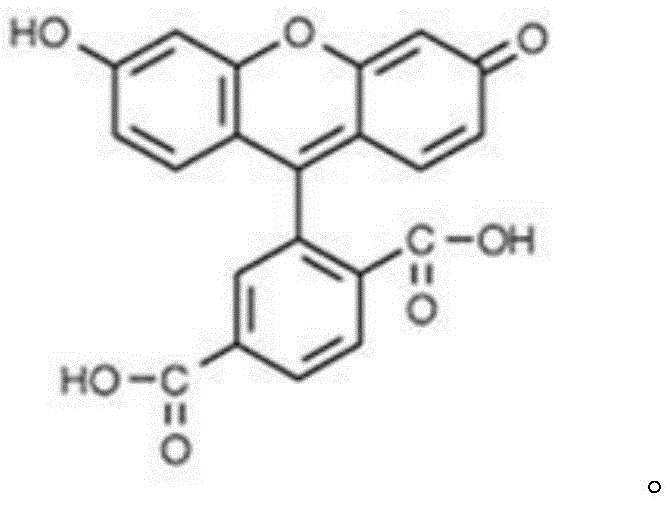
the sequence of the Fluorescein (FAM) -labeled thrombin aptamer is as follows: 5 '-FAM-GGT TGG TGT GGT TGG-3';
the FAM has the following structural formula:

the invention also provides a Ti-based alloy3C2The thrombin aptamer sensor preparation method comprises the following steps:
(1) single layer of Ti3C2The preparation of (1):
preparation of Ti by sintering a mixture of titanium powder, aluminum powder and graphite under argon3AlC2Is prepared from Ti3AlC2Adding the powder into LiF/HCl solution under continuous stirring for etching, washing the acidic mixture with ultrapure water by repeated centrifugation after the reaction is finished until the pH value of the mixture exceeds 5, and finally, carrying out ultrasonic treatment on the slurry and centrifuging to obtain a single-layer Ti3C2A solution;
(2) binding of fluorescein-labeled thrombin aptamer to Ti3C2Surface:
adding fluorescein labeled thrombin aptamer to the Ti prepared in the step (1) at room temperature3C2In solution, after the reaction is complete, the composition is based on Ti3C2The thrombin aptamer sensor of (1).
In the above technical scheme, in the step (1), titanium powder: aluminum powder: the quantity ratio of the graphite substances is 5: 2: 3.
in the technical scheme, the sintering temperature in the step (1) is 1650 ℃, and the time is 2 hours.
In the above technical scheme, Ti in the step (1)3AlC2The powder was ground using a mortar and passed through a 400 mesh screen and then etched.
In the above technical scheme, Ti in the step (1)3AlC2The etching steps of the powder are as follows:
sieving 1g of Ti3AlC2Adding into 8-12M LiF/6-9M HCl solution for etching, and reacting at room temperature for 24 hours.
In the technical scheme, after the etching is finished in the step (1), the centrifugation is repeated, the mixture is washed by ultrapure water for 5 minutes per cycle at the rotating speed of 8000rpm until the pH value of the mixture exceeds 5, and finally, the slurry is subjected to ultrasonic treatment for more than 10 minutes and centrifuged at 3500rpm for 1 h.
In the above technical scheme, Ti in the step (1)3C2The concentration of the solution was confirmed by the following steps: filtering the single layer of Ti with a cellulose membrane with a pore size of 0.22 μm3C2Solution of Ti3C2After drying, Ti3C2The film was peeled and weighed, and was calculated.
In the above technical solution, the specific steps of step (2) are:
adding 20-40nM fluorescein-labeled thrombin aptamer to 0.1-0.2mg/mL Ti prepared in step (1)3C2In solution, the reaction was carried out for 5min, the composition being based on Ti3C2The thrombin aptamer sensor of (1).
The invention has the beneficial effects that:
the invention provides a Ti-based alloy3C2Thrombin aptamer sensor of (1), using Ti3C2The thrombin sensor is constructed by materials, and Ti is widened3C2Application in the biological field, a kind of excellence is constructedElegant nano-detection platforms; compared with the traditional antibody, the thrombin aptamer used as a thrombin recognition agent has the advantages of low price, simple and convenient synthesis, easy storage and quick reaction.
Ti-based material prepared by the invention3C2The thrombin aptamer sensor has the characteristics of high specificity and high sensitivity, and the detection limit of the thrombin aptamer sensor on thrombin is 2.5 multiplied by 10-11mol/L。
Drawings
The present invention will be described in further detail with reference to the accompanying drawings and specific embodiments.
FIG. 1 shows a Ti-based alloy of the present invention3C2Schematic of the thrombin aptamer sensor of (1).
FIG. 2 shows Ti of the present invention3C2Scanning electron micrograph (c).
FIG. 3 shows Ti of the present invention3AlC2And Ti3C2XRD pattern of (a).
FIG. 4 shows a Ti-based alloy of the present invention3C2The thrombin aptamer sensor of (1) fluorescence spectrum after addition of thrombin.
FIG. 5 is a standard curve for thrombin, the linear equation for which is: y 4.3+0.398x, R2=0.986。
Detailed Description
The invention provides a Ti-based alloy3C2The thrombin aptamer sensor is prepared from a single layer of Ti3C2And its binding to Ti3C2A fluorescein-labeled thrombin aptamer composition on the surface; the sequence of the Fluorescein (FAM) -labeled thrombin aptamer is as follows: 5 '-FAM-GGT TGG TGT GGT TGG-3';
the FAM has the following structural formula:

the invention also provides a Ti-based alloy3C2The thrombin aptamer sensor preparation method comprises the following steps:
(1) single layer of Ti3C2The preparation of (1):
preparation of Ti by sintering a mixture of titanium powder, aluminum powder and graphite under argon3AlC2Is prepared from Ti3AlC2Adding the powder into LiF/HCl solution under continuous stirring for etching, washing the acidic mixture with ultrapure water by repeated centrifugation after the reaction is finished until the pH value of the mixture exceeds 5, and finally, carrying out ultrasonic treatment on the slurry and centrifuging to obtain a single-layer Ti3C2A solution;
(2) binding of fluorescein-labeled thrombin aptamer to Ti3C2Surface:
adding fluorescein labeled thrombin aptamer to the Ti prepared in the step (1) at room temperature3C2In solution, after the reaction is complete, the composition is based on Ti3C2The thrombin aptamer sensor of (1).
Preferably, in the step (1), the titanium powder: aluminum powder: the quantity ratio of the graphite substances is 5: 2: 3.
preferably, the sintering temperature in step (1) is 1650 ℃ and the time is 2 hours.
Preferably, Ti in step (1)3AlC2The powder was ground using a mortar and passed through a 400 mesh screen and then etched.
Preferably, Ti in step (1)3AlC2The etching steps of the powder are as follows:
sieving 1g of Ti3AlC2Adding into 8-12M LiF/6-9M HCl solution for etching, and reacting at room temperature for 24 hours.
Preferably, after completion of the etching in step (1), the centrifugation is repeated, the mixture is washed with ultrapure water for 5 minutes per cycle at 8000rpm until the pH of the mixture exceeds 5, and finally, the slurry is sonicated for 10 minutes or more and centrifuged at 3500rpm for 1 hour.
Preferably, Ti in step (1)3C2The concentration of the solution was confirmed by the following steps: filtering the single layer of Ti with a cellulose membrane with a pore size of 0.22 μm3C2Solution of Ti3C2After drying, Ti3C2Film peeling and weighing, i.e. calculatingThus obtaining the product.
Preferably, the specific steps of step (2) are: adding 20-40nM fluorescein-labeled thrombin aptamer to 0.1-0.2mg/mL Ti prepared in step (1)3C2In solution, the reaction was carried out for 5min, the composition being based on Ti3C2The thrombin aptamer sensor of (1).
The Ti-based alloy provided by the invention is used3C2The thrombin aptamer sensor of (1) detects thrombin by the following steps:
(1) drawing a thrombin standard curve: preparing a thrombin solution with a known concentration gradient, and adding the thrombin solution to the Ti-based thrombin prepared in the step (2)3C2The thrombin aptamer sensor solution reacts for 20-30 minutes, supernatant is taken after centrifugation, fluorescence spectrum is measured, the fluorescence intensity of each standard sample at the wavelength of 517nm is taken, the fluorescence intensity is taken as the ordinate, the thrombin concentration is taken as the abscissa, a standard curve is drawn, and a linear equation is obtained.
(2) Measuring the thrombin concentration of the test solution: adding the solution to be tested into the Ti-based solution prepared in the step (2)3C2The thrombin aptamer sensor solution reacts for 20-30 minutes, supernatant is taken after centrifugation, fluorescence spectrum is measured, fluorescence intensity at the wavelength of 517nm is obtained, and the fluorescence intensity is compared with a standard curve to obtain the thrombin concentration of the solution to be measured.
Preferably, in the step (1) of the thrombin detection process, the centrifugation speed is 9000rpm, the centrifugation time is 10 minutes, and the excitation wavelength of the fluorescence spectrum is 470 nm.
Preferably, in the step (2) of the thrombin detection process, the centrifugation speed is 9000rpm, the centrifugation time is 10 minutes, and the excitation wavelength of the fluorescence spectrum is 470 nm.
The Ti-based alloy provided by the present invention will be described with reference to FIG. 13C2The principle of thrombin detection by the thrombin aptamer sensor is as follows: thrombin aptamers are labeled with fluorescein, binding to Ti3C2Surface, fluorescence is transferred by Ti due to fluorescence energy resonance3C2And (4) effectively quenching. In the presence of thrombin, Ti is present due to the higher affinity between thrombin and aptamer3C2The aptamer on the surface willAnd combines with thrombin to form a tetrad. This process results in fluorescein being removed from Ti3C2The surface was detached, the fluorescence energy resonance transfer efficiency was reduced, and fluorescence recovery was observed. Also, the degree of change in the fluorescence spectrum reflects the amount of thrombin in the solution.
The present invention will be further described with reference to specific examples for better illustrating the objects, technical solutions and advantages of the present invention. The preferred embodiments described herein are merely to illustrate and explain the present invention, and the present invention is not limited to these embodiments.
Unless otherwise specified, the starting materials in the examples of the present invention were all purchased commercially, wherein the fluorescein-labeled thrombin aptamers were purchased from Biotechnology engineering (Shanghai) Inc.
All reagents are analytically pure. Ultrapure water having an electrical resistance of 18.25M Ω. cm was obtained from Create Fun Summer-S-10 water purification system (Derliki technologies, Inc., Sichuan, China) and used for all solution preparations.
Example 1:
1) single layer of Ti3C2The synthesis of (2): ti was prepared by sintering a mixture of 7.368g of titanium powder, 1.523g of aluminum powder and 1.109g of graphite at 1650 ℃ under argon for 2 hours3AlC2. Fired Ti3AlC2The powder was ground in a mortar and passed through a 400 mesh screen. 1gTi3AlC2The etching solution was added to 12M LiF/9M HCl solution with continuous stirring and reacted at room temperature for 24 hours. After the etching was completed, the centrifugation was repeated, and the mixture was washed with ultrapure water for 5 minutes per cycle at 8000rpm until the pH of the mixture exceeded 5. Finally, the slurry was sonicated for more than 10 minutes and centrifuged at 3500rpm for 1 hour to yield a monolayer of Ti3C2And (3) solution. To confirm Ti3C210mL of Ti was filtered through a cellulose membrane having a pore size of 0.22 μm3C2And (3) dispersing the mixture. Mixing Ti3C2After drying, Ti3C2Stripping the film, weighing, and calculating to obtain Ti3C2And (4) concentration. FIG. 2 is Ti3C2Scanning electron micrograph (c). FIG. 3 is Ti3AlC2And Ti3C2XRD pattern of (a).
2) Preparation of thrombin aptamer sensor: 40nM fluorescein-labeled thrombin aptamer was added to 0.2mg/mLTi3C2In the solution, the reaction is carried out for 5 minutes, and a thrombin aptamer sensor is formed.
3) Drawing a thrombin standard curve: standard solutions of thrombin were prepared at 8 different concentrations, 25pmol/L, 50pmol/L, 75pmol/L, 100pmol/L, 125pmol/L, 150pmol/L, 175pmol/L and 200 pmol/L. Adding the thrombin solution into the thrombin sensor in the step 2), reacting for 20 minutes at room temperature, centrifuging at the rotating speed of 9000rpm, centrifuging for 10 minutes, taking the supernatant, detecting the fluorescence spectrum by using a Shimadzu RF-5301PC fluorescence spectrometer, taking the fluorescence intensity at the wavelength of 517nm of each standard sample, and drawing a standard curve by taking the fluorescence intensity as a vertical coordinate and the thrombin concentration as a horizontal coordinate to obtain a linear equation. FIG. 4 is an image of fluorescence spectra of thrombin solutions of different concentrations after addition to a thrombin sensor. FIG. 5 is a standard curve of the thrombin obtained.
4) Detecting thrombin in the sample: adding the sample solution into the thrombin sensor in the step 2), reacting at room temperature for 20 minutes, centrifuging at the rotating speed of 9000rpm for 10 minutes, taking the supernatant after centrifugation, detecting the fluorescence spectrum by using a Shimadzu RF-5301PC fluorescence spectrometer, wherein the wavelength of excitation light is 470nm, the fluorescence intensity of the sample at the wavelength of 517nm, and calculating the thrombin concentration in the sample according to a thrombin standard curve.
Example 2:
1) single layer of Ti3C2The synthesis of (2): ti was prepared by sintering a mixture of 3.684g of titanium powder, 0.762g of aluminum powder and 0.555g of graphite at 1650 ℃ under argon for 2 hours3AlC2. Fired Ti3AlC2The powder was ground in a mortar and passed through a 400 mesh screen. 1gTi3AlC2The solution was added to 8M LiF/6M HCl solution with continuous stirring for etching and reacted at room temperature for 24 hours. After the etching was completed, the centrifugation was repeated, and the mixture was washed with ultrapure water for 5 minutes per cycle at 8000rpm until the pH of the mixture exceeded 5. Finally, the slurry was sonicated for more than 10 minutes and centrifuged at 3500rpm for 1 hour to yield a monolayer of Ti3C2And (3) solution. To confirm Ti3C210mL of Ti was filtered through a cellulose membrane having a pore size of 0.22 μm3C2And (3) dispersing the mixture. Mixing Ti3C2After drying, Ti3C2Stripping the film, weighing, and calculating to obtain Ti3C2And (4) concentration.
2) Preparation of thrombin aptamer sensor: 20nM fluorescein-labeled thrombin aptamer was added to 0.1mg/mLTi3C2In the solution, the reaction is carried out for 5 minutes, and a thrombin aptamer sensor is formed.
3) Drawing a thrombin standard curve: standard solutions of thrombin were prepared at 8 different concentrations, 25pmol/L, 50pmol/L, 75pmol/L, 100pmol/L, 125pmol/L, 150pmol/L, 175pmol/L and 200 pmol/L. Adding the thrombin solution into the thrombin sensor in the step 2), reacting for 20 minutes at room temperature, centrifuging at the rotating speed of 9000rpm, centrifuging for 10 minutes, taking the supernatant, detecting the fluorescence spectrum by using a Shimadzu RF-5301PC fluorescence spectrometer, taking the fluorescence intensity at the wavelength of 517nm of each standard sample, and drawing a standard curve by taking the fluorescence intensity as a vertical coordinate and the thrombin concentration as a horizontal coordinate to obtain a linear equation.
4) Detecting thrombin in the sample: adding the sample solution into the thrombin sensor in the step 2), reacting for 25 minutes at room temperature, centrifuging at 9000rpm for 10 minutes, taking the supernatant, detecting the fluorescence spectrum by using a Shimadzu RF-5301PC fluorescence spectrometer, wherein the wavelength of the excitation light is 470nm, the fluorescence intensity of the sample at the wavelength of 517nm, and calculating the thrombin concentration in the sample according to a thrombin standard curve.
Example 3:
1) single layer of Ti3C2The synthesis of (2): ti was prepared by sintering a mixture of 14.736g of titanium powder, 3.048g of aluminum powder and 2.22g of graphite at 1650 ℃ under argon for 2 hours3AlC2. Fired Ti3AlC2The powder was ground in a mortar and passed through a 400 mesh screen. 1gTi3AlC2The solution was added to 8M LiF/6M HCl solution with continuous stirring for etching and reacted at room temperature for 24 hours. After completion of the etching, the centrifugation was repeated, and the mixture was washed with ultrapure water for 5 minutes per cycle at 8000rpmUntil the pH of the mixture exceeds 5. Finally, the slurry was sonicated for more than 10 minutes and centrifuged at 3500rpm for 1 hour to yield a monolayer of Ti3C2And (3) solution. To confirm Ti3C210mL of Ti was filtered through a cellulose membrane having a pore size of 0.22 μm3C2And (3) dispersing the mixture. Mixing Ti3C2After drying, Ti3C2Stripping the film, weighing, and calculating to obtain Ti3C2And (4) concentration.
2) Preparation of thrombin aptamer sensor: 30nM fluorescein-labeled thrombin aptamer was added to 0.15mg/ml Ti3C2In the solution, the reaction is carried out for 5 minutes, and a thrombin aptamer sensor is formed.
3) Drawing a thrombin standard curve: standard solutions of thrombin were prepared at 8 different concentrations, 25pmol/L, 50pmol/L, 75pmol/L, 100pmol/L, 125pmol/L, 150pmol/L, 175pmol/L and 200 pmol/L. Adding the thrombin solution into the thrombin sensor in the step 2), reacting for 20 minutes at room temperature, centrifuging at the rotating speed of 9000rpm, centrifuging for 10 minutes, taking the supernatant, detecting the fluorescence spectrum by using a Shimadzu RF-5301PC fluorescence spectrometer, taking the fluorescence intensity at the wavelength of 517nm of each standard sample, and drawing a standard curve by taking the fluorescence intensity as a vertical coordinate and the thrombin concentration as a horizontal coordinate to obtain a linear equation.
4) Detecting thrombin in the sample: adding the sample solution into the thrombin sensor in the step 2), reacting at room temperature for 30 minutes, centrifuging at the rotating speed of 9000rpm for 10 minutes, taking the supernatant after centrifugation, detecting the fluorescence spectrum by using a Shimadzu RF-5301PC fluorescence spectrometer, wherein the wavelength of excitation light is 470nm, the fluorescence intensity of the sample at the wavelength of 517nm, and calculating the thrombin concentration in the sample according to a thrombin standard curve.
Although the present invention has been described with reference to a few embodiments, it should be understood that the present invention is not limited to the above-described embodiments, but rather, the present invention is not limited to the above-described embodiments.
Claims (9)
Priority Applications (1)
| Application Number | Priority Date | Filing Date | Title |
|---|---|---|---|
| CN201911293066.3A CN110907422B (en) | 2019-12-16 | 2019-12-16 | Thrombin aptamer sensor based on Ti3C2 and preparation method thereof |
Applications Claiming Priority (1)
| Application Number | Priority Date | Filing Date | Title |
|---|---|---|---|
| CN201911293066.3A CN110907422B (en) | 2019-12-16 | 2019-12-16 | Thrombin aptamer sensor based on Ti3C2 and preparation method thereof |
Publications (2)
| Publication Number | Publication Date |
|---|---|
| CN110907422A true CN110907422A (en) | 2020-03-24 |
| CN110907422B CN110907422B (en) | 2021-07-06 |
Family
ID=69825910
Family Applications (1)
| Application Number | Title | Priority Date | Filing Date |
|---|---|---|---|
| CN201911293066.3A Expired - Fee Related CN110907422B (en) | 2019-12-16 | 2019-12-16 | Thrombin aptamer sensor based on Ti3C2 and preparation method thereof |
Country Status (1)
| Country | Link |
|---|---|
| CN (1) | CN110907422B (en) |
Cited By (1)
| Publication number | Priority date | Publication date | Assignee | Title |
|---|---|---|---|---|
| CN116008566A (en) * | 2022-07-11 | 2023-04-25 | 储天新能源科技(长春)有限公司 | Titanium carbide-based aptasensor for simultaneous detection of insulin and vaspin and preparation method thereof |
Citations (9)
| Publication number | Priority date | Publication date | Assignee | Title |
|---|---|---|---|---|
| CN101424642A (en) * | 2008-11-14 | 2009-05-06 | 中国科学院上海应用物理研究所 | Target molecule detecting method based on nanometer aurum and nucleic acid structure |
| CN101430334A (en) * | 2008-11-05 | 2009-05-13 | 中国科学院上海应用物理研究所 | Detection method for target substance based on aptamer and its solid phase biological inductor |
| EP2257624A2 (en) * | 2008-02-05 | 2010-12-08 | Medical Research Council | Methods and compositions |
| CN102608177A (en) * | 2012-03-02 | 2012-07-25 | 北京航空航天大学 | Method for detecting thrombin through biosensor prepared based on ionic channel and aptamer |
| EP2628013A2 (en) * | 2010-10-14 | 2013-08-21 | The Johns Hopkins University | Biomarkers of brain injury |
| CN103630517A (en) * | 2013-11-15 | 2014-03-12 | 南京邮电大学 | A thrombin detection method based on split aptamer and water-soluble conjugated polymer |
| CN104960446A (en) * | 2015-07-14 | 2015-10-07 | 吉林大学 | Honeycomb foam structure seat |
| CN105200119A (en) * | 2015-10-22 | 2015-12-30 | 江苏大学 | Graphene oxide based sensor as well as preparation method and application thereof |
| CN109516513A (en) * | 2018-12-21 | 2019-03-26 | 吉林大学 | The method of heavy nonaqueous phase liquid pollutant density adjusting in a kind of pair of underground water |
-
2019
- 2019-12-16 CN CN201911293066.3A patent/CN110907422B/en not_active Expired - Fee Related
Patent Citations (9)
| Publication number | Priority date | Publication date | Assignee | Title |
|---|---|---|---|---|
| EP2257624A2 (en) * | 2008-02-05 | 2010-12-08 | Medical Research Council | Methods and compositions |
| CN101430334A (en) * | 2008-11-05 | 2009-05-13 | 中国科学院上海应用物理研究所 | Detection method for target substance based on aptamer and its solid phase biological inductor |
| CN101424642A (en) * | 2008-11-14 | 2009-05-06 | 中国科学院上海应用物理研究所 | Target molecule detecting method based on nanometer aurum and nucleic acid structure |
| EP2628013A2 (en) * | 2010-10-14 | 2013-08-21 | The Johns Hopkins University | Biomarkers of brain injury |
| CN102608177A (en) * | 2012-03-02 | 2012-07-25 | 北京航空航天大学 | Method for detecting thrombin through biosensor prepared based on ionic channel and aptamer |
| CN103630517A (en) * | 2013-11-15 | 2014-03-12 | 南京邮电大学 | A thrombin detection method based on split aptamer and water-soluble conjugated polymer |
| CN104960446A (en) * | 2015-07-14 | 2015-10-07 | 吉林大学 | Honeycomb foam structure seat |
| CN105200119A (en) * | 2015-10-22 | 2015-12-30 | 江苏大学 | Graphene oxide based sensor as well as preparation method and application thereof |
| CN109516513A (en) * | 2018-12-21 | 2019-03-26 | 吉林大学 | The method of heavy nonaqueous phase liquid pollutant density adjusting in a kind of pair of underground water |
Non-Patent Citations (8)
Cited By (1)
| Publication number | Priority date | Publication date | Assignee | Title |
|---|---|---|---|---|
| CN116008566A (en) * | 2022-07-11 | 2023-04-25 | 储天新能源科技(长春)有限公司 | Titanium carbide-based aptasensor for simultaneous detection of insulin and vaspin and preparation method thereof |
Also Published As
| Publication number | Publication date |
|---|---|
| CN110907422B (en) | 2021-07-06 |
Similar Documents
| Publication | Publication Date | Title |
|---|---|---|
| Fan et al. | Rational engineering the DNA tetrahedrons of dual wavelength ratiometric electrochemiluminescence biosensor for high efficient detection of SARS-CoV-2 RdRp gene by using entropy-driven and bipedal DNA walker amplification strategy | |
| Zhao et al. | Co3O4-Au polyhedron mimic peroxidase-and cascade enzyme-assisted cycling process-based photoelectrochemical biosensor for monitoring of miRNA-141 | |
| Huang et al. | “Three-in-one” nanohybrids as synergistic nanoquenchers to enhance no-wash fluorescence biosensors for ratiometric detection of cancer biomarkers | |
| Xu et al. | Optical nanobiosensor based on surface-enhanced Raman spectroscopy and catalytic hairpin assembly for early-stage lung cancer detection via blood circular RNA | |
| Sun et al. | Reversible ratiometric electrochemiluminescence biosensor based on DNAzyme regulated resonance energy transfer for myocardial miRNA detection | |
| Li et al. | A zirconium-based metal–organic framework sensitized by thioflavin-T for sensitive photoelectrochemical detection of C-reactive protein | |
| CN110412097A (en) | Preparation method of a photoelectrochemical sensor for ultrasensitive detection of microRNA | |
| Guo et al. | A colorimetric and electrochemical dual-mode biosensor for thrombin using a magnetic separation technique | |
| Wu et al. | PCN-224/nano-zinc oxide nanocomposite-based electrochemiluminescence biosensor for HPV-16 detection by multiple cycling amplification and hybridization chain reaction | |
| CN107543852A (en) | A kind of Electrochemiluminescsensor sensor based on functional metal organic framework materials | |
| Jia et al. | Target-triggered and controlled release plasmon-enhanced fluorescent AIE probe for conformational monitoring of insulin fibrillation | |
| CN105274195B (en) | A kind of kit for detecting cancer markers miRNA | |
| Li et al. | Carbon nanospheres for fluorescent biomolecular detection | |
| CN110907422B (en) | Thrombin aptamer sensor based on Ti3C2 and preparation method thereof | |
| Zhou et al. | A DNA-Schiff base functional nanopore sensing platform for the highly sensitive detection of Al 3+ and Zn 2+ ions | |
| Chen et al. | Label-free electrochemiluminescence aptasensor for rapid and accurate detection of cardiac troponin I | |
| CN118421798A (en) | Serum biomarker for detecting colorectal cancer, SERS sensor and preparation method | |
| Peng et al. | Development of surface-enhanced Raman scattering-sensing Method by combining novel Ag@ Au core/shell nanoparticle-based SERS probe with hybridization chain reaction for high-sensitive detection of hepatitis C virus nucleic acid | |
| Bian et al. | A natural biomaterial promotes hybridization chain reaction for ultra-sensitive detection of miRNA-155 | |
| Sun et al. | Electrochemical aptasensors based on porous carbon derived from graphene oxide/ZIF-8 composites for the detection of Erwinia cypripedii | |
| CN111766288B (en) | Based on oxygen boosting vacancy NiCo 2 O 4 Preparation method of electrochemiluminescence sensor | |
| Kong et al. | Self-enhanced biosensor with luminophore-catalyst integrated strategies and ECL-RET for ultrasensitive SARS-CoV-2 N immunoassay | |
| CN109444103B (en) | Preparation method of PEI functionalized green fluorescent carbon dots and thrombin detection method based on carbon dots | |
| CN110132946A (en) | A kind of aptasensor and its preparation method and application | |
| CN110736731B (en) | Leukemia fusion gene detection method based on SERS (surface enhanced Raman scattering) spectrum technology |
Legal Events
| Date | Code | Title | Description |
|---|---|---|---|
| PB01 | Publication | ||
| PB01 | Publication | ||
| SE01 | Entry into force of request for substantive examination | ||
| SE01 | Entry into force of request for substantive examination | ||
| GR01 | Patent grant | ||
| GR01 | Patent grant | ||
| CF01 | Termination of patent right due to non-payment of annual fee |
Granted publication date: 20210706 |
|
| CF01 | Termination of patent right due to non-payment of annual fee |