CN110892066A - Methods of transforming bacterial cells - Google Patents
Methods of transforming bacterial cells Download PDFInfo
- Publication number
- CN110892066A CN110892066A CN201880047705.5A CN201880047705A CN110892066A CN 110892066 A CN110892066 A CN 110892066A CN 201880047705 A CN201880047705 A CN 201880047705A CN 110892066 A CN110892066 A CN 110892066A
- Authority
- CN
- China
- Prior art keywords
- dna
- amino acid
- seq
- host cell
- sequence
- Prior art date
- Legal status (The legal status is an assumption and is not a legal conclusion. Google has not performed a legal analysis and makes no representation as to the accuracy of the status listed.)
- Pending
Links
Images


Classifications
-
- C—CHEMISTRY; METALLURGY
- C12—BIOCHEMISTRY; BEER; SPIRITS; WINE; VINEGAR; MICROBIOLOGY; ENZYMOLOGY; MUTATION OR GENETIC ENGINEERING
- C12N—MICROORGANISMS OR ENZYMES; COMPOSITIONS THEREOF; PROPAGATING, PRESERVING, OR MAINTAINING MICROORGANISMS; MUTATION OR GENETIC ENGINEERING; CULTURE MEDIA
- C12N9/00—Enzymes; Proenzymes; Compositions thereof; Processes for preparing, activating, inhibiting, separating or purifying enzymes
- C12N9/10—Transferases (2.)
- C12N9/1003—Transferases (2.) transferring one-carbon groups (2.1)
- C12N9/1007—Methyltransferases (general) (2.1.1.)
-
- C—CHEMISTRY; METALLURGY
- C12—BIOCHEMISTRY; BEER; SPIRITS; WINE; VINEGAR; MICROBIOLOGY; ENZYMOLOGY; MUTATION OR GENETIC ENGINEERING
- C12N—MICROORGANISMS OR ENZYMES; COMPOSITIONS THEREOF; PROPAGATING, PRESERVING, OR MAINTAINING MICROORGANISMS; MUTATION OR GENETIC ENGINEERING; CULTURE MEDIA
- C12N15/00—Mutation or genetic engineering; DNA or RNA concerning genetic engineering, vectors, e.g. plasmids, or their isolation, preparation or purification; Use of hosts therefor
- C12N15/09—Recombinant DNA-technology
- C12N15/63—Introduction of foreign genetic material using vectors; Vectors; Use of hosts therefor; Regulation of expression
- C12N15/74—Vectors or expression systems specially adapted for prokaryotic hosts other than E. coli, e.g. Lactobacillus, Micromonospora
- C12N15/75—Vectors or expression systems specially adapted for prokaryotic hosts other than E. coli, e.g. Lactobacillus, Micromonospora for Bacillus
Landscapes
- Health & Medical Sciences (AREA)
- Life Sciences & Earth Sciences (AREA)
- Genetics & Genomics (AREA)
- Chemical & Material Sciences (AREA)
- Engineering & Computer Science (AREA)
- Zoology (AREA)
- Organic Chemistry (AREA)
- Bioinformatics & Cheminformatics (AREA)
- Wood Science & Technology (AREA)
- General Engineering & Computer Science (AREA)
- Biomedical Technology (AREA)
- Biotechnology (AREA)
- Microbiology (AREA)
- Biochemistry (AREA)
- Molecular Biology (AREA)
- General Health & Medical Sciences (AREA)
- Medicinal Chemistry (AREA)
- Physics & Mathematics (AREA)
- Biophysics (AREA)
- Plant Pathology (AREA)
- Enzymes And Modification Thereof (AREA)
- Micro-Organisms Or Cultivation Processes Thereof (AREA)
Abstract
Description
技术领域technical field
本发明涉及表达甲基转移酶的方法和甲基转移酶用于产生甲基化DNA的用途。另外,本发明涉及增加向细菌宿主细胞中引入DNA的效率。The present invention relates to methods of expressing methyltransferases and the use of methyltransferases for the production of methylated DNA. Additionally, the present invention relates to increasing the efficiency of DNA introduction into bacterial host cells.
发明背景Background of the Invention
向细菌宿主细胞中引入DNA的效率经常是允许产生蛋白质(例如,酶、肽)和低分子量与高分子量化学化合物(例如,抗生素、糖、聚-γ-谷氨酸盐)的细菌宿主遗传操作或DNA引入过程的限制步骤。除了用于许多不同细菌宿主细胞的多种优化的DNA转化方法和技术(如原生质体转化、电穿孔、化学转化、天然和诱导型感受态)外,DNA摄取及转移入细菌宿主受宿主细胞特异性限制修饰系统(RMS)限制,所述系统将非差异性或差异性甲基化的DNA识别为外来,导致该DNA在细菌宿主细胞内部限制和降解。宿主细胞的自身DNA被具有使宿主基因组中潜在RE靶位点甲基化的相同DNA结合特异性甲基化的同族DNA甲基转移酶(MT酶(MTase))保护免遭限制酶(RE)活性并且因此保护它们免遭切割(Blow,M.J.等人(2016).The Epigenomic Landscape of Prokaryotes.PLoS.Genet.12,e1005854)。REBASE数据库包含一个关于细菌限制修饰(RM)系统的组分的综合数据库信息(Roberts,R.J.,Vincze,T.,Posfai,J.和Macelis,D.(2015).REBASE-a database for DNA restriction andmodification:enzymes,genes and genomes.Nucleic Acids Res.43,D298-D299)。The efficiency of introducing DNA into bacterial host cells is often the genetic manipulation of the bacterial host that allows the production of proteins (eg, enzymes, peptides) and low and high molecular weight chemical compounds (eg, antibiotics, sugars, poly-gamma-glutamate) or limiting steps in the DNA introduction process. In addition to a variety of optimized DNA transformation methods and techniques (eg, protoplast transformation, electroporation, chemical transformation, native and inducible competence) for many different bacterial host cells, DNA uptake and transfer into bacterial hosts is governed by host cell-specific Sexual Restriction Modification System (RMS) restriction, which recognizes non-differentially or differentially methylated DNA as foreign, causing the DNA to be restricted and degraded inside the bacterial host cell. The host cell's own DNA is protected from restriction enzymes (RE) by cognate DNA methyltransferases (MTases) methylated with the same DNA-binding specificities that methylate potential RE target sites in the host genome active and thus protect them from cleavage (Blow, M.J. et al. (2016). The Epigenomic Landscape of Prokaryotes. PLoS. Genet. 12, e1005854). The REBASE database contains a comprehensive database of information on components of bacterial restriction modification (RM) systems (Roberts, R.J., Vincze, T., Posfai, J. and Macelis, D. (2015). REBASE-a database for DNA restriction and modification : enzymes, genes and genomes. Nucleic Acids Res. 43, D298-D299).
已经成功地对革兰氏阳性细菌宿主巨大芽孢杆菌(Bacillus megaterium)(Richhardt,J.,Larsen,M.,and Meinhardt,F.(2010).An improved transconjugationprotocol for Bacillus megaterium facilitating a direct genetic knockout.Appl.Microbiol.Biotechnol.86,1959-1965)和谷氨酸棒杆菌(Corynebacterium glutamicum)(Schafer,A.,Kalinowski,J.,Simon,R.,Seep-Feldhaus,A.H.和Puhler,A.(1990).High-frequency conjugal plasmid transfer from gram-negative Escherichia coli tovarious gram-positive coryneform bacteria.J.Bacteriol.172,1663-1666)展示在DNA转化前热灭活RM系统以增加转化效率。The Gram-positive bacterial host Bacillus megaterium (Richhardt, J., Larsen, M., and Meinhardt, F. (2010). An improved transconjugation protocol for Bacillus megaterium facilitating a direct genetic knockout. Appl . Microbiol. Biotechnol. 86, 1959-1965) and Corynebacterium glutamicum (Schafer, A., Kalinowski, J., Simon, R., Seep-Feldhaus, A.H. and Puhler, A. (1990) . High-frequency conjugal plasmid transfer from gram-negative Escherichia coli to various gram-positive coryneform bacteria. J. Bacteriol. 172, 1663-1666) demonstrated heat inactivation of the RM system prior to DNA transformation to increase transformation efficiency.
专利DE4005025及其中的参考文献描述了使用细菌宿主完整细胞提取物使靶DNA在体外甲基化用于后续转移入细菌宿主(例如,地衣芽孢杆菌(Bacillus licheniformis)和解淀粉芽孢杆菌(Bacillus amyloliquefacins))。Patent DE4005025 and references therein describe the use of bacterial host whole cell extracts to methylate target DNA in vitro for subsequent transfer into bacterial hosts (eg Bacillus licheniformis and Bacillus amyloliquefacins) .
对细菌宿主RMS的鉴定通常充分描述于专利US6689573中并且更具体地在专利EP20895163中对地衣芽孢杆菌描述并由De Feyter等人对野油菜黄单胞菌(Xantomonascampestris)(De Feyter,R.和Gabriel,D.W.(1991).Use of cloned DNA methylasegenes to increase the frequency of transfer of foreign genes into Xanthomonascampestris pv.malvacearum.J.Bacteriol.173,6421-6427)描述。另外,EP618295中和EP2089516中描述了细菌克隆宿主(如大肠杆菌)中表达靶细菌宿主MT酶以使DNA体内甲基化的方法,其中转移入靶细菌宿主后,保护所述DNA免遭靶细菌宿主中RE降解。EP2089516还描述了可以良好用于使DNA体外甲基化的重组表达的和纯化的靶宿主MT酶。The identification of the bacterial host RMS is generally fully described in patent US6689573 and more specifically in patent EP20895163 for Bacillus licheniformis and by De Feyter et al. for Xantomonascampestris (De Feyter, R. and Gabriel). , D.W. (1991). Use of cloned DNA methylasegenes to increase the frequency of transfer of foreign genes into Xanthomonascampestris pv. malvacearum. J. Bacteriol. 173, 6421-6427) described. In addition, EP618295 and EP2089516 describe a method for expressing a target bacterial host MTase in a bacterial cloning host (such as E. coli) to methylate DNA in vivo, wherein after transfer into the target bacterial host, the DNA is protected from the target bacteria RE degradation in the host. EP2089516 also describes recombinantly expressed and purified target host MTases that can be well used to methylate DNA in vitro.
Lubys等人((1995)Gene 157:25-29)和Madsen等人((1995)Applied andEnvironmental Microbiology,64(7):2424-2431)描述了编码以GCNGC作为识别序列的DNA甲基转移酶的DNA序列(分别是NCBI登录号X81638,位置1112-2056;和Y12707,位置1392-2342),与EP2089516中公开的SEQ ID NO:3具有大于74%的序列同一性(本文根据EP2089516,通过使用NEEDLE程序采用“最长同一性”输出确定序列同一性)。Lubys et al. ((1995) Gene 157:25-29) and Madsen et al. ((1995) Applied and Environmental Microbiology, 64(7):2424-2431) describe DNA methyltransferases encoding DNA methyltransferases with GCNGC as the recognition sequence. DNA sequences (NCBI accession numbers X81638, positions 1112-2056; and Y12707, positions 1392-2342, respectively), have greater than 74% sequence identity to SEQ ID NO: 3 disclosed in EP2089516 (herein according to EP2089516, by using NEEDLE The program uses the "longest identity" output to determine sequence identity).
令人惊讶地,发明人发现,与使用内源甲基转移酶相比,使用包含某些结构特征的在靶细菌细胞的相同DNA序列背景下产生相同甲基化修饰的甲基转移酶显示改善的转化效率。Surprisingly, the inventors have found that the use of methyltransferases comprising certain structural features that produce the same methylation modifications in the context of the same DNA sequence of the target bacterial cell shows an improvement over the use of endogenous methyltransferases. conversion efficiency.
发明简述Brief description of the invention
本发明涉及一种产生DNA甲基转移酶的方法,所述方法包括步骤The present invention relates to a method for producing DNA methyltransferase, the method comprising the steps of
(a)提供包含异源多核苷酸的重组宿主细胞,所述异源多核苷酸编码DNA甲基转移酶,其中DNA甲基转移酶使DNA甲基化,产生在识别序列GCNGC中含有5-甲基胞嘧啶的DNA,其中DNA甲基转移酶包含根据SEQ ID NO:33的编号在氨基酸残基72和氨基酸残基106之间的少于35个氨基酸残基;(a) providing a recombinant host cell comprising a heterologous polynucleotide encoding a DNA methyltransferase, wherein the DNA methyltransferase methylates DNA, resulting in a 5- DNA of methylcytosine, wherein the DNA methyltransferase comprises less than 35 amino acid residues between amino acid residue 72 and amino acid residue 106 according to the numbering of SEQ ID NO: 33;
(b)在可导致DNA甲基转移酶产生的条件下培养步骤(a)的重组宿主细胞;并且(b) culturing the recombinant host cell of step (a) under conditions that result in the production of a DNA methyltransferase; and
(c)任选地,回收DNA甲基转移酶。(c) Optionally, recovering the DNA methyltransferase.
本发明也涉及一种产生细菌转化体的方法,所述方法包括:The present invention also relates to a method for producing bacterial transformants, the method comprising:
(a)向第一细菌宿主细胞中引入多核苷酸,所述多核苷酸包含编码DNA甲基转移酶的多核苷酸序列,所述DNA包含甲基化识别序列GCNGC,以产生在识别序列GCNGC中含有5-甲基胞嘧啶的甲基化DNA,其中DNA甲基转移酶包含根据SEQ ID NO:33的编号在氨基酸残基72和氨基酸残基106之间的少于35个氨基酸残基;(a) introducing into the first bacterial host cell a polynucleotide comprising a polynucleotide sequence encoding a DNA methyltransferase, the DNA comprising a methylation recognition sequence GCNGC, to generate the recognition sequence GCNGC in the first bacterial host cell Methylated DNA containing 5-methylcytosine in, wherein the DNA methyltransferase comprises less than 35 amino acid residues between amino acid residue 72 and amino acid residue 106 according to the numbering of SEQ ID NO: 33;
(b)将甲基化DNA从第一细菌宿主细胞转移入第二细菌宿主细胞,其中第二细菌宿主细胞包含能够降解该DNA但不能降解该甲基化DNA的限制性核酸内切酶;并且(b) transferring methylated DNA from a first bacterial host cell into a second bacterial host cell, wherein the second bacterial host cell comprises a restriction endonuclease capable of degrading the DNA but not the methylated DNA; and
(c)分离包含该甲基化DNA的第二细菌宿主细胞的转化体。(c) isolating a transformant of a second bacterial host cell containing the methylated DNA.
另外,本发明涉及一种产生细菌转化体的方法,所述方法包括步骤In addition, the present invention relates to a method for producing bacterial transformants, the method comprising the steps of
(a)用DNA甲基转移酶使DNA在体外甲基化,所述DNA包含甲基化识别序列GCNGC,以产生在识别序列GCNGC中含有5-甲基胞嘧啶的甲基化DNA,其中DNA甲基转移酶包含根据SEQID NO:33的编号在氨基酸残基72和氨基酸残基106之间的少于35个氨基酸残基;(a) In vitro methylation of DNA comprising the methylation recognition sequence GCNGC with a DNA methyltransferase to produce methylated DNA comprising 5-methylcytosine in the recognition sequence GCNGC, wherein the DNA The methyltransferase comprises less than 35 amino acid residues between amino acid residue 72 and amino acid residue 106 according to the numbering of SEQ ID NO: 33;
(b)向细菌宿主细胞中引入甲基化DNA,其中细菌宿主细胞包含能够降解DNA但是不能降解甲基化DNA的限制性核酸内切酶;和(b) introducing methylated DNA into a bacterial host cell, wherein the bacterial host cell contains a restriction endonuclease capable of degrading DNA but not methylated DNA; and
(c)分离包含该甲基化DNA的细菌宿主细胞的转化体。(c) isolating transformants of bacterial host cells containing the methylated DNA.
与本发明的方法观察到改善的转化效率一样,本发明也涉及使用通过本发明方法获得的甲基化DNA用于改善细菌宿主细胞中DNA转化效率。As with the improved transformation efficiency observed with the methods of the present invention, the present invention also relates to the use of methylated DNA obtained by the methods of the present invention for improving the efficiency of DNA transformation in bacterial host cells.
附图简述Brief Description of Drawings
图1显示来自基于结构对本文所公开的甲基转移酶的预测结构的多重序列比对的有关部分,其可以使用标准同源性建模程序如SWISS-MODEL网络服务器(Biasini M.,Bienert S.,Waterhouse A.,Arnold K.,Studer G.,Schmidt T.,Kiefer F.,CassarinoT.G.,Bertoni M.,Bordoli L.,Schwede T.(2014).SWISS-MODEL:modelling proteintertiary and quaternary structure using evolutionary information NucleicAcids Research 2014(2014年7月1日)42(W1):W252-W258),使用默认参数和来自RCSB PDB数据库的以下结构模板(Berman H.M.,Westbrook J.,Feng Z.,Gilliland G.,Bhat T.N.,Weissig H.,Shindyalov I.N.,Bourne P.E.(2000)The Protein Data Bank NucleicAcids Research,28:235-242.):2uyc_A(用于SEQ ID NO:33(M.Fnu4HI)、SEQ ID NO:34(M.RBH3250)、SEQ ID NO:41(M.CoclI))、2i9k_C(用于SEQ ID NO:36(M.Bsp6I)、SEQ IDNO:43(M.LIaDII))、3swr_A(用于SEQ ID NO:37(M.Cdi13307II)、SEQ ID NO:38(M.Cdi630IV))、1mht_C(用于SEQ ID NO:39(M.Ckr177III))、2z6u_A(用于SEQ ID NO:40(M.CmaLM2II))和9mht_C(用于SEQ ID NO:42(M.Fsp4HI))产生。借助TMalign 20160521版(Y.Zhang,J.Skolnick(2005),TM-align:A protein structure alignment algorithmbased on TM-score,Nucleic Acids Research,33:2302-2309)使用默认参数,将预测的结构在结构上与SEQ ID NO:33(M.Fnu4HI)的预测结构比对。使用合并模型的默认参数,使用MAFFT,版本7,221(Katoh,S.(2013)MAFFT multiple sequence alignment softwareversion 7:improvements in performance and usability Molecular Biology andEvolution 30:772-780),将配对结构性比对合并成多重序列比对。将二级结构注释添加至本图作结构预测的共有序列。将重要的保守位置作为灰色列突出显示并由希腊字母标识。Figure 1 shows relevant portions from a structure-based multiple sequence alignment of the predicted structures of the methyltransferases disclosed herein, which can be obtained using standard homology modeling programs such as the SWISS-MODEL web server (Biasini M., Bienert S. ., Waterhouse A., Arnold K., Studer G., Schmidt T., Kiefer F., Cassarino T.G., Bertoni M., Bordoli L., Schwede T. (2014). SWISS-MODEL: modelling proteintertiary and quaternary structure using evolutionary information NucleicAcids Research 2014 (July 1, 2014) 42(W1):W252-W258), using default parameters and the following structure templates from the RCSB PDB database (Berman H.M., Westbrook J., Feng Z., Gilliland G., Bhat T.N., Weissig H., Shindyalov I.N., Bourne P.E. (2000) The Protein Data Bank Nucleic Acids Research, 28:235-242.): 2uyc_A (for SEQ ID NO:33 (M.Fnu4HI), SEQ ID NO: 34 (M.RBH3250), SEQ ID NO: 41 (M. CoclI)), 2i9k_C (for SEQ ID NO: 36 (M.Bsp6I), SEQ ID NO: 43 (M.LIaDII)), 3swr_A (for in SEQ ID NO:37 (M.Cdi13307II), SEQ ID NO:38 (M.Cdi630IV)), 1mht_C (for SEQ ID NO:39 (M.Ckr177III)), 2z6u_A (for SEQ ID NO:40 ( M.CmaLM2II)) and 9mht_C (for SEQ ID NO: 42 (M.Fsp4HI)) were generated. With the help of TMalign version 20160521 (Y. Zhang, J. Skolnick (2005), TM-align: A protein structure alignment algorithm based on TM-score, Nucleic Acids Research, 33: 2302-2309) using default parameters, the predicted structures were The above is aligned with the predicted structure of SEQ ID NO: 33 (M.Fnu4HI). Pairwise structural alignments were performed using MAFFT,
图2显示质粒的SatI限制性消化物的0.8%琼脂糖凝胶,所述质粒从含有不同MT酶的大肠杆菌菌株分离(实施例1)。泳道1:DNA标志物-Generuler 1 kb DNA梯(ThermoFisherScientific)。泳道2:Ec#83,泳道3:Ec#84,泳道4:Ec#85,泳道5:Ec#86,泳道6:Ec#87,泳道7:Ec#88。泳道8:Ec#82。泳道10:DNA标志物。Figure 2 shows a 0.8% agarose gel of SatI restriction digests of plasmids isolated from E. coli strains containing various MT enzymes (Example 1). Lane 1: DNA marker -
图3显示从如实施例2中所述的不同大肠杆菌菌株分离的质粒DNA进入地衣芽孢杆菌(B.licheniformis)ATCC 53926细胞的相对转化效率。大肠杆菌菌株Ec#083携带地衣芽孢杆菌ATCC 53926DNA甲基转移酶并设定为100%。大肠杆菌菌株Ec#084携带地衣芽孢杆菌ATCC 53926DNA甲基转移酶的密码子优化变体并且充当基因表达对照。GCNGC特异性DNA甲基转移酶未甲基化的来自大肠杆菌Ec#082的质粒DNA未回收任何转化体。从下述大肠杆菌菌株(Ec#85-87)分离的转化入地衣芽孢杆菌ATCC 53926的质粒DNA导致转化效率显著增加,其中所述大肠杆菌菌株携带具有相似结构且对地衣芽孢杆菌ATCC 53926为异源的MT酶。与Ec#83相比,从下述大肠杆菌菌株分离的质粒DNA也导致转化效率显著增加,其中所述大肠杆菌菌株携带地衣芽孢杆菌ATCC 53926的从SEQ ID NO:34缺失氨基酸103-108(总计截短6个氨基酸,产生SEQ ID NO:35)的同源MT酶(Ec#88)。Figure 3 shows the relative transformation efficiencies of plasmid DNA isolated from different E. coli strains as described in Example 2 into B. licheniformis ATCC 53926 cells. E. coli
图4显示如实施例3中所述的从枯草芽孢杆菌(B.subtilis)Bs#54和Bs#55菌株分离的pUK56质粒DNA进入地衣芽孢杆菌ATCC 53926细胞的相对转化效率。从地衣芽孢杆菌Bli#112分离的、携带地衣芽孢杆菌ATCC 53926 DNA甲基化模式的pUK56质粒DNA的转化效率设定为100%。4 shows the relative transformation efficiency of pUK56 plasmid DNA isolated from B.
发明详述Detailed description of the invention
可以通过参考本发明实施方案的以下详述和其中所包含的实施例更轻易地理解本发明。The present invention may be more readily understood by reference to the following detailed description of embodiments of the invention and the examples contained therein.
定义definition
除非另外说明,本文中所用的术语将根据相关领域技术人员的常规用法进行理解。Unless otherwise specified, terms used herein are to be understood according to conventional usage by those skilled in the relevant art.
应当理解如本说明书中和权利要求中所用,“一个”或“一种”可以意指一个或多个,这取决于使用它的上下文。因此,对“细胞”的提及可以意指可以利用至少一个细胞。It should be understood that as used in this specification and in the claims, "a" or "an" can mean one or more, depending on the context in which it is used. Thus, reference to "a cell" may mean that at least one cell may be utilized.
在本申请书的全文范围内,参考了多种出版物。全部这些出版物及这些出版物中完整引用的那些参考文献的公开内容因而通过引用的方式并入本申请书,旨在更充分地描述与本发明相关的现有技术状态。Throughout the entirety of this application, various publications are referenced. The disclosures of all of these publications and those references cited in their entirety are hereby incorporated by reference into this application for the purpose of more fully describing the state of the art to which this invention pertains.
“亲本”序列(例如,“亲本酶”或“亲本蛋白质”)是用于引入序列变化(例如通过引入一个或多个氨基酸置换),产生亲本序列“变体”的起始序列。因此,指称作为相应变体酶的来源的亲本酶时,使用术语“酶变体”或“序列变体”或“蛋白质变体”。因此,亲本酶包括野生型酶和用于开发进一步的变体的野生型酶变体。变体酶与亲本酶在氨基酸序列方面某种程度上相异;然而,变体至少维持相应亲本酶的酶特性。在一个实施方案中,与相应的亲本酶相比时,变体酶中酶特性改善。在一个实施方案中,与相应的亲本酶相比时,变体酶具有至少相同的酶活性,或与相应的亲本酶相比时,变体酶具有增加的酶活性。A "parent" sequence (eg, "parent enzyme" or "parent protein") is the starting sequence used to introduce sequence changes (eg, by introducing one or more amino acid substitutions), resulting in a "variant" of the parent sequence. Thus, the terms "enzyme variant" or "sequence variant" or "protein variant" are used when referring to the parent enzyme from which the corresponding variant enzyme is derived. Accordingly, parent enzymes include wild-type enzymes and wild-type enzyme variants used to develop further variants. A variant enzyme differs to some extent in amino acid sequence from the parent enzyme; however, the variant maintains at least the enzymatic properties of the corresponding parent enzyme. In one embodiment, the enzyme properties of the variant enzyme are improved when compared to the corresponding parent enzyme. In one embodiment, the variant enzyme has at least the same enzymatic activity when compared to the corresponding parent enzyme, or has increased enzymatic activity when compared to the corresponding parent enzyme.
在描述蛋白质变体时,根据公认的IUPAC单个字母或三个字母氨基酸缩写使用单个氨基酸的缩略语。When describing protein variants, single amino acid abbreviations are used according to the accepted IUPAC single letter or three letter amino acid abbreviations.
通过以下方式描述“置换”:提供原始氨基酸,接着是氨基酸序列中位置的编号,随后是置换的氨基酸。例如,位置120处的组氨酸置换为丙氨酸称为“His120Ala”或“H120A”。A "substitution" is described by providing the original amino acid, followed by the number of the position in the amino acid sequence, followed by the substituted amino acid. For example, the substitution of histidine for alanine at position 120 is referred to as "His120Ala" or "H120A".
通过以下方式描述“缺失”:提供原始氨基酸,接着是氨基酸序列内部位置的编号,随后是*。因此,缺失在位置150处的甘氨酸称为“Gly150*”或G150*”。备选地,通过例如“缺失D183和G184”指示缺失。A "deletion" is described by providing the original amino acid, followed by the number of the position within the amino acid sequence, followed by an *. Thus, deletion of the glycine at
通过以下方式描述“插入”:提供原始氨基酸,接着是氨基酸序列内部位置的编号,随后是原始氨基酸和额外的氨基酸。例如,紧邻甘氨酸在位置180处插入赖氨酸称为“Gly180GlyLys”或“G180GK”。当插入多于一个氨基酸残基时,如在Gly180后例如Lys和Ala,这可以表示为:Gly180GlyLysAla或G195GKA。An "insertion" is described by providing the original amino acid, followed by the number of the position within the amino acid sequence, followed by the original amino acid and the additional amino acid. For example, the insertion of a lysine at position 180 next to a glycine is referred to as "Gly180GlyLys" or "G180GK". When more than one amino acid residue is inserted, as after Gly180 eg Lys and Ala, this can be expressed as: Gly180GlyLysAla or G195GKA.
在置换和插入出现在相同位置的情况下,这可以表示为S99SD+S99A或简化为S99AD。在插入与现有氨基酸残基相同的氨基酸残基的情况下,显而易见,命名中出现简并性。例如,如果以上实例中甘氨酸插在甘氨酸之后,这将由G180GG指示。包含多个改变的变体由“+”分隔,例如,“Arg170Tyr+Gly195Glu”或“R170Y+G195E”代表分别用酪氨酸和谷氨酸置换在位置170和195处的精氨酸和甘氨酸。备选地,多个改变可以由空格或逗号分隔,分别例如R170Y G195E或R170Y,G195E。当可以在某位置引入不同改变的情况下,不同的改变由逗号分隔,例如“Arg170Tyr,Glu”和R170T,E,分别表示用酪氨酸或谷氨酸置换位置170处的精氨酸。备选地,可以在括号中指示不同的改变或任选的置换,例如,Arg170[Tyr,Gly]或Arg170{Tyr,Gly}或简化为R170[Y,G]或R170{Y,G}。Where substitutions and insertions occur in the same position, this can be expressed as S99SD+S99A or simplified as S99AD. In the case of insertion of amino acid residues identical to existing amino acid residues, it is apparent that degeneracy occurs in the nomenclature. For example, if glycine was inserted after glycine in the above example, this would be indicated by G180GG. Variants containing multiple changes are separated by "+", eg, "Arg170Tyr+Gly195Glu" or "R170Y+G195E" represents the replacement of arginine and glycine at positions 170 and 195 with tyrosine and glutamic acid, respectively. Alternatively, multiple changes can be separated by spaces or commas, eg, R170Y G195E or R170Y, G195E, respectively. Where different changes can be introduced at a position, the different changes are separated by commas, eg "Arg170Tyr,Glu" and R170T,E, representing the replacement of arginine at position 170 with tyrosine or glutamic acid, respectively. Alternatively, various changes or optional substitutions may be indicated in parentheses, eg, Arg170[Tyr,Gly] or Arg170{Tyr,Gly} or abbreviated to R170[Y,G] or R170{Y,G}.
根据对如SEQ ID NO:33中所示的来自具核梭杆菌(Fusobacterium nucleatum)4H的Fnu4HI DNA甲基转移酶编号(即,根据SEQ ID NO:33的编号),对本文所述DNA甲基转移酶的氨基酸残基编号。DNA methyltransferases described herein are assigned according to the numbering of the Fnu4HI DNA methyltransferase from Fusobacterium nucleatum 4H as shown in SEQ ID NO:33 (ie, according to the numbering of SEQ ID NO:33) Amino acid residue numbering of transferases.
与全长多肽序列相比,亲本酶分子的变体可以具有与具有酶活性的相应亲本酶的氨基酸序列至少百分之n同一的氨基酸序列,n是50和100之间的整数,优选地是50、55、60、65、70、75、80、85、90、91、92、93、94、95、96、97、98或99。本文所述的与亲本酶相比时百分之n同一的变体酶具有酶活性。Compared to the full-length polypeptide sequence, the variant of the parent enzyme molecule may have an amino acid sequence that is at least n percent identical to the amino acid sequence of the corresponding parent enzyme having enzymatic activity, where n is an integer between 50 and 100, preferably 50, 55, 60, 65, 70, 75, 80, 85, 90, 91, 92, 93, 94, 95, 96, 97, 98 or 99. The variant enzymes described herein that are n percent identical when compared to the parent enzyme have enzymatic activity.
酶变体可以由它们与亲本酶相比时的序列同一性定义。序列同一性通常作为“序列同一性%”或“同一性%”提供。为了在第一步骤中确定两个氨基酸序列之间的同一性百分数,在这两个序列之间生成配对序列比对,其中将两个序列在其整个长度范围内比对(即,配对全局比对)。用实施Needlem和Wunsch算法(J.Mol.Biol.(1979)48,第443-453页)的程序,优选地通过使用程序“NEEDLE”(欧洲分子生物学开放软件套件(EuropeanMolecular Biology Open Software Suite)(EMBOSS)),采用程序默认参数(空位开口=10.0、空位延伸=0.5和矩阵=EBLOSUM62),生成比对结果。用于本发明目的的优选比对结果是从中可以确定最高序列同一性的比对结果。Enzyme variants can be defined by their sequence identity when compared to the parent enzyme. Sequence identity is usually provided as "% sequence identity" or "% identity". To determine the percent identity between two amino acid sequences in a first step, a pairwise sequence alignment is generated between the two sequences, wherein the two sequences are aligned over their entire length (ie, a pairwise global alignment right). with a program implementing the algorithm of Needlem and Wunsch (J. Mol. Biol. (1979) 48, pp. 443-453), preferably by using the program "NEEDLE" (European Molecular Biology Open Software Suite) (EMBOSS)), using the program default parameters (gap opening = 10.0, gap extension = 0.5 and matrix = EBLOSUM62) to generate alignments. Preferred alignments for the purposes of the present invention are those from which the highest sequence identity can be determined.
在比对两个序列后,在第二步骤中,应从比对结果测定同一性值。因此,根据本发明,以下的同一性百分数计算适用:After aligning the two sequences, in a second step, an identity value should be determined from the alignment. Therefore, in accordance with the present invention, the following percent identity calculations apply:
同一性%=(相同残基/在其整个长度范围内显示本发明相应序列的比对区域的长度)*100。因此根据这个实施方案,通过相同残基的数目除以其整个长度范围内显示本发明相应序列的比对区域的长度,计算与比较两个氨基酸序列有关的序列同一性。这个值乘以100以得出“同一性%”。% identity=(identical residues/length of the aligned region showing the corresponding sequence of the invention over its entire length)*100. Thus, according to this embodiment, the sequence identity associated with comparing two amino acid sequences is calculated by dividing the number of identical residues by the length of the aligned region over their entire length that shows the corresponding sequences of the invention. This value is multiplied by 100 to get the "% Identity".
为了计算两个DNA序列的同一性百分数,与计算两个氨基酸序列的同一性百分数的相同内容适用,附带某些说明。对于编码蛋白质的DNA序列,应在整个编码区长度范围内从起始密码子至终止密码子(排除内含子)进行配对比对。对于不编码蛋白质的DNA序列,应在本发明序列的整个长度范围内进行配对比对,从而使本发明的完整序列与另一个序列或来自另一个序列的区域比较。另外,实施Needlem和Wunsch算法(J.Mol.Biol.(1979)48,第443-453页)的优选比对程序是采用程序默认参数(空位开口=10.0、空位延伸=0.5和矩阵=EDNAFULL)的“NEEDLE”(欧洲分子生物学开放软件套件(European Molecular BiologyOpen Software Suite)(EMBOSS))。To calculate the percent identity of two DNA sequences, the same applies as for calculating the percent identity of two amino acid sequences, with certain caveats. For protein-encoding DNA sequences, pairwise alignments should be performed over the entire length of the coding region from start codon to stop codon (excluding introns). For DNA sequences that do not encode proteins, a pairwise alignment should be performed over the entire length of the sequence of the invention, so that the entire sequence of the invention is compared to another sequence or a region from another sequence. In addition, the preferred alignment program to implement the Needlem and Wunsch algorithm (J. Mol. Biol. (1979) 48, pp. 443-453) is to use the program default parameters (gap opening=10.0, gap extension=0.5 and matrix=EDNAFULL) "NEEDLE" (European Molecular Biology Open Software Suite (EMBOSS)).
以下实例意在显示本发明的实施方案,其针对两个核苷酸序列进行,但是相同计算适用于蛋白质序列:The following examples are intended to show embodiments of the invention, performed for two nucleotide sequences, but the same calculations apply to protein sequences:
Seq A:AAGATACTG长度:9个碱基Seq A: AAGATACTG Length: 9 bases
Seq B:GATCTGA长度:7个碱基Seq B: GATCTGA Length: 7 bases
因此,较短的序列是序列B。Therefore, the shorter sequence is sequence B.
产生在它们的整个长度范围内显示两个序列的配对全局比对产生Generate pairwise global alignments showing two sequences over their entire lengths

比对结果中的“|”符号表示相同的残基(其意指DNA的碱基或蛋白质的氨基酸)。相同残基的数目是6。The "|" symbol in the alignment result indicates the same residue (which means the base of DNA or the amino acid of protein). The number of identical residues is 6.
比对结果中的“-”符号指示空位。Seq B内部因比对引入的空位数是1。通过比对引入的空位数在Seq B的边界处是2,并且在Seq A的边界处为1。The "-" symbol in the alignment results indicates a gap. The number of gaps introduced by Seq B internally due to the alignment is 1. The number of gaps introduced by the alignment is 2 at the boundary of Seq B and 1 at the boundary of Seq A.
在它们的整个长度范围内显示比对序列的比对长度是10。The alignment length of the aligned sequences is shown to be 10 over their entire length.
根据本发明产生在其整个长度范围内显示较短序列的配对比对因此产生:Pairwise alignments that show shorter sequences over their entire lengths are generated according to the present invention and thus result:

根据本发明产生在其整个长度范围内显示序列A的配对比对因此产生:A pairwise alignment showing sequence A over its entire length was generated according to the present invention thus yielding:
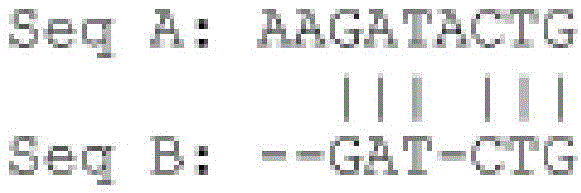
根据本发明产生在其整个长度范围内显示序列B的配对比对因此产生:A pairwise alignment showing sequence B over its entire length was generated according to the present invention thus yielding:

在其整个长度范围内显示较短序列的比对长度是8(存在一个在较短序列的比对长度中考虑的缺口)。The alignment length that shows the shorter sequence over its entire length is 8 (there is a gap that is taken into account in the alignment length of the shorter sequence).
因此,在其整个长度范围内显示Seq A的比对长度将是9(意指Seq A是本发明的序列)。Thus, an alignment showing Seq A over its entire length would be 9 in length (meaning that Seq A is a sequence of the invention).
因此,在其整个长度范围内显示Seq B的比对长度将是8(意指Seq B是本发明的序列)。Thus, an alignment showing Seq B over its entire length would be 8 in length (meaning that Seq B is a sequence of the invention).
根据上文提供的实例,同一性%:对于作为本发明序列的Seq A(6/9)*100=66.7%;对于作为本发明序列的Seq B、(6/8)*100=75%。According to the examples provided above, % identity: for Seq A as the sequence of the invention (6/9)*100=66.7%; for Seq B as the sequence of the invention, (6/8)*100=75%.
酶变体可以由它们与亲本酶相比时的序列相似性定义。序列相似性通常作为“序列相似性%”或“相似性%”提供。为了在第一步骤中计算序列相似性,必须如上文所述生成序列比对。在第二步骤中,必须计算相似性百分数,而序列相似性百分数考虑,定义的氨基酸集合共有相似的特性,例如,依据其大小、依据其疏水性、依据其电荷或依据其他特征考虑。这里,一个氨基酸交换为相似氨基酸称作“保守性突变”。包含保守性突变的酶变体似乎对蛋白质折叠影响最小,导致与亲本酶的酶特性相比时,基本上维持某些酶特性。Enzyme variants can be defined by their sequence similarity when compared to the parent enzyme. Sequence similarity is usually provided as "% sequence similarity" or "% similarity". To calculate sequence similarity in the first step, sequence alignments must be generated as described above. In the second step, the percent similarity must be calculated, and the percent sequence similarity takes into account that the defined set of amino acids share similar properties, for example, in terms of their size, in terms of their hydrophobicity, in terms of their charge, or in terms of other characteristics. Here, an amino acid exchange for a similar amino acid is referred to as a "conservative mutation". Enzyme variants containing conservative mutations appear to have minimal effects on protein folding, resulting in substantially maintaining certain enzymatic properties when compared to those of the parent enzyme.
为了根据本发明确定相似性%,以下适用,这还根据BLOSUM62矩阵适用,所述矩阵是最常用于数据库检索和序列比对的氨基酸相似性矩阵之一To determine % similarity according to the present invention, the following applies, which also applies according to the BLOSUM62 matrix, one of the amino acid similarity matrices most commonly used for database searches and sequence alignments
氨基酸A类似于氨基酸SAmino acid A is similar to amino acid S
氨基酸D类似于氨基酸E;NAmino acid D is similar to amino acid E; N
氨基酸E类似于氨基酸D;K;QAmino acid E is similar to amino acid D; K; Q
氨基酸F类似于氨基酸W;YAmino acid F is similar to amino acid W; Y
氨基酸H类似于氨基酸N;YAmino acid H is similar to amino acid N; Y
氨基酸I类似于氨基酸L;M;VAmino acid I is similar to amino acid L;M;V
氨基酸K类似于氨基酸E;Q;RAmino acid K is similar to amino acid E; Q; R
氨基酸L类似于氨基酸I;M;VAmino acid L is similar to amino acid I; M; V
氨基酸M类似于氨基酸I;L;VAmino acid M is similar to amino acid I; L; V
氨基酸N类似于氨基酸D;H;SAmino acid N is similar to amino acid D;H;S
氨基酸Q类似于氨基酸E;K;RAmino acid Q is similar to amino acid E; K; R
氨基酸R类似于氨基酸K;QAmino acid R is similar to amino acid K; Q
氨基酸S类似于氨基酸A;N;TAmino acid S is similar to amino acid A;N;T
氨基酸T类似于氨基酸SAmino acid T is similar to amino acid S
氨基酸V类似于氨基酸I;L;MAmino acid V is similar to amino acid I; L; M
氨基酸W类似于氨基酸F;YAmino acid W is similar to amino acid F; Y
氨基酸Y类似于氨基酸F;H;W.Amino acid Y is similar to amino acid F; H; W.
保守性氨基酸置换可以出现在功能蛋白质如酶的多肽序列的全长序列范围内。在一个实施方案中,这类突变不涉及酶的功能性结构域。在另一个实施方案中保守的突变不涉及酶的催化中心。Conservative amino acid substitutions can occur over the full length of the polypeptide sequence of a functional protein, such as an enzyme. In one embodiment, such mutations do not involve the functional domain of the enzyme. In another embodiment the conservative mutation does not involve the catalytic center of the enzyme.
因此,根据本发明,以下的相似性百分数计算适用:Therefore, according to the present invention, the following percent similarity calculation applies:
相似性%=[相同残基+相似残基/在其整个长度范围内显示本发明相应序列的比对区域的长度]*100。因此这里,通过相同残基的数目加相似残基的数目除以其整个长度范围内显示本发明相应序列的比对区域的长度,计算与比较两个氨基酸序列有关的序列相似性。这个值乘以100以得出“相似性%”。% similarity=[identical residues+similar residues/length of the aligned region showing the corresponding sequence of the invention over its entire length]*100. Thus, here, the sequence similarity associated with comparing two amino acid sequences is calculated by dividing the number of identical residues plus the number of similar residues by the length of the aligned region over its entire length showing the corresponding sequence of the invention. This value is multiplied by 100 to get the "Similarity %".
特别地,预期这样的变体酶具有基本上不变的酶特性,其中与全长多肽序列相比,所述变体包含与相应的亲本序列至少百分之m相似的保守性突变,其中m是50和100之间的整数,优选地是50、55、60、65、70、75、80、85、90、91、92、93、94、95、96、97、98或99。本文所述的与亲本酶相比时具有百分之m相似性的变体酶具有酶活性。In particular, variant enzymes are expected to have substantially invariant enzymatic properties, wherein the variant comprises conservative mutations that are at least m percent similar to the corresponding parental sequence compared to the full-length polypeptide sequence, wherein m is an integer between 50 and 100, preferably 50, 55, 60, 65, 70, 75, 80, 85, 90, 91, 92, 93, 94, 95, 96, 97, 98 or 99. The variant enzymes described herein having m percent similarity when compared to the parent enzyme have enzymatic activity.
如本文中所定义的术语“杂交”是其中基本上互补的核苷酸序列相互复性的过程。杂交过程可以完全在溶液中进行,即两种互补性核酸均处于溶液中。杂交过程也可以在互补性核酸之一固定到基质如磁珠、琼脂糖凝胶(Sepharose)珠或任何其他树脂的情况下发生。杂交过程也可以用固定至固相支持物如硝酸纤维素膜或尼龙膜上或通过例如照相平版印刷术固定至载体(包括,但不限于硅酸玻璃支持物)(后者称作核酸阵列或微阵列或称作核酸芯片)的互补性核酸之一进行。为使杂交发生,通常将核酸分子热变性或化学变性以使双链解链成为两条单链和/或去除来自单链核酸的发夹或其它二级结构。The term "hybridization" as defined herein is a process in which substantially complementary nucleotide sequences renature each other. The hybridization process can be performed entirely in solution, ie both complementary nucleic acids are in solution. The hybridization process can also take place with one of the complementary nucleic acids immobilized to a matrix such as magnetic beads, Sepharose beads or any other resin. The hybridization process can also be performed using immobilization to solid supports such as nitrocellulose or nylon membranes or to supports (including, but not limited to, silicate glass supports) by, for example, photolithography (the latter referred to as nucleic acid arrays or One of the complementary nucleic acids of a microarray or called a nucleic acid chip). For hybridization to occur, the nucleic acid molecule is typically thermally or chemically denatured to melt the double strand into two single strands and/or to remove hairpins or other secondary structure from the single-stranded nucleic acid.
杂交体的这种形成或解链取决于多种参数,包括但不限于该温度。温度增加有利于解链,而温度下降有利于杂交。但是,这种杂交体形成过程不以线性方式随施加的温度变化而变化:杂交过程是动态的,并且已经形成的核苷酸对也支持相邻核苷酸配对。因而,在良好逼近情况下,杂交是一个是或非过程,并且存在一个基本上定义杂交和非杂交之间界限的温度。这个温度是解链温度(Tm)。Tm是以摄氏度计的温度,在所述温度,给定核苷酸序列的全部分子的50%杂交成双链,并且50%作为单链存在。This formation or melting of hybrids depends on a variety of parameters including, but not limited to, the temperature. An increase in temperature favors melting, while a decrease in temperature favors hybridization. However, this hybrid formation process does not vary with applied temperature in a linear fashion: the hybridization process is dynamic, and nucleotide pairs that have formed also support adjacent nucleotide pairings. Thus, in a good approximation, hybridization is a yes-or-no process, and there is a temperature that essentially defines the boundary between hybridization and non-hybridization. This temperature is the melting temperature (Tm). Tm is the temperature in degrees Celsius at which 50% of all molecules of a given nucleotide sequence hybridize as double-stranded and 50% exist as single-stranded.
解链温度(Tm)取决于所分析核酸序列的物理特性并且因此可以指示两个不同序列之间的关系。但是,解链温度(Tm)还受与序列不直接相关的多种其他参数影响,并且必须考虑施加的杂交实验条件。例如,增加盐(例如一价阳离子)导致Tm较高。The melting temperature (Tm) depends on the physical properties of the nucleic acid sequence being analyzed and can therefore indicate the relationship between two different sequences. However, the melting temperature (Tm) is also affected by a variety of other parameters that are not directly related to the sequence and must take into account the hybridization experimental conditions imposed. For example, increasing salts (eg, monovalent cations) results in higher Tm.
可以通过进行物理杂交实验确定给定杂交条件的Tm,但是也可以计算机模拟估计给定DNA序列对的Tm。在这个实施方案中,Meinkoth和Wahl的等式(Anal.Biochem.,138:267-284,1984)用于具有50个或更多个碱基长度的片段:Tm=81.5℃+16.6(logM)+0.41(%GC)-0.61(甲酰胺%)-500/L。The Tm for a given hybridization condition can be determined by performing physical hybridization experiments, but the Tm for a given pair of DNA sequences can also be estimated by computer simulation. In this embodiment, the equation of Meinkoth and Wahl (Anal. Biochem., 138:267-284, 1984) is used for fragments with a length of 50 or more bases: Tm=81.5°C+16.6 (logM) +0.41 (% GC) - 0.61 (% formamide) - 500/L.
M是一价阳离子的体积摩尔浓度,%GC是DNA片段中鸟苷和胞嘧啶核苷酸的百分数,甲酰胺%是杂交溶液中甲酰胺的百分数,并且L是以碱基对计的杂交体的长度。该等式用于0.01至0.4M的盐范围和30%至75%的GC%。M is the molar concentration of monovalent cations, %GC is the percentage of guanosine and cytosine nucleotides in the DNA fragment, % formamide is the percentage of formamide in the hybridization solution, and L is the hybrid in base pairs length. This equation was used for a salt range of 0.01 to 0.4M and a GC% of 30% to 75%.
尽管上述Tm是完美匹配探针的温度,对每1%错配,Tm降低约1℃(Bonner等人,J.Mol.Biol.81:123-135,1973):Tm=[81.5℃+16.6(logM)+0.41(%GC)-0.61(%甲酰胺)-500/L]-非同一性%。Although the above Tm is the temperature of a perfectly matched probe, for every 1% mismatch, the Tm decreases by about 1°C (Bonner et al., J. Mol. Biol. 81:123-135, 1973): Tm=[81.5°C+16.6 (logM) + 0.41 (% GC) - 0.61 (% formamide) - 500/L] - % non-identity.
这个等式可用于具有35或更多个核苷酸的探针并且在科学方法文献(例如,引用于:“Recombinant DNA Principles and Methodologies”,James Greene,章节“Biochemistry of Nucleic acids”,Paul S.Miller,第55页;1998,CRC Press)、许多专利申请(例如,引用于:US 7026149)及还在商业企业的数据文件(例如来自www.genomics.agilent.com的“Equations for Calculating Tm”)中广泛应用。This equation can be used for probes with 35 or more nucleotides and is described in the scientific methods literature (eg, cited in: "Recombinant DNA Principles and Methodologies", James Greene, chapter "Biochemistry of Nucleic acids", Paul S. Miller, p. 55; 1998, CRC Press), numerous patent applications (eg, cited in: US 7026149) and also in commercial enterprise data files (eg "Equations for Calculating Tm" from www.genomics.agilent.com) widely used in.
在这个实施方案中不太优选的用于计算Tm的其他公式仅可能用于所指示的情形:Other formulas for calculating Tm, which are less preferred in this embodiment, are only possible for the indicated cases:
对于DNA-RNA杂交体(Casey,J.和Davidson,N.(1977)Nucleic Acids Res.,4:1539):For DNA-RNA hybrids (Casey, J. and Davidson, N. (1977) Nucleic Acids Res., 4:1539):
Tm=79.8℃+18.5(logM)+0.58(%GC)+11.8(%GC*%GC)-0.5(甲酰胺%)-820/L。Tm=79.8°C+18.5(logM)+0.58(%GC)+11.8(%GC*%GC)-0.5(% formamide)-820/L.
对于RNA-RNA杂交体(Bodkin,D.K.和Knudson,D.L.(1985)J.Virol.Methods,10:45):For RNA-RNA hybrids (Bodkin, D.K. and Knudson, D.L. (1985) J. Virol. Methods, 10:45):
Tm=79.8℃+18.5(logM)+0.58(%GC)+11.8(%GC*%GC)-0.35(甲酰胺%)-820/L。Tm=79.8°C+18.5(logM)+0.58(%GC)+11.8(%GC*%GC)-0.35(% formamide)-820/L.
对少于20个碱基的寡核苷酸探针(Wallace,R.B.等人(1979)Nucleic AcidRes.6:3535):Tm=2x n(A+T)+4x n(G+C),其中n是形成杂交体的探针中相应碱基的数目。For oligonucleotide probes of less than 20 bases (Wallace, R.B. et al. (1979) Nucleic Acid Res. 6:3535): Tm=2xn(A+T)+4xn(G+C), where n is the number of corresponding bases in the probe forming the hybrid.
对20-35个核苷酸的寡核苷酸探针,改良的Wallace计算可以适用:Tm=22+1.46n(A+T)+2.92n(G+C),其中n是形成杂交体的探针中相应碱基的数目。For oligonucleotide probes of 20-35 nucleotides, a modified Wallace calculation can be applied: Tm=22+1.46n(A+T)+2.92n(G+C), where n is the hybrid forming The number of corresponding bases in the probe.
对于其他寡核苷酸,应连同适宜的热动力数据一起,使用计算解链温度的最近邻模型:For other oligonucleotides, a nearest-neighbor model for calculating melting temperature should be used along with appropriate thermodynamic data:
Tm=(∑(ΔHd)+ΔHi)/(∑(ΔSd)+ΔSi+ΔSself+R×ln(cT/b))+16.6log[Na+]-273.15(Breslauer,K.J.,Frank,R.,
其中:in:
Tm是以摄氏度计的解链温度;Tm is the melting temperature in degrees Celsius;
∑(AHd)和∑(ΔSd)(相应地)是对全部内部最近邻二重峰计算的焓总和和熵总和;∑(AHd) and ∑(ΔSd) (respectively) are the sum of enthalpy and entropy calculated for all inner nearest-neighbor doublets;
ΔSself是自身互补序列的熵罚分;ΔSself is the entropy penalty of the self-complementary sequence;
ΔHi和ΔSi分别是起始焓和起始熵的总和;ΔHi and ΔSi are the sum of onset enthalpy and onset entropy, respectively;
R是气体常数(固定于1.987cal/K·mol);R is the gas constant (fixed at 1.987cal/K·mol);
cT是以摩尔单位计的总链浓度;cT is the total chain concentration in molar units;
对非自身互补序列,常数b采用值4,或对自身互补链的双链体或对链之一明显过量时的双链体,其等于1。The constant b takes a value of 4 for non-self-complementary sequences, or equal to 1 for duplexes of self-complementary strands or when one of the paired strands is in significant excess.
热动力计算假设:复性在缓冲溶液中接近7.0的pH发生并且出现双态转变。Thermodynamic calculations assume that renaturation occurs in buffer solutions at a pH near 7.0 and a two-state transition occurs.
用于该计算的热动力值可以获得自(Alejandro Panjkovich,Francisco Melo,2005.Comparison of different melting temperature calculation methods forshort DNA sequences.Bioinformatics,21(6):711-722)的表1,或获得自原始研究论文(Breslauer,K.J.,Frank,R.,
根据这个实施方案,为了计算机模拟估计Tm,首先在两个序列之间生成一个生物信息学序列比对结果集合。可以通过本领域技术人员已知的各种工具产生这类比对结果,如产生局部比对结果的程序“Blast”(NCBI)、“Water”(EMBOSS)或“Matcher”(EMBOSS)或产生全局比对结果的程序“Needle”(EMBOSS)。这些工具应当用其默认参数集应用,也用某些参数变动应用。例如,程序“MATCHER”可以配合空位开口/空位延伸的多种参数应用(如14/4;14/2;14/5;14/8;14/10;20/2;20/5;20/8;20/10;30/2;30/5;30/8;30/10;40/2;40/5;40/8;40/10;10/2;10/5;10/8;10/10;8/2;8/5;8/8;8/10;6/2;6/5;6/8;6/10)和程序“WATER”可以是应用其中各种参数空位开口/空位延伸(如10/0.5;10/1;10/2;10/3;10/4;10/6;15/1;15/2;15/3;15/4;15/6;20/1;20/2;20/3;20/4;20/6;30/1;30/2;30/3;30/4;30/6;45/1;45/2;45/3;45/4;45/6;60/1;60/2;60/3;60/4;60/6),并且另外,应当通过使用如给予的两个核苷酸序列,还配合处于其反向互补物形式的序列之一应用这些程序。例如,BlastN(NCBI)可以配合增加的e-值截值(例如e+1或甚至e+10)应用,旨在还鉴定非常短的比对,特别地在小规格数据库中如此。According to this embodiment, to estimate Tm in silico, a set of bioinformatic sequence alignments is first generated between two sequences. Such alignments can be generated by a variety of tools known to those skilled in the art, such as the programs "Blast" (NCBI), "Water" (EMBOSS) or "Matcher" (EMBOSS) that generate local alignments or the programs that generate global alignments. The resulting program "Needle" (EMBOSS). These tools should be applied with their default set of parameters, as well as with some parameter variations. For example, the program "MATCHER" can be used with various parameters of vacancy opening/vacancy extension (eg 14/4; 14/2; 14/5; 14/8; 14/10; 20/2; 20/5; 20/ 8;20/10;30/2;30/5;30/8;30/10;40/2;40/5;40/8;40/10;10/2;10/5;10/8; 10/10; 8/2; 8/5; 8/8; 8/10; 6/2; 6/5; 6/8; 6/10) and the program "WATER" can be applied where various parameters of vacancy opening / vacancy extension (e.g. 10/0.5; 10/1; 10/2; 10/3; 10/4; 10/6; 15/1; 15/2; 15/3; 15/4; 15/6; 20 /1;20/2;20/3;20/4;20/6;30/1;30/2;30/3;30/4;30/6;45/1;45/2;45/3 ; 45/4; 45/6; 60/1; 60/2; 60/3; 60/4; 60/6), and in addition, by using two nucleotide sequences as given, also in combination with One of the sequences in reverse complement form applies these procedures. For example, BlastN (NCBI) can be applied with increasing e-value cutoffs (eg e+1 or even e+10) aiming to also identify very short alignments, especially in small-scale databases.
重要是考虑局部比对,因为杂交可能并不必然地在两个序列的整个长度范围内发生,但可能在不同区域最佳发生,这些区域则决定实际解链温度。因此,从产生的全部比对中,必须确定比对长度、比对的GC含量%(以更精确方式,比对内部匹配性碱基的%GC含量)及比对同一性。随后,必须对每个比对计算预测的解链温度(Tm)。计算的最高Tm用来预测实际解链温度。It is important to consider local alignments, as hybridization may not necessarily occur over the entire length of the two sequences, but may optimally occur in different regions that determine the actual melting temperature. Therefore, from all the alignments generated, the alignment length, the % GC content of the alignment (in a more precise way, the % GC content of the aligned internal matching bases), and the alignment identity must be determined. Subsequently, the predicted melting temperature (Tm) must be calculated for each alignment. The calculated maximum Tm was used to predict the actual melting temperature.
如本文定义的术语“在本发明的完整序列范围内杂交”意指对于本发明的序列片段化成约300至500碱基长度的小片时长超过300个碱基的序列,每个片段必须杂交。例如,可以通过使用一种限制性酶或使用限制性酶组合,使DNA片段化成小片。通过如上文所述的相同程序进行Tm的生物信息学计算机模拟计算,仅对每个片段进行。可以通过标准DNA印迹分析或本领域技术人员已知的可比方法,分析各个片段的物理杂交。The term "hybridizes over the entire sequence of the invention" as defined herein means that for sequences of the invention to be fragmented into small pieces of about 300 to 500 bases in length, each fragment must hybridize to sequences longer than 300 bases. For example, DNA can be fragmented into small pieces by using one restriction enzyme or using a combination of restriction enzymes. Bioinformatic in silico calculations of Tm were performed by the same procedure as described above, for each fragment only. Physical hybridization of the individual fragments can be analyzed by standard Southern blot analysis or by comparable methods known to those skilled in the art.
如本文定义的术语“严格性”描述了可能籍此在两个核苷酸序列之间形成杂交分子的难易度。“较高严格性”的条件需要一个序列的更多碱基与另一个序列配对(“较高严格性”的条件下解链温度Tm降低),“较低严格性”的条件允许某些更多碱基不配对。因此,两个序列之间关系的程度可以通过它们仍能够形成杂交体的实际严格性条件来估计。可以通过保持实验杂交温度恒定并降低盐浓度,或通过保持盐恒定并增加实验性杂交温度或这些参数的组合,实现增加严格性。另外,增加甲酰胺将增加严格性。技术人员知晓可以在杂交期间加以改变和将要维持或变更严格性条件的额外参数(Sambrook等人(2001)MolecularCloning:a laboratory manual,第3版,Cold Spring Harbor Laboratory Press,CSH,NewYork或Current Protocols in Molecular Biology,John Wiley&Sons,N.Y.(1989和年度更新版))。The term "stringency" as defined herein describes the ease with which a hybrid molecule may be formed between two nucleotide sequences. "Higher stringency" conditions require more bases of one sequence to pair with another sequence (lower melting temperature Tm under "higher stringency" conditions), "lower stringency" conditions allow some more Polybase mismatch. Thus, the degree of relationship between the two sequences can be estimated by the actual stringency conditions under which they can still form hybrids. Increased stringency can be achieved by keeping the experimental hybridization temperature constant and decreasing the salt concentration, or by keeping the salt constant and increasing the experimental hybridization temperature, or a combination of these parameters. Additionally, increasing formamide will increase stringency. The skilled person is aware of additional parameters that can be changed during hybridization and that will maintain or alter stringency conditions (Sambrook et al. (2001) Molecular Cloning: a laboratory manual, 3rd edition, Cold Spring Harbor Laboratory Press, CSH, New York or Current Protocols in Molecular Biology, John Wiley & Sons, N.Y. (1989 and annual updates)).
通过初始杂交步骤,后续一个至几个洗涤步骤,进行常见杂交实验。用于这些步骤的溶液可以含有防止分析序列降解和/或防止探针的非特异性背景结合的额外组分,如EDTA、SDS、片段化精子DNA或相似试剂,这些组分是本领域技术人员已知的(Sambrook等人(2001)Molecular Cloning:a laboratory manual,第3版,Cold Spring HarborLaboratory Press,CSH,New York或Current Protocols in Molecular Biology,JohnWiley&Sons,N.Y.(1989和年度更新版))。Common hybridization experiments are performed with an initial hybridization step followed by one to several wash steps. The solutions used in these steps may contain additional components such as EDTA, SDS, fragmented sperm DNA or similar reagents to prevent degradation of the assay sequence and/or to prevent non-specific background binding of the probe, which are well known to those skilled in the art. (Sambrook et al. (2001) Molecular Cloning: a laboratory manual, 3rd edition, Cold Spring Harbor Laboratory Press, CSH, New York or Current Protocols in Molecular Biology, John Wiley & Sons, N.Y. (1989 and annual updates)).
通过随机引发的标记方法产生杂交实验的常见探针,所述方法最初由Feinberg和Vogelstein开发(Anal.Biochem.,132(1),6-13(1983);Anal.Biochem.,137(1),266-7(1984)并基于全部可能六核苷酸的混合物与待标记DNA的杂交。标记的探针产物实际上将是一组具有可变长度、一般长度在100-1000个核苷酸大小范围内的片段,最高片段浓度一般约为200至400bp。最终作为杂交实验的探针使用的探针片段的实际大小范围也可以受以下影响:所用标记方法的参数、已产生的探针的后续纯化(例如琼脂糖凝胶)和用于标记的所用模板DNA的大小(标记前,可以例如使用4bp切割酶(例如HaeIII)限制性消化大模板)。Common probes for hybridization experiments are generated by a randomly primed labeling method originally developed by Feinberg and Vogelstein (Anal. Biochem., 132(1), 6-13(1983); Anal. Biochem., 137(1) , 266-7 (1984) and based on the hybridization of a mixture of all possible hexanucleotides to the DNA to be labeled. The labeled probe product will actually be a set of variable lengths, typically 100-1000 nucleotides in length Fragments in the size range, the highest fragment concentration is generally about 200 to 400 bp. The actual size range of the probe fragments that are ultimately used as probes for hybridization experiments can also be affected by the parameters of the labeling method used, the size of the generated probes Subsequent purification (eg agarose gel) and size of the template DNA used for labeling (before labeling the large template can be restricted eg using a 4 bp cleaving enzyme (eg HaeIII)).
对于本发明,通过杂交实验分析本文所述的序列,其中探针从另一个序列产生,并且通过标准随机引发标记方法产生这种探针。对于本发明,探针由一组具有约200-400个核苷酸大小的标记的寡核苷酸组成。在本发明的序列和另一个序列之间杂交意指探针的杂交在本发明的完整序列范围内出现,如上文定义。通过实现依据最终洗涤步骤的严格性的最高严格性,进行杂交实验。最终洗涤步骤具有与以下洗涤条件的严格性可比的严格性条件条件:至少洗涤条件1:在50℃时1.06x SSC、0.1%SDS、0%甲酰胺;在另一个实施方案中至少洗涤条件2:在55℃时1.06x SSC、0.1%SDS、0%甲酰胺;在另一个实施方案中至少洗涤条件3:在60℃时1.06x SSC、0.1%SDS、0%甲酰胺;在另一个实施方案中至少洗涤条件4:在65℃时1.06x SSC、0.1%SDS、0%甲酰胺;在另一个实施方案中至少洗涤条件5:在65℃时0.52x SSC、0.1%SDS、0%甲酰胺;在另一个实施方案中至少洗涤条件6:在65℃时0.25xSSC、0.1%SDS、0%甲酰胺;在另一个实施方案中至少洗涤条件7:在65℃时0.12x SSC、0.1%SDS、0%甲酰胺;在另一个实施方案中至少洗涤条件8:在65℃时0.07x SSC、0.1%SDS、0%甲酰胺。For the present invention, the sequences described herein are analyzed by hybridization experiments, wherein a probe is generated from another sequence, and such probes are generated by standard random priming labeling methods. For the present invention, the probe consists of a set of labeled oligonucleotides of about 200-400 nucleotides in size. Hybridization between a sequence of the invention and another sequence means that hybridization of the probe occurs within the scope of the entire sequence of the invention, as defined above. Hybridization experiments were performed by achieving the highest stringency according to the stringency of the final wash step. The final wash step has stringency conditions comparable to those of the following wash conditions: at least wash condition 1: 1.06x SSC, 0.1% SDS, 0% formamide at 50°C; in another embodiment at least wash condition 2 : 1.06x SSC, 0.1% SDS, 0% formamide at 55°C; in another embodiment at least wash condition 3: 1.06x SSC, 0.1% SDS, 0% formamide at 60°C; in another embodiment In the protocol at least wash condition 4: 1.06x SSC, 0.1% SDS, 0% formamide at 65°C; in another embodiment at least wash condition 5: 0.52x SSC, 0.1% SDS, 0% formazan at 65°C amide; in another embodiment at least wash condition 6: 0.25xSSC, 0.1% SDS, 0% formamide at 65°C; in another embodiment at least wash condition 7: 0.12x SSC, 0.1% at 65°C SDS, 0% formamide; in another embodiment at least wash condition 8: 0.07x SSC, 0.1% SDS, 0% formamide at 65°C.
“低严格洗涤”具有这样的严格性条件,其与至少洗涤条件1的严格性条件可比,但是没有比洗涤条件3更严格,其中洗涤条件如上文所述。A "low stringency wash" has stringency conditions that are comparable to at least the stringent conditions of
“高严格洗涤”具有这样的严格性条件,其与至少洗涤条件4、在另一个实施方案中至少洗涤条件5、在另一个实施方案中至少洗涤条件6、在另一个实施方案中至少洗涤条件7、在另一个实施方案中至少洗涤条件8可比,其中洗涤条件如上文所述。A "highly stringent wash" has stringent conditions that are different from at
本文中术语“异源”(或外源或外来或重组或非天然)多肽定义为相对于宿主细胞并非天然的多肽;相对于宿主细胞为天然的多肽,其中已经通过改变天然多肽的重组DNA技术产生结构性修饰,例如,缺失、置换和/或插入;或相对于宿主细胞为天然的多肽,其中作为重组DNA技术操作DNA宿主细胞的结果(例如,更强启动子),定量改变其表达或从异于天然宿主细胞的基因组位置指导其表达。类似地,术语“异源”(或外源或外来或重组或非天然)多核苷酸指相对于宿主细胞并非天然的多核苷酸;相对于宿主细胞为天然的多核苷酸,其中已经通过改变天然多核苷酸的重组DNA技术产生结构性修饰,例如,缺失、置换和/或插入;相对于宿主细胞为天然的多核苷酸,其中因借助重组DNA技术操作多核苷酸的调节元件而定量改变其表达;或这样的多核苷酸,其相对于宿主细胞为天然的多核苷酸,但因重组DNA技术遗传操作而未整合于其天然遗传环境内部。The term "heterologous" (or foreign or foreign or recombinant or non-native) polypeptide is defined herein as a polypeptide that is not native to the host cell; a polypeptide that is native to the host cell, wherein the native polypeptide has been altered by recombinant DNA techniques produce structural modifications, e.g., deletions, substitutions and/or insertions; or polypeptides that are native to the host cell, wherein their expression is quantitatively altered as a result of recombinant DNA technology manipulation of the DNA host cell (e.g., a stronger promoter) or Its expression is directed from a genomic location other than that of the native host cell. Similarly, the term "heterologous" (or exogenous or foreign or recombinant or non-native) polynucleotide refers to a polynucleotide that is not native to the host cell; a polynucleotide that is native to the host cell, wherein the Recombinant DNA techniques of native polynucleotides produce structural modifications, for example, deletions, substitutions and/or insertions; polynucleotides that are native to the host cell, wherein the quantitative changes are due to manipulation of the regulatory elements of the polynucleotide by means of recombinant DNA techniques its expression; or a polynucleotide that is native to the host cell but not integrated within its native genetic environment due to genetic manipulation by recombinant DNA technology.
对于两个或更多个多核苷酸序列或两个或更多个氨基酸序列,术语“异源”用来表征两个或更多个多核苷酸序列或两个或更多个氨基酸序列并非按照特定的彼此组合天然出现。With respect to two or more polynucleotide sequences or two or more amino acid sequences, the term "heterologous" is used to characterize that two or more polynucleotide sequences or two or more amino acid sequences are not in accordance with Certain combinations with each other occur naturally.
出于本发明的目的,“重组”(或转基因)对于细胞或生物而言意指细胞或生物含有由人类通过基因技术引入的异源多核苷酸,并且对于多核苷酸而言包括由人类通过基因技术/重组DNA技术产生的全部那些构建体,其中For the purposes of the present invention, "recombinant" (or transgenic) with respect to a cell or organism means that the cell or organism contains a heterologous polynucleotide introduced by a human by genetic techniques, and in the case of a polynucleotide includes All those constructs produced by genetic technology/recombinant DNA technology, wherein
(a)多核苷酸或其部分的序列,或(a) the sequence of a polynucleotide or portion thereof, or
(b)与多核苷酸有效连接的一个或多个基因控制序列,包括但不限于启动子,或(b) one or more genetic control sequences, including but not limited to promoters, operably linked to the polynucleotide, or
(c)a)和b)两者(c) both a) and b)
不位于它们的野生型遗传环境或已经被修饰。are not located in their wild-type genetic environment or have been modified.
术语“天然”(或野生型或内源)细胞或生物和“天然”(或野生型或内源)多核苷酸或多肽指如自然界中存在的细胞或生物并且分别指如细胞中以其自然形式和遗传环境下存在(即,无任何人类干预)的所讨论多核苷酸或多肽。The terms "native" (or wild-type or endogenous) cells or organisms and "native" (or wild-type or endogenous) polynucleotides or polypeptides refer to cells or organisms as they occur in nature and refer to cells or organisms as they occur in nature and refer to cells or organisms in their natural The form and genetic environment in which the polynucleotide or polypeptide in question exists (ie, without any human intervention).
“具有相对于细胞为外来的甲基化模式的DNA”指包含甲基化模式的DNA,所述甲基化模式不天然存在于细胞中并且因此可以被细胞的一种或多种限制性酶识别和切割。"DNA with a methylation pattern that is foreign to the cell" refers to DNA that contains a methylation pattern that is not naturally present in the cell and thus can be detected by one or more restriction enzymes of the cell Identify and cut.
术语“多核苷酸”、“核酸序列”、“核苷酸序列”、“核酸”、“核酸分子”在本文中可互换地使用并且指任意长度的聚合非分支形式的核苷酸:核糖核苷酸或脱氧核糖核苷酸或这二者的组合。“多核苷酸”由单体组成,所述单体是由以下三种组分组成的“核苷酸”:戊糖、磷酸酯基和含氮碱基。The terms "polynucleotide", "nucleic acid sequence", "nucleotide sequence", "nucleic acid", "nucleic acid molecule" are used interchangeably herein and refer to a polymeric unbranched form of nucleotides of any length: ribose Nucleotides or deoxyribonucleotides or a combination of the two. A "polynucleotide" consists of monomers, which are "nucleotides" composed of three components: a pentose sugar, a phosphate group, and a nitrogenous base.
如本文所用的术语“核酸构建体”意指单链或双链的核酸分子,所述核酸分子从天然存在的基因分离或经修饰以含有处于本来在自然界中不存在的形式或为合成的核酸区段。当核酸构建体含有表达多核苷酸所需的控制序列时,术语“核酸构建体”同义于术语“表达盒”。The term "nucleic acid construct" as used herein means a single- or double-stranded nucleic acid molecule isolated from a naturally occurring gene or modified to contain nucleic acid in a form not otherwise found in nature or synthetic section. The term "nucleic acid construct" is synonymous with the term "expression cassette" when the nucleic acid construct contains the control sequences required for expression of the polynucleotide.
本文中术语“控制序列”定义成影响多核苷酸表达(包括但不限于,编码多肽的多核苷酸的表达)的全部序列。每个控制序列可以相对于该多核苷酸是天然或外来的或彼此是天然或外来的。这类控制序列包括但不限于启动子序列、5’-UTR(也称作前导序列)、核糖体结合位点(RBS,SD序列)、3’-UTR和转录起始位点和终止位点。The term "control sequences" is defined herein as all sequences that affect the expression of a polynucleotide, including, but not limited to, the expression of a polynucleotide encoding a polypeptide. Each control sequence can be native or foreign with respect to the polynucleotide or native or foreign to each other. Such control sequences include, but are not limited to, promoter sequences, 5'-UTR (also known as leader sequences), ribosome binding sites (RBS, SD sequences), 3'-UTRs, and transcription initiation and termination sites .
就调节元件而言,术语“功能性连接”或“有效连接”理解为意指调节元件(包括但不限于启动子)与待表达的核酸序列并且根据需要与其他调节元件(包括但不限于终止子)以如此方式依次排列,从而每种调节元件可以履行其目的功能以允许、调整、促进或影响所述核酸序列的表达。例如,将控制序列相对于多核苷酸序列的编码序列置于适宜位置处,从而控制序列指导多肽的编码序列表达。优选的排列是这样的排列,其中待表达的核酸序列重组地位于充当启动子的序列之后,从而这两个序列相互共价地连接。在一个实施方案中,待转录的核酸序列以如此方式位于启动子之后,其中转录起点与RNA的合乎需要开端相同。可以借助如(例如,Sambrook,J.和Russell,D.W.Molecular cloning.Alaboratorymanual,第3版,Cold Spring Harbor Laboratory Press,Cold Spring Harbor,NY.2001.);Silhavy等人(1984)Experiments with Gene Fusions,Cold Spring HarborLaboratory,Cold Spring Harbor(NY);Ausubel等人(1987)Current Protocols inMolecular Biology,Greene Publishing Assoc.and Wiley Interscience;Gelvin等人(编著)(1990)Plant Molecular Biology Manual;Kluwer Academic Publisher,Dordrecht,The Netherlands;Plant Molecular Biology Labfax(1993)by R.D.D.Croy,由BIOS Scientific Publications Ltd(UK)和Blackwell Scientific Publications(UK)出版)所述的惯用重组和克隆技术产生功能性连接和表达构建体。然而,其他序列,包括但不限于充当带限制性酶特定切割位点的接头或充当信号肽的序列,也可以位于这两个序列之间。序列的插入也可以导致融合蛋白的表达。With respect to regulatory elements, the term "functionally linked" or "operably linked" is understood to mean that a regulatory element (including but not limited to a promoter) is connected to the nucleic acid sequence to be expressed and, as desired, to other regulatory elements (including but not limited to termination) (sub) are sequentially arranged in such a way that each regulatory element can perform its intended function to allow, regulate, promote or affect the expression of the nucleic acid sequence. For example, a control sequence is placed at a suitable position relative to the coding sequence of the polynucleotide sequence such that the control sequence directs the expression of the coding sequence of the polypeptide. Preferred arrangements are those in which the nucleic acid sequence to be expressed is recombinantly located behind the sequence acting as a promoter, so that the two sequences are covalently linked to each other. In one embodiment, the nucleic acid sequence to be transcribed is located behind the promoter in such a way that the transcription origin is the same as the desired start of the RNA. This can be done by means of, for example, (eg, Sambrook, J. and Russell, D.W. Molecular cloning. Laboratory manual, 3rd edition, Cold Spring Harbor Laboratory Press, Cold Spring Harbor, NY. 2001.); Silhavy et al. (1984) Experiments with Gene Fusions, Cold Spring Harbor Laboratory, Cold Spring Harbor (NY); Ausubel et al. (1987) Current Protocols in Molecular Biology, Greene Publishing Assoc. and Wiley Interscience; Gelvin et al. (eds.) (1990) Plant Molecular Biology Manual; Kluwer Academic Publisher, Dordrecht, The Netherlands; Plant Molecular Biology Labfax (1993) by R.D.D. Croy, published by BIOS Scientific Publications Ltd (UK) and Blackwell Scientific Publications (UK) conventional recombination and cloning techniques to generate functional ligation and expression constructs. However, other sequences, including but not limited to those that act as linkers with specific cleavage sites for restriction enzymes or that act as signal peptides, can also be located between these two sequences. Insertion of sequences can also result in the expression of fusion proteins.
“启动子”或“启动子序列”是位于基因上游与基因相同的能够实现基因转录的链上的核苷酸序列。启动子后接基因的转录起始位点。启动子由启动转录的RNA聚合酶(连同任何需要的转录因子一起)识别。启动子的功能性片段或功能性变体是由RNA聚合酶可识别并且能够启动转录的核苷酸序列。A "promoter" or "promoter sequence" is a nucleotide sequence located upstream of a gene on the same strand as the gene that enables transcription of the gene. The promoter is followed by the transcription start site of the gene. The promoter is recognized by RNA polymerase (along with any required transcription factors) that initiates transcription. A functional fragment or functional variant of a promoter is a nucleotide sequence recognized by RNA polymerase and capable of initiating transcription.
本文中术语“包含共有序列并且其中共有序列紧接有转录起始位点的启动子序列”或术语“包含紧接有转录起始位点的共有序列的启动子序列”意指如转录起始位点直接毗邻于共有序列,即,共有序列和转录起始位点之间无任何连接性附加核苷酸。The term "promoter sequence comprising a consensus sequence followed by a transcription initiation site" or the term "promoter sequence comprising a consensus sequence followed by a transcription initiation site" herein means, for example, transcription initiation The site is directly adjacent to the consensus sequence, ie, without any additional nucleotides concatenating between the consensus sequence and the transcription initiation site.
术语“转录起始位点”或“转录性起始位点”应当理解为其中转录始于基因序列5′端的位置。在原核生物中,第一个核苷酸,称作+1,通常是腺苷(A)或鸟苷(G)核苷酸。在这种情况下,术语“位点”和“信号”可以在本文互换使用。The term "transcription initiation site" or "transcriptional initiation site" should be understood as the position where transcription begins at the 5' end of a gene sequence. In prokaryotes, the first nucleotide, called +1, is usually an adenosine (A) or guanosine (G) nucleotide. In this context, the terms "site" and "signal" are used interchangeably herein.
在本文中使用时,术语“编码序列”意指直接指定其蛋白质产物的氨基酸序列的核苷酸序列。编码序列的界限通常决定于可读框,所述可读框一般始于ATG起始密码子或备选起始密码子如GTG、CTG或TTG并且止于终止密码子如TAA、TAG或TGA。编码序列可以是DNA、cDNA、合成的或重组核苷酸序列。本文中,起始密码子也可以称作“翻译起始信号”或“翻译起始位点”。本文中,终止密码子也可以称作“翻译终止信号”或“翻译终止位点”。As used herein, the term "coding sequence" means a nucleotide sequence that directly specifies the amino acid sequence of its protein product. The boundaries of the coding sequence are generally determined by the open reading frame, which generally begins with the ATG start codon or alternative start codons such as GTG, CTG or TTG and ends with a stop codon such as TAA, TAG or TGA. Coding sequences can be DNA, cDNA, synthetic or recombinant nucleotide sequences. Herein, an initiation codon may also be referred to as a "translation initiation signal" or "translation initiation site". Herein, a stop codon may also be referred to as a "translation stop signal" or "translation stop site".
术语“表达”或“基因表达”意指一个特定基因或多个特定基因或特定核酸构建体的转录。术语“表达”或“基因表达”尤其意指某个基因或多个基因或基因构建体转录成结构性RNA(例如,rRNA、tRNA)或mRNA,其随后翻译成或不翻译成蛋白质。该过程包括DNA的转录和所得mRNA产物的加工。The term "expression" or "gene expression" means the transcription of a particular gene or genes or a particular nucleic acid construct. The term "expression" or "gene expression" especially means the transcription of a gene or genes or gene constructs into structural RNA (eg, rRNA, tRNA) or mRNA, which is subsequently translated into protein or not. The process includes transcription of DNA and processing of the resulting mRNA product.
术语“表达载体”在本文中定义为包含多核苷酸的线型或环状DNA分子,所述多核苷酸与提供多核苷酸表达的一个或多个控制序列有效连接。The term "expression vector" is defined herein as a linear or circular DNA molecule comprising a polynucleotide operably linked to one or more control sequences that provide for the expression of the polynucleotide.
术语基因“中度表达”在本文中定义为给定基因的表达水平,其不破坏细胞生长或活力并允许连续培养宿主细胞。The term "moderately expressed" of a gene is defined herein as the level of expression of a given gene that does not disrupt cell growth or viability and allows continuous culture of host cells.
如本文所用,术语“宿主细胞”包括易于用核酸构建体或表达载体转化、转染、转导、接合等的任何细胞类型。As used herein, the term "host cell" includes any cell type that is susceptible to transformation, transfection, transduction, conjugation, etc. with a nucleic acid construct or expression vector.
术语“引入”及其变型在本文中定义为向宿主细胞中转移DNA。可以通过本领域已知的任何方法,包括不限于转化、转染、转导、接合等,实现向宿主细胞中引入DNA。The term "introducing" and variations thereof are defined herein as the transfer of DNA into a host cell. Introduction of DNA into a host cell can be accomplished by any method known in the art, including without limitation transformation, transfection, transduction, conjugation, and the like.
术语“供体细胞”在本文中定义为这样的细胞,其是通过任何手段向另一个细胞引入的DNA的来源。The term "donor cell" is defined herein as a cell that is the source of DNA introduced into another cell by any means.
术语“接受者细胞”在本文中定义为向其中引入DNA的细胞。The term "recipient cell" is defined herein as a cell into which DNA is introduced.
术语“产业规模发酵”(也称作大规模发酵)指发酵器容积大于或等于20升的发酵过程。The term "industrial scale fermentation" (also referred to as large scale fermentation) refers to a fermentation process with a fermenter volume greater than or equal to 20 liters.
术语“使DNA甲基化,产生在识别序列GCNGC中含有5-甲基胞嘧啶的DNA的DNA甲基转移酶”在本文中定义为DNA(胞嘧啶-5)-甲基转移酶(EC 2.1.1.37),其催化甲基从S-腺苷酰-L-甲硫氨酸转移至序列GCNGC中的胞嘧啶,导致S-腺苷酰-L-同型半胱氨酸和含有5-甲基胞嘧啶的DNA。为了本发明的目的,根据Pfeifer等人,1983,Biochim.Biophys.Acta 740:323-30描述的方法测定DNA甲基转移酶活性。一单位DNA甲基转移酶活性是为保护1μgλDNA在1小时在20μl总反应体积中免遭相应限制性核酸内切酶切割所需的量。The term "DNA methyltransferase that methylates DNA to produce DNA containing 5-methylcytosine in the recognition sequence GCNGC" is defined herein as a DNA(cytosine-5)-methyltransferase (EC 2.1 .1.37), which catalyzes the transfer of a methyl group from S-adenoyl-L-methionine to cytosine in the sequence GCNGC, resulting in S-adenoyl-L-homocysteine and a 5-methyl-containing cytosine in DNA. For the purposes of the present invention, DNA methyltransferase activity was determined according to the method described by Pfeifer et al., 1983, Biochim. Biophys. Acta 740: 323-30. One unit of DNA methyltransferase activity is the amount required to protect 1 μg of lambda DNA from cleavage by the corresponding restriction endonuclease for 1 hour in a total reaction volume of 20 μl.
术语“限制修饰系统”在本文中定义为一种限制性核酸内切酶、保护DNA免遭该限制性核酸内切酶切割的相应DNA甲基转移酶和编码至少这两种酶的基因。The term "restriction modification system" is defined herein as a restriction endonuclease, the corresponding DNA methyltransferase that protects DNA from cleavage by the restriction endonuclease, and the genes encoding at least these two enzymes.
本文中,术语“操纵子”理解为含有单一启动子和一个或多个基因的基因组DNA的单元,所述一个或多个基因均转录自该单一启动子。操纵子中的基因可以重叠,或可以在彼此之间具有非翻译区(UTR)。这些UTR可以任选地具有影响翻译效率的额外控制元件。不受其限制,含有secA的操纵子的实例是由启动子、5’UTR、secM基因(分泌监督者、SecA调节物SecM)、UTR和secA基因组成的构建体。Herein, the term "operon" is understood as a unit of genomic DNA containing a single promoter and one or more genes from which the single promoter is transcribed. Genes in an operon may overlap, or may have untranslated regions (UTRs) between each other. These UTRs may optionally have additional control elements that affect translation efficiency. Without being limited thereto, an example of a secA-containing operon is a construct consisting of a promoter, a 5' UTR, a secM gene (secretion supervisor, SecA regulator SecM), a UTR and a secA gene.
SecA蛋白是参与蛋白质跨细菌细胞内膜分泌过程(蛋白质转运)的多功能蛋白质(Green,Erin R.和Joan Mecsas.“Bacterial Secretion Systems-An Overview.”Microbiology spectrum 4.1(2016))。编码SecA蛋白的secA基因通常注释作为“移位酶亚单位SecA”、“前蛋白移位酶亚单位SecA”、“蛋白质移位酶亚单位SecA”、“移位酶结合亚单位(ATP酶)”或“前蛋白移位酶;分泌蛋白”。一些生物具有两个SecA蛋白同源物,一个为必需并且另一个并非必需(Braunstein M,Brown AM,Kurtz S,Jacobs WR Jr.“Two nonredundantSecA homologues function in mycobacteria.”Journal of Bacteriology,01 Dec2001,183(24):6979-6990;Feltcher ME,Braunstein M.“Emerging themes in SecA2-mediated protein export.”Nature Reviews Microbiology,24 Sep 2012,10(11):779-789)。在具有两种SecA样移位酶蛋白的生物中,与本专利申请相关的蛋白质移位酶亚单位SecA基因注释通常标有附加索引1、例如“蛋白质移位酶亚单位SecA1”,并且指必需的移位酶。The SecA protein is a multifunctional protein involved in the process of protein secretion (protein transport) across bacterial intracellular membranes (Green, Erin R. and Joan Mecsas. "Bacterial Secretion Systems-An Overview." Microbiology spectrum 4.1 (2016)). The secA gene encoding the SecA protein is often annotated as "translocase subunit SecA", "preprotein translocase subunit SecA", "protein translocase subunit SecA", "translocase binding subunit (ATPase)" "or "preprotein translocase; secreted protein". Some organisms have two SecA protein homologues, one essential and the other not essential (Braunstein M, Brown AM, Kurtz S, Jacobs WR Jr. "Two nonredundant SecA homologues function in mycobacteria." Journal of Bacteriology, 01 Dec2001, 183 (24): 6979-6990; Feltcher ME, Braunstein M. "Emerging themes in SecA2-mediated protein export." Nature Reviews Microbiology, 24 Sep 2012, 10(11):779-789). In organisms with two SecA-like translocase proteins, the protein translocase subunit SecA gene annotations relevant to this patent application are usually marked with an
发明详述Detailed description of the invention
DNA甲基转移酶DNA methyltransferase
图1显示包含这些结构特征的多种DNA甲基转移酶的氨基酸序列的基于结构的多重序列比对。可以从图1导出,根据SEQ ID NO:33的编号,在氨基酸残基72和氨基酸残基106之间,SEQ ID NO:33、36、37和38中存在33个氨基酸、SEQ ID NO:39-42中存在32个氨基酸并且SEQ ID NO:43中存在34个氨基酸。但是,根据SEQ ID NO:33的编号,SEQ ID NO:34中在氨基酸残基72和氨基酸残基106之间存在38个氨基酸。因此,与SEQ ID NO:34相比,SEQ IDNO:33和SEQ ID NO:36-43中存在缺失。Figure 1 shows a structure-based multiple sequence alignment of the amino acid sequences of various DNA methyltransferases containing these structural features. As can be derived from Figure 1, between amino acid residue 72 and amino acid residue 106, according to the numbering of SEQ ID NO: 33, there are 33 amino acids in SEQ ID NO: 33, 36, 37 and 38, SEQ ID NO: 39 There are 32 amino acids in -42 and 34 amino acids in SEQ ID NO:43. However, according to the numbering of SEQ ID NO:33, there are 38 amino acids between amino acid residue 72 and amino acid residue 106 in SEQ ID NO:34. Thus, compared to SEQ ID NO:34, there are deletions in SEQ ID NO:33 and SEQ ID NOs:36-43.
因此,本文所述并在本发明方法中使用的DNA甲基转移酶使识别序列GCNGC中的DNA甲基化,产生在识别序列GCNGC中含有5-甲基胞嘧啶的DNA并且其中DNA甲基转移酶包含根据SEQ ID NO:33的编号在氨基酸残基72和氨基酸残基106之间的少于35个氨基酸残基。Accordingly, the DNA methyltransferases described herein and used in the methods of the present invention methylate DNA in the recognition sequence GCNGC, resulting in DNA containing 5-methylcytosine in the recognition sequence GCNGC and in which the DNA methyltransferases The enzyme comprises less than 35 amino acid residues between amino acid residue 72 and amino acid residue 106 according to the numbering of SEQ ID NO:33.
在一个实施方案中,本文所述并在本发明方法中使用的DNA甲基转移酶使识别序列GCNGC中的DNA甲基化,产生在识别序列GCNGC中含有5-甲基胞嘧啶的DNA并且其中DNA甲基转移酶包含根据SEQ ID NO:33的编号在氨基酸残基72和氨基酸残基106之间的少于35个氨基酸残基,其中DNA甲基转移酶包含根据SEQ ID NO:33的编号在氨基酸残基72和氨基酸残基106之间的至少22个、优选地至少28个氨基酸残基。因此,优选地,DNA甲基转移酶包含根据SEQ ID NO:33的编号在氨基酸残基72和氨基酸残基106之间的22-34个、优选地28-34个、更优选地22-33个、甚至更优选地28-33个、最优选地30-34个或30-33个氨基酸残基。最优选地,根据SEQ ID NO:33的编号,在氨基酸残基72和氨基酸残基106之间存在33个氨基酸残基。In one embodiment, the DNA methyltransferases described herein and used in the methods of the invention methylate DNA in the recognition sequence GCNGC, resulting in DNA containing 5-methylcytosine in the recognition sequence GCNGC and wherein The DNA methyltransferase comprises less than 35 amino acid residues between amino acid residue 72 and amino acid residue 106 according to the numbering of SEQ ID NO: 33, wherein the DNA methyltransferase comprises the numbering according to SEQ ID NO: 33 At least 22, preferably at least 28, amino acid residues between amino acid residue 72 and amino acid residue 106. Thus, preferably, the DNA methyltransferase comprises 22-34, preferably 28-34, more preferably 22-33 between amino acid residue 72 and amino acid residue 106 according to the numbering of SEQ ID NO: 33 , even more preferably 28-33, most preferably 30-34 or 30-33 amino acid residues. Most preferably, there are 33 amino acid residues between amino acid residue 72 and amino acid residue 106 according to the numbering of SEQ ID NO:33.
在另一个实施方案中,在本发明的这些方法中使用的DNA甲基转移酶包含根据SEQID NO:33的编号在氨基酸残基84和氨基酸残基106之间的少于23个氨基酸残基。In another embodiment, the DNA methyltransferase used in the methods of the invention comprises less than 23 amino acid residues between amino acid residue 84 and amino acid residue 106 according to the numbering of SEQ ID NO:33.
在另一个实施方案中,DNA甲基转移酶包含根据SEQ ID NO:33的编号在氨基酸残基84和氨基酸残基106之间的少于23个氨基酸残基,其中DNA甲基转移酶包含根据SEQ IDNO:33的编号在氨基酸残基84和氨基酸残基106之间的至少12个、优选地至少18个氨基酸残基。因此,优选地,DNA甲基转移酶包含根据SEQ ID NO:33的编号在氨基酸残基84和氨基酸残基106之间的12-22个、优选地18-22个、更优选地12-21个、甚至更优选地18-21个氨基酸残基。In another embodiment, the DNA methyltransferase comprises less than 23 amino acid residues between amino acid residue 84 and amino acid residue 106 according to the numbering of SEQ ID NO: 33, wherein the DNA methyltransferase comprises The numbering of SEQ ID NO:33 is at least 12, preferably at least 18, amino acid residues between amino acid residue 84 and amino acid residue 106. Thus, preferably, the DNA methyltransferase comprises 12-22, preferably 18-22, more preferably 12-21 between amino acid residue 84 and amino acid residue 106 according to the numbering of SEQ ID NO: 33 and even more preferably 18-21 amino acid residues.
在另一个实施方案中,在本发明方法中使用的DNA甲基转移酶使识别序列GCNGC中的DNA甲基化,产生在识别序列GCNGC中含有5-甲基胞嘧啶的DNA,并且包含根据SEQ ID NO:33的编号在氨基酸残基101和氨基酸残基106之间的少于5个氨基酸残基。In another embodiment, the DNA methyltransferase used in the methods of the present invention methylates DNA in the recognition sequence GCNGC, resulting in DNA containing 5-methylcytosine in the recognition sequence GCNGC, and comprising according to SEQ The numbering of ID NO:33 is between amino acid residue 101 and amino acid residue 106 for less than 5 amino acid residues.
在优选的实施方案中,本文所述并在本发明方法中使用的DNA甲基转移酶使识别序列GCNGC中的DNA甲基化,产生在识别序列GCNGC中含有5-甲基胞嘧啶的DNA并且其中DNA甲基转移酶包含根据SEQ ID NO:33的编号在氨基酸残基101和氨基酸残基106之间的少于5个氨基酸残基,其中DNA甲基转移酶包含根据SEQ ID NO:33的编号在氨基酸残基101和氨基酸残基106之间的0-4个、优选地2-4个、更优选地3-4个、0个、1个、2个、3个、4个、优选地4个氨基酸残基。In a preferred embodiment, the DNA methyltransferases described herein and used in the methods of the invention methylate DNA in the recognition sequence GCNGC, resulting in DNA containing 5-methylcytosine in the recognition sequence GCNGC and wherein the DNA methyltransferase comprises less than 5 amino acid residues between amino acid residue 101 and amino acid residue 106 according to the numbering of SEQ ID NO:33, wherein the DNA methyltransferase comprises the numbering according to SEQ ID NO:33 Numbering between amino acid residue 101 and amino acid residue 106 0-4, preferably 2-4, more preferably 3-4, 0, 1, 2, 3, 4, preferably 4 amino acid residues.
在另一个实施方案中,DNA甲基转移酶包含根据SEQ ID NO:33的编号在氨基酸残基72和氨基酸残基83之间的少于11个氨基酸残基。In another embodiment, the DNA methyltransferase comprises less than 11 amino acid residues between amino acid residue 72 and amino acid residue 83 according to the numbering of SEQ ID NO:33.
在另一个实施方案中,DNA甲基转移酶包含根据SEQ ID NO:33的编号在氨基酸残基72和氨基酸残基83之间的少于11个氨基酸残基,其中DNA甲基转移酶包含根据SEQ IDNO:33的编号在氨基酸残基72和氨基酸残基83之间的至少7个、优选地至少8个氨基酸残基。因此,优选地,DNA甲基转移酶包含根据SEQ ID NO:33的编号在氨基酸残基72和氨基酸残基83之间的7-10个、优选地8-10个、更优选地9-10个氨基酸残基。In another embodiment, the DNA methyltransferase comprises less than 11 amino acid residues between amino acid residue 72 and amino acid residue 83 according to the numbering of SEQ ID NO: 33, wherein the DNA methyltransferase comprises the number according to The numbering of SEQ ID NO: 33 is at least 7, preferably at least 8, amino acid residues between amino acid residue 72 and amino acid residue 83. Thus, preferably, the DNA methyltransferase comprises 7-10, preferably 8-10, more preferably 9-10, between amino acid residue 72 and amino acid residue 83 according to the numbering of SEQ ID NO: 33 amino acid residues.
在另一个实施方案中,在本发明方法中使用的DNA甲基转移酶使识别序列GCNGC中的DNA甲基化,产生在识别序列GCNGC中含有5-甲基胞嘧啶的DNA,并且包含根据SEQ ID NO:33的编号在氨基酸残基72和氨基酸残基106之间的少于35个氨基酸残基并且还包含根据SEQ ID NO:33的编号在氨基酸残基84和氨基酸残基106之间的少于23个氨基酸残基。In another embodiment, the DNA methyltransferase used in the methods of the present invention methylates DNA in the recognition sequence GCNGC, resulting in DNA containing 5-methylcytosine in the recognition sequence GCNGC, and comprising according to SEQ ID NO:33 has fewer than 35 amino acid residues between amino acid residue 72 and amino acid residue 106 and also includes between amino acid residue 84 and amino acid residue 106 according to the numbering of SEQ ID NO:33 Fewer than 23 amino acid residues.
在另一个实施方案中,在本发明方法中使用的DNA甲基转移酶使识别序列GCNGC中的DNA甲基化,产生在识别序列GCNGC中含有5-甲基胞嘧啶的DNA,并且包含根据SEQ ID NO:33的编号在氨基酸残基72和氨基酸残基106之间的少于35个氨基酸残基并且还包含根据SEQ ID NO:33的编号在氨基酸残基101和氨基酸残基106之间的少于5个氨基酸残基。In another embodiment, the DNA methyltransferase used in the methods of the present invention methylates DNA in the recognition sequence GCNGC, resulting in DNA containing 5-methylcytosine in the recognition sequence GCNGC, and comprising according to SEQ ID NO:33 has less than 35 amino acid residues between amino acid residue 72 and amino acid residue 106 and also includes between amino acid residue 101 and amino acid residue 106 according to the numbering of SEQ ID NO:33 less than 5 amino acid residues.
在另一个实施方案中,DNA甲基转移酶还包含根据SEQ ID NO:33的编号在氨基酸残基72和氨基酸残基83之间的少于11个氨基酸残基。In another embodiment, the DNA methyltransferase further comprises less than 11 amino acid residues between amino acid residue 72 and amino acid residue 83 according to the numbering of SEQ ID NO:33.
在一个优选的实施方案中,本文所述并在本发明方法中使用的DNA甲基转移酶使识别序列GCNGC中的DNA甲基化,产生在识别序列GCNGC中含有5-甲基胞嘧啶的DNA,并且包含根据SEQ ID NO:33的编号在氨基酸残基101和氨基酸残基106之间的少于5个氨基酸残基。优选地,本文所述并在本发明方法中使用的DNA甲基转移酶包含根据SEQ ID NO:33的编号在氨基酸残基101和氨基酸残基106之间的0-4个、优选地2-4个、更优选地3-4个氨基酸残基。优选地,本文所述并在本发明方法中使用的DNA甲基转移酶包含根据SEQ ID NO:33的编号在氨基酸残基101和氨基酸残基106之间的0个、1个、2个、3个、或4个、优选地4个氨基酸残基。In a preferred embodiment, the DNA methyltransferases described herein and used in the methods of the invention methylate DNA in the recognition sequence GCNGC, resulting in DNA containing 5-methylcytosine in the recognition sequence GCNGC , and contains less than 5 amino acid residues between amino acid residue 101 and amino acid residue 106 according to the numbering of SEQ ID NO:33. Preferably, the DNA methyltransferases described herein and used in the methods of the invention comprise 0-4, preferably 2-, between amino acid residue 101 and amino acid residue 106 according to the numbering of SEQ ID NO: 33 4, more preferably 3-4 amino acid residues. Preferably, the DNA methyltransferases described herein and used in the methods of the invention comprise 0, 1, 2, 0, 1, 2, 3, or 4, preferably 4 amino acid residues.
如图1中所示,在一个实施方案中,本文所述并在本发明方法中使用的DNA甲基转移酶相对于与SEQ ID NO:33对应的所示氨基酸位置包含以下结构性特征。As shown in Figure 1, in one embodiment, the DNA methyltransferases described herein and used in the methods of the invention comprise the following structural features relative to the indicated amino acid positions corresponding to SEQ ID NO:33.

因此,本文所述并在本发明方法中使用的DNA甲基转移酶包含根据SEQ ID NO:33的编号在氨基酸残基72和氨基酸残基106之间的DNA相互作用环区域和α螺旋区域,其中所述DNA甲基转移酶使DNA甲基化,产生在识别序列GCNGC中含有5-甲基胞嘧啶的DNA,并且包含根据SEQ ID NO:33的编号在氨基酸残基72和氨基酸残基106之间的少于35个氨基酸残基。优选地,DNA相互作用环区根据SEQ ID NO:33的编号位于氨基酸残基72和氨基酸残基83之间并且α螺旋区域根据SEQ ID NO:33的编号位于残基84和106之间。Accordingly, the DNA methyltransferases described herein and used in the methods of the invention comprise a DNA interaction loop region and an alpha helix region between amino acid residue 72 and amino acid residue 106 according to the numbering of SEQ ID NO: 33, wherein the DNA methyltransferase methylates DNA, resulting in DNA containing 5-methylcytosine in the recognition sequence GCNGC and comprising at amino acid residue 72 and amino acid residue 106 according to the numbering of SEQ ID NO: 33 less than 35 amino acid residues in between. Preferably, the DNA interaction loop region is located between amino acid residues 72 and 83 according to the numbering of SEQ ID NO:33 and the alpha helix region is located between residues 84 and 106 according to the numbering of SEQ ID NO:33.
在一个实施方案中,本文所述并在本发明方法中使用的DNA甲基转移酶包含与SEQID NO:34的至少70%、至少80%、至少90%、或至少95%序列同一性并且包含根据SEQ IDNO:33的编号在氨基酸残基72和氨基酸残基106之间的缺失,从而根据SEQ ID NO:33的编号,在氨基酸残基72和氨基酸残基106之间存在少于35个氨基酸残基,其中所述DNA甲基转移酶使DNA甲基化,产生在识别序列GCNGC中含有5-甲基胞嘧啶的DNA。在一个实施方案中,根据SEQ ID NO:33的编号,该缺失在α螺旋区域中氨基酸残基84和106之间。优选地,根据SEQ ID NO:33的编号,在氨基酸残基72和氨基酸残基106之间存在1-20个、优选地3-12个、更优选地4-8个氨基酸的缺失。优选地,根据SEQ ID NO:33的编号,螺旋区域中氨基酸残基84和106之间的缺失是1-15个、优选地2-10个、更优选地4-8个氨基酸残基缺失。在另一个实施方案中,根据SEQ ID NO:33的编号,缺失处于DNA相互作用环区域中氨基酸残基72和83之间。优选地,根据SEQ ID NO:33的编号,DNA相互作用环区域中氨基酸残基72和83之间的缺失是1-6个、优选地2-4个、最优选地1-2个氨基酸残基缺失。在一个实施方案中,根据SEQ IDNO:33的编号,缺失处于α螺旋区域中氨基酸残基84和106之间;和根据SEQ ID NO:33的编号,缺失处于DNA相互作用环区域中氨基酸残基72和83之间。优选地,根据SEQ ID NO:33的编号,缺失处于α螺旋区域中氨基酸残基84和106之间;和根据SEQ ID NO:33的编号,缺失处于DNA相互作用环区域中氨基酸残基72和83之间,所述缺失是1-20个、优选地2-12个、更优选地4-10个、最优选地4-8个氨基酸残基缺失。优选地,根据SEQ ID NO:33的编号在氨基酸残基72和氨基酸残基106之间的缺失不消除根据SEQ ID NO:33的编号在氨基酸残基72和83之间的DNA相互作用环区域的功能并且不彻底地移除根据SEQ ID NO:33的编号在氨基酸残基84和106之间的α螺旋区域。In one embodiment, the DNA methyltransferases described herein and used in the methods of the invention comprise at least 70%, at least 80%, at least 90%, or at least 95% sequence identity to SEQ ID NO: 34 and comprise The deletion between amino acid residue 72 and amino acid residue 106 according to the numbering of SEQ ID NO:33, such that there are less than 35 amino acids between amino acid residue 72 and amino acid residue 106 according to the numbering of SEQ ID NO:33 residues in which the DNA methyltransferase methylates DNA, resulting in DNA containing 5-methylcytosine in the recognition sequence GCNGC. In one embodiment, the deletion is between amino acid residues 84 and 106 in the alpha helical region according to the numbering of SEQ ID NO:33. Preferably, there is a deletion of 1-20, preferably 3-12, more preferably 4-8 amino acids between amino acid residue 72 and amino acid residue 106 according to the numbering of SEQ ID NO: 33. Preferably, the deletion between amino acid residues 84 and 106 in the helical region is a deletion of 1-15, preferably 2-10, more preferably 4-8 amino acid residues according to the numbering of SEQ ID NO: 33. In another embodiment, the deletion is between amino acid residues 72 and 83 in the DNA interaction loop region according to the numbering of SEQ ID NO:33. Preferably, the deletion between amino acid residues 72 and 83 in the DNA interaction loop region is 1-6, preferably 2-4, most preferably 1-2 amino acid residues according to the numbering of SEQ ID NO: 33 base missing. In one embodiment, the deletion is between amino acid residues 84 and 106 in the alpha-helical region according to the numbering of SEQ ID NO:33; and the deletion is at amino acid residues in the DNA interaction loop region according to the numbering of SEQ ID NO:33 Between 72 and 83. Preferably, the deletion is between amino acid residues 84 and 106 in the alpha helical region according to the numbering of SEQ ID NO:33; and the deletion is between amino acid residues 72 and 106 in the DNA interaction loop region according to the numbering of SEQ ID NO:33 83, the deletion is a deletion of 1-20, preferably 2-12, more preferably 4-10, most preferably 4-8 amino acid residues. Preferably, the deletion between amino acid residue 72 and amino acid residue 106 according to the numbering of SEQ ID NO:33 does not eliminate the DNA interaction loop region between amino acid residues 72 and 83 according to the numbering of SEQ ID NO:33 and incompletely removed the alpha helical region between amino acid residues 84 and 106 according to the numbering of SEQ ID NO:33.
SEQ ID NO:34的DNA甲基转移酶的变体包含根据SEQ ID NO:33的编号在氨基酸残基72和氨基酸残基106之间的DNA相互作用环区域和α螺旋区域。The variant of the DNA methyltransferase of SEQ ID NO:34 comprises a DNA interaction loop region and an alpha helix region between amino acid residue 72 and amino acid residue 106 according to the numbering of SEQ ID NO:33.
在一个实施方案中,本文所述并在本发明方法中使用的DNA甲基转移酶(其使DNA甲基化,产生在识别序列GCNGC中含有5-甲基胞嘧啶的DNA,并且包含根据SEQ ID NO:33的编号在氨基酸残基72和氨基酸残基106之间的少于35个氨基酸残基)选自:In one embodiment, the DNA methyltransferases described herein and used in the methods of the invention (which methylate DNA, yield DNA containing 5-methylcytosine in the recognition sequence GCNGC, and comprise a DNA according to SEQ Less than 35 amino acid residues numbered between amino acid residue 72 and amino acid residue 106) of ID NO: 33 are selected from:
(a)与SEQ ID NO:33、36或43具有至少55%同一性的DNA甲基转移酶;(a) a DNA methyltransferase having at least 55% identity to SEQ ID NO: 33, 36 or 43;
(b)由与SEQ ID NO:19、25或27具有至少70%同一性的多核苷酸编码的DNA甲基转移酶;(b) a DNA methyltransferase encoded by a polynucleotide having at least 70% identity to SEQ ID NO: 19, 25 or 27;
(c)由多核苷酸编码的DNA甲基转移酶,所述多核苷酸在高严格性条件下(i)与包含SEQ ID NO:19、25或27的多核苷酸杂交或(ii)与(i)的全长互补物杂交;(c) a DNA methyltransferase encoded by a polynucleotide that hybridizes under high stringency conditions (i) to a polynucleotide comprising SEQ ID NO: 19, 25 or 27 or (ii) to The full-length complement of (i) hybridizes;
(d)SEQ ID NO:33、36或43的DNA甲基转移酶的变体,其在一个或多个位置包含置换、在一个实施方案中保守性置换、缺失和/或插入并具有DNA甲基转移酶活性;(d) a variant of the DNA methyltransferase of SEQ ID NO: 33, 36 or 43 comprising substitutions, in one embodiment conservative substitutions, deletions and/or insertions at one or more positions and having DNA methyltransferases Syltransferase activity;
(e)由因遗传密码简并性而不同于SEQ ID NO:19、25或27的多核苷酸编码的DNA甲基转移酶;和;(e) a DNA methyltransferase encoded by a polynucleotide that differs from SEQ ID NO: 19, 25 or 27 due to the degeneracy of the genetic code; and;
(f)(a)、(b)、(c)、(d)或(e)的DNA甲基转移酶的具有DNA甲基转移酶活性的片段。(f) a fragment of the DNA methyltransferase of (a), (b), (c), (d) or (e) having DNA methyltransferase activity.
在一个实施方案中,本文所述并在本发明方法中使用的DNA甲基转移酶(其使DNA甲基化,产生在识别序列GCNGC中含有5-甲基胞嘧啶的DNA,并且包含根据SEQ ID NO:33的编号在氨基酸残基72和氨基酸残基106之间的少于35个氨基酸残基)选自:In one embodiment, the DNA methyltransferases described herein and used in the methods of the invention (which methylate DNA, yield DNA containing 5-methylcytosine in the recognition sequence GCNGC, and comprise a DNA according to SEQ Less than 35 amino acid residues numbered between amino acid residue 72 and amino acid residue 106) of ID NO: 33 are selected from:
(a)与SEQ ID NO:33具有至少55%同一性的DNA甲基转移酶;(a) a DNA methyltransferase having at least 55% identity to SEQ ID NO: 33;
(b)由与SEQ ID NO:19具有至少70%同一性的多核苷酸编码的DNA甲基转移酶;(b) a DNA methyltransferase encoded by a polynucleotide having at least 70% identity to SEQ ID NO: 19;
(c)由多核苷酸编码的DNA甲基转移酶,所述多核苷酸在高严格性条件下(i)与包含SEQ ID NO:19的多核苷酸杂交或(ii)与(i)的全长互补物杂交;(c) a DNA methyltransferase encoded by a polynucleotide that hybridizes under high stringency conditions (i) to a polynucleotide comprising SEQ ID NO: 19 or (ii) to (i) full-length complement hybridization;
(d)SEQ ID NO:33的DNA甲基转移酶的变体,其在一个或多个位置包含置换、在一个实施方案中保守性置换、缺失和/或插入并具有DNA甲基转移酶活性;(d) a variant of the DNA methyltransferase of SEQ ID NO: 33 comprising substitutions, in one embodiment conservative substitutions, deletions and/or insertions at one or more positions and having DNA methyltransferase activity ;
(e)由因遗传密码简并性而不同于SEQ ID NO:19的多核苷酸编码的DNA甲基转移酶;和(e) a DNA methyltransferase encoded by a polynucleotide that differs from SEQ ID NO: 19 due to the degeneracy of the genetic code; and
(f)(a)、(b)、(c)、(d)或(e)的DNA甲基转移酶的具有DNA甲基转移酶活性的片段。(f) a fragment of the DNA methyltransferase of (a), (b), (c), (d) or (e) having DNA methyltransferase activity.
在一个实施方案中,本文所述并在本发明方法中使用的DNA甲基转移酶(其使DNA甲基化,产生在识别序列GCNGC中含有5-甲基胞嘧啶的DNA,并且包含根据SEQ ID NO:33的编号在氨基酸残基72和氨基酸残基106之间的少于35个氨基酸残基)选自:In one embodiment, the DNA methyltransferases described herein and used in the methods of the invention (which methylate DNA, yield DNA containing 5-methylcytosine in the recognition sequence GCNGC, and comprise a DNA according to SEQ Less than 35 amino acid residues numbered between amino acid residue 72 and amino acid residue 106) of ID NO: 33 are selected from:
(a)与SEQ ID NO:33、35、36、37、38、39、40、41、42或43具有至少90%同一性的DNA甲基转移酶;和(a) a DNA methyltransferase having at least 90% identity to SEQ ID NO: 33, 35, 36, 37, 38, 39, 40, 41, 42 or 43; and
(b)与SEQ ID NO:18、19、20、21、24、25、26、27、28、29、30、31或32具有至少80%同一性的多核苷酸编码的DNA甲基转移酶;(b) a DNA methyltransferase encoded by a polynucleotide having at least 80% identity to SEQ ID NO: 18, 19, 20, 21, 24, 25, 26, 27, 28, 29, 30, 31 or 32 ;
(c)由多核苷酸编码的DNA甲基转移酶,所述多核苷酸在高严格性条件下(i)与包含SEQ ID NO:18、19、20、21、24、25、26、27、28、29、30、31或32的多核苷酸杂交或(ii)与(i)的全长互补物杂交;(c) a DNA methyltransferase encoded by a polynucleotide comprising SEQ ID NOs: 18, 19, 20, 21, 24, 25, 26, 27 under high stringency conditions (i) , 28, 29, 30, 31 or 32 polynucleotide hybridization or (ii) hybridization with the full-length complement of (i);
(d)SEQ ID NO:33、35、36、37、38、39、40、41、42或43的DNA甲基转移酶的变体,其在一个或多个位置包含置换、缺失和/或插入并具有DNA甲基转移酶活性;(d) a variant of the DNA methyltransferase of SEQ ID NO: 33, 35, 36, 37, 38, 39, 40, 41, 42 or 43 comprising substitutions, deletions and/or at one or more positions Insert and have DNA methyltransferase activity;
(e)由因遗传密码简并性而不同于SEQ ID NO:18、19、20、21、24、25、26、27、28、29、30、31或32的多核苷酸编码的DNA甲基转移酶;和(e) DNA A encoded by a polynucleotide that differs from SEQ ID NO: 18, 19, 20, 21, 24, 25, 26, 27, 28, 29, 30, 31 or 32 due to the degeneracy of the genetic code basal transferase; and
(f)(a)、(b)、(c)、(d)或(e)的DNA甲基转移酶的具有DNA甲基转移酶活性的片段。(f) a fragment of the DNA methyltransferase of (a), (b), (c), (d) or (e) having DNA methyltransferase activity.
在一个实施方案中,本文所述并在本发明方法中使用的DNA甲基转移酶(其使DNA甲基化,产生在识别序列GCNGC中含有5-甲基胞嘧啶的DNA,并且包含根据SEQ ID NO:33的编号在氨基酸残基72和氨基酸残基106之间的少于35个氨基酸残基)选自:In one embodiment, the DNA methyltransferases described herein and used in the methods of the invention (which methylate DNA, yield DNA containing 5-methylcytosine in the recognition sequence GCNGC, and comprise a DNA according to SEQ Less than 35 amino acid residues numbered between amino acid residue 72 and amino acid residue 106) of ID NO: 33 are selected from:
(a)与SEQ ID NO:33具有至少80%、至少90%、至少95%、至少98%、或100%同一性的DNA甲基转移酶;和(a) a DNA methyltransferase having at least 80%, at least 90%, at least 95%, at least 98%, or 100% identity to SEQ ID NO: 33; and
(b)由与SEQ ID NO:18具有至少90%、至少95%、至少98%、或100%同一性的多核苷酸编码的DNA甲基转移酶。(b) a DNA methyltransferase encoded by a polynucleotide having at least 90%, at least 95%, at least 98%, or 100% identity to SEQ ID NO:18.
在一个优选的实施方案中,本文所述并在本发明方法中使用的DNA甲基转移酶(其使DNA甲基化,产生在识别序列GCNGC中含有5-甲基胞嘧啶的DNA,并且包含根据SEQ ID NO:33的编号在氨基酸残基72和氨基酸残基106之间的少于35个氨基酸残基)选自:In a preferred embodiment, the DNA methyltransferases described herein and used in the methods of the invention (which methylate DNA to produce DNA containing 5-methylcytosine in the recognition sequence GCNGC and comprise Less than 35 amino acid residues between amino acid residue 72 and amino acid residue 106 according to the numbering of SEQ ID NO: 33) are selected from:
(a)与SEQ ID NO:33具有至少80%、至少90%、至少95%、至少98%、或100%同一性的DNA甲基转移酶;和(a) a DNA methyltransferase having at least 80%, at least 90%, at least 95%, at least 98%, or 100% identity to SEQ ID NO: 33; and
(b)由与SEQ ID NO:18具有至少90%、至少95%、至少98%、或100%同一性的多核苷酸编码的DNA甲基转移酶;(b) a DNA methyltransferase encoded by a polynucleotide having at least 90%, at least 95%, at least 98%, or 100% identity to SEQ ID NO: 18;
其中DNA甲基转移酶包含根据SEQ ID NO:33的编号在氨基酸残基72和氨基酸残基106之间的DNA相互作用环区域和α螺旋区域。优选地,DNA相互作用环区根据SEQ ID NO:33的编号位于氨基酸残基72和氨基酸残基83之间并且α螺旋区域根据SEQ ID NO:33的编号位于残基84和106之间。wherein the DNA methyltransferase comprises a DNA interaction loop region and an alpha helix region between amino acid residue 72 and amino acid residue 106 according to the numbering of SEQ ID NO:33. Preferably, the DNA interaction loop region is located between amino acid residues 72 and 83 according to the numbering of SEQ ID NO:33 and the alpha helix region is located between residues 84 and 106 according to the numbering of SEQ ID NO:33.
在一个实施方案中,本文所述并在本发明方法中使用的DNA甲基转移酶(其使DNA甲基化,产生在识别序列GCNGC中含有5-甲基胞嘧啶的DNA,并且包含根据SEQ ID NO:33的编号在氨基酸残基84和氨基酸残基106之间的少于23个氨基酸残基)选自:In one embodiment, the DNA methyltransferases described herein and used in the methods of the invention (which methylate DNA, yield DNA containing 5-methylcytosine in the recognition sequence GCNGC, and comprise a DNA according to SEQ The numbering of ID NO: 33 is less than 23 amino acid residues between amino acid residue 84 and amino acid residue 106) selected from:
(a)与SEQ ID NO:33具有至少90%、至少95%、至少98%、或100%同一性的DNA甲基转移酶;和(a) a DNA methyltransferase having at least 90%, at least 95%, at least 98%, or 100% identity to SEQ ID NO: 33; and
(b)由与SEQ ID NO:18具有至少90%、至少95%、至少98%、或100%同一性的多核苷酸编码的DNA甲基转移酶。(b) a DNA methyltransferase encoded by a polynucleotide having at least 90%, at least 95%, at least 98%, or 100% identity to SEQ ID NO:18.
在又一个优选的实施方案中,本文所述并在本发明方法中使用的DNA甲基转移酶(其使DNA甲基化,产生在识别序列GCNGC中含有5-甲基胞嘧啶的DNA,并且包含根据SEQ IDNO:33的编号在氨基酸残基84和氨基酸残基106之间的少于23个氨基酸残基)选自:In yet another preferred embodiment, the DNA methyltransferases described herein and used in the methods of the invention (which methylate DNA to produce DNA containing 5-methylcytosine in the recognition sequence GCNGC, and comprising less than 23 amino acid residues between amino acid residue 84 and amino acid residue 106 according to the numbering of SEQ ID NO: 33) selected from:
(a)与SEQ ID NO:33具有至少90%、至少95%、至少98%同一性、或100%同一性的DNA甲基转移酶;和(a) a DNA methyltransferase having at least 90%, at least 95%, at least 98% identity, or 100% identity to SEQ ID NO: 33; and
(b)由与SEQ ID NO:18具有至少90%、至少95%、至少98%、或100%同一性的多核苷酸编码的DNA甲基转移酶;(b) a DNA methyltransferase encoded by a polynucleotide having at least 90%, at least 95%, at least 98%, or 100% identity to SEQ ID NO: 18;
其中DNA甲基转移酶包含根据SEQ ID NO:33的编号在氨基酸残基84和氨基酸残基106之间的α螺旋区域。wherein the DNA methyltransferase comprises an alpha helical region between amino acid residue 84 and amino acid residue 106 according to the numbering of SEQ ID NO:33.
在一个最优选的实施方案中,本文所述并在本发明方法中使用的DNA甲基转移酶(其使DNA甲基化,产生在识别序列GCNGC中含有5-甲基胞嘧啶的DNA,并且包含根据SEQ IDNO:33的编号在氨基酸残基101和氨基酸残基106之间的少于5个氨基酸残基)选自:In a most preferred embodiment, the DNA methyltransferases described herein and used in the methods of the invention (which methylate DNA to produce DNA containing 5-methylcytosine in the recognition sequence GCNGC, and comprising less than 5 amino acid residues between amino acid residue 101 and amino acid residue 106 according to the numbering of SEQ ID NO: 33) selected from:
(a)与SEQ ID NO:33具有至少90%、至少95%、至少98%、或100%同一性的DNA甲基转移酶;和(a) a DNA methyltransferase having at least 90%, at least 95%, at least 98%, or 100% identity to SEQ ID NO: 33; and
(b)由与SEQ ID NO:18具有至少90%、至少95%、至少98%、或100%同一性的多核苷酸编码的DNA甲基转移酶。(b) a DNA methyltransferase encoded by a polynucleotide having at least 90%, at least 95%, at least 98%, or 100% identity to SEQ ID NO:18.
在一个实施方案中,本文所述并在本发明方法中使用的DNA甲基转移酶(其使DNA甲基化,产生在识别序列GCNGC中含有5-甲基胞嘧啶的DNA,并且包含根据SEQ ID NO:33的编号在氨基酸残基101和氨基酸残基106之间的少于5个氨基酸残基)选自:In one embodiment, the DNA methyltransferases described herein and used in the methods of the invention (which methylate DNA, yield DNA containing 5-methylcytosine in the recognition sequence GCNGC, and comprise a DNA according to SEQ ID NO: 33 numbering less than 5 amino acid residues between amino acid residue 101 and amino acid residue 106) is selected from:
(a)与SEQ ID NO:33具有至少90%、至少95%、至少98%同一性、或100%同一性的DNA甲基转移酶;和(a) a DNA methyltransferase having at least 90%, at least 95%, at least 98% identity, or 100% identity to SEQ ID NO: 33; and
(b)由与SEQ ID NO:18具有至少90%、至少95%、至少98%、或100%同一性的多核苷酸编码的DNA甲基转移酶;(b) a DNA methyltransferase encoded by a polynucleotide having at least 90%, at least 95%, at least 98%, or 100% identity to SEQ ID NO: 18;
其中DNA甲基转移酶包含根据SEQ ID NO:33的编号在氨基酸残基72和氨基酸残基106之间的DNA相互作用环区域和α螺旋区域。优选地,DNA相互作用环区根据SEQ ID NO:33的编号位于氨基酸残基72和氨基酸残基83之间并且α螺旋区域根据SEQ ID NO:33的编号位于残基84和106之间。wherein the DNA methyltransferase comprises a DNA interaction loop region and an alpha helix region between amino acid residue 72 and amino acid residue 106 according to the numbering of SEQ ID NO:33. Preferably, the DNA interaction loop region is located between amino acid residues 72 and 83 according to the numbering of SEQ ID NO:33 and the alpha helix region is located between residues 84 and 106 according to the numbering of SEQ ID NO:33.
在一个实施方案中,SEQ ID NO:33、35、36、37、38、39、40、41、42或43的DNA甲基转移酶的变体,其在一个或多个位置包含置换并具有DNA甲基转移酶活性,包含1、2、3、4、5、6、7、8、9、10、11、12、13、14、15、16、17、18、19、20、21、22、23、24、25、26、27、28、29或30个置换。在另一个实施方案中,SEQ ID NO:33、35、36、37、38、39、40、41、42或43的DNA甲基转移酶的变体,其在一个或多个位置包含置换并具有DNA甲基转移酶活性,包含1、2、3、4、5、6、7、8、9、10、11、12、13、14、15、16、17、18、19、20、21、22、23、24、25、26、27、28、29或30个保守性置换。In one embodiment, a variant of the DNA methyltransferase of SEQ ID NO: 33, 35, 36, 37, 38, 39, 40, 41, 42 or 43 comprising substitutions at one or more positions and having DNA methyltransferase activity, including 1, 2, 3, 4, 5, 6, 7, 8, 9, 10, 11, 12, 13, 14, 15, 16, 17, 18, 19, 20, 21, 22, 23, 24, 25, 26, 27, 28, 29 or 30 permutations. In another embodiment, a variant of the DNA methyltransferase of SEQ ID NO: 33, 35, 36, 37, 38, 39, 40, 41, 42 or 43 comprising substitutions at one or more positions and Has DNA methyltransferase activity, including 1, 2, 3, 4, 5, 6, 7, 8, 9, 10, 11, 12, 13, 14, 15, 16, 17, 18, 19, 20, 21 , 22, 23, 24, 25, 26, 27, 28, 29 or 30 conservative substitutions.
在一个实施方案中,DNA甲基转移酶(其使识别序列GCNGC中的DNA甲基化,产生在识别序列GCNGC中含有5-甲基胞嘧啶的DNA并且包含根据SEQ ID NO:33的编号在氨基酸残基72和氨基酸残基106之间的少于35个氨基酸残基、包含根据SEQ ID NO:33的编号在氨基酸残基72和氨基酸残基106之间的少于35个氨基酸残基并且还包含根据SEQ ID NO:33的编号在氨基酸残基101和氨基酸残基106之间的少于5个氨基酸残基和在另一个实施方案中包含根据SEQ ID NO:33的编号在氨基酸残基72和氨基酸残基83之间的少于11个氨基酸残基)选自:In one embodiment, a DNA methyltransferase (which methylates DNA in the recognition sequence GCNGC, produces DNA containing 5-methylcytosine in the recognition sequence GCNGC and comprises the numbering according to SEQ ID NO: 33 in less than 35 amino acid residues between amino acid residue 72 and amino acid residue 106, comprising less than 35 amino acid residues between amino acid residue 72 and amino acid residue 106 according to the numbering of SEQ ID NO: 33 and Also comprising less than 5 amino acid residues between amino acid residue 101 and amino acid residue 106 according to the numbering of SEQ ID NO: 33 and in another embodiment comprising the amino acid residue according to the numbering of SEQ ID NO: 33 less than 11 amino acid residues between 72 and amino acid residue 83) are selected from:
(a)与SEQ ID NO:33、36或43具有至少55%同一性的DNA甲基转移酶;(a) a DNA methyltransferase having at least 55% identity to SEQ ID NO: 33, 36 or 43;
(b)由与SEQ ID NO:19、25或27具有至少70%同一性的多核苷酸编码的DNA甲基转移酶;(b) a DNA methyltransferase encoded by a polynucleotide having at least 70% identity to SEQ ID NO: 19, 25 or 27;
(c)由多核苷酸编码的DNA甲基转移酶,所述多核苷酸在高严格性条件下(i)与包含SEQ ID NO:19、25或27的多核苷酸杂交或(ii)与(i)的全长互补物杂交;(c) a DNA methyltransferase encoded by a polynucleotide that hybridizes under high stringency conditions (i) to a polynucleotide comprising SEQ ID NO: 19, 25 or 27 or (ii) to The full-length complement of (i) hybridizes;
(d)SEQ ID NO:33、36或43的DNA甲基转移酶的变体,其在一个或多个位置包含置换、在一个实施方案中保守性置换、缺失和/或插入并具有DNA甲基转移酶活性;(d) a variant of the DNA methyltransferase of SEQ ID NO: 33, 36 or 43 comprising substitutions, in one embodiment conservative substitutions, deletions and/or insertions at one or more positions and having DNA methyltransferases Syltransferase activity;
(e)由因遗传密码简并性而不同于SEQ ID NO:19、25或27的多核苷酸编码的DNA甲基转移酶;和(e) a DNA methyltransferase encoded by a polynucleotide that differs from SEQ ID NO: 19, 25 or 27 due to the degeneracy of the genetic code; and
(f)(a)、(b)、(c)、(d)或(e)的DNA甲基转移酶的具有DNA甲基转移酶活性的片段。(f) a fragment of the DNA methyltransferase of (a), (b), (c), (d) or (e) having DNA methyltransferase activity.
在一个实施方案中,本文所述并在本发明方法中使用的DNA甲基转移酶是与SEQID NO:33、35、36、37、38、39、40、41、42或43具有至少55%、至少60%、至少65%、至少70%、至少75%、至少80%、至少85%、至少90%、至少91%、至少92%、至少93%、至少94%、至少95%、至少96%、至少97%、至少98%、至少99%或甚至100%序列同一性的DNA甲基转移酶,其中DNA甲基转移酶使DNA甲基化,产生在识别序列GCNGC中含有5-甲基胞嘧啶的DNA,并且包含根据SEQ ID NO:33的编号在氨基酸残基72和氨基酸残基106之间的少于35个氨基酸残基。In one embodiment, the DNA methyltransferase described herein and used in the methods of the invention is at least 55% identical to SEQ ID NO: 33, 35, 36, 37, 38, 39, 40, 41, 42 or 43 , at least 60%, at least 65%, at least 70%, at least 75%, at least 80%, at least 85%, at least 90%, at least 91%, at least 92%, at least 93%, at least 94%, at least 95%, at least DNA methyltransferases of 96%, at least 97%, at least 98%, at least 99% or even 100% sequence identity, wherein the DNA methyltransferase methylates DNA, resulting in a 5-methyltransferase containing in the recognition sequence GCNGC cytosine-based DNA and comprises less than 35 amino acid residues between amino acid residue 72 and amino acid residue 106 according to the numbering of SEQ ID NO:33.
在一个实施方案中,本文所述并在本发明方法中使用的DNA甲基转移酶是与SEQID NO:33、35、36或43具有至少55%、至少60%、至少65%、至少70%、至少75%、至少80%、至少85%、至少90%、至少91%、至少92%、至少93%、至少94%、至少95%、至少96%、至少97%、至少98%、至少99%或甚至100%序列同一性的DNA甲基转移酶,其中DNA甲基转移酶使识别序列GCNGC中的DNA甲基化,产生在识别序列GCNGC中含有5-甲基胞嘧啶的DNA,并且包含根据SEQ ID NO:33的编号在氨基酸残基72和氨基酸残基106之间的少于35个氨基酸残基。In one embodiment, the DNA methyltransferase described herein and used in the methods of the invention is at least 55%, at least 60%, at least 65%, at least 70% identical to SEQ ID NO: 33, 35, 36 or 43 , at least 75%, at least 80%, at least 85%, at least 90%, at least 91%, at least 92%, at least 93%, at least 94%, at least 95%, at least 96%, at least 97%, at least 98%, at least a DNA methyltransferase of 99% or even 100% sequence identity, wherein the DNA methyltransferase methylates DNA in the recognition sequence GCNGC, resulting in DNA containing 5-methylcytosine in the recognition sequence GCNGC, and Contains less than 35 amino acid residues between amino acid residue 72 and amino acid residue 106 according to the numbering of SEQ ID NO:33.
在一个实施方案中,本文所述并在本发明方法中使用的DNA甲基转移酶是与SEQID NO:33所示的氨基酸序列具有至少80%、至少85%、至少90%、至少91%、至少92%、至少93%、至少94%、至少95%、至少96%、至少97%、至少98%、至少99%或甚至100%序列同一性的DNA甲基转移酶,其中DNA甲基转移酶使DNA甲基化,产生在识别序列GCNGC中含有5-甲基胞嘧啶的DNA,并且包含根据SEQ ID NO:33的编号在氨基酸残基72和氨基酸残基106之间的少于35个氨基酸残基。In one embodiment, the DNA methyltransferase described herein and used in the methods of the present invention is at least 80%, at least 85%, at least 90%, at least 91%, at least 80%, at least 85%, at least 90%, at least 91% identical to the amino acid sequence set forth in SEQ ID NO:33 DNA methyltransferases of at least 92%, at least 93%, at least 94%, at least 95%, at least 96%, at least 97%, at least 98%, at least 99%, or even 100% sequence identity, wherein DNA methyltransferases The enzyme methylates DNA, resulting in DNA containing 5-methylcytosine in the recognition sequence GCNGC and comprising less than 35 between amino acid residue 72 and amino acid residue 106 according to the numbering of SEQ ID NO:33 amino acid residues.
在一个实施方案中,本文所述并在本发明方法中使用的DNA甲基转移酶使DNA甲基化,产生在识别序列GCNGC中含有5-甲基胞嘧啶的DNA,并且还包含根据SEQ ID NO:33的编号在氨基酸残基101和氨基酸残基106之间的少于5个氨基酸残基,并且是与SEQ ID NO:33所示的氨基酸序列具有至少80%、至少85%、至少90%、至少91%、至少92%、至少93%、至少94%、至少95%、至少96%、至少97%、至少98%、至少99%或100%序列同一性的DNA甲基转移酶。In one embodiment, the DNA methyltransferases described herein and used in the methods of the invention methylate DNA, resulting in DNA containing 5-methylcytosine in the recognition sequence GCNGC, and further comprising according to SEQ ID The numbering of NO:33 is less than 5 amino acid residues between amino acid residue 101 and amino acid residue 106, and is at least 80%, at least 85%, at least 90% identical to the amino acid sequence shown in SEQ ID NO:33 %, at least 91%, at least 92%, at least 93%, at least 94%, at least 95%, at least 96%, at least 97%, at least 98%, at least 99% or 100% sequence identity DNA methyltransferases.
在一个实施方案中,本文所述并在本发明方法中使用的DNA甲基转移酶使DNA甲基化,产生在识别序列GCNGC中含有5-甲基胞嘧啶的DNA,并且还包含根据SEQ ID NO:33的编号在氨基酸残基101和氨基酸残基106之间的少于5个氨基酸残基,并且是与SEQ ID NO:33所示的氨基酸序列具有至少80%、至少85%、至少90%、至少91%、至少92%、至少93%、至少94%、至少95%、至少96%、至少97%、至少98%、至少99%或100%序列同一性的DNA甲基转移酶,其中DNA甲基转移酶包含根据SEQ ID NO:33的编号在氨基酸残基101和氨基酸残基106之间的0-4个、优选地2-4个、更优选地3-4个、0个、1个、2个、3个或4个、优选地4个氨基酸残基。In one embodiment, the DNA methyltransferases described herein and used in the methods of the invention methylate DNA, resulting in DNA containing 5-methylcytosine in the recognition sequence GCNGC, and further comprising according to SEQ ID The numbering of NO:33 is less than 5 amino acid residues between amino acid residue 101 and amino acid residue 106, and is at least 80%, at least 85%, at least 90% identical to the amino acid sequence shown in SEQ ID NO:33 %, at least 91%, at least 92%, at least 93%, at least 94%, at least 95%, at least 96%, at least 97%, at least 98%, at least 99% or 100% sequence identity DNA methyltransferases, wherein the DNA methyltransferase comprises 0-4, preferably 2-4, more preferably 3-4, 0 between amino acid residue 101 and amino acid residue 106 according to the numbering of SEQ ID NO: 33 , 1, 2, 3 or 4, preferably 4 amino acid residues.
在一个实施方案中,本文所述并在本发明方法中使用的DNA甲基转移酶还包含根据SEQ ID NO:33的编号在氨基酸残基101和氨基酸残基106之间的少于5个氨基酸残基,并且在另一个实施方案中,包含根据SEQ ID NO:33的编号在氨基酸残基72和氨基酸残基83之间的少于11个氨基酸残基并且是与SEQ ID NO:33所示的氨基酸序列具有至少80%、至少85%、至少90%、至少91%、至少92%、至少93%、至少94%、至少95%、至少96%、至少97%、至少98%、至少99%或甚至100%序列同一性的DNA甲基转移酶。In one embodiment, the DNA methyltransferases described herein and used in the methods of the invention further comprise less than 5 amino acids between amino acid residue 101 and amino acid residue 106 according to the numbering of SEQ ID NO: 33 residues, and in another embodiment, comprise less than 11 amino acid residues between amino acid residue 72 and amino acid residue 83 according to the numbering of SEQ ID NO:33 and are the same as those shown in SEQ ID NO:33 The amino acid sequence of a DNA methyltransferases with % or even 100% sequence identity.
在一个实施方案中,本文所述并在本发明方法中使用的DNA甲基转移酶包含根据SEQ ID NO:33的编号在氨基酸残基72和氨基酸残基106之间的少于35个氨基酸残基并且还包含根据SEQ ID NO:33的编号在氨基酸残基101和氨基酸残基106之间的少于5个氨基酸残基并且包含根据SEQ ID NO:33的编号在氨基酸残基72和氨基酸残基83之间的少于11个氨基酸残基并且是与SEQ ID NO:33所示的氨基酸序列具有至少80%、至少85%、至少90%、至少91%、至少92%、至少93%、至少94%、至少95%、至少96%、至少97%、至少98%、至少99%或100%序列同一性的DNA甲基转移酶。In one embodiment, the DNA methyltransferases described herein and used in the methods of the invention comprise less than 35 amino acid residues between amino acid residue 72 and amino acid residue 106 according to the numbering of SEQ ID NO:33 and also comprises less than 5 amino acid residues between amino acid residue 101 and amino acid residue 106 according to the numbering of SEQ ID NO: 33 and comprises at amino acid residue 72 and amino acid residue according to the numbering of SEQ ID NO: 33 less than 11 amino acid residues between bases 83 and at least 80%, at least 85%, at least 90%, at least 91%, at least 92%, at least 93%, DNA methyltransferases of at least 94%, at least 95%, at least 96%, at least 97%, at least 98%, at least 99%, or 100% sequence identity.
在一个实施方案中,本文所述并在本发明方法中使用的DNA甲基转移酶包含根据SEQ ID NO:33的编号在氨基酸残基72和氨基酸残基106之间的少于35个氨基酸残基并且还包含根据SEQ ID NO:33的编号在氨基酸残基101和氨基酸残基106之间的少于5个氨基酸残基并且包含根据SEQ ID NO:33的编号在氨基酸残基72和氨基酸残基83之间的少于11个氨基酸残基并且是与SEQ ID NO:33所示的氨基酸序列具有至少80%、至少85%、至少90%、至少91%、至少92%、至少93%、至少94%、至少95%、至少96%、至少97%、至少98%、至少99%或100%序列同一性的DNA甲基转移酶,其中DNA甲基转移酶使DNA甲基化,产生在识别序列GCNGC中含有5-甲基胞嘧啶的DNA。In one embodiment, the DNA methyltransferases described herein and used in the methods of the invention comprise less than 35 amino acid residues between amino acid residue 72 and amino acid residue 106 according to the numbering of SEQ ID NO:33 and also comprises less than 5 amino acid residues between amino acid residue 101 and amino acid residue 106 according to the numbering of SEQ ID NO: 33 and comprises at amino acid residue 72 and amino acid residue according to the numbering of SEQ ID NO: 33 less than 11 amino acid residues between bases 83 and at least 80%, at least 85%, at least 90%, at least 91%, at least 92%, at least 93%, DNA methyltransferases of at least 94%, at least 95%, at least 96%, at least 97%, at least 98%, at least 99%, or 100% sequence identity, wherein the DNA methyltransferase methylates DNA, resulting in The DNA containing 5-methylcytosine in the recognition sequence GCNGC.
在另一个实施方案中,将本发明中使用的DNA甲基转移酶如上定义,而将所示的序列同一性交换成如本文定义的序列相似性。In another embodiment, the DNA methyltransferases used in the present invention are as defined above, but the sequence identities shown are exchanged for sequence similarity as defined herein.
在另一个实施方案中,DNA甲基转移酶是SEQ ID NO:33、35、36、37、38、39、40、41、42或43的DNA甲基转移酶的变体,其在一个或多个位置包含保守性置换并具有DNA甲基转移酶活性。在另一个实施方案中,DNA甲基转移酶是SEQ ID NO:33、35、36、37、38、39、40、41、42或43的DNA甲基转移酶的变体,与亲本序列相比,其在一个或多个位置仅包含保守性置换并具有DNA甲基转移酶活性。In another embodiment, the DNA methyltransferase is a variant of the DNA methyltransferase of SEQ ID NO: 33, 35, 36, 37, 38, 39, 40, 41, 42 or 43, which is in one or Multiple positions contain conservative substitutions and have DNA methyltransferase activity. In another embodiment, the DNA methyltransferase is a variant of the DNA methyltransferase of SEQ ID NO: 33, 35, 36, 37, 38, 39, 40, 41, 42 or 43, which is identical to the parental sequence than it contains only conservative substitutions at one or more positions and has DNA methyltransferase activity.
在另一个实施方案中,DNA甲基转移酶是具有DNA甲基转移酶活性的DNA甲基转移酶片段。在一个实施方案中,DNA甲基转移酶是SEQ ID NO:33、35、36、37、38、39、40、41、42或43的片段,所述片段具有DNA甲基转移酶活性。In another embodiment, the DNA methyltransferase is a DNA methyltransferase fragment having DNA methyltransferase activity. In one embodiment, the DNA methyltransferase is a fragment of SEQ ID NO: 33, 35, 36, 37, 38, 39, 40, 41, 42 or 43, said fragment having DNA methyltransferase activity.
在另一个实施方案中,本文所述并在本发明方法中使用的DNA甲基转移酶片段具有从SEQ ID NO:33、35、36、37、38、39、40、41、42或43的氨基端和/或羧基端起的一个或多个氨基酸缺失,其中该片段使识别序列GCNGC中的DNA甲基化,产生在识别序列GCNGC中含有5-甲基胞嘧啶的DNA,并且包含根据SEQ ID NO:33的编号在氨基酸残基72和氨基酸残基106之间的少于35个氨基酸残基。在另一个实施方案中,本文所述并在本发明方法中使用的DNA甲基转移酶片段具有从氨基端和/或羧基端起1、2、3、4、5、6、7、8、9、10、11、12、13、14、15、16、17、18、19或20个氨基酸缺失和/或之间环区域的截短。在一个实施方案中,SEQ ID NO:33、35、36、37、38、39、40、41、42或43的片段含有至少300个氨基酸残基。In another embodiment, the DNA methyltransferase fragments described herein and used in the methods of the invention have a sequence from SEQ ID NO: 33, 35, 36, 37, 38, 39, 40, 41, 42 or 43 One or more amino acids from the amino terminus and/or the carboxy terminus are deleted, wherein the fragment methylates the DNA in the recognition sequence GCNGC, resulting in DNA containing 5-methylcytosine in the recognition sequence GCNGC, and comprising according to SEQ ID NO: 33 is numbered between amino acid residue 72 and amino acid residue 106 for fewer than 35 amino acid residues. In another embodiment, the DNA methyltransferase fragments described herein and used in the methods of the invention have 1, 2, 3, 4, 5, 6, 7, 8, 9, 10, 11, 12, 13, 14, 15, 16, 17, 18, 19, or 20 amino acid deletions and/or truncations of intervening loop regions. In one embodiment, a fragment of SEQ ID NO: 33, 35, 36, 37, 38, 39, 40, 41, 42 or 43 contains at least 300 amino acid residues.
在另一个实施方案中,DNA甲基转移酶是在本文所述的DNA甲基转移酶或其片段的N末端或C末端融合另一种多肽的融合蛋白。通过将编码一种多肽的核苷酸序列(或其部分)与编码另一种多肽的核苷酸序列(或其部分)融合,产生融合蛋白。用于产生融合多肽的技术是本领域已知的,并且包括连接编码多肽的编码序列,从而它们符合可读框,并且融合的多肽的表达处于相同的启动子和终止子控制下。In another embodiment, the DNA methyltransferase is a fusion protein fused to another polypeptide at the N-terminus or C-terminus of a DNA methyltransferase described herein or a fragment thereof. Fusion proteins are produced by fusing a nucleotide sequence (or a portion thereof) encoding one polypeptide with a nucleotide sequence (or portion thereof) encoding another polypeptide. Techniques for producing fusion polypeptides are known in the art and include ligating the coding sequences encoding the polypeptides so that they are in open reading frame and expression of the fused polypeptides is under the control of the same promoter and terminator.
在一个实施方案中,本文所述的DNA甲基转移酶来自梭杆菌属(Fusobacterium)物种,在另一个实施方案中来自具核梭杆菌(Barker,H.A.,Kahn,J.M.和Hedrick,L.(1982).Pathway of lysine degradation in Fusobacterium nucleatum.Journal ofBacteriology,152(1),201-207),在另一个实施方案中来自具核梭杆菌4HI(Vaisvila,R.和Morgan,R.D.(2011)New England Biolabs-登录号JF323048,Fusobacterium nucleatumstrain4H Fnu4HI restriction-modification system gene cluster with M.Fnu4HI(登录号ADX97301)。在一个实施方案中,本文所述的DNA甲基转移酶包含如SEQ ID NO:33中所示的氨基酸序列。在又一个实施方案中,本文所述的DNA甲基转移酶由如SEQ ID NO:33中所示的氨基酸序列组成。In one embodiment, the DNA methyltransferases described herein are from Fusobacterium species, and in another embodiment from Fusobacterium nucleatum (Barker, H.A., Kahn, J.M. and Hedrick, L. (1982) ).Pathway of lysine degradation in Fusobacterium nucleatum. Journal of Bacteriology, 152(1), 201-207), in another embodiment from Fusobacterium nucleatum 4HI (Vaisvila, R. and Morgan, R.D. (2011) New England Biolabs - Accession No. JF323048, Fusobacterium nucleatumstrain4H Fnu4HI restriction-modification system gene cluster with M.Fnu4HI (Accession No. ADX97301). In one embodiment, the DNA methyltransferase described herein comprises as shown in SEQ ID NO:33 Amino Acid Sequence. In yet another embodiment, the DNA methyltransferases described herein consist of the amino acid sequence set forth in SEQ ID NO:33.
在一个实施方案中,本文所述并在本发明方法中使用的DNA甲基转移酶由多核苷酸编码,所述多核苷酸与SEQ ID NO:18、19、20、21、24、25、26、27、28、29、30、31或32具有至少70%、至少75%、至少80%、至少85%、至少90%、至少91%、至少92%、至少93%、至少94%、至少95%、至少96%、至少97%、至少98%、至少99%或甚至100%序列同一性,其中DNA甲基转移酶使DNA甲基化,产生在识别序列GCNGC中含有5-甲基胞嘧啶的DNA,并且包含根据SEQ ID NO:33的编号在氨基酸残基72和氨基酸残基106之间的少于35个氨基酸残基。In one embodiment, the DNA methyltransferases described herein and used in the methods of the invention are encoded by polynucleotides that are identical to SEQ ID NOs: 18, 19, 20, 21, 24, 25, 26, 27, 28, 29, 30, 31 or 32 have at least 70%, at least 75%, at least 80%, at least 85%, at least 90%, at least 91%, at least 92%, at least 93%, at least 94%, At least 95%, at least 96%, at least 97%, at least 98%, at least 99% or even 100% sequence identity, wherein DNA methyltransferase methylates DNA resulting in a 5-methyl group in the recognition sequence GCNGC cytosine, and contains less than 35 amino acid residues between amino acid residue 72 and amino acid residue 106 according to the numbering of SEQ ID NO:33.
在一个实施方案中,本文所述并在本发明方法中使用的DNA甲基转移酶由多核苷酸编码,所述多核苷酸与SEQ ID NO:19、24、25或27具有至少70%、至少75%、至少80%、至少85%、至少90%、至少91%、至少92%、至少93%、至少94%、至少95%、至少96%、至少97%、至少98%、至少99%或甚至100%序列同一性,其中DNA甲基转移酶使DNA甲基化,产生在识别序列GCNGC中含有5-甲基胞嘧啶的DNA,并且包含根据SEQ ID NO:33的编号在氨基酸残基72和氨基酸残基106之间的少于35个氨基酸残基。In one embodiment, the DNA methyltransferases described herein and used in the methods of the invention are encoded by a polynucleotide having at least 70%, at least 75%, at least 80%, at least 85%, at least 90%, at least 91%, at least 92%, at least 93%, at least 94%, at least 95%, at least 96%, at least 97%, at least 98%, at least 99% % or even 100% sequence identity, wherein DNA methyltransferases methylate DNA, resulting in DNA containing 5-methylcytosine in the recognition sequence GCNGC and comprising amino acid residues in the numbering according to SEQ ID NO: 33 There are less than 35 amino acid residues between base 72 and amino acid residue 106.
在一个实施方案中,本文所述并在本发明方法中使用的DNA甲基转移酶由多核苷酸编码,所述多核苷酸与SEQ ID NO:19具有至少80%、至少85%、至少90%、至少91%、至少92%、至少93%、至少94%、至少95%、至少96%、至少97%、至少98%、至少99%或甚至100%序列同一性,其中DNA甲基转移酶使DNA甲基化,产生在识别序列GCNGC中含有5-甲基胞嘧啶的DNA,并且包含根据SEQ ID NO:33的编号在氨基酸残基72和氨基酸残基106之间的少于35个氨基酸残基。In one embodiment, the DNA methyltransferases described herein and used in the methods of the invention are encoded by a polynucleotide having at least 80%, at least 85%, at least 90% relative to SEQ ID NO: 19 %, at least 91%, at least 92%, at least 93%, at least 94%, at least 95%, at least 96%, at least 97%, at least 98%, at least 99%, or even 100% sequence identity, wherein DNA methyl transfer The enzyme methylates DNA, resulting in DNA containing 5-methylcytosine in the recognition sequence GCNGC and comprising less than 35 between amino acid residue 72 and amino acid residue 106 according to the numbering of SEQ ID NO:33 amino acid residues.
在一个实施方案中,本文所述并在本发明方法中使用的DNA甲基转移酶还包含根据SEQ ID NO:33的编号在氨基酸残基101和氨基酸残基106之间的少于5个氨基酸残基,并且在一个实施方案中,包含根据SEQ ID NO:33的编号在氨基酸残基72和氨基酸残基83之间的少于11个氨基酸残基并且由多核苷酸编码,所述多核苷酸与SEQ ID NO:19具有至少80%、至少85%、至少90%、至少91%、至少92%、至少93%、至少94%、至少95%、至少96%、至少97%、至少98%、至少99%或甚至100%序列同一性。In one embodiment, the DNA methyltransferases described herein and used in the methods of the invention further comprise less than 5 amino acids between amino acid residue 101 and amino acid residue 106 according to the numbering of SEQ ID NO: 33 residues, and in one embodiment, comprises less than 11 amino acid residues between amino acid residue 72 and amino acid residue 83 according to the numbering of SEQ ID NO: 33 and is encoded by a polynucleotide, the polynucleoside acid with SEQ ID NO: 19 at least 80%, at least 85%, at least 90%, at least 91%, at least 92%, at least 93%, at least 94%, at least 95%, at least 96%, at least 97%, at least 98% %, at least 99% or even 100% sequence identity.
在另一个实施方案中,DNA甲基转移酶由多核苷酸编码,所述多核苷酸(i)与包含SEQ ID NO:19、24、25或27的多核苷酸杂交或(ii)与(i)的全长互补物杂交。在一个实施方案中,DNA甲基转移酶由多核苷酸编码,所述多核苷酸在高严格条件下(i)与包含SEQ IDNO:19、24、25或27的多核苷酸杂交或(ii)与(i)的全长互补物杂交。在另一个实施方案中,严格性条件如上文所述。In another embodiment, the DNA methyltransferase is encoded by a polynucleotide that (i) hybridizes to a polynucleotide comprising SEQ ID NO: 19, 24, 25 or 27 or (ii) hybridizes to ( The full-length complement of i) hybridizes. In one embodiment, the DNA methyltransferase is encoded by a polynucleotide that (i) hybridizes under high stringency conditions to a polynucleotide comprising SEQ ID NO: 19, 24, 25 or 27 or (ii) ) hybridizes to the full-length complement of (i). In another embodiment, stringent conditions are as described above.
在另一个实施方案中,DNA甲基转移酶由因遗传密码简并性而不同于SEQ ID NO:19、24、25或27的多核苷酸编码。在一个实施方案中,DNA甲基转移酶由仅因遗传密码简并性而不同于SEQ ID NO:19的多核苷酸编码。In another embodiment, the DNA methyltransferase is encoded by a polynucleotide that differs from SEQ ID NO: 19, 24, 25 or 27 due to the degeneracy of the genetic code. In one embodiment, the DNA methyltransferase is encoded by a polynucleotide that differs from SEQ ID NO: 19 only by the degeneracy of the genetic code.
核酸构建体nucleic acid construct
本文所述和在本发明方法中使用的DNA甲基转移酶由多核苷酸编码,所述多核苷酸在核酸构建体中、在一个实施方案中在适于表达编码DNA甲基转移酶的多核苷酸的表达构建体中包含。这种表达构建体可以相对于宿主细胞的基因组DNA为染色体外或可以整合在宿主细胞的基因组DNA中。在另一个实施方案中,本文所述的DNA甲基转移酶在表达载体上编码,在一个实施方案中,在质粒上编码。在又一个实施方案中,编码本文所述的DNA甲基转移酶的多核苷酸整合在基因组DNA中。The DNA methyltransferases described herein and used in the methods of the invention are encoded by polynucleotides in a nucleic acid construct, in one embodiment in a polynuclease suitable for expression of a DNA methyltransferase-encoding DNA methyltransferase nucleotides are included in the expression construct. Such expression constructs can be extrachromosomal relative to the genomic DNA of the host cell or can be integrated into the genomic DNA of the host cell. In another embodiment, the DNA methyltransferases described herein are encoded on an expression vector, in one embodiment, a plasmid. In yet another embodiment, the polynucleotide encoding the DNA methyltransferase described herein is integrated into genomic DNA.
可以按多种方式操作编码DNA甲基转移酶的多核苷酸,以引起多核苷酸在合适的宿主细胞中表达。取决于核酸构建体或载体或宿主细胞,可能想要或需要在其插入核酸构建体或载体之前操作多核苷酸的核苷酸序列。本领域熟知利用克隆方法修饰核苷酸序列的技术。A polynucleotide encoding a DNA methyltransferase can be manipulated in a variety of ways to cause expression of the polynucleotide in a suitable host cell. Depending on the nucleic acid construct or vector or host cell, it may be desirable or necessary to manipulate the nucleotide sequence of the polynucleotide prior to its insertion into the nucleic acid construct or vector. Techniques for modifying nucleotide sequences using cloning methods are well known in the art.
在一个实施方案中,编码DNA甲基转移酶的多核苷酸与指导宿主细胞中DNA甲基转移酶产生的一个或多个控制序列有效连接。In one embodiment, the polynucleotide encoding a DNA methyltransferase is operably linked to one or more control sequences that direct the production of the DNA methyltransferase in the host cell.
每个控制序列可以相对于编码DNA甲基转移酶的核苷酸序列为天然或外来。这类控制序列包括但不限于前导序列、启动子、信号序列和转录终止子。至少对于蛋白质表达,控制序列包括启动子、转录和翻译起始位点和转录和翻译终止信号。控制序列可以提供有接头,目的在于引入促进控制序列与核苷酸序列的编码区连接的特异性限制性位点。Each control sequence can be native or foreign with respect to the nucleotide sequence encoding the DNA methyltransferase. Such control sequences include, but are not limited to, leader sequences, promoters, signal sequences, and transcription terminators. At least for protein expression, control sequences include promoters, transcriptional and translational initiation sites, and transcriptional and translational termination signals. The control sequences may be provided with linkers for the purpose of introducing specific restriction sites that facilitate ligation of the control sequences to the coding region of the nucleotide sequence.
控制序列可以是适宜的启动子序列,一个由用于表达核苷酸序列的宿主细胞识别的核苷酸序列。启动子序列含有介导目的编码序列表达的转录控制序列。启动子序列包含由用于表达编码多肽的多核苷酸的细菌宿主细胞识别的核苷酸序列。启动子可以是在选择的宿主细胞中显示转录活性并且可以从基因获得的任何核苷酸序列,所述基因指导相对于宿主细胞为野生型或异源的具有生物学活性的胞外或胞内多肽合成。启动子包含与宿主细胞RNA聚合酶特异性相互作用并允许启动信使RNA合成(即,合成RNA转录物)的核苷酸序列(Browning,D.F.和Busby,S.J.W.(2004).The regulation of bacterial transcriptioninitiation.Nat Rev Micro 2,57-65)。指导核酸构建体在细菌宿主细胞中转录的适合启动子包括但不限于从大肠杆菌lac操纵子、天蓝色链霉菌(Streptomyces coelicolor)琼脂糖基因(dagA)、枯草芽孢杆菌(Bacillus subtilis)果聚糖蔗糖酶基因(sacB)、地衣芽孢杆菌α-淀粉酶基因(amyL)、嗜热脂肪芽孢杆菌(Bacillus stearothermophilus)生麦芽糖淀粉酶基因(amyM)、解淀粉芽孢杆菌α-淀粉酶基因(amyQ)、地衣芽孢杆菌青霉素酶基因(penP)、枯草芽孢杆菌xylA和xylB基因和原核β-内酰胺酶基因获得的启动子(Villa-Komaroff等人,1978,Proceedings of the National Academy of Sciences USA 75:3727-3731),以及tac启动子(DeBoer等人,1983,Proceedings of the National Academyof Sciences USA 80:21-25)。The control sequence may be a suitable promoter sequence, a nucleotide sequence recognized by the host cell used to express the nucleotide sequence. The promoter sequence contains transcriptional control sequences that mediate the expression of the coding sequence of interest. A promoter sequence comprises a nucleotide sequence recognized by the bacterial host cell used to express the polynucleotide encoding the polypeptide. A promoter can be any nucleotide sequence that exhibits transcriptional activity in the host cell of choice and can be obtained from a gene directing a biologically active extracellular or intracellular biologically active wild-type or heterologous relative to the host cell Peptide synthesis. Promoters contain nucleotide sequences that specifically interact with host cell RNA polymerase and allow initiation of messenger RNA synthesis (ie, synthesis of RNA transcripts) (Browning, D.F. and Busby, S.J.W. (2004). The regulation of bacterial transcriptioninitiation.
在一个实施方案中,至少一个控制序列包含了包含secA基因的操纵子的启动子序列(本文中也称作“secA启动子”)或其功能性片段或功能性变体并且其中所述启动子序列对多核苷酸为异源。在一个实施方案中,包含secA基因或其功能性片段或功能性变体的操纵子的启动子序列赋予中度表达水平。In one embodiment, the at least one control sequence comprises the promoter sequence of the operon comprising the secA gene (also referred to herein as the "secA promoter") or a functional fragment or functional variant thereof and wherein the promoter The sequence is heterologous to the polynucleotide. In one embodiment, the promoter sequence of the operon comprising the secA gene or functional fragment or functional variant thereof confers moderate expression levels.
在又一个实施方案中,启动子序列包含共有序列In yet another embodiment, the promoter sequence comprises a consensus sequence
TKNTTTGGAAATN(8-12)RTRTGNTAWRATAWN(4-6)(SEQ ID NO:117)TKNTTTGGAAATN(8-12)RTRTGNTAWRATAWN(4-6) (SEQ ID NO: 117)
并且其中共有序列紧接有转录起始位点。And wherein the consensus sequence is immediately followed by a transcription initiation site.
在又一个实施方案中,启动子序列包含共有序列In yet another embodiment, the promoter sequence comprises a consensus sequence
TKNTTTGGAAATNNNNNNNNRTRTGNTAWRATAWNNNNTKNTTTGGAAATNNNNNNNNRTRTGNTAWRATAWNNNN
并且其中共有序列紧接有转录起始位点。And wherein the consensus sequence is immediately followed by a transcription initiation site.
在又一个实施方案中,启动子序列In yet another embodiment, the promoter sequence
(a)与SEQ ID NO:9、53、54、55、56、57、58、59、60、61、62、63、64、65、66、67或68具有至少70%序列同一性;(a) has at least 70% sequence identity to SEQ ID NO: 9, 53, 54, 55, 56, 57, 58, 59, 60, 61, 62, 63, 64, 65, 66, 67 or 68;
(b)在高严格性条件下(i)与包含SEQ ID NO:9、53、54、55、56、57、58、59、60、61、62、63、64、65、66、67或68的多核苷酸杂交或(ii)与(i)的全长互补物杂交;或(b) under high stringency conditions (i) with a compound comprising SEQ ID NO: 9, 53, 54, 55, 56, 57, 58, 59, 60, 61, 62, 63, 64, 65, 66, 67 or The polynucleotide of 68 hybridizes or (ii) hybridizes to the full-length complement of (i); or
(c)是SEQ ID NO:9、53、54、55、56、57、58、59、60、61、62、63、64、65、66、67或68的启动子序列的变体,所述变体在一个或多个位置包含置换、在一个实施方案中保守性置换、缺失和/或插入并且其中启动子序列的变体具有启动子活性。(c) is a variant of the promoter sequence of SEQ ID NO: 9, 53, 54, 55, 56, 57, 58, 59, 60, 61, 62, 63, 64, 65, 66, 67 or 68, wherein The variants comprise substitutions, in one embodiment conservative substitutions, deletions and/or insertions at one or more positions and wherein the variant of the promoter sequence has promoter activity.
在又一个实施方案中,启动子序列与SEQ ID NO:9、53、54、55、56、57、58、59、60、61、62、63、64、65、66、67或68具有至少70%序列同一性。In yet another embodiment, the promoter sequence has at least the 70% sequence identity.
在一个优选的实施方案中,启动子序列与SEQ ID NO:9具有至少70%、至少75%、至少80%、至少85%、至少90%、至少92%、至少95%、至少98%、至少99%、或甚至100%序列同一性。优选地,启动子序列与SEQ ID NO:9具有至少90%或至少95%序列同一性。In a preferred embodiment, the promoter sequence has at least 70%, at least 75%, at least 80%, at least 85%, at least 90%, at least 92%, at least 95%, at least 98%, At least 99%, or even 100% sequence identity. Preferably, the promoter sequence has at least 90% or at least 95% sequence identity to SEQ ID NO:9.
在另一个实施方案中,包含secA基因的操纵子的启动子序列来自芽孢杆菌属物种。芽孢杆菌属物种可以是,但不限于嗜碱芽孢杆菌(Bacillus alkalophilus)、解淀粉芽孢杆菌、短芽孢杆菌(Bacillus brevis)、环状芽孢杆菌(Bacillus circulans)、克劳氏芽孢杆菌(Bacillus clausii)、凝固芽孢杆菌(Bacillus coagulans)、坚强芽孢杆菌(Bacillus firmus)、灿烂芽孢杆菌(Bacillus lautus)、迟缓芽孢杆菌(Bacilluslentus)、地衣芽孢杆菌、巨大芽孢杆菌(Bacillus megaterium)、短小芽孢杆菌(Bacilluspumilus)、嗜热脂肪芽孢杆菌(Bacillus stearothermophilus)、甲基营养芽孢杆菌(Bacillus methylotrophicus)、蜡样芽孢杆菌(Bacillus cereus)、副地衣芽孢杆菌(Bacillus paralicheniformis)、枯草芽孢杆菌和苏云金芽孢杆菌(Baccillusthuringiensis)细胞。在一个实施方案中,芽孢杆菌属物种是解淀粉芽孢杆菌,迟缓芽孢杆菌、地衣芽孢杆菌、嗜热脂肪芽孢杆菌或枯草芽孢杆菌。在另一个实施方案中,芽孢杆菌属物种是地衣芽孢杆菌或枯草芽孢杆菌。在另一个实施方案中,芽孢杆菌属物种是地衣芽孢杆菌。优选地,芽孢杆菌属物种是地衣芽孢杆菌。In another embodiment, the promoter sequence of the operon comprising the secA gene is from Bacillus sp. Bacillus species may be, but are not limited to, Bacillus alkalophilus, Bacillus amyloliquefaciens, Bacillus brevis, Bacillus circulans, Bacillus clausii , Bacillus coagulans, Bacillus firmus, Bacillus lautus, Bacillus lentus, Bacillus licheniformis, Bacillus megaterium, Bacillus pumilus , Bacillus stearothermophilus, Bacillus methylotrophicus, Bacillus cereus, Bacillus paralicheniformis, Bacillus subtilis and Bacillus thuringiensis cells . In one embodiment, the Bacillus species is Bacillus amyloliquefaciens, Bacillus lentus, Bacillus licheniformis, Bacillus stearothermophilus, or Bacillus subtilis. In another embodiment, the Bacillus sp. is Bacillus licheniformis or Bacillus subtilis. In another embodiment, the Bacillus sp. is Bacillus licheniformis. Preferably, the Bacillus sp. is Bacillus licheniformis.
在又一个实施方案中,启动子序列与SEQ ID NO:9、53、54、55、56、57、58、59、60、61、62、63、64、65、66、67或68具有至少70%、至少75%、至少80%、至少85%、至少90%、至少92%、至少95%、至少98%、至少99%、或甚至100%序列同一性并且其中启动子序列来自芽孢杆菌属物种(Bacillus sp.)。In yet another embodiment, the promoter sequence has at least the 70%, at least 75%, at least 80%, at least 85%, at least 90%, at least 92%, at least 95%, at least 98%, at least 99%, or even 100% sequence identity and wherein the promoter sequence is from Bacillus Genus species (Bacillus sp.).
在又一个实施方案中,启动子序列与SEQ ID NO:9具有至少70%、至少75%、至少80%、至少85%、至少90%、至少92%、至少95%、至少98%、至少99%、或甚至100%序列同一性并且其中启动子序列来自芽孢杆菌属物种,在一个具体实施方案中来自地衣芽孢杆菌。In yet another embodiment, the promoter sequence is at least 70%, at least 75%, at least 80%, at least 85%, at least 90%, at least 92%, at least 95%, at least 98%, at least 95%, at least 98% of SEQ ID NO: 9 99%, or even 100% sequence identity and wherein the promoter sequence is from Bacillus species, in a specific embodiment from Bacillus licheniformis.
在另一个实施方案中,启动子序列包含共有序列In another embodiment, the promoter sequence comprises a consensus sequence
TCAWTMNTGCTGYN(11-13)TTAATGRTAADATTYDTN(4-5)(SEQ ID NO:118)TCAWTMNTGCTGYN(11-13)TTAATGRTAADATTYDTN(4-5) (SEQ ID NO: 118)
并且其中共有序列紧接有转录起始位点。And wherein the consensus sequence is immediately followed by a transcription initiation site.
在另一个实施方案中,启动子序列包含共有序列In another embodiment, the promoter sequence comprises a consensus sequence
TCAWTMNTGCTGYNNNNNNNNNNNNTTAATGRTAADATTYDTNNNN并且其中共有序列紧接有转录起始位点。TCAWTMNTGCTGYNNNNNNNNNNNNTTAATGRTAADATTYDTNNNN and where the consensus sequence is immediately followed by the transcription start site.
在又一个实施方案中,启动子序列In yet another embodiment, the promoter sequence
(a)与SEQ ID NO:69、70、71、72、73、74、75、76、77、78、79、80、81、82、83、84、85、86、87、88、89、90、91、92、93、94、95、96、97或98具有至少70%序列同一性;(a) with SEQ ID NO: 69, 70, 71, 72, 73, 74, 75, 76, 77, 78, 79, 80, 81, 82, 83, 84, 85, 86, 87, 88, 89, 90, 91, 92, 93, 94, 95, 96, 97 or 98 have at least 70% sequence identity;
(b)在高严格性条件下(i)与包含SEQ ID NO:69、70、71、72、73、74、75、76、77、78、79、80、81、82、83、84、85、86、87、88、89、90、91、92、93、94、95、96、97或98的多核苷酸杂交或(ii)与(i)的全长互补物杂交;或(b) under high stringency conditions (i) with a compound comprising SEQ ID NO: 69, 70, 71, 72, 73, 74, 75, 76, 77, 78, 79, 80, 81, 82, 83, 84, 85, 86, 87, 88, 89, 90, 91, 92, 93, 94, 95, 96, 97 or 98 polynucleotide hybridization or (ii) hybridization to the full-length complement of (i); or
(c)是SEQ ID NO:69、70、71、72、73、74、75、76、77、78、79、80、81、82、83、84、85、86、87、88、89、90、91、92、93、94、95、96、97或98的启动子序列的变体,所述变体在一个或多个位置包含置换、在一个实施方案中保守性置换、缺失和/或插入并且其中启动子序列的变体具有启动子活性。(c) is SEQ ID NO: 69, 70, 71, 72, 73, 74, 75, 76, 77, 78, 79, 80, 81, 82, 83, 84, 85, 86, 87, 88, 89, Variants of promoter sequences of 90, 91, 92, 93, 94, 95, 96, 97 or 98 comprising substitutions, in one embodiment conservative substitutions, deletions and/or at one or more positions Or inserted and a variant of the promoter sequence in which it has promoter activity.
在又一个实施方案中,启动子序列与SEQ ID NO:69、70、71、72、73、74、75、76、77、78、79、80、81、82、83、84、85、86、87、88、89、90、91、92、93、94、95、96、97或98具有至少70%、至少75%、至少80%、至少85%、至少90%、至少92%、至少95%、至少98%、至少99%、或甚至100%序列同一性。In yet another embodiment, the promoter sequence is the same as SEQ ID NO: 69, 70, 71, 72, 73, 74, 75, 76, 77, 78, 79, 80, 81, 82, 83, 84, 85, 86 , 87, 88, 89, 90, 91, 92, 93, 94, 95, 96, 97 or 98 have at least 70%, at least 75%, at least 80%, at least 85%, at least 90%, at least 92%, at least 95%, at least 98%, at least 99%, or even 100% sequence identity.
在又一个实施方案中,启动子序列与SEQ ID NO:82具有至少70%、至少75%、至少80%、至少85%、至少90%、至少92%、至少95%、至少98%、至少99%、或甚至100%序列同一性。In yet another embodiment, the promoter sequence is at least 70%, at least 75%, at least 80%, at least 85%, at least 90%, at least 92%, at least 95%, at least 98%, at least 95%, at least 98% of SEQ ID NO: 82 99%, or even 100% sequence identity.
在又一个实施方案中,包含secA基因的操纵子的启动子序列来自肠杆菌属(Enterobacter)物种。在另一个实施方案中,启动子序列来自肠杆菌科(Enterobacteriaceae)物种。在又一个实施方案中,启动子序列来自大肠杆菌(Escherichia coli)。In yet another embodiment, the promoter sequence of the operon comprising the secA gene is from Enterobacter species. In another embodiment, the promoter sequence is from an Enterobacteriaceae species. In yet another embodiment, the promoter sequence is from Escherichia coli.
在又一个实施方案中,启动子序列与SEQ ID NO:69、70、71、72、73、74、75、76、77、78、79、80、81、82、83、84、85、86、87、88、89、90、91、92、93、94、95、96、97或98具有至少70%、至少75%、至少80%、至少85%、至少90%、至少92%、至少95%、至少98%、至少99%、或甚至100%序列同一性并且其中启动子序列来自肠杆菌属(Enterobacteria)物种。In yet another embodiment, the promoter sequence is the same as SEQ ID NO: 69, 70, 71, 72, 73, 74, 75, 76, 77, 78, 79, 80, 81, 82, 83, 84, 85, 86 , 87, 88, 89, 90, 91, 92, 93, 94, 95, 96, 97 or 98 have at least 70%, at least 75%, at least 80%, at least 85%, at least 90%, at least 92%, at least 95%, at least 98%, at least 99%, or even 100% sequence identity and wherein the promoter sequence is from an Enterobacteria species.
在又一个实施方案中,启动子序列与SEQ ID NO:82具有至少70%、至少75%、至少80%、至少85%、至少90%、至少92%、至少95%、至少98%、至少99%、或甚至100%序列同一性并且其中启动子序列来自肠杆菌属物种,在一个具体实施方案中来自大肠杆菌。In yet another embodiment, the promoter sequence is at least 70%, at least 75%, at least 80%, at least 85%, at least 90%, at least 92%, at least 95%, at least 98%, at least 95%, at least 98% of SEQ ID NO: 82 99%, or even 100% sequence identity and wherein the promoter sequence is from Enterobacter species, in a specific embodiment from E. coli.
在一个实施方案中,启动子序列来自包含secA基因的操纵子,所述操纵子来自选自芽孢杆菌科(Bacillaceae)、乳杆菌科(Lactobacillaceae)、肠杆菌科(Enterobacteriaceae)、葡萄球菌科(Staphylococcaceae)、棒杆菌科(Corynebacteriaceae)、短杆菌科(Brevibacteriaceae)、假单胞菌科(Pseudomonadaceae)、链霉菌科(Streptomycetaceae)、醋酸杆菌科(Acetobacteraceae)和梭菌科(Clostridiaceae)的微生物。In one embodiment, the promoter sequence is from an operon comprising the secA gene selected from the group consisting of Bacillaceae, Lactobacillaceae, Enterobacteriaceae, Staphylococcaceae ), Corynebacteriaceae, Brevibacteriaceae, Pseudomonadaceae, Streptomycetaceae, Acetobacteraceae and Clostridiaceae.
在另一个实施方案中,启动子序列来自包含secA基因的操纵子,所述操纵子来自选自地衣芽孢杆菌、嗜酸乳杆菌(Lactobacillus acidophilus)、大肠杆菌、金黄色葡萄球菌(Staphylococcus aureus)、谷氨酸棒杆菌(Corynebacterium glutamicum)、恶臭假单胞菌(Pseudomonas putida)、天蓝色链霉菌、氧化葡糖杆菌(Gluconobacter oxydans)和丙酮丁醇梭菌(Clostridium acetobutylicum)的微生物。In another embodiment, the promoter sequence is from an operon comprising the secA gene selected from the group consisting of Bacillus licheniformis, Lactobacillus acidophilus, Escherichia coli, Staphylococcus aureus, Microorganisms of Corynebacterium glutamicum, Pseudomonas putida, Streptomyces coelicolor, Gluconobacter oxydans and Clostridium acetobutylicum.
在一个实施方案中,启动子序列来自操纵子,所述操纵子包含编码SecA蛋白的secA基因,所述SecA蛋白与SEQ ID NO:44、45、46、47、48、49、50、51或52所示的氨基酸序列具有至少60%序列同一性。In one embodiment, the promoter sequence is from an operon comprising the secA gene encoding the SecA protein that is identical to SEQ ID NO: 44, 45, 46, 47, 48, 49, 50, 51 or The amino acid sequence shown at 52 has at least 60% sequence identity.
在一个实施方案中,启动子序列来自操纵子,所述操纵子包含编码SecA蛋白的secA基因,所述SecA蛋白与SEQ ID NO:44、45、46、47、48、49、50、51或52所示的氨基酸序列具有至少60%、至少65%、至少70%、至少75%、至少80%、至少85%、至少90%、至少92%、至少95%、至少98%、至少99%、或甚至100%序列同一性。In one embodiment, the promoter sequence is from an operon comprising the secA gene encoding the SecA protein that is identical to SEQ ID NO: 44, 45, 46, 47, 48, 49, 50, 51 or The amino acid sequence shown in 52 has at least 60%, at least 65%, at least 70%, at least 75%, at least 80%, at least 85%, at least 90%, at least 92%, at least 95%, at least 98%, at least 99% , or even 100% sequence identity.
在又一个实施方案中,启动子序列来自操纵子,所述操纵子包含编码SecA蛋白的secA基因,所述SecA蛋白与SEQ ID NO:44所示的氨基酸序列具有至少60%、至少65%、至少70%、至少75%、至少80%、至少85%、至少90%、至少92%、至少95%、至少98%、至少99%、或甚至100%序列同一性。In yet another embodiment, the promoter sequence is derived from an operon comprising a secA gene encoding a SecA protein having at least 60%, at least 65%, At least 70%, at least 75%, at least 80%, at least 85%, at least 90%, at least 92%, at least 95%, at least 98%, at least 99%, or even 100% sequence identity.
在又一个实施方案中,启动子序列来自操纵子,所述操纵子包含编码SecA蛋白的secA基因,所述SecA蛋白与SEQ ID NO:45所示的氨基酸序列具有至少60%、至少65%、至少70%、至少75%、至少80%、至少85%、至少90%、至少92%、至少95%、至少98%、至少99%、或甚至100%序列同一性。In yet another embodiment, the promoter sequence is from an operon comprising a secA gene encoding a SecA protein that is at least 60%, at least 65%, at least 65% identical to the amino acid sequence shown in SEQ ID NO:45 At least 70%, at least 75%, at least 80%, at least 85%, at least 90%, at least 92%, at least 95%, at least 98%, at least 99%, or even 100% sequence identity.
在一个实施方案中,本文所述的核酸构建体和/或表达载体包含一个或多个其他控制序列。这类控制序列包括但不限于启动子序列、5’-UTR(也称作前导序列)、核糖体结合位点(RBS,SD序列)、3’-UTR和转录和翻译终止子。在一个实施方案中,控制序列可以配有接头,目的在于引入促进控制序列与待表达多核苷酸连接的特异性限制性位点。In one embodiment, the nucleic acid constructs and/or expression vectors described herein comprise one or more additional control sequences. Such control sequences include, but are not limited to, promoter sequences, 5'-UTRs (also known as leader sequences), ribosome binding sites (RBS, SD sequences), 3'-UTRs, and transcriptional and translational terminators. In one embodiment, the control sequences may be provided with linkers for the purpose of introducing specific restriction sites that facilitate ligation of the control sequences to the polynucleotide to be expressed.
核酸构建体包含合适的转录起始和终止子序列。在选择的宿主细胞中有功能的任何转录起始或终止子可以用于本发明中。Nucleic acid constructs contain suitable transcription initiation and terminator sequences. Any transcriptional initiator or terminator that is functional in the host cell of choice can be used in the present invention.
在一个实施方案中,核酸构建体包含合适的UTR(非翻译区)序列。在一个实施方案中,本文所述的核酸构建体包含5’UTR和/或3’UTR序列。在一个实施方案中,核酸构建体的一个或多个控制序列包含5’UTR,也称作前导序列。在另一个实施方案中,核酸构建体的一个或多个控制序列包含这样的5’UTR序列,其包含核糖体结合位点,也称作SD序列。在选择的宿主细胞中有功能的任何前导序列可以用于本发明中。UTR可以是天然或人工的。在一个实施方案中,5’UTR与SEQ ID NO:13或与SEQ ID NO:99至116中任一者具有至少90%、至少92%、至少95%、至少98%或甚至100%序列同一性。In one embodiment, the nucleic acid construct comprises a suitable UTR (untranslated region) sequence. In one embodiment, the nucleic acid constructs described herein comprise 5'UTR and/or 3'UTR sequences. In one embodiment, the one or more control sequences of the nucleic acid construct comprise a 5'UTR, also referred to as a leader sequence. In another embodiment, the one or more control sequences of the nucleic acid construct comprise a 5'UTR sequence comprising a ribosome binding site, also referred to as an SD sequence. Any leader sequence that is functional in the host cell of choice can be used in the present invention. UTRs can be natural or artificial. In one embodiment, the 5'UTR is at least 90%, at least 92%, at least 95%, at least 98% or even 100% identical in sequence to SEQ ID NO: 13 or to any one of SEQ ID NOs: 99 to 116 sex.
本文所述的核酸构建体可以用于表达目的蛋白。因此,在一个实施方案中,核酸构建体的与一个或多个控制序列有效连接的多核苷酸是编码目的蛋白的多核苷酸,所述控制序列指导该多核苷酸在宿主细胞中表达,其中至少一个控制序列包含了包含secA基因的操纵子的启动子序列或其功能性片段或功能性变体。在一个实施方案中,目的蛋白选自甲基转移酶、核酸内切酶、丝氨酸重组酶、酪氨酸重组酶和赋予抗生素耐药性的蛋白质。The nucleic acid constructs described herein can be used to express a protein of interest. Thus, in one embodiment, the polynucleotide of the nucleic acid construct operably linked to one or more control sequences is a polynucleotide encoding a protein of interest that directs expression of the polynucleotide in a host cell, wherein At least one control sequence comprises the promoter sequence of the operon comprising the secA gene or a functional fragment or functional variant thereof. In one embodiment, the protein of interest is selected from methyltransferases, endonucleases, serine recombinases, tyrosine recombinases, and proteins that confer antibiotic resistance.
本文所述的核酸构建体和/或表达载体可以在宿主细胞中用于提供多核苷酸、优选地编码目的蛋白的多核苷酸的中度表达水平。The nucleic acid constructs and/or expression vectors described herein can be used to provide moderate expression levels of polynucleotides, preferably polynucleotides encoding a protein of interest, in host cells.
在一个实施方案中,本文所述的核酸构建体和/或表达载体可以在宿主细胞中用于表达多核苷酸、优选地编码目的蛋白的多核苷酸,提供允许连续培养宿主细胞的所述多核苷酸的表达水平。In one embodiment, the nucleic acid constructs and/or expression vectors described herein can be used to express a polynucleotide, preferably a polynucleotide encoding a protein of interest, in a host cell, providing the multinucleate allowing continuous culture of the host cell the expression level of glucosinolates.
在Scientific American,1980,242:74-94的″Useful proteins fromrecombinant bacteria″中及Sambroo等人(Sambrook,J.和Russell,D.W.Molecularcloning.A laboratory manual,第3版,Cold Spring Harbor Laboratory Press,ColdSpring Harbor,NY.2001)描述了其他启动子。In Scientific American, 1980, 242:74-94, "Useful proteins from recombinant bacteria" and Sambroo et al. (Sambrook, J. and Russell, D.W. Molecular cloning. A laboratory manual, 3rd edition, Cold Spring Harbor Laboratory Press, Cold Spring Harbor , NY. 2001) describe other promoters.
控制序列也可以是合适的转录终止子序列,即一个由宿主细胞识别以终止转录的序列。终止子序列与编码DNA甲基转移酶的核苷酸序列的3′末端有效连接。在选择的宿主细胞中有功能的任何终止子可以用于本发明中。The control sequence may also be a suitable transcription terminator sequence, a sequence recognized by the host cell to terminate transcription. The terminator sequence is operably linked to the 3' end of the nucleotide sequence encoding the DNA methyltransferase. Any terminator that is functional in the host cell of choice can be used in the present invention.
控制序列也可以是合适的前导序列(也称作UTR),所述前导序列是mRNA中对宿主细胞翻译重要的非翻译区。前导序列与指导具有生物学活性的多肽合成的核苷酸序列的5′末端有效连接。在选择的宿主细胞中有功能的任何前导序列可以用于本发明中。The control sequence may also be a suitable leader sequence (also referred to as a UTR), which is an untranslated region of the mRNA that is important for translation by the host cell. The leader sequence is operably linked to the 5' terminus of the nucleotide sequence that directs the synthesis of the biologically active polypeptide. Any leader sequence that is functional in the host cell of choice can be used in the present invention.
控制序列也可以是合适的UTR序列,在一个实施方案中,其包含指导蛋白质在细菌宿主细胞中翻译的SD序列。The control sequence may also be a suitable UTR sequence, which in one embodiment comprises an SD sequence that directs translation of the protein in a bacterial host cell.
为了自主复制,表达载体还可以包含复制起点,所述复制起点使得载体在讨论的宿主细胞中自主复制成为可能。细菌的复制起点包括但不限于允许在大肠杆菌中复制的质粒pBR322、pUC19、pSC101、pACYC177和pACYC184的复制起点(Sambrook,J.和Russell,D.W.Molecular cloning.A laboratory manual,第3版,Cold Spring Harbor LaboratoryPress,Cold Spring Harbor,NY.2001;Cohen,S.N.,Chang,A.C.Y.,Boyer,H.W.和Helling,R.B.(1973).Construction of Biologically Functional Bacterial Plasmids InVitro.Proceedings of the National Academy of Sciences of the United States ofAmerica,70(11),3240-3244),和允许在芽孢杆菌中复制的质粒pUB110、pC194、pTB19、pAMβ1和pTA1060的复制起点(Janniere,L.,Bruand,C.和Ehrlich,S.D.(1990).Structurallystable Bacillus subtilis cloning vectors.Gene87,53-6;Ehrlich,S.D.,Bruand,C.,Sozhamannan,S.,Dabert,P.,Gros,M.F.,Janniere,L.和Gruss,A.(1991).Plasmidreplication和structural stability in Bacillus subtilis.Res.Microbiol.142,869-873),和质粒pE194的复制起点(Dempsey,L.A.和Dubnau,D.A.(1989).Localization ofthe replication origin of plasmid pE194.J.Bacteriol.171,2866-2869)。复制起点可以是一种具有突变的复制起点,所述突变使所述复制起点在宿主细胞中的功能对温度敏感(例如,参见Ehrlich,1978,Proceedings of the National Academy of Sciences USA75:1433-1436)。In order to replicate autonomously, the expression vector may also contain an origin of replication that enables autonomous replication of the vector in the host cell in question. Bacterial origins of replication include, but are not limited to, the origins of replication of plasmids pBR322, pUC19, pSC101, pACYC177 and pACYC184 that allow replication in E. coli (Sambrook, J. and Russell, D.W. Molecular cloning. A laboratory manual, 3rd edition, Cold Spring Harbor Laboratory Press, Cold Spring Harbor, NY. 2001; Cohen, S.N., Chang, A.C.Y., Boyer, H.W., and Helling, R.B. (1973). Construction of Biologically Functional Bacterial Plasmids InVitro. Proceedings of the National Academy of Sciences of the United States of America , 70(11), 3240-3244), and the origin of replication of plasmids pUB110, pC194, pTB19, pAMβ1 and pTA1060 allowing replication in Bacillus (Janniere, L., Bruand, C. and Ehrlich, S.D. (1990). Structurallystable Bacillus subtilis cloning vectors. Gene 87, 53-6; Ehrlich, S.D., Bruand, C., Sozhamannan, S., Dabert, P., Gros, M.F., Janniere, L. and Gruss, A. (1991). Plasmidreplication and Structural stability in Bacillus subtilis. Res. Microbiol. 142, 869-873), and the origin of replication of plasmid pE194 (Dempsey, L.A. and Dubnau, D.A. (1989). Localization of the replication origin of plasmid pE194. J. Bacteriol. 171, 2866 -2869). The origin of replication can be one with a mutation that makes the function of the origin of replication in the host cell temperature sensitive (see, eg, Ehrlich, 1978, Proceedings of the National Academy of Sciences USA 75: 1433-1436) .
在一个实施方案中,载体含有允许轻易选出已转化细胞的一个或多个选择标记。选择标记是一种编码下述产物的基因,所述产物提供杀生物剂抗性、重金属抗性、原养型至营养缺陷型等。细菌性选择标记包括但不限于来自枯草芽孢杆菌或地衣芽孢杆菌的dal基因或赋予抗生素耐药性如氨苄青霉素、卡那霉素、红霉素、氯霉素或四环素耐药性的标记。另外,可以通过共转化实现选择,例如,如WO91/09129中所述,其中选择标记在独立的载体上。In one embodiment, the vector contains one or more selectable markers that allow easy selection of transformed cells. A selectable marker is a gene encoding a product that provides biocide resistance, heavy metal resistance, prototrophy to auxotrophy, and the like. Bacterial selectable markers include, but are not limited to, the dal gene from Bacillus subtilis or Bacillus licheniformis or markers that confer resistance to antibiotics such as ampicillin, kanamycin, erythromycin, chloramphenicol, or tetracycline resistance. Alternatively, selection can be achieved by co-transformation, eg, as described in WO91/09129, wherein the selectable marker is on a separate vector.
可以例如通过原生质体转化法(例如,参见Chang和Cohen,1979,MolecularGeneral Genetics 168:111-115)、通过使用感受态细胞(例如,参见Young和Spizizen,1961,Journal of Bacteriology 81:823-829,或者Dubnau和Davidoff-Abelson,1971,Journal of Molecular Biology 56:209-221)、通过电穿孔法(例如,参见Shigekawa和Dower,1988,Biotechniques 6:742-751)或通过接合法(例如,参见Koehler和Thorne,1987,Journal of Bacteriology 169:5271-5278)实现向宿主细胞、在一个实施方案中向芽孢杆菌细胞中引入DNA。本领域已知多种类型宿主细胞的具体转化实验方案(例如,参见Hanahan,1983,J.Mol.Biol.166:557-580)。This can be accomplished, for example, by protoplast transformation (see, for example, Chang and Cohen, 1979, Molecular General Genetics 168:111-115), by using competent cells (see, for example, Young and Spizizen, 1961, Journal of Bacteriology 81:823-829, or Dubnau and Davidoff-Abelson, 1971, Journal of Molecular Biology 56:209-221), by electroporation (see, eg, Shigekawa and Dower, 1988, Biotechniques 6:742-751) or by conjugation (see, eg, Koehler and Thorne, 1987, Journal of Bacteriology 169:5271-5278) achieves the introduction of DNA into host cells, in one embodiment Bacillus cells. Specific transformation protocols for various types of host cells are known in the art (see, eg, Hanahan, 1983, J. Mol. Biol. 166:557-580).
宿主细胞host cell
多种宿主细胞可以用于表达本文所述的DNA甲基转移酶。包含本文所述的遗传构建体的宿主细胞可以通过向这类宿主细胞引入多核苷酸的本文所述方法之一来获得。A variety of host cells can be used to express the DNA methyltransferases described herein. Host cells comprising the genetic constructs described herein can be obtained by one of the methods described herein for introducing polynucleotides into such host cells.
在一个实施方案中,宿主细胞是原核生物或真核生物。在另一个实施方案中,宿主细胞是细菌、古细菌、真菌细胞、酵母细胞或真核细胞。在另一个实施方案中,宿主细胞是非人类宿主细胞。In one embodiment, the host cell is a prokaryotic or a eukaryotic organism. In another embodiment, the host cell is a bacterial, archaeal, fungal cell, yeast cell or eukaryotic cell. In another embodiment, the host cell is a non-human host cell.
在一个实施方案中,宿主细胞是细菌细胞。细菌宿主细胞可以是任何革兰氏阳性细菌或革兰氏阴性细菌。革兰氏阳性细菌包括但不限于芽孢杆菌属(Bacillus)、短杆菌属(Brevibacterium)、棒杆菌属(Corynebacterium)、链球菌属(streptococcus)、链霉菌属(Streptomyces)、葡萄球菌属(Staphylococcus)、肠球菌属(Enterococcus)、乳杆菌属(Lactobacillus)、乳球菌属(Lactococcus)、梭菌属(Clostridium)、地芽孢杆菌属(Geobacillus)和海洋芽孢杆菌属(Oceanobacillus)。革兰氏阴性细菌包括但不限于埃希氏菌属(Escherichia)、假单胞菌属(pseudomonas)、沙门氏菌属(Salmonella)、弯曲杆菌属(Campylobacter)、螺杆菌属(Helicobacter)、醋酸杆菌属(Acetobacter)、黄杆菌属(Flavobacterium)、梭杆菌属(Fusobacterium)、葡糖杆菌属(Gluconobacter)。在一个具体实施方案中,细菌宿主细胞是大肠杆菌细胞。在一个实施方案中,宿主细胞是细菌细胞。在一个具体实施方案中,宿主细胞属于埃希氏菌属或芽孢杆菌属。In one embodiment, the host cell is a bacterial cell. Bacterial host cells can be any Gram-positive or Gram-negative bacteria. Gram-positive bacteria include, but are not limited to, Bacillus, Brevibacterium, Corynebacterium, streptococcus, Streptomyces, Staphylococcus , Enterococcus, Lactobacillus, Lactococcus, Clostridium, Geobacillus and Oceanobacillus. Gram-negative bacteria include, but are not limited to, Escherichia, Pseudomonas, Salmonella, Campylobacter, Helicobacter, Acetobacter (Acetobacter), Flavobacterium (Flavobacterium), Fusobacterium (Fusobacterium), Gluconobacter (Gluconobacter). In a specific embodiment, the bacterial host cell is an E. coli cell. In one embodiment, the host cell is a bacterial cell. In a specific embodiment, the host cell belongs to the genus Escherichia or Bacillus.
在本发明的方法中,细菌宿主细胞可以是任何芽孢杆菌细胞。可用于本发明实践中的芽孢杆菌细胞包括但不限于嗜碱芽孢杆菌、解淀粉芽孢杆菌、短芽孢杆菌、环状芽孢杆菌、克劳氏芽孢杆菌、凝固芽孢杆菌、坚强芽孢杆菌、灿烂芽孢杆菌、迟缓芽孢杆菌、地衣芽孢杆菌、巨大芽孢杆菌、短小芽孢杆菌、嗜热脂肪芽孢杆菌、甲基营养芽孢杆菌、蜡样芽孢杆菌、副地衣芽孢杆菌、枯草芽孢杆菌和苏云金芽孢杆菌细胞。在一个实施方案中,细菌宿主细胞是解淀粉芽孢杆菌、迟缓芽孢杆菌、地衣芽孢杆菌、嗜热脂肪芽孢杆菌或枯草芽孢杆菌细胞。在另一个实施方案中,细菌宿主细胞是地衣芽孢杆菌细胞或枯草芽孢杆菌细胞,在一个具体实施方案中是地衣芽孢杆菌细胞。优选地,细菌宿主细胞是地衣芽孢杆菌细胞。更优选地,宿主细胞是地衣芽孢杆菌ATCC 53926细胞。In the methods of the present invention, the bacterial host cell can be any Bacillus cell. Bacillus cells useful in the practice of the present invention include, but are not limited to, Bacillus alkalophila, Bacillus amyloliquefaciens, Bacillus brevis, Bacillus circulans, Bacillus clausii, Bacillus coagulans, Bacillus firmus, Bacillus splendidum , Bacillus lentus, Bacillus licheniformis, Bacillus megaterium, Bacillus pumilus, Bacillus stearothermophilus, Bacillus methylotrophic, Bacillus cereus, Bacillus paralicheniformis, Bacillus subtilis and Bacillus thuringiensis cells. In one embodiment, the bacterial host cell is a Bacillus amyloliquefaciens, Bacillus lentus, Bacillus licheniformis, Bacillus stearothermophilus or Bacillus subtilis cells. In another embodiment, the bacterial host cell is a Bacillus licheniformis cell or a Bacillus subtilis cell, in a specific embodiment a Bacillus licheniformis cell. Preferably, the bacterial host cell is a Bacillus licheniformis cell. More preferably, the host cell is a Bacillus licheniformis ATCC 53926 cell.
在本发明的方法中、细菌宿主细胞可以是嗜酸乳杆菌(Lactobacillusacidophilus)、植物乳杆菌(Lactobacillus plantarum)、戈氏乳杆菌(Lactobacillusgasseri)、保加利亚乳杆菌(Lactobacillus bulgaricus)、路氏乳杆菌(Lactobacillusreuteri)、大肠杆菌、金黄色葡萄球菌(Staphylococcus aureus)、谷氨酸棒杆菌(Corynebacterium glutamicum)、醋谷棒杆菌(Corynebacterium acetoglutamicum)、嗜乙酰乙酸棒杆菌(Corynebacterium acetoacidophilum)、美棒杆菌(Corynebacteriumcallunae)、产氨棒杆菌(Corynebacterium ammoniagenes)、热产氨棒杆菌(Corynebacterium thermoaminogenes)、栖糖蜜棒杆菌(Corynebacterium melassecola)、Corynebacterium effiziens、高效棒杆菌属(Corynebacterium efficiens)、Corynebacterium deserti、黄短杆菌(Brevibacterium flavum)、乳糖发酵短杆菌(Brevibacterium lactofermentum)、二歧短杆菌(Brevibacterium divarecatum)、恶臭假单胞菌(Pseudomonas putida)、丁香假单胞菌(Pseudomonas syringae)、天蓝色链霉菌(Streptomyces coelicolor)、浅青紫链霉菌(Streptomyces lividans)、白色链霉菌(Streptomyces albus)、阿维链霉菌(Streptomyces avermitilis)、氧化葡糖杆菌(Gluconobacter oxydans)、Gluconobacter morbifer、泰国葡糖杆菌(Gluconobacterthailandicus)、醋化醋杆菌(Acetobacter aceti)、丙酮丁醇梭菌(Clostridiumacetobutylicum)、糖丁酸梭菌(Clostridium saccharobutylicum)、拜氏梭菌(Clostridium beijerinckii)、马链球菌(Streptococcus equi)、化脓性链球菌(Streptococcus pyogenes)、乳房链球菌(streptococcus uberis)、马链球菌兽疫亚种(Streptococcus equi subsp.,Zooepidemicus)或Basfia succiniciproducens。In the method of the present invention, the bacterial host cell may be Lactobacillus acidophilus, Lactobacillus plantarum, Lactobacillus gasseri, Lactobacillus bulgaricus, Lactobacillus reuteri ), Escherichia coli, Staphylococcus aureus, Corynebacterium glutamicum, Corynebacterium acetoglutamicum, Corynebacterium acetoacidophilum, Corynebacterium callunae, Corynebacterium ammoniagenes, Corynebacterium thermoaminogenes, Corynebacterium melassecola, Corynebacterium effiziens, Corynebacterium efficiens, Corynebacterium deserti, Brevibacterium flavum , Brevibacterium lactofermentum, Brevibacterium divarecatum, Pseudomonas putida, Pseudomonas syringae, Streptomyces coelicolor, Light cyan Streptomyces lividans, Streptomyces albus, Streptomyces avermitilis, Gluconobacter oxydans, Gluconobacter morbifer, Gluconobacterthailandicus, Acetobacter aceti), Clostridium acetobutylicum, Clostridium saccharo butylicum), Clostridium beijerinckii, Streptococcus equi (Streptococcus equi), Streptococcus pyogenes (Streptococcus pyogenes), Streptococcus uberis (Streptococcus uberis), Streptococcus equi subsp., Zooepidemicus ) or Basfia succiniciproducens.
在一个实施方案中,宿主细胞不天然地表达如SEQ ID NO:33、35、36、37、38、39、40、41、42或43中所显示的DNA甲基转移酶。因此,在一个实施方案中,本文所述的DNA甲基转移酶对宿主细胞为异源。In one embodiment, the host cell does not naturally express a DNA methyltransferase as shown in SEQ ID NO: 33, 35, 36, 37, 38, 39, 40, 41, 42 or 43. Thus, in one embodiment, the DNA methyltransferases described herein are heterologous to the host cell.
在另一个实施方案中,细菌宿主细胞可以另外含有对其他基因的修饰,例如,缺失或破坏,所述修饰可以有损于目的多肽的产生、回收或应用。在一个实施方案中,细菌宿主细胞是蛋白酶缺陷型细胞。在另一个实施方案中,细菌宿主细胞,例如,芽孢杆菌细胞,包含对胞外蛋白酶基因的破坏或缺失,所述胞外蛋白酶基因包括但不限于aprE、mpr、vpr、bpr和/或epr。在一个实施方案中,细菌宿主细胞不产生孢子。在另一个实施方案中,细菌宿主细胞,例如,芽孢杆菌细胞,包含对spoIIAC、sigE和/或sigG的破坏或缺失。在一个实施方案中,细菌宿主细胞,例如,芽孢杆菌细胞,包含对参与生物合成表面活性肽的基因之一(例如,srfA、srfB、srfC和/或srfD)的破坏或缺失。例如,参见美国专利号5,958,728。在另一个实施方案中,细菌宿主细胞包含对参与生物合成聚谷氨酸的基因之一的破坏或缺失。也可以破坏或缺失有损于目的多肽产生、回收或应用的其他基因,包括但不限于amyE基因。In another embodiment, the bacterial host cell may additionally contain modifications to other genes, eg, deletions or disruptions, which may be detrimental to the production, recovery or use of the polypeptide of interest. In one embodiment, the bacterial host cell is a protease deficient cell. In another embodiment, bacterial host cells, eg, Bacillus cells, comprise disruption or deletion of extracellular protease genes including, but not limited to, aprE, mpr, vpr, bpr and/or epr. In one embodiment, the bacterial host cell does not produce spores. In another embodiment, bacterial host cells, eg, Bacillus cells, comprise disruption or deletion of spoIIAC, sigE and/or sigG. In one embodiment, the bacterial host cell, eg, a Bacillus cell, comprises disruption or deletion of one of the genes involved in the biosynthesis of surfactant peptides (eg, srfA, srfB, srfC and/or srfD). See, for example, US Patent No. 5,958,728. In another embodiment, the bacterial host cell comprises disruption or deletion of one of the genes involved in the biosynthesis of polyglutamic acid. Other genes, including but not limited to the amyE gene, can also be disrupted or deleted that impair the production, recovery, or use of the polypeptide of interest.
发明方法Invention method
在一个实施方案中,本发明涉及一种产生DNA甲基转移酶的方法,所述方法包括步骤In one embodiment, the present invention relates to a method of producing a DNA methyltransferase comprising the steps of
(a)如本文进一步描述,优选地通过向宿主细胞引入多核苷酸,提供包含异源多核苷酸的重组宿主细胞,所述异源多核苷酸编码DNA甲基转移酶,并且其中DNA甲基转移酶使DNA甲基化,产生在识别序列GCNGC中含有5-甲基胞嘧啶的DNA,其中DNA甲基转移酶包含根据SEQ ID NO:33的编号在氨基酸残基72和氨基酸残基106之间的少于35个氨基酸残基;(a) as further described herein, preferably by introducing a polynucleotide into a host cell, a recombinant host cell is provided comprising a heterologous polynucleotide encoding a DNA methyltransferase and wherein the DNA methyltransferase The transferase methylates DNA to produce DNA containing 5-methylcytosine in the recognition sequence GCNGC, wherein the DNA methyltransferase comprises between amino acid residue 72 and amino acid residue 106 according to the numbering of SEQ ID NO: 33 less than 35 amino acid residues between;
(b)在可导致DNA甲基转移酶产生的条件下培养步骤(a)的重组宿主细胞;和(b) culturing the recombinant host cell of step (a) under conditions that result in the production of a DNA methyltransferase; and
(b)任选地,回收DNA甲基转移酶。(b) Optionally, recovering the DNA methyltransferase.
可以通过本文进一步描述的现有标准技术方法实现重组宿主细胞的培养和甲基转移酶的回收。Cultivation of recombinant host cells and recovery of methyltransferases can be accomplished by standard prior art methods described further herein.
在一个实施方案中,如上文所述进一步表征宿主细胞中重组表达的DNA甲基转移酶。在一个实施方案中,编码DNA甲基转移酶的表达构建体和表达DNA甲基转移酶的宿主细胞如上文所述。In one embodiment, the recombinantly expressed DNA methyltransferase in the host cell is further characterized as described above. In one embodiment, the expression construct encoding the DNA methyltransferase and the host cell expressing the DNA methyltransferase are as described above.
在另一个实施方案中,本发明涉及一种产生细菌转化体的方法,所述方法包括:In another embodiment, the present invention relates to a method of producing bacterial transformants, the method comprising:
(a)如本文进一步描述,向第一细菌宿主细胞中引入多核苷酸,所述多核苷酸包含编码DNA甲基转移酶的多核苷酸序列,以产生在识别序列GCNGC中含有5-甲基胞嘧啶的甲基化DNA,其中DNA甲基转移酶包含根据SEQ ID NO:33的编号在氨基酸残基72和氨基酸残基106之间的少于35个氨基酸残基;(a) as further described herein, introducing into a first bacterial host cell a polynucleotide comprising a polynucleotide sequence encoding a DNA methyltransferase to produce a 5-methyl group containing in the recognition sequence GCNGC methylated DNA of cytosine, wherein the DNA methyltransferase comprises less than 35 amino acid residues between amino acid residue 72 and amino acid residue 106 according to the numbering of SEQ ID NO: 33;
(b)将甲基化DNA从第一细菌宿主细胞转移入第二细菌宿主细胞,其中第二细菌宿主细胞包含能够降解该DNA但不能降解该甲基化DNA的限制性核酸内切酶;和(b) transferring methylated DNA from a first bacterial host cell into a second bacterial host cell, wherein the second bacterial host cell comprises a restriction endonuclease capable of degrading the DNA but not the methylated DNA; and
(c)分离包含该甲基化DNA的第二细菌宿主细胞的转化体。(c) isolating a transformant of a second bacterial host cell containing the methylated DNA.
在一个实施方案中,产生细菌转化体的方法包括步骤:向第一细菌宿主细胞中引入DNA,所述DNA应当在第一细菌宿主细胞中由本文所述的DNA甲基转移酶甲基化。在一个实施方案中,产生细菌转化体的方法包括步骤:向第一细菌宿主细胞中引入DNA,所述DNA应当在第一细菌宿主细胞中由本文所述的DNA甲基转移酶甲基化,目的在于在DNA中产生在第二细菌宿主细胞中不视为外来的甲基化模式。In one embodiment, the method of producing a bacterial transformant comprises the step of introducing into a first bacterial host cell DNA which should be methylated in the first bacterial host cell by a DNA methyltransferase described herein. In one embodiment, the method of producing a bacterial transformant comprises the steps of introducing into a first bacterial host cell DNA which should be methylated in the first bacterial host cell by a DNA methyltransferase described herein, The goal is to generate methylation patterns in DNA that are not considered foreign in the second bacterial host cell.
在一个实施方案中,如上文所述进一步表征宿主细胞中重组表达的DNA甲基转移酶。在一个实施方案中,编码DNA甲基转移酶的表达构建体和第一和第二细菌宿主细胞如上文所述。In one embodiment, the recombinantly expressed DNA methyltransferase in the host cell is further characterized as described above. In one embodiment, the expression construct encoding the DNA methyltransferase and the first and second bacterial host cells are as described above.
在一个实施方案中,在本发明的这些方法中使用的DNA甲基转移酶使DNA甲基化,产生在识别序列GCNGC中含有5-甲基胞嘧啶的DNA,并且包含根据SEQ ID NO:33的编号在氨基酸残基72和氨基酸残基106之间的少于35个氨基酸残基。In one embodiment, the DNA methyltransferases used in the methods of the present invention methylate DNA, resulting in DNA containing 5-methylcytosine in the recognition sequence GCNGC and comprising according to SEQ ID NO:33 The numbering of less than 35 amino acid residues between amino acid residue 72 and amino acid residue 106.
在另一个实施方案中,在本发明方法中使用的DNA甲基转移酶包含根据SEQ IDNO:33的编号在氨基酸残基84和氨基酸残基106之间的少于23个氨基酸残基。In another embodiment, the DNA methyltransferase used in the methods of the present invention comprises less than 23 amino acid residues between amino acid residue 84 and amino acid residue 106 according to the numbering of SEQ ID NO:33.
在一个实施方案中,在本发明方法中使用的DNA甲基转移酶使DNA甲基化,产生在识别序列GCNGC中含有5-甲基胞嘧啶的DNA,并且包含根据SEQ ID NO:33的编号在氨基酸残基101和氨基酸残基106之间的少于5个氨基酸残基。In one embodiment, the DNA methyltransferase used in the methods of the invention methylates DNA, resulting in DNA containing 5-methylcytosine in the recognition sequence GCNGC and comprising the numbering according to SEQ ID NO:33 There are less than 5 amino acid residues between amino acid residue 101 and amino acid residue 106.
在一个实施方案中,在本发明方法中使用的DNA甲基转移酶包含根据SEQ ID NO:33的编号在氨基酸残基72和氨基酸残基83之间的少于11个氨基酸残基。In one embodiment, the DNA methyltransferase used in the methods of the present invention comprises less than 11 amino acid residues between amino acid residue 72 and amino acid residue 83 according to the numbering of SEQ ID NO:33.
优选地,在本发明方法中使用的DNA甲基转移酶包含根据SEQ ID NO:33的编号在氨基酸残基84和氨基酸残基106之间的少于23个氨基酸残基。Preferably, the DNA methyltransferase used in the method of the present invention comprises less than 23 amino acid residues between amino acid residue 84 and amino acid residue 106 according to the numbering of SEQ ID NO:33.
更优选地,在本发明方法中使用的DNA甲基转移酶使DNA甲基化,产生在识别序列GCNGC中含有5-甲基胞嘧啶的DNA,并且包含根据SEQ ID NO:33的编号在氨基酸残基101和氨基酸残基106之间的少于5个氨基酸残基。More preferably, the DNA methyltransferase used in the method of the present invention methylates DNA, resulting in DNA containing 5-methylcytosine in the recognition sequence GCNGC and comprising the amino acid in the numbering according to SEQ ID NO: 33. There are less than 5 amino acid residues between residue 101 and amino acid residue 106.
在一个实施方案中,在本发明方法中使用的DNA甲基转移酶使DNA甲基化,产生在识别序列GCNGC中含有5-甲基胞嘧啶的DNA,并且包含根据SEQ ID NO:33的编号在氨基酸残基72和氨基酸残基106之间的少于35个氨基酸残基并且还包含根据SEQ ID NO:33的编号在氨基酸残基84和氨基酸残基106之间的少于23个氨基酸残基。In one embodiment, the DNA methyltransferase used in the methods of the invention methylates DNA, resulting in DNA containing 5-methylcytosine in the recognition sequence GCNGC and comprising the numbering according to SEQ ID NO:33 less than 35 amino acid residues between amino acid residue 72 and amino acid residue 106 and also comprising less than 23 amino acid residues between amino acid residue 84 and amino acid residue 106 according to the numbering of SEQ ID NO: 33 base.
在一个实施方案中,在本发明方法中使用的DNA甲基转移酶使DNA甲基化,产生在识别序列GCNGC中含有5-甲基胞嘧啶的DNA,并且包含根据SEQ ID NO:33的编号在氨基酸残基72和氨基酸残基106之间的少于35个氨基酸残基并且还包含根据SEQ ID NO:33的编号在氨基酸残基101和氨基酸残基106之间的少于5个氨基酸残基。In one embodiment, the DNA methyltransferase used in the methods of the invention methylates DNA, resulting in DNA containing 5-methylcytosine in the recognition sequence GCNGC and comprising the numbering according to SEQ ID NO:33 less than 35 amino acid residues between amino acid residue 72 and amino acid residue 106 and also comprising less than 5 amino acid residues between amino acid residue 101 and amino acid residue 106 according to the numbering of SEQ ID NO: 33 base.
在一个实施方案中,DNA甲基转移酶还包含根据SEQ ID NO:33的编号在氨基酸残基72和氨基酸残基83之间的少于11个氨基酸残基。In one embodiment, the DNA methyltransferase further comprises less than 11 amino acid residues between amino acid residue 72 and amino acid residue 83 according to the numbering of SEQ ID NO:33.
在一个实施方案中,在这些方法中使用的DNA甲基转移酶(其使DNA甲基化,产生在识别序列GCNGC中含有5-甲基胞嘧啶的DNA,并且包含根据SEQ ID NO:33的编号在氨基酸残基72和氨基酸残基106之间的少于35个氨基酸残基)在一个实施方案中如上文更详细描述那样选自:In one embodiment, the DNA methyltransferase used in these methods (which methylates DNA to produce DNA containing 5-methylcytosine in the recognition sequence GCNGC and comprises a The less than 35 amino acid residues numbered between amino acid residue 72 and amino acid residue 106) are in one embodiment selected from the group consisting of:
(a)与SEQ ID NO:33、36或43具有至少55%同一性的DNA甲基转移酶;(a) a DNA methyltransferase having at least 55% identity to SEQ ID NO: 33, 36 or 43;
(b)由与SEQ ID NO:19、25或27具有至少70%同一性的多核苷酸编码的DNA甲基转移酶;(b) a DNA methyltransferase encoded by a polynucleotide having at least 70% identity to SEQ ID NO: 19, 25 or 27;
(c)由多核苷酸编码的DNA甲基转移酶,所述多核苷酸在高严格性条件下(i)与包含SEQ ID NO:19、25或27的多核苷酸杂交或(ii)与(i)的全长互补物杂交;(c) a DNA methyltransferase encoded by a polynucleotide that hybridizes under high stringency conditions (i) to a polynucleotide comprising SEQ ID NO: 19, 25 or 27 or (ii) to The full-length complement of (i) hybridizes;
(d)SEQ ID NO:33、36或43的DNA甲基转移酶的变体,其在一个或多个位置包含置换、在一个实施方案中保守性置换、缺失和/或插入并具有DNA甲基转移酶活性;(d) a variant of the DNA methyltransferase of SEQ ID NO: 33, 36 or 43 comprising substitutions, in one embodiment conservative substitutions, deletions and/or insertions at one or more positions and having DNA methyltransferases Syltransferase activity;
(e)由因遗传密码简并性而不同于SEQ ID NO:19、25或27的多核苷酸编码的DNA甲基转移酶;和(e) a DNA methyltransferase encoded by a polynucleotide that differs from SEQ ID NO: 19, 25 or 27 due to the degeneracy of the genetic code; and
(f)(a)、(b)、(c)、(d)或(e)的DNA甲基转移酶的具有DNA甲基转移酶活性的片段。(f) a fragment of the DNA methyltransferase of (a), (b), (c), (d) or (e) having DNA methyltransferase activity.
在一个实施方案中,在这些方法中使用的DNA甲基转移酶(其使DNA甲基化,产生在识别序列GCNGC中含有5-甲基胞嘧啶的DNA,并且包含根据SEQ ID NO:33的编号在氨基酸残基72和氨基酸残基106之间的少于35个氨基酸残基)在一个实施方案中如上文更详细描述那样选自:In one embodiment, the DNA methyltransferase used in these methods (which methylates DNA to produce DNA containing 5-methylcytosine in the recognition sequence GCNGC and comprises a The less than 35 amino acid residues numbered between amino acid residue 72 and amino acid residue 106) are in one embodiment selected from the group consisting of:
(a)与SEQ ID NO:33、35、36、37、38、39、40、41、42或43具有至少90%同一性的DNA甲基转移酶;(a) a DNA methyltransferase having at least 90% identity to SEQ ID NO: 33, 35, 36, 37, 38, 39, 40, 41, 42 or 43;
(b)与SEQ ID NO:18、19、20、21、24、25、26、27、28、29、30、31或32具有至少80%同一性的多核苷酸编码的DNA甲基转移酶;(b) a DNA methyltransferase encoded by a polynucleotide having at least 80% identity to SEQ ID NO: 18, 19, 20, 21, 24, 25, 26, 27, 28, 29, 30, 31 or 32 ;
(c)由多核苷酸编码的DNA甲基转移酶,所述多核苷酸在高严格性条件下(i)与包含SEQ ID NO:18、19、20、21、24、25、26、27、28、29、30、31或32的多核苷酸杂交或(ii)与(i)的全长互补物杂交;(c) a DNA methyltransferase encoded by a polynucleotide comprising SEQ ID NOs: 18, 19, 20, 21, 24, 25, 26, 27 under high stringency conditions (i) , 28, 29, 30, 31 or 32 polynucleotide hybridization or (ii) hybridization with the full-length complement of (i);
(d)SEQ ID NO:33、35、36、37、38、39、40、41、42或43的DNA甲基转移酶的变体,其在一个或多个位置包含置换、缺失和/或插入并具有DNA甲基转移酶活性;(d) a variant of the DNA methyltransferase of SEQ ID NO: 33, 35, 36, 37, 38, 39, 40, 41, 42 or 43 comprising substitutions, deletions and/or at one or more positions Insert and have DNA methyltransferase activity;
(e)由因遗传密码简并性而不同于SEQ ID NO:18、19、20、21、24、25、26、27、28、29、30、31或32的多核苷酸编码的DNA甲基转移酶;和(e) DNA A encoded by a polynucleotide that differs from SEQ ID NO: 18, 19, 20, 21, 24, 25, 26, 27, 28, 29, 30, 31 or 32 due to the degeneracy of the genetic code basal transferase; and
(f)(a)、(b)、(c)、(d)或(e)的DNA甲基转移酶的具有DNA甲基转移酶活性的片段。(f) a fragment of the DNA methyltransferase of (a), (b), (c), (d) or (e) having DNA methyltransferase activity.
在一个实施方案中,在本发明的这些方法中使用的DNA甲基转移酶是与SEQ IDNO:33、35、36或43所示的氨基酸序列具有至少80%、至少85%、至少90%、至少91%、至少92%、至少93%、至少94%、至少95%、至少96%、至少97%、至少98%、至少99%或甚至100%序列同一性的DNA甲基转移酶,其中DNA甲基转移酶使DNA甲基化,产生在识别序列GCNGC中含有5-甲基胞嘧啶的DNA,并且包含根据SEQ ID NO:33的编号在氨基酸残基72和氨基酸残基106之间的少于35个氨基酸残基。In one embodiment, the DNA methyltransferases used in the methods of the invention are at least 80%, at least 85%, at least 90%, DNA methyltransferases of at least 91%, at least 92%, at least 93%, at least 94%, at least 95%, at least 96%, at least 97%, at least 98%, at least 99%, or even 100% sequence identity, wherein DNA methyltransferases methylate DNA, resulting in DNA containing 5-methylcytosine in the recognition sequence GCNGC and comprising between amino acid residue 72 and amino acid residue 106 according to the numbering of SEQ ID NO: 33 less than 35 amino acid residues.
优选地,在本发明方法中使用的DNA甲基转移酶(其使DNA甲基化,产生在识别序列GCNGC中含有5-甲基胞嘧啶的DNA)包含根据SEQ ID NO:33的编号在氨基酸残基84和氨基酸残基106之间的少于23个氨基酸残基并且优选地选自:Preferably, the DNA methyltransferase used in the method of the present invention, which methylates DNA, resulting in DNA containing 5-methylcytosine in the recognition sequence GCNGC, comprises amino acids in the numbering according to SEQ ID NO: 33 Less than 23 amino acid residues between residue 84 and amino acid residue 106 and preferably selected from:
(a)与SEQ ID NO:33具有至少90%、至少95%、至少98%、或100%同一性的DNA甲基转移酶;和(a) a DNA methyltransferase having at least 90%, at least 95%, at least 98%, or 100% identity to SEQ ID NO: 33; and
(b)由与SEQ ID NO:18具有至少90%、至少95%、至少98%、或100%同一性的多核苷酸编码的DNA甲基转移酶。(b) a DNA methyltransferase encoded by a polynucleotide having at least 90%, at least 95%, at least 98%, or 100% identity to SEQ ID NO:18.
更优选地,在本发明方法中使用的DNA甲基转移酶(其使DNA甲基化,产生在识别序列GCNGC中含有5-甲基胞嘧啶的DNA,并且包含根据SEQ ID NO:33的编号在氨基酸残基101和氨基酸残基106之间的少于5个氨基酸残基)选自:More preferably, the DNA methyltransferase used in the method of the present invention (which methylates DNA, resulting in DNA containing 5-methylcytosine in the recognition sequence GCNGC and comprising the numbering according to SEQ ID NO: 33) between amino acid residue 101 and amino acid residue 106 less than 5 amino acid residues) are selected from:
(a)与SEQ ID NO:33具有至少90%、至少95%、至少98%、或100%同一性的DNA甲基转移酶;和(a) a DNA methyltransferase having at least 90%, at least 95%, at least 98%, or 100% identity to SEQ ID NO: 33; and
(b)由与SEQ ID NO:18具有至少90%、至少95%、至少98%、或100%同一性的多核苷酸编码的DNA甲基转移酶。(b) a DNA methyltransferase encoded by a polynucleotide having at least 90%, at least 95%, at least 98%, or 100% identity to SEQ ID NO:18.
在一个实施方案中,在本发明方法中使用的DNA甲基转移酶包含根据SEQ ID NO:33的编号在氨基酸残基101和氨基酸残基106之间的少于5个氨基酸残基,并且是与SEQ IDNO:33所示的氨基酸序列具有至少80%、至少85%、至少90%、至少91%、至少92%、至少93%、至少94%、至少95%、至少96%、至少97%、至少98%、至少99%或100%序列同一性的DNA甲基转移酶,其中DNA甲基转移酶使DNA甲基化,产生在识别序列GCNGC中含有5-甲基胞嘧啶的DNA。In one embodiment, the DNA methyltransferase used in the methods of the invention comprises less than 5 amino acid residues between amino acid residue 101 and amino acid residue 106 according to the numbering of SEQ ID NO: 33, and is At least 80%, at least 85%, at least 90%, at least 91%, at least 92%, at least 93%, at least 94%, at least 95%, at least 96%, at least 97% with the amino acid sequence shown in SEQ ID NO: 33 , a DNA methyltransferase of at least 98%, at least 99% or 100% sequence identity, wherein the DNA methyltransferase methylates DNA to produce DNA containing 5-methylcytosine in the recognition sequence GCNGC.
在一个优选的实施方案中,本文所述并在本发明方法中使用的DNA甲基转移酶使DNA甲基化,产生在识别序列GCNGC中含有5-甲基胞嘧啶的DNA,并且还包含根据SEQ ID NO:33的编号在氨基酸残基101和氨基酸残基106之间的少于5个氨基酸残基,并且是与SEQ IDNO:33所示的氨基酸序列具有至少80%、至少85%、至少90%、至少91%、至少92%、至少93%、至少94%、至少95%、至少96%、至少97%、至少98%、至少99%或100%序列同一性的DNA甲基转移酶,其中DNA甲基转移酶包含根据SEQ ID NO:33的编号在氨基酸残基101和氨基酸残基106之间的0-4个、优选地2-4个、更优选地3-4个、0个、1个、2个、3个或4个、优选地4个氨基酸残基。In a preferred embodiment, the DNA methyltransferases described herein and used in the methods of the invention methylate DNA, resulting in DNA containing 5-methylcytosine in the recognition sequence GCNGC, and further comprising: The numbering of SEQ ID NO:33 is less than 5 amino acid residues between amino acid residue 101 and amino acid residue 106, and is at least 80%, at least 85%, at least 80%, at least 85% identical to the amino acid sequence shown in SEQ ID NO:33 DNA methyltransferases of 90%, at least 91%, at least 92%, at least 93%, at least 94%, at least 95%, at least 96%, at least 97%, at least 98%, at least 99% or 100% sequence identity , wherein the DNA methyltransferase comprises 0-4, preferably 2-4, more preferably 3-4, 0, between amino acid residue 101 and amino acid residue 106 according to the numbering of SEQ ID NO: 33 1, 1, 2, 3 or 4, preferably 4 amino acid residues.
在一个实施方案中,本发明涉及一种产生DNA甲基转移酶的方法,所述方法包括步骤In one embodiment, the present invention relates to a method of producing a DNA methyltransferase comprising the steps of
(a)通过向宿主细胞引入多核苷酸,提供包含异源多核苷酸的重组宿主细胞,所述异源多核苷酸编码DNA甲基转移酶,其中DNA甲基转移酶使DNA甲基化,产生在识别序列GCNGC中含有5-甲基胞嘧啶的DNA,并且其中DNA甲基转移酶包含根据SEQ ID NO:33的编号在氨基酸残基72和氨基酸残基106之间的少于35个氨基酸残基并且是与SEQ ID NO:33所示的氨基酸序列具有至少80%、至少85%、至少90%、至少91%、至少92%、至少93%、至少94%、至少95%、至少96%、至少97%、至少98%、至少99%或100%序列同一性的DNA甲基转移酶;(a) providing a recombinant host cell comprising a heterologous polynucleotide encoding a DNA methyltransferase by introducing a polynucleotide into the host cell, wherein the DNA methyltransferase methylates DNA, producing DNA containing 5-methylcytosine in the recognition sequence GCNGC, and wherein the DNA methyltransferase comprises less than 35 amino acids between amino acid residue 72 and amino acid residue 106 according to the numbering of SEQ ID NO: 33 residue and is at least 80%, at least 85%, at least 90%, at least 91%, at least 92%, at least 93%, at least 94%, at least 95%, at least 96% identical to the amino acid sequence shown in SEQ ID NO: 33 DNA methyltransferases of %, at least 97%, at least 98%, at least 99% or 100% sequence identity;
(b)在可导致DNA甲基转移酶产生的条件下培养步骤(a)的重组宿主细胞;并且(b) culturing the recombinant host cell of step (a) under conditions that result in the production of a DNA methyltransferase; and
(b)任选地,回收DNA甲基转移酶。(b) Optionally, recovering the DNA methyltransferase.
用于这种方法的优选的重组宿主细胞选自大肠杆菌、枯草芽孢杆菌和地衣芽孢杆菌。Preferred recombinant host cells for this method are selected from Escherichia coli, Bacillus subtilis and Bacillus licheniformis.
在一个实施方案中,本发明涉及一种产生细菌转化体的方法,所述方法包括:In one embodiment, the present invention relates to a method of producing bacterial transformants, the method comprising:
(a)向第一细菌宿主细胞中引入多核苷酸,所述多核苷酸包含编码DNA甲基转移酶的多核苷酸序列,以产生在识别序列GCNGC中含有5-甲基胞嘧啶的甲基化DNA,其中DNA甲基转移酶使DNA甲基化,产生在识别序列GCNGC中含有5-甲基胞嘧啶的DNA,并且其中DNA甲基转移酶包含根据SEQ ID NO:33的编号在氨基酸残基72和氨基酸残基106之间的少于35个氨基酸残基并且是与SEQ ID NO:33所示的氨基酸序列具有至少80%、至少85%、至少90%、至少91%、至少92%、至少93%、至少94%、至少95%、至少96%、至少97%、至少98%、至少99%或100%序列同一性的DNA甲基转移酶。(a) introducing into the first bacterial host cell a polynucleotide comprising a polynucleotide sequence encoding a DNA methyltransferase to generate a methyl group containing 5-methylcytosine in the recognition sequence GCNGC DNA, wherein DNA methyltransferase methylates the DNA, resulting in DNA containing 5-methylcytosine in the recognition sequence GCNGC, and wherein the DNA methyltransferase contains amino acid residues according to the numbering of SEQ ID NO: 33 There are less than 35 amino acid residues between base 72 and amino acid residue 106 and are at least 80%, at least 85%, at least 90%, at least 91%, at least 92% identical to the amino acid sequence shown in SEQ ID NO: 33 , at least 93%, at least 94%, at least 95%, at least 96%, at least 97%, at least 98%, at least 99% or 100% sequence identity DNA methyltransferases.
(b)将甲基化DNA从第一细菌宿主细胞转移入第二细菌宿主细胞,其中第二细菌宿主细胞包含能够降解该DNA但不能降解该甲基化DNA的限制性核酸内切酶;并且(b) transferring methylated DNA from a first bacterial host cell into a second bacterial host cell, wherein the second bacterial host cell comprises a restriction endonuclease capable of degrading the DNA but not the methylated DNA; and
(c)分离包含该甲基化DNA的第二细菌宿主细胞的转化体。(c) isolating a transformant of a second bacterial host cell containing the methylated DNA.
在一个优选的实施方案中,本发明涉及一种产生细菌转化体的方法,所述方法包括:In a preferred embodiment, the present invention relates to a method of producing bacterial transformants, the method comprising:
(a)向第一细菌宿主细胞中引入多核苷酸,所述多核苷酸包含编码DNA甲基转移酶的多核苷酸序列,以产生在识别序列GCNGC中含有5-甲基胞嘧啶的甲基化DNA,其中DNA甲基转移酶使DNA甲基化,产生在识别序列GCNGC中含有5-甲基胞嘧啶的DNA,并且其中DNA甲基转移酶包含根据SEQ ID NO:33的编号在氨基酸残基84和氨基酸残基106之间的少于23个氨基酸残基并且是与SEQ ID NO:33所示的氨基酸序列具有至少80%、至少85%、至少90%、至少91%、至少92%、至少93%、至少94%、至少95%、至少96%、至少97%、至少98%、至少99%或100%序列同一性的DNA甲基转移酶。(a) introducing into the first bacterial host cell a polynucleotide comprising a polynucleotide sequence encoding a DNA methyltransferase to generate a methyl group containing 5-methylcytosine in the recognition sequence GCNGC DNA, wherein DNA methyltransferase methylates the DNA, resulting in DNA containing 5-methylcytosine in the recognition sequence GCNGC, and wherein the DNA methyltransferase contains amino acid residues according to the numbering of SEQ ID NO: 33 There are less than 23 amino acid residues between base 84 and amino acid residue 106 and are at least 80%, at least 85%, at least 90%, at least 91%, at least 92% identical to the amino acid sequence shown in SEQ ID NO: 33 , at least 93%, at least 94%, at least 95%, at least 96%, at least 97%, at least 98%, at least 99% or 100% sequence identity DNA methyltransferases.
(b)将甲基化DNA从第一细菌宿主细胞转移入第二细菌宿主细胞,其中第二细菌宿主细胞包含能够降解该DNA但不能降解该甲基化DNA的限制性核酸内切酶;并且(b) transferring methylated DNA from a first bacterial host cell into a second bacterial host cell, wherein the second bacterial host cell comprises a restriction endonuclease capable of degrading the DNA but not the methylated DNA; and
(c)分离包含该甲基化DNA的第二细菌宿主细胞的转化体。(c) isolating a transformant of a second bacterial host cell containing the methylated DNA.
在一个更优选的实施方案中,本发明涉及一种产生细菌转化体的方法,所述方法包括:In a more preferred embodiment, the present invention relates to a method of producing bacterial transformants, the method comprising:
(a)向第一细菌宿主细胞中引入多核苷酸,所述多核苷酸包含编码DNA甲基转移酶的多核苷酸序列,以产生在识别序列GCNGC中含有5-甲基胞嘧啶的甲基化DNA,其中DNA甲基转移酶使DNA甲基化,产生在识别序列GCNGC中含有5-甲基胞嘧啶的DNA,并且其中DNA甲基转移酶包含根据SEQ ID NO:33的编号在氨基酸残基101和氨基酸残基106之间的少于5个氨基酸残基并且是与SEQ ID NO:33所示的氨基酸序列具有至少80%、至少85%、至少90%、至少91%、至少92%、至少93%、至少94%、至少95%、至少96%、至少97%、至少98%、至少99%或100%序列同一性的DNA甲基转移酶。(a) introducing into the first bacterial host cell a polynucleotide comprising a polynucleotide sequence encoding a DNA methyltransferase to generate a methyl group containing 5-methylcytosine in the recognition sequence GCNGC DNA, wherein DNA methyltransferase methylates the DNA, resulting in DNA containing 5-methylcytosine in the recognition sequence GCNGC, and wherein the DNA methyltransferase contains amino acid residues according to the numbering of SEQ ID NO: 33 There are less than 5 amino acid residues between base 101 and amino acid residue 106 and are at least 80%, at least 85%, at least 90%, at least 91%, at least 92% identical to the amino acid sequence shown in SEQ ID NO: 33 , at least 93%, at least 94%, at least 95%, at least 96%, at least 97%, at least 98%, at least 99% or 100% sequence identity DNA methyltransferases.
(b)将甲基化DNA从第一细菌宿主细胞转移入第二细菌宿主细胞,其中第二细菌宿主细胞包含能够降解该DNA但不能降解该甲基化DNA的限制性核酸内切酶;并且(b) transferring methylated DNA from a first bacterial host cell into a second bacterial host cell, wherein the second bacterial host cell comprises a restriction endonuclease capable of degrading the DNA but not the methylated DNA; and
(c)分离包含该甲基化DNA的第二细菌宿主细胞的转化体。(c) isolating a transformant of a second bacterial host cell containing the methylated DNA.
用于这种方法的优选的第一宿主细胞选自大肠杆菌和枯草芽孢杆菌。用于这种方法的优选的第二宿主细胞是地衣芽孢杆菌。Preferred first host cells for this method are selected from Escherichia coli and Bacillus subtilis. A preferred second host cell for use in this method is Bacillus licheniformis.
在一个优选的实施方案中,本发明涉及一种产生地衣芽孢杆菌的细菌转化体的方法,所述方法包括:In a preferred embodiment, the present invention relates to a method of producing a bacterial transformant of Bacillus licheniformis, the method comprising:
(a)向第一细菌宿主细胞中引入多核苷酸,所述第一细菌宿主细胞优选地选自大肠杆菌和枯草芽孢杆菌,所述多核苷酸包含编码DNA甲基转移酶的多核苷酸序列,以产生在识别序列GCNGC中含有5-甲基胞嘧啶的甲基化DNA,其中DNA甲基转移酶使DNA甲基化,产生在识别序列GCNGC中含有5-甲基胞嘧啶的DNA,并且其中DNA甲基转移酶包含根据SEQ IDNO:33的编号在氨基酸残基84和氨基酸残基106之间的少于23个氨基酸残基并且是与SEQID NO:33所示的氨基酸序列具有至少80%、至少85%、至少90%、至少91%、至少92%、至少93%、至少94%、至少95%、至少96%、至少97%、至少98%、至少99%或100%序列同一性的DNA甲基转移酶;(a) introducing a polynucleotide comprising a polynucleotide sequence encoding a DNA methyltransferase into a first bacterial host cell, preferably selected from Escherichia coli and Bacillus subtilis , to produce methylated DNA containing 5-methylcytosine in the recognition sequence GCNGC, wherein a DNA methyltransferase methylates the DNA to produce DNA containing 5-methylcytosine in the recognition sequence GCNGC, and wherein the DNA methyltransferase comprises less than 23 amino acid residues between amino acid residue 84 and amino acid residue 106 according to the numbering of SEQ ID NO: 33 and is at least 80% identical to the amino acid sequence shown in SEQ ID NO: 33 , at least 85%, at least 90%, at least 91%, at least 92%, at least 93%, at least 94%, at least 95%, at least 96%, at least 97%, at least 98%, at least 99%, or 100% sequence identity DNA methyltransferase;
(b)将甲基化DNA从第一细菌宿主细胞转移入第二细菌宿主细胞,其中第二细菌宿主细胞是地衣芽孢杆菌,所述地衣芽孢杆菌包含能够降解该DNA但不能降解该甲基化DNA的限制性核酸内切酶;并且(b) transferring methylated DNA from a first bacterial host cell into a second bacterial host cell, wherein the second bacterial host cell is Bacillus licheniformis comprising a bacterium capable of degrading the DNA but not the methylation DNA restriction endonucleases; and
(c)分离包含该甲基化DNA的第二细菌宿主细胞的转化体。(c) isolating a transformant of a second bacterial host cell containing the methylated DNA.
在一个甚至更优选的实施方案中,本发明涉及一种产生地衣芽孢杆菌的细菌转化体的方法,所述方法包括:In an even more preferred embodiment, the present invention relates to a method of producing a bacterial transformant of Bacillus licheniformis, the method comprising:
(a)向第一细菌宿主细胞中引入多核苷酸,所述第一细菌宿主细胞优选地选自大肠杆菌和枯草芽孢杆菌,所述多核苷酸包含编码DNA甲基转移酶的多核苷酸序列,以产生在识别序列GCNGC中含有5-甲基胞嘧啶的甲基化DNA,其中DNA甲基转移酶使DNA甲基化,产生在识别序列GCNGC中含有5-甲基胞嘧啶的DNA,并且其中DNA甲基转移酶包含根据SEQ IDNO:33的编号在氨基酸残基101和氨基酸残基106之间的少于5个氨基酸残基并且是与SEQID NO:33所示的氨基酸序列具有至少80%、至少85%、至少90%、至少91%、至少92%、至少93%、至少94%、至少95%、至少96%、至少97%、至少98%、至少99%或100%序列同一性的DNA甲基转移酶;(a) introducing a polynucleotide comprising a polynucleotide sequence encoding a DNA methyltransferase into a first bacterial host cell, preferably selected from Escherichia coli and Bacillus subtilis , to produce methylated DNA containing 5-methylcytosine in the recognition sequence GCNGC, wherein a DNA methyltransferase methylates the DNA to produce DNA containing 5-methylcytosine in the recognition sequence GCNGC, and wherein the DNA methyltransferase comprises less than 5 amino acid residues between amino acid residue 101 and amino acid residue 106 according to the numbering of SEQ ID NO: 33 and is at least 80% identical to the amino acid sequence shown in SEQ ID NO: 33 , at least 85%, at least 90%, at least 91%, at least 92%, at least 93%, at least 94%, at least 95%, at least 96%, at least 97%, at least 98%, at least 99%, or 100% sequence identity DNA methyltransferase;
(b)将甲基化DNA从第一细菌宿主细胞转移入第二细菌宿主细胞,其中第二细菌宿主细胞是地衣芽孢杆菌,所述地衣芽孢杆菌包含能够降解该DNA但不能降解该甲基化DNA的限制性核酸内切酶;并且(b) transferring methylated DNA from a first bacterial host cell into a second bacterial host cell, wherein the second bacterial host cell is Bacillus licheniformis comprising a bacterium capable of degrading the DNA but not the methylation DNA restriction endonucleases; and
(c)分离包含该甲基化DNA的第二细菌宿主细胞的转化体。(c) isolating a transformant of a second bacterial host cell containing the methylated DNA.
在一个实施方案中,本发明涉及一种产生细菌转化体的方法,所述方法包括:In one embodiment, the present invention relates to a method of producing bacterial transformants, the method comprising:
(a)向第一细菌宿主细胞中引入多核苷酸,所述多核苷酸包含编码DNA甲基转移酶的多核苷酸序列和应当由DNA甲基转移酶甲基化的DNA,所述DNA包含甲基化识别序列GCNGC,以产生在识别序列GCNGC中含有5-甲基胞嘧啶的甲基化DNA,其中DNA甲基转移酶包含根据SEQ ID NO:33的编号在氨基酸残基72和氨基酸残基106之间的少于35个氨基酸残基;(a) introducing into the first bacterial host cell a polynucleotide comprising a polynucleotide sequence encoding a DNA methyltransferase and DNA that should be methylated by the DNA methyltransferase, the DNA comprising Methylates the recognition sequence GCNGC to generate methylated DNA containing 5-methylcytosine in the recognition sequence GCNGC, wherein the DNA methyltransferase comprises at amino acid residue 72 and amino acid residues according to the numbering of SEQ ID NO: 33 less than 35 amino acid residues between bases 106;
(b)将甲基化DNA从第一细菌宿主细胞转移入第二细菌宿主细胞,其中第二细菌宿主细胞包含能够降解该DNA但不能降解该甲基化DNA的限制性核酸内切酶;并且(b) transferring methylated DNA from a first bacterial host cell into a second bacterial host cell, wherein the second bacterial host cell comprises a restriction endonuclease capable of degrading the DNA but not the methylated DNA; and
(c)分离包含该甲基化DNA的第二细菌宿主细胞的转化体。(c) isolating a transformant of a second bacterial host cell containing the methylated DNA.
在一个实施方案中,本发明涉及一种产生细菌转化体的方法,所述方法包括:In one embodiment, the present invention relates to a method of producing bacterial transformants, the method comprising:
(a)向第一细菌宿主细胞中引入多核苷酸,所述多核苷酸包含编码DNA甲基转移酶的多核苷酸序列和应当由DNA甲基转移酶甲基化的DNA,以产生在识别序列GCNGC中含有5-甲基胞嘧啶的甲基化DNA,其中DNA甲基转移酶使DNA甲基化,产生在识别序列GCNGC中含有5-甲基胞嘧啶的DNA,并且其中DNA甲基转移酶包含根据SEQ ID NO:33的编号在氨基酸残基72和氨基酸残基106之间的少于35个氨基酸残基并且是与SEQ ID NO:33所示的氨基酸序列具有至少80%、至少85%、至少90%、至少91%、至少92%、至少93%、至少94%、至少95%、至少96%、至少97%、至少98%、至少99%或100%序列同一性的DNA甲基转移酶。(a) introducing into the first bacterial host cell a polynucleotide comprising a polynucleotide sequence encoding a DNA methyltransferase and DNA that should be methylated by the DNA methyltransferase to produce a DNA methyltransferase that recognizes Methylated DNA containing 5-methylcytosine in the sequence GCNGC, in which DNA methyltransferases methylate the DNA, resulting in DNA containing 5-methylcytosine in the recognition sequence GCNGC, and in which the DNA methyltransferase The enzyme comprises less than 35 amino acid residues between amino acid residue 72 and amino acid residue 106 according to the numbering of SEQ ID NO:33 and is at least 80%, at least 85% identical to the amino acid sequence shown in SEQ ID NO:33 %, at least 90%, at least 91%, at least 92%, at least 93%, at least 94%, at least 95%, at least 96%, at least 97%, at least 98%, at least 99% or 100% sequence identity. base transferase.
(b)将甲基化DNA从第一细菌宿主细胞转移入第二细菌宿主细胞,其中第二细菌宿主细胞包含能够降解该DNA但不能降解该甲基化DNA的限制性核酸内切酶;并且(b) transferring methylated DNA from a first bacterial host cell into a second bacterial host cell, wherein the second bacterial host cell comprises a restriction endonuclease capable of degrading the DNA but not the methylated DNA; and
(c)分离包含该甲基化DNA的第二细菌宿主细胞的转化体。(c) isolating a transformant of a second bacterial host cell containing the methylated DNA.
在另一个实施方案中,DNA甲基转移酶对第一细菌宿主细胞为天然或异源。在一个实施方案中,DNA甲基转移酶对第一细菌宿主细胞为异源。In another embodiment, the DNA methyltransferase is native or heterologous to the first bacterial host cell. In one embodiment, the DNA methyltransferase is heterologous to the first bacterial host cell.
在另一个实施方案中,DNA甲基转移酶对第二细菌宿主细胞为异源。In another embodiment, the DNA methyltransferase is heterologous to the second bacterial host cell.
在一个实施方案中,对于产生细菌转化体的方法,第二细菌宿主细胞不同于第一细菌宿主细胞。在一个实施方案中,第二细菌宿主细胞在限制修饰系统方面相异于第一细菌宿主细胞,在一个实施方案中所述相异在于,第一细菌细胞不将第二细菌宿主细胞视为外来的DNA识别为外来。在一个实施方案中,第一细菌宿主细胞不包含降解或基本上降解未甲基化的DNA的限制性核酸内切酶或其中第一细菌宿主细胞的限制性核酸内切酶在这样的序列切割DNA,所述序列在DNA中以有限频率出现,其应当由DNA甲基转移酶甲基化。在一个实施方案中,第一细菌宿主细胞不包含能够降解该DNA但不能降解该甲基化DNA的限制性核酸内切酶。In one embodiment, for the method of producing a bacterial transformant, the second bacterial host cell is different from the first bacterial host cell. In one embodiment, the second bacterial host cell differs from the first bacterial host cell in terms of the restriction modification system, in one embodiment the difference is that the first bacterial host cell does not regard the second bacterial host cell as foreign DNA identified as foreign. In one embodiment, the first bacterial host cell does not comprise a restriction endonuclease that degrades or substantially degrades unmethylated DNA or wherein the restriction endonuclease of the first bacterial host cell cuts at such a sequence DNA, said sequences occur with limited frequency in DNA, which should be methylated by DNA methyltransferases. In one embodiment, the first bacterial host cell does not contain a restriction endonuclease capable of degrading the DNA but not the methylated DNA.
用于这种方法的优选的第一宿主细胞选自大肠杆菌和枯草芽孢杆菌。用于这种方法的优选的第二宿主细胞是地衣芽孢杆菌。Preferred first host cells for this method are selected from Escherichia coli and Bacillus subtilis. A preferred second host cell for use in this method is Bacillus licheniformis.
在一个实施方案中,在第一细菌宿主细胞中,摄取外来DNA不受限制修饰系统限制或基本上不受其限制。在标准大肠杆菌或枯草芽孢杆菌克隆宿主中,情况一般如此,但不限于此。标准大肠杆菌克隆宿主包括但不限于DH5α(Invitrogen)、DH10B、(Invitrogen)、Omnimax(Invitrogen)、INV110(Invitrogen)、TOP10(Invitrogen)、HB101(Promega)、SURE(Stratagene)、XL1-Blue(Stratagen)、TG1(Lucigen)和JM109(NEB)。这些大肠杆菌宿主在EcoKI限制修饰系统方面缺陷,一些宿主另外在甲基化依赖性限制酶mcrA、mcrB、mcrC、mrr方面缺陷,一些宿主另外在dam和dcm DNA甲基转移酶方面缺陷。克隆用枯草芽孢杆菌宿主,如携带缺陷性hsd(RI)R-M-基因座的枯草芽孢杆菌如枯草芽孢杆菌IG-20(BGSC 1A436)或携带缺陷性hsdRM1突变的枯草芽孢杆菌如枯草芽孢杆菌1012WT(Mobitec)。In one embodiment, in the first bacterial host cell, the uptake of foreign DNA is not restricted or substantially restricted by the restriction modification system. This is generally the case, but not limited to, in standard E. coli or B. subtilis cloning hosts. Standard E. coli cloning hosts include, but are not limited to, DH5α (Invitrogen), DH10B, (Invitrogen), Omnimax (Invitrogen), INV110 (Invitrogen), TOP10 (Invitrogen), HB101 (Promega), SURE (Stratagene), XL1-Blue (Stratagen) ), TG1 (Lucigen) and JM109 (NEB). These E. coli hosts are deficient in the EcoKI restriction modification system, some hosts are additionally deficient in the methylation-dependent restriction enzymes mcrA, mcrB, mcrC, mrr, and some hosts are additionally deficient in dam and dcm DNA methyltransferases. Cloning using a Bacillus subtilis host, such as a Bacillus subtilis carrying a defective hsd(RI)R-M-locus such as Bacillus subtilis IG-20 (BGSC 1A436) or a Bacillus subtilis carrying a defective hsdRM1 mutation such as Bacillus subtilis 1012WT ( Mobitec).
在一个实施方案中,对于产生细菌转化体的方法,第一细菌宿主细胞在产生由第二细菌宿主细胞视为外来的DNA甲基化模式方面有缺陷,在一个实施方案中,第一细菌宿主细胞是dam和/或dcm甲基化缺陷的。在一个实施方案中,第一细菌细胞是大肠杆菌细胞或枯草芽孢杆菌细胞。在一个实施方案中,第一细菌细胞是大肠杆菌细胞,所述大肠杆菌细胞在使GATC中的腺苷甲基化和/或CCAGG/CCTGG中的第二胞嘧啶甲基化的一种或多种DNA甲基转移酶方面有缺陷。在一个具体实施方案中,第一细菌细胞是dam-和/或dcm-甲基化缺陷的大肠杆菌细胞。在一个实施方案中,第一细菌细胞是recA阳性的大肠杆菌细胞。在另一个实施方案中,第一细菌细胞是dam-和/或dcm-甲基化缺陷并且recA阳性的大肠杆菌细胞。In one embodiment, for the method of producing bacterial transformants, the first bacterial host cell is deficient in producing DNA methylation patterns deemed foreign by the second bacterial host cell, in one embodiment the first bacterial host cell Cells are dam and/or dcm methylation deficient. In one embodiment, the first bacterial cell is an E. coli cell or a Bacillus subtilis cell. In one embodiment, the first bacterial cell is an E. coli cell that is in one or more of the methylation of adenosine in GATC and/or the second cytosine in CCAGG/CCTGG Defects in DNA methyltransferases. In a specific embodiment, the first bacterial cell is a dam- and/or dcm-methylation deficient E. coli cell. In one embodiment, the first bacterial cell is a recA positive E. coli cell. In another embodiment, the first bacterial cell is a dam- and/or dcm-methylation deficient and recA positive E. coli cell.
在一个实施方案中,对于产生细菌转化体的方法,第二细菌宿主细胞是芽孢杆菌细胞,在一个具体实施方案中,是地衣芽孢杆菌细胞。在另一个实施方案中,第二细菌宿主细胞是具有包含识别序列GCNGC的限制修饰系统的地衣芽孢杆菌细胞,在一个具体实施方案中,是地衣芽孢杆菌ATCC 53926细胞。In one embodiment, for the method of producing a bacterial transformant, the second bacterial host cell is a Bacillus cell, in a specific embodiment, a Bacillus licheniformis cell. In another embodiment, the second bacterial host cell is a Bacillus licheniformis cell with a restriction modification system comprising the recognition sequence GCNGC, in a specific embodiment, a Bacillus licheniformis ATCC 53926 cell.
在一个实施方案中,第二细菌宿主细胞是地衣芽孢杆菌细胞并且第一细菌宿主细胞是大肠杆菌或枯草芽孢杆菌细胞。在另一个实施方案中,第一细菌宿主细胞是具核梭杆菌,在一个具体实施方案中是具核梭杆菌4HI。在一个实施方案中,第一细菌宿主细胞是具核梭杆菌,在一个具体实施方案中是具核梭杆菌4HI,并且第二细菌宿主细胞是芽孢杆菌细胞,在一个具体实施方案中是地衣芽孢杆菌。In one embodiment, the second bacterial host cell is a Bacillus licheniformis cell and the first bacterial host cell is an E. coli or Bacillus subtilis cell. In another embodiment, the first bacterial host cell is Fusobacterium nucleatum, in a specific embodiment Fusobacterium nucleatum 4HI. In one embodiment, the first bacterial host cell is a Fusobacterium nucleatum, in a specific embodiment a Fusobacterium nucleatum 4HI, and the second bacterial host cell is a Bacillus cell, in a specific embodiment Bacillus licheniformis Bacillus.
在一个实施方案中,多核苷酸是质粒DNA,所述多核苷酸包含编码DNA甲基转移酶的多核苷酸。在另一个实施方案中,多核苷酸整合入第一细菌宿主细胞的基因组,所述多核苷酸包含编码DNA甲基转移酶的多核苷酸。In one embodiment, the polynucleotide is plasmid DNA comprising a polynucleotide encoding a DNA methyltransferase. In another embodiment, a polynucleotide comprising a polynucleotide encoding a DNA methyltransferase is integrated into the genome of the first bacterial host cell.
第一细菌宿主细胞中借助DNA甲基转移酶活性生成的甲基化DNA可以是染色体DNA或染色体外DNA。在一个实施方案中,甲基化DNA是质粒DNA。The methylated DNA generated by the DNA methyltransferase activity in the first bacterial host cell can be chromosomal DNA or extrachromosomal DNA. In one embodiment, the methylated DNA is plasmid DNA.
在另一个实施方案中,本发明涉及一种用如本文所述的DNA甲基转移酶产生甲基化DNA的方法。这可以在体外或体内完成。在这类实施方案中,本发明涉及一种产生甲基化DNA的方法,所述方法包括步骤In another embodiment, the present invention relates to a method of producing methylated DNA using a DNA methyltransferase as described herein. This can be done in vitro or in vivo. In such embodiments, the invention relates to a method of producing methylated DNA, said method comprising the steps of
(a)用DNA甲基转移酶使DNA在体外或在体内甲基化,所述DNA包含甲基化识别序列GCNGC,以产生在识别序列GCNGC中含有5-甲基胞嘧啶的甲基化DNA,并且其中DNA甲基转移酶包含根据SEQ ID NO:33的编号在氨基酸残基72和氨基酸残基106之间的少于35个氨基酸残基;并且(a) Methylation of DNA comprising the methylation recognition sequence GCNGC in vitro or in vivo with a DNA methyltransferase to produce methylated DNA comprising 5-methylcytosine in the recognition sequence GCNGC , and wherein the DNA methyltransferase comprises less than 35 amino acid residues between amino acid residue 72 and amino acid residue 106 according to the numbering of SEQ ID NO: 33; and
(b)分离甲基化DNA。(b) Isolation of methylated DNA.
优选地,本发明涉及一种用如本文所述的DNA甲基转移酶产生甲基化DNA的方法。这可以在体外或体内完成。在这类实施方案中,本发明涉及一种产生甲基化DNA的方法,所述方法包括步骤Preferably, the present invention relates to a method of producing methylated DNA using a DNA methyltransferase as described herein. This can be done in vitro or in vivo. In such embodiments, the invention relates to a method of producing methylated DNA, said method comprising the steps of
(a)用DNA甲基转移酶使DNA在体外或在体内甲基化,所述DNA包含甲基化识别序列GCNGC以产生在识别序列GCNGC中含有5-甲基胞嘧啶的甲基化DNA,并且其中DNA甲基转移酶使DNA甲基化,产生在识别序列GCNGC中含有5-甲基胞嘧啶的DNA,并且其中DNA甲基转移酶包含根据SEQ ID NO:33的编号在氨基酸残基84和氨基酸残基106之间的少于23个氨基酸残基并且是与SEQ ID NO:33所示的氨基酸序列具有至少80%、至少85%、至少90%、至少91%、至少92%、至少93%、至少94%、至少95%、至少96%、至少97%、至少98%、至少99%或100%序列同一性的DNA甲基转移酶;并且(a) methylating DNA comprising the methylation recognition sequence GCNGC in vitro or in vivo with a DNA methyltransferase to produce methylated DNA comprising 5-methylcytosine in the recognition sequence GCNGC, and wherein the DNA methyltransferase methylates the DNA, resulting in DNA containing 5-methylcytosine in the recognition sequence GCNGC, and wherein the DNA methyltransferase comprises at amino acid residue 84 according to the numbering of SEQ ID NO: 33 and less than 23 amino acid residues between amino acid residue 106 and at least 80%, at least 85%, at least 90%, at least 91%, at least 92%, at least 80%, at least 85%, at least 90%, at least 91%, at least 92%, at least DNA methyltransferases of 93%, at least 94%, at least 95%, at least 96%, at least 97%, at least 98%, at least 99% or 100% sequence identity; and
(b)分离甲基化DNA。(b) Isolation of methylated DNA.
在一个实施方案中,如上文所述进一步表征重组使用的DNA甲基转移酶。在一个实施方案中,编码DNA甲基转移酶的表达构建体和表达DNA甲基转移酶的宿主细胞如上文所述。In one embodiment, the recombinantly used DNA methyltransferase is further characterized as described above. In one embodiment, the expression construct encoding the DNA methyltransferase and the host cell expressing the DNA methyltransferase are as described above.
在一个实施方案中,甲基化DNA是染色体DNA,在另一个实施方案中是染色体DNA的片段。在又一个实施方案中,甲基化DNA是染色体外DNA,在具体实施方案中,染色体外DNA是质粒DNA、病毒DNA或线性DNA。在一个实施方案中,甲基化DNA是包含多核苷酸序列的DNA,所述多核苷酸序列编码蛋白质。在另一个实施方案中,甲基化DNA是不包含编码蛋白质的多核苷酸序列的DNA。In one embodiment, the methylated DNA is chromosomal DNA, and in another embodiment is a fragment of chromosomal DNA. In yet another embodiment, the methylated DNA is extrachromosomal DNA, in specific embodiments, the extrachromosomal DNA is plasmid DNA, viral DNA, or linear DNA. In one embodiment, methylated DNA is DNA comprising a polynucleotide sequence encoding a protein. In another embodiment, methylated DNA is DNA that does not contain a polynucleotide sequence encoding a protein.
体外甲基化的DNA也可以用于产生细菌转化体。因此,在一个实施方案中,本发明涉及一种产生细菌转化体的方法,所述方法包括步骤In vitro methylated DNA can also be used to generate bacterial transformants. Accordingly, in one embodiment, the present invention relates to a method of producing bacterial transformants, said method comprising the steps of
(a)用DNA甲基转移酶使DNA在体外甲基化,所述DNA包含甲基化识别序列GCNGC,以产生在识别序列GCNGC中含有5-甲基胞嘧啶的甲基化DNA,并且其中DNA甲基转移酶包含根据SEQ ID NO:33的编号在氨基酸残基72和氨基酸残基106之间的少于35个氨基酸残基;(a) methylating DNA comprising the methylation recognition sequence GCNGC in vitro with a DNA methyltransferase to produce methylated DNA comprising 5-methylcytosine in the recognition sequence GCNGC, and wherein The DNA methyltransferase comprises less than 35 amino acid residues between amino acid residue 72 and amino acid residue 106 according to the numbering of SEQ ID NO: 33;
(b)向细菌宿主细胞中引入甲基化DNA,其中细菌宿主细胞包含能够降解DNA但是不能降解甲基化DNA的限制性核酸内切酶;和(b) introducing methylated DNA into a bacterial host cell, wherein the bacterial host cell contains a restriction endonuclease capable of degrading DNA but not methylated DNA; and
(c)分离包含该甲基化DNA的细菌宿主细胞的转化体。(c) isolating transformants of bacterial host cells containing the methylated DNA.
体外甲基化的DNA也可以用于产生细菌转化体。因此,在一个实施方案中,本发明涉及一种产生细菌转化体的方法,所述方法包括步骤In vitro methylated DNA can also be used to generate bacterial transformants. Accordingly, in one embodiment, the present invention relates to a method of producing bacterial transformants, said method comprising the steps of
(a)用DNA甲基转移酶使DNA在体外甲基化,所述DNA包含甲基化识别序列GCNGC以产生在识别序列GCNGC中含有5-甲基胞嘧啶的甲基化DNA,并且其中DNA甲基转移酶使DNA甲基化,产生在识别序列GCNGC中含有5-甲基胞嘧啶的DNA,并且其中DNA甲基转移酶包含根据SEQ ID NO:33的编号在氨基酸残基72和氨基酸残基106之间的少于35个氨基酸残基并且是与SEQ ID NO:33所示的氨基酸序列具有至少80%、至少85%、至少90%、至少91%、至少92%、至少93%、至少94%、至少95%、至少96%、至少97%、至少98%、至少99%或100%序列同一性的DNA甲基转移酶;(a) in vitro methylation of DNA comprising the methylation recognition sequence GCNGC to produce methylated DNA comprising 5-methylcytosine in the recognition sequence GCNGC, and wherein the DNA is methylated in vitro with a DNA methyltransferase The methyltransferase methylates DNA, resulting in DNA containing 5-methylcytosine in the recognition sequence GCNGC, and wherein the DNA methyltransferase comprises at amino acid residue 72 and amino acid residues according to the numbering of SEQ ID NO: 33 less than 35 amino acid residues between bases 106 and at least 80%, at least 85%, at least 90%, at least 91%, at least 92%, at least 93%, at least 80%, at least 85%, at least 90%, at least 91%, at least 92%, at least 93%, and DNA methyltransferases of at least 94%, at least 95%, at least 96%, at least 97%, at least 98%, at least 99% or 100% sequence identity;
(b)向细菌宿主细胞中引入甲基化DNA,其中细菌宿主细胞包含能够降解DNA但是不能降解甲基化DNA的限制性核酸内切酶;和(b) introducing methylated DNA into a bacterial host cell, wherein the bacterial host cell contains a restriction endonuclease capable of degrading DNA but not methylated DNA; and
(c)分离包含该甲基化DNA的细菌宿主细胞的转化体。(c) isolating transformants of bacterial host cells containing the methylated DNA.
在一个实施方案中,DNA甲基转移酶对细菌宿主细胞为异源。In one embodiment, the DNA methyltransferase is heterologous to the bacterial host cell.
在一个实施方案中,如上文所述进一步表征使用的DNA甲基转移酶。在一个实施方案中,编码DNA甲基转移酶的表达构建体和表达DNA甲基转移酶的宿主细胞如上文所述。In one embodiment, the DNA methyltransferase used is further characterized as described above. In one embodiment, the expression construct encoding the DNA methyltransferase and the host cell expressing the DNA methyltransferase are as described above.
在另一个实施方案中,本发明涉及甲基化DNA改善细菌宿主细胞中DNA转化效率的用途。在一个实施方案中,本发明涉及甲基化DNA改善细菌宿主细胞中DNA转化效率的用途,其中使用如本文所述的DNA甲基转移酶,通过本文所述的任何方法获得甲基化DNA。In another embodiment, the present invention relates to the use of methylated DNA to improve the efficiency of DNA transformation in bacterial host cells. In one embodiment, the present invention relates to the use of methylated DNA to improve the efficiency of DNA transformation in bacterial host cells, wherein methylated DNA is obtained by any of the methods described herein using a DNA methyltransferase as described herein.
因此,在一个实施方案中,本发明涉及通过以下方法获得的甲基化DNA的用途,所述方法包括步骤Thus, in one embodiment, the present invention relates to the use of methylated DNA obtained by a method comprising the step of
(a)用DNA甲基转移酶在体外或在体内使DNA的识别序列GCNGC中发生甲基化,所述DNA包含甲基化识别序列GCNGC,以产生在识别序列GCNGC中含有5-甲基胞嘧啶的甲基化DNA,并且其中DNA甲基转移酶包含根据SEQ ID NO:33的编号在氨基酸残基72和氨基酸残基106之间的少于35个氨基酸残基;并且(a) Methylation in vitro or in vivo with DNA methyltransferases in the recognition sequence GCNGC of DNA comprising the methylation recognition sequence GCNGC to produce cytosolic cells containing 5-methyl in the recognition sequence GCNGC methylated DNA of pyrimidine, and wherein the DNA methyltransferase comprises less than 35 amino acid residues between amino acid residue 72 and amino acid residue 106 according to the numbering of SEQ ID NO: 33; and
(b)分离甲基化DNA;(b) isolating methylated DNA;
用于改善细菌宿主细胞中DNA的转化效率,在一个实施方案中还包括步骤For improving the transformation efficiency of DNA in bacterial host cells, in one embodiment further comprising the step of
(c)向细菌宿主细胞中引入甲基化DNA,其中细菌宿主细胞包含能够降解DNA但是不能降解甲基化DNA的限制性核酸内切酶;和任选地(c) introducing methylated DNA into a bacterial host cell, wherein the bacterial host cell comprises a restriction endonuclease capable of degrading DNA but not methylated DNA; and optionally
(d)分离包含该甲基化DNA的细菌宿主细胞的转化体。(d) isolating transformants of bacterial host cells containing the methylated DNA.
因此,在一个实施方案中,本发明涉及通过以下方法获得的甲基化DNA的用途,所述方法包括步骤Thus, in one embodiment, the present invention relates to the use of methylated DNA obtained by a method comprising the step of
(a)用DNA甲基转移酶使识别序列GCNGC中的DNA在体外或在体内甲基化,所述DNA包含甲基化识别序列GCNGC以产生在识别序列GCNGC中含有5-甲基胞嘧啶的甲基化DNA,并且其中DNA甲基转移酶使DNA甲基化,产生在识别序列GCNGC中含有5-甲基胞嘧啶的DNA,并且其中DNA甲基转移酶包含根据SEQ ID NO:33的编号在氨基酸残基72和氨基酸残基106之间的少于35个氨基酸残基并且是与SEQ ID NO:33所示的氨基酸序列具有至少80%、至少85%、至少90%、至少91%、至少92%、至少93%、至少94%、至少95%、至少96%、至少97%、至少98%、至少99%或100%序列同一性的DNA甲基转移酶;并且(a) Methylation of DNA in the recognition sequence GCNGC in vitro or in vivo with a DNA methyltransferase, the DNA comprising the methylated recognition sequence GCNGC to generate a 5-methylcytosine containing 5-methylcytosine in the recognition sequence GCNGC methylates DNA, and wherein the DNA methyltransferase methylates the DNA, resulting in DNA containing 5-methylcytosine in the recognition sequence GCNGC, and wherein the DNA methyltransferase comprises the numbering according to SEQ ID NO: 33 There are less than 35 amino acid residues between amino acid residue 72 and amino acid residue 106 and are at least 80%, at least 85%, at least 90%, at least 91%, at least 80%, at least 85%, at least 90%, at least 91% identical to the amino acid sequence shown in SEQ ID DNA methyltransferases of at least 92%, at least 93%, at least 94%, at least 95%, at least 96%, at least 97%, at least 98%, at least 99%, or 100% sequence identity; and
(b)分离甲基化DNA;(b) isolating methylated DNA;
用于改善细菌宿主细胞中DNA的转化效率,在一个实施方案中还包括步骤For improving the transformation efficiency of DNA in bacterial host cells, in one embodiment further comprising the step of
(c)向细菌宿主细胞中引入甲基化DNA,其中细菌宿主细胞包含能够降解DNA但是不能降解甲基化DNA的限制性核酸内切酶;和任选地(c) introducing methylated DNA into a bacterial host cell, wherein the bacterial host cell comprises a restriction endonuclease capable of degrading DNA but not methylated DNA; and optionally
(d)分离包含该甲基化DNA的细菌宿主细胞的转化体。(d) isolating transformants of bacterial host cells containing the methylated DNA.
用于这种方法的优选的宿主细胞是地衣芽孢杆菌。The preferred host cell for this method is Bacillus licheniformis.
目的蛋白:Target protein:
通过本文所述的方法产生的重组宿主细胞特别可用作宿主细胞以表达相对于细胞为天然或外来的多核苷酸。因此,本发明也涉及一种培养转化体的方法,其中通过本文所述的任何方法并使用如本文所述的DNA甲基转移酶获得所述转化体。在一个具体实施方案中,本发明还涉及表达异源多核苷酸的方法,所述方法包括:(a)在有助于表达异源多核苷酸的条件下培养重组细胞;和(b)任选地回收由该多核苷酸编码的多肽。Recombinant host cells produced by the methods described herein are particularly useful as host cells to express polynucleotides that are native or foreign to the cell. Accordingly, the present invention also relates to a method of culturing transformants, wherein said transformants are obtained by any of the methods described herein and using a DNA methyltransferase as described herein. In a specific embodiment, the invention also relates to a method of expressing a heterologous polynucleotide, the method comprising: (a) culturing a recombinant cell under conditions conducive to expression of the heterologous polynucleotide; and (b) any The polypeptide encoded by the polynucleotide is optionally recovered.
在一个具体实施方案中,本发明还涉及产生天然或外来多肽的方法,所述方法包括:(a)在有助于产生多肽的条件下培养重组细胞;和(b)任选地回收多肽。In a specific embodiment, the invention also relates to a method of producing a native or foreign polypeptide, the method comprising: (a) culturing a recombinant cell under conditions conducive to production of the polypeptide; and (b) optionally recovering the polypeptide.
因此,本发明也涉及一种在细菌细胞中产生异源目的蛋白的方法,所述方法包括步骤:在足以产生异源蛋白的时间和足以产生异源蛋白的条件下,培养通过本文所述的任何方法获得的第二细菌宿主细胞的分离的转化体。在一个实施方案中,通过本文所述的任何方法获得的甲基化DNA编码异源目的蛋白。Accordingly, the present invention also relates to a method of producing a heterologous protein of interest in a bacterial cell, the method comprising the steps of: An isolated transformant of a second bacterial host cell obtained by any method. In one embodiment, the methylated DNA obtained by any of the methods described herein encodes a heterologous protein of interest.
在又一个实施方案中,本发明涉及一种用于在细菌细胞中产生异源目的蛋白的方法,所述方法包括步骤In yet another embodiment, the present invention relates to a method for producing a heterologous protein of interest in bacterial cells, the method comprising the steps of
(a)用DNA甲基转移酶使DNA在体外或在体内甲基化,所述DNA包含甲基化识别序列GCNGC,以产生在识别序列GCNGC中含有5-甲基胞嘧啶的甲基化DNA,并且其中DNA甲基转移酶包含根据SEQ ID NO:33的编号在氨基酸残基72和氨基酸残基106之间的少于35个氨基酸残基;(a) Methylation of DNA comprising the methylation recognition sequence GCNGC in vitro or in vivo with a DNA methyltransferase to produce methylated DNA comprising 5-methylcytosine in the recognition sequence GCNGC , and wherein the DNA methyltransferase comprises less than 35 amino acid residues between amino acid residue 72 and amino acid residue 106 according to the numbering of SEQ ID NO: 33;
(b)分离甲基化DNA;(b) isolating methylated DNA;
(c)在一个实施方案中,向细菌宿主细胞中引入甲基化DNA,其中细菌宿主细胞包含能够降解DNA但是不能降解甲基化DNA的限制性核酸内切酶;(c) in one embodiment, introducing methylated DNA into a bacterial host cell, wherein the bacterial host cell comprises a restriction endonuclease capable of degrading DNA but not methylated DNA;
(d)分离包含该甲基化DNA的细菌宿主细胞的转化体;(d) isolating a transformant of a bacterial host cell comprising the methylated DNA;
(e)在足以产生异源蛋白的时间和足以产生异源蛋白的条件下培养一个或多个分离的细菌宿主细胞转化体;(e) culturing one or more isolated bacterial host cell transformants for a time sufficient to produce the heterologous protein and under conditions sufficient to produce the heterologous protein;
其中异源蛋白由包含于甲基化DNA中的多核苷酸编码或由独立于甲基化DNA的多核苷酸编码。在一个实施方案中,异源目的蛋白由甲基化DNA编码。wherein the heterologous protein is encoded by a polynucleotide contained in the methylated DNA or by a polynucleotide independent of the methylated DNA. In one embodiment, the heterologous protein of interest is encoded by methylated DNA.
使用本领域已知的方法,在适合产生目的多肽的营养培养基中培养细菌宿主细胞。例如,可以通过摇瓶培养、实验室或工业发酵器中小规模或大规模发酵(包括连续、分批、补料分批或固态发酵)培养细胞,所述培养在合适的培养基中和允许表达和/或分离目的多肽的条件下进行。在一个实施方案中,通过产业规模发酵培养细菌宿主细胞。使用本领域已知的方法,在包含碳源和氮源和无机盐的适合营养培养基中进行培养。从商业供应商可获得或可以根据公开(例如,在美国典型培养物保藏中心的目录中)的组合物制备合适的培养基。目的蛋白可以积累于细胞中或可以分泌于细胞外部。可以从培养基直接回收分泌的目的多肽。可以使用本领域已知的对多肽特异的方法检测目的多肽。这些检测方法可以包括使用特异性抗体、高效液相色谱法、毛细管色谱、形成酶产物、酶底物消失或SDS-PAGE。例如,酶测定法可以用来测定活性酶。对于许多酶,本领域已知确定酶活性的方法(例如,参见D.Schomburg和M.Salzmann(编著),Enzyme Handbook,Springer-Verlag,New York,1990)。本文中描述了确定限制性核酸内切酶或DNA甲基转移酶的活性的测定法。Bacterial host cells are grown in a nutrient medium suitable for production of the polypeptide of interest using methods known in the art. For example, cells can be cultured by shake flask culture, small-scale or large-scale fermentation (including continuous, batch, fed-batch or solid state fermentation) in laboratory or industrial fermenters in a suitable medium and allowing for expression and/or under conditions that isolate the polypeptide of interest. In one embodiment, the bacterial host cells are cultured by industrial scale fermentation. Cultivation is carried out in a suitable nutrient medium comprising carbon and nitrogen sources and inorganic salts using methods known in the art. Suitable media are available from commercial suppliers or can be prepared from compositions that are published (eg, in catalogues of the American Type Culture Collection). The protein of interest can be accumulated in the cell or can be secreted outside the cell. The secreted polypeptide of interest can be recovered directly from the culture medium. The polypeptide of interest can be detected using methods known in the art that are specific for the polypeptide. These detection methods may include the use of specific antibodies, high performance liquid chromatography, capillary chromatography, formation of enzyme products, disappearance of enzyme substrates, or SDS-PAGE. For example, enzymatic assays can be used to measure active enzymes. For many enzymes, methods for determining enzymatic activity are known in the art (see, eg, D. Schomburg and M. Salzmann (eds), Enzyme Handbook, Springer-Verlag, New York, 1990). Described herein are assays to determine the activity of restriction endonucleases or DNA methyltransferases.
可以通过本领域已知的方法分离所得的目的蛋白。例如,可以通过常规方法从发酵液分离目的蛋白,所述常规方法包括但不限于离心、过滤、提取、喷雾干燥、蒸发或析出。取决于使用的表达构建体,目的蛋白可以分泌入发酵液或可以滞留于宿主细胞内部。在后者情况下,可以通过应用其中使细胞裂解的步骤从发酵液回收目的蛋白。随后可以通过本领域已知的多种方法进一步纯化分离的多肽,所述方法包括但不限于层析(例如,离子交换层析、亲和层析、疏水性层析、聚焦层析和大小排阻层析)、电泳方法(例如,制备性等电聚焦(IEF))、差异性溶解(例如,硫酸铵沉淀)或提取(例如,参见Protein Purification,编者J.-C.Janson和Lars Ryden,VCH Publishers,New York,1989)。随后可以通过本领域已知的方法,包括但不限于超滤和蒸发、尤其薄膜蒸发,浓缩纯化的多肽。在另一个实施方案中,不从发酵液纯化目的蛋白。在一个具体实施方案中,目的蛋白不分泌于发酵液中并且不从发酵液回收。The resulting protein of interest can be isolated by methods known in the art. For example, the protein of interest can be isolated from the fermentation broth by conventional methods including, but not limited to, centrifugation, filtration, extraction, spray drying, evaporation or precipitation. Depending on the expression construct used, the protein of interest can be secreted into the fermentation broth or can be retained inside the host cell. In the latter case, the protein of interest can be recovered from the fermentation broth by applying a step in which the cells are lysed. The isolated polypeptide can then be further purified by a variety of methods known in the art, including, but not limited to, chromatography (eg, ion exchange chromatography, affinity chromatography, hydrophobicity chromatography, focusing chromatography, and size sorting resistance chromatography), electrophoretic methods (eg, preparative isoelectric focusing (IEF)), differential solubilization (eg, ammonium sulfate precipitation), or extraction (eg, see Protein Purification, eds. J.-C. Janson and Lars Ryden, VCH Publishers, New York, 1989). The purified polypeptide can then be concentrated by methods known in the art, including but not limited to ultrafiltration and evaporation, especially thin film evaporation. In another embodiment, the protein of interest is not purified from the fermentation broth. In a specific embodiment, the protein of interest is not secreted into and not recovered from the fermentation broth.
在一个实施方案中,目的蛋白是酶。酶可以是但不限于洗涤剂用酶和适于人类和/或动物营养的酶。在一个实施方案中,酶分类为氧化还原酶(EC 1)、转移酶(EC 2)、水解酶(EC 3)、裂合酶(EC 4)、异构酶(EC 5)或连接酶(EC 6)(根据酶命名法,国际生物化学和分子生物学联盟命名委员会建议(1992)(包括1993-1999年其发表的补充材料),进行EC编号)。在一个实施方案中,目的蛋白是向宿主细胞赋予抗生素耐药性的蛋白质。In one embodiment, the protein of interest is an enzyme. The enzymes may be, but are not limited to, detergent enzymes and enzymes suitable for human and/or animal nutrition. In one embodiment, the enzyme is classified as an oxidoreductase (EC 1), transferase (EC 2), hydrolase (EC 3), lyase (EC 4), isomerase (EC 5) or ligase ( EC 6) (EC numbering according to Enzyme Nomenclature, Recommendation of the Nomenclature Committee of the International Union of Biochemistry and Molecular Biology (1992) (including supplementary material published by it from 1993-1999)). In one embodiment, the protein of interest is a protein that confers antibiotic resistance to the host cell.
在另一个实施方案中,酶是水解酶(EC 3),在一个实施方案中是糖苷酶(EC3.2)或肽酶(EC 3.4)。在一个实施方案中,酶选自淀粉酶(尤其α-淀粉酶(ECIn another embodiment, the enzyme is a hydrolase (EC 3), in one embodiment a glycosidase (EC 3.2) or a peptidase (EC 3.4). In one embodiment, the enzyme is selected from amylases (especially alpha-amylases (EC
3.2.1.1))、纤维素酶(EC 3.2.1.4)、乳糖酶(EC 3.2.1.108)、甘露聚糖酶(EC3.2.1.25)、脂肪酶、植酸酶(EC 3.1.3.8)和蛋白酶。在一个实施方案中,酶选自氧化还原酶、转移酶、水解酶、裂合酶、异构酶、连接酶、氨基肽酶、淀粉酶、天门冬酰胺酶、糖酶、羧肽酶、过氧化氢酶、纤维素酶、几丁质酶、角质酶、环糊精糖基转移酶、脱氧核糖核酸酶、酯酶、α-半乳糖苷酶、β-半乳糖苷酶、葡糖淀粉酶、α-葡糖苷酶、β-葡糖苷酶、透明质酸合酶、转化酶、漆酶、脂肪酶、甘露糖苷酶、变聚糖酶、氧化酶、果胶裂解酶、过氧化物酶、植酸酶、多酚氧化酶、蛋白酶、核糖核酸酶、转谷氨酰胺酶、和木聚糖酶。特别地,酶选自淀粉酶、蛋白酶、脂肪酶、甘露聚糖酶、植酸酶和纤维素酶,在一个具体实施方案中选自淀粉酶或蛋白酶,在一个实施方案中,选自丝氨酸蛋白酶(EC 3.4.21)。在另一个实施方案中,酶是枯草溶菌素蛋白酶。3.2.1.1)), cellulase (EC 3.2.1.4), lactase (EC 3.2.1.108), mannanase (EC 3.2.1.25), lipase, phytase (EC 3.1.3.8) and protease. In one embodiment, the enzyme is selected from the group consisting of oxidoreductase, transferase, hydrolase, lyase, isomerase, ligase, aminopeptidase, amylase, asparaginase, carbohydrase, carboxypeptidase, peroxidase Catalase, cellulase, chitinase, cutinase, cyclodextrin glycosyltransferase, deoxyribonuclease, esterase, alpha-galactosidase, beta-galactosidase, glucoamylase, Alpha-glucosidase, beta-glucosidase, hyaluronan synthase, invertase, laccase, lipase, mannosidase, mutanase, oxidase, pectin lyase, peroxidase, phytase Acidase, polyphenol oxidase, protease, ribonuclease, transglutaminase, and xylanase. In particular, the enzyme is selected from the group consisting of amylases, proteases, lipases, mannanases, phytases and cellulases, in a particular embodiment amylases or proteases, in one embodiment serine proteases (EC 3.4.21). In another embodiment, the enzyme is a subtilisin protease.
实施例Example
以下实施例仅起到说明本发明的作用。对于本领域技术人员显而易见的众多可能变化也落入本发明的范围内。The following examples serve only to illustrate the present invention. Numerous possible variations obvious to those skilled in the art also fall within the scope of the invention.
除非另外声明,否则通过应用如基因工程和通过培养微生物来发酵生产化学化合物中使用的标准设备、方法、化学物质和生物化学物质,进行以下实验。还参见Sambrook等人(Sambrook,J.和Russell,D.W.Molecular cloning.Alaboratory manual,第3版,ColdSpring Harbor Laboratory Press,Cold Spring Harbor,NY.2001)和Chmiel等人(Bioprocesstechnik 1.Einführung in die Bioverfahrenstechnik,Gustav FischerVerlag,Stuttgart,1991)。Unless otherwise stated, the following experiments were performed by applying standard equipment, methods, chemicals and biochemicals used in, for example, genetic engineering and fermentative production of chemical compounds by culturing microorganisms. See also Sambrook et al. (Sambrook, J. and Russell, D.W. Molecular cloning. Alaboratory manual, 3rd edition, Cold Spring Harbor Laboratory Press, Cold Spring Harbor, NY. 2001) and Chmiel et al. (
电感受态地衣芽孢杆菌细胞和电穿孔Electrocompetent Bacillus licheniformis cells and electroporation
通过电穿孔进行DNA转化入地衣芽孢杆菌ATCC 53926中。电感受态地衣芽孢杆菌ATCC 53926细胞的制备和DNA转化基本上如Brigidi等人(Brigidi,P.,Mateuzzi,D.(1991).Biotechnol.Techniques 5,5)描述那样进行,附带以下修改:转化DNA后,则在1mlLBSPG缓冲液中使细胞恢复并且在37℃温育60分钟(
质粒分离Plasmid isolation
通过(Sambrook,J.和Russell,D.W.Molecular cloning.A laboratory manual,第3版,Cold Spring Harbor Laboratory Press,Cold Spring Harbor,NY.2001)描述的标准分子生物学方法中或碱性裂解方法(Birnboim,H.C.,Doly,J.(1979).Nucleic AcidsRes 7(6):1513-1523),从芽孢杆菌细胞和大肠杆菌细胞分离质粒DNA。与大肠杆菌相比,将芽孢杆菌细胞用10mg/ml溶菌酶在37℃处理30分钟,之后裂解细胞。By standard molecular biology methods described by (Sambrook, J. and Russell, D.W. Molecular cloning. A laboratory manual, 3rd edition, Cold Spring Harbor Laboratory Press, Cold Spring Harbor, NY. 2001) or by the alkaline cleavage method (Birnboim , H.C., Doly, J. (1979). Nucleic Acids Res 7(6): 1513-1523), Isolation of Plasmid DNA from Bacillus and E. coli cells. In contrast to E. coli, Bacillus cells were treated with 10 mg/ml lysozyme for 30 minutes at 37°C, after which the cells were lysed.
质粒plasmid
质粒pUK56和pUK56S:蛋白酶表达质粒Plasmids pUK56 and pUK56S: Protease Expression Plasmids
用寡核苷酸SEQ ID NO:1和SEQ ID NO:2对质粒pCB56C(US5352604)的蛋白酶表达盒进行PCR扩增并且用寡核苷酸SEQ ID NO:3和SEQ ID NO:4对包含repU和卡那霉素抗性基因的pUB110质粒主链进行PCR扩增。将PCR片段用限制性酶SaeI和SnabI切割,用T4-DNA连接酶(NEB)连接,之后根据Spizizen方案(Anagnostopoulos,C.和Spizizen,J.(1961).J.Bacteriol.81,741-746),转化入枯草芽孢杆菌168感受态细胞。通过限制性酶消化和测序,分析最终质粒pUK56的正确克隆。用SnaBI切割质粒pUK56,并且将pBR322的片段用寡核苷酸SEQ ID NO:5和SEQ ID NO:6进行PCR扩增,用SnabI/EcoRV切割(登录号pBR322J01749.1)并克隆入pUK56,接着转化入大肠杆菌XL1-Blue感受态细胞(Stratagene)。回收具备功能性SnaBI RE位点的大肠杆菌/芽孢杆菌穿梭质粒pUK56S。The protease expression cassette of plasmid pCB56C (US5352604) was PCR amplified with oligonucleotides SEQ ID NO: 1 and SEQ ID NO: 2 and the repU containing repU was amplified with oligonucleotides SEQ ID NO: 3 and SEQ ID NO: 4 PCR amplification was performed with the pUB110 plasmid backbone of the kanamycin resistance gene. The PCR fragment was cleaved with the restriction enzymes SaeI and SnabI, ligated with T4-DNA ligase (NEB), and then ligated according to the Spizizen protocol (Anagnostopoulos, C. and Spizizen, J. (1961). J. Bacteriol. 81, 741-746 ), transformed into Bacillus subtilis 168 competent cells. The final plasmid pUK56 was analyzed for correct cloning by restriction enzyme digestion and sequencing. Plasmid pUK56 was cut with SnaBI, and a fragment of pBR322 was PCR amplified with oligonucleotides SEQ ID NO: 5 and SEQ ID NO: 6, cut with SnabI/EcoRV (Accession No. pBR322J01749.1) and cloned into pUK56, followed by Transformation into E. coli XL1-Blue competent cells (Stratagene). The E. coli/Bacillus shuttle plasmid pUK56S with a functional SnaBI RE site was recovered.
质粒pLCS3:表达质粒Plasmid pLCS3: Expression Plasmid
通过限制性核酸内切酶XbaI和SeaI消化,将低拷贝复制起点pSC101从质粒pZS4-Int-1(Lutz,R.和Bujard,H.(1997);Nucleic Acids Res.25,1203-1210;登录号U66308)回收并且克隆入限制性核酸内切酶ScaI和AvrII切割的pZA3PLtetO-1luc(登录号U66309),以替代复制起点,产生质粒pLCS3。The low copy origin of replication pSC101 was removed from plasmid pZS4-Int-1 (Lutz, R. and Bujard, H. (1997); Nucleic Acids Res. 25, 1203-1210; Accessed by restriction endonucleases XbaI and SeaI digestion U66308) was recovered and cloned into pZA3PLtetO-1luc (Accession U66309) cleaved with restriction endonucleases ScaI and AvrII to replace the origin of replication, resulting in plasmid pLCS3.
质粒pLCS4:表达质粒Plasmid pLCS4: Expression Plasmid
将来自pZE2 PLtetO-1MCS2(Lutz,R.和Bujard,H.(1997);Nucleic AcidsRes.25,1203-1210;基因登录号U66312)的卡那霉素抗性基因片段(SaeI/XhoI)克隆入限制性核酸内切酶SacI/XhoI切割的pLCS3,以替代氯霉素耐药性基因,产生质粒pLCS4。The kanamycin resistance gene fragment (SaeI/XhoI) from pZE2 PLtetO-1MCS2 (Lutz, R. and Bujard, H. (1997); Nucleic Acids Res. 25, 1203-1210; Gene Accession No. U66312) was cloned into pLCS3 was cleaved with restriction endonucleases SacI/XhoI to replace the chloramphenicol resistance gene, resulting in plasmid pLCS4.
质粒pEDS3:表达质粒Plasmid pEDS3: Expression Plasmid
将旁侧分布有XhoI和XbaI(SEQ ID NO:10)限制性位点的合成性DNA片段克隆入XhoI和XbaI切割的pLCS3质粒以产生质粒pEDS3,所述合成性DNA片段包含地衣芽孢杆菌secA基因的控制区的片段(SEQ ID NO:9)、包含两个BsaI RE位点的T0λ终止子(Stueber,D.和Bujard,H.(1982),EMBO J.1,1399-1404)。A synthetic DNA fragment containing the Bacillus licheniformis secA gene flanked by XhoI and XbaI (SEQ ID NO: 10) restriction sites was cloned into the XhoI and XbaI cut pLCS3 plasmid to generate plasmid pEDS3 A fragment of the control region (SEQ ID NO: 9), a TOλ terminator containing two BsaI RE sites (Stueber, D. and Bujard, H. (1982), EMBO J. 1, 1399-1404).
质粒pMDS001-006:DNA-甲基转移酶基因表达构建体Plasmid pMDS001-006: DNA-methyltransferase gene expression construct
DNA-甲基转移酶的基因作为合成的基因片段订购,所述合成性基因片段包含来自地衣芽孢杆菌secA基因的5’UTR/RBS(SEQ ID NO:13)、MT酶基因的编码序列(cds)(参见序列表),旁侧分布有BsaI限制性位点,所述限制性位点具有限制切割时用于后续克隆入质粒pEDS3的相容性突出端。通过密码子三联体的变异,移除内部BsaI限制性位点。The gene for DNA-methyltransferase was ordered as a synthetic gene fragment comprising the 5'UTR/RBS (SEQ ID NO: 13) from the Bacillus licheniformis secA gene, the coding sequence of the MTase gene (cds ) (see Sequence Listing), flanked by BsaI restriction sites with compatible overhangs for subsequent cloning into plasmid pEDS3 during restriction cleavage. The internal BsaI restriction site was removed by mutation of the codon triplet.
表1.DNA-甲基转移酶表达构建体Table 1. DNA-Methyltransferase Expression Constructs
质粒pBIL009:枯草芽孢杆菌整合质粒Plasmid pBIL009: Bacillus subtilis integration plasmid
用寡核苷酸SEQ ID NO:14和SEQ ID NO:15通过PCR扩增用于枯草芽孢杆菌的质粒pBS1C amyE整合质粒(Radeck,J.等人(2013).J.Biol.Eng 7,29.),用BsaI限制性切割,接着克隆入包含pSC101复制起点和卡那霉素抗性基因的pLCS4质粒主链,所述质粒主链作为XbaI/XhoI限制性消化物片段回收。将连接混合物转化入大肠杆菌XL1-Blue细胞(Stratagene)并且在含有20μg/ml卡那霉素的LB琼脂平板上回收克隆。依据限制性消化物和功能性氯霉素抗性基因分析产生质粒pBIL009的阳性克隆。The plasmid pBS1C amyE integration plasmid for Bacillus subtilis was amplified by PCR with oligonucleotides SEQ ID NO: 14 and SEQ ID NO: 15 (Radeck, J. et al. (2013).
质粒pMIS012:DNA-甲基转移酶-枯草芽孢杆菌基因表达构建体Plasmid pMIS012: DNA-methyltransferase-Bacillus subtilis gene expression construct
用寡核苷酸SEQ ID NO:16和SEQ ID NO:17通过PCR扩增pMDS003的DNA-甲基转移酶表达构建体,用BamHI/XbaI限制性切割,接着克隆入作为BamHI/XbaI限制性消化物片段回收的pBIL009质粒主链。将连接混合物转化入大肠杆菌XL1-Blue细胞(Stratagene)并且在含有20μg/ml卡那霉素的LB琼脂平板上回收克隆。依据限制性消化物和功能性氯霉素抗性基因分析产生质粒pMIS012的阳性克隆。The DNA-methyltransferase expression construct of pMDS003 was amplified by PCR with oligonucleotides SEQ ID NO: 16 and SEQ ID NO: 17, restricted with BamHI/XbaI, and then cloned into as BamHI/XbaI restriction digest The main chain of the pBIL009 plasmid recovered from the product fragment. The ligation mixture was transformed into E. coli XL1-Blue cells (Stratagene) and clones were recovered on LB agar plates containing 20 μg/ml kanamycin. Positive clones of plasmid pMIS012 were generated based on analysis of restriction digests and a functional chloramphenicol resistance gene.
结构预测Structure prediction
使用同源性建模工具套件SWISS-MODEL(Biasini M.,Bienert S.,WaterhouseA.,Arnold K.,Studer G.,Schmidt T.,Kiefer F.,Cassarino T.G.,Bertoni M.,BordoliL.,Schwede T.(2014).SWISS-MODEL:modeUing protein tertiary and quaternarystructure using evolutionary information Nucleic Acids Research 2014(2014年7月1日)42(W1):W252-W258),使用默认参数和来自RCSB PDB数据库的以下结构模板(BermanH.M.,Westbrook J.,Feng Z.,Gilliland G.,Bhat T.N.,WeissigH.,Shindyalov I.N.,Bourne P.E.(2000)The Protein Data Bank Nucleic Acids Research,28:235-242):2uyc_A(用于SEQ ID NO:33(M_Fnu4HI)、SEQ ID NO:34(M_RBH3250)、SEQ ID NO:41(M_CocII))、2i9k_C(用于SEQ ID NO:36(M_Bsp6I)、SEQ ID NO:43(M_LlaDII))、3swr_A(用于SEQ ID NO:37(M_Cdi13307II)、SEQ ID NO:38(M_Cdi630IV))、1mht_C(用于SEQ ID NO:39(M_Ckr177III))、2z6u_A(用于SEQ ID NO:40(M_CmaLM2II))和9mht_C(用于SEQ ID NO:42(M_Fsp4HI)),预测甲基转移酶的结构。Using the homology modeling tool suite SWISS-MODEL (Biasini M., Bienert S., Waterhouse A., Arnold K., Studer G., Schmidt T., Kiefer F., Cassarino T.G., Bertoni M., Bordoli L., Schwede T. (2014). SWISS-MODEL: modeUing protein tertiary and quaternary structure using evolutionary information Nucleic Acids Research 2014 (July 1, 2014) 42(W1):W252-W258), using default parameters and the following from the RCSB PDB database Structural Templates (Berman H.M., Westbrook J., Feng Z., Gilliland G., Bhat T.N., Weissig H., Shindyalov I.N., Bourne P.E. (2000) The Protein Data Bank Nucleic Acids Research, 28:235-242): 2uyc_A (for SEQ ID NO: 33 (M_Fnu4HI), SEQ ID NO: 34 (M_RBH3250), SEQ ID NO: 41 (M_CocII)), 2i9k_C (for SEQ ID NO: 36 (M_Bsp6I), SEQ ID NO: 43 ( M_LlaDII)), 3swr_A (for SEQ ID NO:37 (M_Cdi13307II), SEQ ID NO:38 (M_Cdi630IV)), 1mht_C (for SEQ ID NO:39 (M_Ckr177III)), 2z6u_A (for SEQ ID NO:40 (M_CmaLM2II)) and 9mht_C (for SEQ ID NO: 42 (M_Fsp4HI)), predicted structures of methyltransferases.
结构比对Structural alignment
借助TMalign 20160521版(Y.Zhang,J.Skolnick(2005),TM-align:A proteinstructure alignment algorithm based on TM-score,Nucleic Acids Research,33:2302-2309)使用默认参数,将预测的结构在结构上与SEQ ID NO:33(M_Fnu4HI)的预测结构比对。With the help of TMalign version 20160521 (Y. Zhang, J. Skolnick (2005), TM-align: A proteinstructure alignment algorithm based on TM-score, Nucleic Acids Research, 33: 2302-2309) using default parameters, the predicted structures were The above is aligned with the predicted structure of SEQ ID NO: 33 (M_Fnu4HI).
基于结构的多重序列比对Structure-Based Multiple Sequence Alignment
使用合并模型的默认参数,使用MAFFT,版本7,221(Katoh,S.(2013)MAFFTmultiple sequence alignment software vetsion7:improvements in performance andusability Molecular Biology and Evolution 30:772-780),将配对结构性比对合并成多重序列比对。将二级结构注释添加至图作为结构预测的共有序列。Pairwise structural alignments were merged using MAFFT,
序列选择sequence selection
具有识别序列GCNGC并且用现有技术技术实验核实(通过其评述领域中具有′PacBio′确定)的全部DNA(胞嘧啶-5)-甲基转移酶均提取自REBASE(Roberts RJ,Vincze T,Posfai J,Macelis D(2015)REBASE-a database for DNA restriction andmodification:enzymes,genes and genomes.Nucleic Acids Research 43:D298-D299)。向这个甲基转移酶集合,添加作为自有数据的序列(M.Fnu4HI和M.RBH03250),或来自文献的数据(M.Fsp4HI(Chmuzh,E.V.和Degtiarev,S.K.,2007,Mol.Biol.(Mosk)41,43-50)、M.Bsp6I(Lubys等人,1995,Gene157:25-29)、M.LIaDII(Madsen等人,1995,Applied andEnvironmental Microbiology,64(7):2424-2431))证实了识别序列。All DNA (cytosine-5)-methyltransferases with the recognition sequence GCNGC and experimentally verified with prior art techniques (determined by having 'PacBio' in their review field) were extracted from REBASE (Roberts RJ, Vincze T, Posfai) J, Macelis D (2015) REBASE-a database for DNA restriction and modification: enzymes, genes and genomes. Nucleic Acids Research 43: D298-D299). To this set of methyltransferases, sequences were added as own data (M.Fnu4HI and M.RBH03250), or data from literature (M.Fsp4HI (Chmuzh, E.V. and Degtiarev, S.K., 2007, Mol.Biol.( Mosk) 41, 43-50), M.Bsp6I (Lubys et al., 1995, Gene 157:25-29), M.LIaDII (Madsen et al., 1995, Applied and Environmental Microbiology, 64(7):2424-2431)) The recognition sequence was confirmed.
实施例1:Example 1:
在大肠杆菌细胞中体内产生甲基化DNAIn vivo production of methylated DNA in E. coli cells
将感受态大肠杆菌INV110细胞(Invitrogen/Life technologies)用质粒pUK65S转化并且在具有20μg/ml卡那霉素的LB平板上选择,产生大肠杆菌菌株Ec#082。根据Chung的方法(Chung,C.T.,Niemela,S.L.和Miller,R.H.(1989).One-step preparation ofcompetent Escherichia coli:transformation and storageof bacterial cells inthe same solution.Proc.Natl.Acad.Sci.U.S.A 86,2172-2175),使大肠杆菌菌株Ec#082呈感受态并用编码DNA-甲基转移酶的表达质粒(表1)转化,随后在含有20μg/ml卡那霉素和30μg/ml氯霉素的LB琼脂平板上选择。MT酶表达质粒如上文所述构建(表1)。指示大肠杆菌菌株名称、质粒名称和MT酶基因。Competent E. coli INV110 cells (Invitrogen/Life technologies) were transformed with plasmid pUK65S and selected on LB plates with 20 μg/ml kanamycin, resulting in E. coli
表21Table 21

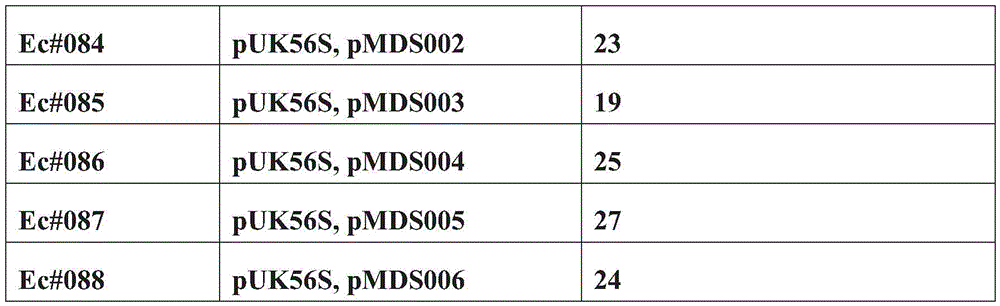
根据分子生物学中的标准方法(Sambrook,J.和Russell,D.W.Molecularcloning.A laboratory manual,第3版,Cold Spring Harbor Laboratory Press,ColdSpring Harbor,NY.2001),从不同的大肠杆菌菌株分离总质粒DNA,并且通过用SatI(ThermoFisher Scientific)限制切割1μg质粒DNA,测定体内甲基化效率,所述质粒受识别序列GCNGC中的5-甲基胞嘧啶抑制免遭切割。通过琼脂糖凝胶电泳分析限制性反应,同时溴化乙啶染色法可视化。Generuler 1kb DNA梯(ThermoFisher Scientific)用于估计DNA片段大小(图2)。具有GCNGC特异性5-甲基胞嘧啶DNA甲基化的分离自大肠杆菌菌株的质粒DNA受到保护免遭SatI限制切割,而来自大肠杆菌菌株Ec#082的pUK56S未受到保护。Total plasmids were isolated from different E. coli strains according to standard methods in molecular biology (Sambrook, J. and Russell, D.W. Molecular cloning. A laboratory manual, 3rd edition, Cold Spring Harbor Laboratory Press, Cold Spring Harbor, NY. 2001). DNA, and in vivo methylation efficiency was determined by restriction cleavage of 1 μg of plasmid DNA inhibited from cleavage by 5-methylcytosine in the recognition sequence GCNGC with SatI (ThermoFisher Scientific). Restriction reactions were analyzed by agarose gel electrophoresis and visualized by ethidium bromide staining. A
实施例2:Example 2:
来自大肠杆菌细胞的甲基化DNA转化入地衣芽孢杆菌。Methylated DNA from E. coli cells was transformed into Bacillus licheniformis.
如实施例1中所述自大肠杆菌细胞Ec#082-Ec#088分离质粒DNA,并且将1μg质粒DNA基本上如Brigidi等人(Brigidi,P.,Mateuzzi,D.(1991).Biotechnol.Techniques 5,5)描述那样转化入地衣芽孢杆菌ATCC 53926电感受态细胞,附带以下修改:转化DNA后,在1ml LBSPG-缓冲液中使细胞恢复并且在37℃温育60分钟(
实施例3:Example 3:
枯草芽孢杆菌中的体内甲基化。In vivo methylation in Bacillus subtilis.
以限制性酶SacI线性化用于整合入枯草芽孢杆菌的amyE基因的MT酶表达质粒pMIS012,随后将2μg线性化的质粒DNA转化入根据Spizizen的方法(Anagnostopoulos,C.和Spizizen,J.(1961).J.Bacteriol.81,741-746.)感受态化的枯草芽孢杆菌168细胞。将细胞铺展在含有10μg/ml氯霉素的LB琼脂平板上并在37℃温育过夜。挑取长出的菌落并在含有10μg/ml氯霉素的LB琼脂平板以及在含有10μg/ml氯霉素和0.5%可溶性淀粉(Sigma)的LB琼脂平板上划线,随后在37℃温育过夜。用含碘的Lugols溶液覆盖淀粉平板并且鉴定具有阴性淀粉酶活性的阳性整合克隆。用溶菌酶(10mg/ml)在37℃处理30分钟后,通过标准苯酚/氯仿提取方法分离阳性克隆的基因组DNA,随后通过PCR分析MT酶表达盒的正确整合。所得的枯草芽孢杆菌菌株称为Bs#053。The MT enzyme expression plasmid pMIS012 for integration into the amyE gene of Bacillus subtilis was linearized with the restriction enzyme SacI, and 2 μg of the linearized plasmid DNA was subsequently transformed into a method according to Spizizen (Anagnostopoulos, C. and Spizizen, J. (1961) ). J. Bacteriol. 81, 741-746.) Competent Bacillus subtilis 168 cells. Cells were spread on LB agar plates containing 10 μg/ml chloramphenicol and incubated overnight at 37°C. Outgrown colonies were picked and streaked on LB agar plates containing 10 μg/ml chloramphenicol and on LB agar plates containing 10 μg/ml chloramphenicol and 0.5% soluble starch (Sigma), followed by incubation at 37°C overnight. Starch plates were overlaid with iodine-containing Lugols solution and positive integrating clones with negative amylase activity were identified. After treatment with lysozyme (10 mg/ml) for 30 min at 37°C, the genomic DNA of positive clones was isolated by standard phenol/chloroform extraction methods, followed by PCR analysis for correct integration of the MTase expression cassette. The resulting Bacillus subtilis strain was designated Bs#053.
将质粒pUK56转化入根据Spizizen的方法(Anagnostopoulos,C.和Spizizen,J.(1961).J.Bacteriol.81,741-746.)感受态化的枯草芽孢杆菌168细胞和枯草芽孢杆菌Bs#053细胞。使质粒DNA pUK56如专利DE4005025中所述那样在体外甲基化,随后如实施例2中所述那样转化入地衣芽孢杆菌ATCC53926电感受态细胞。将转化体铺展在含有20μg/ml卡那霉素和1%脱脂乳的LB琼脂平板上并在37℃温育过夜,分别产生枯草芽孢杆菌菌株Bs#54和Bs#55及地衣芽孢杆菌菌株Bli#112。The plasmid pUK56 was transformed into B. subtilis 168 cells and B. subtilis Bs#053 competent according to the method of Spizizen (Anagnostopoulos, C. and Spizizen, J. (1961). J. Bacteriol. 81, 741-746.) cell. Plasmid DNA pUK56 was methylated in vitro as described in patent DE4005025 and subsequently transformed into Bacillus licheniformis ATCC53926 electrocompetent cells as described in Example 2. Transformants were spread on LB agar plates containing 20 μg/ml kanamycin and 1% skim milk and incubated overnight at 37°C to yield Bacillus subtilis strains
用溶菌酶(10mg/ml)在37℃处理30分钟后,将质粒DNA pUK56如实施例1中所述那样从枯草芽孢杆菌菌株Bs#54和Bs#55和地衣芽孢杆菌菌株Bli#112分离。将1μg每种质粒DNA如实施例2中所述那样转化入地衣芽孢杆菌ATCC53926电感受态细胞。来自枯草芽孢杆菌Bs#54和Bs#55的质粒pUK56的转化效率对设置成100%的从地衣芽孢杆菌Bli#112分离的质粒pUK56的转化效率归一化。令人惊讶地,相比从携带地衣芽孢杆菌ATCC 53926天然DNA甲基化模式的地衣芽孢杆菌Bli#112分离的质粒DNA pUK56,从携带对地衣芽孢杆菌ATCC53926为异源的MT酶的枯草芽孢杆菌Bs#55分离的质粒DNA pUK56导致转化效率显著增加(图4)。相反,在转化来自充当对照的枯草芽孢杆菌Bs#54的质粒pUK56后,几乎回收不到菌落。Plasmid DNA pUK56 was isolated as described in Example 1 from B. subtilis strains

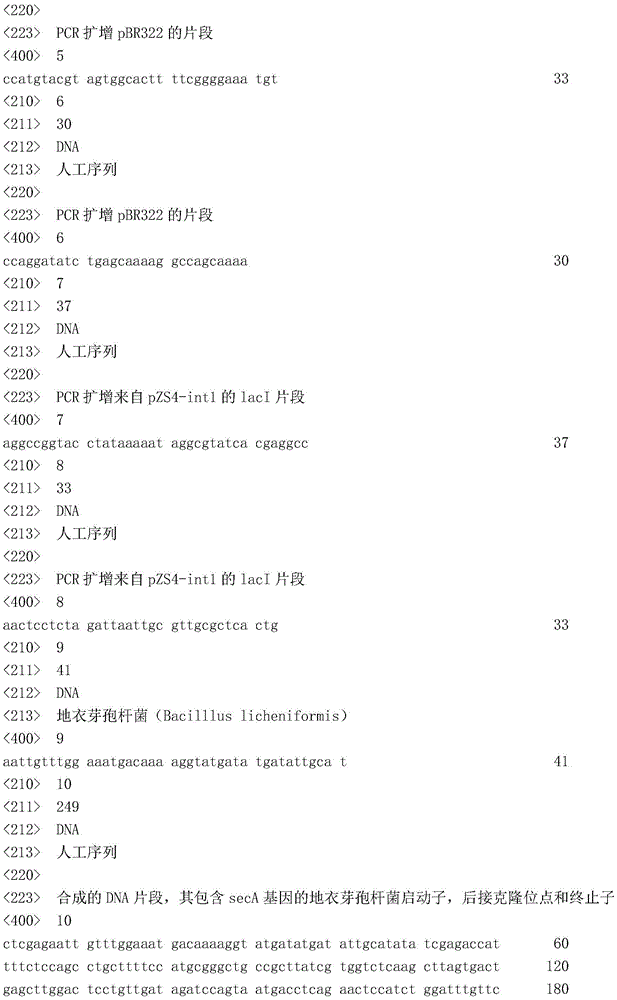


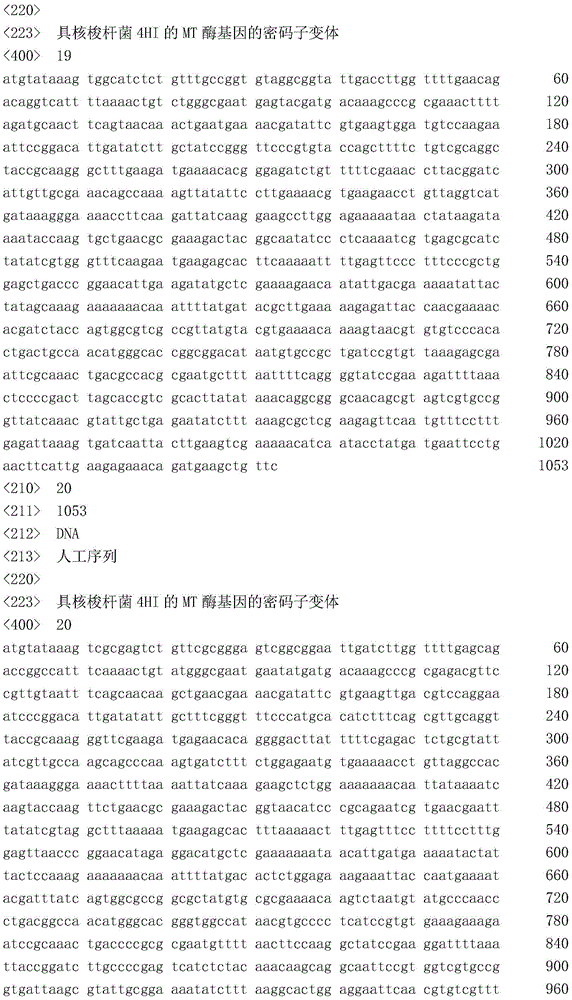

















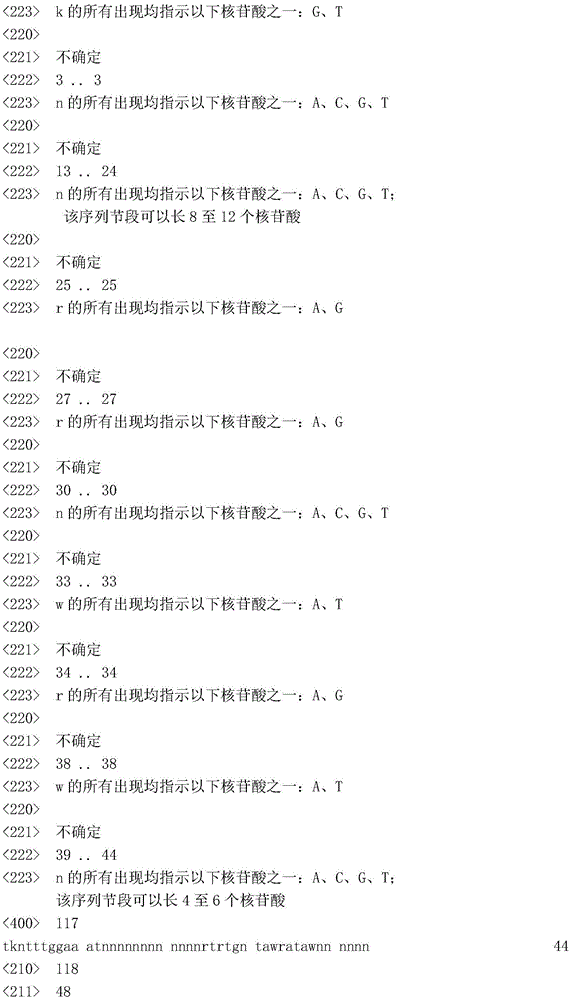
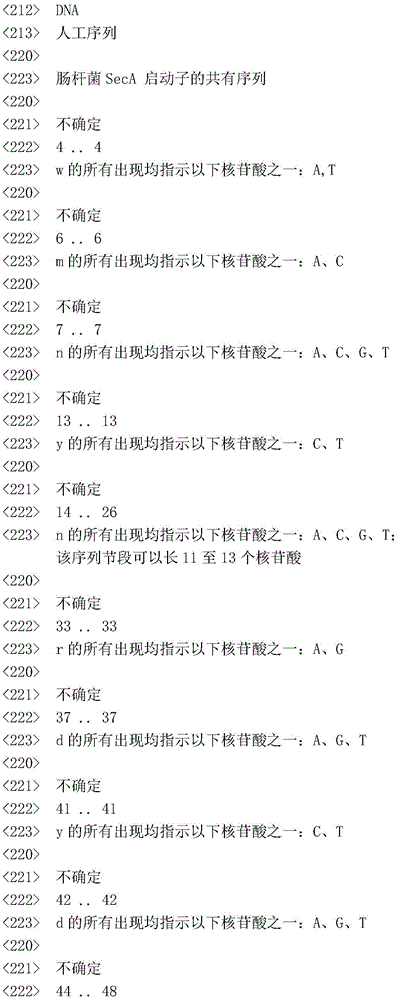

Claims (20)
Applications Claiming Priority (3)
| Application Number | Priority Date | Filing Date | Title |
|---|---|---|---|
| EP17182610.0 | 2017-07-21 | ||
| EP17182610 | 2017-07-21 | ||
| PCT/EP2018/068846 WO2019016051A1 (en) | 2017-07-21 | 2018-07-11 | Method of transforming bacterial cells |
Publications (1)
| Publication Number | Publication Date |
|---|---|
| CN110892066A true CN110892066A (en) | 2020-03-17 |
Family
ID=59409177
Family Applications (1)
| Application Number | Title | Priority Date | Filing Date |
|---|---|---|---|
| CN201880047705.5A Pending CN110892066A (en) | 2017-07-21 | 2018-07-11 | Methods of transforming bacterial cells |
Country Status (4)
| Country | Link |
|---|---|
| US (1) | US11066653B2 (en) |
| EP (1) | EP3655528A1 (en) |
| CN (1) | CN110892066A (en) |
| WO (1) | WO2019016051A1 (en) |
Families Citing this family (13)
| Publication number | Priority date | Publication date | Assignee | Title |
|---|---|---|---|---|
| MX2022002182A (en) | 2019-08-22 | 2022-03-11 | Basf Se | AMYLASE VARIANTS. |
| CN115176018B (en) | 2020-03-04 | 2025-07-08 | 巴斯夫欧洲公司 | Shuttle vectors for expression in E.coli and Bacillus |
| KR20220150328A (en) | 2020-03-04 | 2022-11-10 | 바스프 에스이 | Methods of producing constitutive bacterial promoters conferring low to medium expression |
| WO2021224152A1 (en) | 2020-05-05 | 2021-11-11 | Basf Se | Improving expression in fermentation processes |
| JP2023529980A (en) | 2020-06-17 | 2023-07-12 | ビーエーエスエフ ソシエタス・ヨーロピア | Plasmid copy number regulation and integration |
| EP4185689A1 (en) | 2020-07-24 | 2023-05-31 | Basf Se | Alanine racemase single deletion and transcomplementation |
| EP4225779A2 (en) | 2020-10-07 | 2023-08-16 | Basf Se | Bacillus cell with reduced lipase and/or esterase side activities |
| CN117813316A (en) | 2021-06-24 | 2024-04-02 | 巴斯夫欧洲公司 | Bacillus licheniformis host cells for the production of higher purity compounds of interest |
| WO2022269084A1 (en) | 2021-06-24 | 2022-12-29 | Basf Se | Improved bacillus host cell with altered rema/remb protein |
| CN117813317A (en) | 2021-06-24 | 2024-04-02 | 巴斯夫欧洲公司 | Improved Bacillus production host |
| WO2023117970A1 (en) | 2021-12-20 | 2023-06-29 | Basf Se | Method for improved production of intracellular proteins in bacillus |
| CN120500529A (en) | 2023-01-05 | 2025-08-15 | 巴斯夫欧洲公司 | Use of folding enzymes for improving heterologous expression of secreted molecules |
| WO2025031865A1 (en) | 2023-08-08 | 2025-02-13 | Basf Se | Improved bacillus cell with inactivated metalloprotease |
Citations (4)
| Publication number | Priority date | Publication date | Assignee | Title |
|---|---|---|---|---|
| CN101595214A (en) * | 2006-11-29 | 2009-12-02 | 诺维信股份有限公司 | Method for improved introduction of DNA into bacterial cells |
| CN101631862A (en) * | 2007-04-02 | 2010-01-20 | 花王株式会社 | Modified microorganism |
| CN102421897A (en) * | 2009-03-06 | 2012-04-18 | 合成基因组股份有限公司 | Methods for cloning and manipulating genomes |
| CN103958692A (en) * | 2010-12-23 | 2014-07-30 | 艾克森美孚研究与工程公司 | Genetically engineered microorganisms comprising 4-hydroxybenzoly-coa thioesterases and methods of using the same for producing free fatty acids and fatty acid derivatives |
Family Cites Families (8)
| Publication number | Priority date | Publication date | Assignee | Title |
|---|---|---|---|---|
| AU607141B2 (en) | 1986-06-06 | 1991-02-28 | New England Biolabs, Inc. | Method for cloning restriction modification system |
| DE4005025A1 (en) | 1989-04-28 | 1990-10-31 | Henkel Kgaa | Improving transformation rate for Bacillus licheniformis host - by incubating foreign DNA with host cell modifying enzyme before transfer |
| DE69033388T2 (en) | 1989-08-25 | 2000-05-11 | Henkel Research Corp., Santa Rosa | ALKALINE PROTEOLYTIC ENZYME AND METHOD FOR PRODUCING THE SAME |
| DK639689D0 (en) | 1989-12-18 | 1989-12-18 | Novo Nordisk As | INTRODUCING DNA IN CELLS |
| US5958728A (en) | 1996-11-18 | 1999-09-28 | Novo Nordiskbiotech, Inc. | Methods for producing polypeptides in mutants of bacillus cells |
| US6689573B1 (en) | 1999-05-24 | 2004-02-10 | New England Biolabs, Inc. | Method for screening restriction endonucleases |
| US7026149B2 (en) | 2003-02-28 | 2006-04-11 | Ajinomoto Co., Inc. | Polynucleotides encoding polypeptides involved in the stress response to environmental changes in Methylophilus methylotrophus |
| EP3655422B1 (en) | 2017-07-21 | 2023-03-29 | Basf Se | Promoter for heterologous expression |
-
2018
- 2018-07-11 CN CN201880047705.5A patent/CN110892066A/en active Pending
- 2018-07-11 EP EP18740569.1A patent/EP3655528A1/en active Pending
- 2018-07-11 WO PCT/EP2018/068846 patent/WO2019016051A1/en not_active Ceased
- 2018-07-11 US US16/631,994 patent/US11066653B2/en active Active
Patent Citations (4)
| Publication number | Priority date | Publication date | Assignee | Title |
|---|---|---|---|---|
| CN101595214A (en) * | 2006-11-29 | 2009-12-02 | 诺维信股份有限公司 | Method for improved introduction of DNA into bacterial cells |
| CN101631862A (en) * | 2007-04-02 | 2010-01-20 | 花王株式会社 | Modified microorganism |
| CN102421897A (en) * | 2009-03-06 | 2012-04-18 | 合成基因组股份有限公司 | Methods for cloning and manipulating genomes |
| CN103958692A (en) * | 2010-12-23 | 2014-07-30 | 艾克森美孚研究与工程公司 | Genetically engineered microorganisms comprising 4-hydroxybenzoly-coa thioesterases and methods of using the same for producing free fatty acids and fatty acid derivatives |
Non-Patent Citations (1)
| Title |
|---|
| VAISVILA,R: "ADX97301.1", 《GENBANK》 * |
Also Published As
| Publication number | Publication date |
|---|---|
| US20200165581A1 (en) | 2020-05-28 |
| US11066653B2 (en) | 2021-07-20 |
| WO2019016051A1 (en) | 2019-01-24 |
| EP3655528A1 (en) | 2020-05-27 |
Similar Documents
| Publication | Publication Date | Title |
|---|---|---|
| US11066653B2 (en) | Method of transforming bacterial cells | |
| Song et al. | Enhancement of extracellular expression of Bacillus naganoensis pullulanase from recombinant Bacillus subtilis: effects of promoter and host | |
| CN101611145B (en) | Modified messenger RNA stabilizing sequences for expressing genes in bacterial cells | |
| Adalsteinsson et al. | Efficient genome editing of an extreme thermophile, Thermus thermophilus, using a thermostable Cas9 variant | |
| US7820408B2 (en) | Methods of improving the introduction of DNA into bacterial cells | |
| Wang et al. | A new strategy to express the extracellular α-amylase from Pyrococcus furiosus in Bacillus amyloliquefaciens | |
| Khadye et al. | Optimal secretion of thermostable Beta-glucosidase in Bacillus subtilis by signal peptide optimization | |
| Sürmeli et al. | Improved activity of α‐L‐arabinofuranosidase from Geobacillus vulcani GS90 by directed evolution: Investigation on thermal and alkaline stability | |
| Ran et al. | Enhanced production of recombinant Thermobifida fusca isoamylase in Escherichia coli MDS42 | |
| US12065652B2 (en) | Promoter for heterologous expression | |
| Chung et al. | Identification and characterization of CbeI, a novel thermostable restriction enzyme from Caldicellulosiruptor bescii DSM 6725 and a member of a new subfamily of HaeIII-like enzymes | |
| JP6693723B2 (en) | Bacillus subtilis mutant strain and its use | |
| US20250051822A1 (en) | Method for improved production of intracellular proteins in bacillus | |
| CN105339493B (en) | Codon-modified amylases from Bacillus autumba | |
| CN115176018B (en) | Shuttle vectors for expression in E.coli and Bacillus | |
| CN102559704B (en) | Method for knocking out gene in clostridium acetobutylicum | |
| CN115605597A (en) | Method for generating constitutive bacterial promoters conferring low to moderate expression | |
| Jiang et al. | Vector promoters used in Klebsiella pneumoniae | |
| US20220098599A1 (en) | Minicircle producing bacteria engineered to differentially methylate nucleic acid molecules therein | |
| US20240060110A1 (en) | Bacillus cell with reduced lipase and/or esterase side activities | |
| Rabbani et al. | Cloning and Expression of Randomly Mutated Bacillus subtilis α‐Amylase Genes in HB101 | |
| Kholikov et al. | Enhanced production of thermostable α-amylase in Bacillus subtilis | |
| Pessela et al. | Production of a thermoresistant alpha-galactosidase from Thermus sp. strain T2 for food processing | |
| JP6660718B2 (en) | Bacillus subtilis mutant and its use | |
| Weber et al. | Recombinant production of acidophilic L-arabinose isomerase from Lentilactobacillus parakefiri in Bacillus subtilis |
Legal Events
| Date | Code | Title | Description |
|---|---|---|---|
| PB01 | Publication | ||
| PB01 | Publication | ||
| SE01 | Entry into force of request for substantive examination | ||
| SE01 | Entry into force of request for substantive examination | ||
| WD01 | Invention patent application deemed withdrawn after publication |
Application publication date: 20200317 |
|
| WD01 | Invention patent application deemed withdrawn after publication |