CN110891976A - Proteins that bind GD2, NKG2D and CD16 - Google Patents
Proteins that bind GD2, NKG2D and CD16 Download PDFInfo
- Publication number
- CN110891976A CN110891976A CN201880026498.5A CN201880026498A CN110891976A CN 110891976 A CN110891976 A CN 110891976A CN 201880026498 A CN201880026498 A CN 201880026498A CN 110891976 A CN110891976 A CN 110891976A
- Authority
- CN
- China
- Prior art keywords
- chain variable
- seq
- protein
- amino acid
- variable domain
- Prior art date
- Legal status (The legal status is an assumption and is not a legal conclusion. Google has not performed a legal analysis and makes no representation as to the accuracy of the status listed.)
- Pending
Links
Images




Classifications
-
- C—CHEMISTRY; METALLURGY
- C07—ORGANIC CHEMISTRY
- C07K—PEPTIDES
- C07K16/00—Immunoglobulins [IGs], e.g. monoclonal or polyclonal antibodies
- C07K16/18—Immunoglobulins [IGs], e.g. monoclonal or polyclonal antibodies against material from animals or humans
- C07K16/28—Immunoglobulins [IGs], e.g. monoclonal or polyclonal antibodies against material from animals or humans against receptors, cell surface antigens or cell surface determinants
- C07K16/2803—Immunoglobulins [IGs], e.g. monoclonal or polyclonal antibodies against material from animals or humans against receptors, cell surface antigens or cell surface determinants against the immunoglobulin superfamily
- C07K16/283—Immunoglobulins [IGs], e.g. monoclonal or polyclonal antibodies against material from animals or humans against receptors, cell surface antigens or cell surface determinants against the immunoglobulin superfamily against Fc-receptors, e.g. CD16, CD32, CD64
-
- C—CHEMISTRY; METALLURGY
- C07—ORGANIC CHEMISTRY
- C07K—PEPTIDES
- C07K16/00—Immunoglobulins [IGs], e.g. monoclonal or polyclonal antibodies
- C07K16/18—Immunoglobulins [IGs], e.g. monoclonal or polyclonal antibodies against material from animals or humans
- C07K16/28—Immunoglobulins [IGs], e.g. monoclonal or polyclonal antibodies against material from animals or humans against receptors, cell surface antigens or cell surface determinants
- C07K16/30—Immunoglobulins [IGs], e.g. monoclonal or polyclonal antibodies against material from animals or humans against receptors, cell surface antigens or cell surface determinants from tumour cells
- C07K16/3076—Immunoglobulins [IGs], e.g. monoclonal or polyclonal antibodies against material from animals or humans against receptors, cell surface antigens or cell surface determinants from tumour cells against structure-related tumour-associated moieties
- C07K16/3084—Immunoglobulins [IGs], e.g. monoclonal or polyclonal antibodies against material from animals or humans against receptors, cell surface antigens or cell surface determinants from tumour cells against structure-related tumour-associated moieties against tumour-associated gangliosides
-
- A—HUMAN NECESSITIES
- A61—MEDICAL OR VETERINARY SCIENCE; HYGIENE
- A61P—SPECIFIC THERAPEUTIC ACTIVITY OF CHEMICAL COMPOUNDS OR MEDICINAL PREPARATIONS
- A61P35/00—Antineoplastic agents
-
- C—CHEMISTRY; METALLURGY
- C07—ORGANIC CHEMISTRY
- C07K—PEPTIDES
- C07K16/00—Immunoglobulins [IGs], e.g. monoclonal or polyclonal antibodies
- C07K16/18—Immunoglobulins [IGs], e.g. monoclonal or polyclonal antibodies against material from animals or humans
- C07K16/28—Immunoglobulins [IGs], e.g. monoclonal or polyclonal antibodies against material from animals or humans against receptors, cell surface antigens or cell surface determinants
- C07K16/2851—Immunoglobulins [IGs], e.g. monoclonal or polyclonal antibodies against material from animals or humans against receptors, cell surface antigens or cell surface determinants against the lectin superfamily, e.g. CD23, CD72
-
- C—CHEMISTRY; METALLURGY
- C07—ORGANIC CHEMISTRY
- C07K—PEPTIDES
- C07K16/00—Immunoglobulins [IGs], e.g. monoclonal or polyclonal antibodies
- C07K16/18—Immunoglobulins [IGs], e.g. monoclonal or polyclonal antibodies against material from animals or humans
- C07K16/32—Immunoglobulins [IGs], e.g. monoclonal or polyclonal antibodies against material from animals or humans against translation products of oncogenes
-
- A—HUMAN NECESSITIES
- A61—MEDICAL OR VETERINARY SCIENCE; HYGIENE
- A61K—PREPARATIONS FOR MEDICAL, DENTAL OR TOILETRY PURPOSES
- A61K39/00—Medicinal preparations containing antigens or antibodies
- A61K2039/505—Medicinal preparations containing antigens or antibodies comprising antibodies
-
- A—HUMAN NECESSITIES
- A61—MEDICAL OR VETERINARY SCIENCE; HYGIENE
- A61K—PREPARATIONS FOR MEDICAL, DENTAL OR TOILETRY PURPOSES
- A61K39/00—Medicinal preparations containing antigens or antibodies
- A61K2039/505—Medicinal preparations containing antigens or antibodies comprising antibodies
- A61K2039/507—Comprising a combination of two or more separate antibodies
-
- A—HUMAN NECESSITIES
- A61—MEDICAL OR VETERINARY SCIENCE; HYGIENE
- A61K—PREPARATIONS FOR MEDICAL, DENTAL OR TOILETRY PURPOSES
- A61K39/00—Medicinal preparations containing antigens or antibodies
- A61K2039/80—Vaccine for a specifically defined cancer
- A61K2039/804—Blood cells [leukemia, lymphoma]
-
- C—CHEMISTRY; METALLURGY
- C07—ORGANIC CHEMISTRY
- C07K—PEPTIDES
- C07K2317/00—Immunoglobulins specific features
- C07K2317/30—Immunoglobulins specific features characterized by aspects of specificity or valency
- C07K2317/31—Immunoglobulins specific features characterized by aspects of specificity or valency multispecific
-
- C—CHEMISTRY; METALLURGY
- C07—ORGANIC CHEMISTRY
- C07K—PEPTIDES
- C07K2317/00—Immunoglobulins specific features
- C07K2317/50—Immunoglobulins specific features characterized by immunoglobulin fragments
- C07K2317/52—Constant or Fc region; Isotype
-
- C—CHEMISTRY; METALLURGY
- C07—ORGANIC CHEMISTRY
- C07K—PEPTIDES
- C07K2317/00—Immunoglobulins specific features
- C07K2317/50—Immunoglobulins specific features characterized by immunoglobulin fragments
- C07K2317/52—Constant or Fc region; Isotype
- C07K2317/524—CH2 domain
-
- C—CHEMISTRY; METALLURGY
- C07—ORGANIC CHEMISTRY
- C07K—PEPTIDES
- C07K2317/00—Immunoglobulins specific features
- C07K2317/50—Immunoglobulins specific features characterized by immunoglobulin fragments
- C07K2317/52—Constant or Fc region; Isotype
- C07K2317/53—Hinge
-
- C—CHEMISTRY; METALLURGY
- C07—ORGANIC CHEMISTRY
- C07K—PEPTIDES
- C07K2317/00—Immunoglobulins specific features
- C07K2317/50—Immunoglobulins specific features characterized by immunoglobulin fragments
- C07K2317/55—Fab or Fab'
-
- C—CHEMISTRY; METALLURGY
- C07—ORGANIC CHEMISTRY
- C07K—PEPTIDES
- C07K2317/00—Immunoglobulins specific features
- C07K2317/50—Immunoglobulins specific features characterized by immunoglobulin fragments
- C07K2317/56—Immunoglobulins specific features characterized by immunoglobulin fragments variable (Fv) region, i.e. VH and/or VL
- C07K2317/569—Single domain, e.g. dAb, sdAb, VHH, VNAR or nanobody®
-
- C—CHEMISTRY; METALLURGY
- C07—ORGANIC CHEMISTRY
- C07K—PEPTIDES
- C07K2317/00—Immunoglobulins specific features
- C07K2317/60—Immunoglobulins specific features characterized by non-natural combinations of immunoglobulin fragments
-
- C—CHEMISTRY; METALLURGY
- C07—ORGANIC CHEMISTRY
- C07K—PEPTIDES
- C07K2317/00—Immunoglobulins specific features
- C07K2317/70—Immunoglobulins specific features characterized by effect upon binding to a cell or to an antigen
- C07K2317/73—Inducing cell death, e.g. apoptosis, necrosis or inhibition of cell proliferation
-
- C—CHEMISTRY; METALLURGY
- C07—ORGANIC CHEMISTRY
- C07K—PEPTIDES
- C07K2317/00—Immunoglobulins specific features
- C07K2317/70—Immunoglobulins specific features characterized by effect upon binding to a cell or to an antigen
- C07K2317/75—Agonist effect on antigen
-
- C—CHEMISTRY; METALLURGY
- C07—ORGANIC CHEMISTRY
- C07K—PEPTIDES
- C07K2317/00—Immunoglobulins specific features
- C07K2317/70—Immunoglobulins specific features characterized by effect upon binding to a cell or to an antigen
- C07K2317/76—Antagonist effect on antigen, e.g. neutralization or inhibition of binding
-
- C—CHEMISTRY; METALLURGY
- C07—ORGANIC CHEMISTRY
- C07K—PEPTIDES
- C07K2317/00—Immunoglobulins specific features
- C07K2317/90—Immunoglobulins specific features characterized by (pharmaco)kinetic aspects or by stability of the immunoglobulin
- C07K2317/94—Stability, e.g. half-life, pH, temperature or enzyme-resistance
Landscapes
- Health & Medical Sciences (AREA)
- Chemical & Material Sciences (AREA)
- Organic Chemistry (AREA)
- Immunology (AREA)
- Life Sciences & Earth Sciences (AREA)
- General Health & Medical Sciences (AREA)
- Medicinal Chemistry (AREA)
- Biochemistry (AREA)
- Biophysics (AREA)
- Genetics & Genomics (AREA)
- Molecular Biology (AREA)
- Proteomics, Peptides & Aminoacids (AREA)
- Chemical Kinetics & Catalysis (AREA)
- General Chemical & Material Sciences (AREA)
- Nuclear Medicine, Radiotherapy & Molecular Imaging (AREA)
- Pharmacology & Pharmacy (AREA)
- Animal Behavior & Ethology (AREA)
- Public Health (AREA)
- Veterinary Medicine (AREA)
- Cell Biology (AREA)
- Oncology (AREA)
- Peptides Or Proteins (AREA)
- Medicines That Contain Protein Lipid Enzymes And Other Medicines (AREA)
- Micro-Organisms Or Cultivation Processes Thereof (AREA)
- Medicines Containing Antibodies Or Antigens For Use As Internal Diagnostic Agents (AREA)
- Preparation Of Compounds By Using Micro-Organisms (AREA)
Abstract
Description
与相关申请的交叉引用CROSS-REFERENCE TO RELATED APPLICATIONS
本申请要求2017年2月20日提交的美国临时专利申请号62/461,143的利益和优先权,其全部内容为所有目的通过参考并入本文。This application claims the benefit of and priority to US Provisional Patent Application No. 62/461,143, filed February 20, 2017, the entire contents of which are incorporated herein by reference for all purposes.
序列表sequence listing
本申请含有以ASCII格式电子提交并整体通过参考并入本文的序列表。所述在2018年2月20日生成的ASCII拷贝被命名为DFY-006WO_ST25.txt,大小为74,910个字节。This application contains a Sequence Listing electronically filed in ASCII format and incorporated herein by reference in its entirety. The ASCII copy generated on February 20, 2018 is named DFY-006WO_ST25.txt and is 74,910 bytes in size.
技术领域technical field
本发明涉及结合到二唾液酸神经节苷脂GD2、NKG2D受体和CD16的多特异性结合蛋白。The present invention relates to multispecific binding proteins that bind to the disialoganglioside GD2, the NKG2D receptor and CD16.
背景技术Background technique
尽管在文献中已报道了治疗癌症的大量研究尝试和科学进展,但这种疾病依然是显著的健康问题。一些最经常被诊断到的癌症包括前列腺癌、乳腺癌和肺癌。前列腺癌是男性中最常见的癌症形式。乳腺癌仍然是女性中死亡的主导原因。当前用于这些癌症的治疗选项不对所有患者有效和/或可能具有大量严重副作用。其他类型的癌症对于使用现有治疗选项治疗来说也仍然具有挑战性。Although numerous research attempts and scientific advances to treat cancer have been reported in the literature, the disease remains a significant health problem. Some of the most frequently diagnosed cancers include prostate, breast and lung cancer. Prostate cancer is the most common form of cancer in men. Breast cancer remains the leading cause of death among women. Current treatment options for these cancers are not effective for all patients and/or may have a number of serious side effects. Other types of cancer also remain challenging to treat using existing treatment options.
癌症免疫疗法是理想的,因为它们是高度特异性的并且可以使用患者自己的免疫系统来促进癌细胞的破坏。融合蛋白例如双特异性T-细胞衔接器是文献中描述的结合到肿瘤细胞和T-细胞以促进肿瘤细胞破坏的癌症免疫疗法。结合到某些肿瘤相关抗原和结合到某些免疫细胞的抗体在文献中已有描述。参见例如WO 2016/134371和WO 2015/095412。Cancer immunotherapies are ideal because they are highly specific and can use the patient's own immune system to promote the destruction of cancer cells. Fusion proteins such as bispecific T-cell adapters are cancer immunotherapy described in the literature that bind to tumor cells and T-cells to promote tumor cell destruction. Antibodies that bind to certain tumor-associated antigens and to certain immune cells have been described in the literature. See eg WO 2016/134371 and WO 2015/095412.
自然杀伤(NK)细胞是先天性免疫系统的组成部分,占循环淋巴细胞的大约15%。NK细胞事实上浸润所有组织,并且最初因它们不需前期致敏即可杀伤肿瘤细胞的能力而被表征。激活的NK细胞通过与细胞毒性T细胞相似的手段杀伤靶细胞,即通过含有穿孔素和颗粒酶的细胞溶解颗粒以及通过死亡受体途径。激活的NK细胞还分泌炎性细胞因子例如IFN-γ和促进其他白细胞向靶组织的招募的趋化因子。Natural killer (NK) cells are an integral part of the innate immune system and comprise approximately 15% of circulating lymphocytes. NK cells infiltrate virtually all tissues and were initially characterized for their ability to kill tumor cells without prior sensitization. Activated NK cells kill target cells by means similar to cytotoxic T cells, namely through cytolytic granules containing perforin and granzymes and through the death receptor pathway. Activated NK cells also secrete inflammatory cytokines such as IFN-γ and chemokines that promote the recruitment of other leukocytes to target tissues.
NK细胞通过它们表面上的各种不同激活和抑制受体对信号作出响应。例如,当NK细胞遇到健康的自体细胞时,它们的活性通过杀伤细胞免疫球蛋白样受体(KIR)的激活而被抑制。或者,当NK细胞遇到外来细胞或癌细胞时,它们通过它们的激活受体(例如NKG2D、NCR、DNAM1)而被激活。NK细胞也通过它们表面上的CD16受体被某些免疫球蛋白的恒定区激活。NK细胞对激活的总体灵敏度取决于刺激性和抑制性信号的总和。NK cells respond to signals through a variety of different activating and inhibitory receptors on their surface. For example, when NK cells encounter healthy autologous cells, their activity is inhibited through the activation of killer cell immunoglobulin-like receptors (KIRs). Alternatively, when NK cells encounter foreign cells or cancer cells, they are activated through their activating receptors (eg, NKG2D, NCR, DNAM1). NK cells are also activated by the constant regions of certain immunoglobulins through the CD16 receptor on their surface. The overall sensitivity of NK cells to activation depends on the sum of stimulatory and inhibitory signals.
神经节苷脂是含有唾液酸的鞘糖脂,其在信号传导以及细胞粘附和识别中发挥重要作用。GD2是一种b-系列神经节苷脂,需要酶GD3合酶和GD2合酶将唾液酸单元添加到它的前体GM2上。GD2在几种肿瘤类型上高表达,并且它的表达在正常组织上受限,使它成为潜在的抗肿瘤靶点。此外,已显示GD2在各种不同的肿瘤类型中提高肿瘤增殖和侵入性。几乎所有的成神经母细胞瘤都丰富地表达GD2,据估算每个具有免疫抑制性质的细胞具有5-10百万个GD2分子。具有高GD2表达的其他肿瘤包括黑素瘤、视网膜母细胞瘤、小细胞肺癌、脑肿瘤、骨肉瘤、横纹肌肉瘤、儿童和青少年中的尤文氏肉瘤以及成年人中的脂肪肉瘤、纤维肉瘤、平滑肌肉瘤和其他软组织肉瘤。Gangliosides are sialic acid-containing glycosphingolipids that play important roles in signaling and cell adhesion and recognition. GD2 is a b-series ganglioside that requires the enzymes GD3 synthase and GD2 synthase to add sialic acid units to its precursor GM2. GD2 is highly expressed on several tumor types, and its expression is restricted on normal tissues, making it a potential antitumor target. Furthermore, GD2 has been shown to increase tumor proliferation and invasiveness in a variety of different tumor types. Nearly all neuroblastomas express GD2 abundantly, with an estimated 5-10 million GD2 molecules per cell with immunosuppressive properties. Other tumors with high GD2 expression include melanoma, retinoblastoma, small cell lung cancer, brain tumors, osteosarcoma, rhabdomyosarcoma, Ewing's sarcoma in children and adolescents, and liposarcoma, fibrosarcoma, smooth muscle tumors in adults Sarcomas and other soft tissue sarcomas.
发明内容SUMMARY OF THE INVENTION
本发明提供了结合到癌细胞上或癌症新血管上的GD2并结合到自然杀伤细胞上的NKG2D受体和CD16受体的多特异性结合蛋白。这些蛋白质可以结合超过一种以上NK激活受体,并且可以阻断天然配体与NKG2D的结合。在某些实施方式中,所述蛋白质可以在人类和其他物种例如啮齿动物和食蟹猴中激动NK细胞。本发明的各个不同方面和实施方式将在下文中更详细描述。The present invention provides multispecific binding proteins of NKG2D receptor and CD16 receptor that bind to GD2 on cancer cells or cancer neovasculature and to natural killer cells. These proteins can bind to more than one NK-activating receptor and can block natural ligand binding to NKG2D. In certain embodiments, the protein can stimulate NK cells in humans and other species such as rodents and cynomolgus monkeys. Various aspects and embodiments of the present invention are described in more detail below.
因此,本发明的一个方面提供了一种蛋白质,其包含:结合NKG2D的第一抗原结合位点;结合到GD2的第二抗原结合位点;和足以结合CD16的抗体Fc结构域、其部分或结合CD16的第三抗原结合位点。所述抗原结合位点可以各自包含抗体重链可变结构域和抗体轻链可变结构域(例如像在抗体中那样排列或融合在一起以形成scFv),或者一个或多个所述抗原结合位点可以是单域抗体,例如VHH抗体如骆驼抗体或VNAR抗体如在软骨鱼中发现的。Accordingly, one aspect of the present invention provides a protein comprising: a first antigen-binding site that binds to NKG2D; a second antigen-binding site that binds to GD2; and an antibody Fc domain, a portion thereof, or an antibody sufficient to bind CD16. Binds to the third antigen binding site of CD16. The antigen binding sites may each comprise an antibody heavy chain variable domain and an antibody light chain variable domain (e.g., arranged or fused together as in an antibody to form an scFv), or one or more of the antigen binding Sites can be single domain antibodies, eg VHH antibodies such as camelid antibodies or VNAR antibodies as found in cartilaginous fish.
在某些实施方式中,所述结合到NKG2D的第一抗原结合位点可以包含与SEQ IDNO:1相关的重链可变结构域,例如通过具有与SEQ ID NO:1至少90%(例如90%、91%、92%、93%、94%、95%、96%、97%、98%、99%或100%)同一性的氨基酸序列和/或包含与SEQ ID NO:1的CDR1(SEQ ID NO:62)、CDR2(SEQ ID NO:63)和CDR3(SEQ ID NO:64)序列相同的氨基酸序列。可选地,所述第一抗原结合位点可以包含与SEQ ID NO:41相关的重链可变结构域和与SEQ ID NO:42相关的轻链可变结构域。例如,所述第一抗原结合位点的重链可变结构域可以与SEQ ID NO:41至少90%(例如90%、91%、92%、93%、94%、95%、96%、97%、98%、99%或100%)同一性,和/或包含与SEQ ID NO:41的CDR1(SEQ ID NO:65)、CDR2(SEQ ID NO:66)和CDR3(SEQ ID NO:67)序列相同的氨基酸序列。同样地,所述第二抗原结合位点的轻链可变结构域可以与SEQ ID NO:42至少90%(例如90%、91%、92%、93%、94%、95%、96%、97%、98%、99%或100%)同一性,和/或包含与SEQ ID NO:42的CDR1(SEQID NO:68)、CDR2(SEQ ID NO:69)和CDR3(SEQ ID NO:70)序列相同的氨基酸序列。在其他实施方式中,所述第一抗原结合位点可以包含与SEQ ID NO:43相关的重链可变结构域和与SEQ ID NO:44相关的轻链可变结构域。例如,所述第一抗原结合位点的重链可变结构域可以与SEQ ID NO:43至少90%(例如90%、91%、92%、93%、94%、95%、96%、97%、98%、99%或100%)同一性,和/或包含与SEQ ID NO:43的CDR1(SEQ ID NO:71)、CDR2(SEQ IDNO:72)和CDR3(SEQ ID NO:73)序列相同的氨基酸序列。同样地,所述第二抗原结合位点的轻链可变结构域可以与SEQ ID NO:44至少90%(例如90%、91%、92%、93%、94%、95%、96%、97%、98%、99%或100%)同一性,和/或包含与SEQ ID NO:44的CDR1(SEQ ID NO:74)、CDR2(SEQ ID NO:75)和CDR3(SEQ ID NO:76)序列相同的氨基酸序列。In certain embodiments, the first antigen-binding site that binds to NKG2D may comprise a heavy chain variable domain associated with SEQ ID NO: 1, eg, by having at least 90% (eg, 90%) of SEQ ID NO: 1 %, 91%, 92%, 93%, 94%, 95%, 96%, 97%, 98%, 99% or 100%) identical amino acid sequences and/or comprising CDR1 ( SEQ ID NO: 62), CDR2 (SEQ ID NO: 63) and CDR3 (SEQ ID NO: 64) sequences are identical amino acid sequences. Alternatively, the first antigen binding site may comprise a heavy chain variable domain associated with SEQ ID NO:41 and a light chain variable domain associated with SEQ ID NO:42. For example, the heavy chain variable domain of the first antigen binding site may be at least 90% (eg, 90%, 91%, 92%, 93%, 94%, 95%, 96%, 97%, 98%, 99% or 100%) identity, and/or comprising CDR1 (SEQ ID NO:65), CDR2 (SEQ ID NO:66) and CDR3 (SEQ ID NO:66) to SEQ ID NO:41 67) The amino acid sequence with the same sequence. Likewise, the light chain variable domain of the second antigen binding site may be at least 90% (eg, 90%, 91%, 92%, 93%, 94%, 95%, 96% identical to SEQ ID NO:42) , 97%, 98%, 99% or 100%) identity, and/or comprise CDR1 (SEQ ID NO: 68), CDR2 (SEQ ID NO: 69) and CDR3 (SEQ ID NO: 42) 70) The amino acid sequence with the same sequence. In other embodiments, the first antigen binding site may comprise a heavy chain variable domain associated with SEQ ID NO:43 and a light chain variable domain associated with SEQ ID NO:44. For example, the heavy chain variable domain of the first antigen binding site may be at least 90% (eg, 90%, 91%, 92%, 93%, 94%, 95%, 96%, 97%, 98%, 99% or 100%) identity, and/or comprising CDR1 (SEQ ID NO:71), CDR2 (SEQ ID NO:72) and CDR3 (SEQ ID NO:73) to SEQ ID NO:43 ) sequence identical to the amino acid sequence. Likewise, the light chain variable domain of the second antigen binding site may be at least 90% (eg, 90%, 91%, 92%, 93%, 94%, 95%, 96% identical to SEQ ID NO:44) , 97%, 98%, 99% or 100%) identity, and/or comprise CDR1 (SEQ ID NO:74), CDR2 (SEQ ID NO:75) and CDR3 (SEQ ID NO:44) : 76) amino acid sequence identical to the sequence.
可选地,所述第一抗原结合位点可以包含与SEQ ID NO:45相关的重链可变结构域和与SEQ ID NO:46相关的轻链可变结构域,例如通过具有分别与SEQ ID NO:45至少90%(例如90%、91%、92%、93%、94%、95%、96%、97%、98%、99%或100%)同一性和与SEQID NO:46至少90%(例如90%、91%、92%、93%、94%、95%、96%、97%、98%、99%或100%)同一性的氨基酸序列。在另一个实施方式中,所述第一抗原结合位点可以包含与SEQID NO:47相关的重链可变结构域和与SEQ ID NO:48相关的轻链可变结构域,例如通过具有分别与SEQ ID NO:47至少90%(例如90%、91%、92%、93%、94%、95%、96%、97%、98%、99%或100%)同一性和与SEQ ID NO:48至少90%(例如90%、91%、92%、93%、94%、95%、96%、97%、98%、99%或100%)同一性的氨基酸序列。在某些实施方式中,所述第一抗原结合位点可以包含与SEQ ID NO:89相关的重链可变结构域和与SEQ ID NO:90相关的轻链可变结构域,例如通过具有分别与SEQ ID NO:89至少90%(例如90%、91%、92%、93%、94%、95%、96%、97%、98%、99%或100%)同一性和与SEQ ID NO:90至少90%(例如90%、91%、92%、93%、94%、95%、96%、97%、98%、99%或100%)同一性的氨基酸序列。在某些实施方式中,所述第一抗原结合位点可以包含与SEQ ID NO:91相关的重链可变结构域和与SEQID NO:92相关的轻链可变结构域,例如通过具有分别与SEQ ID NO:91至少90%(例如90%、91%、92%、93%、94%、95%、96%、97%、98%、99%或100%)同一性和与SEQ ID NO:92至少90%(例如90%、91%、92%、93%、94%、95%、96%、97%、98%、99%或100%)同一性的氨基酸序列。Alternatively, the first antigen binding site may comprise a heavy chain variable domain associated with SEQ ID NO:45 and a light chain variable domain associated with SEQ ID NO:46, for example by having the respective SEQ ID NO:46 ID NO:45 is at least 90% (eg 90%, 91%, 92%, 93%, 94%, 95%, 96%, 97%, 98%, 99% or 100%) identical and identical to SEQ ID NO:46 Amino acid sequences that are at least 90% (eg, 90%, 91%, 92%, 93%, 94%, 95%, 96%, 97%, 98%, 99%, or 100%) identical. In another embodiment, the first antigen binding site may comprise a heavy chain variable domain associated with SEQ ID NO:47 and a light chain variable domain associated with SEQ ID NO:48, for example by having the respective At least 90% (eg, 90%, 91%, 92%, 93%, 94%, 95%, 96%, 97%, 98%, 99% or 100%) identical to SEQ ID NO:47 and to SEQ ID NO: 48 Amino acid sequences that are at least 90% (eg, 90%, 91%, 92%, 93%, 94%, 95%, 96%, 97%, 98%, 99%, or 100%) identical. In certain embodiments, the first antigen binding site may comprise a heavy chain variable domain associated with SEQ ID NO:89 and a light chain variable domain associated with SEQ ID NO:90, eg, by having at least 90% (eg, 90%, 91%, 92%, 93%, 94%, 95%, 96%, 97%, 98%, 99% or 100%) identical to SEQ ID NO: 89 and to SEQ ID NO: 89, respectively ID NO: 90 Amino acid sequence at least 90% (eg 90%, 91%, 92%, 93%, 94%, 95%, 96%, 97%, 98%, 99% or 100%) identical. In certain embodiments, the first antigen binding site may comprise a heavy chain variable domain associated with SEQ ID NO:91 and a light chain variable domain associated with SEQ ID NO:92, eg, by having respectively At least 90% (eg, 90%, 91%, 92%, 93%, 94%, 95%, 96%, 97%, 98%, 99% or 100%) identical to SEQ ID NO:91 and to SEQ ID NO: 92 Amino acid sequences that are at least 90% (eg, 90%, 91%, 92%, 93%, 94%, 95%, 96%, 97%, 98%, 99%, or 100%) identical.
所述第二抗原结合位点可以任选地包含与SEQ ID NO:49相关的重链可变结构域和与SEQ ID NO:53相关的轻链可变结构域。例如,所述第二抗原结合位点的重链可变结构域可以与SEQ ID NO:49至少90%(例如90%、91%、92%、93%、94%、95%、96%、97%、98%、99%或100%)同一性,和/或包含与SEQ ID NO:49的CDR1(SEQ ID NO:50)、CDR2(SEQID NO:51)和CDR3(SEQ ID NO:52)序列同一性的氨基酸序列。同样地,所述第二抗原结合位点的轻链可变结构域可以与SEQ ID NO:53至少90%(例如90%、91%、92%、93%、94%、95%、96%、97%、98%、99%或100%)同一性,和/或包含与SEQ ID NO:53的CDR1(SEQ IDNO:54)、CDR2(SEQ ID NO:55)和CDR3(SEQ ID NO:56)序列同一性的氨基酸序列。The second antigen binding site may optionally comprise a heavy chain variable domain associated with SEQ ID NO:49 and a light chain variable domain associated with SEQ ID NO:53. For example, the heavy chain variable domain of the second antigen binding site can be at least 90% (eg, 90%, 91%, 92%, 93%, 94%, 95%, 96%, 97%, 98%, 99% or 100%) identity, and/or comprising CDR1 (SEQ ID NO:50), CDR2 (SEQ ID NO:51) and CDR3 (SEQ ID NO:52) to SEQ ID NO:49 ) amino acid sequences of sequence identity. Likewise, the light chain variable domain of the second antigen binding site may be at least 90% (eg, 90%, 91%, 92%, 93%, 94%, 95%, 96% identical to SEQ ID NO:53) , 97%, 98%, 99% or 100%) identity, and/or comprise CDR1 (SEQ ID NO: 54), CDR2 (SEQ ID NO: 55) and CDR3 (SEQ ID NO: 53) of SEQ ID NO: 53 56) Amino acid sequences of sequence identity.
可选地,所述第二抗原结合位点可以包含与SEQ ID NO:57相关的重链可变结构域和与SEQ ID NO:58相关的轻链可变结构域。例如,所述第二抗原结合位点的重链可变结构域可以与SEQ ID NO:57至少90%(例如90%、91%、92%、93%、94%、95%、96%、97%、98%、99%或100%)同一性,和/或包含与SEQ ID NO:57的CDR1(SEQ ID NO:77)、CDR2(SEQID NO:78)和CDR3(SEQ ID NO:79)序列相同的氨基酸序列。同样地,所述第二抗原结合位点的轻链可变结构域可以与SEQ ID NO:58至少90%(例如90%、91%、92%、93%、94%、95%、96%、97%、98%、99%或100%)同一性,和/或包含与SEQ ID NO:58的CDR1(SEQ ID NO:80)、CDR2(SEQ ID NO:81)和CDR3(SEQ ID NO:82)序列相同的氨基酸序列。Alternatively, the second antigen binding site may comprise a heavy chain variable domain associated with SEQ ID NO:57 and a light chain variable domain associated with SEQ ID NO:58. For example, the heavy chain variable domain of the second antigen binding site can be at least 90% (eg, 90%, 91%, 92%, 93%, 94%, 95%, 96%, 97%, 98%, 99% or 100%) identity, and/or comprising CDR1 (SEQ ID NO:77), CDR2 (SEQ ID NO:78) and CDR3 (SEQ ID NO:79) to SEQ ID NO:57 ) sequence identical to the amino acid sequence. Likewise, the light chain variable domain of the second antigen binding site may be at least 90% (eg, 90%, 91%, 92%, 93%, 94%, 95%, 96% identical to SEQ ID NO:58) , 97%, 98%, 99% or 100%) identity, and/or comprise CDR1 (SEQ ID NO:80), CDR2 (SEQ ID NO:81) and CDR3 (SEQ ID NO:58) : 82) amino acid sequence with the same sequence.
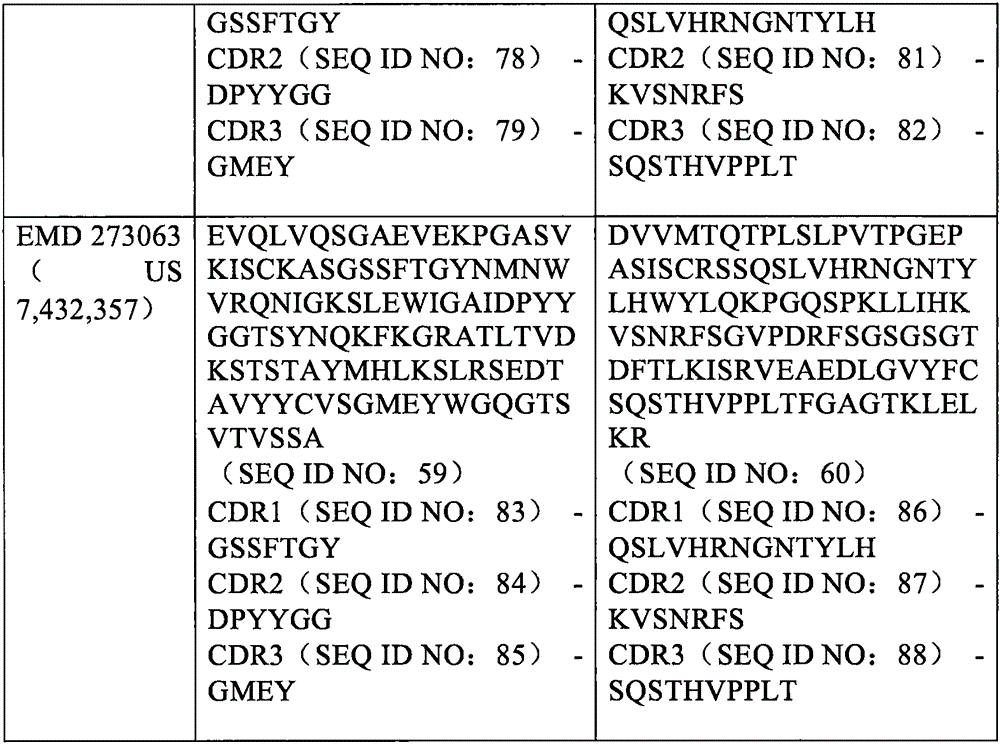
在另一个实施方式中,所述第二抗原结合位点可以包含与SEQ ID NO:59相关的重链可变结构域和与SEQ ID NO:60相关的轻链可变结构域。例如,所述第二抗原结合位点的重链可变结构域可以与SEQ ID NO:59至少90%(例如90%、91%、92%、93%、94%、95%、96%、97%、98%、99%或100%)同一性,和/或包含与SEQ ID NO:59的CDR1(SEQ ID NO:83)、CDR2(SEQ ID NO:84)和CDR3(SEQ ID NO:85)序列相同的氨基酸序列。同样地,所述第二抗原结合位点的轻链可变结构域可以与SEQ ID NO:60至少90%(例如90%、91%、92%、93%、94%、95%、96%、97%、98%、99%或100%)同一性,和/或包含与SEQ ID NO:60的CDR1(SEQ ID NO:86)、CDR2(SEQ ID NO:87)和CDR3(SEQ ID NO:88)序列相同的氨基酸序列。In another embodiment, the second antigen binding site may comprise a heavy chain variable domain associated with SEQ ID NO:59 and a light chain variable domain associated with SEQ ID NO:60. For example, the heavy chain variable domain of the second antigen binding site can be at least 90% (eg, 90%, 91%, 92%, 93%, 94%, 95%, 96%, 97%, 98%, 99% or 100%) identity, and/or comprising CDR1 (SEQ ID NO:83), CDR2 (SEQ ID NO:84) and CDR3 (SEQ ID NO:84) to SEQ ID NO:59 85) The amino acid sequence with the same sequence. Likewise, the light chain variable domain of the second antigen binding site may be at least 90% (eg, 90%, 91%, 92%, 93%, 94%, 95%, 96% identical to SEQ ID NO:60) , 97%, 98%, 99% or 100%) identity, and/or comprise CDR1 (SEQ ID NO:86), CDR2 (SEQ ID NO:87) and CDR3 (SEQ ID NO:60) : 88) amino acid sequence identical to the sequence.
在某些实施方式中,所述第二抗原结合位点包含具有与所述第一抗原结合位点中存在的轻链可变结构域的氨基酸序列相同的氨基酸序列的轻链可变结构域。In certain embodiments, the second antigen binding site comprises a light chain variable domain having the same amino acid sequence as the amino acid sequence of the light chain variable domain present in the first antigen binding site.
在某些实施方式中,所述蛋白质包含抗体Fc结构域的足以结合CD16的部分,其中所述抗体Fc结构域包含铰链和CH2结构域,和/或与人类IgG抗体的234-332位氨基酸序列至少90%同一性的氨基酸序列。In certain embodiments, the protein comprises a portion of an antibody Fc domain sufficient to bind CD16, wherein the antibody Fc domain comprises a hinge and CH2 domain, and/or the amino acid sequence at positions 234-332 of a human IgG antibody Amino acid sequences that are at least 90% identical.
还提供了含有这些蛋白质之一的制剂,含有表达这些蛋白质的一种或多种核酸的细胞,以及使用这些蛋白质增强肿瘤细胞死亡的方法。Also provided are formulations containing one of these proteins, cells containing one or more nucleic acids expressing these proteins, and methods of using these proteins to enhance tumor cell death.
本发明的另一方面提供了一种在患者中治疗癌症的方法。所述方法包括向需要的患者施用治疗有效量的本文描述的多特异性结合蛋白。使用所述多特异性结合蛋白治疗的示例性癌症包括例如成神经母细胞瘤、黑素瘤、视网膜母细胞瘤、小细胞肺癌、脑肿瘤、骨肉瘤、横纹肌肉瘤、儿童和青少年中的尤文氏肉瘤以及成年人中的脂肪肉瘤、纤维肉瘤、平滑肌肉瘤和其他软组织肉瘤。Another aspect of the invention provides a method of treating cancer in a patient. The methods include administering to a patient in need thereof a therapeutically effective amount of a multispecific binding protein described herein. Exemplary cancers treated with the multispecific binding protein include, for example, neuroblastoma, melanoma, retinoblastoma, small cell lung cancer, brain tumors, osteosarcoma, rhabdomyosarcoma, Ewing's disease in children and adolescents Sarcomas and liposarcoma, fibrosarcoma, leiomyosarcoma, and other soft tissue sarcomas in adults.
附图说明Description of drawings
图1是一种异二聚体多特异性抗体的图示。每个臂可以代表NKG2D结合结构域或GD2结合结构域。在某些实施方式中,所述NKG2D和GD2结合结构域可以享有共同轻链。Figure 1 is a schematic representation of a heterodimeric multispecific antibody. Each arm can represent an NKG2D binding domain or a GD2 binding domain. In certain embodiments, the NKG2D and GD2 binding domains may share a common light chain.
图2是一种异二聚体多特异性抗体的图示。所述NKG2D或GD2结合结构域中的任一者可以采取scFv格式(右臂)。Figure 2 is a schematic representation of a heterodimeric multispecific antibody. Either of the NKG2D or GD2 binding domains can be in scFv format (right arm).
图3是在ELISA测定法中显示的NKG2D结合结构域(作为克隆列出)对人类重组NKG2D的结合亲和力的线图。Figure 3 is a line graph of the binding affinity of NKG2D binding domains (listed as clones) for human recombinant NKG2D shown in an ELISA assay.
图4是在ELISA测定法中显示的NKG2D结合结构域(作为克隆列出)对食蟹猴重组NKG2D的结合亲和力的线图。Figure 4 is a line graph of the binding affinity of NKG2D binding domains (listed as clones) for cynomolgus monkey recombinant NKG2D shown in an ELISA assay.
图5是在ELISA测定法中显示的NKG2D结合结构域(作为克隆列出)对小鼠重组NKG2D的结合亲和力的线图。Figure 5 is a line graph of the binding affinity of NKG2D binding domains (listed as clones) for mouse recombinant NKG2D shown in an ELISA assay.
图6是通过流式细胞术证实了NKG2D结合结构域(作为克隆列出)与表达人类NKG2D的EL4细胞的结合的柱状图,示出了与背景相比的平均荧光强度(MFI)倍数。Figure 6 is a bar graph demonstrating the binding of the NKG2D binding domain (listed as a clone) to human NKG2D expressing EL4 cells by flow cytometry, showing the mean fluorescence intensity (MFI) fold compared to background.
图7是通过流式细胞术证实了NKG2D结合结构域(作为克隆列出)与表达小鼠NKG2D的EL4细胞的结合的柱状图,示出了与背景相比的平均荧光强度(MFI)倍数。Figure 7 is a bar graph demonstrating the binding of the NKG2D binding domain (listed as a clone) to mouse NKG2D expressing EL4 cells by flow cytometry, showing the mean fluorescence intensity (MFI) fold compared to background.
图8是通过与天然配体ULBP-6的竞争证实了NKG2D结合结构域(作为克隆列出)对重组人类NKG2D-Fc的特异性结合亲和力的线图。Figure 8 is a line graph demonstrating the specific binding affinity of the NKG2D binding domain (listed as a clone) to recombinant human NKG2D-Fc by competition with the natural ligand ULBP-6.
图9是通过与天然配体MICA的竞争证实了NKG2D结合结构域(作为克隆列出)对重组人类NKG2D-Fc的特异性结合亲和力的线图。Figure 9 is a line graph demonstrating the specific binding affinity of the NKG2D binding domain (listed as a clone) to recombinant human NKG2D-Fc by competition with the native ligand MICA.
图10是通过与天然配体Rae-1δ的竞争证实了NKG2D结合结构域(作为克隆列出)对重组小鼠NKG2D-Fc的特异性结合亲和力的线图。Figure 10 is a line graph demonstrating the specific binding affinity of the NKG2D binding domain (listed as a clone) for recombinant mouse NKG2D-Fc by competition with the natural ligand Rae-1δ.
图11是通过定量表达人类NKG2D-CD3ζ融合蛋白的TNF-α阳性细胞的百分率显示出人类NKG2D被NKG2D结合结构域(作为克隆列出)激活的柱状图。Figure 11 is a bar graph showing activation of human NKG2D by the NKG2D binding domain (listed as a clone) by quantifying the percentage of TNF-[alpha] positive cells expressing the human NKG2D-CD3[zeta] fusion protein.
图12是通过定量表达人类NKG2D-CD3ζ融合蛋白的TNF-α阳性细胞的百分率显示出小鼠NKG2D被NKG2D结合结构域(作为克隆列出)激活的柱状图。Figure 12 is a bar graph showing activation of mouse NKG2D by the NKG2D binding domain (listed as a clone) by quantifying the percentage of TNF-[alpha] positive cells expressing the human NKG2D-CD3[zeta] fusion protein.
图13是显示出人类NK细胞被NKG2D结合结构域(作为克隆列出)激活的柱状图。Figure 13 is a bar graph showing activation of human NK cells by NKG2D binding domains (listed as clones).
图14是显示出人类NK细胞被NKG2D结合结构域(作为克隆列出)激活的柱状图。Figure 14 is a bar graph showing activation of human NK cells by NKG2D binding domains (listed as clones).
图15是显示出小鼠NK细胞被NKG2D结合结构域(作为克隆列出)激活的柱状图。Figure 15 is a bar graph showing activation of mouse NK cells by NKG2D binding domains (listed as clones).
图16是显示出小鼠NK细胞被NKG2D结合结构域(作为克隆列出)激活的柱状图。Figure 16 is a bar graph showing activation of mouse NK cells by NKG2D binding domains (listed as clones).
图17是显示了NKG2D结合结构域(作为克隆列出)对肿瘤细胞的细胞毒性效应的柱状图。Figure 17 is a bar graph showing the cytotoxic effect of NKG2D binding domains (listed as clones) on tumor cells.
图18是显示了通过差示扫描荧光测定法测量的NKG2D结合结构域(作为克隆列出)的解链温度的柱状图。Figure 18 is a bar graph showing the melting temperature of the NKG2D binding domain (listed as a clone) measured by differential scanning fluorometry.
图19A-19C是NK细胞使用CD16和NKG2D结合的协同激活的柱状图。图19A展示了CD107a的水平;图19B展示了IFNγ的水平;图19C展示了CD107a和IFNγ的水平。图指示了平均值(n=2)±SD。数据代表了使用5位不同健康供体的5个独立实验。Figures 19A-19C are bar graphs of synergistic activation of NK cells using CD16 and NKG2D binding. Figure 19A shows the levels of CD107a; Figure 19B shows the levels of IFNy; Figure 19C shows the levels of CD107a and IFNy. Graphs indicate mean (n=2) ± SD. Data are representative of 5 independent experiments using 5 different healthy donors.
图20是采取双特异性抗体(Triomab)型的TriNKET的图示,其是一种维持IgG样形状的三功能双特异性抗体。该嵌合体由源自于两个亲本抗体的两个半抗体构成,各自具有一条轻链和一条重链。Triomab型可以是含有1/2的大鼠抗体和1/2的小鼠抗体的异二聚体构建体。Figure 20 is a schematic representation of TriNKET in the form of a bispecific antibody (Triomab), a trifunctional bispecific antibody that maintains an IgG-like shape. The chimera consists of two half-antibodies derived from the two parental antibodies, each having one light chain and one heavy chain. The Triomab type can be a heterodimeric construct containing 1/2 rat antibody and 1/2 mouse antibody.
图21是采取KiH共同轻链(LC)型的TriNKET的图示,其包含杵臼结构(KIH)技术。KiH是含有结合到靶标1和2的2个Fab和通过异二聚化突变稳定化的FC的异二聚体。采取KiH格式的TriNKET可以是具有结合到靶标1和靶标2的2个fab,含有2条不同重链和1条与两个重链配对的共同轻链的异二聚体构建体。Figure 21 is a schematic representation of TriNKET in the KiH common light chain (LC) form, which incorporates the Knob and Hole (KIH) technology. KiH is a heterodimer containing 2 Fabs bound to
图22是采取双可变结构域免疫球蛋白(DVD-IgTM)型的TriNKET的图示,其将两个单克隆抗体的靶结合结构域通过柔性的天然存在的连接物结合,并产生四价IgG样分子。DVD-IgTM是同型二聚体构建体,其中靶向抗原2的可变结构域被融合到靶向抗原1的Fab的可变结构域的N端。构建体含有正常的Fc。Figure 22 is a schematic representation of TriNKET in the form of a dual variable domain immunoglobulin (DVD-Ig ™ ) that binds the target-binding domains of two monoclonal antibodies through a flexible naturally-occurring linker and produces four Valence IgG-like molecules. DVD-Ig ™ is a homodimeric construct in which the variable
图23是采取正交Fab界面(Ortho-Fab)型的TriNKET,其是含有结合于融合到Fc的靶标1和靶标2的2个Fab的异二聚体构建体。LC-HC配对通过正交界面来确保。异二聚化通过Fc中的突变来确保。Figure 23 is a TriNKET in the form of an orthogonal Fab interface (Ortho-Fab), which is a heterodimeric construct containing two Fabs bound to target 1 and
图24是采取二合一Ig格式的TrinKET的图示。Figure 24 is an illustration of TrinKET in 2-in-1 Ig format.
图25是采取ES型的TriNKET的图示,其是含有融合到Fc的结合到靶标1和靶标2的2个不同Fab的异二聚体构建体。异二聚化通过Fc中的静电操控突变来确保。Figure 25 is a schematic representation of TriNKET in ES form, which is a heterodimeric construct containing 2 different Fabs bound to target 1 and
图26是采取Fab臂交换型的TriNKET的图示:通过将重链和附连的轻链(半分子)与来自于另一个分子的重链-轻链对交换来交换Fab臂以产生双特异性抗体的抗体。Fab臂交换型(cFae)是含有结合到靶1和2的2个Fab和通过异二聚化突变稳定化的Fc的异二聚体。Figure 26 is a schematic representation of TriNKET in a Fab arm swapped form: Fab arms are swapped by exchanging the heavy chain and attached light chain (half molecule) with a heavy chain-light chain pair from another molecule to create a bispecific Antibodies for sex. Fab arm exchange (cFae) is a heterodimer containing 2 Fabs bound to
图27是采取SEED体型的TriNKET的图示,其是含有结合到靶标1和2的2个Fab和通过异二聚化突变稳定化的Fc的异二聚体。Figure 27 is a schematic representation of TriNKET in the SEED form, which is a heterodimer containing 2 Fabs bound to
图28是采取LuZ-Y型的TriNKET的图示,其中使用亮氨酸拉链来诱导两个不同HC的异二聚化。LuZ-Y型是含有结合于融合到Fc的靶标1和标2的两个不同scFab的异二聚体。异二聚化通过融合到Fc的C-端的亮氨酸拉链基序来确保。Figure 28 is a schematic representation of TriNKET in the LuZ-Y form, where a leucine zipper is used to induce heterodimerization of two different HCs. The LuZ-Y type is a heterodimer containing two different scFabs bound to target 1 and
图29是采取Cov-X体型的TriNKET的图示。Figure 29 is an illustration of TriNKET in the Cov-X body shape.
图30A-30B是采取Kλ体型的TriNKET的图示,其是具有融合到通过异二聚化突变稳定化的Fc的2个不同Fab的异二聚体构建体:靶向抗原1的Fab1含有κLC,而靶向抗原2的第二个Fab含有λLC。图30A是Kλ体的一种型的示例性图示;图30B是另一种Kλ体的示例性图示。Figures 30A-30B are schematic representations of TriNKET in the Kλ form, which is a heterodimeric construct with 2 different Fabs fused to Fc stabilized by heterodimerization mutations:
图31是Oasc-Fab异二聚体构建体,其包括融合到Fc的结合到靶1的Fab和结合到靶2的scFab。异二聚化通过Fc中的突变来确保。Figure 31 is an Oasc-Fab heterodimeric construct comprising Fab bound to target 1 and scFab bound to target 2 fused to Fc. Heterodimerization is ensured by mutations in the Fc.
图32是DuetMab,其是含有结合到抗原1和2的2个不同Fab和通过异二聚化突变稳定化的FC的异二聚体构建体。Fab 1和2含有不同的S-S桥,其确保正确的轻链(LC)和重链(HC)配对。Figure 32 is a DuetMab , which is a heterodimeric construct containing 2 different Fabs bound to
图33是CrossmAb,其是具有融合到通过异二聚化稳定化的Fc的结合到靶1和2的2个不同Fab的异二聚体构建体。CL和CH1结构域与VH和VL结构域被调换,例如CH1与VL内联融合,而CL与VH内联融合。Figure 33 is a CrossmAb that is a heterodimeric construct with 2 different Fabs bound to
图34是Fit-Ig,其是一种同二聚体构建体,其中结合到抗原2的Fab被融合到结合到抗原1的Fab的HC的N端。所述构建体含有野生型Fc。Figure 34 is Fit-Ig, which is a homodimeric construct in which the Fab that binds to
详细描述Detailed Description
本发明提供了结合癌细胞或癌症新血管上的GD2和自然杀伤细胞上的NKG2D受体和CD16受体以激活所述自然杀伤细胞的多特异性结合蛋白,包含这些多特异性结合蛋白的药物组合物,以及使用这些多特异性蛋白和药物组合物的治疗方法,包括用于治疗癌症的治疗方法。本发明的各个不同方面在下文分章节阐述;然而,在一个特定章节中描述的本发明的方面不应限于任何特定章节。The present invention provides multispecific binding proteins that bind to GD2 on cancer cells or cancer new blood vessels and NKG2D receptors and CD16 receptors on natural killer cells to activate the natural killer cells, and medicaments comprising these multispecific binding proteins Compositions, and methods of treatment using these multispecific proteins and pharmaceutical compositions, including methods of treatment for cancer. Various aspects of the invention are set forth in sections below; however, aspects of the invention described in one particular section should not be limited to any particular section.
为了便于本发明的理解,下文定义了许多术语和短语。To facilitate understanding of the present invention, a number of terms and phrases are defined below.
当在本文中使用时,没有具体数目的指称意味着“一个或多个”,并包括复数指称物,除非上下文不适合。As used herein, a reference to no specific number means "one or more" and includes plural references unless the context inappropriate.
当在本文中使用时,术语“抗原结合位点”是指免疫球蛋白分子的参与抗原结合的部分。在人类抗体中,抗原结合位点由重(“H”)链和轻(“L”)链的N-端可变(“V”)区的氨基酸残基形成。所述重链和轻链的V区内的三个高度趋异的区段被称为“高变区”,它们插入在被称为“构架区”或“FR”的更保守的侧翼区段之间。因此,术语“FR”是指天然存在于免疫球蛋白中的高变区之间并与其相邻的氨基酸序列。在人类抗体分子中,轻链的三个高变区和重链的三个高变区在三维空间中相对于彼此配置,以形成抗原结合表面。所述抗原结合表面与被结合的抗原的三维表面互补,并且每个重链和轻链的三个高变区被称为“互补决定区”或“CDR”。在某些动物例如骆驼和软骨鱼类中,抗原结合位点由单条抗体链形成,提供了“单域抗体”。抗原结合位点可以存在于完整抗体中、抗体的保留了抗原结合表面的抗原结合片段中或重组多肽例如scFv中,所述scFv在单一多肽中使用肽连接物将重链可变结构域连接到轻链可变结构域。As used herein, the term "antigen binding site" refers to the portion of an immunoglobulin molecule that is involved in antigen binding. In human antibodies, the antigen-binding site is formed by amino acid residues in the N-terminal variable ("V") regions of the heavy ("H") and light ("L") chains. The three highly divergent segments within the V regions of the heavy and light chains are termed "hypervariable regions", which are inserted into more conserved flanking segments termed "framework regions" or "FRs" between. Thus, the term "FR" refers to amino acid sequences naturally occurring between and adjacent to the hypervariable regions in immunoglobulins. In a human antibody molecule, the three hypervariable regions of the light chain and the three hypervariable regions of the heavy chain are arranged relative to each other in three-dimensional space to form an antigen-binding surface. The antigen-binding surface is complementary to the three-dimensional surface of the bound antigen, and the three hypervariable regions of each heavy and light chain are referred to as "complementarity determining regions" or "CDRs". In certain animals such as camels and cartilaginous fish, the antigen binding site is formed by a single antibody chain, providing a "single domain antibody". The antigen-binding site may be present in an intact antibody, in an antigen-binding fragment of an antibody that retains an antigen-binding surface, or in a recombinant polypeptide such as a scFv that uses a peptide linker to link the heavy chain variable domain to the antibody in a single polypeptide. Light chain variable domains.
当在本文中使用时,术语“肿瘤相关抗原”意味着与癌症相关的任何抗原,包括但不限于蛋白质、糖蛋白、神经节苷脂、糖类、脂类。这些抗原可以表达在恶性细胞上或肿瘤微环境中,例如与肿瘤相关的血管、细胞外基质、间充质基质或免疫浸润物上。As used herein, the term "tumor-associated antigen" means any antigen associated with cancer, including but not limited to proteins, glycoproteins, gangliosides, carbohydrates, lipids. These antigens can be expressed on malignant cells or in the tumor microenvironment, such as tumor-associated blood vessels, extracellular matrix, mesenchymal stroma, or immune infiltrates.
当在本文中使用时,术语“受试者”和“患者”是指将要通过本文描述的方法和组合物治疗的生物体。这些生物体优选地包括但不限于哺乳动物(例如鼠科、猿猴、马科、牛科、猪科、犬科、猫科动物等),更优选地包括人类。As used herein, the terms "subject" and "patient" refer to an organism to be treated by the methods and compositions described herein. These organisms preferably include, but are not limited to, mammals (eg, murine, simian, equine, bovine, porcine, canine, feline, etc.), more preferably humans.
当在本文中使用时,术语“有效量”是指化合物(例如本发明的化合物)的足以实现有益或期望结果的量。有效量可以在一次或多次施用、应用或剂量中施用,并且不打算限于特定制剂或施用途径。当在本文中使用时,术语“治疗”包括导致病症、疾病、障碍等的改善的任何效应例如减轻、降低、调节、改善或消除或改善其症状。As used herein, the term "effective amount" refers to an amount of a compound (eg, a compound of the present invention) sufficient to achieve a beneficial or desired result. An effective amount can be administered in one or more administrations, applications or doses and is not intended to be limited to a particular formulation or route of administration. As used herein, the term "treating" includes any effect that results in amelioration of a condition, disease, disorder, etc., eg, alleviation, reduction, modulation, amelioration or elimination or amelioration of symptoms thereof.
当在本文中使用时,术语“药物组合物”是指活性药剂与惰性或有活性的载体的组合,使得所述组合物特别适合于体内或离体诊断或治疗用途。As used herein, the term "pharmaceutical composition" refers to the combination of an active agent with an inert or active carrier, making the composition particularly suitable for in vivo or ex vivo diagnostic or therapeutic use.
当在本文中使用时,术语“可药用载体”是指任何标准的制药载体,例如磷酸盐缓冲盐水溶液、水、乳液(例如油/水或水/油乳液)和各种不同类型的润湿剂。所述组合物也可以包括稳定剂和防腐剂。对于载体、稳定剂和佐剂的实例,参见例如Martin,《Remington′s制药学》(Remington′s Pharmaceutical Sciences),第15版,Mack Publ.Co.,Easton,PA[1975]。As used herein, the term "pharmaceutically acceptable carrier" refers to any standard pharmaceutical carrier such as phosphate buffered saline, water, emulsions (eg oil/water or water/oil emulsions) and various types of moisturisers Wetting agent. The compositions may also include stabilizers and preservatives. For examples of carriers, stabilizers, and adjuvants, see, eg, Martin, Remington's Pharmaceutical Sciences, 15th Edition, Mack Publ. Co., Easton, PA [1975].
当在本文中使用时,术语“可药用盐”是指本发明的化合物的任何制药上可接受的盐(例如酸或碱式盐),其在施用到受试者后,能够提供本发明的化合物或其有活性的代谢物或残留物。正如本领域技术人员所知,本发明的化合物的“盐”可以源自于无机或有机酸和碱。示例性的酸包括但不限于盐酸、氢溴酸、硫酸、硝酸、高氯酸、延胡索酸、马来酸、磷酸、乙醇酸、乳酸、水杨酸、琥珀酸、对甲苯磺酸、酒石酸、乙酸、柠檬酸、甲磺酸、乙磺酸、甲酸、苯甲酸、丙二酸、萘-2-磺酸、苯磺酸等。其他酸例如草酸,尽管本身不是可药用的,但可用于制备在获得本发明的化合物及其可药用酸加成盐中可用作中间体的盐。As used herein, the term "pharmaceutically acceptable salt" refers to any pharmaceutically acceptable salt (eg, acid or base salt) of a compound of the present invention which, upon administration to a subject, is capable of providing the present invention compounds or their active metabolites or residues. As known to those skilled in the art, "salts" of the compounds of the present invention can be derived from inorganic or organic acids and bases. Exemplary acids include, but are not limited to, hydrochloric acid, hydrobromic acid, sulfuric acid, nitric acid, perchloric acid, fumaric acid, maleic acid, phosphoric acid, glycolic acid, lactic acid, salicylic acid, succinic acid, p-toluenesulfonic acid, tartaric acid, acetic acid , citric acid, methanesulfonic acid, ethanesulfonic acid, formic acid, benzoic acid, malonic acid, naphthalene-2-sulfonic acid, benzenesulfonic acid, etc. Other acids such as oxalic acid, although not pharmaceutically acceptable per se, can be used to prepare salts useful as intermediates in obtaining the compounds of the present invention and their pharmaceutically acceptable acid addition salts.
示例性的碱包括但不限于碱金属(例如钠)氢氧化物、碱土金属(例如镁)氢氧化物、氨和式NW4 +的化合物(其中W是C1-4烷基)等。Exemplary bases include, but are not limited to, alkali metal (eg, sodium) hydroxides, alkaline earth metal (eg, magnesium) hydroxides, ammonia, and compounds of formula NW4+ ( wherein W is C1-4 alkyl), and the like.
示例性的盐包括但不限于:乙酸盐,己二酸盐,藻酸盐,天冬氨酸盐,苯甲酸盐,苯磺酸盐,硫酸氢盐,丁酸盐,柠檬酸盐,樟脑酸盐,樟脑磺酸盐,环戊烷丙酸盐,二葡萄糖酸盐,十二烷基硫酸盐,乙磺酸盐,延胡索酸盐,氟代庚酸盐,甘油磷酸盐,半硫酸盐,庚酸盐,己酸盐,盐酸盐,氢溴酸盐,氢碘酸盐,2-羟基乙磺酸盐,乳酸盐,马来酸盐,甲磺酸盐,2-萘磺酸盐,烟酸盐,草酸盐,棕榈酸盐,果胶酸盐,过硫酸盐,苯基丙酸盐,苦味酸盐,新戊酸盐,丙酸盐,琥珀酸盐,酒石酸盐,硫氰酸盐,甲苯磺酸盐,十一烷酸盐等。盐的其他实例包括与适合的阳离子例如Na+、NH4 +和NW4 +(其中W是C1-4烷基)等化合的本发明的化合物的阴离子。Exemplary salts include, but are not limited to: acetate, adipate, alginate, aspartate, benzoate, besylate, bisulfate, butyrate, citrate, Camphorate, Camphorsulfonate, Cyclopentane Propionate, Digluconate, Lauryl Sulfate, Ethanesulfonate, Fumarate, Fluoroheptanoate, Glycerophosphate, Hemisulfate, Heptanoate, Caproate, Hydrochloride, Hydrobromide, Hydroiodide, 2-Hydroxyethanesulfonate, Lactate, Maleate, Mesylate, 2-Naphthalenesulfonate , nicotinate, oxalate, palmitate, pectate, persulfate, phenylpropionate, picrate, pivalate, propionate, succinate, tartrate, thiocyanate acid salt, tosylate, undecanoate, etc. Other examples of salts include the anions of the compounds of the invention combined with suitable cations such as Na + , NH4 + , and NW4+ ( wherein W is C1-4 alkyl).
对治疗应用来说,设想的本发明的化合物的盐是可药用的。然而,不可药用的酸和碱的盐也可以在例如可药用化合物的制备或纯化中发现用途。For therapeutic applications, the salts of the compounds of the present invention are contemplated to be pharmaceutically acceptable. However, salts of acids and bases that are not pharmaceutically acceptable may also find use, for example, in the preparation or purification of pharmaceutically acceptable compounds.
在整个本描述中,在组合物被描述为具有、包括或包含特定组分时,或在过程和方法被描述为具有、包括或包含特定步骤时,设想了另外还存在基本上由所叙述的组分构成或由所叙述的组分构成的本发明的组合物,并且还存在基本上由所叙述的过程步骤构成或由所叙述的过程步骤构成的符合本发明的过程和方法。Throughout this description, when compositions are described as having, comprising or comprising particular components, or when processes and methods are described as having, comprising or comprising particular steps, it is contemplated that there are additional The compositions of the invention consist of or consist of the recited components, and there are also processes and methods consistent with the invention that consist essentially of or consist of the recited process steps.
一般来说,除非另有规定,否则规定百分率的组成是以重量计的。此外,如果变量不伴有定义,则以所述变量的以前的定义为准。Generally, unless otherwise specified, the specified percentages of the composition are by weight. Furthermore, if a variable is not accompanied by a definition, the previous definition of the variable takes precedence.
I.蛋白质I. Protein
本发明提供了结合癌细胞上或癌症微环境中的GD2和自然杀伤细胞上的NKG2D受体和CD16受体以激活所述自然杀伤细胞的多特异性结合蛋白。所述多特异性结合蛋白在本文描述的药物组合物和治疗方法中有用。所述多特异性结合蛋白与自然杀伤细胞上的NKG2D受体和CD16受体的结合增强了所述自然杀伤细胞对癌细胞的破坏的活性。所述多特异性结合蛋白与癌细胞上的GD2的结合将所述癌细胞带到所述自然杀伤细胞附近,促进了所述癌细胞被所述自然杀伤细胞的直接和间接破坏。所述多特异性结合蛋白与癌细胞上的GD2的结合将所述癌细胞带到所述自然杀伤细胞附近,促进了所述癌细胞被所述自然杀伤细胞的直接和间接破坏。示例性的多特异性结合蛋白的进一步描述在下文中提供。The present invention provides multispecific binding proteins that bind GD2 on cancer cells or in the cancer microenvironment and NKG2D receptors and CD16 receptors on natural killer cells to activate the natural killer cells. The multispecific binding proteins are useful in the pharmaceutical compositions and methods of treatment described herein. Binding of the multispecific binding protein to the NKG2D receptor and the CD16 receptor on natural killer cells enhances the activity of the natural killer cells to destroy cancer cells. The binding of the multispecific binding protein to GD2 on cancer cells brings the cancer cells to the vicinity of the natural killer cells, facilitating the direct and indirect destruction of the cancer cells by the natural killer cells. The binding of the multispecific binding protein to GD2 on cancer cells brings the cancer cells to the vicinity of the natural killer cells, facilitating the direct and indirect destruction of the cancer cells by the natural killer cells. Further descriptions of exemplary multispecific binding proteins are provided below.
所述多特异性结合蛋白的第一组分结合到表达NKG2D受体的细胞,其可以包括但不限于NK细胞、γδ T细胞和CD8+αβ T细胞。在结合NKG2D后,所述多特异性结合蛋白可以阻断天然配体例如ULBP6和MICA结合到NKG2D并激活NKG2D受体。The first component of the multispecific binding protein binds to cells expressing the NKG2D receptor, which may include, but are not limited to, NK cells, γδ T cells, and CD8 + αβ T cells. Upon binding to NKG2D, the multispecific binding protein can block the binding of natural ligands such as ULBP6 and MICA to NKG2D and activate the NKG2D receptor.
所述多特异性结合蛋白的第二组分结合到表达GD2的细胞,其可以包括但不限于黑素瘤、视网膜母细胞瘤、小细胞肺癌、脑肿瘤、骨肉瘤、横纹肌肉瘤、儿童和青少年中的尤文氏肉瘤以及成年人中的脂肪肉瘤、纤维肉瘤、平滑肌肉瘤和其他软组织肉瘤。The second component of the multispecific binding protein binds to cells expressing GD2, which can include, but are not limited to, melanoma, retinoblastoma, small cell lung cancer, brain tumor, osteosarcoma, rhabdomyosarcoma, children and adolescents Ewing's sarcoma in adults and liposarcoma, fibrosarcoma, leiomyosarcoma, and other soft tissue sarcomas in adults.
所述多特异性结合蛋白的第三组分结合到表达CD16的细胞,所述CD16是白细胞包括自然杀伤细胞、巨噬细胞、嗜中性粒细胞、嗜曙红细胞、肥大细胞和滤泡树突细胞的表面上的Fc受体。The third component of the multispecific binding protein binds to cells expressing CD16, which is a leukocyte including natural killer cells, macrophages, neutrophils, eosinophils, mast cells and follicular dendrites Fc receptors on the surface of cells.
本文中描述的多特异性结合蛋白可以采取各种不同的格式。例如,一种格式是异二聚体多特异性抗体,其包括第一免疫球蛋白重链、第一免疫球蛋白轻链、第二免疫球蛋白重链和第二免疫球蛋白轻链(图1)。所述第一免疫球蛋白重链包括第一Fc(铰链-CH2-CH3)结构域、第一重链可变结构域和任选的第一CH1重链结构域。所述第一免疫球蛋白轻链包括第一轻链可变结构域和第一轻链恒定结构域。所述第一免疫球蛋白轻链与所述第一免疫球蛋白重链一起,形成结合NKG2D的抗原结合位点。所述第二免疫球蛋白重链包含第二Fc(铰链-CH2-CH3)结构域、第二重链可变结构域和任选的第二CH1重链结构域。所述第二免疫球蛋白轻链包括第二轻链可变结构域和第二轻链恒定结构域。所述第二免疫球蛋白轻链与所述第二免疫球蛋白重链一起,形成结合GD2的抗原结合位点。所述第一Fc结构域和第二Fc结构域一起能够结合到CD16(图1)。在某些实施方式中,所述第一免疫球蛋白轻链可以与所述第二免疫球蛋白轻链相同。The multispecific binding proteins described herein can take a variety of different formats. For example, one format is a heterodimeric multispecific antibody comprising a first heavy immunoglobulin chain, a first light immunoglobulin chain, a second heavy immunoglobulin chain, and a second light immunoglobulin chain (Fig. 1). The first immunoglobulin heavy chain includes a first Fc (hinge-CH2-CH3) domain, a first heavy chain variable domain, and an optional first CH1 heavy chain domain. The first immunoglobulin light chain includes a first light chain variable domain and a first light chain constant domain. The first immunoglobulin light chain, together with the first immunoglobulin heavy chain, forms an antigen binding site that binds NKG2D. The second immunoglobulin heavy chain comprises a second Fc (hinge-CH2-CH3) domain, a second heavy chain variable domain, and an optional second CH1 heavy chain domain. The second immunoglobulin light chain includes a second light chain variable domain and a second light chain constant domain. The second immunoglobulin light chain, together with the second immunoglobulin heavy chain, forms an antigen binding site that binds GD2. The first and second Fc domains together are capable of binding to CD16 (Figure 1). In certain embodiments, the first immunoglobulin light chain can be the same as the second immunoglobulin light chain.
另一种示例性格式涉及一种异二聚体多特异性抗体,其包括第一免疫球蛋白重链、第二免疫球蛋白重链和免疫球蛋白轻链(图2)。所述第一免疫球蛋白重链包括通过连接物或抗体铰链融合到单链可变片段(scFv)的第一Fc(铰链-CH2-CH3)结构域,所述scFv由配对并结合NKG2D或GD2的重链可变结构域和轻链可变结构域构成。所述第二免疫球蛋白重链包括第二Fc(铰链-CH2-CH3)结构域、第二重链可变结构域和任选的CH1重链结构域。所述免疫球蛋白轻链包括轻链可变结构域和恒定轻链结构域。所述第二免疫球蛋白重链与所述免疫球蛋白轻链配对并结合到NKG2D或GD2。所述第一Fc结构域和所述第二Fc结构域一起能够结合到CD16(图2)。Another exemplary format involves a heterodimeric multispecific antibody comprising a first immunoglobulin heavy chain, a second immunoglobulin heavy chain, and an immunoglobulin light chain (FIG. 2). The first immunoglobulin heavy chain comprises a first Fc (hinge-CH2-CH3) domain fused through a linker or antibody hinge to a single-chain variable fragment (scFv) that pairs and binds to NKG2D or GD2 The heavy chain variable domain and light chain variable domain of . The second immunoglobulin heavy chain includes a second Fc (hinge-CH2-CH3) domain, a second heavy chain variable domain, and an optional CH1 heavy chain domain. The immunoglobulin light chain includes a light chain variable domain and a constant light chain domain. The second immunoglobulin heavy chain pairs with the immunoglobulin light chain and binds to NKG2D or GD2. The first Fc domain and the second Fc domain together are capable of binding to CD16 (Figure 2).
一个或多个另外的结合基序,可以任选地通过连接物序列融合到所述恒定区CH3结构域的C-端。在某些实施方式中,所述抗原结合位点可以是单链或二硫键稳定的可变区(scFv)或可以形成四价或三价分子。One or more additional binding motifs may optionally be fused to the C-terminus of the constant region CH3 domain via a linker sequence. In certain embodiments, the antigen binding site may be a single chain or disulfide stabilized variable region (scFv) or may form a tetravalent or trivalent molecule.
在某些实施方式中,所述多特异性结合蛋白采取三功能抗体型,其是维持IgG样形状的三功能、双特异性抗体。这种嵌合体由源自于两个亲本抗体的两个半抗体构成,各自具有一条轻链和一条重链。In certain embodiments, the multispecific binding protein takes the form of a trifunctional antibody, which is a trifunctional, bispecific antibody that maintains an IgG-like shape. This chimera consists of two half-antibodies derived from the two parental antibodies, each with one light and one heavy chain.
在某些实施方式中,所述多特异性结合蛋白是KiH共同轻链(LC)型,其涉及杵臼结构(KIH)技术。所述KIH包括工程化的CH3结构域,以在每条重链中产生“杵”或“臼”来促进异二聚化。在“杵臼结构(KiH)”Fc技术背后的概念是通过将小残基用大体积的残基替换而在一个CH3结构域(CH3A)中引入“杵”(例如采取EU编号的T366WCH3A)。为了容纳所述“杵”,通过将最邻近所述杵的残基用较小的残基代替,在另一个CH3结构域(CH3B)上产生互补的“臼”表面(例如T366S/L368A/Y407VCH3B)。所述“臼”突变通过结构化指导的噬菌体筛选进行优化(Atwell S,Ridgway JB,Wells JA,Carter P.,使用噬菌体展示文库从同二聚体的结构域界面的重塑得到的稳定的异二聚体(Stable heterodimers from remodeling the domaininterface of a homodimer using a phage display library),J Mol Biol(1997)270(1):26-35)。KiH Fc变体的X-射线晶体结构(Elliott JM,Ultsch M,Lee J,Tong R,TakedaK,Spiess C等,杵和臼非糖基化半抗体同二聚体的反平行构象由CH2-CH3疏水相互作用介导(Antiparallel conformation of knob and hole aglycosylated half-antibodyhomodimers is mediated by a CH2-CH3 hydrophobic interaction),J Mol Biol(2014)426(9):1947-57;Mimoto F,Kadono S,Katada H,Igawa T,Kamikawa T,Hattori K等,对FcγR具有提高的亲和性的新的不对称工程化Fc变体的晶体结构(Crystal structure of anovel asymmetrically engineered Fc variant with improved affinity forFcgammaRs),Mol Immunol(2014)58(1):132-8)证实了由CH3结构域间核心界面处的空间互补性驱动的疏水相互作用使异二聚化在热力学上有利,而杵-杵和臼-臼界面分别由于空间位阻和有利相互作用的破坏而不利于同二聚作用。In certain embodiments, the multispecific binding protein is of the KiH common light chain (LC) type, which involves Knob and Hole (KIH) technology. The KIH includes an engineered CH3 domain to create a "knob" or "hole" in each heavy chain to promote heterodimerization. The concept behind the "knob hole (KiH)" Fc technology is to introduce a "knob" in one CH3 domain (CH3A) by replacing small residues with bulky residues (eg T366W CH3A taking EU numbering). To accommodate the "knob", a complementary "hole" surface (eg T366S/L368A/Y407V) is created on the other CH3 domain (CH3B) by replacing the residues closest to the knob with smaller residues CH3B ). The "hole" mutations were optimized by structure-directed phage screening (Atwell S, Ridgway JB, Wells JA, Carter P., Stable heterodimers derived from remodeling of the domain interface of homodimers using a phage display library. Dimers (Stable heterodimers from remodeling the domain interface of a homodimer using a phage display library, J Mol Biol (1997) 270(1):26-35). X-ray crystal structures of the KiH Fc variant (Elliott JM, Ultsch M, Lee J, Tong R, Takeda K, Spiess C et al. Antiparallel conformation of a Knob and Hole aglycosylated half-antibody homodimer composed of CH2-CH3 Antiparallel conformation of knob and hole aglycosylated half-antibody homodimers is mediated by a CH2-CH3 hydrophobic interaction, J Mol Biol (2014) 426(9): 1947-57; Mimoto F, Kadono S, Katada H , Igawa T, Kamikawa T, Hattori K, et al., Crystal structure of anovel asymmetrically engineered Fc variant with improved affinity for FcgammaRs, Mol Immunol ( 2014) 58(1):132-8) demonstrated that hydrophobic interactions driven by steric complementarity at the core interface between CH3 domains make heterodimerization thermodynamically favorable, whereas the knob-knob and hole-hole interfaces, respectively Homodimerization is unfavorable due to steric hindrance and disruption of favorable interactions.
在某些实施方式中,所述多特异性结合蛋白采取双可变结构域免疫球蛋白(DVD-IgTM)型,其通过柔性的天然存在的连接物将两个单克隆抗体的靶结合结构域合并,并得到四价IgG样分子。In certain embodiments, the multispecific binding protein is in the form of a dual variable domain immunoglobulin (DVD-Ig ™ ) that binds the target-binding structures of two monoclonal antibodies via a flexible naturally occurring linker The domains are merged and a tetravalent IgG-like molecule is obtained.
在某些实施方式中,所述多特异性结合蛋白采取正交Fab界面(Ortho-Fab)形式。在ortho-Fab IgG方法中(Lewis SM,Wu X,Pustilnik A,Sereno A,Huang F,Rick HL等,通过正交Fab界面的基于结构的设计产生双特异性IgG抗体(Generation of bispecific IgGantibodies by structure-based design of an orthogonal Fab interface),Nat.Biotechnol.(2014)32(2):191-8),基于结构的区域性设计在仅仅一个Fab中的LC和HCVH-CH1界面处引入互补突变,对另一个Fab没有做出任何改变。In certain embodiments, the multispecific binding protein takes the form of an orthogonal Fab interface (Ortho-Fab). In the ortho-Fab IgG approach (Lewis SM, Wu X, Pustilnik A, Sereno A, Huang F, Rick HL et al., Generation of bispecific IgG antibodies by structure -based design of an orthogonal Fab interface), Nat. Biotechnol. (2014) 32(2): 191-8), Structure-based regional design introduces complementary mutations at the LC and HC VH-CH1 interface in just one Fab , did not make any changes to the other Fab.
在某些实施方式中,所述多特异性结合蛋白采取二合一Ig格式。在某些实施方式中,所述多特异性结合蛋白采取ES型,其是含有融合到Fc的结合到靶1和靶2的2个不同Fab的异二聚体构建体。异二聚化通过所述Fc中的静电操控突变来确保。在某些实施方式中,所述多特异性结合蛋白采取Kλ体型,其是具有融合到通过异二聚化突变稳定化的Fc的2个不同Fab的异二聚体构建体:靶向抗原1的Fab1含有κLC,而靶向抗原2的第二Fab含有λ LC。图30A是一种型的Kλ体的示例性图示;图30B是另一种Kλ体的示例性图示。In certain embodiments, the multispecific binding protein is in a two-in-one Ig format. In certain embodiments, the multispecific binding protein is of the ES type, which is a heterodimeric construct containing 2 different Fabs bound to target 1 and
在某些实施方式中,所述多特异性结合蛋白采取Fab臂交换形式(通过将重链和附连的轻链(半分子)与来自于另一个分子的重链-轻链对交换来交换Fab臂以产生双特异性抗体的抗体)。在某些实施方式中,所述多特异性结合蛋白采取SEED型(所述链交换工程化结构域(SEED)平台被设计成产生不对称且双特异性的抗体样分子,这种能力扩展了天然抗体的治疗性应用。这种蛋白质工程化平台是基于保守的CH3结构域内免疫球蛋白的结构相关的序列的交换。所述SEED设计允许高效产生AG/GA异二聚体,而不利于AG和GA SEED CH3结构域的同二聚作用。(Muda M.等,Protein Eng.Des.Sel.,2011,24(5):447-54))。在某些实施方式中,所述多特异性结合蛋白采取LuZ-Y形式,其中使用亮氨酸拉链来诱导两个不同HC的异二聚化(Wranik,BJ.等,J.Biol.Chem.(2012),287:43331-9)。In certain embodiments, the multispecific binding protein takes the form of a Fab arm exchange (exchanged by exchanging the heavy chain and attached light chain (half molecule) with a heavy chain-light chain pair from another molecule Fab arm to generate bispecific antibodies). In certain embodiments, the multispecific binding protein is of the SEED type (the strand exchange engineered domain (SEED) platform is designed to generate asymmetric and bispecific antibody-like molecules, an ability to expand Therapeutic applications of native antibodies. This protein engineering platform is based on the exchange of structurally related sequences of immunoglobulins within the conserved CH3 domain. The SEED design allows for efficient production of AG/GA heterodimers at the expense of AG Homodimerization with the GA SEED CH3 domain. (Muda M. et al., Protein Eng. Des. Sel., 2011, 24(5):447-54)). In certain embodiments, the multispecific binding protein takes the form of LuZ-Y in which a leucine zipper is used to induce heterodimerization of two different HCs (Wranik, BJ. et al., J. Biol. Chem. (2012), 287:43331-9).
在某些实施方式中,所述多特异性结合蛋白采取Cov-X体型(在双特异性CovX体中,两个不同的肽使用支链氮杂环丁酮连接物联结在一起,并在温和条件下以位点特异性方式融合到支架抗体)。所述抗体支架提供长的半衰期和Ig样分布,而所述药效团负责功能活性。所述药效团可以被化学优化或用其他药效团代替,以产生优化的或独特的双特异性抗体(Doppalapudi VR等,PNAS(2010),107(52);22611-22616)。In certain embodiments, the multispecific binding protein adopts a Cov-X body (in a bispecific CovX body, two different peptides are linked together using a branched azetidinone linker and fused to the scaffold antibody in a site-specific manner). The antibody scaffold provides long half-life and Ig-like distribution, while the pharmacophore is responsible for functional activity. The pharmacophore can be chemically optimized or replaced with other pharmacophore to generate optimized or unique bispecific antibodies (Doppalapudi VR et al., PNAS (2010), 107(52); 22611-22616).
在某些实施方式中,所述多特异性结合蛋白下去Oasc-Fab异二聚体型,其包括融合到Fc的结合到靶1的Fab和结合到靶2的scFab。异二聚化通过所述Fc中的突变来确保。In certain embodiments, the multispecific binding protein is in the Oasc-Fab heterodimeric form, which includes a target 1-binding Fab fused to an Fc and a target 2-binding scFab. Heterodimerization is ensured by mutations in the Fc.
在某些实施方式中,所述多特异性结合蛋白采取DuetMab型,其是含有结合到抗原1和2的2个不同Fab和通过异二聚化突变稳定化的FC的异二聚体构建体。Fab 1和2含有不同的S-S桥,其确保正确的LC和HC配对。In certain embodiments, the multispecific binding protein is of the type DuetMab , which is a heterodimeric construct containing 2 different Fabs that bind to
在某些实施方式中,所述多特异性结合蛋白采取CrossmAb型,其是具有融合到通过异二聚化稳定化的Fc的结合到靶1和2的2个不同Fab的异二聚体构建体。CL和CH1结构域与VH和VL结构域被调换,例如CH1与VL内联融合,而CL与VH内联融合。In certain embodiments, the multispecific binding protein is in the form of a CrossmAb, which is a heterodimeric construct with 2 different Fabs that bind to
在某些实施方式中,所述多特异性结合蛋白采取Fit-Ig型,其是一种同二聚体构建体,其中结合到抗原2的Fab被融合到结合到抗原1的Fab的HC的N端。所述构建体含有野生型Fc。In certain embodiments, the multispecific binding protein is of the Fit-Ig type, which is a homodimeric construct in which the Fab that binds to
通过将本文描述的各种不同格式的NKG2D和GD2结合片段相组合,可以设计所述多特异性结合蛋白的其他格式。Other formats of the multispecific binding protein can be designed by combining the various formats of NKG2D and GD2 binding fragments described herein.
表1列出了相组合可以结合到NKG2D的重链可变结构域和轻链可变结构域的肽序列。Table 1 lists peptide sequences that, in combination, can bind to the heavy and light chain variable domains of NKG2D.

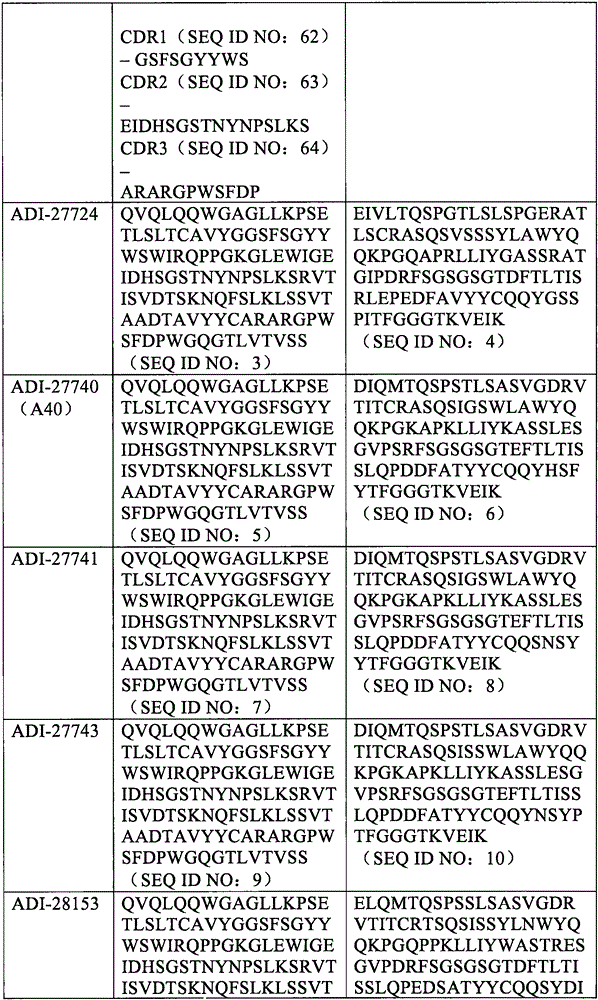


或者,由SEQ ID NO:45所定义的重链可变结构域可以与由SEQ ID NO:46所定义的轻链可变结构域配对,以形成如US 9,273,136中所示的可以结合到NKG2D的抗原结合位点。Alternatively, a heavy chain variable domain defined by SEQ ID NO:45 can be paired with a light chain variable domain defined by SEQ ID NO:46 to form a NKG2D binding molecule as shown in US 9,273,136 antigen binding site.


或者,由SEQ ID NO:47所定义的重链可变结构域可以与由SEQ ID NO:48所定义的轻链可变结构域配对,以形成如US 7,879,985中所示的可以结合到NKG2D的抗原结合位点。Alternatively, the heavy chain variable domain defined by SEQ ID NO:47 can be paired with the light chain variable domain defined by SEQ ID NO:48 to form a NKG2D binding molecule as shown in US 7,879,985 antigen binding site.

表2列出了相组合可以结合到GD2的重链可变结构域和轻链可变结构域的肽序列。Table 2 lists peptide sequences that can bind to the heavy and light chain variable domains of GD2 in combination.

或者,可以通过筛选与下述化学结构所定义的GD2的结合,来鉴定可以结合到GD2的新的抗原结合位点:(2R,4R,5S,6S)-2-[3-[(2S,3S,4R,6S)-6-[(2S,3R,4R,5S,6R)-5-[(2S,3R,4R,5R,6R)-3-乙酰胺基-4,5-二羟基-6-(羟基甲基)氧杂环丙烷-2-基]氧基-2-[(2R,3S,4R,5R,6R)-4,5-二羟基-2-(羟基甲基)-6-[(E)-3-羟基-2-(十八碳酰基氨基)十八-4-烯氧基]氧杂环丙烷-3-基]氧基-3-羟基-6-(羟基甲基)氧杂环丙烷-4-基]氧基-3-氨基-6-羧基-4-羟基氧杂环丙烷-2-基]-2,3-二羟基丙氧基]-5-氨基-4-羟基-6-(1,2,3-三羟基丙基)氧杂环丙烷-2-甲酸。Alternatively, novel antigen-binding sites that can bind to GD2 can be identified by screening for binding to GD2 as defined by the following chemical structure: (2R, 4R, 5S, 6S)-2-[3-[(2S, 3S, 4R, 6S)-6-[(2S, 3R, 4R, 5S, 6R)-5-[(2S, 3R, 4R, 5R, 6R)-3-acetamido-4,5-dihydroxy- 6-(Hydroxymethyl)oxiran-2-yl]oxy-2-[(2R,3S,4R,5R,6R)-4,5-dihydroxy-2-(hydroxymethyl)-6 -[(E)-3-Hydroxy-2-(octadecanoylamino)octadec-4-enyloxy]oxiran-3-yl]oxy-3-hydroxy-6-(hydroxymethyl ) oxiran-4-yl]oxy-3-amino-6-carboxy-4-hydroxyoxiran-2-yl]-2,3-dihydroxypropoxy]-5-amino-4 -Hydroxy-6-(1,2,3-trihydroxypropyl)oxirane-2-carboxylic acid.
在所述Fc结构域内,CD16结合由所述铰链区和CH2结构域介导。例如,在人类IgG1内,与CD16的相互作用主要聚焦于氨基酸残基Asp 265-Glu 269、Asn 297-Thr 299、Ala327-Ile 332、Leu 234-Ser 239和CH2结构域中的糖残基N-乙酰基-D-葡萄糖胺(参见Sondermann等,Nature,406(6793):267-273)。在所述已知结构域的基础上,可以选择突变以提高或降低与CD16的结合亲和力,例如通过使用噬菌体展示文库或酵母表面cDNA文库,或者可以在相互作用的已知三维结构的基础上设计突变。Within the Fc domain, CD16 binding is mediated by the hinge and CH2 domains. For example, within human IgG1, interactions with CD16 are primarily focused on amino acid residues Asp 265-Glu 269, Asn 297-Thr 299, Ala327-Ile 332, Leu 234-Ser 239 and the carbohydrate residue N in the CH2 domain -Acetyl-D-glucosamine (see Sondermann et al., Nature, 406(6793):267-273). On the basis of the known domains, mutations can be selected to increase or decrease the binding affinity to CD16, for example by using a phage display library or a yeast surface cDNA library, or can be designed on the basis of the known three-dimensional structure of the interaction mutation.
异二聚体抗体重链的组装可以通过在同一细胞中表达两种不同抗体重链序列来实现,这可能导致每种抗体重链的同二聚体的组装以及异二聚体的组装。促进异二聚体的偏好性组装可以通过在每种抗体重链恒定区的CH3结构域中并入不同的突变来实现,如US13/494870、US16/028850、US11/533709、US12/875015、US13/289934、US14/773418、US12/811207、US13/866756、US14/647480和US14/830336中所示。例如,可以在人类IgG1的基础上在CH3结构域中制造突变,并在第一多肽和第二多肽内并入不同对的氨基酸替换,以允许这两条链选择性地彼此异二聚化。下面示出的氨基酸替换的位置都按照Kabat中的EU指数来编号。Assembly of heterodimeric antibody heavy chains can be achieved by expressing two different antibody heavy chain sequences in the same cell, which may result in the assembly of homodimers as well as heterodimers of each antibody heavy chain. Facilitating heterodimer-biased assembly can be achieved by incorporating different mutations in the CH3 domain of the heavy chain constant region of each antibody, as in US13/494870, US16/028850, US11/533709, US12/875015, US13 /289934, US14/773418, US12/811207, US13/866756, US14/647480 and US14/830336. For example, one can make mutations in the CH3 domain based on human IgG1 and incorporate different pairs of amino acid substitutions within the first and second polypeptides to allow the two chains to selectively heterodimerize with each other change. The positions of amino acid substitutions shown below are all numbered according to the EU index in Kabat.
在一种情形中,所述第一多肽中的氨基酸替换将原始氨基酸用选自精氨酸(R)、苯丙氨酸(F)、酪氨酸(Y)或色氨酸(W)的较大氨基酸代替,并且所述第二多肽中的至少一个氨基酸替换将原始氨基酸用选自丙氨酸(A)、丝氨酸(S)、苏氨酸(T)或缬氨酸(V)的较小氨基酸代替,使得所述较大氨基酸替换(突起)契合到所述较小氨基酸替换(孔穴)的表面中。例如,一个多肽可以包含T366W替换,并且另一个多肽可以包含三个替换,包括T366S、L368A和Y407V。In one case, the amino acid replacement in the first polypeptide replaces the original amino acid with a replacement amino acid selected from the group consisting of arginine (R), phenylalanine (F), tyrosine (Y), or tryptophan (W) and at least one amino acid in the second polypeptide is replaced with a larger amino acid selected from the group consisting of alanine (A), serine (S), threonine (T) or valine (V) of smaller amino acid substitutions such that the larger amino acid substitutions (protrusions) fit into the surface of the smaller amino acid substitutions (holes). For example, one polypeptide can contain a T366W substitution, and another polypeptide can contain three substitutions, including T366S, L368A, and Y407V.
本发明的抗体重链可变结构域可以被任选地偶联到与抗体恒定区、例如包括铰链、CH2和CH3结构域并含有或不含CH1结构域的IgG恒定区至少90%一致的氨基酸序列。在某些实施方式中,所述恒定区的氨基酸序列与人类抗体恒定区例如人类IgG1恒定区、IgG2恒定区、IgG3恒定区或IgG4恒定区至少90%一致。在某些其他实施方式中,所述恒定区的氨基酸序列与来自于另一种哺乳动物例如兔、狗、猫、小鼠或马的抗体恒定区至少90%一致。与人类IgG1恒定区相比可以在所述恒定区内并入一个或多个突变,例如在Q347、Y349、L351、S354、E356、E357、K360、Q362、S364、T366、L368、K370、N390、K392、T394、D399、S400、D401、F405、Y407、K409、T411和/或K439处。示例性的替换包括例如Q347E、Q347R、Y349S、Y349K、Y349T、Y349D、Y349E、Y349C、T350V、L351K、L351D、L351Y、S354C、E356K、E357Q、E357L、E357W、K360E、K360W、Q362E、S364K、S364E、S364H、S364D、T366V、T366I、T366L、T366M、T366K、T366W、T366S、L368E、L368A、L368D、K370S、N390D、N390E、K392L、K392M、K392V、K392F、K392D、K392E、T394F、T394W、D399R、D399K、D399V、S400K、S400R、D401K、F405A、F405T、Y407A、Y407I、Y407V、K409F、K409W、K409D、T411D、T411E、K439D和K439E。The antibody heavy chain variable domains of the invention may optionally be conjugated to amino acids that are at least 90% identical to antibody constant regions, eg, IgG constant regions comprising hinge, CH2 and CH3 domains, with or without a CH1 domain sequence. In certain embodiments, the amino acid sequence of the constant region is at least 90% identical to a human antibody constant region, eg, a human IgGl constant region, IgG2 constant region, IgG3 constant region, or IgG4 constant region. In certain other embodiments, the amino acid sequence of the constant region is at least 90% identical to an antibody constant region from another mammal, such as a rabbit, dog, cat, mouse, or horse. One or more mutations can be incorporated into the constant region compared to the human IgG1 constant region, e.g. in Q347, Y349, L351, S354, E356, E357, K360, Q362, S364, At K392, T394, D399, S400, D401, F405, Y407, K409, T411 and/or K439. Exemplary replacements include, for example, Q347E, Q347R, Y349S, Y349K, Y349T, Y349D, Y349E, Y349C, T350V, L351K, L351D, L351Y, S354C, E356K, E357Q, E357L, E357W, K360E, K360K, 3SS6462E, Q362E S364H、S364D、T366V、T366I、T366L、T366M、T366K、T366W、T366S、L368E、L368A、L368D、K370S、N390D、N390E、K392L、K392M、K392V、K392F、K392D、K392E、T394F、T394W、D399R、D399K、 D399V, S400K, S400R, D401K, F405A, F405T, Y407A, Y407I, Y407V, K409F, K409W, K409D, T411D, T411E, K439D and K439E.
在某些实施方式中,可以并入到人类IgG1恒定区的CH1中的突变可以在氨基酸V125、F126、P127、T135、T139、A140、F170、P171和/或V173处。在某些实施方式中,可以并入到人类IgG1恒定区的Cκ中的突变可以在氨基酸E123、F116、S176、V163、S174和/或T164处。In certain embodiments, mutations that can be incorporated into CH1 of a human IgG1 constant region can be at amino acids V125, F126, P127, T135, T139, A140, F170, P171 and/or V173. In certain embodiments, the mutations that can be incorporated into the CK of the human IgGl constant region can be at amino acids E123, F116, S176, V163, S174 and/or T164.
氨基酸替换可以选自下面表3中示出的成组替换。Amino acid substitutions can be selected from the group substitutions shown in Table 3 below.
或者,氨基酸替换可以选自下面表4中示出的成组替换。Alternatively, amino acid substitutions can be selected from the group substitutions shown in Table 4 below.
或者,氨基酸替换可以选自下面表5中示出的成组替换。Alternatively, amino acid substitutions can be selected from the group substitutions shown in Table 5 below.
或者,每条多肽链中的至少一个氨基酸替换可以选自表6.Alternatively, at least one amino acid substitution in each polypeptide chain can be selected from Table 6.
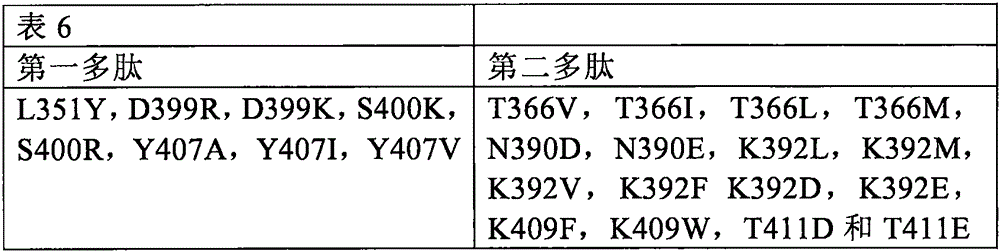
或者,至少一个氨基酸替换可以选自下面表7中的成组替换,其中在所述第一多肽列中标注的位置被任何已知的带负电荷的氨基酸代替,并且在所述第二多肽列中标注的位置被任何已知的带正电荷的氨基酸代替。Alternatively, at least one amino acid substitution may be selected from the group substitutions in Table 7 below, wherein the position noted in the first polypeptide column is replaced by any known negatively charged amino acid, and in the second most Positions noted in the peptide column are replaced by any known positively charged amino acid.


或者,至少一个氨基酸替换可以选自下面表8中的成组替换,其中在所述第一多肽列中标注的位置被任何已知的带正电荷的氨基酸代替,并且在所述第二多肽列中标注的位置被任何已知的带负电荷的氨基酸代替。Alternatively, at least one amino acid substitution can be selected from the group substitutions in Table 8 below, wherein the position noted in the first polypeptide column is replaced by any known positively charged amino acid, and in the second most Positions noted in the peptide column were replaced by any known negatively charged amino acid.
或者,氨基酸替换可以选自下面表9中的成组替换。Alternatively, amino acid substitutions can be selected from the group substitutions in Table 9 below.
可选地或另外地,异多聚体蛋白的结构稳定性可以通过在所述第一或第二多肽链任一者上引入S354C并在相对的多肽链上引入Y349C来提高,所述突变在所述两个多肽的界面内形成人造二硫桥。Alternatively or additionally, the structural stability of the heteromultimeric protein can be improved by introducing S354C on either the first or second polypeptide chain and Y349C on the opposite polypeptide chain, the mutation An artificial disulfide bridge is formed within the interface of the two polypeptides.
上述的多特异性蛋白可以使用本领域技术人员公知的重组DNA技术来制造。例如,可以将编码所述第一免疫球蛋白重链的第一核酸序列克隆到第一表达载体中;可以将编码所述第二免疫球蛋白重链的第二核酸序列克隆到第二表达载体中;将编码所述免疫球蛋白轻链的第三核酸序列克隆到第三表达载体中;并且可以将所述第一、第二和第三表达载体一起稳定转染到宿主细胞中,以产生所述多聚体蛋白。The multispecific proteins described above can be produced using recombinant DNA techniques known to those skilled in the art. For example, a first nucleic acid sequence encoding the first immunoglobulin heavy chain can be cloned into a first expression vector; a second nucleic acid sequence encoding the second immunoglobulin heavy chain can be cloned into a second expression vector the third nucleic acid sequence encoding the immunoglobulin light chain is cloned into a third expression vector; and the first, second and third expression vectors can be stably transfected together into a host cell to produce the multimeric protein.
为了获得所述多特异性蛋白的最高产量,可以探索所述第一、第二和第三表达载体的不同比率,以确定用于转染到所述宿主细胞中的最佳比率。在转染后,可以使用本领域中已知的方法例如有限稀释法、ELISA、FACS、显微术或Clonepix来分离单一克隆,用于细胞库产生。To obtain the highest yield of the multispecific protein, different ratios of the first, second and third expression vectors can be explored to determine the optimal ratio for transfection into the host cell. Following transfection, single clones can be isolated for cell bank generation using methods known in the art such as limiting dilution, ELISA, FACS, microscopy or Clonepix.
可以将克隆在适合于生物反应器规模放大的条件下培养,并维持所述多特异性蛋白的表达。所述多特异性蛋白可以使用本领域中已知的方法包括离心、深度过滤、细胞裂解、匀浆、冻融、亲和纯化、凝胶过滤、离子交换层析、疏水相互作用交换层析和混合模式层析来分离和纯化。Clones can be cultured under conditions suitable for bioreactor scale-up and maintain expression of the multispecific protein. The multispecific proteins can be identified using methods known in the art including centrifugation, depth filtration, cell lysis, homogenization, freeze-thaw, affinity purification, gel filtration, ion exchange chromatography, hydrophobic interaction exchange chromatography and Mixed-mode chromatography for isolation and purification.
II.多特异性蛋白的特征II. Characterization of Multispecific Proteins
在某些实施方式中,本文中描述的包括NKG2D结合结构域和用于GD2的结合结构域的多特异性蛋白,结合到表达人类NKG2D的细胞。在某些实施方式中,所述多特异性蛋白以与具有相同GD2结合结构域的单克隆抗体可比的水平结合到肿瘤相关抗原GD2。然而,本文中描述的多特异性蛋白可能在降低肿瘤生长和杀伤表达GD2的癌细胞中比相应的GD2单克隆抗体更加有效。In certain embodiments, the multispecific proteins described herein that include an NKG2D binding domain and a binding domain for GD2 bind to cells expressing human NKG2D. In certain embodiments, the multispecific protein binds to the tumor-associated antigen GD2 at levels comparable to monoclonal antibodies having the same GD2 binding domain. However, the multispecific proteins described herein may be more effective than the corresponding GD2 monoclonal antibodies in reducing tumor growth and killing GD2-expressing cancer cells.
在某些实施方式中,本文中描述的包括NKG2D结合结构域和用于GD2的结合结构域的多特异性蛋白,当与表达抗原GD2的肿瘤细胞培养时可以激活原代人类NK细胞。NK细胞激活以CD107a脱颗粒和IFNγ细胞因子生产的增加为标志。此外,与包括相同GD2结合结构域的单克隆抗体相比,在表达抗原GD2的肿瘤细胞存在下所述多特异性蛋白显示出人类NK细胞的更高的激活。In certain embodiments, the multispecific proteins described herein comprising an NKG2D binding domain and a binding domain for GD2 can activate primary human NK cells when cultured with tumor cells expressing the antigen GD2. NK cell activation is marked by CD107a degranulation and increased IFNγ cytokine production. Furthermore, the multispecific protein showed higher activation of human NK cells in the presence of tumor cells expressing the antigen GD2 compared to monoclonal antibodies comprising the same GD2 binding domain.
在某些实施方式中,本文中描述的包括NKG2D结合结构域和用于GD2的结合结构域的多特异性蛋白,在表达抗原GD2的肿瘤细胞存在下可以提高静息和IL-2激活的人类NK细胞的活性。In certain embodiments, the multispecific proteins described herein comprising an NKG2D binding domain and a binding domain for GD2 can enhance resting and IL-2 activated human in the presence of tumor cells expressing the antigen GD2 NK cell activity.
在某些实施方式中,本文中描述的包括NKG2D结合结构域和用于肿瘤相关抗原GD2的结合结构域的多特异性蛋白,在表达抗原GD2的肿瘤细胞存在下可以提高静息和IL-2激活的人类NK细胞的细胞毒性活性。在某些实施方式中,与相应的单克隆抗体相比,所述多特异性蛋白可以提供对抗表达中和低GD2的肿瘤细胞的优点。In certain embodiments, the multispecific proteins described herein comprising an NKG2D binding domain and a binding domain for the tumor-associated antigen GD2 can increase resting and IL-2 in the presence of tumor cells expressing the antigen GD2 Cytotoxic activity of activated human NK cells. In certain embodiments, the multispecific protein may provide advantages against tumor cells expressing neutral and low GD2 compared to corresponding monoclonal antibodies.
在某些实施方式中,本文中描述的多特异性蛋白与相应的GD2单克隆抗体相比,在具有Fc受体(FcR)的高表达的癌症或驻留在具有高水平FcR的肿瘤微环境中的癌症的治疗中可能是有利的。单克隆抗体通过包括ADCC、CDC、吞噬作用和信号阻断等的多种机制发挥它们对肿瘤生长的作用。在FcγR中,CD16对IgG Fc具有最低的亲和性;FcγRI(CD64)是高亲和性FcR,其比CD16强约1000倍地结合到IgG Fc。CD64通常表达在许多造血谱系例如髓系谱系上,并且可以表达在源自于这些细胞类型的肿瘤例如急性髓性白血病(AML)细胞上。浸润到所述肿瘤中的免疫细胞例如MDSC和单核细胞也表达CD64,并已知浸润所述肿瘤微环境。CD64被所述肿瘤或在肿瘤微环境中的表达可能对单克隆抗体疗法具有有害效应。CD64在肿瘤微环境中的表达使得这些抗体难以接合NK细胞表面上的CD16,因为所述抗体优先接合所述高亲和性受体。所述多特异性蛋白通过靶向NK细胞表面上的两种激活受体,可以克服CD64表达(在肿瘤或肿瘤微环境上)对单克隆抗体疗法的有害效应。不论所述肿瘤细胞上是否存在CD64表达,所述多特异性蛋白都能介导针对所有肿瘤细胞的人类NK细胞应答,因为NK细胞上的两个激活受体的双重靶向提供了与NK细胞的更强的特异性结合。In certain embodiments, the multispecific proteins described herein are compared to the corresponding GD2 monoclonal antibodies in cancers with high expression of Fc receptors (FcRs) or reside in tumor microenvironments with high levels of FcRs may be beneficial in the treatment of cancer. Monoclonal antibodies exert their effects on tumor growth through a variety of mechanisms including ADCC, CDC, phagocytosis, and signal blockade. Among FcyRs, CD16 has the lowest affinity for IgG Fc; FcyRI (CD64) is a high-affinity FcR that binds to IgG Fc approximately 1000-fold stronger than CD16. CD64 is normally expressed on many hematopoietic lineages, such as the myeloid lineage, and can be expressed on tumors derived from these cell types, such as acute myeloid leukemia (AML) cells. Immune cells such as MDSCs and monocytes that infiltrate the tumor also express CD64 and are known to infiltrate the tumor microenvironment. The expression of CD64 by the tumor or in the tumor microenvironment may have deleterious effects on monoclonal antibody therapy. The expression of CD64 in the tumor microenvironment makes it difficult for these antibodies to engage CD16 on the surface of NK cells because the antibodies preferentially engage the high-affinity receptor. The multispecific protein can overcome the deleterious effects of CD64 expression (on the tumor or tumor microenvironment) on monoclonal antibody therapy by targeting two activating receptors on the surface of NK cells. The multispecific protein mediates human NK cell responses against all tumor cells irrespective of the presence or absence of CD64 expression on the tumor cells, as dual targeting of two activating receptors on NK cells provides interaction with NK cells. stronger specific binding.
在某些实施方式中,本文中描述的多特异性蛋白可以通过减少中靶偏离肿瘤(on-target off-tumor)副作用而提供更好的安全性。自然杀伤细胞和CD8T细胞两者能够直接裂解肿瘤细胞,尽管NK细胞和CD8T细胞识别正常的自身细胞和肿瘤细胞所通过的机制不同。NK细胞的活性受到来自于激活(NCR、NKG2D、CD16等)和抑制(KIR、NKG2A等)受体的信号的平衡调控。这些激活和抑制信号的平衡允许NK细胞确定是健康的自身细胞还是应激的、病毒感染的或转化的自身细胞。这种自体耐受的“内置”机制将帮助保护正常的健康组织免于NK细胞应答。为扩展这个原理,NK细胞的自体耐受将允许TriNKET靶向在自体和肿瘤两者上表达的抗原而没有偏离肿瘤副作用,或者具有增加的治疗窗口。不同于自然杀伤细胞,T细胞需要识别被MHC分子呈递的特定肽才能激活和发挥效应功能。T细胞已作为免疫疗法的主要靶点,并且已经开发了许多策略来重新引导针对肿瘤的T细胞应答。T细胞双特异性物质、检查点抑制剂和CAR-T细胞都已被FDA批准,但通常苦于剂量限制性毒性。T细胞双特异性物质和CAR-T细胞通过使用结合结构域来靶向肿瘤细胞表面上的抗原并使用工程化的信号传导结构域将激活信号传导到效应细胞中,围绕TCR-MHC识别系统工作。尽管在引发抗肿瘤免疫应答中有效,但这些疗法通常伴有细胞因子释放综合征(CRS)和中靶偏离肿瘤副作用。在这种背景下所述多特异性蛋白是独特的,因为它们不“重写”NK细胞激活和抑制的天然系统。相反,所述多特异性蛋白被设计成动摇所述平衡并为NK细胞提供另外的激活信号,同时维持对健康自体细胞的NK耐受。In certain embodiments, the multispecific proteins described herein may provide better safety by reducing on-target off-tumor side effects. Both natural killer cells and CD8 T cells are able to lyse tumor cells directly, although the mechanisms by which NK cells and CD8 T cells recognize normal self and tumor cells are different. The activity of NK cells is regulated by a balance of signals from activating (NCR, NKG2D, CD16, etc.) and inhibitory (KIR, NKG2A, etc.) receptors. The balance of these activating and inhibitory signals allows NK cells to determine whether they are healthy self cells or stressed, virally infected or transformed self cells. This "built-in" mechanism of self-tolerance will help protect normal healthy tissue from NK cell responses. Extending this rationale, auto-tolerance of NK cells would allow TriNKET to target antigens expressed on both autologous and tumor without deviating tumor side effects, or with an increased therapeutic window. Unlike natural killer cells, T cells need to recognize specific peptides presented by MHC molecules in order to activate and perform effector functions. T cells have been the primary target of immunotherapy, and many strategies have been developed to redirect T cell responses against tumors. T-cell bispecifics, checkpoint inhibitors, and CAR-T cells are all FDA-approved, but often suffer from dose-limiting toxicity. T cell bispecifics and CAR-T cells work around the TCR-MHC recognition system by using binding domains to target antigens on the surface of tumor cells and engineered signaling domains to signal activation into effector cells . Although effective in eliciting antitumor immune responses, these therapies are often accompanied by cytokine release syndrome (CRS) and off-target tumor side effects. The multispecific proteins are unique in this context in that they do not "rewrite" the natural system of NK cell activation and inhibition. Instead, the multispecific proteins are designed to shake the balance and provide additional activation signals to NK cells, while maintaining NK tolerance to healthy autologous cells.
在某些实施方式中,本文中描述的多特异性蛋白与包括相同GD2结合结构域的相应的GD2单克隆抗体相比,可以更有效地延迟肿瘤的进展。在某些实施方式中,本文中描述的多特异性蛋白与包括相同GD2结合结构域的相应的GD2单克隆抗体相比,可以更加有效地对抗癌症转移。In certain embodiments, the multispecific proteins described herein can delay tumor progression more effectively than corresponding GD2 monoclonal antibodies comprising the same GD2 binding domain. In certain embodiments, the multispecific proteins described herein may be more effective against cancer metastasis than corresponding GD2 monoclonal antibodies comprising the same GD2 binding domain.
III.治疗性应用III. THERAPEUTIC APPLICATIONS
本发明提供了使用本文中描述的多特异性结合蛋白和/或本文中描述的药物组合物治疗癌症的方法。所述方法可用于治疗表达GD2的各种不同的癌症,其包括向需要的患者施用治疗有效量的本文中描述的多特异性结合蛋白。The present invention provides methods of treating cancer using the multispecific binding proteins described herein and/or the pharmaceutical compositions described herein. The method can be used to treat a variety of different cancers expressing GD2, comprising administering to a patient in need thereof a therapeutically effective amount of a multispecific binding protein described herein.
所述治疗方法可以根据待治疗的癌症来表征。例如,在某些实施方式中,所述癌症是成神经母细胞瘤、黑素瘤、视网膜母细胞瘤、小细胞肺癌、脑肿瘤、骨肉瘤、横纹肌肉瘤、儿童和青少年中的尤文氏肉瘤以及成年人中的脂肪肉瘤、纤维肉瘤、平滑肌肉瘤或其他软组织肉瘤。The method of treatment can be characterized according to the cancer to be treated. For example, in certain embodiments, the cancer is neuroblastoma, melanoma, retinoblastoma, small cell lung cancer, brain tumor, osteosarcoma, rhabdomyosarcoma, Ewing's sarcoma in children and adolescents, and Liposarcoma, fibrosarcoma, leiomyosarcoma, or other soft tissue sarcoma in adults.
在某些其他实施方式中,所述癌症是脑癌、乳腺癌、宫颈癌、结肠癌、结肠直肠癌、子宫内膜癌、食管癌、白血病、肺癌、肝癌、黑素瘤、卵巢癌、胰腺癌、直肠癌、肾癌、胃癌、睾丸癌或子宫癌。在其他实施方式中,所述癌症是鳞状细胞癌、腺癌、小细胞癌、黑素瘤、成神经母细胞瘤、肉瘤(例如血管肉瘤或软骨肉瘤)、喉癌、腮腺癌、胆管癌、甲状腺癌、肢端雀斑痣样黑素瘤、光化性角化病、急性淋巴细胞性白血病、急性髓性白血病、腺样囊性癌、腺瘤、腺肉瘤、腺鳞癌、肛管癌、肛门癌、肛门直肠癌、星形胶质细胞瘤、巴氏腺癌、基底细胞癌、胆管癌、骨癌、骨髓癌、支气管癌、支气管腺体癌、类癌瘤、胆管癌、软骨肉瘤、脉络丛乳头状瘤/癌、慢性淋巴细胞性白血病、慢性髓系白血病、透明细胞癌、结缔组织癌、囊腺瘤、消化系统癌症、十二指肠癌、内分泌系统癌症、内胚窦瘤、子宫内膜增生、子宫内膜间质肉瘤、子宫内膜样腺癌、内皮细胞癌、室管膜癌、上皮细胞癌、尤文氏肉瘤、眼和眼眶癌、女性生殖器癌、局灶性结节性增生、胆囊癌、胃窦癌、胃底癌、胃泌素瘤、成胶质细胞瘤、胰高血糖素瘤、心脏癌症、成血管细胞瘤、血管内皮瘤、血管瘤、肝腺瘤、肝腺瘤病、肝胆管癌、肝细胞癌、霍奇金氏病、回肠癌、胰岛细胞瘤、上皮内瘤变、上皮内鳞状细胞瘤变、肝内胆管癌、侵入性鳞状细胞癌、空肠癌、关节癌、卡波斯肉瘤、盆腔癌、大细胞癌、大肠癌、平滑肌肉瘤、恶性雀斑样痣黑素瘤、淋巴瘤、男性生殖器癌、恶性黑素瘤、恶性间皮肿瘤、成神经管细胞瘤、髓上皮瘤、脑膜癌、间皮癌、转移性癌、口腔癌、粘液表皮样癌、多发性骨髓瘤、肌肉癌、鼻道癌、神经系统癌症、神经上皮腺癌、结节性黑素瘤、非上皮性皮肤癌、非霍奇金氏淋巴瘤、燕麦细胞癌、少突神经胶质癌、口腔癌、骨肉瘤、浆液性乳头状腺癌、阴茎癌、舌咽癌、垂体肿瘤、浆细胞瘤、假性肉瘤、肺母细胞瘤、直肠癌、肾细胞癌、呼吸系统癌症、视网膜母细胞瘤、横纹肌肉瘤、肉瘤、浆液性癌、窦癌、皮肤癌、小细胞癌、小肠癌、平滑肌癌、软组织癌、分泌生长抑素的肿瘤、脊椎癌、鳞状细胞癌、横纹肌癌、间皮下癌、浅表扩散性黑素瘤、T细胞白血病、舌癌、未分化癌、输尿管癌、尿道癌、尿道膀胱癌、泌尿系统癌症、宫颈癌、宫体癌、葡萄膜黑素瘤、阴道癌、疣状癌、血管活性肠肽瘤、外阴癌、高分化癌或肾母细胞瘤。In certain other embodiments, the cancer is brain cancer, breast cancer, cervical cancer, colon cancer, colorectal cancer, endometrial cancer, esophageal cancer, leukemia, lung cancer, liver cancer, melanoma, ovarian cancer, pancreatic cancer cancer, rectal cancer, kidney cancer, stomach cancer, testicular cancer or uterine cancer. In other embodiments, the cancer is squamous cell carcinoma, adenocarcinoma, small cell carcinoma, melanoma, neuroblastoma, sarcoma (eg, angiosarcoma or chondrosarcoma), laryngeal cancer, parotid gland cancer, cholangiocarcinoma , thyroid cancer, acral lentigo melanoma, actinic keratosis, acute lymphoblastic leukemia, acute myeloid leukemia, adenoid cystic carcinoma, adenoma, adenosarcoma, adenosquamous carcinoma, anal canal carcinoma , Anal cancer, anorectal cancer, astrocytoma, Bartholin's adenocarcinoma, basal cell carcinoma, cholangiocarcinoma, bone cancer, bone marrow cancer, bronchial carcinoma, bronchial gland carcinoma, carcinoid tumor, cholangiocarcinoma, chondrosarcoma , choroid plexus papilloma/carcinoma, chronic lymphocytic leukemia, chronic myeloid leukemia, clear cell carcinoma, connective tissue carcinoma, cystadenoma, digestive system cancer, duodenal cancer, endocrine system cancer, endodermal sinus tumor , endometrial hyperplasia, endometrial stromal sarcoma, endometrioid adenocarcinoma, endothelial cell carcinoma, ependymal carcinoma, epithelial cell carcinoma, Ewing's sarcoma, eye and orbital cancer, female genital cancer, focal nodal Nodular hyperplasia, gallbladder cancer, gastric cancer, gastric fundus cancer, gastrinoma, glioblastoma, glucagonoma, cardiac cancer, hemangioblastoma, hemangioendothelioma, hemangioma, hepatic adenoma , hepatic adenomatosis, cholangiocarcinoma, hepatocellular carcinoma, Hodgkin's disease, ileal carcinoma, islet cell tumor, intraepithelial neoplasia, intraepithelial squamous cell neoplasia, intrahepatic cholangiocarcinoma, invasive squamous cell carcinoma, jejunum cancer, joint cancer, Kapos' sarcoma, pelvic cancer, large cell carcinoma, colorectal cancer, leiomyosarcoma, malignant lentigo melanoma, lymphoma, male genital cancer, malignant melanoma, malignant mesothelial tumor, Medulloblastoma, Medullary Epithelioma, Meningeal Carcinoma, Mesothelial Carcinoma, Metastatic Carcinoma, Oral Cancer, Mucoepidermoid Carcinoma, Multiple Myeloma, Muscle Cancer, Nasal Carcinoma, Nervous System Cancer, Neuroepithelial Adenocarcinoma, Nodular melanoma, non-epithelial skin cancer, non-Hodgkin's lymphoma, oat cell carcinoma, oligodendroglial carcinoma, oral cancer, osteosarcoma, serous papillary adenocarcinoma, penile cancer, glossopharyngeal carcinoma Carcinoma, pituitary tumor, plasmacytoma, pseudosarcoma, pulmonary blastoma, rectal cancer, renal cell carcinoma, respiratory cancer, retinoblastoma, rhabdomyosarcoma, sarcoma, serous carcinoma, sinus cancer, skin cancer, small Cell carcinoma, Small bowel carcinoma, Smooth muscle carcinoma, Soft tissue carcinoma, Somatostatin secreting tumor, Spine carcinoma, Squamous cell carcinoma, Rhabdomyocarcinoma, Submesothelial carcinoma, Superficial diffuse melanoma, T cell leukemia, Tongue cancer, Unknown Differentiated carcinoma, ureteral carcinoma, urethral carcinoma, urethral bladder carcinoma, urological carcinoma, cervical carcinoma, uterine corpus carcinoma, uveal melanoma, vaginal carcinoma, verrucous carcinoma, vasoactive intestinal peptide tumor, vulvar carcinoma, well-differentiated carcinoma or Wilms tumor.
在某些其他实施方式中,所述癌症是非霍奇金氏淋巴瘤例如B-细胞淋巴瘤或T-细胞淋巴瘤。在某些实施方式中,所述非霍奇金氏淋巴瘤是B-细胞淋巴瘤,例如弥漫性大B-细胞淋巴瘤、原发性纵隔B-细胞淋巴瘤、滤泡性淋巴瘤、小淋巴细胞性淋巴瘤、套细胞淋巴瘤、边缘区B-细胞淋巴瘤、淋巴结外边缘区B-细胞淋巴瘤、淋巴结边缘区B-细胞淋巴瘤、脾边缘区B-细胞淋巴瘤、伯基特淋巴瘤、淋巴浆细胞性淋巴瘤、毛细胞白血病或原发性中枢神经系统(CNS)淋巴瘤。在某些其他实施方式中,所述非霍奇金氏淋巴瘤是T-细胞淋巴瘤,例如前T淋巴母细胞淋巴瘤、外周T-细胞淋巴瘤、皮肤T-细胞淋巴瘤、血管免疫母细胞T-细胞淋巴瘤、淋巴结外自然杀伤细胞/T-细胞淋巴瘤、肠病型T-细胞淋巴瘤、皮下脂膜炎样T-细胞淋巴瘤、间变性大细胞淋巴瘤或外周T-细胞淋巴瘤。In certain other embodiments, the cancer is a non-Hodgkin's lymphoma such as a B-cell lymphoma or a T-cell lymphoma. In certain embodiments, the non-Hodgkin's lymphoma is a B-cell lymphoma, eg, diffuse large B-cell lymphoma, primary mediastinal B-cell lymphoma, follicular lymphoma, small Lymphocytic lymphoma, mantle cell lymphoma, marginal zone B-cell lymphoma, extranodal marginal zone B-cell lymphoma, nodal marginal zone B-cell lymphoma, splenic marginal zone B-cell lymphoma, Burkitt Lymphoma, lymphoplasmacytic lymphoma, hairy cell leukemia, or primary central nervous system (CNS) lymphoma. In certain other embodiments, the non-Hodgkin's lymphoma is a T-cell lymphoma, eg, pre-T lymphoblastic lymphoma, peripheral T-cell lymphoma, cutaneous T-cell lymphoma, angioimmunoblastoma cell T-cell lymphoma, extranodal NK/T-cell lymphoma, enteropathic T-cell lymphoma, subcutaneous panniculitis-like T-cell lymphoma, anaplastic large cell lymphoma, or peripheral T-cell lymphoma lymphoma.
所述待治疗的癌症可以根据在所述癌细胞表面上表达的特定抗原的存在来表征。在某些实施方式中,除了包括GD2之外,所述癌细胞还表达下述一者或多者:CD2,CD19,CD20,CD30,CD38,CD40,CD52,CD70,EGFR/ERBB1,IGF1R,HER3/ERBB3,HER4/ERBB4,MUC1,cMET,SLAMF7,PSCA,MICA,MICB,TRAILR1,TRAILR2,MAGE-A3,B7.1,B7.2,CTLA4和PD1。The cancer to be treated can be characterized by the presence of specific antigens expressed on the surface of the cancer cells. In certain embodiments, in addition to including GD2, the cancer cells express one or more of the following: CD2, CD19, CD20, CD30, CD38, CD40, CD52, CD70, EGFR/ERBB1, IGF1R, HER3 /ERBB3, HER4/ERBB4, MUC1, cMET, SLAMF7, PSCA, MICA, MICB, TRAILR1, TRAILR2, MAGE-A3, B7.1, B7.2, CTLA4 and PD1.
IV.组合疗法IV. Combination therapy
本发明的另一方面提供了组合疗法。将本文描述的多特异性结合蛋白与其他治疗剂组合使用以治疗癌症。Another aspect of the invention provides combination therapy. The multispecific binding proteins described herein are used in combination with other therapeutic agents to treat cancer.
可以在治疗癌症中用作组合疗法的一部分的示例性治疗剂包括例如放射线、丝裂霉素、维甲酸、盐酸苯达莫司汀(ribomustin)、吉西他滨、长春新碱、依托泊苷、克拉屈滨、二溴甘露醇、甲氨蝶呤、多柔比星、卡波醌、喷司他丁、硝基可润、净司他丁、西曲瑞克、来曲唑、雷替曲塞、柔红霉素、法倔唑、福莫司汀、胸腺法新、索布佐生、奈达铂、阿糖胞苷、比卡鲁胺、长春瑞滨、维司力农、氨鲁米特、安吖啶、丙谷胺、依利醋铵、酮色林、去氧氟尿苷、依曲替酯、异维甲酸、链脲佐菌素、尼莫司汀、长春地辛、氟他胺(flutamide)、氟他胺(drogenil)、布缩宫素、卡莫氟、雷佐生、西佐喃、卡铂、二溴卫矛醇、替加氟、异环磷酰胺、泼尼莫司汀、毕西巴尼、左旋咪唑、替尼泊苷、英丙舒凡、依诺他滨、麦角乙脲、羟甲烯龙、他莫昔芬、孕酮、美雄烷、环硫雄醇、福美司坦、干扰素-α、干扰素-2α、干扰素-β、干扰素-γ、集落刺激因子-1、集落刺激因子-2、地尼白介素、白介素-2、黄体生成激素释放因子和上述药剂的可能表现出对同源受体的差异结合和增加或减少的血清半衰期的变化型。Exemplary therapeutic agents that can be used as part of a combination therapy in the treatment of cancer include, for example, radiation, mitomycin, retinoic acid, ribomustin hydrochloride, gemcitabine, vincristine, etoposide, cladrix Bing, Dibromomannitol, Methotrexate, Doxorubicin, Carboquinone, Pentostatin, Nitrocorin, Netastatin, Cetrorelix, Letrozole, Raltitrexed, Daunorubicin, Fadrozole, Fomustine, Thymosin, Sobrazoxan, Nedaplatin, Cytarabine, Bicalutamide, Vinorelbine, Vesrinone, Aminoglutide, Amacridine, proglumide, eliacetamide, ketanserin, deoxyfluridine, etreteate, isotretinoin, streptozotocin, nimustine, vindesine, flutamide ( flutamide), flutamide (drogenil), butoxine, carmofluor, razoxan, sizoran, carboplatin, dibromodulcitol, tegafur, ifosfamide, prednimustine, Bisibanib, Levamisole, Teniposide, Inprosulfan, Enocitabine, Lysergide, Oxymetholone, Tamoxifen, Progesterone, Meandrostane, Cyclothioandrosterol, Formex Tan, interferon-alpha, interferon-2alpha, interferon-beta, interferon-gamma, colony-stimulating factor-1, colony-stimulating factor-2, denileukin, interleukin-2, luteinizing hormone releasing factor and the above agents Variants that may exhibit differential binding to cognate receptors and increased or decreased serum half-life.
可以在治疗癌症中用作组合疗法的一部分的另一类药剂是免疫检查点抑制剂。示例性的免疫检查点抑制剂包括抑制下述一者或多者的药剂:(i)细胞毒性T-淋巴细胞相关抗原4(CTLA4),(ii)程序化细胞死亡蛋白1(PD1),(iii)PDL1,(iv)LAG3,(v)B7-H3,(vi)B7-H4,和(vii)TIM3。CTLA4抑制剂伊匹单抗已被美国食品和药品监督管理局(United StatesFood and Drug Administration)批准用于治疗黑素瘤。Another class of agents that can be used as part of combination therapy in the treatment of cancer are immune checkpoint inhibitors. Exemplary immune checkpoint inhibitors include agents that inhibit one or more of: (i) cytotoxic T-lymphocyte-associated antigen 4 (CTLA4), (ii) programmed cell death protein 1 (PD1), ( iii) PDL1, (iv) LAG3, (v) B7-H3, (vi) B7-H4, and (vii) TIM3. The CTLA4 inhibitor ipilimumab has been approved by the United States Food and Drug Administration for the treatment of melanoma.
可以在治疗癌症中用作组合疗法的一部分的另一类药剂是靶向非检查点靶的单克隆抗体(例如赫赛汀)和非细胞毒性药剂(例如酪氨酸激酶抑制剂)。Another class of agents that can be used as part of combination therapy in the treatment of cancer are monoclonal antibodies targeting non-checkpoint targets (eg, Herceptin) and non-cytotoxic agents (eg, tyrosine kinase inhibitors).
另一类抗癌药剂包括例如:(i)选自ALK抑制剂、ATR抑制剂、A2A拮抗剂、碱基切除修复抑制剂、Bcr-Abl酪氨酸激酶抑制剂、Bruton′s酪氨酸激酶抑制剂、CDC7抑制剂、CHK1抑制剂、周期蛋白依赖性激酶抑制剂、DNA-PK抑制剂、DNA-PK和mTOR两者的抑制剂、DNMT1抑制剂、DNMT1抑制剂加2-氯-脱氧腺苷、HDAC抑制剂、Hedgehog信号传导途径抑制剂、IDO抑制剂、JAK抑制剂、mTOR抑制剂、MEK抑制剂、MELK抑制剂、MTH1抑制剂、PARP抑制剂、磷脂酰肌醇3-激酶抑制剂、PARP1和DHODH两者的抑制剂、蛋白酶体抑制剂、拓扑异构酶-II抑制剂、酪氨酸激酶抑制剂、VEGFR抑制剂和WEE1抑制剂的抑制剂;(ii)OX40、CD137、CD40、GITR、CD27、HVEM、TNFRSF25或ICOS的激动剂;和(iii)选自IL-12、IL-15、GM-CSF和G-CSF的细胞因子。Another class of anticancer agents includes, for example: (i) selected from ALK inhibitors, ATR inhibitors, A2A antagonists, base excision repair inhibitors, Bcr-Abl tyrosine kinase inhibitors, Bruton's tyrosine kinase Inhibitors, CDC7 inhibitors, CHK1 inhibitors, cyclin-dependent kinase inhibitors, DNA-PK inhibitors, inhibitors of both DNA-PK and mTOR, DNMT1 inhibitors, DNMT1 inhibitors plus 2-chloro-deoxyadenosine glycoside, HDAC inhibitor, Hedgehog signaling pathway inhibitor, IDO inhibitor, JAK inhibitor, mTOR inhibitor, MEK inhibitor, MELK inhibitor, MTH1 inhibitor, PARP inhibitor, phosphatidylinositol 3-kinase inhibitor , inhibitors of both PARP1 and DHODH, proteasome inhibitors, topoisomerase-II inhibitors, tyrosine kinase inhibitors, VEGFR inhibitors and WEE1 inhibitors; (ii) OX40, CD137, CD40 , an agonist of GITR, CD27, HVEM, TNFRSF25 or ICOS; and (iii) a cytokine selected from the group consisting of IL-12, IL-15, GM-CSF and G-CSF.
本发明的蛋白质也可用作原发性病灶的手术去除的辅助物。The proteins of the present invention can also be used as an adjunct to the surgical removal of primary lesions.
为了实现所需的组合治疗效果,可以选择多特异性结合蛋白和其他治疗剂的量和施用的相对时间安排。例如,当向需要这种施用的患者施用组合疗法时,所述组合的治疗剂或包含所述治疗剂的一种或多种药物组合物可以以任何顺序施用,例如顺序、并行、一起、同时施用等。此外,例如,多特异性结合蛋白可以在所述其他治疗剂发挥其预防或治疗效果的时间内施用,或与之相反。The amounts and relative timing of administration of the multispecific binding protein and other therapeutic agents can be selected to achieve the desired combined therapeutic effect. For example, when a combination therapy is administered to a patient in need of such administration, the combined therapeutic agent or one or more pharmaceutical compositions comprising the therapeutic agent may be administered in any order, eg, sequentially, concurrently, together, simultaneously application etc. In addition, for example, the multispecific binding protein can be administered at a time when the other therapeutic agent exerts its prophylactic or therapeutic effect, or vice versa.
V.药物组合物V. Pharmaceutical Compositions
本发明还描述了含有治疗有效量的本文中描述的蛋白质的药物组合物。所述组合物可以被配制成用于各种不同的药物递送系统。对于适合的制剂来说,一种或多种生理上可接受的赋形剂或载体也可以包含在所述组合物中。适合在本公开中使用的制剂参见《Remington′s制药学》(Remington′s Pharmaceutical Sciences,Mack PublishingCompany,Philadelphia,Pa.,17th ed.,1985)。对于用于药物递送的方法的简要综述,参见例如Langer(Science 249:1527-1533,1990)。The present invention also describes pharmaceutical compositions containing a therapeutically effective amount of the proteins described herein. The compositions can be formulated for use in a variety of different drug delivery systems. For suitable formulations, one or more physiologically acceptable excipients or carriers may also be included in the composition. Formulations suitable for use in the present disclosure are described in Remington's Pharmaceutical Sciences (Remington's Pharmaceutical Sciences, Mack Publishing Company, Philadelphia, Pa., 17th ed., 1985). For a brief review of methods for drug delivery, see, eg, Langer (Science 249: 1527-1533, 1990).
本公开的静脉内药物递送制剂可以包含在袋子、笔或注射器中。在某些实施方式中,所述袋子可以被连接到包含管和/或针头的通道。在某些实施方式中,所述制剂可以是冷冻干燥制剂或液体制剂。在某些实施方式中,所述制剂可以被冷冻干燥(冻干)并包含在约12-60个小瓶中。在某些实施方式中,所述制剂可以被冷冻干燥,并且可以将45mg所述冷冻干燥的制剂包含在一个小瓶中。在某些实施方式中,可以将约40mg-约100mg所述冷冻干燥的制剂包含在一个小瓶中。在某些实施方式中,将来自于12、27或45个小瓶的冷冻干燥的制剂合并,以获得所述蛋白质在静脉内药物制剂中的治疗剂量。在某些实施方式中,所述制剂可以是液体制剂,并以约250mg/小瓶至约1000mg/小瓶储存。在某些实施方式中,所述制剂可以是液体制剂并以约600mg/小瓶储存。在某些实施方式中,所述制剂可以是液体制剂并以约250mg/小瓶储存。The intravenous drug delivery formulations of the present disclosure can be contained in a bag, pen or syringe. In certain embodiments, the bag may be connected to a channel containing a tube and/or needle. In certain embodiments, the formulation may be a freeze-dried formulation or a liquid formulation. In certain embodiments, the formulation can be freeze-dried (lyophilized) and contained in about 12-60 vials. In certain embodiments, the formulation can be lyophilized, and 45 mg of the lyophilized formulation can be contained in one vial. In certain embodiments, about 40 mg to about 100 mg of the lyophilized formulation can be contained in one vial. In certain embodiments, freeze-dried formulations from 12, 27, or 45 vials are combined to obtain a therapeutic dose of the protein in an intravenous pharmaceutical formulation. In certain embodiments, the formulation may be a liquid formulation and stored at about 250 mg/vial to about 1000 mg/vial. In certain embodiments, the formulation may be a liquid formulation and stored at about 600 mg/vial. In certain embodiments, the formulation may be a liquid formulation and stored at about 250 mg/vial.
本公开可以以水性液体药物制剂的形式存在,其在形成制剂的缓冲溶液中包括治疗有效量的所述蛋白质。The present disclosure may be presented in the form of an aqueous liquid pharmaceutical formulation that includes a therapeutically effective amount of the protein in a buffered solution forming the formulation.
这些组合物可以通过常规的灭菌技术灭菌,或者可以除菌过滤。得到的水性溶液可以原样包装以备使用,或者可以被冷冻干燥,所述冷冻干燥的制剂在施用之前与无菌水性载体合并。所述制剂的pH通常在3至11之间,更优选地在5至9之间或6至8之间,最优选地在7至8之间,例如7至7.5。所述得到的固体形式的组合物可以被包装在多个单一剂量单元中,各自含有固定量的上述一种或多种药剂。所述固体形式的组合物也可以以灵活的量包装在容器中。These compositions can be sterilized by conventional sterilization techniques, or can be sterile filtered. The resulting aqueous solutions can be packaged for use as is, or can be lyophilized, the lyophilized formulation being combined with a sterile aqueous carrier prior to administration. The pH of the formulation is generally between 3 and 11, more preferably between 5 and 9 or between 6 and 8, most preferably between 7 and 8, such as 7 and 7.5. The resulting solid form composition may be packaged in a plurality of single dosage units, each containing a fixed amount of one or more of the above-mentioned pharmaceutical agents. The solid form compositions can also be packaged in containers in flexible amounts.
在某些实施方式中,本公开提供了具有延长的储存期限的制剂,其包含本公开的蛋白质与甘露糖醇、单水柠檬酸、柠檬酸钠、二水磷酸氢二钠、二水磷酸二氢钠、氯化钠、聚山梨醇酯80、水和氢氧化钠的组合。In certain embodiments, the present disclosure provides a formulation having an extended shelf life comprising a protein of the present disclosure with mannitol, citric acid monohydrate, sodium citrate, disodium hydrogen phosphate dihydrate, dihydrate phosphate dihydrate A combination of sodium hydrogen, sodium chloride,
在某些实施方式中,制备了一种水性制剂,其在pH缓冲的溶液中包含本公开的蛋白质。本发明的缓冲液可以具有约4至约8,例如约4.5至约6.0或约4.8至约5.5范围内的pH,或者可以具有约5.0至约5.2的pH。在上述pH之间的范围也打算作为本公开的一部分。例如,打算包括使用任何上述值的组合作为上限和/或下限的值范围。将pH控制在这个范围之内的缓冲剂的实例包括乙酸盐(例如乙酸钠)、琥珀酸盐(例如琥珀酸钠)、葡萄糖酸盐、组氨酸、柠檬酸盐和其他有机酸缓冲剂。In certain embodiments, an aqueous formulation is prepared comprising a protein of the present disclosure in a pH buffered solution. The buffers of the present invention may have a pH in the range of about 4 to about 8, eg, about 4.5 to about 6.0 or about 4.8 to about 5.5, or may have a pH of about 5.0 to about 5.2. Ranges between the above pHs are also intended to be part of this disclosure. For example, ranges of values that use any combination of the foregoing values as upper and/or lower limits are intended to be included. Examples of buffers that control pH within this range include acetate (eg, sodium acetate), succinate (eg, sodium succinate), gluconate, histidine, citrate, and other organic acid buffers .
在某些实施方式中,所述制剂包括含有柠檬酸盐和磷酸盐的缓冲系统,以将pH维持在约4至约8的范围内。在某些实施方式中,所述pH范围可以是约4.5至约6.0或约pH 4.8至约5.5,或在约5.0至约5.2的pH范围内。在某些实施方式中,所述缓冲系统包括单水柠檬酸、柠檬酸钠、二水磷酸氢二钠和/或二水磷酸二氢钠。在某些实施方式中,所述缓冲系统包括约1.3mg/mL柠檬酸(例如1.305mg/mL)、约0.3mg/mL柠檬酸钠(例如0.305mg/mL)、约1.5mg/mL二水磷酸氢二钠(例如1.53mg/mL)、约0.9mg/mL二水磷酸二氢钠(例如0.86)和约6.2mg/mL氯化钠(例如6.165mg/mL)。在某些实施方式中,所述缓冲系统包括1-1.5mg/mL柠檬酸、0.25至0.5mg/mL柠檬酸钠、1.25至1.75mg/mL二水磷酸氢二钠、0.7至1.1mg/mL二水磷酸二氢钠和6.0至6.4mg/mL氯化钠。在某些实施方式中,所述制剂的pH用氢氧化钠调节。In certain embodiments, the formulation includes a buffer system containing citrate and phosphate to maintain the pH in the range of about 4 to about 8. In certain embodiments, the pH range may be from about 4.5 to about 6.0 or from about pH 4.8 to about 5.5, or in the pH range from about 5.0 to about 5.2. In certain embodiments, the buffer system includes citric acid monohydrate, sodium citrate, disodium hydrogen phosphate dihydrate, and/or sodium dihydrogen phosphate dihydrate. In certain embodiments, the buffer system includes about 1.3 mg/mL citric acid (eg, 1.305 mg/mL), about 0.3 mg/mL sodium citrate (eg, 0.305 mg/mL), about 1.5 mg/mL dihydrate Disodium hydrogen phosphate (eg, 1.53 mg/mL), about 0.9 mg/mL sodium dihydrogen phosphate dihydrate (eg, 0.86), and about 6.2 mg/mL sodium chloride (eg, 6.165 mg/mL). In certain embodiments, the buffer system comprises 1-1.5 mg/mL citric acid, 0.25 to 0.5 mg/mL sodium citrate, 1.25 to 1.75 mg/mL disodium hydrogen phosphate dihydrate, 0.7 to 1.1 mg/mL Sodium dihydrogen phosphate dihydrate and 6.0 to 6.4 mg/mL sodium chloride. In certain embodiments, the pH of the formulation is adjusted with sodium hydroxide.
充当等渗剂并且可以使抗体稳定的多元醇,也可以包含在所述制剂中。所述多元醇以可能根据制剂的所需等渗性而变的量添加到所述制剂。在某些实施方式中,所述水性制剂可以是等渗的。添加的多元醇的量也可能根据所述多元醇的分子量而变。例如,与二糖(例如海藻糖)相比,可以添加较低量的单糖(例如甘露糖醇)。在某些实施方式中,可以在所述制剂中用作等渗剂的多元醇是甘露糖醇。在某些实施方式中,甘露糖醇的浓度可以是约5至约20mg/mL。在某些实施方式中,甘露糖醇的浓度可以是约7.5至15mg/mL。在某些实施方式中,甘露糖醇的浓度可以是约10-14mg/mL。在某些实施方式中,甘露糖醇的浓度可以是约12mg/mL。在某些实施方式中,多元醇山梨糖醇可以包含在所述制剂中。Polyols, which act as isotonic agents and can stabilize antibodies, can also be included in the formulation. The polyol is added to the formulation in an amount that may vary depending on the desired isotonicity of the formulation. In certain embodiments, the aqueous formulation can be isotonic. The amount of polyol added may also vary depending on the molecular weight of the polyol. For example, monosaccharides (eg, mannitol) may be added in lower amounts compared to disaccharides (eg, trehalose). In certain embodiments, the polyol that can be used as an isotonicity agent in the formulation is mannitol. In certain embodiments, the concentration of mannitol can be from about 5 to about 20 mg/mL. In certain embodiments, the concentration of mannitol can be about 7.5 to 15 mg/mL. In certain embodiments, the concentration of mannitol can be about 10-14 mg/mL. In certain embodiments, the concentration of mannitol can be about 12 mg/mL. In certain embodiments, the polyol sorbitol may be included in the formulation.
也可以向所述制剂添加去污剂或表面活性剂。示例性的去污剂包括非离子型去污剂例如聚山梨醇酯(例如聚山梨醇酯20、80等)或泊洛沙姆(例如泊洛沙姆188)。添加的去污剂的量使得它减少所述配制的抗体的聚集和/或将所述制剂中颗粒物的形成降至最低和/或减少吸附。在某些实施方式中,所述制剂可以包含作为表面活性剂的聚山梨醇酯。在某些实施方式中,所述制剂可以含有去污剂聚山梨醇酯80或吐温80。吐温80是用于描述聚氧乙烯(20)失水山梨糖醇单油酸酯的术语(参见Fiedler,Lexikon der Hifsstoffe,EditioCantor Verlag Aulendorf,4th ed.,1996)。在某些实施方式中,所述制剂可以含有约0.1mg/mL至约10mg/mL之间或约0.5mg/mL至约5mg/mL之间的聚山梨醇酯80。在某些实施方式中,可以在所述制剂中添加约0.1%聚山梨醇酯80。Detergents or surfactants can also be added to the formulation. Exemplary detergents include nonionic detergents such as polysorbates (eg,
在实施方式中,本公开的蛋白质产品被配制成液体制剂。所述液体制剂可以以10mg/mL的浓度存在于USP/Ph Eur I型50R小瓶中,用橡胶塞封闭并用铝制压合密封盖密封。所述橡胶塞可以由符合USP和Ph Eur的弹性体制成。在某些实施方式中,小瓶可以装填有61.2mL所述蛋白质产品溶液,以便允许可抽出体积为60mL。在某些实施方式中,可以将所述液体制剂用0.9%盐水溶液稀释。In embodiments, the protein products of the present disclosure are formulated as liquid formulations. The liquid formulation can be present at a concentration of 10 mg/mL in USP/Ph Eur Type I 50R vials, closed with rubber stoppers and sealed with aluminum press-fit closures. The rubber stopper may be made of an elastomer conforming to USP and Ph Eur. In certain embodiments, the vial can be filled with 61.2 mL of the protein product solution to allow for a withdrawable volume of 60 mL. In certain embodiments, the liquid formulation can be diluted with a 0.9% saline solution.
在某些实施方式中,本公开的液体制剂可以被制备成浓度为10mg/mL的溶液,并与稳定剂水平的糖相组合。在某些实施方式中,所述液体制剂可以在水性载体中制备。在某些实施方式中,稳定剂可以以不超过可能产生对静脉内施用来说不理想或不适合的黏度的量添加。在某些实施方式中,所述糖可以是二糖例如蔗糖。在某些实施方式中,所述液体制剂也可以包括一种或多种缓冲剂、表面活性剂和防腐剂。In certain embodiments, the liquid formulations of the present disclosure can be prepared as solutions at a concentration of 10 mg/mL and combined with stabilizer levels of sugar. In certain embodiments, the liquid formulations can be prepared in aqueous carriers. In certain embodiments, the stabilizer may be added in an amount not exceeding that which may result in a viscosity that is not ideal or suitable for intravenous administration. In certain embodiments, the sugar may be a disaccharide such as sucrose. In certain embodiments, the liquid formulation may also include one or more buffers, surfactants and preservatives.
在某些实施方式中,所述液体制剂的pH可以通过添加可药用酸和/或碱来设定。在某些实施方式中,所述可药用酸可以是盐酸。在某些实施方式中,所述碱可以是氢氧化钠。In certain embodiments, the pH of the liquid formulation can be set by adding pharmaceutically acceptable acids and/or bases. In certain embodiments, the pharmaceutically acceptable acid may be hydrochloric acid. In certain embodiments, the base can be sodium hydroxide.
除了聚集之外,脱酰胺是肽和蛋白质在发酵、收获/细胞澄清、纯化、药物物质/药物制品储存期间和样品分析期间可能发生的常见产品变异。脱酰胺是从蛋白质失去NH3,形成琥珀酰亚胺中间体,其可能经历水解。所述琥珀酰亚胺中间体引起母体肽的质量减少17道尔顿。随后的水解导致质量增加18道尔顿。由于在水性条件下不稳定,所述琥珀酰亚胺中间体的分离是困难的。因此,脱酰胺通常可检测为质量增加1道尔顿。天冬酰胺的脱酰胺产生天冬氨酸或异天冬氨酸。影响脱酰胺速率的参数包括pH、温度、溶剂介电常数、离子强度、一级序列、局部多肽构象和三级结构。在肽链中与Asn相邻的氨基酸残基影响脱酰胺速率。蛋白质序列中Asn之后的Gly和Ser导致对脱酰胺更高的敏感性。In addition to aggregation, deamidation is a common product variation that can occur with peptides and proteins during fermentation, harvesting/cell clarification, purification, drug substance/pharmaceutical product storage, and sample analysis. Deamidation is the loss of NH3 from the protein to form a succinimide intermediate, which may undergo hydrolysis. The succinimide intermediate caused a 17 Dalton reduction in the mass of the parent peptide. Subsequent hydrolysis resulted in a mass increase of 18 Daltons. Isolation of the succinimide intermediate is difficult due to its instability under aqueous conditions. Therefore, deamidation is usually detectable as a 1 Dalton increase in mass. Deamidation of asparagine produces aspartic acid or isoaspartic acid. Parameters affecting the rate of deamidation include pH, temperature, solvent permittivity, ionic strength, primary sequence, local polypeptide conformation, and tertiary structure. Amino acid residues adjacent to Asn in the peptide chain affect the rate of deamidation. Gly and Ser following Asn in the protein sequence lead to a higher sensitivity to deamidation.
在某些实施方式中,本公开的液体制剂可以在防止所述蛋白质产品脱酰胺的pH和湿度条件下保存。In certain embodiments, the liquid formulations of the present disclosure can be stored under pH and humidity conditions that prevent deamidation of the protein product.
本文中感兴趣的水性载体是可药用(对于向人类施用来说安全且无毒)并且可用于制备液体制剂的水性载体。说明性载体包括无菌注射用水(SWFI)、抑菌性注射用水(BWFI)、pH缓冲溶液(例如磷酸盐缓冲盐水)、无菌盐水溶液、林格氏溶液或右旋糖溶液。Aqueous carriers of interest herein are those that are pharmaceutically acceptable (safe and non-toxic for administration to humans) and useful in the preparation of liquid formulations. Illustrative carriers include sterile water for injection (SWFI), bacteriostatic water for injection (BWFI), pH buffered solutions (eg, phosphate buffered saline), sterile saline solution, Ringer's solution, or dextrose solution.
防腐剂可以任选地添加到本发明的制剂以减少细菌作用。防腐剂的添加可以例如便于生产多次使用(多剂)制剂。Preservatives may optionally be added to the formulations of the present invention to reduce bacterial action. The addition of a preservative can, for example, facilitate the production of multiple-use (multi-dose) formulations.
在特定情况下,例如当患者在医院中在移植后通过IV途径接受所有药物时,静脉内(IV)制剂可能是优选的施用途径。在某些实施方式中,在施用前将所述液体制剂用0.9%氯化钠溶液稀释。在某些实施方式中,所述稀释的注射用药物产品是等渗的,并适合于通过静脉内输注施用。In certain circumstances, such as when a patient is in a hospital receiving all drugs by the IV route after transplantation, intravenous (IV) formulations may be the preferred route of administration. In certain embodiments, the liquid formulation is diluted with a 0.9% sodium chloride solution prior to administration. In certain embodiments, the diluted injectable drug product is isotonic and suitable for administration by intravenous infusion.
在某些实施方式中,盐或缓冲剂组分可以以10mM-200mM的量添加。所述盐和/或缓冲剂是可药用的,并源自于各种不同的已知酸(无机和有机酸)和“成碱”金属或胺。在某些实施方式中,所述缓冲剂可以是磷酸盐缓冲剂。在某些实施方式中,所述缓冲剂可以是甘氨酸盐、碳酸盐、柠檬酸盐缓冲剂,在所述情况下,钠、钾或铵离子可以充当平衡离子。In certain embodiments, the salt or buffer components can be added in amounts ranging from 10 mM to 200 mM. The salts and/or buffers are pharmaceutically acceptable and derived from a variety of known acids (inorganic and organic) and "base-forming" metals or amines. In certain embodiments, the buffer may be a phosphate buffer. In certain embodiments, the buffer may be a glycinate, carbonate, citrate buffer, in which case sodium, potassium, or ammonium ions may serve as counterions.
防腐剂可以任选地添加到本发明的制剂以减少细菌作用。防腐剂的添加可以例如便于生产多次使用(多剂)制剂。Preservatives may optionally be added to the formulations of the present invention to reduce bacterial action. The addition of a preservative can, for example, facilitate the production of multiple-use (multi-dose) formulations.
本文中感兴趣的水性载体是可药用(对于向人类施用来说安全且无毒)并且可用于制备液体制剂的水性载体。说明性载体包括无菌注射用水(SWFI)、抑菌性注射用水(BWFI)、pH缓冲溶液(例如磷酸盐缓冲盐水)、无菌盐水溶液、林格氏溶液或右旋糖溶液。Aqueous carriers of interest herein are those that are pharmaceutically acceptable (safe and non-toxic for administration to humans) and useful in the preparation of liquid formulations. Illustrative carriers include sterile water for injection (SWFI), bacteriostatic water for injection (BWFI), pH buffered solutions (eg, phosphate buffered saline), sterile saline solution, Ringer's solution, or dextrose solution.
本公开可以以冷冻干燥制剂的形式存在,其包括所述蛋白质和冻干保护剂。所述冻干保护剂可以是糖例如二糖。在某些实施方式中,所述冻干保护剂可以是蔗糖或麦芽糖。所述冷冻干燥制剂也可以包括一种或多种缓冲剂、表面活性剂、增量剂和/或防腐剂。The present disclosure may be in the form of a lyophilized formulation comprising the protein and a lyoprotectant. The lyoprotectant may be a sugar such as a disaccharide. In certain embodiments, the lyoprotectant may be sucrose or maltose. The freeze-dried formulation may also include one or more buffers, surfactants, bulking agents and/or preservatives.
可用于使所述冷冻干燥的药物制品稳定的蔗糖或麦芽糖的量可以是蛋白质与蔗糖或麦芽糖至少1∶2的重量比。在某些实施方式中,所述蛋白质与蔗糖或麦芽糖的重量比可以为1∶2至1∶5。The amount of sucrose or maltose that can be used to stabilize the freeze-dried pharmaceutical product can be at least a 1 :2 weight ratio of protein to sucrose or maltose. In certain embodiments, the weight ratio of the protein to sucrose or maltose may be 1 :2 to 1 :5.
在某些实施方式中,在冷冻干燥之前,所述制剂的pH可以通过添加可药用酸和/或碱来设定。在某些实施方式中,所述可药用酸可以是盐酸。在某些实施方式中,所述可药用碱可以是氢氧化钠。In certain embodiments, the pH of the formulation can be set by adding a pharmaceutically acceptable acid and/or base prior to lyophilization. In certain embodiments, the pharmaceutically acceptable acid may be hydrochloric acid. In certain embodiments, the pharmaceutically acceptable base can be sodium hydroxide.
在冷冻干燥之前,含有本公开的蛋白质的溶液的pH可以被调整到6至8之间。在某些实施方式中,用于所述冷冻干燥的药物制品的pH范围可以是7至8。The pH of the solution containing the proteins of the present disclosure can be adjusted to between 6 and 8 prior to lyophilization. In certain embodiments, the pH range for the freeze-dried pharmaceutical product may be 7 to 8.
在某些实施方式中,盐或缓冲剂组分可以以10mM-200mM的量添加。所述盐和/或缓冲剂是可药用的,并源自于各种不同的已知酸(无机和有机酸)和“成碱”金属或胺。在某些实施方式中,所述缓冲剂可以是磷酸盐缓冲剂。在某些实施方式中,所述缓冲剂可以是甘氨酸盐、碳酸盐、柠檬酸盐缓冲剂,在所述情况下,钠、钾或铵离子可以充当平衡离子。In certain embodiments, the salt or buffer components can be added in amounts ranging from 10 mM to 200 mM. The salts and/or buffers are pharmaceutically acceptable and derived from a variety of known acids (inorganic and organic) and "base-forming" metals or amines. In certain embodiments, the buffer may be a phosphate buffer. In certain embodiments, the buffer may be a glycinate, carbonate, citrate buffer, in which case sodium, potassium, or ammonium ions may serve as counterions.
在某些实施方式中,可以添加“增量剂”。“增量剂”是为冻干混合物增添质量并对冻干饼的物理结构有贡献(例如便于生产维持开放孔隙结构的基本上均匀的冻干饼)的化合物。说明性的增量剂包括甘露糖醇、甘氨酸、聚乙二醇和山梨糖醇。本发明的冷冻干燥制剂可以含有这些增量剂。In certain embodiments, "extenders" may be added. "Bulking agents" are compounds that add mass to the lyophilized mixture and contribute to the physical structure of the lyophilized cake (eg, to facilitate the production of a substantially homogeneous lyophilized cake that maintains an open pore structure). Illustrative bulking agents include mannitol, glycine, polyethylene glycol, and sorbitol. The freeze-dried formulations of the present invention may contain these bulking agents.
防腐剂可以任选地添加到本发明的制剂以减少细菌作用。防腐剂的添加可以例如便于生产多次使用(多剂)制剂。Preservatives may optionally be added to the formulations of the present invention to reduce bacterial action. The addition of a preservative can, for example, facilitate the production of multiple-use (multi-dose) formulations.
在某些实施方式中,所述冷冻干燥的药物制品可以用水性载体构造。本文中感兴趣的水性载体是可药用(例如对于向人类施用来说安全且无毒)并且可用于在冷冻干燥后制备液体制剂的水性载体。说明性稀释剂包括无菌注射用水(SWFI)、抑菌性注射用水(BWFI)、pH缓冲溶液(例如磷酸盐缓冲盐水)、无菌盐水溶液、林格氏溶液或右旋糖溶液。In certain embodiments, the freeze-dried pharmaceutical product can be constructed with an aqueous carrier. Aqueous carriers of interest herein are those that are pharmaceutically acceptable (eg, safe and non-toxic for administration to humans) and that can be used to prepare liquid formulations after lyophilization. Illustrative diluents include sterile water for injection (SWFI), bacteriostatic water for injection (BWFI), pH buffered solutions (eg, phosphate buffered saline), sterile saline solution, Ringer's solution, or dextrose solution.
在某些实施方式中,本公开的冷冻干燥的药物制品用USP级无菌注射用水(SWFI)或USP级0.9%氯化钠注射液重构。在重构期间,将所述冷冻干燥的粉剂溶解在溶液中。In certain embodiments, the lyophilized pharmaceutical product of the present disclosure is reconstituted with USP Grade Sterile Water for Injection (SWFI) or USP Grade 0.9% Sodium Chloride Injection. During reconstitution, the freeze-dried powder is dissolved in solution.
在某些实施方式中,本公开的冷冻干燥的蛋白质产品构造到约4.5mL注射用水,并用0.9%盐水溶液(氯化钠溶液)稀释。In certain embodiments, the lyophilized protein product of the present disclosure is formulated to about 4.5 mL of water for injection and diluted with 0.9% saline solution (sodium chloride solution).
本发明的药物组合物中活性成分的实际剂量水平可以改变,以便获得对特定患者、组合物和施用方式来说有效实现所需治疗响应并且对所述患者无毒的活性成分的量。The actual dosage level of the active ingredient in the pharmaceutical compositions of the present invention can be varied in order to obtain an amount of the active ingredient effective to achieve the desired therapeutic response for a particular patient, composition, and mode of administration, and which is not toxic to said patient.
具体剂量可以是对每位患者来说均一的剂量,例如50-5000mg蛋白质。或者,患者的剂量可以根据所述患者的近似体重或表面积定制。确定适合剂量的其他因素可以包括待治疗或预防的疾病或病症、疾病的严重性、施用途径和患者的年龄、性别和医疗状况。确定用于治疗的适合剂量所必需的计算的进一步精化由本领域技术人员按常规进行,特别是根据本文中公开的剂量信息和测定法。所述剂量也可以通过使用用于确定使用剂量的已知测定法并联合适合的剂量响应数据来确定。当监测到疾病进展时,个体患者的剂量可以进行调整。可以测量患者中可靶向构建体或复合物的血液水平,以观察是否需要调整剂量来达到或维持有效浓度。可以使用药物基因组学来确定哪些可靶向构建体和/或复合物及其剂量最可能对给定个体有效(Schmitz等,Clinica Chimica Acta 308:43-53,2001;Steimer等,Clinica Chimica Acta 308:33-41,2001)。The specific dose may be a uniform dose for each patient, eg, 50-5000 mg of protein. Alternatively, a patient's dosage can be tailored to the approximate body weight or surface area of the patient. Other factors in determining an appropriate dose may include the disease or disorder to be treated or prevented, the severity of the disease, the route of administration, and the age, sex, and medical condition of the patient. Further refinement of calculations necessary to determine appropriate doses for therapy is routinely performed by those skilled in the art, particularly in light of the dosage information and assays disclosed herein. The dose can also be determined by using known assays for determining the dose to be used in conjunction with appropriate dose-response data. When disease progression is monitored, individual patient doses can be adjusted. Blood levels of the targetable construct or complex can be measured in a patient to see if dosage adjustment is necessary to achieve or maintain an effective concentration. Pharmacogenomics can be used to determine which targetable constructs and/or complexes and their doses are most likely to be effective for a given individual (Schmitz et al. Clinica Chimica Acta 308:43-53, 2001; Steimer et al. Clinica Chimica Acta 308 : 33-41, 2001).
一般来说,基于体重的剂量是每kg体重约0.01μg至约100mg,例如约0.01μg至约100mg/kg体重、约0.01μg至约50mg/kg体重、约0.01μg至约10mg/kg体重、约0.01μg至约1mg/kg体重、约0.01μg至约100μg/kg体重、约0.01μg至约50μg/kg体重、约0.01μg至约10μg/kg体重、约0.01μg至约1μg/kg体重、约0.01μg至约0.1μg/kg体重、约0.1μg至约100mg/kg体重、约0.1μg至约50mg/kg体重、约0.1μg至约10mg/kg体重、约0.1μg至约1mg/kg体重、约0.1μg至约100μg/kg体重、约0.1μg至约10μg/kg体重、约0.1μg至约1μg/kg体重、约1μg至约100mg/kg体重、约1μg至约50mg/kg体重、约1μg至约10mg/kg体重、约1μg至约1mg/kg体重、约1μg至约100μg/kg体重、约1μg至约50μg/kg体重、约1μg至约10μg/kg体重、约10μg至约100mg/kg体重、约10μg至约50mg/kg体重、约10μg至约10mg/kg体重、约10μg至约1mg/kg体重、约10μg至约100μg/kg体重、约10μg至约50μg/kg体重、约50μg至约100mg/kg体重、约50μg至约50mg/kg体重、约50μg至约10mg/kg体重、约50μg至约1mg/kg体重、约50μg至约100μg/kg体重、约100μg至约100mg/kg体重、约100μg至约50mg/kg体重、约100μg至约10mg/kg体重、约100μg至约1mg/kg体重、约1mg至约100mg/kg体重、约1mg至约50mg/kg体重、约1mg至约10mg/kg体重、约10mg至约100mg/kg体重、约10mg至约50mg/kg体重、约50mg至约100mg/kg体重。Generally, dosages based on body weight are about 0.01 μg to about 100 mg per kg body weight, such as about 0.01 μg to about 100 mg/kg body weight, about 0.01 μg to about 50 mg/kg body weight, about 0.01 μg to about 10 mg/kg body weight, about 0.01 μg to about 1 mg/kg body weight, about 0.01 μg to about 100 μg/kg body weight, about 0.01 μg to about 50 μg/kg body weight, about 0.01 μg to about 10 μg/kg body weight, about 0.01 μg to about 1 μg/kg body weight, About 0.01 μg to about 0.1 μg/kg body weight, about 0.1 μg to about 100 mg/kg body weight, about 0.1 μg to about 50 mg/kg body weight, about 0.1 μg to about 10 mg/kg body weight, about 0.1 μg to about 1 mg/kg body weight , about 0.1 μg to about 100 μg/kg body weight, about 0.1 μg to about 10 μg/kg body weight, about 0.1 μg to about 1 μg/kg body weight, about 1 μg to about 100 mg/kg body weight, about 1 μg to about 50 mg/kg body weight, about 1 μg to about 10 mg/kg body weight, about 1 μg to about 1 mg/kg body weight, about 1 μg to about 100 μg/kg body weight, about 1 μg to about 50 μg/kg body weight, about 1 μg to about 10 μg/kg body weight, about 10 μg to about 100 mg/ kg body weight, about 10 μg to about 50 mg/kg body weight, about 10 μg to about 10 mg/kg body weight, about 10 μg to about 1 mg/kg body weight, about 10 μg to about 100 μg/kg body weight, about 10 μg to about 50 μg/kg body weight, about 50 μg to about 100 mg/kg body weight, about 50 μg to about 50 mg/kg body weight, about 50 μg to about 10 mg/kg body weight, about 50 μg to about 1 mg/kg body weight, about 50 μg to about 100 μg/kg body weight, about 100 μg to about 100 mg/kg body weight, about 100 μg to about 50 mg/kg body weight, about 100 μg to about 10 mg/kg body weight, about 100 μg to about 1 mg/kg body weight, about 1 mg to about 100 mg/kg body weight, about 1 mg to about 50 mg/kg body weight, about 1 mg to About 10 mg/kg body weight, about 10 mg to about 100 mg/kg body weight, about 10 mg to about 50 mg/kg body weight, about 50 mg to about 100 mg/kg body weight.
药剂可以每日、每周、每月或每年施用一次或多次,或甚至每2至20年施用一次,本领域普通技术人员可以根据体液或组织中可靶向构建体或复合物的测量到的停留时间和浓度,容易地估算施用的重复率。本发明的施用可以是静脉内、动脉内、腹膜内、肌肉内、皮下、胸膜内、鞘内、腔内、通过导管灌注或通过直接病灶内注射。这可以施用每日一次或多次、每周一次或多次、每月一次或多次或每年一次或多次。The agent can be administered one or more times daily, weekly, monthly or yearly, or even every 2 to 20 years, as can be measured by one of ordinary skill in the art based on measurements of the targetable construct or complex in body fluids or tissues. of residence time and concentration, the repetition rate of application can be easily estimated. Administration of the present invention may be intravenous, intraarterial, intraperitoneal, intramuscular, subcutaneous, intrapleural, intrathecal, intracavitary, by catheter infusion or by direct intralesional injection. This can be administered one or more times daily, one or more times per week, one or more times per month, or one or more times per year.
上面的描述描述了本发明的多个方面和实施方式。本申请具体来说设想了所述方面和实施方式的所有组合和排列。The foregoing description describes various aspects and embodiments of the present invention. This application specifically contemplates all combinations and permutations of the described aspects and embodiments.
实施例Example
现在正一般性描述的本发明,通过下面的实施例将更容易被理解,包括所述实施例仅仅是出于说明本发明的某些方面和实施方式,并不打算限制本发明。The invention, now generally described, will be more readily understood by the following examples, which are included merely to illustrate certain aspects and embodiments of the invention and are not intended to limit the invention.
实施例1-NKG2D结合结构域结合到NKG2DExample 1 - NKG2D binding domains bind to NKG2D
NKG2D结合结构域结合到纯化的重组NKG2DNKG2D binding domain bound to purified recombinant NKG2D
将人类、小鼠或食蟹猴NKG2D胞外结构域(ectodomains)的核酸序列与编码人类IgG1 Fc结构域的核酸序列融合,并引入到哺乳动物细胞中进行表达。在纯化后,将NKG2D-Fc融合蛋白吸附到微孔板的孔。在用牛血清白蛋白阻断所述孔以防止非特异性结合后,对NKG2D结合结构域进行滴定并将其添加到预先吸附有NKG2D-Fc融合蛋白的孔。第一抗体结合使用偶联到辣根过氧化物酶并特异性识别人类κ轻链以避免Fc交叉反应性的第二抗体来检测。向所述孔添加辣根过氧化物酶的底物3,3′,5,5′-四甲基联苯胺(TMB)以可视化结合信号,所述信号在450nm处测量并在540nm处校正。向每个孔添加NKG2D结合结构域克隆、同种型对照或阳性对照(选自SEQ ID NO:45-48,或可以在eBioscience获得的抗小鼠NKG2D抗体克隆MI-6和CX-5)。Nucleic acid sequences of human, mouse or cynomolgus NKG2D ectodomains are fused to nucleic acid sequences encoding the human IgGl Fc domain and introduced into mammalian cells for expression. After purification, the NKG2D-Fc fusion protein was adsorbed to the wells of a microplate. After blocking the wells with bovine serum albumin to prevent non-specific binding, the NKG2D binding domains were titrated and added to wells pre-adsorbed with NKG2D-Fc fusion protein. Primary antibody binding was detected using a secondary antibody conjugated to horseradish peroxidase and specifically recognizing human kappa light chains to avoid Fc cross-reactivity.
所述同种型对照显示出与重组NKG2D-Fc蛋白极小的结合,而所述阳性对照最强结合到所述重组抗原。由所有克隆产生的NKG2D结合结构域都表现出跨人类、小鼠和食蟹猴重组NKG2D-Fc蛋白的结合,尽管在不同克隆之间具有不同的亲和力。总体来说,每种抗NKG2D克隆以相近的亲和性结合到人类(图3)和食蟹猴(图4)重组NKG2D-Fc,但结合到小鼠(图5)重组NKG2D-Fc的亲和性较低。The isotype control showed minimal binding to the recombinant NKG2D-Fc protein, while the positive control bound the recombinant antigen most strongly. The NKG2D binding domains produced by all clones exhibited binding across human, mouse and cynomolgus monkey recombinant NKG2D-Fc proteins, albeit with varying affinities between clones. Overall, each anti-NKG2D clone bound with similar affinity to human (Figure 3) and cynomolgus (Figure 4) recombinant NKG2D-Fc, but to mouse (Figure 5) recombinant NKG2D-Fc low sex.
NKG2D结合结构域结合到表达NKG2D的细胞The NKG2D binding domain binds to cells expressing NKG2D
对EL4小鼠淋巴瘤细胞系进行工程化改造,以表达人类或小鼠NKG2D-CD3ζ信号传导结构域嵌合抗原受体。将NKG2D结合克隆、同种型对照或阳性对照以100nM的浓度用于染色在所述EL4细胞上表达的细胞外NKG2D。抗体结合使用荧光团偶联的抗人类IgG第二抗体来检测。细胞通过流式细胞术进行分析,并使用表达NKG2D的细胞与母体EL4细胞的平均荧光强度(MFI)的比较来计算背景倍数(FOB)。The EL4 mouse lymphoma cell line was engineered to express human or mouse NKG2D-CD3ζ signaling domain chimeric antigen receptors. NKG2D binding clones, isotype controls or positive controls were used at a concentration of 100 nM to stain for extracellular NKG2D expressed on the EL4 cells. Antibody binding was detected using a fluorophore-conjugated anti-human IgG secondary antibody. Cells were analyzed by flow cytometry and the fold over background (FOB) was calculated using the mean fluorescence intensity (MFI) of NKG2D expressing cells compared to parental EL4 cells.
由所有克隆产生的NKG2D结合结构域都结合到表达人类和小鼠NKG2D的EL4细胞。阳性对照抗体(选自SEQ ID NO:45-48,或可以在eBioscience获得的抗小鼠NKG2D抗体克隆MI-6和CX-5)给出最好的FOB结合信号。在表达人类NKG2D(图6)和小鼠(图7)NKG2D的细胞之间,每种克隆的NKG2D结合亲和力相近。The NKG2D binding domains produced by all clones bound to EL4 cells expressing human and mouse NKG2D. Positive control antibodies (selected from SEQ ID NOs: 45-48, or the anti-mouse NKG2D antibody clones MI-6 and CX-5 available at eBioscience) gave the best FOB binding signal. The NKG2D binding affinity of each clone was similar between cells expressing human NKG2D (FIG. 6) and mouse (FIG. 7) NKG2D.
实施例2-NKG2D结合结构域阻断天然配体结合到NKG2DExample 2 - NKG2D binding domains block native ligand binding to NKG2D
与ULBP-6的竞争Competition with ULBP-6
将重组人类NKG2D-Fc蛋白吸附到微孔板的孔,并将所述孔用牛血清白蛋白阻断以降低非特异性结合。向所述孔添加饱和浓度的ULBP-6-His-生物素,然后添加NKG2D结合结构域克隆。在孵育2小时后,将孔清洗,并通过链亲合素偶联的辣根过氧化物酶和TMB底物检测仍结合于NKG2D-Fc包被的孔的ULBP-6-His-生物素。吸收值在450nm处测量并在540nm处校正。在减去背景后,从被阻断与孔中的NKG2D-Fc蛋白结合的ULBP-6-His-生物素的百分率,来计算NKG2D结合结构域与NKG2D-Fc蛋白的特异性结合。阳性对照抗体(选自SEQ IDNO:45-48)和各种不同的NKG2D结合结构域阻断ULBP-6结合到NKG2D,而同种型对照显示与ULBP-6的竞争很小(图8)Recombinant human NKG2D-Fc protein was adsorbed to wells of a microplate and the wells were blocked with bovine serum albumin to reduce nonspecific binding. A saturating concentration of ULBP-6-His-biotin was added to the wells followed by the NKG2D binding domain clone. After 2 hours of incubation, wells were washed and ULBP-6-His-biotin still bound to NKG2D-Fc-coated wells was detected by streptavidin-conjugated horseradish peroxidase and TMB substrate. Absorbance values were measured at 450 nm and corrected at 540 nm. Specific binding of the NKG2D binding domain to NKG2D-Fc protein was calculated from the percentage of ULBP-6-His-biotin blocked from binding to NKG2D-Fc protein in the wells after background subtraction. Positive control antibodies (selected from SEQ ID NOs: 45-48) and various NKG2D binding domains blocked ULBP-6 binding to NKG2D, while isotype controls showed little competition with ULBP-6 (Figure 8)
ULBP-6的序列由SEQ ID NO:61表示:The sequence of ULBP-6 is represented by SEQ ID NO: 61:
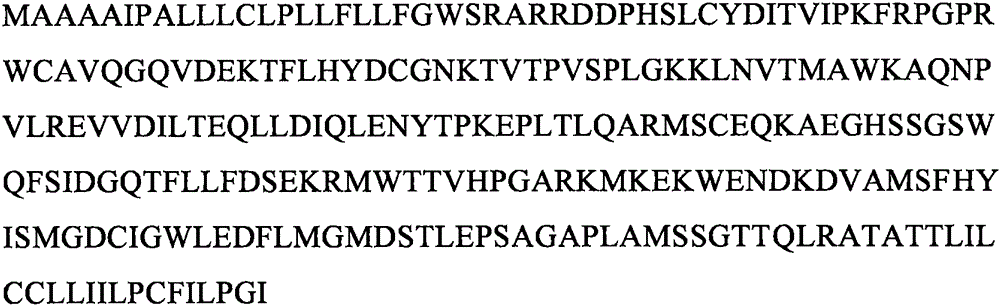
与MICA的竞争Competition with MICA
将重组人类MICA-Fc蛋白吸附到微孔板的孔,并将所述孔用牛血清白蛋白阻断以降低非特异性结合。向所述孔添加NKG2D-Fc-生物素,然后添加NKG2D结合结构域。在孵育和清洗后,使用链亲合素-HRP和TMB底物检测仍结合于MICA-Fc包被的孔的NKG2D-Fc-生物素。吸收值在450nm处测量并在540nm处校正。在减去背景后,从被阻断与MICA-Fc包被的孔结合的NKG2D-Fc-生物素的百分率,来计算NKG2D结合结构域与NKG2D-Fc蛋白的特异性结合。阳性对照抗体(选自SEQ ID NO:45-48)和各种不同的NKG2D结合结构域阻断MICA结合到NKG2D,而同种型对照显示出与MICA的竞争很小(图9)。Recombinant human MICA-Fc protein was adsorbed to wells of a microplate and the wells were blocked with bovine serum albumin to reduce nonspecific binding. NKG2D-Fc-biotin was added to the wells followed by the NKG2D binding domain. After incubation and washing, NKG2D-Fc-biotin still bound to MICA-Fc-coated wells was detected using streptavidin-HRP and TMB substrates. Absorbance values were measured at 450 nm and corrected at 540 nm. Specific binding of the NKG2D binding domain to NKG2D-Fc protein was calculated from the percentage of NKG2D-Fc-biotin blocked from binding to MICA-Fc-coated wells after background subtraction. Positive control antibodies (selected from SEQ ID NOs: 45-48) and various NKG2D binding domains blocked the binding of MICA to NKG2D, while the isotype controls showed little competition with MICA (Figure 9).
与Rae-1δ的竞争Competition with Rae-1δ
将重组小鼠Rae-1δ-Fc(购自R&D Systems)吸附到微孔板的孔,并将所述孔用牛血清白蛋白阻断以降低非特异性结合。向所述孔添加小鼠NKG2D-Fc-生物素,然后添加NKG2D结合结构域。在孵育和清洗后,使用链亲合素-HRP和TMB底物检测仍结合于Rae-1δ-Fc包被的孔的NKG2D-Fc-生物素。吸收值在450nm处测量并在540nm处校正。在减去背景后,从被阻断与Rae-1δ-Fc包被的孔结合的NKG2D-Fc-生物素的百分率,来计算NKG2D结合结构域与NKG2D-Fc蛋白的特异性结合。阳性对照(选自SEQ ID NO:45-48,或可以在eBioscience获得的抗小鼠NKG2D抗体克隆MI-6和CX-5)和各种不同的NKG2D结合结构域克隆阻断Rae-1δ结合到小鼠NKG2D,而同种型对照抗体显示出与Rae-1δ的竞争很小(图10)。Recombinant mouse Rae-1δ-Fc (purchased from R&D Systems) was adsorbed to the wells of a microplate and the wells were blocked with bovine serum albumin to reduce nonspecific binding. Mouse NKG2D-Fc-biotin was added to the wells followed by the NKG2D binding domain. After incubation and washing, NKG2D-Fc-biotin still bound to Rae-1δ-Fc-coated wells was detected using streptavidin-HRP and TMB substrates. Absorbance values were measured at 450 nm and corrected at 540 nm. Specific binding of the NKG2D binding domain to NKG2D-Fc protein was calculated from the percentage of NKG2D-Fc-biotin blocked from binding to Rae-1δ-Fc-coated wells after background subtraction. Positive controls (selected from SEQ ID NOs: 45-48, or anti-mouse NKG2D antibody clones MI-6 and CX-5 available at eBioscience) and various clones of the NKG2D binding domain blocked Rae-1δ binding to Mouse NKG2D, while the isotype control antibody showed little competition with Rae-1δ (Figure 10).
实施例3-NKG2D结合结构域克隆激活NKG2DExample 3 - NKG2D binding domain cloning activates NKG2D
将人类和小鼠NKG2D的核酸序列融合到编码CD3ζ信号传导结构域的核酸序列以获得嵌合抗原受体(CAR)构建体。然后将所述NKG2D-CAR构建体使用Gibson组装克隆到逆转录病毒载体中,并转染到expi293细胞中用于逆转录病毒生产。将EL4细胞用含有NKG2D-CAR的病毒与8μg/mL聚凝胺一起感染。感染后24小时,通过流式细胞术分析所述EL4细胞中NKG2D-CAR的表达水平,并选择在细胞表面上表达高水平NKG2D-CAR的克隆。The nucleic acid sequences of human and mouse NKG2D were fused to nucleic acid sequences encoding the CD3ζ signaling domain to obtain chimeric antigen receptor (CAR) constructs. The NKG2D-CAR construct was then cloned into a retroviral vector using Gibson assembly and transfected into expi293 cells for retroviral production. EL4 cells were infected with virus containing NKG2D-CAR with 8 μg/mL polybrene. Twenty-four hours after infection, the expression levels of NKG2D-CAR in the EL4 cells were analyzed by flow cytometry, and clones that expressed high levels of NKG2D-CAR on the cell surface were selected.
为了确定NKG2D结合结构域是否激活NKG2D,将它们吸附到微孔板的孔,并将NKG2D-CAR EL4细胞在布雷菲德菌素-A和莫能菌素存在下在抗体片段包被的孔上培养4小时。通过流式细胞术测定细胞内TNF-α生产这种NKG2D激活的指示。将TNF-α阳性细胞归一化到用阳性对照处理的细胞。所有NKG2D结合结构域激活人类NKG2D(图11)和小鼠NKG2D(图12)两者。To determine whether NKG2D binding domains activate NKG2D, they were adsorbed to wells of a microplate and NKG2D-CAR EL4 cells were plated on antibody fragment-coated wells in the presence of Brefeldin-A and monensin Incubate for 4 hours. This indication of NKG2D activation was determined by flow cytometry for intracellular TNF-α production. TNF-α positive cells were normalized to cells treated with positive control. All NKG2D binding domains activated both human NKG2D (FIG. 11) and mouse NKG2D (FIG. 12).
实施例4-NKG2D结合结构域激活NK细胞Example 4 - NKG2D binding domain activates NK cells
原代人类NK细胞primary human NK cells
使用密度梯度离心从人类外周血血沉棕黄层分离外周血单核细胞(PBMC)。使用磁珠负选择从PBMC分离NK细胞(CD3-CD56+),分离到的NK细胞的纯度通常>95%。然后将分离的NK细胞在含有100ng/mL IL-2的培养基中培养24-48小时,然后将它们转移到吸附有NKG2D结合结构域的微孔板孔,并在含有荧光团偶联的抗CD107a抗体、布雷菲德菌素-A和莫能菌素的培养基中培养。在培养后,使用荧光团偶联的针对CD3、CD56和IFN-γ的抗体通过流式细胞术测定NK细胞。在CD3-CD56+细胞中分析CD107a和IFN-γ染色,以评估NK细胞激活。CD107a/IFN-γ双阳性细胞的增加指示了通过接合两个激活受体而不是一个受体的更好的NK细胞激活。NKG2D结合结构域和阳性对照(选自SEQ ID NO:45-48)与同种型对照相比显示出变成CD107a+和IFN-γ+的NK细胞的百分率更高(图13和图14代表了来自于两个独立实验的数据,其各自使用不同供体的PBMC用于NK细胞制备)。Peripheral blood mononuclear cells (PBMC) were isolated from human peripheral blood buffy coat using density gradient centrifugation. NK cells (CD3 − CD56 + ) were isolated from PBMCs using magnetic bead negative selection, and the purity of the isolated NK cells was typically >95%. The isolated NK cells were then cultured in medium containing 100 ng/mL IL-2 for 24-48 hours, after which they were transferred to microplate wells adsorbed with the NKG2D-binding domain and incubated in fluorophore-conjugated antibody CD107a antibody, Brefeldin-A and monensin culture medium. After incubation, NK cells were assayed by flow cytometry using fluorophore-conjugated antibodies against CD3, CD56 and IFN-γ. CD107a and IFN-γ staining were analyzed in CD3 − CD56 + cells to assess NK cell activation. An increase in CD107a/IFN-γ double positive cells indicates better NK cell activation by engaging two activating receptors instead of one. The NKG2D binding domain and positive controls (selected from SEQ ID NOs: 45-48) showed a higher percentage of NK cells that became CD107a + and IFN-γ + compared to isotype controls (Figures 13 and 14 represent data from two independent experiments, each using PBMCs from different donors for NK cell preparation).
原代小鼠NK细胞Primary mouse NK cells
从C57B1/6小鼠获得脾脏并将其通过70μm细胞筛压碎,以获得单细胞悬液。将细胞离心沉淀并重悬浮在ACK裂解缓冲液(购自Thermo Fisher Scientific#A1049201;155mM氯化铵,10mM碳酸氢钾,0.01mM EDTA)中,以除去红细胞。将剩余的细胞用100ng/mL hIL-2培养72小时,然后收获并准备用于NK细胞分离。然后用磁珠使用反向贫化技术从脾细胞分离NK细胞(CD3-NK1.1+),通常纯度>90%。将纯化的NK细胞在含有100ng/mL mIL-15的培养基中培养48小时,然后将它们转移到吸附有NKG2D结合结构域的微孔板孔,并在含有荧光团偶联的抗CD107a抗体、布雷菲德菌素-A和莫能菌素的培养基中培养。在NKG2D结合结构域包被的孔中培养后,使用荧光团偶联的针对CD3、NK1.1和IFN-γ的抗体通过流式细胞术测定NK细胞。在CD3-NK1.1+细胞中分析CD107a和IFN-γ染色,以评估NK细胞激活。CD107a/IFN-γ双阳性细胞的增加指示了通过接合两个激活受体而不是一个受体的更好的NK细胞激活。NKG2D结合结构域和阳性对照(选自可以在eBioscience获得的抗小鼠NKG2D抗体克隆MI-6和CX-5)与同种型对照相比显示出变成CD107a+和IFN-γ+的NK细胞的百分率更高(图15和图16代表了来自于两个独立实验的数据,其各自使用不同小鼠用于NK细胞制备)。Spleens were obtained from C57B1/6 mice and crushed through a 70 μm cell sieve to obtain a single cell suspension. Cells were pelleted by centrifugation and resuspended in ACK lysis buffer (available from Thermo Fisher Scientific #A1049201; 155 mM ammonium chloride, 10 mM potassium bicarbonate, 0.01 mM EDTA) to remove red blood cells. The remaining cells were incubated with 100 ng/mL hIL-2 for 72 hours, then harvested and prepared for NK cell isolation. NK cells (CD3 − NK1.1 + ) are then isolated from splenocytes using magnetic beads using a reverse depletion technique, typically >90% pure. Purified NK cells were cultured in medium containing 100 ng/mL mIL-15 for 48 hours, and then transferred to microplate wells to which the NKG2D binding domain had been adsorbed and incubated in fluorophore-conjugated anti-CD107a antibody, Brefeldin-A and monensin culture medium. After incubation in NKG2D binding domain-coated wells, NK cells were assayed by flow cytometry using fluorophore-conjugated antibodies against CD3, NK1.1 and IFN-γ. CD107a and IFN-γ staining were analyzed in CD3 − NK1.1 + cells to assess NK cell activation. An increase in CD107a/IFN-γ double positive cells indicates better NK cell activation by engaging two activating receptors instead of one. NKG2D binding domain and positive controls (selected from anti-mouse NKG2D antibody clones MI-6 and CX-5 available at eBioscience) showed NK cells that became CD107a + and IFN-γ + compared to isotype controls (Figure 15 and Figure 16 represent data from two independent experiments, each using a different mouse for NK cell preparation).
实施例5-NKG2D结合结构域能够引起对靶肿瘤细胞的细胞毒性Example 5 - The NKG2D binding domain is capable of causing cytotoxicity to target tumor cells
人类和小鼠原代NK细胞激活测定法证实了在与NKG2D结合结构域孵育后NK细胞上的细胞毒性标志物增加。为了研究这是否转变成肿瘤细胞裂解的增加,利用了基于细胞的测定法,其中将每个NKG2D结合结构域开发成单特异性抗体。将Fc区用作一个靶向臂,而Fab区(NKG2D结合结构域)充当另一个靶向臂,以激活NK细胞。将人类起源并表达高水平Fc受体的THP-1细胞用作肿瘤靶,并使用Perkin Elmer DELFIA细胞毒性试剂盒。将THP-1细胞用BATDA试剂标记,并以105/mL重悬浮在培养基中。然后将标记的THP-1细胞与NKG2D抗体和分离的小鼠NK细胞在微孔板的孔中合并,在37℃下孵育3小时。在孵育后,取出20μl培养上清液,与200μl Europium溶液混合,并在暗处振摇孵育15分钟。通过装备有时间分辨荧光模块(激发337nm,发射620nm)的PheraStar读板器随时间测量荧光,并按照试剂盒说明书计算特异性裂解。Human and mouse primary NK cell activation assays demonstrated increased cytotoxic markers on NK cells following incubation with the NKG2D binding domain. To investigate whether this translates into increased tumor cell lysis, a cell-based assay was utilized in which each NKG2D binding domain was developed as a monospecific antibody. The Fc region was used as one targeting arm, while the Fab region (NKG2D binding domain) served as another targeting arm to activate NK cells. THP-1 cells of human origin and expressing high levels of Fc receptors were used as tumor targets and the Perkin Elmer DELFIA cytotoxicity kit was used. THP-1 cells were labeled with BATDA reagent and resuspended in medium at 105/mL. Labeled THP-1 cells were then combined with NKG2D antibody and isolated mouse NK cells in the wells of a microplate and incubated at 37°C for 3 hours. After incubation, 20 μl of the culture supernatant was removed, mixed with 200 μl of Europium solution, and incubated in the dark for 15 minutes with shaking. Fluorescence was measured over time by a PheraStar plate reader equipped with a time-resolved fluorescence module (excitation 337 nm, emission 620 nm) and specific lysis was calculated according to the kit instructions.
阳性对照ULBP-6、即NKG2D的天然配体,显示出THP-1靶细胞被小鼠NK细胞的特异性裂解的增加。NKG2D抗体也增加了THP-1靶细胞的特异性裂解,而同种型对照抗体显示出特异性裂解的减少。虚线指示在不添加抗体的情况下THP-1细胞被小鼠NK细胞的特异性裂解(图17)。The positive control ULBP-6, the natural ligand of NKG2D, showed an increase in specific lysis of THP-1 target cells by mouse NK cells. The NKG2D antibody also increased specific lysis of THP-1 target cells, whereas the isotype control antibody showed a decrease in specific lysis. The dashed line indicates the specific lysis of THP-1 cells by mouse NK cells without the addition of antibody (FIG. 17).
实施例6-NKG2D抗体显示出高的热稳定性Example 6 - NKG2D antibody shows high thermal stability
使用差示扫描荧光测定法测定NKG2D结合结构域的解链温度。外推的表观解链温度相对于典型的IgG1抗体来说更高(图18)。The melting temperature of the NKG2D binding domain was determined using differential scanning fluorimetry. The extrapolated apparent melting temperatures were higher relative to typical IgGl antibodies (Figure 18).
实施例7-人类NK细胞被交联的NKG2D和CD16的协同激活Example 7 - Synergistic activation of human NK cells by cross-linked NKG2D and CD16
原代人类NK细胞激活测定法Primary Human NK Cell Activation Assay
使用密度梯度离心从人类外周血血沉棕黄层分离外周血单核细胞(PBMC)。使用负磁珠(StemCell#17955)从PBMC纯化NK细胞。通过流式细胞术确定NK细胞为>90%CD3-CD56+。然后将分离的NK细胞在含有100ng/mL hIL-2(Peprotech#200-02)的培养基中扩增48小时,然后用于激活测定法中。将抗体以2μg/ml(抗CD16抗体,Biolegend#302013)和5μg/mL(抗NKG2D抗体,R&D#MAB139)的浓度,在100μl无菌PBS中在96孔平底板上在4℃包被过夜,然后充分清洗所述孔以除去过量抗体。为了评估脱颗粒,将IL-2激活的NK细胞以5×105个细胞/ml重悬浮在增补有100ng/mL hIL2和1μg/mL APC偶联的抗CD107a mAb(Biolegend#328619)的培养基中。然后将1×10⁵个细胞/孔添加到抗体包被的板上。分别以1∶1000和1∶270的最终稀释度添加蛋白质转运抑制剂布雷菲德菌素A(BFA,Biolegend#420601)和莫能菌素(Biolegend#420701)。将铺板的孔在5%CO2中在37℃下温育4小时。对于IFN-γ的细胞内染色来说,将NK细胞用抗CD3抗体(Biolegend#300452)和抗CD56 mAb(Biolegend#318328)标记,然后固定并通透化,并用抗IFN-γ mAb(Biolegend#506507)标记。在对活的CD56+CD3-细胞进行门选后,通过流式细胞术分析NK细胞的CD107a和IFN-γ表达。Peripheral blood mononuclear cells (PBMC) were isolated from human peripheral blood buffy coat using density gradient centrifugation. NK cells were purified from PBMCs using negative magnetic beads (StemCell #17955). NK cells were determined to be >90% CD3 − CD56 + by flow cytometry. The isolated NK cells were then expanded in medium containing 100 ng/mL hIL-2 (Peprotech #200-02) for 48 hours before being used in activation assays. Antibodies were coated at a concentration of 2 μg/ml (anti-CD16 antibody, Biolegend #302013) and 5 μg/mL (anti-NKG2D antibody, R&D #MAB139) in 100 μl sterile PBS on 96-well flat bottom plates overnight at 4°C, The wells are then washed extensively to remove excess antibody. To assess degranulation, IL-2 activated NK cells were resuspended at 5 x 10⁵ cells/ml in medium supplemented with 100 ng/mL hIL2 and 1 μg/mL APC-conjugated anti-CD107a mAb (Biolegend #328619) middle. 1 x 10⁵ cells/well were then added to the antibody-coated plate. The protein transport inhibitors Brefeldin A (BFA, Biolegend #420601) and monensin (Biolegend #420701) were added at final dilutions of 1:1000 and 1:270, respectively. Plated wells were incubated in 5% CO at 37 °C for 4 h. For intracellular staining of IFN-γ, NK cells were labeled with anti-CD3 antibody (Biolegend #300452) and anti-CD56 mAb (Biolegend #318328), then fixed and permeabilized, and treated with anti-IFN-γ mAb (Biolegend #318328). 506507) mark. After gating on viable CD56 + CD3- cells, NK cells were analyzed for CD107a and IFN-γ expression by flow cytometry.
为了调查受体组合的相对效能,通过板结合刺激进行了NKG2D或CD16的交联和两种受体的共同交联。如图19(图19A-19C)中所示,CD16和NKG2D的组合刺激产生大大提高的CD107a水平(脱颗粒)(图19A)和/或IFN-γ生产(图19B)。虚线表示每种受体的单独刺激的累加效应。To investigate the relative potency of receptor combinations, cross-linking of NKG2D or CD16 and co-cross-linking of both receptors were performed by plate binding stimulation. As shown in Figure 19 (Figures 19A-19C), combined stimulation of CD16 and NKG2D resulted in greatly increased CD107a levels (degranulation) (Figure 19A) and/or IFN-gamma production (Figure 19B). Dashed lines represent the additive effect of individual stimulation of each receptor.
在用抗CD16抗体、抗NKG2D抗体或两种单克隆抗体的组合进行4小时的板结合刺激后,分析IL-2激活的NK细胞的CD107a水平和细胞内IFN-γ生产。图指示了平均值(n=2)±SD。图19A展示了CD107a的水平;图19B展示了IFNγ的水平;图19C展示了CD107a和IFNγ的水平。图19A-19C中示出的数据代表了使用5位不同健康供体的5个独立实验。IL-2-activated NK cells were analyzed for CD107a levels and intracellular IFN-γ production after 4 hours of plate-bound stimulation with anti-CD16 antibody, anti-NKG2D antibody, or a combination of the two monoclonal antibodies. Graphs indicate mean (n=2) ± SD. Figure 19A shows the levels of CD107a; Figure 19B shows the levels of IFNy; Figure 19C shows the levels of CD107a and IFNy. The data shown in Figures 19A-19C are representative of 5 independent experiments using 5 different healthy donors.
通过参考并入Incorporated by reference
本文中提到的每个专利文献和科学论文的整个公开内容为所有目的通过参考并入本文。The entire disclosures of each patent document and scientific paper mentioned herein are incorporated herein by reference for all purposes.
等同性equivalence
本发明可以以其他特定形式体现而不背离其精神或本质特征。因此,前述实施方式应该在所有情况下被认为是说明性的而不是限制本文描述的发明。因此,本发明的范围由随附的权利要求书而不是上面的描述指明,并且打算将进入权利要求书的意义和等同性范围之内的所有变化涵盖在其中。The present invention may be embodied in other specific forms without departing from its spirit or essential characteristics. Accordingly, the foregoing embodiments should be considered in all circumstances to be illustrative and not restrictive of the invention described herein. Therefore, the scope of the invention is indicated by the appended claims, rather than the above description, and all changes that come within the meaning and equivalency range of the claims are intended to be embraced therein.

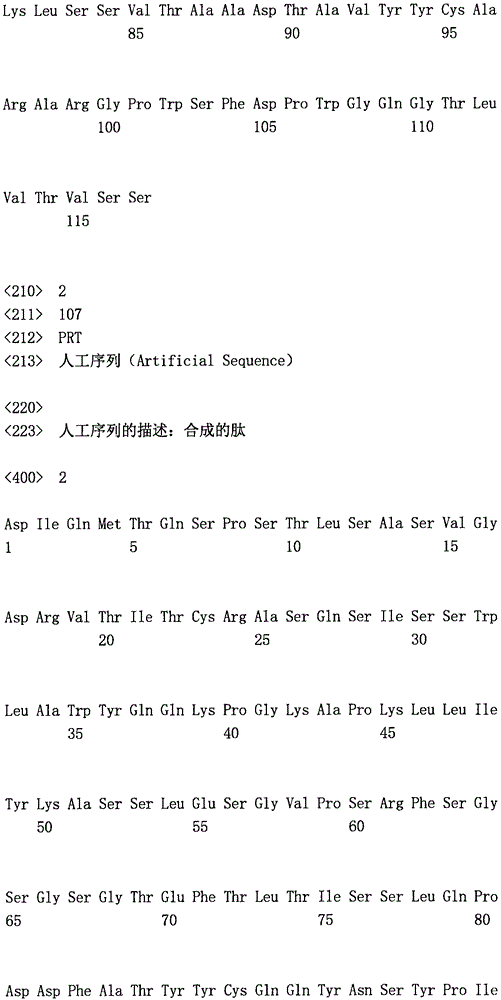


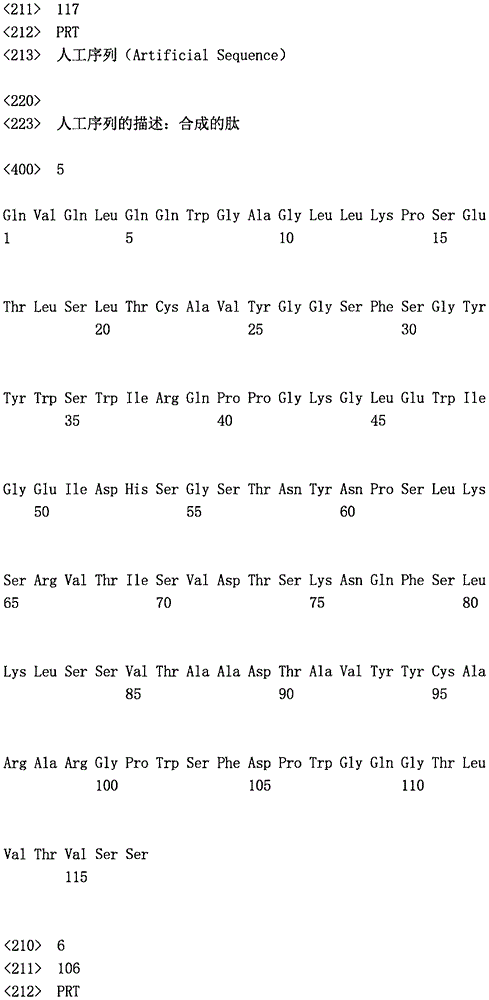
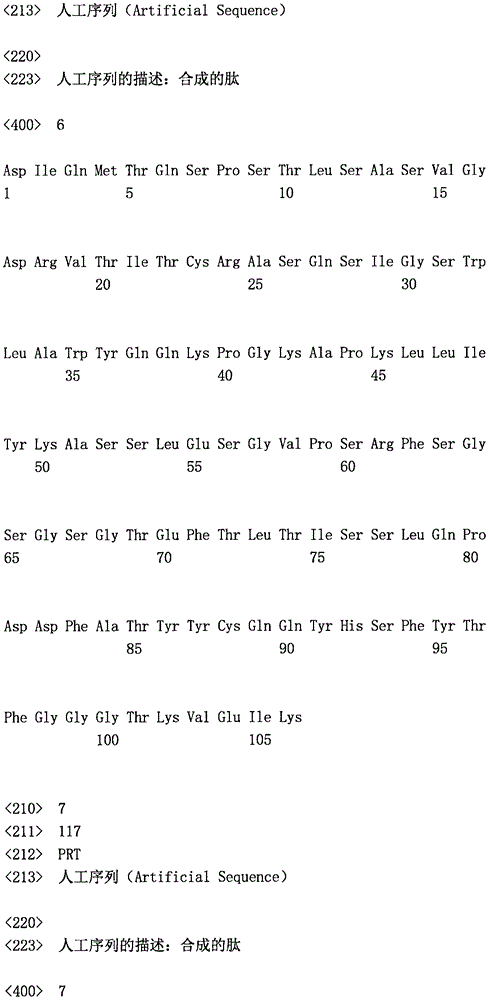
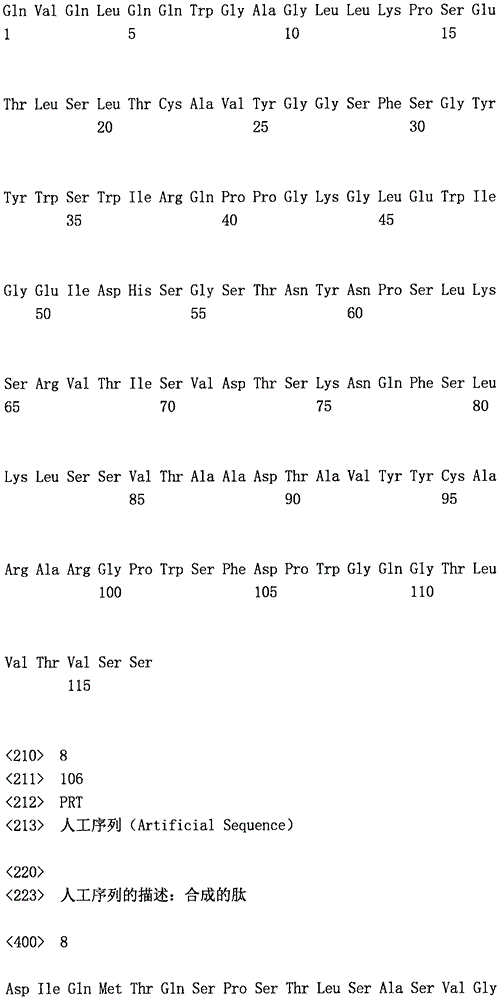

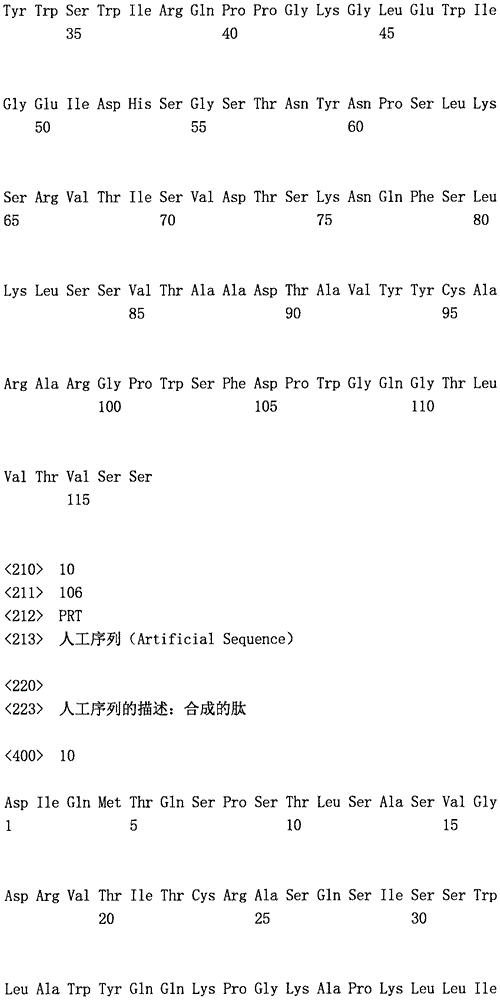
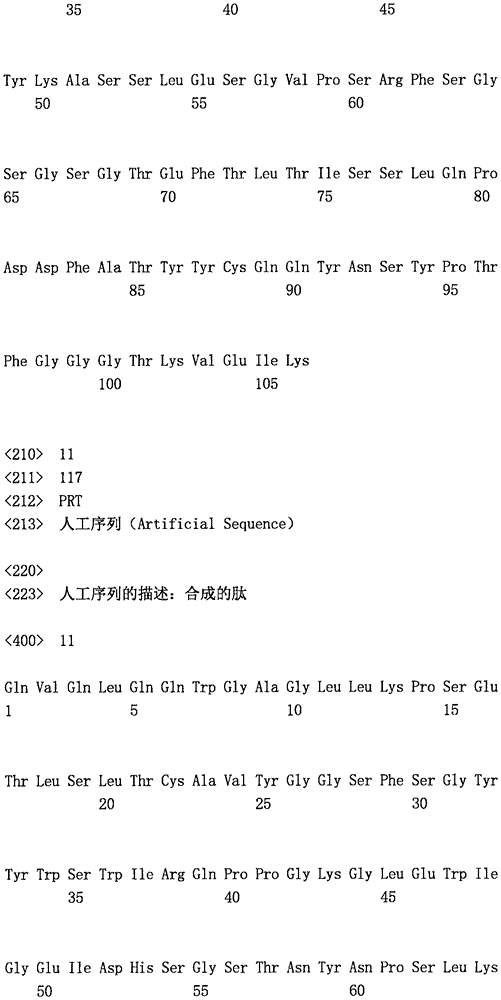
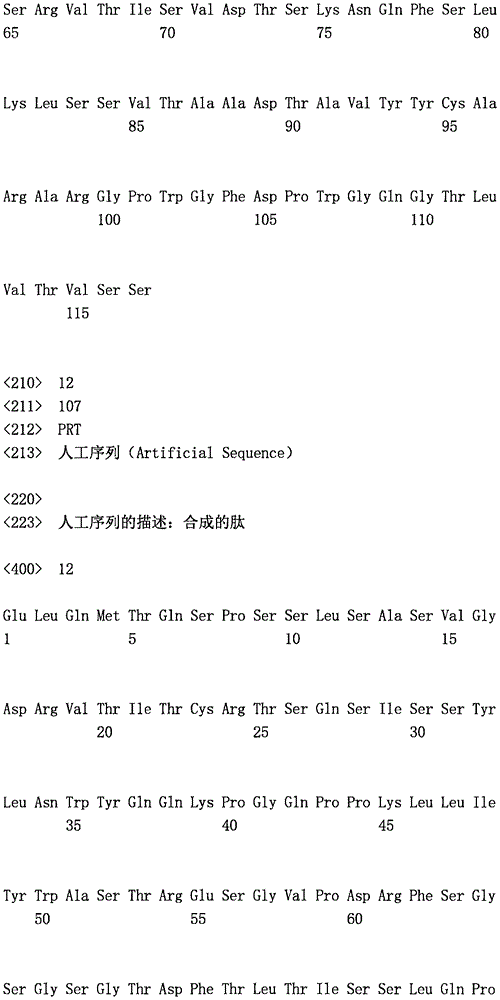
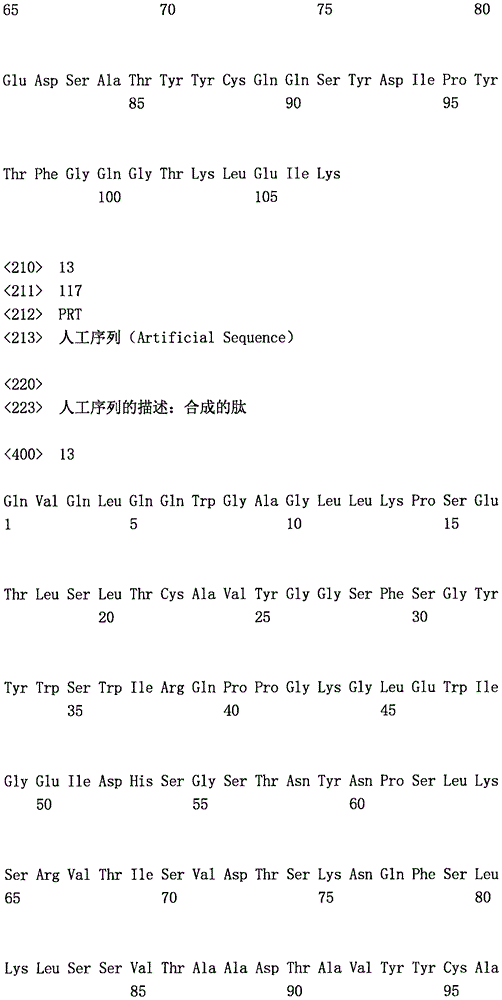

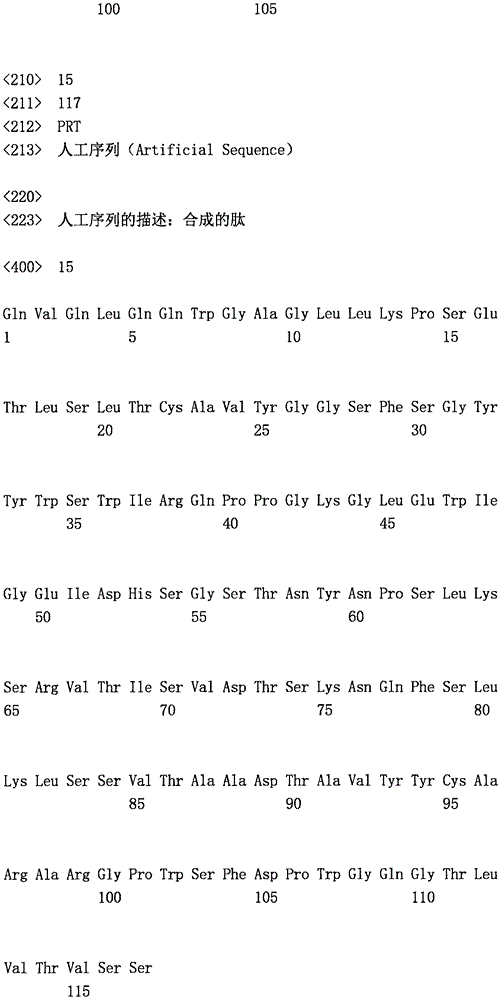

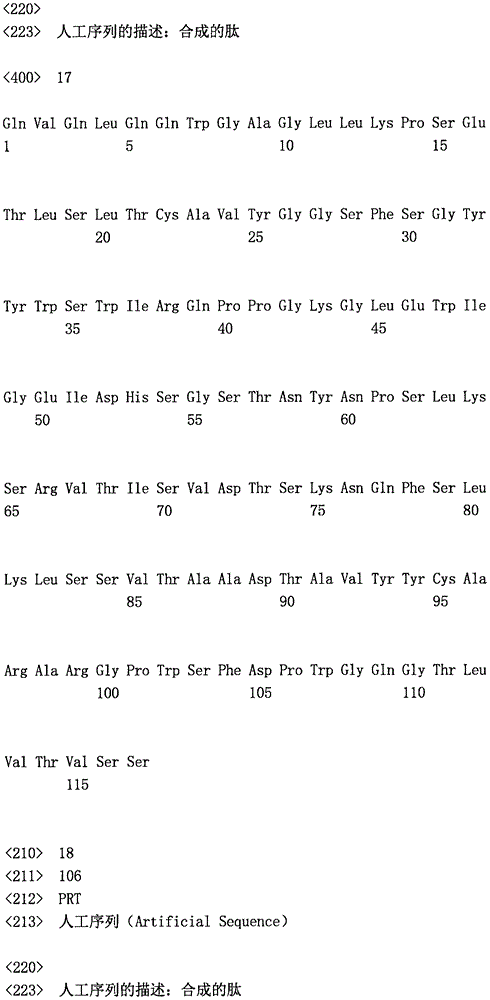


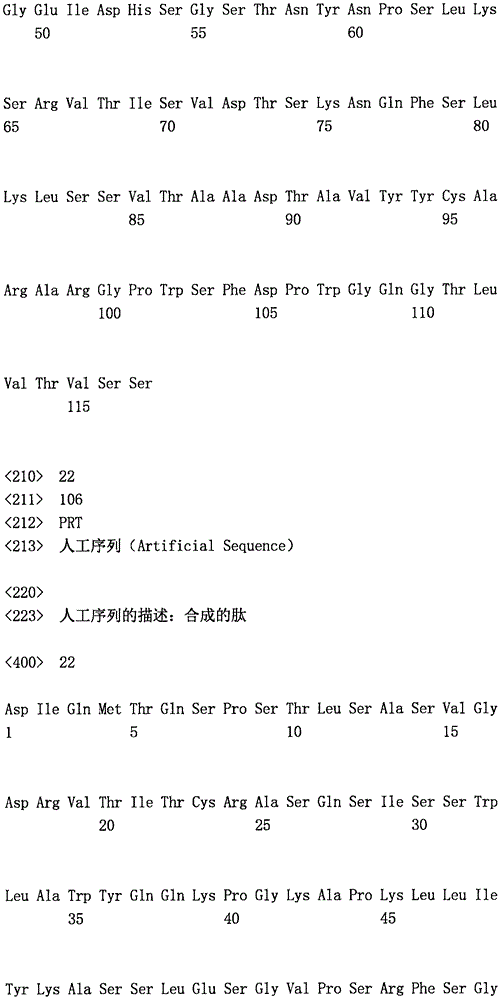


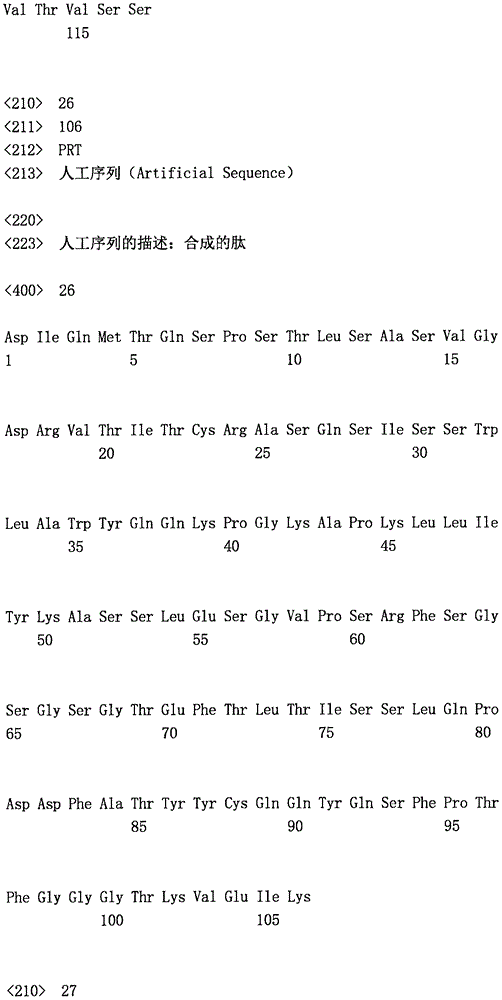
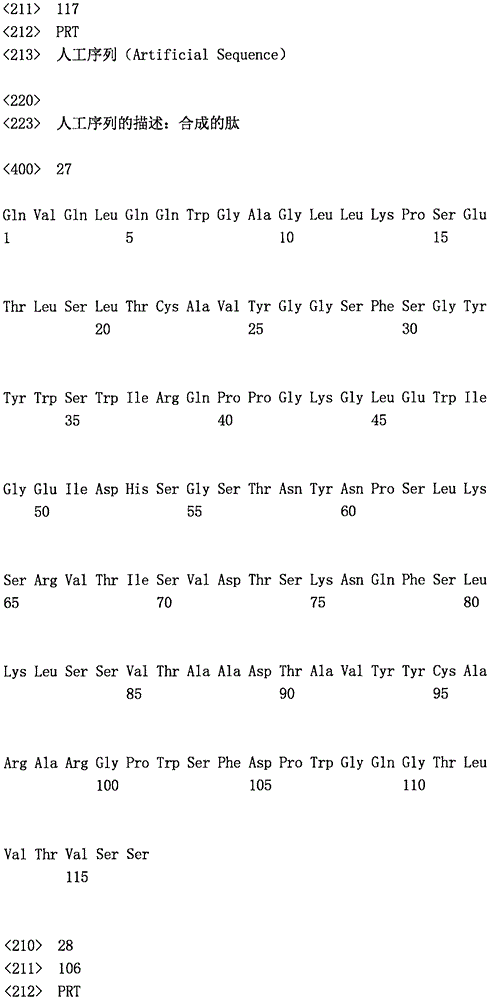

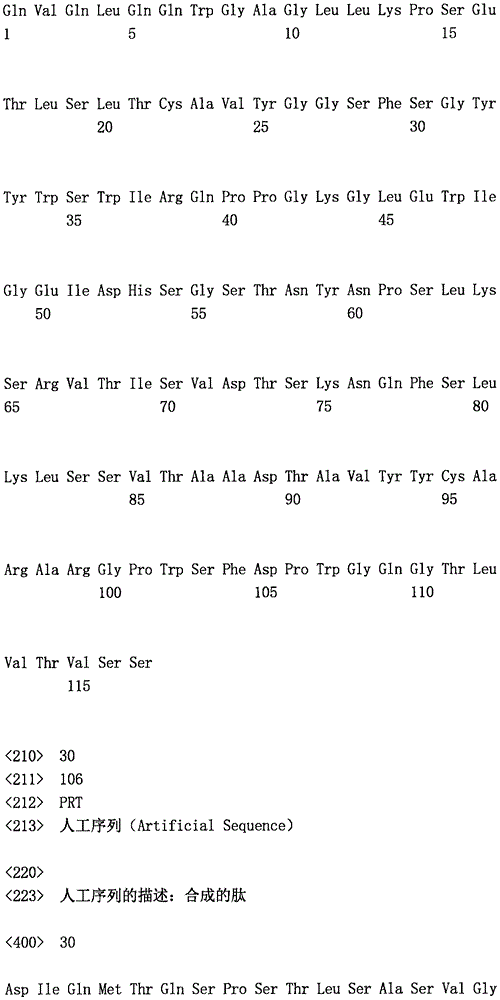


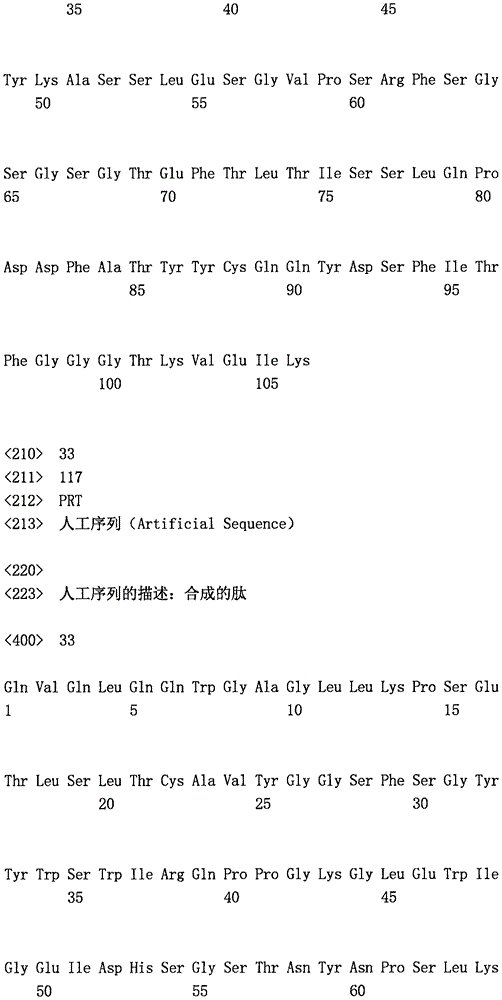
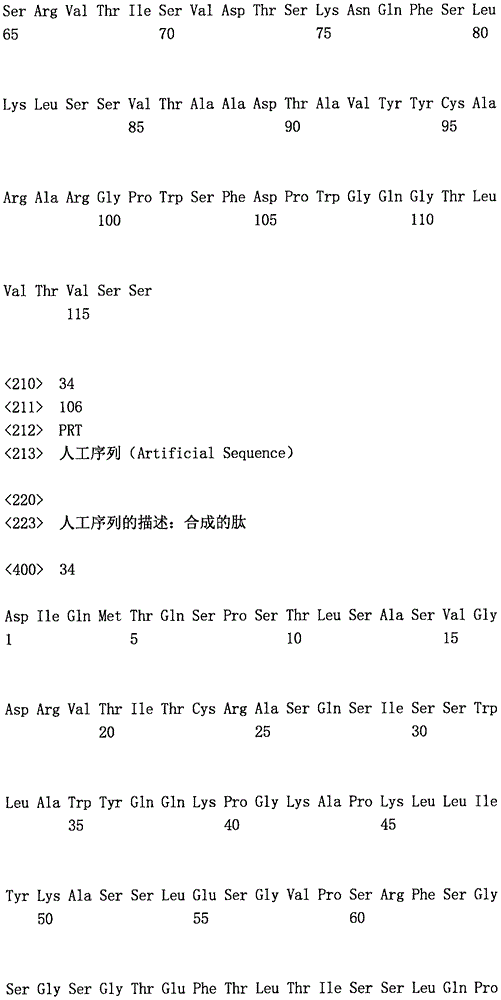
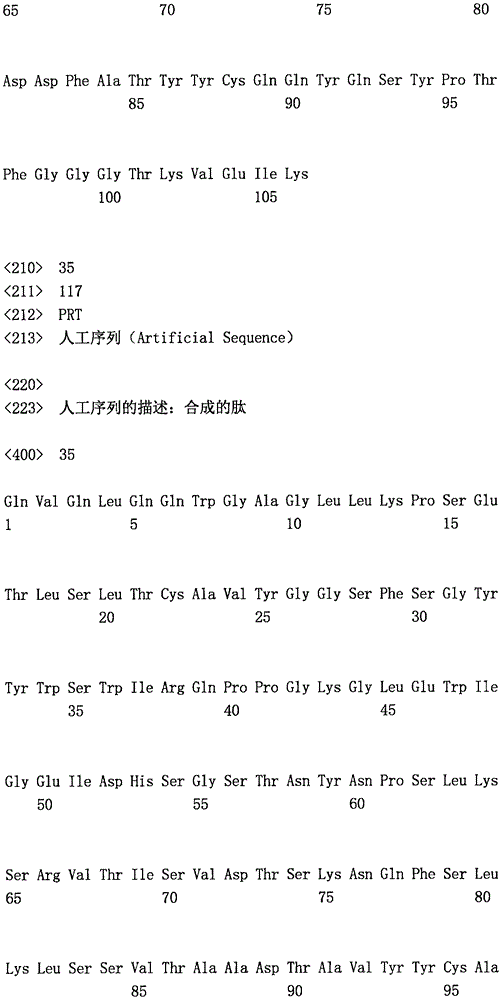
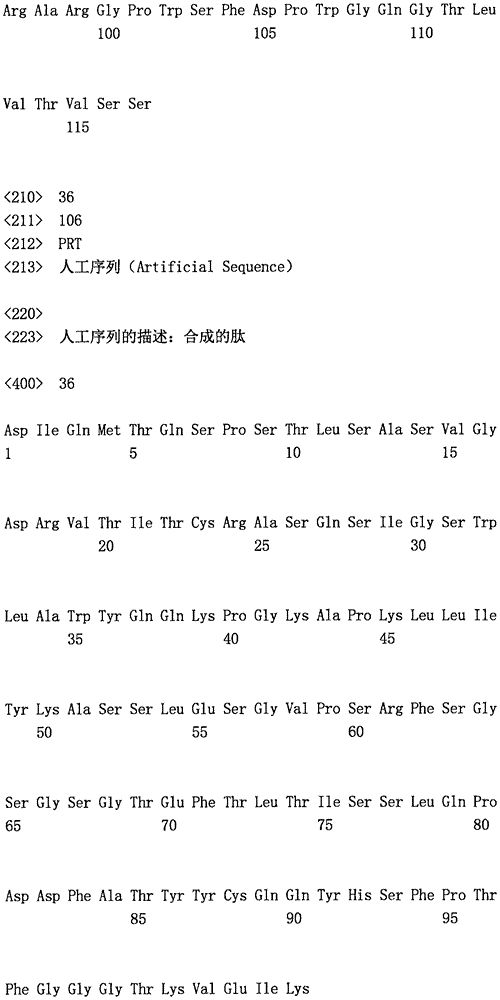
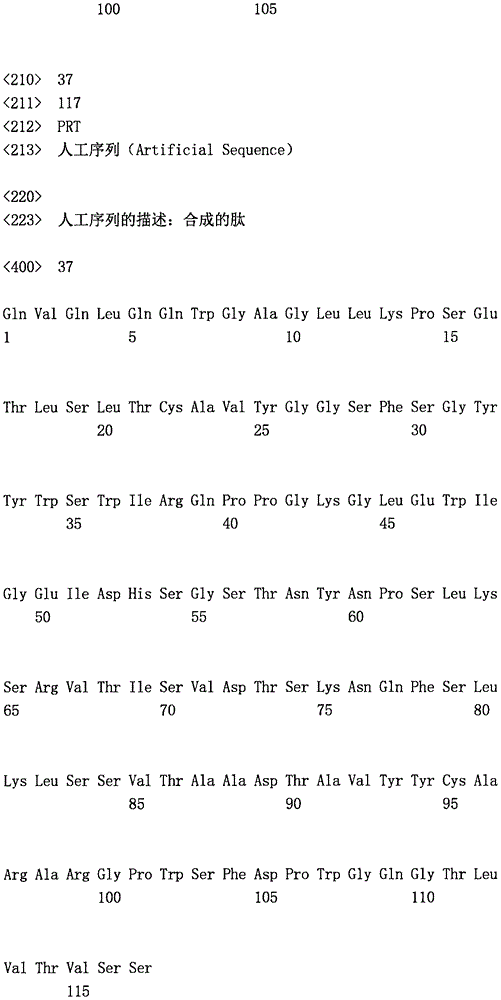

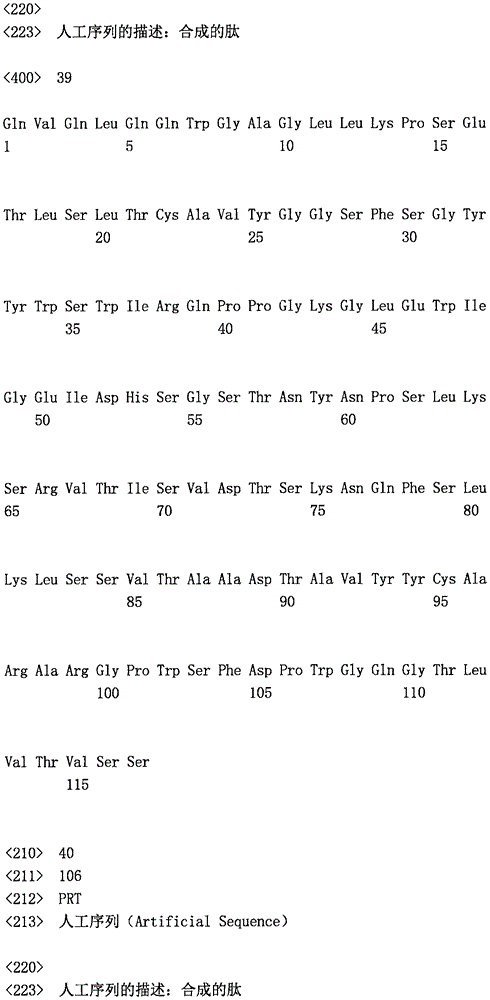


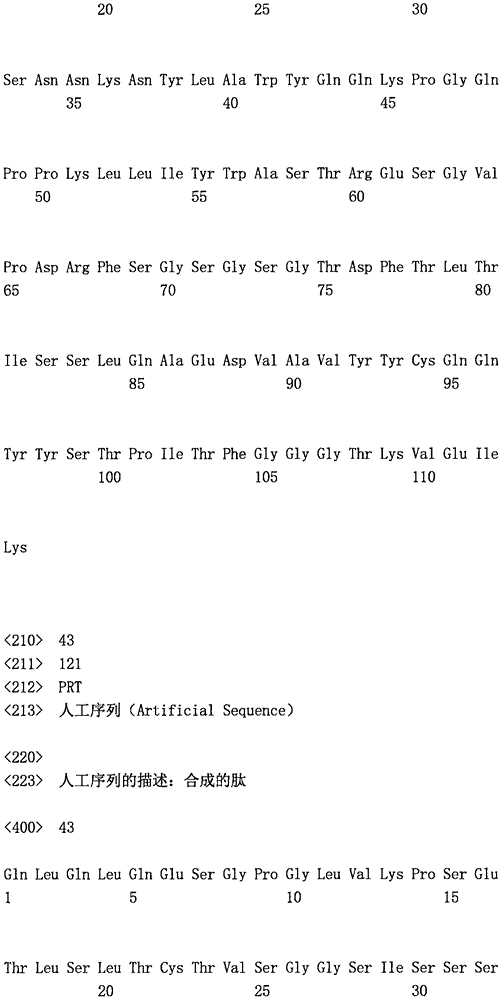
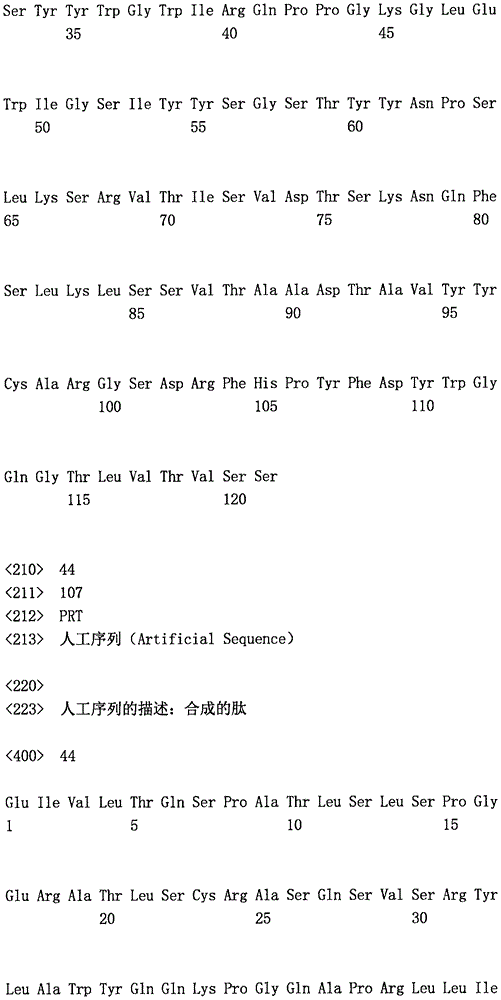


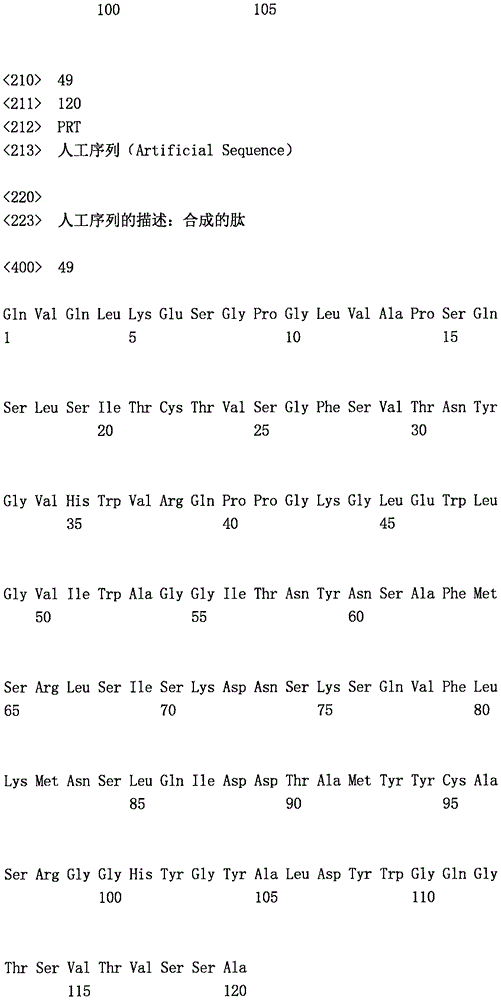

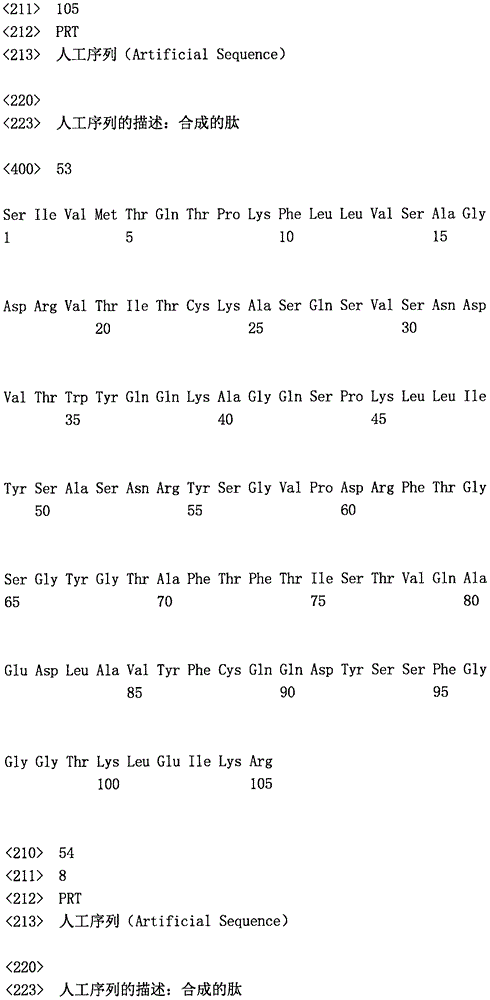


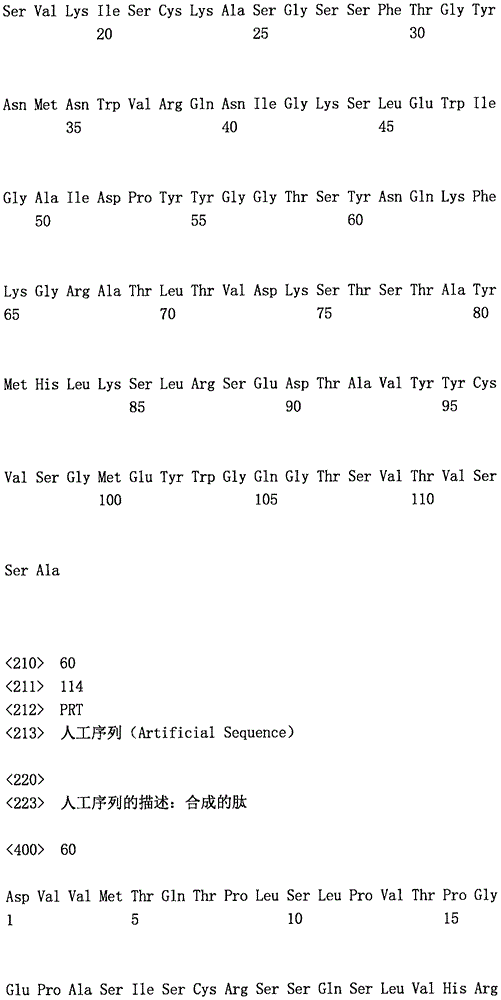


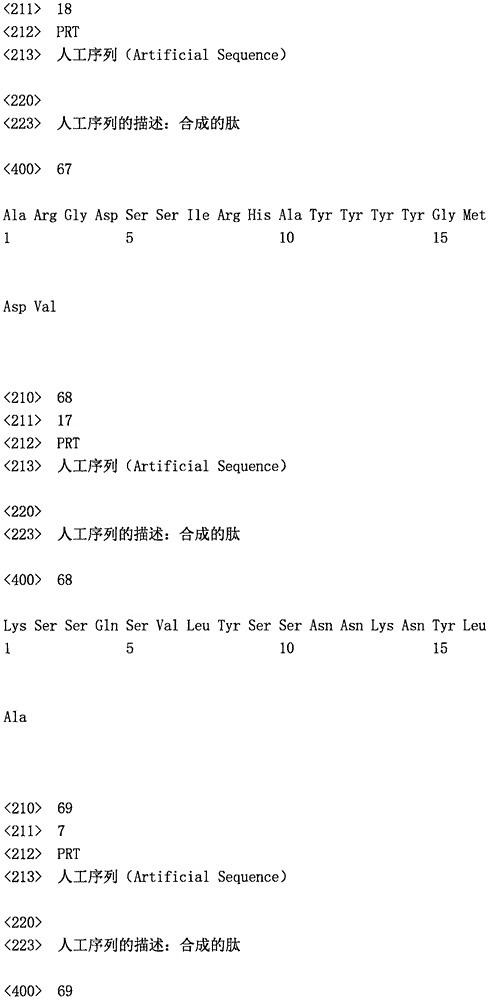
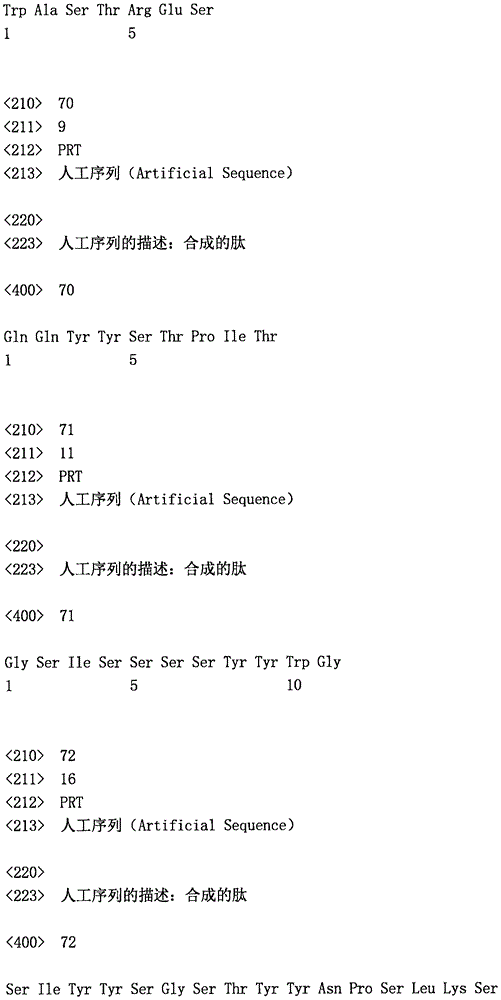
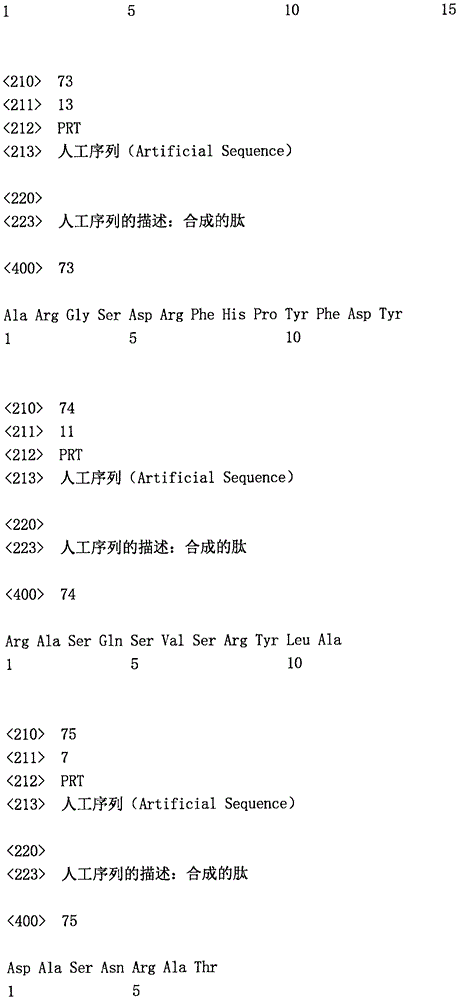

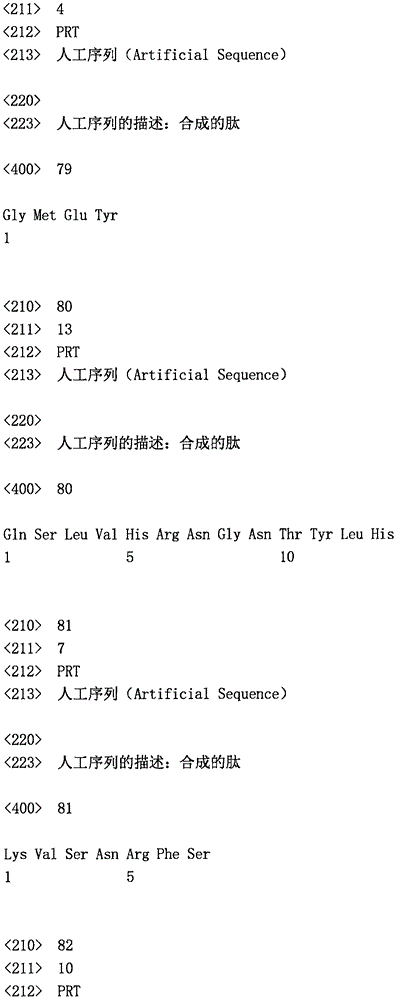


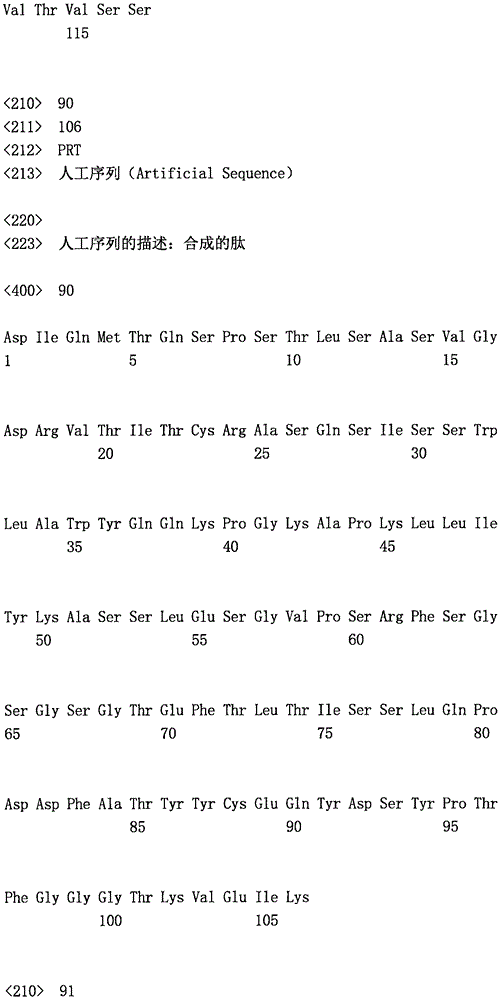

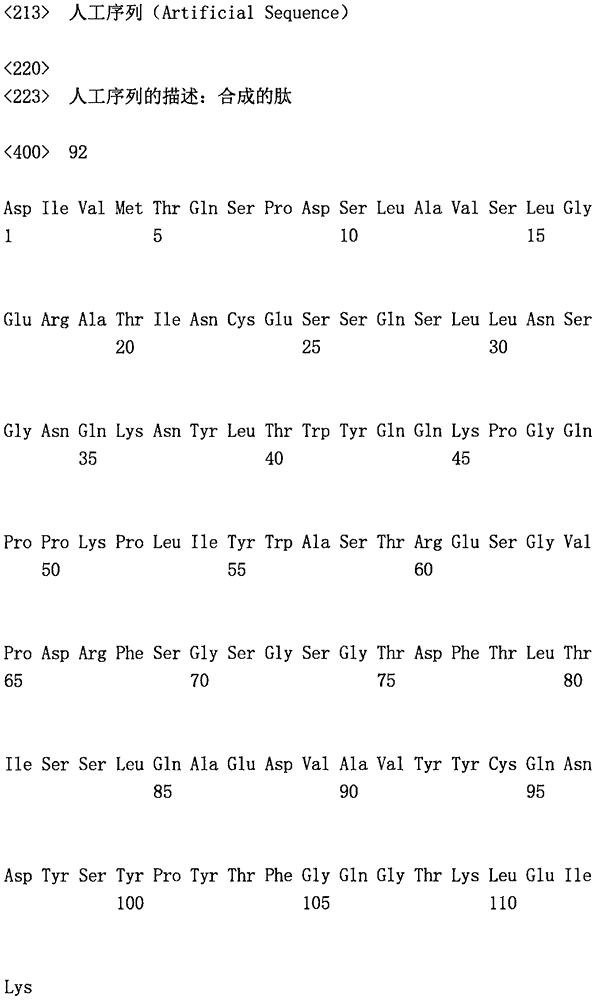
Claims (38)
Applications Claiming Priority (3)
| Application Number | Priority Date | Filing Date | Title |
|---|---|---|---|
| US201762461143P | 2017-02-20 | 2017-02-20 | |
| US62/461,143 | 2017-02-20 | ||
| PCT/US2018/018825 WO2018152530A1 (en) | 2017-02-20 | 2018-02-20 | Proteins binding gd2, nkg2d and cd16 |
Publications (1)
| Publication Number | Publication Date |
|---|---|
| CN110891976A true CN110891976A (en) | 2020-03-17 |
Family
ID=63169997
Family Applications (1)
| Application Number | Title | Priority Date | Filing Date |
|---|---|---|---|
| CN201880026498.5A Pending CN110891976A (en) | 2017-02-20 | 2018-02-20 | Proteins that bind GD2, NKG2D and CD16 |
Country Status (13)
| Country | Link |
|---|---|
| US (1) | US20200231700A1 (en) |
| EP (1) | EP3583133A4 (en) |
| JP (1) | JP2020510644A (en) |
| KR (1) | KR20190120783A (en) |
| CN (1) | CN110891976A (en) |
| AU (1) | AU2018220748A1 (en) |
| BR (1) | BR112019017256A2 (en) |
| CA (1) | CA3054081A1 (en) |
| IL (1) | IL268768A (en) |
| MX (1) | MX2019009943A (en) |
| RU (1) | RU2019129511A (en) |
| SG (1) | SG11201907648XA (en) |
| WO (1) | WO2018152530A1 (en) |
Families Citing this family (12)
| Publication number | Priority date | Publication date | Assignee | Title |
|---|---|---|---|---|
| KR20190118172A (en) | 2017-02-08 | 2019-10-17 | 드래곤플라이 쎄라퓨틱스, 인크. | Multispecific Binding Proteins for Activation of Natural Killer Cells and Their Therapeutic Uses in Cancer Treatment |
| JP7685821B2 (en) | 2017-02-20 | 2025-05-30 | ドラゴンフライ セラピューティクス, インコーポレイテッド | Proteins that bind to Her2, NKG2D and CD16 |
| CN112040971A (en) | 2018-02-08 | 2020-12-04 | 蜻蜓疗法股份有限公司 | Combination cancer therapy involving multispecific binding proteins that activate natural killer cells |
| DK3749346T3 (en) | 2018-02-08 | 2024-09-09 | Dragonfly Therapeutics Inc | ANTIBODY VARIABLE DOMAIN COMBINATIONS TARGETING THE NKG2D RECEPTOR |
| TW201942134A (en) | 2018-02-20 | 2019-11-01 | 美商蜻蜓醫療公司 | Multi-specific binding proteins that bind CD33, NKG2D, and CD16, and methods of use |
| AU2019318083A1 (en) | 2018-08-08 | 2021-02-25 | Dragonfly Therapeutics, Inc. | Multi-specific binding proteins that bind BCMA, NKG2D and CD16, and methods of use |
| KR20250112921A (en) | 2018-08-08 | 2025-07-24 | 드래곤플라이 쎄라퓨틱스, 인크. | Proteins binding nkg2d, cd16 and a tumor-associated antigen |
| EA202091888A1 (en) | 2018-08-08 | 2020-10-23 | Драгонфлай Терапьютикс, Инк. | VARIABLE ANTIBODY DOMAINS TARGETED ON THE NKG2D RECEPTOR |
| RU2733430C1 (en) * | 2019-11-19 | 2020-10-01 | Общество с ограниченной ответственностью «Реал Таргет» | Creation of conjugates of gd2-specific antibodies and fragments of gd2-specific antibodies with preparations |
| EP4146271A4 (en) | 2020-05-06 | 2024-09-04 | Dragonfly Therapeutics, Inc. | Proteins binding nkg2d, cd16 and clec12a |
| JP2023539871A (en) * | 2020-08-26 | 2023-09-20 | ザ リージェンツ オブ ザ ユニバーシティ オブ カリフォルニア | Methods and compositions for treating glioblastoma |
| CN117222663A (en) | 2021-03-03 | 2023-12-12 | 蜻蜓疗法股份有限公司 | Methods of treating cancer using multispecific binding proteins that bind NKG2D, CD16, and tumor-associated antigens |
Citations (5)
| Publication number | Priority date | Publication date | Assignee | Title |
|---|---|---|---|---|
| US20050202021A1 (en) * | 2004-01-22 | 2005-09-15 | Emd Lexigen Research Center Corp. | Anti-cancer antibodies with reduced complement fixation |
| CN101945893A (en) * | 2007-12-14 | 2011-01-12 | 诺沃-诺迪斯克有限公司 | Anti-human NKG2D antibody and use thereof |
| US20110150870A1 (en) * | 2008-08-04 | 2011-06-23 | The United States Of America, As Represented By Th | Fully human anti-human nkg2d monoclonal antibodies |
| CN103347894A (en) * | 2010-06-19 | 2013-10-09 | 纪念斯隆-凯特林癌症中心 | anti-GD2 antibody |
| WO2016207273A2 (en) * | 2015-06-23 | 2016-12-29 | Innate Pharma | Multispecific antigen binding proteins |
Family Cites Families (9)
| Publication number | Priority date | Publication date | Assignee | Title |
|---|---|---|---|---|
| CZ20023203A3 (en) * | 2000-03-24 | 2003-08-13 | Micromet Ag | Multifunctional polypeptides comprising a binding site to an epitope of the NKG2D receptor complex |
| EP1820513A1 (en) * | 2006-02-15 | 2007-08-22 | Trion Pharma Gmbh | Destruction of tumor cells expressing low to medium levels of tumor associated target antigens by trifunctional bispecific antibodies |
| UY32808A (en) * | 2009-07-29 | 2011-02-28 | Abbott Lab | IMMUNOGLOBULINS AS A DUAL VARIABLE DOMAIN AND USES OF THE SAME |
| SG10201705787VA (en) * | 2012-09-27 | 2017-08-30 | Merus Nv | BISPECIFIC IgG ANTIBODIES AS T CELL ENGAGERS |
| CA2902561C (en) * | 2013-03-15 | 2022-08-02 | Memorial Sloan-Kettering Cancer Center | Multimerization technologies |
| CA2903576C (en) * | 2013-03-15 | 2021-06-08 | Nai-Kong V. Cheung | High affinity anti-gd2 antibodies |
| WO2014198748A1 (en) * | 2013-06-11 | 2014-12-18 | INSERM (Institut National de la Santé et de la Recherche Médicale) | Anti-her2 single domain antibodies, polypeptides comprising thereof and their use for treating cancer |
| WO2016122701A1 (en) * | 2015-01-26 | 2016-08-04 | Macrogenics, Inc. | Anti-dr5 antibodies and molecules comprising dr5-binding domains thereof |
| KR20190118172A (en) * | 2017-02-08 | 2019-10-17 | 드래곤플라이 쎄라퓨틱스, 인크. | Multispecific Binding Proteins for Activation of Natural Killer Cells and Their Therapeutic Uses in Cancer Treatment |
-
2018
- 2018-02-20 CN CN201880026498.5A patent/CN110891976A/en active Pending
- 2018-02-20 MX MX2019009943A patent/MX2019009943A/en unknown
- 2018-02-20 JP JP2019544910A patent/JP2020510644A/en active Pending
- 2018-02-20 WO PCT/US2018/018825 patent/WO2018152530A1/en not_active Ceased
- 2018-02-20 CA CA3054081A patent/CA3054081A1/en not_active Abandoned
- 2018-02-20 BR BR112019017256A patent/BR112019017256A2/en not_active Application Discontinuation
- 2018-02-20 RU RU2019129511A patent/RU2019129511A/en not_active Application Discontinuation
- 2018-02-20 AU AU2018220748A patent/AU2018220748A1/en not_active Abandoned
- 2018-02-20 EP EP18754564.5A patent/EP3583133A4/en not_active Withdrawn
- 2018-02-20 SG SG11201907648XA patent/SG11201907648XA/en unknown
- 2018-02-20 KR KR1020197027270A patent/KR20190120783A/en not_active Withdrawn
- 2018-02-20 US US16/486,722 patent/US20200231700A1/en not_active Abandoned
-
2019
- 2019-08-18 IL IL26876819A patent/IL268768A/en unknown
Patent Citations (5)
| Publication number | Priority date | Publication date | Assignee | Title |
|---|---|---|---|---|
| US20050202021A1 (en) * | 2004-01-22 | 2005-09-15 | Emd Lexigen Research Center Corp. | Anti-cancer antibodies with reduced complement fixation |
| CN101945893A (en) * | 2007-12-14 | 2011-01-12 | 诺沃-诺迪斯克有限公司 | Anti-human NKG2D antibody and use thereof |
| US20110150870A1 (en) * | 2008-08-04 | 2011-06-23 | The United States Of America, As Represented By Th | Fully human anti-human nkg2d monoclonal antibodies |
| CN103347894A (en) * | 2010-06-19 | 2013-10-09 | 纪念斯隆-凯特林癌症中心 | anti-GD2 antibody |
| WO2016207273A2 (en) * | 2015-06-23 | 2016-12-29 | Innate Pharma | Multispecific antigen binding proteins |
Non-Patent Citations (2)
| Title |
|---|
| CLAIRE GERMAIN等: "MHC Class I ^Related Chain AConjugated toAntitumor Antibodies Can Sensitize Tumor Cells to Specific Lysis by Natural Killer Cells", 《CLIN CANCER RES》 * |
| 罗晶等: "《医学免疫学与病原生物学》", 31 January 2013, 上海科学技术出版社 * |
Also Published As
| Publication number | Publication date |
|---|---|
| RU2019129511A (en) | 2021-03-22 |
| EP3583133A1 (en) | 2019-12-25 |
| US20200231700A1 (en) | 2020-07-23 |
| IL268768A (en) | 2019-10-31 |
| EP3583133A4 (en) | 2021-04-14 |
| KR20190120783A (en) | 2019-10-24 |
| CA3054081A1 (en) | 2018-08-23 |
| MX2019009943A (en) | 2019-12-19 |
| WO2018152530A1 (en) | 2018-08-23 |
| BR112019017256A2 (en) | 2020-04-14 |
| SG11201907648XA (en) | 2019-09-27 |
| AU2018220748A1 (en) | 2019-09-12 |
| JP2020510644A (en) | 2020-04-09 |
Similar Documents
| Publication | Publication Date | Title |
|---|---|---|
| CA3221995C (en) | Multi-specific binding proteins for activation of natural killer cells and therapeutic uses thereof to treat cancer | |
| US20210261668A1 (en) | Proteins binding nkg2d, cd16, and egfr, ccr4, or pd-l1 | |
| US11884732B2 (en) | Proteins binding HER2, NKG2D and CD16 | |
| JP2025093943A (en) | Proteins that bind to NKG2D, CD16 and tumor-associated antigens | |
| US20240018266A1 (en) | Proteins binding cd123, nkg2d and cd16 | |
| US20200095327A1 (en) | Antibody heavy chain variable domains targeting the nkg2d receptor | |
| US20210130471A1 (en) | Proteins binding cd33, nkg2d and cd16 | |
| CN110662555A (en) | Multispecific binding proteins targeting CAIX, ANO1, mesothelin, TROP2, CEA or Claudin-18.2 | |
| US20200157174A1 (en) | Proteins binding nkg2d, cd16 and ror1 or ror2 | |
| CN111432832A (en) | Proteins that bind NKG2D, CD16 and C-type lectin-like molecule-1 (C LL-1) | |
| CN110461361A (en) | Proteins that bind BCMA, NKG2D and CD16 | |
| CN110891976A (en) | Proteins that bind GD2, NKG2D and CD16 | |
| CN111278460A (en) | Proteins that bind to NKG2D, CD16 and tumor-associated antigens | |
| US20200024353A1 (en) | Proteins binding psma, nkg2d and cd16 | |
| CN111278455A (en) | Proteins that bind NKG2D, CD16 and tumor-associated antigens | |
| KR20210078473A (en) | Proteins that bind NKG2D, CD16 and tumor-associated antigens | |
| RU2820603C2 (en) | Cd33, nkg2d and cd16 binding proteins | |
| HK40026599A (en) | Proteins binding gd2, nkg2d and cd16 |
Legal Events
| Date | Code | Title | Description |
|---|---|---|---|
| PB01 | Publication | ||
| PB01 | Publication | ||
| SE01 | Entry into force of request for substantive examination | ||
| SE01 | Entry into force of request for substantive examination | ||
| REG | Reference to a national code |
Ref country code: HK Ref legal event code: DE Ref document number: 40026599 Country of ref document: HK |
|
| WD01 | Invention patent application deemed withdrawn after publication |
Application publication date: 20200317 |
|
| WD01 | Invention patent application deemed withdrawn after publication |