CN110891565A - Regulators of alpha-synuclein - Google Patents
Regulators of alpha-synuclein Download PDFInfo
- Publication number
- CN110891565A CN110891565A CN201880040954.1A CN201880040954A CN110891565A CN 110891565 A CN110891565 A CN 110891565A CN 201880040954 A CN201880040954 A CN 201880040954A CN 110891565 A CN110891565 A CN 110891565A
- Authority
- CN
- China
- Prior art keywords
- faf1
- synuclein
- subject
- cyclic
- branched
- Prior art date
- Legal status (The legal status is an assumption and is not a legal conclusion. Google has not performed a legal analysis and makes no representation as to the accuracy of the status listed.)
- Pending
Links
Images


Classifications
-
- A—HUMAN NECESSITIES
- A61—MEDICAL OR VETERINARY SCIENCE; HYGIENE
- A61K—PREPARATIONS FOR MEDICAL, DENTAL OR TOILETRY PURPOSES
- A61K31/00—Medicinal preparations containing organic active ingredients
- A61K31/33—Heterocyclic compounds
- A61K31/395—Heterocyclic compounds having nitrogen as a ring hetero atom, e.g. guanethidine or rifamycins
- A61K31/41—Heterocyclic compounds having nitrogen as a ring hetero atom, e.g. guanethidine or rifamycins having five-membered rings with two or more ring hetero atoms, at least one of which being nitrogen, e.g. tetrazole
- A61K31/415—1,2-Diazoles
-
- A—HUMAN NECESSITIES
- A61—MEDICAL OR VETERINARY SCIENCE; HYGIENE
- A61K—PREPARATIONS FOR MEDICAL, DENTAL OR TOILETRY PURPOSES
- A61K31/00—Medicinal preparations containing organic active ingredients
- A61K31/33—Heterocyclic compounds
- A61K31/395—Heterocyclic compounds having nitrogen as a ring hetero atom, e.g. guanethidine or rifamycins
- A61K31/40—Heterocyclic compounds having nitrogen as a ring hetero atom, e.g. guanethidine or rifamycins having five-membered rings with one nitrogen as the only ring hetero atom, e.g. sulpiride, succinimide, tolmetin, buflomedil
-
- A—HUMAN NECESSITIES
- A61—MEDICAL OR VETERINARY SCIENCE; HYGIENE
- A61K—PREPARATIONS FOR MEDICAL, DENTAL OR TOILETRY PURPOSES
- A61K31/00—Medicinal preparations containing organic active ingredients
- A61K31/33—Heterocyclic compounds
- A61K31/395—Heterocyclic compounds having nitrogen as a ring hetero atom, e.g. guanethidine or rifamycins
- A61K31/41—Heterocyclic compounds having nitrogen as a ring hetero atom, e.g. guanethidine or rifamycins having five-membered rings with two or more ring hetero atoms, at least one of which being nitrogen, e.g. tetrazole
- A61K31/415—1,2-Diazoles
- A61K31/4155—1,2-Diazoles non condensed and containing further heterocyclic rings
-
- A—HUMAN NECESSITIES
- A61—MEDICAL OR VETERINARY SCIENCE; HYGIENE
- A61K—PREPARATIONS FOR MEDICAL, DENTAL OR TOILETRY PURPOSES
- A61K31/00—Medicinal preparations containing organic active ingredients
- A61K31/33—Heterocyclic compounds
- A61K31/395—Heterocyclic compounds having nitrogen as a ring hetero atom, e.g. guanethidine or rifamycins
- A61K31/41—Heterocyclic compounds having nitrogen as a ring hetero atom, e.g. guanethidine or rifamycins having five-membered rings with two or more ring hetero atoms, at least one of which being nitrogen, e.g. tetrazole
- A61K31/42—Oxazoles
- A61K31/421—1,3-Oxazoles, e.g. pemoline, trimethadione
-
- A—HUMAN NECESSITIES
- A61—MEDICAL OR VETERINARY SCIENCE; HYGIENE
- A61K—PREPARATIONS FOR MEDICAL, DENTAL OR TOILETRY PURPOSES
- A61K31/00—Medicinal preparations containing organic active ingredients
- A61K31/33—Heterocyclic compounds
- A61K31/395—Heterocyclic compounds having nitrogen as a ring hetero atom, e.g. guanethidine or rifamycins
- A61K31/435—Heterocyclic compounds having nitrogen as a ring hetero atom, e.g. guanethidine or rifamycins having six-membered rings with one nitrogen as the only ring hetero atom
- A61K31/44—Non condensed pyridines; Hydrogenated derivatives thereof
- A61K31/4427—Non condensed pyridines; Hydrogenated derivatives thereof containing further heterocyclic ring systems
- A61K31/4439—Non condensed pyridines; Hydrogenated derivatives thereof containing further heterocyclic ring systems containing a five-membered ring with nitrogen as a ring hetero atom, e.g. omeprazole
-
- A—HUMAN NECESSITIES
- A61—MEDICAL OR VETERINARY SCIENCE; HYGIENE
- A61P—SPECIFIC THERAPEUTIC ACTIVITY OF CHEMICAL COMPOUNDS OR MEDICINAL PREPARATIONS
- A61P25/00—Drugs for disorders of the nervous system
- A61P25/14—Drugs for disorders of the nervous system for treating abnormal movements, e.g. chorea, dyskinesia
- A61P25/16—Anti-Parkinson drugs
-
- A—HUMAN NECESSITIES
- A61—MEDICAL OR VETERINARY SCIENCE; HYGIENE
- A61P—SPECIFIC THERAPEUTIC ACTIVITY OF CHEMICAL COMPOUNDS OR MEDICINAL PREPARATIONS
- A61P25/00—Drugs for disorders of the nervous system
- A61P25/28—Drugs for disorders of the nervous system for treating neurodegenerative disorders of the central nervous system, e.g. nootropic agents, cognition enhancers, drugs for treating Alzheimer's disease or other forms of dementia
-
- G—PHYSICS
- G01—MEASURING; TESTING
- G01N—INVESTIGATING OR ANALYSING MATERIALS BY DETERMINING THEIR CHEMICAL OR PHYSICAL PROPERTIES
- G01N33/00—Investigating or analysing materials by specific methods not covered by groups G01N1/00 - G01N31/00
- G01N33/48—Biological material, e.g. blood, urine; Haemocytometers
- G01N33/50—Chemical analysis of biological material, e.g. blood, urine; Testing involving biospecific ligand binding methods; Immunological testing
- G01N33/68—Chemical analysis of biological material, e.g. blood, urine; Testing involving biospecific ligand binding methods; Immunological testing involving proteins, peptides or amino acids
- G01N33/6872—Intracellular protein regulatory factors and their receptors, e.g. including ion channels
-
- G—PHYSICS
- G01—MEASURING; TESTING
- G01N—INVESTIGATING OR ANALYSING MATERIALS BY DETERMINING THEIR CHEMICAL OR PHYSICAL PROPERTIES
- G01N33/00—Investigating or analysing materials by specific methods not covered by groups G01N1/00 - G01N31/00
- G01N33/48—Biological material, e.g. blood, urine; Haemocytometers
- G01N33/50—Chemical analysis of biological material, e.g. blood, urine; Testing involving biospecific ligand binding methods; Immunological testing
- G01N33/68—Chemical analysis of biological material, e.g. blood, urine; Testing involving biospecific ligand binding methods; Immunological testing involving proteins, peptides or amino acids
- G01N33/6893—Chemical analysis of biological material, e.g. blood, urine; Testing involving biospecific ligand binding methods; Immunological testing involving proteins, peptides or amino acids related to diseases not provided for elsewhere
- G01N33/6896—Neurological disorders, e.g. Alzheimer's disease
-
- G—PHYSICS
- G01—MEASURING; TESTING
- G01N—INVESTIGATING OR ANALYSING MATERIALS BY DETERMINING THEIR CHEMICAL OR PHYSICAL PROPERTIES
- G01N2800/00—Detection or diagnosis of diseases
- G01N2800/28—Neurological disorders
-
- G—PHYSICS
- G01—MEASURING; TESTING
- G01N—INVESTIGATING OR ANALYSING MATERIALS BY DETERMINING THEIR CHEMICAL OR PHYSICAL PROPERTIES
- G01N2800/00—Detection or diagnosis of diseases
- G01N2800/28—Neurological disorders
- G01N2800/2835—Movement disorders, e.g. Parkinson, Huntington, Tourette
Landscapes
- Health & Medical Sciences (AREA)
- Life Sciences & Earth Sciences (AREA)
- Engineering & Computer Science (AREA)
- Chemical & Material Sciences (AREA)
- Biomedical Technology (AREA)
- General Health & Medical Sciences (AREA)
- Medicinal Chemistry (AREA)
- Veterinary Medicine (AREA)
- Pharmacology & Pharmacy (AREA)
- Public Health (AREA)
- Animal Behavior & Ethology (AREA)
- Neurology (AREA)
- Neurosurgery (AREA)
- Molecular Biology (AREA)
- Bioinformatics & Cheminformatics (AREA)
- Epidemiology (AREA)
- Hematology (AREA)
- Urology & Nephrology (AREA)
- Immunology (AREA)
- Cell Biology (AREA)
- Chemical Kinetics & Catalysis (AREA)
- Organic Chemistry (AREA)
- General Chemical & Material Sciences (AREA)
- Nuclear Medicine, Radiotherapy & Molecular Imaging (AREA)
- Hospice & Palliative Care (AREA)
- Psychiatry (AREA)
- Microbiology (AREA)
- Biotechnology (AREA)
- General Physics & Mathematics (AREA)
- Biochemistry (AREA)
- Analytical Chemistry (AREA)
- Physics & Mathematics (AREA)
- Food Science & Technology (AREA)
- Pathology (AREA)
- Proteomics, Peptides & Aminoacids (AREA)
- Psychology (AREA)
- Pharmaceuticals Containing Other Organic And Inorganic Compounds (AREA)
- Medicines Containing Antibodies Or Antigens For Use As Internal Diagnostic Agents (AREA)
- Investigating Or Analysing Biological Materials (AREA)
- Medicines That Contain Protein Lipid Enzymes And Other Medicines (AREA)
Abstract
Description
【相关申请的交叉引用】[Cross-reference to related applications]
本申请要求2017年6月19日提交的美国临时申请号62/521,758的权益,其全部内容通过引用并入本文。This application claims the benefit of US Provisional Application No. 62/521,758, filed June 19, 2017, the entire contents of which are incorporated herein by reference.
【发明领域】【Field of Invention】
本公开涉及用于经由FAF1基因和蛋白调控α-突触核蛋白(synuclein)蛋白水平的组合物和方法,以及调控α-突触核蛋白水平或聚集或修饰的FAF1活性的抑制剂,从而治疗或预防α-突触核蛋白介导的突触核蛋白病(synucleinopathy)。本公开包括相关的诊断方法和治疗方法,其使用具有调控FAF1量或活性的活性的化合物。The present disclosure relates to compositions and methods for modulating alpha-synuclein protein levels via FAF1 genes and proteins, as well as inhibitors that modulate alpha-synuclein levels or aggregated or modified FAF1 activity, thereby treating Or prevent α-synuclein-mediated synucleinopathy (synucleinopathy). The present disclosure includes related diagnostic and therapeutic methods using compounds that have the activity of modulating the amount or activity of FAF1.
【背景技术】【Background technique】
FAF1是一种与凋亡受体Fas关联的蛋白质,即所谓的Fas相关因子1。FAF1在Fas与称为Fas配体(FasL)的配体接合后与Fas结合,并促进细胞凋亡。因此,FAF1是促凋亡蛋白。FAF1具有结合Fas的N端200个氨基酸区域(Ryu SW等,2003;Yu C等,2016)。然后,FAF1通过激活半胱天冬酶级联反应激活半胱天冬酶-8和凋亡途径。FAF1还激活JNK并结合PARP1,并以此方式刺激坏死途径(Yu C等,2016)。然而,在未激活状态下,FAF1与HSP70结合并保持为非活性形式(Kim HJ等,2005;Gao X等,2015)。据报道,FAF1在帕金森氏病患者的死后组织中过表达(Betarbet R等,2008)。FAF1 is a protein associated with the apoptosis receptor Fas, the so-called Fas-associated
突触核蛋白病是由错误折叠的α-突触核蛋白的积累及其聚集物如路易体(LB)或路易神经突(LN)内含物引起的一组神经退行性疾病。例子包括帕金森氏病(PD)、路易体痴呆(DLB)和多系统性萎缩(MSA)(Spillantini MG和Goedert M 2000,Martí MJ等人,2003)。Synucleinopathies are a group of neurodegenerative diseases caused by the accumulation of misfolded alpha-synuclein and its aggregates such as Lewy bodies (LB) or Lewy neurite (LN) inclusions. Examples include Parkinson's disease (PD), dementia with Lewy bodies (DLB) and multiple system atrophy (MSA) (Spillantini MG and Goedert M 2000, Martí MJ et al, 2003).
α-突触核蛋白具有的基因名称为SNCA,是一种大小为14kDa的小胞质蛋白,大部分位于神经元细胞的突触小泡中,并具有信号传导和传递方面的功能(Snead D和Eliezer D2014)。该蛋白质由三个结构域构成:具有两亲性螺旋的N末端结构域,具有柔性构象的β层的中间结构域,以及具有许多酸性残基的C末端尾部(Gallegos S等人,2015)。已知该蛋白质以可溶形式作为单体或四聚体存在。然而,α-突触核蛋白错误折叠并聚集而形成寡聚体和进一步的多聚体,并且由于各种不清楚的原因,可以进一步聚集成称为路易体和路易神经突的纤维状结构。该过程包括C末端蛋白水解、第129位丝氨酸的磷酸化、单泛素化和其他修饰(Sato H等人2013,Oueslati A 2016)。α-突触核蛋白错误折叠和聚集的原因包括由于通过基因增加或降解减少而过度表达蛋白质导致的蛋白质积聚,或由于突变而导致蛋白质本身的性质改变。但是,其他非遗传原因,例如环境毒素、细胞应激(例如细胞毒性)、ER应激和氧化应激也是已知的(Rockenstein E等人,2014,Ingelsson M 2016)。此外,SNCA基因座多态性变异影响α-突触核蛋白的水平和聚集(Mata IF等人,2010)。α-synuclein has the gene name SNCA, which is a small cytoplasmic protein with a size of 14 kDa, most of which are located in synaptic vesicles of neuronal cells, and have functions in signal transduction and transmission (Snead D. and Eliezer D2014). The protein consists of three domains: an N-terminal domain with an amphipathic helix, an intermediate domain with a beta-layer in a flexible conformation, and a C-terminal tail with many acidic residues (Gallegos S et al., 2015). The protein is known to exist in soluble form as monomers or tetramers. However, α-synuclein misfolds and aggregates to form oligomers and further multimers, and for various unclear reasons, can further aggregate into fibrous structures called Lewy bodies and Lewy neurites. This process includes C-terminal proteolysis, phosphorylation of serine 129, monoubiquitination and other modifications (Sato H et al. 2013, Oueslati A 2016). Causes of alpha-synuclein misfolding and aggregation include protein accumulation due to overexpression of the protein through gene gain or reduced degradation, or changes in the properties of the protein itself due to mutations. However, other non-genetic causes such as environmental toxins, cellular stress (eg cytotoxicity), ER stress and oxidative stress are also known (Rockenstein E et al., 2014, Ingelsson M 2016). In addition, SNCA locus polymorphism variation affects alpha-synuclein levels and aggregation (Mata IF et al., 2010).
已经研究了α-突触核蛋白错误折叠的多聚体和路易体的毒性,且可能涉及到多种致病过程,特别是膜运输包括胞吐作用、ER向高尔基体的运输、ER应激、高尔基体内稳态、内吞作用、自噬和氧化应激中的功能障碍(Wang T和Hay JC 2016,Snead D等人2014)。此外,α-突触核蛋白毒性还可以包括线粒体毒性和炎症(Ingelsson M,2016)。α-突触核蛋白寡聚体和路易体能干扰蛋白酶体途径,并与质膜破坏和孔形成(这导致细胞中的凋亡激活)有关(Gallegos S等人,2015)。The toxicity of α-synuclein misfolded multimers and Lewy bodies has been studied and may be involved in a variety of pathogenic processes, notably membrane trafficking including exocytosis, ER to Golgi trafficking, ER stress , dysfunction in Golgi homeostasis, endocytosis, autophagy and oxidative stress (Wang T and Hay JC 2016, Snead D et al 2014). In addition, alpha-synuclein toxicity can also include mitochondrial toxicity and inflammation (Ingelsson M, 2016). Alpha-synuclein oligomers and Lewy bodies can interfere with the proteasome pathway and are associated with plasma membrane disruption and pore formation, which lead to apoptotic activation in cells (Gallegos S et al., 2015).
“突触核蛋白病”是一组具有一系列临床症状的神经退行性病症,例如帕金森氏病(PD)、帕金森氏病痴呆(PDD)、路易体痴呆(DLB)、多系统性萎缩(MSA)、非典型帕金森症(Atypical parkinsonism)、非典型帕金森氏病和纯自主神经衰竭(PAF)(Spillantini MG和Goedert M 2000,Martí MJ 2003)。这些疾病是由神经元和神经胶质中的路易体或路易神经突或α-突触核蛋白聚集引起的。在临床上,根据病变的分布,它们的特征是运动、认知和自主功能的慢性和进展性衰退。"Synucleinopathies" are a group of neurodegenerative disorders with a range of clinical symptoms, such as Parkinson's disease (PD), Parkinson's disease dementia (PDD), dementia with Lewy bodies (DLB), multiple system atrophy (MSA), Atypical parkinsonism, Atypical Parkinson's disease and pure autonomic failure (PAF) (Spillantini MG and Goedert M 2000, Martí MJ 2003). These diseases are caused by Lewy bodies or Lewy neurites or alpha-synuclein aggregation in neurons and glia. Clinically, depending on the distribution of lesions, they are characterized by chronic and progressive decline in motor, cognitive, and autonomic functions.
帕金森氏病是仅次于AD的第二大常见神经退行性疾病(Feng LR等,2010),通常被认为是运动障碍。PD的病理特征是在黑质(SNc),尤其是对运动障碍负责的中脑黑质致密部(SNpc)中多巴胺能神经元的选择性的进行性退变和丧失(Luk KC等人,2012)。然而,该症状通常伴随着自主神经、认知和精神疾病问题的出现(Jankovic J 2008)。Parkinson's disease is the second most common neurodegenerative disease after AD (Feng LR et al., 2010) and is generally considered a movement disorder. The pathological hallmark of PD is the selective progressive degeneration and loss of dopaminergic neurons in the substantia nigra (SNc), especially the substantia nigra pars compacta (SNpc) of the midbrain responsible for dyskinesia (Luk KC et al., 2012 ). However, this symptom is often accompanied by the development of autonomic, cognitive and psychiatric problems (Jankovic J 2008).
PD的另一个标志是在多巴胺能神经元细胞中存在称为路易体(LB)和路易神经突(LN)的胞质内含物,在超过90%的帕金森氏病患者的死后组织中观察到这种情况。LB的主要蛋白质成分是折叠错误且聚集的α-突触核蛋白(Angot E等人,2012)。Another hallmark of PD is the presence of cytoplasmic inclusions called Lewy bodies (LB) and Lewy neurites (LN) in dopaminergic neuronal cells, which are found in postmortem tissue in more than 90% of Parkinson's disease patients observed this. The major protein component of LB is misfolded and aggregated alpha-synuclein (Angot E et al., 2012).
SNCA基因的几种遗传变化,点突变和基因增加被认为导致家族性帕金森氏病(PD)或是PD的病因。这些遗传突变的显性遗传表明了功能获得机制,例如由于蛋白质特性的改变或蛋白质水平的提高而引起的聚集(Devine MJ等人,2011;Appel-Cresswell S等人,2013;Kasten M和Klein C 2013,Petrucci S等人,2016)。SNCA基因内的某些多态性或远端增强子区域的突变可能会增加其表达,从而增加聚集,并且据报道与PD有关(Mata IF等人,2010;Soldner F等人,2016)。Several genetic changes, point mutations and gene additions in the SNCA gene are thought to contribute to or be the cause of familial Parkinson's disease (PD). Dominant inheritance of these genetic mutations suggests a gain-of-function mechanism, such as aggregation due to altered protein properties or increased protein levels (Devine MJ et al., 2011; Appel-Cresswell S et al., 2013; Kasten M and Klein C 2013, Petrucci S et al., 2016). Certain polymorphisms within the SNCA gene or mutations in distal enhancer regions may increase its expression, thereby increasing aggregation, and have been reported to be associated with PD (Mata IF et al., 2010; Soldner F et al., 2016).
除了SNCA基因中的那些外,还有许多突变与帕金森氏病和相关的突触核蛋白病有关(Wang C-D和Chan P 2014,Kalinderi K等人,2016,Federoff M 2015,Nussbaum R2017)。已提出这些基因中的一些参与α-突触核蛋白的加工及其积累。例如,GBA(葡糖脑苷脂酶基因)中的突变占路易体痴呆病例的23%,PD的21%(Sidransky E等,2009;Jesus S等,2016)。据报道,GBA突变体通过改变α-突触核蛋白的加工来增加SNCA积累(Cullen V等人2011,Fernandes HJ 2016)。与疾病相关的其他已知基因是Parkin、LRRK2、DJ-1和PINK1。尽管这些基因在帕金森氏病和其他突触核蛋白病的发病机理中的作用大部分还不清楚,但这些基因在蛋白质翻译后修饰和加工(如泛素化)、膜运输、自噬和蛋白质折叠中具有功能,并且α-突触核蛋白过表达是由于这些基因中一些的突变(Walden H和Muqit MMK 2017,Galegos S 2015)。In addition to those in the SNCA gene, there are many mutations associated with Parkinson's disease and related synucleinopathies (Wang C-D and Chan P 2014, Kalinderi K et al., 2016, Federoff M 2015, Nussbaum R2017). Some of these genes have been proposed to be involved in the processing of alpha-synuclein and its accumulation. For example, mutations in GBA (glucocerebrosidase gene) account for 23% of dementia cases with Lewy bodies and 21% of PD (Sidransky E et al, 2009; Jesus S et al, 2016). GBA mutants have been reported to increase SNCA accumulation by altering the processing of α-synuclein (Cullen V et al. 2011, Fernandes HJ 2016). Other known genes associated with the disease are Parkin, LRRK2, DJ-1 and PINK1. Although the roles of these genes in the pathogenesis of Parkinson's disease and other synucleinopathies are largely unknown, these genes are involved in protein post-translational modification and processing (such as ubiquitination), membrane trafficking, autophagy, and Function in protein folding, and alpha-synuclein overexpression is due to mutations in some of these genes (Walden H and Muqit MMK 2017, Galegos S 2015).
路易体痴呆(DLB)是痴呆症的第二最常见形式,其临床症状是带有痴呆的进展性认知衰退和波动性认知,尤其是视幻觉。死后组织显示除了黑质以外在大脑皮层中还有许多路易体(LB),且这些LB包含α-突触核蛋白(Gaser F等人2005,Goeder M等人2017)。Dementia with Lewy bodies (DLB) is the second most common form of dementia and its clinical symptoms are progressive cognitive decline and fluctuating cognition with dementia, especially visual hallucinations. Postmortem tissue shows that in addition to the substantia nigra there are many Lewy bodies (LBs) in the cerebral cortex, and these LBs contain alpha-synuclein (Gaser F et al. 2005, Goeder M et al. 2017).
多系统性萎缩(MSA)是一种致命的神经退行性疾病,具有自主神经衰竭、帕金森症和小脑共济失调的不同组合的症状(Daniela Kuzdas-Wood等人,2014)。这是一种罕见病,患病率为1.9-4.9/100,000,存活为6-9年(Stefanova等,2009),成人发病的年龄均值为57岁。病理上,观察到整个CNS中神经胶质中广泛分布的胞质内含物(GCI)(Trojanowski JQ和Revesz T 2007),其由丝状α-突触核蛋白构成。新提出的标准是主导性的小脑共济失调,带有主导性的运动特征,以及CNSα-突触核蛋白阳性的神经胶质胞质内含物的神经病理学展现,具有纹状体或橄榄体脑桥小脑(olivopontocerebellar)结构中的神经退行性改变(Gilman S 2008)。Multiple system atrophy (MSA) is a fatal neurodegenerative disease with symptoms of different combinations of autonomic failure, Parkinson's disease and cerebellar ataxia (Daniela Kuzdas-Wood et al., 2014). This is a rare disease with a prevalence of 1.9-4.9/100,000, a survival of 6-9 years (Stefanova et al., 2009), and a mean age of adult onset of 57 years. Pathologically, widespread cytoplasmic inclusions (GCIs) in glia throughout the CNS were observed (Trojanowski JQ and Revesz T 2007) composed of filamentous alpha-synuclein. The newly proposed criteria are predominant cerebellar ataxia with predominant motor features, and neuropathological manifestations of CNS alpha-synuclein-positive glial cytoplasmic inclusions with striatum or olive Neurodegenerative changes in olivopontocerebellar structure (Gilman S 2008).
【附图说明】【Description of drawings】
图1例示了转染的FAF1-FLAG转基因在SH-SY5Y细胞中的过表达。Figure 1 illustrates the overexpression of transfected FAF1-FLAG transgene in SH-SY5Y cells.
图2显示了过表达FAF1-FLAG转基因的SH-SY5Y细胞中α-突触核蛋白的聚集。Figure 2 shows the aggregation of α-synuclein in SH-SY5Y cells overexpressing the FAF1-FLAG transgene.
图3A和3B显示在过表达转染的FAF1-FLAG转基因的SH-SY5Y细胞中形成路易体样形式。图3A显示了用载体对照转染的细胞。图3B显示了用FAF1-FLAG转基因转染的细胞。DAPI-DAPI染色;α-syn-抗α-突触核蛋白抗体染色;Ps129-α-syn-用抗磷酸化α-突触核蛋白染色;合并-三个图像的叠加。Figures 3A and 3B show the formation of Lewy body-like forms in SH-SY5Y cells overexpressing the transfected FAF1-FLAG transgene. Figure 3A shows cells transfected with a vector control. Figure 3B shows cells transfected with the FAF1-FLAG transgene. DAPI-DAPI staining; α-syn-anti-α-synuclein antibody staining; Ps129-α-syn-staining with anti-phosphorylated α-synuclein; merge-overlay of three images.
图4例示了FAF1在小鼠中脑中的过表达,该小鼠具有显微注射到中脑组织中的表达FAF1的腺病毒构建体。Figure 4 illustrates the overexpression of FAF1 in the midbrain of mice with adenovirus constructs expressing FAF1 microinjected into midbrain tissue.
图5显示在用α-突触核蛋白基因和相应的siRNA共转染的SH-SY5Y细胞中FAF1表达的减弱。Figure 5 shows the attenuation of FAF1 expression in SH-SY5Y cells co-transfected with the α-synuclein gene and the corresponding siRNA.
图6显示了用FAF1基因转染的SH-SY5Y细胞中p62和LC3蛋白表达的变化。Figure 6 shows the changes in p62 and LC3 protein expression in SH-SY5Y cells transfected with FAF1 gene.
图7显示了在用FAF1-FLAG构建体转染的细胞中KM-819与FAF1的结合。Figure 7 shows the binding of KM-819 to FAF1 in cells transfected with the FAF1-FLAG construct.
图8显示了通过KM-819在细胞提取物中对FAF1-半胱天冬酶8和FAF1-JNK复合物形成的抑制。Figure 8 shows inhibition of FAF1-caspase 8 and FAF1-JNK complex formation in cell extracts by KM-819.
图9显示了通过KM-819在细胞提取物中对半胱天冬酶8活性(半胱天冬酶3裂解)和JNK磷酸化的抑制。Figure 9 shows inhibition of caspase 8 activity (caspase 3 cleavage) and JNK phosphorylation in cell extracts by KM-819.
图10显示过表达FAF1并用KM-819处理的SH-SY5Y细胞中p62蛋白的量减少和LC3蛋白的量增加。Figure 10 shows a decrease in the amount of p62 protein and an increase in the amount of LC3 protein in SH-SY5Y cells overexpressing FAF1 and treated with KM-819.
图11显示了在用FAF1-FLAG表达构建体和α-突触核蛋白-GFP(绿色荧光蛋白)表达构建体共转染的细胞中的蛋白α-突触核蛋白减少。Figure 11 shows the reduction of the protein α-synuclein in cells co-transfected with the FAF1-FLAG expression construct and the α-synuclein-GFP (green fluorescent protein) expression construct.
图12显示了在施用KM-819后,过表达FAF1的转基因小鼠的中脑组织中α-突触核蛋白的量和S129磷酸化的α-突触核蛋白的量减少。Figure 12 shows that the amount of α-synuclein and the amount of S129 phosphorylated α-synuclein in the midbrain tissue of transgenic mice overexpressing FAF1 decreased after administration of KM-819.
图13显示了在施用KM-819后过表达FAF1的转基因小鼠的海马中α-突触核蛋白的量减少。Figure 13 shows a reduction in the amount of alpha-synuclein in the hippocampus of transgenic mice overexpressing FAF1 following administration of KM-819.
图14显示了在施用KM-819后过表达FAF1的转基因小鼠的大脑皮层中α-突触核蛋白的量减少。Figure 14 shows a reduction in the amount of alpha-synuclein in the cerebral cortex of transgenic mice overexpressing FAF1 following administration of KM-819.
图15显示了在施用KM-819后过表达FAF1的转基因小鼠小脑中α-突触核蛋白的量减少。Figure 15 shows a reduction in the amount of alpha-synuclein in the cerebellum of transgenic mice overexpressing FAF1 following administration of KM-819.
图16显示了在施用KM-819后过表达FAF1的转基因小鼠的纹状体中α-突触核蛋白的量减少。Figure 16 shows a reduction in the amount of alpha-synuclein in the striatum of transgenic mice overexpressing FAF1 following administration of KM-819.
【发明内容】[Content of the invention]
通过以下令人惊讶的发现公开了本发明,即FAF1增加了神经元细胞中α-突触核蛋白的积累及其聚集。继这些之后,我们的研究证实了氨基吡唑衍生物FAF1抑制剂确实降低了α-突触核蛋白在神经元细胞中的积累及其聚集。还通过以下发现公开了本发明,即FAF1通过增加p62蛋白和减少LC3抑制自噬。而且我们的研究证实,氨基吡唑衍生物FAF1抑制剂确实逆转了FAF1活性,通过减少p62蛋白和增加LC3增强了自噬。这些发现是出乎意料的,因为FAF1是促进细胞死亡的促凋亡蛋白,而FAF1对自噬的活性是一个新发现。The present invention is disclosed by the surprising discovery that FAF1 increases the accumulation of alpha-synuclein and its aggregation in neuronal cells. Following these, our study confirmed that the aminopyrazole derivative FAF1 inhibitor indeed reduced the accumulation of α-synuclein and its aggregation in neuronal cells. The present invention is also disclosed by the discovery that FAF1 inhibits autophagy by increasing p62 protein and decreasing LC3. Moreover, our study confirmed that the aminopyrazole derivative FAF1 inhibitor indeed reversed FAF1 activity and enhanced autophagy by reducing p62 protein and increasing LC3. These findings were unexpected because FAF1 is a pro-apoptotic protein that promotes cell death, and the activity of FAF1 on autophagy is a novel finding.
本发明涉及用于经由FAF1基因和蛋白调控α-突触核蛋白蛋白水平的组合物和方法,以及调控α-突触核蛋白水平或聚集或修饰的FAF1活性的抑制剂,从而治疗或预防α-突触核蛋白介导的突触核蛋白病。本公开包括相关的诊断方法和治疗方法,其使用具有调控FAF1水平活性的化合物。The present invention relates to compositions and methods for modulating alpha-synuclein protein levels via FAF1 genes and proteins, as well as inhibitors of modulating alpha-synuclein levels or aggregated or modified FAF1 activity, thereby treating or preventing alpha - Synuclein-mediated synucleinopathies. The present disclosure includes related diagnostic and therapeutic methods using compounds having activity in modulating FAF1 levels.
本公开总体上涉及使用改变人细胞中FAF1表达或FAF1蛋白活性的抗体、肽、核酸(如适体或反义核酸或siRNA等)、或小分子以提供停止或减慢突触核蛋白病进展的组合物和方法。因此,提供了组合物和方法以提供FAF1的修饰的基因序列和改变的蛋白表达和活性,其中所述疾病的进展受到影响。还公开了这种组合物和方法用于检测和定量样品中α-突触核蛋白的水平和/或表征突触核蛋白的形式以用于诊断或预后目的的用途。The present disclosure generally relates to the use of antibodies, peptides, nucleic acids (eg, aptamers or antisense nucleic acids or siRNAs, etc.), or small molecules that alter FAF1 expression or FAF1 protein activity in human cells to provide for stopping or slowing the progression of synucleinopathies compositions and methods. Accordingly, compositions and methods are provided to provide modified gene sequences and altered protein expression and activity of FAF1, wherein the progression of the disease is affected. Also disclosed is the use of such compositions and methods for detecting and quantifying the level of alpha-synuclein in a sample and/or characterizing the form of synuclein for diagnostic or prognostic purposes.
出乎意料的是,使用基于转染细胞的测定法,我们发现FAF1以剂量依赖性方式增加细胞中α-突触核蛋白的水平。此外,通过用表达FAF1的重组腺病毒感染而在动物中增加的FAF1表达提高了α-突触核蛋白水平。此外,通过RNAi转染使FAF1减少降低了α-突触核蛋白水平。我们还公开了FAF1通过增加LC-3II和p62抑制自噬,强烈表明在体外和动物中的细胞中,α-突触核蛋白至少部分通过自噬途径被转换。Unexpectedly, using a transfected cell-based assay, we found that FAF1 increased the levels of α-synuclein in cells in a dose-dependent manner. Furthermore, increased FAF1 expression in animals by infection with recombinant adenovirus expressing FAF1 increased alpha-synuclein levels. Furthermore, reduction of FAF1 by RNAi transfection reduced α-synuclein levels. We also disclose that FAF1 inhibits autophagy by increasing LC-3II and p62, strongly suggesting that in cells in vitro and in animals, α-synuclein is converted, at least in part, through the autophagic pathway.
我们开发出一种FAF1抑制剂KM-819(KR-88493,美国专利7,939,550,Yoo SE等人,2016-通过引用全文并入本文并用于所有目的)。我们在本文中公开了氨基吡唑化合物KM-819,化学名称为4-[2-(4-溴-苯硫烷基)-乙酰氨基]-1-苯乙基-1H-吡唑3-羧酸,是FAF1抑制剂。我们在本文中公开了氨基吡唑化合物KM-819逆转了FAF1过表达的作用,从而降低了细胞和动物中的α-突触核蛋白。综合起来,以下实施例中的实验表明,FAF1 siRNA或反义或其相关基因构建体、肽和抗体以及调节FAF1的小分子可用于调控α-突触核蛋白的量或磷酸化状态,从而治疗α-突触核蛋白诱导的突触核蛋白病。We developed a FAF1 inhibitor, KM-819 (KR-88493, US Patent 7,939,550, Yoo SE et al., 2016 - herein incorporated by reference in its entirety for all purposes). We disclose herein the aminopyrazole compound KM-819 with the chemical name 4-[2-(4-bromo-phenylsulfanyl)-acetamido]-1-phenethyl-1H-pyrazole 3-carboxyl acid, is a FAF1 inhibitor. We disclose herein that the aminopyrazole compound KM-819 reverses the effects of FAF1 overexpression, thereby reducing alpha-synuclein in cells and animals. Taken together, the experiments in the following examples demonstrate that FAF1 siRNA or antisense or their related gene constructs, peptides and antibodies, and small molecules that modulate FAF1, can be used to modulate the amount or phosphorylation state of α-synuclein for therapeutic purposes Alpha-synuclein-induced synucleinopathies.
本公开的一个方面提供了一种治疗由突触核蛋白病引起的疾病或病况的方法,该方法包括向表现出所述突触核蛋白病的症状或处于所述突触核蛋白病的风险中的受试者施用FAF1活性的抑制剂,所述FAF1活性为增加受试者细胞中α-突触核蛋白的量或调节LC-3和p62的量。施用的有效量分别降低受试者细胞中α-突触核蛋白的量,或提高LC-3的量和/或降低p62的量。One aspect of the present disclosure provides a method of treating a disease or condition caused by a synucleinopathy, the method comprising presenting symptoms of or being at risk for the synucleinopathy A subject in 2000 is administered an inhibitor of FAF1 activity by increasing the amount of alpha-synuclein or modulating the amount of LC-3 and p62 in the subject's cells. The effective amount administered decreases the amount of alpha-synuclein in the subject's cells, or increases the amount of LC-3 and/or decreases the amount of p62, respectively.
在该方法的一些实施方式中,FAF1活性的抑制剂可以是式1的氨基吡唑化合物或其药学上可接受的盐:In some embodiments of the method, the inhibitor of FAF1 activity can be an aminopyrazole compound of
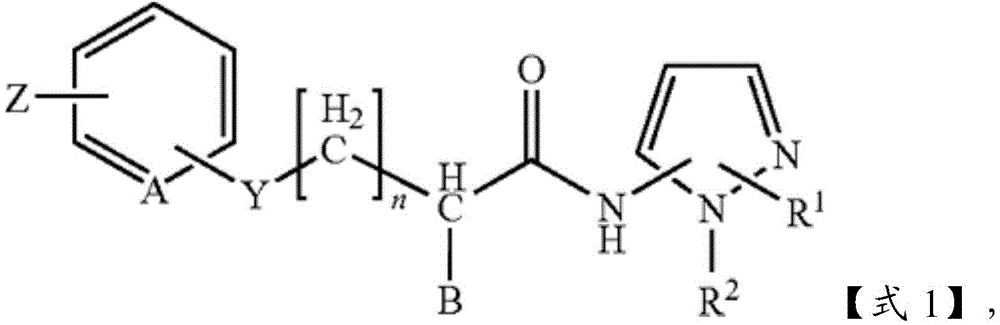
其中R1是-CO2R3、-CH2OR3、-CONR3R4或
其中R3和R4彼此独立地为H或直链、支化或环状的C1~C6烷基;R2是-(CH2)2-苯基;B为H、苯基或C1~C3烷基或卤素取代的苯基;n是0~2的整数;Y为S、O、CH2、SO、SO2或NR3R4,其中R3和R4彼此独立地为H或直链、支化或环状的C1~C6烷基;Z为H、卤素、OCH3、NO2、NH2或直链、支化或环状的C1~C3烷基;且A是CH或N。wherein R 3 and R 4 are independently of each other H or linear, branched or cyclic C 1 -C 6 alkyl; R 2 is -(CH 2 ) 2 -phenyl; B is H, phenyl or C 1 -C 3 alkyl or halogen-substituted phenyl; n is an integer from 0 to 2; Y is S, O, CH 2 , SO, SO 2 or NR 3 R 4 , wherein R 3 and R 4 are independently of each other H or linear, branched or cyclic C 1 -C 6 alkyl; Z is H, halogen, OCH 3 , NO 2 , NH 2 or linear, branched or cyclic C 1 -C 3 alkyl ; and A is CH or N.
在某些情况下,氨基吡唑化合物可以是4-[2-(4-溴-苯硫烷基)-乙酰氨基]-1-苯乙基-1H-吡唑-3-羧酸或其酯或酰胺。In some cases, the aminopyrazole compound can be 4-[2-(4-bromo-phenylsulfanyl)-acetamido]-1-phenethyl-1H-pyrazole-3-carboxylic acid or an ester thereof or amide.
本公开的另一方面提供了一种治疗由突触核蛋白病引起的疾病或病况的方法,该方法包括向表现出所述突触核蛋白病的症状或处于所述突触核蛋白病的风险中的受试者施用一定量的结合FAF1蛋白的化合物,所述一定量的化合物有效地减少所述受试者的细胞中在氨基酸S129处磷酸化的α-突触核蛋白的量。Another aspect of the present disclosure provides a method of treating a disease or condition caused by a synucleinopathy, the method comprising treating a person exhibiting symptoms of the synucleinopathy or being in the synucleinopathy A subject at risk is administered an amount of a compound that binds the FAF1 protein effective to reduce the amount of alpha-synuclein phosphorylated at amino acid S129 in the subject's cells.
在该方面的一些实施方式中,FAF1活性的抑制剂可以是式1的氨基吡唑化合物或其药学上可接受的盐:In some embodiments of this aspect, the inhibitor of FAF1 activity may be an aminopyrazole compound of

其中R1是-CO2R3、-CH2OR3、-CONR3R4或
其中R3和R4彼此独立地为H或直链、支化或环状的C1~C6烷基;R2是-(CH2)2-苯基;B为H、苯基或C1~C3烷基或卤素取代的苯基;n是0~2的整数;Y为S、O、CH2、SO、SO2或NR3R4,其中R3和R4彼此独立地为H或直链、支化或环状的C1~C6烷基;Z为H、卤素、OCH3、NO2、NH2或直链、支化或环状的C1~C3烷基;且A是CH或N。wherein R 3 and R 4 are independently of each other H or linear, branched or cyclic C 1 -C 6 alkyl; R 2 is -(CH 2 ) 2 -phenyl; B is H, phenyl or C 1 -C 3 alkyl or halogen-substituted phenyl; n is an integer from 0 to 2; Y is S, O, CH 2 , SO, SO 2 or NR 3 R 4 , wherein R 3 and R 4 are independently of each other H or linear, branched or cyclic C 1 -C 6 alkyl; Z is H, halogen, OCH 3 , NO 2 , NH 2 or linear, branched or cyclic C 1 -C 3 alkyl ; and A is CH or N.
在一些情况下,氨基吡唑化合物可以是4-[2-(4-溴-苯硫烷基)-乙酰氨基]-1-苯乙基-1H-吡唑-3-羧酸或其酯或酰胺。In some cases, the aminopyrazole compound can be 4-[2-(4-bromo-phenylsulfanyl)-acetamido]-1-phenethyl-1H-pyrazole-3-carboxylic acid or an ester thereof or amide.
在本公开的任何治疗方面,所述FAF1抑制剂可以口服或通过注射到脑或脑脊髓液或血液中或经由皮肤或其他常见的实用方法,例如微型泵植入来施用。最方便的途径是其中口服施用结合FAF1的化合物的途径。In any of the therapeutic aspects of the present disclosure, the FAF1 inhibitor can be administered orally or by injection into the brain or cerebrospinal fluid or blood or via the skin or other common practical methods, such as minipump implantation. The most convenient route is that in which the compound that binds FAF1 is administered orally.
氨基吡唑化合物4-[2-(4-溴-苯硫烷基)-乙酰氨基]-1-苯乙基-1H-吡唑-3-羧酸调控细胞中LC-3和p62水平的EC50为1nM,减少细胞中α-突触核蛋白量的EC50为20μM。因此,用于调控脑组织细胞中LC-3和p62的量的该化合物的有效量是在脑组织细胞中提供至少0.5nM,优选至少1nM、至少2nM、至少5nM或至少10nM的浓度的量,且用于减少脑组织细胞中α-突触核蛋白的量的该化合物的有效量为在脑组织细胞中提供至少10nM,优选至少20mM、至少40nM、至少100nM或至少200nM的浓度的量。The aminopyrazole compound 4-[2-(4-bromo-phenylsulfanyl)-acetamido]-1-phenethyl-1H-pyrazole-3-carboxylic acid modulates EC of LC-3 and p62 levels in cells 50 is 1 nM and the EC 50 for reducing the amount of α-synuclein in cells is 20 μM. Thus, an effective amount of the compound for modulating the amount of LC-3 and p62 in brain tissue cells is an amount that provides a concentration of at least 0.5 nM, preferably at least 1 nM, at least 2 nM, at least 5 nM or at least 10 nM in brain tissue cells, And an effective amount of the compound for reducing the amount of alpha-synuclein in brain tissue cells is an amount that provides a concentration of at least 10 nM, preferably at least 20 mM, at least 40 nM, at least 100 nM or at least 200 nM in brain tissue cells.
本公开的另一方面提供了一种用于在受试者中诊断突触核蛋白病或评估突触核蛋白病的风险的方法,其包括测量受试者的细胞中或取自受试者的样品中FAF1蛋白的量或抑制由LC-3和p62蛋白介导的自噬的FAF1活性的水平,其中FAF1的活性水平或蛋白水平高于正常人群中的水平表明该受试者形成了突触核蛋白病或有形成突触核蛋白病的风险。Another aspect of the present disclosure provides a method for diagnosing a synucleinopathic disease or assessing the risk of a synucleinopathic disease in a subject, comprising measuring in or from cells of the subject The amount of FAF1 protein in the sample or the level of FAF1 activity that inhibits autophagy mediated by LC-3 and p62 proteins, wherein the activity level or protein level of FAF1 is higher than the level in the normal population indicates that the subject has developed a tumor. Nucleopathies or risk of developing synucleinopathies.
本公开的另一方面将诊断和治疗配对以提供用于治疗受试者中由突触核蛋白病引起的疾病或病况的方法,其包括向以下受试者施用一定量的调节LC-3和p62的量的FAF1活性的抑制剂以有效提高受试者细胞中LC3量和/或降低p62量,或一定量的结合FAF1蛋白的化合物以在受试者细胞中有效降低在氨基酸S129处磷酸化的α-突触核蛋白的量,所述受试者在其细胞中表现出高于正常人群的FAF1蛋白的量或FAF1活性(抑制受试者细胞中由LC-3和p62蛋白介导的自噬)水平。Another aspect of the present disclosure pairs diagnosis and therapy to provide a method for treating a disease or condition caused by synucleinopathies in a subject comprising administering to the subject an amount of modulating LC-3 and An inhibitor of FAF1 activity in an amount of p62 effective to increase the amount of LC3 and/or reduce the amount of p62 in the subject's cells, or an amount of a compound that binds the FAF1 protein to effectively reduce phosphorylation at amino acid S129 in the subject's cells the amount of alpha-synuclein in which the subject exhibited a higher amount of FAF1 protein or FAF1 activity in its cells than the normal population (inhibition of LC-3 and p62 protein-mediated inhibition in the subject's cells) autophagy) level.
在本公开的该方面的一些实施方式中,结合FAF1或抑制FAF1调节LC-3和p62的量的活性的化合物可以是式1的氨基吡唑化合物或其药学上可接受的盐:In some embodiments of this aspect of the disclosure, the compound that binds to FAF1 or inhibits the activity of FAF1 to modulate the amount of LC-3 and p62 can be an aminopyrazole compound of

其中R1是-CO2R3、-CH2OR3、-CONR3R4或
其中R3和R4彼此独立地为H或直链、支化或环状的C1~C6烷基;R2是-(CH2)2-苯基;B为H、苯基或C1~C3烷基或卤素取代的苯基;n是0~2的整数;Y为S、O、CH2、SO、SO2或NR3R4,其中R3和R4彼此独立地为H或直链、支化或环状的C1~C6烷基;Z为H、卤素、OCH3、NO2、NH2或直链、支化或环状的C1~C3烷基;且A是CH或N。wherein R 3 and R 4 are independently of each other H or linear, branched or cyclic C 1 -C 6 alkyl; R 2 is -(CH 2 ) 2 -phenyl; B is H, phenyl or C 1 -C 3 alkyl or halogen-substituted phenyl; n is an integer from 0 to 2; Y is S, O, CH 2 , SO, SO 2 or NR 3 R 4 , wherein R 3 and R 4 are independently of each other H or linear, branched or cyclic C 1 -C 6 alkyl; Z is H, halogen, OCH 3 , NO 2 , NH 2 or linear, branched or cyclic C 1 -C 3 alkyl ; and A is CH or N.
可以对脑脊髓液(CSF)取样以测定受试者中的FAF1和α-突触核蛋白水平。通过留置的脊椎导管进行时程采样,例如如T.H.Langenickel等人,Br.J.Clin Pharmacol.,vol.81,pp.878-890(2016)(通过引用整体并入本文)描述的,可用于收集CSF样品用于测定FAF1或α-突触核蛋白。Cerebrospinal fluid (CSF) can be sampled to determine FAF1 and alpha-synuclein levels in a subject. Time course sampling via an indwelling spinal catheter, eg as described by T.H. Langenickel et al., Br.J.Clin Pharmacol., vol.81, pp.878-890 (2016) (incorporated herein by reference in its entirety), can be used for CSF samples were collected for determination of FAF1 or α-synuclein.
【实施例】【Example】
【1.FAF1在细胞中增加α-突触核蛋白】【1.FAF1 increases α-synuclein in cells】
通过用带Flag标签的FAF1基因转染在SH-SY5Y细胞中过表达FAF1。通过使用抗-Flag抗体和抗-FAF1抗体对细胞提取物的Western印迹确认过表达。兔抗FAF1抗体购自Proteintech,Chicago,IL,USA,货号10271-1-AP。用α-突触核蛋白基因共转染细胞。使用抗α-突触核蛋白抗体通过Western印迹监测α-突触核蛋白的水平。显然且出乎意料的是,α-突触核蛋白的水平随着FAF1的过表达而增加(图1)。注意将β-肌动蛋白水平用作内部对照。注意细胞中存在一定水平的内源FAF1蛋白。FAF1 was overexpressed in SH-SY5Y cells by transfection with Flag-tagged FAF1 gene. Overexpression was confirmed by Western blotting of cell extracts using anti-Flag and anti-FAF1 antibodies. Rabbit anti-FAF1 antibody was purchased from Proteintech, Chicago, IL, USA, Cat. No. 10271-1-AP. Cells were co-transfected with the alpha-synuclein gene. Levels of α-synuclein were monitored by Western blotting using an anti-α-synuclein antibody. Clearly and unexpectedly, the levels of α-synuclein increased with overexpression of FAF1 (Figure 1). Note that β-actin levels were used as an internal control. Note the presence of some level of endogenous FAF1 protein in the cells.
【2.FAF1在细胞中增加α-突触核蛋白的聚集形式】【2.FAF1 increases the aggregated form of α-synuclein in cells】
通过用带Flag标签的FAF1基因转染在SH-SY5Y细胞中过表达FAF1。用α-突触核蛋白基因共转染细胞。使用抗α-突触核蛋白抗体并长时间暴露胶片,通过Western印迹监测α-突触核蛋白的聚集形式的水平。显然且出乎意料的是,α-突触核蛋白的聚集形式的水平随着FAF1的过表达而增加(图2)。FAF1 was overexpressed in SH-SY5Y cells by transfection with Flag-tagged FAF1 gene. Cells were co-transfected with the alpha-synuclein gene. Levels of aggregated forms of α-synuclein were monitored by Western blotting using an anti-α-synuclein antibody and prolonged exposure to the film. Clearly and unexpectedly, the levels of aggregated forms of alpha-synuclein increased with overexpression of FAF1 (Figure 2).
【3.FAF1在细胞中产生α-突触核蛋白的路易体样形式】[3.FAF1 produces a Lewy body-like form of α-synuclein in cells]
通过用带Flag标签的FAF1基因转染在SH-SY5Y细胞中过表达FAF1。用α-突触核蛋白基因共转染细胞。使用抗α-突触核蛋白抗体通过免疫荧光染色来监测α-突触核蛋白的LB样形式。显然且出乎意料的是,FAF1过表达时观察到了α-突触核蛋白的LB样形式(图3B顶部,箭头标记)。但是,在载体对照中未观察到LB样形式(图3A顶部),表明FAF1诱导LB样形成。FAF1 was overexpressed in SH-SY5Y cells by transfection with Flag-tagged FAF1 gene. Cells were co-transfected with the alpha-synuclein gene. The LB-like form of α-synuclein was monitored by immunofluorescence staining using an anti-α-synuclein antibody. Clearly and unexpectedly, an LB-like form of α-synuclein was observed upon FAF1 overexpression (Fig. 3B top, arrow mark). However, the LB-like form was not observed in the vehicle control (Figure 3A top), indicating that FAF1 induces LB-like formation.
已知α-突触核蛋白在位置129的丝氨酸残基处被磷酸化,这可能是导致路易体产生的病理过程。使用抗-Ps129-α-突触核蛋白抗体通过免疫荧光染色来监测位置129处α-突触核蛋白的磷酸化形式。显然,当FAF1在LM样形式中过表达时,观察到α-突触核蛋白的S129磷酸化形式(图3B底部,箭头标记)。但是,在载体对照中未观察到这种磷酸化(图3A底部),证实了FAF1诱导位置129的丝氨酸残基处的α-突触核蛋白磷酸化。Alpha-synuclein is known to be phosphorylated at a serine residue at position 129, which may be a pathological process leading to Lewy bodies. The phosphorylated form of α-synuclein at position 129 was monitored by immunofluorescence staining using an anti-Ps129-α-synuclein antibody. Clearly, the S129 phosphorylated form of α-synuclein was observed when FAF1 was overexpressed in the LM-like form (Fig. 3B bottom, arrow mark). However, this phosphorylation was not observed in the vehicle control (Figure 3A bottom), confirming that FAF1 induces alpha-synuclein phosphorylation at the serine residue at position 129.
【4.FAF1在小鼠中增加α-突触核蛋白】【4.FAF1 increases α-synuclein in mice】
使用含有FAF1基因的重组腺病毒通过常规方法用定型注射(stereotypeinjection)到小鼠的中脑区域中来将FAF1在小鼠中过表达。通过使用抗FAF1抗体对中脑组织提取物进行Western印迹确认了过表达。中脑是具有已知会影响突触核蛋白病中的运动的黑质多巴胺能神经元的组织。向两只小鼠注射FAF1腺病毒,并且将两只未注射的小鼠用作对照。使用抗α-突触核蛋白抗体通过Western印迹监测α-突触核蛋白的水平。显然,α-突触核蛋白水平的升高与FAF1的过表达相关(图4)。FAF1 was overexpressed in mice by stereotype injection into the midbrain region of mice using a recombinant adenovirus containing the FAF1 gene by conventional methods. Overexpression was confirmed by Western blotting of midbrain tissue extracts using anti-FAF1 antibody. The midbrain is a tissue with substantia nigra dopaminergic neurons known to affect movement in synucleinopathies. Two mice were injected with FAF1 adenovirus, and two uninjected mice were used as controls. Levels of α-synuclein were monitored by Western blotting using an anti-α-synuclein antibody. Clearly, elevated levels of α-synuclein correlated with overexpression of FAF1 (Figure 4).
【5.通过FAF1 siRNA在细胞中减少α-突触核蛋白】【5. Reduction of α-synuclein in cells by FAF1 siRNA】
通过用siRNA(序列:GUGUUGUGGCACAAACCAU)处理SH-SY5Y细胞减弱了FAF1表达,并使用抗FAF1抗体通过细胞提取物的Western印迹确认FAF水平的降低。用α-突触核蛋白基因共转染细胞。使用抗α-突触核蛋白抗体通过Western印迹监测α-突触核蛋白的水平。显然,用FAF1 siRNA处理降低了α-突触核蛋白的水平(图5)。另一方面,用对照siRNA(scRNA,简并序列)处理不降低α-突触核蛋白水平。FAF1 expression was attenuated by treatment of SH-SY5Y cells with siRNA (sequence: GUGUUGUGGCACAAACCAU), and the reduction of FAF levels was confirmed by Western blotting of cell extracts using an anti-FAF1 antibody. Cells were co-transfected with the alpha-synuclein gene. Levels of α-synuclein were monitored by Western blotting using an anti-α-synuclein antibody. Clearly, treatment with FAF1 siRNA reduced the levels of alpha-synuclein (Figure 5). On the other hand, treatment with control siRNA (scRNA, degenerate sequence) did not reduce alpha-synuclein levels.
【6.FAF1是自噬的抑制剂】【6.FAF1 is an inhibitor of autophagy】
已知α-突触核蛋白会被细胞中的各种途径降解,包括蛋白酶体、自噬和分子伴侣介导的自噬(Sampaio-Marques B和Ludovico P 2015)。通过在SH-SY5Y细胞中转染过表达FAF1,并且通过Western印迹分析了牵涉蛋白质降解途径的各种蛋白质(图6)。Alpha-synuclein is known to be degraded by various pathways in cells, including the proteasome, autophagy, and chaperone-mediated autophagy (Sampaio-Marques B and Ludovico P 2015). FAF1 was overexpressed by transfection in SH-SY5Y cells, and various proteins involved in protein degradation pathways were analyzed by Western blotting (Figure 6).
如图6所示,随着FAF1的过表达,p62蛋白增加,LC3减少,表明FAF1抑制自噬。注意到所有其他蛋白质均未改变。该变化如描述的(Sampaio-Marques B和Ludovico P 2015)介导自噬。这些数据证实FAF1通过抑制自噬途径增加α-突触核蛋白。As shown in Figure 6, with the overexpression of FAF1, p62 protein increased and LC3 decreased, indicating that FAF1 inhibits autophagy. Note that all other proteins were unchanged. This change mediates autophagy as described (Sampaio-Marques B and Ludovico P 2015). These data confirm that FAF1 increases α-synuclein by inhibiting the autophagy pathway.
【7.KM-819(KR-33493)是FAF1抑制剂】【7.KM-819(KR-33493) is a FAF1 inhibitor】
KM-819(KR-33493,4-[2-(4-溴-苯硫烷基)-乙酰氨基]-1-苯乙基-1H-吡唑-3-羧酸)是在现有技术中描述用于缺血性细胞死亡抑制剂的氨基吡唑衍生物(美国专利7,939,550,Yoo SE等人2016)。KM-819对FAF1的抑制通过KM-819与FAF1的结合确认,如所述的和图7所示的。而且,通过对细胞中FAF1下游靶标(包括凋亡路径蛋白半胱天冬酶8和JAK)的抑制,确认了KM-819对FAF1的抑制(图8)。在缺血性细胞死亡的测定中,该化合物在10μM显示出对凋亡的70%的抑制,该凋亡即脱氧葡萄糖诱导的缺氧介导的凋亡(美国专利7,939,550)。KM-819 (KR-33493, 4-[2-(4-Bromo-phenylsulfanyl)-acetamido]-1-phenethyl-1H-pyrazole-3-carboxylic acid) is in the prior art Aminopyrazole derivatives are described for ischemic cell death inhibitors (US Pat. No. 7,939,550, Yoo SE et al. 2016). Inhibition of FAF1 by KM-819 was confirmed by binding of KM-819 to FAF1, as described and shown in Figure 7. Furthermore, inhibition of FAF1 by KM-819 was confirmed by inhibition of FAF1 downstream targets in cells, including apoptosis pathway proteins caspase 8 and JAK (FIG. 8). In an assay of ischemic cell death, the compound showed a 70% inhibition of apoptosis, ie, deoxyglucose-induced hypoxia-mediated apoptosis, at 10 [mu]M (US Pat. No. 7,939,550).
KM-819与FAF1的结合通过如描述的(Yoo SE等人2016)使用生物素标记的KM-819在SH-SY6H细胞提取物中的下拉测定法确认。用带flag标签的FAF1转染细胞。使用抗生物素蛋白包被的琼脂糖沉淀形成的FAF1-KM-819复合物。使用抗-Flag抗体通过Western印迹法测量复合物中沉淀的FAF1。显然,当通过过氧化氢应激细胞由此激活FAF1时,FAF1结合KM-819。注意将全细胞提取物(WCL)中的总FAF1水平作为对照进行测量。Binding of KM-819 to FAF1 was confirmed by a pull-down assay using biotin-labeled KM-819 in SH-SY6H cell extracts as described (Yoo SE et al. 2016). Cells were transfected with flag-tagged FAF1. The formed FAF1-KM-819 complex was precipitated using avidin-coated agarose. FAF1 precipitated in complexes was measured by Western blotting using an anti-Flag antibody. Apparently, when cells are stressed by hydrogen peroxide to thereby activate FAF1, FAF1 binds KM-819. Note that total FAF1 levels in whole cell extracts (WCL) were measured as a control.
FAF1经由激活半胱天冬酶级联反应和坏死来激活多种刺激所致的凋亡应激,如描述的(Yu C等人2016)。在这两个途径中,FAF1的直接靶标分别是半胱天冬酶8和JNK。并且该激活的步骤是形成这些复合物,随后激活下游靶标。FAF1 activates multiple stimuli-induced apoptotic stress via activation of the caspase cascade and necrosis, as described (Yu C et al. 2016). In these two pathways, the direct targets of FAF1 are caspase 8 and JNK, respectively. And the activation step is the formation of these complexes and subsequent activation of downstream targets.
通过常规免疫沉淀测定法确认了KM-819对FAF1-半胱天冬酶8和FAF1-JNK的复合物形成的抑制,其使用半胱天冬酶8DED抗体和JNK抗体,并通过使用抗FAF1抗体的Western印迹测量结合和沉淀的FAF1。显然,KM-819有效抑制了复合物的形成,在0.1μM时有约80%的抑制(图8)。Inhibition of complex formation of FAF1-caspase 8 and FAF1-JNK by KM-819 was confirmed by conventional immunoprecipitation assay using caspase 8 DED antibody and JNK antibody, and by using anti-FAF1 antibody Western blot measurement of bound and precipitated FAF1. Clearly, KM-819 effectively inhibited complex formation, with about 80% inhibition at 0.1 [mu]M (Figure 8).
通过分别测定半胱天冬酶8底物半胱天冬酶3的裂解和JNK的自磷酸化确认了KM-819对半胱天冬酶8和JNK激活的抑制(图9)。如所示,用不同浓度的KM-819处理细胞,并分别使用抗-半胱天冬酶3抗体和抗-磷酸化JNK抗体通过Western印迹测量裂解的半胱天冬酶3和JNK自磷酸化形式的水平。显然,KM-819抑制半胱天冬酶8的活性和JNK激活(图9)。KM-819对半胱天冬酶8激活的IC50为0.73μM,KM-819对JNK激活的IC50为0.25μM。Inhibition of caspase 8 and JNK activation by KM-819 was confirmed by measuring cleavage of caspase 8 substrate caspase 3 and autophosphorylation of JNK, respectively (Figure 9). Cells were treated with different concentrations of KM-819 as indicated, and cleaved caspase 3 and JNK autophosphorylation were measured by Western blot using anti-caspase 3 antibody and anti-phospho-JNK antibody, respectively level of form. Clearly, KM-819 inhibited caspase 8 activity and JNK activation (Figure 9). The IC50 of KM-819 for caspase 8 activation was 0.73 μM, and the IC50 of KM-819 for JNK activation was 0.25 μM.
【8.KM-819增强自噬】【8.KM-819 enhances autophagy】
已知α-突触核蛋白可以通过细胞中的各种途径降解,包括通过蛋白酶体、自噬和分子伴侣介导的自噬(Sampaio-Marques B和Ludovico P 2015)。FAF1抑制自噬。α-synuclein is known to be degraded by various pathways in cells, including via the proteasome, autophagy, and chaperone-mediated autophagy (Sampaio-Marques B and Ludovico P 2015). FAF1 inhibits autophagy.
为确认FAF1抑制剂抑制FAF1介导的自噬抑制的活性,如指示的用KM-819处理过表达FAF1的SH-SY5Y细胞,并通过Western印迹测量LC3和p62水平(图10)。KM-819降低p62蛋白并增加LC3,证明KM-819促进自噬途径。KM-819对自噬促进的EC50为1nM。To confirm the activity of FAF1 inhibitors to inhibit FAF1-mediated autophagy inhibition, SH-SY5Y cells overexpressing FAF1 were treated with KM-819 as indicated, and LC3 and p62 levels were measured by Western blotting (Figure 10). KM-819 decreased p62 protein and increased LC3, demonstrating that KM-819 promotes the autophagy pathway. The EC50 of KM-819 for autophagy promotion was 1 nM.
【9.通过FAF1抑制剂在细胞中减少α-突触核蛋白】[9. Reduction of α-synuclein in cells by FAF1 inhibitors]
为了确认FAF1抑制剂是否降低细胞中的α-突触核蛋白水平,用FAF1抑制剂KM-819(KR-88493,美国专利7,939,550,Yoo SE等人2016)处理SH-SY5Y细胞。用编码带Flag标签的FAF1和带GFP标签的α-突触核蛋白的基因共转染细胞。使用抗GFP抗体通过细胞提取物的Western印迹测量α-突触核蛋白水平。使用抗-Flag抗体通过细胞提取物的Western印迹测量FAF1水平。显然,用FAF1抑制剂处理后,α-突触核蛋白的水平降低(图11)。IC50为20nM,在10μM时抑制超过95%。与现有技术中测量的凋亡抑制活性(在10μM时70%抑制)相比,其功效要高得多。注意到FAF1水平本身不被使用FAF1抑制剂处理改变。To confirm whether FAF1 inhibitors reduce α-synuclein levels in cells, SH-SY5Y cells were treated with FAF1 inhibitor KM-819 (KR-88493, US Pat. No. 7,939,550, Yoo SE et al. 2016). Cells were co-transfected with genes encoding Flag-tagged FAF1 and GFP-tagged α-synuclein. Alpha-synuclein levels were measured by Western blotting of cell extracts using an anti-GFP antibody. FAF1 levels were measured by Western blotting of cell extracts using an anti-Flag antibody. Clearly, the levels of alpha-synuclein were decreased after treatment with FAF1 inhibitor (Figure 11). IC50 is 20 nM, inhibits more than 95% at 10 μM. The efficacy is much higher compared to the apoptosis inhibitory activity (70% inhibition at 10 μM) measured in the prior art. Note that FAF1 levels themselves were not altered by treatment with FAF1 inhibitors.
【10.通过FAF1抑制剂在小鼠中脑中减少α-突触核蛋白】[10. Reduction of α-synuclein in mouse midbrain by FAF1 inhibitor]
为了观察FAF1抑制剂对动物中α-突触核蛋白水平的影响,用FAF1抑制剂KM-819处理过表达α-突触核蛋白的转基因小鼠。该转基因动物是在Prion基因启动子下具有人类α-突触核蛋白突变基因A53T的小鼠品系(携带人突触核蛋白的家族性帕金森氏病(Lee MK等,2002)。To observe the effect of FAF1 inhibitors on α-synuclein levels in animals, transgenic mice overexpressing α-synuclein were treated with the FAF1 inhibitor KM-819. The transgenic animal is a mouse strain harboring the human alpha-synuclein mutant gene A53T under the Prion gene promoter (familial Parkinson's disease carrying human synuclein (Lee MK et al., 2002).
给三个月大的小鼠口服施用KM-819,剂量为1、5和10mg/kg/天,共9天。两只非转基因小鼠(非Tg)被用作对照,而三只转基因小鼠(α-syn A53T Tg)仅施用媒介物而无KM-819。且对KM-819的每种给药使用两只小鼠。处死动物,分离中脑组织并制备提取物。分别使用抗α-突触核蛋白抗体、P-α-syn抗体和FAF1抗体,通过Western印迹测量α-突触核蛋白、S129磷酸化形式的α-突触核蛋白和FAF1。显然,用FAF1抑制剂KM-819处理后,α-突触核蛋白及其磷酸化形式的水平均降低,证明FAF1抑制剂降低了动物中α-突触核蛋白的积累(图12)。注意到FAF1水平本身不被使用FAF1抑制剂处理改变。注意将β-肌动蛋白水平用作内部对照。Three-month-old mice were orally administered KM-819 at doses of 1, 5 and 10 mg/kg/day for 9 days. Two non-transgenic mice (non-Tg) were used as controls, while three transgenic mice (α-syn A53T Tg) were administered vehicle only without KM-819. And two mice were used for each administration of KM-819. Animals were sacrificed, midbrain tissue was isolated and extracts were prepared. α-Synuclein, S129 phosphorylated form of α-synuclein and FAF1 were measured by Western blot using anti-α-synuclein antibody, P-α-syn antibody and FAF1 antibody, respectively. Clearly, the levels of both α-synuclein and its phosphorylated form were decreased after treatment with the FAF1 inhibitor KM-819, demonstrating that FAF1 inhibitor reduced the accumulation of α-synuclein in animals (Figure 12). Note that FAF1 levels themselves were not altered by treatment with FAF1 inhibitors. Note that β-actin levels were used as an internal control.
【11.通过FAF1抑制剂在小鼠海马中降低α-突触核蛋白】[11. Reduction of α-synuclein in mouse hippocampus by FAF1 inhibitor]
为了观察FAF1抑制剂对动物中α-突触核蛋白水平的影响,用FAF1抑制剂KM-819处理过表达α-突触核蛋白的转基因小鼠。该转基因动物是在Prion基因启动子下具有人类α-突触核蛋白突变基因A53T的小鼠品系(携带人突触核蛋白的家族性帕金森氏病(Lee MK等,2002)。To observe the effect of FAF1 inhibitors on α-synuclein levels in animals, transgenic mice overexpressing α-synuclein were treated with the FAF1 inhibitor KM-819. The transgenic animal is a mouse strain harboring the human alpha-synuclein mutant gene A53T under the Prion gene promoter (familial Parkinson's disease carrying human synuclein (Lee MK et al., 2002).
给三个月大的小鼠口服施用KM-819,剂量为1、5和10mg/kg/天,共9天。将三只非转基因(非Tg)小鼠用作对照,并且两只转基因小鼠(α-synA53T Tg)仅施用媒介物而无KM-819。且KM-819的每种给药使用两只小鼠。处死动物,分离海马组织并制备提取物。分别通过使用抗α-突触核蛋白抗体和FAF1抗体的Western印迹法测量α-突触核蛋白和FAF1。显然,用FAF1抑制剂KM-819处理后,α-突触核蛋白的水平降低,这证明FAF1抑制剂降低了动物中α-突触核蛋白的积累(图13)。Three-month-old mice were orally administered KM-819 at doses of 1, 5 and 10 mg/kg/day for 9 days. Three non-transgenic (non-Tg) mice were used as controls, and two transgenic mice (α-synA53T Tg) were administered vehicle only without KM-819. And two mice were used for each administration of KM-819. Animals were sacrificed, hippocampal tissue was isolated and extracts were prepared. α-Synuclein and FAF1 were measured by Western blotting using anti-α-synuclein antibody and FAF1 antibody, respectively. Clearly, the levels of alpha-synuclein were decreased after treatment with the FAF1 inhibitor KM-819, demonstrating that the FAF1 inhibitor reduced the accumulation of alpha-synuclein in animals (Figure 13).
【12.通过FAF1抑制剂在小鼠皮层中减少α-突触核蛋白】[12. Reduction of α-synuclein in mouse cortex by FAF1 inhibitor]
为了观察FAF1抑制剂对动物中α-突触核蛋白水平的影响,用FAF1抑制剂KM-819处理过表达α-突触核蛋白的转基因小鼠。该转基因动物是在Prion基因启动子下具有人α-突触核蛋白突变基因A53T的小鼠品系(携带人突触核蛋白的家族性帕金森氏病(Lee MK等,2002)。To observe the effect of FAF1 inhibitors on α-synuclein levels in animals, transgenic mice overexpressing α-synuclein were treated with the FAF1 inhibitor KM-819. The transgenic animal is a mouse strain harboring the human alpha-synuclein mutant gene A53T under the Prion gene promoter (familial Parkinson's disease carrying human synuclein (Lee MK et al., 2002).
给三个月大的小鼠口服施用KM-819,剂量为1、5和10mg/kg/天,共9天。两只非转基因小鼠(非Tg)被用作对照,并且两只转基因小鼠(α-synA53T Tg)仅施用媒介物而无KM-819。且KM-819的每种给药使用两只小鼠。处死动物,分离皮层组织并制备提取物。使用抗α-突触核蛋白抗体通过Western印迹测量α-突触核蛋白。显然,用FAF1抑制剂KM-819处理后,α-突触核蛋白的水平降低,这证明FAF1抑制剂降低了动物中α-突触核蛋白的积累(图14)。Three-month-old mice were orally administered KM-819 at doses of 1, 5 and 10 mg/kg/day for 9 days. Two non-transgenic mice (non-Tg) were used as controls, and two transgenic mice (α-synA53T Tg) were administered vehicle only without KM-819. And two mice were used for each administration of KM-819. Animals were sacrificed, cortical tissue was isolated and extracts were prepared. Alpha-synuclein was measured by Western blotting using an anti-alpha-synuclein antibody. Clearly, the levels of alpha-synuclein were decreased after treatment with the FAF1 inhibitor KM-819, demonstrating that the FAF1 inhibitor reduced the accumulation of alpha-synuclein in animals (Figure 14).
【13.通过FAF1抑制剂在小鼠小脑中减少α-突触核蛋白】[13. Reduction of α-synuclein in mouse cerebellum by FAF1 inhibitor]
为了观察FAF1抑制剂对动物中α-突触核蛋白水平的影响,用FAF1抑制剂KM-819处理过表达α-突触核蛋白的转基因小鼠。该转基因动物是在Prion基因启动子下具有人α-突触核蛋白突变基因A53T的小鼠品系(携带人突触核蛋白的家族性帕金森氏病(Lee MK等,2002)。To observe the effect of FAF1 inhibitors on α-synuclein levels in animals, transgenic mice overexpressing α-synuclein were treated with the FAF1 inhibitor KM-819. The transgenic animal is a mouse strain harboring the human alpha-synuclein mutant gene A53T under the Prion gene promoter (familial Parkinson's disease carrying human synuclein (Lee MK et al., 2002).
给三个月大的小鼠口服施用KM-819,剂量为1、5和10mg/kg/天,共9天。将三只非转基因小鼠(非Tg)用作对照,并且两只转基因小鼠(α-synA53T Tg)仅施用媒介物而无KM-819。且KM-819的每种给药使用两只小鼠。处死动物,分离小脑组织并制备提取物。分别使用抗α-突触核蛋白抗体和FAF1抗体通过Western印迹测量α-突触核蛋白和FAF1。显然,用FAF1抑制剂KM-819处理后,α-突触核蛋白的水平降低,表明FAF1抑制剂降低了动物中α-突触核蛋白的积累(图15)。Three-month-old mice were orally administered KM-819 at doses of 1, 5 and 10 mg/kg/day for 9 days. Three non-transgenic mice (non-Tg) were used as controls, and two transgenic mice (α-synA53T Tg) were administered vehicle only without KM-819. And two mice were used for each administration of KM-819. Animals were sacrificed, cerebellar tissue was isolated and extracts were prepared. α-Synuclein and FAF1 were measured by Western blotting using anti-α-synuclein antibody and FAF1 antibody, respectively. Clearly, following treatment with the FAF1 inhibitor KM-819, the levels of a-synuclein were decreased, indicating that the FAF1 inhibitor reduced the accumulation of a-synuclein in animals (Figure 15).
【14.通过FAF1抑制剂在小鼠纹状体中降低α-突触核蛋白】[14. Reduction of α-synuclein in mouse striatum by FAF1 inhibitor]
为了观察FAF1抑制剂对动物中α-突触核蛋白水平的影响,用FAF1抑制剂KM-819处理过表达α-突触核蛋白的转基因小鼠。该转基因动物是在Prion基因启动子下具有人类α-突触核蛋白突变基因A53T的小鼠品系(携带人突触核蛋白的家族性帕金森氏病(Lee MK等,2002)。To observe the effect of FAF1 inhibitors on α-synuclein levels in animals, transgenic mice overexpressing α-synuclein were treated with the FAF1 inhibitor KM-819. The transgenic animal is a mouse strain harboring the human alpha-synuclein mutant gene A53T under the Prion gene promoter (familial Parkinson's disease carrying human synuclein (Lee MK et al., 2002).
给三个月大的小鼠口服施用KM-819,剂量为1、5和10mg/kg/天,共9天。将三只非转基因(非Tg)小鼠用作对照,并且两只转基因小鼠(α-synA53T Tg)仅施用媒介物而无KM-819。且KM-819的每种给药使用两只小鼠。处死动物,分离纹状体组织并制备提取物。分别通过使用抗α-突触核蛋白抗体和FAF1抗体的Western印迹测量α-突触核蛋白和FAF1。显然,用FAF1抑制剂KM-819处理后α-突触核蛋白水平降低,证明FAF1抑制剂降低了动物中α-突触核蛋白的积累(图16)。Three-month-old mice were orally administered KM-819 at doses of 1, 5 and 10 mg/kg/day for 9 days. Three non-transgenic (non-Tg) mice were used as controls, and two transgenic mice (α-synA53T Tg) were administered vehicle only without KM-819. And two mice were used for each administration of KM-819. Animals were sacrificed, striatal tissue was isolated and extracts were prepared. α-Synuclein and FAF1 were measured by Western blotting using anti-α-synuclein antibody and FAF1 antibody, respectively. Clearly, alpha-synuclein levels were reduced after treatment with the FAF1 inhibitor KM-819, demonstrating that FAF1 inhibitor reduced the accumulation of alpha-synuclein in animals (Figure 16).
【实施方式】[implementation]
实施方式1:一种用于治疗由突触核蛋白病引起的疾病或病况的方法,其包括向表现出所述突触核蛋白病的症状或处于所述突触核蛋白病的风险中的受试者施用有效量的提高α-突触核蛋白量的FAF1活性的抑制剂或有效量的调节LC-3和p62量的FAF1活性的抑制剂。Embodiment 1 : A method for treating a disease or condition caused by a synucleinopathy, comprising directing treatment to a person exhibiting symptoms of or at risk for the synucleinopathy The subject is administered an effective amount of an inhibitor that increases alpha-synuclein amounts of FAF1 activity or an effective amount of an inhibitor that modulates LC-3 and p62 amounts of FAF1 activity.
实施方式2:实施方式1的方法,其中所述FAF1活性的抑制剂是式1的氨基吡唑化合物或其药学上可接受的盐:Embodiment 2: The method of

其中R1是-CO2R3、-CH2OR3、-CONR3R4或
其中R3和R4彼此独立地为H或直链、支化或环状的C1~C6烷基;R2是-(CH2)2-苯基;B为H、苯基或C1~C3烷基或卤素取代的苯基;n是0~2的整数;Y为S、O、CH2、SO、SO2或NR3R4,其中R3和R4彼此独立地为H或直链、支化或环状的C1~C6烷基;Z为H、卤素、OCH3、NO2、NH2或直链、支化或环状的C1~C3烷基;且A是CH或N。wherein R 3 and R 4 are independently of each other H or linear, branched or cyclic C 1 -C 6 alkyl; R 2 is -(CH 2 ) 2 -phenyl; B is H, phenyl or C 1 - C3 alkyl or halogen-substituted phenyl; n is an integer from 0 to 2; Y is S, O, CH 2 , SO, SO 2 or NR 3 R 4 , wherein R 3 and R 4 are independently of each other H or linear, branched or cyclic C 1 -C 6 alkyl; Z is H, halogen, OCH 3 , NO 2 , NH 2 or linear, branched or cyclic C 1 -C 3 alkyl ; and A is CH or N.
实施方式3:实施方式1的方法,其中所述氨基吡唑化合物为4-[2-(4-溴-苯硫烷基)-乙酰氨基]-1-苯乙基-1H-吡唑-3-羧酸或其酯或酰胺。Embodiment 3: The method of
实施方式4:一种用于治疗由突触核蛋白病引起的疾病或病况的方法,其包括向表现出所述突触核蛋白病的症状或处于所述突触核蛋白病的风险中的受试者施用一定量的结合FAF1蛋白的化合物,所述一定量的化合物对于减少所述受试者的细胞中的在氨基酸S129处磷酸化的α-突触核蛋白的量而言是有效的。Embodiment 4: A method for treating a disease or condition caused by a synucleinopathic disease, comprising administering to a person exhibiting symptoms of or at risk for the synucleinopathic disease The subject is administered an amount of a compound that binds a FAF1 protein that is effective to reduce the amount of alpha-synuclein phosphorylated at amino acid S129 in cells of the subject .
实施方式5:实施方式4的方法,其中所述结合FAF1蛋白的化合物是式1的氨基吡唑化合物或其药学上可接受的盐:Embodiment 5: The method of

其中R1是-CO2R3、-CH2OR3、-CONR3R4或
其中R3和R4彼此独立地为H或直链、支化或环状的C1~C6烷基;R2是-(CH2)2-苯基;B为H、苯基或C1~C3烷基或卤素取代的苯基;n是0~2的整数;Y为S、O、CH2、SO、SO2或NR3R4,其中R3和R4彼此独立地为H或直链、支化或环状的C1~C6烷基;Z为H、卤素、OCH3、NO2、NH2或直链、支化或环状的C1~C3烷基;且A是CH或N。wherein R 3 and R 4 are independently of each other H or linear, branched or cyclic C 1 -C 6 alkyl; R 2 is -(CH 2 ) 2 -phenyl; B is H, phenyl or C 1 - C3 alkyl or halogen-substituted phenyl; n is an integer from 0 to 2; Y is S, O, CH 2 , SO, SO 2 or NR 3 R 4 , wherein R 3 and R 4 are independently of each other H or linear, branched or cyclic C 1 -C 6 alkyl; Z is H, halogen, OCH 3 , NO 2 , NH 2 or linear, branched or cyclic C 1 -C 3 alkyl ; and A is CH or N.
实施方式6:实施方式4的方法,其中所述氨基吡唑化合物为4-[2-(4-溴-苯硫烷基)-乙酰氨基]-1-苯乙基-1H-吡唑-3-羧酸或其酯或酰胺。Embodiment 6: The method of
实施方式7:实施方式1~3之任一项的方法,其中所述FAF1抑制剂经口服或通过注射到脑或血液中或经由皮肤施用。Embodiment 7: The method of any one of Embodiments 1-3, wherein the FAF1 inhibitor is administered orally or by injection into the brain or blood or transdermally.
实施方式8:实施方式4~6之任一项的方法,其中所述结合FAF1蛋白的化合物经口服或通过注射到脑或血液或经由皮肤或其他常用实践方法施用。其中所述结合FAF1的化合物是口服施用的。Embodiment 8: The method of any one of Embodiments 4-6, wherein the compound that binds a FAF1 protein is administered orally or by injection into the brain or blood or via the skin or other commonly practiced methods. wherein the compound that binds FAF1 is administered orally.
实施方式9:一种用于在受试者中诊断突触核蛋白病或评估突触核蛋白病的风险的方法,其包括测量受试者的细胞或来自受试者的任何其他样品中的抑制包含LC-3和p62蛋白的自噬的FAF1活性或FAF1水平,其中高于正常人的FAF1的活性水平或蛋白质水平表明形成了突触核蛋白病或受试者有形成突触核蛋白病的风险。Embodiment 9: A method for diagnosing synucleinopathies or assessing risk of synucleinopathies in a subject, comprising measuring cells in the subject or in any other sample from the subject. Inhibition of FAF1 activity or FAF1 levels of autophagy comprising LC-3 and p62 proteins, wherein higher than normal human FAF1 activity levels or protein levels are indicative of the development of a synucleinopathic disease or the subject has developed a synucleinopathic disease risks of.
实施方式10:一种用于治疗受试者中由突触核蛋白病引起的疾病或病况的方法,其包括向在所述受试者的细胞中表现出FAF1活性或FAF1水平(受试者细胞中抑制包含LC-3和p62蛋白的自噬)的受试者施用一定量的结合FAF1蛋白的化合物,其中FAF1的活性水平或蛋白水平高于正常人表明形成了突触核蛋白病或受试者有形成突触核蛋白病的风险,所述一定量的化合物对于减少所述受试者的细胞中在氨基酸S129处磷酸化的α-突触核蛋白的量而言是有效的。Embodiment 10: A method for treating a disease or condition caused by synucleinopathies in a subject, comprising expressing FAF1 activity or FAF1 levels in cells of the subject (subject Inhibition of autophagy in cells containing LC-3 and p62 proteins) administration of an amount of a compound that binds FAF1 protein, wherein the activity level or protein level of FAF1 is higher than that of normal subjects, indicating the formation of synucleinopathies or affected individuals. The subject is at risk of developing a synucleinopathy, and the amount of the compound is effective to reduce the amount of alpha-synuclein phosphorylated at amino acid S129 in the subject's cells.
实施方式11:实施方式10的方法,其中施用式1的氨基吡唑化合物或其药学上可接受的盐:Embodiment 11: The method of

其中R1是-CO2R3、-CH2OR3、-CONR3R4或
其中R3和R4彼此独立地为H或直链、支化或环状的C1~C6烷基;R2是-(CH2)2-苯基;B为H、苯基或C1~C3烷基或卤素取代的苯基;n是0~2的整数;Y为S、O、CH2、SO、SO2或NR3R4,其中R3和R4彼此独立地为H或直链、支化或环状的C1~C6烷基;Z为H、卤素、OCH3、NO2、NH2或直链、支化或环状的C1~C3烷基;且A为CH或N。wherein R 3 and R 4 are independently of each other H or linear, branched or cyclic C 1 -C 6 alkyl; R 2 is -(CH 2 ) 2 -phenyl; B is H, phenyl or C 1 - C3 alkyl or halogen-substituted phenyl; n is an integer from 0 to 2; Y is S, O, CH 2 , SO, SO 2 or NR 3 R 4 , wherein R 3 and R 4 are independently of each other H or linear, branched or cyclic C 1 -C 6 alkyl; Z is H, halogen, OCH 3 , NO 2 , NH 2 or linear, branched or cyclic C 1 -C 3 alkyl ; and A is CH or N.
实施方式12:一种用于制备药物的方法,其包括将式1的氨基吡唑化合物或其药学上可接受的盐和药学上可接受的载体混合:Embodiment 12: A method for preparing a medicament comprising admixing an aminopyrazole compound of

其中R1是-CO2R3、-CH2OR3、-CONR3R4或
其中R3和R4彼此独立地为H或直链、支化或环状的C1~C6烷基;R2是-(CH2)2-苯基;B为H、苯基或C1~C3烷基或卤素取代的苯基;n是0~2的整数;Y为S、O、CH2、SO、SO2或NR3R4,其中R3和R4彼此独立地为H或直链、支化或环状的C1~C6烷基;Z为H、卤素、OCH3、NO2、NH2或直链、支化或环状的C1~C3烷基;且A为CH或N。wherein R 3 and R 4 are independently of each other H or linear, branched or cyclic C 1 -C 6 alkyl; R 2 is -(CH 2 ) 2 -phenyl; B is H, phenyl or C 1 - C3 alkyl or halogen-substituted phenyl; n is an integer from 0 to 2; Y is S, O, CH 2 , SO, SO 2 or NR 3 R 4 , wherein R 3 and R 4 are independently of each other H or linear, branched or cyclic C 1 -C 6 alkyl; Z is H, halogen, OCH 3 , NO 2 , NH 2 or linear, branched or cyclic C 1 -C 3 alkyl ; and A is CH or N.
实施方式13:实施方式12的方法,其中所述药物用于治疗受试者中由突触核蛋白病引起的疾病或病况。Embodiment 13: The method of Embodiment 12, wherein the medicament is for treating a disease or condition in a subject caused by a synucleinopathy.
实施方式14:式1的氨基吡唑化合物或其药学上可接受的盐用于治疗受试者中由突触核蛋白病引起的疾病或病况的用途:Embodiment 14: Use of an aminopyrazole compound of

其中R1是-CO2R3、-CH2OR3、-CONR3R4或
其中R3和R4彼此独立地为H或直链、支化或环状的C1~C6烷基;R2是-(CH2)2-苯基;B为H、苯基或C1~C3烷基或卤素取代的苯基;n是0~2的整数;Y为S、O、CH2、SO、SO2或NR3R4,其中R3和R4彼此独立地为H或直链、支化或环状的C1~C6烷基;Z为H、卤素、OCH3、NO2、NH2或直链、支化或环状的C1~C3烷基。wherein R 3 and R 4 are independently of each other H or linear, branched or cyclic C 1 -C 6 alkyl; R 2 is -(CH 2 ) 2 -phenyl; B is H, phenyl or C 1 -C 3 alkyl or halogen-substituted phenyl; n is an integer from 0 to 2; Y is S, O, CH 2 , SO, SO 2 or NR 3 R 4 , wherein R 3 and R 4 are independently of each other H or linear, branched or cyclic C 1 -C 6 alkyl; Z is H, halogen, OCH 3 , NO 2 , NH 2 or linear, branched or cyclic C 1 -C 3 alkyl .
实施方式15:实施方式14的用途,其中所述氨基吡唑化合物有效抑制FAF1活性以提高受试者细胞中或来自受试者的样品的细胞中α-突触核蛋白的量,或有效增加受试者细胞中或来自受试者的样品的细胞中通过LC-3和p62蛋白介导的自噬,或有效减少受试者细胞中或来自受试者的样品的细胞中在氨基酸S129处磷酸化的α-突触核蛋白的量。Embodiment 15: The use of Embodiment 14, wherein the aminopyrazole compound is effective to inhibit FAFl activity to increase the amount of alpha-synuclein in cells of a subject or in cells of a sample from a subject, or to effectively increase Autophagy mediated by LC-3 and p62 proteins in cells of a subject or in cells of a sample from a subject, or effective to reduce at amino acid S129 in cells of a subject or in cells of a sample from a subject Amount of phosphorylated alpha-synuclein.
【参考文献】【references】
Appel-Cresswell S,Vilarino-Guell C,Encarnacion M,Sherman H,Yu I,ShahB,Weir D,Thompson C,Szu-Tu C,Trinh J,Aasly JO,Rajput A,Rajput AH,Jon StoesslA,Farrer MJ.2013.Alpha-synuclein p.H50Q,a novel pathogenic mutation forParkinson's disease.Mov.Disord.28,811-3.Appel-Cresswell S, Vilarino-Guell C, Encarnacion M, Sherman H, Yu I, Shah B, Weir D, Thompson C, Szu-Tu C, Trinh J, Aasly JO, Rajput A, Rajput AH, Jon StoesslA, Farrer MJ. 2013. Alpha-synuclein p.H50Q, a novel pathogenic mutation for Parkinson's disease. Mov. Disord. 28, 811-3.
Angot E,Steiner JA,Lema Tome CM,Ekstrom P,Mattsson B,Bjorklund A,Brundin P.2012.Alpha-synuclein cell-to-cell transfer and seeding in grafteddopaminergic neurons in vivo.PloS ONE 7:e39465.Angot E, Steiner JA, Lema Tome CM, Ekstrom P, Mattsson B, Bjorklund A, Brundin P. 2012. Alpha-synuclein cell-to-cell transfer and seeding in grafteddopaminergic neurons in vivo. PloS ONE 7:e39465.
Betarbet R,Anderson LR,Gearing M,Hodges TR,Fritz JJ,Lah JJ,LeveyAI.2008.Fas-associated factor 1 and Parkinson's disease.Neurobiol.Dis.31,309-15.Betarbet R, Anderson LR, Gearing M, Hodges TR, Fritz JJ, Lah JJ, Levey AI. 2008. Fas-associated
Cullen V,Sardi SP,Ng J,Xu YH,Sun Y,Tomlinson JJ,Kolodziej P,Kahn I,Saftig P,Woulfe J,Rochet JC,Glicksman MA,Cheng SH,Grabowski GA,ShihabuddinLS,Schlossmacher MG.2011.Acidβ-glucosidase mutants linked to Gaucher disease,Parkinson disease,and Lewy body dementia alterα-synucleinprocessing.Ann.Neurol.69,940-53.Cullen V, Sardi SP, Ng J, Xu YH, Sun Y, Tomlinson JJ, Kolodziej P, Kahn I, Saftig P, Woulfe J, Rochet JC, Glicksman MA, Cheng SH, Grabowski GA, Shihabuddin LS, Schlossmacher MG. 2011. Acidβ -glucosidase mutants linked to Gaucher disease, Parkinson disease, and Lewy body dementia alterα-synucleinprocessing. Ann. Neurol. 69, 940-53.
Devine MJ,Gwinn K,Singleton A,Hardy J.2011.Parkinson's disease andα-synuclein expression.Mov.Disord.26,2160-8.Devine MJ, Gwinn K, Singleton A, Hardy J. 2011. Parkinson's disease and α-synuclein expression. Mov. Disord. 26, 2160-8.
Federoff M,Schottlaender LV,Houlden H,and Singleton A.2015 Multiplesystem atrophy:the application of genetics in understandingetiology.Clin.Auton.Res.25,19-36.Federoff M, Schottlaender LV, Houlden H, and Singleton A. 2015 Multiplesystem atrophy: the application of genetics in understandingetiology. Clin. Auton. Res. 25, 19-36.
Feng LR,Federoff HJ,Vicini S,and Maguire-Zeiss KA.2010.Alpha-synuclein mediates alterations in membrane conductance:a potential role foralpha-synuclein oligomers in cell vulnerability.Eur.J.Neurosci.32,10-17.Feng LR, Federoff HJ, Vicini S, and Maguire-Zeiss KA. 2010. Alpha-synuclein mediates alterations in membrane conductance: a potential role for alpha-synuclein oligomers in cell vulnerability. Eur.J.Neurosci.32,10-17.
Fernandes HJ,Hartfield EM,Christian HC,Emmanoulidou E,Zheng Y,BoothH,Bogetofte H,Lang C,Ryan BJ,Sardi SP,Badger J,Vowles J,Evetts S,Tofaris GK,Vekrellis K,Talbot K,Hu MT,James W,Cowley SA,Wade-Martins R.2016.ER stressand autophagic perturbations lead to elevated extracellularα-synuclein inGBA-N370S Parkinson's iPSC-derived dopamine neurons.Stem Cell Reports.6,342-56.Fernandes HJ, Hartfield EM, Christian HC, Emmanoulidou E, Zheng Y, Booth H, Bogetofte H, Lang C, Ryan BJ, Sardi SP, Badger J, Vowles J, Evetts S, Tofaris GK, Vekrellis K, Talbot K, Hu MT, James W, Cowley SA, Wade-Martins R. 2016. ER stress and autophagic perturbations lead to elevated extracellular α-synuclein in GBA-N370S Parkinson's iPSC-derived dopamine neurons. Stem Cell Reports. 6, 342-56.
Gallegos S,Pacheco C,Peters C,Opazo CM2,Aguayo LG.2015.Features ofalpha-synuclein that could explain the progression and irreversibility ofParkinson's disease.Front Neurosci.9,59.Gallegos S, Pacheco C, Peters C, Opazo CM2, Aguayo LG. 2015. Features of alpha-synuclein that could explain the progression and irreversibility of Parkinson's disease. Front Neurosci. 9, 59.
Gao X,Liu W,Huang L,Zhang T,Mei Z,Wang X,Gong J,Zhao Y,Xie F,Ma J,Qian L.2015.HSP70 inhibits stress-induced cardiomyocyte apoptosis bycompetitively binding to FAF1.Cell Stress Chaperones.20,653-61.Gao X, Liu W, Huang L, Zhang T, Mei Z, Wang X, Gong J, Zhao Y, Xie F, Ma J, Qian L. 2015. HSP70 inhibits stress-induced cardiomyocyte apoptosis by competitively binding to FAF1. Cell Stress Chaperones .20, 653-61.
Geser F,Wenning GK,Poewe W,McKeith I.2005.How to diagnose dementiawith Lewy bodies:state of the art.Mov.Disord.12,S11-20.Geser F, Wenning GK, Poewe W, McKeith I. 2005. How to diagnose dementia with Lewy bodies: state of the art. Mov. Disord. 12, S11-20.
Gilman S,Wenning GK,Low PA,Brooks DJ,Mathias CJ,Trojanowski JQ,WoodNW,Colosimo C,Durr A,Fowler CJ,Kaufmann H,Klockgether T,Lees A,Poewe W,QuinnN,Revesz T,Robertson D,Sandroni P,Seppi K,Vidailhet M.2008.Second consensusstatement on the diagnosis of multiple system atrophy.Neurology 71,670-676.Gilman S, Wenning GK, Low PA, Brooks DJ, Mathias CJ, Trojanowski JQ, WoodNW, Colosimo C, Durr A, Fowler CJ, Kaufmann H, Klockgether T, Lees A, Poewe W, QuinnN, Revesz T, Robertson D, Sandroni P, Seppi K, Vidailhet M. 2008. Second consensus statement on the diagnosis of multiple system atrophy. Neurology 71, 670-676.
Goedert M,Jakes R,and Spillantinib MG.2017.The Synucleinopathies:twenty years on.J.Parkinsons Dis.7,S51-S69.Goedert M, Jakes R, and Spillantinib MG. 2017. The Synucleinopathies: twenty years on. J. Parkinsons Dis. 7, S51-S69.
Ingelsson M.2016.Alpha-synuclein oligomers—neurotoxic molecules inParkinson's Disease and other Lewy Body disorders.Frontiers in NeuroscienceVolume10,Article408Ingelsson M. 2016. Alpha-synuclein oligomers—neurotoxic molecules in Parkinson's Disease and other Lewy Body disorders. Frontiers in NeuroscienceVolume10,Article408
Jankovic J.2008.Parkinson’s disease:clinical features and diagnosis.J.Neurol.Neurosurg.Psychiatry 79,368-376.Jankovic J. 2008. Parkinson’s disease: clinical features and diagnosis. J. Neurol. Neurosurg. Psychiatry 79, 368-376.
Jellinger KA.2003.Neuropathological spectrum ofsynucleinopathies.Mov.Disord.6,S2-12.Jellinger KA.2003.Neuropathological spectrum of synucleinopathies.Mov.Disord.6,S2-12.
Jesús S,Huertas I,Bernal-Bernal I,Bonilla-Toribio M,Cáceres-RedondoMT,Vargas-González L,Gómez-Llamas M,Carrillo F,Calderón E,Carballo M,Gómez-Garre P,Mir P.2016.GBA variants Influence motor and non-motor features ofParkinson's disease.PLoS One.11:e0167749.Jesús S, Huertas I, Bernal-Bernal I, Bonilla-Toribio M, Cáceres-Redondo MT, Vargas-González L, Gómez-Llamas M, Carrillo F, Calderón E, Carballo M, Gómez-Garre P, Mir P. 2016.GBA variants Influence motor and non-motor features of Parkinson's disease. PLoS One.11:e0167749.
Kalinderi K,Bostantjopoulou S,Fidani L.2016.The genetic background ofParkinson’s disease:current progress and future prospects.ActaNeurol.Scand.134:314-326.Kalinderi K, Bostantjopoulou S, Fidani L. 2016. The genetic background of Parkinson’s disease: current progress and future prospects. ActaNeurol.Scand.134:314-326.
Kasten M,Klein C.2013.The many faces of alpha-synucleinmutations.Mov.Disord.28,697-701.Kasten M, Klein C. 2013. The many faces of alpha-synucleinmutations. Mov. Disord. 28, 697-701.
Kim HJ,Song EJ,Lee YS,Kim E,Lee KJ.2005.Human Fas-associated factor 1interacts with heat shock protein 70 and negatively regulates chaperoneactivity.J.Biol.Chem.280,8125-33.Kim HJ, Song EJ, Lee YS, Kim E, Lee KJ. 2005. Human Fas-associated
Kuzdas-Wood D,Stefanova N,Jellinger KA,Seppi K,Schlossmacher MG,PoeweW,Wenning GK.2014.Towards translational therapies for multiple systematrophy.Progress in Neurobiology 118,19-35.Kuzdas-Wood D, Stefanova N, Jellinger KA, Seppi K, Schlossmacher MG, PoeweW, Wenning GK. 2014. Towards translational therapies for multiple systematrophy. Progress in Neurobiology 118, 19-35.
Lee MK,Stirling W,Xu Y,Xu X,Qui D,Mandir AS,Dawson TM,Copeland NG,Jenkins NA,Price DL.2002.Human-synuclein-harboring familial Parkinson’sdisease-linked Ala-53 Thr mutation causes neurodegenerative disease withalpha-synuclein aggregation in transgenic mice.PNAS 99,8968-8973.Lee MK, Stirling W, Xu Y, Xu X, Qui D, Mandir AS, Dawson TM, Copeland NG, Jenkins NA, Price DL. 2002. Human-synuclein-harboring familial Parkinson'sdisease-linked Ala-53 Thr mutation causes neurodegenerative disease with alpha-synuclein aggregation in transgenic mice. PNAS 99, 8968-8973.
Langenickel,T.H.等人.2016.The effect of LCZ696(sacubitril/valsartan)on amyloid-βconcentrations in cerebrospinal fluid in healthysubjects.Br.J.Clin Pharmacol.81,878-890.Langenickel, T.H. et al. 2016. The effect of LCZ696 (sacubitril/valsartan) on amyloid-β concentrations in cerebrospinal fluid in healthy subjects. Br.J.Clin Pharmacol.81, 878-890.
Luk KC,Kehm V,Carroll J,Zhang B,O’Brien P,Trojanowski JQ,LeeVM.2012.Pathologicalα-synuclein transmission initiates Parkinson-likeneurodegeneration in nontransgenic mice.Science 338,949-953.Luk KC, Kehm V, Carroll J, Zhang B, O’Brien P, Trojanowski JQ, LeeVM. 2012. Pathological α-synuclein transmission initiates Parkinson-like neurodegeneration in nontransgenic mice. Science 338, 949-953.
Martí MJ,Tolosa E,Campdelacreu J.2003.Clinical overview of thesynucleinopathies.Mov.Disord.6:S21-7.Martí MJ, Tolosa E, Campdelacreu J. 2003. Clinical overview of the synucleinopathies. Mov. Disord. 6:S21-7.
Mata IF,Shi M,Agarwal P,Chung KA,Edwards KL,Factor SA,Galasko DR,Ginghina C,Griffith A,Higgins DS,Kay DM,Kim H,Leverenz JB,Quinn JF,RobertsJW,Samii A,Snapinn KW,Tsuang DW,Yearout D,Zhang J,Payami H,ZabetianCP.2010.SNCA variant associated with Parkinson disease and plasma-synucleinlevel.Arch Neurol.Nov;67(11):1350-6.Mata IF, Shi M, Agarwal P, Chung KA, Edwards KL, Factor SA, Galasko DR, Ginghina C, Griffith A, Higgins DS, Kay DM, Kim H, Leverenz JB, Quinn JF, RobertsJW, Samii A, Snapinn KW, Tsuang DW, Yearout D, Zhang J, Payami H, Zabetian CP. 2010. SNCA variant associated with Parkinson disease and plasma-synucleinlevel. Arch Neurol. Nov;67(11):1350-6.
Nussbaum RL.2017.Genetics of synucleinopathies.Cold Spring HarbPerspect Med.pii:a024109.Nussbaum RL. 2017. Genetics of synucleinopathies. Cold Spring HarbPerspect Med.pii:a024109.
Oueslati A.2016.Implication of alpha-synuclein phosphorylation atS129 in synucleinopathies:What have we learned in the last decade?J.Parkinsons Dis.6,39-51.Oueslati A. 2016. Implication of alpha-synuclein phosphorylation atS129 in synucleinopathies: What have we learned in the last decade? J. Parkinsons Dis. 6, 39-51.
Petrucci S,Ginevrino M,Valente EM.2016.Phenotypic spectrum of alpha-synuclein mutations:New insights from patients and cellularmodels.Parkinsonism Relat.Disord.1:S16-20.Petrucci S, Ginevrino M, Valente EM. 2016. Phenotypic spectrum of alpha-synuclein mutations: New insights from patients and cellular models. Parkinsonism Relat. Disord. 1:S16-20.
Rockenstein E,Nuber S,Overk CR,Ubhi K,Mante M,Patrick C,Adame A,Trejo-Morales M,Gerez J,Picotti P,Jensen PH,Campioni S,Riek R,Winkler J,GageFH,Winner B,Masliah E.2014.Accumulation of oligomer-prone a-synucleinexacerbates synaptic and neuronal degeneration in vivo.Brain 137,1496-1513.Rockenstein E, Nuber S, Overk CR, Ubhi K, Mante M, Patrick C, Adame A, Trejo-Morales M, Gerez J, Picotti P, Jensen PH, Campioni S, Riek R, Winkler J, GageFH, Winner B, Masliah E.2014.Accumulation of oligomer-prone a-synucleinexacerbates synaptic and neuronal degeneration in vivo.Brain 137,1496-1513.
Ryu SW,Lee SJ,Park MY,Jun JI,Jung YK,Kim E.2003.Fas-associated factor1,FAF1,is a member of Fas death-inducing signaling complex.J.Biol.Chem.278,24003-10.Ryu SW, Lee SJ, Park MY, Jun JI, Jung YK, Kim E. 2003. Fas-associated factor1, FAF1, is a member of Fas death-inducing signaling complex. J. Biol. Chem. 278, 24003-10.
Sampaio-Marques B and Ludovico P.2015.Sirtuins and proteolyticsystems:implications for pathogenesis of synucleinopathies.Biomolecules 5,735-757.Sampaio-Marques B and Ludovico P. 2015. Sirtuins and proteolytic systems: implications for pathogenesis of synucleinopathies.
Sato,H,Kato,T,and Arawaka,S.2013.The role of Ser129 phosphorylationofαsynuclein in neurodegeneration of Parkinson’s disease:a review of in vivomodels.Rev.Neurosci.24,115-123.Sato, H, Kato, T, and Arawaka, S. 2013. The role of Ser129 phosphorylation of α synuclein in neurodegeneration of Parkinson’s disease: a review of in vivo models. Rev. Neurosci. 24, 115-123.
Snead D,Eliezer D.2014.Alpha-synuclein function and dysfunction oncellular membranes.Exp.Neurobiol.23,292-313.Snead D, Eliezer D. 2014. Alpha-synuclein function and dysfunction oncellular membranes. Exp. Neurobiol. 23, 292-313.
Spillantini MG,Schmidt ML,Lee VMY,Trojanowski JQ,Jakes R,and GoedertM.1997.Alpha-Synuclein in Lewy bodies.Nature,388,839-840.Spillantini MG, Schmidt ML, Lee VMY, Trojanowski JQ, Jakes R, and Goedert M. 1997. Alpha-Synuclein in Lewy bodies. Nature, 388, 839-840.
Spillantini MG,Crowther RA,Jakes R,Hasegawa M,and GoedertM.1998.Alpha-synuclein in flamentous inclusions of Parkinson’s disease anddementia with Lewy bodies.Proc Natl Acad Sci USA,95,6469-6473.Spillantini MG, Crowther RA, Jakes R, Hasegawa M, and Goedert M. 1998. Alpha-synuclein in flamentous inclusions of Parkinson’s disease anddementia with Lewy bodies. Proc Natl Acad Sci USA, 95, 6469-6473.
Spillantini MG,Goedert M.2000.The alpha-synucleinopathies:Parkinson'sdisease,dementia with Lewy bodies,and multiple system atrophy.Ann N Y AcadSci.920,16-27.Spillantini MG, Goedert M. 2000. The alpha-synucleinopathies: Parkinson's disease, dementia with Lewy bodies, and multiple system atrophy. Ann N Y Acad Sci. 920, 16-27.
Stefanova N,Bucke P,Duerr S,Wenning GK.2009.Multiple system atrophy:an update.Lancet Neurol.8,1172-1178.Stefanova N, Bucke P, Duerr S, Wenning GK. 2009. Multiple system atrophy: an update. Lancet Neurol. 8, 1172-1178.
Sul JW,Park MY,Shin J,Kim YR,Yoo SE,Kong YY,Kwon KS,Lee YH,KimE.2013.Accumulation of the parkin substrate,FAF1,plays a key role in thedopaminergic neurodegeneration.Hum.Mol.Genet.2013 Apr 15;22(8):1558-73.Sul JW, Park MY, Shin J, Kim YR, Yoo SE, Kong YY, Kwon KS, Lee YH, KimE. 2013. Accumulation of the parkin substrate, FAF1, plays a key role in thedopaminergic neurodegeneration. Hum. Mol. Genet. 2013 Apr 15;22(8):1558-73.
Sidransky E,Nalls MA,Aasly JO,Aharon-Peretz J,Annesi G,Barbosa ER,Bar-Shira A,Berg D,Bras J,Brice A,Chen CM,Clark LN,Condroyer C,De Marco EV,Dürr A,Eblan MJ,Fahn S,Farrer MJ,Fung HC,Gan-Or Z,Gasser T,Gershoni-Baruch R,Giladi N,Griffith A,Gurevich T,Januario C,Kropp P,Lang AE,Lee-Chen GJ,LesageS,Marder K,Mata IF,Mirelman A,Mitsui J,Mizuta I,Nicoletti G,Oliveira C,OttmanR,Orr-Urtreger A,Pereira LV,Quattrone A,Rogaeva E,Rolfs A,Rosenbaum H,Rozenberg R,Samii A,Samaddar T,Schulte C,Sharma M,Singleton A,Spitz M,Tan EK,Tayebi N,Toda T,Troiano AR,Tsuji S,Wittstock M,Wolfsberg TG,Wu YR,ZabetianCP,Zhao Y,Ziegler SG.2009.Multicenter analysis of glucocerebrosidasemutations in Parkinson’s disease.N.Engl.J.Med.361,1651-1661.Sidransky E, Nalls MA, Aasly JO, Aharon-Peretz J, Annesi G, Barbosa ER, Bar-Shira A, Berg D, Bras J, Brice A, Chen CM, Clark LN, Condroyer C, De Marco EV, Dürr A, Eblan MJ, Fahn S, Farrer MJ, Fung HC, Gan-Or Z, Gasser T, Gershoni-Baruch R, Giladi N, Griffith A, Gurevich T, Januario C, Kropp P, Lang AE, Lee-Chen GJ, LesageS, Marder K, Mata IF, Mirelman A, Mitsui J, Mizuta I, Nicoletti G, Oliveira C, Ottman R, Orr-Urtreger A, Pereira LV, Quattrone A, Rogaeva E, Rolfs A, Rosenbaum H, Rozenberg R, Samii A, Samaddar T, Schulte C, Sharma M, Singleton A, Spitz M, Tan EK, Tayebi N, Toda T, Troiano AR, Tsuji S, Wittstock M, Wolfsberg TG, Wu YR, Zabetian CP, Zhao Y, Ziegler SG. 2009. Multicenter analysis of glucocerebrosidasemutations in Parkinson's disease.N.Engl.J.Med.361,1651-1661.
Trojanowski JQ,Revesz T.2007.Proposed neuropathological criteria forthe post mortem diagnosis of multiple system atrophy.Neuropathol.Appl.Neurobiol.33,615-620.Trojanowski JQ, Revesz T. 2007. Proposed neuropathological criteria for the post mortem diagnosis of multiple system atrophy. Neuropathol. Appl. Neurobiol. 33, 615-620.
Walden H,and Muqit MMK.2017.Ubiquitin and Parkinson’s disease throughthe looking glass of genetics.Biochemical Journal 474,1439-1451.Walden H, and Muqit MMK. 2017. Ubiquitin and Parkinson’s disease through the looking glass of genetics. Biochemical Journal 474, 1439-1451.
Soldner F,Stelzer Y,Shivalila CS,Abraham BJ,Latourelle JC,Barrasa MI,Goldmann J,Myers RH,Young RA,Jaenisch R.2016.Parkinson-associated riskvariant in distal enhancer ofα-synuclein modulates target geneexpression.Nature 533,95-9.Soldner F, Stelzer Y, Shivalila CS, Abraham BJ, Latourelle JC, Barrasa MI, Goldmann J, Myers RH, Young RA, Jaenisch R. 2016. Parkinson-associated riskvariant in distal enhancer of α-synuclein modulates target gene expression. Nature 533,95 -9.
Wang T,Hay JC.2015.Alpha-synuclein toxicity in the early secretorypathway:How it drives neurodegeneration in Parkinsons disease.Frontiers inNeuroscience Volume 9,Article 433.Wang T, Hay JC. 2015. Alpha-synuclein toxicity in the early secretory pathway: How it drives neurodegeneration in Parkinsons disease. Frontiers in Neuroscience Volume 9, Article 433.
Wang C,Chan P.2014.Clinicogenetics of Parkinson’s disease:a drawingbut not completed picture.Neuroimmunol.Neuroinflammation 1,115-126.Wang C, Chan P. 2014. Clinicogenetics of Parkinson’s disease: a drawing but not completed picture. Neuroimmunol.
Yoo SE,Yu C,Jung S,Kim E,Kang NS.2016.Design and synthesis offluorescent and biotin tagged probes for the study of molecular actions ofFAF1 inhibitor.Bioorg.Med.Chem.Lett.26,1169-72.Yoo SE, Yu C, Jung S, Kim E, Kang NS. 2016. Design and synthesis of fluorescent and biotin tagged probes for the study of molecular actions of FAF1 inhibitor. Bioorg.Med.Chem.Lett.26,1169-72.
Yu C,Kim BS,Kim E.2016.FAF1 mediates regulated necrosis through PARP1activation upon oxidative stress leading to dopaminergicneurodegeneration.Cell Death Differ.23,1873-1885.Yu C, Kim BS, Kim E. 2016. FAF1 mediates regulated necrosis through PARP1 activation upon oxidative stress leading to dopaminergicneurodegeneration. Cell Death Differ. 23, 1873-1885.
Claims (11)


Applications Claiming Priority (3)
| Application Number | Priority Date | Filing Date | Title |
|---|---|---|---|
| US201762521758P | 2017-06-19 | 2017-06-19 | |
| US62/521,758 | 2017-06-19 | ||
| PCT/IB2018/000766 WO2018234864A2 (en) | 2017-06-19 | 2018-06-19 | Modulators of alpha-synuclein |
Publications (1)
| Publication Number | Publication Date |
|---|---|
| CN110891565A true CN110891565A (en) | 2020-03-17 |
Family
ID=64736960
Family Applications (1)
| Application Number | Title | Priority Date | Filing Date |
|---|---|---|---|
| CN201880040954.1A Pending CN110891565A (en) | 2017-06-19 | 2018-06-19 | Regulators of alpha-synuclein |
Country Status (12)
| Country | Link |
|---|---|
| US (1) | US12521371B2 (en) |
| EP (1) | EP3641761A4 (en) |
| JP (3) | JP2020524667A (en) |
| KR (2) | KR20200010487A (en) |
| CN (1) | CN110891565A (en) |
| AU (2) | AU2018287319B2 (en) |
| BR (1) | BR112019027029A2 (en) |
| CA (1) | CA3067135A1 (en) |
| IL (1) | IL271359B2 (en) |
| MX (1) | MX2019015273A (en) |
| SG (1) | SG11201911313YA (en) |
| WO (1) | WO2018234864A2 (en) |
Families Citing this family (2)
| Publication number | Priority date | Publication date | Assignee | Title |
|---|---|---|---|---|
| KR102150377B1 (en) * | 2020-03-26 | 2020-09-01 | 서울대학교산학협력단 | Preparation method of [18F]-substituted pyrazole derivatives Radiopharmaceuticals |
| EP4206200A4 (en) * | 2020-08-25 | 2024-08-28 | National Institutes for Quantum Science and Technology | NEW COMPOUND, ALPHA-SYNUCLEIN AGGREGATE BINDING AGENT AND USE THEREOF |
Citations (1)
| Publication number | Priority date | Publication date | Assignee | Title |
|---|---|---|---|---|
| US20100063106A1 (en) * | 2006-10-27 | 2010-03-11 | Korea Research Institute Of Chemical Technology | Aminopyrazole derivatives, process for the preparation thereof, and composition for preventing or treating ischemic diseases containing the same |
Family Cites Families (6)
| Publication number | Priority date | Publication date | Assignee | Title |
|---|---|---|---|---|
| GB0203446D0 (en) | 2002-02-14 | 2002-04-03 | Univ Lancaster | Detection and/or monitoring of synuclein-related diseases |
| WO2010094090A2 (en) | 2009-02-18 | 2010-08-26 | Katholleke Universiteit Leuven | Synucleinopathies |
| ES2392862B1 (en) | 2011-06-02 | 2013-11-05 | Fundación Para La Investigación Biomédica Del Hospital Universitario Ramón Y Cajal | TGF-BETA AND / OR SMAD3 AS MARKERS OF DIAGNOSIS AND / OR FORECAST OF ALPHA-SINUCLEINOPATHIES |
| US20160007893A1 (en) * | 2013-02-06 | 2016-01-14 | Loxbridge Research Llp | Systems and methods for early disease detection and real-time disease monitoring |
| TW201642855A (en) * | 2015-03-10 | 2016-12-16 | 健臻公司 | Methods for treating proteinopathies |
| AU2019214959B2 (en) | 2018-01-30 | 2023-05-11 | Kainos Medicine Inc. | Salt forms of organic compound |
-
2018
- 2018-06-19 KR KR1020197038067A patent/KR20200010487A/en not_active Ceased
- 2018-06-19 EP EP18820452.3A patent/EP3641761A4/en active Pending
- 2018-06-19 CN CN201880040954.1A patent/CN110891565A/en active Pending
- 2018-06-19 IL IL271359A patent/IL271359B2/en unknown
- 2018-06-19 BR BR112019027029-9A patent/BR112019027029A2/en not_active Application Discontinuation
- 2018-06-19 SG SG11201911313YA patent/SG11201911313YA/en unknown
- 2018-06-19 AU AU2018287319A patent/AU2018287319B2/en active Active
- 2018-06-19 US US16/622,138 patent/US12521371B2/en active Active
- 2018-06-19 KR KR1020257036689A patent/KR20250159290A/en active Pending
- 2018-06-19 MX MX2019015273A patent/MX2019015273A/en unknown
- 2018-06-19 JP JP2019569256A patent/JP2020524667A/en active Pending
- 2018-06-19 WO PCT/IB2018/000766 patent/WO2018234864A2/en not_active Ceased
- 2018-06-19 CA CA3067135A patent/CA3067135A1/en active Pending
-
2023
- 2023-07-06 JP JP2023111393A patent/JP2023118923A/en active Pending
-
2024
- 2024-10-15 AU AU2024227322A patent/AU2024227322A1/en active Pending
-
2025
- 2025-07-17 JP JP2025120517A patent/JP2025142087A/en active Pending
Patent Citations (1)
| Publication number | Priority date | Publication date | Assignee | Title |
|---|---|---|---|---|
| US20100063106A1 (en) * | 2006-10-27 | 2010-03-11 | Korea Research Institute Of Chemical Technology | Aminopyrazole derivatives, process for the preparation thereof, and composition for preventing or treating ischemic diseases containing the same |
Non-Patent Citations (2)
| Title |
|---|
| BETARBET等: "Fas-associated factor 1 and Parkinson"s disease", 《NEUROBIOLOGY OF DISEASE》 * |
| JEONG等: "Subacute toxicity evaluation of KR-33493, FAF1 inhibitor for a new anti-parkinson"s disease agent, after oral administration in rats and dogs", 《REGULATORY TOXICOLOGY AND PHARMACOLOGY》 * |
Also Published As
| Publication number | Publication date |
|---|---|
| RU2020101482A (en) | 2021-07-20 |
| IL271359B1 (en) | 2023-07-01 |
| US20200206191A1 (en) | 2020-07-02 |
| EP3641761A4 (en) | 2021-03-24 |
| IL271359B2 (en) | 2023-11-01 |
| KR20250159290A (en) | 2025-11-10 |
| KR20200010487A (en) | 2020-01-30 |
| EP3641761A2 (en) | 2020-04-29 |
| CA3067135A1 (en) | 2018-12-27 |
| AU2018287319B2 (en) | 2024-08-01 |
| US12521371B2 (en) | 2026-01-13 |
| JP2023118923A (en) | 2023-08-25 |
| MX2019015273A (en) | 2020-08-17 |
| SG11201911313YA (en) | 2020-01-30 |
| RU2020101482A3 (en) | 2022-01-31 |
| AU2018287319A1 (en) | 2020-02-06 |
| WO2018234864A2 (en) | 2018-12-27 |
| JP2025142087A (en) | 2025-09-29 |
| BR112019027029A2 (en) | 2020-07-14 |
| JP2020524667A (en) | 2020-08-20 |
| WO2018234864A3 (en) | 2019-02-14 |
| AU2024227322A1 (en) | 2024-10-31 |
| IL271359A (en) | 2020-01-30 |
Similar Documents
| Publication | Publication Date | Title |
|---|---|---|
| Trzeciakiewicz et al. | An HDAC6-dependent surveillance mechanism suppresses tau-mediated neurodegeneration and cognitive decline | |
| Wang et al. | TREM2 ameliorates neuroinflammatory response and cognitive impairment via PI3K/AKT/FoxO3a signaling pathway in Alzheimer’s disease mice | |
| Gulisano et al. | Role of amyloid-β and tau proteins in Alzheimer’s disease: confuting the amyloid cascade | |
| Jiang et al. | Upregulation of TREM2 ameliorates neuropathology and rescues spatial cognitive impairment in a transgenic mouse model of Alzheimer’s disease | |
| Shukla et al. | A truncated peptide from p35, a Cdk5 activator, prevents Alzheimer's disease phenotypes in model mice | |
| Faivre et al. | Neuroprotective effects of D-Ala2GIP on Alzheimer's disease biomarkers in an APP/PS1 mouse model | |
| Zhu et al. | Pharmacological inhibition of O-GlcNAcase enhances autophagy in brain through an mTOR-independent pathway | |
| Gu et al. | Neuroprotective effects of paeoniflorin on 6-OHDA-lesioned rat model of Parkinson’s disease | |
| Lin et al. | Manganese exposure aggravates β-amyloid pathology by microglial activation | |
| Fleming et al. | A pilot trial of the microtubule-interacting peptide (NAP) in mice overexpressing alpha-synuclein shows improvement in motor function and reduction of alpha-synuclein inclusions | |
| JP2025142087A (en) | Modulators of alpha synuclein | |
| Strong et al. | Alterations in Tau Metabolism in ALS and ALS-FTSD | |
| Sydow et al. | Age-dependent neuroinflammation and cognitive decline in a novel Ala152Thr-Tau transgenic mouse model of PSP and AD | |
| Bera et al. | Mechanistic and therapeutic role of Drp1 in the pathogenesis of Alzheimer's disease | |
| US9116157B2 (en) | Ice-cleaved alpha-synuclein as a biomarker | |
| Park et al. | Aberrant role of ALK in tau proteinopathy through autophagosomal dysregulation | |
| Tian et al. | APP lysine 612 lactylation ameliorates amyloid pathology and memory decline in Alzheimer’s disease | |
| Koller et al. | Tau-mediated dysregulation of neuroplasticity and glial plasticity | |
| Nakanishi et al. | Synaptic protein α1-takusan mitigates amyloid-β-induced synaptic loss via interaction with tau and postsynaptic density-95 at postsynaptic sites | |
| Zhang et al. | Microglia‐derived Galectin‐9 drives amyloid‐β pathology in Alzheimer's disease | |
| WO2023130187A1 (en) | Tdp-43 interference peptides, methods, and uses thereof | |
| US20250339422A1 (en) | Methods for enhancing cellular clearance of pathological molecules via activation of the cellular protein ykt6 | |
| WO2022226191A9 (en) | Methods of stabilizing the neuronal proteome against collapse and protecting vascular cells | |
| RU2797677C2 (en) | Alpha-synuclein modulators | |
| HK40020566A (en) | Modulators of alpha-synuclein |
Legal Events
| Date | Code | Title | Description |
|---|---|---|---|
| PB01 | Publication | ||
| PB01 | Publication | ||
| SE01 | Entry into force of request for substantive examination | ||
| SE01 | Entry into force of request for substantive examination | ||
| REG | Reference to a national code |
Ref country code: HK Ref legal event code: DE Ref document number: 40020566 Country of ref document: HK |