CN110869394A - Engineered antibody compounds and conjugates thereof - Google Patents
Engineered antibody compounds and conjugates thereof Download PDFInfo
- Publication number
- CN110869394A CN110869394A CN201880038999.5A CN201880038999A CN110869394A CN 110869394 A CN110869394 A CN 110869394A CN 201880038999 A CN201880038999 A CN 201880038999A CN 110869394 A CN110869394 A CN 110869394A
- Authority
- CN
- China
- Prior art keywords
- residue
- antibody
- domain
- compound
- cancer
- Prior art date
- Legal status (The legal status is an assumption and is not a legal conclusion. Google has not performed a legal analysis and makes no representation as to the accuracy of the status listed.)
- Pending
Links
Classifications
-
- A—HUMAN NECESSITIES
- A61—MEDICAL OR VETERINARY SCIENCE; HYGIENE
- A61K—PREPARATIONS FOR MEDICAL, DENTAL OR TOILETRY PURPOSES
- A61K47/00—Medicinal preparations characterised by the non-active ingredients used, e.g. carriers or inert additives; Targeting or modifying agents chemically bound to the active ingredient
- A61K47/50—Medicinal preparations characterised by the non-active ingredients used, e.g. carriers or inert additives; Targeting or modifying agents chemically bound to the active ingredient the non-active ingredient being chemically bound to the active ingredient, e.g. polymer-drug conjugates
- A61K47/51—Medicinal preparations characterised by the non-active ingredients used, e.g. carriers or inert additives; Targeting or modifying agents chemically bound to the active ingredient the non-active ingredient being chemically bound to the active ingredient, e.g. polymer-drug conjugates the non-active ingredient being a modifying agent
- A61K47/68—Medicinal preparations characterised by the non-active ingredients used, e.g. carriers or inert additives; Targeting or modifying agents chemically bound to the active ingredient the non-active ingredient being chemically bound to the active ingredient, e.g. polymer-drug conjugates the non-active ingredient being a modifying agent the modifying agent being an antibody, an immunoglobulin or a fragment thereof, e.g. an Fc-fragment
- A61K47/6889—Conjugates wherein the antibody being the modifying agent and wherein the linker, binder or spacer confers particular properties to the conjugates, e.g. peptidic enzyme-labile linkers or acid-labile linkers, providing for an acid-labile immuno conjugate wherein the drug may be released from its antibody conjugated part in an acidic, e.g. tumoural or environment
-
- A—HUMAN NECESSITIES
- A61—MEDICAL OR VETERINARY SCIENCE; HYGIENE
- A61K—PREPARATIONS FOR MEDICAL, DENTAL OR TOILETRY PURPOSES
- A61K35/00—Medicinal preparations containing materials or reaction products thereof with undetermined constitution
-
- A—HUMAN NECESSITIES
- A61—MEDICAL OR VETERINARY SCIENCE; HYGIENE
- A61K—PREPARATIONS FOR MEDICAL, DENTAL OR TOILETRY PURPOSES
- A61K47/00—Medicinal preparations characterised by the non-active ingredients used, e.g. carriers or inert additives; Targeting or modifying agents chemically bound to the active ingredient
- A61K47/50—Medicinal preparations characterised by the non-active ingredients used, e.g. carriers or inert additives; Targeting or modifying agents chemically bound to the active ingredient the non-active ingredient being chemically bound to the active ingredient, e.g. polymer-drug conjugates
- A61K47/51—Medicinal preparations characterised by the non-active ingredients used, e.g. carriers or inert additives; Targeting or modifying agents chemically bound to the active ingredient the non-active ingredient being chemically bound to the active ingredient, e.g. polymer-drug conjugates the non-active ingredient being a modifying agent
- A61K47/68—Medicinal preparations characterised by the non-active ingredients used, e.g. carriers or inert additives; Targeting or modifying agents chemically bound to the active ingredient the non-active ingredient being chemically bound to the active ingredient, e.g. polymer-drug conjugates the non-active ingredient being a modifying agent the modifying agent being an antibody, an immunoglobulin or a fragment thereof, e.g. an Fc-fragment
- A61K47/6801—Drug-antibody or immunoglobulin conjugates defined by the pharmacologically or therapeutically active agent
- A61K47/6803—Drugs conjugated to an antibody or immunoglobulin, e.g. cisplatin-antibody conjugates
- A61K47/6811—Drugs conjugated to an antibody or immunoglobulin, e.g. cisplatin-antibody conjugates the drug being a protein or peptide, e.g. transferrin or bleomycin
-
- A—HUMAN NECESSITIES
- A61—MEDICAL OR VETERINARY SCIENCE; HYGIENE
- A61K—PREPARATIONS FOR MEDICAL, DENTAL OR TOILETRY PURPOSES
- A61K47/00—Medicinal preparations characterised by the non-active ingredients used, e.g. carriers or inert additives; Targeting or modifying agents chemically bound to the active ingredient
- A61K47/50—Medicinal preparations characterised by the non-active ingredients used, e.g. carriers or inert additives; Targeting or modifying agents chemically bound to the active ingredient the non-active ingredient being chemically bound to the active ingredient, e.g. polymer-drug conjugates
- A61K47/51—Medicinal preparations characterised by the non-active ingredients used, e.g. carriers or inert additives; Targeting or modifying agents chemically bound to the active ingredient the non-active ingredient being chemically bound to the active ingredient, e.g. polymer-drug conjugates the non-active ingredient being a modifying agent
- A61K47/68—Medicinal preparations characterised by the non-active ingredients used, e.g. carriers or inert additives; Targeting or modifying agents chemically bound to the active ingredient the non-active ingredient being chemically bound to the active ingredient, e.g. polymer-drug conjugates the non-active ingredient being a modifying agent the modifying agent being an antibody, an immunoglobulin or a fragment thereof, e.g. an Fc-fragment
- A61K47/6835—Medicinal preparations characterised by the non-active ingredients used, e.g. carriers or inert additives; Targeting or modifying agents chemically bound to the active ingredient the non-active ingredient being chemically bound to the active ingredient, e.g. polymer-drug conjugates the non-active ingredient being a modifying agent the modifying agent being an antibody, an immunoglobulin or a fragment thereof, e.g. an Fc-fragment the modifying agent being an antibody or an immunoglobulin bearing at least one antigen-binding site
- A61K47/6849—Medicinal preparations characterised by the non-active ingredients used, e.g. carriers or inert additives; Targeting or modifying agents chemically bound to the active ingredient the non-active ingredient being chemically bound to the active ingredient, e.g. polymer-drug conjugates the non-active ingredient being a modifying agent the modifying agent being an antibody, an immunoglobulin or a fragment thereof, e.g. an Fc-fragment the modifying agent being an antibody or an immunoglobulin bearing at least one antigen-binding site the antibody targeting a receptor, a cell surface antigen or a cell surface determinant
-
- A—HUMAN NECESSITIES
- A61—MEDICAL OR VETERINARY SCIENCE; HYGIENE
- A61K—PREPARATIONS FOR MEDICAL, DENTAL OR TOILETRY PURPOSES
- A61K47/00—Medicinal preparations characterised by the non-active ingredients used, e.g. carriers or inert additives; Targeting or modifying agents chemically bound to the active ingredient
- A61K47/50—Medicinal preparations characterised by the non-active ingredients used, e.g. carriers or inert additives; Targeting or modifying agents chemically bound to the active ingredient the non-active ingredient being chemically bound to the active ingredient, e.g. polymer-drug conjugates
- A61K47/51—Medicinal preparations characterised by the non-active ingredients used, e.g. carriers or inert additives; Targeting or modifying agents chemically bound to the active ingredient the non-active ingredient being chemically bound to the active ingredient, e.g. polymer-drug conjugates the non-active ingredient being a modifying agent
- A61K47/68—Medicinal preparations characterised by the non-active ingredients used, e.g. carriers or inert additives; Targeting or modifying agents chemically bound to the active ingredient the non-active ingredient being chemically bound to the active ingredient, e.g. polymer-drug conjugates the non-active ingredient being a modifying agent the modifying agent being an antibody, an immunoglobulin or a fragment thereof, e.g. an Fc-fragment
- A61K47/6835—Medicinal preparations characterised by the non-active ingredients used, e.g. carriers or inert additives; Targeting or modifying agents chemically bound to the active ingredient the non-active ingredient being chemically bound to the active ingredient, e.g. polymer-drug conjugates the non-active ingredient being a modifying agent the modifying agent being an antibody, an immunoglobulin or a fragment thereof, e.g. an Fc-fragment the modifying agent being an antibody or an immunoglobulin bearing at least one antigen-binding site
- A61K47/6851—Medicinal preparations characterised by the non-active ingredients used, e.g. carriers or inert additives; Targeting or modifying agents chemically bound to the active ingredient the non-active ingredient being chemically bound to the active ingredient, e.g. polymer-drug conjugates the non-active ingredient being a modifying agent the modifying agent being an antibody, an immunoglobulin or a fragment thereof, e.g. an Fc-fragment the modifying agent being an antibody or an immunoglobulin bearing at least one antigen-binding site the antibody targeting a determinant of a tumour cell
- A61K47/6855—Medicinal preparations characterised by the non-active ingredients used, e.g. carriers or inert additives; Targeting or modifying agents chemically bound to the active ingredient the non-active ingredient being chemically bound to the active ingredient, e.g. polymer-drug conjugates the non-active ingredient being a modifying agent the modifying agent being an antibody, an immunoglobulin or a fragment thereof, e.g. an Fc-fragment the modifying agent being an antibody or an immunoglobulin bearing at least one antigen-binding site the antibody targeting a determinant of a tumour cell the tumour determinant being from breast cancer cell
-
- A—HUMAN NECESSITIES
- A61—MEDICAL OR VETERINARY SCIENCE; HYGIENE
- A61K—PREPARATIONS FOR MEDICAL, DENTAL OR TOILETRY PURPOSES
- A61K47/00—Medicinal preparations characterised by the non-active ingredients used, e.g. carriers or inert additives; Targeting or modifying agents chemically bound to the active ingredient
- A61K47/50—Medicinal preparations characterised by the non-active ingredients used, e.g. carriers or inert additives; Targeting or modifying agents chemically bound to the active ingredient the non-active ingredient being chemically bound to the active ingredient, e.g. polymer-drug conjugates
- A61K47/51—Medicinal preparations characterised by the non-active ingredients used, e.g. carriers or inert additives; Targeting or modifying agents chemically bound to the active ingredient the non-active ingredient being chemically bound to the active ingredient, e.g. polymer-drug conjugates the non-active ingredient being a modifying agent
- A61K47/68—Medicinal preparations characterised by the non-active ingredients used, e.g. carriers or inert additives; Targeting or modifying agents chemically bound to the active ingredient the non-active ingredient being chemically bound to the active ingredient, e.g. polymer-drug conjugates the non-active ingredient being a modifying agent the modifying agent being an antibody, an immunoglobulin or a fragment thereof, e.g. an Fc-fragment
- A61K47/6835—Medicinal preparations characterised by the non-active ingredients used, e.g. carriers or inert additives; Targeting or modifying agents chemically bound to the active ingredient the non-active ingredient being chemically bound to the active ingredient, e.g. polymer-drug conjugates the non-active ingredient being a modifying agent the modifying agent being an antibody, an immunoglobulin or a fragment thereof, e.g. an Fc-fragment the modifying agent being an antibody or an immunoglobulin bearing at least one antigen-binding site
- A61K47/6851—Medicinal preparations characterised by the non-active ingredients used, e.g. carriers or inert additives; Targeting or modifying agents chemically bound to the active ingredient the non-active ingredient being chemically bound to the active ingredient, e.g. polymer-drug conjugates the non-active ingredient being a modifying agent the modifying agent being an antibody, an immunoglobulin or a fragment thereof, e.g. an Fc-fragment the modifying agent being an antibody or an immunoglobulin bearing at least one antigen-binding site the antibody targeting a determinant of a tumour cell
- A61K47/6857—Medicinal preparations characterised by the non-active ingredients used, e.g. carriers or inert additives; Targeting or modifying agents chemically bound to the active ingredient the non-active ingredient being chemically bound to the active ingredient, e.g. polymer-drug conjugates the non-active ingredient being a modifying agent the modifying agent being an antibody, an immunoglobulin or a fragment thereof, e.g. an Fc-fragment the modifying agent being an antibody or an immunoglobulin bearing at least one antigen-binding site the antibody targeting a determinant of a tumour cell the tumour determinant being from lung cancer cell
-
- A—HUMAN NECESSITIES
- A61—MEDICAL OR VETERINARY SCIENCE; HYGIENE
- A61K—PREPARATIONS FOR MEDICAL, DENTAL OR TOILETRY PURPOSES
- A61K47/00—Medicinal preparations characterised by the non-active ingredients used, e.g. carriers or inert additives; Targeting or modifying agents chemically bound to the active ingredient
- A61K47/50—Medicinal preparations characterised by the non-active ingredients used, e.g. carriers or inert additives; Targeting or modifying agents chemically bound to the active ingredient the non-active ingredient being chemically bound to the active ingredient, e.g. polymer-drug conjugates
- A61K47/51—Medicinal preparations characterised by the non-active ingredients used, e.g. carriers or inert additives; Targeting or modifying agents chemically bound to the active ingredient the non-active ingredient being chemically bound to the active ingredient, e.g. polymer-drug conjugates the non-active ingredient being a modifying agent
- A61K47/68—Medicinal preparations characterised by the non-active ingredients used, e.g. carriers or inert additives; Targeting or modifying agents chemically bound to the active ingredient the non-active ingredient being chemically bound to the active ingredient, e.g. polymer-drug conjugates the non-active ingredient being a modifying agent the modifying agent being an antibody, an immunoglobulin or a fragment thereof, e.g. an Fc-fragment
- A61K47/6835—Medicinal preparations characterised by the non-active ingredients used, e.g. carriers or inert additives; Targeting or modifying agents chemically bound to the active ingredient the non-active ingredient being chemically bound to the active ingredient, e.g. polymer-drug conjugates the non-active ingredient being a modifying agent the modifying agent being an antibody, an immunoglobulin or a fragment thereof, e.g. an Fc-fragment the modifying agent being an antibody or an immunoglobulin bearing at least one antigen-binding site
- A61K47/6851—Medicinal preparations characterised by the non-active ingredients used, e.g. carriers or inert additives; Targeting or modifying agents chemically bound to the active ingredient the non-active ingredient being chemically bound to the active ingredient, e.g. polymer-drug conjugates the non-active ingredient being a modifying agent the modifying agent being an antibody, an immunoglobulin or a fragment thereof, e.g. an Fc-fragment the modifying agent being an antibody or an immunoglobulin bearing at least one antigen-binding site the antibody targeting a determinant of a tumour cell
- A61K47/6861—Medicinal preparations characterised by the non-active ingredients used, e.g. carriers or inert additives; Targeting or modifying agents chemically bound to the active ingredient the non-active ingredient being chemically bound to the active ingredient, e.g. polymer-drug conjugates the non-active ingredient being a modifying agent the modifying agent being an antibody, an immunoglobulin or a fragment thereof, e.g. an Fc-fragment the modifying agent being an antibody or an immunoglobulin bearing at least one antigen-binding site the antibody targeting a determinant of a tumour cell the tumour determinant being from kidney or bladder cancer cell
-
- A—HUMAN NECESSITIES
- A61—MEDICAL OR VETERINARY SCIENCE; HYGIENE
- A61K—PREPARATIONS FOR MEDICAL, DENTAL OR TOILETRY PURPOSES
- A61K47/00—Medicinal preparations characterised by the non-active ingredients used, e.g. carriers or inert additives; Targeting or modifying agents chemically bound to the active ingredient
- A61K47/50—Medicinal preparations characterised by the non-active ingredients used, e.g. carriers or inert additives; Targeting or modifying agents chemically bound to the active ingredient the non-active ingredient being chemically bound to the active ingredient, e.g. polymer-drug conjugates
- A61K47/51—Medicinal preparations characterised by the non-active ingredients used, e.g. carriers or inert additives; Targeting or modifying agents chemically bound to the active ingredient the non-active ingredient being chemically bound to the active ingredient, e.g. polymer-drug conjugates the non-active ingredient being a modifying agent
- A61K47/68—Medicinal preparations characterised by the non-active ingredients used, e.g. carriers or inert additives; Targeting or modifying agents chemically bound to the active ingredient the non-active ingredient being chemically bound to the active ingredient, e.g. polymer-drug conjugates the non-active ingredient being a modifying agent the modifying agent being an antibody, an immunoglobulin or a fragment thereof, e.g. an Fc-fragment
- A61K47/6835—Medicinal preparations characterised by the non-active ingredients used, e.g. carriers or inert additives; Targeting or modifying agents chemically bound to the active ingredient the non-active ingredient being chemically bound to the active ingredient, e.g. polymer-drug conjugates the non-active ingredient being a modifying agent the modifying agent being an antibody, an immunoglobulin or a fragment thereof, e.g. an Fc-fragment the modifying agent being an antibody or an immunoglobulin bearing at least one antigen-binding site
- A61K47/6851—Medicinal preparations characterised by the non-active ingredients used, e.g. carriers or inert additives; Targeting or modifying agents chemically bound to the active ingredient the non-active ingredient being chemically bound to the active ingredient, e.g. polymer-drug conjugates the non-active ingredient being a modifying agent the modifying agent being an antibody, an immunoglobulin or a fragment thereof, e.g. an Fc-fragment the modifying agent being an antibody or an immunoglobulin bearing at least one antigen-binding site the antibody targeting a determinant of a tumour cell
- A61K47/6863—Medicinal preparations characterised by the non-active ingredients used, e.g. carriers or inert additives; Targeting or modifying agents chemically bound to the active ingredient the non-active ingredient being chemically bound to the active ingredient, e.g. polymer-drug conjugates the non-active ingredient being a modifying agent the modifying agent being an antibody, an immunoglobulin or a fragment thereof, e.g. an Fc-fragment the modifying agent being an antibody or an immunoglobulin bearing at least one antigen-binding site the antibody targeting a determinant of a tumour cell the tumour determinant being from stomach or intestines cancer cell
-
- A—HUMAN NECESSITIES
- A61—MEDICAL OR VETERINARY SCIENCE; HYGIENE
- A61K—PREPARATIONS FOR MEDICAL, DENTAL OR TOILETRY PURPOSES
- A61K47/00—Medicinal preparations characterised by the non-active ingredients used, e.g. carriers or inert additives; Targeting or modifying agents chemically bound to the active ingredient
- A61K47/50—Medicinal preparations characterised by the non-active ingredients used, e.g. carriers or inert additives; Targeting or modifying agents chemically bound to the active ingredient the non-active ingredient being chemically bound to the active ingredient, e.g. polymer-drug conjugates
- A61K47/51—Medicinal preparations characterised by the non-active ingredients used, e.g. carriers or inert additives; Targeting or modifying agents chemically bound to the active ingredient the non-active ingredient being chemically bound to the active ingredient, e.g. polymer-drug conjugates the non-active ingredient being a modifying agent
- A61K47/68—Medicinal preparations characterised by the non-active ingredients used, e.g. carriers or inert additives; Targeting or modifying agents chemically bound to the active ingredient the non-active ingredient being chemically bound to the active ingredient, e.g. polymer-drug conjugates the non-active ingredient being a modifying agent the modifying agent being an antibody, an immunoglobulin or a fragment thereof, e.g. an Fc-fragment
- A61K47/6835—Medicinal preparations characterised by the non-active ingredients used, e.g. carriers or inert additives; Targeting or modifying agents chemically bound to the active ingredient the non-active ingredient being chemically bound to the active ingredient, e.g. polymer-drug conjugates the non-active ingredient being a modifying agent the modifying agent being an antibody, an immunoglobulin or a fragment thereof, e.g. an Fc-fragment the modifying agent being an antibody or an immunoglobulin bearing at least one antigen-binding site
- A61K47/6851—Medicinal preparations characterised by the non-active ingredients used, e.g. carriers or inert additives; Targeting or modifying agents chemically bound to the active ingredient the non-active ingredient being chemically bound to the active ingredient, e.g. polymer-drug conjugates the non-active ingredient being a modifying agent the modifying agent being an antibody, an immunoglobulin or a fragment thereof, e.g. an Fc-fragment the modifying agent being an antibody or an immunoglobulin bearing at least one antigen-binding site the antibody targeting a determinant of a tumour cell
- A61K47/6865—Medicinal preparations characterised by the non-active ingredients used, e.g. carriers or inert additives; Targeting or modifying agents chemically bound to the active ingredient the non-active ingredient being chemically bound to the active ingredient, e.g. polymer-drug conjugates the non-active ingredient being a modifying agent the modifying agent being an antibody, an immunoglobulin or a fragment thereof, e.g. an Fc-fragment the modifying agent being an antibody or an immunoglobulin bearing at least one antigen-binding site the antibody targeting a determinant of a tumour cell the tumour determinant being from skin, nerves or brain cancer cell
-
- A—HUMAN NECESSITIES
- A61—MEDICAL OR VETERINARY SCIENCE; HYGIENE
- A61K—PREPARATIONS FOR MEDICAL, DENTAL OR TOILETRY PURPOSES
- A61K47/00—Medicinal preparations characterised by the non-active ingredients used, e.g. carriers or inert additives; Targeting or modifying agents chemically bound to the active ingredient
- A61K47/50—Medicinal preparations characterised by the non-active ingredients used, e.g. carriers or inert additives; Targeting or modifying agents chemically bound to the active ingredient the non-active ingredient being chemically bound to the active ingredient, e.g. polymer-drug conjugates
- A61K47/51—Medicinal preparations characterised by the non-active ingredients used, e.g. carriers or inert additives; Targeting or modifying agents chemically bound to the active ingredient the non-active ingredient being chemically bound to the active ingredient, e.g. polymer-drug conjugates the non-active ingredient being a modifying agent
- A61K47/68—Medicinal preparations characterised by the non-active ingredients used, e.g. carriers or inert additives; Targeting or modifying agents chemically bound to the active ingredient the non-active ingredient being chemically bound to the active ingredient, e.g. polymer-drug conjugates the non-active ingredient being a modifying agent the modifying agent being an antibody, an immunoglobulin or a fragment thereof, e.g. an Fc-fragment
- A61K47/6835—Medicinal preparations characterised by the non-active ingredients used, e.g. carriers or inert additives; Targeting or modifying agents chemically bound to the active ingredient the non-active ingredient being chemically bound to the active ingredient, e.g. polymer-drug conjugates the non-active ingredient being a modifying agent the modifying agent being an antibody, an immunoglobulin or a fragment thereof, e.g. an Fc-fragment the modifying agent being an antibody or an immunoglobulin bearing at least one antigen-binding site
- A61K47/6851—Medicinal preparations characterised by the non-active ingredients used, e.g. carriers or inert additives; Targeting or modifying agents chemically bound to the active ingredient the non-active ingredient being chemically bound to the active ingredient, e.g. polymer-drug conjugates the non-active ingredient being a modifying agent the modifying agent being an antibody, an immunoglobulin or a fragment thereof, e.g. an Fc-fragment the modifying agent being an antibody or an immunoglobulin bearing at least one antigen-binding site the antibody targeting a determinant of a tumour cell
- A61K47/6869—Medicinal preparations characterised by the non-active ingredients used, e.g. carriers or inert additives; Targeting or modifying agents chemically bound to the active ingredient the non-active ingredient being chemically bound to the active ingredient, e.g. polymer-drug conjugates the non-active ingredient being a modifying agent the modifying agent being an antibody, an immunoglobulin or a fragment thereof, e.g. an Fc-fragment the modifying agent being an antibody or an immunoglobulin bearing at least one antigen-binding site the antibody targeting a determinant of a tumour cell the tumour determinant being from a cell of the reproductive system: ovaria, uterus, testes, prostate
-
- C—CHEMISTRY; METALLURGY
- C07—ORGANIC CHEMISTRY
- C07K—PEPTIDES
- C07K16/00—Immunoglobulins [IGs], e.g. monoclonal or polyclonal antibodies
- C07K16/18—Immunoglobulins [IGs], e.g. monoclonal or polyclonal antibodies against material from animals or humans
- C07K16/32—Immunoglobulins [IGs], e.g. monoclonal or polyclonal antibodies against material from animals or humans against translation products of oncogenes
-
- C—CHEMISTRY; METALLURGY
- C07—ORGANIC CHEMISTRY
- C07K—PEPTIDES
- C07K2317/00—Immunoglobulins specific features
- C07K2317/20—Immunoglobulins specific features characterized by taxonomic origin
- C07K2317/24—Immunoglobulins specific features characterized by taxonomic origin containing regions, domains or residues from different species, e.g. chimeric, humanized or veneered
-
- C—CHEMISTRY; METALLURGY
- C07—ORGANIC CHEMISTRY
- C07K—PEPTIDES
- C07K2317/00—Immunoglobulins specific features
- C07K2317/90—Immunoglobulins specific features characterized by (pharmaco)kinetic aspects or by stability of the immunoglobulin
- C07K2317/94—Stability, e.g. half-life, pH, temperature or enzyme-resistance
Landscapes
- Health & Medical Sciences (AREA)
- Life Sciences & Earth Sciences (AREA)
- Engineering & Computer Science (AREA)
- Bioinformatics & Cheminformatics (AREA)
- Chemical & Material Sciences (AREA)
- Cell Biology (AREA)
- General Health & Medical Sciences (AREA)
- Medicinal Chemistry (AREA)
- Immunology (AREA)
- Epidemiology (AREA)
- Animal Behavior & Ethology (AREA)
- Pharmacology & Pharmacy (AREA)
- Public Health (AREA)
- Veterinary Medicine (AREA)
- Oncology (AREA)
- Organic Chemistry (AREA)
- Molecular Biology (AREA)
- Genetics & Genomics (AREA)
- Proteomics, Peptides & Aminoacids (AREA)
- Biochemistry (AREA)
- Biophysics (AREA)
- Urology & Nephrology (AREA)
- Pulmonology (AREA)
- Reproductive Health (AREA)
- Biomedical Technology (AREA)
- Neurology (AREA)
- Neurosurgery (AREA)
- Peptides Or Proteins (AREA)
- Medicinal Preparation (AREA)
- Medicines Containing Antibodies Or Antigens For Use As Internal Diagnostic Agents (AREA)
- Medicines That Contain Protein Lipid Enzymes And Other Medicines (AREA)
- Preparation Of Compounds By Using Micro-Organisms (AREA)
- Pharmaceuticals Containing Other Organic And Inorganic Compounds (AREA)
- Acyclic And Carbocyclic Compounds In Medicinal Compositions (AREA)
Abstract
Description
本发明涉及新型抗体化合物及其使用方法。The present invention relates to novel antibody compounds and methods of their use.
抗体及其截短的片段可以与各种有效载荷(包括治疗性、细胞毒性和诊断性肽或其他小分子)缀合,用于体内和体外应用。可以使用在免疫球蛋白重链或轻链残基的表面上生成的游离半胱氨酸巯基作为反应性亲核试剂以经由各种接头与有效载荷形成稳定的化学键来合成抗体缀合物。然而,取决于反应条件,链间二硫键还原之后的常规巯基缀合导致异质抗体-药物缀合物混合物。甚至小心控制的反应将导致缀合物:抗体比率(CR)的分布。与具有较低CR的缀合物混合物相比,具有较高CR的缀合物混合物将展现不同的化学和生物物理特性。将有效载荷添加至抗体还可改变抗体的药理特性,包括潜在地影响靶标结合和Fc受体相互作用。因此期望获得具有缀合物:抗体比率的更一致和靶向的分布的缀合物。Antibodies and truncated fragments thereof can be conjugated to a variety of payloads, including therapeutic, cytotoxic and diagnostic peptides or other small molecules, for in vivo and in vitro applications. Antibody conjugates can be synthesized using free cysteine sulfhydryl groups generated on the surface of immunoglobulin heavy or light chain residues as reactive nucleophiles to form stable chemical bonds with the payload via various linkers. However, depending on the reaction conditions, conventional sulfhydryl conjugation followed by reduction of interchain disulfide bonds results in a heterogeneous mixture of antibody-drug conjugates. Even carefully controlled reactions will result in a distribution of conjugate:antibody ratios (CR). Conjugate mixtures with higher CR will exhibit different chemical and biophysical properties compared to conjugate mixtures with lower CR. The addition of a payload to an antibody can also alter the pharmacological properties of the antibody, including potentially affecting target binding and Fc receptor interactions. It is therefore desirable to obtain conjugates with a more consistent and targeted distribution of conjugate:antibody ratios.
为了实现有效载荷-缀合的抗体的更同质和靶向的分布,已将半胱氨酸残基工程改造至亲本mAb中,以便于经由巯基-缀合进行药物有效载荷的定点缀合。(例如,美国专利号7,521,541)。然而,将亲本表面氨基酸残基突变为半胱氨酸可以影响mAb的生物物理特性和表达。例如,工程改造的半胱氨酸残基可以破坏对于正确的蛋白折叠至关重要的天然的二硫化物。进一步,所得的未配对的半胱氨酸还可以形成分子间二硫化物,导致高阶聚集物。因此,仍然需要包含替代的工程改造的半胱氨酸残基的另外的IgG mAb。还仍然需要接合免疫系统的细胞的化合物中的此类抗体。To achieve a more homogeneous and targeted distribution of payload-conjugated antibodies, cysteine residues have been engineered into the parental mAbs to facilitate site-directed conjugation of drug payloads via thiol-conjugation. (eg, US Patent No. 7,521,541). However, mutating the parental surface amino acid residues to cysteine can affect the biophysical properties and expression of the mAb. For example, engineered cysteine residues can disrupt native disulfides that are essential for proper protein folding. Further, the resulting unpaired cysteines can also form intermolecular disulfides, leading to higher-order aggregates. Therefore, there remains a need for additional IgG mAbs comprising alternative engineered cysteine residues. There also remains a need for such antibodies in compounds that engage cells of the immune system.
癌症免疫疗法利用人体的免疫系统来攻击癌细胞,并且是肿瘤药物发现和开发中的活跃领域。与基于使用杀肿瘤剂的疗法相反,该治疗方法代表范式转变为接合宿主的免疫系统以识别和破坏肿瘤细胞。两种成功的癌症免疫疗法策略是抑制免疫系统的阻遏以使得能够活化适应性和/或先天性免疫系统,尤其是肿瘤定向的细胞毒性T-细胞(即,免疫检查点阻断),以及经设计以接合和/或增强抗体依赖性细胞介导的细胞毒性(ADCC)的抗体修饰。Cancer immunotherapy harnesses the body's immune system to attack cancer cells and is an active area of oncology drug discovery and development. In contrast to therapies based on the use of tumoricides, this therapeutic approach represents a paradigm shift towards engaging the host's immune system to recognize and destroy tumor cells. Two successful cancer immunotherapy strategies are suppression of immune system repression to enable activation of the adaptive and/or innate immune system, especially tumor-directed cytotoxic T-cells (ie, immune checkpoint blockade), and Antibody modifications designed to engage and/or enhance antibody-dependent cell-mediated cytotoxicity (ADCC).
最近已经用经设计以改变T-细胞表面受体(诸如PD-1和CTLA-4)和同源配体之间的相互作用的免疫检查点调节剂以导致T-细胞的活化和导致T-细胞介导的肿瘤细胞破坏的方式实现成功的临床结果。靶向PD-1(例如,尼沃单抗(Opdivo ®)和派姆单抗(Keytruda®))和CTLA-4(例如,伊匹单抗(Yervoy ®)的癌症免疫疗法已被FDA批准用于治疗癌症,诸如鳞状非小细胞肺癌和转移性黑色素瘤。Immune checkpoint modulators designed to alter the interaction between T-cell surface receptors (such as PD-1 and CTLA-4) and cognate ligands have recently been used to lead to T-cell activation and to T-cell activation. A cell-mediated manner of tumor cell destruction achieves successful clinical outcomes. Cancer immunotherapies targeting PD-1 (eg, nivolumab (Opdivo®) and pembrolizumab (Keytruda®)) and CTLA-4 (eg, ipilimumab (Yervoy®) have been approved by the FDA for for the treatment of cancers such as squamous non-small cell lung cancer and metastatic melanoma.
ADCC涉及抗体Fc结构域与位于免疫系统细胞(例如,自然杀伤细胞或“ NK”细胞)的表面上的受体(例如,Fcγ受体IIIa)的相互作用,导致溶细胞蛋白从免疫细胞释放并随后破坏被靶向的肿瘤细胞。展现ADCC的批准抗体疗法包括Rituxin ® (利妥昔单抗)、Arzerra®(奥法木单抗)、Herceptin ®(曲妥珠单抗)和Campath ® (阿伦单抗)。经由增强的Fc受体结合工程改造具有改善的ADCC活性的抗体的努力在这样的患者中是有效的,所述患者中,具有类似靶标特异性和较少ADCC活化的抗体在该疾病中无效或不再足够有效(例如,Gazyva ®(阿托珠单抗))。ADCC involves the interaction of the antibody Fc domain with receptors (eg, Fcγ receptor IIIa) located on the surface of immune system cells (eg, natural killer cells or "NK" cells), resulting in the release of cytolytic proteins from immune cells and The targeted tumor cells are subsequently destroyed. Approved antibody therapies exhibiting ADCC include Rituxin® (rituximab), Arzerra® (ofatumumab), Herceptin® (trastuzumab) and Campath® (alemtuzumab). Efforts to engineer antibodies with improved ADCC activity via enhanced Fc receptor binding are effective in patients where antibodies with similar target specificity and less ADCC activation are ineffective in the disease or No longer effective enough (eg, Gazyva® (atolizumab)).
尽管目前的癌症免疫疗法取得进展,但仍然需要在治疗癌症中接合免疫系统的替代方法。例如,对T-细胞定向的免疫疗法应答的患者的百分比不同,并且缺乏鉴定哪些患者将应答的可靠的预后测定法。此外,疗法诱导的自身免疫性疾病是与免疫检查点抑制剂疗法相关的严重副作用。用免疫检查点抑制剂的自身免疫性疾病的出现可能与其作用机制相关,因为它们被设计为去除对T-细胞库的抑制,使得肿瘤特异性T-细胞可以出现、增殖并被活化。因此,它们是相对非特异性的,并且这种缺乏特异性的一个后果是其允许自我反应性T-细胞破坏耐受性并诱导自身免疫性疾病,其在停止治疗后不一定是可逆的。增强的ADCC方法被设计为接合NK细胞用于肿瘤细胞杀伤。然而,NK细胞仅占血液中的总白细胞群体的约5%。Despite current advances in cancer immunotherapy, there is still a need for alternative methods of engaging the immune system in the treatment of cancer. For example, the percentage of patients who respond to T-cell-directed immunotherapy varies, and reliable prognostic measures to identify which patients will respond are lacking. Furthermore, therapy-induced autoimmune disease is a serious side effect associated with immune checkpoint inhibitor therapy. The emergence of autoimmune diseases with immune checkpoint inhibitors may be related to their mechanism of action, as they are designed to remove suppression of the T-cell repertoire, allowing tumor-specific T-cells to emerge, proliferate, and become activated. As such, they are relatively nonspecific, and one consequence of this lack of specificity is that they allow self-reactive T-cells to break tolerance and induce autoimmune disease, which is not necessarily reversible upon cessation of treatment. The enhanced ADCC approach is designed to engage NK cells for tumor cell killing. However, NK cells make up only about 5% of the total leukocyte population in the blood.
靶向先天免疫系统的多形核细胞(PMN)以接合肿瘤细胞杀伤代表癌症免疫疗法的替代方法。PMN占总白细胞群体的超过50%,并且是针对病原体(包括共生和外来细菌)的防御的主要防线。在先天免疫应答期间,由病原体呈递的病原体相关分子模式(PAMP)被位于免疫细胞(诸如嗜中性粒细胞)的表面上的模式识别受体(PRR)识别。一种此PRR是甲酰肽受体1 (FPR1),即在嗜中性粒细胞表面上表达的膜结合的G蛋白偶联受体。FPR1检测具有N-甲酰甲硫氨酸的蛋白和多肽,包括细菌在感染后产生和释放的那些。嗜中性粒细胞的表面上的FPR1与含N-甲酰-甲硫氨酸的肽、尤其是呈递N-甲酰-甲硫氨酸-亮氨酸-苯丙氨酸(此处为“ fMLF”)残基的那些的接合,触发嗜中性粒细胞向感染部位的运动/趋化性。甲酰肽对FPR1的活化还引发病原体杀伤机制,诸如脱粒以释放细胞毒性分子,产生活性氧物质和吞噬作用以破坏病原体。文献中存在与本发明有关的天然和非天然FPR-1激动剂的广泛描述(He HQ和Ye RD, Molecules. 2017 Mar 13;22(3). pii: E455. doi: 10.3390/molecules22030455; Hwang TL等人, Org Biomol Chem. 2013 Jun 14;11(22):3742-55.doi:10.1039/c3ob40215k; Cavicchioni G等人, Bioorg Chem. 2006 Oct;34(5):298-318; Higgins JD等人, J Med Chem. 1996 Mar 1;39(5):1013-5; Vergelli C等人,Drug Dev Res. 2017 Feb;78(1):49-62. doi: 10.1002/ddr.21370; Kirpotina LN等人,Mol Pharmacol. 2010 Feb;77(2):159-70. doi: 10.1124/mol.109.060673; CilibrizziA等人, J Med Chem. 2009 Aug 27;52(16):5044-57. doi: 10.1021/jm900592h.)。Targeting polymorphonuclear cells (PMNs) of the innate immune system to engage tumor cell killing represents an alternative approach to cancer immunotherapy. PMNs make up more than 50% of the total leukocyte population and are the main line of defense against pathogens, including commensal and foreign bacteria. During the innate immune response, pathogen-associated molecular patterns (PAMPs) presented by pathogens are recognized by pattern recognition receptors (PRRs) located on the surface of immune cells such as neutrophils. One such PRR is formyl peptide receptor 1 (FPR1), a membrane-bound G protein-coupled receptor expressed on the surface of neutrophils. FPR1 detects proteins and polypeptides with N-formylmethionine, including those produced and released by bacteria after infection. FPR1 on the surface of neutrophils interacts with N-formyl-methionine-containing peptides, especially presenting N-formyl-methionine-leucine-phenylalanine (here "" The engagement of those of fMLF") residues triggers the movement/chemotaxis of neutrophils towards the site of infection. Activation of FPR1 by formyl peptides also triggers pathogen killing mechanisms such as degranulation to release cytotoxic molecules, production of reactive oxygen species and phagocytosis to destroy pathogens. Extensive descriptions of natural and non-natural FPR-1 agonists relevant to the present invention exist in the literature (He HQ and Ye RD, Molecules. 2017 Mar 13; 22(3). pii: E455. doi: 10.3390/molecules22030455; Hwang TL et al, Org Biomol Chem. 2013 Jun 14;11(22):3742-55.doi:10.1039/c3ob40215k; Cavicchioni G et al, Bioorg Chem. 2006 Oct;34(5):298-318; Higgins JD et al , J Med Chem. 1996 Mar 1;39(5):1013-5; Vergelli C et al, Drug Dev Res. 2017 Feb;78(1):49-62. doi: 10.1002/ddr.21370; Kirpotina LN et al Human, Mol Pharmacol. 2010 Feb;77(2):159-70. doi: 10.1124/mol.109.060673; CilibrizziA et al, J Med Chem. 2009 Aug 27;52(16):5044-57. doi: 10.1021/ jm900592h.).
利用fMLF生物缀合物(与肽缀合的抗体)以吸引巨噬细胞以杀死肿瘤细胞的先前努力遇到一些限制。Obrist和Sandberg使用碳二亚胺化学法将肽连接至游离赖氨酸来将fMLF与多克隆兔抗肿瘤抗体缀合。fMLF与多克隆抗体的这种非特异性缀合导致亲和力显著降低,fMLF促进巨噬细胞趋化性的功效降低100倍,和使用正常兔血清作为补体来源的抗体诱导来自预标记的肝癌细胞的补体依赖性51Cr释放的能力的明显减弱。(Obrist和Sandberg, Clin. Immun. Immunopathology, 25; 91-102 (1982))。这些数据与经由赖氨酸化学法向抗体非特异性添加fMLF可以降低抗原结合亲和力、FPR-1受体接合和Fc受体接合的可能性一致。Previous efforts to utilize fMLF bioconjugates (antibodies conjugated to peptides) to attract macrophages to kill tumor cells encountered some limitations. Obrist and Sandberg used carbodiimide chemistry to link peptides to free lysines to conjugate fMLF to polyclonal rabbit antitumor antibodies. This nonspecific conjugation of fMLF to polyclonal antibodies resulted in a significant reduction in affinity, a 100-fold reduction in the efficacy of fMLF in promoting chemotaxis of macrophages, and induction of complement from pre-labeled hepatoma cells using normal rabbit serum as a complement source of antibodies The ability to depend on 51Cr release was significantly weakened. (Obrist and Sandberg, Clin. Immun. Immunopathology, 25; 91-102 (1982)). These data are consistent with the possibility that nonspecific addition of fMLF to antibodies via lysine chemistry can reduce antigen binding affinity, FPR-1 receptor engagement and Fc receptor engagement.
Obrist等人显示,用碳二亚胺化学法将fMLF与小鼠单克隆抗体偶联允许它们保留对人卵巢癌细胞的亲和力,尽管缀合确实降低对人外周血单核细胞的趋化应答。没有报道缀合对补体固定的影响。(Obrist等人, Int. J. Immunopharmac., 5(4); 307-314(1983))。当经由碳二亚胺化学法将fMLF直接缀合至黑色素瘤mAb 9.2.27时,也报道了类似的发现(保留的结合和受损的趋化性)(Obrist等人, Caner Immunol. Immunother., 32;406-08 (1991))。除了单核细胞和巨噬细胞以外,本发明的抗体缀合物化合物能够吸引和活化人嗜中性粒细胞,而现有文献观察结果几乎只针对单核细胞和巨噬细胞。这可以具有重要的治疗关联,因为嗜中性粒细胞代表人中的循环中的总白细胞群体的更高百分比,以比所有其他白细胞群体更高的速率产生,可以容易地迁移至组织中,并且当被活化时在消除靶细菌方面是非常有效的。Obrist et al. showed that conjugation of fMLF to mouse monoclonal antibodies using carbodiimide chemistry allowed them to retain affinity for human ovarian cancer cells, although conjugation did reduce chemotactic responses to human peripheral blood mononuclear cells. The effect of conjugation on complement fixation was not reported. (Obrist et al., Int. J. Immunopharmac., 5(4); 307-314 (1983)). Similar findings (preserved binding and impaired chemotaxis) were also reported when fMLF was directly conjugated to melanoma mAb 9.2.27 via carbodiimide chemistry (Obrist et al., Caner Immunol. Immunother. , 32;406-08 (1991)). The antibody conjugate compounds of the invention are capable of attracting and activating human neutrophils in addition to monocytes and macrophages, for which existing literature observations are almost exclusively directed against monocytes and macrophages. This can have important therapeutic implications because neutrophils represent a higher percentage of the total leukocyte population in circulation in humans, are produced at a higher rate than all other leukocyte populations, can easily migrate into tissues, and It is very effective in eliminating target bacteria when activated.
抗体-药物缀合的最常用方法是还原的链间二硫键的烷基化,赖氨酸残基的酰化和基因工程改造的半胱氨酸残基的烷基化。本发明考虑用于生成抗体缀合物的所有常用方法对于产生能够激动嗜中性粒细胞和先天免疫系统的细胞上的FPR-1的抗体缀合物将是有效的。The most common methods of antibody-drug conjugation are alkylation of reduced interchain disulfide bonds, acylation of lysine residues and alkylation of genetically engineered cysteine residues. The present invention contemplates that all common methods for producing antibody conjugates will be effective for producing antibody conjugates capable of activating FPR-1 on neutrophils and cells of the innate immune system.
能够接合先天免疫系统的PMN嗜中性粒细胞以参与肿瘤细胞破坏的靶向肿瘤的治疗性抗体也可以提供相比于目前的癌症免疫疗法的优势。例如,这种治疗性抗体可以增强对肿瘤的T-细胞应答,并且可能不需要存在肿瘤特异性T-细胞来驱动肿瘤细胞杀伤。PMN嗜中性粒细胞对抗肿瘤活性的接合将取决于所有患者均会在嗜中性粒细胞上天然表达的FPR(例如,FPR1)的存在。进一步,能够在肿瘤细胞杀伤中接合PMN嗜中性粒细胞的药剂将受益于肿瘤杀伤细胞的稳定、持续供应,因为据估计每天产生1x10¹¹个嗜中性粒细胞。能够在肿瘤细胞杀伤中接合嗜中性粒细胞的肿瘤靶向抗体可以具有相比于免疫检查点调节剂的安全优势。与检查点调节剂不同,嗜中性粒细胞靶向疗法不会诱导或要求免疫细胞的增殖,因为循环嗜中性粒细胞是短寿命的。另外,当嗜中性粒细胞用附着的抗体杀死靶肿瘤细胞时,消除了靶向肿瘤的抗体,提供了减少免疫刺激的负反馈环,因为治疗性抗体被靶效应细胞消耗。Tumor-targeted therapeutic antibodies capable of engaging PMN neutrophils of the innate immune system to participate in tumor cell destruction may also offer advantages over current cancer immunotherapies. For example, such therapeutic antibodies can enhance T-cell responses to tumors and may not require the presence of tumor-specific T-cells to drive tumor cell killing. Engagement of PMN neutrophils for antitumor activity will depend on the presence of an FPR (eg, FPR1 ) that all patients will naturally express on neutrophils. Further, agents capable of engaging PMN neutrophils in tumor cell killing would benefit from a steady, continuous supply of tumor killer cells, as it is estimated that 1 x 10 11 neutrophils are produced per day. Tumor-targeting antibodies capable of engaging neutrophils in tumor cell killing may have safety advantages over immune checkpoint modulators. Unlike checkpoint modulators, neutrophil-targeted therapy does not induce or require proliferation of immune cells because circulating neutrophils are short-lived. Additionally, when neutrophils kill target tumor cells with attached antibodies, tumor-targeting antibodies are eliminated, providing a negative feedback loop that reduces immune stimulation, as therapeutic antibodies are depleted by target effector cells.
能够接合肿瘤细胞中的FPR-1阳性先天免疫细胞的靶向肿瘤的治疗性抗体可能证明有用的另一种方法是治疗具有低突变负荷且因此不易被免疫系统识别的冷肿瘤。吸引和活化嗜中性粒细胞介导的肿瘤细胞杀伤可以导致在富含细胞因子的环境中局部产生新抗原,使得适应性免疫系统的细胞获得识别肿瘤并靶向其用于消除的能力。Another approach in which tumor-targeted therapeutic antibodies capable of engaging FPR-1-positive innate immune cells in tumor cells may prove useful is to treat cold tumors that have a low mutational load and are therefore not easily recognized by the immune system. Attraction and activation of neutrophil-mediated tumor cell killing can lead to the local production of neoantigens in a cytokine-rich environment, allowing cells of the adaptive immune system to acquire the ability to recognize tumors and target them for elimination.
能够在肿瘤细胞杀伤中接合嗜中性粒细胞的靶向肿瘤的抗体也可以具有相对于基于毒性剂的抗体药物缀合物(ADC)的优势,所述基于毒性剂的抗体药物缀合物(ADC)通常被设计为在内化进入肿瘤细胞后释放毒性有效载荷。像ADC一样,能够在肿瘤细胞杀伤中接合嗜中性粒细胞的肿瘤靶向抗体应识别在肿瘤细胞上具有高表达、在正常组织上具有低表达的抗原,然而,与ADC不同,能够在肿瘤细胞杀伤中接合嗜中性粒细胞的肿瘤靶向抗体需要激动剂暴露于先天免疫系统的表面上的受体,且因此预期其与具有相对较小内化潜力的靶抗原一起更好地发挥功能。Tumor-targeted antibodies capable of engaging neutrophils in tumor cell killing may also have advantages over toxic-agent-based antibody-drug conjugates (ADCs) ( ADCs) are often designed to release toxic payloads upon internalization into tumor cells. Like ADCs, tumor-targeting antibodies capable of engaging neutrophils in tumor cell killing should recognize antigens with high expression on tumor cells and low expression on normal tissues, however, unlike ADCs, are capable of Tumor-targeting antibodies that engage neutrophils in cell killing require agonist exposure to receptors on the surface of the innate immune system, and are therefore expected to function better with target antigens that have relatively little internalization potential .
尽管可以通过还原链间二硫键以生成反应性巯基或利用表面赖氨酸用于缀合来产生缀合的抗体,但此类常规的缀合方法可以因此导致抗体的不稳定或结合亲和力的丧失。因此,本发明提供了在工程改造的半胱氨酸残基处具有N-甲酰-甲硫氨酸肽-缀合物的位点特异性添加的抗体肽缀合物,其提供了以下优点中的一种或多种:(i)位点特异性添加允许均质缀合概况,其决定N-甲酰-甲硫氨酸肽生物缀合物的功效和最大效力,(ii)间隔物可用于保留N-甲酰-甲硫氨酸肽当与抗体缀合时用于人嗜中性粒细胞的迁移和活化的功效,并在人嗜中性粒细胞迁移测定中增加N-甲酰甲硫氨酸肽的体外功效,(iii)位点特异性添加保留IgG1构建体中的Fc-受体相互作用,其可促成肿瘤细胞杀伤,(iv)位点特异性添加允许抗体保留抗原结合亲和力,其在一些、但不是全部先前文献实例中实现,和(v)位点特异性缀合维持抗体的稳定性,其可以是原料药的生产和药品的稳定性中的重要优势。Although conjugated antibodies can be produced by reducing interchain disulfide bonds to generate reactive sulfhydryl groups or utilizing surface lysines for conjugation, such conventional conjugation methods can thus lead to instability of the antibody or loss of binding affinity. lost. Accordingly, the present invention provides antibody peptide conjugates with site-specific addition of N-formyl-methionine peptide-conjugates at engineered cysteine residues, which provide the following advantages One or more of: (i) site-specific additions that allow for a homogeneous conjugation profile that determines the efficacy and maximum potency of N-formyl-methionine peptide bioconjugates, (ii) spacers Can be used to preserve the efficacy of N-formyl-methionine peptides for migration and activation of human neutrophils when conjugated to antibodies and to increase N-formyl in human neutrophil migration assays In vitro efficacy of methionine peptides, (iii) site-specific additions preserve Fc-receptor interactions in IgG1 constructs that can contribute to tumor cell killing, (iv) site-specific additions allow antibodies to retain antigen binding Affinity, which is achieved in some, but not all, previous literature examples, and (v) site-specific conjugation maintains antibody stability, which can be an important advantage in drug substance production and drug product stability.
本发明还提供了包含工程改造的半胱氨酸残基的IgG抗体,其用于生成抗体缀合物化合物(也称为生物缀合物)。更具体地,本发明提供了治疗化合物,其包含含有工程改造的半胱氨酸残基、与能够活化先天免疫系统的细胞上的FPR-1的肽或肽模拟物缀合的肿瘤靶向抗体。在一个实施方案中,抗体与能够激动FPR-1的肽或肽模拟物缀合。在一些具体实施方案中,所述肽或肽模拟物是下式之一的化合物:The present invention also provides IgG antibodies comprising engineered cysteine residues for use in the production of antibody conjugate compounds (also referred to as bioconjugates). More specifically, the present invention provides therapeutic compounds comprising tumor-targeting antibodies containing engineered cysteine residues conjugated to peptides or peptidomimetics capable of activating FPR-1 on cells of the innate immune system . In one embodiment, the antibody is conjugated to a peptide or peptidomimetic capable of agonizing FPR-1. In some specific embodiments, the peptide or peptidomimetic is a compound of one of the following formulae:
式I. R-P1-P2-P3-NH(CH2CH2O) nCH2CH2-YFormula I. RP 1 -P 2 -P 3 -NH(CH 2 CH 2 O) n CH 2 CH 2 -Y
其中in
R是HC(=O)-或R1NHC(=O)NH-;R is HC(=O)- or R 1 NHC(=O)NH-;
R1是可以被取代或未被取代的C5-C10芳基;R 1 is C 5 -C 10 aryl which may be substituted or unsubstituted;
P1是Met或Nle;P 1 is Met or Nle;
P2是肽或肽模拟物;P2 is a peptide or peptidomimetic ;
P3是具有ε氨基酰化的赖氨酸;P 3 is lysine with epsilon amino acylation;
n是6-24的整数;n is an integer from 6 to 24;
Y是马来酰亚胺、马来酰亚胺-二氨基丙酸(maleimide-diaminopropionic)、碘乙酰胺或乙烯基砜;Y is maleimide, maleimide-diaminopropionic, iodoacetamide or vinyl sulfone;
或其盐。or its salt.
式II. R-P1-P2-NH(CH2CH2O) nCH2CH2-P3-YFormula II. RP 1 -P 2 -NH(CH 2 CH 2 O) n CH 2 CH 2 -P 3 -Y
其中in
R是HC(=O)-或R1NHC(=O)NH-;R is HC(=O)- or R 1 NHC(=O)NH-;
R1是可以被取代或未被取代的C5-C10芳基;R 1 is C 5 -C 10 aryl which may be substituted or unsubstituted;
P1是Met或Nle;P 1 is Met or Nle;
P2是肽或肽模拟物;P2 is a peptide or peptidomimetic ;
P3是具有ε氨基酰化的赖氨酸;P 3 is lysine with epsilon amino acylation;
n是6-24的整数;n is an integer from 6 to 24;
Y是马来酰亚胺、马来酰亚胺-二氨基丙酸、碘乙酰胺或乙烯基砜;Y is maleimide, maleimide-diaminopropionic acid, iodoacetamide or vinyl sulfone;
或其盐。or its salt.
式III. R-Met-X1-X2-X3-X4-NH(CH2CH2O)nCH2CH2--X5-YFormula III. R-Met-X 1 -X 2 -X 3 -X 4 -NH(CH 2 CH 2 O) n CH 2 CH 2 --X 5 -Y
其中in
R是HC(=O)-或R1NHC(=O)NH-;R is HC(=O)- or R 1 NHC(=O)NH-;
R1是苯基、4-氯苯基、4-甲氧基苯基、对甲苯基、间甲苯基、芳基、取代的芳基或2-烯丙基;R 1 is phenyl, 4-chlorophenyl, 4-methoxyphenyl, p-tolyl, m-tolyl, aryl, substituted aryl, or 2-allyl;
X1是Leu、Ile、Nle、二乙基甘氨酸或二丙基甘氨酸;X 1 is Leu, Ile, Nle, diethylglycine or dipropylglycine;
X2是Phe、α-Me-Phe、DPhe、4-F-Phe、2-Nal或1-Nal;X 2 is Phe, α-Me-Phe, DPhe, 4-F-Phe, 2-Nal or 1-Nal;
X3是Glu、Leu、Nle、α-Me-Leu、DLeu或不存在; X3 is Glu, Leu, Nle, α-Me-Leu, DLeu or absent;
X4是Glu、DGlu、γGlu、Gla或不存在; X4 is Glu, DGlu, γGlu, Gla or absent;
X5是C2-C10二氨基烷基(diaminoakyl);且X 5 is C 2 -C 10 diaminoakyl; and
Y是马来酰亚胺、马来酰亚胺-二氨基丙酸、碘乙酰胺或乙烯基砜;Y is maleimide, maleimide-diaminopropionic acid, iodoacetamide or vinyl sulfone;
或其盐。or its salt.
在一些其他具体实施方案中,所述肽是下式之一的化合物:In some other specific embodiments, the peptide is a compound of one of the following formulae:
式IV. [R-P1-P2-NH(CH2CH2O)n CH2CH2-]2-Q-X-YFormula IV. [RP 1 -P 2 -NH(CH 2 CH 2 O) n CH 2 CH 2 -] 2 -QXY
其中in
R是HC(=O)-或R1NHC(=O)NH-;R is HC(=O)- or R 1 NHC(=O)NH-;
R1是可以被取代或未被取代的C5-C10芳基;R 1 is C 5 -C 10 aryl which may be substituted or unsubstituted;
P1是Met或Nle;P 1 is Met or Nle;
P2是肽或肽模拟物;P2 is a peptide or peptidomimetic ;
n是6-24的整数;n is an integer from 6 to 24;
Q是能够在α氨基处和侧链氨基处被酰化的氨基双官能残基;Q is an amino bifunctional residue capable of being acylated at the alpha amino group and at the side chain amino group;
X是C2-C10二氨基烷基;且X is C 2 -C 10 diaminoalkyl; and
Y是马来酰亚胺、马来酰亚胺-二氨基丙酸、碘乙酰胺或乙烯基砜;Y is maleimide, maleimide-diaminopropionic acid, iodoacetamide or vinyl sulfone;
或其盐。or its salt.
式V. [[R-P1-P2-NH(CH2CH2O)nCH2CH2-]4-(Q)2-Q-X-YFormula V. [[RP1 - P2 - NH( CH2CH2O ) nCH2CH2- ] 4- (Q) 2 - QXY
其中in
R是HC(=O)-或R1NHC(=O)NH-;R is HC(=O)- or R 1 NHC(=O)NH-;
R1是可以被取代或未被取代的C5-C10芳基;R 1 is C 5 -C 10 aryl which may be substituted or unsubstituted;
P1是Met或Nle;P 1 is Met or Nle;
P2是肽或肽模拟物;P2 is a peptide or peptidomimetic ;
n是6-24的整数;n is an integer from 6 to 24;
Q是能够在α氨基处和侧链氨基处被酰化的氨基双官能残基;Q is an amino bifunctional residue capable of being acylated at the alpha amino group and at the side chain amino group;
X是C2-C10二氨基烷基;且X is C 2 -C 10 diaminoalkyl; and
Y是马来酰亚胺、马来酰亚胺-二氨基丙酸、碘乙酰胺或乙烯基砜;Y is maleimide, maleimide-diaminopropionic acid, iodoacetamide or vinyl sulfone;
或其盐。or its salt.
式VI. [[[R-P1-P2-NH(CH2CH2O)nCH2CH2-]8-(Q)4-(Q)2-Q-X-YFormula VI. [[[RP1 - P2 - NH ( CH2CH2O ) nCH2CH2- ] 8- (Q) 4- (Q) 2 - QXY
其中in
R是HC(=O)-或R1NHC(=O)NH-;R is HC(=O)- or R 1 NHC(=O)NH-;
R1是可以被取代或未被取代的C5-C10芳基;R 1 is C 5 -C 10 aryl which may be substituted or unsubstituted;
P1是Met或Nle;P 1 is Met or Nle;
P2是肽或肽模拟物;P2 is a peptide or peptidomimetic ;
n是6-24的整数;n is an integer from 6 to 24;
Q是能够在α氨基处和侧链氨基处被酰化的氨基双官能残基;Q is an amino bifunctional residue capable of being acylated at the alpha amino group and at the side chain amino group;
X是C2-C10二氨基烷基;且X is C 2 -C 10 diaminoalkyl; and
Y是马来酰亚胺、马来酰亚胺-二氨基丙酸、碘乙酰胺或乙烯基砜;Y is maleimide, maleimide-diaminopropionic acid, iodoacetamide or vinyl sulfone;
或其盐。or its salt.
式IV-VI的化合物包含经由氨基双官能残基(由“ Q”代表)连接在一起的两个或更多个化学引诱物。在一些实施方案中,Q是Lys、Orn,Dap或Dab。在一个优选实施方案中,所述双官能残基是赖氨酸或鸟氨酸残基。所述双官能残基可以通过每个氨基连接至两个额外的氨基双官能残基,由此将化学引诱物的数目增加至四个化学引诱物。额外的双官能残基允许额外数目的化学引诱物。在一个优选实施方案中,化学引诱物的数目不大于八。例如,如果Q2是赖氨酸分支残基的重复,则结构如下:Compounds of formula IV-VI comprise two or more chemoattractants linked together via an amino bifunctional residue (represented by "Q"). In some embodiments, Q is Lys, Orn, Dap or Dab. In a preferred embodiment, the bifunctional residue is a lysine or ornithine residue. The bifunctional residue can be linked to two additional amino bifunctional residues through each amino group, thereby increasing the number of chemoattractants to four chemoattractants. Additional bifunctional residues allow for additional numbers of chemoattractants. In a preferred embodiment, the number of chemoattractants is no greater than eight. For example, if Q2 is a repeat of a lysine branching residue, the structure would be as follows:

本发明提供了式I-VI中任一者的化合物,其中P2由X1-X2-X3-X4给出,且The present invention provides compounds of any one of formulae I-VI, wherein P2 is given by X1 - X2 - X3 - X4 , and
X1是Leu、Ile、Nle、二乙基甘氨酸或二丙基甘氨酸;X 1 is Leu, Ile, Nle, diethylglycine or dipropylglycine;
X2是Phe、α-Me-Phe、DPhe、4-F-Phe、2-Nal或1-Nal;X 2 is Phe, α-Me-Phe, DPhe, 4-F-Phe, 2-Nal or 1-Nal;
X3是Glu、Leu、Nle、α-Me-Leu、DLeu或不存在;且 X3 is Glu, Leu, Nle, α-Me-Leu, DLeu or absent; and
X4是Glu、DGlu、γGlu、Gla或不存在。 X4 is Glu, DGlu, γGlu, Gla or absent.
在一些实施方案中,式I、II、III、IV、V或VI中任一者的化合物能够激动甲酰肽受体1并与蛋白形成共价键。在一些实施方案中,式I、II、III、IV、V或VI中任一者的化合物经由接头与抗体缀合。在一些具体实施方案中,所述化合物经由如本文所述的马来酰亚胺-PEG接头缀合。在一些具体实施方案中,PEG接头与X的二氨基烷基键合。在一些具体实施方案中,不存在PEG接头,且式I、II、III、IV、V或VI中任一者的化合物与X的二氨基烷基直接键合。在一些此类实施方案中,衍生自式I、II、III、IV、V或VI中任一者的化合物能够活化先天免疫细胞、诸如嗜中性粒细胞的表面上的甲酰肽受体。In some embodiments, compounds of any of Formulas I, II, III, IV, V, or VI are capable of agonizing formyl peptide receptor 1 and forming covalent bonds with proteins. In some embodiments, the compound of any one of Formulas I, II, III, IV, V, or VI is conjugated to the antibody via a linker. In some specific embodiments, the compound is conjugated via a maleimide-PEG linker as described herein. In some specific embodiments, the PEG linker is bonded to the diaminoalkyl group of X. In some embodiments, no PEG linker is present, and the compound of any of Formulas I, II, III, IV, V, or VI is directly bonded to the diaminoalkyl group of X. In some such embodiments, a compound derived from any one of Formulas I, II, III, IV, V, or VI is capable of activating formyl peptide receptors on the surface of innate immune cells, such as neutrophils.
本发明的实施方案在非肿瘤环境中也可用于使先天免疫细胞参与特异性消除具有超过癌症疗法的效用的目标靶细胞。在其中期望消除正常细胞的情况下,例如在肥大性组织、进入受限的组织或病毒感染的细胞中,特异性靶向目标细胞且也能够活化先天免疫系统的细胞以提供靶向细胞杀伤的抗体对于消除那些靶组织或受感染的细胞将是有用的。Embodiments of the invention can also be used to engage innate immune cells in the specific elimination of target cells of interest with utility beyond cancer therapy in non-tumor settings. In situations where elimination of normal cells is desired, such as in hypertrophic tissues, restricted access tissues, or virus-infected cells, specific targeting of target cells and also capable of activating cells of the innate immune system to provide targeted cell killing Antibodies would be useful to eliminate those target tissues or infected cells.
本发明考虑将FPR-1激动剂连接至工程改造的半胱氨酸残基的一系列接头(Yao等人, Int J Mol Sci. 2016 Feb 2;17(2). pii: E194. doi: 10.3390/ijms17020194)。提供的实例包括基于马来酰亚胺的接头以与半胱氨酸形成硫醚连接。还可以使用另一种接头、诸如卤代乙酰基接头的使用来缀合抗体。The present invention contemplates a series of linkers linking FPR-1 agonists to engineered cysteine residues (Yao et al., Int J Mol Sci. 2016 Feb 2;17(2).pii: E194. doi: 10.3390 /ijms17020194). Examples provided include maleimide-based linkers to form thioether linkages to cysteine. Antibodies can also be conjugated using another linker, such as the use of a haloacetyl linker.
因此,本发明提供了包含IgG重链和轻链恒定区的抗体,其中所述恒定区包含至少一个半胱氨酸。在一个实施方案中,所述恒定区在表面上包含未配对的游离半胱氨酸。在另一个实施方案中,所述恒定区包含工程改造的半胱氨酸。在一些具体实施方案中,所述恒定区在以下残基之一处包含至少一个工程改造的半胱氨酸:CH1结构域中的残基124,CH1结构域中的残基157,CH1结构域中的残基162,CH2结构域中的残基262,CH3结构域中的残基375,CH3结构域中的残基373,CH3结构域中的残基397,CH3结构域中的残基415,Cκ结构域中的残基156,Cκ结构域中的残基171,Cκ结构域中的残基191,Cκ结构域中的残基193,Cκ结构域中的残基202,或Cκ结构域中的残基208。Accordingly, the present invention provides antibodies comprising IgG heavy and light chain constant regions, wherein the constant regions comprise at least one cysteine. In one embodiment, the constant region comprises unpaired free cysteines on the surface. In another embodiment, the constant region comprises an engineered cysteine. In some specific embodiments, the constant region comprises at least one engineered cysteine at one of the following residues: residue 124 in the CH1 domain, residue 157 in the CH1 domain, CH1 domain Residue 162 in the CH2 domain, residue 262 in the CH2 domain, residue 375 in the CH3 domain, residue 373 in the CH3 domain, residue 397 in the CH3 domain, residue 415 in the CH3 domain , residue 156 in the CK domain, residue 171 in the CK domain, residue 191 in the CK domain, residue 193 in the CK domain, residue 202 in the CK domain, or residue 202 in the CK domain Residue 208 in .
本发明还提供了包含IgG重链恒定区的抗体,其中所述恒定区包含CH1结构域的残基124处的半胱氨酸,和CH1结构域中的残基157和162以及CH3结构域中的残基375和378中的一个、但不是全部处的半胱氨酸。作为一个具体实施方案,所述IgG重链恒定区是人、小鼠、大鼠或兔IgG恒定区。甚至更具体地,所述IgG重链恒定区是人IgG1、人IgG2或人IgG4同种型,和甚至更具体地,人IgG1或人IgG4。作为一个甚至更具体实施方案,所述IgG重链恒定区是人IgG1同种型,且由SEQ ID NO:17、18、19或52的氨基酸序列且甚至更具体地SEQ IDNO:20、21或53的氨基酸序列给出。作为包含人IgG1重链恒定区的上述抗体的一个甚至进一步的具体实施方案,所述恒定区进一步包含在残基247处取代的异亮氨酸和在残基339处取代的谷氨酰胺。在另一个实施方案中,所述恒定区包含在残基247处取代的异亮氨酸、在残基339处取代的谷氨酰胺和在残基332处取代的谷氨酸。作为一个替代具体实施方案,所述IgG重链恒定区是人IgG4同种型,且由SEQ ID NO:12、13、14、54或55的氨基酸序列且甚至更具体地SEQ ID NO:15、16、56或57的氨基酸序列给出。作为包含人IgG4重链恒定区的上述抗体的一个甚至进一步的具体实施方案,所述恒定区进一步包含在残基228处取代的脯氨酸、在残基234处取代的丙氨酸和在残基235处取代的丙氨酸。The invention also provides an antibody comprising an IgG heavy chain constant region, wherein the constant region comprises a cysteine at residue 124 of the CH1 domain, and residues 157 and 162 in the CH1 domain and in the CH3 domain cysteines at one, but not all, of residues 375 and 378. As a specific embodiment, the IgG heavy chain constant region is a human, mouse, rat or rabbit IgG constant region. Even more specifically, the IgG heavy chain constant region is of the human IgGl, human IgG2 or human IgG4 isotype, and even more specifically, human IgGl or human IgG4. As an even more specific embodiment, the IgG heavy chain constant region is of the human IgG1 isotype and consists of the amino acid sequence of SEQ ID NO: 17, 18, 19 or 52 and even more specifically SEQ ID NO: 20, 21 or The amino acid sequence of 53 is given. As an even further specific embodiment of the above-described antibody comprising a human IgGl heavy chain constant region, the constant region further comprises isoleucine substituted at residue 247 and glutamine substituted at residue 339. In another embodiment, the constant region comprises isoleucine substituted at residue 247, glutamine substituted at residue 339, and glutamic acid substituted at residue 332. As an alternative specific embodiment, the IgG heavy chain constant region is of the human IgG4 isotype and consists of the amino acid sequence of SEQ ID NO: 12, 13, 14, 54 or 55 and even more specifically SEQ ID NO: 15, Amino acid sequences of 16, 56 or 57 are given. As an even further specific embodiment of the above-described antibody comprising a human IgG4 heavy chain constant region, the constant region further comprises a proline substituted at residue 228, alanine substituted at residue 234 and a Alanine substituted at base 235.
本发明进一步提供了包含两个重链IgG恒定区的抗体,其中每个IgG恒定区包含至少一个半胱氨酸。在一个实施方案中,每个IgG恒定区包含以下残基之一处的半胱氨酸:CH1结构域中的残基124,CH1结构域中的残基157,CH1结构域中的残基162,CH3结构域中的残基375,和CH3结构域中的残基378。本发明还提供了包含两个重链IgG恒定区的上述抗体中的任一种,其中每个IgG恒定区包含每条重链的CH1结构域的残基124处的半胱氨酸,和CH1结构域中的残基157和162以及CH3结构域中的残基375和378中的一个、但不是全部处的半胱氨酸。更具体地,每个IgG恒定区是人、小鼠、大鼠或兔IgG,且甚至更具体地,人IgG1、人IgG2或人IgG4同种型,且甚至更具体地,人IgG1或人IgG4。作为一个甚至更具体实施方案,每个IgG重链恒定区是人IgG1同种型,且由SEQ ID NO:17、18、19或52的氨基酸序列且甚至更具体地SEQ ID NO:20、21或53的氨基酸序列给出。作为包含两个人IgG1重链恒定区的上述抗体的一个甚至进一步的具体实施方案,所述恒定区进一步包含在残基247处取代的异亮氨酸和在残基339处取代的谷氨酰胺。在另一个实施方案中,所述恒定区包含在残基247处取代的异亮氨酸、在残基339处取代的谷氨酰胺和在残基332处取代的谷氨酸。作为一个替代具体实施方案,每个IgG重链恒定区是人IgG4同种型,且由SEQ ID NO:12、13、14、54或55的氨基酸序列且甚至更具体地SEQ ID NO:15、16、56或57的氨基酸序列给出。作为包含两个人IgG4重链恒定区的上述抗体的一个甚至进一步的具体实施方案,所述恒定区进一步包含在残基228处取代的脯氨酸、在残基234处取代的丙氨酸和在残基235处取代的丙氨酸。The invention further provides antibodies comprising two heavy chain IgG constant regions, wherein each IgG constant region comprises at least one cysteine. In one embodiment, each IgG constant region comprises a cysteine at one of the following residues: residue 124 in the CH1 domain, residue 157 in the CH1 domain, residue 162 in the CH1 domain , residue 375 in the CH3 domain, and residue 378 in the CH3 domain. The invention also provides any one of the aforementioned antibodies comprising two heavy chain IgG constant regions, wherein each IgG constant region comprises a cysteine at residue 124 of the CH1 domain of each heavy chain, and CH1 Cysteines at one, but not all, residues 157 and 162 in the domain and residues 375 and 378 in the CH3 domain. More specifically, each IgG constant region is a human, mouse, rat, or rabbit IgG, and even more specifically, a human IgGl, human IgG2, or human IgG4 isotype, and even more specifically, human IgGl or human IgG4 . As an even more specific embodiment, each IgG heavy chain constant region is of the human IgGl isotype and is represented by the amino acid sequence of SEQ ID NO: 17, 18, 19 or 52 and even more specifically SEQ ID NO: 20, 21 or the amino acid sequence of 53 is given. As an even further specific embodiment of the above-described antibody comprising two human IgGl heavy chain constant regions, the constant regions further comprise isoleucine substituted at residue 247 and glutamine substituted at residue 339. In another embodiment, the constant region comprises isoleucine substituted at residue 247, glutamine substituted at residue 339, and glutamic acid substituted at residue 332. As an alternative specific embodiment, each IgG heavy chain constant region is of the human IgG4 isotype and consists of the amino acid sequence of SEQ ID NO: 12, 13, 14, 54 or 55 and even more specifically SEQ ID NO: 15, Amino acid sequences of 16, 56 or 57 are given. As an even further specific embodiment of the above-described antibody comprising two human IgG4 heavy chain constant regions, the constant regions further comprise proline substituted at residue 228, alanine substituted at residue 234 and Alanine substituted at residue 235.
本发明进一步提供了上述抗体中的任一种,其中CH1结构域中的残基124、CH1结构域中的残基157、CH1结构域中的残基162、CH2结构域中的残基262、CH3结构域中的残基375、CH3结构域中的残基373、CH3结构域中的残基397、CH3结构域中的残基415、Cκ结构域中的残基156、Cκ结构域中的残基171、Cκ结构域中的残基191、Cκ结构域中的残基193、Cκ结构域中的残基202或Cκ结构域中的残基208处的每个半胱氨酸与化学引诱物缀合。在一个实施方案中,所述化学引诱物是f-Met肽、小分子FPR-1激动剂、PRR激动剂、肽模拟物、N-脲基-肽或细菌糖。在一个具体实施方案中,所述化学引诱物是N-甲酰-甲硫氨酸肽。在一些实施方案中,所述化学引诱物经由马来酰亚胺接头缀合至抗体半胱氨酸,其中所述接头通过马来酰亚胺官能团和半胱氨酸(位于CH1结构域中的残基124、CH1结构域中的残基157、CH1结构域中的残基162、CH2结构域中的残基262、CH3结构域中的残基375、CH3结构域中的残基373、CH3结构域中的残基397、CH3结构域中的残基415、Cκ结构域中的残基156、Cκ结构域中的残基171、Cκ结构域中的残基191、Cκ结构域中的残基193、Cκ结构域中的残基202或Cκ结构域中的残基208处)之间的硫醚键形成与所述IgG重链和轻链恒定区的共价附接并且通过与所述N-甲酰-甲硫氨酸肽的C-末端赖氨酸的ε氨基侧链的酰胺键形成与所述N-甲酰-甲硫氨酸肽的共价附接。在一个实施方案中,本发明提供了上述抗体中的任一种,其中本文中提及的每个半胱氨酸经由马来酰亚胺接头缀合至N-甲酰-甲硫氨酸肽,其中所述接头通过马来酰亚胺官能团和半胱氨酸之间的硫醚键形成与所述IgG重链恒定区的共价附接,并且还通过与所述N-甲酰-甲硫氨酸肽的C-末端赖氨酸的ε氨基侧链的酰胺键形成与所述N-甲酰-甲硫氨酸肽的共价附接。作为一个具体实施方案,本发明进一步提供了包含两个重链IgG恒定区的抗体化合物,其中每个IgG恒定区包含CH1结构域的残基124处的半胱氨酸,和CH1结构域中的残基157和162以及CH3结构域中的残基375和378中的一个、但不是全部处的半胱氨酸,其中每个CH1结构域的残基124处的每个半胱氨酸,和CH1结构域中的残基157或162、每个CH3结构域的残基375或378处的每个半胱氨酸,经由马来酰亚胺接头缀合至N-甲酰-甲硫氨酸肽,其中所述接头通过马来酰亚胺官能团和每个IgG恒定区的残基124、157或162和375或378处的半胱氨酸之间的硫醚键共价附接至所述抗体,并且通过与所述N-甲酰-甲硫氨酸肽的C-末端赖氨酸的ε氨基侧链的酰胺键共价附接至所述N-甲酰-甲硫氨酸肽。更具体地,对于上述缀合的抗体,所述马来酰亚胺接头具有下式:The present invention further provides any one of the above antibodies, wherein residue 124 in the CH1 domain, residue 157 in the CH1 domain, residue 162 in the CH1 domain, residue 262 in the CH2 domain, Residue 375 in CH3 domain, Residue 373 in CH3 domain, Residue 397 in CH3 domain, Residue 415 in CH3 domain, Residue 156 in Cκ domain, Residue 156 in Cκ domain Each cysteine at residue 171, residue 191 in the CK domain, residue 193 in the CK domain, residue 202 in the CK domain, or residue 208 in the CK domain was associated with a chemoattractant conjugation. In one embodiment, the chemoattractant is an f-Met peptide, a small molecule FPR-1 agonist, a PRR agonist, a peptidomimetic, an N-ureido-peptide, or a bacterial sugar. In a specific embodiment, the chemoattractant is an N-formyl-methionine peptide. In some embodiments, the chemoattractant is conjugated to antibody cysteine via a maleimide linker, wherein the linker is via a maleimide functional group and a cysteine (located in the CH1 domain) Residue 124, residue 157 in CH1 domain, residue 162 in CH1 domain, residue 262 in CH2 domain, residue 375 in CH3 domain, residue 373 in CH3 domain, CH3 Residue 397 in the domain, residue 415 in the CH3 domain, residue 156 in the CK domain, residue 171 in the CK domain, residue 191 in the CK domain, residue in the CK domain A thioether bond between base 193, residue 202 in the CK domain, or residue 208 in the CK domain) forms a covalent attachment to the IgG heavy and light chain constant regions and is The amide bond of the epsilon amino side chain of the C-terminal lysine of the N-formyl-methionine peptide forms a covalent attachment to the N-formyl-methionine peptide. In one embodiment, the invention provides any one of the aforementioned antibodies, wherein each cysteine mentioned herein is conjugated to an N-formyl-methionine peptide via a maleimide linker , wherein the linker forms a covalent attachment to the constant region of the IgG heavy chain via a thioether bond between the maleimide functional group and cysteine, and also via the N-formyl-formyl The amide bond of the epsilon amino side chain of the C-terminal lysine of the thionine peptide forms a covalent attachment to the N-formyl-methionine peptide. As a specific embodiment, the present invention further provides antibody compounds comprising two heavy chain IgG constant regions, wherein each IgG constant region comprises a cysteine at residue 124 of the CH1 domain, and a cysteine in the CH1 domain cysteines at one, but not all, residues 157 and 162 and residues 375 and 378 in the CH3 domain, each of which is at residue 124 in the CH1 domain, and Residues 157 or 162 in the CH1 domain, each cysteine at residue 375 or 378 in each CH3 domain, conjugated to N-formyl-methionine via a maleimide linker A peptide wherein the linker is covalently attached to the said linker through a thioether bond between the maleimide functional group and the cysteines at residues 124, 157 or 162 and 375 or 378 of each IgG constant region antibody, and is covalently attached to the N-formyl-methionine peptide through an amide bond with the epsilon amino side chain of the C-terminal lysine of the N-formyl-methionine peptide. More specifically, for the conjugated antibodies described above, the maleimide linker has the formula:

其中n = 1-24,更具体地n = 6-24,且甚至更具体地n = 12。甚至更具体地,所述N-甲酰-甲硫氨酸肽是N-甲酰-甲硫氨酸-亮氨酸-苯丙氨酸-X (SEQ ID NO:22),其中X是通过形成与马来酰亚胺接头的酰胺键而修饰的赖氨酸。仍更具体地,所述缀合的抗体化合物的每个IgG恒定区是人IgG1或人IgG4同种型,且甚至更具体地,每个IgG重链恒定区是人IgG1同种型,并且进一步包含在残基247处取代的异亮氨酸和在残基339处取代的谷氨酰胺,或每个IgG重链恒定区是人IgG4同种型,并且进一步包含在残基228处取代的脯氨酸、在残基234处取代的丙氨酸和在残基235处取代的丙氨酸。where n=1-24, more specifically n=6-24, and even more specifically n=12. Even more specifically, the N-formyl-methionine peptide is N-formyl-methionine-leucine-phenylalanine-X (SEQ ID NO: 22), wherein X is through Lysine modified to form an amide bond with a maleimide linker. Still more specifically, each IgG constant region of the conjugated antibody compound is of human IgGl or human IgG4 isotype, and even more specifically, each IgG heavy chain constant region is of human IgGl isotype, and further Comprising isoleucine substituted at residue 247 and glutamine substituted at residue 339, or each IgG heavy chain constant region is of the human IgG4 isotype, and further comprises protamine substituted at residue 228 amino acid, alanine substituted at residue 234, and alanine substituted at residue 235.
可以将本发明的工程改造的半胱氨酸残基并入现有的癌症治疗性抗体的IgG恒定区中,以便于生成替代的N-甲酰-甲硫氨酸肽缀合的免疫治疗剂。或者,可以将现有的癌症治疗性抗体的重链CDR或可变结构域与含有本发明的工程改造的半胱氨酸残基的IgG恒定区组合以生成缀合的免疫治疗剂。用于这些应用的示例性癌症疗法包括靶向实体瘤、包括表达HER-2的肿瘤(即IgG1抗体、诸如曲妥珠单抗和帕妥珠单抗)、液体肿瘤、包括表达CD20的液体肿瘤(即IgG1和IgG1增强的ADCC抗体、诸如利妥昔单抗、奥法木单抗、阿托珠单抗和AME133v)的IgG1治疗性抗体和靶向表达c-Met的肿瘤的抗体(即依米妥珠单抗(Emibetuzumab))。The engineered cysteine residues of the present invention can be incorporated into the IgG constant regions of existing cancer therapeutic antibodies to facilitate the generation of alternative N-formyl-methionine peptide-conjugated immunotherapeutics . Alternatively, the heavy chain CDRs or variable domains of existing cancer therapeutic antibodies can be combined with IgG constant regions containing the engineered cysteine residues of the invention to generate conjugated immunotherapeutics. Exemplary cancer therapies for these applications include targeting solid tumors, including HER-2 expressing tumors (ie, IgGl antibodies such as Trastuzumab and Pertuzumab), liquid tumors, including CD20 expressing liquid tumors (i.e. IgG1 and IgG1-enhanced ADCC antibodies, IgG1 therapeutic antibodies such as rituximab, ofatumumab, atolizumab, and AME133v) and antibodies targeting c-Met-expressing tumors (i.e., Emibetuzumab).
如本文所公开的N-甲酰甲硫氨酸肽缀合的抗体还可以充当进一步缀合细胞毒性剂以实现更大效力的平台,或者充当靶向癌细胞中过表达的抗原的抗体药物缀合物中的药物缀合物的替代物。具有示例性抗体药物缀合物的靶抗原包括但不限于GPNMB (格伦巴单抗vedotin),CD56 (洛妥珠单抗美登素(IMGN-901)),TACSTD2 (TROP2; sacituzumabgovitecan, (IMMU-132)),CEACAM5 (拉贝妥单抗SN-38),叶酸受体-α (mirvetuximabsoravtansine (IMGN-853), vintafolide),粘蛋白1 (sialoglycotope CA6; SAR-566658) STEAP1 (vandortuzumab vedotin (RG-7450)),间皮素(DMOT4039A, anetumabravtensine (BAY-94–9343), BMS-986148),连接蛋白4 (enfortumab vedotin (ASG-22M6E); ASC-22CE),ENPP3 (AGS-16M8F),鸟苷酸环化酶C (indusatumab vedotin (MLN-0264)),SLC44A4 (ASG-5ME),NaPi2b,(lifastuzumab vedotin),CD70 (TNFSF7;DNIB0600A, AMG-172, MDX-1243, vorsetuzumab mafodotin (SGN-75)),CA9碳酸酐酶(BAY79–4620),5T4 (TPBG; PF 06263507),SLTRK6 (ASG-15ME),SC-16 (抗Fyn3;SC16LD6.5),组织因子(HuMax-TF-ADC (TF-011-MMAE)),LIV-1 (ZIP6; SGN-LIV1A),P-钙粘蛋白 (PCA062),PSMA (MLN2704, PSMA-ADC),纤连蛋白超结构域B(人mAb L19和F8),内皮素受体ETB (RG-7636),VEGFR2 (CD309;抗VEGFR-2ScFv-As2O3-隐匿纳米颗粒),腱生蛋白c (抗TnC-A1抗体SIP(F16)),骨膜蛋白(抗骨膜蛋白抗体),DLL3 (罗伐普单抗soravtansine),HER 2 (T-DM1、ARX788、SYD985),EGFR (ABT-414、IMGN289 AMG-595),CD30(本妥昔单抗vedotin,iratumumab MDX-060),CD22 (依诺珠单抗ozogamicin (CMC-544),吡那珠单抗vedotin,依帕珠单抗SN38),CD79b (polatuzumab vedotin), CD19(coltuximab ravtansine、SAR-3419、SGN-CD19A),CD138 (indatuximab ravtansine),CD74 (milatuzumab doxorubicin),CD37 (IMGN-529),CD33 (吉妥珠单抗ozogamicin、IMGN779、SGN CD33 A)和CD98 (IGN523)。(参见例如,Thomas等人, Lancet Oncol. 2016Jun;17(6)e254-62以及Diamantis和Banerji, Brit. Journ. Cancer, 2016; 114, 362-367)。N-formylmethionine peptide-conjugated antibodies as disclosed herein can also serve as platforms for further conjugation of cytotoxic agents for greater potency, or as antibody drug conjugates targeting antigens overexpressed in cancer cells Alternatives to Drug Conjugates in Compounds. Target antigens with exemplary antibody drug conjugates include, but are not limited to, GPNMB (glombizumab vedotin), CD56 (lostuzumab maytansine (IMGN-901)), TACSTD2 (TROP2; sacituzumabgovitecan, (IMMU- 132)), CEACAM5 (labetuzumab SN-38), folate receptor-alpha (mirvetuximabsoravtansine (IMGN-853), vintafolide), mucin 1 (sialoglycotope CA6; SAR-566658) STEAP1 (vandortuzumab vedotin (RG- 7450)), mesothelin (DMOT4039A, anetumabravtensine (BAY-94–9343), BMS-986148), connexin 4 (enfortumab vedotin (ASG-22M6E); ASC-22CE), ENPP3 (AGS-16M8F), guanosine Acid cyclase C (indusatumab vedotin (MLN-0264)), SLC44A4 (ASG-5ME), NaPi2b, (lifastuzumab vedotin), CD70 (TNFSF7; DNIB0600A, AMG-172, MDX-1243, vorsetuzumab mafodotin (SGN-75) ), CA9 carbonic anhydrase (BAY79–4620), 5T4 (TPBG; PF 06263507), SLTRK6 (ASG-15ME), SC-16 (anti-Fyn3; SC16LD6.5), tissue factor (HuMax-TF-ADC (TF- 011-MMAE)), LIV-1 (ZIP6; SGN-LIV1A), P-cadherin (PCA062), PSMA (MLN2704, PSMA-ADC), fibronectin superdomain B (human mAbs L19 and F8), Endothelin receptor ETB (RG-7636), VEGFR2 (CD309; anti-VEGFR-2ScFv-As2O3-cryptic nanoparticles), tenascin c (anti-TnC-A1 antibody SIP(F16)), periostin (anti-periostin antibody ), DLL3 (Rovacizumab soravtansine), HER 2 (T-DM1, ARX788, SYD985), EGFR (ABT-414, IMGN289 AMG-595), CD30 (Bentuximab vedotin, iratumumab MDX-060) , C D22 (ozogamicin (CMC-544), pinacuzumab vedotin, epratuzumab SN38), CD79b (polatuzumab vedotin), CD19 (coltuximab ravtansine, SAR-3419, SGN-CD19A), CD138 (indatuximab ravtansine), CD74 (milatuzumab doxorubicin), CD37 (IMGN-529), CD33 (gemtuzumab ozogamicin, IMGN779, SGN CD33 A) and CD98 (IGN523). (See eg, Thomas et al, Lancet Oncol. 2016 Jun; 17(6)e254-62 and Diamantis and Banerji, Brit. Journ. Cancer, 2016; 114, 362-367).
因此,本发明进一步提供了包含上述癌症治疗性抗体中的任一种的重链和轻链CDR的IgG抗体,其中每个IgG恒定区包含CH1结构域的残基124处的半胱氨酸,和CH1结构域中的残基157和162以及CH3结构域中的残基375和378中的一个、但不是全部处的半胱氨酸。进一步,本发明提供了上述半胱氨酸工程改造的抗体中的任一种,其中每个IgG恒定区的残基124处的每个半胱氨酸,和每个IgG恒定区的残基157、162、375或378处的每个半胱氨酸,经由马来酰亚胺-PEG接头缀合至N-甲酰-甲硫氨酸肽,全部如本文所述。Accordingly, the present invention further provides IgG antibodies comprising the heavy and light chain CDRs of any of the aforementioned cancer therapeutic antibodies, wherein each IgG constant region comprises a cysteine at residue 124 of the CH1 domain, and cysteines at one, but not all, of residues 157 and 162 in the CH1 domain and residues 375 and 378 in the CH3 domain. Further, the present invention provides any one of the above-described cysteine engineered antibodies, wherein each cysteine at residue 124 of each IgG constant region, and each cysteine at residue 157 of each IgG constant region Each cysteine at , 162, 375, or 378 was conjugated to an N-formyl-methionine peptide via a maleimide-PEG linker, all as described herein.
本发明提供了化合物,其为含有至少一个任选地通过接头与化学引诱物缀合的半胱氨酸的抗体,所述化学引诱物能够吸引和/或活化免疫系统的一种或多种细胞,且其中药剂在抗体内的一个或多个半胱氨酸残基处缀合至抗体。在一些实施方案中,所述抗体包含IgG重链恒定区,其中所述恒定区包含以下残基中的至少一个处的半胱氨酸:CH1结构域中的残基124,CH1结构域中的残基157,CH1结构域中的残基162,CH2结构域中的残基262,CH3结构域中的残基375,CH3结构域中的残基373,CH3结构域中的残基397,CH3结构域中的残基415,Cκ结构域中的残基156,Cκ结构域中的残基171,Cκ结构域中的残基191,Cκ结构域中的残基193,Cκ结构域中的残基202,或Cκ结构域中的残基208。在一些实施方案中,所述半胱氨酸是工程改造的半胱氨酸。在进一步实施方案中,每条重链和/或轻链上的工程改造的半胱氨酸的数目在1和3之间。在其他实施方案中,所述抗体通过接头缀合至化学引诱物。在一些实施方案中,所述接头是马来酰亚胺-PEG接头或Mal-Dap接头。在其他实施方案中,所述化学引诱物是f-Met肽、小分子FPR-1激动剂、PRR激动剂、肽模拟物、N-脲基-肽或细菌糖。The invention provides compounds that are antibodies that contain at least one cysteine, optionally conjugated through a linker to a chemoattractant capable of attracting and/or activating one or more cells of the immune system , and wherein the agent is conjugated to the antibody at one or more cysteine residues within the antibody. In some embodiments, the antibody comprises an IgG heavy chain constant region, wherein the constant region comprises a cysteine at at least one of the following residues: residue 124 in the CH1 domain, residue 124 in the CH1 domain Residue 157, residue 162 in CH1 domain, residue 262 in CH2 domain, residue 375 in CH3 domain, residue 373 in CH3 domain, residue 397 in CH3 domain, CH3 Residue 415 in the Cκ domain, residue 156 in the Cκ domain, residue 171 in the Cκ domain, residue 191 in the Cκ domain, residue 193 in the Cκ domain, residue in the Cκ domain base 202, or residue 208 in the CK domain. In some embodiments, the cysteine is an engineered cysteine. In further embodiments, the number of engineered cysteines on each heavy and/or light chain is between 1 and 3. In other embodiments, the antibody is conjugated to a chemoattractant via a linker. In some embodiments, the linker is a maleimide-PEG linker or a Mal-Dap linker. In other embodiments, the chemoattractant is an f-Met peptide, a small molecule FPR-1 agonist, a PRR agonist, a peptidomimetic, an N-ureido-peptide, or a bacterial sugar.
本发明提供了化合物,其为含有至少一个任选地通过接头与化学引诱物缀合的半胱氨酸的抗体,所述化学引诱物能够吸引和/或活化免疫系统的一种或多种细胞,且其中药剂在抗体内的一个或多个半胱氨酸残基处缀合至抗体,且其中所述化学引诱物是如本文所述的式I、式II、式III、式IV、式V或式VI中的任一者的化合物。在一些实施方案中,所述化合物能够吸引和活化免疫系统的一种或多种细胞。在一些具体实施方案中,所述化合物能够吸引和活化先天免疫系统的一种或多种细胞。在一个优选实施方案中,存在接头。The present invention provides compounds that are antibodies containing at least one cysteine, optionally conjugated through a linker to a chemoattractant capable of attracting and/or activating one or more cells of the immune system , and wherein the agent is conjugated to the antibody at one or more cysteine residues within the antibody, and wherein the chemoattractant is Formula I, Formula II, Formula III, Formula IV, Formula as described herein A compound of any of V or Formula VI. In some embodiments, the compound is capable of attracting and activating one or more cells of the immune system. In some specific embodiments, the compounds are capable of attracting and activating one or more cells of the innate immune system. In a preferred embodiment, a linker is present.
此外,本发明还提供了抗体、其IgG重链恒定区及其N-甲酰甲硫氨酸肽-缀合物中的任一种,其各自如本文具体例举。作为一个进一步实施方案,本发明提供了呈“分离的”形式的抗体、IgG重链恒定区、缀合的抗体或编码其中之一的核酸中的任一种。如本文所用,术语“分离的”是指不含或基本上不含在细胞环境中发现的其他大分子物质的蛋白、多肽或核酸。In addition, the present invention also provides any one of an antibody, its IgG heavy chain constant region, and its N-formylmethionine peptide-conjugate, each as specifically exemplified herein. As a further embodiment, the present invention provides any one of an antibody, an IgG heavy chain constant region, a conjugated antibody, or a nucleic acid encoding one of these in "isolated" form. As used herein, the term "isolated" refers to a protein, polypeptide or nucleic acid that is free or substantially free of other macromolecular species found in the cellular environment.
本发明进一步提供了药物组合物,其包含如本文所述的任何N-甲酰甲硫氨酸肽缀合的抗体和药学上可接受的载体或赋形剂。此外,本发明进一步提供了治疗实体癌、包括乳腺癌、肺癌、前列腺癌、皮肤癌、结肠直肠癌、膀胱癌、肾癌、肝癌、甲状腺癌、子宫内膜癌、肌肉癌、骨间皮癌、血管癌和纤维状癌以及相关的转移以及液体肿瘤、包括白血病和淋巴瘤的方法,其包括向有需要的患者施用有效量的N-甲酰-甲硫氨酸肽缀合的抗体或其药物组合物,其各自如本文所述。进一步,本发明进一步提供了如本文所述的N-甲酰-甲硫氨酸肽-缀合的抗体中的任一种及其药物组合物,其用于疗法中。具体而言,本发明提供了如本文所述的N-甲酰-甲硫氨酸肽-缀合的抗体中的任一种及其药物组合物,其用于治疗乳腺癌、肺癌、前列腺癌、皮肤癌、结肠直肠癌、膀胱癌、肾癌、肝癌、甲状腺癌、子宫内膜癌、肌肉癌、骨间皮癌、血管癌和纤维状癌、白血病和淋巴瘤。作为本文的方法、用途和组合物的一个具体实施方案,N-甲酰化的甲硫氨酸肽是N-甲酰基-Met-Leu-Phe-Lys-OH。The present invention further provides pharmaceutical compositions comprising any of the N-formylmethionine peptide-conjugated antibodies as described herein and a pharmaceutically acceptable carrier or excipient. In addition, the present invention further provides for the treatment of solid cancer, including breast cancer, lung cancer, prostate cancer, skin cancer, colorectal cancer, bladder cancer, kidney cancer, liver cancer, thyroid cancer, endometrial cancer, muscle cancer, bone mesothelial cancer , vascular and fibrous carcinomas and associated metastases and liquid tumors, including leukemias and lymphomas, methods comprising administering to a patient in need thereof an effective amount of an N-formyl-methionine peptide-conjugated antibody or its Pharmaceutical compositions, each as described herein. Further, the present invention further provides any of the N-formyl-methionine peptide-conjugated antibodies as described herein, and pharmaceutical compositions thereof, for use in therapy. In particular, the present invention provides any of the N-formyl-methionine peptide-conjugated antibodies as described herein and pharmaceutical compositions thereof for use in the treatment of breast, lung, prostate cancer , skin cancer, colorectal cancer, bladder cancer, kidney cancer, liver cancer, thyroid cancer, endometrial cancer, muscle cancer, bone mesothelial cancer, vascular and fibrous cancer, leukemia and lymphoma. As a specific embodiment of the methods, uses and compositions herein, the N-formylated methionine peptide is N-formyl-Met-Leu-Phe-Lys-OH.
定义:definition:
“ IgG抗体”的一般结构是众所周知的。IgG型的野生型(WT)抗体是经由链内和链间二硫键交联的四条多肽链(两条相同的“重链”和两条相同的“轻链”)的异四聚体。每条重链(HC)由N-末端重链可变区(“VH”)和重链恒定区构成。重链恒定区由三个结构域(CH1、CH2和CH3)以及CH1和CH2结构域之间的铰链区(“铰链”)构成。每条轻链(LC)由N-末端轻链可变区(“VL”)和轻链恒定区(“CL”)构成。VL和CL区域可以是kappa (“κ”)或lambda (“λ”)同种型(分别为“Cκ”或“Cλ”)的。每条重链经由重链和轻链可变结构域之间的界面(VH/VL界面)以及重链恒定CH1和轻链恒定结构域之间的界面(CH1/ CL界面)与一条轻链缔合。VH - CH1和VL – CL区段之间的缔合形成两个相同的抗原结合片段(Fab),其指导抗体与相同的抗原靶标或表位结合。每条重链经由每条重链的铰链-CH2-CH3区段之间的界面与另一条重链缔合,其中两个CH2-CH3区段之间的缔合形成抗体的Fc区域。每个Fab和Fc一起形成IgG抗体的特征性“ Y-形”结构,其中每个Fab代表“ Y”的“臂”。IgG抗体可以进一步分为亚型,例如IgG1、IgG2、IgG3和IgG4,其区别在于铰链区的长度、链间和链内二硫键的数目和位置以及各自HC恒定区的氨基酸序列。The general structure of "IgG antibodies" is well known. Wild-type (WT) antibodies of the IgG type are heterotetramers of four polypeptide chains (two identical "heavy chains" and two identical "light chains") cross-linked via intrachain and interchain disulfide bonds. Each heavy chain (HC) consists of an N-terminal heavy chain variable region (" VH ") and a heavy chain constant region. The heavy chain constant region consists of three domains (CH1, CH2 and CH3) and a hinge region ("hinge") between the CH1 and CH2 domains. Each light chain (LC) consists of an N-terminal light chain variable region (" VL ") and a light chain constant region (" CL "). The VL and CL regions can be of the kappa ("κ") or lambda ("λ") isotype ("CK" or "Cλ", respectively). Each heavy chain is associated with one light chain via the interface between the heavy and light chain variable domains (VH/VL interface) and the interface between the heavy chain constant CH1 and light chain constant domains (CH1/CL interface) combine. The association between the VH -CH1 and VL - CL segments forms two identical antigen-binding fragments (Fabs) that direct antibody binding to the same antigenic target or epitope. Each heavy chain associates with the other heavy chain via the interface between the hinge-CH2-CH3 segments of each heavy chain, where the association between the two CH2-CH3 segments forms the Fc region of the antibody. Each Fab and Fc together form the characteristic "Y-shaped" structure of IgG antibodies, where each Fab represents the "arm" of the "Y". IgG antibodies can be further divided into subtypes, such as IgGl, IgG2, IgG3, and IgG4, which differ by the length of the hinge region, the number and position of inter- and intra-chain disulfide bonds, and the amino acid sequence of the respective HC constant regions.
每个重链-轻链对的可变区缔合以形成结合位点。重链可变区(VH)和轻链可变区(VL)可细分为高变区,称为互补决定区(“CDRs”),其散布有更保守的区域,称为构架区(“FR”)。每个VH和VL均由三个CDR和四个FR构成,从氨基末端到羧基末端按以下顺序排列:FR1, CDR1, FR2, CDR2, FR3, CDR3, FR4。重链的CDR可以被称为“ CDRH1、CDRH2和CDRH3”,且轻链的3个CDR可以被称为“ CDRL1、CDRL2和CDRL3”。重链的FR可以被称为HFR1、HFR2、HFR3和HFR4,而轻链的FR可以被称为LFR1、LFR2、LFR3和LFR4。所述CDR含有与抗原形成特异性相互作用的大部分残基。The variable regions of each heavy chain-light chain pair associate to form binding sites. The heavy chain variable region ( VH ) and light chain variable region ( VL ) can be subdivided into hypervariable regions, called complementarity determining regions ("CDRs"), which are interspersed with more conserved regions, called framework regions ("CDRs"). FR”). Each VH and VL consists of three CDRs and four FRs, arranged from the amino terminus to the carboxy terminus in the following order: FR1, CDR1, FR2, CDR2, FR3, CDR3, FR4. The CDRs of the heavy chain may be referred to as "CDRH1, CDRH2 and CDRH3", and the 3 CDRs of the light chain may be referred to as "CDRL1, CDRL2 and CDRL3". The FRs of the heavy chain may be referred to as HFR1, HFR2, HFR3 and HFR4, while the FRs of the light chain may be referred to as LFR1, LFR2, LFR3 and LFR4. The CDRs contain most of the residues that form specific interactions with the antigen.
本发明的化合物和方法在重链多肽的恒定区的特定残基处包含设计的氨基酸修饰。如本领域普通技术人员将理解,可以采用各种编号惯例来指定IgG恒定和可变区序列内的特定氨基酸残基。常用的编号约惯例包括“ Kabat编号”和“ EU索引编号”系统。如本文所用的 “ Kabat编号”或“ Kabat编号系统”是指在Kabat等人, Sequences of Proteins of Immunological Interest, 第5版, Public Health Service, National Institutes ofHealth, Bethesda, MD (1991)中的作者设计和阐述的用于指定抗体重链和轻链的可变和恒定结构域两者中的氨基酸残基的编号系统。如本文所用的“ EU索引编号”或“ EU索引编号系统”是指用于指定抗体重链恒定结构域中的氨基酸残基的编号惯例,并且也阐述于Kabat等人(1991)中。包括针对可变结构域的校正或替代编号系统的其他惯例包括Chothia(Chothia C, Lesk AM (1987), J Mol Biol 196: 901–917; Chothia, 等人 (1989),Nature 342: 877–883)、IMGT (Lefranc, 等人 (2003), Dev Comp Immunol 27: 55–77)和AHo (Honegger A, Pluckthun A (2001) J Mol Biol 309: 657–670)。除非本文另有明确阐明,否则在说明书、实施例和权利要求中出现的对免疫球蛋白重链恒定区CH1、铰链、CH2和CH3氨基酸残基的所有引用(即编号)均基于EU索引编号系统。在知道根据EU索引编号的残基编号的情况下,根据任何常用的编号惯例,本领域普通技术人员可以应用本领域的教导来鉴定本发明内的氨基酸序列修饰。注意,尽管本发明的说明书、实施例和权利要求采用EU索引编号来标识特定氨基酸残基,但应理解,如由Patent In Version 3.5生成的本申请所附的实施例和序列表中出现的SEQ ID NO提供了给定多肽内的氨基酸的序列编号,且因此与如EU索引编号提供的相应氨基酸残基编号不一致。The compounds and methods of the present invention comprise designed amino acid modifications at specific residues in the constant region of heavy chain polypeptides. As will be understood by those of ordinary skill in the art, various numbering conventions may be employed to designate specific amino acid residues within the IgG constant and variable region sequences. Common numbering conventions include the "Kabat Numbering" and "EU Index Numbering" systems. "Kabat numbering" or "Kabat numbering system" as used herein refers to the authors' design in Kabat et al., Sequences of Proteins of Immunological Interest , 5th ed., Public Health Service, National Institutes of Health, Bethesda, MD (1991). and the numbering system described for designating amino acid residues in both the variable and constant domains of antibody heavy and light chains. "EU index numbering" or "EU index numbering system" as used herein refers to the numbering convention used to designate amino acid residues in the constant domains of antibody heavy chains, and is also described in Kabat et al. (1991). Other conventions including corrective or alternative numbering systems for variable domains include Chothia (Chothia C, Lesk AM (1987), J Mol Biol 196: 901-917; Chothia, et al. (1989), Nature 342: 877-883 ), IMGT (Lefranc, et al. (2003), Dev Comp Immunol 27: 55-77) and AHo (Honegger A, Pluckthun A (2001) J Mol Biol 309: 657-670). Unless expressly stated otherwise herein, all references (i.e. numbering) to immunoglobulin heavy chain constant region CH1, hinge, CH2 and CH3 amino acid residues appearing in the specification, examples and claims are based on the EU index numbering system . One of ordinary skill in the art can apply the teachings of the art to identify amino acid sequence modifications within the present invention, knowing the numbering of residues according to the EU index numbering, according to any common numbering convention. Note that although the description, examples and claims of the present invention employ EU index numbers to identify specific amino acid residues, it should be understood that, as generated by Patent In Version 3.5, the SEQ appearing in the accompanying Examples and Sequence Listing of the present application The ID NO provides the sequence number of the amino acid within a given polypeptide and is therefore not identical to the corresponding amino acid residue number as provided by the EU index number.
当从左至右读取时,如本文所述的多肽链通过它们从N-末端至C-末端的氨基酸序列来描绘,其中每个氨基酸由其单字母或三字母氨基酸缩写代表。除非在本文另有阐述,否则用于制备本发明的多肽的所有氨基酸都是L-氨基酸。氨基酸或多肽链的“N-末端”(或氨基末端)是指氨基酸上的游离氨基或多肽链的第一个氨基酸残基上的游离氨基。进一步,术语“ N-末端氨基酸”是指多肽链中的第一个氨基酸。同样,氨基酸或多肽链的“C-末端”(或羧基末端)是指氨基酸上的游离羧基或多肽链的最后一个氨基酸残基上的游离羧基。进一步,术语“ C-末端氨基酸”是指多肽链中的最后一个氨基酸。When read from left to right, polypeptide chains as described herein are depicted by their amino acid sequence from N-terminal to C-terminal, where each amino acid is represented by its one-letter or three-letter amino acid abbreviation. Unless otherwise stated herein, all amino acids used to prepare the polypeptides of the present invention are L-amino acids. The "N-terminus" (or amino terminus) of an amino acid or polypeptide chain refers to a free amino group on an amino acid or a free amino group on the first amino acid residue of a polypeptide chain. Further, the term "N-terminal amino acid" refers to the first amino acid in a polypeptide chain. Likewise, the "C-terminus" (or carboxyl terminus) of an amino acid or polypeptide chain refers to the free carboxyl group on an amino acid or the free carboxyl group on the last amino acid residue of a polypeptide chain. Further, the term "C-terminal amino acid" refers to the last amino acid in a polypeptide chain.
如本文所用,参考重链或轻链多肽的短语“在残基...处被取代的...[氨基酸名称]”是指用所示氨基酸取代亲本氨基酸。通过举例的方式,包含“在残基235处被取代的丙氨酸”的重链是指这样的重链,其中亲本氨基酸序列已被突变为在残基号235处含有丙氨酸代替亲本氨基酸。此类突变也可以通过表示特定氨基酸残基编号来代表,之前为亲本氨基酸,且随后为替代氨基酸。例如,“ F235A”是指用丙氨酸替代残基235处的苯丙氨酸。类似地,“ 235A”是指用丙氨酸替代亲本氨基酸。“工程改造的”半胱氨酸是指用半胱氨酸替代亲本氨基酸。As used herein, the phrase "...[amino acid name] substituted at residue..." in reference to a heavy or light chain polypeptide refers to the substitution of the indicated amino acid for the parent amino acid. By way of example, a heavy chain comprising "alanine substituted at residue 235" refers to a heavy chain in which the parent amino acid sequence has been mutated to contain an alanine at residue number 235 in place of the parent amino acid . Such mutations can also be represented by indicating a particular amino acid residue number, preceded by the parental amino acid, and followed by the replacement amino acid. For example, "F235A" refers to the replacement of phenylalanine at residue 235 with alanine. Similarly, "235A" refers to the substitution of alanine for the parent amino acid. "Engineered" cysteine refers to the replacement of a parent amino acid with cysteine.
如本文所用,“ N-甲酰-甲硫氨酸肽”是指长度为4-10个氨基酸的肽,其中N-末端氨基酸是甲酰化的甲硫氨酸,且C-末端氨基酸是赖氨酸。特定的N-甲酰-甲硫氨酸肽是肽N-甲酰-甲硫氨酸-亮氨酸-苯丙氨酸-赖氨酸-OH (“fMLFK;” SEQ ID NO:23)。As used herein, "N-formyl-methionine peptide" refers to a peptide of 4-10 amino acids in length, wherein the N-terminal amino acid is formylated methionine and the C-terminal amino acid is lysine amino acid. A specific N-formyl-methionine peptide is the peptide N-formyl-methionine-leucine-phenylalanine-lysine-OH ("fMLFK;" SEQ ID NO: 23).
如本文所用,“接头”是指连接两个或更多个额外结构的结构。接头的实例包括肽接头、蛋白接头和PEG接头。如本文所用的“马来酰亚胺-PEG接头”是指包含式“-(O-CH2-CH2)n-”(其中“ n”是6-24)的聚乙二醇(PEG)聚合物和衍生的马来酰亚胺官能团的化学部分,其中所述接头通过马来酰亚胺官能团和重链恒定区中的半胱氨酸残基之间的硫醚键形成与IgG抗体重链的共价附接,并且还通过与所述N-甲酰-甲硫氨酸肽的C-末端赖氨酸的ε氨基侧链的酰胺键形成与N-甲酰-甲硫氨酸肽的共价附接。作为一个具体实施方案,本发明的化合物的马来酰亚胺-PEG接头具有以下结构,其中虚线代表与IgG抗体重链和N-甲酰-甲硫氨酸肽的共价附接的位置:As used herein, "linker" refers to a structure that connects two or more additional structures. Examples of linkers include peptide linkers, protein linkers, and PEG linkers. "Maleimide-PEG linker" as used herein refers to polyethylene glycol (PEG) comprising the formula "-(O- CH2 - CH2 ) n- " (wherein "n" is 6-24) Chemical moieties of polymers and derivatized maleimide functional groups wherein the linker is heavy with IgG antibodies through thioether bond formation between maleimide functional groups and cysteine residues in the heavy chain constant region The covalent attachment of the chain and also the formation of an amide bond with the N-formyl-methionine peptide through the epsilon amino side chain of the C-terminal lysine of the N-formyl-methionine peptide covalent attachment. As a specific embodiment, the maleimide-PEG linker of the compounds of the present invention has the following structure, where the dotted line represents the position of covalent attachment to the IgG antibody heavy chain and the N-formyl-methionine peptide:

其中,“n” = 6 – 24,且更具体地“n” = 12。where "n" = 6 - 24, and more specifically "n" = 12.
在本情况下,用于制备以下实施例中采用的测试化合物的试剂(Mal-dPEG12-OH(QuantaBiodesign 目录号10285, 批次IH1-A1240-80))是单分散试剂,意味着其含有离散数目的乙基-氧基单体(O-CH2-CH2)单元。同样,使用该试剂将产生缀合的抗体化合物,其含有具有n = 12 (O-CH2-CH2)单元的马来酰亚胺-PEGn接头。In this case, the reagent used to prepare the test compounds employed in the following examples (Mal-dPEG12-OH (QuantaBiodesign Cat. No. 10285, Lot IH1-A1240-80)) was a monodisperse reagent, meaning that it contained discrete numbers of of ethyl-oxy monomer (O-CH 2 -CH 2 ) units. Likewise, use of this reagent will result in conjugated antibody compounds containing maleimide-PEG n linkers with n=12 (O- CH2 - CH2 ) units.
然而,如本领域技术人员将理解,经常通过提及试剂中含PEG的化合物的PEG聚合物部分的分子量(以道尔顿或千道尔顿计)来描述聚乙二醇化试剂。此外,许多市售的含PEG的试剂通常具有一定程度的多分散性,意味着试剂内含有的重复乙二醇单体单元的数目(“ n”)在一定范围内变化,通常在狭窄范围内变化。因此,对多分散试剂中的PEG聚合物分子量的提及通常是对试剂内含有的PEG聚合物的平均分子量的提及。用于制备本发明的缀合的抗体化合物的试剂的乙基-氧基单体(O-CH2-CH2)具有约44 g/mol或44道尔顿的分子量。因此,当使用由其平均分子量表示的多分散聚乙二醇化试剂时,本领域技术人员可以容易地确定“ n”的值,以及同样地,在所得的缀合抗体化合物中的“ n”的值。However, as will be understood by those skilled in the art, pegylation reagents are often described by reference to the molecular weight (in Daltons or kilodaltons) of the PEG polymer moiety of the PEG-containing compound in the reagent. In addition, many commercially available PEG-containing reagents typically exhibit some degree of polydispersity, meaning that the number of repeating ethylene glycol monomer units ("n") contained within the reagent varies within a range, usually within a narrow range Variety. Thus, reference to the molecular weight of the PEG polymer in a polydisperse reagent is generally a reference to the average molecular weight of the PEG polymer contained within the reagent. The ethyl-oxy monomer (O- CH2 - CH2 ) of the reagents used to prepare the conjugated antibody compounds of the invention has a molecular weight of about 44 g/mol or 44 Daltons. Thus, when using a polydisperse pegylation reagent represented by its average molecular weight, one skilled in the art can easily determine the value of "n", and likewise, the value of "n" in the resulting conjugated antibody compound value.
如短语“ R1是可以被取代或未被取代的C5-C10芳基”中所用的术语“取代的”在本文中例如表示可能存在一个或多个取代基,所述取代基选自这样的原子和基团,当存在于式II、式III、式IV、式V或式VI的化合物中时,所述原子和基团不阻止该化合物作为化学引诱物发挥功能。可以存在于取代的C5-C10芳基中的取代基的实例包括羟基、卤化物(I、Cl、F、Br)、烷氧基(MeO-、EtO-、PrO或C1-C4)或烷基(Me-、Et-、Pr或C1-C4),其共价连接至芳基结构。The term "substituted" as used in the phrase "R1 is a C5 - C10 aryl group which may or may not be substituted" herein means, for example, that there may be one or more substituents selected from the group consisting of Atoms and groups that, when present in a compound of Formula II, Formula III, Formula IV, Formula V, or Formula VI, do not prevent the compound from functioning as a chemoattractant. Examples of substituents that may be present in a substituted C5 - C10 aryl group include hydroxyl, halide (I, Cl, F, Br), alkoxy (MeO-, EtO-, PrO, or C1 - C4) ) or an alkyl group (Me-, Et-, Pr or C1 - C4 ), which is covalently attached to the aryl structure.
术语二氨基烷基由结构-NH(CH2)nNH-(其中n = 2- 10)给出。The term diaminoalkyl is given by the structure -NH( CH2 )nNH- (where n =2-10).
甲酰基由与氢键合的羰基组成,并且由以下结构给出:CH(=O),或者A formyl group consists of a hydrogen-bonded carbonyl group and is given by the structure: CH(=O), or

马来酰亚胺-二氨基丙酸经由与游离胺的酰胺键与Y偶联,并且是指结构:Maleimide-diaminopropionic acid is coupled to Y via an amide bond to the free amine and refers to the structure:

马来酰亚胺经由与游离胺的酰胺键与Y偶联,并且是指由以下结构给出的3-马来酰亚胺丙酸:Maleimide is coupled to Y via an amide bond to the free amine and refers to 3-maleimidopropionic acid given by the structure:

如本文所用,术语“有需要的患者”是指人或非人哺乳动物,并且更优选地是人类,其已被诊断为具有适合用本发明的化合物的治疗或施用的病况或病症。As used herein, the term "patient in need" refers to a human or non-human mammal, and more preferably a human, who has been diagnosed with a condition or disorder suitable for treatment or administration with the compounds of the present invention.
如本文所用,术语“有效量”是指本发明的缀合的抗体化合物的量或剂量,其在向患者单个或多个剂量施用后,在患者中提供期望的药理作用。有效量可以由作为本领域技术人员的主治诊断专家通过考虑许多因素来容易地确定,所述因素诸如哺乳动物的物种;其大小、年龄和总体健康;涉及的特定疾病或手术程序;疾病或弊病的程度或严重程度;个体患者的应答;施用的特定化合物或组合物;施用模式;施用的制备物的生物利用度特征;选择的剂量方案;以及任何伴随药物的使用。As used herein, the term "effective amount" refers to the amount or dose of a conjugated antibody compound of the invention which, upon administration to the patient in single or multiple doses, provides the desired pharmacological effect in a patient. An effective amount can be readily determined by the attending diagnostician, who is skilled in the art, by considering a number of factors, such as the species of the mammal; its size, age, and general health; the particular disease or surgical procedure involved; the disease or ailment individual patient response; particular compound or composition administered; mode of administration; bioavailability profile of the preparation administered; selected dosage regimen; and use of any concomitant drugs.
可以使用本领域中众所周知的技术,诸如在哺乳动物或酵母细胞中的重组表达,来产生用于本发明中的半胱氨酸-工程改造的IgG抗体。具体而言,可以容易地采用本文实施例的方法和程序。另外,本发明的IgG抗体可以进一步工程改造以包含衍生自完全人框架的框架区。各种不同的人框架序列可以用于实施本发明的实施方案。作为一个具体实施方案,本发明的IgG抗体中采用的框架区是人来源的或基本上是人的(人来源的至少95%、97%或99%)。人来源的框架区的序列是本领域中已知的,并且可以获得自The Immunoglobulin Factsbook, Marie-Paule Lefranc, Gerard Lefranc, Academic Press 2001, ISBN012441351。Cysteine-engineered IgG antibodies for use in the present invention can be produced using techniques well known in the art, such as recombinant expression in mammalian or yeast cells. In particular, the methods and procedures of the embodiments herein can readily be employed. Additionally, the IgG antibodies of the invention can be further engineered to contain framework regions derived from fully human frameworks. A variety of different human framework sequences can be used to practice embodiments of the present invention. As a specific embodiment, the framework regions employed in the IgG antibodies of the invention are of human origin or are substantially human (at least 95%, 97% or 99% of human origin). Sequences of framework regions of human origin are known in the art and can be obtained from The Immunoglobulin Factsbook , Marie-Paule Lefranc, Gerard Lefranc, Academic Press 2001, ISBN012441351.
能够指导与其可操作连接的基因的表达的表达载体是本领域中众所周知的。表达载体含有适当的控制序列,诸如启动子序列和复制起始位点。它们还可以编码合适的选择标记以及促进从宿主细胞分泌期望的多肽产物的信号肽。所述信号肽可以是免疫球蛋白信号肽或异源信号肽。编码期望多肽、例如本发明的缀合的IgG抗体的HC和LC组分的核酸,可以使用在单一载体中与其可操作地连接的不同启动子独立地表达,或者,可替代地,编码期望的产物的核酸可以使用在分开的载体中与其可操作连接的不同启动子独立表达。可以使用标准方法来制备编码本发明的半胱氨酸-工程改造的IgG抗体的HC和LC组分两者的单一表达载体。Expression vectors capable of directing the expression of genes to which they are operably linked are well known in the art. Expression vectors contain appropriate control sequences, such as promoter sequences and origins of replication. They may also encode suitable selectable markers and signal peptides that facilitate secretion of the desired polypeptide product from the host cell. The signal peptide may be an immunoglobulin signal peptide or a heterologous signal peptide. Nucleic acids encoding the desired polypeptides, such as the HC and LC components of the conjugated IgG antibodies of the invention, can be expressed independently using different promoters operably linked thereto in a single vector, or, alternatively, encode the desired The nucleic acid of the product can be expressed independently using different promoters operably linked thereto in separate vectors. Standard methods can be used to prepare a single expression vector encoding both the HC and LC components of the cysteine-engineered IgG antibodies of the invention.
如本文所用,“宿主细胞”是指用编码一种或多种期望的多肽产物的核苷酸序列稳定或瞬时转染、转化、转导或感染的细胞。可以使用本领域中已知的标准技术来完成产生用于本发明中的IgG抗体的宿主细胞系的产生和分离。哺乳动物细胞是用于表达根据本发明的半胱氨酸-工程改造的IgG抗体的优选宿主细胞。特定的哺乳动物细胞包括HEK293、NS0、DG-44和CHO细胞。优选地,组装的蛋白被分泌至其中培养宿主细胞的培养基中,从所述培养基可以回收和分离蛋白。可以通过常规技术纯化其中已分泌蛋白的培养基。例如,可以使用常规方法将培养基应用至蛋白A或G柱或从蛋白A或G柱洗脱。可溶性聚集物和多聚体可以通过常规技术(包括大小排阻、疏水相互作用、离子交换、羟基磷灰石或混合模式色谱)有效去除。回收的产物可以立即冷冻,例如在-70℃下冷冻,或者可以冻干。如本领域技术人员将理解,当在某些生物系统(例如哺乳动物细胞系)中表达时,抗体在Fc区中糖基化,除非在Fc中引入突变以减少糖基化。另外,抗体同样可以在其他位置处糖基化。As used herein, "host cell" refers to a cell stably or transiently transfected, transformed, transduced or infected with nucleotide sequences encoding one or more desired polypeptide products. Generation and isolation of host cell lines producing IgG antibodies for use in the present invention can be accomplished using standard techniques known in the art. Mammalian cells are preferred host cells for expressing cysteine-engineered IgG antibodies according to the present invention. Particular mammalian cells include HEK293, NSO, DG-44 and CHO cells. Preferably, the assembled proteins are secreted into the medium in which the host cells are cultured, from which the proteins can be recovered and isolated. The medium in which the protein has been secreted can be purified by conventional techniques. For example, the medium can be applied to or eluted from a Protein A or G column using conventional methods. Soluble aggregates and multimers can be efficiently removed by conventional techniques including size exclusion, hydrophobic interactions, ion exchange, hydroxyapatite or mixed mode chromatography. The recovered product can be frozen immediately, eg, at -70°C, or can be lyophilized. As will be understood by those of skill in the art, antibodies are glycosylated in the Fc region when expressed in certain biological systems (eg, mammalian cell lines), unless mutations are introduced in the Fc to reduce glycosylation. In addition, antibodies can also be glycosylated at other positions.
如本文所用,“细菌糖”是指细菌的外表面处的多糖。细菌糖的一个实例是角叉菜胶。As used herein, "bacterial saccharide" refers to a polysaccharide at the outer surface of bacteria. An example of a bacterial sugar is carrageenan.
如本文所用,“模拟物”是指功能类似于天然存在的分子的分子。例如,肽模拟物可以是分子,诸如肽,修饰的肽,或生物学模拟激素、细胞因子、酶底物、病毒或其他天然存在的分子的活性配体的任何其他分子。As used herein, a "mimetic" refers to a molecule that functions similarly to a naturally occurring molecule. For example, a peptidomimetic can be a molecule such as a peptide, a modified peptide, or any other molecule that biologically mimics the active ligand of a hormone, cytokine, enzyme substrate, virus, or other naturally occurring molecule.
如本文所用,“化学引诱物”是指能够吸引和/或活化免疫系统的细胞的结构,诸如肽。在一个优选实施方案中,化学引诱物是能够吸引和活化免疫系统的细胞的结构。化学引诱物的实例包括f-Met肽、小分子FPR-1激动剂、PRR激动剂、肽模拟物、N-脲基-肽和细菌糖。更具体的实例包括式I-IV中任一者的化合物,和SEQ ID NO 22、36-39中任一者的肽。As used herein, "chemoattractant" refers to a structure, such as a peptide, capable of attracting and/or activating cells of the immune system. In a preferred embodiment, chemoattractants are structures capable of attracting and activating cells of the immune system. Examples of chemoattractants include f-Met peptides, small molecule FPR-1 agonists, PRR agonists, peptidomimetics, N-ureido-peptides, and bacterial sugars. More specific examples include compounds of any of formulae I-IV, and peptides of any of SEQ ID NOs 22, 36-39.
以下实施例进一步举例说明本发明,并且提供用于实施本发明的各个具体实施方案的典型方法和程序。然而,应理解,实施例通过举例说明而不是限制的方式进行阐述,并且本领域普通技术人员可以进行各种修改。The following examples further illustrate the invention and provide exemplary methods and procedures for practicing various specific embodiments of the invention. It should be understood, however, that the embodiments are set forth by way of illustration and not limitation, and that various modifications may be made by those of ordinary skill in the art.
实施例1:含有工程改造的半胱氨酸残基的IgG重链恒定区的设计Example 1: Design of IgG heavy chain constant regions containing engineered cysteine residues
选择IgG重链恒定区残基用于突变,以允许用具有各种可变或抗原结合结构域的亲本mAb使用工程改造的半胱氨酸设计。简而言之,选择恒定结构域中对于抗体二级和三级结构并不关键的缬氨酸、丙氨酸和丝氨酸残基用于计算机芯片上的初始突变。使用公开的CH1-Cκ Fab(pdb:4DTG)和IgG4 Fc(pdb:4C55)的晶体结构,设计多种不同的抗体单半胱氨酸-工程改造的构建体。在人IgG4重链和κ轻链质粒中构建编码每种突变体设计的基因,并在细胞中表达,并通过表达水平和分析概况表征未缀合的含有工程改造的半胱氨酸的mAb。扩大并进一步表征保留与亲本野生型mAb基本上相同的靶标结合亲和力和表达水平(如通过ELISA所测定)的构建体,其在缀合前具有最小的高分子量聚集物(<10%)。IgG heavy chain constant region residues were selected for mutation to allow the use of engineered cysteine designs with parental mAbs with various variable or antigen binding domains. Briefly, valine, alanine, and serine residues in the constant domains that are not critical to antibody secondary and tertiary structure were selected for initial mutation in silico. Using the published crystal structures of CH1-CK Fab (pdb: 4DTG) and IgG4 Fc (pdb: 4C55), a number of different antibody monocysteine-engineered constructs were designed. Genes encoding each mutant design were constructed in human IgG4 heavy chain and kappa light chain plasmids, expressed in cells, and unconjugated mAbs containing engineered cysteine were characterized by expression levels and analytical profiles. Constructs that retained substantially the same target binding affinity and expression levels (as determined by ELISA) as the parental wild-type mAb with minimal high molecular weight aggregates (<10%) prior to conjugation were expanded and further characterized.
然后在HEK293细胞中表达超过二十种具有被工程改造至每个HC和LC恒定结构域中的单一半胱氨酸突变的mAb构建体,纯化并经由接头缀合至细胞毒性有效载荷,诸如单甲基澳瑞他汀E (MMAE)和念珠藻素。通过标准程序(诸如ESI-TOF质谱法或疏水性指数色谱法(HIC))监测缀合效率,同时通过分析型大小排阻色谱法测量聚集倾向。进一步检查在与两种有效载荷缀合后具有大于~60%缀合效率和小于~10%高分子聚集物的构建体,用于离体血浆和体内稳定性研究。More than two dozen mAb constructs with single cysteine mutations engineered into each of the HC and LC constant domains were then expressed in HEK293 cells, purified and conjugated via linkers to cytotoxic payloads such as single Methyl auristatin E (MMAE) and candidin. Conjugation efficiency is monitored by standard procedures such as ESI-TOF mass spectrometry or hydrophobic index chromatography (HIC), while aggregation propensity is measured by analytical size exclusion chromatography. Constructs with greater than ∼60% conjugation efficiency and less than ∼10% polymeric aggregates after conjugation with both payloads were further examined for ex vivo plasma and in vivo stability studies.
简而言之,将缀合物与血浆一起孵育几天,并通过质谱法分析以证实有效载荷仍然缀合在抗体上。发现在每条HC中的S124C、S157C、A162C、S375C或A378C处含有残基突变的缀合的构建体具有合适的稳定性。HC 124C突变可以与157C、162C、375C或378C组合,以产生更高的抗体/药物比率。此外,生成CH1结构域中的重链残基124、157和162、CH2结构域中的残基262和CH3结构域中的残基375、378和397以及Cκ结构域中的轻链残基156、171、191、193、202和208中的额外单一半胱氨酸工程改造的依米妥珠单抗突变体,用于与各种甲酰肽缀合。Briefly, the conjugates were incubated with plasma for several days and analyzed by mass spectrometry to confirm that the payload was still conjugated to the antibody. Conjugated constructs containing mutations of residues at S124C, S157C, A162C, S375C or A378C in each HC were found to have suitable stability. The HC 124C mutation can be combined with 157C, 162C, 375C or 378C to generate higher antibody/drug ratios. In addition, heavy chain residues 124, 157 and 162 in the CH1 domain, residue 262 in the CH2 domain and residues 375, 378 and 397 in the CH3 domain and light chain residue 156 in the CK domain were generated , 171, 191, 193, 202 and 208 additional single cysteine-engineered imituzumab mutants for conjugation with various formyl peptides.
除了包括具有缀合的化学引诱物的工程改造的半胱氨酸的单价IgG抗体以外,还可以开发具有如本文公开的具有缀合的化学引诱物的工程改造的半胱氨酸的二价抗体构建体。具有工程改造的半胱氨酸的二价抗体构建体包括,但不限于,IgG-scFv形式(如在PCT/US2015/058719中所报道)和二价IgG形式(如在US 2018/0009908中所公开)。根据此类二价抗体构建体,位点特异性工程改造的半胱氨酸包括表面暴露的半胱氨酸,用于将化学引诱物缀合至双特异性抗体。根据一个具体实施方案(具有二价IgG形式的双特异性抗体,其具有SEQ ID NO:34、35的两条HC和SEQ ID NO:58、59的两条LC),重链残基124和378处的半胱氨酸被工程改造用于缀合化学引诱物。这种示例性实施方案的表达和组装未改变,而与测试肽的缀合递送与单特异性抗体相当的CR。In addition to monovalent IgG antibodies comprising engineered cysteines with conjugated chemoattractants, bivalent antibodies with engineered cysteines with conjugated chemoattractants as disclosed herein can also be developed construct. Bivalent antibody constructs with engineered cysteines include, but are not limited to, IgG-scFv format (as reported in PCT/US2015/058719) and bivalent IgG format (as reported in US 2018/0009908 public). According to such bivalent antibody constructs, site-specifically engineered cysteines including surface exposed cysteines are used for conjugation of chemoattractants to bispecific antibodies. According to a specific embodiment (a bispecific antibody having a bivalent IgG format with two HCs of SEQ ID NOs: 34, 35 and two LCs of SEQ ID NOs: 58, 59), heavy chain residues 124 and The cysteine at 378 was engineered for conjugation of chemoattractants. The expression and assembly of this exemplary embodiment were unchanged, while conjugation to the test peptide delivered a CR comparable to that of a monospecific antibody.
实施例2:聚乙二醇化的fMLFK肽的合成Example 2: Synthesis of PEGylated fMLFK peptides
实施例2(A):甲酰基-Met-Leu-Phe-Lys(Mal-PEG12)-OH (“肽-‘183”) (SEQ ID NO:22)的合成。Example 2(A): Synthesis of Formyl-Met-Leu-Phe-Lys(Mal-PEG12)-OH ("Peptide-'183") (SEQ ID NO: 22).
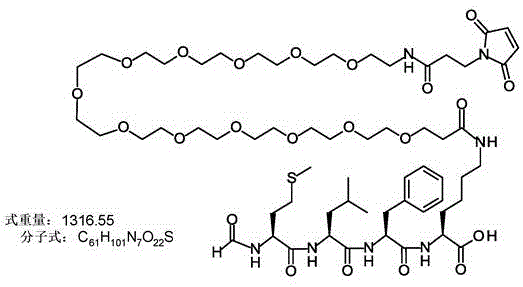
用作未缀合的肽的具有水解的马来酰亚胺基的肽-‘183。Peptide with hydrolyzed maleimide group used as unconjugated peptide - '183.

合成趋化肽甲酰基-Met-Leu-Phe-Lys-OH (SEQ ID NO:23)并纯化为HCl盐。该材料用作赖氨酸的ε-氨基处的进一步衍生化的底物。The chemotactic peptide formyl-Met-Leu-Phe-Lys-OH (SEQ ID NO: 23) was synthesized and purified as the HCl salt. This material serves as a substrate for further derivatization at the ε-amino group of lysine.
在来自Ace Glassware Inc的100 mL烧结玻璃手动反应容器中,使用标准Fmoc/tBu化学法以0.3 mmol规模经由手动固相肽合成产生肽。用于合成的固体支持物是Fmoc-Lys(Boc)-Wang树脂,(NovaBiochem,目录号8.56013,批号S6696713-529),100-200目,取代量为0.57 meq/g。使用的标准氨基酸是:Fmoc-Phe-OH (NovaBiochem, 目录号04-12-1030,批号A21653)、Fmoc-Leu-OH (NovaBiochem, 目录号04-12-1025, 批号A25917)、Fmoc-Met-OH (MidWest Biotech 目录号12400, 批号OP12240)。在每个偶联步骤之前,用20%哌啶/DMF处理(2 x 10 min)除去Fmoc基团。使用等比率的Fmoc氨基酸、二异丙基碳二亚胺(Sigma-Aldrich, 目录号DI25407, 批号80896APV)和HOAt (AK Scientific, 目录号D046, 批号1188G50I)以相比于理论肽树脂取代量的3倍摩尔过量下以DMF中~0.2 M的最终浓度进行所有偶联6小时。偶联最后一个氨基酸并除去N-末端Fmoc基团后,肽基树脂通过用6倍过量的溶解于DMF中的甲酸2,4,6-三氯苯酯(TCI, 目录号T3121, 批号P8AFA-PE)与200μL二异丙基乙胺处理而被甲酰化,并在室温下反应3小时。然后将树脂用DCM和二乙醚洗涤,并通过对反应容器应用真空抽吸5 min来彻底干燥。将干燥的树脂在室温下用25 mL裂解混合物(TFA:茴香醚:水:三异丙基硅烷,88:5:5:1 v/v)处理2小时。将树脂滤出,用5 mL纯TFA洗涤两次,并将合并的滤液用50 mL冷二乙醚处理以沉淀粗肽。然后将肽/乙醚悬浮液以4000 rpm离心4分钟以形成固体沉淀,倾析乙醚,并将固体沉淀再用乙醚研磨2次,并在真空中干燥30 min。将粗肽溶解于20%乙腈/水中,并通过RP-HPLC在C18制备型柱(Phenomenex,Luna Phenyl-Hexyl, 21 x 250 mm)上用含有0.1% HCl的水中的乙腈的线性梯度纯化,以得到作为HCl盐的冻干的肽(125 mg,基于起始树脂取代量的产率为73%)。纯度使用分析型RP-HPLC评价,并且发现其为>99%。分子量通过分析电喷雾MS测定。计算值:565.7 Da,观察值:565.3 Da (平均分子量)。观察到以下离子:566.3 (M+1H)。Peptides were generated via manual solid phase peptide synthesis at 0.3 mmol scale using standard Fmoc/tBu chemistry in 100 mL sintered glass manual reaction vessels from Ace Glassware Inc. The solid support used for the synthesis was Fmoc-Lys(Boc)-Wang resin, (NovaBiochem, Cat. No. 8.56013, Lot No. S6696713-529), 100-200 mesh, with a substitution of 0.57 meq/g. Standard amino acids used were: Fmoc-Phe-OH (NovaBiochem, Cat. No. 04-12-1030, Lot No. A21653), Fmoc-Leu-OH (NovaBiochem, Cat. No. 04-12-1025, Lot No. A25917), Fmoc-Met- OH (MidWest Biotech Cat. No. 12400, Lot No. OP12240). Before each coupling step, the Fmoc group was removed by treatment with 20% piperidine/DMF (2 x 10 min). Equal ratios of Fmoc amino acid, diisopropylcarbodiimide (Sigma-Aldrich, Cat. No. DI25407, Lot No. 80896APV) and HOAt (AK Scientific, Cat. No. D046, Lot No. 1188G50I) were used to compare All couplings were performed at a final concentration of ~0.2 M in DMF for 6 hours at a 3-fold molar excess. After coupling of the last amino acid and removal of the N-terminal Fmoc group, the peptidyl resin was treated with a 6-fold excess of 2,4,6-trichlorophenyl formate (TCI, Cat. No. T3121, Lot No. P8AFA-) dissolved in DMF. PE) was formylated by treatment with 200 μL of diisopropylethylamine and reacted at room temperature for 3 hours. The resin was then washed with DCM and diethyl ether and dried thoroughly by applying vacuum to the reaction vessel for 5 min. The dried resin was treated with 25 mL of cleavage mixture (TFA:anisole:water:triisopropylsilane, 88:5:5:1 v/v) for 2 hours at room temperature. The resin was filtered off, washed twice with 5 mL of pure TFA, and the combined filtrates were treated with 50 mL of cold diethyl ether to precipitate the crude peptide. The peptide/ether suspension was then centrifuged at 4000 rpm for 4 min to form a solid precipitate, the ether was decanted, and the solid precipitate was triturated twice with ether and dried in vacuo for 30 min. The crude peptide was dissolved in 20% acetonitrile/water and purified by RP-HPLC on a C18 preparative column (Phenomenex, Luna Phenyl-Hexyl, 21 x 250 mm) with a linear gradient of acetonitrile in water containing 0.1% HCl to give The lyophilized peptide was obtained as the HCl salt (125 mg, 73% yield based on starting resin substitution). Purity was assessed using analytical RP-HPLC and found to be >99%. Molecular weights were determined by analytical electrospray MS. Calculated: 565.7 Da, observed: 565.3 Da (average molecular weight). The following ions were observed: 566.3 (M+1H).
赖氨酸的ε-氨基如下酰化:在超声仪的帮助下,将~50 mg (~0.088 mmol)的冻干肽溶解于5 mL无水DMF中。在分开的闪烁小瓶中,将74 mg (1.1当量)的Mal-dPEG12-OH(QuantaBiodesign 目录号10285, 批号IH1-A1240-80)用1 mL干燥DMF中的29 mg (1.1当量)的TSTU (OakWood Chemicals, 目录号024891, 批号024891)和61 µL (4当量)的DIPEA在室温下活化25 min。将活化的Mal-PEG12-OH逐滴添加至DMF (1 mL)中的增溶肽中,并添加62 µL (5当量)三乙胺,并将反应混合物在室温下混合。1小时后,通过添加冷二乙醚来终止反应。然后将溶液分开并转移至两个50 mL锥形管中,并添加更多的冷乙醚以进一步沉淀肽。然后将肽/乙醚悬浮液以4000 rpm离心4分钟以形成固体沉淀,倾析乙醚,并将固体沉淀再用乙醚研磨2次,并在真空中干燥30 min。将合并的粗肽沉淀溶解于20%乙腈/水中,并通过RP-HPLC在C18制备型柱(Phenomenex, Luna Phenyl Hexyl 21 x 250 mm)上用含有0.1%TFA的水中的乙腈的线性梯度纯化,以得到作为TFA盐的冻干的肽(44.4 mg,基于起始材料的产率为38%)。纯度使用分析型RP-HPLC评价,并且发现其为>96%。分子量通过分析电喷雾MS测定。计算值:1316.6 Da,观察值:1316.2 Da (平均分子量)。观察到以下离子:659.0 (M+2H),和1317.2 (M+1H)。然后可以如以下实施例3中所述将该肽(甲酰基-Met-Leu-Phe-Lys(Mal-PEG12)-OH)缀合至抗体。The ε-amino group of lysine was acylated as follows: ~50 mg (~0.088 mmol) of lyophilized peptide was dissolved in 5 mL of dry DMF with the help of a sonicator. In a separate scintillation vial, 74 mg (1.1 equiv) of Mal-dPEG12-OH (QuantaBiodesign Cat. No. 10285, Lot No. IH1-A1240-80) was mixed with 29 mg (1.1 equiv) of TSTU (OakWood) in 1 mL of dry DMF Chemicals, Cat. No. 024891, Lot No. 024891) and 61 µL (4 equiv.) of DIPEA were activated for 25 min at room temperature. Activated Mal-PEG12-OH was added dropwise to the solubilized peptide in DMF (1 mL), 62 µL (5 equiv) of triethylamine was added, and the reaction mixture was mixed at room temperature. After 1 hour, the reaction was quenched by the addition of cold diethyl ether. The solution was then split and transferred to two 50 mL conical tubes, and more cold ether was added to further precipitate the peptides. The peptide/ether suspension was then centrifuged at 4000 rpm for 4 min to form a solid precipitate, the ether was decanted, and the solid precipitate was triturated twice with ether and dried in vacuo for 30 min. The combined crude peptide precipitates were dissolved in 20% acetonitrile/water and purified by RP-HPLC on a C18 preparative column (Phenomenex, Luna Phenyl Hexyl 21 x 250 mm) with a linear gradient of acetonitrile in water containing 0.1% TFA, to give the lyophilized peptide as a TFA salt (44.4 mg, 38% yield based on starting material). Purity was assessed using analytical RP-HPLC and found to be >96%. Molecular weights were determined by analytical electrospray MS. Calculated: 1316.6 Da, observed: 1316.2 Da (average molecular weight). The following ions were observed: 659.0 (M+2H), and 1317.2 (M+1H). The peptide (Formyl-Met-Leu-Phe-Lys(Mal-PEG12)-OH) can then be conjugated to the antibody as described in Example 3 below.
对于以下实施例中使用的未缀合肽,通过将20 mg来自步骤1的产物在2 mL 40 mMTris HCl缓冲液(pH 8.0)中室温下孵育过夜,来进一步水解马来酰亚胺基。18小时后,将溶液用10 mL 20%乙腈/水稀释,并通过RP-HPLC在C18制备型柱(Phenomenex, Luna PhenylHexyl 21 x 250 mm)上用含有0.1 % TFA的水中的乙腈的线性梯度纯化,以得到作为TFA盐的冻干的肽(6.4 mg,基于起始材料的产率为32%)。纯度使用分析型RP-HPLC评价,并且发现其为>94%。分子量通过分析电喷雾MS测定:计算值:1334.6 Da;观察值:1334.4 Da (平均分子量)。观察到以下离子:668.0 (M+2H),和1335.8 (M+1H)。For the unconjugated peptides used in the following examples, the maleimide groups were further hydrolyzed by incubating 20 mg of the product from step 1 in 2 mL of 40 mM Tris HCl buffer (pH 8.0) overnight at room temperature. After 18 hours, the solution was diluted with 10 mL of 20% acetonitrile/water and purified by RP-HPLC on a C18 preparative column (Phenomenex, Luna PhenylHexyl 21 x 250 mm) with a linear gradient of acetonitrile in water containing 0.1% TFA , to obtain the lyophilized peptide as a TFA salt (6.4 mg, 32% yield based on starting material). Purity was assessed using analytical RP-HPLC and found to be >94%. Molecular weight determined by analytical electrospray MS: calculated: 1334.6 Da; observed: 1334.4 Da (average molecular weight). The following ions were observed: 668.0 (M+2H), and 1335.8 (M+1H).
实施例2(B):H-Met-Leu-Phe-Lys(Mal-PEG12-OH (“肽-‘844”) (SEQ ID NO:24)的合成。Example 2(B): Synthesis of H-Met-Leu-Phe-Lys(Mal-PEG12-OH ("peptide-'844") (SEQ ID NO: 24).

用作未缀合的肽的具有水解的马来酰亚胺基的肽-‘844。Peptide with hydrolyzed maleimide group used as unconjugated peptide - '844.

通过手动固相肽合成,使用标准的芴基甲氧基羰基(Fmoc)/叔丁基(tBu)化学法以0.3 mmol规模产生缺乏甲酰化的阴性对照肽((H-Met-LeuPhe-Lys-OH) (SEQ ID NO:25)。肽组装在来自Ace Glassware Inc.的100 mL烧结玻璃手动反应容器中进行。用于合成的固体支持物是Fmoc-Lys(Mtt)-Wang树脂,(NovaBiochem, 目录号8.56021, 批号S6692621503),100-200目,取代量为0.57 meq/g。使用的标准氨基酸是Fmoc-Phe-OH (NovaBiochem,目录号04-12-1030, 批号A21653),Fmoc-Leu-OH (NovaBiochem, 目录号04-12-1025, 批号A25917),Fmoc-Met-OH (MidWest Biotech 目录号12400, 批号OP12240)。Negative control peptides lacking formylation ((H-Met-LeuPhe-Lys) were generated at 0.3 mmol scale by manual solid-phase peptide synthesis using standard fluorenylmethoxycarbonyl (Fmoc)/tert-butyl (tBu) chemistry -OH) (SEQ ID NO: 25). Peptide assembly was performed in a 100 mL sintered glass manual reaction vessel from Ace Glassware Inc. The solid support used for the synthesis was Fmoc-Lys(Mtt)-Wang resin, (NovaBiochem , Cat. No. 8.56021, Lot No. S6692621503), 100-200 mesh, 0.57 meq/g substitution. Standard amino acids used were Fmoc-Phe-OH (NovaBiochem, Cat. No. 04-12-1030, Lot No. A21653), Fmoc-Leu -OH (NovaBiochem, Cat. No. 04-12-1025, Lot No. A25917), Fmoc-Met-OH (MidWest Biotech Cat. No. 12400, Lot No. OP12240).
在每个偶联步骤之前,用20%哌啶/DMF处理(2 x 10 min)除去Fmoc基团。使用等比率的Fmoc氨基酸、二异丙基碳二亚胺(Sigma-Aldrich, 目录号DI25407, 批号80896APV)和HOAt (AK Scientific, 目录号D046, 批号1188G50I)以相比于理论肽树脂取代量的3倍摩尔过量下以DMF中~0.2 M的最终浓度进行所有偶联6小时。Before each coupling step, the Fmoc group was removed by treatment with 20% piperidine/DMF (2 x 10 min). Equal ratios of Fmoc amino acid, diisopropylcarbodiimide (Sigma-Aldrich, Cat. No. DI25407, Lot No. 80896APV) and HOAt (AK Scientific, Cat. No. D046, Lot No. 1188G50I) were used to compare All couplings were performed at a final concentration of ~0.2 M in DMF for 6 hours at a 3-fold molar excess.
偶联最后一个氨基酸并除去N-末端Fmoc基团后,肽基树脂通过用6倍过量的溶解于二甲基甲酰胺(DMF)中的Boc2O (NovaBiochem, 目录号01-63-0007, 批号A25675)与200μL二异丙基乙胺处理而用Boc(丁基氧基羰基)-基团保护,并在室温下反应3小时。然后将树脂用二氯甲烷(DCM)洗涤8次,并用DCM中的20%六氟异丙醇(Oakwood Chemicals, 目录号003409)的三次连续处理(2 x 10 min和1 x 45 min)选择性除去Lys残基上的Mtt (4-甲基三苯甲基)保护基以暴露Lys的游离ε胺,用于进一步反应。随后的Fmoc PEG12-OH(BroadPharm, 目录号 BP-22241)和3-马来酰亚胺基-丙酸(Bachem, 目录号 Q-2620)的偶联以与标准氨基酸残基相同的方式完成。After coupling of the last amino acid and removal of the N-terminal Fmoc group, the peptidyl resin was treated with a 6 -fold excess of Boc2O in dimethylformamide (DMF) (NovaBiochem, cat. no. 01-63-0007, Lot A25675) was treated with 200 μL of diisopropylethylamine to protect with a Boc(butyloxycarbonyl)-group and reacted at room temperature for 3 hours. The resin was then washed 8 times with dichloromethane (DCM) and selectively treated with three successive treatments (2 x 10 min and 1 x 45 min) of 20% hexafluoroisopropanol in DCM (Oakwood Chemicals, cat. no. 003409) The Mtt (4-methyltrityl) protecting group on the Lys residue was removed to expose the free epsilon amine of Lys for further reactions. Subsequent coupling of Fmoc PEG12-OH (BroadPharm, cat. no. BP-22241) and 3-maleimido-propionic acid (Bachem, cat. no. Q-2620) was accomplished in the same manner as standard amino acid residues.
合成完成后,将肽基树脂用DCM、二乙醚洗涤,并通过对反应容器应用真空抽吸5min来彻底干燥。将干燥的树脂在室温下用25 mL裂解混合物(三氟乙酸(TFA):茴香醚:水:三异丙基硅烷,88:5:5:1 v/v)处理2小时。将树脂滤出,用5 mL纯TFA洗涤两次,并将合并的滤液用50 mL冷二乙醚处理以沉淀粗肽。然后将肽/乙醚悬浮液以4000 rpm离心4分钟以形成固体沉淀,倾析乙醚,并将固体沉淀再用乙醚研磨2次,并在真空中干燥30 min。After the synthesis was complete, the peptidyl resin was washed with DCM, diethyl ether, and thoroughly dried by applying vacuum to the reaction vessel for 5 min. The dried resin was treated with 25 mL of cleavage mixture (trifluoroacetic acid (TFA):anisole:water:triisopropylsilane, 88:5:5:1 v/v) for 2 hours at room temperature. The resin was filtered off, washed twice with 5 mL of pure TFA, and the combined filtrates were treated with 50 mL of cold diethyl ether to precipitate the crude peptide. The peptide/ether suspension was then centrifuged at 4000 rpm for 4 min to form a solid precipitate, the ether was decanted, and the solid precipitate was triturated twice with ether and dried in vacuo for 30 min.
将粗肽溶解于20%乙腈/水中,并通过RP-HPLC在C18制备型柱(Phenomenex, LunaPhenyl-Hexyl, 21 x 250 mm)上用含有0.1 % TFA的水中的乙腈的线性梯度纯化,以得到作为TFA盐的冻干的肽(38.8 mg,基于起始树脂取代量的产率为10%)。纯度使用分析型RP-HPLC评价,并且发现其为>96%。分子量通过分析电喷雾MS测定。计算值:1288.5 Da,观察值:1288.4 Da (平均分子量)。观察到以下离子:645.0 (M+2H),和1289.7 (M+1H)。然后可以如以下实施例3中所述将该肽(H-Met-Leu-Phe-Lys(Mal-PEG12-OH)缀合至抗体。The crude peptide was dissolved in 20% acetonitrile/water and purified by RP-HPLC on a C18 preparative column (Phenomenex, LunaPhenyl-Hexyl, 21 x 250 mm) with a linear gradient of acetonitrile in water containing 0.1% TFA to give Lyophilized peptide as TFA salt (38.8 mg, 10% yield based on starting resin substitution). Purity was assessed using analytical RP-HPLC and found to be >96%. Molecular weights were determined by analytical electrospray MS. Calculated: 1288.5 Da, observed: 1288.4 Da (average molecular weight). The following ions were observed: 645.0 (M+2H), and 1289.7 (M+1H). The peptide (H-Met-Leu-Phe-Lys(Mal-PEG12-OH)) can then be conjugated to the antibody as described in Example 3 below.
对于以下实施例中使用的未缀合肽,通过将20 mg来自步骤1的产物在2 mL 40 mMTris HCl缓冲液(pH 8.0)中室温下孵育过夜,来进一步水解马来酰亚胺基。18小时后,将溶液用10 mL 20%乙腈/水稀释,并通过RP-HPLC在C18制备型柱(Phenomenex, Luna PhenylHexyl 21 x 250 mm)上用含有0.1 % TFA的水中的乙腈的线性梯度纯化,以得到作为TFA盐的冻干的肽(5.2 mg,基于起始材料的产率为26%)。纯度使用分析型RP-HPLC评价,并且发现其为>96%。分子量通过分析电喷雾MS测定。计算值:1306.6 Da,观察值:1306.4 Da (平均分子量)。观察到以下离子:654.0 (M+2H),和1307.7 (M+1H)。For the unconjugated peptides used in the following examples, the maleimide groups were further hydrolyzed by incubating 20 mg of the product from step 1 in 2 mL of 40 mM Tris HCl buffer (pH 8.0) overnight at room temperature. After 18 hours, the solution was diluted with 10 mL of 20% acetonitrile/water and purified by RP-HPLC on a C18 preparative column (Phenomenex, Luna PhenylHexyl 21 x 250 mm) with a linear gradient of acetonitrile in water containing 0.1% TFA , to obtain the lyophilized peptide as a TFA salt (5.2 mg, 26% yield based on starting material). Purity was assessed using analytical RP-HPLC and found to be >96%. Molecular weights were determined by analytical electrospray MS. Calculated: 1306.6 Da, observed: 1306.4 Da (average molecular weight). The following ions were observed: 654.0 (M+2H), and 1307.7 (M+1H).
实施例2(c):甲酰基-Nle-Leu-Phe-PEG12-Lys(马来酰亚胺基-丙酰基)-OH(“fNle”; SEQ ID NO:42)的合成Example 2(c): Synthesis of Formyl-Nle-Leu-Phe-PEG12-Lys(maleimido-propionyl)-OH ("fNle"; SEQ ID NO:42)

趋化肽甲酰基-Nle-Leu-Phe-PEG12-Lys-OH被合成为HCl盐(PeptidesInternational),并且不经进一步修饰即用作用于衍生化的底物。The chemotactic peptide formyl-Nle-Leu-Phe-PEG12-Lys-OH was synthesized as the HCl salt (Peptides International) and used as substrate for derivatization without further modification.
赖氨酸的ε-氨基的酰化如下进行:在超声仪的帮助下,将~50 mg (~0.044 mmol)的冻干肽溶解于5 mL无水DMF中。在分开的闪烁小瓶中,将8.1 mg (1.1当量)的马来酰亚胺基-丙酸(Bachem, 目录号Q-2620, 批号0564230)用1 mL干燥DMF中的14.5 mg (1.1当量)的TSTU (OakWood Chemicals, 目录号024891, 批号024891)和33.4 µL (4当量)的DIPEA在室温下活化25 min。将活化的马来酰亚胺基-丙酸逐滴添加至DMF (1 mL)中的增溶肽中,且然后添加30 µL (5当量)三乙胺,并将反应物在室温下混合。1小时后,通过添加冷二乙醚来终止反应。然后将溶液分开并转移至两个50 mL锥形管中,并添加更多的冷乙醚以进一步沉淀肽。然后将肽/乙醚悬浮液以4000 rpm离心4分钟以形成固体沉淀,倾析乙醚,并将固体沉淀再用乙醚研磨2次,并在真空中干燥30 min。将合并的粗肽沉淀溶解于20%乙腈/水中,并通过RP-HPLC在C18制备型柱(Phenomenex, Luna Phenyl Hexyl 21 x 250 mm)上用含有0.1% TFA的水中的乙腈的线性梯度纯化,以得到作为TFA盐的冻干的肽(8.6 mg,基于起始材料的产率为15.1%)。纯度使用分析型RP-HPLC评价,并且发现其为>97%。分子量通过分析电喷雾MS测定。计算值:1298.5 Da,观察值:1298.8 Da (平均分子量)。观察到以下离子:650.0 (M+2H),和1299.8 (M+1H)。然后可以将该肽缀合至抗体,如以下实施例3中所述。Acylation of the ε-amino group of lysine was performed as follows: ~50 mg (~0.044 mmol) of lyophilized peptide was dissolved in 5 mL of dry DMF with the help of a sonicator. In a separate scintillation vial, combine 8.1 mg (1.1 equiv) of maleimido-propionic acid (Bachem, Cat. No. Q-2620, Lot No. 0564230) with 14.5 mg (1.1 equiv.) in 1 mL of dry DMF TSTU (OakWood Chemicals, Cat. No. 024891, Lot No. 024891) and 33.4 µL (4 equiv.) of DIPEA were activated for 25 min at room temperature. Activated maleimido-propionic acid was added dropwise to the solubilized peptide in DMF (1 mL), and then 30 µL (5 equiv.) of triethylamine was added, and the reaction was mixed at room temperature. After 1 hour, the reaction was quenched by the addition of cold diethyl ether. The solution was then split and transferred to two 50 mL conical tubes, and more cold ether was added to further precipitate the peptides. The peptide/ether suspension was then centrifuged at 4000 rpm for 4 min to form a solid precipitate, the ether was decanted, and the solid precipitate was triturated twice with ether and dried in vacuo for 30 min. The combined crude peptide precipitates were dissolved in 20% acetonitrile/water and purified by RP-HPLC on a C18 preparative column (Phenomenex, Luna Phenyl Hexyl 21 x 250 mm) with a linear gradient of acetonitrile in water containing 0.1% TFA, to give the lyophilized peptide as a TFA salt (8.6 mg, 15.1% yield based on starting material). Purity was assessed using analytical RP-HPLC and found to be >97%. Molecular weights were determined by analytical electrospray MS. Calculated: 1298.5 Da, observed: 1298.8 Da (average molecular weight). The following ions were observed: 650.0 (M+2H), and 1299.8 (M+1H). This peptide can then be conjugated to an antibody, as described in Example 3 below.
实施例3:IgG抗体与肽的缀合Example 3: Conjugation of IgG antibodies to peptides
抗体-肽生物缀合物可以如下制备。使用Zeba™旋转脱盐柱(40K MWCO)将含有工程改造的半胱氨酸残基的亲本抗体缓冲液交换为50mM三(羟甲基)氨基甲烷(Tris-HCl)、2mM乙二胺四乙酸(EDTA)(pH 7.5),并使最终浓度为5mg/ml。将溶解于MilliQ水中的新鲜制备的100mM二硫苏糖醇(DTT)以40倍摩尔过量添加至抗体中。将反应混合物在室温下孵育16小时。在孵育期之后,使用Zeba旋转脱盐柱将反应混合物缓冲液交换为50mM三(羟甲基)氨基甲烷(Tris-HCl)、150mM氯化钠(NaCl)(pH 7.5),以除去过量的未反应的DTT。Antibody-peptide bioconjugates can be prepared as follows. The parental antibody containing engineered cysteine residues was buffer-exchanged into 50 mM Tris-HCl (Tris-HCl), 2 mM EDTA ( EDTA) (pH 7.5) and bring the final concentration to 5 mg/ml. Freshly prepared 100 mM dithiothreitol (DTT) dissolved in MilliQ water was added to the antibody in a 40-fold molar excess. The reaction mixture was incubated at room temperature for 16 hours. After the incubation period, the reaction mixture was buffer-exchanged to 50 mM tris(hydroxymethyl)aminomethane (Tris-HCl), 150 mM sodium chloride (NaCl) (pH 7.5) using a Zeba spin desalting column to remove excess unreacted DTT.
将新鲜制备的100mM脱氢抗坏血酸(dHAA)/二甲基乙酰胺以30倍摩尔过量添加至抗体中,并在室温下孵育3小时。孵育之后,将4、8或12倍摩尔过量的甲酰基-Met-Leu-Phe-Lys(Mal-PEG12)-OH (SEQ ID NO:22)、H-Met-Leu-Phe-Lys(Mal-PEG12)-OH (SEQ ID NO:24)或甲酰基-Nle-Leu-Phe-PEG12-Lys(马来酰亚胺基-丙酰基)-OH(分别如实施例2(A)、2(B)和2(C)中所述合成)分别添加(溶解于分子级水中)至具有一个、两个或三个工程改造的半胱氨酸残基的抗体,以产生2、4或6比率的生物缀合物。将该反应混合物在室温下孵育1小时。孵育后,将样品缓冲液交换为期望的缓冲液,并使用脱盐柱、制备型大小排阻色谱法(pSEC)或透析除去过量的未缀合的肽。Freshly prepared 100 mM dehydroascorbic acid (dHAA)/dimethylacetamide was added to the antibody in a 30-fold molar excess and incubated for 3 hours at room temperature. Following incubation, 4, 8 or 12-fold molar excess of formyl-Met-Leu-Phe-Lys(Mal-PEG12)-OH (SEQ ID NO: 22), H-Met-Leu-Phe-Lys(Mal- PEG12)-OH (SEQ ID NO: 24) or formyl-Nle-Leu-Phe-PEG12-Lys(maleimido-propionyl)-OH (as in Example 2(A), 2(B), respectively ) and the synthesis described in 2(C)) were added (dissolved in molecular grade water) to antibodies with one, two, or three engineered cysteine residues, respectively, to produce 2, 4, or 6 ratios of Bioconjugates. The reaction mixture was incubated at room temperature for 1 hour. After incubation, the sample was buffer exchanged to the desired buffer and excess unconjugated peptide was removed using a desalting column, preparative size exclusion chromatography (pSEC) or dialysis.
表1提供了基本上如本文和上文所述制备的并在随后的测定法中测试的缀合和未缀合的IgG抗体构建体,包括用于缀合的抗体HC和LC序列以及聚乙二醇化肽。如本文所用,“依米妥珠单抗”、“ TMab”(曲妥珠单抗)和“ AME133”是指含有所示抗体的可变区的抗体构建体。Table 1 provides conjugated and unconjugated IgG antibody constructs prepared substantially as described herein and above and tested in subsequent assays, including antibody HC and LC sequences and polyethylene Diolated peptides. As used herein, "emetuzumab", "TMab" (trastuzumab), and "AME133" refer to antibody constructs containing the variable regions of the indicated antibodies.
表1. 缀合和未缀合的IgG抗体构建体。Table 1. Conjugated and unconjugated IgG antibody constructs.


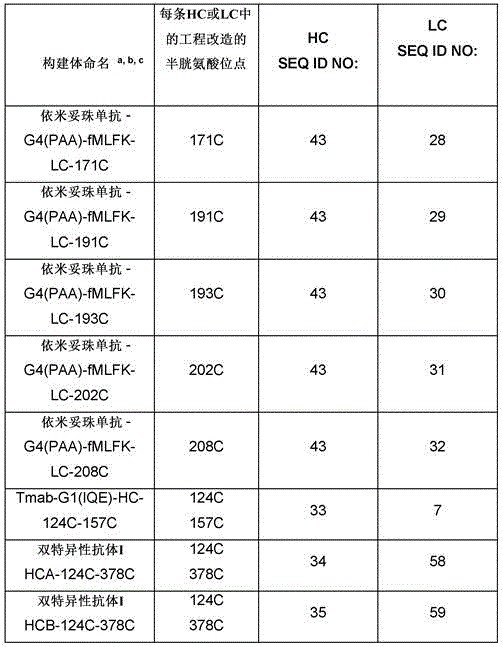
a 第一个术语是指亲本抗体,第二个术语是指免疫球蛋白同种型,第三个术语是指用Mal-PEG12接头与抗体缀合的N-甲酰肽(其中“ UC”意指未缀合,且因此抗体未与肽缀合),第四个术语是指重链工程改造的半胱氨酸,通过第五个和第六个术语的残基表示(如果适用)。例如,依米妥珠单抗-G4-fMLFK-HC-378C意味着亲本抗体是依米妥珠单抗,其为IgG4抗体,使用的N-甲酰肽是fMLFK,并且在重链中的位置378处工程改造半胱氨酸(根据EU编号)。 aThe first term refers to the parent antibody, the second term refers to the immunoglobulin isotype, and the third term refers to the N-formyl peptide conjugated to the antibody with a Mal-PEG12 linker (where "UC" means means unconjugated, and thus the antibody is not conjugated to a peptide), the fourth term refers to the heavy chain engineered cysteine, represented by the residues of the fifth and sixth terms (if applicable). For example, Emetuzumab-G4-fMLFK-HC-378C means that the parent antibody is Emetuzumab, which is an IgG4 antibody, the N-formyl peptide used is fMLFK, and the position in the heavy chain 378 engineered cysteines (according to EU numbering).
b 标记为“(PAA)”的抗体构建体在IgG4恒定区中含有额外突变:228P、234A和235A(根据EU编号)。 b Antibody constructs labeled "(PAA)" contain additional mutations in the IgG4 constant region: 228P, 234A and 235A (according to EU numbering).
c 标记为“(IQ)”的抗体构建体在IgG1恒定区中含有额外突变:247I和339Q (根据EU编号)。 c Antibody constructs marked "(IQ)" contain additional mutations in the IgGl constant region: 247I and 339Q (according to EU numbering).
实施例4:缀合比率测定Example 4: Conjugation Ratio Determination
通过完整质谱分析使用缀合加成的加权平均值测定半胱氨酸工程改造的TMab(“曲妥珠单抗”)、AME133和依米妥珠单抗构建体的重链上的肽-’183的缀合比率。使用与Agilent6230 ESI-TOF质谱仪联用的Agilent 1290 HPLC收集完整的质量测量值。用PLRP-S反相柱(Agilent)使用0.3 ml/min的流速以水/0.2%甲酸作为流动相A且以乙腈/0.2%甲酸作为流动相B用4分钟内20%至70% B的梯度分析样品(2ug)。Agilent 6230 TOF以4000V的正离子模式、65V的锥孔电压(skimmer)、300V的裂解电压(Fragmentor)、350C的气体温度、12psi的干燥气体、40psi的雾化器气体下运行。以1次扫描/秒,MS扫描为600 m/z至5000 m/z。从2分钟至15分钟收集数据,并通过对TIC峰光谱求和、随后用Agilent Mass Hunter和Bioconfirmv7.0解卷积来确定蛋白分子量。未还原样品的解卷积为50000至190000 Da.,且峰宽为1.0Da. 20次迭代和1 Da.步骤。Determination of peptide-' on the heavy chain of cysteine-engineered TMab ("trastuzumab"), AME133 and imituzumab constructs by intact mass spectrometry analysis using a weighted average of conjugate addition Conjugation ratio of 183. Complete mass measurements were collected using an Agilent 1290 HPLC coupled to an Agilent 6230 ESI-TOF mass spectrometer. A gradient of 20% to 70% B over 4 minutes with water/0.2% formic acid as mobile phase A and acetonitrile/0.2% formic acid as mobile phase B with a PLRP-S reverse phase column (Agilent) using a flow rate of 0.3 ml/min A sample (2ug) was analyzed. The Agilent 6230 TOF was run in positive ion mode of 4000V, skimmer of 65V, fragmentor of 300V, gas temperature of 350C, dry gas of 12psi, nebulizer gas of 40psi. At 1 scan/sec, MS scans from 600 m/z to 5000 m/z. Data were collected from 2 minutes to 15 minutes and protein molecular weights were determined by summing TIC peak spectra followed by deconvolution with Agilent Mass Hunter and Bioconfirm v7.0. The deconvolution of the unreduced sample was 50000 to 190000 Da. and the peak width was 1.0 Da. 20 iterations and 1 Da. step.
表2a. 肽-’183:半胱氨酸缀合比率。Table 2a. Peptide-'183:cysteine conjugation ratios.

a根据与本文实施例1的表1中所述相同的惯例来命名抗体构建体。 a Antibody constructs are named according to the same convention as described in Table 1 of Example 1 herein.
通过将50 µl 1 mg/ml抗体缀合物添加至小鼠血清并在37℃下在300 RPM摇动下孵育0.5至48小时来制备血清稳定性的样品。在测定缀合比率之前,所有体内样品或血清稳定性样品都需要从生物基质中提取。生物流体经历以13,000 RPM离心10分钟,随后使用逐步梯度将其应用于人Fc Select亲和柱。将缀合的抗体捕获于流动相A (PBS, pH 7.4)中,并用0.2% (V/V)甲酸洗脱。手动收集样品级分,并在低热下使用真空离心干燥至50-100 µl。偏离靶标的百分比表示将生物缀合物添加至除了预期的半胱氨酸以外的位点。遵循上述程序,获得以下数据。Serum stability samples were prepared by adding 50 µl of 1 mg/ml antibody conjugate to mouse serum and incubating at 37°C with shaking at 300 RPM for 0.5 to 48 hours. All in vivo samples or serum stability samples need to be extracted from biological matrices prior to determination of conjugation ratios. Biological fluids were subjected to centrifugation at 13,000 RPM for 10 minutes and then applied to a human Fc Select affinity column using a step gradient. Conjugated antibodies were captured in mobile phase A (PBS, pH 7.4) and eluted with 0.2% (v/v) formic acid. Sample fractions were collected manually and dried to 50-100 µl using vacuum centrifugation at low heat. Percent off target represents addition of bioconjugate to sites other than the expected cysteines. Following the above procedure, the following data were obtained.
表2b:在cMet单一工程改造的半胱氨酸突变体上与肽-frm-MLFK(Mal-PEG12)-OH(肽-‘183)的位点特异性缀合。Table 2b: Site-specific conjugation to peptide-frm-MLFK(Mal-PEG12)-OH(peptide-'183) on cMet single engineered cysteine mutants.

表2c:在cMet单一工程改造的半胱氨酸突变体上与肽frm-Met-Ile-Phe-Leu-NH-(CH2)2-NH-[(Mal-Dap(NH2)] (SEQ ID NO:41; FRM-032)的位点特异性缀合Table 2c: On cMet single engineered cysteine mutants with the peptide frm-Met-Ile-Phe-Leu-NH-(CH2)2-NH-[(Mal-Dap(NH2)] (SEQ ID NO :41; FRM-032) site-specific conjugation

ND: 未测定。ND: Not determined.
这些数据表明,经由马来酰亚胺化学法单克隆抗体在工程改造的半胱氨酸位点124、157、375和/或378与甲酰化肽构建体的缀合产生肽:抗体缀合比率,其由添加至抗体的半胱氨酸的数目所预测,如脱靶百分比所表明。These data demonstrate that conjugation of monoclonal antibodies to formylated peptide constructs at engineered cysteine positions 124, 157, 375 and/or 378 via maleimide chemistry results in peptide:antibody conjugation ratio, as predicted by the number of cysteines added to the antibody, as indicated by the percent off-target.
实施例5:结合人HER2的TMab生物缀合物Example 5: TMab Bioconjugates Binding Human HER2
使用用人HER2包被的96孔细胞培养板通过ELISA测定TMab与人HER2的结合。将板暴露于结合抗体80分钟,洗涤以除去未结合的抗体,并与二抗孵育50分钟。洗涤板,然后在37℃下显色25分钟。用96孔板读数器在O.D.560处测量结合。遵循基本上如上所述的程序,获得以下数据。Binding of TMab to human HER2 was determined by ELISA using 96-well cell culture plates coated with human HER2. Plates were exposed to bound antibody for 80 minutes, washed to remove unbound antibody, and incubated with secondary antibody for 50 minutes. Plates were washed and then developed at 37°C for 25 minutes. Binding was measured at O.D. 560 with a 96-well plate reader. Following the procedure essentially as described above, the following data were obtained.
表3. TMab与人HER2的结合(O.D.560)。Table 3. Binding of TMabs to human HER2 (O.D.560).

a 根据与本文实施例1的表1中所述相同的惯例来命名抗体构建体。 a Antibody constructs are named according to the same convention as described in Table 1 of Example 1 herein.
这些数据表明,TMab与人Her2的结合不受修饰重链以在位点124和378处引入半胱氨酸的影响,并且也不受肽-’183与位点124和378处的半胱氨酸残基的缀合的影响。These data indicate that the binding of TMab to human Her2 is not affected by modification of the heavy chain to introduce cysteines at positions 124 and 378, and is also not affected by peptide-'183 and cysteines at positions 124 and 378 Effect of Conjugation of Acid Residues.
实施例6:PMN趋化性Example 6: PMN Chemotaxis
通过在改良的Boyden腔室测定中观察人多形核嗜中性粒细胞(PMN)跨过transwell膜(Corning #3415)向抗体缀合物的迁移来测量趋化性。将来自嗜中性粒细胞富集的制备物的近似2-4 x 10⁵个细胞接种在具有3.0 um孔的膜上的上部transwell腔室中。下部transwell腔室含有单独的缓冲液以及fMLF(N-甲酰基-Met-Leu-Phe肽作为阳性对照)和实验性抗体生物缀合物的溶液。一些实验还包括fMLFK(Mal[OH]-PEG12)-OH (水解肽-’183)和H-Met-Leu-Phe-Lys(Mal[OH]-PEG12-OH (水解肽-’844)作为阳性对照。在transwell中接种后,将细胞在37℃下置于加湿培养箱中。一小时后,除去上部腔室中的所有细胞,并使用CellTiter-Glotm (Promega #G7571)根据制造商指定的方案定量分析成功迁移至下部腔室的细胞的百分比。迁移百分比被定义为(迁移至下部腔室的细胞的数目/最初接种的细胞的数目)。细胞数目使用标准曲线测定。将所有数据都转换为相对于各单独实验的最大fMLF响应的百分比。Chemotaxis was measured by observing the migration of human polymorphonuclear neutrophils (PMNs) across a transwell membrane (Corning #3415) to the antibody conjugate in a modified Boyden chamber assay. Approximately 2-4 x 10⁵ cells from neutrophil - enriched preparations were seeded in upper transwell chambers on membranes with 3.0 um pores. The lower transwell chamber contained buffer alone as well as solutions of fMLF (N-formyl-Met-Leu-Phe peptide as a positive control) and experimental antibody bioconjugates. Some experiments also included fMLFK(Mal[OH]-PEG12)-OH (Hydrolyzed Peptide-'183) and H-Met-Leu-Phe-Lys(Mal[OH]-PEG12-OH (Hydrolyzed Peptide-'844) as positives Control. After seeding in transwell, cells were placed in a humidified incubator at 37°C. After one hour, all cells in the upper chamber were removed and treated with CellTiter-Glo tm (Promega #G7571) as specified by the manufacturer The protocol quantified the percentage of cells that successfully migrated to the lower chamber. The percentage of migration was defined as (number of cells migrated to the lower chamber/number of cells initially seeded). The number of cells was determined using a standard curve. All data were transformed as a percentage of the maximal fMLF response relative to each individual experiment.
刺激PMN趋化性需要N-甲酰基修饰Stimulation of PMN chemotaxis requires N-formyl modification
为了确定N-甲酰基修饰的肽诱导PMN迁移的能力,将原代人PMN暴露于具有或不具有N-甲酰基修饰的肽,并测量PMN迁移响应。遵循基本上如上所述的程序,PMN分别在10 nM、1 nM和1µM的浓度对fMLF、肽-’183和肽-’844的响应最大(表4)。肽-’844与肽-’183相似,除了肽-’844缺乏N-甲酰基,并且在诱导PMN迁移方面的功效低1000倍,如肽-’183和肽-’844之间的剂量响应差异所表明。数值作为相对于10 nM fMLF的PMN迁移百分比给出。To determine the ability of N-formyl-modified peptides to induce PMN migration, primary human PMNs were exposed to peptides with or without N-formyl modification and PMN migration responses were measured. Following the procedure essentially as described above, PMNs responded maximally to fMLF, Peptide-'183 and Peptide-'844 at concentrations of 10 nM, 1 nM and 1 µM, respectively (Table 4). Peptide-'844 is similar to peptide-'183 except that peptide-'844 lacks an N-formyl group and is 1000-fold less potent in inducing PMN migration, as in the dose-response difference between peptide-'183 and peptide-'844 indicated. Values are given as percent PMN migration relative to 10 nM fMLF.
表4a. PMN朝向fMLF、肽-’183和肽-’844的迁移。Table 4a. Migration of PMNs towards fMLF, Peptide-'183 and Peptide-'844.

这些数据表明,肽的N-甲酰基修饰对于诱导PMN趋化性是重要的。These data suggest that N-formyl modification of peptides is important for induction of PMN chemotaxis.
甲酰肽变体诱导嗜中性粒细胞趋化性Formyl peptide variants induce neutrophil chemotaxis
将原代人嗜中性粒细胞暴露于甲酰肽,并且基本上如上所述测量PMN迁移响应,除了保留原始迁移值而不是转换为细胞计数。遵循基本上如上所述的程序,提供以下数据作为相对于100 nM fMLF的百分比。Primary human neutrophils were exposed to formyl peptides and PMN migratory responses were measured essentially as described above, except that raw migration values were retained rather than converted to cell counts. Following the procedure essentially as described above, the following data are presented as percentages relative to 100 nM fMLF.
表4b. PMN朝向甲酰肽的趋化性Table 4b. Chemotaxis of PMNs towards formyl peptides
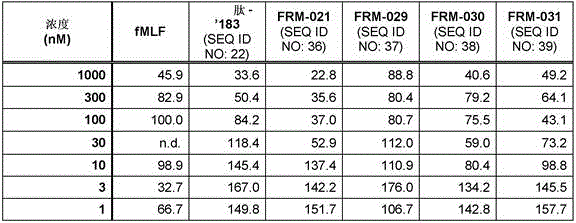
n.d. = 未测定。n.d. = not determined.
这些数据表明,对甲酰肽氨基酸序列和接头的修饰可以诱导通过FPR1介导的嗜中性粒细胞迁移。PEG连接的肽[肽-’183、FRM-021、FRM-029、FRM-030和FRM-031]在1和3 nM之间的暴露浓度下最大地诱导嗜中性粒细胞迁移。These data suggest that modifications to the formyl peptide amino acid sequence and linker can induce neutrophil migration mediated by FPR1. The PEG-linked peptides [Peptide-'183, FRM-021, FRM-029, FRM-030 and FRM-031] maximally induced neutrophil migration at exposure concentrations between 1 and 3 nM.
N-甲酰肽氨基酸序列和缀合位点在驱动PMN趋化性中的作用The role of N-formyl peptide amino acid sequences and conjugation sites in driving PMN chemotaxis
修饰人抗MET IgG4抗体(依米妥珠单抗),以包括在每条HC的CH1-S124或CH3-A378处的半胱氨酸残基。将修饰的抗体以~2:1肽:抗体比率缀合至肽-’183或f-Nle(甲酰基-Nle-Leu-Phe-PEG12-Lys(马来酰亚胺基-丙酰基)-OH)。将原代人PMN暴露于这些不同的抗体缀合物,并测量PMN迁移响应。Human anti-MET IgG4 antibody (emetuzumab) was modified to include cysteine residues at CH1-S124 or CH3-A378 of each HC. The modified antibody was conjugated to Peptide-'183 or f-Nle(formyl-Nle-Leu-Phe-PEG12-Lys(maleimido-propionyl)-OH at ~2:1 peptide:antibody ratio) ). Primary human PMNs were exposed to these different antibody conjugates and PMN migration responses were measured.
抗体-肽生物缀合物如下:依米妥珠单抗-G4-fMLFK-HC-378C、依米妥珠单抗-G4-fNle-HC-378C、依米妥珠单抗-G4-fMLFK-HC-124C和依米妥珠单抗-G4-fNle-HC-124C。Antibody-peptide bioconjugates were as follows: Emetuzumab-G4-fMLFK-HC-378C, Emetuzumab-G4-fNle-HC-378C, Emetuzumab-G4-fMLFK- HC-124C and imituzumab-G4-fNle-HC-124C.
遵循基本上如上所述的程序,与肽-’183缀合的抗体相比,fNle缀合的抗体在刺激PMN迁移方面的功效较低。在位点A378和S124处与肽-’183缀合的抗体在30 nM下最大地诱导PMN迁移,分别诱导等于fMLF对照的99.1%和117.8%的迁移响应。相比之下,fNle抗体缀合物在100 nM下最大地诱导PMN迁移,分别导致等于fMLF对照的71.7%和76.5%的迁移响应。下表5中的值作为相对于100 nM fMLF的PMN迁移百分比给出。Following a procedure essentially as described above, the fNle-conjugated antibody was less potent in stimulating PMN migration than the peptide-'183-conjugated antibody. Antibodies conjugated to peptide-'183 at sites A378 and S124 maximally induced PMN migration at 30 nM, inducing migration responses equal to 99.1% and 117.8% of the fMLF control, respectively. In contrast, the fNle antibody conjugate maximally induced PMN migration at 100 nM, resulting in migratory responses equivalent to 71.7% and 76.5% of the fMLF control, respectively. The values in Table 5 below are given as percent PMN migration relative to 100 nM fMLF.
表5. PMN朝向抗体缀合物的迁移。Table 5. Migration of PMNs towards antibody conjugates.
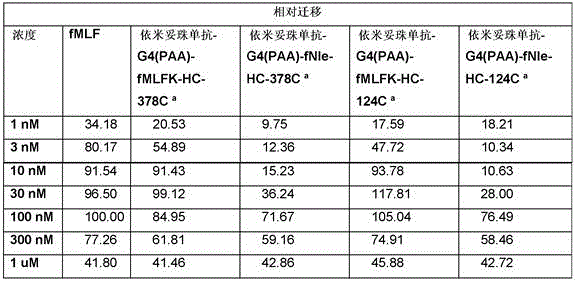
a 根据与本文实施例1的表1中所述相同的惯例来命名抗体构建体。 a Antibody constructs are named according to the same convention as described in Table 1 of Example 1 herein.
这些数据表明,在诱导PMN迁移方面,与肽-’183缀合的抗体比fNle抗体缀合物显著更有效。A378和S124位点两者均适用于N-甲酰肽缀合。These data suggest that antibodies conjugated to peptide-'183 are significantly more effective than fNle antibody conjugates in inducing PMN migration. Both the A378 and S124 sites are suitable for N-formyl peptide conjugation.
较高的肽:抗体缀合比率增加PMN迁移响应Higher peptide:antibody conjugation ratios increase PMN migration responses
在CH1-124C和378C或仅在378C处具有氨基酸修饰的人抗MET IgG4抗体(依米妥珠单抗)与肽-’183缀合。将原代人PMN暴露于这些抗体缀合物,并测量PMN迁移响应。A human anti-MET IgG4 antibody (emetuzumab) with amino acid modifications at CH1-124C and 378C or only at 378C was conjugated to peptide-'183. Primary human PMNs were exposed to these antibody conjugates and PMN migration responses were measured.
遵循基本上如上所述的程序,依米妥珠单抗-G4-fMLFK-HC-124C-378C在12.5 nM下最大地诱导迁移,且依米妥珠单抗-G4-fMLFK-HC-378C在25 nM下最大地诱导迁移,分别诱导等于fMLF对照的119.3%和124.3%的迁移响应(表6)。相对于缀合的抗体,未缀合的抗体不诱导PMN迁移。数值作为相对于3.12 nM fMLF的PMN迁移百分比给出。Following procedures essentially as described above, emetuzumab-G4-fMLFK-HC-124C-378C induced maximal migration at 12.5 nM, and emetuzumab-G4-fMLFK-HC-378C at 12.5 nM Migration was maximally induced at 25 nM, inducing migratory responses equal to 119.3% and 124.3% of the fMLF control, respectively (Table 6). In contrast to conjugated antibodies, unconjugated antibodies did not induce PMN migration. Values are given as percent PMN migration relative to 3.12 nM fMLF.
表6. PMN朝向抗体缀合物的迁移。Table 6. Migration of PMNs towards antibody conjugates.

a 根据与本文实施例1的表1中所述相同的惯例来命名抗体构建体。 a Antibody constructs are named according to the same convention as described in Table 1 of Example 1 herein.
这些数据表明,增加肽:抗体比率成比例地影响PMN迁移浓度响应关系。These data suggest that increasing the peptide:antibody ratio proportionally affects the PMN migration concentration-response relationship.
TMab(曲妥珠单抗)和AME133抗体缀合物TMab (trastuzumab) and AME133 antibody conjugate
基本上如上所述,在PMN趋化性测定中研究TMab-G1-fMLFK-HC-124C-378C、AME133-G1(IQ)-fMLFK-HC-124C-378C和依米妥珠单抗-G4-UC-124C-378C。TMab-G1-fMLFK-HC-124C-378C和AME133-G1(IQ)-fMLFK-HC-124C-378C分别在10 nM和3 nM下最大地诱导PMN迁移。相对于缀合抗体,依米妥珠单抗-G4-UC-124C-378C不诱导PMN迁移。值在下表7中给出,并且是相对于30 nM fMLF的PMN迁移百分比。TMab-G1-fMLFK-HC-124C-378C, AME133-G1(IQ)-fMLFK-HC-124C-378C and emetuzumab-G4- were investigated in PMN chemotaxis assays essentially as described above UC-124C-378C. TMab-G1-fMLFK-HC-124C-378C and AME133-G1(IQ)-fMLFK-HC-124C-378C maximally induced PMN migration at 10 nM and 3 nM, respectively. In contrast to the conjugated antibody, emetuzumab-G4-UC-124C-378C did not induce PMN migration. Values are given in Table 7 below, and are percent PMN migration relative to 30 nM fMLF.
表7. PMN朝向抗体缀合物的迁移。Table 7. Migration of PMNs towards antibody conjugates.

a 根据与本文实施例1的表1中所述相同的惯例来命名抗体构建体。 a Antibody constructs are named according to the same convention as described in Table 1 of Example 1 herein.
这些数据表明与N-甲酰肽缀合的TMab和AME133抗体有效地诱导PMN迁移。因此,据信本发明的缀合的抗体可用于利用人体的免疫系统来攻击癌细胞。These data suggest that TMab and AME133 antibodies conjugated to N-formyl peptides efficiently induce PMN migration. Accordingly, it is believed that the conjugated antibodies of the present invention can be used to utilize the body's immune system to attack cancer cells.
实施例7:PMN活性氧物质(ROS)产生Example 7: PMN reactive oxygen species (ROS) production
多形核嗜中性粒细胞(PMN)能够在刺激后产生ROS,并且含有产生ROS的酶,诸如髓过氧化物酶。PMN的刺激诱导脱颗粒,并将预先形成的ROS和产生ROS的酶释放至细胞外环境中,作为对病原体响应的主要机制。PMN对ROS产生的刺激足以破坏和杀死从细菌至真核细胞的广泛范围的靶标。刺激PMN以产生ROS的最有效途径之一涉及通过N-甲酰肽接合PMN上的甲酰肽受体1(FPR1)。抗体在PMN上的Fc-受体接合也是诱导ROS产生的有效机制。Polymorphonuclear neutrophils (PMNs) are capable of producing ROS upon stimulation and contain ROS-producing enzymes such as myeloperoxidase. Stimulation of PMNs induces degranulation and releases preformed ROS and ROS-generating enzymes into the extracellular milieu as a major mechanism in response to pathogens. Stimulation of ROS production by PMNs is sufficient to destroy and kill a wide range of targets from bacteria to eukaryotic cells. One of the most efficient ways to stimulate PMNs to generate ROS involves engagement of formyl peptide receptor 1 (FPR1) on PMNs through N-formyl peptides. Fc-receptor engagement of antibodies on PMNs is also an efficient mechanism for inducing ROS production.
人原代PMN的ROS产生使用鲁米诺扩增的化学发光法测量。分离后,将PMN以1 x10⁶个细胞/ml悬浮于含有钙和镁的HBSS (Gibco #14025-092)中,所述HBSS补充有0.25%人血清白蛋白(Gemini Bio 产品号800-124)和50 uM鲁米诺(SigmaAldrich #123072-2.5G)。然后将100 µl细胞悬浮液(1 x 10⁵个总细胞)分配至适合于荧光测量的96孔板(Greiner #655098)的每个孔中,并在37℃下平衡温度5分钟。平衡之后,将抗体缀合物的10x溶液添加至孔中,达到1x最终浓度。ROS production from human primary PMNs was measured using luminol amplified chemiluminescence. After isolation, PMNs were suspended at 1 x 10 cells/ml in HBSS containing calcium and magnesium (Gibco #14025-092) supplemented with 0.25% human serum albumin (Gemini Bio product number 800-124) and 50 uM luminol (SigmaAldrich #123072-2.5G). 100 µl of the cell suspension ( 1 x 10⁵ total cells) was then dispensed into each well of a 96-well plate (Greiner #655098) suitable for fluorescence measurements and the temperature was equilibrated at 37°C for 5 minutes. After equilibration, a 10x solution of antibody conjugate was added to the wells to a final concentration of 1x.
添加抗体缀合物后,立即在维持在37℃的光度计中记录化学发光信号,每孔停留时间为0.01秒,依次读板之间的总时间为20秒,且总运行时间为45分钟(PerkinElmerEnVision Multilabel Plate Reader)。使用来自每次运行的前5分钟的发光信号来计算曲线下面积(AUC)评分,指示每种暴露条件下初始ROS爆发的相对幅度。甲酰基-Met-Leu-Phe(fMLF)肽用作阳性对照,并且环孢菌素H用作FPR1抑制剂。值展现为最大暴露浓度下的fMLF对照的百分比((AUC暴露条件 / AUC fMLF) x 100)。Immediately after addition of the antibody conjugate, the chemiluminescent signal was recorded in a luminometer maintained at 37°C with a dwell time of 0.01 s per well, a total time between sequential plate reads of 20 s, and a total run time of 45 min ( PerkinElmerEnVision Multilabel Plate Reader). Area under the curve (AUC) scores were calculated using the luminescence signal from the first 5 min of each run, indicating the relative magnitude of the initial ROS burst for each exposure condition. Formyl-Met-Leu-Phe (fMLF) peptide was used as a positive control and cyclosporin H was used as FPR1 inhibitor. Values are presented as percentage of fMLF control at maximum exposure concentration ((AUC exposure condition/AUC fMLF) x 100).
将原代人PMN暴露于肽或生物缀合物,并且使用基本上如上所述的鲁米诺扩增化学发光法来测量ROS产生。遵循基本上如上所述的程序,与具有所示的工程改造的半胱氨酸的单克隆抗体缀合的N-甲酰肽有效地接合由原代人多形核嗜中性粒细胞表达的甲酰肽受体并刺激细胞毒性活性氧物质的产生。缀合的N-甲酰肽对ROS产生的刺激主要是FPR1依赖性的,因为FRP1拮抗剂环孢菌素H对FPR1信号传导的抑制显著降低响应于N-甲酰肽缀合的抗体的PMN ROS产生。下面显示使用特异性抗体缀合物的实例。Primary human PMNs were exposed to peptides or bioconjugates and ROS production was measured using a luminol amplification chemiluminescence method essentially as described above. Following procedures essentially as described above, N-formyl peptides conjugated to monoclonal antibodies with the indicated engineered cysteines efficaciously engage the cells expressed by primary human polymorphonuclear neutrophils. formyl peptide receptors and stimulate the production of cytotoxic reactive oxygen species. Stimulation of ROS production by conjugated N-formyl peptides was primarily FPR1-dependent, as inhibition of FPR1 signaling by the FRP1 antagonist cyclosporin H significantly reduced PMNs in response to N-formyl peptide-conjugated antibodies ROS production. Examples using specific antibody conjugates are shown below.
肽N-甲酰基修饰Peptide N-formyl modification
将原代人PMN暴露于肽,并且使用基本上如上所述的鲁米诺扩增化学发光法来测量ROS产生。数据显示于下表8中,并且数据报告为使用暴露于抗体缀合物后5分钟期间记录的发光的曲线下面积计算的相对于10uM fMLF的百分比。Primary human PMNs were exposed to peptides and ROS production was measured using luminol amplification chemiluminescence essentially as described above. The data are shown in Table 8 below, and are reported as a percentage relative to 10 uM fMLF calculated using the area under the curve of luminescence recorded during 5 minutes after exposure to the antibody conjugate.
表8a. PMN对ROS产生的刺激需要具有N-甲酰基修饰的肽。Table 8a. Stimulation of ROS production by PMNs requires peptides with N-formyl modifications.

这些数据表明,在10 nM至10 uM的浓度下,暴露于肽-’183的PMN产生比对于fMLF所观察到的更多的ROS。肽-’844刺激的ROS产生显著少于对于fMLF所观察到的,表明PMN的ROS产生的有效刺激需要肽N-甲酰基修饰。These data indicate that PMNs exposed to peptide-'183 produced more ROS than observed for fMLF at concentrations ranging from 10 nM to 10 uM. Peptide-'844 stimulated ROS production significantly less than that observed for fMLF, indicating that peptide N-formyl modification is required for efficient stimulation of ROS production by PMNs.
甲酰肽变体诱导嗜中性粒细胞ROS产生Formyl peptide variants induce neutrophil ROS production
将原代人嗜中性粒细胞暴露于具有氨基酸取代(包括合成氨基酸)的甲酰肽变体,并且使用基本上如上所述的鲁米诺扩增化学发光法来测量ROS产生。数据显示于下表8b中,并且数据报告为使用暴露于试剂后5分钟期间记录的发光的曲线下面积计算的相对于3000 nMfMLF的百分比。使用Graphpad PRISM中的最佳拟合值计算EC50值。Primary human neutrophils were exposed to formyl peptide variants with amino acid substitutions, including synthetic amino acids, and ROS production was measured using a luminol amplification chemiluminescence method essentially as described above. The data are shown in Table 8b below, and are reported as a percentage relative to 3000 nM fMLF calculated using the area under the curve of luminescence recorded during 5 minutes after exposure to the reagent. EC50 values were calculated using the best fit values in Graphpad PRISM.
表8b. PMN ROS产生Table 8b. PMN ROS production

这些数据表明例举的甲酰肽变体用于诱导ROS产生的功效。预期非编码氨基酸的并入可以改善肽稳定性,并且可以并入非编码氨基酸变体以增强甲酰肽和FPR1之间的结合,导致功效增加。These data demonstrate the efficacy of the exemplified formyl peptide variants for inducing ROS production. Incorporation of non-coding amino acids is expected to improve peptide stability, and non-coding amino acid variants may be incorporated to enhance binding between the formyl peptide and FPR1, resulting in increased efficacy.
小鼠嗜中性粒细胞FPR-1比fMLF衍生物对fMIFL肽和抗体缀合物更敏感Mouse neutrophils FPR-1 are more sensitive to fMIFL peptide and antibody conjugates than fMLF derivatives
将从骨髓纯化的小鼠嗜中性粒细胞暴露于甲酰肽或抗体缀合物,并且使用基本上如上所述的鲁米诺扩增化学发光法来测量ROS产生。数据显示于下表8c中,并且数据报告为使用暴露于试剂后5分钟期间记录的发光的曲线下面积计算的相对于10000 nM fMLF的百分比。Mouse neutrophils purified from bone marrow were exposed to formyl peptide or antibody conjugates and ROS production was measured using luminol amplification chemiluminescence essentially as described above. The data are shown in Table 8c below, and are reported as a percentage relative to 10000 nM fMLF calculated using the area under the curve of luminescence recorded during 5 minutes after exposure to the reagent.
表8c. 小鼠PMN ROS产生Table 8c. Mouse PMN ROS production

Nd = 无数据。Nd = no data.
这些数据表明,小鼠嗜中性粒细胞比fMLF变体对fMIFL肽和抗体缀合物显著更敏感。在人中,fMLF是最有效的FPR1激动剂之一,而其在小鼠实验中的功效显著较低。无论FPR1激动剂是可溶性肽还是与抗体缀合,小鼠和人嗜中性粒细胞上的FPR1之间的这种关系都是如此。These data suggest that mouse neutrophils are significantly more sensitive to fMIFL peptide and antibody conjugates than the fMLF variant. In humans, fMLF is one of the most potent FPR1 agonists, while its efficacy in mouse experiments is significantly lower. This relationship between FPR1 on mouse and human neutrophils holds true whether the FPR1 agonist is a soluble peptide or conjugated to an antibody.
TMab生物缀合物TMab bioconjugates
将原代人PMN暴露于TMab生物缀合物,并且使用基本上如上所述的鲁米诺扩增化学发光法来测量ROS产生。数据显示于下表9中,并且数据报告为使用暴露于试剂后5分钟期间记录的发光的曲线下面积计算的相对于1000 nM fMLF的百分比。Primary human PMNs were exposed to TMab bioconjugates and ROS production was measured using a luminol amplification chemiluminescence method essentially as described above. The data are shown in Table 9 below, and are reported as a percentage relative to 1000 nM fMLF calculated using the area under the curve of luminescence recorded during 5 minutes after exposure to the agent.
表9. PMN ROS产生。Table 9. PMN ROS production.

a 根据与本文实施例1的表1中所述相同的惯例来命名抗体构建体。 a Antibody constructs are named according to the same convention as described in Table 1 of Example 1 herein.
这些数据表明,暴露于1000 nM TMab-G1-fMLFK-HC-124C-378C的PMN产生ROS的水平等于fMLF对照的70.1%,并且其水平比TMab-G1-UC-HC-124C-378C高得多。These data indicate that PMNs exposed to 1000 nM TMab-G1-fMLFK-HC-124C-378C produced levels of ROS equal to 70.1% of the fMLF control and at much higher levels than TMab-G1-UC-HC-124C-378C .
依米妥珠单抗缀合物Emetuzumab Conjugate
将原代人PMN暴露于依米妥珠单抗缀合物,并且使用基本上如上所述的鲁米诺扩增化学发光法来测量ROS产生。数据显示于下表10中,并且数据报告为使用暴露于抗体缀合物后5分钟期间记录的发光的曲线下面积计算的相对于1000 nM fMLF的百分比。Primary human PMNs were exposed to the emetuzumab conjugate and ROS production was measured using a luminol amplification chemiluminescence method essentially as described above. The data are shown in Table 10 below, and are reported as a percentage relative to 1000 nM fMLF calculated using the area under the curve of luminescence recorded during 5 minutes after exposure to the antibody conjugate.
表10. PMN ROS产生。Table 10. PMN ROS production.

a 根据与本文实施例1的表1中所述相同的惯例来命名抗体构建体。 a Antibody constructs are named according to the same convention as described in Table 1 of Example 1 herein.
这些数据表明,暴露于1000 nM 依米妥珠单抗-G4-fMLFK-HC-124C-378C和依米妥珠单抗-G4-fMLFK-HC-378C的PMN产生ROS的水平分别等于1000 nM fMLF对照的62.2%和48.9%。暴露于1000 nM 依米妥珠单抗-G4-UC-HC-124C-378C生成更低的ROS产生,等于对照的仅32.2%。These data indicate that PMNs exposed to 1000 nM emetuzumab-G4-fMLFK-HC-124C-378C and emetuzumab-G4-fMLFK-HC-378C produced ROS at levels equivalent to 1000 nM fMLF, respectively 62.2% and 48.9% of the control. Exposure to 1000 nM emetuzumab-G4-UC-HC-124C-378C generated lower ROS production, equal to only 32.2% of the control.
AME133(抗CD20)缀合物AME133 (anti-CD20) conjugate
将原代人PMN暴露于AME133抗体缀合物,并且使用基本上如上所述的鲁米诺扩增化学发光法来测量ROS产生。数据显示于下表11中,并且数据报告为使用暴露于抗体缀合物后5分钟期间记录的发光的曲线下面积计算的相对于1000 nM fMLF的百分比。Primary human PMNs were exposed to AME133 antibody conjugates and ROS production was measured using a luminol amplification chemiluminescence method essentially as described above. The data are shown in Table 11 below, and are reported as percent relative to 1000 nM fMLF calculated using the area under the curve of luminescence recorded during 5 minutes after exposure to the antibody conjugate.
表11. PMN ROS产生。Table 11. PMN ROS production.

a 根据与本文实施例1的表1中所述相同的惯例来命名抗体构建体。 a Antibody constructs are named according to the same convention as described in Table 1 of Example 1 herein.
这些数据表明,暴露于1000 nM AME133- G1(IQ)-fMLFK-HC-124C-378C和AME133-UC的PMN产生ROS的水平分别等于对照的77.9%和13.9%。These data indicate that PMNs exposed to 1000 nM AME133-G1(IQ)-fMLFK-HC-124C-378C and AME133-UC produced levels of ROS equivalent to 77.9% and 13.9% of controls, respectively.
抗体缀合物和FPR1信号传导的抑制Antibody conjugates and inhibition of FPR1 signaling
为了确定缀合的抗体是否比未缀合的抗体激发更多的ROS产生,基本上如上所述测量ROS产生。所有肽均在300 nM最终浓度下进行测试。在添加肽之前,将PMN与1 uM环孢菌素H预孵育30分钟。To determine whether conjugated antibodies elicited more ROS production than unconjugated antibodies, ROS production was measured essentially as described above. All peptides were tested at a final concentration of 300 nM. PMNs were pre-incubated with 1 uM cyclosporine H for 30 min before peptide addition.
缓冲液是含有钙和镁的HBSS (Gibco #14025-092),所述HBSS补充有0.25%人血清白蛋白(Gemini Bio 产品号800-124)和50 uM鲁米诺(SigmaAldric #123072-2.5G)。值报告于下表12a中,并且表示为相对于暴露于抗体缀合物后5分钟期间记录的发光的fMLF曲线下面积计算值的百分比。The buffer was HBSS containing calcium and magnesium (Gibco #14025-092) supplemented with 0.25% human serum albumin (Gemini Bio product number 800-124) and 50 uM luminol (SigmaAldric #123072-2.5G ). Values are reported in Table 12a below, and are expressed as a percentage of the calculated area under the fMLF curve relative to the luminescence recorded during 5 min after exposure to the antibody conjugate.
表12a. PMN ROS产生。Table 12a. PMN ROS production.

a 根据与本文实施例1的表1中所述相同的惯例来命名抗体构建体。 a Antibody constructs are named according to the same convention as described in Table 1 of Example 1 herein.
这些数据表明,与未缀合的抗体相比,与fMLFK缀合的抗体激发来自人PMN的显著更多的ROS产生。数据还表明,用FPR1拮抗剂环孢菌素H预处理PMN导致抗体生物缀合物中ROS水平的显著降低,但未缀合的对照中则不会。These data suggest that antibodies conjugated to fMLFK stimulate significantly more ROS production from human PMNs compared to unconjugated antibodies. The data also showed that pretreatment of PMNs with the FPR1 antagonist cyclosporine H resulted in a significant reduction in ROS levels in antibody bioconjugates, but not in unconjugated controls.
增强FcγR3结合的抗体突变增加响应于N-甲酰肽生物缀合物的FPR1介导的ROS产 生 Antibody mutations that enhance FcγR3 binding increase FPR1-mediated ROS production in response to N-formyl peptide bioconjugates
将原代人嗜中性粒细胞暴露于Tmab N-甲酰肽缀合物,所述缀合物在Fc区中具有或不具有增加对FcγR3的亲和力的突变(247I、339Q、+/-332E突变)。基本上如上所述,使用鲁米诺扩增的化学发光来测量ROS产生。数据显示于下表12b中,并且数据报告为使用暴露于试剂后5分钟期间记录的发光的曲线下面积计算的相对于1000 nM fMLF的百分比。使用Graphpad PRISM中的最佳拟合值计算FPR1介导的ROS产生的EC50值。Primary human neutrophils were exposed to Tmab N-formyl peptide conjugates with or without mutations in the Fc region that increase affinity for FcγR3 (247I, 339Q, +/- 332E mutation). ROS production was measured using luminol amplified chemiluminescence essentially as described above. The data are shown in Table 12b below, and are reported as a percentage relative to 1000 nM fMLF calculated using the area under the curve of luminescence recorded during 5 minutes after exposure to the reagent. EC50 values for FPR1-mediated ROS production were calculated using best fit values in Graphpad PRISM.
表12b. PMN ROS产生Table 12b. PMN ROS production

a 根据与本文实施例1的表1中所述相同的惯例来命名抗体构建体。Ud = 未测定。 a Antibody constructs are named according to the same convention as described in Table 1 of Example 1 herein. Ud = not determined.
b 标记为“(IQ)”的抗体构建体在IgG1恒定区中含有额外突变:247I和339Q(根据EU编号)。 b Antibody constructs marked "(IQ)" contain additional mutations in the IgGl constant region: 247I and 339Q (according to EU numbering).
c 标记为“(IQE)”的抗体构建体在IgG1恒定区中含有额外突变:247I、332E和339Q(根据EU编号)。 c Antibody constructs labeled "(IQE)" contain additional mutations in the IgGl constant region: 247I, 332E and 339Q (according to EU numbering).
这些数据表明,可以通过优化嗜中性粒细胞的FcR接合,对N-甲酰基-Met生物缀合物进行工程改造,以进一步增强ROS产生。具有IQ和IQE氨基酸取代的Fc优化的Tmab生物缀合物相对于野生型Tmab IgG1缀合物增强嗜中性粒细胞的刺激的ROS产生,其中当与Tmab-G1-fMLFK-HC-124C-378C相比时,Tmab-G1-fMLFK-HC-124C-378C-IQ和Tmab-G1-fMLFK-HC-124C-378C-IQE变体分别显示出EC50改善2.98倍和14.9倍。预期在PMN细胞杀伤机制的活化中的Fc-工程改造的改善将在缀合的抗体介导的嗜中性粒细胞的细胞杀伤中带来实质性益处。These data suggest that N-formyl-Met bioconjugates can be engineered to further enhance ROS production by optimizing neutrophil FcR engagement. Fc-optimized Tmab bioconjugates with IQ and IQE amino acid substitutions enhance neutrophil-stimulated ROS production relative to wild-type Tmab IgG1 conjugates when combined with Tmab-G1-fMLFK-HC-124C-378C When compared, the Tmab-G1-fMLFK-HC-124C-378C-IQ and Tmab-G1-fMLFK-HC-124C-378C-IQE variants showed a 2.98-fold and 14.9-fold improvement in EC50 , respectively. Improvements in Fc-engineering in the activation of PMN cell killing mechanisms are expected to bring substantial benefits in conjugated antibody-mediated cell killing of neutrophils.
化合物接头长度Compound Connector Length
将原代人嗜中性粒细胞暴露于具有不同长度的PEG接头的N-甲酰肽Tmab缀合物,并且使用基本上如上所述的鲁米诺扩增化学发光法来测量ROS产生。数据显示于下表12c中,并且数据报告为使用暴露于试剂后5分钟期间记录的发光的曲线下面积计算的相对于3000nM FRM-023 (SEQ ID NO:40)的百分比。使用Graphpad PRISM中的最佳拟合值计算FPR1介导的ROS产生的EC50值。Primary human neutrophils were exposed to N-formyl peptide Tmab conjugates with PEG linkers of various lengths and ROS production was measured using luminol amplification chemiluminescence essentially as described above. The data are shown in Table 12c below, and are reported as percent relative to 3000 nM FRM-023 (SEQ ID NO: 40) calculated using the area under the curve of luminescence recorded during 5 minutes after exposure to the agent. EC50 values for FPR1-mediated ROS production were calculated using best fit values in Graphpad PRISM.
表12c. PMN ROS产生Table 12c. PMN ROS production

a 根据与本文实施例1的表1中所述相同的惯例来命名抗体构建体。ND= 未测定。 a Antibody constructs are named according to the same convention as described in Table 1 of Example 1 herein. ND= not determined.
这些数据表明,N-甲酰肽缀合物作为具有不同大小的PEG的FPR1激动剂维持功能性。These data suggest that N-formyl peptide conjugates maintain functionality as FPR1 agonists with PEGs of different sizes.
实施例8:抗体缀合物实现嗜中性粒细胞介导的肿瘤细胞杀伤Example 8: Antibody Conjugates Achieve Neutrophil-Mediated Tumor Cell Killing
测定抗体化合物将PMN靶向至肿瘤并参与肿瘤细胞杀伤的能力。在实体瘤和液体瘤中评价Tmab、依米妥珠单抗和AME133抗体缀合物其在肿瘤细胞杀伤中接合PMN的能力。Antibody compounds were assayed for their ability to target PMNs to tumors and participate in tumor cell killing. Tmab, emetuzumab, and AME133 antibody conjugates were evaluated for their ability to engage PMNs in tumor cell killing in solid and liquid tumors.
使用xCelligence实时细胞分析系统(ACEA Biosciences)测量PMN对肿瘤细胞的抗体靶向杀伤。该系统通过记录培养板的生长表面上的传感器之间的电阻抗来实时监控细胞活力。其报告针对平行孔中的对照细胞归一化的归一化的细胞指数(NCI),并且允许技术人员对相对培养物活力进行控制。在肿瘤培养物与靶向抗体孵育并以10:1 PMN:肿瘤细胞比率添加人原代PMN后24小时,以15分钟间隔连续连续测量NCI。在用肿瘤细胞接种之前,将xCelligence 96孔E-板针对背景信号校准。每个孔接受50 µl培养基(RPMI + 10% FBS +抗生素),并在含有xCelligence读板器的加湿培养箱中将E-板平衡至37℃。Antibody-targeted killing of tumor cells by PMNs was measured using the xCelligence Real-Time Cell Analysis System (ACEA Biosciences). The system monitors cell viability in real time by recording the electrical impedance between sensors on the growth surface of the culture plate. It reports the normalized cell index (NCI) normalized to control cells in parallel wells and allows the technician to control relative culture viability. Twenty-four hours after tumor cultures were incubated with targeting antibody and human primary PMNs were added at a 10:1 PMN:tumor cell ratio, NCI was continuously measured continuously at 15-minute intervals. The xCelligence 96-well E-plate was calibrated for background signal prior to seeding with tumor cells. Each well received 50 µl of medium (RPMI + 10% FBS + antibiotics) and E-plates were equilibrated to 37°C in a humidified incubator containing an xCelligence plate reader.
平衡后,测量背景中的E-板孔变异。将培养的肿瘤细胞系解离,计数并在培养基中稀释至1 x 10⁵个细胞/ml的最终密度,并将100 µl稀释的肿瘤细胞铺板至E-板孔中。将E-板返回至xCelligence读取器,并且以15分钟间隔测量细胞指数过夜以建立基线。After equilibration, E-plate well variation in background was measured. Cultured tumor cell lines were dissociated, counted and diluted in culture medium to a final density of 1 x 10⁵ cells/ml, and 100 µl of the diluted tumor cells were plated into E-plate wells. The E-plate was returned to the xCelligence reader and the cell index was measured overnight at 15 minute intervals to establish a baseline.
第二天,从新鲜的人血液样品分离PMN,并使其在培养基中达到2 x 10⁶个细胞/ml的最终密度。过夜记录后,从xCelligence读取器取出E-板,并将22 µl 10x抗体溶液或缓冲液添加至指定孔中。15分钟后,将50 µl稀释的PMN(总共1 x 10⁵个细胞)或缓冲液添加至指定孔中。添加PMN后,立即将E-板返回至xCelligence读取器,并测量细胞指数最长达72小时。实验完成后,将细胞指数针对紧接添加抗体之前的时间点归一化(NCI)。The next day, PMNs were isolated from fresh human blood samples and brought to a final density of 2 x 10⁶ cells/ml in culture medium. After overnight recording, remove the E-plate from the xCelligence reader and add 22 µl of 10x antibody solution or buffer to the designated wells. After 15 minutes, 50 µl of diluted PMN (total 1 x 10⁵ cells) or buffer was added to the designated wells. Immediately after PMN addition, the E-plate was returned to the xCelligence reader and cell index was measured for up to 72 hours. After the experiment was completed, the cell index was normalized to the time point immediately before antibody addition (NCI).
百分比NCI被定义为((样品的NCI)/(单独的肿瘤细胞的NCI) x 100)。对于非粘附性肿瘤细胞(Daudi细胞),根据制造商方案,使用xCelligence免疫疗法试剂盒– B细胞杀伤测定(ACEA #8100004)来将肿瘤细胞栓系至E-板孔。在栓系和背景获取之后,如上所示进行方案。Percent NCI was defined as ((NCI of sample)/(NCI of tumor cells alone) x 100). For non-adherent tumor cells (Daudi cells), tumor cells were tethered to E-plate wells using the xCelligence Immunotherapy Kit - B Cell Killing Assay (ACEA #8100004) according to the manufacturer's protocol. After tethering and background acquisition, the protocol was performed as above.
下面显示的数据表明与N-甲酰肽缀合的抗体导致肿瘤细胞的PMN介导的杀伤。The data presented below demonstrate that antibodies conjugated to N-formyl peptides result in PMN-mediated killing of tumor cells.
N-甲酰基-Met-Leu-Phe肽N-formyl-Met-Leu-Phe peptide
在SKOV3肿瘤细胞杀伤测定中评估两种N-甲酰化的肽f-Met-Leu-Phe和肽-’183,以确定在没有用单克隆抗体靶向肿瘤的情况下N-甲酰甲硫氨酸肽对PMN介导的肿瘤细胞杀伤的影响。Evaluation of two N-formylated peptides, f-Met-Leu-Phe and peptide-'183, in the SKOV3 tumor cell killing assay to determine N-formylmethyl sulfide in the absence of tumor targeting with monoclonal antibodies Effects of aminopeptides on PMN-mediated tumor cell killing.
百分比NCI值代表暴露于所述条件2小时后SKOV3细胞的相对活力。值作为针对SKOV3对照归一化的平均百分比 ± SD给出;对于所有条件,n=4。统计显著性由单向ANOVA、随后相比于“+ PMN”的事后邓尼特氏多重比较检验来确定。Percent NCI values represent the relative viability of SKOV3 cells after 2 hours exposure to the conditions. Values are given as mean percent ± SD normalized to SKOV3 control; n=4 for all conditions. Statistical significance was determined by one-way ANOVA followed by a post hoc Dunnett's multiple comparison test compared to "+PMN".
表13. 可溶性甲酰肽增强SKOV3肿瘤细胞的PMN介导的杀伤。Table 13. Soluble formyl peptides enhance PMN-mediated killing of SKOV3 tumor cells.

这些数据表明,在PMN不存在的情况下,所述肽对肿瘤细胞活力没有统计学影响。在PMN存在的情况下,这些肽仅在最高肽浓度下引起NCI的降低。These data indicate that the peptides had no statistical effect on tumor cell viability in the absence of PMNs. In the presence of PMN, these peptides caused a reduction in NCI only at the highest peptide concentrations.
TMabTMab
将粘附的HER2(+) SKOV3人腺癌肿瘤细胞铺板近似24小时,且然后与TMab-G1-fMLFK-HC-124C-378C或TMab-G1-UC-HC-124C-378C孵育,并以10:1效应靶标:细胞比率暴露于原代人PMN。Adherent HER2(+) SKOV3 human adenocarcinoma tumor cells were plated for approximately 24 hours and then incubated with TMab-G1-fMLFK-HC-124C-378C or TMab-G1-UC-HC-124C-378C and incubated with 10 :1 effector target:cell ratio exposed to primary human PMNs.
百分比NCI值代表暴露于所述条件2小时后SKOV3细胞的相对活力。值在下表14中给出,并且表示为针对SKOV3对照归一化的平均百分比 ± SD。对于所有条件,N=4。Percent NCI values represent the relative viability of SKOV3 cells after 2 hours exposure to the conditions. Values are given in Table 14 below and are expressed as mean percent ± SD normalized to the SKOV3 control. For all conditions, N=4.
表14. TMab缀合物PMN介导的SKOV3肿瘤细胞的杀伤。Table 14. TMab conjugate PMN-mediated killing of SKOV3 tumor cells.

a根据与本文实施例1的表1中所述相同的惯例来命名抗体构建体。 a Antibody constructs are named according to the same convention as described in Table 1 of Example 1 herein.
统计显著性由单向ANOVA、随后相比于“+ PMN”的事后邓尼特氏多重比较检验来确定。NCI,归一化的细胞指数。Statistical significance was determined by one-way ANOVA followed by a post hoc Dunnett's multiple comparison test compared to "+PMN". NCI, normalized cell index.
这些数据表明,在2小时后,与10 nM TMab-G1-fMLFK-HC-124C-378C孵育并暴露于PMN的细胞显示等于对照细胞的63.5 ± 9.9%的减小的归一化细胞指数(NCI)(p-值<0.0001),而暴露于10 nM TMab-G1-UC-HC-124C-378C的细胞维持对照细胞的103 ± 1.2%的NCI(统计学意不显著)。在PMN不存在的情况下,两小时后,TMab-G1-fMLFK-HC-124C-378C不降低肿瘤细胞活力,并且添加不含抗体的PMN不影响SKOV3肿瘤细胞活力。These data show that after 2 hours, cells incubated with 10 nM TMab-G1-fMLFK-HC-124C-378C and exposed to PMN showed a reduced normalized cell index (NCI) equal to 63.5 ± 9.9% of control cells ) (p-value < 0.0001), while cells exposed to 10 nM TMab-G1-UC-HC-124C-378C maintained an NCI of 103 ± 1.2% of control cells (not statistically significant). In the absence of PMN, TMab-G1-fMLFK-HC-124C-378C did not reduce tumor cell viability after two hours, and addition of PMN without antibody did not affect SKOV3 tumor cell viability.
依米妥珠单抗Emetuzumab
将粘附的MET(+) A549人肺癌细胞铺板近似24小时,然后与依米妥珠单抗-G4-fMLFK-HC-124C-375C或依米妥珠单抗-G4-UC-HC-124C-375C孵育,并以10:1效应细胞:靶细胞比率暴露于原代人PMN。Adherent MET(+) A549 human lung cancer cells were plated for approximately 24 hours and then mixed with emetuzumab-G4-fMLFK-HC-124C-375C or emetuzumab-G4-UC-HC-124C -375C incubated and exposed to primary human PMNs at a 10:1 effector:target ratio.
遵循基本上如上所述的程序,获得以下数据,并显示于表15中。Following the procedure substantially as described above, the following data were obtained and are shown in Table 15.
表15. 甲酰肽缀合的依米妥珠单抗-G4-fMLFK-HC-124C-375C抗体增强PMN介导的Table 15. Formyl peptide-conjugated imituzumab-G4-fMLFK-HC-124C-375C antibody enhances PMN-mediated A549肿瘤细胞的杀伤。Killing of A549 tumor cells.


a 根据与本文实施例1的表1中所述相同的惯例来命名抗体构建体。 a Antibody constructs are named according to the same convention as described in Table 1 of Example 1 herein.
百分比NCI值代表暴露于所述条件2小时后A549细胞的相对活力。值作为针对“ +PMN”对照归一化的平均百分比 ± SD给出;对于所有条件,n=4。统计显著性由单向ANOVA、随后相比于“+ PMN”的事后邓尼特氏多重比较检验来确定。NCI,归一化的细胞指数;PMN,原代人多形核嗜中性粒细胞;ns,不显著。Percent NCI values represent the relative viability of A549 cells after 2 hours exposure to the conditions. Values are given as mean percent ± SD normalized to the "+PMN" control; n=4 for all conditions. Statistical significance was determined by one-way ANOVA followed by a post hoc Dunnett's multiple comparison test compared to "+PMN". NCI, normalized cell index; PMN, primary human polymorphonuclear neutrophils; ns, not significant.
这些数据表明,在PMN存在的情况下暴露于10 nM 依米妥珠单抗-G4-fMLFK-HC-124C-375C的培养物在2小时孵育后显示等于对照细胞的87.7 ± 0.9%的降低的NCI,而依米妥珠单抗-G4-UC-HC-124C-375C处理的细胞维持对照细胞的NCI 102.5 ± 1.9%。These data indicate that cultures exposed to 10 nM emetuzumab-G4-fMLFK-HC-124C-375C in the presence of PMNs showed a reduction in NCI, while emetuzumab-G4-UC-HC-124C-375C-treated cells maintained an NCI of 102.5 ± 1.9% of control cells.
AME133实施例AME133 Example
将非粘附的CD20 + Daudi B淋巴母细胞用xCelligence Immunotherapy Kit (ACEA #8100004)根据制造商方案固定,以将肿瘤细胞栓系至E-Plate孔,并使其暴露于下表16中显示的条件。百分比NCI值代表暴露于所述条件6小时后DAUDI细胞的相对活力。值作为针对“缓冲液对照”归一化的平均百分比 ± SD给出;对于所有条件,n=4。统计显著性由单向ANOVA、随后相比于“+ PMN”的事后邓尼特氏多重比较检验来确定。Non-adherent CD20+ Daudi B lymphoblasts were fixed with the xCelligence Immunotherapy Kit (ACEA #8100004) according to the manufacturer's protocol to tether tumor cells to the E-Plate wells and exposed to the following table 16. condition. Percent NCI values represent the relative viability of DAUDI cells after 6 hours exposure to the conditions. Values are given as mean percent ± SD normalized to "buffer control"; n=4 for all conditions. Statistical significance was determined by one-way ANOVA followed by a post hoc Dunnett's multiple comparison test compared to "+PMN".
表16. 甲酰肽缀合的AME133抗体增强PMN介导的DAUDI肿瘤细胞的杀伤。Table 16. Formyl peptide-conjugated AME133 antibody enhances PMN-mediated killing of DAUDI tumor cells.


a 根据与本文实施例1的表1中所述相同的惯例来命名抗体构建体。 a Antibody constructs are named according to the same convention as described in Table 1 of Example 1 herein.
这些数据表明,暴露于30 nM AME133-G1(IQ)-fMLFK-124C-378C的培养物在6小时孵育后具有等于对照细胞的20 ± 2.1%的降低的NCI (p-值<0.0001),而与30 nM AME133-G1(IQ)-UC-124C-378C孵育的培养物维持对照细胞的97.3 ± 1.2%的NCI。AME133-G1(IQ)-fMLFK-124C-378C和AME133-G1(IQ)-UC-124C-378C在PMN不存在的情况下没有降低肿瘤细胞活力。然而,在抗体不存在的情况下,Daudi细胞暴露于PMN使肿瘤培养物NCI降低至对照细胞的66.9 ± 5.2% (p-值<0.0001)。These data show that cultures exposed to 30 nM AME133-G1(IQ)-fMLFK-124C-378C had a reduced NCI equivalent to 20 ± 2.1% of control cells after 6 hours of incubation (p-value < 0.0001), while Cultures incubated with 30 nM AME133-G1(IQ)-UC-124C-378C maintained an NCI of 97.3 ± 1.2% of control cells. AME133-G1(IQ)-fMLFK-124C-378C and AME133-G1(IQ)-UC-124C-378C did not reduce tumor cell viability in the absence of PMN. However, exposure of Daudi cells to PMN in the absence of antibody reduced tumor culture NCI to 66.9 ± 5.2% of control cells (p-value < 0.0001).
甲酰肽与单一抗体缀合物的多个半胱氨酸的缀合增加功效Conjugation of formyl peptides to multiple cysteines of a single antibody conjugate increases efficacy
将原代人嗜中性粒细胞暴露于具有不同数目的工程改造的半胱氨酸缀合位点的IgG4抗体缀合物,并且使用基本上如上所述的鲁米诺扩增化学发光法来测量ROS产生。遵循基本上如上所述的程序,获得以下数据。Primary human neutrophils were exposed to IgG4 antibody conjugates with varying numbers of engineered cysteine conjugation sites, and luminol amplification chemiluminescence was used essentially as described above. ROS production was measured. Following the procedure essentially as described above, the following data were obtained.
表17. PMN ROS产生。Table 17. PMN ROS production.
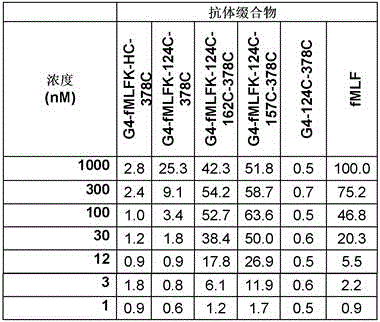
表17中的数据被报告为使用暴露于试剂后5分钟期间记录的发光的曲线下面积计算的相对于1000 nM fMLF的百分比。The data in Table 17 are reported as percent relative to 1000 nM fMLF calculated using the area under the curve of luminescence recorded during 5 minutes after exposure to the reagent.
这些数据表明,与fMLFK缀合的抗体可以用额外缀合位点变得更有效。These data suggest that antibodies conjugated to fMLFK can be made more efficient with additional conjugation sites.
说明性实施方案Illustrative Implementation
以下包含根据本公开的说明性实施方案的列表,其代表本公开的各个实施方案。这些说明性实施方案并非旨在穷举或将本公开内容限制为所公开的精确形式,而是提供这些说明性实施方案以帮助进一步描述本公开内容,使得本领域的其他技术人员可以利用其教导。The following contains a list of illustrative embodiments in accordance with the present disclosure, which are representative of various embodiments of the present disclosure. These illustrative embodiments are not intended to be exhaustive or to limit the disclosure to the precise forms disclosed, but are provided to help further describe the disclosure so that others skilled in the art may utilize its teachings .
1. 包含IgG重链恒定区和轻链恒定区的抗体,其中所述抗体包含以下残基中的至少一个处的半胱氨酸:CH1结构域中的残基124,CH1结构域中的残基157,CH1结构域中的残基162,CH2结构域中的残基262,CH3结构域中的残基375,CH3结构域中的残基373,CH3结构域中的残基397,CH3结构域中的残基415,Cκ结构域中的残基156,Cκ结构域中的残基171,Cκ结构域中的残基191,Cκ结构域中的残基193,Cκ结构域中的残基202,或Cκ结构域中的残基208。1. An antibody comprising an IgG heavy chain constant region and a light chain constant region, wherein the antibody comprises a cysteine at at least one of the following residues: residue 124 in the CH1 domain, residues in the CH1 domain Base 157, residue 162 in CH1 domain, residue 262 in CH2 domain, residue 375 in CH3 domain, residue 373 in CH3 domain, residue 397 in CH3 domain, CH3 structure Residue 415 in the domain, residue 156 in the Cκ domain, residue 171 in the Cκ domain, residue 191 in the Cκ domain, residue 193 in the Cκ domain, residue in the Cκ domain 202, or residue 208 in the CK domain.
2. 实施方案1的抗体,其中所述抗体包含CH1结构域的残基124处的半胱氨酸,且进一步包含CH1结构域中的残基157和162以及CH3结构域中的残基375和378中的一个、但不是全部处的半胱氨酸。2. The antibody of embodiment 1, wherein the antibody comprises a cysteine at residue 124 in the CH1 domain, and further comprises residues 157 and 162 in the CH1 domain and residues 375 and 162 in the CH3 domain. 378 cysteines at one, but not all, of 378.
3. 实施方案1或2的抗体,其中所述抗体在CH1结构域的残基157处包含半胱氨酸。3. The antibody of embodiment 1 or 2, wherein the antibody comprises a cysteine at residue 157 of the CH1 domain.
4. 实施方案2的抗体,其中所述抗体在CH3结构域的残基375处包含半胱氨酸。4. The antibody of embodiment 2, wherein the antibody comprises a cysteine at residue 375 of the CH3 domain.
5. 实施方案2的抗体,其中所述抗体在CH3结构域的残基378处包含半胱氨酸。5. The antibody of embodiment 2, wherein the antibody comprises a cysteine at residue 378 of the CH3 domain.
6. 实施方案1至4中任一项的抗体,其中所述IgG重链恒定区是人、小鼠、大鼠或兔IgG恒定区。6. The antibody of any one of embodiments 1 to 4, wherein the IgG heavy chain constant region is a human, mouse, rat or rabbit IgG constant region.
7. 实施方案5的抗体,其中所述IgG重链恒定区是人IgG1或人IgG4同种型。7. The antibody of embodiment 5, wherein the IgG heavy chain constant region is of human IgGl or human IgG4 isotype.
8. 实施方案6的抗体,其中所述IgG重链恒定区是人IgG1。8. The antibody of embodiment 6, wherein the IgG heavy chain constant region is human IgGl.
9. 实施方案1的抗体,其中所述重链恒定区是由SEQ ID NO:17、18、19或52的氨基酸序列给出的人IgG1。9. The antibody of embodiment 1, wherein the heavy chain constant region is human IgGl as given by the amino acid sequence of SEQ ID NO: 17, 18, 19 or 52.
10. 实施方案2的抗体,其中所述重链恒定区是由SEQ ID NO:20、21或53的氨基酸序列给出的人IgG1。10. The antibody of embodiment 2, wherein the heavy chain constant region is human IgGl as given by the amino acid sequence of SEQ ID NO: 20, 21 or 53.
11. 根据实施方案7至9中任一项所述的抗体,其中所述IgG1重链恒定区进一步包含在残基247处取代的异亮氨酸、在残基339处取代的谷氨酰胺和任选地在残基332处取代的谷氨酸。11. The antibody of any one of embodiments 7 to 9, wherein the IgGl heavy chain constant region further comprises isoleucine substituted at residue 247, glutamine substituted at residue 339, and Glutamate optionally substituted at residue 332.
12. 实施方案6的抗体,其中所述IgG重链恒定区是人IgG4。12. The antibody of embodiment 6, wherein the IgG heavy chain constant region is human IgG4.
13. 实施方案1的抗体,其中所述重链恒定区是由SEQ ID NO:12、13、14、54或55的氨基酸序列给出的人IgG4。13. The antibody of embodiment 1, wherein the heavy chain constant region is human IgG4 given by the amino acid sequence of SEQ ID NO: 12, 13, 14, 54 or 55.
14. 实施方案2的抗体,其中所述重链恒定区是由SEQ ID NO:15、16、56或57的氨基酸序列给出的人IgG4。14. The antibody of embodiment 2, wherein the heavy chain constant region is human IgG4 given by the amino acid sequence of SEQ ID NO: 15, 16, 56 or 57.
15. 根据实施方案11至13中任一项所述的抗体,其中所述IgG4重链恒定区进一步包含在残基228处取代的脯氨酸、在残基234处取代的丙氨酸和在残基235处取代的丙氨酸和在残基339处取代的谷氨酰胺。15. The antibody of any one of embodiments 11 to 13, wherein the IgG4 heavy chain constant region further comprises a proline substituted at residue 228, an alanine substituted at residue 234, and a Alanine substituted at residue 235 and glutamine substituted at residue 339.
16. 根据实施方案1所述的抗体,其包含两条重链和两条轻链,其中每条重链包含IgG重链恒定区,所述IgG重链恒定区包含以下残基之一处的半胱氨酸:CH1结构域中的残基124,CH3结构域中的残基375,和CH3结构域中的残基373。16. The antibody of embodiment 1, comprising two heavy chains and two light chains, wherein each heavy chain comprises an IgG heavy chain constant region comprising a Cysteine: residue 124 in the CH1 domain, residue 375 in the CH3 domain, and residue 373 in the CH3 domain.
17. 实施方案15的抗体,其中所述抗体包含每条重链的CH1结构域的残基124处的半胱氨酸,且进一步包含每条重链的CH3结构域中的残基375和378以及CH1结构域中的残基157中的一个、但不是全部处的半胱氨酸。17. The antibody of embodiment 15, wherein the antibody comprises a cysteine at residue 124 in the CH1 domain of each heavy chain, and further comprises residues 375 and 378 in the CH3 domain of each heavy chain and cysteines at one, but not all, of residues 157 in the CH1 domain.
18. 实施方案16的抗体,其中所述抗体在每条重链的CH3结构域的残基375处包含半胱氨酸。18. The antibody of embodiment 16, wherein the antibody comprises a cysteine at residue 375 of the CH3 domain of each heavy chain.
19. 实施方案16的抗体,其中所述抗体在每条重链的CH3结构域的残基378处包含半胱氨酸。19. The antibody of embodiment 16, wherein the antibody comprises a cysteine at residue 378 of the CH3 domain of each heavy chain.
20. 实施方案15至18中任一项的抗体,其中所述IgG重链恒定区各自是人、小鼠、大鼠或兔IgG恒定区。20. The antibody of any one of embodiments 15 to 18, wherein the IgG heavy chain constant regions are each a human, mouse, rat or rabbit IgG constant region.
21. 实施方案19的抗体,其中所述IgG重链恒定区各自是人IgG1或人IgG4同种型。21. The antibody of embodiment 19, wherein the IgG heavy chain constant regions are each of the human IgGl or human IgG4 isotype.
22. 实施方案20的抗体,其中所述IgG重链恒定区各自是人IgG1。22. The antibody of embodiment 20, wherein the IgG heavy chain constant regions are each human IgGl.
23. 实施方案15的抗体,其中所述重链恒定区各自是由SEQ ID NO:17、18、19或52的氨基酸序列给出的人IgG1。23. The antibody of embodiment 15, wherein each of the heavy chain constant regions is a human IgG1 given by the amino acid sequence of SEQ ID NO: 17, 18, 19 or 52.
24. 实施方案16的抗体,其中所述重链恒定区各自是由SEQ ID NO:20、21或53的氨基酸序列给出的人IgG1。24. The antibody of embodiment 16, wherein each of the heavy chain constant regions is human IgGl as given by the amino acid sequence of SEQ ID NO: 20, 21 or 53.
25. 根据实施方案21至23中任一项所述的抗体,其中所述IgG1重链恒定区各自进一步包含在残基247处取代的异亮氨酸、在残基339处取代的谷氨酰胺和任选地在残基332处取代的谷氨酸。25. The antibody of any one of embodiments 21 to 23, wherein the IgGl heavy chain constant regions each further comprise isoleucine substituted at residue 247, glutamine substituted at residue 339 and an optionally substituted glutamic acid at residue 332.
26. 实施方案20的抗体,其中所述IgG重链恒定区各自是人IgG4。26. The antibody of embodiment 20, wherein the IgG heavy chain constant regions are each human IgG4.
27. 实施方案15的抗体,其中所述重链恒定区各自是由SEQ ID NO:12、13、14、54或55的氨基酸序列给出的人IgG4。27. The antibody of embodiment 15, wherein each of the heavy chain constant regions is a human IgG4 given by the amino acid sequence of SEQ ID NO: 12, 13, 14, 54 or 55.
28. 实施方案16的抗体,其中所述重链恒定区各自是由SEQ ID NO:15、16、56或57的氨基酸序列给出的人IgG4。28. The antibody of embodiment 16, wherein the heavy chain constant regions are each a human IgG4 given by the amino acid sequence of SEQ ID NO: 15, 16, 56 or 57.
29. 根据实施方案25至27中任一项所述的抗体,其中所述IgG4重链恒定区各自进一步包含在残基228处取代的脯氨酸、在残基234处取代的丙氨酸和在残基235处取代的丙氨酸和在残基339处取代的谷氨酰胺。29. The antibody of any one of embodiments 25 to 27, wherein the IgG4 heavy chain constant regions each further comprise proline substituted at residue 228, alanine substituted at residue 234, and Alanine substituted at residue 235 and glutamine substituted at residue 339.
30. 根据实施方案1-28中任一项所述的抗体,其中每个IgG恒定区的残基124、157、162、375或378处的每个半胱氨酸经由马来酰亚胺-PEG接头缀合至N-甲酰-甲硫氨酸肽。30. The antibody of any one of embodiments 1-28, wherein each cysteine at residue 124, 157, 162, 375 or 378 of each IgG constant region is via a maleimide- The PEG linker was conjugated to the N-formyl-methionine peptide.
31. 实施方案29的缀合的抗体,其包含在每个IgG恒定区的残基124处的半胱氨酸和每个IgG恒定区的残基157、162、375和378中的一个、但不是全部处的半胱氨酸,其中每个IgG恒定区的残基124和157、162、375或378处的每个半胱氨酸经由下式的马来酰亚胺-PEG接头缀合至N-甲酰-甲硫氨酸肽31. The conjugated antibody of embodiment 29 comprising a cysteine at residue 124 of each IgG constant region and one of residues 157, 162, 375 and 378 of each IgG constant region, but Cysteines at not all, wherein each cysteine at residues 124 and 157, 162, 375 or 378 of each IgG constant region is conjugated to via a maleimide-PEG linker of the formula N-formyl-methionine peptide

其中所述接头通过与所述IgG恒定区的残基124和157、162、375或378处的半胱氨酸的硫醚键共价附接至所述抗体,并且通过肽的C-末端赖氨酸的ε氨基处的酰胺键共价附接至所述N-甲酰-甲硫氨酸肽;且其中n = 6-24。wherein the linker is covalently attached to the antibody via a thioether bond with cysteines at residues 124 and 157, 162, 375 or 378 of the IgG constant region, and via the C-terminal linker of the peptide An amide bond at the epsilon amino group of the amino acid is covalently attached to the N-formyl-methionine peptide; and wherein n=6-24.
32. 实施方案30的缀合的抗体,其中每个IgG恒定区的残基124处的半胱氨酸和残基375处的半胱氨酸经由所述马来酰亚胺-PEG接头缀合至所述N-甲酰甲硫氨酸肽。32. The conjugated antibody of embodiment 30, wherein the cysteine at residue 124 and the cysteine at residue 375 of each IgG constant region are conjugated via the maleimide-PEG linker to the N-formylmethionine peptide.
33. 实施方案30的缀合的抗体,其中每个IgG恒定区的残基124处的半胱氨酸和残基378处的半胱氨酸经由所述马来酰亚胺-PEG接头缀合至所述N-甲酰甲硫氨酸肽。33. The conjugated antibody of embodiment 30, wherein the cysteine at residue 124 and the cysteine at residue 378 of each IgG constant region are conjugated via the maleimide-PEG linker to the N-formylmethionine peptide.
34. 实施方案30至32中任一项的缀合的抗体,其中n = 12。34. The conjugated antibody of any one of embodiments 30 to 32, wherein n=12.
35. 实施方案29至33中任一项的缀合的抗体,其中所述N-甲酰甲硫氨酸肽由SEQID NO:22、SEQ ID NO:23、SEQ ID NO:36、SEQ ID NO:37、SEQ ID NO:38、SEQ ID NO:39、SEQID NO:40或SEQ ID NO:41给出。35. The conjugated antibody of any one of embodiments 29 to 33, wherein the N-formylmethionine peptide consists of SEQ ID NO: 22, SEQ ID NO: 23, SEQ ID NO: 36, SEQ ID NO :37, SEQ ID NO:38, SEQ ID NO:39, SEQ ID NO:40 or SEQ ID NO:41 are given.
36. 药物组合物,其包含实施方案29至34中任一项的缀合的抗体和一种或多种药学上可接受的载体、稀释剂或赋形剂。36. A pharmaceutical composition comprising the conjugated antibody of any one of embodiments 29 to 34 and one or more pharmaceutically acceptable carriers, diluents or excipients.
37. 治疗实体癌或液体肿瘤的方法,其包括向有需要的患者施用有效量的根据实施方案29至35中任一项的缀合的抗体或其药物组合物。37. A method of treating a solid or liquid tumor comprising administering to a patient in need thereof an effective amount of a conjugated antibody according to any one of embodiments 29 to 35, or a pharmaceutical composition thereof.
38. 根据实施方案36所述的方法,其用于治疗乳腺癌、肺癌、前列腺癌、皮肤癌、结肠直肠癌、膀胱癌、肾癌、肝癌、甲状腺癌、子宫内膜癌、肌肉癌、骨癌、间皮癌、血管癌、纤维状癌、白血病或淋巴瘤。38. The method of embodiment 36 for the treatment of breast cancer, lung cancer, prostate cancer, skin cancer, colorectal cancer, bladder cancer, kidney cancer, liver cancer, thyroid cancer, endometrial cancer, muscle cancer, bone cancer carcinoma, mesothelial carcinoma, vascular carcinoma, fibrous carcinoma, leukemia or lymphoma.
39. 实施方案29至35中任一项的缀合的抗体,其用于疗法中。39. The conjugated antibody of any one of embodiments 29 to 35, for use in therapy.
40. 实施方案29至35中任一项的缀合的抗体,其用于治疗实体癌或液体肿瘤。40. The conjugated antibody of any one of embodiments 29 to 35 for use in the treatment of solid or liquid tumors.
41. 实施方案39的缀合的抗体,用于治疗乳腺癌、肺癌、前列腺癌、皮肤癌、结肠直肠癌、膀胱癌、肾癌、肝癌、甲状腺癌、子宫内膜癌、肌肉癌、骨癌、间皮癌、血管癌、纤维状癌、白血病或淋巴瘤。41. The conjugated antibody of embodiment 39 for the treatment of breast cancer, lung cancer, prostate cancer, skin cancer, colorectal cancer, bladder cancer, kidney cancer, liver cancer, thyroid cancer, endometrial cancer, muscle cancer, bone cancer , mesothelial carcinoma, vascular carcinoma, fibrous carcinoma, leukemia or lymphoma.
42. 化合物,其为包含至少一个工程改造的半胱氨酸的抗体,其中所述抗体通过接头缀合至能够吸引和/或活化免疫系统的一种或多种细胞的化学引诱物,且其中所述化学引诱物在抗体内的一个或多个半胱氨酸残基处缀合至抗体。42. A compound that is an antibody comprising at least one engineered cysteine, wherein the antibody is conjugated to a chemoattractant capable of attracting and/or activating one or more cells of the immune system through a linker, and wherein The chemoattractant is conjugated to the antibody at one or more cysteine residues within the antibody.
43. 实施方案42的化合物,其中所述抗体是单克隆抗体或双特异性抗体。43. The compound of embodiment 42, wherein the antibody is a monoclonal antibody or a bispecific antibody.
44. 实施方案42的化合物,其中所述抗体是单克隆抗体。44. The compound of embodiment 42, wherein the antibody is a monoclonal antibody.
45. 实施方案42的化合物,其中所述抗体是双特异性抗体。45. The compound of embodiment 42, wherein the antibody is a bispecific antibody.
46. 实施方案42-45中任一项的化合物,其中所述半胱氨酸是抗体可变区内的工程改造的半胱氨酸。46. The compound of any one of embodiments 42-45, wherein the cysteine is an engineered cysteine within an antibody variable region.
47. 实施方案42-45中任一项的化合物,其中所述半胱氨酸是抗体恒定区内的工程改造的半胱氨酸。47. The compound of any one of embodiments 42-45, wherein the cysteine is an engineered cysteine within an antibody constant region.
48. 实施方案42-45中任一项的化合物,其中所述半胱氨酸是CH1或CH3结构域内的工程改造的半胱氨酸。48. The compound of any one of embodiments 42-45, wherein the cysteine is an engineered cysteine within a CH1 or CH3 domain.
49. 实施方案42-48中任一项的化合物,其中所述半胱氨酸在替代天然的丝氨酸、缬氨酸、丙氨酸、谷氨酰胺、天冬酰胺、苏氨酸或甘氨酸的位置被工程改造。49. The compound of any one of embodiments 42-48, wherein the cysteine is in a position that replaces a natural serine, valine, alanine, glutamine, asparagine, threonine, or glycine Remodeled by engineering.
50. 实施方案49的化合物,其中所述半胱氨酸在替代天然的丝氨酸、缬氨酸或丙氨酸的位置被工程改造。50. The compound of embodiment 49, wherein the cysteine is engineered in place of a native serine, valine, or alanine.
51. 实施方案42-50中任一项的化合物,其中所述工程改造的半胱氨酸的总数在2和6之间。51. The compound of any one of embodiments 42-50, wherein the total number of engineered cysteines is between 2 and 6.
52. 实施方案42-51中任一项的化合物,其中所述化合物能够吸引和活化免疫系统的一种或多种细胞。52. The compound of any one of embodiments 42-51, wherein the compound is capable of attracting and activating one or more cells of the immune system.
53. 实施方案42-52中任一项的化合物,其中所述免疫系统是适应性免疫系统。53. The compound of any one of embodiments 42-52, wherein the immune system is the adaptive immune system.
54. 实施方案42-52中任一项的化合物,其中所述免疫系统是先天性免疫系统。54. The compound of any one of embodiments 42-52, wherein the immune system is the innate immune system.
55. 实施方案42-52中任一项的化合物,其中所述免疫系统的一种或多种细胞是嗜中性粒细胞。55. The compound of any one of embodiments 42-52, wherein the one or more cells of the immune system are neutrophils.
56. 实施方案42-52中任一项的化合物,其中所述免疫系统的一种或多种细胞是巨噬细胞。56. The compound of any one of embodiments 42-52, wherein the one or more cells of the immune system are macrophages.
57. 实施方案42-56中任一项的化合物,其中所述接头是PEG接头或Mal-Dap接头。57. The compound of any one of embodiments 42-56, wherein the linker is a PEG linker or a Mal-Dap linker.
58. 实施方案57的化合物,其中所述接头是PEG接头。58. The compound of embodiment 57, wherein the linker is a PEG linker.
59. 实施方案57的化合物,其中所述接头是Mal-Dap接头。59. The compound of embodiment 57, wherein the linker is a Mal-Dap linker.
60. 实施方案42-58中任一项的化合物,其中所述抗体包含IgG重链恒定区和轻链恒定区,其中所述恒定区包含以下残基中的至少一个处的工程改造的半胱氨酸:CH1结构域中的残基124,CH1结构域中的残基157,CH1结构域中的残基162,CH2结构域中的残基262,CH3结构域中的残基375,CH3结构域中的残基373,CH3结构域中的残基397,CH3结构域中的残基415,Cκ结构域中的残基156,Cκ结构域中的残基171,Cκ结构域中的残基191,Cκ结构域中的残基193,Cκ结构域中的残基202,或Cκ结构域中的残基208。60. The compound of any one of embodiments 42-58, wherein the antibody comprises an IgG heavy chain constant region and a light chain constant region, wherein the constant region comprises an engineered cysteine at least one of the following residues Amino acids: residue 124 in CH1 domain, residue 157 in CH1 domain, residue 162 in CH1 domain, residue 262 in CH2 domain, residue 375 in CH3 domain, CH3 structure Residue 373 in domain, residue 397 in CH3 domain, residue 415 in CH3 domain, residue 156 in Cκ domain, residue 171 in Cκ domain, residue in Cκ domain 191, residue 193 in the CK domain, residue 202 in the CK domain, or residue 208 in the CK domain.
61. 实施方案60的化合物,其中所述抗体包含CH1结构域的残基124处的半胱氨酸,且进一步包含CH1结构域中的残基157和162以及CH3结构域中的残基375和378中的一个、但不是全部处的半胱氨酸。61. The compound of embodiment 60, wherein the antibody comprises a cysteine at residue 124 in the CH1 domain, and further comprises residues 157 and 162 in the CH1 domain and residues 375 and 162 in the CH3 domain. 378 cysteines at one, but not all, of 378.
62. 实施方案61的化合物,其中所述抗体在CH1结构域的残基157处包含半胱氨酸。62. The compound of embodiment 61, wherein the antibody comprises a cysteine at residue 157 of the CH1 domain.
63. 实施方案61的化合物,其中所述抗体在CH3结构域的残基375处包含半胱氨酸。63. The compound of embodiment 61, wherein the antibody comprises a cysteine at residue 375 of the CH3 domain.
64. 实施方案61的化合物,其中所述抗体在CH3结构域的残基378处包含半胱氨酸。64. The compound of embodiment 61, wherein the antibody comprises a cysteine at residue 378 of the CH3 domain.
65. 实施方案42-64中任一项的化合物,其中所述IgG重链恒定区是人、小鼠、大鼠或兔IgG恒定区。65. The compound of any one of embodiments 42-64, wherein the IgG heavy chain constant region is a human, mouse, rat or rabbit IgG constant region.
66. 实施方案65的化合物,其中所述IgG重链恒定区是人IgG1或人IgG4同种型。66. The compound of embodiment 65, wherein the IgG heavy chain constant region is of human IgGl or human IgG4 isotype.
67. 实施方案66的化合物,其中所述IgG重链恒定区是人IgG1。67. The compound of embodiment 66, wherein the IgG heavy chain constant region is human IgGl.
68. 实施方案67的化合物,其中所述重链恒定区是由SEQ ID NO:17、18、19或52的氨基酸序列给出的人IgG1。68. The compound of embodiment 67, wherein the heavy chain constant region is human IgGl given by the amino acid sequence of SEQ ID NO: 17, 18, 19 or 52.
69. 实施方案67的化合物,其中所述重链恒定区是由SEQ ID NO:20、21或53的氨基酸序列给出的人IgG1。69. The compound of embodiment 67, wherein the heavy chain constant region is human IgGl as given by the amino acid sequence of SEQ ID NO: 20, 21 or 53.
70. 实施方案66-69中任一项的化合物,其中所述IgG1重链恒定区进一步包含在残基247处取代的异亮氨酸、在残基339处取代的谷氨酰胺和任选地在残基332处取代的谷氨酸。70. The compound of any one of embodiments 66-69, wherein the IgGl heavy chain constant region further comprises isoleucine substituted at residue 247, glutamine substituted at residue 339 and optionally Glutamate substituted at residue 332.
71. 实施方案66的化合物,其中所述IgG重链恒定区是人IgG4。71. The compound of embodiment 66, wherein the IgG heavy chain constant region is human IgG4.
72. 实施方案71的化合物,其中所述重链恒定区是由SEQ ID NO:12、13、14、54或55的氨基酸序列给出的人IgG4。72. The compound of embodiment 71, wherein the heavy chain constant region is human IgG4 given by the amino acid sequence of SEQ ID NO: 12, 13, 14, 54 or 55.
73. 实施方案71的化合物,其中所述重链恒定区是由SEQ ID NO:15、16、56或57的氨基酸序列给出的人IgG4。73. The compound of embodiment 71, wherein the heavy chain constant region is human IgG4 given by the amino acid sequence of SEQ ID NO: 15, 16, 56 or 57.
74. 根据实施方案71-73中任一项所述的抗体,其中所述IgG4重链恒定区进一步包含在残基228处取代的脯氨酸、在残基234处取代的丙氨酸和在残基235处取代的丙氨酸和在残基339处取代的谷氨酰胺。74. The antibody of any one of embodiments 71-73, wherein the IgG4 heavy chain constant region further comprises a proline substituted at residue 228, an alanine substituted at residue 234, and a Alanine substituted at residue 235 and glutamine substituted at residue 339.
75. 实施方案42-74中任一项的化合物,其中所述化学引诱物是f-Met肽、小分子FPR-1激动剂、PRR激动剂、肽模拟物、N-脲基-肽或细菌糖。75. The compound of any one of embodiments 42-74, wherein the chemoattractant is an f-Met peptide, a small molecule FPR-1 agonist, a PRR agonist, a peptidomimetic, an N-ureido-peptide, or a bacterium sugar.
76. 实施方案75的化合物,其中所述化学引诱物是N-甲酰甲硫氨酸肽。76. The compound of embodiment 75, wherein the chemoattractant is an N-formylmethionine peptide.
77. 实施方案76的化合物,其中所述N-甲酰肽由SEQ ID NO:22、SEQ ID NO:23、SEQ ID NO:36、SEQ ID NO:37、SEQ ID NO:38、SEQ ID NO:39、SEQ ID NO:40或SEQ ID NO:41给出。77. The compound of embodiment 76, wherein the N-formyl peptide consists of SEQ ID NO:22, SEQ ID NO:23, SEQ ID NO:36, SEQ ID NO:37, SEQ ID NO:38, SEQ ID NO :39, SEQ ID NO:40 or SEQ ID NO:41 are given.
78. 实施方案42-78中任一项的化合物,其中所述半胱氨酸经由马来酰亚胺-PEG接头缀合至化学引诱物。78. The compound of any one of embodiments 42-78, wherein the cysteine is conjugated to a chemoattractant via a maleimide-PEG linker.
79. 实施方案78的化合物,其中所述半胱氨酸经由下式的马来酰亚胺-PEG接头缀合至化学引诱物79. The compound of embodiment 78, wherein the cysteine is conjugated to a chemoattractant via a maleimide-PEG linker of the formula

其中所述接头通过与半胱氨酸的硫醚键共价附接至所述抗体,且通过肽的C-末端赖氨酸的ε氨基处的酰胺键共价附接至所述化学引诱物;且其中n = 2-24。wherein the linker is covalently attached to the antibody via a thioether bond to cysteine and to the chemoattractant via an amide bond at the epsilon amino group of the C-terminal lysine of the peptide ; and where n = 2-24.
80. 实施方案79的化合物,其中n = 12。80. The compound of embodiment 79, wherein n=12.
81. 药物组合物,其包含实施方案42-80中任一项的化合物和一种或多种药学上可接受的载体、稀释剂或赋形剂。81. A pharmaceutical composition comprising a compound of any one of embodiments 42-80 and one or more pharmaceutically acceptable carriers, diluents or excipients.
82. 治疗实体癌或液体肿瘤的方法,其包括向有需要的患者施用有效量的根据实施方案42-81中任一项的化合物或其药物组合物。82. A method of treating a solid or liquid tumor comprising administering to a patient in need thereof an effective amount of a compound according to any one of embodiments 42-81 or a pharmaceutical composition thereof.
83. 根据实施方案82所述的方法,其用于治疗乳腺癌、肺癌、前列腺癌、皮肤癌、结肠直肠癌、膀胱癌、肾癌、肝癌、甲状腺癌、子宫内膜癌、肌肉癌、骨癌、间皮癌、血管癌、纤维状癌、白血病或淋巴瘤。83. The method of embodiment 82 for the treatment of breast cancer, lung cancer, prostate cancer, skin cancer, colorectal cancer, bladder cancer, kidney cancer, liver cancer, thyroid cancer, endometrial cancer, muscle cancer, bone cancer carcinoma, mesothelial carcinoma, vascular carcinoma, fibrous carcinoma, leukemia or lymphoma.
84. 实施方案42-80中任一项的化合物,其用于疗法中。84. The compound of any one of embodiments 42-80 for use in therapy.
85. 实施方案42-80中任一项的化合物,其用于治疗实体癌或液体肿瘤。85. The compound of any one of embodiments 42-80 for use in the treatment of solid or liquid tumors.
86. 实施方案42-80中任一项的化合物,其用于治疗乳腺癌、肺癌、前列腺癌、皮肤癌、结肠直肠癌、膀胱癌、肾癌、肝癌、甲状腺癌、子宫内膜癌、肌肉癌、骨癌、间皮癌、血管癌、纤维状癌、白血病或淋巴瘤。86. The compound of any one of embodiments 42-80 for use in the treatment of breast cancer, lung cancer, prostate cancer, skin cancer, colorectal cancer, bladder cancer, kidney cancer, liver cancer, thyroid cancer, endometrial cancer, muscle cancer cancer, bone cancer, mesothelial cancer, vascular cancer, fibrous cancer, leukemia or lymphoma.
87. 化合物R-P1-P2-P3-NH(CH2CH2O) nCH2CH2-Y,其中:87. Compound RP1- P2 - P3 - NH( CH2CH2O ) nCH2CH2 - Y wherein:
(i) R是HC(=O)-或R1NHC(=O)NH-;(i) R is HC(=O)- or R 1 NHC(=O)NH-;
(ii) R1是可以被取代或未被取代的C5-C10芳基;(ii) R 1 is C 5 -C 10 aryl which may be substituted or unsubstituted;
(iii) P1是Met或Nle;(iii) P1 is Met or Nle ;
(iv) P2是肽或肽模拟物;(iv) P2 is a peptide or peptidomimetic ;
(v) P3是具有ε氨基酰化的赖氨酸;(v) P is lysine with epsilon amino acylation ;
(vi) n是6-24的整数;(vi) n is an integer from 6 to 24;
(vii) Y是马来酰亚胺、马来酰亚胺-二氨基丙酸、碘乙酰胺或乙烯基砜;(vii) Y is maleimide, maleimide-diaminopropionic acid, iodoacetamide or vinyl sulfone;
(viii) 或其盐。(viii) or a salt thereof.
88. 化合物R-P1-P2-NH(CH2CH2O) nCH2CH2-P3-Y,其中:88. The compound RP1 - P2 - NH( CH2CH2O ) nCH2CH2 - P3 - Y wherein:
(i) R是HC(=O)-或R1NHC(=O)NH-;(i) R is HC(=O)- or R 1 NHC(=O)NH-;
(ii) R1是可以被取代或未被取代的C5-C10芳基;(ii) R 1 is C 5 -C 10 aryl which may be substituted or unsubstituted;
(iii) P1是Met或Nle;(iii) P1 is Met or Nle ;
(iv) P2是肽或肽模拟物;(iv) P2 is a peptide or peptidomimetic ;
(v) P3是具有ε氨基酰化的赖氨酸;(v) P is lysine with epsilon amino acylation ;
(vi) n是6-24的整数;(vi) n is an integer from 6 to 24;
(vii) Y是马来酰亚胺、马来酰亚胺-二氨基丙酸、碘乙酰胺或乙烯基砜;(vii) Y is maleimide, maleimide-diaminopropionic acid, iodoacetamide or vinyl sulfone;
(viii) 或其盐。(viii) or a salt thereof.
89. 化合物R-Met-P2-NH(CH2CH2O)nCH2CH2--X5-Y,其中:89. The compound R-Met-P2 - NH( CH2CH2O ) nCH2CH2 - X5 - Y, wherein:
(i) R是HC(=O)-或R1NHC(=O)NH-;(i) R is HC(=O)- or R 1 NHC(=O)NH-;
(ii) R1是苯基、4-氯苯基、4-甲氧基苯基、对甲苯基、间甲苯基、芳基、取代的芳基或2-烯丙基;(ii) R 1 is phenyl, 4-chlorophenyl, 4-methoxyphenyl, p-tolyl, m-tolyl, aryl, substituted aryl, or 2-allyl;
(iii) P2是肽或肽模拟物;(iii) P2 is a peptide or peptidomimetic ;
(iv) X5是C2-C10二氨基烷基;且(iv) X 5 is C 2 -C 10 diaminoalkyl; and
(v) Y是马来酰亚胺、马来酰亚胺-二氨基丙酸、碘乙酰胺或乙烯基砜;(v) Y is maleimide, maleimide-diaminopropionic acid, iodoacetamide or vinyl sulfone;
(xi) 或其盐。(xi) or a salt thereof.
90. 化合物[R-P1-P2-NH(CH2CH2O)n CH2CH2-]2-Q-X-Y,其中:90. The compound [RP 1 -P 2 -NH(CH 2 CH 2 O) n CH 2 CH 2 -] 2 -QXY, wherein:
(i) R是HC(=O)-或R1NHC(=O)NH-;(i) R is HC(=O)- or R 1 NHC(=O)NH-;
(ii) R1是可以被取代或未被取代的C5-C10芳基;(ii) R 1 is C 5 -C 10 aryl which may be substituted or unsubstituted;
(iii) P1是Met或Nle;(iii) P1 is Met or Nle ;
(iv) P2是肽或肽模拟物;(iv) P2 is a peptide or peptidomimetic ;
(v) n是6-24的整数;(v) n is an integer from 6 to 24;
(vi) Q是Lys、Orn、Dap、Dab或能够在α氨基和侧链氨基处被酰化的其他氨基双官能残基;(vi) Q is Lys, Orn, Dap, Dab or other amino bifunctional residue capable of being acylated at the alpha amino group and the side chain amino group;
(vii) X是C2-C10二氨基烷基;且(vii) X is C 2 -C 10 diaminoalkyl; and
(viii) Y是马来酰亚胺、马来酰亚胺-二氨基丙酸、碘乙酰胺或乙烯基砜;(viii) Y is maleimide, maleimide-diaminopropionic acid, iodoacetamide or vinyl sulfone;
(ix) 或其盐。(ix) or a salt thereof.
91. 化合物[[R-P1-P2-NH(CH2CH2O)nCH2CH2-]4-(Q)2-Q-X-Y,其中:91. The compound [[RP 1 -P 2 -NH(CH 2 CH 2 O) n CH 2 CH 2 -] 4 -(Q) 2 -QXY, wherein:
(i) R是HC(=O)-或R1NHC(=O)NH-;(i) R is HC(=O)- or R 1 NHC(=O)NH-;
(ii) R1是可以被取代或未被取代的C5-C10芳基;(ii) R 1 is C 5 -C 10 aryl which may be substituted or unsubstituted;
(iii) P1是Met或Nle;(iii) P1 is Met or Nle ;
(iv) P2是肽或肽模拟物;(iv) P2 is a peptide or peptidomimetic ;
(v) n是6-24的整数;(v) n is an integer from 6 to 24;
(vi) Q是Lys、Orn、Dap、Dab或能够在α氨基和侧链氨基处被酰化的其他氨基双官能残基;(vi) Q is Lys, Orn, Dap, Dab or other amino bifunctional residue capable of being acylated at the alpha amino group and the side chain amino group;
(vii) X是C2-C10二氨基烷基;且(vii) X is C 2 -C 10 diaminoalkyl; and
(viii) Y是马来酰亚胺、马来酰亚胺-二氨基丙酸、碘乙酰胺或乙烯基砜;(viii) Y is maleimide, maleimide-diaminopropionic acid, iodoacetamide or vinyl sulfone;
(ix) 或其盐。(ix) or a salt thereof.
92. 化合物[[[R-P1-P2-NH(CH2CH2O)nCH2CH2-]8-(Q)4-(Q)2-Q-X-Y,其中:92. The compound [[[RP 1 -P 2 -NH(CH 2 CH 2 O) n CH 2 CH 2 -] 8 -(Q) 4 -(Q) 2 -QXY, wherein:
(i) R是HC(=O)-或R1NHC(=O)NH-;(i) R is HC(=O)- or R 1 NHC(=O)NH-;
(ii) R1是可以被取代或未被取代的C5-C10芳基;(ii) R 1 is C 5 -C 10 aryl which may be substituted or unsubstituted;
(iii) P1是Met或Nle;(iii) P1 is Met or Nle ;
(iv) P2是肽或肽模拟物;(iv) P2 is a peptide or peptidomimetic ;
(v) n是6-24的整数;(v) n is an integer from 6 to 24;
(vi) Q是Lys、Orn、Dap、Dab或能够在α氨基和侧链氨基处被酰化的其他氨基双官能残基;(vi) Q is Lys, Orn, Dap, Dab or other amino bifunctional residue capable of being acylated at the alpha amino group and the side chain amino group;
(vii) X是C2-C10二氨基烷基;且(vii) X is C 2 -C 10 diaminoalkyl; and
(viii) Y是马来酰亚胺、马来酰亚胺-二氨基丙酸、碘乙酰胺或乙烯基砜;(viii) Y is maleimide, maleimide-diaminopropionic acid, iodoacetamide or vinyl sulfone;
(ix) 或其盐。(ix) or a salt thereof.
93. 实施方案87-92中任一项的化合物,其中P2由X1-X2-X3-X4给出,且其中:93. The compound of any one of embodiments 87-92, wherein P 2 is given by X 1 -X 2 -X 3 -X 4 , and wherein:
(i) X1是Leu、Ile、Nle、二乙基甘氨酸或二丙基甘氨酸;(i) X 1 is Leu, Ile, Nle, diethylglycine or dipropylglycine;
(ii) X2是Phe、α-Me-Phe、DPhe、4-F-Phe、2-Nal或1-Nal;(ii) X2 is Phe, α-Me-Phe, DPhe, 4-F-Phe, 2 -Nal or 1-Nal;
(iii) X3是Glu、Leu、Nle、α-Me-Leu、DLeu或不存在;且(iii) X3 is Glu, Leu, Nle, α-Me-Leu, DLeu or absent; and
(iv) X4是Glu、DGlu、γGlu、Gla或不存在。(iv) X4Is Glu, DGlu, γGlu, Gla or absent.
94. 实施方案87-93中任一项的化合物,其中所述化合物能够通过硫醚键共价附接至抗体或抗体片段。94. The compound of any one of embodiments 87-93, wherein the compound is capable of covalent attachment to an antibody or antibody fragment through a thioether bond.
95. 实施方案87-94中任一项的化合物,其中所述化合物能够通过如下半胱氨酸处的硫醚键共价附接至抗体或抗体片段:CH1结构域中的残基124、CH1结构域中的残基157、CH1结构域中的残基162、CH2结构域中的残基262、CH3结构域中的残基375、CH3结构域中的残基373、CH3结构域中的残基397、CH3结构域中的残基415、Cκ结构域中的残基156、Cκ结构域中的残基171、Cκ结构域中的残基191、Cκ结构域中的残基193、Cκ结构域中的残基202或Cκ结构域中的残基208。95. The compound of any one of embodiments 87-94, wherein the compound is capable of covalent attachment to the antibody or antibody fragment via a thioether bond at the following cysteine: residues 124, CH1 in the CH1 domain Residue 157 in domain, residue 162 in CH1 domain, residue 262 in CH2 domain, residue 375 in CH3 domain, residue 373 in CH3 domain, residue in CH3 domain base 397, residue 415 in CH3 domain, residue 156 in CK domain, residue 171 in CK domain, residue 191 in CK domain, residue 193 in CK domain, CK structure Residue 202 in the domain or residue 208 in the CK domain.
96. 化合物,其为含有至少一个通过接头与实施方案87-95中任一项的化合物缀合的半胱氨酸的抗体,所述实施方案87-95中任一项的化合物能够吸引和/或活化免疫系统的一种或多种细胞,且其中药剂在抗体内的一个或多个半胱氨酸残基处缀合至抗体。96. A compound that is an antibody containing at least one cysteine conjugated to a compound of any one of embodiments 87-95 by a linker capable of attracting and/or or activates one or more cells of the immune system, and wherein the agent is conjugated to the antibody at one or more cysteine residues within the antibody.
序列sequence
依米妥珠单抗 378C缀合物的抗体重链(SEQ ID NO:1)Antibody heavy chain of Emetuzumab 378C conjugate (SEQ ID NO: 1)

(位置373处的X是通过与马来酰亚胺-PEG接头形成硫醚键修饰的半胱氨酸残基)(X at position 373 is a cysteine residue modified by forming a thioether bond with a maleimide-PEG linker)
依米妥珠单抗 124C缀合物的抗体重链(SEQ ID NO:2)Antibody heavy chain of Emetuzumab 124C conjugate (SEQ ID NO:2)

(位置122处的X是通过与马来酰亚胺-PEG接头形成硫醚键修饰的半胱氨酸残基)(X at position 122 is a cysteine residue modified by forming a thioether bond with a maleimide-PEG linker)
依米妥珠单抗 124C-378C缀合物的抗体重链(SEQ ID NO:3)Antibody heavy chain of Emetuzumab 124C-378C conjugate (SEQ ID NO:3)

(位置122处的X和位置373处的X是通过与马来酰亚胺-PEG接头形成硫醚键修饰的半胱氨酸残基)(X at position 122 and X at position 373 are cysteine residues modified by forming a thioether bond with a maleimide-PEG linker)
依米妥珠单抗 124C-375C缀合物的抗体重链(SEQ ID NO:4)Antibody Heavy Chain of Emetuzumab 124C-375C Conjugate (SEQ ID NO:4)

(位置122处的X和位置370处的X是通过与马来酰亚胺-PEG接头形成硫醚键修饰的半胱氨酸残基)(X at position 122 and X at position 370 are cysteine residues modified by forming a thioether bond with a maleimide-PEG linker)
依米妥珠单抗缀合物的抗体轻链(SEQ ID NO:5)Antibody Light Chain of Emetuzumab Conjugate (SEQ ID NO:5)

TMab 124C-378C缀合物的抗体重链(SEQ ID NO:6)Antibody heavy chain of TMab 124C-378C conjugate (SEQ ID NO:6)
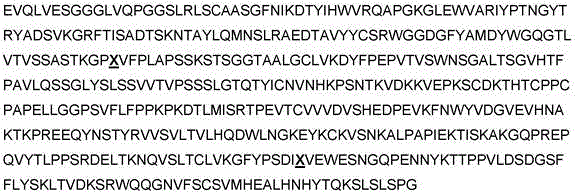
(位置127处的X和位置381处的X是通过与马来酰亚胺-PEG接头形成硫醚键修饰的半胱氨酸残基)(X at position 127 and X at position 381 are cysteine residues modified by forming a thioether bond with a maleimide-PEG linker)
TMab缀合物的抗体轻链(SEQ ID NO:7)Antibody light chain of TMab conjugate (SEQ ID NO:7)

AME133 124C-378C缀合物的抗体重链(SEQ ID NO:8)Antibody heavy chain of AME133 124C-378C conjugate (SEQ ID NO:8)

(位置128处的X和位置382处的X是通过与马来酰亚胺-PEG接头形成硫醚键修饰的半胱氨酸残基)(X at position 128 and X at position 382 are cysteine residues modified by forming a thioether bond with a maleimide-PEG linker)
AME133缀合物的抗体轻链(SEQ ID NO:9)Antibody light chain of AME133 conjugate (SEQ ID NO:9)

人IgG1恒定区(SEQ ID NO:10)Human IgG1 constant region (SEQ ID NO: 10)
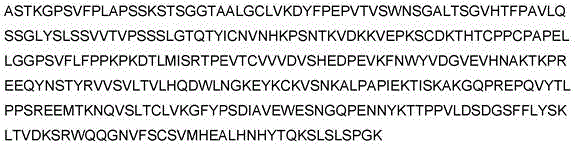
人IgG4恒定区(SEQ ID NO:11)Human IgG4 constant region (SEQ ID NO: 11)

IgG4 124C缀合物的抗体重链恒定区(SEQ ID NO:12)Antibody heavy chain constant region of IgG4 124C conjugate (SEQ ID NO: 12)

(位置7处的X是通过与马来酰亚胺-PEG接头形成硫醚键修饰的半胱氨酸残基)(X at position 7 is a cysteine residue modified by forming a thioether bond with a maleimide-PEG linker)
IgG4 378C缀合物的抗体重链恒定区(SEQ ID NO:13)Antibody heavy chain constant region of IgG4 378C conjugate (SEQ ID NO: 13)
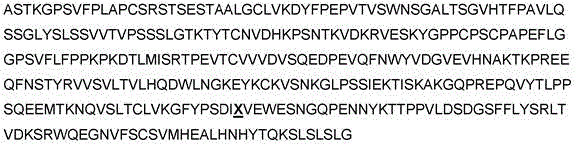
(位置258处的X是通过与马来酰亚胺-PEG接头形成硫醚键修饰的半胱氨酸残基)(X at position 258 is a cysteine residue modified by forming a thioether bond with a maleimide-PEG linker)
IgG4 375C缀合物的抗体重链恒定区(SEQ ID NO:14)Antibody heavy chain constant region of IgG4 375C conjugate (SEQ ID NO: 14)

(位置255处的X是通过与马来酰亚胺-PEG接头形成硫醚键修饰的半胱氨酸残基)(X at position 255 is a cysteine residue modified by forming a thioether bond with a maleimide-PEG linker)
IgG4 124C-378C缀合物的抗体重链恒定区(SEQ ID NO:15)Antibody heavy chain constant region of IgG4 124C-378C conjugate (SEQ ID NO: 15)

(位置7处的X和位置258处的X是通过与马来酰亚胺-PEG接头形成硫醚键修饰的半胱氨酸残基)(X at position 7 and X at position 258 are cysteine residues modified by forming a thioether bond with a maleimide-PEG linker)
IgG4 124C-375C缀合物的抗体重链恒定区(SEQ ID NO:16)Antibody heavy chain constant region of IgG4 124C-375C conjugate (SEQ ID NO: 16)

(位置7处的X和位置255处的X是通过与马来酰亚胺-PEG接头形成硫醚键修饰的半胱氨酸残基)(X at position 7 and X at position 255 are cysteine residues modified by forming a thioether bond with a maleimide-PEG linker)
IgG1 124C缀合物的抗体重链恒定区(SEQ ID NO:17)Antibody heavy chain constant region of IgG1 124C conjugate (SEQ ID NO: 17)

(位置7处的X是通过与马来酰亚胺-PEG接头形成硫醚键修饰的半胱氨酸残基)(X at position 7 is a cysteine residue modified by forming a thioether bond with a maleimide-PEG linker)
IgG1 378C缀合物的抗体重链恒定区(SEQ ID NO:18)Antibody heavy chain constant region of IgG1 378C conjugate (SEQ ID NO: 18)

(位置261处的X是通过与马来酰亚胺-PEG接头形成硫醚键修饰的半胱氨酸残基)(X at position 261 is a cysteine residue modified by forming a thioether bond with a maleimide-PEG linker)
IgG1 375C缀合物的抗体重链恒定区(SEQ ID NO:19)Antibody heavy chain constant region of IgG1 375C conjugate (SEQ ID NO: 19)

(位置258处的X是通过与马来酰亚胺-PEG接头形成硫醚键修饰的半胱氨酸残基)(X at position 258 is a cysteine residue modified by forming a thioether bond with a maleimide-PEG linker)
IgG1 124C-378C缀合物的抗体重链恒定区(SEQ ID NO:20)Antibody heavy chain constant region of IgG1 124C-378C conjugate (SEQ ID NO:20)

(位置7处的X和位置261处的X是通过与马来酰亚胺-PEG接头形成硫醚键修饰的半胱氨酸残基)(X at position 7 and X at position 261 are cysteine residues modified by forming a thioether bond with a maleimide-PEG linker)
IgG1 124C-375C缀合物的抗体重链恒定区(SEQ ID NO:21)Antibody heavy chain constant region of IgG1 124C-375C conjugate (SEQ ID NO: 21)

(位置7处的X和位置258处的X是通过与马来酰亚胺-PEG接头形成硫醚键修饰的半胱氨酸残基)(X at position 7 and X at position 258 are cysteine residues modified by forming a thioether bond with a maleimide-PEG linker)
fMLFX (肽-’183) (SEQ ID NO:22)fMLFX (peptide-'183) (SEQ ID NO:22)
(位置1处的Met被甲酰化)(Met at position 1 is formylated)
(位置4处的X是通过与马来酰亚胺-PEG接头形成酰胺键修饰的赖氨酸残基)(X at position 4 is a lysine residue modified by forming an amide bond with a maleimide-PEG linker)
fMLFK (SEQ ID NO:23)fMLFK (SEQ ID NO: 23)
(位置1处的Met被甲酰化)(Met at position 1 is formylated)
MLFX (肽-’844) (SEQ ID NO:24)MLFX (peptide-'844) (SEQ ID NO:24)
(位置4处的X是通过与马来酰亚胺-PEG接头形成酰胺键修饰的赖氨酸残基)(X at position 4 is a lysine residue modified by forming an amide bond with a maleimide-PEG linker)
MLFK (SEQ ID NO:25)MLFK (SEQ ID NO: 25)
MET 415C抗体缀合物的抗体重链(SEQ ID NO:26)Antibody heavy chain of MET 415C antibody conjugate (SEQ ID NO: 26)

(位置410处的X是通过与马来酰亚胺-PEG接头形成硫醚键修饰的半胱氨酸残基)(X at position 410 is a cysteine residue modified by forming a thioether bond with a maleimide-PEG linker)
MET 156C抗体缀合物的抗体轻链(SEQ ID NO:27)Antibody Light Chain of MET 156C Antibody Conjugate (SEQ ID NO:27)

(位置157处的X是通过与马来酰亚胺-PEG接头形成硫醚键修饰的半胱氨酸残基)(X at position 157 is a cysteine residue modified by forming a thioether bond with a maleimide-PEG linker)
MET 171C抗体缀合物的抗体轻链(SEQ ID NO:28)Antibody Light Chain of MET 171C Antibody Conjugate (SEQ ID NO:28)

(位置172处的X是通过与马来酰亚胺-PEG接头形成硫醚键修饰的半胱氨酸残基)(X at position 172 is a cysteine residue modified by forming a thioether bond with a maleimide-PEG linker)
MET 191C抗体缀合物的抗体轻链(SEQ ID NO:29)Antibody Light Chain of MET 191C Antibody Conjugate (SEQ ID NO:29)

(位置192处的X是通过与马来酰亚胺-PEG接头形成硫醚键修饰的半胱氨酸残基)(X at position 192 is a cysteine residue modified by forming a thioether bond with a maleimide-PEG linker)
MET 193C抗体缀合物的抗体轻链(SEQ ID NO:30)Antibody Light Chain of MET 193C Antibody Conjugate (SEQ ID NO:30)

(位置194处的X是通过与马来酰亚胺-PEG接头形成硫醚键修饰的半胱氨酸残基)(X at position 194 is a cysteine residue modified by forming a thioether bond with a maleimide-PEG linker)
MET 202C抗体缀合物的抗体轻链(SEQ ID NO:31)Antibody Light Chain of MET 202C Antibody Conjugate (SEQ ID NO:31)

(位置203处的X是通过与马来酰亚胺-PEG接头形成硫醚键修饰的半胱氨酸残基)(X at position 203 is a cysteine residue modified by forming a thioether bond with a maleimide-PEG linker)
MET 208C抗体缀合物的抗体轻链(SEQ ID NO:32)Antibody Light Chain of MET 208C Antibody Conjugate (SEQ ID NO:32)

(位置209处的X是通过与马来酰亚胺-PEG接头形成硫醚键修饰的半胱氨酸残基)(X at position 209 is a cysteine residue modified by forming a thioether bond with a maleimide-PEG linker)
曲妥珠单抗124C-157C抗体缀合物的抗体重链(SEQ ID NO:33)Antibody Heavy Chain of Trastuzumab 124C-157C Antibody Conjugate (SEQ ID NO:33)

(位置127处的X和位置160处的X是通过与马来酰亚胺-PEG接头形成硫醚键修饰的半胱氨酸残基)(X at position 127 and X at position 160 are cysteine residues modified by forming a thioether bond with a maleimide-PEG linker)
124C-378C双特异性抗体I缀合物的抗体重链A(SEQ ID NO:34)Antibody Heavy Chain A of 124C-378C Bispecific Antibody I Conjugate (SEQ ID NO:34)

(位置126处的X和位置380处的X是通过与马来酰亚胺-PEG接头形成硫醚键修饰的半胱氨酸残基)(X at position 126 and X at position 380 are cysteine residues modified by forming a thioether bond with a maleimide-PEG linker)
124C-378C双特异性抗体I缀合物的抗体重链B(SEQ ID NO:35)Antibody Heavy Chain B of 124C-378C Bispecific Antibody I Conjugate (SEQ ID NO:35)

(位置128处的X和位置382处的X是通过与马来酰亚胺-PEG接头形成硫醚键修饰的半胱氨酸残基)(X at position 128 and X at position 382 are cysteine residues modified by forming a thioether bond with a maleimide-PEG linker)
fMIFLX (FRM-021) (SEQ ID NO:36)fMIFLX (FRM-021) (SEQ ID NO:36)
(位置1处的Met被甲酰化)(Met at position 1 is formylated)
(位置5处的X是通过与水解的马来酰亚胺-PEG接头形成ε酰胺键修饰的赖氨酸残基侧链)(X at position 5 is a side chain of a lysine residue modified by forming an epsilon amide bond with a hydrolyzed maleimide-PEG linker)
fMXFX (FRM-029) (SEQ ID NO:37)fMXFX (FRM-029) (SEQ ID NO:37)
(位置1处的Met被甲酰化)(Met at position 1 is formylated)
(位置2处的X是二乙基甘氨酸)(X at position 2 is diethylglycine)
(位置4处的X是通过与式(PEG6)2-NH-(CH2)2-NH2的PEG接头形成酰胺键C-末端连接的亮氨酸残基)(X at position 4 is a leucine residue linked C-terminally by forming an amide bond with a PEG linker of formula (PEG6) 2 -NH-( CH2 ) 2 - NH2 )
fMXFX (FRM-030) (SEQ ID NO:38)fMXFX (FRM-030) (SEQ ID NO: 38)
(位置1处的Met被甲酰化)(Met at position 1 is formylated)
(位置2处的X是二丙基甘氨酸)(X at position 2 is dipropylglycine)
(位置4处的X是通过与式(PEG6)2-NH-(CH2)2-NH2的PEG接头形成酰胺键C-末端连接的亮氨酸残基)(X at position 4 is a leucine residue linked C-terminally by forming an amide bond with a PEG linker of formula (PEG6) 2 -NH-( CH2 ) 2 - NH2 )
fMIX (FRM-031) (SEQ ID NO:39)fMIX (FRM-031) (SEQ ID NO: 39)
(位置1处的Met被甲酰化)(Met at position 1 is formylated)
(位置3处的X是通过与式PEG12-NH-(CH2)2-NH2的PEG接头形成酰胺键C-末端连接的苯丙氨酸残基)(X at position 3 is a phenylalanine residue linked C-terminusly by forming an amide bond with a PEG linker of formula PEG12-NH-( CH2 ) 2 - NH2 )
fMIFX (FRM-023) (SEQ ID NO:40)fMIFX (FRM-023) (SEQ ID NO:40)
(位置1处的Met被甲酰化)(Met at position 1 is formylated)
(位置4处的X是通过与式PEG12-NH-(CH2)2-NH2的PEG接头形成酰胺键C-末端连接的的亮氨酸残基)(X at position 4 is a leucine residue attached C-terminally via an amide bond to a PEG linker of formula PEG12-NH-( CH2 ) 2 - NH2 )
fMIFX (FRM-032) (SEQ ID NO:41)fMIFX (FRM-032) (SEQ ID NO:41)
(位置1处的Met被甲酰化)(Met at position 1 is formylated)
(位置4处的X是通过与式NH-(CH2)-NH-[(Mal-Dap(NH2)]的接头形成酰胺键修饰的亮氨酸残基)(X at position 4 is a leucine residue modified by forming an amide bond with a linker of formula NH-( CH2 )-NH-[(Mal-Dap( NH2 )])
fNleLX (FRM-009) (SEQ ID NO:42)fNleLX (FRM-009) (SEQ ID NO:42)
(位置1处的Nle被甲酰化)(Nle at position 1 is formylated)
(位置3处的X是通过与式PEG12-Lys(马来酰亚胺基-丙酰基)-OH的接头形成酰胺键C-末端连接的苯丙氨酸)(X at position 3 is phenylalanine C-terminally linked to form an amide bond with a linker of formula PEG12-Lys(maleimido-propionyl)-OH)
依米妥珠单抗缀合物的抗体重链(SEQ ID NO:43)Antibody Heavy Chain of Emetuzumab Conjugate (SEQ ID NO:43)

依米妥珠单抗 157C抗体缀合物的抗体重链(SEQ ID NO:44)Antibody Heavy Chain of Emetuzumab 157C Antibody Conjugate (SEQ ID NO:44)

(位置155处的X是通过与马来酰亚胺-PEG接头形成硫醚键修饰的半胱氨酸残基)(X at position 155 is a cysteine residue modified by forming a thioether bond with a maleimide-PEG linker)
依米妥珠单抗 162C抗体缀合物的抗体重链(SEQ ID NO:45)Antibody Heavy Chain of Emetuzumab 162C Antibody Conjugate (SEQ ID NO:45)

(位置160处的X是通过与马来酰亚胺-PEG接头形成硫醚键修饰的半胱氨酸残基)(X at position 160 is a cysteine residue modified by forming a thioether bond with a maleimide-PEG linker)
依米妥珠单抗 262C抗体缀合物的抗体重链(SEQ ID NO:46)Antibody Heavy Chain of Emetuzumab 262C Antibody Conjugate (SEQ ID NO:46)

(位置257处的X是通过与马来酰亚胺-PEG接头形成硫醚键修饰的半胱氨酸残基)(X at position 257 is a cysteine residue modified by forming a thioether bond with a maleimide-PEG linker)
依米妥珠单抗 375C抗体缀合物的抗体重链(SEQ ID NO:47)Antibody Heavy Chain of Emetuzumab 375C Antibody Conjugate (SEQ ID NO:47)

(位置370处的X是通过与马来酰亚胺-PEG接头形成硫醚键修饰的半胱氨酸残基)(X at position 370 is a cysteine residue modified by forming a thioether bond with a maleimide-PEG linker)
依米妥珠单抗 397C抗体缀合物的抗体重链(SEQ ID NO:48)Antibody Heavy Chain of Emetuzumab 397C Antibody Conjugate (SEQ ID NO:48)
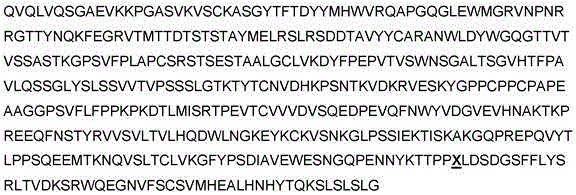
(位置392处的X是通过与马来酰亚胺-PEG接头形成硫醚键修饰的半胱氨酸残基)(X at position 392 is a cysteine residue modified by forming a thioether bond with a maleimide-PEG linker)
依米妥珠单抗 124C-157C-378C抗体缀合物的抗体重链(SEQ ID NO:49)Antibody Heavy Chain of Emetuzumab 124C-157C-378C Antibody Conjugate (SEQ ID NO:49)

(位置122处的X和位置155处的X和位置373处的X是通过与马来酰亚胺-PEG接头形成硫醚键修饰的半胱氨酸残基)(X at position 122 and X at position 155 and X at position 373 are cysteine residues modified by forming a thioether bond with a maleimide-PEG linker)
依米妥珠单抗 124C-162C-378C抗体缀合物的抗体重链(SEQ ID NO:50)Antibody Heavy Chain of Emetuzumab 124C-162C-378C Antibody Conjugate (SEQ ID NO:50)

(位置122处的X和位置160处的X和位置373处的X是通过与马来酰亚胺-PEG接头形成硫醚键修饰的半胱氨酸残基)(X at position 122 and X at position 160 and X at position 373 are cysteine residues modified by forming a thioether bond with a maleimide-PEG linker)
Tmab (IQE) 124C-378C抗体缀合物的抗体重链(SEQ ID NO:51)Antibody heavy chain of Tmab (IQE) 124C-378C antibody conjugate (SEQ ID NO:51)

(位置127处的X和位置381处的X是通过与马来酰亚胺-PEG接头形成硫醚键修饰的半胱氨酸残基)(X at position 127 and X at position 381 are cysteine residues modified by forming a thioether bond with a maleimide-PEG linker)
IgG1 157C缀合物的抗体重链恒定区(SEQ ID NO:52)Antibody heavy chain constant region of IgG1 157C conjugate (SEQ ID NO: 52)

(位置40处的X是通过与马来酰亚胺-PEG接头形成硫醚键修饰的半胱氨酸残基)(X at position 40 is a cysteine residue modified by forming a thioether bond with a maleimide-PEG linker)
IgG1 124C-157C缀合物的抗体重链恒定区(SEQ ID NO:53)Antibody heavy chain constant region of IgG1 124C-157C conjugate (SEQ ID NO: 53)
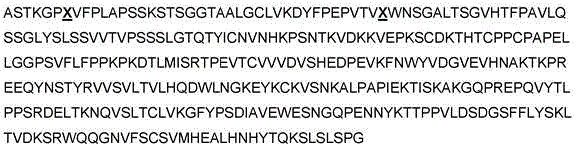
(位置7处的X和位置40处的X是通过与马来酰亚胺-PEG接头形成硫醚键修饰的半胱氨酸残基)(X at position 7 and X at position 40 are cysteine residues modified by forming a thioether bond with a maleimide-PEG linker)
IgG4 157C缀合物的抗体重链恒定区(SEQ ID NO:54)Antibody heavy chain constant region of IgG4 157C conjugate (SEQ ID NO: 54)
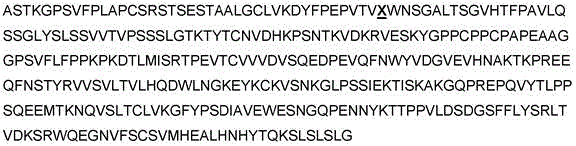
(位置40处的X是通过与马来酰亚胺-PEG接头形成硫醚键修饰的半胱氨酸残基)(X at position 40 is a cysteine residue modified by forming a thioether bond with a maleimide-PEG linker)
IgG4 162C缀合物的抗体重链恒定区(SEQ ID NO:55)Antibody heavy chain constant region of IgG4 162C conjugate (SEQ ID NO: 55)

(位置45处的X是通过与马来酰亚胺-PEG接头形成硫醚键修饰的半胱氨酸残基)(X at position 45 is a cysteine residue modified by forming a thioether bond with a maleimide-PEG linker)
IgG4 124C-157C-373C缀合物的抗体重链恒定区(SEQ ID NO:56)Antibody heavy chain constant region of IgG4 124C-157C-373C conjugate (SEQ ID NO:56)
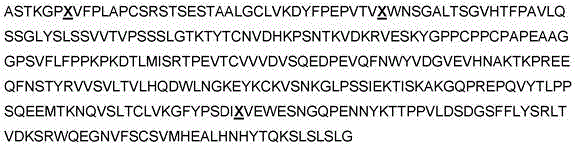
(位置7处的X和位置40处的X和位置258处的X是通过与马来酰亚胺-PEG接头形成硫醚键修饰的半胱氨酸残基)(X at position 7 and X at position 40 and X at position 258 are cysteine residues modified by forming a thioether bond with a maleimide-PEG linker)
IgG4 124C-162C-373C缀合物的抗体重链恒定区(SEQ ID NO:57)Antibody heavy chain constant region of IgG4 124C-162C-373C conjugate (SEQ ID NO:57)

(位置7处的X和位置45处的X和位置258处的X是通过与马来酰亚胺-PEG接头形成硫醚键修饰的半胱氨酸残基)(X at position 7 and X at position 45 and X at position 258 are cysteine residues modified by forming a thioether bond with a maleimide-PEG linker)
双特异性抗体I缀合物的抗体轻链A(SEQ ID NO:58)Antibody Light Chain A of Bispecific Antibody I Conjugate (SEQ ID NO:58)

双特异性抗体I缀合物的抗体轻链B(SEQ ID NO:59)Antibody Light Chain B of Bispecific Antibody I Conjugate (SEQ ID NO:59)


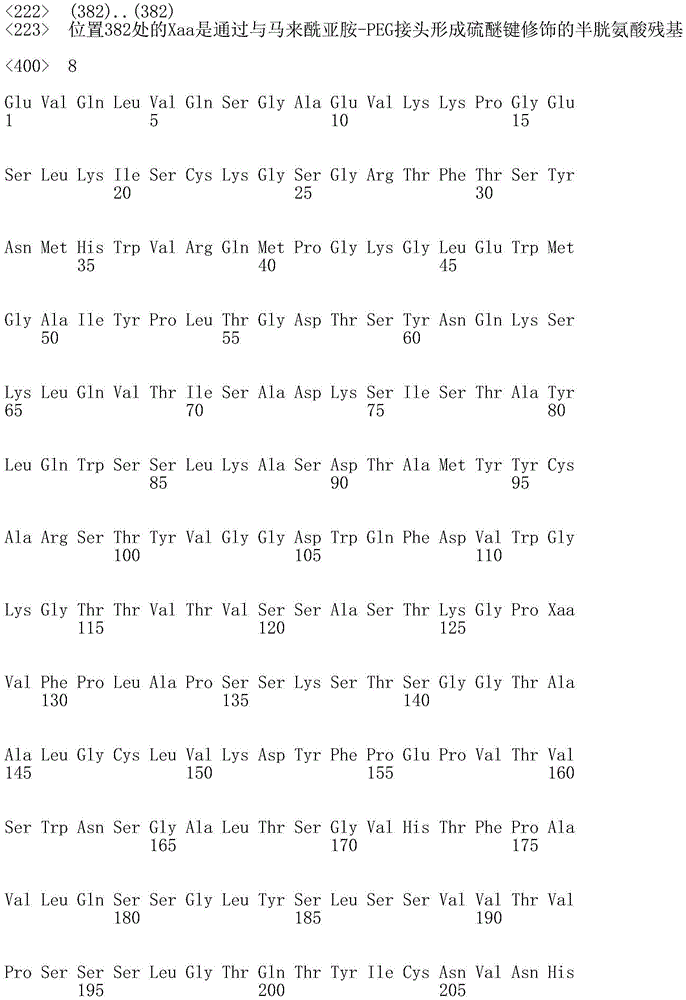
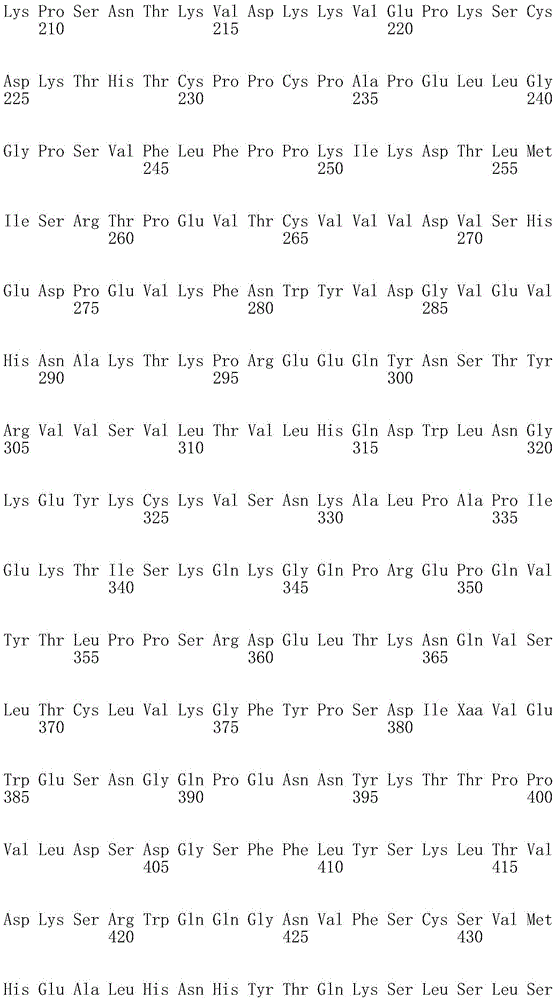


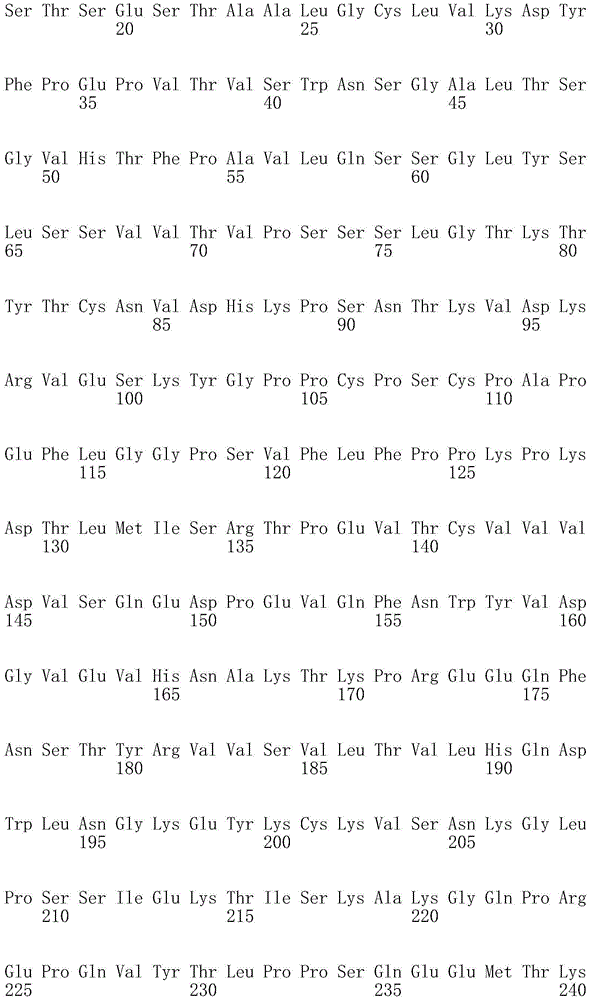


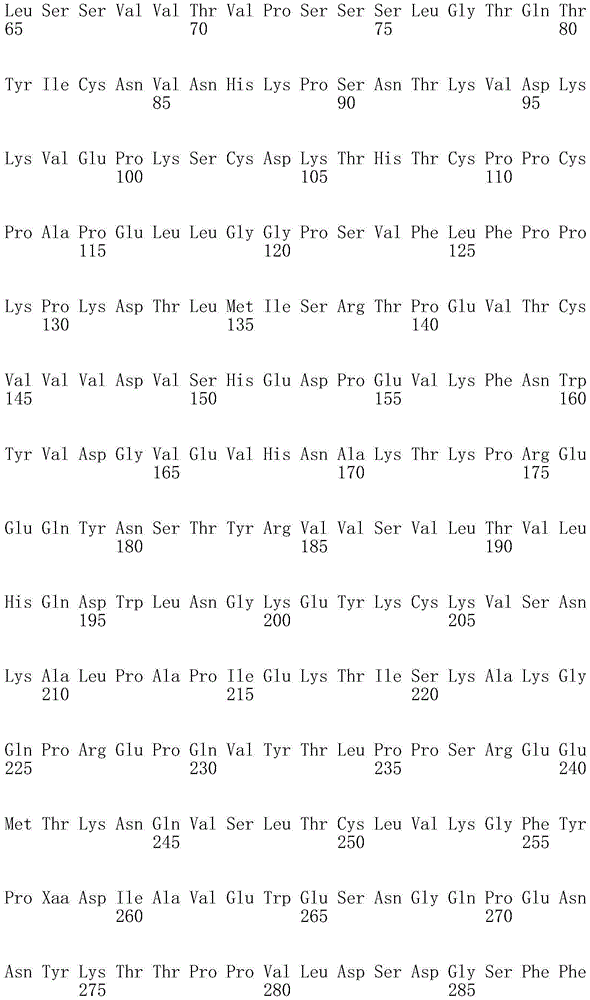

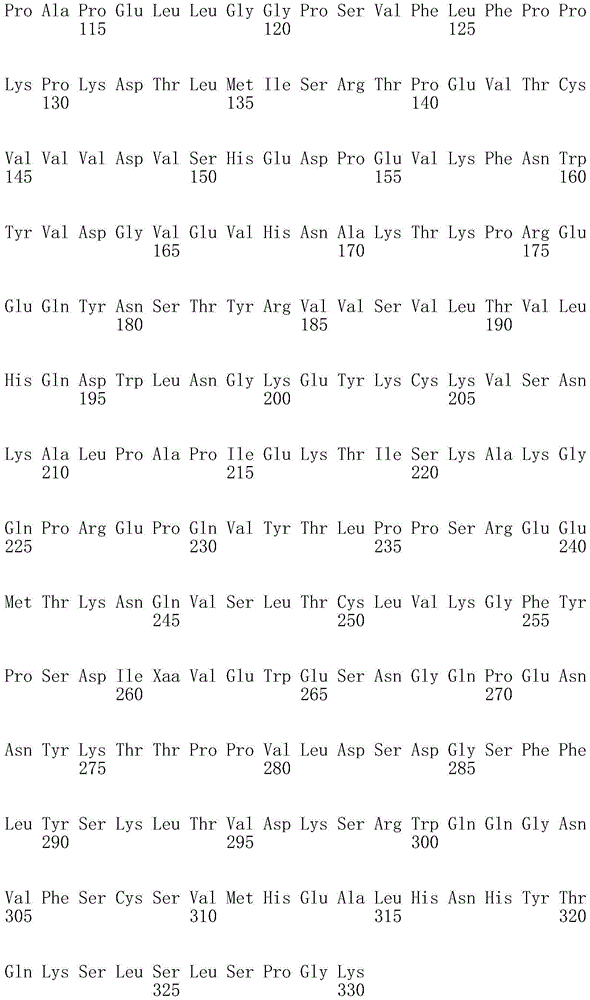

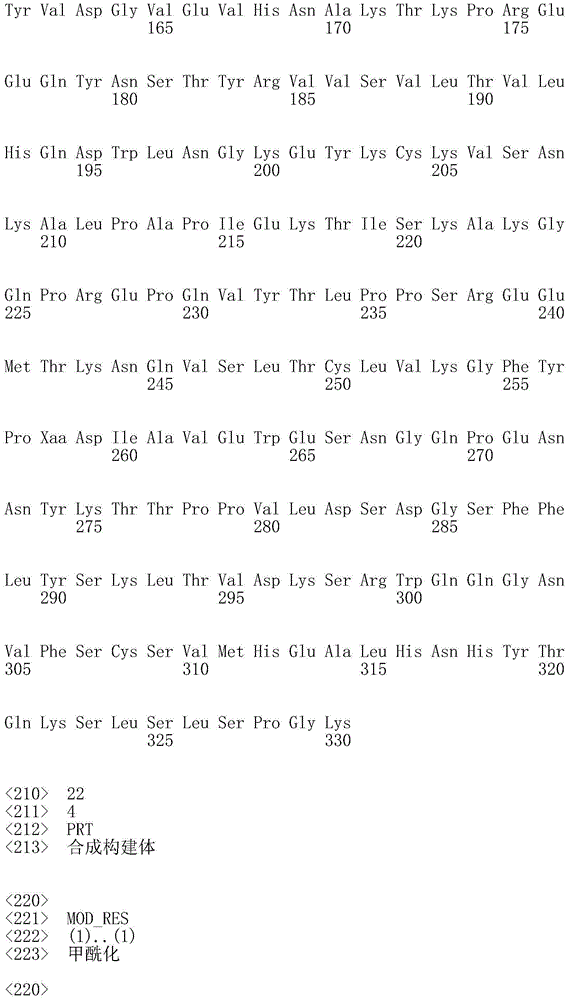
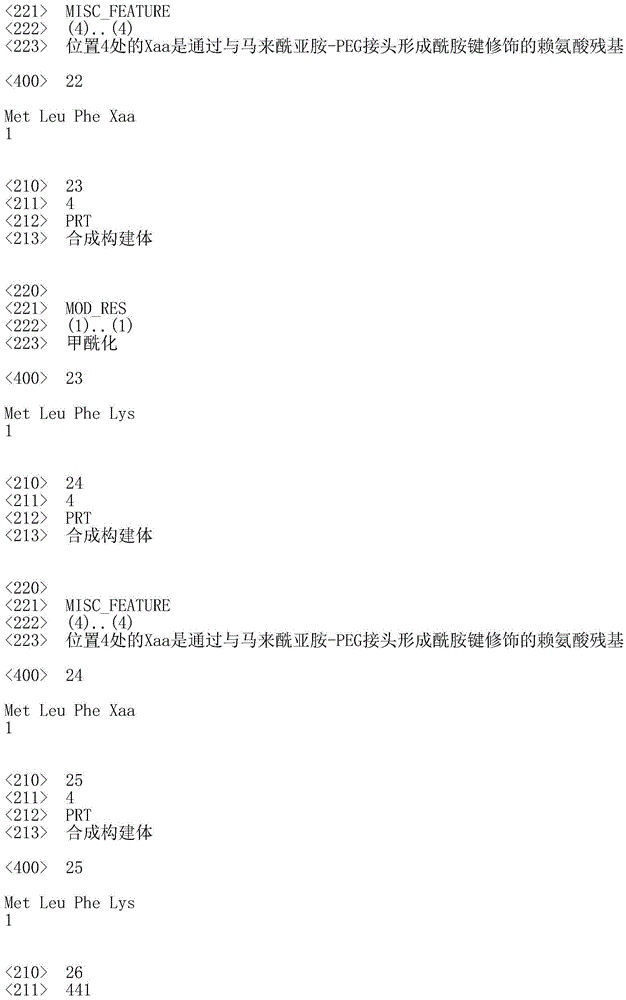
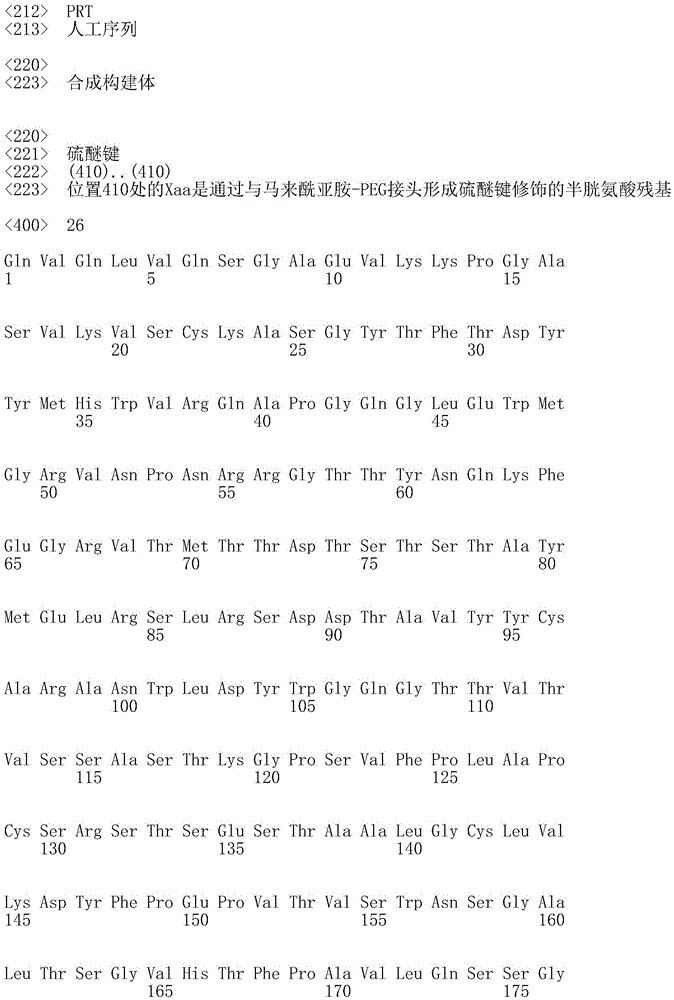
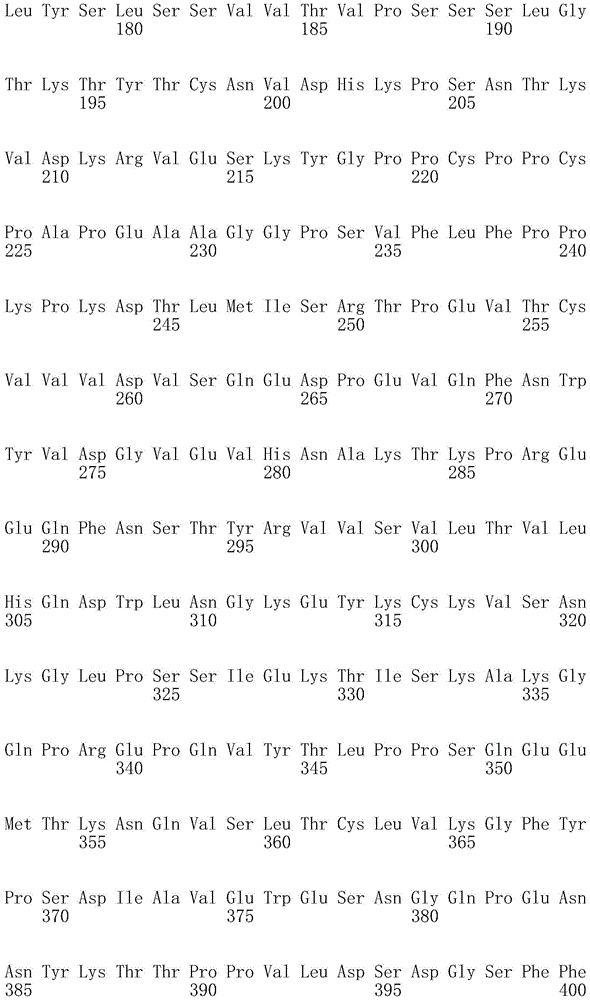
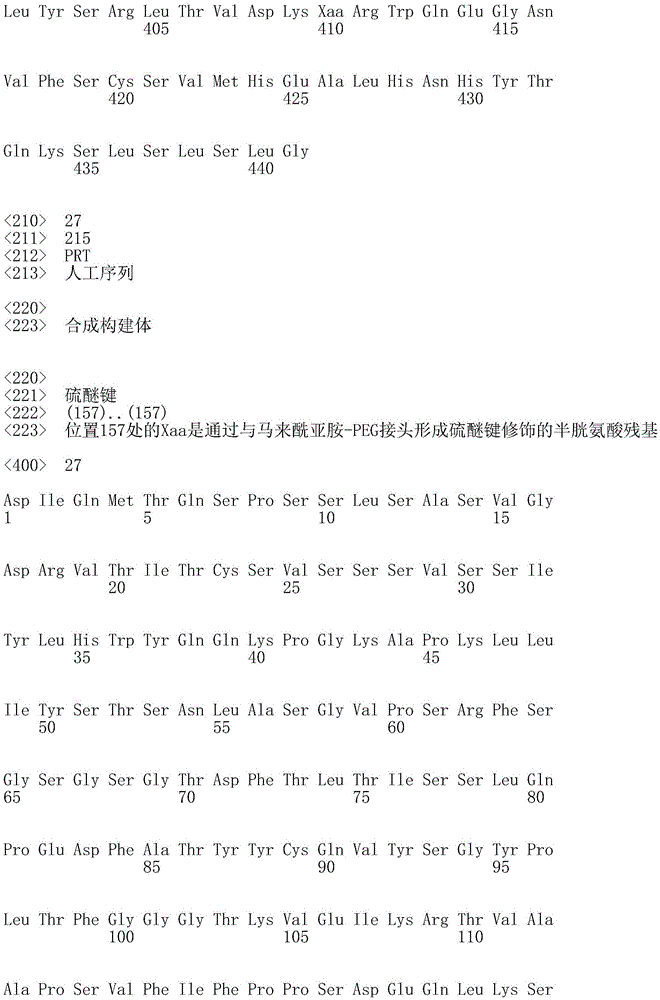
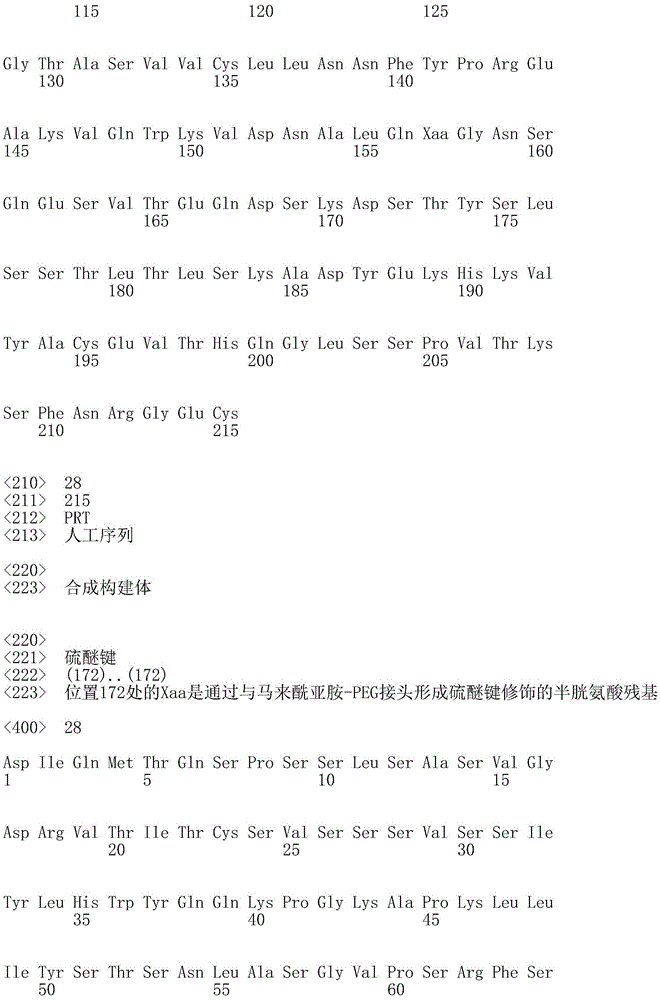


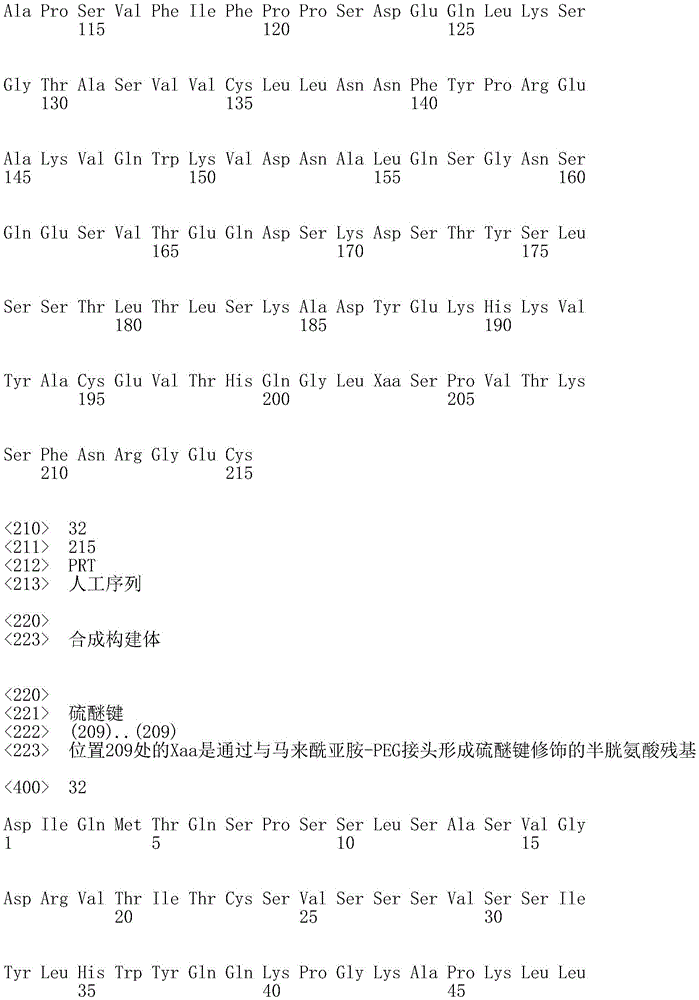


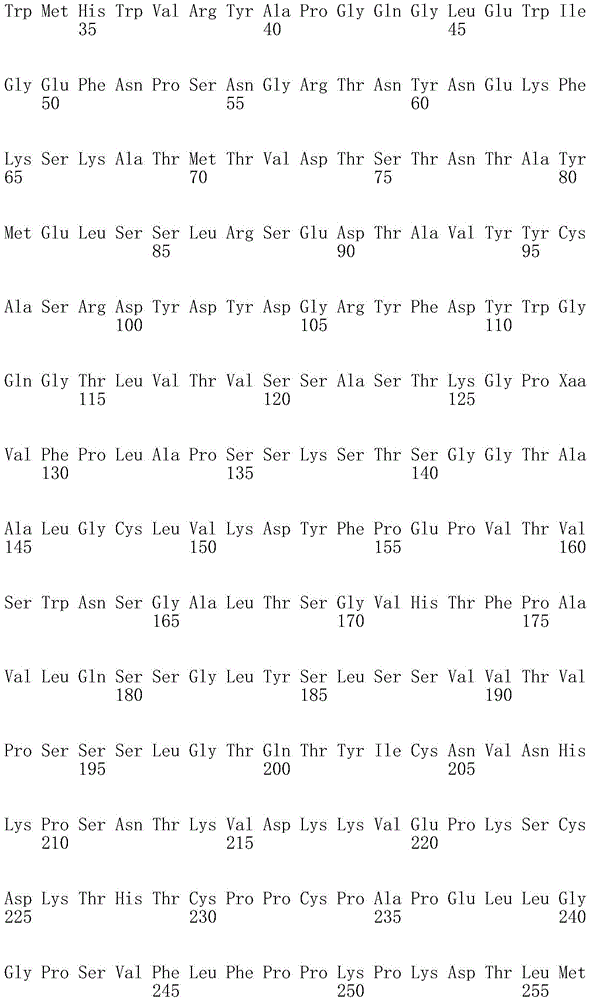


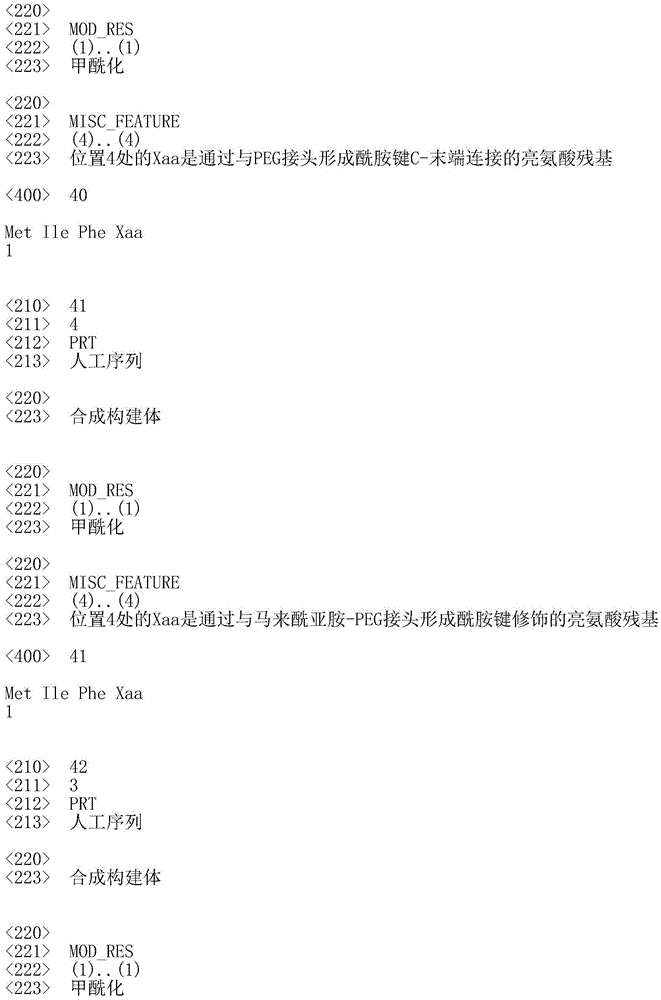

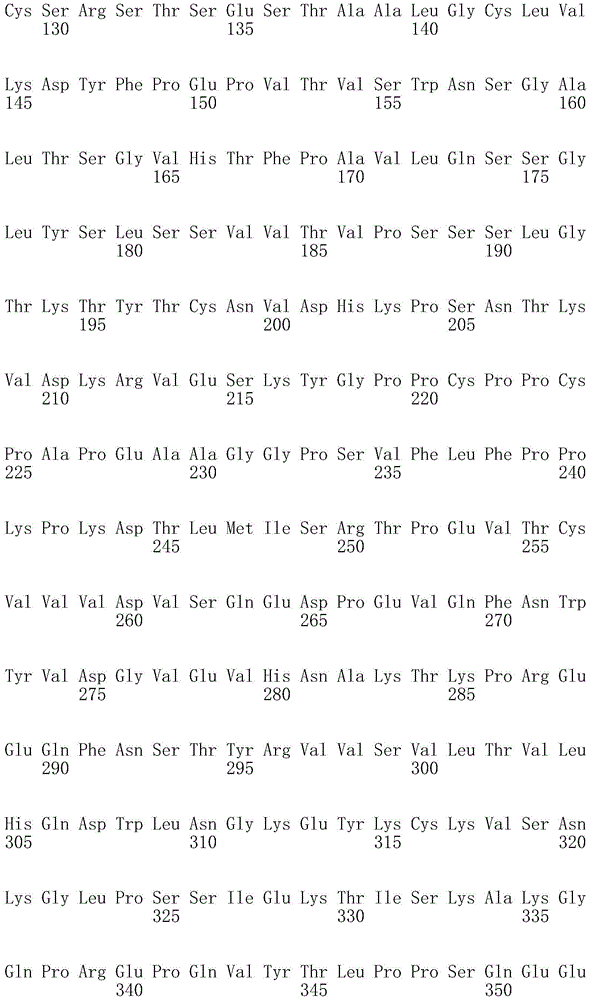

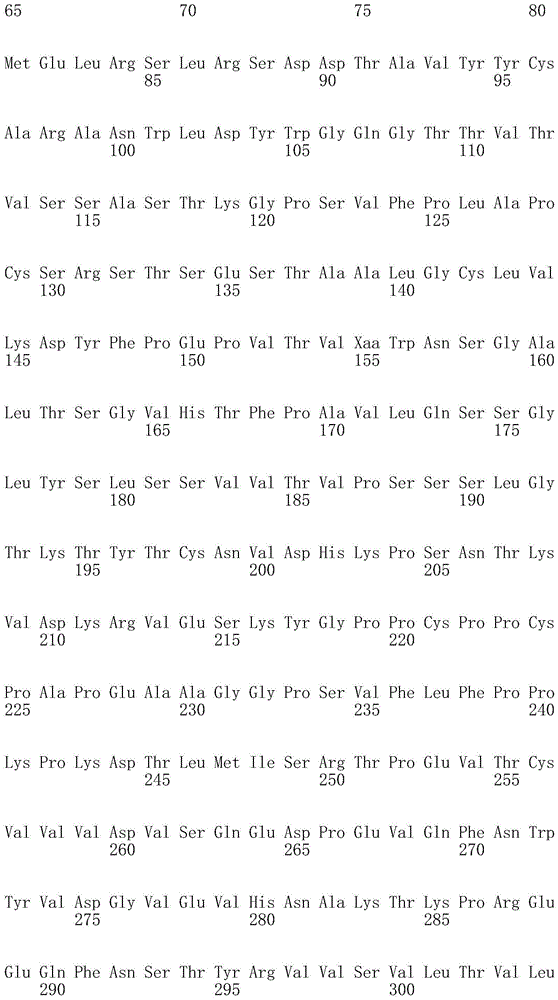


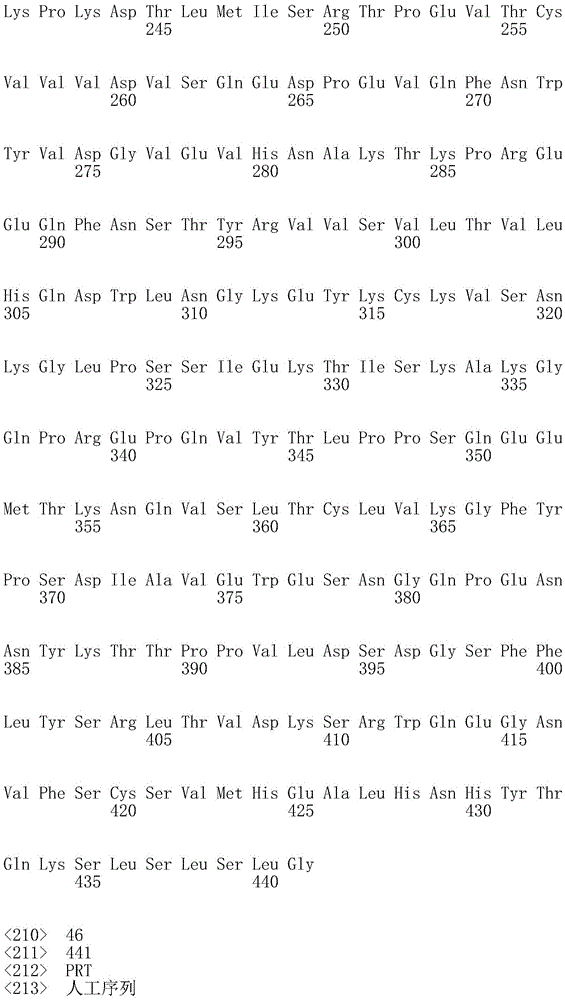


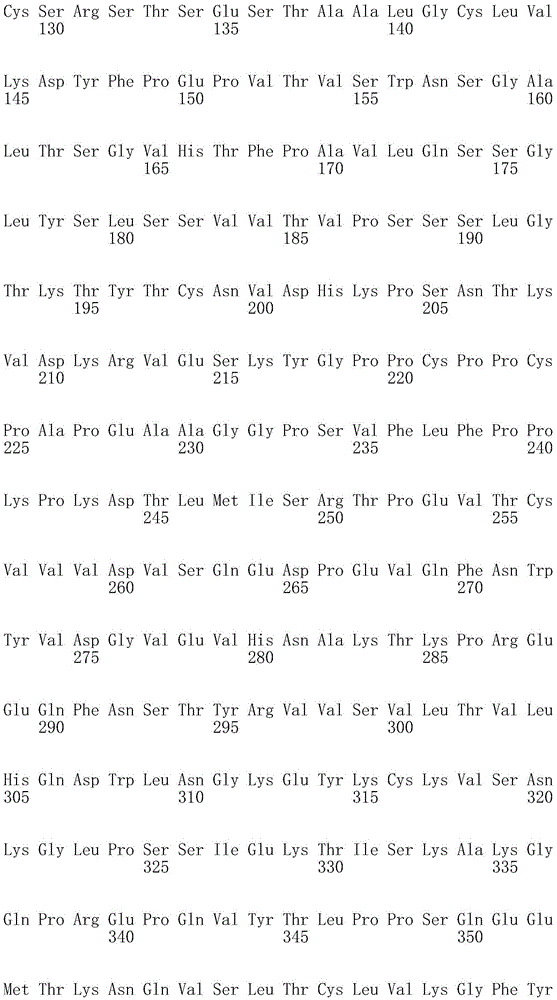
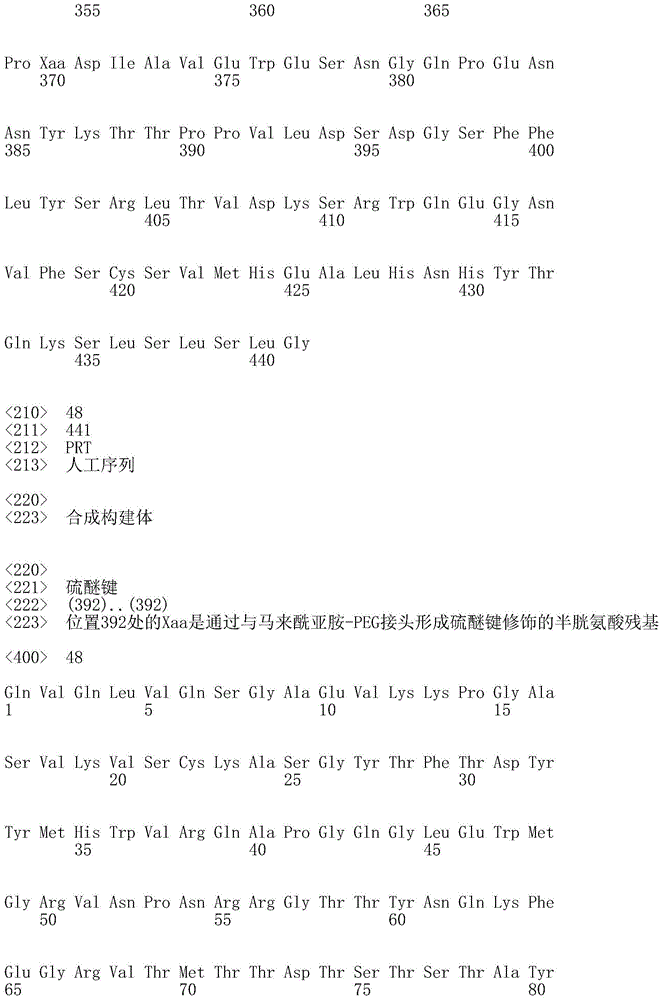
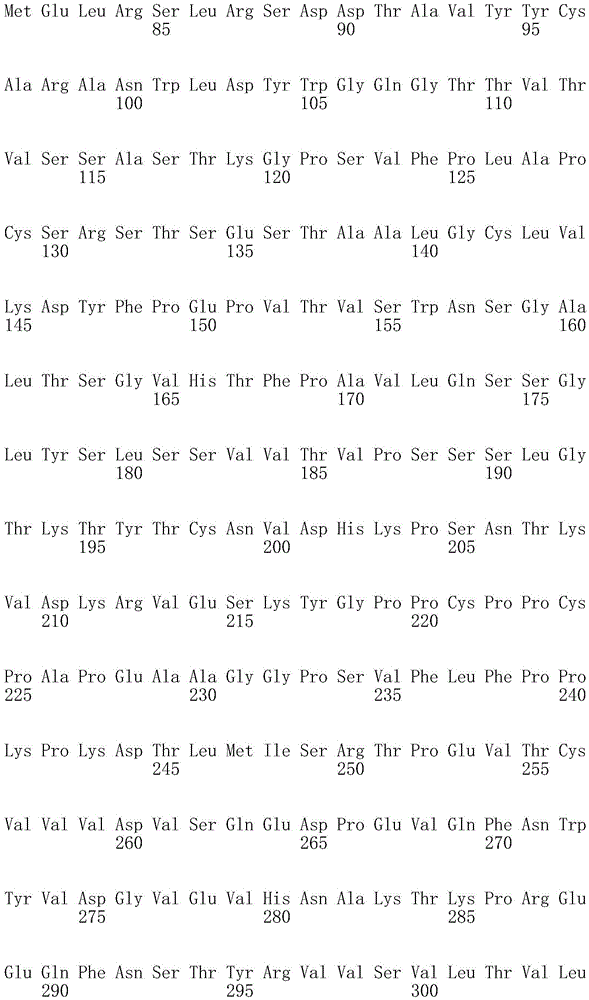


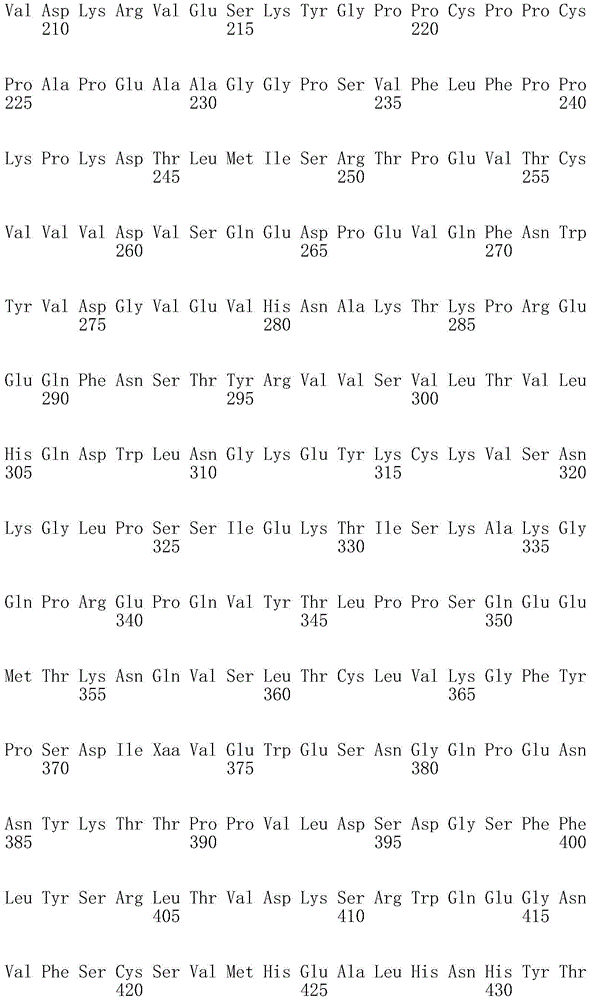


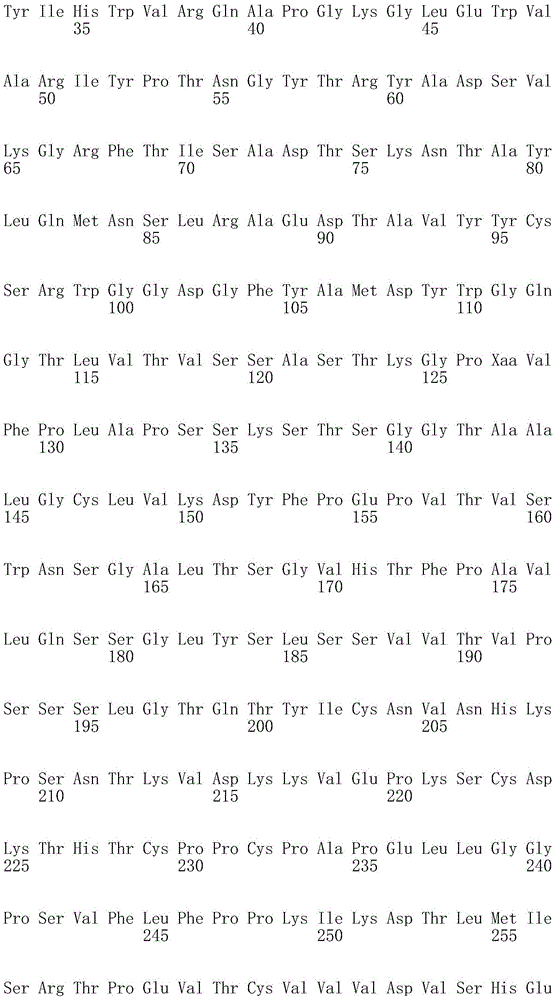


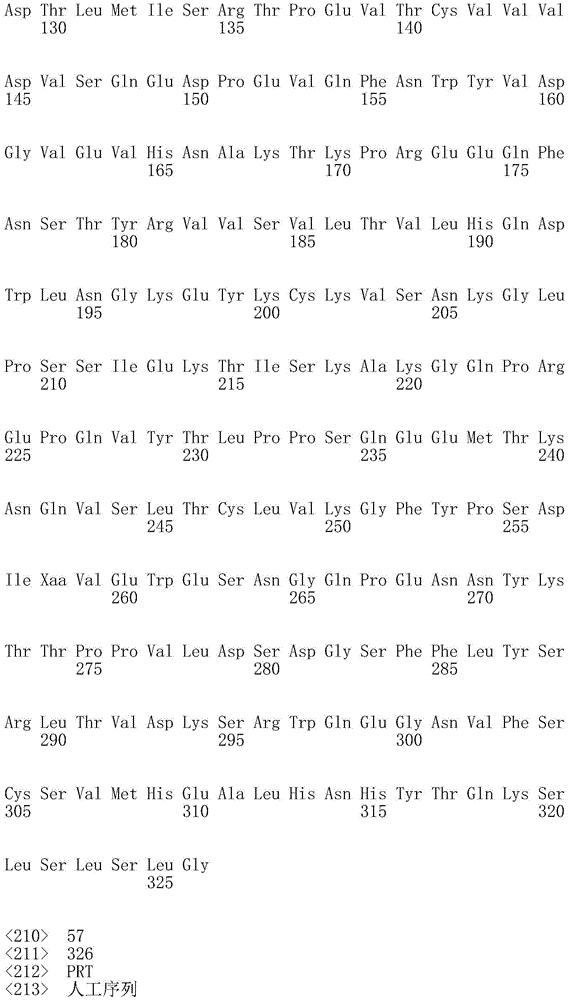
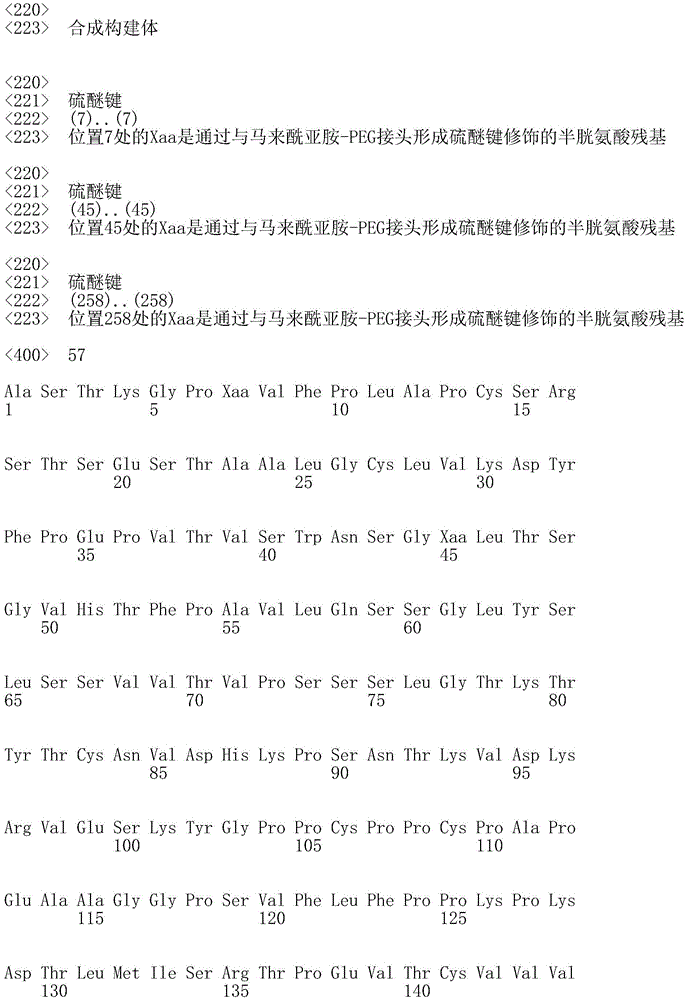
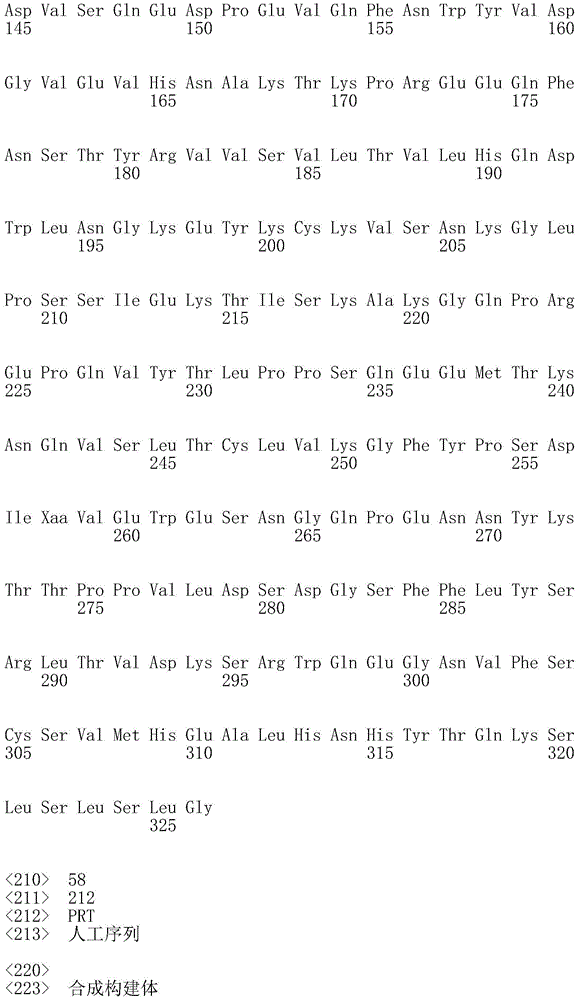


Claims (96)


Applications Claiming Priority (3)
| Application Number | Priority Date | Filing Date | Title |
|---|---|---|---|
| US201762520855P | 2017-06-16 | 2017-06-16 | |
| US62/520855 | 2017-06-16 | ||
| PCT/US2018/037495 WO2018232088A1 (en) | 2017-06-16 | 2018-06-14 | Engineered antibody compounds and conjugates thereof |
Publications (1)
| Publication Number | Publication Date |
|---|---|
| CN110869394A true CN110869394A (en) | 2020-03-06 |
Family
ID=62875283
Family Applications (1)
| Application Number | Title | Priority Date | Filing Date |
|---|---|---|---|
| CN201880038999.5A Pending CN110869394A (en) | 2017-06-16 | 2018-06-14 | Engineered antibody compounds and conjugates thereof |
Country Status (6)
| Country | Link |
|---|---|
| US (2) | US20200155702A1 (en) |
| EP (1) | EP3638699A1 (en) |
| JP (6) | JP7073487B2 (en) |
| CN (1) | CN110869394A (en) |
| CA (1) | CA3066920C (en) |
| WO (1) | WO2018232088A1 (en) |
Families Citing this family (27)
| Publication number | Priority date | Publication date | Assignee | Title |
|---|---|---|---|---|
| CN110869394A (en) * | 2017-06-16 | 2020-03-06 | 伊莱利利公司 | Engineered antibody compounds and conjugates thereof |
| US11168141B2 (en) | 2018-08-02 | 2021-11-09 | Dyne Therapeutics, Inc. | Muscle targeting complexes and uses thereof for treating dystrophinopathies |
| SG11202100934PA (en) | 2018-08-02 | 2021-02-25 | Dyne Therapeutics Inc | Muscle targeting complexes and uses thereof for treating dystrophinopathies |
| MX2021000827A (en) | 2018-08-03 | 2021-03-25 | Chugai Pharmaceutical Co Ltd | ANTIGEN-BINDING MOLECULE CONTAINING TWO ANTIGEN-BINDING DOMAINS THAT ARE LINKED TO EACH OTHER. |
| JP2022501325A (en) | 2018-09-28 | 2022-01-06 | 中外製薬株式会社 | Antigen-binding molecule containing modified antibody variable region |
| KR20220137923A (en) * | 2020-02-05 | 2022-10-12 | 추가이 세이야쿠 가부시키가이샤 | Methods for making and/or enriching recombinant antigen binding molecules |
| AU2022238571A1 (en) | 2021-03-18 | 2023-09-14 | Seagen Inc. | Selective drug release from internalized conjugates of biologically active compounds |
| US20240285787A1 (en) | 2021-06-11 | 2024-08-29 | Eli Lilly And Company | Peptides comprising n-formyl-halogenated methionine residues and engineered antibody-peptide conjugates thereof |
| US11771776B2 (en) | 2021-07-09 | 2023-10-03 | Dyne Therapeutics, Inc. | Muscle targeting complexes and uses thereof for treating dystrophinopathies |
| US11969475B2 (en) | 2021-07-09 | 2024-04-30 | Dyne Therapeutics, Inc. | Muscle targeting complexes and uses thereof for treating facioscapulohumeral muscular dystrophy |
| AU2022309028A1 (en) | 2021-07-09 | 2024-01-25 | Dyne Therapeutics, Inc. | Muscle targeting complexes and formulations for treating dystrophinopathies |
| TWI876192B (en) | 2021-08-05 | 2025-03-11 | 美商美國禮來大藥廠 | Human interleukin-4 receptor alpha antibodies |
| CN118201640A (en) * | 2021-11-01 | 2024-06-14 | 达因疗法公司 | Muscle-targeted complexes for the treatment of dystrophinopathy |
| AR127562A1 (en) | 2021-11-11 | 2024-02-07 | Lilly Co Eli | ANTIBODIES AGAINST THE TUMORAL NECROSIS FACTOR in HUMAN |
| CA3253295A1 (en) | 2022-05-13 | 2023-11-16 | Eli Lilly And Company | Human tumor necrosis factor alpha antibody glucocorticoid conjugates |
| AU2023278918A1 (en) | 2022-06-02 | 2025-01-09 | Eli Lilly And Company | Human interleukin-4 receptor alpha antibody glucocorticoid conjugates |
| EP4543924A2 (en) | 2022-06-22 | 2025-04-30 | Eli Lilly And Company | Human cd33 antibodies and glucocorticoid conjugates |
| AU2023366495A1 (en) | 2022-10-28 | 2025-06-12 | Eli Lilly And Company | Self-hydrolyzing maleimides for bioconjugation |
| EP4665754A1 (en) | 2023-02-15 | 2025-12-24 | Eli Lilly and Company | Glycosylated polypeptides |
| US20250064958A1 (en) | 2023-08-22 | 2025-02-27 | Eli Lilly And Company | AMYLOID PRECURSOR PROTEIN (APP) RNAi AGENTS |
| WO2025085352A1 (en) | 2023-10-18 | 2025-04-24 | Eli Lilly And Company | Transferrin receptor binding proteins and uses thereof |
| WO2025166107A1 (en) | 2024-02-02 | 2025-08-07 | Eli Lilly And Company | Cns tagrted sarm1 rnai agents |
| WO2025166111A1 (en) | 2024-02-02 | 2025-08-07 | Eli Lilly And Company | Conjugates comprising transferrin receptor binding protein |
| WO2025166119A1 (en) | 2024-02-02 | 2025-08-07 | Eli Lilly And Company | Transferrin receptor binding proteins and conjugates |
| WO2025250642A2 (en) | 2024-05-31 | 2025-12-04 | Eli Lilly And Company | Transferrin receptor (tfr)-binding variable domains of a heavy chain only antibody (vhh), conjugates and uses thereof |
| WO2025250605A1 (en) | 2024-05-31 | 2025-12-04 | Eli Lilly And Company | Acvr2a and acvr2b rna interference agents |
| WO2025264602A1 (en) | 2024-06-18 | 2025-12-26 | Eli Lilly And Company | PRNP RNAi AGENTS |
Citations (5)
| Publication number | Priority date | Publication date | Assignee | Title |
|---|---|---|---|---|
| US7521541B2 (en) * | 2004-09-23 | 2009-04-21 | Genetech Inc. | Cysteine engineered antibodies and conjugates |
| CN101528263A (en) * | 2006-06-30 | 2009-09-09 | 安德烈·科尔特曼 | Conjugates for use in methods of innate immunity to cancer |
| US20120010153A1 (en) * | 2009-01-14 | 2012-01-12 | Andre Koltermann | Novel tumor-targeting compounds |
| CN105143271A (en) * | 2013-02-08 | 2015-12-09 | Irm责任有限公司 | Specific sites for modifying antibodies to make immunoconjugates |
| CA2949033A1 (en) * | 2015-11-30 | 2017-05-30 | Pfizer Inc. | Antibodies and antibody fragments for site-specific conjugation |
Family Cites Families (13)
| Publication number | Priority date | Publication date | Assignee | Title |
|---|---|---|---|---|
| DK1877101T3 (en) * | 2005-04-28 | 2017-01-09 | Ventana Med Syst Inc | ENZYMES CONJUGATED TO ANTIBODIES THROUGH A PEG hetero LINKER |
| WO2009012256A1 (en) * | 2007-07-16 | 2009-01-22 | Genentech, Inc. | Humanized anti-cd79b antibodies and immunoconjugates and methods of use |
| DK2219672T3 (en) * | 2007-11-09 | 2016-05-17 | Peregrine Pharmaceuticals Inc | The anti-VEGF antibody compositions and methods |
| CA2859755C (en) * | 2011-12-23 | 2021-04-20 | Pfizer Inc. | Engineered antibody constant regions for site-specific conjugation and methods and uses therefor |
| AU2015229463A1 (en) * | 2014-03-12 | 2016-09-15 | Novartis Ag | Specific sites for modifying antibodies to make immunoconjugates |
| CA2947238A1 (en) * | 2014-05-22 | 2015-11-26 | Synthon Biopharmaceuticals B.V. | Site-specific conjugation of linker drugs to antibodies and resulting adcs |
| RU2017101331A (en) * | 2014-06-20 | 2018-07-23 | Абгеномикс Интернэшнл Инк. | CONJUGATES ANTIBODY TO HER2 - MEDICINE |
| EP3209334A2 (en) * | 2014-10-20 | 2017-08-30 | Igenica Biotherapeutics, Inc. | Novel antibody-drug conjugates and related compounds, compositions, and methods of use |
| MA41375A (en) | 2015-01-22 | 2017-11-28 | Lilly Co Eli | BISPECIFIC IGG ANTIBODIES AND THEIR PREPARATION PROCESSES |
| US20190194315A1 (en) * | 2015-06-17 | 2019-06-27 | Novartis Ag | Antibody drug conjugates |
| JP2018523471A (en) * | 2015-07-16 | 2018-08-23 | セレラント セラピューティクス インコーポレイテッド | Cysteine substituted immunoglobulin |
| MA44334A (en) * | 2015-10-29 | 2018-09-05 | Novartis Ag | ANTIBODY CONJUGATES INCLUDING A TOLL-TYPE RECEPTOR AGONIST |
| CN110869394A (en) * | 2017-06-16 | 2020-03-06 | 伊莱利利公司 | Engineered antibody compounds and conjugates thereof |
-
2018
- 2018-06-14 CN CN201880038999.5A patent/CN110869394A/en active Pending
- 2018-06-14 JP JP2020518601A patent/JP7073487B2/en active Active
- 2018-06-14 US US16/619,846 patent/US20200155702A1/en not_active Abandoned
- 2018-06-14 WO PCT/US2018/037495 patent/WO2018232088A1/en not_active Ceased
- 2018-06-14 CA CA3066920A patent/CA3066920C/en active Active
- 2018-06-14 EP EP18739985.2A patent/EP3638699A1/en active Pending
-
2022
- 2022-05-11 JP JP2022078340A patent/JP2022106975A/en active Pending
- 2022-05-11 JP JP2022078259A patent/JP7467526B2/en active Active
- 2022-05-11 JP JP2022078343A patent/JP7553504B2/en active Active
-
2024
- 2024-02-05 JP JP2024015345A patent/JP2024054197A/en active Pending
- 2024-02-27 JP JP2024027280A patent/JP2024059848A/en active Pending
- 2024-08-19 US US18/808,584 patent/US20240398973A1/en active Pending
Patent Citations (5)
| Publication number | Priority date | Publication date | Assignee | Title |
|---|---|---|---|---|
| US7521541B2 (en) * | 2004-09-23 | 2009-04-21 | Genetech Inc. | Cysteine engineered antibodies and conjugates |
| CN101528263A (en) * | 2006-06-30 | 2009-09-09 | 安德烈·科尔特曼 | Conjugates for use in methods of innate immunity to cancer |
| US20120010153A1 (en) * | 2009-01-14 | 2012-01-12 | Andre Koltermann | Novel tumor-targeting compounds |
| CN105143271A (en) * | 2013-02-08 | 2015-12-09 | Irm责任有限公司 | Specific sites for modifying antibodies to make immunoconjugates |
| CA2949033A1 (en) * | 2015-11-30 | 2017-05-30 | Pfizer Inc. | Antibodies and antibody fragments for site-specific conjugation |
Also Published As
| Publication number | Publication date |
|---|---|
| US20240398973A1 (en) | 2024-12-05 |
| JP7553504B2 (en) | 2024-09-18 |
| JP2020523413A (en) | 2020-08-06 |
| JP7073487B2 (en) | 2022-05-23 |
| JP7467526B2 (en) | 2024-04-15 |
| JP2022106975A (en) | 2022-07-20 |
| WO2018232088A1 (en) | 2018-12-20 |
| CA3066920C (en) | 2024-07-02 |
| US20200155702A1 (en) | 2020-05-21 |
| JP2024059848A (en) | 2024-05-01 |
| JP2022106970A (en) | 2022-07-20 |
| CA3066920A1 (en) | 2018-12-20 |
| JP2022106976A (en) | 2022-07-20 |
| EP3638699A1 (en) | 2020-04-22 |
| JP2024054197A (en) | 2024-04-16 |
Similar Documents
| Publication | Publication Date | Title |
|---|---|---|
| JP7467526B2 (en) | Engineered antibody compounds and conjugates thereof | |
| JP6326137B2 (en) | Anti-HER2 antibody and conjugate thereof | |
| AU2022232674B2 (en) | Anti-her2 antibody-immune agonist conjugate and applications thereof | |
| TWI845724B (en) | Polypeptide complex for conjugation and use thereof | |
| US20210061916A1 (en) | Anti-prlr antibody-drug conjugates (adc) and uses thereof | |
| US20200188525A1 (en) | Anti-egfr antibody drug conjugates (adc) and uses thereof | |
| JP2023548522A (en) | Composition for use in cancer treatment comprising a combination of an immune checkpoint inhibitor and an antibody-amatoxin conjugate | |
| AU2018285523A1 (en) | Antibody drug conjugates that bind LGR5 | |
| WO2020006449A1 (en) | Anti-glyc0-muc1 antibodies and their uses | |
| TW202330599A (en) | Anti-ccr8 monoclonal antibodies and uses thereof | |
| CN115304680A (en) | Preparation and Application of Bispecific Cell Engager Molecules Based on Pep42 | |
| KR102917227B1 (en) | Anti-HER2 antibody immunogenic conjugate and its application | |
| WO2024051747A1 (en) | A pharmaceutical composition of anti-her2 antibody-immune agonist conjugate and applications thereof | |
| WO2021170146A1 (en) | Preparation of new-type anti-cd19 antibody and cd19-car-t cell, and use thereof | |
| CN119816519A (en) | Anti-ROR1 antibody, bispecific antibody containing the same and use thereof |
Legal Events
| Date | Code | Title | Description |
|---|---|---|---|
| PB01 | Publication | ||
| PB01 | Publication | ||
| SE01 | Entry into force of request for substantive examination | ||
| SE01 | Entry into force of request for substantive examination |