CN110866970B - A system and method for reconstructing glasses through facial key point recognition - Google Patents
A system and method for reconstructing glasses through facial key point recognition Download PDFInfo
- Publication number
- CN110866970B CN110866970B CN201911001584.3A CN201911001584A CN110866970B CN 110866970 B CN110866970 B CN 110866970B CN 201911001584 A CN201911001584 A CN 201911001584A CN 110866970 B CN110866970 B CN 110866970B
- Authority
- CN
- China
- Prior art keywords
- model
- face
- frame
- module
- key point
- Prior art date
- Legal status (The legal status is an assumption and is not a legal conclusion. Google has not performed a legal analysis and makes no representation as to the accuracy of the status listed.)
- Active
Links
Images


Classifications
-
- G—PHYSICS
- G06—COMPUTING OR CALCULATING; COUNTING
- G06T—IMAGE DATA PROCESSING OR GENERATION, IN GENERAL
- G06T17/00—Three dimensional [3D] modelling, e.g. data description of 3D objects
Landscapes
- Physics & Mathematics (AREA)
- Engineering & Computer Science (AREA)
- Computer Graphics (AREA)
- Geometry (AREA)
- Software Systems (AREA)
- General Physics & Mathematics (AREA)
- Theoretical Computer Science (AREA)
- Eyeglasses (AREA)
- Processing Or Creating Images (AREA)
Abstract
本发明公开了一种通过面部关键点识别实现重建配镜的系统及方法;一种通过面部关键点识别实现重建配镜的系统,其特征在于,该系统包括:摄像头采集用户脸部包括正面、左侧面和右侧面图像,将脸部图像信号输出到关键点提取模块;关键点提取模块通过关键点识别算法,对摄像头采集的脸部图像信号提取面部关键点,并将关键点数据输出到3D模型建立模块;3D模型建立模块根据关键点数据建立人脸3D模型;镜框模型建立模块根据人脸3D模型选配适宜的镜框;仿真实验模块,用于将选配的镜框与人脸3D模型配合进行仿真实验,测试镜框和脸部的摩擦力;判断模块:用于判断摩擦力大小是否符合规定的要求;本发明可广泛应用于医院、眼镜生产及销售等领域。

The invention discloses a system and method for reconstructing glasses by recognizing key points of the face; a system for realizing reconstructing glasses by recognizing key points of the face, which is characterized in that the system includes: the camera collects the user's face including the front, For the left and right side images, the facial image signal is output to the key point extraction module; the key point extraction module extracts the facial key points from the facial image signal collected by the camera through the key point recognition algorithm, and outputs the key point data to the 3D model building module; the 3D model building module builds a 3D face model according to the key point data; the frame model building module selects a suitable frame according to the 3D model of the face; the simulation experiment module is used to match the selected frame with the 3D face The model cooperates with the simulation experiment to test the friction force between the frame and the face; the judgment module: used to judge whether the friction force meets the specified requirements; the invention can be widely used in hospitals, glasses production and sales and other fields.
Description
技术领域technical field
本发明涉及眼镜配制,具体涉及一种通过面部关键点识别实现重建配镜的系统及方法。The invention relates to spectacles preparation, in particular to a system and method for reconstructing spectacles by recognizing facial key points.
背景技术Background technique
现在市面上普遍的眼镜配制方法主要采用人工配镜,即配镜工作人员根据目测消费者的脸型,提供几种镜框给消费者试戴,由消费者自己根据舒适度选择合适的镜框,镜框配置不准确。The glasses preparation method that is common in the market now mainly adopts manual dispensing, that is, the dispensing staff provides several frames for the consumer to try on according to the face shape of the consumer, and the consumer chooses the appropriate frame according to the comfort level, and the configuration of the frame Inaccurate.
3D人脸重建技术自上个世纪就已经有人研究,在最近20多年的发展中,主要分为传统的3d人脸重建法、基于模型的3d人脸重建法、端到端的3d人脸重建法等阶段。传统的3d人脸重建法基于图像亮度、边缘信息、线性透视、颜色、相对高度、视差等等一种或多种信息建模技术进行重建。端到端的3d人脸重建法采用CNN结构进行直接重建人脸。基于模型的3d人脸重建法是目前比较流行的重建方法,3D模型主要用三角网格或点云来表示,基于他们的算法既有传统的也有最新的深度学习算法。发明内容 3D face reconstruction technology has been studied since the last century. In the past 20 years of development, it is mainly divided into traditional 3D face reconstruction method, model-based 3D face reconstruction method, and end-to-end 3D face reconstruction method. and so on. The traditional 3D face reconstruction method is based on one or more information modeling techniques such as image brightness, edge information, linear perspective, color, relative height, and parallax. The end-to-end 3D face reconstruction method uses the CNN structure to directly reconstruct the face. The model-based 3D face reconstruction method is currently a popular reconstruction method. The 3D model is mainly represented by a triangular mesh or a point cloud. The algorithms based on them include both traditional and the latest deep learning algorithms. Contents of the invention
本发明针对现有技术存在的不足,提出了一种通过面部关键点识别实现重建配镜的系统及方法。Aiming at the deficiencies in the prior art, the present invention proposes a system and method for reconstructing glasses by recognizing facial key points.
本发明的第一个技术方案是:一种通过面部关键点识别实现重建配镜的系统,其特征在于,该系统包括:The first technical solution of the present invention is: a system for reconstructing glasses by facial key point recognition, characterized in that the system includes:
摄像头用于采集用户脸部包括正面、左侧面和右侧面图像,将脸部图像信号输出到关键点提取模块。The camera is used to collect the user's face including front, left and right side images, and output the facial image signal to the key point extraction module.
关键点提取模块,用于通过关键点识别算法,对摄像头采集的脸部图像信号提取面部关键点,并将关键点数据输出到3D模型建立模块。The key point extraction module is used to extract facial key points from the facial image signal collected by the camera through a key point recognition algorithm, and output the key point data to the 3D model building module.
3D模型建立模块,用于根据关键点数据建立人脸3D模型。The 3D model building module is used for building a 3D model of a human face according to key point data.
镜框模型建立模块,用于根据人脸3D模型选配适宜的镜框模型。The spectacle frame model building module is used to select and match a suitable spectacle frame model according to the 3D model of the human face.
仿真实验模块,用于将选配的镜框模型与人脸3D模型配合进行仿真实验,测试镜框模型和人脸3D模型的摩擦力。The simulation experiment module is used to carry out a simulation experiment with the matching frame model and the 3D face model, and test the friction between the frame model and the 3D face model.
判断模块:用于判断摩擦力大小是否符合规定的要求。并将判断结果输出到镜框尺寸调整模块。Judgment module: used to judge whether the friction force meets the specified requirements. And the judgment result is output to the frame size adjustment module.
镜框尺寸调整模块:用于根据摩擦力大小的判断结果调整镜框模型尺寸。Mirror frame size adjustment module: used to adjust the size of the mirror frame model according to the judgment result of the friction force.
输出模块:用于根据镜框模型尺寸输出镜框尺寸。Output module: used to output the size of the frame according to the size of the frame model.
根据本发明所述的一种通过面部关键点识别实现重建配镜的系统的优选方案,所述镜框模型建立模块包括:According to a preferred solution of a system for reconstructing glasses by facial key point recognition according to the present invention, the frame model building module includes:
标准脸型的3D模型数据库建立模块:用于建立标准脸型的3D模型数据库。3D model database building module of standard face shape: used to build a 3D model database of standard face shape.
标准镜框模型数据库建立模块:用于对应每一个标准脸型的3D模型,建立与之相适应的标准镜框模型,存入标准镜框模型数据库内。Standard frame model database building module: used to correspond to the 3D model of each standard face shape, establish a standard frame model corresponding to it, and store it in the standard frame model database.
选择模块:用于将人脸3D模型与标准脸型的3D模型数据库中的标准脸型的3D模型进行比较,选择出与人脸3D模型最接近的标准脸型3D模型,并选配出与之相适应的标准镜框模型。Selection module: it is used to compare the 3D model of the human face with the 3D model of the standard face in the 3D model database of the standard face, select the 3D model of the standard face that is closest to the 3D model of the human face, and match it to match it standard mirror frame model.
本发明的第二个技术方案是,一种通过面部关键点识别实现重建配镜的方法,其特征在于:该方法包括如下步骤:The second technical solution of the present invention is a method for reconstructing glasses by facial key point recognition, which is characterized in that the method includes the following steps:
A.摄像头采集用户脸部包括正面、左侧面和右侧面图像,将脸部图像信号输出到关键点提取模块。A. The camera collects the user's face including front, left and right side images, and outputs the facial image signal to the key point extraction module.
B.关键点提取模块通过关键点识别算法,对摄像头采集的脸部图像信号提取面部关键点,并将关键点数据输出到3D模型建立模块。B. The key point extraction module extracts facial key points from the facial image signal collected by the camera through the key point recognition algorithm, and outputs the key point data to the 3D model building module.
C.3D模型建立模块根据关键点数据建立人脸3D模型。C. The 3D model building module builds a face 3D model according to the key point data.
D.镜框模型建立模块根据人脸3D模型选配适宜的镜框模型。D. The frame model building module selects a suitable frame model according to the 3D model of the face.
E.仿真实验模块将镜框模型与人脸3D模型配合进行仿真实验,测试镜框模型和脸部的摩擦力。镜框模型与人脸3D模型的摩擦力计算和碰撞模拟实验采用模拟装配技术,可在autoCAD的solidworks中完成。E. The simulation experiment module cooperates the frame model with the 3D face model to conduct simulation experiments to test the friction between the frame model and the face. The friction calculation and collision simulation experiment between the mirror frame model and the 3D face model adopts the simulation assembly technology, which can be completed in the solidworks of autoCAD.
F.判断模块判断摩擦力大小是否符合规定的要求。当摩擦力大小不符合规定的要求时,将判断结果输出到镜框尺寸调整模块,进入步骤G。当摩擦力大小符合规定的要求时,进入步骤H。F. The judging module judges whether the magnitude of the frictional force meets the specified requirements. When the magnitude of the frictional force does not meet the specified requirements, the judgment result is output to the frame size adjustment module, and step G is entered. When the friction force meets the specified requirements, go to step H.
G.镜框尺寸调整模块根据摩擦力大小的判断结果调整镜框模型尺寸,返回步骤E。该步骤可在autoCAD中进行。G. The frame size adjustment module adjusts the size of the frame model according to the judgment result of the friction force, and returns to step E. This step can be done in autoCAD.
H.输出模块根据镜框模型输出镜框尺寸,完成配镜。H. The output module outputs the size of the frame according to the frame model to complete the matching.
根据本发明所述的一种通过面部关键点识别实现重建配镜的方法的优选方案,步骤D包括如下步骤:According to a preferred solution of the method for reconstructing glasses by facial key point recognition according to the present invention, step D includes the following steps:
D1.标准脸型的3D模型数据库建立模块建立标准脸型的3D模型数据库。D1. The 3D model database building module for standard face shapes establishes a 3D model database for standard face shapes.
D2.标准镜框模型数据库建立模块对每一个标准脸型的3D模型,建立与之相适应的标准镜框模型,存入标准镜框模型数据库内。D2. The standard frame model database building module establishes a standard frame model corresponding to the 3D model of each standard face shape, and stores it in the standard frame model database.
D3.选择模块将人脸3D模型与标准脸型的3D模型数据库中的标准脸型的3D模型进行比较,选择出与人脸3D模型最接近的标准脸型3D模型,并选配出与之相适应的标准镜框模型。D3. The selection module compares the 3D model of the human face with the 3D models of the standard face in the 3D model database of the standard face, selects the 3D model of the standard face that is closest to the 3D model of the human face, and chooses a standard frame that is suitable for it Model.
本发明所述的一种通过面部关键点识别实现重建配镜的系统及方法的有益效果是:本发明通过面部关键点识别技术和仿真实验,实现了电子在线配镜,镜框配置准确,配制效率高,提高了佩戴者的舒适度,也可以保护眼睛。本发明可广泛应用于医院、眼镜生产及销售企业等领域。The beneficial effects of the system and method for reconstructing glasses by facial key point recognition described in the present invention are: the present invention realizes electronic online glasses fitting through facial key point recognition technology and simulation experiments, accurate frame configuration, and high preparation efficiency High, which improves the wearer's comfort and also protects the eyes. The invention can be widely used in fields such as hospitals, glasses production and sales enterprises, and the like.
附图说明Description of drawings
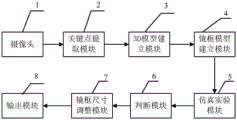
图1是本发明所述的一种通过面部关键点识别实现重建配镜的系统的原理框图。Fig. 1 is a functional block diagram of a system for reconstructing glasses by facial key point recognition according to the present invention.
图2是本发明所述的一种通过面部关键点识别实现重建配镜的方法流程意图。Fig. 2 is a flow diagram of a method for reconstructing glasses by facial key point recognition according to the present invention.
图3是面部关键点识别示意图。Figure 3 is a schematic diagram of facial key point recognition.
实施方式Implementation
下面结合附图和具体实施实例对本发明的技术方案进行进一步详细的说明。但应该指出,本发明的实施不限于以下的实施方式。The technical solutions of the present invention will be further described in detail below in conjunction with the accompanying drawings and specific implementation examples. However, it should be noted that implementation of the present invention is not limited to the following embodiments.
参见图1,一种通过面部关键点识别实现重建配镜的系统,其特征在于,该系统包括:Referring to Figure 1, a system for reconstructing glasses by facial key point recognition is characterized in that the system includes:
摄像头1用于采集用户脸部包括正面、左侧面和右侧面图像,将脸部图像信号输出到关键点提取模块2。The
关键点提取模块2,用于通过关键点识别算法,对摄像头1采集的脸部图像信号提取面部关键点64—128个,并将关键点数据输出到3D模型建立模块3。The key
3D模型建立模块3,用于根据关键点数据建立人脸3D模型。The 3D
镜框模型建立模块4,用于根据人脸3D模型选配适宜的镜框模型。The spectacle frame model building module 4 is used to select and match a suitable spectacle frame model according to the 3D model of the human face.
仿真实验模块5,用于将选配的镜框模型与人脸3D模型配合进行仿真实验,测试镜框模型和人脸3D模型的摩擦力。镜框与人脸3D模型的摩擦力测试和碰撞模拟实验采用模拟装配技术,可在autoCAD的solidworks中完成。The
判断模块6:用于判断摩擦力大小是否符合规定的要求。并将判断结果输出到镜框尺寸调整模块7。Judgment module 6: for judging whether the magnitude of the frictional force meets the specified requirements. And the judgment result is output to the frame size adjustment module 7.
镜框尺寸调整模块7:用于根据摩擦力大小的判断结果调整镜框模型尺寸。Mirror frame size adjustment module 7: used to adjust the size of the mirror frame model according to the judgment result of the friction force.
输出模块8:用于根据镜框模型尺寸输出镜框尺寸。Output module 8: used to output the size of the frame according to the size of the frame model.
在具体实施例中,所述镜框模型建立模块4包括:In a specific embodiment, the frame model building module 4 includes:
标准脸型的3D模型数据库建立模块:用于建立标准脸型的3D模型数据库。3D model database building module of standard face shape: used to build a 3D model database of standard face shape.
标准镜框模型数据库建立模块:用于对应每一个标准脸型的3D模型,建立与之相适应的标准镜框模型,存入标准镜框模型数据库内。Standard frame model database building module: used to correspond to the 3D model of each standard face shape, establish a standard frame model corresponding to it, and store it in the standard frame model database.
选择模块:用于将人脸3D模型与标准脸型的3D模型数据库中的标准脸型的3D模型进行比较,选择出与人脸3D模型最接近的标准脸型3D模型,并选配出与之相适应的标准镜框模型。Selection module: it is used to compare the 3D model of the human face with the 3D model of the standard face in the 3D model database of the standard face, select the 3D model of the standard face that is closest to the 3D model of the human face, and match it to match it standard mirror frame model.
参见图2, 一种通过面部关键点识别实现重建配镜的方法,该方法包括如下步骤:Referring to Fig. 2, a method for reconstructing glasses by facial key point recognition, the method includes the following steps:
A.摄像头1采集用户脸部包括正面、左侧面和右侧面图像,将脸部图像信号输出到关键点提取模块2。A. The
B.关键点提取模块2通过关键点识别算法,对摄像头1采集的脸部图像信号提取面部关键点64—128个,并将关键点数据输出到3D模型建立模块3。B. The key
参见图3,图3中的黑点“”为需要识别的人脸面部关键点,共有64个。人脸面部关键点主要包括:鼻尖 、鼻根、下巴、左眼外角、左眼内角、 右眼外角、右眼内角、嘴中心、嘴左角、嘴右角、左脸最外端、右脸最外端等。人脸面部关键点的识别可采用encoder-decoder模型,输入人脸图像采用256×256×3,输出的位置映射图为256×256×3。See Figure 3, the black dots in Figure 3" "There are 64 facial key points that need to be recognized. The key points of human face mainly include: nose tip, nose root, chin, left eye outer corner, left eye inner corner, right eye outer corner, right eye inner corner, mouth center, mouth The left corner, the right corner of the mouth, the outermost end of the left face, the outermost end of the right face, etc. The recognition of key points of the face can use the encoder-decoder model, the input face image is 256×256×3, and the output position map is 256×256×3.
C.3D模型建立模块3根据关键点数据建立人脸3D模型。C. The 3D
D.镜框模型建立模块4根据人脸3D模型选配适宜的镜框模型。D. Spectacle frame model building module 4 selects a suitable spectacle frame model according to the 3D model of the face.
E.仿真实验模块5将镜框模型与人脸3D模型配合进行仿真实验,测试镜框模型和脸部的摩擦力。镜框模型与人脸3D模型的摩擦力计算和碰撞模拟实验采用模拟装配技术,可在autoCAD的solidworks中完成。E. The
F.判断模块6判断摩擦力大小是否符合规定的要求。当摩擦力大小不符合规定的要求时,将判断结果输出到镜框尺寸调整模块7,进入步骤G。当摩擦力大小符合规定的要求时,进入步骤H。F. The judging
G.镜框尺寸调整模块7根据摩擦力大小的判断结果调整镜框模型尺寸,返回步骤E。该步骤可在autoCAD中进行。G. The frame size adjustment module 7 adjusts the size of the frame model according to the judgment result of the friction force, and returns to step E. This step can be done in autoCAD.
H.输出模块8根据镜框模型输出镜框尺寸,完成配镜。H. The output module 8 outputs the size of the frame according to the frame model to complete the dispensing.
在具体实施例中,步骤D包括如下步骤:In a specific embodiment, step D includes the following steps:
D1.标准脸型的3D模型数据库建立模块建立标准脸型的3D模型数据库。D1. The 3D model database building module for standard face shapes establishes a 3D model database for standard face shapes.
D2.标准镜框模型数据库建立模块对每一个标准脸型的3D模型,建立与之相适应的标准镜框模型,存入标准镜框模型数据库内。D2. The standard frame model database building module establishes a standard frame model corresponding to the 3D model of each standard face shape, and stores it in the standard frame model database.
D3.选择模块将人脸3D模型与标准脸型的3D模型数据库中的标准脸型的3D模型进行比较,选择出与人脸3D模型最接近的标准脸型3D模型,并选配出与之相适应的标准镜框模型。D3. The selection module compares the 3D model of the human face with the 3D models of the standard face in the 3D model database of the standard face, selects the 3D model of the standard face that is closest to the 3D model of the human face, and chooses a standard frame that is suitable for it Model.
尽管已经示出和描述了本发明的实施例,本领域的普通技术人员可以理解:在不脱离本发明的原理和宗旨的情况下可以对这些实施例进行多种变化、修改、替换和变型,本发明的范围由权利要求及其等同物限定。Although the embodiments of the present invention have been shown and described, those skilled in the art can understand that various changes, modifications, substitutions and modifications can be made to these embodiments without departing from the principle and spirit of the present invention. The scope of the invention is defined by the claims and their equivalents.
Claims (4)
Priority Applications (1)
| Application Number | Priority Date | Filing Date | Title |
|---|---|---|---|
| CN201911001584.3A CN110866970B (en) | 2019-10-21 | 2019-10-21 | A system and method for reconstructing glasses through facial key point recognition |
Applications Claiming Priority (1)
| Application Number | Priority Date | Filing Date | Title |
|---|---|---|---|
| CN201911001584.3A CN110866970B (en) | 2019-10-21 | 2019-10-21 | A system and method for reconstructing glasses through facial key point recognition |
Publications (2)
| Publication Number | Publication Date |
|---|---|
| CN110866970A CN110866970A (en) | 2020-03-06 |
| CN110866970B true CN110866970B (en) | 2023-04-25 |
Family
ID=69652685
Family Applications (1)
| Application Number | Title | Priority Date | Filing Date |
|---|---|---|---|
| CN201911001584.3A Active CN110866970B (en) | 2019-10-21 | 2019-10-21 | A system and method for reconstructing glasses through facial key point recognition |
Country Status (1)
| Country | Link |
|---|---|
| CN (1) | CN110866970B (en) |
Citations (4)
| Publication number | Priority date | Publication date | Assignee | Title |
|---|---|---|---|---|
| JPH11160599A (en) * | 1997-11-25 | 1999-06-18 | Konica Corp | Lens driving device |
| CN205540749U (en) * | 2016-04-13 | 2016-08-31 | 黑龙江科技大学 | Thief -proof device of getting of computer information |
| CN108615256A (en) * | 2018-03-29 | 2018-10-02 | 西南民族大学 | A kind of face three-dimensional rebuilding method and device |
| CN108769079A (en) * | 2018-07-09 | 2018-11-06 | 四川大学 | A kind of Web Intrusion Detection Techniques based on machine learning |
Family Cites Families (15)
| Publication number | Priority date | Publication date | Assignee | Title |
|---|---|---|---|---|
| CN200944160Y (en) * | 2006-08-11 | 2007-09-05 | 黄文泽 | Spectacle tripod retractable stop structure |
| US8154524B2 (en) * | 2008-06-24 | 2012-04-10 | Microsoft Corporation | Physics simulation-based interaction for surface computing |
| US20130088490A1 (en) * | 2011-04-04 | 2013-04-11 | Aaron Rasmussen | Method for eyewear fitting, recommendation, and customization using collision detection |
| CN102254475B (en) * | 2011-07-18 | 2013-11-27 | 广州赛宝联睿信息科技有限公司 | Method for realizing endoscopic minimal invasive surgery simulated training 3D platform system |
| EP3036701A4 (en) * | 2013-08-22 | 2017-01-18 | Bespoke, Inc. | Method and system to create custom products |
| US20150127132A1 (en) * | 2013-11-01 | 2015-05-07 | West Coast Vision Labs Inc. | Method and system for generating custom-fit eye wear geometry for printing and fabrication |
| CN103578137A (en) * | 2013-11-29 | 2014-02-12 | 中国建筑第八工程局有限公司 | Three-dimensional modeling system and method for prefabricated parts |
| FR3016050B1 (en) * | 2014-01-02 | 2017-12-08 | Essilor Int | METHOD OF ADJUSTING A PREDETERMINED GLASS MOUNT FOR USE BY A DONOR |
| CN105067236B (en) * | 2015-07-24 | 2017-11-14 | 北京航空航天大学 | A kind of dry friction damping shock absorber major error monitoring method |
| FR3039662B1 (en) * | 2015-07-31 | 2017-09-01 | Essilor Int | METHOD OF VERIFYING CONFORMITY TO A PREDETERMINE USE CRITERION OF A GLASSES FRAME |
| CN108701216B (en) * | 2017-11-13 | 2021-12-03 | 深圳和而泰智能控制股份有限公司 | Face recognition method and device and intelligent terminal |
| CN108154386A (en) * | 2017-12-08 | 2018-06-12 | 上海翰达眼镜销售有限公司 | A kind of method for choosing and customizing glasses |
| CN109549620A (en) * | 2018-12-21 | 2019-04-02 | 西南民族大学 | A kind of embedded eyeground pathological changes automatic recognition system |
| CN109460635B (en) * | 2018-12-29 | 2023-08-18 | 陈星原 | Method and system for generating a frame |
| CN109978655A (en) * | 2019-01-14 | 2019-07-05 | 明灏科技(北京)有限公司 | A kind of virtual frame matching method and system |
-
2019
- 2019-10-21 CN CN201911001584.3A patent/CN110866970B/en active Active
Patent Citations (4)
| Publication number | Priority date | Publication date | Assignee | Title |
|---|---|---|---|---|
| JPH11160599A (en) * | 1997-11-25 | 1999-06-18 | Konica Corp | Lens driving device |
| CN205540749U (en) * | 2016-04-13 | 2016-08-31 | 黑龙江科技大学 | Thief -proof device of getting of computer information |
| CN108615256A (en) * | 2018-03-29 | 2018-10-02 | 西南民族大学 | A kind of face three-dimensional rebuilding method and device |
| CN108769079A (en) * | 2018-07-09 | 2018-11-06 | 四川大学 | A kind of Web Intrusion Detection Techniques based on machine learning |
Also Published As
| Publication number | Publication date |
|---|---|
| CN110866970A (en) | 2020-03-06 |
Similar Documents
| Publication | Publication Date | Title |
|---|---|---|
| US12130499B2 (en) | Systems and methods for previewing adjustments to stock eyewear frames using a 3D scan of facial features | |
| US12386210B2 (en) | Method and system to create custom products | |
| CN107358648B (en) | Real-time fully automatic high-quality 3D face reconstruction method based on a single face image | |
| KR102334280B1 (en) | Method, device and computer program for the virtual fitting of a spectacle frame | |
| CN105708467B (en) | Human body actual range measures and the method for customizing of spectacle frame | |
| US9341867B1 (en) | Methods of designing and fabricating custom-fit eyeglasses using a 3D printer | |
| CN104809638A (en) | Virtual glasses trying method and system based on mobile terminal | |
| CN101324961B (en) | Human face portion three-dimensional picture pasting method in computer virtual world | |
| CN104408764A (en) | Method, device and system for trying on glasses in virtual mode | |
| JPH07168875A (en) | Eyeglass shape design design system | |
| CN110796719A (en) | Real-time facial expression reconstruction method | |
| CN105913416A (en) | Method for automatically segmenting three-dimensional human face model area | |
| CN110782528A (en) | Free deformation human face shaping simulation method, system and storage medium | |
| CN107886568B (en) | Method and system for reconstructing facial expression by using 3D Avatar | |
| CN110866970B (en) | A system and method for reconstructing glasses through facial key point recognition | |
| TWI471807B (en) | Face classification method, face classification device, classification chart, face classification program and recorded the program of the recording media | |
| CN117541689A (en) | Digital person generation method, platform, electronic device and storage medium | |
| CN108256648A (en) | A kind of image design robot | |
| CN113129429A (en) | Design method of head wearable product | |
| Du et al. | Research on the two-dimensional face image feature extraction method | |
| CN115497147A (en) | Eye image generation system and method | |
| CN117333897A (en) | A sitting posture recognition system and method combining regional importance | |
| CN116311450A (en) | A portrait adjustment method and system based on GAN and Mediapipe | |
| CN120612405A (en) | Virtual image generation method, device, equipment and medium based on model training | |
| CN120823275A (en) | Model training method, visual media generation method, device and storage medium |
Legal Events
| Date | Code | Title | Description |
|---|---|---|---|
| PB01 | Publication | ||
| PB01 | Publication | ||
| SE01 | Entry into force of request for substantive examination | ||
| SE01 | Entry into force of request for substantive examination | ||
| GR01 | Patent grant | ||
| GR01 | Patent grant |