CN110859636B - Dynamic bladder volume measurement method insensitive to urine conductivity - Google Patents
Dynamic bladder volume measurement method insensitive to urine conductivity Download PDFInfo
- Publication number
- CN110859636B CN110859636B CN201911275429.0A CN201911275429A CN110859636B CN 110859636 B CN110859636 B CN 110859636B CN 201911275429 A CN201911275429 A CN 201911275429A CN 110859636 B CN110859636 B CN 110859636B
- Authority
- CN
- China
- Prior art keywords
- bladder
- edge effect
- conductivity
- volume
- reconstructed image
- Prior art date
- Legal status (The legal status is an assumption and is not a legal conclusion. Google has not performed a legal analysis and makes no representation as to the accuracy of the status listed.)
- Active
Links
Images


Classifications
-
- A—HUMAN NECESSITIES
- A61—MEDICAL OR VETERINARY SCIENCE; HYGIENE
- A61B—DIAGNOSIS; SURGERY; IDENTIFICATION
- A61B5/00—Measuring for diagnostic purposes; Identification of persons
- A61B5/20—Measuring for diagnostic purposes; Identification of persons for measuring urological functions restricted to the evaluation of the urinary system
- A61B5/202—Assessing bladder functions, e.g. incontinence assessment
- A61B5/204—Determining bladder volume
-
- A—HUMAN NECESSITIES
- A61—MEDICAL OR VETERINARY SCIENCE; HYGIENE
- A61B—DIAGNOSIS; SURGERY; IDENTIFICATION
- A61B5/00—Measuring for diagnostic purposes; Identification of persons
- A61B5/05—Detecting, measuring or recording for diagnosis by means of electric currents or magnetic fields; Measuring using microwaves or radio waves
- A61B5/053—Measuring electrical impedance or conductance of a portion of the body
Landscapes
- Health & Medical Sciences (AREA)
- Life Sciences & Earth Sciences (AREA)
- Medical Informatics (AREA)
- Molecular Biology (AREA)
- Veterinary Medicine (AREA)
- Biophysics (AREA)
- Pathology (AREA)
- Engineering & Computer Science (AREA)
- Biomedical Technology (AREA)
- Heart & Thoracic Surgery (AREA)
- Public Health (AREA)
- Physics & Mathematics (AREA)
- Surgery (AREA)
- Animal Behavior & Ethology (AREA)
- General Health & Medical Sciences (AREA)
- Nuclear Medicine, Radiotherapy & Molecular Imaging (AREA)
- Radiology & Medical Imaging (AREA)
- Physiology (AREA)
- Urology & Nephrology (AREA)
- Measurement And Recording Of Electrical Phenomena And Electrical Characteristics Of The Living Body (AREA)
Abstract
本发明公开了一种对尿液电导率不敏感的动态膀胱体积测量方法,涉及电阻抗层析成像技术在膀胱尿量监测领域。首先测量前通过MATLAB调用EIDORS函数对人体腹部进行有限元仿真模拟;在膀胱底面往上距离h的位置,在人体周身表面设置n个电极,构建重建图像;然后利用重建图像中膀胱区域的各像素点的坐标和像素值,提取边缘效应特征值;建立边缘效应特征值与膀胱体积的拟合方程;对拟合方程中的待定拟合系数进行求解;最后针对实际患者,以患者的膀胱排空时为参考帧,使用时间差分法,对当下时刻相对参考帧进行重建图像;利用重建图像提取患者的边缘效应特征值,带入拟合方程中映射得到该患者的膀胱体积。本发明减小了尿液电导率带来的影响。
The invention discloses a dynamic bladder volume measurement method that is insensitive to urine electrical conductivity, and relates to the field of bladder urine volume monitoring using electrical impedance tomography technology. First, call the EIDORS function through MATLAB to perform finite element simulation on the abdomen of the human body; set n electrodes on the surface of the human body at a distance h from the bottom of the bladder to construct a reconstructed image; then use the pixels of the bladder region in the reconstructed image The coordinates and pixel values of the points are used to extract the eigenvalues of the edge effect; the fitting equation between the eigenvalues of the edge effect and the bladder volume is established; the undetermined fitting coefficients in the fitting equation are solved; The time difference is used as the reference frame, and the time difference method is used to reconstruct the image relative to the reference frame at the current moment; the edge effect eigenvalues of the patient are extracted from the reconstructed image and brought into the fitting equation to map the bladder volume of the patient. The present invention reduces the influence of urine conductivity.
Description
技术领域technical field
本发明涉及电阻抗层析成像技术(EIT)在膀胱尿量监测领域的应用,具体涉及一种对尿液电导率不敏感的动态膀胱体积测量方法。The invention relates to the application of electrical impedance tomography (EIT) in the field of bladder urine volume monitoring, in particular to a dynamic bladder volume measurement method that is insensitive to urine conductivity.
背景技术Background technique
目前常见的膀胱体积测量方法有计算机断层成像(Computed Tomography,CT)和超声法。CT具有较高精度,但其辐射较高,操作复杂,价格昂贵等原因限制了其在日常的膀胱体积检测方面的应用。超声对比计算机断层成像相对操作简单,无害且可多次检查,但其使用仍限制在医院及专业人员。此外这两种方法都是静态测量,无法实时监测膀胱体积。At present, the common methods of bladder volume measurement include computed tomography (Computed Tomography, CT) and ultrasound. CT has high precision, but its high radiation, complicated operation and high price limit its application in daily bladder volume detection. Ultrasound versus computed tomography is relatively simple, harmless, and can be examined multiple times, but its use is still limited to hospitals and professionals. In addition, both methods are static measurements and cannot monitor bladder volume in real time.
电阻抗层析成像(Electrical Impedance Tomography,EIT)方法与传统的膀胱体积测量方法相比,具有实时性,非入侵,安全无辐射以及价格低廉的优点,能对膀胱体积进行动态测量。Compared with traditional bladder volume measurement methods, Electrical Impedance Tomography (EIT) has the advantages of real-time, non-invasive, safe, non-radiation and low cost, and can dynamically measure bladder volume.
目前EIT膀胱体积测量方法常用的有全局阻抗法,等效圆直径法,神经网络法以及奇异值差分法;如文献1:T.Schlebusch,S.Nienke,S.Leonhardt,and M.Walter,‘基于电阻抗断层成像的膀胱容积估计’,生理学测量;,第35卷,9号,pp.1813–1823,2014年9月。At present, the commonly used methods for EIT bladder volume measurement include global impedance method, equivalent circle diameter method, neural network method and singular value difference method; Bladder volume estimation based on electrical impedance tomography', Physiological Measurements;, Vol. 35, No. 9, pp. 1813–1823, September 2014.
但全局阻抗法,神经网络法以及奇异值差分法对膀胱体积的测量均易受到尿液电导率变化的影响;等效圆直径法对尿液电导率变化不敏感,但其测量精度较差。人体尿液电导率受到生活习惯和饮食结构等因素的影响,不同个体间甚至同一个体的不同时间均有不同;由于上述原因,EIT方法测量膀胱体积的精度提高受到限制。However, the measurement of bladder volume by global impedance method, neural network method and singular value difference method is easily affected by the change of urine conductivity; the equivalent circle diameter method is not sensitive to the change of urine conductivity, but its measurement accuracy is poor. The conductivity of human urine is affected by factors such as living habits and dietary structure, and varies among individuals and even at different times within the same individual. Due to the above reasons, the improvement of the accuracy of the EIT method for measuring bladder volume is limited.
发明内容SUMMARY OF THE INVENTION
针对上述本领域存在的问题,本发明提供了一种对尿液电导率不敏感的动态膀胱体积测量方法,能够改善膀胱体积测量的线性度,同时相比于传统方法,本方法膀胱体积的测量受尿液电导率变化的影响减小且保证了测量的精度。In view of the above problems in the art, the present invention provides a dynamic bladder volume measurement method that is insensitive to urine conductivity, which can improve the linearity of bladder volume measurement. The influence of changes in the conductivity of urine is reduced and the accuracy of the measurement is guaranteed.
具体步骤如下:Specific steps are as follows:
步骤一、测量前通过MATLAB调用EIDORS函数对人体腹部进行有限元仿真模拟;
仿真包括人体轮廓,膀胱形状;以及膀胱电导率和腹部除膀胱外的周围组织的电导率。Simulations include the contours of the human body, the shape of the bladder; and the conductivity of the bladder and surrounding tissues of the abdomen, excluding the bladder.
步骤二、在膀胱底面往上距离h的位置,在人体周身表面设置n个电极,构建重建图像;Step 2: At the position of h above the bottom of the bladder, n electrodes are set on the surface of the human body to construct a reconstructed image;
电极覆盖的弧长占人体周长的比例为α;The ratio of the arc length covered by the electrode to the circumference of the human body is α;
每次测量时,将n个电极中的相邻两个电极作为一对,依次激励和测量,通过测量电压信号和有限元模型,对人体内部电阻抗的分布进行反演,即重建图像;图像中不同像素点大小表示不同的电导率大小。In each measurement, the adjacent two electrodes among the n electrodes are regarded as a pair, and the excitation and measurement are performed in turn. By measuring the voltage signal and the finite element model, the distribution of the internal electrical impedance of the human body is inverted, that is, the image is reconstructed; Different pixel sizes in , represent different conductivity sizes.
步骤三、利用重建图像中膀胱区域的各像素点的坐标和像素值,提取边缘效应特征值;
边缘效应的产生是由于激励测量电极产生的电场线不仅存在于电极平面,同时向第三维扩散,这导致当EIT传感器对电极平面外的物体成像时,物体在重建图像中的位置会发生偏移。The edge effect is caused by the fact that the electric field lines generated by exciting the measuring electrodes not only exist in the electrode plane, but also spread to the third dimension, which leads to the shift of the position of the object in the reconstructed image when the EIT sensor images the object outside the electrode plane. .
边缘效应特征值g计算公式为:The calculation formula of the edge effect eigenvalue g is:

N表示重建图像中膀胱区域像素点个数;pi为第i个像素点的像素值,yi为重建图像中以左上角为原点的第i个像素点的纵坐标。N represents the number of pixels in the bladder region in the reconstructed image; pi is the pixel value of the ith pixel, and y i is the ordinate of the ith pixel in the reconstructed image with the upper left corner as the origin.
步骤四、建立边缘效应特征值与膀胱体积的拟合方程;Step 4, establishing the fitting equation of edge effect characteristic value and bladder volume;
V膀胱=a·g-4+b Vbladder =a·g -4 +b
V膀胱为膀胱体积,a和b分别为待定拟合系数。Vbladder is the bladder volume, a and b are the undetermined fitting coefficients, respectively.
步骤五、对拟合方程中的待定拟合系数进行求解;Step 5. Solve the undetermined fitting coefficient in the fitting equation;
具体求解过程如下:The specific solution process is as follows:
首先,选择膀胱空和膀胱满两种情况,分别对膀胱进行多次成像,计算两次的边缘效应特征值;Firstly, two cases of bladder empty and full bladder were selected, and the bladder was imaged multiple times respectively, and the edge effect eigenvalues were calculated twice;
膀胱空以刚排尿后作为膀胱体积0ml。The empty bladder was taken as the bladder volume of 0 ml immediately after urination.
膀胱满通过两种情况进行确定:通过膀胱叩诊法确定和通过测量设备进行确定。Bladder fullness is determined by two conditions: by bladder percussion and by measuring equipment.
然后、根据膀胱空和膀胱满两种情况下的膀胱体积,以及两次的边缘效应特征值计算待定拟合系数a和b。Then, the undetermined fitting coefficients a and b were calculated based on the bladder volume in both cases of empty bladder and full bladder, and the edge effect eigenvalues of the two times.
步骤六、针对实际患者,以患者的膀胱排空时为参考帧,使用时间差分法,对当下时刻相对参考帧进行重建图像;Step 6. For the actual patient, take the patient's bladder emptying as the reference frame, and use the time difference method to reconstruct the image relative to the reference frame at the current moment;
步骤七、利用重建图像提取患者的边缘效应特征值,带入拟合方程中映射得到该患者的膀胱体积。Step 7: Extract the edge effect characteristic value of the patient by using the reconstructed image, and bring it into the fitting equation to map to obtain the bladder volume of the patient.
本发明的优点在于:The advantages of the present invention are:
一种对尿液电导率不敏感的动态膀胱体积测量方法,是相对于全局阻抗方法,从图中能够看出改善了线性度,且边缘效应是基于图像特征的,而不是基于像素点的,从而减小了尿液电导率带来的影响。A dynamic bladder volume measurement method that is not sensitive to urine conductivity is relative to the global impedance method. It can be seen from the figure that the linearity is improved, and the edge effect is based on image features rather than pixel points. Thereby reducing the effect of urine conductivity.
附图说明Description of drawings
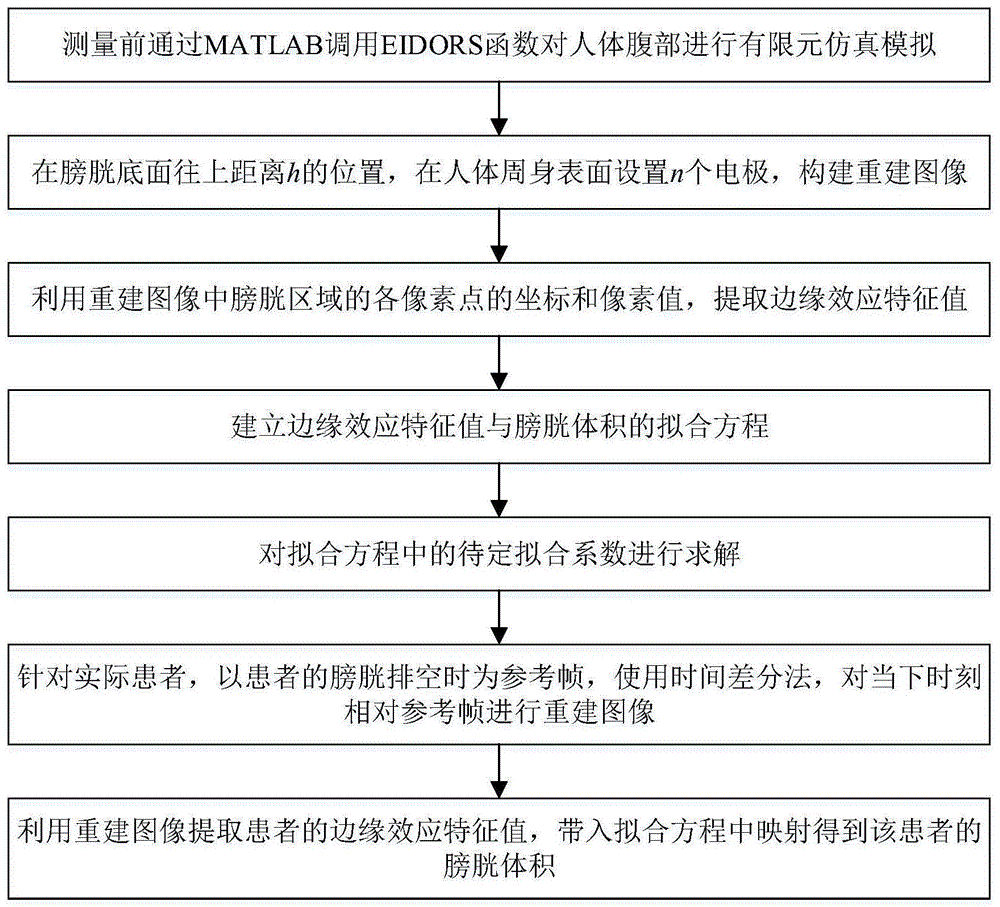
图1为本发明一种对尿液电导率不敏感的动态膀胱体积测量方法的流程图;Fig. 1 is the flow chart of a kind of dynamic bladder volume measurement method insensitive to urine conductivity of the present invention;
图2为本发明人体腹部有限元模型示意图;Fig. 2 is the schematic diagram of the finite element model of human abdomen of the present invention;
图3为本发明四端子系统示意图;3 is a schematic diagram of a four-terminal system of the present invention;
图4为本发明边缘效应原理示意图;4 is a schematic diagram of the principle of edge effect of the present invention;
图5为本发明不同参数下边缘效应特征值变化图;Fig. 5 is the variation diagram of edge effect eigenvalues under different parameters of the present invention;
图6为本发明不同参数下全局阻抗变化图。FIG. 6 is a diagram of global impedance variation under different parameters of the present invention.
具体实施方式Detailed ways
下面结合实施例和附图,对本发明的实施方式做详细、清楚的描述。The embodiments of the present invention will be described in detail and clearly below with reference to the embodiments and the accompanying drawings.
传统的全局阻抗这类指标测量膀胱体积,本质上是对躯干成像,然后对二维图像的全部像素点进行加和,以全局阻抗的增加来表征膀胱体积的增加。这种体积测量方法有两个潜在问题:1)二维图像全部像素点的加和,意味着将非膀胱区域所成图像也进行了计算,如肠胃,盆骨等;2)当尿液电导率变化时,图像像素点值的变化不仅反映了膀胱体积的变化,也反映了尿液电导率的变化。实际上,不同个体间或同一个体在不同时间,受饮食等因素影响,尿液电导率不大相同。测量原理上的这两个误差,是造成EIT膀胱体积监测无法应用于临床测量的重要障碍。Traditional indicators such as global impedance measure bladder volume, essentially imaging the torso, and then summing all pixels of the two-dimensional image to represent the increase in bladder volume with the increase in global impedance. This volume measurement method has two potential problems: 1) the summation of all pixels in the two-dimensional image means that the image of the non-bladder area is also calculated, such as the stomach, pelvis, etc.; 2) when the urine conductance When the rate changes, the change of image pixel value not only reflects the change of bladder volume, but also reflects the change of urine conductivity. In fact, different individuals or the same individual at different times, influenced by factors such as diet, the urine conductivity is not the same. These two errors in the measurement principle are important obstacles that prevent EIT bladder volume monitoring from being applied to clinical measurement.
本发明应用EIT边缘效应的膀胱体积测量方法能够很好的解决以上两个问题:1)边缘效应特征值只需膀胱区域进行运算,避免了其他位置器官变化引起图像的变化对膀胱体积测量的影响;2)当尿液电导率变化时,由于引起边缘效应的原因只与物体距传感器平面的距离有关,而与物体的电导率无关,也就是说,边缘效应特征值的变化,仅与膀胱形状的变化相关,而与尿液电导率无关,从而排除尿液电导率的影响。此外,在使用边缘效应的膀胱体积测量能够一定程度改善结果的线性度。The bladder volume measurement method using the EIT edge effect in the present invention can well solve the above two problems: 1) The edge effect feature value only needs to be calculated in the bladder area, avoiding the influence of image changes caused by changes in other positions on the bladder volume measurement. 2) When the urine conductivity changes, the cause of the edge effect is only related to the distance of the object from the sensor plane, and has nothing to do with the conductivity of the object, that is, the change of the edge effect eigenvalue is only related to the shape of the bladder. , but not with urine conductivity, thus excluding the influence of urine conductivity. In addition, the use of edge effects in bladder volume measurement can improve the linearity of the results to some extent.
本发明一种对尿液电导率不敏感的动态膀胱体积测量方法,如图1所示,包括以下步骤:A dynamic bladder volume measurement method insensitive to urine conductivity of the present invention, as shown in Figure 1, includes the following steps:
步骤一、测量前通过有限元模型对人体腹部进行仿真模拟;
仿真包括人体轮廓,膀胱形状;以及膀胱电导率和腹部除膀胱外的周围组织的电导率。通过MATLAB调用EIDORS中的函数进行有限元仿真,有限元模型如图2所示,图中腹部轮廓仿照人体腹部,灰色部分为膀胱。Simulations include the contours of the human body, the shape of the bladder; and the conductivity of the bladder and surrounding tissues of the abdomen, excluding the bladder. The finite element simulation is performed by calling the functions in EIDORS through MATLAB. The finite element model is shown in Figure 2. The outline of the abdomen in the figure is modeled after the human abdomen, and the gray part is the bladder.
步骤二、在膀胱底面往上距离h的位置,在人体周身表面设置n个电极,构建重建图像;Step 2: At the position of h above the bottom of the bladder, n electrodes are set on the surface of the human body to construct a reconstructed image;
电极覆盖的弧长占人体周长的比例为α,本实施例中电极个数n为16。The ratio of the arc length covered by the electrodes to the circumference of the human body is α, and the number n of electrodes in this embodiment is 16.
每次测量时,将16个电极中的相邻两个电极作为一对,依次激励和测量,通过测量电压信号和有限元模型,对人体内部电阻抗的分布进行反演,即重建图像;图像中不同像素点大小表示不同的电导率大小。In each measurement, two adjacent electrodes in the 16 electrodes are used as a pair, and they are excited and measured in turn. By measuring the voltage signal and the finite element model, the distribution of the internal electrical impedance of the human body is inverted, that is, the image is reconstructed; Different pixel sizes in , represent different conductivity sizes.
步骤三、利用重建图像中膀胱区域的各像素点的坐标和像素值,提取边缘效应特征值;
边缘效应的产生是由于激励测量电极产生的电场线不仅存在于电极平面,同时向第三维扩散,这导致当EIT传感器对电极平面外的物体成像时,物体在重建图像中的位置会发生偏移。The edge effect is caused by the fact that the electric field lines generated by exciting the measuring electrodes not only exist in the electrode plane, but also spread to the third dimension, which leads to the shift of the position of the object in the reconstructed image when the EIT sensor images the object outside the electrode plane. .
对边缘效应进行说明,对于四端子系统,重建图像中物体大体位置能够用下式计算:To illustrate the edge effect, for the four-terminal system, the general position of the object in the reconstructed image can be calculated by the following formula:
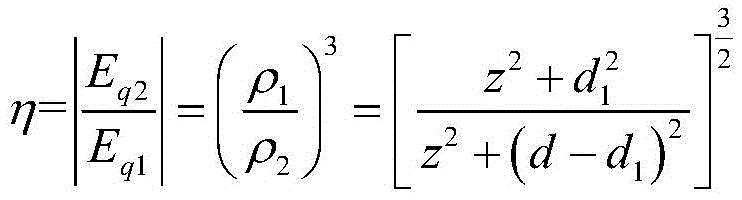
该简化模型如图3所示,式中η表示收敛比,E表示电势,q1表示激励电极对,q2表示测量电极对,ρ1表示物体p到激励电极对q1的距离;ρ2表示物体p到测量电极对q2的距离;p`表示物体p在重建图像中的位置,d1表示位置p`到激励电极对q1的距离,d表示激励电极对q1到测量电极对q2之间的距离,z表示物体到电极平面的距离。The simplified model is shown in Figure 3, where η represents the convergence ratio, E represents the electric potential, q1 represents the excitation electrode pair, q2 represents the measurement electrode pair, ρ 1 represents the distance from the object p to the excitation electrode pair q1; ρ 2 represents the object p the distance to the measurement electrode pair q2; p` represents the position of the object p in the reconstructed image, d 1 represents the distance from the position p` to the excitation electrode pair q1, d represents the distance between the excitation electrode pair q1 and the measurement electrode pair q2, z represents the distance from the object to the electrode plane.
通过这个公式,能够建立物体到电极平面距离与重建图像中物体位置之间的关系。如图4所示,展示了到电极平面不同距离小球的重建图像,从图中能够明显看出物体距离电极平面越远,重建图像中物体位置越靠近中心。With this formula, the relationship between the object-to-electrode plane distance and the object's position in the reconstructed image can be established. As shown in Figure 4, the reconstructed images of the balls at different distances from the electrode plane are shown. It can be clearly seen from the figure that the farther the object is from the electrode plane, the closer the object position in the reconstructed image is to the center.
膀胱在体积增大过程中,沿腹壁向上延伸,且底部位置几乎不变,整个膀胱的几何中心在膀胱体积增大的过程中向上变化。可利用边缘效应,对重建图像进行处理,提取边缘效应特征值,反映膀胱几何中心的位置变化,而这种位置变化与膀胱体积单调相关,从而进行膀胱体积测量。During the process of increasing the volume of the bladder, the bladder extends upward along the abdominal wall, and the position of the bottom is almost unchanged, and the geometric center of the entire bladder changes upward during the process of increasing the volume of the bladder. The edge effect can be used to process the reconstructed image and extract the edge effect feature value to reflect the position change of the geometric center of the bladder, and this position change is monotonically related to the bladder volume, so as to measure the bladder volume.
通过计算重心来表征重建图像中物体位置的移动。对于膀胱体积测量这一应用,为避免非膀胱区域成像对膀胱体积测量的影响,仅计算膀胱区域的重心。边缘效应特征值g计算公式为:The movement of the object position in the reconstructed image is characterized by calculating the center of gravity. For the application of bladder volume measurement, to avoid the influence of non-bladder region imaging on bladder volume measurement, only the center of gravity of the bladder region is calculated. The calculation formula of the edge effect eigenvalue g is:
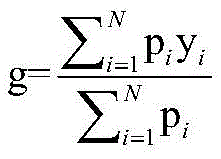
N表示重建图像中膀胱区域像素点个数;pi为第i个像素点的像素值,yi为重建图像中以左上角为原点的第i个像素点的纵坐标。N represents the number of pixels in the bladder region in the reconstructed image; pi is the pixel value of the ith pixel, and y i is the ordinate of the ith pixel in the reconstructed image with the upper left corner as the origin.
步骤四、建立边缘效应特征值随膀胱体积变化时,与膀胱体积的拟合方程;Step 4, establishing the fitting equation of the edge effect characteristic value with the bladder volume when it changes with the bladder volume;
对有限元模型中膀胱的大小和膀胱电导率这两个参数进行一系列不同的符合人体实际情况的设置,膀胱大小在40ml-500ml之间,膀胱电导率在0.4S/m-3.4S/m之间。在本实施例中,体积变化为40ml到490ml,间隔为30ml。尿液电导率分别设置为增加、不变和减少三种趋势。其中增加尿液电导率从0.4S/m变化到3.4S/m,间隔0.2S/m;尿液电导率不变为2S/m;减少时,尿液电导率从3.4S/m变化到0.4S/m,间隔0.2S/m;共16*3种设置。同时在对应设置下进行图像重建,并计算边缘效应特征值。A series of different settings are made for the two parameters of bladder size and bladder conductivity in the finite element model, which are in line with the actual situation of the human body. The bladder size is between 40ml-500ml and the bladder conductivity is 0.4S/m-3.4S/m between. In this example, the volume was varied from 40ml to 490ml at 30ml intervals. Urine conductivity was set to three trends of increasing, unchanged and decreasing, respectively. Among them, the urine conductivity changed from 0.4S/m to 3.4S/m with an interval of 0.2S/m; the urine conductivity did not change to 2S/m; when decreased, the urine conductivity changed from 3.4S/m to 0.4 S/m, interval 0.2S/m; a total of 16*3 settings. At the same time, image reconstruction is performed under the corresponding settings, and edge effect eigenvalues are calculated.
在每种体积下,都对应有不同电导率下的边缘效应特征值,对边缘效应特征值和膀胱体积进行拟合。尝试指数,对数,多项式等多种拟合方式,对比拟合优度R2,寻找最佳的拟合曲线。值得注意的是,拟合方程应包含少于两个的待定系数。结果显示,边缘效应特征值的负四次方与膀胱体积有最高的拟合优度,如图5所示。拟合方程为:Under each volume, there are corresponding edge effect eigenvalues under different conductivities, and the edge effect eigenvalues and bladder volume are fitted. Try exponential, logarithmic, polynomial and other fitting methods, compare the goodness of fit R 2 , and find the best fitting curve. It is worth noting that the fitted equation should contain less than two undetermined coefficients. The results showed that the negative fourth power of the edge effect eigenvalue had the highest goodness of fit with bladder volume, as shown in Figure 5. The fitting equation is:
V膀胱=a·g-4+b Vbladder =a·g -4 +b
V膀胱为膀胱体积,a和b分别为待定拟合系数。Vbladder is the bladder volume, a and b are the undetermined fitting coefficients, respectively.
步骤五、通过已知体积的边缘效应特征值,对拟合方程中的待定拟合系数进行求解;Step 5. Solve the undetermined fitting coefficient in the fitting equation by using the edge effect characteristic value of the known volume;
具体求解过程如下:The specific solution process is as follows:
首先,选择膀胱空和膀胱满两种情况,分别对膀胱进行多次成像,计算两次的边缘效应特征值;Firstly, two cases of bladder empty and full bladder were selected, and the bladder was imaged multiple times respectively, and the edge effect eigenvalues were calculated twice;
两个已知体积的边缘效应特征值,一般选取膀胱空和膀胱满。膀胱空以刚排尿后作为膀胱体积0ml。膀胱满有两种情况,第一种通过膀胱叩诊方法确定膀胱是否为满,假设膀胱满的体积为400ml;第二种通过精度更高的膀胱体积测量设备,如超声设备。在这两种状态下,对膀胱进行多次成像并计算边缘效应特征值,两个数据点分别为(g1,V1),(g2,V2)。。The edge effect eigenvalues of two known volumes are generally selected as bladder empty and bladder full. The empty bladder was taken as the bladder volume of 0 ml immediately after urination. There are two cases of bladder fullness. The first is to determine whether the bladder is full by the method of bladder percussion, assuming that the volume of the bladder is 400ml; the second is to measure the bladder volume with higher precision equipment, such as ultrasound equipment. In these two states, the bladder was imaged multiple times and edge effect eigenvalues were calculated, the two data points were (g 1 , V 1 ), (g 2 , V 2 ). .
然后、根据膀胱空和膀胱满两种情况下的膀胱体积,以及两次的边缘效应特征值计算待定拟合系数a和b,得到个性化边缘效应特征值与膀胱体积之间拟合方程。。Then, the undetermined fitting coefficients a and b were calculated according to the bladder volume in the two cases of bladder empty and full bladder, and the edge effect eigenvalues twice, and the fitting equation between the personalized edge effect eigenvalues and the bladder volume was obtained. .
步骤六、针对实际患者,使用差分成像以患者的膀胱排空时的测量值作为参考值,使用时间差分法,连续不断的对膀胱进行动态监测,得到测量值,重建图像,并计算边缘效应特征值。Step 6. For the actual patient, use differential imaging to take the measurement value of the patient's bladder emptying as the reference value, and use the time difference method to continuously monitor the bladder dynamically, obtain the measurement value, reconstruct the image, and calculate the edge effect feature value.
步骤七、利用重建图像提取患者的边缘效应特征值,带入拟合方程中映射得到该患者的膀胱体积。Step 7: Extract the edge effect characteristic value of the patient by using the reconstructed image, and bring it into the fitting equation to map to obtain the bladder volume of the patient.
为对比传统的全局阻抗方法,在每种参数设置下计算了全局阻抗,如图6所示。对比两图能够发现,边缘效应方法不同尿液电导率下边缘效应特征值具有较好的一致性,而全局阻抗方法在膀胱体积较大时,易受尿液电导率变化影响,且线性度较差。To compare with the traditional global impedance method, the global impedance is calculated at each parameter setting, as shown in Figure 6. Comparing the two figures, it can be found that the edge effect eigenvalues have good consistency under different urine conductivities, while the global impedance method is easily affected by changes in urine conductance when the bladder volume is large, and the linearity is better. Difference.
Claims (4)

Priority Applications (1)
| Application Number | Priority Date | Filing Date | Title |
|---|---|---|---|
| CN201911275429.0A CN110859636B (en) | 2019-12-12 | 2019-12-12 | Dynamic bladder volume measurement method insensitive to urine conductivity |
Applications Claiming Priority (1)
| Application Number | Priority Date | Filing Date | Title |
|---|---|---|---|
| CN201911275429.0A CN110859636B (en) | 2019-12-12 | 2019-12-12 | Dynamic bladder volume measurement method insensitive to urine conductivity |
Publications (2)
| Publication Number | Publication Date |
|---|---|
| CN110859636A CN110859636A (en) | 2020-03-06 |
| CN110859636B true CN110859636B (en) | 2020-12-25 |
Family
ID=69658835
Family Applications (1)
| Application Number | Title | Priority Date | Filing Date |
|---|---|---|---|
| CN201911275429.0A Active CN110859636B (en) | 2019-12-12 | 2019-12-12 | Dynamic bladder volume measurement method insensitive to urine conductivity |
Country Status (1)
| Country | Link |
|---|---|
| CN (1) | CN110859636B (en) |
Families Citing this family (13)
| Publication number | Priority date | Publication date | Assignee | Title |
|---|---|---|---|---|
| CN112165970A (en) | 2018-05-22 | 2021-01-01 | C·R·巴德股份有限公司 | Catheter insertion system and method of use |
| CN112566550B (en) | 2018-08-10 | 2024-10-22 | C·R·巴德股份有限公司 | Automated urine output measurement system and method |
| US12083261B2 (en) | 2020-06-05 | 2024-09-10 | C. R. Bard, Inc. | Automated fluid output monitoring |
| US12055249B2 (en) | 2020-07-21 | 2024-08-06 | C. R. Bard, Inc. | Automatic fluid flow system with retractable connection |
| CN111790011A (en) * | 2020-07-28 | 2020-10-20 | 曾洁 | Suction adjusting platform and method applying urine volume detection |
| US12408853B2 (en) | 2020-12-17 | 2025-09-09 | C. R. Bard, Inc. | Smart bag to measure urine output via catheter |
| US12364423B2 (en) | 2020-12-21 | 2025-07-22 | C. R. Bard, Inc. | Automated urinary output-measuring systems and methods |
| US11931151B2 (en) | 2020-12-22 | 2024-03-19 | C. R. Bard, Inc. | Automated urinary output measuring system |
| US12246146B2 (en) | 2020-12-23 | 2025-03-11 | C. R. Bard, Inc. | Automated weight based fluid output monitoring system |
| US12446813B2 (en) | 2021-08-23 | 2025-10-21 | C. R. Bard, Inc. | Automated urine output system for attachment to hospital bed |
| CN114176526B (en) * | 2021-12-29 | 2024-05-07 | 杭州电子科技大学 | Wearable bladder filling detection method and device based on novel neural architecture search |
| CN114521916B (en) * | 2022-01-10 | 2023-10-03 | 浙江大学 | A method for measuring urine output in the bladder based on a flexible ultrasound patch |
| CN118078293B (en) * | 2024-04-23 | 2024-06-28 | 天津科技大学 | Method, device and equipment for measuring bladder urine content |
Family Cites Families (8)
| Publication number | Priority date | Publication date | Assignee | Title |
|---|---|---|---|---|
| EP2228009B1 (en) * | 2009-03-09 | 2018-05-16 | Drägerwerk AG & Co. KGaA | Apparatus and method to determine functional lung characteristics |
| US9804112B2 (en) * | 2013-11-20 | 2017-10-31 | Transtech Systems, Inc. | Selective characterization of material under test (MUT) with electromagnetic impedance tomography and spectroscopy |
| CN103610463B (en) * | 2013-11-28 | 2015-12-02 | 中山大学 | A kind of urine electrical conductivity dynamic monitor and method |
| CN104605850B (en) * | 2015-01-19 | 2017-08-01 | 中山大学 | A device and method for real-time monitoring of bladder urine volume based on electrical impedance tomography |
| JP6860920B2 (en) * | 2015-05-06 | 2021-04-28 | ナショナル ユニバーシティー オブ アイルランド, ゴールウェイ | Non-invasive detection of urine reflux |
| CN107845119B (en) * | 2017-09-15 | 2021-04-27 | 南京航空航天大学 | A hybrid method for electrical tomography |
| CN109498013B (en) * | 2018-12-12 | 2020-10-09 | 北京航空航天大学 | Bladder volume measurement method based on single-layer EIT electrode edge effect |
| CN109662712B (en) * | 2018-12-25 | 2021-09-03 | 中国人民解放军第四军医大学 | Dynamic multi-frequency electrical impedance tomography method based on impedance spectrum constraint |
-
2019
- 2019-12-12 CN CN201911275429.0A patent/CN110859636B/en active Active
Also Published As
| Publication number | Publication date |
|---|---|
| CN110859636A (en) | 2020-03-06 |
Similar Documents
| Publication | Publication Date | Title |
|---|---|---|
| CN110859636B (en) | Dynamic bladder volume measurement method insensitive to urine conductivity | |
| CN109498013B (en) | Bladder volume measurement method based on single-layer EIT electrode edge effect | |
| Leonhäuser et al. | Evaluation of electrical impedance tomography for determination of urinary bladder volume: comparison with standard ultrasound methods in healthy volunteers | |
| Adam et al. | Survey on medical imaging of electrical impedance tomography (EIT) by variable current pattern methods | |
| US8295921B2 (en) | Apparatus and method for non-contact electrical impedance imaging | |
| Li et al. | Preliminary study of assessing bladder urinary volume using electrical impedance tomography | |
| Noyori et al. | Non-invasive urine volume estimation in the bladder by electrical impedance-based methods: A review | |
| CN109276315B (en) | Impedance-based location tracking performance using dispersive interpolation | |
| Schlebusch et al. | Impedance ratio method for urine conductivity-invariant estimation of bladder volume | |
| Shiga et al. | A new simple measurement system of visceral fat accumulation by bioelectrical impedance analysis | |
| CN115311227A (en) | A method for measuring bladder volume based on three-dimensional EIT image reconstruction of parameter level set | |
| CN111887847A (en) | Visceral fat measuring method and device based on human body composition meter, computer equipment and storage medium | |
| Sun et al. | Bladder volume estimation using 3-D electrical impedance tomography based on fringe field sensing | |
| CN110840457B (en) | Two-dimensional EIT electrode array structure optimization method based on fringe field detection | |
| JP2000175875A (en) | Body fat measuring method and measuring device | |
| CN106373194A (en) | Human lung electric resistance tomography finite element model design method | |
| Hwang et al. | Novel algorithm for improving accuracy of ultrasound measurement of residual urine volume according to bladder shape | |
| Padmapriya et al. | Edge based image segmentation technique for detection and estimation of the bladder wall thickness | |
| CN119559339B (en) | Bladder EIT three-dimensional morphology real-time reconstruction and capacity measurement method based on deep learning | |
| CN115736877A (en) | Focusing type cardiac electrical impedance imaging method | |
| Liu et al. | Investigation of bladder volume measurement based on fringe effect of electrical impedance tomography sensors | |
| CN109946388B (en) | Electrical/ultrasonic bimodal inclusion boundary reconstruction method based on statistical inversion | |
| Liang et al. | Effect of stimulation patterns on bladder volume measurement based on fringe effect of EIT sensors | |
| CN117274413A (en) | A conductivity image reconstruction method, system and equipment based on EIT | |
| JP2013183767A (en) | Muscle function evaluation method and muscle function evaluation apparatus |
Legal Events
| Date | Code | Title | Description |
|---|---|---|---|
| PB01 | Publication | ||
| PB01 | Publication | ||
| SE01 | Entry into force of request for substantive examination | ||
| SE01 | Entry into force of request for substantive examination | ||
| GR01 | Patent grant | ||
| GR01 | Patent grant |