Disclosure of Invention
The invention aims to provide a natural language theme classification method and a natural language theme classification device, which can realize the self-adaptive selection of characteristics and improve the classification accuracy.
In order to achieve the purpose, the invention provides the following scheme:
a natural language topic classification method, comprising: a training stage and a classification stage;
the training phase comprises:
acquiring a natural language text segment with a known theme as a sample set;
extracting a plurality of words with the highest occurrence frequency in the sample set to obtain a plurality of characteristic words;
representing each feature word into a vector to obtain a plurality of feature vectors;
calculating the similarity between any two feature vectors to obtain a similarity set; the similarity degree set reflects the characteristics and the relation of a plurality of feature vectors;
inputting the similarity degree, the topics and the feature words corresponding to each topic into a preset neural network structure for training, so as to learn the characteristics and the connection of the feature vectors and the relationship between the feature words and the classification results, and obtain a feature spectrum and a model expressing the relationship between the feature spectrum and the classification results; the feature spectrum is a plurality of feature words which can influence the classification result most;
the classification phase comprises:
acquiring a natural language text segment to be classified;
extracting feature words belonging to the feature spectrum in the natural language text segment to be classified to obtain input feature parameters;
and inputting the input characteristic parameters into a model of the relation between the expression characteristic spectrum and the classification result to obtain the classification result.
Optionally, the extracting a plurality of words with the highest occurrence frequency in the sample set to obtain a plurality of feature words specifically includes:
and searching the occurrence frequency of each word in the sample set by using a Sunday algorithm to obtain a plurality of words with the highest occurrence frequency.
Optionally, the representing each feature word into a vector to obtain a plurality of feature vectors specifically includes:
and calculating the word frequency-inverse text frequency index of each characteristic word to obtain the characteristic vector representation of each characteristic word.
Optionally, the calculating the similarity between any two feature vectors to obtain a similarity set specifically includes:
calculating the similarity between any two eigenvectors by using cosine similarity;
and carrying out normalization processing on each similarity value to obtain a similarity degree set.
Optionally, the preset neural network structure includes a feature information summary layer, a feature spectrum layer, an input layer, a hidden layer, and an output layer;
each node of the characteristic information summarizing layer is generated by each element of the similarity degree set;
the characteristic spectrum layer is used for generating the characteristic spectrum in a training stage;
the input layer is used for inputting the input characteristic parameters in a classification stage;
the hidden layer is used for establishing a relation between the characteristic spectrum and a classification result in a training stage and generating a classification result corresponding to the input characteristic parameter according to the established relation in a classification stage;
the output layer is used for outputting a classification result in a classification stage.
A natural language topic classification apparatus comprising:
the sample acquisition device is used for acquiring a natural language text segment with a known theme as a sample set;
the high-frequency word extraction device is used for extracting a plurality of words with the highest occurrence frequency in the sample set to obtain a plurality of characteristic words;
the vector representation device is used for representing each feature word into a vector to obtain a plurality of feature vectors;
the similarity calculation device is used for calculating the similarity between any two feature vectors to obtain a similarity set; the similarity degree set reflects the characteristics and the relation of a plurality of feature vectors;
the training and classifying device is used for inputting the similarity degree, the topics and the feature words corresponding to each topic into a preset neural network structure for training, so that the characteristics and the connection of the feature vectors and the relation between the feature words and the classification result are learned, and a feature spectrum and a model expressing the relation between the feature spectrum and the classification result are obtained; the feature spectrum is a plurality of feature words which can influence the classification result most;
the text to be classified acquisition device is used for acquiring the natural language text segment to be classified;
the input parameter extraction device is used for extracting the feature words belonging to the feature spectrum in the natural language text segment to be classified to obtain input feature parameters;
the training and classifying device is also used for inputting the input characteristic parameters into a model expressing the relationship between the characteristic spectrum and the classification result to obtain the classification result.
Optionally, the high-frequency word extracting apparatus includes:
and the high-frequency word extraction element is used for searching the occurrence frequency of each word in the sample set by utilizing a Sunday algorithm to obtain a plurality of words with the highest occurrence frequency.
Optionally, the vector representing device includes:
and the vector representing element is used for calculating the word frequency-inverse text frequency index of each characteristic word to obtain the characteristic vector representation of each characteristic word.
Optionally, the similarity degree calculation device includes:
the cosine similarity calculation element is used for calculating the similarity between any two eigenvectors by utilizing the cosine similarity;
and the normalization processing element is used for performing normalization processing on each similarity value to obtain a similarity degree set.
Optionally, the preset neural network structure includes a feature information summary layer, a feature spectrum layer, an input layer, a hidden layer, and an output layer;
each node of the characteristic information summarizing layer is generated by each element of the similarity degree set;
the characteristic spectrum layer is used for generating the characteristic spectrum in a training stage;
the input layer is used for inputting the input characteristic parameters in a classification stage;
the hidden layer is used for establishing a relation between the characteristic spectrum and a classification result in a training stage and generating a classification result corresponding to the input characteristic parameter according to the established relation in a classification stage;
the output layer is used for outputting a classification result in a classification stage.
According to the specific embodiment provided by the invention, the invention discloses the following technical effects: according to the natural language theme classification method and device, the characteristic spectrum is screened out by utilizing the neural network structure, so that a plurality of characteristic words which can influence the classification result most are automatically generated, the self-adaptive selection of the characteristics can be realized, the dependence on the characteristics selected by the artificial characteristics is avoided, and the classification accuracy is improved.
Detailed Description
The technical solutions in the embodiments of the present invention will be clearly and completely described below with reference to the drawings in the embodiments of the present invention, and it is obvious that the described embodiments are only a part of the embodiments of the present invention, and not all of the embodiments. All other embodiments, which can be derived by a person skilled in the art from the embodiments given herein without making any creative effort, shall fall within the protection scope of the present invention.
In order to make the aforementioned objects, features and advantages of the present invention comprehensible, embodiments accompanied with figures are described in further detail below.
Example 1:
this embodiment provides a natural language topic classification method. As is well known, the classification of natural language topics is one of the contents that students must currently master. For example, the classification of the ancient poetry theme can help students understand the subject thought of the ancient poetry. Therefore, the scheme of the application can play a role in assisting teaching.
The natural language topic classification method comprises the following steps: a training phase and a classification phase.
Fig. 1 is a flowchart of a training phase in the natural language topic classification method of embodiment 1.
The training phase, see fig. 1, comprises:
step 101: natural language text segments of known topics are obtained as a sample set.
Step 102: extracting a plurality of words with the highest occurrence frequency in the sample set to obtain a plurality of characteristic words; the method specifically comprises the following steps: and searching the occurrence frequency of each word in the sample set by using a Sunday algorithm to obtain a plurality of words with the highest occurrence frequency.
Step 103: representing each feature word into a vector to obtain a plurality of feature vectors; the method specifically comprises the following steps: and calculating the word frequency-inverse text frequency index of each characteristic word to obtain the characteristic vector representation of each characteristic word.
Step 104: calculating the similarity between any two feature vectors to obtain a similarity set; the similarity degree set reflects the characteristics and the relation of a plurality of feature vectors; the method specifically comprises the following steps:
calculating the similarity between any two eigenvectors by using cosine similarity; and carrying out normalization processing on each similarity value to obtain a similarity degree set.
Step 105: inputting the similarity degree, the topics and the feature words corresponding to each topic into a preset neural network structure for training, so as to learn the characteristics and the connection of the feature vectors and the relationship between the feature words and the classification results, and obtain a feature spectrum and a model expressing the relationship between the feature spectrum and the classification results; the feature spectrum is a plurality of feature words which can influence the classification result most.
The preset neural network structure is used for automatically establishing the characteristics and the relation of the characteristic vectors and establishing the relation between the characteristic words and the classification results through learning under the condition that the characteristics and the relation of the characteristic vectors are not clear and the relation between the characteristic words and the classification results is not clear.
The preset neural network structure comprises a characteristic information gathering layer, a characteristic spectrum layer, an input layer, a hidden layer and an output layer; and establishing a forward propagation and backward propagation relation between the characteristic spectrum layer and the hidden layer.
Each node of the characteristic information summarizing layer is generated by each element of the similarity degree set; the number of the nodes of the characteristic information summarizing layer is the same as the number of the elements of the similarity degree set. Namely, the characteristic information summary layer is essentially composed of elements in the similarity degree set.
The characteristic spectrum layer is used for generating the characteristic spectrum in a training stage; the number of the nodes of the characteristic spectrum layer is the same as the number of the characteristic words. The feature spectrum layer marks the feature words belonging to the feature spectrum as 1, marks the feature words not belonging to the feature spectrum as 0, and then generates a mask vector M with the feature spectrum of 1 × n, wherein M is composed of 0 and 1, the corresponding position of the feature words belonging to the feature spectrum is 1, and the corresponding position of the feature words not belonging to the feature spectrum is 0. n is the number of feature words obtained in step 102. The characteristic spectrum layer is fully connected with the characteristic information gathering layer.
The input layer is used for inputting the input characteristic parameters in a classification stage. The number of the nodes of the input layer is the same as the number of the feature words in the feature spectrum.
The hidden layer is used for establishing a relation between the characteristic spectrum and a classification result in a training stage and generating the classification result corresponding to the input characteristic parameter according to the established relation in a classification stage;
the output layer is used for outputting the classification result in the classification stage. The number of the nodes of the output layer is the same as the number of the types of the preset classification results. The input layer, the hidden layer and the output layer are all connected.
Fig. 2 is a flowchart of a classification stage in the natural language topic classification method of embodiment 1.
Referring to fig. 2, the classification phase includes:
step 201: and acquiring the natural language text segment to be classified.
Step 202: and extracting the characteristic words belonging to the characteristic spectrum in the natural language text segment to be classified to obtain input characteristic parameters.
The input characteristic parameters have two forms, namely a normalization form and a binary form;
determination of the normalized form:
counting the frequency of n characteristic words in the natural language text segment to be classified, and then normalizing to obtain a 1 x n vector. And performing point multiplication on the 1 xn vector and the mask vector M to obtain an input characteristic parameter vector. The normalization form of the input characteristic parameters contains the characteristics of the frequency of occurrence of each characteristic word.
Determination process in binary form:
extracting feature words in a natural language text segment to be classified; and constructing a 1 x n vector, marking the position corresponding to the feature word belonging to the feature spectrum in the 1 x n vector as 1, and marking the position corresponding to the feature word not belonging to the feature spectrum as 0 to obtain an input feature parameter vector. The binary form of the input characteristic parameters does not contain the characteristics of the occurrence frequency of each characteristic word, and only contains the characteristics of which characteristic words are contained in the natural language text segment to be classified.
Step 203: and inputting the input characteristic parameters into a model of the relation between the expression characteristic spectrum and the classification result to obtain the classification result.
Example 2:
the embodiment 2 takes the ancient poem text as an example to explain the technical scheme of the invention in detail.
The ancient poetry text is used as a special type of natural language text, the sentence pattern, the format and the expression mode of the ancient poetry text are different from those of the current generation text, and the ancient poetry text is impoverished and obscure in content and is extremely refined at the same time. In addition, ancient poetry mostly takes monosyllabic words, and the characteristic also brings about a problem for the selection of the characteristics. The invention forms the most efficient characteristic spectrum (the characteristic spectrum is a set of a plurality of selected characteristics) by adaptively selecting the most useful characteristics for text classification, and because the classification task is completed according to the characteristic selection, the selection of the characteristics is influenced by the final task completion condition, namely the classification quality directly influences the selection of the characteristics, the invention is very suitable for the large data field with numerous characteristics, such as text identification, text classification and the like, and can also overcome the problems caused by the characteristics of ancient poetry texts.
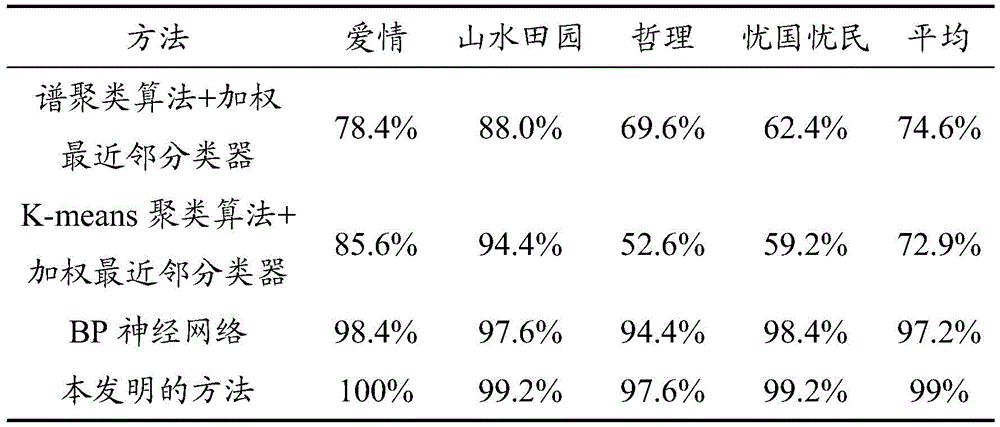
The invention is illustrated by taking the example that the theme of a certain section of ancient poetry text is divided into four types of love, mountain and water gardens, worry people in our country and philosophy.
1200 ancient poetry texts with known subjects were selected, 700 of which were used as training sets and 500 of which were used as test sets (125 of each category).
The classification method is divided into a training phase and a classification phase. The training phase is as follows:
1. and (3) searching the high-frequency words in the training set by using a Sunday algorithm (the Sunday algorithm is a linear character string pattern matching algorithm), and forming a high-frequency word feature library. The feature library contains n feature items (i.e. n feature words).
2. Vectorizing each feature word.
The goal of this example 2 is to classify the input ancient poem text into 4 classes, so the numerical value of each feature word should be related to the distinguishing representation of the feature word for 4 types of ancient poem text. Therefore, TF-IDF, namely a method of word frequency-inverse text frequency, is selected to carry out vector representation on the feature words. The specific process is as follows:
1) the word frequency (TF) is calculated.
Setting love, mountain and water gardens, worry about people and philosophy poems which respectively correspond to the categories: 1. 2, 3 and 4, the corresponding space numbers under each category are respectively: n1, N2, N3 and N4, wherein the total number of Chinese characters contained in the jth ancient poetry text under the ith category is Ni,jThe occurrence frequency of the characteristic word t in the jth ancient poem text under the ith class is nt,i,j(i=1,2,3,4;j=1,2,…,Ni) Then the word frequency TF of the characteristic word t in the i-th class textt,iIs composed of
The word frequency TFt,iThe formula of (2) shows the occurrence rate of the characteristic word t in the i-type text, and meanwhile, the normalization of the number of words is also carried out, so that the phenomenon that the characteristic word t is biased to a longer text file is avoided.
2) An inverse document frequency is calculated.
The inverse document frequency idf (inverseddocumentfrequency) is a measure of "universal importance" for a certain feature word. Let the space number containing the feature word t in all texts be DFtAll text numbers are: N-N1 + N2+ N3+ N4, the inverse document frequency IDF of the feature word ttComprises the following steps:
3) based on 4 categories, the TF-IDF of the feature word t is expressed as a 1 × 4 vector:
TF_IDFt=(TFt,1,TFt,2,TFt,3,TFt,4)×IDFt
3. and calculating a similarity matrix A among the characteristic vectors by adopting cosine similarity.
Ap,q=cos(TF_IDFtp,TF_IDFtq)
p and q are the sequence numbers of the feature vectors. t is tpIs the p-th feature vector, tqIs the qth feature vector. A. thep,qIs a feature vector tpAnd the feature vector tqThe similarity between them. And A isp,qIs the p-th row and q-th column element of the matrix A.
4. And (6) normalization processing.
Constructing a diagonal matrix D:
D
ppis the p-th row and p-th column element of the matrix D.
And (3) carrying out normalization processing to obtain a Laplace matrix L:
the upper triangular portions of the laplacian matrix are sequentially ordered to form a similarity degree set.
5. And training the neural network. And (5) taking the similarity degree set as a feature information summarizing layer of a preset neural network structure, and training to generate a feature spectrum and a model for expressing the relationship between the feature spectrum and the classification result.
The number of the nodes of the characteristic information summarizing layer is the number of elements in the similarity degree set. Fig. 3 is a structural diagram of a predetermined neural network structure according to embodiment 2 of the present invention. Referring to fig. 3, the feature information summary layer is followed by a feature spectrum layer. The nature of the signature layer is a hidden layer. The characteristic spectrum layer is used for generating the characteristic spectrum in a training stage; the number of the nodes of the characteristic spectrum layer is the same as the number of the characteristic words. The feature spectrum layer marks the feature words belonging to the feature spectrum as 1, and marks the feature words not belonging to the feature spectrum as 0. The characteristic spectrum layer is fully connected with the characteristic information gathering layer. The input layer is used for inputting the input characteristic parameters in a classification stage. The number of the nodes of the input layer is the same as the number of the feature words in the feature spectrum, and the number of the nodes of the input layer is smaller than that of the nodes of the feature spectrum layer. The hidden layer is used for establishing a relation between the characteristic spectrum and a classification result in a training stage, and generating the classification result corresponding to the input characteristic parameter according to the established relation in a classification stage. The output layer is used for outputting the classification result in the classification stage. The number of the nodes of the output layer is the same as the number of the types of the preset classification results. The input layer, the hidden layer and the output layer are all connected.
The process of selecting the feature spectrum by the feature spectrum layer is a process of assigning weights to each feature word. And finding out the positions corresponding to the first m nodes with the maximum weight in the characteristic spectrum layer, namely selecting m characteristic words which can influence the classification result most. And generating a binary mask vector M according to the positions corresponding to the M nodes, wherein the positions corresponding to the M nodes in the mask vector are 1, and the rest positions are 0. The M vectors have n elements in total, the values of the elements are 0 or 1, the elements with the values of 1 have M elements in total, M feature words which can influence the classification result most are represented, and the M feature words form a feature spectrum.
The feature spectrum is generated by the feature spectrum layer. The input layer, the hidden layer and the output layer are trained into a model expressing the relationship between the characteristic spectrum and the classification result.
A classification stage:
and converting the ancient poem text to be classified into a Vector Space Model (VSM).
And respectively counting the frequency of n characteristic words in each ancient poetry text, and then carrying out normalization to obtain a 1 x n vector as a representation vector S of the ancient poetry text. And performing point multiplication on the representation vector S and the mask vector M to obtain an input text vector. The input text vector S' is S · M. And classifying the input text as the input of the input layer.
Table 1 is a comparison table of classification accuracy between the method of the present invention and the existing classification method. As can be seen from Table 1, the classification method of the present invention has high accuracy and sensitivity.
TABLE 1 Classification accuracy comparison table of the method of the present invention and the existing classification method
Example 3:
this embodiment 3 provides a natural language topic classification device including:
the sample acquisition device is used for acquiring a natural language text segment with a known theme as a sample set;
the high-frequency word extraction device is used for extracting a plurality of words with the highest occurrence frequency in the sample set to obtain a plurality of characteristic words;
vector representing means for representing each of the feature words as a vector to obtain a plurality of feature vectors;
the similarity calculation device is used for calculating the similarity between any two feature vectors to obtain a similarity set; the similarity degree set reflects the characteristics and the relation of a plurality of feature vectors;
the training and classifying device is used for inputting the similarity degree, the topics and the feature words corresponding to each topic into a preset neural network structure for training, so that the characteristics and the connection of the feature vectors and the relation between the feature words and the classification result are learned, and a feature spectrum and a model expressing the relation between the feature spectrum and the classification result are obtained; the feature spectrum is a plurality of feature words which can influence the classification result most;
the text to be classified acquisition device is used for acquiring the natural language text segment to be classified;
the input parameter extraction device is used for extracting the feature words belonging to the feature spectrum in the natural language text segment to be classified to obtain input feature parameters;
the training and classifying device is also used for inputting the input characteristic parameters into a model expressing the relationship between the characteristic spectrum and the classification result to obtain the classification result.
Optionally, the high-frequency word extracting apparatus includes:
and the high-frequency word extraction element is used for searching the occurrence frequency of each word in the sample set by utilizing a Sunday algorithm to obtain a plurality of words with the highest occurrence frequency.
Optionally, the vector representing device includes:
and the vector representing element is used for calculating the word frequency-inverse text frequency index of each characteristic word to obtain the characteristic vector representation of each characteristic word.
Optionally, the similarity degree calculation device includes:
the cosine similarity calculation element is used for calculating the similarity between any two eigenvectors by utilizing the cosine similarity;
and the normalization processing element is used for performing normalization processing on each similarity value to obtain a similarity degree set.
Optionally, the preset neural network structure includes a feature information summary layer, a feature spectrum layer, an input layer, a hidden layer, and an output layer;
each node of the characteristic information summarizing layer is generated by each element of the similarity degree set;
the characteristic spectrum layer is used for generating the characteristic spectrum in a training stage;
the input layer is used for inputting the input characteristic parameters in a classification stage;
the hidden layer is used for establishing a relation between the characteristic spectrum and a classification result in a training stage and generating the classification result corresponding to the input characteristic parameter according to the established relation in a classification stage;
the output layer is used for outputting the classification result in the classification stage.
According to the specific embodiment provided by the invention, the invention discloses the following technical effects:
according to the natural language theme classification method and device, the characteristic spectrum is screened out by utilizing the neural network structure, so that a plurality of characteristic words which can influence the classification result most are automatically generated, the self-adaptive selection of the characteristics can be realized, the dependence on the characteristics selected by the artificial characteristics is avoided, and the classification accuracy is improved.
The invention sets the characteristic spectrum layer in the preset neural network structure, can self-adaptively select the characteristics which are beneficial to classification in the text, enables the classification quality to directly and reversely act on the selection of the characteristics, and effectively solves the problem that the characteristics are difficult to select in deep learning. Therefore, the algorithm is particularly suitable for large data fields with a large number of features.
The invention has strong mobility, and the model can be used for the natural language classification problem of each language type (such as ancient poems, modern texts and the like) only by changing the training set without changing. Meanwhile, the algorithm is not limited to finishing a text classification task, and with the change of the task and a data set, only the hidden layer and the output layer behind the adaptive feature spectrum neural network need to be correspondingly adjusted to be RNN or other structures, so that the tasks of machine translation, text prediction, text matching, text summarization, reference resolution and the like can be well finished.
The invention applies deep learning to the natural language processing problem, and data preprocessing, feature selection and other works before the deep learning framework provide an idea for the natural language processing problem.
The embodiments in the present description are described in a progressive manner, each embodiment focuses on differences from other embodiments, and the same and similar parts among the embodiments are referred to each other. The device disclosed by the embodiment corresponds to the method disclosed by the embodiment, so that the description is simple, and the relevant points can be referred to the method part for description.
The principles and embodiments of the present invention have been described herein using specific examples, which are provided only to help understand the method and the core concept of the present invention; meanwhile, for a person skilled in the art, according to the idea of the present invention, the specific embodiments and the application range may be changed. In view of the above, the present disclosure should not be construed as limiting the invention.