CN110799645A - Novel type VI CRISPR orthologs and systems - Google Patents
Novel type VI CRISPR orthologs and systems Download PDFInfo
- Publication number
- CN110799645A CN110799645A CN201880038907.3A CN201880038907A CN110799645A CN 110799645 A CN110799645 A CN 110799645A CN 201880038907 A CN201880038907 A CN 201880038907A CN 110799645 A CN110799645 A CN 110799645A
- Authority
- CN
- China
- Prior art keywords
- rna
- cas13b
- target
- composition
- protein
- Prior art date
- Legal status (The legal status is an assumption and is not a legal conclusion. Google has not performed a legal analysis and makes no representation as to the accuracy of the status listed.)
- Granted
Links
Images


Classifications
-
- C—CHEMISTRY; METALLURGY
- C12—BIOCHEMISTRY; BEER; SPIRITS; WINE; VINEGAR; MICROBIOLOGY; ENZYMOLOGY; MUTATION OR GENETIC ENGINEERING
- C12N—MICROORGANISMS OR ENZYMES; COMPOSITIONS THEREOF; PROPAGATING, PRESERVING, OR MAINTAINING MICROORGANISMS; MUTATION OR GENETIC ENGINEERING; CULTURE MEDIA
- C12N9/00—Enzymes; Proenzymes; Compositions thereof; Processes for preparing, activating, inhibiting, separating or purifying enzymes
- C12N9/14—Hydrolases (3)
- C12N9/16—Hydrolases (3) acting on ester bonds (3.1)
- C12N9/22—Ribonucleases [RNase]; Deoxyribonucleases [DNase]
-
- C—CHEMISTRY; METALLURGY
- C12—BIOCHEMISTRY; BEER; SPIRITS; WINE; VINEGAR; MICROBIOLOGY; ENZYMOLOGY; MUTATION OR GENETIC ENGINEERING
- C12N—MICROORGANISMS OR ENZYMES; COMPOSITIONS THEREOF; PROPAGATING, PRESERVING, OR MAINTAINING MICROORGANISMS; MUTATION OR GENETIC ENGINEERING; CULTURE MEDIA
- C12N15/00—Mutation or genetic engineering; DNA or RNA concerning genetic engineering, vectors, e.g. plasmids, or their isolation, preparation or purification; Use of hosts therefor
- C12N15/09—Recombinant DNA-technology
- C12N15/10—Processes for the isolation, preparation or purification of DNA or RNA
- C12N15/102—Mutagenizing nucleic acids
-
- C—CHEMISTRY; METALLURGY
- C12—BIOCHEMISTRY; BEER; SPIRITS; WINE; VINEGAR; MICROBIOLOGY; ENZYMOLOGY; MUTATION OR GENETIC ENGINEERING
- C12N—MICROORGANISMS OR ENZYMES; COMPOSITIONS THEREOF; PROPAGATING, PRESERVING, OR MAINTAINING MICROORGANISMS; MUTATION OR GENETIC ENGINEERING; CULTURE MEDIA
- C12N15/00—Mutation or genetic engineering; DNA or RNA concerning genetic engineering, vectors, e.g. plasmids, or their isolation, preparation or purification; Use of hosts therefor
- C12N15/09—Recombinant DNA-technology
- C12N15/11—DNA or RNA fragments; Modified forms thereof; Non-coding nucleic acids having a biological activity
-
- C—CHEMISTRY; METALLURGY
- C12—BIOCHEMISTRY; BEER; SPIRITS; WINE; VINEGAR; MICROBIOLOGY; ENZYMOLOGY; MUTATION OR GENETIC ENGINEERING
- C12N—MICROORGANISMS OR ENZYMES; COMPOSITIONS THEREOF; PROPAGATING, PRESERVING, OR MAINTAINING MICROORGANISMS; MUTATION OR GENETIC ENGINEERING; CULTURE MEDIA
- C12N15/00—Mutation or genetic engineering; DNA or RNA concerning genetic engineering, vectors, e.g. plasmids, or their isolation, preparation or purification; Use of hosts therefor
- C12N15/09—Recombinant DNA-technology
- C12N15/11—DNA or RNA fragments; Modified forms thereof; Non-coding nucleic acids having a biological activity
- C12N15/113—Non-coding nucleic acids modulating the expression of genes, e.g. antisense oligonucleotides; Antisense DNA or RNA; Triplex- forming oligonucleotides; Catalytic nucleic acids, e.g. ribozymes; Nucleic acids used in co-suppression or gene silencing
-
- C—CHEMISTRY; METALLURGY
- C12—BIOCHEMISTRY; BEER; SPIRITS; WINE; VINEGAR; MICROBIOLOGY; ENZYMOLOGY; MUTATION OR GENETIC ENGINEERING
- C12N—MICROORGANISMS OR ENZYMES; COMPOSITIONS THEREOF; PROPAGATING, PRESERVING, OR MAINTAINING MICROORGANISMS; MUTATION OR GENETIC ENGINEERING; CULTURE MEDIA
- C12N15/00—Mutation or genetic engineering; DNA or RNA concerning genetic engineering, vectors, e.g. plasmids, or their isolation, preparation or purification; Use of hosts therefor
- C12N15/09—Recombinant DNA-technology
- C12N15/63—Introduction of foreign genetic material using vectors; Vectors; Use of hosts therefor; Regulation of expression
-
- C—CHEMISTRY; METALLURGY
- C12—BIOCHEMISTRY; BEER; SPIRITS; WINE; VINEGAR; MICROBIOLOGY; ENZYMOLOGY; MUTATION OR GENETIC ENGINEERING
- C12N—MICROORGANISMS OR ENZYMES; COMPOSITIONS THEREOF; PROPAGATING, PRESERVING, OR MAINTAINING MICROORGANISMS; MUTATION OR GENETIC ENGINEERING; CULTURE MEDIA
- C12N15/00—Mutation or genetic engineering; DNA or RNA concerning genetic engineering, vectors, e.g. plasmids, or their isolation, preparation or purification; Use of hosts therefor
- C12N15/09—Recombinant DNA-technology
- C12N15/63—Introduction of foreign genetic material using vectors; Vectors; Use of hosts therefor; Regulation of expression
- C12N15/79—Vectors or expression systems specially adapted for eukaryotic hosts
- C12N15/85—Vectors or expression systems specially adapted for eukaryotic hosts for animal cells
- C12N15/86—Viral vectors
-
- C—CHEMISTRY; METALLURGY
- C12—BIOCHEMISTRY; BEER; SPIRITS; WINE; VINEGAR; MICROBIOLOGY; ENZYMOLOGY; MUTATION OR GENETIC ENGINEERING
- C12Q—MEASURING OR TESTING PROCESSES INVOLVING ENZYMES, NUCLEIC ACIDS OR MICROORGANISMS; COMPOSITIONS OR TEST PAPERS THEREFOR; PROCESSES OF PREPARING SUCH COMPOSITIONS; CONDITION-RESPONSIVE CONTROL IN MICROBIOLOGICAL OR ENZYMOLOGICAL PROCESSES
- C12Q1/00—Measuring or testing processes involving enzymes, nucleic acids or microorganisms; Compositions therefor; Processes of preparing such compositions
- C12Q1/68—Measuring or testing processes involving enzymes, nucleic acids or microorganisms; Compositions therefor; Processes of preparing such compositions involving nucleic acids
- C12Q1/6813—Hybridisation assays
- C12Q1/6816—Hybridisation assays characterised by the detection means
-
- C—CHEMISTRY; METALLURGY
- C12—BIOCHEMISTRY; BEER; SPIRITS; WINE; VINEGAR; MICROBIOLOGY; ENZYMOLOGY; MUTATION OR GENETIC ENGINEERING
- C12Q—MEASURING OR TESTING PROCESSES INVOLVING ENZYMES, NUCLEIC ACIDS OR MICROORGANISMS; COMPOSITIONS OR TEST PAPERS THEREFOR; PROCESSES OF PREPARING SUCH COMPOSITIONS; CONDITION-RESPONSIVE CONTROL IN MICROBIOLOGICAL OR ENZYMOLOGICAL PROCESSES
- C12Q1/00—Measuring or testing processes involving enzymes, nucleic acids or microorganisms; Compositions therefor; Processes of preparing such compositions
- C12Q1/68—Measuring or testing processes involving enzymes, nucleic acids or microorganisms; Compositions therefor; Processes of preparing such compositions involving nucleic acids
- C12Q1/6813—Hybridisation assays
- C12Q1/6816—Hybridisation assays characterised by the detection means
- C12Q1/6823—Release of bound markers
-
- C—CHEMISTRY; METALLURGY
- C07—ORGANIC CHEMISTRY
- C07K—PEPTIDES
- C07K2319/00—Fusion polypeptide
- C07K2319/01—Fusion polypeptide containing a localisation/targetting motif
- C07K2319/09—Fusion polypeptide containing a localisation/targetting motif containing a nuclear localisation signal
-
- C—CHEMISTRY; METALLURGY
- C12—BIOCHEMISTRY; BEER; SPIRITS; WINE; VINEGAR; MICROBIOLOGY; ENZYMOLOGY; MUTATION OR GENETIC ENGINEERING
- C12N—MICROORGANISMS OR ENZYMES; COMPOSITIONS THEREOF; PROPAGATING, PRESERVING, OR MAINTAINING MICROORGANISMS; MUTATION OR GENETIC ENGINEERING; CULTURE MEDIA
- C12N2310/00—Structure or type of the nucleic acid
- C12N2310/10—Type of nucleic acid
- C12N2310/20—Type of nucleic acid involving clustered regularly interspaced short palindromic repeats [CRISPR]
Landscapes
- Health & Medical Sciences (AREA)
- Life Sciences & Earth Sciences (AREA)
- Genetics & Genomics (AREA)
- Engineering & Computer Science (AREA)
- Chemical & Material Sciences (AREA)
- Organic Chemistry (AREA)
- Zoology (AREA)
- Wood Science & Technology (AREA)
- Bioinformatics & Cheminformatics (AREA)
- Biomedical Technology (AREA)
- Biotechnology (AREA)
- General Engineering & Computer Science (AREA)
- Molecular Biology (AREA)
- Microbiology (AREA)
- Biochemistry (AREA)
- General Health & Medical Sciences (AREA)
- Biophysics (AREA)
- Physics & Mathematics (AREA)
- Plant Pathology (AREA)
- Proteomics, Peptides & Aminoacids (AREA)
- Medicinal Chemistry (AREA)
- Crystallography & Structural Chemistry (AREA)
- Analytical Chemistry (AREA)
- Immunology (AREA)
- Virology (AREA)
- Micro-Organisms Or Cultivation Processes Thereof (AREA)
- Medicines That Contain Protein Lipid Enzymes And Other Medicines (AREA)
- Pharmaceuticals Containing Other Organic And Inorganic Compounds (AREA)
- Measuring Or Testing Involving Enzymes Or Micro-Organisms (AREA)
- Investigating Or Analysing Biological Materials (AREA)
- Enzymes And Modification Thereof (AREA)
- Peptides Or Proteins (AREA)
Abstract
本发明提供了用于靶向核酸的系统、方法和组合物。具体地,本发明提供了包含新型RNA靶向CRISPR效应蛋白和至少一种靶向核酸组分如向导RNA的非天然存在的或工程化的RNA靶向系统。

The present invention provides systems, methods and compositions for targeting nucleic acids. Specifically, the present invention provides non-naturally occurring or engineered RNA targeting systems comprising novel RNA-targeting CRISPR effector proteins and at least one nucleic acid-targeting component, such as a guide RNA.
Description
相关申请和引用并入RELATED APPLICATIONS AND INCORPORATED BY REFERENCE
本申请要求提交于2017年4月12日的美国临时申请号62/484,791、提交于2017年9月21日的美国临时申请号62/561,662以及提交于2017年10月4日的美国临时申请号62/568,129的优先权,这些申请中的每一件申请全文通过引用并入本文。This application claims US Provisional Application No. 62/484,791, filed April 12, 2017, US Provisional Application No. 62/561,662, filed September 21, 2017, and US Provisional Application No., filed October 4, 2017 62/568,129, each of which is hereby incorporated by reference in its entirety.
参考提交于2016年10月21日的PCT申请,当其特别指定美国时,包括申请号PCT/US2016/058302。参考提交于2015年10月22日的美国临时专利申请62/245,270、提交于2016年2月17日的美国临时专利申请62/296,548以及提交于2016年8月17日的美国临时专利申请62/376,367和62/376,382。进一步参考提交于2017年3月15日的US 62/471,792。进一步参考提交于2017年3月17日的美国临时专利申请62/471,170。进一步参考提交于2017年4月12日的美国临时专利申请62/484,791。进一步参考提交于2017年9月21日的美国临时专利申请62/561,662。提到了以下文献:Smargon等人(2017),“Cas13b Is a Type VI-BCRISPR-Associated RNA-Guided RNase Differentially Regulated by AccessoryProteins Csx27 and Csx28,”Molecular Cell 65,618-630(2017年2月16日)doi:10.1016/j.molcel.2016.12.023.(2017年1月5日的电子版)以及Smargon等人(2017),“Cas13b Is a Type VI-B CRISPR-Associated RNA-Guided RNase DifferentiallyRegulated by Accessory Proteins Csx27 and Csx28,”bioRxiv 092577;doi:https://doi.org/10.1101/092577.(2017年12月9日发布)。前述申请和文献引用中的每一者均据此通过引用并入本文。Reference is made to the PCT application filed on October 21, 2016, including application number PCT/US2016/058302 when it specifically designates the United States. Reference is made to US
在本文引用的文献中引用或参考的所有文献,连同针对在本文中提及或通过引用并入本文的任何文献中的任何产品的任何制造商说明书、说明、产品规格和产品表据此通过引用并入本文,并且可用于本发明的实践中。更具体地,所有参考的文献均通过引用并入,其程度就如同每个单独的文献被确切且单独地指明通过引用并入一样。All documents cited or referenced in the documents cited herein, together with any manufacturer's instructions, instructions, product specifications and product sheets for any product mentioned herein or incorporated by reference herein, are hereby incorporated by reference is incorporated herein and may be used in the practice of the present invention. More specifically, all documents referenced are incorporated by reference to the same extent as if each individual document was specifically and individually indicated to be incorporated by reference.
关于联邦资助研究的声明Statement Regarding Federally Funded Research
本发明是根据由美国国立卫生研究院(National Institutes of Health)授予的授权号MH100706和MH110049在美国政府支持下完成的。美国政府享有本发明的某些权利。This invention was made with United States Government support under Grant Nos. MH100706 and MH110049 awarded by the National Institutes of Health. The US Government has certain rights in this invention.
技术领域technical field
本发明整体涉及用于控制涉及序列靶向的基因表达(诸如基因转录干扰或核酸编辑)的系统、方法和组合物,所述系统、方法和组合物可使用与成簇规律间隔短回文重复序列(CRISPR)及其组分有关的载体系统。The present invention generally relates to systems, methods and compositions for controlling gene expression involving sequence targeting, such as gene transcriptional perturbation or nucleic acid editing, that can use clustered regularly interspaced short palindromic repeats Sequence (CRISPR) and its components related vector systems.
背景技术Background technique
基因组测序技术和分析方法的最新进展显著加速了对与各种生物学功能和疾病相关联的遗传因子进行编目和标测的能力。精确的基因组靶向技术是通过对单个遗传元件进行选择性干扰来实现因果遗传变异的系统性逆向工程化以及推进合成生物学、生物技术和医学应用所需要的。尽管基因组编辑技术(诸如设计者锌指、转录激活子样效应物(TALE)或归巢大范围核酸酶)可用于产生靶向基因组干扰,但仍需要采用新型的策略和分子机制并且负担得起、易于建立、可扩展、便于靶向真核基因组和转录组内的多个位置的新基因组和转录组工程化技术。这将为基因组工程化和生物技术中的新应用提供主要资源。Recent advances in genome sequencing technologies and analytical methods have significantly accelerated the ability to catalog and map genetic factors associated with various biological functions and diseases. Precise genome-targeting techniques are needed to enable the systematic reverse engineering of causal genetic variation through selective perturbation of individual genetic elements and to advance applications in synthetic biology, biotechnology, and medicine. Although genome editing technologies such as designer zinc fingers, transcription activator-like effectors (TALEs), or homing meganucleases can be used to generate targeted genome interference, novel strategies and molecular mechanisms need to be employed and affordable , New genome and transcriptome engineering technologies that are easy to establish, scalable, and facilitate targeting multiple locations within eukaryotic genomes and transcriptomes. This will provide a major resource for genome engineering and new applications in biotechnology.
细菌和古细菌适应性免疫的CRISPR-Cas系统显示出蛋白质组成和基因组基因座结构的极端多样性。CRISPR-Cas系统基因座具有超过50个基因家族,并且不存在严格通用的基因,这表明基因座结构进化快速且极具多样性。到目前为止,采用多管齐下的方法,对93种Cas蛋白,全面的cas基因鉴定得到约395种图谱。分类包括标签基因图谱加上基因座结构的标签。提出了一种新的CRISPR-Cas系统分类,其中将这些系统大致分为两类:1类具有多亚基效应物复合物,2类具有Cas9蛋白例示的单亚基效应物模块。与2类CRISPR-Cas系统相关的新型效应蛋白可作为强大的基因组工程化工具开发,并且对推定的新型效应蛋白及其工程化和优化进行预测非常重要。CRISPR-Cas systems for bacterial and archaeal adaptive immunity display extreme diversity in protein composition and genome locus structure. The CRISPR-Cas system locus has more than 50 gene families, and no strictly universal genes exist, suggesting that the locus structure has evolved rapidly and is extremely diverse. So far, a multi-pronged approach has yielded about 395 profiles for 93 Cas proteins, from a comprehensive cas gene identification. Classification includes labeling gene maps plus labels for locus structure. A new classification of CRISPR-Cas systems is proposed, in which these systems are broadly divided into two categories: 1 with multi-subunit effector complexes and 2 with single-subunit effector modules exemplified by Cas9 proteins. Novel effector proteins associated with
CRISPR-Cas自适应免疫系统通过DNA或RNA-DNA干扰保护微生物免受外来遗传元件的影响。2类VI型单组分CRISPR-Cas效应物靶向RNA。一种这样的效应物是Cas13a(也称为C2c2;参见Shmakov等人(2015)“Discovery and Functional Characterization ofDiverse Class 2CRISPR-Cas Systems”;Molecular Cell 60:1-13;doi:http://dx.doi.org/10.1016/j.molcel.2015.10.008),其被表征为RNA引导的RNase(Abudayyeh等人(2016),Science,[印刷版前的电子版],6月2日;“C2c2 is a single-componentprogrammable RNA-guided RNA-targeting CRISPR effector”;doi:10.1126/science.aaf5573)。根据目前的分类,Cas13a是2类VI-A型CRISPR-Cas系统。Cas13b提供了另一种选择,它是2类VI-B型效应蛋白。2类VI-B型效应蛋白包括两个亚组,即VI-B1型和VI-B2型,也称为29组蛋白和30组蛋白,并且其成员包括RNA可编程核酸酶、RNA干扰物并且可能涉及细菌对RNA噬菌体的过继免疫。(参见Smargon A等人,“Cas13b is a Type VI-BCRISPR-associated RNA-Guided RNAse differentially regulated by accessoryproteins Csx27 and Csx28”Molecular Cell(online)2017年1月5日.DOI:10.1016/j.molcel.2016.12.023)。The CRISPR-Cas adaptive immune system protects microbes from foreign genetic elements through DNA or RNA-DNA interference.
29组和30组系统包括一个大型效应物(长度为约1100个氨基酸,称为Cas13b),以及CRISPR阵列附近的两个小型推定辅助蛋白(长度为约200个氨基酸,分别称为Csx27和Csx28)中的一个或者两个都不包括。根据附近的小蛋白,该系统被分类为VI-B1型(Csx27)或VI-B2型(Csx28)。每个基因座在物种之间都不存在从阵列上游或下游向外25千碱基对都保守的其他蛋白质。除少数例外,CRISPR阵列包含长度为36个核苷酸的正向重复序列和长度为30个核苷酸的间隔序列。正向重复序列通常很保守,尤其是在末端,5'端的GTTG/GUUG与3'端的CAAC反向互补。对于可能与基因座中的一种或多种蛋白质相互作用的RNA环结构,这种保守性表示强碱基配对。与正向重复序列互补的基序搜索结果显示在阵列附近没有候选tracrRNA,表明只有一个类似于在Cpf1基因座中发现的crRNA。
在本申请中对任何文献的引用或确认均不是承认该文献可用作本发明的现有技术。Citation or identification of any document in this application is not an admission that such document is available as prior art to the present invention.
发明内容SUMMARY OF THE INVENTION
迫切需要特别是在真核系统中、更特别是在哺乳动物系统中具有广泛应用的用于靶向核酸或多核苷酸(例如,DNA或RNA或者其任何杂合体或衍生物)的可选的且可靠的系统和技术。本发明满足了这种需要并提供了相关优点。将本申请的新型RNA靶向系统添加到基因组、转录组和表观基因组靶向技术库中可通过特别是在真核系统中、更特别是在哺乳动物系统(包括细胞、器官、组织或生物)中直接检测、分析和操纵来转化研究以及特定靶位点的干扰或编辑。为了有效地利用本申请的RNA靶向系统进行RNA靶向而无有害作用,了解这些RNA靶向工具的工程化和优化方面至关重要。There is a pressing need for alternatives for targeting nucleic acids or polynucleotides (eg, DNA or RNA or any hybrid or derivative thereof) that have broad application, particularly in eukaryotic systems, and more particularly in mammalian systems and reliable systems and technologies. The present invention satisfies this need and provides related advantages. Addition of the novel RNA targeting systems of the present application to the library of genome, transcriptome and epigenome targeting technologies can be achieved by particularly in eukaryotic systems, more particularly in mammalian systems (including cells, organs, tissues or organisms). ) in direct detection, analysis, and manipulation for translational research as well as perturbation or editing of specific target sites. To effectively utilize the RNA targeting systems of the present application for RNA targeting without deleterious effects, it is critical to understand aspects of the engineering and optimization of these RNA targeting tools.
2类VI-B型效应蛋白Cas13b是RNA引导的RNase,可以对其进行有效编程以降解ssRNA。发明人已经进行了筛选以鉴定来自不同物种的代表性数量的Cas13b直系同源物,并确定这些直系同源物在真核细胞环境中的功效。在各种实施方案中,本发明涉及、包括或利用VI-B型CRISPR-Cas效应蛋白或Cas13b效应蛋白;以及编码此类蛋白质的核酸。The
在一些实施方案中,该效应蛋白与选自卟啉单胞菌属(Porphyromonas)、普雷沃菌属(Prevotella)、拟杆菌属(Bacteroides)、里氏杆菌属(Riemerella)、伯杰菌属(Bergeyella)、另枝菌属(Alistipes)、香味菌属(Myroides)、二氧化碳噬纤维菌属(Capnocytophaga)和黄杆菌属(Flavobacterium)的原核生物的野生型Cas13b效应蛋白具有至少50%、60%、70%、80%、85%、90%、91%、92%、93%、94%、95%、96%、97%、98%、99%或更大的同源性或同一性。在一些实施方案中,该效应蛋白与选自口腔卟啉单胞菌(Porphyromonas gulae)、普雷沃菌属种(Prevotella sp.)、牙龈卟啉单胞菌(Porphyromonas gingivalis)、化脓拟杆菌(Bacteroides pyogenes)、鸭疫里默氏杆菌(Riemerella anatipestifer)、动物溃疡伯杰菌(Bergeyella zoohelcum)、中间普雷沃菌(Prevotella intermedia)、颊普雷沃菌(Prevotella buccae)、另枝菌属种(Alistipessp.)、桔红色普雷沃菌(Prevotella aurantiaca)、类香味菌(Myroides odoratimimus)、犬咬二氧化碳噬纤维菌(Capnocytophaga canimorsus)、嗜鳃黄杆菌(Flavobacteriumbranchiophilum)和柱状黄杆菌(Flavobacterium columnare)的原核生物的野生型Cas13b效应蛋白具有至少50%、60%、70%、80%、85%、90%、91%、92%、93%、94%、95%、96%、97%、98%、99%或更大的同源性或同一性。在优选的实施方案中,该效应蛋白与选自口腔卟啉单胞菌Cas13b(登录号WP_039434803)、普雷沃菌属P5-125 Cas13b(登录号WP_044065294)、牙龈卟啉单胞菌Cas13b(登录号WP_053444417)、卟啉单胞菌属COT-052OH4946 Cas13b(登录号WP_039428968)、化脓拟杆菌Cas13b(登录号WP_034542281)、鸭疫里默氏杆菌Cas13b(登录号WP_004919755)的野生型Cas13b效应蛋白具有至少50%、60%、70%、80%、85%、90%、91%、92%、93%、94%、95%、96%、97%、98%、99%或更大的同源性或同一性。最优选的效应蛋白是与选自口腔卟啉单胞菌Cas13b(登录号WP_039434803)、普雷沃菌属P5-125 Cas13b(登录号WP_044065294)、牙龈卟啉单胞菌Cas13b(登录号WP_053444417)、卟啉单胞菌属COT-052 OH4946 Cas13b(登录号WP_039428968);并且最特别优选的是与口腔卟啉单胞菌Cas13b(登录号WP_039434803)或普雷沃菌属P5-125 Cas13b(登录号WP_044065294)的野生型Cas13b效应蛋白具有至少50%、60%、70%、80%、85%、90%、91%、92%、93%、94%、95%、96%、97%、98%、99%或更大的同源性或同一性的效应蛋白。这些Cas13b效应蛋白中的每一个以及其他效应蛋白的完整氨基酸序列如图1所示。In some embodiments, the effector protein is associated with a species selected from the group consisting of Porphyromonas, Prevotella, Bacteroides, Riemerella, Bergerella The wild-type Cas13b effector protein of prokaryotes of Bergeyella, Alistipes, Myroides, Capnocytophaga and Flavobacterium has at least 50%, 60% , 70%, 80%, 85%, 90%, 91%, 92%, 93%, 94%, 95%, 96%, 97%, 98%, 99% or greater homology or identity. In some embodiments, the effector protein is associated with the group consisting of Porphyromonas gulae, Prevotella sp., Porphyromonas gingivalis, Bacteroides pyogenes ( Bacteroides pyogenes), Riemerella anatipestifer, Bergeyella zoohelcum, Prevotella intermedia, Prevotella buccae, Alternaria species (Alistipessp.), Prevotella aurantiaca, Myroides odoratimimus, Capnocytophaga canimorsus, Flavobacterium branchiophilum and Flavobacterium columnare The prokaryotic wild-type Cas13b effector protein has at least 50%, 60%, 70%, 80%, 85%, 90%, 91%, 92%, 93%, 94%, 95%, 96%, 97%, 98%, 99% or greater homology or identity. In a preferred embodiment, the effector protein is selected from the group consisting of P. No. WP_053444417), Porphyromonas sp. COT-052OH4946 Cas13b (Accession No. WP_039428968), B. pyogenes Cas13b (Accession No. WP_034542281), Riemerella anatipestifer Cas13b (Accession No. WP_004919755) wild-type Cas13b effector proteins with at least 50%, 60%, 70%, 80%, 85%, 90%, 91%, 92%, 93%, 94%, 95%, 96%, 97%, 98%, 99% or greater homology sex or identity. The most preferred effector protein is selected from the group consisting of Porphyromonas oralis Cas13b (Accession No. WP_039434803), Prevotella P5-125 Cas13b (Accession No. WP_044065294), Porphyromonas gingivalis Cas13b (Accession No. WP_053444417), Porphyromonas sp COT-052 OH4946 Cas13b (Accession No. WP_039428968); and most particularly preferred is a combination with Porphyromonas oralis Cas13b (Accession No. WP_039434803) or Prevotella P5-125 Cas13b (Accession No. WP_044065294 ) wild-type Cas13b effector protein with at least 50%, 60%, 70%, 80%, 85%, 90%, 91%, 92%, 93%, 94%, 95%, 96%, 97%, 98% , 99% or greater homology or identity to effector proteins. The complete amino acid sequences of each of these Cas13b effector proteins, as well as other effector proteins, are shown in Figure 1.
在一些实施方案中,该Cas13b效应蛋白(a)包含900-1800个氨基酸和两个HEPN结构域,(b)天然存在于原核基因组中,位于CRISPR阵列上游或下游10kb内,(c)是在CRISPR阵列上游或下游10kb内包含700个以上氨基酸的唯一编码蛋白,并且/或者(d)在CRISPR阵列上游或下游10kb内没有Cas1基因或Cas2基因。在一些实施方案中,Csx27或Csx28中的至少一个也存在于CRISPR阵列上游或下游10kb内。In some embodiments, the Cas13b effector protein (a) comprises 900-1800 amino acids and two HEPN domains, (b) is naturally present in prokaryotic genomes and is located within 10 kb upstream or downstream of the CRISPR array, (c) is in A unique encoded protein comprising more than 700 amino acids within 10 kb upstream or downstream of the CRISPR array, and/or (d) no Cas1 gene or Cas2 gene within 10 kb upstream or downstream of the CRISPR array. In some embodiments, at least one of Csx27 or Csx28 is also present within 10 kb upstream or downstream of the CRISPR array.
在某些实施方案中,与野生型蛋白相比,该Cas13b效应蛋白具有经修饰的序列。在某些实施方案中,该效应蛋白与野生型Cas13b效应蛋白在两个或更多个Cas13b效应蛋白之间共用的至少一个或多个共同基序上相同。可通过标准序列比对工具确定共同基序,以鉴定共有序列。在特定的实施方案中,该Cas13b效应蛋白是包含与由DKHXFGAFLNLARHN(SEQID NO:1)、GLLFFVSLFLDK(SEQ ID NO:2)、SKIXGFK(SEQ ID NO:3)、DMLNELXRCP(SEQ ID NO:4)、RXZDRFPYFALRYXD(SEQ ID NO:5)和LRFQVBLGXY(SEQ ID NO:6)组成的序列中的一个或多个具有至少70%序列同一性的序列的蛋白质。在另外的特定实施方案中,该Cas13b效应蛋白包含与这些序列中的至少2个、3个、4个、5个或全部6个具有至少70%序列同一性的序列。在另外的特定实施方案中,与这些序列的序列同一性为至少75%、80%、85%、90%、95%或100%。在另外的特定实施方案中,该Cas 13b效应蛋白是包含与GLLFFVSLFL(SEQ IDNO:7)和RHQXRFPYF(SEQ ID NO:8)具有100%序列同一性的序列的蛋白。在另外的特定实施方案中,该Cas13b效应物是包含与RHQDRFPY(SEQ ID NO:9)具有100%序列同一性的序列的Cas13b效应蛋白。In certain embodiments, the Cas13b effector protein has a modified sequence compared to the wild-type protein. In certain embodiments, the effector protein is identical to the wild-type Cas13b effector protein in at least one or more common motifs shared between two or more Cas13b effector proteins. Common motifs can be determined by standard sequence alignment tools to identify consensus sequences. In a specific embodiment, the Cas13b effector protein is comprised of DKHXFGAFLNLARHN (SEQ ID NO: 1), GLLFFVSLFLDK (SEQ ID NO: 2), SKIXGFK (SEQ ID NO: 3), DMLNELXRCP (SEQ ID NO: 4), A protein of which one or more of the sequences consisting of RXZDRFPYFALRYXD (SEQ ID NO: 5) and LRFQVBLGXY (SEQ ID NO: 6) have sequences of at least 70% sequence identity. In additional specific embodiments, the Cas13b effector protein comprises a sequence having at least 70% sequence identity to at least 2, 3, 4, 5 or all 6 of these sequences. In additional specific embodiments, the sequence identity to these sequences is at least 75%, 80%, 85%, 90%, 95% or 100%. In another specific embodiment, the Cas 13b effector protein is a protein comprising a sequence having 100% sequence identity to GLLFFVSLFL (SEQ ID NO:7) and RHQXRFPYF (SEQ ID NO:8). In another specific embodiment, the Cas13b effector is a Cas13b effector protein comprising a sequence with 100% sequence identity to RHQDRFPY (SEQ ID NO:9).
应当理解,术语“Cas酶”、“CRISPR酶”、“CRISPR蛋白”、“Cas蛋白”和“CRISPR Cas”通常可互换使用,并且在本文的所有提及处类似地是指本申请中进一步描述的CRISPR效应蛋白,除非另有明显说明,诸如具体提及Cas9。It is to be understood that the terms "Cas enzyme", "CRISPR enzyme", "CRISPR protein", "Cas protein" and "CRISPR Cas" are often used interchangeably and similarly refer to further in this application at all references CRISPR effector proteins are described, unless explicitly stated otherwise, such as with specific reference to Cas9.
在本发明的实施方案中,VI-B型系统包含Cas13b效应蛋白以及任选的在Cas13b效应蛋白上游或下游编码的小型辅助蛋白。在某些实施方案中,该小型辅助蛋白增强了Cas13b效应物靶向RNA的能力。In an embodiment of the invention, the Type VI-B system comprises a Cas13b effector protein and optionally a small accessory protein encoded upstream or downstream of the Cas13b effector protein. In certain embodiments, the small accessory protein enhances the ability of the Cas13b effector to target RNA.
在本发明的某些实施方案中,VI-B型系统包含Cas13b效应蛋白以及任选的在Cas13b效应蛋白上游或下游编码的小型辅助蛋白。在某些实施方案中,该小型辅助蛋白阻遏了Cas13b效应物靶向RNA的能力。In certain embodiments of the invention, the Type VI-B system comprises a Cas13b effector protein and optionally a small accessory protein encoded upstream or downstream of the Cas13b effector protein. In certain embodiments, the small accessory protein represses the ability of the Cas13b effector to target RNA.
本发明提供了一种非天然存在的或工程化的组合物,其包含:i)VI-B型CRISPR-Cas效应蛋白,以及ii)VI-B型CRISPR-Cas crRNA,其中crRNA包含a)能够与靶RNA序列杂交的指导序列,以及b)正向重复序列。VI-B型CRISPR-Cas效应蛋白与crRNA形成复合物,并且指导序列指导复合物与靶RNA序列进行序列特异性结合,由此形成包含与指导序列复合的VI-B型CRISPR-Cas效应蛋白的CRISPR复合物,该指导序列与靶RNA序列杂交。在指导序列与靶RNA序列杂交时形成的复合物包括原间隔侧接序列(PFS)的相互作用(识别)。The present invention provides a non-naturally occurring or engineered composition comprising: i) a type VI-B CRISPR-Cas effector protein, and ii) a type VI-B CRISPR-Cas crRNA, wherein the crRNA comprises a) capable of A guide sequence that hybridizes to the target RNA sequence, and b) a forward repeat. The type VI-B CRISPR-Cas effector protein forms a complex with crRNA, and the guide sequence guides the complex to perform sequence-specific binding with the target RNA sequence, thereby forming a complex comprising the type VI-B CRISPR-Cas effector protein complexed with the guide sequence. CRISPR complex, the guide sequence hybridizes to the target RNA sequence. The complex formed when the guide sequence hybridizes to the target RNA sequence includes the interaction (recognition) of the protospacer flanking sequence (PFS).
在一些实施方案中,本发明的非天然存在的或工程化的组合物可包含增强VI-B型CRISPR-Cas效应蛋白活性的VI-B型CRISPR-Cas辅助蛋白。在某些此类实施方案中,增强VI-B型CRISPR-Cas效应蛋白活性的辅助蛋白是csx28蛋白。在此类实施方案中,VI-B型CRISPR-Cas效应蛋白和VI-B型CRISPR-Cas辅助蛋白可来自相同来源或来自不同来源。In some embodiments, the non-naturally occurring or engineered compositions of the invention may comprise a Type VI-B CRISPR-Cas helper protein that enhances the activity of a Type VI-B CRISPR-Cas effector protein. In certain such embodiments, the accessory protein that enhances the activity of the Type VI-B CRISPR-Cas effector protein is the csx28 protein. In such embodiments, the Type VI-B CRISPR-Cas effector protein and the Type VI-B CRISPR-Cas helper protein can be from the same source or from different sources.
在一些实施方案中,本发明的非天然存在的或工程化的组合物包含阻遏VI-B型CRISPR-Cas效应蛋白活性的VI-B型CRISPR-Cas辅助蛋白。在某些此类实施方案中,阻遏VI-B型CRISPR-Cas效应蛋白活性的辅助蛋白是csx27蛋白。在此类实施方案中,VI-B型CRISPR-Cas效应蛋白和VI-B型CRISPR-Cas辅助蛋白可来自相同来源或来自不同来源。In some embodiments, the non-naturally occurring or engineered compositions of the invention comprise a Type VI-B CRISPR-Cas accessory protein that represses the activity of a Type VI-B CRISPR-Cas effector protein. In certain such embodiments, the accessory protein that represses the activity of the Type VI-B CRISPR-Cas effector protein is the csx27 protein. In such embodiments, the Type VI-B CRISPR-Cas effector protein and the Type VI-B CRISPR-Cas helper protein can be from the same source or from different sources.
在一些实施方案中,本发明的非天然存在的或工程化的组合物包含两种或更多种VI-B型CRISPR-Cas crRNA。In some embodiments, the non-naturally occurring or engineered compositions of the invention comprise two or more Type VI-B CRISPR-Cas crRNAs.
在一些实施方案中,本发明的非天然存在的或工程化的组合物包含与原核细胞中的靶RNA序列杂交的指导序列。在一些实施方案中,本发明的非天然存在的或工程化的组合物包含与真核细胞中的靶RNA序列杂交的指导序列。本文所提供的CRISPR系统可以利用包含指导序列的crRNA或类似多核苷酸,其中多核苷酸是RNA、DNA或者RNA和DNA的混合物,并且/或者其中多核苷酸包含一种或多种核苷酸类似物。该序列可以包含任何结构,包括但不限于天然crRNA的结构,诸如凸起、发夹或茎环结构。在某些实施方案中,包含指导序列的多核苷酸与第二多核苷酸序列形成双链体,第二多核苷酸序列可以是RNA或DNA序列。In some embodiments, the non-naturally occurring or engineered compositions of the invention comprise guide sequences that hybridize to target RNA sequences in prokaryotic cells. In some embodiments, the non-naturally occurring or engineered compositions of the invention comprise guide sequences that hybridize to target RNA sequences in eukaryotic cells. The CRISPR systems provided herein can utilize crRNA or similar polynucleotides comprising guide sequences, wherein the polynucleotide is RNA, DNA, or a mixture of RNA and DNA, and/or wherein the polynucleotide comprises one or more nucleotides analog. The sequence may contain any structure, including but not limited to structures of native crRNA, such as bulges, hairpins, or stem-loop structures. In certain embodiments, the polynucleotide comprising the guide sequence forms a duplex with a second polynucleotide sequence, which may be an RNA or DNA sequence.
在某些实施方案中,这些方法利用经化学修饰的向导RNA。向导RNA化学修饰的实例包括但不限于在一个或多个末端核苷酸处并入2'-O-甲基(M)、2'-O-甲基3'硫代磷酸酯(MS)或2'-O-甲基3'硫代膦酰基乙酸酯(MSP)。与未修饰的向导RNA相比,此类经化学修饰的向导RNA的稳定性和活性可能有所增加,但是无法预测在靶和脱靶特异性。(参见Hendel,2015,Nat Biotechnol.33(9):985-9,doi:10.1038/nbt.3290,2015年6月29日在线发布)。经化学修饰的向导RNA还包括但不限于具有硫代磷酸酯键以及在核糖环的2'和4'碳之间包含亚甲基桥的锁核酸(LNA)核苷酸的RNA。In certain embodiments, these methods utilize chemically modified guide RNAs. Examples of guide RNA chemical modifications include, but are not limited to, incorporation of 2'-O-methyl (M), 2'-O-methyl 3' phosphorothioate (MS) at one or more terminal nucleotides, or 2'-O-Methyl 3'thiophosphonoacetate (MSP). Such chemically modified guide RNAs may have increased stability and activity compared to unmodified guide RNAs, but on-target and off-target specificity cannot be predicted. (See Hendel, 2015, Nat Biotechnol. 33(9):985-9, doi:10.1038/nbt.3290, published online June 29, 2015). Chemically modified guide RNAs also include, but are not limited to, RNAs with phosphorothioate linkages and locked nucleic acid (LNA) nucleotides comprising a methylene bridge between the 2' and 4' carbons of the ribose ring.
在一些实施方案中,VI-B型CRISPR-Cas效应蛋白包含一个或多个核定位信号(NLS)。In some embodiments, the Type VI-B CRISPR-Cas effector protein comprises one or more nuclear localization signals (NLS).
与在CRISPR-Cas系统中发现的其他已知RNase的催化机制相比之下,Cas13b通过其两个HEPN结构域内的保守碱性残基来实现RNA裂解。HEPN结构域的突变,诸如四个预测的HEPN结构域催化残基中的任何一个的(例如,丙氨酸)取代,都可以将Cas13b转化为无活性的可编程RNA结合蛋白(dCas13b,类似于dCas9)。In contrast to the catalytic mechanism of other known RNases found in the CRISPR-Cas system, Cas13b achieves RNA cleavage through conserved basic residues within its two HEPN domains. Mutations in the HEPN domain, such as substitution of any of the four predicted HEPN domain catalytic residues (eg, alanine), can convert Cas13b into an inactive programmable RNA-binding protein (dCas13b, similar to dCas9).
dCas13b结合特定序列的能力可用于根据本发明的若干个方面,以(i)将效应物模块引入特定转录物,从而调节功能或翻译,这可用于大规模筛选、合成调控回路的构建以及其他目的;(ii)荧光标记特定RNA,以可视化其转运和/或定位;(iii)通过对特定亚细胞区室具有亲和力的结构域改变RNA定位;以及(iv)捕获特定转录物(通过直接下拉(pulldown)dCas13b或使用dCas13b将生物素连接酶活性定位到特定转录物),以富集包括RNA和蛋白在内的近端分子伴侣。The ability of dCas13b to bind to specific sequences can be used in accordance with several aspects of the invention to (i) introduce effector modules into specific transcripts to modulate function or translation, which can be used for large-scale screening, construction of synthetic regulatory circuits, and other purposes (ii) fluorescently label specific RNAs to visualize their transport and/or localization; (iii) alter RNA localization by domains with affinity for specific subcellular compartments; and (iv) capture specific transcripts (by direct pull-down ( pulldown) dCas13b or use dCas13b to target biotin ligase activity to specific transcripts) to enrich for proximal chaperones including RNA and proteins.
活性Cas13b也应当有许多应用。本发明的一方面涉及靶向特定转录物进行破坏。另外,Cas13b一旦被同源靶标引发,就可以在体外裂解其他(非互补)RNA分子并且可以在体内抑制细胞生长。生物学上,这种混杂的RNase活性可反映VI-B型CRISPR-Cas系统的基于程序性细胞死亡/休眠(PCD/D)的保护机制。因此,在本发明的一个方面,它可以用于触发特定细胞中的PCD或休眠,例如表达特定转录物的癌细胞、给定类别的神经元、被特定病原体感染的细胞,或者其他异常细胞或其他不希望存在的细胞。Active Cas13b should also have many applications. One aspect of the invention involves targeting specific transcripts for destruction. Additionally, once primed by a cognate target, Cas13b can cleave other (non-complementary) RNA molecules in vitro and can inhibit cell growth in vivo. Biologically, this promiscuous RNase activity may reflect the programmed cell death/dormancy (PCD/D)-based protective mechanism of the VI-B CRISPR-Cas system. Thus, in one aspect of the invention, it can be used to trigger PCD or dormancy in specific cells, such as cancer cells expressing specific transcripts, neurons of a given class, cells infected with specific pathogens, or other abnormal cells or other unwanted cells.
本发明提供了一种修饰特别是真核细胞、组织、器官或生物中,更特别是在哺乳动物细胞、组织、器官或生物中的与目标靶基因座相关的或目标靶基因座处的核酸序列的方法,所述方法包括将包含VI-B型CRISPR-Cas基因座效应蛋白以及一种或多种核酸组分的非天然存在的或工程化的组合物递送到所述基因座,其中效应蛋白与一种或多种核酸组分形成复合物,并且在所述复合物与目标基因座结合时,效应蛋白诱导与目标靶基因座相关的或目标靶基因座处的序列的修饰。在一个优选的实施方案中,修饰是引入链断裂。在一个优选的实施方案中,与目标靶基因座相关的或目标靶基因座处的序列包含RNA,并且效应蛋白由VI-B型CRISPR-Cas基因座编码。所述复合物可以体外或离体形成并且被引入细胞中或与RNA接触;或者可以体内形成。The present invention provides a modification of a nucleic acid associated with or at a target locus of interest, particularly in eukaryotic cells, tissues, organs or organisms, more particularly in mammalian cells, tissues, organs or organisms A method of sequence comprising delivering to the locus a non-naturally occurring or engineered composition comprising a Type VI-B CRISPR-Cas locus effector protein and one or more nucleic acid components, wherein the effector The protein forms a complex with one or more nucleic acid components, and upon binding of the complex to the target locus, the effector protein induces modifications of sequences associated with or at the target locus of interest. In a preferred embodiment, the modification is the introduction of strand breaks. In a preferred embodiment, the sequence associated with or at the target locus of interest comprises RNA and the effector protein is encoded by the Type VI-B CRISPR-Cas locus. The complexes can be formed in vitro or ex vivo and introduced into cells or contacted with RNA; or can be formed in vivo.
本发明提供了一种靶向(诸如修饰)与目标靶基因座相关的或目标靶基因座处的序列的方法,所述方法包括将包含Cas13b基因座效应蛋白(其可有催化活性,或者另选地无催化活性)以及一种或多种核酸组分的非天然存在的或工程化的组合物递送到与所述基因座相关的或所述基因座处的所述序列,其中Cas13b效应蛋白与一种或多种核酸组分形成复合物,并且在所述复合物与目标基因座结合时,效应蛋白诱导与目标靶基因座相关的或目标靶基因座处的序列的修饰。在一个优选的实施方案中,修饰是引入链断裂。在一个优选的实施方案中,Cas13b效应蛋白与一种核酸组分、有利地与工程化的或非天然存在的核酸组分形成复合物。所述复合物可以体外或离体形成并且被引入细胞中或与RNA接触;或者可以体内形成。与目标靶基因座相关的或目标靶基因座处的序列的修饰的诱导可以由Cas13b效应蛋白-核酸引导。在一个优选的实施方案中,一种核酸组分是CRISPR RNA(crRNA)。在一个优选的实施方案中,一种核酸组分是成熟crRNA或向导RNA,其中成熟crRNA或向导RNA包含间隔序列(或指导序列)和正向重复序列或其衍生物。在一个优选的实施方案中,间隔序列或其衍生物包含种子序列,其中种子序列对于靶基因座处的序列的识别和/或杂交至关重要。The present invention provides a method of targeting, such as modifying, a sequence associated with or at a target locus of interest, the method comprising incorporating a Cas13b locus effector protein (which may be catalytically active, or otherwise (optionally catalytically inactive) and a non-naturally occurring or engineered composition of one or more nucleic acid components are delivered to the sequence associated with or at the locus, wherein the Cas13b effector protein A complex is formed with one or more nucleic acid components, and upon binding of the complex to a locus of interest, the effector protein induces modifications of sequences associated with or at the target locus of interest. In a preferred embodiment, the modification is the introduction of strand breaks. In a preferred embodiment, the Cas13b effector protein forms a complex with a nucleic acid component, advantageously an engineered or non-naturally occurring nucleic acid component. The complexes can be formed in vitro or ex vivo and introduced into cells or contacted with RNA; or can be formed in vivo. Induction of modifications of sequences associated with or at the target locus of interest can be directed by a Cas13b effector protein-nucleic acid. In a preferred embodiment, a nucleic acid component is CRISPR RNA (crRNA). In a preferred embodiment, a nucleic acid component is a mature crRNA or guide RNA, wherein the mature crRNA or guide RNA comprises a spacer sequence (or guide sequence) and a forward repeat or derivative thereof. In a preferred embodiment, the spacer sequence or derivative thereof comprises a seed sequence, wherein the seed sequence is essential for the recognition and/or hybridization of the sequence at the target locus.
本发明的各方面涉及具有一种或多种非天然存在的或工程化的或经修饰的或优化的核酸组分的Cas13b效应蛋白复合物。在一个优选的实施方案中,该复合物的核酸组分可包含与正向重复序列连接的指导序列,其中正向重复序列包含一个或多个茎环或优化的二级结构。在一个实施方案中,正向重复序列的长度可为约36个核苷酸。在一个特定的实施方案中,正向重复序列在5'端包含GTTG/GUUG,其与3'端的CAAC反向互补。在某些实施方案中,正向重复序列的最小长度为16nt,诸如至少28nt,并且具有单个茎环。在另外的实施方案中,正向重复序列的长度大于16nt,优选大于17nt,诸如至少28nt,并且具有多于一个的茎环或优化的二级结构。在特定的实施方案中,正向重复序列具有25个或更多个nt,诸如26nt、27nt、28nt或更多,以及一个或多个茎环结构。在一个优选的实施方案中,可将正向重复序列修饰为包含一种或多种蛋白结合RNA适配体。在一个优选的实施方案中,可包括一种或多种适配体,诸如优化的二级结构的一部分。此类适配体可能能够结合噬菌体外壳蛋白。噬菌体外壳蛋白可选自Qβ、F2、GA、fr、JP501、MS2、M12、R17、BZ13、JP34、JP500、KU1、M11、MX1、TW18、VK、SP、FI、ID2、NL95、TW19、AP205、φCb5、φCb8r、φCb12r、φCb23r、7s和PRR1。在一个优选的实施方案中,噬菌体外壳蛋白是MS2。本发明还提供了复合物的核酸组分,其长度为30个或更多个、40个或更多个或者50个或更多个核苷酸。Aspects of the invention relate to Cas13b effector protein complexes having one or more non-naturally occurring or engineered or modified or optimized nucleic acid components. In a preferred embodiment, the nucleic acid component of the complex may comprise a guide sequence linked to a forward repeat, wherein the forward repeat comprises one or more stem loops or optimized secondary structure. In one embodiment, the forward repeats may be about 36 nucleotides in length. In a specific embodiment, the forward repeat comprises GTTG/GUUG at the 5' end, which is reverse complementary to CAAC at the 3' end. In certain embodiments, the forward repeat has a minimum length of 16 nt, such as at least 28 nt, and has a single stem loop. In further embodiments, the forward repeat is greater than 16 nt in length, preferably greater than 17 nt, such as at least 28 nt, and has more than one stem loop or optimized secondary structure. In particular embodiments, the forward repeat has 25 or more nts, such as 26nt, 27nt, 28nt or more, and one or more stem-loop structures. In a preferred embodiment, the forward repeats can be modified to include one or more protein-binding RNA aptamers. In a preferred embodiment, one or more aptamers may be included, such as part of an optimized secondary structure. Such aptamers may be able to bind phage coat proteins. The phage coat protein can be selected from Qβ, F2, GA, fr, JP501, MS2, M12, R17, BZ13, JP34, JP500, KU1, M11, MX1, TW18, VK, SP, FI, ID2, NL95, TW19, AP205, φCb5, φCb8r, φCb12r, φCb23r, 7s and PRR1. In a preferred embodiment, the phage coat protein is MS2. The invention also provides nucleic acid components of complexes that are 30 or more, 40 or more, or 50 or more nucleotides in length.
本发明提供了包含Cas13b效应蛋白和/或其指导物和/或与靶核酸的复合物的细胞,包括包含瞬时表达的或引入的Cas13b效应蛋白和/或其指导物和/或复合物的细胞。在某些实施方案中,细胞是真核细胞,包括但不限于酵母细胞、植物细胞、哺乳动物细胞、动物细胞或人类细胞。The invention provides cells comprising a Cas13b effector protein and/or its guide and/or complex with a target nucleic acid, including cells comprising a transiently expressed or introduced Cas13b effector protein and/or its guide and/or complex . In certain embodiments, the cells are eukaryotic cells, including but not limited to yeast cells, plant cells, mammalian cells, animal cells, or human cells.
本发明提供了一种修饰特别是真核细胞、组织、器官或生物中,更特别是在哺乳动物细胞、组织、器官或生物中的目标靶基因座的方法,所述方法包括将包含Cas13b基因座效应蛋白以及一种或多种核酸组分的非天然存在的或工程化的组合物递送到所述基因座,其中Cas13b效应蛋白与一种或多种核酸组分形成复合物,并且在所述复合物与目标基因座结合时,效应蛋白诱导目标靶基因座的修饰。在一个优选的实施方案中,修饰是引入链断裂。复合物可以体外或离体形成并且被引入细胞中或与RNA接触;或者可以体内形成。The present invention provides a method of modifying a target locus of interest, particularly in eukaryotic cells, tissues, organs or organisms, more particularly in mammalian cells, tissues, organs or organisms, the method comprising incorporating a Cas13b gene A non-naturally occurring or engineered composition of a locus effector protein and one or more nucleic acid components is delivered to the locus, wherein the Cas13b effector protein forms a complex with the one or more nucleic acid components, and is When the complex binds to the target locus, the effector protein induces modification of the target locus of interest. In a preferred embodiment, the modification is the introduction of strand breaks. The complexes can be formed in vitro or ex vivo and introduced into cells or contacted with RNA; or can be formed in vivo.
在此类方法中,目标靶基因座可包含在RNA分子中。而且,目标靶基因座可包含在DNA分子内,并且在某些实施方案中,可包含在转录的DNA分子内。在此类方法中,目标靶基因座可包含在体外核酸分子中。In such methods, the target locus of interest can be contained in an RNA molecule. Furthermore, the target locus of interest can be contained within a DNA molecule, and in certain embodiments, within a transcribed DNA molecule. In such methods, the target locus of interest can be contained in an in vitro nucleic acid molecule.
在此类方法中,目标靶基因座可包含在细胞、特别是真核细胞诸如哺乳动物细胞或植物细胞内的核酸分子中。哺乳动物细胞可以是非人类灵长类动物、牛科动物、猪科动物、啮齿动物或小鼠细胞。细胞可以是非哺乳动物真核细胞,诸如家禽、鱼或虾。植物细胞可以是作物植物,诸如木薯、玉米、高粱、小麦或水稻。植物细胞也可以是藻类、树木或蔬菜。通过本发明引入细胞的修饰可以是使得改变细胞和细胞子代用于提高生物产物诸如抗体、淀粉、醇或其他所需细胞输出的产量。通过本发明引入细胞的修饰可以是使得细胞和细胞子代包括改变所产生的生物产物的改变。In such methods, the target locus of interest may be contained in a nucleic acid molecule within a cell, particularly a eukaryotic cell such as a mammalian cell or a plant cell. Mammalian cells can be non-human primate, bovine, porcine, rodent or mouse cells. The cells can be non-mammalian eukaryotic cells such as poultry, fish or shrimp. Plant cells can be crop plants such as cassava, corn, sorghum, wheat or rice. Plant cells can also be algae, trees or vegetables. Modifications introduced into cells by the present invention may be such that cells and cell progeny are altered for increased production of biological products such as antibodies, starches, alcohols or other desired cellular outputs. Modifications introduced into cells by the present invention may be such that the cell and cell progeny include changes in the biological product produced.
哺乳动物细胞可以是非人类哺乳动物(例如,灵长类动物、牛科动物、绵羊科动物、猪科动物、犬科动物、啮齿动物、兔科动物,诸如猴、奶牛、绵羊、猪、狗、兔、大鼠或小鼠)细胞。细胞可以是非哺乳动物真核细胞,诸如禽鸟(例如,鸡)、脊椎鱼类(例如,鲑鱼)或贝类(例如,牡蛎、蛤蜊、龙虾、虾)细胞。细胞也可以是植物细胞。植物细胞可以是单子叶植物或双子叶植物,也可以是作物或谷物植物,诸如木薯、玉米、高粱、大豆、小麦、燕麦或水稻。植物细胞也可以是藻类、树木或生产植物、水果或蔬菜(例如,树木诸如柑橘属树,例如橙树、葡萄柚树或柠檬树;桃树或油桃树;苹果树或梨树;坚果树诸如扁桃树或胡桃树或开心果树;茄属植物;芸苔属(Brassica)植物;莴苣属(Lactuca)植物;菠菜属(Spinacia)植物;辣椒属(Capsicum)植物;棉花、烟草、芦笋、胡萝卜、卷心菜、西兰花、花椰菜、番茄、茄子、胡椒、生菜、菠菜、草莓、蓝莓、覆盆子、黑莓、葡萄、咖啡、可可等)。The mammalian cell can be a non-human mammal (eg, primate, bovine, ovine, porcine, canine, rodent, lagomorph, such as monkeys, cows, sheep, pigs, dogs, rabbit, rat or mouse) cells. The cells may be non-mammalian eukaryotic cells, such as avian (eg, chicken), vertebrate (eg, salmon) or shellfish (eg, oyster, clams, lobster, shrimp) cells. The cells can also be plant cells. Plant cells may be monocotyledonous or dicotyledonous plants, and may also be crop or cereal plants, such as cassava, corn, sorghum, soybean, wheat, oat, or rice. Plant cells can also be algae, trees, or producing plants, fruits or vegetables (eg, trees such as citrus trees, such as orange, grapefruit, or lemon trees; peach or nectarine trees; apple or pear trees; nut trees such as almond or walnut or pistachio; nightshade; Brassica; Lactuca; Spinacia; Capsicum; cotton, tobacco, asparagus, carrots , cabbage, broccoli, cauliflower, tomato, eggplant, pepper, lettuce, spinach, strawberry, blueberry, raspberry, blackberry, grape, coffee, cocoa, etc.).
本发明提供了一种修饰目标靶基因座的方法,所述方法包括将包含VI-B型CRISPR-Cas基因座效应蛋白以及一种或多种核酸组分的非天然存在的或工程化的组合物递送到所述基因座,其中效应蛋白与一种或多种核酸组分形成复合物,并且在所述复合物与目标基因座结合时,效应蛋白诱导目标靶基因座的修饰。在一个优选的实施方案中,修饰是引入链断裂。The present invention provides a method of modifying a target locus of interest, the method comprising incorporating a non-naturally occurring or engineered combination comprising a Type VI-B CRISPR-Cas locus effector protein and one or more nucleic acid components A substance is delivered to the locus, wherein the effector protein forms a complex with one or more nucleic acid components, and upon binding of the complex to the target locus, the effector protein induces modification of the target locus of interest. In a preferred embodiment, the modification is the introduction of strand breaks.
本发明提供了一种修饰目标靶基因座的方法,所述方法包括将包含Cas13b基因座效应蛋白以及一种或多种核酸组分的非天然存在的或工程化的组合物递送到所述基因座,其中Cas13b效应蛋白与一种或多种核酸组分形成复合物,并且在所述复合物与目标基因座结合时,效应蛋白诱导目标靶基因座的修饰。在一个优选的实施方案中,修饰是引入链断裂。The present invention provides a method of modifying a target locus of interest, the method comprising delivering to the gene a non-naturally occurring or engineered composition comprising a Cas13b locus effector protein and one or more nucleic acid components A locus in which a Cas13b effector protein forms a complex with one or more nucleic acid components, and upon binding of the complex to a target locus, the effector protein induces modification of the target locus of interest. In a preferred embodiment, the modification is the introduction of strand breaks.
在此类方法中,目标靶基因座可包含在体外核酸分子中。在此类方法中,目标靶基因座可包含在细胞内的核酸分子中。优选地,在此类方法中,目标靶基因座可包含在体外RNA分子中。同样优选地,在此类方法中,目标靶基因座可包含在细胞内的RNA分子中。细胞可以是原核细胞或真核细胞。细胞可以是哺乳动物细胞。细胞可以是啮齿动物细胞。细胞可以是小鼠细胞。In such methods, the target locus of interest can be contained in an in vitro nucleic acid molecule. In such methods, the target locus of interest can be contained within a nucleic acid molecule within a cell. Preferably, in such methods, the target locus of interest may be contained in an in vitro RNA molecule. Also preferably, in such methods, the target locus of interest may be contained within an RNA molecule within a cell. Cells can be prokaryotic or eukaryotic. The cells can be mammalian cells. The cells can be rodent cells. The cells can be mouse cells.
在所描述的任何方法中,目标靶基因座可以是目标基因组或表观基因组基因座。在所描述的任何方法中,可将复合物与多种指导物一起递送以供多重使用。在所描述的任何方法中,可使用一种以上的蛋白质。In any of the methods described, the target locus of interest can be a genomic or epigenomic locus of interest. In any of the methods described, the complexes can be delivered with multiple guides for multiple use. In any of the methods described, more than one protein can be used.
在本发明的其他方面,核酸组分可包含CRISPR RNA(crRNA)序列。不受限制地,申请人假设在这种情况下,前crRNA可包含足以加工产生成熟crRNA以及加载到效应蛋白上的crRNA的二级结构。举例来说而非限制,这种二级结构可在前crRNA内、更特别是在正向重复序列内包含茎环、基本上由茎环组成或由茎环组成。In other aspects of the invention, the nucleic acid components may comprise CRISPR RNA (crRNA) sequences. Without limitation, Applicants hypothesize that in this case, the pre-crRNA may contain secondary structure sufficient to be processed to produce the mature crRNA and the crRNA loaded onto the effector protein. By way of example and not limitation, such secondary structure may comprise, consist essentially of, or consist of a stem-loop within the pre-crRNA, more particularly within the forward repeats.
在所描述的任何方法中,效应蛋白和核酸组分可通过编码所述蛋白和/或一种或多种核酸组分的一种或多种多核苷酸分子来提供,并且其中所述一种或多种多核苷酸分子可操作地被构造成表达所述蛋白和/或一种或多种核酸组分。一种或多种多核苷酸分子可包含可操作地被构造成表达所述蛋白和/或一种或多种核酸组分的一个或多个调控元件。一种或多种多核苷酸分子可包含在一个或多个载体内。在所描述的任何方法中,目标靶基因座可以是目标基因组或表观基因组基因座。在所描述的任何方法中,可将复合物与多种指导物一起递送以供多重使用。在所描述的任何方法中,可使用一种以上的蛋白质。In any of the methods described, the effector protein and nucleic acid component may be provided by one or more polynucleotide molecules encoding the protein and/or one or more nucleic acid components, and wherein the one The polynucleotide molecules or molecules are operably configured to express the protein and/or one or more nucleic acid components. One or more polynucleotide molecules may comprise one or more regulatory elements operably configured to express the protein and/or one or more nucleic acid components. One or more polynucleotide molecules can be contained within one or more vectors. In any of the methods described, the target locus of interest can be a genomic or epigenomic locus of interest. In any of the methods described, the complexes can be delivered with multiple guides for multiple use. In any of the methods described, more than one protein can be used.
调控元件可包含诱导型启动子。多核苷酸和/或载体系统可包含诱导系统。Regulatory elements may comprise inducible promoters. The polynucleotide and/or vector system may comprise an inducible system.
在所描述的任何方法中,一种或多种多核苷酸分子可包含在递送系统中,或者一个或多个载体可包含在递送系统中。In any of the methods described, one or more polynucleotide molecules can be included in the delivery system, or one or more vectors can be included in the delivery system.
在所描述的任何方法中,非天然存在的或工程化的组合物可通过脂质体、包括纳米颗粒在内的颗粒、外泌体、微泡、基因枪或者一个或多个病毒载体来递送。In any of the methods described, the non-naturally occurring or engineered composition can be delivered by liposomes, particles including nanoparticles, exosomes, microvesicles, gene guns, or one or more viral vectors .
本发明还提供了一种非天然存在的或工程化的组合物,其是具有本文所讨论的或本文所述的任何方法中所定义的特征的组合物。The present invention also provides a non-naturally occurring or engineered composition having the characteristics discussed herein or as defined in any of the methods described herein.
因此,在某些实施方案中,本发明提供了一种非天然存在的或工程化的组合物,诸如特别是能够或被构造成修饰目标靶基因座的组合物,所述组合物包含VI-B型CRISPR-Cas基因座效应蛋白以及一种或多种核酸组分,其中效应蛋白与一种或多种核酸组分形成复合物,并且在所述复合物与目标基因座结合时,效应蛋白诱导目标靶基因座的修饰。在某些实施方案中,效应蛋白可以是Cas13b基因座效应蛋白。Accordingly, in certain embodiments, the present invention provides a non-naturally occurring or engineered composition, such as, inter alia, a composition capable or configured to modify a target locus of interest, comprising VI- Type B CRISPR-Cas locus effector protein and one or more nucleic acid components, wherein the effector protein forms a complex with the one or more nucleic acid components, and when the complex binds to the target locus, the effector protein Induce modification of target loci of interest. In certain embodiments, the effector protein can be a Cas13b locus effector protein.
在另一方面,本发明还提供了一种非天然存在的或工程化的组合物,诸如特别是能够或被构造成修饰目标靶基因座的组合物,所述组合物包含:(a)向导RNA分子(或向导RNA分子的组合,例如第一向导RNA分子和第二向导RNA分子,诸如用于多重化)或编码该向导RNA分子的核酸(或编码向导RNA分子的组合的一种或多种核酸);(b)VI-B型CRISPR-Cas基因座效应蛋白或编码该VI-B型CRISPR-Cas基因座效应蛋白的核酸。在某些实施方案中,效应蛋白可以是Cas13b基因座效应蛋白。In another aspect, the invention also provides a non-naturally occurring or engineered composition, such as, inter alia, a composition capable or configured to modify a target locus of interest, the composition comprising: (a) a guide One or more of an RNA molecule (or a combination of guide RNA molecules, e.g., a first guide RNA molecule and a second guide RNA molecule, such as for multiplexing) or a nucleic acid encoding the guide RNA molecule (or a combination of encoding RNA molecules). (b) VI-B type CRISPR-Cas locus effector protein or nucleic acid encoding the VI-B type CRISPR-Cas locus effector protein. In certain embodiments, the effector protein can be a Cas13b locus effector protein.
在另一方面,本发明还提供了一种非天然存在的或工程化的组合物,其包含:(a)向导RNA分子(或向导RNA分子的组合,例如第一向导RNA分子和第二向导RNA分子)或编码该向导RNA分子的核酸(或编码向导RNA分子的组合的一种或多种核酸);(b)Cas13b基因座效应蛋白。In another aspect, the invention also provides a non-naturally occurring or engineered composition comprising: (a) a guide RNA molecule (or a combination of guide RNA molecules, such as a first guide RNA molecule and a second guide RNA molecule RNA molecule) or a nucleic acid encoding the guide RNA molecule (or one or more nucleic acids encoding a combination of guide RNA molecules); (b) a Cas13b locus effector protein.
本发明还提供了一种包含一个或多个载体的载体系统,所述一个或多个载体包含编码非天然存在的或工程化的组合物的组分的一种或多种多核苷酸分子,所述组合物是具有本文所述的任何方法中所定义的特征的组合物。The present invention also provides a vector system comprising one or more vectors comprising one or more polynucleotide molecules encoding components of a non-naturally occurring or engineered composition, The composition is a composition having the characteristics defined in any of the methods described herein.
本发明还提供了一种包含一个或多个载体或者一种或多种多核苷酸分子的递送系统,所述一个或多个载体或多核苷酸分子包含编码非天然存在的或工程化的组合物的组分的一种或多种多核苷酸分子,所述组合物是具有本文所讨论或本文所述的任何方法中所定义的特征的组合物。The present invention also provides a delivery system comprising one or more vectors or one or more polynucleotide molecules comprising encoding a non-naturally occurring or engineered combination One or more polynucleotide molecules that are components of a composition having the characteristics discussed herein or defined in any of the methods described herein.
本发明还提供了一种用于治疗方法的非天然存在的或工程化的组合物,或者编码所述组合物的组分的一种或多种多核苷酸,或者包含编码所述组合物的组分的一种或多种多核苷酸的载体或递送系统。治疗方法可包括基因或转录组编辑或者基因疗法。The present invention also provides a non-naturally occurring or engineered composition for use in a method of treatment, or one or more polynucleotides encoding components of the composition, or comprising A carrier or delivery system for one or more polynucleotides of the components. Treatment methods may include gene or transcriptome editing or gene therapy.
本发明还提供了其中可修饰效应蛋白例如工程化的或非天然存在的效应蛋白或Cas13b的一个或多个氨基酸残基的方法和组合物。在一个实施方案中,修饰可包括效应蛋白的一个或多个氨基酸残基的突变。一个或多个突变可在效应蛋白的一个或多个有催化活性的结构域中。效应蛋白的核酸酶活性与缺乏所述一个或多个突变的效应蛋白相比可能有所降低甚至消除。效应蛋白可能不指导在目标靶基因座处裂解RNA链。在一个优选的实施方案中,一个或多个突变可包含两个突变。在一个优选的实施方案中,在Cas13b效应蛋白例如工程化的或非天然存在的效应蛋白或Cas13b中修饰一个或多个氨基酸残基。在某些实施方案中,效应蛋白包含以下一个或多个突变:R116A、H121A、R1177A、H1182A(其中氨基酸位置对应于源自动物溃疡伯杰菌ATCC 43767的Cas13b蛋白的氨基酸位置),诸如R116A、H121A、R1177A和H1182A;R116A、H121A和R1177A;R116A、H121A和H1182A;R116A、R1177A和H1182A;H121A、R1177A和H1182A;R116A和H121A;R116A和R1177A;R116A和H1182A;H121A和R1177A;H121A和H1182A;R1177A和H1182A;R116A;H121A;R1177A;H1182A。技术人员将理解,可将不同Cas13b蛋白中的对应氨基酸位置突变以达到相同的效果。在某些实施方案中,突变R116A、H121A、R1177A、H1182A中的一个或多个完全或部分消除了蛋白的催化活性(例如,裂解速率改变、特异性改变等),诸如R116A、H121A、R1177A和H1182A;R116A、H121A和R1177A;R116A、H121A和H1182A;R116A、R1177A和H1182A;H121A、R1177A和H1182A;R116A和H121A;R116A和R1177A;R116A和H1182A;H121A和R1177A;H121A和H1182A;R1177A和H1182A;R116A;H121A;R1177A;H1182A。在某些实施方案中,其中氨基酸位置对应于源自普雷沃菌属P5-125的Cas13b蛋白的氨基酸位置,效应蛋白包含H133A和H1058A突变。在某些实施方案中,本文所述的效应蛋白是“死亡”效应蛋白,诸如死亡Cas13b效应蛋白(即dCas13b)。在某些实施方案中,效应蛋白在HEPN结构域1中具有一个或多个突变。在某些实施方案中,效应蛋白在HEPN结构域2中具有一个或多个突变。在某些实施方案中,效应蛋白在HEPN结构域1和HEPN结构域2中具有一个或多个突变。效应蛋白可包含一个或多个异源功能结构域。一个或多个异源功能结构域可包含一个或多个核定位信号(NLS)结构域。一个或多个异源功能结构域可包含至少两个或更多个NLS结构域。一个或多个NLS结构域可定位在效应蛋白(例如,Cas13b效应蛋白)的末端处或其附近或者靠近该末端定位,并且如果有两个或更多个NLS,则两个中的每一个可定位在效应蛋白(例如,Cas13b效应蛋白)的末端处或其附近或者靠近该末端定位。一个或多个异源功能结构域可包含一个或多个转录激活结构域。在一个优选的实施方案中,转录激活结构域可包含VP64。一个或多个异源功能结构域可包含一个或多个转录阻遏结构域。在一个优选的实施方案中,转录阻遏结构域包含KRAB结构域或SID结构域(例如,SID4X)。一个或多个异源功能结构域可包含一个或多个核酸酶结构域。在一个优选的实施方案中,核酸酶结构域包含Fok1。The present invention also provides methods and compositions in which one or more amino acid residues of an effector protein, such as an engineered or non-naturally occurring effector protein or Cas13b, can be modified. In one embodiment, the modification may include mutation of one or more amino acid residues of the effector protein. The one or more mutations may be in one or more catalytically active domains of the effector protein. The nuclease activity of the effector protein may be reduced or even eliminated compared to the effector protein lacking the one or more mutations. The effector protein may not direct the cleavage of the RNA strand at the target locus of interest. In a preferred embodiment, the one or more mutations may comprise two mutations. In a preferred embodiment, one or more amino acid residues are modified in a Cas13b effector protein, eg, an engineered or non-naturally occurring effector protein or Cas13b. In certain embodiments, the effector protein comprises one or more of the following mutations: R116A, H121A, R1177A, H1182A (wherein the amino acid position corresponds to the amino acid position of the Cas13b protein derived from B. zoohelcum ATCC 43767), such as R116A, H121A、R1177A和H1182A;R116A、H121A和R1177A;R116A、H121A和H1182A;R116A、R1177A和H1182A;H121A、R1177A和H1182A;R116A和H121A;R116A和R1177A;R116A和H1182A;H121A和R1177A;H121A和H1182A; R1177A and H1182A; R116A; H121A; R1177A; H1182A. The skilled artisan will understand that corresponding amino acid positions in different Cas13b proteins can be mutated to achieve the same effect. In certain embodiments, one or more of the mutations R116A, H121A, R1177A, H1182A completely or partially abolish the catalytic activity (eg, altered cleavage rate, altered specificity, etc.) of the protein, such as R116A, H121A, R1177A, and H1182A;R116A、H121A和R1177A;R116A、H121A和H1182A;R116A、R1177A和H1182A;H121A、R1177A和H1182A;R116A和H121A;R116A和R1177A;R116A和H1182A;H121A和R1177A;H121A和H1182A;R1177A和H1182A; R116A; H121A; R1177A; H1182A. In certain embodiments, wherein the amino acid positions correspond to the amino acid positions of the Cas13b protein derived from Prevotella P5-125, the effector protein comprises the H133A and H1058A mutations. In certain embodiments, the effector protein described herein is a "death" effector protein, such as a dead Cas13b effector protein (ie, dCas13b). In certain embodiments, the effector protein has one or more mutations in
本发明还提供了一个或多个异源功能结构域以具有以下一种或多种活性:甲基化酶活性、脱甲基酶活性、翻译激活活性、翻译阻遏活性、转录激活活性、转录阻遏活性、转录释放因子活性、组蛋白修饰活性、核酸酶活性、单链RNA裂解活性、双链RNA裂解活性、单链DNA裂解活性、双链DNA裂解活性和核酸结合活性。至少一个或多个异源功能结构结构域可在效应蛋白的氨基末端处或其附近,并且/或者其中至少一个或多个异源功能结构域在效应蛋白的羧基末端处或其附近。一个或多个异源功能结构域可与效应蛋白融合。一个或多个异源功能结构域可联接至效应蛋白。一个或多个异源功能结构域可通过接头部分连接到效应蛋白。The present invention also provides one or more heterologous functional domains to have one or more of the following activities: methylase activity, demethylase activity, translation activation activity, translation repression activity, transcription activation activity, transcription repression activity, transcription release factor activity, histone modification activity, nuclease activity, single-stranded RNA cleavage activity, double-stranded RNA cleavage activity, single-stranded DNA cleavage activity, double-stranded DNA cleavage activity, and nucleic acid binding activity. The at least one or more heterologous functional domains can be at or near the amino terminus of the effector protein, and/or wherein the at least one or more heterologous functional domains are at or near the carboxy terminus of the effector protein. One or more heterologous functional domains can be fused to the effector protein. One or more heterologous functional domains can be linked to the effector protein. One or more heterologous functional domains can be linked to the effector protein through a linker moiety.
在本发明的某些实施方案中,一个或多个异源功能结构域可包含表位标签或报告物。表位标签的非限制性实例包括组氨酸(His)标签、V5标签、FLAG标签、流感血凝素(HA)标签、Myc标签、VSV-G标签和硫氧还蛋白(Trx)标签。报告物的实例包括但不限于谷胱甘肽-S-转移酶(GST)、辣根过氧化物酶(HRP)、氯霉素乙酰转移酶(CAT)β-半乳糖苷酶、β-葡萄糖醛酸酶、荧光素酶、绿色荧光蛋白(GFP)、HcRed、DsRed、青色荧光蛋白(CFP)、黄色荧光蛋白(YFP)以及包括蓝色荧光蛋白(BFP)在内的自发荧光蛋白。In certain embodiments of the invention, one or more of the heterologous functional domains may comprise epitope tags or reporters. Non-limiting examples of epitope tags include histidine (His) tags, V5 tags, FLAG tags, influenza hemagglutinin (HA) tags, Myc tags, VSV-G tags, and thioredoxin (Trx) tags. Examples of reporters include, but are not limited to, glutathione-S-transferase (GST), horseradish peroxidase (HRP), chloramphenicol acetyltransferase (CAT), beta-galactosidase, beta-glucose Aldase, luciferase, green fluorescent protein (GFP), HcRed, DsRed, cyan fluorescent protein (CFP), yellow fluorescent protein (YFP), and autofluorescent proteins including blue fluorescent protein (BFP).
本发明还提供了以下效应蛋白:其包含与选自卟啉单胞菌属、普雷沃菌属、拟杆菌属、里氏杆菌属、伯杰菌属、另枝菌属、香味菌属、二氧化碳噬纤维菌属和黄杆菌属的原核属的野生型Cas13b效应蛋白具有至少50%、60%、70%、80%、85%、90%、91%、92%、93%、94%、95%、96%、97%、98%、99%或更大的同源性或同一性的效应蛋白。本发明还提供了以下效应蛋白:其包含与选自口腔卟啉单胞菌、普雷沃菌属种、牙龈卟啉单胞菌、化脓拟杆菌、鸭疫里默氏杆菌、动物溃疡伯杰菌、中间普雷沃菌、颊普雷沃菌、另枝菌属种、桔红色普雷沃菌、类香味菌、犬咬二氧化碳噬纤维菌、嗜鳃黄杆菌和柱状黄杆菌的原核物种的野生型Cas13b效应蛋白具有至少50%、60%、70%、80%、85%、90%、91%、92%、93%、94%、95%、96%、97%、98%、99%或更大的同源性或同一性的效应蛋白。本发明还提供了以下效应蛋白:其包含与选自口腔卟啉单胞菌Cas13b(登录号WP_039434803)、普雷沃菌属种P5-125Cas13b(登录号WP_044065294)、牙龈卟啉单胞菌Cas13b(登录号WP_053444417)、卟啉单胞菌属种COT-052OH4946 Cas13b(登录号WP_039428968)、化脓拟杆菌Cas13b(登录号WP_034542281)、鸭疫里默氏杆菌Cas13b(登录号WP_004919755)的野生型Cas13b效应蛋白具有至少50%、60%、70%、80%、85%、90%、91%、92%、93%、94%、95%、96%、97%、98%、99%或更大同源性或同一性的效应蛋白。最优选的效应蛋白是与选自口腔卟啉单胞菌Cas13b(登录号WP_039434803)、普雷沃菌属种P5-125 Cas13b(登录号WP_044065294)、牙龈卟啉单胞菌Cas13b(登录号WP_053444417)、卟啉单胞菌属种COT-052OH4946 Cas13b(登录号WP_039428968)的野生型Cas13b效应蛋白具有至少50%、60%、70%、80%、85%、90%、91%、92%、93%、94%、95%、96%、97%、98%、99%或更大的同源性或同一性的效应蛋白;并且最特别优选的是与野生型口腔卟啉单胞菌Cas13b(登录号WP_039434803)或普雷沃菌属种P5-125 Cas13b(登录号WP_044065294)具有至少50%、60%、70%、80%、85%、90%、91%、92%、93%、94%、95%、96%、97%、98%、99%或更大的同源性或同一性的效应蛋白。该效应蛋白可包含嵌合效应蛋白,其包含来自第一效应蛋白直系同源物的第一片段和来自第二效应蛋白直系同源物的第二片段,并且其中第一效应蛋白直系同源物和第二效应蛋白直系同源物不同。The present invention also provides the following effector protein: it comprises and is selected from the genus Porphyromonas, Prevotella, Bacteroides, Reesei, Bergerella, Alternaria, Aroma, The wild-type Cas13b effector protein of Prokaryotes of Capnocytophaga and Flavobacterium has at least 50%, 60%, 70%, 80%, 85%, 90%, 91%, 92%, 93%, 94%, Effector proteins of 95%, 96%, 97%, 98%, 99% or greater homology or identity. The present invention also provides the following effector protein: it comprises and is selected from the group consisting of Porphyromonas oralis, Prevotella sp., Porphyromonas gingivalis, Bacteroides pyogenes, Riemerella anatipestifer, Berger animal ulcers prokaryotic species of bacteria, Prevotella intermedius, Prevotella buccae, Alternaria species, Prevotella tangerines, Aroma spp, Capnocytophaga canisensis, Flavobacterium gillophilus and Flavobacterium columnarum The wild-type Cas13b effector protein has at least 50%, 60%, 70%, 80%, 85%, 90%, 91%, 92%, 93%, 94%, 95%, 96%, 97%, 98%, 99% % or greater homology or identity to the effector protein. The present invention also provides the following effector protein: it comprises and is selected from the group consisting of Porphyromonas oralis Cas13b (accession number WP_039434803), Prevotella sp. P5-125Cas13b (accession number WP_044065294), Porphyromonas gingivalis Cas13b ( Accession No. WP_053444417), Porphyromonas sp. COT-052OH4946 Cas13b (Accession No. WP_039428968), Bacteroides pyogenes Cas13b (Accession No. WP_034542281), Riemerella anatipestifer Cas13b (Accession No. WP_004919755) wild-type Cas13b effector protein have at least 50%, 60%, 70%, 80%, 85%, 90%, 91%, 92%, 93%, 94%, 95%, 96%, 97%, 98%, 99% or greater effector protein of origin or identity. The most preferred effector protein is selected from the group consisting of Porphyromonas oralis Cas13b (Accession No. WP_039434803), Prevotella sp. P5-125 Cas13b (Accession No. WP_044065294), Porphyromonas gingivalis Cas13b (Accession No. WP_053444417) , The wild-type Cas13b effector protein of Porphyromonas sp. COT-052OH4946 Cas13b (Accession No. WP_039428968) has at least 50%, 60%, 70%, 80%, 85%, 90%, 91%, 92%, 93% %, 94%, 95%, 96%, 97%, 98%, 99% or greater homology or identity to the effector protein; and most particularly preferred is with wild-type Porphyromonas oralis Cas13b ( Accession No. WP_039434803) or Prevotella sp. P5-125 Cas13b (Accession No. WP_044065294) with at least 50%, 60%, 70%, 80%, 85%, 90%, 91%, 92%, 93%, 94% %, 95%, 96%, 97%, 98%, 99% or greater homology or identity to the effector protein. The effector protein can comprise a chimeric effector protein comprising a first fragment from a first effector protein ortholog and a second fragment from a second effector protein ortholog, and wherein the first effector protein ortholog Different from second effector protein orthologs.
在某些实施方案中,该效应蛋白的长度可为至少700个氨基酸。在优选的实施方案中,该效应蛋白的长度可为约900至约1500个氨基酸,例如约900至约1000个氨基酸、约1000至约1100个氨基酸、约1100至约1200个氨基酸,或约1200至约1300个氨基酸,或约1300至约1400个氨基酸,或约1400至约1500个氨基酸,例如约900、约1000、约1100、约1200、约1300、约1400、约1500、约1600、约1700或约1800个氨基酸。In certain embodiments, the effector protein can be at least 700 amino acids in length. In preferred embodiments, the effector protein may be about 900 to about 1500 amino acids in length, such as about 900 to about 1000 amino acids, about 1000 to about 1100 amino acids, about 1100 to about 1200 amino acids, or about 1200 amino acids in length to about 1300 amino acids, or about 1300 to about 1400 amino acids, or about 1400 to about 1500 amino acids, such as about 900, about 1000, about 1100, about 1200, about 1300, about 1400, about 1500, about 1600, about 1700 or about 1800 amino acids.
在一些实施方案中,该Cas13b效应蛋白(a)包含900-1800个氨基酸和两个HEPN结构域,(b)天然存在于原核基因组中,位于CRISPR阵列上游或下游10kb内,(c)是在CRISPR阵列上游或下游10kb内包含700个以上氨基酸的唯一蛋白,并且/或者(d)在CRISPR阵列上游或下游10kb内没有Cas1基因或Cas2基因。在一些实施方案中,Csx27或Csx28也存在于CRISPR阵列上游或下游10kb内。In some embodiments, the Cas13b effector protein (a) comprises 900-1800 amino acids and two HEPN domains, (b) is naturally present in prokaryotic genomes and is located within 10 kb upstream or downstream of the CRISPR array, (c) is in A unique protein comprising more than 700 amino acids within 10 kb upstream or downstream of the CRISPR array and/or (d) no Cas1 gene or Cas2 gene within 10 kb upstream or downstream of the CRISPR array. In some embodiments, Csx27 or Csx28 is also present within 10 kb upstream or downstream of the CRISPR array.
在某些实施方案中,该效应蛋白、特别是VI-B型基因座效应蛋白、更特别是Cas13b包含至少一个且优选至少两个诸如更优选正好两个保守的RxxxxH基序。催化性RxxxxH基序表现出HEPN(高级真核生物和原核生物核苷酸-结合)结构域的特征。因此,在某些实施方案中,该效应蛋白包含至少一个且优选至少两个诸如更优选正好两个HEPN结构域。在某些实施方案中,HEPN结构域可具有RNAse活性。在其他实施方案中,HEPN结构域可具有DNAse活性。In certain embodiments, the effector protein, particularly the type VI-B locus effector protein, more particularly Cas13b, comprises at least one and preferably at least two such as more preferably exactly two conserved RxxxxH motifs. The catalytic RxxxxH motif exhibits the characteristics of a HEPN (Higher Eukaryotic and Prokaryotic Nucleotide-Binding) domain. Thus, in certain embodiments, the effector protein comprises at least one and preferably at least two such as more preferably exactly two HEPN domains. In certain embodiments, the HEPN domain can have RNAse activity. In other embodiments, the HEPN domain may have DNAse activity.
在某些实施方案中,如本文预期的Cas13b效应蛋白可与包含短CRISPR重复序列的基因座相关,所述短CRISPR重复序列的长度在30至40bp之间,更通常在34至38bp之间,甚至更通常在36至37bp之间,例如为30、31、32、33、34、35、36、37、38、39或40bp。在某些实施方案中,CRISPR重复序列是长重复序列或双重复序列,其长度在80至350bp之间,诸如在80至200bp之间,甚至更通常在86至88bp之间,例如为80、81、82、83、84、85、86、87、88、89或90bp。In certain embodiments, the Cas13b effector protein as contemplated herein can be associated with a locus comprising short CRISPR repeats, the short CRISPR repeats being between 30 and 40 bp in length, more typically between 34 and 38 bp in length, Even more typically between 36 and 37 bp, eg 30, 31, 32, 33, 34, 35, 36, 37, 38, 39 or 40 bp. In certain embodiments, the CRISPR repeats are long repeats or double repeats, the length of which is between 80 and 350 bp, such as between 80 and 200 bp, even more typically between 86 and 88 bp, such as 80, 81, 82, 83, 84, 85, 86, 87, 88, 89 or 90 bp.
在某些实施方案中,原间隔邻近基序(PAM)或PAM样基序指导本文公开的效应蛋白(例如,Cas13b效应蛋白)复合物与目标靶基因座结合。PAM可称为PFS或原间隔侧接位点。在一些实施方案中,PAM可以是5'PAM(即,位于原间隔序列的5'端上游)。在其他实施方案中,PAM可以是3'PAM(即,位于原间隔序列的5'端下游)。在其他实施方案中,需要5'PAM和3'PAM两者。在本发明的某些实施方案中,指导效应蛋白(例如,Cas13b效应蛋白)结合可能不需要PAM或PAM样基序。在某些实施方案中,5'PAM是D(即A、G或U)。在某些实施方案中,对于VI-B1型效应物,5'PAM是D。参见表2的实例1。存在确定给定Cas13b系统的共有5'和3'PAM的方法。在本发明的某些实施方案中,在重复序列处进行裂解可产生crRNA(例如,短crRNA或长crRNA),其包含在5'端由短核苷酸(例如,如果是双重复序列,则为5、6、7、8、9或10nt或更长)重复序列(可称为crRNA“标签”)侧接并且在3'端由其余重复序列侧接的完整间隔序列。在某些实施方案中,通过本文所述的效应蛋白靶向可能要求在crRNA标签和靶5'侧接序列之间缺乏同源性。该要求可类似于Samai等人在“Co-transcriptional DNA and RNACleavage during Type III CRISPR-Cas Immunity”Cell 161,1164–1174,2015年5月21日中进一步描述的要求,其中该要求被认为用于区分入侵核酸上的真实靶标与CRISPR阵列本身,并且重复序列的存在会导致与crRNA标签完全同源并阻止自身免疫。In certain embodiments, a protospacer-adjacent motif (PAM) or PAM-like motif directs the binding of an effector protein (eg, Cas13b effector protein) complex disclosed herein to a target locus of interest. PAM may be referred to as PFS or protoseptal flanking site. In some embodiments, the PAM can be a 5' PAM (ie, located 5' upstream of the protospacer sequence). In other embodiments, the PAM may be a 3' PAM (ie, located 5' downstream of the protospacer sequence). In other embodiments, both 5'PAM and 3'PAM are required. In certain embodiments of the invention, a PAM or PAM-like motif may not be required to direct effector protein (eg, Cas13b effector protein) binding. In certain embodiments, the 5'PAM is D (ie, A, G, or U). In certain embodiments, the 5'PAM is D for a type VI-B1 effector. See Example 1 of Table 2. Methods exist to determine the consensus 5' and 3' PAMs for a given Cas13b system. In certain embodiments of the invention, cleavage at repeats can generate crRNAs (eg, short crRNAs or long crRNAs) comprising short nucleotides at the 5' end (eg, in the case of double repeats, then is a complete spacer sequence flanked by a 5, 6, 7, 8, 9 or 10 nt or longer) repeat sequence (which may be referred to as a crRNA "tag") and at the 3' end by the remaining repeat sequence. In certain embodiments, targeting by effector proteins described herein may require a lack of homology between the crRNA tag and the target 5' flanking sequence. This requirement may be similar to that further described by Samai et al in "Co-transcriptional DNA and RNA Cleavage during Type III CRISPR-Cas Immunity" Cell 161, 1164–1174, May 21, 2015, where this requirement is considered for Distinguish the true target on the invading nucleic acid from the CRISPR array itself, and the presence of repeats leads to complete homology to the crRNA tag and prevents autoimmunity.
在某些实施方案中,该Cas13b效应蛋白被工程化并且可以包含降低或消除核酸酶活性,从而降低或消除RNA干扰活性的一个或多个突变。还可以在邻近残基处例如在参与核酸酶活性的氨基酸附近的氨基酸处进行突变。在一些实施方案中,使一个或多个推定的催化核酸酶结构域失活,并且效应蛋白复合物缺乏裂解活性并起RNA结合复合物的作用。在一个优选的实施方案中,所得的RNA结合复合物可与本文所述的一个或多个功能结构域连接。In certain embodiments, the Cas13b effector protein is engineered and may comprise one or more mutations that reduce or eliminate nuclease activity, thereby reducing or eliminating RNA interference activity. Mutations can also be made at adjacent residues, eg, at amino acids adjacent to amino acids involved in nuclease activity. In some embodiments, one or more putative catalytic nuclease domains are inactivated and the effector protein complex lacks cleavage activity and functions as an RNA binding complex. In a preferred embodiment, the resulting RNA binding complex may be linked to one or more functional domains described herein.
在某些实施方案中,本文所述的根据本发明的效应蛋白(CRISPR酶;Cas13;效应蛋白)是无催化活性的或死亡Cas13效应蛋白(dCas13)。在一些实施方案中,该dCas13效应物在核酸酶结构域中包含突变。在一些实施方案中,该dCas13效应蛋白已被截短。在一些实施方案中,为了减小Cas13b效应物和一个或多个功能结构域的融合蛋白的大小,可以在仍保持Cas13b效应物的RNA结合功能的同时将其C端截短。例如,可在Cas13b效应物的C端截短至少20个氨基酸、至少50个氨基酸、至少80个氨基酸,或至少100个氨基酸,或至少150个氨基酸,或至少200个氨基酸,或至少250个氨基酸,或至少300个氨基酸,或至少350个氨基酸,或最多120个氨基酸,或最多140个氨基酸,或最多160个氨基酸,或最多180个氨基酸,或最多200个氨基酸,或最多250个氨基酸,或最多300个氨基酸,或最多350个氨基酸,或最多400个氨基酸。Cas13b截短的具体实例包括C端Δ984-1090、C端Δ1026-1090和C端Δ1053-1090、C端Δ934-1090、C端Δ884-1090、C端Δ834-1090、C端Δ784-1090和C端Δ734-1090,其中氨基酸位置对应于普雷沃菌属P5-125 Cas13b蛋白的氨基酸位置。参见图15B。In certain embodiments, the effector protein (CRISPR enzyme; Cas13; effector protein) according to the invention described herein is a catalytically inactive or dead Cas13 effector protein (dCas13). In some embodiments, the dCas13 effector comprises a mutation in the nuclease domain. In some embodiments, the dCas13 effector protein has been truncated. In some embodiments, in order to reduce the size of the fusion protein of the Cas13b effector and one or more functional domains, the Cas13b effector can be C-terminally truncated while still maintaining the RNA binding function of the Cas13b effector. For example, at least 20 amino acids, at least 50 amino acids, at least 80 amino acids, or at least 100 amino acids, or at least 150 amino acids, or at least 200 amino acids, or at least 250 amino acids can be truncated at the C-terminus of the Cas13b effector , or at least 300 amino acids, or at least 350 amino acids, or up to 120 amino acids, or up to 140 amino acids, or up to 160 amino acids, or up to 180 amino acids, or up to 200 amino acids, or up to 250 amino acids, or Up to 300 amino acids, or up to 350 amino acids, or up to 400 amino acids. Specific examples of Cas13b truncations include C-terminal Δ984-1090, C-terminal Δ1026-1090 and C-terminal Δ1053-1090, C-terminal Δ934-1090, C-terminal Δ884-1090, C-terminal Δ834-1090, C-terminal Δ784-1090 and C-terminal End Δ734-1090, where the amino acid positions correspond to those of the Prevotella P5-125 Cas13b protein. See Figure 15B.
在某些实施方案中,一个或多个功能结构域是可控的,即可诱导的。In certain embodiments, one or more functional domains are controllable, ie, inducible.
在本发明的某些实施方案中,向导RNA或成熟crRNA包含正向重复序列和指导序列或间隔序列、基本上由所述序列组成或由所述序列组成。在某些实施方案中,向导RNA或成熟crRNA包含与指导序列或间隔序列连接的正向重复序列、基本上由该正向重复序列组成或由该正向重复序列组成。在本发明的优选实施方案中,成熟crRNA包含茎环或优化的茎环结构或优化的二级结构。在优选的实施方案中,成熟crRNA在正向重复序列中包含茎环或优化的茎环结构,其中茎环或优化的茎环结构对于裂解活性很重要。在某些实施方案中,成熟crRNA优选地包含单个茎环。在某些实施方案中,正向重复序列优选地包含单个茎环。在某些实施方案中,通过引入影响茎环RNA双链体结构的突变来修饰效应蛋白复合物的裂解活性。在优选的实施方案中,可引入维持茎环的RNA双链体的突变,由此保持效应蛋白复合物的裂解活性。在其他优选的实施方案中,可引入破坏茎环的RNA双链体结构的突变,由此完全消除效应蛋白复合物的裂解活性。In certain embodiments of the invention, the guide RNA or mature crRNA comprises, consists essentially of, or consists of a forward repeat sequence and a guide sequence or a spacer sequence. In certain embodiments, the guide RNA or mature crRNA comprises, consists essentially of, or consists of a forward repeat linked to a guide sequence or a spacer sequence. In a preferred embodiment of the invention, the mature crRNA comprises a stem-loop or an optimized stem-loop structure or an optimized secondary structure. In a preferred embodiment, the mature crRNA comprises a stem-loop or an optimized stem-loop structure in the forward repeat, where the stem-loop or optimized stem-loop structure is important for cleavage activity. In certain embodiments, the mature crRNA preferably comprises a single stem-loop. In certain embodiments, the forward repeats preferably comprise a single stem-loop. In certain embodiments, the cleavage activity of the effector protein complex is modified by introducing mutations that affect the structure of the stem-loop RNA duplex. In a preferred embodiment, mutations can be introduced that maintain the RNA duplex of the stem loop, thereby maintaining the cleavage activity of the effector protein complex. In other preferred embodiments, mutations that disrupt the RNA duplex structure of the stem-loop can be introduced, thereby completely eliminating the cleavage activity of the effector protein complex.
本发明还在本文所述的任何方法或组合物中提供了针对在真核生物或真核细胞中表达而进行密码子优化的编码效应蛋白的核苷酸序列。在本发明的一个实施方案中,编码效应蛋白的经密码子优化的核苷酸序列编码本文所讨论的任何Cas13b,并且针对在真核细胞或生物例如在本文中其他地方提到的这种细胞或生物(例如但不限于酵母细胞或者哺乳动物细胞或生物,包括小鼠细胞、大鼠细胞和人类细胞或非人类真核生物,例如植物)中的可操作性进行密码子优化。The invention also provides nucleotide sequences encoding effector proteins that are codon-optimized for expression in eukaryotes or eukaryotic cells in any of the methods or compositions described herein. In one embodiment of the invention, the codon-optimized nucleotide sequence encoding the effector protein encodes any of the Cas13b discussed herein, and is directed against cells in eukaryotic cells or organisms such as those mentioned elsewhere herein Codon optimization is performed for operability in organisms such as, but not limited to, yeast cells or mammalian cells or organisms, including mouse cells, rat cells, and human cells or non-human eukaryotes, such as plants.
在本发明的某些实施方案中,至少一个核定位信号(NLS)附接到编码Cas13b效应蛋白的核酸序列。在优选的实施方案中,附接有至少一个或多个C端或N端NLS(因此编码Cas13b效应蛋白的一种或多种核酸分子可以包括编码一个或多个NLS,使得所表达的产物附接有或连接有所述一个或多个NLS)。在本发明的某些实施方案中,至少一个核输出信号(NES)附接到编码Cas13b效应蛋白的核酸序列。在优选的实施方案中,附接有至少一个或多个C端或N端NES(因此编码Cas13b效应蛋白的一种或多种核酸分子可以包括编码一个或多个NES,使得所表达的产物附接有或连接有所述一个或多个NES)。在一个优选的实施方案中,附接有C端和/或N端NLS或NES,以便在真核细胞、优选人类细胞中进行最佳表达和核靶向。在一个优选的实施方案中,经密码子优化的效应蛋白是Cas13b,并且向导RNA的间隔序列长度为15至35nt。在某些实施方案中,向导RNA的间隔序列长度为至少16个核苷酸,诸如至少17个核苷酸、优选至少18nt,诸如优选至少19nt、至少20nt、至少21nt或至少22nt。在某些实施方案中,间隔序列长度为15至17nt、17至20nt、20至24nt(例如,20、21、22、23或24nt)、23至25nt(例如,23、24或25nt)、24至27nt、27至30nt、30至35nt或35nt或更长。在本发明的某些实施方案中,经密码子优化的效应蛋白是Cas13b,并且向导RNA的正向重复序列长度为至少16个核苷酸。在某些实施方案中,经密码子优化的效应蛋白是Cas13b,并且向导RNA的正向重复序列长度为16至20nt,例如16、17、18、19或20个核苷酸。在某些优选的实施方案中,向导RNA的正向重复序列长度为19个核苷酸。In certain embodiments of the invention, at least one nuclear localization signal (NLS) is attached to a nucleic acid sequence encoding a Cas13b effector protein. In preferred embodiments, at least one or more C-terminal or N-terminal NLSs are attached (thus one or more nucleic acid molecules encoding a Cas13b effector protein may include encoding one or more NLSs such that the expressed product attaches connected or connected with the one or more NLS). In certain embodiments of the invention, at least one nuclear export signal (NES) is attached to a nucleic acid sequence encoding a Cas13b effector protein. In preferred embodiments, at least one or more C-terminal or N-terminal NESs are attached (thus one or more nucleic acid molecules encoding a Cas13b effector protein may include encoding one or more NESs such that the expressed product attaches connected or connected to the one or more NESs). In a preferred embodiment, a C-terminal and/or N-terminal NLS or NES is attached for optimal expression and nuclear targeting in eukaryotic cells, preferably human cells. In a preferred embodiment, the codon-optimized effector protein is Cas13b and the spacer sequence of the guide RNA is 15 to 35 nt in length. In certain embodiments, the spacer sequence of the guide RNA is at least 16 nt in length, such as at least 17 nt, preferably at least 18 nt, such as preferably at least 19 nt, at least 20 nt, at least 21 nt or at least 22 nt. In certain embodiments, the spacer sequence is 15 to 17 nt, 17 to 20 nt, 20 to 24 nt (eg, 20, 21, 22, 23 or 24 nt), 23 to 25 nt (eg, 23, 24 or 25 nt), 24 nt in length to 27nt, 27 to 30nt, 30 to 35nt or 35nt or longer. In certain embodiments of the invention, the codon-optimized effector protein is Cas13b and the forward repeat of the guide RNA is at least 16 nucleotides in length. In certain embodiments, the codon-optimized effector protein is Cas13b and the forward repeat of the guide RNA is 16 to 20 nt in length, eg, 16, 17, 18, 19 or 20 nucleotides. In certain preferred embodiments, the forward repeat of the guide RNA is 19 nucleotides in length.
本发明还包括用于递送多种核酸组分的方法,其中每种核酸组分对不同的目标靶基因座具有特异性,从而修饰多个目标靶基因座。复合物的核酸组分可包含一种或多种蛋白结合RNA适配体。一种或多种适配体可能能够结合噬菌体外壳蛋白。噬菌体外壳蛋白可选自Qβ、F2、GA、fr、JP501、MS2、M12、R17、BZ13、JP34、JP500、KU1、M11、MX1、TW18、VK、SP、FI、ID2、NL95、TW19、AP205、φCb5、φCb8r、φCb12r、φCb23r、7s和PRR1。在一个优选的实施方案中,噬菌体外壳蛋白是MS2。本发明还提供了复合物的核酸组分,其长度为30个或更多个、40个或更多个或者50个或更多个核苷酸。The invention also includes methods for delivering multiple nucleic acid components, wherein each nucleic acid component is specific for a different target locus of interest, thereby modifying multiple target loci of interest. The nucleic acid component of the complex may comprise one or more protein-binding RNA aptamers. One or more aptamers may be capable of binding to phage coat proteins. The phage coat protein can be selected from Qβ, F2, GA, fr, JP501, MS2, M12, R17, BZ13, JP34, JP500, KU1, M11, MX1, TW18, VK, SP, FI, ID2, NL95, TW19, AP205, φCb5, φCb8r, φCb12r, φCb23r, 7s and PRR1. In a preferred embodiment, the phage coat protein is MS2. The invention also provides nucleic acid components of complexes that are 30 or more, 40 or more, or 50 or more nucleotides in length.
在另一方面,本发明提供了一种包含经修饰的目标靶基因座的真核细胞,其中已根据本文所述的任何方法对目标靶基因座进行了修饰。另一方面提供了所述细胞的细胞系。另一方面提供了一种包含一个或多个所述细胞的多细胞生物。In another aspect, the invention provides a eukaryotic cell comprising a modified target locus of interest, wherein the target locus of interest has been modified according to any of the methods described herein. Another aspect provides cell lines of the cells. Another aspect provides a multicellular organism comprising one or more of the cells.
在某些实施方案中,对目标靶基因座的修饰可导致:真核细胞包括至少一种基因产物的表达改变;真核细胞包括至少一种基因产物的表达改变,其中该至少一种基因产物的表达增加;真核细胞包括至少一种基因产物的表达改变,其中该至少一种基因产物的表达降低;或者真核细胞包括基因组编辑。In certain embodiments, modifications to a target locus of interest can result in: eukaryotic cells comprising altered expression of at least one gene product; eukaryotic cells comprising altered expression of at least one gene product, wherein the at least one gene product The eukaryotic cell includes altered expression of at least one gene product, wherein the expression of the at least one gene product is decreased; or the eukaryotic cell includes genome editing.
在某些实施方案中,真核细胞可以是哺乳动物细胞或人类细胞。In certain embodiments, eukaryotic cells can be mammalian cells or human cells.
在另外的实施方案中,本说明书中描述的非天然存在的或工程化的组合物、载体系统或递送系统可用于:位点特异性基因敲除;位点基因组编辑;RNA序列特异性干扰;或者多重基因组工程化。In additional embodiments, the non-naturally occurring or engineered compositions, vector systems or delivery systems described in this specification can be used for: site-specific gene knockout; site-specific genome editing; RNA sequence-specific interference; Or multiplex genome engineering.
还提供了一种来自本文所述的细胞、细胞系或生物的基因产物。在某些实施方案中,所表达的基因产物的量可大于或小于来自未改变表达或未编辑基因组的细胞的基因产物的量。在某些实施方案中,与来自未改变表达或未编辑基因组的细胞的基因产物相比,该基因产物可能有所改变。Also provided is a gene product from a cell, cell line or organism described herein. In certain embodiments, the amount of gene product expressed may be greater or less than the amount of gene product from cells whose expression has not been altered or whose genome has not been edited. In certain embodiments, the gene product may be altered compared to the gene product from a cell whose expression has not been altered or whose genome has not been edited.
还提供了一种工程化和非天然存在的真核细胞,其包含以下至少一种:(i)本文所述的Cas13b效应蛋白,或(ii)能够与Cas13b效应蛋白形成CRISPR-Cas复合物的向导RNA。在一些实施方案中,将(i)和/或(ii)瞬时表达或引入细胞中。还提供了包含此类细胞、细胞系、所述细胞系或生物的子代的生物。该生物可以是脊椎动物,例如哺乳动物。另选地,该生物可以是植物或真菌。Also provided is an engineered and non-naturally occurring eukaryotic cell comprising at least one of: (i) a Cas13b effector protein described herein, or (ii) a CRISPR-Cas complex capable of forming a CRISPR-Cas complex with the Cas13b effector protein. guide RNA. In some embodiments, (i) and/or (ii) are transiently expressed or introduced into the cell. Organisms comprising such cells, cell lines, progeny of said cell lines or organisms are also provided. The organism may be a vertebrate, such as a mammal. Alternatively, the organism may be a plant or fungus.
在另一方面,本发明提供了一种包含编码本文所述的CRISPR系统的核苷酸序列的真核细胞,该系统确保产生经修饰的目标靶基因座,其中根据本文所述的任何方法对目标靶基因座进行修饰。另一方面提供了所述细胞的细胞系。另一方面提供了一种包含一个或多个所述细胞的多细胞生物。In another aspect, the invention provides a eukaryotic cell comprising a nucleotide sequence encoding the CRISPR system described herein, the system ensuring the production of a modified target locus of interest, wherein the target loci for modification. Another aspect provides cell lines of the cells. Another aspect provides a multicellular organism comprising one or more of the cells.
在某些实施方案中,对目标靶基因座的修饰可导致:真核细胞包括至少一种基因产物的(蛋白)表达改变;真核细胞包括至少一种基因产物的(蛋白)表达改变,其中该至少一种基因产物的(蛋白)表达增加;真核细胞包括至少一种基因产物的(蛋白)表达改变,其中该至少一种基因产物的(蛋白)表达降低;或者真核细胞包括转录组编辑。In certain embodiments, modifications to a target locus of interest may result in: eukaryotic cells comprising altered (protein) expression of at least one gene product; eukaryotic cells comprising altered (protein) expression of at least one gene product, wherein Increased (protein) expression of the at least one gene product; eukaryotic cells include altered (protein) expression of at least one gene product, wherein (protein) expression of the at least one gene product is decreased; or eukaryotic cells include a transcriptome edit.
在某些实施方案中,真核细胞可以是哺乳动物细胞或人类细胞。In certain embodiments, eukaryotic cells can be mammalian cells or human cells.
在另外的实施方案中,本说明书中描述的非天然存在的或工程化的组合物、载体系统或递送系统可用于RNA序列特异性干扰、RNA序列特异性表达(包括同种型特异性表达)调节、稳定性、定位、功能性(例如,核糖体RNA或miRNA)等;或者此类过程的多重化。In additional embodiments, the non-naturally occurring or engineered compositions, vector systems or delivery systems described in this specification can be used for RNA sequence specific interference, RNA sequence specific expression (including isoform specific expression) Regulation, stability, localization, functionality (eg, ribosomal RNA or miRNA), etc.; or multiplexing of such processes.
在另外的实施方案中,本说明书中描述的非天然存在的或工程化的组合物、载体系统或递送系统可用于样品诸如生物样品中的RNA检测和/或定量。在某些实施方案中,RNA检测在细胞中进行。在一个实施方案中,本发明提供了一种检测样品中的靶RNA的方法,其包括(a)将样品与以下物质一起孵育:i)能够裂解RNA的VI-B型CRISPR-Cas效应蛋白,ii)能够与靶RNA杂交的向导RNA,以及iii)能够被效应蛋白非特异性且可检测地裂解的基于RNA的裂解诱导型报告物,(b)基于通过裂解所述基于RNA的裂解诱导型报告物产生的信号来检测所述靶RNA。In additional embodiments, the non-naturally occurring or engineered compositions, carrier systems or delivery systems described in this specification can be used for RNA detection and/or quantification in samples such as biological samples. In certain embodiments, RNA detection is performed in cells. In one embodiment, the present invention provides a method of detecting target RNA in a sample comprising (a) incubating the sample with: i) a type VI-B CRISPR-Cas effector protein capable of cleaving RNA, ii) a guide RNA capable of hybridizing to the target RNA, and iii) an RNA-based cleavage-inducible reporter capable of being non-specifically and detectably cleaved by an effector protein, (b) based on the RNA-based cleavage-inducible reporter by cleaving the RNA-based cleavage-inducible reporter The target RNA is detected by the signal generated by the compound.
在一个实施方案中,VI-B型CRISPR-Cas效应蛋白是Cas13b效应蛋白;例如本文所述的Cas13b效应蛋白。在一个实施方案中,基于RNA的裂解诱导型报告物构建体包含荧光染料和猝灭剂。在某些实施方案中,样品包括无细胞生物样品。在其他实施方案中,样品包括细胞样品,例如但不限于植物细胞或动物细胞。在本发明的一个实施方案中,靶RNA包括病原体RNA,包括但不限于来自病毒、细菌、真菌或寄生虫的靶RNA。在一个实施方案中,向导RNA被设计成检测包含RNA转录物的单核苷酸多态性或剪接变体的靶RNA。在一个实施方案中,向导RNA包含与靶RNA错配的一个或多个核苷酸。在某些实施方案中,向导RNA与诊断疾病状态诸如但不限于癌症或免疫疾病的靶分子杂交。In one embodiment, the Type VI-B CRISPR-Cas effector protein is a Cas13b effector protein; eg, the Cas13b effector proteins described herein. In one embodiment, the RNA-based cleavage-inducible reporter construct comprises a fluorescent dye and a quencher. In certain embodiments, the sample comprises a cell-free biological sample. In other embodiments, the sample includes a sample of cells, such as, but not limited to, plant cells or animal cells. In one embodiment of the invention, target RNAs include pathogen RNAs, including but not limited to target RNAs from viruses, bacteria, fungi or parasites. In one embodiment, guide RNAs are designed to detect target RNAs comprising single nucleotide polymorphisms or splice variants of RNA transcripts. In one embodiment, the guide RNA comprises one or more nucleotides that are mismatched with the target RNA. In certain embodiments, the guide RNA hybridizes to a target molecule that diagnoses a disease state such as, but not limited to, cancer or immune disease.
本发明提供了一种核糖核酸(RNA)检测系统,其包含:a)能够裂解RNA的VI-B型CRISPR-Cas效应蛋白,b)能够与靶RNA结合的向导RNA,以及c)能够被效应蛋白非特异性且可检测地裂解的基于RNA的裂解诱导型报告物。此外,本发明提供了一种用于RNA检测的试剂盒,其包含:a)能够裂解RNA的VI-B型CRISPR-Cas效应蛋白,以及b)能够被效应蛋白非特异性且可检测地裂解的基于RNA的裂解诱导型报告物。在某些实施方案中,基于RNA的裂解诱导型报告物构建体包含荧光染料和猝灭剂。The present invention provides a ribonucleic acid (RNA) detection system, comprising: a) a VI-B type CRISPR-Cas effector protein capable of cleaving RNA, b) a guide RNA capable of binding to target RNA, and c) capable of being effected by RNA-based cleavage-inducible reporter that nonspecifically and detectably cleaved proteins. In addition, the present invention provides a kit for RNA detection comprising: a) a type VI-B CRISPR-Cas effector protein capable of cleaving RNA, and b) a non-specific and detectable cleavage of the effector protein RNA-based cleavage-inducible reporter. In certain embodiments, the RNA-based cleavage-inducible reporter construct comprises a fluorescent dye and a quencher.
在其他实施方案中,本说明书中描述的非天然存在的或工程化的组合物、载体系统或递送系统可用于产生疾病模型和/或筛选系统。In other embodiments, the non-naturally occurring or engineered compositions, vector systems or delivery systems described in this specification can be used to generate disease models and/or screening systems.
在另外的实施方案中,本说明书中描述的非天然存在的或工程化的组合物、载体系统或递送系统可用于:位点特异性转录组编辑或干扰;核酸序列特异性干扰;或者多重基因组工程化。In additional embodiments, the non-naturally occurring or engineered compositions, vector systems, or delivery systems described in this specification can be used for: site-specific transcriptome editing or interference; nucleic acid sequence-specific interference; or multiplex genomes Engineering.
在本发明的各方面,本文所述的Cas13b效应蛋白或系统可用于治疗、防治、预防或抑制哺乳动物受试者的病毒发病、感染或传播。本发明的各方面提供了一种用于治疗、防治、抑制和/或减轻受试者的病毒发病、感染和/或传播的Cas13b CRISPR系统,其包含(a)Cas13b CRISPR效应蛋白和/或编码Cas13b CRISPR效应蛋白的多核酸,以及(b)一种或多种向导RNA和/或编码一种或多种向导RNA的一种或多种多核酸,所述一种或多种向导RNA被设计成与病毒的一个或多个靶分子结合。Cas13b效应蛋白可如本文所定义,包括关于优选的野生型Cas13b蛋白及其优选的衍生物和修饰方面。In various aspects of the invention, the Cas13b effector proteins or systems described herein can be used to treat, prevent, prevent or inhibit viral onset, infection or transmission in mammalian subjects. Aspects of the present invention provide a Cas13b CRISPR system comprising (a) a Cas13b CRISPR effector protein and/or encoding A polynucleic acid of the Cas13b CRISPR effector protein, and (b) one or more guide RNAs and/or one or more polynucleic acids encoding one or more guide RNAs, the one or more guide RNAs being designed to bind to one or more target molecules of the virus. A Cas13b effector protein may be as defined herein, including aspects with respect to the preferred wild-type Cas13b protein and preferred derivatives and modifications thereof.
在一些实施方案中,本文所述的Cas13b效应蛋白或系统可用于治疗、防治、预防或抑制哺乳动物受试者的拉沙病毒发病、感染或传播。拉沙病毒与DC和血管内皮细胞有关(参见Kunz,S.等人2005.Journal of Virology)。In some embodiments, the Cas13b effector proteins or systems described herein can be used to treat, prevent, prevent or inhibit the onset, infection or transmission of Lassa virus in a mammalian subject. Lassa virus is associated with DCs and vascular endothelial cells (see Kunz, S. et al. 2005. Journal of Virology).
在一些实施方案中,本文所述的Cas13b效应蛋白或系统可用于治疗、防治、预防或抑制哺乳动物受试者的埃博拉病毒发病、感染或传播。埃博拉病毒与许多组织和细胞类型有关,包括DC、巨噬细胞、肝细胞等(参见Martines,R.B.等人2015.Journal ofPathology)。In some embodiments, the Cas13b effector proteins or systems described herein can be used to treat, prevent, prevent or inhibit the onset, infection or transmission of Ebola virus in a mammalian subject. Ebola virus is associated with many tissues and cell types, including DCs, macrophages, hepatocytes, etc. (see Martines, R.B. et al. 2015. Journal of Pathology).
在一些实施方案中,本文所述的Cas13b效应蛋白或系统可用于治疗、防治、预防或抑制哺乳动物受试者的SARS-CoV发病、感染或传播。SARS-CoV与肺组织和细胞有关(参见To,KF.等人2004.Journal of Pathology)。In some embodiments, the Cas13b effector proteins or systems described herein can be used to treat, prevent, prevent or inhibit the onset, infection or transmission of SARS-CoV in mammalian subjects. SARS-CoV is associated with lung tissue and cells (see To, KF. et al. 2004. Journal of Pathology).
在一些实施方案中,本文所述的Cas13b效应蛋白或系统可用于治疗、防治、预防或抑制哺乳动物受试者的寨卡病毒发病、感染或传播。寨卡病毒与许多组织和细胞类型有关,包括体液、胎盘、脑等(参见Miner,J.J.和Diamond,M.S.2017.Cell Host&Microbe)。In some embodiments, the Cas13b effector proteins or systems described herein can be used to treat, prevent, prevent or inhibit the onset, infection or transmission of Zika virus in a mammalian subject. Zika virus is associated with many tissues and cell types, including body fluids, placenta, brain, etc. (see Miner, J.J. and Diamond, M.S. 2017. Cell Host & Microbe).
在一些实施方案中,本文所述的Cas13b效应蛋白或系统可用于治疗、防治、预防或抑制哺乳动物受试者的登革病毒发病、感染或传播。登革病毒与许多组织和细胞类型有关,包括DC、巨噬细胞、肝脏等(参见Flipse,J.等人2016.Journal of General Virology)。In some embodiments, the Cas13b effector proteins or systems described herein can be used to treat, prevent, prevent or inhibit the onset, infection or transmission of dengue virus in a mammalian subject. Dengue virus is associated with many tissues and cell types, including DCs, macrophages, liver, etc. (see Flipse, J. et al. 2016. Journal of General Virology).
在一些实施方案中,本文所述的Cas13b效应蛋白或系统可用于治疗、防治、预防或抑制哺乳动物受试者的基孔肯雅病毒发病、感染或传播。基孔肯雅病毒与许多组织和细胞类型有关,包括免疫细胞、肝脏、中枢神经系统等(参见Schwartz,O.和Albert,M.L.,2010.Nature Reviews)。In some embodiments, the Cas13b effector proteins or systems described herein can be used to treat, prevent, prevent or inhibit the onset, infection or transmission of chikungunya virus in a mammalian subject. Chikungunya virus is associated with many tissues and cell types, including immune cells, liver, central nervous system, etc. (see Schwartz, O. and Albert, M.L., 2010. Nature Reviews).
在一些实施方案中,本文所述的Cas13b效应蛋白或系统可用于治疗、防治、预防或抑制哺乳动物受试者的流感病毒发病、感染或传播。流感病毒与肺上皮细胞和巨噬细胞有关(参见Medina,R.A.和Garcia-Sastre A.2011 Nature Reviews)。In some embodiments, the Cas13b effector proteins or systems described herein can be used to treat, prevent, prevent or inhibit the onset, infection or transmission of influenza virus in a mammalian subject. Influenza virus is associated with lung epithelial cells and macrophages (see Medina, R.A. and Garcia-Sastre A. 2011 Nature Reviews).
在一些实施方案中,本文所述的Cas13b效应蛋白或系统可用于治疗、防治、预防或抑制哺乳动物受试者的HIV病毒发病、感染或传播。HIV病毒与T细胞和巨噬细胞有关(参见Weiss,R.A.2002.IUBMB Life)。In some embodiments, the Cas13b effector proteins or systems described herein can be used to treat, prevent, prevent or inhibit the onset, infection or transmission of HIV virus in a mammalian subject. The HIV virus is associated with T cells and macrophages (see Weiss, R.A. 2002. IUBMB Life).
在一些实施方案中,本文所述的Cas13b效应蛋白或系统可用于治疗、防治、预防或抑制哺乳动物受试者的轮状病毒发病、感染或传播。轮状病毒与肠道组织和细胞有关(参见Lopez,S和Arias,C.F.2006.CTMI)。In some embodiments, the Cas13b effector proteins or systems described herein can be used to treat, prevent, prevent or inhibit the onset, infection or transmission of rotavirus in a mammalian subject. Rotaviruses are associated with intestinal tissues and cells (see Lopez, S and Arias, C.F. 2006. CTMI).
在一些实施方案中,本文所述的Cas13b效应蛋白或系统可用于治疗、防治、预防或抑制哺乳动物受试者的单纯疱疹(HSV-1)发病、感染或传播。HSV-1与上皮细胞和神经元细胞有关(参见Schelhaas,M.等人2003.Journal of General Virology)。In some embodiments, the Cas13b effector proteins or systems described herein can be used to treat, prevent, prevent or inhibit the onset, infection or transmission of herpes simplex (HSV-1) in a mammalian subject. HSV-1 is associated with epithelial and neuronal cells (see Schelhaas, M. et al. 2003. Journal of General Virology).
在一些实施方案中,本文所述的Cas13b效应蛋白或系统可用于治疗、防治、预防或抑制哺乳动物受试者的HCV发病、感染或传播。HCV与肝脏组织和细胞有关(参见Ding,Q等人2014.Cell Host&Microbe)。In some embodiments, the Cas13b effector proteins or systems described herein can be used to treat, prevent, prevent or inhibit the onset, infection or transmission of HCV in a mammalian subject. HCV is associated with liver tissue and cells (see Ding, Q et al. 2014. Cell Host & Microbe).
在一些实施方案中,本文所述的Cas13b效应蛋白或系统可用于治疗、防治、预防或抑制哺乳动物受试者的HBV发病、感染或传播。HBV与肝脏组织和细胞有关(参见Schieck,A.等人2013.Hepatology)。In some embodiments, the Cas13b effector proteins or systems described herein can be used to treat, prevent, prevent or inhibit the onset, infection or transmission of HBV in a mammalian subject. HBV is associated with liver tissue and cells (see Schieck, A. et al. 2013. Hepatology).
还提供了一种来自本文所述的细胞、细胞系或生物的基因产物。在某些实施方案中,所表达的基因产物的量可大于或小于来自未改变表达或未编辑基因组的细胞的基因产物的量。在某些实施方案中,与来自未改变表达或未编辑基因组的细胞的基因产物相比,该基因产物可能有所改变。Also provided is a gene product from a cell, cell line or organism described herein. In certain embodiments, the amount of gene product expressed may be greater or less than the amount of gene product from cells whose expression has not been altered or whose genome has not been edited. In certain embodiments, the gene product may be altered compared to the gene product from a cell whose expression has not been altered or whose genome has not been edited.
这些实施方案和其他实施方案根据以下具体实施方案公开或变得显而易见,并且被以下具体实施方式所涵盖。These and other embodiments are disclosed or become apparent from and are encompassed by the following detailed description.
因此,本发明的目的是不将任何先前已知的产品、制造该产品的过程或使用该产品的方法涵盖在本发明内,使得申请人保留权利并据此公开对任何先前已知的产品、过程或方法的免责声明。还应当注意,本发明无意将任何产品、过程、制造该产品或使用该产品的方法涵盖在本发明的范围内,这不符合USPTO(35 U.S.C.§112,第一段)或EPO(EPC的第83条)的书面描述和实施要求,使得申请人保留权利并据此公开对任何先前描述的产品、制造该产品的过程或使用该产品的方法的免责声明。在本发明的实践中,完全遵照EPC第53(c)条以及EPC规则28(b)和(c)可能是有利的。本文中的任何内容均不得视为承诺。Accordingly, it is an object of the present invention not to encompass within the present invention any previously known product, process for making such product, or method for using such product, so that the applicant reserves the right to disclose any prior known product, Disclaimer of procedures or methods. It should also be noted that this invention is not intended to encompass within the scope of this invention any product, process, method of making the same, or using the same, which is not in compliance with the USPTO (35 U.S.C. §112, first paragraph) or the EPO (
应当注意,在本公开中,特别是在权利要求和/或段落中,术语诸如“包含”可以具有在美国专利法中赋予其的含义;例如,其可以表示“包括”;并且术语诸如“基本上由……组成”具有在美国专利法中赋予其的含义,例如,其允许未明确叙述的要素,但排除在现有技术中发现或者影响本发明的基本或新型特征的要素。It should be noted that in this disclosure, particularly in the claims and/or paragraphs, terms such as "comprising" may have the meaning ascribed to them under US patent law; for example, it may mean "including"; and terms such as "substantially" "Consisting of" has the meaning ascribed to it under US patent law, eg, it allows elements not expressly recited but excludes elements found in the prior art or which affect the essential or novel characteristics of the invention.
附图说明Description of drawings
本发明的新型特征在所附权利要求书中具体阐述。通过参考阐述说明性实施方案(其中利用了本发明的原理)的以下详细描述以及附图,将更好地理解本发明的特征和优点,在附图中:The novel features of the invention are set forth with particularity in the appended claims. The features and advantages of the present invention will be better understood by reference to the following detailed description illustrating illustrative embodiments in which the principles of the invention are utilized, together with the accompanying drawings, in which:
图1示出了野生型Cas13b直系同源物的列表及其氨基酸序列,以及来源生物和蛋白登录号。Figure 1 shows a list of wild-type Cas13b orthologs and their amino acid sequences, as well as source organism and protein accession numbers.
图2示出了图1的每个Cas13b直系同源物的分类以及它们在哺乳动物细胞培养中敲低荧光素酶表达的相对功效。Figure 2 shows the classification of each of the Cas13b orthologs of Figure 1 and their relative efficacy in knocking down luciferase expression in mammalian cell culture.
图3在针对指导序列进行控制的情况下比较每个活性Cas13b直系同源物的活性。Figure 3 compares the activity of each active Cas13b ortholog under control for the guide sequence.
图4在各种指导序列间比较两个Cas13b直系同源物口腔卟啉单胞菌WP_039434803和普雷沃菌属P5-125 WP_044065294的活性以及C2c2/Cas13a的活性。Figure 4 compares the activity of the two Cas13b orthologs, Porphyromonas oralis WP_039434803 and Prevotella P5-125 WP_044065294 and the activity of C2c2/Cas13a, among various guide sequences.
图5:对高活性Cas13b直系同源物的RNA敲低的表征。(A)定型Cas13基因座和对应crRNA结构的示意图。(B)使用两种不同的指导物评估19个Cas13a、15个Cas13b和7个Cas13c直系同源物的荧光素酶敲低。使用两种指导物有效敲低的直系同源物标有其宿主生物名称。(C)通过针对Gluc平铺指导物并测量荧光素酶表达来比较PspCas13b和LwaCas13a敲低活性。(D)通过针对Cluc平铺指导物并测量荧光素酶表达来比较PspCas13b和LwaCas13a敲低活性。(E)与LwaCas13a(红色)和shRNA(黑色)的Gluc靶向条件(y轴)相比,在非靶向对照(x轴)的RNA-seq文库中检测到的所有基因的表达水平(用log2(每百万转录物(TPM))值表示)。显示的是三个生物学重复的平均值。Gluc转录物数据点被标记。(F)与PspCas13b(蓝色)和shRNA(黑色)的Gluc靶向条件(y轴)相比,在非靶向对照(x轴)的RNA-seq文库中检测到的所有基因的表达水平(用log2(每百万转录物(TPM))值表示)。显示的是三个生物学重复的平均值。Gluc转录物数据点被标记。(G)从E和F中的全转录组分析得出的LwaCas13a、PspCas13b和shRNA的Gluc敲低的显著脱靶数量。Figure 5: Characterization of RNA knockdown of highly active Cas13b orthologs. (A) Schematic representation of the committed Cas13 locus and corresponding crRNA structure. (B) Luciferase knockdown of 19 Cas13a, 15 Cas13b and 7 Cas13c orthologs was assessed using two different guides. Orthologs knocked down efficiently using both guides are marked with their host organism name. (C) PspCas13b and LwaCas13a knockdown activities were compared by tiling the guide against Gluc and measuring luciferase expression. (D) Comparison of PspCas13b and LwaCas13a knockdown activities by tiling the guide against Cluc and measuring luciferase expression. (E) Expression levels of all genes detected in RNA-seq libraries of non-targeting controls (x-axis) compared to Gluc-targeted conditions (y-axis) for LwaCas13a (red) and shRNA (black) (with log2 (transcripts per million (TPM)) values are expressed). Shown is the mean of three biological replicates. Gluc transcript data points are labeled. (F) Expression levels of all genes detected in RNA-seq libraries of non-targeting controls (x-axis) compared to Gluc-targeted conditions (y-axis) for PspCas13b (blue) and shRNA (black) (y-axis) ( Expressed as log2 (transcripts per million (TPM)) value). Shown is the mean of three biological replicates. Gluc transcript data points are labeled. (G) Significant off-target numbers for Gluc knockdown of LwaCas13a, PspCas13b and shRNA from transcriptome-wide analysis in E and F.
图6:对dCas13b-ADAR融合体进行工程化以用于RNA编辑。(A)dCas13b-ADAR融合蛋白进行RNA编辑的示意图。(B)海萤(Cypridina)荧光素酶W85X靶标和靶向指导物设计的示意图。(C)利用长度为30、50、70或84nt的平铺指导物对Cas13b-dADAR1(左)和Cas13b-ADAR2-cd(右)的荧光素酶活性恢复进行定量。(D)用于靶向海萤荧光素酶W85X的靶位点的示意图。(E)对靶向海萤荧光素酶W85X的50nt指导物的A->I编辑进行测序定量。Figure 6: Engineering of dCas13b-ADAR fusions for RNA editing. (A) Schematic illustration of RNA editing by dCas13b-ADAR fusion protein. (B) Schematic illustration of Cypridina luciferase W85X target and targeting guide design. (C) Quantification of luciferase activity recovery for Cas13b-dADAR1 (left) and Cas13b-ADAR2-cd (right) using tiling guides of 30, 50, 70 or 84 nt in length. (D) Schematic representation of the target site used to target luciferase W85X. (E) Sequencing quantification of A->I editing of a 50nt guide targeting luciferase W85X.
图7:测量通过REPAIRv1进行RNA编辑的序列灵活性。(A)用于确定通过REPAIRv1进行RNA编辑的原间隔侧接位点(PFS)偏好的筛选示意图。(B)两个不同的编辑位点处所有4-NPFS组合的RNA编辑效率的分布(C)对所有可能的3碱基基序在Cluc W85处的REPAIRv1编辑百分比进行定量。(D)所有可能的3碱基基序在Cluc W85处的RNA编辑的5'和3'碱基偏好的热图Figure 7: Measuring sequence flexibility of RNA editing by REPAIRv1. (A) Schematic of the screen used to determine protospacer flanking site (PFS) preference for RNA editing by REPAIRv1. (B) Distribution of RNA editing efficiencies for all 4-NPFS combinations at two different editing sites (C) Quantification of percent REPAIRv1 editing at Cluc W85 for all possible 3-base motifs. (D) Heatmap of 5' and 3' base bias for RNA editing at Cluc W85 for all possible 3-base motifs
图8:利用REPAIRv1校正与疾病相关的突变。(A)靶标以及用于靶向AVPR2 878G>A的指导物设计的示意图。(B)使用具有三种不同指导物设计的REPAIRv1将AVPR2中的878G>A突变校正为不同百分比。(C)靶标以及用于靶向FANCC 1517G>A的指导物设计的示意图。(D)使用具有三种不同指导物设计的REPAIRv1将FANCC中的1517G>A突变校正为不同百分比。(E)使用REPAIRv1对34种与疾病相关的G>A突变的编辑百分比进行定量。(F)对如ClinVar数据库所注释的可被校正的所有可能的G>A突变进行分析。(G)相对于每个基序的REPAIRv1编辑效率(如在Gluc转录物上定量),示出了ClinVar中所有G>A突变的编辑基序的分布。Figure 8: Correction of disease-associated mutations using REPAIRv1. (A) Schematic representation of the target and guide design for targeting AVPR2 878G>A. (B) Correction of the 878G>A mutation in AVPR2 to different percentages using REPAIRv1 with three different guide designs. (C) Schematic representation of the target and guide design for targeting FANCC 1517G>A. (D) Correction of the 1517G>A mutation in FANCC to different percentages using REPAIRv1 with three different guide designs. (E) Quantification of percent editing of 34 disease-associated G>A mutations using REPAIRv1. (F) Analysis of all possible G>A mutations that could be corrected as annotated in the ClinVar database. (G) The distribution of editing motifs for all G>A mutations in ClinVar is shown relative to REPAIRv1 editing efficiency per motif (as quantified on Gluc transcripts).
图9:表征REPAIRv1的特异性。(A)KRAS靶位点和指导物设计的示意图。(B)对平铺的KRAS靶向指导物的编辑百分比进行定量。编辑百分比示出于在靶和相邻腺苷位点处。对于每种指导物,双链体RNA的区由红色矩形表示。(C)利用Cluc靶向指导物通过REPAIRv1进行重要RNA编辑的全转录组位点。在靶位点Cluc位点(254A>G)用橙色突出显示。(D)利用非靶向指导物通过REPAIRv1进行重要RNA编辑的全转录组位点。Figure 9: Characterization of the specificity of REPAIRv1. (A) Schematic of KRAS target site and guide design. (B) Quantification of percent editing of tiled KRAS targeting guides. Percent edits are shown at the target and adjacent adenosine sites. For each guide, the region of the duplex RNA is represented by a red rectangle. (C) Transcriptome-wide sites of important RNA editing by REPAIRv1 using the Cluc targeting guide. The Cluc site at the target site (254A>G) is highlighted in orange. (D) Transcriptome-wide sites of important RNA editing by REPAIRv1 using non-targeting guides.
图10:对ADAR2进行合理诱变以提高REPAIRv1的特异性。(A)对通过各种dCas13-ADAR2突变体恢复荧光素酶信号进行定量,以及它们的特异性得分,所述特异性得分沿着关键ADAR2脱氨酶残基与dsRNA靶标之间的接触示意图绘制。特异性得分被定义为靶向指导物和非靶向指导物条件之间的荧光素酶信号之比。(B)对通过各种dCas13-ADAR2突变体恢复荧光素酶信号进行定量,以及它们的特异性得分。(C)通过对mRNA进行全转录组测序对每个dCas13-ADAR2突变体的在靶编辑分数以及显著脱靶的数量进行测量。(D)利用靶向Cluc中预先终止位点的指导物通过REPAIRv1和REPAIRv2进行重要RNA编辑的全转录组位点。在靶Cluc位点(254A>G)用橙色突出显示。(E)在靶Cluc编辑位点(254A>G)周围的RNA测序读数,突出显示了REPAIRv1和REPAIRv2之间的脱靶编辑差异。所有A>G编辑均用红色突出显示,而测序错误用蓝色突出显示。(F)利用靶向内源KRAS和PPIB转录物中的框外UAG位点的指导物通过REPAIRv1和REPAIRv2进行RNA编辑。每个条件行的在靶编辑分数被示为右侧的横向条形图。由向导RNA形成的双链体区由红色轮廓框示出。Figure 10: Rational mutagenesis of ADAR2 to increase specificity of REPAIRv1. (A) Quantification of restoration of luciferase signal by various dCas13-ADAR2 mutants, and their specificity scores plotted along the schematic diagram of contacts between key ADAR2 deaminase residues and dsRNA targets . The specificity score was defined as the ratio of the luciferase signal between on-target and non-target-guide conditions. (B) Quantification of restoration of luciferase signal by various dCas13-ADAR2 mutants, and their specificity scores. (C) The fraction of on-target editing and the number of significant off-targets for each dCas13-ADAR2 mutant were measured by whole-transcriptome sequencing of mRNA. (D) Transcriptome-wide sites of important RNA editing by REPAIRv1 and REPAIRv2 using guides targeting pre-terminated sites in Cluc. The target Cluc site (254A>G) is highlighted in orange. (E) RNA sequencing reads around the target Cluc editing site (254A>G), highlighting off-target editing differences between REPAIRv1 and REPAIRv2. All A>G edits are highlighted in red, while sequencing errors are highlighted in blue. (F) RNA editing by REPAIRv1 and REPAIRv2 using guides targeting out-of-frame UAG sites in endogenous KRAS and PPIB transcripts. On-target edit scores for each conditional row are shown as horizontal bars on the right. The duplex region formed by the guide RNA is shown by the red outline box.
图11:对Cas13b直系同源物进行细菌筛选以用于体内效率和PFS测定。(A)用于确定Cas13b直系同源物的PFS的细菌测定的示意图。将具有β-内酰胺酶靶向间隔序列的Cas13b直系同源物与β-内酰胺酶表达质粒共转化并进行双重选择。(B)对靶向β-内酰胺酶的Cas13b直系同源物的干扰活性进行定量,由集落形成单位(cfu)测量。(C)Cas13b直系同源物的PFS标识,由细菌测定中的耗竭序列确定。Figure 11: Bacterial screening of Cas13b orthologs for in vivo efficiency and PFS assays. (A) Schematic representation of the bacterial assay used to determine the PFS of Cas13b orthologs. Cas13b orthologs with β-lactamase targeting spacer sequences were co-transformed with β-lactamase expression plasmids and subjected to double selection. (B) Quantification of interfering activity of Cas13b orthologs targeting β-lactamase, measured in colony forming units (cfu). (C) PFS identity of Cas13b orthologs as determined from depletion sequences in bacterial assays.
图12:对Cas13b敲低的优化以及对错配特异性的进一步表征。(A)使用与各种核定位和核输出标签融合的前2个Cas13a和前4个Cas13b直系同源物测量利用两种不同指导物进行的Gluc敲低。(B)利用四种不同指导物测量LwaCas13a、RanCas13b、PguCas13b和PspCas13b对KRAS的敲低进行测量,并且与四个位置匹配的shRNA对照进行比较。(C)用于评估LwaCas13a和PspCas13b敲低特异性的单错配和双错配质粒文库的示意图。在靶序列中以及在正向侧接靶位点5'和3'端的3个位置中存在每种可能的单错配和双错配。(D)对于LwaCas13a和PspCas13b条件两者,将具有指示的单错配的转录物的耗竭水平绘制为热图。(E)对于LwaCas13a和PspCas13b条件两者,将具有指示的双错配的转录物的耗竭水平绘制为热图。Figure 12: Optimization of Cas13b knockdown and further characterization of mismatch specificity. (A) Gluc knockdown with two different guides was measured using the top 2 Cas13a and top 4 Cas13b orthologs fused to various nuclear localization and nuclear export tags. (B) KRAS knockdown by LwaCas13a, RanCas13b, PguCas13b and PspCas13b was measured using four different guides and compared to four positionally matched shRNA controls. (C) Schematic representation of the single- and double-mismatch plasmid libraries used to assess the specificity of LwaCas13a and PspCas13b knockdown. There are each possible single and double mismatches in the target sequence and in the 3 positions forward flanking the 5' and 3' ends of the target site. (D) Depletion levels of transcripts with indicated single mismatches are plotted as a heatmap for both LwaCas13a and PspCas13b conditions. (E) Depletion levels of transcripts with indicated double mismatches are plotted as a heatmap for both LwaCas13a and PspCas13b conditions.
图13:对用于dCas13-ADAR2 RNA编辑的设计参数的表征。(A)野生型Cas13b和无催化活性的H133A/H1058A Cas13b(dCas13b)的Gluc靶向的敲低效率。(B)对通过与野生型ADAR2催化结构域或高活性E488Q突变体ADAR2催化结构域融合的dCas13b恢复荧光素酶活性进行定量,用平铺Cluc靶向指导物进行测试。(C)对靶向海萤荧光素酶W85X的30nt指导物的A->I编辑进行指导物设计和测序定量。(D)对靶向PPIB的50nt指导物的A->I编辑进行指导物设计和测序定量。(E)接头选择对REPAIRv1恢复荧光素酶活性的影响。(F)与靶腺苷相对的碱基鉴定对REPAIRv1恢复荧光素酶活性的影响。Figure 13: Characterization of design parameters for dCas13-ADAR2 RNA editing. (A) Gluc-targeted knockdown efficiency of wild-type Cas13b and catalytically inactive H133A/H1058A Cas13b (dCas13b). (B) Quantification of restoration of luciferase activity by dCas13b fused to either the wild-type ADAR2 catalytic domain or the highly active E488Q mutant ADAR2 catalytic domain, tested with tiled Cluc targeting guides. (C) Guide design and sequencing quantification of A->I editing of a 30nt guide targeting luciferase W85X. (D) Guide design and sequencing quantification of A->I editing of a 50nt guide targeting PPIB. (E) Effect of linker selection on restoration of luciferase activity by REPAIRv1. (F) Effect of base identification relative to target adenosine on restoration of luciferase activity by REPAIRv1.
图14:G>A突变的ClinVar基序分布。在ClinVar数据库中观察到的所有G>A突变的每个可能的三联体基序的数量。Figure 14: ClinVar motif distribution for G>A mutations. Number of each possible triplet motif for all G>A mutations observed in the ClinVar database.
图15:(A)dCas13b的截短物仍具有RNA编辑功能。dCas13b的各种N端和C端截短物允许进行RNA编辑,如通过恢复荧光素酶信号所测量。图15:(B)具有dCas13b的不同C端截短物的dCas13b-ADAR构建体的其他实例。Figure 15: (A) A truncation of dCas13b still has RNA editing function. Various N- and C-terminal truncations of dCas13b allow for RNA editing, as measured by restoration of luciferase signal. Figure 15: (B) Additional examples of dCas13b-ADAR constructs with different C-terminal truncations of dCas13b.
图16:将其他可编程ADAR系统与dCas13-ADAR2编辑器进行比较。(A)两种可编程ADAR方案的示意图:基于BoxB的靶向和全长ADAR2靶向。在BoxB方案(上图)中,将ADAR2脱氨酶结构域(ADAR2DD(E488Q))与被称为lambda N


图17:dCas13b-ADAR2突变体的效率和特异性。(A)对Cluc靶向和非靶向指导物通过dCas13b-ADAR2DD(E488Q)突变体恢复荧光素酶活性进行定量。(B)如通过全转录组测序定量的靶向和非靶向指导物的比例与RNA编辑脱靶的数量之间的关系。(C)对dCas13b-ADAR2DD(E488Q)突变体的全转录组脱靶RNA编辑位点的数量与在靶Cluc编辑效率进行定量。Figure 17: Efficiency and specificity of the dCas13b-ADAR2 mutant. (A) Quantification of restoration of luciferase activity by Cluc targeting and non-targeting guides by the dCas13b-ADAR2 DD (E488Q) mutant. (B) Relationship between the ratio of on-target and non-target guides and the number of RNA editing off-targets as quantified by whole transcriptome sequencing. (C) Quantification of the number of transcriptome-wide off-target RNA editing sites and on-target Cluc editing efficiency of the dCas13b-ADAR2 DD (E488Q) mutant.
图18:dCas13b-ADAR2DD(E488Q)突变体进行RNA编辑的全转录组特异性。(A)dCas13b-ADAR2DD(E488Q)突变体利用靶向Cluc的指导物进行重要RNA编辑的全转录组位点。在靶Cluc位点(254A>G)用橙色突出显示。(B)dCas13b-ADAR2DD(E488Q)突变体利用非靶向指导物进行重要RNA编辑的全转录组位点。Figure 18: Transcriptome-wide specificity of RNA editing by the dCas13b-ADAR2 DD (E488Q) mutant. (A) Transcriptome-wide sites of important RNA editing in the dCas13b-ADAR2 DD (E488Q) mutant using a Cluc-targeting guide. The target Cluc site (254A>G) is highlighted in orange. (B) Transcriptome-wide sites of important RNA editing in the dCas13b-ADAR2 DD (E488Q) mutant using non-targeting guides.
图19:对dCas13b-ADAR2DD(E488Q)编辑的脱靶中的基序偏倚的表征。(A)对于每个dCas13b-ADAR2DD(E488Q)突变体,示出了转录组中所有A>G脱靶编辑中存在的基序。(B)示出了利用靶向和非靶向指导物进行REPAIRv1时每个基序身份的脱靶A>G编辑的分布。(C)示出了利用靶向和非靶向指导物进行REPAIRv2时每个基序身份的脱靶A>G编辑的分布。Figure 19: Characterization of motif bias in off-target editing of dCas13b-ADAR2 DD (E488Q) editing. (A) For each dCas13b-ADAR2 DD (E488Q) mutant, the motifs present in all A>G off-target editing in the transcriptome are shown. (B) shows the distribution of off-target A>G edits per motif identity for REPAIRv1 with targeting and non-targeting guides. (C) shows the distribution of off-target A>G edits per motif identity for REPAIRv2 with targeting and non-targeting guides.
图20:对REPAIRv1和REPAIRv2脱靶的进一步表征。(A)REPAIRv1的每个转录物的脱靶数量的直方图。(B)REPAIRv2的每个转录物的脱靶数量的直方图。(C)REPAIRv1脱靶的变异效应预测。(D)REPAIRv1脱靶的潜在致癌效应的分布。(E)REPAIRv2脱靶的变异效应预测。(F)REPAIRv2脱靶的潜在致癌效应的分布。Figure 20: Further characterization of REPAIRv1 and REPAIRv2 off-target. (A) Histogram of the number of off-targets per transcript for REPAIRv1. (B) Histogram of the number of off-targets per transcript for REPAIRv2. (C) Prediction of off-target variant effects of REPAIRv1. (D) Distribution of off-target potential oncogenic effects of REPAIRv1. (E) Prediction of off-target variant effects of REPAIRv2. (F) Distribution of potential oncogenic effects of REPAIRv2 off-target.
图21:REPAIRv1和REPAIRv2的RNA编辑效率和特异性。(A)对REPAIRv1和REPAIRv2在靶腺苷和相邻位点处利用KRAS靶向指导物1对KRAS进行编辑的百分比进行定量。(B)对REPAIRv1和REPAIRv2在靶腺苷和相邻位点处利用KRAS靶向指导物3对KRAS进行编辑的百分比进行定量。(C)对REPAIRv1和REPAIRv2在靶腺苷和相邻位点处利用PPIB靶向指导物2对PPIB进行编辑的百分比进行定量。Figure 21: RNA editing efficiency and specificity of REPAIRv1 and REPAIRv2. (A) Quantification of the percentage of KRAS editing with
图22:对具有A>G RNA编辑器的所有潜在的密码子变化的展示。(A)通过A>I编辑实现的所有潜在密码子转换的表。(B)展示通过A>I编辑实现的所有潜在密码子转换的密码子表。Figure 22: Display of all potential codon changes with A>G RNA editors. (A) Table of all potential codon transitions achieved by A>I editing. (B) Codon table showing all potential codon transitions achieved by A>I editing.
本文中的附图仅用于说明性目的,不一定按比例绘制。The drawings herein are for illustrative purposes only and are not necessarily drawn to scale.
具体实施方式Detailed ways
一般来讲,在前述文献诸如WO 2014/093622(PCT/US2013/074667)中使用的CRISPR-Cas或CRISPR系统统指涉及与CRISPR相关的(“Cas”)基因的表达或指导该基因的活性的转录物和其他元件,包括编码Cas基因的序列、tracr(反式激活CRISPR)序列(例如,tracrRNA或活性部分tracrRNA)、tracr-mate序列(在内源CRISPR系统的情况下,包含“正向重复序列”和tracrRNA处理的部分正向重复序列)、指导序列(在内源CRISPR系统的情况下,也称为“间隔序列”),或者本文使用的术语“一种或多种RNA”(例如,用于指导Cas诸如Cas9的一种或多种RNA,例如CRISPR RNA和反式激活(tracr)RNA或单个向导RNA(sgRNA)(嵌合RNA)),或者来自CRISPR基因座的其他序列和转录物。一般来讲,CRISPR系统的特征在于具有在靶序列位点(在内源CRISPR系统的情况下,也称为原间隔序列)处促进CRISPR复合物形成的元件。In general, the CRISPR-Cas or CRISPR system used in the aforementioned documents such as WO 2014/093622 (PCT/US2013/074667) refers collectively to the expression of or directing the activity of a CRISPR-associated ("Cas") gene. Transcripts and other elements, including sequences encoding the Cas gene, tracr (trans-activating CRISPR) sequences (eg, tracrRNA or active part tracrRNA), tracr-mate sequences (in the case of endogenous CRISPR systems, containing "forward repeats") sequence" and tracrRNA-processed partial forward repeats), guide sequences (also referred to as "spacer sequences" in the case of endogenous CRISPR systems), or as used herein, the term "RNA or RNAs" (e.g., One or more RNAs for guiding a Cas such as Cas9, such as CRISPR RNA and transactivation (tracr) RNA or single guide RNA (sgRNA) (chimeric RNA), or other sequences and transcripts from CRISPR loci . In general, CRISPR systems are characterized by elements that facilitate CRISPR complex formation at target sequence sites (in the case of endogenous CRISPR systems, also referred to as protospacers).
当CRISPR蛋白是2类VI-B型效应物(例如,Cas13b效应蛋白)时,不需要tracrRNA。在本发明的工程化系统中,正向重复序列可包括天然存在的序列或非天然存在的序列。本发明的正向重复序列不限于天然存在的长度和序列。正向重复序列的长度可以为36nt,但是更长或更短的正向重复序列可以变化。例如,正向重复序列可以为30nt或更长,诸如30-100nt或更长。例如,正向重复序列的长度可以为30nt、40nt、50nt、60nt、70nt、80nt、90nt、100nt或更长。在一些实施方案中,本发明的正向重复序列可以包括插入天然存在的正向重复序列的5'端和3'端之间的合成核苷酸序列。在某些实施方案中,所插入的序列可以是自身互补的,例如20%、30%、40%、50%、60%、70%、80%、90%或100%自身互补。此外,本发明的正向重复序列可包括核苷酸的插入序列,诸如适配体或与衔接蛋白结合(用于与功能结构域缔合)的序列。在某些实施方案中,含有这种插入序列的正向重复序列的一端大约是短DR的前半部分,而另一端大约是短DR的后半部分。When the CRISPR protein is a
在形成CRISPR复合物的情况下,“靶序列”是指指导序列被设计成与其具有互补性的序列,其中靶序列和指导序列之间的杂交促进了CRISPR复合物的形成。靶序列可包含RNA多核苷酸。在一些实施方案中,靶序列位于细胞的细胞核或细胞质中。在一些实施方案中,可通过搜索满足任何或所有以下标准的重复基序在计算机上鉴定正向重复序列:1.在侧接CRISPR基因座的2Kb基因组序列窗口中发现;2.跨度为20至50bp;以及3.间隔20至50bp。在一些实施方案中,可使用这些标准中的2个,例如1和2、2和3或者1和3。在一些实施方案中,可使用所有3个标准。In the context of forming a CRISPR complex, a "target sequence" refers to a sequence to which a guide sequence is designed to be complementary, wherein hybridization between the target and guide sequences facilitates the formation of the CRISPR complex. The target sequence can comprise an RNA polynucleotide. In some embodiments, the target sequence is located in the nucleus or cytoplasm of the cell. In some embodiments, forward repeats can be identified in silico by searching for repeat motifs that meet any or all of the following criteria: 1. found in a 2Kb genomic sequence window flanking the CRISPR locus; 2. spanning from 20 to 20 50 bp; and 3. 20 to 50 bp apart. In some embodiments, 2 of these criteria may be used, eg, 1 and 2, 2 and 3, or 1 and 3. In some embodiments, all 3 criteria can be used.
在本发明的实施方案中,术语指导序列和向导RNA(即,能够将Cas13b指导至靶基因组基因座的RNA)可互换使用,如在前文引用的文献诸如WO 2014/093622(PCT/US2013/074667)中。一般来讲,指导序列是与靶多核苷酸序列具有足够互补性以与靶序列杂交并且指导CRISPR复合物与靶序列进行序列特异性结合的任何多核苷酸序列。在一些实施方案中,当使用合适的比对算法进行最佳比对时,指导序列与其对应靶序列之间的互补程度为约或大于约50%、60%、75%、80%、85%、90%、95%、97.5%、99%或更高。可使用用于比对序列的任何合适的算法来确定最佳比对,这些算法的非限制性实例包括Smith-Waterman算法、Needleman-Wunsch算法、基于Burrows-Wheeler变换的算法(例如,Burrows WheelerAligner)、ClustalW、Clustal X、BLAT、Novoalign(Novocraft Technologies;可从www.novocraft.com获取)、ELAND(Illumina,San Diego,CA)、SOAP(可从soap.genomics.org.cn获取)和Maq(可从maq.sourceforge.net获取)。在一些实施方案中,指导序列的长度为约或大于约5、10、11、12、13、14、15、16、17、18、19、20、21、22、23、24、25、26、27、28、29、30、35、40、45、50、75个或更多的核苷酸。在一些实施方案中,指导序列的长度小于约75、50、45、40、35、30、25、20、15、12个或更少的核苷酸。优选地,指导序列的长度为10-40个核苷酸,诸如20-30或20-40个核苷酸或更长,诸如30个核苷酸或约30个核苷酸。在某些实施方案中,对于Cas13b效应物,指导序列的长度为10-30个核苷酸,诸如20-30或20-40个核苷酸或更长,诸如30个核苷酸或约30个核苷酸。在某些实施方案中,对于源自动物溃疡伯杰菌(诸如动物溃疡伯杰菌ATCC 43767)的Cas13b效应物,指导序列的长度为10-30个核苷酸,诸如20-30个核苷酸,诸如30个核苷酸或约30个核苷酸。可通过任何合适的测定来评估指导序列指导CRISPR复合物与靶序列进行序列特异性结合的能力。例如,可诸如通过用编码CRISPR序列的组分的载体进行转染,然后诸如通过本文所述的Surveyor测定对靶序列内的优先裂解进行评估,将足以形成CRISPR复合物的CRISPR系统组分(包括待测试的指导序列)提供给具有对应靶序列的宿主细胞。类似地,可通过提供靶序列、CRISPR复合物的组分(包括待测试的指导序列和不同于该测试指导序列的对照指导序列),并比较测试指导序列和对照指导序列反应之间在靶序列处的结合或裂解速率,在试管中对靶多核苷酸序列的裂解进行评估。其他测定也是可能的,并且是本领域技术人员可以想到的。In embodiments of the invention, the terms guide sequence and guide RNA (ie, RNA capable of directing Cas13b to a target genomic locus) are used interchangeably, as in previously cited documents such as WO 2014/093622 (PCT/US2013/ 074667). In general, a guide sequence is any polynucleotide sequence that is sufficiently complementary to a target polynucleotide sequence to hybridize to the target sequence and to direct sequence-specific binding of the CRISPR complex to the target sequence. In some embodiments, the degree of complementarity between the guide sequence and its corresponding target sequence is about or greater than about 50%, 60%, 75%, 80%, 85% when optimally aligned using a suitable alignment algorithm , 90%, 95%, 97.5%, 99% or higher. Optimal alignment can be determined using any suitable algorithm for aligning sequences, non-limiting examples of these algorithms include the Smith-Waterman algorithm, the Needleman-Wunsch algorithm, algorithms based on the Burrows-Wheeler transformation (eg, Burrows WheelerAligner) , ClustalW, Clustal X, BLAT, Novoalign (Novocraft Technologies; available from www.novocraft.com), ELAND (Illumina, San Diego, CA), SOAP (available from soap.genomics.org.cn) and Maq (available from soap.genomics.org.cn) from maq.sourceforge.net). In some embodiments, the length of the guide sequence is about or greater than about 5, 10, 11, 12, 13, 14, 15, 16, 17, 18, 19, 20, 21, 22, 23, 24, 25, 26 , 27, 28, 29, 30, 35, 40, 45, 50, 75 or more nucleotides. In some embodiments, the guide sequence is less than about 75, 50, 45, 40, 35, 30, 25, 20, 15, 12 or fewer nucleotides in length. Preferably, the guide sequence is 10-40 nucleotides in length, such as 20-30 or 20-40 nucleotides or longer, such as 30 nucleotides or about 30 nucleotides. In certain embodiments, for a Cas13b effector, the guide sequence is 10-30 nucleotides in length, such as 20-30 or 20-40 nucleotides or longer, such as 30 nucleotides or about 30 nucleotides in length nucleotides. In certain embodiments, the guide sequence is 10-30 nucleotides in length, such as 20-30 nucleosides, for a Cas13b effector derived from B. zoohelcum (such as B. zoohelcum ATCC 43767) acid, such as 30 nucleotides or about 30 nucleotides. The ability of a guide sequence to direct sequence-specific binding of a CRISPR complex to a target sequence can be assessed by any suitable assay. For example, the components of the CRISPR system sufficient to form the CRISPR complex (including the The guide sequence to be tested) is provided to the host cell with the corresponding target sequence. Similarly, the target sequence can be obtained by providing the target sequence, the components of the CRISPR complex (including the guide sequence to be tested and a control guide sequence different from the test guide sequence), and comparing the test guide sequence and the control guide sequence reaction between the target sequence. The rate of binding or cleavage at the cleavage of the target polynucleotide sequence is assessed in a test tube. Other assays are also possible and will occur to those skilled in the art.
在经典的CRISPR-Cas系统中,指导序列与其对应靶序列之间的互补程度可以为或大于约50%、60%、75%、80%、85%、90%、95%、97.5%、99%或100%;指导物或RNA或sgRNA的长度可以为约或大于约5、10、11、12、13、14、15、16、17、18、19、20、21、22、23、24、25、26、27、28、29、30、35、40、45、50、75个或更多的核苷酸;或者指导物或RNA或sgRNA的长度可以小于约75、50、45、40、35、30、25、20、15、12个或更少的核苷酸。然而,在本发明的某些方面,可减少脱靶相互作用,例如减少指导物与互补性低的靶序列相互作用。实际上,某些突变可能导致CRISPR-Cas系统能够区分互补性大于80%至约95%例如互补性为83%-84%或88-89%或94-95%的靶序列和脱靶序列(例如,区分具有18个核苷酸的靶标与具有1、2或3个错配的18个核苷酸的脱靶标)。因此,在本发明的上下文中,指导序列与其对应靶序列之间的互补程度可大于94.5%、或95%、或95.5%、或96%、或96.5%、或97%、或97.5%、或98%、或98.5%、或99%、或99.5%、或99.9%或100%。脱靶在序列和指导物之间的互补性小于100%、或99.9%、或99.5%、或99%、或99%、或98.5%、或98%、或97.5%、或97%、或96.5%、或96%、或95.5%、或95%、或94.5%、或94%、或93%、或92%、或91%、或90%、或89%、或88%、或87%、或86%、或85%、或84%、或83%、或82%、或81%或80%,有利的是脱靶在序列和指导物之间的互补性为100%、或99.9%、或99.5%、或99%、或99%、或98.5%、或98%、或97.5%、或97%、或96.5%、或96%、或95.5%、或95%或94.5%。In a classical CRISPR-Cas system, the degree of complementarity between a guide sequence and its corresponding target sequence can be about 50%, 60%, 75%, 80%, 85%, 90%, 95%, 97.5%, 99% or greater % or 100%; the length of the guide or RNA or sgRNA can be about or greater than about 5, 10, 11, 12, 13, 14, 15, 16, 17, 18, 19, 20, 21, 22, 23, 24 , 25, 26, 27, 28, 29, 30, 35, 40, 45, 50, 75 or more nucleotides; or the length of the guide or RNA or sgRNA may be less than about 75, 50, 45, 40 , 35, 30, 25, 20, 15, 12 or fewer nucleotides. However, in certain aspects of the invention, off-target interactions can be reduced, eg, guide interactions with low complementarity target sequences can be reduced. Indeed, certain mutations may result in the CRISPR-Cas system being able to distinguish between on-target and off-target sequences with complementarity greater than 80% to about 95%, eg, 83%-84% or 88-89% or 94-95% complementarity (eg , to distinguish targets with 18 nucleotides from off-targets of 18 nucleotides with 1, 2 or 3 mismatches). Thus, in the context of the present invention, the degree of complementarity between a guide sequence and its corresponding target sequence may be greater than 94.5%, or 95%, or 95.5%, or 96%, or 96.5%, or 97%, or 97.5%, or 98%, or 98.5%, or 99%, or 99.5%, or 99.9% or 100%. Off-target complementarity between sequence and guide less than 100%, or 99.9%, or 99.5%, or 99%, or 99%, or 98.5%, or 98%, or 97.5%, or 97%, or 96.5% , or 96%, or 95.5%, or 95%, or 94.5%, or 94%, or 93%, or 92%, or 91%, or 90%, or 89%, or 88%, or 87%, or 86%, or 85%, or 84%, or 83%, or 82%, or 81%, or 80%, advantageously off-target complementarity between sequence and guide of 100%, or 99.9%, or 99.5 %, or 99%, or 99%, or 98.5%, or 98%, or 97.5%, or 97%, or 96.5%, or 96%, or 95.5%, or 95%, or 94.5%.
在某些实施方案中,可以通过引入错配,例如1个或更多个错配,诸如间隔序列和靶序列之间的1个或2个错配,包括沿着间隔序列/靶标的错配位置来利用裂解效率的调节。例如,双错配越居中(即,不在3'或5'),裂解效率受到的影响越大。因此,通过选择沿着间隔序列的错配位置,可以调节裂解效率。举例来说,如果希望靶标的裂解小于100%(例如,在细胞群体中),则可在间隔序列中引入间隔序列和靶序列之间的1个或多个诸如优选2个错配。沿着错配位置的间隔序列越居中,裂解百分比越低。In certain embodiments, mismatches can be achieved by introducing mismatches, eg, 1 or more mismatches, such as 1 or 2 mismatches between the spacer sequence and the target sequence, including mismatches along the spacer sequence/target position to exploit the modulation of cleavage efficiency. For example, the more centered the double mismatch is (ie, not 3' or 5'), the more cleavage efficiency is affected. Thus, by choosing the position of mismatches along the spacer sequence, the cleavage efficiency can be tuned. For example, if less than 100% cleavage of the target is desired (eg, in a population of cells), one or more, such as preferably two, mismatches between the spacer and target sequences can be introduced in the spacer sequence. The more centered the spacer sequence along the mismatch position, the lower the cleavage percentage.
本文所述的根据本发明的方法包括如本文所讨论在真核细胞中(在体外,即在分离的真核细胞中)诱导一个或多个核苷酸修饰,包括如本文所讨论将载体递送到细胞。一个或多个突变可以包括经由一种或多种向导RNA或sgRNA在一个或多个细胞的每个靶序列处引入、缺失或取代一个或多个核苷酸。突变可以包括经由一种或多种向导RNA在所述一个或多个细胞的每个靶序列处引入、缺失或取代1-75个核苷酸。突变可以包突变可以包括经由一种或多种向导RNA在所述一个或多个细胞的每个靶序列处引入、缺失或取代1、5、10、11、12、13、14、15、16、17、18、19、20、21、22、23、24、25、26、27、28、29、30、35、40、45、50或75个核苷酸。突变可以包括经由一种或多种向导RNA在所述一个或多个细胞的每个靶序列处引入、缺失或取代5、10、11、12、13、14、15、16、17、18、19、20、21、22、23、24、25、26、27、28、29、30、35、40、45、50或75个核苷酸。突变包括经由一种或多种向导RNA在所述一个或多个细胞的每个靶序列处引入、缺失或取代10、11、12、13、14、15、16、17、18、19、20、21、22、23、24、25、26、27、28、29、30、35、40、45、50或75个核苷酸。突变可以包括经由一种或多种向导RNA在所述一个或多个细胞的每个靶序列处引入、缺失或取代20、21、22、23、24、25、26、27、28、29、30、35、40、45、50或75个核苷酸。突变可以包括经由一种或多种向导RNA在所述一个或多个细胞的每个靶序列处引入、缺失或取代40、45、50、75、100、200、300、400或500个核苷酸。The methods according to the invention described herein include inducing one or more nucleotide modifications in eukaryotic cells (in vitro, ie in isolated eukaryotic cells) as discussed herein, including delivering a vector as discussed herein to cells. The one or more mutations can include the introduction, deletion or substitution of one or more nucleotides at each target sequence in one or more cells via one or more guide RNAs or sgRNAs. Mutations can include introduction, deletion or substitution of 1-75 nucleotides at each target sequence in the one or more cells via one or more guide RNAs. Mutation may include mutation may include introduction, deletion or substitution at each target sequence of the one or more cells via one or
为了最大程度地降低毒性和脱靶效应,控制所递送的Cas mRNA或蛋白和向导RNA的浓度非常重要。可以通过在细胞或非人类真核生物动物模型中测试不同的浓度并且使用深度测序来分析潜在脱靶基因组基因座处的修饰程度来确定Cas mRNA或蛋白和向导RNA的最佳浓度。To minimize toxicity and off-target effects, it is important to control the concentrations of Cas mRNA or protein and guide RNA delivered. Optimal concentrations of Cas mRNA or protein and guide RNA can be determined by testing different concentrations in cells or non-human eukaryotic animal models and using deep sequencing to analyze the degree of modification at potential off-target genomic loci.
通常,在内源性CRISPR系统的情况下,CRISPR复合物(包含与靶序列杂交并与一种或多种Cas蛋白复合的指导序列)的形成会导致在靶序列中或附近(例如,在距靶序列1、2、3、4、5、6、7、8、9、10、20、50个或更多个碱基对内)发生裂解,但是可取决于例如二级结构,特别是在RNA靶标的情况下。Typically, in the case of an endogenous CRISPR system, the formation of a CRISPR complex (comprising a guide sequence that hybridizes to the target sequence and complexes with one or more Cas proteins) results in the formation of a CRISPR complex in or near the target sequence (eg, at a distance from Cleavage occurs within 1, 2, 3, 4, 5, 6, 7, 8, 9, 10, 20, 50 or more base pairs of the target sequence, but may depend on, for example, secondary structure, particularly in in the case of RNA targets.
编码Cas的核酸分子有利地是经密码子优化的Cas。在这种情况下,经密码子优化的序列的实例是针对在真核生物例如人类中表达而优化(即,针对在人类中表达而优化)的序列,或针对在本文所讨论的另一种真核生物、动物或哺乳动物中表达而优化的序列。参见例如WO 2014/093622(PCT/US2013/074667)中的经SaCas9人类密码子优化的序列。尽管这一实例是优选的,但应当理解其他实例也是可能的,并且针对除人类以外的宿主物种进行的密码子优化或针对特定器官进行的密码子优化是已知的。在一些实施方案中,针对在特定细胞诸如真核细胞中表达对编码Cas的酶编码序列进行密码子优化。真核细胞可以是特定生物诸如哺乳动物的细胞或来源于该特定生物的细胞,所述哺乳动物包括但不限于人类或本文所讨论的非人类真核生物或动物或哺乳动物,例如小鼠、大鼠、兔、狗、家畜或非人类哺乳动物或灵长类动物。在一些实施方案中,可将用于修饰人类种系遗传同一性的过程和/或用于修饰可能导致动物遭受痛苦而对人类或动物没有任何实质性医学益处的动物遗传同一性的过程以及由这些过程产生的动物排除在外。一般来讲,密码子优化是指通过在保持天然氨基酸序列的同时用在目标宿主细胞的基因中更常用或最常用的密码子来替换天然序列的至少一个密码子(例如,约或大于约1、2、3、4、5、10、15、20、25、50个或更多个密码子)来修饰核酸序列以在该宿主细胞中增强表达的过程。各种物种对特定氨基酸的某些密码子表现出特定的偏倚。密码子偏倚(生物之间密码子使用的差异)通常与信使RNA(mRNA)的翻译效率相关,而信使RNA(mRNA)的翻译效率又被认为尤其取决于被翻译的密码子的性质和特定转移RNA(tRNA)分子的可用性。所选tRNA在细胞中具有优势通常反映了在肽合成中最常使用的密码子。因此,可以基于密码子优化来定制基因以在给定生物中进行最佳基因表达。密码子使用表可容易获得,例如可在www.kazusa.orjp/codon/的“密码子使用数据库”中获得,并且可以通过多种方式对这些表进行调整。参见Nakamura,Y.等人“Codonusage tabulated from the international DNA sequence databases:status for theyear 2000”Nucl.Acids Res.28:292(2000)。也可获得针对在特定宿主细胞中表达而对特定序列进行密码子优化的计算机算法,诸如也可获得Gene Forge(Aptagen;Jacobus,PA)。在一些实施方案中,编码Cas的序列中的一个或多个密码子(例如,1、2、3、4、5、10、15、20、25、50个或更多个或所有密码子)对应于特定氨基酸的最常用的密码子。Nucleic acid molecules encoding Cas are advantageously codon-optimized Cas. In this context, examples of codon-optimized sequences are sequences optimized for expression in eukaryotes such as humans (ie, optimized for expression in humans), or for another species discussed herein Sequences optimized for expression in eukaryotes, animals or mammals. See, eg, SaCas9 human codon-optimized sequences in WO 2014/093622 (PCT/US2013/074667). While this example is preferred, it should be understood that other examples are possible and that codon optimization for host species other than humans or for specific organs is known. In some embodiments, the Cas-encoding enzyme coding sequence is codon-optimized for expression in a particular cell, such as a eukaryotic cell. A eukaryotic cell can be or derived from a cell of a particular organism such as a mammal including, but not limited to, a human or non-human eukaryote as discussed herein or an animal or mammal such as a mouse, Rat, rabbit, dog, domestic animal or non-human mammal or primate. In some embodiments, processes for modifying human germline genetic identity and/or for modifying animal genetic identity that may cause suffering in animals without any substantial medical benefit to humans or animals, and Animals produced by these processes were excluded. In general, codon optimization refers to the replacement of at least one codon of the native sequence (eg, about or greater than about 1 , 2, 3, 4, 5, 10, 15, 20, 25, 50 or more codons) to modify a nucleic acid sequence to enhance expression in the host cell. Various species exhibit specific biases for certain codons for specific amino acids. Codon bias (differences in codon usage between organisms) is generally related to the translation efficiency of messenger RNA (mRNA), which in turn is thought to depend inter alia on the nature and specific shifts of the codons being translated Availability of RNA (tRNA) molecules. The predominance of selected tRNAs in cells generally reflects the codons most frequently used in peptide synthesis. Thus, genes can be tailored based on codon optimization for optimal gene expression in a given organism. Codon usage tables are readily available, eg, in the "Codon Usage Database" at www.kazusa.orjp/codon/, and these tables can be adjusted in a number of ways. See Nakamura, Y. et al. "Codonusage tabulated from the international DNA sequence databases: status for the
在某些实施方案中,本文所述的方法可包括提供Cas转基因细胞,在该Cas转基因细胞中提供或引入了编码一种或多种向导RNA的一种或多种核酸,所述一种或多种向导RNA利用包含一个或多个目标基因的启动子的调控元件在细胞中可操作地连接。如本文所用,术语“Cas转基因细胞”是指已将Cas基因基因组整合在其中的细胞,诸如真核细胞。根据本发明,细胞的性质、类型或来源没有特别限制。同样,将Cas转基因引入细胞的方式也可不同,并且可以是本领域已知的任何方法。在某些实施方案中,通过将Cas转基因引入分离的细胞中来获得Cas转基因细胞。在某些其他实施方案中,通过从Cas转基因生物中分离细胞来获得Cas转基因细胞。举例来说但不限制,本文所指的Cas转基因细胞可来源于Cas转基因真核生物,诸如Cas敲入真核生物。参考通过引用并入本文的WO 2014/093622(PCT/US13/74667)。可以对转让给Sangamo BioSciences,Inc.的针对靶向Rosa基因座的美国专利公开号20120017290和20110265198的方法进行修改,以利用本发明的CRISPR Cas系统。也可以对转让给Cellectis的针对靶向Rosa基因座的美国专利公开号20130236946的方法进行修改,以利用本发明的CRISPR Cas系统。进一步举例来说,参考Platt等人(Cell;159(2):440-455(2014)),该文献描述了Cas9敲入小鼠并通过引用并入本文。Cas转基因还可以包含Lox-Stop-polyA-Lox(LSL)盒,使得Cas表达可被Cre重组酶诱导。另选地,可通过将Cas转基因引入分离的细胞中来获得Cas转基因细胞。转基因的递送系统是本领域众所周知的。举例来说,可借助于如本文其他地方所述的载体(例如,AAV、腺病毒、慢病毒)和/或颗粒和/或纳米颗粒递送在例如真核细胞中递送Cas转基因。In certain embodiments, the methods described herein can include providing a Cas transgenic cell in which one or more nucleic acids encoding one or more guide RNAs are provided or introduced, the one or more Various guide RNAs are operably linked in a cell using regulatory elements comprising the promoter of one or more genes of interest. As used herein, the term "Cas transgenic cell" refers to a cell, such as a eukaryotic cell, into which the Cas gene genome has been integrated. According to the present invention, the nature, type or source of cells is not particularly limited. Likewise, the manner in which the Cas transgene is introduced into the cell can vary and can be any method known in the art. In certain embodiments, Cas transgenic cells are obtained by introducing a Cas transgene into the isolated cells. In certain other embodiments, Cas transgenic cells are obtained by isolating cells from Cas transgenic organisms. By way of example and not limitation, Cas transgenic cells referred to herein may be derived from Cas transgenic eukaryotes, such as Cas knock-in eukaryotes. Reference is made to WO 2014/093622 (PCT/US13/74667), which is incorporated herein by reference. The methods of US Patent Publication Nos. 20120017290 and 20110265198 for targeting the Rosa locus, assigned to Sangamo BioSciences, Inc., can be modified to utilize the CRISPR Cas system of the present invention. The method of US Patent Publication No. 20130236946 assigned to Cellectis for targeting the Rosa locus can also be modified to utilize the CRISPR Cas system of the present invention. For further example, see Platt et al. (Cell; 159(2):440-455 (2014)), which describes Cas9 knock-in mice and is incorporated herein by reference. The Cas transgene may also contain a Lox-Stop-polyA-Lox (LSL) cassette, so that Cas expression is inducible by Cre recombinase. Alternatively, Cas transgenic cells can be obtained by introducing a Cas transgene into isolated cells. Transgene delivery systems are well known in the art. For example, Cas transgenes can be delivered in eukaryotic cells, for example, by means of vectors (eg, AAV, adenovirus, lentivirus) and/or particle and/or nanoparticle delivery as described elsewhere herein.
本领域技术人员将理解,本文所指的细胞诸如Cas转基因细胞除了具有整合的Cas基因或突变外,还可包含另外的基因组改变,所述突变是当与能够将Cas指导至靶基因座的RNA复合时由Cas的序列特异性作用引起的,诸如一个或多个致癌突变,例如但不限于在Platt等人(2014)、Chen等人(2014)或Kumar等人(2009)中描述的。Those of skill in the art will appreciate that cells referred to herein, such as Cas transgenic cells, may contain additional genomic alterations in addition to having an integrated Cas gene or mutation, which when combined with an RNA capable of directing Cas to a target locus Compounding results from sequence-specific effects of Cas, such as one or more oncogenic mutations, such as, but not limited to, those described in Platt et al. (2014), Chen et al. (2014), or Kumar et al. (2009).
在一些实施方案中,将Cas序列与一个或多个核定位序列(NLS)或核输出信号(NES)融合,诸如约或大于约1、2、3、4、5、6、7、8、9、10个或更多个NLS或NES。在一些实施方案中,Cas在氨基末端处或附近包含约或大于约1、2、3、4、5、6、7、8、9、10个或更多个NLS或NES,在羧基末端处或附近包含约或大于约1、2、3、4、5、6、7、8、9、10个或更多个NLS或NES,或这些情况的组合(例如,在氨基末端处包含零个或至少一个或多个NLS或NES,并且在羧基末端处包含零个或至少一个或多个NLS或NES)。当存在一个以上的NLS或NES时,可彼此独立地选择每个的NLS或NES,使得单个NLS或NES可以一个以上的拷贝存在和/或与以一个或多个拷贝存在的一个或多个其他NLS或NES组合存在。在本发明的优选实施方案中,Cas包含至多6个NLS。在一些实施方案中,当NLS或NE S的最近氨基酸沿着多肽链在距N端或C端约1、2、3、4、5、10、15、20、25、30、40、50个或更多个氨基酸内时,该NLS或NES被认为在N端或C端附近。NLS的非限制性实例包括来源于以下各项的NLS序列:SV40病毒大T抗原的NLS,氨基酸序列为PKKKRKV(SEQ ID NO:X);来自核质蛋白的NLS(例如,序列为KRPAATKKAGQAKKKK的核质蛋白二分NLS)(SEQ ID NO:X);氨基酸序列为PAAKRVKLD(SEQ ID NO:X)或RQRRNELKRSP(SEQ IDNO:X)的c-myc NLS;序列为NQSSNFGPMKGGNFGGRSSGPYGGGGQYFAKPRNQGGY(SEQ ID NO:X)的hRNPA1 M9 NLS;来自输入蛋白-α的IBB结构域的序列RMRIZFKNKGKDTAELRRRRVEVSVELRKAKKDEQILKRRNV(SEQ ID NO:X);肌瘤T蛋白的序列VSRKRPRP(SEQ ID NO:X)和PPKKARED(SEQID NO:X);人p 53的序列POPKKKPL(SEQ ID NO:X);小鼠c-abl IV的序列SALIKKKKKMAP(SEQID NO:X);流感病毒NS1的序列DRLRR(SEQ ID NO:X)和PKQKKRK(SEQ ID NO:X);肝炎病毒δ抗原的序列RKLKKKIKKL(SEQ ID NO:X);小鼠Mx1蛋白的序列REKKKFLKRR(SEQ ID NO:X);人聚(ADP-核糖)聚合酶的序列KRKGDEVDGVDEVAKKKSKK(SEQ ID NO:X);类固醇激素受体(人)糖皮质激素的序列RKCLQAGMNLEARKTKK(SEQ ID NO:X)。NES的非限制性实例包括NES序列LYPERLRRILT(ctgtaccctgagcggctgcggcggatcctgacc)。一般来讲,一个或多个NLS或NES具有足够的强度来驱动Cas以可检测的量分别在真核细胞的细胞核或细胞质中积累。一般来讲,核定位/输出活动的强度可源自Cas中的NLS/NES数量、所使用的一个或多个特定NLS或NES或者这些因素的组合。检测细胞核/细胞质中的积累物可通过任何合适的技术进行。例如,可将可检测的标记与Cas融合,使得诸如结合用于检测细胞核或细胞质的位置的手段(例如,对细胞核特异的染色剂,诸如DAPI)使细胞内的位置可视化。也可从细胞中分离细胞核,然后可通过用于检测蛋白质的任何合适的方法诸如免疫组织化学、蛋白质印迹或酶活性测定来分析其内容物。也可间接确定细胞核中的积累物,诸如通过与未暴露于Cas或复合物或者暴露于缺少一个或多个NLS或NES的Cas的对照相比,测定CRISPR复合物形成的影响(例如,测定靶序列处的DNA裂解或突变,或测定受CRISPR复合物形成影响的改变基因表达活性和/或Cas酶活性)。在某些实施方案中,可将其他定位标签与Cas蛋白融合,诸如但不限于将Cas定位到细胞中的特定位点,诸如细胞器,诸如线粒体、质体、叶绿体、囊泡、高尔基体(核或细胞)膜、核糖体、核仁、内质网、细胞骨架、液泡、中心体、核小体、颗粒、中心粒等。In some embodiments, the Cas sequence is fused to one or more nuclear localization sequences (NLS) or nuclear export signals (NES), such as about or greater than about 1, 2, 3, 4, 5, 6, 7, 8, 9, 10 or more NLS or NES. In some embodiments, the Cas comprises about or more than about 1, 2, 3, 4, 5, 6, 7, 8, 9, 10 or more NLS or NES at or near the amino terminus at the carboxy terminus At or near about or greater than about 1, 2, 3, 4, 5, 6, 7, 8, 9, 10 or more NLS or NES, or a combination of these (e.g., zero at the amino terminus or at least one or more NLS or NES and zero or at least one or more NLS or NES at the carboxy terminus). When more than one NLS or NES is present, each NLS or NES may be selected independently of each other, such that a single NLS or NES may be present in more than one copy and/or be present in one or more copies with one or more other NLS or NES combinations exist. In a preferred embodiment of the present invention, the Cas contains up to 6 NLSs. In some embodiments, when the nearest amino acid of NLS or NES is about 1, 2, 3, 4, 5, 10, 15, 20, 25, 30, 40, 50 from the N-terminus or C-terminus along the polypeptide chain Within or more amino acids, the NLS or NES is considered to be near the N-terminus or the C-terminus. Non-limiting examples of NLS include NLS sequences derived from: NLS from the SV40 virus large T antigen, amino acid sequence PKKKRKV (SEQ ID NO:X); NLS from nucleoplasmic proteins (e.g., nuclear sequence KRPAATKKAGQAKKKK) Plasmin bipartite NLS) (SEQ ID NO:X); c-myc NLS with amino acid sequence PAAKRVKLD (SEQ ID NO:X) or RQRRNELKRSP (SEQ ID NO:X); hRNPA1 with sequence NQSSNFGPMKGGNFGGRSSGPYGGGGQYFAKPRNQGGY (SEQ ID NO:X) M9 NLS; Sequences RMRIZFKNKGKDTAELRRRRVEVSVELRKAKKDEQILKRRNV (SEQ ID NO:X) from IBB domain of importin-alpha; Sequences VSRKRPRP (SEQ ID NO:X) and PPKKARED (SEQ ID NO:X) of fibroids T protein; human p53 Sequence POKKKKPL (SEQ ID NO:X); sequence SALIKKKKKMAP (SEQ ID NO:X) of mouse c-abl IV; sequence DLRRR (SEQ ID NO:X) and PKQKKRK (SEQ ID NO:X) of influenza virus NS1; hepatitis Sequence of viral delta antigen RKLKKKIKKL (SEQ ID NO:X); sequence of mouse Mx1 protein REKKKFLKRR (SEQ ID NO:X); sequence of human poly(ADP-ribose) polymerase KRKGDEVDGVDEVAKKKSKK (SEQ ID NO:X); steroid Sequence of hormone receptor (human) glucocorticoid RKCLQAGMNLEARKTKK (SEQ ID NO:X). Non-limiting examples of NES include the NES sequence LYPERLRRILT (ctgtaccctgagcggctgcggcggatcctgacc). In general, one or more NLSs or NESs are of sufficient strength to drive the accumulation of Cas in detectable amounts in the nucleus or cytoplasm, respectively, of eukaryotic cells. In general, the intensity of nuclear localization/export activity can be derived from the number of NLS/NES in the Cas, one or more specific NLS or NES used, or a combination of these factors. Detection of accumulation in the nucleus/cytoplasm can be performed by any suitable technique. For example, a detectable label can be fused to Cas, such as in conjunction with means for detecting the location of the nucleus or cytoplasm (eg, a stain specific for the nucleus, such as DAPI) to visualize the location within the cell. Nuclei can also be isolated from cells, and their contents can then be analyzed by any suitable method for detecting proteins, such as immunohistochemistry, Western blotting, or enzymatic activity assays. Accumulation in the nucleus can also be determined indirectly, such as by assaying the effect of CRISPR complex formation compared to controls that are not exposed to Cas or complexes or exposed to Cas lacking one or more NLS or NES (e.g., assaying the target). DNA cleavage or mutation at sequences, or assays that alter gene expression activity and/or Cas enzymatic activity affected by CRISPR complex formation). In certain embodiments, other localization tags can be fused to the Cas protein, such as, but not limited to, localization of Cas to specific sites in the cell, such as organelles, such as mitochondria, plastids, chloroplasts, vesicles, Golgi (nuclear) or cell) membrane, ribosome, nucleolus, endoplasmic reticulum, cytoskeleton, vacuole, centrosome, nucleosome, granule, centriole, etc.
在某些方面,本发明涉及载体,例如用于在细胞中递送或引入Cas和/或能够将Cas指导至靶基因座的RNA(即,向导RNA),还用于繁殖这些组分(例如,在原核细胞中)。如本文所用,“载体”是允许或促进实体从一种环境转移到另一种环境的工具。载体是复制子,诸如质粒、噬菌体或粘粒,可在其中插入另一个DNA片段,以实现所插入片段的复制。一般来讲,载体在与适当的控制元件结合时能够复制。一般来讲,术语“载体”是指能够转运已与其连接的另一核酸的核酸分子。载体包括但不限于单链、双链或部分双链的核酸分子;包含一个或多个自由端、不包含自由端(例如,呈环状)的核酸分子;包含DNA、RNA或两者的核酸分子;以及本领域已知的其他多核苷酸变体。载体的一种类型是“质粒”,是指环状双链DNA环,可以诸如通过标准分子克隆技术在其中插入其他DNA片段。载体的另一种类型是病毒载体,其中病毒来源的DNA或RNA序列存在于该载体中以包装到病毒(例如,逆转录病毒、复制缺陷型逆转录病毒、腺病毒、复制缺陷型腺病毒和腺相关病毒(AAV))中。病毒载体还包括病毒携带的用于转染到宿主细胞中的多核苷酸。某些载体能够在引入它们的宿主细胞中自主复制(例如,具有细菌复制起点的细菌载体和游离型哺乳动物载体)。其他载体(例如,非游离型哺乳动物载体)在引入宿主细胞后整合到宿主细胞的基因组中,从而与宿主基因组一起复制。此外,某些载体能够指导与其可操作地连接的基因表达。这类载体在本文中称为“表达载体”。在重组DNA技术中实用的通用表达载体通常是质粒的形式。In certain aspects, the present invention relates to vectors, eg, for the delivery or introduction of Cas and/or RNAs capable of directing Cas to target loci (ie, guide RNAs) in cells, and also for propagation of these components (eg, in prokaryotic cells). As used herein, a "carrier" is a tool that allows or facilitates the transfer of an entity from one environment to another. A vector is a replicon, such as a plasmid, phage or cosmid, into which another DNA segment can be inserted to effect replication of the inserted segment. In general, vectors are capable of replication when combined with appropriate control elements. In general, the term "vector" refers to a nucleic acid molecule capable of transporting another nucleic acid to which it has been linked. Vectors include, but are not limited to, single-stranded, double-stranded, or partially double-stranded nucleic acid molecules; nucleic acid molecules that contain one or more free ends, but no free ends (eg, in a circular shape); nucleic acids that include DNA, RNA, or both molecules; and other polynucleotide variants known in the art. One type of vector is a "plasmid," which refers to a circular double-stranded DNA loop into which other DNA fragments can be inserted, such as by standard molecular cloning techniques. Another type of vector is a viral vector in which DNA or RNA sequences of viral origin are present for packaging into a virus (e.g., retrovirus, replication-defective retrovirus, adenovirus, replication-defective adenovirus, and adeno-associated virus (AAV)). Viral vectors also include virally carried polynucleotides for transfection into host cells. Certain vectors are capable of autonomous replication in the host cell into which they are introduced (eg, bacterial vectors with bacterial origins of replication and episomal mammalian vectors). Other vectors (eg, non-episomal mammalian vectors) integrate into the genome of the host cell upon introduction into the host cell, thereby replicating together with the host genome. In addition, certain vectors are capable of directing the expression of genes to which they are operably linked. Such vectors are referred to herein as "expression vectors". Universal expression vectors useful in recombinant DNA technology are usually in the form of plasmids.
重组表达载体可以以适合在宿主细胞中表达本发明的核酸的形式包含该核酸,这意味着重组表达载体包括与要表达的核酸序列可操作地连接的一个或多个调控元件,可根据要用于表达的宿主细胞来选择这些调控元件。在重组表达载体内,“可操作地连接”是指目标核苷酸序列以允许核苷酸序列表达的方式(例如,在体外转录/翻译系统中,或当将载体引入宿主细胞时,在宿主细胞中)与一个或多个调控元件连接。关于重组和克隆方法,提到了2004年9月2日公开为US2004-0171156A1的美国专利申请10/815,730,其内容全文通过引用并入本文。A recombinant expression vector may contain the nucleic acid of the invention in a form suitable for expressing the nucleic acid of the invention in a host cell, which means that the recombinant expression vector includes one or more regulatory elements operably linked to the nucleic acid sequence to be expressed, depending on the desired expression. These regulatory elements are selected for expression in the host cell. Within a recombinant expression vector, "operably linked" refers to a nucleotide sequence of interest in a manner that allows expression of the nucleotide sequence (eg, in an in vitro transcription/translation system, or when the vector is introduced into a host cell, in the host cells) linked to one or more regulatory elements. With regard to recombination and cloning methods, reference is made to
一个或多个载体可以包括一个或多个调控元件,例如一个或多个启动子。一个或多个载体可以包含Cas编码序列,和/或单个但也可以包含至少3或8或16或32或48或50个向导RNA(例如,sgRNA)编码序列,诸如1-2、1-3、1-4、1-5、3-6、3-7、3-8、3-9、3-10、3-8、3-16、3-30、3-32、3-48、3-50个RNA(例如,sgRNA)。在单个载体中,有利的是当存在多达约16个RNA时,每个RNA(例如,sgRNA)可以有一个启动子;并且当单个载体提供16个以上的RNA时,一个或多个启动子可以驱动一个以上的RNA表达,例如当存在32个RNA时,每个启动子可以驱动两个RNA表达,并且当存在48个RNA时,每个启动子可以驱动三个RNA表达。通过简单的算术和成熟的克隆方案以及本公开中的教导,本领域技术人员可以容易地在一种或多种RNA方面针对合适的示例性载体诸如AAV和合适的启动子诸如U6启动子实践本发明。例如,AAV的包装限制为约4.7kb。单个U6-gRNA(加上克隆限制位点)的长度为361bp。因此,技术人员可以容易地在单个载体中装配约12-16个例如13个U6-gRNA盒。可以通过任何合适的方式进行组装,诸如用于TALE组装的金门策略(golden gate strategy)(http://www.genome-engineering.org/taleffectors/)。技术人员还可以使用串联指导策略将U6-gRNA的数量增加大约1.5倍,例如从12-16个例如13个增加到大约18-24个例如约19个U6-gRNA。因此,本领域技术人员可以在单个载体例如AAV载体中容易地达到大约18-24个例如约19个启动子-RNA,例如U6-gRNA。增加载体中启动子和RNA数量的另一种手段是使用单个启动子(例如,U6)来表达被可裂解序列隔开的RNA阵列。增加载体中启动子-RNA数量的另一种手段是在编码序列或基因的内含子中表达被可裂解序列隔开的启动子-RNA阵列;并且在这种情况下,有利的是使用聚合酶II启动子,这种启动子可以增加表达并能够以组织特异性方式转录长RNA。(参见例如http://nar.oxfordjournals.org/content/34/7/e53.short,http://www.nature.com/mt/journal/v16/n9/abs/mt2008144a.html)。在一个有利的实施方案中,AAV可包装靶向多达约50个基因的U6串联gRNA。因此,根据本领域的知识和本公开的教导,技术人员尤其是在本文所讨论的RNA或指导物数量方面可以容易地制备和使用一个或多个载体,例如在控制下表达多个RNA或指导物或者与一个或多个启动子可操作地或功能地连接的单个载体,而无需任何过度实验。One or more vectors may include one or more regulatory elements, such as one or more promoters. One or more vectors may contain Cas coding sequences, and/or a single but may also contain at least 3 or 8 or 16 or 32 or 48 or 50 guide RNA (eg, sgRNA) coding sequences, such as 1-2, 1-3 , 1-4, 1-5, 3-6, 3-7, 3-8, 3-9, 3-10, 3-8, 3-16, 3-30, 3-32, 3-48, 3 -50 RNAs (eg, sgRNAs). In a single vector, it may be advantageous to have one promoter per RNA (eg, sgRNA) when up to about 16 RNAs are present; and one or more promoters when more than 16 RNAs are provided by a single vector More than one RNA expression can be driven, eg, when 32 RNAs are present, each promoter can drive two RNA expression, and when 48 RNAs are present, each promoter can drive three RNA expression. By simple arithmetic and sophisticated cloning protocols and the teachings in this disclosure, one skilled in the art can readily practice the present invention in terms of one or more RNAs against suitable exemplary vectors such as AAV and suitable promoters such as the U6 promoter invention. For example, the packaging limit for AAV is about 4.7kb. The length of a single U6-gRNA (plus cloning restriction sites) is 361 bp. Thus, the skilled person can easily assemble about 12-16, eg 13, U6-gRNA cassettes in a single vector. Assembly can be performed by any suitable means, such as the golden gate strategy for TALE assembly (http://www.genome-engineering.org/taleffectors/). The skilled artisan can also increase the number of U6-gRNAs by approximately 1.5-fold using a tandem guide strategy, eg, from 12-16, eg, 13, to about 18-24, eg, about 19 U6-gRNAs. Thus, one skilled in the art can easily achieve about 18-24, eg, about 19, promoter-RNAs, eg, U6-gRNAs, in a single vector, eg, an AAV vector. Another means of increasing the number of promoters and RNAs in a vector is to use a single promoter (eg, U6) to express an array of RNAs separated by cleavable sequences. Another means of increasing the number of promoter-RNAs in a vector is to express an array of promoter-RNAs separated by cleavable sequences in the coding sequence or introns of genes; and in this case it is advantageous to use aggregation Enzyme II promoter, which increases expression and transcribes long RNAs in a tissue-specific manner. (See eg http://nar.oxfordjournals.org/content/34/7/e53.short, http://www.nature.com/mt/journal/v16/n9/abs/mt2008144a.html). In an advantageous embodiment, AAVs can package U6 tandem gRNAs targeting up to about 50 genes. Thus, given the knowledge in the art and the teachings of the present disclosure, the skilled artisan can readily prepare and use one or more vectors, such as the controlled expression of multiple RNAs or guides, particularly in terms of the amount of RNAs or guides discussed herein. or a single vector operably or functionally linked to one or more promoters without any undue experimentation.
一个或多个向导RNA编码序列和/或Cas编码序列可以功能地或可操作地与一个或多个调控元件连接,因此所述一个或多个调控元件可以驱动表达。一个或多个启动子可以是一个或多个组成型启动子和/或条件启动子和/或诱导型启动子和/或组织特异性启动子。启动子可以选自:RNA聚合酶pol I、pol II、pol III、T7、U6、H1型逆转录病毒劳斯肉瘤病毒(RSV)LTR启动子、巨细胞病毒(CMV)启动子、SV40启动子、二氢叶酸还原酶启动子、β-肌动蛋白启动子、磷酸甘油激酶(PGK)启动子和EF1α启动子。有利的启动子是启动子是U6。The one or more guide RNA coding sequences and/or the Cas coding sequences can be functionally or operably linked to one or more regulatory elements such that the one or more regulatory elements can drive expression. The one or more promoters may be one or more constitutive promoters and/or conditional promoters and/or inducible promoters and/or tissue specific promoters. The promoter can be selected from: RNA polymerase pol I, pol II, pol III, T7, U6, H1 retrovirus Rous sarcoma virus (RSV) LTR promoter, cytomegalovirus (CMV) promoter, SV40 promoter , dihydrofolate reductase promoter, β-actin promoter, phosphoglycerol kinase (PGK) promoter and EF1α promoter. An advantageous promoter is that the promoter is U6.
本发明的各方面涉及与2类CRISPR-Cas系统缔合的新型效应蛋白的鉴定和工程化。在一个优选的实施方案中,效应蛋白包含单亚基效应物模块。在一个另外的实施方案中,效应蛋白在原核或真核细胞中可用于体外、体内或离体应用。Aspects of the invention relate to the identification and engineering of novel effector proteins that associate with
术语“核酸靶向系统”(其中核酸是DNA或RNA,并且在一些方面还可指DNA-RNA杂交体或其衍生物)统称为涉及与DNA或RNA靶向CRISPR相关的(“Cas”)基因的表达或指导该基因的活性的转录物和其他元件,其可包括编码DNA或RNA靶向Cas蛋白的序列以及包含CRISPR RNA(crRNA)序列和(在一些但并非所有系统中)反式激活CRISPR/Cas系统RNA(tracrRNA)序列的DNA或RNA靶向向导RNA,或者来自DNA或RNA靶向CRISPR基因座的其他序列和转录物。一般来讲,RNA靶向系统的特征在于具有促进在靶DNA或RNA序列的位点处形成DNA或RNA靶向复合物的元件。在形成DNA或RNA靶向复合物的情况下,“靶序列”是指DNA或RNA靶向向导RNA被设计成与其具有互补性的DNA或RNA序列,其中靶序列和RNA靶向向导RNA之间的杂交促进了RNA靶向复合物的形成。在一些实施方案中,靶序列位于细胞的细胞核或细胞质中。The term "nucleic acid targeting system" (wherein nucleic acid is DNA or RNA, and in some aspects may also refer to DNA-RNA hybrids or derivatives thereof) is collectively referred to as referring to genes associated with DNA or RNA targeting CRISPR ("Cas") Transcripts and other elements that express or direct the activity of the gene, which may include sequences encoding DNA or RNA-targeting Cas proteins as well as sequences comprising CRISPR RNA (crRNA) and (in some but not all systems) transactivating CRISPR DNA or RNA targeting guide RNAs of /Cas system RNA (tracrRNA) sequences, or other sequences and transcripts from DNA or RNA targeting CRISPR loci. In general, RNA targeting systems are characterized by having elements that facilitate the formation of DNA or RNA targeting complexes at the site of the target DNA or RNA sequence. In the context of forming a DNA or RNA targeting complex, "target sequence" refers to a DNA or RNA sequence to which the DNA or RNA targeting guide RNA is designed to be complementary, wherein the target sequence and the RNA targeting guide RNA are between The hybridization promotes the formation of RNA-targeting complexes. In some embodiments, the target sequence is located in the nucleus or cytoplasm of the cell.
在本发明的一个方面,新型RNA靶向系统也称为RNA或RNA靶向CRISPR/Cas或CRISPR-Cas系统,本申请的RNA靶向系统基于已鉴定的VI-B型Cas蛋白,不需要产生定制的蛋白来靶向特定RNA序列,而是可通过RNA分子对单个酶进行编程来识别特定RNA靶向,换句话说,可以使用所述RNA分子将酶募集到特定RNA靶标。In one aspect of the invention, the novel RNA targeting system is also referred to as RNA or RNA targeting CRISPR/Cas or CRISPR-Cas system, the RNA targeting system of the present application is based on the identified VI-B type Cas protein and does not require the production of Instead of a protein tailored to target a specific RNA sequence, a single enzyme can be programmed by the RNA molecule to recognize a specific RNA target, in other words, the RNA molecule can be used to recruit the enzyme to a specific RNA target.
在本发明的一个方面,新型DNA靶向系统也称为DNA或DNA靶向CRISPR/Cas或CRISPR-Cas系统,本申请的RNA靶向系统基于已鉴定的VI-B型Cas蛋白,不需要产生定制的蛋白来靶向特定RNA序列,而是可通过RNA分子对单个酶进行编程来识别特定DNA靶向,换句话说,可以使用所述RNA分子将酶募集到特定DNA靶标。In one aspect of the invention, the novel DNA targeting system is also referred to as DNA or DNA targeting CRISPR/Cas or CRISPR-Cas system, the RNA targeting system of the present application is based on the identified type VI-B Cas protein and does not require the production of Instead of a protein tailored to target a specific RNA sequence, a single enzyme can be programmed by the RNA molecule to recognize a specific DNA target, in other words, the RNA molecule can be used to recruit the enzyme to a specific DNA target.
本文所述的核酸靶向系统、载体系统、载体和组合物可用于多种核酸靶向应用,包括改变或修饰基因产物诸如蛋白质的合成、核酸裂解、核酸编辑、核酸剪接;靶核酸的转运、靶核酸的追踪、靶核酸的分离、靶核酸的可视化等。The nucleic acid targeting systems, vector systems, vectors and compositions described herein can be used in a variety of nucleic acid targeting applications, including the synthesis of altered or modified gene products such as proteins, nucleic acid cleavage, nucleic acid editing, nucleic acid splicing; transport of target nucleic acids, Target nucleic acid tracking, target nucleic acid isolation, target nucleic acid visualization, etc.
如本文所用,Cas蛋白或CRISPR酶是指在CRISPR-Cas系统的新分类中呈现的任何蛋白质。As used herein, Cas protein or CRISPR enzyme refers to any protein presented in the new classification of the CRISPR-Cas system.
Cas13b核酸酶Cas13b nuclease
本发明的Cas13b效应蛋白是来自图1或如图1所阐述的蛋白,或包含该蛋白,或基本上由该蛋白组成,或由该蛋白组成,或包含该蛋白。图1的优选蛋白选自口腔卟啉单胞菌Cas13b(登录号WP_039434803)、普雷沃菌属P5-125 Cas13b(登录号WP_044065294)、牙龈卟啉单胞菌Cas13b(登录号WP_053444417)、卟啉单胞菌属COT-052 OH4946 Cas13b(登录号WP_039428968)、化脓拟杆菌Cas13b(登录号WP_034542281)、鸭疫里默氏杆菌Cas13b(登录号WP_004919755)。图1的最优选蛋白选自口腔卟啉单胞菌Cas13b(登录号WP_039434803)、普雷沃菌属P5-125 Cas13b(登录号WP_044065294)、牙龈卟啉单胞菌Cas13b(登录号WP_053444417)、卟啉单胞菌属COT-052OH4946 Cas13b(登录号WP_039428968);并且最特别优选的是口腔卟啉单胞菌Cas13b(登录号WP_039434803)或普雷沃菌属P5-125 Cas13b(登录号WP_044065294)。本发明旨在提供或涉及或包含来自本文或本文所阐述的蛋白,或基本上由该蛋白组成,或由该蛋白组成,包括本文所阐述的突变或改变。The Cas13b effector protein of the present invention is derived from, or consists of, or consists essentially of, or consists of, or comprises a protein as described in or as illustrated in FIG. 1 . The preferred protein of Figure 1 is selected from Porphyromonas oralis Cas13b (Accession No. WP_039434803), Prevotella P5-125 Cas13b (Accession No. WP_044065294), Porphyromonas gingivalis Cas13b (Accession No. WP_053444417), Porphyromonas gingivalis Cas13b (Accession No. WP_053444417), Monomonas COT-052 OH4946 Cas13b (Accession No. WP_039428968), Bacteroides pyogenes Cas13b (Accession No. WP_034542281), Riemerella anatipestifer Cas13b (Accession No. WP_004919755). The most preferred protein of Figure 1 is selected from Porphyromonas oralis Cas13b (Accession No. WP_039434803), Prevotella P5-125 Cas13b (Accession No. WP_044065294), Porphyromonas gingivalis Cas13b (Accession No. WP_053444417), Porphyromonas gingivalis Cas13b (Accession No. WP_053444417), Porphyromonas sp. COT-052OH4946 Cas13b (Accession No. WP_039428968); and most particularly preferred is Porphyromonas oralis Cas13b (Accession No. WP_039434803) or Prevotella P5-125 Cas13b (Accession No. WP_044065294). The present invention is intended to provide or relate to or comprise from, consist essentially of, or consist of a protein as described herein, including the mutations or alterations described herein.
因此,在一些实施方案中,效应蛋白可以是RNA结合蛋白,诸如死亡Cas型效应蛋白,其可如本文所述任选地被功能化,例如具有转录激活子或阻遏子结构域、NLS或其他功能结构域。在一些实施方案中,效应蛋白可以是裂解RNA的单链的RNA结合蛋白。如果结合的RNA是ssRNA,则ssRNA被完全裂解。在一些实施方案中,例如,如果效应蛋白包含两个RNase结构域,则其可以是裂解RNA的双链的RNA结合蛋白。如果结合的RNA是dsRNA,则dsRNA被完全裂解。Thus, in some embodiments, the effector protein may be an RNA binding protein, such as a dead Cas-type effector protein, which may be optionally functionalized as described herein, eg, with a transcriptional activator or repressor domain, NLS, or other functional domain. In some embodiments, the effector protein can be an RNA-binding protein that cleaves a single strand of RNA. If the bound RNA is ssRNA, the ssRNA is completely cleaved. In some embodiments, for example, if the effector protein comprises two RNase domains, it can be an RNA binding protein that cleaves the double strand of RNA. If the bound RNA is a dsRNA, the dsRNA is completely cleaved.
CRISPR系统中的RNase功能是已知的,例如已报道了某些III型CRISPR-Cas系统的mRNA靶向(Hale等人,2014,Genes Dev,第28卷,2432-2443;Hale等人,2009,Cell,第139卷,945-956;Peng等人,2015,Nucleic acids research,第43卷,406-417),并且所报道的mRNA靶向提供了明显的优势。因此,提供了经由本发明的效应蛋白靶向RNA的CRISPR-Cas系统、组合物或方法。RNase functions in CRISPR systems are known, for example mRNA targeting of certain type III CRISPR-Cas systems has been reported (Hale et al., 2014, Genes Dev, vol. 28, 2432-2443; Hale et al., 2009 , Cell, Vol. 139, 945-956; Peng et al., 2015, Nucleic acids research, Vol. 43, 406-417), and the reported mRNA targeting offers clear advantages. Accordingly, CRISPR-Cas systems, compositions or methods for targeting RNA via the effector proteins of the invention are provided.
靶RNA即目标RNA是本发明要靶向的RNA,从而导致募集到靶RNA上的目标靶位点并且效应蛋白在该目标靶位点处结合。靶RNA可以是任何合适形式的RNA。在一些实施方案中,这可包括mRNA。在其他实施方案中,靶RNA可包括tRNA或rRNA。The target RNA, ie, the target RNA, is the RNA to be targeted by the present invention, resulting in recruitment to the target site of interest on the target RNA and binding of the effector protein at the target site of interest. The target RNA can be any suitable form of RNA. In some embodiments, this can include mRNA. In other embodiments, the target RNA may comprise tRNA or rRNA.
Cas13b指导物Cas13b guide
如本文所用,VI型CRISPR-Cas基因座效应蛋白的术语“crRNA”或“向导RNA”或“单个向导RNA”或“sgRNA”或“一种或多种核酸组分”包含与靶核酸序列具有足够互补性以与靶核酸序列杂交并且向导RNA靶向复合物与靶RNA序列进行序列特异性结合的任何多核苷酸序列。As used herein, the terms "crRNA" or "guide RNA" or "single guide RNA" or "sgRNA" or "one or more nucleic acid components" of a Type VI CRISPR-Cas locus effector protein include those with a target nucleic acid sequence Any polynucleotide sequence that is sufficiently complementary to hybridize to a target nucleic acid sequence and to allow sequence-specific binding of the guide RNA targeting complex to the target RNA sequence.
在某些实施方案中,本文所提供的CRISPR系统可以利用包含指导序列的crRNA或类似多核苷酸,其中多核苷酸是RNA、DNA或者RNA和DNA的混合物,并且/或者其中多核苷酸包含一种或多种核苷酸类似物。该序列可以包含任何结构,包括但不限于天然crRNA的结构,诸如凸起、发夹或茎环结构。在某些实施方案中,包含指导序列的多核苷酸与第二多核苷酸序列形成双链体,第二多核苷酸序列可以是RNA或DNA序列。In certain embodiments, the CRISPR systems provided herein can utilize crRNA or similar polynucleotides comprising guide sequences, wherein the polynucleotide is RNA, DNA, or a mixture of RNA and DNA, and/or wherein the polynucleotide comprises a one or more nucleotide analogs. The sequence may contain any structure, including but not limited to structures of native crRNA, such as bulges, hairpins, or stem-loop structures. In certain embodiments, the polynucleotide comprising the guide sequence forms a duplex with a second polynucleotide sequence, which may be an RNA or DNA sequence.
在某些实施方案中,本发明的指导物包含非天然存在的核酸和/或非天然存在的核苷酸和/或核苷酸类似物和/或化学修饰。非天然存在的核酸可以包括例如天然和非天然存在的核苷酸的混合物。非天然存在的核苷酸和/或核苷酸类似物可在核糖、磷酸和/或碱基部分处被修饰。在本发明的一个实施方案中,指导核酸包含核糖核苷酸和非核糖核苷酸。在一个这种实施方案中,指导物包含一种或多种核糖核苷酸和一种或多种脱氧核糖核苷酸。在本发明的一个实施方案中,指导物包含一个或多个非天然存在的核苷酸或核苷酸类似物,诸如具有硫代磷酸酯键、硼酸磷酸酯键的核苷酸、在核糖环的2'和4'碳之间包含亚甲基桥的锁核酸(LNA)核苷酸,或桥接核酸(BNA)。经修饰的核苷酸的其他实例包括2'-O-甲基类似物、2'-脱氧类似物、2-硫尿核苷类似物、N6-甲基腺苷类似物或2'-氟类似物。经修饰的碱基的其他实例包括但不限于2-氨基嘌呤、5-溴尿苷、假尿苷(Ψ)、N1-甲基假尿苷(me1Ψ)、5-甲氧基尿苷(5moU)、肌苷、7-甲基鸟苷。向导RNA化学修饰的实例包括但不限于在一个或多个末端核苷酸处并入2'-O-甲基(M)、2'-O-甲基3'硫代磷酸酯(MS)、S-约束乙基(cEt)或2'-O-甲基3'硫代膦酰基乙酸酯(MSP)。与未修饰的向导RNA相比,此类经化学修饰的向导RNA的稳定性和活性可能有所增加,但是无法预测在靶和脱靶特异性。(参见Hendel,2015,Nat Biotechnol.33(9):985-9,doi:10.1038/nbt.3290,2015年6月29日在线发布;Allerson等人,J.Med.Chem.2005,48:901-904;Bramsen等人,Front.Genet.,2012,3:154;Deng等人,PNAS,2015,112:11870-11875;Sharma等人,MedChemComm.,2014,5:1454-1471;Li等人,Nature Biomedical Engineering,2017,1,0066DOI:10.1038/s41551-017-0066)。In certain embodiments, the guides of the invention comprise non-naturally occurring nucleic acids and/or non-naturally occurring nucleotides and/or nucleotide analogs and/or chemical modifications. Non-naturally occurring nucleic acids can include, for example, mixtures of natural and non-naturally occurring nucleotides. Non-naturally occurring nucleotides and/or nucleotide analogs may be modified at ribose, phosphate and/or base moieties. In one embodiment of the invention, the guide nucleic acid comprises ribonucleotides and non-ribonucleotides. In one such embodiment, the guide comprises one or more ribonucleotides and one or more deoxyribonucleotides. In one embodiment of the invention, the guide comprises one or more non-naturally occurring nucleotides or nucleotide analogs, such as nucleotides with phosphorothioate linkages, phosphoboronic acid linkages, in the ribose ring A locked nucleic acid (LNA) nucleotide containing a methylene bridge between the 2' and 4' carbons, or a bridging nucleic acid (BNA). Other examples of modified nucleotides include 2'-O-methyl analogs, 2'-deoxy analogs, 2-thiouridine analogs, N6-methyladenosine analogs, or 2'-fluoro analogs thing. Other examples of modified bases include, but are not limited to, 2-aminopurine, 5-bromouridine, pseudouridine (Ψ), N1-methylpseudouridine (me1Ψ), 5-methoxyuridine (5 moU ), inosine, 7-methylguanosine. Examples of chemical modifications of the guide RNA include, but are not limited to, the incorporation of 2'-O-methyl (M), 2'-O-methyl 3' phosphorothioate (MS) at one or more terminal nucleotides, S-constrained ethyl (cEt) or 2'-O-methyl 3'thiophosphonoacetate (MSP). Such chemically modified guide RNAs may have increased stability and activity compared to unmodified guide RNAs, but on-target and off-target specificity cannot be predicted. (See Hendel, 2015, Nat Biotechnol. 33(9):985-9, doi:10.1038/nbt.3290, published online June 29, 2015; Allerson et al., J. Med. Chem. 2005, 48:901 -904; Bramsen et al, Front. Genet., 2012, 3:154; Deng et al, PNAS, 2015, 112:11870-11875; Sharma et al, MedChemComm., 2014, 5:1454-1471; Li et al. , Nature Biomedical Engineering, 2017, 1,0066 DOI: 10.1038/s41551-017-0066).
在一些实施方案中,向导RNA的5'和/或3'端被包括荧光染料、聚乙二醇、胆固醇、蛋白质或检测标签在内的多种功能部分修饰。(参见Kelly等人,2016,J.Biotech.233:74-83)。在某些实施方案中,指导物在与靶RNA结合的区中包含核糖核苷酸,并且在与Cas13b结合的区中包含一种或多种脱氧核糖核苷酸和/或核苷酸类似物。在本发明的一个实施方案中,将脱氧核糖核苷酸和/或核苷酸类似物并入工程化的指导结构中,诸如但不限于5'和/或3'端、茎环区和种子区。在某些实施方案中,修饰不在茎环区的3'-柄中。指导物的茎环区的3'-柄中的化学修饰可能消除其功能。在某些实施方案中,对指导物的至少1、2、3、4、5、6、7、8、9、10、11、12、13、14、15、16、17、18、19、20、21、22、23、24、25、26、27、28、29、30、35、40、45、50或75个核苷酸进行化学修饰。在一些实施方案中,对指导物的3'端或5'端处的3-5个核苷酸进行化学修饰。在一些实施方案中,仅在种子区中引入微小修饰,诸如2'-F修饰。在某些实施方案中,在指导物的5’端和/或3'端引入2'-F修饰。在某些实施方案中,用2'-O-甲基(M)、2'-O-甲基-3'-硫代磷酸酯(MS)、S-约束乙基(cEt)或2'-O-甲基-3'-硫代膦酰基乙酸酯(MSP)化学修饰指导物的5'端和/或3'端处的3至5个核苷酸。这种修饰可以提高基因组编辑效率(参见Hendel等人,Nat.Biotechnol.(2015)33(9):985-989)。在某些实施方案中,用硫代磷酸酯(PS)取代指导物的所有磷酸二酯键,以增强基因破坏水平。在某些实施方案中,用2'-O-Me、2'-F或S-约束乙基(cEt)化学修饰指导物的5'端和/或3'端处的五个以上核苷酸。这种经化学修饰的指导物可以介导增强基因破坏水平(参见Ragdarm等人,0215,PNAS,E7110-E7111)。在本发明的一个实施方案中,将指导物修饰成在其3'端和/或5'端包含化学部分。这种部分包括但不限于胺、叠氮化物、炔、硫代物、二苯并环辛炔(DBCO)或若丹明。在某些实施方案中,通过接头诸如烷基链将化学部分与指导物缀合。在某些实施方案中,可以使用经修饰的指导物的化学部分将指导物附接到另一分子,诸如DNA、RNA、蛋白质或纳米颗粒。可以使用这种经化学修饰的指导物来识别或富集通常由CRISPR系统编辑的细胞(参见Lee等人,eLife,2017,6:e25312,DOI:10.7554)。In some embodiments, the 5' and/or 3' ends of the guide RNA are modified with various functional moieties including fluorescent dyes, polyethylene glycol, cholesterol, proteins or detection tags. (See Kelly et al., 2016, J. Biotech. 233:74-83). In certain embodiments, the guide comprises ribonucleotides in the region that binds to the target RNA and one or more deoxyribonucleotides and/or nucleotide analogs in the region that binds Cas13b . In one embodiment of the invention, deoxyribonucleotides and/or nucleotide analogs are incorporated into engineered guide structures such as, but not limited to, the 5' and/or 3' ends, stem-loop regions and seeds Area. In certain embodiments, the modification is not in the 3'-stalk of the stem-loop region. Chemical modifications in the 3'-stalk of the stem-loop region of the guide may eliminate its function. In certain embodiments, at least 1, 2, 3, 4, 5, 6, 7, 8, 9, 10, 11, 12, 13, 14, 15, 16, 17, 18, 19, 20, 21, 22, 23, 24, 25, 26, 27, 28, 29, 30, 35, 40, 45, 50 or 75 nucleotides were chemically modified. In some embodiments, 3-5 nucleotides at the 3' or 5' end of the guide are chemically modified. In some embodiments, only minor modifications, such as 2'-F modifications, are introduced in the seed region. In certain embodiments, a 2'-F modification is introduced at the 5' and/or 3' end of the guide. In certain embodiments, 2'-O-methyl (M), 2'-O-methyl-3'-phosphorothioate (MS), S-constrained ethyl (cEt) or 2'- O-methyl-3'-thiophosphonoacetate (MSP) chemically modifies 3 to 5 nucleotides at the 5' end and/or 3' end of the guide. Such modifications can increase genome editing efficiency (see Hendel et al., Nat. Biotechnol. (2015) 33(9):985-989). In certain embodiments, all phosphodiester linkages of the guide are replaced with phosphorothioate (PS) to enhance the level of gene disruption. In certain embodiments, five or more nucleotides at the 5' end and/or the 3' end of the guide are chemically modified with 2'-O-Me, 2'-F, or S-constrained ethyl (cEt) chemistry . Such chemically modified guides can mediate enhanced levels of gene disruption (see Ragdarm et al., 0215, PNAS, E7110-E7111). In one embodiment of the invention, the guide is modified to include chemical moieties at its 3' and/or 5' end. Such moieties include, but are not limited to, amines, azides, alkynes, thios, dibenzocyclooctyne (DBCO), or rhodamine. In certain embodiments, the chemical moiety is conjugated to the guide through a linker such as an alkyl chain. In certain embodiments, the chemical moiety of the modified guide can be used to attach the guide to another molecule, such as DNA, RNA, protein, or nanoparticles. Such chemically modified guides can be used to identify or enrich cells commonly edited by the CRISPR system (see Lee et al., eLife, 2017, 6:e25312, DOI:10.7554).
在一些实施方案中,对指导物的修饰是化学修饰、插入、缺失或断裂。在一些实施方案中,化学修饰包括但不限于并入2'-O-甲基(M)类似物、2'-脱氧类似物、2-硫尿核苷类似物、N6-甲基腺苷类似物、2'-氟类似物、2-氨基嘌呤、5-溴尿苷、假尿苷(Ψ)、N1-甲基假尿苷(me1Ψ)、5-甲氧基尿苷(5moU)、肌苷、7-甲基鸟苷、2'-O-甲基-3'-硫代磷酸酯(MS)、S-约束乙基(cEt)、硫代磷酸酯(PS)或2'-O-甲基-3'-硫代膦酰基乙酸酯(MSP)。在一些实施方案中,指导物包含一种或多种硫代磷酸酯修饰。在某些实施方案中,对指导物的至少1、2、3、4、5、6、7、8、9、10、11、12、13、14、15、16、17、18、19、20或25个核苷酸进行化学修饰。在某些实施方案中,对种子区中的一个或多个核苷酸进行化学修饰。在某些实施方案中,对5'端中的一个或多个核苷酸进行化学修饰。在某些实施方案中,不对3'-柄中的任何核苷酸进行化学修饰。在一些实施方案中,种子区中的化学修饰是微小修饰,诸如并入2'-氟类似物。在一个特定的实施方案中,用2'-氟类似物替换种子区的一个核苷酸。在一些实施方案中,对5'端中的5或10个核苷酸进行化学修饰。在Cas13b CrRNA的5'端进行此类化学修饰可提高基因切割效率。在一个特定的实施方案中,用2'-氟类似物替换5'端中的5个核苷酸。在一个特定的实施方案中,用2'-氟类似物替换5'端中的10个核苷酸。在一个特定的实施方案中,用2'-O-甲基(M)类似物替换5'端中的5个核苷酸。In some embodiments, the modification to the guide is a chemical modification, insertion, deletion or fragmentation. In some embodiments, chemical modifications include, but are not limited to, incorporation of 2'-O-methyl (M) analogs, 2'-deoxy analogs, 2-thiouridine analogs, N6-methyladenosine analogs compounds, 2'-fluoro analogs, 2-aminopurine, 5-bromouridine, pseudouridine (Ψ), N1-methylpseudouridine (me1Ψ), 5-methoxyuridine (5moU), inosine glycoside, 7-methylguanosine, 2'-O-methyl-3'-phosphorothioate (MS), S-constrained ethyl (cEt), phosphorothioate (PS) or 2'-O- Methyl-3'-thiophosphonoacetate (MSP). In some embodiments, the guide comprises one or more phosphorothioate modifications. In certain embodiments, at least 1, 2, 3, 4, 5, 6, 7, 8, 9, 10, 11, 12, 13, 14, 15, 16, 17, 18, 19, 20 or 25 nucleotides for chemical modification. In certain embodiments, one or more nucleotides in the seed region are chemically modified. In certain embodiments, one or more nucleotides in the 5' end are chemically modified. In certain embodiments, no chemical modifications are made to any of the nucleotides in the 3'-handle. In some embodiments, the chemical modification in the seed region is a minor modification, such as the incorporation of a 2'-fluoro analog. In a specific embodiment, one nucleotide of the seed region is replaced with a 2'-fluoro analog. In some embodiments, 5 or 10 nucleotides in the 5' end are chemically modified. Such chemical modification at the 5' end of Cas13b CrRNA can improve gene cleavage efficiency. In a specific embodiment, 5 nucleotides in the 5' end are replaced with a 2'-fluoro analog. In a specific embodiment, 10 nucleotides in the 5' end are replaced with a 2'-fluoro analog. In a specific embodiment, 5 nucleotides in the 5' end are replaced with a 2'-O-methyl (M) analog.
在一些实施方案中,对指导物的3'-柄的环进行修饰。在一些实施方案中,将指导物的3'-柄的环修饰成具有缺失、插入、断裂或化学修饰。在某些实施方案中,环包含3、4或5个核苷酸。在某些实施方案中,环包含序列UCUU、UUUU、UAUU或UGUU。In some embodiments, modifications are made to the loop of the 3'-handle of the guide. In some embodiments, the loop of the 3'-handle of the guide is modified with deletions, insertions, breaks, or chemical modifications. In certain embodiments, the loop comprises 3, 4 or 5 nucleotides. In certain embodiments, the loop comprises the sequence UCUU, UUUU, UAUU or UGUU.
在一方面,指导物包含经由非磷酸二酯键化学连接或缀合的部分。在一方面,在非限制性实例中,指导物包含经由非核苷酸环化学连接或缀合的正向重复序列和靶向序列部分。在一些实施方案中,这些部分经由非磷酸二酯共价接头连接。共价接头的实例包括但不限于选自以下的化学部分:氨基甲酸酯、醚、酯、酰胺、亚胺、脒、氨基三嗪、腙、二硫化物、硫醚、硫酯、硫代磷酸酯、二硫代磷酸酯、磺酰胺、磺酸酯、砜(fulfone)、亚砜、脲、硫脲、酰肼、肟、三唑、光不稳定键、C-C键形成基团(诸如,Diels-Alder环化加成对或闭环复分解对以及Michael反应对)。In one aspect, the guide comprises a moiety that is chemically linked or conjugated via a non-phosphodiester bond. In one aspect, in a non-limiting example, the guide comprises a forward repeat and a targeting sequence moiety linked or conjugated via non-nucleotide loop chemistry. In some embodiments, the moieties are linked via a non-phosphodiester covalent linker. Examples of covalent linkers include, but are not limited to, chemical moieties selected from the group consisting of carbamates, ethers, esters, amides, imines, amidines, aminotriazines, hydrazones, disulfides, thioethers, thioesters, thiols Phosphates, phosphorodithioates, sulfonamides, sulfonates, fulfones, sulfoxides, ureas, thioureas, hydrazides, oximes, triazoles, photolabile bonds, C-C bond forming groups (such as, Diels-Alder cycloaddition pairs or ring closure metathesis pairs and Michael reaction pairs).
在一些实施方案中,首先使用标准亚磷酰胺合成方案(Herdewijn,P.编辑,Methods in Molecular Biology Col 288,Oligonucleotide Synthesis:Methods andApplications,Humana Press,New Jersey(2012))来合成指导物的多个部分。在一些实施方案中,可以使用本领域已知的标准方案(Hermanson,G.T.,Bioconjugate Techniques,Academic Press(2013))将非靶向指导物部分官能化成包含用于连接的合适官能团。官能团的实例包括但不限于羟基、胺、羧酸、羧酸卤化物、羧酸活性酯、醛、羰基、氯羰基、咪唑基羰基、酰肼(hydrozide)、氨基脲、硫代氨基脲、硫醇、马来酰亚胺、卤代烷基、磺酰基、烯丙基、炔丙基、二烯、炔和叠氮化物。一旦将指导物的非靶向部分官能化,就可以在两个寡核苷酸之间形成共价化学键。化学键的实例包括但不限于基于以下各项的化学键:氨基甲酸酯、醚、酯、酰胺、亚胺、脒、氨基三嗪、腙、二硫化物、硫醚、硫酯、硫代磷酸酯、二硫代磷酸酯、磺酰胺、磺酸酯、砜、亚砜、脲、硫脲、酰肼、肟、三唑、光不稳定键、C-C键形成基团(诸如,Diels-Alder环加成对或闭环复分解对以及Michael反应对)。In some embodiments, standard phosphoramidite synthesis protocols (Herdewijn, P. ed., Methods in Molecular Biology Col 288, Oligonucleotide Synthesis: Methods and Applications, Humana Press, New Jersey (2012)) are first synthesized to synthesize multiple guides part. In some embodiments, non-targeting guide moieties can be functionalized to include suitable functional groups for attachment using standard protocols known in the art (Hermanson, G.T., Bioconjugate Techniques, Academic Press (2013)). Examples of functional groups include, but are not limited to, hydroxyl, amine, carboxylic acid, carboxylic acid halide, carboxylic acid active ester, aldehyde, carbonyl, chlorocarbonyl, imidazolylcarbonyl, hydrozide, semicarbazide, thiosemicarbazide, sulfur Alcohols, maleimides, haloalkyls, sulfonyls, allyls, propargyls, dienes, alkynes and azides. Once the non-targeting moiety of the guide is functionalized, a covalent chemical bond can be formed between the two oligonucleotides. Examples of chemical bonds include, but are not limited to, chemical bonds based on carbamates, ethers, esters, amides, imines, amidines, aminotriazines, hydrazones, disulfides, thioethers, thioesters, phosphorothioates , phosphorodithioates, sulfonamides, sulfonates, sulfones, sulfoxides, ureas, thioureas, hydrazides, oximes, triazoles, photolabile bonds, C-C bond forming groups (such as Diels-Alder cycloaddition Pairwise or ring-closed metathesis pairs and Michael reaction pairs).
在一些实施方案中,可以化学合成指导物的一个或多个部分。在一些实施方案中,化学合成使用自动化固相寡核苷酸合成机并利用2'-乙酰氧基乙基原酸酯(2'-ACE)(Scaringe等人,J.Am.Chem.Soc.(1998)120:11820-11821;Scaringe,Methods Enzymol.(2000)317:3-18)或2'-硫羰氨基甲酸酯(2'-TC)化学(Dellinger等人,J.Am.Chem.Soc.(2011)133:11540-11546;Hendel等人,Nat.Biotechnol.(2015)33:985-989)。In some embodiments, one or more moieties of the guide can be chemically synthesized. In some embodiments, the chemical synthesis uses an automated solid-phase oligonucleotide synthesis machine and utilizes 2'-acetoxyethyl orthoester (2'-ACE) (Scaringe et al., J. Am. Chem. Soc. (1998) 120:11820-11821; Scaringe, Methods Enzymol. (2000) 317:3-18) or 2'-thiocarbamate (2'-TC) chemistry (Dellinger et al, J.Am.Chem . Soc. (2011) 133:11540-11546; Hendel et al., Nat. Biotechnol. (2015) 33:985-989).
在一些实施方案中,可以经由糖、核苷酸间磷酸二酯键、嘌呤和嘧啶残基的修饰,使用各种生物缀合反应、环、桥和非核苷酸键来共价连接指导部分。Sletten等人,Angew.Chem.Int.Ed.(2009)48:6974-6998;Manoharan,M.,Curr.Opin.Chem.Biol.(2004)8:570-9;Behlke等人,Oligonucleotides(2008)18:305-19;Watts等人,Drug.Discov.Today(2008)13:842-55;Shukla等人,ChemMedChem(2010)5:328-49。In some embodiments, the guide moiety can be covalently attached via modification of sugars, internucleotide phosphodiester bonds, purine and pyrimidine residues using various bioconjugation reactions, loops, bridges and non-nucleotide linkages. Sletten et al., Angew. Chem. Int. Ed. (2009) 48:6974-6998; Manoharan, M., Curr. Opin. Chem. Biol. (2004) 8:570-9; Behlke et al., Oligonucleotides (2008) ) 18:305-19; Watts et al, Drug. Discov. Today (2008) 13:842-55; Shukla et al, ChemMedChem (2010) 5:328-49.
在一些实施方案中,可以使用点击化学来共价连接指导物部分。在一些实施方案中,可以使用三唑接头来共价连接指导物部分。在一些实施方案中,可以使用涉及炔和叠氮化物的Huisgen 1,3-偶极环加成反应以产生高度稳定的三唑接头来共价连接指导物部分(He等人,ChemBioChem(2015)17:1809-1812;WO 2016/186745)。在一些实施方案中,通过连接5'-己炔部分和3'-叠氮化物部分来共价连接指导物部分。在一些实施方案中,可以用2'-乙酰氧基乙基原酸酯(2'-ACE)基团来保护5'-己炔指导物部分和3'-叠氮化物指导物部分中的一者或两者,随后可以使用Dharmacon方案将该基团去除(Scaringe等人,J.Am.Chem.Soc.(1998)120:11820-11821;Scaringe,Methods Enzymol.(2000)317:3-18)。In some embodiments, click chemistry can be used to covalently attach guide moieties. In some embodiments, a triazole linker can be used to covalently attach the guide moiety. In some embodiments, a
在一些实施方案中,可以经由接头(例如,非核苷酸环)共价连接指导物部分,所述接头包含诸如间隔物、附接物、生物缀合物、发色团、报告基团、染料标记的RNA和非天然存在的核苷酸类似物的部分。更具体地,用于本发明目的的合适间隔物包括但不限于聚醚(例如,聚乙二醇、多元醇、聚丙二醇或者乙烯和丙二醇的混合物)、多胺基团(例如,精胺、亚精胺及其聚合衍生物)、聚酯(例如,聚(丙烯酸乙酯))、聚磷酸二酯、亚烷基及其组合。合适的附接物包括可以被添加到接头以向接头添加附加性质的任何部分,诸如但不限于荧光标记。合适的生物缀合物包括但不限于肽、糖苷、脂质、胆固醇、磷脂、二酰基甘油和二烷基甘油、脂肪酸、烃、酶底物、类固醇、生物素、洋地黄毒苷、碳水化合物、多糖。合适的发色团、报告基团和染料标记的RNA包括但不限于荧光染料(诸如荧光素和若丹明)、化学发光、电化学发光和生物发光标记化合物。还在WO 2004/015075中描述了缀合两个RNA组分的示例接头的设计。In some embodiments, the guide moiety can be covalently attached via a linker (eg, a non-nucleotide loop) comprising, for example, spacers, linkers, bioconjugates, chromophores, reporter groups, dyes Portions of labeled RNA and non-naturally occurring nucleotide analogs. More specifically, suitable spacers for the purposes of the present invention include, but are not limited to, polyethers (eg, polyethylene glycols, polyols, polypropylene glycols, or mixtures of ethylene and propylene glycol), polyamine groups (eg, spermine, spermidine and its polymeric derivatives), polyesters (eg, poly(ethyl acrylate)), polyphosphoric diesters, alkylenes, and combinations thereof. Suitable attachments include any moiety that can be added to the linker to add additional properties to the linker, such as, but not limited to, fluorescent labels. Suitable bioconjugates include, but are not limited to, peptides, glycosides, lipids, cholesterol, phospholipids, diacylglycerols and dialkylglycerols, fatty acids, hydrocarbons, enzyme substrates, steroids, biotin, digoxigenin, carbohydrates , polysaccharides. Suitable chromophores, reporter groups, and dye-labeled RNAs include, but are not limited to, fluorescent dyes (such as fluorescein and rhodamine), chemiluminescence, electrochemiluminescence, and bioluminescence labeling compounds. The design of exemplary linkers for conjugating two RNA components is also described in WO 2004/015075.
接头(例如,非核苷酸环)可以具有任何长度。在一些实施方案中,接头具有等于约0-16个核苷酸的长度。在一些实施方案中,接头具有等于约0-8个核苷酸的长度。在一些实施方案中,接头具有等于约0-4个核苷酸的长度。在一些实施方案中,接头具有等于约2个核苷酸的长度。还在WO2011/008730中描述了示例接头设计。Linkers (eg, non-nucleotide loops) can be of any length. In some embodiments, the linker has a length equal to about 0-16 nucleotides. In some embodiments, the linker has a length equal to about 0-8 nucleotides. In some embodiments, the linker has a length equal to about 0-4 nucleotides. In some embodiments, the linker has a length equal to about 2 nucleotides. Example linker designs are also described in WO2011/008730.
在一些实施方案中,当使用合适的比对算法进行最佳比对时,互补程度为约或大于约50%、60%、75%、80%、85%、90%、95%、97.5%、99%或更高。可使用用于比对序列的任何合适的算法来确定最佳比对,这些算法的非限制性实例包括Smith-Waterman算法、Needleman-Wunsch算法、基于Burrows-Wheeler变换的算法(例如,Burrows WheelerAligner)、ClustalW、Clustal X、BLAT、Novoalign(Novocraft Technologies;可从www.novocraft.com获取)、ELAND(Illumina,San Diego,CA)、SOAP(可从soap.genomics.org.cn获取)和Maq(可从maq.sourceforge.net获取)。可通过任何合适的测定来评估指导序列(在RNA靶向向导RNA或crRNA内)指导核酸靶向复合物与靶核酸序列进行序列特异性结合的能力。例如,可诸如通过用编码核酸靶向复合物的组分的载体进行转染,然后诸如通过本文所述的Surveyor测定对靶核酸序列内的优先靶向(例如,裂解)进行评估,将足以形成核酸靶向复合物的RNA靶向CRISPR Cas13b系统组分(包括待测试的指导序列)提供给具有对应靶核酸序列的宿主细胞。类似地,可通过提供靶核酸序列、核酸靶向复合物的组分(包括待测试的指导序列和不同于该测试指导序列的对照指导序列),并比较测试指导序列和对照指导序列反应之间在靶序列处的结合或裂解速率,在试管中对靶核酸序列的裂解进行评估。其他测定也是可能的,并且是本领域技术人员可以想到的。可选择指导序列并因此可选择RNA靶向向导RNA或crRNA,以靶向任何靶核酸序列。靶序列可以是DNA。靶序列可以是任何RNA序列。在一些实施方案中,靶序列可以是选自信使RNA(mRNA)、前mRNA、核糖体RNA(rRNA)、转移RNA(tRNA)、微RNA(miRNA)、小干扰RNA(siRNA)、小核RNA(snRNA)、小核仁RNA(snoRNA)、双链RNA(dsRNA)、非编码RNA(ncRNA)、长非编码RNA(lncRNA)和小胞质RNA(scRNA)的RNA分子内的序列。在一些优选的实施方案中,靶序列可以是选自mRNA、前mRNA和rRNA的RNA分子内的序列。在一些优选的实施方案中,靶序列可以是选自ncRNA和lncRNA的RNA分子内的序列。在一些更优选的实施方案中,靶序列可以是mRNA分子或前mRNA分子内的序列。In some embodiments, when optimally aligned using a suitable alignment algorithm, the degree of complementarity is about or greater than about 50%, 60%, 75%, 80%, 85%, 90%, 95%, 97.5% , 99% or higher. Optimal alignment can be determined using any suitable algorithm for aligning sequences, non-limiting examples of these algorithms include the Smith-Waterman algorithm, the Needleman-Wunsch algorithm, algorithms based on the Burrows-Wheeler transformation (eg, Burrows WheelerAligner) , ClustalW, Clustal X, BLAT, Novoalign (Novocraft Technologies; available from www.novocraft.com), ELAND (Illumina, San Diego, CA), SOAP (available from soap.genomics.org.cn) and Maq (available from soap.genomics.org.cn) from maq.sourceforge.net). The ability of a guide sequence (within an RNA-targeting guide RNA or crRNA) to direct sequence-specific binding of a nucleic acid-targeting complex to a target nucleic acid sequence can be assessed by any suitable assay. For example, preferential targeting (eg, cleavage) within the target nucleic acid sequence can be assessed, such as by transfection with a vector encoding the components of the nucleic acid targeting complex, such as by the Surveyor assay described herein, will be sufficient to form The RNA-targeting CRISPR Cas13b system components of the nucleic acid-targeting complex, including the guide sequences to be tested, are provided to host cells with corresponding target nucleic acid sequences. Similarly, by providing the target nucleic acid sequence, the components of the nucleic acid targeting complex (including the guide sequence to be tested and a control guide sequence different from the test guide sequence), and comparing the test guide sequence and the control guide sequence reaction between The rate of binding or cleavage at the target sequence, cleavage of the target nucleic acid sequence is assessed in a test tube. Other assays are also possible and will occur to those skilled in the art. The guide sequence and thus the RNA targeting guide RNA or crRNA can be selected to target any target nucleic acid sequence. The target sequence can be DNA. The target sequence can be any RNA sequence. In some embodiments, the target sequence may be selected from the group consisting of gene RNA (mRNA), pre-mRNA, ribosomal RNA (rRNA), transfer RNA (tRNA), microRNA (miRNA), small interfering RNA (siRNA), small nuclear RNA Sequences within RNA molecules of (snRNA), small nucleolar RNA (snoRNA), double-stranded RNA (dsRNA), non-coding RNA (ncRNA), long non-coding RNA (lncRNA), and small cytoplasmic RNA (scRNA). In some preferred embodiments, the target sequence may be a sequence within an RNA molecule selected from the group consisting of mRNA, pre-mRNA and rRNA. In some preferred embodiments, the target sequence may be a sequence within an RNA molecule selected from ncRNA and lncRNA. In some more preferred embodiments, the target sequence may be a sequence within an mRNA molecule or a pre-mRNA molecule.
在一些实施方案中,选择RNA靶向向导RNA或crRNA以降低RNA靶向向导RNA或crRNA内的二级结构程度。在一些实施方案中,当进行最佳折叠时,RNA靶向向导RNA的约或小于约75%、50%、40%、30%、25%、20%、15%、10%、5%、1%或更少的核苷酸参与自身互补碱基配对。最佳折叠可通过任何合适的多核苷酸折叠算法来确定。一些程序基于计算最小吉布斯自由能(Gibbs free energy)。这种算法的一个实例是mFold,如Zuker和Stiegler(Nucleic Acids Res.9(1981),133-148)所述。折叠算法的另一个实例是在线网络服务器RNAfold,由维也纳大学(University of Vienna)理论化学研究所开发,使用质心结构预测算法(参见例如A.R.Gruber等人,2008,Cell 106(1):23-24;以及PA Carr和GM Church,2009,Nature Biotechnology 27(12):1151-62)。In some embodiments, the RNA-targeting guide RNA or crRNA is selected to reduce the degree of secondary structure within the RNA-targeting guide RNA or crRNA. In some embodiments, the RNA targets about or less than about 75%, 50%, 40%, 30%, 25%, 20%, 15%, 10%, 5%, 1% or less of the nucleotides participate in self-complementary base pairing. The optimal folding can be determined by any suitable polynucleotide folding algorithm. Some programs are based on calculating the minimum Gibbs free energy. An example of such an algorithm is mFold, as described by Zuker and Stiegler (Nucleic Acids Res. 9 (1981), 133-148). Another example of a folding algorithm is the online web server RNAfold, developed by the Institute of Theoretical Chemistry, University of Vienna, using a centroid structure prediction algorithm (see eg A.R. Gruber et al., 2008, Cell 106(1):23-24 and PA Carr and GM Church, 2009, Nature Biotechnology 27(12):1151-62).
在某些实施方案中,向导RNA或crRNA可包含正向重复(DR)序列以及指导序列或间隔序列、基本上由所述序列组成或由所述序列组成。在某些实施方案中,向导RNA或crRNA可包含与指导序列或间隔序列融合或连接的正向重复序列、基本上由所述序列组成或由所述序列组成。在某些实施方案中,正向重复序列可位于指导序列或间隔序列的上游(即5')。在其他实施方案中,正向重复序列可位于指导序列或间隔序列的下游(即3')。在其他实施方案中,可存在多个DR(诸如双DR)。In certain embodiments, a guide RNA or crRNA may comprise, consist essentially of, or consist of a forward repeat (DR) sequence and a guide sequence or a spacer sequence. In certain embodiments, the guide RNA or crRNA may comprise, consist essentially of, or consist of a forward repeat sequence fused or linked to a guide sequence or a spacer sequence. In certain embodiments, the forward repeat sequence may be located upstream (ie, 5') of the guide sequence or the spacer sequence. In other embodiments, the forward repeat sequence may be located downstream (ie, 3') of the guide sequence or spacer sequence. In other embodiments, multiple DRs (such as double DRs) may be present.
在某些实施方案中,crRNA包含茎环、优选单个茎环。在某些实施方案中,正向重复序列形成茎环、优选单个茎环。In certain embodiments, the crRNA comprises a stem-loop, preferably a single stem-loop. In certain embodiments, the direct repeats form a stem loop, preferably a single stem loop.
在某些实施方案中,向导RNA的间隔序列长度为15至35nt。在某些实施方案中,向导RNA的间隔序列长度为至少15个核苷酸。在某些实施方案中,间隔序列长度为15至17nt(例如,15、16或17nt)、17至20nt(例如,17、18、19或20nt)、20至24nt(例如,20、21、22、23或24nt)、23至25nt(例如,23、24或25nt)、24至27nt(例如,24、25、26或27nt)、27至30nt(例如,27、28、29或30nt)、30至35nt(例如,30、31、32、33、34或35nt)或35nt或更长。In certain embodiments, the spacer sequence of the guide RNA is 15 to 35 nt in length. In certain embodiments, the spacer sequence of the guide RNA is at least 15 nucleotides in length. In certain embodiments, the spacer sequence is 15 to 17 nt (eg, 15, 16, or 17 nt), 17 to 20 nt (eg, 17, 18, 19, or 20 nt), 20 to 24 nt (eg, 20, 21, 22 nt) in length , 23 or 24nt), 23 to 25nt (eg, 23, 24 or 25nt), 24 to 27nt (eg, 24, 25, 26 or 27nt), 27 to 30nt (eg, 27, 28, 29 or 30nt), 30 to 35nt (eg, 30, 31, 32, 33, 34, or 35nt) or 35nt or longer.
干扰RNA(RNAi)和微RNA(miRNA)Interfering RNA (RNAi) and MicroRNA (miRNA)
在其他实施方案中,靶RNA可包括干扰RNA,即在真核生物和原核生物中参与RNA干扰途径的RNA,诸如shRNA、siRNA等。在其他实施方案中,靶RNA可包括微RNA(miRNA)。对干扰RNA或miRNA进行控制可通过减少体内或体外干扰RNA或miRNA的寿命来帮助减少那些方法所产生的脱靶效应(OTE)。In other embodiments, target RNAs can include interfering RNAs, ie, RNAs that participate in RNA interference pathways in eukaryotes and prokaryotes, such as shRNAs, siRNAs, and the like. In other embodiments, target RNAs can include microRNAs (miRNAs). Controlling interfering RNAs or miRNAs can help reduce off-target effects (OTEs) produced by those approaches by reducing the longevity of interfering RNAs or miRNAs in vivo or in vitro.
在某些实施方案中,靶标不是miRNA本身,而是miRNA靶标的miRNA结合位点。In certain embodiments, the target is not the miRNA itself, but the miRNA binding site of the miRNA target.
在某些实施方案中,可隔离miRNA(诸如包括亚细胞重定位)。在某些实施方案中,可诸如但不限于在发夹处切割miRNA。In certain embodiments, miRNAs can be sequestered (such as including subcellular relocalization). In certain embodiments, miRNAs can be cleaved, such as but not limited to hairpins.
在某些实施方案中,增加或减少miRNA加工(诸如包括转换)。In certain embodiments, miRNA processing (such as including turnover) is increased or decreased.
如果选择性表达(例如,在合适的启动子例如组织或细胞周期特异性启动子和/或增强子的控制下,在空间上或在时间上表达)效应蛋白和合适的指导物,那么这可以用于“保护”细胞或系统(体内或体外)免受这些细胞中的RNAi的影响。这在不需要RNAi的邻近组织或细胞中或者在比较表达和不表达效应蛋白和合适的指导物(即,分别不控制和控制RNAi)的细胞或组织时可能是有用的。效应蛋白可用于控制或结合包含RNA或由RNA组成的分子,诸如核酶、核糖体或核糖开关。在本发明的实施方案中,RNA指导物可以将效应蛋白募集到这些分子,使得效应蛋白能够与它们结合。If selectively expressing (eg, spatially or temporally under the control of a suitable promoter such as tissue or cell cycle specific promoters and/or enhancers) the effector protein and a suitable guide, this can be Used to "protect" cells or systems (in vivo or in vitro) from RNAi in these cells. This may be useful in adjacent tissues or cells that do not require RNAi or when comparing cells or tissues that express and do not express effector proteins and appropriate guides (ie, do not control and control RNAi, respectively). Effector proteins can be used to control or bind RNA-containing or RNA-consisting molecules, such as ribozymes, ribosomes, or riboswitches. In embodiments of the invention, RNA guides can recruit effector proteins to these molecules, enabling the effector proteins to bind to them.
根据本公开内容,本发明的蛋质系统无需过度实验即可应用于RNAi技术领域,包括治疗、测定和其他应用(参见例如Guidi等人,PLoS Negl Trop Dis 9(5):e0003801.doi:10.1371/journal.pntd;Crotty等人,In vivo RNAi screens:concepts andapplications.Shane Crotty...2015,Elsevier Ltd.,由Elsevier Inc.出版,PesticideBiochemistry and Physiology(影响因子:2.01).01/2015;120.DOI:10.1016/j.pestbp.2015.01.002以及Makkonen等人,Viruses 2015,7(4),2099-2125;doi:10.3390/v7042099),因为本申请为有根据地对系统进行工程化提供了基础。In accordance with the present disclosure, the protein system of the present invention can be applied without undue experimentation to the field of RNAi technology, including therapeutics, assays, and other applications (see, eg, Guidi et al., PLoS Negl Trop Dis 9(5):e0003801.doi:10.1371 /journal.pntd; Crotty et al., In vivo RNAi screens: concepts and applications. Shane Crotty...2015, Elsevier Ltd., published by Elsevier Inc., Pesticide Biochemistry and Physiology (Impact Factor: 2.01). 01/2015; 120. DOI: 10.1016/j.pestbp.2015.01.002 and Makkonen et al., Viruses 2015, 7(4), 2099-2125; doi: 10.3390/v7042099), as this application provides a basis for educated engineering of systems.
核糖体RNA(rRNA)Ribosomal RNA (rRNA)
例如,氮杂内酯抗生素诸如阿奇霉素是众所周知的。它们靶向并破坏50S核糖体亚基。在一些实施方案中,可将本发明的效应蛋白与靶向50S核糖体亚基的合适向导RNA一起募集并结合到50S核糖体亚基。因此,提供了本发明的效应蛋白以及针对核糖体(尤其是50s核糖体亚基)靶标的合适指导物。这样使用效应蛋白以及针对核糖体(尤其是50s核糖体亚基)靶标的合适指导物的用途可包括抗生素用途。具体地,抗生素用途类似于氮杂内酯抗生素诸如阿奇霉素的作用。在一些实施方案中,可靶向原核生物核糖体亚基诸如原核生物中的70S亚基、上述50S亚基、30S亚基以及16S和5S亚基。在其他实施方案中,可靶向真核生物核糖体亚基诸如真核生物中的80S亚基、60S亚基、40S亚基以及28S、18S、5.8S和5S亚基。For example, azalide antibiotics such as azithromycin are well known. They target and destroy the 50S ribosomal subunit. In some embodiments, the effector proteins of the invention can be recruited and bound to the 50S ribosomal subunit together with a suitable guide RNA targeting the 50S ribosomal subunit. Accordingly, the effector proteins of the present invention are provided as well as suitable guides for targeting ribosomes, especially the 50s ribosomal subunit. Such use of effector proteins and suitable guides for ribosomal (especially 50s ribosomal subunit) targets may include antibiotic use. In particular, antibiotic use is similar to that of azalide antibiotics such as azithromycin. In some embodiments, prokaryotes ribosomal subunits such as the 70S subunit in prokaryotes, the 50S subunit described above, the 30S subunit, and the 16S and 5S subunits can be targeted. In other embodiments, eukaryotic ribosomal subunits such as the 80S, 60S, 40S, and 28S, 18S, 5.8S, and 5S subunits in eukaryotes can be targeted.
在一些实施方案中,效应蛋白可以是如本文所述任选地被功能化的RNA结合蛋白。在一些实施方案中,效应蛋白可以是裂解RNA的单链的RNA结合蛋白。在任一种情况下,但是特别是在RNA结合蛋白裂解RNA的单链的情况下,可调节、特别是减少或破坏核糖体功能。这可应用于任何核糖体RNA和任何核糖体亚基,并且rRNA的序列是众所周知的。In some embodiments, the effector protein can be an RNA binding protein that is optionally functionalized as described herein. In some embodiments, the effector protein can be an RNA-binding protein that cleaves a single strand of RNA. In either case, but especially where RNA binding proteins cleave single strands of RNA, ribosomal function can be modulated, especially reduced or disrupted. This applies to any ribosomal RNA and any ribosomal subunit, and the sequence of rRNA is well known.
因此,设想了通过使用本发明的效应蛋白连同核糖体靶标的合适指导物来控制核糖体活性。这可通过裂解或结合核糖体来实现。具体地,设想了降低核糖体活性。这对于体内或体外测定核糖体功能可能有用,但也可作为体内或体外基于核糖体活性来控制疗法的手段。此外,设想了在体内或体外系统中控制(即减少)蛋白合成,这种控制包括抗生素用途以及研究和诊断用途。Therefore, it is envisaged to control ribosomal activity by using the effector proteins of the invention together with suitable guides for ribosomal targets. This can be accomplished by cleaving or binding ribosomes. Specifically, a reduction in ribosomal activity is envisaged. This may be useful for measuring ribosomal function in vivo or in vitro, but also as a means to control therapy based on ribosomal activity in vivo or in vitro. In addition, control (ie, reduction) of protein synthesis in in vivo or in vitro systems is envisaged, such control including antibiotic use as well as research and diagnostic uses.
核糖开关Riboswitch
核糖开关(也称为适体酶(aptozyme))是信使RNA分子的结合小分子的调控片段。这通常会导致mRNA所编码的蛋白的产生发生变化。因此,设想了通过使用本发明的效应蛋白以及核糖开关靶标的合适指导物来控制核糖开关活性。这可通过裂解或结合核糖开关来实现。具体地,设想了降低核糖开关活性。这对于体内或体外测定核糖开关功能可能有用,但也可作为体内或体外基于核糖开关活性来控制疗法的手段。此外,设想了在体内或体外系统中控制(即减少)蛋白合成。对于rRNA,这种控制可包括抗生素用途以及研究和诊断用途。Riboswitches (also known as aptozymes) are small molecule-binding regulatory segments of messenger RNA molecules. This usually results in a change in the production of the protein encoded by the mRNA. Therefore, it is envisaged to control riboswitch activity by using the effector proteins of the present invention and suitable guides for the riboswitch target. This can be achieved by cleaving or binding a riboswitch. Specifically, a reduction in riboswitch activity is envisaged. This may be useful for measuring riboswitch function in vivo or in vitro, but also as a means to control therapy based on riboswitch activity in vivo or in vitro. Furthermore, control (ie, reduction) of protein synthesis in in vivo or in vitro systems is envisaged. For rRNA, such controls can include antibiotic use as well as research and diagnostic uses.
核酶Ribozyme
核酶是具有催化性质的RNA分子,类似于酶(当然是蛋白质)。由于天然存在的和工程化的核酶均包含RNA或由RNA组成,因此它们也可被本发明的RNA结合效应蛋白靶向。在一些实施方案中,效应蛋白可以是裂解核酶从而使其失活的RNA结合蛋白。因此,设想了通过使用本发明的效应蛋白以及核酶靶标的合适指导物来控制核酶活性。这可通过裂解或结合核酶来实现。具体地,设想了降低核酶活性。这对于体内或体外测定核酶功能可能有用,但也可作为体内或体外基于核酶活性来控制疗法的手段。Ribozymes are RNA molecules with catalytic properties, similar to enzymes (proteins, of course). Since both naturally occurring and engineered ribozymes comprise or consist of RNA, they can also be targeted by the RNA-binding effector proteins of the invention. In some embodiments, the effector protein can be an RNA binding protein that cleaves the ribozyme, thereby inactivating it. Therefore, it is envisaged to control ribozyme activity by using the effector proteins of the invention and suitable guides for the ribozyme target. This can be accomplished by cleavage or binding of ribozymes. Specifically, a reduction in ribozyme activity is envisaged. This may be useful for measuring ribozyme function in vivo or in vitro, but also as a means to control therapy based on ribozyme activity in vivo or in vitro.
基因表达,包括RNA加工Gene expression, including RNA processing
还可将效应蛋白与合适的指导物一起用于靶向基因表达,包括经由控制RNA加工。控制RNA加工可包括RNA加工反应诸如RNA剪接,包括经由靶向RNApol进行可变剪接;病毒复制(特别是卫星病毒、噬菌体和逆转录病毒,诸如HBV、HBC和HIV以及本文所列的其他病毒),包括植物中的类病毒;以及tRNA生物合成。效应蛋白和合适的指导物也可用于控制RNA激活(RNAa)。RNAa将促进基因表达,因此可通过破坏或降低RNAa从而减少促进基因表达来实现对基因表达的控制。这将在下面更详细地讨论。Effector proteins can also be used with appropriate guides to target gene expression, including via control of RNA processing. Controlling RNA processing can include RNA processing reactions such as RNA splicing, including alternative splicing via targeted RNApol; viral replication (particularly satellite viruses, bacteriophages and retroviruses such as HBV, HBC and HIV and others listed herein) , including viroids in plants; and tRNA biosynthesis. Effector proteins and suitable guides can also be used to control RNA activation (RNAa). RNAa will promote gene expression, so control of gene expression can be achieved by disrupting or reducing RNAa and thereby reducing gene expression. This will be discussed in more detail below.
RNAi筛选RNAi Screening
通过鉴定基因的敲低与表型改变相关的该基因产物,可以经由RNAi筛选来探询生物学途径并鉴定组成部分。还可通过使用效应蛋白和合适的指导物对这些筛选或在这些筛选过程中施加控制,来去除或降低筛选中RNAi的活性,从而恢复(先前受干扰的)基因产物的活性(通过去除或减少干扰/阻遏)。By identifying the gene product whose knockdown is associated with a phenotypic change, biological pathways can be interrogated and components identified through RNAi screens. The activity of RNAi in the screen can also be removed or reduced by using effector proteins and appropriate guides to control these screens or to control them, thereby restoring the activity of the (previously perturbed) gene product (by removing or reducing the activity of the gene product). interference/repression).
也可处理卫星RNA(satRNA)和卫星病毒。Satellite RNA (satRNA) and satellite viruses can also be processed.
本文中关于RNase活性的控制一般是指降低、阴性破坏或者敲低或敲除。Control of RNase activity herein generally refers to reduction, negative disruption, or knockdown or knockout.
体内RNA应用In vivo RNA applications
抑制基因表达suppress gene expression
本文提供的靶特异性RNAse允许非常特异性地切割靶RNA。由于基因组未经修饰,因此RNA水平上的干扰可在空间和时间上并且以非侵入性方式进行调节。The target-specific RNAse provided herein allows for very specific cleavage of target RNA. Since the genome is unmodified, interference at the RNA level can be modulated spatially and temporally and in a non-invasive manner.
已经证明通过mRNA靶向可以治疗许多疾病。尽管这些研究大多数都与施用siRNA有关,但应明确可以类似的方式施加本文提供的RNA靶向效应蛋白。It has been demonstrated that many diseases can be treated by mRNA targeting. Although most of these studies are related to the administration of siRNA, it should be clear that the RNA-targeting effector proteins provided herein can be administered in a similar manner.
mRNA靶标(以及对应的疾病治疗)的实例是VEGF、VEGF-R1和RTP801(在AMD和/或DME的治疗中)、Caspase 2(在Naion的治疗中)、ADRB2(在眼内压的治疗中)、TRPVI(在干眼综合征的治疗中)、Syk激酶(在哮喘的治疗中)、Apo B(在高胆固醇血症或低β脂蛋白血症的治疗中)、PLK1、KSP和VEGF(在实体瘤的治疗中)、Ber-Abl(在CML的治疗中)(Burnett和Rossi,Chem Biol.2012,19(1):60–71))。同样,已经证明RNA靶向可有效治疗RNA病毒介导的疾病,诸如HIV(靶向HIV Tet和Rev)、RSV(靶向RSV核衣壳)和HCV(靶向miR-122)(Burnett和Rossi,Chem Biol.2012,19(1):60–71)。Examples of mRNA targets (and corresponding disease treatments) are VEGF, VEGF-R1 and RTP801 (in the treatment of AMD and/or DME), Caspase 2 (in the treatment of Naion), ADRB2 (in the treatment of intraocular pressure) ), TRPVI (in the treatment of dry eye syndrome), Syk kinase (in the treatment of asthma), Apo B (in the treatment of hypercholesterolemia or hypobetalipoproteinemia), PLK1, KSP and VEGF ( in the treatment of solid tumors), Ber-Abl (in the treatment of CML) (Burnett and Rossi, Chem Biol. 2012, 19(1):60-71)). Likewise, RNA targeting has been shown to be effective in the treatment of RNA virus-mediated diseases such as HIV (targets HIV Tet and Rev), RSV (targets RSV nucleocapsid), and HCV (targets miR-122) (Burnett and Rossi) , Chem Biol. 2012, 19(1):60–71).
进一步设想本发明的RNA靶向效应蛋白可以用于突变特异性或等位基因特异性敲低。可以设计向导RNA,使其特异性靶向转录的mRNA中包含突变或等位基因特异性序列的序列。这种特异性敲低特别适合与突变或等位基因特异性基因产物有关的疾病的治疗应用。例如,家族性低β脂蛋白血症(FHBL)的大多数情况是由ApoB基因突变引起的。该基因编码载脂蛋白B蛋白的两种型式:短型式(ApoB-48)和长型式(ApoB-100)。引起FHBL的几个ApoB基因突变导致两种型式的ApoB异常得短。用本发明的RNA靶向效应蛋白特异性地靶向和敲低突变的ApoB mRNA转录物可能对治疗FHBL有益。作为另一个实例,Huntington病(HD)是由编码Huntingtin蛋白的基因中的CAG三联体重复序列的扩增从而导致蛋白异常引起的。用本发明的RNA靶向效应蛋白特异性地靶向和敲低编码Huntingtin蛋白的突变或等位基因特异性mRNA转录物可能对治疗HD有益。It is further envisaged that the RNA targeting effector proteins of the present invention can be used for mutation-specific or allele-specific knockdown. Guide RNAs can be designed to specifically target sequences in the transcribed mRNA that contain mutant or allele-specific sequences. Such specific knockdowns are particularly suitable for therapeutic applications in diseases associated with mutation or allele-specific gene products. For example, most cases of familial hypobetalipoproteinemia (FHBL) are caused by mutations in the ApoB gene. This gene encodes two forms of the apolipoprotein B protein: the short form (ApoB-48) and the long form (ApoB-100). Mutations in several ApoB genes that cause FHBL cause both forms of ApoB to be abnormally short. Specific targeting and knockdown of mutated ApoB mRNA transcripts with the RNA targeting effector proteins of the present invention may be beneficial in the treatment of FHBL. As another example, Huntington disease (HD) is caused by the expansion of the CAG triplet repeat in the gene encoding the Huntingtin protein, resulting in abnormal protein. Specific targeting and knockdown of mutant or allele-specific mRNA transcripts encoding Huntingtin proteins with the RNA targeting effector proteins of the present invention may be beneficial for the treatment of HD.
应当注意,在这种情况下,并且更一般地,对于本文所述的各种应用中,可以设想使用RNA靶向效应蛋白的断裂型式。实际上,这不仅可增加特异性,而且对递送也可能有利。从Cas13b酶的两个部分基本上包含功能性Cas13b的意义上说,Cas13b是断裂的。理想情况下,断裂应始终使一个或多个催化结构域不受影响。Cas13b可充当核酸酶,或者可以是死亡Cas13b,其基本上是由于其催化结构域中通常存在一个或多个突变而具有很少催化活性或没有催化活性的RNA结合蛋白。It should be noted that in this context, and more generally, for the various applications described herein, the use of fragmented versions of RNA-targeting effector proteins is contemplated. In fact, this may not only increase specificity, but may also be beneficial for delivery. Cas13b is cleaved in the sense that both parts of the Cas13b enzyme essentially comprise functional Cas13b. Ideally, cleavage should always leave one or more catalytic domains unaffected. Cas13b can act as a nuclease, or it can be dead Cas13b, which is basically an RNA-binding protein with little or no catalytic activity due to the usual presence of one or more mutations in its catalytic domain.
断裂Cas13b的每一半可与二聚化伴侣融合。举例来说但不限制,使用雷帕霉素敏感的二聚化结构域可以产生可化学诱导的断裂Cas13b,以暂时控制Cas13b活性。因此,可以通过将Cas13b分成两个片段来使其可化学诱导,并且雷帕霉素敏感的二聚化结构域可用于Cas13b的受控重组。可以将断裂Cas13b的两个部分视为断裂Cas13b的N'端部分和C'端部分。融合通常在Cas13b的断裂点。换句话说,断裂Cas13b的N'端部分的C'端与两半二聚体中的一半融合,而C'端部分的N'端与另一半二聚体融合。Each half of the broken Cas13b can be fused to a dimerization partner. By way of example and not limitation, the use of a rapamycin-sensitive dimerization domain can generate chemically inducible cleaved Cas13b to temporarily control Cas13b activity. Therefore, Cas13b can be made chemically inducible by splitting it into two fragments, and the rapamycin-sensitive dimerization domain can be used for the controlled recombination of Cas13b. The two parts of the cleaved Cas13b can be regarded as the N' terminal part and the C' terminal part of the cleaved Cas13b. Fusion is usually at the breakpoint of Cas13b. In other words, the C'-terminus of the N'-terminal part of the split Cas13b is fused to one half of the dimer half, while the N'-terminus of the C'-terminal part is fused to the other half of the dimer.
从新形成断裂的意义上说,Cas13b不必是断裂的。通常在计算机上设计断裂点,并将其克隆到构建体中。断裂Cas13b的两个部分即N'端和C'端部分一起形成完整的Cas13b,其包含优选至少70%或更多的野生型氨基酸(或编码它们的核苷酸),优选至少80%或更多、优选至少90%或更多、优选至少95%或更多、最优选至少99%或更多的野生型氨基酸(或编码它们的核苷酸)。可以进行一些修整,并且设想了突变体。可完全去除非功能性结构域。重要的是可将两个部分放在一起,并恢复或重构所需的Cas13b功能。二聚体可以是同二聚体或异二聚体。Cas13b does not have to be fractured in the sense of newly formed fractures. Breakpoints are usually designed in silico and cloned into the construct. Splitting the two parts of Cas13b, the N'-terminal and C'-terminal parts together form a complete Cas13b comprising preferably at least 70% or more wild-type amino acids (or nucleotides encoding them), preferably at least 80% or more More, preferably at least 90% or more, preferably at least 95% or more, most preferably at least 99% or more wild-type amino acids (or nucleotides encoding them). Some trimming is possible and mutants are envisaged. Non-functional domains can be completely removed. Importantly, the two parts can be brought together and the desired Cas13b function can be restored or reconstituted. Dimers can be homodimers or heterodimers.
在某些实施方案中,本文所述的Cas13b效应物可用于突变特异性或等位基因特异性靶向,诸如用于突变特异性或等位基因特异性敲低。In certain embodiments, the Cas13b effectors described herein can be used for mutation-specific or allele-specific targeting, such as for mutation-specific or allele-specific knockdown.
此外,RNA靶向效应蛋白可以与另一功能性RNAse结构域诸如非特异性RNase或Argonaute 2融合,它们协同作用以增加RNAse活性或确保消息的进一步降解。Furthermore, RNA-targeting effector proteins can be fused to another functional RNAse domain such as nonspecific RNase or
通过调节RNA功能来调节基因表达Regulate gene expression by modulating RNA function
除了通过裂解mRNA对基因表达产生直接影响外,RNA靶向还可以用于影响细胞内RNA加工的特定方面,从而可对基因表达进行更细微的调节。一般来讲,可以例如通过干扰蛋白质与RNA的结合例如阻断蛋白质的结合或募集RNA结合蛋白来介导调节。实际上,可以在不同水平(诸如mRNA的剪接、转运、定位、翻译和转换)上确保调节。类似地,在治疗的情况下,可以设想通过使用RNA特异性靶向分子来在这些水平中的每个水平上解决(致病性)功能失常。在这些实施方案中,在许多情况下,优选的是RNA靶向蛋白是失去切割RNA靶标的能力但保持其结合RNA靶标的能力的“死亡”Cas13b,诸如本文所述的Cas13b的突变形式。In addition to having a direct effect on gene expression by cleaving mRNA, RNA targeting can also be used to affect specific aspects of RNA processing within cells, allowing for more subtle regulation of gene expression. In general, modulation can be mediated, for example, by interfering with the binding of the protein to the RNA, eg, blocking the binding of the protein or recruiting RNA-binding proteins. Indeed, regulation can be ensured at different levels such as splicing, transport, localization, translation and turnover of mRNA. Similarly, in the case of therapy, it can be envisaged to address (pathogenic) dysfunction at each of these levels through the use of RNA-specific targeting molecules. In these embodiments, in many cases it is preferred that the RNA targeting protein is a "dead" Cas13b that has lost the ability to cleave the RNA target but retains its ability to bind the RNA target, such as a mutated form of Cas13b described herein.
A)可变剪接A) Alternative splicing
许多人类基因由于可变剪接而表达多种mRNA。已经表明不同的疾病与异常剪接有关,这些异常剪接导致所表达基因的功能丧失或功能获得。尽管其中一些疾病是由引起剪接缺陷的突变引起的,但许多疾病都不是。一种治疗选择是直接靶向剪接机制。本文所述的RNA靶向效应蛋白可以例如用于阻断或促进剪接、包括或排除外显子并影响特定同种型的表达和/或刺激替代蛋白产物的表达。下文更详细地描述了此类应用。Many human genes express multiple mRNAs due to alternative splicing. Different diseases have been shown to be associated with aberrant splicing, which results in either loss-of-function or gain-of-function of the expressed genes. While some of these diseases are caused by mutations that cause splicing defects, many are not. One therapeutic option is to directly target the splicing machinery. The RNA targeting effector proteins described herein can be used, for example, to block or promote splicing, include or exclude exons and affect the expression of specific isoforms and/or stimulate the expression of alternative protein products. Such applications are described in more detail below.
RNA靶向效应蛋白与靶RNA结合可以在空间上阻断剪接因子接近RNA序列。RNA靶向效应蛋白靶向剪接位点可阻断在该位点进行剪接,任选地将剪接重定向到邻近位点。例如,RNA靶向效应蛋白与5'剪接位点结合可以阻断剪接体的U1组分的募集,从而有利于该外显子的跳跃。另选地,RNA靶向效应蛋白靶向剪接增强子或沉默子可以防止反式调控剪接因子在靶位点处结合并有效地阻断或促进剪接。通过由本文所述的RNA靶向效应蛋白将ILF2/3募集到外显子附近的前mRNA可以进一步实现外显子排除。作为又一个实例,可以附接富含甘氨酸的结构域,用于募集hnRNP A1和外显子排除(Del Gatto-Konczak等人Mol CellBiol.1999年1月;19(1):251-60)。Binding of RNA-targeting effector proteins to target RNAs can sterically block access of splicing factors to RNA sequences. Targeting a splicing site by an RNA targeting effector protein can block splicing at that site, optionally redirecting splicing to an adjacent site. For example, binding of an RNA-targeting effector protein to the 5' splice site can block the recruitment of the U1 component of the spliceosome, thereby favoring skipping of this exon. Alternatively, RNA targeting effector proteins targeting splicing enhancers or silencers can prevent trans-regulated splicing factors from binding at the target site and effectively block or promote splicing. Exon exclusion can be further achieved by the recruitment of ILF2/3 to pre-mRNAs near exons by the RNA-targeting effector proteins described herein. As yet another example, a glycine-rich domain can be attached for recruitment of hnRNP Al and exon exclusion (Del Gatto-Konczak et al. Mol Cell Biol. 1999 Jan;19(1):251-60).
在某些实施方案中,通过适当选择gRNA,可靶向特定的剪接变体,而不会靶向其他剪接变体。In certain embodiments, by appropriate selection of the gRNA, specific splice variants can be targeted while other splice variants are not.
在一些情况下,RNA靶向效应蛋白可以用于促进剪接(例如,在剪接有缺陷的情况下)。例如,RNA靶向效应蛋白可以与能够稳定剪接调控茎环的效应物缔合,以便进一步剪接。RNA靶向效应蛋白可以与特定剪接因子的共有结合位点序列连接,以便将蛋白质募集到靶DNA或RNA。In some cases, RNA-targeting effector proteins can be used to promote splicing (eg, where splicing is defective). For example, RNA-targeting effector proteins can associate with effectors capable of stabilizing splicing regulatory stem-loops for further splicing. RNA-targeting effector proteins can be linked to consensus binding site sequences for specific splicing factors in order to recruit proteins to target DNA or RNA.
与异常剪接相关的疾病的实例包括但不限于由于Nova蛋白(调节在突触中起作用的蛋白质的剪接)的缺失引起的副肿瘤性斜视眼阵挛-肌阵挛共济失调(或POMA),以及由于囊性纤维化跨膜传导调节因子的缺陷型剪接(从而导致产生非功能性氯通道)引起的囊性纤维化。在其他疾病中,异常RNA剪接会导致功能获得。例如强直性肌营养不良就是这种情况,这是由mRNA的3'UTR中的CUG三联体重复序列扩增(50至1500个以上重复序列),从而导致剪接缺陷引起的。Examples of disorders associated with aberrant splicing include, but are not limited to, paraneoplastic strabismus opsoclonus-myoclonic ataxia (or POMA) due to deletion of Nova protein, which regulates splicing of proteins that function at synapses , and cystic fibrosis due to defective splicing of the cystic fibrosis transmembrane conductance regulator, resulting in the creation of nonfunctional chloride channels. In other diseases, aberrant RNA splicing results in gain of function. This is the case, for example, in myotonic dystrophy, which is caused by the expansion of CUG triplet repeats (50 to more than 1500 repeats) in the 3'UTR of the mRNA, resulting in splicing defects.
RNA靶向效应蛋白可以用于通过将剪接因子(诸如U1)募集到5'剪接位点以促进切除所需外显子周围的内含子来包括外显子。可以通过与富含精氨酸/丝氨酸的结构域融合来介导这种募集,该结构域起剪接激活子的作用(Gravely BR和Maniatis T,MolCell.1998(5):765-71)。RNA targeting effector proteins can be used to include exons by recruiting splicing factors such as U1 to the 5' splice site to facilitate excision of introns surrounding the desired exon. This recruitment can be mediated by fusion to an arginine/serine rich domain that acts as a splicing activator (Gravely BR and Maniatis T, Mol Cell. 1998(5):765-71).
设想了RNA靶向效应蛋白可以用于在所需位点阻断剪接装置,从而防止外显子识别和不同蛋白产物的表达。可治疗的疾病的一个实例是Duchenne肌营养不良(DMD),其是由编码肌营养不良蛋白的基因突变引起的。几乎所有DMD突变都会引起移码,从而导致肌营养不良蛋白翻译受损。RNA靶向效应蛋白可以与剪接结点或外显子剪接增强子(ESE)配对,从而防止外显子识别,进而导致部分功能蛋白翻译。这将致命的Duchenne表型转化为不太严重的Becker表型。It is envisaged that RNA-targeting effector proteins can be used to block the splicing apparatus at desired sites, thereby preventing exon recognition and expression of different protein products. An example of a treatable disease is Duchenne muscular dystrophy (DMD), which is caused by mutations in the gene encoding dystrophin. Almost all DMD mutations cause frameshifts that result in impaired dystrophin translation. RNA-targeting effector proteins can pair with splice junctions or exon splicing enhancers (ESEs), preventing exon recognition, which in turn leads to partially functional protein translation. This converts the lethal Duchenne phenotype into the less severe Becker phenotype.
B)RNA修饰B) RNA modification
RNA编辑是一个自然过程,借助于该自然过程、通过在RNA中进行微小修饰来增加给定序列的基因产物的多样性。通常,修饰涉及腺苷(A)向肌苷(I)的转化,从而产生与基因组所编码的RNA序列不同的序列。一般通过ADAR酶来确保RNA修饰,由此使前体RNA靶标通过在包含要编辑的腺苷的外显子与内含子非编码元件之间进行碱基配对来形成不完善的双链体RNA。A-I编辑的一个经典实例是谷氨酸受体GluR-B mRNA,由此这种改变导致通道的电导特性被修改(Higuchi M等人Cell.1993;75:1361-70)。RNA editing is a natural process by which the diversity of gene products of a given sequence is increased by making small modifications in RNA. Typically, the modification involves the conversion of adenosine (A) to inosine (I), resulting in a sequence that differs from the RNA sequence encoded by the genome. RNA modification is generally ensured by ADAR enzymes, whereby the precursor RNA target forms imperfect duplex RNAs by base pairing between the exons containing the adenosine to be edited and the noncoding elements of the introns . A classic example of A-I editing is the glutamate receptor GluR-B mRNA, whereby this change results in a modification of the conductance properties of the channel (Higuchi M et al. Cell. 1993;75:1361-70).
根据本发明,使用酶促方法在给定转录物的RNA碱基中诱导转换(A<->G或C<->U变化)或颠换(任何嘌呤到任何嘧啶,反之亦然)。可以通过使用分别将A转化为I或将C转化为U的腺苷脱氨酶(ADAR1/2)或胞嘧啶脱氨酶(APOBEC、AID)来直接诱导转换。可以通过定位活性氧分子簇以损坏目标碱基来间接诱导转换,这会导致将化学修饰添加到受影响的碱基上,诸如将鸟嘌呤转化为氧代鸟嘌呤。氧代鸟嘌呤被认为是T,因此将与腺嘌呤碱基配对,从而导致翻译受到影响。可以被募集用于ROS介导的碱基损坏的蛋白质包括APEX和mini-SOG。两种方法都可以将这些效应物与无催化活性的Cas13b融合,并将其募集到需要这些类型的突变的转录物上的位点。According to the present invention, enzymatic methods are used to induce transitions (A<->G or C<->U changes) or transversions (any purine to any pyrimidine and vice versa) in the RNA bases of a given transcript. Switching can be induced directly by using adenosine deaminase (ADAR1/2) or cytosine deaminase (APOBEC, AID) that convert A to I or C to U, respectively. Switching can be induced indirectly by targeting clusters of reactive oxygen species to damage target bases, which results in the addition of chemical modifications to the affected bases, such as the conversion of guanines to oxoguanines. Oxoguanine is considered a T and will therefore base pair with adenine, resulting in translation being affected. Proteins that can be recruited for ROS-mediated base damage include APEX and mini-SOG. Both approaches can fuse these effectors to catalytically inactive Cas13b and recruit it to sites on transcripts that require these types of mutations.
在人类中,ADAR1基因中发生杂合无功能突变会导致皮肤疾病,即人类色素性皮肤病(Miyamura Y等人Am J Hum Genet.2003;73:693-9)。设想了本发明的RNA靶向效应蛋白可以用于纠正功能失常的RNA修饰。In humans, heterozygous non-functioning mutations in the ADAR1 gene lead to a skin disease, human pigmented skin disease (Miyamura Y et al. Am J Hum Genet. 2003;73:693-9). It is envisaged that the RNA targeting effector proteins of the present invention can be used to correct dysfunctional RNA modifications.
进一步设想了可以将RNA腺苷甲基化酶(N(6)-甲基腺苷)与本发明的RNA靶向效应蛋白融合并靶向目标转录物。这种甲基化酶引起可逆的甲基化,具有调节作用,并且可通过调节多个RNA相关的细胞途径来影响基因表达和细胞命运的决定(Fu等人,Nat RevGenet.2014;15(5):293-306)。It is further envisaged that RNA adenosine methylase (N(6)-methyladenosine) can be fused to the RNA targeting effector proteins of the invention and targeted to target transcripts. This methylase causes reversible methylation, is regulatory, and can affect gene expression and cell fate decisions by regulating multiple RNA-related cellular pathways (Fu et al., Nat RevGenet. 2014; 15(5). ): 293-306).
C)聚腺苷酸化 C) Polyadenylation
mRNA的聚腺苷酸化对于核转运、mRNA的翻译效率和稳定性很重要,所有这些以及聚腺苷酸化过程都依赖于特定的RBP。大多数真核mRNA在转录后收到约200个核苷酸的3'poly(A)尾部。聚腺苷酸化涉及不同的RNA结合蛋白复合物,这些复合物刺激poly(A)聚合酶的活性(Minvielle-Sebastia L等人Curr Opin Cell Biol.1999;11:352–7)。设想了本文提供的RNA靶向效应蛋白可以用于干扰或促进RNA结合蛋白与RNA之间的相互作用。Polyadenylation of mRNA is important for nuclear transport, translation efficiency and stability of mRNA, all of which, as well as the polyadenylation process, are dependent on specific RBPs. Most eukaryotic mRNAs receive a 3'poly(A) tail of about 200 nucleotides after transcription. Polyadenylation involves distinct RNA-binding protein complexes that stimulate the activity of poly(A) polymerase (Minvielle-Sebastia L et al. Curr Opin Cell Biol. 1999; 11:352-7). It is envisioned that the RNA targeting effector proteins provided herein can be used to interfere with or facilitate the interaction between RNA binding proteins and RNA.
与参与聚腺苷酸化的缺陷蛋白有关的疾病的实例是眼咽肌营养不良(OPMD)(Brais B等人Nat Genet.1998;18:164–7)。An example of a disease associated with a defective protein involved in polyadenylation is oculopharyngeal muscular dystrophy (OPMD) (Brais B et al. Nat Genet. 1998; 18:164-7).
D)RNA输出D) RNA export
在前mRNA加工之后,mRNA从细胞核输出到细胞质。这一过程通过涉及产生载体复合物的细胞机制来确保,该载体复合物随后被转运通过核孔并在细胞质中释放mRNA,随后回收载体。After pre-mRNA processing, mRNA is exported from the nucleus to the cytoplasm. This process is ensured by cellular mechanisms involving the production of carrier complexes that are subsequently transported through nuclear pores and release mRNA in the cytoplasm, followed by recovery of the carrier.
已经发现在RNA的输出中起作用的蛋白质(诸如TAP)的过量表达会增加在非洲爪蟾中无效输出的转录物的输出(Katahira J等人EMBO J.1999;18:2593–609)。Overexpression of proteins that play a role in the export of RNA, such as TAP, has been found to increase the export of transcripts that are ineffectively exported in Xenopus laevis (Katahira J et al. EMBO J. 1999; 18:2593-609).
E)mRNA定位E) mRNA localization
mRNA定位可确保在空间上调控蛋白的产生。转录物定位到细胞的特定区可以通过定位元件来确保。在特定的实施方案中,设想了本文所述的效应蛋白可以用于将定位元件靶向目标RNA。效应蛋白可以被设计成结合靶转录物,并将这些效应蛋白穿梭到细胞中由该靶转录物的肽信号标签决定的位置。更具体地,例如,与一个或多个核定位信号(NLS)和/或一个或多个核输出信号(NES)融合的RNA靶向效应蛋白可以用于改变RNA定位。mRNA localization ensures spatial regulation of protein production. Localization of transcripts to specific regions of the cell can be ensured by localization elements. In certain embodiments, it is contemplated that the effector proteins described herein can be used to target localization elements to target RNAs. Effector proteins can be designed to bind target transcripts and shuttle these effector proteins to locations in the cell determined by the peptide signal tag of the target transcript. More specifically, for example, RNA targeting effector proteins fused to one or more nuclear localization signals (NLS) and/or one or more nuclear export signals (NES) can be used to alter RNA localization.
定位信号的其他实例包括zipcode结合蛋白(ZBP1)(确保β-肌动蛋白定位到几种不对称细胞类型中的细胞质)、KDEL保留序列(定位到内质网)、核输出信号(定位到细胞质)、线粒体靶向信号(定位到线粒体)、过氧化物酶体靶向信号(定位到过氧化物酶体)和m6A标记/Y THDF2(定位到p小体)。设想的其他方法是将RNA靶向效应蛋白与定位已知的蛋白(例如膜、突触)融合。Other examples of localization signals include zipcode-binding protein (ZBP1) (ensures β-actin localization to the cytoplasm in several asymmetric cell types), KDEL retention sequences (localization to the endoplasmic reticulum), nuclear export signals (localization to the cytoplasm) ), mitochondrial targeting signal (localized to mitochondria), peroxisome targeting signal (localized to peroxisomes), and m6A marker/Y THDF2 (localized to p-bodies). Other approaches envisaged are fusion of RNA targeting effector proteins to proteins whose localization is known (eg membrane, synapse).
另选地,根据本发明的效应蛋白可例如用于定位依赖性敲低。通过将该效应蛋白与合适的定位信号融合,可以将该效应物靶向特定的细胞区室。只有位于该区室中的靶RNA才能被有效靶向,而其他相同的靶标(但位于不同的细胞区室中)则不会被靶向,从而可以建立定位依赖性敲低。Alternatively, effector proteins according to the present invention can eg be used for location-dependent knockdown. By fusing the effector protein with an appropriate localization signal, the effector can be targeted to specific cellular compartments. Only target RNAs located in this compartment can be efficiently targeted, while other identical targets (but in different cellular compartments) are not, allowing the establishment of location-dependent knockdown.
F)翻译F) Translation
本文所述的RNA靶向效应蛋白可以用于增强或阻遏翻译。设想了上调翻译是控制细胞电路的一种非常可靠的方式。此外,对于功能研究,蛋白质翻译筛选可能优于转录上调筛选,后者的缺点是转录物的上调不会转化为蛋白质产量的增加。The RNA targeting effector proteins described herein can be used to enhance or repress translation. Up-regulation of translation is envisaged as a very reliable way of controlling cellular circuits. Furthermore, for functional studies, protein translational screens may be preferred over transcriptional upregulation screens, which have the disadvantage that upregulation of transcripts does not translate into increased protein production.
设想了本文所述的RNA靶向效应蛋白可以用于将翻译起始因子诸如EIF4G带到目标信使RNA的5'非翻译重复序列(5'UTR)附近,从而驱动翻译(如De Gregorio等人EMBOJ.1999;18(17):4865-74,针对不可重编程的RNA结合蛋白)。作为另一个实例,可以通过RNA靶向效应蛋白将细胞质聚(A)聚合酶GLD2募集到靶mRNA。这将允许靶mRNA发生定向聚腺苷酸化,从而刺激翻译。It is envisioned that the RNA-targeting effector proteins described herein can be used to bring translation initiation factors such as EIF4G near the 5' untranslated repeat (5' UTR) of the target messenger RNA to drive translation (eg, De Gregorio et al. EMBOJ 1999;18(17):4865-74 for non-reprogrammable RNA binding proteins). As another example, the cytoplasmic poly(A) polymerase GLD2 can be recruited to target mRNAs by RNA-targeting effector proteins. This will allow targeted polyadenylation of the target mRNA, thereby stimulating translation.
类似地,本文设想的RNA靶向效应蛋白可以用于阻断mRNA的翻译阻遏子,诸如ZBP1(Huttelmaier S等人Nature.2005;438:512–5)。通过与靶RNA的翻译起始位点结合,可以直接影响翻译。Similarly, RNA-targeting effector proteins contemplated herein can be used to block translational repressors of mRNAs, such as ZBP1 (Huttelmaier S et al. Nature. 2005; 438:512-5). Translation can be directly affected by binding to the translation initiation site of the target RNA.
另外,将RNA靶向效应蛋白与稳定mRNA的蛋白融合,例如通过防止诸如RNase抑制剂对其进行降解,可以增加目标转录物的蛋白质产量。Additionally, fusion of RNA-targeting effector proteins to proteins that stabilize the mRNA, eg, by preventing its degradation by inhibitors such as RNases, can increase the protein yield of the target transcript.
设想了本文所述的RNA靶向效应蛋白可以用于通过在RNA转录物的5'UTR区中结合并阻止核糖体形成和开始翻译来阻遏翻译。It is envisaged that the RNA targeting effector proteins described herein can be used to repress translation by binding in the 5'UTR region of an RNA transcript and preventing ribosome formation and initiation of translation.
此外,RNA靶向效应蛋白可以用于将CCR4-NOT脱腺苷酶复合物的组分Caf1募集到靶mRNA,从而导致脱腺苷化或靶转录物并抑制蛋白质翻译。Furthermore, RNA-targeting effector proteins can be used to recruit Caf1, a component of the CCR4-NOT deadenylase complex, to target mRNAs, resulting in deadenylation or target transcripts and inhibition of protein translation.
例如,本发明的RNA靶向效应蛋白可以用于增加或减少治疗相关蛋白的翻译。RNA靶向效应蛋白可以用于下调或上调翻译的治疗应用的实例是肌萎缩性脊髓侧索硬化症(ALS)和心血管疾病。据报道,ALS运动皮层和脊髓中神经胶质谷氨酸转运体EAAT2的水平降低,以及ALS脑组织中存在多个异常EAAT2 mRNA转录物。丧失EAAT2蛋白和功能被认为是ALS中兴奋性毒性的主要原因。恢复EAAT2蛋白水平和功能可提供治疗益处。因此,RNA靶向效应蛋白可以有益地用于上调EAAT2蛋白的表达,例如通过如上所述阻断翻译阻遏子或稳定mRNA。载脂蛋白A1是高密度脂蛋白(HDL)的主要蛋白组分,通常认为ApoA1和HDL具有抗动脉粥样硬化作用。设想了RNA靶向效应蛋白可以有益地用于上调ApoA1的表达,例如通过如上所述阻断翻译阻遏子或稳定mRNA。For example, the RNA targeting effector proteins of the invention can be used to increase or decrease translation of therapeutically relevant proteins. Examples of therapeutic applications in which RNA targeting effector proteins can be used to down-regulate or up-regulate translation are amyotrophic lateral sclerosis (ALS) and cardiovascular disease. Decreased levels of the glial glutamate transporter EAAT2 have been reported in the ALS motor cortex and spinal cord, as well as the presence of multiple aberrant EAAT2 mRNA transcripts in ALS brain tissue. Loss of EAAT2 protein and function is thought to be a major cause of excitotoxicity in ALS. Restoring EAAT2 protein levels and function may provide therapeutic benefit. Thus, RNA targeting effector proteins can be beneficially used to upregulate the expression of EAAT2 protein, eg by blocking translational repressors or stabilizing mRNA as described above. Apolipoprotein A1 is the main protein component of high-density lipoprotein (HDL), and ApoA1 and HDL are generally considered to have anti-atherosclerotic effects. It is envisaged that RNA targeting effector proteins can be beneficially used to upregulate the expression of ApoAl, eg by blocking the translational repressor or stabilizing the mRNA as described above.
G)mRNA转换G) mRNA turnover
翻译与mRNA转换和所调节的mRNA稳定性紧密相关。已经描述了特定的蛋白与转录物的稳定性有关,诸如神经元中的ELAV/Hu蛋白(Keene JD,1999,Proc Natl Acad SciUSA.96:5–7)和tristetraprolin(TTP)。这些蛋白质通过保护信息免于在细胞质中降解来稳定靶mRNA(Peng SS等人,1988,EMBO J.17:3461-70)。Translation is closely related to mRNA turnover and regulated mRNA stability. Specific proteins have been described to be involved in transcript stability, such as the ELAV/Hu protein in neurons (Keene JD, 1999, Proc Natl Acad SciUSA. 96:5-7) and tristetraprolin (TTP). These proteins stabilize target mRNAs by protecting messages from degradation in the cytoplasm (Peng SS et al., 1988, EMBO J. 17:3461-70).
可以设想本发明的RNA靶向效应蛋白可以用于干扰或促进起稳定mRNA转录物作用的蛋白的活性,从而影响mRNA转换。例如,使用RNA靶向效应蛋白将人TTP募集到靶RNA将允许富含腺苷酸-尿苷酸的元件(富含AU的元件)介导的翻译阻遏和靶标降解。在许多编码原癌基因、核转录因子和细胞因子的mRNA的3'UTR中发现了富含AU的元件,它们促进RNA稳定性。作为另一个实例,RNA靶向效应蛋白可以与另一种mRNA稳定蛋白HuR融合(Hinman MN和Lou H,Cell Mol Life Sci 2008;65:3168-81),并将其募集到靶转录物以延长其寿命或稳定短寿的mRNA。It is envisaged that the RNA targeting effector proteins of the present invention may be used to interfere with or promote the activity of proteins that function to stabilize mRNA transcripts, thereby affecting mRNA turnover. For example, recruitment of human TTP to target RNAs using RNA-targeting effector proteins would allow adenylate-uridylate-rich element (AU-rich element)-mediated translational repression and target degradation. AU-rich elements are found in the 3'UTRs of many mRNAs encoding proto-oncogenes, nuclear transcription factors, and cytokines, which promote RNA stability. As another example, RNA-targeting effector proteins can be fused to another mRNA-stabilizing protein, HuR (Hinman MN and Lou H, Cell Mol Life Sci 2008;65:3168-81) and recruited to target transcripts for elongation its long-lived or stable short-lived mRNA.
进一步设想了本文所述的RNA靶向效应蛋白可以用于促进靶转录物降解。例如,可以将m6A甲基转移酶募集到靶转录物以将该转录物定位到P小体,从而导致靶标降解。It is further envisioned that the RNA targeting effector proteins described herein can be used to promote degradation of target transcripts. For example, m6A methyltransferases can be recruited to a target transcript to localize the transcript to P bodies, leading to degradation of the target.
作为又一个实例,本文所述的RNA靶向效应蛋白可以与非特异性核酸内切酶结构域PilT N-端(PIN)融合,以将其募集到靶转录物并使其降解。As yet another example, the RNA targeting effector proteins described herein can be fused to the non-specific endonuclease domain PilT N-terminal (PIN) to recruit it to and degrade target transcripts.
患有副肿瘤性神经障碍(PND)相关脑脊髓炎和神经病的患者是在中枢神经系统以外的肿瘤中针对Hu蛋白产生自身抗体的患者(SzaboA等人1991,Cell.;67:325–33),产生的自身抗体随后穿过血脑屏障。可以设想本发明的RNA靶向效应蛋白可以用于干扰自身抗体与mRNA转录物结合。Patients with paraneoplastic neurological disorder (PND)-associated encephalomyelitis and neuropathy are those who develop autoantibodies against Hu protein in tumors outside the central nervous system (SzaboA et al. 1991, Cell.;67:325–33) , the resulting autoantibodies then cross the blood-brain barrier. It is envisaged that the RNA targeting effector proteins of the present invention may be used to interfere with the binding of autoantibodies to mRNA transcripts.
患有由肌营养不良性肌强直症蛋白激酶(DMPK)基因3'UTR中的(CUG)n扩增引起的1型营养不良(DM1)的患者的特征在于此类转录物在细胞核中积累。设想了与靶向(CUG)n重复序列的核酸内切酶融合的本发明的RNA靶向效应蛋白可以抑制异常转录物的这种积累。Patients with dystrophy type 1 (DM1) caused by (CUG)n amplification in the 3'UTR of the muscular dystrophy myotonia protein kinase (DMPK) gene are characterized by the accumulation of such transcripts in the nucleus. It is envisaged that the RNA targeting effector proteins of the invention fused to an endonuclease targeting (CUG)n repeats can inhibit this accumulation of abnormal transcripts.
H)与多功能蛋白的相互作用H) Interaction with multifunctional proteins
一些RNA结合蛋白与许多RNA上的多个位点结合,以在多种过程中发挥作用。例如,已经发现hnRNP A1蛋白结合外显子剪接沉默子序列(从而拮抗剪接因子),与端粒末端相连(从而刺激端粒活性)并结合miRNA以促进Drosha介导的加工,从而影响成熟。设想了本发明的RNA结合效应蛋白可以干扰RNA结合蛋白在一个或多个位置结合。Some RNA-binding proteins bind to multiple sites on many RNAs to function in a variety of processes. For example, hnRNP A1 proteins have been found to bind exon splicing silencer sequences (thereby antagonizing splicing factors), ligate to telomere ends (thus stimulating telomere activity) and bind miRNAs to promote Drosha-mediated processing, thereby affecting maturation. It is envisioned that the RNA-binding effector proteins of the present invention can interfere with RNA-binding protein binding at one or more locations.
I)RNA折叠I) RNA folding
RNA采用定义的结构以执行其生物学活性。构象在替代三级结构之间进行转变对于大多数RNA介导的过程至关重要。然而,RNA折叠可能存在几个问题。例如,RNA可能具有折叠成不适当的替代构象并保持在该构象的趋势,并且/或者与替代结构相比,正确的三级结构可能没有足够的热力学优势。本发明的RNA靶向效应蛋白、特别是裂解缺陷或死亡RNA靶向蛋白可用于指导(m)RNA折叠和/或捕获其正确的三级结构。RNA adopts a defined structure to carry out its biological activity. Conformation transitions between alternative tertiary structures are critical for most RNA-mediated processes. However, there can be several problems with RNA folding. For example, RNA may have a tendency to fold into and remain in an inappropriate alternative conformation, and/or the correct tertiary structure may not have sufficient thermodynamic advantage over the alternative. The RNA-targeting effector proteins of the invention, in particular cleavage-deficient or dead RNA-targeting proteins, can be used to direct (m)RNA folding and/or capture its correct tertiary structure.
RNA靶向效应蛋白在调节细胞状态中的用途Use of RNA-targeted effector proteins in regulating cellular states
在某些实施方案中,具有crRNA的复合物中的Cas13b在与靶RNA结合后被激活,随后裂解任何附近的ssRNA靶标(即“附带”或“旁观者”效应)。Cas13b一旦被同源靶标引发,就可以裂解其他(非互补)RNA分子。这种混杂的RNA裂解可能会引起细胞毒性,或以其他方式影响细胞生理或细胞状态。In certain embodiments, Cas13b in a complex with crRNA is activated upon binding to the target RNA, followed by cleavage of any nearby ssRNA targets (ie, "incidental" or "bystander" effect). Once primed by a cognate target, Cas13b can cleave other (non-complementary) RNA molecules. This promiscuous RNA cleavage may cause cytotoxicity, or otherwise affect cellular physiology or cellular state.
因此,在某些实施方案中,本文所描述的非天然存在的或工程化的组合物、载体系统或递送系统用于或用来诱导细胞休眠。在某些实施方案中,本文所述的非天然存在的或工程化的组合物、载体系统或递送系统用于或用来诱导细胞周期停滞。在某些实施方案中,本文所述的非天然存在的或工程化的组合物、载体系统或递送系统用于或用来减少细胞生长和/或细胞增殖。在某些实施方案中,本文所述的非天然存在的或工程化的组合物、载体系统或递送系统用于或用来诱导细胞失能。在某些实施方案中,本文所述的非天然存在的或工程化的组合物、载体系统或递送系统用于或用来诱导细胞凋亡。在某些实施方案中,本文所述的非天然存在的或工程化的组合物、载体系统或递送系统用于或用来诱导细胞坏死。在某些实施方案中,本文所述的非天然存在的或工程化的组合物、载体系统或递送系统用于或用来诱导细胞死亡。在某些实施方案中,本文所述的非天然存在的或工程化的组合物、载体系统或递送系统用于或用来诱导程序性细胞死亡。Accordingly, in certain embodiments, the non-naturally occurring or engineered compositions, vector systems or delivery systems described herein are used or used to induce cell dormancy. In certain embodiments, the non-naturally occurring or engineered compositions, vector systems or delivery systems described herein are used or used to induce cell cycle arrest. In certain embodiments, the non-naturally occurring or engineered compositions, vector systems or delivery systems described herein are used or used to reduce cell growth and/or cell proliferation. In certain embodiments, the non-naturally occurring or engineered compositions, vector systems or delivery systems described herein are used or used to induce cell disabling. In certain embodiments, the non-naturally occurring or engineered compositions, vector systems or delivery systems described herein are used or used to induce apoptosis. In certain embodiments, the non-naturally occurring or engineered compositions, vector systems or delivery systems described herein are used or used to induce cell necrosis. In certain embodiments, the non-naturally occurring or engineered compositions, vector systems or delivery systems described herein are used or used to induce cell death. In certain embodiments, the non-naturally occurring or engineered compositions, vector systems or delivery systems described herein are used or used to induce programmed cell death.
在某些实施方案中,本发明涉及一种用于诱导细胞休眠的方法,其包括引入或诱导本文所述的非天然存在的或工程化的组合物、载体系统或递送系统。在某些实施方案中,本发明涉及一种用于诱导细胞周期停滞的方法,其包括引入或诱导本文所述的非天然存在的或工程化的组合物、载体系统或递送系统。在某些实施方案中,本发明涉及一种用于减少细胞生长和/或细胞增殖的方法,其包括引入或诱导本文所述的非天然存在的或工程化的组合物、载体系统或递送系统。在某些实施方案中,本发明涉及一种用于诱导细胞失能的方法,其包括引入或诱导本文所述的非天然存在的或工程化的组合物、载体系统或递送系统。在某些实施方案中,本发明涉及一种用于诱导细胞凋亡的方法,其包括引入或诱导本文所述的非天然存在的或工程化的组合物、载体系统或递送系统。在某些实施方案中,本发明涉及一种用于诱导细胞坏死的方法,其包括引入或诱导本文所述的非天然存在的或工程化的组合物、载体系统或递送系统。在某些实施方案中,本发明涉及一种用于诱导细胞死亡的方法,其包括引入或诱导本文所述的非天然存在的或工程化的组合物、载体系统或递送系统。在某些实施方案中,本发明涉及一种用于诱导程序性细胞死亡的方法,其包括引入或诱导本文所述的非天然存在的或工程化的组合物、载体系统或递送系统。In certain embodiments, the present invention relates to a method for inducing dormancy in a cell comprising introducing or inducing a non-naturally occurring or engineered composition, vector system or delivery system described herein. In certain embodiments, the present invention relates to a method for inducing cell cycle arrest comprising introducing or inducing a non-naturally occurring or engineered composition, vector system or delivery system described herein. In certain embodiments, the present invention relates to a method for reducing cell growth and/or cell proliferation comprising introducing or inducing a non-naturally occurring or engineered composition, vector system or delivery system described herein . In certain embodiments, the present invention relates to a method for inducing cell disabling comprising introducing or inducing a non-naturally occurring or engineered composition, vector system or delivery system described herein. In certain embodiments, the present invention relates to a method for inducing apoptosis comprising introducing or inducing a non-naturally occurring or engineered composition, vector system or delivery system described herein. In certain embodiments, the present invention relates to a method for inducing cell necrosis comprising introducing or inducing a non-naturally occurring or engineered composition, vector system or delivery system described herein. In certain embodiments, the present invention relates to a method for inducing cell death comprising introducing or inducing a non-naturally occurring or engineered composition, vector system or delivery system described herein. In certain embodiments, the present invention relates to a method for inducing apoptosis comprising introducing or inducing a non-naturally occurring or engineered composition, vector system or delivery system described herein.
本文所述的方法和用途可以是治疗性或预防性的,并且可靶向特定的细胞、细胞(亚)群体或细胞/组织类型。具体地,本文所述的方法和用途可以是治疗性或预防性的,并且可以靶向表达一种或多种靶序列诸如一种或多种特定靶RNA(例如,ssRNA)的特定细胞、细胞(亚)群体或细胞/组织类型。非限制性地,靶细胞可以例如是表达特定转录物的癌细胞,例如给定类别的神经元、引起例如自身免疫的(免疫)细胞,或被特定(例如,病毒)病原体感染的细胞等。The methods and uses described herein can be therapeutic or prophylactic, and can target specific cells, cell (sub)populations, or cell/tissue types. In particular, the methods and uses described herein can be therapeutic or prophylactic, and can target specific cells, cells that express one or more target sequences, such as one or more specific target RNAs (eg, ssRNAs). (sub)population or cell/tissue type. Without limitation, target cells may be, for example, cancer cells expressing particular transcripts, eg, neurons of a given class, (immune) cells that cause eg autoimmunity, or cells infected with particular (eg, viral) pathogens, and the like.
因此,在某些实施方案中,本发明涉及一种用于治疗以存在不希望的细胞(宿主细胞)为特征的病理状况的方法,其包括引入或诱导本文所述的非天然存在的或工程化的组合物、载体系统或递送系统。在某些实施方案中,本发明涉及本文所述的非天然存在的或工程化的组合物、载体系统或递送系统用于治疗以存在不希望的细胞(宿主细胞)为特征的病理状况的用途。在某些实施方案中,本发明涉及本文所述的非天然存在的或工程化的组合物、载体系统或递送系统用于治疗以存在不希望的细胞(宿主细胞)为特征的病理状况。应当理解,优选地CRISPR-Cas系统靶向对不希望的细胞具有特异性的靶标。在某些实施方案中,本发明涉及本文所述的非天然存在的或工程化的组合物、载体系统或递送系统用于治疗、防治或减轻癌症的用途。在某些实施方案中,本发明涉及本文所述的非天然存在的或工程化的组合物、载体系统或递送系统用于治疗、防治或减轻癌症。在某些实施方案中,本发明涉及一种用于治疗、防治或减轻癌症的方法,其包括引入或诱导本文所述的非天然存在的或工程化的组合物、载体系统或递送系统。应当理解,优选地CRISPR-Cas系统靶向对癌细胞具有特异性的靶标。在某些实施方案中,本发明涉及本文所述的非天然存在的或工程化的组合物、载体系统或递送系统用于治疗、防治或减轻病原体引起的细胞感染的用途。在某些实施方案中,本发明涉及本文所述的非天然存在的或工程化的组合物、载体系统或递送系统用于治疗、防治或减轻病原体引起的细胞感染。在某些实施方案中,本发明涉及一种用于治疗、防治或减轻病原体引起的细胞感染的方法,其包括引入或诱导本文所述的非天然存在的或工程化的组合物、载体系统或递送系统。应当理解,优选地CRISPR-Cas系统靶向对被病原体感染的细胞具有特异性的靶标(例如,病原体衍生的靶标)。在某些实施方案中,本发明涉及本文所述的非天然存在的或工程化的组合物、载体系统或递送系统用于治疗、防治或减轻自体免疫疾病的用途。在某些实施方案中,本发明涉及本文所述的非天然存在的或工程化的组合物、载体系统或递送系统用于治疗、防治或减轻自体免疫疾病。在某些实施方案中,本发明涉及一种用于治疗、防治或减轻自体免疫疾病的方法,其包括引入或诱导本文所述的非天然存在的或工程化的组合物、载体系统或递送系统。应当理解,优选地CRISPR-Cas系统靶向对导致自身免疫疾病的细胞(例如,特异性免疫细胞)具有特异性的靶标。Accordingly, in certain embodiments, the present invention relates to a method for treating a pathological condition characterized by the presence of unwanted cells (host cells) comprising introducing or inducing a non-naturally occurring or engineered as described herein chemical composition, carrier system or delivery system. In certain embodiments, the present invention relates to the use of a non-naturally occurring or engineered composition, vector system or delivery system described herein for the treatment of pathological conditions characterized by the presence of unwanted cells (host cells). . In certain embodiments, the present invention relates to the non-naturally occurring or engineered compositions, vector systems or delivery systems described herein for use in the treatment of pathological conditions characterized by the presence of unwanted cells (host cells). It will be appreciated that preferably the CRISPR-Cas system targets a target specific for the undesired cell. In certain embodiments, the present invention relates to the use of a non-naturally occurring or engineered composition, carrier system or delivery system described herein for treating, preventing or alleviating cancer. In certain embodiments, the present invention relates to the non-naturally occurring or engineered compositions, vector systems or delivery systems described herein for use in treating, preventing or alleviating cancer. In certain embodiments, the present invention relates to a method for treating, preventing or alleviating cancer comprising introducing or inducing a non-naturally occurring or engineered composition, vector system or delivery system described herein. It will be appreciated that preferably the CRISPR-Cas system targets targets specific for cancer cells. In certain embodiments, the present invention relates to the use of a non-naturally occurring or engineered composition, vector system or delivery system described herein for treating, preventing or alleviating cellular infection by a pathogen. In certain embodiments, the present invention relates to the non-naturally occurring or engineered compositions, vector systems or delivery systems described herein for use in the treatment, prevention or reduction of cellular infections caused by pathogens. In certain embodiments, the present invention relates to a method for treating, preventing or alleviating cellular infection by a pathogen comprising introducing or inducing a non-naturally occurring or engineered composition, vector system or delivery system. It will be appreciated that preferably the CRISPR-Cas system targets targets specific for pathogen-infected cells (eg, pathogen-derived targets). In certain embodiments, the present invention relates to the use of a non-naturally occurring or engineered composition, carrier system or delivery system described herein for treating, preventing or alleviating autoimmune diseases. In certain embodiments, the present invention relates to the non-naturally occurring or engineered compositions, vector systems or delivery systems described herein for the treatment, prevention or alleviation of autoimmune diseases. In certain embodiments, the present invention relates to a method for treating, preventing or alleviating an autoimmune disease comprising introducing or inducing a non-naturally occurring or engineered composition, vector system or delivery system described herein . It will be appreciated that preferably the CRISPR-Cas system targets targets specific for cells (eg, specific immune cells) that cause autoimmune disease.
RNA靶向效应蛋白在RNA检测或蛋白质检测中的用途Use of RNA-targeting effector proteins in RNA detection or protein detection
进一步设想RNA靶向效应蛋白可以用于检测生物样品中的核酸或蛋白质。样品可以由细胞组成或不含细胞。It is further contemplated that RNA targeting effector proteins can be used to detect nucleic acids or proteins in biological samples. The sample may consist of cells or be free of cells.
进一步设想了RNA靶向效应蛋白可以用于Northern印迹分析中。Northern印迹涉及使用电泳按大小分离RNA样品。RNA靶向效应蛋白可以用于特异性结合和检测靶RNA序列。It is further envisaged that RNA targeting effector proteins can be used in Northern blot analysis. Northern blotting involves the use of electrophoresis to separate RNA samples by size. RNA targeting effector proteins can be used to specifically bind and detect target RNA sequences.
RNA靶向效应蛋白还可以与荧光蛋白(诸如GFP)融合,并用于追踪活细胞中的RNA定位。更具体地,可以使RNA靶向效应蛋白失活,因为它不再裂解RNA。在特定的实施方案中,设想了可以使用断裂RNA靶向效应蛋白,由此信号取决于两种亚蛋白的结合,以确保更精确的可视化。另选地,可以使用断裂荧光蛋白,当多个RNA靶向效应蛋白复合物与靶转录物结合时,该荧光蛋白被重构。进一步设想了在沿着mRNA的多个结合位点处靶向转录物,因此荧光信号可以放大真实信号并允许进行聚焦鉴定。作为又一替代方案,可以将荧光蛋白重构形成断裂内含肽。RNA targeting effector proteins can also be fused to fluorescent proteins, such as GFP, and used to track RNA localization in living cells. More specifically, the RNA-targeting effector protein can be inactivated since it no longer cleaves RNA. In certain embodiments, it is envisaged that the effector protein can be targeted using fragmented RNA, whereby the signal depends on the binding of the two subproteins to ensure more precise visualization. Alternatively, a split fluorescent protein can be used, which is reconstituted when multiple RNA-targeting effector protein complexes bind to the target transcript. It is further envisaged to target transcripts at multiple binding sites along the mRNA so that the fluorescent signal can amplify the true signal and allow focused identification. As yet another alternative, fluorescent proteins can be reconstituted to form split inteins.
RNA靶向效应蛋白例如适合用于确定RNA或特定剪接变体的定位、mRNA转录物的水平、转录物的上调或下调以及疾病特异性诊断。RNA靶向效应蛋白可以用于使用例如荧光显微镜检查术或流式细胞术(诸如荧光激活细胞分选术(FACS),可对细胞进行高通量筛选并在细胞分选后回收活细胞)来可视化例如(活)细胞中的RNA。此外,不同转录物的表达水平可以在胁迫(例如,使用分子抑制剂或低氧条件抑制癌细胞生长)下同时评估。另一个应用是使用双光子显微镜在神经刺激过程中追踪转录物到突触联系的定位。RNA-targeting effector proteins are suitable, for example, for determining RNA or specific splice variant localization, levels of mRNA transcripts, up- or down-regulation of transcripts, and disease-specific diagnosis. RNA-targeted effector proteins can be used for high-throughput screening of cells and recovery of viable cells after cell sorting using, for example, fluorescence microscopy or flow cytometry, such as fluorescence-activated cell sorting (FACS). Visualize RNA in e.g. (live) cells. Furthermore, the expression levels of different transcripts can be assessed simultaneously under stress (eg, inhibition of cancer cell growth using molecular inhibitors or hypoxic conditions). Another application is the use of two-photon microscopy to track the localization of transcripts to synaptic connections during neural stimulation.
在某些实施方案中,本文所述的根据本发明的组分或复合物可以与诸如(荧光)标记的Cas13b效应物一起用于多重抗误差矫正荧光原位杂交技术(MERFISH;Chen等人Science;2015;348(6233))。In certain embodiments, the components or complexes according to the invention described herein may be used in multiplex error-resistant fluorescence in situ hybridization (MERFISH; Chen et al. Science) with effectors such as (fluorescently) labeled Cas13b. ; 2015; 348(6233)).
体外顶点标记In vitro vertex markers
细胞过程取决于蛋白质、RNA和DNA之间的分子相互作用网络。精确检测蛋白质-DNA和蛋白质-RNA相互作用是理解此类过程的关键。体外邻近标记技术采用结合有例如可光活化探针的亲和标签,在体外标记目标蛋白质或RNA附近的多肽和RNA。紫外光照射后,可光活化基团与蛋白质和靠近标记分子的其他分子发生反应,从而对它们进行标记。随后可以回收和鉴定所标记的相互作用分子。本发明的RNA靶向效应蛋白可以例如用于将探针靶向所选择的RNA序列。Cellular processes depend on a network of molecular interactions between proteins, RNA and DNA. Precise detection of protein-DNA and protein-RNA interactions is key to understanding such processes. In vitro proximity labeling techniques employ affinity tags coupled with, for example, photoactivatable probes, to label polypeptides and RNAs in the vicinity of a target protein or RNA in vitro. Upon exposure to UV light, the photoactivatable group reacts with proteins and other molecules in close proximity to the labeled molecule, thereby labeling them. The tagged interacting molecules can then be recovered and identified. The RNA targeting effector proteins of the invention can be used, for example, to target probes to selected RNA sequences.
这些应用还可以应用于动物模型中,以对疾病相关应用或难培养细胞类型进行体内成像。These applications can also be applied in animal models for in vivo imaging of disease-relevant applications or difficult-to-culture cell types.
本发明提供了通过对不含细胞的RNA进行非侵入性采样来诊断和监测健康状况(包括测试风险和指导靶向RNA的疗法)的试剂和方法,并且可用于快速施用疗法对治疗结果很重要的场合。在一个实施方案中,本发明提供了用于循环肿瘤RNA(包括用于监测常见药物抗性突变的复发和/或发展)的癌症检测方法和试剂。在另一个实施方案中,本发明提供了用于直接从血液或血清中检测和/或鉴定细菌种类以监测例如疾病进展和败血症的检测方法和试剂。在本发明的一个实施方案中,Cas13b蛋白和衍生物用于区分和诊断常见疾病诸如鼻病毒或上呼吸道感染与更严重的感染诸如支气管炎。The present invention provides reagents and methods for diagnosing and monitoring health conditions, including testing for risk and directing RNA-targeted therapies, by non-invasive sampling of cell-free RNA, and can be used to rapidly administer therapies that are important to treatment outcomes the occasion. In one embodiment, the present invention provides cancer detection methods and reagents for circulating tumor RNA, including for monitoring the recurrence and/or progression of common drug resistance mutations. In another embodiment, the present invention provides detection methods and reagents for the detection and/or identification of bacterial species directly from blood or serum for monitoring, eg, disease progression and sepsis. In one embodiment of the invention, Cas13b proteins and derivatives are used to differentiate and diagnose common diseases such as rhinovirus or upper respiratory tract infections from more serious infections such as bronchitis.
本发明提供了用于对紧急药物基因组学(包括基于例如VKORC1、CYP2C9和CYP2C19基因分型在心肌梗塞或中风治疗过程中施用抗凝剂的指导)进行快速基因分型的方法和试剂。The present invention provides methods and reagents for rapid genotyping of emergency pharmacogenomics, including guidance for administration of anticoagulants during myocardial infarction or stroke treatment based on, eg, VKORC1, CYP2C9, and CYP2C19 genotyping.
本发明提供了用于在食品生产和配送链的所有点上监测细菌造成的食品污染的试剂和方法。在另一个实施方案中,本发明提供了例如通过鉴定食品来源和确定纯度来进行质量控制和监测。在一个非限制性实例中,本发明可用于鉴定或确认食品来源,诸如动物肉和海鲜的种类。The present invention provides reagents and methods for monitoring bacterial contamination of food at all points in the food production and distribution chain. In another embodiment, the present invention provides for quality control and monitoring, eg, by identifying the origin and determining the purity of a food product. In one non-limiting example, the present invention can be used to identify or confirm types of food sources, such as animal meat and seafood.
在另一个实施方案中,本发明用于法医鉴定,例如含有血液或其他体液的犯罪现场样品。在本发明的一个实施方案中,本发明用于从指纹中鉴定核酸样品。In another embodiment, the present invention is used for forensic identification, such as crime scene samples containing blood or other bodily fluids. In one embodiment of the invention, the invention is used to identify nucleic acid samples from fingerprints.
RNA靶向效应蛋白在RNA折纸(origami)/体外组装线中的用途-组合式Use of RNA-targeting effector proteins in RNA origami/in vitro assembly lines - combinatorial
RNA折纸是指使用RNA作为整合模板来形成二维或三维结构的纳米级折叠结构。折叠的结构在RNA中被编码,因此所得RNA的形状由合成的RNA序列确定(Geary等人2014.Science,345(6198).第799-804页)。RNA折纸可充当用于将其他组分诸如蛋白质排列成复合物的支架。本发明的RNA靶向效应蛋白可以例如用于使用合适的向导RNA将目标蛋白质靶向RNA折纸。RNA origami refers to nanoscale folded structures that use RNA as an integrated template to form two- or three-dimensional structures. The folded structure is encoded in RNA, so the shape of the resulting RNA is determined by the synthetic RNA sequence (Geary et al. 2014. Science, 345(6198). pp. 799-804). RNA origami can act as a scaffold for arranging other components, such as proteins, into complexes. The RNA targeting effector proteins of the invention can be used, for example, to target proteins of interest to RNA origami using suitable guide RNAs.
RNA靶向效应蛋白在RNA分离或纯化、富集或耗竭中的用途Use of RNA-targeting effector proteins in RNA isolation or purification, enrichment or depletion
进一步设想了RNA靶向效应蛋白在与RNA复合可以用于分离和/或纯化RNA。RNA靶向效应蛋白可以例如与亲和标签融合,该亲和标签可以用于分离和/或纯化RNA-RNA靶向效应蛋白复合物。此类应用例如可用于分析细胞中的基因表达谱。在特定的实施方案中,可以设想RNA靶向效应蛋白可以用于靶向特定的非编码RNA(ncRNA),从而阻断其活性,进而提供有用的功能探针。在某些实施方案中,本文所述的效应蛋白可用于特异性富集特定RNA(包括但不限于增加稳定性等),或者另选地特异性耗竭特定RNA(诸如但不限于例如特定剪接变体、同种型等)。It is further envisaged that RNA targeting effector proteins in complex with RNA can be used to isolate and/or purify RNA. The RNA-targeting effector protein can be fused, for example, to an affinity tag that can be used to isolate and/or purify the RNA-RNA-targeting effector protein complex. Such applications can be used, for example, to analyze gene expression profiles in cells. In certain embodiments, it is envisaged that RNA targeting effector proteins can be used to target specific non-coding RNAs (ncRNAs), thereby blocking their activity, thereby providing useful functional probes. In certain embodiments, the effector proteins described herein can be used to specifically enrich for specific RNAs (including but not limited to increasing stability, etc.), or alternatively to specifically deplete specific RNAs (such as, but not limited to, for example, specific splice transitions) body, isotype, etc.).
lincRNA功能和其他核RNA的探询Interrogation of lincRNA function and other nuclear RNAs
目前的RNA敲低策略诸如siRNA的缺点是,它们主要限于靶向胞质转录物,因为蛋白质装置是胞质型的。本发明的RNA靶向效应蛋白是一种对于细胞功能不是必需的外源系统,优点是它可以在细胞的任何区室中使用。通过将NLS信号与RNA靶向效应蛋白融合,可以将其指导至细胞核,从而靶向核RNA。例如,设想了探测lincRNA的功能。长基因间非编码RNA(lincRNA)是一个尚未充分研究的领域。迄今为止,大多数lincRNA具有未知功能,可以使用本发明的RNA靶向效应蛋白进行研究。A disadvantage of current RNA knockdown strategies such as siRNA is that they are primarily limited to targeting cytoplasmic transcripts, since the protein apparatus is cytoplasmic. The RNA targeting effector protein of the present invention is an exogenous system that is not essential for cellular function, with the advantage that it can be used in any compartment of the cell. By fusing the NLS signal to an RNA-targeting effector protein, it can be directed to the nucleus, thereby targeting nuclear RNA. For example, probing the function of lincRNAs is envisaged. Long intergenic noncoding RNAs (lincRNAs) are an understudied area. To date, most lincRNAs have unknown functions and can be studied using the RNA-targeting effector proteins of the present invention.
RNA结合蛋白的鉴定Identification of RNA-binding proteins
鉴定与特定RNA结合的蛋白可能有助于理解许多RNA的作用。例如,许多lincRNA与转录和表观遗传调节因子相关,以控制转录。了解什么蛋白与给定lincRNA结合可以帮助阐明给定调控途径中的组分。本发明的RNA靶向效应蛋白可以被设计成将生物素连接酶募集到特定的转录物,以便用生物素标记局部结合的蛋白。然后可以将蛋白下拉并通过质谱分析来对其进行鉴定。Identifying proteins that bind to specific RNAs may help understand the role of many RNAs. For example, many lincRNAs are associated with transcriptional and epigenetic regulators to control transcription. Understanding what proteins bind to a given lincRNA can help to elucidate the components in a given regulatory pathway. The RNA targeting effector proteins of the invention can be designed to recruit biotin ligases to specific transcripts in order to label locally bound proteins with biotin. The protein can then be pulled down and identified by mass spectrometry.
复合物在RNA上的组装以及底物穿梭Assembly of complexes on RNA and substrate shuttling
本发明的RNA靶向效应蛋白还可以用于在RNA上组装复合物。这可以通过用多种相关蛋白(例如,特定合成途径的组分)功能化RNA靶向效应蛋白来实现。另选地,可以用此类不同的相关蛋白功能化多种RNA靶向效应蛋白,并将其靶向相同或相邻的靶RNA。在RNA上组装复合物的有用应用是例如促进蛋白之间的底物穿梭。The RNA targeting effector proteins of the invention can also be used to assemble complexes on RNA. This can be achieved by functionalizing RNA-targeting effector proteins with a variety of related proteins (eg, components of specific synthetic pathways). Alternatively, multiple RNA targeting effector proteins can be functionalized with such different related proteins and targeted to the same or adjacent target RNAs. A useful application of assembling complexes on RNA is, for example, facilitating substrate shuttling between proteins.
合成生物学synthetic biology
生物系统的开发具有广泛的用途,包括用于临床应用中。设想了本发明的可编程RNA靶向效应蛋白可以与所靶向的细胞死亡的毒性结构域的断裂蛋白融合使用,例如使用癌症连接的RNA作为靶转录物。此外,涉及蛋白-蛋白相互作用的途径可能在具有例如融合复合物(具有合适的效应物,诸如激酶或其他酶)的合成生物系统中受到影响。The development of biological systems has a wide range of uses, including in clinical applications. It is envisaged that the programmable RNA targeting effector proteins of the present invention can be used in fusion with a targeted fragmentation protein of the toxicity domain of cell death, eg using cancer linked RNAs as target transcripts. Furthermore, pathways involving protein-protein interactions may be affected in synthetic biological systems with, for example, fusion complexes with suitable effectors such as kinases or other enzymes.
蛋白剪接:内含肽Protein Splicing: Intein
蛋白剪接是一种翻译后的过程,在该过程中,介入多肽(称为内含肽)催化从与其侧接的多肽(称为外显肽)自切除,以及随后的外显肽连接。本文所述的两个或更多个RNA靶向效应蛋白在靶转录物上组装可以用于指导断裂内含肽的释放(Topilina和Mills,MobDNA.2014年2月4日;5(1):5),从而可以直接计算mRNA转录物的存在以及随后的蛋白产物释放,诸如代谢酶或转录因子(用于转录途径的下游激活)。该应用程序在合成生物学(参见上文)或大规模生物生产(仅在特定条件下生产产品)中可能具有重大意义。Protein splicing is a post-translational process in which an intervening polypeptide (called an intein) catalyzes self-cleavage from the polypeptide flanking it (called an extein), and subsequent extein ligation. The assembly of two or more RNA-targeting effector proteins described herein on target transcripts can be used to direct the release of fragmented inteins (Topilina and Mills, MobDNA. 2014
可诱导的、定量的且自失活的系统Inducible, quantitative and self-inactivating system
在一个实施方案中,包含本发明的RNA靶向效应蛋白以及效应物组分的融合复合物被设计成诱导型的,例如光诱导型的或化学诱导型的。这种诱导性允许在所需的时刻激活效应物组分。In one embodiment, a fusion complex comprising an RNA targeting effector protein of the invention and an effector component is designed to be inducible, eg, light-inducible or chemically inducible. This inducibility allows activation of effector components at desired times.
例如,通过设计融合复合物(其中使用CRY2PHR/CIBN配对进行融合)来实现光诱导性。该系统对于光诱导活细胞中的蛋白相互作用特别有用(Konermann S等人Nature.2013;500:472–476)。For example, photoinducibility is achieved by designing fusion complexes in which fusion is performed using a CRY2PHR/CIBN pair. This system is particularly useful for light-induced protein interactions in living cells (Konermann S et al. Nature. 2013;500:472-476).
例如,通过设计融合复合物(其中使用FKBP/FRB(FK506结合蛋白/FKBP雷帕霉素结合)配对进行融合)来提供化学诱导性。使用该系统,雷帕霉素是蛋白结合所必需的(Zetsche等人Nat Biotechnol.2015;33(2):139-42描述了该系统在Cas9中的使用)。For example, chemical inducibility can be provided by designing fusion complexes in which the FKBP/FRB (FK506 binding protein/FKBP rapamycin binding) pair is used for fusion. Using this system, rapamycin is required for protein binding (Zetsche et al. Nat Biotechnol. 2015;33(2):139-42 describes the use of this system in Cas9).
此外,本发明的RNA靶向效应蛋白在作为DNA引入细胞中时,可以通过诱导型启动子诸如四环素或强力霉素控制的转录激活(Tet-On和Tet-Off表达系统)、激素诱导型基因表达系统(诸如蜕皮激素诱导型基因表达系统)和阿拉伯糖诱导型基因表达系统来进行调节。当RNA靶向效应蛋白作为RNA递送时,可以经由核糖开关来调节其表达,该核糖开关可以感应小分子,如四环素(如Goldfless等人Nucleic Acids Res.2012;40(9):e64中所述)。In addition, the RNA targeting effector proteins of the present invention, when introduced into cells as DNA, can be activated by inducible promoters such as tetracycline or doxycycline-controlled transcription (Tet-On and Tet-Off expression systems), hormone-inducible genes Expression systems such as the ecdysone-inducible gene expression system and the arabinose-inducible gene expression system are regulated. When an RNA-targeting effector protein is delivered as RNA, its expression can be regulated via a riboswitch that senses small molecules, such as tetracyclines (as described in Goldfless et al. Nucleic Acids Res. 2012;40(9):e64 ).
在一个实施方案中,可以调节本发明的RNA靶向效应蛋白的递送,以改变细胞中蛋白或crRNA的量,从而改变希望的效应或任何不希望的脱靶效应的大小。In one embodiment, the delivery of an RNA-targeted effector protein of the invention can be modulated to alter the amount of protein or crRNA in a cell, thereby altering the magnitude of the desired effect or any undesired off-target effect.
在一个实施方案中,本文所述的RNA靶向效应蛋白可以被设计成自失活的。它们在作为RNA、mRNA或作为复制RNA治疗剂递送到细胞时(Wrobleska等人,Nat Biotechnol.2015年8月;33(8):839-841),可以通过破坏自身RNA来使表达和随后的效应自失活,从而减少驻留和潜在的不希望的效应。In one embodiment, the RNA targeting effector proteins described herein can be designed to be self-inactivating. When they are delivered to cells as RNA, mRNA, or as replicating RNA therapeutics (Wrobleska et al., Nat Biotechnol. 2015 Aug;33(8):839-841), expression and subsequent The effect is self-inactivating, thereby reducing persistence and potentially unwanted effects.
对于本文所述的RNA靶向效应蛋白的其他体内应用,参考Mackay JP等人(NatStruct Mol Biol.2011年3月;18(3):256-61)、Nelles等人(Bioessays.2015年7月;37(7):732-9)以及Abil Z和Zhao H(Mol Biosyst.2015年10月;11(10):2658-65),这些文献通过引用并入本文。具体地,在本发明的某些实施方案中、优选地在使用无催化活性的Cas13b的某些实施方案中设想了以下应用:增强翻译(例如,Cas13b—翻译促进因子融合(例如,eIF4融合));阻遏翻译(例如,靶向核糖体结合位点的gRNA);外显子跳跃(例如,靶向剪接供体和/或受体位点的gRNA);外显子包含(例如,靶向要包括的特定外显子剪接供体和/或受体位点或者与剪接体组分(例如,U1 snRNA)融合或募集该剪接体组分的Cas13b的gRNA);访问RNA定位(例如,Cas13b—标记融合(例如,EGFP融合));改变RNA定位(例如,Cas13b—定位信号融合(例如,NLS或NES融合));RNA降解(在这种情况下,如果依赖于Cas13b的活性,则不使用无催化活性的Cas13b,另选地为了提高特异性,可使用断裂Cas13b);抑制非编码RNA功能(例如,miRNA),诸如通过降解gRNA或使其与功能位点结合(可能通过Cas13b-信号序列融合进行重新定位来在特定位点去除(titrating out))。For other in vivo applications of the RNA-targeting effector proteins described herein, see Mackay JP et al. (NatStruct Mol Biol. 2011 Mar; 18(3):256-61), Nelles et al. (Bioessays. Jul 2015) 37(7):732-9) and Abil Z and Zhao H (Mol Biosyst. 2015 Oct;11(10):2658-65), which are incorporated herein by reference. Specifically, in certain embodiments of the invention, preferably in certain embodiments using catalytically inactive Cas13b, the following applications are envisioned: enhancing translation (eg, Cas13b-translation promoting factor fusions (eg, eIF4 fusions) ); translation repression (eg, gRNA targeting a ribosome binding site); exon skipping (eg, gRNA targeting splice donor and/or acceptor sites); exon inclusion (eg, targeting Specific exons to include splice donor and/or acceptor sites or gRNAs for Cas13b fused to or recruiting a spliceosome component (eg, U1 snRNA); access RNA localization (eg, Cas13b - marker fusions (e.g., EGFP fusions)); alter RNA localization (e.g., Cas13b-localization signal fusions (e.g., NLS or NES fusions)); RNA degradation (in this case, not if dependent on Cas13b activity) Catalytically inactive Cas13b is used, alternatively to improve specificity, cleaved Cas13b can be used); inhibition of non-coding RNA function (eg, miRNA), such as by degrading gRNAs or binding them to functional sites (possibly by Cas13b-signaling) Sequence fusions are repositioned to titrating out at specific sites.
Cas13b功能对于crRNA的5'或3'延伸以及crRNA环的延伸是稳健的。因此,设想了可以将MS2环和其他募集结构域添加到crRNA,而不影响复合物形成和与靶转录物结合。对crRNA进行这种修饰以募集各种效应结构域可适用于上述RNA靶向效应蛋白的用途。Cas13b function is robust to 5' or 3' extension of crRNA and extension of crRNA loops. Therefore, it is envisaged that the MS2 loop and other recruitment domains can be added to crRNA without affecting complex formation and binding to target transcripts. This modification of crRNA to recruit various effector domains is amenable to the use of RNA-targeting effector proteins as described above.
Cas13b能够介导对RNA噬菌体的抗性。因此,设想了Cas13b可以用于使例如动物、人类和植物对仅有RNA的病原体(包括但不限于逆转录病毒(例如慢病毒,诸如HIV)、HCV、埃博拉病毒和寨卡病毒)免疫。Cas13b is able to mediate resistance to RNA phages. Thus, it is envisaged that Cas13b can be used to immunize, eg, animals, humans and plants against RNA-only pathogens, including but not limited to retroviruses (eg, lentiviruses such as HIV), HCV, Ebola, and Zika .
在某些实施方案中,Cas13b可以加工(裂解)其自身的阵列。这适用于野生型Cas13b蛋白以及本文所讨论的含有一个或多个突变氨基酸残基的突变Cas13b蛋白。因此,设想了针对不同的靶转录物和/或应用设计的多个crRNA可以作为单个前crRNA或作为由一个启动子驱动的单个转录物递送。这种递送方法的优点是,其在病毒系统中明显更紧凑,更容易合成并且更容易递送。应当理解,对于本文Cas13b的直系同源物,确切的氨基酸位置可变化,这可以通过蛋白比对来适当地确定,如本领域已知的以及如本文其他地方所述。本发明的各方面还涵盖本文所述的组合物和系统在基因组工程中例如用于在原核或真核细胞中体外、体内或离体改变或操纵一种或多种基因或者一种或多种基因产物的表达的方法和用途。In certain embodiments, Cas13b can process (cleavage) its own array. This applies to wild-type Cas13b proteins as well as mutant Cas13b proteins discussed herein containing one or more mutated amino acid residues. Therefore, it is envisaged that multiple crRNAs designed for different target transcripts and/or applications can be delivered as a single pre-crRNA or as a single transcript driven by one promoter. The advantage of this delivery method is that it is significantly more compact, easier to synthesize and easier to deliver in viral systems. It will be appreciated that for orthologs of Cas13b herein, the exact amino acid positions may vary, as may be appropriately determined by protein alignment, as known in the art and as described elsewhere herein. Aspects of the invention also encompass the use of the compositions and systems described herein in genome engineering, eg, for altering or manipulating one or more genes or one or more in prokaryotic or eukaryotic cells in vitro, in vivo or ex vivo Methods and uses for expression of gene products.
本发明的各方面还涵盖本文所述的组合物和系统在基因组或转录组工程中的方法和用途,例如基因组或转录组工程。用于在原核或真核细胞中例如用于在原核或真核细胞中体外、体内或离体改变或操纵一种或多种基因或者一种或多种基因产物的(蛋白)表达的方法和用途。Aspects of the invention also encompass methods and uses of the compositions and systems described herein in genome or transcriptome engineering, eg, genome or transcriptome engineering. Methods and use.
在一方面,本发明提供了用于调节例如减少细胞中靶RNA的(蛋白)表达的方法和组合物。在主题方法中,提供了本发明的Cas13b系统,该系统干扰RNA的转录、稳定性和/或翻译。In one aspect, the present invention provides methods and compositions for modulating, eg, reducing, (protein) expression of a target RNA in a cell. In the subject methods, Cas13b systems of the invention are provided which interfere with RNA transcription, stability and/or translation.
在某些实施方案中,使用有效量的Cas13b系统来裂解RNA或以其他方式抑制RNA表达。就这一点而言,该系统具有类似于siRNA和shRNA的用途,因此也可以替代此类方法。该方法包括但不限于使用Cas13b系统作为例如干扰核糖核酸(诸如siRNA或shRNA)或其转录模板(例如编码shRNA的DNA)的替代物。例如通过将Cas13b系统施用到包括靶细胞的哺乳动物中将该系统引入靶细胞中。In certain embodiments, an effective amount of the Cas13b system is used to cleave RNA or otherwise inhibit RNA expression. In this regard, the system has uses similar to siRNA and shRNA and can therefore also be an alternative to such methods. This method includes, but is not limited to, the use of the Cas13b system as, for example, a surrogate for interfering ribonucleic acid (such as siRNA or shRNA) or its transcriptional template (eg, DNA encoding shRNA). The Cas13b system is introduced into a target cell, for example, by administering the Cas13b system to a mammal that includes the target cell.
有利地,本发明的Cas13b系统具有特异性。例如,虽然干扰核糖核酸(诸如siRNA或shRNA)多核苷酸系统受设计和稳定性问题以及脱靶结合的困扰,但是本发明的Cas13b系统可以被设计成具有高特异性。Advantageously, the Cas13b system of the invention is specific. For example, while interfering ribonucleic acid (such as siRNA or shRNA) polynucleotide systems suffer from design and stability issues and off-target binding, the Cas13b system of the present invention can be designed to be highly specific.
去稳定的Cas13bDestabilized Cas13b
在某些实施方案中,本文所述的根据本发明的效应蛋白(CRISPR酶;Cas13b)与去稳定结构域(DD)缔合或融合。在一些实施方案中,DD是ER50。在一些实施方案中,该DD的对应稳定配体是4HT。因此,在一些实施方案中,至少一个DD中的一个是ER50,并且其稳定配体是4HT或CMP8。在一些实施方案中,DD是DHFR50。在一些实施方案中,该DD的对应稳定配体是TMP。因此,在一些实施方案中,至少一个DD中的一个是DHFR50,并且其稳定配体是TMP。在一些实施方案中,DD是ER50。在一些实施方案中,该DD的对应稳定配体是CMP8。因此,CMP8在ER50系统中可以是4HT的替代稳定配体。虽然有可能的是CMP8和4HT可以/应当用于竞争事件,但是一些细胞类型可能更易受这两种配体中的一种或另一种的影响,并且根据本公开和本领域的知识,技术人员可以使用CMP8和/或4HT。In certain embodiments, the effector proteins according to the invention described herein (CRISPR enzymes; Cas13b) are associated or fused to a destabilizing domain (DD). In some embodiments, DD is ER50. In some embodiments, the corresponding stabilizing ligand for the DD is 4HT. Thus, in some embodiments, one of the at least one DD is ER50 and its stabilizing ligand is 4HT or CMP8. In some embodiments, DD is DHFR50. In some embodiments, the corresponding stabilizing ligand for the DD is TMP. Thus, in some embodiments, one of the at least one DD is DHFR50 and its stabilizing ligand is TMP. In some embodiments, DD is ER50. In some embodiments, the corresponding stabilizing ligand for the DD is CMP8. Therefore, CMP8 may be an alternative stabilizing ligand for 4HT in the ER50 system. While it is possible that CMP8 and 4HT can/should be used for competing events, some cell types may be more susceptible to one or the other of these two ligands, and in light of this disclosure and the knowledge in the art, techniques Personnel may use CMP8 and/or 4HT.
在一些实施方案中,可将一个或两个DD与CRISPR酶的N末端融合,并且将一个或两个DD与CRISPR酶的C末端融合。在一些实施方案中,该至少两个DD与CRISPR酶缔合,并且这些DD是相同的DD,即所述DD是同源的。因此,这两个(或者两个或更多个)DD都可以是ER50DD。这在一些实施方案中是优选的。另选地,这两个(或者两个或更多个)DD可以是DHFR50DD。这在一些实施方案中也是优选的。在一些实施方案中,该至少两个DD与CRISPR酶缔合,并且这些DD是不同的DD,即DD是异源的。因此,一个DD可以是ER50,而一个或多个DD或者任何其他DD可以是DHFR50。具有两个或更多个异源DD可能是有利的,因为这将提供更高水平的降解控制。在N端或C端串联融合一个以上DD可增强降解;并且这种串联融合可以是例如ER50-ER50-Cas13b或DHFR-DHFR-Cas13b。设想了高水平的降解将在不存在任何稳定配体的情况下发生,中等水平的降解将在不存在一个稳定配体并且存在其他(或另一个)稳定配体的情况下发生,而低水平的降解将在存在两个(或者两个或更多个)稳定配体的情况下发生。也可以通过具有N端ER50 DD和C端DHFR50DD来给予控制。In some embodiments, one or two DDs can be fused to the N-terminus of the CRISPR enzyme, and one or two DDs can be fused to the C-terminus of the CRISPR enzyme. In some embodiments, the at least two DDs are associated with a CRISPR enzyme, and the DDs are the same DD, ie, the DDs are homologous. Thus, both (or two or more) DDs can be ER50DDs. This is preferred in some embodiments. Alternatively, the two (or two or more) DDs may be DHFR50DDs. This is also preferred in some embodiments. In some embodiments, the at least two DDs are associated with a CRISPR enzyme, and the DDs are different DDs, ie, the DDs are heterologous. Thus, one DD can be ER50, while one or more DDs or any other DD can be DHFR50. It may be advantageous to have two or more heterologous DDs as this would provide a higher level of degradation control. Tandem fusion of more than one DD at the N-terminus or C-terminus can enhance degradation; and such a tandem fusion can be, for example, ER50-ER50-Cas13b or DHFR-DHFR-Cas13b. It is envisaged that high levels of degradation will occur in the absence of any stabilizing ligand, moderate levels of degradation will occur in the absence of one stabilizing ligand and the presence of the other (or another) stabilizing ligand, and low levels The degradation of will occur in the presence of two (or two or more) stabilizing ligands. Control can also be given by having an N-terminal ER50DD and a C-terminal DHFR50DD.
在一些实施方案中,CRISPR酶与DD融合包含DD和CRISPR酶之间的接头。在一些实施方案中,接头是GlySer接头。在一些实施方案中,DD-CRISPR酶还包含至少一个核输出信号(NES)。在一些实施方案中,DD-CRISPR酶包含两个或更多个NES。在一些实施方案中,DD-CRISPR酶包含至少一个核定位信号(NLS)。这可能是对NES的补充。在一些实施方案中,CRISPR酶包含定位(核输入或输出)信号,或基本上由该信号组成,或由该信号组成,作为CRISPR酶和DD之间的接头或作为该接头的一部分。HA或Flag标签也作为接头在本发明的范围内。申请人使用NLS和/或NES作为接头,并且还使用短至GS到高达(GGGGS)3的甘氨酸丝氨酸接头。In some embodiments, the fusion of the CRISPR enzyme to the DD comprises a linker between the DD and the CRISPR enzyme. In some embodiments, the linker is a GlySer linker. In some embodiments, the DD-CRISPR enzyme further comprises at least one nuclear export signal (NES). In some embodiments, the DD-CRISPR enzyme comprises two or more NESs. In some embodiments, the DD-CRISPR enzyme comprises at least one nuclear localization signal (NLS). This could be a complement to the NES. In some embodiments, the CRISPR enzyme comprises, consists essentially of, or consists of a localization (nuclear import or export) signal as or as part of a linker between the CRISPR enzyme and the DD. HA or Flag tags are also within the scope of the present invention as linkers. Applicants used NLS and/or NES as linkers, and also used glycine serine linkers as short as GS to as high as (GGGGS) 3 .
去稳定结构域的一般用途是赋予各种蛋白不稳定性;参见例如Miyazaki,J AmChem Soc.2012年3月7日;134(9):3942-3945,该文献通过引用并入本文。CMP8或4-羟基他莫昔芬可以是去稳定结构域。更一般地,发现哺乳动物DHFR的温度敏感突变体(DHFRt)(按照N端规则的去稳定残基)在许可温度下是稳定的,但在37℃下不稳定。将甲氨蝶呤(一种哺乳动物DHFR的高亲和力配体)添加到表达DHFRt的细胞中部分地抑制了该蛋白的降解。这是小分子配体可以稳定以其他方式被靶向以在细胞中降解的蛋白的一个重要证明。使用雷帕霉素衍生物来稳定mTOR(FRB*)的FRB结构域的不稳定突变体并恢复融合激酶GSK-3β的功能。6,7该系统证明配体依赖性稳定性代表了一种在复杂生物环境中调节特定蛋白的功能的有吸引力的策略。当由于雷帕霉素诱导FK506结合蛋白和FKBP12二聚化而发生泛素互补时,控制蛋白活性的系统可以涉及DD发挥功能。可以将人类FKBP12或ecDHFR蛋白的突变体工程化为分别在不存在它们的高亲和力配体Shield-1或甲氧苄啶(TMP)的情况下在代谢上不稳定。这些突变体是可用于实践本发明的一些可能的去稳定结构域(DD),并且DD与CRISPR酶融合时的不稳定性使得整个融合蛋白被蛋白酶体CRISPR蛋白降解。Shield-1和TMP以剂量依赖性方式与DD结合并稳定DD。也可以将雌激素受体配体结合结构域(ERLBD,ERS1的残基305-549)工程化为去稳定结构域。由于雌激素受体信号转导途径与多种疾病诸如乳腺癌有关,因此对该途径进行了广泛研究,并且开发出雌激素受体的许多激动剂和拮抗剂。因此,ERLBD和药物的相容对是已知的。有一些配体与ERLBD的突变体结合但不与其野生型形式结合。通过使用这些编码三个突变(L384M、M421G、G521R)的突变结构域中的一个,可以使用不干扰内源雌激素敏感的网络的配体来调节ERLBD衍生的DD的稳定性。可以引入其他突变(Y537S),以进一步使ERLBD去稳定并将其构造成潜在的DD候选物。这种四突变体是有利的DD开发物。可以将突变ERLBD与CRISPR酶融合,并且可以使用配体来调节或干扰其稳定性,由此CRISPR酶具有DD。另一种DD可以是基于突变FKBP蛋白的12-kDa(107个氨基酸)标签,由Shield1配体稳定。参见例如,Nature Methods 5,(2008)。例如,DD可以是经修饰的FK506结合蛋白12(FKBP12),该蛋白与合成的具有生物学惰性的小分子Shield-1结合并由其可逆地稳定。参见例如Banaszynski LA,Chen LC,Maynard-Smith LA,Ooi AG,WandlessTJ.A rapid,reversible,and tunable method to regulate protein function inliving cells using synthetic small molecules.Cell.2006;126:995–1004;Banaszynski LA,Sellmyer MA,Contag CH,Wandless TJ,Thorne SH.Chemical controlof protein stability and function in living mice.Nat Med.2008;14:1123–1127;Maynard-Smith LA,Chen LC,Banaszynski LA,Ooi AG,Wandless TJ.A directedapproach for engineering conditional protein stability using biologicallysilent small molecules.The Journal of biological chemistry.2007;282:24866–24872;以及Rodriguez,Chem Biol.2012年3月23日;19(3):391-398,所有这些文献均通过引用并入本文,并且可在本发明的实践中用于要在本发明的实践中与CRISPR酶缔合的所选DD中。可以看出,本领域的知识包括许多DD,并且DD可以与CRISPR酶缔合,例如有利地利用接头与其融合,由此在存在配体的情况下DD可以被稳定,并且当不存在配体时DD可以被去稳定,由此CRISPR酶被完全去稳定,或者在不存在配体的情况下DD可以被稳定,并且当存在配体时DD可以被去稳定;DD使CRISPR酶并且因此使CRISPR-Cas复合物或系统得以调节或控制(可以说打开或关闭),从而提供了用于例如在体内或体外环境中调节或控制系统的手段。例如,当将目标蛋白表达为与DD标签的融合物时,它被去稳定并在细胞中例如被蛋白酶体迅速降解。因此,缺乏稳定配体会导致D相关的Cas被降解。当新的DD与目标蛋白融合时,其不稳定性被赋予目标蛋白,从而导致整个融合蛋白迅速降解。Cas的峰值活性对于减少脱靶效应有时是有益的。因此,短突发的高活性是优选的。本发明能够提供这类峰值。从某些意义上说,该系统是诱导型的。在某些其他意义上说,该系统在不存在稳定配体的情况下被阻遏,而在存在稳定配体的情况下被去阻遏。A general use of destabilizing domains is to confer instability on various proteins; see eg Miyazaki, J AmChem Soc. 2012
RNA靶向CRISPR系统在植物和酵母中的应用Applications of RNA-targeted CRISPR systems in plants and yeast
定义:definition:
一般来讲,术语“植物”涉及植物界的任何不同的光合、真核、单细胞或多细胞生物,其特征在于通过细胞分裂进行生长,含有叶绿体,并且具有由纤维素组成的细胞壁。术语“植物”涵盖单子叶植物和双子叶植物。具体地讲,这些植物旨在包括但不限于被子植物和裸子植物,诸如阿拉伯树胶、苜蓿、苋菜、苹果、杏、朝鲜蓟、白蜡树、芦笋、鳄梨、香蕉、大麦、豆类、甜菜、桦树、山毛榉、黑莓、蓝莓、西兰花、抱子甘蓝、卷心菜、油菜、哈密瓜、胡萝卜、木薯、花椰菜、雪松、谷类、芹菜、栗子、樱桃、大白菜、柑橘、克莱门氏小柑橘、三叶草、咖啡、玉米、棉花、豇豆、黄瓜、柏树、茄子、榆树、菊苣、桉树、茴香、无花果、冷杉、天竺葵、葡萄、葡萄柚、落花生、地樱桃、树胶铁杉、山核桃木、羽衣甘蓝、奇异果、甘蓝、落叶松、莴苣、韭、柠檬、青柠、洋槐、松树、孔雀草、玉米、芒果、枫树、甜瓜、粟、蘑菇、芥菜、坚果、橡树、燕麦、油棕、秋葵、洋葱、橙、观赏植物或花或树木、木瓜、棕榈、荷兰芹、欧洲防风草、豌豆、桃、花生、梨、泥炭、胡椒、柿子、木豆、松树、菠萝、大蕉、李子、石榴、马铃薯、南瓜、菊苣、萝卜、油菜籽、覆盆子、水稻、黑麦、高粱、红花、黄华柳、大豆、菠菜、云杉、南瓜属植物果实、草莓、糖甜菜、甘蔗、向日葵、甘薯、甜玉米、橘子、茶、烟草、番茄、树类、黑小麦、草坪草、芜菁、藤本植物、胡桃、豆瓣菜、西瓜、小麦、山药、紫杉和西葫芦。术语“植物”还涵盖藻类,藻类主要是光合自养生物,它们的共同特点主要是缺少根、叶以及其他表征高等植物的器官。In general, the term "plant" refers to any of the various photosynthetic, eukaryotic, unicellular or multicellular organisms of the plant kingdom, characterized by growth by cell division, containing chloroplasts, and having cell walls composed of cellulose. The term "plant" covers both monocotyledonous and dicotyledonous plants. Specifically, these plants are intended to include, but are not limited to, angiosperms and gymnosperms such as gum arabic, alfalfa, amaranth, apples, apricots, artichokes, ash, asparagus, avocados, bananas, barley, beans, sugar beets, birch, beech, blackberries, blueberries, broccoli, Brussels sprouts, cabbage, canola, cantaloupe, carrots, tapioca, cauliflower, cedar, cereals, celery, chestnuts, cherries, Chinese cabbage, citrus, clementines, Clover, coffee, corn, cotton, cowpea, cucumber, cypress, eggplant, elm, chicory, eucalyptus, fennel, fig, fir, geranium, grape, grapefruit, groundnut, ground cherry, gum hemlock, hickory, kale , kiwi, kale, larch, lettuce, leek, lemon, lime, acacia, pine, malachite, corn, mango, maple, melon, millet, mushroom, mustard, nuts, oak, oat, oil palm, autumn Sunflower, onion, orange, ornamental plant or flower or tree, papaya, palm, parsley, parsnip, pea, peach, peanut, pear, peat, pepper, persimmon, dal, pine, pineapple, plantain, plum, Pomegranate, potato, squash, chicory, radish, rapeseed, raspberry, rice, rye, sorghum, safflower, willow, soybean, spinach, spruce, squash fruit, strawberry, sugar beet, sugar cane, sunflower, sweet potato , sweet corn, oranges, tea, tobacco, tomatoes, trees, triticale, turfgrass, turnips, lianas, walnuts, watercress, watermelon, wheat, yams, yew and zucchini. The term "plant" also covers algae, which are mainly photoautotrophs, which are characterized mainly by the absence of roots, leaves, and other organs that characterize higher plants.
使用本文所述的RNA靶向系统调节基因表达的方法可以用于赋予基本上任何植物所需的性状。使用本公开的核酸构建体和上述各种转化方法,可针对本文所述的所需生理学和农艺学特征对各种各样的植物和植物细胞系统进行工程化。在优选的实施方案中,用于工程化的靶植物和植物细胞包括但不限于那些单子叶植物和双子叶植物,诸如作物,包括谷类作物(例如,小麦、玉米、水稻、小米、大麦)、水果作物(例如,番茄、苹果、梨、草莓、橙子)、饲料作物(例如,苜蓿)、根用蔬菜作物(例如,胡萝卜、马铃薯、甜菜、山药)、叶类蔬菜作物(例如,生菜、菠菜);开花植物(例如,矮牵牛、玫瑰、菊花)、针叶树和松树(例如,松木、云杉);用于植物修复的植物(例如,重金属积累植物);油料作物(例如,向日葵、油菜籽)以及用于实验目的的植物(例如,拟南芥(Arabidopsis))。因此,这些方法和CRISPR-Cas系统可以用于广泛的植物,诸如与属于以下目的双子叶植物一起使用:木兰目(Magniolales)、八角目(Illiciales)、樟目(Laurales)、胡椒目(Piperales)、马览铃目(Aristochiales)、睡莲目(Nymphaeales)、毛茛目(Ranunculales)、罂粟目(Papeverales)、瓶子草科(Sarraceniaceae)、昆栏树目(Trochodendrales)、金缕梅目(Hamamelidales)、杜仲目(Eucomiales)、莱脱纳目(Leitneriales)、杨梅目(Myricales)、壳斗目(Fagales)、木麻黄目(Casuarinales)、石竹目(Caryophyllales)、肉穗果目(Batales)、蓼目(Polygonales)、蓝雪目(Plumbaginales)、五桠果目(Dilleniales)、山茶目(Theales)、锦葵目(Malvales)、荨麻目(Urticales)、玉蕊目(Lecythidales)、紫堇目(Violales)、杨柳目(Salicales)、白花菜目(Capparales)、欧石楠目(Ericales)、岩梅目(Diapensales)、柿树目(Ebenales)、报春花目(Primulales)、蔷薇目(Rosales)、豆目(Fabales)、川苔草目(Podostemales)、小二仙草目(Haloragales)、桃金娘目(Myrtales)、山茱萸目(Cornales)、睡莲目(Proteales)、檀香目(San tales)、大花草目(Rafflesiales)、卫矛目(Celastrales)、大戟目(Euphorbiales)、鼠李目(Rhamnales)、无患子目(Sapindales)、胡桃目(Juglandales)、牻牛儿苗目(Geraniales)、远志目(Polygalales)、伞形目(Umbellales)、龙胆目(Gentianales)、花葱目(Polemoniales)、唇形目(Lamiales)、车前草目(Plantaginales)、玄参目(Scrophulariales)、桔梗目(Campanulales)、茜草目(Rubiales)、川绿断目(Dipsacales)和菊目(Asterales);这些方法和CRISPR-Cas系统可以与诸如属于以下目的单子叶植物一起使用:泽泻目(Alismatales)、水鳖目(Hydrocharitales)、茨藻目(Najadales)、霉草目(Triuridales)、鸭跖草目(Commelinales)、谷精草目(Eriocaulales)、帚灯草目(Restionales)、禾本目(Poales)、灯芯草目(Juncales)、莎草目(Cyperales)、香蒲目(Typhales)、凤梨目(Bromeliales)、姜目(Zingiberales)、槟榔目(Arecales)、环花目(Cyclanthales)、露兜树目(Pandanales)、天南星目(Arales)、百合目(Lilliales)和兰目(Orchid ales),或者与属于裸子植物的植物一起使用,例如属于以下目的植物:松目(Pinales)、银杏目(Ginkgoales)、苏铁目(Cycadales)、南洋杉目(Araucariales)、柏目(Cupressales)和麻黄目(Gnetales)。Methods of modulating gene expression using the RNA targeting systems described herein can be used to confer essentially any desired trait in a plant. Using the nucleic acid constructs of the present disclosure and the various transformation methods described above, a wide variety of plants and plant cell systems can be engineered for the desired physiological and agronomic characteristics described herein. In preferred embodiments, target plants and plant cells for engineering include, but are not limited to, those monocotyledonous and dicotyledonous plants, such as crops, including cereal crops (eg, wheat, corn, rice, millet, barley), Fruit crops (eg, tomatoes, apples, pears, strawberries, oranges), fodder crops (eg, alfalfa), root vegetable crops (eg, carrots, potatoes, beets, yams), leafy vegetable crops (eg, lettuce, spinach) ); flowering plants (eg, petunia, roses, chrysanthemums), conifers and pines (eg, pine, spruce); plants used for phytoremediation (eg, heavy metal accumulating plants); oil crops (eg, sunflower, rapeseed) seeds) and plants for experimental purposes (eg, Arabidopsis). Thus, these methods and CRISPR-Cas systems can be used in a wide range of plants, such as with dicotyledonous plants belonging to the following orders: Magniolales, Illiciales, Laurales, Piperales , Aristochiales, Nymphaeales, Ranunculales, Papeverales, Sarraceniaceae, Trochodendrales, Hamamelidales, Eucomiales, Leitneriales, Myricales, Fagales, Casuarinales, Caryophyllales, Batales, Polygonum (Polygonales), Plumbaginales, Dilleniales, Theales, Malvales, Urticales, Lecythidales, Viola Violales, Salicales, Capparales, Ericales, Diapensales, Ebenales, Primulales, Rosales, Fabales, Podostemales, Haloragales, Myrtales, Cornales, Proteales, San tales , Rafflesiales, Celastrales, Euphorbiales, Rhamnales, Sapindales, Jugldales, Geraniales ), Polygalales, Umbellales, Gentianales, Polemoniales, Lamiales, Plantaginales, Scrophulariales , Campanulales, Rubiales, Dipsacales and Chrysanthemum Order Asterales; these methods and the CRISPR-Cas system can be used with monocots such as those belonging to the following orders: Alismatales, Hydrocharitales, Najadales, Triuridales ), Commelinales, Eriocauales, Restionales, Poales, Juncales, Cyperales, Typhales , Bromeliales, Zingiberales, Arecales, Cyclanthales, Pandanales, Arales, Lilliales and Orchid ales), or with plants belonging to gymnosperms, such as those belonging to the order Pinales, Ginkgoales, Cycadales, Araucariales, Cupressales and Ephedra (Gnetales).
本文所述的RNA靶向CRISPR系统和使用方法可以用于广泛的植物物种,这些植物物种包括在以下双子叶植物、单子叶植物或裸子植物属的非限制性列表中:颠茄属(Atropa)、油丹属(Alseodaphne)、槚如树属(Anacardium)、落花生属(Arachis)、琼楠属(Beilschmiedia)、芸苔属(Brassica)、红花属(Carthamus)、木防己属(Cocculus)、巴豆属(Croton)、黄瓜属(Cucumis)、柑橘属(Citrus)、西瓜属(Citrullus)、辣椒属(Capsicum)、长春花属(Catharanthus)、椰子属(Cocos)、咖啡属(Coffea)、南瓜属(Cucurbita)、胡萝卜属(Daucus)、杜氏木属(Duguetia)、花菱草属(Eschscholzia)、无花果属(Ficus)、草莓属(Fragaria)、海罂粟属(Glaucium)、大豆属(Glycine)、棉属(Gossypium)、向日葵属(Helianthus)、橡胶树属(Hevea)、天仙子属(Hyoscyamus)、莴苣属(Lactuca)、卷枝藤属(Landolphia)、亚麻属(Linum)、木姜子属(Litsea)、番茄属(Lycopersicon)、羽扇豆属(Lupinus)、木薯属(Manihot)、马郁兰属(Majorana)、苹果属(Malus)、苜蓿属(Medicago)、烟草属(Nicotiana)、木犀榄(Olea)、银胶菊属(Parthenium)、罂粟属(Papaver)、鳄梨属(Persea)、菜豆属(Phaseolus)、黄连木属(Pistacia)、豌豆属(Pisum)、梨属(Pyrus)、李属(Prunus)、萝卜属(Raphanus)、蓖麻属(Ricinus)、千里光属(Senecio)、风龙属(Sinomenium)、千金藤属(Stephania)、欧白芥属(Sinapis)、茄属(Solanum)、可可属(Theobroma)、三叶草属(Trifolium)、胡芦巴属(Trigonella)、蚕豆属(Vicia)、长春花属(Vinca)、葡萄属(Vilis)和豇豆属(Vigna);以及以下属:葱属(Allium)、须芒草属(Andropogon)、画眉草属(Aragrostis)、天门冬属(Asparagus)、燕麦属(Avena)、狗牙根属(Cynodon)、油棕属(Elaeis)、羊茅属(Festuca)、羊茅黑麦草属(Festulolium)、萱草属(Heterocallis)、大麦属(Hordeum)、浮萍属(Lemna)、黑麦草属(Lolium)、芭蕉属(Musa)、稻属(Oryza)、黍属(Panicum)、皇竹草属(Pannesetum)、梯牧草属(Phleum)、早熟禾属(Poa)、黑麦属(Secale)、蜀黍(Sorghum)、小麦属(Triticum)、玉蜀黍属(Zea)、冷杉属(Abies)、杉木属(Cunninghamia)、麻黄属(Ephedra)、云杉属(Picea)、松属(Pinus)和黄杉属(Pseudotsuga)。The RNA-targeting CRISPR systems and methods of use described herein can be used with a wide range of plant species included in the following non-limiting list of dicotyledonous, monocotyledonous or gymnosperm genera: Atropa , Alseodaphne, Anacardium, Arachis, Beilschmiedia, Brassica, Carthamus, Cocculus, Croton, Cucumis, Citrus, Citrullus, Capsicum, Catharanthus, Cocos, Coffee, Pumpkin Genus Cucurbita, Daucus, Duguetia, Eschscholzia, Ficus, Fragaria, Glaucium, Glycine, Gossypium, Helianthus, Hevea, Hyoscyamus, Lactuca, Landolphia, Linum, Xantho Litsea, Lycopersicon, Lupinus, Manihot, Majorana, Malus, Medicago, Nicotiana, Olea ), Parthenium, Papaver, Persea, Phaseolus, Pistacia, Pisum, Pyrus, Prunus Prunus, Raphanus, Ricinus, Senecio, Sinomenium, Stephania, Sinapis, Solanum ), Theobroma, Trifolium, Trigonella, Vicia, Vinca, Vilis, and Vigna; and the following genera : Allium, Andropogon, Aragrostis, Aspar agus), Avena, Cynodon, Elaeis, Festuca, Festulolium, Heterocallis, Hordeum , Lemna, Lolium, Musa, Oryza, Panicum, Pannesetum, Phleum, Bluegrass Genus Poa, Secale, Sorghum, Triticum, Zea, Abies, Cunninghamia, Ephedra, Spruce (Picea), Pinus and Pseudotsuga.
这些RNA靶向CRISPR系统和使用方法还可以用于广泛的“藻类”或“藻类细胞”,包括例如选自多种真核门(包括红藻门(Rhodophyta)(红藻)、绿藻门(Chlorophyta)(绿藻)、褐藻门(Phaeophyta)(褐藻)、硅藻门(Bacillariophyta)(硅藻)、真眼点藻门(Eustigmatophyta)和鞭毛藻类)的藻类,以及原核门蓝藻门(Cyanobacteria)(蓝绿藻)。术语“藻类”包括例如选自以下属的藻类:双眉藻属(Amphora)、鱼腥藻属(Anabaena)、纤维藻属(Anikstrodesmis)、葡萄藻属(Botryococcus)、角毛藻属(Chaetoceros)、衣藻属(Chlamydomonas)、小球藻属(Chlorella)、绿球藻属(Chlorococcum)、小环藻属(Cyclotella)、细柱藻属(Cylindrotheca)、杜氏藻属(Dunaliella)、球石藻属(Emiliana)、眼虫属(Euglena)、球藻属(Hematococcus)、等鞭金藻属(Isochrysis)、单鞭金藻属(Monochrysis)、单针藻属(Monoraphidium)、微绿球藻属(Nannochloris)、拟微球藻属(Nannnochloropsis)、舟形藻属(Navicula)、肾鞭藻属(Nephrochloris)、肾爿藻属(Nephroselmis)、菱形藻属(Nitzschia)、节球藻属(Nodularia)、念珠藻属(Nostoc)、鞭毛藻属(Oochromonas)、卵囊藻属(Oocystis)、颤藻属(Oscillartoria)、巴夫藻属(Pavlova)、褐指藻属(Phaeodactylum)、扁藻属(Playtmonas)、颗石藻属(Pleurochrysis)、紫菜属(Porhyra)、假鱼腥藻属(Pseudoanabaena)、塔胞藻属(Pyramimonas)、裂丝藻属(Stichococcus)、聚球藻属(Synechococcus)、集胞藻属(Synechocystis)、四爿藻属(Tetraselmis)、海链藻属(Thalassiosira)和束毛藻属(Trichodesmium)。These RNA-targeting CRISPR systems and methods of use can also be applied to a wide range of "algae" or "algal cells" including, for example, selected from a variety of eukaryotic phyla including Rhodophyta (red algae), green algae ( Chlorophyta (green algae), Phaeophyta (brown algae), Bacillariophyta (diatoms), Eustigmatophyta and dinoflagellate algae, and prokaryotic phyla Cyanobacteria (blue-green algae). The term "algae" includes, for example, algae selected from the genera Amphora, Anabaena, Anikstrodesmis, Botryococcus, Chaetoceros , Chlamydomonas, Chlorella, Chlorococcum, Cyclotella, Cylindrotheca, Dunaliella, Coccoli Genus Emiliana, Euglena, Hematococcus, Isochrysis, Monochrysis, Monoraphidium, Nannochloropsis Nannochloris, Nannnochloropsis, Navicula, Nephrochloris, Nephroselmis, Nitzschia, Nodularia , Nostoc, Oochromonas, Oocystis, Oscillartoria, Pavlova, Phaeodactylum, Phaeodactylum ( Playtmonas, Pleurochrysis, Porhyra, Pseudoanabaena, Pyramimonas, Stichococcus, Synechococcus, Synechocystis, Tetraselmis, Thalassiosira and Trichodesmium.
可以根据本发明的方法处理植物的一部分,即“植物组织”,以产生改良的植物。植物组织还涵盖植物细胞。本文所用的术语“植物细胞”是指活植物的个体单位,不论在完整的全植物中还是呈在体外组织培养物中、培养基或琼脂上、生长培养基或缓冲液中的悬浮液中生长的分离形式,或作为更高组织化合体(诸如植物组织、植物器官或全植物)的一部分。A part of a plant, "plant tissue", can be treated according to the methods of the present invention to produce an improved plant. Plant tissue also encompasses plant cells. The term "plant cell" as used herein refers to an individual unit of a living plant, whether grown in an intact whole plant or in suspension in vitro in tissue culture, on medium or agar, in growth medium or in buffer in isolated form, or as part of a higher tissue complex such as a plant tissue, plant organ or whole plant.
“原生质体”是指通过使用例如机械或酶促手段完全或部分去除保护性细胞壁从而形成活植物的具有生化功能的完整单位的植物细胞,可以改造植物细胞的细胞壁,使其增殖并且在适当的生长条件下使其再生生长成全植物。"Protoplast" refers to a plant cell that forms a biochemically functional complete unit of a living plant by completely or partially removing the protective cell wall using, for example, mechanical or enzymatic means. Regenerate into whole plants under growing conditions.
术语“转化”广义上是指借助农杆菌(Agrobacteria)或者多种化学或物理方法中的一种通过引入DNA对植物宿主进行遗传修饰的过程。如本文所用,术语“植物宿主”是指植物,包括植物的任何细胞、组织、器官或子代。可以转化许多合适的植物组织或植物细胞,包括但不限于原生质体、体细胞胚、花粉、叶、籽苗、茎、愈伤组织、匍匐茎、试管块茎和芽。植物组织还指这种植物、种子、子代、繁殖体(无论有性还是无性生殖)以及这些中任一项的后代(诸如插条或种子)的任何克隆。The term "transformation" broadly refers to the process of genetically modifying a plant host by introducing DNA by means of Agrobacteria or one of a variety of chemical or physical methods. As used herein, the term "plant host" refers to a plant, including any cell, tissue, organ, or progeny of a plant. Many suitable plant tissues or plant cells can be transformed, including but not limited to protoplasts, somatic embryos, pollen, leaves, seedlings, stems, callus, stolons, tubers, and shoots. Plant tissue also refers to any clone of such a plant, seed, progeny, propagules (whether sexual or asexual) and progeny of any of these, such as cuttings or seeds.
本文所用的术语“转化”是指其中已经引入外源DNA分子诸如构建体的细胞、组织、器官或生物。引入的DNA分子可被整合到受体细胞、组织、器官或生物的基因组DNA中,使得引入的DNA分子被传递给后续子代。在这些实施方案中,“转化”或“转基因”细胞或植物还可包括细胞或植物的子代,以及由利用这种转化植物作为杂交亲本并且由于存在引入的DNA分子而表现出表型改变的育种程序产生的子代。优选地,转基因植物是可育的并且能够通过有性繁殖将引入的DNA传递给子代。The term "transformed" as used herein refers to a cell, tissue, organ or organism into which an exogenous DNA molecule, such as a construct, has been introduced. The introduced DNA molecule can be integrated into the genomic DNA of the recipient cell, tissue, organ or organism such that the introduced DNA molecule is passed on to subsequent progeny. In these embodiments, a "transformed" or "transgenic" cell or plant may also include the progeny of the cell or plant, as well as those derived from utilizing such transformed plants as hybrid parents and exhibiting phenotypic changes due to the presence of the introduced DNA molecule Progeny produced by a breeding program. Preferably, the transgenic plant is fertile and capable of transmitting the introduced DNA to progeny by sexual reproduction.
术语“子代”诸如转基因植物的子代是出生于、产生于或来源于植物或转基因植物的子代。引入的DNA分子还可被瞬时引入受体细胞中,使得引入的DNA分子不会被后续子代遗传,因此不被认为是“转基因的”。因此,如本文所用,“非转基因”植物或植物细胞是不包含稳定整合到其基因组中的外源DNA的植物。The term "progeny" such as the progeny of a transgenic plant is the progeny born, produced or derived from a plant or a transgenic plant. The introduced DNA molecule can also be transiently introduced into recipient cells such that the introduced DNA molecule is not inherited by subsequent progeny and is therefore not considered "transgenic." Thus, as used herein, a "non-transgenic" plant or plant cell is a plant that does not contain foreign DNA stably integrated into its genome.
本文所用的术语“植物启动子”是能够启动植物细胞中的转录的启动子,无论其起源是否是植物细胞。示例性合适的植物启动子包括但不限于从植物、植物病毒以及包含在植物细胞中表达的基因的细菌(诸如农杆菌(Agrobacterium)或根瘤菌(Rhizobium))获得的启动子。The term "plant promoter" as used herein is a promoter capable of initiating transcription in a plant cell, whether or not its origin is a plant cell. Exemplary suitable plant promoters include, but are not limited to, promoters obtained from plants, plant viruses, and bacteria containing genes expressed in plant cells, such as Agrobacterium or Rhizobium.
如本文所用,“真菌细胞”是指真菌界内的任何类型的真核细胞。真菌界内的门包括菌门子囊菌门(Ascomycota)、担子菌门(Basidiomycota)、芽枝霉门(Blastocladiomycota)、壶菌门(Chytridiomycota)、球囊菌门(Glomeromycota)、微孢子虫目(Microsporidia)和新丽鞭毛菌门(Neocallimastigomycota)。真菌细胞可包括酵母、霉菌和丝状真菌。在一些实施方案中,真菌细胞是酵母细胞。As used herein, "fungal cell" refers to any type of eukaryotic cell within the kingdom of fungi. The phyla within the fungal kingdom include the phylum Ascomycota, Basidiomycota, Blastocladiomycota, Chytridiomycota, Glomeromycota, Microsporidia ( Microsporidia) and Neocallimastigomycota. Fungal cells can include yeast, molds, and filamentous fungi. In some embodiments, the fungal cell is a yeast cell.
如本文所用,术语“酵母细胞”是指子囊菌门和担子菌门内的任何真菌细胞。酵母细胞可包括芽殖酵母细胞、裂殖酵母细胞和霉菌细胞。不限于这些生物,在实验室和工业环境中使用的许多类型的酵母是子囊菌门的一部分。在一些实施方案中,酵母细胞是酿酒酵母(S.cerervisiae)、马克斯克鲁维酵母(Kluyveromyces marxianus)或东方伊萨酵母(Issatchenkia orientalis)细胞。其他酵母细胞可包括但不限于假丝酵母属(Candidaspp.)(例如,白色念珠菌(Candida albicans))、亚罗酵母属(Yarrowia spp.)(例如,解脂亚罗酵母(Yarrowia lipolytica))、毕赤酵母属(Pichia spp.)(例如,巴斯德毕赤酵母(Pichia pastoris))、克鲁维酵母属(Kluyveromyces spp.)(例如,乳酸克鲁维酵母(Kluyveromyces lactis)和马克斯克鲁维酵母)、脉孢菌属(Neurospora spp.)(例如,粗糙脉孢菌(Neurospora crassa))、镰刀菌属(Fusarium spp.)(例如,尖孢镰刀菌(Fusariumoxysporum))和伊萨酵母属(Issatchenkia spp.)(例如,东方伊萨酵母,又名库德里阿兹氏毕赤酵母(Pichia kudriavzevii)和嗜热假丝酵母(Candida acidothermophilum))。在一些实施方案中,真菌细胞是丝状真菌细胞。如本文所用,术语“丝状真菌细胞”是指在丝状体即菌丝或菌丝体中生长的任何类型的真菌细胞。丝状真菌细胞的实例可包括但不限于曲霉属(Aspergillus spp.)(例如,黑曲霉(Aspergillus niger))、木霉属(Trichoderma spp.)(例如,里氏木霉(Trichoderma reesei))、根霉(Rhizopus spp.)(例如,米根霉(Rhizopusoryzae))和被孢霉属(Mortierella spp.)(例如,深黄被孢霉(Mortierellaisabellina))。As used herein, the term "yeast cell" refers to any fungal cell within the phylum Ascomycota and Basidiomycota. Yeast cells can include budding yeast cells, fission yeast cells, and mold cells. Not limited to these organisms, many types of yeast used in laboratory and industrial settings are part of the phylum Ascomycota. In some embodiments, the yeast cell is a S. cerervisiae, Kluyveromyces marxianus, or Issatchenkia orientalis cell. Other yeast cells may include, but are not limited to, Candidaspp. (eg, Candida albicans), Yarrowia spp. (eg, Yarrowia lipolytica) , Pichia spp. (eg, Pichia pastoris), Kluyveromyces spp. (eg, Kluyveromyces lactis), and Marks Luyveromyces), Neurospora spp. (eg, Neurospora crassa), Fusarium spp. (eg, Fusarium oxysporum), and Isaac yeast Genus (Issatchenkia spp.) (eg, I. orientalis, also known as Pichia kudriavzevii and Candida acidothermophilum). In some embodiments, the fungal cell is a filamentous fungal cell. As used herein, the term "filamentous fungal cell" refers to any type of fungal cell that grows in a filamentous body, ie, a hypha or mycelium. Examples of filamentous fungal cells may include, but are not limited to, Aspergillus spp. (eg, Aspergillus niger), Trichoderma spp. (eg, Trichoderma reesei), Rhizopus spp. (eg, Rhizopusoryzae) and Mortierella spp. (eg, Mortierellaisabellina).
在一些实施方案中,真菌细胞是工业菌株。如本文所用,“工业菌株”是指在工业过程(例如以商业或工业规模生产产品)中使用或从工业过程中分离的任何真菌细胞菌株。工业菌株可指通常在工业过程中使用的真菌物种,或者可指也可用于非工业目的(例如,实验室研究)的真菌物种的分离菌。工业过程的实例可包括发酵(例如,在食品或饮料产品的生产中)、蒸馏、生物燃料生产、化合物生产和多肽生产。工业菌株的实例可包括但不限于JAY270和ATCC4124。In some embodiments, the fungal cell is an industrial strain. As used herein, "industrial strain" refers to any fungal cell strain used in or isolated from an industrial process (eg, production of a product on a commercial or industrial scale). Industrial strains can refer to fungal species commonly used in industrial processes, or can refer to isolates of fungal species that can also be used for non-industrial purposes (eg, laboratory research). Examples of industrial processes may include fermentation (eg, in the production of food or beverage products), distillation, biofuel production, compound production, and polypeptide production. Examples of industrial strains may include, but are not limited to, JAY270 and ATCC4124.
在一些实施方案中,真菌细胞是多倍体细胞。如本文所用,“多倍体”细胞可指其基因组以一个以上拷贝存在的任何细胞。多倍体细胞可指天然发现处于多倍体状态的细胞类型,或者可指已被诱导成以多倍体状态存在的细胞(例如,通过对减数分裂、胞质分裂或DNA复制进行特定调控、改变、失活、激活或修饰)。多倍体细胞可指其整个基因组是多倍体的细胞,或者可指在特定的目标基因组基因座中是多倍体的细胞。不希望受理论的束缚,据认为向导RNA的丰度在多倍体细胞的基因组工程化中可能比在单倍体细胞中更经常地是限速组分,并且因此使用本文所述的Cas13b CRISPR系统的方法可利用使用某种真菌细胞类型。In some embodiments, the fungal cell is a polyploid cell. As used herein, a "polyploid" cell can refer to any cell whose genome exists in more than one copy. Polyploid cells can refer to cell types that are naturally found in a polyploid state, or can refer to cells that have been induced to exist in a polyploid state (e.g., by specific regulation of meiosis, cytokinesis, or DNA replication). , altered, inactivated, activated or modified). A polyploid cell may refer to a cell whose entire genome is polyploid, or may refer to a cell that is polyploid at a particular genomic locus of interest. Without wishing to be bound by theory, it is believed that the abundance of guide RNAs may be more often the rate-limiting component in genome engineering of polyploid cells than in haploid cells, and therefore the Cas13b CRISPR described herein was used A systematic approach is available using certain fungal cell types.
在一些实施方案中,真菌细胞是二倍体细胞。如本文所用,“二倍体”细胞可指其基因组以两个拷贝存在的任何细胞。二倍体细胞可指天然发现处于二倍体状态的细胞类型,或者可指已被诱导成以二倍体状态存在的细胞(例如,通过对减数分裂、胞质分裂或DNA复制进行特定调控、改变、失活、激活或修饰)。例如,可将酿酒酵母菌株S228C维持在单倍体或二倍体状态。二倍体细胞可指其整个基因组是二倍体的细胞,或者可指在特定的目标基因组基因座中是二倍体的细胞。在一些实施方案中,真菌细胞是单倍体细胞。如本文所用,“单倍体”细胞可指其基因组以一个拷贝存在的任何细胞。单倍体细胞可指天然发现处于单倍体状态的细胞类型,或者可指已被诱导成以单倍体状态存在的细胞(例如,通过对减数分裂、胞质分裂或DNA复制进行特定调控、改变、失活、激活或修饰)。例如,可将酿酒酵母菌株S228C维持在单倍体或二倍体状态。单倍体细胞可指其整个基因组是单倍体的细胞,或者可指在特定的目标基因组基因座中是单倍体的细胞。In some embodiments, the fungal cell is a diploid cell. As used herein, a "diploid" cell may refer to any cell whose genome exists in two copies. Diploid cells can refer to cell types that are naturally found in a diploid state, or can refer to cells that have been induced to exist in a diploid state (eg, through specific regulation of meiosis, cytokinesis, or DNA replication) , altered, inactivated, activated or modified). For example, Saccharomyces cerevisiae strain S228C can be maintained in a haploid or diploid state. A diploid cell can refer to a cell whose entire genome is diploid, or can refer to a cell that is diploid at a particular genomic locus of interest. In some embodiments, the fungal cell is a haploid cell. As used herein, a "haploid" cell can refer to any cell whose genome exists in one copy. Haploid cells can refer to cell types that are naturally found in a haploid state, or can refer to cells that have been induced to exist in a haploid state (for example, through specific regulation of meiosis, cytokinesis, or DNA replication). , altered, inactivated, activated or modified). For example, Saccharomyces cerevisiae strain S228C can be maintained in a haploid or diploid state. A haploid cell may refer to a cell whose entire genome is haploid, or may refer to a cell that is haploid at a particular genomic locus of interest.
如本文所用,“酵母表达载体”是指包含编码RNA和/或多肽的一个或多个序列的核酸,并且还可包含控制一种或多种核酸表达的任何所需元件,以及能够在酵母细胞内部复制和维持表达载体的任何元件。许多合适的酵母表达载体及其特征在本领域中是已知的;例如,在Yeast Protocols,第2版,Xiao,W.编辑(Humana Press,New York,2007)以及Buckholz,R.G.和Gleeson,M.A.(1991)Biotechnology(NY)9(11):1067-72中示出了不同载体和技术。酵母载体可包含但不限于着丝粒(CEN)序列、自主复制序列(ARS)、可操作地连接到目标序列或基因的启动子(诸如RNA聚合酶III启动子)、终止子(诸如RNA聚合酶III终止子)、复制起点和标记基因(例如,营养缺陷标记、抗生素标记或其他选择性标记)。用于酵母的表达载体的实例可包括质粒、酵母人工染色体、2μ质粒、酵母整合质粒、酵母复制质粒、穿梭载体和游离质粒。As used herein, a "yeast expression vector" refers to a nucleic acid comprising one or more sequences encoding RNA and/or polypeptides, and may also comprise any desired elements for controlling the expression of the one or more nucleic acids, and is capable of expression in yeast cells Any element of an expression vector that internally replicates and maintains. Many suitable yeast expression vectors and their characteristics are known in the art; for example, in Yeast Protocols, 2nd Edition, Xiao, W., ed. (Humana Press, New York, 2007) and Buckholz, R.G. and Gleeson, M.A. (1991) Biotechnology (NY) 9(11):1067-72 Different vectors and techniques are shown. Yeast vectors may include, but are not limited to, centromeric (CEN) sequences, autonomously replicating sequences (ARS), promoters (such as RNA polymerase III promoter) operably linked to sequences or genes of interest, terminators (such as RNA polymerase) Enzyme III terminator), origins of replication and marker genes (eg, auxotrophic markers, antibiotic markers or other selectable markers). Examples of expression vectors for yeast may include plasmids, yeast artificial chromosomes, 2μ plasmids, yeast integration plasmids, yeast replication plasmids, shuttle vectors, and episomal plasmids.
RNA靶向CRISP系统组分在植物和植物细胞基因组中的稳定整合Stable integration of RNA-targeted CRISP system components into plant and plant cell genomes
在特定的实施方案中,设想了引入编码靶向RNACRISPR系统的组分的多核苷酸以稳定整合到植物细胞的基因组中。在这些实施方案中,可以根据一种或多种向导RNA和/或RNA靶向基因何时、何处以及在什么条件下表达来对转化载体或表达系统的设计进行调节。In certain embodiments, introduction of polynucleotides encoding components of the targeted RNACRISPR system for stable integration into the genome of plant cells is contemplated. In these embodiments, the design of the transformation vector or expression system can be adjusted according to when, where and under what conditions one or more guide RNAs and/or RNA targeting genes are expressed.
在特定的实施方案中,设想了将RNA靶向CRISPR系统的组分稳定地引入植物细胞的基因组DNA中。另外或另选地,设想了引入RNA靶向CRISPR系统的组分以稳定整合到植物细胞器(诸如但不限于质体、线粒体或叶绿体)的DNA中。In particular embodiments, stable introduction of components of the RNA-targeting CRISPR system into the genomic DNA of plant cells is envisioned. Additionally or alternatively, it is envisaged to introduce components of the RNA-targeting CRISPR system for stable integration into the DNA of plant organelles such as, but not limited to, plastids, mitochondria, or chloroplasts.
用于稳定整合到植物细胞的基因组中的表达系统可包含以下元件中的一种或多种:启动子元件,其可以用于在植物细胞中表达向导RNA和/或RNA靶向酶;5'非翻译区,用以增强表达;内含子元件,用以进一步增强某些细胞诸如单子叶植物细胞中的表达;多克隆位点,用以为插入一种或多种向导RNA和/或RNA靶向基因序列和其他所需元件提供方便的限制性位点;以及3'非翻译区,用以有效终止表达的转录物。An expression system for stable integration into the genome of a plant cell can comprise one or more of the following elements: a promoter element, which can be used to express a guide RNA and/or an RNA targeting enzyme in a plant cell; 5' Untranslated regions to enhance expression; intronic elements to further enhance expression in certain cells such as monocot cells; multiple cloning sites for insertion of one or more guide RNAs and/or RNA targets Gene sequences and other desired elements are provided with convenient restriction sites; and 3' untranslated regions for efficient termination of expressed transcripts.
表达系统的这些元件可在一个或多个环状表达构建体(诸如质粒或转化载体)或非环状构建体(诸如线性双链DNA)上。These elements of the expression system can be on one or more circular expression constructs (such as plasmids or transformation vectors) or non-circular constructs (such as linear double-stranded DNA).
在一个特定实施方案中,RNA靶向CRISPR表达系统至少包含:In a specific embodiment, the RNA-targeted CRISPR expression system comprises at least:
(a)编码与植物中的靶序列杂交的向导RNA(gRNA)的核苷酸序列,其中向导RNA包含指导序列和正向重复序列,以及(a) a nucleotide sequence encoding a guide RNA (gRNA) that hybridizes to a target sequence in a plant, wherein the guide RNA comprises a guide sequence and a forward repeat, and
(b)编码RNA靶向蛋白的核苷酸序列,(b) a nucleotide sequence encoding an RNA targeting protein,
其中组分(a)或(b)位于相同或不同的构建体上,并且由此不同的核苷酸序列可以受在植物细胞中可操作的相同或不同调控元件的控制。wherein components (a) or (b) are on the same or different constructs, and thus the different nucleotide sequences may be under the control of the same or different regulatory elements operable in the plant cell.
可通过多种常规技术将包含RNA靶向CRISPR系统的组分以及模板序列(在适用的情况下)的一个或多个DNA构建体引入植物、植物部分或植物细胞的基因组中。该过程一般包括以下步骤:选择合适的宿主细胞或宿主组织,将一个或多个构建体引入宿主细胞或宿主组织中,并从中再生植物细胞或植物。在特定的实施方案中,可使用诸如但不限于植物细胞原生质体的电穿孔、显微注射、气溶胶束注射等技术将DNA构建体引入植物细胞中,或者可以使用生物弹射法诸如DNA粒子轰击将DNA构建体直接引入植物组织(还可参见Fu等人,Transgenic Res,2000年2月;9(1):11-9)。粒子轰击的基础是使包覆有目标基因的粒子朝向细胞加速,从而使得粒子穿透原生质并且通常稳定整合到基因组中。(参见例如Klein等人,Nature(1987);Klein等人,Bio/Technology(1992);Casas等人,Proc.Natl.Acad.Sci.USA(1993))。One or more DNA constructs comprising components of an RNA-targeting CRISPR system and, where applicable, template sequences, can be introduced into the genome of a plant, plant part, or plant cell by a variety of conventional techniques. The process generally includes the steps of selecting a suitable host cell or host tissue, introducing one or more constructs into the host cell or host tissue, and regenerating the plant cell or plant therefrom. In certain embodiments, DNA constructs can be introduced into plant cells using techniques such as, but not limited to, electroporation of plant cell protoplasts, microinjection, aerosol beam injection, or the like, or bioejective methods such as DNA particle bombardment can be used DNA constructs are introduced directly into plant tissue (see also Fu et al., Transgenic Res, 2000 Feb;9(1):11-9). The basis of particle bombardment is to accelerate particles coated with the gene of interest towards the cell so that the particles penetrate the protoplasm and are generally stably integrated into the genome. (See eg, Klein et al, Nature (1987); Klein et al, Bio/Technology (1992); Casas et al, Proc. Natl. Acad. Sci. USA (1993)).
在特定的实施方案中,可通过农杆菌介导的转化将含有RNA靶向CRISPR系统的组分的DNA构建体引入植物中。可将DNA构建体与合适的T-DNA侧接区组合,并引入常规的根癌农杆菌(Agrobacterium tumefaciens)宿主载体中。可以通过侵染植物或通过用含有一种或多种Ti(肿瘤诱导)质粒的农杆菌属细菌孵育植物原生质体将外源DNA掺入植物基因组中。(例如参见Fraley等人,(1985);Rogers等人,(1987);以及美国专利号5,563,055)。In particular embodiments, DNA constructs containing components of the RNA-targeting CRISPR system can be introduced into plants by Agrobacterium-mediated transformation. The DNA constructs can be combined with appropriate T-DNA flanking regions and introduced into conventional Agrobacterium tumefaciens host vectors. Exogenous DNA can be incorporated into the plant genome by infecting the plant or by incubating plant protoplasts with Agrobacterium bacteria containing one or more Ti (tumor-inducing) plasmids. (See, eg, Fraley et al., (1985); Rogers et al., (1987); and US Pat. No. 5,563,055).
植物启动子plant promoter
为了确保在植物细胞中适当表达,通常将本文所述的Cas13b CRISPR系统的组分置于植物启动子即在植物细胞中可操作的启动子的控制下。设想了使用不同类型的启动子。To ensure proper expression in plant cells, the components of the Cas13b CRISPR system described herein are typically placed under the control of plant promoters, ie, promoters operable in plant cells. The use of different types of promoters is envisaged.
组成型植物启动子是能够在植物的所有或几乎所有发育阶段在所有或几乎所有植物组织中表达其控制(称为“组成型表达”)的开放阅读框(ORF)的启动子。组成型启动子的一个非限制性实例是花椰菜花叶病毒35S启动子。本发明设想了用于修饰RNA序列的方法,因此还设想了调控植物生物分子的表达。因此,在本发明的特定实施方案中,将RNA靶向CRISPR系统的一个或多个元件置于可以被调控的启动子的控制下是有利的。“调控型启动子”是指非组成性地但以时间和/或空间调控型方式指导基因表达的启动子,并且包括组织特异性、组织优选型和诱导型启动子。不同启动子可指导基因在不同组织或细胞类型中或者在不同发育阶段或者响应于不同环境条件而表达。在特定的实施方案中,一种或多种RNA靶向CRISPR组分在组成型启动子诸如花椰菜花叶病毒35S启动子的控制下表达。可以利用组织优选型启动子来靶向特定植物组织内的某些细胞类型(例如叶或根的维管细胞)或种子的特定细胞的增强表达。用于RNA靶向CRISPR系统的特定启动子的实例可见于Kawamata等人,(1997)Plant Cell Physiol 38:792-803;Yamamoto等人,(1997)Plant J 12:255-65;Hire等人,(1992)Plant Mol Biol 20:207-18;Kuster等人,(1995)Plant Mol Biol29:759-72;以及Capana等人,(1994)Plant Mol Biol 25:681-91。A constitutive plant promoter is a promoter capable of expressing an open reading frame (ORF) under its control (referred to as "constitutive expression") in all or nearly all plant tissues at all or nearly all developmental stages of the plant. A non-limiting example of a constitutive promoter is the cauliflower mosaic virus 35S promoter. The present invention contemplates methods for modifying RNA sequences and therefore also contemplates modulating the expression of plant biomolecules. Thus, in certain embodiments of the invention, it is advantageous to place one or more elements of the RNA targeting CRISPR system under the control of a promoter that can be regulated. "Regulatory promoter" refers to a promoter that directs gene expression in a non-constitutive but temporally and/or spatially regulated manner, and includes tissue-specific, tissue-preferred, and inducible promoters. Different promoters can direct gene expression in different tissues or cell types or at different developmental stages or in response to different environmental conditions. In particular embodiments, one or more RNA-targeting CRISPR components are expressed under the control of a constitutive promoter, such as the cauliflower mosaic virus 35S promoter. Tissue-preferred promoters can be used to target certain cell types within specific plant tissues (eg, vascular cells of leaves or roots) or seeds for enhanced expression. Examples of specific promoters for RNA targeting CRISPR systems can be found in Kawamata et al., (1997) Plant Cell Physiol 38:792-803; Yamamoto et al., (1997) Plant J 12:255-65; Hire et al., (1992) Plant MoI Biol 20:207-18; Kuster et al. (1995) Plant MoI Biol 29:759-72; and Capana et al. (1994) Plant MoI Biol 25:681-91.
可诱导并且允许对基因编辑或基因表达进行时空控制的启动子的实例可使用能量形式。能量形式可包括但不限于声能、电磁辐射、化学能和/或热能。诱导型系统的实例包括四环素诱导型启动子(Tet-On或Tet-Off)、小分子双杂交转录激活系统(FKBP、ABA等)或光诱导型系统(光敏素、LOV结构域或隐花色素),诸如以序列特异性方式指导转录活性的变化的光诱导型转录效应因子(LITE)。光诱导型系统的组分可包括RNA靶向CRISPR酶、光响应性细胞色素异二聚体(例如,来自拟南芥)和转录激活/阻遏结构域。诱导型DNA结合蛋白的其他实例及其使用方法在US 61/736465和US 61/721,283中提供,这些文献全文据此通过引用并入。Examples of promoters that are inducible and allow spatiotemporal control of gene editing or gene expression can use energy forms. Forms of energy may include, but are not limited to, acoustic energy, electromagnetic radiation, chemical energy, and/or thermal energy. Examples of inducible systems include tetracycline-inducible promoters (Tet-On or Tet-Off), small molecule two-hybrid transcriptional activation systems (FKBP, ABA, etc.) or light-inducible systems (phytochrome, LOV domain or cryptochrome ), such as light-inducible transcriptional effectors (LITEs) that direct changes in transcriptional activity in a sequence-specific manner. Components of a light-inducible system can include RNA-targeting CRISPR enzymes, light-responsive cytochrome heterodimers (eg, from Arabidopsis thaliana), and transcriptional activation/repression domains. Additional examples of inducible DNA binding proteins and methods of their use are provided in US 61/736465 and US 61/721,283, which are hereby incorporated by reference in their entirety.
在特定的实施方案中,可以通过使用例如化学调控型启动子(即由此应用外源化学物质来诱导基因表达)来实现瞬时或诱导型表达。还可以通过化学阻遏型启动子(其中应用化学物质来阻遏基因表达)来获得对基因表达的调节。化学诱导型启动子包括但不限于由苯磺酰胺类除草安全剂激活的玉米ln2-2启动子(De Veylder等人,(1997)Plant CellPhysiol 38:568-77)、由用作萌前除草剂的疏水性亲电子化合物激活的玉米GST启动子(GST-ll-27,WO93/01294),以及由水杨酸激活的烟草PR-1a启动子(Ono等人,(2004)BiosciBiotechnol Biochem68:803-7)。由抗生素调控的启动子诸如四环素诱导型和四环素阻遏型启动子(Gatz等人,(1991)Mol Gen Genet 227:229-37;以及美国专利号5,814,618和5,789,156)也可以在本文中使用。In certain embodiments, transient or inducible expression can be achieved through the use of, for example, chemically regulated promoters (ie, whereby gene expression is induced by the application of exogenous chemicals). Regulation of gene expression can also be obtained through chemically repressible promoters in which a chemical is applied to repress gene expression. Chemically inducible promoters include, but are not limited to, the maize ln2-2 promoter activated by benzenesulfonamide herbicide safeners (De Veylder et al., (1997) Plant CellPhysiol 38:568-77), used as a preemergence herbicide The maize GST promoter activated by hydrophobic electrophilic compounds (GST-11-27, WO93/01294), and the tobacco PR-1a promoter activated by salicylic acid (Ono et al., (2004) BiosciBiotechnol Biochem 68:803- 7). Promoters regulated by antibiotics such as tetracycline-inducible and tetracycline-repressible promoters (Gatz et al., (1991) MoI Gen Genet 227:229-37; and US Pat. Nos. 5,814,618 and 5,789,156) can also be used herein.
易位到特定植物细胞器和/或在特定植物细胞器中表达Translocated to and/or expressed in specific plant organelles
表达系统可包含用于易位到特定植物细胞器和/或在特定植物细胞器中表达的元件。The expression system may comprise elements for translocation into and/or expression in a particular plant organelle.
叶绿体靶向chloroplast targeting
在特定的实施方案中,设想了使用RNA靶向CRISPR系统对叶绿体基因的表达和/或翻译进行特异性修饰或者确保在叶绿体中的表达。为此,使用叶绿体转化方法或将RNA靶向CRISPR组分区室化使其进入叶绿体。例如,在质体基因组中引入遗传修饰可以减少生物安全问题,诸如通过花粉产生的基因流动。In certain embodiments, the use of RNA-targeted CRISPR systems to specifically modify the expression and/or translation of chloroplast genes or to ensure expression in the chloroplast is contemplated. To do this, use chloroplast transformation methods or compartmentalize the RNA-targeting CRISPR component into the chloroplast. For example, the introduction of genetic modifications into the plastid genome can reduce biosafety issues, such as gene flow through pollen production.
叶绿体转化方法是本领域已知的,包括粒子轰击、PEG处理和显微注射。另外,可以使用如WO2010061186中所述的涉及使转化盒从核基因组易位到质体的方法。Methods of chloroplast transformation are known in the art and include particle bombardment, PEG treatment and microinjection. Additionally, methods involving translocation of the transformation cassette from the nuclear genome to the plastid as described in WO2010061186 can be used.
另选地,设想了将一种或多种RNA靶向CRISPR组分靶向到植物叶绿体。这是通过在表达构建物中掺入编码叶绿体转运肽(CTP)或质体转运肽的序列(其与编码RNA靶向蛋白的序列的5'区可操作连接)来实现的。在易位到叶绿体期间的加工步骤中去除CTP。对所表达的蛋白进行叶绿体靶向是本领域技术人员熟知的(参见例如Protein Transport intoChloroplasts,2010,Annual Review of Plant Biology,第61卷:157-180)。在此类实施方案中,还希望将一种或多种向导RNA靶向到植物叶绿体。可以借助于叶绿体定位序列使向导RNA易位到叶绿体中的方法和构建体描在例如US 20040142476中描述,该文献通过引用并入本文。可以将构建体的此类变体掺入本发明的表达系统中,以有效地易位一种或多种RNA靶向向导RNA。Alternatively, targeting of one or more RNA-targeting CRISPR components to the plant chloroplast is envisioned. This is achieved by incorporating into the expression construct a sequence encoding a chloroplast transit peptide (CTP) or a plastid transit peptide operably linked to the 5' region of the sequence encoding the RNA targeting protein. CTPs are removed in a processing step during translocation to the chloroplast. Chloroplast targeting of expressed proteins is well known to those skilled in the art (see eg Protein Transport into Chloroplasts, 2010, Annual Review of Plant Biology, Vol. 61: 157-180). In such embodiments, it is also desirable to target one or more guide RNAs to the plant chloroplast. Methods and constructs by which guide RNAs can be translocated into chloroplasts by means of chloroplast localization sequences are described, for example, in US 20040142476, which is incorporated herein by reference. Such variants of constructs can be incorporated into the expression systems of the invention to efficiently translocate one or more RNA-targeting guide RNAs.
将编码CRISPR-RNA靶向系统的多核苷酸引入藻类细胞中。Introduction of polynucleotides encoding CRISPR-RNA targeting systems into algal cells.
转基因藻类(或其他植物,诸如油菜)在生产植物油或生物燃料诸如醇(尤其是甲醇和乙醇)或其他产品中可能特别有用。可以将它们工程化为表达或过量表达用于油或生物燃料行业的高含量油或醇。Transgenic algae (or other plants such as canola) may be particularly useful in the production of vegetable oils or biofuels such as alcohols (especially methanol and ethanol) or other products. They can be engineered to express or overexpress high levels of oils or alcohols for use in the oil or biofuel industry.
US 8945839描述了一种使用Cas9来工程化微藻类(莱茵衣藻(Chlamydomonasreinhardtii)细胞)的方法。使用类似的工具,可以将本文所述的RNA靶向CRISPR系统的方法应用于衣藻(Chlamydomonas)物种和其他藻类。在特定的实施方案中,将一种或多种RNA靶向蛋白和向导RNA引入使用在组成型启动子诸如Hsp70A-Rbc S2或Beta2-微管蛋白的控制下表达RNA靶向蛋白的载体表达的藻类中。任选地,使用含有T7启动子的载体来递送向导RNA。另选地,可以将RNA靶向mRNA和体外转录的向导RNA递送到藻类细胞。电穿孔方案对于技术人员是可用的,诸如来源于GeneArt Chlamydomonas Engineering试剂盒的标准推荐方案。US 8945839 describes a method for engineering microalgae (Chlamydomonas reinhardtii cells) using Cas9. Using similar tools, the RNA-targeting CRISPR system described herein can be applied to Chlamydomonas species and other algae. In a specific embodiment, one or more RNA targeting proteins and guide RNAs are introduced into a protein expressed using a vector that expresses the RNA targeting protein under the control of a constitutive promoter such as Hsp70A-Rbc S2 or Beta2-tubulin in algae. Optionally, a vector containing a T7 promoter is used to deliver the guide RNA. Alternatively, RNA targeting mRNA and in vitro transcribed guide RNA can be delivered to algal cells. Electroporation protocols are available to the skilled artisan, such as the standard recommended protocol derived from the GeneArt Chlamydomonas Engineering kit.
将编码RNA靶向组分的多核苷酸引入酵母细胞中Introduction of polynucleotides encoding RNA targeting components into yeast cells
在特定的实施方案中,本发明涉及RNA靶向CRISPR系统用于在酵母细胞中进行RNA编辑的用途。可以用于引入编码RNA靶向CRISPR系统组分的多核苷酸的用于转化酵母细胞的方法是本领域技术人员熟知的,并且在Kawai等人,2010,Bioeng Bugs.2010年11月至12月;1(6):395-403中对其进行了综述。非限制性实例包括通过乙酸锂处理(其还可包括载体DNA和PEG处理)、轰击或电穿孔转化酵母细胞。In a specific embodiment, the present invention relates to the use of an RNA targeting CRISPR system for RNA editing in yeast cells. Methods for transforming yeast cells that can be used to introduce polynucleotides encoding components of the RNA-targeting CRISPR system are well known to those of skill in the art and described in Kawai et al., 2010, Bioeng Bugs. Nov-Dec 2010 ; 1(6):395-403. Non-limiting examples include transformation of yeast cells by lithium acetate treatment (which may also include vector DNA and PEG treatment), bombardment or electroporation.
RNA靶向CRISPR系统组分在植物和植物细胞中瞬时表达Transient expression of RNA-targeted CRISPR system components in plants and plant cells
在特定的实施方案中,设想了向导RNA和/或RNA靶向基因在植物细胞中瞬时表达。在这些实施方案中,仅当向导RNA和RNA靶向蛋白都存在于细胞中时,RNA靶向CRISPR系统才能确保修饰RNA靶分子,从而可以进一步控制基因表达。由于RNA靶向酶的表达是瞬时的,因此从此类植物细胞再生的植物通常不包含外源DNA。在特定的实施方案中,RNA靶向酶由植物细胞稳定表达,并且指导序列瞬时表达。In certain embodiments, transient expression of guide RNAs and/or RNA targeting genes in plant cells is contemplated. In these embodiments, the RNA targeting CRISPR system ensures that the RNA target molecule is modified so that gene expression can be further controlled only if both the guide RNA and the RNA targeting protein are present in the cell. Since the expression of RNA targeting enzymes is transient, plants regenerated from such plant cells typically do not contain foreign DNA. In specific embodiments, the RNA targeting enzyme is stably expressed by the plant cell and the guide sequence is transiently expressed.
在特别优选的实施方案中,可以使用植物病毒载体将RNA靶向CRISPR系统组分引入植物细胞(Scholthof等人,1996,Annu Rev Phytopathol.1996;34:299-323)。在另外的特定实施方案中,所述病毒载体是来自DNA病毒的载体。例如,双生病毒(例如,卷心菜曲叶病毒、豆黄矮病毒、小麦矮小病毒、番茄曲叶病毒、玉米条纹病毒、烟草曲叶病毒或番茄金色花叶病毒)或矮缩病毒(例如,蚕豆坏死黄化病毒)。在其他特定的实施方案中,所述病毒载体是来自RNA病毒的载体。例如,烟草脆裂病毒属(例如,烟草脆裂病毒、烟草花叶病毒)、马铃薯X病毒属(例如,马铃薯X病毒)或大麦病毒属(例如,大麦条纹花叶病毒)。植物病毒的复制基因组是非整合型载体,这在避免产生转基因植物方面是有意义的。In particularly preferred embodiments, components of the RNA-targeting CRISPR system can be introduced into plant cells using plant viral vectors (Scholthof et al., 1996, Annu Rev Phytopathol. 1996;34:299-323). In another specific embodiment, the viral vector is a vector from a DNA virus. For example, geminiviruses (eg, cabbage leaf curl virus, soybean dwarf virus, wheat dwarf virus, tomato leaf curl virus, corn streak virus, tobacco leaf curl virus, or tomato golden mosaic virus) or dwarf virus (eg, broad bean necrosis Yellowing virus). In other specific embodiments, the viral vector is a vector from an RNA virus. For example, Tobacco Rib virus (eg, Tobacco Rib virus, Tobacco mosaic virus), Potatovirus (eg, Potato virus), or Barley virus (eg, Barley Streak mosaic virus). The replicating genome of plant viruses is a non-integrating vector, which is of interest in avoiding the production of transgenic plants.
在特定的实施方案中,用于瞬时表达RNA靶向CRISPR构建体的载体是例如pEAQ载体,该载体是针对在原生质体中进行农杆菌介导的瞬时表达而定制的(Sainsbury F.等人,Plant Biotechnol J.,2009年9月;7(7):682-93)。使用经修饰的卷心菜曲叶病毒(CaLCuV)载体在表达CRISPR酶的稳定转基因植物中表达gRNA证明了基因组位置的精确靶向(Scientific Reports 5,文章编号:14926(2015),doi:10.1038/srep14926)。In particular embodiments, the vector used for transient expression of RNA-targeting CRISPR constructs is, for example, the pEAQ vector, which is customized for Agrobacterium-mediated transient expression in protoplasts (Sainsbury F. et al., Plant Biotechnol J. 2009 Sep;7(7):682-93). Precise targeting of genomic locations was demonstrated using a modified cabbage leaf curl virus (CaLCuV) vector to express gRNAs in stable transgenic plants expressing CRISPR enzymes (
在特定的实施方案中,可以将编码向导RNA和/或RNA靶向基因的双链DNA片段瞬时引入植物细胞中。在此类实施方案中,提供引入的双链DNA片段的量足以修饰细胞中的一种或多种RNA分子,但在经过预期的时间段之后或在一次或多次细胞分裂之后不会持续存在。用于直接将DNA转移到植物中的方法是技术人员已知的(参见例如Davey等人,Plant MolBiol.1989年9月;13(3):273-85。)In certain embodiments, double-stranded DNA fragments encoding guide RNAs and/or RNA targeting genes can be transiently introduced into plant cells. In such embodiments, the introduced double-stranded DNA fragment is provided in an amount sufficient to modify one or more RNA molecules in the cell, but not persistent over the desired period of time or after one or more cell divisions . Methods for the direct transfer of DNA into plants are known to the skilled person (see, eg, Davey et al., Plant Mol Biol. 1989 Sep;13(3):273-85.)
在其他实施方案中,将编码RNA靶向蛋白的RNA多核苷酸引入植物细胞中,然后由宿主细胞翻译和加工,从而产生足以修饰细胞中的RNA分子的量的蛋白(在存在至少一种向导RNA的情况下),但所产生的蛋白在经过预期的时间段之后或在一次或多次细胞分裂之后不会持续存在。用于将mRNA引入植物原生质体进行瞬时表达的方法是技术人员已知的(参见例如Gallie,Plant Cell Reports(1993),13;119-122)。还设想了上述不同方法的组合。In other embodiments, an RNA polynucleotide encoding an RNA targeting protein is introduced into a plant cell and then translated and processed by the host cell to produce the protein in an amount sufficient to modify the RNA molecule in the cell (in the presence of at least one guide in the case of RNA), but the protein produced does not persist over the expected period of time or after one or more cell divisions. Methods for introducing mRNA into plant protoplasts for transient expression are known to the skilled person (see eg Gallie, Plant Cell Reports (1993), 13; 119-122). Combinations of the different approaches described above are also contemplated.
RNA靶向CRISPR组分向植物细胞的递送Delivery of RNA-targeted CRISPR components to plant cells
在特定的实施方案中,将RNA靶向CRISPR系统的一种或多种组分直接递送到植物细胞是有意义的。这尤其对于产生非转基因植物是有意义的(参见下文)。在特定的实施方案中,在植物或植物细胞外部制备一种或多种RNA靶向组分并将其递送到细胞。例如,在特定的实施方案中,在引入植物细胞之前在体外制备RNA靶向蛋白。可以通过本领域技术人员已知的多种方法来制备RNA靶向蛋白,包括重组生产。在表达之后,将RNA靶向蛋白分离,如果需要的话进行再折叠,进行纯化并且任选地进行处理,以去除任何纯化标签,诸如His标签。一旦获得未加工、部分纯化或更完全纯化的RNA靶向蛋白,就可将该蛋白引入植物细胞中。In certain embodiments, it is of interest to deliver one or more components of an RNA-targeting CRISPR system directly to plant cells. This is especially interesting for the production of non-transgenic plants (see below). In particular embodiments, one or more RNA targeting components are prepared outside the plant or plant cell and delivered to the cell. For example, in certain embodiments, RNA targeting proteins are prepared in vitro prior to introduction into plant cells. RNA targeting proteins can be prepared by a variety of methods known to those of skill in the art, including recombinant production. Following expression, the RNA targeting protein is isolated, refolded if necessary, purified and optionally processed to remove any purification tags, such as the His tag. Once the raw, partially purified, or fully purified RNA targeting protein is obtained, the protein can be introduced into plant cells.
在特定的实施方案中,将RNA靶向蛋白与靶向目标RNA的向导RNA混合,以形成预组装的核糖核蛋白。In certain embodiments, the RNA targeting protein is mixed with guide RNA targeting the target RNA to form a preassembled ribonucleoprotein.
可以经由电穿孔、通过用RNA靶向相关的基因产物包被的粒子轰击、通过化学转染或通过某种其他跨细胞膜转运的手段将各个组分或预组装的核糖核蛋白引入植物细胞。例如,已证明用预组装的CRISPR核糖核蛋白转染植物原生质体可以确保对植物基因组的靶向修饰(如Woo等人Nature Biotechnology,2015;DOI:10.1038/nbt.3389所述)。可以改进这些方法,以实现对植物中的RNA分子的靶向修饰。The individual components or preassembled ribonucleoproteins can be introduced into plant cells via electroporation, by bombardment with particles coated with RNA targeting the relevant gene product, by chemical transfection, or by some other means of transport across the cell membrane. For example, transfection of plant protoplasts with pre-assembled CRISPR ribonucleoproteins has been shown to ensure targeted modification of plant genomes (as described in Woo et al. Nature Biotechnology, 2015; DOI: 10.1038/nbt.3389). These methods can be improved to enable targeted modification of RNA molecules in plants.
在特定的实施方案中,使用纳米颗粒将RNA靶向CRISPR系统引入植物细胞中。可以将这些组分作为蛋白或核酸或者以其组合上载到纳米颗粒上或包装在纳米颗粒中并施加到植物上(诸如,在WO2008042156和US 20130185823中所述)。具体地,本发明的实施方案包括与编码RNA靶向蛋白的一种或多种DNA分子、编码向导RNA的DNA分子和/或分离的向导RNA一起上载或包装的纳米颗粒,如WO2015089419中所述。In particular embodiments, nanoparticles are used to introduce RNA-targeting CRISPR systems into plant cells. These components can be loaded onto or packaged in nanoparticles as proteins or nucleic acids or combinations thereof and applied to plants (such as described in WO2008042156 and US 20130185823). In particular, embodiments of the invention include nanoparticles loaded or packaged with one or more DNA molecules encoding RNA targeting proteins, DNA molecules encoding guide RNAs, and/or isolated guide RNAs, as described in WO2015089419 .
将RNA靶向CRISPR系统的一种或多种组分引入植物细胞的其他手段是通过使用细胞穿透肽(CPP)。因此,具体地,本发明的实施方案包括包含与RNA靶向蛋白连接的细胞穿透肽的组合物。在本发明的特定实施方案中,将RNA靶向蛋白和/或一种或多种向导RNA与一种或多种CPP联接,以将它们有效地转运到植物原生质体内部(Ramakrishna(2014,GenomeRes.2014年6月;24(6):1020-7(针对人类细胞中的Cas9))。在其他实施方案中,RNA靶向基因和/或一种或多种向导RNA由一种或多种环状或非环状DNA分子编码,这些DNA分子与一种或多种CPP联接以用于植物原生质体递送。然后将植物原生质体再生为植物细胞并进一步再生为植物。一般将CPP描述为来源于蛋白或嵌合序列的少于35个氨基酸的短肽,其能够以受体非依赖性方式跨细胞膜转运生物分子。CPP可以是阳离子肽、具有疏水序列的肽、两亲性肽、具有富含脯氨酸和抗微生物序列的肽以及嵌合或二分肽(Pooga和Langel 2005)。CPP能够穿透生物膜,并因此触发各种生物分子跨细胞膜移动到细胞质中并改进其细胞内路线,从而促进生物分子与靶标相互作用。CPP的实例尤其包括:Tat(HIV 1型进行病毒复制所需的核转录激活蛋白)、穿透素、Kaposi成纤维细胞生长因子(FGF)信号肽序列、整合素β3信号肽序列;聚精氨酸肽Args序列、富含鸟嘌呤的分子转运体、甜箭肽等。Another means of introducing one or more components of the RNA-targeting CRISPR system into plant cells is through the use of cell penetrating peptides (CPPs). Thus, in particular, embodiments of the present invention include compositions comprising cell penetrating peptides linked to RNA targeting proteins. In a specific embodiment of the invention, RNA targeting proteins and/or one or more guide RNAs are linked to one or more CPPs for their efficient transport into the interior of plant protoplasts (Ramakrishna (2014, GenomeRes). 2014 Jun;24(6):1020-7 (for Cas9 in human cells). In other embodiments, the RNA targeting gene and/or the one or more guide RNAs are composed of one or more Circular or non-circular DNA molecules encoding, these DNA molecules are linked with one or more CPPs for plant protoplast delivery. The plant protoplasts are then regenerated into plant cells and further regenerated into plants. CPPs are generally described as a source Short peptides of less than 35 amino acids of protein or chimeric sequence capable of transporting biomolecules across cell membranes in a receptor-independent manner. CPPs can be cationic peptides, peptides with hydrophobic sequences, amphiphilic peptides, peptides with rich Peptides containing proline and antimicrobial sequences as well as chimeric or bipartite peptides (Pooga and Langel 2005). CPPs are able to penetrate biomembranes and thus trigger the movement of various biomolecules across cell membranes into the cytoplasm and improve their intracellular routes, Thus facilitating the interaction of biomolecules with the target. Examples of CPPs include inter alia: Tat (a nuclear transcriptional activator protein required for viral replication of HIV type 1), penetrin, Kaposi fibroblast growth factor (FGF) signal peptide sequence, integration β3 signal peptide sequence; polyarginine peptide Args sequence, guanine-rich molecular transporter, sweet arrow peptide, etc.
设想用于植物、藻类或真菌应用的靶RNATarget RNAs envisioned for plant, algal or fungal applications
靶RNA即目标RNA是本发明要靶向的RNA,从而导致募集到靶RNA上的目标靶位点并且RNA靶向蛋白在该目标靶位点处结合。靶RNA可以是任何合适形式的RNA。在一些实施方案中,这可包括mRNA。在其他实施方案中,靶RNA可包括转移RNA(tRNA)或核糖体RNA(rRNA)。在其他实施方案中,靶RNA可包括干扰RNA(RNAi)、微RNA(miRNA)、微开关、微酶、卫星RNA和RNA病毒。靶RNA可位于植物细胞的细胞质中,或者位于细胞核或植物细胞细胞器(诸如线粒体、叶绿体或质体)中。The target RNA, ie, the target RNA, is the RNA to be targeted by the present invention, resulting in recruitment to a target site of interest on the target RNA and binding of the RNA targeting protein at the target site of interest. The target RNA can be any suitable form of RNA. In some embodiments, this can include mRNA. In other embodiments, the target RNA can include transfer RNA (tRNA) or ribosomal RNA (rRNA). In other embodiments, target RNAs can include interfering RNAs (RNAi), microRNAs (miRNAs), microswitches, microenzymes, satellite RNAs, and RNA viruses. The target RNA can be located in the cytoplasm of a plant cell, or in the nucleus or plant cell organelles such as mitochondria, chloroplasts or plastids.
在特定的实施方案中,RNA靶向CRISPR系统用于裂解RNA或以其他方式抑制RNA表达。In particular embodiments, RNA-targeting CRISPR systems are used to cleave RNA or otherwise inhibit RNA expression.
RNA靶向CRISPR系统经由RNA调节来调节植物基因表达的用途Use of RNA-targeted CRISPR systems to modulate gene expression in plants via RNA regulation
还可经由控制RNA加工来将RNA靶向蛋白与合适的向导RNA一起用于靶向基因表达。控制RNA加工可包括RNA加工反应(诸如RNA剪接,包括可变剪接)或特异性靶向某些剪接变体或同种型;病毒复制(尤其是植物病毒,包括植物中的类病毒和tRNA生物合成)。还可将RNA靶向蛋白与合适的向导RNA组合用于控制RNA激活(RNAa)。RNAa将促进基因表达,因此可通过破坏或降低RNAa从而减少促进基因表达来实现对基因表达的控制。RNA targeting proteins can also be used to target gene expression with suitable guide RNAs via control of RNA processing. Controlling RNA processing can include RNA processing reactions (such as RNA splicing, including alternative splicing) or specific targeting of certain splice variants or isoforms; viral replication (especially plant viruses, including viroids and tRNA organisms in plants); synthesis). RNA targeting proteins can also be used to control RNA activation (RNAa) in combination with suitable guide RNAs. RNAa will promote gene expression, so control of gene expression can be achieved by disrupting or reducing RNAa and thereby reducing gene expression.
本发明的RNA靶向效应蛋白还可以用于植物中的抗病毒活性,特别是抗RNA病毒。可以使用对所选的病毒RNA序列具有选择性的合适向导RNA来将效应蛋白靶向病毒RNA。具体地,效应蛋白可以是裂解RNA诸如单链RNA的活性核酸酶。因此,提供了本发明的RNA靶向效应蛋白作为抗病毒剂的用途。可以以这种方式抵抗的病毒的实例包括但不限于烟草花叶病毒(TMV)、番茄斑萎病毒(TSWV)、黄瓜花叶病毒(CMV)、马铃薯Y病毒(PVY)、花椰菜花叶病毒(CaMV)(RT病毒)、李痘病毒(PPV)、雀麦草花叶病毒(BMV)和马铃薯X病毒(PVX)。The RNA targeting effector proteins of the present invention can also be used for antiviral activity in plants, especially against RNA viruses. The effector protein can be targeted to the viral RNA using a suitable guide RNA that is selective for the viral RNA sequence of choice. In particular, the effector protein can be an active nuclease that cleaves RNA, such as single-stranded RNA. Accordingly, the use of the RNA targeting effector proteins of the present invention as antiviral agents is provided. Examples of viruses that can be resisted in this manner include, but are not limited to, tobacco mosaic virus (TMV), tomato spotted wilt virus (TSWV), cucumber mosaic virus (CMV), potato virus Y (PVY), cauliflower mosaic virus ( CaMV) (RT virus), plum pox virus (PPV), brome grass mosaic virus (BMV) and potato virus X (PVX).
本文还描述了调节植物、藻类或真菌中的RNA表达的实例,作为靶向基因修饰的替代方案。Also described herein are examples of modulating RNA expression in plants, algae or fungi as an alternative to targeted genetic modification.
特别有意义的是通过调控mRNA的裂解对基因表达进行调控控制。这可以通过将RNA靶向的元件置于本文所述的调控型启动子的控制下来实现。Of particular interest is the regulatory control of gene expression by regulating mRNA cleavage. This can be accomplished by placing the RNA targeting element under the control of a regulatable promoter as described herein.
RNA靶向CRISPR系统恢复tRNA分子的功能的用途。Use of RNA-targeted CRISPR systems to restore function of tRNA molecules.
Pring等人描述了植物线粒体和叶绿体中的RNA编辑,这种编辑可以改变mRNA序列以编码不同于DNA的蛋白质。(Plant Mol.Biol.(1993)21(6):1163-1170.doi:10.1007/BF00023611)。在本发明的特定实施方案中,可以将特异性靶向线粒体和叶绿体mRNA的RNA靶向CRISPR系统的元件引入植物或植物细胞中,以模拟体内发生的过程在这种植物细胞细胞器中表达不同的蛋白。Pring et al. describe RNA editing in plant mitochondria and chloroplasts that alters mRNA sequences to encode proteins other than DNA. (Plant Mol. Biol. (1993) 21(6):1163-1170.doi:10.1007/BF00023611). In certain embodiments of the invention, elements of the RNA-targeting CRISPR system that specifically target mitochondrial and chloroplast mRNAs can be introduced into plants or plant cells to mimic the processes that occur in vivo to express different organelles in such plant cells. protein.
RNA靶向CRISPR系统作为RNA干扰的替代方案抑制RNA表达的用途。Use of RNA-targeting CRISPR systems to inhibit RNA expression as an alternative to RNA interference.
RNA靶向CRISPR系统具有类似于RNA抑制或RNA干扰的用途,因此也可以替代此类方法。在特定的实施方案中,本发明的方法包括使用RNA靶向CRISPR作为例如干扰核糖核酸(诸如siRNA或shRNA或dsRNA)的替代物。本文还描述了抑制植物、藻类或真菌中的RNA表达的实例,作为靶向基因修饰的替代方案。RNA-targeted CRISPR systems have uses similar to RNA inhibition or RNA interference and can therefore also be an alternative to such approaches. In particular embodiments, the methods of the invention include the use of RNA-targeted CRISPR as an alternative to, for example, interfering ribonucleic acids such as siRNA or shRNA or dsRNA. Also described herein are examples of inhibiting RNA expression in plants, algae or fungi as an alternative to targeted genetic modification.
RNA靶向CRISPR系统控制RNA干扰的用途。Use of RNA-targeting CRISPR systems to control RNA interference.
对干扰RNA或miRNA进行控制可通过减少体内或体外干扰RNA或miRNA的寿命来帮助减少那些方法所产生的脱靶效应(OTE)。在特定的实施方案中,靶RNA可包括干扰RNA,即参与RNA干扰途径的RNA,诸如shRNA、siRNA等。在其他实施方案中,靶RNA可包括微RNA(miRNA)或双链RNA(dsRNA)。Controlling interfering RNAs or miRNAs can help reduce off-target effects (OTEs) produced by those approaches by reducing the longevity of interfering RNAs or miRNAs in vivo or in vitro. In certain embodiments, target RNAs may include interfering RNAs, ie, RNAs involved in RNA interference pathways, such as shRNAs, siRNAs, and the like. In other embodiments, the target RNA may comprise microRNA (miRNA) or double-stranded RNA (dsRNA).
在其他特定的实施方案中,如果选择性表达(例如,在调控型启动子例如组织或细胞周期特异性启动子和/或增强子的控制下,在空间上或在时间上表达)RNA靶向蛋白和一种或多种合适的向导RNA,则这可以用于“保护”细胞或系统(体内或体外)免受这些细胞中的RNAi的影响。这在不需要RNAi的邻近组织或细胞中或者在比较表达和不表达效应蛋白和合适的指导物(即,分别不控制和控制RNAi)的细胞或组织时可能是有用的。RNA靶向蛋白可用于控制或结合包含RNA或由RNA组成的分子,诸如核酶、核糖体或核糖开关。在本发明的实施方案中,向导RNA可以将RNA靶向蛋白募集到这些分子,使得RNA靶向蛋白能够与它们结合。In other specific embodiments, if selectively expressed (eg, spatially or temporally expressed under the control of a regulated promoter such as a tissue or cell cycle specific promoter and/or enhancer) the RNA targeting protein and one or more suitable guide RNAs, this can be used to "protect" cells or systems (in vivo or in vitro) from RNAi in these cells. This may be useful in adjacent tissues or cells that do not require RNAi or when comparing cells or tissues that express and do not express effector proteins and appropriate guides (ie, do not control and control RNAi, respectively). RNA targeting proteins can be used to control or bind molecules comprising or consisting of RNA, such as ribozymes, ribosomes or riboswitches. In embodiments of the invention, guide RNAs can recruit RNA-targeting proteins to these molecules, enabling the RNA-targeting proteins to bind to them.
根据本公开,本发明的RNA靶向CRISPR系统无需过度实验即可应用于植物RNAi技术领域,包括虫害管理、植物病害管理和除草剂抗性管理以及植物测定和其他应用(参见例如Kim等人,Pesticide Biochemistry and Physiology(影响因子:2.01),01/2015;120.DOI:10.1016/j.pestbp.2015.01.002;Sharma等人,Academic Journals(2015),第12(18)卷,第2303-2312页);Green J.M,Pest Management Science,第70(9)卷,第1351-1357页),因为本申请为有根据地对系统进行工程化提供了基础。In accordance with the present disclosure, the RNA-targeted CRISPR systems of the present invention can be applied without undue experimentation to the field of plant RNAi technology, including pest management, plant disease management, and herbicide resistance management, as well as plant assays and other applications (see, e.g., Kim et al., Pesticide Biochemistry and Physiology (Impact Factor: 2.01), 01/2015; 120.DOI:10.1016/j.pestbp.2015.01.002; Sharma et al, Academic Journals (2015), Vol. 12(18), Vol. 2303-2312 page); Green J.M, Pest Management Science, Vol. 70(9), pp. 1351-1357), as this application provides a basis for engineering systems with evidence.
RNA靶向CRISPR系统在植物、藻类和真菌中修饰核糖开关和控制代谢调控的用途Use of RNA-targeted CRISPR systems to modify riboswitches and control metabolic regulation in plants, algae and fungi
核糖开关(也称为适体酶)是信使RNA的结合小分子进而调控基因表达的调控片段。这种机制使细胞能够感知这些小分子的细胞内浓度。特定的核糖开关通常通过改变其邻近基因的转录、翻译或剪接来调控该基因。因此,在本发明的特定实施方案中,设想了通过使用RNA靶向蛋白与合适的向导RNA结合以靶向核糖开关来控制核糖开关活性。这可通过裂解或结合核糖开关来实现。在特定的实施方案中,设想了降低核糖开关活性。最近,对结合焦磷酸硫胺(TPP)的核糖开关进行了表征,并发现其在植物和藻类中调控硫胺生物合成。此外,该元件似乎是植物初级代谢的重要调控子(Bocobza和Aharoni,Plant J,2014年8月;79(4):693-703.doi:10.1111/tpj.12540.2014年6月17日的电子版)。TPP核糖开关还存在于某些真菌诸如粗糙脉孢菌中,其控制可变剪接以条件性产生上游开放阅读框(uORF),从而影响下游基因的表达(Cheah MT等人,(2007)Nature 447(7143):497-500,doi:10.1038/nature05769)。本文所述的RNA靶向CRISPR系统可用于操纵植物、藻类或真菌中的内源核糖开关活性,并因此改变其控制的下游基因的表达。在特定的实施方案中,RNA靶向CRISPR系统可用于体内或体外测定核糖开关功能,并用于研究其与代谢网络的相关性。在特定的实施方案中,RNA靶向CRISPR系统可潜在地用于将核糖开关工程化为植物中的代谢物传感器和用于基因控制的平台。Riboswitches (also known as aptamer enzymes) are regulatory segments that bind small molecules of messenger RNA and thereby regulate gene expression. This mechanism enables cells to sense the intracellular concentration of these small molecules. A specific riboswitch typically regulates a gene adjacent to it by altering its transcription, translation or splicing. Thus, in certain embodiments of the present invention, it is envisaged to control riboswitch activity by targeting the riboswitch using an RNA targeting protein in combination with a suitable guide RNA. This can be achieved by cleaving or binding a riboswitch. In certain embodiments, reduction of riboswitch activity is contemplated. Recently, a riboswitch that binds thiamine pyrophosphate (TPP) was characterized and found to regulate thiamine biosynthesis in plants and algae. In addition, this element appears to be an important regulator of primary metabolism in plants (Bocobza and Aharoni, Plant J, 2014 Aug;79(4):693-703.doi:10.1111/tpj.12540. Electronic edition 2014 Jun 17 ). TPP riboswitches are also present in certain fungi such as Neurospora crassa, where they control alternative splicing to conditionally generate upstream open reading frames (uORFs) that affect the expression of downstream genes (Cheah MT et al., (2007) Nature 447 (7143):497-500, doi:10.1038/nature05769). The RNA-targeting CRISPR systems described herein can be used to manipulate endogenous riboswitch activity in plants, algae, or fungi, and thus alter the expression of downstream genes it controls. In certain embodiments, RNA-targeted CRISPR systems can be used to assay riboswitch function in vivo or in vitro, and to study its relevance to metabolic networks. In certain embodiments, RNA-targeting CRISPR systems can potentially be used to engineer riboswitches as metabolite sensors in plants and as platforms for gene control.
RNA靶向CRISPR系统在植物、藻类或真菌的RNAi筛选中的用途Use of RNA-targeted CRISPR systems for RNAi screening in plants, algae or fungi
通过鉴定基因的敲低与表型改变相关的该基因产物,可以经由RNAi筛选来探询生物学途径并鉴定组成部分。在本发明的特定实施方案中,还可通过使用本文所述的Cas13b蛋白和合适的向导RNA对这些筛选或在这些筛选过程中施加控制,来去除或降低筛选中RNAi的活性,从而恢复(先前受干扰的)基因产物的活性(通过去除或减少干扰/阻遏)。By identifying the gene product whose knockdown is associated with a phenotypic change, biological pathways can be interrogated and components identified through RNAi screens. In certain embodiments of the invention, the activity of RNAi in the screens can also be removed or reduced by the use of the Cas13b proteins described herein and appropriate guide RNAs to control these screens, or to exert control during these screens, thereby restoring (previously disturbed) activity of a gene product (by removing or reducing disturbance/repression).
RNA靶向蛋白用于在体内和体外可视化RNA分子的用途Use of RNA targeting proteins for visualization of RNA molecules in vivo and in vitro
在特定的实施方案中,本发明提供了一种核酸结合系统。RNA与互补探针进行原位杂交是一项强大的技术。通常,使用荧光DNA寡核苷酸通过杂交来检测核酸。已经通过某些修饰诸如锁核酸(LNA)提高了效率,但是仍然需要有效且通用的替代方案。因此,可以将RNA靶向系统的标记元素用作用于原位杂交的有效且适合的系统的替代方案。In particular embodiments, the present invention provides a nucleic acid binding system. In situ hybridization of RNA with complementary probes is a powerful technique. Typically, nucleic acids are detected by hybridization using fluorescent DNA oligonucleotides. Efficiency has been improved by certain modifications such as locked nucleic acids (LNA), but there is still a need for efficient and versatile alternatives. Thus, labeling elements of RNA targeting systems can be used as an alternative to efficient and suitable systems for in situ hybridization.
RNA靶向CRISPR系统在植物和酵母中的其他应用Other applications of RNA-targeting CRISPR systems in plants and yeast
RNA靶向CRISPR系统在生物燃料生产中的应用Application of RNA-targeted CRISPR system in biofuel production
如本文所用的术语“生物燃料”是由植物和植物源的来源制成的替代燃料。可以从通过固碳过程获得其能量的有机质中提取可再生生物燃料,或者通过使用或转化生物质制成可再生生物燃料。可以将该生物质直接用于生物燃料,或者可以通过热转化、化学转化和生化转化将其转化为方便的含能量物质。这种生物质转化可以产生固体、液体或气体形式的燃料。有两种类型的生物燃料:生物乙醇和生物柴油。生物乙醇主要通过纤维素(淀粉)的糖发酵过程产生,纤维素(淀粉)主要来源于玉米和甘蔗。在另一方面,生物柴油主要由油料作物诸如油菜籽、棕榈和大豆产生。生物燃料主要用于运输。The term "biofuel" as used herein is an alternative fuel made from plants and plant-derived sources. Renewable biofuels can be extracted from organic matter that obtains its energy through carbon sequestration processes, or by using or converting biomass to make renewable biofuels. This biomass can be used directly for biofuels, or it can be converted into convenient energy-containing substances through thermal, chemical, and biochemical conversions. This biomass conversion can produce fuels in solid, liquid or gaseous form. There are two types of biofuels: bioethanol and biodiesel. Bioethanol is mainly produced through the sugar fermentation process of cellulose (starch), which is mainly derived from corn and sugarcane. On the other hand, biodiesel is mainly produced from oil crops such as rapeseed, palm and soybean. Biofuels are mainly used for transportation.
增强植物特性用于生产生物燃料Enhanced plant properties for biofuel production
在特定的实施方案中,使用本文所述的使用RNA靶向CRISPR系统的方法来改变细胞壁的特性,以便关键水解剂进入,从而更有效地释放糖进行发酵。在特定的实施方案中,对纤维素和/或木质素的生物合成进行了修饰。纤维素是细胞壁的主要成分。纤维素和木质素的生物合成是共同调控的。通过减少植物中木质素的比例,可以增加纤维素的比例。在特定的实施方案中,使用本文所述的方法来下调植物中木质素的生物合成,从而增加可发酵的碳水化合物。更具体地,使用本文所述的方法来下调至少第一木质素生物合成基因,该第一木质素生物合成基因选自4-香豆酸3-羟化酶(C3H)、苯丙氨酸氨裂解酶(PAL)、肉桂酸4-羟化酶(C4H)、羟基肉桂酰转移酶(HCT)、咖啡酸O-甲基转移酶(COMT)、咖啡酰CoA 3-O-甲基转移酶(CCoAOMT)、阿魏酸5-羟化酶(F5H)、肉桂醇脱氢酶(CAD)、肉桂酰CoA-还原酶(CCR)、4-香豆酸-CoA连接酶(4CL)、单木质醇-木质素-特异性糖基转移酶和醛脱氢酶(ALDH),如WO2008064289 A2中所公开。In certain embodiments, the methods described herein using the RNA-targeted CRISPR system are used to alter the properties of the cell wall to allow key hydrolyzing agents to enter, thereby releasing sugars more efficiently for fermentation. In certain embodiments, the biosynthesis of cellulose and/or lignin is modified. Cellulose is the main component of cell walls. The biosynthesis of cellulose and lignin is co-regulated. By reducing the proportion of lignin in the plant, the proportion of cellulose can be increased. In particular embodiments, the methods described herein are used to down-regulate lignin biosynthesis in plants, thereby increasing fermentable carbohydrates. More specifically, using the methods described herein to down-regulate at least a first lignin biosynthesis gene selected from the group consisting of 4-coumarate 3-hydroxylase (C3H), phenylalanine ammonia Lyase (PAL), Cinnamate 4-hydroxylase (C4H), Hydroxycinnamoyltransferase (HCT), Caffeic acid O-methyltransferase (COMT), Caffeoyl CoA 3-O-methyltransferase ( CCoAOMT), ferulic acid 5-hydroxylase (F5H), cinnamyl alcohol dehydrogenase (CAD), cinnamoyl CoA-reductase (CCR), 4-coumaric acid-CoA ligase (4CL), monolignol - Lignin-specific glycosyltransferase and aldehyde dehydrogenase (ALDH) as disclosed in WO2008064289 A2.
在特定的实施方案中,使用本文所述的方法来产生植物质,该植物质在发酵过程中产生较低水平的乙酸(还可参见WO 2010096488)。In certain embodiments, the methods described herein are used to produce plant matter that produces lower levels of acetic acid during fermentation (see also WO 2010096488).
修饰酵母用于生产生物燃料Modified yeast for biofuel production
在特定的实施方案中,使用本文提供的RNA靶向酶通过重组微生物来生产生物乙醇。例如,可以使用RNA靶向酶来工程化微生物诸如酵母,以由可发酵糖产生生物燃料或生物聚合物,并且任选地能够降解来源于农业废物的植物源木质纤维素作为可发酵糖的来源。更具体地,本发明提供了使用RNA靶向CRISPR复合物来修饰生物燃料生产所需的内源基因的表达和/或修饰可干扰生物燃料合成的内源基因的方法。更具体地,这些方法涉及刺激编码参与丙酮酸转化为乙醇或另一目标产物的酶的一种或多种核苷酸序列在微生物诸如酵母中表达。在特定的实施方案中,这些方法确保刺激允许微生物降解纤维素的一种或多种酶诸如纤维素酶的表达。在另外的实施方案中,使用RNA靶向CRISPR复合物来抑制与生物燃料产生途径竞争的内源代谢途径。In particular embodiments, the RNA targeting enzymes provided herein are used to produce bioethanol by recombinant microorganisms. For example, RNA targeting enzymes can be used to engineer microorganisms such as yeast to produce biofuels or biopolymers from fermentable sugars, and optionally capable of degrading plant-derived lignocellulose derived from agricultural waste as a source of fermentable sugars . More specifically, the present invention provides methods of using RNA-targeting CRISPR complexes to modify the expression of endogenous genes required for biofuel production and/or to modify endogenous genes that can interfere with biofuel synthesis. More specifically, these methods involve stimulating expression in a microorganism such as yeast of one or more nucleotide sequences encoding enzymes involved in the conversion of pyruvate to ethanol or another target product. In certain embodiments, these methods ensure that the expression of one or more enzymes, such as cellulases, that allow the microorganism to degrade cellulose is stimulated. In additional embodiments, RNA-targeting CRISPR complexes are used to inhibit endogenous metabolic pathways that compete with biofuel production pathways.
修饰藻类和植物用于生产植物油或生物燃料Modification of algae and plants for the production of vegetable oils or biofuels
例如,转基因藻类或其他植物诸如油菜在生产植物油或生物燃料诸如醇(尤其是甲醇和乙醇)中可能特别有用。可以将它们工程化为表达或过量表达用于油或生物燃料行业的高含量油或醇。For example, transgenic algae or other plants such as canola may be particularly useful in the production of vegetable oils or biofuels such as alcohols, especially methanol and ethanol. They can be engineered to express or overexpress high levels of oils or alcohols for use in the oil or biofuel industry.
US 8945839描述了一种使用Cas9来工程化微藻类(莱茵衣藻细胞)的方法。使用类似的工具,可以将本文所述的RNA靶向CRISPR系统的方法应用于衣藻物种和其他藻类。在特定的实施方案中,将RNA靶向效应蛋白和向导RNA引入使用在组成型启动子诸如Hsp70A-RbcS2或Beta2-微管蛋白的控制下表达RNA靶向效应蛋白的载体表达的藻类中。将使用含有T7启动子的载体来递送向导RNA。另选地,可以将体外转录的向导RNA递送到藻类细胞。电穿孔方案遵循来源于GeneArt Chlamydomonas Engineering试剂盒的标准推荐方案。US 8945839 describes a method for engineering microalgae (C. reinhardtii cells) using Cas9. Using similar tools, the RNA-targeting CRISPR system described herein can be applied to Chlamydomonas species and other algae. In particular embodiments, the RNA targeting effector protein and guide RNA are introduced into algae expressed using a vector expressing the RNA targeting effector protein under the control of a constitutive promoter such as Hsp70A-RbcS2 or Beta2-tubulin. The guide RNA will be delivered using a vector containing the T7 promoter. Alternatively, in vitro transcribed guide RNAs can be delivered to algal cells. The electroporation protocol followed the standard recommended protocol derived from the GeneArt Chlamydomonas Engineering kit.
RNA靶向酶在植物中的具体应用Specific applications of RNA targeting enzymes in plants
在特定的实施方案中,本发明由于能够裂解病毒RNA而可以用作植物系统中去除病毒的疗法。先前在人体系统中的研究表明,利用CRISPR成功靶向了单链RNA病毒丙型肝炎(A.Price等人,Proc.Natl.Acad.Sci,2015)。也可对这些方法进行调整以在植物中使用该RNA靶向CRISPR系统。In certain embodiments, the present invention can be used as a therapy for virus removal in plant systems due to its ability to lyse viral RNA. Previous studies in human systems demonstrated successful targeting of the single-stranded RNA virus hepatitis C using CRISPR (A. Price et al., Proc. Natl. Acad. Sci, 2015). These methods can also be adapted to use the RNA-targeting CRISPR system in plants.
改良的植物improved plants
本发明还提供了通过本文提供的方法可获得并获得的植物和酵母细胞。通过本文所述的方法获得的改良植物可通过修饰例如确保对植物虫害、除草剂、干旱、低温或高温、过量水分等产生耐受性的基因的表达而用于食品或饲料生产中。The present invention also provides plant and yeast cells obtainable and obtained by the methods provided herein. The improved plants obtained by the methods described herein can be used in food or feed production by modifying, for example, the expression of genes that ensure tolerance to plant pests, herbicides, drought, low or high temperatures, excess moisture, and the like.
通过本文所述的方法获得的改良植物、尤其是作物和藻类可通过表达例如比在野生型中通常所见的更高的蛋白、碳水化合物、营养物或维生素水平而用于食品或饲料生产中。就这一点而言,改良植物、尤其是豆类和块茎是优选的。The improved plants, especially crops and algae obtained by the methods described herein, can be used in food or feed production by expressing, for example, higher levels of protein, carbohydrates, nutrients or vitamins than typically found in wild type . In this regard, modified plants, especially legumes and tubers, are preferred.
例如,改良的藻类或其他植物诸如油菜在生产植物油或生物燃料诸如醇(尤其是甲醇和乙醇)中可能特别有用。可以将它们工程化为表达或过量表达用于油或生物燃料行业的高含量油或醇。For example, modified algae or other plants such as canola may be particularly useful in the production of vegetable oils or biofuels such as alcohols, especially methanol and ethanol. They can be engineered to express or overexpress high levels of oils or alcohols for use in the oil or biofuel industry.
本发明还提供了植物的改良部分。植物部分包括但不限于叶、茎、根、块茎、种子、胚乳、胚珠和花粉。本文设想的植物部分可以是可存活的、不可存活的、可再生的和/或不可再生的。The present invention also provides improved parts of plants. Plant parts include, but are not limited to, leaves, stems, roots, tubers, seeds, endosperm, ovules, and pollen. Plant parts contemplated herein may be viable, non-viable, regenerable and/or non-regenerable.
本文还涵盖了提供根据本发明的方法产生的植物细胞和植物。通过传统育种方法产生的包含遗传修饰的植物的配子、种子、胚胎(合子或体细胞)、子代或杂种也包括在本发明的范围内。此类植物可包含插入或代替靶序列的异源或外源DNA序列。另选地,此类植物可在一个或多个核苷酸中仅包含改变(突变、缺失、插入、取代)。因此,此类植物与它们的祖先植物的不同之处将仅在于存在特定修饰。Also contemplated herein are the provision of plant cells and plants produced according to the methods of the present invention. Gametes, seeds, embryos (zygotic or somatic), progeny or hybrids comprising genetically modified plants produced by conventional breeding methods are also included within the scope of the present invention. Such plants may contain heterologous or exogenous DNA sequences inserted into or in place of the target sequence. Alternatively, such plants may contain only changes (mutations, deletions, insertions, substitutions) in one or more nucleotides. Thus, such plants will differ from their ancestors only in the presence of certain modifications.
在本发明的一个实施方案中,使用Cas13b系统例如通过对细菌、真菌或病毒引起的病害产生抗性来工程化病原体抗性植物。在某些实施方案中,可以通过工程化作物以产生将被害虫摄入从而导致其死亡的Cas13b系统来实现病原体抗性。在本发明的一个实施方案中,使用Cas13b系统来工程化非生物胁迫耐受性。在另一个实施方案中,使用Cas13b系统来工程化干旱胁迫耐受性或盐胁迫耐受性或者冷胁迫耐受性或热胁迫耐受性。Younis等人2014,Int.J.Biol.Sci.10;1150综述了植物育种方法的潜在靶标,所有这些方法都可以通过使用本文所述的Cas13b系统进行修正或改进。一些非限制性靶作物包括水稻(Oryzasativa L)、欧洲李(Prunus domestica L)、陆地棉(Gossypium hirsutum)、黄花烟草(Nicotiana rustica)、玉米(Zea mays)、紫花苜蓿(Medicago sativa)、本氏烟草(Nicotiana benthamiana)和拟南芥。In one embodiment of the invention, the Cas13b system is used to engineer pathogen-resistant plants, eg, by developing resistance to diseases caused by bacteria, fungi or viruses. In certain embodiments, pathogen resistance can be achieved by engineering crops to produce a Cas13b system that will be ingested by pests causing their death. In one embodiment of the invention, the Cas13b system is used to engineer abiotic stress tolerance. In another embodiment, the Cas13b system is used to engineer drought stress tolerance or salt stress tolerance or cold stress tolerance or heat stress tolerance. Younis et al. 2014, Int.J.Biol.Sci.10;1150 reviewed potential targets for plant breeding methods, all of which can be modified or improved by using the Cas13b system described herein. Some non-limiting target crops include rice (Oryzasativa L), European plum (Prunus domestica L), upland cotton (Gossypium hirsutum), Nicotiana rustica, maize (Zea mays), alfalfa (Medicago sativa), benthamiana Tobacco (Nicotiana benthamiana) and Arabidopsis.
在本发明的一个实施方案中,使用Cas13b系统来管理作物虫害。例如,可以例如使用病毒载体将在作物虫害中可操作的Cas13b系统从植物宿主表达出来或直接转移到靶标。In one embodiment of the invention, the Cas13b system is used to manage crop pests. For example, a Cas13b system operable in crop pests can be expressed from a plant host or transferred directly to a target, eg, using a viral vector.
在一个实施方案中,本发明提供了一种从杂合非人类起始生物有效产生纯合生物的方法。在一个实施方案中,本发明用于植物育种。在另一个实施方案中,本发明用于动物育种。在此类实施方案中,通过干扰参与双链断裂、染色体配对和/或链交换的至少一种靶基因来阻止或抑制重组,从而制备纯合生物,诸如植物或动物。In one embodiment, the present invention provides a method for efficiently producing a homozygous organism from a hybrid non-human starting organism. In one embodiment, the present invention is used in plant breeding. In another embodiment, the present invention is used in animal breeding. In such embodiments, homozygous organisms, such as plants or animals, are prepared by preventing or inhibiting recombination by interfering with at least one target gene involved in double-strand breaks, chromosome pairing, and/or strand exchange.
Cas13b蛋白在优化的功能性RNA靶向系统中的应用Application of Cas13b protein in an optimized functional RNA targeting system
在一方面,本发明提供了一种用于将功能性组分特异性递送到RNA环境的系统。这可以使用包含本发明的允许将不同组分特异性靶向RNA的RNA靶向效应蛋白的CRISPR系统来确保。更具体地,此类组分包括激活子或阻遏子,诸如RNA翻译、降解等的激活子或阻遏子。该系统的应用在本文其他地方描述。In one aspect, the present invention provides a system for the specific delivery of functional components to the RNA environment. This can be ensured using a CRISPR system comprising an RNA targeting effector protein of the invention that allows specific targeting of different components to RNA. More specifically, such components include activators or repressors, such as activators or repressors of RNA translation, degradation, and the like. The application of this system is described elsewhere in this document.
根据一个方面,本发明提供了一种非天然存在的或工程化的组合物,其包含向导RNA,所述向导RNA包含能够与细胞中目标基因组基因座中的靶序列杂交的指导序列,其中通过插入与衔接蛋白结合的一个或多个不同的RNA序列来对所述向导RNA进行修饰。在特定的实施方案中,RNA序列可与两个或更多个衔接蛋白(例如,适配体)结合,并且其中每个衔接蛋白与一个或多个功能结构域缔合。表明本文所述的Cas13b酶的向导RNA可以对指导序列进行修饰。在特定的实施方案中,通过在正向重复序列的5'、正向重复序列内或正向重复序列的3'插入一个或多个不同的RNA序列来对向导RNA进行修饰。当存在一个以上的功能结构域时,这些功能结构域可以相同或不同,例如两个功能结构域相同,或两个功能结构域的激活子或阻遏子不同。在一方面,本发明提供了本文讨论的组合物,其中一个或多个功能结构域附接到RNA靶向酶,使得在与靶RNA结合时,该功能结构域处于允许该功能结构域以其属性功能起作用的空间取向;在一方面,本发明提供了本文讨论的组合物,其中该组合物包含具有至少三个功能结构域的CRISPR-Cas复合物,至少一个功能结构域与RNA靶向酶缔合,并且至少两个功能结构域与gRNA缔合。According to one aspect, the present invention provides a non-naturally occurring or engineered composition comprising a guide RNA comprising a guide sequence capable of hybridizing to a target sequence in a genomic locus of interest in a cell, wherein the The guide RNA is modified by inserting one or more different RNA sequences that bind to an adaptor protein. In certain embodiments, the RNA sequence can bind to two or more adaptor proteins (eg, aptamers), and wherein each adaptor protein is associated with one or more functional domains. It is shown that the guide RNA of the Cas13b enzyme described herein can modify the guide sequence. In particular embodiments, the guide RNA is modified by inserting one or more different RNA sequences 5' to the forward repeat, within the forward repeat, or 3' to the forward repeat. When more than one functional domain is present, these functional domains can be the same or different, eg, the two functional domains are the same, or the activators or repressors of the two functional domains are different. In one aspect, the invention provides the compositions discussed herein, wherein one or more functional domains are attached to an RNA targeting enzyme such that upon binding to a target RNA, the functional domains are in a position that allows the functional domains to function in their Spatial orientation of properties function; in one aspect, the invention provides the compositions discussed herein, wherein the composition comprises a CRISPR-Cas complex having at least three functional domains, at least one functional domain and RNA targeting The enzyme is associated, and at least two functional domains are associated with the gRNA.
因此,在一方面,本发明提供了一种非天然存在的或工程化的CRISPR-Cas13b复合组合物,其包含本文讨论的向导RNA和作为RNA靶向酶的Cas13b,其中任选地RNA靶向酶包含至少一个突变,使得RNA靶向酶的核酸酶活性不超过不具有该至少一个突变的酶的5%,并且任选地一个或多个包含至少一个或多个核定位序列。在特定的实施方案中,另外或另选地对向导RNA进行修饰,以便仍然确保RNA靶向酶的结合,但是防止被RNA靶向酶裂解(如本文其他地方详述)。Accordingly, in one aspect, the present invention provides a non-naturally occurring or engineered CRISPR-Cas13b complex composition comprising the guide RNA discussed herein and Cas13b as an RNA targeting enzyme, wherein optionally the RNA targeting The enzyme comprises at least one mutation such that the nuclease activity of the RNA targeting enzyme is no more than 5% of the enzyme without the at least one mutation, and optionally one or more of the at least one or more nuclear localization sequences. In certain embodiments, the guide RNA is additionally or alternatively modified so as to still ensure binding of the RNA-targeting enzyme, but prevent cleavage by the RNA-targeting enzyme (as detailed elsewhere herein).
在特定的实施方案中,RNA靶向酶是与不具有至少一个突变的Cas13b酶相比,其核酸酶活性降低至少97%或100%的Cas13b酶。在一方面,本发明提供了本文讨论的组合物,其中Cas13b酶包含两个或更多个突变,如本文另外讨论。In particular embodiments, the RNA targeting enzyme is a Cas13b enzyme that has at least a 97% or 100% reduction in nuclease activity compared to a Cas13b enzyme that does not have at least one mutation. In one aspect, the invention provides the composition discussed herein, wherein the Cas13b enzyme comprises two or more mutations, as discussed otherwise herein.
在特定的实施方案中,提供了一种上文所述的包含两个或更多个功能结构域的RNA靶向系统。在特定的实施方案中,两个或更多个功能结构域是异源功能结构域。在特定的实施方案中,该系统包含衔接蛋白,其是包含功能结构域的融合蛋白,该融合蛋白任选地包含衔接蛋白和功能结构域之间的接头。在特定的实施方案中,接头包括GlySer接头。另外或另选地,一个或多个功能结构域通过接头、任选地是GlySer接头附接到RNA效应蛋白。在特定的实施方案中,一个或多个功能结构域通过一个或两个HEPN结构域附接到RNA靶向酶。In particular embodiments, an RNA targeting system as described above comprising two or more functional domains is provided. In specific embodiments, the two or more functional domains are heterologous functional domains. In a specific embodiment, the system comprises an adaptor protein, which is a fusion protein comprising a functional domain, the fusion protein optionally comprising a linker between the adaptor protein and the functional domain. In specific embodiments, the linker comprises a GlySer linker. Additionally or alternatively, one or more functional domains are attached to the RNA effector protein by a linker, optionally a GlySer linker. In specific embodiments, one or more functional domains are attached to the RNA targeting enzyme through one or two HEPN domains.
在一方面,本发明提供了本文讨论的组合物,其中与衔接蛋白或RNA靶向酶缔合的一个或多个功能结构域是能够激活或阻遏RNA翻译的结构域。在一方面,本发明提供了本文讨论的组合物,其中与衔接蛋白缔合的一个或多个功能结构域中的至少一个具有一种或多种活性,包括甲基化酶活性、脱甲基酶活性、转录激活活性、转录阻遏活性、转录释放因子活性、组蛋白修饰活性、DNA整合活性、RNA裂解活性、DNA裂解活性或核酸结合活性,或者分子开关活性或化学诱导性或光诱导性。In one aspect, the invention provides the compositions discussed herein, wherein the one or more functional domains associated with the adaptor protein or RNA targeting enzyme are domains capable of activating or repressing translation of RNA. In one aspect, the invention provides the compositions discussed herein, wherein at least one of the one or more functional domains associated with the adaptor protein has one or more activities, including methylase activity, demethylation Enzyme activity, transcription activation activity, transcription repression activity, transcription release factor activity, histone modification activity, DNA integration activity, RNA cleavage activity, DNA cleavage activity or nucleic acid binding activity, or molecular switch activity or chemical inducibility or light inducibility.
在一方面,本发明提供了本文讨论的组合物,其包含适配体序列。在特定的实施方案中,适配体序列是对同一衔接蛋白具有特异性的两个或更多个适配体序列。在一方面,本发明提供了本文讨论的组合物,其中适体序列是对不同衔接蛋白具有特异性的两个或更多个适配体序列。在一方面,本发明提供了本文讨论的组合物,其中衔接蛋白包括MS2、PP7、Qβ、F2、GA、fr、JP501、M12、R17、BZ13、JP34、JP500、KU1、M11、MX1、TW18、VK、SP、FI、ID2、NL95、TW19、AP205、φCb5、φCb8r、φCb12r、φCb23r、7s、PRR1。因此,在特定的实施方案中,适配体选自与上述任何衔接蛋白特异性结合的结合蛋白。在一方面,本发明提供了本文讨论的组合物,其中细胞是真核细胞。在一方面,本发明提供了本文讨论的组合物,其中真核细胞是哺乳动物细胞、植物细胞或酵母细胞,由此哺乳动物细胞任选地是小鼠细胞。在一方面,本发明提供了本文讨论的组合物,其中哺乳动物细胞是人类细胞。In one aspect, the invention provides the compositions discussed herein comprising an aptamer sequence. In particular embodiments, the aptamer sequences are two or more aptamer sequences specific for the same adaptor protein. In one aspect, the invention provides the compositions discussed herein, wherein the aptamer sequences are two or more aptamer sequences specific for different adaptor proteins. In one aspect, the invention provides the composition discussed herein, wherein the adaptor protein comprises MS2, PP7, Qβ, F2, GA, fr, JP501, M12, R17, BZ13, JP34, JP500, KU1, M11, MX1, TW18, VK, SP, FI, ID2, NL95, TW19, AP205, φCb5, φCb8r, φCb12r, φCb23r, 7s, PRR1. Thus, in specific embodiments, the aptamer is selected from binding proteins that specifically bind to any of the adaptor proteins described above. In one aspect, the invention provides the composition discussed herein, wherein the cell is a eukaryotic cell. In one aspect, the invention provides the composition discussed herein, wherein the eukaryotic cell is a mammalian cell, a plant cell or a yeast cell, whereby the mammalian cell is optionally a mouse cell. In one aspect, the invention provides the composition discussed herein, wherein the mammalian cell is a human cell.
在一方面,本发明提供了本文上面讨论的组合物,其中存在一种以上的gRNA,并且这些gRNA靶向不同的序列,由此当使用组合物时,存在多重化。在在一方面,本发明提供了一种组合物,其中存在一种以上的gRNA,通过插入与一个或多个衔接蛋白结合的一个或多个不同的RNA序列来对这些gRNA进行修饰。In one aspect, the invention provides the compositions discussed herein above, wherein more than one gRNA is present, and the gRNAs target different sequences, whereby multiplexing exists when the composition is used. In one aspect, the invention provides a composition in which more than one gRNA is present, the gRNAs being modified by insertion of one or more different RNA sequences that bind to one or more adaptor proteins.
在一方面,本发明提供了本文讨论的组合物,其中存在与一个或多个功能结构域缔合的一个或多个衔接蛋白,并且这些衔接蛋白与插入向导RNA中的不同RNA序列结合。In one aspect, the invention provides the compositions discussed herein wherein one or more adaptor proteins are present in association with one or more functional domains, and these adaptor proteins bind to different RNA sequences inserted into the guide RNA.
在一方面,本发明提供了本文讨论的组合物,其中将向导RNA修饰为具有至少一个非编码功能环;例如,其中至少一个非编码功能环是阻遏性的;例如,其中至少一个非编码功能环包含Alu。In one aspect, the invention provides the compositions discussed herein, wherein the guide RNA is modified to have at least one non-coding functional loop; eg, wherein the at least one non-coding functional loop is repressive; eg, wherein the at least one non-coding functional loop The ring contains Alu.
在一方面,本发明提供了一种用于修饰基因表达的方法,其包括向宿主施用本文讨论的一种或多种组合物或者在宿主中体内表达本文讨论的一种或多种组合物。In one aspect, the present invention provides a method for modifying gene expression comprising administering to a host or expressing one or more compositions discussed herein in vivo in a host.
在一方面,本发明提供了本文讨论的方法,其包括递送所述组合物或编码其的一种或多种核酸分子,其中所述一种或多种核酸分子可操作地连接到一个或多个调控序列并在体内表达。在一方面,本发明提供了本文讨论的方法,其中体内表达是经由慢病毒、腺病毒或AAV进行的。In one aspect, the invention provides the methods discussed herein comprising delivering the composition or one or more nucleic acid molecules encoding the same, wherein the one or more nucleic acid molecules are operably linked to one or more nucleic acid molecules regulatory sequences and expressed in vivo. In one aspect, the invention provides the methods discussed herein, wherein the in vivo expression is via lentivirus, adenovirus, or AAV.
在一方面,本发明提供了本文所讨论的细胞的哺乳动物细胞系,其中所述细胞系任选地是人类细胞系或小鼠细胞系。在一方面,本发明提供了一种转基因哺乳动物模型、任选地是小鼠,其中用本文讨论的组合物对该模型进行了转化,或者该模型是所述转化体的子代。In one aspect, the invention provides a mammalian cell line of the cells discussed herein, wherein the cell line is optionally a human cell line or a mouse cell line. In one aspect, the invention provides a transgenic mammalian model, optionally a mouse, wherein the model has been transformed with a composition discussed herein, or the model is a progeny of said transformant.
在一方面,本发明提供了编码向导RNA或RNA靶向CRISPR-Cas复合物或本文讨论的组合物的核酸分子。在一方面,本发明提供了一种载体,其包含:编码向导RNA(gRNA)的核酸分子,所述向导RNA包含能够与细胞中目标基因组基因座中的靶序列杂交的指导序列,其中通过插入与两个或更多个衔接蛋白结合的一个或多个不同的RNA序列来对所述gRNA的正向重复序列进行修饰,并且其中每个衔接蛋白与一个或多个功能结构域缔合;或者,其中将所述gRNA修饰为具有至少一个非编码功能环。在一方面,本发明提供了包含编码以下物质的一种或多种核酸分子的一个或多个载体:包含本文讨论的gRNA的非天然存在的或工程化的CRISPR-Cas复合组合物,以及RNA靶向酶,其中任选地RNA靶向酶包括至少一个突变,使得RNA靶向酶的核酸酶活性不超过不具有该至少一个突变的RNA靶向酶的5%,并且任选地一个或多个包含至少一个或多个核定位序列。在一方面,载体还可以包含在真核细胞中可操作的一个或多个调控元件,这些调控元件可操作地连接到编码向导RNA(gRNA)的核酸分子和/或编码RNA靶向酶的核酸分子和/或一个或多个任选的核定位序列。In one aspect, the invention provides nucleic acid molecules encoding guide RNAs or RNA targeting CRISPR-Cas complexes or compositions discussed herein. In one aspect, the invention provides a vector comprising: a nucleic acid molecule encoding a guide RNA (gRNA) comprising a guide sequence capable of hybridizing to a target sequence in a genomic locus of interest in a cell, wherein insertion of one or more different RNA sequences that bind to two or more adaptor proteins to modify the forward repeats of the gRNA, and wherein each adaptor protein is associated with one or more functional domains; or , wherein the gRNA is modified to have at least one non-coding functional loop. In one aspect, the invention provides one or more vectors comprising one or more nucleic acid molecules encoding non-naturally occurring or engineered CRISPR-Cas complex compositions comprising the gRNAs discussed herein, and RNA A targeting enzyme, wherein optionally the RNA targeting enzyme includes at least one mutation such that the nuclease activity of the RNA targeting enzyme does not exceed 5% of the RNA targeting enzyme without the at least one mutation, and optionally one or more Each contains at least one or more nuclear localization sequences. In one aspect, the vector may also comprise one or more regulatory elements operable in eukaryotic cells operably linked to a nucleic acid molecule encoding a guide RNA (gRNA) and/or a nucleic acid encoding an RNA targeting enzyme molecule and/or one or more optional nuclear localization sequences.
在一方面,本发明提供了一种试剂盒,其包含本文上面所述的一种或多种组分。在一些实施方案中,该试剂盒包含如上所述的载体系统和使用该试剂盒的说明书。In one aspect, the present invention provides a kit comprising one or more of the components described herein above. In some embodiments, the kit comprises a carrier system as described above and instructions for using the kit.
在一方面,本发明提供了一种筛选功能获得(GOF)或功能丧失(LOF)或者用于筛选非编码RNA或潜在调控区(例如,增强子、阻遏子)的方法,其包括含有或表达RNA靶向酶的本文讨论的或细胞系本文讨论的模型的细胞并将本文讨论的组合物引入细胞系或模型的细胞中,由此gRNA包括激活子或阻遏子,以及分别关于所引入的gRNA包括激活子的那些细胞或关于所引入的gRNA包括阻遏子的那些细胞监测GOF或LOF。In one aspect, the invention provides a method of screening for gain of function (GOF) or loss of function (LOF) or for screening non-coding RNAs or potential regulatory regions (eg, enhancers, repressors) comprising containing or expressing The RNA targets the cells of the cell lines discussed herein or the cell lines discussed herein and introduces the compositions discussed herein into cells of the cell line or model, whereby the gRNAs include activators or repressors, and for the introduced gRNAs, respectively GOF or LOF were monitored for those cells that included the activator or those that included the repressor for the introduced gRNA.
在一方面,本发明提供了一种非天然存在的或工程化的组合物的文库,每种组合物包含:RNA靶向CRISPR向导RNA(gRNA),所述向导RNA包含能够与细胞中的目标靶RNA序列杂交;RNA靶向酶,其中RNA靶向酶包含至少一个突变,使得RNA靶向酶的核酸酶活性不超过不具有该至少一个突变的RNA靶向酶的5%,其中通过插入与一个或多个衔接蛋白结合的一个或多个不同的RNA序列来对gRNA进行修饰,并且其中衔接蛋白与一个或多个功能结构域缔合,其中组合物包含一个或多个或者两个或更多个衔接蛋白,其中每个蛋白与一个或多个功能结构域缔合,其中gRNA包含全基因组文库,该文库包含多个RNA靶向向导RNA(gRNA)。在一方面,本发明提供了本文讨论的文库,其中与不具有至少一个突变的RNA靶向酶相比,靶向RNA的RNA靶向酶的核酸酶活性降低了至少97%或100%。在一方面,本发明提供了本文讨论的文库,其中衔接蛋白是包含功能结构域的融合蛋白。在一方面,本发明提供了本文讨论的文库,其中没有通过插入与一个或两个或更多个衔接蛋白结合的一个或多个不同的RNA序列来对gRNA进行修饰。在一方面,本发明提供了本文讨论的文库,其中一个或两个或更多个功能结构域与RNA靶向酶缔合。在一方面,本发明提供了本文讨论的文库,其中细胞的细胞群是真核细胞群。在一方面,本发明提供了本文讨论的文库,其中真核细胞是哺乳动物细胞、植物细胞或酵母细胞。在一方面,本发明提供了本文讨论的文库,其中哺乳动物细胞是人类细胞。在一方面,本发明提供了本文讨论的文库,其中细胞群是胚胎干(ES)细胞群。In one aspect, the invention provides a library of non-naturally occurring or engineered compositions, each composition comprising: an RNA-targeting CRISPR guide RNA (gRNA) comprising a guide RNA capable of interacting with a target in a cell Target RNA sequence hybridization; RNA targeting enzyme, wherein the RNA targeting enzyme contains at least one mutation such that the nuclease activity of the RNA targeting enzyme does not exceed 5% of the RNA targeting enzyme not having the at least one mutation, wherein by insertion with One or more different RNA sequences to which one or more adaptor proteins bind to modify the gRNA, and wherein the adaptor proteins are associated with one or more functional domains, wherein the composition comprises one or more or two or more functional domains A plurality of adaptor proteins, wherein each protein is associated with one or more functional domains, wherein the gRNA comprises a genome-wide library comprising a plurality of RNA targeting guide RNAs (gRNAs). In one aspect, the invention provides the libraries discussed herein, wherein the nuclease activity of the RNA-targeting RNA-targeting enzyme is reduced by at least 97% or 100% compared to the RNA-targeting enzyme without at least one mutation. In one aspect, the invention provides the library discussed herein, wherein the adaptor protein is a fusion protein comprising a functional domain. In one aspect, the invention provides the libraries discussed herein in which gRNAs have not been modified by insertion of one or more different RNA sequences that bind to one or two or more adaptor proteins. In one aspect, the invention provides the libraries discussed herein, wherein one or two or more functional domains are associated with an RNA targeting enzyme. In one aspect, the invention provides the library discussed herein, wherein the cell population of cells is a eukaryotic cell population. In one aspect, the invention provides the library discussed herein, wherein the eukaryotic cells are mammalian cells, plant cells, or yeast cells. In one aspect, the invention provides the library discussed herein, wherein the mammalian cells are human cells. In one aspect, the invention provides the library discussed herein, wherein the cell population is an embryonic stem (ES) cell population.
在一方面,本发明提供了本文讨论的文库,其中靶向的是约100个或更多个RNA序列。在一方面,本发明提供了本文讨论的文库,其中靶向的是约1000个或更多个RNA序列。在一方面,本发明提供了本文讨论的文库,其中靶向的是约20,000个或更多个序列。在一方面,本发明提供了本文讨论的文库,其中靶向的是整个转录组。在一方面,本发明提供了本文讨论的文库,其中靶向的是针对相关或期望途径的一组靶序列。在一方面,本发明提供了本文讨论的文库,其中途径是免疫途径。在一方面,本发明提供了本文讨论的文库,其中途径是细胞分裂途径。In one aspect, the invention provides the libraries discussed herein wherein about 100 or more RNA sequences are targeted. In one aspect, the invention provides the libraries discussed herein wherein about 1000 or more RNA sequences are targeted. In one aspect, the invention provides the libraries discussed herein wherein about 20,000 or more sequences are targeted. In one aspect, the invention provides the libraries discussed herein wherein the entire transcriptome is targeted. In one aspect, the invention provides the libraries discussed herein, wherein targeting is a set of target sequences for a related or desired pathway. In one aspect, the invention provides the library discussed herein, wherein the pathway is an immunization pathway. In one aspect, the invention provides the library discussed herein, wherein the pathway is a cell division pathway.
在一方面,本发明提供了产生包含具有经修饰的表达的基因的模型真核细胞的方法。在一些实施方案中,疾病基因是与罹患或发展疾病的风险增加相关的任何基因。在一些实施方案中,所述方法包括(a)将编码上文所述的系统的组分的一个或多个载体引入真核细胞中,以及(b)使CRISPR复合物与靶多核苷酸结合,以便修饰基因的表达,从而产生包含经修饰的基因表达的模型真核细胞。In one aspect, the invention provides methods of generating model eukaryotic cells comprising genes with modified expression. In some embodiments, the disease gene is any gene associated with an increased risk of developing or developing a disease. In some embodiments, the method comprises (a) introducing into a eukaryotic cell one or more vectors encoding components of the system described above, and (b) binding a CRISPR complex to a target polynucleotide , in order to modify the expression of the gene, thereby generating a model eukaryotic cell comprising the modified gene expression.
本文提供的结构信息允许探询向导RNA与靶RNA和RNA靶向酶的相互作用,从而允许对向导RNA结构进行工程化或改变以优化整个RNA靶向CRISPR-Cas系统的功能。例如,可通过插入可以与RNA结合的衔接蛋白来延伸向导RNA,而不会与RNA靶向蛋白发生冲突。这些衔接蛋白还可以募集包含一个或多个功能结构域的效应蛋白或融合物。The structural information provided herein allows interrogation of the interaction of guide RNAs with target RNAs and RNA-targeting enzymes, thereby allowing the guide RNA structure to be engineered or altered to optimize the function of the entire RNA-targeting CRISPR-Cas system. For example, guide RNAs can be extended by inserting adaptor proteins that can bind to RNAs without conflicting with RNA targeting proteins. These adaptor proteins can also recruit effector proteins or fusions comprising one or more functional domains.
本发明的一个方面是将上述元件包含在单一组合物中或包含在单独的组合物中。可将这些组合物有利地施加给宿主以在基因组水平上引发功能作用。One aspect of the present invention is to include the above-described elements in a single composition or in separate compositions. These compositions can be advantageously administered to a host to elicit functional effects at the genomic level.
技术人员将理解,对向导RNA进行允许衔接体+功能结构域结合但不能正确定位衔接体+功能结构域(例如,由于CRISPR复合物的三维结构内的位阻现象)的修饰是不希望的修饰。可通过在正向重复序列的5'、正向重复序列内或正向重复序列的3'插入一个或多个不同的RNA序列来对一个或多个经修饰的向导RNA进行修饰。The skilled artisan will understand that modifications to the guide RNA that allow the binding of the adaptor + functional domains but do not correctly position the adaptor + functional domains (eg, due to steric hindrance within the three-dimensional structure of the CRISPR complex) are undesirable modifications . One or more modified guide RNAs can be modified by inserting one or more different RNA sequences 5' to the forward repeat, within the forward repeat, or 3' to the forward repeat.
可将经修饰的向导RNA、失活的RNA靶向酶(具有或不具有功能结构域)以及具有一个或多个功能结构域的结合蛋白各自单独地包含在组合物中并且单独地或共同地施用给宿主。另选地,可以单一组合物的形式提供这些组分以便施用给宿主。可经由技术人员已知的或本文所述的用于递送到宿主的病毒载体(例如,慢病毒载体、腺病毒载体、AAV载体)进行对宿主的施用。如本文所述,使用不同的选择性标记(例如,用于慢病毒gRNA选择)和gRNA浓度(例如,取决于是否使用多个gRNA)对引发改善的作用可能有利。Modified guide RNAs, inactivated RNA targeting enzymes (with or without functional domains), and binding proteins with one or more functional domains can each be individually included in the composition and individually or collectively administered to the host. Alternatively, these components may be provided in a single composition for administration to a host. Administration to the host can be carried out via viral vectors (eg, lentiviral vectors, adenoviral vectors, AAV vectors) known to the skilled artisan or described herein for delivery to the host. As described herein, the use of different selectable markers (eg, for lentiviral gRNA selection) and gRNA concentrations (eg, depending on whether multiple gRNAs are used) may be beneficial in eliciting improved effects.
使用所提供的组合物,本领域技术人员可以有利地且特异性地靶向具有相同或不同功能结构域的单个或多个基因座,从而引发一个或多个基因组事件。这些组合物可用于各种方法中,用于在细胞中的文库中进行筛选和在体内进行功能建模(例如,lincRNA的基因激活和功能的鉴定;功能获得建模;功能丧失建模;使用本发明的组合物建立细胞系和转基因动物以用于优化和筛选目的)。Using the provided compositions, one skilled in the art can advantageously and specifically target single or multiple loci with the same or different functional domains, thereby triggering one or more genomic events. These compositions can be used in a variety of methods for screening in libraries in cells and for functional modeling in vivo (eg, identification of gene activation and function of lincRNAs; gain-of-function modeling; loss-of-function modeling; using The compositions of the present invention establish cell lines and transgenic animals for optimization and screening purposes).
本发明包括使用本发明的组合物来建立和利用条件型或诱导型CRISPR RNA靶向事件。(参见例如Platt等人,Cell(2014),http://dx.doi.org/10.1016/j.cell.2014.09.014;或本文引用的PCT专利出版物,诸如WO 2014/093622(PCT/US2013/074667),不认为这些文献先于本发明或本申请)。例如,靶细胞条件性地或诱导性地包含RNA靶向CRISPR酶(例如,以Cre依赖性构建体的形式)和/或条件性地或诱导性地包含衔接蛋白,并且在表达引入靶细胞中的载体时,该载体在靶细胞中表达的是诱导或产生s RNA靶向酶表达和/或衔接体表达的条件。通过与形成CRISPR复合物的已知方法一起应用本发明的教导和组合物,受功能结构域影响的诱导型基因表达也是本发明的一个方面。另选地,衔接蛋白可作为条件型或诱导型元件与条件型或诱导型s RNA靶向酶一起提供,以便提供有效模型用于筛选目的,这对于大量应用有利地仅需要最小限度的设计和施用特异性gRNA。The present invention includes the use of the compositions of the present invention to establish and utilize conditional or inducible CRISPR RNA targeting events. (See, eg, Platt et al., Cell (2014), http://dx.doi.org/10.1016/j.cell.2014.09.014; or PCT patent publications cited herein, such as WO 2014/093622 (PCT/US2013 /074667), these documents are not considered to be prior to the present invention or this application). For example, the target cell conditionally or inducibly contains an RNA-targeting CRISPR enzyme (eg, in the form of a Cre-dependent construct) and/or conditionally or inducibly contains an adaptor protein, and upon expression is introduced into the target cell In the case of a vector, the vector is expressed in the target cell under conditions that induce or produce the expression of the sRNA targeting enzyme and/or the expression of the adaptor. Inducible gene expression influenced by functional domains is also an aspect of the present invention by applying the teachings and compositions of the present invention in conjunction with known methods of forming CRISPR complexes. Alternatively, adaptor proteins can be provided as conditional or inducible elements together with conditional or inducible sRNA targeting enzymes in order to provide an efficient model for screening purposes, which advantageously requires minimal design and Administer specific gRNAs.
根据本发明的包含死亡指导序列的向导RNAGuide RNA comprising a death guide sequence according to the invention
在一方面,本发明提供了以下述方式进行修饰的指导序列:允许形成CRISPR复合物并成功与靶标结合,而同时不允许具有成功的核酸酶活性(即,没有核酸酶活性/没有插入缺失活性)。出于解释目的,这类经修饰的指导序列被称为“死亡指导物”或“死亡指导序”。就核酸酶活性而言,可以认为这些死亡指导物或死亡指导序列无催化活性或无构象活性。实际上,就促进催化活性或区分在靶和脱靶结合活性的能力而言,死亡指导序列可能不足以参与生产性碱基配对。简要地说,该测定涉及合成CRISPR靶RNA以及包含与靶RNA错配的向导RNA,将这些物质与RNA靶向酶结合并基于由裂解产物产生的条带的存在基于凝胶分析裂解,并且基于相对条带强度定量裂解。In one aspect, the invention provides guide sequences that are modified in a manner that allows for the formation of a CRISPR complex and successful binding to a target, while simultaneously not allowing for successful nuclease activity (ie, no nuclease activity/no indel activity) ). For explanatory purposes, such modified guide sequences are referred to as "death guides" or "death guides." In terms of nuclease activity, these death guides or death guide sequences can be considered catalytically or conformationally inactive. Indeed, death guide sequences may not be sufficient to participate in productive base pairing in terms of their ability to promote catalytic activity or differentiate between on-target and off-target binding activity. Briefly, this assay involves synthesizing a CRISPR target RNA and a guide RNA comprising a mismatch to the target RNA, binding these to an RNA targeting enzyme and cleavage based on gel analysis based on the presence of a band resulting from the cleavage product, and based on Lysis was quantified relative to band intensities.
因此,在相关方面,本发明提供了一种非天然存在的或工程化的组合物RNA靶向CRISPR-Cas系统,其包含本文所述的功能RNA靶向系统以及向导RNA(gRNA),其中gRNA包含死亡指导序列,由此gRNA能够与靶序列杂交,使得RNA靶向CRISPR-Cas系统指向细胞中的目标基因组基因座,而没有系统的非突变RNA靶向酶的可检测RNA裂解活性。应当理解,根据本发明的本文其他地方所述的任何gRNA均可用作下文所述的包含死亡指导序列的死亡gRNA/gRNA。本文其他地方所述的任何方法、产品、组合物和用途均同样适用于下文进一步详述的包含死亡指导序列的死亡gRNA/gRNA。通过进一步指导,提供了以下特定方面和实施方案。Accordingly, in a related aspect, the present invention provides a non-naturally occurring or engineered composition RNA targeting CRISPR-Cas system comprising the functional RNA targeting system described herein and a guide RNA (gRNA), wherein the gRNA Inclusion of a death guide sequence, whereby the gRNA is able to hybridize to the target sequence, enables the RNA targeting CRISPR-Cas system to be directed to the target genomic locus in the cell without the detectable RNA cleavage activity of the system's non-mutated RNA targeting enzyme. It is to be understood that any of the gRNAs described elsewhere herein according to the invention can be used as the death gRNA/gRNA comprising the death guide sequence described below. Any of the methods, products, compositions and uses described elsewhere herein are equally applicable to death gRNAs/gRNAs comprising death guide sequences as described in further detail below. With further guidance, the following specific aspects and embodiments are provided.
可通过任何合适的测定来评估死亡指导序列指导CRISPR复合物与RNA靶序列进行序列特异性结合的能力。例如,可诸如通过用编码CRISPR序列的组分的载体进行转染,然后对靶序列内的优先裂解进行评估,将足以形成CRISPR复合物的CRISPR系统组分(包括待测试的死亡指导序列)提供给具有对应靶序列的宿主细胞。例如,可通过提供靶序列、CRISPR复合物的组分(包括待测试的死亡指导序列和不同于该测试死亡指导序列的对照指导序列),并比较测试指导序列和对照指导序列反应之间在靶序列处的结合或裂解速率,在试管中对靶RNA多核苷酸序列的裂解进行评估。其他测定也是可能的,并且是本领域技术人员可以想到的。可选择死亡指导序列以靶向任何靶序列。在一些实施方案中,靶序列是细胞基因组内的序列。The ability of a dead guide sequence to direct sequence-specific binding of a CRISPR complex to an RNA target sequence can be assessed by any suitable assay. For example, sufficient CRISPR system components (including the dead guide sequence to be tested) to form a CRISPR complex can be provided, such as by transfection with a vector encoding the components of the CRISPR sequence, followed by assessment of preferential cleavage within the target sequence to a host cell with the corresponding target sequence. For example, by providing the target sequence, the components of the CRISPR complex (including the death guide sequence to be tested and a control guide sequence different from the test death guide sequence), and comparing the reaction between the test guide sequence and the control guide sequence The rate of binding or cleavage at the sequence, cleavage of the target RNA polynucleotide sequence is assessed in a test tube. Other assays are also possible and will occur to those skilled in the art. Death guide sequences can be selected to target any target sequence. In some embodiments, the target sequence is a sequence within the genome of a cell.
如本文进一步解释,多种结构参数允许适当的框架到达这类死亡指导物处。死亡指导序列通常比引起活性RNA裂解的相应指导序列短。在特定的实施方案中,死亡指导物比指向该死亡指导序列的相应指导物短5%、10%、20%、30%、40%、50%。As explained further herein, various structural parameters allow for an appropriate framework to arrive at such death guides. Death guide sequences are typically shorter than the corresponding guide sequences that cause cleavage of active RNA. In specific embodiments, the death guide is 5%, 10%, 20%, 30%, 40%, 50% shorter than the corresponding guide directed to the death guide sequence.
如下文解释且在本领域已知,gRNA-RNA靶向特异性的一个方面是将适当地与这类指导物连接的正向重复序列。具体地,这意味着正向重复序列的设计取决于RNA靶向酶的来源。因此,可用于经验证的死亡指导序列的结构数据可用于设计Cas13b特异性等效物。例如,两个或更多个Cas13b效应蛋白的直系同源核酸酶结构域HEPN之间的结构相似性可用于转移设计等效的死亡指导物。因此,可在长度和序列上对本文的死亡指导序列进行适当地修饰以反映此类Cas13b特异性等效物,从而允许形成CRISPR复合物并成功与靶RNA结合,而同时不允许具有成功的核酸酶活性。As explained below and known in the art, one aspect of gRNA-RNA targeting specificity is the forward repeats that will be appropriately linked to such guides. Specifically, this means that the design of the forward repeats depends on the source of the RNA-targeting enzyme. Therefore, the structural data available for the validated death guide sequences can be used to design Cas13b-specific equivalents. For example, the structural similarity between the orthologous nuclease domains HEPN of two or more Cas13b effector proteins can be used to transfer the design of equivalent death guides. Thus, the death guide sequences herein can be appropriately modified in length and sequence to reflect such Cas13b-specific equivalents, allowing for the formation of CRISPR complexes and successful binding to target RNA, while not allowing for successful nucleic acid enzymatic activity.
在本文以及现有技术背景中使用死亡指导物为体外、离体和体内应用中的网络生物学和/或系统生物学提供了令人惊讶且出乎意料的平台,从而允许多重基因靶向,特别是双向多重基因靶向。在使用死亡指导物之前,处理多个靶标一直具有挑战性并且在一些情况下是不可能的。通过使用死亡指导物,可例如在同一细胞中、在同一动物体内或在同一患者体内处理多个靶标,因此处理多种活性。这种多重化可同时发生或交错发生,持续希望的时间段。The use of death guides herein and in the background of the prior art provides a surprising and unexpected platform for network biology and/or systems biology in in vitro, ex vivo and in vivo applications, allowing multiplex gene targeting, Especially bidirectional multiplex gene targeting. Prior to the use of death guides, dealing with multiple targets has been challenging and in some cases impossible. By using death guides, multiple targets, and thus multiple activities, can be addressed, eg, in the same cell, in the same animal, or in the same patient. This multiplexing can occur simultaneously or staggered for a desired period of time.
例如,死亡指导物允许使用gRNA作为基因靶向的手段,而最终不具有核酸酶活性,并且同时提供激活或阻遏的指导手段。可按一定方式将包含死亡指导物的向导RNA修饰为还包括允许激活或阻遏基因活性的元件,特别是本文其他地方所述的允许功能性放置基因效应物(例如,基因活性的激活子或阻遏子)的蛋白衔接体(例如,适配体)。一个实例是掺入适配体,如在本文中和在现有技术中所解释。通过工程化包含死亡指导物的gRNA以掺入蛋白质相互作用的适配体(Konermann等人,“Genome-scale transcription activation byan engineered CRISPR-Cas9 complex,”doi:10.1038/nature14136,通过引用并入本文),可组装多个不同的效应结构域。可在天然过程之后对其进行建模。For example, death guides allow the use of gRNAs as a means of gene targeting, without ultimately having nuclease activity, and at the same time provide a guide means of activation or repression. A guide RNA comprising a death guide can be modified in a manner to also include elements that allow activation or repression of gene activity, in particular, as described elsewhere herein, allow for the functional placement of gene effectors (e.g., activators or repressors of gene activity). (e.g., aptamer). An example is the incorporation of aptamers, as explained herein and in the prior art. Incorporation of protein-interacting aptamers by engineering gRNAs containing death guides (Konermann et al., "Genome-scale transcription activation by an engineered CRISPR-Cas9 complex," doi: 10.1038/nature14136, incorporated herein by reference) , which can assemble multiple different effector domains. It can be modeled after the natural process.
一般规定General provisions
在一方面,本发明提供了一种核酸结合系统。RNA与互补探针进行原位杂交是一项强大的技术。通常,使用荧光DNA寡核苷酸通过杂交来检测核酸。已经通过某些修饰诸如锁核酸(LNA)提高了效率,但是仍然需要有效且通用的替代方案。本发明提供了一种用于原位杂交的有效的可调整系统。In one aspect, the present invention provides a nucleic acid binding system. In situ hybridization of RNA with complementary probes is a powerful technique. Typically, nucleic acids are detected by hybridization using fluorescent DNA oligonucleotides. Efficiency has been improved by certain modifications such as locked nucleic acids (LNA), but there is still a need for efficient and versatile alternatives. The present invention provides an efficient and adjustable system for in situ hybridization.
在本发明的实施方案中,术语指导序列和向导RNA可互换使用,如在前文引用的文献诸如WO 2014/093622(PCT/US2013/074667)中。一般来讲,指导序列是与靶多核苷酸序列具有足够互补性以与靶序列杂交并且指导CRISPR复合物与靶序列进行序列特异性结合的任何多核苷酸序列。在一些实施方案中,当使用合适的比对算法进行最佳比对时,指导序列与其对应靶序列之间的互补程度为约或大于约50%、60%、75%、80%、85%、90%、95%、97.5%、99%或更高。可使用用于比对序列的任何合适的算法来确定最佳比对,这些算法的非限制性实例包括Smith-Waterman算法、Needleman-Wunsch算法、基于Burrows-Wheeler变换的算法(例如,Burrows Wheeler Aligner)、ClustalW、Clustal X、BLAT、Novoalign(Novocraft Technologies;可从www.novocraft.com获取)、ELAND(Illumina,San Diego,CA)、SOAP(可从soap.genomics.org.cn获取)和Maq(可从maq.sourceforge.net获取)。在一些实施方案中,指导序列的长度为约或大于约5、10、11、12、13、14、15、16、17、18、19、20、21、22、23、24、25、26、27、28、29、30、35、40、45、50、75个或更多的核苷酸。在一些实施方案中,指导序列的长度小于约75、50、45、40、35、30、25、20、15、12个或更少的核苷酸。优选地,指导序列的长度为10-30个核苷酸。可通过任何合适的测定来评估指导序列指导CRISPR复合物与靶序列进行序列特异性结合的能力。例如,可诸如通过用编码CRISPR序列的组分的载体进行转染,然后诸如通过本文所述的Surveyor测定对靶序列内的优先裂解进行评估,将足以形成CRISPR复合物的CRISPR系统组分(包括待测试的指导序列)提供给具有对应靶序列的宿主细胞。类似地,可通过提供靶序列、CRISPR复合物的组分(包括待测试的指导序列和不同于该测试指导序列的对照指导序列),并比较测试指导序列和对照指导序列反应之间在靶序列处的结合或裂解速率,在试管中对靶多核苷酸序列的裂解进行评估。其他测定也是可能的,并且是本领域技术人员可以想到的。可选择指导序列以靶向任何靶序列。在一些实施方案中,靶序列是细胞基因组内的序列。示例性靶序列包括在靶基因组中独一无二的序列。In embodiments of the present invention, the terms guide sequence and guide RNA are used interchangeably, as in previously cited documents such as WO 2014/093622 (PCT/US2013/074667). In general, a guide sequence is any polynucleotide sequence that is sufficiently complementary to a target polynucleotide sequence to hybridize to the target sequence and to direct sequence-specific binding of the CRISPR complex to the target sequence. In some embodiments, the degree of complementarity between the guide sequence and its corresponding target sequence is about or greater than about 50%, 60%, 75%, 80%, 85% when optimally aligned using a suitable alignment algorithm , 90%, 95%, 97.5%, 99% or higher. Optimal alignment can be determined using any suitable algorithm for aligning sequences, non-limiting examples of such algorithms include the Smith-Waterman algorithm, the Needleman-Wunsch algorithm, algorithms based on the Burrows-Wheeler transformation (e.g., Burrows Wheeler Aligner ), ClustalW, Clustal X, BLAT, Novoalign (Novocraft Technologies; available from www.novocraft.com), ELAND (Illumina, San Diego, CA), SOAP (available from soap.genomics.org.cn), and Maq ( Available from maq.sourceforge.net). In some embodiments, the length of the guide sequence is about or greater than about 5, 10, 11, 12, 13, 14, 15, 16, 17, 18, 19, 20, 21, 22, 23, 24, 25, 26 , 27, 28, 29, 30, 35, 40, 45, 50, 75 or more nucleotides. In some embodiments, the guide sequence is less than about 75, 50, 45, 40, 35, 30, 25, 20, 15, 12 or fewer nucleotides in length. Preferably, the guide sequence is 10-30 nucleotides in length. The ability of a guide sequence to direct sequence-specific binding of a CRISPR complex to a target sequence can be assessed by any suitable assay. For example, the components of the CRISPR system sufficient to form the CRISPR complex (including the The guide sequence to be tested) is provided to the host cell with the corresponding target sequence. Similarly, the target sequence can be obtained by providing the target sequence, the components of the CRISPR complex (including the guide sequence to be tested and a control guide sequence different from the test guide sequence), and comparing the test guide sequence and the control guide sequence reaction between the target sequence. The rate of binding or cleavage at the cleavage of the target polynucleotide sequence is assessed in a test tube. Other assays are also possible and will occur to those skilled in the art. Guide sequences can be selected to target any target sequence. In some embodiments, the target sequence is a sequence within the genome of a cell. Exemplary target sequences include sequences that are unique within the target genome.
一般来讲,在整个说明书中,术语“载体”是指能够转运已与其连接的另一核酸的核酸分子。载体包括但不限于单链、双链或部分双链的核酸分子;包含一个或多个自由端、不包含自由端(例如,呈环状)的核酸分子;包含DNA、RNA或两者的核酸分子;以及本领域已知的其他多核苷酸变体。载体的一种类型是“质粒”,是指环状双链DNA环,可以诸如通过标准分子克隆技术在其中插入其他DNA片段。载体的另一种类型是病毒载体,其中病毒来源的DNA或RNA序列存在于该载体中以包装到病毒(例如,逆转录病毒、复制缺陷型逆转录病毒、腺病毒、复制缺陷型腺病毒和腺相关病毒)中。病毒载体还包括病毒携带的用于转染到宿主细胞中的多核苷酸。某些载体能够在引入它们的宿主细胞中自主复制(例如,具有细菌复制起点的细菌载体和游离型哺乳动物载体)。其他载体(例如,非游离型哺乳动物载体)在引入宿主细胞后整合到宿主细胞的基因组中,从而与宿主基因组一起复制。此外,某些载体能够指导与其可操作地连接的基因表达。这类载体在本文中称为“表达载体”。用于并导致在真核细胞中表达的载体在本文中可以称为“真核表达载体”。在重组DNA技术中实用的通用表达载体通常是质粒的形式。Generally, throughout the specification, the term "vector" refers to a nucleic acid molecule capable of transporting another nucleic acid to which it has been linked. Vectors include, but are not limited to, single-stranded, double-stranded, or partially double-stranded nucleic acid molecules; nucleic acid molecules that contain one or more free ends, but no free ends (eg, in a circular shape); nucleic acids that include DNA, RNA, or both molecules; and other polynucleotide variants known in the art. One type of vector is a "plasmid," which refers to a circular double-stranded DNA loop into which other DNA fragments can be inserted, such as by standard molecular cloning techniques. Another type of vector is a viral vector in which DNA or RNA sequences of viral origin are present for packaging into a virus (e.g., retrovirus, replication-defective retrovirus, adenovirus, replication-defective adenovirus, and adeno-associated virus). Viral vectors also include virally carried polynucleotides for transfection into host cells. Certain vectors are capable of autonomous replication in the host cell into which they are introduced (eg, bacterial vectors with bacterial origins of replication and episomal mammalian vectors). Other vectors (eg, non-episomal mammalian vectors) integrate into the genome of the host cell upon introduction into the host cell, thereby replicating together with the host genome. In addition, certain vectors are capable of directing the expression of genes to which they are operably linked. Such vectors are referred to herein as "expression vectors". Vectors used for and resulting in expression in eukaryotic cells may be referred to herein as "eukaryotic expression vectors." Universal expression vectors useful in recombinant DNA technology are usually in the form of plasmids.
重组表达载体可以以适合在宿主细胞中表达本发明的核酸的形式包含该核酸,这意味着重组表达载体包括与要表达的核酸序列可操作地连接的一个或多个调控元件,可根据要用于表达的宿主细胞来选择这些调控元件。在重组表达载体内,“可操作地连接”是指目标核苷酸序列以允许核苷酸序列表达的方式(例如,在体外转录/翻译系统中,或当将载体引入宿主细胞时,在宿主细胞中)与一个或多个调控元件连接。A recombinant expression vector may contain the nucleic acid of the invention in a form suitable for expressing the nucleic acid of the invention in a host cell, which means that the recombinant expression vector includes one or more regulatory elements operably linked to the nucleic acid sequence to be expressed, depending on the desired expression. These regulatory elements are selected for expression in the host cell. Within a recombinant expression vector, "operably linked" refers to a nucleotide sequence of interest in a manner that allows expression of the nucleotide sequence (eg, in an in vitro transcription/translation system, or when the vector is introduced into a host cell, in the host cells) linked to one or more regulatory elements.
术语“调控元件”是指包括启动子、增强子、内部核糖体进入位点(IRES)和其他表达控制元件(例如,转录终止信号,诸如聚腺苷酸化信号和poly-U序列)。例如,在Goeddel,GENE EXPRESSION TECHNOLOGY:METHODS IN ENZYMOLOGY 185,Academic Press,SanDiego,Calif.(1990)中描述了这类调控元件。调控元件包括指导核苷酸序列在许多类型的宿主细胞中指导组成性表达的调控元件以及指导核苷酸序列(例如,组织特异性调控序列)仅在某些宿主细胞中表达的调控元件。组织特异性启动子可指导主要在所需的目标组织中表达,诸如肌肉、神经元、骨骼、皮肤、血液、特定器官(例如,肝脏、胰腺)或特定细胞类型(例如,淋巴细胞)。调控元件也可以时间依赖性方式指导表达,例如以细胞周期依赖性或发育阶段依赖性方式,这些方式可以是或也可以不是组织或细胞类型特异性的。在一些实施方案中,载体包含一个或多个pol III启动子(例如,1、2、3、4、5个或更多个pol III启动子)、一个或多个pol II启动子(例如,1、2、3、4、5个或更多个pol II启动子)、一个或多个pol I启动子(例如,1、2、3、4、5个或更多个pol I启动子)或其组合。pol III启动子的实例包括但不限于U6和H1启动子。pol II启动子的实例包括但不限于逆转录病毒劳斯肉瘤病毒(RSV)LTR启动子(任选地带有RSV增强子)、巨细胞病毒(CMV)启动子(任选地带有CMV增强子)[参见例如Boshart等人,Cell,41:521-530(1985)]、SV40启动子、二氢叶酸还原酶启动子、β-肌动蛋白启动子、磷酸甘油激酶(PGK)启动子和EF1α启动子。术语“调控元件”还包括增强子元件,诸如WPRE;CMV增强子;HTLV-I的LTR中的R-U5'片段(Mol.Cell.Biol.,第8(1)卷,第466-472页,1988);SV40增强子;以及兔β-珠蛋白的外显子2和3之间的内含子序列(Proc.Natl.Acad.Sci.USA.,第78(3)卷,第1527-31页,1981)。本领域技术人员应当理解,表达载体的设计可以取决于诸如要转化的宿主细胞的选择、所需的表达水平等因素。可以将载体引入宿主细胞,从而产生由本文所述的核酸编码的转录物、蛋白质或肽,包括融合蛋白或肽(例如,成簇规律间隔短回文重复序列(CRISPR)转录物、蛋白质、酶、其突变体形式、其融合蛋白等)。The term "regulatory elements" is meant to include promoters, enhancers, internal ribosome entry sites (IRES), and other expression control elements (eg, transcription termination signals such as polyadenylation signals and poly-U sequences). Such regulatory elements are described, for example, in Goeddel, GENE EXPRESSION TECHNOLOGY: METHODS IN ENZYMOLOGY 185, Academic Press, San Diego, Calif. (1990). Regulatory elements include those that direct constitutive expression of a nucleotide sequence in many types of host cells as well as those that direct expression of a nucleotide sequence (eg, tissue-specific regulatory sequences) only in certain host cells. Tissue-specific promoters can direct expression primarily in the desired target tissue, such as muscle, neurons, bone, skin, blood, specific organs (eg, liver, pancreas), or specific cell types (eg, lymphocytes). Regulatory elements may also direct expression in a time-dependent manner, eg, in a cell cycle-dependent or developmental stage-dependent manner, which may or may not be tissue or cell type specific. In some embodiments, the vector comprises one or more pol III promoters (eg, 1, 2, 3, 4, 5 or more pol III promoters), one or more pol II promoters (eg, 1, 2, 3, 4, 5 or more pol II promoters), one or more pol I promoters (e.g., 1, 2, 3, 4, 5 or more pol I promoters) or a combination thereof. Examples of pol III promoters include, but are not limited to, U6 and H1 promoters. Examples of pol II promoters include, but are not limited to, retroviral Rous sarcoma virus (RSV) LTR promoter (optionally with RSV enhancer), cytomegalovirus (CMV) promoter (optionally with CMV enhancer) [See, eg, Boshart et al., Cell, 41:521-530 (1985)], SV40 promoter, dihydrofolate reductase promoter, beta-actin promoter, phosphoglycerol kinase (PGK) promoter, and EF1α promoter son. The term "regulatory element" also includes enhancer elements, such as WPRE; CMV enhancer; R-U 5' fragment in the LTR of HTLV-I (Mol. Cell. Biol., Vol. 8(1), pp. 466-472 , 1988); the SV40 enhancer; and the intron sequence between
有利的载体包括慢病毒和腺相关病毒,并且也可以针对靶向特定类型的细胞来选择这类载体的类型。Favorable vectors include lentiviruses and adeno-associated viruses, and the type of such vectors can also be selected for targeting specific types of cells.
如本文所用,V型或VI型CRISPR-Cas基因座效应蛋白的术语“crRNA”或“向导RNA”或“单个向导RNA”或“sgRNA”或“一种或多种核酸组分”包含与靶核酸序列具有足够互补性以与靶核酸序列杂交并且指导核酸靶向复合物与靶核酸序列进行序列特异性结合的任何多核苷酸序列。As used herein, the term "crRNA" or "guide RNA" or "single guide RNA" or "sgRNA" or "one or more nucleic acid components" of a type V or VI CRISPR-Cas locus effector protein includes a target A nucleic acid sequence is any polynucleotide sequence that is sufficiently complementary to hybridize to a target nucleic acid sequence and direct sequence-specific binding of a nucleic acid-targeting complex to the target nucleic acid sequence.
在某些实施方案中,本文所提供的CRISPR系统可以利用包含指导序列的crRNA或类似多核苷酸,其中多核苷酸是RNA、DNA或者RNA和DNA的混合物,并且/或者其中多核苷酸包含一种或多种核苷酸类似物。该序列可以包含任何结构,包括但不限于天然crRNA的结构,诸如凸起、发夹或茎环结构。在某些实施方案中,包含指导序列的多核苷酸与第二多核苷酸序列形成双链体,第二多核苷酸序列可以是RNA或DNA序列。In certain embodiments, the CRISPR systems provided herein can utilize crRNA or similar polynucleotides comprising guide sequences, wherein the polynucleotide is RNA, DNA, or a mixture of RNA and DNA, and/or wherein the polynucleotide comprises a one or more nucleotide analogs. The sequence may contain any structure, including but not limited to structures of native crRNA, such as bulges, hairpins, or stem-loop structures. In certain embodiments, the polynucleotide comprising the guide sequence forms a duplex with a second polynucleotide sequence, which may be an RNA or DNA sequence.
在某些实施方案中,利用经化学修饰的向导RNA。向导RNA化学修饰的实例包括但不限于在一个或多个末端核苷酸处并入2'-O-甲基(M)、2'-O-甲基3'硫代磷酸酯(MS)或2'-O-甲基3'硫代膦酰基乙酸酯(MSP)。与未修饰的向导RNA相比,此类经化学修饰的向导RNA的稳定性和活性可能有所增加,但是无法预测在靶和脱靶特异性。(参见Hendel,2015,NatBiotechnol.33(9):985-9,doi:10.1038/nbt.3290,2015年6月29日在线发布)。经化学修饰的向导RNA还包括但不限于具有硫代磷酸酯键以及在核糖环的2'和4'碳之间包含亚甲基桥的锁核酸(LNA)核苷酸的RNA。In certain embodiments, chemically modified guide RNAs are utilized. Examples of guide RNA chemical modifications include, but are not limited to, incorporation of 2'-O-methyl (M), 2'-O-methyl 3' phosphorothioate (MS) at one or more terminal nucleotides, or 2'-O-Methyl 3'thiophosphonoacetate (MSP). Such chemically modified guide RNAs may have increased stability and activity compared to unmodified guide RNAs, but on-target and off-target specificity cannot be predicted. (See Hendel, 2015, NatBiotechnol. 33(9):985-9, doi:10.1038/nbt.3290, published online June 29, 2015). Chemically modified guide RNAs also include, but are not limited to, RNAs with phosphorothioate linkages and locked nucleic acid (LNA) nucleotides comprising a methylene bridge between the 2' and 4' carbons of the ribose ring.
在一些实施方案中,当使用合适的比对算法进行最佳比对时,互补程度为约或大于约50%、60%、75%、80%、85%、90%、95%、97.5%、99%或更高。可使用用于比对序列的任何合适的算法来确定最佳比对,这些算法的非限制性实例包括Smith-Waterman算法、Needleman-Wunsch算法、基于Burrows-Wheeler变换的算法(例如,Burrows WheelerAligner)、ClustalW、Clustal X、BLAT、Novoalign(Novocraft Technologies;可从www.novocraft.com获取)、ELAND(Illumina,San Diego,CA)、SOAP(可从soap.genomics.org.cn获取)和Maq(可从maq.sourceforge.net获取)。可通过任何合适的测定来评估指导序列(在核酸靶向向导RNA内)指导核酸靶向复合物与靶核酸序列进行序列特异性结合的能力。例如,可诸如通过用编码核酸靶向复合物的组分的载体进行转染,然后诸如通过本文所述的Surveyor测定对靶核酸序列内的优先靶向(例如,裂解)进行评估,将足以形成核酸靶向复合物的核酸靶向CRISPR系统组分(包括待测试的指导序列)提供给具有对应靶核酸序列的宿主细胞。类似地,可通过提供靶核酸序列、核酸靶向复合物的组分(包括待测试的指导序列和不同于该测试指导序列的对照指导序列),并比较测试指导序列和对照指导序列反应之间在靶序列处的结合或裂解速率,在试管中对靶核酸序列的裂解进行评估。其他测定也是可能的,并且是本领域技术人员可以想到的。可选择指导序列并因此可选择核酸靶向向导RNA,以靶向任何靶核酸序列。靶序列可以是DNA。靶序列可以是任何RNA序列。在一些实施方案中,靶序列可以是选自信使RNA(mRNA)、前mRNA、核糖体RNA(rRNA)、转移RNA(tRNA)、微RNA(miRNA)、小干扰RNA(siRNA)、小核RNA(snRNA)、小核仁RNA(snoRNA)、双链RNA(dsRNA)、非编码RNA(ncRNA)、长非编码RNA(lncRNA)和小胞质RNA(scRNA)的RNA分子内的序列。在一些优选的实施方案中,靶序列可以是选自mRNA、前mRNA和rRNA的RNA分子内的序列。在一些优选的实施方案中,靶序列可以是选自ncRNA和lncRNA的RNA分子内的序列。在一些更优选的实施方案中,靶序列可以是mRNA分子或前mRNA分子内的序列。In some embodiments, when optimally aligned using a suitable alignment algorithm, the degree of complementarity is about or greater than about 50%, 60%, 75%, 80%, 85%, 90%, 95%, 97.5% , 99% or higher. Optimal alignment can be determined using any suitable algorithm for aligning sequences, non-limiting examples of these algorithms include the Smith-Waterman algorithm, the Needleman-Wunsch algorithm, algorithms based on the Burrows-Wheeler transformation (eg, Burrows WheelerAligner) , ClustalW, Clustal X, BLAT, Novoalign (Novocraft Technologies; available from www.novocraft.com), ELAND (Illumina, San Diego, CA), SOAP (available from soap.genomics.org.cn) and Maq (available from soap.genomics.org.cn) from maq.sourceforge.net). The ability of a guide sequence (within a nucleic acid-targeting guide RNA) to direct sequence-specific binding of a nucleic acid-targeting complex to a target nucleic acid sequence can be assessed by any suitable assay. For example, preferential targeting (eg, cleavage) within the target nucleic acid sequence can be assessed, such as by transfection with a vector encoding the components of the nucleic acid targeting complex, such as by the Surveyor assay described herein, will be sufficient to form The nucleic acid-targeting CRISPR system components of the nucleic acid-targeting complex, including the guide sequences to be tested, are provided to host cells having corresponding target nucleic acid sequences. Similarly, by providing the target nucleic acid sequence, the components of the nucleic acid targeting complex (including the guide sequence to be tested and a control guide sequence different from the test guide sequence), and comparing the test guide sequence and the control guide sequence reaction between The rate of binding or cleavage at the target sequence, cleavage of the target nucleic acid sequence is assessed in a test tube. Other assays are also possible and will occur to those skilled in the art. The guide sequence and thus the nucleic acid targeting guide RNA can be selected to target any target nucleic acid sequence. The target sequence can be DNA. The target sequence can be any RNA sequence. In some embodiments, the target sequence may be selected from the group consisting of gene RNA (mRNA), pre-mRNA, ribosomal RNA (rRNA), transfer RNA (tRNA), microRNA (miRNA), small interfering RNA (siRNA), small nuclear RNA Sequences within RNA molecules of (snRNA), small nucleolar RNA (snoRNA), double-stranded RNA (dsRNA), non-coding RNA (ncRNA), long non-coding RNA (lncRNA), and small cytoplasmic RNA (scRNA). In some preferred embodiments, the target sequence may be a sequence within an RNA molecule selected from the group consisting of mRNA, pre-mRNA and rRNA. In some preferred embodiments, the target sequence may be a sequence within an RNA molecule selected from ncRNA and lncRNA. In some more preferred embodiments, the target sequence may be a sequence within an mRNA molecule or a pre-mRNA molecule.
在一些实施方案中,选择核酸靶向向导RNA以降低RNA靶向向导RNA内的二级结构程度。在一些实施方案中,当进行最佳折叠时,核酸靶向向导RNA的约或小于约75%、50%、40%、30%、25%、20%、15%、10%、5%、1%或更少的核苷酸参与自身互补碱基配对。最佳折叠可通过任何合适的多核苷酸折叠算法来确定。一些程序基于计算最小吉布斯自由能。这种算法的一个实例是mFold,如Zuker和Stiegler(Nucleic Acids Res.9(1981),133-148)所述。折叠算法的另一个实例是在线网络服务器RNAfold,由维也纳大学(Universityof Vienna)理论化学研究所开发,使用质心结构预测算法(参见例如A.R.Gruber等人,2008,Cell 106(1):23-24;以及PA Carr和GM Church,2009,Nature Biotechnology 27(12):1151-62)。In some embodiments, the nucleic acid targeting guide RNA is selected to reduce the degree of secondary structure within the RNA targeting guide RNA. In some embodiments, when optimally folded, the nucleic acid targets about or less than about 75%, 50%, 40%, 30%, 25%, 20%, 15%, 10%, 5%, 1% or less of the nucleotides participate in self-complementary base pairing. The optimal folding can be determined by any suitable polynucleotide folding algorithm. Some programs are based on calculating the minimum Gibbs free energy. An example of such an algorithm is mFold, as described by Zuker and Stiegler (Nucleic Acids Res. 9 (1981), 133-148). Another example of a folding algorithm is the online web server RNAfold, developed by the Institute of Theoretical Chemistry, University of Vienna, using a centroid structure prediction algorithm (see eg A.R. Gruber et al., 2008, Cell 106(1):23-24; and PA Carr and GM Church, 2009, Nature Biotechnology 27(12):1151-62).
在某些实施方案中,向导RNA或crRNA可包含正向重复(DR)序列以及指导序列或间隔序列、基本上由所述序列组成或由所述序列组成。在某些实施方案中,向导RNA或crRNA可包含与指导序列或间隔序列融合或连接的正向重复序列、基本上由所述序列组成或由所述序列组成。在某些实施方案中,正向重复序列可位于指导序列或间隔序列的上游(即5')。在其他实施方案中,正向重复序列可位于指导序列或间隔序列的下游(即3')。In certain embodiments, a guide RNA or crRNA may comprise, consist essentially of, or consist of a forward repeat (DR) sequence and a guide sequence or a spacer sequence. In certain embodiments, the guide RNA or crRNA may comprise, consist essentially of, or consist of a forward repeat sequence fused or linked to a guide sequence or a spacer sequence. In certain embodiments, the forward repeat sequence may be located upstream (ie, 5') of the guide sequence or the spacer sequence. In other embodiments, the forward repeat sequence may be located downstream (ie, 3') of the guide sequence or spacer sequence.
在某些实施方案中,crRNA包含茎环、优选单个茎环。在某些实施方案中,正向重复序列形成茎环、优选单个茎环。In certain embodiments, the crRNA comprises a stem-loop, preferably a single stem-loop. In certain embodiments, the direct repeats form a stem loop, preferably a single stem loop.
在某些实施方案中,向导RNA的间隔序列长度为15至35nt。在某些实施方案中,向导RNA的间隔序列长度为至少15个核苷酸,优选至少18nt,诸如至少19、20、21、22nt或更多。在某些实施方案中,间隔序列长度为15至17nt(例如,15、16或17nt)、17至20nt(例如,17、18、19或20nt)、20至24nt(例如,20、21、22、23或24nt)、23至25nt(例如,23、24或25nt)、24至27nt(例如,24、25、26或27nt)、27至30nt(例如,27、28、29或30nt)、30至35nt(例如,30、31、32、33、34或35nt)或35nt或更长。In certain embodiments, the spacer sequence of the guide RNA is 15 to 35 nt in length. In certain embodiments, the spacer sequence of the guide RNA is at least 15 nucleotides in length, preferably at least 18 nt, such as at least 19, 20, 21, 22 nt or more. In certain embodiments, the spacer sequence is 15 to 17 nt (eg, 15, 16, or 17 nt), 17 to 20 nt (eg, 17, 18, 19, or 20 nt), 20 to 24 nt (eg, 20, 21, 22 nt) in length , 23 or 24nt), 23 to 25nt (eg, 23, 24 or 25nt), 24 to 27nt (eg, 24, 25, 26 or 27nt), 27 to 30nt (eg, 27, 28, 29 or 30nt), 30 to 35nt (eg, 30, 31, 32, 33, 34, or 35nt) or 35nt or longer.
为了最大程度地降低毒性和脱靶效应,控制所递送的RNA靶向向导RNA的浓度非常重要。可以通过在细胞或非人类真核生物动物模型中测试不同的浓度并且使用深度测序来分析潜在脱靶基因组基因座处的修饰程度来确定核酸靶向向导RNA的最佳浓度。对于体内递送,应选择提供最高在靶修饰水平同时最小化脱靶修饰水平的浓度。RNA靶向系统有利地来源于CRISPR-Cas13b系统。在一些实施方案中,RNA靶向系统的一个或多个元件来源于包含本文所讨论的Cas13b效应蛋白系统的内源RNA靶向系统的特定生物。To minimize toxicity and off-target effects, it is important to control the concentration of RNA-targeting guide RNAs delivered. Optimal concentrations of nucleic acid-targeting guide RNAs can be determined by testing different concentrations in cells or non-human eukaryotic animal models and using deep sequencing to analyze the degree of modification at potential off-target genomic loci. For in vivo delivery, the concentration that provides the highest level of on-target modification while minimizing the level of off-target modification should be selected. The RNA targeting system is advantageously derived from the CRISPR-Cas13b system. In some embodiments, one or more elements of the RNA targeting system are derived from a particular organism comprising the endogenous RNA targeting system of the Cas13b effector protein system discussed herein.
术语“同源物”(在本文中也称为“直系同源物”)和“同系物”在本领域中是众所周知的。通过进一步指导,本文所用的蛋白质的“同系物”是同一物种的蛋白质,其执行与该蛋白质的同系物相同或相似的功能。同系蛋白质可以但不必在结构上相关,或仅在部分结构上相关。本文所用的蛋白质的“同源物”是不同物种的蛋白质,其执行与该蛋白质的同源物相同或相似的功能。同源蛋白质可以但不必在结构上相关,或仅在部分结构上相关。在特定的实施方案中,本文所提及的Cas13b蛋白的同系物或同源物与图1所阐述的Cas13b效应蛋白具有至少50%、至少60%、至少70%、至少80%、更优选至少85%、甚至更优选至少90%诸如至少95%的序列同源性或同一性。The terms "homolog" (also referred to herein as "ortholog") and "homolog" are well known in the art. By way of further guidance, a "homolog" of a protein, as used herein, is a protein of the same species that performs the same or a similar function as a homolog of the protein. Homologous proteins may, but need not be, structurally related, or only partially structurally related. As used herein, a "homolog" of a protein is a protein of a different species that performs the same or a similar function as a homolog of the protein. Homologous proteins may, but need not be, structurally related, or only partially structurally related. In particular embodiments, the homologues or homologues of the Cas13b proteins referred to herein are at least 50%, at least 60%, at least 70%, at least 80%, more preferably at least 50%, at least 60%, at least 70%, at least 80%, more preferably at least 85%, even more preferably at least 90%, such as at least 95% sequence homology or identity.
应当理解,可将本文所述的任何功能工程化到来自其他直系同源物的CRISPR酶中,包括包含来自多个直系同源物的片段的嵌合酶。这类直系同源物的实例在本文其他地方描述。因此,嵌合酶可包含生物的CRISPR酶直系同源物的片段,所述生物包括但不限于伯杰菌属、普雷沃菌属、卟啉单胞菌属、拟杆菌属、另枝菌属、里氏杆菌属、香味菌属、黄杆菌属、二氧化碳噬纤维菌属、金黄杆菌属(Chryseobacterium)、褐指藻杆菌属(Phaeodactylibacter)、紫单胞菌属(Paludibacter)或冷弯菌属(Psychroflexus)。嵌合酶可以包含第一片段和第二片段以及所述片段,其中第一片段和第二片段中的一个具有或来自第一物种的Cas13b效应蛋白(例如,图1中所列出的Cas13b效应蛋白),并且另一个片段具有或来自不同物种的CRISPR酶直系同源物。It will be appreciated that any of the functions described herein can be engineered into CRISPR enzymes from other orthologs, including chimeric enzymes comprising fragments from multiple orthologs. Examples of such orthologs are described elsewhere herein. Thus, chimeric enzymes may comprise fragments of CRISPR enzyme orthologs of organisms including, but not limited to, Bergerella, Prevotella, Porphyromonas, Bacteroides, Alternaria Genus, Reesei, Aroma, Flavobacterium, Capnocytophaga, Chryseobacterium, Phaeodactylibacter, Paludibacter, or Coldbacter (Psychroflexus). The chimeric enzyme can comprise a first fragment and a second fragment and the fragment, wherein one of the first fragment and the second fragment has or is derived from a Cas13b effector protein of the first species (eg, the Cas13b effector listed in FIG. 1 . protein), and another fragment has or is from a different species of CRISPR enzyme ortholog.
在本发明的一个实施方案中,提供了以下效应蛋白:其包含与选自口腔卟啉单胞菌Cas13b(登录号WP_039434803)、普雷沃菌属P5-125 Cas13b(登录号WP_044065294)、牙龈卟啉单胞菌Cas13b(登录号WP_053444417)、卟啉单胞菌属COT-052OH4946 Cas13b(登录号WP_039428968)、化脓拟杆菌Cas13b(登录号WP_034542281)、鸭疫里默氏杆菌Cas13b(登录号WP_004919755)的野生型Cas13b效应蛋白具有至少50%、60%、70%、80%、85%、90%、91%、92%、93%、94%、95%、96%、97%、98%、99%或更大的同源性或同一性的氨基酸序列。最优选的效应蛋白是与选自口腔卟啉单胞菌Cas13b(登录号WP_039434803)、普雷沃菌属P5-125 Cas13b(登录号WP_044065294)、牙龈卟啉单胞菌Cas13b(登录号WP_053444417)、卟啉单胞菌属COT-052OH4946 Cas13b(登录号WP_039428968)的野生型Cas13b效应蛋白具有至少50%、60%、70%、80%、85%、90%、91%、92%、93%、94%、95%、96%、97%、98%、99%或更大的同源性或同一性的效应蛋白;并且最特别优选的是与口腔卟啉单胞菌Cas13b(登录号WP_039434803)或普雷沃菌属P5-125 Cas13b(登录号WP_044065294)的野生型Cas13b效应蛋白具有至少50%、60%、70%、80%、85%、90%、91%、92%、93%、94%、95%、96%、97%、98%、99%或更大的同源性或同一性的效应蛋白。In one embodiment of the present invention, the following effector protein is provided: it comprises and is selected from the group consisting of Porphyromonas oralis Cas13b (Accession No. WP_039434803), Prevotella P5-125 Cas13b (Accession No. WP_044065294), Porphyromonas gingivalis Porphyromonas sp. Cas13b (accession number WP_053444417), Porphyromonas sp. COT-052OH4946 Cas13b (accession number WP_039428968), Bacteroides pyogenes Cas13b (accession number WP_034542281), Riemerella anatipestifer Cas13b (accession number WP_004919755) The wild-type Cas13b effector protein has at least 50%, 60%, 70%, 80%, 85%, 90%, 91%, 92%, 93%, 94%, 95%, 96%, 97%, 98%, 99% % or greater homology or identity to the amino acid sequence. The most preferred effector protein is selected from the group consisting of Porphyromonas oralis Cas13b (Accession No. WP_039434803), Prevotella P5-125 Cas13b (Accession No. WP_044065294), Porphyromonas gingivalis Cas13b (Accession No. WP_053444417), The wild-type Cas13b effector protein of Porphyromonas sp. COT-052OH4946 Cas13b (Accession No. WP_039428968) has at least 50%, 60%, 70%, 80%, 85%, 90%, 91%, 92%, 93%, Effector proteins of 94%, 95%, 96%, 97%, 98%, 99% or greater homology or identity; and most particularly preferred is Porphyromonas oralis Cas13b (Accession No. WP_039434803) or Prevotella P5-125 Cas13b (Accession No. WP_044065294) wild-type Cas13b effector protein with at least 50%, 60%, 70%, 80%, 85%, 90%, 91%, 92%, 93%, Effector proteins of 94%, 95%, 96%, 97%, 98%, 99% or greater homology or identity.
已经发现许多Cas13b直系同源物的特征是共有基序。因此,在特定的实施方案中,该Cas13b效应蛋白是包含与由DKHXFGAFLNLARHN(SEQ ID NO:1)、GLLFFVSLFLDK(SEQ IDNO:2)、SKIXGFK(SEQ ID NO:3)、DMLNELXRCP(SEQ ID NO:4)、RXZDRFPYFALRYXD(SEQ ID NO:5)和LRFQVBLGXY(SEQ ID NO:6)组成的序列中的一个或多个具有至少70%序列同一性的序列的蛋白质。在另外的特定实施方案中,该Cas13b效应蛋白包含与这些序列中的至少2个、3个、4个、5个或全部6个具有至少70%序列同一性的序列。在另外的特定实施方案中,与这些序列的序列同一性为至少75%、80%、85%、90%、95%或100%。在另外的特定实施方案中,该Cas13b效应蛋白是包含与GLLFFVSLFL(SEQ ID NO:7)和RHQXRFPYF(SEQ ID NO:8)具有100%序列同一性的序列的蛋白。在另外的特定实施方案中,该Cas13b效应物是包含与RHQDRFPY(SEQ ID NO:9)具有100%序列同一性的序列的Cas13b效应蛋白。Many Cas13b orthologs have been found to be characterized by consensus motifs. Thus, in specific embodiments, the Cas13b effector protein is comprised of a combination of DKHXFGAFLNLARHN (SEQ ID NO:1), GLLFFVSLFLDK (SEQ ID NO:2), SKIXGFK (SEQ ID NO:3), DMLNELXRCP (SEQ ID NO:4) ), RXZDRFPYFALRYXD (SEQ ID NO: 5), and LRFQVBLGXY (SEQ ID NO: 6) with one or more of the sequences having a sequence of at least 70% sequence identity. In additional specific embodiments, the Cas13b effector protein comprises a sequence having at least 70% sequence identity to at least 2, 3, 4, 5 or all 6 of these sequences. In additional specific embodiments, the sequence identity to these sequences is at least 75%, 80%, 85%, 90%, 95% or 100%. In another specific embodiment, the Cas13b effector protein is a protein comprising a sequence having 100% sequence identity to GLLFFVSLFL (SEQ ID NO:7) and RHQXRFPYF (SEQ ID NO:8). In another specific embodiment, the Cas13b effector is a Cas13b effector protein comprising a sequence with 100% sequence identity to RHQDRFPY (SEQ ID NO:9).
在本发明的一个实施方案中,该效应蛋白包含与VI-B型效应蛋白共有序列包括但不限于本文所述的共有序列具有至少80%、85%、90%、91%、92%、93%、94%、95%、96%、97%、98%、99%或更大序列同源性或同一性的氨基酸序列。In one embodiment of the invention, the effector protein comprises at least 80%, 85%, 90%, 91%, 92%, 93% with a consensus sequence of type VI-B effector protein including but not limited to the consensus sequences described herein Amino acid sequences of %, 94%, 95%, 96%, 97%, 98%, 99% or greater sequence homology or identity.
在本发明的一个实施方案中,该效应蛋白包含至少一个HEPN结构域,包括但不限于本文所述的HEPN结构域、本领域已知的HEPN结构域以及通过与共有序列和基序比较被识别为HEPN结构域的结构域。在一个非限制性实例中,共有序列可以来源于本文提供的Cas13b直系同源物的序列。In one embodiment of the invention, the effector protein comprises at least one HEPN domain, including but not limited to HEPN domains described herein, HEPN domains known in the art and identified by comparison to consensus sequences and motifs is the domain of the HEPN domain. In one non-limiting example, the consensus sequence can be derived from the sequences of Cas13b orthologs provided herein.
在本发明的一个实施方案中,该效应蛋白包含一个或多个HEPN结构域,这些HEPN结构域包含RxxxxH基序序列。RxxxxH基序序列可以但不限于来自本文所述的HEPN结构域或本领域已知的HEPN结构域。RxxxxH基序序列还包括通过组合两个或更多个HEPN结构域的各部分而产生的基序序列。In one embodiment of the invention, the effector protein comprises one or more HEPN domains comprising RxxxxH motif sequences. The RxxxxH motif sequence can be, but is not limited to, from the HEPN domains described herein or HEPN domains known in the art. RxxxxH motif sequences also include motif sequences generated by combining portions of two or more HEPN domains.
在一些实施方案中,该效应蛋白包含两个HEPN结构域。在一些实施方案中,该效应蛋白包含至少一个催化活性HEPN结构域,该HEPN结构域包含RxxxxH基序。在一些实施方案中,该效应蛋白包含两个催化活性HEPN结构域,这些HEPN结构域各自包含RxxxxH基序。在一些实施方案中,该效应蛋白包含至少一个无催化活性HEPN结构域,该HEPN结构域从突变野生型RxxxxH基序的R或H中的至少一个获得。在一些实施方案中,该效应蛋白包含两个无催化活性HEPN结构域,这些HEPN结构域各自从突变野生型RxxxxH基序的R或H中的至少一个获得。In some embodiments, the effector protein comprises two HEPN domains. In some embodiments, the effector protein comprises at least one catalytically active HEPN domain comprising an RxxxxH motif. In some embodiments, the effector protein comprises two catalytically active HEPN domains, each of the HEPN domains comprising an RxxxxH motif. In some embodiments, the effector protein comprises at least one catalytically inactive HEPN domain obtained from at least one of R or H of the mutated wild-type RxxxxH motif. In some embodiments, the effector protein comprises two catalytically inactive HEPN domains, each of which is derived from at least one of R or H of the mutant wild-type RxxxxH motif.
在一个实施方案中,可针对在真核细胞中表达对编码VI-B型RNA靶向效应蛋白的一种或多种核酸分子进行密码子优化。真核生物可以如本文所讨论。一种或多种核酸分子可以被工程化或非天然存在。In one embodiment, one or more nucleic acid molecules encoding a Type VI-B RNA targeting effector protein can be codon-optimized for expression in eukaryotic cells. Eukaryotes can be as discussed herein. One or more nucleic acid molecules may be engineered or non-naturally occurring.
在一个实施方案中,VI-B型RNA靶向效应蛋白、特别是Cas13b或其直系同源物或同系物可包含一个或多个突变(因此编码其的一种或多种核酸分子可具有突变)。这些突变可以是人工引入的突变,并且可包括但不限于催化结构域中的一个或多个突变。关于Cas9酶的催化结构域的实例可包括但不限于RuvC I、RuvC II、RuvC III和HNH结构域。关于Cas13b酶的催化结构域的实例可包括但不限于HEPN结构域。In one embodiment, the type VI-B RNA targeting effector protein, in particular Cas13b or an ortholog or homolog thereof, may comprise one or more mutations (thus one or more nucleic acid molecules encoding it may have mutations ). These mutations may be artificially introduced mutations and may include, but are not limited to, one or more mutations in the catalytic domain. Examples of catalytic domains for Cas9 enzymes may include, but are not limited to, RuvC I, RuvC II, RuvC III, and HNH domains. Examples of catalytic domains for Cas13b enzymes may include, but are not limited to, HEPN domains.
在一个实施方案中,VI-B型蛋白诸如Cas13b或其直系同源物或同系物可包含一个或多个突变。这些突变可以是人工引入的突变,并且可包括但不限于催化结构域中的一个或多个突变。关于Cas酶的催化结构域的实例可包括但不限于HEPN结构域。In one embodiment, a type VI-B protein such as Cas13b or an ortholog or homolog thereof may comprise one or more mutations. These mutations may be artificially introduced mutations and may include, but are not limited to, one or more mutations in the catalytic domain. Examples of catalytic domains for Cas enzymes may include, but are not limited to, HEPN domains.
在一个实施方案中,VI-B型蛋白诸如Cas13b或其直系同源物或同系物可用作与功能结构域融合或可操作地连接的通用核酸结合蛋白。示例性功能结构域可包括但不限于翻译引发子、翻译激活子、翻译阻遏子、核酸酶,特别是核糖核酸酶、剪接体、珠、光诱导/光控结构域或者化学诱导/化学控制结构域。In one embodiment, a type VI-B protein such as Cas13b or an ortholog or homolog thereof can be used as a universal nucleic acid binding protein fused or operably linked to a functional domain. Exemplary functional domains may include, but are not limited to, translation initiators, translation activators, translation repressors, nucleases, especially ribonucleases, spliceosomes, beads, light-inducible/light-controlled domains, or chemically inducible/chemically controlled structures area.
在一些实施方案中,未经修饰的核酸靶向效应蛋白可具有裂解活性。在一些实施方案中,RNA靶向效应蛋白可指导一条或两条核酸(DNA或RNA)链在靶序列位置或附近诸如在靶序列内和/或在靶序列的互补序列内或在与靶序列缔合的序列处裂解。在一些实施方案中,核酸靶向Cas蛋白可指导一条或两条DNA或RNA链在距靶序列的第一个或最后一个核苷酸约1、2、3、4、5、6、7、8、9、10、15、20、25、50、100、200、500个或更多个碱基对内裂解。在一些实施方案中,载体编码可相对于对应野生型酶突变的核酸靶向Cas蛋白,使得突变的核酸靶向Cas蛋白缺乏裂解含有靶序列的靶多核苷酸的RNA链的能力。作为另一个实例,可将Cas的两个或更多个催化结构域(例如,HEPN结构域)突变以产生实质上缺乏所有RNA裂解活性的突变Cas。在一些实施方案中,当突变酶的RNA裂解活性为该酶的非突变形式的核酸裂解活性的约不超过25%、10%、5%、1%、0.1%、0.01%或更少时,可认为核酸靶向效应蛋白实质上缺乏所有RNA裂解活性;一个实例可以是当突变形式的核酸裂解活性与非突变形式相比为零或可忽略时。可以参考与来自VI-B型CRISPR系统的具有多个核酸酶结构域的最大核酸酶具有同源性的通用酶类别来鉴定效应蛋白。所谓衍生,申请人是指所衍生的酶在很大程度上与野生型酶具有高度序列同源性,但以本领域已知或本文所述的某种方式对其进行了突变(修饰)。In some embodiments, the unmodified nucleic acid targeting effector protein can have lytic activity. In some embodiments, an RNA targeting effector protein can direct one or both nucleic acid (DNA or RNA) strands at or near a target sequence location, such as within the target sequence and/or within the complement of the target sequence or within the target sequence Cleavage at the associated sequence. In some embodiments, the nucleic acid-targeting Cas protein directs one or both DNA or RNA strands to be located at about 1, 2, 3, 4, 5, 6, 7, Cleavage within 8, 9, 10, 15, 20, 25, 50, 100, 200, 500 or more base pairs. In some embodiments, the vector encodes a Cas protein that is mutated relative to the corresponding wild-type enzyme, such that the mutated nucleic acid-targeting Cas protein lacks the ability to cleave the RNA strand of the target polynucleotide containing the target sequence. As another example, two or more catalytic domains (eg, HEPN domains) of Cas can be mutated to generate mutant Cas that lack substantially all RNA cleavage activity. In some embodiments, when the RNA cleavage activity of the mutant enzyme is about no more than 25%, 10%, 5%, 1%, 0.1%, 0.01% or less of the nucleic acid cleavage activity of the non-mutated form of the enzyme Nucleic acid targeting effector proteins are believed to lack substantially all RNA cleavage activity; an example may be when the mutated form has zero or negligible nucleic acid cleavage activity compared to the non-mutated form. Effector proteins can be identified with reference to a general class of enzymes with homology to the largest nucleases with multiple nuclease domains from the Type VI-B CRISPR system. By derivatization, applicants mean that the derivatized enzyme has a high degree of sequence homology to the wild-type enzyme, but is mutated (modified) in some manner known in the art or described herein.
同样,应当理解,术语“Cas”和“CRISPR酶”以及“CRISPR蛋白”和“Cas蛋白”通常可互换使用,并且在本文的所有提及处类似地是指本申请中进一步描述的新型CRISPR效应蛋白,除非另有明显说明,诸如具体提及Cas9。如上所述,本文所用的许多残基编号是指来自VI型CRISPR基因座的效应蛋白。然而,应该理解,本发明包括更多来自其他微生物物种的效应蛋白。在某些实施方案中,Cas可组成性存在或诱导性存在,或者条件性存在或施用或递送。Cas优化可用于增强功能或开发新功能,一种优化可以产生嵌合Cas蛋白。并且Cas可用作通用核酸结合蛋白。Likewise, it is to be understood that the terms "Cas" and "CRISPR enzyme" and "CRISPR protein" and "Cas protein" are generally used interchangeably, and at all references herein similarly refer to the novel CRISPR described further in this application Effector proteins, unless explicitly stated otherwise, such as Cas9 specifically. As noted above, many of the residue numbers used herein refer to effector proteins from the Type VI CRISPR locus. However, it should be understood that the present invention includes more effector proteins from other microbial species. In certain embodiments, Cas may be present constitutively or inducibly, or conditionally or administered or delivered. Cas optimizations can be used to enhance function or develop new functions, and one optimization can generate chimeric Cas proteins. And Cas can be used as a general nucleic acid binding protein.
在一些实施方案中,将驱动核酸靶向系统的一个或多个元件表达的一个或多个载体引入宿主细胞,使得核酸靶向系统的元件的表达指导核酸靶向复合物在一个或多个靶位点处形成。例如,核酸靶向效应酶和核酸靶向向导RNA可以各自可操作地连接到单独载体上的单独调控元件。可以将核酸靶向系统的一种或多种RNA递送到转基因核酸靶向效应蛋白动物或哺乳动物,例如组成性或诱导性或条件性表达核酸靶向效应蛋白的动物或哺乳动物;或者以其他方式表达核酸靶向效应蛋白或诸如通过事先施用编码和体内表达核酸靶向效应蛋白的一个或多个载体而具有含有核酸靶向效应蛋白的细胞的动物或哺乳动物。另选地,可将由相同或不同调控元件表达的两个或更多个元件组合在单个载体中,而一个或多个附加载体提供不包括在第一载体中的核酸靶向系统的任何组分。可将在单个载体中组合的核酸靶向系统元件以任何合适的定向布置,诸如一个元件相对于第二元件(的“上游”)位于5'或相对于第二元件(的“下游”)位于3'。一个元件的编码序列可位于第二元件的编码序列的相同或相反链上,并且以相同或相反的方向定向。在一些实施方案中,单个启动子驱动编码嵌入一个或多个内含子序列内(例如,每个在不同内含子中,两个或更多个在至少一个内含子中,或者全部在单个内含子中)的核酸靶向效应蛋白和核酸靶向向导RNA的转录物的表达。在一些实施方案中,核酸靶向效应蛋白和核酸靶向向导RNA可以可操作地连接到相同启动子并由该启动子表达。用于表达核酸靶向系统的一个或多个元件的递送媒介物、载体、颗粒、纳米颗粒、制剂及其组分如前述文献诸如WO2014/093622(PCT/US2013/074667)中所用。在一些实施方案中,载体包含一个或多个插入位点,诸如限制性核酸内切酶识别序列(也称为“克隆位点”)。在一些实施方案中,一个或多个插入位点(例如,约或大于约1、2、3、4、5、6、7、8、9、10个或更多个插入位点)位于一个或多个载体的一个或多个序列元件的上游和/或下游。在一些实施方案中,载体包含两个或更多个插入位点,以允许在每个位点处插入指导序列。在这种布置中,两个或更多个指导序列可包括单个指导序列的两个或更多个拷贝、两个或更多个不同的指导序列或这些情况的组合。当使用多个不同的指导序列时,单个表达构建体可用于将核酸靶向活性靶向细胞内的多个不同的对应靶序列。例如,单个载体可包含约或大于约1、2、3、4、5、6、7、8、9、10、15、20个或更多个指导序列。在一些实施方案中,可提供约或大于约1、2、3、4、5、6、7、8、9、10个或更多个这类含指导序列的载体,并任选地将其递送到细胞。在一些实施方案中,载体包含与编码核酸靶向效应蛋白的酶编码序列可操作地连接的调控元件。可以分开递送核酸靶向效应蛋白或者一种或多种核酸靶向向导RNA;并且有利地,经由颗粒或纳米颗粒复合物递送这些物质中的至少一种。可以在核酸靶向向导RNA之前递送核酸靶向效应蛋白mRNA,以留出时间表达核酸靶向效应蛋白。可以在施用核酸靶向向导RNA前1-12小时(优选约2-6小时)施用核酸靶向效应蛋白mRNA。另选地,可以一起施用核酸靶向效应蛋白mRNA和核酸靶向向导RNA。有利地,可以在初次施用核酸靶向效应蛋白mRNA+向导RNA后1-12小时(优选约2-6小时)施用第二加强剂量的向导RNA。额外施用核酸靶向效应蛋白mRNA和/或向导RNA可能有助于获得最有效的基因组和/或转录组修饰水平。In some embodiments, one or more vectors that drive expression of one or more elements of the nucleic acid targeting system are introduced into a host cell such that expression of the elements of the nucleic acid targeting system directs the nucleic acid targeting complex at one or more targets formed at the site. For example, the nucleic acid-targeting effector enzyme and nucleic acid-targeting guide RNA can each be operably linked to separate regulatory elements on separate vectors. One or more RNAs of a nucleic acid targeting system can be delivered to a transgenic nucleic acid targeting effector protein animal or mammal, such as an animal or mammal that constitutively or inducibly or conditionally expresses a nucleic acid targeting effector protein; or in other The nucleic acid-targeting effector protein is expressed in a manner such as an animal or mammal having cells containing the nucleic acid-targeting effector protein, such as by prior administration of one or more vectors encoding and in vivo expressing the nucleic acid-targeting effector protein. Alternatively, two or more elements expressed by the same or different regulatory elements can be combined in a single vector, with one or more additional vectors providing any components of the nucleic acid targeting system not included in the first vector . The elements of the nucleic acid targeting system combined in a single vector may be arranged in any suitable orientation, such as one element located 5' relative to ("upstream") a second element or located relative to ("downstream") a second element. 3'. The coding sequence of one element can be located on the same or the opposite strand of the coding sequence of a second element and be oriented in the same or opposite orientation. In some embodiments, a single promoter driver code is embedded within one or more intron sequences (eg, each in a different intron, two or more in at least one intron, or all in expression of nucleic acid-targeting effector proteins and nucleic acid-targeting guide RNA transcripts in a single intron). In some embodiments, the nucleic acid-targeting effector protein and the nucleic acid-targeting guide RNA can be operably linked to and expressed from the same promoter. Delivery vehicles, vectors, particles, nanoparticles, formulations and components thereof for expressing one or more elements of a nucleic acid targeting system are as used in aforementioned documents such as WO2014/093622 (PCT/US2013/074667). In some embodiments, the vector contains one or more insertion sites, such as restriction endonuclease recognition sequences (also referred to as "cloning sites"). In some embodiments, one or more insertion sites (eg, about or greater than about 1, 2, 3, 4, 5, 6, 7, 8, 9, 10 or more insertion sites) are located at one upstream and/or downstream of one or more sequence elements of one or more vectors. In some embodiments, the vector contains two or more insertion sites to allow insertion of a guide sequence at each site. In such an arrangement, the two or more guide sequences may comprise two or more copies of a single guide sequence, two or more different guide sequences, or a combination of these. When multiple different guide sequences are used, a single expression construct can be used to target nucleic acid targeting activity to multiple different corresponding target sequences within a cell. For example, a single vector may contain about or greater than about 1, 2, 3, 4, 5, 6, 7, 8, 9, 10, 15, 20 or more guide sequences. In some embodiments, about or more than about 1, 2, 3, 4, 5, 6, 7, 8, 9, 10 or more such guide sequence-containing vectors can be provided and optionally delivered to cells. In some embodiments, the vector comprises regulatory elements operably linked to an enzyme coding sequence encoding a nucleic acid-targeting effector protein. The nucleic acid-targeting effector protein or one or more nucleic acid-targeting guide RNAs can be delivered separately; and advantageously, at least one of these is delivered via a particle or nanoparticle complex. The nucleic acid-targeting effector protein mRNA can be delivered prior to the nucleic acid-targeting guide RNA to allow time for expression of the nucleic acid-targeting effector protein. The nucleic acid-targeting effector protein mRNA can be administered 1-12 hours (preferably about 2-6 hours) prior to administration of the nucleic acid-targeting guide RNA. Alternatively, nucleic acid-targeting effector protein mRNA and nucleic acid-targeting guide RNA can be administered together. Advantageously, a second booster dose of guide RNA can be administered 1-12 hours (preferably about 2-6 hours) after the initial administration of nucleic acid-targeting effector protein mRNA + guide RNA. Additional administration of nucleic acid-targeting effector protein mRNAs and/or guide RNAs may help to achieve the most efficient levels of genome and/or transcriptome modification.
在一方面,本发明提供了使用核酸靶向系统的一个或多个元件的方法。本发明的核酸靶向复合物提供了修饰靶RNA的有效手段。本发明的核酸靶向复合物具有广泛的用途,包括修饰(例如,缺失、插入、转运、失活、激活)多种细胞类型中的靶RNA。因此,本发明的核酸靶向复合物在例如基因疗法、药物筛选、疾病诊断和预后中具有广泛的应用。示例性核酸靶向复合物包含与向导RNA复合的RNA靶向效应蛋白,该向导RNA与目标靶基因座内的靶序列杂交。In one aspect, the invention provides methods of using one or more elements of a nucleic acid targeting system. The nucleic acid targeting complexes of the present invention provide an efficient means of modifying target RNAs. The nucleic acid targeting complexes of the present invention have a wide variety of uses, including modification (eg, deletion, insertion, transport, inactivation, activation) of target RNAs in a variety of cell types. Therefore, the nucleic acid-targeting complexes of the present invention have broad applications in, for example, gene therapy, drug screening, disease diagnosis and prognosis. Exemplary nucleic acid-targeting complexes comprise an RNA-targeting effector protein complexed with a guide RNA that hybridizes to a target sequence within a target locus of interest.
在一个实施方案中,本发明提供了一种裂解靶RNA的方法。该方法可包括使用与靶RNA结合的核酸靶向复合物并实现对所述靶RNA的裂解来对靶RNA进行修饰。在一个实施方案中,本发明的核酸靶向复合物在被引入细胞中时可在RNA序列中产生断裂(例如,单链断裂或双链断裂)。例如,所述方法可以用于裂解细胞中的疾病RNA。例如,可将包含要整合的序列并侧接上游序列和下游序列的外源RNA模板引入细胞中。上游和下游序列与RNA中整合位点的任一侧具有序列相似性。需要时,供体RNA可以是mRNA。外源RNA模板包含要整合的序列(例如,突变的RNA)。用于整合的序列可以是细胞内源或外源的序列。要整合的序列的实例包括编码蛋白的RNA或非编码RNA(例如,微RNA)。因此,用于整合的序列可以可操作地连接到合适的一个或多个控制序列。另选地,要整合的序列可提供调控功能。选择外源RNA模板中的上游和下游序列以促进目标RNA序列和供体RNA之间的重组。上游序列是与用于整合的靶位点上游的RNA序列具有序列相似性的RNA序列。类似地,下游序列是与整合的靶位点下游的RNA序列具有序列相似性的RNA序列。外源RNA模板中的上游和下游序列可以与靶RNA序列具有75%、80%、85%、90%、95%或100%的序列同一性。优选地,外源RNA模板中的上游和下游序列与靶RNA序列具有约95%、96%、97%、98%、99%或100%的序列同一性。在一些方法中,外源RNA模板中的上游和下游序列与靶RNA序列具有约99%或100%的序列同一性。上游或下游序列可包含约20bp至约2500bp,例如约50、100、200、300、400、500、600、700、800、900、1000、1100、1200、1300、1400、1500、1600、1700、1800、1900、2000、2100、2200、2300、2400或2500bp。在一些方法中,示例性上游或下游序列具有约200bp至约2000bp、约600bp至约1000bp或更特别地约700bp至约1000bp。在一些方法中,外源RNA模板还可包含标记。这种标记可使筛选靶整合变得容易。合适的标记的实例包括限制位点、荧光蛋白或选择性标记。可以使用重组技术来构建本发明的外源RNA模板(参见例如Sambrook等人,2001;以及Ausubel等人,1996)。在通过整合外源RNA模板来修饰靶RNA的方法中,通过核酸靶向复合物将断裂(例如,双链或单链DNA或RNA中的双链或单链断裂)引入DNA或RNA序列中,通过与外源RNA模板的同源重组来修复断裂,从而将模板整合到RNA靶标中。双链断裂的存在促进了模板的整合。在其他实施方案中,本发明提供了一种修饰RNA在真核细胞中的表达的方法。该方法包括通过使用与RNA(例如,mRNA或前mRNA)结合的核酸靶向复合物来增加或减少靶多核苷酸的表达。在一些方法中,可以使靶RNA失活,以实现对细胞中的表达进行修饰。例如,当RNA靶向复合物与细胞中的靶序列结合后,靶RNA失活,使得序列不被翻译,不产生编码的蛋白,或序列不会像野生型序列那样起作用。例如,可使蛋白或微RNA编码序列失活,使得不产生蛋白或微RNA或前体微RNA转录物。RNA靶向复合物的靶RNA可以是真核细胞内源或外源的任何RNA。例如,靶RNA可以是位于真核细胞核中的RNA。靶RNA可以是编码基因产物(例如,蛋白)的序列(例如,mRNA或前mRNA)或非编码序列(例如,ncRNA、lncRNA、tRNA或rRNA)。靶RNA的实例包括与信号转导生化途径相关的序列,例如与信号转导生化途径相关的RNA。靶RNA的实例包括疾病相关的RNA。“疾病相关的”RNA是指与非疾病对照的组织或细胞相比在来源于受疾病影响的组织的细胞中以异常水平或以异常形式产生翻译产物的任何RNA。它可能是从异常高水平表达的基因转录而来的RNA。它可能是从异常低水平表达的基因转录而来的RNA,其中表达改变与疾病发生和/或发展相关。疾病相关的RNA还指从具有一个或多个突变或遗传变异的基因转录而来的RNA,该突变或遗传变异直接导致疾病病因或与导致疾病病因的一种或多种基因连锁不平衡。翻译的产物可能是已知的或未知的,并且可能处于正常或异常水平。RNA靶向复合物的靶RNA可以是真核细胞内源或外源的任何RNA。例如,靶RNA可以是位于真核细胞核中的RNA。靶RNA可以是编码基因产物(例如,蛋白)的序列(例如,mRNA或前mRNA)或非编码序列(例如,ncRNA、lncRNA、tRNA或rRNA)。In one embodiment, the present invention provides a method of cleaving a target RNA. The method can include modifying the target RNA using a nucleic acid targeting complex that binds to the target RNA and effectuates cleavage of the target RNA. In one embodiment, the nucleic acid-targeting complexes of the present invention can generate breaks (eg, single-stranded breaks or double-stranded breaks) in RNA sequences when introduced into a cell. For example, the method can be used to lyse disease RNA in cells. For example, an exogenous RNA template containing the sequence to be integrated flanked by upstream and downstream sequences can be introduced into the cell. The upstream and downstream sequences share sequence similarity with either side of the integration site in the RNA. If desired, the donor RNA can be mRNA. The exogenous RNA template contains the sequence to be integrated (eg, mutated RNA). The sequences used for integration can be either endogenous to the cell or exogenous. Examples of sequences to be integrated include protein-coding RNAs or non-coding RNAs (eg, microRNAs). Thus, the sequences for integration can be operably linked to a suitable control sequence or sequences. Alternatively, the sequences to be integrated may provide regulatory functions. The upstream and downstream sequences in the exogenous RNA template are chosen to facilitate recombination between the target RNA sequence and the donor RNA. An upstream sequence is an RNA sequence that has sequence similarity to the RNA sequence upstream of the target site for integration. Similarly, a downstream sequence is an RNA sequence that has sequence similarity to an RNA sequence downstream of the integrated target site. The upstream and downstream sequences in the exogenous RNA template can have 75%, 80%, 85%, 90%, 95% or 100% sequence identity to the target RNA sequence. Preferably, the upstream and downstream sequences in the exogenous RNA template have about 95%, 96%, 97%, 98%, 99% or 100% sequence identity to the target RNA sequence. In some methods, the upstream and downstream sequences in the exogenous RNA template have about 99% or 100% sequence identity with the target RNA sequence. The upstream or downstream sequence may comprise from about 20 bp to about 2500 bp, eg, about 50, 100, 200, 300, 400, 500, 600, 700, 800, 900, 1000, 1100, 1200, 1300, 1400, 1500, 1600, 1700, 1800, 1900, 2000, 2100, 2200, 2300, 2400 or 2500bp. In some methods, an exemplary upstream or downstream sequence has about 200 bp to about 2000 bp, about 600 bp to about 1000 bp, or more specifically about 700 bp to about 1000 bp. In some methods, the exogenous RNA template may also comprise a label. Such markers can facilitate screening for target integration. Examples of suitable labels include restriction sites, fluorescent proteins or selectable markers. Exogenous RNA templates of the invention can be constructed using recombinant techniques (see, eg, Sambrook et al., 2001; and Ausubel et al., 1996). In a method of modifying a target RNA by incorporating an exogenous RNA template, a break (eg, a double- or single-stranded break in double- or single-stranded DNA or RNA) is introduced into a DNA or RNA sequence by a nucleic acid-targeting complex, The break is repaired by homologous recombination with the exogenous RNA template, thereby integrating the template into the RNA target. The presence of double-strand breaks facilitates template integration. In other embodiments, the present invention provides a method of modifying the expression of RNA in eukaryotic cells. The method involves increasing or decreasing the expression of the target polynucleotide by using a nucleic acid targeting complex that binds to RNA (eg, mRNA or pre-mRNA). In some methods, the target RNA can be inactivated to effect modification of expression in the cell. For example, when an RNA-targeting complex binds to a target sequence in a cell, the target RNA is inactivated so that the sequence is not translated, the encoded protein is not produced, or the sequence does not function as a wild-type sequence. For example, protein or microRNA coding sequences can be inactivated so that no protein or microRNA or precursor microRNA transcripts are produced. The target RNA of the RNA targeting complex can be any RNA endogenous or exogenous to the eukaryotic cell. For example, the target RNA can be RNA located in the nucleus of a eukaryotic cell. The target RNA can be a sequence (eg, mRNA or pre-mRNA) encoding a gene product (eg, a protein) or a non-coding sequence (eg, ncRNA, lncRNA, tRNA, or rRNA). Examples of target RNAs include sequences associated with signal transduction biochemical pathways, such as RNAs associated with signal transduction biochemical pathways. Examples of target RNAs include disease-associated RNAs. "Disease-associated" RNA refers to any RNA that produces translation products at abnormal levels or in abnormal forms in cells derived from disease-affected tissue compared to non-disease control tissues or cells. It may be RNA transcribed from genes that are expressed at abnormally high levels. It may be RNA transcribed from genes that are expressed at abnormally low levels, where altered expression correlates with disease initiation and/or progression. Disease-associated RNA also refers to RNA that is transcribed from a gene with one or more mutations or genetic variations that directly contribute to the etiology of the disease or are in linkage disequilibrium with one or more genes that contribute to the etiology of the disease. The products of translation may be known or unknown, and may be at normal or abnormal levels. The target RNA of the RNA targeting complex can be any RNA endogenous or exogenous to the eukaryotic cell. For example, the target RNA can be RNA located in the nucleus of a eukaryotic cell. The target RNA can be a sequence (eg, mRNA or pre-mRNA) encoding a gene product (eg, a protein) or a non-coding sequence (eg, ncRNA, lncRNA, tRNA, or rRNA).
在一些实施方案中,所述方法可包括允许核酸靶向复合物与靶RNA结合以实现所述靶RNA或RNA的裂解,从而修饰靶RNA,其中核酸靶向复合物包含与向导RNA复合的核酸靶向效应蛋白,该向导RNA与所述靶RNA内的靶序列杂交。在一方面,本发明提供了一种修饰RNA在真核细胞中的表达的方法。在一些实施方案中,所述方法包括允许核酸靶向复合物与RNA结合,使得所述结合导致所述RNA的表达增加或减少;其中核酸靶向复合物包含与向导RNA复合的核酸靶向效应蛋白。类似的考虑和条件如上所述适用于修饰靶RNA的方法。实际上,这些采样、培养和重新引入选项适用于本发明的各个方面。在一方面,本发明提供了修饰真核细胞中的靶RNA的方法,该靶RNA可以是体内、离体或体外的。在一些实施方案中,所述方法包括从人类或非人类动物中取样细胞或细胞群,并且修饰一个或多个细胞。培养可在任何阶段离体进行。甚至可将一种或多种细胞重新引入非人类动物或植物中。对于重新引入的细胞,特别优选细胞是干细胞。In some embodiments, the method can include allowing a nucleic acid targeting complex to bind to a target RNA to effect cleavage of the target RNA or RNA, thereby modifying the target RNA, wherein the nucleic acid targeting complex comprises nucleic acid complexed with a guide RNA Targeting an effector protein, the guide RNA hybridizes to a target sequence within the target RNA. In one aspect, the present invention provides a method of modifying the expression of RNA in eukaryotic cells. In some embodiments, the method comprises allowing the nucleic acid targeting complex to bind to the RNA such that the binding results in increased or decreased expression of the RNA; wherein the nucleic acid targeting complex comprises a nucleic acid targeting effect complexed with a guide RNA protein. Similar considerations and conditions apply to methods of modifying target RNA as described above. Indeed, these sampling, culturing and reintroduction options apply to various aspects of the present invention. In one aspect, the present invention provides methods of modifying target RNAs in eukaryotic cells, which target RNAs may be in vivo, ex vivo, or in vitro. In some embodiments, the method comprises sampling a cell or population of cells from a human or non-human animal, and modifying one or more cells. Cultivation can be performed ex vivo at any stage. One or more cells can even be reintroduced into non-human animals or plants. For reintroduced cells, it is particularly preferred that the cells are stem cells.
实际上,在本发明的任何方面,核酸靶向复合物可包含与向导RNA复合的核酸靶向效应蛋白,该向导RNA与靶序列杂交。Indeed, in any aspect of the invention, the nucleic acid targeting complex may comprise a nucleic acid targeting effector protein complexed with a guide RNA that hybridizes to a target sequence.
本发明涉及对用于控制涉及RNA序列靶向的基因表达的系统、方法和组合物的工程化和优化,其涉及核酸靶向系统及其组分。在有利的实施方案中,效应蛋白是VI-B型蛋白,诸如Cas13b。本发明方法的优点是CRISPR系统可最小化或避免脱靶结合及其产生的副作用。这是通过使用被布置成对靶RNA具有高度序列特异性的系统来实现的。The present invention relates to the engineering and optimization of systems, methods, and compositions for controlling gene expression involving RNA sequence targeting, involving nucleic acid targeting systems and components thereof. In an advantageous embodiment, the effector protein is a type VI-B protein, such as Cas13b. An advantage of the method of the present invention is that the CRISPR system can minimize or avoid off-target binding and its resulting side effects. This is achieved by using a system that is arranged to be highly sequence specific for the target RNA.
使用两种不同的适配体(各自与不同的核酸靶向向导RNA缔合)允许与不同的核酸靶向向导RNA一起使用激活子-衔接蛋白融合物和阻遏子-衔接蛋白融合物,以激活一种DNA或RNA的表达,而抑制另一种。可以将它们及其不同的向导RNA以多重方法一起或基本上一起施用。可以同时使用大量此类经修饰的核酸靶向向导RNA,例如10种或20种或30种等,而仅需要递送一种(或至少最小数量的)效应蛋白分子,因为相对少量的效应蛋白分子可以与大量经修饰的指导物一起使用。衔接蛋白可与一种或多种激活子或者一种或多种阻遏子缔合(优选连接或融合)。例如,衔接蛋白可与第一激活子和第二激活子缔合。第一激活子和第二激活子可以相同,但是它们优选地是不同的激活子。可使用三个或更多个或者甚至四个或更多个激活子(或阻遏子),但包装尺寸可限制其数量高于5个不同的功能结构域。接头优选地用于与衔接蛋白直接融合,其中两个或更多个功能结构域与衔接蛋白缔合。合适的接头可能包括GlySer接头。The use of two different aptamers, each associated with a different nucleic acid-targeting guide RNA, allows the use of activator-adapter fusions and repressor-adapter fusions with different nucleic acid-targeting guide RNAs to activate Expression of one DNA or RNA while inhibiting the other. They and their different guide RNAs can be administered together or substantially together in a multiplex approach. A large number of such modified nucleic acid targeting guide RNAs can be used simultaneously, e.g. 10 or 20 or 30 etc., while only one (or at least a minimal number) of effector protein molecules need be delivered because of the relatively small number of effector protein molecules Can be used with a number of modified guides. The adaptor protein can be associated (preferably linked or fused) with one or more activators or one or more repressors. For example, an adaptor protein can be associated with a first activator and a second activator. The first activator and the second activator may be the same, but they are preferably different activators. Three or more, or even four or more activators (or repressors) can be used, but the size of the package can limit the number to higher than 5 distinct functional domains. Linkers are preferably used for direct fusion to an adaptor protein, wherein two or more functional domains are associated with the adaptor protein. Suitable linkers may include GlySer linkers.
还设想了核酸靶向效应蛋白-向导RNA复合物作为整体可与两个或更多个功能结构域缔合。例如,可能有与核酸靶向效应蛋白缔合的两个或更多个功能结构域,或者可能有与向导RNA缔合的两个或更多个功能结构域(经由一个或多个衔接蛋白),或者可能有与核酸靶向效应蛋白缔合的一个或多个功能结构域以及与向导RNA缔合的一个或多个功能结构域(经由一个或多个衔接蛋白)。It is also contemplated that the nucleic acid-targeting effector protein-guide RNA complex as a whole can associate with two or more functional domains. For example, there may be two or more functional domains associated with nucleic acid targeting effector proteins, or there may be two or more functional domains associated with guide RNAs (via one or more adaptor proteins) , or there may be one or more functional domains associated with nucleic acid targeting effector proteins and one or more functional domains associated with guide RNAs (via one or more adaptor proteins).
衔接蛋白与激活子或阻遏子之间的融合物可包括接头。例如,可以使用GlySer接头GGGS。它们可以用于3个、6个、9个或甚至12个或更多个((GGGGS)3)的重复序列,以根据需要提供合适的长度。接头可以在向导RNA与功能结构域(激活子或阻遏子)之间或者在核酸靶向效应蛋白与功能结构域(激活子或阻遏子)之间使用。接头使用户可以设计适当数量的“机械灵活性”。Fusions between an adaptor protein and an activator or repressor can include a linker. For example, the GlySer linker GGGS can be used. They can be used for repeats of 3, 6, 9 or even 12 or more ((GGGGS) 3 ) to provide suitable lengths as required. Linkers can be used between a guide RNA and a functional domain (activator or repressor) or between a nucleic acid targeting effector protein and a functional domain (activator or repressor). Joints allow the user to design an appropriate amount of "mechanical flexibility".
本发明包括核酸靶向复合物,其包含核酸靶向效应蛋白和向导RNA,其中核酸靶向效应蛋白包含至少一个突变,使得核酸靶向Cas蛋白的活性不超过不具有该至少一个突变的核酸靶向Cas蛋白的5%,并且核酸靶向Cas蛋白任选地具有至少一个或多个核定位序列;向导RNA包含能够与细胞中目标RNA中的靶序列杂交的指导序列;并且其中:核酸靶向效应蛋白与两个或更多个功能结构域缔合;或者通过插入与一个或多个衔接蛋白结合的一个或多个不同的RNA序列来对向导RNA的至少一个环进行修饰,并且其中衔接蛋白与两个或更多个功能结构域缔合;或者核酸靶向效应蛋白与一个或多个功能结构域缔合,并且通过插入与一个或多个衔接蛋白结合的一个或多个不同的RNA序列来对向导RNA的至少一个环进行修饰,并且其中衔接蛋白与一个或多个功能结构域缔合。The present invention includes nucleic acid targeting complexes comprising a nucleic acid targeting effector protein and a guide RNA, wherein the nucleic acid targeting effector protein comprises at least one mutation such that the nucleic acid targeting Cas protein is no more active than a nucleic acid target without the at least one mutation to 5% of the Cas protein, and the nucleic acid targeting the Cas protein optionally has at least one or more nuclear localization sequences; the guide RNA comprises a guide sequence capable of hybridizing to a target sequence in the target RNA in the cell; and wherein: the nucleic acid targeting The effector protein is associated with two or more functional domains; or at least one loop of the guide RNA is modified by inserting one or more different RNA sequences that bind to one or more adaptor proteins, and wherein the adaptor proteins Associated with two or more functional domains; or a nucleic acid targeting effector protein is associated with one or more functional domains and by insertion of one or more different RNA sequences bound to one or more adaptor proteins to modify at least one loop of the guide RNA, and wherein the adaptor protein is associated with one or more functional domains.
Cas13b效应蛋白复合物可以递送功能性效应物Cas13b effector protein complexes can deliver functional effectors
与CRISPR-Cas13b介导的敲除(通过在RNA水平上进行突变来消除表达)不同,CRISPR-Cas13b敲低允许通过使用人工转录因子例如经由使Cas13b蛋白的一个或多个裂解结构域中的残基突变来暂时降低基因表达,从而导致产生无催化活性的Cas13b蛋白。无催化活性的Cas13b与向导RNA或crRNA形成复合物,并定位到该向导RNA或crRNA的靶向结构域指定的RNA序列上,但是它不能裂解靶标。无活性的Cas13b蛋白与效应结构域例如转录阻遏结构域融合使得能够将效应物募集到由向导RNA指定的任何位点。Unlike CRISPR-Cas13b-mediated knockdown (which eliminates expression by making mutations at the RNA level), CRISPR-Cas13b knockdown allows the use of artificial transcription factors, for example, by deactivating residues in one or more cleavage domains of the Cas13b protein. gene mutation to temporarily reduce gene expression, resulting in the production of a catalytically inactive Cas13b protein. The catalytically inactive Cas13b forms a complex with a guide RNA or crRNA and localizes to the RNA sequence specified by the targeting domain of the guide RNA or crRNA, but it cannot cleave the target. Fusion of an inactive Cas13b protein to an effector domain, such as a transcriptional repression domain, enables recruitment of effectors to any site designated by the guide RNA.
优化的功能性RNA靶向系统Optimized functional RNA targeting system
因此,在一方面,本发明提供了一种用于将功能性组分特异性递送到RNA环境的系统。这可以使用包含本发明的允许将不同组分特异性靶向RNA的RNA靶向效应蛋白的CRISPR系统来确保。更具体地,此类组分包括激活子或阻遏子,诸如RNA翻译、降解等的激活子或阻遏子。Thus, in one aspect, the present invention provides a system for the specific delivery of functional components to the RNA environment. This can be ensured using a CRISPR system comprising an RNA targeting effector protein of the invention that allows specific targeting of different components to RNA. More specifically, such components include activators or repressors, such as activators or repressors of RNA translation, degradation, and the like.
根据一个方面,本发明提供了一种非天然存在的或工程化的组合物,其包含向导RNA或crRNA,所述向导RNA或crRNA包含能够与细胞中的目标序列杂交的指导序列,其中通过插入与衔接蛋白结合的一个或多个不同RNA序列来对所述向导RNA或crRNA进行修饰。在特定的实施方案中,RNA序列可与两个或更多个衔接蛋白(例如,适配体)结合,并且其中每个衔接蛋白与一个或多个功能结构域缔合。当存在一个以上的功能结构域时,这些功能结构域可以相同或不同,例如两个功能结构域相同,或两个功能结构域的激活子或阻遏子不同。在一方面,本发明提供了本文讨论的组合物,其中一个或多个功能结构域附接到RNA靶向酶,使得在与靶RNA结合时,该功能结构域处于允许该功能结构域以其属性功能起作用的空间取向;在一方面,本发明提供了本文讨论的组合物,其中该组合物包含具有至少三个功能结构域的CRISPR-Cas13b复合物,至少一个功能结构域与RNA靶向酶缔合,并且至少两个功能结构域与gRNA或crRNA缔合。According to one aspect, the present invention provides a non-naturally occurring or engineered composition comprising a guide RNA or crRNA comprising a guide sequence capable of hybridizing to a target sequence in a cell, wherein by inserting The guide RNA or crRNA is modified by one or more different RNA sequences that bind to an adaptor protein. In certain embodiments, the RNA sequence can bind to two or more adaptor proteins (eg, aptamers), and wherein each adaptor protein is associated with one or more functional domains. When more than one functional domain is present, these functional domains can be the same or different, eg, the two functional domains are the same, or the activators or repressors of the two functional domains are different. In one aspect, the invention provides the compositions discussed herein, wherein one or more functional domains are attached to an RNA targeting enzyme such that upon binding to a target RNA, the functional domains are in a position that allows the functional domains to function in their Spatial orientation of properties function; in one aspect, the invention provides a composition discussed herein, wherein the composition comprises a CRISPR-Cas13b complex having at least three functional domains, at least one functional domain and RNA targeting The enzyme is associated, and at least two functional domains are associated with the gRNA or crRNA.
Cas13b效应蛋白复合物或其组分的递送Delivery of the Cas13b effector protein complex or components thereof
通过本公开和本领域的知识,可以通过本文一般和详细描述的递送系统来递送TALE、CRISPR-Cas系统或其组分或其核酸分子(包括例如HDR模板)或者编码或提供其组分的核酸分子。With the present disclosure and knowledge in the art, TALE, CRISPR-Cas systems, or components thereof, or nucleic acid molecules thereof (including, for example, HDR templates), or nucleic acids encoding or providing components thereof, can be delivered by the delivery systems described generally and in detail herein. molecular.
载体递送,例如质粒、病毒递送:可以使用任何合适的载体(例如,质粒或病毒载体,诸如腺相关病毒(AAV)、慢病毒、腺病毒或其他病毒载体类型或者它们的组合)来递送CRISPR酶和/或任何本发明的RNA,例如向导RNA。可以将效应蛋白和一种或多种向导RNA包装到一个或多个载体例如质粒或病毒载体中。在一些实施方案中,通过例如肌内注射将载体例如质粒或病毒载体递送到目标组织,而其他时间经由静脉内、透皮、鼻内、口服、粘膜或其他递送方法进行递送。这种递送可以是经由单剂量或多剂量进行的。本领域技术人员应当理解,本文中所递送的实际剂量可根据多种因素而有很大变化,诸如载体选择、靶细胞、生物或组织、待治疗受试者的一般状况、所寻求的转化/修饰程度、施用途径、施用方式、所寻求的转化/修饰类型等。Vector delivery, eg, plasmid, viral delivery: CRISPR enzymes can be delivered using any suitable vector (eg, plasmid or viral vector, such as adeno-associated virus (AAV), lentivirus, adenovirus, or other viral vector types or combinations thereof) and/or any RNA of the invention, such as guide RNA. The effector protein and one or more guide RNAs can be packaged into one or more vectors such as plasmids or viral vectors. In some embodiments, a vector, such as a plasmid or viral vector, is delivered to the target tissue by, eg, intramuscular injection, while at other times delivery is via intravenous, transdermal, intranasal, oral, mucosal, or other delivery methods. This delivery can be via a single dose or multiple doses. It will be understood by those of skill in the art that the actual dose delivered herein may vary widely depending on a variety of factors, such as vector choice, target cell, organism or tissue, general condition of the subject to be treated, transformation// Degree of modification, route of administration, mode of administration, type of transformation/modification sought, etc.
这种剂量还可包含例如运载体(水、盐水、乙醇、甘油、乳糖、蔗糖、磷酸钙、明胶、右旋糖酐、琼脂、果胶、花生油、芝麻油等)、稀释剂、药学上可接受的运载体(例如,磷酸盐缓冲盐水)、药学上可接受的赋形剂和/或本领域已知的其他化合物。剂量还可包含一种或多种药学上可接受的盐,诸如无机酸盐,诸如盐酸盐、氢溴酸盐、磷酸盐、硫酸盐等;以及有机酸的盐,诸如乙酸盐、丙酸盐、丙二酸盐、苯甲酸盐等。另外,辅助物质诸如润湿剂或乳化剂、pH缓冲物质、凝胶或胶凝材料、调味剂、着色剂、微球、聚合物、悬浮剂等也可存在于其中。另外,尤其是如果剂型是可重构形式,则还可存在一种或多种其他常规药物成分,诸如防腐剂、湿润剂、悬浮剂、表面活性剂、抗氧化剂、抗结块剂、填充剂、螯合剂、包衣剂、化学稳定剂等。合适的示例性成分包括微晶纤维素、羧甲基纤维素钠、聚山梨醇酯80、苯乙醇、氯丁醇、山梨酸钾、山梨酸、二氧化硫、没食子酸丙酯、对羟基苯甲酸酯、乙基香草醛、甘油、苯酚、对氯苯酚、明胶、白蛋白以及它们的组合。对药学上可接受的赋形剂的详细讨论可在REMINGTON'S PHARMACEUTICAL SCIENCES(Mack Pub.Co.,N.J.1991)中获得,该文献通过引用并入本文。Such dosages may also contain, for example, carriers (water, saline, ethanol, glycerol, lactose, sucrose, calcium phosphate, gelatin, dextran, agar, pectin, peanut oil, sesame oil, etc.), diluents, pharmaceutically acceptable carriers (eg, phosphate buffered saline), pharmaceutically acceptable excipients, and/or other compounds known in the art. The dose may also contain one or more pharmaceutically acceptable salts, such as inorganic acid salts, such as hydrochloride, hydrobromide, phosphate, sulfate, etc.; and salts of organic acids, such as acetate, propionate salts, malonates, benzoates, etc. Additionally, auxiliary substances such as wetting or emulsifying agents, pH buffering substances, gelling or gelling materials, flavoring agents, coloring agents, microspheres, polymers, suspending agents, and the like may also be present. In addition, especially if the dosage form is a reconstitutable form, one or more other conventional pharmaceutical ingredients may also be present, such as preservatives, wetting agents, suspending agents, surfactants, antioxidants, anti-caking agents, fillers , chelating agent, coating agent, chemical stabilizer, etc. Suitable exemplary ingredients include microcrystalline cellulose, sodium carboxymethyl cellulose,
在本文的一个实施方案中,经由腺病毒进行递送,该腺病毒可以是含有至少1×105个腺病毒载体颗粒(也称为颗粒单位,pu)的单次加强剂量。在本文的一个实施方案中,剂量优选地是至少约1×106个腺病毒载体颗粒(例如,约1×106-1×1012个颗粒)、更优选至少约1×107个颗粒、更优选至少约1×108个颗粒(例如,约1×108-1×1011个颗粒或约1×108-1×1012个颗粒)、最优选至少约1×100个颗粒(例如,约1×109-1×1010个颗粒或约1×10⁹-1×10¹²个颗粒)或甚至至少约1×10¹⁰个颗粒(例如,约1×10¹⁰-1×10¹²个颗粒)。另选地,剂量包含不超过约1×10¹⁴个颗粒,优选不超过约1×10¹³个颗粒,甚至更优选不超过约1×10¹²个颗粒,甚至更优选不超过约1×10¹¹个颗粒,并且最优选不超过约1×10¹⁰个颗粒(例如,不超过约1×10⁹个颗粒)。因此,剂量可含有单剂量的腺病毒载体,其具有例如约1×10⁶颗粒单位(pu)、约2×10⁶pu、约4×10⁶pu、约1×10⁷pu、约2×10⁷pu、约4×10⁷pu、约1×10⁸pu、约2×10⁸pu、约4×10⁸pu、约1×109pu、约2×109pu、约4×109pu、约1×1010pu、约2×1010pu、约4×1010pu、约1×1011pu、约2×1011pu、约4×1011pu、约1×1012pu、约2×1012pu或约4×1012pu的腺病毒载体。参见例如2013年6月4日授予Nabel等人的美国专利号8,454,972B2(通过引用并入本文)中的腺病毒载体;以及其在第29栏第36-58行的剂量。在本文的一个实施方案中,腺病毒经由多次剂量递送。In one embodiment herein, delivery is via an adenovirus, which may be a single booster dose containing at least 1 x 10⁵ adenoviral vector particles (also referred to as particle units, pu). In one embodiment herein, the dose is preferably at least about 1×10 6 adenoviral vector particles (eg, about 1×10 6 - 1×10 12 particles), more preferably at least about 1×10 7 particles , more preferably at least about 1×10 8 particles (eg, about 1×10 8 to 1×10 11 particles or about 1×10 8 to 1×10 12 particles), most preferably at least about 1×10 0 particles (eg, about 1 x 10 9 - 1
在本文的一个实施方案中,经由AAV进行递送。据认为用于体内向人体内递送AAV的治疗有效剂量的范围为约20至约50ml盐水溶液,其含有约1×10¹⁰至约1×10¹⁰个功能性AAV/ml溶液。可以调节剂量以平衡治疗益处与任何副作用。在本文的一个实施方案中,AAV剂量的浓度范围一般为约1×105至1×1050个基因组AAV、约1×108至1×1020个基因组AAV、约1×1010至约1×1016个基因组,或约1×1011至约1×1016个基因组AAV。人类剂量可为约1×1013个基因组AAV。此类浓度可以约0.001ml至约100ml、约0.05至约50ml或约10至约25ml的运载体溶液递送。通过建立剂量反应曲线的常规试验,本领域普通技术人员可以容易地确定其他有效剂量。参见例如2013年3月26日授予Hajjar等人的美国专利号8,404,658B2第27栏第45-60行。In one embodiment herein, delivery is via AAV. A therapeutically effective dose for in vivo delivery of AAVs to humans is believed to range from about 20 to about 50 ml of saline solution containing from about 1 x 10¹⁰ to about 1 x 10¹⁰ functional AAVs per ml of solution. Dosage can be adjusted to balance therapeutic benefit with any side effects. In one embodiment herein, the AAV dose is generally in a concentration range of about 1x10⁵ to 1x1050 genomes AAV, about 1x10⁸ to 1x10²⁰ genomes AAV, about 1x10¹⁰ to about 1×10 16 genomes, or about 1×10 11 to about 1×10 16 genomes of AAV. A human dose may be about 1 x 10¹³ genome AAV. Such concentrations can be delivered in from about 0.001 ml to about 100 ml, from about 0.05 to about 50 ml, or from about 10 to about 25 ml of the carrier solution. Other effective doses can be readily determined by one of ordinary skill in the art through routine experimentation in establishing dose-response curves. See, eg, US Patent No. 8,404,658 B2, issued March 26, 2013 to Hajjar et al. at
在本文的一个实施方案中,经由质粒进行递送。在此类质粒组合物中,剂量应为足以引起反应的质粒量。例如,质粒组合物中质粒DNA的合适量可为每70kg个体约0.1至约2mg或约1μg至约10μg。本发明的质粒一般包含(i)启动子;(ii)与所述启动子可操作地连接的编码核酸靶向CRISPR酶的序列;(iii)选择性标记;(iv)复制起点;以及(v)在(ii)下游并与其可操作地连接的转录终止子。质粒还可以编码CRISPR复合物的RNA组分,但是一种或多种组分可替代地在不同的载体上编码。In one embodiment herein, delivery is via a plasmid. In such plasmid compositions, the dosage should be an amount of plasmid sufficient to elicit a response. For example, a suitable amount of plasmid DNA in a plasmid composition may be about 0.1 to about 2 mg or about 1 μg to about 10 μg per 70 kg of an individual. The plasmids of the invention generally comprise (i) a promoter; (ii) a sequence encoding a nucleic acid-targeting CRISPR enzyme operably linked to the promoter; (iii) a selectable marker; (iv) an origin of replication; and (v) ) a transcription terminator downstream of and operably linked to (ii). Plasmids may also encode RNA components of the CRISPR complex, but one or more components may alternatively be encoded on a different vector.
本文的剂量是基于平均70kg的个体。施用频率在医学或兽医学从业者(例如,医师、兽医)或本领域技术人员的能力范围内。还应当注意,实验中使用的小鼠通常为约20g,并且根据小鼠实验,可以放大到70kg的个体。Dosages herein are based on an average 70 kg individual. The frequency of administration is within the capabilities of the medical or veterinary practitioner (eg, physician, veterinarian) or those skilled in the art. It should also be noted that the mice used in the experiments are typically about 20 g and can be scaled up to 70 kg individuals depending on the mouse experiments.
在一些实施方案中,本发明的RNA分子以脂质体或脂质转染蛋白制剂等形式递送,并且可以通过本领域技术人员众所周知的方法制备。此类方法例如在美国专利号5,593,972、5,589,466和5,580,859中描述,这些专利通过引用并入本文。已经开发了专门针对增强和改善将siRNA递送到哺乳动物细胞中的递送系统(参见例如Shen等人,FEBS Let.2003,539:111-114;Xia等人,Nat.Biotech.2002,20:1006-1010;Reich等人,Mol.Vision.2003,9:210-216;Sorensen等人,J.Mol.Biol.2003,327:761-766;Lewis等人,Nat.Gen.2002,32:107-108以及Simeoni等人,NAR 2003,31,11:2717-2724),这些递送系统可应用于本发明。siRNA最近已成功用于抑制灵长类动物中的基因表达(参见例如Tolentino等人,Retina 24(4):660),其也可应用于本发明。In some embodiments, the RNA molecules of the invention are delivered in the form of liposomes or lipofectin formulations, and the like, and can be prepared by methods well known to those of skill in the art. Such methods are described, for example, in US Patent Nos. 5,593,972, 5,589,466, and 5,580,859, which are incorporated herein by reference. Delivery systems have been developed specifically for enhancing and improving the delivery of siRNA into mammalian cells (see eg Shen et al, FEBS Let. 2003, 539: 111-114; Xia et al, Nat. Biotech. 2002, 20: 1006 -1010; Reich et al., Mol. Vision. 2003, 9:210-216; Sorensen et al., J. Mol. Biol. 2003, 327:761-766; Lewis et al., Nat. Gen. 2002, 32:107 -108 and Simeoni et al.,
实际上,RNA递送是有用的体内递送方法。可以使用脂质体或颗粒将核酸靶向Cas蛋白和向导RNA(以及例如HR修复模板)递送到细胞中。因此,可以RNA形式并且经由微泡、脂质体或颗粒进行本发明的核酸靶向Cas13b蛋白的递送和/或向导RNA或crRNA的递送。例如,可以将Cas13b mRNA和向导RNA或crRNA包装到脂质体颗粒中以用于体内递送。脂质体转染试剂诸如Life Technologies的lipofectamine以及市场上的其他试剂可以有效地将RNA分子输送到肝脏中。Indeed, RNA delivery is a useful in vivo delivery method. Liposomes or particles can be used to deliver nucleic acids targeting Cas proteins and guide RNAs (and eg HR repair templates) into cells. Thus, the delivery of nucleic acid-targeted Cas13b proteins and/or the delivery of guide RNAs or crRNAs of the invention can be performed in RNA form and via microvesicles, liposomes or particles. For example, Cas13b mRNA and guide RNA or crRNA can be packaged into liposomal particles for in vivo delivery. Lipofectamine reagents such as Life Technologies' lipofectamine and others on the market can efficiently deliver RNA molecules into the liver.
RNA的递送手段还优选地包括经由纳米颗粒(Cho,S.,Goldberg,M.,Son,S.,Xu,Q.,Yang,F.,Mei,Y.,Bogatyrev,S.,Langer,R.and Anderson,D.,Lipid-likenanoparticles for small interfering RNA delivery to endothelial cells,Advanced Functional Materials,19:3112-3118,2010)或外泌体(Schroeder,A.,Levins,C.,Cortez,C.,Langer,R.,and Anderson,D.,Lipid-based nanotherapeutics for siRNAdelivery,Journal of Internal Medicine,267:9-21,2010,PMID:20059641)进行RNA递送。实际上,已经表明外泌体在递送siRNA中特别有用,它是一种与RNA靶向系统有一些相似之处的系统。例如,El-Andaloussi S等人(“Exosome-mediated delivery of siRNA invitro and in vivo.”Nat Protoc.2012年12月;7(12):2112-26.doi:10.1038/nprot.2012.131.2012年11月15日的电子版)描述了外泌体作为跨越不同生物屏障进行药物递送的有前景的工具并且可以用来在体内外递送siRNA的原因。他们的方法是通过转染包含与肽配体融合的外泌体蛋白的表达载体来产生靶向的外泌体。然后从转染的细胞上清液中纯化外泌体并进行表征,然后将RNA加载到外泌体中。根据本发明的递送或施用可以用外泌体进行,特别是但不限于脑。可将维生素E(α-生育酚)与核酸靶向Cas蛋白缀合,并且例如以与Uno等人将短干扰RNA(siRNA)递送到脑类似的方式(HUMAN GENE THERAPY 22:711–719(2011年6月))将其与高密度脂蛋白(HDL)一起递送到脑。经由渗透微型泵(型号1007D;Alzet,Cupertino,CA)对小鼠进行输注,该渗透微型泵装满磷酸盐缓冲液(PBS)或游离TocsiBACE或Toc-siBACE/HDL并与Brain Infusion Kit 3(Alzet)连接。将脑输注套管放置在中线处,位于前卤后约0.5mm,以便输注到背侧第三脑室中。Uno等人发现,使用相同的ICV输注方法,低至3nmol的Toc-siRNA与HDL一起可以诱导程度相当的靶标降低。在本发明中,可考虑人类中靶向脑的缀合到α-生育酚并与HDL共同施用的核酸靶向效应蛋白的相似剂量,例如可考虑约3nmol至约3μmol的靶向脑的核酸靶向效应蛋白。Zou等人((HUMAN GENETHERAPY 22:465-475(2011年4月))描述了一种慢病毒介导的递送靶向PKCγ的短发夹RNA的方法,用于在大鼠脊髓中进行体内基因沉默。Zou等人通过鞘内导管施用约10μl效价为1×10⁹转导单位(TU)/ml的重组慢病毒。在本发明中,可考虑人类中靶向脑的在慢病毒载体中表达的核酸靶向效应蛋白的相似剂量,例如可考虑约10-50ml效价为1×109转导单位(TU)/ml的靶向脑的核酸靶向效应蛋白。Means of delivery of RNA also preferably include via nanoparticles (Cho, S., Goldberg, M., Son, S., Xu, Q., Yang, F., Mei, Y., Bogatyrev, S., Langer, R. .and Anderson, D., Lipid-like nanoparticles for small interfering RNA delivery to endothelial cells, Advanced Functional Materials, 19:3112-3118, 2010) or exosomes (Schroeder, A., Levins, C., Cortez, C. , Langer, R., and Anderson, D., Lipid-based nanotherapeutics for siRNA delivery, Journal of Internal Medicine, 267:9-21, 2010, PMID:20059641) for RNA delivery. In fact, exosomes have been shown to be particularly useful in delivering siRNA, a system that shares some similarities with RNA-targeting systems. For example, El-Andaloussi S et al. (“Exosome-mediated delivery of siRNA invitro and in vivo.” Nat Protoc. 2012 Dec;7(12):2112-26.doi:10.1038/nprot.2012.131.2012 11 15 electronic edition) describes the reason why exosomes are promising tools for drug delivery across different biological barriers and can be used to deliver siRNA in vitro and in vivo. Their approach was to generate targeted exosomes by transfecting expression vectors containing exosomal proteins fused to peptide ligands. The exosomes were then purified and characterized from the transfected cell supernatant, and the RNA was loaded into the exosomes. Delivery or administration according to the present invention can be performed with exosomes, particularly but not limited to the brain. Vitamin E (alpha-tocopherol) can be conjugated to nucleic acid-targeting Cas proteins and, for example, in a manner similar to Uno et al. delivering short interfering RNAs (siRNAs) to the brain (HUMAN GENE THERAPY 22:711-719 (2011 ) June 2009)) delivered it to the brain along with high-density lipoprotein (HDL). Mice were infused via an osmotic minipump (Model 1007D; Alzet, Cupertino, CA) filled with phosphate buffered saline (PBS) or free TocsiBACE or Toc-siBACE/HDL and mixed with Brain Infusion Kit 3 ( Alzet) connection. A brain infusion cannula was placed at the midline, approximately 0.5 mm posterior to the anterior halo, for infusion into the dorsal third ventricle. Uno et al. found that using the same ICV infusion method, as low as 3 nmol of Toc-siRNA, together with HDL, could induce comparable target reduction. In the present invention, similar doses of brain-targeting nucleic acid-targeting effector proteins conjugated to alpha-tocopherol and co-administered with HDL are contemplated in humans, eg, about 3 nmol to about 3 μmol of brain-targeting nucleic acid targets are contemplated to effector proteins. Zou et al. ((HUMAN GENETHERAPY 22:465-475 (April 2011)) describe a lentiviral-mediated delivery of short hairpin RNA targeting PKCγ for in vivo gene expression in the rat spinal cord Silencing. Zou et al. administered approximately 10 μl of recombinant lentivirus at a titer of 1× 10 Transduction Units (TU)/ml via an intrathecal catheter. In the present invention, brain-targeting in humans is contemplated in a lentiviral vector Similar doses of expressed nucleic acid-targeting effector protein, eg, about 10-50 ml of brain-targeting nucleic acid-targeting effector protein at a titer of 1 x 10< 9 > transduction units (TU)/ml can be considered.
就局部递送到脑而言,这可以通过多种方式来实现。例如,可以例如通过注射在纹状体内递送材料。可以经由穿颅术立体定向地进行注射。In terms of local delivery to the brain, this can be achieved in a number of ways. For example, the material can be delivered within the striatum, eg, by injection. Injections can be performed stereotaxically via craniotomy.
通用包装和启动子Universal packaging and promoters
将编码RNA靶向效应蛋白(Cas13b蛋白)的核酸分子例如DNA包装到载体例如病毒载体中以介导体内基因组修饰的方法包括:Methods of packaging nucleic acid molecules, such as DNA, encoding RNA-targeting effector proteins (Cas13b proteins) into vectors, such as viral vectors, to mediate in vivo genome modification include:
单病毒载体:Single viral vector:
含有两个或更多个表达盒的载体:A vector containing two or more expression cassettes:
编码启动子-核酸靶向效应蛋白的核酸分子-终止子Nucleic acid molecule encoding promoter-nucleic acid targeting effector protein-terminator
启动子-向导RNA1-终止子promoter-guide RNA1-terminator
启动子-向导RNA(N)-终止子(直到载体的大小限制)Promoter-Guide RNA(N)-Terminator (up to the size limit of the vector)
双病毒载体:Double viral vector:
含有用于驱动RNA靶向效应蛋白(Cas13b)的一个表达盒的载体1
编码启动子-RNA靶向效应蛋白(Cas13b)的核酸分子-终止子Nucleic acid molecule encoding promoter-RNA targeting effector protein (Cas13b)-terminator
含有用于驱动一种或多种向导RNA或crRNA的表达的一个或多个表达盒的载体2
启动子-向导RNA1或crRNA1-终止子promoter-guide RNA1 or crRNA1-terminator
启动子-向导RNA1(N)或crRNA1(N)-终止子(直到载体的大小限制)。Promoter-guide RNA1(N) or crRNA1(N)-terminator (up to the size limit of the vector).
用于驱动编码RNA靶向效应蛋白的核酸分子表达的启动子可以包括AAV ITR,其可以用作启动子:这有利于消除对额外启动子元件(其可占据载体中的空间)的需要。释放的额外空间可以用于驱动其他元件(gRNA等)的表达。而且,ITR活性相对较弱,因此可以用于降低由于核酸靶向效应蛋白的过量表达引起的潜在毒性。对于全身性表达,可以使用启动子:CMV、CAG、CBh、PGK、SV40、铁蛋白重链或轻链等。对于脑或其他CNS表达,可以使用启动子:用于所有神经元的突触蛋白I、用于兴奋性神经元的CaMKIIalpha、用于GABA能神经元的GAD67或GAD65或VGAT等。对于肝脏表达,可以使用白蛋白启动子。对于肺表达,可以使用SP-B。对于内皮细胞,可以使用ICAM。对于造血细胞,可以使用IFNbeta或CD45。对于成骨细胞,可以使用OG-2。用于驱动向导RNA的启动子可以包括:Pol III启动子,诸如U6或H1;Pol II启动子和内含子盒,用来表达向导RNA或crRNA。Promoters used to drive expression of nucleic acid molecules encoding RNA targeting effector proteins can include AAV ITRs, which can be used as promoters: this advantageously eliminates the need for additional promoter elements that can occupy space in the vector. The extra space freed up can be used to drive the expression of other elements (gRNA, etc.). Furthermore, ITR activity is relatively weak and thus can be used to reduce potential toxicity due to overexpression of nucleic acid-targeting effector proteins. For systemic expression, promoters: CMV, CAG, CBh, PGK, SV40, ferritin heavy or light chain, etc. can be used. For brain or other CNS expression, promoters can be used: synapsin I for all neurons, CaMKIIalpha for excitatory neurons, GAD67 or GAD65 or VGAT for GABAergic neurons, etc. For hepatic expression, the albumin promoter can be used. For lung expression, SP-B can be used. For endothelial cells, ICAM can be used. For hematopoietic cells, IFNbeta or CD45 can be used. For osteoblasts, OG-2 can be used. Promoters for driving guide RNAs can include: Pol III promoters such as U6 or H1; Pol II promoters and intron cassettes for expressing guide RNAs or crRNAs.
腺相关病毒(AAV)Adeno-Associated Virus (AAV)
可以使用腺相关病毒(AAV)、慢病毒、腺病毒或其他质粒或病毒载体类型,特别是使用例如来自美国专利号8,454,972(腺病毒的制剂、剂量)、8,404,658(AAV的制剂、剂量)和5,846,946(DNA质粒的制剂、剂量)以及来自临床试验和关于涉及慢病毒、AAV和腺病毒的临床试验的出版物的制剂和剂量来递送Cas13b和一种或多种向导RNA或crRNA。例如,对于AAV,施用途径、制剂和剂量可以如美国专利号8,454,972和涉及AAV的临床试验。对于腺病毒,施用途径、制剂和剂量可以如美国专利号8,404,658和涉及腺病毒的临床试验。对于质粒递送,施用途径、制剂和剂量可以如美国专利号5,846,946和涉及质粒的临床研究。剂量可基于或外推到平均70kg的个体(例如,成年男性),并且可以针对患者、受试者、不同体重和物种的哺乳动物进行调节。施用频率在医学或兽医学从业者(例如,医师、兽医)的能力范围内,取决于常规因素,包括患者或受试者的年龄、性别、一般健康状况、其他状况以及着手解决的特殊状况或症状。可以将病毒载体注射到目标组织中。对于细胞类型特异性基因组修饰,RNA靶向效应蛋白(Cas13b效应蛋白)的表达可以由细胞类型特异性启动子驱动。例如,肝脏特异性表达可使用白蛋白启动子,而神经元特异性表达(例如,用于靶向CNS疾病)可使用突触蛋白I启动子。就体内递送而言,AAV优于其他病毒载体,有两个原因:毒性低(这可能是由于纯化方法不需要对细胞颗粒进行超速离心,因为超速离心可能激活免疫反应),以及引起插入诱变的可能性低,因为它不整合到宿主基因组中。Adeno-associated virus (AAV), lentivirus, adenovirus, or other plasmid or viral vector types can be used, particularly using, for example, those from US Pat. Nos. 8,454,972 (formulations of adenoviruses, dosages), 8,404,658 (formulations of AAVs, dosages) and 5,846,946 (formulations, doses of DNA plasmids) and formulations and doses from clinical trials and publications on clinical trials involving lentivirus, AAV and adenovirus to deliver Cas13b and one or more guide RNAs or crRNAs. For example, for AAV, the route of administration, formulation and dosage can be as described in US Pat. No. 8,454,972 and clinical trials involving AAV. For adenovirus, the route of administration, formulation and dosage can be as described in US Pat. No. 8,404,658 and clinical trials involving adenovirus. For plasmid delivery, the route of administration, formulation and dosage can be as described in US Pat. No. 5,846,946 and clinical studies involving plasmids. Dosages can be based on or extrapolated to an average 70 kg individual (eg, adult male) and can be adjusted for patients, subjects, mammals of different weights and species. The frequency of administration is within the capabilities of the medical or veterinary practitioner (e.g., physician, veterinarian) and depends on routine factors, including the patient or subject's age, sex, general health, other conditions, and the particular condition being addressed or symptom. Viral vectors can be injected into target tissues. For cell-type-specific genome modification, the expression of an RNA-targeting effector protein (Cas13b effector protein) can be driven by cell-type-specific promoters. For example, liver-specific expression can use the albumin promoter, while neuron-specific expression (eg, for targeting CNS disease) can use the synapsin I promoter. In terms of in vivo delivery, AAV is superior to other viral vectors for two reasons: low toxicity (possibly due to the purification method that does not require ultracentrifugation of the cell pellet, which may activate immune responses), and causes insertional mutagenesis The probability is low because it does not integrate into the host genome.
AAV的包装限制为4.5或4.75Kb。这意味着必须将编码RNA靶向效应蛋白(Cas13b效应蛋白)的序列以及启动子和转录终止子都装配在同一病毒载体中。关于AAV,AAV可以是AAV1、AAV2、AAV5或它们的任何组合。可以针对要靶向的细胞选择AAV中的AAV;例如,可以选择AAV血清型1、2、5或杂合衣壳AAV1、AAV2、AAV5或它们的任何组合用于靶向脑或神经元细胞;并且可以选择AAV4用于靶向心脏组织。AAV8可用于递送到肝脏。本文的启动子和载体是单独优选的。关于这些细胞的某些AAV血清型的列表(参见Grimm,D.等人,J.Virol.82:5887-5911(2008))如下:AAV has a packaging limit of 4.5 or 4.75Kb. This means that the sequence encoding the RNA targeting effector protein (Cas13b effector protein) as well as the promoter and transcription terminator must be assembled in the same viral vector. Regarding AAV, the AAV can be AAV1, AAV2, AAV5, or any combination thereof. The AAVs of the AAVs can be selected for the cells to be targeted; for example, AAV serotypes 1, 2, 5 or hybrid capsid AAV1, AAV2, AAV5 or any combination thereof can be selected for targeting brain or neuronal cells; And AAV4 can be selected for targeting cardiac tissue. AAV8 can be used for delivery to the liver. The promoters and vectors herein are individually preferred. A list of certain AAV serotypes for these cells (see Grimm, D. et al., J. Virol. 82:5887-5911 (2008)) is as follows:
慢病毒Lentivirus
慢病毒是复杂的逆转录病毒,能够在有丝分裂和有丝分裂后细胞中感染并表达其基因。最常见的慢病毒是人类免疫缺陷病毒(HIV),其使用其他病毒的包膜糖蛋白来靶向广泛的细胞类型。慢病毒可如下制备。克隆pCasES10(含有慢病毒转移质粒主链)后,将低传代(p=5)的HEK293FT接种在T-75烧瓶中,直到在转染的前一天在含10%胎牛血清且无抗生素的DMEM中达到50%的汇合。20小时后,将培养基更换为OptiMEM(无血清)培养基,并在4小时后进行转染。用10μg慢病毒转移质粒(pCasES10)和以下包装质粒转染细胞:5μg pMD2.G(VSV-g假型)和7.5ug psPAX2(gag/pol/rev/tat)。用阳离子脂质递送剂(50uLLipofectamine 2000和100ul Plus试剂)在4mL OptiMEM中进行转染。6小时后,将培养基更换为含10%胎牛血清的无抗生素DMEM。这些方法在细胞培养过程中使用血清,但优选无血清的方法。Lentiviruses are complex retroviruses capable of infecting and expressing their genes in mitotic and postmitotic cells. The most common lentivirus is the human immunodeficiency virus (HIV), which uses the envelope glycoproteins of other viruses to target a wide range of cell types. Lentiviruses can be prepared as follows. After cloning pCasES10 (containing the lentiviral transfer plasmid backbone), low passage (p=5) HEK293FT was inoculated in T-75 flasks until the day before transfection in DMEM with 10% fetal bovine serum and no
慢病毒可如下纯化。48小时后收获病毒上清液。首先清除上清液中的碎片,并通过0.45um低蛋白结合(PVDF)滤膜进行过滤。然后将它们在超速离心机中以24,000rpm旋转2小时。将病毒沉淀重新悬浮在50ul DMEM中,在4C下过夜。然后将它们等分,并立即在-80℃下冷冻。Lentiviruses can be purified as follows. Viral supernatants were harvested after 48 hours. The supernatant was first cleaned of debris and filtered through a 0.45um low protein binding (PVDF) filter. They were then spun in an ultracentrifuge at 24,000 rpm for 2 hours. The virus pellet was resuspended in 50ul DMEM overnight at 4C. They were then aliquoted and immediately frozen at -80°C.
在另一个实施方案中,还考虑了基于马传染性贫血病毒(EIAV)的最小非灵长类慢病毒载体,特别是用于眼部基因疗法(参见例如Balagaan,J Gene Med 2006;8:275-285)。在另一个实施方案中,还考虑了
在另一个实施方案中,可将具有靶向由HIV tat/rev共用的共有外显子的siRNA、核仁定位TAR诱饵和抗CCR5特异性锤头状核酶的自失活慢病毒载体(参见例如DiGiusto等人,(2010)Sci Transl Med2:36ra43)用于和/或调整为本发明的核酸靶向系统。每千克患者体重可收集最少2.5×106个CD34+细胞,并且以2×106个细胞/ml的密度在含有2μmol/L谷氨酰胺、干细胞因子(100ng/ml)、Flt-3配体(Flt-3L)(100ng/ml)和促血小板生成素(10ng/ml)(CellGenix)的X-VIVO 15培养基(Lonza)中预刺激16至20小时。可在75cm2的包被有纤连蛋白(25mg/cm2)(RetroNectin,Takara Bio Inc.)的组织培养瓶中用慢病毒以感染复数5转导预刺激的细胞16至24小时。In another embodiment, a self-inactivating lentiviral vector with siRNA targeting a consensus exon shared by HIV tat/rev, a nucleolar-localized TAR decoy, and anti-CCR5-specific hammerhead ribozymes (see For example DiGiusto et al. (2010) Sci Transl Med 2:36ra43) are used and/or adapted to the nucleic acid targeting system of the present invention. A minimum of 2.5 x 10 6 CD34+ cells can be collected per kilogram of patient body weight and at a density of 2 x 10 6 cells/ml in 2 μmol/L glutamine, stem cell factor (100 ng/ml), Flt-3 ligand ( Flt-3L) (100 ng/ml) and thrombopoietin (10 ng/ml) (CellGenix) in
公开了慢病毒载体用于治疗帕金森病,参见例如美国专利公开号20120295960以及美国专利号7303910和7351585。还公开了慢病毒载体用于治疗眼部疾病,参见例如美国专利公开号20060281180、20090007284,US20110117189;US20090017543;US20070054961、US20100317109。还公开了慢病毒载体用于递送到脑,参见例如美国专利公开号US20110293571;US20110293571、US20040013648、US20070025970、US20090111106和美国专利号US7259015。Lentiviral vectors are disclosed for the treatment of Parkinson's disease, see eg US Patent Publication No. 20120295960 and US Patent Nos. 7303910 and 7351585. Lentiviral vectors are also disclosed for the treatment of ocular diseases, see eg US Patent Publication Nos. 20060281180, 20090007284, US20110117189; US20090017543; US20070054961, US20100317109. Lentiviral vectors have also been disclosed for delivery to the brain, see eg, US Patent Publication Nos. US20110293571; US20110293571; US20040013648; US20070025970; US20090111106; and US Patent Nos. US7259015.
RNA递送RNA delivery
RNA递送:也可以RNA的形式递送核酸靶向Cas13b蛋白和/或向导RNA。可以使用含有以下元件的PCR盒来合成mRNA:来自β珠蛋白-polyA尾部(一串120个或更多个腺嘌呤)的T7_启动子-kozak序列(GCCACC)-效应蛋白-3'UTR。该盒可以用于通过T7聚合酶进行转录。也可以使用体外转录从含有T7_启动子-GG-向导RNA或crRNA序列的盒转录向导RNA或crRNA。RNA delivery: Nucleic acids targeting Cas13b protein and/or guide RNA can also be delivered in the form of RNA. mRNA can be synthesized using a PCR cassette containing the following elements: T7-promoter-kozak sequence (GCCACC)-effector protein-3'UTR from beta globin-polyA tail (a string of 120 or more adenines). This cassette can be used for transcription by T7 polymerase. Guide RNAs or crRNAs can also be transcribed from cassettes containing T7-promoter-GG-guide RNA or crRNA sequences using in vitro transcription.
颗粒递送系统和/或制剂:Particulate delivery systems and/or formulations:
已知有多种类型的颗粒递送系统和/或制剂可用于各种生物医学应用。一般来讲,将颗粒定义为在转运和特性方面作为整体表现的小物体。根据直径将颗粒进一步分类。粗颗粒的覆盖范围在2,500至10,000纳米之间。细颗粒的大小在100至2,500纳米之间。超细颗粒或纳米颗粒的大小一般在1至100纳米之间。以100nm作为限值基于以下事实:使粒子区分于大块材料的新型特性通常是在100nm以下的临界长度尺度下显现的。Various types of particle delivery systems and/or formulations are known for various biomedical applications. In general, a particle is defined as a small object that behaves as a whole in terms of transport and properties. Particles are further classified according to diameter. Coarse particles cover a range between 2,500 and 10,000 nanometers. Fine particles are between 100 and 2,500 nanometers in size. Ultrafine particles or nanoparticles are generally between 1 and 100 nanometers in size. The use of 100 nm as the limit is based on the fact that novel properties that distinguish particles from bulk materials are typically manifested at critical length scales below 100 nm.
如本文所用,将颗粒递送系统/制剂定义为包括根据本发明的颗粒的任何生物递送系统/制剂。根据本发明的颗粒是最大尺寸(例如,直径)小于100微米(μm)的任何实体。在一些实施方案中,本发明的颗粒的最大尺寸小于10μm。在一些实施方案中,本发明的颗粒的最大尺寸小于2000纳米(nm)。在一些实施方案中,本发明的颗粒的最大尺寸小于1000纳米(nm)。在一些实施方案中,本发明的颗粒的最大尺寸小于900nm、800nm、700nm、600nm、500nm、400nm、300nm、200nm或100nm。通常,本发明的颗粒的最大尺寸(例如,直径)为500nm或更小。在一些实施方案中,本发明的颗粒的最大尺寸(例如,直径)为250nm或更小。在一些实施方案中,本发明的颗粒的最大尺寸(例如,直径)为200nm或更小。在一些实施方案中,本发明的颗粒的最大尺寸(例如,直径)为150nm或更小。在一些实施方案中,本发明的颗粒的最大尺寸(例如,直径)为100nm或更小。在本发明的一些实施方案中使用较小的颗粒,例如最大尺寸为50nm或更小。在一些实施方案中,本发明的颗粒的最大尺寸在25nm至200nm的范围内。As used herein, a particle delivery system/formulation is defined as any biological delivery system/formulation comprising particles according to the present invention. A particle according to the present invention is any entity having a largest dimension (eg, diameter) of less than 100 micrometers (μm). In some embodiments, the particles of the present invention have a largest dimension of less than 10 μm. In some embodiments, the particles of the present invention have a largest dimension of less than 2000 nanometers (nm). In some embodiments, the particles of the present invention have a largest dimension of less than 1000 nanometers (nm). In some embodiments, the particles of the invention have a largest dimension of less than 900 nm, 800 nm, 700 nm, 600 nm, 500 nm, 400 nm, 300 nm, 200 nm, or 100 nm. Typically, the particles of the present invention will have a largest dimension (eg, diameter) of 500 nm or less. In some embodiments, the particles of the present invention have a largest dimension (eg, diameter) of 250 nm or less. In some embodiments, the particles of the present invention have a largest dimension (eg, diameter) of 200 nm or less. In some embodiments, the particles of the present invention have a largest dimension (eg, diameter) of 150 nm or less. In some embodiments, the particles of the present invention have a largest dimension (eg, diameter) of 100 nm or less. Smaller particles are used in some embodiments of the invention, eg, 50 nm or less in largest dimension. In some embodiments, the particles of the present invention have a largest dimension in the range of 25 nm to 200 nm.
使用多种不同技术进行颗粒表征(包括表征形态、尺寸等)。常用技术是电子显微术(TEM、SEM)、原子力显微镜术(AFM)、动态光散射(DLS)、X-射线光电子能谱法(XPS)、粉末X射线衍射(XRD)、傅里叶变换红外光谱法(FTIR)、基质辅助激光解吸/电离飞行时间质谱法(MALDI-TOF)、紫外-可见光谱法、双偏振干涉法和核磁共振(NMR)。可针对天然颗粒(即预加载)或在加载负荷物(本文的负荷物是指例如CRISPR-Cas13b系统的一种或多种组分,例如Cas13b酶或mRNA或向导RNA或者它们的任何组合,并且可包括另外的运载体和/或赋形剂)后进行表征(尺寸测量),以提供具有最佳大小的颗粒用于本发明的任何体外、离体和/或体内应用的递送。在某些优选的实施方案中,颗粒尺寸(例如,直径)表征是基于使用动态激光散射(DLS)的测量。提到了美国专利号8,709,843;美国专利号6,007,845;美国专利号5,855,913;美国专利号5,985,309;美国专利号5,543,158;以及James E.Dahlman和CarmenBarnes等人的出版物(Nature Nanotechnology(2014),2014年5月11日在线发布,doi:10.1038/nnano.2014.84),其涉及颗粒、制备和使用它们的方法及其测量。还可参见Dahlman等人,“Orthogonal gene control with a catalytically active Cas9nuclease,”Nature Biotechnology 33,1159-1161(2015年11月)。Particle characterization (including characterization of morphology, size, etc.) is performed using a number of different techniques. Common techniques are electron microscopy (TEM, SEM), atomic force microscopy (AFM), dynamic light scattering (DLS), X-ray photoelectron spectroscopy (XPS), powder X-ray diffraction (XRD), Fourier transform Infrared spectroscopy (FTIR), matrix-assisted laser desorption/ionization time-of-flight mass spectrometry (MALDI-TOF), ultraviolet-visible spectroscopy, dual polarization interferometry, and nuclear magnetic resonance (NMR). can be directed against native particles (i.e. preloaded) or upon loading of a payload (load herein refers to, for example, one or more components of the CRISPR-Cas13b system, such as a Cas13b enzyme or mRNA or guide RNA, or any combination thereof, and Additional carriers and/or excipients may be included) followed by characterization (size measurement) to provide particles of optimal size for delivery for any in vitro, ex vivo and/or in vivo application of the invention. In certain preferred embodiments, particle size (eg, diameter) characterization is based on measurements using dynamic laser light scattering (DLS). US Patent No. 8,709,843; US Patent No. 6,007,845; US Patent No. 5,855,913; US Patent No. 5,985,309; US Patent No. 5,543,158; Published online on the 11th, doi: 10.1038/nnano.2014.84), which relates to particles, methods of making and using them, and their measurement. See also Dahlman et al., "Orthogonal gene control with a catalytically active Cas9nuclease,"
本发明范围内的颗粒递送系统可以任何形式提供,包括但不限于固体、半固体、乳液或胶体颗粒。因此,本文所述的任何递送系统,包括但不限于例如基于脂质的系统、脂质体、微团、微泡、外泌体或基因枪,可作为本发明范围内的颗粒递送系统提供。Particle delivery systems within the scope of the present invention may be provided in any form including, but not limited to, solid, semi-solid, emulsion or colloidal particles. Accordingly, any of the delivery systems described herein, including but not limited to, for example, lipid-based systems, liposomes, micelles, microvesicles, exosomes, or gene guns, can be provided as particulate delivery systems within the scope of the present invention.
颗粒particles
Cas13b mRNA和向导RNA或crRNA可使用颗粒或脂质包膜同时递送;例如,本发明的CRISPR酶和RNA例如作为复合物可以经由如Dahlman等人的WO2015089419A2及其中引用的文献中的颗粒诸如7C1来递送(参见例如James E.Dahlman和Carmen Barnes等人,NatureNanotechnology(2014),2014年5月11日在线发布,doi:10.1038/nnano.2014.84),例如包含脂质或类脂质和亲水性聚合物(例如,阳离子脂质和亲水性聚合物)的递送颗粒,例如其中阳离子脂质包括1,2-二油酰基-3-三甲基铵-丙烷(DOTAP)或1,2-二十四酰基-sn-甘油-3-磷酸胆碱(DMPC)并且/或者其中亲水性聚合物包括乙二醇或聚乙二醇(PEG);并且/或者其中颗粒还包含胆固醇(例如,来源于以下制剂的颗粒:制剂1=DOTAP 100,DMPC 0,PEG 0,胆固醇0;制剂2=DOTAP 90,DMPC 0,PEG 10,胆固醇0;制剂3=DOTAP 90,DMPC 0,PEG 5,胆固醇5),其中使用有效的多步骤过程形成颗粒,其中首先将效应蛋白和RNA例如在无菌、不含核酸酶的1X PBS中例如在室温下以例如1:1的摩尔比混合在一起例如30分钟;分别将适用于制剂的DOTAP、DMPC、PEG和胆固醇溶解于醇例如100%乙醇中;并且将这两种溶液混合在一起以形成含有这些复合物的颗粒。Cas13b效应蛋白mRNA和向导RNA可使用颗粒或脂质包膜同时递送。Dahlman等人的技术可以应用于本发明。可利用环氧化物修饰的脂质聚合物将本发明的核酸靶向系统递送到肺细胞、心血管细胞或肾细胞,但是本领域技术人员可调整该系统以递送到其他靶器官。设想了剂量范围为约0.05至约0.6mg/kg。还设想了几天或几周的剂量,总剂量为约2mg/kg。例如,Su X,Fricke J,Kavanagh DG,Irvine DJ(“Invitro and in vivo mRNA delivery using lipid-enveloped pH-responsive polymernanoparticles”Mol Pharm.2011年6月6日;8(3):774-87.doi:10.1021/mp100390w.2011年4月1日的电子版)描述了可生物降解的核-壳结构颗粒,其具有被磷脂双层壳包封的聚(β-氨基酯)(PBAE)核。这些被开发用于体内mRNA递送。选择pH响应性PBAE组分以促进内体破坏,而选择脂质表面层以最大程度降低聚阳离子核心的毒性。因此,这对于递送本发明的RNA是优选的。Cas13b mRNA and guide RNA or crRNA can be delivered simultaneously using particles or lipid envelopes; for example, the CRISPR enzyme and RNA of the invention can be delivered, eg as a complex, via particles such as 7C1 as in WO2015089419A2 by Dahlman et al. and references cited therein Delivery (see eg James E. Dahlman and Carmen Barnes et al., Nature Nanotechnology (2014), published online May 11, 2014, doi: 10.1038/nnano.2014.84), eg comprising lipids or lipidoids and hydrophilic polymers Delivery particles of substances (eg, cationic lipids and hydrophilic polymers), for example, wherein the cationic lipids include 1,2-dioleoyl-3-trimethylammonium-propane (DOTAP) or 1,2-docosamine Tetraacyl-sn-glycero-3-phosphocholine (DMPC) and/or wherein the hydrophilic polymer comprises ethylene glycol or polyethylene glycol (PEG); and/or wherein the particle further comprises cholesterol (eg, derived from Granules of the following formulations: Formulation 1 = DOTAP 100, DMPC 0, PEG 0, Cholesterol 0; Formulation 2 = DOTAP 90, DMPC 0, PEG 10, Cholesterol 0; Formulation 3 = DOTAP 90, DMPC 0, PEG 5, Cholesterol 5) wherein the particles are formed using an efficient multi-step process, wherein the effector protein and RNA are first mixed together, for example, in sterile, nuclease-free 1X PBS, for example, at room temperature in a molar ratio of, for example, 1:1, for example, for 30 minutes; Separately, DOTAP, DMPC, PEG and cholesterol suitable for formulation are dissolved in an alcohol such as 100% ethanol; and the two solutions are mixed together to form particles containing these complexes. Cas13b effector protein mRNA and guide RNA can be delivered simultaneously using particles or lipid envelopes. The techniques of Dahlman et al. can be applied to the present invention. Epoxide-modified lipopolymers can be used to deliver the nucleic acid targeting systems of the present invention to lung cells, cardiovascular cells, or kidney cells, but those skilled in the art can tailor the system for delivery to other target organs. A dose range of about 0.05 to about 0.6 mg/kg is envisaged. Dosages over several days or weeks are also envisaged, with a total dose of about 2 mg/kg. For example, Su X, Fricke J, Kavanagh DG, Irvine DJ ("Invitro and in vivo mRNA delivery using lipid-enveloped pH-responsive polymer nanoparticles" Mol Pharm. 2011
在一个实施方案中,考虑了基于自组装生物粘附性聚合物的颗粒,其可用于口服递送肽、静脉内递送肽和鼻内递送肽,所有这些均被递送到脑。还考虑了其他实施方案,诸如疏水药物的口服吸收和眼部递送。分子包膜技术涉及被保护并递送到疾病部位的工程化聚合物包膜(参见例如Mazza,M.等人ACSNano,2013.7(2):1016-1026;Siew,A.等人MolPharm,2012.9(1):14-28;Lalatsa,A.等人J Contr Rel,2012.161(2):523-36;Lalatsa,A.等人,Mol Pharm,2012.9(6):1665-80;Lalatsa,A.等人Mol Pharm,2012.9(6):1764-74;Garrett,N.L.等人J Biophotonics,2012.5(5-6):458-68;Garrett,N.L.等人J RamanSpect,2012.43(5):681-688;Ahmad,S.等人J Royal Soc Interface 2010.7:S423-33;Uchegbu,I.F.Expert Opin Drug Deliv,2006.3(5):629-40;Qu,X.等人Biomacromolecules,2006.7(12):3452-9以及Uchegbu,I.F.等人Int J Pharm,2001.224:185-199)。考虑了约5mg/kg的剂量,根据靶组织,采用单剂量或多剂量。In one embodiment, self-assembling bioadhesive polymer-based particles are contemplated that can be used to deliver peptides orally, intravenously, and intranasally, all of which are delivered to the brain. Other embodiments are also contemplated, such as oral absorption and ocular delivery of hydrophobic drugs. Molecular envelope technology involves engineered polymer envelopes that are protected and delivered to the site of disease (see, eg, Mazza, M. et al. ACSNano, 2013.7(2):1016-1026; Siew, A. et al. MolPharm, 2012.9(1 ): 14-28; Lalatsa, A. et al. J Contr Rel, 2012.161(2): 523-36; Lalatsa, A. et al., Mol Pharm, 2012.9(6): 1665-80; Lalatsa, A. et al. Mol Pharm, 2012.9(6):1764-74; Garrett, N.L. et al. J Biophotonics, 2012.5(5-6):458-68; Garrett, N.L. et al. J Raman Spect, 2012.43(5):681-688; Ahmad, S. et al. J Royal Soc Interface 2010.7:S423-33; Uchegbu, I.F. Expert Opin Drug Deliv, 2006.3(5):629-40; Qu, X. et al. Biomacromolecules, 2006.7(12):3452-9 and Uchegbu, I.F. et al. Int J Pharm, 2001. 224: 185-199). A dose of about 5 mg/kg is contemplated, either in single or multiple doses depending on the target tissue.
关于颗粒,还可参见Alabi等人,Proc Natl Acad Sci USA.2013年8月6日;110(32):12881-6;Zhang等人,Adv Mater.2013年9月6日;25(33):4641-5;Jiang等人,NanoLett.2013年3月13日;13(3):1059-64;Karagiannis等人,ACS Nano.2012年10月23日;6(10):8484-7;Whitehead等人,ACS Nano.2012年8月28日;6(8):6922-9以及Lee等人,NatNanotechnol.2012年6月3日;7(6):389-93。For particles, see also Alabi et al, Proc Natl Acad Sci USA. 2013
美国专利申请20110293703涉及类脂质化合物在多核苷酸的施用中也特别有用,其可用于递送本发明的核酸靶向系统。在一个方面,将氨基醇类脂质化合物与要递送到细胞或受试者的试剂组合以形成微粒、纳米颗粒、脂质体或微团。由颗粒、脂质体或微团递送的试剂可以是气体、液体或固体的形式,并且该试剂可以是多核苷酸、蛋白、肽或小分子。可将氨基醇类脂质化合物与其他氨基醇类脂质化合物、聚合物(合成的或天然的)、表面活性剂、胆固醇、碳水化合物、蛋白、脂质等组合以形成颗粒。然后可将这些颗粒任选地与药物赋形剂组合以形成药物组合物。美国专利公开号20110293703还提供了制备氨基醇类脂质化合物的方法。使胺的一种或多种等效物与环氧化物封端化合物的一种或多种等效物在适当条件下反应以形成本发明的氨基醇类脂质化合物。在某些实施方案中,胺的所有氨基基团与环氧化物封端化合物充分反应以形成叔胺。在其他实施方案中,胺的所有氨基基团不与环氧化物封端化合物充分反应以形成叔胺,从而在氨基醇类脂质化合物中产生伯胺或仲胺。这些伯胺或仲胺保持原样,或可与另一种亲电体诸如不同的环氧化物封端化合物反应。如本领域技术人员将理解的,使胺与未过量的环氧化物封端化合物反应将产生多种不同的具有不同尾部数的氨基醇类脂质化合物。某些胺可被两个环氧化物衍生的化合物尾部充分官能化,而其他分子将不会被环氧化物衍生的化合物尾部完全官能化。例如,二胺或多胺可包括脱离该分子的不同氨基部分的一个、二个、三个或四个环氧化物衍生的化合物尾部,从而产生伯胺、仲胺和叔胺。在某些实施方案中,并不是所有氨基基团均被充分官能化。在某些实施方案中,使用两种相同类型的环氧化物封端化合物。在其他实施方案中,使用两种或更多种不同的环氧化物封端化合物。氨基醇类脂质化合物的合成在有或没有溶剂的情况下进行,并且该合成可在30-100℃、优选大约50-90℃的较高温度下进行。可任选地纯化所制备的氨基醇类脂质化合物。例如,可纯化氨基醇类脂质化合物的混合物,以产生具有特定数量的环氧化物衍生的化合物尾部的氨基醇类脂质化合物。或者可纯化混合物以产生特定的立体异构体或区异构体。也可使用烷基卤化物(例如,甲基碘)或其他烷化剂将氨基醇类脂质化合物烷化,并且/或者可将它们酰化。US Patent Application 20110293703 relates to lipidoid compounds that are also particularly useful in the administration of polynucleotides, which can be used to deliver the nucleic acid targeting systems of the present invention. In one aspect, the aminoalcohol lipidoid compound is combined with an agent to be delivered to a cell or subject to form a microparticle, nanoparticle, liposome, or micelle. The agent delivered by particles, liposomes or micelles can be in gaseous, liquid or solid form, and the agent can be a polynucleotide, protein, peptide or small molecule. The aminoalcohol lipidoid compounds can be combined with other aminoalcohol lipidoid compounds, polymers (synthetic or natural), surfactants, cholesterol, carbohydrates, proteins, lipids, and the like to form particles. These particles can then optionally be combined with pharmaceutical excipients to form pharmaceutical compositions. US Patent Publication No. 20110293703 also provides methods for preparing aminoalcohol lipidoid compounds. One or more equivalents of an amine and one or more equivalents of an epoxide capping compound are reacted under appropriate conditions to form the aminoalcohol lipidoid compounds of the present invention. In certain embodiments, all amino groups of the amine are sufficiently reacted with the epoxide capping compound to form a tertiary amine. In other embodiments, all amino groups of the amine do not sufficiently react with the epoxide capping compound to form a tertiary amine, thereby producing a primary or secondary amine in the aminoalcohol lipidoid compound. These primary or secondary amines are left as is, or can be reacted with another electrophile such as a different epoxide capping compound. As will be understood by those of skill in the art, reacting the amine with no excess of the epoxide capping compound will yield a variety of different aminoalcohol lipidoid compounds with different numbers of tails. Some amines can be fully functionalized with two epoxide-derived compound tails, while other molecules will not be fully functionalized with epoxide-derived compound tails. For example, a diamine or polyamine can include one, two, three or four epoxide-derived compound tails off different amino moieties of the molecule, resulting in primary, secondary, and tertiary amines. In certain embodiments, not all amino groups are fully functionalized. In certain embodiments, two of the same type of epoxide capping compounds are used. In other embodiments, two or more different epoxide capping compounds are used. The synthesis of the aminoalcohol lipidoid compound is carried out with or without a solvent, and the synthesis can be carried out at an elevated temperature of 30-100°C, preferably about 50-90°C. The prepared aminoalcohol lipidoid compound can optionally be purified. For example, mixtures of aminoalcohol lipidoid compounds can be purified to yield aminoalcohol lipidoid compounds having a specific number of epoxide-derived compound tails. Alternatively, the mixture can be purified to yield a specific stereoisomer or regioisomer. Aminoalcohol lipidoid compounds can also be alkylated using alkyl halides (eg, methyl iodide) or other alkylating agents, and/or they can be acylated.
美国专利公开号20110293703还提供了通过本发明方法制备的氨基醇类脂质化合物的文库。可使用涉及液体处理器、自动机、微量滴定板、计算机等的高通量技术来制备和/或筛选这些氨基醇类脂质化合物。在某些实施方案中,筛选氨基醇类脂质化合物将多核苷酸或其他试剂(例如,蛋白、肽、小分子)转染到细胞中的能力。美国专利公开号20130302401涉及使用组合聚合制备的一类聚(β-氨基醇)(PBAA)。本发明的PBAA可在生物技术和生物医学应用中用作涂层(诸如用于医疗装置或植入物的膜或多层膜的涂层)、添加剂、材料、赋形剂、生物防污剂、微图案化剂和细胞包封剂。当用作表面涂层时,这些PBAA会根据其化学结构在体内和体外引起不同程度的炎症。这类材料具有各不相同的化学多样性使我们能够鉴定出在体外抑制巨噬细胞激活的聚合物涂层。此外,在皮下植入羧化聚苯乙烯微粒之后,这些涂层减少了炎症细胞的募集并减少了纤维化。这些聚合物可用于形成进行细胞包封的聚电解质复合物胶囊。本发明还可具有许多其他生物学应用,诸如抗微生物涂层、DNA或siRNA递送以及干细胞组织工程。美国专利公开号20130302401的教导可应用于本发明的核酸靶向系统。US Patent Publication No. 20110293703 also provides a library of aminoalcohol lipidoid compounds prepared by the methods of the present invention. These aminoalcohol lipidoid compounds can be prepared and/or screened using high-throughput techniques involving liquid handlers, robots, microtiter plates, computers, and the like. In certain embodiments, aminoalcohol lipidoid compounds are screened for their ability to transfect polynucleotides or other agents (eg, proteins, peptides, small molecules) into cells. US Patent Publication No. 20130302401 relates to a class of poly(beta-aminoalcohols) (PBAA) prepared using combinatorial polymerization. The PBAAs of the present invention can be used in biotechnological and biomedical applications as coatings (such as coatings of films or multilayer films for medical devices or implants), additives, materials, excipients, biofouling agents , micropatterning agents and cell encapsulating agents. When used as surface coatings, these PBAAs cause varying degrees of inflammation in vivo and in vitro depending on their chemical structure. The diverse chemical diversity of this class of materials allowed us to identify polymer coatings that inhibit macrophage activation in vitro. Furthermore, these coatings reduced inflammatory cell recruitment and reduced fibrosis following subcutaneous implantation of carboxylated polystyrene microparticles. These polymers can be used to form polyelectrolyte complex capsules for cell encapsulation. The present invention may also have many other biological applications, such as antimicrobial coatings, DNA or siRNA delivery, and stem cell tissue engineering. The teachings of US Patent Publication No. 20130302401 can be applied to the nucleic acid targeting systems of the present invention.
在另一个实施方案中,考虑了脂质纳米颗粒(LNP)。已经将抗转甲状腺素蛋白小干扰RNA包封在脂质纳米颗粒中并递送给人类(参见例如Coelho等人,N Engl J Med 2013;369:819-29),并且可将这种系统调整为并应用于本发明的核酸靶向系统。考虑了静脉内施用约0.01至约1mg/kg体重的剂量。考虑了降低输注相关反应的风险的药物,诸如考虑了地塞米松、对乙酰氨基酚、苯海拉明或西替利嗪以及雷尼替丁。还考虑了每4周约0.3mg/kg的多剂量,持续五个剂量。已经表明LNP在将siRNA递送到肝脏方面非常有效(参见例如Tabernero等人,Cancer Discovery,2013年4月,第3卷,第4期,第363-470页),因此被考虑用于将编码核酸靶向效应蛋白的RNA递送到肝脏。可考虑每两周约四个剂量的6mg/kg的LNP这一剂量。Tabern ero等人证明,在以0.7mg/kg给药LNP的前2个周期之后,观察到肿瘤消退,并且在6个周期结束时,患者已经实现了部分应答,其中淋巴结转移完全消退并且肝脏肿瘤显著萎缩。该患者接受40个剂量后获得了完全应答,在接受26个月以上的剂量后处于缓解状态并完成了治疗。患有RCC和在用VEGF途径抑制剂进行在先治疗之后进展的肝外部位(包括肾脏、肺和淋巴结)疾病的两名患者在所有部位的疾病都保持稳定大约8至12个月,并且患有PNET和肝转移的一名患者继续在18个月(36个剂量)的延伸研究中保持疾病稳定。但是,必须考虑LNP的电荷。当阳离子脂质与带负电荷的脂质结合,诱导促进细胞内递送的非双层结构。由于带电荷的LNP在静脉注射之后迅速从循环中清除,因此开发了pKa值低于7的可电离阳离子脂质(参见例如Rosin等人,Molecular Therapy,第19卷,第12期,第1286-2200页,2011年12月)。可将带负电荷的聚合物诸如RNA在低pH值(例如,pH 4)下加载到LNP中,在此pH下可电离脂质显示出正电荷。但是,在生理pH值下,LNP表现出与更长的循环时间相容的低表面电荷。已经关注的有四种可电离阳离子脂质,即1,2-二亚油酰基-3-二甲基铵-丙烷(DLinDAP)、1,2-二亚油基氧基-3-N,N-二甲基氨基丙烷(DLinDMA)、1,2-二亚油基氧基-酮基-N,N-二甲基-3-氨基丙烷(DLinKDMA)和1,2-二亚油基-4-(2-二甲基氨基乙基)-[1,3]-二氧戊环(DLinKC2-DMA)。已经表明,含有这些脂质的LNP siRNA系统在体内肝细胞中表现出显著不同的基因沉默特性,具有根据采用因子VII基因沉默模型的级数DLinKC2-DMA>DLinKDMA>DLinDMA>>DLinDAP而变化的潜能(参见例如Rosin等人,Molecular Therapy,第19卷,第12期,第1286-2200页,2011年12月)。可考虑1μg/ml的LNP或者LNP中或与LNP相关联的CRISPR-Cas RNA的剂量,尤其是对于含有DLinKC2-DMA的制剂而言。In another embodiment, lipid nanoparticles (LNPs) are contemplated. Anti-transthyretin small interfering RNAs have been encapsulated in lipid nanoparticles and delivered to humans (see, eg, Coelho et al., N Engl J Med 2013;369:819-29), and this system can be adapted to And applied to the nucleic acid targeting system of the present invention. Doses of about 0.01 to about 1 mg/kg body weight for intravenous administration are contemplated. Medications that reduce the risk of infusion-related reactions are considered, such as dexamethasone, acetaminophen, diphenhydramine or cetirizine, and ranitidine. Multiple doses of approximately 0.3 mg/kg every 4 weeks for five doses were also contemplated. LNPs have been shown to be very effective in delivering siRNA to the liver (see eg Tabernero et al., Cancer Discovery, April 2013, Vol. 3, No. 4, pp. 363-470) and are therefore considered for use in encoding nucleic acids RNA targeting effector proteins is delivered to the liver. About four doses of LNP at 6 mg/kg every two weeks can be considered. Tabernero et al demonstrated that after the first 2 cycles of LNP dosing at 0.7 mg/kg, tumor regression was observed, and by the end of 6 cycles, patients had achieved a partial response with complete regression of lymph node metastases and liver tumors Significant shrinkage. The patient had a complete response after 40 doses, was in remission and completed treatment after receiving more than 26 months of doses. Two patients with RCC and disease in extrahepatic sites (including kidneys, lungs, and lymph nodes) that had progressed following prior treatment with VEGF pathway inhibitors had stable disease at all sites for approximately 8 to 12 months and had One patient with PNET and liver metastases continued to have stable disease in the 18-month (36-dose) extension study. However, the charge of the LNP must be considered. When cationic lipids bind to negatively charged lipids, a non-bilayer structure is induced that facilitates intracellular delivery. Since charged LNPs are rapidly cleared from the circulation after intravenous injection, ionizable cationic lipids with pKa values below 7 were developed (see, eg, Rosin et al., Molecular Therapy, Vol. 19, No. 12, No. 1286- 2200 pages, December 2011). Negatively charged polymers such as RNA can be loaded into LNPs at low pH (eg, pH 4) at which ionizable lipids exhibit a positive charge. However, at physiological pH, LNPs exhibited low surface charges compatible with longer circulation times. Four ionizable cationic lipids have been of interest, namely 1,2-dilinoleoyl-3-dimethylammonium-propane (DLinDAP), 1,2-dilinoleyloxy-3-N,N - Dimethylaminopropane (DLinDMA), 1,2-dilinoleyloxy-keto-N,N-dimethyl-3-aminopropane (DLinKDMA) and 1,2-dilinoleyl-4 -(2-Dimethylaminoethyl)-[1,3]-dioxolane (DLinKC2-DMA). It has been shown that LNP siRNA systems containing these lipids exhibit significantly different gene silencing properties in hepatocytes in vivo, with the potential to vary according to the order of DLinKC2-DMA>DLinKDMA>DLinDMA>>DLinDAP using a factor VII gene silencing model (See eg, Rosin et al., Molecular Therapy, Vol. 19, No. 12, pp. 1286-2200, December 2011). Doses of 1 μg/ml of LNP or CRISPR-Cas RNA in or associated with LNP may be considered, especially for formulations containing DLinKC2-DMA.
LNP的制备和CRISPR-Cas13b包封可根据Rosin等人,Molecular Therapy,第19卷,第12期,第1286-2200页,2011年12月)使用和/或调整。阳离子脂质1,2-二亚油酰基-3-二甲基铵-丙烷(DLinDAP)、1,2-二亚油基氧基-3-N,N-二甲基氨基丙烷(DLinDMA)、1,2-二亚油基氧基酮基-N,N-二甲基-3-氨基丙烷(DLinK-DMA)、1,2-二亚油基-4-(2-二甲基氨基乙基)-[1,3]-二氧戊环(DLinKC2-DMA)、(3-o-[2″-(甲氧基聚乙二醇2000)琥珀酰]-1,2-二肉豆蔻酰基-sn-二醇(PEG-S-DMG)和R-3-[(ω-甲氧基-聚(乙二醇)2000)氨甲酰]-1,2-二肉豆蔻酰氧基丙基-3-胺(PEG-C-DOMG)可由Tekmira Pharmaceuticals(Vancouver,Canada)提供或者合成。胆固醇可购自Sigma(St Louis,MO)。可将特异性核酸靶向复合物(CRISPR-Cas)RNA包封在含有DLinDAP、DLinDMA、DLinK-DMA和DLinKC2-DMA的LNP中(阳离子脂质:DSPC:CHOL:PEGS-DMG或PEG-C-DOMG的摩尔比为40:10:40:10)。需要时,可掺入0.2%SP-DiOC18(Invitrogen,Burlington,Canada)来评估细胞摄取、细胞内传递和生物分布。可通过将由阳离子脂质:DSPC:胆固醇:PEG-c-DOMG(摩尔比为40:10:40:10)组成的脂质混合物溶解在乙醇中直到最终脂质浓度为10mmol/l来进行包封。可将脂质的这种乙醇溶液逐滴加入pH 4.0的50mmol/l柠檬酸盐中形成多层囊泡,从而产生30%乙醇(体积/体积)的最终浓度。在使用挤出机(Northern Lipids,Vancouver,Canada)通过两个重叠的80nm Nuclepore聚碳酸酯滤膜挤出多层囊泡之后,可形成较大单层囊泡。可通过如下步骤实现包封:将以2mg/ml溶解在含有30%乙醇(体积/体积)的pH 4.0的50mmol/l柠檬酸盐中的RNA逐滴加入所挤出的预成型较大单层囊泡中,并且在31℃下孵育30分钟,同时不断搅拌直到最终的RNA/脂质重量比为0.06/1(重量/重量)。通过使用Spectra/Por2再生纤维素透析膜在pH7.4的磷酸盐缓冲液(PBS)中透析16小时去除乙醇并中和制剂缓冲液。可使用NICOMP 370粒度分析仪、囊泡/强度模型和高斯拟合(Nicomp Particle Sizing,Santa Barbara,CA)通过动态光散射来确定粒度分布。所有三个LNP系统的粒度在直径上均为约70nm。可通过使用VivaPureD MiniH色谱柱(Sartorius Stedim Biotech)从透析前后收集的样品中去除游离RNA来确定RNA包封效率。可从洗脱的颗粒中提取包封的RNA,并在260nm处对其进行定量。通过使用来自Wako Chemicals USA(Richmond,VA)的胆固醇E酶学测定测量囊泡中的胆固醇含量来确定RNA与脂质的比率。结合本文对LNP和PEG脂质的讨论,聚乙二醇化脂质体或LNP同样适合递送核酸靶向系统或其组分。较大LNP的制备可根据Rosin等人,MolecularTherapy,第19卷,第12期,第1286-2200页,2011年12月使用和/或调整。可在以摩尔比50:10:38.5含有DLinKC2-DMA、DSPC和胆固醇的乙醇中制备脂质预混溶液(总脂质浓度为20.4mg/ml)。可以0.75:1的摩尔比(乙酸钠:DLinKC2-DMA)将乙酸钠加入脂质预混物中。随后可通过将该混合物与1.85倍体积的柠檬酸盐缓冲液(10mmol/l,pH 3.0)在剧烈搅拌下合并来使脂质水合,从而导致在含有35%乙醇的在水性缓冲液中自发形成脂质体。可在37℃下孵育脂质体溶液,以使粒度随时间增加。可在孵育的不同时间移出等分试样以通过动态光散射(Zetasizer Nano ZS,Malvern Instruments,Worcestershire,UK)研究脂质体尺寸的变化。一旦实现所希望的粒度,就可将水性PEG脂质溶液(储备液=10mg/ml PEG-DMG的35%(体积/体积)乙醇)加入脂质体混合物中,以产生最终PEG摩尔浓度为3.5%的总脂质。加入PEG-脂质后,脂质体应其大小,从而有效地猝灭进一步生长。然后可以大约1:10(重量:重量)的RNA与总脂质比率将RNA加入空脂质体中,然后在37℃下孵育30分钟以形成加载的LNP。随后可将混合物在PBS中透析过夜,并用0.45μm注射器式过滤器过滤。LNP preparation and CRISPR-Cas13b encapsulation can be used and/or adapted according to Rosin et al., Molecular Therapy, Vol. 19, No. 12, pp. 1286-2200, December 2011).
还考虑了球形核酸(SNATM)构建体和其他颗粒(尤其是金颗粒)作为将核酸靶向系统递送到预期靶标的手段。重要数据表明,基于核酸功能化金颗粒的AuraSense治疗性球形核酸(SNATM)构建体是有用的。Spherical nucleic acid (SNA ™ ) constructs and other particles, especially gold particles, are also contemplated as means of delivering nucleic acid targeting systems to intended targets. Important data suggest that AuraSense Therapeutic Spherical Nucleic Acid (SNA ™ ) constructs based on nucleic acid functionalized gold particles are useful.
可与本文的教导结合使用的文献包括:Cutler等人,J.Am.Chem.Soc.2011 133:9254-9257;Hao等人,Small.2011 7:3158-3162;Zhang等人,ACS Nano.2011 5:6962-6970;Cutler等人,J.Am.Chem.Soc.2012 134:1376-1391;Young等人,Nano Lett.2012 12:3867-71;Zheng等人,Proc.Natl.Acad.Sci.USA.2012 109:11975-80,Mirkin,Nanomedicine2012 7:635-638;Zhang等人,J.Am.Chem.Soc.2012134:16488-1691,Weintraub,Nature2013 495:S14-S16;Choi等人,Proc.Natl.Acad.Sci.USA.2013 110(19):7625-7630;Jensen等人,Sci.Transl.Med.5,209ra152(2013);以及Mirkin等人,Small,10:186-192。Documents that can be used in conjunction with the teachings herein include: Cutler et al, J. Am. Chem. Soc. 2011 133:9254-9257; Hao et al, Small. 2011 7:3158-3162; Zhang et al, ACS Nano. 2011 5:6962-6970; Cutler et al, J.Am.Chem.Soc. 2012 134:1376-1391; Young et al, Nano Lett. 2012 12:3867-71; Zheng et al, Proc.Natl.Acad. Sci.USA.2012 109:11975-80, Mirkin, Nanomedicine 2012 7:635-638; Zhang et al., J.Am.Chem.Soc.2012134:16488-1691, Weintraub, Nature 2013 495:S14-S16; Choi et al. , Proc. Natl. Acad. Sci. USA. 2013 110(19): 7625-7630; Jensen et al, Sci. Transl. Med. 5, 209ra152 (2013); and Mirkin et al, Small, 10: 186-192.
具有RNA的自组装颗粒可用被聚乙二醇化的聚乙烯亚胺(PEI)进行构建,其中Arg-Gly-Asp(RGD)肽配体附接在聚乙二醇(PEG)的远端。例如,这种系统已经被用作靶向表达整合素的肿瘤新血管系统和递送抑制血管内皮生长因子受体2(VEGF R2)表达的siRNA从而实现抑制肿瘤血管发生的手段(参见例如Schiffelers等人,Nucleic Acids Research,2004,第32卷,第19期)。可通过将等体积的阳离子聚合物水溶液和核酸水溶液混,以产生相对于磷酸盐(核酸)净摩尔过量(2至6范围内)的可电离氮(聚合物),从而制备纳米复合体。阳离子聚合物和核酸之间的静电相互作用导致形成平均粒度分布为约100nm的聚复合体,因此这里称为纳米复合体。设想了约100至200mg的核酸靶向复合物RNA的剂量用于在Schiffelers等人的自组装颗粒中进行递送。Self-assembled particles with RNA can be constructed with pegylated polyethyleneimine (PEI) with an Arg-Gly-Asp (RGD) peptide ligand attached to the distal end of polyethylene glycol (PEG). For example, this system has been used as a means to target integrin-expressing tumor neovasculature and deliver siRNA that inhibits vascular endothelial growth factor receptor 2 (VEGF R2) expression to achieve inhibition of tumor angiogenesis (see, eg, Schiffelers et al. , Nucleic Acids Research, 2004, Vol. 32, No. 19). Nanocomposites can be prepared by mixing equal volumes of aqueous cationic polymer and aqueous nucleic acids to yield a net molar excess (in the range of 2 to 6) of ionizable nitrogen (polymer) relative to phosphate (nucleic acid). The electrostatic interaction between the cationic polymer and the nucleic acid results in the formation of polycomplexes with an average particle size distribution of about 100 nm, hence the term nanocomplexes herein. Doses of about 100 to 200 mg of nucleic acid targeting complex RNA are envisaged for delivery in the self-assembling particles of Schiffelers et al.
Bartlett等人的纳米复合体(PNAS,2007年9月25日,第104卷,第39期)也可应用于本发明。通过将等体积的阳离子聚合物水溶液和核酸水溶液混,以产生相对于磷酸盐(核酸)净摩尔过量(2至6范围内)的可电离氮(聚合物),从而制备Bartlett等人的纳米复合体。阳离子聚合物和核酸之间的静电相互作用导致形成平均粒度分布为约100nm的聚复合体,因此这里称为纳米复合体。如下合成Bartlett等人的DOTA-siRNA:从Macrocyclics(Dallas,TX)订购1,4,7,10-四氮杂环十二烷-1,4,7,10-四乙酸单(N-羟基琥珀酰亚胺酯)(DOTA-NHS酯)。将具有100倍摩尔过量的DOTA-NHS-酯的经胺修饰的RNA有义链的碳酸盐缓冲液(pH 9)加入微量离心管中。通过在室温下搅拌4小时使内容物反应。将DOTA-RNA有义缀合物用乙醇沉淀,重新悬浮在水中,并退火为未修饰的反义链,以产生DOTA-siRNA。所有液体均用Chelex-100(Bio-Rad,Hercules,CA)进行预处理,以去除痕量金属污染物。可通过使用含环糊精的聚阳离子形成Tf靶向和非靶向siRNA颗粒。通常,以3(+/-)的电荷比和0.5g/l的siRNA浓度在水中形成颗粒。用Tf(金刚烷-PEG-Tf)对靶向颗粒表面上百分之一的金刚烷-PEG分子进行修饰。将颗粒悬浮在5%(重量/体积)葡萄糖运载体溶液中以用于注射。The nanocomposites of Bartlett et al. (PNAS, Sept. 25, 2007, Vol. 104, No. 39) are also applicable to the present invention. The nanocomposites of Bartlett et al. were prepared by mixing equal volumes of aqueous cationic polymer and aqueous nucleic acids to yield a net molar excess (in the range of 2 to 6) of ionizable nitrogen (polymer) relative to phosphate (nucleic acid) body. The electrostatic interaction between the cationic polymer and the nucleic acid results in the formation of polycomplexes with an average particle size distribution of about 100 nm, hence the term nanocomplexes herein. DOTA-siRNA of Bartlett et al. was synthesized as follows: 1,4,7,10-tetraazacyclododecane-1,4,7,10-tetraacetic acid mono(N-hydroxysuccinate) was ordered from Macrocyclics (Dallas, TX). imide ester) (DOTA-NHS ester). Carbonate buffer (pH 9) of the amine-modified RNA sense strand with a 100-fold molar excess of DOTA-NHS-ester was added to a microcentrifuge tube. The contents were reacted by stirring at room temperature for 4 hours. The DOTA-RNA sense conjugate was ethanol precipitated, resuspended in water, and annealed to the unmodified antisense strand to generate DOTA-siRNA. All fluids were pretreated with Chelex-100 (Bio-Rad, Hercules, CA) to remove trace metal contaminants. Tf-targeting and non-targeting siRNA particles can be formed by using cyclodextrin-containing polycations. Typically, particles were formed in water with a charge ratio of 3 (+/-) and a siRNA concentration of 0.5 g/l. One percent of the adamantane-PEG molecules on the surface of the targeting particles were modified with Tf (adamantane-PEG-Tf). The particles were suspended in 5% (w/v) dextrose vehicle solution for injection.
Davis等人(Nature,第464卷,2010年4月15日)使用靶向颗粒递送系统进行了RNA临床试验(临床试验注册号NCT00689065)。在21天周期的第1、3、8和10天,通过30分钟的静脉输注向患有标准护理疗法难治的实体癌的患者施用靶向颗粒剂量。颗粒包含合成递送系统、基本上由该合成递送系统组成或由该合成递送系统组成,该合成递送系统含有:(1)线性的基于环糊精的聚合物(CDP),(2)显示在纳米颗粒外部上以接合癌细胞表面上的TF受体(TFR)的人转铁蛋白(TF)靶向配体,(3)亲水性聚合物(用于促进生物流体中的纳米颗粒稳定性的聚乙二醇(PEG)),以及(4)被设计成降低RRM2表达的siRNA(临床中所用的序列先前表示为siR2B+5)。早已清楚TFR在恶性细胞中上调,并且RRM2是确立的抗癌靶标。这些颗粒(临床版本表示为CALAA-01)在非人类灵长类动物中的多剂量研究中显示出良好的耐受性。虽然已经通过脂质体递送向患有慢性粒细胞白血病的单个患者施用了siRNA,但是Davis等人的临床试验是首次用靶向递送系统全身性递送siRNA并且治疗患有实体癌的患者的人体试验。为了确定靶向递送系统是否可以将功能性siRNA有效递送到人类肿瘤,Davis等人研究了来自三个不同剂量组的三名患者(患者A、B和C,均患有转移性黑素瘤,并且分别接受了18、24和30mg m-2 siRNA的CALAA-01剂量)的活组织检查。对于本发明的核酸靶向系统也可考虑相似的剂量。可用含有线性的基于环糊精的聚合物(CDP)、显示在颗粒外部上以接合癌细胞表面上的TF受体(TFR)的人转铁蛋白(TF)靶向配体和/或亲水性聚合物(例如,用于促进生物流体中的颗粒稳定性的聚乙二醇(PEG))的颗粒来实现本发明的递送。Davis et al. (Nature, Vol. 464, April 15, 2010) conducted an RNA clinical trial using a targeted particle delivery system (clinical trial registration number NCT00689065). Patients with solid cancers refractory to standard-of-care therapy were administered doses of targeted particles by intravenous infusion over 30 minutes on
就本发明而言,优选的是使用颗粒或脂质包膜来递送RNA靶向复合物的一种或多种组分,例如核酸靶向效应蛋白(Cas13b)或其mRNA或者向导RNA或crRNA。可结合本发明的颗粒方面使用其他递送系统或载体。本发明涵盖的颗粒可以不同形式例如作为固体颗粒(例如,金属(诸如银、金、铁、钛)、非金属、基于脂质的固体、聚合物)、颗粒的悬浮液或它们的组合提供。可制备金属颗粒、介电颗粒和半导体颗粒以及杂合结构(例如,核-壳颗粒)。如果由半导体材料制成的颗粒足够小(通常小于10nm),可以发生电子能级的量化,则也可将这些颗粒标记为量子点。此类纳米级颗粒在生物医学应用中用作药物运载体或成像剂,并且可对其进行调整以用于本发明中的类似目的。For the purposes of the present invention, it is preferred to use a particle or lipid envelope to deliver one or more components of an RNA targeting complex, such as a nucleic acid targeting effector protein (Cas13b) or its mRNA or guide RNA or crRNA. Other delivery systems or carriers may be used in conjunction with the particulate aspects of the present invention. Particles encompassed by the present invention may be provided in various forms, eg, as solid particles (eg, metals (such as silver, gold, iron, titanium), non-metals, lipid-based solids, polymers), suspensions of particles, or combinations thereof. Metallic, dielectric and semiconducting particles as well as hybrid structures (eg, core-shell particles) can be prepared. Particles made of semiconducting materials can also be labeled as quantum dots if they are small enough (typically less than 10 nm) that quantification of electron energy levels can occur. Such nanoscale particles are useful as drug carriers or imaging agents in biomedical applications, and can be adapted for similar purposes in the present invention.
已经制造了半固体和软颗粒,并且它们在本发明的范围内。具有半固体性质的原型颗粒是脂质体。各种类型的脂质体颗粒目前在临床上用作进行抗癌药物和疫苗的递送系统。一半亲水并且另一半疏水的颗粒被称为Janus颗粒,对稳定乳液特别有效。它们可以在水/油界面处自组装并充当固体表面活性剂。Semi-solid and soft particles have been made and are within the scope of the present invention. Prototype particles with semi-solid properties are liposomes. Various types of liposomal particles are currently used clinically as delivery systems for anticancer drugs and vaccines. Particles that are half hydrophilic and half hydrophobic are called Janus particles and are particularly effective for stabilizing emulsions. They can self-assemble at the water/oil interface and act as solid surfactants.
美国专利号8,709,843(通过引用并入本文)提供了一种用于将含治疗剂的颗粒靶向递送到组织、细胞和细胞内隔室的药物递送系统。本发明提供了包含与表面活性剂、亲水性聚合物或脂质缀合的聚合物的靶向颗粒。美国专利号6,007,845(通过引用并入本文)提供了具有通过将多官能化合物与一种或多种疏水性聚合物和一种或多种亲水性聚合物共价连接而形成的多嵌段共聚物的核并且含有生物活性材料的颗粒。美国专利号5,855,913(通过引用并入本文)提供了一种具有空气动力学上较轻的颗粒的微粒组合物,这些颗粒的振实密度小于0.4g/cm3,平均直径在5μm至30μm之间,其表面上掺有表面活性剂以用于将药物递送到肺部系统。美国专利号5,985,309(通过引用并入本文)提供了掺有表面活性剂和/或带正电或带负电的治疗剂或诊断剂和带相反电荷的带电分子的亲水性或疏水性复合物以用于递送到肺部系统的颗粒。美国专利号5,543,158(通过引用并入本文)提供了具有可生物降解固体的可生物降解的可注射颗粒,该固体核在表面上包含生物活性材料和聚(亚烷基二醇)部分。WO2012135025(也公开为US20120251560,通过引用并入本文)描述了缀合聚乙烯亚胺(PEI)聚合物和缀合氮杂大环化合物(统称为“缀合脂聚物(lipomer)”或“脂聚物”)。在某些实施方案中,可以设想本文引用的文献的此类方法和材料例如缀合脂聚物可以在核酸靶向系统的背景下用来实现体外、离体和体内基因组干扰,从而修饰基因表达,包括调节蛋白表达。US Patent No. 8,709,843 (incorporated herein by reference) provides a drug delivery system for targeted delivery of therapeutic agent-containing particles to tissues, cells, and intracellular compartments. The present invention provides targeting particles comprising polymers conjugated to surfactants, hydrophilic polymers or lipids. US Patent No. 6,007,845 (incorporated herein by reference) provides multi-block copolymers formed by covalently linking a multifunctional compound to one or more hydrophobic polymers and one or more hydrophilic polymers the core of the substance and contain particles of biologically active material. US Patent No. 5,855,913 (incorporated herein by reference) provides a particulate composition having aerodynamically lighter particles having a tap density of less than 0.4 g/cm3 and an average diameter of between 5 μm and 30 μm, It has surfactants incorporated on its surface for drug delivery to the pulmonary system. US Patent No. 5,985,309 (incorporated herein by reference) provides hydrophilic or hydrophobic complexes incorporating surfactants and/or positively or negatively charged therapeutic or diagnostic agents and oppositely charged charged molecules to Particles for delivery to the pulmonary system. US Patent No. 5,543,158 (incorporated herein by reference) provides biodegradable injectable particles having a biodegradable solid core comprising a bioactive material and a poly(alkylene glycol) moiety on the surface. WO2012135025 (also published as US20120251560, incorporated herein by reference) describes conjugated polyethyleneimine (PEI) polymers and conjugated azamacrocycles (collectively referred to as "conjugated lipomers" or "lipomers"). polymer"). In certain embodiments, it is contemplated that such methods and materials of the documents cited herein, eg, conjugated lipopolymers, can be used in the context of nucleic acid targeting systems to achieve in vitro, ex vivo, and in vivo genome perturbations to modify gene expression , including regulation of protein expression.
外泌体exosomes
外泌体是转运RNA和蛋白并且可以将RNA递送到脑和其他靶器官的内源性纳米囊泡。为了降低免疫原性,Alvarez-Erviti等人(2011,Nat Biotechnol 29:341)使用自衍生的树突细胞来产生外泌体。通过将树突细胞工程化为表达Lamp2b(一种与神经元特异性RVG肽融合的外泌体膜蛋白)来实现靶向脑。通过电穿孔用外源RNA加载纯化的外泌体。经静脉注射的RVG靶向外泌体将GAPDH siRNA特异性递送到脑中的神经元、小胶质细胞、少突胶质细胞,从而导致特异性基因敲低。预暴露于RVG外泌体未减弱敲低作用,并且在其他组织中未观察到非特异性摄取。通过强力敲低BACE1(阿尔茨海默病的一种治疗靶标)的mRNA(60%)和蛋白(62%),证明了外泌体介导的siRNA递送具有治疗潜能。Exosomes are endogenous nanovesicles that transport RNA and proteins and can deliver RNA to the brain and other target organs. In order to reduce immunogenicity, Alvarez-Erviti et al. (2011, Nat Biotechnol 29:341 ) used dendritic cells derived from them to generate exosomes. Targeting to the brain was achieved by engineering dendritic cells to express Lamp2b, an exosomal membrane protein fused to a neuron-specific RVG peptide. Purified exosomes were loaded with exogenous RNA by electroporation. Intravenously injected RVG-targeted exosomes deliver GAPDH siRNA specifically to neurons, microglia, and oligodendrocytes in the brain, resulting in specific gene knockdown. Pre-exposure to RVG exosomes did not attenuate knockdown, and no nonspecific uptake was observed in other tissues. The therapeutic potential of exosome-mediated siRNA delivery was demonstrated by robust knockdown of mRNA (60%) and protein (62%) of BACE1, a therapeutic target for Alzheimer's disease.
为了获得免疫惰性的外泌体池,Alvarez-Erviti等人从具有同质主要组织相容性复合物(MHC)单体型的近交C57BL/6小鼠中收获了骨髓。由于未成熟树突细胞会产生大量缺乏T细胞激活子诸如MHC-II和CD86的外泌体,因此Alvarez-Erviti等人选择具有粒细胞/巨噬细胞集落刺激因子(GM-CSF)的树突细胞培养7天。次日,使用成熟的超速离心方案从培养上清液中纯化外泌体。产生的外泌体在物理上是同质的,粒度分布在直径为80nm处达到峰值,这是通过粒子跟踪分析(NTA)和电子显微镜确定的。Alvarez-Erviti等人每106个细胞获得了6-12μg外泌体(基于蛋白浓度测量)。接下来,Alvarez-Erviti等人研究了使用适用于纳米级应用的电穿孔方案用外源负荷物加载经修饰的外泌体的可能性。由于电穿孔对于纳米级的膜颗粒尚未良好表征,因此使用非特异性Cy5标记的RNA来对电穿孔方案进行经验优化。超速离心和裂解外泌体后测定包封的RNA的量。在400V和125μF下进行电穿孔可最好保留RNA并且用于所有的后续实验。Alvarez-Erviti等人向正常C57BL/6小鼠施用150μg包封在150μg RVG外泌体中的每种BACE1 siRNA并且将敲低效率与四个对照进行比较:未处理的小鼠、仅用RVG外泌体注射的小鼠、用与体内阳离子脂质体试剂复合的BACE1 siRNA注射的小鼠,以及用与RVG-9R复合的BACE1 siRNA注射的小鼠,其中RVG肽与静电结合到siRNA的9个D-精氨酸缀合。在施用后3天分析皮层组织样品,在siRNA-RVG-9R处理的和siRNARVG外泌体处理的小鼠中均观察到显著的蛋白敲低(45%,P<0.05,以及62%,P<0.01),这是由于BACE1mRNA水平显著降低(分别为66%[+或-]15%,P<0.001,以及61%[+或-]13%,P<0.01)。此外,申请人证明了总[β]-淀粉样蛋白1-42水平(阿尔茨海默病的淀粉样斑块的一种主要组分)在RVG-外泌体处理的动物中显著降低(55%,P<0.05)。在脑室内注射BACE1抑制剂后,观察到β-淀粉样蛋白1-40的减少量大于正常小鼠中的减少量。Alvarez-Erviti等人对BACE1裂解产物进行了5'-cDNA末端快速扩增(RACE),为通过siRNA实现了RNAi介导的敲低提供了证据。最后,Alvarez-Erviti等人通过评估IL-6、IP-10、TNFα和IFN-α血清浓度研究了RNA-RVG外泌体是否在体内诱导了免疫反应。在外泌体处理之后,类似于siRNA转染试剂处理(与siRNA-RVG-9R相比之下,其有力地刺激了IL-6分泌),所有细胞因子都被记录为发生非显著变化,从而证实了外泌体处理具有免疫惰性属性。鉴于外泌体仅包封20%siRNA,用RVG-外泌体递送比RVG-9R递送显得更有效,因为用少五倍的siRNA实现了相当的mRNA敲低和更好的蛋白敲低,而没有相应水平的免疫刺激。这一实验证明了RVG-外泌体技术具有治疗潜力,其潜在地适合于与神经退行性疾病相关的基因的长期沉默。Alvarez-Erviti等人的外泌体递送系统可用于将本发明的核酸靶向系统递送到治疗靶标,尤其是神经退行性疾病。本发明可考虑约100至1000mg包封在约100至1000mg RVG外泌体中的核酸靶向系统的剂量。To obtain an immunologically inert exosome pool, Alvarez-Erviti et al. harvested bone marrow from inbred C57BL/6 mice with a homogeneous major histocompatibility complex (MHC) haplotype. Since immature dendritic cells produce large numbers of exosomes lacking T cell activators such as MHC-II and CD86, Alvarez-Erviti et al. selected dendritic cells with granulocyte/macrophage colony stimulating factor (GM-CSF) Cells were cultured for 7 days. The next day, exosomes were purified from the culture supernatant using a well-established ultracentrifugation protocol. The resulting exosomes were physically homogeneous with a particle size distribution peaking at 80 nm in diameter, as determined by particle tracking analysis (NTA) and electron microscopy. Alvarez-Erviti et al. obtained 6-12 μg of exosomes (based on protein concentration measurements) per 10 6 cells. Next, Alvarez-Erviti et al. investigated the possibility of loading modified exosomes with exogenous payloads using an electroporation protocol suitable for nanoscale applications. Since electroporation has not been well characterized for nanoscale membrane particles, the electroporation protocol was empirically optimized using non-specific Cy5-labeled RNA. The amount of encapsulated RNA was determined after ultracentrifugation and lysis of exosomes. Electroporation at 400V and 125μF best preserves RNA and is used for all subsequent experiments. Alvarez-Erviti et al administered 150 μg of each BACE1 siRNA encapsulated in 150 μg RVG exosomes to normal C57BL/6 mice and compared knockdown efficiency with four controls: untreated mice, RVG alone exosome-injected mice, mice injected with BACE1 siRNA complexed with an in vivo cationic liposomal agent, and mice injected with BACE1 siRNA complexed with RVG-9R in which the RVG peptide was electrostatically bound to 9 of the siRNA D-Arginine conjugated. Cortical tissue samples were analyzed 3 days after administration, and significant protein knockdown was observed in both siRNA-RVG-9R-treated and siRNARVG exosome-treated mice (45%, P<0.05, and 62%, P<0.05). 0.01), due to significantly lower BACE1 mRNA levels (66% [+ or -] 15%, P<0.001, and 61% [+ or -] 13%, P<0.01, respectively). Furthermore, Applicants demonstrated that total [beta]-amyloid 1-42 levels, a major component of amyloid plaques in Alzheimer's disease, were significantly reduced in RVG-exosome-treated animals (55 %, P<0.05). Following intracerebroventricular injection of a BACE1 inhibitor, a greater reduction in beta-amyloid 1-40 was observed than in normal mice. Alvarez-Erviti et al. performed rapid amplification of 5'-cDNA ends (RACE) of BACE1 cleavage products, providing evidence for RNAi-mediated knockdown by siRNA. Finally, Alvarez-Erviti et al. investigated whether RNA-RVG exosomes induced an immune response in vivo by assessing serum concentrations of IL-6, IP-10, TNFα, and IFN-α. Following exosome treatment, similar to siRNA transfection reagent treatment (which potently stimulated IL-6 secretion compared to siRNA-RVG-9R), all cytokines were recorded as non-significant changes, confirming that The processing of exosomes has immunologically inert properties. Given that the exosomes encapsulated only 20% of the siRNA, delivery with RVG-exosomes appeared to be more efficient than RVG-9R delivery, as comparable mRNA knockdown and better protein knockdown were achieved with five times less siRNA, while There is no corresponding level of immune stimulation. This experiment demonstrates the therapeutic potential of RVG-exosome technology, which is potentially suitable for long-term silencing of genes associated with neurodegenerative diseases. The exosome delivery system of Alvarez-Erviti et al. can be used to deliver the nucleic acid targeting systems of the invention to therapeutic targets, especially neurodegenerative diseases. The present invention contemplates dosages of about 100 to 1000 mg of the nucleic acid targeting system encapsulated in about 100 to 1000 mg of RVG exosomes.
El-Andaloussi等人(Nature Protocols 7,2112–2126(2012))提供了来源于培养细胞的外泌体,这些外泌体用来在体外和体内递送RNA。该方案首先描述了通过转染表达载体生成靶向外泌体,该表达载体包含与肽配体融合的外泌体蛋白。接着,El-Andaloussi等人解释了如何从转染的细胞上清液中纯化和表征外泌体。接下来,El-Andaloussi等人详述了将RNA加载到外泌体中的关键步骤。最后,El-Andaloussi等人概述了如何使用外泌体将RNA在体外和体内有效递送到小鼠脑中。还提供了预期结果的实例,其中通过功能测定和成像评估了外泌体介导的RNA递送。整个方案耗时约3周。根据本发明的递送或施用可使用由自衍生的树突细胞产生的外泌体进行。根据本文的教导,这可以用于实践本发明。El-Andaloussi et al. (
在另一个实施方案中,考虑了Wahlgren等人(Nucleic Acids Research,2012,第40卷,第17期,e130)的血浆外泌体。外泌体是由许多细胞类型包括树突细胞(DC)、B细胞、T细胞、肥大细胞、上皮细胞和肿瘤细胞产生的纳米大小的囊泡(大小为30-90nm)。这些囊泡是由晚期内体向内出芽而形成,然后在与质膜融合后释放到细胞外环境中。因为外泌体天然地在细胞之间运载RNA,所以这种特性可用于基因疗法,并且根据本公开可以用于实践本发明。来自血浆的外泌体可以如下制备:以900g离心血沉棕黄层20分钟以分离血浆,然后收获细胞上清液,以300g离心10分钟以去除细胞,并且以16 500g离心30分钟,然后通过0.22mm过滤器进行过滤。通过以120 000g超速离心70分钟使外泌体沉淀。根据RNAi Human/Mouse Starter Kit(Quiagen,Hilden,Germany)中的制造商说明将siRNA化学转染到外泌体中。将siRNA以2mmol/ml的最终浓度加入100ml PBS中。加入HiPerFect转染试剂后,将混合物在室温下孵育10分钟。为了去除过量的微团,使用醛/硫酸盐乳胶珠再分离外泌体。将核酸靶向系统化学转染到外泌体中可类似于siRNA进行。外泌体可与从健康供体外周血中分离的单核细胞和淋巴细胞共培养。因此,可以考虑将含有核酸靶向系统的外泌体引入人的单核细胞和淋巴细胞中,并以自体方式再引入人体内。因此,根据本发明的递送或施用可使用血浆外泌体进行。In another embodiment, the plasma exosomes of Wahlgren et al. (Nucleic Acids Research, 2012, Vol. 40, No. 17, e130) are contemplated. Exosomes are nanometer-sized vesicles (30-90 nm in size) produced by many cell types including dendritic cells (DCs), B cells, T cells, mast cells, epithelial cells, and tumor cells. These vesicles are formed by inward budding of late endosomes and then released into the extracellular environment after fusion with the plasma membrane. Because exosomes naturally carry RNA between cells, this property can be used in gene therapy, and in accordance with the present disclosure can be used to practice the invention. Plasma-derived exosomes can be prepared by centrifuging the buffy coat at 900 g for 20 minutes to separate the plasma, then harvesting the cell supernatant, centrifuging at 300 g for 10 minutes to remove cells, and centrifuging at 16 500 g for 30 minutes, then by 0.22 mm filter for filtration. Exosomes were pelleted by ultracentrifugation at 120 000 g for 70 min. siRNAs were chemically transfected into exosomes according to the manufacturer's instructions in the RNAi Human/Mouse Starter Kit (Quiagen, Hilden, Germany). siRNA was added to 100 ml of PBS at a final concentration of 2 mmol/ml. After adding HiPerFect Transfection Reagent, the mixture was incubated at room temperature for 10 minutes. To remove excess micelles, exosomes were re-isolated using aldehyde/sulfate latex beads. Chemical transfection of nucleic acid-targeting systems into exosomes can be performed analogously to siRNA. Exosomes can be co-cultured with monocytes and lymphocytes isolated from the peripheral blood of healthy donors. Therefore, it can be considered to introduce exosomes containing nucleic acid targeting systems into human monocytes and lymphocytes, and then reintroduce them into the human body in an autologous manner. Thus, delivery or administration according to the present invention may be performed using plasma exosomes.
脂质体Liposomes
根据本发明的递送或施用可以用脂质体进行。脂质体是球形囊泡结构,由围绕内部水性区室的单层或多层脂质双层以及相对不可渗透的外部亲脂性磷脂双层组成。脂质体作为药物递送运载体受到了广泛关注,因为它们具有生物相容性、无毒性,可以递送亲水性和亲脂性药物分子,保护其负荷物免于被血浆酶降解,并且可以跨生物膜和血脑屏障(BBB)转运其负载(参见例如Spuch和Navarro,Journal of Drug Delivery,第2011卷,文章编号469679,第12页,2011,doi:10.1155/2011/469679查看综述)。脂质体可以由几种不同类型的脂质制成;然而,最常使用磷脂来产生脂质体作为药物运载体。虽然当脂质膜与一种水性溶液混合时脂质体形成是自发的,但是也可通过使用均质机、超声发生器或挤出设备以振动形式施加力来使该过程加速(参见例如Spuch和Navarro,Journal of Drug Delivery,第2011卷,文章编号469679,第12页,2011,doi:10.1155/2011/469679查看综述)。Delivery or administration according to the present invention can be carried out with liposomes. Liposomes are spherical vesicular structures consisting of a monolayer or multilamellar lipid bilayer surrounding an inner aqueous compartment and a relatively impermeable outer lipophilic phospholipid bilayer. Liposomes have received extensive attention as drug delivery vehicles because of their biocompatibility, non-toxicity, delivery of hydrophilic and lipophilic drug molecules, protection of their cargoes from degradation by plasma enzymes, and ability to cross biological membranes and the blood-brain barrier (BBB) to transport its load (see eg Spuch and Navarro, Journal of Drug Delivery, Vol. 2011, Article No. 469679, p. 12, 2011, doi: 10.1155/2011/469679 for review). Liposomes can be made from several different types of lipids; however, phospholipids are most commonly used to create liposomes as drug carriers. Although liposome formation occurs spontaneously when the lipid film is mixed with an aqueous solution, the process can also be accelerated by applying force in the form of vibrations using a homogenizer, sonicator, or extrusion equipment (see, e.g., Spuch and Navarro, Journal of Drug Delivery, Vol. 2011, Article No. 469679, p. 12, 2011, doi: 10.1155/2011/469679 for review).
可将几种其他添加剂加入脂质体中,以修饰其结构和特性。例如,可将胆固醇或鞘磷脂加入脂质体混合物中,以帮助稳定脂质体结构并防止脂质体内部负荷物泄漏。此外,由氢化卵磷脂酰胆碱或卵磷脂酰胆碱、胆固醇和磷酸二鲸蜡酯制备脂质体,并将它们的平均囊泡大小调节为约50和100nm。(参见例如Spuch和Navarro,Journal of Drug Delivery,第2011卷,文章编号469679,第12页,2011,doi:10.1155/2011/469679查看综述)。脂质体制剂主要可由天然磷脂和脂质诸如1,2-二硬脂酰基-sn-甘油-3-磷脂酰胆碱(DSPC)、鞘磷脂、卵磷脂酰胆碱和单唾液酸神经节苷脂组成。由于这种制剂仅由磷脂组成,因此脂质体制剂遇到了许多挑战,其中一个挑战就是在血浆中的不稳定性。已经作出了克服这些挑战的若干尝试,特别是在脂质膜的处理方面。其中一种尝试集中在胆固醇的处理方面。将胆固醇加入常规制剂中减缓了包封的生物活性化合物快速释放到血浆中的速度,或者加入1,2-二油酰基-sn-甘油-3-磷酸乙醇胺(DOPE)增加了稳定性(参见例如Spuch和Navarro,Journal ofDrug Delivery,第2011卷,文章编号469679,第12页,2011,doi:10.1155/2011/469679查看综述)。在一个特别有利的实施方案中,Trojan Horse脂质体(也称为Trojan Horses分子)是可取的,其方案可见于http://cshprotocols.cshlp.org/content/2010/4/pdb.prot5407.long。这些颗粒允许在血管内注射转基因后将其递送到整个脑中。不受限制,据认为具有与表面缀合的特异性抗体的中性脂质颗粒允许经由内吞作用跨越血脑屏障。申请人假定利用Trojan Horse脂质体经由血管内注射将CRISPR-Cas13b复合物递送到脑中,这将获得全脑转基因动物而无需胚胎操作。对于在脂质体中的体内施用,可考虑约1-5g DNA或RNA。Several other additives can be added to liposomes to modify their structure and properties. For example, cholesterol or sphingomyelin can be added to the liposome mixture to help stabilize the liposome structure and prevent leakage of the liposome internal cargo. In addition, liposomes were prepared from hydrogenated lecithin phosphatidylcholine or lecithin phosphatidylcholine, cholesterol and dicetyl phosphate, and their average vesicle size was adjusted to about 50 and 100 nm. (See eg, Spuch and Navarro, Journal of Drug Delivery, Vol. 2011, Article No. 469679, p. 12, 2011, doi: 10.1155/2011/469679 for review). Liposome preparations are mainly composed of natural phospholipids and lipids such as 1,2-distearoyl-sn-glycero-3-phosphatidylcholine (DSPC), sphingomyelin, lecithin phosphatidylcholine and monosialoganglioside lipid composition. Since this formulation consists only of phospholipids, liposomal formulations encounter many challenges, one of which is instability in plasma. Several attempts have been made to overcome these challenges, especially in the handling of lipid membranes. One such attempt has focused on the handling of cholesterol. The addition of cholesterol to conventional formulations slowed the rapid release of encapsulated bioactive compounds into plasma, or the addition of 1,2-dioleoyl-sn-glycero-3-phosphoethanolamine (DOPE) increased stability (see e.g. Spuch and Navarro, Journal of Drug Delivery, Vol. 2011, Article No. 469679, p. 12, 2011, doi: 10.1155/2011/469679 for review). In a particularly advantageous embodiment, Trojan Horse liposomes (also known as Trojan Horses molecules) are desirable, the protocol of which can be found at http://cshprotocols.cshlp.org/content/2010/4/pdb.prot5407. long. These particles allow the transgene to be delivered throughout the brain after intravascular injection. Without limitation, it is believed that neutral lipid particles with specific antibodies conjugated to the surface allow crossing the blood-brain barrier via endocytosis. Applicants postulate the use of Trojan Horse liposomes to deliver the CRISPR-Cas13b complex into the brain via intravascular injection, which would result in whole-brain transgenic animals without embryo manipulation. For in vivo administration in liposomes, about 1-5 g DNA or RNA is contemplated.
在另一个实施方案中,核酸靶向系统或其组分可在脂质体诸如稳定的核酸-脂质颗粒(SNALP)中施用(参见例如Morrissey等人,Nature Biotechnology,第23卷,第8期,2005年8月)。考虑了每日静脉注射约1、3或5mg/kg/天的在SNALP中靶向的特异性核酸靶向系统。每日治疗可超过约三天,然后每周治疗持续约五周。在另一个实施方案中,还考虑了通过以约1或2.5mg/kg的剂量静脉注射施用的封装有特异性核酸靶向系统的SNALP(参见例如Zimmerman等人,Nature Letters,第441卷,2006年5月4日)。SNALP制剂可含有摩尔百分比为2:40:10:48的脂质3-N-[(w-甲氧基聚(乙二醇)2000)氨甲酰]-1,2-二肉豆蔻氧基-丙胺(PEG-C-DMA)、1,2-二亚油基氧基-N,N-二甲基-3-氨基丙烷(DLinDMA)、1,2-二硬脂酰-sn-甘油-3-磷酸胆碱(DSPC)和胆固醇(例如参见Zimmerman等人,Nature Letters,第441卷,2006年5月4日)。在另一个实施方案中,已经证明稳定的核酸-脂质颗粒(SNALP)可以将分子有效递送到高度血管化的HepG2-衍生的肝脏肿瘤,但是不递送到血管化较差的HCT-116衍生的肝脏肿瘤(参见例如Li,Gene Therapy(2012)19,775-780)。SNALP脂质体可如下制备:用二硬脂酰磷脂酰胆碱(DSPC)、胆固醇和siRNA,使用25:1的脂质/siRNA比率和48/40/10/2的胆固醇/D-Lin-DMA/DSPC/PEG-C-DMA摩尔比配制D-Lin-DMA和PEG-C-DMA。所得的SNALP脂质体的大小为约80-100nm。在又一个实施方案中,SNALP可包含合成胆固醇(Sigma-Aldrich,St Louis,MO,USA)、二棕榈酰磷脂酰胆碱(Avanti Polar Lipids,Alabaster,AL,USA)、3-N-[(w甲氧基聚(乙二醇)2000)氨甲酰]-1,2-二肉豆蔻氧基丙基胺和阳离子1,2-二亚油基氧基-3-N,N二甲基氨基丙烷(参见例如Geisbert等人,Lancet 2010;375:1896-905)。可考虑以例如作为静脉推注施用的每剂量约2mg/kg总核酸靶向系统的剂量。在又一个实施方案中,SNALP可包含合成胆固醇(Sigma-Aldrich)、1,2-二硬脂酰-sn-甘油-3-磷酸胆碱(DSPC;Avanti Polar Lipids Inc.)、PEG-cDMA和1,2-二亚油基氧基-3-(N;N-二甲基)氨基丙烷(DLinDMA)(参见例如Judge,J.Clin.Invest.119:661-673(2009))。用于体内研究的制剂可包含约9:1的最终脂质/RNA质量比。In another embodiment, the nucleic acid targeting system or components thereof can be administered in liposomes such as stabilized nucleic acid-lipid particles (SNALPs) (see, eg, Morrissey et al., Nature Biotechnology, Vol. 23, No. 8 , August 2005). Specific nucleic acid targeting systems targeted in SNALP at about 1, 3 or 5 mg/kg/day intravenously daily are contemplated. Daily treatment can last over about three days, followed by weekly treatment for about five weeks. In another embodiment, SNALPs encapsulated with specific nucleic acid targeting systems administered by intravenous injection at doses of about 1 or 2.5 mg/kg are also contemplated (see eg, Zimmerman et al., Nature Letters, Vol. 441, 2006 4 May). The SNALP formulation may contain a 2:40:10:48 mole percent lipid 3-N-[(w-methoxypoly(ethylene glycol) 2000)carbamoyl]-1,2-dimyristyloxy - Propylamine (PEG-C-DMA), 1,2-Dilinoleyloxy-N,N-Dimethyl-3-aminopropane (DLinDMA), 1,2-Distearoyl-sn-glycerol- 3-phosphocholine (DSPC) and cholesterol (see, eg, Zimmerman et al., Nature Letters, Vol. 441, May 4, 2006). In another embodiment, stable nucleic acid-lipid particles (SNALPs) have been shown to efficiently deliver molecules to highly vascularized HepG2-derived liver tumors, but not to poorly vascularized HCT-116-derived tumors. Liver tumors (see eg Li, Gene Therapy (2012) 19, 775-780). SNALP liposomes can be prepared with distearoylphosphatidylcholine (DSPC), cholesterol and siRNA using a lipid/siRNA ratio of 25:1 and a cholesterol/D-Lin- The molar ratio of DMA/DSPC/PEG-C-DMA was used to prepare D-Lin-DMA and PEG-C-DMA. The resulting SNALP liposomes were approximately 80-100 nm in size. In yet another embodiment, the SNALP may comprise synthetic cholesterol (Sigma-Aldrich, St Louis, MO, USA), dipalmitoyl phosphatidylcholine (Avanti Polar Lipids, Alabaster, AL, USA), 3-N-[( w Methoxypoly(ethylene glycol) 2000)carbamoyl]-1,2-dimyristyloxypropylamine and cationic 1,2-dilinoleoxy-3-N,N dimethyl Aminopropane (see eg, Geisbert et al, Lancet 2010;375:1896-905). Doses of about 2 mg/kg of total nucleic acid targeting system per dose administered, for example, as an intravenous bolus are contemplated. In yet another embodiment, the SNALP may comprise synthetic cholesterol (Sigma-Aldrich), 1,2-distearoyl-sn-glycero-3-phosphocholine (DSPC; Avanti Polar Lipids Inc.), PEG-cDMA and 1,2-Dilinoleyloxy-3-(N;N-dimethyl)aminopropane (DLinDMA) (see eg Judge, J. Clin. Invest. 119:661-673 (2009)). Formulations for in vivo studies can contain a final lipid/RNA mass ratio of about 9:1.
Alnylam Pharmaceuticals的Barros和Gollob已对RNAi纳米药物的安全性进行了综述(例如参见Advanced Drug Delivery Reviews 64(2012)1730-1737)。稳定的核酸脂质颗粒(SNALP)由四种不同的脂质组成:在低pH下为阳离子的可电离脂质(DLinDMA)、中性辅助脂质、胆固醇和可扩散聚乙二醇(PEG)-脂质。该颗粒的直径为大约80nm,并且在生理pH值下呈电中性。在配制过程中,可电离脂质用于在颗粒形成过程中使脂质与阴离子RNA凝聚。当在越来越酸性的内体条件下带正电时,可电离脂质还会介导SNALP与内体膜融合,从而使RNA释放到细胞质中。PEG-脂质在配制过程中可稳定颗粒并减少聚集,随后提供可改善药代动力学特性的中性亲水性外部。迄今为止,已经使用SNALP制剂和RNA启动了两个临床项目。Tekmira Pharmaceuticals最近在LDL胆固醇升高的成年志愿者中完成了SNALP-ApoB的I期单剂量研究。ApoB主要在肝脏和空肠中表达,对于VLDL和LDL的组装和分泌必不可少。十七名受试者接受了单剂量的SNALP-ApoB(跨7个剂量水平的剂量递增)。没有证据表明产生了肝脏毒性(基于临床前研究,被预期为潜在的剂量限制性毒性)。接受最高剂量的(两名受试者中的)一名受试者经历了与免疫系统刺激相一致的流感样症状,于是决定结束试验。Alnylam Pharmaceuticals类似地推出了ALN-TTR01,其采用如上所述的SNALP技术并且靶向突变体和野生型TTR的肝细胞产生,从而治疗TTR淀粉样变性(ATTR)。已经描述了三种ATTR综合征:家族性淀粉样多神经病(FAP)和家族性淀粉样心肌病(FAC),这两者均由TTR中的常染色体显性突变引起;以及由野生型TTR引起的老年全身性淀粉样变性(SSA)。最近在ATTR患者中完成了ALN-TTR01的安慰剂对照单剂量递增I期试验。通过15分钟静脉输注在0.01至1.0mg/kg(基于siRNA)的剂量范围内向31名患者施用ALN-TTR01(23名输注研究药物,8名输注安慰剂)。治疗耐受性良好,在肝功能检查中没有显著增加。23名患者中,以≥0.4mg/kg输注的3名患者出现了与输注相关的反应;所有患者都对减慢输注速度有反应,并且所有患者都继续参与研究。以最高剂量1mg/kg输注的两名患者出现了血清细胞因子IL-6、IP-10和IL-1ra的最小和瞬时升高(根据临床前和NHP研究预期)。在1mg/kg处观察到血清TTR的降低,这是ALN-TTR01的预期药理效应。The safety of RNAi nanodrugs has been reviewed by Barros and Gollob of Alnylam Pharmaceuticals (see, eg, Advanced Drug Delivery Reviews 64 (2012) 1730-1737). Stable Nucleic Acid Lipid Particles (SNALPs) are composed of four different lipids: ionizable lipids that are cationic at low pH (DLinDMA), neutral helper lipids, cholesterol, and diffusible polyethylene glycol (PEG) - Lipids. The particles are approximately 80 nm in diameter and are electrically neutral at physiological pH. During formulation, ionizable lipids are used to coagulate lipids with anionic RNA during particle formation. When positively charged under increasingly acidic endosome conditions, ionizable lipids also mediate the fusion of SNALP with the endosomal membrane, resulting in the release of RNA into the cytoplasm. PEG-lipids stabilize particles and reduce aggregation during formulation, and subsequently provide a neutral hydrophilic exterior that improves pharmacokinetic properties. To date, two clinical programs have been initiated using SNALP formulations and RNA. Tekmira Pharmaceuticals recently completed a phase I single-dose study of SNALP-ApoB in adult volunteers with elevated LDL cholesterol. ApoB is mainly expressed in the liver and jejunum and is essential for the assembly and secretion of VLDL and LDL. Seventeen subjects received a single dose of SNALP-ApoB (dose escalation across 7 dose levels). There was no evidence of hepatotoxicity (expected to be a potential dose-limiting toxicity based on preclinical studies). One subject (of two subjects) who received the highest dose experienced flu-like symptoms consistent with immune system stimulation, and the decision was made to end the trial. Alnylam Pharmaceuticals has similarly introduced ALN-TTR01, which employs SNALP technology as described above and targets hepatocyte production of mutant and wild-type TTR for the treatment of TTR amyloidosis (ATTR). Three ATTR syndromes have been described: familial amyloid polyneuropathy (FAP) and familial amyloid cardiomyopathy (FAC), both caused by autosomal dominant mutations in TTR; and by wild-type TTR of elderly systemic amyloidosis (SSA). A placebo-controlled single-dose escalation phase I trial of ALN-TTR01 was recently completed in ATTR patients. ALN-TTR01 was administered to 31 patients (23 infused with study drug, 8 infused with placebo) at doses ranging from 0.01 to 1.0 mg/kg (based on siRNA) by 15-minute intravenous infusion. Treatment was well tolerated with no significant increase in liver function tests. Infusion-related reactions occurred in 3 of 23 patients infused at ≥0.4 mg/kg; all responded to the slowing of the infusion rate, and all continued to participate in the study. Minimal and transient increases in serum cytokines IL-6, IP-10, and IL-1ra (expected from preclinical and NHP studies) were seen in two patients infused at the highest dose of 1 mg/kg. A decrease in serum TTR was observed at 1 mg/kg, the expected pharmacological effect of ALN-TTR01.
在又一个实施方案中,可通过将阳离子脂质、DSPC、胆固醇和PEG-脂质例如以40:10:40:10的摩尔比分别溶解在例如乙醇中来制备SNALP(参见Semple等人,NatureNiotechnology,第28卷,第2期,2010年2月,第172-177页)。将该脂质混合物加入水性缓冲液(50mM柠檬酸盐,pH 4)中,混合直到最终的乙醇和脂质浓度分别为30%(体积/体积)和6.1mg/ml,使其在22℃下平衡2分钟,然后挤出。使用Lipex挤出机(Northern Lipids),在22℃下将水合脂质通过两个重叠的孔径为80nm的滤膜(Nuclepore)挤出,直到获得直径为70-90nm的囊泡(通过动态光散射分析确定)。这一般需要通过1-3次。将siRNA(溶解在50mM柠檬酸盐、pH 4水溶液中,含30%乙醇)以约5ml/min的速率一边混合一边加入预平衡(35℃)的囊泡中。达到0.06(重量/重量)的最终靶siRNA/脂质比率后,将混合物在35℃下再孵育30分钟,以进行囊泡重组和siRNA包封。然后除去乙醇,并通过透析或切向流渗滤将外部缓冲液替换为PBS(155mM NaCl、3mM Na2HPO4、1mM KH2PO4,pH 7.5)。使用受控的逐步稀释法过程将siRNA包封在SNALP中。KC2-SNALP的脂质成分为DLin-KC2-DMA(阳离子脂质)、二棕榈酰磷脂酰胆碱(DPPC;Avanti Polar Lipids)、合成胆固醇(Sigma)和PEG-C-DMA,它们以摩尔比57.1:7.1:34.3:1.4使用。在形成加载的颗粒后,将SNALP用PBS透析,并在使用前通过0.2μm滤膜过滤灭菌。平均粒度为75-85nm,并且90-95%的siRNA被包封在脂质颗粒中。用于体内测试的制剂中最终的siRNA/脂质比率为约0.15(重量/重量)。即将使用前,将含有因子VIIsiRNA的LNP-siRNA系统在无菌PBS中稀释到适当浓度,并且通过侧尾静脉以10ml/kg的总体积静脉施用制剂。这种方法和这些递送系统可外推到本发明的核酸靶向系统。In yet another embodiment, SNALP can be prepared by dissolving cationic lipid, DSPC, cholesterol, and PEG-lipid, for example, in a molar ratio of 40:10:40:10, respectively, in, for example, ethanol (see Semple et al., NatureNiotechnology , Vol. 28, No. 2, February 2010, pp. 172-177). This lipid mixture was added to aqueous buffer (50 mM citrate, pH 4) and mixed until final ethanol and lipid concentrations were 30% (v/v) and 6.1 mg/ml, respectively, and allowed to cool at 22°C Equilibrate for 2 minutes, then squeeze out. Hydrated lipids were extruded through two overlapping filters (Nuclepore) with a pore size of 80 nm at 22°C using a Lipex extruder (Northern Lipids) until vesicles with diameters of 70-90 nm (by dynamic light scattering) were obtained. analysis confirmed). This generally requires 1-3 passes. siRNA (dissolved in 50 mM citrate,
其他脂质other lipids
其他阳离子脂质诸如氨基脂质2,2-二亚油基-4-二甲基氨基乙基-[1,3]-二氧戊环(DLin-KC2-DMA)可用来例如类似于SiRNA包封核酸靶向系统或其一种或多种组分或编码其的一种或多种核酸分子(参见例如Jayaraman,Angew.Chem.Int.Ed.2012,51,8529–8533),因此可用于实践本发明。可考虑具有以下脂质组成的预成型囊泡:摩尔比分别为40/10/40/10的氨基脂质、二硬脂酰磷脂酰胆碱(DSPC)、胆固醇和(R)-2,3-双(十八烷氧基)丙基-1-(甲氧基聚(乙二醇)2000)丙基碳酸酯(PEG-脂质),以及比率为大约0.05(重量/重量)的FVII siRNA/总脂质。为了确保在70-90nm范围内的窄粒度分布以及0.11+0.04(n=56)的低多分散性指数,可在加入向导RNA之前将颗粒通过80nm膜挤出多达三次。可使用含有高效氨基脂质16的颗粒,其中可进一步优化四种脂质组分即16、DSPC、胆固醇和PEG-脂质的摩尔比(50/10/38.5/1.5)以增强体内活性。Other cationic lipids such as the
Michael S D Kormann等人("Expression of therapeutic proteins afterdelivery of chemically modified mRNA in mice:Nature Biotechnology,第29卷,第154-157页(2011))描述了使用脂质包膜来递送RNA。使用脂质包膜在本发明中也是优选的。Michael S D Kormann et al. ("Expression of therapeutic proteins afterdelivery of chemically modified mRNA in mice: Nature Biotechnology, Vol. 29, pp. 154-157 (2011)) describe the use of lipid envelopes to deliver RNA. The use of lipid envelopes Membranes are also preferred in the present invention.
在另一个实施方案中,可将脂质与本发明的RNA靶向系统(CRISPR-Cas13b复合物,即与crRNA复合的Cas13b)或其一种或多种组分或编码其的一种或多种核酸分子一起配制,以形成脂质纳米颗粒(LNP)。脂质包括但不限于DLin-KC2-DMA4、C12-200和辅助脂质二硬脂酰磷脂酰胆碱、胆固醇,并且可使用自发囊泡形成程序将PEG-DMG与RNA靶向系统而不是siRNA一起配制(参见例如Novobrantseva,Molecular Therapy–Nucleic Acids(2012)1,e4;doi:10.1038/mtna.2011.3)。组分摩尔比可为约50/10/38.5/1.5(DLin-KC2-DMA或C12-200/二硬脂酰磷脂酰胆碱/胆固醇/PEG-DMG)。在为DLin-KC2-DMA和C12-200脂质颗粒(LNP)的情况下,最终的脂质:siRNA重量比可分别为约12:1和9:1。制剂的平均粒径可为约80nm,包覆效率>90%。可考虑3mg/kg的剂量。Tekmira在美国和国外拥有大约95个专利家族的产品组合,涉及LNP和LNP制剂的各个方面(参见例如美国专利号7,982,027、7,799,565;8,058,069;8,283,333;7,901,708;7,745,651;7,803,397;8,101,741;8,188,263;7,915,399;8,236,943和7,838,658以及欧洲专利号1766035 1519714、1781593和1664316),所有这些产品都可用于和/或适于本发明。In another embodiment, lipids can be conjugated to the RNA targeting system of the invention (CRISPR-Cas13b complex, ie, Cas13b complexed with crRNA), or one or more components thereof, or one or more encodings thereof Nucleic acid molecules are formulated together to form lipid nanoparticles (LNPs). Lipids include, but are not limited to, DLin-KC2-DMA4, C12-200, and the helper lipids distearoylphosphatidylcholine, cholesterol, and PEG-DMG can be coupled to RNA targeting systems instead of siRNA using spontaneous vesicle formation procedures formulated together (see eg Novobrantseva, Molecular Therapy - Nucleic Acids (2012) 1, e4; doi: 10.1038/mtna.2011.3). The molar ratio of components may be about 50/10/38.5/1.5 (DLin-KC2-DMA or C12-200/distearoylphosphatidylcholine/cholesterol/PEG-DMG). In the case of DLin-KC2-DMA and C12-200 lipid particles (LNP), the final lipid:siRNA weight ratio can be about 12:1 and 9:1, respectively. The average particle size of the formulation can be about 80 nm with a coating efficiency of >90%. A dose of 3 mg/kg may be considered. Tekmira has a portfolio of approximately 95 patent families in the U.S. and abroad covering various aspects of LNP and LNP formulations (see, e.g., U.S. Patent Nos. 7,982,027; 7,799,565; 8,058,069; 8,283,333; 7,901,708; and 7,838,658 and European Patent Nos. 1766035 1519714, 1781593 and 1664316), all of which may be used and/or suitable for the present invention.
可将RNA靶向系统或其一种或多种组分或编码其的一种或多种核酸分子包封在诸如在美国公开申请20130252281和20130245107以及20130244279(转让给ModernaTherapeutics)中进一步描述的PLGA微球中进行递送,这些申请涉及配制包含经修饰的核酸分子的组合物的各方面,所述核酸分子可编码蛋白、蛋白前体或者蛋白或蛋白前体的部分或完全加工形式。该制剂的摩尔比可为50:10:38.5:1.5-3.0(阳离子脂质:融合脂质:胆固醇:PEG脂质)。PEG脂质可选自但不限于PEG-c-DOMG、PEG-DMG。融合脂质可为DSPC。还可参见Schrum等人,Delivery and Formulation of Engineered Nucleic Acids、美国公开申请20120251618。The RNA targeting system, or one or more components thereof, or one or more nucleic acid molecules encoding the same can be encapsulated in PLGA microarrays such as those further described in U.S. Published Applications 20130252281 and 20130245107 and 20130244279 (assigned to Moderna Therapeutics). delivery in a sphere, these applications relate to aspects of formulating compositions comprising modified nucleic acid molecules that may encode proteins, protein precursors, or partially or fully processed forms of proteins or protein precursors. The molar ratio of the formulation may be 50:10:38.5:1.5-3.0 (cationic lipid:fusogenic lipid:cholesterol:PEG lipid). PEG lipids can be selected from, but not limited to, PEG-c-DOMG, PEG-DMG. The fusion lipid can be DSPC. See also Schrum et al., Delivery and Formulation of Engineered Nucleic Acids, US Published Application 20120251618.
Nanomerics的技术解决了许多疗法的生物利用度挑战,包括低分子量疏水性药物、肽和基于核酸的疗法(质粒、siRNA、miRNA)。该技术已经证明具有明显优势的特异性施用途径包括口服途径、跨血脑屏障转运、向实体瘤和眼部递送。参见例如Mazza等人,2013,ACS Nano.2013年2月26日;7(2):1016-26;Uchegbu和Siew,2013,J Pharm Sci.102(2):305-10以及Lalatsa等人,2012,J Control Release.2012年7月20日;161(2):523-36。Nanomerics' technology addresses the bioavailability challenges of many therapeutics, including low molecular weight hydrophobic drugs, peptides, and nucleic acid-based therapeutics (plasmids, siRNA, miRNA). Specific routes of administration for which this technology has demonstrated significant advantages include oral routes, transport across the blood-brain barrier, delivery to solid tumors, and the eye. See, eg, Mazza et al., 2013, ACS Nano. 2013
美国专利公开号20050019923描述了用于将生物活性分子诸如多核苷酸分子、肽和多肽和/或药剂递送到哺乳动物体内的阳离子树状大分子。所述树状大分子适合靶向将生物活性分子递送到例如肝、脾、肺、肾或心脏(或甚至脑)。树状大分子是由简单的分支单体单元逐步制备而成的合成三维大分子,可以轻松控制和改变其性质和功能。树状大分子是通过将构建嵌段重复加成到多功能核(发散合成法)上或朝向多功能核重复加成构建嵌段(收敛合成法)而合成的,并且每次加成构建嵌段的三维壳都会导致新一代的树状大分子形成。聚丙烯亚胺树状大分子从二氨基丁烷核开始,通过将丙烯腈双迈克尔加成到伯胺上,然后将腈加氢,在该二氨基丁烷核上加成两倍数量的氨基基团。这导致氨基基团加倍。聚丙烯亚胺树状大分子含有100%的可质子化氮和多达64个末端氨基基团(第5代,DAB 64)。可质子化基团通常是能够在中性pH下接受质子的胺基团。树状大分子作为基因递送剂的用途主要集中在聚酰胺-胺和含磷化合物的用途,其中胺/酰胺的混合物或N--P(O2)S分别作为缀合单元,还没有工作报道更低代的聚丙烯亚胺树状大分子用于基因递送的用途。还研究了聚丙烯亚胺树状大分子作为pH敏感的受控释放系统,用于递送药物以及当被外周氨基酸基团化学修饰时用于包封它们的客体分子。还研究了聚丙烯亚胺树状大分子的细胞毒性和与DNA的相互作用以及DAB 64的转染效率。美国专利公开号20050019923基于以下观察结果:与早期报道相反,阳离子树状大分子诸如聚丙烯亚胺树状大分子显示出用于靶向递送生物活性分子诸如遗传物质的合适特性,诸如特异性靶向和低毒性。另外,阳离子树状大分子的衍生物也显示出用于靶向递送生物活性分子的合适特性。还可参见BioactivePolymers(美国公开申请20080267903),其公开了包括阳离子聚胺聚合物和树状聚合物在内的各种聚合物被证明具有抗增殖活性,因此可用于治疗其特征为发生不希望的细胞增殖的疾病,诸如赘生物和肿瘤、炎症性疾病(包括自身免疫性疾病)、银屑病和动脉粥样硬化。这些聚合物可单独用作活性剂,或用作其他治疗剂诸如用于基因疗法的药物分子或核酸的递送媒介物。在这种情况下,这些聚合物本身固有的抗肿瘤活性可补充要递送的药剂的活性。这些专利公开的公开内容可与本文的教导结合使用,用于递送核酸靶向系统或其一种或多种组分或编码其的一种或多种核酸分子。US Patent Publication No. 20050019923 describes cationic dendrimers for the delivery of biologically active molecules such as polynucleotide molecules, peptides and polypeptides and/or pharmaceutical agents into mammals. The dendrimers are suitable for targeted delivery of bioactive molecules to eg liver, spleen, lung, kidney or heart (or even brain). Dendrimers are synthetic three-dimensional macromolecules that are prepared step-by-step from simple branched monomeric units, and their properties and functions can be easily controlled and altered. Dendrimers are synthesized by repeated addition of building blocks to or towards a multifunctional core (divergent synthesis), and each addition builds a block The three-dimensional shell of the segment leads to the formation of a new generation of dendrimers. Polypropyleneimine dendrimers start from a diaminobutane nucleus to which twice the number of amino groups are added by bis-Michael addition of acrylonitrile to a primary amine followed by hydrogenation of the nitrile group. This results in a doubling of the amino groups. Polypropyleneimine dendrimers contain 100% protonizable nitrogen and up to 64 terminal amino groups (5th generation, DAB 64). Protonizable groups are typically amine groups capable of accepting protons at neutral pH. The use of dendrimers as gene delivery agents is mainly focused on the use of polyamide-amines and phosphorus-containing compounds, in which amine/amide mixtures or N--P(O 2 )S are used as conjugation units, respectively, and no work has been reported yet. Use of lower generation polypropyleneimine dendrimers for gene delivery. Polypropyleneimine dendrimers have also been investigated as pH-sensitive, controlled-release systems for drug delivery as well as for encapsulating their guest molecules when chemically modified with peripheral amino acid groups. The cytotoxicity and interaction with DNA of polypropyleneimine dendrimers and the transfection efficiency of DAB 64 were also investigated. US Patent Publication No. 20050019923 is based on the observation that, contrary to earlier reports, cationic dendrimers such as polypropyleneimide dendrimers exhibit suitable properties for targeted delivery of biologically active molecules such as genetic material, such as specific targets Toxicity and low toxicity. In addition, derivatives of cationic dendrimers also show suitable properties for the targeted delivery of biologically active molecules. See also Bioactive Polymers (US Published Application 20080267903), which discloses that various polymers, including cationic polyamine polymers and dendrimers, have demonstrated antiproliferative activity and are therefore useful in the treatment of Diseases of cell proliferation, such as neoplasms and tumors, inflammatory diseases (including autoimmune diseases), psoriasis, and atherosclerosis. These polymers can be used alone as active agents, or as delivery vehicles for other therapeutic agents such as drug molecules or nucleic acids for gene therapy. In this case, the inherent antitumor activity of these polymers can complement the activity of the agent to be delivered. The disclosures of these patent publications can be used in conjunction with the teachings herein for the delivery of nucleic acid targeting systems or one or more components thereof or one or more nucleic acid molecules encoding the same.
超电荷蛋白supercharged protein
超电荷蛋白是一类具有异常高的正或负净理论电荷的工程化或天然存在的蛋白,并且可用于递送一个或多个核酸靶向系统或其一种或多种组分或编码其的一种或多种核酸分子。超负电荷和超正电荷蛋白均表现出显著的抵抗热诱导或化学诱导的聚集的能力。超正电荷蛋白还能够穿透哺乳动物细胞。将负荷物诸如质粒DNA、RNA或其他蛋白与这些蛋白结合可以使这些大分子能够在体外和体内功能性递送到哺乳动物细胞中。David Liu的实验室在2007年报道了超电荷蛋白的产生和表征(Lawrence等人,2007,Journal of theAmerican Chemical Society 129,10110–10112)。Supercharged proteins are a class of engineered or naturally occurring proteins with an abnormally high net positive or negative theoretical charge and can be used to deliver one or more nucleic acid targeting systems or one or more components thereof or encoding one or more nucleic acid molecules. Both supernegatively and superpositively charged proteins exhibit remarkable resistance to thermally or chemically induced aggregation. Superpositively charged proteins are also able to penetrate mammalian cells. Binding of payloads such as plasmid DNA, RNA or other proteins to these proteins can enable the functional delivery of these macromolecules to mammalian cells in vitro and in vivo. The laboratory of David Liu reported the generation and characterization of supercharged proteins in 2007 (Lawrence et al., 2007, Journal of the American Chemical Society 129, 10110-10112).
将RNA和质粒DNA以非病毒方式递送到哺乳动物细胞中对于研究和治疗应用都是有价值的(Akinc等人,2010,Nat.Biotech.26,561-569)。将纯化的+36GFP蛋白(或其他超正电荷蛋白)在适当的无血清培养基中与RNA混合并使其复合,然后加入细胞中。在此阶段加入血清会抑制超电荷蛋白-RNA复合物的形成并降低治疗效果。发现以下方案对多种细胞系有效(McNaughton等人,2009,Proc.Natl.Acad.Sci.USA 106,6111–6116)。但是,应当进行改变蛋白和RNA剂量的先导实验,以优化特定细胞系的程序。(1)治疗前一天,在48孔板中每孔接种1×10⁵个细胞。(2)治疗当天,在无血清培养基中稀释纯化的+36GFP蛋白直到最终浓度为200nM。加入RNA直到最终浓度为50nM。涡旋混合并在室温下孵育10分钟。(3)孵育期间,从细胞中吸出培养基,并用PBS洗涤一次。(4)孵育+36GFP和RNA后,将蛋白-RNA复合物加入细胞中。(5)将细胞与复合物在37℃下孵育4小时。(6)孵育后,吸出培养基,并用20U/mL肝素PBS洗涤三次。将细胞与含血清的培养基再孵育48小时或更长时间,具体取决于活性测定。(7)通过免疫印迹、qPCR、表型测定或其他合适的方法分析细胞。Non-viral delivery of RNA and plasmid DNA into mammalian cells is valuable for both research and therapeutic applications (Akinc et al., 2010, Nat. Biotech. 26, 561-569). Purified +36GFP protein (or other superpositively charged protein) is mixed and complexed with RNA in appropriate serum-free medium, and then added to cells. Adding serum at this stage inhibits the formation of supercharged protein-RNA complexes and reduces the therapeutic effect. The following protocol was found to be effective on a variety of cell lines (McNaughton et al., 2009, Proc. Natl. Acad. Sci. USA 106, 6111-6116). However, pilot experiments with varying protein and RNA doses should be performed to optimize the procedure for a particular cell line. (1) One day before treatment, 1×10 5 cells were seeded per well in a 48-well plate. (2) On the day of treatment, the purified +36GFP protein was diluted in serum-free medium to a final concentration of 200 nM. RNA was added to a final concentration of 50 nM. Vortex to mix and incubate for 10 minutes at room temperature. (3) During incubation, medium was aspirated from cells and washed once with PBS. (4) After incubation of +36GFP and RNA, the protein-RNA complex was added to the cells. (5) Incubate cells with complexes at 37°C for 4 hours. (6) After incubation, the medium was aspirated and washed three times with 20 U/mL heparin PBS. Cells were incubated with serum-containing medium for an additional 48 hours or longer, depending on the activity assay. (7) Analyze cells by immunoblotting, qPCR, phenotyping, or other suitable methods.
发现+36GFP在许多细胞中都是有效的质粒递送试剂。还可参见例如McNaughton等人,Proc.Natl.Acad.Sci.USA 106,6111-6116(2009);Cronican等人,ACS ChemicalBiology 5,747-752(2010);Cronican等人,Chemistry&Biology 18,833-838(2011);Thompson等人,Methods in Enzymology 503,293-319(2012);Thompson,D.B.等人,Chemistry&Biology 19(7),831-843(2012)。超荷电蛋白的方法可用于和/或被调适为递送本发明的一个或多个RNA靶向系统或其一种或多种组分或编码其的一种或多种核酸分子。+36GFP was found to be an efficient plasmid delivery agent in many cells. See also, eg, McNaughton et al, Proc. Natl. Acad. Sci. USA 106, 6111-6116 (2009); Croncan et al,
细胞穿透肽(CPP)Cell Penetrating Peptide (CPP)
在又一个实施方案中,考虑了细胞穿透肽(CPP)用于递送CRISPR Cas系统。CPP是促进细胞摄取各种分子负荷物(从纳米级颗粒到小化学分子和大DNA片段)的短肽。本文所用的术语“负荷物”包括但不限于治疗剂、诊断探针、肽、核酸、反义寡核苷酸、质粒、蛋白、颗粒(包括纳米颗粒)、脂质体、发色团、小分子和放射性物质。在本发明的各方面,负荷物还可包括CRISPR Cas系统的任何组分或整个功能性CRISPR Cas系统。本发明的各方面还提供了用于将希望的负荷物递送到受试者体内的方法,其包括:(a)制备包含本发明的细胞穿透肽以及希望的负荷物的复合物,并且(b)将复合物经口服、关节内、腹膜内、鞘内、动脉内、鼻内、实质内、皮下、肌内、静脉内、经皮、直肠内或局部施用给受试者。负荷物通过化学键合经由共价键或通过非共价相互作用与肽缔合。CPP的功能是将负荷物递送到细胞中,这一过程通常通过内吞作用发生,其中负荷物被递送到活哺乳动物细胞的内体中。细胞穿透肽具有不同的大小、氨基酸序列和电荷,但是所有CPP都具有一个独特的特征,即能够转运质膜并促进将各种分子负荷物递送到细胞质或细胞器中。CPP转运可分为三种主要进入机制:直接穿透膜、内吞作用介导的进入以及通过形成暂时结构进行转运。CPP已在医学上得到广泛应用,在治疗不同疾病(包括癌症)时作为药物递送剂、作为病毒抑制剂以及作为用于细胞标记的造影剂。后者的实例包括充当GFP的运载体、MRI造影剂或量子点。CPP作为用于研究和医学的体外和体内递送载体具有巨大潜力。CPP通常具有以下氨基酸组成:包含较高相对丰度的带负电荷氨基酸,诸如赖氨酸或精氨酸,或者具有包含交替模式的极性/带电荷氨基酸和非极性疏水氨基酸的序列。这两种类型的结构分别称为聚阳离子或两亲性。第三类CPP是仅包含非极性残基、具有低净电荷或具有对于细胞摄入至关重要的疏水氨基酸基团的疏水肽。最初发现的其中一种CPP是来自人类免疫缺陷病毒1(HIV-1)的反式激活转录激活因子(Tat),发现其被多种培养细胞类型从周围培养基中有效摄取。从那以后,已知CPP的数量大大增加,并产生了具有更有效蛋白转导特性的小分子合成类似物。CPP包括但不限于穿透素、Tat(48-60)、转运素和(R-AhX-R4)(Ahx=氨基己酰基)。In yet another embodiment, cell penetrating peptides (CPPs) are contemplated for delivery of the CRISPR Cas system. CPPs are short peptides that facilitate cellular uptake of various molecular loads, ranging from nanoscale particles to small chemical molecules and large DNA fragments. The term "load" as used herein includes, but is not limited to, therapeutic agents, diagnostic probes, peptides, nucleic acids, antisense oligonucleotides, plasmids, proteins, particles (including nanoparticles), liposomes, chromophores, small Molecules and radioactive substances. In various aspects of the invention, the payload may also include any component of the CRISPR Cas system or the entire functional CRISPR Cas system. Aspects of the invention also provide methods for delivering a desired cargo into a subject, comprising: (a) preparing a complex comprising a cell penetrating peptide of the invention and a desired cargo, and (a) b) administering the complex to the subject orally, intra-articularly, intraperitoneally, intrathecally, intraarterally, intranasally, intraparenchially, subcutaneously, intramuscularly, intravenously, transdermally, intrarectally, or topically. The charge is associated with the peptide by chemical bonding, via covalent bonds or by non-covalent interactions. The function of CPP is to deliver cargo into cells, a process that typically occurs through endocytosis, where the cargo is delivered into the endosomes of living mammalian cells. Cell-penetrating peptides vary in size, amino acid sequence, and charge, but all CPPs share a unique feature of being able to transport the plasma membrane and facilitate the delivery of various molecular cargoes into the cytoplasm or organelles. CPP transport can be divided into three main entry mechanisms: direct membrane penetration, endocytosis-mediated entry, and transport through the formation of transient structures. CPPs have found widespread use in medicine, as drug delivery agents in the treatment of various diseases, including cancer, as viral inhibitors, and as contrast agents for cell labeling. Examples of the latter include acting as GFP carriers, MRI contrast agents or quantum dots. CPP has great potential as an in vitro and in vivo delivery vehicle for research and medicine. CPPs typically have an amino acid composition comprising higher relative abundances of negatively charged amino acids, such as lysine or arginine, or sequences comprising alternating patterns of polar/charged amino acids and non-polar hydrophobic amino acids. These two types of structures are called polycations or amphiphiles, respectively. A third class of CPPs are hydrophobic peptides that contain only non-polar residues, have a low net charge, or have hydrophobic amino acid groups that are critical for cellular uptake. One of the first CPPs discovered was the transactivating transcription activator (Tat) from human immunodeficiency virus 1 (HIV-1), which was found to be efficiently taken up from the surrounding medium by a variety of cultured cell types. Since then, the number of known CPPs has greatly increased and small-molecule synthetic analogs with more efficient protein transduction properties have been generated. CPPs include, but are not limited to, penetrin, Tat(48-60), transportin, and (R-AhX-R4) (Ahx=aminocaproyl).
美国专利8,372,951提供了一种来源于嗜酸粒细胞阳离子蛋白(ECP)的CPP,其表现出高细胞穿透效率和低毒性。还提供了将CPP与其负荷物一起递送到脊椎动物受试者中的各方面。CPP及其递送的其他方面在美国专利8,575,305、8;614,194和8,044,019中描述。CPP可以用于递送CRISPR-Cas系统或其组分。Suresh Ramakrishna、Abu-Bonsrah KwakuDad、Jagadish Beloor等人的稿件“Gene disruption by cell-penetrating peptide-mediated delivery of Cas9 protein and guide RNA”(Genome Res,2014年4月2日,[印刷版前的电子版])中也提供了CPP可以用于递送CRISPR-Cas系统或其组分,该文献全文通过引用并入,其中证明了用CPP缀合的重组Cas9蛋白和CPP复杂的向导RNA处理可以导致人类细胞系中的内源基因破坏。在该论文中,Cas9蛋白经由硫醚键缀合到CPP,而向导RNA与CPP复合,从而形成缩合的带负电荷颗粒。结果表明,用经修饰的Cas9和向导RNA同时和顺序处理人类细胞,包括胚胎干细胞、真皮成纤维细胞、HEK293T细胞、HeLa细胞和胚胎癌细胞,可以导致有效的基因破坏,相对于质粒转染降低了脱靶突变。CPP递送可以用于实践本发明。US Patent 8,372,951 provides a CPP derived from eosinophil cationic protein (ECP) that exhibits high cell penetration efficiency and low toxicity. Aspects of delivering a CPP along with its cargo into a vertebrate subject are also provided. Other aspects of CPP and its delivery are described in US Pat. Nos. 8,575,305, 8; 614,194 and 8,044,019. CPPs can be used to deliver CRISPR-Cas systems or components thereof. Manuscript "Gene disruption by cell-penetrating peptide-mediated delivery of Cas9 protein and guide RNA" by Suresh Ramakrishna, Abu-Bonsrah KwakuDad, Jagadish Beloor, et al. (Genome Res, April 2, 2014, [Electronic version before print] ]) also provides that CPP can be used to deliver the CRISPR-Cas system or components thereof, which is incorporated by reference in its entirety, which demonstrates that treatment with CPP-conjugated recombinant Cas9 protein and CPP-complex guide RNA can result in human cells Endogenous gene disruption in lines. In the paper, the Cas9 protein is conjugated to CPP via a thioether bond, while the guide RNA complexes with CPP, forming a condensed negatively charged particle. The results demonstrate that simultaneous and sequential treatment of human cells, including embryonic stem cells, dermal fibroblasts, HEK293T cells, HeLa cells, and embryonic carcinoma cells, with modified Cas9 and guide RNAs can result in efficient gene disruption that is reduced relative to plasmid transfection off-target mutations. CPP delivery can be used to practice the present invention.
可植入装置implantable device
在另一个实施方案中,还考虑了可植入装置用于递送核酸靶向系统或其一种或多种组分或编码其的一种或多种核酸分子。例如,美国专利公开20110195123公开了一种局部且长期洗脱药物的可植入医疗装置,包括几种类型的这种装置、实施的治疗模式和植入方法。该装置包括聚合物基材诸如用作装置主体的基质以及药物,在某些情况下还包括支架材料诸如金属或其他聚合物以及增强可见度和成像的材料。可植入递送装置可有利于提供局部且长期释放,其中药物直接释放到病变区域诸如肿瘤、炎症、变性的细胞外基质(ECM),或用于有症状的目的,或释放到受损的平滑肌细胞,或用于预防。如上文所公开,一种药物是RNA,并且该系统可用于和/或适于本发明的核酸靶向系统。在一些实施方案中,植入模式是当今针对包括近距离放射疗法和针吸活组织检查在内的其他治疗开发和使用的现有植入程序。在这种情况下,本发明中描述的新植入物的尺寸类似于原始植入物。通常,在同一治疗程序中会植入几个装置。In another embodiment, implantable devices are also contemplated for use in delivering a nucleic acid targeting system, or one or more components thereof, or one or more nucleic acid molecules encoding the same. For example, US Patent Publication 20110195123 discloses a localized and long-term drug eluting implantable medical device, including several types of such devices, treatment modalities performed, and implantation methods. The device includes a polymeric substrate such as a matrix that serves as the body of the device, and a drug, and in some cases a scaffold material such as metal or other polymers, and materials that enhance visibility and imaging. Implantable delivery devices may be advantageous to provide local and long-term release, where the drug is delivered directly to diseased areas such as tumors, inflammation, degenerated extracellular matrix (ECM), or for symptomatic purposes, or to damaged smooth muscle cells, or for prophylaxis. As disclosed above, one drug is RNA and this system can be used and/or suitable for the nucleic acid targeting system of the present invention. In some embodiments, the implantation modality is an existing implantation procedure developed and used today for other treatments including brachytherapy and needle biopsy. In this case, the dimensions of the new implant described in the present invention are similar to the original implant. Often, several devices are implanted during the same treatment procedure.
美国专利公开20110195123提供了一种药物递送可植入或可插入系统,其包括适用于腔体诸如腹腔和/或其中未锚定或未附接该药物递送系统的任何其他类型的施用的系统,包含可生物稳定的和/或可降解的和/或可生物吸收的聚合物基材,所述聚合物基材可例如任选地是基质。应当注意,术语“插入”也包括植入。如美国专利公开20110195123中所述,该药物输送系统优选地被实施为“Loder”。US Patent Publication 20110195123 provides a drug delivery implantable or insertable system comprising a system suitable for administration in a cavity such as the abdominal cavity and/or any other type of administration in which the drug delivery system is not anchored or attached, A biostable and/or degradable and/or bioabsorbable polymer substrate is included, which may, for example, optionally be a matrix. It should be noted that the term "insertion" also includes implantation. The drug delivery system is preferably implemented as a "Loder" as described in US Patent Publication 20110195123.
聚合物或多种聚合物是生物相容的,结合药剂和/或多种药剂,使得能够以受控的速率释放药剂,其中在一些实施方案中,聚合物基材诸如基质的总体积任选地且优选地不大于允许达到该药剂的治疗水平的最大体积。作为非限制性实例,这种体积优选地在0.1m3至1000mm3的范围内,如药剂负载的体积所要求的。例如在与其尺寸由功能性决定的装置(例如但不限于膝关节、宫内节育环或子宫颈环等等)结合时,该Loder可任选地更大。The polymer or polymers are biocompatible, bind the agent and/or agents so as to enable release of the agent at a controlled rate, wherein in some embodiments the total volume of the polymer matrix such as the matrix is optional Preferably and preferably no greater than the maximum volume allowed to achieve therapeutic levels of the agent. As a non-limiting example, such a volume is preferably in the range of 0.1 m 3 to 1000 mm 3 as required by the volume of the medicament load. The Loder may optionally be larger, for example when combined with devices whose size is determined by functionality, such as, but not limited to, a knee joint, an intrauterine ring, or a cervical ring, and the like.
在一些实施方案中,药物递送系统(用于递送组合物)被设计成优选地采用可降解的聚合物,其中主要释放机制是本体溶蚀。或者在某些实施方案中,使用不可降解或降解缓慢的聚合物,其中主要释放机制是扩散而不是本体溶蚀,因此外部起到膜的作用,而其内部起到药物贮存器的作用,该贮存器长时间(例如约一周至约几个月)内几乎不受环境的影响。还可任选地使用具有不同释放机制的不同聚合物的组合。在总药物释放期的相当长一段时间内,优选地维持表面处的浓度梯度有效恒定,因此扩散速率是有效恒定的(称为“零模”扩散)。所谓术语“恒定”,是指优选地维持在治疗效果的较低阈值之上的扩散速率,但是其仍可任选地具有初期突释的特征并且/或者可波动,例如从而增加和降低到一定程度。优选地长期如此维持扩散速率,并且可以认为它恒定到一定水平,以优化治疗有效期,例如有效沉默期。In some embodiments, drug delivery systems (for delivering compositions) are designed to preferably employ degradable polymers, where the primary release mechanism is bulk erosion. Alternatively, in certain embodiments, non-degradable or slow-degrading polymers are used, where the primary release mechanism is diffusion rather than bulk erosion, so that the exterior acts as a membrane and the interior acts as a drug reservoir, which The device is hardly affected by the environment for a long period of time (eg, about a week to about a few months). Combinations of different polymers with different release mechanisms can also optionally be used. The concentration gradient at the surface is preferably maintained effectively constant and thus the diffusion rate is effectively constant (called "zero-mode" diffusion) over a substantial period of the total drug release period. By the term "constant" is meant a diffusion rate that is preferably maintained above a lower threshold of therapeutic effect, but which may still optionally be characterized by an initial burst and/or may fluctuate, eg, increasing and decreasing to a certain degree. The diffusion rate is preferably so maintained over the long term, and can be considered constant to a level to optimize the duration of treatment, eg, the effective silent period.
药物递送系统任选地且优选地被设计成保护基于核苷酸的治疗剂免于降解,无论是由于化学性质还是由于受试者体内的酶和其他因素的攻击。The drug delivery system is optionally and preferably designed to protect the nucleotide-based therapeutic from degradation, either by chemical nature or by attack by enzymes and other factors in the subject.
美国专利公开号20110195123的药物输送系统任选地与感测和/或激活器具相关联,这些器具在通过激活和/或加速/减速的无创和/或微创方法植入装置之时和/或之后运行,所述方法例如任选地包括但不限于热力加热和冷却、激光束和超声波,包括聚焦超声和/或RF(射频)方法或装置。The drug delivery system of US Patent Publication No. 20110195123 is optionally associated with sensing and/or activation devices that are implanted at the time of implantation of the device and/or by non-invasive and/or minimally invasive methods of activation and/or acceleration/deceleration After that, the methods optionally include, but are not limited to, thermal heating and cooling, laser beams and ultrasound, including focused ultrasound and/or RF (radio frequency) methods or devices, for example, optionally.
根据美国专利公开20110195123的一些实施方案,用于局部递送的部位可任选地包括特征为细胞高度异常增殖、细胞凋亡受到抑制的靶部位,包括肿瘤、活动性和/或慢性炎症和感染,包括自身免疫性疾病状态、退化组织(包括肌肉和神经组织)、慢性疼痛、退行性部位,以及用于增强组织再生的骨折位置以及其他伤口位置,以及受损的心肌、平滑肌和横纹肌。According to some embodiments of US Patent Publication 20110195123, the site for local delivery may optionally include a target site characterized by highly abnormal cellular proliferation, inhibition of apoptosis, including tumors, active and/or chronic inflammation and infection, Includes autoimmune disease states, degenerated tissue (including muscle and nerve tissue), chronic pain, degenerative sites, and sites of fractures and other wound sites for enhanced tissue regeneration, as well as damaged myocardium, smooth muscle, and striated muscle.
用于植入组合物的部位或靶部位优选地具有足够小用于靶向局部递送的半径、面积和/或体积。例如,靶部位的直径任选地在约0.1mm至约5cm的范围内。The site or target site for implantation of the composition preferably has a radius, area and/or volume that is sufficiently small for targeted local delivery. For example, the diameter of the target site is optionally in the range of about 0.1 mm to about 5 cm.
优选地选择靶部位的位置以实现最大治疗功效。例如,任选地且优选地将药物递送系统的组合物(任选地与如上所述用于植入的装置一起)植入肿瘤环境或与其相关的血液供应内或附近。The location of the target site is preferably selected to achieve maximum therapeutic efficacy. For example, optionally and preferably, the composition of the drug delivery system (optionally together with a device for implantation as described above) is implanted in or near the tumor environment or its associated blood supply.
例如,任选地将所述组合物(任选地与所述装置一起)经由乳头在血管系统之内植入胰腺、前列腺、乳房、肝脏内或附近等等。For example, the composition (optionally with the device) is optionally implanted within the vasculature via the nipple, within or near the pancreas, prostate, breast, liver, and the like.
靶位置任选地选自以下位置、基本上由以下位置组成或由以下位置组成(仅作为非限制性实例,因为任选地体内的任何部位都可能适合植入Loder):1.脑中的退行性部位,如帕金森病或阿尔茨海默病中的基底神经节、白质和灰质;2.脊柱,如肌萎缩性脊髓侧索硬化症(ALS);3.子宫颈,用于预防HPV感染;4.活动性和慢性炎症性关节;5.真皮,如银屑病;6.交感和感觉神经部位,用于止痛作用;7.骨内植入;8.急性和慢性感染部位;9.阴道内;10.内耳听觉系统、内耳迷路、前庭系统;11.气管内12.心内、冠状动脉、心外膜;13.膀胱;14.胆道系统;15.实质组织,包括但不限于肾、肝、脾;16.淋巴结;17.唾液腺;18.牙龈;19.关节内(进入关节);20.眼内;21.脑组织;22.脑室;23.腔体,包括腹腔(例如但不限于卵巢癌);24.食道内以及25.直肠内。The target location is optionally selected from, consists essentially of, or consists of (by way of non-limiting example only, as optionally any location in the body may be suitable for implanting the Loder): 1. In the brain degenerative sites, such as the basal ganglia, white and gray matter in Parkinson's disease or Alzheimer's disease; 2. the spine, such as in amyotrophic lateral sclerosis (ALS); 3. the cervix, for HPV prevention Infections; 4. Active and chronic inflammatory joints; 5. Dermis, such as psoriasis; 6. Sympathetic and sensory nerve sites for pain relief; 7. Intraosseous implants; 8. Acute and chronic infection sites; 9 10. Inner ear auditory system, inner ear labyrinth, vestibular system; 11.
任选地,系统(例如,含有组合物的装置)的插入与在靶部位及该部位附近向ECM注射材料相关联,以影响该靶部位及该部位附近的局部pH和/或温度和/或影响ECM中的药物扩散和/或药物动力学的其他生物因素。Optionally, insertion of a system (eg, a device containing a composition) is associated with injecting material into the ECM at and near the target site to affect local pH and/or temperature and/or at and near the target site Other biological factors affecting drug diffusion and/or pharmacokinetics in the ECM.
任选地,根据一些实施方案,所述药剂的释放可以与感测和/或激活器具相关联,这些器具在通过激活和/或加速/减速的无创和/或微创和/或其他方法植入装置之时和/或之后运行,所述方法包括激光束、辐射、热力加热和冷却以及超声波,包括聚焦超声和/或RF(射频)方法或装置以及化学激活物。Optionally, according to some embodiments, the release of the agent can be associated with sensing and/or activation devices implanted in non-invasive and/or minimally invasive and/or other methods of activation and/or acceleration/deceleration. The methods include laser beams, radiation, thermal heating and cooling, and ultrasound, including focused ultrasound and/or RF (radio frequency) methods or devices, and chemical activators, when and/or after entering the device.
根据美国专利公开20110195123的其他实施方案,药物优选地包含RNA,例如用于如下所述的乳房、胰腺、脑、肾脏、膀胱、肺和前列腺中的局部癌症病例。虽然以RNAi为例,但是许多药物都适用于包封在Loder中,并且可以与本发明结合使用,只要这些药物可以包封在Loder基材诸如基质中即可,并且这种系统可用于和/或被调适为递送本发明的核酸靶向系统。According to other embodiments of US Patent Publication 20110195123, the medicament preferably comprises RNA, eg for localized cancer cases in breast, pancreas, brain, kidney, bladder, lung and prostate as described below. While RNAi is exemplified, many drugs are suitable for encapsulation in Loder and can be used in conjunction with the present invention, as long as these drugs can be encapsulated in Loder substrates such as matrices, and such systems can be used and/or or adapted to deliver the nucleic acid targeting systems of the invention.
作为特定应用的另一个实例,由于基因表达异常而发生神经和肌肉退行性疾病。局部递送RNA可具有治疗特性,以干扰这种异常基因表达。局部递送包括小药物和大分子在内的抗凋亡、抗炎和抗退行性药物也可任选地具有治疗性。在这种情况下,Loder用于以恒定的速率和/或通过单独植入的专用装置延长释放。所有这些均可用于和/或适用于本发明的核酸靶向系统。As another example of a specific application, neurodegenerative diseases occur due to abnormal gene expression. Local delivery of RNA can have therapeutic properties to interfere with this abnormal gene expression. Local delivery of anti-apoptotic, anti-inflammatory and anti-degenerative drugs, including small drugs and macromolecules, can also optionally be therapeutic. In this case, the Loder is used for prolonged release at a constant rate and/or through a separately implanted dedicated device. All of these can be used and/or adapted to the nucleic acid targeting system of the present invention.
作为特定应用的又一个实例,用基因修饰剂治疗精神和认知障碍。基因敲低是一种治疗选择。Loder向中枢神经系统部位局部递送药剂是精神和认知障碍的治疗选择,这些精神和认知障碍包括但不限于精神病、双相障碍、精神官能症和行为疾病。当在特定脑部位植入时,Loder还可局部递送药物,包括小药物和大分子。所有这些均可用于和/或适用于本发明的核酸靶向系统。As yet another example of a specific application, genetic modification agents are used to treat mental and cognitive disorders. Gene knockdown is a therapeutic option. Local delivery of agents to central nervous system sites by Loder is a therapeutic option for psychiatric and cognitive disorders including, but not limited to, psychosis, bipolar disorder, neurosis, and behavioral disorders. When implanted in specific brain sites, Loder can also deliver drugs locally, including small drugs and large molecules. All of these can be used and/or adapted to the nucleic acid targeting system of the present invention.
作为特定应用的另一个实例,在局部位点使先天性和/或适应性免疫介质沉默能够预防器官移植排斥。利用植入移植器官和/或植入部位中的Loder局部递送RNA和免疫调节试剂可以通过排斥性免疫细胞诸如针对移植器官被激活的CD8而抑制局部免疫。所有这些均可用于和/或适用于本发明的核酸靶向系统。As another example of a specific application, silencing of innate and/or adaptive immune mediators at local sites can prevent organ transplant rejection. Localized delivery of RNA and immunomodulatory agents using Loder implanted in the transplanted organ and/or implanted site can suppress local immunity by rejecting immune cells such as CD8 that are activated against the transplanted organ. All of these can be used and/or adapted to the nucleic acid targeting system of the present invention.
作为特定应用的另一个实例,包括VEGF和血管生成素等在内的血管生长因子对于新血管形成必不可少。局部递送这些因子、肽、拟肽或抑制它们的阻遏物的是一种重要的治疗方式;使阻遏物沉默以及用Loder局部递送刺激血管生成的这些因子、肽、大分子和小药物对于周围血管疾病、全身性血管疾病和心血管疾病具有治疗性。As another example of a specific application, vascular growth factors, including VEGF and angiopoietin, are essential for the formation of new blood vessels. Local delivery of these factors, peptides, peptidomimetics, or repressors that inhibit them is an important therapeutic modality; silencing the repressors and local delivery of these factors, peptides, macromolecules, and small drugs that stimulate angiogenesis with Loder are important for peripheral blood vessels. Disease, systemic vascular disease, and cardiovascular disease are therapeutic.
插入方法诸如植入可任选地已用于其他类型的组织植入和/或用于插入和/或用于组织取样,任选地在这类方法中没有进行修改,或者另选地任选地仅进行了非重点修改。这类方法任选地包括但不限于近距离放射治疗方法、活组织检查、用和/或不用超声的内窥镜检查诸如ERCP、进入脑组织的立体定向法、腹腔镜检查,包括用腹腔镜植入关节、腹腔器官、膀胱壁和体腔中。Insertion methods such as implantation may optionally have been used for other types of tissue implantation and/or for insertion and/or for tissue sampling, optionally without modification in such methods, or alternatively optionally Only minor modifications have been made. Such methods optionally include, but are not limited to, brachytherapy, biopsy, endoscopy with and/or without ultrasound such as ERCP, stereotaxic access to brain tissue, laparoscopy, including laparoscopy Implanted in joints, abdominal organs, bladder walls and body cavities.
在本文讨论的可植入装置技术可以与本文的教导一起使用,因此根据本公开和本领域的知识,可经由可植入装置递送CRISPR-Cas系统或其组分或者编码或提供组分的核酸分子。The implantable device technologies discussed herein can be used in conjunction with the teachings herein, and thus, in light of the present disclosure and knowledge in the art, the CRISPR-Cas system, or components thereof, or nucleic acids encoding or providing components can be delivered via an implantable device molecular.
患者特异性筛选方法Patient-specific screening methods
靶向RNA例如三核苷酸重复序列的核酸靶向系统可以用于筛选患者或患者样品中是否存在这类重复序列。这些重复序列可以是核酸靶向系统的RNA的靶标,并且如果核酸靶向系统与其结合,则可以检测到该结合,从而表明存在这种重复序列。因此,核酸靶向系统可以用于筛选患者或患者样品中是否存在重复序列。然后可以向患者施用一种或多种合适的化合物以解决病症;或者,可以向患者施用核酸靶向系统以结合并且引起插入、缺失或突变并减轻病症。Nucleic acid targeting systems targeting RNAs such as trinucleotide repeats can be used to screen patients or patient samples for the presence of such repeats. These repeats can be targets of the RNA of the nucleic acid targeting system, and if the nucleic acid targeting system binds to it, the binding can be detected, thereby indicating the presence of such repeats. Thus, nucleic acid targeting systems can be used to screen patients or patient samples for the presence of repetitive sequences. The patient can then be administered one or more suitable compounds to address the disorder; alternatively, a nucleic acid targeting system can be administered to the patient to bind and cause insertions, deletions or mutations and alleviate the disorder.
本发明使用核酸来结合靶RNA序列。The present invention uses nucleic acids to bind target RNA sequences.
CRISPR效应蛋白mRNA和向导RNACRISPR effector mRNA and guide RNA
也可以分开递送CRISPR效应蛋白(Cas13b)或其mRNA(或更一般为其核酸分子)和向导RNA或crRNA,例如施用前者1-12小时(优选2-6小时左右)后才施用向导RNA或crRNA,也可以一起递送。可以在初次施用后1-12小时(优选2-6小时左右)施用第二加强剂量的向导RNA或crRNA。The CRISPR effector protein (Cas13b) or its mRNA (or more generally its nucleic acid molecule) and the guide RNA or crRNA can also be delivered separately, for example, the guide RNA or crRNA is administered 1-12 hours (preferably around 2-6 hours) after the former is administered , can also be delivered together. A second booster dose of guide RNA or crRNA can be administered 1-12 hours (preferably around 2-6 hours) after the initial administration.
Cas13b效应蛋白有时在本文中称为CRISPR酶。应当理解,效应蛋白基于酶或衍生自酶,因此在一些实施方案中,术语“效应蛋白”当然包括“酶”。然而,还应当理解,如一些实施方案中所要求的,效应蛋白可具有DNA或RNA结合活性,但不一定具有切割或切口活性,包括死亡Cas效应蛋白功能。Cas13b effector proteins are sometimes referred to herein as CRISPR enzymes. It is to be understood that effector proteins are based on or derived from enzymes, so in some embodiments the term "effector protein" certainly includes "enzyme". However, it should also be understood that, as required in some embodiments, the effector protein may have DNA or RNA binding activity, but not necessarily cleavage or nicking activity, including dead Cas effector protein function.
细胞靶标包括造血干/祖细胞(CD34+);人类T细胞;以及眼睛(视网膜细胞),例如光感器前体细胞。Cellular targets include hematopoietic stem/progenitor cells (CD34+); human T cells; and eye (retinal cells) such as photoreceptor precursor cells.
本发明的方法还可以包括模板的递送。模板的递送可与任何或所有CRISPR效应蛋白(Cas13b)或指导序列或crRNA的递送同时或分开进行,并且经由相同或不同的递送机制进行。诱导型系统 The methods of the present invention may also include the delivery of templates. Delivery of the template can occur simultaneously or separately from the delivery of any or all of the CRISPR effector protein (Cas13b) or guide sequence or crRNA, and via the same or different delivery mechanisms. inducible system
在一些实施方案中,CRISPR效应蛋白(Cas13b)可形成诱导型系统的组分。系统的可诱导性质将允许使用一种能量形式来对基因编辑或基因表达进行时空控制。能量形式可包括但不限于电磁辐射、声能、化学能和热能。诱导型系统的实例包括四环素诱导型启动子(Tet-On或Tet-Off)、小分子双杂交转录激活系统(FKBP、ABA等)或光诱导型系统(光敏素、LOV结构域或隐花色素)。在一个实施方案中,CRISPR效应蛋白可以是光诱导型转录效应物(LITE)的一部分,以便以序列特异性方式指导转录活性的变化。光的组分可包括CRISPR效应蛋白、光响应性细胞色素异二聚体(例如,来自拟南芥)和转录激活/阻遏结构域。诱导型DNA结合蛋白的其他实例及其使用方法在US 61/736465和US 61/721,283以及WO2014018423 A2中提供,这些文献全文据此通过引用并入。In some embodiments, the CRISPR effector protein (Cas13b) can form a component of an inducible system. The inducible nature of the system would allow the use of a form of energy for spatiotemporal control of gene editing or gene expression. Forms of energy may include, but are not limited to, electromagnetic radiation, acoustic energy, chemical energy, and thermal energy. Examples of inducible systems include tetracycline-inducible promoters (Tet-On or Tet-Off), small molecule two-hybrid transcriptional activation systems (FKBP, ABA, etc.) or light-inducible systems (phytochrome, LOV domain or cryptochrome ). In one embodiment, a CRISPR effector protein may be part of a light-inducible transcriptional effector (LITE) to direct changes in transcriptional activity in a sequence-specific manner. Components of light can include CRISPR effector proteins, light-responsive cytochrome heterodimers (eg, from Arabidopsis thaliana), and transcriptional activation/repression domains. Additional examples of inducible DNA binding proteins and methods of their use are provided in US 61/736465 and US 61/721,283 and WO2014018423 A2, which are hereby incorporated by reference in their entirety.
自失活系统self-deactivating system
一旦细胞中RNA的所有拷贝都被编辑,就不再需要在该细胞中继续Cas13b效应蛋白表达或活性。依靠使用Cas13b的RNA或者crRNA作为指导靶序列的自失活系统可以通过阻止Cas13b的表达或复合物的形成来关闭系统。Once all copies of the RNA in a cell have been edited, it is no longer necessary to continue Cas13b effector protein expression or activity in that cell. Self-inactivating systems that rely on the use of Cas13b RNA or crRNA as guide target sequences can shut down the system by preventing Cas13b expression or complex formation.
试剂盒Reagent test kit
在一方面,本发明提供了含有上述方法和组合物中公开的任何一种或多种元件的试剂盒。在一些实施方案中,该试剂盒包含本文所教导的载体系统或本文所教导的CRISPR/Cas13b系统或复合物的一种或多种组分,诸如crRNA和/或Cas13b效应蛋白或编码Cas13b效应蛋白的mRNA,以及使用该试剂盒的说明书。这些元件可单独或组合提供,并且可在任何合适的容器诸如小瓶、瓶或管中提供。在一些实施方案中,该试剂盒包括一种或多种语言例如一种以上语言的说明书。说明书可特定于本文所述的应用和方法。在一些实施方案中,该试剂盒包含一种或多种试剂,用于利用本文所述的一种或多种元件的过程中。试剂可在任何合适的容器中提供。例如,试剂盒可提供一种或多种反应或储存缓冲液。试剂可以可用于特定测定的形式提供,或者以在使用前需要添加一种或多种其他组分的形式(例如,以浓缩或冻干形式)提供。缓冲液可以是任何缓冲液,包括但不限于碳酸钠缓冲液、碳酸氢钠缓冲液、硼酸盐缓冲液、Tris缓冲液、MOPS缓冲液、HEPES缓冲液以及它们的组合。在一些实施方案中,缓冲剂是碱性的。在一些实施方案中,缓冲液的pH为约7至约10。在一些实施方案中,该试剂盒包含一个或多个寡核苷酸,它们对应于用于插入载体中的指导序列,以便可操作地连接指导序列或crRNA序列和调控元件。在一些实施方案中,该试剂盒包含同源重组模板多核苷酸。在一些实施方案中,该试剂盒包含本文所述的一个或多个载体和/或一个或多个多核苷酸。试剂盒可有利地允许提供本发明的系统的所有元件。In one aspect, the present invention provides kits comprising any one or more of the elements disclosed in the above methods and compositions. In some embodiments, the kit comprises one or more components of a vector system taught herein or a CRISPR/Cas13b system or complex taught herein, such as crRNA and/or a Cas13b effector protein or encoding a Cas13b effector protein mRNA, and instructions for using the kit. These elements may be provided alone or in combination, and may be provided in any suitable container such as a vial, bottle or tube. In some embodiments, the kit includes instructions in one or more languages, eg, more than one language. Instructions may be specific to the applications and methods described herein. In some embodiments, the kit comprises one or more reagents for use in a process utilizing one or more of the elements described herein. Reagents can be provided in any suitable container. For example, a kit can provide one or more reaction or storage buffers. Reagents can be provided in a form that can be used in a particular assay, or in a form that requires the addition of one or more other components prior to use (eg, in a concentrated or lyophilized form). The buffer can be any buffer including, but not limited to, sodium carbonate buffer, sodium bicarbonate buffer, borate buffer, Tris buffer, MOPS buffer, HEPES buffer, and combinations thereof. In some embodiments, the buffer is basic. In some embodiments, the pH of the buffer is from about 7 to about 10. In some embodiments, the kit comprises one or more oligonucleotides corresponding to the guide sequence for insertion into the vector so as to operably link the guide sequence or crRNA sequence and the regulatory elements. In some embodiments, the kit comprises a homologous recombination template polynucleotide. In some embodiments, the kit comprises one or more vectors and/or one or more polynucleotides described herein. A kit may advantageously allow all elements of the system of the invention to be provided.
本发明在例如基因疗法、药物筛选、疾病诊断和预后中具有广泛的应用。The present invention has broad application in eg gene therapy, drug screening, disease diagnosis and prognosis.
术语“多核苷酸”、“核苷酸”、“核苷酸序列”、“核酸”和“寡核苷酸”可互换使用。它们是指任何长度的核苷酸的聚合形式,即脱氧核糖核苷酸或核糖核苷酸或其类似物。多核苷酸可具有任何三维结构,并且可执行任何已知或未知的功能。以下是多核苷酸的非限制性实例:基因或基因片段的编码或非编码区、根据连锁分析定义的基因座、外显子、内含子、信使RNA(mRNA)、转移RNA、核糖体RNA、短干扰RNA(siRNA)、短发夹RNA(shRNA)、微RNA(miRNA)、核酶、cDNA、重组多核苷酸、分支多核苷酸、质粒、载体、任何序列的分离DNA、任何序列的分离RNA、核酸探针和引物。该术语还涵盖具有合成主链的核酸样结构,参见例如Eckstein,1991;Baserga等人,1992;Milligan,1993;WO 97/03211;WO 96/39154;Mata,1997;Strauss-Soukup,1997;以及Samstag,1996。多核苷酸可包含一个或多个经修饰的核苷酸,诸如甲基化核苷酸和核苷酸类似物。如果存在的话,可在组装聚合物之前或之后对核苷酸结构进行修饰。核苷酸的序列可被非核苷酸组分打断。可在聚合后对多核苷酸进行进一步修饰,诸如通过与标记组分缀合。如本文所用,术语“野生型”是本领域技术人员理解的术语,是指与突变体或变体形式不同的天然存在的生物、菌株、基因或特征的典型形式。“野生型”可以是基线。如本文所用,术语“变体”应被理解为表示展现出与天然存在的模式不同的品质。术语“非天然存在”或“工程化”可互换使用,表示人为介入。当提及核酸分子或多肽时,这些术语是指该核酸分子或多肽至少基本上不含与它们天然缔合且天然存在的至少一种其他组分。“互补性”是指核酸通过传统的Watson-Crick碱基配对或其他非传统类型与另一个核酸序列形成一个或多个氢键的能力。互补性百分比表示核酸分子中可以与第二核酸序列形成氢键(例如,Watson-Crick碱基配对)的残基的百分比(例如,10个残基中有5、6、7、8、9、10个残基与第二核酸序列形成氢键,则为50%、60%、70%、80%、90%和100%互补)。“完全互补”是指核酸序列的所有连续残基将与第二核酸序列中相同数目的连续残基氢键键合。本文所用的“基本上互补”是指在8、9、10、11、12、13、14、15、16、17、18、19、20、21、22、23、24、25、30、35、40、45、50个或更多个核苷酸的区上至少60%、65%、70%、75%、80%、85%、90%、95%、97%、98%、99%或100%的互补程度,或者是指在严格条件下杂交的两个核酸。如本文所用,用于杂交的“严格条件”是指与靶序列具有互补性的核酸主要与靶序列杂交而基本上不与非靶序列杂交的条件。严格条件一般是序列依赖性的,并且取决于许多因素而变化。一般来讲,序列越长,序列与其靶序列特异性杂交的温度越高。严格条件的非限制性实例在Tijssen(1993),Laboratory Techniques In Biochemistry And MolecularBiology-Hybridization With Nucleic Acid Probes第一部分、第二章“Overview ofprinciples of hybridization and the strategy of nucleic acid probe assay”,Elsevier,N.Y.中描述。当提及多核苷酸序列时,还设想了互补或部分互补序列。这些序列优选地能够在高度严格的条件下与参考序列杂交。一般来讲,为了使杂交速率达到最大,选择严格性相对低的杂交条件:比热熔点(Tm)低约20至25℃。Tm是指在限定的离子强度和pH下,溶液中50%的特异性靶序列与完全互补探针杂交的温度。一般来讲,为了要求杂交序列具有至少约85%的核苷酸互补性,将高度严格的洗涤条件选择为比Tm低约5至15℃。为了要求杂交序列具有至少约70%的核苷酸互补性,将中等严格的洗涤条件选择为比Tm低约15至30℃。高度宽容(严格性极低)的洗涤条件可低至Tm以下50℃,从而允许杂交序列之间发生高度错配。本领域技术人员将认识到,也可以改变杂交和洗涤阶段中的其他物理和化学参数,从而影响来自靶序列和探针序列之间的特定同源水平的可检测杂交信号的结果。优选的高度严格条件包括在42℃下在50%甲酰胺、5×SSC和1%SDS中孵育,或在65℃下在5×SSC和1%SDS中孵育,并在65℃下在0.2×SSC和0.1%SDS中洗涤。“杂交”是指一个或多个多核苷酸反应形成一种经由核苷酸残基的碱基之间的氢结合而稳定的复合物的反应。氢结合可通过Watson Crick碱基配对、Hoogstein结合或以任何其他序列特异性方式发生。复合物可包含形成双链体结构的两条链、形成多链复合物的三条或更多条链、一条自杂交链或这些的任何组合。杂交反应可构成更广泛的过程诸如PCR的启动或酶对多核苷酸的裂解中的步骤。能够与给定序列杂交的序列称为给定序列的“互补物”。如本文所用,术语“基因组基因座”或“基因座”是基因或DNA序列在染色体上的特定位置。“基因”是指编码多肽或RNA链的DNA或RNA片段,所编码的多肽或RNA链在生物中发挥功能作用,因此是活生物中的遗传分子单元。出于本发明的目的,可认为基因包括调控基因产物的产生的区,无论这些调控序列是否与编码序列和/或转录序列相邻。因此,基因包括但不一定限于启动子序列、终止子、翻译调控序列诸如核糖体结合位点和内部核糖体进入位点、增强子、沉默子、绝缘子、边界元件、复制起点、基质附着位点和基因座控制区。如本文所用,“基因组基因座的表达”或“基因表达”是将来自基因的信息用于功能性基因产物的合成的过程。基因表达的产物通常是蛋白质,但是在非蛋白质编码基因诸如rRNA基因或tRNA基因中,产物是功能性RNA。基因表达的过程被所有已知的生命即真核生物(包括多细胞生物)、原核生物(细菌和古细菌)和病毒用来产生赖以生存的功能性产物。如本文所用,基因或核酸的“表达”不仅涵盖细胞基因表达,而且涵盖在克隆系统中以及在任何其他情况下一种或多种核酸的转录和翻译。如本文所用,“表达”还指从DNA模板转录成多核苷酸(诸如转录成mRNA或其他RNA转录物)的过程和/或随后将转录的mRNA翻译成肽、多肽或蛋白质的过程。转录物和编码的多肽可统称为“基因产物”。如果多核苷酸来源于基因组DNA,则表达可包括真核细胞中mRNA的剪接。术语“多肽”、“肽”和“蛋白质”在本文可互换使用,是指具有任何长度的氨基酸的聚合物。该聚合物可以是直链或支链的,其可包含经修饰的氨基酸,并且其可被非氨基酸中断。该术语还涵盖已被修饰的氨基酸聚合物;例如,二硫键形成、糖基化、脂化、乙酰化、磷酸化或任何其他操作,诸如与标记组分缀合。如本文所用,术语“氨基酸”包括天然氨基酸和/或非天然或合成氨基酸,包括甘氨酸以及D或L旋光异构体,以及氨基酸类似物和拟肽。如本文所用,术语“结构域”或“蛋白质结构域”是指可独立于蛋白质链的其余部分而存在并起作用的蛋白质序列的一部分。如本发明的各方面所述,序列同一性与序列同源性有关。同源性比较可通过肉眼进行,或更通常地,借助于容易获得的序列比较程序进行。这些可商购的计算机程序可计算两个或更多个序列之间的同源性百分比(%),还可计算两个或更多个氨基酸或核酸序列共有的序列同一性。The terms "polynucleotide", "nucleotide", "nucleotide sequence", "nucleic acid" and "oligonucleotide" are used interchangeably. They refer to polymeric forms of nucleotides of any length, ie deoxyribonucleotides or ribonucleotides or analogs thereof. Polynucleotides can have any three-dimensional structure and perform any known or unknown function. The following are non-limiting examples of polynucleotides: coding or non-coding regions of genes or gene fragments, loci as defined by linkage analysis, exons, introns, messenger RNA (mRNA), transfer RNA, ribosomal RNA , short interfering RNA (siRNA), short hairpin RNA (shRNA), microRNA (miRNA), ribozyme, cDNA, recombinant polynucleotide, branched polynucleotide, plasmid, vector, isolated DNA of any sequence, isolated DNA of any sequence Isolate RNA, nucleic acid probes and primers. The term also encompasses nucleic acid-like structures with synthetic backbones, see eg Eckstein, 1991; Baserga et al., 1992; Milligan, 1993; WO 97/03211; WO 96/39154; Mata, 1997; Strauss-Soukup, 1997; and Samstag, 1996. A polynucleotide may contain one or more modified nucleotides, such as methylated nucleotides and nucleotide analogs. If present, the nucleotide structure can be modified before or after assembly of the polymer. The sequence of nucleotides can be interrupted by non-nucleotide components. Polynucleotides can be further modified after polymerization, such as by conjugation to labeling components. As used herein, the term "wild-type" is a term understood by those of skill in the art to refer to a typical form of a naturally occurring organism, strain, gene or trait that differs from a mutant or variant form. "Wild type" can be the baseline. As used herein, the term "variant" should be understood to mean exhibiting qualities that differ from the naturally occurring pattern. The terms "non-naturally occurring" or "engineered" are used interchangeably and mean human intervention. When referring to a nucleic acid molecule or polypeptide, these terms mean that the nucleic acid molecule or polypeptide is at least substantially free of at least one other component with which it is naturally associated and occurs in nature. "Complementarity" refers to the ability of a nucleic acid to form one or more hydrogen bonds with another nucleic acid sequence through conventional Watson-Crick base pairing or other non-traditional types. The percent complementarity represents the percentage of residues in a nucleic acid molecule that can hydrogen bond (e.g., Watson-Crick base pairing) with a second nucleic acid sequence (e.g., 5, 6, 7, 8, 9, 9 out of 10 residues). 10 residues hydrogen bond to the second nucleic acid sequence, then 50%, 60%, 70%, 80%, 90% and 100% complementary). "Perfectly complementary" means that all contiguous residues of a nucleic acid sequence will hydrogen bond to the same number of contiguous residues in a second nucleic acid sequence. As used herein, "substantially complementary" means at , 40, 45, 50 or more nucleotides at least 60%, 65%, 70%, 75%, 80%, 85%, 90%, 95%, 97%, 98%, 99% or 100% complementarity, or refers to two nucleic acids that hybridize under stringent conditions. As used herein, "stringent conditions" for hybridization refer to conditions under which a nucleic acid having complementarity to a target sequence hybridizes primarily to the target sequence and does not substantially hybridize to non-target sequences. Stringent conditions are generally sequence-dependent and vary depending on a number of factors. In general, the longer the sequence, the higher the temperature at which the sequence specifically hybridizes to its target sequence. Non-limiting examples of stringent conditions are in Tijssen (1993), Laboratory Techniques In Biochemistry And Molecular Biology-Hybridization With Nucleic Acid Probes Part I, Chapter II "Overview of principles of hybridization and the strategy of nucleic acid probe assay", Elsevier, NY describe. When referring to a polynucleotide sequence, complementary or partially complementary sequences are also contemplated. These sequences are preferably capable of hybridizing to the reference sequence under highly stringent conditions. In general, to maximize hybridization rates, hybridization conditions are chosen that are relatively low stringency: about 20 to 25°C lower than the thermal melting point ( Tm ). Tm refers to the temperature at which 50% of a specific target sequence in solution hybridizes to a fully complementary probe at a defined ionic strength and pH. In general, highly stringent wash conditions are selected to be about 5 to 15°C below the Tm in order to require that the hybridizing sequences have at least about 85% nucleotide complementarity. Moderately stringent wash conditions are selected to be about 15 to 30°C lower than the Tm in order to require that the hybridizing sequences have at least about 70% nucleotide complementarity. Highly forgiving (very low stringency) wash conditions can be as low as 50°C below the Tm , allowing a high degree of mismatch between hybridizing sequences. Those skilled in the art will recognize that other physical and chemical parameters in the hybridization and wash stages can also be altered to affect the outcome of a detectable hybridization signal from a particular level of homology between the target and probe sequences. Preferred highly stringent conditions include incubation in 50% formamide, 5xSSC and 1% SDS at 42°C, or incubation in 5xSSC and 1% SDS at 65°C, and incubation at 65°C in 0.2x SSC and 1% SDS Wash in SSC and 0.1% SDS. "Hybridization" refers to the reaction of one or more polynucleotides to form a complex that is stabilized via hydrogen bonding between the bases of nucleotide residues. Hydrogen binding can occur by Watson Crick base pairing, Hoogstein binding or in any other sequence specific manner. The complex may comprise two strands forming a duplex structure, three or more strands forming a multi-stranded complex, one self-hybridizing strand, or any combination of these. Hybridization reactions may constitute steps in broader processes such as initiation of PCR or cleavage of polynucleotides by enzymes. A sequence capable of hybridizing to a given sequence is referred to as the "complement" of the given sequence. As used herein, the term "genomic locus" or "locus" is a specific location of a gene or DNA sequence on a chromosome. "Gene" refers to a fragment of DNA or RNA that encodes a polypeptide or RNA chain that functions in an organism and is therefore a unit of genetic molecules in a living organism. For the purposes of the present invention, genes may be considered to include regions that regulate the production of gene products, whether or not these regulatory sequences are adjacent to coding sequences and/or transcribed sequences. Thus, genes include, but are not necessarily limited to, promoter sequences, terminators, translational regulatory sequences such as ribosome binding sites and internal ribosome entry sites, enhancers, silencers, insulators, border elements, origins of replication, substrate attachment sites and locus control regions. As used herein, "expression of a genomic locus" or "gene expression" is the process of using information from a gene for the synthesis of a functional gene product. The product of gene expression is usually a protein, but in non-protein-coding genes such as rRNA genes or tRNA genes, the product is a functional RNA. The process of gene expression is used by all known life, eukaryotes (including multicellular organisms), prokaryotes (bacteria and archaea) and viruses, to produce the functional products upon which they live. As used herein, "expression" of a gene or nucleic acid encompasses not only cellular gene expression, but also transcription and translation of one or more nucleic acids in cloning systems and in any other context. As used herein, "expression" also refers to the process of transcribing from a DNA template into a polynucleotide, such as into mRNA or other RNA transcripts, and/or the subsequent translation of the transcribed mRNA into a peptide, polypeptide or protein. Transcripts and encoded polypeptides may be collectively referred to as "gene products." If the polynucleotide is derived from genomic DNA, expression may include splicing of mRNA in eukaryotic cells. The terms "polypeptide,""peptide," and "protein" are used interchangeably herein to refer to polymers of amino acids of any length. The polymer can be linear or branched, it can contain modified amino acids, and it can be interrupted by non-amino acids. The term also encompasses amino acid polymers that have been modified; eg, disulfide bond formation, glycosylation, lipidation, acetylation, phosphorylation, or any other manipulation, such as conjugation to a labeling component. As used herein, the term "amino acid" includes natural amino acids and/or unnatural or synthetic amino acids, including glycine and D or L optical isomers, as well as amino acid analogs and peptidomimetics. As used herein, the term "domain" or "protein domain" refers to a portion of a protein sequence that can exist and function independently of the rest of the protein chain. As described in various aspects of the invention, sequence identity relates to sequence homology. Homology comparisons can be performed visually, or more generally, with the aid of readily available sequence comparison programs. These commercially available computer programs can calculate the percent (%) homology between two or more sequences, and can also calculate the sequence identity shared by two or more amino acid or nucleic acid sequences.
如本文所用,术语“野生型”是本领域技术人员理解的术语,是指与突变体或变体形式不同的天然存在的生物、菌株、基因或特征的典型形式。“野生型”可以是基线。As used herein, the term "wild-type" is a term understood by those of skill in the art to refer to a typical form of a naturally occurring organism, strain, gene or trait that differs from a mutant or variant form. "Wild type" can be the baseline.
如本文所用,术语“变体”应被理解为表示展现出与天然存在的模式不同的品质。术语“非天然存在”或“工程化”可互换使用,表示人为介入。当提及核酸分子或多肽时,这些术语是指该核酸分子或多肽至少基本上不含与它们天然缔合且天然存在的至少一种其他组分。在所有方面和实施方案中,无论它们是否包括这些术语,应当理解,优选地,它们可以是任选的,因此优选地包括或不优选地不包括。此外,术语“非天然存在”和“工程化”可互换使用,因此可以单独或组合使用,并且一个或另一个可代替对两者一起的提及。具体地,“工程化”代替“非天然存在”或“非天然存在和/或工程化”是优选的。As used herein, the term "variant" should be understood to mean exhibiting qualities that differ from the naturally occurring pattern. The terms "non-naturally occurring" or "engineered" are used interchangeably and mean human intervention. When referring to a nucleic acid molecule or polypeptide, these terms mean that the nucleic acid molecule or polypeptide is at least substantially free of at least one other component with which it is naturally associated and occurs in nature. In all aspects and embodiments, whether or not they include these terms, it should be understood that, preferably, they may be optional, and therefore preferably included or not preferably excluded. Furthermore, the terms "non-naturally occurring" and "engineered" are used interchangeably, and thus may be used alone or in combination, and one or the other may replace a reference to both together. In particular, "engineered" instead of "non-naturally occurring" or "non-naturally occurring and/or engineered" is preferred.
序列同源性可通过本领域已知的许多计算机程序例如BLAST或FASTA等中的任何一种来生成。用于进行这种比对的合适的计算机程序是GCG Wisconsin Bestfit软件包(University of Wisconsin,U.S.A;Devereux等人,1984,Nucleic Acids Research 12:387)。可执行序列比较的其他软件的实例包括但不限于BLAST程序包(参见Ausubel等人,1999同上,第18章)、FASTA(Atschul等人,1990,J.Mol.Biol.,403-410)和GENEWORKS比较工具套件。BLAST和FASTA均可用于离线和在线搜索(参见Ausubel等人,1999同上,第7-58至7-60页)。但是,优选的是使用GCG Bestfit程序。可在连续序列上计算序列同源性百分比(%),即将一个序列与另一个序列进行比对,并且将一个序列中的每个氨基酸或核苷酸直接与另一个序列中对应的氨基酸或核苷酸进行比较,一次比较一个残基。这被称为“无空位”比对。通常,仅在相对少数量的残基上进行这种无空位比对。虽然这是一种非常简单且一致的方法,但是它没有考虑到例如在其他方面相同的序列对中,一个插入或缺失可能引起随后的氨基酸残基比对不成功,从而可能导致进行全局比对时同源性百分比大大降低。因此,大多数序列比较方法被设计成产生最佳比对,这种比对考虑了可能的插入和缺失而不会对整体同源性或同一性得分进行过度罚分。这是通过在序列比对中插入“空位”以试图将局部同源性或同一性最大化来实现的。但是,这些较复杂的方法向比对中出现的每个空位分配“空位罚分”,以便对于相同数量的相同氨基酸,利用尽可能少的空位进行序列比对(反映了两个被比较序列之间具有较高的关联性)可比利用许多空位进行序列比对获得更高的得分。通常使用“亲和空位成本(Affinity gap cost)”,其对空位的存在收取相对较高的成本,而对空位中的每个后续残基收取较小的罚分。这是最常用的空位评分系统。当然,高空位罚分可产生空位较少的优化比对。大多数比对程序都允许对空位罚分进行修改。但是,优选的是在使用这种软件进行序列比较时使用默认值。例如,当使用GCG WisconsinBestfit软件包时,氨基酸序列的默认空位罚分对于空位是-12,对于每个延伸是-4。因此,计算最大同源性百分比首先要求在考虑空位罚分的情况下产生最佳比对。用于进行这种比对的合适的计算机程序是GCG Wisconsin Bestfit软件包(Devereux等人,1984Nuc.AcidsResearch 12第387页)。可执行序列比较的其他软件的实例包括但不限于BLAST程序包(参见Ausubel等人,1999 Short Protocols in Molecular Biology,第4版,第18章)、FASTA(Altschul等人,1990 J.Mol.Biol.403-410)和GENEWORKS比较工具套件。BLAST和FASTA均可用于离线和在线搜索(参见Ausubel等人,1999,Short Protocols in MolecularBiology,第7-58至7-60页)。但是,对于一些应用,优选的是使用GCG Bestfit程序。一种称为BLAST 2 Sequences的新工具也可用于比较蛋白质和核苷酸序列(参见FEMS MicrobiolLett.1999 174(2):247-50;FEMS Microbiol Lett.1999 177(1):187-8以及美国国立卫生研究院网站上的国家生物技术中心信息网站)。虽然可根据同一性来测量最终的同源性百分比,但是比对过程本身通常不基于全配对或无配对比较。而是,通常使用成比例的相似性得分矩阵,该矩阵基于化学相似性或进化距离向每个成对比较分配得分。常用的这种矩阵的实例是BLOSUM62矩阵,是BLAST程序套件的默认矩阵。如果提供的话,GCG Wisconsin程序一般使用公共默认值或自定义符号比较表(有关更多详细信息,参见用户手册)。对于一些应用,优选的是使用GCG软件包的公共默认值,或在为其他软件的情况下,优选的是使用默认矩阵诸如BLOSUM62。另选地,可基于类似于CLUSTAL(Higgins DG&Sharp PM(1988),Gene73(1),237-244)的算法,使用DNASISTM(Hitachi Software)中的多重比对特征来计算同源性百分比。一旦软件产生最佳比对,就可以计算同源性百分比、优选序列同一性百分比。该软件通常将其作为序列比较的一部分,并生成数值结果。这些序列还可具有氨基酸残基的缺失、插入或取代,其产生沉默变化并形成功能上等同的物质。可基于氨基酸特性(诸如残基的极性、电荷、溶解度、疏水性、亲水性和/或两亲性质)的相似性来进行有意的氨基酸取代,因此根据官能团将氨基酸分组在一起是有用的。可仅基于氨基酸侧链的特性将氨基酸分组在一起。但是,还包括突变数据会更有用。出于结构原因,由此得到的氨基酸集合可能是保守的。可以文氏图(Venn diagram)的形式描述这些集合(Livingstone C.D.andBarton G.J.(1993)“Protein sequence alignments:a strategy for the hierarchicalanalysis of residue conservation”Comput.Appl.Biosci.9:745-756)(Taylor W.R.(1986)“The classification of amino acid conservation”J.Theor.Biol.119;205-218)。可例如根据下表进行保守性取代,下表描述了对氨基酸的公认文氏图分组。Sequence homology can be generated by any of a number of computer programs known in the art, such as BLAST or FASTA, among others. A suitable computer program for performing such alignments is the GCG Wisconsin Bestfit software package (University of Wisconsin, USA; Devereux et al., 1984, Nucleic Acids Research 12:387). Examples of other software that can perform sequence comparisons include, but are not limited to, the BLAST package (see Ausubel et al., 1999 ibid, Chapter 18), FASTA (Atschul et al., 1990, J. Mol. Biol., 403-410) and GENEWORKS Comparison Tool Suite. Both BLAST and FASTA can be used for offline and online searches (see Ausubel et al., 1999 ibid, pp. 7-58 to 7-60). However, it is preferred to use the GCG Bestfit program. Percent (%) sequence homology can be calculated over contiguous sequences by aligning one sequence with another, and comparing each amino acid or nucleotide in one sequence directly to the corresponding amino acid or nucleus in the other nucleotides are compared, one residue at a time. This is called a "gap-free" alignment. Typically, such gap-free alignments are performed only on a relatively small number of residues. Although this is a very simple and consistent approach, it does not take into account that, for example, in an otherwise identical sequence pair, one insertion or deletion may cause subsequent unsuccessful alignment of amino acid residues, potentially leading to a global alignment At the same time, the percentage of homology is greatly reduced. Therefore, most sequence comparison methods are designed to produce optimal alignments that take into account possible insertions and deletions without unduly penalizing overall homology or identity scores. This is accomplished by inserting "gaps" in the sequence alignment in an attempt to maximize local homology or identity. However, these more sophisticated methods assign a "gap penalty" to each gap that occurs in the alignment, so that for the same number of identical amino acids, the sequence alignment is performed with as few gaps as possible (reflecting the difference between the two sequences being compared). higher correlation) can obtain higher scores than using many gaps for sequence alignment. Often an "Affinity gap cost" is used, which charges a relatively high cost for the presence of a gap and a small penalty for each subsequent residue in the gap. This is the most commonly used vacancy scoring system. Of course, a high gap penalty can yield optimized alignments with fewer gaps. Most alignment programs allow modification of the gap penalty. However, it is preferred to use default values when using such software for sequence comparisons. For example, when using the GCG WisconsinBestfit package, the default gap penalty for amino acid sequences is -12 for gaps and -4 for each extension. Therefore, calculating the maximum percent homology first requires producing optimal alignments taking into account gap penalties. A suitable computer program for performing such alignments is the GCG Wisconsin Bestfit software package (Devereux et al., 1984 Nuc. Acids Research 12 p. 387). Examples of other software that can perform sequence comparisons include, but are not limited to, the BLAST package (see Ausubel et al, 1999 Short Protocols in Molecular Biology, 4th edition, Chapter 18), FASTA (Altschul et al, 1990 J. Mol. Biol .403-410) and the GENEWORKS Comparison Toolkit. Both BLAST and FASTA can be used for offline and online searches (see Ausubel et al., 1999, Short Protocols in Molecular Biology, pp. 7-58 to 7-60). However, for some applications it is preferred to use the GCG Bestfit program. A new tool called


术语“受试者”、“个体”和“患者”在本文可互换使用,是指脊椎动物、优选哺乳动物、更优选人类。哺乳动物包括但不限于鼠类、猿猴、人类、农场动物、运动动物和宠物。还包括体内获得或体外培养的生物实体的组织、细胞及其子代。The terms "subject", "individual" and "patient" are used interchangeably herein to refer to a vertebrate, preferably a mammal, more preferably a human. Mammals include, but are not limited to, rodents, simians, humans, farm animals, sport animals, and pets. Also included are tissues, cells and progeny of biological entities obtained in vivo or cultured in vitro.
术语“治疗性剂”、“具有治疗能力的药剂”或“治疗剂”可互换使用,是指在施用于受试者时赋予一些有益效果的分子或化合物。有益效果包括实现诊断确定;改善疾病、症状、障碍或病理病症;减少或预防疾病、症状、障碍或病症的发作;以及一般可以抵抗疾病、症状、障碍或病理病症。如本文所用,“治疗”或“缓解”或“改善”可互换使用。这些术语是指获得有益或期望结果包括但不限于治疗性益处和/或预防性益处的方法。所谓治疗益处,是指对一种或多种治疗中的疾病、病症或症状的任何与治疗有关的改善或效果。对于预防性益处,可将组合物施用于有发展为特定疾病、病症或症状的风险的受试者,或者施用于报告有疾病的一种或多种生理症状的受试者,即使疾病、病症或症状可能尚未显现也是如此。术语“有效量”或“治疗有效量”是指足以实现有益或期望结果的药剂量。治疗有效量可根据以下一项或多项而变化:受治疗的受试者和疾病状况、受试者的体重和年龄、疾病状况的严重程度、可以由本领域普通技术人员容易地确定的施用方式等。该术语还适用于将提供图像以通过本文所述的任何一种成像方法进行检测的剂量。具体剂量可根据以下一项或多项而变化:所选的特定药剂、要遵循的给药方案、是否与其他化合物联合施用、施用时间、要成像的组织以及携带其的物理递送系统。The terms "therapeutic agent," "agent with therapeutic capability," or "therapeutic agent" are used interchangeably and refer to a molecule or compound that, when administered to a subject, confers some beneficial effect. Beneficial effects include achieving a diagnostic determination; ameliorating a disease, symptom, disorder, or pathological condition; reducing or preventing the onset of a disease, symptom, disorder, or condition; and generally combating the disease, symptom, disorder, or pathological condition. As used herein, "treating" or "relieving" or "improving" are used interchangeably. These terms refer to methods of obtaining beneficial or desired results including, but not limited to, therapeutic benefit and/or prophylactic benefit. By therapeutic benefit is meant any treatment-related improvement or effect on one or more diseases, disorders or symptoms under treatment. For prophylactic benefit, the composition can be administered to a subject at risk of developing a particular disease, disorder or symptom, or to a subject reporting one or more physical symptoms of a disease, even if the disease, disorder or condition Or symptoms may not yet appear as well. The term "effective amount" or "therapeutically effective amount" refers to an amount of a drug sufficient to achieve a beneficial or desired result. A therapeutically effective amount may vary depending on one or more of the following: the subject and disease condition being treated, the weight and age of the subject, the severity of the disease condition, the mode of administration that can be readily determined by one of ordinary skill in the art Wait. The term also applies to doses that will provide an image for detection by any of the imaging methods described herein. The specific dosage may vary depending on one or more of the following: the particular agent selected, the dosing regimen to be followed, whether it is administered in combination with other compounds, the time of administration, the tissue to be imaged, and the physical delivery system that carries it.
除非另有说明,否则本发明的实践采用本领域技术范围内的免疫学、生物化学、化学、分子生物学、微生物学、细胞生物学、基因组学和重组DNA的常规技术。参见Sambrook、Fritsch和Maniatis,MOLECULAR CLONING:A LABORATORY MANUAL,第2版(1989);CURRENTPROTOCOLS IN MOLECULAR BIOLOGY(F.M.Ausubel等人编辑,(1987));METHODS INENZYMOLOGY系列(Academic Press,Inc.):PCR 2:A PRACTICAL APPROACH(M.J.MacPherson,B.D.Hames和G.R.Taylor编辑(1995));Harlow和Lane编辑(1988)ANTIBODIES,A LABORATORY MANUAL;以及ANIMAL CELL CULTURE(R.I.Freshney编辑(1987))。本发明的若干个方面涉及包含一个或多个载体的载体系统,或者载体本身。载体可以被设计用于在原核或真核细胞中表达CRISPR转录物(例如,核酸转录物、蛋白质或酶)。例如,CRISPR转录物可以在细菌细胞诸如大肠杆菌(Escherichia coli)、昆虫细胞(使用杆状病毒表达载体)、酵母细胞或哺乳动物细胞中表达。合适的宿主细胞在Goeddel,GENEEXPRESSION TECHNOLOGY:METHODS IN ENZYMOLOGY 185,Academic Press,San Diego,Calif.(1990)中进一步讨论。另选地,重组表达载体可以例如使用T7启动子调控序列和T7聚合酶在体外转录和翻译。本发明的实施方案包括可包含同源取代(取代和置换在本文中均用于表示现有氨基酸残基或核苷酸与替代残基或核苷酸的互换)的序列(多核苷酸或多肽),该同源取代,在氨基酸的情况下,可发生即同类取代(like-for-like substitution),诸如碱性取代碱性、酸性取代酸性、极性取代极性等。也可发生非同源取代,即从一类残基取代为另一类残基,或者另选地涉及包含非天然氨基酸诸如鸟氨酸(在下文称为Z)、二氨基丁酸鸟氨酸(在下文称为B)、正亮氨酸鸟氨酸(在下文称为O)、吡啶基丙氨酸、噻吩基丙氨酸、萘基丙氨酸和苯基甘氨酸。变体氨基酸序列可包括可插入该序列的任何两个氨基酸残基之间的合适间隔基团,除了氨基酸间隔物诸如甘氨酸或β-丙氨酸残基之外,还包括烷基基团诸如甲基、乙基或丙基基团。本领域技术人员可很好地理解另一种形式的变化,其涉及以类肽形式存在一个或多个氨基酸残基。为避免疑义,“类肽形式”用于指变体氨基酸残基,其中α-碳取代基在该残基的氮原子上,而不是在α-碳上。用于制备类肽形式的肽的过程是本领域已知的,例如Simon RJ等人,PNAS(1992)89(20),9367-9371和Horwell DC,TrendsBiotechnol.(1995)13(4),132-134。同源性建模:其他Cas13b直系同源物中的对应残基可以通过Zhang等人,2012(Nature;490(7421):556-60)和Chen等人,2015(PLoS ComputBiol;11(5):e1004248)的方法鉴定,所述方法是一种用于预测由结构域-基序界面介导的相互作用的计算蛋白-蛋白相互作用(PPI)方法。PrePPI(预测PPI)是一种基于结构的PPI预测方法,它使用Bayesian统计框架将结构证据与非结构证据结合在一起。该方法涉及获取一对查询蛋白并使用结构比对,以鉴定对应于其实验测定结构或同源性模型的结构代表。还通过考虑全局和局部几何关系将结构比对用于鉴定近结构相邻部和远结构相邻部。每当结构代表的两个相邻部形成蛋白质数据库中报告的复合物时,这就定义了用于对两个查询蛋白之间的相互作用进行建模的模板。通过在模板中将代表性结构叠加在其对应的结构邻居部上来创建复合物的模型。该方法在Dey等人,2013(Prot Sci;22:359-66)中进一步描述。Unless otherwise indicated, the practice of the present invention employs conventional techniques of immunology, biochemistry, chemistry, molecular biology, microbiology, cell biology, genomics and recombinant DNA which are within the skill in the art. See Sambrook, Fritsch and Maniatis, MOLECULAR CLONING: A LABORATORY MANUAL, 2nd Edition (1989); CURRENTPROTOCOLS IN MOLECULAR BIOLOGY (eds. by F.M. Ausubel et al., (1987)); METHODS INENZYMOLOGY series (Academic Press, Inc.): PCR 2 : A PRACTICAL APPROACH (edited by M.J. MacPherson, B.D. Hames and G.R. Taylor (1995)); edited by Harlow and Lane (1988) ANTIBODIES, A LABORATORY MANUAL; and ANIMAL CELL CULTURE (edited by R.I. Freshney (1987)). Aspects of the invention relate to vector systems comprising one or more vectors, or the vectors themselves. Vectors can be designed to express CRISPR transcripts (eg, nucleic acid transcripts, proteins, or enzymes) in prokaryotic or eukaryotic cells. For example, CRISPR transcripts can be expressed in bacterial cells such as Escherichia coli, insect cells (using baculovirus expression vectors), yeast cells, or mammalian cells. Suitable host cells are discussed further in Goeddel, GENEEXPRESSION TECHNOLOGY: METHODS IN ENZYMOLOGY 185, Academic Press, San Diego, Calif. (1990). Alternatively, recombinant expression vectors can be transcribed and translated in vitro, eg, using T7 promoter regulatory sequences and T7 polymerase. Embodiments of the invention include sequences (polynucleotides or polypeptides), the homologous substitutions, in the case of amino acids, may occur like-for-like substitutions, such as basic for basic, acidic for acidic, polar for polar, and the like. Non-homologous substitutions can also occur, i.e. from one type of residue to another, or alternatively involve the inclusion of unnatural amino acids such as ornithine (hereinafter referred to as Z), ornithine diaminobutyrate (hereinafter referred to as B), norleucine ornithine (hereinafter referred to as O), pyridylalanine, thienylalanine, naphthylalanine and phenylglycine. Variant amino acid sequences may include suitable spacer groups that can be inserted between any two amino acid residues in the sequence, including alkyl groups such as methyl in addition to amino acid spacers such as glycine or beta-alanine residues. group, ethyl or propyl group. Another form of variation, which involves the presence of one or more amino acid residues in peptoid form, is well understood by those skilled in the art. For the avoidance of doubt, "peptoid forms" are used to refer to variant amino acid residues in which the alpha-carbon substituent is on the residue's nitrogen atom rather than on the alpha-carbon. Procedures for the preparation of peptides in peptoid form are known in the art, eg Simon RJ et al, PNAS (1992) 89(20), 9367-9371 and Horwell DC, Trends Biotechnol. (1995) 13(4), 132 -134. Homology modeling: corresponding residues in other Cas13b orthologs can be determined by Zhang et al., 2012 (Nature; 490(7421):556-60) and Chen et al., 2015 (PLoS ComputBiol; 11(5) :e1004248), a computational protein-protein interaction (PPI) method for predicting interactions mediated by domain-motif interfaces. PrePPI (predicted PPI) is a structure-based PPI prediction method that combines structural evidence with non-structural evidence using the Bayesian statistical framework. The method involves taking a pair of query proteins and using structural alignments to identify structural representatives that correspond to their experimentally determined structures or homology models. Structural alignments are also used to identify near and far structural neighbors by taking into account global and local geometric relationships. Whenever two contiguous parts represented by a structure form a complex reported in the protein database, this defines a template for modeling the interaction between the two query proteins. Models of complexes are created by superimposing representative structures on their corresponding structural neighbors in a template. This method is further described in Dey et al., 2013 (Prot Sci; 22:359-66).
出于本发明的目的,扩增是指利用引物和聚合酶的能够以合理的保真度复制靶序列的任何方法。可通过天然或重组DNA聚合酶诸如TaqGoldTM、T7 DNA聚合酶、大肠杆菌DNA聚合酶的Klenow片段以及逆转录酶进行扩增。优选的扩增方法是PCR。在某些方面,本发明涉及载体。如本文所用,“载体”是允许或促进实体从一种环境转移到另一种环境的工具。载体是复制子,诸如质粒、噬菌体或粘粒,可在其中插入另一个DNA片段,以实现所插入片段的复制。一般来讲,载体在与适当的控制元件结合时能够复制。一般来讲,术语“载体”是指能够转运已与其连接的另一核酸的核酸分子。载体包括但不限于单链、双链或部分双链的核酸分子;包含一个或多个自由端、不包含自由端(例如,呈环状)的核酸分子;包含DNA、RNA或两者的核酸分子;以及本领域已知的其他多核苷酸变体。载体的一种类型是“质粒”,是指环状双链DNA环,可以诸如通过标准分子克隆技术在其中插入其他DNA片段。载体的另一种类型是病毒载体,其中病毒来源的DNA或RNA序列存在于该载体中以包装到病毒(例如,逆转录病毒、复制缺陷型逆转录病毒、腺病毒、复制缺陷型腺病毒和腺相关病毒(AAV))中。病毒载体还包括病毒携带的用于转染到宿主细胞中的多核苷酸。某些载体能够在引入它们的宿主细胞中自主复制(例如,具有细菌复制起点的细菌载体和游离型哺乳动物载体)。其他载体(例如,非游离型哺乳动物载体)在引入宿主细胞后整合到宿主细胞的基因组中,从而与宿主基因组一起复制。此外,某些载体能够指导与其可操作地连接的基因表达。这类载体在本文中称为“表达载体”。在重组DNA技术中实用的通用表达载体通常是质粒的形式。重组表达载体可以以适合在宿主细胞中表达本发明的核酸的形式包含该核酸,这意味着重组表达载体包括与要表达的核酸序列可操作地连接的一个或多个调控元件,可根据要用于表达的宿主细胞来选择这些调控元件。在重组表达载体内,“可操作地连接”是指目标核苷酸序列以允许核苷酸序列表达的方式(例如,在体外转录/翻译系统中,或当将载体引入宿主细胞时,在宿主细胞中)与一个或多个调控元件连接。关于重组和克隆方法,提到了2004年9月2日公开为US 2004-0171156 A1的美国专利申请10/815,730,其内容全文通过引用并入本文。本发明的各方面涉及用于向导RNA以及野生型、经修饰或经突变的CRISPR效应蛋白/酶(例如,Cas13b效应蛋白)的双顺反子载体。双顺反子表达载体向导RNA以及野生型、经修饰或经突变的CRISPR效应蛋白/酶(例如,Cas13b效应蛋白)是优选的。一般来讲,特别是在该实施方案中,野生型、经修饰或经突变的CRISPR效应蛋白/酶(例如,Cas13b效应蛋白)优选地由CBh启动子驱动。RNA可优选地由Pol III启动子诸如U6启动子驱动。理想情况下,将两者结合。For the purposes of the present invention, amplification refers to any method utilizing primers and polymerases that is capable of replicating a target sequence with reasonable fidelity. Amplification can be performed by native or recombinant DNA polymerases such as TaqGold ™ , T7 DNA polymerase, Klenow fragment of E. coli DNA polymerase, and reverse transcriptase. The preferred amplification method is PCR. In certain aspects, the present invention relates to vectors. As used herein, a "carrier" is a tool that allows or facilitates the transfer of an entity from one environment to another. A vector is a replicon, such as a plasmid, phage or cosmid, into which another DNA segment can be inserted to effect replication of the inserted segment. In general, vectors are capable of replication when combined with appropriate control elements. In general, the term "vector" refers to a nucleic acid molecule capable of transporting another nucleic acid to which it has been linked. Vectors include, but are not limited to, single-stranded, double-stranded, or partially double-stranded nucleic acid molecules; nucleic acid molecules that contain one or more free ends, but no free ends (eg, in a circular shape); nucleic acids that include DNA, RNA, or both molecules; and other polynucleotide variants known in the art. One type of vector is a "plasmid," which refers to a circular double-stranded DNA loop into which other DNA fragments can be inserted, such as by standard molecular cloning techniques. Another type of vector is a viral vector in which DNA or RNA sequences of viral origin are present for packaging into a virus (e.g., retrovirus, replication-defective retrovirus, adenovirus, replication-defective adenovirus, and adeno-associated virus (AAV)). Viral vectors also include virally carried polynucleotides for transfection into host cells. Certain vectors are capable of autonomous replication in the host cell into which they are introduced (eg, bacterial vectors with bacterial origins of replication and episomal mammalian vectors). Other vectors (eg, non-episomal mammalian vectors) integrate into the genome of the host cell upon introduction into the host cell, thereby replicating together with the host genome. In addition, certain vectors are capable of directing the expression of genes to which they are operably linked. Such vectors are referred to herein as "expression vectors". Universal expression vectors useful in recombinant DNA technology are usually in the form of plasmids. A recombinant expression vector may contain the nucleic acid of the invention in a form suitable for expressing the nucleic acid of the invention in a host cell, which means that the recombinant expression vector includes one or more regulatory elements operably linked to the nucleic acid sequence to be expressed, depending on the desired expression. These regulatory elements are selected for expression in the host cell. Within a recombinant expression vector, "operably linked" refers to a nucleotide sequence of interest in a manner that allows expression of the nucleotide sequence (eg, in an in vitro transcription/translation system, or when the vector is introduced into a host cell, in the host cells) linked to one or more regulatory elements. With regard to recombination and cloning methods,
在一些实施方案中,提供了向导RNA或crRNA中的环。该环可以是茎环或四环。该环优选地是GAAA,但不限于该序列或实际上长度仅为4bp。实际上,用于发夹结构的优选的环形成序列的长度为四个核苷酸,并且最优选地具有序列GAAA。但是,可使用更长或更短的环序列,也可使用另选的序列。这些序列优选地包括核苷酸三联体(例如,AAA)和另外的核苷酸(例如,C或G)。环形成序列的实例包括CAAA和AAAG。In some embodiments, loops in guide RNAs or crRNAs are provided. The loop can be a stem loop or a four loop. The loop is preferably GAAA, but is not limited to this sequence or actually only 4 bp in length. In practice, preferred loop-forming sequences for hairpin structures are four nucleotides in length, and most preferably have the sequence GAAA. However, longer or shorter loop sequences can be used, and alternative sequences can be used. These sequences preferably include nucleotide triplets (eg, AAA) and additional nucleotides (eg, C or G). Examples of loop-forming sequences include CAAA and AAAG.
在实践本文公开的任何方法时,可以经由本领域已知的一种或多种方法将适合的载体引入细胞或胚胎中,这些方法包括但不限于显微注射、电穿孔、声致穿孔、生物弹射、磷酸钙介导的转染、阳离子转染、脂质体转染、树状大分子转染、热休克转染、核转染、磁转染、脂质转染、刺穿转染(impalefection)、光学转染、专有试剂增强的核酸摄取以及经由脂质体、免疫脂质体、病毒颗粒或人工病毒体进行递送。在一些方法中,通过显微注射将载体引入胚胎中。可将一个或多个载体显微注射到胚胎的细胞核或细胞质中。在一些方法中,可通过核转染将一个或多个载体引入细胞中。In practicing any of the methods disclosed herein, suitable vectors can be introduced into cells or embryos via one or more methods known in the art, including but not limited to microinjection, electroporation, sonoporation, biological Catapult, calcium phosphate-mediated transfection, cationic transfection, lipofection, dendrimer transfection, heat shock transfection, nucleofection, magnetic transfection, lipofection, puncture transfection ( impalefection), optical transfection, enhanced nucleic acid uptake by proprietary reagents, and delivery via liposomes, immunoliposomes, viral particles, or artificial virions. In some methods, the vector is introduced into the embryo by microinjection. One or more vectors can be microinjected into the nucleus or cytoplasm of the embryo. In some methods, one or more vectors can be introduced into cells by nucleofection.
载体可以被设计用于在原核或真核细胞中表达CRISPR转录物(例如,核酸转录物、蛋白质或酶)。例如,CRISPR转录物可以在细菌细胞诸如大肠杆菌(Escherichia coli)、昆虫细胞(使用杆状病毒表达载体)、酵母细胞或哺乳动物细胞中表达。合适的宿主细胞在Goeddel,GENE EXPRESSION TECHNOLOGY:METHODS IN ENZYMOLOGY 185,Academic Press,San Diego,Calif.(1990)中进一步讨论。另选地,重组表达载体可以例如使用T7启动子调控序列和T7聚合酶在体外转录和翻译。Vectors can be designed to express CRISPR transcripts (eg, nucleic acid transcripts, proteins, or enzymes) in prokaryotic or eukaryotic cells. For example, CRISPR transcripts can be expressed in bacterial cells such as Escherichia coli, insect cells (using baculovirus expression vectors), yeast cells, or mammalian cells. Suitable host cells are discussed further in Goeddel, GENE EXPRESSION TECHNOLOGY: METHODS IN ENZYMOLOGY 185, Academic Press, San Diego, Calif. (1990). Alternatively, recombinant expression vectors can be transcribed and translated in vitro, eg, using T7 promoter regulatory sequences and T7 polymerase.
载体可被引入原核生物或原核细胞中并在其中繁殖。在一些实施方案中,原核生物用于扩增将要引入真核细胞中的载体的拷贝或者用作要引入真核细胞中的载体的产生中的中间载体(例如,扩增质粒,作为病毒载体包装系统的一部分)。在一些实施方案中,原核生物用于扩增载体的拷贝并表达一种或多种核酸,诸如以提供一种或多种蛋白质的来源以递送到宿主细胞或宿主生物。蛋白质在原核生物中的表达最经常在大肠杆菌中用含有指导融合或非融合蛋白表达的组成型或诱导型启动子的载体来进行。融合载体将许多氨基酸添加到其中编码的蛋白质上,诸如添加到重组蛋白质的氨基末端上。此类融合载体可用于一个或多个目的,诸如:(i)增加重组蛋白的表达;(ii)增加重组蛋白的溶解度;和(iii)通过在亲和纯化中充当配体来帮助纯化重组蛋白。通常,在融合表达载体中,在融合部分和重组蛋白的接合处引入蛋白水解裂解位点,以使得在纯化融合蛋白之后能够从融合部分分离重组蛋白。此类酶及其同源识别序列包括Xa因子、凝血酶和肠激酶。示例融合表达载体包括pGEX(Pharmacia Biotech Inc;Smith and Johnson,1988.Gene 67:31-40)、pMAL(NewEngland Biolabs,Beverly,Mass.)和pRIT5(Pharmacia,Piscataway,N.J.),它们分别将谷胱甘肽S-转移酶(GST)、麦芽糖E结合蛋白或蛋白A与靶重组蛋白融合。合适的诱导型非融合大肠杆菌表达载体的实例包括pTrc(Amrann等人,(1988)Gene 69:301-315)和pET 11d(Studier等人,GENE EXPRESSION TECHNOLOGY:METHODS IN ENZYMOLOGY 185,AcademicPress,San Diego,Calif.(1990)60-89)。在一些实施方案中,载体是酵母表达载体。用于在酿酒酵母(Saccharomyces cerivisae)中表达的载体的实例包括pYepSec1(Baldari等人,1987.EMBO J.6:229-234)、pMFa(Kuijan和Herskowitz,1982.Cell 30:933-943)、pJRY88(Schultz等人,1987.Gene 54:113-123)、pYES2(Invitrogen Corporation,San Diego,Calif.)和picZ(InVitrogen Corp,San Diego,Calif.)。在一些实施方案中,载体使用杆状病毒表达载体驱动昆虫细胞中的蛋白表达。可用于在培养的昆虫细胞(例如,SF9细胞)中表达蛋白质的杆状病毒载体包括pAc系列(Smith等人,1983.Mol.Cell.Biol.3:2156-2165)和pVL系列(Lucklow和Summers,1989.Virology 170:31-39)。在一些实施方案中,载体能够使用哺乳动物表达载体来驱动哺乳动物细胞中一个或多个序列的表达。哺乳动物表达载体的实例包括pCDM8(Seed,Nature(1987)329:840)和pMT2PC(Kaufman等,1987.EMBO J.6 187:-195)。当用于哺乳动物细胞时,表达载体的控制功能通常由一个或多个调控元件提供。例如,常用的启动子来源于多瘤病毒、腺病毒2、巨细胞病毒、猿猴病毒40以及本文公开和本领域已知的其他病毒。对于用于原核和真核细胞的其他合适的表达系统,参见例如Sambrook等人,MOLECULAR CLONING:A LABORATORY MANUAL.第2版,Cold Spring HarborLaboratory,Cold Spring Harbor Laboratory Press,Cold Spring Harbor,N.Y.,1989的第16章和第17章。在一些实施方案中,重组哺乳动物表达载体能够指导核酸优先在特定细胞类型中表达(例如,使用组织特异性调控元件来表达核酸)。组织特异性调控元件是本领域已知的。合适的组织特异性启动子的非限制性实例包括白蛋白启动子(具有肝脏特异性;Pinkert等人,1987.Genes Dev.1:268-277)、淋巴特异性启动子(Calame和Eaton,1988.Adv.Immunol.43:235-275)(特别是T细胞受体的启动子(Winoto和Baltimore,1989.EMBO J.8:729-733)和免疫球蛋白的启动子(Baneiji等人,1983.Cell 33:729-740;Queen和Baltimore,1983.Cell 33:741-748))、神经元特异性启动子(例如,神经丝启动子;Byrne和Ruddle,1989.Proc.Natl.Acad.Sci.USA 86:5473-5477)、胰腺特异性启动子(Edlund等人,1985.Science 230:912-916)和乳腺特异性启动子(例如,乳清启动子;美国专利号4,873,316和欧洲申请公开号264,166)。还包括发育型调控启动子,例如鼠类hox启动子(Kessel和Gruss,1990.Science 249:374-379)和α-甲胎蛋白启动子(Campes和Tilghman,1989.Genes Dev.3:537-546)。关于这些原核和真核载体,提到了美国专利6,750,059,其内容全文通过引用并入本文。本发明的其他实施方案可涉及病毒载体的用途,关于这在一方面,提到了美国专利申请13/092,085,其内容全文通过引用并入本文。组织特异性调控元件是本领域已知的,在这在一方面,提到了美国专利7,776,321,其内容全文通过引用并入本文。Vectors can be introduced into and propagated in prokaryotes or prokaryotic cells. In some embodiments, prokaryotes are used to amplify copies of vectors to be introduced into eukaryotic cells or as intermediate vectors in the production of vectors to be introduced into eukaryotic cells (eg, amplification plasmids, packaged as viral vectors part of the system). In some embodiments, prokaryotes are used to amplify copies of the vector and express one or more nucleic acids, such as to provide a source of one or more proteins for delivery to a host cell or host organism. Expression of proteins in prokaryotes is most often carried out in E. coli using vectors containing constitutive or inducible promoters directing the expression of fusion or non-fusion proteins. Fusion vectors add a number of amino acids to the protein encoded therein, such as to the amino terminus of a recombinant protein. Such fusion vectors can be used for one or more purposes, such as: (i) increasing expression of recombinant proteins; (ii) increasing solubility of recombinant proteins; and (iii) aiding in purification of recombinant proteins by serving as ligands in affinity purification . Typically, in fusion expression vectors, a proteolytic cleavage site is introduced at the junction of the fusion moiety and the recombinant protein to enable isolation of the recombinant protein from the fusion moiety after purification of the fusion protein. Such enzymes and their cognate recognition sequences include factor Xa, thrombin and enterokinase. Exemplary fusion expression vectors include pGEX (Pharmacia Biotech Inc; Smith and Johnson, 1988. Gene 67:31-40), pMAL (NewEngland Biolabs, Beverly, Mass.), and pRIT5 (Pharmacia, Piscataway, N.J.), which respectively Glypeptide S-transferase (GST), maltose E binding protein or protein A is fused to the target recombinant protein. Examples of suitable inducible non-fusion E. coli expression vectors include pTrc (Amrann et al, (1988) Gene 69:301-315) and pET 11d (Studier et al, GENE EXPRESSION TECHNOLOGY: METHODS IN ENZYMOLOGY 185, Academic Press, San Diego , Calif. (1990) 60-89). In some embodiments, the vector is a yeast expression vector. Examples of vectors for expression in Saccharomyces cerivisae include pYepSec1 (Baldari et al., 1987. EMBO J. 6:229-234), pMFa (Kuijan and Herskowitz, 1982. Cell 30:933-943), pJRY88 (Schultz et al., 1987. Gene 54: 113-123), pYES2 (Invitrogen Corporation, San Diego, Calif.) and picZ (InVitrogen Corp, San Diego, Calif.). In some embodiments, the vector uses a baculovirus expression vector to drive protein expression in insect cells. Baculovirus vectors that can be used to express proteins in cultured insect cells (eg, SF9 cells) include the pAc series (Smith et al., 1983. Mol. Cell. Biol. 3:2156-2165) and the pVL series (Lucklow and Summers) , 1989. Virology 170:31-39). In some embodiments, the vector enables the use of mammalian expression vectors to drive expression of one or more sequences in mammalian cells. Examples of mammalian expression vectors include pCDM8 (Seed, Nature (1987) 329:840) and pMT2PC (Kaufman et al., 1987. EMBO J. 6 187:-195). When used in mammalian cells, the control functions of the expression vector are typically provided by one or more regulatory elements. For example, commonly used promoters are derived from polyoma virus,
在一些实施方案中,调控元件可操作地连接到CRISPR系统或复合物的一个或多个元件或者编码CRISPR Cas13b系统或复合物,以便驱动CRISPR系统的一个或多个元件表达。一般来讲,CRISPR(成簇规律间隔短回文重复序列)也称为SPIDR(间隔序列间隔正向重复序列),构成通常对特定细菌物种具有特异性的DNA基因座家族。CRISPR基因座包含在大肠杆菌识别的一类不同的间隔短序列重复序列(SSR)(Ishino等人,J.Bacteriol.,169:5429-5433[1987];以及Nakata等人,J.Bacteriol.,171:3553-3556[1989])以及相关基因。已经在地中海富盐菌(Haloferax mediterranei)、酿脓链球菌(Streptococcus pyogenes)、鱼腥藻(Anabaena)和结核分枝杆菌(Mycobacterium tuberculosis)中鉴定了类似的间隔SSR(参见Groenen等人,Mol.Microbiol.,10:1057-1065[1993];Hoe等人,Emerg.Infect.Dis.,5:254-263[1999];Masepohl等人,Biochim.Biophys.Acta 1307:26-30[1996];以及Mojica等人,Mol.Microbiol.,17:85-93[1995])。CRISPR基因座通常与其他SSR的不同之处在于重复序列的结构,这些重复序列被称为短规则间隔重复序列(SRSR)(Janssen等人,OMICSJ.Integ.Biol.,6:23-33[2002];以及Mojica等人,Mol.Microbiol.,36:244-246[2000])。一般来讲,重复序列是出现在簇中的短元件,这些短元件由长度基本恒定的独特间插序列规则地间隔开(Mojica等人,[2000],同上)。虽然重复序列在菌株之间是高度保守的,但是间隔重复序列的数目和间隔区的序列通常因菌株而异(van Embden等人,J.Bacteriol.,182:2393-2401[2000])。已经在40多种原核生物中鉴定了CRISPR基因座(参见例如Jansen等人,Mol.Microbiol.,43:1565-1575[2002];以及Mojica等人,[2005]),这些原核生物包括但不限于气火菌属(Aeropyrum)、热棒菌属(Pyrobaculum)、硫化叶菌属(Sulfolobus)、古球菌属(Archaeoglobus)、盐盒菌属(Halocarcula)、甲烷杆菌属(Methanobacterium)、甲烷球菌属(Methanococcus)、甲烷八叠球菌属(Methanosarcina)、甲烷火菌属(Methanopyrus)、火球菌属(Pyrococcus)、嗜酸菌属(Picrophilus)、热原体属(Thermoplasma)、棒杆菌属(Corynebacterium)、分枝杆菌属(Mycobacterium)、链霉菌属(Streptomyces)、产水菌属(Aquifex)、卟啉单胞菌属(Porphyromonas)、绿菌属(Chlorobium)、栖热菌属(Thermus)、芽孢杆菌属(Bacillus)、李斯特菌属(Listeria)、葡萄球菌属(Staphylococcus)、梭菌属(Clostridium)、好热厌氧杆菌属(Thermoanaerobacter)、支原体属(Mycoplasma)、梭杆菌属(Fusobacterium)、固氮弓菌属(Azarcus)、色杆菌属(Chromobacterium)、奈瑟氏菌属(Neisseria)、亚硝化单胞菌属(Nitrosomonas)、脱硫弧菌属(Desulfovibrio)、地杆菌属(Geobacter)、粘球菌属(Myxococcus)、弯曲杆菌属(Campylobacter)、沃廉菌属(Wolinella)、不动杆菌属(Acinetobacter)、欧文菌属(Erwinia)、埃希氏杆菌属(Escherichia)、军团菌属(Legionella)、甲基球菌属(Methylococcus)、巴斯德菌属(Pasteurella)、发光杆菌属(Photobacterium)、沙门氏菌属(Salmonella)、黄单胞菌属(Xanthomonas)、耶尔森菌属(Yersinia)、密螺旋体属(Treponema)和热袍菌属(Thermotoga)。In some embodiments, the regulatory element is operably linked to one or more elements of the CRISPR system or complex or encodes the CRISPR Cas13b system or complex so as to drive expression of the one or more elements of the CRISPR system. In general, CRISPR (Clustered Regularly Interspaced Short Palindromic Repeats), also known as SPIDRs (Spacer Interspaced Direct Repeats), constitute a family of DNA loci that are often specific to a particular bacterial species. CRISPR loci comprise a distinct class of spaced short sequence repeats (SSRs) recognized in E. coli (Ishino et al., J. Bacteriol., 169:5429-5433 [1987]; and Nakata et al., J. Bacteriol., 171:3553-3556 [1989]) and related genes. Similar spacer SSRs have been identified in Haloferax mediterranei, Streptococcus pyogenes, Anabaena and Mycobacterium tuberculosis (see Groenen et al., Mol. Microbiol., 10:1057-1065 [1993]; Hoe et al., Emerg. Infect. Dis., 5:254-263 [1999]; Masepohl et al., Biochim. Biophys. Acta 1307:26-30 [1996]; and Mojica et al., Mol. Microbiol., 17:85-93 [1995]). CRISPR loci often differ from other SSRs in the structure of the repeats known as short regularly spaced repeats (SRSRs) (Janssen et al., OMICS J. Integ. Biol., 6:23-33 [2002] ]; and Mojica et al., Mol. Microbiol., 36:244-246 [2000]). In general, repeats are short elements that occur in clusters and are regularly spaced apart by unique intervening sequences of substantially constant length (Mojica et al., [2000], supra). Although repeats are highly conserved between strains, the number of spaced repeats and the sequence of the spacers generally vary from strain to strain (van Embden et al., J. Bacteriol., 182:2393-2401 [2000]). CRISPR loci have been identified in more than 40 prokaryotes (see, eg, Jansen et al., Mol. Microbiol., 43:1565-1575 [2002]; and Mojica et al., [2005]), including but not Limited to Aeropyrum, Pyrobaculum, Sulfolobus, Archaeoglobus, Halocarcula, Methanobacterium, Methanococcus Methanococcus, Methanosarcina, Methanopyrus, Pyrococcus, Picrophilus, Thermoplasma, Corynebacterium , Mycobacterium, Streptomyces, Aquifex, Porphyromonas, Chlorobium, Thermus, Spores Bacillus, Listeria, Staphylococcus, Clostridium, Thermoanaerobacter, Mycoplasma, Fusobacterium , Azarcus, Chromobacterium, Neisseria, Nitrosomonas, Desulfovibrio, Geobacter, Myxococcus, Campylobacter, Wolinella, Acinetobacter, Erwinia, Escherichia, Legionella ( Legionella, Methylococcus, Pasteurella, Photobacterium, Salmonella, Xanthomonas, Yersinia , Treponema and Thermotoga.
一般来讲,本申请中所用的“RNA靶向系统”统指涉及与RNA靶向CRISPR相关的13b(“Cas13b”)基因(在本文中也称为效应蛋白)的表达或指导该基因的活性的转录物和其他元件,包括编码RNA靶向Cas(效应)蛋白和向导RNA(或crRNA序列)的序列,参考本文中讨论的图1。一般来讲,RNA靶向系统的特征在于促进在靶序列的位点处形成RNA靶向复合物的元件。在形成RNA靶向复合物的情况下,“靶序列”是指指导序列(或crRNA的指导序列)被设计成与其具有互补性的RNA序列,其中靶序列和向导RNA之间的杂交促进了RNA靶向复合物的形成。假如存在足够的互补性以引起杂交并促进RNA靶向复合物的形成,则不一定需要完全互补。在一些实施方案中,靶序列位于细胞的细胞核或细胞质中。在一些实施方案中,靶序列可在真核细胞的细胞器内。可用于重组为包含靶序列的靶基因座的序列或模板被称为“编辑模板”或“编辑RNA”或“编辑序列”。在本发明的各方面,外源模板RNA可称为编辑模板。在本发明的在一方面,重组是同源重组。一般来讲,指导序列是与靶多核苷酸序列具有足够互补性以与靶序列杂交并且指导核酸靶向复合物与靶序列进行序列特异性结合的任何多核苷酸序列。在一些实施方案中,当使用合适的比对算法进行最佳比对时,指导序列与其对应靶序列之间的互补程度为约或大于约50%、60%、75%、80%、85%、90%、95%、97.5%、99%或更高。可使用用于比对序列的任何合适的算法来确定最佳比对,这些算法的非限制性实例包括Smith-Waterman算法、Needleman-Wunsch算法、基于Burrows-Wheeler变换的算法(例如,Burrows Wheeler Aligner)、ClustalW、Clustal X、BLAT、Novoalign(NovocraftTechnologies)、ELAND(Illumina,San Diego,CA)、SOAP(可从soap.genomics.org.cn获取)和Maq(可从maq.sourceforge.net获取)。在一些实施方案中,指导序列的长度为约或大于约5、10、11、12、13、14、15、16、17、18、19、20、21、22、23、24、25、26、27、28、29、30、35、40、45、50、75个或更多的核苷酸。在一些实施方案中,指导序列的长度小于约75、50、45、40、35、30、25、20、15、12个或更少的核苷酸。可通过任何合适的测定来评估指导序列向导RNA靶向复合物与靶序列进行序列特异性结合的能力。模板多核苷酸可具有任何合适的长度,诸如长度为约或大于约10、15、20、25、50、75、100、150、200、500、1000个或更多个核苷酸。在一些实施方案中,模板多核苷酸与多核苷酸的包含靶序列的一部分互补。当进行最佳比对时,模板多核苷酸可能与靶序列的一个或多个核苷酸(例如,约或大于约1、5、10、15、20、25、30、35、40、45、50、60、70、80、90、100个或更多个核苷酸)重叠。在一些实施方案中,当将模板序列和包含靶序列的多核苷酸进行最佳比对时,模板多核苷酸的最近核苷酸在距靶序列约1、5、10、15、20、25、50、75、100、200、300、400、500、1000、5000、10000个或更多个核苷酸内。在一些实施方案中,RNA靶向效应蛋白是融合蛋白的包含一个或多个异源蛋白结构域(例如,除了核酸靶向效应蛋白外,还包含约或大于约1、2、3、4、5、6、7、8、9、10个或更多个结构域)的部分。在一些实施方案中,CRISPR Cas13b效应蛋白/酶是融合蛋白的包含一个或多个异源蛋白结构域(例如,除了CRISPR Cas13b酶外,还包含约或大于约1、2、3、4、5、6、7、8、9、10个或更多个结构域)的部分。可与效应蛋白融合的蛋白结构域的实例包括但不限于表位标签、报告基因序列以及具有以下一种或多种活性的蛋白结构域:甲基化酶活性、脱甲基酶活性、转录激活活性、转录阻遏活性、转录释放因子活性、组蛋白修饰活性、RNA裂解活性和核酸结合活性。表位标签的非限制性实例包括组氨酸(His)标签、V5标签、FLAG标签、流感血凝素(HA)标签、Myc标签、VSV-G标签和硫氧还蛋白(Trx)标签。报告基因的实例包括但不限于谷胱甘肽-S-转移酶(GST)、辣根过氧化物酶(HRP)、氯霉素乙酰转移酶(CAT)β-半乳糖苷酶、β-葡萄糖醛酸酶、荧光素酶、绿色荧光蛋白(GFP)、HcRed、DsRed,青色荧光蛋白(CFP)、黄色荧光蛋白(YFP)以及包括蓝色荧光蛋白(BFP)在内的自发荧光蛋白。核酸靶向效应蛋白可与编码结合DNA分子或结合其他细胞分子的蛋白或蛋白片段的基因序列融合,所述蛋白或蛋白片段包括但不限于麦芽糖结合蛋白(MBP)、S-标签、Lex A DNA结合结构域(DBD)融合物、GAL4 DNA结合结构域融合物和单纯疱疹病毒(HSV)BP16蛋白融合物。可形成融合蛋白的包含核酸靶向效应蛋白的部分的其他结构域在US20110059502中描述,该文献通过引用并入本文。在一些实施方案中,标记的核酸靶向效应蛋白用于鉴定靶序列的位置。在一些实施方案中,CRISPR Cas13b酶可形成诱导型系统的组分。系统的可诱导性质将允许使用一种能量形式来对基因编辑或基因表达进行时空控制。能量形式可包括但不限于电磁辐射、声能、化学能和热能。诱导型系统的实例包括四环素诱导型启动子(Tet-On或Tet-Off)、小分子双杂交转录激活系统(FKBP、ABA等)或光诱导型系统(光敏素、LOV结构域或隐花色素)。在一个实施方案中,CRISPR Cas13b酶可以是光诱导型转录效应物(LITE)的一部分,以便以序列特异性方式指导转录活性的变化。光的组分可包括CRISPR酶、光响应性细胞色素异二聚体(例如,来自拟南芥)和转录激活/阻遏结构域。诱导型DNA结合蛋白的其他实例及其使用方法在US61/736465和US 61/721,283和WO 2014/018423和US8889418、US8895308、US20140186919、US20140242700、US20140273234、US20140335620、WO2014093635中提供,这些文献全文据此通过引用并入。在一些方面,本发明提供了包括将一种或多种多核苷酸诸如本文所述的一个或多个载体、其一种或多种转录物和/或从其转录的一种或多种蛋白递送到宿主细胞的方法。在一些方面,本发明还提供了通过此类方法产生的细胞,以及包含此类细胞或由此类细胞产生的生物(诸如动物、植物或真菌)。在一些实施方案中,将与向导RNA或crRNA结合(并且任选地与之复合)的RNA靶向效应蛋白递送到细胞。常规的基于病毒和非病毒的基因转移方法可以用于将核酸引入哺乳动物细胞或靶组织。此类方法可以用于向培养物中或宿主生物中的细胞施用编码RNA靶向系统的组分的核酸。非病毒载体递送系统包括DNA质粒、RNA(例如,本文所述的载体的转录物)、裸核酸以及与递送媒介物诸如脂质体复合的核酸。病毒载体递送系统包括DNA和RNA病毒,它们在被递送到细胞后具有游离或整合基因组。有关基因疗法程序的综述,参见Anderson,Science 256:808-813(1992);Nabel&Felgner,TIBTECH 11:211-217(1993);Mitani&Caskey,TIBTECH 11:162-166(1993);Dillon,TIBTECH 11:167-175(1993);Miller,Nature 357:455-460(1992);Van Brunt,Biotechnology 6(10):1149-1154(1988);Vigne,Restorative Neurology andNeuroscience 8:35-36(1995);Kremer&Perricaudet,British Medical Bulletin 51(1):31-44(1995);Haddada等人,Current Topics in Microbiology and Immunology,Doerfler and
病症模型disease model
本发明的方法可用于产生植物、动物或细胞,所述植物、动物或细胞可用于诸如通过目标突变模型或疾病模型来对目标遗传或表观遗传病症进行建模和/或研究。如本文所用,“疾病”是指受试者的疾病、障碍或适应症。例如,本发明的方法可用于产生包含与疾病相关的一个或多个核酸序列的修饰的动物或细胞,或者其中与疾病相关的一个或多个核酸序列的表达发生改变的植物、动物或细胞。这种核酸序列可编码或翻译疾病相关的蛋白序列,或者可以是疾病相关的控制序列。因此,应当理解,在本发明的实施方案中,植物、受试者、患者、生物或细胞可以是非人类受试者、患者、生物或细胞。因此,本发明提供了通过本方法产生的植物、动物或细胞,或者其子代。子代可以是所产生的植物或动物的克隆,或者可通过与相同物种的其他个体杂交以将其他所需性状渗入其后代中的有性繁殖而产生。在多细胞生物、特别是动物或植物的情况下,细胞可以是体内或离体的。在细胞处于培养中的情况下,如果满足适当的培养条件,并且优选地如果针对建立细胞系目的(例如干细胞)对细胞进行了适当的调整,则可建立细胞系。还设想了由本发明产生的细菌细胞系。因此,还设想了细胞系。在一些方法中,使用在疾病研究中常用的措施,该疾病模型可以用于研究突变或者更普遍的改变诸如减少基因或基因产物的表达对动物或细胞以及疾病的发展和/或进展的影响。另选地,这种疾病模型可用于研究药物活性化合物对疾病的影响。在一些方法中,该疾病模型可以用于评估潜在基因疗法策略的功效。也就是说,可以对疾病相关的RNA进行修饰,从而显示或抑制或减少疾病的发展和/或进展,然后测试化合物对该进展或抑制或减少的影响。The methods of the present invention can be used to generate plants, animals or cells that can be used to model and/or study a genetic or epigenetic disorder of interest, such as through a mutational or disease model of interest. As used herein, "disease" refers to a disease, disorder, or indication of a subject. For example, the methods of the invention can be used to generate modified animals or cells comprising one or more nucleic acid sequences associated with a disease, or plants, animals or cells in which the expression of one or more nucleic acid sequences associated with a disease is altered. Such nucleic acid sequences may encode or translate disease-associated protein sequences, or may be disease-associated control sequences. Thus, it should be understood that in embodiments of the present invention, a plant, subject, patient, organism or cell may be a non-human subject, patient, organism or cell. Accordingly, the present invention provides a plant, animal or cell, or progeny thereof, produced by the present method. Progeny may be clones of the resulting plant or animal, or may be produced by sexual reproduction by crossing with other individuals of the same species to introgress other desired traits into their progeny. In the case of multicellular organisms, especially animals or plants, the cells may be in vivo or ex vivo. Where the cells are in culture, a cell line can be established if appropriate culture conditions are met, and preferably if the cell is appropriately conditioned for the purpose of establishing the cell line (eg, stem cells). Bacterial cell lines produced by the present invention are also contemplated. Therefore, cell lines are also envisaged. In some methods, using measures commonly used in disease research, the disease model can be used to study the effects of mutations or more general alterations such as reduced expression of a gene or gene product on the animal or cell and the development and/or progression of the disease. Alternatively, this disease model can be used to study the effect of a pharmaceutically active compound on the disease. In some methods, the disease model can be used to assess the efficacy of potential gene therapy strategies. That is, disease-associated RNAs can be modified to show or inhibit or reduce the development and/or progression of the disease, and the compound is then tested for its effect on that progression or inhibition or reduction.
在利用Cas13b效应蛋白及其复合物的本发明的实践中有用的是编码其的核酸分子和使用其的方法,参考:Genome-Scale CRISPR-Cas9 Knockout Screening in HumanCells.Shalem,O.,Sanjana,NE.,Hartenian,E.,Shi,X.,Scott,DA.,Mikkelson,T.,Heckl,D.,Ebert,BL.,Root,DE.,Doench,JG.,Zhang,F.Science.2013年12月12日[印刷版前的电子版];以最终编辑形式出版为:Science.2014年1月3日;343(6166):84–87。Shalem等人提出了一种在全基因组规模内探询基因功能的新方法。他们的研究表明,利用64,751个独特的指导序列递送靶向18,080个基因的基因组规模CRISPR-Cas9基因敲除(GeCKO)文库,可以在人类细胞中进行阴性和阳性选择筛选。首先,作者展示了使用GeCKO文库来鉴定癌症和多能干细胞中细胞存活所必需的基因。接下来,在黑素瘤模型中,作者筛选了其丢失与对维莫非尼(一种抑制突变蛋白激酶BRAF的治疗剂)的抗性有关的基因。他们的研究表明,排名最高的候选基因包括先前验证的基因NF1和MED12,以及新型命中基因NF2、CUL3、TADA2B和TADA1。作者观察到靶向相同基因的独立向导RNA之间的高度一致性以及高比率的命中确认,从而证明了用Cas9进行基因组规模筛选的前景。还参考了美国专利公开号US20140357530和PCT专利公开WO2014093701,这些专利据此通过引用并入本文。Useful in the practice of the present invention utilizing Cas13b effector proteins and complexes thereof are nucleic acid molecules encoding the same and methods of using the same, reference: Genome-Scale CRISPR-Cas9 Knockout Screening in Human Cells. Shalem, O., Sanjana, NE ., Hartenian, E., Shi, X., Scott, DA., Mikkelson, T., Heckl, D., Ebert, BL., Root, DE., Doench, JG., Zhang, F. Science. 2013 Dec 12 [Electronic version before print]; Published in final edited form: Science.2014
术语“与……缔合”此处用来指功能结构域缔合到Cas13b效应蛋白或衔接蛋白。它用来表示一个分子如何例如在衔接蛋白和功能结构域之间或在Cas13b效应蛋白和功能结构域之间与另一个分子“缔合”。在这种蛋白-蛋白相互作用的情况下,可以抗体识别表位的方式从识别的角度看待这种缔合。另选地,一种蛋白可经由与另一种蛋白融合(例如,一个亚基与另一个亚基融合)而与另一种蛋白缔合。融合通常通过将一种蛋白的氨基酸序列添加到另一种蛋白的氨基酸序列(例如,经由将编码每种蛋白或亚基的核苷酸序列剪接在一起)而发生。另选地,这本质上可被视为两个分子之间的结合或直接连接,诸如融合蛋白。在任何情况下,融合蛋白可在两个目标亚基之间(即,在酶和功能结构域之间或在衔接蛋白和功能结构域之间)包括接头。因此,在一些实施方案中,Cas13b效应蛋白或衔接蛋白通过与功能结构域结合而与之缔合。在其他实施方案中,Cas13b效应蛋白或衔接蛋白与功能结构域缔合,因为二者任选地经由中间接头融合在一起。The term "associated with" is used herein to refer to the association of a functional domain to a Cas13b effector or adaptor protein. It is used to indicate how a molecule "associates" with another molecule, eg, between an adaptor protein and a functional domain, or between a Cas13b effector protein and a functional domain. In the context of such protein-protein interactions, the association can be viewed in terms of recognition in the way that antibodies recognize epitopes. Alternatively, one protein can be associated with another protein via fusion to another protein (eg, one subunit is fused to another subunit). Fusions typically occur by adding the amino acid sequence of one protein to the amino acid sequence of another protein (eg, via splicing together the nucleotide sequences encoding each protein or subunit). Alternatively, this can be viewed as a binding or direct link between two molecules in nature, such as a fusion protein. In any event, the fusion protein may include a linker between the two subunits of interest (ie, between the enzyme and the functional domain or between the adaptor protein and the functional domain). Thus, in some embodiments, the Cas13b effector protein or adaptor protein associates with the functional domain by binding to it. In other embodiments, the Cas13b effector protein or adaptor protein is associated with the functional domain, as the two are optionally fused together via an intermediate linker.
Cas13b效应蛋白复合物可以用于植物Cas13b effector protein complex can be used in plants
在一些实施方案中,本发明包括一种修饰细胞或生物的方法。细胞可以是原核细胞或真核细胞。细胞可以是哺乳动物细胞。哺乳动物细胞可以是非人类灵长类动物、牛科动物、猪科动物、啮齿动物或小鼠细胞。细胞可以是非哺乳动物真核细胞,诸如家禽、鱼或虾。细胞也可以是植物细胞。植物细胞可以是作物植物,诸如木薯、玉米、高粱、小麦或水稻。植物细胞也可以是藻类、树木或蔬菜。通过本发明引入细胞的修饰可以是使得改变细胞和细胞子代用于提高生物产物诸如抗体、淀粉、醇或其他所需细胞输出的产量。通过本发明引入细胞的修饰可以是使得细胞和细胞子代包括改变所产生的生物产物的改变。系统可包含一个或多个不同的载体。在本发明的在一方面,针对在所需细胞类型、优选真核细胞、优选哺乳动物细胞或人类细胞中表达对效应蛋白进行密码子优化。可以结合作物基因组学的最新进展来使用一种或多种Cas13b系统(例如,单一的或多重化的)。此类一种或多种CRISPR系统可以用于执行高效且经济高效的植物基因或基因组或转录组探询或编辑或操作,例如用于植物基因或基因组的快速研究和/或选择和/或探询和/或比较和/或操作和/或转化;例如,以向一种或多种植物产生、鉴定、开发、优化或赋予一种或多种性状或特征,或者以转化植物基因组。因此,可以改善植物即具有性状或特征的新组合的新植物或者具有增强性状的新植物的产生。此类一种或多种CRISPR系统可以在定点整合(SDI)或基因编辑(GE)或任何近反向育种(NRB)或反向育种(RB)技术中用于植物。因此,本文中对动物细胞的提及也可作必要的变通后应用于植物细胞,除非另有明显说明;并且,本文中脱靶效应减少的酶和采用此类酶的系统可以用于植物应用,包括本文中提到的那些应用。提供了通过效应蛋白(Cas13b)和合适的指导物(crRNA)修饰的工程化植物及其子代。这些植物可包括抗病或抗旱作物,诸如小麦、大麦、水稻、大豆或玉米;经修饰以去除或降低自花授粉能力(但替代地可以任选地杂交)的植物;以及过敏原性食物,诸如花生和坚果,其中已经通过效应蛋白和合适的指导物进行靶向而使免疫原性蛋白失能、被毁坏或被破坏。使用经典CRIPSR-Cas系统的任何方面都可适用于是Cas蛋白不可知论的CRISPR系统,例如Cas13b效应蛋白系统。In some embodiments, the present invention includes a method of modifying a cell or organism. Cells can be prokaryotic or eukaryotic. The cells can be mammalian cells. Mammalian cells can be non-human primate, bovine, porcine, rodent or mouse cells. The cells can be non-mammalian eukaryotic cells such as poultry, fish or shrimp. The cells can also be plant cells. Plant cells can be crop plants such as cassava, corn, sorghum, wheat or rice. Plant cells can also be algae, trees or vegetables. Modifications introduced into cells by the present invention may be such that cells and cell progeny are altered for increased production of biological products such as antibodies, starches, alcohols or other desired cellular outputs. Modifications introduced into cells by the present invention may be such that the cell and cell progeny include changes in the biological product produced. The system may contain one or more different vectors. In one aspect of the invention, the effector protein is codon optimized for expression in a desired cell type, preferably eukaryotic cells, preferably mammalian cells or human cells. One or more Cas13b systems (eg, single or multiplexed) can be used in conjunction with recent advances in crop genomics. Such one or more CRISPR systems can be used to perform efficient and cost-effective interrogation or editing or manipulation of plant genes or genomes or transcriptomes, such as for rapid research and/or selection and/or interrogation of plant genes or genomes and /or to compare and/or manipulate and/or transform; eg, to generate, identify, develop, optimize or impart one or more traits or characteristics to one or more plants, or to transform a plant genome. Thus, the production of plants, ie new plants with new combinations of traits or characteristics, or new plants with enhanced traits, can be improved. Such one or more CRISPR systems can be used in plants in site-directed integration (SDI) or gene editing (GE) or any near reverse breeding (NRB) or reverse breeding (RB) technique. Accordingly, references herein to animal cells may also apply mutatis mutandis to plant cells, unless expressly stated otherwise; and, herein, enzymes with reduced off-target effects and systems employing such enzymes may be used in plant applications, Including those applications mentioned in this article. Engineered plants and their progeny modified by an effector protein (Cas13b) and a suitable guide (crRNA) are provided. These plants may include disease- or drought-resistant crops, such as wheat, barley, rice, soybean, or corn; plants modified to remove or reduce self-pollination (but alternatively may optionally be hybridized); and allergenic foods, Such as peanuts and tree nuts, where immunogenic proteins have been disabled, destroyed or destroyed by targeting by effector proteins and suitable guides. Using any aspect of the classical CRIPSR-Cas system is applicable to CRISPR systems that are Cas protein agnostic, such as the Cas13b effector protein system.
治疗性治疗therapeutic treatment
根据本公开,本发明的系统无需过度实验即可应用于以前的RNA切割技术领域,包括治疗、测定和其他应用,因为本申请为有根据地对系统进行工程化提供了基础。本发明提供了对由RNA、毒性RNA和/或突变RNA(诸如剪接缺陷或截短)的过量表达引起的疾病的治疗性治疗。毒性RNA的表达可能与核内含物的形成以及脑、心脏或骨骼肌中迟发性退行性变化有关。在充分研究的实例强直性肌营养不良中,毒性RNA的主要致病作用似乎是隔离结合蛋白并破坏对可变剪接的调控(Hum.Mol.Genet.(2006)15(增刊2):R162-R169)。遗传学家对强直性肌营养不良[肌营养不良性肌强直症(DM)]特别感兴趣,因为它会产生极为广泛的临床特征。部分列出内容包括肌肉萎缩、白内障、胰岛素抵抗、睾丸萎缩、心脏传导减慢、皮肤肿瘤以及对认知的影响。DM的经典形式现在称为1型DM(DM1),是由DMPK(一种编码胞质蛋白激酶的基因)的3'-非翻译区(UTR)中CTG重复序列的扩增引起的。In light of the present disclosure, the systems of the present invention can be applied without undue experimentation to previous fields of RNA cleavage technology, including therapeutics, assays, and other applications, as the present application provides a basis for engineering the systems with evidence. The present invention provides therapeutic treatments for diseases caused by overexpression of RNA, toxic RNA, and/or mutant RNA, such as splicing defects or truncations. Expression of toxic RNAs may be associated with the formation of nuclear inclusions and late-onset degenerative changes in the brain, heart, or skeletal muscle. In the well-studied example of myotonic dystrophy, the major pathogenic role of toxic RNA appears to sequester binding proteins and disrupt regulation of alternative splicing (Hum. Mol. Genet. (2006) 15(Suppl 2):R162- R169). Myotonic dystrophy [muscular dystrophy myotonia (DM)] is of particular interest to geneticists because it produces an extremely wide range of clinical features. Part of the list includes muscle wasting, cataracts, insulin resistance, testicular atrophy, slowed heart conduction, skin tumors, and effects on cognition. The classical form of DM, now called DM type 1 (DM1), is caused by the expansion of CTG repeats in the 3'-untranslated region (UTR) of DMPK, a gene encoding a cytoplasmic protein kinase.
先天免疫系统主要通过识别感染细胞内的病毒核酸(称为DNA或RNA感测)来检测病毒感染。体外RNA感测测定可以用于检测特定的RNA底物。RNA靶向效应蛋白可以例如用于活细胞中基于RNA的感测。应用的实例是通过感测例如疾病特异性RNA进行诊断。本发明的RNA靶向效应蛋白(Cas13b)还可以用于抗病毒活性,特别是抗RNA病毒。可以使用对所选的病毒RNA序列具有选择性的合适向导RNA来将效应蛋白(Cas13b)靶向病毒RNA。具体地,效应蛋白可以是裂解RNA诸如单链RNA的活性核酸酶。考虑了本发明的酶系统靶向RNA诸如上述RNA的治疗剂量为约0.1至约2mg/kg,可在监测到应答的情况下相继施用该剂量,并且如果需要的话可重复该剂量,最高为每名患者约7至10剂。有利地,在治疗方案期间从每名患者收集样品,以确定治疗的有效性。例如,可分离并定量RNA样品以确定表达是降低还是改善。这种诊断在本领域技术人员的能力范围内。The innate immune system detects viral infections primarily by recognizing viral nucleic acids within infected cells, known as DNA or RNA sensing. In vitro RNA sensing assays can be used to detect specific RNA substrates. RNA-targeting effector proteins can be used, for example, for RNA-based sensing in living cells. An example of an application is diagnosis by sensing eg disease specific RNA. The RNA targeting effector protein (Cas13b) of the present invention can also be used for antiviral activity, especially against RNA viruses. The effector protein (Cas13b) can be targeted to the viral RNA using a suitable guide RNA selective for the viral RNA sequence of choice. In particular, the effector protein can be an active nuclease that cleaves RNA, such as single-stranded RNA. Enzyme systems of the invention targeting RNAs such as those described above are contemplated for therapeutic doses of from about 0.1 to about 2 mg/kg, which doses can be administered sequentially with monitoring of response, and repeated if necessary, up to a maximum of every about 7 to 10 doses per patient. Advantageously, samples are collected from each patient during the treatment regimen to determine the effectiveness of the treatment. For example, RNA samples can be isolated and quantified to determine whether expression is decreased or improved. Such diagnosis is within the capabilities of those skilled in the art.
全转录组敲低筛选Transcriptome-wide knockdown screen
本文所述的CRISPR效应蛋白复合物可以用于执行高效且经济高效的功能转录筛选。此类筛选可以利用基于CRISPR效应蛋白的全转录组文库。此类筛选和文库可以用于确定基因的功能、基因所涉及的细胞途径以及基因表达的任何改变如何导致特定的生物学过程。本发明的一个优点是CRISPR系统避免了脱靶结合及其产生的副作用。这是通过使用被布置成对靶RNA具有高度序列特异性的系统来实现的。在本发明的优选实施方案中,CRISPR效应蛋白复合物是Cas13b效应蛋白复合物。The CRISPR effector protein complexes described herein can be used to perform efficient and cost-effective functional transcriptional screens. Such screens can utilize whole transcriptome libraries based on CRISPR effector proteins. Such screens and libraries can be used to determine the function of genes, the cellular pathways involved in genes, and how any changes in gene expression lead to specific biological processes. One advantage of the present invention is that the CRISPR system avoids off-target binding and its resulting side effects. This is achieved by using a system that is arranged to be highly sequence specific for the target RNA. In a preferred embodiment of the invention, the CRISPR effector protein complex is a Cas13b effector protein complex.
在本发明的实施方案中,全转录组文库可包含多个Cas13b向导RNA,如本文所述,所述向导RNA包含能够靶向真核细胞群体中多个基因座中的多个靶序列的指导序列。细胞群体可以是胚胎干(ES)细胞群体。基因座中的靶序列可以是非编码序列。非编码序列可以是内含子、调空序列、剪接位点、3'UTR、5'UTR或聚腺苷酸化信号。可通过所述靶向改变一种或多种基因产物的基因功能。靶向可导致基因功能的敲除。基因产物的靶向可包含一个以上的向导RNA。基因产物可被2、3、4、5、6、7、8、9或10个向导RNA靶向,优选地每个基因被3至4个向导RNA靶向。可通过利用Cas13b效应子蛋白复合物产生的交错双链断裂或者通过利用类似于在CRISPR-Cas9系统中使用的方法来使脱靶修饰最小化(参见例如DNA targetingspecificity of RNA-guided Cas9 nucleases.Hsu,P.,Scott,D.,Weinstein,J.,Ran,FA.,Konermann,S.,Agarwala,V.,Li,Y.,Fine,E.,Wu,X.,Shalem,O.,Cradick,TJ.,Marraffini,LA.,Bao,G.,&Zhang,F.Nat Biotechnol doi:10.1038/nbt.2647(2013),该文献通过引用并入本文)。靶向可以具有约100个或更多个序列。靶向可以具有约1000个或更多个序列。靶向可以具有约20,000个或更多个序列。靶向可以具有整个基因组。靶向可以具有集中于相关或期望途径的一组靶序列。该途径可以是免疫途径。该途径可以是细胞分裂途径。In embodiments of the invention, a whole transcriptome library may comprise a plurality of Cas13b guide RNAs comprising guides capable of targeting a plurality of target sequences in a plurality of loci in a population of eukaryotic cells, as described herein sequence. The cell population may be an embryonic stem (ES) cell population. Target sequences in a locus can be non-coding sequences. Non-coding sequences can be introns, regulatory sequences, splice sites, 3'UTRs, 5'UTRs, or polyadenylation signals. The gene function of one or more gene products can be altered by such targeting. Targeting can lead to knockout of gene function. Targeting of the gene product may comprise more than one guide RNA. The gene product can be targeted by 2, 3, 4, 5, 6, 7, 8, 9 or 10 guide RNAs, preferably 3 to 4 guide RNAs per gene. Off-target modifications can be minimized by utilizing staggered double-strand breaks created by the Cas13b effector protein complex or by utilizing methods similar to those used in the CRISPR-Cas9 system (see, e.g., DNA targeting specificity of RNA-guided Cas9 nucleases. Hsu, p. ., Scott, D., Weinstein, J., Ran, FA., Konermann, S., Agarwala, V., Li, Y., Fine, E., Wu, X., Shalem, O., Cradick, TJ ., Marraffini, LA., Bao, G., & Zhang, F. Nat Biotechnol doi:10.1038/nbt.2647 (2013), which is incorporated herein by reference). A target can have about 100 or more sequences. A target may have about 1000 or more sequences. A target can have about 20,000 or more sequences. Targeting can have the entire genome. A target may have a set of target sequences focused on a related or desired pathway. The pathway may be an immune pathway. The pathway may be a cell division pathway.
本发明的一个方面包括全转录组文库,其可包含多个cas13b向导RNA,所述向导RNA可包含能够靶向多个基因座中的多个靶序列的指导序列,其中所述靶向导致基因功能的敲低。该文库可能包含靶向生物体基因组中每个基因的向导RNA。One aspect of the invention includes a whole transcriptome library, which may comprise a plurality of cas13b guide RNAs, which guide RNAs may comprise guide sequences capable of targeting a plurality of target sequences in a plurality of loci, wherein the targeting results in a gene Functional knockdown. The library may contain guide RNAs that target every gene in the organism's genome.
在本发明的一些实施方案中,生物或受试者是真核生物(包括哺乳动物,包括人类)或非人类真核生物或非人类动物或非人类哺乳动物。在一些实施方案中,生物或受试者是非人类动物,并且可以是节肢动物例如昆虫,或者可以是线虫。在本发明的一些方法中,生物或受试者是植物。在本发明的一些方法中,生物或受试者是哺乳动物或非人类哺乳动物。非人类哺乳动物可以是例如啮齿动物(优选小鼠或大鼠)、有蹄类动物或灵长类动物。在本发明的一些方法中,生物或受试者是藻类(包括微藻),或者是真菌。In some embodiments of the invention, the organism or subject is a eukaryotic organism (including mammals, including humans) or a non-human eukaryotic organism or a non-human animal or a non-human mammal. In some embodiments, the organism or subject is a non-human animal, and can be an arthropod such as an insect, or can be a nematode. In some methods of the invention, the organism or subject is a plant. In some methods of the invention, the organism or subject is a mammal or a non-human mammal. The non-human mammal can be, for example, a rodent (preferably a mouse or rat), an ungulate or a primate. In some methods of the invention, the organism or subject is an algae (including microalgae), or a fungus.
基因功能的敲低可包括:将一个或多个载体的载体系统引入细胞群中的每个细胞中,所述一个或多个载体包含工程化的非天然存在的Cas13b效应蛋白系统,该效应蛋白系统包含I.Cas13b效应蛋白以及II.一种或多种向导RNA,其中组分I和II可相同或在系统的不同载体上;将组分I和II整合到每个细胞中,其中指导序列靶向每个细胞中的独特基因,其中Cas13b效应蛋白可操作连接到调控元件,其中当转录时,包含指导序列的向导RNA指导Cas13b效应蛋白系统与独特基因的基因组基因座中的靶序列进行序列特异性结合;诱导Cas13b效应蛋白裂解基因组基因座;以及在细胞群的每个细胞中的多个独特基因中确认不同的敲低事件,从而产生基因敲低细胞文库。本发明包括细胞群是真核细胞群体,并且在一个优选的实施方案中,细胞群是胚胎干(ES)细胞群。The knockdown of gene function can include introducing into each cell in the cell population a vector system of one or more vectors comprising an engineered non-naturally occurring Cas13b effector protein system, the effector protein The system comprises I. Cas13b effector protein and II. one or more guide RNAs, wherein components I and II may be the same or on different vectors of the system; components I and II are integrated into each cell, wherein the guide sequences Targets a unique gene in each cell in which the Cas13b effector protein is operably linked to a regulatory element, wherein, when transcribed, a guide RNA comprising a guide sequence directs the Cas13b effector protein system to sequence with the target sequence in the unique gene's genomic locus Specific binding; induction of Cas13b effector protein cleavage of genomic loci; and identification of distinct knockdown events in multiple unique genes in each cell of the cell population, resulting in a library of gene knockdown cells. The present invention includes that the cell population is a eukaryotic cell population, and in a preferred embodiment, the cell population is an embryonic stem (ES) cell population.
一个或多个载体可以是质粒载体。载体可以是包含Cas13b效应蛋白、sgRNA和任选的进入靶细胞的选择性标记的单个载体。不受理论的束缚,通过单个载体同时递送Cas13b效应蛋白和sgRNA的能力使得可以应用于任何目标细胞类型,而无需首先产生表达Cas13b效应蛋白的细胞系。调控元件可以是诱导型启动子。诱导型启动子可以是强力霉素诱导型启动子。在本发明的一些方法中,指导序列的表达受T7启动子的控制并且由T7聚合酶的表达驱动。可通过全转录组测序来确认不同的敲低事件。敲低事件可在100个或更多个独特基因中实现。敲低事件可在1000个或更多个独特基因中实现。敲低事件可在20,000个或更多个独特基因中实现。敲低事件可在整个转录组中实现。基因功能的敲低可在特定生理途径或条件下起作用的多个独特基因中实现。该途径或条件可以是免疫途径或条件。该途径或条件可以是细胞分裂途径或条件。One or more of the vectors may be plasmid vectors. The vector can be a single vector comprising the Cas13b effector protein, sgRNA and optionally a selectable marker for entry into target cells. Without being bound by theory, the ability to deliver Cas13b effector protein and sgRNA simultaneously by a single vector enables application to any target cell type without first generating a Cas13b effector protein-expressing cell line. The regulatory element can be an inducible promoter. The inducible promoter may be a doxycycline inducible promoter. In some methods of the invention, the expression of the guide sequence is under the control of the T7 promoter and is driven by the expression of the T7 polymerase. Different knockdown events can be confirmed by whole transcriptome sequencing. Knockdown events can be achieved in 100 or more unique genes. Knockdown events can be achieved in 1000 or more unique genes. Knockdown events can be achieved in 20,000 or more unique genes. Knockdown events can be achieved across the transcriptome. Knockdown of gene function can be achieved in multiple unique genes that function under specific physiological pathways or conditions. The route or condition may be an immunization route or condition. The pathway or condition may be a cell division pathway or condition.
本发明还提供了包含本文提及的全转录组文库的试剂盒。试剂盒可包括单个容器,该单个容器包含含有本发明的文库的载体或质粒。试剂盒还可包括面板,该面板包含独特Cas13b效应蛋白系统向导RNA的选择,所述向导RNA包含来自本发明的文库的指导序列,其中该选择指示特定的生理条件。本发明包括靶向的是约100个或更多个序列、约1000个或更多个序列或者约20,000个或更多个序列或者整个转录组。此外,一组靶序列可集中于相关或期望途径,诸如免疫途径或细胞分裂。The present invention also provides kits comprising the whole transcriptome libraries mentioned herein. The kit may comprise a single container containing a vector or plasmid containing the library of the invention. The kit may also include a panel comprising a selection of unique Cas13b effector protein system guide RNAs comprising guide sequences from the library of the invention, wherein the selection is indicative of specific physiological conditions. The present invention includes targeting of about 100 or more sequences, about 1000 or more sequences, or about 20,000 or more sequences or the entire transcriptome. Furthermore, a set of target sequences can be focused on related or desired pathways, such as immune pathways or cell division.
在本发明的在另一方面,Cas13b效应蛋白可包含一个或多个突变,并且可用作与或不与功能结构域融合的通用RNA结合蛋白。突变可以是人工引入的突变或者功能获得或丧失突变。如本文所述已经表征了这些突变。在本发明的在一方面,功能结构域可以是转录激活结构域,其可以是VP64。在本发明的其他方面,功能结构域可以是转录阻遏结构域,其可以是KRAB或SID4X。本发明的其他方面涉及与结构域融合的突变Cas13b效应蛋白,这些结构域包括但不限于转录激活子、阻遏子、重组酶、转座酶、组蛋白重塑剂、脱甲基酶、DNA甲基转移酶、隐花色素、光诱导/控制结构域或化学诱导/控制结构域。本发明的一些方法可以包括诱导靶基因的表达。在一个实施方案中,通过靶向真核细胞群中多个基因组基因座中的多个靶序列来诱导表达是通过使用功能结构域进行的。In another aspect of the invention, the Cas13b effector protein can comprise one or more mutations and can be used as a universal RNA binding protein with or without a functional domain fusion. Mutations can be artificially introduced mutations or gain or loss of function mutations. These mutations have been characterized as described herein. In one aspect of the invention, the functional domain may be a transcriptional activation domain, which may be VP64. In other aspects of the invention, the functional domain may be a transcriptional repression domain, which may be KRAB or SID4X. Other aspects of the invention relate to mutant Cas13b effector proteins fused to domains including, but not limited to, transcriptional activators, repressors, recombinases, transposases, histone remodelers, demethylases, DNA formazanes Syltransferases, cryptochromes, photoinducible/control domains or chemical induction/control domains. Some methods of the invention may include inducing expression of a target gene. In one embodiment, the induction of expression by targeting multiple target sequences in multiple genomic loci in a population of eukaryotic cells is through the use of functional domains.
在利用Cas13b效应蛋白复合物的本发明的实践中有用的是在CRISPR-Cas9系统中使用的方法,并且参考以下文献:Useful in the practice of the present invention utilizing the Cas13b effector protein complex is the method used in the CRISPR-Cas9 system and reference is made to the following references:
Genome-Scale CRISPR-Cas9 Knockout Screening in Human Cells.Shalem,O.,Sanjana,NE.,Hartenian,E.,Shi,X.,Scott,DA.,Mikkelson,T.,Heckl,D.,Ebert,BL.,Root,DE.,Doench,JG.,Zhang,F.Science.12月12日(2013)[印刷版前的电子版];以最终编辑形式出版为:Science.2014年1月3日;343(6166):84–87。Genome-Scale CRISPR-Cas9 Knockout Screening in Human Cells. Shalem, O., Sanjana, NE., Hartenian, E., Shi, X., Scott, DA., Mikkelson, T., Heckl, D., Ebert, BL ., Root, DE., Doench, JG., Zhang, F. Science. Dec. 12 (2013) [Electronic version before print]; Published in final edited form: Science. Jan. 3, 2014; 343(6166):84–87.
Shalem等人提出了一种在全基因组规模内探询基因功能的新方法。他们的研究表明,利用64,751个独特的指导序列递送靶向18,080个基因的基因组规模CRISPR-Cas9基因敲除(GeCKO)文库,可以在人类细胞中进行阴性和阳性选择筛选。首先,作者展示了使用GeCKO文库来鉴定癌症和多能干细胞中细胞存活所必需的基因。接下来,在黑素瘤模型中,作者筛选了其丢失与对维莫非尼(一种抑制突变蛋白激酶BRAF的治疗剂)的抗性有关的基因。他们的研究表明,排名最高的候选基因包括先前验证的基因NF1和MED12,以及新型命中基因NF2、CUL3、TADA2B和TADA1。作者观察到靶向相同基因的独立向导RNA之间的高度一致性以及高比率的命中确认,从而证明了用Cas9进行基因组规模筛选的前景。Shalem et al. propose a novel approach to interrogate gene function on a genome-wide scale. Their study demonstrated that using 64,751 unique guide sequences to deliver a genome-scale CRISPR-Cas9 knockout (GeCKO) library targeting 18,080 genes enables negative and positive selection screens in human cells. First, the authors demonstrate the use of GeCKO libraries to identify genes essential for cell survival in cancer and pluripotent stem cells. Next, in a melanoma model, the authors screened for genes whose loss is associated with resistance to vemurafenib, a therapeutic agent that inhibits the mutant protein kinase BRAF. Their study showed that the top-ranked candidate genes included previously validated genes NF1 and MED12, as well as novel hits NF2, CUL3, TADA2B and TADA1. The authors observed a high degree of concordance between independent guide RNAs targeting the same gene and a high rate of hit confirmation, demonstrating the promise of genome-scale screening with Cas9.
还参考了美国专利公开号US20140357530和PCT专利公开WO2014093701,这些专利据此通过引用并入本文。Reference is also made to US Patent Publication No. US20140357530 and PCT Patent Publication WO2014093701, which are hereby incorporated by reference.
功能改变和筛选Functional Changes and Filters
在另一方面,本发明提供了一种功能评估和基因筛选的方法。本发明的CRISPR系统精确地递送功能结构域、通过精确地改变目标特定基因座上的甲基化位点来激活或阻遏基因或者改变表观遗传状态这一用途可以与一种或多种向导RNA一起应用于单个细胞或细胞群或者与文库一起应用于离体或体内细胞池中的基因组,包括施用或表达包含多个向导RNA(sgRNA)的文库,并且其中筛选还包括Cas13b效应蛋白的用途,其中将包含Cas13b效应蛋白的CRISPR复合物修饰为包含异源功能结构域。在一方面,本发明提供了一种用于筛选基因组/转录组的方法,所述方法包括向宿主施用文库或在宿主体内表达文库。在一方面,本发明提供了本文讨论的方法,所述方法还包括施用于宿主或在宿主中表达的激活子。在一方面,本发明提供了本文讨论的方法,其中激活子附接到Cas13b效应蛋白。在一方面,本发明提供了本文讨论的方法,其中激活子附接到Cas13b效应蛋白的N端或C端。在一方面,本发明提供了本文讨论的方法,其中激活子附接到sgRNA环。在一方面,本发明提供了本文讨论的方法,所述方法还包括施用于宿主或在宿主中表达的阻遏子。在一方面,本发明提供了本文讨论的方法,其中筛选包括影响和检测基因激活、基因抑制或基因座中的裂解。In another aspect, the present invention provides a method of functional assessment and genetic screening. The use of the CRISPR system of the present invention to precisely deliver functional domains, activate or repress genes by precisely altering methylation sites at specific loci of interest, or alter epigenetic states can be combined with one or more guide RNAs Applying together to a single cell or population of cells or to a genome in a pool of cells ex vivo or in vivo, including administering or expressing a library comprising multiple guide RNAs (sgRNAs), or with a library, and wherein screening also includes the use of a Cas13b effector protein, The CRISPR complex containing the Cas13b effector protein was modified to contain a heterologous functional domain. In one aspect, the present invention provides a method for screening a genome/transcriptome comprising administering a library to a host or expressing the library in a host. In one aspect, the invention provides the methods discussed herein further comprising an activator administered to or expressed in a host. In one aspect, the invention provides the methods discussed herein, wherein the activator is attached to a Cas13b effector protein. In one aspect, the invention provides the methods discussed herein, wherein the activator is attached to the N-terminus or C-terminus of the Cas13b effector protein. In one aspect, the invention provides the methods discussed herein, wherein the activator is attached to the sgRNA loop. In one aspect, the invention provides the methods discussed herein further comprising a repressor administered to or expressed in a host. In one aspect, the invention provides the methods discussed herein, wherein screening includes affecting and detecting gene activation, gene repression, or cleavage in a locus.
在一方面,本发明提供了有效的在靶活性,并使脱靶活性最小化。在一方面,本发明提供了Cas13b效应蛋白的有效在靶裂解,并使Cas13b效应蛋白的脱靶裂解最小化。在一方面,本发明提供了Cas13b效应蛋白在基因座处的指导特异性结合,而没有DNA裂解。因此,在一方面,本发明提供了靶特异性基因调控。在一方面,本发明提供了Cas13b效应蛋白在基因座处的指导特异性结合,而没有DNA裂解。因此,在一方面,本发明提供了使用单个Cas13b效应蛋白在一个基因座处的裂解和在不同基因座处的基因调控。在一方面,本发明提供了使用一种或多种Cas13b效应蛋白和/或酶对多个靶标的正交激活和/或抑制和/或裂解。In one aspect, the present invention provides efficient on-target activity and minimizes off-target activity. In one aspect, the present invention provides efficient on-target cleavage of Cas13b effector proteins and minimizes off-target cleavage of Cas13b effector proteins. In one aspect, the present invention provides directed specific binding of a Cas13b effector protein at a locus without DNA cleavage. Thus, in one aspect, the present invention provides target-specific gene regulation. In one aspect, the present invention provides directed specific binding of a Cas13b effector protein at a locus without DNA cleavage. Thus, in one aspect, the present invention provides cleavage at one locus and gene regulation at different loci using a single Cas13b effector protein. In one aspect, the present invention provides orthogonal activation and/or inhibition and/or cleavage of multiple targets using one or more Cas13b effector proteins and/or enzymes.
在一方面,本发明提供了本文讨论的方法,其中宿主是真核细胞。在一方面,本发明提供了本文讨论的方法,其中宿主是哺乳动物细胞。在一方面,本发明提供了本文讨论的方法,其中宿主是非人类真核生物。在一方面,本发明提供了本文讨论的方法,其中非人类真核生物是非人类哺乳动物。在一方面,本发明提供了本文讨论的方法,其中非人类哺乳动物是小鼠。在一方面,本发明提供了本文讨论的方法,其包括递送Cas13b效应蛋白复合物或其一种或多种组分或编码其的一种或多种核酸分子,其中所述一种或多种核酸分子可操作地连接到一个或多个调控序列并在体内表达。在一方面,本发明提供了本文讨论的方法,其中体内表达是经由慢病毒、腺病毒或AAV进行的。在一方面,本发明提供了本文讨论的方法,其中递送是经由颗粒、纳米颗粒、脂质或细胞穿透肽(CPP)进行的。In one aspect, the invention provides the methods discussed herein, wherein the host is a eukaryotic cell. In one aspect, the invention provides the methods discussed herein, wherein the host is a mammalian cell. In one aspect, the invention provides the methods discussed herein, wherein the host is a non-human eukaryotic organism. In one aspect, the invention provides the methods discussed herein, wherein the non-human eukaryotic organism is a non-human mammal. In one aspect, the invention provides the methods discussed herein, wherein the non-human mammal is a mouse. In one aspect, the invention provides the methods discussed herein comprising delivering the Cas13b effector protein complex, or one or more components thereof, or one or more nucleic acid molecules encoding the same, wherein the one or more Nucleic acid molecules are operably linked to one or more regulatory sequences and expressed in vivo. In one aspect, the invention provides the methods discussed herein, wherein the in vivo expression is via lentivirus, adenovirus, or AAV. In one aspect, the invention provides the methods discussed herein, wherein the delivery is via a particle, nanoparticle, lipid or cell penetrating peptide (CPP).
在一方面,本发明提供了包含Cas13b效应蛋白的一对CRISPR复合物,每个复合物包含:向导RNA(sgRNA),所述向导RNA包含能够与细胞中目标基因组基因座中的靶序列杂交的指导序列,其中通过插入与一个或多个衔接蛋白结合的一个或多个不同的RNA序列来对每个sgRNA的至少一个环进行修饰,并且其中衔接蛋白与一个或多个功能结构域缔合,其中每个Cas13b效应蛋白复合物的每个sgRNA包含具有DNA裂解活性的功能结构域;In one aspect, the invention provides a pair of CRISPR complexes comprising a Cas13b effector protein, each complex comprising: a guide RNA (sgRNA) comprising a target sequence capable of hybridizing to a target genomic locus in a cell guide sequences, wherein at least one loop of each sgRNA is modified by inserting one or more different RNA sequences that bind to one or more adaptor proteins, and wherein the adaptor proteins are associated with one or more functional domains, wherein each sgRNA of each Cas13b effector protein complex comprises a functional domain with DNA cleavage activity;
在一方面,本发明提供了一种用于在目标基因座中切割靶序列的方法,所述方法包括将Cas13b效应蛋白复合物或其一种或多种组分或编码其的一种或多种核酸分子递送到细胞,其中所述一种或多种核酸分子可操作地连接到一个或多个调控序列并在体内表达。在一方面,本发明提供了本文讨论的方法,其中递送是经由慢病毒、腺病毒或AAV进行的。In one aspect, the invention provides a method for cleaving a target sequence in a locus of interest, the method comprising combining the Cas13b effector protein complex or one or more components thereof or one or more encoding the same A nucleic acid molecule is delivered to a cell, wherein the one or more nucleic acid molecules are operably linked to one or more regulatory sequences and expressed in vivo. In one aspect, the invention provides the methods discussed herein, wherein the delivery is via lentivirus, adenovirus, or AAV.
在一方面,本发明提供了本文讨论的文库、方法或复合物,其中将sgRNA修饰为具有至少一个非编码功能环,例如其中至少一个非编码功能环是阻遏性的;例如,其中至少一个非编码功能环包括Alu。In one aspect, the invention provides the libraries, methods or complexes discussed herein, wherein the sgRNA is modified to have at least one non-coding functional loop, eg, wherein at least one non-coding functional loop is repressive; eg, wherein at least one non-coding functional loop is repressive The coding function loop includes Alu.
在一方面,本发明提供了一种用于改变或修饰基因产物的表达的方法。所述方法可包括将包含Cas13b效应蛋白以及靶向RNA分子的向导RNA的工程化的非天然存在的CRISPR系统引入含有并表达编码基因产物的DNA分子的细胞中,由此向导RNA靶向编码基因产物的RNA靶分子并且Cas13b效应蛋白裂解编码基因产物的RNA分子,由此改变基因产物的表达;并且其中Cas13b效应蛋白和向导RNA并非天然一起存在。本发明包括包含与正向重复序列连接的指导序列的向导RNA。本发明还包括针对在真核细胞中表达而进行密码子优化的Cas13b效应蛋白。在一个优选的实施方案中,真核细胞是哺乳动物细胞,并且在一个更优选的实施方案中,哺乳动物细胞是人类细胞。在本发明的另一个实施方案中,基因产物的表达降低。In one aspect, the present invention provides a method for altering or modifying the expression of a gene product. The method may comprise introducing an engineered non-naturally occurring CRISPR system comprising a Cas13b effector protein and a guide RNA targeting the RNA molecule into a cell containing and expressing a DNA molecule encoding the gene product, whereby the guide RNA targets the encoding gene The RNA target molecule of the product and the Cas13b effector protein cleaves the RNA molecule encoding the gene product, thereby altering the expression of the gene product; and wherein the Cas13b effector protein and the guide RNA do not naturally occur together. The present invention includes guide RNAs comprising guide sequences linked to forward repeats. The present invention also includes Cas13b effector proteins codon-optimized for expression in eukaryotic cells. In a preferred embodiment, the eukaryotic cells are mammalian cells, and in a more preferred embodiment, the mammalian cells are human cells. In another embodiment of the invention, the expression of the gene product is reduced.
在一些实施方案中,一个或多个功能结构域与Cas13b效应蛋白缔合。在一些实施方案中,一个或多个功能结构域与衔接蛋白缔合,例如与Konnerman等人(Nature 517,583-588,2015年1月29日)的经修饰的指导物一起使用。在一些实施方案中,一个或多个功能结构域与死亡sgRNA(dRNA)缔合。在一些实施方案中,具有活性Cas13b效应蛋白的dRNA复合物通过基因座上的功能结构域指导基因调控,而sgRNA通过其他基因座处的活性Cas13b效应蛋白指导DNA裂解,例如如Dahlman等人‘Orthogonal gene control with acatalytically active Cas9 nuclease,’Nature Biotechnology 33,第1159-1161页(2015年11月)在CRISPR-Cas9系统中类似描述的。在一些实施方案中,选择dRNA以与脱靶调控相比最大化目标基因座的调控的选择性。在一些实施方案中,选择dRNA以最大化靶基因调控并最小化靶裂解。In some embodiments, one or more functional domains are associated with a Cas13b effector protein. In some embodiments, one or more functional domains are associated with an adaptor protein, eg, used with the modified guide of Konnerman et al. (Nature 517, 583-588, Jan. 29, 2015). In some embodiments, one or more functional domains are associated with a dead sgRNA (dRNA). In some embodiments, dRNA complexes with active Cas13b effector proteins direct gene regulation through functional domains at loci, while sgRNAs direct DNA cleavage through active Cas13b effector proteins at other loci, e.g., as described in Dahlman et al' Orthogonal gene control with acatalytically active Cas9 nuclease, '
出于以下讨论的目的,提及功能结构域可能是与Cas13b效应蛋白缔合的功能结构域或与衔接蛋白缔合的功能结构域。For the purposes of the following discussion, a reference to a functional domain may be a functional domain associated with a Cas13b effector protein or a functional domain associated with an adaptor protein.
在一些实施方案中,一个或多个功能结构域是NLS(核定位序列)或NES(核输出信号)。在一些实施方案中,一个或多个功能结构域是转录激活结构域,其包含VP64、p65、MyoD1、HSF1、RTA、SET7/9和组蛋白乙酰转移酶。本文关于与CRISPR酶缔合的结构域提及其他激活(或激活子)结构域包括任何已知的转录激活结构域,特别是VP64、p65、MyoD1、HSF1、RTA、SET7/9或组蛋白乙酰转移酶。In some embodiments, the one or more functional domains are NLS (nuclear localization sequence) or NES (nuclear export signal). In some embodiments, the one or more functional domains are transcriptional activation domains comprising VP64, p65, MyoD1, HSF1, RTA, SET7/9, and histone acetyltransferase. References herein to other activator (or activator) domains with respect to domains associated with CRISPR enzymes include any known transcriptional activation domains, in particular VP64, p65, MyoD1, HSF1, RTA, SET7/9 or histone acetyl transferase.
在一些实施方案中,一个或多个功能结构域是转录阻遏子结构域。在一些实施方案中,转录阻遏子结构域是KRAB结构域。在一些实施方案中,转录阻遏子结构域是NuE结构域、NcoR结构域、SID结构域或SID4X结构域。In some embodiments, the one or more functional domains are transcriptional repressor domains. In some embodiments, the transcriptional repressor domain is a KRAB domain. In some embodiments, the transcriptional repressor domain is a NuE domain, a NcoR domain, a SID domain, or a SID4X domain.
在一些实施方案中,一个或多个功能结构域具有一种或多种活性,包括翻译激活活性、翻译阻遏活性、甲基化酶活性、脱甲基酶活性、转录激活活性、转录阻遏活性、转录释放因子活性、组蛋白修饰活性、RNA裂解活性、DNA裂解活性、DNA整合活性或核酸结合活性。In some embodiments, one or more functional domains have one or more activities, including translation activation activity, translation repression activity, methylase activity, demethylase activity, transcription activation activity, transcription repression activity, Transcription release factor activity, histone modification activity, RNA cleavage activity, DNA cleavage activity, DNA integration activity or nucleic acid binding activity.
在一些实施方案中,DNA裂解活性是由于核酸酶。在一些实施方案中,核酸酶包含Fok1核酸酶。参见“Dimeric CRISPR RNA-guided FokI nucleases for highly specificgenome editing”,Shengdar Q.Tsai,Nicolas Wyvekens,Cyd Khayter,JenniferA.Foden,Vishal Thapar,Deepak Reyon,Mathew J.Goodwin,Martin J.Aryee,J.KeithJoung Nature Biotechnology 32(6):569-77(2014),其涉及二聚体RNA引导的FokI核酸酶,该核酸酶识别延伸序列并且可以在人类细胞中高效编辑内源基因。In some embodiments, the DNA cleavage activity is due to a nuclease. In some embodiments, the nuclease comprises Fokl nuclease. See "Dimeric CRISPR RNA-guided FokI nucleases for highly specificgenome editing", Shengdar Q. Tsai, Nicolas Wyvekens, Cyd Khayter, Jennifer A. Foden, Vishal Thapar, Deepak Reyon, Mathew J. Goodwin, Martin J. Aryee, J. Keith Joung Nature Biotechnology 32(6):569-77 (2014), which relates to a dimeric RNA-guided FokI nuclease that recognizes extended sequences and can efficiently edit endogenous genes in human cells.
在一些实施方案中,一个或多个功能结构域附接到Cas13b效应蛋白,使得在与sgRNA和靶标结合时,该功能结构域处于允许该功能结构域以其属性功能起作用的空间取向。In some embodiments, one or more functional domains are attached to the Cas13b effector protein such that upon binding to the sgRNA and target, the functional domain is in a spatial orientation that allows the functional domain to function in its properties.
在一些实施方案中,一个或多个功能结构域附接到衔接蛋白,使得Cas13b效应蛋白与sgRNA和靶标结合时,该功能结构域处于允许该功能结构域以其属性功能起作用的空间取向。In some embodiments, one or more functional domains are attached to the adaptor protein such that when the Cas13b effector protein binds the sgRNA and the target, the functional domain is in a spatial orientation that allows the functional domain to function in its properties.
在一方面,本发明提供了本文讨论的组合物,其中一个或多个功能结构域经由本文讨论的接头、任选地为GlySer接头附接到Cas13b效应蛋白或衔接蛋白。In one aspect, the invention provides a composition discussed herein, wherein one or more functional domains are attached to a Cas13b effector protein or an adaptor protein via a linker discussed herein, optionally a GlySer linker.
还优选的是靶向诸如参与翻译、稳定性等的内源(调控)控制元件。靶向已知控制元件可以用于激活或阻遏目标基因。在另一方面,靶向推定控制元件可以用作验证此类元件(通过测量目标基因的翻译)或检测新型控制元件的手段。另外,靶向推定控制元件在理解疾病的遗传原因的情况下可能有用。与疾病表型相关的许多突变和常见SNP变异都位于编码区之外。利用本文所述的激活或阻遏系统靶向此类区后可以读出以下各项的转录:a)一组推定靶标(例如,最接近控制元件的一组基因),或者b)通过例如RNAseq或微阵列读出的全转录组。这将允许鉴定涉及疾病表型的可能候选基因。此类候选基因可用作新型药物靶标。It is also preferred to target endogenous (regulatory) control elements such as those involved in translation, stability and the like. Targeting known control elements can be used to activate or repress target genes. In another aspect, targeting putative control elements can be used as a means to validate such elements (by measuring translation of the gene of interest) or to detect novel control elements. Additionally, targeting putative control elements may be useful in the context of understanding the genetic cause of disease. Many mutations and common SNP variants associated with disease phenotypes are located outside coding regions. Targeting such regions using the activation or repression systems described herein can read out the transcription of: a) a set of putative targets (eg, a set of genes closest to control elements), or b) by, for example, RNAseq or Whole transcriptome of microarray readout. This will allow identification of possible candidate genes involved in disease phenotypes. Such candidate genes can be used as novel drug targets.
本文提到了组蛋白乙酰转移酶(HAT)抑制剂。然而,在一些实施方案中,一种替代方案是一个或多个功能结构域包含乙酰转移酶、优选组蛋白乙酰转移酶。这些在表观基因组学领域中例如在探询表观基因组的方法中是有用的。探询表观基因组的方法可包括例如靶向表观基因组序列。靶向表观基因组序列可包括针对表观基因组靶序列的指导序列。在一些实施方案中,表观基因组靶序列可包括启动子、沉默子或增强子序列。Histone acetyltransferase (HAT) inhibitors are mentioned herein. However, in some embodiments, an alternative is that one or more functional domains comprise an acetyltransferase, preferably a histone acetyltransferase. These are useful in the field of epigenomics, eg, in methods of interrogating the epigenome. Methods of interrogating the epigenome can include, for example, targeting epigenome sequences. Targeting epigenomic sequences can include guide sequences for epigenomic target sequences. In some embodiments, epigenomic target sequences may include promoter, silencer, or enhancer sequences.
使用与本文所述的Cas13b效应蛋白、优选死亡Cas13b效应蛋白、更优选死亡FnCas13b效应蛋白连接的功能结构域来靶向表观基因组序列可以用于激活或阻遏启动子、沉默子或增强子。Targeting epigenomic sequences using a functional domain linked to a Cas13b effector protein described herein, preferably a dead Cas13b effector protein, more preferably a dead FnCas13b effector protein, can be used to activate or repress a promoter, silencer or enhancer.
乙酰转移酶的实例是已知的,但是在一些实施方案中可包括组蛋白乙酰转移酶。在一些实施方案中,组蛋白乙酰转移酶可包含人类乙酰转移酶p300的催化核心(Gerbasch和Reddy,Nature Biotech,2015年4月6日)。Examples of acetyltransferases are known, but in some embodiments may include histone acetyltransferases. In some embodiments, the histone acetyltransferase may comprise the catalytic core of the human acetyltransferase p300 (Gerbasch and Reddy, Nature Biotech, April 6, 2015).
在一些优选的实施方案中,功能结构域与死亡Cas13b效应蛋白连接以靶向并激活表观基因组序列,诸如启动子或增强子。还可提供针对此类启动子或增强子的一种或多种指导物,以指导CRISPR酶与此类启动子或增强子结合。In some preferred embodiments, the functional domain is linked to a dead Cas13b effector protein to target and activate epigenomic sequences, such as promoters or enhancers. One or more guides to such promoters or enhancers can also be provided to direct the CRISPR enzyme to bind to such promoters or enhancers.
在某些实施方案中,本发明的RNA靶向效应蛋白可以用于干扰DNA/染色质结构的共转录修饰、RNA引导的DNA甲基化或RNA引导的DNA/染色质的沉默/激活。RNA引导的DNA甲基化(RdDM)是最早在植物中发现的表观遗传过程。在RdDM中,双链RNA(dsRNA)被加工成21-24个核苷酸的小干扰RNA(siRNA),并指导同源DNA基因座的甲基化。除RNA分子外,RdDM的建立还涉及大量蛋白质,如Argonautes、DNA甲基转移酶、染色质重塑复合物以及植物特异性PolIV和PolV。所有这些共同作用以在胞嘧啶的5'位置添加甲基基团。小RNA可以通过将含Argonaute的复合物指导至互补的新生(非编码)RNA转录物来修饰染色质结构并沉默转录。随后介导染色质修饰复合物(包括组蛋白和DNA甲基转移酶)的募集。本发明的RNA靶向效应蛋白可用于靶向此类小RNA,并干扰这些小RNA与新生非编码转录物之间的相互作用。In certain embodiments, the RNA-targeting effector proteins of the invention can be used to interfere with co-transcriptional modification of DNA/chromatin structure, RNA-guided DNA methylation, or RNA-guided DNA/chromatin silencing/activation. RNA-directed DNA methylation (RdDM) is an epigenetic process first discovered in plants. In RdDM, double-stranded RNA (dsRNA) is processed into small interfering RNA (siRNA) of 21-24 nucleotides and directs the methylation of homologous DNA loci. In addition to RNA molecules, the establishment of RdDM involves a large number of proteins such as Argonautes, DNA methyltransferases, chromatin remodeling complexes, and plant-specific PolIV and PolV. All of these work together to add a methyl group at the 5' position of cytosine. Small RNAs can modify chromatin structure and silence transcription by directing Argonaute-containing complexes to complementary nascent (noncoding) RNA transcripts. It subsequently mediates the recruitment of chromatin-modifying complexes, including histones and DNA methyltransferases. The RNA targeting effector proteins of the invention can be used to target such small RNAs and interfere with the interaction between these small RNAs and nascent non-coding transcripts.
术语“与……缔合”此处用来指功能结构域缔合到Cas13b效应蛋白或衔接蛋白。它用来表示一个分子如何例如在衔接蛋白和功能结构域之间或在Cas13b效应蛋白和功能结构域之间与另一个分子“缔合”。在这种蛋白-蛋白相互作用的情况下,可以抗体识别表位的方式从识别的角度看待这种缔合。另选地,一种蛋白可经由与另一种蛋白融合(例如,一个亚基与另一个亚基融合)而与另一种蛋白缔合。融合通常通过将一种蛋白的氨基酸序列添加到另一种蛋白的氨基酸序列(例如,经由将编码每种蛋白或亚基的核苷酸序列剪接在一起)而发生。另选地,这本质上可被视为两个分子之间的结合或直接连接,诸如融合蛋白。在任何情况下,融合蛋白可在两个目标亚基之间(即,在酶和功能结构域之间或在衔接蛋白和功能结构域之间)包括接头。因此,在一些实施方案中,Cas13b效应蛋白或衔接蛋白通过与功能结构域结合而与之缔合。在其他实施方案中,Cas13b效应蛋白或衔接蛋白与功能结构域缔合,因为二者任选地经由中间接头融合在一起。The term "associated with" is used herein to refer to the association of a functional domain to a Cas13b effector or adaptor protein. It is used to indicate how a molecule "associates" with another molecule, eg, between an adaptor protein and a functional domain, or between a Cas13b effector protein and a functional domain. In the context of such protein-protein interactions, the association can be viewed in terms of recognition in the way that antibodies recognize epitopes. Alternatively, one protein can be associated with another protein via fusion to another protein (eg, one subunit is fused to another subunit). Fusions typically occur by adding the amino acid sequence of one protein to the amino acid sequence of another protein (eg, via splicing together the nucleotide sequences encoding each protein or subunit). Alternatively, this can be viewed as a binding or direct link between two molecules in nature, such as a fusion protein. In any event, the fusion protein may include a linker between the two subunits of interest (ie, between the enzyme and the functional domain or between the adaptor protein and the functional domain). Thus, in some embodiments, the Cas13b effector protein or adaptor protein associates with the functional domain by binding to it. In other embodiments, the Cas13b effector protein or adaptor protein is associated with the functional domain, as the two are optionally fused together via an intermediate linker.
饱和诱变saturation mutagenesis
本文所述的一种或多种Cas13b效应蛋白系统可以用于与细胞表型结合进行基因组基因座的饱和或深层扫描诱变,例如用于确定基因表达、药物抗性和疾病逆转所需的功能元件的关键最小特征和离散脆弱性。所谓饱和或深层扫描诱变,是指在基因组基因座内切割每个或基本上每个RNA碱基。可将Cas13b效应蛋白向导RNA的文库引入细胞群中。可引入该文库,使得每个细胞接收单个向导RNA(sgRNA)。在如本文所述通过转导病毒载体引入该文库的情况下,使用低感染复数(MOI)。该文库可包括靶向基因组基因座中原间隔邻近基序(PAM)序列上游的每个序列的sgRNA。对于基因组基因座内的每1000个碱基对,该文库可在PAM序列上游包括至少100个非重叠基因组序列。该文库可包括靶向至少一种不同PAM序列上游的序列的sgRNA。Cas13b效应蛋白系统可包括一种以上的Cas13b蛋白。可使用本文所述的任何Cas13b效应蛋白,包括识别不同PAM序列的同源物或工程化Cas13b效应蛋白。sgRNA脱靶位点的频率可小于500。可产生脱靶得分以选择具有最低脱靶位点的sgRNA。可通过在单次实验中使用靶向同一位点的sgRNA来确定被确定与在sgRNA靶位点处进行切割相关的任何表型。还可通过使用本文所述的经修饰的Cas13b效应蛋白以及靶向目标基因组位点的两种sgRNA来进行靶位点的验证。不受理论的束缚,如果在验证实验中观察到表型的变化,则靶位点是真正的命中点。One or more of the Cas13b effector protein systems described herein can be used to perform saturation or deep scan mutagenesis of genomic loci in conjunction with cellular phenotypes, for example to determine functions required for gene expression, drug resistance and disease reversal Critical minimum characteristics and discrete vulnerabilities of components. By saturation or deep scanning mutagenesis is meant the cleavage of every or substantially every RNA base within a genomic locus. Libraries of Cas13b effector protein guide RNAs can be introduced into cell populations. The library can be introduced such that each cell receives a single guide RNA (sgRNA). Where the library was introduced by transduction of a viral vector as described herein, a low multiplicity of infection (MOI) was used. The library can include sgRNAs targeting each sequence upstream of a protospacer adjacent motif (PAM) sequence in a genomic locus. For every 1000 base pairs within a genomic locus, the library can include at least 100 non-overlapping genomic sequences upstream of the PAM sequence. The library can include sgRNAs targeting sequences upstream of at least one different PAM sequence. The Cas13b effector protein system can include more than one Cas13b protein. Any of the Cas13b effector proteins described herein can be used, including homologues or engineered Cas13b effector proteins that recognize different PAM sequences. The frequency of sgRNA off-target sites can be less than 500. Off-target scores can be generated to select sgRNAs with the lowest off-target sites. Any phenotype determined to be associated with cleavage at the sgRNA target site can be determined by using sgRNAs targeting the same site in a single experiment. Validation of target sites can also be performed by using the modified Cas13b effector proteins described herein along with two sgRNAs targeting the genomic locus of interest. Without being bound by theory, if a change in phenotype is observed in a validation experiment, the target site is the true hit.
用于饱和或深层扫描诱变的一种或多种Cas13b效应蛋白系统可以用于细胞群中。一种或多种Cas13b效应蛋白系统可以用于真核细胞中,包括但不限于哺乳动物和植物细胞。细胞群体可以是原核细胞。真核细胞群可以是胚胎干(ES)细胞群、神经元细胞群、上皮细胞群、免疫细胞群、内分泌细胞群、肌细胞群、红细胞群、淋巴细胞群、植物细胞群或酵母细胞群。One or more Cas13b effector protein systems for saturation or deep scanning mutagenesis can be used in the cell population. One or more Cas13b effector protein systems can be used in eukaryotic cells, including but not limited to mammalian and plant cells. The cell population can be prokaryotic cells. The eukaryotic cell population may be an embryonic stem (ES) cell population, neuronal cell population, epithelial cell population, immune cell population, endocrine cell population, muscle cell population, erythrocyte population, lymphocyte population, plant cell population, or yeast cell population.
在一方面,本发明提供了一种筛选与表型改变相关的功能元件的方法。可将文库引入被调适为包含Cas13b效应蛋白的细胞群中。可基于表型将细胞分为至少两组。表型可以是基因的表达、细胞生长或细胞存活。确定每组中存在的向导RNA的相对表示,由此通过每组中存在的向导RNA的表示来确定与表型的变化相关的基因组位点。表型的改变可以是目标基因表达的改变。可上调、下调或敲除目标基因。可将细胞分为高表达组和低表达组。细胞群可包括用于确定表型的报告物构建体。报告物构建体可包括可检测标记。可通过使用可检测标记对细胞进行分类。In one aspect, the present invention provides a method of screening for functional elements associated with phenotypic alterations. Libraries can be introduced into cell populations adapted to contain the Cas13b effector protein. Cells can be divided into at least two groups based on phenotype. The phenotype can be gene expression, cell growth or cell survival. A relative representation of the guide RNAs present in each group is determined, thereby determining the genomic locus associated with the change in phenotype by the representation of the guide RNAs present in each group. The change in phenotype can be a change in the expression of the target gene. Target genes can be up-regulated, down-regulated or knocked out. Cells can be divided into high and low expression groups. Cell populations can include reporter constructs for phenotype determination. The reporter construct can include a detectable label. Cells can be sorted through the use of detectable labels.
在另一方面,本发明提供了一种筛选与对化学化合物的抗性相关的基因座的方法。化学化合物可以是药物或农药。可将文库引入被调适为包含Cas13b效应蛋白的细胞群中,其中细胞群中的每个细胞包含不超过一种的向导RNA;用化学化合物处理细胞群;并且在与较早时间点相比在较晚时间点用化学化合物处理之后确定向导RNA的表示,由此通过富集向导RNA来确定与对化学化合物的抗性相关的基因组位点。可通过深度测序方法确定sgRNA的表示。In another aspect, the present invention provides a method of screening for loci associated with resistance to chemical compounds. Chemical compounds can be drugs or pesticides. The library can be introduced into a population of cells adapted to contain a Cas13b effector protein, wherein each cell in the population of cells contains no more than one guide RNA; the population of cells is treated with a chemical compound; Representation of guide RNAs was determined following treatment with chemical compounds at later time points, thereby identifying genomic loci associated with resistance to chemical compounds by enriching for guide RNAs. The representation of sgRNAs can be determined by deep sequencing methods.
在利用Cas13b效应蛋白复合物的本发明的实践中有用的是在CRISPR-Cas9系统中使用的方法,并且参考以下文章:标题为“BCL11A enhancer dissection by Cas9-mediated in situ saturating mutagenesis”,Canver,M.C.,Smith,E.C.,Sher,F.,Pinello,L.,Sanjana,N.E.,Shalem,O.,Chen,D.D.,Schupp,P.G.,Vinjamur,D.S.,Garcia,S.P.,Luc,S.,Kurita,R.,Nakamura,Y.,Fujiwara,Y.,Maeda,T.,Yuan,G.,Zhang,F.,Orkin,S.H.和Bauer,D.E.DOI:10.1038/nature15521,2015年9月16日在线发布,该文章通过引用并入本文,并如下简要讨论:Useful in the practice of the present invention utilizing the Cas13b effector protein complex is the method used in the CRISPR-Cas9 system and reference is made to the following article: "BCL11A enhancer dissection by Cas9-mediated in situ saturating mutagenesis", Canver, M.C. , Smith, E.C., Sher, F., Pinello, L., Sanjana, N.E., Shalem, O., Chen, D.D., Schupp, P.G., Vinjamur, D.S., Garcia, S.P., Luc, S., Kurita, R., Nakamura, Y., Fujiwara, Y., Maeda, T., Yuan, G., Zhang, F., Orkin, S.H., and Bauer, D.E. DOI: 10.1038/nature15521, published online September 16, 2015, via This document is incorporated by reference and discussed briefly as follows:
Canver等人提出了对人类和小鼠BCL11A红系增强子进行原位饱和诱变的新型池化CRISPR-Cas9向导RNA文库,这些增强子先前被鉴定为与胎儿血红蛋白(HbF)水平相关的增强子并且其小鼠直系同源物是红系BCL11A表达所必需的。这种方法揭示了这些增强子的关键最小特征和离散脆弱性。通过编辑原代人类祖细胞并进行小鼠转基因,作者验证了BCL11A红系增强子是HbF再诱导的靶标。作者生成了详细的增强子图,可指导治疗性基因组编辑。Canver et al. present a novel pooled CRISPR-Cas9 guide RNA library for in situ saturation mutagenesis of human and mouse BCL11A erythroid enhancers previously identified as enhancers associated with fetal hemoglobin (HbF) levels And its mouse ortholog is required for erythroid BCL11A expression. This approach revealed key minimal features and discrete vulnerabilities of these enhancers. By editing primary human progenitor cells and transgenic mice, the authors validated the BCL11A erythroid enhancer as a target of HbF reinduction. The authors generate detailed enhancer maps that guide therapeutic genome editing.
使用Cas13b系统来修饰细胞或生物的方法Methods of modifying cells or organisms using the Cas13b system
在一些实施方案中,本发明包括一种修饰细胞或生物的方法。细胞可以是原核细胞或真核细胞。细胞可以是哺乳动物细胞。哺乳动物细胞可以是非人类灵长类动物、牛科动物、猪科动物、啮齿动物或小鼠细胞。细胞可以是非哺乳动物真核细胞,诸如家禽、鱼或虾。细胞也可以是植物细胞。植物细胞可以是作物植物,诸如木薯、玉米、高粱、小麦或水稻。植物细胞也可以是藻类、树木或蔬菜。通过本发明引入细胞的修饰可以是使得改变细胞和细胞子代用于提高生物产物诸如抗体、淀粉、醇或其他所需细胞输出的产量。通过本发明引入细胞的修饰可以是使得细胞和细胞子代包括改变所产生的生物产物的改变。In some embodiments, the present invention includes a method of modifying a cell or organism. Cells can be prokaryotic or eukaryotic. The cells can be mammalian cells. Mammalian cells can be non-human primate, bovine, porcine, rodent or mouse cells. The cells can be non-mammalian eukaryotic cells such as poultry, fish or shrimp. The cells can also be plant cells. Plant cells can be crop plants such as cassava, corn, sorghum, wheat or rice. Plant cells can also be algae, trees or vegetables. Modifications introduced into cells by the present invention may be such that cells and cell progeny are altered for increased production of biological products such as antibodies, starches, alcohols or other desired cellular outputs. Modifications introduced into cells by the present invention may be such that the cell and cell progeny include changes in the biological product produced.
系统可包含一个或多个不同的载体。在本发明的在一方面,针对在所需细胞类型、优选真核细胞、优选哺乳动物细胞或人类细胞中表达对效应蛋白进行密码子优化。The system may contain one or more different vectors. In one aspect of the invention, the effector protein is codon optimized for expression in a desired cell type, preferably eukaryotic cells, preferably mammalian cells or human cells.
包装细胞通常用于形成能够感染宿主细胞的病毒颗粒。此类细胞包括包装腺病毒的293细胞以及包装逆转录病毒的ψ2细胞或PA317细胞。基因疗法中使用的病毒载体通常是通过产生将核酸载体包装成病毒颗粒的细胞系而产生的。载体通常包含包装且随后整合到宿主中所需的最小病毒序列,其他病毒序列被要表达的一种或多种多核苷酸的表达盒替换。缺失的病毒功能通常由包装细胞系反式地提供。例如,基因疗法中使用的AAV载体通常仅具有来自AAV基因组的ITR序列,这些序列是包装且整合到宿主基因组中所需的。将病毒DNA包装在细胞系中,该细胞系包含编码辅助质粒的其他AAV基因即rep和cap,但缺少ITR序列。该细胞系也可被作为辅助病毒的腺病毒感染。辅助病毒促进AAV载体复制和AAV基因从辅助质粒表达。由于缺少ITR序列,因此没有大量包装辅助质粒。可以通过例如腺病毒比AAV更敏感的热处理来减少腺病毒的污染。用于将核酸递送到细胞的其他方法是本领域技术人员已知的。参见例如US20030087817,其通过引用并入本文。Packaging cells are often used to form viral particles capable of infecting host cells. Such cells include 293 cells that package adenovirus and ψ2 cells or PA317 cells that package retrovirus. Viral vectors used in gene therapy are typically produced by generating cell lines that package nucleic acid vectors into viral particles. The vector typically contains the minimal viral sequences required for packaging and subsequent integration into the host, other viral sequences being replaced by the expression cassette of the polynucleotide(s) to be expressed. The missing viral function is usually provided in trans by packaging cell lines. For example, AAV vectors used in gene therapy typically only have ITR sequences from the AAV genome that are required for packaging and integration into the host genome. The viral DNA was packaged in a cell line that contained the other AAV genes encoding the helper plasmids, rep and cap, but lacked the ITR sequence. This cell line can also be infected with adenovirus as a helper virus. Helper viruses facilitate AAV vector replication and AAV gene expression from helper plasmids. The helper plasmids were not packaged in bulk due to the lack of ITR sequences. Adenovirus contamination can be reduced by, for example, heat treatment in which adenovirus is more sensitive than AAV. Other methods for delivering nucleic acids to cells are known to those of skill in the art. See, eg, US20030087817, which is incorporated herein by reference.
在一些实施方案中,用本文所述的一个或多个载体瞬时或非瞬时转染宿主细胞。在一些实施方案中,当细胞天然存在于受试者中时将其转染。在一些实施方案中,转染的细胞取自受试者。在一些实施方案中,细胞来源于取自受试者的细胞,诸如细胞系。用于组织培养的各种细胞系是本领域已知的。细胞系的实例包括但不限于C8161、CCRF-CEM、MOLT、mIMCD-3、NHDF、HeLa-S3、Huh1、Huh4、Huh7、HUVEC、HASMC、HEKn、HEKa、MiaPaCell、Panc1、PC-3、TF1、CTLL-2、C1R、Rat6、CV1、RPTE、A10、T24、J82、A375、ARH-77、Calu1、SW480、SW620、SKOV3、SK-UT、CaCo2、P388D1、SEM-K2、WEHI-231、HB56、TIB55、Jurkat、J45.01、LRMB、Bcl-1、BC-3、IC21、DLD2、Raw264.7、NRK、NRK-52E、MRC5、MEF、Hep G2、HeLa B、HeLa T4、COS、COS-1、COS-6、COS-M6A、BS-C-1猴肾上皮、BALB/3T3小鼠胚胎成纤维细胞、3T3 Swiss、3T3-L1、132-d5人类胎儿成纤维细胞;10.1小鼠成纤维细胞、293-T、3T3、721、9L、A2780、A2780ADR、A2780cis、A172、A20、A253、A431、A-549、ALC、B16、B35、BCP-1细胞、BEAS-2B、bEnd.3、BHK-21、BR 293、BxPC3、C3H-10T1/2、C6/36、Cal-27、CHO、CHO-7、CHO-IR、CHO-K1、CHO-K2、CHO-T、CHO Dhfr-/-、COR-L23、COR-L23/CPR、COR-L23/5010、COR-L23/R23、COS-7、COV-434、CMLT1、CMT、CT26、D17、DH82、DU145、DuCaP、EL4、EM2、EM3、EMT6/AR1、EMT6/AR10.0、FM3、H1299、H69、HB54、HB55、HCA2、HEK-293、HeLa、Hepa1c1c7、HL-60、HMEC、HT-29、Jurkat、JY细胞、K562细胞、Ku812、KCL22、KG1、KYO1、LNCap、Ma-Mel 1-48、MC-38、MCF-7、MCF-10A、MDA-MB-231、MDA-MB-468、MDA-MB-435、MDCK II、MDCK II、MOR/0.2R、MONO-MAC 6、MTD-1A、MyEnd、NCI-H69/CPR、NCI-H69/LX10、NCI-H69/LX20、NCI-H69/LX4、NIH-3T3、NALM-1、NW-145、OPCN/OPCT细胞系、Peer、PNT-1A/PNT 2、RenCa、RIN-5F、RMA/RMAS、Saos-2细胞、Sf-9、SkBr3、T2、T-47D、T84、THP1细胞系、U373、U87、U937、VCaP、Vero细胞、WM39、WT-49、X63、YAC-1、YAR以及它们的转基因变体。细胞系可从本领域技术人员已知的多种来源获得(参见例如美国模式培养物集存库(ATCC)(Manassus,Va.))。在一些实施方案中,用本文所述的一个或多个载体转染的细胞用于建立包含一个或多个载体来源的序列的新细胞系。在一些实施方案中,用本文所述的核酸靶向系统的组分瞬时转染(诸如通过一个或多个载体瞬时转染,或用RNA转染)并且通过核酸靶向复合体的活性进行修饰的细胞用于建立包含以下细胞的新细胞系:所述细胞含有所述修饰但缺少任何其他外源序列。在一些实施方案中,用本文所述的一个或多个载体瞬时或非瞬时转染的细胞或者来源于此类细胞的细胞系用于评估一种或多种测试化合物。In some embodiments, host cells are transiently or non-transiently transfected with one or more of the vectors described herein. In some embodiments, the cells are transfected as they naturally exist in the subject. In some embodiments, the transfected cells are obtained from a subject. In some embodiments, the cells are derived from cells obtained from a subject, such as a cell line. Various cell lines for tissue culture are known in the art. Examples of cell lines include, but are not limited to, C8161, CCRF-CEM, MOLT, mIMCD-3, NHDF, HeLa-S3, Huh1, Huh4, Huh7, HUVEC, HASMC, HEKn, HEKa, MiaPaCell, Panc1, PC-3, TF1, CTLL-2, C1R, Rat6, CV1, RPTE, A10, T24, J82, A375, ARH-77, Calu1, SW480, SW620, SKOV3, SK-UT, CaCo2, P388D1, SEM-K2, WEHI-231, HB56, TIB55, Jurkat, J45.01, LRMB, Bcl-1, BC-3, IC21, DLD2, Raw264.7, NRK, NRK-52E, MRC5, MEF, Hep G2, HeLa B, HeLa T4, COS, COS-1 , COS-6, COS-M6A, BS-C-1 monkey kidney epithelium, BALB/3T3 mouse embryonic fibroblasts, 3T3 Swiss, 3T3-L1, 132-d5 human fetal fibroblasts; 10.1 mouse fibroblasts , 293-T, 3T3, 721, 9L, A2780, A2780ADR, A2780cis, A172, A20, A253, A431, A-549, ALC, B16, B35, BCP-1 cells, BEAS-2B, bEnd.3, BHK- 21. BR 293, BxPC3, C3H-10T1/2, C6/36, Cal-27, CHO, CHO-7, CHO-IR, CHO-K1, CHO-K2, CHO-T, CHO Dhfr-/-, COR -L23, COR-L23/CPR, COR-L23/5010, COR-L23/R23, COS-7, COV-434, CMLT1, CMT, CT26, D17, DH82, DU145, DuCaP, EL4, EM2, EM3, EMT6 /AR1, EMT6/AR10.0, FM3, H1299, H69, HB54, HB55, HCA2, HEK-293, HeLa, Hepa1c1c7, HL-60, HMEC, HT-29, Jurkat, JY cells, K562 cells, Ku812, KCL22 , KG1, KYO1, LNCap, Ma-Mel 1-48, MC-38, MCF-7, MCF-10A, MDA-MB-231, MDA-MB-468, MDA-MB-435, MDCK II, MDCK II, MOR/0.2R, MONO-MAC 6, MTD-1A, MyEnd, NCI-H69/CPR, NCI-H69/LX10, NCI-H69/LX20, NCI-H69/LX4, NIH-3T3, NALM-1, NW-145, OPCN/OPCT cell lines, Peer, PNT-1A/PNT 2, RenCa, RIN-5F, RMA/RMAS, Saos -2 cells, Sf-9, SkBr3, T2, T-47D, T84, THP1 cell lines, U373, U87, U937, VCaP, Vero cells, WM39, WT-49, X63, YAC-1, YAR and their transgenes Variants. Cell lines can be obtained from a variety of sources known to those of skill in the art (see, eg, the American Type Culture Collection (ATCC) (Manassus, Va.)). In some embodiments, cells transfected with one or more of the vectors described herein are used to establish new cell lines comprising one or more vector-derived sequences. In some embodiments, the components of the nucleic acid targeting systems described herein are transiently transfected (such as by one or more vectors, or transfected with RNA) and modified by the activity of the nucleic acid targeting complexes The cells were used to establish new cell lines comprising cells that contained the modifications but lacked any other exogenous sequences. In some embodiments, cells transiently or non-transiently transfected with one or more of the vectors described herein, or cell lines derived from such cells, are used to evaluate one or more test compounds.
在一些实施方案中,本文所述的一个或多个载体用于产生非人类转基因动物或转基因植物。在一些实施方案中,转基因动物是哺乳动物,诸如小鼠、大鼠或兔。在某些实施方案中,生物或受试者是植物。在某些实施方案中,生物或受试者或植物是藻类。用于产生转基因植物和动物的方法是本领域已知的,一般以诸如本文所述的细胞转染方法开始。In some embodiments, one or more of the vectors described herein are used to generate non-human transgenic animals or transgenic plants. In some embodiments, the transgenic animal is a mammal, such as a mouse, rat or rabbit. In certain embodiments, the organism or subject is a plant. In certain embodiments, the organism or subject or plant is algae. Methods for producing transgenic plants and animals are known in the art and generally begin with cell transfection methods such as those described herein.
在一方面,本发明提供了修饰真核细胞中的靶多核苷酸的方法。在一些实施方案中,所述方法包括允许核酸靶向复合物与靶多核苷酸结合以实现所述靶多核苷酸的裂解,从而修饰靶多核苷酸,其中核酸靶向复合物包含与向导RNA复合的核酸靶向效应蛋白,该向导RNA与所述靶多核苷酸内的靶序列杂交。In one aspect, the present invention provides methods of modifying target polynucleotides in eukaryotic cells. In some embodiments, the method comprises allowing a nucleic acid-targeting complex to bind to a target polynucleotide to effect cleavage of the target polynucleotide, thereby modifying the target polynucleotide, wherein the nucleic acid-targeting complex comprises and a guide RNA The complexed nucleic acid targets the effector protein, and the guide RNA hybridizes to the target sequence within the target polynucleotide.
在一方面,本发明提供了一种修饰多核苷酸在真核细胞中的表达的方法。在一些实施方案中,所述方法包括允许核酸靶向复合物与多核苷酸结合,使得所述结合导致所述多核苷酸的表达增加或减少;其中核酸靶向复合物包含与向导RNA复合的核酸靶向效应蛋白,该向导RNA与所述多核苷酸内的靶序列杂交。In one aspect, the present invention provides a method of modifying the expression of a polynucleotide in a eukaryotic cell. In some embodiments, the method comprises allowing a nucleic acid-targeting complex to bind to a polynucleotide such that the binding results in increased or decreased expression of the polynucleotide; wherein the nucleic acid-targeting complex comprises a nucleic acid-targeting complex complexed with a guide RNA The nucleic acid targets the effector protein, and the guide RNA hybridizes to the target sequence within the polynucleotide.
Cas13b效应蛋白复合物可以用于植物Cas13b effector protein complex can be used in plants
可以结合作物基因组学的最新进展来使用Cas13b效应蛋白(例如,单个或多重)。本文所述的系统可以用于执行高效且经济高效的植物基因或基因组探询或编辑或操纵,例如用于植物基因或基因组的快速研究和/或选择和/或探询和/或比较和/或操作和/或转化;例如,以为植物产生、鉴定、开发、优化或赋予性状或特征,或者以转化植物基因组。因此,可以改善植物即具有性状或特征的新组合的新植物或者具有增强性状的新植物的产生。Cas13b效应蛋白系统可以在定点整合(SDI)或基因编辑(GE)或任何近反向育种(NRB)或反向育种(RB)技术中用于植物。利用本文所述的Cas13b效应蛋白系统的各方面可类似于在植物中使用CRISPR-Cas(例如,CRISPR-Cas9)系统,并且提到了亚利桑那大学(Universityof Arizona)的网站“CRISPR-PLANT”(http://www.genome.arizona.edu/crispr/)(由宾州州立大学(Penn State)和AGI提供支持)。本发明的实施方案可以在植物中或者在先前已经使用过RNAi或类似的基因组编辑技术的情况下可以用于基因组编辑;参见例如Nekrasov,“Plant genome editing made easy:targeted mutagenesis in model and crop plantsusing the CRISPR-Cas system,”Plant Methods 2013,9:39(doi:10.1186/1746-4811-9-39);Brooks,“Efficient gene editing in tomato in the first generation usingthe CRISPR-Cas9 system,”Plant Physiology September 2014第114.247577页;Shan,“Targeted genome modification of crop plants using a CRISPR-Cas system,”Nature Biotechnology 31,686-688(2013);Feng,“Efficient genome editing inplants using a CRISPR/Cas system,”Cell Research(2013)23:1229–1232.doi:10.1038/cr.2013.114;2013年8月20日在线发布;Xie,“RNA-guided genome editing inplants using a CRISPR-Cas system,”Mol Plant.2013年11月;6(6):1975-83.doi:10.1093/mp/sst119.2013年8月17日的电子版;Xu,“Gene targeting using theAgrobacterium tumefaciens-mediated CRISPR-Cas system in rice,”Rice 2014,7:5(2014);Zhou等人,“Exploiting SNPs for biallelic CRISPR mutations in theoutcrossing woody perennial Populus reveals 4-coumarate:CoA ligasespecificity and Redundancy,”New Phytologist(2015)(论坛)1-4(仅可从www.newphytologist.com在线获取);Caliando等人,“Targeted DNA degradation usinga CRISPR device stably carried in the host genome,NATURE COMMUNICATIONS 6:6989,DOI:10.1038/ncomms7989,www.nature.com/naturecommunications DOI:10.1038/ncomms7989;美国专利号6,603,061“Agrobacterium-Mediated Plant TransformationMethod”;美国专利号7,868,149“Plant Genome Sequences and Uses Thereof”以及美国2009/0100536“Transgenic Plants with Enhanced Agronomic Traits”,这些文献中每一篇的全部内容和公开内容全文通过引用并入本文。在本发明的实践中,Morrell等人“Cropgenomics:advances and applications,”Nat Rev Genet.2011年12月29日13(2):85-96(通过引用并入本文)的内容和公开内容包括关于其中的实施方案可如何用于植物。因此,本文中对动物细胞的提及也可作必要的变通后应用于植物细胞,除非另有明显说明;并且,本文中脱靶效应减少的酶和采用此类酶的系统可以用于植物应用,包括本文中提到的那些应用。Cas13b effector proteins (eg, single or multiple) can be used in conjunction with recent advances in crop genomics. The systems described herein can be used to perform efficient and cost-effective interrogation or editing or manipulation of plant genes or genomes, eg, for the rapid study and/or selection and/or interrogation and/or comparison and/or manipulation of plant genes or genomes and/or transformation; eg, to generate, identify, develop, optimize or impart a trait or characteristic to a plant, or to transform a plant genome. Thus, the production of plants, ie new plants with new combinations of traits or characteristics, or new plants with enhanced traits, can be improved. The Cas13b effector protein system can be used in plants in site-directed integration (SDI) or gene editing (GE) or any near reverse breeding (NRB) or reverse breeding (RB) technique. Aspects of utilizing the Cas13b effector protein system described herein can be analogous to the use of the CRISPR-Cas (eg, CRISPR-Cas9) system in plants, and reference is made to the University of Arizona's website "CRISPR-PLANT" (http: https://www.genome.arizona.edu/crispr/) (supported by Penn State and AGI). Embodiments of the invention can be used for genome editing in plants or where RNAi or similar genome editing techniques have been used previously; see eg Nekrasov, "Plant genome editing made easy: targeted mutagenesis in model and crop plants using the CRISPR-Cas system, "Plant Methods 2013, 9:39 (doi:10.1186/1746-4811-9-39); Brooks, "Efficient gene editing in tomato in the first generation using the CRISPR-Cas9 system," Plant Physiology September 2014 114.247577; Shan, "Targeted genome modification of crop plants using a CRISPR-Cas system,"
Sugano等人(Plant Cell Physiol,2014年3月;55(3):475-81.doi:10.1093/pcp/pcu014.2014年1月18日的电子版)报道了CRISPR-Cas9在地钱(Marchantia polymorphaL.)中应用于靶向诱变,地钱已经成为研究陆地植物进化的模型物种。鉴定并克隆了地钱的U6启动子以表达gRNA。gRNA的靶序列被设计成破坏地钱中编码生长素应答因子1(ARF1)的基因。使用农杆菌介导的转化,Sugano等人在地钱的配子体世代中分离出稳定的突变体。使用花椰菜花叶病毒35S或地钱EF1α启动子来表达Cas9实现了基于CRISPR-Cas9的体内定点诱变。显示出生长素抗性表型的分离突变体个体不是嵌合的。此外,通过无性繁殖T1植物产生了稳定的突变体。使用基于CRIPSR/Cas9的靶向诱变轻松建立了多个arf1等位基因。本发明的Cas13b系统可以用于调控相同基因以及其他基因,并且像表达控制系统诸如RNAi和siRNA一样,本发明的方法可以是可诱导的和可逆的。Sugano et al. (Plant Cell Physiol, 2014 Mar; 55(3):475-81.doi:10.1093/pcp/pcu014.
Kabadi等人(Nucleic Acids Res.2014年10月29日;42(19):e147.doi:10.1093/nar/gku749.2014年8月13日的电子版)开发了一种单一慢病毒系统来表达Cas9变体、报告基因以及来自独立RNA聚合酶III启动子的多达四个sgRNA,这些启动子通过便利的GoldenGate克隆方法掺入载体中。每个sgRNA都有效表达,并且可以在永生和原代人类细胞中介导多重基因编辑和持续转录激活。本发明可以用于调控Kabadi的植物基因。Kabadi et al. (Nucleic Acids Res. 2014
Xing等人(BMC Plant Biology 2014,14:327)基于pGreen或pCAMBIA主链开发了一种CRISPR-Cas9双元载体组,以及gRNA。除BsaI外,该工具包不需要任何限制酶即可在一个克隆步骤中高效生成具有经玉米密码子优化的Cas9以及一个或多个gRNA的最终构建体。使用玉米原生质体、转基因玉米品系和转基因拟南芥品系对该工具包进行了验证,表明其具有高效性和高特异性。更重要的是,使用该工具包,在T1代转基因幼苗中检测到了三个拟南芥基因的靶向突变。此外,该多基因突变可以被下一代遗传。(向导RNA)模块载体组作为植物中多重基因组编辑的工具包。本发明的Cas13b系统和蛋白质可用于靶向Xing靶向的基因。Xing et al. (BMC Plant Biology 2014, 14:327) developed a CRISPR-Cas9 binary vector set based on pGreen or pCAMBIA backbones, as well as gRNAs. With the exception of BsaI, the kit does not require any restriction enzymes to efficiently generate final constructs with maize codon-optimized Cas9 and one or more gRNAs in one cloning step. The toolkit was validated using maize protoplasts, transgenic maize lines, and transgenic Arabidopsis lines, showing high efficiency and specificity. More importantly, using this toolkit, targeted mutations in three Arabidopsis genes were detected in T1 generation transgenic seedlings. Furthermore, this polygenic mutation can be inherited by the next generation. (Guide RNA) modular vector set as a toolkit for multiplex genome editing in plants. The Cas13b system and protein of the present invention can be used to target genes targeted by Xing.
本发明的Cas13b CRISPR系统可用于植物病毒的检测。Gambino等人(Phytopathology.2006年11月;96(11):1223-9.doi:10.1094/PHYTO-96-1223)依靠扩增和多重PCR同时检测九种葡萄病毒。本发明的Cas13b系统和蛋白质可类似地用于检测宿主中的多个靶标。此外,本发明的系统可以用于同时敲低有价值的栽培种中病毒基因的表达,并且通过靶向表达的病毒RNA来防止激活或进一步感染。The Cas13b CRISPR system of the present invention can be used for the detection of plant viruses. Gambino et al. (Phytopathology. 2006 Nov;96(11):1223-9.doi:10.1094/PHYTO-96-1223) simultaneously detected nine grape viruses by means of amplification and multiplex PCR. The Cas13b systems and proteins of the invention can similarly be used to detect multiple targets in a host. Furthermore, the system of the invention can be used to simultaneously knock down the expression of viral genes in valuable cultivars and prevent activation or further infection by targeting the expressed viral RNA.
Murray等人(Proc Biol Sci.2013年6月26日;280(1765):20130965.doi:10.1098/rspb.2013.0965;2013年8月22日发布)分析了12种植物RNA病毒来研究进化速率,并发现了可能由于不同宿主基因型或物种之间的移码而发生偶发性选择的证据。本发明的Cas13b系统和蛋白质可用于靶向宿主中的此类病毒或对其免疫。例如,本发明的系统可以用于阻断病毒RNA表达从而阻断复制。而且,本发明可以用于靶向核酸以进行裂解,以及靶向表达或激活。此外,本发明的系统可以被多重化,以命中同一病毒的多个靶标或多个分离物。Murray et al. (Proc Biol Sci. 2013
Ma等人(Mol Plant.2015年8月3日;8(8):1274-84.doi:10.1016/j.molp.2015.04.007)报道了一种可靠的CRISPR-Cas9载体系统,其利用经植物密码子优化的Cas9基因在单子叶植物和双子叶植物中方便高效地进行多重基因组编辑。Ma等人设计了基于PCR的程序来快速产生多个sgRNA表达盒,可通过Golden Gate连接或Gibson Assembly在一轮克隆中将这些表达盒组装到双元CRISPR-Cas9载体中。利用该系统,Ma等人对水稻中的46个靶位点进行了编辑,平均突变率为85.4%,主要处于双等位基因和纯合子状态。Ma等人通过同时靶向基因家族的多个(多达八个)成员、生物合成途径中的多个基因或单个基因中的多个位点,提供了T0水稻和T1拟南芥植物中功能丧失基因突变的实例。类似地,本发明的Cas13b系统可以同时不同地靶向多个基因的表达。Ma et al. (Mol Plant. 2015
Lowder等人(Plant Physiol.2015年8月21日,pii:pp.00636.2015)也开发了一种CRISPR-Cas9工具箱,其可对植物中的表达基因、沉默基因或非编码基因进行多重基因组编辑和转录调控。该工具箱为研究人员提供了使用Golden Gate和Gateway克隆方法快速有效地组装单子叶植物和双子叶植物的功能性CRISPR-Cas9 T-DNA构建体的方案和试剂。该工具箱具有一整套功能,包括多重基因编辑以及植物内源基因的转录激活或阻遏。基于T-DNA的转化技术是现代植物生物技术、遗传学、分子生物学和生理学的基础。因此,我们开发了一种将Cas9(野生型切口酶或dCas9)和gRNA组装到目标T-DNA目的载体中的方法。该组装方法基于Golden Gate组装和MultiSite Gateway重组。组装需要三个模块。第一个模块是Cas9进入载体,其包含无启动子的Cas9或其侧接attL1和attR5位点的衍生基因。第二个模块是gRNA进入载体,其包含侧接attL5和attL2位点的进入gRNA表达盒。第三个模块包括含attR1-attR2的目的T-DNA载体,其提供选择的启动子以便Cas9表达。Lowder等人的工具箱可应用于本发明的Cas13b效应蛋白系统。Lowder et al. (Plant Physiol. Aug. 21, 2015, pii:pp.00636.2015) also developed a CRISPR-Cas9 toolbox that enables multiplex genome editing of expressed, silenced, or noncoding genes in plants and transcriptional regulation. This toolbox provides researchers with protocols and reagents for the rapid and efficient assembly of functional CRISPR-Cas9 T-DNA constructs in monocots and dicots using the Golden Gate and Gateway cloning methods. The toolbox has a full set of capabilities, including multiplex gene editing and transcriptional activation or repression of plant endogenous genes. Transformation techniques based on T-DNA are the foundation of modern plant biotechnology, genetics, molecular biology and physiology. Therefore, we developed a method to assemble Cas9 (wild-type nickase or dCas9) and gRNA into target T-DNA destination vectors. The assembly method is based on Golden Gate assembly and MultiSite Gateway recombination. Assembly requires three modules. The first module is the Cas9 entry vector, which contains the promoterless Cas9 or its derived genes flanked by attL1 and attR5 sites. The second module is the gRNA entry vector, which contains the entry gRNA expression cassette flanked by attL5 and attL2 sites. The third module includes the attR1-attR2-containing T-DNA vector of interest, which provides the promoter of choice for Cas9 expression. The toolbox of Lowder et al. can be applied to the Cas13b effector protein system of the present invention.
生物诸如酵母和微藻等被广泛用于合成生物学。Stovicek等人(Metab.Eng.Comm.,2015;2:13)描述了对工业酵母例如酿酒酵母(Saccharomycescerevisae)进行基因组编辑,以有效产生用于工业生产的可靠菌株。Stovicek使用针对酵母进行密码子优化的CRISPR-Cas9系统来同时破坏内源基因的两个等位基因并敲入异源基因。Cas9和gRNA从基于基因组或游离2μ的载体位置表达。作者还表明,通过优化Cas9和gRNA表达水平可以提高基因破坏效率。Hlavová等人(Biotechnol.Adv.2015)讨论了使用诸如CRISPR的技术来靶向核基因和叶绿体基因进行插入诱变和筛选,从而开发微藻物种或菌株。相同的质粒和载体可以应用于本发明的Cas13b系统。Organisms such as yeast and microalgae are widely used in synthetic biology. Stovicek et al. (Metab. Eng. Comm., 2015; 2:13) describe genome editing of industrial yeasts such as Saccharomyces cerevisae to efficiently generate reliable strains for industrial production. Stovicek used a codon-optimized CRISPR-Cas9 system for yeast to simultaneously disrupt both alleles of an endogenous gene and knock in a heterologous gene. Cas9 and gRNA were expressed from genomic or episomal 2μ vector locations. The authors also show that gene disruption efficiency can be improved by optimizing Cas9 and gRNA expression levels. Hlavová et al. (Biotechnol. Adv. 2015) discuss the use of technologies such as CRISPR to target nuclear and chloroplast genes for insertional mutagenesis and screening to develop microalgal species or strains. The same plasmids and vectors can be applied to the Cas13b system of the present invention.
Petersen(“Towards precisely glycol engineered plants,”Plant BiotechDenmark Annual meeting 2015,Copenhagen,Denmark)开发了一种使用CRISPR/Cas9工程化拟南芥基因组变化(例如糖工程化拟南芥以产生具有所需翻译后修饰的蛋白质和产物)的方法。Hebelstrup等人(Front Plant Sci.2015年4月23日;6:247)概述了植物淀粉生物工程,提供了表达淀粉修饰酶并直接产生通常通过工业化学和/或物理处理淀粉而制成的产品的农作物。Petersen和Hebelstrup的方法可应用于本发明的Cas13b效应蛋白系统。Petersen (“Towards precisely glycol engineered plants,” Plant BiotechDenmark Annual meeting 2015, Copenhagen, Denmark) developed a method for engineering Arabidopsis genome changes using CRISPR/Cas9 (e.g., glycoengineering Arabidopsis to produce posttranslational modified proteins and products). Hebelstrup et al. (Front Plant Sci. 2015
Kurth等人,J Virol.2012年6月;86(11):6002-9.doi:10.1128/JVI.00436-12.2012年3月21日的电子版)开发了一种基于RNA病毒的载体,用于将所需的性状引入葡萄中,而无需对基因组进行遗传修饰。该载体能够通过病毒诱导的基因沉默来调控内源基因的表达。本发明的Cas13b系统和蛋白质可以用于沉默基因和蛋白质,而无需对基因组进行遗传修饰。Kurth et al., J Virol. 2012 Jun; 86(11):6002-9.doi:10.1128/JVI.00436-12.2012
在一个实施方案中,植物可以是豆类。本发明可利用本文公开的CRISPR-Cas系统来探索和修饰例如但不限于大豆、豌豆和花生。Curtin等人提供了一种用于豆类功能基因组学的工具箱。(参见Curtin等人,“A genome engineering toolbox for legumeFunctional genomics,”International Plant and Animal Genome Conference XXII2014)。Curtin利用CRISPR的遗传转化敲除/敲低了毛状根和整个植物系统中的单拷贝和重复豆类基因。选择一些靶基因(例如,八氢番茄红素脱氢酶)以便探索和优化敲除/敲低系统的特征,而其他靶基因是通过与拟南芥Dicer样基因的大豆同源性或通过苜蓿中结瘤的全基因组关联研究来鉴定的。本发明的Cas13b系统和蛋白质可以用于敲除/敲低系统。In one embodiment, the plant can be a legume. The present invention can utilize the CRISPR-Cas system disclosed herein to explore and modify such as, but not limited to, soybean, pea, and peanut. Curtin et al. provide a toolbox for functional genomics of pulses. (See Curtin et al., "A genome engineering toolbox for legumeFunctional genomics," International Plant and Animal Genome Conference XXII2014). Curtin knocked out/knocked down single-copy and repetitive legume genes in hairy roots and whole plant systems using CRISPR-based genetic transformation. Some target genes (e.g., phytoene dehydrogenase) were selected to explore and optimize the characterization of the knockout/knockdown system, while others were either through soybean homology to Arabidopsis Dicer-like genes or through alfalfa identified in a genome-wide association study of nodule. The Cas13b system and protein of the present invention can be used in knockout/knockdown systems.
花生过敏和对豆类过敏通常是一个真正严重的健康问题。本发明的Cas13b效应蛋白系统可以用于鉴定编码此类豆类的致敏蛋白的基因,然后编辑或沉默这些基因。不限于此类基因和蛋白质,Nicolaou等人鉴定了花生、大豆、扁豆、豌豆、羽扇豆、青豆和绿豆中的致敏蛋白。参见Nicolaou等人,Current Opinion in Allergy and Clinical Immunology2011;11(3):222)。Peanut allergies and soy allergies are often a really serious health problem. The Cas13b effector protein system of the present invention can be used to identify genes encoding allergenic proteins of such legumes, and then edit or silence these genes. Without being limited to such genes and proteins, Nicolaou et al. identified allergenic proteins in peanuts, soybeans, lentils, peas, lupins, green beans and mung beans. See Nicolaou et al., Current Opinion in Allergy and Clinical Immunology 2011; 11(3):222).
在一个有利的实施方案中,植物可以是树木。本发明还可将本文公开的CRISPRCas系统用于草本系统(参见例如Belhaj等人,Plant Methods 9:39以及Harrison等人,Genes&Development 28:1859-1872)。在一个特别有利的实施方案中,本发明的CRISPR Cas系统可靶向树木中的单核苷酸多态性(SNP)(参见例如Zhou等人,New Phytologist,第208卷,第2期,第298-301页,2015年10月)。在Zhou等人的研究中,作者使用4-香豆酸酯:CoA连接酶(4CL)基因家族作为案例研究,将CRISPR Cas系统应用于多年生木本杨树中,并针对两个靶向的4CL基因实现了100%的突变效率,检查到每个转化体均携带有双等位基因修饰。在Zhou等人的研究中,CRISPR-Cas9系统对单核苷酸多态性(SNP)高度敏感,因为由于靶序列中的SNP而废除了对第三个4CL基因的裂解。这些方法可应用于本发明的Cas13b效应蛋白系统。In an advantageous embodiment, the plants may be trees. The present invention can also use the CRISPRCas system disclosed herein for herbal systems (see, eg, Belhaj et al., Plant Methods 9:39 and Harrison et al., Genes & Development 28:1859-1872). In a particularly advantageous embodiment, the CRISPR Cas system of the invention can target single nucleotide polymorphisms (SNPs) in trees (see, eg, Zhou et al., New Phytologist, Vol. 208, No. 2, Vol. 298-301, October 2015). In Zhou et al.'s study, the authors used the 4-coumarate:CoA ligase (4CL) gene family as a case study to apply the CRISPR Cas system in perennial woody poplar and target two targeted 4CL genes. 100% mutation efficiency was obtained, and it was checked that each transformant carried biallelic modifications. In Zhou et al.'s study, the CRISPR-Cas9 system was highly sensitive to single nucleotide polymorphisms (SNPs) because cleavage of the third 4CL gene was abolished due to the SNP in the target sequence. These methods can be applied to the Cas13b effector protein system of the present invention.
Zhou等人(New Phytologist,第208卷,第2期,第298-301页,2015年10月)的方法可如下应用于本发明。靶向分别与木质素和类黄酮生物合成相关的两个4CL基因4CL1和4CL2以进行CRISPR-Cas9编辑。通常用于转化的杨树tremula×alba克隆717-1B4与基因组测序的毛果杨(Populus trichocarpa)不同。因此,利用自身717RNA-Seq数据对根据参考基因组设计的4CL1和4CL2 gRNA进行探询,以确保不存在可能限制Cas效率的SNP。还包括为4CL5(4CL1的基因组副本)设计的第三gRNA。对应的717序列在PAM附近/之内的每个等位基因中都具有一个SNP,预计这两种情况都将消除4CL5-gRNA的靶向作用。所有三个gRNA靶位点均位于第一个外显子内。对于717转化,gRNA在双元载体中的CaMV 35S启动子的控制下与经人类密码子优化的Cas一起由苜蓿U6.6启动子表达。仅利用仅有Cas的载体进行的转化可以用作对照。对随机选择的4CL1和4CL2品系进行扩增子测序。然后处理数据,并在所有情况下确认双等位基因突变。这些方法可应用于本发明的Cas13b效应蛋白系统。The method of Zhou et al. (New Phytologist, Vol. 208, No. 2, pp. 298-301, October 2015) can be applied to the present invention as follows. Two 4CL genes, 4CL1 and 4CL2, associated with lignin and flavonoid biosynthesis, respectively, were targeted for CRISPR-Cas9 editing. Poplar tremula x alba clone 717-1B4, which is commonly used for transformation, is different from Populus trichocarpa for genome sequencing. Therefore, 4CL1 and 4CL2 gRNAs designed from the reference genome were interrogated with own 717RNA-Seq data to ensure the absence of SNPs that could limit Cas efficiency. A third gRNA designed for 4CL5 (the genomic copy of 4CL1) was also included. The corresponding 717 sequence has one SNP in each allele near/within the PAM, both of which are expected to abolish the targeting of the 4CL5-gRNA. All three gRNA target sites are located within the first exon. For 717 transformation, the gRNA was expressed from the alfalfa U6.6 promoter together with human codon-optimized Cas under the control of the CaMV 35S promoter in a binary vector. Transformation with only Cas-only vector can be used as a control. Amplicon sequencing was performed on randomly selected 4CL1 and 4CL2 lines. The data were then processed and biallelic mutations were confirmed in all cases. These methods can be applied to the Cas13b effector protein system of the present invention.
在植物中,病原体通常具有宿主特异性。例如,尖孢镰刀菌番茄专化型(Fusariumoxysporum f.sp.lycopersici)会引起番茄枯萎病,但只侵害番茄,而香石竹尖镰孢禾柄锈菌小麦专化型(F.oxysporum f.dianthii Puccinia graminis f.sp.tritici)只侵害小麦。植物具有抵抗大多数病原体的现有和诱导防御能力。跨植物世代的突变和重组事件会导致产生易感性的遗传变异,特别是当病原体的繁殖频率高于植物时。在植物中可能存在非宿主抗性,例如宿主和病原体不相容。还可能存在水平抗性,例如对病原体所有种族的部分抗性,通常由许多基因控制;以及垂直抗性,例如对病原体某些种族而不是其他种族的完全抗性,通常由几个基因控制。在基因对基因水平上,植物和病原体一起进化,并且一者的遗传变化会平衡另一者的变化。因此,利用自然变异,育种者针对产率、质量、均匀性、耐性、抗性将最有用的基因进行结合。抗性基因的来源包括天然或外来品种、祖传品种、野生植物亲缘种和诱导的突变,例如用诱变剂处理植物材料。使用本发明,为植物育种者提供了诱导突变的新工具。因此,本领域技术人员可以分析抗性基因来源的基因组,并且可以在具有所需特征或性状的品种中采用本发明比以前的诱变剂更精确地诱导抗性基因的产生,从而加快和改善植物育种程序。In plants, pathogens are often host-specific. For example, Fusarium oxysporum f.sp. lycopersici causes tomato blight, but only infects tomatoes, while F. oxysporum f. dianthii Puccinia graminis f.sp.tritici) only infects wheat. Plants have existing and induced defenses against most pathogens. Mutation and recombination events across plant generations can lead to genetic variation that creates susceptibility, especially when pathogens reproduce more frequently than plants. Non-host resistance, eg, host and pathogen incompatibility, may exist in plants. There may also be horizontal resistance, such as partial resistance to all races of the pathogen, often controlled by many genes, and vertical resistance, such as complete resistance to some races of the pathogen but not others, often controlled by a few genes. At the gene-for-gene level, plants and pathogens have evolved together, and genetic changes in one balance changes in the other. Thus, using natural variation, breeders combine the most useful genes for yield, quality, uniformity, tolerance, resistance. Sources of resistance genes include native or exotic varieties, ancestral varieties, wild plant relatives, and induced mutations, such as treatment of plant material with mutagen. Using the present invention, plant breeders are provided with a new tool for inducing mutations. Thus, one skilled in the art can analyze the genome from which the resistance gene is derived, and can use the present invention to induce the production of the resistance gene more precisely than previous mutagens in cultivars with desired characteristics or traits, thereby accelerating and improving Plant Breeding Program.
除了本文和上文另外讨论的植物外,还提供了通过效应蛋白和合适的指导物修饰的工程化植物及其子代。这些植物可包括抗病或抗旱作物,诸如小麦、大麦、水稻、大豆或玉米;经修饰以去除或降低自花授粉能力(但替代地可以任选地杂交)的植物;以及过敏原性食物,诸如花生和坚果,其中已经通过效应蛋白和合适的指导物进行靶向而使免疫原性蛋白失能、被毁坏或被破坏。In addition to the plants discussed otherwise herein and above, engineered plants and progeny thereof modified by effector proteins and suitable guides are also provided. These plants may include disease- or drought-resistant crops, such as wheat, barley, rice, soybean, or corn; plants modified to remove or reduce self-pollination (but alternatively may optionally be hybridized); and allergenic foods, Such as peanuts and tree nuts, where immunogenic proteins have been disabled, destroyed or destroyed by targeting by effector proteins and suitable guides.
治疗性治疗therapeutic treatment
根据本公开,本发明的系统无需过度实验即可应用于以前的RNA切割技术领域,包括治疗、测定和其他应用,因为本申请为有根据地对系统进行工程化提供了基础。本发明提供了对由RNA、毒性RNA和/或突变RNA(诸如剪接缺陷或截短)的过量表达引起的疾病的治疗性治疗。毒性RNA的表达可能与核内含物的形成以及脑、心脏或骨骼肌中迟发性退行性变化有关。在充分研究的实例强直性肌营养不良中,毒性RNA的主要致病作用似乎是隔离结合蛋白并破坏对可变剪接的调控(Hum.Mol.Genet.(2006)15(增刊2):R162-R169)。遗传学家对强直性肌营养不良[肌营养不良性肌强直症(DM)]特别感兴趣,因为它会产生极为广泛的临床特征。部分列出内容包括肌肉萎缩、白内障、胰岛素抵抗、睾丸萎缩、心脏传导减慢、皮肤肿瘤以及对认知的影响。DM的经典形式现在称为1型DM(DM1),是由DMPK(一种编码胞质蛋白激酶的基因)的3'-非翻译区(UTR)中CTG重复序列的扩增引起的。In light of the present disclosure, the systems of the present invention can be applied without undue experimentation to previous fields of RNA cleavage technology, including therapeutics, assays, and other applications, as the present application provides a basis for engineering the systems with evidence. The present invention provides therapeutic treatments for diseases caused by overexpression of RNA, toxic RNA, and/or mutant RNA, such as splicing defects or truncations. Expression of toxic RNAs may be associated with the formation of nuclear inclusions and late-onset degenerative changes in the brain, heart, or skeletal muscle. In the well-studied example of myotonic dystrophy, the major pathogenic role of toxic RNA appears to sequester binding proteins and disrupt regulation of alternative splicing (Hum. Mol. Genet. (2006) 15(Suppl 2):R162- R169). Myotonic dystrophy [muscular dystrophy myotonia (DM)] is of particular interest to geneticists because it produces an extremely wide range of clinical features. Part of the list includes muscle wasting, cataracts, insulin resistance, testicular atrophy, slowed heart conduction, skin tumors, and effects on cognition. The classical form of DM, now called DM type 1 (DM1), is caused by the expansion of CTG repeats in the 3'-untranslated region (UTR) of DMPK, a gene encoding a cytoplasmic protein kinase.
下表列出了被证明在DM1骨骼肌、心脏或脑中具有错误调控的可变剪接的外显子列表。The table below presents a list of alternatively spliced exons shown to be misregulated in DM1 skeletal muscle, heart or brain.


本发明的酶可靶向过量表达的RNA或毒性RNA,诸如DMPK基因或者例如上表中DM1骨骼肌、心脏或脑中任何错误调控的可变剪接。The enzymes of the invention can target overexpressed RNAs or toxic RNAs, such as the DMPK gene or any misregulated alternative splicing in DM1 skeletal muscle, heart or brain for example in the table above.
本发明的酶还可靶向影响引起疾病的RNA依赖性功能的反式作用突变(在Cell,2009年2月20日;136(4):777-793中概述),如下表所示。The enzymes of the invention can also target trans-acting mutations that affect disease-causing RNA-dependent functions (outlined in Cell, 2009
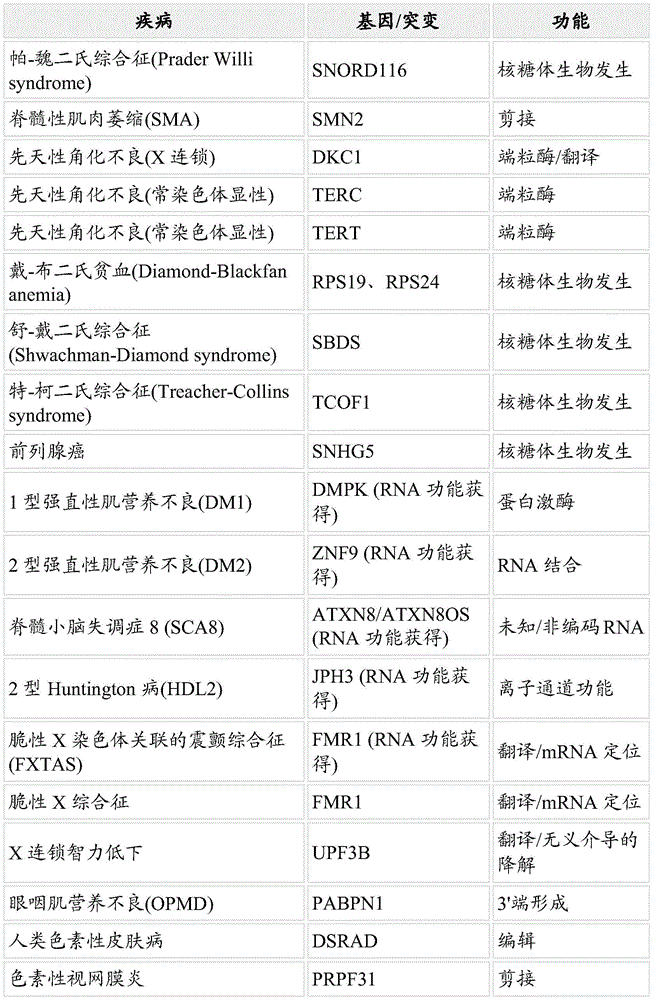
本发明的酶还可用于治疗各种tau蛋白病,包括原发性和继发性tau蛋白病,例如原发性年龄相关性tau蛋白病(PART)/神经原纤维缠结型老年性痴呆(其中NFT类似于AD,但没有斑块)、拳击员痴呆(慢性创伤性脑病变)、进行性核上性麻痹、皮质基底节变性、与第17号染色体联锁的额颞叶痴呆和帕金森症、lytico-Bodig病(关岛帕金森痴呆复征)、神经节神经胶质瘤和神经节细胞瘤、脑膜血管瘤病、脑炎后帕金森綜合征、亚急性硬化性全脑炎以及铅毒性脑病、结节性硬化症、哈-斯二氏病(Hallervorden-Spatz disease)和脂褐质沉积症、阿尔茨海默病。本发明的酶还可靶向破坏引起剪接缺陷和疾病的顺式作用剪接代码的突变(在Cell,2009年2月20日;136(4):777-793中概述)。运动神经元退行性疾病SMA由SMN1基因的缺失引起。其余的SMN2基因在外显子7中具有C->T取代,该取代使外显子剪接增强子(ESE)失活,并且产生外显子剪接沉默子(ESS),从而导致外显子7跳跃并得到截短的蛋白(SMNΔ7)。肌营养不良蛋白基因的外显子31中的T->A取代同时产生提前终止密码子(STOP)和ESS,从而导致外显子31跳跃。这种突变会导致轻度DMD,因为缺少外显子31的mRNA会产生部分功能性蛋白。编码tau蛋白的MAPT基因的外显子10内部和下游的突变会影响剪接调控元件,并破坏包括或不包括外显子10的mRNA的正常1:1比率。这导致含有四个或三个微管结合结构域(分别为4R-tau和3R-tau)的tau蛋白之间的平衡被干扰,从而引起神经病理障碍FTDP-17。所示的实例是N279K突变,该突变会增强ESE功能,从而促进外显子10的包括并使平衡朝向增加的4R-tau转移。CFTR基因外显子9的3'剪接位点内的多态性(UG)m(U)n片段会影响外显子9的包括程度和全长功能蛋白的水平,从而改变由CFTR基因中其他位置的突变引起的囊性纤维化(CF)的严重性。The enzymes of the invention are also useful in the treatment of various tauopathies, including primary and secondary tauopathies, such as primary age-related tauopathies (PART)/neurofibrillary tangles of senile dementia ( where NFT resembles AD but without plaques), boxer dementia (chronic traumatic encephalopathy), progressive supranuclear palsy, corticobasal degeneration, frontotemporal dementia linked to
先天免疫系统主要通过识别感染细胞内的病毒核酸(称为DNA或RNA感测)来检测病毒感染。体外RNA感测测定可以用于检测特定的RNA底物。RNA靶向效应蛋白可以例如用于活细胞中基于RNA的感测。应用的实例是通过感测例如疾病特异性RNA进行诊断。The innate immune system detects viral infections primarily by recognizing viral nucleic acids within infected cells, known as DNA or RNA sensing. In vitro RNA sensing assays can be used to detect specific RNA substrates. RNA-targeting effector proteins can be used, for example, for RNA-based sensing in living cells. An example of an application is diagnosis by sensing eg disease specific RNA.
本发明的RNA靶向效应蛋白还可以用于抗病毒活性,特别是抗RNA病毒。可以使用对所选的病毒RNA序列具有选择性的合适向导RNA来将效应蛋白靶向病毒RNA。具体地,效应蛋白可以是裂解RNA诸如单链RNA的活性核酸酶。因此,提供了本发明的RNA靶向效应蛋白作为抗病毒剂的用途。The RNA targeting effector proteins of the present invention can also be used for antiviral activity, especially against RNA viruses. The effector protein can be targeted to the viral RNA using a suitable guide RNA that is selective for the viral RNA sequence of choice. In particular, the effector protein can be an active nuclease that cleaves RNA, such as single-stranded RNA. Accordingly, the use of the RNA targeting effector proteins of the present invention as antiviral agents is provided.
考虑了本发明的酶系统靶向RNA诸如上述RNA的治疗剂量为约0.1至约2mg/kg,可在监测到应答的情况下相继施用该剂量,并且如果需要的话可重复该剂量,最高为每名患者约7至10剂。有利地,在治疗方案期间从每名患者收集样品,以确定治疗的有效性。例如,可分离并定量RNA样品以确定表达是降低还是改善。这种诊断在本领域技术人员的能力范围内。Enzyme systems of the invention targeting RNAs such as those described above are contemplated for therapeutic doses of from about 0.1 to about 2 mg/kg, which doses can be administered sequentially with monitoring of response, and repeated if necessary, up to a maximum of every about 7 to 10 doses per patient. Advantageously, samples are collected from each patient during the treatment regimen to determine the effectiveness of the treatment. For example, RNA samples can be isolated and quantified to determine whether expression is decreased or improved. Such diagnosis is within the capabilities of those skilled in the art.
转录物检测方法Transcript detection methods
本发明的效应蛋白和系统可用于特异性检测细胞或其他样品中的RNA。在存在目标RNA靶标的情况下,指导序列依赖性Cas13b核酸酶活性可能伴随着对附带靶标的非特异性RNAse活性。为了利用RNase活性,所需要的只是可以可检测地裂解的报告底物。例如,报告分子可以包含RNA,一端用荧光报告分子(荧光剂)标记,并且另一端用猝灭剂标记。在不存在Cas13b RNase活性的情况下,猝灭剂的物理接近将来自荧光剂的荧光衰减到低水平。当Cas13b靶特异性裂解通过目标RNA靶标和合适的向导RNA的存在被激活时,含RNA的报告分子被非特异性裂解,并且荧光剂和猝灭剂在空间上分开。这导致荧光剂在被适当波长的光激发时发出可检测的信号。The effector proteins and systems of the present invention can be used to specifically detect RNA in cells or other samples. In the presence of the RNA target of interest, the guide sequence-dependent Cas13b nuclease activity may be accompanied by nonspecific RNAse activity against the incidental target. To exploit RNase activity, all that is required is a reporter substrate that can be cleaved detectably. For example, a reporter molecule can comprise RNA, labeled with a fluorescent reporter molecule (fluorescent agent) at one end and a quencher at the other end. In the absence of Cas13b RNase activity, the physical proximity of the quencher attenuates the fluorescence from the fluorophore to low levels. When Cas13b target-specific cleavage is activated by the presence of the target RNA target and a suitable guide RNA, the RNA-containing reporter is non-specifically cleaved, and the fluorophore and quencher are spatially separated. This results in the fluorescent agent emitting a detectable signal when excited by light of the appropriate wavelength.
在一方面,本发明涉及一种(靶)RNA检测系统,其包含:RNA靶向效应物;被设计成与对应RNA靶标结合的一种或多种向导RNA;以及基于RNA的裂解诱导型报告物构建体。在另一方面,本发明涉及一种用于样品中的(靶)RNA检测的方法,其包括将RNA靶向效应物、被设计成与所述(靶)RNA结合的一种或多种向导RNA以及基于RNA的裂解诱导型报告物构建体加入所述样品中。在另一方面,本发明涉及一种包含本文定义的(靶)RNA检测系统的试剂盒或装置,或者一种包含至少RNA靶向效应物和基于RNA的裂解诱导型报告物构建体的试剂盒或装置。在另一方面,本发明涉及本文定义的RNA靶向系统或者试剂盒或装置用于(靶)RNA检测的用途。在某些实施方案中,RNA靶向效应物是RNA引导的RNAse。在某些实施方案中,RNA靶向效应物是CRISPR效应物。在某些实施方案中,RNA靶向效应物是2类CRISPR效应物。在某些实施方案中,RNA靶向效应物是2类VI-B型CRISPR效应物。在一个优选的实施方案中,RNA靶向效应物是Cas13b。在某些实施方案中,RNA靶向效应物、优选Cas13b来源于本文其他地方所述的物种。应当理解,被设计成与本文所述的所述(靶)RNA结合的向导RNA能够与RNA靶向效应物形成复合物,并且其中所述复合物中的向导RNA能够与靶RNA分子结合,由此裂解靶RNA,如本文其他地方所述。应当理解,向导RNA通常包含指导序列和正向重复序列,如本文其他地方所述。在某些实施方案中,一种或多种向导RNA被设计成与诊断疾病状态的一种或多种靶分子结合。在某些实施方案中,疾病状态是感染,诸如病毒、细菌、真菌或寄生虫感染。在某些实施方案中,疾病状态的特征在于异常(靶)RNA表达。在某些实施方案中,疾病状态是癌症。在某些实施方案中,疾病状态是自身免疫疾病。基于RNA的裂解诱导型报告物构建体包含RNA,并且裂解RNA可获得可检测的读数,即在裂解RNA时产生可检测的信号。在某些实施方案中,基于RNA的裂解诱导型报告物构建体包含荧光染料和猝灭剂。技术人员将理解,可使用不同类型的荧光染料和对应的猝灭剂。技术人员将容易设想可能适用于本发明的RNA裂解报告物构建体的其他类型的诱导报告物系统。In one aspect, the present invention relates to a (target) RNA detection system comprising: an RNA targeting effector; one or more guide RNAs designed to bind to a corresponding RNA target; and an RNA-based cleavage-inducible reporter object construct. In another aspect, the invention relates to a method for the detection of (target) RNA in a sample comprising targeting RNA to an effector, one or more guides designed to bind to said (target) RNA RNA and RNA-based cleavage-inducible reporter constructs were added to the samples. In another aspect, the invention relates to a kit or device comprising a (target) RNA detection system as defined herein, or a kit comprising at least an RNA-targeting effector and an RNA-based cleavage-inducible reporter construct or device. In another aspect, the present invention relates to the use of an RNA targeting system or kit or device as defined herein for (target) RNA detection. In certain embodiments, the RNA-targeting effector is an RNA-guided RNAse. In certain embodiments, the RNA targeting effector is a CRISPR effector. In certain embodiments, the RNA targeting effector is a
在一种示例性测定方法中,将Cas13b效应物、目标靶特异性向导RNA和报告分子添加到细胞样品中。荧光增加表明存在目标RNA靶标。在另一种示例性方法中,提供了一种检测阵列。阵列的每个位置均提供有Cas13b效应物、报告分子和目标靶特异性向导RNA。取决于要进行的测定,阵列的每个位置处的目标靶特异性向导RNA可以相同、不同或是它们的组合。例如,当需要检测单个来源样品中的一个或多个靶标时,可能提供不同的目标靶特异性向导RNA。例如,当需要检测多个样品的同一靶标时,可能在每个位置处提供相同的目标靶特异性向导RNA。In one exemplary assay, a Cas13b effector, target-specific guide RNA of interest, and reporter molecule are added to a cell sample. An increase in fluorescence indicates the presence of the RNA target of interest. In another exemplary method, a detection array is provided. The Cas13b effector, reporter and target-specific guide RNA of interest are provided at each position of the array. Depending on the assay to be performed, the target-specific guide RNAs of interest at each position of the array can be the same, different, or a combination thereof. For example, when it is desired to detect one or more targets in a single source sample, different target-specific guide RNAs of interest may be provided. For example, when multiple samples need to be detected for the same target, the same target-specific guide RNA of interest may be provided at each location.
如本文所用,“掩蔽构建体”是指可以被本文所述的激活的CRISPR系统效应蛋白裂解或以其他方式失活的分子。在某些示例实施方案中,掩蔽构建体是基于RNA的掩蔽构建体。掩蔽构建体可防止产生或检测到阳性可检测信号。阳性可检测信号可以是可以使用光学、荧光、化学发光、电化学方法或本领域已知的其他检测方法检测的任何信号。掩蔽构建体可防止可检测阳性信号的产生或掩蔽可检测阳性信号的存在,直到去除掩蔽构建体或以其他方式使掩蔽构建体沉默。术语“阳性可检测信号”用于与在存在掩蔽构建体的情况下可检测的其他可检测信号区分开。例如,在某些实施方案中,当存在掩蔽剂时可检测到第一信号(即阴性可检测信号),然后在检测到靶分子并且通过激活的CRISPR效应蛋白裂解掩蔽剂或使掩蔽剂失活时将其转换为第二信号(例如阳性可检测信号)。As used herein, a "masking construct" refers to a molecule that can be cleaved or otherwise inactivated by the activated CRISPR system effector proteins described herein. In certain exemplary embodiments, the masking construct is an RNA-based masking construct. Masking the construct prevents the generation or detection of a positive detectable signal. A positive detectable signal can be any signal that can be detected using optical, fluorescent, chemiluminescent, electrochemical methods, or other detection methods known in the art. The masking construct can prevent the generation of a detectable positive signal or mask the presence of a detectable positive signal until the masking construct is removed or otherwise silenced. The term "positive detectable signal" is used to distinguish it from other detectable signals detectable in the presence of the masking construct. For example, in certain embodiments, a first signal (ie, a negative detectable signal) can be detected when a masking agent is present, and then after the target molecule is detected and the masking agent is cleaved or inactivated by an activated CRISPR effector protein is converted to a second signal (eg, a positive detectable signal).
在某些示例实施方案中,掩蔽构建体可抑制基因产物的产生。基因产物可由加入样品中的报告物构建体编码。掩蔽构建体可以是参与RNA干扰途径的干扰RNA,诸如shRHN或siRNA。掩蔽构建体还可包含微RNA(miRNA)。当存在时,掩蔽构建体抑制基因产物的表达。基因产物可以是荧光蛋白或其他RNA转录物,或者可通过标记的探针或抗体但针对掩蔽构建体的存在检测的蛋白。激活效应蛋白后,裂解掩蔽构建体或以其他方式使掩蔽构建体沉默,从而允许表达和检测基因产物作为阳性可检测信号。In certain exemplary embodiments, the masking construct inhibits the production of the gene product. The gene product can be encoded by a reporter construct added to the sample. The masking construct can be an interfering RNA that participates in the RNA interference pathway, such as shRHN or siRNA. Masking constructs may also comprise microRNAs (miRNAs). When present, the masking construct inhibits the expression of the gene product. The gene product can be a fluorescent protein or other RNA transcript, or a protein detectable by a labeled probe or antibody but for the presence of a masking construct. After activation of the effector protein, the masking construct is cleaved or otherwise silenced, allowing expression and detection of the gene product as a positive detectable signal.
在某些示例实施方案中,掩蔽构建体可隔离产生可检测阳性信号所需的一种或多种试剂,使得从掩蔽构建体中释放一种或多种试剂产生可检测阳性信号。一种或多种试剂可结合产生比色信号、化学发光信号、荧光信号或任何其他可检测信号,并且可包含已知适合于该目的的任何试剂。在某些示例实施方案中,一种或多种试剂被与一种或多种试剂结合的RNA适配体隔离。当检测到靶分子并激活效应蛋白时,一种或多种试剂被释放。在某些示例实施方案中,一种或多种试剂是蛋白质,诸如酶,其能够促进以下可检测信号诸如比色信号、化学发光信号或荧光信号的产生:其被抑制或隔离,使得蛋白质不能通过一种或多种RNA适配体与蛋白质结合而产生可检测信号。激活本文公开的效应蛋白后,RNA适配体被裂解或降解至不再抑制该蛋白产生可检测信号的能力的程度。In certain exemplary embodiments, the masking construct can sequester one or more reagents required to produce a detectable positive signal, such that release of the one or more reagents from the masking construct produces a detectable positive signal. One or more reagents can be combined to produce a colorimetric signal, a chemiluminescent signal, a fluorescent signal, or any other detectable signal, and can include any reagent known to be suitable for the purpose. In certain example embodiments, the one or more agents are sequestered by RNA aptamers that bind to the one or more agents. When the target molecule is detected and the effector protein is activated, one or more reagents are released. In certain exemplary embodiments, the one or more reagents are proteins, such as enzymes, that are capable of promoting the production of a detectable signal such as a colorimetric signal, a chemiluminescent signal, or a fluorescent signal that is inhibited or sequestered so that the protein cannot A detectable signal is generated by the binding of one or more RNA aptamers to the protein. Upon activation of the effector protein disclosed herein, the RNA aptamer is cleaved or degraded to the extent that it no longer inhibits the ability of the protein to generate a detectable signal.
在一个实施方案中,凝血酶被用作具有抑制性适配体的信号放大酶,例如具有以下序列:GGGAACAAAGCUGAAGUACUUACCC。当该适配体被裂解时,凝血酶变得具有活性,并且将裂解肽比色底物(例如参见www.sigmaaldrich.com/catalog/product/sigma/t3068?lang=en®ion=US)或荧光底物(例如参见www.sigmaaldrich.com/catalog/product/sigma/b9385?lang=en®ion=US)。比色底物对硝基苯胺(pNA)与凝血酶的肽底物共价连接。在被凝血酶裂解后,pNA被释放并且变为黄色,肉眼容易看见。荧光底物以相似的原理工作,并且在被凝血酶裂解后释放7-氨基-4-甲基香豆素,这是一种可以使用荧光检测器检测的蓝色荧光团。凝血酶的替代物包括辣根过氧化物酶(HRP)、β-半乳糖苷酶和小牛碱性磷酸酶(CAP),它们可以类似地用于产生比色或荧光信号,并且被抑制性适配体抑制。In one embodiment, thrombin is used as a signal amplifying enzyme with an inhibitory aptamer, eg, having the sequence: GGGAACAAAGCUGAAGUACUUACCC. When the aptamer is cleaved, thrombin becomes active and will cleave a peptide colorimetric substrate (see eg www.sigmaaldrich.com/catalog/product/sigma/t3068?lang=en®ion=US) or a fluorescent substrate (see, eg, www.sigmaaldrich.com/catalog/product/sigma/b9385?lang=en®ion=US). The colorimetric substrate p-nitroaniline (pNA) is covalently linked to the peptide substrate of thrombin. After cleavage by thrombin, pNA is released and turns yellow, easily visible to the naked eye. Fluorescent substrates work on a similar principle and upon cleavage by thrombin releases 7-amino-4-methylcoumarin, a blue fluorophore that can be detected using a fluorescence detector. Alternatives to thrombin include horseradish peroxidase (HRP), beta-galactosidase, and calf alkaline phosphatase (CAP), which can similarly be used to generate colorimetric or fluorescent signals and are inhibited by Aptamer inhibition.
在某些示例实施方案中,掩蔽构建体可以单独的离散体积(在下文中进一步定义)固定在固体底物上,并隔离单一试剂。例如,试剂可以是包含染料的珠。当被固定试剂隔离时,各个珠太扩散而不能产生可检测信号,但在从掩蔽构建体释放后能够例如通过聚集或简单增加溶液浓度而产生可检测信号。在某些示例实施方案中,固定掩蔽剂是基于RNA的适配体,其可以在检测到靶分子时被激活的效应蛋白裂解。In certain exemplary embodiments, a masking construct can be immobilized on a solid substrate in a separate discrete volume (defined further below) and isolate a single agent. For example, the reagents can be beads containing dyes. When isolated by immobilization reagents, individual beads are too diffuse to generate a detectable signal, but can generate a detectable signal after release from the masking construct, eg, by aggregation or simply increasing the concentration of the solution. In certain exemplary embodiments, the immobilized masking agent is an RNA-based aptamer that can be cleaved by an activated effector protein upon detection of the target molecule.
在某些其他示例实施方案中,掩蔽构建体与溶液中的固定试剂结合,从而阻断试剂与溶液中游离的单独的标记结合伴侣结合的能力。因此,在将洗涤步骤应用于样品时,可以在不存在靶分子的情况下将标记的结合伴侣从样品中洗出。但是,如果效应蛋白被激活,则将掩蔽构建体裂解至足以干扰掩蔽构建体与试剂结合的能力的程度,从而允许标记的结合伴侣与固定试剂结合。因此,标记的结合伴侣在洗涤步骤后保留,表明样品中存在靶分子。在某些方面,与固定试剂结合的掩蔽构建体是RNA适配体。固定试剂可以是蛋白质,并且标记的结合伴侣可以是标记的抗体。另选地,固定试剂可以是链霉亲和素,并且标记的结合伴侣可以是标记的生物素。在以上实施方案中使用的结合伴侣上的标记可以是本领域已知的任何可检测标记。另外,可根据这里描述的总体设计使用其他已知的结合伴侣。In certain other exemplary embodiments, the masking construct binds to the immobilized reagent in solution, thereby blocking the ability of the reagent to bind to the labelled binding partner free in solution alone. Thus, when a washing step is applied to the sample, the labeled binding partner can be washed out of the sample in the absence of the target molecule. However, if the effector protein is activated, the masking construct is cleaved to an extent sufficient to interfere with the ability of the masking construct to bind the reagent, thereby allowing the labeled binding partner to bind to the immobilization reagent. Thus, the labeled binding partner remains after the washing step, indicating the presence of the target molecule in the sample. In certain aspects, the masking construct bound to the immobilization reagent is an RNA aptamer. The immobilization reagent can be a protein, and the labeled binding partner can be a labeled antibody. Alternatively, the immobilization reagent can be streptavidin and the labeled binding partner can be labeled biotin. The label on the binding partner used in the above embodiments can be any detectable label known in the art. In addition, other known binding partners can be used according to the general designs described herein.
在某些示例实施方案中,掩蔽构建体可包含核酶。核酶是具有催化特性的RNA分子。由于天然和工程化核酶均包含RNA或由RNA组成,因此其可被本文公开的效应蛋白靶向。可选择或工程化核酶以催化产生阴性可检测信号或阻止产生阳性对照信号的反应。通过激活的效应蛋白分子使核酶失活后,去除了产生阴性对照信号或防止产生阳性可检测信号的反应,从而允许检测阳性可检测信号。在一个示例实施方案中,核酶可催化比色反应,从而使溶液显现为第一种颜色。当使核酶失活时,溶液则变成第二种颜色,第二种颜色是可检测阳性信号。可以如何使用核酶催化比色反应的实例在Zhao等人“Signal amplification ofglucosamine-6-phosphate based on ribozyme glmS,”Biosens Bioelectron.2014;16:337-42中描述,并且提供了可以如何修改这种系统以在本文公开的实施方案的上下文中工作的实例。另选地,核酶(当存在时)可以产生例如RNA转录物的裂解产物。因此,检测阳性可检测信号可包括检测仅在不存在核酶的情况下产生的未裂解的RNA转录物。In certain exemplary embodiments, the masking construct may comprise a ribozyme. Ribozymes are RNA molecules with catalytic properties. Since both natural and engineered ribozymes comprise or consist of RNA, they can be targeted by the effector proteins disclosed herein. Ribozymes can be selected or engineered to catalyze reactions that produce negative detectable signals or prevent the production of positive control signals. Inactivation of the ribozyme by the activated effector protein molecule removes the reaction that produces a negative control signal or prevents the production of a positive detectable signal, thereby allowing detection of a positive detectable signal. In an exemplary embodiment, a ribozyme can catalyze a colorimetric reaction that causes the solution to appear as a first color. When the ribozyme is inactivated, the solution changes to a second color, which is a detectable positive signal. An example of how ribozymes can be used to catalyze colorimetric reactions is described in Zhao et al. "Signal amplification of glucosamine-6-phosphate based on ribozyme glmS," Biosens Bioelectron. 2014;16:337-42, and provides how this can be modified An example of the system working in the context of the embodiments disclosed herein. Alternatively, ribozymes (when present) can generate, for example, cleavage products of RNA transcripts. Thus, detecting a positive detectable signal can include detecting uncleaved RNA transcripts that are produced only in the absence of the ribozyme.
在一个示例实施方案中,掩蔽构建体包含检测剂,其根据检测剂是聚集还是分散在溶液中而改变颜色。例如,某些纳米颗粒诸如胶体金在从聚集体移动成分散颗粒时会从可见的紫色转变为红色。因此,在某些示例实施方案中,此类检测剂可通过一个或多个桥接分子保持为聚集体。桥接分子的至少一部分包含RNA。激活本文公开的效应蛋白后,桥接分子的RNA部分被裂解,从而使检测剂分散并产生对应的颜色变化。在某些示例实施方案中,桥接分子是RNA分子。在某些示例实施方案中,检测剂是胶体金属。胶体金属材料可包括不溶于水的金属颗粒或者分散在液体、水溶胶或金属溶胶中的金属化合物。胶体金属可选自元素周期表的IA、IB、IIB和IIIB族金属,以及过渡金属、尤其是VIII族的过渡金属。优选的金属包括金、银、铝、钌、锌、铁、镍和钙。其他合适的金属还包括所有不同氧化态的以下金属:锂、钠、镁、钾、钪、钛、钒、铬、锰、钴、铜、镓、锶、铌、钼、钯、铟、锡、钨、铼、铂和钆。金属优选地以来源于适当金属化合物的离子形式提供,例如Al3+、Ru3+、Zn2+、Fe3+、Ni2+和Ca2+离子。In an exemplary embodiment, the masking construct comprises a detection agent that changes color depending on whether the detection agent is aggregated or dispersed in solution. For example, certain nanoparticles, such as colloidal gold, change from visible purple to red as they move from aggregates to dispersed particles. Thus, in certain exemplary embodiments, such detection agents may be held as aggregates by one or more bridging molecules. At least a portion of the bridging molecule comprises RNA. Upon activation of the effector proteins disclosed herein, the RNA portion of the bridging molecule is cleaved, thereby dispersing the detection agent and producing a corresponding color change. In certain exemplary embodiments, the bridging molecule is an RNA molecule. In certain example embodiments, the detection agent is a colloidal metal. Colloidal metal materials may include water-insoluble metal particles or metal compounds dispersed in a liquid, hydrosol, or metal sol. The colloidal metal may be selected from metals of Groups IA, IB, IIB and IIIB of the Periodic Table of the Elements, and transition metals, especially transition metals of Group VIII. Preferred metals include gold, silver, aluminum, ruthenium, zinc, iron, nickel and calcium. Other suitable metals also include the following metals in all different oxidation states: lithium, sodium, magnesium, potassium, scandium, titanium, vanadium, chromium, manganese, cobalt, copper, gallium, strontium, niobium, molybdenum, palladium, indium, tin, Tungsten, rhenium, platinum and gadolinium. The metals are preferably provided in the form of ions derived from suitable metal compounds, such as Al 3+ , Ru 3+ , Zn 2+ , Fe 3+ , Ni 2+ and Ca 2+ ions.
在某些其他示例实施方案中,掩蔽构建体可包含RNA寡核苷酸,其上附接有可检测标记和该可检测标记的掩蔽剂。这种可检测标记/掩蔽剂对的实例是荧光团和荧光团的猝灭剂。荧光团的猝灭可能由于在荧光团与另一荧光团或非荧光分子之间形成非荧光复合物而发生。这种机制被称为基态复合物形成、静态猝灭或接触猝灭。因此,RNA寡核苷酸可被设计成使得荧光团和猝灭剂足够接近以发生接触猝灭。荧光团及其同源猝灭剂是本领域已知的,并且可以由本领域普通技术人员针对该目的选择。在本发明的上下文中,特定的荧光团/猝灭剂对不是关键的,只是荧光团/猝灭剂对的选择能确保荧光团的掩蔽。在激活本文公开的效应蛋白后,RNA寡核苷酸被裂解,从而切断了荧光团与维持接触猝灭作用所需的猝灭剂之间的接近。因此,荧光团的检测可用于确定样品中靶分子的存在。In certain other exemplary embodiments, a masking construct can comprise an RNA oligonucleotide to which a detectable label and a masking agent for the detectable label are attached. An example of such a detectable label/masker pair is a fluorophore and a quencher of the fluorophore. Quenching of a fluorophore may occur due to the formation of non-fluorescent complexes between the fluorophore and another fluorophore or non-fluorescent molecule. This mechanism is known as ground state complex formation, static quenching or contact quenching. Thus, RNA oligonucleotides can be designed so that the fluorophore and quencher are in close enough proximity for contact quenching to occur. Fluorophores and their cognate quenchers are known in the art and can be selected for this purpose by one of ordinary skill in the art. In the context of the present invention, the specific fluorophore/quencher pair is not critical, only the choice of the fluorophore/quencher pair ensures masking of the fluorophore. Upon activation of the effector proteins disclosed herein, the RNA oligonucleotides are cleaved, cutting off access between the fluorophore and the quencher required to maintain contact quenching. Thus, detection of fluorophores can be used to determine the presence of target molecules in a sample.
在一个示例实施方案中,掩蔽构建体可包括量子点。量子点可以具有附接到表面的多个接头分子。接头分子的至少一部分包含RNA。接头分子的一端附接到量子点,并沿着接头的长度或在接头的末端附接到一个或多个猝灭剂,使得猝灭剂保持足够接近以使量子点猝灭。接头可以是分支的。如上所述,量子点/猝灭剂对不是关键的,只是量子点/猝灭剂对的选择能确保荧光团的掩蔽。量子点及其同源猝灭剂是本领域已知的,并且可以由本领域普通技术人员针对该目的选择。激活本文公开的效应蛋白后,接头分子的RNA部分被裂解,从而消除了量子点与维持猝灭作用所需的一种或多种猝灭剂之间的接近。在一个实施方案中,量子点是链霉亲和素缀合的,诸如
以类似的方式,荧光能量转移(FRET)可用于产生可检测阳性信号。FRET是来自能量激发荧光团(即“供体荧光团”)的光子将另一个分子(即“受体”)中电子的能态升高到激发单重态的较高振动水平的非辐射过程。供体荧光团返回基态而没有发射该荧光团的荧光特征。受体可以是另一个荧光团或非荧光分子。如果受体是荧光团,则转移的能量作为该荧光团的荧光特征而发射。如果受体是非荧光分子,则吸收的能量作为热量损失。因此,在本文公开的实施方案的上下文中,将荧光团/猝灭剂对替换为附接到寡核苷酸分子的供体荧光团/受体对。掩蔽构建体完整时会生成第一信号(阴性可检测信号),该信号通过从受体发射的荧光或热量检测。在激活本文公开的效应蛋白后,RNA寡核苷酸被裂解并且FRET被破坏,使得现在检测到的是供体荧光团的荧光(阳性可检测信号)。In a similar fashion, fluorescence energy transfer (FRET) can be used to generate a detectable positive signal. FRET is a nonradiative process in which photons from an energetically excited fluorophore (i.e. "donor fluorophore") raise the energy state of an electron in another molecule (i.e. "acceptor") to a higher vibrational level of an excited singlet state . The donor fluorophore returns to the ground state without emitting the fluorescent characteristics of the fluorophore. The acceptor can be another fluorophore or a non-fluorescent molecule. If the acceptor is a fluorophore, the transferred energy is emitted as the fluorescent characteristic of the fluorophore. If the acceptor is a non-fluorescent molecule, the absorbed energy is lost as heat. Thus, in the context of the embodiments disclosed herein, a fluorophore/quencher pair is replaced by a donor fluorophore/acceptor pair attached to an oligonucleotide molecule. The masking construct, when intact, generates a first signal (negative detectable signal), which is detected by fluorescence or heat emitted from the receptor. Upon activation of the effector proteins disclosed herein, the RNA oligonucleotides are cleaved and FRET disrupted, such that what is now detected is the fluorescence of the donor fluorophore (positive detectable signal).
用于检测RNAse的比色读数的一种模式基于嵌入染料,所嵌入的染料响应于将长RNA裂解成短核苷酸而改变其吸光度。存在几种具有这些特性的现有染料。来源于Wagner(1983)的Pyronine-Y将与RNA复合并形成在572nm处具有吸光度的复合物;RNA的裂解导致吸光度损失和颜色变化。Greiner-Stoeffele(1996)以类似的方式使用亚甲蓝,688nm处的吸光度在具有RNAse活性时发生变化。One mode of colorimetric readout for the detection of RNAse is based on intercalating dyes that change their absorbance in response to cleavage of long RNAs into short nucleotides. There are several existing dyes with these properties. Pyronine-Y from Wagner (1983) will complex with RNA and form a complex with absorbance at 572 nm; cleavage of RNA results in loss of absorbance and color change. Greiner-Stoeffele (1996) used methylene blue in a similar fashion, and the absorbance at 688 nm changed with RNAse activity.
比色读数的另一种模式涉及在裂解时改变颜色的核酸底物。Witmer(1991)利用合成的核糖核苷酸底物U-3'-BCIP,该底物在裂解后释放报告基团,从而在650nm处产生吸光度。Another mode of colorimetric readout involves nucleic acid substrates that change color upon cleavage. Witmer (1991) utilized the synthetic ribonucleotide substrate U-3'-BCIP, which upon cleavage releases a reporter group resulting in absorbance at 650 nm.
脱氨酶功能化的CRISPR/Cas13Deaminase-functionalized CRISPR/Cas13
在本发明的某些方面和实施方案中,本文所述的Cas13蛋白(包括例如Cas13a、Cas13b或Cas13c,包括任何同源物,诸如本文其他地方所述的同源物),包括任何Cas13蛋白变体(诸如功能变体、突变体(包括但不限于无催化活性的突变体)、(功能)结构域或截短物(包括断裂Cas13)、本文所述的Cas13融合蛋白(例如,包括NLS或NES序列或者本文其他地方所述的任何其他融合蛋白等)可与脱氨酶或其功能片段诸如其有催化活性的片段共价或非共价缔合或融合。脱氨酶可以是腺苷脱氨酶或胞苷脱氨酶,优选地该脱氨酶是RNA特异性脱氨酶。本文所述的脱氨酶可以是截短的或突变的脱氨酶。应当理解,每当在本文中提及腺苷脱氨酶时,类似的考虑也适用于胞苷脱氨酶(并且代替使腺嘌呤脱氨,使胞苷脱氨)。In certain aspects and embodiments of the invention, Cas13 proteins described herein (including, for example, Cas13a, Cas13b, or Cas13c, including any homologs, such as those described elsewhere herein), include any Cas13 protein variant Variants (such as functional variants, mutants (including but not limited to catalytically inactive mutants), (functional) domains or truncations (including cleaved Cas13), Cas13 fusion proteins described herein (eg, including NLS or NES sequences or any other fusion proteins described elsewhere herein, etc.) can be covalently or non-covalently associated or fused to a deaminase or a functional fragment thereof, such as a catalytically active fragment thereof. The deaminase can be an adenosine deaminase Aminase or cytidine deaminase, preferably the deaminase is an RNA-specific deaminase. The deaminase described herein may be a truncated or mutated deaminase. It should be understood that whenever in the text Similar considerations apply to cytidine deaminase (and instead of deamination of adenine, deamination of cytidine) when referring to adenosine deaminase.
在某些方面和实施方案中,本发明涉及编码此类Cas13-脱氨酶融合蛋白(或在非共价键的情况下单独编码Cas13和脱氨酶)的可有利地被密码子优化的多核酸,以及用于繁殖和/或表达诸如原核或真核繁殖或表达的载体和载体系统。示例性多核酸和载体在本文其他地方描述。In certain aspects and embodiments, the present invention relates to advantageously codon-optimized polynucleotides encoding such Cas13-deaminase fusion proteins (or Cas13 and deaminase alone in the case of non-covalent linkages). Nucleic acids, and vectors and vector systems for propagation and/or expression such as prokaryotic or eukaryotic propagation or expression. Exemplary polynucleic acids and vectors are described elsewhere herein.
在某些方面和实施方案中,本发明涉及包含上述蛋白和/或多核苷酸或者载体或载体系统的宿主细胞(或其子代)、器官或生物(或其子代)。示例性宿主细胞/器官/生物以及表达系统在本文其他地方描述。In certain aspects and embodiments, the present invention relates to host cells (or progeny thereof), organs or organisms (or progeny thereof) comprising the above-described proteins and/or polynucleotides or vectors or vector systems. Exemplary host cells/organs/organisms and expression systems are described elsewhere herein.
在某些方面和实施方案中,本发明涉及包含此类蛋白、多核酸、载体或载体系统、宿主细胞、器官或生物的系统、复合物或组合物(包括试剂盒),诸如药物组合物。示例性系统、复合物或组合物诸如药物组合物在本文其他地方描述。应当理解,此类系统、复合物或组合物还可包括本文其他地方所述的向导RNA,包括任何变体向导RNA(诸如陪同、受保护、死亡指导物等,包括包含适配体的指导物)。In certain aspects and embodiments, the invention relates to systems, complexes or compositions (including kits) comprising such proteins, polynucleic acids, vectors or vector systems, host cells, organs or organisms, such as pharmaceutical compositions. Exemplary systems, complexes or compositions such as pharmaceutical compositions are described elsewhere herein. It is to be understood that such systems, complexes or compositions may also include guide RNAs as described elsewhere herein, including any variant guide RNAs (such as chaperone, protected, death guides, etc., including guides comprising aptamers) ).
在某些方面和实施方案中,本发明涉及使用此类蛋白、多核酸、载体或载体系统、宿主细胞、器官、生物、系统、复合物或组合物的用途或方法。示例性方法和用途在本文其他地方描述。在特定的实施方案中,这些用途和方法涉及修饰目标靶RNA序列中的腺嘌呤或胞苷。在特定的实施方案中,这些用途或方法是治疗性或预防性的,同样如本文其他地方所述。有利地,这些用途和方法可涉及靶向的碱基编辑。在一方面,本文所述的本发明提供了用于修饰靶基因座处的腺苷残基的方法,目的是治疗和/或预防由或可能由G至A或C至T点突变或致病性单核苷酸多态性(SNP)引起的患病病症。ClinVar数据库中报告了与影响脑和中枢神经系统的各种疾病相关的致病性G至A或C至T突变/SNP。根据本发明,可以靶向任何突变/SNP。In certain aspects and embodiments, the invention relates to uses or methods of using such proteins, polynucleic acids, vectors or vector systems, host cells, organs, organisms, systems, complexes or compositions. Exemplary methods and uses are described elsewhere herein. In particular embodiments, these uses and methods involve modifying adenine or cytidine in a target RNA sequence of interest. In certain embodiments, these uses or methods are therapeutic or prophylactic, also as described elsewhere herein. Advantageously, these uses and methods may involve targeted base editing. In one aspect, the invention described herein provides methods for modifying adenosine residues at a target locus for the purpose of treating and/or preventing G to A or C to T point mutations or pathogenicity Diseases caused by sexual single nucleotide polymorphisms (SNPs). Pathogenic G-to-A or C-to-T mutations/SNPs associated with various diseases affecting the brain and central nervous system are reported in the ClinVar database. According to the present invention, any mutation/SNP can be targeted.
一般来讲,本文公开的系统包含靶向组分和碱基编辑组分。靶向组分的作用是将碱基编辑组分特异性靶向其中一个或多个核苷酸将被编辑的靶核苷酸序列。然后,碱基编辑组分可催化化学反应,以将靶序列中的第一核苷酸转化为第二核苷酸。例如,碱基编辑器可催化腺嘌呤的转化,使得其被细胞的转录或翻译装置读取为鸟嘌呤,反之亦然。同样,碱基编辑组分可催化胞苷转化为尿嘧啶,反之亦然。在某些示例实施方案中,可通过以已知碱基编辑器诸如腺嘌呤脱氨酶或胞嘧啶脱氨酶开始来得到基础编辑器,并且可使用诸如定向进化的方法对其进行修饰以得到新的功能。定向进化技术是本领域已知的,并且可包括WO2015/184016“High-Throughput Assembly of Genetic Permuatations”中描述的定向技术。In general, the systems disclosed herein comprise a targeting component and a base editing component. The role of the targeting component is to specifically target the base editing component to a target nucleotide sequence in which one or more nucleotides are to be edited. The base editing component can then catalyze a chemical reaction to convert the first nucleotide in the target sequence to a second nucleotide. For example, base editors can catalyze the conversion of adenines so that they are read as guanines by the cell's transcription or translation machinery, and vice versa. Likewise, base editing components can catalyze the conversion of cytidine to uracil and vice versa. In certain exemplary embodiments, a base editor can be obtained by starting with a known base editor, such as adenine deaminase or cytosine deaminase, and can be modified using methods such as directed evolution to obtain new features. Directed evolution techniques are known in the art and may include the directed techniques described in WO2015/184016 "High-Throughput Assembly of Genetic Permuatations".
在一方面,本发明涉及一种(融合)蛋白或蛋白复合物或者编码其的多核苷酸(包括载体和载体系统),其包含(a)无催化活性的(死亡)Cas13蛋白;以及(b)(腺苷)脱氨酶蛋白或其催化结构域;其中所述(腺苷)脱氨酶蛋白或其催化结构域与所述死亡Cas13蛋白共价或非共价连接,或者被调适为在递送后与其连接。在某些实施方案中,(融合)蛋白或蛋白复合物可以与指导分子结合或被调适为与指导分子结合,该指导分子包含与正向重复序列连接的指导序列;其中指导分子与所述死亡Cas13蛋白形成复合物并指导所述复合物结合所述目标靶RNA序列,其中所述指导序列能够与包含所述腺嘌呤的靶序列杂交以形成RNA双链体,其中所述指导序列在对应于所述腺嘌呤的位置上包含非配对胞嘧啶,从而导致在形成的RNA双链体中产生A-C错配;其中所述(腺苷)脱氨酶蛋白或其催化结构域使所述RNA双链体中的所述腺嘌呤脱氨。In one aspect, the invention relates to a (fusion) protein or protein complex or a polynucleotide encoding the same (including vectors and vector systems) comprising (a) a catalytically inactive (dead) Cas13 protein; and (b) ) (adenosine) deaminase protein or catalytic domain thereof; wherein said (adenosine) deaminase protein or catalytic domain thereof is covalently or non-covalently linked to said dead Cas13 protein, or is adapted to Connect to it after delivery. In certain embodiments, a (fusion) protein or protein complex may bind or be adapted to bind to a guide molecule comprising a guide sequence linked to a forward repeat; wherein the guide molecule is associated with the death The Cas13 protein forms a complex and directs the complex to bind to the target RNA sequence of interest, wherein the guide sequence is capable of hybridizing to the target sequence comprising the adenine to form an RNA duplex, wherein the guide sequence corresponds to The adenine contains an unpaired cytosine in its position, resulting in an A-C mismatch in the formed RNA duplex; wherein the (adenosine) deaminase protein or catalytic domain thereof makes the RNA duplex Deamination of the adenine in the body.
在一方面,本发明涉及一种组合物、复合物或系统,其包含:(a)无催化活性的(死亡)Cas13蛋白;(b)包含与正向重复序列连接的指导序列的指导分子;以及(c)(腺苷)脱氨酶蛋白或其催化结构域;其中所述(腺苷)脱氨酶蛋白或其催化结构域与所述死亡Cas13蛋白或所述指导分子共价或非共价连接,或者被调适为在递送后与其连接;其中指导分子与所述死亡Cas13蛋白形成复合物并指导所述复合物结合所述目标靶RNA序列,其中所述指导序列能够与包含所述腺嘌呤的靶序列杂交以形成RNA双链体,其中所述指导序列在对应于所述腺嘌呤的位置上包含非配对胞嘧啶,从而导致在形成的RNA双链体中产生A-C错配;其中所述(腺苷)脱氨酶蛋白或其催化结构域使所述RNA双链体中的所述腺嘌呤脱氨。本发明还涉及一种适合修饰目标靶基因座中的腺嘌呤的工程化的非天然存在的(载体)系统,其包含:指导分子,其包含指导序列或编码指导分子的核苷酸序列;CRISPR-Cas蛋白或编码CRISPR-Cas蛋白的一个或多个核苷酸序列;(腺苷)脱氨酶蛋白或其催化结构域,或编码其的一个或多个核苷酸序列;其中(腺苷)脱氨酶蛋白或其催化结构域与CRISPR-Cas蛋白或指导分子共价或非共价连接,或者被调适为在递送后与其连接;其中指导序列能够与目标RNA多核苷酸内包含腺嘌呤的靶序列杂交,但是在对应于腺嘌呤的位置包含胞嘧啶。In one aspect, the invention relates to a composition, complex or system comprising: (a) a catalytically inactive (dead) Cas13 protein; (b) a guide molecule comprising a guide sequence linked to a forward repeat; and (c) a (adenosine) deaminase protein or its catalytic domain; wherein said (adenosine) deaminase protein or its catalytic domain is covalently or non-covalently with said dead Cas13 protein or said guide molecule valently linked, or adapted to be linked to it after delivery; wherein a guide molecule forms a complex with the dead Cas13 protein and directs the complex to bind to the target RNA sequence of interest, wherein the guide sequence is capable of interacting with the adenocarcinoma comprising the A target sequence of a purine hybridizes to form an RNA duplex, wherein the guide sequence contains an unpaired cytosine at a position corresponding to the adenine, resulting in an A-C mismatch in the formed RNA duplex; wherein the The (adenosine) deaminase protein or catalytic domain thereof deaminates the adenine in the RNA duplex. The present invention also relates to an engineered non-naturally occurring (vector) system suitable for modifying adenines in a target locus of interest, comprising: a guide molecule comprising a guide sequence or a nucleotide sequence encoding a guide molecule; CRISPR - Cas protein or one or more nucleotide sequences encoding a CRISPR-Cas protein; (adenosine) deaminase protein or catalytic domain thereof, or one or more nucleotide sequences encoding the same; wherein (adenosine) ) a deaminase protein or its catalytic domain is covalently or non-covalently linked to a CRISPR-Cas protein or a guide molecule, or is adapted to be linked to it after delivery; wherein the guide sequence is capable of containing adenine within the target RNA polynucleotide hybridizes to the target sequence, but contains cytosines in positions corresponding to adenines.
在一方面,本发明涉及一种适合修饰目标靶基因座中的腺嘌呤的工程化的非天然存在的载体系统,其包含一个或多个载体,所述一个或多个载体包含:(a)第一调控元件,其可操作地连接到编码包含所述指导序列的所述指导分子的核苷酸序列,(b)第二调控元件,其可操作地连接到编码所述无催化活性的Cas13蛋白的核苷酸序列;以及(c)编码(腺苷)脱氨酶蛋白或其催化结构域的核苷酸序列,其受所述第一调控元件或第二调控元件的控制或可操作地连接到第三调控元件;其中如果所述编码(腺苷)脱氨酶蛋白或其催化结构域的核苷酸序列可操作地连接到第三调控元件,则所述(腺苷)脱氨酶蛋白或其催化结构域被调适为在表达后连接到所述指导分子或所述Cas13蛋白;其中组分(a)、(b)和(c)位于系统的相同或不同载体上。In one aspect, the present invention relates to an engineered non-naturally occurring vector system suitable for modifying adenine in a target locus of interest, comprising one or more vectors comprising: (a) a first regulatory element operably linked to a nucleotide sequence encoding said guide molecule comprising said guide sequence, (b) a second regulatory element operably linked to encoding said catalytically inactive Cas13 The nucleotide sequence of the protein; and (c) the nucleotide sequence encoding the (adenosine) deaminase protein or catalytic domain thereof, which is controlled or operable by the first regulatory element or the second regulatory element Linked to a third regulatory element; wherein if the nucleotide sequence encoding the (adenosine) deaminase protein or catalytic domain thereof is operably linked to the third regulatory element, the (adenosine) deaminase The protein or catalytic domain thereof is adapted to be linked to the guide molecule or the Cas13 protein after expression; wherein components (a), (b) and (c) are located on the same or different carriers of the system.
在一方面,本发明涉及一种修饰目标靶RNA序列中的腺嘌呤的方法。在特定的实施方案中,所述方法包括向所述靶RNA递送:(a)无催化活性的(死亡)Cas13蛋白;(b)包含与正向重复序列连接的指导序列的指导分子;以及(c)(腺苷)脱氨酶蛋白或其催化结构域;其中所述(腺苷)脱氨酶蛋白或其催化结构域与所述死亡Cas13蛋白或所述指导分子共价或非共价连接,或者被调适为在递送后与其连接;其中指导分子与所述死亡Cas13蛋白形成复合物并指导所述复合物结合所述目标靶RNA序列,其中所述指导序列能够与包含所述腺嘌呤的靶序列杂交以形成RNA双链体,其中所述指导序列在对应于所述腺嘌呤的位置上包含非配对胞嘧啶,从而导致在形成的RNA双链体中产生A-C错配;其中所述(腺苷)脱氨酶蛋白或其催化结构域使所述RNA双链体中的所述腺嘌呤脱氨。In one aspect, the present invention relates to a method of modifying adenines in a target RNA sequence of interest. In certain embodiments, the method comprises delivering to the target RNA: (a) a catalytically inactive (dead) Cas13 protein; (b) a guide molecule comprising a guide sequence linked to a forward repeat; and ( c) (adenosine) deaminase protein or catalytic domain thereof; wherein said (adenosine) deaminase protein or catalytic domain thereof is covalently or non-covalently linked to said dead Cas13 protein or said guide molecule , or is adapted to be attached to it after delivery; wherein a guide molecule forms a complex with the dead Cas13 protein and directs the complex to bind to the target RNA sequence of interest, wherein the guide sequence is capable of interacting with the adenine-containing The target sequence hybridizes to form an RNA duplex, wherein the guide sequence comprises an unpaired cytosine at a position corresponding to the adenine, resulting in an A-C mismatch in the formed RNA duplex; wherein the ( An adenosine) deaminase protein or catalytic domain thereof deaminates the adenine in the RNA duplex.
本发明还涉及一种用于细胞疗法的方法,其包括向有此需要的患者施用本文所述的经修饰的细胞,其中经修饰的细胞的存在可以治疗患者的疾病。在一个实施方案中,用于细胞疗法的经修饰的细胞是能够识别和/或攻击肿瘤细胞的CAR-T细胞。在另一个实施方案中,用于细胞疗法的经修饰的细胞是干细胞,诸如神经干细胞、间充质干细胞、造血干细胞或iPSC细胞。The present invention also relates to a method for cell therapy comprising administering to a patient in need thereof the modified cells described herein, wherein the presence of the modified cells can treat the patient's disease. In one embodiment, the modified cells used in cell therapy are CAR-T cells capable of recognizing and/or attacking tumor cells. In another embodiment, the modified cells for cell therapy are stem cells, such as neural stem cells, mesenchymal stem cells, hematopoietic stem cells, or iPSC cells.
本发明还涉及一种用于敲除或敲低不需要的基因活性的方法,其中使基因的转录物处的A脱氨导致功能丧失。例如,在一个实施方案中,通过脱氨酶功能化的CRISPR系统进行的靶向脱氨可以引起无义突变,从而导致在内源基因中产生提前终止密码子。这可能会改变内源基因的表达,并且可能使得经编辑的细胞具有所需性状。在另一个实施方案中,通过脱氨酶功能化的CRISPR系统进行的靶向脱氨可以引起非保守的错义突变,从而导致在内源基因中产生不同氨基酸残基的密码子。这可能会改变所表达的内源基因的功能,并且还可能使得编辑后的细胞具有所需性状。The present invention also relates to a method for knocking out or knocking down unwanted gene activity, wherein deamination of A at the transcript of the gene results in loss of function. For example, in one embodiment, targeted deamination by a deaminase-functionalized CRISPR system can cause nonsense mutations, resulting in the generation of premature stop codons in endogenous genes. This may alter the expression of endogenous genes and may result in edited cells with desired traits. In another embodiment, targeted deamination by a deaminase-functionalized CRISPR system can cause non-conservative missense mutations, resulting in codons for different amino acid residues in the endogenous gene. This may alter the function of the expressed endogenous gene, and may also give the edited cell the desired trait.
本文所述的脱氨酶功能化的CRISPR系统可以用于靶向RNA多核苷酸序列内的特定腺嘌呤以进行脱氨。例如,指导分子可以与CRISPR-Cas蛋白形成复合物,并指导该复合物结合目标RNA多核苷酸中的靶RNA序列。因为指导序列被设计成具有非配对C,所以在指导序列和靶序列之间形成的RNA双链体包含A-C错配,该错配指导(腺苷)脱氨酶接触与非配对C相对的A并使脱氨,从而将其转化为肌苷(I)。由于肌苷(I)碱基在细胞过程中与C配对并具有类似G的功能,因此本文所述的A的靶向脱氨可用于校正不需要的G-A和C-T突变,以及获得所需的A-G和T-C突变。The deaminase-functionalized CRISPR systems described herein can be used to target specific adenines within RNA polynucleotide sequences for deamination. For example, a guide molecule can form a complex with a CRISPR-Cas protein and direct the complex to bind to a target RNA sequence in a target RNA polynucleotide. Because the guide sequence is designed to have an unpaired C, the RNA duplex formed between the guide sequence and the target sequence contains an A-C mismatch that directs (adenosine) deaminase to contact the A opposite the unpaired C and deaminated, thereby converting it to inosine (I). Since the inosine (I) base pairs with C in cellular processes and has a G-like function, the targeted deamination of A described herein can be used to correct unwanted G-A and C-T mutations, as well as to obtain desired A-G and T-C mutation.
在某些示例实施方案中,Cas13蛋白是Cas13a、Cas13b或Cas13c。In certain exemplary embodiments, the Cas13 protein is Cas13a, Cas13b, or Cas13c.
(腺苷)脱氨酶蛋白或其催化结构域可与所述死亡Cas13蛋白的N端或C端融合。在某些示例实施方案中,(腺苷)脱氨酶蛋白或其催化结构域通过接头与所述死亡Cas13蛋白融合。接头可以是(GGGGS)3-11、GSG5或LEPGEKPYKCPECGKSFSQSGALTRHQRTHTR。(Adenosine) deaminase protein or its catalytic domain can be fused to the N-terminus or C-terminus of the dead Cas13 protein. In certain exemplary embodiments, a (adenosine) deaminase protein or catalytic domain thereof is fused to the dead Cas13 protein through a linker. The linker can be (GGGGS) 3-11 , GSG 5 or LEPGEKPYKCPECGKSFSQSGALTRHQRTHTR.
在某些示例实施方案中,(腺苷)脱氨酶蛋白或其催化结构域与衔接蛋白连接,并且所述指导分子或所述死亡Cas13蛋白包含能够与所述衔接蛋白结合的适配体序列。适配体序列可选自MS2、PP7、Qβ、F2、GA、fr、JP501、M12、R17、BZ13、JP34、JP500、KU1、M11、MX1、TW18、VK、SP、FI、ID2、NL95、TW19、AP205、φCb5、φCb8r、φCb12r、φCb23r、7s和PRR1。In certain exemplary embodiments, the (adenosine) deaminase protein or catalytic domain thereof is linked to an adaptor protein, and the guide molecule or the dead Cas13 protein comprises an aptamer sequence capable of binding to the adaptor protein . The aptamer sequence can be selected from MS2, PP7, Qβ, F2, GA, fr, JP501, M12, R17, BZ13, JP34, JP500, KU1, M11, MX1, TW18, VK, SP, FI, ID2, NL95, TW19 , AP205, φCb5, φCb8r, φCb12r, φCb23r, 7s, and PRR1.
在某些示例实施方案中,将(腺苷)脱氨酶蛋白或其催化结构域插入到所述死亡Cas13蛋白的内部环中。在某些示例实施方案中,Cas13a蛋白在两个HEPN结构域中、特别是在源自瓦氏纤毛菌(Leptotrichia wadei)的Cas 13a蛋白的位置R474和R1046或者与Cas13a直系同源物的与其对应的氨基酸位置处包含一个或多个突变。In certain exemplary embodiments, an (adenosine) deaminase protein or catalytic domain thereof is inserted into the inner loop of the dead Cas13 protein. In certain exemplary embodiments, the Cas13a protein is in both HEPN domains, particularly at positions R474 and R1046 of the Cas 13a protein derived from Leptotrichia wadei or its counterpart to a Cas13a ortholog contains one or more mutations at the amino acid positions of .
在某些示例实施方案中,Cas 13蛋白是Cas13b蛋白,并且Cas13b在源自动物溃疡伯杰菌ATCC 43767的Cas13b蛋白的位置R116、H121、R1177、H1182中的一个或多个或者Cas13b直系同源物的与其对应的氨基酸位置中包含一个或多个突变。在某些其他示例实施方案中,突变是源自动物溃疡伯杰菌ATCC 43767的Cas13b蛋白的R116A、H121A、R1177A、H1182A中的一个或多个或者Cas13b直系同源物的与其对应的氨基酸位置。In certain exemplary embodiments, the Cas13 protein is a Cas13b protein, and Cas13b is at one or more of positions R116, H121, R1177, H1182 or a Cas13b ortholog of the Cas13b protein derived from Bergerella zoohelcerus ATCC 43767 The product contains one or more mutations in its corresponding amino acid position. In certain other exemplary embodiments, the mutation is one or more of R116A, H121A, R1177A, H1182A of the Cas13b protein derived from Bergerella zoohelcum ATCC 43767 or its corresponding amino acid position of a Cas13b ortholog.
在某些示例实施方案中,指导序列具有能够与所述靶序列形成所述RNA双链体的约29-53nt的长度。在某些其他示例实施方案中,指导序列具有能够与所述靶序列形成所述RNA双链体的约40-50nt的长度。在某些示例实施方案中,所述非配对C与所述指导序列的5'端之间的距离为20-30个核苷酸。In certain exemplary embodiments, the guide sequence has a length of about 29-53 nt capable of forming the RNA duplex with the target sequence. In certain other exemplary embodiments, the guide sequence has a length of about 40-50 nt capable of forming the RNA duplex with the target sequence. In certain exemplary embodiments, the distance between the unpaired C and the 5' end of the guide sequence is 20-30 nucleotides.
在某些示例实施方案中,(腺苷)脱氨酶蛋白或其催化结构域是人类、头足类或果蝇(腺苷)脱氨酶蛋白或其催化结构域。在某些示例实施方案中,对(腺苷)脱氨酶蛋白或其催化结构域进行了修饰以在hADAR2-D氨基酸序列的谷氨酸488处或在同源ADAR蛋白中的对应位置处包含突变。在某些示例实施方案中,谷氨酸残基可在位置488处,或者同源ADAR蛋白中的对应位置被谷氨酰胺残基替换(E488Q)。In certain exemplary embodiments, the (adenosine) deaminase protein or catalytic domain thereof is a human, cephalopod or Drosophila (adenosine) deaminase protein or catalytic domain thereof. In certain exemplary embodiments, the (adenosine) deaminase protein or catalytic domain thereof is modified to comprise at glutamic acid 488 of the hADAR2-D amino acid sequence or at the corresponding position in the homologous ADAR protein mutation. In certain exemplary embodiments, the glutamic acid residue may be replaced by a glutamine residue at position 488, or the corresponding position in a homologous ADAR protein (E488Q).
在某些其他示例实施方案中,(腺苷)脱氨酶蛋白或其催化结构域是包含突变E488Q的突变的hADAR2d或包含突变E1008Q的突变的hADAR1d。In certain other exemplary embodiments, the (adenosine) deaminase protein or catalytic domain thereof is mutated hADAR2d comprising mutation E488Q or mutated hADAR1d comprising mutation E1008Q.
在某些示例实施方案中,指导序列包含一个以上对应于靶RNA序列中不同腺苷位点的错配,或者其中使用两个指导分子,每个指导分子包含一个对应于靶RNA序列中不同腺苷位点的错配。In certain exemplary embodiments, the guide sequence comprises one or more mismatches corresponding to different adenosine sites in the target RNA sequence, or wherein two guide molecules are used, each guide molecule comprising one mismatch corresponding to a different adenosine site in the target RNA sequence Mismatches at glycoside sites.
在某些示例实施方案中,Cas13蛋白以及任选地所述(腺苷)脱氨酶蛋白或其催化结构域包含一个或多个异源核定位信号(NLS)。In certain exemplary embodiments, the Cas13 protein, and optionally the (adenosine) deaminase protein or catalytic domain thereof, comprises one or more heterologous nuclear localization signals (NLS).
在某些示例实施方案中,所述方法还包括确定目标靶序列并选择最有效地使存在于靶序列中的所述腺嘌呤脱氨的脱氨(腺苷)脱氨酶蛋白或其催化结构域。In certain exemplary embodiments, the method further comprises determining a target sequence of interest and selecting a deaminase (adenosine) deaminase protein or catalytic structure thereof that most efficiently deaminates the adenine present in the target sequence area.
目标靶RNA序列可在细胞内。细胞可以是真核细胞、非人类动物细胞、人类细胞、植物细胞。目标靶基因座可在动物或植物内。The target RNA sequence of interest can be intracellular. The cells can be eukaryotic cells, non-human animal cells, human cells, plant cells. The target locus of interest can be in an animal or a plant.
目标靶RNA序列可在体外RNA多核苷酸中包含。The target RNA sequence of interest can be included in an in vitro RNA polynucleotide.
可将本文所述系统的组分作为核糖核蛋白复合物或者作为一种或多种多核苷酸分子,或者如本文其他地方所述的任何其他递送方法包括病毒或非病毒递送方法递送到所述细胞。一种或多种多核苷酸分子可包含编码这些组分的一种或多种mRNA分子。一种或多种多核苷酸分子可包含在一个或多个载体内。一种或多种多核苷酸分子还可包含可操作地被构造成表达所述Cas13蛋白、所述指导分子以及所述脱氨酶蛋白或其催化结构域的一个或多个调控元件,任选地其中所述一个或多个调控元件包含诱导型启动子。可经由颗粒、囊泡或者一个或多个病毒载体来递送一种或多种多核苷酸分子或所述核糖核蛋白复合物。颗粒可包含脂质、糖、金属或蛋白质。颗粒可包含脂质纳米颗粒。囊泡可包含外泌体或脂质体。一个或多个病毒载体可包含一种或多种腺病毒、一种或多种慢病毒或者一种或多种腺相关病毒。Components of the systems described herein can be delivered to the system as ribonucleoprotein complexes or as one or more polynucleotide molecules, or any other delivery method as described elsewhere herein, including viral or non-viral delivery methods. cell. One or more polynucleotide molecules may comprise one or more mRNA molecules encoding these components. One or more polynucleotide molecules can be contained within one or more vectors. One or more polynucleotide molecules may further comprise one or more regulatory elements operably configured to express the Cas13 protein, the guide molecule, and the deaminase protein or catalytic domain thereof, optionally wherein the one or more regulatory elements comprise an inducible promoter. The one or more polynucleotide molecules or the ribonucleoprotein complexes may be delivered via particles, vesicles, or one or more viral vectors. Particles may contain lipids, sugars, metals or proteins. The particles may comprise lipid nanoparticles. Vesicles can contain exosomes or liposomes. The one or more viral vectors may comprise one or more adenoviruses, one or more lentiviruses, or one or more adeno-associated viruses.
本文公开的方法可用于通过操纵一个或多个靶RNA序列来修饰细胞、细胞系或生物。The methods disclosed herein can be used to modify cells, cell lines or organisms by manipulating one or more target RNA sequences.
在某些示例实施方案中,使所述目标靶RNA中的所述腺嘌呤脱氨可以治疗由含有致病性G→A或C→T点突变的转录物引起的疾病。In certain exemplary embodiments, deamination of the adenine in the target RNA of interest can treat diseases caused by transcripts containing pathogenic G→A or C→T point mutations.
这些方法可用于治疗或防治疾病,或者以其他方式诸如特别是通过使用脱氨酶功能化的CRISPR系统进行靶向脱氨来减轻疾病或疾病的严重性,其中使A脱氨可以治疗由含有致病性G→A或C→T点突变的转录物引起的疾病。在某些示例实施方案中,疾病选自Meier-Gorlin综合征、Seckel综合征4、Joubert综合征5、Leber先天性黑蒙症10;2型腓骨肌萎缩病;2型腓骨肌萎缩病;2C型Usher综合征;脊髓小脑失调症28;脊髓小脑失调症28;脊髓小脑失调症28;长QT综合征2;
本文公开的方法可用于进行影响生物繁殖力的修饰。修饰可影响所述靶RNA序列的剪接。修饰可在转录物中引入突变,该突变引入氨基酸变化并引起癌细胞中新抗原的表达。The methods disclosed herein can be used to make modifications that affect biological fecundity. Modifications can affect splicing of the target RNA sequence. Modifications can introduce mutations in the transcript that introduce amino acid changes and cause the expression of neoantigens in cancer cells.
在某些示例实施方案中,靶RNA可以是微RNA或包含在微RNA中。在某些示例实施方案中,使所述目标靶RNA中的所述腺嘌呤脱氨引起基因的功能获得或功能丧失。在某些示例实施方案中,基因是癌细胞表达的基因。In certain exemplary embodiments, the target RNA can be or be contained within a microRNA. In certain exemplary embodiments, deamination of the adenine in the target RNA of interest results in gain or loss of function of a gene. In certain exemplary embodiments, the gene is a gene expressed by cancer cells.
在另一方面,本发明包括使用本文公开的方法获得的经修饰的细胞或其后代,其中与未经历所述方法的对应细胞相比,所述细胞包含次黄嘌呤或鸟嘌呤代替所述目标靶RNA中的所述腺嘌呤。经修饰的细胞或其后代可以是真核细胞、动物细胞、人类细胞、治疗T细胞、产生抗体的B细胞、植物细胞。In another aspect, the invention includes modified cells or progeny thereof obtained using the methods disclosed herein, wherein the cells comprise hypoxanthine or guanine in place of the target as compared to corresponding cells not subjected to the methods the adenine in the target RNA. The modified cells or progeny thereof can be eukaryotic cells, animal cells, human cells, therapeutic T cells, antibody producing B cells, plant cells.
在另一方面,本发明包括包含所述经修饰的细胞或其后代的非人类动物。经修饰可以是植物细胞。In another aspect, the invention includes non-human animals comprising the modified cells or progeny thereof. The modified can be a plant cell.
在另一方面,本发明包括一种用于细胞疗法的方法,其包括向有此需要的患者施用本文公开的经修饰的细胞,其中所述经修饰的细胞的存在可以治疗患者的疾病。In another aspect, the invention includes a method for cell therapy comprising administering to a patient in need thereof a modified cell disclosed herein, wherein the presence of the modified cell can treat a disease in the patient.
在另一方面,本发明涉及一种适合修饰目标靶基因座中的腺嘌呤的工程化的非天然存在的系统,其包含A)指导分子,其包含与正向重复序列连接的指导序列,或编码所述指导分子的核苷酸序列;B)无催化活性的Cas13蛋白,或编码所述无催化活性的Cas13蛋白的核苷酸序列;C)(腺苷)脱氨酶蛋白或其催化结构域,或编码所述(腺苷)脱氨酶蛋白或其催化结构域的核苷酸序列;其中所述(腺苷)脱氨酶蛋白或其催化结构域与所述Cas13蛋白或所述指导分子共价或非共价连接,或者被调适为在递送后与其连接;其中所述指导序列能够与包含腺嘌呤的靶RNA序列杂交以形成RNA双链体,其中所述指导序列在对应于所述腺嘌呤的位置上包含非配对胞嘧啶,从而导致在形成的RNA双链体中产生A-C错配。In another aspect, the invention relates to an engineered, non-naturally occurring system suitable for modifying adenines in a target locus of interest, comprising A) a guide molecule comprising a guide sequence linked to a forward repeat, or Nucleotide sequence encoding the guide molecule; B) a catalytically inactive Cas13 protein, or a nucleotide sequence encoding the catalytically inactive Cas13 protein; C) (adenosine) deaminase protein or its catalytic structure domain, or a nucleotide sequence encoding said (adenosine) deaminase protein or its catalytic domain; wherein said (adenosine) deaminase protein or its catalytic domain is associated with said Cas13 protein or said guide The molecule is covalently or non-covalently linked, or is adapted to be linked to it after delivery; wherein the guide sequence is capable of hybridizing to an adenine-containing target RNA sequence to form an RNA duplex, wherein the guide sequence corresponds to the The adenine contains an unpaired cytosine in its position, resulting in an A-C mismatch in the resulting RNA duplex.
在另一方面,本发明涉及一种适合修饰目标靶基因座中的腺嘌呤的工程化的非天然存在的载体系统,其包含a)、b)和ca的核苷酸序列。In another aspect, the present invention relates to an engineered non-naturally occurring vector system suitable for modifying adenine in a target locus of interest, comprising the nucleotide sequences of a), b) and ca.
在另一方面,本发明涉及一种工程化的非天然存在的载体系统,其包含一个或多个载体,所述一个或多个载体包含:第一调控元件,其可操作地连接到编码包含所述指导序列的所述指导分子的核苷酸序列;第二调控元件,其可操作地连接到编码所述无催化活性的Cas13蛋白的核苷酸序列;以及编码(腺苷)脱氨酶蛋白或其催化结构域的核苷酸序列,其受所述第一调控元件或第二调控元件的控制或可操作地连接到第三调控元件;其中如果所述编码(腺苷)脱氨酶蛋白或其催化结构域的核苷酸序列可操作地连接到第三调控元件,则所述(腺苷)脱氨酶蛋白或其催化结构域被调适为在表达后连接到所述指导分子或所述Cas13蛋白;其中组分A)、B)和C)位于系统的相同或不同载体上。In another aspect, the present invention relates to an engineered non-naturally occurring vector system comprising one or more vectors comprising: a first regulatory element operably linked to an encoding comprising the nucleotide sequence of the guide molecule of the guide sequence; a second regulatory element operably linked to the nucleotide sequence encoding the catalytically inactive Cas13 protein; and encoding a (adenosine) deaminase The nucleotide sequence of a protein or its catalytic domain, which is under the control of said first regulatory element or second regulatory element or is operably linked to a third regulatory element; wherein if said encoding (adenosine) deaminase The nucleotide sequence of the protein or its catalytic domain is operably linked to a third regulatory element, then the (adenosine) deaminase protein or its catalytic domain is adapted to be linked to the guide molecule after expression or The Cas13 protein; wherein components A), B) and C) are on the same or different carriers of the system.
在另一方面,本发明涉及包含本文公开的系统的体外或离体宿主细胞或其后代或者细胞系或其后代。宿主细胞或其后代可以是真核细胞、动物细胞、人类细胞或植物细胞。In another aspect, the present invention relates to in vitro or ex vivo host cells or progeny thereof or cell lines or progeny thereof comprising the systems disclosed herein. The host cell or progeny thereof can be a eukaryotic cell, an animal cell, a human cell or a plant cell.
在一方面,本发明提供了用于对RNA中、更特别是目标RNA序列中的腺嘌呤进行靶向脱氨的方法。根据本发明的方法,通过可以特异性结合靶序列的CRISPR-Cas复合物将(腺苷)脱氨酶(AD)蛋白特异性募集到目标RNA序列中的相关腺嘌呤上。为了实现这一点,可以将(腺苷)脱氨酶蛋白与CRISPR-Cas酶共价连接或作为单独的蛋白提供,但是对其进行调整以便确保将其募集到CRISPR-Cas复合物中。In one aspect, the present invention provides methods for targeted deamination of adenines in RNA, more particularly in target RNA sequences. According to the methods of the present invention, (adenosine) deaminase (AD) proteins are specifically recruited to the relevant adenines in the target RNA sequence by a CRISPR-Cas complex that can specifically bind the target sequence. To achieve this, the (adenosine) deaminase protein can be covalently linked to the CRISPR-Cas enzyme or provided as a separate protein, but adjusted to ensure its recruitment to the CRISPR-Cas complex.
在本发明的方法的特定实施方案中,通过将(腺苷)脱氨酶或其催化结构域与作为Cas13蛋白的CRISPR-Cas蛋白融合来确保将(腺苷)脱氨酶募集到靶基因座上。由两种单独的蛋白质产生融合蛋白的方法是本领域已知的,通常涉及使用间隔物或接头。可以将Cas13蛋白在其N末端或C末端与(腺苷)脱氨酶蛋白或其催化结构域融合。在特定的实施方案中,CRISPR-Cas蛋白是无活性或死亡的Cas13蛋白,并且与脱氨酶蛋白的N端或其催化结构域连接。In a specific embodiment of the method of the invention, recruitment of (adenosine) deaminase to target loci is ensured by fusing (adenosine) deaminase or its catalytic domain to the CRISPR-Cas protein as a Cas13 protein superior. Methods for producing fusion proteins from two separate proteins are known in the art and generally involve the use of spacers or linkers. The Cas13 protein can be fused at its N-terminus or C-terminus to a (adenosine) deaminase protein or its catalytic domain. In specific embodiments, the CRISPR-Cas protein is an inactive or dead Cas13 protein and is linked to the N-terminus of the deaminase protein or its catalytic domain.
本文所用的术语“腺苷脱氨酶”或“腺苷脱氨酶蛋白”是指如下所示能够催化将腺嘌呤(或分子的腺嘌呤部分)转化为次黄嘌呤(或分子的次黄嘌呤部分)的水解脱氨反应的蛋白质、多肽或者蛋白质或多肽的一个或多个功能结构域。在一些实施方案中,含腺嘌呤的分子是腺苷(A),而含次黄嘌呤的分子是肌苷(I)。含腺嘌呤的分子可以是脱氧核糖核酸(DNA)或核糖核酸(RNA)。As used herein, the term "adenosine deaminase" or "adenosine deaminase protein" refers to the ability to catalyze the conversion of adenine (or the adenine portion of a molecule) to hypoxanthine (or the hypoxanthine of a molecule) as shown below partially) hydrolytically deaminated proteins, polypeptides, or one or more functional domains of a protein or polypeptide. In some embodiments, the adenine-containing molecule is adenosine (A) and the hypoxanthine-containing molecule is inosine (I). Adenine-containing molecules can be deoxyribonucleic acid (DNA) or ribonucleic acid (RNA).
根据本公开,可以与本公开结合使用的腺苷脱氨酶包括但不限于被称为作用于RNA的腺苷脱氨酶的酶家族成员(ADAR)、被称为作用于tRNA的腺苷脱氨酶的酶家族成员(ADAT),以及其他含腺苷脱氨酶结构域的家族成员(ADAD)。根据本公开,腺苷脱氨酶能够靶向RNA/DNA和RNA双链体中的腺嘌呤。实际上,Zheng等人(Nucleic Acids Res.2017,45(6):3369-3377)证明ADAR可以对RNA/DNA和RNA/RNA双链体进行腺嘌呤到肌苷的编辑反应。在特定的实施方案中,对腺苷脱氨酶进行了修饰以增加其编辑RNA/DNA和RNA双链体中的DNA的能力,如下文详述。According to the present disclosure, adenosine deaminase enzymes that can be used in conjunction with the present disclosure include, but are not limited to, members of the family of enzymes known as adenosine deaminase acting on RNA (ADAR), adenosine deaminase known as tRNA acting Enzyme family members of aminoases (ADAT), and other family members containing adenosine deaminase domains (ADAD). According to the present disclosure, adenosine deaminase is capable of targeting adenine in RNA/DNA and RNA duplexes. Indeed, Zheng et al. (Nucleic Acids Res. 2017, 45(6):3369-3377) demonstrated that ADAR can perform adenine-to-inosine editing reactions on RNA/DNA and RNA/RNA duplexes. In particular embodiments, adenosine deaminase is modified to increase its ability to edit DNA in RNA/DNA and RNA duplexes, as described in detail below.
在一些实施方案中,腺苷脱氨酶来源于一种或多种后生动物物种,包括但不限于哺乳动物、鸟类、青蛙、鱿鱼、鱼、蝇和蠕虫。在一些实施方案中,腺苷脱氨酶是人类、鱿鱼或果蝇腺苷脱氨酶。In some embodiments, the adenosine deaminase is derived from one or more metazoan species, including but not limited to mammals, birds, frogs, squid, fish, flies, and worms. In some embodiments, the adenosine deaminase is a human, squid or Drosophila adenosine deaminase.
在一些实施方案中,腺苷脱氨酶是人类ADAR,包括hADAR1、hADAR2、hADAR3。在一些实施方案中,腺苷脱氨酶是秀丽隐杆线虫ADAR蛋白,包括ADR-1和ADR-2。在一些实施方案中,腺苷脱氨酶是果蝇ADAR蛋白,包括dAdar。在一些实施方案中,腺苷脱氨酶是长鳍鱿鱼(Loligo pealeii)ADAR蛋白,包括sqADAR2a和sqADAR2b。在一些实施方案中,腺苷脱氨酶是人类ADAT蛋白。在一些实施方案中,腺苷脱氨酶是果蝇ADAT蛋白。在一些实施方案中,腺苷脱氨酶是人类ADAD蛋白,包括TENR(hADAD1)和TENRL(hADAD2)。In some embodiments, the adenosine deaminase is a human ADAR, including hADARl, hADAR2, hADAR3. In some embodiments, the adenosine deaminase is a C. elegans ADAR protein, including ADR-1 and ADR-2. In some embodiments, the adenosine deaminase is a Drosophila ADAR protein, including dAdar. In some embodiments, the adenosine deaminase is a longfin squid (Loligo pealeii) ADAR protein, including sqADAR2a and sqADAR2b. In some embodiments, the adenosine deaminase is a human ADAT protein. In some embodiments, the adenosine deaminase is a Drosophila ADAT protein. In some embodiments, the adenosine deaminase is a human ADAD protein, including TENR (hADAD1) and TENRL (hADAD2).
在一些实施方案中,腺苷脱氨酶蛋白识别双链核酸底物中的一个或多个靶腺苷残基并将其转化为肌苷残基。在一些实施方案中,双链核酸底物是RNA-DNA杂合双链体。在一些实施方案中,腺苷脱氨酶蛋白识别双链底物上的结合窗口。在一些实施方案中,结合窗口含有至少一个靶腺苷残基。在一些实施方案中,结合窗口在约3bp至约100bp的范围内。在一些实施方案中,结合窗口在约5bp至约50bp的范围内。在一些实施方案中,结合窗口在约10bp至约30bp的范围内。在一些实施方案中,结合窗口为约1bp、2bp、3bp、5bp、7bp、10bp、15bp、20bp、25bp、30bp、40bp、45bp、50bp、55bp、60bp、65bp、70bp、75bp、80bp、85bp、90bp、95bp或100bp。In some embodiments, an adenosine deaminase protein recognizes and converts one or more target adenosine residues in a double-stranded nucleic acid substrate to inosine residues. In some embodiments, the double-stranded nucleic acid substrate is an RNA-DNA hybrid duplex. In some embodiments, the adenosine deaminase protein recognizes a binding window on a double-stranded substrate. In some embodiments, the binding window contains at least one target adenosine residue. In some embodiments, the binding window is in the range of about 3 bp to about 100 bp. In some embodiments, the binding window is in the range of about 5 bp to about 50 bp. In some embodiments, the binding window is in the range of about 10 bp to about 30 bp. In some embodiments, the binding window is about 1 bp, 2 bp, 3 bp, 5 bp, 7 bp, 10 bp, 15 bp, 20 bp, 25 bp, 30 bp, 40 bp, 45 bp, 50 bp, 55 bp, 60 bp, 65 bp, 70 bp, 75 bp, 80 bp, 85 bp, 90bp, 95bp or 100bp.
在一些实施方案中,腺苷脱氨酶蛋白包含一个或多个脱氨酶结构域。不受理论的束缚,考虑了脱氨酶结构域起识别双链核酸底物中包含的一个或多个靶腺苷(A)残基并将其转化为肌苷(I)残基的作用。在一些实施方案中,脱氨酶结构域包含活性中心。在一些实施方案中,活性中心包含锌离子。在一些实施方案中,在A到I编辑过程中,靶腺苷残基处的碱基配对被破坏,并且靶腺苷残基被“翻转”出双螺旋,变得可被腺苷脱氨酶接近。在一些实施方案中,活性中心内或附近的氨基酸残基与靶腺苷残基5'的一个或多个核苷酸相互作用。在一些实施方案中,活性中心内或附近的氨基酸残基与靶腺苷残基3'的一个或多个核苷酸相互作用。在一些实施方案中,活性中心内或附近的氨基酸残基还与相反链上与靶腺苷残基互补的核苷酸相互作用。在一些实施方案中,氨基酸残基与核苷酸的2'羟基形成氢键。In some embodiments, the adenosine deaminase protein comprises one or more deaminase domains. Without being bound by theory, it is contemplated that the deaminase domain functions to recognize and convert one or more target adenosine (A) residues contained in a double-stranded nucleic acid substrate to inosine (I) residues. In some embodiments, the deaminase domain comprises an active center. In some embodiments, the active center comprises zinc ions. In some embodiments, during A to I editing, base pairing at the target adenosine residue is disrupted, and the target adenosine residue is "flipped" out of the duplex, becoming accessible to adenosine deaminase near. In some embodiments, an amino acid residue in or near the active center interacts with one or more nucleotides 5' to the target adenosine residue. In some embodiments, an amino acid residue in or near the active center interacts with one or more nucleotides 3' to the target adenosine residue. In some embodiments, the amino acid residues in or near the active center also interact with nucleotides on the opposite strand that are complementary to the target adenosine residues. In some embodiments, the amino acid residue forms a hydrogen bond with the 2' hydroxyl group of the nucleotide.
在一些实施方案中,腺苷脱氨酶包含人类ADAR2全蛋白(hADAR2)或其脱氨酶结构域(hADAR2-D)。在一些实施方案中,腺苷脱氨酶是与hADAR2或hADAR2-D同源的ADAR家族成员。In some embodiments, the adenosine deaminase comprises human ADAR2 holoprotein (hADAR2) or its deaminase domain (hADAR2-D). In some embodiments, the adenosine deaminase is an ADAR family member homologous to hADAR2 or hADAR2-D.
具体地,在一些实施方案中,同源ADAR蛋白是人类ADAR1(hADAR1)或其脱氨酶结构域(hADAR1-D)。在一些实施方案中,hADAR1-D的甘氨酸1007对应于甘氨酸487hADAR2-D,并且hADAR1-D的谷氨酸1008对应于hADAR2-D的谷氨酸488。Specifically, in some embodiments, the cognate ADAR protein is human ADAR1 (hADAR1) or its deaminase domain (hADAR1-D). In some embodiments, glycine 1007 of hADAR1-D corresponds to glycine 487 hADAR2-D, and glutamate 1008 of hADAR1-D corresponds to glutamate 488 of hADAR2-D.
在一些实施方案中,腺苷脱氨酶包含hADAR2-D的野生型氨基酸序列。在一些实施方案中,腺苷脱氨酶在hADAR2-D序列中包含一个或多个突变,使得根据特定需要改变编辑效率和/或hADAR2-D的底物编辑偏好。In some embodiments, the adenosine deaminase comprises the wild-type amino acid sequence of hADAR2-D. In some embodiments, the adenosine deaminase comprises one or more mutations in the hADAR2-D sequence such that the editing efficiency and/or the substrate editing preference of hADAR2-D is altered according to particular needs.
hADAR1和hADAR2蛋白的某些突变在Kuttan等人,Proc Natl Acad Sci USA.(2012)109(48):E3295-304;Want等人,ACS Chem Biol.(2015)10(11):2512-9;以及Zheng等人,Nucleic Acids Res.(2017)45(6):3369-337中进行了描述,这些文献中的每一项全文通过引用并入本文。Certain mutations in hADAR1 and hADAR2 proteins are described in Kuttan et al., Proc Natl Acad Sci USA. (2012) 109(48):E3295-304; Want et al., ACS Chem Biol. (2015) 10(11):2512-9 and Zheng et al., Nucleic Acids Res. (2017) 45(6):3369-337, each of which is hereby incorporated by reference in its entirety.
在一些实施方案中,腺苷脱氨酶在hADAR2-D氨基酸序列的甘氨酸336处或在同源ADAR蛋白中的对应位置处包含突变。在一些实施方案中,位置336处的甘氨酸残基被天冬氨酸残基替换(G336D)。In some embodiments, the adenosine deaminase comprises a mutation at glycine 336 of the hADAR2-D amino acid sequence or at the corresponding position in a homologous ADAR protein. In some embodiments, the glycine residue at position 336 is replaced with an aspartate residue (G336D).
在一些实施方案中,腺苷脱氨酶在hADAR2-D氨基酸序列的甘氨酸487处或在同源ADAR蛋白中的对应位置处包含突变。在一些实施方案中,位置487处的甘氨酸残基被具有相对小的侧链的非极性氨基酸残基替换。例如,在一些实施方案中,位置487处的甘氨酸残基被丙氨酸残基替换(G487A)。在一些实施方案中,位置487处的甘氨酸残基被缬氨酸残基替换(G487V)。在一些实施方案中,位置487处的甘氨酸残基被具有相对大的侧链的氨基酸残基替换。在一些实施方案中,位置487处的甘氨酸残基被精氨酸残基替换(G487R)。在一些实施方案中,位置487处的甘氨酸残基被赖氨酸残基替换(G487K)。在一些实施方案中,位置487处的甘氨酸残基被色氨酸残基替换(G487W)。在一些实施方案中,位置487处的甘氨酸残基被酪氨酸残基替换(G487Y)。In some embodiments, the adenosine deaminase comprises a mutation at glycine 487 of the hADAR2-D amino acid sequence or at the corresponding position in a homologous ADAR protein. In some embodiments, the glycine residue at position 487 is replaced with a non-polar amino acid residue with a relatively small side chain. For example, in some embodiments, the glycine residue at position 487 is replaced with an alanine residue (G487A). In some embodiments, the glycine residue at position 487 is replaced by a valine residue (G487V). In some embodiments, the glycine residue at position 487 is replaced with an amino acid residue with a relatively large side chain. In some embodiments, the glycine residue at position 487 is replaced with an arginine residue (G487R). In some embodiments, the glycine residue at position 487 is replaced by a lysine residue (G487K). In some embodiments, the glycine residue at position 487 is replaced with a tryptophan residue (G487W). In some embodiments, the glycine residue at position 487 is replaced with a tyrosine residue (G487Y).
在一些实施方案中,腺苷脱氨酶在hADAR2-D氨基酸序列的谷氨酸488处或在同源ADAR蛋白中的对应位置处包含突变。在一些实施方案中,位置488处的谷氨酸残基被谷氨酰胺残基替换(E488Q)。在一些实施方案中,位置488处的谷氨酸残基被组氨酸残基替换(E488H)。在一些实施方案中,位置488处的谷氨酸残基被精氨酸残基替换(E488R)。在一些实施方案中,位置488处的谷氨酸残基被赖氨酸残基替换(E488K)。在一些实施方案中,位置488处的谷氨酸残基被天冬酰胺残基替换(E488N)。在一些实施方案中,位置488处的谷氨酸残基被丙氨酸残基替换(E488A)。在一些实施方案中,位置488处的谷氨酸残基被蛋氨酸残基替换(E488M)。在一些实施方案中,位置488处的谷氨酸残基被丝氨酸残基替换(E488S)。在一些实施方案中,位置488处的谷氨酸残基被苯丙氨酸残基替换(E488F)。在一些实施方案中,位置488处的谷氨酸残基被赖氨酸残基替换(E488L)。在一些实施方案中,位置488处的谷氨酸残基被色氨酸残基替换(E488W)。In some embodiments, the adenosine deaminase comprises a mutation at glutamic acid 488 of the hADAR2-D amino acid sequence or at the corresponding position in the homologous ADAR protein. In some embodiments, the glutamic acid residue at position 488 is replaced by a glutamine residue (E488Q). In some embodiments, the glutamic acid residue at position 488 is replaced by a histidine residue (E488H). In some embodiments, the glutamic acid residue at position 488 is replaced with an arginine residue (E488R). In some embodiments, the glutamic acid residue at position 488 is replaced by a lysine residue (E488K). In some embodiments, the glutamic acid residue at position 488 is replaced with an asparagine residue (E488N). In some embodiments, the glutamic acid residue at position 488 is replaced with an alanine residue (E488A). In some embodiments, the glutamic acid residue at position 488 is replaced by a methionine residue (E488M). In some embodiments, the glutamic acid residue at position 488 is replaced by a serine residue (E488S). In some embodiments, the glutamic acid residue at position 488 is replaced by a phenylalanine residue (E488F). In some embodiments, the glutamic acid residue at position 488 is replaced by a lysine residue (E488L). In some embodiments, the glutamic acid residue at position 488 is replaced with a tryptophan residue (E488W).
在一些实施方案中,腺苷脱氨酶在hADAR2-D氨基酸序列的苏氨酸490处或在同源ADAR蛋白中的对应位置处包含突变。在一些实施方案中,位置490处的苏氨酸残基被半胱氨酸残基替换(T490C)。在一些实施方案中,位置490处的苏氨酸残基被丝氨酸残基替换(T490S)。在一些实施方案中,位置490处的苏氨酸残基被丙氨酸残基替换(T490A)。在一些实施方案中,位置490处的苏氨酸残基被苯丙氨酸残基替换(T490F)。在一些实施方案中,位置490处的苏氨酸残基被酪氨酸残基替换(T490Y)。在一些实施方案中,位置490处的苏氨酸残基被丝氨酸残基替换(T490R)。在一些实施方案中,位置490处的苏氨酸残基被丙氨酸残基替换(T490K)。在一些实施方案中,位置490处的苏氨酸残基被苯丙氨酸残基替换(T490P)。在一些实施方案中,位置490处的苏氨酸残基被酪氨酸残基替换(T490E)。In some embodiments, the adenosine deaminase comprises a mutation at threonine 490 of the hADAR2-D amino acid sequence or at the corresponding position in the homologous ADAR protein. In some embodiments, the threonine residue at position 490 is replaced with a cysteine residue (T490C). In some embodiments, the threonine residue at position 490 is replaced by a serine residue (T490S). In some embodiments, the threonine residue at position 490 is replaced with an alanine residue (T490A). In some embodiments, the threonine residue at position 490 is replaced with a phenylalanine residue (T490F). In some embodiments, the threonine residue at position 490 is replaced with a tyrosine residue (T490Y). In some embodiments, the threonine residue at position 490 is replaced with a serine residue (T490R). In some embodiments, the threonine residue at position 490 is replaced with an alanine residue (T490K). In some embodiments, the threonine residue at position 490 is replaced by a phenylalanine residue (T490P). In some embodiments, the threonine residue at position 490 is replaced with a tyrosine residue (T490E).
在一些实施方案中,腺苷脱氨酶在hADAR2-D氨基酸序列的缬氨酸493处或在同源ADAR蛋白中的对应位置处包含突变。在一些实施方案中,位置493处的缬氨酸残基被丙氨酸残基替换(V493A)。在一些实施方案中,位置493处的缬氨酸残基被丝氨酸残基替换(V493S)。在一些实施方案中,位置493处的缬氨酸残基被苏氨酸残基替换(V493T)。在一些实施方案中,位置493处的缬氨酸残基被精氨酸残基替换(V493R)。在一些实施方案中,位置493处的缬氨酸残基被天冬氨酸残基替换(V493D)。在一些实施方案中,位置493处的缬氨酸残基被脯氨酸残基替换(V493P)。在一些实施方案中,位置493处的缬氨酸残基被甘氨酸残基替换(V493G)。In some embodiments, the adenosine deaminase comprises a mutation at valine 493 of the hADAR2-D amino acid sequence or at the corresponding position in a homologous ADAR protein. In some embodiments, the valine residue at position 493 is replaced with an alanine residue (V493A). In some embodiments, the valine residue at position 493 is replaced by a serine residue (V493S). In some embodiments, the valine residue at position 493 is replaced by a threonine residue (V493T). In some embodiments, the valine residue at position 493 is replaced with an arginine residue (V493R). In some embodiments, the valine residue at position 493 is replaced with an aspartate residue (V493D). In some embodiments, the valine residue at position 493 is replaced by a proline residue (V493P). In some embodiments, the valine residue at position 493 is replaced with a glycine residue (V493G).
在一些实施方案中,腺苷脱氨酶在hADAR2-D氨基酸序列的丙氨酸589处或在同源ADAR蛋白中的对应位置处包含突变。在一些实施方案中,位置589处的丙氨酸残基被缬氨酸残基替换(A589V)。In some embodiments, the adenosine deaminase comprises a mutation at alanine 589 of the hADAR2-D amino acid sequence or at the corresponding position in a homologous ADAR protein. In some embodiments, the alanine residue at position 589 is replaced with a valine residue (A589V).
在一些实施方案中,腺苷脱氨酶在hADAR2-D氨基酸序列的天冬酰胺597处或在同源ADAR蛋白中的对应位置处包含突变。在一些实施方案中,位置597处的天冬酰胺残基被赖氨酸残基替换(N597K)。在一些实施方案中,腺苷脱氨酶在氨基酸序列的位置597处包含突变,该位置在野生型序列中具有天冬酰胺残基。在一些实施方案中,位置597处的天冬酰胺残基被精氨酸残基替换(N597R)。在一些实施方案中,腺苷脱氨酶在氨基酸序列的位置597处包含突变,该位置在野生型序列中具有天冬酰胺残基。在一些实施方案中,位置597处的天冬酰胺残基被丙氨酸残基替换(N597A)。在一些实施方案中,腺苷脱氨酶在氨基酸序列的位置597处包含突变,该位置在野生型序列中具有天冬酰胺残基。在一些实施方案中,位置597处的天冬酰胺残基被谷氨酸残基替换(N597E)。在一些实施方案中,腺苷脱氨酶在氨基酸序列的位置597处包含突变,该位置在野生型序列中具有天冬酰胺残基。在一些实施方案中,位置597处的天冬酰胺残基被组氨酸残基替换(N597H)。在一些实施方案中,腺苷脱氨酶在氨基酸序列的位置597处包含突变,该位置在野生型序列中具有天冬酰胺残基。在一些实施方案中,位置597处的天冬酰胺残基被甘氨酸残基替换(N597G)。在一些实施方案中,腺苷脱氨酶在氨基酸序列的位置597处包含突变,该位置在野生型序列中具有天冬酰胺残基。在一些实施方案中,位置597处的天冬酰胺残基被酪氨酸残基替换(N597Y)。在一些实施方案中,位置597处的天冬酰胺残基被苯丙氨酸残基替换(N597F)。In some embodiments, the adenosine deaminase comprises a mutation at asparagine 597 of the hADAR2-D amino acid sequence or at the corresponding position in the homologous ADAR protein. In some embodiments, the asparagine residue at position 597 is replaced by a lysine residue (N597K). In some embodiments, the adenosine deaminase comprises a mutation at position 597 of the amino acid sequence, which has an asparagine residue in the wild-type sequence. In some embodiments, the asparagine residue at position 597 is replaced with an arginine residue (N597R). In some embodiments, the adenosine deaminase comprises a mutation at position 597 of the amino acid sequence, which has an asparagine residue in the wild-type sequence. In some embodiments, the asparagine residue at position 597 is replaced with an alanine residue (N597A). In some embodiments, the adenosine deaminase comprises a mutation at position 597 of the amino acid sequence, which has an asparagine residue in the wild-type sequence. In some embodiments, the asparagine residue at position 597 is replaced with a glutamic acid residue (N597E). In some embodiments, the adenosine deaminase comprises a mutation at position 597 of the amino acid sequence, which has an asparagine residue in the wild-type sequence. In some embodiments, the asparagine residue at position 597 is replaced by a histidine residue (N597H). In some embodiments, the adenosine deaminase comprises a mutation at position 597 of the amino acid sequence, which has an asparagine residue in the wild-type sequence. In some embodiments, the asparagine residue at position 597 is replaced with a glycine residue (N597G). In some embodiments, the adenosine deaminase comprises a mutation at position 597 of the amino acid sequence, which has an asparagine residue in the wild-type sequence. In some embodiments, the asparagine residue at position 597 is replaced by a tyrosine residue (N597Y). In some embodiments, the asparagine residue at position 597 is replaced by a phenylalanine residue (N597F).
在一些实施方案中,腺苷脱氨酶在hADAR2-D氨基酸序列的丝氨酸599处或在同源ADAR蛋白中的对应位置处包含突变。在一些实施方案中,位置599处的丝氨酸残基被苏氨酸残基替换(S599T)。In some embodiments, the adenosine deaminase comprises a mutation at serine 599 of the hADAR2-D amino acid sequence or at the corresponding position in a homologous ADAR protein. In some embodiments, the serine residue at position 599 is replaced with a threonine residue (S599T).
在一些实施方案中,腺苷脱氨酶在hADAR2-D氨基酸序列的天冬酰胺613处或在同源ADAR蛋白中的对应位置处包含突变。在一些实施方案中,位置613处的天冬酰胺残基被赖氨酸残基替换(N613K)。在一些实施方案中,腺苷脱氨酶在氨基酸序列的位置613处包含突变,该位置在野生型序列中具有天冬酰胺残基。在一些实施方案中,位置613处的天冬酰胺残基被精氨酸残基替换(N613R)。在一些实施方案中,腺苷脱氨酶在氨基酸序列的位置613处包含突变,该位置在野生型序列中具有天冬酰胺残基。在一些实施方案中,位置613处的天冬酰胺残基被丙氨酸残基替换(N613A)。在一些实施方案中,腺苷脱氨酶在氨基酸序列的位置613处包含突变,该位置在野生型序列中具有天冬酰胺残基。在一些实施方案中,位置613处的天冬酰胺残基被谷氨酸残基替换(N613E)。In some embodiments, the adenosine deaminase comprises a mutation at asparagine 613 of the hADAR2-D amino acid sequence or at the corresponding position in a homologous ADAR protein. In some embodiments, the asparagine residue at position 613 is replaced by a lysine residue (N613K). In some embodiments, the adenosine deaminase comprises a mutation at position 613 of the amino acid sequence, which has an asparagine residue in the wild-type sequence. In some embodiments, the asparagine residue at position 613 is replaced with an arginine residue (N613R). In some embodiments, the adenosine deaminase comprises a mutation at position 613 of the amino acid sequence, which has an asparagine residue in the wild-type sequence. In some embodiments, the asparagine residue at position 613 is replaced with an alanine residue (N613A). In some embodiments, the adenosine deaminase comprises a mutation at position 613 of the amino acid sequence, which has an asparagine residue in the wild-type sequence. In some embodiments, the asparagine residue at position 613 is replaced with a glutamic acid residue (N613E).
在一些实施方案中,为了提高编辑效率,腺苷脱氨酶可包含基于hADAR2-D的氨基酸序列位置的一个或多个以下突变:G336D、G487A、G487V、E488Q、E488H、E488R、E488N、E488A、E488S、E488M、T490C、T490S、V493T、V493S、V493A、V493R、V493D、V493P、V493G、N597K、N597R、N597A、N597E、N597H、N597G、N597Y、A589V、S599T、N613K、N613R、N613A、N613E,以及同源ADAR蛋白中与上述突变相对应的突变。In some embodiments, to improve editing efficiency, the adenosine deaminase may comprise one or more of the following mutations based on the amino acid sequence positions of hADAR2-D: G336D, G487A, G487V, E488Q, E488H, E488R, E488N, E488A, E488S, E488M, T490C, T490S, V493T, V493S, V493A, V493R, V493D, V493P, V493G, N597K, N597R, N597A, N597E, N597H, N597G, N1597Y, A589V, S599T, N613A, N613K Mutations in the source ADAR protein corresponding to the above-mentioned mutations.
在一些实施方案中,为了降低编辑效率,腺苷脱氨酶可包含基于hADAR2-D的氨基酸序列位置的一个或多个以下突变:E488F、E488L、E488W、T490A、T490F、T490Y、T490R、T490K、T490P、T490E、N597F,以及同源ADAR蛋白中与上述突变相对应的突变。在特定的实施方案中,可能感兴趣的是使用效率降低的腺苷脱氨酶来减少脱靶效应。In some embodiments, to reduce editing efficiency, adenosine deaminase may comprise one or more of the following mutations based on the amino acid sequence positions of hADAR2-D: E488F, E488L, E488W, T490A, T490F, T490Y, T490R, T490K, T490P, T490E, N597F, and the corresponding mutations in the homologous ADAR protein. In certain embodiments, it may be of interest to use a reduced efficiency adenosine deaminase to reduce off-target effects.
在某些实施方案中,通过gRNA的化学修饰来实现编辑的改善和脱靶修饰的减少。如Vogel等人(2014),Angew Chem Int Ed,53:6267-6271,doi:10.1002/anie.201402634(全文通过引用并入本文)中例示的经化学修饰的gRNA降低了脱靶活性并提高了在靶效率。2'-O-甲基和硫代磷酸酯修饰的向导RNA一般可提高细胞中的编辑效率。In certain embodiments, the improvement in editing and the reduction in off-target modifications are achieved by chemical modification of the gRNA. Chemically modified gRNAs as exemplified in Vogel et al. (2014), Angew Chem Int Ed, 53:6267-6271, doi:10.1002/anie.201402634 (incorporated herein by reference in its entirety) reduce off-target activity and increase on-target activity target efficiency. 2'-O-methyl and phosphorothioate-modified guide RNAs generally increase editing efficiency in cells.
众所周知,ADAR对经编辑的A的任一侧上的相邻核苷酸表现出偏好(www.nature.com/nsmb/journal/v23/n5/full/nsmb.3203.html,Matthews等人(2017),Nature Structural Mol Biol,23(5):426-433,其全文通过引用并入本文)。因此,在某些实施方案中,选择gRNA、靶标和/或ADAR针对基序偏好进行优化。It is well known that ADARs show a preference for adjacent nucleotides on either side of an edited A (www.nature.com/nsmb/journal/v23/n5/full/nsmb.3203.html, Matthews et al. (2017) ), Nature Structural Mol Biol, 23(5):426-433, which is hereby incorporated by reference in its entirety). Thus, in certain embodiments, gRNAs, targets and/or ADARs are selected to optimize for motif bias.
已经在体外证实,有意错配可以编辑非优选的基序(https://academic.oup.com/nar/article-lookup/doi/10.1093/nar/gku272;Schneider等人(2014),Nucleic AcidRes,42(10):e87);Fukuda等人(2017),Scienticic Reports,7,doi:10.1038/srep41478,这些文献全文通过引用并入本文)。因此,在某些实施方案中,为了提高非优选的5'或3'相邻碱基上的RNA编辑效率,引入了相邻碱基中的有意错配。It has been demonstrated in vitro that intentional mismatches can edit non-preferred motifs (https://academic.oup.com/nar/article-lookup/doi/10.1093/nar/gku272; Schneider et al. (2014), Nucleic AcidRes, 42(10):e87); Fukuda et al. (2017), Scientific Reports, 7, doi: 10.1038/srep41478, which are hereby incorporated by reference in their entirety). Thus, in certain embodiments, to increase the efficiency of RNA editing on non-preferred 5' or 3' adjacent bases, intentional mismatches in adjacent bases are introduced.
结果表明,ADAR脱氨酶结构域的靶向窗口中与C相对的A比其他碱基优先被编辑。另外,在靶向碱基的几个碱基内与U配对的A碱基表现出较低的Cas13b-ADAR融合物编辑水平,这表明该酶可以灵活地编辑多个A,参见例如图18。这两个观察结果表明,可以通过错配要用C编辑的所有A来指定Cas13b-ADAR融合物的活性窗口中的多个A进行编辑。因此,在某些实施例中,活性窗口中的多个A:C错配被设计成形成多个A:I编辑。在某些实施方案中,为了抑制活性窗口中潜在的脱靶编辑,将非靶A与A或G配对。The results show that the A opposite C in the targeting window of the ADAR deaminase domain is preferentially edited over other bases. Additionally, A bases paired with U within a few bases of the targeted base exhibited lower levels of editing of the Cas13b-ADAR fusion, suggesting that the enzyme can flexibly edit multiple A's, see eg, Figure 18. These two observations suggest that multiple A's in the activity window of the Cas13b-ADAR fusion can be designated for editing by mismatching all the A's to be C-edited. Thus, in certain embodiments, multiple A:C mismatches in the activity window are designed to form multiple A:I edits. In certain embodiments, non-target A is paired with A or G in order to inhibit potential off-target editing in the activity window.
术语“编辑特异性”和“编辑偏好”在本文可互换使用,是指双链底物中特定腺苷位点处的A到I编辑的程度。在一些实施方案中,底物编辑偏好由靶腺苷残基的5'最近邻部和/或3'最近邻部确定。在一些实施方案中,腺苷脱氨酶对底物的5'最近邻部具有偏好,顺序为U>A>C>G(“>”表示偏好更大)。在一些实施方案中,腺苷脱氨酶对底物的3'最近邻部具有偏好,顺序为G>C~A>U(“>”表示偏好更大;


在一些实施方案中,腺苷脱氨酶的底物编辑偏好受腺苷脱氨酶蛋白中是否存在核酸结合结构域的影响。在一些实施方案中,为了修改底物编辑偏好,将脱氨酶结构域与双链RNA结合结构域(dsRBD)或双链RNA结合基序(dsRBM)连接。在一些实施方案中,dsRBD或dsRBM可来源于ADAR蛋白,诸如hADAR1或hADAR2。在一些实施方案中,使用包含至少一个dsRBD和脱氨酶结构域的全长ADAR蛋白。在一些实施方案中,一个或多个dsRBM或dsRBD在脱氨酶结构域的N端。在其他实施方案中,一个或多个dsRBM或dsRBD在脱氨酶结构域的C端。In some embodiments, the substrate editing preference of adenosine deaminase is influenced by the presence or absence of a nucleic acid binding domain in the adenosine deaminase protein. In some embodiments, to modify substrate editing preferences, the deaminase domain is linked to a double-stranded RNA binding domain (dsRBD) or a double-stranded RNA binding motif (dsRBM). In some embodiments, the dsRBD or dsRBM can be derived from an ADAR protein, such as hADAR1 or hADAR2. In some embodiments, a full-length ADAR protein comprising at least one dsRBD and a deaminase domain is used. In some embodiments, the one or more dsRBMs or dsRBDs are N-terminal to the deaminase domain. In other embodiments, the one or more dsRBMs or dsRBDs are C-terminal to the deaminase domain.
在一些实施方案中,腺苷脱氨酶的底物编辑偏好受酶活性中心附近或其内的氨基酸残基的影响。在一些实施方案中,为了修改底物编辑偏好,腺苷脱氨酶可包含基于hADAR2-D的氨基酸序列位置的一个或多个以下突变:G336D、G487R、G487K、G487W、G487Y、E488Q、E488N、T490A、V493A、V493T、V493S、N597K、N597R、A589V、S599T、N613K、N613R,以及同源ADAR蛋白中与上述突变相对应的突变。In some embodiments, the substrate editing preference of adenosine deaminase is influenced by amino acid residues near or within the active center of the enzyme. In some embodiments, to modify substrate editing preferences, the adenosine deaminase may comprise one or more of the following mutations based on the amino acid sequence positions of hADAR2-D: G336D, G487R, G487K, G487W, G487Y, E488Q, E488N, T490A, V493A, V493T, V493S, N597K, N597R, A589V, S599T, N613K, N613R, and the corresponding mutations in the homologous ADAR proteins.
具体地,在一些实施方案中,为了降低编辑特异性,腺苷脱氨酶可以包含基于hADAR2-D的氨基酸序列位置的一个或多个以下突变:E488Q、V493A、N597K、N613K,以及同源ADAR蛋白中与上述突变相对应的突变。在一些实施方案中,为了增加编辑特异性,腺苷脱氨酶可以包含突变T490A。Specifically, in some embodiments, to reduce editing specificity, the adenosine deaminase may comprise one or more of the following mutations based on the amino acid sequence positions of hADAR2-D: E488Q, V493A, N597K, N613K, and the homologous ADAR The mutation in the protein corresponding to the above mutation. In some embodiments, in order to increase editing specificity, the adenosine deaminase may comprise the mutation T490A.
在一些实施方案中,为了减少脱靶效应,腺苷脱氨酶包含基于hADAR2-D的氨基酸序列位置的以下位置处的一个或多个突变:R348、V351、T375、K376、E396、C451、R455、N473、R474、K475、R477、R481、S486、E488、T490、S495、R510,以及同源ADAR蛋白中与上述突变相对应的突变。在一些实施方案中,腺苷脱氨酶在E488处以及选自R348、V351、T375、K376、E396、C451、R455、N473、R474、K475、R477、R481、S486、T490、S495、R510的一个或多个其他位置处包含突变。在一些实施方案中,腺苷脱氨酶在T375处以及任选地在一个或多个其他位置处包含突变。在一些实施方案中,腺苷脱氨酶在N473处以及任选地在一个或多个其他位置处包含突变。在一些实施方案中,腺苷脱氨酶在V351处以及任选地在一个或多个其他位置处包含突变。在一些实施方案中,腺苷脱氨酶在E488和T375处以及任选地在一个或多个其他位置处包含突变。在一些实施方案中,腺苷脱氨酶在E488和N473处以及任选地在一个或多个其他位置处包含突变。在一些实施方案中,腺苷脱氨酶在E488和V351处以及任选地在一个或多个其他位置处包含突变。在一些实施方案中,腺苷脱氨酶在E488处以及T375、N473和V351中的一个或多个处包含突变。In some embodiments, to reduce off-target effects, the adenosine deaminase comprises one or more mutations at the following positions based on the amino acid sequence positions of hADAR2-D: R348, V351, T375, K376, E396, C451, R455, N473, R474, K475, R477, R481, S486, E488, T490, S495, R510, and the corresponding mutations in the homologous ADAR protein. In some embodiments, the adenosine deaminase is at E488 and one selected from the group consisting of R348, V351, T375, K376, E396, C451, R455, N473, R474, K475, R477, R481, S486, T490, S495, R510 or multiple other positions containing mutations. In some embodiments, the adenosine deaminase comprises a mutation at T375 and optionally at one or more other positions. In some embodiments, the adenosine deaminase comprises a mutation at N473 and optionally at one or more other positions. In some embodiments, the adenosine deaminase comprises a mutation at V351 and optionally at one or more other positions. In some embodiments, the adenosine deaminase comprises mutations at E488 and T375, and optionally at one or more other positions. In some embodiments, the adenosine deaminase comprises mutations at E488 and N473 and optionally at one or more other positions. In some embodiments, the adenosine deaminase comprises mutations at E488 and V351 and optionally at one or more other positions. In some embodiments, the adenosine deaminase comprises mutations at E488 and at one or more of T375, N473, and V351.
在一些实施方案中,为了减少脱靶效应,腺苷脱氨酶包含基于hADAR2-D的氨基酸序列位置的选自以下的一个或多个突变:R348E、V351L、T375G、T375S、R455G、R455S、R455E、N473D、R474E、K475Q、R477E、R481E、S486T、E488Q、T490A、T490S、S495T和R510E,以及同源ADAR蛋白中与上述突变相对应的突变。在一些实施方案中,腺苷脱氨酶包含突变E488Q以及选自R348E、V351L、T375G、T375S、R455G、R455S、R455E、N473D、R474E、K475Q、R477E、R481E、S486T、T490A、T490S、S495T和R510E的一个或多个其他突变。在一些实施方案中,腺苷脱氨酶包含突变T375G或T375S,以及任选地一个或多个其他突变。在一些实施方案中,腺苷脱氨酶包含突变N473D,以及任选地一个或多个其他突变。在一些实施方案中,腺苷脱氨酶包含突变V351L,以及任选地一个或多个其他突变。在一些实施方案中,腺苷脱氨酶包含突变E488Q和T375G或T375G,以及任选地一个或多个其他突变。在一些实施方案中,腺苷脱氨酶包含突变E488Q和N473D,以及任选地一个或多个其他突变。在一些实施方案中,腺苷脱氨酶包含突变E488Q和V351L,以及任选地一个或多个其他突变。在一些实施方案中,腺苷脱氨酶包含突变E488Q以及T375G/S、N473D和V351L中的一个或多个。In some embodiments, to reduce off-target effects, the adenosine deaminase comprises one or more mutations selected from the group consisting of R348E, V351L, T375G, T375S, R455G, R455S, R455E, N473D, R474E, K475Q, R477E, R481E, S486T, E488Q, T490A, T490S, S495T, and R510E, as well as mutations in homologous ADAR proteins corresponding to the above-mentioned mutations. In some embodiments, the adenosine deaminase comprises the mutation E488Q and is selected from the group consisting of R348E, V351L, T375G, T375S, R455G, R455S, R455E, N473D, R474E, K475Q, R477E, R481E, S486T, T490A, T490S, S495T and R510E one or more other mutations. In some embodiments, the adenosine deaminase comprises the mutation T375G or T375S, and optionally one or more other mutations. In some embodiments, the adenosine deaminase comprises the mutation N473D, and optionally one or more other mutations. In some embodiments, the adenosine deaminase comprises the mutation V351L, and optionally one or more other mutations. In some embodiments, the adenosine deaminase comprises the mutations E488Q and T375G or T375G, and optionally one or more other mutations. In some embodiments, the adenosine deaminase comprises mutations E488Q and N473D, and optionally one or more other mutations. In some embodiments, the adenosine deaminase comprises mutations E488Q and V351L, and optionally one or more other mutations. In some embodiments, the adenosine deaminase comprises the mutation E488Q and one or more of T375G/S, N473D, and V351L.
在一些实施方案中,为了增加对具有直接5'G的靶腺苷(A)(诸如包含三联体序列GAC、中心A为靶腺苷残基的底物)的编辑偏好,腺苷脱氨酶可以包含基于hADAR2-D的氨基酸序列位置的一个或多个以下突变:G336D、E488Q、E488N、V493T、V493S、V493A、A589V、N597K、N597R、S599T、N613K、N613R,以及同源ADAR蛋白中与上述突变相对应的突变。In some embodiments, in order to increase the editing preference for target adenosine (A) with a direct 5'G (such as a substrate comprising the triplet sequence GAC with central A being the target adenosine residue), adenosine deaminase Can comprise one or more of the following mutations based on the amino acid sequence position of hADAR2-D: G336D, E488Q, E488N, V493T, V493S, V493A, A589V, N597K, N597R, S599T, N613K, N613R, and homologous ADAR proteins as described above Mutation corresponding to mutation.
具体地,在一些实施方案中,腺苷脱氨酶包含突变E488Q或同源ADAR蛋白中用于编辑包含以下三联体序列的底物的对应突变:GAC、GAA、GAU、GAG、CAU、AAU、UAC,中心A为靶腺苷残基。Specifically, in some embodiments, the adenosine deaminase comprises the mutation E488Q or the corresponding mutation in the cognate ADAR protein for editing a substrate comprising the following triplet sequence: GAC, GAA, GAU, GAG, CAU, AAU, UAC, center A is the target adenosine residue.
在一些实施方案中,腺苷脱氨酶包含hADAR1-D的野生型氨基酸序列。在一些实施方案中,腺苷脱氨酶在hADAR1-D序列中包含一个或多个突变,使得根据特定需要改变编辑效率和/或hADAR1-D的底物编辑偏好。In some embodiments, the adenosine deaminase comprises the wild-type amino acid sequence of hADAR1-D. In some embodiments, the adenosine deaminase comprises one or more mutations in the hADAR1-D sequence such that the editing efficiency and/or the substrate editing preference of hADAR1-D is altered according to particular needs.
在一些实施方案中,腺苷脱氨酶在hADAR1-D氨基酸序列的甘氨酸1007处或在同源ADAR蛋白中的对应位置处包含突变。在一些实施方案中,位置1007处的甘氨酸残基被具有相对小的侧链的非极性氨基酸残基替换。例如,在一些实施方案中,位置1007处的甘氨酸残基被丙氨酸残基替换(G1007A)。在一些实施方案中,位置1007处的甘氨酸残基被缬氨酸残基替换(G1007V)。在一些实施方案中,位置1007处的甘氨酸残基被具有相对大的侧链的氨基酸残基替换。在一些实施方案中,位置1007处的甘氨酸残基被精氨酸残基替换(G1007R)。在一些实施方案中,位置1007处的甘氨酸残基被赖氨酸残基替换(G1007K)。在一些实施方案中,位置1007处的甘氨酸残基被色氨酸残基替换(G1007W)。在一些实施方案中,位置1007处的甘氨酸残基被酪氨酸残基替换(G1007Y)。另外,在其他实施方案中,位置1007处的甘氨酸残基被亮氨酸残基替换(G1007L)。在其他实施方案中,位置1007处的甘氨酸残基被苏氨酸残基替换(G1007T)。在其他实施方案中,位置1007处的甘氨酸残基被丝氨酸残基替换(G1007S)。In some embodiments, the adenosine deaminase comprises a mutation at glycine 1007 of the hADAR1-D amino acid sequence or at the corresponding position in a homologous ADAR protein. In some embodiments, the glycine residue at position 1007 is replaced with a non-polar amino acid residue with a relatively small side chain. For example, in some embodiments, the glycine residue at position 1007 is replaced with an alanine residue (G1007A). In some embodiments, the glycine residue at position 1007 is replaced with a valine residue (G1007V). In some embodiments, the glycine residue at position 1007 is replaced with an amino acid residue with a relatively large side chain. In some embodiments, the glycine residue at position 1007 is replaced with an arginine residue (G1007R). In some embodiments, the glycine residue at position 1007 is replaced by a lysine residue (G1007K). In some embodiments, the glycine residue at position 1007 is replaced with a tryptophan residue (G1007W). In some embodiments, the glycine residue at position 1007 is replaced with a tyrosine residue (G1007Y). Additionally, in other embodiments, the glycine residue at position 1007 is replaced with a leucine residue (G1007L). In other embodiments, the glycine residue at position 1007 is replaced by a threonine residue (G1007T). In other embodiments, the glycine residue at position 1007 is replaced by a serine residue (G1007S).
在一些实施方案中,腺苷脱氨酶在hADAR1-D氨基酸序列的谷氨酸1008处或在同源ADAR蛋白中的对应位置处包含突变。在一些实施方案中,位置1008处的谷氨酸残基被具有相对大的侧链的极性氨基酸残基替换。在一些实施方案中,位置1008处的谷氨酸残基被谷氨酰胺残基替换(E1008Q)。在一些实施方案中,位置1008处的谷氨酸残基被组氨酸残基替换(E1008H)。在一些实施方案中,位置1008处的谷氨酸残基被精氨酸残基替换(E1008R)。在一些实施方案中,位置1008处的谷氨酸残基被赖氨酸残基替换(E1008K)。在一些实施方案中,位置1008处的谷氨酸残基被非极性或较小极性氨基酸残基替换。在一些实施方案中,位置1008处的谷氨酸残基被苯丙氨酸残基替换(E1008F)。在一些实施方案中,位置1008处的谷氨酸残基被色氨酸残基替换(E1008W)。在一些实施方案中,位置1008处的谷氨酸残基被甘氨酸残基替换(E1008G)。在一些实施方案中,位置1008处的谷氨酸残基被异亮氨酸残基替换(E1008I)。在一些实施方案中,位置1008处的谷氨酸残基被缬氨酸残基替换(E1008V)。在一些实施方案中,位置1008处的谷氨酸残基被脯氨酸残基替换(E1008P)。在一些实施方案中,位置1008处的谷氨酸残基被丝氨酸残基替换(E1008S)。在其他实施方案中,位置1008处的谷氨酸残基被天冬酰胺残基替换(E1008N)。在其他实施方案中,位置1008处的谷氨酸残基被丙氨酸残基替换(E1008A)。在其他实施方案中,位置1008处的谷氨酸残基被蛋氨酸残基替换(E1008M)。在一些实施方案中,位置1008处的谷氨酸残基被亮氨酸残基替换(E1008L)。In some embodiments, the adenosine deaminase comprises a mutation at glutamic acid 1008 of the hADAR1-D amino acid sequence or at the corresponding position in a homologous ADAR protein. In some embodiments, the glutamic acid residue at position 1008 is replaced with a polar amino acid residue with a relatively large side chain. In some embodiments, the glutamic acid residue at position 1008 is replaced by a glutamine residue (E1008Q). In some embodiments, the glutamic acid residue at position 1008 is replaced with a histidine residue (E1008H). In some embodiments, the glutamic acid residue at position 1008 is replaced with an arginine residue (E1008R). In some embodiments, the glutamic acid residue at position 1008 is replaced with a lysine residue (E1008K). In some embodiments, the glutamic acid residue at position 1008 is replaced with a non-polar or less polar amino acid residue. In some embodiments, the glutamic acid residue at position 1008 is replaced with a phenylalanine residue (E1008F). In some embodiments, the glutamic acid residue at position 1008 is replaced with a tryptophan residue (E1008W). In some embodiments, the glutamic acid residue at position 1008 is replaced with a glycine residue (E1008G). In some embodiments, the glutamic acid residue at position 1008 is replaced with an isoleucine residue (E1008I). In some embodiments, the glutamic acid residue at position 1008 is replaced by a valine residue (E1008V). In some embodiments, the glutamic acid residue at position 1008 is replaced with a proline residue (E1008P). In some embodiments, the glutamic acid residue at position 1008 is replaced with a serine residue (E1008S). In other embodiments, the glutamic acid residue at position 1008 is replaced with an asparagine residue (E1008N). In other embodiments, the glutamic acid residue at position 1008 is replaced with an alanine residue (E1008A). In other embodiments, the glutamic acid residue at position 1008 is replaced by a methionine residue (E1008M). In some embodiments, the glutamic acid residue at position 1008 is replaced with a leucine residue (E1008L).
在一些实施方案中,为了提高编辑效率,腺苷脱氨酶可包含基于hADAR1-D的氨基酸序列位置的一个或多个以下突变:E1007S、E1007A、E1007V、E1008Q、E1008R、E1008H、E1008M、E1008N、E1008K,以及同源ADAR蛋白中与上述突变相对应的突变。In some embodiments, to improve editing efficiency, the adenosine deaminase may comprise one or more of the following mutations based on the amino acid sequence positions of hADAR1-D: E1007S, E1007A, E1007V, E1008Q, E1008R, E1008H, E1008M, E1008N, E1008K, and the mutation corresponding to the above mutation in the homologous ADAR protein.
在一些实施方案中,为了降低编辑效率,腺苷脱氨酶可包含基于hADAR1-D的氨基酸序列位置的一个或多个以下突变:E1007R、E1007K、E1007Y、E1007L、E1007T、E1008G、E1008I、E1008P、E1008V、E1008F、E1008W、E1008S、E1008N、E1008K,以及同源ADAR蛋白中与上述突变相对应的突变。In some embodiments, to reduce editing efficiency, adenosine deaminase may comprise one or more of the following mutations based on the amino acid sequence positions of hADAR1-D: E1007R, E1007K, E1007Y, E1007L, E1007T, E1008G, E1008I, E1008P, E1008V, E1008F, E1008W, E1008S, E1008N, E1008K, and the corresponding mutations in the homologous ADAR proteins.
在一些实施方案中,腺苷脱氨酶的底物编辑偏好、效率和/或选择性受酶活性中心附近或其内的氨基酸残基的影响。在一些实施方案中,腺苷脱氨酶在hADAR1-D序列中的谷氨酸1008位置处或在同源ADAR蛋白中的对应位置处包含突变。在一些实施方案中,突变是E1008R,或同源ADAR蛋白中的对应突变。在一些实施方案中,E1008R突变体对在相反链上具有错配的G残基的靶腺苷残基具有增加的编辑效率。In some embodiments, the substrate editing preference, efficiency and/or selectivity of adenosine deaminase is influenced by amino acid residues near or within the active center of the enzyme. In some embodiments, the adenosine deaminase comprises a mutation at position 1008 of glutamic acid in the hADAR1-D sequence or at the corresponding position in a homologous ADAR protein. In some embodiments, the mutation is E1008R, or the corresponding mutation in a homologous ADAR protein. In some embodiments, the E1008R mutant has increased editing efficiency for target adenosine residues with mismatched G residues on opposite strands.
在一些实施方案中,腺苷脱氨酶蛋白还包含或连接到一个或多个双链RNA(dsRNA)结合基序(dsRBM)或结构域(dsRBD),以识别并结合到双链核酸底物。在一些实施方案中,腺苷脱氨酶与双链底物之间的相互作用由一种或多种其他蛋白因子(包括CRISPR/CAS蛋白因子)介导。在一些实施方案中,腺苷脱氨酶与双链底物之间的相互作用还由一种或多种核酸组分(包括向导RNA)介导。In some embodiments, the adenosine deaminase protein further comprises or is linked to one or more double-stranded RNA (dsRNA) binding motifs (dsRBM) or domains (dsRBD) to recognize and bind to double-stranded nucleic acid substrates . In some embodiments, the interaction between adenosine deaminase and the double-stranded substrate is mediated by one or more other protein factors, including CRISPR/CAS protein factors. In some embodiments, the interaction between adenosine deaminase and the double-stranded substrate is also mediated by one or more nucleic acid components, including guide RNAs.
在某些示例实施方案中,定向进化可用于设计经修饰的ADAR蛋白,该蛋白除了能够将腺嘌呤脱氨为次黄嘌呤外,还能够催化另外的反应。例如In certain exemplary embodiments, directed evolution can be used to design modified ADAR proteins capable of catalyzing additional reactions in addition to deamination of adenine to hypoxanthine. E.g
根据本发明,腺苷脱氨酶的底物是在指导分子与其DNA靶标结合时形成的RNA/DNAn RNA双链体,该双链体然后与CRISPR-Cas酶形成CRISPR-Cas复合物。RNA/DNA或DNA/RNAn RNA双链体在本文中也称为“RNA/DNA杂合体”、“DNA/RNA杂合体”或“双链底物”。指导分子和CRISPR-Cas酶的具体特征在下面详述。According to the present invention, the substrate for adenosine deaminase is the RNA/DNAn RNA duplex formed when the guide molecule binds to its DNA target, which then forms a CRISPR-Cas complex with the CRISPR-Cas enzyme. RNA/DNA or DNA/RNAn RNA duplexes are also referred to herein as "RNA/DNA hybrids," "DNA/RNA hybrids," or "double-stranded substrates." Specific features of the guide molecules and CRISPR-Cas enzymes are detailed below.
本文所用的术语“编辑选择性”是指由腺苷脱氨酶编辑的双链底物上所有位点的分数。不受理论的束缚,考虑了腺苷脱氨酶的编辑选择性受双链底物的长度和二级结构(诸如碱基错配、凸起和/或内部环的存在)的影响。The term "editing selectivity" as used herein refers to the fraction of all sites on a double-stranded substrate edited by adenosine deaminase. Without being bound by theory, it is considered that the editing selectivity of adenosine deaminase is affected by the length of the double-stranded substrate and secondary structure (such as the presence of base mismatches, bulges and/or internal loops).
在一些实施方案中,当底物是长于50bp的完全碱基配对的双链体时,腺苷脱氨酶可能能够使双链体内的多个腺苷残基(例如,所有腺苷残基的50%)脱氨。在一些实施方案中,当底物短于50bp时,腺苷脱氨酶的编辑选择性受靶腺苷位点处存在错配的影响。具体地,在一些实施方案中,在相反链上具有错配的胞苷(C)残基的腺苷(A)残基被高效脱氨。在一些实施方案中,在相反链上具有错配的鸟苷(G)残基的腺苷(A)残基被跳过而不进行编辑。In some embodiments, when the substrate is a fully base-paired duplex that is longer than 50 bp, the adenosine deaminase may be capable of deaminating multiple adenosine residues within the duplex (eg, all adenosine residues of 50%) deamination. In some embodiments, when the substrate is shorter than 50 bp, the editing selectivity of adenosine deaminase is affected by the presence of mismatches at the target adenosine site. Specifically, in some embodiments, adenosine (A) residues with mismatched cytidine (C) residues on opposite strands are efficiently deaminated. In some embodiments, adenosine (A) residues with mismatched guanosine (G) residues on the opposite strand are skipped without editing.
关于CRISPR-Cas系统、其组分以及此类组分的递送的一般信息,包括方法、材料、递送媒介物、载体、颗粒、AAV及其制备和使用,包括数量和制剂方面,均可用于本发明的实践中,参考以下文献:美国专利号8,999,641、8,993,233、8,945,839、8,932,814、8,906,616、8,895,308、8,889,418、8,889,356、8,871,445、8,865,406、8,795,965、8,771,945和8,697,359;美国专利公开US 2014-0310830(美国申请序列号14/105,031)、US 2014-0287938A1(美国申请序列号14/213,991)、US 2014-0273234 A1(美国申请序列号14/293,674)、US2014-0273232 A1(美国申请序列号14/290,575)、US 2014-0273231(美国申请序列号14/259,420)、US 2014-0256046 A1(美国申请序列号14/226,274)、US 2014-0248702 A1(美国申请序列号14/258,458)、US 2014-0242700 A1(美国申请序列号14/222,930)、US 2014-0242699 A1(美国申请序列号14/183,512)、US 2014-0242664 A1(美国申请序列号14/104,990)、US 2014-0234972 A1(美国申请序列号14/183,471)、US 2014-0227787 A1(美国申请序列号14/256,912)、US 2014-0189896 A1(美国申请序列号14/105,035)、US 2014-0186958(美国申请序列号14/105,017)、US 2014-0186919 A1(美国申请序列号14/104,977)、US 2014-0186843 A1(美国申请序列号14/104,900)、US 2014-0179770 A1(美国申请序列号14/104,837)以及US 2014-0179006 A1(美国申请序列号14/183,486)、US 2014-0170753(美国申请序列号14/183,429);欧洲专利EP 2 784 162 B1和EP 2 771 468 B1;欧洲专利申请EP 2 771 468(EP13818570.7)、EP 2 764 103(EP13824232.6)和EP 2 784 162(EP14170383.5);以及PCT专利公开PCT专利公开WO 2014/093661(PCT/US2013/074743)、WO2014/093694(PCT/US2013/074790)、WO 2014/093595(PCT/US2013/074611)、WO 2014/093718(PCT/US2013/074825)、WO 2014/093709(PCT/US2013/074812)、WO 2014/093622(PCT/US2013/074667)、WO 2014/093635(PCT/US2013/074691)、WO 2014/093655(PCT/US2013/074736)、WO 2014/093712(PCT/US2013/074819)、WO 2014/093701(PCT/US2013/074800)、WO 2014/018423(PCT/US2013/051418)、WO 2014/204723(PCT/US2014/041790)、WO 2014/204724(PCT/US2014/041800)、WO 2014/204725(PCT/US2014/041803)、WO 2014/204726(PCT/US2014/041804)、WO 2014/204727(PCT/US2014/041806)、WO 2014/204728(PCT/US2014/041808)、WO 2014/204729(PCT/US2014/041809)。还参考分别提交于2013年1月30日、2013年3月15日、2013年3月28日、2013年4月20日、2013年5月6日和2013年5月28日的美国临时专利申请61/758,468、61/802,174、61/806,375、61/814,263、61/819,803和61/828,130。还参考提交于2013年6月17日的美国临时专利申请61/836,123。另外参考各自提交于2013年6月17日的美国临时专利申请61/835,931、61/835,936、61/836,127、61/836,101、61/836,080和61/835,973。进一步参考提交于2013年8月5日的美国临时专利申请61/862,468和61/862,355;提交于2013年8月28日的61/871,301;提交于2013年9月25日的61/960,777以及提交于2013年10月28日的61/961,980。还参考各自提交于2014年6月10日(6/10/14)的PCT专利申请号:PCT/US2014/041803、PCT/US2014/041800、PCT/US2014/041809、PCT/US2014/041804和PCT/US2014/041806;提交于2014年6月11日的PCT/US2014/041808;以及提交于2014年10月28日的PCT/US2014/62558,以及各自提交于2013年12月12日的美国临时专利申请序列号:61/915,150、61/915,301、61/915,267和61/915,260;提交于2013年1月29日和2013年2月25日的61/757,972和61/768,959;提交于2013年6月17日的61/835,936、61/836,127、61/836,101、61/836,080、61/835,973和61/835,931;均提交于2014年6月11日的62/010,888和62/010,879;各自提交于2014年6月10日的62/010,329和62/010,441;各自提交于2014年2月12日的61/939,228和61/939,242;提交于2014年4月15日的61/980,012;提交于2014年8月17日的62/038,358;各自提交于2014年9月25日的62/054,490、62/055,484、62/055,460和62/055,487;以及提交于2014年10月27日的62/069,243。还参考提交于2014年9月25日的美国临时专利申请号62/055,484、62/055,460和62/055,487;提交于2014年4月15日的美国临时专利申请61/980,012;以及提交于2014年2月12日的美国临时专利申请61/939,242。参考提交于2014年6月10日的PCT申请,特别指定美国时,申请号为PCT/US14/41806。参考提交于2014年1月22日的美国临时专利申请61/930,214。参考各自提交于2013年12月12日的美国临时专利申请61/915,251、61/915,260和61/915,267。参考提交于2014年4月15日的美国临时专利申请USSN 61/980,012。参考提交于2014年6月10日的PCT申请,特别指定美国时,申请号为PCT/US14/41806。参考提交于2014年1月22日的美国临时专利申请61/930,214。参考各自提交于2013年12月12日的美国临时专利申请61/915,251、61/915,260和61/915,267。General information about the CRISPR-Cas system, its components, and the delivery of such components, including methods, materials, delivery vehicles, vectors, particles, AAVs, and their preparation and use, including amounts and formulations, are available here发明的实践中,参考以下文献:美国专利号8,999,641、8,993,233、8,945,839、8,932,814、8,906,616、8,895,308、8,889,418、8,889,356、8,871,445、8,865,406、8,795,965、8,771,945和8,697,359;美国专利公开US 2014-0310830(美国申请序列号14/105,031), US 2014-0287938A1 (US Application Serial No. 14/213,991), US 2014-0273234 A1 (US Application Serial No. 14/293,674), US2014-0273232 A1 (US Application Serial No. 14/290,575), US 2014 -0273231 (US Application Serial No. 14/259,420), US 2014-0256046 A1 (US Application Serial No. 14/226,274), US 2014-0248702 A1 (US Application Serial No. 14/258,458), US 2014-0242700 A1 (US Application Serial No. 14/258,458) Serial No. 14/222,930), US 2014-0242699 A1 (US Application Serial No. 14/183,512), US 2014-0242664 A1 (US Application Serial No. 14/104,990), US 2014-0234972 A1 (US Application Serial No. 14/183,471 ), US 2014-0227787 A1 (US Application Serial No. 14/256,912), US 2014-0189896 A1 (US Application Serial No. 14/105,035), US 2014-0186958 (US Application Serial No. 14/105,017), US 2014-0186919 A1 (US Application Serial No. 14/104,977), US 2014-0186843 A1 (US Application Serial No. 14/104,900), US 2014-0179770 A1 (US Application Serial No. 14/104,837) and US 2014-0179006 A1 (US Application Serial No. 14/104,837) No. 14/183,486), US 2014-0170753 (US Application Serial No. 14/183,429); European Patents EP 2 784 162 B1 and EP 2 771 468 B1; European Patent Application EP 2 771 468 (EP 13818570.7), EP 2 764 103 (EP13824232.6) and EP 2 784 162 (EP14170383.5); and PCT Patent Publications PCT Patent Publications WO 2014/093661 (PCT/US2013/074743), WO2014/093694 (PCT/US2013/ 074790), WO 2014/093595 (PCT/US2013/074611), WO 2014/093718 (PCT/US2013/074825), WO 2014/093709 (PCT/US2013/074812), WO 2014/093622 (PCT/US2013/074677 , WO 2014/093635 (PCT/US2013/074691), WO 2014/093655 (PCT/US2013/074736), WO 2014/093712 (PCT/US2013/074819), WO 2014/093701 (PCT/US2013/074800), WO 2014/018423 (PCT/US2013/051418), WO 2014/204723 (PCT/US2014/041790), WO 2014/204724 (PCT/US2014/041800), WO 2014/204725 (PCT/US2014/041803), WO 2014/ 204726 (PCT/US2014/041804), WO 2014/204727 (PCT/US2014/041806), WO 2014/204728 (PCT/US2014/041808), WO 2014/204729 (PCT/US2014/041809). Reference is also made to U.S. Provisional Patents filed on January 30, 2013, March 15, 2013, March 28, 2013, April 20, 2013, May 6, 2013, and May 28, 2013 Applications 61/758,468, 61/802,174, 61/806,375, 61/814,263, 61/819,803 and 61/828,130. Reference is also made to US Provisional Patent Application 61/836,123, filed June 17, 2013. Reference is also made to US Provisional Patent Applications 61/835,931, 61/835,936, 61/836,127, 61/836,101, 61/836,080, and 61/835,973, each filed June 17, 2013. Further Reference to US Provisional Patent Applications 61/862,468 and 61/862,355, filed Aug. 5, 2013; 61/871,301, Aug. 28, 2013; 61/960,777, Sept. 25, 2013, and 61/961,980 on October 28, 2013. Reference is also made to PCT Patent Application Nos. respectively filed on June 10, 2014 (6/10/14): PCT/US2014/041803, PCT/US2014/041800, PCT/US2014/041809, PCT/US2014/041804 and PCT/ US2014/041806; PCT/US2014/041808, filed June 11, 2014; and PCT/US2014/62558, filed October 28, 2014, and US Provisional Patent Applications, each filed December 12, 2013 Serial Numbers: 61/915,150, 61/915,301, 61/915,267 and 61/915,260; filed January 29, 2013 and 61/757,972 and 61/768,959 February 25, 2013; filed June 17, 2013 June 11, 2014 62/010,329 and 62/010,441 on Feb. 10; 61/939,228 and 61/939,242, respectively, on Feb. 12, 2014; 61/980,012 on April 15, 2014; filed on Aug. 17, 2014 62/038,358 dated September 25, 2014; 62/054,490, 62/055,484, 62/055,460, and 62/055,487, respectively, filed September 25, 2014; and 62/069,243, October 27, 2014. Reference is also made to US Provisional Patent Application Nos. 62/055,484, 62/055,460, and 62/055,487, filed September 25, 2014; US Provisional Patent Application No. 61/980,012, filed April 15, 2014; and 2014 US Provisional Patent Application 61/939,242, February 12. Reference is made to the PCT application filed on June 10, 2014, when the United States is specifically designated, the application number is PCT/US14/41806. Reference is made to US Provisional Patent Application 61/930,214, filed January 22, 2014. Reference is made to US Provisional Patent Applications 61/915,251, 61/915,260 and 61/915,267, each filed on December 12, 2013. Reference is made to US Provisional Patent Application USSN 61/980,012, filed April 15, 2014. Reference is made to the PCT application filed on June 10, 2014, when the United States is specifically designated, the application number is PCT/US14/41806. Reference is made to US Provisional Patent Application 61/930,214, filed January 22, 2014. Reference is made to US Provisional Patent Applications 61/915,251, 61/915,260 and 61/915,267, each filed on December 12, 2013.
还提到了提交于2014年12月12日的美国申请62/091,455,“PROTECTED GUIDERNAS(PGRNAS)”;提交于2014年12月24日的美国申请62/096,708,“PROTECTED GUIDE RNAS(PGRNAS)”;提交于2014年12月12日的美国申请62/091,462,“DEAD GUIDES FOR CRISPRTRANSCRIPTION FACTORS”;提交于2014/12/23的美国申请62/096,324,“DEAD GUIDES FORCRISPR TRANSCRIPTION FACTORS”;提交于2014年12月12日的美国申请62/091,456,“ESCORTED AND FUNCTIONALIZED GUIDES FOR CRISPR-CAS SYSTEMS”;提交于2014年12月12日的美国申请62/091,461,“DELIVERY,USE AND THERAPEUTIC APPLICATIONS OF THECRISPR-CAS SYSTEMS AND COMPOSITIONS FOR GENOME EDITING AS TO HEMATOPOETICSTEM CELLS(HSCs)”;提交于2014年12月19日的美国申请62/094,903,“UNBIASEDIDENTIFICATION OF DOUBLE-STRAND BREAKS AND GENOMIC REARRANGEMENT BY GENOME-WISE INSERT CAPTURE SEQUENCING”;提交于2014年12月24日的美国申请62/096,761,“ENGINEERING OF SYSTEMS,METHODS AND OPTIMIZED ENZYME AND GUIDE SCAFFOLDS FORSEQUENCE MANIPULATION”;提交于2014年12月30日的美国申请62/098,059,“RNA-TARGETING SYSTEM”;提交于2014年12月24日的美国申请62/096,656,“CRISPR HAVING ORASSOCIATED WITH DESTABILIZATION DOMAINS”;提交于2014年12月24日的美国申请62/096,697,“CRISPR HAVING OR ASSOCIATED WITH AAV”;提交于2014年12月30日的美国申请62/098,158,“ENGINEERED CRISPR COMPLEX INSERTIONAL TARGETING SYSTEMS”;提交于2015年4月22日的美国申请62/151,052,“CELLULAR TARGETING FOR EXTRACELLULAREXOSOMAL REPORTING”;提交于2014年9月24日的美国申请62/054,490,“DELIVERY,USE ANDTHERAPEUTIC APPLICATIONS OF THE CRISPR-CAS SYSTEMS AND COMPOSITIONS FORTARGETING DISORDERS AND DISEASES USING PARTICLE DELIVERY COMPONENTS”;提交于2014年9月25日的美国申请62/055,484,“SYSTEMS,METHODS AND COMPOSITIONS FORSEQUENCE MANIPULATION WITH OPTIMIZED FUNCTIONAL CRISPR-CAS SYSTEMS”;提交于2014年12月4日的美国申请62/087,537,“SYSTEMS,METHODS AND COMPOSITIONS FORSEQUENCE MANIPULATION WITH OPTIMIZED FUNCTIONAL CRISPR-CAS SYSTEMS”;提交于2014年9月24日的美国申请62/054,651,“DELIVERY,USE AND THERAPEUTIC APPLICATIONSOF THE CRISPR-CAS SYSTEMS AND COMPOSITIONS FOR MODELING COMPETITION OFMULTIPLE CANCER MUTATIONS IN VIVO”;提交于2014年10月23日的美国申请62/067,886,“DELIVERY,USE AND THERAPEUTIC APPLICATIONS OF THE CRISPR-CAS SYSTEMS ANDCOMPOSITIONS FOR MODELING COMPETITION OF MULTIPLE CANCER MUTATIONS IN VIVO”;提交于2014年9月24日的美国申请62/054,675,“DELIVERY,USE AND THERAPEUTICAPPLICATIONS OF THE CRISPR-CAS SYSTEMS AND COMPOSITIONS IN NEURONAL CELLS/TISSUES”;提交于2014年9月24日的美国申请62/054,528,“DELIVERY,USE ANDTHERAPEUTIC APPLICATIONS OF THE CRISPR-CAS SYSTEMS AND COMPOSITIONS IN IMMUNEDISEASES OR DISORDERS”;提交于2014年9月25日的美国申请62/055,454,“DELIVERY,USEAND THERAPEUTIC APPLICATIONS OF THE CRISPR-CAS SYSTEMS AND COMPOSITIONS FORTARGETING DISORDERS AND DISEASES USING CELL PENETRATION PEPTIDES(CPP)”;提交于2014年9月25日的美国申请62/055,460,“MULTIFUNCTIONAL-CRISPR COMPLEXES AND/OROPTIMIZED ENZYME LINKED FUNCTIONAL-CRISPR COMPLEXES”;提交于2014年12月4日的美国申请62/087,475,“FUNCTIONAL SCREENING WITH OPTIMIZED FUNCTIONAL CRISPR-CASSYSTEMS”;提交于2014年9月25日的美国申请62/055,487,“FUNCTIONAL SCREENING WITHOPTIMIZED FUNCTIONAL CRISPR-CAS SYSTEMS”;提交于2014年12月4日的美国申请62/087,546,“MULTIFUNCTIONAL CRISPR COMPLEXES AND/OR OPTIMIZED ENZYME LINKEDFUNCTIONAL-CRISPR COMPLEXES”;以及提交于2014年12月30日的美国申请62/098,285,“CRISPR MEDIATED IN VIVO MODELING AND GENETIC SCREENING OF TUMOR GROWTH ANDMETASTASIS”。Reference is also made to US Application 62/091,455, "PROTECTED GUIDERNAS (PGRNAS)", filed December 12, 2014; US Application 62/096,708, "PROTECTED GUIDE RNAS (PGRNAS)", filed December 24, 2014; US Application 62/091,462, "DEAD GUIDES FOR CRISPR TRANSCRIPTION FACTORS", filed December 12, 2014; US Application 62/096,324, "DEAD GUIDES FORCRISPR TRANSCRIPTION FACTORS", filed December 23, 2014; US Application 62/091,456, "ESCORTED AND FUNCTIONALIZED GUIDES FOR CRISPR-CAS SYSTEMS," filed December 12; US Application 62/091,461, "DELIVERY, USE AND THERAPEUTIC APPLICATIONS OF THE CRISPR-CAS SYSTEMS AND COMPOSITIONS FOR GENOME EDITING AS TO HEMATOPOETICSTEM CELLS(HSCs)"; US Application 62/094,903, "UNBIASEDIDENTIFICATION OF DOUBLE-STRAND BREAKS AND GENOMIC REARRANGEMENT BY GENOME-WISE INSERT CAPTURE SEQUENCING", filed December 19, 2014; filed 2014 US Application 62/096,761, "ENGINEERING OF SYSTEMS, METHODS AND OPTIMIZED ENZYME AND GUIDE SCAFFOLDS FORSEQUENCE MANIPULATION", filed December 24, 2014; US Application 62/098,059, "RNA-TARGETING SYSTEM", filed December 30, 2014; US Application 62/096,656, "CRISPR HAVING ORASSOCIATED WITH DESTABILIZATION DOMAINS," filed December 24, 2014; US Application 62/096,697, "CRISPR HAVING OR, filed December 24, 2014 ASSOCIATED WITH AAV"; US Application 62/098,158, filed December 30, 2014, "ENGINEERED CRISPR COMPLEX INSERTIONAL TARGETING SYSTEMS"; US Application 62/151,052, filed April 22, 2015, "CELLULAR TARGETING FOR EXTRACELLULAREXOSOMAL REPORTING "; US Application 62/054,490, filed September 24, 2014, "DELIVERY, USE ANDTHERAPEUTIC APPLICATIONS OF THE CRISPR-CAS SYSTEMS AND COMPOSITIONS FORTARGETING DISORDERS AND DISEASES USING PARTICLE DELIVERY COMPONENTS"; filed September 25, 2014 US Application 62/055,484, "SYSTEMS, METHODS AND COMPOSITIONS FORSEQUENCE MANIPULATION WITH OPTIMIZED FUNCTIONAL CRISPR-CAS SYSTEMS"; US Application 62/087,537, "SYSTEMS, METHODS AND COMPOSITIONS FORSEQUENCE MANIPULATION WITH OPTIMIZED FUNCTIONAL CRISPR-CAS SYSTEMS" -CAS SYSTEMS"; US Application 62/054,651, filed September 24, 2014, "DELIVERY, USE AND THERAPEUTIC APPLICATIONSOF THE CRISPR-CAS SYSTEMS AND COMPOSITIONS FOR MODELING COMPETITION OFMULTIPLE CANCER MUTATIONS IN VIVO"; filed October 2014 23 US Application 62/067,886, "DELIVERY, USE AND THERAPEUTIC APPLICATIONS OF THE CRISPR-CAS SYSTEMS ANDCOMPOSITIONS FOR MODELING COMPETITION OF MULTIPLE CANCER MUTATIONS IN VIV O"; US Application 62/054,675, "DELIVERY, USE AND THERAPEUTICAPPLICATIONS OF THE CRISPR-CAS SYSTEMS AND COMPOSITIONS IN NEURONAL CELLS/TISSUES", filed September 24, 2014; US Application, filed September 24, 2014 62/054,528, "DELIVERY, USE AND THERAPEUTIC APPLICATIONS OF THE CRISPR-CAS SYSTEMS AND COMPOSITIONS IN IMMUNEDISEASES OR DISORDERS"; SYSTEMS AND COMPOSITIONS FORTARGETING DISORDERS AND DISEASES USING CELL PENETRATION PEPTIDES(CPP)"; US Application No. 62/055,460, "MULTIFUNCTIONAL-CRISPR COMPLEXES AND/OROPTIMIZED ENZYME LINKED FUNCTIONAL-CRISPR COMPLEXES", filed September 25, 2014; filed 2014 US Application 62/087,475, "FUNCTIONAL SCREENING WITH OPTIMIZED FUNCTIONAL CRISPR-CASSYSTEMS," filed December 4, 2014; US Application 62/055,487, "FUNCTIONAL SCREENING WITHOPTIMIZED FUNCTIONAL CRISPR-CAS SYSTEMS," filed September 25, 2014; filed US Application 62/087,546, "MULTIFUNCTIONAL CRISPR COMPLEXES AND/OR OPTIMIZED ENZYME LINKEDFUNCTIONAL-CRISPR COMPLEXES," filed December 4, 2014; and US Application 62/098,285, "CRISPR MEDIATED IN VIVO," filed December 30, 2014 MODELING AND GENETIC SCREENIN G OF TUMOR GROWTH ANDMETASTASIS".
这些专利、专利公开和申请中的每一者,以及在其中或在其审查期间引用的所有文献(“申请引用文献”)以及在这些申请引用文献中引用或参考的所有文献,连同针对在其中提及或其中通过引用并入本文的任何文献中的任何产品的任何说明书、说明、产品规格和产品表据此通过引用并入本文,并且可在本发明的实践中采用。所有文献(例如,这些专利、专利公开和申请以及申请引用文献)均通过引用并入本文,其程度如同每个单独的文献被确切且单独地指明通过引用并入。Each of these patents, patent publications, and applications, and all documents cited therein or during the prosecution of them ("application citations") and all documents cited or referenced in these application citations, together with Any specifications, instructions, product specifications and product tables that refer to any product in any document incorporated herein by reference are hereby incorporated by reference and may be employed in the practice of the present invention. All documents (eg, these patents, patent publications and applications, and application citations) are incorporated herein by reference to the same extent as if each individual document was specifically and individually indicated to be incorporated by reference.
同样关于CRISPR-Cas系统的一般信息,提到了以下文献(同样据此通过引用并入本文):Also for general information on CRISPR-Cas systems, the following documents are mentioned (also hereby incorporated by reference):


Optical control of mammalian endogenous transcription andepigenetic states.Konermann S,Brigham MD,Trevino AE,Hsu PD,Heidenreich M,CongL,Platt RJ,Scott DA,Church GM,Zhang F.Nature.8月22日;500(7463):472-6.doi:10.1038/Nature12466.电子版,2013年8月23日(2013); Optical control of mammalian endogenous transcription and epigenetic states. Konermann S, Brigham MD, Trevino AE, Hsu PD, Heidenreich M, CongL, Platt RJ, Scott DA, Church GM, Zhang F. Nature.


Genome engineering using the CRISPR-Cas9 system.Ran,FA.,Hsu,PD.,Wright,J.,Agarwala,V.,Scott,DA.,Zhang,F.Nature Protocols,11月;8(11):2281-308(2013-B); Genome engineering using the CRISPR-Cas9 system. Ran, FA., Hsu, PD., Wright, J., Agarwala, V., Scott, DA., Zhang, F. Nature Protocols, Nov;8(11):2281 -308(2013-B);

Crystal structure of cas9 in complex with guide RNA and targetDNA.Nishimasu,H.,Ran,FA.,Hsu,PD.,Konermann,S.,Shehata,SI.,Dohmae,N.,Ishitani,R.,Zhang,F.,Nureki,O.Cell,2月27日,156(5):935-49(2014); Crystal structure of cas9 in complex with guide RNA and targetDNA. Nishimasu, H., Ran, FA., Hsu, PD., Konermann, S., Shehata, SI., Dohmae, N., Ishitani, R., Zhang, F. ., Nureki, O. Cell, Feb. 27, 156(5):935-49 (2014);


Genetic screens in human cells using the CRISPR/Cas9 system,Wang T,Wei JJ,Sabatini DM,Lander ES.,Science.1月3日;343(6166):80–84.doi:10.1126/science.1246981(2014); Genetic screens in human cells using the CRISPR/Cas9 system, Wang T, Wei JJ, Sabatini DM, Lander ES., Science.


Ramanan等人,CRISPR/Cas9 cleavage of viral DNA efficientlysuppresses hepatitis B virus,”Scientific Reports 5:10833.doi:10.1038/srep10833(2015年6月2日) Ramanan et al., "CRISPR/Cas9 cleavage of viral DNA efficiently suppresses hepatitis B virus," Scientific Reports 5:10833.doi:10.1038/srep10833 (June 2, 2015)


Smargon等人(2017),“Cas13b Is a Type VI-B CRISPR-Associated RNA-Guided RNase Differentially Regulated by Accessory Proteins Csx27 and Csx28,”Molecular Cell 65,618-630(2017年2月16日)doi:10.1016/j.molcel.2016.12.023.2017年1月5日的电子版 Smargon et al. (2017), "Cas13b Is a Type VI-B CRISPR-Associated RNA-Guided RNase Differentially Regulated by Accessory Proteins Csx27 and Csx28," Molecular Cell 65, 618-630 (February 16, 2017) doi:10.1016/j Electronic version of .molcel.2016.12.023.January 5, 2017
上述文献中的每一者通过引用并入本文,可被认为在本发明的实践中,并如下简要讨论:Each of the above documents is incorporated herein by reference, may be considered in the practice of the present invention, and is briefly discussed below:


Wang等人(2013)使用CRISPR/Cas系统一步产生了携带多个基因突变的小鼠,这些小鼠传统上是通过在胚胎干细胞中进行连续重组和/或使具有单个突变的小鼠进行耗时杂交来多步产生的。CRISPR/Cas系统将大大加快功能冗余基因和上位基因相互作用的体内研究。 Wang et al. (2013) used the CRISPR/Cas system to generate mice carrying multiple genetic mutations in one step, traditionally by serial recombination in embryonic stem cells and/or time-consuming mice with a single mutation produced by hybridization in multiple steps. The CRISPR/Cas system will greatly accelerate in vivo studies of functionally redundant genes and epistatic interactions.


Shalem等人描述了一种在全基因组规模内探询基因功能的新方法。他们的研究表明,利用64,751个独特的指导序列递送靶向18,080个基因的基因组规模CRISPR-Cas9基因敲除(GeCKO)文库,可以在人类细胞中进行阴性和阳性选择筛选。首先,作者展示了使用GeCKO文库来鉴定癌症和多能干细胞中细胞存活所必需的基因。接下来,在黑素瘤模型中,作者筛选了其丢失与对维莫非尼(一种抑制突变蛋白激酶BRAF的治疗剂)的抗性有关的基因。他们的研究表明,排名最高的候选基因包括先前验证的基因NF1和MED12,以及新型命中基因NF2、CUL3、TADA2B和TADA1。作者观察到靶向相同基因的独立向导RNA之间的高度一致性以及高比率的命中确认,从而证明了用Cas9进行基因组规模筛选的前景。 Shalem et al. describe a new approach to interrogate gene function on a genome-wide scale. Their study demonstrated that using 64,751 unique guide sequences to deliver a genome-scale CRISPR-Cas9 knockout (GeCKO) library targeting 18,080 genes enables negative and positive selection screens in human cells. First, the authors demonstrate the use of GeCKO libraries to identify genes essential for cell survival in cancer and pluripotent stem cells. Next, in a melanoma model, the authors screened for genes whose loss is associated with resistance to vemurafenib, a therapeutic agent that inhibits the mutant protein kinase BRAF. Their study showed that the top-ranked candidate genes included previously validated genes NF1 and MED12, as well as novel hits NF2, CUL3, TADA2B and TADA1. The authors observed a high degree of concordance between independent guide RNAs targeting the same gene and a high rate of hit confirmation, demonstrating the promise of genome-scale screening with Cas9.


Doench等人创建了覆盖一组六个内源小鼠基因和三个内源人类基因的所有可能靶位点的sgRNA池,并通过抗体染色和流式细胞术定量评估了它们产生其靶基因的无效等位基因的能力。作者表明,对PAM进行优化提高了活性,并且还提供了用于设计sgRNA的在线工具。 created sgRNA pools covering all possible target sites for a set of six endogenous mouse genes and three endogenous human genes and quantitatively assessed their ability to generate their target genes by antibody staining and flow cytometry Ability to null alleles. The authors show that optimization of the PAM increases activity and also provides an online tool for designing sgRNAs.
Swiech等人证实了AAV介导的SpCas9基因组编辑可以实现脑中基因功能的反向遗传研究。 Swiech et al. demonstrated that AAV-mediated SpCas9 genome editing enables reverse genetic studies of gene function in the brain.


Chen等人通过证实在小鼠中进行全基因组体内CRISPR-Cas9筛选揭示了调控肺转移的基因而涉及多重筛选。 Chen et al. involved multiplex screening by demonstrating that a genome-wide in vivo CRISPR-Cas9 screen in mice revealed genes regulating lung metastasis.


而且,“Dimeric CRISPR RNA-guided FokI nucleases for highly specificgenome editing”,Shengdar Q.Tsai,Nicolas Wyvekens,Cyd Khayter,JenniferA.Foden,Vishal Thapar,Deepak Reyon,Mathew J.Goodwin,Martin J.Aryee,J.KeithJoung Nature Biotechnology 32(6):569-77(2014)涉及二聚体RNA引导的FokI核酸酶,该核酸酶识别延伸序列并且可以在人类细胞中高效编辑内源基因。Also, "Dimeric CRISPR RNA-guided FokI nucleases for highly specificgenome editing", Shengdar Q. Tsai, Nicolas Wyvekens, Cyd Khayter, Jennifer A. Foden, Vishal Thapar, Deepak Reyon, Mathew J. Goodwin, Martin J. Aryee, J. Keith Joung Nature Biotechnology 32(6):569-77 (2014) relates to a dimeric RNA-guided FokI nuclease that recognizes extended sequences and can efficiently edit endogenous genes in human cells.
另外,提到了标题为“DELIVERY,USE AND THERAPEUTIC APPLICATIONS OF THECRISPR-CAS SYSTEMS AND COMPOSITIONS FOR TARGETING DISORDERS AND DISEASESUSING PARTICLE DELIVERY COMPONENTS”的PCT申请PCT/US14/70057,代理人参考号为47627.99.2060和BI-2013/107(要求以下一项或多项或者所有美国临时专利申请的优先权:提交于2014年9月24日的62/054,490;提交于2014年6月10日的62/010,441;以及各自提交于2013年12月12日的61/915,118、61/915,215和61/915,148)(“颗粒递送PCT”),该申请通过引用并入本文,其内容关于:制备含sgRNA和Cas9蛋白的颗粒的方法,所述方法包括将包含sgRNA和Cas9蛋白(以及任选的HDR模板)的混合物与包含表面活性剂、磷脂、可生物降解的聚合物、脂蛋白和醇或者基本上由这些物质组成或由这些物质组成的混合物混合;以及来自该过程的颗粒。例如,其中有利地在无菌、无核酸酶的缓冲液例如1X PBS中在合适的温度例如15-30C、例如20-25C、例如室温下将Cas9蛋白和sgRNA以合适的摩尔比例如3:1至1:3或2:1至1:2或1:1混合在一起合适的时间例如15-45分钟、诸如30分钟。单独地,将颗粒组分(诸如或包含:表面活性剂,例如阳离子脂质,例如1,2-二油酰基-3-三甲基铵-丙烷(DOTAP);磷脂,例如二肉豆蔻酰基磷脂酰胆碱(DMPC);可生物降解的聚合物,诸如乙二醇聚合物或PEG;以及脂蛋白,诸如低密度脂蛋白,例如胆固醇)溶解在醇中,有利地溶解在C1-6烷基醇(诸如甲醇、乙醇、异丙醇,例如100%乙醇)中。将两种溶液混合在一起形成含有Cas9-sgRNA复合物的颗粒。因此,在将整个复合物配制成颗粒之前,可将sgRNA与Cas9蛋白预复合。可利用已知可以促进将核酸递送到细胞中的不同摩尔比的不同组分(例如,1,2-二油酰基-3-三甲基铵-丙烷(DOTAP)、1,2-二十四酰基-sn-甘油-3-磷酸胆碱(DMPC)、聚乙二醇(PEG)和胆固醇)来进行配制。例如DOTAP:DMPC:PEG:胆固醇摩尔比可以是DOTAP 100、DMPC0、PEG 0、胆固醇0;或DOTAP 90、DMPC 0、PEG 10、胆固醇0;或DOTAP 90、DMPC 0、PEG 5、胆固醇5;DOTAP 100、DMPC 0、PEG 0、胆固醇0。因此,该申请包括将sgRNA、Cas9蛋白和形成颗粒的组分混合在一起;以及来自这种混合的颗粒。本发明的各方面可以涉及颗粒;例如,使用类似于颗粒递送PCT的过程(例如通过将如本发明中包含sgRNA和/或Cas9的混合物与例如如颗粒递送PCT形成颗粒的组分混合以形成颗粒,以及来自这种混合的颗粒)得到的颗粒(或者,当然,如本发明中涉及sgRNA和/或Cas9的其他颗粒)。In addition, PCT application PCT/US14/70057 entitled "DELIVERY, USE AND THERAPEUTIC APPLICATIONS OF THE CRISPR-CAS SYSTEMS AND COMPOSITIONS FOR TARGETING DISORDERS AND DISEASESUSING PARTICLE DELIVERY COMPONENTS", with attorney reference number 47627.99.2060 and BI-2013 is mentioned /107 (claims priority to one or more or all of the following U.S. provisional patent applications: 62/054,490, filed September 24, 2014; 62/010,441, filed June 10, 2014; and each filed at 61/915,118, 61/915,215 and 61/915,148 of Dec. 12, 2013) ("Particle Delivery PCT"), which is incorporated herein by reference, with respect to: Methods of making particles containing sgRNA and Cas9 protein, The method comprises combining a mixture comprising sgRNA and Cas9 protein (and optionally an HDR template) with or consisting essentially of or consisting of a surfactant, a phospholipid, a biodegradable polymer, a lipoprotein and an alcohol The composition of the mixture is mixed; and the particles from the process. For example, where Cas9 protein and sgRNA are advantageously combined in a suitable molar ratio such as 3:1 in sterile, nuclease-free buffer such as IX PBS at a suitable temperature such as 15-30C, such as 20-25C, such as room temperature To 1:3 or 2:1 to 1:2 or 1:1 are mixed together for a suitable time eg 15-45 minutes, such as 30 minutes. Separately, particulate components such as or comprising: surfactants, eg, cationic lipids, eg, 1,2-dioleoyl-3-trimethylammonium-propane (DOTAP); phospholipids, eg, dimyristoyl phospholipids Acylcholine (DMPC); biodegradable polymers, such as ethylene glycol polymers or PEG; and lipoproteins, such as low-density lipoproteins, such as cholesterol) dissolved in alcohol, advantageously in C 1-6 alkanes base alcohols such as methanol, ethanol, isopropanol, eg 100% ethanol. The two solutions were mixed together to form particles containing the Cas9-sgRNA complex. Therefore, the sgRNA can be pre-complexed with the Cas9 protein before formulating the entire complex into particles. Different molar ratios of different components known to facilitate delivery of nucleic acids into cells are available (eg, 1,2-dioleoyl-3-trimethylammonium-propane (DOTAP), 1,2-docosamine acyl-sn-glycero-3-phosphocholine (DMPC), polyethylene glycol (PEG) and cholesterol) were formulated. For example, the molar ratio of DOTAP:DMPC:PEG:cholesterol can be
实施例Example
实施例1:Cas13b直系同源物Example 1: Cas13b orthologs
下表1所示的Cas13b蛋白有利地由针对在哺乳动物细胞中的表达而进行密码子优化的构建体产生。以下序列以及蛋白序列的登录号也在图1中给出。表2提供了Cas13b直系同源物的PFS基序。The Cas13b proteins shown in Table 1 below are advantageously produced from constructs codon-optimized for expression in mammalian cells. The following sequences are also given in Figure 1 along with the accession numbers of the protein sequences. Table 2 provides the PFS motifs of Cas13b orthologs.


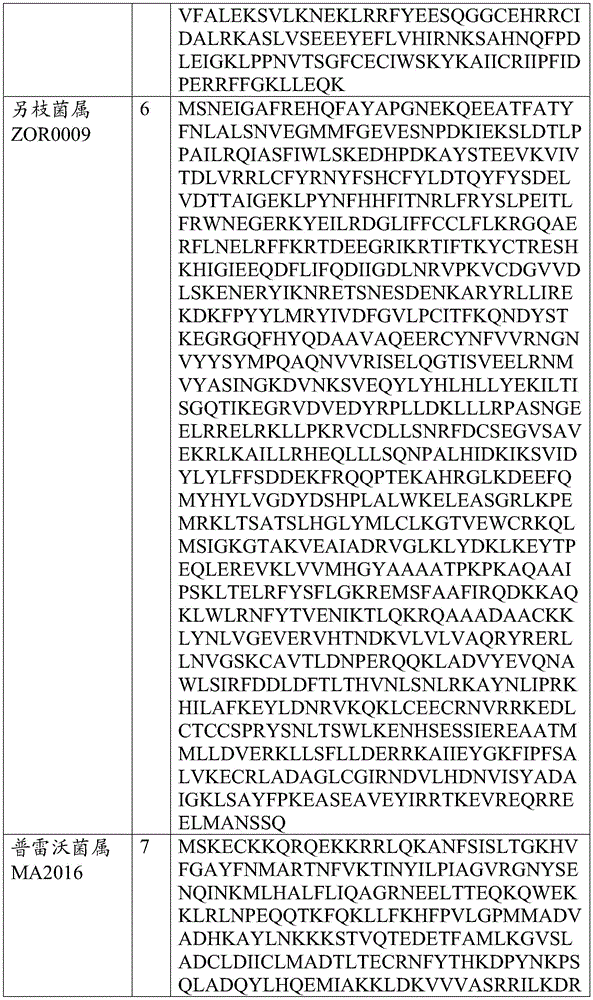
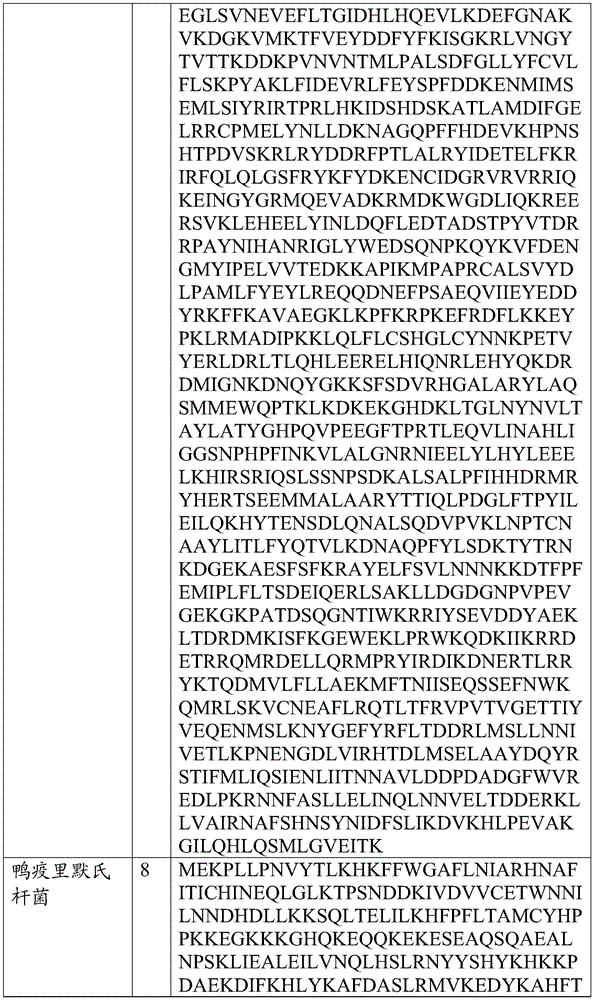

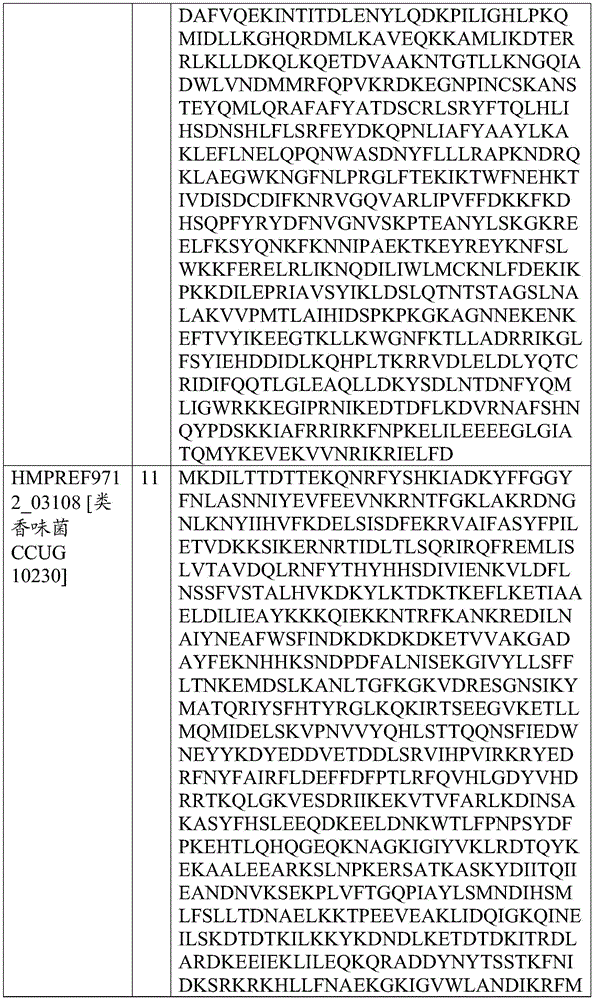
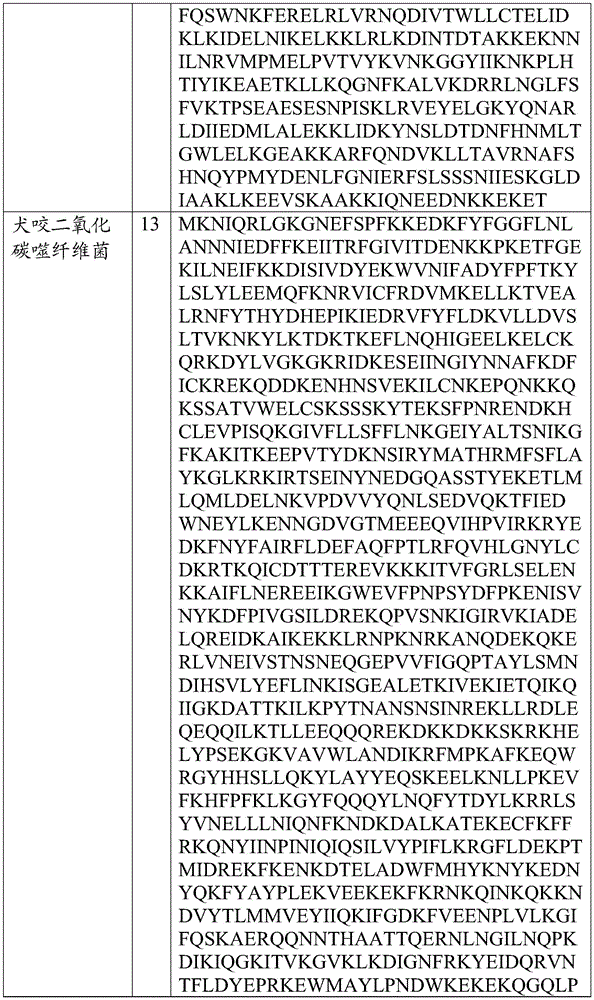

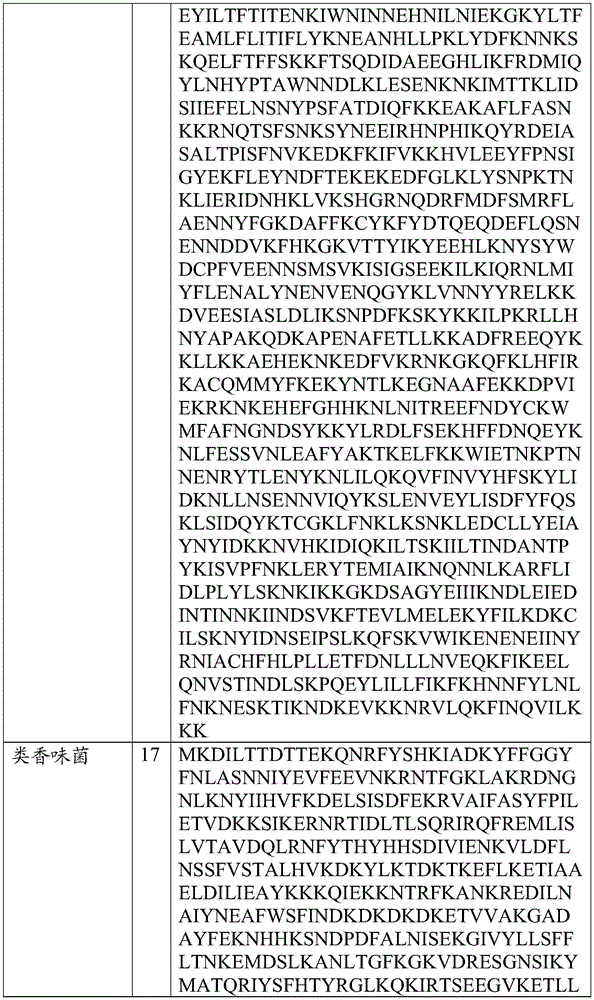


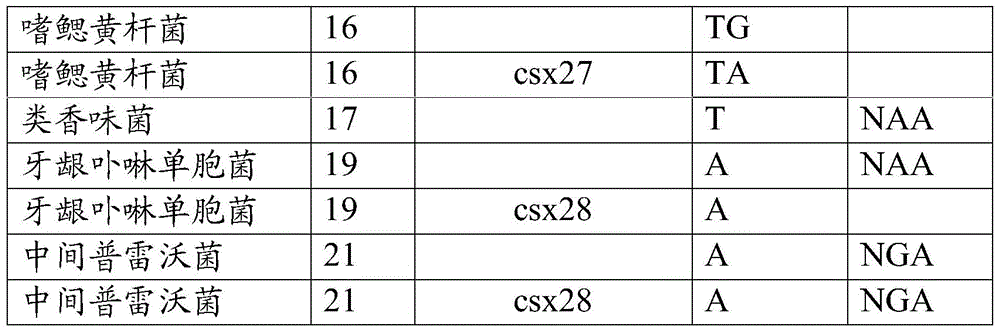
实施例2:Cas13b在哺乳动物细胞中的活性Example 2: Activity of Cas13b in mammalian cells
使用标准lipofectamine 2000方案将HEK293T细胞与以下质粒一起转染:HEK293T cells were transfected with the following plasmids using the
(a)Cas13b(或对照C2c2)哺乳动物表达质粒,在基因C端带有1X核输出序列标签。(a) Cas13b (or control C2c2) mammalian expression plasmid with a 1X nuclear export sequence tag at the C-terminus of the gene.
(b)crRNA表达质粒,每个质粒相对于Gaussia荧光素酶表达靶向crRNA或者表达非靶向crRNA。(b) crRNA expression plasmids, each expressing either targeting crRNA or non-targeting crRNA relative to Gaussia luciferase.
(c)荧光素酶报告质粒,从两个单独的启动子表达Gaussia和Cypridinia荧光素酶。(c) Luciferase reporter plasmid expressing Gaussia and Cypridinia luciferases from two separate promoters.
Gaussia荧光素酶针对敲低,而cypridinia荧光素酶的水平用于控制转染效率。使用瓦氏纤毛菌C2c2来与C2c2直系同源物进行比较。Gaussia luciferase was targeted for knockdown, while cypridinia luciferase levels were used to control transfection efficiency. C. var. var. C2c2 was used for comparison with the C2c2 ortholog.
在相应的指导物中使用以下间隔序列:Use the following spacer sequences in the corresponding guides:

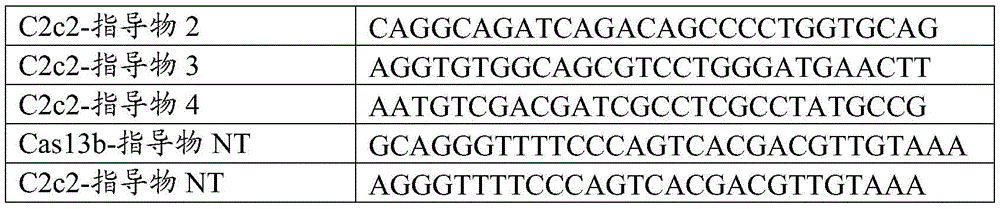
在图2提供了不同Cas13b直系同源物的结果。将直系同源物分类为低/无活性、中、高或金。“金”直系同源物利用所测试的大多数指导物提供了大于80%的荧光素酶活性敲低。“高”直系同源物利用所测试的大多数指导物提供了小于50%的荧光素酶活性敲低。“中”直系同源物利用所测试的大多数指导物提供了约50%的荧光素酶活性敲低。“低/无”直系同源物利用所测试的所有指导物提供了小于80%的荧光素酶活性敲低。Results for different Cas13b orthologs are provided in Figure 2. Orthologs were classified as low/inactive, medium, high or gold. The "gold" ortholog provided greater than 80% knockdown of luciferase activity with most guides tested. The "high" ortholog provided less than 50% knockdown of luciferase activity with most guides tested. The "medium" ortholog provided about 50% knockdown of luciferase activity with most of the guides tested. The "low/none" ortholog provided less than 80% knockdown of luciferase activity with all guides tested.
图3示出了使用指导物2(GGGCATTGGCTTCCATCTCTTTGAGCACCT)和非靶向指导物(GCAGGGTTTTCCCAGTCACGACGTTGTAAA)作为对照测试的几种直系同源物的活性的标准化比较数据。可以看出,Cas13b直系同源物14、15、19和20(来自口腔卟啉单胞菌、普雷沃菌属P5-125、牙龈卟啉单胞菌和卟啉单胞菌属COT-052OH4946)在哺乳动物细胞中特别活跃。Figure 3 shows normalized comparative data for the activity of several orthologs tested using guide 2 (GGGCATTGGCTTCCATCTCTTTGAGCACCT) and non-targeting guide (GCAGGGTTTTCCCAGTCACGACGTTGTAAA) as controls. As can be seen,
图4示出了使用几种荧光素酶靶向指导物和非靶向对照指导物对两个最有效的直系同源物14和15与C2c2/Cas13a进行比较的归一化数据。可以看出,Cas13b直系同源物14和15(来自口腔卟啉单胞菌和普雷沃菌属P5-125)始终比瓦氏纤毛菌C2c2在哺乳动物细胞中更活跃。Figure 4 shows normalized data comparing the two most potent orthologs, 14 and 15, to C2c2/Cas13a using several luciferase targeting guides and a non-targeting control guide. As can be seen,
实施例3Example 3
高效精确的核酸编辑在治疗遗传性疾病方面具有广阔的前景,尤其是在RNA水平上,可以挽救与疾病相关的转录物,从而产生功能性蛋白产物。VI型CRISPR-Cas系统含有可编程的单效应物RNA引导的RNase Cas13。这里,我们简要描述了VI型系统的多样性,以设计出能够可靠敲低的Cas13直系同源物,并通过使用无催化活性的Cas13(dCas13)将腺苷脱氨酶活性指导至哺乳动物细胞中的转录物来证明RNA编辑。通过将ADAR2脱氨酶结构域融合到dCas13上并工程化向导RNA以形成最佳RNA双链体底物,我们实现了特定单腺苷到肌苷的靶向编辑(在翻译过程中被读出为鸟苷),效率通常为20-40%,甚至高达89%。该系统称为可编程的腺嘌呤到肌苷置换的RNA编辑(REPAIR),可以被进一步工程化以实现高特异性。工程化的变体REPAIRv2显示出特异性提高170倍以上,同时仍保持可靠的在靶腺嘌呤到肌苷编辑。我们使用REPAIRv2编辑含有已知致病突变的全长转录物,并形成适合包装在腺相关病毒(AAV)载体中的功能性截短型式。REPAIR提供了一个有前景的RNA编辑平台,在研究、治疗和生物技术领域具有广泛的适用性。精确的核酸编辑技术对于研究细胞功能和作为新型疗法具有重要的价值。尽管当前的编辑工具诸如Cas9核酸酶可以实现对基因组基因座的可编程修饰,但是由于插入或缺失或需要供体模板进行精确编辑,编辑物通常是异源的。碱基编辑器诸如dCas9-APOBEC融合物允许在不产生双链断裂的情况下进行编辑,但由于胞苷脱氨酶活性的性质(在靶标窗口中编辑任何胞苷)可能缺乏精确性。此外,对原间隔邻近基序(PAM)的要求限制了可能的编辑位点的数量。这里,我们描述了使用来自VI型原核成簇规律间隔短回文重复序列(CRISPR)自适应免疫系统的RNA引导的RNA靶向Cas13酶来开发一种精确灵活的RNA碱基编辑工具。Efficient and precise nucleic acid editing holds great promise in the treatment of genetic diseases, especially at the RNA level, where disease-associated transcripts can be rescued, resulting in functional protein products. Type VI CRISPR-Cas systems contain a programmable single-effector RNA-guided RNase Cas13. Here, we briefly describe the diversity of the type VI system to engineer Cas13 orthologs that can be reliably knocked down and direct adenosine deaminase activity to mammalian cells by using catalytically inactive Cas13 (dCas13) transcripts to demonstrate RNA editing. By fusing the ADAR2 deaminase domain to dCas13 and engineering the guide RNA to form an optimal RNA duplex substrate, we achieved targeted editing of specific monoadenosine to inosine (read during translation) guanosine), the efficiency is usually 20-40%, even as high as 89%. The system, called programmable adenine-to-inosine replacement RNA editing (REPAIR), can be further engineered to achieve high specificity. The engineered variant REPAIRv2 showed more than 170-fold improvement in specificity, while still maintaining reliable on-target adenine-to-inosine editing. We used REPAIRv2 to edit full-length transcripts containing known disease-causing mutations and formed functionally truncated versions suitable for packaging in adeno-associated virus (AAV) vectors. REPAIR provides a promising RNA editing platform with broad applicability in research, therapy, and biotechnology. Precise nucleic acid editing techniques are of great value for studying cellular function and as novel therapeutics. Although current editing tools such as Cas9 nucleases enable programmable modifications to genomic loci, editors are often heterologous due to insertions or deletions or the need for precise editing from a donor template. Base editors such as the dCas9-APOBEC fusion allow editing without creating double-strand breaks, but may lack precision due to the nature of cytidine deaminase activity (editing any cytidine in the target window). Furthermore, the requirement for a protospacer adjacent motif (PAM) limits the number of possible editing sites. Here, we describe the development of a precise and flexible RNA base editing tool using an RNA-guided RNA-targeting Cas13 enzyme from the type VI prokaryotic clustered regularly interspaced short palindromic repeats (CRISPR) adaptive immune system.
精确的核酸编辑技术对于研究细胞功能和作为新型疗法具有重要的价值。当前的基于可编辑核酸酶的编辑工具诸如原核成簇规律间隔短回文重复序列(CRISPR)相关的核酸酶Cas9(1-4)或Cpf1(5)已广泛用于介导靶DNA裂解,该靶DNA裂解继而驱动通过非同源末端连接(NHEJ)进行靶基因破坏或通过模板依赖性同源定向修复(HDR)进行精确基因编辑(6)。NHEJ利用在分裂细胞和有丝分裂后细胞中均活跃的宿主装置,并通过产生可以导致蛋白质编码基因移码的插入或缺失(插入缺失)突变的混合物来提供有效的基因破坏。相比之下,HDR由其表达在很大程度上受限于复制细胞的宿主装置介导。因此,开发有丝分裂后细胞中基因编辑能力仍然是主要挑战。最近,DNA碱基编辑器诸如使用无催化活性的Cas9(dCas9)将胞苷脱氨酶活性靶向特定的基因组靶标以在靶标窗口内实现胞嘧啶向胸腺嘧啶的转化,允许在不产生DNA双链断裂的情况下进行编辑并显著减少了插入缺失的形成(7,8)。但是,由于Cas9在编辑位点需要一个原间隔邻近基序(PAM),DNA碱基编辑的靶向范围受到限制(9)。这里,我们描述了使用VI型CRISPR相关的RNA引导的RNase Cas13来开发一种精确灵活的RNA碱基编辑技术(10-13)。Precise nucleic acid editing techniques are of great value for studying cellular function and as novel therapeutics. Current editable nuclease-based editing tools such as the prokaryotic clustered regularly interspaced short palindromic repeats (CRISPR)-related nucleases Cas9(1-4) or Cpf1(5) have been widely used to mediate target DNA cleavage, which Target DNA cleavage in turn drives target gene disruption by non-homologous end joining (NHEJ) or precise gene editing by template-dependent homology-directed repair (HDR) (6). NHEJ takes advantage of host machinery that is active in both dividing and postmitotic cells and provides efficient gene disruption by generating a mixture of insertion or deletion (indel) mutations that can cause frameshifts in protein-coding genes. In contrast, HDR is mediated by a host apparatus whose expression is largely restricted to replicating cells. Therefore, developing gene editing capabilities in post-mitotic cells remains a major challenge. More recently, DNA base editors such as the use of catalytically inactive Cas9 (dCas9) target cytidine deaminase activity to specific genomic targets to achieve cytosine to thymine conversion within the target window, allowing DNA duplexes to be generated without Editing without strand breaks significantly reduces indel formation (7,8). However, the targeting range of DNA base editing is limited because Cas9 requires a protospacer adjacent motif (PAM) at the editing site (9). Here, we describe the use of the type VI CRISPR-associated RNA-guided RNase Cas13 to develop a precise and flexible RNA base editing technology (10-13).
Cas13酶具有两个介导精确RNA裂解的高等真核生物和原核生物核苷酸结合(HEPN)内切RNase结构域(10,11)。迄今为止,已鉴定出三个Cas13蛋白家族:Cas13a(以前称为C2c2)、Cas13b和Cas13c(12,13)。我们最近报道了Cas13a酶可以用作核酸检测的工具(14)以及哺乳动物和植物细胞RNA敲低和转录物追踪的工具(15)。Cas13酶具有RNA引导的性质使它们成为用于RNA结合和干扰应用的有吸引力的工具。The Cas13 enzyme has two higher eukaryotic and prokaryotic nucleotide-binding (HEPN) endo-RNase domains that mediate precise RNA cleavage (10,11). To date, three Cas13 protein families have been identified: Cas13a (formerly C2c2), Cas13b and Cas13c (12,13). We recently reported that the Cas13a enzyme can be used as a tool for nucleic acid detection (14) as well as for RNA knockdown and transcript tracking in mammalian and plant cells (15). The RNA-guided nature of Cas13 enzymes makes them attractive tools for RNA-binding and interference applications.
作用于RNA(ADAR)酶家族的腺苷脱氨酶通过将腺苷水解脱氨成肌苷来介导转录物的内源编辑,肌苷是一种在翻译和剪接中的功能相当于鸟苷的核碱基(16)。有两个功能性的人类ADAR直系同源物ADAR1和ADAR2,它们由N端双链RNA结合结构域和C端催化脱氨结构域组成。ADAR1和ADAR2的内源靶位点具有相当高的双链同一性,并且催化结构域需要双链体化区才能在体外和体内进行有效编辑(17,18)。尽管ADAR蛋白具有可能限制靶向的潜在灵活性的优选编辑基序,但高活性突变体诸如ADAR(E488Q)(19)可放宽序列限制并提高腺苷到肌苷的编辑率。ADAR优先使RNA双链体中与胞苷碱基相对的腺苷脱氨(20),从而为精确的碱基编辑提供有前景的机会。尽管先前的方法已经通过RNA指导物设计了靶向ADAR融合(21-24),但尚未报道这些方法的特异性,并且它们各自的靶向机制依赖于RNA-RNA杂交而不需要蛋白质伴侣的帮助,这可增强靶标的识别和严格性。Adenosine deaminase acting on RNA (ADAR) enzyme family mediates endogenous editing of transcripts by hydrolyzing adenosine to deaminate to inosine, a functional equivalent of guanosine in translation and splicing the nucleobase (16). There are two functional human ADAR orthologs, ADAR1 and ADAR2, which consist of an N-terminal double-stranded RNA-binding domain and a C-terminal catalytic deamination domain. The endogenous target sites of ADAR1 and ADAR2 share considerable duplex identity, and the catalytic domains require duplexed regions for efficient editing in vitro and in vivo (17,18). Although ADAR proteins have preferred editing motifs that may limit the potential flexibility of targeting, highly active mutants such as ADAR(E488Q) (19) can relax sequence constraints and increase the rate of adenosine to inosine editing. ADAR preferentially deaminates adenosine opposite cytidine bases in RNA duplexes (20), thus offering promising opportunities for precise base editing. Although previous approaches have designed targeted ADAR fusions via RNA guides (21-24), the specificity of these approaches has not been reported, and their respective targeting mechanisms rely on RNA-RNA hybridization without the help of protein partners , which enhances target recognition and stringency.
这里,我们分析了整个Cas13酶家族在哺乳动物细胞中的RNA敲低活性,并鉴定出来自普雷沃菌属P5-125的Cas13b直系同源物(PspCas13b)对于哺乳动物细胞应用是最有效和最特异的。然后,我们将ADAR2脱氨酶结构域(ADARDD)与无催化活性的PspCas13b融合,并证实了对报告物和内源转录物的可编程的腺嘌呤到肌苷置换的RNA编辑(REPAIR)以及与疾病相关的突变。最后,我们采用合理的诱变方案来提高dCas13b-ADAR2DD融合物的特异性,以产生特异性增加170倍以上的REPAIRv2。Here, we analyzed the RNA knockdown activity of the entire Cas13 enzyme family in mammalian cells and identified the Cas13b ortholog (PspCas13b) from Prevotella P5-125 as the most efficient and effective for mammalian cell applications. most idiosyncratic. We then fused the ADAR2 deaminase domain (ADARDD) to catalytically inactive PspCas13b and demonstrated programmable adenine-to-inosine-replacement RNA editing (REPAIR) of the reporter and endogenous transcripts as well as with Disease-associated mutations. Finally, we employed a rational mutagenesis protocol to increase the specificity of the dCas13b-ADAR2DD fusion to generate REPAIRv2 with greater than 170-fold increased specificity.
细菌构建体的设计和克隆Design and Cloning of Bacterial Constructs
在Lac启动子的控制下,将经哺乳动物密码子优化的Cas13b构建体克隆到耐氯霉素的pACYC184载体中。然后,在pJ23119启动子的控制下,将由BsaI限制性位点分开的两个对应的正向重复(DR)序列插入Cas13b下游。最后,使用T4 PNK(New England Biolabs)将用于靶向间隔序列的寡核苷酸磷酸化,将其退火并使用T7连接酶(Enzymatics)连接到经BsaI消化的载体中,以生成靶向Cas13b载体。The mammalian codon-optimized Cas13b construct was cloned into the chloramphenicol-resistant pACYC184 vector under the control of the Lac promoter. Then, two corresponding direct repeat (DR) sequences separated by a BsaI restriction site were inserted downstream of Cas13b under the control of the pJ23119 promoter. Finally, oligonucleotides targeting the spacer were phosphorylated using T4 PNK (New England Biolabs), annealed and ligated into the BsaI-digested vector using T7 ligase (Enzymatics) to generate targeting Cas13b vector.
细菌PFS筛选Bacterial PFS Screening
通过使用NEB Gibson Assembly(New England Biolabs),在氨苄青霉素抗性基因bla的起始密码子下游插入含有Cas13b靶标且具有由靶位点分开的2个5'随机核苷酸和4个3'随机核苷酸的PCR产物,从而克隆出用于PFS筛选的氨苄青霉素抗性质粒。然后将100ng抗氨苄青霉素的靶质粒与65-100ng抗氯霉素的Cas13b细菌靶向质粒电穿孔到Endura电感受态细胞中。将质粒加入细胞中,在冰上孵育15分钟,使用制造商方案进行电穿孔,然后将950uL回收培养基加入细胞中,然后在37C下生长一小时。将生长物接种到氯霉素和氨苄青霉素双重选择平板上。将生长物的连续稀释液用于估计cfu/ng DNA。接种后16小时,将细胞从平板上刮下,并使用Qiagen Plasmid Plus Maxi Kit(Qiagen)收集尚存的质粒DNA。通过PCR扩增尚存的Cas13b靶序列及其侧接区,并使用Illumina NextSeq进行测序。为了评估PFS偏好,提取原始库中包含随机核苷酸的位置,并使用自定义python脚本提取两个生物复制中都存在的相对于仅载体条件而言耗竭的序列。然后,将Cas13b条件下PFS丰度与仅载体条件相比的比率的-log2用于计算优选基序。具体地,将-log2(样品/载体)耗竭率高于特定阈值的所有序列都用于生成序列基序的weblogo(weblogo.berkeley.edu)。表7列出了用于为每个Cas13b直系同源物生成weblogo的特定耗竭率值。An insertion containing the Cas13b target with 2 5' random nucleotides and 4 3' random nucleotides separated by the target site was inserted downstream of the start codon of the ampicillin resistance gene bla by using NEB Gibson Assembly (New England Biolabs). PCR product of nucleotides, thereby cloning an ampicillin resistance plasmid for PFS screening. 100 ng of the ampicillin-resistant targeting plasmid and 65-100 ng of the chloramphenicol-resistant Cas13b bacterial targeting plasmid were then electroporated into Endura electrocompetent cells. Plasmids were added to cells, incubated on ice for 15 min, electroporated using the manufacturer's protocol, then 950 uL of recovery medium was added to cells and grown at 37C for one hour. Growths were plated on chloramphenicol and ampicillin double selection plates. Serial dilutions of the growth were used to estimate cfu/ng DNA. Sixteen hours after seeding, cells were scraped from the plate and surviving plasmid DNA was collected using the Qiagen Plasmid Plus Maxi Kit (Qiagen). Surviving Cas13b target sequences and their flanking regions were amplified by PCR and sequenced using Illumina NextSeq. To assess PFS bias, positions in the original library containing random nucleotides were extracted and a custom python script was used to extract sequences that were depleted relative to the vector-only condition present in both biological replicates. Then, -log2 of the ratio of PFS abundance under Cas13b conditions compared to vector-only conditions was used to calculate preferred motifs. Specifically, all sequences with a -log2 (sample/vector) depletion rate above a certain threshold were used to generate weblogos of sequence motifs (weblogo.berkeley.edu). Table 7 lists the specific depletion rate values used to generate weblogos for each Cas13b ortholog.
用于RNA干扰的哺乳动物构建体的设计和克隆Design and cloning of mammalian constructs for RNA interference
为了生成用于在哺乳动物细胞中测试Cas13直系同源物的载体,对经哺乳动物密码子优化的Cas13a、Cas13b和Cas13c基因进行PCR扩增,并在EF1α启动子的控制下将这些基因golden-gate克隆到包含双重NLS序列和C端msfGFP的哺乳动物表达载体中。为了进一步优化,在EF1α启动子的控制下将Cas13直系同源物golden gate克隆到包含不同的C端定位标签的目的载体中。To generate vectors for testing Cas13 orthologs in mammalian cells, the mammalian codon-optimized Cas13a, Cas13b, and Cas13c genes were PCR-amplified and golden- The gate was cloned into a mammalian expression vector containing dual NLS sequences and C-terminal msfGFP. For further optimization, the Cas13 ortholog golden gate was cloned into a destination vector containing different C-terminal localization tags under the control of the EF1α promoter.
通过使用NEB Gibson Assembly(New England Biolabs)PCR扩增编码Gaussia和Cypridinia荧光素酶的DNA、EF1α和CMV启动子和组件,克隆出双荧光素酶报告基因。Dual luciferase reporter genes were cloned by PCR amplification of DNA encoding Gaussia and Cypridinia luciferases, EF1α and CMV promoters and modules using NEB Gibson Assembly (New England Biolabs).
为了表达Cas13a、Cas13b或Cas13c直系同源物的哺乳动物向导RNA,合成了具有golden-gate受体位点的对应正向重复序列,并经由限制性消化克隆在U6表达下对其进行克隆。然后通过golden gate克隆将各个指导物克隆到每个直系同源物的对应表达主链中。To express mammalian guide RNAs of Cas13a, Cas13b or Cas13c orthologs, the corresponding forward repeats with golden-gate acceptor sites were synthesized and cloned under U6 expression via restriction digest cloning. Each guide was then cloned into the corresponding expression backbone of each ortholog by golden gate cloning.
用于Cas13干扰特异性的池化错配文库的克隆Cloning of Pooled Mismatch Libraries for Cas13 Interference Specificity
通过PCR创建池化错配文库靶位点。将在靶标内每个位置处包含94%正确碱基和2%每个错误碱基的混合物的G-荧光素酶中包含半简并靶序列的寡核苷酸用作一个引物,并将G-荧光素酶的非靶向区的寡核苷酸用作PCR反应中的第二个引物。然后使用NEBGibson assembly(New England Biolabs)将错配文库靶标克隆到双荧光素酶报告基因中代替野生型G-荧光素酶。Pooled mismatch library target sites were created by PCR. An oligonucleotide containing a semidegenerate target sequence in G-luciferase containing a mixture of 94% correct bases and 2% each incorrect base at each position within the target was used as one primer, and the G - The oligonucleotide of the non-targeting region of luciferase was used as the second primer in the PCR reaction. The mismatch library targets were then cloned into a dual-luciferase reporter in place of wild-type G-luciferase using NEBGibson assembly (New England Biolabs).
用于RNA编辑的哺乳动物构建体的设计和克隆Design and cloning of mammalian constructs for RNA editing
通过在HEPN结构域的催化位点进行两个组氨酸到丙氨酸突变(H133A/H1058A)使PspCas13b失去催化活性(dPspCas13b)。合成人类ADAR1和ADAR2的脱氨酶结构域并进行PCR扩增以将其gibson克隆到pcDNA-CMV载体主链中,并通过GS或GSGGGGS接头使其在C端与dPspCas13b融合。对于测试不同接头的实验,我们在dPspCas13b和ADAR2dd之间克隆了以下其他接头:GGGGSGGGGSGGGGS、EAAAK、GGSGGSGGSGGSGGSGGS和SGSETPGTSESATPES(XTEN)。通过将适当的突变体gibson克隆到dPspCas13b-GSGGGGS主链中来产生特异性突变体。PspCas13b was inactivated catalytically (dPspCas13b) by two histidine-to-alanine mutations (H133A/H1058A) at the catalytic site of the HEPN domain. The deaminase domains of human ADAR1 and ADAR2 were synthesized and PCR amplified to gibson clone them into the pcDNA-CMV vector backbone and fused at the C-terminus to dPspCas13b via a GS or GSGGGGS linker. For experiments testing different linkers, we cloned the following additional linkers between dPspCas13b and ADAR2dd: GGGGSGGGGSGGGGS, EAAAK, GGSGGSGGSGGSGGSGGS and SGSETPGTSESATPES (XTEN). Specific mutants were generated by cloning the appropriate mutant gibson into the dPspCas13b-GSGGGGS backbone.
通过在用于敲低实验的荧光素酶报告载体中产生W85X突变(TGG>TAG)来产生用于测量RNA编辑活性的荧光素酶报告载体。该报告载体将功能性Gluc表达为归一化对照,但是由于添加了预先终止位点而导致有Cluc缺陷。为了测试ADAR编辑基序偏好,我们克隆了Cluc的第85位密码子(XAX)处腺苷周围的所有可能基序。The luciferase reporter vector for measuring RNA editing activity was generated by creating the W85X mutation (TGG>TAG) in the luciferase reporter vector used for the knockdown experiments. This reporter vector expresses functional Gluc as a normalization control, but is Cluc deficient due to the addition of a pre-stop site. To test ADAR editing motif bias, we cloned all possible motifs around adenosine at codon 85 (XAX) of Cluc.
为了测试REPAIR的PFS偏好,我们克隆了在靶区和腺苷编辑位点上游包含6个碱基对的简并PFS序列的池化质粒文库。文库由Integrated DNA Technologies(IDT)合成为ultramer,并且通过使引物退火以及DNA聚合酶I(New England Biolabs)的Klenow片段填补序列使文库成为双链。然后将包含简并序列的该dsDNA片段gibson克隆到消化的报告载体中,然后将其用异丙醇沉淀并纯化。然后将克隆的文库电穿孔到Endura感受态大肠杆菌细胞(Lucigen)中,并接种在245mm×245mm正方形生物测定板(Nunc)中。16小时后,使用无内毒素的MACHEREY-NAGEL midiprep试剂盒收获菌落并进行midiprep分析。通过下一代测序验证克隆的文库。To test the PFS preference of REPAIR, we cloned a pooled plasmid library containing 6 base pairs of degenerate PFS sequences upstream of the target region and the adenosine editing site. Libraries were synthesized as ultramers by Integrated DNA Technologies (IDT) and double-stranded by annealing primers and filling in sequences with Klenow fragments of DNA polymerase I (New England Biolabs). This dsDNA fragment containing the degenerate sequence gibson was then cloned into a digested reporter vector, which was then precipitated with isopropanol and purified. The cloned library was then electroporated into Endura competent E. coli cells (Lucigen) and plated in 245mm x 245mm square bioassay plates (Nunc). After 16 hours, colonies were harvested and subjected to midiprep analysis using the endotoxin-free MACHEREY-NAGEL midiprep kit. The cloned library was verified by next-generation sequencing.
为了克隆与疾病相关的突变来测试REPAIR活性,选择如ClinVar中定义的与疾病发病机制相关的34个G>A突变,并在CMV启动子下将围绕这些突变的200bp区golden-gate克隆到mScarlett和EGFP之间。选择AVPR2和FANCC中两个另外的G>A突变,用于在EF1α表达下Gibson克隆整个基因序列。To clone disease-associated mutations to test REPAIR activity, 34 G>A mutations associated with disease pathogenesis as defined in ClinVar were selected and a 200 bp region surrounding these mutations golden-gated into mScarlett under the CMV promoter and EGFP. Two additional G>A mutations in AVPR2 and FANCC were selected for Gibson cloning of the entire gene sequence under EF1α expression.
为了表达用于REPAIR的哺乳动物向导RNA,合成了具有golden-gate受体位点的PspCas13b正向重复序列,并经由限制性消化克隆在U6表达下对其进行克隆。然后通过golden gate克隆将各个指导物克隆到该表达主链中。To express the mammalian guide RNA for REPAIR, a PspCas13b forward repeat with a golden-gate acceptor site was synthesized and cloned under U6 expression via restriction digest cloning. Individual guides were then cloned into the expression backbone by golden gate cloning.
哺乳动物细胞培养mammalian cell culture
哺乳动物细胞培养实验是在HEK293FT品系(美国模式培养物集存库(ATCC))中进行的,该品系在含高葡萄糖、丙酮酸钠和GlutaMAX(Thermo Fisher Scientific)并且另外还补充有1×青霉素-链霉素(Thermo Fisher Scientific)和10%胎牛血清(VWRSeradigm)的杜尔贝科改良伊格尔培养基(Dulbecco's Modified Eagle Medium)中生长。将细胞保持在低于80%的汇合度。Mammalian cell culture experiments were performed in the HEK293FT strain (American Type Culture Collection (ATCC)) containing high glucose, sodium pyruvate and GlutaMAX (Thermo Fisher Scientific) and additionally supplemented with 1× penicillin - Growth in Dulbecco's Modified Eagle Medium in Streptomycin (Thermo Fisher Scientific) and 10% Fetal Bovine Serum (VWRSeradigm). Keep cells below 80% confluency.
除非另有说明,否则所有转染均用Lipofectamine 2000(Thermo FisherScientific)在涂覆有聚-D-赖氨酸的96孔板(BD Biocoat)上进行。转染前十六小时以大约20,000个细胞/孔接种细胞,以确保转染时的汇合度达到90%。对于板上的每个孔,将转染质粒与Opti-MEM I还原血清培养基(Thermo Fisher)合并,总体积为25μl。单独地,将24.5ul Opti-MEM与0.5ul Lipofectamine 2000合并。然后将质粒和Lipofectamine溶液合并并孵育5分钟,然后将它们吸移到细胞上。All transfections were performed on poly-D-lysine-coated 96-well plates (BD Biocoat) with Lipofectamine 2000 (Thermo Fisher Scientific) unless otherwise stated. Cells were seeded at approximately 20,000 cells/well sixteen hours prior to transfection to ensure 90% confluency at the time of transfection. For each well of the plate, the transfected plasmid was combined with Opti-MEM I reduced serum medium (Thermo Fisher) in a total volume of 25 μl. Separately, 24.5ul Opti-MEM was combined with 0.5
RNA敲低哺乳动物细胞测定RNA knockdown mammalian cell assay
为了用报告基因构建体评估哺乳动物细胞中的RNA靶向情况,将150ng Cas13构建体与300ng指导表达质粒和12.5ng敲低报告基因构建体共转染。转染后48小时,从细胞中移出含有分泌型荧光素酶的培养基,在PBS中以1:5稀释,并利用BioLux Cypridinia和BioluxGaussia荧光素酶测定试剂盒(New England Biolabs)在具有注射方案的酶标仪(BiotekSynergy Neo2)上测量活性。进行的所有重复都是生物学重复。To assess RNA targeting in mammalian cells with reporter constructs, 150 ng of the Cas13 construct was co-transfected with 300 ng of the guide expression plasmid and 12.5 ng of the knockdown reporter construct. Forty-eight hours after transfection, the secreted luciferase-containing medium was removed from the cells, diluted 1:5 in PBS, and analyzed using the BioLux Cypridinia and BioluxGaussia luciferase assay kits (New England Biolabs) with an injection protocol. Activity was measured on a microplate reader (BiotekSynergy Neo2). All replicates performed are biological replicates.
为了靶向内源基因,将150ng Cas13构建体与300ng指导表达质粒共转染。转染后48小时,使用先前描述的Cells-to-Ct试剂盒(Thermo Fisher Scientific)的改良方法,溶解细胞并收获RNA并且进行反转录。使用KRAS转录物的TaqMan qPCR探针(Thermo FisherScientific)、GAPDH对照探针(Thermo Fisher Scientific)和Fast Advanced Master Mix(Thermo Fisher Scientific)通过qPCR测量cDNA表达。在LightCycler 480仪器II(Roche)上读取qPCR反应,其中以384孔形式进行四个5ul技术重复。To target endogenous genes, 150ng of the Cas13 construct was co-transfected with 300ng of the guide expression plasmid. Forty-eight hours after transfection, cells were lysed and RNA was harvested and reverse transcribed using a modification of the Cells-to-Ct kit (Thermo Fisher Scientific) described previously. cDNA expression was measured by qPCR using TaqMan qPCR probes for KRAS transcripts (Thermo Fisher Scientific), GAPDH control probes (Thermo Fisher Scientific) and Fast Advanced Master Mix (Thermo Fisher Scientific). qPCR reactions were read on a LightCycler 480 Instrument II (Roche) with four 5ul technical replicates performed in a 384-well format.
使用错配靶标的池化文库评估RNA特异性Assessing RNA specificity using pooled libraries of mismatched targets
使用接种在6孔板中接种的HEK293FT细胞来测试Cas13干扰错配靶标文库的能力。使用2400ng Cas13载体、4800ng指导物和240ng错配靶标文库转染约汇合70%的细胞。转染后48小时,使用QIAshredder(Qiagen)和Qiagen RNeasy Mini Kit收获细胞并提取RNA。使用qScript Flex cDNA合成试剂盒(Quantabio),按照制造商基因特异性引物延伸方案并使用Gluc特异性RT引物,对1ug提取的RNA进行反转录。然后扩增cDNA并在Illumina NextSeq上进行测序。The ability of Cas13 to interfere with a library of mismatched targets was tested using HEK293FT cells seeded in 6-well plates. Cells approximately 70% confluent were transfected with 2400ng of Cas13 vector, 4800ng of guide and 240ng of mismatched target library. Forty-eight hours after transfection, cells were harvested and RNA extracted using QIAshredder (Qiagen) and Qiagen RNeasy Mini Kit. 1 ug of extracted RNA was reverse transcribed using the qScript Flex cDNA synthesis kit (Quantabio) following the manufacturer's gene-specific primer extension protocol and using Gluc-specific RT primers. cDNA was then amplified and sequenced on Illumina NextSeq.
通过对每个序列的读数进行计数来分析测序,并通过确定log2(-读数计数比)值来计算消耗竭得分,其中读数计数比是靶向指导条件与非靶向指导条件下的读数计数之比。该得分值代表序列上Cas13的活性水平,值越高代表耗竭越强,因此代表Cas13裂解活性越高。确定了单错配和双错配序列的单独分布,并将其绘制为热图,其具有每个错配同一性的耗竭得分。对于双错配序列,绘制了给定位置处所有可能的双错配的平均值。Sequencing was analyzed by counting reads per sequence, and depletion scores were calculated by determining a log2(-read count ratio) value, where the read count ratio was the sum of the read counts in the target-directed and non-target-directed conditions Compare. The score value represents the level of Cas13 activity on the sequence, with higher values representing greater depletion and therefore higher Cas13 cleavage activity. Separate distributions of single- and double-mismatch sequences were determined and plotted as a heatmap with a depletion score for each mismatch identity. For double-mismatch sequences, the average of all possible double-mismatches at a given position is plotted.
通过RNA测序在哺乳动物细胞中对Cas13进行全转录组分析Transcriptome-wide analysis of Cas13 in mammalian cells by RNA-sequencing
为了测量全转录组特异性,共转染了150ng Cas13构建体、300ng指导表达质粒和15ng敲低报告基因构建体。对于shRNA条件,共转染了300ng shRNA靶向质粒、15ng敲低报告基因构建体和150ng EF1-α驱动的mCherry(以平衡报告基因负载)。转染后48小时,利用RNeasy Plus Mini试剂盒(Qiagen)纯化RNA,针对使用NEBNext Poly(A)mRNA磁性分离模块(New England Biolabs)选择mRNA,并将其准备利用Illumina(New England Biolabs)的NEBNext Ultra RNA Library Prep Kit进行测序。然后在NextSeq(Illumina)上对RNA测序文库进行测序。To measure transcriptome-wide specificity, 150ng Cas13 construct, 300ng guide expression plasmid and 15ng knockdown reporter construct were co-transfected. For shRNA conditions, 300ng of shRNA targeting plasmid, 15ng of knockdown reporter construct, and 150ng of EF1-α driven mCherry (to balance reporter gene load) were co-transfected. Forty-eight hours post-transfection, RNA was purified using the RNeasy Plus Mini kit (Qiagen), mRNA was selected for using the NEBNext Poly(A) mRNA Magnetic Separation Module (New England Biolabs), and was prepared for NEBNext using Illumina (New England Biolabs). Ultra RNA Library Prep Kit for sequencing. RNA sequencing libraries were then sequenced on NextSeq (Illumina).
为了分析全转录组测序数据,使用Bowtie和RSEM 1.2.31版利用默认参数对读数进行RefSeq GRCh38组件比对。将转录物表达定量为log2(TPM+1),过滤基因以使log2(TPM+1)大于2.5。为了选择差异表达的基因,仅考虑差异变化大于2或小于.75的基因。针对三个靶向重复与非靶向重复进行Student T检验以评估差异表达的统计显著性,并通过Benjamini-Hochberg程序过滤了小于0.01%的错误发现率。To analyze whole transcriptome sequencing data, RefSeq GRCh38 assembly alignments were performed on reads using Bowtie and RSEM version 1.2.31 with default parameters. Transcript expression was quantified as log2(TPM+1) and genes were filtered so that log2(TPM+1) was greater than 2.5. To select differentially expressed genes, only genes with differential changes greater than 2 or less than .75 were considered. Student's T-test was performed against three targeted versus non-targeted replicates to assess the statistical significance of differential expression, and a false discovery rate of less than 0.01% was filtered by the Benjamini-Hochberg procedure.
哺乳动物细胞转染中的ADARADAR in mammalian cell transfection RNA编辑RNA editing
为了评估哺乳动物细胞中的REPAIR活性,我们转染了150ng REPAIR载体、300ng指导表达质粒和40ng RNA编辑报告基因。48小时后,使用先前描述的方法并利用基因特异性逆转录引物,收获来自细胞的RNA并进行逆转录。然后使用NEBNext High-Fidelity 2X PCRMaster Mix对提取的cDNA进行两轮PCR,以加入Illumina适配体和样品条形码。然后在Illumina NextSeq或MiSeq上对文库进行下一代测序。然后在测序窗口内的所有腺苷处评估RNA编辑率。To assess REPAIR activity in mammalian cells, we transfected 150ng of the REPAIR vector, 300ng of the guide expression plasmid, and 40ng of the RNA editing reporter gene. After 48 hours, RNA from cells was harvested and reverse transcribed using previously described methods and using gene-specific reverse transcription primers. The extracted cDNA was then subjected to two rounds of PCR using NEBNext High-Fidelity 2X PCRMaster Mix to incorporate Illumina aptamers and sample barcodes. Libraries are then next-generation sequenced on Illumina NextSeq or MiSeq. RNA editing rates were then assessed at all adenosines within the sequencing window.
在荧光素酶报告基因被靶向RNA编辑的实验中,我们还在收获RNA之前收获了含有分泌型荧光素酶的培养基。在这种情况下,由于校正后的Cluc可能处于较低水平,因此我们没有稀释介质。我们利用BioLux Cypridinia和Biolux Gaussia荧光素酶测定试剂盒(NewEngland Biolabs)在具有注射方案的酶标仪(Biotek Synergy Neo2)上测量荧光素酶活性。进行的所有重复都是生物学重复。In experiments where the luciferase reporter gene was targeted for RNA editing, we also harvested media containing secreted luciferase prior to harvesting the RNA. In this case, we did not dilute the medium since the corrected Cluc might be at a lower level. We measured luciferase activity on a microplate reader (Biotek Synergy Neo2) with an injection protocol using the BioLux Cypridinia and Biolux Gaussia Luciferase Assay Kits (NewEngland Biolabs). All replicates performed are biological replicates.
PFS结合哺乳动物筛选PFS combined with mammalian screening
为了确定PFS对编辑效率的贡献,将625ng PFS靶标文库、4.7ug指导物和2.35ugREPAIR共转染到接种在225cm2烧瓶中的HEK293FT细胞上。将质粒与33ul PLUS试剂(ThermoFisher Scientific)混合,用Opti-MEM调节至533ul,孵育5分钟,再与30ulLipofectamine2000和500ul Opti-MEM合并,再孵育5分钟,然后将其吸移到细胞上。转染后48小时,利用RNeasy Plus Mini试剂盒(Qiagen)收获RNA,利用qScript Flex(Quantabio)并使用基因特异性引物进行反转录,并使用NEBNext High-Fidelity 2X PCR Master Mix(New England Biolabs)进行两轮PCR扩增,以加入Illumina适配体和样品条形码。在Illumina NextSeq上对文库进行测序,并将靶标腺苷处的RNA编辑率映射为PFS同一性。为了增加覆盖率,PFS在计算上被折叠为4个核苷酸。计算每个PFS的REPAIR编辑率,在生物学重复内求平均值,减去对应PFS的非靶向率。To determine the contribution of PFS to editing efficiency, 625ng of the PFS target library, 4.7ug of guide and 2.35ug of REPAIR were co-transfected onto HEK293FT cells seeded in 225cm2 flasks. Plasmids were mixed with 33ul PLUS reagent (ThermoFisher Scientific), adjusted to 533ul with Opti-MEM, incubated for 5 min, combined with
进行全转录组测序以评估ADAR编辑特异性Whole-transcriptome sequencing to assess ADAR editing specificity
为了分析整个转录组的脱靶RNA编辑位点,我们使用RNeasy Plus Miniprep试剂盒(Qiagen)从转染后48小时的细胞中收集总RNA。然后使用NEBNext Poly(A)mRNA磁性分离模块(NEB)富集mRNA部分,然后并将该RNA准备使用Illumina(NEB)的NEBNext Ultra RNALibrary Prep Kit进行测序。然后在Illumina NextSeq上对文库进行测序,并将其加载使得每个样品至少有500万个读数。To analyze off-target RNA editing sites across the transcriptome, we collected total RNA from cells 48 h post-transfection using the RNeasy Plus Miniprep kit (Qiagen). The mRNA fraction was then enriched using the NEBNext Poly(A) mRNA Magnetic Separation Module (NEB), and the RNA was prepared for sequencing using the NEBNext Ultra RNALibrary Prep Kit from Illumina (NEB). Libraries were then sequenced on Illumina NextSeq and loaded such that each sample had at least 5 million reads.
靶向和全转录组实验的RNA编辑分析RNA editing analysis for targeted and whole transcriptome experiments
为了分析全转录组RNA编辑RNA测序数据,将序列文件随机下采样至500万个读数。使用添加有Gluc和Cluc序列的RefSeq GRCh38组件生成索引,并使用Bowtie/RSEM版本1.3.0对读数进行比对和定量。然后使用REDitools[cite]利用以下参数对比对BAM进行分类和RNA编辑位点分析:-t 8 -e -d -l -U[AG或TC]-p -u -m20 -T6-0 -W -v 1 -n 0.0。在未转染或EGFP转染的条件下发现的任何显著编辑均视为SNP或转染的假象,并从脱靶分析中过滤掉。如果Fisher精确检验得出p值小于0.5并且3个生物学重复中至少有2个鉴定出编辑位点,则认为脱靶显著。To analyze whole transcriptome RNA editing RNA sequencing data, sequence files were randomly downsampled to 5 million reads. Indexes were generated using the RefSeq GRCh38 module supplemented with Gluc and Cluc sequences, and reads were aligned and quantified using Bowtie/RSEM version 1.3.0. BAMs were then sorted and analyzed for RNA editing sites using REDitools[cite] with the following parametric alignments: -t 8 -e -d -l -U[AG or TC] -p -u -m20 -T6-0 -W - v 1 -n 0.0. Any significant editing found in untransfected or EGFP-transfected conditions was considered an artifact of SNP or transfection and filtered from off-target analysis. Off-target was considered significant if Fisher's exact test yielded a p-value less than 0.5 and editing sites were identified in at least 2 of the 3 biological replicates.
为了分析每个脱靶的预测变异效应,使用SIFT和PolyPhen-2注释并且使用作为UCSC基因组浏览器工具套件的一部分的变体注释集成器(https://genome.ucsc.edu/cgi-bin/hgVai),对脱靶编辑位点列表进行分析。为了判断脱靶基因是否致癌,参见了COSMIC癌症体细胞突变目录(cancer.sanger.ac.uk)中的致癌注释数据库。To analyze predicted variant effects for each off-target, SIFT and PolyPhen-2 annotations were used and the variant annotation integrator (https://genome.ucsc.edu/cgi-bin/hgVai) was used as part of the UCSC Genome Browser tool suite. ) to analyze the list of off-target editing sites. To determine whether off-target genes are oncogenic, the oncogenic annotation database in the COSMIC Cancer Somatic Mutation Catalog (cancer.sanger.ac.uk) was consulted.
为了分析REPAIR构建体是否干扰RNA水平,使用RSEM分析输出的每百万转录物(TPM)值进行表达计数,并通过取log2(TPM+1)将其转化为对数空间。为了找到差异调控的基因,针对三个靶向指导物重复与三个非靶向指导物重复进行Student t检验。仅对log2(TPM+1)值大于2.5的基因进行统计分析,并且只有倍数变化大于2或小于0.8的基因才视为被差异调控。对错误发现率小于0.01的基因进行报告。To analyze whether the REPAIR construct interferes with RNA levels, expression counts were performed using the transcripts per million (TPM) values output from the RSEM analysis and converted to logarithmic space by taking log2(TPM+1). To find differentially regulated genes, Student's t-test was performed for three targeted guide repeats versus three non-targeted guide repeats. Statistical analysis was performed only on genes with log2(TPM+1) values greater than 2.5, and only genes with fold changes greater than 2 or less than 0.8 were considered differentially regulated. Genes with a false discovery rate of less than 0.01 were reported.
哺乳动物细胞中Cas13家族成员的全面表征。Comprehensive characterization of Cas13 family members in mammalian cells.
我们之前开发了用于哺乳动物敲低应用的LwaCas13a,但它需要msfGFP稳定结构域才能有效敲低,尽管特异性很高,但敲低效率并不能始终低于50%(15)。我们试图通过表征一组遗传上多样化的Cas13家族成员来评估它们在哺乳动物细胞中的RNA敲低活性,从而鉴定出更可靠的RNA靶向CRISPR系统(图5A)。我们将21个Cas13a、15个Cas13b和7个Cas13c经哺乳动物密码子优化的直系同源物(表4)克隆到具有N端和C端核输出信号(NES)序列和C端msfGFP的表达载体中,以增强蛋白质稳定性。为了测定在哺乳动物细胞中的干扰,我们设计了在单独的启动子下表达正交Gaussia(Gluc)和Cypridinia(Cluc)荧光素酶的双报告基因构建体,该构建体允许一种荧光素酶用作Cas13干扰活性的量度,而另一种荧光素酶作为内部对照。对于每个直系同源物,我们使用来源于氨苄青霉素干扰测定的Cas13b PFS基序(图11;表5)和以前Cas13a活性报告中的3'H PFS设计了与PFS相容的向导RNA(10)。We previously developed LwaCas13a for mammalian knockdown applications, but it requires the msfGFP stabilizing domain for efficient knockdown, and despite high specificity, knockdown efficiency is not consistently below 50% (15). We sought to identify a more reliable RNA-targeting CRISPR system by characterizing a genetically diverse set of Cas13 family members to assess their RNA knockdown activity in mammalian cells (Fig. 5A). We cloned 21 Cas13a, 15 Cas13b and 7 Cas13c mammalian codon-optimized orthologs (Table 4) into expression vectors with N- and C-terminal nuclear export signal (NES) sequences and C-terminal msfGFP to enhance protein stability. To assay interference in mammalian cells, we designed dual reporter constructs expressing orthogonal Gaussia (Gluc) and Cypridinia (Cluc) luciferases under separate promoters that allow for one luciferase was used as a measure of Cas13 interfering activity, while another luciferase served as an internal control. For each ortholog, we designed PFS-compatible guide RNAs using the Cas13b PFS motif derived from the ampicillin interference assay (Figure 11; Table 5) and the 3'H PFS from previous reports of Cas13a activity (10 ).
我们用Cas13表达、向导RNA和报告质粒转染HEK293FT细胞,并在48小时后定量靶向Gluc的水平。针对每个Cas13直系同源物测试两种向导RNA揭示了一系列的活性水平,包括相对于最近表征的LwaCas13a,两种向导RNA的干扰相似或增加的五个Cas13b直系同源物(图5B)。我们选择了这五个Cas13b直系同源物,以及选择前两个Cas13a直系同源物进行进一步工程化。We transfected HEK293FT cells with Cas13 expression, guide RNA and reporter plasmids and quantified the levels of targeted
接下来,我们在没有msfGFP的情况下测试了Cas13介导的Gluc的敲低,以便选择不需要稳定结构域就能实现可靠活性的直系同源物。我们假设,除了msfGFP之外,Cas13活性还可能受到亚细胞定位的影响,如先前针对LwaCas13a的优化所报道的(15)。因此,我们测试了七个选择的Cas13直系同源物的干扰活性,这些直系同源物在没有msfGFP的情况下与六个不同定位标签中的一个标签在C端融合。使用荧光素酶报告基因测定法,我们发现与HIV Rev基因NES在C端融合的PspCas13b和PguCas13b以及与MAPK NES在C端融合的RanCas13b具有最高水平的干扰活性(图12A)。为了进一步区分前几个直系同源物的活性水平,我们就使用位置匹配的指导物来敲低KRAS转录物的能力将三种经优化的Cas13b构建体与最佳LwaCas13a-msfGFP融合体和shRNA进行了比较(图12B)。我们观察到PspCas13b的干扰水平最高(平均敲低62.9%),因此选择其用于与LwaCas13a进行进一步比较。Next, we tested Cas13-mediated knockdown of Gluc in the absence of msfGFP in order to select orthologs that do not require a stabilizing domain for reliable activity. We hypothesized that, in addition to msfGFP, Cas13 activity may also be affected by subcellular localization, as previously reported for optimization of LwaCas13a (15). We therefore tested the interference activity of seven selected Cas13 orthologs fused C-terminally to one of six different localization tags in the absence of msfGFP. Using a luciferase reporter assay, we found that PspCas13b and PguCas13b fused to the HIV Rev gene NES at the C-terminus and RanCas13b fused to the MAPK NES at the C-terminus had the highest levels of interfering activity (Figure 12A). To further differentiate the activity levels of the first few orthologs, we tested three optimized Cas13b constructs with the optimal LwaCas13a-msfGFP fusion and shRNA for the ability to knock down KRAS transcripts using position-matched guides comparison (Figure 12B). We observed the highest level of interference with PspCas13b (average knockdown of 62.9%) and therefore selected it for further comparison with LwaCas13a.
为了更严格地定义PspCas13b和LwaCas13a的活性水平,我们设计了沿Gluc和Cluc平铺的位置匹配的指导物,并使用我们的荧光素酶报告物测定了它们的活性。我们分别测试了93个和20个靶向Gluc和Cluc的位置匹配的指导物,发现相对于LwaCas13a,PspCas13b的敲低水平持续增加(PspCas13b的敲低平均水平为92.3%,而LwaCas13a的敲低平均水平为40.1%)(图5C、图5D)。To more rigorously define the activity levels of PspCas13b and LwaCas13a, we designed position-matched guides along the Gluc and Cluc tiles and assayed their activities using our luciferase reporter. We tested 93 and 20 position-matched guides targeting Gluc and Cluc, respectively, and found that the level of knockdown of PspCas13b continued to increase relative to LwaCas13a (the average level of knockdown for PspCas13b was 92.3%, while that for LwaCas13a averaged 92.3%). level was 40.1%) (Fig. 5C, Fig. 5D).
Cas13哺乳动物干扰活性的特异性Specificity of Cas13 mammalian interference activity
为了表征PspCas13b和LwaCas13a的干扰特异性,我们设计了荧光素酶靶标的质粒文库,该靶标文库在整个靶标序列以及三个侧接5'和3'碱基对中包含单错配和双错配(图12C)。我们用LwaCas13a或PspCas13b、靶向未修饰靶序列的固定向导RNA以及与合适系统相对应的错配靶标文库转染HEK293FT细胞。然后,我们对未裂解的转录物进行靶向RNA测序,以定量错配靶序列的耗竭。我们发现LwaCas13a和PspCas13b具有相对不耐受单个错配的中心区,从PspCas13b靶标的碱基对12-26和LwaCas13a靶标的碱基对13-24延伸(图12D)。双错配的耐受性比单个突变甚至更低,在较大的窗口(在各自的靶标中分别从PspCas13b的碱基对12-29和LwaCas13a的碱基对8-27延伸)中观察到的敲低活性很小(图12E)。另外,因为在侧接靶序列5'端和3'端的三个核苷酸中包括错配,所以我们可以评估PFS对Cas13敲低活性的限制。测序表明,几乎所有PFS组合都可实现可靠的敲低,这表明对于任一种测试的酶,对哺乳动物细胞中干扰的PFS限制可能都不存在。这些结果表明,Cas13a和Cas13b显示出相似的序列限制和对错配的敏感性。To characterize the interference specificity of PspCas13b and LwaCas13a, we designed a plasmid library of luciferase targets that contained single and double mismatches throughout the target sequence and three flanking 5' and 3' base pairs (FIG. 12C). We transfected HEK293FT cells with LwaCas13a or PspCas13b, immobilized guide RNAs targeting unmodified target sequences, and a library of mismatched targets corresponding to the appropriate system. We then performed targeted RNA sequencing of uncleaved transcripts to quantify the depletion of mismatched target sequences. We found that LwaCas13a and PspCas13b have central regions that are relatively intolerant to single mismatches, extending from base pairs 12-26 of the PspCas13b target and base pairs 13-24 of the LwaCas13a target (Figure 12D). The tolerance of double mismatches is even lower than that of single mutations, observed over a larger window (extending from base pairs 12-29 of PspCas13b and 8-27 of LwaCas13a, respectively, in their respective targets) Knockdown activity was minimal (Figure 12E). Additionally, because mismatches were included in the three nucleotides flanking the 5' and 3' ends of the target sequence, we could assess the restriction of Cas13 knockdown activity by PFS. Sequencing showed reliable knockdown for nearly all PFS combinations, suggesting that PFS limitations on interference in mammalian cells may not exist for either enzyme tested. These results suggest that Cas13a and Cas13b display similar sequence constraints and susceptibility to mismatches.
接下来,我们表征了转录组的mRNA部分中PspCas13b和LwaCas13a的干扰特异性。我们进行了全转录组mRNA测序,以检测显著差异表达的基因。LwaCas13a和PspCas13b证实了Gluc的可靠敲低(图5E、图5F),并且与位置匹配的shRNA相比具有高度特异性,后者显示了数百个脱靶(图5G)。Next, we characterized the interference specificity of PspCas13b and LwaCas13a in the mRNA fraction of the transcriptome. We performed whole-transcriptome mRNA sequencing to detect significantly differentially expressed genes. LwaCas13a and PspCas13b confirmed reliable knockdown of Gluc (Fig. 5E, Fig. 5F) and were highly specific compared to position-matched shRNAs, which showed hundreds of off-targets (Fig. 5G).
Cas13-ADAR融合体实现了靶向RNA编辑Cas13-ADAR fusion enables targeted RNA editing
鉴于PspCas13b在哺乳动物细胞中实现了一致、可靠和特异性的mRNA敲低,我们设想可以将其调整为RNA结合平台来募集ADAR的脱氨酶结构域(ADARDD)进行可编程RNA编辑。为了设计缺乏核酸酶活性的PspCas13b(dPspCas13b,这里称为dCas13b),我们突变了HEPN结构域中的保守催化残基,并观察到荧光素酶RNA敲低活性的丧失(图13A)。我们假设,dCas13b-ADARDD融合体可以被向导RNA募集以靶向腺苷,其中杂交后的RNA为ADAR活性创造了所需的双链体底物(图6A)。为了提高靶腺苷脱氨率,我们在最初的RNA编辑设计中引入了另外两个修饰:我们引入了与靶腺苷相对的错配胞苷(先前据报道这会增加脱氨频率),并将dCas13b与包含高活性突变以增强催化活性的人类ADAR1或ADAR2的脱氨酶结构域(ADAR1DD(E1008Q)(25)或ADAR2DD(E488Q)(19))融合。Given that PspCas13b achieves consistent, reliable, and specific mRNA knockdown in mammalian cells, we envision it could be adapted as an RNA-binding platform to recruit the ADAR deaminase domain (ADAR DD ) for programmable RNA editing. To engineer PspCas13b lacking nuclease activity (dPspCas13b, referred to here as dCas13b), we mutated conserved catalytic residues in the HEPN domain and observed loss of luciferase RNA knockdown activity (Figure 13A). We hypothesized that the dCas13b-ADAR DD fusion could be recruited to target adenosine by the guide RNA, where the hybridized RNA created the required duplex substrate for ADAR activity (Fig. 6A). To increase the rate of target adenosine deamination, we introduced two additional modifications in the original RNA editing design: we introduced mismatched cytidine as opposed to target adenosine (which was previously reported to increase deamination frequency), and dCas13b was fused to the deaminase domain of human ADAR1 or ADAR2 (ADAR1 DD (E1008Q)(25) or ADAR2 DD (E488Q)(19)) containing hyperactive mutations to enhance catalytic activity.
为了测试dCas13b-ADARDD的活性,我们通过引入无义突变(W85X(UGG->UAG))在Cluc上产生了RNA编辑报告物,可以通过A->I编辑将该无义突变功能性修复为野生型密码子(图6B),然后检测为恢复Cluc发光。我们在靶腺苷上均匀地平铺了具有长度为30、50、70或84个核苷酸的间隔序列的指导物,以确定最佳的指导物位置和设计(图6C)。我们发现dCas13b-ADAR1DD需要更长的指导物才能修复Cluc报道物,而dCas13b-ADAR2DD在测试的所有指导物长度下均起作用(图6C)。我们还发现,高活性E488Q突变提高了编辑效率,因为野生型ADAR2DD的荧光素酶恢复有所减少(图13B)。根据所展示的活性,我们选择了dCas13b-ADAR2DD(E488Q)进行进一步表征,并将该方法指定为可编程的腺嘌呤到肌苷置换的RNA编辑版本1(REPAIRv1)。To test the activity of dCas13b-ADAR DD , we generated an RNA editing reporter on Cluc by introducing a nonsense mutation (W85X(UGG->UAG)), which can be functionally repaired by A->I editing as Wild-type codons (FIG. 6B) were then detected to restore Cluc luminescence. We evenly tiled guides with spacer sequences of 30, 50, 70 or 84 nucleotides in length on the target adenosine to determine optimal guide location and design (Figure 6C). We found that dCas13b-ADAR1 DD required longer guides to repair the Cluc reporter, whereas dCas13b-ADAR2 DD worked at all guide lengths tested (Fig. 6C). We also found that the highly active E488Q mutation increased editing efficiency due to reduced luciferase recovery in wild-type ADAR2 DD (Figure 13B). Based on the demonstrated activity, we selected dCas13b-ADAR2 DD (E488Q) for further characterization and designated the method as programmable adenine to inosine replacement RNA editing version 1 ( REPAIRv1 ).
为了验证荧光素酶活性的恢复是由于真正的编辑事件引起的,我们直接通过逆转录和靶向下一代测序测量了经过REPAIRv1的Cluc转录物的编辑。我们测试了靶位点周围30nt和50nt的间隔序列,发现两种指导物长度均导致了预期的A到I编辑,而50nt的间隔序列实现了更高的编辑百分比(图6D、图6E、图13C)。我们还观察到50nt的间隔序列在非靶向腺苷处的编辑倾向增加,这可能是由于双链体RNA的区增加(图6E、图13C)。To verify that restoration of luciferase activity was due to a bona fide editing event, we measured editing of Cluc transcripts subjected to REPAIRv1 directly by reverse transcription and targeted next-generation sequencing. We tested 30nt and 50nt spacers around the target site and found that both guide lengths resulted in the expected A to I editing, while the 50nt spacer achieved a higher percentage of editing (Fig. 6D, Fig. 6E, Fig. 13C). We also observed an increased editing propensity for the 50nt spacer sequence at non-targeting adenosines, likely due to increased regions of the duplex RNA (Fig. 6E, Fig. 13C).
接下来,我们靶向了内源基因PPIB。我们设计了平铺PPIB的50nt的间隔序列,发现可以编辑PPIB转录物,编辑效率高达28%(图13D)。为了测试是否可以进一步优化REPAIR,我们修饰了dCas13b和ADAR2DD(E488Q)之间的接头(图13E、表6),发现接头选择适当地影响了荧光素酶活性恢复。Next, we targeted the endogenous gene PPIB. We designed a 50 nt spacer sequence that tiled PPIB and found that PPIB transcripts could be edited with an editing efficiency as high as 28% (Fig. 13D). To test whether REPAIR could be further optimized, we modified the linker between dCas13b and ADAR2 DD (E488Q) (Fig. 13E, Table 6) and found that linker choice appropriately affected luciferase activity recovery.
定义用于RNA编辑的序列参数Defining sequence parameters for RNA editing
鉴于我们可以在测试位点实现精确的RNA编辑,我们想要表征针对转录组中任何RNA靶点进行系统编程的序列限制。序列限制可能是由于dCas13b靶向限制诸如PFS或者由于ADAR序列偏好引起的(26)。为了研究PFS对REPAIRv1的限制,我们设计了一个质粒文库,其在Cluc转录物的靶位点5'端携带一系列四个随机核苷酸(图7A)。我们靶向UAG或AAC基序内的中心腺苷,发现对于这两个基序,所有PFS都展示出可检测水平的RNA编辑,大多数PFS在靶位点处的编辑率均超过50%(图7B)。接下来,我们试图确定REPAIRv1中的ADAR2DD是否具有紧密侧接靶碱基的任何序列限制,如先前关于ADAR2DD所报道的(26)。我们测试了靶腺苷周围的5'和3'侧接核苷酸的每种可能组合(图7C),发现REPAIRv1能够编辑所有基序(图7D)。最后,我们分析了间隔序列中与靶标A相对的碱基的身份是否影响编辑效率,发现A-C错配的荧光素酶恢复率最高,而A-G、A-U和A-A的REPAIRv1活性大大降低(图13F)。Given that we can achieve precise RNA editing at the tested sites, we wanted to characterize the sequence constraints for systematic programming against any RNA target in the transcriptome. Sequence constraints may be due to dCas13b targeting constraints such as PFS or due to ADAR sequence bias (26). To investigate the restriction of REPAIRv1 by PFS, we designed a plasmid library carrying a series of four random nucleotides at the 5' end of the target site of the Cluc transcript (Fig. 7A). We targeted the central adenosine within the UAG or AAC motifs and found that for both motifs, all PFS exhibited detectable levels of RNA editing, with most PFS editing over 50% at the target site ( Figure 7B). Next, we sought to determine whether the ADAR2 DD in REPAIRv1 has any sequence constraints tightly flanking the target base, as previously reported for ADAR2 DD (26). We tested every possible combination of 5' and 3' flanking nucleotides around the target adenosine (Fig. 7C) and found that REPAIRv1 was able to edit all motifs (Fig. 7D). Finally, we analyzed whether the identity of bases in the spacer sequence relative to target A affects editing efficiency and found that AC mismatches had the highest luciferase recovery rate, while AG, AU, and AA had greatly reduced REPAIRv1 activity (Figure 13F).
使用REPAIRv1校正与疾病相关的人类突变Correction of disease-associated human mutations using REPAIRv1
为了证明REPAIRv1系统在哺乳动物细胞中进行RNA编辑的广泛适用性,我们针对两种与疾病相关的突变设计了REPAIRv1指导物:X联锁肾原性尿崩症中的878G>A(AVPR2W293X)和Fanconi贫血中的1517G>A(FANCC W506X)。我们将携带这些突变的基因的cDNA的表达构建体转染到HEK293FT细胞中,并测试了REPAIRv1是否可以校正这些突变。使用包含50nt的间隔序列的向导RNA,我们能够实现35%的AVPR2校正和23%的FANCC校正(图8A-D)。然后,我们测试了REPAIRv1校正34种与疾病相关的G>A突变的能力(表7),发现我们能够在33个位点实现重要编辑,编辑效率高达28%(图8E)。我们选择的突变仅是ClinVar数据库中致病性G到A突变(5,739个)的一部分,其中还包括另外11,943个G到A变异(图8F和图14)。因为没有序列限制,所以REPAIRv1能够潜在地编辑所有这些与疾病相关的突变,特别是鉴于我们观察到了重要编辑,而与靶基序无关(图7C和图8G)。To demonstrate the broad applicability of the REPAIRv1 system for RNA editing in mammalian cells, we designed REPAIRv1 guides for two disease-associated mutations: 878G>A in X-linked nephrogenic diabetes insipidus (AVPR2W293X) and 1517G>A in Fanconi anemia (FANCC W506X). We transfected expression constructs of cDNAs carrying these mutated genes into HEK293FT cells and tested whether REPAIRv1 could correct these mutations. Using a guide RNA containing a 50 nt spacer sequence, we were able to achieve 35% AVPR2 correction and 23% FANCC correction (Fig. 8A-D). We then tested the ability of REPAIRv1 to correct 34 disease-associated G>A mutations (Table 7) and found that we were able to achieve significant editing at 33 loci with editing efficiencies as high as 28% (Fig. 8E). The mutations we selected were only a fraction of the pathogenic G to A mutations (5,739) in the ClinVar database, which also included an additional 11,943 G to A variants (Figure 8F and Figure 14). Because there are no sequence constraints, REPAIRv1 is able to potentially edit all of these disease-associated mutations, especially given the significant editing we observed independent of the target motif (Figure 7C and Figure 8G).
向患病细胞递送REPAIRv1系统是治疗用途的前提,因此,我们寻求设计出可以包装到治疗相关病毒载体诸如腺相关病毒(AAV)载体中的REPAIRv1构建体。AAV载体的包装限制为4.7kb,无法容纳大尺寸的dCas13b-ADARDD(4473bp)以及启动子和表达调控元件。为了减小尺寸,我们测试了与ADAR2DD(E488Q)融合的dCas13的各种N端和C端截短物的RNA编辑活性。我们发现测试的所有C端截短物仍具有功能并能够恢复荧光素酶信号(图15),最大的截短物C端Δ984-1090(融合蛋白的总尺寸为4,152bp)足够小,在AAV载体的包装限制内。Delivery of the REPAIRv1 system to diseased cells is a prerequisite for therapeutic use, therefore, we sought to design REPAIRv1 constructs that could be packaged into therapeutically relevant viral vectors such as adeno-associated virus (AAV) vectors. The packaging limit of the AAV vector is 4.7kb and cannot accommodate the large size dCas13b-ADAR DD (4473bp) as well as the promoter and expression control elements. To reduce size, we tested the RNA editing activity of various N- and C-terminal truncations of dCas13 fused to ADAR2 DD (E488Q). We found that all C-terminal truncations tested were still functional and able to restore the luciferase signal (Figure 15), the largest truncation C-terminal Δ984-1090 (the total size of the fusion protein was 4,152 bp) was small enough to be used in AAV within the packaging limits of the carrier.
REPAIRv1的全转录组特异性。Transcriptome-wide specificity of REPAIRv1.
尽管利用PspCas13b进行RNA敲低具有高度特异性,但在我们的荧光素酶平铺实验中,我们在指导物:靶标双链体内观察到了脱靶腺苷编辑(图6E)。为了查看这是否是普遍现象,我们平铺了内源转录物KRAS,并测量了靶腺苷附近的脱靶编辑程度(图9A)。我们发现,对于KRAS,尽管在靶编辑率为23%,但靶位点周围有许多位点也具有可检测的A到G编辑(图9B)。Despite the high specificity of RNA knockdown with PspCas13b, in our luciferase tiling experiments we observed off-target adenosine editing within the guide:target duplex (Figure 6E). To see if this is a general phenomenon, we tiled the endogenous transcript KRAS and measured the extent of off-target editing near the target adenosine (Fig. 9A). We found that for KRAS, despite the on-target editing rate of 23%, many sites around the target site also had detectable A to G edits (Fig. 9B).
由于在指导物:靶标双链体内观察到了脱靶编辑,我们通过对所有mRNA进行RNA测序评估了所有可能的转录组脱靶。RNA测序显示,存在大量A到G脱靶事件,其中在靶向条件下有1,732个脱靶,在非靶向条件下有925个脱靶,有828个脱靶重叠(图9C、图9D)。在整个转录组的所有编辑位点中,在靶编辑位点的编辑率最高,其中A到G转化率为89%。Since off-target editing was observed in the guide:target duplex, we assessed all possible transcriptome off-targets by performing RNA-sequencing on all mRNAs. RNA-sequencing revealed a large number of A to G off-target events, including 1,732 off-targets under targeted conditions, 925 off-targets under non-targeted conditions, and 828 off-target overlaps (Fig. 9C, Fig. 9D). Among all editing sites in the entire transcriptome, the editing rate was highest at the target editing site, where the A-to-G conversion rate was 89%.
鉴于Cas13靶向的高度特异性,我们认为脱靶可能源自ADAR。先前已经描述了两种RNA引导的ADAR系统(图16A)。第一种利用ADAR2DD与小病毒蛋白lambda N


通过合理的蛋白质工程提高REPAIRv1的特异性Improving the specificity of REPAIRv1 through rational protein engineering
为了提高REPAIR的特异性,我们采用了ADAR2DD(E488Q)的结构指导的蛋白质工程。由于脱靶具有与指导物无关的性质,我们假设破坏ADAR2DD(E488Q)-RNA结合的稳定性会选择性地降低脱靶编辑,但由于dCas13b将ADAR2DD(E488Q)与靶位点结合增加了局部浓度,因此会维持在靶编辑。我们对先前确定与ADAR2DD(E488Q)背景上的靶RNA的双链体区接触的ADAR2DD(E488Q)残基(图10A)(18)进行了诱变。为了评估效率和特异性,我们假设在检测到的非靶向条件下的背景荧光素酶恢复将指示较宽的脱靶活性,利用靶向和非靶向指导物测试了17个单突变体。我们发现,选定残基处的突变对靶向和非靶向指导物的荧光素酶活性具有显著影响(图10A、图10B、图17A)。大多数突变体要么显著提高了靶向指导物的荧光素酶活性,要么增加了靶向与非靶向指导物活性之比(我们将其称为特异性得分)(图10A、图10B)。我们选择了这些突变体的一个子集(图10B)用于通过下一代测序进行全转录组特异性分析。如预期的那样,从全转录组测序中测得的脱靶与突变体的特异性得分相关(图17B)。我们发现,除ADAR2DD(E488Q/R455E)外,所有测序的REPAIRv1突变体均可以有效编辑报告转录物(图10C),许多突变体显示出脱靶数量减少(图17C和图18)。我们进一步探索了特异性突变体的脱靶的周围基序,发现REPAIRv1和大多数工程化突变体对其编辑表现出强烈的3'G偏好,与被表征的ADAR2基序一致(图19A)(26)。我们选择了突变体ADAR2DD(E488Q/T375G)进行后续实验,因为该突变体在全转录组脱靶数量最低的四个突变体中编辑百分比最高,将其称为REPAIRv2。与REPAIRv1相比,REPAIRv2表现出更高的特异性,转录组脱靶从1732个减少到10个(图10D)。在Cluc中靶腺苷周围的区中,REPAIRv2减少了脱靶编辑,这在测序记录中可见(图10E)。在来源于下一代测序的基序中,REPAIRv1表现出对3'G的强烈偏好,但对所有基序均显示出脱靶编辑(图19B);相比之下,REPAIRv2仅编辑最强的脱靶基序(图19C)。转录物上的编辑分布严重偏斜,高度编辑的基因具有60多个编辑(图20A、图20B),而REPAIRv2多次仅编辑一个转录物(EEF1A1)(图20D-F)。预测REPAIRv1脱靶编辑会导致多种变异,包括1000个错义突变(图20C)和93个致癌事件(图20D)。相比之下,REPAIRv2仅具有6个错义突变(图20E),没有一个有致癌后果(图20F)。预测的脱靶效应的这种降低将REPAIRv2与其他RNA编辑方法区分开来。To improve the specificity of REPAIR, we employed structure-guided protein engineering of ADAR2 DD (E488Q). Due to the guide-independent nature of off-target, we hypothesized that destabilizing ADAR2 DD (E488Q)-RNA binding would selectively reduce off-target editing, but increase local concentrations due to binding of ADAR2 DD (E488Q) to the target site by dCas13b , thus maintaining on-target editing. We mutagenized ADAR2 DD (E488Q) residues (FIG. 10A) (18) previously identified to contact the duplex region of the target RNA on the ADAR2 DD (E488Q) background. To assess efficiency and specificity, we tested 17 single mutants with targeting and non-targeting guides, assuming that background luciferase recovery under detected non-targeting conditions would be indicative of broad off-target activity. We found that mutations at selected residues had a significant effect on the luciferase activity of targeted and non-targeted guides (Figure 10A, Figure 10B, Figure 17A). Most of the mutants either significantly increased the luciferase activity of the targeted guides or increased the ratio of on-target to non-targeted guide activity (which we refer to as the specificity score) (Fig. 10A, Fig. 10B). We selected a subset of these mutants (Fig. 10B) for transcriptome-wide specific analysis by next-generation sequencing. As expected, off-targets detected from whole transcriptome sequencing correlated with specificity scores for the mutants (Figure 17B). We found that, with the exception of ADAR2 DD (E488Q/R455E), all sequenced REPAIRv1 mutants could efficiently edit reporter transcripts (Fig. 10C), and many mutants showed a reduced number of off-targets (Fig. 17C and Fig. 18). We further explored the off-target surrounding motifs of specific mutants and found that REPAIRv1 and most engineered mutants displayed a strong 3'G preference for their editing, consistent with the characterized ADAR2 motifs (Fig. 19A) (26 ). We chose the mutant ADAR2 DD (E488Q/T375G) for follow-up experiments because this mutant had the highest editing percentage among the four mutants with the lowest number of off-targets across the transcriptome, and called it REPAIRv2. Compared to REPAIRv1, REPAIRv2 exhibited higher specificity, with a reduction in transcriptome off-targets from 1732 to 10 (Fig. 10D). In the region surrounding the target adenosine in Cluc, REPAIRv2 reduced off-target editing, which was seen in the sequencing transcripts (Fig. 10E). Among motifs derived from next-generation sequencing, REPAIRv1 showed a strong preference for 3'G, but off-target editing for all motifs (Fig. 19B); in contrast, REPAIRv2 edited only the strongest off-target moieties sequence (Figure 19C). The distribution of edits across transcripts was severely skewed, with highly edited genes having more than 60 edits (Fig. 20A, 20B), while REPAIRv2 edited only one transcript (EEF1A1) multiple times (Fig. 20D-F). REPAIRv1 off-target editing was predicted to result in multiple variants, including 1000 missense mutations (Fig. 20C) and 93 oncogenic events (Fig. 20D). In contrast, REPAIRv2 had only 6 missense mutations (FIG. 20E), none of which had oncogenic consequences (FIG. 20F). This reduction in predicted off-target effects distinguishes REPAIRv2 from other RNA editing approaches.
我们将REPAIRv2靶向内源基因,以测试特异性增强的突变是否能减少靶转录物附近的编辑,同时保持高效的在靶编辑。对于靶向KRAS或PPIB的指导物,我们发现,REPAIRv2没有可检测的脱靶编辑,这与REPAIRv1不同,并且可以分别以27.1%和13%的效率有效地编辑在靶腺苷(图10F、图10G)。这种特异性扩展到其他靶位点,包括在REPAIRv1的非靶向条件下显示出高水平背景的区,诸如其他KRAS或PPIB靶位点(图21)。总体而言,REPAIRv2消除了双链体区中编辑后的腺苷周围的脱靶现象,并显示出显著增强的全转录组特异性。We targeted REPAIRv2 to endogenous genes to test whether specificity-enhancing mutations could reduce editing near the target transcript while maintaining efficient on-target editing. For guides targeting KRAS or PPIB, we found that REPAIRv2 had no detectable off-target editing, unlike REPAIRv1, and could efficiently edit on-target adenosine with 27.1% and 13% efficiency, respectively (Figure 10F, Figure 10G ). This specificity extends to other target sites, including regions that show high levels of background under non-targeting conditions of REPAIRv1, such as other KRAS or PPIB target sites (Figure 21). Overall, REPAIRv2 eliminated off-target phenomena around edited adenosines in duplex regions and showed significantly enhanced transcriptome-wide specificity.
结论in conclusion
我们在这里表明,RNA引导的RNA靶向VI-B型效应物Cas13b能够高效且高特异性地敲低RNA,为改进用于探询必要基因和非编码RNA的工具提供了基础,以及可以在转录组学水平控制细胞过程。无催化活性的Cas13b(dCas13b)保留了可编程RNA结合能力,在这里我们通过将dCas13b与腺苷脱氨酶ADAR2融合以实现精确的A到I编辑(我们称为REPAIRv1(可编程的腺嘌呤到肌苷置换的RNA编辑版本1)的系统)来利用这种结合能力。对该系统进行进一步工程化产生了REPAIRv2,这种方法相对于当前的编辑平台具有相当的或增加的活性,并且具有显著提高的特异性。We show here that RNA-guided RNA targeting of the type VI-B effector Cas13b enables efficient and highly specific knockdown of RNA, providing a basis for improved tools for interrogation of essential genes and noncoding RNAs, as well as for transcriptional The omics level controls cellular processes. The catalytically inactive Cas13b (dCas13b) retains programmable RNA-binding capacity, and here we achieved precise A to I editing by fusing dCas13b to the adenosine deaminase ADAR2 (which we termed REPAIRv1 (programmable adenine to Inosine-substituted RNA editing system of version 1)) to take advantage of this binding capacity. Further engineering of this system resulted in REPAIRv2, an approach with comparable or increased activity relative to current editing platforms and with significantly improved specificity.
尽管Cas13b表现出高保真性,但我们对dCas13b-ADAR2DD融合物的初步研究结果显示有数千个脱靶。为了解决这个问题,我们采用了一种合理的诱变策略来改变与RNA双链体接触的ADAR2DD残基,从而鉴定出一个变体ADAR2DD(E488Q/T375G),其在与dCas13b融合时能够进行精确、有效和高度特异性的编辑。利用此变体的编辑效率可与利用两个当前可用的系统BoxB-ADARDD或ADAR2编辑相当或比其更好。此外,REPAIRv2系统在整个转录组中仅形成了10个可观察到的脱靶,比两种替代编辑技术好至少一个数量级。Despite the high fidelity shown by Cas13b, our preliminary findings on the dCas13b-ADAR2 DD fusion revealed thousands of off-targets. To address this issue, we employed a rational mutagenesis strategy to alter ADAR2 DD residues in contact with the RNA duplex, thereby identifying a variant ADAR2 DD (E488Q/T375G) that, when fused to dCas13b, was able to Make precise, efficient and highly specific editing. Editing efficiency with this variant is comparable to or better than editing with the two currently available systems, BoxB-ADAR DD or ADAR2. Furthermore, the REPAIRv2 system produced only 10 observable off-targets across the transcriptome, at least one order of magnitude better than the two alternative editing techniques.
与其他核酸编辑工具相比,REPAIR系统具有许多优势。首先,可以通过将胞嘧啶置于所需的腺苷对面的指导物延伸区中,以产生对ADAR编辑活性而言理想的有利A-C错配,从而在指导物中编码精确的靶位点。其次,Cas13没有靶向序列限制诸如PFS或PAM,并且在靶腺苷周围没有基序偏好,因此转录组中的任何腺苷都可能被REPAIR系统靶向。但是,我们确实注意到,DNA碱基编辑器可以靶向有义链或反义链,而REPAIR系统仅限于转录序列,从而限制了我们可以靶向的可能编辑位点的总数。但是,由于利用REPAIR靶向的灵活性更强,因此该系统相较于Cas9-DNA碱基编辑器可以在ClinVar内实现更多的编辑(图8C)。第三,REPAIR系统将靶腺苷直接脱氨为肌苷,并且不依赖于内源修复途径诸如碱基切除或错配修复来产生所需的编辑结果。因此,REPAIR在不能支持其他形式编辑的非分裂细胞中应该是可能的。第四,RNA编辑可以是瞬时的,从而有可能暂时控制编辑结果。这种特性可能对治疗由细胞状态的暂时变化引起的疾病诸如局部炎症有用。The REPAIR system has many advantages over other nucleic acid editing tools. First, the precise target site can be encoded in the guide by placing a cytosine in the guide extension opposite the desired adenosine to create a favorable A-C mismatch ideal for ADAR editing activity. Second, Cas13 has no targeting sequence restrictions such as PFS or PAM, and has no motif bias around target adenosines, so any adenosine in the transcriptome could potentially be targeted by the REPAIR system. However, we did note that DNA base editors can target either the sense or antisense strands, whereas the REPAIR system is limited to transcribed sequences, limiting the total number of possible editing sites we can target. However, due to the greater flexibility of targeting with REPAIR, this system can achieve more editing within ClinVar than the Cas9-DNA base editor (Fig. 8C). Third, the REPAIR system directly deaminates target adenosine to inosine and does not rely on endogenous repair pathways such as base excision or mismatch repair to produce the desired editing results. Therefore, REPAIR should be possible in non-dividing cells that cannot support other forms of editing. Fourth, RNA editing can be transient, making it possible to temporarily control editing outcomes. This property may be useful in the treatment of diseases caused by transient changes in cellular state, such as local inflammation.
REPAIR系统为附加工程提供了多种机会。Cas13b具有前crRNA加工活性(13),可对多种变异进行多重编辑,仅仅如此可能不会改变疾病风险,但一起可能具有累加效应和改变疾病的潜力。扩展我们合理的设计方法诸如结合有前景的突变可以进一步提高系统的特异性和效率,而无偏倚的筛选方法可以鉴定其他残基以改善REPAIR活性和特异性。The REPAIR system offers multiple opportunities for additional engineering. Cas13b has pro-crRNA processing activity (13) and enables multiple editing of multiple variants, which alone may not modify disease risk, but together may have additive effects and disease-modifying potential. Extending our rational design approach such as incorporating promising mutations could further improve the specificity and efficiency of the system, while an unbiased screening approach could identify additional residues to improve REPAIR activity and specificity.
当前,REPAIR可实现的碱基转化仅限于由腺苷生成肌苷;dCas13与其他催化RNA编辑结构域诸如APOBEC的其他融合体可以实现胞苷到尿苷编辑。另外,ADAR的诱变作用可以放宽底物对靶胞苷的偏好,从而使C->U编辑器可以利用双链体RNA底物要求来赋予增强的特异性。通过形成DNA-RNA异源双链体靶标(27)或诱变ADAR结构域,利用无催化活性的DNA靶向CRISPR效应物例如dCas9或dCpf1,也可以在DNA底物上进行腺苷到肌苷编辑。Currently, the base conversions that can be achieved by REPAIR are limited to the generation of inosine from adenosine; other fusions of dCas13 with other catalytic RNA editing domains such as APOBEC allow cytidine to uridine editing. Additionally, ADAR mutagenesis can relax the substrate preference for target cytidines, allowing C->U editors to take advantage of duplex RNA substrate requirements to confer enhanced specificity. Adenosine-to-inosine conversion on DNA substrates can also be performed using catalytically inactive DNA-targeting CRISPR effectors such as dCas9 or dCpf1 by forming DNA-RNA heteroduplex targets (27) or by mutagenesis of ADAR domains edit.
REPAIR可用于其中A到I(A到G)编辑可以逆转或减慢疾病进展的一系列治疗适应症(图22)。首先,在与疾病相关的组织中表达REPAIR以靶向病因性孟德尔G到A突变可用于恢复有害突变并治疗疾病。例如,在脑组织中通过AAV稳定表达REPAIR可用于校正引起局灶性癫痫的GRIN2A错义突变c.2191G>A(Asp731Asn)(28)或引起早发性阿尔茨海默病的APP错义突变c.2149G>A(Val717Ile)(29)。其次,REPAIR可用于通过修饰参与疾病相关信号转导的蛋白质的功能来治疗疾病。例如,REPAIR编辑将允许重新编码作为激酶靶标的一些丝氨酸、苏氨酸和酪氨酸残基(图22)。与疾病相关的蛋白质中这些残基的磷酸化会影响许多疾病的进展,包括阿尔茨海默病和多种神经退行性病症(30)。第三,REPAIR可用于改变表达的风险修饰的G到A变体的序列,以抢先降低患者进入疾病状态的机会。最有趣的案例是“保护性”风险修饰的等位基因,它显著降低了进入疾病状态的机会,在某些情况下,还可以带来其他健康益处。例如,REPAIR可用于在功能上模拟分别预防心血管疾病和银屑病关节炎的PCSK9和IFIH1的A到G等位基因(31)。最后,REPAIR可用于治疗性修饰外显子调节疗法的剪接受体和供体位点。REPAIR可以将AU变为IU或将AA变为AI,这分别相当于共有5'剪接供体或3'剪接受体位点的功能,从而形成新的剪接点。另外,REPAIR编辑可以将共有3'剪接受体位点从AG突变为IG,以促进相邻下游外显子的跳跃,这种治疗策略在治疗DMD中引起了广泛关注。剪接位点的调节在反义寡核苷酸已取得一定成功的疾病中可能具有广泛的应用,诸如调节SMN2剪接以治疗脊髓性肌肉萎缩(32)。REPAIR can be used in a range of therapeutic indications where A to I (A to G) editing can reverse or slow disease progression (Figure 22). First, expressing REPAIR in disease-associated tissues to target causal Mendelian G to A mutations could be used to restore deleterious mutations and treat disease. For example, stable expression of REPAIR by AAV in brain tissue can be used to correct the GRIN2A missense mutation c.2191G>A(Asp731Asn)(28) that causes focal epilepsy or the APP missense mutation that causes early-onset Alzheimer's disease c.2149G>A(Val717Ile)(29). Second, REPAIR can be used to treat diseases by modifying the function of proteins involved in disease-related signaling. For example, REPAIR editing will allow recoding of some serine, threonine and tyrosine residues that are kinase targets (Figure 22). Phosphorylation of these residues in disease-associated proteins affects the progression of many diseases, including Alzheimer's disease and various neurodegenerative disorders (30). Third, REPAIR can be used to alter the sequence of expressed risk-modified G to A variants to preemptively reduce the chance of a patient entering a disease state. The most interesting case is the "protective" risk-modified allele, which significantly reduces the chance of entering a disease state and, in some cases, can confer other health benefits. For example, REPAIR can be used to functionally mimic the A to G alleles of PCSK9 and IFIH1 that protect against cardiovascular disease and psoriatic arthritis, respectively (31). Finally, REPAIR can be used to therapeutically modify splice acceptor and donor sites for exon modulation therapy. REPAIR can change AU to IU or AA to AI, which corresponds to the function of a shared 5' splice donor or 3' splice acceptor site, respectively, to form new splice junctions. Additionally, REPAIR editing can mutate the consensus 3' splice acceptor site from AG to IG to facilitate skipping of adjacent downstream exons, a therapeutic strategy that has attracted considerable attention in the treatment of DMD. Modulation of splice sites may have broad applications in diseases where antisense oligonucleotides have had some success, such as modulating SMN2 splicing to treat spinal muscular atrophy (32).
我们证实了PspCas13b酶既可用作RNA敲低工具,又可用作RNA编辑工具。用于可编程RNA结合的dCas13b平台有许多应用,包括实时转录成像、剪接修饰、转录物的靶向定位、RNA结合蛋白的下拉以及表观转录组修饰。这里,我们使用dCas13产生REPAIR,为现有的成套核酸编辑技术注入了新的力量。REPAIR提供了一种用于治疗遗传疾病或模拟保护等位基因的新方法,并将RNA编辑确立为修饰遗传功能的有用工具。We confirmed that the PspCas13b enzyme can be used as both an RNA knockdown and an RNA editing tool. The dCas13b platform for programmable RNA binding has many applications, including real-time transcriptional imaging, splicing modification, targeted localization of transcripts, pull-down of RNA-binding proteins, and epitranscriptome modification. Here, we use dCas13 to generate REPAIR, bringing new power to the existing suite of nucleic acid editing technologies. REPAIR provides a new approach for treating genetic diseases or modeling protective alleles and establishes RNA editing as a useful tool for modifying genetic function.
表4 本研究中使用的Cas13直系同源物Table 4 Cas13 orthologs used in this study


表5 细菌筛选中的PFS临界值Table 5 PFS cutoff values in bacterial screening


表6 本研究中用于在哺乳动物细胞中进行RNA编辑的dCas13b-ADAR接头序列。Table 6 dCas13b-ADAR linker sequences used for RNA editing in mammalian cells in this study.


表7 与疾病相关的突变的疾病信息Table 7 Disease information for disease-associated mutations


表8:本研究中使用的关键质粒Table 8: Key plasmids used in this study
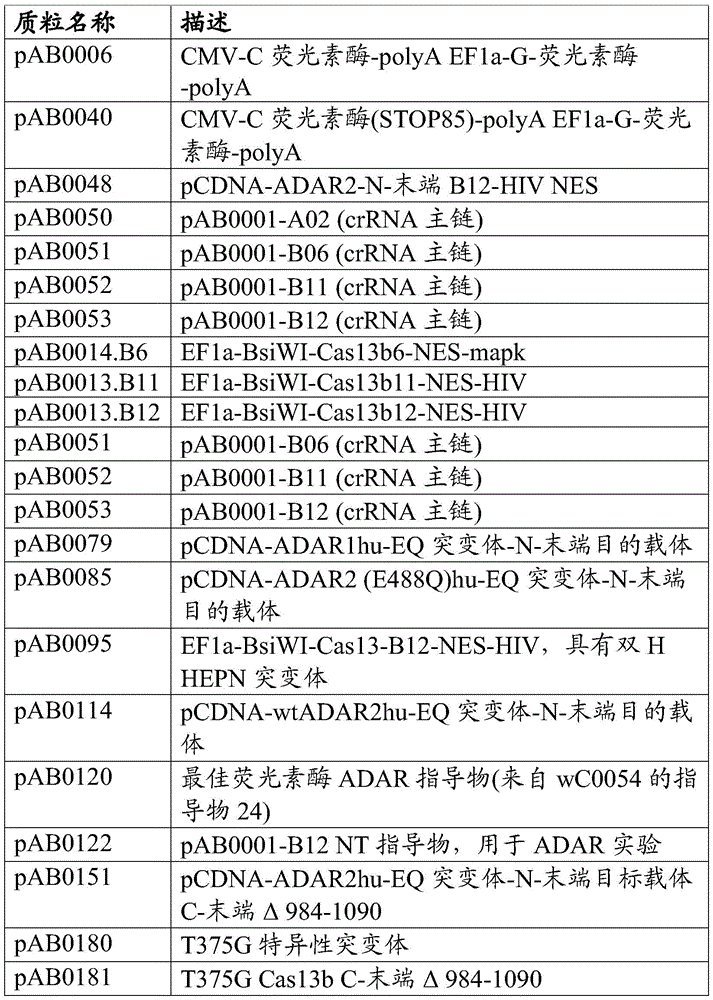
表9:本研究中用于在哺乳动物细胞中进行敲低的指导/shRNA序列Table 9: Guide/shRNA sequences used for knockdown in mammalian cells in this study

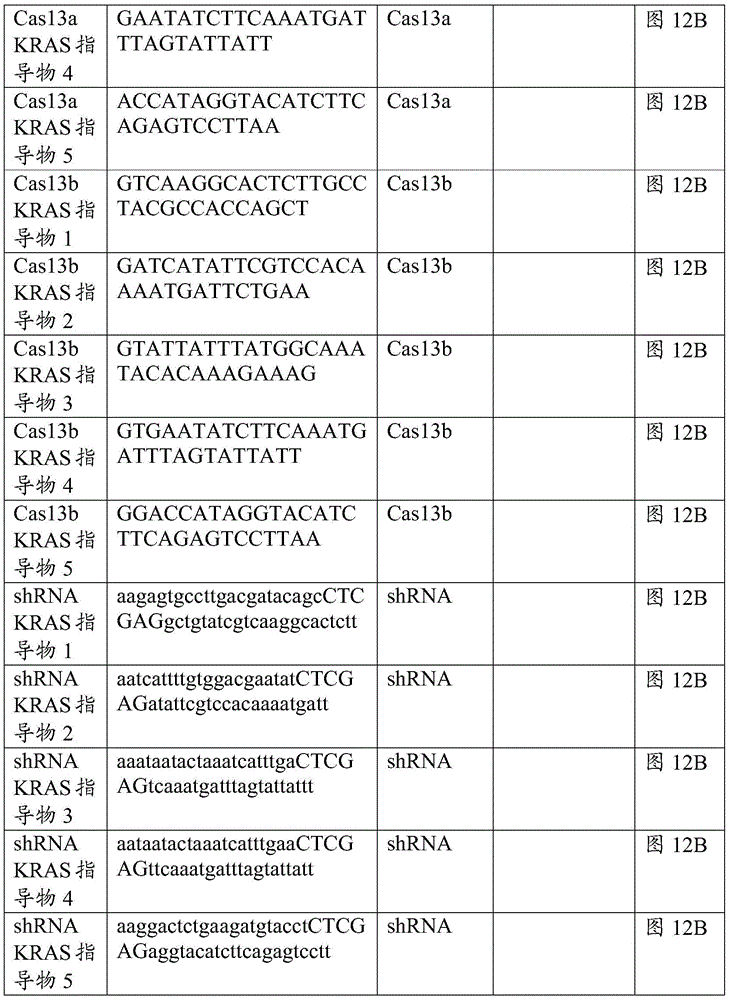
表10:用于Gluc敲低的指导序列Table 10: Guide sequences for Gluc knockdown
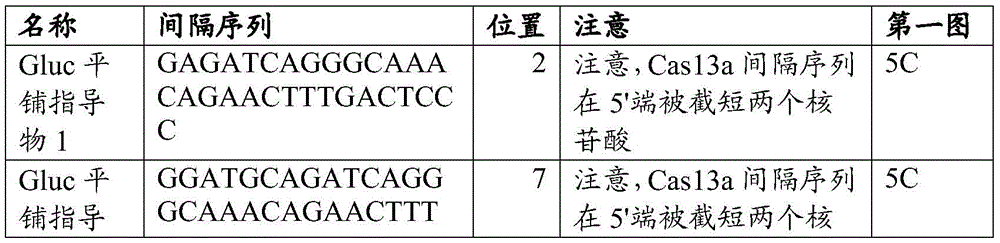

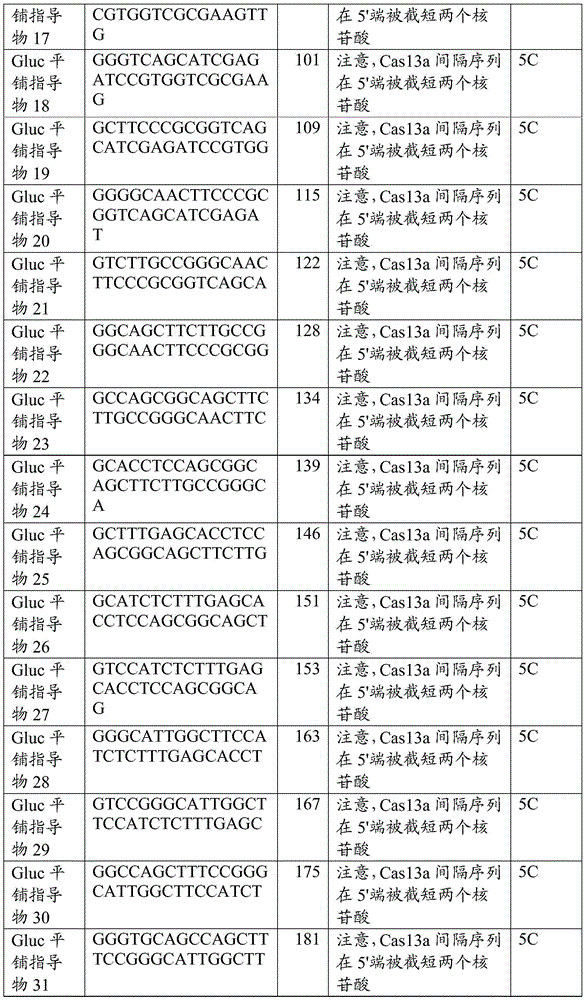


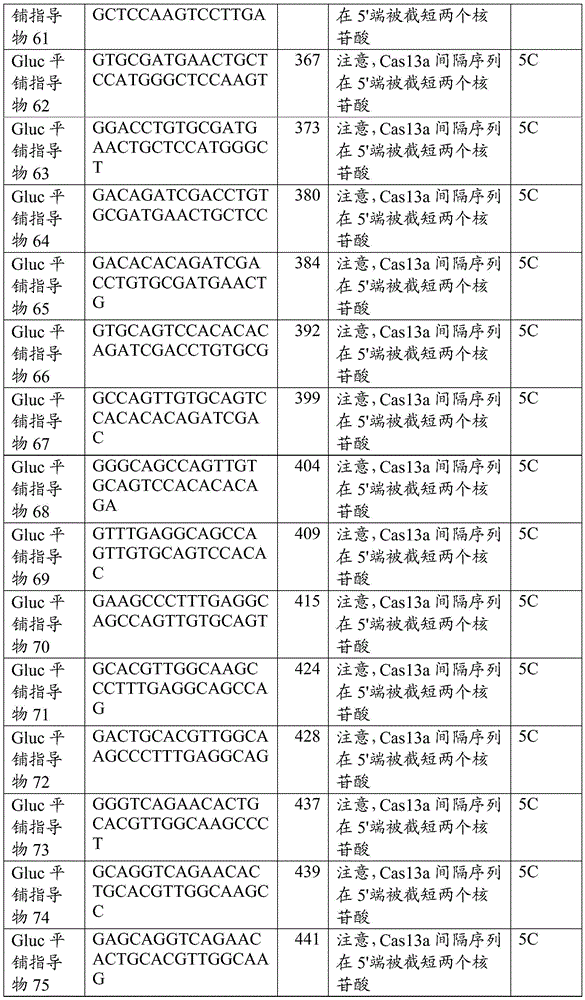

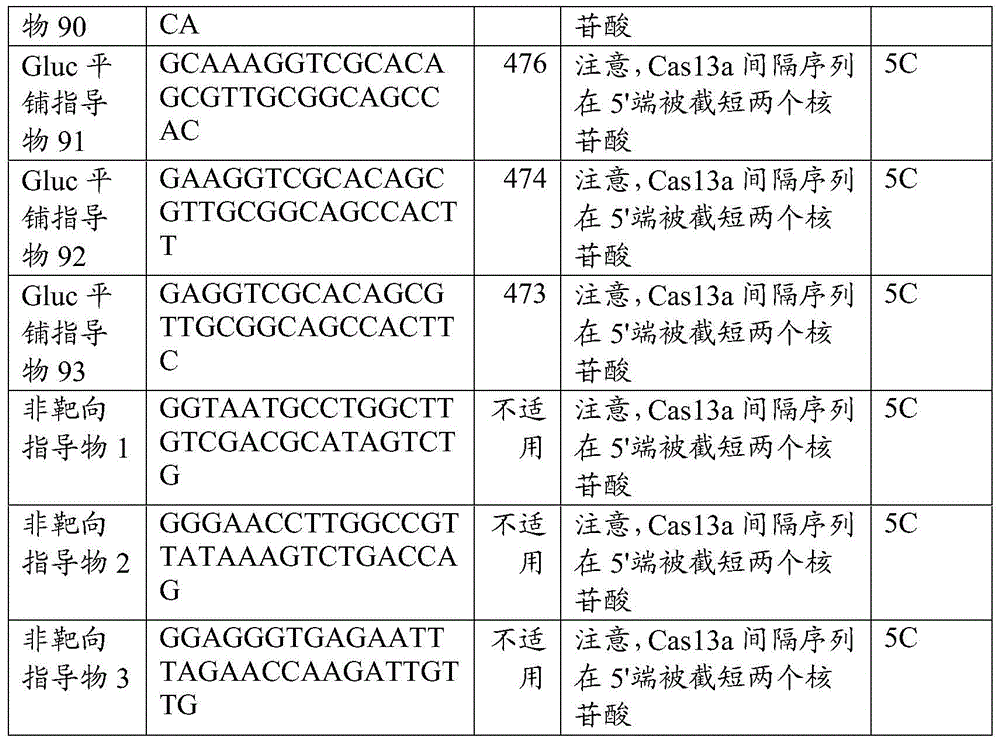
表11:用于Cluc敲低的指导序列Table 11: Guide sequences for Cluc knockdown


表12:本研究中用于在哺乳动物细胞中进行RNA编辑的指导序列。错配碱基翻转被大写Table 12: Guide sequences used in this study for RNA editing in mammalian cells. Mismatched base flips are capitalized

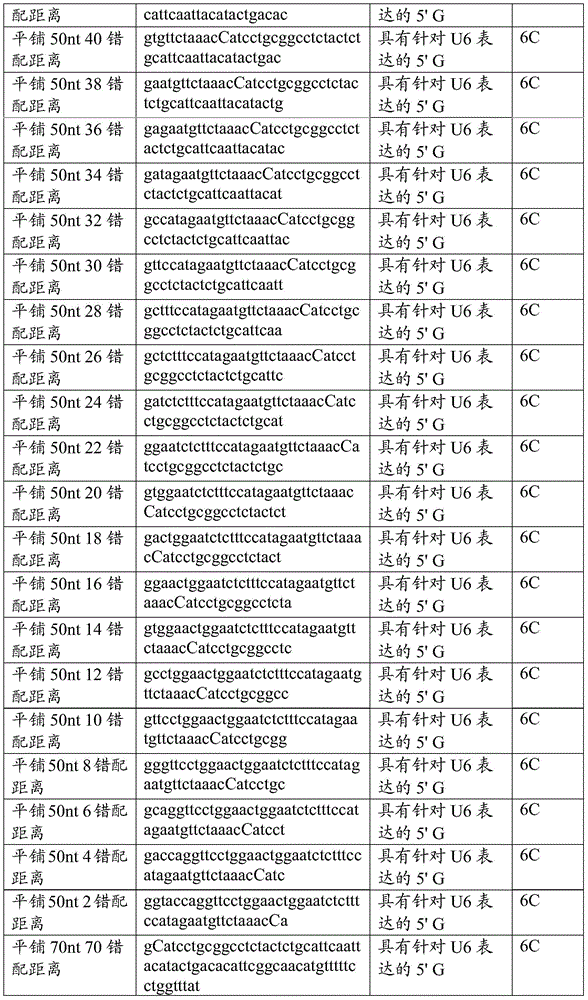
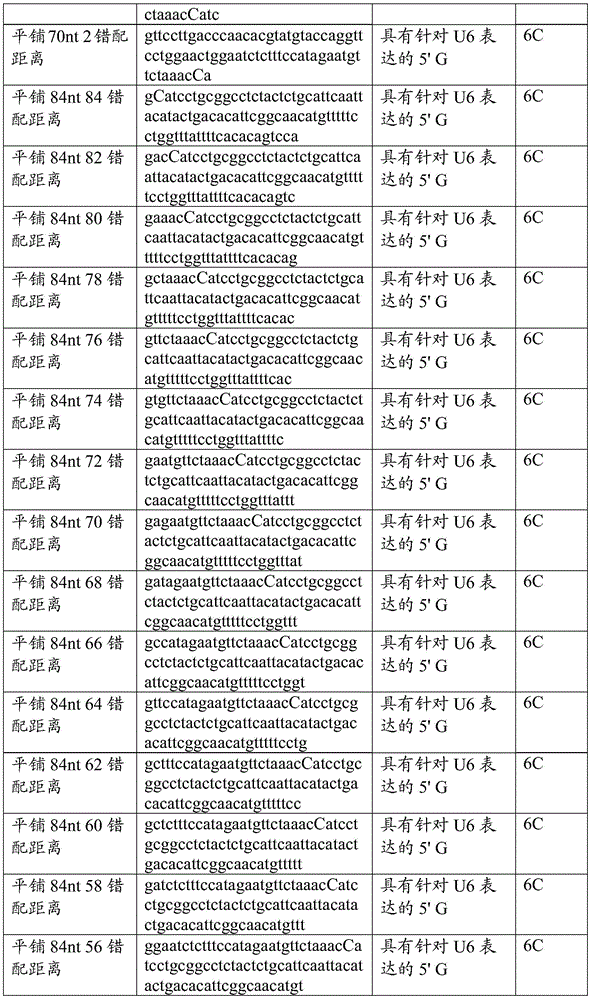


参考文献references
1.P.D.Hsu,E.S.Lander,F.Zhang,Development and applications of CRISPR-Cas9 for genome engineering.Cell 157,1262-1278(2014).1. P.D.Hsu, E.S.Lander, F.Zhang, Development and applications of CRISPR-Cas9 for genome engineering. Cell 157, 1262-1278 (2014).
2.A.C.Komor,A.H.Badran,D.R.Liu,CRISPR-Based Technologies for theManipulation of Eukaryotic Genomes.Cell 168,20-36(2017).2. A.C. Komor, A.H. Badran, D.R. Liu, CRISPR-Based Technologies for the Manipulation of Eukaryotic Genomes. Cell 168, 20-36 (2017).
3.L.Cong et al.,Multiplex genome engineering using CRISPR/Cassystems.Science 339,819-823(2013).3. L. Cong et al., Multiplex genome engineering using CRISPR/Cassystems. Science 339, 819-823 (2013).
4.P.Mali et al.,RNA-guided human genome engineering via Cas9.Science339,823-826(2013).4.P.Mali et al., RNA-guided human genome engineering via Cas9.Science339, 823-826 (2013).
5.B.Zetsche et al.,Cpf1 is a single RNA-guided endonuclease of aclass 2 CRISPR-Cas system.Cell 163,759-771(2015).5.B.Zetsche et al., Cpf1 is a single RNA-guided endonuclease of
6.H.Kim,J.S.Kim,A guide to genome engineering with programmablenucleases.Nat Rev Genet 15,321-334(2014).6.H.Kim, J.S.Kim, A guide to genome engineering with programmablenucleases.
7.A.C.Komor,Y.B.Kim,M.S.Packer,J.A.Zuris,D.R.Liu,Programmable editingof a target base in genomic DNA without double-stranded DNA cleavage.Nature533,420-424(2016).7. A.C. Komor, Y.B. Kim, M.S. Packer, J.A. Zuris, D.R. Liu, Programmable editing of a target base in genomic DNA without double-stranded DNA cleavage. Nature 533, 420-424 (2016).
8.K.Nishida et al.,Targeted nucleotide editing using hybridprokaryotic and vertebrate adaptive immune systems.Science 353,(2016).8. K. Nishida et al., Targeted nucleotide editing using hybridprokaryotic and vertebrate adaptive immune systems. Science 353, (2016).
9.Y.B.Kim et al.,Increasing the genome-targeting scope and precisionof base editing with engineered Cas9-cytidine deaminase fusions.NatBiotechnol 35,371-376(2017).9. Y.B. Kim et al., Increasing the genome-targeting scope and precision of base editing with engineered Cas9-cytidine deaminase fusions.
10.O.O.Abudayyeh et al.,C2c2 is a single-component programmable RNA-guided RNA-targeting CRISPR effector.Science 353,aaf5573(2016).10.O.O.Abudayyeh et al., C2c2 is a single-component programmable RNA-guided RNA-targeting CRISPR effector. Science 353, aaf5573 (2016).
11.S.Shmakov et al.,Discovery and Functional Characterization ofDiverse Class 2 CRISPR-Cas Systems.Mol Cell 60,385-397(2015).11. S. Shmakov et al., Discovery and Functional Characterization of
12.S.Shmakov et al.,Diversity and evolution of class 2 CRISPR-Cassystems.Nat Rev Microbiol 15,169-182(2017).12. S. Shmakov et al., Diversity and evolution of
13.A.A.Smargon et al.,Casl3b Is a Type VI-B CRISPR-Associated RNA-Guided RNase Differentially Regulated by Accessory Proteins Csx27 andCsx28.Mol Cell 65,618-630 e617(2017).13. A.A. Smargon et al., Casl3b Is a Type VI-B CRISPR-Associated RNA-Guided RNase Differentially Regulated by Accessory Proteins Csx27 and Csx28. Mol Cell 65, 618-630 e617 (2017).
14.J.S.Gootenberg et al.,Nucleic acid detection with CRISPR-Cas13a/C2c2.Science 356,438-442(2017).14. J.S. Gootenberg et al., Nucleic acid detection with CRISPR-Cas13a/C2c2. Science 356, 438-442 (2017).
15.O.O.Abudayyeh et al.,RNA targeting with CRISPR-Cas13a.Nature inpress,(2017).15. O.O. Abudayyeh et al., RNA targeting with CRISPR-Cas13a. Nature inpress, (2017).
16.K.Nishikura,Functions and regulation of RNA editing by ADARdeaminases.Annu Rev Biochem 79,321-349(2010).16. K. Nishikura, Functions and regulation of RNA editing by ADARdeaminases. Annu Rev Biochem 79, 321-349 (2010).
17.B.L.Bass,H.Weintraub,An unwinding activity that covalentlymodifies its double-stranded RNA substrate.Cell 55,1089-1098(1988).17. B.L. Bass, H. Weintraub, An unwinding activity that covalently modifies its double-stranded RNA substrate.
18.M.M.Matthews et al.,Structures of human ADAR2 bound to dsRNAreveal base-flipping mechanism and basis for site selectivity.Nat Struct MolBiol 23,426-433(2016).18. M.M. Matthews et al., Structures of human ADAR2 bound to dsRNAreveal base-flipping mechanism and basis for site selectivity.
19.A.Kuttan,B.L.Bass,Mechanistic insights into editing-sitespecificity of ADARs.Proc Natl Acad Sci USA 109,E3295-3304(2012).19. A. Kuttan, B.L. Bass, Mechanistic insights into editing-sitespecificity of ADARs. Proc Natl Acad Sci USA 109, E3295-3304 (2012).
20.S.K.Wong,S.Sato,D.W.Lazinski,Substrate recognition by ADAR1 andADAR2.RNA 7,846-858(2001).20. S.K. Wong, S. Sato, D.W. Lazinski, Substrate recognition by ADAR1 and ADAR2.
21.M.Fukuda et al.,Construction of a guide-RNA for site-directed RNAmutagenesis utilising intracellular A-to-I RNA editing.Sci Rep 7,41478(2017).21. M. Fukuda et al., Construction of a guide-RNA for site-directed RNAmutagenesis utilising intracellular A-to-I RNA editing.
22.M.F.Montiel-Gonzalez,I.Vallecillo-Viejo,G.A.Yudowski,J.J.Rosenthal,Correction of mutations within the cystic fibrosistransmembrane conductance regulator by site-directed RNA editing.Proc NatlAcad Sci USA 110,18285-18290(2013).22. M.F.Montiel-Gonzalez, I.Vallecillo-Viejo, G.A.Yudowski, J.J.Rosenthal, Correction of mutations within the cystic fibrosistransmembrane conductance regulator by site-directed RNA editing.Proc NatlAcad Sci USA 110, 18285-18290 (2013).
23.M.F.Montiel-Gonzalez,I.C.Vallecillo-Viejo,J.J.Rosenthal,Anefficient system for selectively altering genetic information withinmRNAs.Nucleic Acids Res 44,e157(2016).23. M.F. Montiel-Gonzalez, I.C. Vallecillo-Viejo, J.J. Rosenthal, An efficient system for selectively altering genetic information within mRNAs. Nucleic Acids Res 44, e157 (2016).
24.J.Wettengel,P.Reautschnig,S.Geisler,P.J.Kahle,T.Stafforst,Harnessing human ADAR2 for RNA repair-Recoding a PINK1 mutation rescuesmitophagy.Nucleic Acids Res 45,2797-2808(2017).24. J. Wettengel, P. Reautschnig, S. Geisler, P.J. Kahle, T. Stafforst, Harnessing human ADAR2 for RNA repair-Recoding a PINK1 mutation rescuesmitophagy. Nucleic Acids Res 45, 2797-2808 (2017).
25.Y.Wang,J.Havel,P.A.Beal,A Phenotypic Screen for Functional Mutantsof Human Adenosine Deaminase Acting on RNA 1.ACS Chem Biol 10,2512-2519(2015).25. Y. Wang, J. Havel, P.A. Beal, A Phenotypic Screen for Functional Mutants of Human Adenosine Deaminase Acting on
26.K.A.Lehmann,B.L.Bass,Double-stranded RNA adenosine deaminasesADAR1 and ADAR2 have overlapping specificities.Biochemistry 39,12875-12884(2000).26. K.A. Lehmann, B.L. Bass, Double-stranded RNA adenosine deaminases ADAR1 and ADAR2 have overlapping specificities.
27.Y.Zheng,C.Lorenzo,P.A.Beal,DNA editing in DNA/RNA hybrids byadenosine deaminases that act on RNA.Nucleic Acids Res 45,3369-3377(2017).27. Y. Zheng, C. Lorenzo, P.A. Beal, DNA editing in DNA/RNA hybrids byadenosine deaminases that act on RNA. Nucleic Acids Res 45, 3369-3377 (2017).
28.K.Gao et al.,A de novo loss-of-function GRIN2A mutation associatedwith childhood focal epilepsy and acquired epileptic aphasia.PLoS One 12,e0170818(2017).28. K. Gao et al., A de novo loss-of-function GRIN2A mutation associated with childhood focal epilepsy and acquired epileptic aphasia.
29.H.M.Lanoiselee et al.,APP,PSEN1,and PSEN2 mutations in early-onsetAlzheimer disease:A genetic screening study of familial and sporadiccases.PLoS Med 14,e1002270(2017).29. H.M.Lanoiselee et al., APP, PSEN1, and PSEN2 mutations in early-onsetAlzheimer disease: A genetic screening study of familial and sporadiccases.
30.C.Ballatore,V.M.Lee,J.Q.Trojanowski,Tau-mediated neurodegenerationin Alzheimer′s disease and related disorders.Nat Rev Neurosci 8,663-672(2007).30. C. Ballatore, V. M. Lee, J. Q. Trojanowski, Tau-mediated neurodegeneration in Alzheimer's disease and related disorders.
31.Y.Li et al.,Carriers of rare missense variants in IFIH1 areprotected from psoriasis.J Invest Dermatol 130,2768-2772(2010).31. Y. Li et al., Carriers of rare missense variants in IFIH1 are protected from psoriasis. J Invest Dermatol 130, 2768-2772 (2010).
32.R.S.Finkel et al.,Treatment of infantile-onset spinal muscularatrophy with nusinersen:a phase 2,open-label,dose-escalation study.Lancet388,3017-3026(2016).32. R.S. Finkel et al., Treatment of infantile-onset spinal muscularatrophy with nusinersen: a
实施例4-其他VI-B型效应物Example 4 - Other Type VI-B Effectors
表13Table 13
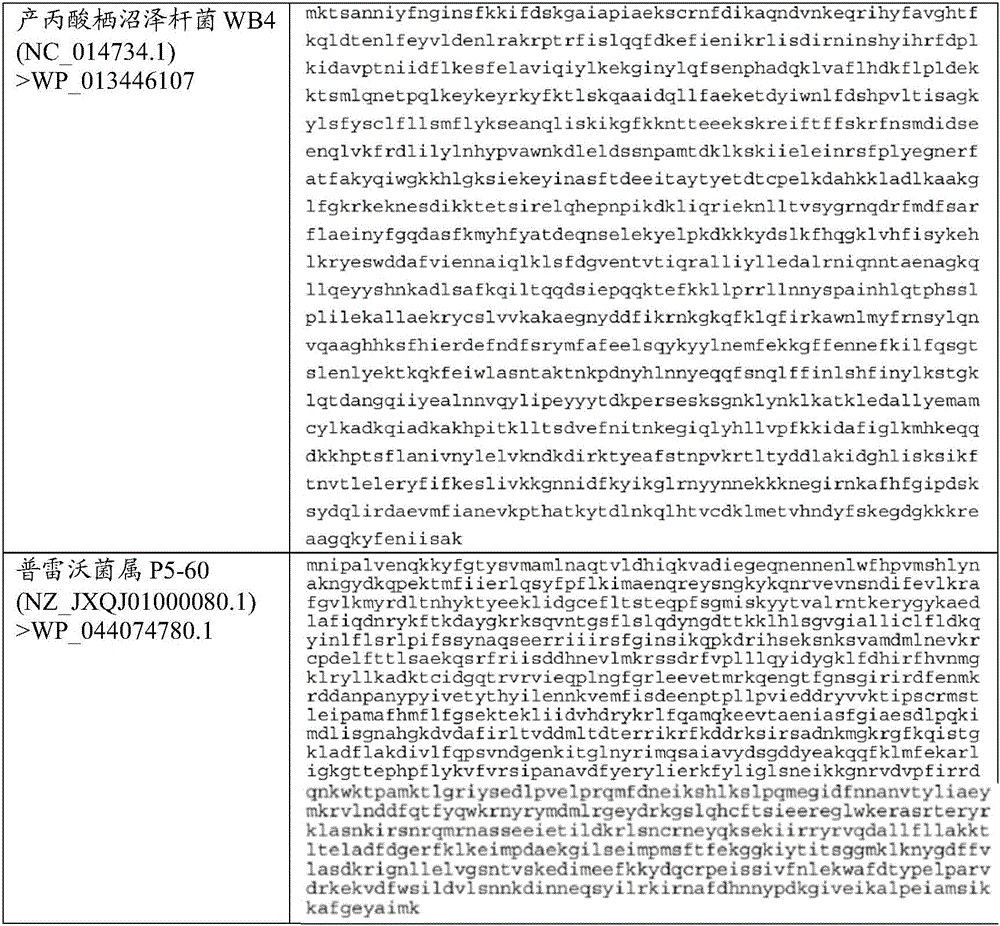


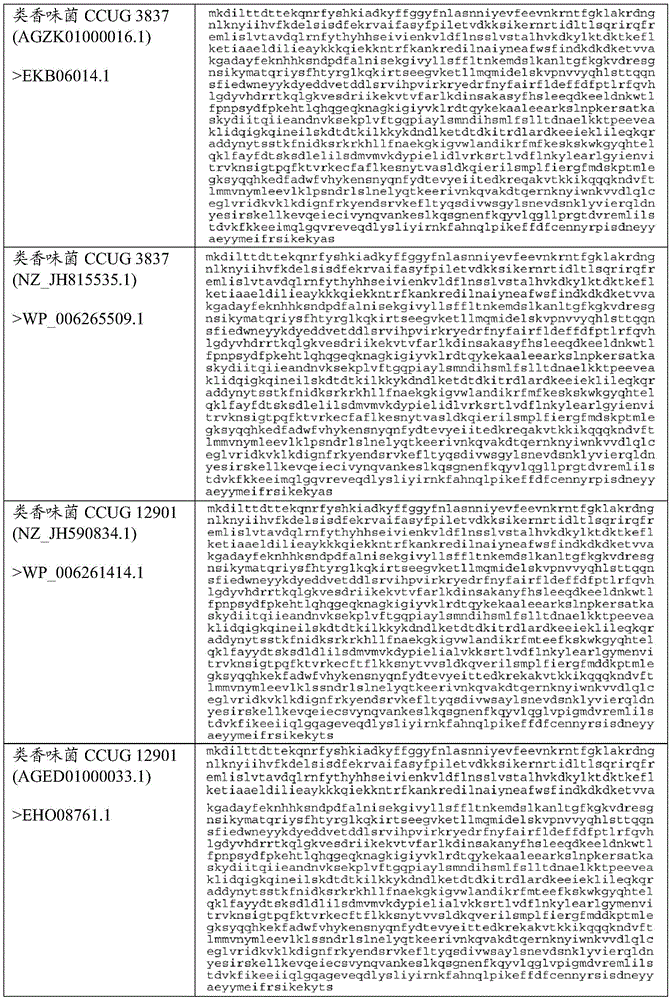


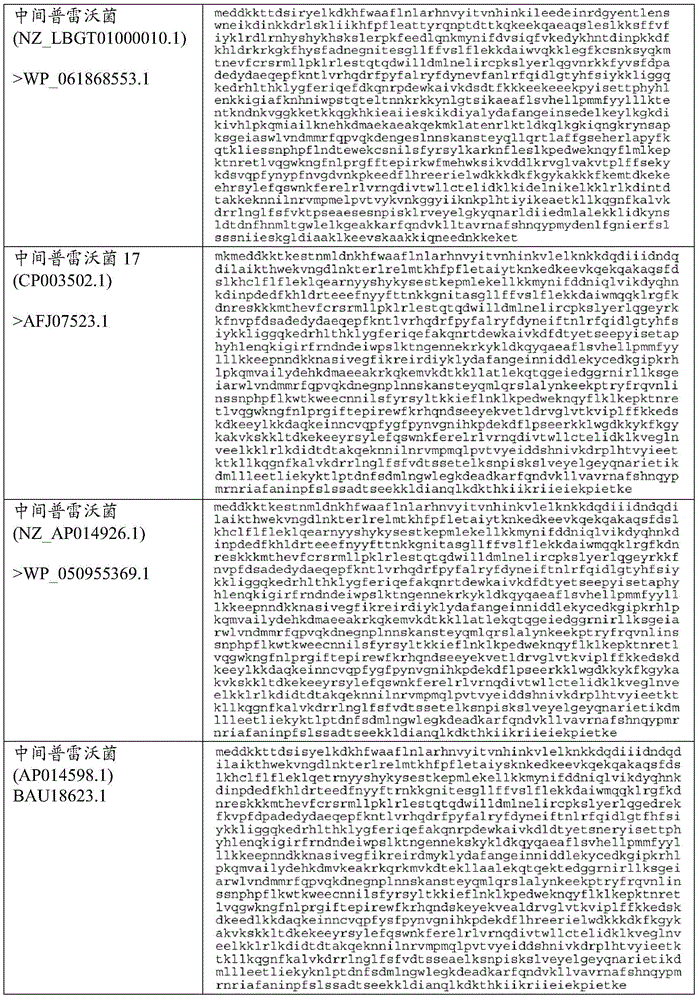
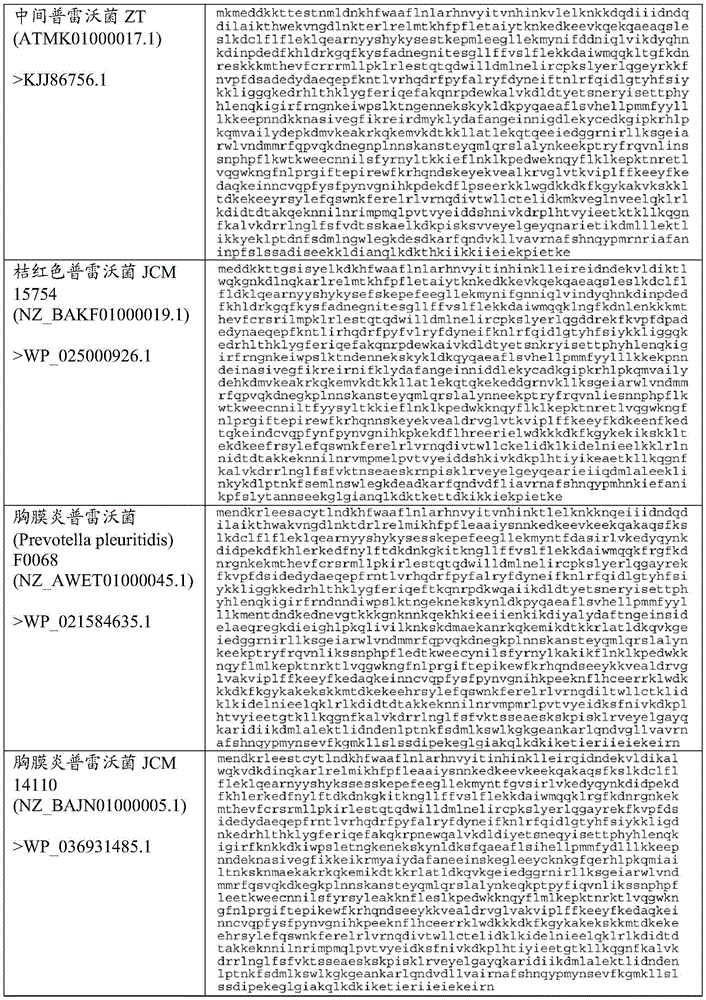


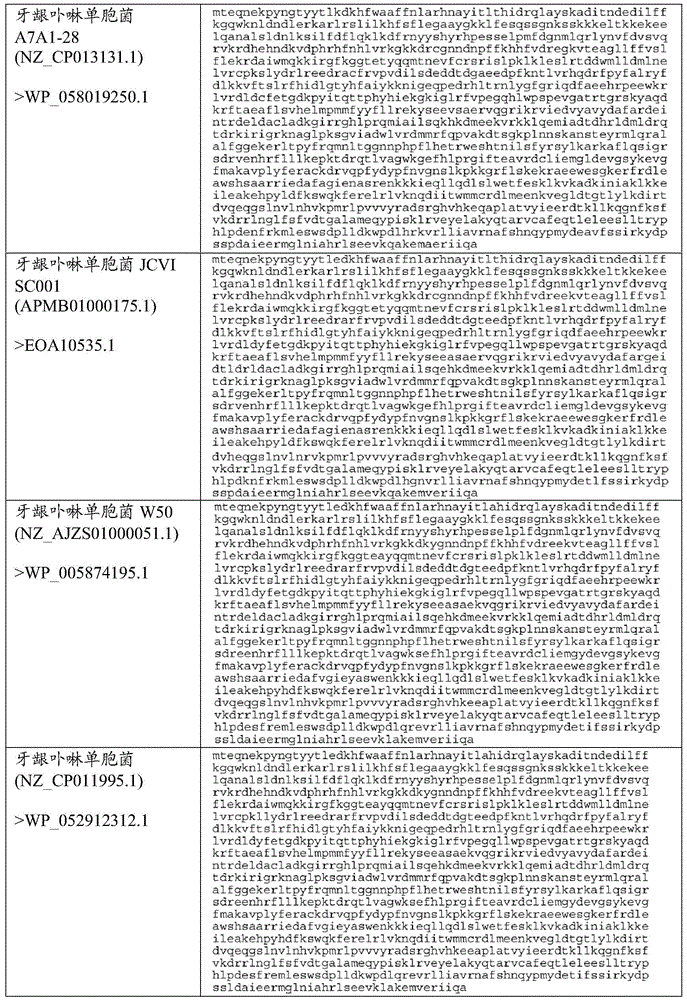
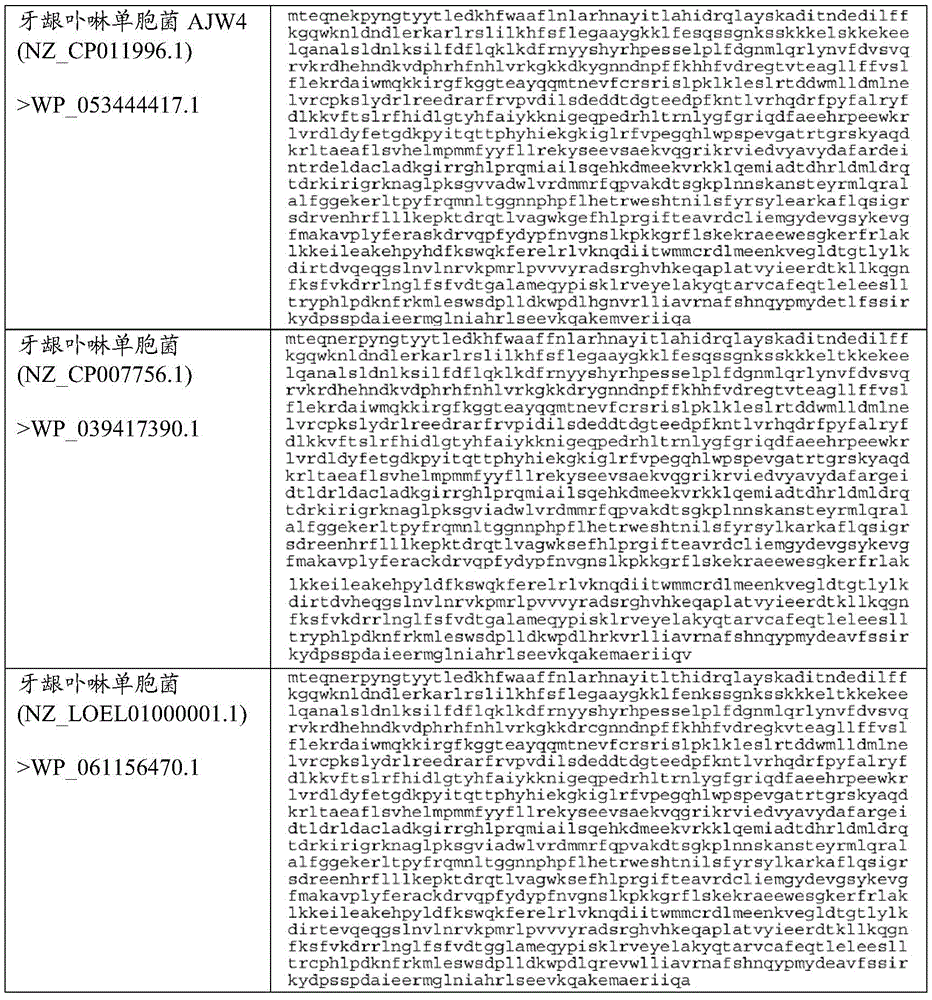
表14Table 14


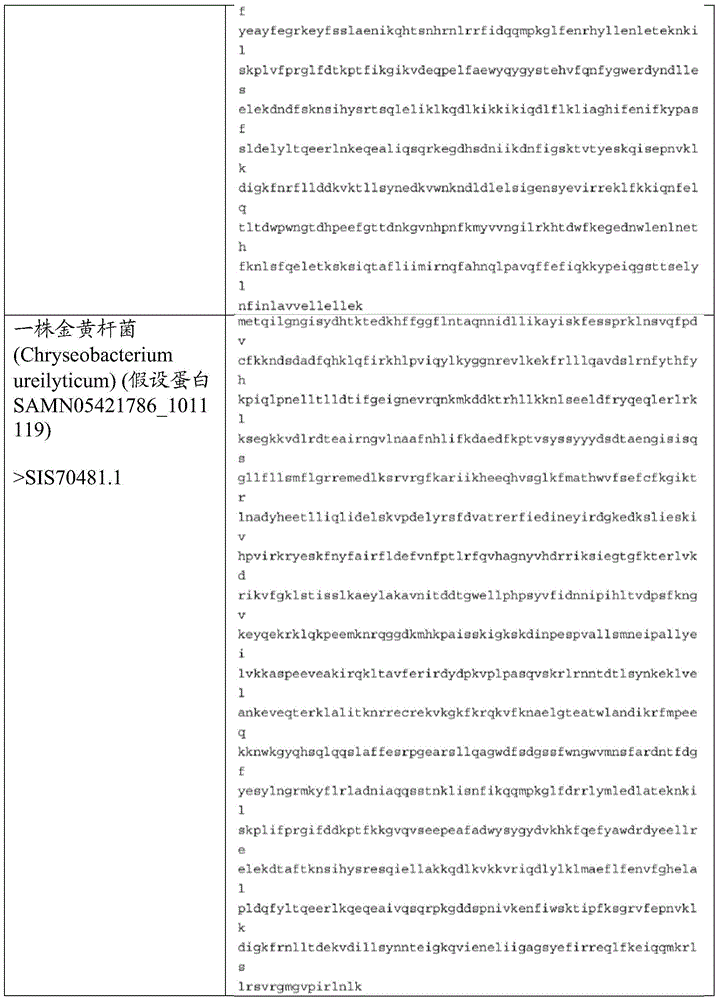

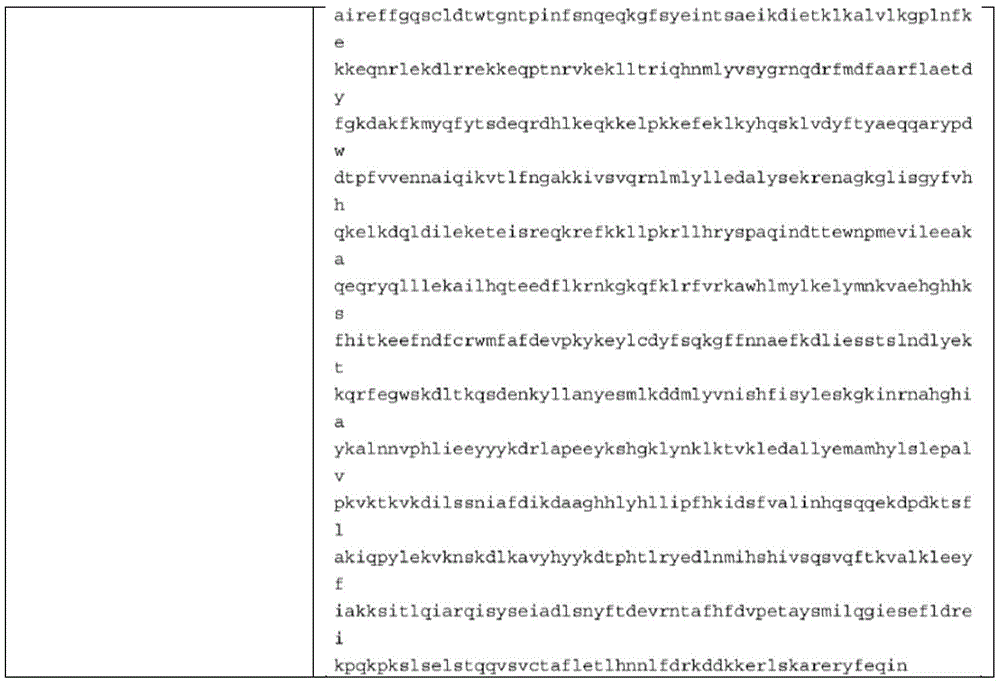
******
尽管已经在本文中示出和描述了本发明的优选实施方案,但是对于本领域技术人员显而易见的是,这些实施方案仅作为实例提供。在不背离本发明的情况下,本领域技术人员现在将想到许多变化、改变和代替形式。应当理解,本文所述的本发明的实施方案的各种替代方案可用于实践本发明。以下权利要求旨在限定本发明的范围并且从而覆盖在这些权利要求及其等同物范围内的方法和结构。While preferred embodiments of the present invention have been shown and described herein, it will be obvious to those skilled in the art that these embodiments are provided by way of example only. Numerous variations, changes and substitutions will now occur to those skilled in the art without departing from the invention. It should be understood that various alternatives to the embodiments of the invention described herein may be employed in the practice of the invention. It is intended that the following claims define the scope of the invention and that methods and structures within the scope of these claims and their equivalents be covered thereby.
Claims (50)
Priority Applications (1)
| Application Number | Priority Date | Filing Date | Title |
|---|---|---|---|
| CN202410945478.5A CN118995694A (en) | 2017-04-12 | 2018-04-11 | Novel VI CRISPR ortholog and system |
Applications Claiming Priority (7)
| Application Number | Priority Date | Filing Date | Title |
|---|---|---|---|
| US201762484791P | 2017-04-12 | 2017-04-12 | |
| US62/484,791 | 2017-04-12 | ||
| US201762561662P | 2017-09-21 | 2017-09-21 | |
| US62/561,662 | 2017-09-21 | ||
| US201762568129P | 2017-10-04 | 2017-10-04 | |
| US62/568,129 | 2017-10-04 | ||
| PCT/US2018/027125 WO2018191388A1 (en) | 2017-04-12 | 2018-04-11 | Novel type vi crispr orthologs and systems |
Related Child Applications (1)
| Application Number | Title | Priority Date | Filing Date |
|---|---|---|---|
| CN202410945478.5A Division CN118995694A (en) | 2017-04-12 | 2018-04-11 | Novel VI CRISPR ortholog and system |
Publications (2)
| Publication Number | Publication Date |
|---|---|
| CN110799645A true CN110799645A (en) | 2020-02-14 |
| CN110799645B CN110799645B (en) | 2024-08-02 |
Family
ID=62196674
Family Applications (2)
| Application Number | Title | Priority Date | Filing Date |
|---|---|---|---|
| CN202410945478.5A Pending CN118995694A (en) | 2017-04-12 | 2018-04-11 | Novel VI CRISPR ortholog and system |
| CN201880038907.3A Active CN110799645B (en) | 2017-04-12 | 2018-04-11 | Novel VI CRISPR ortholog and system |
Family Applications Before (1)
| Application Number | Title | Priority Date | Filing Date |
|---|---|---|---|
| CN202410945478.5A Pending CN118995694A (en) | 2017-04-12 | 2018-04-11 | Novel VI CRISPR ortholog and system |
Country Status (9)
| Country | Link |
|---|---|
| US (2) | US11840711B2 (en) |
| EP (1) | EP3610009A1 (en) |
| JP (3) | JP7679174B2 (en) |
| KR (2) | KR20240155360A (en) |
| CN (2) | CN118995694A (en) |
| AU (2) | AU2018251801B2 (en) |
| BR (1) | BR112019021378A2 (en) |
| CA (1) | CA3059757A1 (en) |
| WO (1) | WO2018191388A1 (en) |
Cited By (9)
| Publication number | Priority date | Publication date | Assignee | Title |
|---|---|---|---|---|
| CN111328290A (en) * | 2017-06-26 | 2020-06-23 | 博德研究所 | CRISPR/CAS-adenine deaminase-based compositions, systems, and methods for targeted nucleic acid editing |
| CN111727247A (en) * | 2017-10-04 | 2020-09-29 | 博德研究所 | Systems, methods and compositions for targeted nucleic acid editing |
| CN112430586A (en) * | 2020-11-16 | 2021-03-02 | 珠海舒桐医疗科技有限公司 | VI-B type CRISPR/Cas13 gene editing system and application thereof |
| WO2021169980A1 (en) * | 2020-02-25 | 2021-09-02 | Shanghaitech University | Compositions and methods for detecting nucleic acid-protein interactions |
| CN113897359A (en) * | 2020-07-06 | 2022-01-07 | 博雅辑因(北京)生物科技有限公司 | Improved RNA editing method |
| WO2022253351A1 (en) * | 2021-06-04 | 2022-12-08 | 中国科学院脑科学与智能技术卓越创新中心 | Novel cas13 protein, and screening method and use therefor |
| CN116083398A (en) * | 2021-11-05 | 2023-05-09 | 广州瑞风生物科技有限公司 | Isolated Cas13 proteins and uses thereof |
| CN116590257A (en) * | 2020-02-28 | 2023-08-15 | 辉大(上海)生物科技有限公司 | VI-E type and VI-F type CRISPR-Cas system and application thereof |
| CN117126925A (en) * | 2023-08-07 | 2023-11-28 | 中科枢密生物技术(武汉)有限公司 | Crispr-Cas nucleic acid detection kit capable of being stored stably for long term |
Families Citing this family (73)
| Publication number | Priority date | Publication date | Assignee | Title |
|---|---|---|---|---|
| WO2013163628A2 (en) | 2012-04-27 | 2013-10-31 | Duke University | Genetic correction of mutated genes |
| US9828582B2 (en) | 2013-03-19 | 2017-11-28 | Duke University | Compositions and methods for the induction and tuning of gene expression |
| US9340799B2 (en) | 2013-09-06 | 2016-05-17 | President And Fellows Of Harvard College | MRNA-sensing switchable gRNAs |
| US10676726B2 (en) | 2015-02-09 | 2020-06-09 | Duke University | Compositions and methods for epigenome editing |
| EP4089175A1 (en) | 2015-10-13 | 2022-11-16 | Duke University | Genome engineering with type i crispr systems in eukaryotic cells |
| US10167457B2 (en) | 2015-10-23 | 2019-01-01 | President And Fellows Of Harvard College | Nucleobase editors and uses thereof |
| EA201891317A3 (en) | 2015-11-30 | 2019-04-30 | Дьюк Юниверсити | THERAPEUTIC TARGETS FOR CORRECTION OF HUMAN DISTROPHIN GENE BY EDITING GENES AND METHODS OF THEIR APPLICATION |
| US20190127713A1 (en) | 2016-04-13 | 2019-05-02 | Duke University | Crispr/cas9-based repressors for silencing gene targets in vivo and methods of use |
| JP7490211B2 (en) | 2016-07-19 | 2024-05-27 | デューク ユニバーシティ | Therapeutic Applications of CPF1-Based Genome Editing |
| KR20250103795A (en) | 2016-08-03 | 2025-07-07 | 프레지던트 앤드 펠로우즈 오브 하바드 칼리지 | Adenosine nucleobase editors and uses thereof |
| EP3497214B1 (en) | 2016-08-09 | 2023-06-28 | President and Fellows of Harvard College | Programmable cas9-recombinase fusion proteins and uses thereof |
| WO2018039438A1 (en) | 2016-08-24 | 2018-03-01 | President And Fellows Of Harvard College | Incorporation of unnatural amino acids into proteins using base editing |
| AU2017342543B2 (en) | 2016-10-14 | 2024-06-27 | President And Fellows Of Harvard College | AAV delivery of nucleobase editors |
| US10745677B2 (en) | 2016-12-23 | 2020-08-18 | President And Fellows Of Harvard College | Editing of CCR5 receptor gene to protect against HIV infection |
| EP3592853A1 (en) | 2017-03-09 | 2020-01-15 | President and Fellows of Harvard College | Suppression of pain by gene editing |
| US12390514B2 (en) | 2017-03-09 | 2025-08-19 | President And Fellows Of Harvard College | Cancer vaccine |
| US11542496B2 (en) | 2017-03-10 | 2023-01-03 | President And Fellows Of Harvard College | Cytosine to guanine base editor |
| BR112019019655A2 (en) | 2017-03-23 | 2020-04-22 | Harvard College | nucleobase editors comprising nucleic acid programmable dna binding proteins |
| CN118995694A (en) | 2017-04-12 | 2024-11-22 | 博德研究所 | Novel VI CRISPR ortholog and system |
| WO2018209320A1 (en) | 2017-05-12 | 2018-11-15 | President And Fellows Of Harvard College | Aptazyme-embedded guide rnas for use with crispr-cas9 in genome editing and transcriptional activation |
| US11732274B2 (en) | 2017-07-28 | 2023-08-22 | President And Fellows Of Harvard College | Methods and compositions for evolving base editors using phage-assisted continuous evolution (PACE) |
| US11319532B2 (en) | 2017-08-30 | 2022-05-03 | President And Fellows Of Harvard College | High efficiency base editors comprising Gam |
| AU2018352592C1 (en) | 2017-10-16 | 2025-09-25 | Beam Therapeutics, Inc. | Uses of adenosine base editors |
| WO2019084063A1 (en) * | 2017-10-23 | 2019-05-02 | The Broad Institute, Inc. | Systems, methods, and compositions for targeted nucleic acid editing |
| US20210130800A1 (en) * | 2017-10-23 | 2021-05-06 | The Broad Institute, Inc. | Systems, methods, and compositions for targeted nucleic acid editing |
| US12406749B2 (en) | 2017-12-15 | 2025-09-02 | The Broad Institute, Inc. | Systems and methods for predicting repair outcomes in genetic engineering |
| EP3740580A4 (en) | 2018-01-19 | 2021-10-20 | Duke University | GENOMIC ENGINEERING WITH CRISPR-CAS SYSTEMS IN EUKARYOTES |
| EP3765040A4 (en) * | 2018-03-13 | 2021-12-01 | Regents of the University of Minnesota | LYMPHOHEMATOPOIETIC ENGINEERING USING CAS9 BASIC EDITORS |
| US12157760B2 (en) | 2018-05-23 | 2024-12-03 | The Broad Institute, Inc. | Base editors and uses thereof |
| AU2019291827A1 (en) | 2018-06-26 | 2020-12-24 | Massachusetts Institute Of Technology | Crispr double nickase based amplification compositions, systems, and methods |
| KR20210040943A (en) | 2018-06-26 | 2021-04-14 | 매사추세츠 인스티튜트 오브 테크놀로지 | CRISPR effector system-based amplification method, system, and diagnosis |
| US12522807B2 (en) | 2018-07-09 | 2026-01-13 | The Broad Institute, Inc. | RNA programmable epigenetic RNA modifiers and uses thereof |
| WO2020092453A1 (en) | 2018-10-29 | 2020-05-07 | The Broad Institute, Inc. | Nucleobase editors comprising geocas9 and uses thereof |
| WO2020124050A1 (en) | 2018-12-13 | 2020-06-18 | The Broad Institute, Inc. | Tiled assays using crispr-cas based detection |
| AU2019419494A1 (en) * | 2018-12-31 | 2021-07-15 | Research Institute At Nationwide Children's Hospital | DUX4 RNA silencing using RNA targeting CRISPR-Cas13b |
| BR112021013173A2 (en) * | 2019-01-04 | 2021-09-28 | The University Of Chicago | SYSTEMS AND METHODS TO MODULATE RNA |
| WO2020142739A1 (en) * | 2019-01-04 | 2020-07-09 | Mammoth Biosciences, Inc. | COMPOSITIONS AND METHODS FOR DETECTING MODIFIED NUCLEIC ACIDS AND AMPLIFYING ssDNA |
| EP3914260A4 (en) | 2019-01-22 | 2023-05-17 | Korro Bio, Inc. | RNA EDITING OLIGONUCLEOTIDES AND THEIR USES |
| WO2020154342A1 (en) | 2019-01-22 | 2020-07-30 | Korro Bio, Inc. | Rna-editing oligonucleotides and uses thereof |
| US11479575B2 (en) | 2019-01-22 | 2022-10-25 | Korro Bio, Inc. | RNA-editing oligonucleotides and uses thereof |
| US12351837B2 (en) | 2019-01-23 | 2025-07-08 | The Broad Institute, Inc. | Supernegatively charged proteins and uses thereof |
| US20220154258A1 (en) | 2019-03-14 | 2022-05-19 | The Broad Institute, Inc. | Crispr effector system based multiplex diagnostics |
| WO2020191102A1 (en) | 2019-03-18 | 2020-09-24 | The Broad Institute, Inc. | Type vii crispr proteins and systems |
| CN114127285B (en) | 2019-03-19 | 2024-09-10 | 布罗德研究所股份有限公司 | Methods and compositions for editing nucleotide sequences |
| WO2020192712A1 (en) * | 2019-03-26 | 2020-10-01 | Peking University | Method for identifying functional elements |
| WO2020210776A1 (en) * | 2019-04-12 | 2020-10-15 | Duke University | Crispr/cas-based base editing composition for restoring dystrophin function |
| KR102851101B1 (en) * | 2019-04-15 | 2025-08-27 | 에디진 테라퓨틱스(베이징) 인크. | Methods and compositions for editing RNA |
| EP3956349A1 (en) | 2019-04-17 | 2022-02-23 | The Broad Institute, Inc. | Adenine base editors with reduced off-target effects |
| US20220364159A1 (en) * | 2019-07-26 | 2022-11-17 | Mammoth Biosciences, Inc. | Compositions for detection of dna and methods of use thereof |
| KR20220066289A (en) * | 2019-08-29 | 2022-05-24 | 빔 테라퓨틱스, 인크. | Compositions and methods for editing mutations that enable transcription or expression |
| WO2021046257A1 (en) | 2019-09-03 | 2021-03-11 | The Broad Institute, Inc. | Crispr effector system based multiplex cancer diagnostics |
| US12435330B2 (en) | 2019-10-10 | 2025-10-07 | The Broad Institute, Inc. | Methods and compositions for prime editing RNA |
| US11844800B2 (en) | 2019-10-30 | 2023-12-19 | Massachusetts Institute Of Technology | Methods and compositions for predicting and preventing relapse of acute lymphoblastic leukemia |
| US20230340537A1 (en) | 2020-01-17 | 2023-10-26 | The Broad Institute, Inc. | Small type ii-d cas proteins and methods of use thereof |
| WO2021158999A1 (en) * | 2020-02-05 | 2021-08-12 | The Broad Institute, Inc. | Gene editing methods for treating spinal muscular atrophy |
| EP3875602A1 (en) * | 2020-03-05 | 2021-09-08 | Nederlandse Organisatie voor toegepast- natuurwetenschappelijk Onderzoek TNO | Nucleic acid fluorescence detection |
| US20220228150A1 (en) | 2020-03-17 | 2022-07-21 | Gowtham THAKKU | Crispr system high throughput diagnostic systems and methods |
| EP4127169A1 (en) * | 2020-03-27 | 2023-02-08 | University of Rochester | Targeted destruction of viral rna by crispr-cas13 |
| US20230346978A1 (en) * | 2020-04-14 | 2023-11-02 | University Of Massachusetts | Dcas13-mediated therapeutic rna base editing for in vivo gene therapy |
| DE112021002672T5 (en) | 2020-05-08 | 2023-04-13 | President And Fellows Of Harvard College | METHODS AND COMPOSITIONS FOR EDIT BOTH STRANDS SIMULTANEOUSLY OF A DOUBLE STRANDED NUCLEOTIDE TARGET SEQUENCE |
| WO2021252432A1 (en) * | 2020-06-08 | 2021-12-16 | Neonc Technologies, Inc. | Compositions and methods for delivering polynucleotides |
| EP4267252A4 (en) * | 2020-12-23 | 2025-07-23 | Mammoth Biosciences Inc | Compositions and methods for using programmable nucleases to induce cell death |
| US20240102007A1 (en) | 2021-06-01 | 2024-03-28 | Arbor Biotechnologies, Inc. | Gene editing systems comprising a crispr nuclease and uses thereof |
| US12139731B2 (en) | 2021-07-08 | 2024-11-12 | National Institutes Of Health (Nih), U.S. Dept. Of Health And Human Services (Dhhs) U.S. Government | CRISPR-based programmable RNA editing |
| WO2023282710A1 (en) * | 2021-07-08 | 2023-01-12 | 한국과학기술원 | Rna expression regulation or editing method through activity control of cas13 protein |
| EP4373963A4 (en) | 2021-07-21 | 2025-06-18 | Montana State University | Nucleic acid detection with type III CRISPR complex |
| US20250290067A1 (en) * | 2022-05-03 | 2025-09-18 | Tacit Therapeutics, Inc. | Localization of trans-splicing nucleic acid molecules to and within the cellular nucleus |
| CN114634972B (en) * | 2022-05-19 | 2022-08-26 | 舜丰生物科技(海南)有限公司 | Method for detecting nucleic acid by using Cas enzyme |
| CN120641122A (en) | 2022-11-23 | 2025-09-12 | 安铂生物公司 | Gene-modifying endonucleases |
| WO2024173645A1 (en) | 2023-02-15 | 2024-08-22 | Arbor Biotechnologies, Inc. | Gene editing method for inhibiting aberrant splicing in stathmin 2 (stmn2) transcript |
| WO2025171210A1 (en) | 2024-02-09 | 2025-08-14 | Arbor Biotechnologies, Inc. | Compositions and methods for gene editing via homology-mediated end joining |
| WO2026015829A2 (en) | 2024-07-12 | 2026-01-15 | Arbor Biotechnologies, Inc. | Small reverse transcriptases and gene editing systems comprising such |
| WO2026015832A2 (en) | 2024-07-12 | 2026-01-15 | Arbor Biotechnologies, Inc. | Reverse transcriptases and gene editing systems comprising such |
Citations (3)
| Publication number | Priority date | Publication date | Assignee | Title |
|---|---|---|---|---|
| CN105899657A (en) * | 2013-12-12 | 2016-08-24 | 布罗德研究所有限公司 | Crispr-cas systems and methods for altering expression of gene products, structural information and inducible modular cas enzymes |
| CN106029880A (en) * | 2013-12-12 | 2016-10-12 | 布罗德研究所有限公司 | Compositions and methods of use of CRISPR-Cas systems in nucleotide repeat disorders |
| CN109153980A (en) * | 2015-10-22 | 2019-01-04 | 布罗德研究所有限公司 | Type VI-B CRISPR enzymes and systems |
Family Cites Families (103)
| Publication number | Priority date | Publication date | Assignee | Title |
|---|---|---|---|---|
| US61836A (en) | 1867-02-05 | Thomas jose | ||
| US101A (en) | 1836-12-06 | Method of jcakibtg and furling iw sails fob ships | ||
| US4946787A (en) | 1985-01-07 | 1990-08-07 | Syntex (U.S.A.) Inc. | N-(ω,(ω-1)-dialkyloxy)- and N-(ω,(ω-1)-dialkenyloxy)-alk-1-yl-N,N,N-tetrasubstituted ammonium lipids and uses therefor |
| US4897355A (en) | 1985-01-07 | 1990-01-30 | Syntex (U.S.A.) Inc. | N[ω,(ω-1)-dialkyloxy]- and N-[ω,(ω-1)-dialkenyloxy]-alk-1-yl-N,N,N-tetrasubstituted ammonium lipids and uses therefor |
| US5049386A (en) | 1985-01-07 | 1991-09-17 | Syntex (U.S.A.) Inc. | N-ω,(ω-1)-dialkyloxy)- and N-(ω,(ω-1)-dialkenyloxy)Alk-1-YL-N,N,N-tetrasubstituted ammonium lipids and uses therefor |
| DE122007000007I1 (en) | 1986-04-09 | 2007-05-16 | Genzyme Corp | Genetically transformed animals secreting a desired protein in milk |
| US4873316A (en) | 1987-06-23 | 1989-10-10 | Biogen, Inc. | Isolation of exogenous recombinant proteins from the milk of transgenic mammals |
| US5703055A (en) | 1989-03-21 | 1997-12-30 | Wisconsin Alumni Research Foundation | Generation of antibodies through lipid mediated DNA delivery |
| US5264618A (en) | 1990-04-19 | 1993-11-23 | Vical, Inc. | Cationic lipids for intracellular delivery of biologically active molecules |
| WO1991017424A1 (en) | 1990-05-03 | 1991-11-14 | Vical, Inc. | Intracellular delivery of biologically active substances by means of self-assembling lipid complexes |
| GB9114259D0 (en) | 1991-07-02 | 1991-08-21 | Ici Plc | Plant derived enzyme and dna sequences |
| AU670316B2 (en) | 1992-07-27 | 1996-07-11 | Pioneer Hi-Bred International, Inc. | An improved method of (agrobacterium)-mediated transformation of cultured soybean cells |
| US5593972A (en) | 1993-01-26 | 1997-01-14 | The Wistar Institute | Genetic immunization |
| US5814618A (en) | 1993-06-14 | 1998-09-29 | Basf Aktiengesellschaft | Methods for regulating gene expression |
| US5789156A (en) | 1993-06-14 | 1998-08-04 | Basf Ag | Tetracycline-regulated transcriptional inhibitors |
| US5543158A (en) | 1993-07-23 | 1996-08-06 | Massachusetts Institute Of Technology | Biodegradable injectable nanoparticles |
| US6007845A (en) | 1994-07-22 | 1999-12-28 | Massachusetts Institute Of Technology | Nanoparticles and microparticles of non-linear hydrophilic-hydrophobic multiblock copolymers |
| JPH10510433A (en) | 1995-06-06 | 1998-10-13 | アイシス・ファーマシューティカルス・インコーポレーテッド | Oligonucleotides with high chiral purity phosphorothioate linkages |
| US5985662A (en) | 1995-07-13 | 1999-11-16 | Isis Pharmaceuticals Inc. | Antisense inhibition of hepatitis B virus replication |
| US5985309A (en) | 1996-05-24 | 1999-11-16 | Massachusetts Institute Of Technology | Preparation of particles for inhalation |
| US5855913A (en) | 1997-01-16 | 1999-01-05 | Massachusetts Instite Of Technology | Particles incorporating surfactants for pulmonary drug delivery |
| US5846946A (en) | 1996-06-14 | 1998-12-08 | Pasteur Merieux Serums Et Vaccins | Compositions and methods for administering Borrelia DNA |
| GB9907461D0 (en) | 1999-03-31 | 1999-05-26 | King S College London | Neurite regeneration |
| GB9720465D0 (en) | 1997-09-25 | 1997-11-26 | Oxford Biomedica Ltd | Dual-virus vectors |
| DE69836092T2 (en) | 1997-10-24 | 2007-05-10 | Invitrogen Corp., Carlsbad | RECOMBINATORY CLONING USING NUCLEAR FACILITIES WITH RECOMBINATION CENTERS |
| US6750059B1 (en) | 1998-07-16 | 2004-06-15 | Whatman, Inc. | Archiving of vectors |
| US6534261B1 (en) | 1999-01-12 | 2003-03-18 | Sangamo Biosciences, Inc. | Regulation of endogenous gene expression in cells using zinc finger proteins |
| US7868149B2 (en) | 1999-07-20 | 2011-01-11 | Monsanto Technology Llc | Plant genome sequence and uses thereof |
| US6603061B1 (en) | 1999-07-29 | 2003-08-05 | Monsanto Company | Agrobacterium-mediated plant transformation method |
| GB0024550D0 (en) | 2000-10-06 | 2000-11-22 | Oxford Biomedica Ltd | |
| US7776321B2 (en) | 2001-09-26 | 2010-08-17 | Mayo Foundation For Medical Education And Research | Mutable vaccines |
| GB0125216D0 (en) | 2001-10-19 | 2001-12-12 | Univ Strathclyde | Dendrimers for use in targeted delivery |
| US20090100536A1 (en) | 2001-12-04 | 2009-04-16 | Monsanto Company | Transgenic plants with enhanced agronomic traits |
| WO2003056022A2 (en) | 2001-12-21 | 2003-07-10 | Oxford Biomedica (Uk) Limited | Method for producing a transgenic organism using a lentiviral expression vector such as eiav |
| EP2338478B1 (en) | 2002-06-28 | 2014-07-23 | Protiva Biotherapeutics Inc. | Method for producing liposomes |
| WO2004015075A2 (en) | 2002-08-08 | 2004-02-19 | Dharmacon, Inc. | Short interfering rnas having a hairpin structure containing a non-nucleotide loop |
| GB0220467D0 (en) | 2002-09-03 | 2002-10-09 | Oxford Biomedica Ltd | Composition |
| WO2004040973A2 (en) | 2002-11-01 | 2004-05-21 | New England Biolabs, Inc. | Organellar targeting of rna and its use in the interruption of environmental gene flow |
| CN101291653B (en) | 2003-07-16 | 2012-06-27 | 普洛体维生物治疗公司 | lipid-encapsulated interfering RNA |
| US7803397B2 (en) | 2003-09-15 | 2010-09-28 | Protiva Biotherapeutics, Inc. | Polyethyleneglycol-modified lipid compounds and uses thereof |
| GB0325379D0 (en) | 2003-10-30 | 2003-12-03 | Oxford Biomedica Ltd | Vectors |
| EP1766035B1 (en) | 2004-06-07 | 2011-12-07 | Protiva Biotherapeutics Inc. | Lipid encapsulated interfering rna |
| WO2005120152A2 (en) | 2004-06-07 | 2005-12-22 | Protiva Biotherapeutics, Inc. | Cationic lipids and methods of use |
| BRPI0513390A (en) | 2004-07-16 | 2008-05-06 | Us Gov Health & Human Serv | AIDS vaccines containing cmv / r nucleic acid constructs |
| GB0422877D0 (en) | 2004-10-14 | 2004-11-17 | Univ Glasgow | Bioactive polymers |
| US7838658B2 (en) | 2005-10-20 | 2010-11-23 | Ian Maclachlan | siRNA silencing of filovirus gene expression |
| US8044019B2 (en) | 2005-10-28 | 2011-10-25 | Mitsubishi Tanabe Pharma Corporation | Cell penetrating peptide |
| CN101346393B (en) | 2005-11-02 | 2015-07-22 | 普洛体维生物治疗公司 | Modified siRNA molecules and uses thereof |
| GB0526211D0 (en) | 2005-12-22 | 2006-02-01 | Oxford Biomedica Ltd | Viral vectors |
| US7915399B2 (en) | 2006-06-09 | 2011-03-29 | Protiva Biotherapeutics, Inc. | Modified siRNA molecules and uses thereof |
| JP2008078613A (en) | 2006-08-24 | 2008-04-03 | Rohm Co Ltd | Nitride semiconductor manufacturing method and nitride semiconductor device |
| US20100099858A1 (en) | 2006-09-28 | 2010-04-22 | Mirkin Chad A | Maximizing Oligonucleotide Loading on Gold Nanoparticle |
| CA2670096A1 (en) | 2006-11-21 | 2008-05-29 | The Samuel Roberts Noble Foundation, Inc. | Biofuel production methods and compositions |
| WO2008149176A1 (en) | 2007-06-06 | 2008-12-11 | Cellectis | Meganuclease variants cleaving a dna target sequence from the mouse rosa26 locus and uses thereof |
| AU2008346801A1 (en) | 2007-12-31 | 2009-07-16 | Nanocor Therapeutics, Inc. | RNA interference for the treatment of heart failure |
| AU2009238175C1 (en) | 2008-04-15 | 2023-11-30 | Arbutus Biopharma Corporation | Novel lipid formulations for nucleic acid delivery |
| WO2009147368A1 (en) | 2008-06-04 | 2009-12-10 | Medical Research Council | Peptides |
| JP2011526619A (en) | 2008-06-30 | 2011-10-13 | サイレンシード リミテッド | Topical drug delivery system, method and composition thereof |
| EP2309980A1 (en) | 2008-07-08 | 2011-04-20 | S.I.F.I. Societa' Industria Farmaceutica Italiana | Ophthalmic compositions for treating pathologies of the posterior segment of the eye |
| MX353900B (en) | 2008-11-07 | 2018-02-01 | Massachusetts Inst Technology | Aminoalcohol lipidoids and uses thereof. |
| GB2465749B (en) | 2008-11-25 | 2013-05-08 | Algentech Sas | Plant cell transformation method |
| WO2010096488A1 (en) | 2009-02-17 | 2010-08-26 | The Regents Of The University Of California | Method of reducing acetylation in plants to improve biofuel production |
| EP2449114B9 (en) | 2009-07-01 | 2017-04-19 | Protiva Biotherapeutics Inc. | Novel lipid formulations for delivery of therapeutic agents to solid tumors |
| EP2449106B1 (en) | 2009-07-01 | 2015-04-08 | Protiva Biotherapeutics Inc. | Compositions and methods for silencing apolipoprotein b |
| EP2454371B1 (en) | 2009-07-13 | 2021-01-20 | Somagenics, Inc. | Chemical modification of small hairpin rnas for inhibition of gene expression |
| US8889394B2 (en) | 2009-09-07 | 2014-11-18 | Empire Technology Development Llc | Multiple domain proteins |
| US20120003201A1 (en) | 2010-04-21 | 2012-01-05 | Nicholas Susanne B | Vault agents for chronic kidney disease |
| SG185367A1 (en) | 2010-04-26 | 2012-12-28 | Sangamo Biosciences Inc | Genome editing of a rosa locus using zinc-finger nucleases |
| BR112012028805A2 (en) | 2010-05-10 | 2019-09-24 | The Regents Of The Univ Of California E Nereus Pharmaceuticals Inc | endoribonuclease compositions and methods of use thereof. |
| US8372951B2 (en) | 2010-05-14 | 2013-02-12 | National Tsing Hua University | Cell penetrating peptides for intracellular delivery |
| CN102946907A (en) | 2010-05-28 | 2013-02-27 | 牛津生物医学(英国)有限公司 | Delivery of lentiviral vectors to the brain |
| EP2609135A4 (en) | 2010-08-26 | 2015-05-20 | Massachusetts Inst Technology | POLY (BETA-AMINO ALCOHOLS), THEIR PREPARATION AND USES THEREOF |
| DK2691443T3 (en) | 2011-03-28 | 2021-05-03 | Massachusetts Inst Technology | CONJUGIATED LIPOMERS AND USES OF THESE |
| US8710200B2 (en) | 2011-03-31 | 2014-04-29 | Moderna Therapeutics, Inc. | Engineered nucleic acids encoding a modified erythropoietin and their expression |
| US20120295960A1 (en) | 2011-05-20 | 2012-11-22 | Oxford Biomedica (Uk) Ltd. | Treatment regimen for parkinson's disease |
| PL2791160T3 (en) | 2011-12-16 | 2022-06-20 | Modernatx, Inc. | Modified mrna compositions |
| US20130185823A1 (en) | 2012-01-16 | 2013-07-18 | Academia Sinica | Mesoporous silica nanoparticle-mediated delivery of dna into arabidopsis root |
| US8614194B1 (en) | 2012-07-25 | 2013-12-24 | Kaohsiung Medical University | Anionic cell penetrating peptide and its use for intracellular delivery |
| KR102530118B1 (en) | 2012-07-25 | 2023-05-08 | 더 브로드 인스티튜트, 인코퍼레이티드 | Inducible dna binding proteins and genome perturbation tools and applications thereof |
| DK2784162T3 (en) | 2012-12-12 | 2015-07-13 | Broad Inst Inc | Design of systems, methods and optimized control manipulations for sequence manipulation |
| WO2014093655A2 (en) | 2012-12-12 | 2014-06-19 | The Broad Institute, Inc. | Engineering and optimization of systems, methods and compositions for sequence manipulation with functional domains |
| US8697359B1 (en) | 2012-12-12 | 2014-04-15 | The Broad Institute, Inc. | CRISPR-Cas systems and methods for altering expression of gene products |
| EP2931899A1 (en) | 2012-12-12 | 2015-10-21 | The Broad Institute, Inc. | Functional genomics using crispr-cas systems, compositions, methods, knock out libraries and applications thereof |
| ES2553782T3 (en) | 2012-12-12 | 2015-12-11 | The Broad Institute, Inc. | Systems engineering, methods and guide compositions optimized for sequence manipulation |
| WO2014093694A1 (en) | 2012-12-12 | 2014-06-19 | The Broad Institute, Inc. | Crispr-cas nickase systems, methods and compositions for sequence manipulation in eukaryotes |
| EP4234696A3 (en) | 2012-12-12 | 2023-09-06 | The Broad Institute Inc. | Crispr-cas component systems, methods and compositions for sequence manipulation |
| SG10201707569YA (en) | 2012-12-12 | 2017-10-30 | Broad Inst Inc | Delivery, Engineering and Optimization of Systems, Methods and Compositions for Sequence Manipulation and Therapeutic Applications |
| KR20150105634A (en) | 2012-12-12 | 2015-09-17 | 더 브로드 인스티튜트, 인코퍼레이티드 | Engineering and optimization of improved systems, methods and enzyme compositions for sequence manipulation |
| EP3434776A1 (en) | 2012-12-12 | 2019-01-30 | The Broad Institute, Inc. | Methods, models, systems, and apparatus for identifying target sequences for cas enzymes or crispr-cas systems for target sequences and conveying results thereof |
| US11332719B2 (en) | 2013-03-15 | 2022-05-17 | The Broad Institute, Inc. | Recombinant virus and preparations thereof |
| BR112015031611A2 (en) | 2013-06-17 | 2017-12-12 | Massachusetts Inst Technology | application, manipulation and optimization of systems, methods and compositions for targeting and modeling post-mitotic cell diseases and disorders |
| JP6738728B2 (en) | 2013-06-17 | 2020-08-19 | ザ・ブロード・インスティテュート・インコーポレイテッド | Delivery and use of CRISPR-Cas systems, vectors and compositions for liver targeting and therapy |
| WO2014204727A1 (en) | 2013-06-17 | 2014-12-24 | The Broad Institute Inc. | Functional genomics using crispr-cas systems, compositions methods, screens and applications thereof |
| WO2014204724A1 (en) | 2013-06-17 | 2014-12-24 | The Broad Institute Inc. | Delivery, engineering and optimization of tandem guide systems, methods and compositions for sequence manipulation |
| WO2014204723A1 (en) | 2013-06-17 | 2014-12-24 | The Broad Institute Inc. | Oncogenic models based on delivery and use of the crispr-cas systems, vectors and compositions |
| WO2014204725A1 (en) | 2013-06-17 | 2014-12-24 | The Broad Institute Inc. | Optimized crispr-cas double nickase systems, methods and compositions for sequence manipulation |
| AU2014281031B2 (en) | 2013-06-17 | 2020-05-21 | Massachusetts Institute Of Technology | Delivery, use and therapeutic applications of the CRISPR-Cas systems and compositions for targeting disorders and diseases using viral components |
| JP2017501149A (en) | 2013-12-12 | 2017-01-12 | ザ・ブロード・インスティテュート・インコーポレイテッド | Delivery, use and therapeutic applications of CRISPR-CAS systems and compositions for targeting disorders and diseases using particle delivery components |
| WO2015184016A2 (en) | 2014-05-27 | 2015-12-03 | The Broad Institute, Inc. | High-thoughput assembly of genetic elements |
| JP2018515142A (en) | 2015-05-15 | 2018-06-14 | ダーマコン,インコーポレイテッド. | Synthetic single guide RNA for CAS9-mediated gene editing |
| AU2017283713B2 (en) | 2016-06-17 | 2021-04-08 | Massachusetts Institute Of Technology | Type VI CRISPR orthologs and systems |
| CN110959039B (en) | 2017-03-15 | 2025-03-14 | 博德研究所 | Novel Cas13B orthologs CRISPR enzymes and systems |
| CN118995694A (en) | 2017-04-12 | 2024-11-22 | 博德研究所 | Novel VI CRISPR ortholog and system |
-
2018
- 2018-04-11 CN CN202410945478.5A patent/CN118995694A/en active Pending
- 2018-04-11 WO PCT/US2018/027125 patent/WO2018191388A1/en not_active Ceased
- 2018-04-11 KR KR1020247034183A patent/KR20240155360A/en active Pending
- 2018-04-11 CN CN201880038907.3A patent/CN110799645B/en active Active
- 2018-04-11 US US16/604,724 patent/US11840711B2/en active Active
- 2018-04-11 EP EP18725676.3A patent/EP3610009A1/en active Pending
- 2018-04-11 JP JP2019555810A patent/JP7679174B2/en active Active
- 2018-04-11 BR BR112019021378A patent/BR112019021378A2/en not_active IP Right Cessation
- 2018-04-11 KR KR1020197033038A patent/KR20200006054A/en not_active Ceased
- 2018-04-11 CA CA3059757A patent/CA3059757A1/en active Pending
- 2018-04-11 AU AU2018251801A patent/AU2018251801B2/en active Active
-
2023
- 2023-01-06 JP JP2023000762A patent/JP7676449B2/en active Active
- 2023-10-04 US US18/480,647 patent/US20240110165A1/en active Pending
-
2025
- 2025-02-06 AU AU2025200821A patent/AU2025200821A1/en active Pending
- 2025-04-30 JP JP2025075335A patent/JP2025131570A/en active Pending
Patent Citations (3)
| Publication number | Priority date | Publication date | Assignee | Title |
|---|---|---|---|---|
| CN105899657A (en) * | 2013-12-12 | 2016-08-24 | 布罗德研究所有限公司 | Crispr-cas systems and methods for altering expression of gene products, structural information and inducible modular cas enzymes |
| CN106029880A (en) * | 2013-12-12 | 2016-10-12 | 布罗德研究所有限公司 | Compositions and methods of use of CRISPR-Cas systems in nucleotide repeat disorders |
| CN109153980A (en) * | 2015-10-22 | 2019-01-04 | 布罗德研究所有限公司 | Type VI-B CRISPR enzymes and systems |
Non-Patent Citations (3)
| Title |
|---|
| AARON A. SMARGON ET AL.: ""Cas13b Is a Type VI-B CRISPR-Associated RNA Guided RNase Differentially Regulated by Accessory Proteins Csx27 and Csx28"" * |
| DAVID A. NELLES ET AL.: "\"Programmable RNA Tracking in Live Cells with CRISPR/Cas9\"" * |
| RODOLPHE BARRANGOU ET AL.: ""Expanding the CRISPR Toolbox: Targeting RNA with Cas13b"" * |
Cited By (13)
| Publication number | Priority date | Publication date | Assignee | Title |
|---|---|---|---|---|
| CN111328290A (en) * | 2017-06-26 | 2020-06-23 | 博德研究所 | CRISPR/CAS-adenine deaminase-based compositions, systems, and methods for targeted nucleic acid editing |
| CN111727247A (en) * | 2017-10-04 | 2020-09-29 | 博德研究所 | Systems, methods and compositions for targeted nucleic acid editing |
| US12221636B2 (en) | 2017-10-04 | 2025-02-11 | The Broad Institute, Inc. | Systems methods, and compositions for targeted nucleic acid editing |
| WO2021169980A1 (en) * | 2020-02-25 | 2021-09-02 | Shanghaitech University | Compositions and methods for detecting nucleic acid-protein interactions |
| CN116590257B (en) * | 2020-02-28 | 2024-04-30 | 辉大(上海)生物科技有限公司 | VI-E type and VI-F type CRISPR-Cas system and application thereof |
| CN116590257A (en) * | 2020-02-28 | 2023-08-15 | 辉大(上海)生物科技有限公司 | VI-E type and VI-F type CRISPR-Cas system and application thereof |
| CN113897359A (en) * | 2020-07-06 | 2022-01-07 | 博雅辑因(北京)生物科技有限公司 | Improved RNA editing method |
| CN112430586A (en) * | 2020-11-16 | 2021-03-02 | 珠海舒桐医疗科技有限公司 | VI-B type CRISPR/Cas13 gene editing system and application thereof |
| WO2022253351A1 (en) * | 2021-06-04 | 2022-12-08 | 中国科学院脑科学与智能技术卓越创新中心 | Novel cas13 protein, and screening method and use therefor |
| CN116083398A (en) * | 2021-11-05 | 2023-05-09 | 广州瑞风生物科技有限公司 | Isolated Cas13 proteins and uses thereof |
| CN116083398B (en) * | 2021-11-05 | 2024-01-05 | 广州瑞风生物科技有限公司 | Isolated Cas13 proteins and uses thereof |
| CN117126925B (en) * | 2023-08-07 | 2024-06-07 | 中科枢密生物技术(武汉)有限公司 | Crispr-Cas nucleic acid detection kit capable of being stored stably for long term |
| CN117126925A (en) * | 2023-08-07 | 2023-11-28 | 中科枢密生物技术(武汉)有限公司 | Crispr-Cas nucleic acid detection kit capable of being stored stably for long term |
Also Published As
| Publication number | Publication date |
|---|---|
| CA3059757A1 (en) | 2018-10-18 |
| CN118995694A (en) | 2024-11-22 |
| JP2025131570A (en) | 2025-09-09 |
| CN110799645B (en) | 2024-08-02 |
| WO2018191388A1 (en) | 2018-10-18 |
| EP3610009A1 (en) | 2020-02-19 |
| US20210071158A1 (en) | 2021-03-11 |
| AU2018251801B2 (en) | 2024-11-07 |
| US11840711B2 (en) | 2023-12-12 |
| JP2020516285A (en) | 2020-06-11 |
| AU2025200821A1 (en) | 2025-02-27 |
| AU2018251801A1 (en) | 2019-11-07 |
| JP7676449B2 (en) | 2025-05-14 |
| AU2018251801A8 (en) | 2019-11-21 |
| BR112019021378A2 (en) | 2020-05-05 |
| US20240110165A1 (en) | 2024-04-04 |
| JP7679174B2 (en) | 2025-05-19 |
| JP2023052236A (en) | 2023-04-11 |
| KR20200006054A (en) | 2020-01-17 |
| KR20240155360A (en) | 2024-10-28 |
Similar Documents
| Publication | Publication Date | Title |
|---|---|---|
| JP7676449B2 (en) | Novel Type VI CRISPR Orthologs and Systems | |
| AU2023204078B2 (en) | Novel Type VI CRISPR orthologs and systems | |
| AU2021201683B2 (en) | Novel CAS13B orthologues CRISPR enzymes and systems | |
| EP3430134B1 (en) | Novel crispr enzymes and systems | |
| US20200231975A1 (en) | Novel type vi crispr orthologs and systems | |
| CA3024543A1 (en) | Type vi-b crispr enzymes and systems | |
| CA3056236C (en) | Novel cas13b orthologues crispr enzymes and systems | |
| HK40115805A (en) | Novel type vi crispr orthologs and systems | |
| HK40024463A (en) | Novel type vi crispr orthologs and systems | |
| HK40024463B (en) | Novel type vi crispr orthologs and systems | |
| HK40003251B (en) | Novel crispr enzymes and systems | |
| HK40003251A (en) | Novel crispr enzymes and systems |
Legal Events
| Date | Code | Title | Description |
|---|---|---|---|
| PB01 | Publication | ||
| PB01 | Publication | ||
| SE01 | Entry into force of request for substantive examination | ||
| SE01 | Entry into force of request for substantive examination | ||
| REG | Reference to a national code |
Ref country code: HK Ref legal event code: DE Ref document number: 40024463 Country of ref document: HK |
|
| GR01 | Patent grant | ||
| GR01 | Patent grant |