CN110770838A - Methods and systems for determining the clonality of somatic mutations - Google Patents
Methods and systems for determining the clonality of somatic mutations Download PDFInfo
- Publication number
- CN110770838A CN110770838A CN201880040456.7A CN201880040456A CN110770838A CN 110770838 A CN110770838 A CN 110770838A CN 201880040456 A CN201880040456 A CN 201880040456A CN 110770838 A CN110770838 A CN 110770838A
- Authority
- CN
- China
- Prior art keywords
- somatic
- sample
- sequencing
- iccf
- cancer
- Prior art date
- Legal status (The legal status is an assumption and is not a legal conclusion. Google has not performed a legal analysis and makes no representation as to the accuracy of the status listed.)
- Granted
Links
Images


Classifications
-
- G—PHYSICS
- G16—INFORMATION AND COMMUNICATION TECHNOLOGY [ICT] SPECIALLY ADAPTED FOR SPECIFIC APPLICATION FIELDS
- G16H—HEALTHCARE INFORMATICS, i.e. INFORMATION AND COMMUNICATION TECHNOLOGY [ICT] SPECIALLY ADAPTED FOR THE HANDLING OR PROCESSING OF MEDICAL OR HEALTHCARE DATA
- G16H50/00—ICT specially adapted for medical diagnosis, medical simulation or medical data mining; ICT specially adapted for detecting, monitoring or modelling epidemics or pandemics
- G16H50/20—ICT specially adapted for medical diagnosis, medical simulation or medical data mining; ICT specially adapted for detecting, monitoring or modelling epidemics or pandemics for computer-aided diagnosis, e.g. based on medical expert systems
-
- C—CHEMISTRY; METALLURGY
- C12—BIOCHEMISTRY; BEER; SPIRITS; WINE; VINEGAR; MICROBIOLOGY; ENZYMOLOGY; MUTATION OR GENETIC ENGINEERING
- C12Q—MEASURING OR TESTING PROCESSES INVOLVING ENZYMES, NUCLEIC ACIDS OR MICROORGANISMS; COMPOSITIONS OR TEST PAPERS THEREFOR; PROCESSES OF PREPARING SUCH COMPOSITIONS; CONDITION-RESPONSIVE CONTROL IN MICROBIOLOGICAL OR ENZYMOLOGICAL PROCESSES
- C12Q1/00—Measuring or testing processes involving enzymes, nucleic acids or microorganisms; Compositions therefor; Processes of preparing such compositions
- C12Q1/68—Measuring or testing processes involving enzymes, nucleic acids or microorganisms; Compositions therefor; Processes of preparing such compositions involving nucleic acids
- C12Q1/6806—Preparing nucleic acids for analysis, e.g. for polymerase chain reaction [PCR] assay
-
- C—CHEMISTRY; METALLURGY
- C12—BIOCHEMISTRY; BEER; SPIRITS; WINE; VINEGAR; MICROBIOLOGY; ENZYMOLOGY; MUTATION OR GENETIC ENGINEERING
- C12Q—MEASURING OR TESTING PROCESSES INVOLVING ENZYMES, NUCLEIC ACIDS OR MICROORGANISMS; COMPOSITIONS OR TEST PAPERS THEREFOR; PROCESSES OF PREPARING SUCH COMPOSITIONS; CONDITION-RESPONSIVE CONTROL IN MICROBIOLOGICAL OR ENZYMOLOGICAL PROCESSES
- C12Q1/00—Measuring or testing processes involving enzymes, nucleic acids or microorganisms; Compositions therefor; Processes of preparing such compositions
- C12Q1/68—Measuring or testing processes involving enzymes, nucleic acids or microorganisms; Compositions therefor; Processes of preparing such compositions involving nucleic acids
- C12Q1/6809—Methods for determination or identification of nucleic acids involving differential detection
-
- C—CHEMISTRY; METALLURGY
- C12—BIOCHEMISTRY; BEER; SPIRITS; WINE; VINEGAR; MICROBIOLOGY; ENZYMOLOGY; MUTATION OR GENETIC ENGINEERING
- C12Q—MEASURING OR TESTING PROCESSES INVOLVING ENZYMES, NUCLEIC ACIDS OR MICROORGANISMS; COMPOSITIONS OR TEST PAPERS THEREFOR; PROCESSES OF PREPARING SUCH COMPOSITIONS; CONDITION-RESPONSIVE CONTROL IN MICROBIOLOGICAL OR ENZYMOLOGICAL PROCESSES
- C12Q1/00—Measuring or testing processes involving enzymes, nucleic acids or microorganisms; Compositions therefor; Processes of preparing such compositions
- C12Q1/68—Measuring or testing processes involving enzymes, nucleic acids or microorganisms; Compositions therefor; Processes of preparing such compositions involving nucleic acids
- C12Q1/6813—Hybridisation assays
- C12Q1/6827—Hybridisation assays for detection of mutation or polymorphism
-
- C—CHEMISTRY; METALLURGY
- C12—BIOCHEMISTRY; BEER; SPIRITS; WINE; VINEGAR; MICROBIOLOGY; ENZYMOLOGY; MUTATION OR GENETIC ENGINEERING
- C12Q—MEASURING OR TESTING PROCESSES INVOLVING ENZYMES, NUCLEIC ACIDS OR MICROORGANISMS; COMPOSITIONS OR TEST PAPERS THEREFOR; PROCESSES OF PREPARING SUCH COMPOSITIONS; CONDITION-RESPONSIVE CONTROL IN MICROBIOLOGICAL OR ENZYMOLOGICAL PROCESSES
- C12Q1/00—Measuring or testing processes involving enzymes, nucleic acids or microorganisms; Compositions therefor; Processes of preparing such compositions
- C12Q1/68—Measuring or testing processes involving enzymes, nucleic acids or microorganisms; Compositions therefor; Processes of preparing such compositions involving nucleic acids
- C12Q1/6876—Nucleic acid products used in the analysis of nucleic acids, e.g. primers or probes
- C12Q1/6883—Nucleic acid products used in the analysis of nucleic acids, e.g. primers or probes for diseases caused by alterations of genetic material
- C12Q1/6886—Nucleic acid products used in the analysis of nucleic acids, e.g. primers or probes for diseases caused by alterations of genetic material for cancer
-
- G—PHYSICS
- G06—COMPUTING OR CALCULATING; COUNTING
- G06F—ELECTRIC DIGITAL DATA PROCESSING
- G06F17/00—Digital computing or data processing equipment or methods, specially adapted for specific functions
- G06F17/10—Complex mathematical operations
- G06F17/15—Correlation function computation including computation of convolution operations
- G06F17/153—Multidimensional correlation or convolution
-
- G—PHYSICS
- G06—COMPUTING OR CALCULATING; COUNTING
- G06N—COMPUTING ARRANGEMENTS BASED ON SPECIFIC COMPUTATIONAL MODELS
- G06N3/00—Computing arrangements based on biological models
- G06N3/02—Neural networks
-
- G—PHYSICS
- G16—INFORMATION AND COMMUNICATION TECHNOLOGY [ICT] SPECIALLY ADAPTED FOR SPECIFIC APPLICATION FIELDS
- G16B—BIOINFORMATICS, i.e. INFORMATION AND COMMUNICATION TECHNOLOGY [ICT] SPECIALLY ADAPTED FOR GENETIC OR PROTEIN-RELATED DATA PROCESSING IN COMPUTATIONAL MOLECULAR BIOLOGY
- G16B20/00—ICT specially adapted for functional genomics or proteomics, e.g. genotype-phenotype associations
- G16B20/10—Ploidy or copy number detection
-
- G—PHYSICS
- G16—INFORMATION AND COMMUNICATION TECHNOLOGY [ICT] SPECIALLY ADAPTED FOR SPECIFIC APPLICATION FIELDS
- G16B—BIOINFORMATICS, i.e. INFORMATION AND COMMUNICATION TECHNOLOGY [ICT] SPECIALLY ADAPTED FOR GENETIC OR PROTEIN-RELATED DATA PROCESSING IN COMPUTATIONAL MOLECULAR BIOLOGY
- G16B20/00—ICT specially adapted for functional genomics or proteomics, e.g. genotype-phenotype associations
- G16B20/20—Allele or variant detection, e.g. single nucleotide polymorphism [SNP] detection
-
- G—PHYSICS
- G16—INFORMATION AND COMMUNICATION TECHNOLOGY [ICT] SPECIALLY ADAPTED FOR SPECIFIC APPLICATION FIELDS
- G16B—BIOINFORMATICS, i.e. INFORMATION AND COMMUNICATION TECHNOLOGY [ICT] SPECIALLY ADAPTED FOR GENETIC OR PROTEIN-RELATED DATA PROCESSING IN COMPUTATIONAL MOLECULAR BIOLOGY
- G16B40/00—ICT specially adapted for biostatistics; ICT specially adapted for bioinformatics-related machine learning or data mining, e.g. knowledge discovery or pattern finding
-
- G—PHYSICS
- G16—INFORMATION AND COMMUNICATION TECHNOLOGY [ICT] SPECIALLY ADAPTED FOR SPECIFIC APPLICATION FIELDS
- G16H—HEALTHCARE INFORMATICS, i.e. INFORMATION AND COMMUNICATION TECHNOLOGY [ICT] SPECIALLY ADAPTED FOR THE HANDLING OR PROCESSING OF MEDICAL OR HEALTHCARE DATA
- G16H50/00—ICT specially adapted for medical diagnosis, medical simulation or medical data mining; ICT specially adapted for detecting, monitoring or modelling epidemics or pandemics
- G16H50/30—ICT specially adapted for medical diagnosis, medical simulation or medical data mining; ICT specially adapted for detecting, monitoring or modelling epidemics or pandemics for calculating health indices; for individual health risk assessment
Landscapes
- Engineering & Computer Science (AREA)
- Chemical & Material Sciences (AREA)
- Health & Medical Sciences (AREA)
- Life Sciences & Earth Sciences (AREA)
- Physics & Mathematics (AREA)
- Organic Chemistry (AREA)
- Proteomics, Peptides & Aminoacids (AREA)
- Analytical Chemistry (AREA)
- General Health & Medical Sciences (AREA)
- Bioinformatics & Cheminformatics (AREA)
- Wood Science & Technology (AREA)
- Zoology (AREA)
- Genetics & Genomics (AREA)
- Biophysics (AREA)
- Medical Informatics (AREA)
- Molecular Biology (AREA)
- Biotechnology (AREA)
- General Engineering & Computer Science (AREA)
- Theoretical Computer Science (AREA)
- Immunology (AREA)
- Data Mining & Analysis (AREA)
- Public Health (AREA)
- Microbiology (AREA)
- Pathology (AREA)
- Biochemistry (AREA)
- Biomedical Technology (AREA)
- General Physics & Mathematics (AREA)
- Databases & Information Systems (AREA)
- Mathematical Physics (AREA)
- Epidemiology (AREA)
- Spectroscopy & Molecular Physics (AREA)
- Evolutionary Biology (AREA)
- Bioinformatics & Computational Biology (AREA)
- Computational Mathematics (AREA)
- Primary Health Care (AREA)
- Mathematical Optimization (AREA)
- Mathematical Analysis (AREA)
- Pure & Applied Mathematics (AREA)
- Software Systems (AREA)
- Computing Systems (AREA)
Abstract
Description
相关申请的交叉引用CROSS-REFERENCE TO RELATED APPLICATIONS
本申请根据35U.S.C.§119(e),要求2017年12月1日递交的标题为CLONSCORE:快速和准确推断体细胞突变的克隆性(CLONSCORE:FAST AND ACCURATE INFERENCE OFCLONALITY OF SOMATIC MUTATIONS)的第62/593,810号美国临时专利申请的权益,出于所有目的,其通过引用整体并入本文中。This application requires Section 62 of CLONSCORE: FAST AND ACCURATE INFERENCE OFCLONALITY OF SOMATIC MUTATIONS, filed on December 1, 2017, pursuant to 35 U.S.C. §119(e), entitled CLONSCORE: FAST AND ACCURATE INFERENCE OF CLONALITY OF SOMATIC MUTATIONS The benefit of US Provisional Patent Application No. /593,810, which is hereby incorporated by reference in its entirety for all purposes.
背景background
癌症涉及异常的细胞生长,可能会侵袭或扩散到身体的其他部位。癌症主要是由体细胞突变驱动的。癌细胞通过突变获得以不受控制的方式生长以侵占生物体的能力。许多体细胞突变是克隆突变,并且发生在创始细胞中以引发疾病。通过在克隆扩增过程中将突变传递给细胞的后代,这些克隆突变会均匀地存在于肿瘤中。在本公开中,作为创始细胞的克隆的细胞群也被称为克隆。其他的体细胞突变是亚克隆的,其发生在现有的瘤细胞中,并且仅传递至自其衍生的细胞亚群。在本文中所述细胞亚群也被称为亚克隆。亚克隆中的细胞具有创始突变和亚克隆突变。克隆和亚克隆突变累积的结果是由细胞异质混合物组成的肿瘤。最近对各种实体和血液学癌症进行的研究得出的新图景是,癌症在空间和时间上都是异质的,并且经常由单个创始克隆和几个亚克隆组成。Cancer involves abnormal cell growth that may invade or spread to other parts of the body. Cancer is primarily driven by somatic mutations. Cancer cells acquire the ability to grow in an uncontrolled manner to take over an organism through mutations. Many somatic mutations are clonal and occur in founder cells to cause disease. By passing the mutation on to the cell's progeny during clonal expansion, these clonal mutations are uniformly present in the tumor. In the present disclosure, cell populations that are clones of founder cells are also referred to as clones. Other somatic mutations are subclonal, occur in existing tumor cells, and are transmitted only to a subset of cells from which they are derived. The cell subsets described herein are also referred to as subclones. Cells in subclones have founder mutations and subclonal mutations. The result of the accumulation of clonal and subclonal mutations is a tumor composed of a heterogeneous mixture of cells. A new picture emerging from recent studies of various solid and hematological cancers is that cancers are spatially and temporally heterogeneous and often consist of a single founder clone and several subclones.
肿瘤内异质性和克隆结构具有临床意义,并有助于治疗抗性。Ma等人,(2012),Curr Opin Genet Dev 22:3–9。Yap TA,Gerlinger M,Futreal PA,Pusztai L,Swanton C(2012),Sci Transl Med 4:127ps10。亚克隆的存在与慢性淋巴细胞性白血病的不良临床结果,或与如在Barrett食管和多发性骨髓瘤中进展为恶性肿瘤的增加的风险有关。亚克隆突变可以驱动抗性,如是静音型的非小细胞肺癌的EGF中所示的。Merlo LM,Shah NA,Li X,Blount PL,Vaughan TL,(2010),Cancer Prev Res(Phila)3:1388–97。Intratumoral heterogeneity and clonal architecture have clinical implications and contribute to treatment resistance. Ma et al, (2012), Curr Opin Genet Dev 22:3-9. Yap TA, Gerlinger M, Futreal PA, Pusztai L, Swanton C (2012), Sci Transl Med 4:127ps10. The presence of subclones is associated with poor clinical outcomes in chronic lymphocytic leukemia, or with an increased risk of progression to malignancy as in Barrett's esophagus and multiple myeloma. Subclonal mutations can drive resistance, as shown in the EGF of silent non-small cell lung cancer. Merlo LM, Shah NA, Li X, Blount PL, Vaughan TL, (2010), Cancer Prev Res (Phila) 3:1388–97.
开发有效的癌症疗法需要理解癌症的潜在突变及其克隆结构。在这种情况下,肿瘤的克隆结构的多个特征具有临床意义。例如,癌细胞中亚克隆的数量可能与抗药性有关或是恶性的。此外,测量携带目标突变的癌细胞的分数的癌细胞分数(CCF)可能会影响靶向突变或其相关因素的疗法的攻效。例如,体细胞突变可以导致新抗原的产生。新抗原是由肿瘤细胞中蛋白质变化的DNA突变产生的抗原。免疫系统可能潜在地会将新抗原识别为非自身抗原。新抗原负荷是对免疫检查点抑制剂应答的标志物。已表明在非小细胞肺癌中,新抗原水平与抗PD1疗法的功效呈正相关。Rizvi等人(2015),Science,348(6230):124–128。因此,免疫疗法所靶向的突变的CCF可能会影响疗法功效。The development of effective cancer therapies requires an understanding of the underlying mutations of cancer and its clonal structure. In this context, multiple features of the tumor's clonal architecture have clinical implications. For example, the number of subclones in cancer cells may be associated with drug resistance or malignancy. In addition, the cancer cell fraction (CCF), which measures the fraction of cancer cells carrying the target mutation, may influence the efficacy of therapies targeting the mutation or its associated factors. For example, somatic mutations can lead to the production of neoantigens. Neoantigens are antigens that result from DNA mutations that change proteins in tumor cells. The immune system may potentially recognize neoantigens as non-self antigens. Neoantigen burden is a marker of response to immune checkpoint inhibitors. Neoantigen levels have been shown to positively correlate with the efficacy of anti-PD1 therapy in non-small cell lung cancer. Rizvi et al. (2015), Science, 348(6230):124-128. Therefore, mutated CCFs targeted by immunotherapy may affect therapeutic efficacy.
因此,用于测量癌症克隆结构和性质的方法和系统对开发有效的癌症治疗具有重要意义。Therefore, methods and systems for measuring the structure and properties of cancer clones have important implications for the development of effective cancer treatments.
概述Overview
本文中所呈现的一些实施方案提供了用于估算来自对象的一个或多个样品中的一个或多个变体的CCF的计算机实施的方法和系统。在一些实施方案中,如下文所述的,核酸癌症样品包括生物组织、细胞、外周血、唾液、尿液和其他的生物流体。Some embodiments presented herein provide computer-implemented methods and systems for estimating the CCF of one or more variants in one or more samples from a subject. In some embodiments, as described below, nucleic acid cancer samples include biological tissues, cells, peripheral blood, saliva, urine, and other biological fluids.
由于本文中所提供的各种方法和系统实施使用变分贝叶斯混合模型的策略和过程来估算CCF,并考虑了可能与简单核苷酸变异(SNV)重叠的拷贝数变异(CNV),因此这些实施方案在估算癌症样品的CCF方面提供了相比常规方法的各种技术改进。一些实施方案提供了改进的分析灵敏度和特异性,实现了更准确的估算和更快的结果,同时使用更少的计算机存储器和资源。Since the various methods and systems presented in this paper implement strategies and procedures for estimating CCF using variational Bayesian mixture models, taking into account copy number variations (CNVs) that may overlap with simple nucleotide variations (SNVs), These embodiments thus provide various technical improvements over conventional methods in estimating the CCF of cancer samples. Some embodiments provide improved analytical sensitivity and specificity, enabling more accurate estimates and faster results, while using less computer memory and resources.
本公开的一个方面提供了用于估算对象的一个或多个癌症样品中的CCF的计算机实施的方法。该方法包括:(a)通过一个或多个处理器接收通过对来自对象的至少一个测试样品中的核酸测序获得的基因组序列数据,其中所述核酸来自癌细胞的一个或多个亚克隆;(b)确定基因组序列数据中的多个体细胞突变变体;(c)针对每各体细胞突变变体并通过一个或多个处理器,使用VAF计算初始癌细胞分数(iCCF),从而获得所述多个体细胞突变变体的多个iCCF,其中癌细胞分数是具有体细胞突变变体的癌细胞在所有癌细胞中所占的分数,并且其中所述VAF是体细胞突变变体的等位基因频率;(d)通过一个或多个处理器对多个基因座的多个iCCF聚类,从而获得iCCF的一个或多个簇,每个簇对应于一个或多个肿瘤亚克隆中的同一亚克隆中存在的变异;以及(e)通过一个或多个处理器,使用所述一个或多个簇的iCCF确定所述多个体细胞突变中的一个或多个体细胞突变的一个或多个最终癌细胞分数(fCCF)。One aspect of the present disclosure provides a computer-implemented method for estimating CCF in one or more cancer samples of a subject. The method comprises: (a) receiving, by one or more processors, genomic sequence data obtained by sequencing nucleic acids in at least one test sample from a subject, wherein the nucleic acids are from one or more subclones of cancer cells; ( b) determining a plurality of somatic mutation variants in the genome sequence data; (c) for each somatic mutation variant and by one or more processors, calculating an initial cancer cell fraction (iCCF) using the VAF to obtain the A plurality of iCCFs of a plurality of somatic mutant variants, wherein the cancer cell fraction is the fraction of all cancer cells of cancer cells with the somatic mutant variant, and wherein the VAF is an allele of the somatic mutant variant frequency; (d) clustering of multiple iCCFs at multiple loci by one or more processors to obtain one or more clusters of iCCFs, each cluster corresponding to the same subclone in one or more tumor subclones and (e) using the iCCF of the one or more clusters to determine, by one or more processors, one or more eventual cancers of one or more somatic mutations of the plurality of somatic mutations Cell Fraction (fCCF).
在一些实施方案中,该方法还包括:将基因组序列数据的序列读取与参照基因组进行比对以提供序列标签,其中所述参照基因组包括多个基因座,所述多个基因座中的每个基因座含有多个体细胞突变中的一个体细胞突变;以及针对所述多个基因座中的每个基因座,确定所述基因座的覆盖率和所述基因座的变异等位基因频率(VAF)。In some embodiments, the method further comprises: aligning the sequence reads of the genomic sequence data with a reference genome to provide sequence tags, wherein the reference genome includes a plurality of loci, each of the plurality of loci a locus contains one of a plurality of somatic mutations; and for each locus of the plurality of loci, determining the coverage of the locus and the variant allele frequency of the locus ( VAF).
在一些实施方案中,该方法还包括使用所述基因组序列数据估算肿瘤纯度值(p),所述肿瘤纯度值(p)为所述测试样品中的肿瘤细胞在所有细胞中所占的分数。In some embodiments, the method further comprises using the genomic sequence data to estimate a tumor purity value (p), the tumor purity value (p) being the fraction of all cells in the test sample that are tumor cells.
在一些实施方案中,该方法还包括针对多个基因座中的每个基因座,使用所述基因组序列数据,估算测试样品中的所有细胞在所述基因座处的所有等位基因的平均拷贝数(N)。在一些实施方案中,使用VAF、p和N计算初始癌细胞分数(iCCF)。In some embodiments, the method further comprises, for each of the plurality of loci, using the genome sequence data, estimating the average copy of all alleles at the locus for all cells in the test sample number (N). In some embodiments, the initial cancer cell fraction (iCCF) is calculated using VAF, p, and N.
在一些实施方案中,该方法还包括从个体获得至少一个测试样品;从所述至少一个测试样品获得细胞DNA或无细胞DNA (cfDNA);以及对所述细胞DNA或cfDNA测序以产生序列读取。In some embodiments, the method further comprises obtaining at least one test sample from the individual; obtaining cellular DNA or cell-free DNA (cfDNA) from the at least one test sample; and sequencing the cellular DNA or cfDNA to generate sequence reads .
在一些实施方案中,该方法还包括至少部分基于一个或多个fCCF应用治疗方案。In some embodiments, the method further comprises applying a treatment regimen based at least in part on the one or more fCCFs.
在一些实施方案中,应用治疗方案包括:将所述一个或多个体细胞突变的一个或多个fCCF与一个或多个标准值或阈值进行比较;以及基于所述比较制定、启动和/或更改治疗方案。在一些实施方案中,所述治疗方案影响与一个或多个体细胞突变相关的生物通路。在一些实施方案中,所述治疗方案包括免疫疗法。在一些实施方案中,所述至少一个测试样品中的核酸包括cfDNA。In some embodiments, applying a treatment regimen includes: comparing the one or more somatically mutated fCCFs to one or more standard values or thresholds; and formulating, initiating, and/or modifying based on the comparisons treatment plan. In some embodiments, the treatment regimen affects biological pathways associated with one or more somatic mutations. In some embodiments, the treatment regimen includes immunotherapy. In some embodiments, the nucleic acid in the at least one test sample comprises cfDNA.
在一些实施方案中,所述至少一个测试样品包括来自个体的两个或更多个测试样品。In some embodiments, the at least one test sample includes two or more test samples from an individual.
在一些实施方案中,基于(VAF*N)/p计算所述iCCF。In some embodiments, the iCCF is calculated based on (VAF*N)/p.
在一些实施方案中,使用所述体细胞突变的变异等位基因的拷贝数(n),以及VAF、p和N计算所述iCCF。在一些实施方案中,基于(VAF*N)/(p*n)计算所述iCCF。在一些实施方案中,在假设n为1的情况下来计算所述iCCF。在一些实施方案中,基于以下计算iCCF:(i)当(VAF*N)/p不大于1时,为(VAF*N)/p,以及(ii)当(VAF*N)/p大于1时,为1。In some embodiments, the iCCF is calculated using the copy number (n) of the variant allele of the somatic mutation, and VAF, p, and N. In some embodiments, the iCCF is calculated based on (VAF*N)/(p*n). In some embodiments, the iCCF is calculated assuming that n is one. In some embodiments, iCCF is calculated based on (i) (VAF*N)/p when (VAF*N)/p is not greater than 1, and (ii) when (VAF*N)/p is greater than 1 , is 1.
在一些实施方案中,所述聚类包括确定属于一个或多个簇的突变的一个或多个后验概率。在一些实施方案中,使用一个或多个后验概率和多个iCCF计算所述一个或多个fCCF。在一些实施方案中,将突变的fCCF计算为每个簇中的体细胞突变的平均iCCF与属于每个簇的所述突变的后验概率的线性组合。在一些实施方案中,使用下式计算突变m的fCCFm:In some embodiments, the clustering includes determining one or more posterior probabilities of mutations belonging to one or more clusters. In some embodiments, the one or more fCCFs are calculated using one or more posterior probabilities and a plurality of iCCFs. In some embodiments, the mutated fCCF is calculated as a linear combination of the mean iCCF of somatic mutations in each cluster and the posterior probability of the mutation belonging to each cluster. In some embodiments, the fCCF m of mutation m is calculated using the following formula:
其中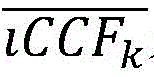
在一些实施方案中,簇k包括所述突变的最高概率的簇。In some embodiments, cluster k includes the cluster with the highest probability of the mutation.
在一些实施方案中,所述聚类包括使用混合模型来确定所述一个或多个簇。在一些实施方案中,所述混合模型包括变分贝叶斯混合模型。在一些实施方案中,所述聚类包括确定产生所述iCCF的一个或多个簇的多个亚克隆。在一些实施方案中,确定所述多个亚克隆中的亚克隆包括鉴定多个体细胞序列变体的子集,所述子集是基于均在预定范围内的所述子集的估算分数聚类在一起的子集。在一些实施方案中,所述混合模型包括两个或更多个簇的变异等位基因计数的两种或更多种概率分布的混合。在一些实施方案中,变异等位基因计数的每种概率分布选自:二项分布、β分布、高斯分布,和以上的任意组合。在一些实施方案中,变异等位基因计数的每种概率分布是二项分布。在一些实施方案中,基于测序深度和iCCF计算所述变异等位基因计数。在一些实施方案中,将所述变异等位基因计数计算为:变异等位基因计数=深度×iCCF。In some embodiments, the clustering includes using a mixture model to determine the one or more clusters. In some embodiments, the mixture model comprises a variational Bayesian mixture model. In some embodiments, the clustering includes identifying a plurality of subclones that generate one or more clusters of the iCCF. In some embodiments, determining a subclone of the plurality of subclones includes identifying a subset of the plurality of somatic sequence variants, the subset being clustered based on estimated scores of the subsets all within a predetermined range subsets together. In some embodiments, the mixture model includes a mixture of two or more probability distributions of variant allele counts for two or more clusters. In some embodiments, each probability distribution of variant allele counts is selected from the group consisting of: a binomial distribution, a beta distribution, a Gaussian distribution, and any combination of the above. In some embodiments, each probability distribution of variant allele counts is a binomial distribution. In some embodiments, the variant allele count is calculated based on sequencing depth and iCCF. In some embodiments, the variant allele count is calculated as: variant allele count = depth x iCCF.
在一些实施方案中,突变的iCCF被建模为簇的具有β分布的β随机变量。在一些实施方案中,所述至少一个测试样品包括一个样品,并且属于簇的突变的概率被建模为:In some embodiments, the mutated iCCF is modeled as a clustered beta random variable with a beta distribution. In some embodiments, the at least one test sample comprises one sample, and the probability of a mutation belonging to a cluster is modeled as:

其中prm,k是突变m的属于簇k的概率;where pr m,k is the probability that mutation m belongs to cluster k;
β(;)是簇k的β分布的概率密度函数;f是突变m的iCCF;Γ()是γ函数;并且uk和vk是簇k的β分布的形状参数。β(;) is the probability density function of the beta distribution of cluster k; f is the iCCF of mutation m; Γ() is the gamma function; and uk and vk are the shape parameters of the beta distribution of cluster k.
在一些实施方案中,所述至少一个测试样品包括两个或更多个测试样品,并且属于簇的突变的概率被建模为:In some embodiments, the at least one test sample includes two or more test samples, and the probability of a mutation belonging to a cluster is modeled as:
其中uk和uv是S向量,其sth分量分别是uks和vks。where u k and u v are S-vectors whose s th components are u ks and v ks , respectively.
在一些实施方案中,所述多个基因座包括一个或多个双等位基因基因座。In some embodiments, the plurality of loci include one or more biallelic loci.
在一些实施方案中,所述多个体细胞突变的一个或多个突变与一个或多个拷贝数变异(CNV)重叠。In some embodiments, one or more mutations of the plurality of somatic mutations overlap with one or more copy number variations (CNVs).
在一些实施方案中,该方法不假定所有癌细胞都CNV影响,或都不受CNV影响。在一些实施方案中,该方法不假定携带体细胞突变的所有癌细胞都受CNV影响,或都不受CNV影响。In some embodiments, the method does not assume that all cancer cells are affected by CNV, or are not affected by CNV. In some embodiments, the method does not assume that all cancer cells carrying somatic mutations are affected by CNV, or that none are affected by CNV.
在一些实施方案中,所述聚类不使用马尔科夫链蒙特卡洛(MCMC)方法。In some embodiments, the clustering does not use a Markov Chain Monte Carlo (MCMC) method.
在一些实施方案中,所述多个体细胞突变包括选自以下的突变:单核苷酸变异(SNV)、插入缺失,或以上的组合。In some embodiments, the plurality of somatic mutations comprise mutations selected from the group consisting of single nucleotide variations (SNVs), indels, or combinations thereof.
本公开的另外的方面提供了用于估算来自对象的一个或多个测试样品中的一种个或多个突变变体的一个或多个CCF的系统。该系统包括用于从测试样品接收核酸并提供来自所述样品的核酸序列信息的测序仪、处理器;以及一种或多种计算机可读的存储介质,在其上已存储有用于在所述处理器上执行的指令以使用本文中所描述的方法估算一个或多个突变变体的一个或多个CCF。Additional aspects of the present disclosure provide systems for estimating one or more CCFs of one or more mutant variants in one or more test samples from a subject. The system includes a sequencer, a processor for receiving nucleic acid from a test sample and providing nucleic acid sequence information from the sample; and one or more computer-readable storage media on which are stored Instructions executed on the processor to estimate one or more CCFs of the one or more mutant variants using the methods described herein.
在一些实施方案中,该系统包括用于从核酸样品提取核酸分子的工具。In some embodiments, the system includes means for extracting nucleic acid molecules from a nucleic acid sample.
本公开的另外的方面提供了计算机程序产品,其包括存储程序代码的非暂时性的机器可读的介质,当通过计算机系统的一个或多个处理器执行所述程序代码时,使得计算机系统使用本文中所描述的方法估算一个或多个突变变体的一个或多个CCF。Further aspects of the present disclosure provide a computer program product comprising a non-transitory machine-readable medium storing program code that, when executed by one or more processors of a computer system, causes the computer system to use The methods described herein estimate one or more CCFs of one or more mutant variants.
尽管本文中的实例涉及人类,并且语言主要针对人类担忧,但是本文所述的概念适用于来自任何植物或动物的基因组。根据以下描述和所附权利要求书,本公开的这些和其他目的和特征将变得更加完全明显,或者可以通过下文中所述的本公开的实践来获知。Although the examples herein relate to humans and the language is primarily concerned with human concerns, the concepts described herein apply to genomes from any plant or animal. These and other objects and features of the present disclosure will become more fully apparent from the following description and appended claims, or may be learned by practice of the present disclosure as hereinafter described.
通过引用并入incorporated by reference
本文中提及的所有专利、专利申请和其他的出版物,包括在这些参考文献中所公开的所有序列,均通过引用明确地并入本文中,其程度就像每个单独的出版物、专利或专利申请被明确地和单独地指出通过引用并入本文中一样。引用的所有文件在相关部分中均通过引用以其整体并入本文中,用于其在本文中的引用的上下文所指示的目的。然而,任何文件的引用均不应被解释为承认其是关于本公开的现有技术。All patents, patent applications, and other publications mentioned herein, including all sequences disclosed in these references, are expressly incorporated herein by reference to the same extent as each individual publication, patent or patent applications are expressly and individually indicated to be incorporated herein by reference. All documents cited are hereby incorporated by reference in their entirety, in relevant portions, for the purposes indicated by the context in which they are cited herein. However, citation of any document should not be construed as an admission that it is prior art with regard to the present disclosure.
附图的简要说明Brief Description of Drawings
图1是由在癌症进展中可能发生的体细胞突变造成的示例性突变肽的示意图。Figure 1 is a schematic representation of exemplary mutant peptides resulting from somatic mutations that may occur in cancer progression.
图2是如应用于具有亚克隆新抗原表达的肿瘤的检查点抑制剂疗法的示意图。Figure 2 is a schematic representation of checkpoint inhibitor therapy as applied to tumors with subclonal neoantigen expression.
图3是包括正常细胞以及具有特定体细胞突变的肿瘤细胞和无特定体细胞突变的肿瘤细胞的异质性混合物的肿瘤的示意图。Figure 3 is a schematic representation of a tumor comprising normal cells and a heterogeneous mixture of tumor cells with specific somatic mutations and tumor cells without specific somatic mutations.
图4显示了其中所有正常细胞和肿瘤细胞均包括一个拷贝的体细胞突变的示意性实例。Figure 4 shows a schematic example in which all normal cells and tumor cells include one copy of a somatic mutation.
图5显示了其中肿瘤样品不是仅由肿瘤细胞组成,而是还由正常细胞组成的示意性实例。Figure 5 shows a schematic example in which a tumor sample is not composed only of tumor cells, but also normal cells.
图6显示了具有5个非肿瘤细胞和10个肿瘤细胞的肿瘤的示意性实例。Figure 6 shows a schematic example of a tumor with 5 non-tumor cells and 10 tumor cells.
图7显示了其中仅一些肿瘤细胞中包括体细胞突变的基因座在非变异等位基因中的的拷贝数相对于正常细胞增加的示意性实例。Figure 7 shows a schematic example in which only some tumor cells have an increased copy number of a locus comprising a somatic mutation in a non-variant allele relative to normal cells.
图8显示了其中CNV为亚克隆,并且它们影响与体细胞突变相同或不同的肿瘤亚克隆集合的说明性实例。Figure 8 shows an illustrative example where CNVs are subclones and they affect the same or different collection of tumor subclones as somatic mutations.
图9显示了示出了根据相同的实施方案确定癌细胞分数的过程的流程图。Figure 9 shows a flowchart illustrating the process of determining the cancer cell fraction according to the same embodiment.
图10示出了使用序列读取估算肿瘤纯度和拷贝数的过程。Figure 10 shows the process of estimating tumor purity and copy number using sequence reads.
图11显示了对iCCF值聚类的过程。Figure 11 shows the process of clustering iCCF values.
图12显示了可用作根据某些实施方案的计算机设备的典型的计算机系统的框图。12 shows a block diagram of a typical computer system that may be used as a computer device according to certain embodiments.
图13显示了用于从测试样品产生调用(call)或诊断的分散系统的一种实施方案。Figure 13 shows one embodiment of a decentralized system for generating calls or diagnoses from test samples.
图14显示了用于在不同的位置进行一些实施方案的各种操作的选项。FIG. 14 shows options for performing various operations of some embodiments in different locations.
图15示出了产生具有与正常细胞不同的组成和两种肿瘤亚克隆的20个肿瘤样品的模拟数据的方法。Figure 15 shows a method for generating simulated data for 20 tumor samples with a different composition from normal cells and two tumor subclones.
图16显示了PyClone的估算的CCF与真实的CCF的偏差。Figure 16 shows the deviation of PyClone's estimated CCF from the true CCF.
图17显示了ClonScore的估算的CCF与真实的CCF的偏差。Figure 17 shows the deviation of ClonScore's estimated CCF from the true CCF.
图18显示用于多样品分析的ClonScore与Hao等人之间的CCF差异。Figure 18 shows the CCF difference between ClonScore and Hao et al. for multi-sample analysis.
图19显示了用于多样品分析的PyClone与Hao等人之间的CCF的差异。Figure 19 shows the difference in CCF between PyClone and Hao et al. for multi-sample analysis.
图20-图22显示了相对于通过Hao(图20)、PyClone(图21)和ClonScore(图22)的方法的多样品分析的估算值的ClonScore的单样品分析的估算值。Figures 20-22 show estimates of single sample analysis of ClonScore relative to estimates of multi-sample analysis by the methods of Hao (Figure 20), PyClone (Figure 21) and ClonScore (Figure 22).
图23-图25显示了相对于通过Hao(图23)、PyClone(图24)和ClonScore(图25)的方法的多样品分析的估算值的PyClone的单样品分析的估算值。Figures 23-25 show estimates of single-sample analysis of PyClone relative to estimates of multi-sample analysis by the methods of Hao (Figure 23), PyClone (Figure 24), and ClonScore (Figure 25).
详述detail
定义definition
数值范围包括限定范围的数值。在整个本说明书中给出的每个最大数值限制旨在包括每个更低的数值限制,就像这些更低的数值限制在本文中被明确写出一样。在整个本说明书中给出的每个最小数值限制将包括每个更高的数值限制,就像这些更高的数值限制在本文中被明确写出一样。在整个本说明书中给出的每个数值范围将包括落入这样的更宽的数值范围内的每个更窄的数值范围,就好像这些更窄的数值范围在本文中均被明确写出一样。Numerical ranges include the values defining the range. Every maximum numerical limitation given throughout this specification is intended to include every lower numerical limitation, as if such lower numerical limitations were expressly written herein. Every minimum numerical limitation given throughout this specification will include every higher numerical limitation, as if such higher numerical limitations were expressly written herein. Every numerical range given throughout this specification will include every narrower numerical range that falls within such broader numerical range, as if such narrower numerical ranges were all expressly written herein .
当使用术语“约”修饰数量时,它是指从数量减去10%到数量加上10%的范围。When the term "about" is used to modify an amount, it refers to a range from the amount minus 10% to the amount plus 10%.
本文中所提供的标题不旨在限制本公开。The headings provided herein are not intended to limit the present disclosure.
除非在本文中另有定义,否则本文中所使用的所有技术和科学术语具有与本领域普通技术人员通常所理解的相同的含义。包括本文中所包括的术语的各种科学词典是本领域技术人员熟知的并且是可得到的。尽管与本文中所描述的那些类似或等同的任何方法和物质均可在本文中所公开的实施方案的实践或测试中使用,但仍描述了一些方法和物质。Unless otherwise defined herein, all technical and scientific terms used herein have the same meaning as commonly understood by one of ordinary skill in the art. Various scientific dictionaries including terms included herein are well known and available to those skilled in the art. Although any methods and materials similar or equivalent to those described herein can be used in the practice or testing of the embodiments disclosed herein, some methods and materials are described.
通过总体参考本说明书更完整地描述了紧接着在下文中所定义的术语。应当理解,本公开不限于所描述的特定方法、方案和试剂,因为这些可以根据本领域技术人员所使用的环境而变化。如本文中所用的,除非上下文另外明确指出,否则单数术语“一个/种(a/an)”和“所述(the)”包括复数参照。Terms defined immediately below are more fully described by reference to this specification in its entirety. It is to be understood that this disclosure is not limited to the particular methods, protocols and reagents described, as these may vary depending upon the circumstances employed by those skilled in the art. As used herein, the singular terms "a/an" and "the" include plural references unless the context clearly dictates otherwise.
术语“突变”是指基因结构的变化,其导致由DNA中的碱基单元的改变或者基因或染色体的缺失、插入或较大部分的重排造成的可被传递至后代的变体形式。The term "mutation" refers to a change in the structure of a gene that results in a variant form that can be passed on to offspring, resulting from a change in a base unit in DNA or a deletion, insertion, or rearrangement of a larger portion of a gene or chromosome.
突变包括但不限于:单核苷酸多态性(SNP),其突变变体被称为单核苷酸变异(SNV);插入缺失;和拷贝数变异(CNV)。然而,在一些情况下,术语“突变”也以其较窄的含义使用,包括SNV和插入缺失,但排除CNV,从上下文将前者与后者区分开来是显而易见的。已知一些突变与癌症相关。这样的突变被称为癌症突变,且相应的变体被称为癌症变体。Mutations include, but are not limited to: single nucleotide polymorphisms (SNPs), mutant variants of which are referred to as single nucleotide variations (SNVs); indels; and copy number variations (CNVs). In some cases, however, the term "mutation" is also used in its narrower sense, including SNVs and indels, but excluding CNVs, which is obvious from the context to distinguish the former from the latter. Some mutations are known to be associated with cancer. Such mutations are called cancer mutations, and the corresponding variants are called cancer variants.
单核苷酸多态性(SNP)是发生在基因组中的特定位置处的单个核苷酸的变异,其中每个变异在种群中以某种可评估的程度(例如,>1%)存在。A single nucleotide polymorphism (SNP) is a variation of a single nucleotide that occurs at a specific location in the genome, where each variation is present to some assessable degree (eg, >1%) in a population.
多态性和遗传多态性在本文中可互换使用,是指在相同的群体中,在一个基因组基因座处存在两个或更多个等位基因,每个具有可评估的频率。Polymorphism and genetic polymorphism are used interchangeably herein and refer to the presence of two or more alleles, each with an assessable frequency, at a genomic locus in the same population.
多态性位点和多态位点在本文中可互换使用,是指两个或更多个等位基因所在的基因组上的基因座。在一些实施方案中,它被用于指两个不同碱基的等位基因的单个核苷酸变异。Polymorphic site and polymorphic site are used interchangeably herein and refer to a locus on a genome where two or more alleles reside. In some embodiments, it is used to refer to a single nucleotide variation of alleles of two different bases.
术语“等位基因”是指基因的两种或更多种可选形式中的一种且在基因组上的相同基因座处被发现。The term "allele" refers to one of two or more alternative forms of a gene and is found at the same locus on the genome.
术语“等位基因计数”是指包括特定等位基因的序列读取的数量。在一些实施方案中,它可以通过将读取映射为参照基因组中的一个位置,并对包括等位基因序列且被映射至参照基因组的读取计数来确定。The term "allele count" refers to the number of sequence reads that include a particular allele. In some embodiments, it can be determined by mapping a read to a position in the reference genome, and counting the reads that include the allelic sequence and are mapped to the reference genome.
等位基因频率是基因(或基因的变体)的等位基因相对于基因的所有等位基因的频率,其可被表示为分数或百分比。等位基因频率常常与特定基因组基因座相关,因为基因通常位于一个或多个基因座处。Allele frequency is the frequency of alleles of a gene (or variant of a gene) relative to all alleles of a gene, which can be expressed as a fraction or a percentage. Allele frequencies are often associated with specific genomic loci because genes are usually located at one or more loci.
术语“变异等位基因”在本文中被用于指目标的变体的等位基因,或更明确地,指癌症相关的变体的等位基因。The term "variant allele" is used herein to refer to an allele of a variant of interest, or more specifically, to an allele of a cancer-associated variant.
术语“变异等位基因频率”是指变异等位基因相对于所有等位基因的频率。The term "variant allele frequency" refers to the frequency of a variant allele relative to all alleles.
术语“癌细胞分数”(CCF)或“癌细胞突变分数”是指具有体细胞突变的变异等位基因的癌细胞在所有癌细胞中所占的分数。可以计算对象的一个或多个样品的CCF。根据一些实施方案,,当使用多个样品时,CCF可能比使用单个样品更有效和/或更可靠。The term "cancer cell fraction" (CCF) or "cancer cell mutation fraction" refers to the fraction of all cancer cells that have a variant allele of a somatic mutation. The CCF can be calculated for one or more samples of the subject. According to some embodiments, when using multiple samples, CCF may be more efficient and/or more reliable than using a single sample.
癌症纯度是指样品中的癌细胞相对于所有的细胞的比例。Cancer purity refers to the proportion of cancer cells relative to all cells in a sample.
某些体细胞突变发生在创始细胞中,并传递给所有的细胞后代细胞。这些突变被称为克隆突变。后代细胞的生长称为克隆扩增。后代细胞的群体在本文中称为细胞的“克隆”或克隆变种。但是在另外的用途中,术语“克隆”也被用于指后代细胞群中的细胞。Certain somatic mutations occur in the founder cell and are passed on to all descendant cells. These mutations are called clonal mutations. The growth of progeny cells is called clonal expansion. A population of progeny cells is referred to herein as a "clone" or clonal variant of the cell. But in another use, the term "clone" is also used to refer to cells in a progeny population of cells.
一些体细胞突变是亚克隆的,其发生在癌症克隆中现有的瘤细胞中,并且仅传递给自其衍生的细胞亚群。细胞的亚群被称为细胞的“亚克隆”或亚克隆变种。Some somatic mutations are subclonal, occurring in existing neoplastic cells in the cancer clone and transmitted only to the subpopulation of cells from which they are derived. Subpopulations of cells are referred to as "subclones" or subclonal variants of cells.
“聚类”或聚类分析是指根据某些标准,以使得同一组(被称为“簇”)中的项目彼此之间比与他组(“簇”)中的那些更相似的方式对一组项目进行分组的过程。可以通过各种技术来实现聚类,这些技术在对什么构成簇以及如何有效地找到它们方面的理解上存在显著差异。形成簇的普遍标准包括聚类成员之间具有较小距离的组、数据空间的密集区域、间隔或特定统计学分布。因此,聚类可以被表述为多目标优化问题。适当的聚类算法和参数设置(包括参数,如要使用的距离函数、密度阈值或预期的簇的数量)取决于结果的单个数据集和预期用途。聚类技术包括但不限于:基于连通性的聚类(例如,分层聚类)、基于质心的聚类(例如,k-均值聚类)、基于分布的聚类和基于密度的聚类。"Clustering" or cluster analysis refers to classifying items in the same group (called a "cluster") in such a way that they are more similar to each other than to those in other groups ("clusters") according to some criteria The process of grouping a set of items. Clustering can be achieved through a variety of techniques that differ significantly in their understanding of what constitutes clusters and how to find them efficiently. Common criteria for forming clusters include groups with small distances between cluster members, dense regions of the data space, intervals, or specific statistical distributions. Therefore, clustering can be formulated as a multi-objective optimization problem. Appropriate clustering algorithms and parameter settings (including parameters such as distance functions to use, density thresholds, or expected number of clusters) depend on the individual dataset and intended use of the results. Clustering techniques include, but are not limited to, connectivity-based clustering (eg, hierarchical clustering), centroid-based clustering (eg, k-means clustering), distribution-based clustering, and density-based clustering.
二项实验是具有以下性质的统计实验:该实验由n个重复试验组成;每个试验只能引起两种可能的结果(成功/失败);在每个试验中,用p表示的成功概率是相同的;并且试验是独立的。二项实验的n个重复试验中的成功次数X是二项随机变量。A binomial experiment is a statistical experiment with the following properties: the experiment consists of n repeated trials; each trial can elicit only two possible outcomes (success/failure); in each trial, the probability of success, denoted by p, is the same; and the trials are independent. The number of successes X in n replicates of a binomial experiment is a binomial random variable.
二项随机变量可以被表示为X~B(n,p)或X~BN(n,p)。A binomial random variable can be represented as X∼B(n,p) or X∼BN(n,p).
二项随机变量的概率分布被称为二项分布。对于单个实验,即n=1,二项分布是伯努利分布。二项分布具有以下性质:分布的均值为μ=n*p;方差为σ2=n*p*(1-p);并且标准偏差为σ=sqrt[n*P*(1-P)]。The probability distribution of a binomial random variable is called the binomial distribution. For a single experiment, ie, n=1, the binomial distribution is a Bernoulli distribution. The binomial distribution has the following properties: the mean of the distribution is μ=n*p; the variance is σ2 =n*p*(1-p); and the standard deviation is σ=sqrt[n*P*(1-P)] .
二项概率是指二项实验仅产生x次成功的概率。可按如下计算二项概率。Binomial probability refers to the probability that a binomial experiment yields only x successes. The binomial probability can be calculated as follows.

β分布是一系列连续的概率分布,其被限定在由通过例如α和β(或u和v)表示的两个正的形状参数参数化的间隔[0,1]上,,以随机变量指数形式出现并控制分布的形状。在许多学科中,β分布已被用于对限于有限长度的间隔的随机变量的行为进行建模。在贝叶斯推理中,β分布是伯努利分布、二项分布、负二项分布和几何分布的共轭先验概率分布。例如,可以在贝叶斯分析中使用β分布来描述有关成功概率的初始知识。A beta distribution is a series of continuous probability distributions defined over an interval [0, 1] parameterized by two positive shape parameters, denoted by, for example, α and β (or u and v), with a random variable exponential The form appears and controls the shape of the distribution. In many disciplines, the beta distribution has been used to model the behavior of random variables restricted to intervals of finite length. In Bayesian inference, the beta distribution is the conjugate prior probability distribution of Bernoulli, binomial, negative binomial, and geometric distributions. For example, a beta distribution can be used in Bayesian analysis to describe initial knowledge about the probability of success.
如果随机变量X的概率分布是β分布,则随机变量X被称为β随机变量。β随机变量可表示为X~Beta(α,β)或X~β(α,β)。If the probability distribution of a random variable X is a beta distribution, then the random variable X is called a beta random variable. A β random variable can be expressed as X~Beta(α,β) or X~β(α,β).
β概率是指具有x的值的β随机变量的概率。可按如下计算β概率。Beta probability refers to the probability of a beta random variable having the value of x. The beta probability can be calculated as follows.

其中β(x;α,β)是β分布β(α,β)的概率密度函数,且Γ()是γ函数。where β(x; α,β) is the probability density function of the β distribution β(α,β), and Γ() is the γ function.
循环无细胞DNA或简单的无细胞DNA(cfDNA)是不限于细胞内的DNA片段,并且是在血流或其他体液中自由循环的。已知cfDNA具有不同的来源,在一些情况下来自肿瘤细胞或受肿瘤影响的细胞,在其他情况下则来自母体血液中循环的胎儿DNA。通常,cfDNA是片段化的,并且仅包括基因组的一小部分,其可能与获得cfDNA的个体的基因组不同。Circulating cell-free DNA, or simply cell-free DNA (cfDNA), is a DNA fragment that is not restricted to cells and that circulates freely in the bloodstream or other bodily fluids. cfDNA is known to have different origins, in some cases from tumor cells or cells affected by tumors, and in other cases from fetal DNA circulating in maternal blood. Typically, cfDNA is fragmented and includes only a small portion of the genome, which may differ from the genome of the individual from which the cfDNA was obtained.
术语非循环基因组DNA(gDNA)或细胞DNA被用于指限制在细胞中的DNA分子,并且通常包括完整的基因组。The terms non-circulating genomic DNA (gDNA) or cellular DNA are used to refer to DNA molecules that are confined in cells and generally include the complete genome.
术语“读取”是指从核酸样品的一部分获得的序列。通常,尽管不是必须的,读取代表样品中连续碱基对的短序列。可以通过样品部分的碱基对序列(以A、T、C或G)象征性地表示读取。可以将它存储在存储器装置中,并适当地行处理以确定它是否与参照序列匹配或满足其他的标准。可以直接从测序设备获得读取,或者可以从存储的关于样品的序列信息间接获得读取。在一些情况下,读取是具有足够长度(例如,至少约25bp)的DNA序列,其可被用于识别更大的序列或区域,例如可进行比对并特异性地分配给染色体或基因组区域或基因。The term "read" refers to a sequence obtained from a portion of a nucleic acid sample. Typically, though not required, short sequences representing contiguous base pairs in the sample are read. Reads can be symbolically represented by the base pair sequence (in A, T, C or G) of the sample portion. It can be stored in a memory device and processed as appropriate to determine whether it matches a reference sequence or satisfies other criteria. The reads can be obtained directly from the sequencing device, or the reads can be obtained indirectly from stored sequence information about the sample. In some cases, reads are DNA sequences of sufficient length (eg, at least about 25 bp) that can be used to identify larger sequences or regions, such as can be aligned and specifically assigned to chromosomal or genomic regions or genes.
本文中所使用的术语“参数”表示其值或其他特性影响诸如拷贝数变异的相关条件的物理特征。在一些情况下,参照影响数学关系或模型的输出的变量来使用术语参数,所述变量可以是自变量(即至模型的输入)或基于一个或多个自变量的中间变量。取决于模型的范围,一个模型的输出可以变成另一模型的输入,从而变成另一模型的参数。As used herein, the term "parameter" refers to a physical characteristic whose value or other property affects a related condition, such as copy number variation. In some cases, the term parameter is used with reference to a variable that affects the output of a mathematical relationship or model, which may be an independent variable (ie, an input to a model) or an intermediate variable based on one or more independent variables. Depending on the scope of the model, the output of one model can become the input of another model and thus become the parameters of another model.
术语“拷贝数变异”在本文中是指与参照样品中存在的核酸序列的拷贝数相比测试样品中存在的核酸序列的拷贝数的变化。在某些实施方案中,核酸序列为1kb或更大。在一些情况下,核酸序列是整个染色体或其重要部分。“拷贝数变异”是指核酸的序列,其中通过将测试样品中的目标核酸序列与预期水平的目标核酸序列进行比较来发现拷贝数差异。例如,将测试样品中的目标核酸序列的水平与合格样品中存在的水平进行比较。拷贝数变异/变化包括缺失(包括微缺失)、插入(包括微插入)、复制、倍增和易位。CNV涵盖染色体非整倍性和部分非整倍性。The term "copy number variation" herein refers to a change in the copy number of a nucleic acid sequence present in a test sample compared to the copy number of a nucleic acid sequence present in a reference sample. In certain embodiments, the nucleic acid sequence is 1 kb or larger. In some cases, the nucleic acid sequence is the entire chromosome or a substantial portion thereof. "Copy number variation" refers to the sequence of nucleic acids in which copy number differences are found by comparing a target nucleic acid sequence in a test sample to an expected level of target nucleic acid sequence. For example, the level of the target nucleic acid sequence in the test sample is compared to the level present in the qualified sample. Copy number variations/changes include deletions (including microdeletions), insertions (including microinsertion), duplications, duplications, and translocations. CNV covers chromosomal aneuploidy and partial aneuploidy.
本文中的术语“非整倍性”是指由整个染色体或部分染色体的丢失或获得引起的遗传物质的失衡。The term "aneuploidy" as used herein refers to an imbalance of genetic material caused by the loss or gain of an entire chromosome or part of a chromosome.
本文中的术语“染色体非整倍性”和“完整的染色体非整倍性”是指由整个染色体的丢失或获得引起的遗传物质的失衡,并且包括生殖系非整倍性和镶嵌非整倍性。The terms "chromosomal aneuploidy" and "complete chromosomal aneuploidy" herein refer to an imbalance of genetic material caused by the loss or gain of an entire chromosome, and include germline aneuploidy and mosaic aneuploidy sex.
术语“多个”是指多于一个元素。例如,在本文中参照使用本文中所公开的方法足以鉴定测试样品和合格的样品中的拷贝数变异的显著差异的多个核酸分子或序列标签来使用该术语。在一些实施方案中,对于每个测试样品获得了至少约3×10⁶个约20至40bp的序列标签。在一些实施方案中,每个测试样品提供了至少约5×10⁶、8×10⁶、10×106、15×106、20×106、30×106、40×106或50×106个序列标签的数据,每个序列标签包含约20至40bp。The term "plurality" refers to more than one element. For example, the term is used herein with reference to a plurality of nucleic acid molecules or sequence tags sufficient to identify significant differences in copy number variation in a test sample and a qualified sample using the methods disclosed herein. In some embodiments, at least about 3 x 10⁶ sequence tags of about 20 to 40 bp are obtained for each test sample. In some embodiments, each test sample provides at least about 5x10⁶ , 8x10⁶ , 10x106 , 15x106 , 20x106 , 30x106 , 40x106 , or 50 Data of ×10 6 sequence tags, each containing about 20 to 40 bp.
术语“多核苷酸”、“核酸”和“核酸分子”可互换使用,并且指共价连接的核苷酸序列(即RNA的核糖核苷酸和DNA的脱氧核糖核苷酸),其中一个核苷酸的戊糖的3’位置通过磷酸二酯基团连接至下一个核苷酸的戊糖的5’位置。核苷酸包括任何形式的核酸的序列,包括但不限于RNA和DNA分子,如cfDNA分子。术语“多核苷酸”包括但不限于单链多核苷酸和双链多核苷酸。The terms "polynucleotide", "nucleic acid" and "nucleic acid molecule" are used interchangeably and refer to a covalently linked sequence of nucleotides (ie, ribonucleotides for RNA and deoxyribonucleotides for DNA), one of which The 3' position of the pentose sugar of a nucleotide is linked by a phosphodiester group to the 5' position of the pentose sugar of the next nucleotide. Nucleotides include sequences of any form of nucleic acid, including but not limited to RNA and DNA molecules, such as cfDNA molecules. The term "polynucleotide" includes, but is not limited to, single-stranded polynucleotides and double-stranded polynucleotides.
本文中的术语“测试样品”是指通常来源于生物流体、细胞、组织、器官或生物体的样品,其包含核酸或含有在测试中待分析的至少一条核酸序列的核酸的混合物。在某些实施方案中,样品包含至少一条核酸序列。这样的样品包括但不限于:硬组织和软组织、痰/口腔液、羊水、血液、血液级分或细针穿刺活检样品(例如,外科活检、细针穿刺活检等)、尿液、腹膜液、胸膜液等。尽管样品通常采自人类对象(例如患者),但测定可被用于测试来自任何哺乳动物的样品,包括但不限于狗、猫、马、山羊、绵羊、牛、猪等。可以直接使用从生物来源获得的样品,或者可以在进行预处理以修改样品特性后使用。例如,这样的预处理可以包括从血液中制备血浆、稀释粘性流体等。预处理方法还可以包括但不限于:过滤、沉淀、稀释、蒸馏、混合、离心、冷冻、冻干、浓缩、扩增、核酸片段化、干扰成分灭活、添加试剂、溶解等。如果对样品采用这样的预处理方法,则这样的预处理方法通常使得目标核酸保留在测试样品中,有时以与未处理测试样品(例如,即未进行任何这样的预处理方法的样品)中的浓度成比例的浓度保留在测试样品中。相对于本文所述的方法,这种“处理的”或“加工的”样品仍被认为是生物学的“测试”样品。The term "test sample" herein refers to a sample, generally derived from a biological fluid, cell, tissue, organ or organism, that contains nucleic acid or a mixture of nucleic acids containing at least one nucleic acid sequence to be analyzed in a test. In certain embodiments, the sample comprises at least one nucleic acid sequence. Such samples include, but are not limited to: hard and soft tissues, sputum/oral fluid, amniotic fluid, blood, blood fractions or fine needle aspiration biopsy samples (eg, surgical biopsy, fine needle aspiration biopsy, etc.), urine, peritoneal fluid, Pleural fluid, etc. Although samples are typically taken from human subjects (eg, patients), the assay can be used to test samples from any mammal, including but not limited to dogs, cats, horses, goats, sheep, cattle, pigs, and the like. Samples obtained from biological sources can be used directly, or can be used after pretreatment to modify sample properties. For example, such pretreatment may include preparing plasma from blood, diluting viscous fluids, and the like. Pretreatment methods may also include, but are not limited to, filtration, precipitation, dilution, distillation, mixing, centrifugation, freezing, lyophilization, concentration, amplification, nucleic acid fragmentation, inactivation of interfering components, addition of reagents, dissolution, and the like. If such pretreatment methods are applied to the sample, such pretreatment methods generally result in the retention of target nucleic acids in the test sample, sometimes in a different way than in untreated test samples (eg, samples that have not undergone any such pretreatment methods). Concentration-proportional concentrations are retained in the test sample. Such "treated" or "processed" samples are still considered biological "test" samples relative to the methods described herein.
本文中的术语“训练集”是指一组训练样品,其可以包括受影响的和/或未受影响的样品,并被用于开发用于分析测试样品的模型。在一些实施方案中,训练集包括未受影响的样品。在这些实施方案中,使用目标拷贝数变异未受影响的样品训练集来确立用于确定CNV的阈值。训练集中未受影响的样品可被用作鉴定标准化序列(例如标准化染色体)的合格样品,并且将未受影响样品的染色体剂量被用于设置每条目标序列(例如染色体)的阈值。在一些实施方案中,训练集包括受影响的样品。训练集中的受影响样品可被用于验证可以容易地从未受影响的样品区分的受影响的样品。The term "training set" herein refers to a set of training samples, which may include affected and/or unaffected samples, and is used to develop a model for analyzing test samples. In some embodiments, the training set includes unaffected samples. In these embodiments, a training set of samples unaffected by the copy number variation of interest is used to establish a threshold for determining CNVs. Unaffected samples in the training set can be used as qualified samples to identify normalizing sequences (eg, normalizing chromosomes), and the chromosome dose of unaffected samples is used to set thresholds for each target sequence (eg, chromosome). In some embodiments, the training set includes affected samples. Affected samples in the training set can be used to validate affected samples that can be easily distinguished from unaffected samples.
训练集还是目标群体中的统计样品,所述统计样品不应与生物样品混淆。统计样品通常包含多个个体,所述个体的数据被用于确定可推广到群体的一个或多个目标定量值。统计样品是目标群体中的个体的子集。个体可以是人、动物、组织、细胞、其他生物样品(即统计样品可以包括多个生物样品),以及提供数据点以进行统计分析的其他单个实体。The training set is also a statistical sample in the target population, which should not be confused with the biological sample. A statistical sample typically contains multiple individuals whose data is used to determine one or more target quantitative values that can be generalized to a population. A statistical sample is a subset of individuals in the target population. An individual can be a human, animal, tissue, cell, other biological sample (ie, a statistical sample can include multiple biological samples), and other single entities that provide data points for statistical analysis.
通常,将训练集与验证集联合使用。术语“验证集”被用于指统计样品中的一组个体;使用所述个体的数据来验证或评估使用训练集确定的目标定量值。例如,在一些实施方案中,训练集提供数据以计算参照序列的掩模(mask),而验证集提供数据以评估掩模的可信性或有效性。Typically, a training set is used in conjunction with a validation set. The term "validation set" is used to refer to a group of individuals in a statistical sample; the data of said individuals is used to validate or evaluate target quantitative values determined using the training set. For example, in some embodiments, the training set provides data to compute a mask for a reference sequence, and the validation set provides data to assess the reliability or validity of the mask.
在本文中参照与序列的拷贝数相关的基因序列的状态的统计评估来使用“拷贝数的评估”。例如,在一些实施方案中,评估包括确定基因序列的存在或不存在。在一些实施方案中,评估包括确定基因序列的部分非整倍性或完全非整倍性。在其他实施方案中,评估包括基于基因序列的拷贝数的两个或更多个样品之间的区别。在一些实施方案中,评估包括基于基因序列的拷贝数的统计分析,例如标准化和比较。"Assessment of copy number" is used herein with reference to a statistical assessment of the state of a gene sequence in relation to the copy number of the sequence. For example, in some embodiments, evaluating includes determining the presence or absence of a genetic sequence. In some embodiments, assessing includes determining partial aneuploidy or complete aneuploidy of the gene sequence. In other embodiments, the assessment includes differences between two or more samples based on the copy number of the gene sequence. In some embodiments, the assessment includes statistical analysis, such as normalization and comparison, based on copy number of gene sequences.
术语“覆盖率”是指映射到所限定的序列的序列标签的丰度。可以通过序列标签密度(或序列标签的计数)、序列标签密度比率、标准化的覆盖率量、调整后的覆盖率值等定量表示覆盖率。The term "coverage" refers to the abundance of sequence tags that map to a defined sequence. Coverage can be expressed quantitatively by sequence tag density (or count of sequence tags), sequence tag density ratio, normalized coverage amount, adjusted coverage value, and the like.
术语“下一代测序(NGS)”在本文中是指允许克隆扩增的分子和单个核酸分子的大规模平行测序的测序方法。NGS的非限制性实例包括使用可逆染料终止剂的边合成边测序,以及边连接边测序。The term "Next Generation Sequencing (NGS)" herein refers to sequencing methods that allow for the massively parallel sequencing of clonally amplified molecules and single nucleic acid molecules. Non-limiting examples of NGS include sequencing by synthesis using reversible dye terminators, and sequencing by ligation.
本文中的术语“参数”是指表征系统性能的数值。通常,参数在数值上表征定量数据集和/或定量数据集之间的数值关系。例如,映射到染色体的序列标签的数量与标签所映射到的染色体的长度之间的比率(或比率的函数)是参数。The term "parameter" as used herein refers to a numerical value that characterizes the performance of a system. Typically, parameters numerically characterize quantitative data sets and/or numerical relationships between quantitative data sets. For example, the ratio (or a function of the ratio) between the number of sequence tags mapped to a chromosome and the length of the chromosome to which the tags map is a parameter.
本文中的术语“阈值”和“合格阈值”是指用作临界值的任何数值,以表征诸如含有来自疑似患有医学病况的生物体的核酸的测试样品的样品。可以将阈值与参数值进行比较,以确定产生这样的参数值的样品是否表明该生物体患有医学病况。在某些实施方案中,使用合格的数据集来计算合格的阈值,并用作生物体中拷贝数变异(例如非整倍性)的诊断极限值。如果从本文中所公开的方法获得的结果超过阈值,则可以将对象诊断为具有拷贝数变异,例如21三体。可以通过分析计算的样品的训练集的标准化的值(例如染色体剂量、NCV或NSV)来鉴定本文中所述方法的适当阈值。可以使用包括合格(即未受影响)的样品和受影响的样品的训练集中的合格(即未受影响)的样品来鉴定阈值。训练集中已知具有染色体非整倍性的样品(即受影响的样品)可被用于确认所选阈值可用于区分测试集中的受影响的的样品和未受影响的样品(参见本文中的实施例)。阈值的选择取决于用户进行分类所希望具有的置信水平。在一些实施方案中,用于鉴定适当的阈值的训练集包括至少10个、至少20个、至少30个、至少40个、至少50个、至少60个、至少70个、至少80个、至少90个、至少100个、至少200个、至少300个、至少400个、至少500个、至少600个、至少700个、至少800个、至少900个、至少1000个、至少2000个、至少3000个、至少4000个或更多个合格的样品。使用更大的合格样品集以提高阈值的诊断效用可能是有利的。The terms "threshold" and "eligibility threshold" herein refer to any numerical value used as a cutoff value to characterize a sample such as a test sample containing nucleic acid from an organism suspected of having a medical condition. Threshold values can be compared to parameter values to determine whether samples producing such parameter values indicate that the organism suffers from a medical condition. In certain embodiments, a qualifying data set is used to calculate a qualifying threshold and serve as a diagnostic limit for copy number variation (eg, aneuploidy) in an organism. If the results obtained from the methods disclosed herein exceed a threshold, the subject can be diagnosed as having a copy number variation, such as trisomy 21. Appropriate thresholds for the methods described herein can be identified by analyzing normalized values (eg, chromosome dose, NCV, or NSV) of the calculated training set of samples. Thresholds can be identified using a training set that includes qualified (ie, unaffected) samples and qualified (ie, unaffected) samples in the training set. Samples known to have a chromosomal aneuploidy in the training set (ie, affected samples) can be used to confirm that the selected threshold can be used to distinguish affected samples from unaffected samples in the test set (see implementation herein example). The choice of the threshold depends on the confidence level that the user wishes to have for the classification. In some embodiments, the training set used to identify appropriate thresholds includes at least 10, at least 20, at least 30, at least 40, at least 50, at least 60, at least 70, at least 80, at least 90 at least 100, at least 200, at least 300, at least 400, at least 500, at least 600, at least 700, at least 800, at least 900, at least 1000, at least 2000, at least 3000, At least 4000 or more qualified samples. It may be advantageous to use a larger set of qualified samples to improve the diagnostic utility of the threshold.
术语“堆栈段(bin)”是指序列的片段或基因组的片段。在一些实施方案中,基因组或染色体内的堆栈段彼此相邻。每个堆栈段可以限定参照序列(如参照基因组)中的核苷酸序列。堆栈段的大小可以是1kb、100kb、1Mb等,具体取决于特定应用程序所需的分析和序列标签密度。除了它们在参照序列中的位置外,堆栈段还可以具有其他特征(如样品覆盖率)和序列结构特性(如G-C分数)。The term "bin" refers to a fragment of a sequence or a fragment of a genome. In some embodiments, stack segments within a genome or chromosome are adjacent to each other. Each stack segment can define a nucleotide sequence in a reference sequence (eg, a reference genome). Stack segments can be 1kb, 100kb, 1Mb, etc. in size, depending on the analysis and sequence tag density required for a particular application. In addition to their position in the reference sequence, stack segments can have other characteristics (such as sample coverage) and sequence structure properties (such as G-C scores).
术语“读取”是指从核酸样品的一部分获得的序列。通常,尽管不是必须的,但读取代表样品中连续碱基对的短序列。读取可以通过样品部分的碱基对序列(以A、T、C或G)象征性地表示。可以将它存储在存储器装置中,并适当地进行处理以确定它是否与参照序列匹配或满足其他标准。可以直接从测序设备获得读取,或者可以从存储的关于样品的序列信息间接获得读取。在一些情况下,读取是具有足够长度(例如,至少约25bp)的DNA序列,其可被用于鉴定较大的序列或区域,例如可进行比对并特异性地分配给染色体或基因组区域或基因。The term "read" refers to a sequence obtained from a portion of a nucleic acid sample. Often, though not required, short sequences representing contiguous base pairs in the sample are read. A read can be symbolically represented by the base pair sequence (in A, T, C or G) of the sample portion. It can be stored in a memory device and processed appropriately to determine whether it matches a reference sequence or satisfies other criteria. The reads can be obtained directly from the sequencing device, or the reads can be obtained indirectly from stored sequence information about the sample. In some cases, reads are DNA sequences of sufficient length (eg, at least about 25 bp) that can be used to identify larger sequences or regions, such as can be aligned and specifically assigned to chromosomal or genomic regions or genes.
术语“序列标签”在本文中与术语“映射的序列标签”可互换使用,是指已经通过比对而被具体分配(即,映射到)较大的序列(例如参照基因组)的序列读取。映射的序列标签被独特地映射到参照基因组,即,它们被分配给参照基因组的单个位置。除非另有说明,否则映射到参照序列上相同序列的标签将被计数一次。标签可以作为数据结构或其他数据集合提供。在某些实施方案中,标签包含读取序列和与该读取相关的信息,如基因组中序列的位置,例如染色体上的位置。在某些实施方案中,该位置被指定为正链方向。可以限定标签以允许与参考基因组比对中有限数量的错配。在一些实施方案中,可以映射到参照基因组上的多于一个位置的标签(即非唯一映射的标签)可能不会包括在分析中。The term "sequence tag" is used interchangeably herein with the term "mapped sequence tag" and refers to a sequence read that has been specifically assigned (ie, mapped to) a larger sequence (eg, a reference genome) by alignment . Mapped sequence tags are uniquely mapped to the reference genome, ie they are assigned to a single location in the reference genome. Tags that map to the same sequence on the reference sequence will be counted once unless otherwise stated. Tags can be provided as data structures or other collections of data. In certain embodiments, a tag comprises a read sequence and information associated with the read, such as the location of the sequence in the genome, eg, on a chromosome. In certain embodiments, the position is designated as the positive strand orientation. Tags can be defined to allow for a limited number of mismatches in the alignment to the reference genome. In some embodiments, tags that can map to more than one position on the reference genome (ie, tags that are not uniquely mapped) may not be included in the analysis.
术语“基因座”或“位点”是指参照基因组上的唯一位置(即染色体ID、染色体位置和方向)。在一些实施方案中,位点可以提供残基、序列标签或序列上片段的位置。The term "locus" or "site" refers to a unique location (ie, chromosome ID, chromosome position and orientation) on a reference genome. In some embodiments, a site may provide the position of a residue, sequence tag, or fragment on a sequence.
如本文中所用的,术语“比对的(aligned)”、“比对(alignment)”或“比对(aligning)”是指将读取或标签与参照序列进行比较,并由此确定参照序列是否包含读取序列的过程。如果参照序列含有读取,则该读取可以被映射到参照序列,或者在某些实施方案中,被映射到参照序列中的特定位置。在一些情况下,比对简单地告知读取是否是特定参照序列的成员(即,该读取在参照序列中存在与否)。例如,读取与人类13号染色体的参照序列的比对将告知该读取是否存在于13号染色体的参照序列中。提供该信息的工具可以被称为集合成员资格测试器。在一些情况下,比对另外指示在参照序列中读取或标签所映射到的位置。例如,如果参照序列是整个人类基因组序列,则比对可以指示在13号染色体上存在读取,并且可以进一步指示该读取在13号染色体的特定链和/或位点上。As used herein, the terms "aligned," "aligned," or "aligning" refer to comparing a read or tag to a reference sequence, and thereby determining the reference sequence Whether to include the process of reading the sequence. If the reference sequence contains a read, the read can be mapped to the reference sequence, or in certain embodiments, to a specific position in the reference sequence. In some cases, an alignment simply tells whether a read is a member of a particular reference sequence (ie, whether the read is present in the reference sequence). For example, an alignment of a read to the reference sequence of human chromosome 13 will tell whether the read is present in the reference sequence of chromosome 13. A tool that provides this information can be referred to as a set membership tester. In some cases, the alignment additionally indicates where in the reference sequence the reads or tags are mapped. For example, if the reference sequence is the entire human genome sequence, the alignment can indicate the presence of a read on chromosome 13, and can further indicate that the read is on a particular strand and/or locus on chromosome 13.
比对的读取或标签是根据它们的核酸分子的顺序被鉴定为与来自参照基因组中的已知序列匹配的一条或多条序列。可以手动进行比对,尽管通常是通过计算机算法来实施的,因为不可能在合理的时间段内比对读取以实施本文中所公开的方法。来自比对序列算法的一个实例是作为Illumina基因组分析管线(the Illumina Genomics Analysispipeline)的一部分发布的核苷酸数据的有效局部比对(the Efficient Local Alignmentof Nucleotide Data,ELAND)计算机程序。可选地,可以采用布隆过滤器或类似的集合成员资格测试器来将读取与参照基因组比对。参见2011年10月27日提交的第61/552,374号美国专利申请,其通过引用整体并入本文中。比对中的序列读取的匹配可以是100%的序列匹配或小于100%的序列匹配(非完美匹配)。Aligned reads or tags are one or more sequences that are identified based on the order of their nucleic acid molecules as matching known sequences from a reference genome. Alignments can be performed manually, although usually by computer algorithms, as it is not possible to align reads within a reasonable period of time to implement the methods disclosed herein. An example from an aligned sequence algorithm is the Efficient Local Alignment of Nucleotide Data (ELAND) computer program published as part of the Illumina Genomics Analysis pipeline. Alternatively, a Bloom filter or similar pool membership tester can be employed to align reads to a reference genome. See US Patent Application No. 61/552,374, filed October 27, 2011, which is incorporated herein by reference in its entirety. The match of the sequence reads in the alignment can be a 100% sequence match or a less than 100% sequence match (a non-perfect match).
本文中所用的术语“映射”是指通过比对将序列读取特异性地分配给较大的序列(例如参照基因组)。The term "mapping" as used herein refers to the specific assignment of sequence reads to a larger sequence (eg, a reference genome) by alignment.
当在核酸或核酸混合物的上下文中使用时,术语“来源于”在本文中是指借以从它们所起源的来源获得核酸的方式。例如,在一个实施方案中,来源于两个不同基因组的核酸混合物意指细胞通过天然存在的过程(如坏死或细胞凋亡)而天然释放核酸(例如cfDNA)。在另一个实施方案中,来源于两个不同的基因组的核酸混合物意指从来自对象的两种不同类型的细胞中提取核酸。When used in the context of nucleic acids or nucleic acid mixtures, the term "derived from" refers herein to the manner by which nucleic acids are obtained from the source from which they originated. For example, in one embodiment, a mixture of nucleic acids derived from two different genomes means that cells naturally release nucleic acids (eg, cfDNA) through naturally occurring processes such as necrosis or apoptosis. In another embodiment, a mixture of nucleic acids derived from two different genomes means extraction of nucleic acids from two different types of cells from a subject.
当在获得特定定量值的上下文中使用时,术语“基于”在本文中是指使用另一量作为输入以计算特定定量值作为输出。When used in the context of obtaining a specific quantitative value, the term "based on" herein refers to using another quantity as an input to calculate a specific quantitative value as an output.
本文中的术语“生物流体”是指获自生物来源的液体,包括例如血液、血清、血浆、痰、灌洗液、脑脊髓液、尿液、精液、汗液、眼泪、唾液等。如本文中所用的,术语“血液”、“血浆”和“血清”明确涵盖其级分或处理的部分。类似地,当样品获自活检、拭子、涂片等时,“样品”明确涵盖来源于活检、拭子、涂片等的处理的级分或部分。The term "biological fluid" herein refers to fluids obtained from biological sources, including, for example, blood, serum, plasma, sputum, lavage fluid, cerebrospinal fluid, urine, semen, sweat, tears, saliva, and the like. As used herein, the terms "blood", "plasma" and "serum" expressly encompass fractions or processed portions thereof. Similarly, when a sample is obtained from a biopsy, swab, smear, or the like, "sample" specifically encompasses a processed fraction or portion derived from the biopsy, swab, smear, or the like.
如本文中所用的,术语“染色体”是指活细胞的带有遗传性的基因载体,其来源于包含DNA和蛋白质成分(特别是组蛋白)的染色质链。本文中采用了常规的国际上公认的单个人类基因组染色体编号系统。As used herein, the term "chromosome" refers to the genetic carrier of a living cell that is derived from a strand of chromatin comprising DNA and protein components, particularly histones. The conventional internationally recognized single human genome chromosome numbering system is employed herein.
如本文中所用的,术语“灵敏度”是指当存在目标病况时,测试结果将为阳性的概率。可将它计算为真阳性数除以真阳性和假阴性之和。As used herein, the term "sensitivity" refers to the probability that a test result will be positive when the target condition is present. It can be calculated as the number of true positives divided by the sum of true positives and false negatives.
如本文中所用的,术语“特异性”是指当目标病况不存在时,测试结果将为阴性的概率。可将其计算为真阴性数除以真阴性和假阳性之和。As used herein, the term "specificity" refers to the probability that a test result will be negative when the target condition is absent. It can be calculated as the number of true negatives divided by the sum of true negatives and false positives.
引言与背景Introduction and Background
本技术提供了从测序数据推断体细胞突变的克隆性的新的方法。与花费数小时来分析一组数百个体细胞突变的其他技术相反,所公开的技术在一分钟内推断数百至数千个体细胞突变的克隆性,节约了大量的计算机资源。此外,所公开的技术展现与现有的方法类似的准确性。所公开的技术的另外的优势在于当从单个肿瘤样品推断体细胞突变的克隆性时,与从相同肿瘤多位点取样相反,准确性的损失相对于现有的方法减少。The present technology provides a novel approach to infer the clonality of somatic mutations from sequencing data. In contrast to other techniques that spend hours analyzing a set of hundreds of somatic mutations, the disclosed technique infers the clonality of hundreds to thousands of somatic mutations in a minute, saving considerable computer resources. Furthermore, the disclosed technique exhibits similar accuracy to existing methods. An additional advantage of the disclosed technique is that when inferring the clonality of somatic mutations from a single tumor sample, as opposed to sampling from the same tumor multiple sites, the loss of accuracy is reduced relative to existing methods.
可以将本技术实施为新抗原预测和优先级排序管线的一部分。图1是由在癌症进展期间可能发生的体细胞突变造成的示例突变肽的示意图。突变肽可能会对突变肽新抗原产生免疫反应,其被靶向表达新抗原的细胞的免疫疗法所利用。这样的疗法可以包括检查点抑制剂疗法以及定制针对患者所表达的新抗原集合的基于疫苗的疗法。因为这样的疗法成本高昂,并且可能给药复杂,所以确定哪些患者可能会因接受基于免疫的疗法而有所改善将是有益的。已经证明,依赖靶向新抗原的免疫疗法的成功可能取决于肿瘤细胞群中新抗原的普遍性,并且新抗原的克隆性是区分检查点抑制剂疗法的应答者和非应答者的重要因素。图2是如应用于具有亚克隆新抗原表达的肿瘤的检查点抑制剂疗法的示意图。靶向新抗原12的被抑制的T细胞应答于检查点抑制剂疗法而被激活。然而,因为新抗原12并非在肿瘤中的所有肿瘤细胞中表达,所以该疗法仅靶向肿瘤细胞的子集,这继而引起不完全的肿瘤靶向和不成功的疗法,因为不表达新抗原12的肿瘤细胞不受T细胞的影响。The present technology can be implemented as part of a neoantigen prediction and prioritization pipeline. Figure 1 is a schematic representation of exemplary mutated peptides resulting from somatic mutations that may occur during cancer progression. The mutated peptides may mount an immune response to the mutated peptide neoantigens, which are exploited by immunotherapies targeting cells expressing the neoantigens. Such therapy may include checkpoint inhibitor therapy as well as vaccine-based therapy tailored to the set of neoantigens expressed by the patient. Because such therapies are expensive and can be complex to administer, it would be beneficial to identify which patients may improve with immune-based therapy. It has been demonstrated that the success of immunotherapies that rely on targeting neoantigens may depend on the prevalence of neoantigens in tumor cell populations, and that the clonality of neoantigens is an important factor in distinguishing responders and non-responders to checkpoint inhibitor therapy. Figure 2 is a schematic representation of checkpoint inhibitor therapy as applied to tumors with subclonal neoantigen expression. Suppressed T
本技术提供了对展现新抗原表达的肿瘤细胞群的预测以及与给定肿瘤样品相关的特定新抗原的表征的改进,而无需显著增加工作流程的总运行时间。这样的预测可能会阻止不太可能对这样的疗法产生应答的患有肿瘤的患者施用基于免疫的疗法。另外,由于癌症会随着时间发展,因此可以监测单个患者的肿瘤,以确定先前未被认为是基于免疫疗法的候选人的患者的肿瘤状况是否具有变化,从而使该患者更有可能对基于免疫的疗法应答。先前的技术涉及资源密集型计算以推断体细胞突变的克隆性,而所公开的新颖方法允许在几分钟而不是几小时内准确推断出克隆性,从而使这样的确定在临床上更容易获得。The present technology provides improved prediction of tumor cell populations exhibiting neoantigen expression and characterization of specific neoantigens associated with a given tumor sample without significantly increasing the overall runtime of the workflow. Such predictions may prevent the administration of immune-based therapies to patients with tumors who are unlikely to respond to such therapies. Additionally, because cancer progresses over time, an individual patient's tumor can be monitored to determine if there is a change in the tumor status of a patient who was not previously considered a candidate for immuno-based therapy, making that patient more likely to respond to immune-based therapy response to therapy. Whereas previous techniques involved resource-intensive computation to infer the clonality of somatic mutations, the disclosed novel method allows accurate inference of clonality in minutes rather than hours, making such determinations more clinically accessible.
图3是包括正常细胞以及具有特定体细胞突变的肿瘤细胞和无特定体细胞突变的肿瘤细胞的异质性混合物的肿瘤的示意图。应理解,示出的实例适用于单个体细胞突变,并且其他的体细胞突变可能在样品内具有不同的分布。此外,对于采自肿瘤的不同位点的样品,样品中正常细胞和肿瘤细胞的混合物可能不同。示出的实例中的体细胞突变的癌细胞分数为70%,并且是基于肿瘤细胞而非正常细胞(包括体细胞突变)的百分比。Figure 3 is a schematic representation of a tumor comprising normal cells and a heterogeneous mixture of tumor cells with specific somatic mutations and tumor cells without specific somatic mutations. It will be appreciated that the examples shown apply to a single somatic mutation and that other somatic mutations may have different distributions within the sample. Furthermore, for samples taken from different sites of the tumor, the mixture of normal cells and tumor cells in the sample may be different. The fraction of somatically mutated cancer cells in the example shown is 70% and is based on the percentage of tumor cells rather than normal cells (including somatic mutations).
随着体细胞突变所影响的细胞的分数增加,映射到突变的基因座并展现该突变的预期的序列读取的分数(变异等位基因频率(VAF))也将增加。在当样品仅由肿瘤细胞组成,并且体细胞突变仅影响两个等位基因中的一个时的情况下,CCF简单地为预期的变异等位基因频率的两倍,如图4的实例中所示的,其中所有的正常细胞14和肿瘤细胞16均包括一个拷贝的体细胞突变,表示为变异等位基因20。即当变异等位基因频率为0.5(指示50%的序列读取包括序列变体)时,CCF为1(指示变异等位基因存在于样品中100%的细胞中)。As the fraction of cells affected by the somatic mutation increases, the fraction of expected sequence reads (variant allele frequency (VAF)) that map to the mutated locus and exhibit the mutation will also increase. In the case when the sample consists only of tumor cells and the somatic mutation affects only one of the two alleles, the CCF is simply twice the expected variant allele frequency, as shown in the example of Figure 4 shown, where all
然而,肿瘤样品不是仅由肿瘤细胞组成,而是也由正常细胞22组成,如图5的实例中所示的。此外,肿瘤样品中的肿瘤细胞可能是异质的,包括彼此不同的且具有不同特性的体细胞突变的细胞。因此,肿瘤包括不包含特定体细胞突变的细胞24和不包含特定体细胞突变的细胞26的混合物。此外,当考虑第二(或不同的)体细胞突变时,混合物可能改变,其中细胞24具有第二突变,且细胞26不包括第二突变。对于克隆群,某些体细胞突变将被一起遗传,使得鉴定的在相似的肿瘤细胞级分中发现的体细胞突变可被认为是如本文中提供的相同亚克隆的一部分。在一个实施方案中,具有相对于另一体细胞突变的另一癌细胞分数加或减5%内的癌细胞分数的单个体细胞突变可被认为可能是相同亚克隆的一部分。即如果体细胞突变具有x%的癌细胞分数,则具有x-5%至x+5%范围内的癌细胞分数的其他的体细胞突变可被认为可能是相同亚克隆的一部分。在其他的实施方案中,可以经由如本文中所提供的聚类分析鉴定为相同亚克隆的一部分的体细胞突变。However, the tumor sample is not composed only of tumor cells, but also
图5显示了具有70%的CCF的示例性体细胞突变的VAF为20%,其反映了包括非肿瘤细胞以及不具有体细胞突变的肿瘤细胞的样品。在这样的情况下,变异等位基因频率是肿瘤纯度(p)和癌细胞分数的函数。如图6中所示的,对于具有5个非肿瘤细胞28和10个肿瘤细胞的肿瘤,肿瘤细胞包括无体细胞突变30的细胞和具有体细胞突变32的细胞的混合物,体细胞突变表示为变异等位基因34,肿瘤纯度(p)表示为33%。Figure 5 shows that an exemplary somatic mutation with a CCF of 70% has a VAF of 20%, reflecting a sample including non-tumor cells as well as tumor cells without somatic mutations. In such cases, variant allele frequency is a function of tumor purity (p) and cancer cell fraction. As shown in Figure 6, for tumors with 5
然而,这并未考虑肿瘤细胞中的也可能影响预期的VAF和癌细胞分数之间的关系的拷贝数变异。图7显示了实例,其中仅一些肿瘤细胞中包括体细胞突变的基因座在非变异等位基因中的拷贝数相对于正常细胞增加。即如肿瘤细胞34中所示的体细胞突变是亚克隆,同时相对于正常细胞38,非变异等位基因中的拷贝数增加贯穿于肿瘤细胞群中,包括不包含体细胞突变的肿瘤细胞36。此外,如图8的实例中所示的,CNV可以是亚克隆,并且它们可能影响与体细胞突变相同的或不同的肿瘤亚克隆集合。某些CNV影响携带突变的等位基因,而其他的CNV影响其他的等位基因。如示出的实例中所示的,肿瘤细胞42的一个群体展现关于CNV和体细胞突变的与正常细胞44相似的表型。肿瘤细胞46的另一群体包含体细胞突变但非CNV,而肿瘤细胞48的又一群体包括CNV和体细胞突变。总之,预期的VAF和CCF之间的通用关系可书写为:However, this does not take into account copy number variations in tumor cells that may also affect the expected relationship between VAF and cancer cell fraction. Figure 7 shows an example in which only some tumor cells have increased copy number of loci including somatic mutations in non-mutated alleles relative to normal cells. That is, somatic mutations as shown in

其中p是肿瘤纯度,n是携带突变的细胞中的该基因组基因座的突变拷贝的平均数,并且N是样品中在所有细胞中该基因组基因座的平均拷贝数,并且p、n、N和CCF均是未知的量。where p is the tumor purity, n is the average number of mutated copies of this genomic locus in cells carrying the mutation, and N is the average number of copies of this genomic locus in all cells in the sample, and p, n, N, and Both CCFs are unknown quantities.
观测的VAF是预期的VAF(其与CCF的关系适用)的估算值。随着测序深度的增加,观测的VAF越来越接近预期的VAF。因此,更高的深度通常会引起更好的CCF估算值。然而,在某些实施方案中,可以使用存在于相同肿瘤亚克隆中的所有体细胞突变的信息来解决观测的VAF的变异性。如果在相同肿瘤亚克隆中存在多个体细胞突变,那么根据定义,它们将具有相同的CCF(并且如果其不与CNV重叠,则将具有相同的预期VAF)。The observed VAF is an estimate of the expected VAF whose relationship to the CCF applies. As the sequencing depth increased, the observed VAFs became closer and closer to the expected VAFs. Therefore, higher depths generally lead to better CCF estimates. However, in certain embodiments, the observed variability in VAF can be resolved using information on all somatic mutations present in the same tumor subclone. If multiple somatic mutations are present in the same tumor subclone, they will by definition have the same CCF (and if it does not overlap with the CNV, the same expected VAF).
尚不清楚哪个体细胞突变属于相同的肿瘤亚克隆或在特定肿瘤中可以发现多少个亚克隆。然而,通过基于它们的VAF或CCF对体细胞突变进行聚类,可以估算肿瘤亚克隆的数量,并且可以将每个簇内所有突变的最终CCF估算值指定为该簇的平均(或其他统计量)CCF。It is unclear which somatic mutations belong to the same tumor subclone or how many subclones can be found in a particular tumor. However, by clustering somatic mutations based on their VAF or CCF, the number of tumor subclones can be estimated, and the final CCF estimate for all mutations within each cluster can be specified as the average (or other statistic) for that cluster ) CCF.
可以基于单个样品对体细胞突变进行聚类。然而,如果来自相同肿瘤的多个样品是可获得的,则聚类更为可靠。当多个样品是可获得的时,预期来自相同亚克隆的突变将在所有样品中一致地具有相同的癌细胞分数(相关变异)。因此,当观察到这样的相关变异模式时,可以更可靠地将变体聚类在一起。Somatic mutations can be clustered based on a single sample. However, clustering is more reliable if multiple samples from the same tumor are available. When multiple samples are available, it is expected that mutations from the same subclone will consistently have the same cancer cell fraction (correlated variation) in all samples. Thus, when such correlated variation patterns are observed, variants can be clustered together more reliably.
本技术相对于进行某种简化假设以便从VAF估算CCF的现有方法具有优势。。这些方法的缺点包括由于不考虑各种CNV方案的影响和肿瘤纯度变化性而导致的不准确性。此外,某些技术未考虑与CNV重叠的由体细胞突变所引起的不准确估算。因为通常在肿瘤内有很大一部分的体细胞突变与CNV重叠。The present technique has advantages over existing methods that make certain simplifying assumptions in order to estimate CCF from VAF. . Disadvantages of these methods include inaccuracy due to not taking into account the impact of various CNV protocols and variability in tumor purity. In addition, some techniques do not account for inaccurate estimates caused by somatic mutations that overlap with CNVs. Because there is usually a large fraction of somatic mutations within tumors that overlap with CNVs.
另一个常见的假设是CNV是克隆性的。进行该假设的方法还假定通过先前运行的CNV调用工具准确估算了肿瘤细胞中CNV影响的基因座的拷贝数和肿瘤纯度。当满足这样的假设时,N将被估算为:Another common assumption is that CNVs are clonal. The method by which this assumption was made also assumed that the copy number and tumor purity of CNV-affected loci in tumor cells were accurately estimated by previously run CNV calling tools. When such assumptions are met, N will be estimated as:
N=p*C+(1-p)*2N=p*C+(1-p)*2
其中C是所有肿瘤细胞上该基因座的拷贝数。在该情况下,n还只能假设1到C之间的有限数量的整数值,或者当等位基因拷贝数值是可获得的时,甚至更小数量的可能值。这样的方法将尝试确定n和CCF的哪些值最有可能引起观测的VAF。通过某些方法进行的克隆CNV假设的变化是CNV不一定是克隆性的,而是所有携带体细胞突变的细胞都受CNV影响或都不受CNV影响(CNV不能仅影响一部分携带突变的细胞)。即使这可以解决其他方法的缺点,但大多数CNV调用工具在估算CNV区域的拷贝数时也假设CNV是克隆性的,因此,从更复杂的模型中获得的好处可能并不那么显著。使用马尔科夫链蒙特卡洛分析或相关方法推断肿瘤亚克隆的数量以及哪些突变属于相同的亚克隆有时与推断其他参数同时进行,并且能够潜在地帮助确定最可能的CCF,以及在整个体细胞突变集合中的n个值。这样的方法的缺点是完成分析所需的时间。where C is the copy number of this locus on all tumor cells. In this case, n can also only assume a limited number of integer values between 1 and C, or an even smaller number of possible values when allele copy numbers are available. Such an approach would attempt to determine which values of n and CCF are most likely to cause the observed VAF. A change in the assumption of clonal CNVs by some methods is that CNVs are not necessarily clonal, but that all cells carrying a somatic mutation are either affected by the CNV or none at all (CNV cannot affect only a subset of cells carrying the mutation) . Even if this addresses the shortcomings of other methods, most CNV calling tools assume that CNVs are clonal when estimating copy number of CNV regions, so the benefits from more complex models may not be as significant. Using Markov Chain Monte Carlo analysis or related methods to infer the number of tumor subclones and which mutations belong to the same subclone is sometimes done concurrently with inference of other parameters and can potentially help determine the most likely CCF, as well as in the whole somatic cell. The n values in the mutation collection. The disadvantage of such an approach is the time required to complete the analysis.
本技术解决了其他方法的缺陷,即在不同时增加复杂的计算负担的情况下不能准确解决肿瘤样品中CNV复杂性。因此,提供了对体细胞突变的克隆性的有效推断,其可被更快地执行并且使用更低的计算负担,使得使用本技术的装置更有效地运行。The present technique addresses the deficiencies of other approaches, namely, the inability to accurately address CNV complexity in tumor samples without concurrently increasing the complex computational burden. Thus, efficient inference of the clonality of somatic mutations is provided, which can be performed faster and with a lower computational burden, making devices using the present technology run more efficiently.
本技术通过假设携带突变的每个细胞中仅存在一个拷贝的突变等位基因(n=1)来解决CNV复杂性的问题。该假设适用于不与CNV重叠、与拷贝数损失重叠或与拷贝数增加重叠、未特异性影响突变的等位基因的所有体细胞变体。于是,CCF和预期的VAF之间的关系变成:The present technique addresses the issue of CNV complexity by assuming that only one copy of the mutant allele (n=1) is present in each cell carrying the mutation. This assumption applies to all somatic variants that do not overlap with CNVs, overlap with copy number loss, or overlap with copy number gain, and do not specifically affect the mutated allele. Thus, the relationship between CCF and expected VAF becomes:
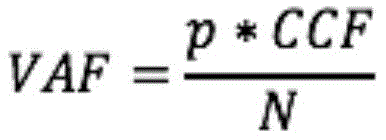
其中p是肿瘤纯度,且N是样品中所有细胞中该基因组基因座的平均拷贝数。p和N的估算值是由CNV调用器(如Canvas调用器(Illumina,Inc.))以肿瘤正常富集模式进行的。Canvas是一种算法,用于从(a)主要是二倍体生殖系的样品,或(b)来自相同个体的生殖系样品连同肿瘤样品中调用拷贝数变异。正常生殖系样品的绝大部分将是二倍体,即具有两个拷贝。然而,肿瘤样品可能被更广泛地重排。Canvas鉴定样品的基因组区域,其在基因组中存在0次、1次或多于两次。简言之,这是通过扫描基因组以查找具有非预期数量的短读取比对的区域来实现的。具有少于预期的数量的比对的区域被分类为损失。具有多于预期的数量的比对的区域被分类为增益。然后,使用该分析来估算个别基因座处的拷贝数变异。本技术不是使用整数拷贝数估算,而是使用标准化的覆盖率估算,其估算样品中所有细胞中该基因组基因座的平均拷贝数(N)。使用实值标准化的覆盖率的优势在于,这解决了其他技术中假定CNV的克隆性的缺陷。于是,只要初始假设成立,通过本技术产生的CCF估算值将对重叠克隆和亚克隆CNV的变体有效。where p is the tumor purity and N is the average copy number of this genomic locus in all cells in the sample. Estimates of p and N were performed by a CNV caller, such as the Canvas caller (Illumina, Inc.), in a tumor-normal enrichment pattern. Canvas is an algorithm for calling copy number variation from (a) primarily diploid germline samples, or (b) germline samples from the same individual along with tumor samples. The vast majority of normal germline samples will be diploid, ie with two copies. However, tumor samples may be more extensively rearranged. Canvas identifies genomic regions of a sample that are present 0, 1, or more than twice in the genome. Briefly, this is achieved by scanning the genome for regions with an unexpected number of short-read alignments. Regions with fewer than expected number of alignments were classified as losses. Regions with more than expected number of alignments were classified as gains. This analysis is then used to estimate copy number variation at individual loci. Rather than using integer copy number estimates, this technique uses a normalized coverage estimate, which estimates the average copy number (N) of this genomic locus in all cells in a sample. The advantage of using real-valued normalized coverage is that this addresses the deficiencies of other techniques that put the clonality of CNVs. Thus, CCF estimates generated by this technique will be valid for variants of overlapping clones and subcloned CNVs, as long as the initial assumptions hold.
当n>1时,通过本技术进行的CCF估算值可能会大于1。为避免这样的无意义的CCF估算值,将CCF估算值的上限设为1。因此,使用下式进行初始CCF估算:When n>1, the CCF estimate by this technique may be greater than 1. To avoid such meaningless CCF estimates, the upper limit of the CCF estimates is set to 1. Therefore, an initial CCF estimate is made using:

一旦估算初始的CCF值,即使用SciClone R包来基于它们的CCF对体细胞突变聚类。SciClone基于它们的VAF将体细胞变异聚类在CNV区之外。它使用变分贝叶斯混合模型进行聚类可允许同时聚类和推断簇的数量,并且相比其他方法所使用的随机马尔科夫链蒙特卡洛技术明显更有效。然而,本技术基于CCF(针对拷贝数标准化)而非VAF对体细胞变体聚类,这允许对与CNV重叠的体细胞变体聚类。SciClone还允许在相同肿瘤的单个样品内和多个样品中进行聚类。如本文中所提供的,可以使用多种不同的混合模型(包括二项、β或高斯混合模型)来实施聚类。这样的概率性聚类引起产生属于不同簇中的每个的单个序列变体(代表体细胞突变)的概率估算值的输出。在某些实施方案中,本技术将聚类后CCF估算值更新为每个簇中的体细胞突变的平均CCF和属于每个簇的突变的后验概率的线性组合。当使用二项混合模式进行聚类时,其取决于实际测序深度和可选等位基因的计数,以这样的方式调整可选的等位基因计数,使得其与CCF而非VAF一致(可选的计数=深度×ccf)。Once initial CCF values were estimated, the SciClone R package was used to cluster somatic mutations based on their CCF. SciClone clusters somatic variants outside of CNV regions based on their VAFs. It uses a variational Bayesian mixture model for clustering that allows simultaneous clustering and inference of the number of clusters, and is significantly more efficient than the stochastic Markov chain Monte Carlo technique used by other methods. However, the present technique clusters somatic variants based on CCF (normalized for copy number) rather than VAF, which allows clustering of somatic variants that overlap with CNVs. SciClone also allows clustering within a single sample and across multiple samples of the same tumor. As provided herein, clustering can be implemented using a variety of different mixture models, including binomial, beta, or Gaussian mixture models. Such probabilistic clustering results in an output producing probability estimates of individual sequence variants (representing somatic mutations) belonging to each of the different clusters. In certain embodiments, the present techniques update the post-cluster CCF estimate as a linear combination of the mean CCF of somatic mutations in each cluster and the posterior probability of mutations belonging to each cluster. When clustering using a binomial mixed mode, which depends on the actual sequencing depth and the count of alternative alleles, adjust the count of alternative alleles in such a way that it is consistent with CCF rather than VAF (optional count = depth × ccf).
技术问题和技术改进Technical Issues and Technical Improvements
为了有效治疗癌症,重要的是不仅要了解癌症潜在的突变,而且要了解突变的克隆结构。与癌症的克隆结构相关的多个参数可用于设计疗法。例如,癌细胞分数和亚克隆的数量是癌症克隆性的重要度量。确定这些参数的一种方法是使用单细胞测序方法来确定癌症样品中单个细胞的突变。基于单个细胞的遗传信息,可以确定癌细胞的克隆结构。然而,单细胞测序方法具有多种局限性。目前,单细胞测序的价格昂贵,且不能有效地进行来检查大量的癌细胞。并且当使用单细胞测序方法时,诸如等位基因信号丢失等技术挑战仍然存在。To effectively treat cancer, it is important to understand not only the underlying mutations of the cancer, but also the clonal structure of the mutations. Several parameters related to the clonal structure of cancer can be used to design therapies. For example, cancer cell fraction and the number of subclones are important measures of cancer clonality. One way to determine these parameters is to use single-cell sequencing methods to identify mutations in individual cells in a cancer sample. Based on the genetic information of individual cells, the clonal structure of cancer cells can be determined. However, single-cell sequencing approaches have several limitations. Currently, single-cell sequencing is expensive and cannot be performed efficiently to examine large numbers of cancer cells. And technical challenges such as loss of allelic signaling remain when single-cell sequencing approaches are used.
可以使用多个细胞的测序数据来直接测量癌症变体的变异等位基因频率。然而,直接测量变异等位基因频率并不能提供有关突变的某些克隆结构的信息。癌细胞分数(CCF)不仅与变异等位基因频率有关,而且还考虑了拷贝数变异和肿瘤纯度,提供了有关癌症突变的特性的更多信息。然而,单个突变的癌细胞分数具有有限的测序深度,这使得所观测或所测量的癌细胞分数嘈杂且不可靠。Variant allele frequencies of cancer variants can be directly measured using sequencing data from multiple cells. However, direct measurement of variant allele frequencies does not provide information about certain clonal structures of the mutation. Cancer cell fraction (CCF) is not only related to variant allele frequency, but also takes into account copy number variation and tumor purity, providing more information about the properties of cancer mutations. However, cancer cell fractions for single mutations have limited sequencing depth, which makes observed or measured cancer cell fractions noisy and unreliable.
观测的VAF或CCF是预期VAF或预期CCF的估算值。随着测序深度的增加,观测值变得更接近于预期值。因此,通过增加测序深度,可以增加观测值的可靠性。然而,这样的方法需要更多的时间、物质和成本来实现增加的测序深度。一些现有的方法试图通过汇总亚克隆中存在的突变的测量值来改善结果的可靠性。亚克隆的细胞应该具有相同的突变,并因此具有相同的CCF。然而,这些方法包括各种技术限制。例如,广泛使用的方法PyClone使用马尔科夫链蒙特卡洛(MCMC)模拟技术。然而,MCMC技术对计算的要求很高,并且依赖于关于引入不确定性的链会聚的假设。此外,该方法没有适当地考虑与突变部分重叠的拷贝数变异。The observed VAF or CCF is an estimate of the expected VAF or expected CCF. As the sequencing depth increases, the observed value becomes closer to the expected value. Therefore, by increasing the sequencing depth, the reliability of the observations can be increased. However, such methods require more time, material and cost to achieve increased sequencing depth. Some existing methods attempt to improve the reliability of results by aggregating measurements of mutations present in subclones. Subcloned cells should have the same mutation and therefore the same CCF. However, these methods include various technical limitations. For example, the widely used method PyClone uses the Markov Chain Monte Carlo (MCMC) simulation technique. However, MCMC techniques are computationally demanding and rely on assumptions about chain convergence that introduce uncertainty. Furthermore, the method does not properly account for copy number variation that partially overlaps with the mutation.
使用拷贝数来推断克隆性的其他方法通过简单假设肿瘤样品不具有亚克隆拷贝数事件而避免了计算开销。这样的假设常常是不真实的。一些方法简单地完全忽略了CNV和肿瘤纯度的影响,或者不处理与CNV重叠的体细胞突变。相反它们集中于确定哪些体细胞突变属于相同的亚克隆的问题,即聚类。这些现有的方法是不可取的,因为肿瘤内很大一部分的体细胞突变与CNV重叠。许多方法假定CNV是克隆性的。然而,如上文中所解释的,CNV并不总是克隆性的。Other approaches that use copy number to infer clonality avoid computational overhead by simply assuming that tumor samples do not have subclonal copy number events. Such assumptions are often untrue. Some approaches simply ignore the effects of CNVs and tumor purity entirely, or do not deal with somatic mutations that overlap with CNVs. Instead they focus on the problem of determining which somatic mutations belong to the same subclone, ie clustering. These existing approaches are undesirable because a large proportion of somatic mutations within tumors overlap with CNVs. Many methods assume that CNVs are clonal. However, as explained above, CNVs are not always clonal.
由广泛使用的工具PyClone进行的克隆性CNV假设的变化是CNV不一定是克隆性的,而是所有携带体细胞突变的细胞都受CNV影响,或都不受CNV影响。Roth等人,(2014),Nat Meth 11:396–398。换言之,它假设CNV不能仅影响一部分携带突变的细胞。该假设仍然不总是正确的,并且可能导致CCF或变异等位基因频率(VAF)估算值的不准确。A change in the assumption of clonal CNVs by the widely used tool PyClone is that CNVs are not necessarily clonal, but that all cells carrying somatic mutations are affected by CNVs, or none at all. Roth et al, (2014), Nat Meth 11:396-398. In other words, it assumes that CNVs cannot affect only a subset of cells that carry the mutation. This assumption is still not always correct and can lead to inaccurate estimates of CCF or variant allele frequency (VAF).
一种现有的方法SciClone使用变分混合模型来通过对VAF聚类并确定属于一个或多个簇的变体概率而确定变异等位基因频率。然而,SciClone的聚类不考虑在突变基因座处的平均拷贝数、变异等位基因的拷贝数或肿瘤纯度水平。Miller等人,(2014),PLoSComput Biol 10(8):e1003665。One existing method, SciClone, uses a variational mixture model to determine variant allele frequencies by clustering VAFs and determining the probability of variants belonging to one or more clusters. However, SciClone's clustering did not take into account the average copy number at the mutant locus, the copy number of the mutant allele, or the level of tumor purity. Miller et al, (2014), PLoS Comput Biol 10(8):e1003665.
随着受突变影响的癌细胞分数的增加(CCF),映射到突变基因座并展现该突变的预期的读取的分数(VAF)也增加。在当样品仅由肿瘤细胞组成,并且体细胞突变仅影响两个等位基因中的一个时的情况下,CCF简单地是预期的变异等位基因频率的两倍。然而,肿瘤样品不仅包括肿瘤细胞,而且也包括正常细胞。同样,拷贝数变异可以影响预期的VAF和CCF之间的关系。此外,CNV可以影响与体细胞突变相同的或不同的肿瘤或克隆的集合。它们有时影响携带突变的等位基因,且有时影响其他的等位基因。总之,预期的VAF和CCF之间的通用关系可书写为:As the fraction of cancer cells affected by the mutation (CCF) increases, so does the fraction of expected reads (VAF) that map to the mutated locus and exhibit the mutation. In the case when the sample consists only of tumor cells, and the somatic mutation affects only one of the two alleles, the CCF is simply twice the expected variant allele frequency. However, tumor samples include not only tumor cells but also normal cells. Likewise, copy number variation can affect the expected relationship between VAF and CCF. Furthermore, CNVs can affect a collection of tumors or clones that are the same or different from the somatic mutation. They sometimes affect the allele that carries the mutation, and sometimes other alleles. In summary, the expected general relationship between VAF and CCF can be written as:
其中p是肿瘤纯度,n是携带突变的细胞中该基因组基因座的突变拷贝的平均数,且N是样品中在所有细胞中的该基因组基因座的平均拷贝数。测量和聚类VAF的诸如SciClone的方法不充分地考虑肿瘤纯度或拷贝数变异。where p is the tumor purity, n is the average number of mutated copies of this genomic locus in cells carrying the mutation, and N is the average number of copies of this genomic locus in all cells in the sample. Methods such as SciClone that measure and cluster VAFs do not adequately account for tumor purity or copy number variation.
本公开的一些实施方案提供了用于估算CCF和评估癌细胞的克隆性,同时解决了现有方法的各种缺点的方法和系统。本公开的实施方案从亚克隆中的多个突变汇总信息以增加估算的CCF的可靠性。本公开的实施方案可以通过从相同亚克隆中的体细胞突变汇总数据而在不增加测序深度的情况下增加测量的准确性。无法预知哪些体细胞突变属于相同的肿瘤亚克隆或者在该肿瘤中可以发现多少亚克隆。本公开的实施方案使用聚类方法来基于它们的CCF对体细胞突变聚类。考虑到肿瘤纯度和突变变体以及突变基因座的拷贝数,所公开的实施方案对CCF而非VAF聚类。然后,所公开的实施方案基于突变所属的簇的CCF值的均值(或其他统计平均值)来确定突变的最终CCF。Some embodiments of the present disclosure provide methods and systems for estimating CCF and assessing the clonality of cancer cells while addressing various shortcomings of existing methods. Embodiments of the present disclosure aggregate information from multiple mutations in subclones to increase the reliability of the estimated CCF. Embodiments of the present disclosure can increase the accuracy of measurements without increasing sequencing depth by aggregating data from somatic mutations in the same subclone. It is not possible to predict which somatic mutations belong to the same tumor subclone or how many subclones can be found in that tumor. Embodiments of the present disclosure use clustering methods to cluster somatic mutations based on their CCFs. The disclosed embodiments cluster CCFs but not VAFs, taking into account tumor purity and copy number of mutant variants and mutant loci. The disclosed embodiments then determine the final CCF of the mutation based on the mean (or other statistical average) of the CCF values of the cluster to which the mutation belongs.
与PyClone不同,所公开的实施方案不依赖MCMC,从而减少了不确定性并提高了计算速度。在一些实施方案中,方法在几秒钟内即可实现并获得结果,而使用MCMC技术的现有方法则在7小时内获得结果。Unlike PyClone, the disclosed embodiment does not rely on MCMC, thereby reducing uncertainty and increasing computational speed. In some embodiments, methods are implemented and results are obtained within seconds, compared to 7 hours for existing methods using MCMC technology.
众所周知,MCMC需要大量的计算机存储器才能执行。所公开的不使用MCMC的方法可以大大减少执行任务所需的计算机存储器。It is well known that MCMC requires a large amount of computer memory to execute. The disclosed method that does not use MCMC can greatly reduce the computer memory required to perform tasks.
在在线出版物中,Guilhoto举例说明了使用MCMC分析的二维实例,如果将每个维划分为500个细分,则这将导致大小为5002=250000的状态空间,以及具有总共12500000000个项的跃迁矩阵。假设存储的每个项使用4个字节的存储器(不足的估算),这将意味着整个矩阵将需要250GB的存储器。对于n个维度(每个维度分为m个划分),所需的存储器量将为O(m2n)。这样的计算机存储器需求是资源需求性的。减少所需计算机存储器的一种应变方法是计算每次需要时的任何特定转换概率,而不是在存储器中存储所有值。然而,这进一步降低了程序速度。参见math.uchicago.edu/~may/REU2017/REUPapers/Guilhoto.pdf。In an online publication, Guilhoto illustrates a two-dimensional example of analysis using MCMC, if each dimension is divided into 500 subdivisions, this results in a state space of size 5002=250000, and a total of 12500000000 terms transition matrix. Assuming that each item stored uses 4 bytes of memory (insufficient estimate), this would mean that the entire matrix would require 250GB of memory. For n dimensions (each dimension is divided into m partitions), the amount of memory required will be O(m 2n ). Such computer memory requirements are resource-demanding. A strained approach to reducing the required computer memory is to calculate the probability of any particular transition each time it is needed, rather than storing all the values in memory. However, this further slows down the program. See math.uchicago.edu/~may/REU2017/REUPapers/Guilhoto.pdf.
因此,与现有的应用MCMC技术的方法(如PyClone)相比,所公开的不依赖MCMC的方法可以减少计算机存储器使用并提高计算速度。Therefore, the disclosed MCMC-independent method can reduce computer memory usage and increase computational speed compared to existing methods that apply MCMC technology, such as PyClone.
此外,本公开的各种实施方案可以考虑非克隆的CNV。即,其不会假定所有癌细胞都受CNV的影响,或都不受CNV的影响。同样,它们不假定携带体细胞突变的所有癌细胞都受CNV的影响,或都不受CNV的影响。In addition, various embodiments of the present disclosure may contemplate non-cloned CNVs. That is, it does not assume that all cancer cells are affected by CNV, or that none are affected by CNV. Likewise, they do not assume that all cancer cells carrying somatic mutations are affected by CNV, or none at all.
由于上述技术性能,所公开的实施方案可以实现对癌症的CCF和克隆性的更准确和更有效的估算。它们为各种样品提供了更一致的结果。在一些实施方案中,当使用多个样品时,CCF和克隆性的估算值将得到进一步提高。因为实施方案不需要MCMC,所以它们可以获得比使用MCMC技术的现有方法快5个数量级的结果。同样,与使用MCMC的现有方法相比,它们需要更少的计算机存储器。Due to the technical properties described above, the disclosed embodiments may enable more accurate and efficient estimation of the CCF and clonality of cancers. They provide more consistent results for a variety of samples. In some embodiments, estimates of CCF and clonality are further improved when multiple samples are used. Because the implementations do not require MCMC, they can achieve results that are 5 orders of magnitude faster than existing methods using MCMC techniques. Also, they require less computer memory than existing methods using MCMC.
估算癌细胞的CCF和克隆性Estimation of CCF and clonality of cancer cells
工作流程概述Workflow overview
(i)采集样品(i) Collection of samples
工作流程通过采集单个肿瘤样品开始。肿瘤可能包括非癌细胞,其可能包含或不包含体细胞突变。肿瘤样品还包括第一亚克隆变种或简称为亚克隆的癌细胞,其可能包括该亚克隆所特有的一个或多个体细胞突变,以及出现在其他亚克隆或创始克隆中的一个或多个突变。另外,样品可以包括除第一亚克隆外的一个或多个亚克隆的癌细胞。这些另外的亚克隆中的每种都可能具有其自身亚克隆所独有的一个或多个突变,以及它与一个或多个其他cyclones共有的一个或多个突变(例如,创始克隆的克隆突变)。某些突变可以在所有亚克隆中找到。这样的突变是克隆突变或生殖系突变。仅在亚克隆中发现的突变被认为是亚克隆。肿瘤中包括体细胞突变的癌细胞在所有癌细胞(即所有亚克隆)中所占的分数是肿瘤的重要性质。The workflow begins by taking a single tumor sample. Tumors may include noncancerous cells, which may or may not contain somatic mutations. Tumor samples also include a first subclone variant or simply a subclone of cancer cells, which may include one or more somatic mutations that are unique to that subclone, as well as one or more mutations that are present in other subclones or founding clones . Additionally, the sample may include one or more subclones of cancer cells in addition to the first subclone. Each of these additional subclones may have one or more mutations that are unique to its own subclone, as well as one or more mutations that it shares with one or more other cyclones (eg, the clonal mutation of the founder clone ). Certain mutations can be found in all subclones. Such mutations are clonal or germline mutations. Mutations found only in subclones were considered subclones. The fraction of all cancer cells (ie, all subclones) of cancer cells that include somatic mutations in a tumor is an important property of a tumor.
在一些实施方案中,样品包括从对象的组织获得的细胞DNA。在一些实施方案中,肿瘤样品包括在体液中循环且源自癌细胞的无细胞DNA(cfDNA)。In some embodiments, the sample includes cellular DNA obtained from the subject's tissue. In some embodiments, the tumor sample includes cell-free DNA (cfDNA) circulating in body fluids and derived from cancer cells.
注意,为了应用所公开的方法,假定在给定肿瘤细胞中存在至少两个体细胞突变。然而,单个样品可能包括一个或多个亚克隆。根据定义的单个变体意味着所述变体是克隆性的,并且样品中所有其他的细胞是非癌性的。Note that in order to apply the disclosed method, it is assumed that at least two somatic mutations are present in a given tumor cell. However, a single sample may include one or more subclones. A single variant by definition means that the variant is clonal and all other cells in the sample are non-cancerous.
本文中所公开的方法可以分析来自测试个体的一个或多个癌症样品。在一些实施方案中,分析多个样品提高了结果的准确性和有效性。The methods disclosed herein can analyze one or more cancer samples from a test individual. In some embodiments, analyzing multiple samples increases the accuracy and validity of the results.
用于所公开的过程的测试样品包括源自肿瘤细胞的DNA。它们可以是各种肿瘤样品,参见例如组织和流体样品。有关测试样品的进一步描述参见样品章节。Test samples for the disclosed procedures include DNA derived from tumor cells. They can be various tumor samples, see eg tissue and fluid samples. See the Samples section for a further description of the test samples.
(ii)从样品获得序列读取(ii) Obtaining sequence reads from the sample
工作流程涉及对测试样品测序,以提供含有体细胞突变的多个基因座中的每个基因座的覆盖率(读取计数或读取丰度)。可以使用测序方法章节中描述的各种测序技术。鉴定了癌症相关的等位基因和基因座的野生型等位基因。可以使用已知的变异体调用技术来鉴定这些基因座,以鉴定与癌症相关的变异(如SNP)。例如,可以按Ding等人(2012),Nature481:506–10中所述的使用用于调用变异的方法。Strelka2是报告目标变体的变异调用工具的另一个实例。The workflow involves sequencing test samples to provide coverage (read count or read abundance) for each of the multiple loci that contain somatic mutations. Various sequencing techniques described in the Sequencing Methods section can be used. Cancer-associated alleles and wild-type alleles of loci were identified. These loci can be identified using known variant calling techniques to identify variants (eg SNPs) associated with cancer. For example, the method for calling mutation can be used as described in Ding et al. (2012), Nature 481:506-10. Strelka2 is another instance of a mutation calling tool that reports target variants.
在一些实施方案中,鉴定了SNP突变。在其他实施方案中,鉴定了插入缺失突变。使用癌症变异等位基因和参照等位基因的序列读取计数,可以测量癌症变异等位基因中的变异等位基因频率(VAF)。然而,在该阶段无法预知变异是否来源于癌细胞的克隆或亚克隆。In some embodiments, SNP mutations are identified. In other embodiments, indel mutations are identified. Using sequence read counts of the cancer variant allele and the reference allele, the variant allele frequency (VAF) among the cancer variant alleles can be measured. However, at this stage it is impossible to predict whether the mutation originates from a clone or a subclone of the cancer cell.
(iii)从序列读取确定初始癌细胞分数(iCCF)(iii) Determination of initial cancer cell fraction (iCCF) from sequence reads
对于测序的和测量了其VAF的多个基因座中的每个基因座,将初始癌细胞分数(iCCF)计算为:For each of the multiple loci that were sequenced and for which VAF was measured, the initial cancer cell fraction (iCCF) was calculated as:
iCCF=(VAF*N)/(p*n)iCCF=(VAF*N)/(p*n)
其中N是该基因座处的平均拷贝数,p是样品的肿瘤纯度,并且n是突变变异等位基因的拷贝数。where N is the average copy number at this locus, p is the tumor purity of the sample, and n is the copy number of the mutant variant allele.
在该阶段,估计了分析中所考虑的体细胞突变的变异等位基因中的每个的iCCF。在一些实施方案中,为了估计癌细胞分数,进行了某些假设。在一些实施方案中,假设突变等位基因的平均拷贝数(n)为1。该假设适用于不与CNV重叠、与参照等位基因(不具有体细胞突变的等位基因)的拷贝数损失重叠,或者与参照等位基因的拷贝数增加重叠的所有体细胞变体。这是合理可接受的假设,因为相对于小变异,预期拷贝数变化很少见。At this stage, the iCCF for each of the variant alleles of somatic mutations considered in the analysis was estimated. In some embodiments, certain assumptions are made in order to estimate cancer cell fraction. In some embodiments, the average copy number (n) of the mutant allele is assumed to be one. This assumption applies to all somatic variants that do not overlap with the CNV, overlap with the copy number loss of the reference allele (allele without a somatic mutation), or overlap with the copy number gain of the reference allele. This is a reasonably acceptable assumption since copy number changes are expected to be rare relative to small variants.
在一些实施方案中,可以通过直接测量肿瘤纯度的实证方法确定肿瘤纯度值p。在其他的实施方案中,可以使用CNV调用工具(如Canvas)基于序列读取,确定p和/或N。参见Roller等人(2016),Bioinformatics,32(15),pp.2375–2377,其通过引用整体并入本文中以用于所有目的。In some embodiments, the tumor purity value p can be determined by an empirical method that directly measures tumor purity. In other embodiments, p and/or N can be determined based on sequence reads using a CNV calling tool such as Canvas. See Roller et al. (2016), Bioinformatics, 32(15), pp. 2375-2377, which is hereby incorporated by reference in its entirety for all purposes.
实施方案不需要N的整数拷贝数估算值,但需要估算样品中所有细胞中该基因组基因座的平均拷贝数的标准化的覆盖率估算值。使用标准化为覆盖率的实值的优势在于该方法避免了假设CNV的克隆性。于是,对于与克隆和亚克隆的CNV重叠的变异,只要上述初始的假设成立,则CCF估算值将成立。Embodiments do not require an integer copy number estimate for N, but rather a normalized coverage estimate that estimates the average copy number of that genomic locus in all cells in the sample. The advantage of using real values normalized to coverage is that this method avoids assuming the clonality of CNVs. Thus, for variants that overlap with cloned and subcloned CNVs, the CCF estimate will hold as long as the initial assumptions above hold.
在一些实施方案中,当N>1时,通过所公开的方法得出的iCCF估算值可能大于一个。为避免这样的结果,将iCCF估算值上限设为1。因此,使用下式进行iCCF估算。In some embodiments, the iCCF estimate derived by the disclosed method may be greater than one when N>1. To avoid such a result, the upper limit of the iCCF estimate is set to 1. Therefore, iCCF estimation is performed using the following equation.

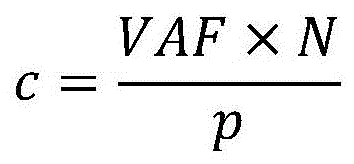
(iv)基于iCCF对体细胞突变聚类(iv) Clustering of somatic mutations based on iCCF
聚类是这样的过程,通过该过程,将多个不同的体细胞突变基于它们的iCCF分组到一个或多个簇中。然后,使用簇中的iCCF确定突变最终的CCF。iCCF的一个问题是由于各种错误来源,它们是真实CCF的嘈杂估算值。如果一组变异的iCCF形成簇,则可以推断出该组变异存在于相同的亚克隆或相同的亚克隆集合中。以此推断,簇中的该组变异的真实CCFs(与iCCF相反)应该是相同的。与变体的iCCF相比,聚类中iCCF的平均值或另一个中心估算值将是对簇中任何变体的真实CCF的更可靠的估算值。因此,使用聚类,可以更好地估算目标变体的癌细胞分数。在一些实施方案中,还可以估算产生iCCF的簇的亚克隆的数量。Clustering is the process by which multiple distinct somatic mutations are grouped into one or more clusters based on their iCCFs. Then, the mutant final CCF was determined using the iCCF in the cluster. A problem with iCCF is that they are noisy estimates of the true CCF due to various sources of errors. If a set of variant iCCFs form clusters, it can be inferred that the set of variants is present in the same subclone or the same collection of subclones. With this inference, the true CCFs (as opposed to iCCFs) of this set of variants in the cluster should be the same. The mean or another estimate of the center of the iCCF in the cluster will be a more reliable estimate of the true CCF of any variant in the cluster than the iCCF of the variant. Therefore, using clustering, the cancer cell fraction of the target variant can be better estimated. In some embodiments, the number of subclones that generate clusters of iCCFs can also be estimated.
所公开的实施方案使用变分贝叶斯混合模型进行聚类。该方法允许同时进行聚类和推断簇的数量。所公开的实施方案比通过诸如PyClone的传统方法所使用的随机MCMC技术更高效。所公开的实施方案基于CCF而非VAF对体细胞变异聚类。这允许实施方案对与CNV重叠的体细胞变异进行聚类。所公开的实施方案还允许在单个样品内以及在多个样品中进行聚类。可以使用各种不同的混合模型(包括二项、β或高斯混合模型)来进行聚类。这样的概率聚类提供了属于不同簇中的每个的一个或多个变异的后验概率估算值。这些概率可被用于计算突变的总体CCF。The disclosed embodiments use a variational Bayesian mixture model for clustering. This method allows for simultaneous clustering and inference of the number of clusters. The disclosed embodiments are more efficient than stochastic MCMC techniques used by traditional methods such as PyClone. The disclosed embodiments cluster somatic variants based on CCF rather than VAF. This allows embodiments to cluster somatic variants that overlap with CNVs. The disclosed embodiments also allow for clustering within a single sample as well as across multiple samples. Clustering can be performed using a variety of different mixture models, including binomial, beta, or Gaussian mixture models. Such probabilistic clusters provide estimates of the posterior probability of one or more variants belonging to each of the different clusters. These probabilities can be used to calculate the overall CCF of the mutation.
在一些模仿中,对iCCF聚类可以确定癌细胞中的多个亚克隆,其为癌症的临床相关特性。例如,一些具有大量亚克隆的癌症更具抗药性或更具恶性。In some simulations, clustering of iCCFs can identify multiple subclones in cancer cells, which are clinically relevant properties of cancer. For example, some cancers with a large number of subclones are more resistant or malignant.
(v)确定每种突变的最终CCF(fCCF)(v) Determine the final CCF (fCCF) for each mutation
fCCF是样品或对象中的突变的总体得分。根据突变属于一个或多个簇的概率以及簇中的平均CCF来计算突变的最终CCF。fCCF is the overall score for mutations in a sample or subject. The final CCF of the mutation is calculated based on the probability that the mutation belongs to one or more clusters and the average CCF in the cluster.
确定最终CCF的一个目标是确定在样品或对象中的所有癌细胞中,特定目标体细胞突变的普遍性。例如,已知特定体细胞突变与癌症形成和/或发展的特定机制相关。如果体细胞突变具有高的fCCF,则针对特定机制的癌症疗法可能会影响大部分的癌细胞,从而为癌症提供有效的治疗。由此,应该制定或启动癌症疗法。相反,如果体细胞突变具有低的fCCF,则针对特定机制的癌症疗法本身可能就不那么有效。由此,应该改变、终止癌症疗法,或将癌症疗法与其他疗法组合。One goal of determining the final CCF is to determine the prevalence of a specific target somatic mutation in all cancer cells in a sample or subject. For example, specific somatic mutations are known to be associated with specific mechanisms of cancer formation and/or progression. If somatic mutations have high fCCF, cancer therapies targeting specific mechanisms may affect a large proportion of cancer cells, providing an effective treatment for cancer. From this, cancer therapy should be developed or initiated. Conversely, if somatic mutations have low fCCF, cancer therapies targeting specific mechanisms may themselves be less effective. As such, cancer therapy should be altered, discontinued, or combined with other therapies.
例如,体细胞突变可以导致新抗原的产生。新抗原负荷是应答于对免疫检查点抑制剂的标志物。已表明,在非小细胞肺癌中,新抗原水平与抗P1疗法的功效呈正相关。参见Rizvi等人,Science,2015,348(6230):124–128。还参见McGranahan等人,Science,2016,351(6280):1463–1469。诸如在研究中使用的癌症疗法包括靶向与特定突变相关的新抗原的免疫疗法。如果突变的CCF值低并且新抗原是亚克隆性的,则疗法的针对亚克隆新抗原的免疫反应可能会影响较少部分的癌细胞并导致不良的治疗功效。For example, somatic mutations can lead to the production of neoantigens. Neoantigen burden is a marker of response to immune checkpoint inhibitors. It has been shown that in non-small cell lung cancer, neoantigen levels positively correlate with the efficacy of anti-P1 therapy. See Rizvi et al., Science, 2015, 348(6230):124-128. See also McGranahan et al., Science, 2016, 351(6280):1463-1469. Cancer therapies such as those used in research include immunotherapy that targets neoantigens associated with specific mutations. If the mutated CCF value is low and the neoantigen is subclonal, the immune response of the therapy against the subclonal neoantigen may affect a smaller fraction of cancer cells and lead to poor therapeutic efficacy.
(vi)使用CCF或亚克隆等位基因分布来确定癌症治疗(vi) Use of CCF or subclonal allele distribution to determine cancer therapy
一些实施方案使用变异CCF和/或亚克隆等位基因分布来确定亚克隆群体的抗原互补和/或针对所有亚克隆群体的治疗选择。在一些实施方案中,治疗选择可以基于突变的fCCF、亚克隆的平均CCF或亚克隆的数量。Some embodiments use variant CCF and/or subclonal allele distributions to determine antigenic complementation of subclonal populations and/or treatment selection for all subclonal populations. In some embodiments, treatment selection can be based on mutated fCCF, the average CCF of subclones, or the number of subclones.
确定癌细胞分数的示例性过程Exemplary Procedure for Determining Cancer Cell Fraction
图9显示的流程示意图示出了根据一些实施方案的用于确定癌细胞分数的过程100。使用包括一个或多个处理器和系统存储器的计算机系统实施过程100。过程100包括从对象获得至少一个测试样品。所述至少一个测试样品包括来自癌细胞的一个或多个亚克隆的核酸。参见框102。在一些实施方案中,所述至少一个测试样品包括两个或更多个测试样品。可以使用如下文的样品章节中进一步描述的各种样品和样品处理技术。FIG. 9 shows a schematic flow diagram illustrating a process 100 for determining a cancer cell fraction in accordance with some embodiments. Process 100 is implemented using a computer system including one or more processors and system memory. Process 100 includes obtaining at least one test sample from a subject. The at least one test sample includes nucleic acid from one or more subclones of cancer cells. See block 102 . In some embodiments, the at least one test sample includes two or more test samples. Various sample and sample processing techniques can be used as further described in the samples section below.
在一些实施方案中,过程包括从个体获得至少一个测试样品;从所述至少一个测试样品获得细胞DNA或无细胞DNA(cfDNA);以及对细胞DNA或cfDNA测序以产生序列读取。参见框104。在一些实施方案中,对核酸测序包括分离和/或扩增核酸。在一些实施方案中,对核酸测序包括全基因组测序。在其他实施方案中,对核酸测序包括靶向测序。可以使用如测序方法章节中所描述的各种测序方法。In some embodiments, the process includes obtaining at least one test sample from the individual; obtaining cellular DNA or cell-free DNA (cfDNA) from the at least one test sample; and sequencing the cellular DNA or cfDNA to generate sequence reads. See block 104 . In some embodiments, sequencing the nucleic acid includes isolating and/or amplifying the nucleic acid. In some embodiments, sequencing nucleic acids includes whole genome sequencing. In other embodiments, sequencing nucleic acids includes targeted sequencing. Various sequencing methods can be used as described in the Sequencing Methods section.
过程100还包括将序列读取与参照基因组比对以提供序列标签。参照基因组包括含有多种体细胞突变的多个基因座。序列标签是已与参照基因组比对并分配序列位置的序列读取。在一些实施方案中,所述多个体细胞突变包括选自以下的突变:单核苷酸变异(SNV)、插入缺失或以上的组合。参见框106。Process 100 also includes aligning the sequence reads to a reference genome to provide sequence tags. The reference genome includes multiple loci containing multiple somatic mutations. Sequence tags are sequence reads that have been aligned to a reference genome and assigned sequence positions. In some embodiments, the plurality of somatic mutations comprise mutations selected from the group consisting of single nucleotide variations (SNVs), indels, or combinations thereof. See block 106 .
过程100还涉及针对所述多个基因座中的每个基因座,确定基因座的覆盖率和基因座的变异等位基因频率(VAF)。基因座的覆盖率是与基因座比对的读取的数量(例如,计数或标准化的计数)。VAF是体细胞突变的变异等位基因的频率。参见框108。Process 100 also involves determining, for each of the plurality of loci, the coverage of the locus and the variant allele frequency (VAF) of the locus. The coverage of a locus is the number of reads (eg, counts or normalized counts) that align to the locus. VAF is the frequency of the variant allele of somatic mutations. See block 108 .
过程100还包括提供肿瘤纯度值(p),其为测试样品中肿瘤细胞在所有细胞中所占的分数。参见框110。过程100还包括针对所述多个基因座中的每个基因座,提供测试样品中所有细胞在该基因座处的所有等位基因的平均拷贝数(N)。参见框112。不同细胞的拷贝数可能不同。因此,平均拷贝数可能不是整数。在过程中可以确定包括多个基因座的区域的平均拷贝数。在这样的情况下,将该区域的拷贝数用作该基因座在该区域中的拷贝数。在一些实施方案中,使用序列读取估算肿瘤纯度值(p)。在一些实施方案中,使用序列读取估算等位基因的平均拷贝数(N)。可以使用各种技术,使用序列读取来估算肿瘤纯度和拷贝数。Process 100 also includes providing a tumor purity value (p), which is the fraction of all cells in the test sample that are tumor cells. See block 110 . Process 100 also includes, for each locus of the plurality of loci, providing an average copy number (N) of all alleles at that locus for all cells in the test sample. See block 112 . The copy number may vary from cell to cell. Therefore, the average copy number may not be a whole number. The average copy number of a region comprising multiple loci can be determined in the process. In such a case, the copy number of the region is used as the copy number of the locus in the region. In some embodiments, sequence reads are used to estimate tumor purity values (p). In some embodiments, the average copy number (N) of the allele is estimated using sequence reads. Sequence reads can be used to estimate tumor purity and copy number using various techniques.
图9示出了使用序列读取估算肿瘤纯度和拷贝数的过程。过程200涉及针对所述多个基因座中的每个基因座,测量测试样品的覆盖率和次等位基因频率(MAF)。参见框202。Figure 9 shows the process of estimating tumor purity and copy number using sequence reads.
过程200还涉及提供具有一组新的参数值的模型:候选二倍体覆盖率、候选肿瘤纯度(p)和候选拷贝数状态。二倍体覆盖率是样品的二倍体细胞的读取计数或丰度度量。候选拷贝数状态描述了等位基因及它们在基因组基因座处的拷贝数。利用这些参数值,可以根据以下关系确定预期的覆盖率和预期的MAF。
·倍性A:MAF 0·Ploidy A:
·倍性AB(正常):MAF 0.5Ploidy AB (normal): MAF 0.5
·倍性AA(拷贝中性的LOH):MAF 0Ploidy AA (copy-neutral LOH):
·倍性AAB:MAF 0.33333·Ploidy AAB:MAF 0.33333
·倍性AAA:MAF 0ploidy AAA:
·倍性AABB:MAF 0.5·Ploidy AABB:MAF 0.5
·倍性AAAB:MAF 0.25·Ploidy AAAB:MAF 0.25
·倍性AAAA:MAF 0ploidy AAAA:
·(等)·(Wait)
过程200包括根据上述关系,基于候选二倍体覆盖率、肿瘤纯度和拷贝数状态计算预期覆盖率和预期MAF。参见框206。
然后,过程200确定(a)和(b)之间的模型偏差:(a)框206中获得的预期覆盖率和预期MAF,以及(b)框202中获得的测量的覆盖率和测量的MAF。参见框208。The
过程200还涉及使用训练数据估算惩罚项值。参见框210。Roller等人,(2016),Bioinformatics,32(15),pp.2375–2377中描述了模型惩罚项的更多细节,其通过引用整体并入本文中,以用于所有目的。
过程200还涉及估算多克隆性误差,其涉及数据如何偏离对应于潜在的癌细胞亚克隆的簇。参见框212。在Roller等人中描述了多克隆性误差的更多细节。
然后,过程200评估是否要考虑更多模型。参见判定框214。如果是,则过程循环回到框204以提供具有一组新的参数值的下一模型。然后重复此过程,以确定下一模型的模型偏差、模型惩罚项和多克隆性误差。如果没有更多的模型要考虑,则过程200继续选择具有考虑208的模型偏差、210的模型惩罚项值以及框212的多克隆类比误差的最小总偏差的模型。参见框216。
之后,然后过程200涉及确定测试样品的肿瘤纯度(p)和拷贝数,作为所选择模型的肿瘤纯度和拷贝数。参见框218。Afterwards, then process 200 involves determining the tumor purity (p) and copy number of the test sample as the tumor purity and copy number of the selected model. See
回到图1,利用提供的变异等位基因频率(VAF)、肿瘤纯度值(p)和等位基因的平均拷贝数(N),过程100使用VAF、p和N为所述多个基因座中的每个基因座计算初始癌细胞分数(iCCF)。参见框114。癌细胞分数是在基因座处具有体细胞突变的癌细胞分数。该操作提供了多个基因座/突变的多个iCCF。在一些实施方案中,基于(VAF*N)/p计算iCCF。Returning to Figure 1, using the provided variant allele frequency (VAF), tumor purity value (p), and mean copy number of alleles (N), process 100 uses VAF, p, and N for the plurality of loci The initial cancer cell fraction (iCCF) was calculated for each locus in . See block 114 . Cancer cell fraction is the fraction of cancer cells with somatic mutations at the locus. This operation provides multiple iCCFs for multiple loci/mutations. In some embodiments, the iCCF is calculated based on (VAF*N)/p.
在一些患者中,iCCF的计算包括使用变异等位基因的拷贝数(n),以及VAF、p和N计算iCCF。在一些实施方案中,基于(VAF*N)/(p*n)计算iCCF。In some patients, the calculation of iCCF includes using the copy number (n) of the variant allele, as well as VAF, p, and N to calculate the iCCF. In some embodiments, the iCCF is calculated based on (VAF*N)/(p*n).
在一些实施方案中,在假设n为1的情况下来计算计算iCCF。在一些实施方案中,使用下式计算iCCF,其将iCCF值上线设为1。In some embodiments, iCCF is calculated assuming that n is one. In some embodiments, the iCCF is calculated using the following equation, which sets the iCCF value upper line to 1.
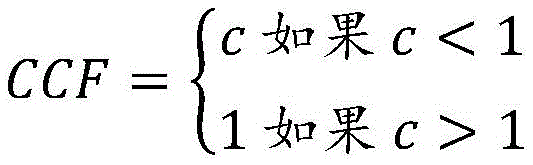
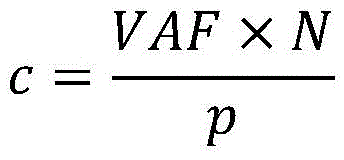
在一些实施方案中,所述多个体细胞突变中的一个或多个突变与一个或多个拷贝数变异(CNV)重叠。在一些实施方案中,过程不假定所有癌细胞都受CNV影响,或都不受CNV影响。换言之,CNV不一定为克隆性的。在这样的实施方案中,参数N并不总是整数。在一些实施方案中,过程不假定携带体细胞突变的所有癌细胞都受CNV影响,或都不受CNV影响。在这样的实施方案中,不同突变的参数n的值可能不同。In some embodiments, one or more of the plurality of somatic mutations overlap with one or more copy number variations (CNVs). In some embodiments, the process does not assume that all cancer cells are affected by CNV, or that none are affected by CNV. In other words, CNVs are not necessarily clonal. In such embodiments, the parameter N is not always an integer. In some embodiments, the process does not assume that all cancer cells carrying somatic mutations are affected by the CNV, or none are affected by the CNV. In such embodiments, the value of parameter n may be different for different mutations.
过程100还涉及对多个基因座的多个iCCF聚类,从而获得iCC的一个或多个簇。参见框116。在一些实施方案中,聚类包括确定属于一个或多个簇的每个突变的一个或多个后验概率。在一些实施方案中,聚类涉及使用混合模型来确定一个或多个簇。在一些实施方案中,混合模型包括变分贝叶斯混合模型。在一些实施方案中,聚类包括确定产生iCCF的多个簇的变异的多个亚克隆。Process 100 also involves clustering multiple iCCFs of multiple loci to obtain one or more clusters of iCCs. See block 116 . In some embodiments, clustering includes determining one or more posterior probabilities for each mutation belonging to one or more clusters. In some embodiments, clustering involves using a mixture model to determine one or more clusters. In some embodiments, the mixture model includes a variational Bayesian mixture model. In some embodiments, clustering includes identifying multiple subclones of variation that generate multiple clusters of iCCFs.
在一些实施方案中,混合模型包括两个或更多个亚克隆的变异等位基因计数的两种或更多种概率分布的混合,所述变异等位基因是突变变异的等位基因。在一些实施方案中,变异等位基因计数的每种概率分布是二项分布、β分布、高斯分布或以上的任意组合。在一些实施方案中,变异等位基因计数的每种概率分布是二项分布。在一些实施方案中,基于测序深度和iCCF计算变异等位基因计数。在一些实施方案中,将变异等位基因计数计算为:变异等位基因计数=深度×iCCF。In some embodiments, a mixture model includes a mixture of two or more probability distributions of counts for two or more subclones of variant alleles that are mutant variant alleles. In some embodiments, each probability distribution of variant allele counts is a binomial distribution, a beta distribution, a Gaussian distribution, or any combination thereof. In some embodiments, each probability distribution of variant allele counts is a binomial distribution. In some embodiments, variant allele counts are calculated based on sequencing depth and iCCF. In some embodiments, variant allele counts are calculated as: variant allele counts = depth x iCCF.
在一些实施方案中,变异的iCCF被建模为来自β分布的随机变量。在一些实施方案中,聚类不使用马尔科夫链蒙特卡洛(MCMC)方法。在一些实施方案中,可以使用图11中所描绘的过程实施框116的聚类。In some embodiments, the variant iCCF is modeled as a random variable from a beta distribution. In some embodiments, the clustering does not use a Markov Chain Monte Carlo (MCMC) method. In some embodiments, the clustering of block 116 may be implemented using the process depicted in FIG. 11 .
图11显示了对iCCF值聚类的过程300。过程300以使用聚类技术(如K-均值)聚类形成iCCF的初始聚类开始。参见框302。FIG. 11 shows a process 300 of clustering iCCF values. Process 300 begins by clustering to form an initial cluster of iCCFs using a clustering technique such as K-means. See block 302 .
然后,过程300涉及提供具有一组新的参数值的混合模型。所述混合模型是变分贝叶斯混合模型。参见框304。混合模型按如下将突变m的等位基因计数建模为来自簇k的二项分布的二项随机变量:Process 300 then involves providing a mixture model with a new set of parameter values. The mixture model is a variational Bayesian mixture model. See block 304 . The mixed model models the allele count of mutation m as a binomial random variable from a binomial distribution of cluster k as follows:
计数m~BN(x,qk)count m to BN(x,q k )
其中BN(,)表示二项分布,x是总等位基因计数,并且qk是簇k的变异等位基因在所有等位基因中所占的分数。参见框306。where BN(,) denotes the binomial distribution, x is the total allele count, and qk is the fraction of all alleles that the variant allele of cluster k occupies. See block 306 .
混合模型还按如下将突变m的iCCF建模为来自簇k的β分布的β随机变量:The mixed model also models the iCCF of mutation m as a beta random variable from the beta distribution of cluster k as follows:
iCCFm~β(uk,vk)iCCF m ~β(u k ,v k )
其中β表示β分布,且uk和vk是簇k的β分布的形状参数。参见框308。where β denotes the beta distribution, and uk and vk are the shape parameters of the beta distribution of cluster k. See block 308 .
过程300涉及按如下计算突变m的属于簇k的iCCF的概率:Process 300 involves calculating the probability of mutation m's iCCF belonging to cluster k as follows:

其中prm,k是突变m的属于簇k的概率;β(;)是簇k的β分布的概率密度函数;f是突变m的iCCF;并且Γ()是γ函数。参见框310。在该实施方案中,所述至少一个测试样品是一个样品。where pr m,k is the probability of mutation m belonging to cluster k; β(;) is the probability density function of the β distribution for cluster k; f is the iCCF of mutation m; and Γ() is the γ function. See block 310 . In this embodiment, the at least one test sample is a sample.
在其他的实施方案中,所述至少一个测试样品包括两个或更多个测试样品,并且属于簇的突变的概率被建模为:In other embodiments, the at least one test sample includes two or more test samples, and the probability of a mutation belonging to a cluster is modeled as:

其中uk和uv是S向量,其sth分量分别是uks和vks。where u k and u v are S-vectors whose s th components are u ks and v ks , respectively.
考虑到K(多维的)β分量的混合,实施方案使用K维潜在二元随机变量zn指示iCCFfn是否属于(znk=1)或不属于(znk=0)分量k,并满足1/K表达式,其中
iCCF属于分量k的边际概率p(znk=1)由其混合系数πk给出,The marginal probability p(z nk = 1) that iCCF belongs to component k is given by its mixing coefficient π k ,
p(znk=1)=πk p(z nk =1)= πk
受到以下概率限制:Subject to the following probability constraints:
0≤πk≤1 0≤πk≤1
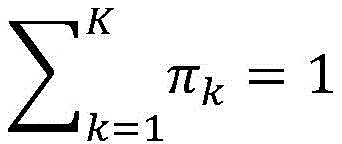
考虑到zn的1/K表达式,这可书写为:Considering the 1/K expression for z n , this can be written as:
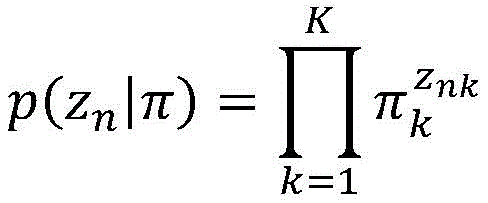
类似地,产生于混合的iCCF fn的条件分布p(fn|zn,U,V)可书写为:Similarly, the conditional distribution p(f n |z n ,U,V) resulting from the mixed iCCF f n can be written as:
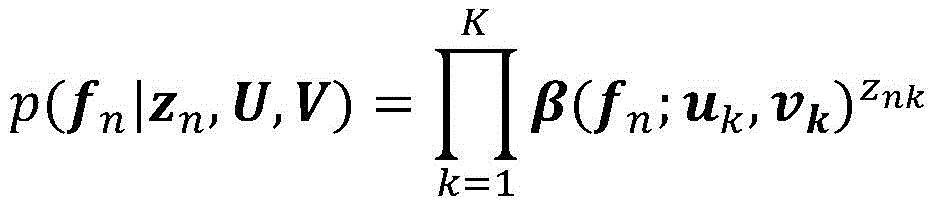
根据kthβ分量的形状参数向量uk和vk,集合参数为U≡{uk}和V≡{vk}。The set parameters are U≡{u k } and V≡{v k } according to the shape parameter vectors uk and v k of the k th β component.
聚类模型的更多细节参见Miller等人(2014),PLoS Comput Biol 10(8):e1003665,其通过引用整体并入本文中以用于所有目的。For more details on clustering models see Miller et al. (2014), PLoS Comput Biol 10(8):e1003665, which is hereby incorporated by reference in its entirety for all purposes.
过程300还涉及通过比较预期数据和观察数据来确定当前的混合模型是否收敛。参见框312。确定模型收敛的方法在Miller,et al.(2014)中有进一步的描述。参见框312。如果模型不收敛,则过程循环回到框304以提供具有一组新的参数值的下一混合模型,并计算iCCF的一组新的后验概率。如果模型收敛,则过程300继续进行至基于最佳模型而获得聚类和每种突变属于簇的概率。参见框314。Process 300 also involves determining whether the current mixture model is converged by comparing expected and observed data. See block 312 . Methods for determining model convergence are further described in Miller, et al. (2014). See block 312 . If the model does not converge, the process loops back to block 304 to provide the next mixture model with a new set of parameter values and compute a new set of posterior probabilities for iCCF. If the model converges, the process 300 proceeds to obtain clusters and the probability that each mutation belongs to the cluster based on the best model. See block 314.
回到图1,在一些实施方案中,框116的聚类允许确定细胞的簇或克隆的平均iCCF。在一些实施方案中,聚类允许确定产生iCCFs的聚类的多个亚克隆。在一些实施方案中,这些值描述了癌细胞的克隆结构,并且其可用于帮助设计如本文中其他地方所述的癌症疗法。Returning to Figure 1, in some embodiments, the clustering at block 116 allows for the determination of the average iCCF of a cluster or clone of cells. In some embodiments, clustering allows the determination of multiple subclones that generate clusters of iCCFs. In some embodiments, these values describe the clonal structure of cancer cells and can be used to aid in the design of cancer therapies as described elsewhere herein.
在获得聚类和后验概率后,过程100继续进行至使用一个或多个簇的iCCFs确定一个或多个体细胞突变的一个或多个最终癌细胞分数(fCCFs)。参见框118。在一些实施方案中,使用突变属于多个簇的后验概率和聚类的iCCFs的均值计算每个fCCFs。在一些实施方案中,将突变的fCCF计算为每个簇的体细胞突变的平均iCCF和突变属于每个簇的后验概率的线性组合。在一些实施方案中,将突变m的fCCF计算为:After obtaining the clusters and posterior probabilities, the process 100 proceeds to determine one or more final cancer cell fractions (fCCFs) for one or more somatic mutations using the iCCFs of the one or more clusters. See block 118 . In some embodiments, each fCCFs is calculated using the posterior probability that a mutation belongs to multiple clusters and the mean of the clustered iCCFs. In some embodiments, the fCCF of the mutation is calculated as a linear combination of the mean iCCF of the somatic mutation for each cluster and the posterior probability that the mutation belongs to each cluster. In some embodiments, the fCCF of mutation m is calculated as:
其中iCCFk是簇k的平均iCCF;且prm,k是突变m属于簇k的概率。where iCCF k is the average iCCF of cluster k; and pr m,k is the probability that mutation m belongs to cluster k.
在一些实施方案中,过程可以任选地还包括至少部分基于一个或多个fCCFs应用治疗方案。在一些实施方案中,应用治疗方案包括:将一个或多个体细胞突变的一个或多个fCCFs与一个或多个标准值或阈值比较;以及基于比较开具、启动和/或改变治疗方案。在一些实施方案中,治疗方案影响与一个或多个体细胞突变相关的生物通路。在一些实施方案中,治疗方案包括免疫治疗。In some embodiments, the process can optionally further include applying a therapeutic regimen based at least in part on the one or more fCCFs. In some embodiments, applying a treatment regimen includes: comparing the one or more somatically mutated one or more fCCFs to one or more standard values or thresholds; and prescribing, initiating, and/or changing a treatment regimen based on the comparison. In some embodiments, the therapeutic regimen affects biological pathways associated with one or more somatic mutations. In some embodiments, the treatment regimen includes immunotherapy.
样品sample
本文中使用的样品含有是细胞结合(例如,细胞DNA)或“无细胞”(例如,cfDNA)的核酸。可以从实体组织(例如骨和骨髓)、软组织(例如器官、肌肉、脂肪和皮肤)或体液(例如血液、血浆、血清、尿液、腹膜液、脑脊液、胸膜液和羊水)获得细胞DNA。可以通过本领域已知的多种方法从包括但不限于血浆、血清和尿液的生物样品中获得无细胞核酸(包括无细胞DNA)无细胞(参见,例如Fan等人,Proc Natl Acad Sci 105:16266-16271[2008];Koide等人,Prenatal Diagnosis 25:604-607[2005];Chen等人,Nature Med.2:1033-1035[1996];Lo等人,Lancet 350:485-487[1997];Botezatu等人,Clin Chem.46:1078-1084,2000;和Su等人,J Mol.Diagn.6:101-107[2004])。为了从样品中的细胞中分离无细胞DNA,可以使用各种方法,包括但不限于分级分离、离心(例如密度梯度离心)、DNA特异性沉淀或高通量细胞分选和/或其他分离方法。可获得用于cfDNA的手动和自动化分离的可商购获得的试剂盒(Roche Diagnostics,Indianapolis,IN,Qiagen,Valencia,CA,Macherey-Nagel,Duren,DE)。包含cfDNA的生物样品已被用于测定中,以通过可检测染色体非整倍性和/或各种多态性的测序测定方法来确定是否存在染色体异常(例如21三体)。As used herein, a sample contains nucleic acid that is cell-bound (eg, cellular DNA) or "cell-free" (eg, cfDNA). Cellular DNA can be obtained from solid tissues (eg, bone and bone marrow), soft tissues (eg, organs, muscle, fat, and skin), or body fluids (eg, blood, plasma, serum, urine, peritoneal fluid, cerebrospinal fluid, pleural fluid, and amniotic fluid). Cell-free nucleic acids (including cell-free DNA) cell-free (see, eg, Fan et al., Proc Natl Acad Sci 105) can be obtained from biological samples including, but not limited to, plasma, serum, and urine by a variety of methods known in the art. : 16266-16271 [2008]; Koide et al, Prenatal Diagnosis 25: 604-607 [2005]; Chen et al, Nature Med. 2: 1033-1035 [1996]; Lo et al, Lancet 350: 485-487 [ 1997]; Botezatu et al., Clin Chem. 46:1078-1084, 2000; and Su et al., J Mol. Diagn. 6:101-107 [2004]). To isolate cell-free DNA from cells in a sample, various methods can be used, including but not limited to fractionation, centrifugation (eg, density gradient centrifugation), DNA-specific precipitation or high-throughput cell sorting, and/or other separation methods . Commercially available kits for manual and automated isolation of cfDNA are available (Roche Diagnostics, Indianapolis, IN, Qiagen, Valencia, CA, Macherey-Nagel, Duren, DE). Biological samples containing cfDNA have been used in assays to determine the presence of chromosomal abnormalities (eg, trisomy 21) by sequencing assays that can detect chromosomal aneuploidy and/or various polymorphisms.
在各种实施方案中,可以在使用之前(例如,在制备测序文库之前)特异性或非特异性地富集样品中存在的DNA。样品DNA的非特异性富集是指样品基因组DNA片段的全基因组扩增,其可被用于在制备DNA测序文库之前增加样品DNA的水平。非特异性富集可以是包含多于一个基因组的样品中存在的两个基因组之一的选择性富集。例如,非特异性富集可以是选择血浆样品中的癌症基因组,其可以通过已知方法获得,以增加样品中癌症DNA与正常DNA的相对比例。可选地,非特异性富集可以是样品中存在的两个基因组的非选择性扩增。例如,非特异性扩增可以是样品中包含来自癌症基因组和正常基因组的DNA的混合物的癌症DNA和正常DNA的扩增。用于全基因组扩增的方法是本领域已知的。简并寡核苷酸引物PCR(DOP)、引物延伸PCR技术(PEP)和多置换扩增(MDA)是全基因组扩增方法的实例。在一些实施方案中,包含来自不同基因组的cfDNA的混合物的样品未富集该混合物中存在的基因组的cfDNA。在其他实施方案中,包含来自不同基因组的cfDNA的混合物的样品非特异性地富集了样品中存在的基因组中的任一种。In various embodiments, DNA present in a sample can be enriched specifically or non-specifically prior to use (eg, prior to preparation of a sequencing library). Nonspecific enrichment of sample DNA refers to whole genome amplification of sample genomic DNA fragments, which can be used to increase the level of sample DNA prior to preparation of DNA sequencing libraries. A non-specific enrichment can be a selective enrichment of one of the two genomes present in a sample containing more than one genome. For example, non-specific enrichment may be to select the cancer genome in a plasma sample, which can be obtained by known methods, to increase the relative proportion of cancer DNA to normal DNA in the sample. Alternatively, the non-specific enrichment can be the non-selective amplification of the two genomes present in the sample. For example, non-specific amplification can be amplification of cancer DNA and normal DNA in a sample comprising a mixture of DNA from the cancer genome and normal genome. Methods for whole genome amplification are known in the art. Degenerate oligonucleotide primer PCR (DOP), primer extension PCR technique (PEP) and multiple displacement amplification (MDA) are examples of whole genome amplification methods. In some embodiments, a sample comprising a mixture of cfDNA from different genomes is not enriched for genomic cfDNA present in the mixture. In other embodiments, a sample comprising a mixture of cfDNA from different genomes is non-specifically enriched for any of the genomes present in the sample.
包含本文中所述方法所应用的核酸的样品通常包含至少一种生物样品(“测试样品”),例如如上文所述的。在一些实施方案中,通过多种熟知的方法中的任一种纯化或分离待分析的核酸。A sample comprising nucleic acid to which the methods described herein are applied typically comprises at least one biological sample ("test sample"), eg, as described above. In some embodiments, the nucleic acid to be analyzed is purified or isolated by any of a variety of well-known methods.
因此,在某些实施方案中,样品包含纯化的或分离的多核苷酸,或由纯化的或分离的多核苷酸组成,或者它可以包含样品(如组织样品、生物流体样品、细胞样品等)。合适的生物流体样品包括但不限于:血液、血浆、血清、汗液、泪液、痰、尿液、痰、耳流出物、淋巴液、唾液、脑脊液、ravages、骨髓悬液、阴道流出物、经宫颈灌洗液、脑液、腹水、乳液、呼吸道分泌物、肠道和泌尿生殖道的分泌物、羊水、乳液和白细胞单采术(leukophoresis)样品。在一些实施方案中,样品是易于通过非侵入性程序获得的样品,例如血液、血浆、血清、汗液、泪液、痰、尿液、痰、耳流出物、唾液或粪便。在某些实施方案中,样品是外周血样品,或者是外周血样品的血浆和/或血清级分。在其他实施方案中,生物样品是拭子或涂片、活检标本或细胞培养物。在另一实施方案中,样品是两种或更多种生物样品的混合物,例如,生物样品可包含生物流体样品、组织样品和细胞培养样品中的两种或更多种。如本文中所用的,术语“血液”、“血浆”和“血清”明确涵盖其级分或处理的部分。类似地,在从活检、拭子、涂片等采集样品的情况下,“样品”明确涵盖来源于活检、拭子、涂片等的处理的级分或部分。Thus, in certain embodiments, a sample comprises, or consists of, purified or isolated polynucleotides, or it may comprise a sample (eg, a tissue sample, biological fluid sample, cell sample, etc.) . Suitable biological fluid samples include, but are not limited to: blood, plasma, serum, sweat, tears, sputum, urine, sputum, ear discharge, lymph, saliva, cerebrospinal fluid, ravages, bone marrow suspension, vaginal discharge, transcervical Lavage fluid, cerebral fluid, ascites fluid, emulsions, respiratory secretions, secretions from the intestinal and genitourinary tracts, amniotic fluid, emulsions and leukophoresis samples. In some embodiments, the sample is a sample readily obtained by non-invasive procedures, such as blood, plasma, serum, sweat, tears, sputum, urine, sputum, ear discharge, saliva, or feces. In certain embodiments, the sample is a peripheral blood sample, or a plasma and/or serum fraction of a peripheral blood sample. In other embodiments, the biological sample is a swab or smear, biopsy specimen or cell culture. In another embodiment, the sample is a mixture of two or more biological samples, eg, the biological sample may comprise two or more of a biological fluid sample, a tissue sample, and a cell culture sample. As used herein, the terms "blood", "plasma" and "serum" expressly encompass fractions or processed portions thereof. Similarly, where a sample is collected from a biopsy, swab, smear, etc., "sample" specifically encompasses a fraction or portion derived from the treatment of the biopsy, swab, smear, etc.
在某些实施方案中,可以从以下来源获得样品,包括但不限于:来自不同个体的样品、来自相同或不同个体不同发育阶段的样品、来自不同患病个体(例如,患有癌症或疑似患有遗传病症的个体)的样品、正常个体的样品、在个体疾病的不同阶段获得的样品、从经受不同疾病治疗的个体获得的样品、来自经受不同环境因素的个体的样品、来自具有病理易感体质的个体的样品、来自暴露至传染性病因子(例如,HIV)的个体的样品,等等。In certain embodiments, samples can be obtained from the following sources, including but not limited to: samples from different individuals, samples from different developmental stages of the same or different individuals, from different diseased individuals (eg, those with cancer or suspected samples from individuals with genetic disorders), samples from normal individuals, samples obtained at different stages of the disease of the individual, samples obtained from individuals subjected to treatments for different diseases, samples from individuals subjected to different environmental factors, samples from individuals with pathological susceptibility Samples from individuals who are constitutional, samples from individuals exposed to infectious agents (eg, HIV), and the like.
在某些实施方案中,也可以从体外培养的组织、细胞或其他含多核苷酸的来源获得样品。培养的样品可以取自以下来源,包括但不限于:在不同培养基和条件(例如,pH、压力或温度)下维持的培养物(例如,组织或细胞)、维持不同时长的培养物(例如,组织或细胞)、用不同因子或试剂(例如,候选药物或调节剂)处理的培养物(例如,组织或细胞),或者不同类型的组织和/或细胞的培养物。In certain embodiments, samples can also be obtained from in vitro cultured tissues, cells, or other polynucleotide-containing sources. Cultured samples can be obtained from sources including, but not limited to, cultures (eg, tissues or cells) maintained under different media and conditions (eg, pH, pressure, or temperature), cultures maintained for different periods of time (eg, , tissues or cells), cultures (eg, tissues or cells) treated with different factors or agents (eg, candidate drugs or modulators), or cultures of different types of tissues and/or cells.
从生物来源分离核酸的方法是众所周知的,并且将根据来源的性质而不同。本领域技术人员可以按照本文中所述方法所需要的容易地从来源中分离核酸。在一些情况下,将核酸样品中的核酸分子片段化可能是有利的。片段化可以是随机的,也可以是特异性的,如例如使用限制性核酸内切酶消化所实现的。用于随机片段化的方法是本领域熟知的,并且包括例如限制DNA酶消化、碱处理和物理剪切。在一个实施方案中,样品核酸是作为未被片段化的cfDNA获得的。Methods for isolating nucleic acids from biological sources are well known and will vary depending on the nature of the source. One of skill in the art can readily isolate nucleic acids from sources as required by the methods described herein. In some cases, it may be advantageous to fragment nucleic acid molecules in a nucleic acid sample. Fragmentation can be random or specific, as eg achieved using restriction endonuclease digestion. Methods for random fragmentation are well known in the art and include, for example, restriction DNase digestion, alkaline treatment, and physical shearing. In one embodiment, the sample nucleic acid is obtained as unfragmented cfDNA.
测序文库制备Sequencing library preparation
在一个实施方案中,本文中所描述的方法可以利用下一代测序技术(NGS),其允许在单个测序运行上将多个样品作为基因组分子(即单重测序)或作为包含索引基因组分子的合并样品(例如,多重测序)单独测序。这些方法可以产生多达数亿个DNA序列的读取。在各种实施方案中,可以使用例如本文中所述的下一代测序技术(NGS)来确定基因组核酸的序列和/或索引基因组核酸的序列。在各种实施方案中,可以使用如本文中所述的一个或多个处理器来执行使用NGS获得的大量序列数据的分析。In one embodiment, the methods described herein may utilize next-generation sequencing technology (NGS), which allows multiple samples to be processed on a single sequencing run as genomic molecules (ie, singleplex sequencing) or as a pool comprising indexed genomic molecules Samples (eg, multiplex sequencing) are sequenced individually. These methods can generate reads of up to hundreds of millions of DNA sequences. In various embodiments, next-generation sequencing (NGS) techniques, such as those described herein, can be used to determine the sequence of the genomic nucleic acid and/or to index the sequence of the genomic nucleic acid. In various embodiments, analysis of large amounts of sequence data obtained using NGS can be performed using one or more processors as described herein.
在各种实施方案中,使用这样的测序技术不涉及制备测序文库。In various embodiments, the use of such sequencing techniques does not involve preparing a sequencing library.
然而,在某些实施方案中,本文中包括的测序方法涉及制备测序文库。在一种说明性方法中,测序文库制备涉及产生准备好测序的适配子修饰的DNA片段(例如,多核苷酸)的随机集合。可以从DNA或RNA制备多核苷酸的测序文库,包括DNA或cDNA的等同物、类似物,例如与通过逆转录酶的作用从RNA模板产生的是互补DNA或复制DNA的DNA或cDNA。多核苷酸可以来源于双链形式(例如dsDNA,如基因组DNA片段、cDNA、PCR扩增产物等),或者在某些实施方案中,多核苷酸可以来源于单链形式(例如,ssDNA、RNA等),并已转换为dsDNA形式。通过举例说明的方式,在某些实施方案中,单链mRNA分子可被复制成适合用于制备测序文库的双链cDNA。原始多核苷酸分子的精确序列通常对文库制备方法无关紧要,并且可能是已知的或未知的。在一个实施方案中,多核苷酸分子是DNA分子。更具体地,在某些实施方案中,多核苷酸分子代表生物体的整个遗传互补物或实质上是生物体的整个遗传互补物,并且是基因组DNA分子(例如,细胞DNA、无细胞DNA(cfDNA)等),其通常包括内含子序列和外显子序列(编码序列),以及非编码调控序列(如启动子序列和增强子序列)。在某些实施方案中,原始多核苷酸分子包括人基因组DNA分子,例如存在于怀孕对象的外周血中的cfDNA分子。However, in certain embodiments, the sequencing methods encompassed herein involve preparing a sequencing library. In one illustrative method, sequencing library preparation involves generating a random collection of aptamer-modified DNA fragments (eg, polynucleotides) that are ready for sequencing. Sequencing libraries of polynucleotides can be prepared from DNA or RNA, including equivalents, analogs of DNA or cDNA, eg, DNA or cDNA that is complementary to DNA or replicating DNA produced from an RNA template by the action of reverse transcriptase. Polynucleotides can be derived from double-stranded form (eg, dsDNA, such as genomic DNA fragments, cDNA, PCR amplification products, etc.), or in certain embodiments, polynucleotides can be derived from single-stranded form (eg, ssDNA, RNA etc.), and have been converted to dsDNA form. By way of illustration, in certain embodiments, single-stranded mRNA molecules can be replicated into double-stranded cDNAs suitable for use in preparing sequencing libraries. The exact sequence of the original polynucleotide molecule is generally not critical to the library preparation method and may or may not be known. In one embodiment, the polynucleotide molecule is a DNA molecule. More specifically, in certain embodiments, a polynucleotide molecule represents or is substantially the entire genetic complement of an organism, and is a genomic DNA molecule (e.g., cellular DNA, cell-free DNA ( cfDNA), etc.), which typically include intronic and exonic sequences (coding sequences), as well as non-coding regulatory sequences (eg, promoter sequences and enhancer sequences). In certain embodiments, the original polynucleotide molecule comprises a human genomic DNA molecule, eg, a cfDNA molecule present in the peripheral blood of a pregnant subject.
通过使用包含特定范围片段大小的多核苷酸,可以为一些NGS测序平台的测序文库的制备提供便利。这样的文库的制备通常涉及将大的多核苷酸(例如,细胞基因组DNA)片段化以获得所需大小范围的多核苷酸。Preparation of sequencing libraries for some NGS sequencing platforms can be facilitated by the use of polynucleotides comprising a specific range of fragment sizes. Preparation of such libraries typically involves fragmenting large polynucleotides (eg, cellular genomic DNA) to obtain polynucleotides in a desired size range.
可以通过本领域技术人员已知的多种方法中的任何一种来实现片段化。例如,可以通过机械方式来实现片段化,包括但不限于:雾化、超声处理和水力剪切。然而,机械片段化通常在C-O、P-O和C-C键处切割DNA骨架,导致产生具有破坏的C-O、P-O和/C-C键的平端和3’突出端和5’突出端的异质混合物(参见,例如Alnemri和Liwack,J Biol.Chem265:17323-17333[1990];Richards和Boyer,J Mol Biol 11:327-240[1965]),由于它们可能缺少随后的酶促反应(例如制备测序DNA所需的测序适配子的连接)所必需的5’-磷酸,因此其可能需要进行修复。Fragmentation can be accomplished by any of a variety of methods known to those skilled in the art. For example, fragmentation can be achieved by mechanical means including, but not limited to, atomization, sonication, and hydraulic shearing. However, mechanical fragmentation typically cleaves the DNA backbone at C-O, P-O, and C-C bonds, resulting in blunt ends with disrupted C-O, P-O, and /C-C bonds and a heterogeneous mixture of 3' and 5' overhangs (see, e.g., Alnemri and Liwack, J Biol. Chem 265:17323-17333 [1990]; Richards and Boyer, J Mol Biol 11:327-240 [1965]), since they may lack subsequent enzymatic reactions (such as the sequencing required to prepare sequenced DNA 5'-phosphate necessary for adaptor ligation), so it may need to be repaired.
相反,cfDNA通常作为少于约300个碱基对的片段存在,并因此,使用cfDNA样品生成cDNA文库通常不需要片段化。In contrast, cfDNA typically exists as fragments of less than about 300 base pairs, and thus, fragmentation is generally not required to generate cDNA libraries using cfDNA samples.
通常,无论多核苷酸是被强制片段化(例如,体外片段化),还是作为片段天然存在,它们都将被转化为具有5’-磷酸和3’-羟基的平末端DNA。标准方案(例如,使用例如如本文中其他地方所述的Illumina平台的测序方案)指导用户对样品DNA进行末端修复、在dA加尾之前纯化末端修复的产物,以及在文库制备的适配子连接步骤之前纯化dA加尾的产物。Generally, polynucleotides will be converted to blunt-ended DNA with 5'-phosphate and 3'-hydroxyl groups, whether they are forcibly fragmented (eg, fragmented in vitro), or naturally occurring as fragments. Standard protocols (eg, using sequencing protocols such as those of the Illumina platform as described elsewhere herein) instruct the user to end-repair sample DNA, purify end-repaired products prior to dA-tailing, and adaptor ligation during library preparation The dA-tailed product was purified prior to the step.
本文所述的序列文库制备方法的各种实施方案消除了执行通常由标准方案强制执行的一个或多个步骤以获得可被NGS测序的修饰的DNA产物的需要。缩写方法(ABB法)、1步法和2步法是制备测序文库的方法的实例,这些方法可以在2012年7月20日递交的第13/555,037号专利申请中找到,其通过引用整体并入本文中。Various embodiments of the sequence library preparation methods described herein eliminate the need to perform one or more steps typically enforced by standard protocols to obtain modified DNA products that can be sequenced by NGS. The Abbreviated Method (ABB method), 1-step method, and 2-step method are examples of methods for preparing sequencing libraries, which can be found in patent application Ser. No. 13/555,037, filed on July 20, 2012, which is incorporated by reference in its entirety. into this article.
测序方法Sequencing method
如上文所示的,对制备的样品(例如,测序文库)测序,作为估算癌症样品的CCF程序的一部分。可以利用多种测序技术中的任何一种。As indicated above, prepared samples (eg, sequencing libraries) are sequenced as part of the CCF procedure for estimating cancer samples. Any of a variety of sequencing techniques can be utilized.
如下文所述的,一些测序技术可商购获得,如来自Affymetrix公司(森尼维尔市,CA)的边杂交边测序平台和来自454Life Sciences(布拉德福德,CT)的边合成边测序平台、Illumina/Solexa(海沃德,CA)和Helicos Biosciences(剑桥,MA),以及来自AppliedBiosystems(福斯特城,CA)的边连接边测序平台。除了使用Helicos Biosciences的边合成边测序进行的单分子测序外,其他单分子测序技术包括但不限于:Pacific Biosciences的SMRTTM技术、离子激流TM(ION TORRENTTM)技术和例如由Oxford Nanopore Technologies开发的纳米孔测序。As described below, several sequencing technologies are commercially available, such as the Sequencing by Hybridization platform from Affymetrix Corporation (Sunnyvale, CA) and the Sequencing by Synthesis from 454Life Sciences (Bradford, CT) platforms, Illumina/Solexa (Hayward, CA) and Helicos Biosciences (Cambridge, MA), and a sequencing-by-ligation platform from Applied Biosystems (Foster City, CA). In addition to single-molecule sequencing using Helicos Biosciences' Sequencing-by-Synthesis, other single-molecule sequencing technologies include, but are not limited to: Pacific Biosciences' SMRT ™ technology, ION TORRENT™ technology and, for example, developed by Oxford Nanopore Technologies Nanopore sequencing.
尽管自动化的Sanger方法被视为“第一代”技术,但在本文中所述的方法中也可以采用包括自动化的Sanger测序的Sanger测序。另外的合适的测序方法包括但不限于核酸成像技术,例如原子力显微镜(AFM)或透射电子显微镜(TEM)。将在下文中更详细地描述示例性的测序技术。Although automated Sanger methods are considered "first generation" technologies, Sanger sequencing including automated Sanger sequencing can also be employed in the methods described herein. Additional suitable sequencing methods include, but are not limited to, nucleic acid imaging techniques such as atomic force microscopy (AFM) or transmission electron microscopy (TEM). Exemplary sequencing techniques are described in more detail below.
在一个说明性但非限制性的实施方案中,本文中所描述的方法包括使用Illumina的边合成边测序和基于可逆终止子的测序化学过程(例如,如Bentley等人,Nature 6:53-59[2009]中所述的),获得测试样品中的核酸的序列信息,例如,筛查癌症的对象中的cfDNA或细胞DNA等。模板DNA可以是基因组DNA,例如细胞DNA或cfDNA。在一些实施方案中,将来自分离的细胞的基因组DNA用作模板,并将其片段化为数百个碱基对的长度。在其他实施方案中,使用cfDNA作为模板,并且由于cfDNA以短片段存在,因此不需要片段化。循环肿瘤DNA以短片段存在,其大小分布在约150-170bp处达到峰值。Illumina的测序技术依赖于将片段化的基因组DNA连接到一个平的、光学透明的表面上,该表面上结合了寡核苷酸锚。对模板DNA进行末端修复,以生成5’-磷酸化的平末端,并将使用Klenow片段的聚合酶活性来在平的磷酸化的DNA片段的3’端添加单个A碱基。该添加使DNA片段准备好连接至寡核苷酸适配子,所述寡核苷酸适配子在其3’端具有单个T碱基的突出,以提高连接效率。适配子寡核苷酸与流通池锚定寡核苷酸互补(不要与重复扩增分析中的锚/锚定读取混淆)。在有限稀释条件下,将适配子修饰的单链模板DNA加入到流通池中,并通过与锚定寡核苷酸杂交来固定。将连接的DNA片段延伸并桥联扩增,以创建具有数亿个簇的超高密度流通池,每个簇含有约1,000个相同模板的拷贝。在一个实施方案中,在它经受簇扩增之前,使用PCR对随机片段化的基因组DNA进行扩增。可选地,使用无扩增(例如,无PCR)的基因组文库制备物,并且仅使用簇扩增来富集随机片段化的基因组DNA(Kozarewa等人,Nature Methods 6:291-295[2009])。使用强大的四色DNA边合成边测序技术对模板测序,该技术采用带有可移除的荧光染料的可逆终止子。使用激光激发和全内反射光学器件实现高灵敏度的荧光检测。将约数十至几百个碱基对的短序列读取与参照基因组进行比对,并使用专门开发的数据分析管线软件鉴定短序列读取到参照基因组的独特映射。第一次读取完成后,可以原位再生模板,以从片段的另一端进行第二次读取。因此,可以使用DNA片段的单端测序或配对端测序。In an illustrative but non-limiting embodiment, the methods described herein include the use of Illumina's sequencing-by-synthesis and reversible terminator-based sequencing chemistries (eg, as in Bentley et al., Nature 6:53-59 [2009]) to obtain sequence information for nucleic acids in test samples, e.g., cfDNA or cellular DNA in subjects screened for cancer. Template DNA can be genomic DNA, such as cellular DNA or cfDNA. In some embodiments, genomic DNA from an isolated cell is used as a template and fragmented to hundreds of base pairs in length. In other embodiments, cfDNA is used as a template, and since cfDNA exists in short fragments, fragmentation is not required. Circulating tumor DNA exists as short fragments with a size distribution peaking at approximately 150-170 bp. Illumina's sequencing technology relies on ligating fragmented genomic DNA to a flat, optically clear surface to which oligonucleotide anchors are bound. The template DNA is end repaired to generate 5'-phosphorylated blunt ends, and the polymerase activity of the Klenow fragment will be used to add a single A base to the 3' end of the blunt phosphorylated DNA fragment. This addition prepares the DNA fragment for ligation to an oligonucleotide adaptor with a single T base overhang at its 3' end to improve ligation efficiency. Adaptor oligonucleotides are complementary to flow cell anchor oligonucleotides (not to be confused with anchor/anchor reads in repeat amplification assays). Under limiting dilution conditions, aptamer-modified single-stranded template DNA is added to the flow cell and immobilized by hybridization to anchor oligonucleotides. The ligated DNA fragments are extended and bridge-amplified to create ultra-dense flow cells with hundreds of millions of clusters, each containing approximately 1,000 copies of the same template. In one embodiment, the randomly fragmented genomic DNA is amplified using PCR before it is subjected to cluster amplification. Alternatively, an amplification-free (eg, PCR-free) genomic library preparation is used, and only cluster amplification is used to enrich for randomly fragmented genomic DNA (Kozarewa et al., Nature Methods 6:291-295 [2009] ). Templates are sequenced using a powerful four-color DNA sequencing-by-synthesis technology that employs reversible terminators with removable fluorescent dyes. High sensitivity fluorescence detection is achieved using laser excitation and total internal reflection optics. Short reads of about tens to hundreds of base pairs are aligned to the reference genome and unique mappings of the short reads to the reference genome are identified using specially developed data analysis pipeline software. After the first read is complete, the template can be regenerated in situ for a second read from the other end of the fragment. Therefore, single-end sequencing or paired-end sequencing of DNA fragments can be used.
本公开的各种实施方案可以使用允许配对末端测序的边合成边测序。在一些实施方案中,Illumina的边合成边测序平台涉及对片段聚类。聚类是其中每个片段分子均被等温扩增的过程。在一些实施方案中,如此处所述的实例,片段在所述片段两端连接有两个不同的适配子,所述适配子允许片段与流通池通道表面上的两种不同的寡核苷酸杂交。片段在所述片段的两端还包括索引序列或连接有两个索引序列,所述索引序列提供标签以鉴定多重测序中的不同样品。在一些测序平台上,待测序的片段也被称为插入片段。Various embodiments of the present disclosure may use sequencing-by-synthesis that allows paired-end sequencing. In some embodiments, Illumina's sequencing-by-synthesis platform involves clustering fragments. Clustering is a process in which each fragment molecule is isothermally amplified. In some embodiments, as exemplified herein, the fragment has two different adapters attached at both ends of the fragment that allow the fragment to interact with two different oligos on the surface of the flow cell channel nucleotide hybridization. Fragments also include or have two index sequences joined at both ends of the fragment that provide tags to identify different samples in multiplexed sequencing. On some sequencing platforms, the fragment to be sequenced is also referred to as an insert.
在一些实施方案中,在Illumina平台中用于聚类的流通池是具有通道的载玻片。每个通道是包被有两种类型寡核苷酸坪(lawn)的玻璃通道。表面上的两种类型的寡核苷酸中的第一种使杂交成为可能。该寡核苷酸与片段一端上的第一适配子互补。聚合酶产生杂交片段的互补链。将双链分子变性,并洗掉原来的模板链。剩余的链与许多其他剩余的链同时通过桥联扩增而被克隆扩增。In some embodiments, the flow cells used for clustering in the Illumina platform are slides with channels. Each channel is a glass channel coated with two types of oligonucleotide lawns. The first of two types of oligonucleotides on the surface enables hybridization. The oligonucleotide is complementary to the first adaptor on one end of the fragment. The polymerase produces complementary strands of the hybridized fragments. The double-stranded molecule is denatured and the original template strand is washed away. The remaining strands are clonally amplified by bridge amplification at the same time as many other remaining strands.
在桥联扩增中,链折叠,并且链第二端上的第二适配子区域与流通池表面上的第二种类型的寡核苷酸杂交。聚合酶产生互补链,形成双链桥联分子。将该双链分子变性,从而导致两个单链分子通过两种不同的寡核苷酸拴接到流通池。然后一遍又一遍地重复该过程,并且数百万个簇同时发生,导致所有片段的克隆扩增。桥联扩增后,将反链切割并冲洗掉,仅留下正链。将3’端封闭以防止不需要的引发。In bridged amplification, the strands are folded and the second adaptor region on the second end of the strand hybridizes to a second type of oligonucleotide on the surface of the flow cell. The polymerase generates complementary strands, forming double-stranded bridged molecules. The double-stranded molecule is denatured, resulting in two single-stranded molecules tethered to the flow cell by two different oligonucleotides. This process is then repeated over and over, and millions of clusters occur simultaneously, resulting in clonal expansion of all fragments. After bridging amplification, the reverse strand is cleaved and washed away, leaving only the positive strand. The 3' end was blocked to prevent unwanted priming.
聚类后,以延伸第一测序引物来产生第一读取而开始测序。在每个循环中,荧光标记的核苷酸竞争添加到生长链中。基于模板的序列仅掺入一个。在添加每个核苷酸后,簇被光源激发,并发射出特征性的荧光信号。循环数决定了读取的长度。发射波长和信号强度决定了碱基检出率。对于给定的簇,同时读取所有相同的链。以大规模并行的方式对数以亿计的簇测序。在第一次读取完成后,将读取产物冲洗掉。After clustering, sequencing begins by extending the first sequencing primer to generate the first read. In each cycle, fluorescently labeled nucleotides compete for addition to the growing chain. Template-based sequences incorporate only one. After each nucleotide is added, the clusters are excited by the light source and emit characteristic fluorescent signals. The number of loops determines the length of the read. The emission wavelength and signal strength determine the base calling rate. For a given cluster, all identical strands are read simultaneously. Sequence hundreds of millions of clusters in a massively parallel fashion. After the first read is complete, the read product is rinsed away.
在涉及两种索引引物的方案的下一步骤中,引入索引1引物并将其与模板上的索引1区域杂交。索引区域提供了片段的标识,这对于在多重测序过程中将样品解多重很有用。索引1读取的产生类似于第一读取。在完成索引1的读取后,将读取的产品冲洗掉,并将链的3’端去保护。然后,模板链折叠并与流通池上的第二寡核苷酸结合。以与索引1相同的方式读取索引2序列。然后在该步骤完成时冲洗掉索引2读取产物。In the next step of the protocol involving both index primers, the
读取两个索引后,通过使用聚合酶延伸第二流通池寡核苷酸来启动读取2,从而形成双链桥。将该双链DNA变性,并将3’端封闭。将原来的正链切割并冲洗掉,留下反链。以引入读取2测序引物开始读取2。与读取1一样,重复测序步骤,直到达到所期望的长度。将读取2产物冲洗掉。该整个过程产生数百万个代表所有片段的读取。基于样品制备期间中引入的独特索引分离来自合并样品文库的序列。对于每个样品,将具有相似延伸的碱基调用的读取局部聚类。将正向和反向读取配对以产生连续的序列。将这些连续的序列与参照基因组比对以进行变异鉴定。After reading both indices, read 2 is initiated by extending the second flow cell oligonucleotide with a polymerase, thereby forming a double-stranded bridge. The double-stranded DNA was denatured, and the 3' end was blocked. The original positive strand is cut and washed away, leaving the reverse strand. Begin read 2 with the introduction of the
上述的边合成边测序实例涉及配对末端读取,其被用于所公开的方法的许多实施方案中。配对末端测序涉及来自片段两端的两个读取。当将一对读取映射到参照序列时,可以确定两个读取之间的碱基对距离,然后可以将所述距离用于确定从中获得读取的片段的长度。在一些情况下,跨两个堆栈段的片段的配对末端读取中的一个将与一个堆栈段比对,且另一个将与相邻的堆栈段比对。随着堆栈段变长或读取变短,这种情况变得越来越少。可以使用各种方法来解释这些片段的堆栈段成员。例如,在确定堆栈段的片段大小频率中可以将它们省略;可以针对两个相邻的堆栈段来对它们计数;可以将它们分配给涵盖两个堆栈段的大量碱基对的堆栈段;或者可以将它们分配给具有与每个堆栈段中的碱基对的一部分相关的权重的两个堆栈段。The sequencing-by-synthesis examples described above involve paired-end reads, which are used in many embodiments of the disclosed methods. Paired-end sequencing involves two reads from both ends of the fragment. When mapping a pair of reads to a reference sequence, the base pair distance between the two reads can be determined, which can then be used to determine the length of the fragment from which the reads were obtained. In some cases, one of the paired-end reads of fragments spanning two stack segments will align with one stack segment and the other will align with an adjacent stack segment. This becomes less and less as stack segments get longer or reads get shorter. The stack segment members of these fragments can be interpreted using various methods. For example, they may be omitted in determining the fragment size frequency of stack segments; they may be counted against two adjacent stack segments; they may be assigned to stack segments that span a large number of base pairs of two stack segments; or They can be assigned to two stack segments with weights associated with a portion of the base pairs in each stack segment.
配对末端读取可以使用不同长度的插入片段(即待测序的不同片段大小)。作为本公开中的默认方式,配对末端读取被用来指从各种插入长度获得的读取。在一些情况下,为了区分短插入配对末端读取和长插入配对末端读取,后者也称为双端读取(mate pairreads)。在涉及双端读取的一些实施方案中,首先将两个生物素连接适配子连接到相对较长插入片段(例如,几kb)的两端。然后,生物素连接适配子将插入片段的两端连接起来,形成一个环状分子。然后可以通过将环状分子进一步片段化来获得包含生物素连接适配子的亚片段。然后可以通过与上述短插入配对末端测序相同的程序对包括相反序列顺序的原始片段两端的亚片段进行测序。使用Illumina平台进行的双端测序的更多细节显示在以下URL的在线出版物中(其通过引用整体并入本文中):res|.|illumina|.|com/documents/products/technotes/technote_nextera_matepair_data_processing。关于配对末端测序的另外的信息可以在第7601499号美国专利和第2012/0,053,063号美国专利公开中找到,其通过关于有关配对末端测序方法和设备的物质的引用而被并入本文中。Paired-end reads can use inserts of different lengths (ie, different fragment sizes to be sequenced). By default in this disclosure, paired-end reads are used to refer to reads obtained from various insertion lengths. In some cases, the latter are also referred to as mate pair reads in order to distinguish short insertion paired-end reads from long insertion paired-end reads. In some embodiments involving paired-end reads, two biotin ligation adapters are first ligated to both ends of a relatively long insert (eg, several kb). Then, a biotin ligation adapter joins the two ends of the insert to form a circular molecule. Subfragments containing biotin-linked adaptors can then be obtained by further fragmenting the circular molecule. The subfragments including both ends of the original fragment in reverse sequence order can then be sequenced by the same procedure as described above for short insert paired-end sequencing. Further details of paired-end sequencing using the Illumina platform are shown in an online publication at the following URL (which is incorporated herein by reference in its entirety): res|.|illumina|.|com/documents/products/technotes/technote_nextera_matepair_data_processing. Additional information regarding paired-end sequencing can be found in US Patent No. 7,601,499 and US Patent Publication No. 2012/0,053,063, which are incorporated herein by reference for materials related to paired-end sequencing methods and apparatus.
在DNA片段测序之后,将预定长度(例如100bp)的序列读取映射或比对到已知的参照基因组。映射或比对的读取及其在参照序列上的对应位置也被称为标签。在一个实施方案中,参照基因组序列是NCBI36/hg18序列,其可在万维网上的genome.ucsc.edu/cgi-bin/hgGateway?org=Human&db=hg18&hgsid=166260105)上获得。可选地,参照基因组序列是GRCh37/hg19,其可在万维网上的genome.ucsc.edu/cgi-bin/hgGateway上获得。公共序列信息的其他来源包括GenBank、dbEST、dbSTS、EMBL(欧洲分子生物学实验室)和DDBJ(日本的DNA数据库)。多种计算机程序可用于比对序列,包括但不限于BLAST(Altschul等人,1990)、BLITZ(MPsrch)(Sturrock&Collins,1993)、FASTA(Person&Lipman,1988)、BOWTIE(Langmead等人,Genome Biology 10:R25.1-R25.10[2009])或ELAND(Illumina公司,圣地亚哥,CA,USA)。在一个实施方案中,对血浆cfDNA分子的克隆扩展拷贝的一端进行测序,并通过使用核苷酸数据库的有效大规模比对(ELAND)软件的Illumina基因组分析仪的生物信息学比对分析进行处理。Following DNA fragment sequencing, sequence reads of predetermined length (eg, 100 bp) are mapped or aligned to a known reference genome. The mapped or aligned reads and their corresponding positions on the reference sequence are also referred to as tags. In one embodiment, the reference genome sequence is the NCBI36/hg18 sequence, which is available on the World Wide Web at genome.ucsc.edu/cgi-bin/hgGateway? org=Human&db=hg18&hgsid=166260105). Alternatively, the reference genome sequence is GRCh37/hg19, which is available on the World Wide Web at genome.ucsc.edu/cgi-bin/hgGateway. Other sources of public sequence information include GenBank, dbEST, dbSTS, EMBL (European Molecular Biology Laboratory) and DDBJ (Japan's DNA Database). A variety of computer programs can be used to align sequences, including but not limited to BLAST (Altschul et al., 1990), BLITZ (MPsrch) (Sturrock & Collins, 1993), FASTA (Person & Lipman, 1988), BOWTIE (Langmead et al., Genome Biology 10: R25.1-R25.10 [2009]) or ELAND (Illumina, San Diego, CA, USA). In one embodiment, one end of a clonal extended copy of a plasma cfDNA molecule is sequenced and processed by bioinformatic alignment analysis of the Illumina Genome Analyzer using Efficient Large-Scale Alignment of Nucleotide Databases (ELAND) software .
在一个说明性但非限制性的实施方案中,本文中所描述的方法包括使用Helicos真正的单分子测序(tSMS)技术(例如,如Harris T.D.等人,Science 320:106-109[2008]中所述的)的单分子测序技术,获得测试样品中的核酸(例如,筛查癌症的对象中的cfDNA或细胞DNA等)的序列信息。在tSMS技术中,将DNA样品切割成大约100至200个核苷酸的链,并将多聚腺苷酸(polyA)序列添加到每条DNA链的3’端。通过添加荧光标记的腺苷核苷酸标记每条链。然后将DNA链与含有数百万个固定在流通池表面上的寡核苷酸-T捕获位点的流通池杂交。在某些实施方案中,模板的密度可以为约1亿个模板/cm2。然后将流通池加载到仪器(例如HeliScopeTM测序仪)中,并用激光照射流通池的表面,露出每个模板的位置。CCD摄像机可以在流通池表面上绘制模板的位置。然后切割模板荧光标记并冲洗掉。通过引入DNA聚合酶和荧光标记的核苷酸开始测序反应。寡核苷酸-T核酸用作引物。聚合酶以模板指导的方式将标记的核苷酸掺入引物中。去除聚合酶和未掺入的核苷酸。通过对流通池表面成像,识别出已定向掺入荧光标记的核苷酸的模板。成像后,切割步骤去除荧光标记,然后使用其他荧光标记的核苷酸重复此过程,直到获得所期望的读取长度。在每个核苷酸添加步骤中收集序列信息。通过单分子测序技术进行的全基因组测序排除了或通常避免了测序文库制备过程中的基于PCR的扩增,并且该方法允许直接测量样品,而不是测量该样品的拷贝。In an illustrative but non-limiting embodiment, the methods described herein comprise the use of Helicos true single molecule sequencing (tSMS) technology (eg, as in Harris TD et al., Science 320:106-109 [2008] The single-molecule sequencing technology described above can obtain sequence information of nucleic acids in test samples (eg, cfDNA or cellular DNA in subjects screened for cancer, etc.). In the tSMS technique, a DNA sample is cut into strands of approximately 100 to 200 nucleotides, and a polyadenylation (polyA) sequence is added to the 3' end of each DNA strand. Each strand is labeled by adding fluorescently labeled adenosine nucleotides. The DNA strands are then hybridized to a flow cell containing millions of oligonucleotide-T capture sites immobilized on the flow cell surface. In certain embodiments, the density of the templates can be about 100 million templates/cm2. The flow cell is then loaded into an instrument (eg, a HeliScope ™ sequencer) and the surface of the flow cell is irradiated with a laser to reveal the location of each template. A CCD camera can map the position of the template on the surface of the flow cell. The template fluorescent label is then cleaved and washed away. The sequencing reaction is initiated by introducing DNA polymerase and fluorescently labeled nucleotides. Oligonucleotide-T nucleic acids were used as primers. The polymerase incorporates the labeled nucleotide into the primer in a template-directed manner. The polymerase and unincorporated nucleotides are removed. By imaging the surface of the flow cell, templates that have directed incorporation of fluorescently labeled nucleotides are identified. After imaging, a cleavage step removes the fluorescent label, and the process is repeated with other fluorescently labeled nucleotides until the desired read length is obtained. Sequence information was collected at each nucleotide addition step. Whole-genome sequencing by single-molecule sequencing technology precludes, or generally avoids, PCR-based amplification during sequencing library preparation, and the method allows direct measurement of a sample, rather than measurement of copies of the sample.
在另一说明性但非限制性的实施方案中,本文中所描述的方法包括使用454测序(Roche)(例如,如Margulies,M.等人Nature 437:376-380[2005]中所述的),获得测试样品中的核酸(例如,筛查癌症的对象中的cfDNA或细胞DNA等)的序列信息。454测序通常涉及两个步骤。在第一个步骤中,将DNA剪切成约300-800个碱基对的片段,并将片段平末端化。然后将寡核苷酸适配子连接至片段的末端。适配子用作片段扩增和测序的引物。可以使用例如含有5’-生物素标签的适配子B,将片段连接到DNA捕获珠(例如链霉亲和素包被的珠)上。在油-水乳状液的液滴内经PCR扩增与珠相连的片段。结果在每个珠上产生了克隆扩增的DNA片段的多个拷贝。在第二个步骤中,将珠捕获在孔(例如,皮升大小的孔)中。对每条DNA片段并行进行焦磷酸测序。一个或多个核苷酸的添加产生光信号,其由测序仪器中的CCD摄像机记录。信号强度与掺入的核苷酸数量成比例。焦磷酸测序利用了焦磷酸(PPi),其在添加核苷酸后被释放。在腺苷-5’-磷酰硫酸存在下,PPi通过ATP硫酸化酶转化为ATP。萤光素酶使用ATP将萤光素转化为氧化萤光素,并且该反应产生可被测量和可分析的光。In another illustrative but non-limiting embodiment, the methods described herein comprise the use of 454 sequencing (Roche) (eg, as described in Margulies, M. et al. Nature 437:376-380 [2005] ) to obtain sequence information for nucleic acids in a test sample (eg, cfDNA or cellular DNA in subjects screened for cancer, etc.). 454 sequencing typically involves two steps. In the first step, the DNA is sheared into fragments of approximately 300-800 base pairs, and the fragments are blunt-ended. Oligonucleotide adapters are then ligated to the ends of the fragments. Adaptors are used as primers for fragment amplification and sequencing. Fragments can be ligated to DNA capture beads (e.g. streptavidin-coated beads) using, for example, Adapter B containing a 5'-biotin tag. Fragments attached to the beads were PCR amplified within droplets of the oil-water emulsion. As a result, multiple copies of the clonally amplified DNA fragments are produced on each bead. In the second step, the beads are trapped in wells (eg, picoliter-sized wells). Pyrosequencing was performed on each DNA fragment in parallel. The addition of one or more nucleotides produces a light signal, which is recorded by a CCD camera in the sequencing instrument. The signal intensity is proportional to the number of nucleotides incorporated. Pyrosequencing utilizes pyrophosphate (PPi), which is released after the addition of nucleotides. In the presence of adenosine-5'-phosphoryl sulfate, PPi is converted to ATP by ATP sulfurylase. Luciferase uses ATP to convert luciferin to oxyluciferin, and this reaction produces light that can be measured and analyzed.
在另一说明性但非限制性的实施方案中,本文中所描述的方法包括使用SOLiDTM技术(Applied Biosystems),获得测试样品中的核酸(例如测试样品中的cfDNA、筛查癌症的对象中的cfDNA或细胞DNA等)的序列信息。在SOLiDTM边连接边测序中,将基因组DNA剪切成片段,并将适配子连接到片段的5’端和3’端以产生片段文库。可选地,可以通过以下步骤来引入内部适配子:将适配子连接至片段的5’端和3’端,将片段环化、消化环化的片段以产生内部适配子,以及将适配子连接至产生的片段的5’端和3’端以产生配对配对文库(mate-paired library)。接下来,在含有珠、引物、模板和PCR成分的微反应器中制备克隆珠群。PCR之后,将模板变性,并富集珠以分离具有延伸的模板的珠。对所选珠上的模板进行允许与载玻片结合的3’修饰。可以通过连续杂交和将部分随机的寡核苷酸与通过特定荧光团鉴定的中心决定碱基(或碱基对)连接来确定序列。记录颜色后,将连接的寡核苷酸切割并去除,然后重复该过程。In another illustrative but non-limiting embodiment, the methods described herein comprise obtaining nucleic acids in a test sample (eg, cfDNA in a test sample, in a subject screened for cancer, in a subject screened for cancer) using SOLiD ™ technology (Applied Biosystems). cfDNA or cellular DNA, etc.) sequence information. In SOLiD ™ sequencing-by-ligation, genomic DNA is sheared into fragments, and adapters are ligated to the 5' and 3' ends of the fragments to generate a fragment library. Alternatively, internal adaptors can be introduced by ligating adaptors to the 5' and 3' ends of the fragments, circularizing the fragments, digesting the circularized fragments to generate internal adaptors, and Adapters were ligated to the 5' and 3' ends of the resulting fragments to generate a mate-paired library. Next, clonal bead populations are prepared in microreactors containing beads, primers, template and PCR components. After PCR, the template is denatured and the beads are enriched to isolate beads with extended template. Templates on selected beads are 3' modified to allow binding to the slide. Sequences can be determined by sequential hybridization and ligation of partially random oligonucleotides to central determining bases (or base pairs) identified by specific fluorophores. After recording the color, the ligated oligonucleotide is cleaved and removed, and the process is repeated.
在另一说明性但非限制性的实施方案中,本文中所描述的方法包括使用PacificBiosciences的单分子实时(SMRTTM)测序技术,获得测试样品中核酸(例如测试样品中的cfDNA、筛查癌症的对象中的cfDNA或细胞DNA等)的序列信息。在SMRT测序中,在DNA合成过程中对染料标记的核苷酸的连续掺入进行了成像。将单个DNA聚合酶分子连接到单个零模波长探测器(ZMW探测器)的底表面,该检测器在将磷连接的核苷酸掺入正在生长的引物链中时获得序列信息。ZMW检测器包括限制结构,其使得能够针对快速扩散进出ZMW(例如,以微秒为单位)的荧光核苷酸的背景,观察通过DNA聚合酶掺入单个核苷酸。通常,需要花费几毫秒的时间才能将核苷酸掺入到生长链中。在这段时间内,荧光标记被激发并产生荧光信号,并且荧光标记被切除。染料的相应荧光测量指示掺入了哪种碱基。重复该过程以提供序列。In another illustrative, but non-limiting embodiment, the methods described herein comprise obtaining nucleic acids in a test sample (eg, cfDNA in a test sample, screening for cancer) using Pacific Biosciences' Single Molecule Real Time (SMRT ™ ) sequencing technology cfDNA or cellular DNA, etc.) sequence information in the object. In SMRT sequencing, the sequential incorporation of dye-labeled nucleotides during DNA synthesis is imaged. A single DNA polymerase molecule is attached to the bottom surface of a single zero-mode wavelength detector (ZMW detector), which obtains sequence information upon incorporation of phosphorous-linked nucleotides into the growing primer strand. The ZMW detector includes a confinement structure that enables observation of the incorporation of individual nucleotides by DNA polymerase against a background of fluorescent nucleotides rapidly diffusing into and out of the ZMW (eg, in microseconds). Typically, it takes several milliseconds to incorporate nucleotides into a growing chain. During this time, the fluorescent label is excited and generates a fluorescent signal, and the fluorescent label is excised. The corresponding fluorescence measurement of the dye indicates which base is incorporated. This process is repeated to provide sequences.
在另一说明性但非限制性的实施方案中,本文中所描述的方法包括使用纳米孔测序(例如,如Soni GV和Meller A.Clin Chem 53:1996-2001[2007]中所述的),获得测试样品中的核酸(例如,筛查癌症的对象中的cfDNA或细胞DNA等)的序列信息。纳米孔测序DNA分析技术是由多家公司开发的,包括例如,Oxford Nanopore Technologies(牛津,英国)、Sequenom、NABsys等。纳米孔测序是一种单分子测序技术,通过这种技术,单分子DNA在通过纳米孔时直接被测序。纳米孔是小的孔,通常直径约为1纳米的级别。将纳米孔浸入导电流体中并施加通过其中的电势(电压)会由于通过纳米孔传导离子而产生少量电流。流过的电流量对纳米孔的大小和形状敏感。当DNA分子通过纳米孔时,DNA分子上的每个核苷酸都会以不同程度阻塞纳米孔,从而以不同程度改变通过纳米孔的电流大小。因此,当DNA分子通过纳米孔时电流的这种变化提供了DNA序列的读取。In another illustrative but non-limiting embodiment, the methods described herein comprise sequencing using nanopores (eg, as described in Soni GV and Meller A. Clin Chem 53:1996-2001 [2007]) , to obtain sequence information for nucleic acids in a test sample (eg, cfDNA or cellular DNA in subjects screened for cancer, etc.). Nanopore sequencing DNA analysis technology has been developed by a number of companies including, for example, Oxford Nanopore Technologies (Oxford, UK), Sequenom, NABsys and others. Nanopore sequencing is a single-molecule sequencing technology by which single-molecule DNA is sequenced directly as it passes through a nanopore. Nanopores are small pores, usually on the order of about 1 nanometer in diameter. Immersion of a nanopore in a conducting fluid and application of an electrical potential (voltage) therethrough produces a small amount of current due to conduction of ions through the nanopore. The amount of current flowing is sensitive to the size and shape of the nanopore. When a DNA molecule passes through a nanopore, each nucleotide on the DNA molecule blocks the nanopore to varying degrees, thereby varying the magnitude of the current through the nanopore to varying degrees. Thus, this change in current as the DNA molecule passes through the nanopore provides a read of the DNA sequence.
在另一说明性但非限制性的实施方案中,本文中所描述的方法包括使用化学敏感的场效应晶体管(chemFET)阵列(例如,如第2009/0026082号美国专利申请公开中所述的),获得测试样品中的核酸(例如,筛查癌症的对象中的cfDNA或细胞DNA等)的序列信息。在该技术的一个实例中,可以将DNA分子放入反应室中,并且可以将模板分子与和聚合酶结合的测序引物杂交。通过chemFET,可以将在测序引物的3’端处掺入新核酸链中的一个或多个三磷酸识别为电流的变化。阵列可以具有多个chemFET传感器。在另一个实例中,可以将单个核酸连接到珠,并且可以在珠上扩增核酸,并且可以将单个珠转移到chemFET阵列上的单个反应室中,每个室具有chemFET传感器,并且核酸可被测序。In another illustrative but non-limiting embodiment, the methods described herein include the use of chemically sensitive field effect transistor (chemFET) arrays (eg, as described in US Patent Application Publication No. 2009/0026082) , to obtain sequence information for nucleic acids in a test sample (eg, cfDNA or cellular DNA in subjects screened for cancer, etc.). In one example of this technique, a DNA molecule can be placed in a reaction chamber, and a template molecule can be hybridized to a sequencing primer bound to a polymerase. By chemFET, the incorporation of one or more triphosphates into the new nucleic acid strand at the 3' end of the sequencing primer can be recognized as a change in current. The array can have multiple chemFET sensors. In another example, a single nucleic acid can be attached to a bead, and the nucleic acid can be amplified on the bead, and the single bead can be transferred to a single reaction chamber on a chemFET array, each chamber having a chemFET sensor, and the nucleic acid can be Sequencing.
在另一个实施例中,本方法包括使用透射电子显微镜(TEM)获得测试样品中的核酸的序列信息。该方法被称为单分子放置快速纳米转移(Individual Molecule PlacementRapid Nano Transfer,IMPRNT),其包括利用单原子分辨率透射电子显微镜对用重原子标志物选择性标记的高分子量(150kb或更大的)DNA进行成像,以及在具有一致的碱基间间隔的超密集(链间3nm)平行阵列中的超薄膜上排列这些分子。使用电子显微镜对薄膜上的分子成像,以确定重原子标志物的位置,并从DNA中提取碱基序列信息。在PCT专利公开WO2009/046445中进一步描述了该方法。该方法允许在不到十分钟的时间内对完整的人类基因组测序。In another embodiment, the method includes obtaining sequence information for nucleic acids in the test sample using transmission electron microscopy (TEM). The method, known as Individual Molecule Placement Rapid Nano Transfer (IMPRNT), involves the use of single-atom resolution transmission electron microscopy to selectively label high molecular weight (150 kb or greater) molecules with heavy atom markers. DNA is imaged, and these molecules are arranged on ultrathin films in ultradense (3 nm interstrand) parallel arrays with consistent interbase spacing. Molecules on the films were imaged using electron microscopy to locate heavy atom markers and extract base sequence information from DNA. This method is further described in PCT Patent Publication WO2009/046445. The method allows sequencing of the complete human genome in less than ten minutes.
在另一个实施方案中,DNA测序技术是离子激流单分子测序,其将半导体技术与简单的测序化学结合起来,以在半导体芯片上将化学编码的信息(A、C、G、T)直接转变为数字信息(0,1)。实际上,当核苷酸通过聚合酶掺入DNA链时,氢离子作为副产物释放出来。离子激流使用高密度的微型加工孔阵列来以大规模并行方式进行该生化过程。每个孔中都有不同的DNA分子。孔下面是离子敏感层,且其下方是离子传感器。当将核苷酸(例如C)添加到DNA模板中然后掺入到DNA链中时,氢离子将被释放。来自该离子的电荷将会改变溶液的pH,其可通过离子激流的离子传感器检测到。该测序仪—基本上是世界上最小的固态pH计—调用碱基,直接从化学信息到数字信息。然后,离子个人基因组机器(Ion personal GenomeMachine)(PGMTM)测序仪依次用一个核苷酸接一个核苷酸充满芯片。如果下一个充满芯片的核苷酸不匹配。不会记录电压变化,并且将不会调用碱基。如果DNA链上有两个相同的碱基,则电压将加倍,并且芯片将记录调用的两个相同的碱基。直接检测允许在几秒钟内记录核苷酸掺入。In another embodiment, the DNA sequencing technology is ion torrent single-molecule sequencing, which combines semiconductor technology with simple sequencing chemistry to directly convert chemically encoded information (A, C, G, T) on a semiconductor chip is digital information (0,1). In fact, when nucleotides are incorporated into DNA strands by polymerases, hydrogen ions are released as by-products. Ion Torrent uses a high-density array of microfabricated holes to perform this biochemical process in a massively parallel manner. Each well contains a different DNA molecule. Below the aperture is the ion sensitive layer, and below it is the ion sensor. When a nucleotide (eg C) is added to the DNA template and then incorporated into the DNA strand, hydrogen ions will be released. The charge from this ion will change the pH of the solution, which can be detected by the ion sensor of the ion torrent. The sequencer—essentially the world's smallest solid-state pH meter—calls bases, directly from chemical information to digital information. The Ion Personal GenomeMachine (PGM ™ ) sequencer then fills the chip with nucleotide by nucleotide in turn. If the next filled chip does not match the nucleotides. Voltage changes will not be recorded and bases will not be called. If there are two identical bases on the DNA strand, the voltage will double and the chip will record the two identical bases called. Direct detection allows nucleotide incorporation to be recorded in seconds.
在另一个实施方案中,本方法包括使用边杂交边测序获得测试样品中的核酸的序列信息。边杂交边测序包括使多个多核苷酸序列与多个多核苷酸探针接触,其中多个多核苷酸探针中的每一个可以任选地束缚至底物上。底物可以是包含已知核苷酸序列的阵列的平表面。与阵列杂交的模式可被用于确定样品中存在的多核苷酸序列。在其他实施方案中,每个探针被束缚到珠(例如磁珠等)上。可以确定与珠的杂交,并用于鉴定样品中的多个多核苷酸序列。In another embodiment, the method includes obtaining sequence information for nucleic acids in a test sample using sequencing-by-hybridization. Sequencing-by-hybridization includes contacting a plurality of polynucleotide sequences with a plurality of polynucleotide probes, wherein each of the plurality of polynucleotide probes may optionally be tethered to a substrate. The substrate can be a flat surface containing an array of known nucleotide sequences. The pattern of hybridization to the array can be used to determine the polynucleotide sequence present in the sample. In other embodiments, each probe is tethered to a bead (eg, a magnetic bead, etc.). Hybridization to beads can be determined and used to identify multiple polynucleotide sequences in a sample.
在本文中所述方法的一些实施方案中,映射的序列标签包含约20bp、约25bp、约30bp、约35bp、约40bp、约45bp、约50bp、约55bp、约60bp、约65bp、约70bp、约75bp、约80bp、约85bp、约90bp、约95bp、约100bp、约110bp、约120bp、约130、约140bp、约150bp、约200bp、约250bp、约300bp、约350bp、约400bp、约450bp或约500bp的序列读取。预期技术优势将使得能够获得大于500bp的单端读取,从而在产生配对末端读取时使得能够获得大于约1000bp的读取。在一个实施方案中,映射的序列标签包含36bp的序列读取。通过将标签的序列与参照序列比较来实现序列标签的映射,以确定所测序的核酸(例如,cfDNA)分子的染色体来源,并且不需要具体的基因序列信息。可以允许很小程度的错配(每个序列标签0-2个错配),以解释混合样品中的参照基因组和基因组之间可能存在的少量多态性。In some embodiments of the methods described herein, the mapped sequence tags comprise about 20 bp, about 25 bp, about 30 bp, about 35 bp, about 40 bp, about 45 bp, about 50 bp, about 55 bp, about 60 bp, about 65 bp, about 70 bp, About 75bp, about 80bp, about 85bp, about 90bp, about 95bp, about 100bp, about 110bp, about 120bp, about 130, about 140bp, about 150bp, about 200bp, about 250bp, about 300bp, about 350bp, about 400bp, about 450bp or about 500bp of sequence reads. It is expected that technical advantages will enable single-ended reads greater than 500 bp to be obtained, thereby enabling reads greater than about 1000 bp when paired-end reads are generated. In one embodiment, the mapped sequence tags comprise 36 bp sequence reads. Mapping of sequence tags is accomplished by comparing the sequence of the tag to a reference sequence to determine the chromosomal origin of the nucleic acid (eg, cfDNA) molecule being sequenced, and does not require specific gene sequence information. A small degree of mismatches (0-2 mismatches per sequence tag) can be allowed to account for the small number of polymorphisms that may exist between the reference genome and the genome in mixed samples.
每个样品通常获得多个序列标签。在一些实施方案中,从映射读取至参照基因组每个样品获得了包含75bp读取的至少约1×10⁵个序列标签。Multiple sequence tags are usually obtained per sample. In some embodiments, at least about 1 x 10⁵ sequence tags comprising 75 bp reads are obtained per sample from the mapped reads to the reference genome.
正确估算癌症样品CCF所需的准确性基于测序运行内的样品中映射到参照基因组的序列标签的数量变化(运行间变化性),以及不同测序运行中映射到参照基因组的序列标签的数量变化(运行间变化性)。使用不同方案可能引起提取和纯化核酸、制备测序文库以及使用不同测序平台的其他变化。The accuracy required to correctly estimate CCF in a cancer sample is based on the variation in the number of sequence tags mapped to the reference genome in samples within a sequencing run (run-to-run variability), and the variation in the number of sequence tags mapped to the reference genome across sequencing runs ( inter-run variability). The use of different protocols may result in other variations in extracting and purifying nucleic acids, preparing sequencing libraries, and using different sequencing platforms.
用于估算癌细胞分数(CCF)的设备和系统Device and system for estimating cancer cell fraction (CCF)
通常使用不同的计算机程序来进行测序数据的分析和从中得出的诊断。因此,某些实施方案采用涉及存储在一种或多种计算机系统或其他处理系统中的,或通过一种或多种计算机系统或其他处理系统传输的数据的处理。本文中所公开的实施方案还涉及用于执行这些操作的设备。该设备可以为所需的目的而专门构建,或者可以是由存储在计算机中的计算机程序和/或数据结构选择性地激活或重新配置的通用计算机(或计算机组)。在一些实施方案中,一组处理器协作(例如,经由网络或云计算)和/或以并行方式执行所述分析操作中的一些或全部。用于执行本文中所述方法的处理器或处理器组可以是不同类型的,包括微控制器和微处理器(如可编程装置(例如,CPLD和FPGA)),以及非可编程装置(如门阵列ASIC或通用目的微处理器)。The analysis of sequencing data and the diagnoses derived therefrom are typically performed using different computer programs. Accordingly, certain embodiments employ processes involving data stored in or transmitted through one or more computer systems or other processing systems. Embodiments disclosed herein also relate to apparatus for performing these operations. This apparatus may be specially constructed for the required purposes, or it may be a general-purpose computer (or group of computers) selectively activated or reconfigured by computer programs and/or data structures stored in the computer. In some embodiments, a set of processors cooperate (eg, via a network or cloud computing) and/or perform some or all of the analysis operations in parallel. Processors or groups of processors used to perform the methods described herein can be of different types, including microcontrollers and microprocessors (eg, programmable devices (eg, CPLDs and FPGAs)), and non-programmable devices (eg, gate array ASIC or general purpose microprocessor).
另外,某些实施方案涉及有形和/或非暂时性的计算机可读介质或计算机程序产品,其包括用于进行各种计算机实施的操作的程序指令和/或数据(包括数据结构)。计算机可读介质的实例包括但不限于:半导体存储器装置、磁介质(如磁盘驱动器、磁带)、光学介质(如CD)、磁光介质,以及专门配置为存储并执行程序指令的硬件装置(如只读存储器装置(ROM)和随机存取存储器(RAM))。计算机可读介质可以由终端用户直接控制,或者所述介质可以由终端用户间接控制。直接控制介质的实例包括位于用户设施处的介质和/或未与其他实体共享的介质。间接控制介质的实例包括用户可以经由外部网络和/或经由提供共享资源的服务(例如“云”)间接访问的介质。程序指令的实例包括机器代码(如通过编译器产生的机器代码),以及含有可由计算机使用解释器执行的高级代码的文件。Additionally, certain embodiments relate to tangible and/or non-transitory computer-readable media or computer program products comprising program instructions and/or data (including data structures) for performing various computer-implemented operations. Examples of computer-readable media include, but are not limited to, semiconductor memory devices, magnetic media (eg, disk drives, magnetic tapes), optical media (eg, CDs), magneto-optical media, and hardware devices specially configured to store and execute program instructions (eg, read only memory device (ROM) and random access memory (RAM)). The computer-readable medium can be controlled directly by the end user, or the medium can be controlled indirectly by the end user. Examples of direct control media include media located at user facilities and/or media not shared with other entities. Examples of indirect control media include media that a user may indirectly access via an external network and/or via a service (eg, a "cloud") that provides shared resources. Examples of program instructions include machine code, such as produced by a compiler, and files containing higher-level code that can be executed by a computer using an interpreter.
在各种实施方案中,所公开的方法和设备中采用的数据或信息是以电子格式提供的。这样的数据或信息可包括来源于核酸样本的读取和标签、与参照序列的特定区域比对(例如,与染色体或染色体段比对)的此类标签的计数或密度、参照序列(包括仅提供或主要提供多态性的参照序列)、代用如SNV或非整倍性调用、CCF估算值、咨询建议、诊断等。如本文中所使用的,以电子格式提供的数据或其他信息可用于在机器上存储以及在机器之间传输。常规上,电子格式的数据以数字提供,并且可以作为位和/或字节存储在各种数据结构、列表、数据库等中。数据可以以电子、光学等方式呈现。In various embodiments, the data or information employed in the disclosed methods and apparatus is provided in an electronic format. Such data or information may include reads and tags derived from nucleic acid samples, counts or densities of such tags aligned to particular regions of a reference sequence (eg, aligned to a chromosome or chromosome segment), reference sequences (including only Reference sequences that provide or primarily provide polymorphisms), surrogates such as SNV or aneuploidy calls, CCF estimates, counseling advice, diagnosis, etc. As used herein, data or other information provided in electronic format may be used for storage on machines and for transmission between machines. Conventionally, data in electronic format is provided in numbers and can be stored as bits and/or bytes in various data structures, lists, databases, and the like. Data can be presented electronically, optically, etc.
一个实施方案提供了计算机程序产品,用于产生指示测试样品中的变异(例如与癌症相关的变异)的CCF的输出。该计算机产品可以含有用于进行上述用于确定染色体异常的方法中的任何一种或多种的指令。如同所解释的,计算机产品可以包括其上记录有计算机可执行或可编译逻辑(例如,指令)的非暂时性的和/或有形计算机可读介质,以使处理器能够估算一个或多个癌症样品中的一种或多种变体的CCF。在一个实例中,计算机产品包括其上记录有计算机可执行或可编译逻辑(例如,指令)的计算机可读介质,以使处理器能够确定一个或多个癌症样品中的一种或多种变体的CCF。One embodiment provides a computer program product for generating an output of a CCF indicative of a variation in a test sample (eg, a variation associated with cancer). The computer product may contain instructions for performing any one or more of the above-described methods for determining a chromosomal abnormality. As explained, a computer product may include a non-transitory and/or tangible computer-readable medium having computer-executable or compilable logic (eg, instructions) recorded thereon to enable a processor to estimate one or more cancers CCF of one or more variants in the sample. In one example, a computer product includes a computer-readable medium having computer-executable or compilable logic (eg, instructions) recorded thereon to enable a processor to determine one or more variants in one or more cancer samples body CCF.
可以将来自所考虑的样品的序列信息映射到染色体参照序列,以鉴定任何一条或多条目标染色体中的每条的多个序列标签。在各种实施方案中,例如,将参照序列存储在诸如关系数据库或对象数据库之类的数据库中。Sequence information from the sample under consideration can be mapped to a chromosomal reference sequence to identify multiple sequence tags for each of any one or more chromosomes of interest. In various embodiments, for example, the reference sequences are stored in a database such as a relational database or an object database.
应当理解,对于没有帮助的人来说,执行本文中所公开的方法的计算操作是不切实际的,或者甚至在大多数情况下是不可能的。例如,在不借助计算机设备的情况下,将来自样品的单个30bp读取映射到任何一条人类染色体可能需要数年的努力。混合模型优化或计算机模拟将很难或不可能由人执行。It will be appreciated that, to the unaided person, performing the computational operations of the methods disclosed herein is impractical, or even impossible in most cases. For example, mapping a single 30-bp read from a sample to any one human chromosome can take years of effort without the aid of computer equipment. Mixed model optimization or computer simulations would be difficult or impossible to perform by humans.
可以采用用于估算癌症样品的CCF的系统来进行本文中所公开的方法。所述系统包括:(a)用于接收来自测试样品的核酸、提供来自样品的核酸序列信息的测序仪;(b)处理器;和(c)一个或多个计算机可读的存储介质,在其上存储有用于在所述处理器上执行的指令以,以确定一个或多个癌症样品中的一种或多种变体的CCF。The methods disclosed herein can be performed using a system for estimating the CCF of a cancer sample. The system includes: (a) a sequencer for receiving nucleic acid from a test sample, providing nucleic acid sequence information from the sample; (b) a processor; and (c) one or more computer-readable storage media, in Stored thereon are instructions for execution on the processor to determine the CCF of one or more variants in one or more cancer samples.
在一些实施方案中,通过其上储存有用于执行估算癌症样品的CCF的方法的计算机可读的指令的计算机可读的介质来指导方法。因此,一个实施方案提供了包括其上储存有计算机可执行的指令的一个或多个计算机可读的非暂时性的存储介质的计算机程序产品,所述计算机可执行的指令当由计算机系统的一个或多个处理器执行时,造成计算机系统实施估算癌症样品的CCF的方法。所述方法包括:(a)接收通过对来自对象的至少一个测试样品中的核酸测序获得的序列读取,其中所述核酸来自癌细胞的一个或多个亚克隆;(b)将序列读取与参照基因组比对以提供序列标签,其中所述参照基因组包含多个基因座,所述多个基因座中的每个基因座含有多个体细胞突变中的一个体细胞突变;(c)针对所述多个基因座中的每个基因座,确定基因座的覆盖率和基因座的变异等位基因频率(VAF),所述VAF是体细胞突变的变异等位基因的频率;(d)提供肿瘤纯度值(p),其为测试样品中的肿瘤细胞在所有细胞中所占的分数;(e)针对所述多个基因座中的每个基因座,提供测试样品中所有细胞的该基因座处所有等位基因的平均拷贝数(N);(f)针对所述多个基因座中的每个基因座,使用VAF、p和N计算初始癌细胞分数(iCCF),从而获得所述多个基因座的多个iCCF,其中癌细胞分数是该基因座处具有体细胞突变的癌细胞的分数;(g)对所述多个基因座的多个iCCF聚类,从而获得iCCF的一个或多个簇;以及(h)使用一个或多个簇的iCCF确定所述多个体细胞突变中的一个或多个体细胞突变的一个或多个最终癌细胞分数(fCCF)。In some embodiments, the method is directed by a computer-readable medium having stored thereon computer-readable instructions for performing the method of estimating the CCF of a cancer sample. Accordingly, one embodiment provides a computer program product comprising one or more computer-readable, non-transitory storage media having computer-executable instructions stored thereon, the computer-executable instructions being executed by one of the computer systems or multiple processors, when executed, cause a computer system to implement a method of estimating the CCF of a cancer sample. The method comprises: (a) receiving sequence reads obtained by sequencing nucleic acids in at least one test sample from a subject, wherein the nucleic acids are from one or more subclones of cancer cells; (b) sequencing the sequence reads aligning with a reference genome to provide sequence tags, wherein the reference genome comprises a plurality of loci, each locus of the plurality of loci containing a somatic mutation of a plurality of somatic mutations; (c) for the for each locus of the plurality of loci, determining the coverage of the locus and the variant allele frequency (VAF) of the locus, the VAF being the frequency of the variant allele of the somatic mutation; (d) providing Tumor purity value (p), which is the fraction of tumor cells in the test sample among all cells; (e) for each locus in the plurality of loci, provide the gene for all cells in the test sample average copy number of all alleles at the locus (N); (f) for each locus of the plurality of loci, calculate the initial cancer cell fraction (iCCF) using VAF, p and N to obtain the a plurality of iCCFs for a plurality of loci, wherein the cancer cell fraction is the fraction of cancer cells with somatic mutations at that locus; (g) clustering the plurality of iCCFs for the plurality of loci to obtain one of the iCCFs and (h) using the iCCF of the one or more clusters to determine one or more final cancer cell fractions (fCCFs) for one or more somatic mutations in the plurality of somatic mutations.
在一些实施方案中,指令还可包括自动记录与提供测试样品的人类对象的患者医疗记录中的方法相关的信息。患者医疗记录可以由例如实验室、医生办公室、医院、健康维护机构、保险公司或个人医疗记录网站维护。此外,基于处理器实施的分析的结果,该方法还可以涉及指定、启动和/或更改从其采集测试样品的人类对象的治疗。这可能涉及对采自对象的另外的样品进行一种或多种另外的测试或分析。In some embodiments, the instructions may also include automatically recording information related to the method in the patient medical record of the human subject providing the test sample. Patient medical records may be maintained by, for example, laboratories, doctors' offices, hospitals, health maintenance agencies, insurance companies, or personal medical records websites. Furthermore, based on the results of the processor-implemented analysis, the method may also involve specifying, initiating, and/or altering the treatment of the human subject from which the test sample was collected. This may involve performing one or more additional tests or analyses on additional samples taken from the subject.
也可以使用适于或配置为执行用于预测癌症样品的CCF的方法的计算机处理系统来执行所公开的方法。一个实施方案提供了适于或配置为执行如本文中所述的方法的计算机处理系统。在一个实施方案中,设备包括适于或配置为用于对样品中的至少一部分核酸分子测序以获得本文中其他地方描述的序列信息类型的测序装置。设备还可包括用于处理样品的组件。这样的组件在本文中其他地方有描述。The disclosed methods can also be performed using a computer processing system adapted or configured to perform the method for predicting the CCF of a cancer sample. One embodiment provides a computer processing system adapted or configured to perform the methods as described herein. In one embodiment, the apparatus comprises a sequencing device adapted or configured for sequencing at least a portion of nucleic acid molecules in a sample to obtain sequence information of the type described elsewhere herein. The apparatus may also include components for processing the sample. Such components are described elsewhere in this document.
可以将序列或其他数据直接或间接输入计算机中或存储在计算机可读介质中。在一个实施方案中,计算机系统与读取和/或分析来自样品的核酸序列的测序装置直接联接。来自这样的工具的序列或其他信息是经由计算机系统中的界面提供的。可选地,由系统处理的序列是从诸如数据库或其他知识库的序列存储源提供的。一旦可用于处理设备,则存储器装置或大容量存储器装置至少临时地缓存或存储核酸序列。另外,存储器装置可以储存各种染色体或基因组等的标签计数。存储器还可以储存用于分析呈现序列或映射数据的各种例行程序和/或程序。这样的程序/例行程序可以包括用于进行统计分析的程序等。Sequences or other data may be entered directly or indirectly into a computer or stored in a computer-readable medium. In one embodiment, the computer system is directly coupled to a sequencing device that reads and/or analyzes nucleic acid sequences from a sample. Sequences or other information from such tools are provided via interfaces in the computer system. Optionally, the sequences processed by the system are provided from a sequence storage source such as a database or other knowledge base. Once available to the processing apparatus, the memory device or mass storage device buffers or stores the nucleic acid sequence at least temporarily. In addition, the memory device may store tag counts for various chromosomes or genomes, etc. The memory may also store various routines and/or programs for analyzing presentation sequence or mapping data. Such programs/routines may include programs for performing statistical analysis, and the like.
在一个实例中,用户将样品提供到测序设备中。由连接到计算机的测序设备收集和/或分析数据。计算机上的软件允许进行数据收集和/或分析。可以将数据存储、展示(经由监视器或其他类似装置)和/或发送到另一位置。可以将计算机连接到因特网,其被用于将数据传输到由远程用户(例如,医生、科学家或分析人员)使用的手持装置。应理解,可以在传输之前对数据进行存储和/或分析。在一些实施方案中,收集原始数据并发送到将分析和/或存储数据的远程用户或设备。传输可以经由因特网进行,但也可以经由卫星或其他连接进行。可选地,可以将数据存储在计算机可读的介质上,并且可以将介质运送到最终用户(例如,经由邮件)。远程用户可以位于相同或不同的地理位置,包括但不限于:建筑物、城市、州、国家或大陆。In one example, a user provides a sample into a sequencing device. Data is collected and/or analyzed by sequencing equipment connected to a computer. Software on the computer allows data collection and/or analysis. The data may be stored, displayed (via a monitor or other similar device) and/or sent to another location. The computer can be connected to the Internet, which is used to transmit data to a handheld device used by a remote user (eg, a doctor, scientist, or analyst). It should be understood that data may be stored and/or analyzed prior to transmission. In some embodiments, raw data is collected and sent to a remote user or device that will analyze and/or store the data. Transmission can take place via the Internet, but also via satellite or other connections. Alternatively, the data may be stored on computer-readable media, and the media may be shipped to end users (eg, via mail). Remote users may be located in the same or different geographic locations, including but not limited to: buildings, cities, states, countries, or continents.
在一些实施方案中,方法还包括收集有关多个多核苷酸序列的数据(例如,读取、标签和/或参照染色体序列),并将数据发送到计算机或其他计算系统。例如,可以将计算机连接到实验室设备,例如样品收集设备、核苷酸扩增设备、核苷酸测序设备或杂交设备。然后,计算机可以收集由实验室装置收集的适用数据。可以在任何步骤中,例如在实时收集时、在发送之前、在发送期间或与发送同时,或者在发送之后,将数据存储在计算机上。可以将数据存储在可以从计算机中提取的计算机可读的介质上。所收集或存储的数据可以例如经由局域网或诸如因特网之类的广域网从计算机传输到远程位置。如下文所述,在远程位置可以对传输的数据执行各种操作。In some embodiments, the method further includes collecting data (eg, reads, tags, and/or reference chromosome sequences) about the plurality of polynucleotide sequences, and transmitting the data to a computer or other computing system. For example, the computer can be connected to laboratory equipment, such as sample collection equipment, nucleotide amplification equipment, nucleotide sequencing equipment, or hybridization equipment. The computer can then collect the applicable data collected by the laboratory device. The data may be stored on a computer at any step, such as at the time of collection in real time, before transmission, during or concurrently with transmission, or after transmission. Data can be stored on computer-readable media that can be retrieved from a computer. The collected or stored data may be transmitted from the computer to a remote location, eg, via a local area network or a wide area network such as the Internet. Various operations can be performed on the transferred data at the remote location, as described below.
可以在本文中公开的系统、设备和方法中存储、传输、分析和/或操作的电子格式的数据类型包括以下:Types of data in electronic format that can be stored, transmitted, analyzed, and/or manipulated in the systems, devices, and methods disclosed herein include the following:
通过对测试样品中的核酸测序获得的读取Reads obtained by sequencing nucleic acids in test samples
通过将读取与参照基因组或其他参照序列或序列比对获得的标签Tags obtained by aligning reads to a reference genome or other reference sequences or sequences
参照基因组或序列reference genome or sequence
等位基因计数-参照基因组或其他参照序列的每个等位基因和区域的标签的计数或数量Allele Count - The count or number of tags for each allele and region of a reference genome or other reference sequence
确定的CCF值、癌细胞克隆性或癌细胞亚克隆的数量Determined CCF value, cancer cell clonality or number of cancer cell subclones
诊断(与调用相关的临床病况)Diagnosis (Clinical Conditions Associated with Calls)
对来源于调用和/或诊断的进一步测试的建议Recommendations for further testing derived from invocation and/or diagnostics
来源于调用和/或诊断的治疗和/或监测计划Treatment and/or monitoring plans derived from calls and/or diagnoses
可以使用不同的设备在一个或多个位置处获得、存储、传输、分析和/或操纵这些不同类型的数据。处理选择所跨的范围很广。在范围的一端,在处理测试样品的位置(例如医生办公室或其他临床场所)中存储和使用所有或许多此类信息。在另一个末端中,在一个位置获得样品,在不同的位置对其进行处理和任选地测序,在一个或多个不同位置比对读取和进行调用,以及仍然在另一位置(其可以是获取样品的位置)准备诊断、建议和/或计划。These different types of data may be obtained, stored, transmitted, analyzed, and/or manipulated at one or more locations using different devices. Processing options span a wide range. At one end of the spectrum, all or much of this information is stored and used in the location where the test sample is processed (eg, a doctor's office or other clinical setting). In the other end, the sample is obtained at one location, processed and optionally sequenced at a different location, reads are aligned and called at one or more different locations, and still at another location (which can be is the location where samples are obtained) in preparation for diagnosis, advice and/or planning.
在各种实施方案中,利用测序设备产生读取,然后将其传输到远程地点,在该地点处对其进行处理以产生调用。例如,在该远程位置处,将读取与参照序列比对以产生标签,对其进行计数并分配给目标染色体或片段。同样在远程位置处,将剂量用于产生调用。In various embodiments, reads are generated using sequencing equipment and then transmitted to a remote site where they are processed to generate calls. For example, at this remote location, reads are aligned to a reference sequence to generate tags, which are counted and assigned to chromosomes or fragments of interest. Also at the remote location, the dose is used to generate a call.
在处理中,在不同位置处可以采用的操作如下:In processing, the actions that can be taken at different locations are as follows:
样品收集sample collection
测序前的样品处理Sample processing before sequencing
测序Sequencing
分析序列数据和定量测试样品Analyze sequence data and quantify test samples
诊断diagnosis
向患者或卫生保健提供者报告诊断和/或调用Report diagnoses and/or calls to patients or health care providers
开发用于进一步治疗、测试和/或监测的计划Develop a plan for further treatment, testing and/or monitoring
执行计划Implementation plan
咨询consult
如本文中其他地方所述,这些操作中的任何一项或多项均可自动化。通常,将通过计算机进行序列数据的测序和分析以及估算CCF。其他操作可以手动或自动进行。Any one or more of these operations can be automated as described elsewhere in this article. Typically, sequencing and analysis of sequence data and estimation of CCF will be performed by computer. Other operations can be performed manually or automatically.
其中可以进行样品收集的位置的实例包括卫生从业人员的办公室、诊所、患者家中(其中提供了样品收集工具或试剂盒),以及移动卫生保健交通工具。其中可以在测序之前进行样品处理的位置的实例包括卫生从业人员的办公室、诊所、患者家中(其中提供了样品处理设备或试剂盒)、移动卫生保健交通工具,以及DNA分析供应商的设施。其中可以进行测序的位置的实例包括卫生从业人员的办公室、诊所、卫生从业人员的办公室、诊所、患者家中(其中提供了样品测序设备和/或试剂盒)、移动卫生保健交通工具,以及DNA分析供应商的设施。其中测序发生的位置可提供有专用网络连接,用于以电子格式传输序列数据(通常是读取)。这样的连接可以是有线的或无线的,并且具有并且可以被配置为将数据发送到可以在传输到处理地点之前对数据进行处理和/或整合的地点。数据整合器可以由诸如健康维护机构(HMO)的卫生机构维护。Examples of locations where sample collection can take place include health practitioner offices, clinics, patient homes (where sample collection kits or kits are provided), and mobile health care vehicles. Examples of locations where sample processing can be performed prior to sequencing include health practitioner offices, clinics, patient homes (where sample processing equipment or kits are provided), mobile health care vehicles, and DNA analysis providers' facilities. Examples of locations where sequencing can be performed include health practitioner offices, clinics, health practitioner offices, clinics, patient homes (where sample sequencing equipment and/or kits are provided), mobile health care vehicles, and DNA analysis Supplier's facilities. The location where sequencing takes place may be provided with a dedicated network connection for transferring sequence data (usually reads) in electronic format. Such connections can be wired or wireless, and have and can be configured to send data to a location where it can be processed and/or integrated prior to transmission to a processing location. The data aggregator may be maintained by a health organization such as a health maintenance organization (HMO).
可以在任何前述位置处或者可在专用于计算和/或分析核酸序列数据的服务的另一远程地点处进行分析和/或推导操作。这样的位置包括例如簇,如通用服务器农场、DNA分析服务业务的设施等。在一些实施方案中,用于进行分析的计算机设备是租赁的或租用的。计算资源可以是可访问因特网的处理器集合的一部分,如俗称为云的处理资源。在一些情况下,由彼此关联或不关联的并行或大规模并行处理器组进行计算。可以使用诸如聚类计算、网格计算等的分布式处理来完成处理。在这样的实施方案中,计算资源的簇或网格共同形成由多个处理器组成的超级虚拟计算机,或者一起起作用以进行本文中所述的分析和/或推导的计算机。这些技术以及更常规的超级计算机可以被用于处理如本文中所述的序列数据。每种都是依赖于处理器或计算机的并行计算形式。在网格计算的情况下,这些处理器(通常是整个计算机)通过网络(私有、公用或因特网),通过常规网络协议如以太网连接。相反,超级计算机具有许多通过本地高速计算机总线连接的处理器。The analysis and/or derivation operations may be performed at any of the foregoing locations or may be at another remote location dedicated to services dedicated to computing and/or analyzing nucleic acid sequence data. Such locations include, for example, clusters such as general server farms, facilities for DNA analysis service businesses, and the like. In some embodiments, the computer equipment used to perform the analysis is leased or leased. The computing resources may be part of a collection of processors accessible to the Internet, such as processing resources commonly known as the cloud. In some cases, computations are performed by groups of parallel or massively parallel processors that may or may not be associated with each other. Processing may be accomplished using distributed processing such as cluster computing, grid computing, and the like. In such embodiments, clusters or grids of computing resources collectively form a super virtual computer composed of multiple processors, or computers that function together to perform the analysis and/or derivation described herein. These techniques, as well as more conventional supercomputers, can be used to process sequence data as described herein. Each is a form of parallel computing that relies on a processor or computer. In the case of grid computing, these processors (usually entire computers) are connected through a network (private, public or Internet), through conventional network protocols such as Ethernet. Instead, supercomputers have many processors connected by a local high-speed computer bus.
在某些实施方案中,在与分析操作相同的位置处产生诊断。在其他实施方案中,其在不同的位置处进行。在一些实例中,报告诊断是在采集样品的位置处进行的,尽管并非必须如此。可以产生或报告诊断和/或进行计划制定的位置的实例包括:卫生从业人员的办公室、诊所,计算机可访问的因特网站点,以及与网络建立有线或无线连接的手持装置(如手机、平板电脑、智能电话等)。进行咨询的位置的实例包括卫生从业人员的办公室、诊所、计算机可访问的因特网站点、手持式装置等。In certain embodiments, the diagnosis is generated at the same location as the analytical operation. In other embodiments, it is performed at a different location. In some instances, reporting a diagnosis is made at the location where the sample was collected, although this is not required. Examples of locations where diagnoses and/or planning can be generated or reported include: health practitioners' offices, clinics, computer-accessible Internet sites, and handheld devices (e.g., cell phones, tablets, smartphone, etc.). Examples of locations where consultations are conducted include health practitioner offices, clinics, computer-accessible Internet sites, hand-held devices, and the like.
在一些实施方案中,样品收集、样品处理和测序操作在第一位置处进行,且分析和推导操作在第二位置处进行。然而,在一些情况下,样品收集在一个位置(例如,卫生从业人员的办公室或诊所)处收集,且样品处理和测序在不同的位置处进行,所述位置任选地是发生分析和推导的位置同一的位置。In some embodiments, sample collection, sample processing, and sequencing operations are performed at a first location, and analysis and derivation operations are performed at a second location. In some cases, however, sample collection is collected at one location (eg, a health practitioner's office or clinic), and sample processing and sequencing are performed at a different location, where analysis and derivation optionally occur. same location.
在各种实施方案中,可以由启动样品收集、样品处理和/或测序的用户或实体来触发一系列上文列出的操作。在这些操作中的一项或多项开始执行后,其他操作自然会随之而来。例如,测序操作可导致自动收集读取并将其发送到处理设备,其随后进行(通常为自动化的且可能在没有用户进一步干预的情况下)进行癌症样品的序列分析和估算CCF。在一些实施方案中,该处理操作的结果随后被自动递送(可能会重新格式化为诊断)给处理报告信息给卫生专业人员和/或患者的系统组件或实体。如同所解释的,这样的信息还可被自动地处理以产生可能与咨询信息一起的治疗、测试和/或监测计划。因此,启动早期操作可以触发端到端顺序,其中卫生专业人员、患者或其他有关当事人将被提供可用于作用于身体状况的诊断、计划、咨询和/或其他信息。即使整个系统的一部分是物理分离的并且可能远离例如样品和测序设备的位置,这也可以实现。In various embodiments, the series of operations listed above may be triggered by a user or entity initiating sample collection, sample processing, and/or sequencing. After one or more of these actions begins, other actions will naturally follow. For example, a sequencing operation can result in reads being automatically collected and sent to a processing device, which then performs (usually automated and possibly without further user intervention) sequence analysis of the cancer sample and estimation of CCF. In some embodiments, the results of this processing operation are then automatically delivered (possibly reformatted as a diagnosis) to a system component or entity that processes reporting information to health professionals and/or patients. As explained, such information may also be automatically processed to generate treatment, testing and/or monitoring plans, possibly along with counseling information. Thus, initiating early action can trigger an end-to-end sequence in which a health professional, patient, or other interested party will be provided with diagnosis, planning, counseling, and/or other information that can be used to act on the physical condition. This can be achieved even if parts of the entire system are physically separated and may be remote from locations such as samples and sequencing equipment.
图12以简单的方框格式示出了典型的计算机系统,当对其进行适当配置或设计时,可以用作根据某些实施方案的计算机设备。计算机系统2000包括与存储器装置联接的任意数量的处理器2002(也被称为中央处理单元或CPU),所述存储器装置包括主存储器2006(通常是随机存取存储器或RAM)、主存储器2004(通常是只读存储器或ROM)。CPU 2002可以是各种类型,包括微控制器和微处理器(如可编程装置(例如,CPLD和FPGA)),以及不可编程装置(如门阵列ASIC或通用微处理器)。在所描绘的实施方案中,主存储器2004用于将数据和指令单向传送到CPU,并且主存储器2006通常被用于以双向方式传送数据和指令。这两种主存储器装置都可以包括任何合适的计算机可读介质,如上文所述的那些。大容量存储器装置2008也双向联接到主存储器2006,并提供额外的数据存储容量,并且可以包括上文所述的任何计算机可读的介质。大容量存储器装置2008可以被用于存储程序、数据等,并且通常是诸如硬盘之类的辅助存储介质。通常,这样的程序、数据等被临时拷贝到主存储器2006上以在CPU 2002上执行。应理解,保留在大容量存储器装置2008中的信息在适当的情况下可以以标准方式被合并为主存储器2004的一部分。诸如CD-ROM 2014之类的特定大容量存储器装置也可以单向地将数据传递到CPU或主存储器。Figure 12 illustrates, in simple block format, a typical computer system that, when appropriately configured or designed, can be used as a computer apparatus according to certain embodiments.
CPU 2002还联接到界面2010,界面2010与一种或多种输入/输出装置连接,诸如如核酸测序仪(2020)、视频监视器、跟踪球、鼠标、键盘、麦克风、触敏显示器、换能器卡读取器、磁带或纸带读取器、平板电脑、手写笔、语音或手写识别外围设备、USB端口或其他熟知的输入装置,如(当然地)其他计算机。最后,CPU 2002任选地可以使用如同所示的外部连接,通常在2012处与诸如数据库或计算机或电信网络的外部装置联接。利用这样的连接,预期CPU在进行本文中所描述的方法步骤的过程中可能会从网络接收信息,或者可能会向网络输出信息。在一些实施方案中,核酸测序仪(2020)可以经由网络连接2012(而非经由界面2010或除经由界面2010外)与CPU 2002通信连接。
在一个实施方案中,将诸如计算机系统2000之类的系统用作数据输入、数据关联和能够执行本文中所述的一些或全部任务的查询系统。可以经由网络连接2012提供包括数据文件在内的信息和程序,以供研究者访问或下载。可选地,可以在存储器装置上向研究者提供这样的信息、程序和文件。In one embodiment, a system such as
在具体的实施方案中,计算机系统2000直接联接至数据获取系统,如从样品中捕获数据的微阵列、高通量筛选系统或核酸测序仪(2020)。来自这样的系统的数据是经由界面2010提供的,以供系统2000进行分析。可选地,由系统2000处理的数据是从数据存储源(如数据库或相关数据的其他知识库)中提供的。一旦进入设备2000中,诸如主存储器2006或大容量存储器2008之类的存储器装置至少临时地缓存或存储相关的数据。存储器还可以存储用于输入、分析和呈现数据的各种例行程序和/或程序,包括序列读取、UMI、用于确定序列读取的代码、隐缩序列读取和校正读取中的错误等。In particular embodiments,
在某些实施方案中,本文中使用的计算机可以包括用户终端,其可以是任何类型的计算机(例如台式计算机、膝上型计算机、平板电脑等)、媒体计算平台(例如电缆、卫星机顶盒、数字视频记录器等)、手持式计算装置(例如PDA、电子邮件客户端等)、手机或任何其他类型的计算或通信平台。In certain embodiments, a computer as used herein may include a user terminal, which may be any type of computer (eg, desktop computer, laptop computer, tablet computer, etc.), media computing platform (eg, cable, satellite set-top box, digital video recorders, etc.), handheld computing devices (eg, PDAs, email clients, etc.), cell phones, or any other type of computing or communication platform.
在某些实施方案中,本文中使用的计算机还可以包括与用户终端通信的服务器系统,所述服务器系统可以包括服务器装置或分散式服务器装置,并且可以包括大型计算机、微型计算机、超级计算机、个人计算机,或以上的组合。在不脱离本发明范围的情况下,也可以使用多种服务器系统。用户终端和服务器系统可以通过网络彼此通信。网络可以包括例如有线网络(如LAN(局域网)、WAN(广域网)、MAN(城域网),ISDN(集成服务数字网络)等),以及无线网络(如无线LAN、CDMA、蓝牙和卫星通信网络等),而不限制本发明的范围。In certain embodiments, a computer as used herein may also include a server system in communication with a user terminal, the server system may include a server device or a distributed server device, and may include mainframe computers, microcomputers, supercomputers, personal computer, or a combination of the above. Various server systems may also be used without departing from the scope of the present invention. The user terminal and the server system can communicate with each other through the network. Networks may include, for example, wired networks (such as LAN (Local Area Network), WAN (Wide Area Network), MAN (Metropolitan Area Network), ISDN (Integrated Services Digital Network), etc.), and wireless networks (such as wireless LAN, CDMA, Bluetooth, and satellite communication networks) etc.) without limiting the scope of the present invention.
图13显示了用于从测试样品产生调用或诊断的分散系统的一种实施方案。样品收集位置01被用于从患者(如怀孕的女性或推定的癌症患者)获得测试样品。然后将样品提供到处理和测序位置03,在该位置处可以按上文所述对测试样品进行处理和测序。位置03包括用于处理样品的设备以及用于对处理的样品测序的设备。如本文中其他地方所述的,测序的结果是读取的集合,其通常以电子格式提供并提供给诸如因特网的网络,其在图13中通过参考编号05指示。Figure 13 shows one embodiment of a decentralized system for generating calls or diagnostics from test samples. Sample collection location 01 is used to obtain test samples from patients such as pregnant females or presumptive cancer patients. The sample is then provided to processing and sequencing location 03 where the test sample can be processed and sequenced as described above. Location 03 includes equipment for processing the sample and equipment for sequencing the processed sample. As described elsewhere herein, the result of sequencing is a collection of reads, typically provided in electronic format and provided to a network such as the Internet, which is indicated by reference numeral 05 in FIG. 13 .
序列数据被提供到远程位置07,在该位置处进行分析和调用产生。该位置可以包括一个或多个功能强大的计算装置,如计算机或处理器。在位置07处的计算资源完成其分析并从接收的序列信息产生调用后,将调用传回网络05。在一些实施方案中,不仅在位置07处产生了调用,而且还生成了相关的诊断。然后将调用和或诊断通过网络传输并返回到如图5中所示的样品收集位置01。如同所解释的,这只是有关在不同的位置之间如何划分与产生调用或诊断相关的各种操作的众多变化之一。一种常见的变化涉及在单个位置提供样品收集和处理及测序。另一种变化涉及在与分析和调用产生相同的位置处提供处理和测序。Sequence data is provided to a remote location 07 where analysis and call generation are performed. The location may include one or more powerful computing devices, such as computers or processors. After the computing resource at location 07 completes its analysis and generates the call from the received sequence information, the call is passed back to network 05. In some embodiments, not only a call is made at location 07, but an associated diagnostic is also generated. The call and or diagnosis is then transmitted over the network and back to the sample collection location 01 as shown in FIG. 5 . As explained, this is just one of many variations on how various operations related to making calls or diagnostics are divided between different locations. A common variation involves providing sample collection and processing and sequencing in a single location. Another variation involves providing processing and sequencing at the same location as analysis and call generation.
图14阐述了在不同位置进行各种操作的选项。从图14中所描绘的最细微的意义上讲,以下每项操作都是在单独的位置处进行的:样品收集、样品处理、测序、读取比对、调用、诊断以及报告和/或计划制定。Figure 14 illustrates options for performing various operations in different locations. In the most subtle sense depicted in Figure 14, each of the following operations is performed at a separate location: sample collection, sample processing, sequencing, read alignment, calling, diagnosis, and reporting and/or planning formulate.
在汇总这些操作中的一些的一个实施方案中,在一个位置处进行样品处理和测序,并且在单独的位置处进行读取比对、调用和诊断。参见图14中通过参考字符A标识的部分。在另一实施方案中,在图14中通过字符B标识的样品收集、样品处理和测序均在相同位置进行。在该实施方案中,读取比对和调用在第二位置处进行。最后,在第三位置处进行诊断以及报告和/或计划制定。在图14中通过字符C表示的实施方案中,样品收集在第一位置处进行,样品处理、测序、读取比对、调用和诊断均在第二位置处一起进行,并在第三位置处进行报告和/或计划制定。最后,在图14中标为D的实施方案中,样品收集在第一位置处进行,样品处理、测序、读取比对和调用均在第二位置处进行,且诊断以及报告和/或计划管理在第三位置处进行。In one embodiment that aggregates some of these operations, sample processing and sequencing are performed at one location, and read alignment, calling, and diagnosis are performed at a separate location. See the portion identified by reference character A in FIG. 14 . In another embodiment, sample collection, sample processing and sequencing, identified by the character B in Figure 14, are all performed at the same location. In this embodiment, read alignment and calling are performed at the second position. Finally, diagnosis and reporting and/or planning are performed at the third location. In the embodiment denoted by the character C in Figure 14, sample collection takes place at a first location, and sample processing, sequencing, read alignment, calling, and diagnosis are all performed together at a second location, and at a third location Conduct reporting and/or planning. Finally, in the embodiment labeled D in Figure 14, sample collection is performed at a first location, sample processing, sequencing, read alignment and calling are all performed at a second location, and diagnostics and reporting and/or program management are performed performed at the third position.
一个实施方案提供了用于分析无细胞DNA(cfDNA)的与肿瘤相关的单核苷酸变异的系统,所述系统包括用于接收核酸样品并提供来自核酸样品的核酸序列信息的测序仪;处理器;和包括用于在所述处理器上执行的指令的机器可读的存储器介质,所述指令包括:(a)接收通过对来自对象的至少一个测试样品中的核酸测序获得的基因组序列数据,其中所述核酸来自癌细胞的一个或多个亚克隆;(b)确定基因组序列数据中的多种体细胞突变变体;(c)针对每种体细胞突变变体,使用VAF计算初始癌细胞分数(iCCF),从而获得所述多种体细胞突变变体的多个iCCF,其中癌细胞分数是具有体细胞突变变异的癌细胞在所有癌细胞中所占的分数,并且其中VAF是体细胞突变变体的等位基因频率;(d)对所述多个基因座的多个iCCF聚类,从而获得iCCF的一个或多个簇,每个簇对应于一个或多个肿瘤亚克隆的同一亚克隆中存在的变异;以及(e)使用一个或多个簇的iCCF,确定所述多个体细胞突变的一个或多个体细胞突变的一个或多个最终癌细胞分数(fCCF)。One embodiment provides a system for analyzing cell-free DNA (cfDNA) for tumor-associated single nucleotide variations, the system comprising a sequencer for receiving a nucleic acid sample and providing nucleic acid sequence information from the nucleic acid sample; processing and a machine-readable memory medium comprising instructions for execution on the processor, the instructions comprising: (a) receiving genomic sequence data obtained by sequencing nucleic acids in at least one test sample from a subject , wherein the nucleic acid is derived from one or more subclones of cancer cells; (b) identify multiple somatic mutation variants in the genome sequence data; (c) for each somatic mutation variant, use VAF to calculate the initial cancer a cell fraction (iCCF) to obtain a plurality of iCCFs of the plurality of somatic mutational variants, wherein cancer cell fraction is the fraction of all cancer cells with somatic mutational variants, and wherein VAF is the somatic mutational variant Allele frequencies of cell mutation variants; (d) clustering multiple iCCFs of the multiple loci to obtain one or more clusters of iCCFs, each cluster corresponding to one or more tumor subclones variation present in the same subclone; and (e) determining one or more final cancer cell fractions (fCCF) for one or more somatic mutations of the plurality of somatic mutations using iCCF of one or more clusters.
在本文中提供的任何系统的一些实施方案中,将测序仪配置为执行下一代测序(NGS)。在一些实施方案中,将测序仪配置为使用利用可逆染料终止子的边合成边测序进行大规模并行测序。在其他实施方案中,将测序仪配置为边连接边测序。在其他实施方案中,将测序仪配置为进行单分子测序。In some embodiments of any of the systems provided herein, the sequencer is configured to perform next generation sequencing (NGS). In some embodiments, the sequencer is configured to perform massively parallel sequencing using sequencing by synthesis using reversible dye terminators. In other embodiments, the sequencer is configured to sequence by ligation. In other embodiments, the sequencer is configured to perform single molecule sequencing.
实验experiment
实施例1:模拟数据Example 1: Simulation data
本实施例使用模拟数据来比较根据一些实施方案且被称为ClonScore的方法与先前的方法PyClone。图15示出了实施例中使用的用于产生具有与正常细胞不同的组成和两种肿瘤亚克隆的20个肿瘤样品的模拟数据的方法。正常细胞群示出为圆圈704。肿瘤创始的克隆示出为圆圈708。两种肿瘤亚克隆示出为圆圈714和716。正常细胞包括生殖系突变“G”(702)。肿瘤创始的克隆(708)包括克隆性体细胞突变“C”(706)。肿瘤亚克隆1(714)包括亚克隆性体细胞突变1“SC1”(710)。肿瘤亚克隆2(716)包括亚克隆性体细胞突变2“SC2”(712)。两种肿瘤亚克隆还包括克隆性体细胞突变“C”(706)。肿瘤样品718a、718b和718c具有不同的细胞和突变组成。样品的肿瘤纯度(p)范围为20%-80%。对于该实施例产生了两个模拟的全外显子组序列(WES)数据集。每个数据集包括20个样品,其具有不同比例的两种不同的肿瘤亚克隆和正常细胞。This example uses simulated data to compare a method according to some embodiments, referred to as ClonScore, to a previous method, PyClone. Figure 15 shows the method used in the Examples to generate simulated data for 20 tumor samples with a different composition from normal cells and two tumor subclones. Normal cell populations are shown as circles 704 . Tumor-initiated clones are shown as circles 708. Two tumor subclones are shown as
数据集中的靶标区域被限定为在TruSeq外显子组测定中指定的那些区域(覆盖约~45Mb),每个靶标的上下游均填充150bp。从dbsnp中随机选择了生殖系SNP(90,000个)和插入缺失(12,000个),并将其包括在所有肿瘤亚克隆和正常细胞中。从DGV中随机选择受生殖系CNV影响的区域,并随机选择这样的区域上的拷贝数变异,且其范围从丢失两个拷贝到复制两个等位基因。这些生殖系突变被示出为“G”波突变(702)。还创建了两种不同的肿瘤亚克隆“SC1”(710)和“SC2”(712)。从COSMIC随机选择与至少一个靶区域重叠的一组500个体细胞SNV、200个插入缺失和75个CNV(5个LOH、一种等位基因的5个拷贝的30个增加、20个单拷贝缺失和一种等位基因的8个拷贝的20个增加),并包括在两种肿瘤亚克隆(克隆变体)中。其被示为“C”波突变(706)。将来自COSMIC的一组不同的500个体细胞SNV、200个插入缺失和75个CNV(与上述相同的拷贝数分布)包括在亚克隆“SC1”(710)中,并将一组相同大小的不同的突变包括在亚克隆“SC2”(712)中。注意,当CNV与SNV重叠时,其具有相等的机会影响携带突变的等位基因或其他的等位基因。因此,许多这样的CNV确实导致突变等位基因的拷贝数增加(预计ClonScore会遇到困难的情况)。模拟了来自每个亚克隆的读取和来自正常细胞的读取,并按不同比例混合在一起,以创建20种不同的肿瘤样品。Target regions in the data set were defined as those specified in the TruSeq exome assay (covering ~45Mb), each target was padded upstream and downstream by 150bp. Germline SNPs (90,000) and indels (12,000) were randomly selected from dbsnp and included in all tumor subclones and normal cells. Regions affected by germline CNVs were randomly selected from DGV, and copy number variation on such regions was randomly selected and ranged from loss of two copies to duplication of two alleles. These germline mutations are shown as "G" wave mutations (702). Two different tumor subclones "SC1" (710) and "SC2" (712) were also created. A set of 500 somatic SNVs, 200 indels, and 75 CNVs (5 LOH, 30 gains of 5 copies of one allele, 20 single-copy deletions of one allele) were randomly selected from COSMIC overlapping at least one target region and a 20 gain of 8 copies of one allele) and were included in two tumor subclones (clonal variants). It is shown as a "C" wave mutation (706). A different set of 500 somatic SNVs, 200 indels, and 75 CNVs (same copy number distribution as above) from COSMIC was included in subclone "SC1" (710), and a different set of the same size The mutation is included in subclone "SC2" (712). Note that when a CNV overlaps a SNV, it has an equal chance of affecting the mutation-carrying allele or other alleles. Thus, many of these CNVs do result in increased copy number of the mutant allele (a difficult situation is expected for ClonScore). Reads from each subclone and reads from normal cells were simulated and mixed together in different ratios to create 20 different tumor samples.
在使用富集(Enrichment)_和肿瘤正常(TumorNormal)工作流程处理完该数据集后,我们估算了调用的每个体细胞SNV的fCCF。使用单样品模式下的PyClone和ClonScore进行fCCF估算。对于PyClone,将Canvas等位基因拷贝数调用用于与CNV调用重叠的任何体细胞SNV。对于ClonScore,每当标准化的覆盖率在[1.9,2.1]区间之外时,均使用Canvas标准化的覆盖率作为N的估算值,否则将N假定为2。在PyClone和ClonScore估算中均使用通过Canvas进行的肿瘤纯度估算。After processing this dataset using the Enrichment_ and TumorNormal workflows, we estimated the fCCF for each somatic SNV called. fCCF estimation was performed using PyClone and ClonScore in single-sample mode. For PyClone, Canvas allele copy number calls were used for any somatic SNVs that overlapped with CNV calls. For ClonScore, the Canvas normalized coverage is used as an estimate of N whenever the normalized coverage is outside the [1.9, 2.1] interval, otherwise N is assumed to be 2. Tumor purity estimates by Canvas were used in both PyClone and ClonScore estimates.
图16显示了PyClone的估算的CCF与真实的CCF的偏差。图17显示了ClonScore的结果。这些结果包括对2个模拟WES数据集中的所有40个样品中的所有SNV的估算值。注意,ClonScore估算值比PyClone估算值更接近真实的CCF。此外,PyClone在每个肿瘤WES实验中花费了约7个小时来运行,而ClonScore仅花费了几秒钟。Figure 16 shows the deviation of PyClone's estimated CCF from the true CCF. Figure 17 shows the results of ClonScore. These results include estimates for all SNVs in all 40 samples in the 2 simulated WES datasets. Note that the ClonScore estimate is closer to the true CCF than the PyClone estimate. Furthermore, PyClone took about 7 hours to run in each tumor WES experiment, while ClonScore took only a few seconds.
实施例1:真实癌症数据Example 1: Real Cancer Data
目前研究肿瘤内异质性最常用的方法是肿瘤样品的多位点测序。在同时分析相同肿瘤的多个样品时,克隆性估算工具的准确性提高了,这是因为可以实现更可信的体细胞突变聚类。在Hao等人的最新研究中,对11例食道鳞状细胞癌进行了多位点WES。11例肿瘤中的每例都有用WES进行分析的4个在空间上分离的样品,以及匹配的正常样品。Currently, the most commonly used method to study intratumor heterogeneity is multilocus sequencing of tumor samples. The accuracy of the clonality estimation tool improves when analyzing multiple samples of the same tumor simultaneously, as more confident clustering of somatic mutations can be achieved. In the latest study by Hao et al, multi-site WES was performed on 11 cases of esophageal squamous cell carcinoma. Each of the 11 tumors had 4 spatially separated samples analyzed with WES, as well as matched normal samples.
我们下载了该数据集,并利用富集+肿瘤正常工作流程对其进行了处理。然后将PyClone和ClonScore都以单样品模式,并通过同时分析每种肿瘤的所有四个样品而应用于该数据集。我们首先比较了多样品ClonScore、多样品PyClone和发表的CCF估算值的结果。图18显示了ClonScore和Hao等人之间的CCF差异。图19显示了PyClone和Hao等人之间的CCF差异。图表明所有多样品估算值的结果相对一致,但PyClone估算值与其他两种方法的那些相差更大。We downloaded this dataset and processed it using the enrichment + tumor normal workflow. Both PyClone and ClonScore were then applied to this dataset in single-sample mode and by simultaneously analyzing all four samples of each tumor. We first compared results from multi-sample ClonScore, multi-sample PyClone and published CCF estimates. Figure 18 shows the CCF difference between ClonScore and Hao et al. Figure 19 shows the CCF difference between PyClone and Hao et al. The figure shows that the results for all multi-sample estimates are relatively consistent, but the PyClone estimates differ more from those for the other two methods.
然后,我们将通过ClonScore和PyClone在单个肿瘤样品中进行的CCF估算值与在多个样品间进行的估算值进行了比较。我们观察到,单个样品中ClonScore的估算值与通过Hao(图20)、PyClone(图21)和ClonScore(图22)在样品之间进行的估算值高度一致。令人惊讶的是,PyClone在单样品模式下的性能与通过Hao(图23)、PyClone(图24)和ClonScore(图25)在样品之间进行的估算值不一致。We then compared CCF estimates by ClonScore and PyClone within a single tumor sample with estimates made across multiple samples. We observed that the estimates of ClonScore within a single sample were highly consistent with the estimates made between samples by Hao (Figure 20), PyClone (Figure 21) and ClonScore (Figure 22). Surprisingly, the performance of PyClone in single-sample mode was inconsistent with the estimates made between samples by Hao (Fig. 23), PyClone (Fig. 24) and ClonScore (Fig. 25).
尽管单个样品的ClonScore结果与样品之间的CCF估算值之间具有令人鼓舞的一致性,但样品之间的结果不一定是真实的CCF值。因此,我们通过检查ClonScore是否能够区分可能是克隆的SNV和可能是亚克隆的那些来评估ClonScore的性能。我们限定SNV的“真实的”克隆状态的方式是通过其在所有四个空间上分离的肿瘤样品中被调用,并且在所有四个肿瘤样品中具有的样品之间的CCF估算值(通过样品之间的ClonScore)大于90%。通过确定预测的克隆SNV是分配的CCF>95%的单个样品ClonScore的那些,我们在克隆状态预测中从单个肿瘤样品观察到0.91的敏感度和0.89的特异性。整个数据集中的结果参见表1。Although there is encouraging agreement between ClonScore results for individual samples and CCF estimates between samples, the results between samples are not necessarily true CCF values. Therefore, we assessed the performance of ClonScore by examining whether ClonScore was able to distinguish between SNVs that might be clones and those that might be subclones. The way we define the "true" clonal status of a SNV is by its being called in all four spatially separated tumor samples, and by the CCF estimates between samples (by the number of samples in all four tumor samples) ClonScore) is greater than 90%. By determining that the predicted clonal SNVs were those of a single sample ClonScore with an assigned CCF >95%, we observed a sensitivity of 0.91 and a specificity of 0.89 in clonal status prediction from a single tumor sample. See Table 1 for the results in the entire dataset.
表1.真实的和预测的克隆和亚克隆SNVTable 1. True and predicted cloned and subcloned SNVs
本公开可以以其他具体形式来体现,而不脱离其精神或基本特性。所描述的实施方案被认为在所有方面仅是说明性的而非限制性的。因此,本公开的范围由所附权利要求而不是由前文的描述指示。权利要求的等同物的含义和范围内的所有变化均应包含在其范围内。The present disclosure may be embodied in other specific forms without departing from its spirit or essential characteristics. The described embodiments are considered in all respects to be illustrative only and not restrictive. Accordingly, the scope of the present disclosure is indicated by the appended claims rather than by the foregoing description. All changes that come within the meaning and range of equivalency of the claims are intended to be embraced within their scope.
Claims (43)
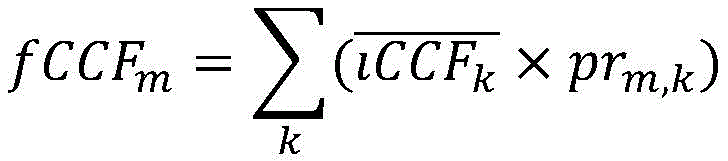


Applications Claiming Priority (3)
| Application Number | Priority Date | Filing Date | Title |
|---|---|---|---|
| US201762593810P | 2017-12-01 | 2017-12-01 | |
| US62/593,810 | 2017-12-01 | ||
| PCT/US2018/063647 WO2019109086A1 (en) | 2017-12-01 | 2018-12-03 | Methods and systems for determining somatic mutation clonality |
Publications (2)
| Publication Number | Publication Date |
|---|---|
| CN110770838A true CN110770838A (en) | 2020-02-07 |
| CN110770838B CN110770838B (en) | 2023-12-19 |
Family
ID=64734245
Family Applications (1)
| Application Number | Title | Priority Date | Filing Date |
|---|---|---|---|
| CN201880040456.7A Expired - Fee Related CN110770838B (en) | 2017-12-01 | 2018-12-03 | Methods and systems for determining clonality of somatic mutations |
Country Status (9)
| Country | Link |
|---|---|
| US (1) | US12367978B2 (en) |
| EP (1) | EP3622522A1 (en) |
| JP (1) | JP7299169B2 (en) |
| KR (1) | KR102805731B1 (en) |
| CN (1) | CN110770838B (en) |
| AU (1) | AU2018375008B2 (en) |
| CA (1) | CA3067229A1 (en) |
| IL (1) | IL271301A (en) |
| WO (1) | WO2019109086A1 (en) |
Cited By (5)
| Publication number | Priority date | Publication date | Assignee | Title |
|---|---|---|---|---|
| CN111402952A (en) * | 2020-03-27 | 2020-07-10 | 深圳裕策生物科技有限公司 | Method and system for detecting tumor heterogeneity degree |
| CN111798919A (en) * | 2020-06-24 | 2020-10-20 | 上海交通大学 | A kind of tumor neoantigen prediction method, prediction device and storage medium |
| CN112863594A (en) * | 2021-03-31 | 2021-05-28 | 中国工商银行股份有限公司 | Tumor purity estimation method and device |
| CN114023384A (en) * | 2022-01-06 | 2022-02-08 | 天津金域医学检验实验室有限公司 | Method for automatically generating standardized report of full exome sequencing annotation table |
| CN115375640A (en) * | 2022-08-11 | 2022-11-22 | 哈尔滨医科大学 | Tumor heterogeneity identification method and device, electronic equipment and storage medium |
Families Citing this family (13)
| Publication number | Priority date | Publication date | Assignee | Title |
|---|---|---|---|---|
| WO2019109086A1 (en) | 2017-12-01 | 2019-06-06 | Illumina, Inc. | Methods and systems for determining somatic mutation clonality |
| US11365441B2 (en) | 2019-05-22 | 2022-06-21 | Mission Bio, Inc. | Method and apparatus for simultaneous targeted sequencing of DNA, RNA and protein |
| JP2022544496A (en) * | 2019-08-12 | 2022-10-19 | ミッション バイオ インコーポレイテッド | Methods, systems, and devices for simultaneous multi-omics detection of protein expression, single nucleotide changes, and copy number variation in the same single cell |
| CN111100909A (en) * | 2020-01-10 | 2020-05-05 | 信华生物药业(广州)有限公司 | Method for calculating genetic heterogeneity in tumor |
| CN113593637B (en) * | 2020-04-30 | 2024-05-03 | 深圳市真迈生物科技有限公司 | Sequencing method, analysis method and analysis system thereof, computer-readable storage medium and electronic device |
| WO2022054086A1 (en) * | 2020-09-08 | 2022-03-17 | Indx Technology (India) Private Limited | A system and a method for identifying genomic abnormalities associated with cancer and implications thereof |
| GB202104715D0 (en) * | 2021-04-01 | 2021-05-19 | Achilles Therapeutics Uk Ltd | Identification of clonal neoantigens and uses thereof |
| GB202111194D0 (en) * | 2021-08-03 | 2021-09-15 | Cergentis B V | Method |
| GB202114434D0 (en) * | 2021-10-08 | 2021-11-24 | Francis Crick Institute Ltd | Methods and systems for tumour monitoring |
| EP4444915A4 (en) * | 2021-12-10 | 2025-12-24 | Glm Innovations Llc | DETECTION OF CYTOGENETIC BY LIQUID BIOPSY |
| CN119585730A (en) * | 2022-07-15 | 2025-03-07 | 基金会医学公司 | Methods and systems for determining the fraction of circulating tumor DNA in a patient sample |
| KR102645647B1 (en) * | 2023-08-04 | 2024-03-11 | 웰트 주식회사 | Method for managing prescription based on digital biomarker and apparatus for performing the method |
| WO2026022525A1 (en) * | 2024-07-22 | 2026-01-29 | NEC Laboratories Europe GmbH | Personalized cancer vaccine composition with enhanced clonal coverage |
Citations (16)
| Publication number | Priority date | Publication date | Assignee | Title |
|---|---|---|---|---|
| CN101155932A (en) * | 2005-04-14 | 2008-04-02 | 默克专利有限公司 | anti-EGFR antibody treatment based on increased EGFR gene copy number in tumor tissue |
| CN101437962A (en) * | 2006-03-03 | 2009-05-20 | 维里德克斯有限责任公司 | Molecular assay to predict recurrence of duke's B colon cancer |
| CN103562218A (en) * | 2011-03-24 | 2014-02-05 | 国家健康与医学研究院 | Dominant negative hsp110 mutant and its use in prognosing and treating cancers |
| WO2014026096A1 (en) * | 2012-08-10 | 2014-02-13 | The Broad Institute, Inc. | Methods and apparatus for analyzing and quantifying dna alterations in cancer |
| CN104781421A (en) * | 2012-09-04 | 2015-07-15 | 夸登特健康公司 | Systems and methods for detecting rare mutations and copy number variations |
| CA2945962A1 (en) * | 2014-04-21 | 2015-10-29 | Natera, Inc. | Detecting mutations and ploidy in chromosomal segments |
| WO2015164432A1 (en) * | 2014-04-21 | 2015-10-29 | Natera, Inc. | Detecting mutations and ploidy in chromosomal segments |
| CN105408496A (en) * | 2013-03-15 | 2016-03-16 | 夸登特健康公司 | Systems and methods for detecting rare mutations and copy number variations |
| WO2016127944A1 (en) * | 2015-02-10 | 2016-08-18 | The Chinese University Of Hong Kong | Detecting mutations for cancer screening and fetal analysis |
| US20160333416A1 (en) * | 2014-04-21 | 2016-11-17 | Natera, Inc. | Detecting cancer mutations and aneuploidy in chromosomal segments |
| CN106164289A (en) * | 2014-01-02 | 2016-11-23 | 纪念斯隆凯特琳癌症中心 | Determinants of cancer response to immunotherapy |
| WO2017042394A1 (en) * | 2015-09-10 | 2017-03-16 | Cancer Research Technology Limited | "immune checkpoint intervention" in cancer |
| CN107075482A (en) * | 2014-04-07 | 2017-08-18 | 诺华股份有限公司 | Using the Anti-CD19 Chimeric Antigen Receptor to Treat Cancer |
| CN107075586A (en) * | 2014-10-15 | 2017-08-18 | 开普敦大学 | Glycosyltransferase gene expression profiling for the identification of multiple cancer types and subtypes |
| CN107206064A (en) * | 2014-11-21 | 2017-09-26 | 纪念斯隆凯特琳癌症中心 | Determinants of cancer response to immunotherapy via PD‑1 blockade |
| CN107406876A (en) * | 2014-12-31 | 2017-11-28 | 夸登特健康公司 | Detection and treatment of diseases exhibiting heterogeneity of diseased cells and systems and methods for communicating test results |
Family Cites Families (7)
| Publication number | Priority date | Publication date | Assignee | Title |
|---|---|---|---|---|
| CA2615323A1 (en) | 2005-06-06 | 2007-12-21 | 454 Life Sciences Corporation | Paired end sequencing |
| US8262900B2 (en) | 2006-12-14 | 2012-09-11 | Life Technologies Corporation | Methods and apparatus for measuring analytes using large scale FET arrays |
| US20100331195A1 (en) | 2007-10-04 | 2010-12-30 | William Andregg | Sequencing Nucleic Acid Polymers with Electron Microscopy |
| US9260745B2 (en) | 2010-01-19 | 2016-02-16 | Verinata Health, Inc. | Detecting and classifying copy number variation |
| US9029103B2 (en) | 2010-08-27 | 2015-05-12 | Illumina Cambridge Limited | Methods for sequencing polynucleotides |
| GB201318369D0 (en) * | 2013-10-17 | 2013-12-04 | Univ Leuven Kath | Methods using BAF |
| WO2019109086A1 (en) | 2017-12-01 | 2019-06-06 | Illumina, Inc. | Methods and systems for determining somatic mutation clonality |
-
2018
- 2018-12-03 WO PCT/US2018/063647 patent/WO2019109086A1/en not_active Ceased
- 2018-12-03 US US16/208,290 patent/US12367978B2/en active Active
- 2018-12-03 CN CN201880040456.7A patent/CN110770838B/en not_active Expired - Fee Related
- 2018-12-03 CA CA3067229A patent/CA3067229A1/en active Pending
- 2018-12-03 AU AU2018375008A patent/AU2018375008B2/en not_active Expired - Fee Related
- 2018-12-03 JP JP2019569695A patent/JP7299169B2/en active Active
- 2018-12-03 KR KR1020197037314A patent/KR102805731B1/en active Active
- 2018-12-03 EP EP18821927.3A patent/EP3622522A1/en not_active Withdrawn
-
2019
- 2019-12-10 IL IL271301A patent/IL271301A/en unknown
Patent Citations (17)
| Publication number | Priority date | Publication date | Assignee | Title |
|---|---|---|---|---|
| CN101155932A (en) * | 2005-04-14 | 2008-04-02 | 默克专利有限公司 | anti-EGFR antibody treatment based on increased EGFR gene copy number in tumor tissue |
| CN101437962A (en) * | 2006-03-03 | 2009-05-20 | 维里德克斯有限责任公司 | Molecular assay to predict recurrence of duke's B colon cancer |
| CN103562218A (en) * | 2011-03-24 | 2014-02-05 | 国家健康与医学研究院 | Dominant negative hsp110 mutant and its use in prognosing and treating cancers |
| WO2014026096A1 (en) * | 2012-08-10 | 2014-02-13 | The Broad Institute, Inc. | Methods and apparatus for analyzing and quantifying dna alterations in cancer |
| CN104781421A (en) * | 2012-09-04 | 2015-07-15 | 夸登特健康公司 | Systems and methods for detecting rare mutations and copy number variations |
| CN105408496A (en) * | 2013-03-15 | 2016-03-16 | 夸登特健康公司 | Systems and methods for detecting rare mutations and copy number variations |
| CN106164289A (en) * | 2014-01-02 | 2016-11-23 | 纪念斯隆凯特琳癌症中心 | Determinants of cancer response to immunotherapy |
| CN107075482A (en) * | 2014-04-07 | 2017-08-18 | 诺华股份有限公司 | Using the Anti-CD19 Chimeric Antigen Receptor to Treat Cancer |
| WO2015164432A1 (en) * | 2014-04-21 | 2015-10-29 | Natera, Inc. | Detecting mutations and ploidy in chromosomal segments |
| US20160333416A1 (en) * | 2014-04-21 | 2016-11-17 | Natera, Inc. | Detecting cancer mutations and aneuploidy in chromosomal segments |
| CN106460070A (en) * | 2014-04-21 | 2017-02-22 | 纳特拉公司 | Detection of mutations and ploidy in chromosome segments |
| CA2945962A1 (en) * | 2014-04-21 | 2015-10-29 | Natera, Inc. | Detecting mutations and ploidy in chromosomal segments |
| CN107075586A (en) * | 2014-10-15 | 2017-08-18 | 开普敦大学 | Glycosyltransferase gene expression profiling for the identification of multiple cancer types and subtypes |
| CN107206064A (en) * | 2014-11-21 | 2017-09-26 | 纪念斯隆凯特琳癌症中心 | Determinants of cancer response to immunotherapy via PD‑1 blockade |
| CN107406876A (en) * | 2014-12-31 | 2017-11-28 | 夸登特健康公司 | Detection and treatment of diseases exhibiting heterogeneity of diseased cells and systems and methods for communicating test results |
| WO2016127944A1 (en) * | 2015-02-10 | 2016-08-18 | The Chinese University Of Hong Kong | Detecting mutations for cancer screening and fetal analysis |
| WO2017042394A1 (en) * | 2015-09-10 | 2017-03-16 | Cancer Research Technology Limited | "immune checkpoint intervention" in cancer |
Cited By (8)
| Publication number | Priority date | Publication date | Assignee | Title |
|---|---|---|---|---|
| CN111402952A (en) * | 2020-03-27 | 2020-07-10 | 深圳裕策生物科技有限公司 | Method and system for detecting tumor heterogeneity degree |
| CN111798919A (en) * | 2020-06-24 | 2020-10-20 | 上海交通大学 | A kind of tumor neoantigen prediction method, prediction device and storage medium |
| CN111798919B (en) * | 2020-06-24 | 2022-11-25 | 上海交通大学 | Tumor neoantigen prediction method, prediction device and storage medium |
| CN112863594A (en) * | 2021-03-31 | 2021-05-28 | 中国工商银行股份有限公司 | Tumor purity estimation method and device |
| CN114023384A (en) * | 2022-01-06 | 2022-02-08 | 天津金域医学检验实验室有限公司 | Method for automatically generating standardized report of full exome sequencing annotation table |
| CN114023384B (en) * | 2022-01-06 | 2022-04-05 | 天津金域医学检验实验室有限公司 | Method for automatically generating standardized report of full exome sequencing annotation table |
| CN115375640A (en) * | 2022-08-11 | 2022-11-22 | 哈尔滨医科大学 | Tumor heterogeneity identification method and device, electronic equipment and storage medium |
| CN115375640B (en) * | 2022-08-11 | 2026-01-02 | 哈尔滨医科大学 | A method, apparatus, electronic device, and storage medium for identifying tumor heterogeneity. |
Also Published As
| Publication number | Publication date |
|---|---|
| KR102805731B1 (en) | 2025-06-19 |
| AU2018375008B2 (en) | 2024-06-27 |
| IL271301A (en) | 2020-01-30 |
| CA3067229A1 (en) | 2019-06-06 |
| US12367978B2 (en) | 2025-07-22 |
| KR20200093438A (en) | 2020-08-05 |
| AU2018375008A1 (en) | 2019-12-05 |
| EP3622522A1 (en) | 2020-03-18 |
| JP2021505977A (en) | 2021-02-18 |
| US20190172582A1 (en) | 2019-06-06 |
| JP7299169B2 (en) | 2023-06-27 |
| WO2019109086A1 (en) | 2019-06-06 |
| CN110770838B (en) | 2023-12-19 |
Similar Documents
| Publication | Publication Date | Title |
|---|---|---|
| JP7299169B2 (en) | Methods and systems for determining clonality of somatic mutations | |
| US12087401B2 (en) | Using cell-free DNA fragment size to detect tumor-associated variant | |
| US20240404638A1 (en) | Methods for accurate computational decomposition of dna mixtures from contributors of unknown genotypes | |
| KR20200010464A (en) | Methods and systems for digesting and quantifying DNA mixtures from multiple contributors of known or unknown genotypes | |
| CN112823391A (en) | Quality control metrics based on detection limits | |
| HK40047016B (en) | Limit of detection based quality control metric | |
| HK40023955A (en) | Using cell-free dna fragment size to detect tumor-associated variant | |
| NZ759784A (en) | Liquid sample loading | |
| NZ759784B2 (en) | Methods and systems for decomposition and quantification of dna mixtures from multiple contributors of known or unknown genotypes | |
| HK40019713B (en) | Methods for accurate computational decomposition of dna mixtures from contributors of unknown genotypes | |
| HK40019713A (en) | Methods for accurate computational decomposition of dna mixtures from contributors of unknown genotypes |
Legal Events
| Date | Code | Title | Description |
|---|---|---|---|
| PB01 | Publication | ||
| PB01 | Publication | ||
| SE01 | Entry into force of request for substantive examination | ||
| SE01 | Entry into force of request for substantive examination | ||
| GR01 | Patent grant | ||
| GR01 | Patent grant | ||
| CF01 | Termination of patent right due to non-payment of annual fee | ||
| CF01 | Termination of patent right due to non-payment of annual fee |
Granted publication date: 20231219 |