CN110759930B - Spiro compounds and uses thereof - Google Patents
Spiro compounds and uses thereof Download PDFInfo
- Publication number
- CN110759930B CN110759930B CN201911025034.5A CN201911025034A CN110759930B CN 110759930 B CN110759930 B CN 110759930B CN 201911025034 A CN201911025034 A CN 201911025034A CN 110759930 B CN110759930 B CN 110759930B
- Authority
- CN
- China
- Prior art keywords
- atoms
- group
- ring
- organic
- substituted
- Prior art date
- Legal status (The legal status is an assumption and is not a legal conclusion. Google has not performed a legal analysis and makes no representation as to the accuracy of the status listed.)
- Active
Links
- 150000003413 spiro compounds Chemical class 0.000 title abstract description 8
- 239000000463 material Substances 0.000 claims abstract description 150
- 239000000203 mixture Substances 0.000 claims abstract description 70
- 150000001875 compounds Chemical class 0.000 claims abstract description 45
- 229920000642 polymer Polymers 0.000 claims abstract description 32
- 150000002894 organic compounds Chemical class 0.000 claims description 49
- 125000006413 ring segment Chemical group 0.000 claims description 43
- 125000003118 aryl group Chemical group 0.000 claims description 41
- -1 cyano, carbamoyl Chemical group 0.000 claims description 41
- 229910052760 oxygen Inorganic materials 0.000 claims description 21
- 125000000217 alkyl group Chemical group 0.000 claims description 19
- 125000001072 heteroaryl group Chemical group 0.000 claims description 18
- 125000003545 alkoxy group Chemical group 0.000 claims description 17
- 125000005309 thioalkoxy group Chemical group 0.000 claims description 16
- 230000000903 blocking effect Effects 0.000 claims description 14
- 229910052757 nitrogen Inorganic materials 0.000 claims description 14
- 239000003960 organic solvent Substances 0.000 claims description 14
- 125000004435 hydrogen atom Chemical class [H]* 0.000 claims description 13
- SPKSOWKQTVDRTK-UHFFFAOYSA-N 2-hydroxy-4-(4-methyl-1,3-dioxoisoindol-2-yl)benzoic acid Chemical group O=C1C=2C(C)=CC=CC=2C(=O)N1C1=CC=C(C(O)=O)C(O)=C1 SPKSOWKQTVDRTK-UHFFFAOYSA-N 0.000 claims description 12
- 125000004429 atom Chemical group 0.000 claims description 12
- 229910052739 hydrogen Inorganic materials 0.000 claims description 11
- 239000001257 hydrogen Substances 0.000 claims description 11
- 238000002347 injection Methods 0.000 claims description 11
- 239000007924 injection Substances 0.000 claims description 11
- 229910052731 fluorine Inorganic materials 0.000 claims description 10
- 125000002887 hydroxy group Chemical group [H]O* 0.000 claims description 10
- 229910052794 bromium Inorganic materials 0.000 claims description 9
- 230000005525 hole transport Effects 0.000 claims description 9
- 229930194542 Keto Natural products 0.000 claims description 8
- ZMZDMBWJUHKJPS-UHFFFAOYSA-M Thiocyanate anion Chemical compound [S-]C#N ZMZDMBWJUHKJPS-UHFFFAOYSA-M 0.000 claims description 8
- 125000004453 alkoxycarbonyl group Chemical group 0.000 claims description 8
- 125000005161 aryl oxy carbonyl group Chemical group 0.000 claims description 8
- 125000004104 aryloxy group Chemical group 0.000 claims description 8
- 125000004122 cyclic group Chemical group 0.000 claims description 8
- 125000002485 formyl group Chemical group [H]C(*)=O 0.000 claims description 8
- 125000005067 haloformyl group Chemical group 0.000 claims description 8
- 125000005553 heteroaryloxy group Chemical group 0.000 claims description 8
- ZMZDMBWJUHKJPS-UHFFFAOYSA-N hydrogen thiocyanate Natural products SC#N ZMZDMBWJUHKJPS-UHFFFAOYSA-N 0.000 claims description 8
- VINBVOMNIBDIPH-UHFFFAOYSA-N isocyanoimino(oxo)methane Chemical compound O=C=N[N+]#[C-] VINBVOMNIBDIPH-UHFFFAOYSA-N 0.000 claims description 8
- 150000002540 isothiocyanates Chemical class 0.000 claims description 8
- 125000000468 ketone group Chemical group 0.000 claims description 8
- 125000000449 nitro group Chemical group [O-][N+](*)=O 0.000 claims description 8
- 125000001181 organosilyl group Chemical group [SiH3]* 0.000 claims description 8
- 229910052717 sulfur Inorganic materials 0.000 claims description 7
- 229910052801 chlorine Inorganic materials 0.000 claims description 6
- 125000001931 aliphatic group Chemical group 0.000 claims description 4
- AFYPFACVUDMOHA-UHFFFAOYSA-N chlorotrifluoromethane Chemical compound FC(F)(F)Cl AFYPFACVUDMOHA-UHFFFAOYSA-N 0.000 claims description 3
- 125000002950 monocyclic group Chemical group 0.000 claims description 3
- 125000006574 non-aromatic ring group Chemical group 0.000 claims description 3
- 125000003367 polycyclic group Chemical group 0.000 claims description 3
- 238000005401 electroluminescence Methods 0.000 abstract description 4
- 230000000536 complexating effect Effects 0.000 abstract 1
- 230000015572 biosynthetic process Effects 0.000 description 36
- 238000003786 synthesis reaction Methods 0.000 description 36
- 238000004768 lowest unoccupied molecular orbital Methods 0.000 description 33
- 238000004770 highest occupied molecular orbital Methods 0.000 description 27
- 239000010410 layer Substances 0.000 description 26
- 229910052751 metal Inorganic materials 0.000 description 16
- 239000002184 metal Substances 0.000 description 16
- 238000000034 method Methods 0.000 description 14
- 230000000052 comparative effect Effects 0.000 description 13
- 239000000243 solution Substances 0.000 description 13
- 238000007639 printing Methods 0.000 description 11
- 239000000758 substrate Substances 0.000 description 11
- WYURNTSHIVDZCO-UHFFFAOYSA-N Tetrahydrofuran Chemical compound C1CCOC1 WYURNTSHIVDZCO-UHFFFAOYSA-N 0.000 description 10
- GVEPBJHOBDJJJI-UHFFFAOYSA-N fluoranthene Chemical compound C1=CC(C2=CC=CC=C22)=C3C2=CC=CC3=C1 GVEPBJHOBDJJJI-UHFFFAOYSA-N 0.000 description 10
- 239000003446 ligand Substances 0.000 description 10
- BBEAQIROQSPTKN-UHFFFAOYSA-N pyrene Chemical compound C1=CC=C2C=CC3=CC=CC4=CC=C1C2=C43 BBEAQIROQSPTKN-UHFFFAOYSA-N 0.000 description 9
- IJGRMHOSHXDMSA-UHFFFAOYSA-N Atomic nitrogen Chemical compound N#N IJGRMHOSHXDMSA-UHFFFAOYSA-N 0.000 description 8
- 150000001412 amines Chemical class 0.000 description 8
- 150000004982 aromatic amines Chemical class 0.000 description 8
- 239000002904 solvent Substances 0.000 description 8
- 125000001424 substituent group Chemical group 0.000 description 8
- 238000003775 Density Functional Theory Methods 0.000 description 7
- ZMXDDKWLCZADIW-UHFFFAOYSA-N N,N-Dimethylformamide Chemical compound CN(C)C=O ZMXDDKWLCZADIW-UHFFFAOYSA-N 0.000 description 7
- 238000004519 manufacturing process Methods 0.000 description 7
- UFWIBTONFRDIAS-UHFFFAOYSA-N Naphthalene Chemical compound C1=CC=CC2=CC=CC=C21 UFWIBTONFRDIAS-UHFFFAOYSA-N 0.000 description 6
- SMWDFEZZVXVKRB-UHFFFAOYSA-N Quinoline Chemical compound N1=CC=CC2=CC=CC=C21 SMWDFEZZVXVKRB-UHFFFAOYSA-N 0.000 description 6
- YXFVVABEGXRONW-UHFFFAOYSA-N Toluene Chemical compound CC1=CC=CC=C1 YXFVVABEGXRONW-UHFFFAOYSA-N 0.000 description 6
- MWPLVEDNUUSJAV-UHFFFAOYSA-N anthracene Chemical compound C1=CC=CC2=CC3=CC=CC=C3C=C21 MWPLVEDNUUSJAV-UHFFFAOYSA-N 0.000 description 6
- 125000006615 aromatic heterocyclic group Chemical group 0.000 description 6
- XSCHRSMBECNVNS-UHFFFAOYSA-N benzopyrazine Natural products N1=CC=NC2=CC=CC=C21 XSCHRSMBECNVNS-UHFFFAOYSA-N 0.000 description 6
- 238000004364 calculation method Methods 0.000 description 6
- RAXXELZNTBOGNW-UHFFFAOYSA-N imidazole Natural products C1=CNC=N1 RAXXELZNTBOGNW-UHFFFAOYSA-N 0.000 description 6
- AWJUIBRHMBBTKR-UHFFFAOYSA-N isoquinoline Chemical compound C1=NC=CC2=CC=CC=C21 AWJUIBRHMBBTKR-UHFFFAOYSA-N 0.000 description 6
- 238000002360 preparation method Methods 0.000 description 6
- YMWUJEATGCHHMB-UHFFFAOYSA-N Dichloromethane Chemical compound ClCCl YMWUJEATGCHHMB-UHFFFAOYSA-N 0.000 description 5
- 229910052799 carbon Inorganic materials 0.000 description 5
- 125000004432 carbon atom Chemical group C* 0.000 description 5
- 230000005284 excitation Effects 0.000 description 5
- 230000005669 field effect Effects 0.000 description 5
- 229910052697 platinum Inorganic materials 0.000 description 5
- FCEHBMOGCRZNNI-UHFFFAOYSA-N 1-benzothiophene Chemical compound C1=CC=C2SC=CC2=C1 FCEHBMOGCRZNNI-UHFFFAOYSA-N 0.000 description 4
- UJOBWOGCFQCDNV-UHFFFAOYSA-N 9H-carbazole Chemical compound C1=CC=C2C3=CC=CC=C3NC2=C1 UJOBWOGCFQCDNV-UHFFFAOYSA-N 0.000 description 4
- HEDRZPFGACZZDS-UHFFFAOYSA-N Chloroform Chemical compound ClC(Cl)Cl HEDRZPFGACZZDS-UHFFFAOYSA-N 0.000 description 4
- SIKJAQJRHWYJAI-UHFFFAOYSA-N Indole Chemical compound C1=CC=C2NC=CC2=C1 SIKJAQJRHWYJAI-UHFFFAOYSA-N 0.000 description 4
- KYQCOXFCLRTKLS-UHFFFAOYSA-N Pyrazine Chemical compound C1=CN=CC=N1 KYQCOXFCLRTKLS-UHFFFAOYSA-N 0.000 description 4
- JUJWROOIHBZHMG-UHFFFAOYSA-N Pyridine Chemical compound C1=CC=NC=C1 JUJWROOIHBZHMG-UHFFFAOYSA-N 0.000 description 4
- KAESVJOAVNADME-UHFFFAOYSA-N Pyrrole Chemical compound C=1C=CNC=1 KAESVJOAVNADME-UHFFFAOYSA-N 0.000 description 4
- YTPLMLYBLZKORZ-UHFFFAOYSA-N Thiophene Chemical compound C=1C=CSC=1 YTPLMLYBLZKORZ-UHFFFAOYSA-N 0.000 description 4
- CUJRVFIICFDLGR-UHFFFAOYSA-N acetylacetonate Chemical compound CC(=O)[CH-]C(C)=O CUJRVFIICFDLGR-UHFFFAOYSA-N 0.000 description 4
- 125000002029 aromatic hydrocarbon group Chemical group 0.000 description 4
- 238000006243 chemical reaction Methods 0.000 description 4
- 238000004440 column chromatography Methods 0.000 description 4
- 125000004093 cyano group Chemical group *C#N 0.000 description 4
- NIHNNTQXNPWCJQ-UHFFFAOYSA-N fluorene Chemical compound C1=CC=C2CC3=CC=CC=C3C2=C1 NIHNNTQXNPWCJQ-UHFFFAOYSA-N 0.000 description 4
- 239000002346 layers by function Substances 0.000 description 4
- 238000013086 organic photovoltaic Methods 0.000 description 4
- HFPZCAJZSCWRBC-UHFFFAOYSA-N p-cymene Chemical compound CC(C)C1=CC=C(C)C=C1 HFPZCAJZSCWRBC-UHFFFAOYSA-N 0.000 description 4
- 229910052698 phosphorus Inorganic materials 0.000 description 4
- 150000003254 radicals Chemical group 0.000 description 4
- 229910052710 silicon Inorganic materials 0.000 description 4
- 238000004088 simulation Methods 0.000 description 4
- 238000000859 sublimation Methods 0.000 description 4
- 230000008022 sublimation Effects 0.000 description 4
- 125000005259 triarylamine group Chemical group 0.000 description 4
- PBKONEOXTCPAFI-UHFFFAOYSA-N 1,2,4-trichlorobenzene Chemical compound ClC1=CC=C(Cl)C(Cl)=C1 PBKONEOXTCPAFI-UHFFFAOYSA-N 0.000 description 3
- ZWEHNKRNPOVVGH-UHFFFAOYSA-N 2-Butanone Chemical compound CCC(C)=O ZWEHNKRNPOVVGH-UHFFFAOYSA-N 0.000 description 3
- UHOVQNZJYSORNB-UHFFFAOYSA-N Benzene Chemical compound C1=CC=CC=C1 UHOVQNZJYSORNB-UHFFFAOYSA-N 0.000 description 3
- XEKOWRVHYACXOJ-UHFFFAOYSA-N Ethyl acetate Chemical compound CCOC(C)=O XEKOWRVHYACXOJ-UHFFFAOYSA-N 0.000 description 3
- YLQBMQCUIZJEEH-UHFFFAOYSA-N Furan Chemical compound C=1C=COC=1 YLQBMQCUIZJEEH-UHFFFAOYSA-N 0.000 description 3
- OKKJLVBELUTLKV-UHFFFAOYSA-N Methanol Chemical compound OC OKKJLVBELUTLKV-UHFFFAOYSA-N 0.000 description 3
- ZCQWOFVYLHDMMC-UHFFFAOYSA-N Oxazole Chemical compound C1=COC=N1 ZCQWOFVYLHDMMC-UHFFFAOYSA-N 0.000 description 3
- PCNDJXKNXGMECE-UHFFFAOYSA-N Phenazine Natural products C1=CC=CC2=NC3=CC=CC=C3N=C21 PCNDJXKNXGMECE-UHFFFAOYSA-N 0.000 description 3
- 239000010405 anode material Substances 0.000 description 3
- 230000009286 beneficial effect Effects 0.000 description 3
- IOJUPLGTWVMSFF-UHFFFAOYSA-N benzothiazole Chemical class C1=CC=C2SC=NC2=C1 IOJUPLGTWVMSFF-UHFFFAOYSA-N 0.000 description 3
- 238000009835 boiling Methods 0.000 description 3
- 239000010406 cathode material Substances 0.000 description 3
- 239000011248 coating agent Substances 0.000 description 3
- 238000000576 coating method Methods 0.000 description 3
- 150000004696 coordination complex Chemical group 0.000 description 3
- 229910052802 copper Inorganic materials 0.000 description 3
- 230000003111 delayed effect Effects 0.000 description 3
- 238000011161 development Methods 0.000 description 3
- 125000005266 diarylamine group Chemical group 0.000 description 3
- TXCDCPKCNAJMEE-UHFFFAOYSA-N dibenzofuran Chemical group C1=CC=C2C3=CC=CC=C3OC2=C1 TXCDCPKCNAJMEE-UHFFFAOYSA-N 0.000 description 3
- 230000006870 function Effects 0.000 description 3
- 229910052737 gold Inorganic materials 0.000 description 3
- 125000005842 heteroatom Chemical group 0.000 description 3
- 238000000691 measurement method Methods 0.000 description 3
- 125000001624 naphthyl group Chemical group 0.000 description 3
- 229910052759 nickel Inorganic materials 0.000 description 3
- 125000004433 nitrogen atom Chemical group N* 0.000 description 3
- 239000013110 organic ligand Substances 0.000 description 3
- 125000004430 oxygen atom Chemical group O* 0.000 description 3
- 229910052763 palladium Inorganic materials 0.000 description 3
- 239000004065 semiconductor Substances 0.000 description 3
- 229910052709 silver Inorganic materials 0.000 description 3
- 239000000126 substance Substances 0.000 description 3
- 238000002207 thermal evaporation Methods 0.000 description 3
- NNWHUJCUHAELCL-SNAWJCMRSA-N trans-isomethyleugenol Chemical compound COC1=CC=C(\C=C\C)C=C1OC NNWHUJCUHAELCL-SNAWJCMRSA-N 0.000 description 3
- XLYOFNOQVPJJNP-UHFFFAOYSA-N water Substances O XLYOFNOQVPJJNP-UHFFFAOYSA-N 0.000 description 3
- QPFMBZIOSGYJDE-UHFFFAOYSA-N 1,1,2,2-tetrachloroethane Chemical compound ClC(Cl)C(Cl)Cl QPFMBZIOSGYJDE-UHFFFAOYSA-N 0.000 description 2
- BFIMMTCNYPIMRN-UHFFFAOYSA-N 1,2,3,5-tetramethylbenzene Chemical compound CC1=CC(C)=C(C)C(C)=C1 BFIMMTCNYPIMRN-UHFFFAOYSA-N 0.000 description 2
- JYEUMXHLPRZUAT-UHFFFAOYSA-N 1,2,3-triazine Chemical compound C1=CN=NN=C1 JYEUMXHLPRZUAT-UHFFFAOYSA-N 0.000 description 2
- AGIQIOSHSMJYJP-UHFFFAOYSA-N 1,2,4-Trimethoxybenzene Chemical compound COC1=CC=C(OC)C(OC)=C1 AGIQIOSHSMJYJP-UHFFFAOYSA-N 0.000 description 2
- KTZQTRPPVKQPFO-UHFFFAOYSA-N 1,2-benzoxazole Chemical compound C1=CC=C2C=NOC2=C1 KTZQTRPPVKQPFO-UHFFFAOYSA-N 0.000 description 2
- RFFLAFLAYFXFSW-UHFFFAOYSA-N 1,2-dichlorobenzene Chemical compound ClC1=CC=CC=C1Cl RFFLAFLAYFXFSW-UHFFFAOYSA-N 0.000 description 2
- KVNYFPKFSJIPBJ-UHFFFAOYSA-N 1,2-diethylbenzene Chemical compound CCC1=CC=CC=C1CC KVNYFPKFSJIPBJ-UHFFFAOYSA-N 0.000 description 2
- QNLZIZAQLLYXTC-UHFFFAOYSA-N 1,2-dimethylnaphthalene Chemical compound C1=CC=CC2=C(C)C(C)=CC=C21 QNLZIZAQLLYXTC-UHFFFAOYSA-N 0.000 description 2
- DPZNOMCNRMUKPS-UHFFFAOYSA-N 1,3-Dimethoxybenzene Chemical compound COC1=CC=CC(OC)=C1 DPZNOMCNRMUKPS-UHFFFAOYSA-N 0.000 description 2
- AFZZYIJIWUTJFO-UHFFFAOYSA-N 1,3-diethylbenzene Chemical compound CCC1=CC=CC(CC)=C1 AFZZYIJIWUTJFO-UHFFFAOYSA-N 0.000 description 2
- DSNHSQKRULAAEI-UHFFFAOYSA-N 1,4-Diethylbenzene Chemical compound CCC1=CC=C(CC)C=C1 DSNHSQKRULAAEI-UHFFFAOYSA-N 0.000 description 2
- SPPWGCYEYAMHDT-UHFFFAOYSA-N 1,4-di(propan-2-yl)benzene Chemical compound CC(C)C1=CC=C(C(C)C)C=C1 SPPWGCYEYAMHDT-UHFFFAOYSA-N 0.000 description 2
- APQSQLNWAIULLK-UHFFFAOYSA-N 1,4-dimethylnaphthalene Chemical compound C1=CC=C2C(C)=CC=C(C)C2=C1 APQSQLNWAIULLK-UHFFFAOYSA-N 0.000 description 2
- NQMUGNMMFTYOHK-UHFFFAOYSA-N 1-methoxynaphthalene Chemical compound C1=CC=C2C(OC)=CC=CC2=C1 NQMUGNMMFTYOHK-UHFFFAOYSA-N 0.000 description 2
- UDONPJKEOAWFGI-UHFFFAOYSA-N 1-methyl-3-phenoxybenzene Chemical compound CC1=CC=CC(OC=2C=CC=CC=2)=C1 UDONPJKEOAWFGI-UHFFFAOYSA-N 0.000 description 2
- QPUYECUOLPXSFR-UHFFFAOYSA-N 1-methylnaphthalene Chemical compound C1=CC=C2C(C)=CC=CC2=C1 QPUYECUOLPXSFR-UHFFFAOYSA-N 0.000 description 2
- KJCVRFUGPWSIIH-UHFFFAOYSA-N 1-naphthol Chemical compound C1=CC=C2C(O)=CC=CC2=C1 KJCVRFUGPWSIIH-UHFFFAOYSA-N 0.000 description 2
- LIWRTHVZRZXVFX-UHFFFAOYSA-N 1-phenyl-3-propan-2-ylbenzene Chemical group CC(C)C1=CC=CC(C=2C=CC=CC=2)=C1 LIWRTHVZRZXVFX-UHFFFAOYSA-N 0.000 description 2
- HYZJCKYKOHLVJF-UHFFFAOYSA-N 1H-benzimidazole Chemical compound C1=CC=C2NC=NC2=C1 HYZJCKYKOHLVJF-UHFFFAOYSA-N 0.000 description 2
- YBYIRNPNPLQARY-UHFFFAOYSA-N 1H-indene Chemical compound C1=CC=C2CC=CC2=C1 YBYIRNPNPLQARY-UHFFFAOYSA-N 0.000 description 2
- OJVAMHKKJGICOG-UHFFFAOYSA-N 2,5-hexanedione Chemical compound CC(=O)CCC(C)=O OJVAMHKKJGICOG-UHFFFAOYSA-N 0.000 description 2
- VQGHOUODWALEFC-UHFFFAOYSA-N 2-phenylpyridine Chemical compound C1=CC=CC=C1C1=CC=CC=N1 VQGHOUODWALEFC-UHFFFAOYSA-N 0.000 description 2
- HJKGBRPNSJADMB-UHFFFAOYSA-N 3-phenylpyridine Chemical compound C1=CC=CC=C1C1=CC=CN=C1 HJKGBRPNSJADMB-UHFFFAOYSA-N 0.000 description 2
- GNKZMNRKLCTJAY-UHFFFAOYSA-N 4'-Methylacetophenone Chemical compound CC(=O)C1=CC=C(C)C=C1 GNKZMNRKLCTJAY-UHFFFAOYSA-N 0.000 description 2
- CSCPPACGZOOCGX-UHFFFAOYSA-N Acetone Chemical compound CC(C)=O CSCPPACGZOOCGX-UHFFFAOYSA-N 0.000 description 2
- KWOLFJPFCHCOCG-UHFFFAOYSA-N Acetophenone Chemical compound CC(=O)C1=CC=CC=C1 KWOLFJPFCHCOCG-UHFFFAOYSA-N 0.000 description 2
- IYTXKIXETAELAV-UHFFFAOYSA-N Aethyl-n-hexyl-keton Natural products CCCCCCC(=O)CC IYTXKIXETAELAV-UHFFFAOYSA-N 0.000 description 2
- WDECIBYCCFPHNR-UHFFFAOYSA-N Chrysene Natural products C1=CC=CC2=CC=C3C4=CC=CC=C4C=CC3=C21 WDECIBYCCFPHNR-UHFFFAOYSA-N 0.000 description 2
- XFXPMWWXUTWYJX-UHFFFAOYSA-N Cyanide Chemical compound N#[C-] XFXPMWWXUTWYJX-UHFFFAOYSA-N 0.000 description 2
- YZCKVEUIGOORGS-OUBTZVSYSA-N Deuterium Chemical compound [2H] YZCKVEUIGOORGS-OUBTZVSYSA-N 0.000 description 2
- IAZDPXIOMUYVGZ-UHFFFAOYSA-N Dimethylsulphoxide Chemical compound CS(C)=O IAZDPXIOMUYVGZ-UHFFFAOYSA-N 0.000 description 2
- LFQSCWFLJHTTHZ-UHFFFAOYSA-N Ethanol Chemical compound CCO LFQSCWFLJHTTHZ-UHFFFAOYSA-N 0.000 description 2
- KFZMGEQAYNKOFK-UHFFFAOYSA-N Isopropanol Chemical compound CC(C)O KFZMGEQAYNKOFK-UHFFFAOYSA-N 0.000 description 2
- AFVFQIVMOAPDHO-UHFFFAOYSA-N Methanesulfonic acid Chemical compound CS(O)(=O)=O AFVFQIVMOAPDHO-UHFFFAOYSA-N 0.000 description 2
- YNAVUWVOSKDBBP-UHFFFAOYSA-N Morpholine Chemical compound C1COCCN1 YNAVUWVOSKDBBP-UHFFFAOYSA-N 0.000 description 2
- CTQNGGLPUBDAKN-UHFFFAOYSA-N O-Xylene Chemical group CC1=CC=CC=C1C CTQNGGLPUBDAKN-UHFFFAOYSA-N 0.000 description 2
- URLKBWYHVLBVBO-UHFFFAOYSA-N Para-Xylene Chemical group CC1=CC=C(C)C=C1 URLKBWYHVLBVBO-UHFFFAOYSA-N 0.000 description 2
- PWATWSYOIIXYMA-UHFFFAOYSA-N Pentylbenzene Chemical compound CCCCCC1=CC=CC=C1 PWATWSYOIIXYMA-UHFFFAOYSA-N 0.000 description 2
- WTKZEGDFNFYCGP-UHFFFAOYSA-N Pyrazole Chemical compound C=1C=NNC=1 WTKZEGDFNFYCGP-UHFFFAOYSA-N 0.000 description 2
- CZPWVGJYEJSRLH-UHFFFAOYSA-N Pyrimidine Chemical compound C1=CN=CN=C1 CZPWVGJYEJSRLH-UHFFFAOYSA-N 0.000 description 2
- XUIMIQQOPSSXEZ-UHFFFAOYSA-N Silicon Chemical compound [Si] XUIMIQQOPSSXEZ-UHFFFAOYSA-N 0.000 description 2
- PJANXHGTPQOBST-VAWYXSNFSA-N Stilbene Natural products C=1C=CC=CC=1/C=C/C1=CC=CC=C1 PJANXHGTPQOBST-VAWYXSNFSA-N 0.000 description 2
- PPBRXRYQALVLMV-UHFFFAOYSA-N Styrene Chemical compound C=CC1=CC=CC=C1 PPBRXRYQALVLMV-UHFFFAOYSA-N 0.000 description 2
- FZWLAAWBMGSTSO-UHFFFAOYSA-N Thiazole Chemical compound C1=CSC=N1 FZWLAAWBMGSTSO-UHFFFAOYSA-N 0.000 description 2
- 238000004833 X-ray photoelectron spectroscopy Methods 0.000 description 2
- XLOMVQKBTHCTTD-UHFFFAOYSA-N Zinc monoxide Chemical compound [Zn]=O XLOMVQKBTHCTTD-UHFFFAOYSA-N 0.000 description 2
- DZBUGLKDJFMEHC-UHFFFAOYSA-N acridine Chemical compound C1=CC=CC2=CC3=CC=CC=C3N=C21 DZBUGLKDJFMEHC-UHFFFAOYSA-N 0.000 description 2
- 125000002723 alicyclic group Chemical group 0.000 description 2
- RDOXTESZEPMUJZ-UHFFFAOYSA-N anisole Chemical compound COC1=CC=CC=C1 RDOXTESZEPMUJZ-UHFFFAOYSA-N 0.000 description 2
- 150000008365 aromatic ketones Chemical class 0.000 description 2
- 125000003710 aryl alkyl group Chemical group 0.000 description 2
- 150000008378 aryl ethers Chemical class 0.000 description 2
- RFRXIWQYSOIBDI-UHFFFAOYSA-N benzarone Chemical compound CCC=1OC2=CC=CC=C2C=1C(=O)C1=CC=C(O)C=C1 RFRXIWQYSOIBDI-UHFFFAOYSA-N 0.000 description 2
- SESFRYSPDFLNCH-UHFFFAOYSA-N benzyl benzoate Chemical compound C=1C=CC=CC=1C(=O)OCC1=CC=CC=C1 SESFRYSPDFLNCH-UHFFFAOYSA-N 0.000 description 2
- 239000004305 biphenyl Substances 0.000 description 2
- OCKPCBLVNKHBMX-UHFFFAOYSA-N butylbenzene Chemical compound CCCCC1=CC=CC=C1 OCKPCBLVNKHBMX-UHFFFAOYSA-N 0.000 description 2
- FJDQFPXHSGXQBY-UHFFFAOYSA-L caesium carbonate Chemical compound [Cs+].[Cs+].[O-]C([O-])=O FJDQFPXHSGXQBY-UHFFFAOYSA-L 0.000 description 2
- 229910000024 caesium carbonate Inorganic materials 0.000 description 2
- 125000003917 carbamoyl group Chemical group [H]N([H])C(*)=O 0.000 description 2
- 238000012512 characterization method Methods 0.000 description 2
- MVPPADPHJFYWMZ-UHFFFAOYSA-N chlorobenzene Chemical compound ClC1=CC=CC=C1 MVPPADPHJFYWMZ-UHFFFAOYSA-N 0.000 description 2
- 238000001816 cooling Methods 0.000 description 2
- HHNHBFLGXIUXCM-GFCCVEGCSA-N cyclohexylbenzene Chemical compound [CH]1CCCC[C@@H]1C1=CC=CC=C1 HHNHBFLGXIUXCM-GFCCVEGCSA-N 0.000 description 2
- NNBZCPXTIHJBJL-UHFFFAOYSA-N decalin Chemical compound C1CCCC2CCCCC21 NNBZCPXTIHJBJL-UHFFFAOYSA-N 0.000 description 2
- ZAJNGDIORYACQU-UHFFFAOYSA-N decan-2-one Chemical compound CCCCCCCCC(C)=O ZAJNGDIORYACQU-UHFFFAOYSA-N 0.000 description 2
- 229910052805 deuterium Inorganic materials 0.000 description 2
- IYYZUPMFVPLQIF-UHFFFAOYSA-N dibenzothiophene Chemical compound C1=CC=C2C3=CC=CC=C3SC2=C1 IYYZUPMFVPLQIF-UHFFFAOYSA-N 0.000 description 2
- MHDVGSVTJDSBDK-UHFFFAOYSA-N dibenzyl ether Chemical compound C=1C=CC=CC=1COCC1=CC=CC=C1 MHDVGSVTJDSBDK-UHFFFAOYSA-N 0.000 description 2
- ZUOUZKKEUPVFJK-UHFFFAOYSA-N diphenyl Chemical compound C1=CC=CC=C1C1=CC=CC=C1 ZUOUZKKEUPVFJK-UHFFFAOYSA-N 0.000 description 2
- USIUVYZYUHIAEV-UHFFFAOYSA-N diphenyl ether Chemical compound C=1C=CC=CC=1OC1=CC=CC=C1 USIUVYZYUHIAEV-UHFFFAOYSA-N 0.000 description 2
- SQNZJJAZBFDUTD-UHFFFAOYSA-N durene Chemical compound CC1=CC(C)=C(C)C=C1C SQNZJJAZBFDUTD-UHFFFAOYSA-N 0.000 description 2
- 230000000694 effects Effects 0.000 description 2
- 238000010894 electron beam technology Methods 0.000 description 2
- 238000005516 engineering process Methods 0.000 description 2
- 238000011156 evaluation Methods 0.000 description 2
- 238000001704 evaporation Methods 0.000 description 2
- 230000008020 evaporation Effects 0.000 description 2
- 230000005281 excited state Effects 0.000 description 2
- 239000010408 film Substances 0.000 description 2
- 238000001914 filtration Methods 0.000 description 2
- 239000011521 glass Substances 0.000 description 2
- 230000009477 glass transition Effects 0.000 description 2
- 125000004404 heteroalkyl group Chemical group 0.000 description 2
- 125000000623 heterocyclic group Chemical group 0.000 description 2
- 230000001965 increasing effect Effects 0.000 description 2
- PZOUSPYUWWUPPK-UHFFFAOYSA-N indole Natural products CC1=CC=CC2=C1C=CN2 PZOUSPYUWWUPPK-UHFFFAOYSA-N 0.000 description 2
- RKJUIXBNRJVNHR-UHFFFAOYSA-N indolenine Natural products C1=CC=C2CC=NC2=C1 RKJUIXBNRJVNHR-UHFFFAOYSA-N 0.000 description 2
- 238000007641 inkjet printing Methods 0.000 description 2
- 229910052740 iodine Inorganic materials 0.000 description 2
- 229910052741 iridium Inorganic materials 0.000 description 2
- 229910052742 iron Inorganic materials 0.000 description 2
- HJOVHMDZYOCNQW-UHFFFAOYSA-N isophorone Chemical compound CC1=CC(=O)CC(C)(C)C1 HJOVHMDZYOCNQW-UHFFFAOYSA-N 0.000 description 2
- IVSZLXZYQVIEFR-UHFFFAOYSA-N m-xylene Chemical group CC1=CC=CC(C)=C1 IVSZLXZYQVIEFR-UHFFFAOYSA-N 0.000 description 2
- 229910052749 magnesium Inorganic materials 0.000 description 2
- 239000011777 magnesium Substances 0.000 description 2
- 238000001755 magnetron sputter deposition Methods 0.000 description 2
- 229910052748 manganese Inorganic materials 0.000 description 2
- 239000008204 material by function Substances 0.000 description 2
- 229910044991 metal oxide Inorganic materials 0.000 description 2
- 150000004706 metal oxides Chemical class 0.000 description 2
- 150000002790 naphthalenes Chemical group 0.000 description 2
- 239000012299 nitrogen atmosphere Substances 0.000 description 2
- VKCYHJWLYTUGCC-UHFFFAOYSA-N nonan-2-one Chemical compound CCCCCCCC(C)=O VKCYHJWLYTUGCC-UHFFFAOYSA-N 0.000 description 2
- 239000011368 organic material Substances 0.000 description 2
- 239000012074 organic phase Substances 0.000 description 2
- 229910052762 osmium Inorganic materials 0.000 description 2
- WCPAKWJPBJAGKN-UHFFFAOYSA-N oxadiazole Chemical compound C1=CON=N1 WCPAKWJPBJAGKN-UHFFFAOYSA-N 0.000 description 2
- YTZKOQUCBOVLHL-UHFFFAOYSA-N p-methylisopropylbenzene Natural products CC(C)(C)C1=CC=CC=C1 YTZKOQUCBOVLHL-UHFFFAOYSA-N 0.000 description 2
- YNPNZTXNASCQKK-UHFFFAOYSA-N phenanthrene Chemical compound C1=CC=C2C3=CC=CC=C3C=CC2=C1 YNPNZTXNASCQKK-UHFFFAOYSA-N 0.000 description 2
- RDOWQLZANAYVLL-UHFFFAOYSA-N phenanthridine Chemical compound C1=CC=C2C3=CC=CC=C3C=NC2=C1 RDOWQLZANAYVLL-UHFFFAOYSA-N 0.000 description 2
- LFSXCDWNBUNEEM-UHFFFAOYSA-N phthalazine Chemical compound C1=NN=CC2=CC=CC=C21 LFSXCDWNBUNEEM-UHFFFAOYSA-N 0.000 description 2
- 238000005240 physical vapour deposition Methods 0.000 description 2
- 239000004033 plastic Substances 0.000 description 2
- 229920003023 plastic Polymers 0.000 description 2
- 229920000139 polyethylene terephthalate Polymers 0.000 description 2
- 239000005020 polyethylene terephthalate Substances 0.000 description 2
- UOHMMEJUHBCKEE-UHFFFAOYSA-N prehnitene Chemical compound CC1=CC=C(C)C(C)=C1C UOHMMEJUHBCKEE-UHFFFAOYSA-N 0.000 description 2
- 125000002924 primary amino group Chemical group [H]N([H])* 0.000 description 2
- 230000002035 prolonged effect Effects 0.000 description 2
- 150000003220 pyrenes Chemical class 0.000 description 2
- PBMFSQRYOILNGV-UHFFFAOYSA-N pyridazine Chemical compound C1=CC=NN=C1 PBMFSQRYOILNGV-UHFFFAOYSA-N 0.000 description 2
- UMJSCPRVCHMLSP-UHFFFAOYSA-N pyridine Natural products COC1=CC=CN=C1 UMJSCPRVCHMLSP-UHFFFAOYSA-N 0.000 description 2
- JWVCLYRUEFBMGU-UHFFFAOYSA-N quinazoline Chemical compound N1=CN=CC2=CC=CC=C21 JWVCLYRUEFBMGU-UHFFFAOYSA-N 0.000 description 2
- 150000003248 quinolines Chemical group 0.000 description 2
- 239000002994 raw material Substances 0.000 description 2
- 125000003003 spiro group Chemical group 0.000 description 2
- PJANXHGTPQOBST-UHFFFAOYSA-N stilbene Chemical group C=1C=CC=CC=1C=CC1=CC=CC=C1 PJANXHGTPQOBST-UHFFFAOYSA-N 0.000 description 2
- 235000021286 stilbenes Nutrition 0.000 description 2
- 150000003440 styrenes Chemical group 0.000 description 2
- 125000005504 styryl group Chemical group 0.000 description 2
- 239000000725 suspension Substances 0.000 description 2
- ZUHZGEOKBKGPSW-UHFFFAOYSA-N tetraglyme Chemical compound COCCOCCOCCOCCOC ZUHZGEOKBKGPSW-UHFFFAOYSA-N 0.000 description 2
- CXWXQJXEFPUFDZ-UHFFFAOYSA-N tetralin Chemical compound C1=CC=C2CCCCC2=C1 CXWXQJXEFPUFDZ-UHFFFAOYSA-N 0.000 description 2
- 229930192474 thiophene Natural products 0.000 description 2
- 230000036962 time dependent Effects 0.000 description 2
- 238000012546 transfer Methods 0.000 description 2
- 150000003852 triazoles Chemical class 0.000 description 2
- 229910052721 tungsten Inorganic materials 0.000 description 2
- 238000004402 ultra-violet photoelectron spectroscopy Methods 0.000 description 2
- ABDKAPXRBAPSQN-UHFFFAOYSA-N veratrole Chemical compound COC1=CC=CC=C1OC ABDKAPXRBAPSQN-UHFFFAOYSA-N 0.000 description 2
- 238000005406 washing Methods 0.000 description 2
- JCXLYAWYOTYWKM-UHFFFAOYSA-N (2,3,4-triphenylcyclopenta-1,3-dien-1-yl)benzene Chemical compound C1C(C=2C=CC=CC=2)=C(C=2C=CC=CC=2)C(C=2C=CC=CC=2)=C1C1=CC=CC=C1 JCXLYAWYOTYWKM-UHFFFAOYSA-N 0.000 description 1
- UWRZIZXBOLBCON-VOTSOKGWSA-N (e)-2-phenylethenamine Chemical compound N\C=C\C1=CC=CC=C1 UWRZIZXBOLBCON-VOTSOKGWSA-N 0.000 description 1
- NKJOXAZJBOMXID-UHFFFAOYSA-N 1,1'-Oxybisoctane Chemical compound CCCCCCCCOCCCCCCCC NKJOXAZJBOMXID-UHFFFAOYSA-N 0.000 description 1
- ICPSWZFVWAPUKF-UHFFFAOYSA-N 1,1'-spirobi[fluorene] Chemical class C1=CC=C2C=C3C4(C=5C(C6=CC=CC=C6C=5)=CC=C4)C=CC=C3C2=C1 ICPSWZFVWAPUKF-UHFFFAOYSA-N 0.000 description 1
- UOCLXMDMGBRAIB-UHFFFAOYSA-N 1,1,1-trichloroethane Chemical compound CC(Cl)(Cl)Cl UOCLXMDMGBRAIB-UHFFFAOYSA-N 0.000 description 1
- VWCLTWGYSRBKAI-UHFFFAOYSA-N 1,2,3-tripentylbenzene Chemical compound CCCCCC1=CC=CC(CCCCC)=C1CCCCC VWCLTWGYSRBKAI-UHFFFAOYSA-N 0.000 description 1
- WSLDOOZREJYCGB-UHFFFAOYSA-N 1,2-Dichloroethane Chemical compound ClCCCl WSLDOOZREJYCGB-UHFFFAOYSA-N 0.000 description 1
- CSNIZNHTOVFARY-UHFFFAOYSA-N 1,2-benzothiazole Chemical compound C1=CC=C2C=NSC2=C1 CSNIZNHTOVFARY-UHFFFAOYSA-N 0.000 description 1
- NMUWSGQKPAEPBA-UHFFFAOYSA-N 1,2-dibutylbenzene Chemical compound CCCCC1=CC=CC=C1CCCC NMUWSGQKPAEPBA-UHFFFAOYSA-N 0.000 description 1
- GVSYDCGFYSVNAX-UHFFFAOYSA-N 1,2-dihexylbenzene Chemical compound CCCCCCC1=CC=CC=C1CCCCCC GVSYDCGFYSVNAX-UHFFFAOYSA-N 0.000 description 1
- FQYVVSNFPLKMNU-UHFFFAOYSA-N 1,2-dipentylbenzene Chemical compound CCCCCC1=CC=CC=C1CCCCC FQYVVSNFPLKMNU-UHFFFAOYSA-N 0.000 description 1
- SXWIAEOZZQADEY-UHFFFAOYSA-N 1,3,5-triphenylbenzene Chemical compound C1=CC=CC=C1C1=CC(C=2C=CC=CC=2)=CC(C=2C=CC=CC=2)=C1 SXWIAEOZZQADEY-UHFFFAOYSA-N 0.000 description 1
- 150000000183 1,3-benzoxazoles Chemical class 0.000 description 1
- UTFRNSPYRPYKDV-UHFFFAOYSA-N 1,3-dipropoxybenzene Chemical compound CCCOC1=CC=CC(OCCC)=C1 UTFRNSPYRPYKDV-UHFFFAOYSA-N 0.000 description 1
- GWTBXGSNWKXTPX-UHFFFAOYSA-N 1,3-dipropylbenzene Chemical compound CCCC1=CC=CC(CCC)=C1 GWTBXGSNWKXTPX-UHFFFAOYSA-N 0.000 description 1
- 239000005967 1,4-Dimethylnaphthalene Substances 0.000 description 1
- RYHBNJHYFVUHQT-UHFFFAOYSA-N 1,4-Dioxane Chemical compound C1COCCO1 RYHBNJHYFVUHQT-UHFFFAOYSA-N 0.000 description 1
- IQISOVKPFBLQIQ-UHFFFAOYSA-N 1,4-dimethoxy-2-methylbenzene Chemical compound COC1=CC=C(OC)C(C)=C1 IQISOVKPFBLQIQ-UHFFFAOYSA-N 0.000 description 1
- GDXHBFHOEYVPED-UHFFFAOYSA-N 1-(2-butoxyethoxy)butane Chemical compound CCCCOCCOCCCC GDXHBFHOEYVPED-UHFFFAOYSA-N 0.000 description 1
- NNHYAHOTXLASEA-UHFFFAOYSA-N 1-(dimethoxymethyl)-4-methoxybenzene Chemical compound COC(OC)C1=CC=C(OC)C=C1 NNHYAHOTXLASEA-UHFFFAOYSA-N 0.000 description 1
- JRRDISHSXWGFRF-UHFFFAOYSA-N 1-[2-(2-ethoxyethoxy)ethoxy]-2-methoxyethane Chemical compound CCOCCOCCOCCOC JRRDISHSXWGFRF-UHFFFAOYSA-N 0.000 description 1
- HYLLZXPMJRMUHH-UHFFFAOYSA-N 1-[2-(2-methoxyethoxy)ethoxy]butane Chemical compound CCCCOCCOCCOC HYLLZXPMJRMUHH-UHFFFAOYSA-N 0.000 description 1
- SNAQINZKMQFYFV-UHFFFAOYSA-N 1-[2-[2-(2-methoxyethoxy)ethoxy]ethoxy]butane Chemical compound CCCCOCCOCCOCCOC SNAQINZKMQFYFV-UHFFFAOYSA-N 0.000 description 1
- DVVNLKTXAVHPLZ-UHFFFAOYSA-N 1-benzofuran;pyridine Chemical compound C1=CC=NC=C1.C1=CC=C2OC=CC2=C1 DVVNLKTXAVHPLZ-UHFFFAOYSA-N 0.000 description 1
- BNRDGHFESOHOBF-UHFFFAOYSA-N 1-benzoselenophene Chemical compound C1=CC=C2[se]C=CC2=C1 BNRDGHFESOHOBF-UHFFFAOYSA-N 0.000 description 1
- HMLURENDJQQGCM-UHFFFAOYSA-N 1-benzothiophene;pyridine Chemical compound C1=CC=NC=C1.C1=CC=C2SC=CC2=C1 HMLURENDJQQGCM-UHFFFAOYSA-N 0.000 description 1
- JTPNRXUCIXHOKM-UHFFFAOYSA-N 1-chloronaphthalene Chemical compound C1=CC=C2C(Cl)=CC=CC2=C1 JTPNRXUCIXHOKM-UHFFFAOYSA-N 0.000 description 1
- RRQYJINTUHWNHW-UHFFFAOYSA-N 1-ethoxy-2-(2-ethoxyethoxy)ethane Chemical compound CCOCCOCCOCC RRQYJINTUHWNHW-UHFFFAOYSA-N 0.000 description 1
- BQBROHBMIBOPFU-UHFFFAOYSA-N 1-ethoxy-4-ethylbenzene Chemical compound CCOC1=CC=C(CC)C=C1 BQBROHBMIBOPFU-UHFFFAOYSA-N 0.000 description 1
- BPIUIOXAFBGMNB-UHFFFAOYSA-N 1-hexoxyhexane Chemical compound CCCCCCOCCCCCC BPIUIOXAFBGMNB-UHFFFAOYSA-N 0.000 description 1
- RERATEUBWLKDFE-UHFFFAOYSA-N 1-methoxy-2-[2-(2-methoxypropoxy)propoxy]propane Chemical compound COCC(C)OCC(C)OCC(C)OC RERATEUBWLKDFE-UHFFFAOYSA-N 0.000 description 1
- NQVHSBDSEAYZOO-UHFFFAOYSA-N 1-methyl-2-pentylbenzene Chemical compound CCCCCC1=CC=CC=C1C NQVHSBDSEAYZOO-UHFFFAOYSA-N 0.000 description 1
- AOPDRZXCEAKHHW-UHFFFAOYSA-N 1-pentoxypentane Chemical compound CCCCCOCCCCC AOPDRZXCEAKHHW-UHFFFAOYSA-N 0.000 description 1
- KWSHGRJUSUJPQD-UHFFFAOYSA-N 1-phenyl-4-propan-2-ylbenzene Chemical group C1=CC(C(C)C)=CC=C1C1=CC=CC=C1 KWSHGRJUSUJPQD-UHFFFAOYSA-N 0.000 description 1
- MCUPBIBNSTXCPQ-UHFFFAOYSA-N 1-tert-butyl-4-methoxybenzene Chemical compound COC1=CC=C(C(C)(C)C)C=C1 MCUPBIBNSTXCPQ-UHFFFAOYSA-N 0.000 description 1
- XHLHPRDBBAGVEG-UHFFFAOYSA-N 1-tetralone Chemical compound C1=CC=C2C(=O)CCCC2=C1 XHLHPRDBBAGVEG-UHFFFAOYSA-N 0.000 description 1
- WJFKNYWRSNBZNX-UHFFFAOYSA-N 10H-phenothiazine Chemical compound C1=CC=C2NC3=CC=CC=C3SC2=C1 WJFKNYWRSNBZNX-UHFFFAOYSA-N 0.000 description 1
- TZMSYXZUNZXBOL-UHFFFAOYSA-N 10H-phenoxazine Chemical compound C1=CC=C2NC3=CC=CC=C3OC2=C1 TZMSYXZUNZXBOL-UHFFFAOYSA-N 0.000 description 1
- BAXOFTOLAUCFNW-UHFFFAOYSA-N 1H-indazole Chemical compound C1=CC=C2C=NNC2=C1 BAXOFTOLAUCFNW-UHFFFAOYSA-N 0.000 description 1
- IEBQZJXMAOMNBO-UHFFFAOYSA-N 1h-indole;pyridine Chemical compound C1=CC=NC=C1.C1=CC=C2NC=CC2=C1 IEBQZJXMAOMNBO-UHFFFAOYSA-N 0.000 description 1
- AVRPFRMDMNDIDH-UHFFFAOYSA-N 1h-quinazolin-2-one Chemical compound C1=CC=CC2=NC(O)=NC=C21 AVRPFRMDMNDIDH-UHFFFAOYSA-N 0.000 description 1
- YXWWHNCQZBVZPV-UHFFFAOYSA-N 2'-methylacetophenone Chemical compound CC(=O)C1=CC=CC=C1C YXWWHNCQZBVZPV-UHFFFAOYSA-N 0.000 description 1
- VEPOHXYIFQMVHW-XOZOLZJESA-N 2,3-dihydroxybutanedioic acid (2S,3S)-3,4-dimethyl-2-phenylmorpholine Chemical compound OC(C(O)C(O)=O)C(O)=O.C[C@H]1[C@@H](OCCN1C)c1ccccc1 VEPOHXYIFQMVHW-XOZOLZJESA-N 0.000 description 1
- BFTIPCRZWILUIY-UHFFFAOYSA-N 2,5,8,11-tetratert-butylperylene Chemical group CC(C)(C)C1=CC(C2=CC(C(C)(C)C)=CC=3C2=C2C=C(C=3)C(C)(C)C)=C3C2=CC(C(C)(C)C)=CC3=C1 BFTIPCRZWILUIY-UHFFFAOYSA-N 0.000 description 1
- GFWVDQCGGDBTBS-UHFFFAOYSA-N 2,6,8-trimethylnonan-4-one Chemical compound CC(C)CC(C)CC(=O)CC(C)C GFWVDQCGGDBTBS-UHFFFAOYSA-N 0.000 description 1
- HIXDQWDOVZUNNA-UHFFFAOYSA-N 2-(3,4-dimethoxyphenyl)-5-hydroxy-7-methoxychromen-4-one Chemical compound C=1C(OC)=CC(O)=C(C(C=2)=O)C=1OC=2C1=CC=C(OC)C(OC)=C1 HIXDQWDOVZUNNA-UHFFFAOYSA-N 0.000 description 1
- GUMOJENFFHZAFP-UHFFFAOYSA-N 2-Ethoxynaphthalene Chemical compound C1=CC=CC2=CC(OCC)=CC=C21 GUMOJENFFHZAFP-UHFFFAOYSA-N 0.000 description 1
- XNWFRZJHXBZDAG-UHFFFAOYSA-N 2-METHOXYETHANOL Chemical compound COCCO XNWFRZJHXBZDAG-UHFFFAOYSA-N 0.000 description 1
- SFKMVPQJJGJCMI-UHFFFAOYSA-N 2-chloro-4-phenylquinazoline Chemical compound C=12C=CC=CC2=NC(Cl)=NC=1C1=CC=CC=C1 SFKMVPQJJGJCMI-UHFFFAOYSA-N 0.000 description 1
- POXIZPBFFUKMEQ-UHFFFAOYSA-N 2-cyanoethenylideneazanide Chemical group [N-]=C=[C+]C#N POXIZPBFFUKMEQ-UHFFFAOYSA-N 0.000 description 1
- BSMGLVDZZMBWQB-UHFFFAOYSA-N 2-methyl-1-phenylpropan-1-one Chemical compound CC(C)C(=O)C1=CC=CC=C1 BSMGLVDZZMBWQB-UHFFFAOYSA-N 0.000 description 1
- CRWNQZTZTZWPOF-UHFFFAOYSA-N 2-methyl-4-phenylpyridine Chemical compound C1=NC(C)=CC(C=2C=CC=CC=2)=C1 CRWNQZTZTZWPOF-UHFFFAOYSA-N 0.000 description 1
- SHRDVLUJLDYXSO-UHFFFAOYSA-N 2-phenoxyoxane Chemical compound O1CCCCC1OC1=CC=CC=C1 SHRDVLUJLDYXSO-UHFFFAOYSA-N 0.000 description 1
- PBCTYXBHPFCNBB-UHFFFAOYSA-N 2-phenoxyoxolane Chemical compound C1CCOC1OC1=CC=CC=C1 PBCTYXBHPFCNBB-UHFFFAOYSA-N 0.000 description 1
- TVYVQNHYIHAJTD-UHFFFAOYSA-N 2-propan-2-ylnaphthalene Chemical compound C1=CC=CC2=CC(C(C)C)=CC=C21 TVYVQNHYIHAJTD-UHFFFAOYSA-N 0.000 description 1
- QMEQBOSUJUOXMX-UHFFFAOYSA-N 2h-oxadiazine Chemical compound N1OC=CC=N1 QMEQBOSUJUOXMX-UHFFFAOYSA-N 0.000 description 1
- BCHZICNRHXRCHY-UHFFFAOYSA-N 2h-oxazine Chemical compound N1OC=CC=C1 BCHZICNRHXRCHY-UHFFFAOYSA-N 0.000 description 1
- UIVPNOBLHXUKDX-UHFFFAOYSA-N 3,5,5-trimethylhexyl 3,5,5-trimethylhexanoate Chemical compound CC(C)(C)CC(C)CCOC(=O)CC(C)CC(C)(C)C UIVPNOBLHXUKDX-UHFFFAOYSA-N 0.000 description 1
- GOLORTLGFDVFDW-UHFFFAOYSA-N 3-(1h-benzimidazol-2-yl)-7-(diethylamino)chromen-2-one Chemical compound C1=CC=C2NC(C3=CC4=CC=C(C=C4OC3=O)N(CC)CC)=NC2=C1 GOLORTLGFDVFDW-UHFFFAOYSA-N 0.000 description 1
- AQIIVEISJBBUCR-UHFFFAOYSA-N 4-(3-phenylpropyl)pyridine Chemical compound C=1C=NC=CC=1CCCC1=CC=CC=C1 AQIIVEISJBBUCR-UHFFFAOYSA-N 0.000 description 1
- SBUYFICWQNHBCM-UHFFFAOYSA-N 4-Ethyl-o-xylene Chemical compound CCC1=CC=C(C)C(C)=C1 SBUYFICWQNHBCM-UHFFFAOYSA-N 0.000 description 1
- KGYYLUNYOCBBME-UHFFFAOYSA-M 4-fluoro-2-phenyl-4-(4-propylcyclohexyl)cyclohexa-1,5-diene-1-carboxylate Chemical compound C1CC(CCC)CCC1C1(F)C=CC(C([O-])=O)=C(C=2C=CC=CC=2)C1 KGYYLUNYOCBBME-UHFFFAOYSA-M 0.000 description 1
- PATYHUUYADUHQS-UHFFFAOYSA-N 4-methylpropiophenone Chemical compound CCC(=O)C1=CC=C(C)C=C1 PATYHUUYADUHQS-UHFFFAOYSA-N 0.000 description 1
- FBXGQDUVJBKEAJ-UHFFFAOYSA-N 4h-oxazin-3-one Chemical class O=C1CC=CON1 FBXGQDUVJBKEAJ-UHFFFAOYSA-N 0.000 description 1
- UXPXQSWKWHQUCB-UHFFFAOYSA-N 5-(furan-2-yl)-1h-indole Chemical compound C1=COC(C=2C=C3C=CNC3=CC=2)=C1 UXPXQSWKWHQUCB-UHFFFAOYSA-N 0.000 description 1
- AZZHCIXSZZXEAS-UHFFFAOYSA-N 5-phenylpentylbenzene Chemical compound C=1C=CC=CC=1CCCCCC1=CC=CC=C1 AZZHCIXSZZXEAS-UHFFFAOYSA-N 0.000 description 1
- ZPQAKYPOZRXKFA-UHFFFAOYSA-N 6-Undecanone Chemical compound CCCCCC(=O)CCCCC ZPQAKYPOZRXKFA-UHFFFAOYSA-N 0.000 description 1
- MNALUTYMBUBKNX-UHFFFAOYSA-N 6-methoxy-3,4-dihydro-2h-naphthalen-1-one Chemical compound O=C1CCCC2=CC(OC)=CC=C21 MNALUTYMBUBKNX-UHFFFAOYSA-N 0.000 description 1
- BGEVROQFKHXUQA-UHFFFAOYSA-N 71012-25-4 Chemical compound C12=CC=CC=C2C2=CC=CC=C2C2=C1C1=CC=CC=C1N2 BGEVROQFKHXUQA-UHFFFAOYSA-N 0.000 description 1
- ZCYVEMRRCGMTRW-UHFFFAOYSA-N 7553-56-2 Chemical compound [I] ZCYVEMRRCGMTRW-UHFFFAOYSA-N 0.000 description 1
- SNFCXVRWFNAHQX-UHFFFAOYSA-N 9,9'-spirobi[fluorene] Chemical compound C12=CC=CC=C2C2=CC=CC=C2C21C1=CC=CC=C1C1=CC=CC=C21 SNFCXVRWFNAHQX-UHFFFAOYSA-N 0.000 description 1
- RAPHUPWIHDYTKU-UHFFFAOYSA-N 9-ethyl-3-[2-[4-[4-[2-(9-ethylcarbazol-3-yl)ethenyl]phenyl]phenyl]ethenyl]carbazole Chemical group C1=CC=C2C3=CC(C=CC4=CC=C(C=C4)C4=CC=C(C=C4)C=CC=4C=C5C6=CC=CC=C6N(C5=CC=4)CC)=CC=C3N(CC)C2=C1 RAPHUPWIHDYTKU-UHFFFAOYSA-N 0.000 description 1
- GJCOSYZMQJWQCA-UHFFFAOYSA-N 9H-xanthene Chemical compound C1=CC=C2CC3=CC=CC=C3OC2=C1 GJCOSYZMQJWQCA-UHFFFAOYSA-N 0.000 description 1
- YNMZZHPSYMOGCI-UHFFFAOYSA-N Aethyl-octyl-keton Natural products CCCCCCCCC(=O)CC YNMZZHPSYMOGCI-UHFFFAOYSA-N 0.000 description 1
- FMMWHPNWAFZXNH-UHFFFAOYSA-N Benz[a]pyrene Chemical compound C1=C2C3=CC=CC=C3C=C(C=C3)C2=C2C3=CC=CC2=C1 FMMWHPNWAFZXNH-UHFFFAOYSA-N 0.000 description 1
- HKMTVMBEALTRRR-UHFFFAOYSA-N Benzo[a]fluorene Chemical compound C1=CC=CC2=C3CC4=CC=CC=C4C3=CC=C21 HKMTVMBEALTRRR-UHFFFAOYSA-N 0.000 description 1
- ROFVEXUMMXZLPA-UHFFFAOYSA-N Bipyridyl Chemical compound N1=CC=CC=C1C1=CC=CC=N1 ROFVEXUMMXZLPA-UHFFFAOYSA-N 0.000 description 1
- ZOXJGFHDIHLPTG-UHFFFAOYSA-N Boron Chemical group [B] ZOXJGFHDIHLPTG-UHFFFAOYSA-N 0.000 description 1
- DKPFZGUDAPQIHT-UHFFFAOYSA-N Butyl acetate Natural products CCCCOC(C)=O DKPFZGUDAPQIHT-UHFFFAOYSA-N 0.000 description 1
- 239000004641 Diallyl-phthalate Substances 0.000 description 1
- LCGLNKUTAGEVQW-UHFFFAOYSA-N Dimethyl ether Chemical compound COC LCGLNKUTAGEVQW-UHFFFAOYSA-N 0.000 description 1
- 229910052693 Europium Inorganic materials 0.000 description 1
- PXGOKWXKJXAPGV-UHFFFAOYSA-N Fluorine Chemical compound FF PXGOKWXKJXAPGV-UHFFFAOYSA-N 0.000 description 1
- 239000007818 Grignard reagent Substances 0.000 description 1
- 239000004890 Hydrophobing Agent Substances 0.000 description 1
- FYYHWMGAXLPEAU-UHFFFAOYSA-N Magnesium Chemical compound [Mg] FYYHWMGAXLPEAU-UHFFFAOYSA-N 0.000 description 1
- HDJLSECJEQSPKW-UHFFFAOYSA-N Methyl 2-Furancarboxylate Chemical compound COC(=O)C1=CC=CO1 HDJLSECJEQSPKW-UHFFFAOYSA-N 0.000 description 1
- FXHOOIRPVKKKFG-UHFFFAOYSA-N N,N-Dimethylacetamide Chemical compound CN(C)C(C)=O FXHOOIRPVKKKFG-UHFFFAOYSA-N 0.000 description 1
- BOEPPLMESBNXAS-UHFFFAOYSA-N N1=CC=CC=C1.[Se]1C=CC2=C1C=CC=C2 Chemical compound N1=CC=CC=C1.[Se]1C=CC2=C1C=CC=C2 BOEPPLMESBNXAS-UHFFFAOYSA-N 0.000 description 1
- DJNTZVRUYMHBTD-UHFFFAOYSA-N Octyl octanoate Chemical compound CCCCCCCCOC(=O)CCCCCCC DJNTZVRUYMHBTD-UHFFFAOYSA-N 0.000 description 1
- CBENFWSGALASAD-UHFFFAOYSA-N Ozone Chemical compound [O-][O+]=O CBENFWSGALASAD-UHFFFAOYSA-N 0.000 description 1
- 229910019142 PO4 Inorganic materials 0.000 description 1
- 239000002202 Polyethylene glycol Substances 0.000 description 1
- 206010070834 Sensitisation Diseases 0.000 description 1
- XBDYBAVJXHJMNQ-UHFFFAOYSA-N Tetrahydroanthracene Natural products C1=CC=C2C=C(CCCC3)C3=CC2=C1 XBDYBAVJXHJMNQ-UHFFFAOYSA-N 0.000 description 1
- SLGBZMMZGDRARJ-UHFFFAOYSA-N Triphenylene Natural products C1=CC=C2C3=CC=CC=C3C3=CC=CC=C3C2=C1 SLGBZMMZGDRARJ-UHFFFAOYSA-N 0.000 description 1
- DGEZNRSVGBDHLK-UHFFFAOYSA-N [1,10]phenanthroline Chemical compound C1=CN=C2C3=NC=CC=C3C=CC2=C1 DGEZNRSVGBDHLK-UHFFFAOYSA-N 0.000 description 1
- CWRYPZZKDGJXCA-UHFFFAOYSA-N acenaphthene Chemical compound C1=CC(CC2)=C3C2=CC=CC3=C1 CWRYPZZKDGJXCA-UHFFFAOYSA-N 0.000 description 1
- KSZVHVUMUSIKTC-UHFFFAOYSA-N acetic acid;propan-2-one Chemical compound CC(C)=O.CC(O)=O KSZVHVUMUSIKTC-UHFFFAOYSA-N 0.000 description 1
- 229910052768 actinide Inorganic materials 0.000 description 1
- 150000001255 actinides Chemical class 0.000 description 1
- 150000001336 alkenes Chemical class 0.000 description 1
- 125000003342 alkenyl group Chemical group 0.000 description 1
- 150000001345 alkine derivatives Chemical class 0.000 description 1
- 125000000304 alkynyl group Chemical group 0.000 description 1
- 239000000956 alloy Substances 0.000 description 1
- 229910045601 alloy Inorganic materials 0.000 description 1
- 229910052782 aluminium Inorganic materials 0.000 description 1
- YUENFNPLGJCNRB-UHFFFAOYSA-N anthracen-1-amine Chemical compound C1=CC=C2C=C3C(N)=CC=CC3=CC2=C1 YUENFNPLGJCNRB-UHFFFAOYSA-N 0.000 description 1
- VVLCNWYWKSWJTG-UHFFFAOYSA-N anthracene-1,2-diamine Chemical compound C1=CC=CC2=CC3=C(N)C(N)=CC=C3C=C21 VVLCNWYWKSWJTG-UHFFFAOYSA-N 0.000 description 1
- 150000001454 anthracenes Chemical class 0.000 description 1
- 229910052788 barium Inorganic materials 0.000 description 1
- 229910001632 barium fluoride Inorganic materials 0.000 description 1
- 150000001556 benzimidazoles Chemical class 0.000 description 1
- WZJYKHNJTSNBHV-UHFFFAOYSA-N benzo[h]quinoline Chemical class C1=CN=C2C3=CC=CC=C3C=CC2=C1 WZJYKHNJTSNBHV-UHFFFAOYSA-N 0.000 description 1
- BNBQRQQYDMDJAH-UHFFFAOYSA-N benzodioxan Chemical compound C1=CC=C2OCCOC2=C1 BNBQRQQYDMDJAH-UHFFFAOYSA-N 0.000 description 1
- RWCCWEUUXYIKHB-UHFFFAOYSA-N benzophenone Chemical compound C=1C=CC=CC=1C(=O)C1=CC=CC=C1 RWCCWEUUXYIKHB-UHFFFAOYSA-N 0.000 description 1
- 239000012965 benzophenone Substances 0.000 description 1
- 229960002903 benzyl benzoate Drugs 0.000 description 1
- 239000011230 binding agent Substances 0.000 description 1
- 230000005540 biological transmission Effects 0.000 description 1
- 235000010290 biphenyl Nutrition 0.000 description 1
- QUDWYFHPNIMBFC-UHFFFAOYSA-N bis(prop-2-enyl) benzene-1,2-dicarboxylate Chemical compound C=CCOC(=O)C1=CC=CC=C1C(=O)OCC=C QUDWYFHPNIMBFC-UHFFFAOYSA-N 0.000 description 1
- UFVXQDWNSAGPHN-UHFFFAOYSA-K bis[(2-methylquinolin-8-yl)oxy]-(4-phenylphenoxy)alumane Chemical compound [Al+3].C1=CC=C([O-])C2=NC(C)=CC=C21.C1=CC=C([O-])C2=NC(C)=CC=C21.C1=CC([O-])=CC=C1C1=CC=CC=C1 UFVXQDWNSAGPHN-UHFFFAOYSA-K 0.000 description 1
- 229910052796 boron Inorganic materials 0.000 description 1
- YFNONBGXNFCTMM-UHFFFAOYSA-N butoxybenzene Chemical compound CCCCOC1=CC=CC=C1 YFNONBGXNFCTMM-UHFFFAOYSA-N 0.000 description 1
- FFSAXUULYPJSKH-UHFFFAOYSA-N butyrophenone Chemical compound CCCC(=O)C1=CC=CC=C1 FFSAXUULYPJSKH-UHFFFAOYSA-N 0.000 description 1
- 229910052791 calcium Inorganic materials 0.000 description 1
- 150000001717 carbocyclic compounds Chemical class 0.000 description 1
- 125000005606 carbostyryl group Chemical group 0.000 description 1
- 238000004140 cleaning Methods 0.000 description 1
- 239000012459 cleaning agent Substances 0.000 description 1
- 229920001940 conductive polymer Polymers 0.000 description 1
- 150000001882 coronenes Chemical class 0.000 description 1
- 230000008878 coupling Effects 0.000 description 1
- 238000010168 coupling process Methods 0.000 description 1
- 238000005859 coupling reaction Methods 0.000 description 1
- SIFHTIHFPPIGBL-UHFFFAOYSA-N ctk2i0750 Chemical class C12=C3C4=CC=CC3=CC=C2C=CC=C1C1=C4CC2=CC=CC=C21 SIFHTIHFPPIGBL-UHFFFAOYSA-N 0.000 description 1
- 238000002484 cyclic voltammetry Methods 0.000 description 1
- ZSWFCLXCOIISFI-UHFFFAOYSA-N cyclopentadiene Chemical class C1C=CC=C1 ZSWFCLXCOIISFI-UHFFFAOYSA-N 0.000 description 1
- 230000007547 defect Effects 0.000 description 1
- 150000001987 diarylethers Chemical class 0.000 description 1
- DHFABSXGNHDNCO-UHFFFAOYSA-N dibenzoselenophene Chemical compound C1=CC=C2C3=CC=CC=C3[se]C2=C1 DHFABSXGNHDNCO-UHFFFAOYSA-N 0.000 description 1
- 229940019778 diethylene glycol diethyl ether Drugs 0.000 description 1
- RXKJFZQQPQGTFL-UHFFFAOYSA-N dihydroxyacetone Chemical compound OCC(=O)CO RXKJFZQQPQGTFL-UHFFFAOYSA-N 0.000 description 1
- 238000003618 dip coating Methods 0.000 description 1
- CZZYITDELCSZES-UHFFFAOYSA-N diphenylmethane Chemical compound C=1C=CC=CC=1CC1=CC=CC=C1 CZZYITDELCSZES-UHFFFAOYSA-N 0.000 description 1
- 239000002270 dispersing agent Substances 0.000 description 1
- 239000006185 dispersion Substances 0.000 description 1
- 238000009826 distribution Methods 0.000 description 1
- 238000007606 doctor blade method Methods 0.000 description 1
- KWKXNDCHNDYVRT-UHFFFAOYSA-N dodecylbenzene Chemical compound CCCCCCCCCCCCC1=CC=CC=C1 KWKXNDCHNDYVRT-UHFFFAOYSA-N 0.000 description 1
- 230000005684 electric field Effects 0.000 description 1
- 238000004836 empirical method Methods 0.000 description 1
- 230000002708 enhancing effect Effects 0.000 description 1
- 239000003759 ester based solvent Substances 0.000 description 1
- 150000002148 esters Chemical class 0.000 description 1
- UYMKPFRHYYNDTL-UHFFFAOYSA-N ethenamine Chemical class NC=C UYMKPFRHYYNDTL-UHFFFAOYSA-N 0.000 description 1
- RTZKZFJDLAIYFH-UHFFFAOYSA-N ether Substances CCOCC RTZKZFJDLAIYFH-UHFFFAOYSA-N 0.000 description 1
- 239000004210 ether based solvent Substances 0.000 description 1
- 150000002170 ethers Chemical class 0.000 description 1
- 239000000706 filtrate Substances 0.000 description 1
- YLQWCDOCJODRMT-UHFFFAOYSA-N fluoren-9-one Chemical compound C1=CC=C2C(=O)C3=CC=CC=C3C2=C1 YLQWCDOCJODRMT-UHFFFAOYSA-N 0.000 description 1
- 150000002220 fluorenes Chemical class 0.000 description 1
- 239000011737 fluorine Substances 0.000 description 1
- ZTYYDUBWJTUMHW-UHFFFAOYSA-N furo[3,2-b]furan Chemical compound O1C=CC2=C1C=CO2 ZTYYDUBWJTUMHW-UHFFFAOYSA-N 0.000 description 1
- YRTCKZIKGWZNCU-UHFFFAOYSA-N furo[3,2-b]pyridine Chemical compound C1=CC=C2OC=CC2=N1 YRTCKZIKGWZNCU-UHFFFAOYSA-N 0.000 description 1
- 238000007646 gravure printing Methods 0.000 description 1
- 150000004795 grignard reagents Chemical class 0.000 description 1
- 229910052736 halogen Inorganic materials 0.000 description 1
- 125000005843 halogen group Chemical group 0.000 description 1
- 150000002367 halogens Chemical class 0.000 description 1
- 238000010438 heat treatment Methods 0.000 description 1
- 150000002391 heterocyclic compounds Chemical class 0.000 description 1
- FUZZWVXGSFPDMH-UHFFFAOYSA-M hexanoate Chemical compound CCCCCC([O-])=O FUZZWVXGSFPDMH-UHFFFAOYSA-M 0.000 description 1
- 150000002430 hydrocarbons Chemical group 0.000 description 1
- 230000006872 improvement Effects 0.000 description 1
- PJULCNAVAGQLAT-UHFFFAOYSA-N indeno[2,1-a]fluorene Chemical compound C1=CC=C2C=C3C4=CC5=CC=CC=C5C4=CC=C3C2=C1 PJULCNAVAGQLAT-UHFFFAOYSA-N 0.000 description 1
- SWGQKRKXZZPKJA-UHFFFAOYSA-N indeno[2,1-a]fluorene-1,2-diamine Chemical class C1=CC=C2C=C3C4=CC5=C(N)C(N)=CC=C5C4=CC=C3C2=C1 SWGQKRKXZZPKJA-UHFFFAOYSA-N 0.000 description 1
- VVVPGLRKXQSQSZ-UHFFFAOYSA-N indolo[3,2-c]carbazole Chemical compound C1=CC=CC2=NC3=C4C5=CC=CC=C5N=C4C=CC3=C21 VVVPGLRKXQSQSZ-UHFFFAOYSA-N 0.000 description 1
- 229960005544 indolocarbazole Drugs 0.000 description 1
- 239000011630 iodine Substances 0.000 description 1
- 229940100554 isononyl isononanoate Drugs 0.000 description 1
- 239000005453 ketone based solvent Substances 0.000 description 1
- 150000002576 ketones Chemical class 0.000 description 1
- 229910052747 lanthanoid Inorganic materials 0.000 description 1
- 150000002602 lanthanoids Chemical class 0.000 description 1
- QDLAGTHXVHQKRE-UHFFFAOYSA-N lichenxanthone Natural products COC1=CC(O)=C2C(=O)C3=C(C)C=C(OC)C=C3OC2=C1 QDLAGTHXVHQKRE-UHFFFAOYSA-N 0.000 description 1
- DLEDOFVPSDKWEF-UHFFFAOYSA-N lithium butane Chemical compound [Li+].CCC[CH2-] DLEDOFVPSDKWEF-UHFFFAOYSA-N 0.000 description 1
- PQXKHYXIUOZZFA-UHFFFAOYSA-M lithium fluoride Inorganic materials [Li+].[F-] PQXKHYXIUOZZFA-UHFFFAOYSA-M 0.000 description 1
- 239000000314 lubricant Substances 0.000 description 1
- 238000000504 luminescence detection Methods 0.000 description 1
- 238000004020 luminiscence type Methods 0.000 description 1
- FSPSELPMWGWDRY-UHFFFAOYSA-N m-Methylacetophenone Chemical compound CC(=O)C1=CC=CC(C)=C1 FSPSELPMWGWDRY-UHFFFAOYSA-N 0.000 description 1
- 239000011159 matrix material Substances 0.000 description 1
- HZVOZRGWRWCICA-UHFFFAOYSA-N methanediyl Chemical compound [CH2] HZVOZRGWRWCICA-UHFFFAOYSA-N 0.000 description 1
- 229940098779 methanesulfonic acid Drugs 0.000 description 1
- UZKWTJUDCOPSNM-UHFFFAOYSA-N methoxybenzene Substances CCCCOC=C UZKWTJUDCOPSNM-UHFFFAOYSA-N 0.000 description 1
- 125000000325 methylidene group Chemical group [H]C([H])=* 0.000 description 1
- 238000012986 modification Methods 0.000 description 1
- 230000004048 modification Effects 0.000 description 1
- 238000004776 molecular orbital Methods 0.000 description 1
- MZRVEZGGRBJDDB-UHFFFAOYSA-N n-Butyllithium Substances [Li]CCCC MZRVEZGGRBJDDB-UHFFFAOYSA-N 0.000 description 1
- DYFFAVRFJWYYQO-UHFFFAOYSA-N n-methyl-n-phenylaniline Chemical compound C=1C=CC=CC=1N(C)C1=CC=CC=C1 DYFFAVRFJWYYQO-UHFFFAOYSA-N 0.000 description 1
- 229910000510 noble metal Inorganic materials 0.000 description 1
- WSGCRAOTEDLMFQ-UHFFFAOYSA-N nonan-5-one Chemical compound CCCCC(=O)CCCC WSGCRAOTEDLMFQ-UHFFFAOYSA-N 0.000 description 1
- 229940078552 o-xylene Drugs 0.000 description 1
- KSCKTBJJRVPGKM-UHFFFAOYSA-N octan-1-olate;titanium(4+) Chemical compound [Ti+4].CCCCCCCC[O-].CCCCCCCC[O-].CCCCCCCC[O-].CCCCCCCC[O-] KSCKTBJJRVPGKM-UHFFFAOYSA-N 0.000 description 1
- 230000003287 optical effect Effects 0.000 description 1
- 230000005693 optoelectronics Effects 0.000 description 1
- 125000002524 organometallic group Chemical group 0.000 description 1
- AZHVQJLDOFKHPZ-UHFFFAOYSA-N oxathiazine Chemical compound O1SN=CC=C1 AZHVQJLDOFKHPZ-UHFFFAOYSA-N 0.000 description 1
- 150000004880 oxines Chemical class 0.000 description 1
- 238000004806 packaging method and process Methods 0.000 description 1
- 238000007649 pad printing Methods 0.000 description 1
- 125000002080 perylenyl group Chemical group C1(=CC=C2C=CC=C3C4=CC=CC5=CC=CC(C1=C23)=C45)* 0.000 description 1
- CSHWQDPOILHKBI-UHFFFAOYSA-N peryrene Natural products C1=CC(C2=CC=CC=3C2=C2C=CC=3)=C3C2=CC=CC3=C1 CSHWQDPOILHKBI-UHFFFAOYSA-N 0.000 description 1
- 150000002987 phenanthrenes Chemical class 0.000 description 1
- 229950000688 phenothiazine Drugs 0.000 description 1
- 125000001997 phenyl group Chemical group [H]C1=C([H])C([H])=C(*)C([H])=C1[H] 0.000 description 1
- 125000000843 phenylene group Chemical group C1(=C(C=CC=C1)*)* 0.000 description 1
- 150000005359 phenylpyridines Chemical class 0.000 description 1
- MTZWHHIREPJPTG-UHFFFAOYSA-N phorone Chemical compound CC(C)=CC(=O)C=C(C)C MTZWHHIREPJPTG-UHFFFAOYSA-N 0.000 description 1
- 229930193351 phorone Natural products 0.000 description 1
- 239000010452 phosphate Substances 0.000 description 1
- 150000003003 phosphines Chemical class 0.000 description 1
- 125000004437 phosphorous atom Chemical group 0.000 description 1
- 238000005424 photoluminescence Methods 0.000 description 1
- OXNIZHLAWKMVMX-UHFFFAOYSA-N picric acid Chemical compound OC1=C([N+]([O-])=O)C=C([N+]([O-])=O)C=C1[N+]([O-])=O OXNIZHLAWKMVMX-UHFFFAOYSA-N 0.000 description 1
- 238000009832 plasma treatment Methods 0.000 description 1
- 229920001223 polyethylene glycol Polymers 0.000 description 1
- 239000002861 polymer material Substances 0.000 description 1
- XOFYZVNMUHMLCC-ZPOLXVRWSA-N prednisone Chemical compound O=C1C=C[C@]2(C)[C@H]3C(=O)C[C@](C)([C@@](CC4)(O)C(=O)CO)[C@@H]4[C@@H]3CCC2=C1 XOFYZVNMUHMLCC-ZPOLXVRWSA-N 0.000 description 1
- KRIOVPPHQSLHCZ-UHFFFAOYSA-N propiophenone Chemical compound CCC(=O)C1=CC=CC=C1 KRIOVPPHQSLHCZ-UHFFFAOYSA-N 0.000 description 1
- CPNGPNLZQNNVQM-UHFFFAOYSA-N pteridine Chemical compound N1=CN=CC2=NC=CN=C21 CPNGPNLZQNNVQM-UHFFFAOYSA-N 0.000 description 1
- 125000005581 pyrene group Chemical group 0.000 description 1
- KAVSMINTEBGDTI-UHFFFAOYSA-N pyridine;thiophene Chemical compound C=1C=CSC=1.C1=CC=NC=C1 KAVSMINTEBGDTI-UHFFFAOYSA-N 0.000 description 1
- 229940083082 pyrimidine derivative acting on arteriolar smooth muscle Drugs 0.000 description 1
- 150000003230 pyrimidines Chemical class 0.000 description 1
- MHOZZUICEDXVGD-UHFFFAOYSA-N pyrrolo[2,3-d]imidazole Chemical compound C1=NC2=CC=NC2=N1 MHOZZUICEDXVGD-UHFFFAOYSA-N 0.000 description 1
- RQGPLDBZHMVWCH-UHFFFAOYSA-N pyrrolo[3,2-b]pyrrole Chemical compound C1=NC2=CC=NC2=C1 RQGPLDBZHMVWCH-UHFFFAOYSA-N 0.000 description 1
- FYNROBRQIVCIQF-UHFFFAOYSA-N pyrrolo[3,2-b]pyrrole-5,6-dione Chemical class C1=CN=C2C(=O)C(=O)N=C21 FYNROBRQIVCIQF-UHFFFAOYSA-N 0.000 description 1
- 239000011347 resin Substances 0.000 description 1
- 229920005989 resin Polymers 0.000 description 1
- 230000004044 response Effects 0.000 description 1
- 229910052702 rhenium Inorganic materials 0.000 description 1
- PYWVYCXTNDRMGF-UHFFFAOYSA-N rhodamine B Chemical compound [Cl-].C=12C=CC(=[N+](CC)CC)C=C2OC2=CC(N(CC)CC)=CC=C2C=1C1=CC=CC=C1C(O)=O PYWVYCXTNDRMGF-UHFFFAOYSA-N 0.000 description 1
- 238000002390 rotary evaporation Methods 0.000 description 1
- YYMBJDOZVAITBP-UHFFFAOYSA-N rubrene Chemical compound C1=CC=CC=C1C(C1=C(C=2C=CC=CC=2)C2=CC=CC=C2C(C=2C=CC=CC=2)=C11)=C(C=CC=C2)C2=C1C1=CC=CC=C1 YYMBJDOZVAITBP-UHFFFAOYSA-N 0.000 description 1
- 229910052707 ruthenium Inorganic materials 0.000 description 1
- 150000003839 salts Chemical class 0.000 description 1
- 238000007650 screen-printing Methods 0.000 description 1
- MABNMNVCOAICNO-UHFFFAOYSA-N selenophene Chemical compound C=1C=C[se]C=1 MABNMNVCOAICNO-UHFFFAOYSA-N 0.000 description 1
- 230000008313 sensitization Effects 0.000 description 1
- 230000001235 sensitizing effect Effects 0.000 description 1
- 239000010703 silicon Substances 0.000 description 1
- 238000007764 slot die coating Methods 0.000 description 1
- 150000003384 small molecules Chemical class 0.000 description 1
- 238000004528 spin coating Methods 0.000 description 1
- 238000005507 spraying Methods 0.000 description 1
- 238000006467 substitution reaction Methods 0.000 description 1
- 125000004434 sulfur atom Chemical group 0.000 description 1
- IFLREYGFSNHWGE-UHFFFAOYSA-N tetracene Chemical compound C1=CC=CC2=CC3=CC4=CC=CC=C4C=C3C=C21 IFLREYGFSNHWGE-UHFFFAOYSA-N 0.000 description 1
- 150000005136 tetraphenes Chemical class 0.000 description 1
- 150000003536 tetrazoles Chemical class 0.000 description 1
- VLLMWSRANPNYQX-UHFFFAOYSA-N thiadiazole Chemical compound C1=CSN=N1.C1=CSN=N1 VLLMWSRANPNYQX-UHFFFAOYSA-N 0.000 description 1
- ONCNIMLKGZSAJT-UHFFFAOYSA-N thieno[3,2-b]furan Chemical compound S1C=CC2=C1C=CO2 ONCNIMLKGZSAJT-UHFFFAOYSA-N 0.000 description 1
- VJYJJHQEVLEOFL-UHFFFAOYSA-N thieno[3,2-b]thiophene Chemical compound S1C=CC2=C1C=CS2 VJYJJHQEVLEOFL-UHFFFAOYSA-N 0.000 description 1
- 125000001544 thienyl group Chemical group 0.000 description 1
- 239000010409 thin film Substances 0.000 description 1
- IBBLKSWSCDAPIF-UHFFFAOYSA-N thiopyran Chemical compound S1C=CC=C=C1 IBBLKSWSCDAPIF-UHFFFAOYSA-N 0.000 description 1
- RUVINXPYWBROJD-ONEGZZNKSA-N trans-anethole Chemical compound COC1=CC=C(\C=C\C)C=C1 RUVINXPYWBROJD-ONEGZZNKSA-N 0.000 description 1
- 229910052723 transition metal Inorganic materials 0.000 description 1
- 150000003624 transition metals Chemical class 0.000 description 1
- 150000003918 triazines Chemical class 0.000 description 1
- YFNKIDBQEZZDLK-UHFFFAOYSA-N triglyme Chemical compound COCCOCCOCCOC YFNKIDBQEZZDLK-UHFFFAOYSA-N 0.000 description 1
- 125000005580 triphenylene group Chemical group 0.000 description 1
- PXXNTAGJWPJAGM-UHFFFAOYSA-N vertaline Natural products C1C2C=3C=C(OC)C(OC)=CC=3OC(C=C3)=CC=C3CCC(=O)OC1CC1N2CCCC1 PXXNTAGJWPJAGM-UHFFFAOYSA-N 0.000 description 1
- 239000000080 wetting agent Substances 0.000 description 1
- 150000003732 xanthenes Chemical class 0.000 description 1
- 239000011787 zinc oxide Substances 0.000 description 1
Classifications
-
- C—CHEMISTRY; METALLURGY
- C07—ORGANIC CHEMISTRY
- C07D—HETEROCYCLIC COMPOUNDS
- C07D495/00—Heterocyclic compounds containing in the condensed system at least one hetero ring having sulfur atoms as the only ring hetero atoms
- C07D495/02—Heterocyclic compounds containing in the condensed system at least one hetero ring having sulfur atoms as the only ring hetero atoms in which the condensed system contains two hetero rings
- C07D495/10—Spiro-condensed systems
-
- C—CHEMISTRY; METALLURGY
- C07—ORGANIC CHEMISTRY
- C07D—HETEROCYCLIC COMPOUNDS
- C07D311/00—Heterocyclic compounds containing six-membered rings having one oxygen atom as the only hetero atom, condensed with other rings
- C07D311/96—Heterocyclic compounds containing six-membered rings having one oxygen atom as the only hetero atom, condensed with other rings spiro-condensed with carbocyclic rings or ring systems
-
- C—CHEMISTRY; METALLURGY
- C07—ORGANIC CHEMISTRY
- C07D—HETEROCYCLIC COMPOUNDS
- C07D491/00—Heterocyclic compounds containing in the condensed ring system both one or more rings having oxygen atoms as the only ring hetero atoms and one or more rings having nitrogen atoms as the only ring hetero atoms, not provided for by groups C07D451/00 - C07D459/00, C07D463/00, C07D477/00 or C07D489/00
- C07D491/02—Heterocyclic compounds containing in the condensed ring system both one or more rings having oxygen atoms as the only ring hetero atoms and one or more rings having nitrogen atoms as the only ring hetero atoms, not provided for by groups C07D451/00 - C07D459/00, C07D463/00, C07D477/00 or C07D489/00 in which the condensed system contains two hetero rings
- C07D491/10—Spiro-condensed systems
- C07D491/107—Spiro-condensed systems with only one oxygen atom as ring hetero atom in the oxygen-containing ring
-
- C—CHEMISTRY; METALLURGY
- C07—ORGANIC CHEMISTRY
- C07D—HETEROCYCLIC COMPOUNDS
- C07D491/00—Heterocyclic compounds containing in the condensed ring system both one or more rings having oxygen atoms as the only ring hetero atoms and one or more rings having nitrogen atoms as the only ring hetero atoms, not provided for by groups C07D451/00 - C07D459/00, C07D463/00, C07D477/00 or C07D489/00
- C07D491/12—Heterocyclic compounds containing in the condensed ring system both one or more rings having oxygen atoms as the only ring hetero atoms and one or more rings having nitrogen atoms as the only ring hetero atoms, not provided for by groups C07D451/00 - C07D459/00, C07D463/00, C07D477/00 or C07D489/00 in which the condensed system contains three hetero rings
- C07D491/20—Spiro-condensed systems
-
- C—CHEMISTRY; METALLURGY
- C07—ORGANIC CHEMISTRY
- C07D—HETEROCYCLIC COMPOUNDS
- C07D491/00—Heterocyclic compounds containing in the condensed ring system both one or more rings having oxygen atoms as the only ring hetero atoms and one or more rings having nitrogen atoms as the only ring hetero atoms, not provided for by groups C07D451/00 - C07D459/00, C07D463/00, C07D477/00 or C07D489/00
- C07D491/22—Heterocyclic compounds containing in the condensed ring system both one or more rings having oxygen atoms as the only ring hetero atoms and one or more rings having nitrogen atoms as the only ring hetero atoms, not provided for by groups C07D451/00 - C07D459/00, C07D463/00, C07D477/00 or C07D489/00 in which the condensed system contains four or more hetero rings
-
- C—CHEMISTRY; METALLURGY
- C07—ORGANIC CHEMISTRY
- C07D—HETEROCYCLIC COMPOUNDS
- C07D493/00—Heterocyclic compounds containing oxygen atoms as the only ring hetero atoms in the condensed system
- C07D493/02—Heterocyclic compounds containing oxygen atoms as the only ring hetero atoms in the condensed system in which the condensed system contains two hetero rings
- C07D493/10—Spiro-condensed systems
-
- C—CHEMISTRY; METALLURGY
- C07—ORGANIC CHEMISTRY
- C07D—HETEROCYCLIC COMPOUNDS
- C07D493/00—Heterocyclic compounds containing oxygen atoms as the only ring hetero atoms in the condensed system
- C07D493/12—Heterocyclic compounds containing oxygen atoms as the only ring hetero atoms in the condensed system in which the condensed system contains three hetero rings
- C07D493/20—Spiro-condensed systems
-
- C—CHEMISTRY; METALLURGY
- C07—ORGANIC CHEMISTRY
- C07D—HETEROCYCLIC COMPOUNDS
- C07D495/00—Heterocyclic compounds containing in the condensed system at least one hetero ring having sulfur atoms as the only ring hetero atoms
- C07D495/12—Heterocyclic compounds containing in the condensed system at least one hetero ring having sulfur atoms as the only ring hetero atoms in which the condensed system contains three hetero rings
- C07D495/20—Spiro-condensed systems
-
- C—CHEMISTRY; METALLURGY
- C07—ORGANIC CHEMISTRY
- C07D—HETEROCYCLIC COMPOUNDS
- C07D495/00—Heterocyclic compounds containing in the condensed system at least one hetero ring having sulfur atoms as the only ring hetero atoms
- C07D495/22—Heterocyclic compounds containing in the condensed system at least one hetero ring having sulfur atoms as the only ring hetero atoms in which the condensed system contains four or more hetero rings
-
- C—CHEMISTRY; METALLURGY
- C08—ORGANIC MACROMOLECULAR COMPOUNDS; THEIR PREPARATION OR CHEMICAL WORKING-UP; COMPOSITIONS BASED THEREON
- C08G—MACROMOLECULAR COMPOUNDS OBTAINED OTHERWISE THAN BY REACTIONS ONLY INVOLVING UNSATURATED CARBON-TO-CARBON BONDS
- C08G61/00—Macromolecular compounds obtained by reactions forming a carbon-to-carbon link in the main chain of the macromolecule
- C08G61/12—Macromolecular compounds containing atoms other than carbon in the main chain of the macromolecule
- C08G61/122—Macromolecular compounds containing atoms other than carbon in the main chain of the macromolecule derived from five- or six-membered heterocyclic compounds, other than imides
-
- C—CHEMISTRY; METALLURGY
- C08—ORGANIC MACROMOLECULAR COMPOUNDS; THEIR PREPARATION OR CHEMICAL WORKING-UP; COMPOSITIONS BASED THEREON
- C08G—MACROMOLECULAR COMPOUNDS OBTAINED OTHERWISE THAN BY REACTIONS ONLY INVOLVING UNSATURATED CARBON-TO-CARBON BONDS
- C08G61/00—Macromolecular compounds obtained by reactions forming a carbon-to-carbon link in the main chain of the macromolecule
- C08G61/12—Macromolecular compounds containing atoms other than carbon in the main chain of the macromolecule
- C08G61/122—Macromolecular compounds containing atoms other than carbon in the main chain of the macromolecule derived from five- or six-membered heterocyclic compounds, other than imides
- C08G61/123—Macromolecular compounds containing atoms other than carbon in the main chain of the macromolecule derived from five- or six-membered heterocyclic compounds, other than imides derived from five-membered heterocyclic compounds
- C08G61/124—Macromolecular compounds containing atoms other than carbon in the main chain of the macromolecule derived from five- or six-membered heterocyclic compounds, other than imides derived from five-membered heterocyclic compounds with a five-membered ring containing one nitrogen atom in the ring
-
- C—CHEMISTRY; METALLURGY
- C08—ORGANIC MACROMOLECULAR COMPOUNDS; THEIR PREPARATION OR CHEMICAL WORKING-UP; COMPOSITIONS BASED THEREON
- C08G—MACROMOLECULAR COMPOUNDS OBTAINED OTHERWISE THAN BY REACTIONS ONLY INVOLVING UNSATURATED CARBON-TO-CARBON BONDS
- C08G61/00—Macromolecular compounds obtained by reactions forming a carbon-to-carbon link in the main chain of the macromolecule
- C08G61/12—Macromolecular compounds containing atoms other than carbon in the main chain of the macromolecule
- C08G61/122—Macromolecular compounds containing atoms other than carbon in the main chain of the macromolecule derived from five- or six-membered heterocyclic compounds, other than imides
- C08G61/123—Macromolecular compounds containing atoms other than carbon in the main chain of the macromolecule derived from five- or six-membered heterocyclic compounds, other than imides derived from five-membered heterocyclic compounds
- C08G61/125—Macromolecular compounds containing atoms other than carbon in the main chain of the macromolecule derived from five- or six-membered heterocyclic compounds, other than imides derived from five-membered heterocyclic compounds with a five-membered ring containing one oxygen atom in the ring
-
- C—CHEMISTRY; METALLURGY
- C08—ORGANIC MACROMOLECULAR COMPOUNDS; THEIR PREPARATION OR CHEMICAL WORKING-UP; COMPOSITIONS BASED THEREON
- C08G—MACROMOLECULAR COMPOUNDS OBTAINED OTHERWISE THAN BY REACTIONS ONLY INVOLVING UNSATURATED CARBON-TO-CARBON BONDS
- C08G61/00—Macromolecular compounds obtained by reactions forming a carbon-to-carbon link in the main chain of the macromolecule
- C08G61/12—Macromolecular compounds containing atoms other than carbon in the main chain of the macromolecule
- C08G61/122—Macromolecular compounds containing atoms other than carbon in the main chain of the macromolecule derived from five- or six-membered heterocyclic compounds, other than imides
- C08G61/123—Macromolecular compounds containing atoms other than carbon in the main chain of the macromolecule derived from five- or six-membered heterocyclic compounds, other than imides derived from five-membered heterocyclic compounds
- C08G61/126—Macromolecular compounds containing atoms other than carbon in the main chain of the macromolecule derived from five- or six-membered heterocyclic compounds, other than imides derived from five-membered heterocyclic compounds with a five-membered ring containing one sulfur atom in the ring
-
- H—ELECTRICITY
- H10—SEMICONDUCTOR DEVICES; ELECTRIC SOLID-STATE DEVICES NOT OTHERWISE PROVIDED FOR
- H10K—ORGANIC ELECTRIC SOLID-STATE DEVICES
- H10K50/00—Organic light-emitting devices
-
- H—ELECTRICITY
- H10—SEMICONDUCTOR DEVICES; ELECTRIC SOLID-STATE DEVICES NOT OTHERWISE PROVIDED FOR
- H10K—ORGANIC ELECTRIC SOLID-STATE DEVICES
- H10K85/00—Organic materials used in the body or electrodes of devices covered by this subclass
- H10K85/10—Organic polymers or oligomers
- H10K85/111—Organic polymers or oligomers comprising aromatic, heteroaromatic, or aryl chains, e.g. polyaniline, polyphenylene or polyphenylene vinylene
-
- H—ELECTRICITY
- H10—SEMICONDUCTOR DEVICES; ELECTRIC SOLID-STATE DEVICES NOT OTHERWISE PROVIDED FOR
- H10K—ORGANIC ELECTRIC SOLID-STATE DEVICES
- H10K85/00—Organic materials used in the body or electrodes of devices covered by this subclass
- H10K85/10—Organic polymers or oligomers
- H10K85/111—Organic polymers or oligomers comprising aromatic, heteroaromatic, or aryl chains, e.g. polyaniline, polyphenylene or polyphenylene vinylene
- H10K85/113—Heteroaromatic compounds comprising sulfur or selene, e.g. polythiophene
-
- H—ELECTRICITY
- H10—SEMICONDUCTOR DEVICES; ELECTRIC SOLID-STATE DEVICES NOT OTHERWISE PROVIDED FOR
- H10K—ORGANIC ELECTRIC SOLID-STATE DEVICES
- H10K85/00—Organic materials used in the body or electrodes of devices covered by this subclass
- H10K85/60—Organic compounds having low molecular weight
- H10K85/649—Aromatic compounds comprising a hetero atom
- H10K85/654—Aromatic compounds comprising a hetero atom comprising only nitrogen as heteroatom
-
- H—ELECTRICITY
- H10—SEMICONDUCTOR DEVICES; ELECTRIC SOLID-STATE DEVICES NOT OTHERWISE PROVIDED FOR
- H10K—ORGANIC ELECTRIC SOLID-STATE DEVICES
- H10K85/00—Organic materials used in the body or electrodes of devices covered by this subclass
- H10K85/60—Organic compounds having low molecular weight
- H10K85/649—Aromatic compounds comprising a hetero atom
- H10K85/657—Polycyclic condensed heteroaromatic hydrocarbons
-
- H—ELECTRICITY
- H10—SEMICONDUCTOR DEVICES; ELECTRIC SOLID-STATE DEVICES NOT OTHERWISE PROVIDED FOR
- H10K—ORGANIC ELECTRIC SOLID-STATE DEVICES
- H10K85/00—Organic materials used in the body or electrodes of devices covered by this subclass
- H10K85/60—Organic compounds having low molecular weight
- H10K85/649—Aromatic compounds comprising a hetero atom
- H10K85/657—Polycyclic condensed heteroaromatic hydrocarbons
- H10K85/6574—Polycyclic condensed heteroaromatic hydrocarbons comprising only oxygen in the heteroaromatic polycondensed ring system, e.g. cumarine dyes
-
- H—ELECTRICITY
- H10—SEMICONDUCTOR DEVICES; ELECTRIC SOLID-STATE DEVICES NOT OTHERWISE PROVIDED FOR
- H10K—ORGANIC ELECTRIC SOLID-STATE DEVICES
- H10K85/00—Organic materials used in the body or electrodes of devices covered by this subclass
- H10K85/60—Organic compounds having low molecular weight
- H10K85/649—Aromatic compounds comprising a hetero atom
- H10K85/657—Polycyclic condensed heteroaromatic hydrocarbons
- H10K85/6576—Polycyclic condensed heteroaromatic hydrocarbons comprising only sulfur in the heteroaromatic polycondensed ring system, e.g. benzothiophene
Landscapes
- Chemical & Material Sciences (AREA)
- Organic Chemistry (AREA)
- Engineering & Computer Science (AREA)
- Materials Engineering (AREA)
- Physics & Mathematics (AREA)
- Health & Medical Sciences (AREA)
- Chemical Kinetics & Catalysis (AREA)
- Medicinal Chemistry (AREA)
- Polymers & Plastics (AREA)
- Spectroscopy & Molecular Physics (AREA)
- Optics & Photonics (AREA)
- Electroluminescent Light Sources (AREA)
Abstract
The invention relates to the field of electroluminescence, in particular to a spiro compound and application thereof. In particular to a spiro compound, polymers, mixtures and compositions comprising the same, and applications thereof in organic electronic devices. The compound can be used as a main material to be applied to electroluminescent devices, particularly OLED devices. The compounds according to the invention can improve the luminous efficiency and lifetime of electroluminescent devices by complexing with suitable guests, in particular phosphorescent guests or TADF emitters, and provide a solution for producing light-emitting devices with low cost, high efficiency, long lifetime and low roll-off.
Description
The present application claims priority of chinese patent application with the title "a spiro-based organic photoelectric material and its use" filed by chinese patent office on 2018, 12/06/8, application No. 2018115116507, the entire contents of which are incorporated herein by reference.
Technical Field
The invention relates to the field of electroluminescent materials, in particular to a spiro compound and application thereof, and particularly relates to the spiro compound, a polymer, a mixture and a composition containing the same, and application of the spiro compound in organic electronic devices.
Background
The organic photoelectric material has diversity in synthesis, relatively low manufacturing cost and excellent optical and electrical properties. Organic Light Emitting Diodes (OLEDs) have the advantages of wide viewing angle, fast response time, low operating voltage, thin panel thickness, etc., in the application of optoelectronic devices, such as flat panel displays and lighting, and thus have a wide potential for development.
In order to improve the light emitting efficiency of the organic light emitting diode, various light emitting material systems based on fluorescence and phosphorescence have been developed, and the organic light emitting diode using a fluorescent material has a high reliability but is limited in its internal electroluminescence quantum efficiency to 25% under electric field excitation because the branching ratio of the singlet excited state and the triplet excited state of excitons is 1: 3. In contrast, the organic light emitting diode using the phosphorescent material has achieved nearly 100% internal electroluminescence quantum efficiency. Theoretically, the luminous efficiency of phosphorescent materials can be increased to 4 times compared to fluorescent materials, and thus the development of phosphorescent materials has been widely studied.
The light emitting material generally includes a host material and a guest material to improve color purity, light emitting efficiency, and stability of the light emitting device. Since the host material greatly affects the efficiency and characteristics of the electroluminescent device when the host material/guest system is used as the light emitting layer of the light emitting device, the selection of the host material is important.
Currently, 4, 4' -dicarbazole-biphenyl (CBP) is known to be the most widely used host material for phosphorescent substances. In recent years, Pioneer corporation (Pioneer) and the like have developed a high-performance organic electroluminescent device using a compound such as BAlq (bis (2-methyl) -8-hydroxyquinolinato-4-phenylphenolaluminum (III)), phenanthroline (BCP) and the like as a main component.
In the prior art material designs, one tends to use a composition containing an electron transport group and a hole transport group, designed as a host of bipolar transport, beneficial to the balance of charge transport, as described in patents US2016329506, US20170170409, etc., or as a class of triazine or pyrimidine derivatives disclosed in patent CN 104541576A. The bipolar transmission molecules are used as main bodies, so that good device performance can be obtained. The performance and lifetime of the resulting devices remain to be improved.
Thus, there is still a need for improvement and development of the prior art, particularly the solutions of the host materials.
Disclosure of Invention
In view of the above-mentioned shortcomings of the prior art, the main object of the present invention is to provide an organic compound, a polymer, a mixture, a composition and an organic electronic device containing the same, and applications thereof, which are intended to provide a new functional material, especially a host material, and solve the problems of high cost, fast efficiency roll-off under high brightness and short lifetime of the existing phosphorescent light-emitting material.
The technical scheme of the invention is as follows:
an organic compound having a formula as shown in formula (1):

wherein:
A1selected from substituted or unsubstituted naphthalene rings; alternatively, a substituted or unsubstituted quinoline ring;
A2selected from the structures represented by structural formula (2);
Y1selected from O or S; y is2Selected from single bonds, CR1R2,NR1O, or S; y is3Selected from the group consisting of CR1R2,NR1O, or S;
X1、X2at multiple occurrence, each is independently selected from CR3Or N;at least 2 adjacent X2Is a fused site of formula (2) with formula (1); when X is present2When it is a fused site, X2Is C;
R1、R2and R3Each independently at multiple occurrences is selected from hydrogen, D, straight chain alkyl of 1-20C atoms, alkoxy of 1-20C atoms, thioalkoxy of 1-20C atoms, branched alkyl of 3-20C atoms, cyclic alkyl of 1-20C atoms, alkoxy of 1-20C atoms, thioalkoxy of 1-20C atoms, silyl, keto of 1-20C atoms, alkoxycarbonyl of 2-20C atoms, aryloxycarbonyl of 7-20C atoms, cyano, carbamoyl, haloformyl, formyl, isocyano, isocyanate, thiocyanate, isothiocyanate, hydroxy, nitro, CF, hydroxyl, or a salt thereof3Cl, Br, F, a crosslinkable group, a substituted or unsubstituted aromatic group having 5 to 60 ring atoms, a substituted or unsubstituted heteroaromatic group having 5 to 60 ring atoms, an aryloxy group having 5 to 60 ring atoms, or a heteroaryloxy group having 5 to 60 ring atoms, or a combination of these systems; r1、R2And R3Two or more adjacent radicals in the radical may optionally form a mono-or polycyclic, aliphatic, aromatic or heteroaromatic ring system with one another.
A high polymer comprising at least one repeating unit comprising an organic compound represented by the formula (1).
A mixture comprising at least one of the above-mentioned compound and the above-mentioned high polymer, and another organic functional material; the other organic functional material is at least one selected from the group consisting of a hole injection material, a hole transport material, an electron injection material, an electron blocking material, a hole blocking material, a light emitter, and a host material.
A composition comprising at least one of the above organic compounds, polymers and mixtures, and at least one organic solvent.
An organic electronic device comprising at least one of the organic compounds, polymers and mixtures as described above, or prepared from the above composition.
Compared with the prior art, the invention has the following beneficial effects:
the spiro compound can be used as a host material, and can improve the luminous efficiency and the service life of an electroluminescent device by being matched with a suitable object, particularly a phosphorescent object or a TADF luminophor, thereby providing a solution for the luminescent device with low manufacturing cost, high efficiency, long service life and low roll-off. In addition, the organic electroluminescent device is matched with another body with hole transport property or bipolar property to form a common body, so that the electroluminescent efficiency and the service life of the device can be further improved.
Detailed Description
In order that the invention may be more fully understood, reference will now be made to the following description. This invention may, however, be embodied in many different forms and should not be construed as limited to the embodiments set forth herein. Rather, these embodiments are provided so that this disclosure will be thorough and complete.
Unless defined otherwise, all technical and scientific terms used herein have the same meaning as commonly understood by one of ordinary skill in the art to which this invention belongs. The terminology used in the description of the invention herein is for the purpose of describing particular embodiments only and is not intended to be limiting of the invention. As used herein, the term "and/or" includes any and all combinations of one or more of the associated listed items.
The embodiments of the present invention provide an organic compound and an application thereof in an organic electroluminescent device, and the present invention is further described in detail below in order to make the objects, technical solutions, and effects of the present invention clearer and clearer. It should be understood that the specific embodiments described herein are merely illustrative of the invention and are not intended to limit the invention.
In the embodiments of the present invention, the Host material, the matrix material, and the Host material have the same meaning and may be interchanged.
In the embodiments of the present invention, singlet states and singlet states have the same meaning and may be interchanged.
In the present embodiment, the triplet state and the triplet state have the same meaning and are interchangeable.
In the embodiments of the present invention, "substituted" means that a hydrogen atom in a substituent is substituted with a substituent.
In the embodiment of the present invention, the "number of ring atoms" represents the number of atoms among atoms constituting the ring itself of a structural compound (for example, a monocyclic compound, a condensed ring compound, a crosslinked compound, a carbocyclic compound, and a heterocyclic compound) in which atoms are bonded in a ring shape. When the ring is substituted with a substituent, the atoms contained in the substituent are not included in the ring-forming atoms. The "number of ring atoms" described below is the same unless otherwise specified. For example, the number of ring atoms of the benzene ring is 6, the number of ring atoms of the naphthalene ring is 10, and the number of ring atoms of the thienyl group is 5.
An aromatic group refers to a hydrocarbon group containing at least one aromatic ring. A heteroaromatic group refers to an aromatic hydrocarbon group that contains at least one heteroatom. The heteroatoms are preferably selected from Si, N, P, O, S and/or Ge, particularly preferably from Si, N, P, O and/or S. By fused ring aromatic group is meant that the rings of the aromatic group may have two or more rings in which two carbon atoms are shared by two adjacent rings, i.e., fused rings. The fused heterocyclic aromatic group means a fused ring aromatic hydrocarbon group containing at least one hetero atom. For the purposes of the present invention, aromatic or heteroaromatic radicals include not only aromatic ring systems but also non-aromatic ring systems. Thus, for example, systems such as pyridine, thiophene, pyrrole, pyrazole, triazole, imidazole, oxazole, oxadiazole, thiazole, tetrazole, pyrazine, pyridazine, pyrimidine, triazine, carbene, and the like, are also considered aromatic or heterocyclic aromatic groups for the purposes of this invention. For the purposes of the present embodiments, fused-ring aromatic or fused-heterocyclic aromatic ring systems include not only systems of aromatic or heteroaromatic groups, but also systems in which a plurality of aromatic or heterocyclic aromatic groups may also be interrupted by short non-aromatic units (< 10% of non-H atoms, preferably less than 5% of non-H atoms, such as C, N or O atoms). Thus, for example, systems such as 9,9' -spirobifluorene, 9, 9-diarylfluorene, triarylamines, diaryl ethers, etc., are also considered fused aromatic ring systems for the purposes of this example of the invention.
Specifically, examples of the condensed ring aromatic group are: naphthalene, anthracene, fluoranthene, phenanthrene, triphenylene, perylene, tetracene, pyrene, benzopyrene, acenaphthene, fluorene, and derivatives thereof.
Specifically, examples of the fused heterocyclic aromatic group are: benzofuran, benzothiophene, indole, carbazole, pyrroloimidazole, pyrrolopyrrole, thienopyrrole, thienothiophene, furopyrrole, furofuran, thienofuran, benzisoxazole, benzisothiazole, benzimidazole, quinoline, isoquinoline, phthalazine, quinoxaline, phenanthridine, primadine, quinazoline, quinazolinone, and derivatives thereof.
In embodiments of the present invention, "adjacent groups" means that these groups are bonded to the same carbon atom or to adjacent carbon atoms. These definitions apply correspondingly to "adjacent substituents".
In the embodiment of the present invention, the energy level structure of the organic material, the triplet level T1, the highest occupied orbital level HOMO, and the lowest unoccupied orbital level LUMO play a key role. The determination of these energy levels is described below.
The HOMO and LUMO energy levels can be measured by the photoelectric effect, for example XPS (X-ray photoelectron spectroscopy) and UPS (ultraviolet photoelectron spectroscopy) or by cyclic voltammetry (hereinafter referred to as CV). Recently, quantum chemical methods, such as the density functional theory (hereinafter abbreviated as DFT), have become effective methods for calculating the molecular orbital level.
The triplet energy level T1 of the organic material may be measured by low temperature Time resolved luminescence spectroscopy, or may be obtained by quantum simulation calculations (e.g. by Time-dependent DFT), such as by commercial software Gaussian09W (Gaussian Inc.), specific simulation methods may be found in WO2011141110 or as described in the examples below.
It should be noted that the absolute values of HOMO, LUMO, T1 depend on the measurement or calculation method used, and even for the same method, different methods of evaluation, e.g. starting point and peak point on the CV curve, may give different HOMO/LUMO values. Thus, a reasonably meaningful comparison should be made with the same measurement method and the same evaluation method. In the description of the embodiment of the present invention, the values of HOMO, LUMO, and T1 are based on the simulation of Time-dependent DFT, but do not affect the application of other measurement or calculation methods.
Embodiments of the present invention provide an organic compound having a structural formula shown in structural formula (1):

wherein:
A1selected from a substituted or unsubstituted naphthalene ring, or, a substituted or unsubstituted quinoline ring;
A2selected from the structures represented by structural formula (2);
Y1selected from O or S; y is2Selected from single bonds, CR1R2,NR1O, or S; y is3Selected from the group consisting of CR1R2,NR1O, or S;
X1、X2at multiple occurrence, each is independently selected from CR3Or N; at least 2 adjacent X2Is a fused site of formula (2) with formula (1); when X is present2When it is a fused site, X2Is C;
R1、R2and R3Each independently at multiple occurrences is selected from hydrogen, D, straight chain alkyl having 1 to 20C atoms, alkoxy having 1 to 20C atoms, thioalkoxy having 1 to 20C atoms, branched alkyl having 3 to 20C atoms, cyclic alkyl having 1 to 20C atoms, alkoxy having 1 to 20C atoms, thioalkoxy having 1 to 20C atoms, silyl, keto having 1 to 20C atoms, alkoxycarbonyl having 2 to 20C atoms, aryloxycarbonyl having 7 to 20C atoms, cyano (-CN), carbamoyl (-C (═ O) NH2) Haloformyl, formyl (-C (═ O) -H), isocyano, isocyanate, thiocyanate, isothiocyanate, hydroxy, nitroBasic group, CF3Cl, Br, F, a crosslinkable group, a substituted or unsubstituted aromatic group having 5 to 60 ring atoms, a substituted or unsubstituted heteroaromatic group having 5 to 60 ring atoms, an aryloxy group having 5 to 60 ring atoms, or a heteroaryloxy group having 5 to 60 ring atoms, or a combination of these systems; r1、R2And R3Two or more adjacent radicals in the radical may optionally form a mono-or polycyclic, aliphatic, aromatic or heteroaromatic ring system with one another.
In a preferred embodiment, A1Selected from naphthalene rings, and the naphthalene ring can be substituted by R4Substituted, R4Has the same meaning as R1I.e. selected from hydrogen, D, straight-chain alkyl having 1 to 20C atoms, alkoxy having 1 to 20C atoms, thioalkoxy having 1 to 20C atoms, branched-chain alkyl having 3 to 20C atoms, cyclic alkyl having 1 to 20C atoms, alkoxy having 1 to 20C atoms, thioalkoxy having 1 to 20C atoms, silyl, keto having 1 to 20C atoms, alkoxycarbonyl having 2 to 20C atoms, aryloxycarbonyl having 7 to 20C atoms, cyano (-CN), carbamoyl (-C (═ O) NH2) Haloformyl, formyl (-C (═ O) -H), isocyano, isocyanate, thiocyanate, isothiocyanate, hydroxy, nitro, CF3Cl, Br, F, a crosslinkable group, a substituted or unsubstituted aromatic group having 5 to 60 ring atoms, a substituted or unsubstituted heteroaromatic group having 5 to 60 ring atoms, an aryloxy group having 5 to 60 ring atoms, a heteroaryloxy group having 5 to 60 ring atoms, or a combination of these systems; two or more adjacent R4Aliphatic, aromatic or heteroaromatic ring systems which may optionally form a single ring or multiple rings with one another.
More preferably, the organic compound according to the embodiment of the present invention, the structural formula (1) may be selected from any one of the following structural formulae (2-1) to (2-3):

wherein:
R4the meaning is the same as above;
n is selected from any integer of 0-6.
According to the compound of the embodiment of the present invention, the structural formula (1) may be selected from any one of the following structural formulae (3-1) to (3-4):

more preferably, the compound according to the embodiment of the present invention, structural formula (1) is any one selected from structural formulae (4-1) to (4-7):

in certain preferred implementations, the compounds according to the examples of the present invention, of formula (1), formulae (2-1) through (2-3), formulae (3-1) through (3-4), and formulae (4-1) through (4-7), X1、X2Are all CR3. More preferably, there are at least two adjacent R3Are connected with each other to form a ring.
In a preferred embodiment, there are at least two adjacent xs1Selected from the group consisting of CR3And at least two adjacent R3Are connected with each other to form a ring.
In a preferred embodiment, there are at least two adjacent xs2Selected from the group consisting of CR3And at least two adjacent R3Are connected with each other to form a ring.
Specifically, according to the compound according to the embodiment of the present invention, structural formula (1) is selected from any one of structural formulae (5-1) to (5-9):

wherein: y is1、Y2、Y3、R3、R4N has the meaning as described above; n is1Is selected fromAny integer from 0 to 4; n is2Is selected from any integer of 0-2.
Preferably, any one of the organic compounds as described above, wherein Y2Is preferably selected from CR1R2Or NR is1Or O, or S; more preferably, Y2Selected from NR1And R is1Any one or combination of the following structures:

wherein: z1Independently at each occurrence from CR7Or N, and at least one Z1Is selected from N; r5、R6、R7Has the same meaning as R1;Y4Has the same meaning as Y3;X3Has the same meaning as X1. Namely:
R5、R6、R7independently selected from the group consisting of hydrogen, D, straight chain alkyl having 1 to 20C atoms, alkoxy having 1 to 20C atoms, thioalkoxy having 1 to 20C atoms, branched alkyl having 3 to 20C atoms, cyclic alkyl having 1 to 20C atoms, alkoxy having 1 to 20C atoms, thioalkoxy having 1 to 20C atoms, silyl, keto having 1 to 20C atoms, alkoxycarbonyl having 2 to 20C atoms, aryloxycarbonyl having 7 to 20C atoms, cyano, carbamoyl, haloformyl, formyl, isocyano, isocyanate, thiocyanate, isothiocyanate, hydroxy, nitro, CF, and mixtures thereof3Cl, Br, F, a crosslinkable group, a substituted or unsubstituted aromatic group having 5 to 60 ring atoms, a substituted or unsubstituted heteroaromatic group having 5 to 60 ring atoms, an aryloxy group having 5 to 60 ring atoms, a heteroaryloxy group having 5 to 60 ring atoms, or a combination of these systems;
Y4selected from the group consisting of CR1R2,NR1O, or S;
X3selected from the group consisting of CR3Or N.
In a certain preferred embodimentIn the examples, Y2Selected from the group consisting of CR1R2Or NR is1Either O, or S, Y3Selected from NR1(ii) a In a certain preferred embodiment, Y2Selected from NR1Either O, or S, Y3Selected from NR1;
In a certain preferred embodiment, Y2Selected from NR1,Y1Selected from O, Y3Is selected from S; in a certain preferred embodiment, Y2Selected from NR1,Y1Selected from S, Y3Selected from the group consisting of CR1R2(ii) a In a certain preferred embodiment, Y2Selected from NR1,Y1Selected from O, Y3Selected from NR1(ii) a In a certain preferred embodiment, Y2Selected from the group consisting of CR1R2,Y1Selected from O, Y3Selected from the group consisting of CR1R2(ii) a In a certain preferred embodiment, Y2Selected from O, Y1Selected from S, Y3Selected from NR1(ii) a In a certain preferred embodiment, Y2Selected from S, Y1Selected from O, Y3Is selected from S; in a certain preferred embodiment, Y2Selected from the group consisting of CR1R2,Y1Selected from O, Y3Is selected from S; in a certain preferred embodiment, Y2Selected from O, Y1Selected from O, Y3Is selected from S.
Preferably, any of the compounds described above, at least one X1Selected from the group consisting of CR3And R is3Any one or combination of the following structures:
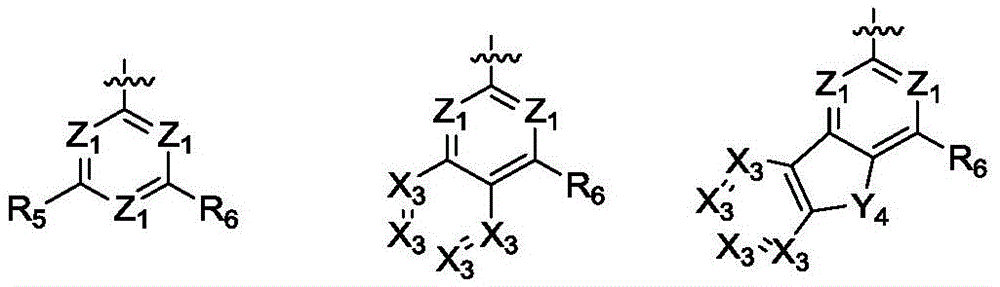
wherein: z1The meaning is as described above; r5、R6、R7Has the same meaning as R1;Y4Has the same meaning as Y3;X3Has the same meaning as X1。
In a certain preferred embodiment, Y2Selected from single bonds;
in a certain preferred embodiment, Y2Selected from single bonds, Y3Selected from NR1Or O, or S; in a certain preferred embodiment, Y2Selected from single bonds, Y3Selected from NR1;
In a certain preferred embodiment, Y2Selected from single bonds, Y1Selected from S, Y3Is selected from O; in a certain preferred embodiment, Y2Selected from single bonds, Y1Selected from O, Y3Is selected from S; in a certain preferred embodiment, Y2Selected from single bonds, Y1Selected from O, Y3Selected from NR1;
The compounds according to the invention are preferably selected from, but not limited to, the following structures, which may be optionally substituted.
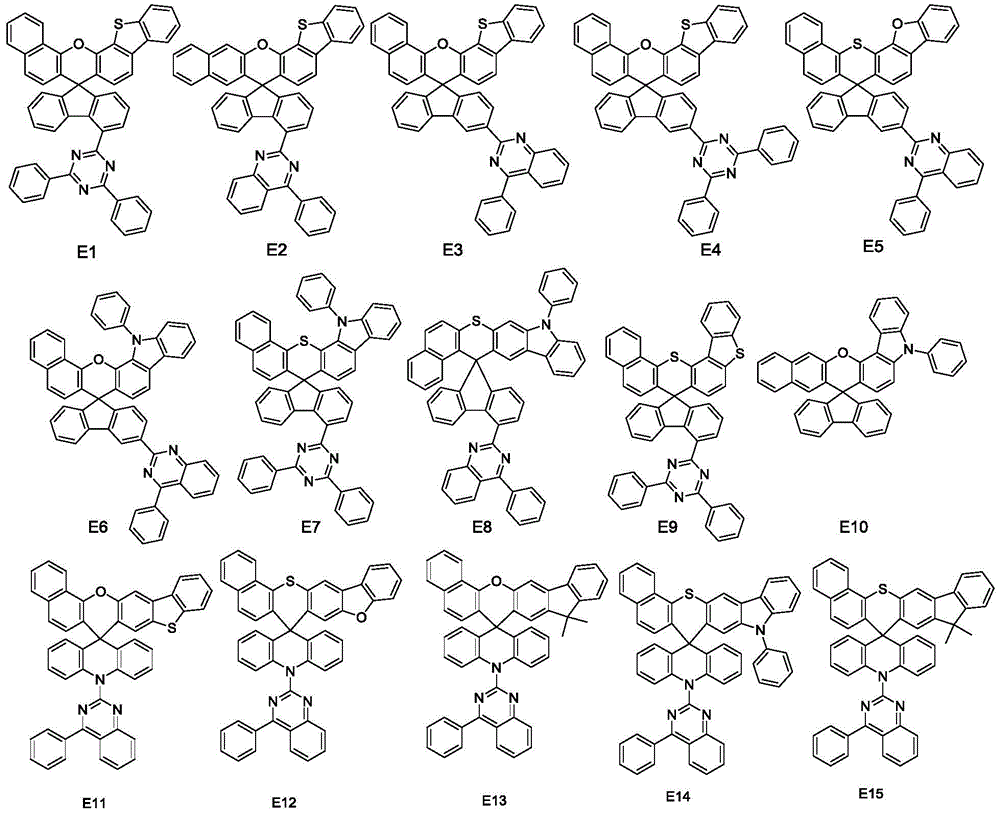


The organic compound according to the embodiment of the invention can be used as a functional material in an electronic device. Organic functional materials include, but are not limited to, the following examples: hole Injection Material (HIM), Hole Transport Material (HTM), Electron Transport Material (ETM), Electron Injection Material (EIM), Electron Blocking Material (EBM), Hole Blocking Material (HBM), Emitter (Emitter), Host material (Host).
In a preferred embodiment, the organic compounds according to embodiments of the present invention are used as electron transport materials or hole blocking materials.
There must be a suitable LUMO as the electron transport material. In certain embodiments, the compounds according to the invention have a LUMO ≦ -2.7eV, preferably ≦ -2.8eV, and most preferably ≦ -2.9 eV.
In a particularly preferred embodiment, the organic compounds according to the invention are used as host materials, in particular phosphorescent host materials.
An appropriate triplet energy level, T1, is necessary as a phosphorescent host material. In certain embodiments, the compounds according to the invention have a T1 ≧ 2.2 eV.
In a preferred embodiment, an organic compound according to the embodiments of the present invention needs to have a relatively suitable resonance factor f (S1) to facilitate the transfer of excitons from the host to the guest, thereby improving the light emitting efficiency of the device. Preferably f (S1) ≥ 0.01, more preferably f (S1) ≥ 0.02, most preferably f (S1) ≥ 0.26.
In another preferred embodiment, an organic compound according to the invention requires a more suitable singlet-triplet energy level difference Δ ESTThereby facilitating the transfer of excitons from the host to the guest and improving the luminous efficiency of the device. Preferably,. DELTA.ESTLess than or equal to 0.3eV, preferably Delta EST0.2eV or less, preferably,. DELTA.EST≤0.1eV。
In certain preferred embodiments, the Δ HOMO, i.e., ((HOMO- (HOMO-1)) of the compounds according to the invention is preferably ≧ 0.10eV, preferably ≧ 0.20eV, more preferably ≧ 0.30eV, most preferably ≧ 0.45 eV.
In certain preferred embodiments, the compounds according to the invention,. DELTA.LUMO (((LUMO +1) -LUMO), is preferably ≥ 0.10eV, preferably ≥ 0.16eV, more preferably ≥ 0.28eV, most preferably ≥ 0.40 eV.
In some embodiments, the organic compounds according to the present invention have a light-emitting function with a light-emitting wavelength of between 300 and 1000nm, preferably between 350 and 900nm, and more preferably between 400 and 800 nm. Luminescence as used herein refers to photoluminescence or electroluminescence.
Embodiments of the present invention further relate to a polymer comprising at least one repeat unit comprising a structural unit represented by structural formula (1).
In a preferred embodiment, the polymer is synthesized by a method selected from the group consisting of SUZUKI-, YAMAMOTO-, STILLE-, NIGESHI-, KUMADA-, HECK-, SONOGASHIRA-, HIYAMA-,' FUKUYAMA-, HARTWIG-BUCHWALD-and ULLMAN.
In a preferred embodiment, the polymers according to the invention have a glass transition temperature (Tg) of 100 ℃ or higher, preferably 120 ℃ or higher, more preferably 140 ℃ or higher, more preferably 160 ℃ or higher, most preferably 180 ℃ or higher.
In a preferred embodiment, the polymers according to the invention preferably have a molecular weight distribution (PDI) in the range from 1 to 5; more preferably 1 to 4; more preferably 1-3, more preferably 1-2, most preferably 1-1.5.
In a preferred embodiment, the polymers according to the invention preferably have a weight average molecular weight (Mw) ranging from 1 to 100 ten thousand; more preferably 5 to 50 ten thousand; more preferably from 10 to 40 ten thousand, more preferably from 15 to 30 ten thousand, and most preferably from 20 to 25 ten thousand.
The embodiment of the invention also relates to a mixture, which comprises the organic compound and at least one of the high polymer, and another organic functional material H2; the further organic functional material H2 is selected from hole (also called hole) injecting or transporting materials (HIM/HTM), Hole Blocking Materials (HBM), electron injecting or transporting materials (EIM/ETM), Electron Blocking Materials (EBM), organic Host materials (Host), singlet emitters (fluorescent emitters), heavy emitters (phosphorescent emitters), in particular light emitting organometallic complexes, and organic thermal excitation delayed fluorescence materials (TADF materials). Various organic functional materials are described in detail, for example, in WO2010135519a1, US20090134784a1 and WO2011110277a1, the entire contents of this 3 patent document being hereby incorporated by reference. The organic functional material can be small molecule and high polymer material.
In a more preferred embodiment, the mixture comprises the above compound or the above polymer and a luminescent material selected from singlet emitters, triplet emitters or TADF emitters.
In certain embodiments, the mixture comprises at least one organic compound or polymer according to the invention and a singlet emitter. The mixtures according to the invention can be used as fluorescent host materials in which the singlet emitters are present in a proportion by weight of less than or equal to 10%, preferably less than or equal to 9%, more preferably less than or equal to 8%, particularly preferably less than or equal to 7%, most preferably less than or equal to 5%.
In a particularly preferred embodiment, the mixture comprises at least one organic compound or polymer according to the invention and a triplet emitter. The mixtures according to the invention can be used as phosphorescent host materials in which the triplet emitters are present in amounts of < 25% by weight, preferably < 20% by weight and more preferably < 15% by weight.
In a further preferred embodiment, the mixture comprises at least one organic compound or polymer according to the invention, a triplet emitter and a host material. In such embodiments, the organic compounds according to the invention can be used as auxiliary luminescent materials in a weight ratio to the triplet emitter of from 1:2 to 2: 1. In a further preferred embodiment, the energy level of the exciplex of the mixture according to the invention is higher than that of the phosphorescent emitter.
In another more preferred embodiment, said mixture comprises at least one organic compound or polymer according to the invention, and a TADF material. The organic compounds according to the invention can be used here as TADF host materials, wherein the TADF host materials are present in a weight percentage of 15 wt.% or less, preferably 10 wt.% or less, more preferably 5 wt.% or less.
In a very preferred embodiment, the mixture comprises an organic compound according to the invention and a further host material. The organic compound according to the invention can here be used as the second host, and its weight percentage can be between 30% and 70%.
The host material according to the present invention is preferably selected from triplet host materials.
In certain preferred embodiments, the mixture according to the invention comprises one organic functional material H1 selected from compounds or polymers as described above, and at least one further organic functional material H2 selected from hole (also called hole) injecting or transporting materials (HIM/HTM), electron injecting or transporting materials (EIM/ETM), organic Host materials (Host).
In certain preferred embodiments, the mixtures according to the invention in which at least one of H1 and H2 has a value of ((LUMO +1) -LUMO) of 0.2eV or more, preferably 0.25eV or more, more preferably 0.3eV or more, still more preferably 0.35eV or more, very preferably 0.4eV or more, most preferably 0.45 eV.
In a preferred embodiment, the mixtures according to the invention in which H1 has a value ((LUMO +1) -LUMO) of 0.2eV or more, preferably 0.25eV or more, more preferably 0.3eV or more, still more preferably 0.35eV or more, very preferably 0.4eV or more, most preferably 0.45eV or more.
In certain preferred embodiments, the mixtures according to the invention in which at least one of H1 and H2 ((HOMO- (HOMO-1)) >0.2 eV, preferably 0.25eV, more preferably 0.3eV, still more preferably 0.35eV, very preferably 0.4eV, most preferably 0.45eV, are used.
In a more preferred embodiment, the mixtures according to the invention in which H2 has a value ((HOMO- (HOMO-1)) > or more than 0.2eV, preferably > 0.25eV, more preferably > 0.3eV, more preferably > 0.35eV, very preferably > 0.4eV, most preferably > 0.45 eV.
In certain preferred embodiments, the organic mixture is described wherein min ((LUMO (H1) -HOMO (H2), LUMO (H2) -HOMO (H1)) ≦ min (ET (H1), ET (H2)) +0.1eV, wherein LUMO (H1), HOMO (H1) and ET (H1) are the lowest unoccupied orbital, the highest occupied orbital, the energy level for the triplet, LUMO (H2), HOMO (H2) and ET (H2) are the lowest unoccupied orbital, the highest occupied orbital, the energy level for the triplet, respectively, of H2. preferably min ((LUMO (H1) -HOMO (H2), LUMO (H2) -HOMO (H1)) ≦ min (ET (H1), ET (H2)) more preferably min ((LUMO (H1) -HOMO (H2)), LUMO (HOMO 2) -HOMO (H2) eV 2 eV), and ET 2eV 3.
In certain more preferred embodiments, the organic mixture 1) has a Δ E (S1-T1) of H1 of ≦ 0.50eV, preferably ≦ 0.40eV, more preferably ≦ 0.30eV, most preferably ≦ 0.10eV, and/or 2) has a LUMO of H2 higher than that of H1 and a HOMO of H2 lower than that of H1.
In a preferred embodiment, the organic mixture wherein the molar ratio of H1 to H2 is from 2: 8 to 8: 2; preferred molar ratios are 3:7 to 7: 3; more preferred molar ratios are 4:6 to 6: 4; the most preferred molar ratio is 4.5:5.5 to 5.5: 4.5.
In a preferred embodiment, the organic mixture wherein the molecular weights of H1 and H2 differ by no more than 100Dalton, preferably no more than 80Dalton, more preferably no more than 70Dalton, more preferably no more than 60Dalton, most preferably no more than 40Dalton, most preferably no more than 30 Dalton.
In another preferred embodiment, the organic mixture wherein the difference between the sublimation temperatures of H1 and H2 is no more than 50K; more preferably the difference in sublimation temperatures does not exceed 30K; more preferably, the difference in sublimation temperature does not exceed 20K; most preferably the difference in sublimation temperatures does not exceed 10K.
In a preferred embodiment, at least one of H1 and H2 in the organic mixture according to the invention has a Tg of 100 ℃ or higher, in a preferred embodiment 120 ℃ or higher, in a more preferred embodiment 140 ℃ or higher, in a more preferred embodiment 160 ℃ or higher, and in a most preferred embodiment 180 ℃ or higher.
In certain preferred embodiments, the mixture, the additional organic functional material H2 comprises a structure according to structural formula (6):

structural formula (6)
Wherein:
Ar1,Ar2each independently selected from substituted or unsubstituted aryl having 5 to 30 ring atoms, substituted or unsubstituted heteroaryl having 5 to 30 ring atoms, or substituted or unsubstituted non-aromatic ring group having 5 to 30 ring atoms.
Preferably, examples of the organic functional material according to formula (6) are selected from, but not limited to, the structures shown in the following formulae, wherein H in the structures may be further optionally substituted:


some more detailed descriptions of singlet emitters, triplet host materials, and TADF materials are provided below (but not limited thereto).
1. Singlet state luminophor (Singlet Emitter)
Singlet emitters tend to have longer conjugated pi-electron systems. Hitherto, there have been many examples such as styrylamine and its derivatives disclosed in JP2913116B and WO2001021729a1, indenofluorene and its derivatives disclosed in WO2008/006449 and WO2007/140847, and triarylamine derivatives of pyrene disclosed in US7233019, KR 2006-0006760.
In a preferred embodiment, the singlet emitters may be selected from the group consisting of monostyrenes, distyrenes, tristyrenes, tetrastyrenes, styrylphosphines, styryl ethers and aromatic amines.
A monostyrene amine is a compound comprising an unsubstituted or substituted styryl group and at least one amine, preferably an aromatic amine. A distyrene amine refers to a compound comprising two unsubstituted or substituted styryl groups and at least one amine, preferably an aromatic amine. A tristyrenylamine refers to a compound comprising three unsubstituted or substituted styrene groups and at least one amine, preferably an aromatic amine. A tetrastyrene amine refers to a compound comprising four unsubstituted or substituted styrene groups and at least one amine, preferably an aromatic amine. One preferred styrene is stilbene, which may be further substituted. The corresponding phosphines and ethers are defined analogously to the amines. Arylamine or aromatic amine refers to a compound comprising three unsubstituted or substituted aromatic rings or heterocyclic systems directly linked to nitrogen. At least one of these aromatic or heterocyclic ring systems is preferably a fused ring system and preferably has at least 14 aromatic ring atoms. Among them, preferred examples are aromatic anthracenamines, aromatic anthracenediamines, aromatic pyrenediamines, aromatic chrysenamines and aromatic chrysenediamines. An aromatic anthracylamine refers to a compound in which a diarylamine group is attached directly to the anthracene, preferably at the 9 position. An aromatic anthracenediamine refers to a compound in which two diarylamine groups are attached directly to the anthracene, preferably at the 9,10 positions. Aromatic pyrene amines, aromatic pyrene diamines, aromatic chrysene amines and aromatic chrysene diamines are similarly defined, wherein the diarylamine groups are preferably attached to the 1 or 1, 6 position of pyrene.
Examples, which are also preferred, of singlet emitters based on vinylamines and arylamines can be found in the following patent documents: WO2006/000388, WO2006/058737, WO2006/000389, WO2007/065549, WO2007/115610, US7250532B2, DE102005058557A1, CN1583691A, JP08053397A, US6251531B1, US2006/210830A, EP1957606A1 and US2008/0113101A1 the entire contents of the patent documents listed above are hereby incorporated by reference.
An example of singlet emitters based on stilbene and its derivatives is US 5121029.
Further preferred singlet emitters may be selected from indenofluorene-amines and indenofluorene-diamines, as disclosed in WO2006/122630, benzindenofluorene-amines and benzindenofluorene-diamines, as disclosed in WO2008/006449, dibenzoindenofluorene-amines and dibenzoindenofluorene-diamines, as disclosed in WO 2007/140847.
Further preferred singlet emitters may be selected from fluorene based fused ring systems as disclosed in US2015333277a1, US2016099411a1, US2016204355a 1.
More preferred singlet emitters may be selected from pyrene derivatives, such as the structures disclosed in US2013175509a 1; triarylamine derivatives of pyrene, such as pyrene triarylamine derivatives containing dibenzofuran units as disclosed in CN 102232068B; other triarylamine derivatives of pyrene having specific structures are disclosed in CN105085334A, CN 105037173A. Other materials which can be used as singlet emitters are polycyclic aromatic compounds, in particular derivatives of the following compounds: anthracenes such as 9, 10-bis (2-naphthoanthracene), naphthalene, tetraphenes, xanthenes, phenanthrenes, pyrenes (e.g. 2,5,8, 11-tetra-t-butylperylene), indenopyrenes, phenylenes such as (4,4 '-bis (9-ethyl-3-carbazolylethenyl) -1, 1' -biphenyl), diindenopyrenes, decacycloalkenes, coronenes, fluorenes, spirobifluorenes, arylpyrenes (e.g. US20060222886), aryleneethylenes (e.g. US5121029, US5130603), cyclopentadienes such as tetraphenylcyclopentadiene, rubrene, coumarin, rhodamine, quinacridones, pyrans such as 4 (dicyanomethylene) -6- (4-p-dimethylaminostyryl-2-methyl) -4H-pyran (DCM), thiopyran, bis (azinyl) imine boron compounds (US 2007/0092753A1), bis (azinyl) methylene compounds, carbostyryl compounds, oxazinones, benzoxazoles, benzothiazoles, benzimidazoles and pyrrolopyrrolediones. Some singlet emitter materials can be found in the following patent documents: US20070252517A1, US4769292, US6020078, US2007/0252517A1, US2007/0252517A 1. The entire contents of the above listed patent documents are hereby incorporated by reference.
Some examples of suitable singlet emitters are listed in the following table:

2. thermally activated delayed fluorescence luminescent material (TADF):
the traditional organic fluorescent material can only emit light by utilizing 25% singlet excitons formed by electric excitation, and the internal quantum efficiency of the device is low (up to 25%). Although the phosphorescence material enhances the intersystem crossing due to the strong spin-orbit coupling of the heavy atom center, the singlet excitons and the triplet excitons formed by the electric excitation can be effectively used for emitting light, so that the internal quantum efficiency of the device reaches 100 percent. However, the application of the phosphorescent material in the OLED is limited by the problems of high price, poor material stability, serious efficiency roll-off of the device and the like. The thermally activated delayed fluorescence emitting material is a third generation organic emitting material developed after organic fluorescent materials and organic phosphorescent materials. The material generally has small singlet state-triplet state energy level difference(ΔEst) The triplet excitons may be converted to singlet excitons by intersystem crossing to emit light. This can make full use of singlet excitons and triplet excitons formed upon electrical excitation. The quantum efficiency in the device can reach 100%. Meanwhile, the material has controllable structure, stable property, low price and no need of noble metal, and has wide application prospect in the field of OLED.
TADF materials need to have a small singlet-triplet level difference, preferably Δ Est <0.3eV, less preferably Δ Est <0.25eV, more preferably Δ Est <0.20eV, and most preferably Δ Est <0.1 eV. In a preferred embodiment, the TADF material has a relatively small Δ Est, and in another preferred embodiment, the TADF has a good fluorescence quantum efficiency. Some TADF luminescent materials can be found in the following patent documents: CN103483332(a), TW201309696(a), TW201309778(a), TW201343874(a), TW201350558(a), US20120217869(a1), WO2013133359(a1), WO2013154064(a1), Adachi, et al adv.adv.mater, 101,2012,093306, Adachi, et al chem.commu. 48,2012,11392, Adachi, et al. nature photomonics, 6,2012,253, Adachi, et al. nature,492,2012,234, Adachi, et al.j.chem. 134,2012,14706, Adachi, et al. machi.t.J. 25,2013,3038 5, Adachi, et al. phytoni, Adachi, et al.t. 25,2013,3038, Adachi, et al.t.19848, et al, adv.t.t.7, adv.t.7, et al.t.t.638, et al, adv.t.t.t.c.t.t.t.t.t.7, Adachi, adachi.t.t.t.t.t.t.t.t.t.t.c.t.t.t.t.t.t.t. ep, Adachi, et al.t.t.t.t.t.t.t.t.t.t.t.t.7, Adachi, et al.t.t.t.t.t.t.t.t.t.t.t.t.t.c. ep, et al, et al.t.t.t.t.ep, et al, et al.ep, et al.t.ep, et al.ep, et al.
Some examples of suitable TADF phosphors are listed in the following table:

3. triplet Emitter (Triplet Emitter)
Triplet emitters are also known as phosphorescent emitters. In a preferred embodiment, the triplet emitter is a metal complex of the general formula M (L) n, where M is a metal atom, L, which may be the same or different at each occurrence, is an organic ligand which is bonded or coordinately bound to the metal atom M via one or more positions, and n is an integer from 1 to 6. Preferably, the triplet emitter comprises a chelating ligand, i.e. a ligand, which coordinates to the metal via at least two binding sites, particularly preferably the triplet emitter comprises two or three identical or different bidentate or polydentate ligands. Chelating ligands are advantageous for increasing the stability of the metal complex.
In a preferred embodiment, the metal complexes which can be used as triplet emitters are of the form:

wherein:
m is a metal atom selected from the group consisting of transition metals, lanthanides and actinides; preferably Ir, Pt, Pd, Au, Rh, Ru, Os, Re, Cu, Ag, Ni, Co, W or Eu; ir, Au, Pt, W or Os are particularly preferred;
Ar1,Ar2may be the same or different at each occurrence and is a cyclic group wherein Ar1Contains at least one donor atom, i.e. an atom having a lone pair of electrons, such as nitrogen, which is coordinately bound to the metal via its cyclic group; wherein Ar is2Contains at least one carbon atom through which the cyclic group is attached to the metal; ar (Ar)1And Ar2Linked together by a covalent bond, which may each carry one or more substituent groups, which may in turn be linked together by substituent groups; l', which may be the same or different at each occurrence, is a bidentate chelating ancillary ligand, preferably a monoanionic bidentate chelating ligand; q1 may be 0,1,2 or 3, preferably 2 or 3; q2 may be 0,1,2 or 3, preferably 1 or 0. Examples of organic ligands may be selected from phenylpyridine derivatives or 7, 8-benzoquinoline derivatives. All of these organic ligands may be substituted, e.g. byAlkyl or fluorine or silicon containing substitution. The ancillary ligand may preferably be selected from acetone acetate or picric acid.
Examples of the extreme use of some triplet emitter materials can be found in the following patent documents and literature: WO200070655, WO200141512, WO200202714, WO200215645, WO2005033244, WO2005019373, US20050258742, US20070087219, US20070252517, US2008027220, WO2009146770, US20090061681, WO2009118087, WO2010015307, WO2010054731, WO2011157339, WO2012007087, WO201200708, WO2013107487, WO2013094620, WO2013174471, WO 2014031977, WO 2014112450, WO2014007565, WO2014024131, bao et al nature (2000),750, Adachi et al. The entire contents of the above listed patent documents and literature are hereby incorporated by reference. Some examples of suitable triplet emitters are listed in the following table:

4. triplet host materials
Examples of the triplet host material are not particularly limited, and any metal complex or organic compound may be used as the host as long as the triplet energy level thereof is higher than that of a light emitter, particularly a triplet light emitter or a phosphorescent light emitter.
Examples of metal complexes that can be used as triplet hosts (Host) include, but are not limited to, the following general structures:

wherein:
m is a metal;
(Y3-Y4) Is a bidentate ligand, Y3And Y4Independently selected from C, N, O, P, or S;
l is an ancillary ligand;
m is an integer having a value from 1 to the maximum coordination number of metal M.
In a preferred embodiment, the metal complexes that can be used as triplet hosts are of the form:

wherein:
(O-N) is a bidentate ligand wherein the metal is coordinated to the O and N atoms;
m is an integer having a value from 1 up to the maximum coordination number of the metal.
In one embodiment, M may be selected from Ir or Pt.
Examples of the organic compound which can be a triplet host are selected from compounds containing a cyclic aromatic hydrocarbon group such as benzene, biphenyl, triphenylbenzene, benzofluorene; compounds containing aromatic heterocyclic groups, such as dibenzothiophene, dibenzofuran, dibenzoselenophene, furan, thiophene, benzofuran, benzothiophene, benzoselenophene, carbazole, dibenzocarbazole, indolocarbazole, pyridine indole, pyrrole bipyridine, pyrazole, imidazole, triazoles, oxazole, thiazole, oxadiazole, bisoxazole, thiadiazole, pyridine, pyridazine, pyrimidine, pyrazine, triazine, oxazine, oxathiazine, oxadiazine, indole, benzimidazole, indazole, oxazole, dibenzooxazole, benzisoxazole, benzothiazole, quinoline, isoquinoline, phthalazine, quinazoline, quinoxaline, naphthalene, phthalein, pteridine, xanthene, acridine, phenazine, phenothiazine, phenoxazine, benzofuran pyridine, furopyridine, benzothiophene pyridine, thiophene pyridine, benzoselenophene pyridine, and selenophene benzodipyridine; groups having 2 to 10 ring structures, which may be the same or different types of cyclic aromatic hydrocarbon groups or aromatic heterocyclic groups, are bonded to each other directly or through at least one group selected from the group consisting of an oxygen atom, a nitrogen atom, a sulfur atom, a silicon atom, a phosphorus atom, a boron atom, a chain structural unit and an alicyclic group. Wherein each Ar may be further substituted, and the substituents may be selected from the group consisting of hydrogen, deuterium, cyano, halogen, alkyl, alkoxy, amino, alkene, alkyne, aralkyl, heteroalkyl, aryl and heteroaryl.
In a preferred embodiment, the triplet host material may be selected from compounds comprising at least one of the following groups:

wherein:
when Y appears multiple times, Y is independently selected from C (R)2NR, O or S;
when X appears for multiple times, X is respectively and independently selected from CR or N, Ar3-Ar5Selected from aryl or heteroaryl, R may be selected from the following groups: hydrogen, deuterium, halogen atoms (F, Cl, Br, I), cyano, alkyl, alkoxy, amino, alkenyl, alkynyl, aralkyl, heteroalkyl, aryl and heteroaryl;
n is selected from an integer from 1 to 20.
Examples of suitable triplet host materials are listed in the following table but are not limited to:


it is an object of the present invention to provide a material solution for evaporation type OLEDs.
In certain embodiments, the compounds according to the invention have a molecular weight of 1200g/mol or less, preferably 1100g/mol or less, very preferably 1000g/mol or less, more preferably 950g/mol or less, and most preferably 900g/mol or less.
It is another object of the present invention to provide a material solution for printing OLEDs.
In certain embodiments, the compounds according to the invention have a molecular weight of 800g/mol or more, preferably 900g/mol or more, very preferably 1000g/mol or more, more preferably 1100g/mol or more, most preferably 1200g/mol or more.
In other embodiments, the compounds according to the invention have a solubility in toluene of 2mg/ml or more, preferably 3mg/ml or more, more preferably 4mg/ml or more, most preferably 5mg/ml or more at 25 ℃.
The invention also relates to a composition comprising at least one of the organic compounds, polymers and mixtures as described above, and at least one organic solvent.
In some embodiments, the at least one organic solvent is selected from one or a mixture of two or more of aromatic, heteroaromatic, ester, aromatic ketone, aromatic ether, aliphatic ketone, aliphatic ether, alicyclic, olefinic compound, borate compound, and phosphate compound.
In a preferred embodiment, according to a composition of the invention, said at least one organic solvent is chosen from aromatic or heteroaromatic-based solvents.
Examples of aromatic or heteroaromatic based solvents suitable for embodiments of the present invention are, but not limited to: p-diisopropylbenzene, pentylbenzene, tetrahydronaphthalene, cyclohexylbenzene, chloronaphthalene, 1, 4-dimethylnaphthalene, 3-isopropylbiphenyl, p-methylisopropylbenzene, dipentylbenzene, tripentylbenzene, pentyltoluene, o-diethylbenzene, m-diethylbenzene, p-diethylbenzene, 1,2,3, 4-tetramethylbenzene, 1,2,3, 5-tetramethylbenzene, 1,2,4, 5-tetramethylbenzene, butylbenzene, dodecylbenzene, dihexylbenzene, dibutylbenzene, p-diisopropylbenzene, cyclohexylbenzene, benzylbutylbenzene, dimethylnaphthalene, 3-isopropylbiphenyl, p-methylisopropylbenzene, 1-methylnaphthalene, 1,2, 4-trichlorobenzene, 4-difluorodiphenylmethane, 1, 2-dimethoxy-4- (1-propenyl) benzene, diphenylmethane, 2-phenylpyridine, 3-phenylpyridine, N-methyldiphenylamine, 4-isopropylbiphenyl, α -dichlorodiphenylmethane, 4- (3-phenylpropyl) pyridine, benzyl benzoate, 1-bis (3, 4-dimethylphenyl) ethane, 2-isopropylnaphthalene, quinoline, isoquinoline, methyl 2-furancarboxylate, ethyl 2-furancarboxylate, and the like;
examples of aromatic ketone-based solvents suitable for the present invention are, but not limited to: 1-tetralone, 2- (phenylepoxy) tetralone, 6- (methoxy) tetralone, acetophenone, propiophenone, benzophenone, and derivatives thereof, such as 4-methylacetophenone, 3-methylacetophenone, 2-methylacetophenone, 4-methylpropiophenone, 3-methylpropiophenone, 2-methylpropiophenone, and the like;
examples of aromatic ether-based solvents suitable for the present invention are, but not limited to: 3-phenoxytoluene, butoxybenzene, p-anisaldehyde dimethylacetal, tetrahydro-2-phenoxy-2H-pyran, 1, 2-dimethoxy-4- (1-propenyl) benzene, 1, 4-benzodioxan, 1, 3-dipropylbenzene, 2, 5-dimethoxytoluene, 4-ethylphenetole, 1, 3-dipropoxybenzene, 1,2, 4-trimethoxybenzene, 4- (1-propenyl) -1, 2-dimethoxybenzene, 1, 3-dimethoxybenzene, glycidylphenyl ether, dibenzyl ether, 4-t-butylanisole, trans-p-propenylanisole, 1, 2-dimethoxybenzene, 1-methoxynaphthalene, diphenyl ether, 2-phenoxymethyl ether, methyl ether, 2-phenoxytetrahydrofuran, ethyl-2-naphthyl ether;
in some preferred embodiments, the at least one organic solvent may be selected from: aliphatic ketones such as 2-nonanone, 3-nonanone, 5-nonanone, 2-decanone, 2, 5-hexanedione, 2,6, 8-trimethyl-4-nonanone, fenchylone, phorone, isophorone, di-n-amyl ketone, etc.; or aliphatic ethers such as amyl ether, hexyl ether, dioctyl ether, ethylene glycol dibutyl ether, diethylene glycol diethyl ether, diethylene glycol butyl methyl ether, diethylene glycol dibutyl ether, triethylene glycol dimethyl ether, triethylene glycol ethyl methyl ether, triethylene glycol butyl methyl ether, tripropylene glycol dimethyl ether, tetraethylene glycol dimethyl ether, and the like.
In other preferred embodiments, the at least one organic solvent may be selected from ester-based solvents: alkyl octanoates, alkyl sebacates, alkyl stearates, alkyl benzoates, alkyl phenylacetates, alkyl cinnamates, alkyl oxalates, alkyl maleates, alkyl lactones, alkyl oleates, and the like. Octyl octanoate, diethyl sebacate, diallyl phthalate, isononyl isononanoate are particularly preferred.
The solvents mentioned may be used alone or as a mixture of two or more organic solvents.
In certain preferred embodiments, a composition according to the present invention comprises at least one compound or polymer or mixture as described above and at least one organic solvent, and may further comprise another organic solvent. Examples of such another organic solvent include, but are not limited to: one or a mixture of methanol, ethanol, 2-methoxyethanol, dichloromethane, chloroform, chlorobenzene, o-dichlorobenzene, tetrahydrofuran, anisole, morpholine, toluene, o-xylene, m-xylene, p-xylene, 1, 4-dioxane, acetone, methyl ethyl ketone, 1, 2-dichloroethane, 3-phenoxytoluene, 1,1, 1-trichloroethane, 1,1,2, 2-tetrachloroethane, ethyl acetate, butyl acetate, dimethylformamide, dimethylacetamide, dimethyl sulfoxide, tetrahydronaphthalene, decalin and indene.
In some preferred embodiments, particularly suitable solvents for the present invention are those having Hansen (Hansen) solubility parameters within the following ranges:
δd(dispersion force) is 17.0-23.2MPa1/2In particular in the range from 18.5 to 21.0MPa1/2A range of (d);
δp(polar force) is 0.2-12.5MPa1/2In particular in the range from 2.0 to 6.0MPa1/2A range of (d);
δh(hydrogen bonding force) is 0.9-14.2MPa1/2In particular in the range from 2.0 to 6.0MPa1/2The range of (1).
Compositions according to embodiments of the invention wherein the organic solvent is selected taking into account its boiling point parameter. In the embodiment of the invention, the boiling point of the organic solvent is more than or equal to 150 ℃; preferably equal to or more than 180 ℃; more preferably more than or equal to 200 ℃; more preferably more than or equal to 250 ℃; most preferably more than or equal to 275 ℃ or more than or equal to 300 ℃. Boiling points in these ranges are beneficial for preventing nozzle clogging in inkjet print heads. The organic solvent may be evaporated from the solvent system to form a thin film comprising the functional material.
In a preferred embodiment, the composition according to the invention is a solution.
In another preferred embodiment, the composition according to the invention is a suspension.
The compositions of the embodiments of the present invention may contain 0.01 to 10 wt% of the organic compound or polymer or mixture according to the present invention, preferably 0.1 to 15 wt%, more preferably 0.2 to 5 wt%, and most preferably 0.25 to 3 wt%.
The invention also relates to the use of said composition as a coating or printing ink for the production of organic electronic devices, particularly preferably by a printing or coating production process.
Suitable Printing or coating techniques include, but are not limited to, ink jet Printing, letterpress, screen Printing, dip coating, spin coating, doctor blade coating, roll Printing, twist roll Printing, lithographic Printing, flexographic Printing, rotary Printing, spray coating, brush or pad Printing, slot die coating, and the like. Gravure printing, jet printing and ink jet printing are preferred. The solution or suspension may additionally include one or more components such as surface active compounds, lubricants, wetting agents, dispersants, hydrophobing agents, binders, and the like, for adjusting viscosity, film forming properties, enhancing adhesion, and the like. For details on the printing technology and its requirements concerning the solutions, such as solvents and concentrations, viscosities, etc., reference is made to the Handbook of Print Media, technology and Production Methods, published by Helmut Kipphan, ISBN 3-540-67326-1.
The invention also provides the use of an organic compound, polymer, mixture or composition as described above in an organic electronic device.
In some embodiments, the Organic electronic device can be selected from, but is not limited to, Organic Light Emitting Diodes (OLEDs), Organic photovoltaic cells (OPVs), Organic light Emitting cells (OLEECs), Organic Field Effect Transistors (OFETs), Organic light Emitting field effect transistors (efets), Organic lasers, Organic spintronic devices, Organic sensors, Organic Plasmon Emitting diodes (Organic plasma Emitting diodes), and the like, and particularly preferably is an OLED.
In the embodiment of the present invention, the organic compound or the high polymer is preferably used for a light emitting layer of an OLED device.
In another preferred embodiment of the present invention, the organic compound or polymer according to the present invention is used for an electron transport layer or a hole blocking layer of an OLED device.
The present invention relates to an organic electronic device comprising at least one of the organic compounds, polymers and mixtures as described above, or prepared from the above composition.
Generally, such organic electronic devices comprise at least a cathode, an anode and a functional layer located between the cathode and the anode, wherein the functional layer comprises at least one organic mixture as described above. The Organic electronic device can be selected from, but not limited to, Organic Light Emitting Diodes (OLEDs), Organic photovoltaic cells (OPVs), Organic light Emitting cells (OLEECs), Organic Field Effect Transistors (OFETs), Organic light Emitting field effect transistors (fets), Organic lasers, Organic spintronic devices, Organic sensors, Organic Plasmon Emitting diodes (Organic Plasmon Emitting diodes), and the like, and particularly preferred are Organic electroluminescent devices such as OLEDs, OLEECs, Organic light Emitting field effect transistors.
In certain preferred embodiments, the electroluminescent device comprises a light-emitting layer comprising an organic compound or mixture or polymer as described above.
In certain preferred embodiments, the electroluminescent device comprises a hole transport layer or an electron transport layer comprising an organic compound or mixture or polymer as described above.
In certain preferred embodiments, the electroluminescent device comprises a light-emitting layer comprising an organic compound as described above, or comprising an organic compound as described above and a phosphorescent light-emitting material, or comprising an organic compound as described above and a fluorescent light-emitting material, or comprising an organic compound as described above and a TADF material.
In the above-mentioned light emitting device, especially an OLED, it comprises a substrate, an anode, at least one light emitting layer, and a cathode.
The substrate may be opaque or transparent. A transparent substrate may be used to fabricate a transparent light emitting device. See, for example, Bulovic et al Nature 1996,380, p29, and Gu et al, appl.Phys.Lett.1996,68, p 2606. The substrate may be rigid or flexible. The substrate may be plastic, metal, semiconductor wafer or glass. Preferably, the substrate has a smooth surface. A substrate free of surface defects is a particularly desirable choice. In a preferred embodiment, the substrate is flexible, and may be selected from polymeric films or plastics having a glass transition temperature Tg of 150 deg.C or greater, preferably greater than 200 deg.C, more preferably greater than 250 deg.C, and most preferably greater than 300 deg.C. Examples of suitable flexible substrates are poly (ethylene terephthalate) (PET) and polyethylene glycol (2, 6-naphthalene) (PEN).
The anode may comprise a conductive metal or metal oxide, or a conductive polymer. The anode can easily inject holes into a Hole Injection Layer (HIL) or a Hole Transport Layer (HTL) or an emission layer. In one embodiment, the absolute value of the difference between the work function of the anode and the HOMO level or valence band level of the emitter in the light emitting layer or the p-type semiconductor material acting as a HIL or HTL or Electron Blocking Layer (EBL) is less than 0.5eV, preferably less than 0.3eV, most preferably less than 0.2 eV. Examples of anode materials include, but are not limited to: al, Cu, Au, Ag, Mg, Fe, Co, Ni, Mn, Pd, Pt, ITO, aluminum-doped zinc oxide (AZO), and the like. Other suitable anode materials are known and can be readily selected for use by one of ordinary skill in the art. The anode material may be deposited using any suitable technique, such as a suitable physical vapor deposition method including radio frequency magnetron sputtering, vacuum thermal evaporation, electron beam (e-beam), and the like. In certain embodiments, the anode is pattern structured. Patterned ITO conductive substrates are commercially available and can be used to prepare devices according to the present invention.
The cathode may comprise a conductive metal or metal oxide. The cathode can easily inject electrons into the EIL or ETL or directly into the light emitting layer. In one embodiment, the absolute value of the difference between the work function of the cathode and the LUMO level or conduction band level of the emitter in the light-emitting layer or of the n-type semiconductor material as Electron Injection Layer (EIL) or Electron Transport Layer (ETL) or Hole Blocking Layer (HBL) is less than 0.5eV, preferably less than 0.3eVAnd preferably less than 0.2 eV. In principle, all materials which can be used as cathodes in OLEDs are possible as cathode materials for the device according to the invention. Examples of cathode materials include, but are not limited to: al, Au, Ag, Ca, Ba, Mg, LiF/Al, MgAg alloy, BaF2Al, Cu, Fe, Co, Ni, Mn, Pd, Pt, ITO, etc. The cathode material may be deposited using any suitable technique, such as a suitable physical vapor deposition method, including radio frequency magnetron sputtering, vacuum thermal evaporation, electron beam (e-beam), and the like.
The OLED may also comprise further functional layers, such as a Hole Injection Layer (HIL), a Hole Transport Layer (HTL), an Electron Blocking Layer (EBL), an Electron Injection Layer (EIL), an Electron Transport Layer (ETL), a Hole Blocking Layer (HBL). Suitable materials for use in these functional layers are described in detail above and in WO2010135519a1, US20090134784a1 and WO2011110277a1, the entire contents of these 3 patent documents being hereby incorporated by reference.
The organic light emitting device according to the embodiment of the present invention emits light with a wavelength of 300 to 1200nm, preferably 350 to 1000nm, and more preferably 400 to 900 nm.
The invention also relates to the use of the organic electronic device according to the invention in various electronic devices, including, but not limited to, display devices, lighting devices, light sources, sensors, etc.
The embodiment of the invention also provides electronic equipment which comprises the organic electronic device.
The present invention will be described in connection with preferred embodiments, but the present invention is not limited to the following embodiments, and it should be understood that the appended claims outline the scope of the present invention and those skilled in the art, guided by the inventive concept, will appreciate that certain changes may be made to the embodiments of the invention, which are intended to be covered by the spirit and scope of the appended claims.
DETAILED DESCRIPTION OF EMBODIMENT (S) OF INVENTION
1. Synthesis of Compounds
Example 1

(1) Synthesis of E5-3:
a flask was charged with E5-1(30.0g), E5-2(23.4g), cesium carbonate (49.1g) and DMF (300ml), stirred at 160 ℃ for 12 h; cooling, filtering, washing with water and extracting; the extracted organic phase column chromatography gives E5-3. Ms (asap): 405.31.
(2) synthesis of E5-5:
e5-3(25.0g) and dry THF were added to the flask, cooled to-78 ℃ under nitrogen and n-BuLi (30.8ml, 2M) was added and stirred at temperature for 2 h; a solution of E5-4(16.0g) in THF was added and the temperature was slowly brought back to room temperature. The solvent was removed by rotary evaporation, the resulting intermediate was purified by column chromatography and dissolved in 200ml of methanesulfonic acid and stirred at 75 ℃ for 4 h. The reaction solution was poured into a large amount of water, filtered with suction and recrystallized to give intermediate E5-5. Ms (asap): 567.50.
(3) synthesis of E5:
e5-5(20.0g) was dissolved in dry THF (300ml) and magnesium turnings (0.86g) and a small amount of iodine were added; heating to initiate and maintain the reaction in a nitrogen atmosphere; after completion of the reaction, the obtained Grignard reagent solution was poured into a THF solution containing 2-chloro-4-phenylquinazoline (8.5g), and refluxed at 80 ℃ for 12 hours under a nitrogen atmosphere. And extracting and separating the reaction solution, and performing column chromatography to obtain E5. Ms (asap): 692.84.
example 2

(1) Synthesis of E2-3 reference was made to the synthesis of E5-3 in example 1, except that E5-1 was replaced with E2-1 and E5-2 was replaced with E2-2;
(2) synthesis of E2-5 reference was made to the synthesis of E5-5, except that E5-3 was changed to E2-3 and E5-4 was changed to E2-4;
(3) synthesis of E2 reference was made to the synthesis of E5, with the exception that E5-5 was replaced by E2-5. Ms (asap) of E2: 692.84.
example 3

Synthesis of E10 reference was made to the synthesis of E5-5 in example 1, except that E5-1 was changed to E2-1, E5-2 was changed to E10-1, and E5-4 was changed to 9-fluorenone. Ms (asap) of E10: 547.66.
example 4

Synthesis of E8 reference was made to the synthesis of E2 in example 2, except that E2-1 was changed to E8-1 and E2-2 was changed to E8-2. Ms (asap) of E8: 767.95.
example 5

Synthesis of E45-3 reference was made to the synthesis of E5-5 in example 1, except that E5-1 was changed to E45-1, E5-2 was changed to E45-2, and E5-4 was changed to E45-4. Ms (asap) of E45: 763.93.
example 6
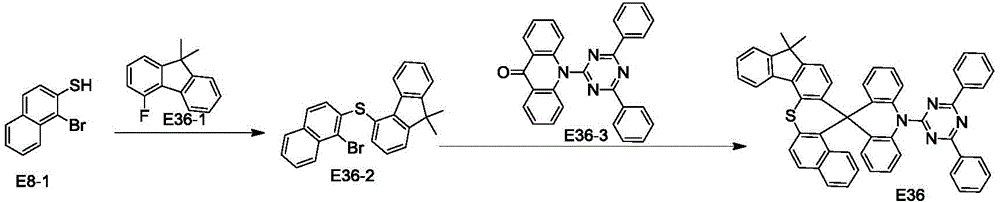
Synthesis of E36 reference was made to the synthesis of E5-5 in example 1, except that E5-1 was changed to E8-1, E5-2 was changed to E36-1, and E5-4 was changed to E36-3. Ms (asap) of E36: 760.96.
example 7

Synthesis of E20 reference was made to the synthesis of E5-5 in example 1, except that E5-1 was changed to E20-1, E5-2 was changed to E20-2, and E5-4 was changed to E20-4. Ms (asap) of E20: 766.90.
example 8

(1) Synthesis of E25-3: a flask was charged with E25-1(25.0g), E25-2(50.5g) and cesium carbonate (52g), and 400ml of DMF was added, stirred at 170 ℃ for 15 h. Cooling, filtering to obtain filtrate, washing with water, extracting, and performing organic phase column chromatography to obtain E25-3.
(2) Synthesis of E25 reference was made to the synthesis of E5-5 in example 1, except that E5-3 was changed to E25-3 and E5-4 was changed to E25-4. Ms (asap) of E25: 664.85.
example 9

Synthesis of E40 reference was made to the synthesis of E5-5 in example 1, except that E5-1 was changed to E40-1, E5-2 was changed to E40-2, and E5-4 was changed to E40-4. Ms (asap) of E40: 850.05.
example 10

Synthesis of E44 reference was made to the synthesis of E5-5 in example 1, except that E5-1 was changed to E20-1, E5-2 was changed to E44-1, and E5-4 was changed to E44-3. Ms (asap) of E44: 679.82.
example 11

Synthesis of E31 reference was made to the synthesis of E5-5 in example 1, except that E5-1 was changed to E45-1, E5-2 was changed to E31-1, and E5-4 was changed to E31-3. Ms (asap) of E31: 780.98.
example 12

Synthesis of E35 reference was made to the synthesis of E5-5 in example 1, except that E5-1 was replaced by 1-naphthol, E5-2 was replaced by E35-1, and E5-4 was replaced by E35-3. Ms (asap) of E35: 532.66
Example 13

Synthesis of E50 reference was made to the synthesis of E5-5 in example 1, except that E5-1 was changed to E45-1, E5-2 was changed to E50-1, and E5-4 was changed to E50-3. Ms (asap) of E50: 654.78.
example 14

Synthesis of E54 reference was made to the synthesis of E5-5 in example 1, except that E5-1 was changed to E54-1, E5-2 was changed to E54-2, and E5-4 was changed to E44-3. Ms (asap) of E54: 670.78
2. Energy level calculation of Compounds
The energy level of the organic compound material can be obtained by quantum calculation, for example, by using TD-DFT (including time density functional theory) through Gaussian09W (Gaussian Inc.), and a specific simulation method can be seen in WO 2011141110. Firstly, a Semi-empirical method of 'group State/Semi-empirical/Default Spin/AM 1' (Charge 0/Spin Singlet) is used for optimizing the molecular geometrical structure, and then the energy structure of the organic molecules is calculated by a TD-DFT (time-density functional theory) method "TD-SCF/DFT/Default Spin/B3PW 91' and base group "6-31G (d)" (Charge 0/Spin Singlet). The HOMO and LUMO energy levels are calculated according to the following calibration equation, S1,T1And resonance factor f (S)1) Can be used directly.
HOMO(eV)=((HOMO(G)×27.212)-0.9899)/1.1206
LUMO(eV)=((LUMO(G)×27.212)-2.0041)/1.385
Where HOMO (G) and LUMO (G) are direct calculations of Gaussian09W in Hartree. The results are shown in table 1:
table 1: comparison of quantum-chemical computation results of materials

Wherein, the HOMO values are all in the range of-5.2 eV to 6.0eV, and the triplet state energy level T1 is all above-2.30 eV, which indicates that the materials shown in the embodiment are all suitable red host materials. Delta E of E8, E45, E36, E20 in the tableSTBoth are below 0.30eV, indicating that these materials have TADF sensitizing properties. In the tables, f (S1) of E44, E35, E50 and E54 is 0.02 or more, and particularly, E44 has higher f (S1) (S1)>0.2), indicating that these materials have better host-guest exciton transport efficiency. E45 satisfied min ((LUMO (H1) -HOMO (H2), LUMO (H2) -HOMO (H1)). ltoreq.min (ET (H1), ET (H2)) with F-2, and E36 satisfied min ((LUMO (H1) -HOMO (H2), LUMO (H2) -HOMO (H1)). ltoreq.min (ET (H1), ET (H2)) -0.1 eV) with F-2, indicating that E45, E36 can form exciplex with F-2 and can be used as host material for the mixture.
3. OLED device fabrication
Example 15 preparation of an OLED device based on E5 as host material:
the structure of the device is ITO/NPD (60 nm)/compound E5 (95%): piq)2Ir (acac) (5%) (45nm)/TPBi (35nm)/Liq (1nm)/Al (150 nm). Wherein (piq)2Ir (acac) as the light-emitting material and E5 as the host material. NPD is used as a hole transport material, TPBi is used as an electron transport material, and Liq is used as an electron injection material. E5 and (piq)2Ir (acac) in a mass ratio of95:5. The specific preparation process is as follows:
a. cleaning the conductive glass substrate: for the first time, the cleaning agent can be cleaned by various solvents, such as chloroform, ketone and isopropanol, and then ultraviolet ozone plasma treatment is carried out;
b. HTL (60nm), EML (45nm), ETL (35 m): under high vacuum (1X 10)-6Mbar, mbar) by thermal evaporation;
c. cathode: LiF/Al (1nm/150nm) in high vacuum (1X 10)-6Millibar) hot evaporation;
d. packaging: the devices were encapsulated with uv curable resin in a nitrogen glove box.


Example 16 example 28
Device preparation of examples reference was made to example 15, except that E5 was replaced with the material shown in table 2.
Example 29 and example 30
Device preparation of examples reference was made to example 15, except that E5 was replaced with a mixture of the materials shown in table 2 blended in a 1:1 mass ratio.
Comparative examples 31 and 32
Device preparation of comparative example reference was made to example 15, except that E5 was replaced with the host material shown in table 2.
Table 2: OLED device Performance comparison
| OLED device | Host material | LT95@1000nits (relative value) | External quantum efficiency (relative value) |
| Example 15 | E5 | 1.5 | 147 |
| Example 16 | E2 | 1.7 | 151 |
| Example 17 | E10 | 1.8 | 153 |
| Example 18 | E8 | 1.9 | 165 |
| Example 19 | E45 | 2.8 | 171 |
| Example 20 | E36 | 2.7 | 172 |
| Example 21 | E20 | 2.9 | 179 |
| Example 22 | E25 | 2.1 | 162 |
| Example 23 | E40 | 2.2 | 166 |
| Example 24 | E44 | 2.8 | 172 |
| Example 25 | E31 | 2.2 | 161 |
| Example 26 | E35 | 2.1 | 154 |
| Example 27 | E50 | 2.2 | 149 |
| Example 28 | E54 | 2.1 | 156 |
| Example 29 | E45:F-2(1:1) | 3.1 | 191 |
| Example 30 | E36:F-2(1:1) | 3.2 | 193 |
| Comparative example 31 | F-2 | 1 | 100 |
| Comparative example 32 | F-1 | 1.1 | 129 |
The current-voltage (J-V) characteristics of each OLED device were characterized by a characterization device, while recording important parameters such as efficiency, lifetime, and external quantum efficiency. Table 2 shows the OLED device lifetime and external quantum efficiency comparison, where lifetime LT95 is the time at which the luminance drops to 95% of the initial luminance @1000nits at constant current. Here, LT95 was calculated in comparison with example 31 (corresponding to material F-2), i.e., in the case where the life of comparative example 31 was 1 and the external quantum efficiency was 100. From table 1, it can be seen that:
examples 15 to 30, which used the material or the mixture of the present invention as the main component, had significantly higher lifetime and external quantum efficiency than those of comparative example 31 (corresponding to raw material F-2) and comparative example 32 (corresponding to material F-1), respectively. This is related to the molecular structure of the compound used in the examples of the present invention, which has a spiro structure and a larger conjugated system than the molecule F-1 of the comparative example, resulting in better carrier transport efficiency.
Examples 19 to 28 all had higher efficiencies and lifetimes than examples 15 to 18, illustrating Y in the general structural formula (1)2The molecule selected from the group consisting of atoms C, N, O, S is preferred to Y2A molecule selected from a single bond.
E45, E36, E20 have relatively higher lifetimes (2.7-2.9) and efficiencies (EQE)>20%) because the three have a relatively small Δ EST(<0.1eV) to make the material have TADF sensitization, thereby improving the luminous efficiency and lifetime of the device.
In addition, the better lifetime (2.8) and efficiency (> 20%) of E44 is due to the higher Δ HOMO (> 0.45eV), Δ LUMO (> 0.28eV) and f (S1) (>0.26) of E44, which enhances the stability of the molecule and the exciton transport efficiency.
Examples 29 and 30 used the mixture according to the present invention as a device host material, and the lifetime thereof was 3 times or more as long as that of comparative example 31 (corresponding to the raw material F-2) and example 32 (corresponding to the material F-1). In particular, in example 29 (E45: F-2) and example 30(E36: F-2), the external quantum efficiencies were 20% or more.
Therefore, the compound and the mixture containing the compound are used as the host material, the service life of the device is obviously prolonged compared with the existing material, and the device performance is obviously improved.
Example 33 preparation of OLED device with E2 as ETM Material (Electron transport Material)
The structure of the device is ITO/NPD (60 nm)/compound E45 (95%): piq)2Ir (acac) (5%) (45nm)/E2(35nm)/Liq (1nm)/Al (150 nm). The specific device fabrication method is referred to example 15.
Example 34
OLED devices were prepared according to example 33, except that E2 was replaced with E8.
Comparative example 35
OLED devices were prepared according to example 33, except that E2 was replaced with TPBi.
Table 3: comparison of OLED device Performance Using different ETM materials
| OLED device | ETM material | LT95@1000nits (relative value) | External quantum efficiency (relative value) |
| Example 33 | E2 | 2.6 | 126 |
| Example 34 | E8 | 2.3 | 124 |
| Comparative example 35 | TPBi | 1 | 100 |
The current-voltage (J-V) characteristics of each OLED device were characterized by a characterization device, while recording important parameters such as efficiency, lifetime, and external quantum efficiency. Table 3 shows the OLED device lifetime and external quantum efficiency comparison, where lifetime LT95 is the time at which the luminance drops to 95% of the initial luminance @1000nits at constant current. Here, LT95 and the external quantum efficiency were calculated by comparing with example 35 (corresponding material TPBi), that is, the lifetime of comparative example 35 was 1 and the external quantum efficiency was 100. The lifetimes of examples 33 (corresponding to E2) to 34 (corresponding to E8) were all significantly higher than that of comparative example 35 (corresponding to TPBi). Therefore, the material of the invention is used as an electron transport layer material (ETM), the service life of the device is obviously prolonged compared with the service life of the existing electron transport material, and the device performance is obviously improved.
The technical features of the embodiments described above may be arbitrarily combined, and for the sake of brevity, all possible combinations of the technical features in the embodiments described above are not described, but should be considered as being within the scope of the present specification as long as there is no contradiction between the combinations of the technical features.
The above-mentioned embodiments only express several embodiments of the present invention, and the description thereof is more specific and detailed, but not construed as limiting the scope of the invention. It should be noted that, for a person skilled in the art, several variations and modifications can be made without departing from the inventive concept, which falls within the scope of the present invention. Therefore, the protection scope of the present patent shall be subject to the appended claims.
Claims (12)
1. An organic compound characterized by being selected from any one of the following structural formulae (4-1) to (4-7):

wherein:
Y1selected from O or S;
Y2selected from NR1;
Y3Selected from the group consisting of CR1R2,NR1O, or S;
X1、X2at multiple occurrence, each is independently selected from CR3Or N;
R1、R2and R3Independently selected, when present at multiple times, from hydrogen, D, straight chain alkyl having 1 to 20C atoms, alkoxy having 1 to 20C atoms, thioalkoxy having 1 to 20C atoms, branched alkyl having 3 to 20C atoms, cyclic alkyl having 1 to 20C atoms, alkoxy having 1 to 20C atoms, thioalkoxy having 1 to 20C atoms, silyl, keto having 1 to 20C atoms, alkoxycarbonyl having 2 to 20C atoms, aryloxycarbonyl having 7 to 20C atoms, cyano, carbamoyl, haloformyl, formyl, isocyano, isocyanate, thiocyanate, isothiocyanate, hydroxy, nitro, CF, hydroxyl, nitro, CF, and mixtures thereof3Cl, Br, F, a crosslinkable group, a substituted or unsubstituted aromatic group having 5 to 60 ring atoms, a substituted or unsubstituted heteroaromatic group having 5 to 60 ring atoms, an aryloxy group having 5 to 60 ring atoms, or a heteroaryloxy group having 5 to 60 ring atoms, or a combination of these systems; r1、R2And R3Two or more adjacent radicals in the above-mentioned ring systems may optionally form a mono-or polycyclic, aliphatic, aromatic or heteroaromatic ring system with one another;
R4selected from the group consisting of hydrogen, D, straight chain alkyl having 1 to 20C atoms, alkoxy having 1 to 20C atoms, thioalkoxy having 1 to 20C atoms, branched alkyl having 3 to 20C atoms, cyclic alkyl having 1 to 20C atoms, alkoxy having 1 to 20C atoms, thioalkoxy having 1 to 20C atoms, silyl, keto having 1 to 20C atoms, alkoxycarbonyl having 2 to 20C atoms, aryloxycarbonyl having 7 to 20C atoms, cyano, carbamoyl, haloformyl, formyl, isocyano, isocyanate, thiocyanate, isothiocyanate, hydroxy, nitro, CF, and mixtures thereof3Cl, Br, F, a crosslinkable group, a substituted or unsubstituted aromatic group having 5 to 60 ring atoms, a substituted or unsubstituted heteroaromatic group having 5 to 60 ring atoms, an aryloxy group having 5 to 60 ring atoms, or a heteroaryloxy group having 5 to 60 ring atoms, or a combination of these systems; two or more adjacentR4Aliphatic, aromatic or heteroaromatic ring systems which may optionally form a single ring or multiple rings with one another;
n is selected from any integer of 0-6.
2. The organic compound according to claim 1, wherein in the structural formulae (4-1) to (4-7), X1、X2Are all CR3。
3. An organic compound according to claim 1, wherein there are at least two adjacent xs1Selected from the group consisting of CR3And at least two adjacent R3Are connected with each other to form a ring.
4. An organic compound according to claim 1, wherein there are at least two adjacent xs2Selected from the group consisting of CR3And at least two adjacent R3Are connected with each other to form a ring.
5. The organic compound according to claim 1, wherein the compound is selected from any one of the following structural formulae (5-1) to (5-9):

wherein:
n1any integer selected from 0 to 4; n is2Is selected from any integer of 0-2.
6. An organic compound according to claim 1, wherein Y is2Is NR1And R is1Any one or combination of the following structures:

wherein:
Z1independently at each occurrence from CR7Or N, and at least one Z1Is selected from N;
R5、R6、R7independently selected from the group consisting of hydrogen, D, straight chain alkyl having 1 to 20C atoms, alkoxy having 1 to 20C atoms, thioalkoxy having 1 to 20C atoms, branched alkyl having 3 to 20C atoms, cyclic alkyl having 1 to 20C atoms, alkoxy having 1 to 20C atoms, thioalkoxy having 1 to 20C atoms, silyl, keto having 1 to 20C atoms, alkoxycarbonyl having 2 to 20C atoms, aryloxycarbonyl having 7 to 20C atoms, cyano, carbamoyl, haloformyl, formyl, isocyano, isocyanate, thiocyanate, isothiocyanate, hydroxy, nitro, CF, and mixtures thereof3Cl, Br, F, a crosslinkable group, a substituted or unsubstituted aromatic group having 5 to 60 ring atoms, a substituted or unsubstituted heteroaromatic group having 5 to 60 ring atoms, an aryloxy group having 5 to 60 ring atoms, a heteroaryloxy group having 5 to 60 ring atoms, or a combination of these systems;
Y4selected from the group consisting of CR1R2,NR1O, or S;
X3selected from the group consisting of CR3Or N.
7. The compound of claim 1, wherein at least one X is1Selected from the group consisting of CR3And R is3Any one or combination of the following structures:

wherein:
Z1at each occurrence, is independently selected from CR7Or N, and at least one Z1Is selected from N;
R5、R6、R7independently selected from hydrogen, D, straight chain alkyl having 1-20C atoms, having 1-2Alkoxy of 0C atom, thioalkoxy having 1 to 20C atoms, branched alkyl having 3 to 20C atoms, cyclic alkyl having 1 to 20C atoms, alkoxy having 1 to 20C atoms, thioalkoxy having 1 to 20C atoms, silyl, keto having 1 to 20C atoms, alkoxycarbonyl having 2 to 20C atoms, aryloxycarbonyl having 7 to 20C atoms, cyano, carbamoyl, haloformyl, formyl, isocyano, isocyanate, thiocyanate, isothiocyanate, hydroxy, nitro, CF3Cl, Br, F, a crosslinkable group, a substituted or unsubstituted aromatic group having 5 to 60 ring atoms, a substituted or unsubstituted heteroaromatic group having 5 to 60 ring atoms, an aryloxy group having 5 to 60 ring atoms, a heteroaryloxy group having 5 to 60 ring atoms, or a combination of these systems;
Y4selected from the group consisting of CR1R2,NR1O, or S;
X3selected from the group consisting of CR3Or N.
8. A polymer comprising at least one repeating unit comprising an organic compound according to any one of claims 1 to 7.
9. A mixture comprising at least one of the organic compound according to any one of claims 1 to 7 and the high polymer according to claim 8, and another organic functional material H2; the other organic functional material H2 is at least one selected from a hole injection material, a hole transport material, an electron injection material, an electron blocking material, a hole blocking material, a light emitter, and a host material.
10. The mixture of claim 9, wherein the other organic functional material H2 comprises a structural formula shown in structural formula (6):

wherein Ar is1,Ar2Independently selected from substituted or unsubstituted aryl having 5 to 30 ring atoms, substituted or unsubstituted heteroaryl having 5 to 30 ring atoms, or substituted or unsubstituted non-aromatic ring group having 5 to 30 ring atoms.
11. A composition comprising at least one of the organic compound according to any one of claims 1 to 7, the polymer according to claim 8 and the mixture according to any one of claims 9 to 10, and at least one organic solvent.
12. An organic electronic device comprising at least one of an organic compound according to any one of claims 1 to 7, a polymer according to claim 8 and a mixture according to any one of claims 9 to 10, or prepared from a composition according to claim 11.
Applications Claiming Priority (2)
| Application Number | Priority Date | Filing Date | Title |
|---|---|---|---|
| CN201811511650 | 2018-12-06 | ||
| CN2018115116507 | 2018-12-06 |
Publications (2)
| Publication Number | Publication Date |
|---|---|
| CN110759930A CN110759930A (en) | 2020-02-07 |
| CN110759930B true CN110759930B (en) | 2022-04-05 |
Family
ID=69333735
Family Applications (1)
| Application Number | Title | Priority Date | Filing Date |
|---|---|---|---|
| CN201911025034.5A Active CN110759930B (en) | 2018-12-06 | 2019-10-25 | Spiro compounds and uses thereof |
Country Status (1)
| Country | Link |
|---|---|
| CN (1) | CN110759930B (en) |
Families Citing this family (6)
| Publication number | Priority date | Publication date | Assignee | Title |
|---|---|---|---|---|
| CN111423450B (en) * | 2020-04-29 | 2021-10-26 | 上海天马有机发光显示技术有限公司 | Compound, display panel and display device |
| CN111635413B (en) * | 2020-06-12 | 2023-08-01 | 苏州大学 | Compound, organic electronic device including the same, and display device or lighting device including the same |
| CN114656463B (en) * | 2020-12-22 | 2023-12-01 | 广州华睿光电材料有限公司 | Organic compounds, mixtures, compositions and organic electronic devices |
| CN113717171B (en) * | 2021-09-09 | 2023-04-07 | 武汉华星光电半导体显示技术有限公司 | Organic compound, preparation method thereof and light-emitting device |
| CN115304574B (en) * | 2022-07-27 | 2024-04-26 | 上海钥熠电子科技有限公司 | Heterocyclic compound and application thereof in organic electroluminescent device |
| KR20240101271A (en) * | 2022-12-23 | 2024-07-02 | 솔루스첨단소재 주식회사 | Organic compound and organic electroluminescent device using the same |
Citations (7)
| Publication number | Priority date | Publication date | Assignee | Title |
|---|---|---|---|---|
| CN104478864A (en) * | 2010-04-26 | 2015-04-01 | 通用显示公司 | Bicarbzole containing compounds for OLEDS |
| KR20170016703A (en) * | 2015-08-04 | 2017-02-14 | 주식회사 두산 | Organic light-emitting compound and organic electroluminescent device using the same |
| CN106397398A (en) * | 2016-08-31 | 2017-02-15 | 北京绿人科技有限责任公司 | Organic compound and application thereof to organic electroluminescent devices |
| KR20170112965A (en) * | 2016-03-30 | 2017-10-12 | 솔브레인 주식회사 | Compound and organic light emitting device comprising the same |
| CN107531723A (en) * | 2015-11-17 | 2018-01-02 | 株式会社Lg化学 | Spiro compound and organic light-emitting element containing it |
| CN107857769A (en) * | 2016-09-22 | 2018-03-30 | 株式会社Lg化学 | Heterocyclic compound and organic light-emitting device comprising the heterocyclic compound |
| CN108699074A (en) * | 2016-01-27 | 2018-10-23 | 株式会社Lg化学 | Compounds with spiro ring structure and organic electronic devices containing them |
-
2019
- 2019-10-25 CN CN201911025034.5A patent/CN110759930B/en active Active
Patent Citations (7)
| Publication number | Priority date | Publication date | Assignee | Title |
|---|---|---|---|---|
| CN104478864A (en) * | 2010-04-26 | 2015-04-01 | 通用显示公司 | Bicarbzole containing compounds for OLEDS |
| KR20170016703A (en) * | 2015-08-04 | 2017-02-14 | 주식회사 두산 | Organic light-emitting compound and organic electroluminescent device using the same |
| CN107531723A (en) * | 2015-11-17 | 2018-01-02 | 株式会社Lg化学 | Spiro compound and organic light-emitting element containing it |
| CN108699074A (en) * | 2016-01-27 | 2018-10-23 | 株式会社Lg化学 | Compounds with spiro ring structure and organic electronic devices containing them |
| KR20170112965A (en) * | 2016-03-30 | 2017-10-12 | 솔브레인 주식회사 | Compound and organic light emitting device comprising the same |
| CN106397398A (en) * | 2016-08-31 | 2017-02-15 | 北京绿人科技有限责任公司 | Organic compound and application thereof to organic electroluminescent devices |
| CN107857769A (en) * | 2016-09-22 | 2018-03-30 | 株式会社Lg化学 | Heterocyclic compound and organic light-emitting device comprising the heterocyclic compound |
Also Published As
| Publication number | Publication date |
|---|---|
| CN110759930A (en) | 2020-02-07 |
Similar Documents
| Publication | Publication Date | Title |
|---|---|---|
| CN111278838B (en) | Boron-containing heterocyclic compounds, polymers, mixtures, compositions and uses thereof | |
| CN110759930B (en) | Spiro compounds and uses thereof | |
| CN110746409A (en) | Organic compounds, mixtures, compositions, and electronic devices and applications | |
| CN109791993B (en) | Organic mixture, composition and organic electronic device | |
| CN109638171B (en) | Organic mixtures, polymers, compositions and uses thereof | |
| CN112430239B (en) | Seven-membered ring structure-based compound, high polymer, mixture, composition, and organic electronic device | |
| CN111848590B (en) | Compound, high polymer, mixture, composition and organic electronic device | |
| CN109705107B (en) | Condensed ring organic compound, mixture containing the same, and organic electronic device | |
| CN111279508B (en) | Composition, application thereof and organic electronic device | |
| CN110759925A (en) | Nitrogen-containing condensed ring organic compound and application thereof | |
| CN109705100B (en) | Naphthalenecarbazole-containing organic photochemical compound, mixture, composition and application thereof | |
| CN110746442A (en) | Imidazole spiro-containing compound and application thereof | |
| CN110746405B (en) | Pyrrole group-containing compound and application thereof in organic electronic device | |
| CN109792001B (en) | Organic compounds, organic mixtures, organic electronics | |
| CN110759949B (en) | Organometallic complexes and their use | |
| CN109659448B (en) | Organic mixture, composition and organic electronic device | |
| CN109705018B (en) | Organic compound, organic mixture, composition and organic electronic device | |
| CN110759910A (en) | Pyridine compound and use thereof | |
| CN113024607B (en) | Transition metal complexes, polymers, mixtures, compositions and organic electronic devices | |
| CN110845525B (en) | Naphthazole compound and application thereof | |
| CN114763475A (en) | Organic mixture and application thereof in organic electronic device | |
| CN111278813B (en) | Organic compounds, polymers, organic mixtures, compositions and organic electronic devices | |
| CN110669048A (en) | Organic compound based on nitrogen-containing fused ring and application thereof | |
| CN113004336B (en) | Transition metal complexes, polymers, mixtures, compositions and organic electronic devices | |
| CN111247133A (en) | Carbazole triphenyl organic compound, high polymer, mixture, composition and application thereof |
Legal Events
| Date | Code | Title | Description |
|---|---|---|---|
| PB01 | Publication | ||
| PB01 | Publication | ||
| SE01 | Entry into force of request for substantive examination | ||
| SE01 | Entry into force of request for substantive examination | ||
| GR01 | Patent grant | ||
| GR01 | Patent grant |