CN110741372A - Computer-implemented system and method for managing transactions on a blockchain network - Google Patents
Computer-implemented system and method for managing transactions on a blockchain network Download PDFInfo
- Publication number
- CN110741372A CN110741372A CN201880038016.8A CN201880038016A CN110741372A CN 110741372 A CN110741372 A CN 110741372A CN 201880038016 A CN201880038016 A CN 201880038016A CN 110741372 A CN110741372 A CN 110741372A
- Authority
- CN
- China
- Prior art keywords
- nodes
- transaction
- transactions
- node
- blockchain network
- Prior art date
- Legal status (The legal status is an assumption and is not a legal conclusion. Google has not performed a legal analysis and makes no representation as to the accuracy of the status listed.)
- Pending
Links
Images


Classifications
-
- G—PHYSICS
- G06—COMPUTING OR CALCULATING; COUNTING
- G06F—ELECTRIC DIGITAL DATA PROCESSING
- G06F21/00—Security arrangements for protecting computers, components thereof, programs or data against unauthorised activity
- G06F21/60—Protecting data
- G06F21/64—Protecting data integrity, e.g. using checksums, certificates or signatures
-
- G—PHYSICS
- G06—COMPUTING OR CALCULATING; COUNTING
- G06F—ELECTRIC DIGITAL DATA PROCESSING
- G06F16/00—Information retrieval; Database structures therefor; File system structures therefor
- G06F16/20—Information retrieval; Database structures therefor; File system structures therefor of structured data, e.g. relational data
- G06F16/24—Querying
- G06F16/245—Query processing
- G06F16/2458—Special types of queries, e.g. statistical queries, fuzzy queries or distributed queries
- G06F16/2465—Query processing support for facilitating data mining operations in structured databases
-
- G—PHYSICS
- G06—COMPUTING OR CALCULATING; COUNTING
- G06F—ELECTRIC DIGITAL DATA PROCESSING
- G06F16/00—Information retrieval; Database structures therefor; File system structures therefor
- G06F16/10—File systems; File servers
- G06F16/18—File system types
- G06F16/182—Distributed file systems
- G06F16/1834—Distributed file systems implemented based on peer-to-peer networks, e.g. gnutella
- G06F16/1837—Management specially adapted to peer-to-peer storage networks
-
- G—PHYSICS
- G06—COMPUTING OR CALCULATING; COUNTING
- G06Q—INFORMATION AND COMMUNICATION TECHNOLOGY [ICT] SPECIALLY ADAPTED FOR ADMINISTRATIVE, COMMERCIAL, FINANCIAL, MANAGERIAL OR SUPERVISORY PURPOSES; SYSTEMS OR METHODS SPECIALLY ADAPTED FOR ADMINISTRATIVE, COMMERCIAL, FINANCIAL, MANAGERIAL OR SUPERVISORY PURPOSES, NOT OTHERWISE PROVIDED FOR
- G06Q40/00—Finance; Insurance; Tax strategies; Processing of corporate or income taxes
- G06Q40/04—Trading; Exchange, e.g. stocks, commodities, derivatives or currency exchange
-
- H—ELECTRICITY
- H04—ELECTRIC COMMUNICATION TECHNIQUE
- H04L—TRANSMISSION OF DIGITAL INFORMATION, e.g. TELEGRAPHIC COMMUNICATION
- H04L67/00—Network arrangements or protocols for supporting network services or applications
- H04L67/01—Protocols
- H04L67/10—Protocols in which an application is distributed across nodes in the network
- H04L67/104—Peer-to-peer [P2P] networks
- H04L67/1074—Peer-to-peer [P2P] networks for supporting data block transmission mechanisms
-
- H—ELECTRICITY
- H04—ELECTRIC COMMUNICATION TECHNIQUE
- H04L—TRANSMISSION OF DIGITAL INFORMATION, e.g. TELEGRAPHIC COMMUNICATION
- H04L67/00—Network arrangements or protocols for supporting network services or applications
- H04L67/01—Protocols
- H04L67/10—Protocols in which an application is distributed across nodes in the network
- H04L67/104—Peer-to-peer [P2P] networks
- H04L67/1087—Peer-to-peer [P2P] networks using cross-functional networking aspects
- H04L67/1091—Interfacing with client-server systems or between P2P systems
-
- H—ELECTRICITY
- H04—ELECTRIC COMMUNICATION TECHNIQUE
- H04L—TRANSMISSION OF DIGITAL INFORMATION, e.g. TELEGRAPHIC COMMUNICATION
- H04L67/00—Network arrangements or protocols for supporting network services or applications
- H04L67/01—Protocols
- H04L67/10—Protocols in which an application is distributed across nodes in the network
- H04L67/104—Peer-to-peer [P2P] networks
- H04L67/1087—Peer-to-peer [P2P] networks using cross-functional networking aspects
- H04L67/1093—Some peer nodes performing special functions
-
- H—ELECTRICITY
- H04—ELECTRIC COMMUNICATION TECHNIQUE
- H04L—TRANSMISSION OF DIGITAL INFORMATION, e.g. TELEGRAPHIC COMMUNICATION
- H04L9/00—Cryptographic mechanisms or cryptographic arrangements for secret or secure communications; Network security protocols
- H04L9/06—Cryptographic mechanisms or cryptographic arrangements for secret or secure communications; Network security protocols the encryption apparatus using shift registers or memories for block-wise or stream coding, e.g. DES systems or RC4; Hash functions; Pseudorandom sequence generators
- H04L9/0643—Hash functions, e.g. MD5, SHA, HMAC or f9 MAC
-
- H—ELECTRICITY
- H04—ELECTRIC COMMUNICATION TECHNIQUE
- H04L—TRANSMISSION OF DIGITAL INFORMATION, e.g. TELEGRAPHIC COMMUNICATION
- H04L9/00—Cryptographic mechanisms or cryptographic arrangements for secret or secure communications; Network security protocols
- H04L9/32—Cryptographic mechanisms or cryptographic arrangements for secret or secure communications; Network security protocols including means for verifying the identity or authority of a user of the system or for message authentication, e.g. authorization, entity authentication, data integrity or data verification, non-repudiation, key authentication or verification of credentials
- H04L9/3236—Cryptographic mechanisms or cryptographic arrangements for secret or secure communications; Network security protocols including means for verifying the identity or authority of a user of the system or for message authentication, e.g. authorization, entity authentication, data integrity or data verification, non-repudiation, key authentication or verification of credentials using cryptographic hash functions
- H04L9/3239—Cryptographic mechanisms or cryptographic arrangements for secret or secure communications; Network security protocols including means for verifying the identity or authority of a user of the system or for message authentication, e.g. authorization, entity authentication, data integrity or data verification, non-repudiation, key authentication or verification of credentials using cryptographic hash functions involving non-keyed hash functions, e.g. modification detection codes [MDCs], MD5, SHA or RIPEMD
-
- H—ELECTRICITY
- H04—ELECTRIC COMMUNICATION TECHNIQUE
- H04L—TRANSMISSION OF DIGITAL INFORMATION, e.g. TELEGRAPHIC COMMUNICATION
- H04L9/00—Cryptographic mechanisms or cryptographic arrangements for secret or secure communications; Network security protocols
- H04L9/50—Cryptographic mechanisms or cryptographic arrangements for secret or secure communications; Network security protocols using hash chains, e.g. blockchains or hash trees
-
- G—PHYSICS
- G06—COMPUTING OR CALCULATING; COUNTING
- G06Q—INFORMATION AND COMMUNICATION TECHNOLOGY [ICT] SPECIALLY ADAPTED FOR ADMINISTRATIVE, COMMERCIAL, FINANCIAL, MANAGERIAL OR SUPERVISORY PURPOSES; SYSTEMS OR METHODS SPECIALLY ADAPTED FOR ADMINISTRATIVE, COMMERCIAL, FINANCIAL, MANAGERIAL OR SUPERVISORY PURPOSES, NOT OTHERWISE PROVIDED FOR
- G06Q20/00—Payment architectures, schemes or protocols
- G06Q20/30—Payment architectures, schemes or protocols characterised by the use of specific devices or networks
- G06Q20/36—Payment architectures, schemes or protocols characterised by the use of specific devices or networks using electronic wallets or electronic money safes
- G06Q20/367—Payment architectures, schemes or protocols characterised by the use of specific devices or networks using electronic wallets or electronic money safes involving electronic purses or money safes
- G06Q20/3672—Payment architectures, schemes or protocols characterised by the use of specific devices or networks using electronic wallets or electronic money safes involving electronic purses or money safes initialising or reloading thereof
-
- H—ELECTRICITY
- H04—ELECTRIC COMMUNICATION TECHNIQUE
- H04L—TRANSMISSION OF DIGITAL INFORMATION, e.g. TELEGRAPHIC COMMUNICATION
- H04L2209/00—Additional information or applications relating to cryptographic mechanisms or cryptographic arrangements for secret or secure communication H04L9/00
- H04L2209/30—Compression, e.g. Merkle-Damgard construction
-
- H—ELECTRICITY
- H04—ELECTRIC COMMUNICATION TECHNIQUE
- H04L—TRANSMISSION OF DIGITAL INFORMATION, e.g. TELEGRAPHIC COMMUNICATION
- H04L2209/00—Additional information or applications relating to cryptographic mechanisms or cryptographic arrangements for secret or secure communication H04L9/00
- H04L2209/56—Financial cryptography, e.g. electronic payment or e-cash
Landscapes
- Engineering & Computer Science (AREA)
- Computer Security & Cryptography (AREA)
- Theoretical Computer Science (AREA)
- Computer Networks & Wireless Communication (AREA)
- Signal Processing (AREA)
- Physics & Mathematics (AREA)
- General Physics & Mathematics (AREA)
- General Engineering & Computer Science (AREA)
- Software Systems (AREA)
- Databases & Information Systems (AREA)
- Computer Hardware Design (AREA)
- Bioethics (AREA)
- General Health & Medical Sciences (AREA)
- Health & Medical Sciences (AREA)
- Business, Economics & Management (AREA)
- Computing Systems (AREA)
- Data Mining & Analysis (AREA)
- Accounting & Taxation (AREA)
- Finance (AREA)
- Power Engineering (AREA)
- Probability & Statistics with Applications (AREA)
- Fuzzy Systems (AREA)
- Mathematical Physics (AREA)
- Computational Linguistics (AREA)
- Development Economics (AREA)
- Economics (AREA)
- Marketing (AREA)
- Strategic Management (AREA)
- Technology Law (AREA)
- General Business, Economics & Management (AREA)
- Information Retrieval, Db Structures And Fs Structures Therefor (AREA)
- Financial Or Insurance-Related Operations Such As Payment And Settlement (AREA)
Abstract
Description
技术领域technical field
本说明书主要涉及适用于在区块链网络的交易验证节点中实现的计算机实现的方法和系统。描述了用于处理大量交易和大交易区块的修改后的区块链节点结构、网络架构和协议。本发明特别适用于但不限于与比特币区块链一起使用。This specification is primarily concerned with computer-implemented methods and systems suitable for implementation in transaction verification nodes of blockchain networks. A modified blockchain node structure, network architecture, and protocol for handling large transaction volumes and large transaction blocks is described. The present invention is particularly applicable, but not limited to, use with the Bitcoin blockchain.
背景技术Background technique
在本文献中,我们使用术语“区块链”来包括所有形式的电子、基于计算机的分布式账本。它们包括但不限于区块链和交易链技术、许可的账本和未经许可的账本、共享账本及其变体。虽然提出并开发了其他区块链实施方式,但是区块链技术最广为人知的应用是比特币账本。虽然本文中出于方便和说明的目的可以引用比特币,但是应当注意,本发明不限于与比特币区块链一起使用,替代性的区块链实施方式和协议也落入本发明的范围内。In this document, we use the term "blockchain" to include all forms of electronic, computer-based distributed ledgers. They include, but are not limited to, blockchain and transaction chain technologies, permissioned and permissionless ledgers, shared ledgers and variants thereof. While other blockchain implementations have been proposed and developed, the most widely known application of blockchain technology is the Bitcoin ledger. While Bitcoin may be referenced herein for convenience and illustration, it should be noted that the present invention is not limited to use with the Bitcoin blockchain and that alternative blockchain implementations and protocols are also within the scope of the present invention .
区块链是一种基于共识的电子账本,它被实现为基于计算机的分散式、分布式系统,该系统由区块组成,而区块相应地由交易和其他信息组成。对于比特币而言,每个交易是一个数据结构,该数据结构对区块链系统中的参与者之间的数字资产的控制转移进行编码,并包括至少一个输入和至少一个输出。每个区块包含前一个区块的散列,以致于这些区块变为链接在一起,以创建自区块链开始以来就已经写入区块链的所有交易的永久、不可更改的记录。交易包含嵌入其输入和输出中称为脚本的小程序,它们指定如何以及通过谁来访问交易的输出。在比特币平台上,这些脚本是使用基于堆栈的脚本语言来编写的。A blockchain is a consensus-based electronic ledger that is implemented as a computer-based decentralized, distributed system composed of blocks, which in turn are composed of transactions and other information. For Bitcoin, each transaction is a data structure that encodes the transfer of control of a digital asset between participants in a blockchain system, and includes at least one input and at least one output. Each block contains the hash of the previous block, so that the blocks become linked together to create a permanent, immutable record of all transactions that have been written to the blockchain since its inception. Transactions contain small programs called scripts embedded in their inputs and outputs that specify how and by whom the outputs of the transaction are accessed. On the Bitcoin platform, these scripts are written using a stack-based scripting language.
为了将交易写入区块链,必须对其进行“验证”。某些网络节点充当矿工并进行工作以确保每次交易都有效,而无效交易从网络中被拒绝。例如,安装在节点上的软件客户端对引用未耗用交易输出(UTXO)的交易进行该验证工作。可通过执行其锁定和解锁脚本来进行验证。如果锁定和解锁脚本的执行评估为TRUE,并且如果满足某些其他条件,则交易有效并且可以被写入区块链。因此,为了将交易写入区块链,该交易必须i)由接收交易的节点来验证-如果交易被验证,则节点将其中继到网络中的其他节点;ii)被加入由矿工建造的新区块;iii)被开采,即加入过去交易的公共账本。当向区块链添加足够数量的区块以使交易实际上不可逆时,认为交易被确认。In order for a transaction to be written to the blockchain, it must be "validated". Certain network nodes act as miners and work to ensure that every transaction is valid, while invalid transactions are rejected from the network. For example, a software client installed on the node does this verification work for transactions that reference unspent transaction outputs (UTXOs). This can be verified by executing its lock and unlock scripts. If the execution of the lock and unlock scripts evaluates to TRUE, and if certain other conditions are met, then the transaction is valid and can be written to the blockchain. Therefore, in order to write a transaction to the blockchain, the transaction must i) be verified by the node receiving the transaction - if the transaction is verified, the node will relay it to other nodes in the network; ii) be added to a new zone built by miners block; iii) is mined, i.e. added to the public ledger of past transactions. A transaction is considered confirmed when a sufficient number of blocks are added to the blockchain such that the transaction is effectively irreversible.
虽然区块链技术由于加密货币实现方式的使用而广为人知,但是数字企业家已经开始探索比特币所基于的加密安全系统以及可以存储在区块链上以实现新系统的数据这两者的使用。如果区块链可用于并非纯粹限于以加密货币计价的支付的自动化任务和过程,这将是非常有利的。这样的解决方案将能够利用区块链的好处(例如,事件的永久性、防篡改记录,分布式处理等),同时在其应用中更通用。While blockchain technology is widely known due to the use of cryptocurrency implementations, digital entrepreneurs have begun to explore the use of both the cryptographically secure system on which Bitcoin is based and the data that can be stored on the blockchain to enable new systems. It would be very beneficial if blockchain could be used to automate tasks and processes that are not purely limited to cryptocurrency-denominated payments. Such a solution would be able to leverage the benefits of blockchain (e.g., permanence of events, tamper-proof recording, distributed processing, etc.) while being more general in its application.
研究的领域之一是使用区块链来实现“智能合约(smart contract)”。这些智能合约是旨在自动执行机器可读合约或协议的条款的计算机程序。与用自然语言编写的传统合约不同,智能合约是一种机器可执行程序,其包括可处理输入以产生结果的规则,然后可以使得根据这些结果来执行操作。One of the areas of research is the use of blockchain to implement "smart contracts". These smart contracts are computer programs designed to automatically execute the terms of a machine-readable contract or agreement. Unlike traditional contracts written in natural language, a smart contract is a machine-executable program that includes rules that process inputs to produce results, which can then cause actions to be performed based on those results.
与区块链相关的另一领域是使用“代币(Token)”(或“彩色币(Coloured Coins)”)通过区块链来表示和传输现实世界的实体。潜在的敏感或机密项可以由没有明显意义或价值的代币来表示。因此,代币充当允许从区块链引用现实世界的项目的标识符。Another area related to blockchain is the use of "tokens" (or "Colored Coins") to represent and transmit real-world entities through the blockchain. Potentially sensitive or confidential items can be represented by tokens with no apparent meaning or value. Thus, tokens act as identifiers that allow real-world items to be referenced from the blockchain.
US2015/0287026公开了一种热钱包(Hot Wallet)服务系统。热钱包服务系统从一个或多个用户设备接收金融交易,使用实现多签名认证系统的多个认证服务器认证金融交易,聚合数字签名,并将认证的金融交易传播到虚拟货币网络中。一旦金融交易通过虚拟货币网络传播,金融交易就可以由虚拟货币网络的矿工实体以常规方式并入公共共享账本中。热钱包服务系统还包括分析系统,该分析系统监控虚拟货币网络并可以生成信用等级或分数,该信用等级或分数可以用于例如防止某些金融交易由多签名认证系统处理。US2015/0287026 discloses a hot wallet (Hot Wallet) service system. The hot wallet service system receives financial transactions from one or more user devices, authenticates the financial transactions using multiple authentication servers implementing a multi-signature authentication system, aggregates digital signatures, and propagates the authenticated financial transactions into the virtual currency network. Once a financial transaction is propagated through the virtual currency network, the financial transaction can be incorporated into a common shared ledger in a conventional manner by the virtual currency network's miner entities. The hot wallet service system also includes an analysis system that monitors the virtual currency network and can generate a credit rating or score that can be used, for example, to prevent certain financial transactions from being processed by the multi-signature authentication system.
CN106548349涉及的问题是,如果区块链网络中的每个节点都需要验证每个交易的交易信息,那么这个过程产生相当大的工作量,给节点带来很大的压力。在CN106548349中描述的解决方案是将交易信息从第一节点传播到多个选定的第二节点,以便验证交易信息,而不是要求所有节点都需要验证交易信息。以随机、不规则的方式选择第二节点,以防止恶意欺诈的可能性,并且无需每个节点验证交易信息。The problem involved in CN106548349 is that if each node in the blockchain network needs to verify the transaction information of each transaction, then this process generates a considerable workload and puts a lot of pressure on the nodes. The solution described in CN106548349 is to propagate the transaction information from a first node to a plurality of selected second nodes in order to verify the transaction information, rather than requiring all nodes to verify the transaction information. The second node is chosen in a random, irregular manner to prevent the possibility of malicious fraud and without requiring each node to verify transaction information.
WO2017/162904针对一种基于区块链的资源管理系统,在该系统中,通过在资源管理系统中建立新的区块之前验证交易,减少了交易延迟,减轻了资源双重花费。提供至少一个验证节点来验证交易,并向商户提供验证接受消息以将项目释放给顾客。这样,销售可以可靠地完成,而无需等待区块链的下一个区块建成。WO2017/162904还公开了验证节点可将验证请求分配到一组验证节点,并从该组验证节点接收响应。然后,当且仅当来自该组验证节点的响应均不拒绝交易时,验证节点可向商户发送验证接受消息。WO2017/162904还公开了当在区块链中建立区块的时间到来时,建立区块的节点可编译自最近建立的区块以来已经发生的一组交易,该下一个区块包括该组交易。WO2017/162904 is directed to a blockchain-based resource management system in which transaction delays are reduced and resource double-spending is alleviated by verifying transactions before establishing new blocks in the resource management system. At least one validating node is provided to validate the transaction and provide a validation acceptance message to the merchant to release the item to the customer. This way, the sale can be done reliably without waiting for the next block of the blockchain to be built. WO2017/162904 also discloses that a validating node can distribute validation requests to a group of validating nodes and receive responses from the group of validating nodes. Then, if and only if none of the responses from the set of validating nodes reject the transaction, the validating node may send a validation accept message to the merchant. WO2017/162904 also discloses that when the time to build a block in the blockchain comes, the node building the block can compile a set of transactions that have occurred since the most recently built block, the next block including the set of transactions .
US2016/0259937、WO2017/004527和WO2017/011601描述了比特币区块链网络的配置和功能。特别地,各个交易通过网络传播,并通过挖掘并入区块链中,其中挖掘节点选择一组交易,将交易分组到原型区块(Prototype Block)中,并以传统的“工作证明”方式确定只被使用一次的非重复的随机数(Number Used Once,简称Nonce)的值。一旦矿工找到有效的只被使用一次的非重复的随机数,该区块就被其他节点验证,并合并到区块链中。US2016/0259937, WO2017/004527 and WO2017/011601 describe the configuration and functionality of the Bitcoin blockchain network. In particular, individual transactions are propagated through the network and incorporated into the blockchain through mining, where mining nodes select a set of transactions, group transactions into prototype blocks, and determine in a traditional "proof-of-work" fashion The value of a non-repeated random number (Number Used Once, referred to as Nonce) that is only used once. Once miners find a valid non-repeating nonce that is only used once, the block is validated by other nodes and merged into the blockchain.
US2015/0310424公开了一种通过多模式密钥地址映射来生成用户目录数据的系统。加密货币网络包括加密节点,用于公开验证加密货币用户的一组交易。节点可以通过中继交易、维护验证账本和/或挖掘加密货币来参与加密货币网络。US2015/0310424 discloses a system for generating user directory data through multimodal key address mapping. Cryptocurrency networks include cryptographic nodes that publicly verify a set of transactions by cryptocurrency users. Nodes can participate in cryptocurrency networks by relaying transactions, maintaining validating ledgers, and/or mining cryptocurrency.
发明内容SUMMARY OF THE INVENTION
在撰写本文时,比特币区块链网络基于包含大约2000个交易的区块大小,并且大约每10分钟挖掘区块一次(10分钟的区块时间设置为第一确认时间和在链拆分上浪费的时间之间的折衷)。这提供了大约每秒3.5个交易的交易处理速率。相比之下,VISA系统以大约每秒10000个交易、并且可能达到每秒50000多个交易的交易处理速率运行。At the time of writing, the Bitcoin blockchain network is based on a block size containing about 2000 transactions, and blocks are mined about every 10 minutes (the 10-minute block time is set as the first confirmation time and on chain splits compromise between wasted time). This provides a transaction processing rate of about 3.5 transactions per second. In contrast, the VISA system operates at a transaction processing rate of around 10,000 transactions per second, and may reach more than 50,000 transactions per second.
显然,为了建立有竞争力的支付系统,有必要对区块链网络当前的限制条件进行某种规避。由于已经确定10分钟的区块时间,因此必须考虑区块大小的变化,进而考虑区块链本身的变化。在本说明书中,描述了一种可扩展的解决方案,其例如每秒大约能够处理50000个交易。重要的是,提供了一种可以支持高交易速率的解决方案,同时保留去中心化的、分布式系统架构。Clearly, in order to build a competitive payment system, some kind of circumvention of the current constraints of blockchain networks is necessary. Since the block time of 10 minutes has been determined, changes in the block size, and thus changes in the blockchain itself, must be taken into account. In this specification, a scalable solution is described, which is capable of, for example, processing approximately 50,000 transactions per second. Importantly, a solution is provided that can support high transaction rates while retaining a decentralized, distributed system architecture.
从比特币网络的当前架构到可以处理大量同步交易的架构的过渡给整个网络带来了基础架构压力。已经提出了一种节点系统,其能够更有效且更快地验证和中继大量交易。由于交易量大,在存储池的设计中已经提出了分布式方法(尚未处理以及存储在区块链上的待处理交易)。交易量的大幅增加对区块大小产生了压力,并且当区块大小超过特定限制时,存储基础架构的问题就成为一个重要问题。在本说明书中,描述了处理和存储大的、千兆字节大小的区块问题的解决方案。The transition from the current architecture of the Bitcoin network to one that can handle large numbers of simultaneous transactions puts infrastructure stress on the entire network. A system of nodes has been proposed that is capable of validating and relaying large numbers of transactions more efficiently and faster. Due to the high transaction volume, a distributed approach has been proposed in the design of the storage pool (not yet processed and pending transactions stored on the blockchain). The massive increase in transaction volume puts pressure on block sizes, and when the block size exceeds a certain limit, the issue of storage infrastructure becomes a significant issue. In this specification, a solution to the problem of processing and storing large, gigabyte-sized blocks is described.
本说明书描述了一种修改后的区块链网络架构,所述修改后的架构包括多个专用交易验证节点,所述多个专用交易验证节点用于验证交易并维护与区块链网络中的其他交易验证节点的已验证交易的分布式、去中心化存储。交易验证节点还用于为矿工准备已验证交易的列表,并且还创建用于数字资产换取向矿工提供已验证交易的列表的承诺交易。这样,专用交易验证节点在验证交易、构造已验证交易的列表、以及向矿工提供列表以换取费用的方面向矿工提供服务。一旦交易被挖掘,则已挖掘交易被提供给交易验证节点,所述交易验证节点构造已挖掘的交易的大区块并将该大区块存储在专用存储节点中。This specification describes a modified blockchain network architecture that includes a plurality of dedicated transaction verification nodes for verifying transactions and maintaining connections with the blockchain network. Distributed, decentralized storage of verified transactions from other transaction verification nodes. Transaction verification nodes are also used to prepare a list of verified transactions for miners, and also create commitment transactions for digital assets in exchange for providing miners with a list of verified transactions. In this way, dedicated transaction validating nodes provide services to miners in terms of validating transactions, constructing a list of validated transactions, and providing the list to miners in exchange for fees. Once a transaction is mined, the mined transaction is provided to a transaction verification node, which constructs a large block of the mined transaction and stores the large block in a dedicated storage node.
本发明的一个方面针对验证节点中用于接收、验证、存储和分发交易到区块链网络以进行挖掘的方法。提供了一种用于区块链网络的交易验证节点的计算机实现的方法,所述计算机实现的方法包括:One aspect of the present invention is directed to a method in a validating node for receiving, validating, storing and distributing transactions to a blockchain network for mining. A computer-implemented method for a transaction verification node of a blockchain network is provided, the computer-implemented method comprising:
(i)从所述区块链网络接收交易;(i) receive a transaction from said blockchain network;
(ii)验证从所述区块链网络接收的所述交易;(ii) verifying said transaction received from said blockchain network;
(iii)与所述区块链网络中其他交易验证节点一起维护已验证交易的分布式、去中心化存储;和(iii) maintain a distributed, decentralized storage of verified transactions with other transaction verification nodes in said blockchain network; and
(iv)将对应于所述已验证交易的数据分发到所述区块链网络以用于挖掘。(iv) Distributing the data corresponding to the verified transaction to the blockchain network for mining.
分发到区块链网络用于挖掘的、对应于已验证交易的数据可包括已验证交易的列表。每个列表可以提供一个完整的已验证交易列表,以便挖掘到区块中。The data corresponding to verified transactions distributed to the blockchain network for mining may include a list of verified transactions. Each list can provide a complete list of verified transactions for mining into blocks.
这种方法有效地消除了矿工执行验证功能的要求,同时与区块链网络中其他交易验证节点一起保留了已验证交易的分布式、去中心化存储。此外,该方法使得交易验证节点能够通过准备对应于已验证交易的数据并将其分发到区块链网络用于挖掘来向矿工提供服务。例如,该方法使得能够准备和分发已验证交易的列表。This approach effectively removes the requirement for miners to perform verification functions, while maintaining a distributed, decentralized storage of verified transactions along with other transaction verification nodes in the blockchain network. Furthermore, the method enables transaction validating nodes to provide services to miners by preparing and distributing data corresponding to validated transactions to the blockchain network for mining. For example, the method enables the preparation and distribution of a list of verified transactions.
所述计算机实现的方法还可包括:The computer-implemented method may also include:
(v)从对应于所述已验证交易的所述区块链网络接收已挖掘数据;(v) receiving mined data from said blockchain network corresponding to said verified transaction;
(vi)基于所述已挖掘数据组装区块;和(vi) assembling blocks based on said mined data; and
(vii)将已组装区块发送到存储实体以存储在区块链上。(vii) Send the assembled block to the storage entity for storage on the blockchain.
这些进一步的方法步骤使得验证节点能够构造要存储在存储实体上的大区块,无需矿工构造和存储大区块并通过区块链网络传输此类区块。此外,该架构允许使用专用于存储大的且不断增长的区块链的大型存储实体。These further method steps enable validating nodes to construct large blocks to be stored on the storage entity without the need for miners to construct and store large blocks and transmit such blocks through the blockchain network. Additionally, the architecture allows for the use of large storage entities dedicated to storing large and growing blockchains.
与所述区块链网络中的其他交易验证节点一起维护所述已验证交易的分布式、去中心化存储的步骤可包括同步所述区块链网络上的交易验证节点,以去中心化和分布式的方式维护所述已验证交易的最新列表。例如,可以通过交换可逆布隆过滤器查找表来同步所述验证节点。所述已验证交易按定义的顺序排序,以便在所述区块链网络中的交易验证节点上使用通用排序系统,以维护所述已验证交易的分布式、去中心化存储。例如,可使用规范的排序系统来维护所述已验证交易的分布式、去中心化存储。已得知这是对于保持去中心化、分布式存储的同时确保以一致的方式维护网络上的交易数据的一个特别有效的方法。The step of maintaining a distributed, decentralized storage of the verified transactions with other transaction verification nodes in the blockchain network may include synchronizing transaction verification nodes on the blockchain network to decentralize and An up-to-date list of said verified transactions is maintained in a distributed fashion. For example, the validating nodes may be synchronized by exchanging reversible bloom filter lookup tables. The verified transactions are ordered in a defined order such that a general ordering system is used on transaction verification nodes in the blockchain network to maintain distributed, decentralized storage of the verified transactions. For example, a canonical ordering system may be used to maintain the distributed, decentralized storage of the verified transactions. This has been known to be a particularly effective method for maintaining decentralized, distributed storage while ensuring that transaction data on the network is maintained in a consistent manner.
将对应于所述验证交易的数据分发到所述区块链网络以用于挖掘的步骤可包括:准备与所述已验证交易的列表对应的数据(例如可逆布隆查找表和与所述已验证交易的列表对应的任何附带数据)。此外,将对应于所述已验证交易的数据分发到所述区块链网络以用于挖掘的步骤包括:创建用于数字资产换取向矿工提供与所述验证交易的列表对应的所述数据的承诺交易。例如,在所述承诺交易包括在内的情况下,计算散列树、帕特里夏(Patricia)树、或另一类型的基数树。Distributing data corresponding to the verified transaction to the blockchain network for mining may include preparing data corresponding to the list of verified transactions (eg, a reversible Bloom lookup table and a any accompanying data corresponding to the list of verified transactions). Additionally, distributing data corresponding to the verified transactions to the blockchain network for mining includes creating a digital asset in exchange for providing miners with the data corresponding to the list of verified transactions Commitment to deal. For example, with the commitment transaction included, a hash tree, Patricia tree, or another type of radix tree is computed.
在通过解决相关联的密码难题(例如散列难题)来分发和挖掘对应于验证交易的数据之后,已挖掘数据被发送回交易验证节点,而不是由矿工直接存储在区块链上。已挖掘数据可以组装成(大)区块,并存储在专门为存储大量数据而配置的存储实体上和/或分布式存储系统中。如前所述,这使得验证节点能够构造要存储在存储实体上的大区块,无需矿工构造和存储大区块并通过区块链网络传输此类区块。此外,该架构允许使用专用于存储大的且不断增长的区块链的大型存储实体。After the data corresponding to a verified transaction is distributed and mined by solving an associated cryptographic puzzle (eg, a hashing puzzle), the mined data is sent back to the transaction verification nodes, rather than being stored directly on the blockchain by miners. Mined data can be assembled into (large) blocks and stored on storage entities and/or distributed storage systems specially configured for storing large amounts of data. As mentioned earlier, this enables validating nodes to construct large blocks to be stored on the storage entity, eliminating the need for miners to construct and store large blocks and transmit such blocks over the blockchain network. Additionally, the architecture allows for the use of large storage entities dedicated to storing large and growing blockchains.
从所述区块链网络接收的所述已挖掘数据可包括对应于所述已验证交易的区块头。所述已挖掘数据还可包括用于数字资产换取基于所述已挖掘数据组装并存储区块的交易。此外,所述方法可包括在接收所述数字资产之前等待与最小数量的区块相关联的时间段t的要求。这提供了用于提供验证节点的激励方案,因为提供者将因提供已验证交易的列表(例如,以可逆布隆查找表的形式)用于挖掘和/或在区块链上存储已挖掘区块而获得奖励。在接收数字资产之前需要最短的时间段使得激励矿工将骨架区块(包括支付)传播到一系列节点,并且将激励节点将骨架区块传播到其他节点。The mined data received from the blockchain network may include block headers corresponding to the verified transactions. The mined data may also include transactions for digital assets in exchange for assembling and storing blocks based on the mined data. Furthermore, the method may include the requirement to wait for a time period t associated with a minimum number of blocks before receiving the digital asset. This provides an incentive scheme for providing validating nodes as the provider will be rewarded for providing a list of validated transactions (e.g. in the form of a reversible Bloom lookup table) for mining and/or storing the mined area on the blockchain block and get rewarded. The shortest period of time required before receiving digital assets enables incentivized miners to propagate skeleton blocks (including payments) to a series of nodes, and incentivizes nodes to propagate skeleton blocks to other nodes.
基于已挖掘数据来组装区块的步骤可涉及组装大区块,每个区块具有例如至少2、4、6、8、10、50、100、500、1000或10000兆字节的大小。尽管上限会随着时间增加,但可以指定1PB的额定上限值。每个区块可包括例如至少5000、10000、500000、100000、500000或1000000个交易。尽管上限会随着时间增加,但可以指定每个区块1012个交易的额定上限值。如前所述,本文所述的方法、节点和区块链网络架构使大区块能够被构造和存储在存储实体上,无需矿工构造和存储大量交易。这使得系统能够应对大幅提高的交易速率。The step of assembling blocks based on the mined data may involve assembling large blocks, each block having a size of, for example, at least 2, 4, 6, 8, 10, 50, 100, 500, 1000, or 10000 megabytes. A nominal cap value of 1PB can be specified, although the cap will increase over time. Each block may include, for example, at least 5,000, 10,000, 500,000, 100,000, 500,000, or 1,000,000 transactions. Although the cap will increase over time, a nominal cap value of 10 12 transactions per block can be specified. As previously mentioned, the methods, nodes, and blockchain network architecture described in this paper enable large blocks to be constructed and stored on storage entities without requiring miners to construct and store large numbers of transactions. This allows the system to cope with dramatically increased transaction rates.
在本文所述的方法中,可以将区块修改为包括包含由矿工提供的随机数的区块头。即,交易验证节点可以用于处理包括如下区块头的区块,所述区块头包含由矿工在从区块链网络接收已解决的交易时提供的随机数。这构成了对区块头的更改,因此矿工可以选择或随机生成插入到区块头中的数字。这有助于确保即使许多矿工选择了同一交易列表,所述矿工不会相互竞争尝试挖掘相同区块。In the method described herein, a block may be modified to include a block header containing a nonce provided by a miner. That is, a transaction verification node may be used to process blocks that include a block header containing a nonce provided by a miner upon receiving a resolved transaction from the blockchain network. This constitutes a change to the block header, so miners can choose or randomly generate numbers to insert into the block header. This helps to ensure that even if many miners choose the same transaction list, said miners do not compete with each other trying to mine the same block.
用于存储前述大区块的数据的存储实体可以在所述区块链网络上的多个交易验证节点之间共享,所述多个交易验证节点形成所述区块链网络上的超级节点,其中,所述共享存储实体是公共存储节点、分布式存储或两者的组合。这种架构使得在区块链网络上形成一个超级节点,并允许提供专用存储设施来存储区块链并对区块链网络提供服务。The storage entity for storing the data of the aforementioned large block can be shared among multiple transaction verification nodes on the blockchain network, and the multiple transaction verification nodes form super nodes on the blockchain network, Wherein, the shared storage entity is a public storage node, a distributed storage, or a combination of both. This architecture enables the formation of a super node on the blockchain network and allows the provision of dedicated storage facilities to store the blockchain and provide services to the blockchain network.
鉴于上述内容,还提供了一种区块链网络的超级节点,所述超级节点包括:In view of the above, a super node of a blockchain network is also provided, and the super node includes:
如前所述的多个验证节点;和Multiple validating nodes as previously described; and
用于存储所述区块链的共享存储实体,a shared storage entity for storing said blockchain,
其中,所述共享存储实体是公共存储节点、分布式存储或两者的组合,和wherein the shared storage entity is a common storage node, distributed storage, or a combination of both, and
其中,由所述多个验证节点组装的区块被发送到并存储在所述共享存储实体,由此所述共享存储实体维护所述区块链。Wherein, the blocks assembled by the plurality of verification nodes are sent to and stored in the shared storage entity, whereby the shared storage entity maintains the blockchain.
这种架构更适合于处理实现期望的交易速率增加所需的大区块尺寸,这是本文描述的方法和配置的目的。例如,共享存储实体可配置为具有至少100GB的存储容量,并且更优选地具有至少1、10、100或1000TB的存储容量。虽然上限会随着时间而增加,但可以指定106TB甚至106YB的额定上限值。This architecture is better suited to handle the large block sizes required to achieve the desired increase in transaction rate, which is the purpose of the methods and configurations described in this paper. For example, the shared storage entity may be configured to have a storage capacity of at least 100 GB, and more preferably at least 1, 10, 100 or 1000 TB of storage capacity. While the cap will increase over time, a nominal cap of 10 6 TB or even 10 6 YB can be specified.
就总体网络架构而言,可以提供包括多个这种超级节点的区块链网络。所述超级节点可以连接(但不重叠)在所述区块链网络上,每个所述超级节点的共享存储实体用于存储所述区块链的副本。超级节点实际上包括一组节点,这些节点形成了用作超级节点的池。为了保持区块链的分布式性质,有利地,应该有一定数量的这样的超级节点(例如,至少10、50、100或1000个,并且可选地小于100000000个)。In terms of overall network architecture, a blockchain network including multiple such supernodes can be provided. The supernodes may be connected (but not overlapping) on the blockchain network, each of the supernodes' shared storage entity for storing a copy of the blockchain. A supernode actually consists of a group of nodes that form a pool that acts as a supernode. In order to maintain the distributed nature of the blockchain, there should advantageously be a certain number of such supernodes (eg, at least 10, 50, 100 or 1000, and optionally less than 100,000,000).
本发明的实施例可以以多种形式提供。例如,可以提供一种包括计算机可执行指令的计算机可读存储介质,所述计算机可执行指令在被执行时使处理器执行本文所述的方法。还可以提供一种电子设备,所述电子设备包括:接口设备;一个或多个处理器,连接到所述接口设备;存储器,连接到所述一个或多个处理器,所述存储器上存储有计算机可执行指令,所述计算机可执行指令在被执行时使得所述一个或多个处理器执行本文所述的方法。此外,还可以提供区块链网络的验证交易节点,所述验证交易节点用于执行本文所述的方法。Embodiments of the invention may be provided in a variety of forms. For example, a computer-readable storage medium may be provided that includes computer-executable instructions that, when executed, cause a processor to perform the methods described herein. An electronic device may also be provided, the electronic device comprising: an interface device; one or more processors connected to the interface device; a memory connected to the one or more processors, the memory having stored thereon Computer-executable instructions that, when executed, cause the one or more processors to perform the methods described herein. In addition, validating transaction nodes of the blockchain network may also be provided for performing the methods described herein.
本文描述的本发明不同于下文中背景技术部分讨论的现有技术。The invention described herein differs from the prior art discussed in the Background section below.
US2015/0287026的热钱包服务系统显然公开了接收交易、认证交易并将交易分发到区块链网络以进行挖掘。但是,US2015/0287026的热钱包服务系统不与区块链网络中其他交易验证节点一起维护已验证交易的分布式、去中心化存储。相反,US2015/0287026的热钱包服务系统利用多个服务器来发起多签名认证系统。然后,通过聚集认证因素进行验证的任何交易都被传播到虚拟货币网络中,而不是以分布式、去中心化的方式存储在热钱包服务系统中。另外,在US2015/0287026中未建议准备已验证交易的列表并创建用于数字资产换取向矿工提供已验证交易的列表的承诺交易。The hot wallet service system of US2015/0287026 apparently discloses receiving transactions, authenticating them and distributing them to the blockchain network for mining. However, the hot wallet service system of US2015/0287026 does not maintain distributed, decentralized storage of verified transactions with other transaction verification nodes in the blockchain network. In contrast, the hot wallet service system of US2015/0287026 utilizes multiple servers to initiate a multi-signature authentication system. Any transactions verified by aggregated authentication factors are then propagated into the virtual currency network, rather than being stored in a hot wallet service system in a distributed, decentralized manner. Additionally, it is not suggested in US2015/0287026 to prepare a list of verified transactions and create a commitment transaction for digital assets to provide miners with a list of verified transactions.
CN106548349显然公开了接收交易、验证交易以及将验证交易分发到区块链网络以进行挖掘。但是,CN106548349未公开与区块链网络中的其他交易验证节点一起维护已验证交易的分布式、去中心化存储。此外,在CN106548349中未建议准备已验证交易的列表并创建用于数字资产换取向矿工提供已验证交易的列表的承诺交易。CN106548349 apparently discloses receiving transactions, verifying transactions, and distributing verified transactions to a blockchain network for mining. However, CN106548349 does not disclose maintaining distributed, decentralized storage of verified transactions with other transaction verification nodes in the blockchain network. Furthermore, it is not suggested in CN106548349 to prepare a list of verified transactions and create a commitment transaction for digital assets in exchange for providing miners with a list of verified transactions.
WO2017/162904显然公开了接收交易、验证交易和分发已验证交易以并入区块链。但是,WO2017/162904未公开与区块链网络中的其他交易验证节点一起维护已验证交易的分布式、去中心化存储。此外,在WO2017/162904中未建议准备已验证交易的列表并创建用于数字资产换取向矿工提供已验证交易的列表的承诺交易。在WO2017/162904中,矿工编制了一组用于挖掘的交易。WO2017/162904 apparently discloses receiving transactions, verifying transactions and distributing verified transactions for incorporation into the blockchain. However, WO2017/162904 does not disclose maintaining a distributed, decentralized storage of verified transactions with other transaction verification nodes in the blockchain network. Furthermore, it is not suggested in WO2017/162904 to prepare a list of verified transactions and create a commitment transaction for digital assets to provide miners with a list of verified transactions. In WO2017/162904, miners compiled a set of transactions for mining.
US2016/0259937、WO2017/004527和WO2017/011601公开了挖掘节点选择一组交易,将交易分组为原型区块,并以常规的“工作证明”方式确定随机数的值。一旦矿工找到了有效的随机数,该区块便会被其他节点验证并合并到区块链中。US2016/0259937、WO2017/004527和WO2017/011601没有公开与区块链网络中的其他交易验证节点一起维护已验证交易的分布式、去中心化存储的步骤,该步骤提供了分布式池,该池具有提供给矿工用于挖掘的已验证交易列表。同样,US2015/0310424也没有公开一个验证节点,该节点接收交易、验证交易、与其他交易验证节点维护已验证交易的分布式、去中心化存储、准备已验证交易的列表以及创建用于数字资产换取向矿工提供已验证交易的列表的承诺交易。US2016/0259937, WO2017/004527 and WO2017/011601 disclose that mining nodes select a set of transactions, group the transactions into prototype blocks, and determine the value of a nonce in a conventional "proof-of-work" manner. Once miners find a valid nonce, the block is validated by other nodes and incorporated into the blockchain. US2016/0259937, WO2017/004527 and WO2017/011601 do not disclose the step of maintaining a distributed, decentralized storage of verified transactions with other transaction verification nodes in the blockchain network, which provides a distributed pool that Has a list of verified transactions provided to miners for mining. Likewise, US2015/0310424 does not disclose a validating node that receives transactions, validates transactions, maintains distributed, decentralized storage of validated transactions with other transaction validating nodes, prepares a list of validated transactions, and creates for digital assets Commitment transactions in exchange for providing miners with a list of verified transactions.
鉴于上述内容,相信本发明提供了一种独特的架构和方法,用于更有效地在区块链网络中处理和存储千兆字节大小的大区块。In view of the foregoing, it is believed that the present invention provides a unique architecture and method for more efficient processing and storage of large gigabyte-sized blocks in a blockchain network.
附图说明Description of drawings
参考本文所述的实施方案,本发明的这些和其他方案将变得显而易见并得以阐明。下面仅通过示例并参考附图来描述本发明的实施例,其中:These and other aspects of the invention will be apparent from and elucidated with reference to the embodiments described herein. Embodiments of the invention are described below, by way of example only, with reference to the accompanying drawings, wherein:
图1示出了区块的整体结构;Fig. 1 shows the overall structure of the block;
图2以操作图的形式示出了比特币网络的修改后的架构,所述操作图示出了从用户提交交易到交易在区块链结束的步骤;Figure 2 shows the modified architecture of the Bitcoin network in the form of an operational diagram illustrating the steps from the user submitting the transaction to the transaction ending on the blockchain;
图3示出了在存储池中等待确认的交易的总大小的示例的曲线图;Figure 3 shows a graph of an example of the total size of transactions awaiting confirmation in the storage pool;
图4示出了链接到内部去中心化存储设施的多个节点。Figure 4 shows multiple nodes linked to an internal decentralized storage facility.
图5示出了一种配置,其中每个节点都是分布式存储池和分布式存储设施的一部分;Figure 5 shows a configuration in which each node is part of a distributed storage pool and distributed storage facility;
图6示出了一种新的节点结构如何融入比特币网络,其示出了如下网络配置,其中验证节点是存储池的成员,这些池共同构成去中心化的分布式比特币网络;Figure 6 shows how a new node structure fits into the Bitcoin network, showing a network configuration where validating nodes are members of storage pools that together form a decentralized distributed Bitcoin network;
图7示出了新节点的功能;Figure 7 shows the functionality of the new node;
图8示出了新的默克尔树结构,所述结构构成了对当前协议的修改。Figure 8 shows the new Merkle tree structure, which constitutes a modification of the current protocol.
图9示出了创建布隆过滤器的工作流程;和Figure 9 shows the workflow for creating a Bloom filter; and
图10示出了说明交易如何在可逆布隆过滤器(Invertible Bloom Filters,IBF)和可逆布隆查找表(Invertible Bloom Lookup Tables,IBLT)中编码的工作流程。Figure 10 shows a workflow illustrating how transactions are encoded in Invertible Bloom Filters (IBF) and Invertible Bloom Lookup Tables (IBLT).
具体实施方式Detailed ways
在本说明书中,描述了处理和存储大的、千兆字节大小的区块问题的解决方案。In this specification, a solution to the problem of processing and storing large, gigabyte-sized blocks is described.
区块链网络节点和验证节点的类型Types of Blockchain Network Nodes and Validation Nodes
区块链网络可描述为点对点开放式成员网络,任何人都可以加入该网络,而无需邀请或无需经其他成员同意。运行区块链协议(区块链网络在区块链协议下运行)实例的分布式电子设备可以参与区块链网络中。这种分布式电子设备可以称为节点。例如,区块链协议可以是例如比特币协议或其他加密货币。A blockchain network can be described as a peer-to-peer open network of members that anyone can join without invitation or consent from other members. Distributed electronic devices running instances of the blockchain protocol (under which the blockchain network operates) can participate in the blockchain network. Such distributed electronic devices may be referred to as nodes. For example, the blockchain protocol can be, for example, the Bitcoin protocol or other cryptocurrencies.
运行区块链协议并形成区块链网络的节点的电子设备可以是各种类型的,包括例如计算机(如台式计算机、笔记本电脑、平板电脑、服务器、计算机群组)、移动设备(如智能手机)、可穿戴计算机(如智能手表)、或其他电子设备。The electronic devices that run the blockchain protocol and form the nodes of the blockchain network can be of various types including, for example, computers (eg, desktop computers, laptops, tablets, servers, groups of computers), mobile devices (eg, smartphones) ), wearable computers (such as smart watches), or other electronic devices.
区块链网络的节点使用合适的通信技术彼此连接,该通信技术可以包括有线和无线通信技术。在许多情况下,区块链网络至少部分地在互联网上实现,并且一些节点可以位于地理上分散的位置。The nodes of a blockchain network are connected to each other using suitable communication technologies, which can include wired and wireless communication technologies. In many cases, blockchain networks are implemented at least in part on the Internet, and some nodes can be located in geographically dispersed locations.
当前,节点维护区块链上所有交易的全局帐本,所有交易分组到多个区块中,其中每个区块包含区块链上前一个区块的散列。全局账本是分布式账本,每个节点可以存储全局账本的完整副本或部分副本。影响全局账本的节点的交易由其他节点验证,从而保持全局账本的有效性。本领域的普通技术人员将会理解实现和操作区块链网络(例如使用比特币协议的区块链网络)的细节。Currently, nodes maintain a global ledger of all transactions on the blockchain, and all transactions are grouped into blocks, where each block contains a hash of the previous block on the blockchain. The global ledger is a distributed ledger, and each node can store a full copy or a partial copy of the global ledger. Transactions of nodes affecting the global ledger are verified by other nodes, thus maintaining the validity of the global ledger. Those of ordinary skill in the art will understand the details of implementing and operating a blockchain network, such as one using the Bitcoin protocol.
每个交易通常具有一个或多个输入和一个或多个输出。嵌入到输入和输出中的脚本指定了如何以及谁可以访问所述交易的输出。交易的输出可以是作为交易结果的值被转移到的地址。然后,该值与该输出的地址相关联,作为未花费的交易输出(UnspentTransaction Output,简称UTXO)。随后的交易可以将该地址作为输入参考以便花费或分散该值。Each transaction typically has one or more inputs and one or more outputs. Scripts embedded in the inputs and outputs specify how and who can access the outputs of said transactions. The output of a transaction can be the address to which the value as a result of the transaction is transferred. This value is then associated with the address of that output as the Unspent Transaction Output (UTXO for short). Subsequent transactions can refer to this address as an input in order to spend or distribute the value.
节点可以根据其功能而具有不同的类型或类别。已经提出了与节点相关联的四个基本功能:钱包、挖掘、全区块链维护和网络路由。这些功能可能有所不同。节点可具有多个功能。例如,“全节点”(“full node”)提供了所有四种功能。轻量级节点例如可以在数字钱包中实现,并且可以仅具有钱包和网络路由功能。数字钱包可保持对区块头的跟踪(区块头在查询区块时用作索引),而不是存储全区块链。节点使用面向连接的协议(例如TCP/IP(传输控制协议))相互通信。Nodes can be of different types or categories depending on their function. Four basic functions associated with nodes have been proposed: wallets, mining, full blockchain maintenance, and network routing. These functions may vary. Nodes can have multiple functions. For example, "full node" provides all four functions. Lightweight nodes may be implemented in digital wallets, for example, and may only have wallet and network routing functions. Instead of storing the full blockchain, digital wallets keep track of block headers (which are used as an index when querying blocks). Nodes communicate with each other using connection-oriented protocols such as TCP/IP (Transmission Control Protocol).
可提供节点的附加类型或类别:商户节点(Merchant Node)(本文有时称为“M节点”)。M节点旨在专注于交易的快速传播。M节点可存储也可不存储全区块链,并且不执行挖掘功能。从这个意义上讲,M节点与轻量级节点或钱包类似。但是,M节点包括附加功能以实现交易的快速传播。M节点的操作重点是未确认交易的快速验证和传播,特别是传播到其他M节点,未确认交易被从这些M节点快速推动到区块链网络中的其他节点。为了便于实现此功能,允许M节点进行更多数量的传入连接以及特别是传出连接,否则,这些连接可能会被允许用于管理协议下的节点。Additional types or categories of nodes may be provided: Merchant Nodes (sometimes referred to herein as "M-Nodes"). M-nodes are designed to focus on fast propagation of transactions. M-nodes may or may not store the full blockchain, and do not perform mining functions. In this sense, M-nodes are similar to lightweight nodes or wallets. However, M-nodes include additional functionality to enable fast propagation of transactions. The operation of M-nodes focuses on the rapid verification and propagation of unconfirmed transactions, especially to other M-nodes, from which unconfirmed transactions are rapidly pushed to other nodes in the blockchain network. To facilitate this functionality, M-nodes are allowed to make a greater number of incoming connections and especially outgoing connections that might otherwise be allowed for nodes under the management protocol.
M节点可统称为商户网络(Merchant Network)(或“M网络”)。术语“商户”可解释为“专用的”。M节点可集成到区块链网络中。每个M节点都是区块链网络上的满足特定的硬件和性能能力、确保其能够执行M节点的功能的专用节点。也就是说,M网络可视为区块链网络内的一个子网,并通过区块链网络分布。M节点可布置并配置成执行一个或多个专用功能或服务。The M nodes may be collectively referred to as the Merchant Network (or "M Network"). The term "merchant" may be interpreted as "proprietary". M-nodes can be integrated into the blockchain network. Each M-node is a dedicated node on the blockchain network that meets specific hardware and performance capabilities to ensure that it can perform the functions of an M-node. That is, the M network can be regarded as a sub-network within the blockchain network and distributed through the blockchain network. The M-Nodes may be arranged and configured to perform one or more dedicated functions or services.
为了使M网络可靠地运行,能够在一定的安全级别上提供服务,M节点需要保持对整个M网络的良好概览,因此需要建立有效的路由协议。每当M节点接收到启动交易时,其需要将交易广播给其他几个M节点以及其他节点。在M网络环境下,这相当于寻找多旅行商问题(Multiple Traveling Salesman Problem,MTSP)的解决方案。有许多解决方案可以解决多这个问题,其中任何一个方案都可运用于M网络。每个M节点都以某种最新的形式运行路由优化。In order for the M-network to operate reliably and provide services at a certain level of security, the M-nodes need to maintain a good overview of the entire M-network, and therefore an efficient routing protocol needs to be established. Whenever an M node receives a start transaction, it needs to broadcast the transaction to several other M nodes and other nodes. In the M network environment, this is equivalent to finding a solution to the Multiple Traveling Salesman Problem (MTSP). There are many solutions to this problem, any of which can be applied to M-networks. Each M node runs routing optimization in some up-to-date form.
在一些实施方式中,M网络实现为去中心化的IP多播类型的网络。也就是说,为了使传入交易能够快速扩散到区块链网络,可以使用多播来确保交易在整个M网络中快速广播,从而使得所有M节点专注于将交易转发到区块链网络中的其他节点。In some embodiments, the M-Network is implemented as a decentralized IP multicast type network. That is, in order for incoming transactions to diffuse quickly to the blockchain network, multicast can be used to ensure that transactions are quickly broadcast throughout the M network, so that all M nodes focus on forwarding transactions to the blockchain network. other nodes.
多播网络架构允许向一组目的节点同时分发数据的可能性,无需为每个对接收信息感兴趣的节点复制数据。如果节点想要接收多播传输,那么节点加入多播组(注册阶段),此后该节点将能够接收通过多播组发送的所有数据。IP多播不需要具备有多少个接收器的先验知识就能扩展到更大的接收器群,且通过仅要求源发送一次数据包,就可以有效地利用网络基础结构。对于多播网络的性质,由于与大量其他节点同时通信,因此使用面向连接的协议(如TCP)是不切实际的。据此,使用无连接协议。The multicast network architecture allows the possibility of distributing data simultaneously to a group of destination nodes without duplicating the data for each node interested in receiving the information. If a node wants to receive multicast transmissions, then the node joins the multicast group (registration phase), after which the node will be able to receive all data sent through the multicast group. IP multicasting does not require prior knowledge of how many receivers there are to scale to larger groups of receivers, and by requiring a source to send a packet only once, efficiently utilizes the network infrastructure. Due to the nature of multicast networks, it is impractical to use a connection-oriented protocol such as TCP due to simultaneous communication with a large number of other nodes. Accordingly, a connectionless protocol is used.
一些区块链网络(例如比特币)使用TCP进行节点对节点的通信。使用TCP发送的数据包具有相关联的序列号,该序列号用于排序。除此之外,TCP协议在建立连接和终止连接时都涉及三次握手过程。通过TCP发送的数据包有相关的开销,所述数据包具有相关联的序列号并且有一个三次握手协议。建立连接时,传输了128–136字节,而关闭连接花费160字节。因此,包传输中的握手成本高达296字节。此外,当节点接收新交易时,该节点通过包含交易散列的库存(INV)消息通知其他节点。接收INV消息的节点检查该交易的散列是否已经被看到过;如果没有看到过,则该节点将通过发送获取数据(GETDATA)消息来请求交易。交易从节点A传输到节点B所需的时间为T1=verification+TCP(inv+getdata+tx),其中,TCP()表示由TCP握手程序引入的时间开销。Some blockchain networks, such as Bitcoin, use TCP for node-to-node communication. Packets sent using TCP have an associated sequence number, which is used for ordering. In addition to this, the TCP protocol involves a three-way handshake process when establishing a connection and terminating a connection. There is an associated overhead for packets sent over TCP, the packets have an associated sequence number and there is a three-way handshake protocol. When the connection was established, 128–136 bytes were transferred, and closing the connection took 160 bytes. So the handshake in the packet transfer costs up to 296 bytes. Additionally, when a node receives a new transaction, the node notifies other nodes via an Inventory (INV) message containing the transaction hash. A node receiving an INV message checks whether the hash of the transaction has already been seen; if not, the node will request the transaction by sending a GETDATA message. The time required for a transaction to be transmitted from node A to node B is T1=verification+TCP(inv+getdata+tx), where TCP( ) represents the time overhead introduced by the TCP handshake procedure.
M节点可被配置为在现有协议(如比特币)授权的情况下、使用TCP与其他节点通信。然而,M节点可使用无连接协议(如用户数据报协议(User Datagram Protocol,UDP))在多播情况下进行从M节点到M节点的通信,甚至更合适地从M节点到多个M节点的通信。与TCP不同,UDP不涉及握手协议,因此M节点能够更快地传播交易。这也可以避免恶意节点不发送实际交易而是通过发送重复的INV消息来捆绑其他节点。M-nodes can be configured to communicate with other nodes using TCP when authorized by existing protocols such as Bitcoin. However, M-nodes may use connectionless protocols such as User Datagram Protocol (UDP) to communicate from M-nodes to M-nodes, or even more suitably from M-nodes to multiple M-nodes, in the multicast case Communication. Unlike TCP, UDP does not involve a handshake protocol, so M nodes are able to propagate transactions faster. This also prevents malicious nodes from not sending actual transactions but tying up other nodes by sending duplicate INV messages.
UDP的轻量级特性与某些权衡相关联。错误检查较少,也没有错误恢复。在一些实施方式中,可以通过将错误恢复、排序和重新传输作为应用层的功能实现来在应用级别克服UDP的这些限制。把错误检查放在应用级别消除了网络的开销。The lightweight nature of UDP is associated with certain tradeoffs. There is less error checking and no error recovery. In some embodiments, these limitations of UDP can be overcome at the application level by implementing error recovery, ordering, and retransmission as application layer functions. Placing error checking at the application level eliminates network overhead.
在一个示例情况下,区块链网络上的常规节点生成其希望通过M网络处理的交易(例如基于商户的支付)。常规节点可以将交易发送到M节点,然后该M节点使用多播将交易广播到其他M节点,或者如果常规节点知道M节点的IP多播地址,则可以将交易直接发送到多个M节点。在一些示例中,M网络的所有M节点都是单个多播地址的成员,因此发送到该地址的所有交易都被所有M节点接收。然而,在一些情况下,可能有多于一个与M网络相关联的多播地址,并且接收M节点可以从路由信息中评估是否需要将交易进一步广播到其他多播地址,以将交易传播到全M网络。In one example case, a regular node on a blockchain network generates transactions (eg, merchant-based payments) that it wishes to process through the M-Network. A regular node can send a transaction to an M node, which then broadcasts the transaction to other M nodes using multicast, or can send the transaction directly to multiple M nodes if the regular node knows the M node's IP multicast address. In some examples, all M nodes of an M network are members of a single multicast address, so all transactions sent to this address are received by all M nodes. However, in some cases there may be more than one multicast address associated with the M network, and the receiving M node can assess from the routing information whether it needs to further broadcast the transaction to other multicast addresses to propagate the transaction to all M network.
多播有助于确保新交易快速初始传播到所有M节点;但是,多播解决方案并不一定解决由增加的交易吞吐量引起的区块链网络的可扩展性问题。网络中的每个节点通常都维护一个存储池(Mempool),该存储池包含其已经看到的、且还没有被完成工作证明的矿工合并到区块链的未确认的交易。支付处理中使用的交易数量的显著增长会增加每个存储池中存储的交易数量。因此,尽管M网络中的节点能够几乎同时接收新的交易,但是所述节点对于大型且快速变化的存储池可能具有存储能力的限制。Multicasting helps ensure fast initial propagation of new transactions to all M nodes; however, multicasting solutions do not necessarily solve the scalability issues of blockchain networks caused by increased transaction throughput. Each node in the network typically maintains a storage pool (Mempool) that contains unconfirmed transactions it has seen that have not yet been merged into the blockchain by miners who have completed proof-of-work. A significant increase in the number of transactions used in payment processing increases the number of transactions stored in each storage pool. Thus, although nodes in the M network are able to receive new transactions almost simultaneously, they may have storage capacity limitations for large and rapidly changing storage pools.
为了解决这个问题,M节点可以使用通过分布式散列表(Distributed HashTable,简称DHT)实现的共享存储池,作为使用多播的替代。To solve this problem, M nodes can use a shared storage pool implemented by Distributed HashTable (DHT) as an alternative to using multicast.
假设交易(TX)的平均大小为500字节,交易速率为大约104个交易/秒,则M网络可以接收大约400GB的每日传入数据。所有这些数据都需要在未确认交易的存储池中存储不同的时间。因此,M网络需要大量存储空间和快速存储数据的能力。为了不对每个单独的M节点提出太多的要求,M节点实现一个依赖于DHT的共享存储池。代替让每个M节点将所有传入的交易保存在自己的存储池中,每个M节点只存储总数的某一部分,以及存储其余部分的散列和相关密钥值。Assuming an average transaction (TX) size of 500 bytes and a transaction rate of about 10 4 transactions/sec, the M network can receive about 400GB of incoming data per day. All of this data needs to be stored for different times in the storage pool of unconfirmed transactions. Therefore, the M network requires a large amount of storage space and the ability to store data quickly. In order not to place too many demands on each individual M-node, the M-node implements a shared storage pool that relies on DHT. Instead of having each M-node keep all incoming transactions in its own storage pool, each M-node only stores a certain portion of the total, along with hashes and associated key values for the rest.
DHT是一类去中心化的分布式系统,其允许在节点之间对密钥集进行成员划分,能够以有效且优化的方式仅向给定密钥的所有者发送消息。网络的每个节点都可以看作是散列表阵列的一个单元。DHT旨在管理大量节点,允许新节点加入网络,旧节点离开网络或崩溃,而不损害共享数据的完整性。DHT确保去中心化(没有中心权力,也没有中心协调)、可扩展性(系统具有数百万节点的高效行为)和容错性(系统可靠,能够管理加入和离开网络或崩溃的节点)。网络中的每个节点可以只与少数其他节点保持联系,因此在出现变化或新数据时,网络不会过载。DHTs are a class of decentralized distributed systems that allow for membership partitioning of key sets among nodes, capable of sending messages only to the owner of a given key in an efficient and optimized manner. Each node of the network can be seen as a unit of a hash table array. DHT is designed to manage large numbers of nodes, allowing new nodes to join the network and old nodes to leave the network or crash without compromising the integrity of shared data. DHT ensures decentralization (no central authority and no central coordination), scalability (the system has the efficient behavior of millions of nodes), and fault tolerance (the system is reliable and able to manage nodes joining and leaving the network or crashing). Each node in the network can keep in touch with only a few other nodes, so the network is not overloaded with changes or new data.
这种概念同样可应用于UTXO数据库,该数据库包含区块链上所有未花费输出的集合。可以使用DHT构建UTXO数据库,以便在一组节点之间共享内容。The same concept can be applied to the UTXO database, which contains a collection of all unspent outputs on the blockchain. A UTXO database can be built using DHT to share content among a group of nodes.
许多可能的DHT结构和协议可用于实现M网络的共享存储池。一个例子是PastryTM,此外还有许多其他的例子。PastryTM是一种旨在维护覆盖网络的协议,该网络能够在分布式系统上存储和传输信息。PastryTM网络中的每个节点都分配有128位标识符,该标识符用于指示节点在圆形节点标识符(ID)空间中的位置(范围从0到2128-1)。当节点加入网络时,随机分配该ID。每个节点维护路由表、邻域集和叶集。Many possible DHT structures and protocols can be used to implement the shared storage pool of the M-Network. One example is Pastry ™ , and there are many others. Pastry TM is a protocol designed to maintain an overlay network capable of storing and transmitting information on distributed systems. Each node in the Pastry ™ network is assigned a 128-bit identifier, which is used to indicate the node's position in the circular node identifier (ID) space (ranging from 0 to 2 128-1 ). This ID is randomly assigned when a node joins the network. Each node maintains routing tables, neighbor sets, and leaf sets.
在确定鲁棒的DHT的维数时,需要考虑的一个因素是确保整个网络的鲁棒性和可靠性所需的副本数量。如前所述,节点可以加入和离开网络,这不应影响数据的可用性。如果存储交易A的节点离开网络,则有必要在网络的另一部分中找到交易A。在现有的区块链网络中(例如比特币),网络的区块链副本的数量等于网络中全部节点的数量(平均5000个副本),但这影响了可扩展性。One factor to consider when determining the dimensionality of a robust DHT is the number of replicas required to ensure robustness and reliability of the entire network. As mentioned earlier, nodes can join and leave the network, which should not affect the availability of data. If the node storing transaction A leaves the network, it is necessary to find transaction A in another part of the network. In an existing blockchain network (such as Bitcoin), the number of blockchain replicas of the network is equal to the number of full nodes in the network (5000 replicas on average), but this affects scalability.
在一个M网络配置中,存储池不是在每个M节点上完全复制的,而是通过DHT来实现。为了提供可靠性,可将DHT实现为具有一些重叠;即每个交易数据项都在多于一个M节点中复制,尽管不是在每个M节点中都复制。例如,可将DHT实现为指定最少数量的2个副本。同时假设两个节点之间的完全独立性为
因此,用于在分布式存储池中存储新交易的过程可包括以下步骤,其中使用DHT实现分布式存储池。该过程包括:节点将交易发送到M节点。M节点根据所述实现来散列交易或交易ID以获得密钥值。密钥值指示该M节点或多个M节点(在复制数据的情况下),交易存储在所述M节点或多个M节点。然后,M节点将交易存储在分布式存储池中,其可包括:基于密钥值和M网络中M节点的分配ID,将交易路由到要存储交易的正确的M节点。根据所涉及的DHT协议,M节点可能会接收到确认。当M节点从常规节点接收新交易时,M节点可以执行某些验证操作以验证交易的真实性。Thus, the process for storing new transactions in a distributed storage pool may include the following steps, where the distributed storage pool is implemented using DHT. The process includes: the node sends the transaction to the M node. The M-node hashes the transaction or transaction ID according to the implementation to obtain the key value. The key value indicates the M-node or M-nodes (in the case of replicated data) at which the transaction is stored. The M node then stores the transaction in a distributed storage pool, which may include routing the transaction to the correct M node to store the transaction based on the key value and the M node's assigned ID in the M network. Depending on the DHT protocol involved, the M node may receive an acknowledgment. When an M-node receives a new transaction from a regular node, the M-node can perform certain verification operations to verify the authenticity of the transaction.
可以将交易散列以生成用于交易的密钥。密钥可以指示交易应存储在DHT中的哪个位置,其可以在当前M节点以外的其他节点上。然后,M节点评估交易是否已在运行的DHT中。基于组成M网络的M节点之间的密钥空间划分,每个M节点具有一部分存储的交易。在一些配置中,密钥空间在参与的M节点之间划分。划分可能涉及重叠,以引起网络弹性的复制。在一些实施方式中(例如使用PastryTM),每个M节点都被指派了唯一的密钥或ID号码,交易可以基于交易密钥值的接近度而存储在所述M节点或多个M节点(在需要复制的情况下)。M节点可以在本地具有交易的存储部分以及其余部分的散列或密钥值。因此,M节点能够基于运行中的本地数据来评估新交易是否在DHT中。The transaction can be hashed to generate a key for the transaction. The key can indicate where in the DHT the transaction should be stored, which can be on a node other than the current M node. The M node then evaluates whether the transaction is already in the running DHT. Based on the division of the key space among the M nodes that make up the M network, each M node has a portion of stored transactions. In some configurations, the key space is divided among the participating M nodes. Partitioning may involve overlapping to induce replication of network resilience. In some implementations (eg, using Pastry ™ ), each M-Node is assigned a unique key or ID number, and transactions can be stored at the M-Node or M-Nodes based on the proximity of transaction key values (in case copying is required). The M-node can have locally the stored part of the transaction and the hash or key value for the rest. Therefore, M nodes are able to evaluate whether a new transaction is in the DHT based on the local data in operation.
如果交易不在DHT中,那么在运行中,M节点根据其密钥值将交易存储在DHT中。一般来说,这可以采取put(k,tx)操作的形式,其中k是密钥值,tx是交易。适用的DHT路由协议确保交易发送到并存储在适当的M节点。基于所选择的实施方式,DHT可以根据用于分布式散列表的各种协议来操作。使用DHT在M网络中存储交易避免了在M网络中使用库存/获取数据(INV/GETDATA)消息来将交易路由到每个M节点。If the transaction is not in the DHT, then on the fly, the M node stores the transaction in the DHT according to its key value. Generally, this can take the form of a put(k,tx) operation, where k is the key value and tx is the transaction. The applicable DHT routing protocol ensures that transactions are sent to and stored at the appropriate M-nodes. Based on the chosen implementation, the DHT may operate according to various protocols for distributed hash tables. Using DHT to store transactions in the M-Network avoids the use of Inventory/Get Data (INV/GETDATA) messages in the M-Network to route transactions to each M node.
在本示例的操作中,M节点可根据区块链网络的正常交易转发协议将交易发送到区块链网络中的常规节点。例如,到普通节点的通信可以使用TCP进行节点对节点的连接。In the operation of this example, the M node may send the transaction to the regular node in the blockchain network according to the normal transaction forwarding protocol of the blockchain network. For example, communication to common nodes may use TCP for node-to-node connections.
在一种配置中,M节点包括处理器、网络接口、和存储器。可以使用任何合适的计算硬件来实现所述M节点,所述计算硬件具有网络连接性和足够的处理与存储资源来执行本文描述的功能。所述M节点可包括处理器可执行指令以实现本文描述的功能。在一些情况下,处理器可执行指令可称为区块链商户节点应用,但可以理解,基于硬件和操作系统,指令可以在一个或多个模块、应用程序、脚本、或其他编程结构中实现。处理器可包括多核处理器和/或多个处理器。In one configuration, an M-node includes a processor, a network interface, and memory. The M-Nodes may be implemented using any suitable computing hardware with network connectivity and sufficient processing and storage resources to perform the functions described herein. The M-Node may include processor-executable instructions to implement the functions described herein. In some cases, processor-executable instructions may be referred to as blockchain merchant node applications, although it is understood that, based on hardware and operating systems, the instructions may be implemented in one or more modules, applications, scripts, or other programming constructs . The processor may include a multi-core processor and/or multiple processors.
存储器部分地基于其DHT密钥值(即M节点ID)存储数据,包括基于DHT的存储池的指派部分。在此示例实施方式中,存储器还存储路由表、邻域集和叶集。路由表包含M网络内特定路由目的地的列表,当节点接收到数据包时,会参考路由表以了解将数据发送到何处。路由表还可包含有关每个目的地与M节点间距离的信息。邻域集(例如基于邻近度量(ping延迟))包含关于接近的M节点的信息。叶集包含数字上接近的M节点。如果M节点的密钥值(节点ID)在数字上接近,那么所述节点在数字上接近。存储器还包括M节点信誉表,这将在下文中进一步说明。The memory stores data based in part on its DHT key value (ie, the M-Node ID), including the assigned portion of the DHT-based storage pool. In this example embodiment, the memory also stores routing tables, neighbor sets, and leaf sets. The routing table contains a list of specific routing destinations within the M network, and when a node receives a packet, it refers to the routing table to know where to send the data. The routing table may also contain information about the distance between each destination and the M-nodes. A neighborhood set (eg, based on a proximity metric (ping delay)) contains information about M nodes that are in proximity. The leaf set contains M nodes that are numerically close. If the key values (node IDs) of M nodes are numerically close, then the nodes are numerically close. The memory also includes an M-node reputation table, which will be described further below.
为了提供可扩展性,除了使用DHT实现存储池之外,M网络还允许节点加入M网络。新节点需要具有至少一个已经是M网络一部分的M节点的地址,以便该新节点可以将其加入请求定向到其中一个M节点。M节点可以执行某些验证动作,这可能涉及查询新节点。例如,M网络可以具有其指定给M节点的、与加入M网络相关联的一组最低标准。举例来说,该标准可包括可用的最小处理资源、可用的最小空闲内存或连接性要求。To provide scalability, the M-Network allows nodes to join the M-Network in addition to implementing storage pools using DHT. The new node needs to have the address of at least one M-node that is already part of the M-network so that the new node can direct its join request to one of the M-nodes. M-nodes can perform certain verification actions, which may involve querying new nodes. For example, an M-Network may have a set of minimum criteria that it assigns to an M-node associated with joining the M-Network. For example, the criteria may include minimum processing resources available, minimum free memory available, or connectivity requirements.
假设M节点完成为检验新节点而执行的任何验证操作,那么M节点根据控制DHT操作的任何DHT协议,将加入请求(Joinrequest())转发到DHT。然后,DHT与新节点通信,以向新节点提供路由表、密钥值(节点ID)和任何其他数据,以使新节点能够充当M网络上的新M节点。Assuming that the M-node completes any verification operations performed to verify the new node, the M-node forwards the join request (Joinrequest()) to the DHT according to whatever DHT protocol controls the operation of the DHT. The DHT then communicates with the new node to provide the new node with the routing table, key value (node ID) and any other data to enable the new node to act as a new M node on the M network.
应当理解,节点能够轻易加入M网络造成了恶意节点也容易加入网络。为了识别和隔离潜在的恶意节点,一种配置提供M节点存储M节点信誉表,用于跟踪和更新节点行为排名。当新节点加入网络时,该节点可以被添加到M节点信誉表中,如节点ID字段所示。在一些实施方式中,该表还可以包括加入时间。该表还包括该M节点的分数或评级。It should be understood that the fact that nodes can easily join the M network causes malicious nodes to easily join the network. To identify and isolate potentially malicious nodes, one configuration provides M-nodes to store M-node reputation tables for tracking and updating node behavior rankings. When a new node joins the network, the node can be added to the M-node reputation table, as indicated by the node ID field. In some embodiments, the table may also include the join time. The table also includes a score or rating for the M-node.
分数可以根据某些行为指标向上或向下调整。例如,如果M节点未能转发交易,保持一段时间的静默,用被确定为非交易性的流量淹没M网络,或者以其他方式参与负面行为,那么该M节点的排名可能被降低或递减。如果节点的分数低于预设的最小值,那么可以将该节点从M网络中排除。Scores can be adjusted up or down based on certain behavioral metrics. For example, if an M node fails to forward transactions, remains silent for a period of time, floods the M network with traffic determined to be non-transactional, or otherwise engages in negative behavior, the M node's rank may be lowered or decremented. If a node's score is below a preset minimum value, the node can be excluded from the M-network.
在特定M节点维护的M节点信誉表可仅限于跟踪其邻居的分数,而不是全M网络。因此,当新M节点在t时刻加入网络时,其邻居的M节点信誉表不包含有关新节点的任何信息,但是从t时刻开始,他们开始建立新节点的信誉,将信息存储在节点注册表中。例如,如果新节点是静默节点,这意味着该节点不传输其通过网络接收到的信息,那么所有邻居都开始在其各自的M节点信誉表中记录此行为(例如给新节点的ID分配负值)。在一定时间t+n之后,如果知道新节点的所有节点的M节点信誉表都包含负值,那么节点可决定隔离新节点并将新节点从网络禁止。The M-node reputation table maintained at a particular M-node may be limited to tracking the scores of its neighbors, rather than the full-M network. Therefore, when a new M-node joins the network at time t, the M-node reputation table of its neighbors does not contain any information about the new node, but from time t, they start to build the reputation of the new node, storing the information in the node registry middle. For example, if the new node is a silent node, meaning that the node does not transmit the information it receives over the network, then all neighbors start recording this behavior in their respective M-node reputation tables (e.g. assigning a negative ID to the new node's ID) value). After a certain time t+n, the node may decide to quarantine the new node and ban the new node from the network if the M-node reputation tables of all nodes known to the new node contain negative values.
M网络的分布式存储池中的交易可能需要等待相当长的时间才能被确认,即在被合并到添加至区块链并被确认的区块中之前。当足够数量的后续区块添加到其上方的区块链中时,该区块被视为“已确认”,这样,扭转链中的增长并删除区块以更改为不同的分支或分叉在计算上不可行。Transactions in the M Network's distributed storage pools may need to wait a considerable amount of time to be confirmed, before being incorporated into blocks that are added to the blockchain and confirmed. A block is considered "confirmed" when a sufficient number of subsequent blocks are added to the chain above it, thus reversing the growth in the chain and removing blocks to change to a different fork or fork in Computationally infeasible.
由于存储池的大小和灵活性以及交易量,给定交易未被确认的时间可能长于某些区块链实施方式(例如比特币)中的。在传统的比特币实施方式中,一旦将交易合并到区块中,该交易便从存储池中删除。这意味着,如果该区块最终成为孤立块,那么该区块中的所有交易都会在网络上重新传输。在快速交易网络的情况下,这可能不切实际,或者可能导致对某些交易的确认造成长时间延迟。Due to the size and flexibility of the storage pool and transaction volume, a given transaction can go unconfirmed for longer than in some blockchain implementations (such as Bitcoin). In traditional Bitcoin implementations, once a transaction is incorporated into a block, the transaction is removed from the storage pool. This means that if the block ends up being orphaned, all transactions in that block are retransmitted on the network. In the case of a fast transaction network, this may not be practical, or may result in long delays in the confirmation of certain transactions.
因此,在一些实施方式中,存储池可以跟踪已并入交易的区块的确认数量,即在并入了交易的区块之后添加到区块链的区块的数量。只有在确认的预定数量发生后,交易才会从存储池中删除。预定数量可以是4、5、6、7或对于给定实施方式的任何合适的数量。存储池数据条目可构建为包括交易ID字段、交易字段和确认数量(NoC)字段。在另一实施方式中,存储池数据条目可以简单地记录区块数量,而不跟踪NoC。基于区块链的当前区块数量,该存储池数据条目可以根据区块数量评估发生了多少次确认。Thus, in some embodiments, the storage pool can track the number of confirmations of blocks that have incorporated transactions, ie, the number of blocks that are added to the blockchain after the blocks that incorporated transactions. Transactions are removed from the storage pool only after a predetermined number of confirmations have occurred. The predetermined number may be 4, 5, 6, 7 or any suitable number for a given implementation. The storage pool data entry may be constructed to include a transaction ID field, a transaction field, and a number of confirmations (NoC) fields. In another embodiment, the storage pool data entry may simply record the number of blocks without tracking the NoC. Based on the current block count of the blockchain, this pool data entry can assess how many confirmations have occurred based on the block count.
一旦发生必要数量的确认,交易就可以安全地从存储池中删除。这样,在孤立区块的情况下不会有交易损失,并且在必要数量的确认之后,交易将被永久删除。Once the necessary number of confirmations have occurred, the transaction can be safely removed from the storage pool. This way, in the case of orphaned blocks, there is no transaction loss, and after the necessary number of confirmations, the transaction is permanently deleted.
本说明书以下部分中描述的解决方案利用了如前所述的修改后类型的快速验证节点。描述了一种新的全节点配置,该配置实际上是以大规模存储能力和修改后的操作协议增强的M节点验证体系结构。M节点和存储节点共同构成了新的全节点的核心。详细描述了新的节点结构,包括必要的技术要求和技术解决方案,并提供了可持续激励模型。The solution described in the following sections of this specification utilizes a modified type of fast validating node as previously described. A new full-node configuration is described, which is actually an M-node verification architecture enhanced with large-scale storage capabilities and a modified operating protocol. M nodes and storage nodes together form the core of the new full node. The new node structure is described in detail, including the necessary technical requirements and technical solutions, and a sustainable incentive model is provided.
区块大小和存储要求Block size and storage requirements
当前区块大小为1Mb。当前,区块由包含所谓的幻数(总是相同的值)的字段、表明区块实际大小的值、所谓的区块头、区块中包含的交易数量、以及实际交易列表组成。实际交易列表总是从币库交易开始,该交易包含对于挖掘区块的奖励。在图1中,示出了区块的整体结构。The current block size is 1Mb. Currently, a block consists of a field containing a so-called magic number (always the same value), a value indicating the actual size of the block, a so-called block header, the number of transactions contained in the block, and a list of actual transactions. The actual transaction list always starts with the coinbase transaction, which contains the reward for mining the block. In Figure 1, the overall structure of the block is shown.
区块头包含以下内容:The block header contains the following:
1.版本号(4字节)1. Version number (4 bytes)
2.前一个区块头的散列(32字节)2. The hash of the previous block header (32 bytes)
3.默克尔根散列(Merkle root hash)(32字节)3. Merkle root hash (32 bytes)
4.时间(4字节)4. Time (4 bytes)
5.目标阈值(编码为nBits–4字节)5. Target threshold (encoded as nBits – 4 bytes)
6.只被使用一次的非重复的随机数(4字节)6. A non-repeating random number (4 bytes) that is only used once
当前,区块包含大约2000个交易,并且大约每10分钟挖掘一次(10分钟的区块时间被设置为第一确认时间和在链拆分上浪费的时间之间的折衷)。这提供了大约每秒3.5个交易的交易速率,理论上每秒最多7个交易。相比之下,VISA以大约每秒10000个交易的速率运行,并且能够达到每秒50000多个交易。Currently, blocks contain about 2000 transactions and are mined about every 10 minutes (the 10-minute block time is set as a compromise between first confirmation time and time wasted on chain splits). This provides a transaction rate of about 3.5 transactions per second, with a theoretical maximum of 7 transactions per second. In contrast, VISA operates at a rate of about 10,000 transactions per second and is capable of reaching over 50,000 transactions per second.
显然,为了建立有竞争力的支付系统,有必要对当前的限制条件进行某种规避。由于已经确定10分钟的区块时间,因此必须考虑区块大小的变化,进而考虑区块链本身的变化。在本说明书中,描述了一种可扩展的解决方案,该解决方案能够处理每秒大约例如50000个交易。Clearly, in order to build a competitive payment system, some circumvention of the current constraints is necessary. Since the block time of 10 minutes has been determined, changes in the block size, and thus changes in the blockchain itself, must be taken into account. In this specification, a scalable solution is described which is capable of handling about, eg, 50,000 transactions per second.
增加当前区块的大小、甚至完全取消限制,是一个备受讨论的话题,有时也是有争议的话题。双方似乎都有强有力的论据,因为保持现有大小和增加大小都有明显的好处和权衡。Increasing the current block size, or even removing the limit altogether, is a much-discussed, and sometimes controversial, topic. There seem to be strong arguments on both sides, as there are clear benefits and trade-offs between keeping the current size and increasing it.
假设交易速率为r,我们可以计算出必要的区块大小。下面假设区块时间(平均)为10分钟。因此,假设每个区块的交易数量为T(r)。我们得到Assuming a transaction rate of r, we can calculate the necessary block size. The following assumes a block time (on average) of 10 minutes. Therefore, assume that the number of transactions per block is T(r). we got
T(r)=r·6·102 block-1 T(r)=r·6·10 2 block -1
如果sTx是平均交易大小(以字节为单位),则区块大小B(r,sTx)可以表示为If s Tx is the average transaction size (in bytes), the block size B(r, s Tx ) can be expressed as
B(r,sTx)=sTx·T(r)=sTx·r·6·102 B(r, s Tx ) = s Tx · T(r) = s Tx · r · 6 · 10 2
因此,考虑到r=50000个交易/秒和sTx=500字节的情况,快速回溯计算得出:So, considering r = 50000 transactions/sec and s Tx = 500 bytes, a quick backtracking calculates:

这反过来又导致了

表1:交易速率、平均交易大小、区块大小以及每月和每年所需存储空间量之间的关系Table 1: Relationship between transaction rate, average transaction size, block size, and the amount of storage space required per month and year
新的比特币网络new bitcoin network
我们为比特币网络提出的架构如图2所示,图2示出了从用户提交交易的时刻到交易在区块链结束的操作示意图。Our proposed architecture for the Bitcoin network is shown in Figure 2, which shows a schematic diagram of the operation from the moment a user submits a transaction to the end of the transaction on the blockchain.
提供了一种系统,其中特殊验证节点(通过分布式散列表DHT维护特殊验证节点之间的共享存储池)接收交易,验证交易,并在存储池分配交易。验证节点然后向矿工提供服务,即提供有效交易散列的列表。矿工根据这些散列来组装预区块(区块骨架)(BlockSkeletons),并尝试解决散列难题。在找到难题的解决方案时,获胜的矿工将区块骨架发送回验证节点。该验证节点验证区块并确保区块被存储。最初,验证节点存储区块本身是可能且可行的。当区块大小最终超过某个大小阈值时,验证节点将:a)扩展自身的存储能力;或b)将存储外包给专门的存储节点。本说明书下文将讨论这两种体系结构。A system is provided in which special validating nodes (maintaining a shared storage pool between special validating nodes through a distributed hash table DHT) receive transactions, validate transactions, and distribute transactions in the storage pool. Validating nodes then provide a service to miners, i.e. provide a list of valid transaction hashes. Miners assemble pre-blocks (Block Skeletons) based on these hashes and try to solve the hashing puzzle. When the solution to the puzzle is found, the winning miner sends the block skeleton back to the validating nodes. The validator node validates the block and ensures that the block is stored. Initially, it was possible and feasible for validators to store blocks themselves. When the block size eventually exceeds a certain size threshold, validators will either: a) expand their own storage capacity; or b) outsource storage to specialized storage nodes. Both of these architectures are discussed later in this specification.
新的全节点new full node
按照顺序

设想了两种类型的全节点结构,以及这两种类型的组合:Two types of full-node structures are envisaged, as well as combinations of these two types:
1.带有相关联的千兆字节存储机架的验证节点1. A validating node with an associated gigabyte storage rack
2.基于内部去中心化的分布式点对点(P2P)单节点网络(非常类似于当前的比特币网络本身)的带有关联存储池验证节点2. Validating nodes with associated storage pools based on an internal decentralized distributed peer-to-peer (P2P) single-node network (much like the current Bitcoin network itself)
3.1和2的组合3. A combination of 1 and 2
所提出的解决方案试图通过引入类似于在当今比特币网络上运行的所谓全节点、但是相比之下具有随着区块的大小和交易数量的增加而扩展的能力的节点,来解决一直保持区块链的分布式和去中心化的记录的问题。The proposed solution attempts to solve the persistent problem by introducing nodes that are similar to the so-called full nodes operating on today's Bitcoin network, but which in contrast have the ability to scale with the size of blocks and the number of transactions. The problem of distributed and decentralized records of blockchain.
区别不仅限于纯粹的结构和硬件相关问题。与撰写本文时运行的基于家用电脑的全节点相比,本文提出的新节点将是专用节点。所述新节点需要大量的投资,因此,激励措施将大不相同。在可扩展的范例中,M节点(验证节点)和新的全节点(验证和存储节点的组合)都将期望对其服务进行补偿。The differences are not limited to purely structural and hardware related issues. The new nodes proposed in this paper will be dedicated nodes compared to the home PC-based full nodes running at the time of writing. Said new node requires a significant investment, therefore, the incentives will be very different. In a scalable paradigm, both M-nodes (validating nodes) and new full nodes (combination of validating and storage nodes) would expect to be compensated for their services.
在谱的另一方面,我们拥有去中心化的分布式存储解决方案,这些解决方案主要由单个节点组成。Storj(Wilkinson et al.,2016)、Sia(NebulousLabs)和MaidSafe(maidsafe)是很好的例子。就Storj而言,其功能基于参与者因提供存储空间而获得奖励。On the other side of the spectrum, we have decentralized distributed storage solutions, which are mostly composed of single nodes. Storj (Wilkinson et al., 2016), Sia (NebulousLabs) and MaidSafe (maidsafe) are good examples. In the case of Storj, its functionality is based on participants being rewarded for providing storage space.
如上所述,也可以想到由千兆兆字节(Pb)机架和点对点(P2P)存储系统组成的超级节点。As mentioned above, supernodes consisting of gigabyte (Pb) racks and peer-to-peer (P2P) storage systems are also conceivable.
因为比特币生态系统严重依赖于以去中心化方式分布的整个区块链的多个副本的存在,所以显然,对所有全节点进行补偿是很重要的。这与挖掘非常不同,挖掘本质上是一种由赢家获得全部奖金的游戏。因为矿工将依靠他们(赢得的)区块最终进入公共区块链,所以奖励存储全节点符合他们的利益。Because the Bitcoin ecosystem relies heavily on the existence of multiple copies of the entire blockchain distributed in a decentralized manner, it is obviously important to compensate all full nodes. This is very different from mining, which is essentially a game where the winner gets the full prize. Because miners will rely on their (winning) blocks to end up on the public blockchain, it is in their interest to reward storage full nodes.
节点将组成为池,这些池充当超级节点。为了保持区块链的分布式性质,必须有一定数量的此类超级节点(≥100)。超级节点连接但不重叠。Nodes are grouped into pools, and these pools act as supernodes. In order to maintain the distributed nature of the blockchain, there must be a certain number of such supernodes (≥100). Supernodes are connected but do not overlap.
技术要求skills requirement
如上所述,在讨论新的全节点时,需要考虑两种完全不同的体系结构(见表2)。As mentioned above, there are two completely different architectures to consider when discussing new full nodes (see Table 2).
新的全节点需要维护两种类型的存储设备:A new full node needs to maintain two types of storage devices:
1)存储池的类似随机存取存储器(RAM)的分布式散列表(DHT)存储器/存储设备。1) Random Access Memory (RAM)-like Distributed Hash Table (DHT) memory/storage device of the storage pool.
2)区块链的永久性磁带/磁盘式存储设备。2) Persistent tape/disk storage device for blockchain.
如上所述,对于r=50000个交易/秒的交易速率,区块预计为这意味着年存储需求为~365×24×6×15Gb=7.9·105Gb=0.8Pb/yr(见表1)。As mentioned above, for a transaction rate of r = 50000 transactions/sec, the block is expected to be This means that the annual storage requirement is ~365x24x6x15Gb=7.9· 105Gb =0.8Pb/yr (see Table 1).
表2示出了当前全节点和未来全节点之间的比较:Table 2 shows the comparison between current full nodes and future full nodes:
同时,机架/集群需要维护存储池。这样可以快速恢复区块。存储池的必要大小更难评估。当前,区块大小约为1兆字节

如上所述,我们设想了两种根本上不同的、能够存储大量数据的结构,以及两种结构的组合。图4和图5中示出了这两种结构。图4示出了包括能够访问内部去中心化存储设施的多个节点的配置。图5示出了一种配置,其中每个节点都是分布式存储池和分布式存储设施的一部分。图4所描述的架构构似乎适合拥有并维护多个验证节点的较大实体,这些节点都可以访问实体自身的存储设施。相比之下,图5中描述的架构是完全去中心化的。这一解决方案适用于希望加入共享的分布式存储池的单个节点(例如具有足够存储容量的家用PC)。已经存在用于此目的的底层存储技术(例如Storj、Sia、MaidSafe)。As mentioned above, we envision two fundamentally different structures capable of storing large amounts of data, and combinations of the two. Both structures are shown in FIGS. 4 and 5 . Figure 4 shows a configuration including multiple nodes with access to an internal decentralized storage facility. Figure 5 shows a configuration in which each node is part of a distributed storage pool and distributed storage facility. The architecture depicted in Figure 4 appears to be suitable for larger entities that have and maintain multiple validating nodes, all of which have access to the entity's own storage facilities. In contrast, the architecture depicted in Figure 5 is fully decentralized. This solution is suitable for a single node (eg a home PC with sufficient storage capacity) wishing to join a shared distributed storage pool. Underlying storage technologies already exist for this purpose (eg Storj, Sia, MaidSafe).
图6示出了一种将新的全节点如何适应比特币网络进行可视化的方法,图6显示了一种网络配置,其中验证节点是存储池的成员。这些池共同构成一个去中心化的分布式比特币网络。Figure 6 shows a way to visualize how new full nodes fit into the Bitcoin network, and Figure 6 shows a network configuration where validating nodes are members of the storage pool. Together, these pools form a decentralized distributed Bitcoin network.
全节点操作full node operation
在大区块场景中,我们将面临另一种情况,而不仅仅是由于空间需求。存储池应能够容纳相当于一个区块的量,即大约15千兆字节(~15Gb),最好是与下一个要挖掘的区块等量。这也将与需要考虑的开销相结合。In a large block scenario, we will face another situation, not just due to space requirements. The storage pool should be able to hold the equivalent of one block, about 15 gigabytes (~15Gb), preferably equal to the next block to be mined. This will also combine with overhead that needs to be considered.
1)存储池需要与其他验证节点同步。这涉及交换可逆布隆过滤器查找表(MichaelT.Goodrich,2011年)1) The storage pool needs to be synchronized with other validators. This involves swapping the reversible bloom filter lookup table (Michael T. Goodrich, 2011)
2)需要仔细检查IBLT,并检索丢失的交易(Tx)2) IBLT needs to be checked carefully, and lost transactions (Tx) retrieved
3)需要验证额外检索的交易3) Transactions that need to be verified for additional retrieval
4)基于从矿工或其他完整节点接收到的区块骨架来组装区块4) Assemble blocks based on block skeletons received from miners or other full nodes
新的全节点保持最新的存储池。它通过与矿工交换的IBLT和其他验证以及新的全节点来实现。New full nodes keep up-to-date storage pools. It does so through IBLT and other validators exchanged with miners and new full nodes.
矿工发送包含以下内容的区块骨架(元组(Tuple)):Miners send block skeletons (Tuples) containing:
1.只被使用一次的非重复的随机数,n1. A non-repeating random number that is used only once, n
2.IBLT2. IBLT
3.币库交易3. Coinbase transaction
基于此,新的全节点相应地对交易进行排序(根据一组特定的规则),并组装新挖掘的区块。新的全节点继续将区块存储在自己的存储设备中,并将骨架传播到其他新的全节点。本说明书的下文将更详细地描述协议。Based on this, the new full node orders the transactions accordingly (according to a specific set of rules) and assembles the newly mined blocks. New full nodes continue to store blocks in their own storage devices and propagate skeletons to other new full nodes. The protocol is described in more detail later in this specification.
激励excitation
特定配置的一个重要特征是将激励内置到系统中,以激励提供新的节点结构和服务。由于存储区块链需要大量成本,因此需要激励措施。图7示出了新的全节点的功能。新的全节点因两种类型的服务而获得奖励,主要是:An important feature of a specific configuration is the incentive built into the system to provide new node structures and services. Due to the significant cost of storing the blockchain, incentives are needed. Figure 7 shows the functionality of the new full node. New full nodes are rewarded for two types of services, mainly:
1)编制已验证交易的列表,准备挖掘。将交易的散列值(默克尔根)发送给矿工,矿工选择列表并挖掘区块。1) Compile a list of verified transactions, ready to mine. The hash of the transaction (Merkel root) is sent to the miner, the miner selects the list and mines the block.
2)获胜的矿工将已挖掘的区块的骨架发送给几个新的全节点。所述骨架包括币库交易,其中包含:2) The winning miner sends the skeleton of the mined block to several new full nodes. The skeleton includes a coinbase transaction, which contains:
a.挖掘奖励。a. Mining rewards.
b.作为承诺方案一部分的秘密,该方案用作提供经过验证列表的支付机制。b. A secret that is part of a commitment scheme that serves as a payment mechanism to provide a verified list.
c.支付区块验证和/或在区块链上存储区块的费用。c. Pay for block verification and/or storage of blocks on the blockchain.
[交易]验证节点将通过收费系统补偿交易验证。接收验证/新的全节点将因以下一项或多项而获得奖励:[Transaction] Verification nodes will compensate transaction verification through a fee system. Receiving validation/new full nodes will be rewarded for one or more of the following:
1)向矿工提供已验证交易(Tx)散列的列表(见上文b)1) Provide miners with a list of verified transaction (Tx) hashes (see b above)
2)从区块骨架重新组装区块(“固定”费用)。2) Reassemble the block from the block skeleton ("fixed" fee).
3)区块的大小(“每兆字节存储”付款)3) The size of the block (payments per megabyte of storage)
激励在于100个区块确认时间T100。The incentive is the 100 block confirmation time T 100 .
1)矿工需要等待时间t约为T100,以领取奖励。1) Miners need to wait for a time t of about T 100 to receive rewards.
2)验证节点需要等待时间t约为T100,才能收到验证区块中交易的费用。2) The verification node needs to wait for a time t of about T 100 to receive the fee for verifying the transaction in the block.
3)新的全节点需要等待时间t约为T100,才能收到区块组装费和取决于大小的存储费用。3) A new full node needs to wait for a time t of about T 100 to receive block assembly fees and size-dependent storage fees.
因此,100个区块的确认时间将为矿工提供必要的激励,以将骨架区块(包括支付)传播到一系列新的全节点,并且激励新的全节点将骨架区块传播到其他新的全节点。Therefore, a confirmation time of 100 blocks would provide the necessary incentive for miners to propagate skeleton blocks (including payments) to a new set of full nodes, and to incentivize new full nodes to propagate skeleton blocks to other new full node.
还应指出,矿工可以自由选择他们希望包含在区块中的(交易)列表。因此,我们设想了一个由以下验证节点组成的市场,该验证节点通过编制矿工可以通过承诺交易从中选择和购买的、已验证交易的列表来进行竞争。It should also be noted that miners are free to choose the list of (transactions) they wish to include in the block. Therefore, we envision a market consisting of validating nodes that compete by compiling a list of validated transactions from which miners can select and buy by committing transactions.
重访挖掘Revisiting Mining
比特币生态系统依赖于挖掘过程。矿工从存储池(或者如本文所设想的,从专门的验证节点)中收集交易(Tx),将交易组织为区块,并尝试找到解决散列难题的方案(只被使用一次的非重复的随机数)。区块头包含矿工包含的只被使用一次的非重复的随机数、区块链上前一个区块的散列、交易的默克尔树的根。该难题的解决包括计算与前一个区块散列和默克尔根串联的只被使用一次的非重复的随机数(迭代选择)的双SHA256散列,检查其是否小于所谓的难度目标。如果小于难度目标,则难题得以解决;如果大于难度目标,则只被使用一次的非重复的随机数的迭代继续。这在新的范例中保持不变。构成挑战的是极大地扩大的区块大小和已挖掘区块在整个网络中的分布。对于千兆字节大小的区块,通过网络广播整个区块不一定可行。The Bitcoin ecosystem relies on the mining process. Miners collect transactions (Tx) from storage pools (or, as the paper envisages, from dedicated validating nodes), organize them into blocks, and try to find solutions to the hashing puzzle (non-repeating ones that are used only once). random number). The block header contains the miner's non-repetitive nonce that is used only once, the hash of the previous block on the blockchain, and the root of the Merkle tree of the transaction. The solution to the puzzle consists of computing a double SHA256 hash of a non-repeated random number (iteratively chosen) that is used only once in concatenation with the previous block hash and the Merkle root, checking if it is less than the so-called difficulty target. If it is less than the difficulty goal, the puzzle is solved; if it is greater than the difficulty goal, the iteration of the non-repeating random number used only once continues. This remains the same in the new paradigm. What poses a challenge is the greatly expanded block size and distribution of mined blocks across the network. For gigabyte-sized blocks, broadcasting the entire block over the network is not necessarily feasible.
相反,我们提出一种解决方案,包括以下步骤:Instead, we propose a solution consisting of the following steps:
1.矿工从验证/M节点和/或新的全节点接收已验证交易的列表。1. Miners receive a list of verified transactions from validating /M nodes and/or new full nodes.
2.矿工本身可以或可以不操作自己的交易散列值存储池,该存储池遵循特定排序惯例。2. Miners themselves may or may not operate their own transaction hash value storage pool, which follows a specific ordering convention.
[https://www.cryptocoinsnews.com/bitcoin-in-bloom-how-iblts-allow-bitcoin-scale/]中提供了此类排序的示例。An example of such ordering is available at [https://www.cryptocoinsnews.com/bitcoin-in-bloom-how-iblts-allow-bitcoin-scale/].
3.矿工通过确定只被使用一次的非重复的随机数n来解决散列难题。3. Miners solve the hashing puzzle by determining a non-repeating random number n that is used only once.
4.接下来,计算散列树(默克尔树,下文称为HT),存储默克尔树的根(见下一节)。4. Next, a hash tree (Merkel tree, hereinafter referred to as HT) is computed, and the root of the Merkle tree is stored (see next section).
5.交易列表用于创建IBLT。IBLT可用于计算两个集合(例如存储池)之间的内容差异,以及协调两个集合。5. The transaction list is used to create the IBLT. IBLT can be used to compute content differences between two collections (eg, storage pools), and to reconcile the two collections.
6.元组{n;IBLT;CoinBase Tx;HT root}被广播到验证/M节点。6. The tuple {n; IBLT; CoinBase Tx; HT root} is broadcast to validators/M nodes.
7.新的全节点为区块链的存储池和存储设备操作DHT。7. The new full node operates DHT for the storage pool and storage devices of the blockchain.
8.池基于元组{n;IBLT;CoinBase Tx;HT root}重新组装区块,并通过a)自身存储区块或b)通过存储在专用存储节点上,将区块记录在区块链上。8. The pool reassembles the block based on the tuple {n; IBLT; CoinBase Tx; HT root} and records the block on the blockchain by either a) storing the block itself or b) by storing it on a dedicated storage node .
避免矿工之间的竞争Avoid competition among miners
矿工能够从由若干个验证节点组成的市场中选择已验证交易的列表。除非另有说明,否则假设矿工将选择最大化其潜在收入的列表是合理的。细心的读者可能会指出,这可能导致矿工主要从同一节点选择同一列表。反过来,这会导致一些矿工相互竞争,试图挖掘同一区块的情况。这有利于具有最大散列能力的矿工。Miners can select a list of verified transactions from a market consisting of several validating nodes. Unless otherwise stated, it is reasonable to assume that miners will choose the list that maximizes their potential revenue. Attentive readers may point out that this can lead to miners choosing the same list mostly from the same node. This, in turn, leads to a situation where some miners are competing with each other trying to mine the same block. This favors miners with maximum hashing power.
我们提出在区块头中添加一个额外字段。该字段包含每个矿工选择的随机数。这保证了每个矿工从不同的起点开始,因此防止将解决区块仅归结为散列能力。这又将模拟现在的情况,即矿工倾向于挖掘相似但独立选择且略有不同的区块。We propose to add an extra field to the block header. This field contains a random number chosen by each miner. This guarantees that each miner starts from a different starting point, thus preventing solving blocks from being boiled down to hash power alone. This in turn would simulate the current situation where miners tend to mine similar but independently chosen and slightly different blocks.
协议protocol
在此,我们对操作新的全节点所必需的协议进行说明。Here, we describe the protocol necessary to operate a new full node.
为了使所提出的系统发挥作用,所涉及的节点(验证者、矿工、新的全节点……)的存储池应遵循交易的排序惯例。在此,我们提出使用加文·安德烈森(GavinAndresen)提出的规范顺序。在该排序中,排序与区块中的交易列表有关,但是在此,我们提出了一个想法:所有验证节点和新的全节点都对其存储池使用相同的约定。For the proposed system to work, the storage pools of the nodes involved (validators, miners, new full nodes...) should follow the ordering convention for transactions. Here we propose to use the canonical order proposed by Gavin Andresen. In this ordering, the ordering is related to the list of transactions in the block, but here we present the idea that all validating nodes and new full nodes use the same convention for their storage pools.
约定可以总结如下:The conventions can be summarized as follows:
1)按照相对于前一个交易散列的升序对交易进行排序。1) Sort transactions in ascending order relative to the hash of the previous transaction.
2)从排序列表中添加不依赖于后续交易的第一个交易。2) Add the first transaction from the sorted list that does not depend on subsequent transactions.
如前所述,区块包含所谓的默克尔根散列。它是通过散列所有交易(包括币库交易),然后散列串接的散列,直到达到默克尔根散列而产生的。显然,如果不是针对矿工正在制造币库交易的事实,验证节点可以计算整个默克尔树,从而计算默克尔根和相应的散列。As mentioned, blocks contain the so-called Merkle root hash. It is produced by hashing all transactions (including coinbase transactions), and then hashing concatenated hashes until the Merkle root hash is reached. Obviously, validating nodes could compute the entire Merkle tree, and thus the Merkle root and corresponding hash, were it not for the fact that the miner was making a coinbase transaction.
在此,我们提出通过以下方式的程序来计算默克尔树:Here, we propose a procedure to compute a Merkle tree in the following way:
验证者节点计算小默克尔根(Little Merkle Root)。该程序与计算标准默克尔根时的程序相同,但有几处例外:Validator nodes compute the Little Merkle Root. The procedure is the same as when calculating the standard Merkel roots, with a few exceptions:
1)排出币库交易。1) Discharge coinbase transactions.
2)包括所谓的承诺交易。2) Including so-called commitment transactions.
3)矿工生成币库交易,并将其与小默克尔根散列串联起来,产生默克尔根散列。3) The miner generates the coinbase transaction and concatenates it with the little Merkle root hash to generate the Merkle root hash.
图8示出了新的默克尔树结构。注意,所述结构构成了对当前协议的修改。Figure 8 shows the new Merkle tree structure. Note that the structure described constitutes a modification of the current protocol.
修改区块头Modify the block header
如上所述,我们提出在区块头中添加一个额外字段,其中包含矿工选择的随机数。因此,散列难题的解决变化如下:As mentioned above, we propose to add an extra field to the block header containing the miner-chosen nonce. Therefore, the solution to the hashing puzzle changes as follows:

因此,我们提出用包含随机数的额外字段来增强已挖掘的新区块的区块头。区块头将包含以下内容:Therefore, we propose to enhance the block header of new blocks that have been mined with an extra field containing a nonce. The block header will contain the following:
1.版本号(4字节)1. Version number (4 bytes)
2.前一个区块头的散列(32字节)2. The hash of the previous block header (32 bytes)
3.默克尔根散列(Merkle Root Hash)(32字节)3. Merkle Root Hash (32 bytes)
4.时间(4字节)4. Time (4 bytes)
5.目标阈值(编码为nBits–4字节)5. Target threshold (encoded as nBits – 4 bytes)
6.只被使用一次的非重复的随机数(4字节)6. A non-repeating random number (4 bytes) that is used only once
7.随机数(4字节)7. Random number (4 bytes)
验证→矿工Validation → Miner
验证节点:Validate Node:
o根据请求,验证节点(可能是也可能不是新的全节点)准备要挖掘的已验证交易的列表。o Upon request, a validating node (which may or may not be a new full node) prepares a list of validated transactions to mine.
o验证者节点创建承诺交易。o Validator nodes create commitment transactions.
o计算所谓的小默克尔根(Little Merkle Root)(见前面一部分),其中包括承诺交易。o Calculate the so-called Little Merkle Root (see previous section), which includes committed transactions.
o验证者节点为以下准备两个IBLT:o Validator nodes prepare two IBLTs for:
1)为区块中的所有交易(IBLT1);和1) for all transactions in the block (IBLT1); and
2)为区块中所有对应的交易标识符TxID(IBLT2)2) All corresponding transaction identifiers TxID (IBLT2) in the block
o验证者节点向矿工发送:o The validator node sends to the miner:
1)小默克尔根。1) Little Merkel roots.
2)IBLT1。2) IBLT1.
3)IBLT2(可选——仅当矿工使用自己的TxID-/存储池运行时)。3) IBLT2 (optional - only if the miner is running with its own TxID-/storage pool).
4)前一区块散列。4) The previous block hash.
5)上述散列校验和。5) The above hash checksum.
矿工:miner:
o从验证者节点接收数据后,矿工继续创建币库交易,其中包括挖掘奖励以及矿工希望将挖掘的区块发送到其的新的全节点的区块验证/存储的奖励。此外,币库交易包含带有秘密的输出字段,该秘密字段与承诺交易中的秘密匹配。o After receiving the data from the validator node, the miner proceeds to create a coinbase transaction that includes the mining reward and the reward for block validation/storage of the new full node to which the miner wishes to send the mined block. Additionally, the Coinbase transaction contains an output field with a secret that matches the secret in the commit transaction.
o矿工使用从验证者节点收到的小默克尔根,并将其与币库交易结合起来以创建默克尔根散列。o Miners take the little Merkle root received from the validator node and combine it with a coinbase transaction to create the Merkle root hash.
o矿工现在掌握了开始解决散列难题所需的所有信息。o Miners now have all the information they need to start solving the hashing puzzle.
o按照前述线进行挖掘。o Dig according to the aforementioned lines.
矿工→新的全节点Miner → new full node
矿工:miner:
o挖掘一个区块后,矿工将以下内容发送到新的全节点列表:o After mining a block, miners send the following to a new list of full nodes:
o只被使用一次的非重复的随机数(难题的解决方案),no A non-repeating random number that is used only once (solution to the puzzle), n
o币库交易oCoinbase transaction
o区块头oBlock header
o默克尔根o Merkel root
o小默克尔根o Little Merkel root
oIBLT1oIBLT1
oIBLT2(可选)oIBLT2 (optional)
o散列校验和。oHash checksum.
新的全节点:New full node:
o检查币库交易中是否包含适当的奖励。o Check that the Coinbase transaction contains the appropriate reward.
o节点通过计算校验和(散列)来检查接收到的数据是否一致。o Nodes check whether the received data is consistent by computing a checksum (hash).
o节点使用IBLT1来确保区块中的交易存在于存储池中。oNodes use IBLT1 to ensure that transactions in blocks exist in the storage pool.
o通过使用IBLT1查询存储池,节点组装区块。然后存储该区块(见有关新的全节点和存储的部分)。o Nodes assemble blocks by querying the storage pool using IBLT1. The block is then stored (see the section on new full nodes and storage).
o从矿工收到的数据将广播到其他新的全节点。oData received from miners will be broadcast to other new full nodes.
定制交易列表Customized deal list
我们设想这样一种情况,即已验证交易的市场将适应矿工的需求。矿工倾向于选择最大化其潜力的列表,而验证M节点将顺应这类趋势。We envision a situation where the market for verified transactions will adapt to the needs of miners. Miners tend to choose lists that maximize their potential, and validating M-nodes will follow this trend.
在某些情况下,矿工可能希望通过合并两个或多个列表中的交易来定制其区块。通过计算两个IBLT之间的差异,可以在两个集合之间进行集合调和(setreconciliation)。然后,矿工将包含差异的IBLT发送回其中一个提供节点,以此方式检索制作列表所需的信息,该列表包含两个列表中的所有交易。In some cases, miners may wish to customize their blocks by merging transactions from two or more lists. Set reconciliation can be performed between two sets by computing the difference between two IBLTs. The miner then sends the IBLT containing the difference back to one of the providing nodes, in this way retrieving the information needed to make a list containing all the transactions in both lists.
显然,如果矿工想要根据几份列表编制自己的列表,就会带来额外的挑战。本文简要地介绍一下各个要点。Obviously, additional challenges arise if miners want to compile their own lists based on several lists. This article briefly describes each point.
如果矿工要合并来自各个验证节点的列表,不清楚应该如何合并默克尔根。在此,我们提出以下建议:It is not clear how Merkle roots should be merged if miners are to merge lists from various validators. Here, we make the following recommendations:
构建多个单个小默克尔根的大小默克尔根(Big Little Merkle Root);和Build a Big Little Merkle Root of multiple single Little Merkle Roots; and
将大小默克尔根与币库交易相结合。Combine big and small Merkel roots with coinbase transactions.
额外费用与添加到列表/区块的额外交易的量不成比例。由于可以合理假设各种存储池大量重叠,因此合并列表等于从另一个列表中添加了少量(相对而言)交易。然而,为了合并列表,矿工必须从每个验证节点“购买”全列表(通过承诺交易)。这是否是一种对于矿工有利可图的方法还有待观察。The extra fee is not proportional to the amount of extra transactions added to the list/block. Since it is reasonable to assume that the various pools overlap considerably, merging the list amounts to adding a small number of (relatively speaking) transactions from the other list. However, in order to merge lists, miners must "purchase" the full list (via commit transactions) from each validator. Whether this is a profitable method for miners remains to be seen.
合并来自多个验证节点的列表需要矿工和每个提供验证节点之间的承诺。可以想到,矿工可能会滥用该系统。目前,尚无规则/协议强制所有承诺交易都将在区块中结束。一种可能是验证节点可以检查每个区块并否决包含其交易的那些区块。Merging lists from multiple validating nodes requires a commitment between the miner and each providing validating node. It is conceivable that miners could abuse the system. Currently, there is no rule/protocol that enforces that all committed transactions will end up in a block. One possibility is that validating nodes can examine each block and reject those blocks that contain their transactions.
总结Summarize
就计算工作而言,如今的比特币网络主要集中在挖掘方面。随着交易量的大幅增加,集中在挖掘方面不一定可行。本说明书中描述的解决方案将各种任务降级到相应的专用节点,矿工本身也变得更加专用。编制已验证交易的列表、基于区块骨架重新构建区块、以及存储都是需要大量资源的功能。因此,预计比特币网络的结构将发生变化,激励机制也会随之改变。我们已经在本说明书中详细描述了这些问题。In terms of computational work, the Bitcoin network today is largely focused on mining. Concentrating on mining is not necessarily feasible as transaction volume increases substantially. The solution described in this specification downgrades various tasks to the corresponding dedicated nodes, and the miners themselves become more dedicated. Compiling lists of verified transactions, reconstructing blocks based on block skeletons, and storage are all resource-intensive functions. As a result, expect the structure of the Bitcoin network to change and the incentives to change with it. We have described these issues in detail in this specification.
在本说明书介绍的新元素中,我们可以提及:Among the new elements introduced in this specification, we can mention:
o新型的节点结构,本文称为新的全节点或超级节点,可能是也可能不是验证M节点的扩展。o A new type of node structure, referred to herein as a new full node or super node, may or may not be an extension of the validating M node.
o节点根据协议进行操作,该协议有效地允许从验证节点到矿工以及从矿工到新的全节点的千兆字节大小的区块的广播。o Nodes operate according to a protocol that effectively allows the broadcast of gigabyte-sized blocks from validating nodes to miners and from miners to new full nodes.
o用于存储区块链的两个整体存储结构,可能是也可能不是所提出的新的全节点的一部分。o The two overall storage structures used to store the blockchain, which may or may not be part of the proposed new full node.
o激励模型,其允许建立已验证交易的预区块列表市场,在挖掘后进行区块组装和存储。o Incentive model, which allows the establishment of a pre-block listing market of verified transactions, block assembly and storage after mining.
o新的默克尔树结构,使得矿工无需维护自己的存储池。o The new Merkle tree structure makes it unnecessary for miners to maintain their own storage pools.
o在区块头中添加带有由矿工选择的随机数的额外字段,以避免挖掘行为变成纯粹基于散列能力的竞争。o Add an extra field to the block header with a nonce chosen by the miner to avoid mining behavior becoming a purely hash power based competition.
o通过特殊承诺交易来奖励验证。o Reward verification through special commitment transactions.
布隆过滤器和可逆布隆查找表(IBLT)Bloom Filters and Invertible Bloom Lookup Tables (IBLT)
在本节中,我们总结了所谓的布隆过滤器的属性以及对这些过滤器的扩展,称为可逆布隆查找表。In this section, we summarize the properties of so-called bloom filters and an extension to these filters, called reversible bloom lookup tables.
最简单的形式是布隆过滤器是一个阵列。该阵列有两个与其相关联的参数M和k。M是该阵列中的位数,而k是不同散列函数Hk的数量,使得In its simplest form a bloom filter is an array. The array has two parameters M and k associated with it. M is the number of bits in this array and k is the number of different hash functions H k such that

其中S16是十六进制字符串的空间,散列函数作用于该空间。为了确定交易Tx0是否属于布隆过滤器所针对的集合,我们需要计算H1(Tx0)…Hk(Tx0),然后检查阵列中相应的位是否被设置为1。图9示出了创建布隆过滤器的工作流程。where S 16 is the space for the hexadecimal string on which the hash function acts. To determine whether transaction Tx 0 belongs to the set targeted by the Bloom filter, we need to compute H 1 (Tx 0 )...H k (Tx 0 ) and then check if the corresponding bit in the array is set to 1. Figure 9 shows the workflow for creating a Bloom filter.
如果一个或多个为否,则Tx0绝对不在查询的集合中。但是,布隆过滤器确实允许误报。这是因为散列函数将位更改为1的概率为p=1/|size of array|=1/M,其中,“sizeof array”为阵列大小。因此,没有使用所谓的如下给定散列函数将位设置为1:If one or more is NO, Tx 0 is definitely not in the queried set. However, bloom filters do allow false positives. This is because the probability that the hash function changes a bit to 1 is p=1/|size of array|=1/M, where "sizeof array" is the size of the array. Therefore, the bits are not set to 1 using the so-called given hash function as follows:

因此,如果有k个散列函数,则给定位不被设置为1的概率为So if there are k hash functions, the probability that a given bit is not set to 1 is
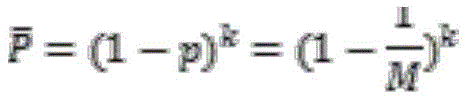
如果需要插入n个元素,则所述概率变成If n elements need to be inserted, the probability becomes

布隆过滤器的一个明显缺点是它既不跟踪也不保持任何特定的顺序。很显然,如果我们希望维护要过滤的项目的索引,则需要扩展过滤器的功能。这就是可逆布隆过滤器(IBF)和可逆布隆查找表(IBLT)的作用。An obvious disadvantage of the Bloom filter is that it neither tracks nor maintains any particular order. Obviously, if we wish to maintain an index of the items to filter, we need to extend the functionality of the filter. That's what Invertible Bloom Filters (IBFs) and Invertible Bloom Lookup Tables (IBLTs) do.
不同于只激活阵列中的位,密钥的异或和、散列值(像前面一样)和总计数器被存储在IBF的每个字段中。该过程如图10所示,图10示出了说明交易如何在IBF/IBLT中编码的工作流程。Instead of just activating the bits in the array, the XOR sum of the key, the hash value (as before) and the total counter are stored in each field of the IBF. This process is illustrated in Figure 10, which shows a workflow illustrating how transactions are encoded in IBF/IBLT.
应用application
我们假设有两个节点N1和N2,分别维护存储池m1和m2。每个存储池包含来自整个十六进制字符串S16的元素。我们进一步假设存储池遵循由安德烈森(Andresen)提出并且已在本说明书前文概述的排序惯例。We assume that there are two nodes N 1 and N 2 maintaining storage pools m 1 and m 2 respectively. Each pool contains elements from the entire hex string S16 . We further assume that the storage pool follows the ordering convention proposed by Andresen and outlined earlier in this specification.
现在,N1发送m1给N2·,N2·现在可以通过两种方式处理集合调和:Now, N 1 sends m 1 to N 2 ·, N 2 · can now handle set reconciliation in two ways:
(1)通过Δm=m2-m1计算集合差(参见(David Eppstein,2011),(MichaelT.Goodrich,2011))(1) Calculate the ensemble difference by Δm=m 2 −m 1 (see (David Eppstein, 2011), (Michael T. Goodrich, 2011))
(2)迭代m2中的交易,检查所述交易是否存在于N1的存储池中( 2 ) Iterate over the transactions in m2, checking if said transaction exists in the storage pool of N1
我们看出IBLT至少可以用于两个目的:We see that IBLT can be used for at least two purposes:
1)让节点根据其存储池中已经存在的交易组装已挖掘的区块,并帮助识别和检索其没有的区块。1) Let nodes assemble mined blocks based on transactions that already exist in their storage pool, and help identify and retrieve blocks they don't have.
2)在属于不同节点的存储池之间保持一定级别的同步。2) A certain level of synchronization is maintained between storage pools belonging to different nodes.
应当理解,虽然交易可以转移比特币,但是用户可以改为使用本文所述的方法和系统来交换其他资源(例如信息、合同和代币)。代币根据与代币相关联的智能合约来表示资产或资源,使得代币的控制有能力控制资产或资源。智能合约本身可以存储在区块链外,也可以存储在一个或多个交易中。It should be understood that while transactions may transfer bitcoin, users may instead use the methods and systems described herein to exchange other resources (eg, information, contracts, and tokens). Tokens represent assets or resources according to the smart contracts associated with the tokens, enabling the control of the tokens to have the ability to control the asset or resource. The smart contract itself can be stored off-blockchain or in one or more transactions.
参考资料References
An Integrated World.(n.d.).Retrieved from https://www.anintegratedworld.com/whats-in-a-block/An Integrated World.(n.d.).Retrieved from https://www.anintegratedworld.com/whats-in-a-block/
David Eppstein,M.T.(2011).What's the Difference?Efficient SetReconciliation without Prior Context.ACM.David Eppstein, M.T. (2011). What's the Difference? Efficient SetReconciliation without Prior Context.ACM.
maidsafe.(n.d.).Retrieved from github.com:https://github.com/maidsafe/Whitepapersmaidsafe.(n.d.).Retrieved from github.com: https://github.com/maidsafe/Whitepapers
Michael T.Goodrich,M.M.(2011).Invertible Bloom LookupTables.Communication,Control,and Computing(Allerton),2011 49th AnnualAllerton Conference on.Michael T. Goodrich, M.M. (2011). Invertible Bloom LookupTables. Communication, Control, and Computing (Allerton), 2011 49th Annual Allerton Conference on.
NebulousLabs.(n.d.).Retrieved from github.com:https://github.com/NebulousLabs/SiaNebulousLabs.(n.d.).Retrieved from github.com: https://github.com/NebulousLabs/Sia
O(1)Block Propagation.(n.d.).Retrieved from github.com:https://gist.github.com/gavinandresen/e20c3b5a1d4b97f79ac2O(1)Block Propagation.(n.d.).Retrieved from github.com: https://gist.github.com/gavinandresen/e20c3b5a1d4b97f79ac2
Wikipedia.(n.d.).Retrieved from https://en.wikipedia.org/wiki/Distributed_hash_tableWikipedia.(n.d.).Retrieved from https://en.wikipedia.org/wiki/Distributed_hash_table
Wilkinson et al.(2016,December 15).Retrieved from https://storj.io/storj.pdfWilkinson et al. (2016, December 15). Retrieved from https://storj.io/storj.pdf
应当说明的是,上述实施例说明而非限制本发明,在不脱离本发明的由所附权利要求限定的范围的情况下,本领域技术人员将能够设计出许多替代性实施例。在权利要求中,括号中的任何附图标记不应解释为对权利要求的限制。词语“包括”等并非在整体上排除其他元件和步骤的存在,尽管这些元件和步骤并没有在任何权利要求或说明书中列出。在本说明书中,“包括”意指“包括或由......组成”。元件的单数引用不意味着排除这些元件的复数引用,反之亦然。本发明可以借助包括若干不同元件的硬件,以及借助适当编程的计算机来实施。在列举了若干装置的设备权利要求中,这些装置中的若干个可以由硬件的同一个部件来体现。不争的事实是,在相互不同的从属权利要求中列举了某些方法,并不代表这些方法的结合不能获得有益效果。It should be noted that the above-described embodiments illustrate rather than limit the invention, and that those skilled in the art will be able to design many alternative embodiments without departing from the scope of the invention as defined by the appended claims. In the claims, any reference signs placed between parentheses shall not be construed as limiting the claim. The words "comprising" and the like are not intended to exclude the presence of other elements and steps as a whole, notwithstanding the fact that such elements and steps are not listed in any claim or specification. In this specification, "comprising" means "comprising or consisting of". The singular reference of elements does not imply the exclusion of the plural reference of these elements, and vice versa. The invention may be implemented by means of hardware comprising several different elements, as well as by means of suitably programmed computers. In the device claim enumerating several means, several of these means may be embodied by one and the same item of hardware. The mere fact that certain measures are recited in mutually different dependent claims does not indicate that a combination of these measures cannot be used to advantage.
Claims (23)
Priority Applications (1)
| Application Number | Priority Date | Filing Date | Title |
|---|---|---|---|
| CN202510086625.2A CN120086900A (en) | 2017-06-07 | 2018-06-05 | Computer-implemented systems and methods for managing transactions on a blockchain network |
Applications Claiming Priority (5)
| Application Number | Priority Date | Filing Date | Title |
|---|---|---|---|
| GB1709099.4 | 2017-06-07 | ||
| GBGB1709099.4A GB201709099D0 (en) | 2017-06-07 | 2017-06-07 | Computer-Implemented system and method |
| GB1709098.6 | 2017-06-07 | ||
| GBGB1709098.6A GB201709098D0 (en) | 2017-06-07 | 2017-06-07 | Computer-Implemented system and method |
| PCT/IB2018/054006 WO2018224954A1 (en) | 2017-06-07 | 2018-06-05 | Computer-Implemented System and Method for Managing Transactions Over a Blockchain Network |
Related Child Applications (1)
| Application Number | Title | Priority Date | Filing Date |
|---|---|---|---|
| CN202510086625.2A Division CN120086900A (en) | 2017-06-07 | 2018-06-05 | Computer-implemented systems and methods for managing transactions on a blockchain network |
Publications (1)
| Publication Number | Publication Date |
|---|---|
| CN110741372A true CN110741372A (en) | 2020-01-31 |
Family
ID=62816886
Family Applications (5)
| Application Number | Title | Priority Date | Filing Date |
|---|---|---|---|
| CN202510111175.8A Pending CN119691819A (en) | 2017-06-07 | 2018-06-05 | Computer-implemented systems and methods for managing large blocks on a blockchain network |
| CN201880038312.8A Pending CN110741373A (en) | 2017-06-07 | 2018-06-05 | Computer-implemented system and method for managing large blocks on a blockchain network |
| CN202510086625.2A Pending CN120086900A (en) | 2017-06-07 | 2018-06-05 | Computer-implemented systems and methods for managing transactions on a blockchain network |
| CN202511616828.4A Pending CN121256856A (en) | 2017-06-07 | 2018-06-05 | Computer-based systems and methods for managing large blocks on a blockchain network |
| CN201880038016.8A Pending CN110741372A (en) | 2017-06-07 | 2018-06-05 | Computer-implemented system and method for managing transactions on a blockchain network |
Family Applications Before (4)
| Application Number | Title | Priority Date | Filing Date |
|---|---|---|---|
| CN202510111175.8A Pending CN119691819A (en) | 2017-06-07 | 2018-06-05 | Computer-implemented systems and methods for managing large blocks on a blockchain network |
| CN201880038312.8A Pending CN110741373A (en) | 2017-06-07 | 2018-06-05 | Computer-implemented system and method for managing large blocks on a blockchain network |
| CN202510086625.2A Pending CN120086900A (en) | 2017-06-07 | 2018-06-05 | Computer-implemented systems and methods for managing transactions on a blockchain network |
| CN202511616828.4A Pending CN121256856A (en) | 2017-06-07 | 2018-06-05 | Computer-based systems and methods for managing large blocks on a blockchain network |
Country Status (5)
| Country | Link |
|---|---|
| US (4) | US20210083852A1 (en) |
| EP (3) | EP3635608A1 (en) |
| JP (6) | JP7208164B2 (en) |
| CN (5) | CN119691819A (en) |
| WO (2) | WO2018224955A1 (en) |
Cited By (11)
| Publication number | Priority date | Publication date | Assignee | Title |
|---|---|---|---|---|
| CN111325346A (en) * | 2020-02-20 | 2020-06-23 | 中南大学 | Identity Inference Method and Inference System of Bitcoin Mining Pool |
| CN111324633A (en) * | 2020-02-18 | 2020-06-23 | 杭州复杂美科技有限公司 | Block chain transaction distributed caching method, system, equipment and storage medium |
| CN111352968A (en) * | 2020-02-28 | 2020-06-30 | 杭州云象网络技术有限公司 | Intelligent manufacturing element identification method based on block chain network |
| CN111638962A (en) * | 2020-06-08 | 2020-09-08 | 杭州复杂美科技有限公司 | Dynamic expansion and contraction method, device and storage medium for transaction pool |
| CN112565368A (en) * | 2020-11-26 | 2021-03-26 | 中国船舶工业系统工程研究院 | Block chain-based offshore equipment ad hoc network system, method and medium |
| CN112988891A (en) * | 2021-03-11 | 2021-06-18 | 重庆文理学院 | Method and device for storing block chain account book, electronic equipment and storage medium |
| CN113609231A (en) * | 2021-09-30 | 2021-11-05 | 支付宝(杭州)信息技术有限公司 | Method and device for maintaining network architecture information of block chain system |
| CN114066456A (en) * | 2022-01-13 | 2022-02-18 | 环球数科集团有限公司 | ERC 1155-based cross-chain NFT transfer and settlement system |
| WO2022053048A1 (en) * | 2020-09-14 | 2022-03-17 | International Business Machines Corporation | Ensuring secure provisioning of blockchain infrastructure |
| CN114390063A (en) * | 2022-02-25 | 2022-04-22 | 蚂蚁区块链科技(上海)有限公司 | Message broadcasting method for block chain network, block chain node and block chain system |
| CN116668066A (en) * | 2023-04-18 | 2023-08-29 | 华北电力大学 | A blockchain-based smart grid privacy protection method, device and application thereof |
Families Citing this family (70)
| Publication number | Priority date | Publication date | Assignee | Title |
|---|---|---|---|---|
| EP3413530B1 (en) * | 2017-06-09 | 2019-07-31 | Siemens Aktiengesellschaft | Method and device for exchanging messages |
| US11334678B2 (en) * | 2017-07-06 | 2022-05-17 | Chromaway Ab | Method and system for a distributed computing system |
| EP3665858B1 (en) * | 2017-08-09 | 2022-05-25 | Visa International Service Association | Verification of interactions system and method |
| US11412383B2 (en) * | 2018-01-03 | 2022-08-09 | Helium Systems , Inc. | Systems and methods for providing and using a decentralized wireless network |
| US11176101B2 (en) * | 2018-02-05 | 2021-11-16 | Bank Of America Corporation | System and method for decentralized regulation and hierarchical control of blockchain architecture |
| US12093908B2 (en) * | 2018-03-22 | 2024-09-17 | NEC Laboratories Europe GmbH | System and method for secure transaction verification in a distributed ledger system |
| WO2019185042A1 (en) * | 2018-03-29 | 2019-10-03 | AnApp Technologies Limited | System and method for operating a blockchain network |
| EP3811259B1 (en) * | 2018-09-21 | 2023-08-16 | NEC Corporation | Method for signing a new block in a decentralized blockchain consensus network |
| US11399284B1 (en) | 2018-09-28 | 2022-07-26 | Helium Systems, Inc. | Systems and methods for providing and using proof of coverage in a decentralized wireless network |
| US11368446B2 (en) * | 2018-10-02 | 2022-06-21 | International Business Machines Corporation | Trusted account revocation in federated identity management |
| US12026760B2 (en) * | 2018-10-11 | 2024-07-02 | Hefei Dappworks Technology Co., Ltd. | Method and apparatus for transacting resource flow |
| CN112232817B (en) * | 2018-10-25 | 2024-12-27 | 蚂蚁链技术有限公司 | Transaction processing method and device based on blockchain, and electronic device |
| WO2019072306A2 (en) | 2018-12-28 | 2019-04-18 | Alibaba Group Holding Limited | Accelerating transaction deliveries in blockchain networks using transaction resending |
| EP3571808A4 (en) | 2018-12-28 | 2020-03-04 | Alibaba Group Holding Limited | IMPROVE THE SPEED OF BLOCKCHAIN TRANSACTIONS USING GLOBAL ACCELERATION NODES |
| CN110392898A (en) | 2018-12-28 | 2019-10-29 | 阿里巴巴集团控股有限公司 | It is delivered using the transaction accelerated in node accelerating region block chain network |
| EP3909199A1 (en) * | 2019-01-09 | 2021-11-17 | British Telecommunications public limited company | Probabilistic shared secret validation |
| US11418402B1 (en) * | 2019-01-17 | 2022-08-16 | Artema Labs, Inc | Robust and secure proof of space based mining |
| WO2020158973A1 (en) * | 2019-01-30 | 2020-08-06 | 주식회사 아티프렌즈 | Hypothesis acceptance protocol-2 mode blockchain consensus system and method |
| SG11202108152XA (en) * | 2019-02-15 | 2021-08-30 | Nchain Holdings Ltd | Computer-implemented systems and methods for implementing transfers over a blockchain network |
| CN111598564B (en) * | 2019-02-20 | 2023-11-21 | 华为技术有限公司 | Blockchain node connection establishment method, device and equipment |
| KR102544628B1 (en) * | 2019-03-08 | 2023-06-19 | 한국전자통신연구원 | System for a data sharing platform in a block chain based distributed data sharing environment, method for searching data index in the system and method for providing seartch index in the system |
| US11777712B2 (en) * | 2019-03-22 | 2023-10-03 | International Business Machines Corporation | Information management in a database |
| US20200314648A1 (en) * | 2019-03-29 | 2020-10-01 | Parallel Wireless, Inc. | Distributed HSS Using Blockchain |
| US10939405B1 (en) | 2019-04-08 | 2021-03-02 | Helium Systems, Inc. | Systems and methods for implementing permissionless network consensus using blockchain |
| GB2582978B (en) | 2019-04-12 | 2022-05-04 | Nchain Holdings Ltd | Methods and devices for propagating blocks in a blockchain network |
| US11482074B1 (en) * | 2019-05-06 | 2022-10-25 | Matthew Dickson | Cryptocurrency transactional systems and methods |
| US11570002B2 (en) | 2019-05-29 | 2023-01-31 | International Business Machines Corporation | Reduced-step blockchain verification of media file |
| US11516000B2 (en) * | 2019-05-29 | 2022-11-29 | International Business Machines Corporation | Approximate hash verification of unused blockchain output |
| US11429738B2 (en) | 2019-05-29 | 2022-08-30 | International Business Machines Corporation | Blockchain endorsement with approximate hash verification |
| US11539527B2 (en) | 2019-05-29 | 2022-12-27 | International Business Machines Corporation | Peer node recovery via approximate hash verification |
| US11711202B2 (en) | 2019-05-29 | 2023-07-25 | International Business Machines Corporation | Committing data to blockchain based on approximate hash verification |
| CN110188300B (en) * | 2019-05-30 | 2023-04-07 | 吉林大学 | Automobile field-oriented purchasing information processing method and device |
| CN112039930B (en) * | 2019-06-03 | 2023-04-07 | 本无链科技(深圳)有限公司 | Method and system for constructing mobile block chain based on large nodes |
| WO2020255158A1 (en) * | 2019-06-20 | 2020-12-24 | INDIAN INSTITUTE OF TECHNOLOGY MADRAS (IIT Madras) | Colosseum, a scalable and byzantine-fault tolerant consensus mechanism for permissioned systems |
| CN110544167B (en) * | 2019-07-25 | 2022-03-01 | 晋商博创(北京)科技有限公司 | Data processing method, server and storage medium of alliance chain based on CPK |
| CN112529572B (en) * | 2019-09-18 | 2025-06-13 | 上海树图区块链研究院 | Transaction forwarding method, system, device and P2P network based on short transaction ID |
| CN110599144B (en) * | 2019-09-24 | 2023-08-22 | 腾讯科技(深圳)有限公司 | Network access method and device for blockchain nodes |
| WO2021073701A1 (en) * | 2019-10-14 | 2021-04-22 | Vestas Wind Systems A/S | Secure data synchronization between offline and online systems |
| US11522670B2 (en) | 2019-12-04 | 2022-12-06 | MaataData, Inc. | Pyramid construct with trusted score validation |
| EP3852305B1 (en) * | 2020-01-17 | 2022-11-16 | Fetch.ai Limited | Transaction verification system and method of operation thereof |
| US11271742B2 (en) | 2020-01-26 | 2022-03-08 | International Business Machines Corporation | Decentralized secure data sharing |
| US11088833B1 (en) * | 2020-01-26 | 2021-08-10 | International Business Machines Corporation | Decentralized secure data sharing |
| US11356260B2 (en) | 2020-01-26 | 2022-06-07 | International Business Machines Corporation | Decentralized secure data sharing |
| US20210374843A1 (en) * | 2020-05-26 | 2021-12-02 | Mitsubishi Electric Research Laboratories, Inc. | Debt Resource Management in a Distributed Ledger System |
| KR102319416B1 (en) * | 2020-08-21 | 2021-10-28 | 세종대학교산학협력단 | Method for generating bloom filter of based blockchain, computing device and system for executing the method |
| KR102318947B1 (en) * | 2020-08-21 | 2021-10-27 | 세종대학교산학협력단 | Method for protecting privacy data, computing device and system for executing the method |
| EP4002786B1 (en) * | 2020-11-11 | 2023-06-21 | Deutsche Post AG | Distributed ledger system |
| GB2601539A (en) | 2020-12-04 | 2022-06-08 | Nchain Holdings Ltd | Methods and systems for streaming block templates with cross-references |
| GB2601540A (en) * | 2020-12-04 | 2022-06-08 | Nchain Holdings Ltd | Methods and systems for synchronizing a streamed template to a solved block |
| CN112671908B (en) * | 2020-12-25 | 2023-03-21 | 成都质数斯达克科技有限公司 | Network management method and device, electronic equipment and readable storage medium |
| CN120602095A (en) | 2021-03-12 | 2025-09-05 | 迈克尔·艾拉·卡诺维茨 | Authenticated modification of blockchain-based data |
| CN112950211B (en) * | 2021-05-14 | 2021-07-30 | 腾讯科技(深圳)有限公司 | Transaction duplication checking method, device, equipment and medium |
| CN113612810B (en) * | 2021-05-18 | 2023-06-27 | 中国信息通信研究院 | Method for optimizing performance among cluster nodes based on DHT, electronic equipment and storage medium |
| US11790353B2 (en) * | 2021-06-16 | 2023-10-17 | Song Hwan KIM | System and method for online/offline payment with virtual currency for nodes included in mobile-based blockchain distributed network |
| CN113535849B (en) * | 2021-07-08 | 2023-03-07 | 电子科技大学 | A Scalable Consensus Method for Blockchain |
| GB2608841A (en) * | 2021-07-14 | 2023-01-18 | Nchain Licensing Ag | Blockchain blocks & proof-of-existence |
| GB2608842A (en) * | 2021-07-14 | 2023-01-18 | Nchain Licensing Ag | Blockchain Blocks & Proof-of-existence |
| GB2608845A (en) * | 2021-07-14 | 2023-01-18 | Nchain Licensing Ag | Blockchain blocks & proof-of-existence |
| GB2608844A (en) * | 2021-07-14 | 2023-01-18 | Nchain Licensing Ag | Blockchain blocks & proof-of-existence |
| US11847137B2 (en) | 2021-11-18 | 2023-12-19 | Fivetran Inc. | Database synchronization using resizable invertible bloom filters with database snapshots |
| US11640603B1 (en) * | 2021-11-18 | 2023-05-02 | Joseph Freire | System and method for crypto token linked assets |
| CN114036237B (en) * | 2021-11-23 | 2025-11-18 | 东软集团股份有限公司 | Block generation methods, apparatus, storage media and electronic devices |
| CN114363349B (en) * | 2021-12-31 | 2024-04-02 | 支付宝(杭州)信息技术有限公司 | Block chain sub-network starting method and device |
| CN114461730B (en) * | 2022-02-09 | 2024-09-17 | 天津大学 | Self-adaptive block data compression method based on remainder system |
| US20230274262A1 (en) * | 2022-02-28 | 2023-08-31 | International Institute Of Information Technology, Hyderabad | System and method for better utilization of power consumption in blockchain system by validating digital currency transactions with minimal computing resources |
| CN115001816B (en) * | 2022-05-31 | 2024-10-29 | 杭州万林数链科技服务有限公司 | Block chain link point service system of multi-block chain platform |
| CN116361384B (en) * | 2022-07-07 | 2025-09-19 | 成都安恒信息技术有限公司 | Method and system for collecting, storing and analyzing blockchain transaction data |
| CN117453662A (en) * | 2022-07-19 | 2024-01-26 | 腾讯科技(深圳)有限公司 | Transaction processing methods, devices, electronic devices and computer-readable storage media |
| US20240193610A1 (en) * | 2022-12-09 | 2024-06-13 | Assurant, Inc. | Electronic data management for an asset associated with a property identifier based on a distributed ledger |
| CN115766745B (en) * | 2023-01-09 | 2023-05-23 | 杭州安碣信息安全科技有限公司 | Method and device for collecting and broadcasting transaction data of block chain link point memory pool |
Citations (11)
| Publication number | Priority date | Publication date | Assignee | Title |
|---|---|---|---|---|
| US20150199416A1 (en) * | 2014-01-15 | 2015-07-16 | Dell Products L.P. | System and method for data structure synchronization |
| CN105488675A (en) * | 2015-11-25 | 2016-04-13 | 布比(北京)网络技术有限公司 | Distributed shared general ledger construction method of block chain |
| US20160342977A1 (en) * | 2015-05-20 | 2016-11-24 | Vennd.io Pty Ltd | Device, method and system for virtual asset transactions |
| WO2017004527A1 (en) * | 2015-07-02 | 2017-01-05 | Nasdaq, Inc. | Systems and methods of secure provenance for distributed transaction databases |
| CN106372868A (en) * | 2016-09-06 | 2017-02-01 | 联动优势科技有限公司 | Verification method and apparatus for transaction data written into block chain |
| CN106452785A (en) * | 2016-09-29 | 2017-02-22 | 财付通支付科技有限公司 | Block chain network, branch node and block chain network application method |
| CN106506638A (en) * | 2016-11-04 | 2017-03-15 | 江苏通付盾科技有限公司 | Block storage method and device in block chain |
| CN106548349A (en) * | 2016-11-02 | 2017-03-29 | 江苏通付盾科技有限公司 | Transaction Information verification method and system |
| CN106603198A (en) * | 2016-12-02 | 2017-04-26 | 深圳大学 | Blockchain distributed storage method and system with network coding |
| CN106656974A (en) * | 2016-10-17 | 2017-05-10 | 江苏通付盾科技有限公司 | Block chain grouping consensus method and system |
| US20170132625A1 (en) * | 2015-11-05 | 2017-05-11 | Mastercard International Incorporated | Method and system for use of a blockchain in a transaction processing network |
Family Cites Families (49)
| Publication number | Priority date | Publication date | Assignee | Title |
|---|---|---|---|---|
| US20020199102A1 (en) * | 2001-06-21 | 2002-12-26 | Carman David W. | Method and apparatus for establishing a shared cryptographic key between energy-limited nodes in a network |
| US9389965B1 (en) | 2012-03-12 | 2016-07-12 | Emc Corporation | System and method for improving performance of backup storage system with future access prediction |
| US8817541B2 (en) | 2012-11-09 | 2014-08-26 | Sandisk Technologies Inc. | Data search using bloom filters and NAND based content addressable memory |
| US10068228B1 (en) | 2013-06-28 | 2018-09-04 | Winklevoss Ip, Llc | Systems and methods for storing digital math-based assets using a secure portal |
| US9672499B2 (en) | 2014-04-02 | 2017-06-06 | Modernity Financial Holdings, Ltd. | Data analytic and security mechanism for implementing a hot wallet service |
| FR3019921B1 (en) * | 2014-04-10 | 2017-08-11 | Commissariat Energie Atomique | DISTRIBUTED CALCULATION SYSTEM IMPLEMENTING NON-SPECULATIVE MATERIAL TRANSACTIONAL MEMORY AND METHOD OF USE FOR DISTRIBUTED CALCULATION |
| US11270298B2 (en) * | 2014-04-14 | 2022-03-08 | 21, Inc. | Digital currency mining circuitry |
| US9830593B2 (en) | 2014-04-26 | 2017-11-28 | Ss8 Networks, Inc. | Cryptographic currency user directory data and enhanced peer-verification ledger synthesis through multi-modal cryptographic key-address mapping |
| US9703644B1 (en) | 2014-12-09 | 2017-07-11 | EMC IP Holding Company LLC | Methods for generating a synthetic backup and for consolidating a chain of backups independent of endianness |
| US9965628B2 (en) | 2015-03-02 | 2018-05-08 | Dell Products Lp | Device reporting and protection systems and methods using a secure distributed transactional ledger |
| WO2016161073A1 (en) * | 2015-03-31 | 2016-10-06 | Nasdaq, Inc. | Systems and methods of blockchain transaction recordation |
| US20160342989A1 (en) * | 2015-05-21 | 2016-11-24 | Mastercard International Incorporated | Method and system for processing blockchain-based transactions on existing payment networks |
| CA2992458A1 (en) | 2015-07-14 | 2017-01-19 | Fmr Llc | Computationally efficient transfer processing, auditing, and search apparatuses, methods and systems |
| US20170228731A1 (en) | 2016-02-09 | 2017-08-10 | Fmr Llc | Computationally Efficient Transfer Processing and Auditing Apparatuses, Methods and Systems |
| US20170091756A1 (en) | 2015-07-14 | 2017-03-30 | Fmr Llc | Point-to-Point Transaction Guidance Apparatuses, Methods and Systems |
| JP6452156B2 (en) * | 2015-09-03 | 2019-01-16 | 日本電信電話株式会社 | License information management system, user terminal, rights holder terminal, license information management method, and license information management program |
| WO2017079652A1 (en) | 2015-11-05 | 2017-05-11 | Pulsifer Allen | Cryptographic transactions system |
| US20170132630A1 (en) * | 2015-11-11 | 2017-05-11 | Bank Of America Corporation | Block chain alias for person-to-person payments |
| US20170140408A1 (en) * | 2015-11-16 | 2017-05-18 | Bank Of America Corporation | Transparent self-managing rewards program using blockchain and smart contracts |
| CN108701325B (en) | 2015-12-21 | 2022-11-22 | 星茶瓦公司 | Self-adjusting transaction system and method therefor |
| US10887665B2 (en) * | 2016-01-05 | 2021-01-05 | Visible World, Llc | Value-based TV advertising audience exchange |
| US20170213221A1 (en) * | 2016-01-26 | 2017-07-27 | Bank Of America Corporation | System for tracking and validation of multiple instances of an entity in a process data network |
| US9825931B2 (en) * | 2016-01-26 | 2017-11-21 | Bank Of America Corporation | System for tracking and validation of an entity in a process data network |
| US10116667B2 (en) * | 2016-01-26 | 2018-10-30 | Bank Of America Corporation | System for conversion of an instrument from a non-secured instrument to a secured instrument in a process data network |
| US11374935B2 (en) * | 2016-02-11 | 2022-06-28 | Bank Of America Corporation | Block chain alias person-to-person resource allocation |
| US20170236123A1 (en) | 2016-02-16 | 2017-08-17 | Blockstack Inc. | Decentralized processing of global naming systems |
| US10318938B2 (en) * | 2016-02-22 | 2019-06-11 | Bank Of America Corporation | System for routing of process authorization and settlement to a user in process data network based on specified parameters |
| US20170243209A1 (en) * | 2016-02-22 | 2017-08-24 | Bank Of America Corporation | System for grant of user access and data usage in a process data network |
| US10026118B2 (en) * | 2016-02-22 | 2018-07-17 | Bank Of America Corporation | System for allowing external validation of data in a process data network |
| US10475030B2 (en) * | 2016-02-22 | 2019-11-12 | Bank Of America Corporation | System for implementing a distributed ledger across multiple network nodes |
| CN109155731B (en) | 2016-03-23 | 2022-02-11 | 诺基亚技术有限公司 | Management of cryptographic transactions |
| US10810583B2 (en) * | 2016-04-29 | 2020-10-20 | Digital Asset Holdings | Digital asset modeling |
| US20170345011A1 (en) * | 2016-05-26 | 2017-11-30 | Hitfin, Inc. | System and method executed on a blockchain network |
| CN107438002B (en) * | 2016-05-27 | 2022-02-11 | 索尼公司 | Block chain based system and electronic device and method in system |
| US10417217B2 (en) * | 2016-08-05 | 2019-09-17 | Chicago Mercantile Exchange Inc. | Systems and methods for blockchain rule synchronization |
| CN106296191A (en) * | 2016-08-13 | 2017-01-04 | 深圳市樊溪电子有限公司 | A kind of PoW common recognition mechanism of block chain power-aware |
| US10789239B2 (en) * | 2016-10-10 | 2020-09-29 | AlphaPoint | Finite state machine distributed ledger |
| US10291627B2 (en) | 2016-10-17 | 2019-05-14 | Arm Ltd. | Blockchain mining using trusted nodes |
| US10657526B2 (en) * | 2016-10-28 | 2020-05-19 | International Business Machines Corporation | System and method to dynamically setup a private sub-blockchain based on agility of transaction processing |
| US10491378B2 (en) * | 2016-11-16 | 2019-11-26 | StreamSpace, LLC | Decentralized nodal network for providing security of files in distributed filesystems |
| US10862959B2 (en) | 2016-11-28 | 2020-12-08 | Keir Finlow-Bates | Consensus system and method for adding data to a blockchain |
| US10586210B2 (en) | 2016-11-30 | 2020-03-10 | International Business Machines Corporation | Blockchain checkpoints and certified checkpoints |
| US10447480B2 (en) * | 2016-12-30 | 2019-10-15 | Guardtime Sa | Event verification receipt system and methods |
| US11631077B2 (en) * | 2017-01-17 | 2023-04-18 | HashLynx Inc. | System for facilitating secure electronic communications between entities and processing resource transfers |
| WO2018175666A1 (en) * | 2017-03-21 | 2018-09-27 | Dappsters, LLC | Blockchain systems and methods |
| US10812270B2 (en) * | 2017-04-07 | 2020-10-20 | Citizen Hex Inc. | Techniques for increasing the probability that a transaction will be included in a target block of a blockchain |
| US10397328B2 (en) | 2017-05-17 | 2019-08-27 | Nec Corporation | Method and system for providing a robust blockchain with an integrated proof of storage |
| US11018850B2 (en) * | 2017-12-26 | 2021-05-25 | Akamai Technologies, Inc. | Concurrent transaction processing in a high performance distributed system of record |
| US11829351B2 (en) * | 2018-11-26 | 2023-11-28 | Akamai Technologies, Inc. | High performance distributed system of record with hosted origin services |
-
2018
- 2018-06-05 CN CN202510111175.8A patent/CN119691819A/en active Pending
- 2018-06-05 JP JP2019564132A patent/JP7208164B2/en active Active
- 2018-06-05 EP EP18737413.7A patent/EP3635608A1/en active Pending
- 2018-06-05 US US16/620,441 patent/US20210083852A1/en active Pending
- 2018-06-05 CN CN201880038312.8A patent/CN110741373A/en active Pending
- 2018-06-05 JP JP2019564126A patent/JP7053677B2/en active Active
- 2018-06-05 CN CN202510086625.2A patent/CN120086900A/en active Pending
- 2018-06-05 WO PCT/IB2018/054007 patent/WO2018224955A1/en not_active Ceased
- 2018-06-05 WO PCT/IB2018/054006 patent/WO2018224954A1/en not_active Ceased
- 2018-06-05 EP EP18737412.9A patent/EP3635607B1/en active Active
- 2018-06-05 US US16/620,451 patent/US11468077B2/en active Active
- 2018-06-05 EP EP24155874.1A patent/EP4350560A3/en active Pending
- 2018-06-05 CN CN202511616828.4A patent/CN121256856A/en active Pending
- 2018-06-05 CN CN201880038016.8A patent/CN110741372A/en active Pending
-
2022
- 2022-03-31 JP JP2022058089A patent/JP7278453B2/en active Active
- 2022-10-03 US US17/959,252 patent/US12038937B2/en active Active
-
2023
- 2023-01-05 JP JP2023000329A patent/JP7518220B2/en active Active
- 2023-05-09 JP JP2023076998A patent/JP7653214B2/en active Active
-
2024
- 2024-06-04 US US18/733,775 patent/US20240403305A1/en active Pending
- 2024-07-04 JP JP2024108004A patent/JP7785859B2/en active Active
Patent Citations (11)
| Publication number | Priority date | Publication date | Assignee | Title |
|---|---|---|---|---|
| US20150199416A1 (en) * | 2014-01-15 | 2015-07-16 | Dell Products L.P. | System and method for data structure synchronization |
| US20160342977A1 (en) * | 2015-05-20 | 2016-11-24 | Vennd.io Pty Ltd | Device, method and system for virtual asset transactions |
| WO2017004527A1 (en) * | 2015-07-02 | 2017-01-05 | Nasdaq, Inc. | Systems and methods of secure provenance for distributed transaction databases |
| US20170132625A1 (en) * | 2015-11-05 | 2017-05-11 | Mastercard International Incorporated | Method and system for use of a blockchain in a transaction processing network |
| CN105488675A (en) * | 2015-11-25 | 2016-04-13 | 布比(北京)网络技术有限公司 | Distributed shared general ledger construction method of block chain |
| CN106372868A (en) * | 2016-09-06 | 2017-02-01 | 联动优势科技有限公司 | Verification method and apparatus for transaction data written into block chain |
| CN106452785A (en) * | 2016-09-29 | 2017-02-22 | 财付通支付科技有限公司 | Block chain network, branch node and block chain network application method |
| CN106656974A (en) * | 2016-10-17 | 2017-05-10 | 江苏通付盾科技有限公司 | Block chain grouping consensus method and system |
| CN106548349A (en) * | 2016-11-02 | 2017-03-29 | 江苏通付盾科技有限公司 | Transaction Information verification method and system |
| CN106506638A (en) * | 2016-11-04 | 2017-03-15 | 江苏通付盾科技有限公司 | Block storage method and device in block chain |
| CN106603198A (en) * | 2016-12-02 | 2017-04-26 | 深圳大学 | Blockchain distributed storage method and system with network coding |
Non-Patent Citations (2)
| Title |
|---|
| "区块链" * |
| 田海博;何杰杰;付利青;: "基于公开区块链的隐私保护公平合同签署协议" * |
Cited By (20)
| Publication number | Priority date | Publication date | Assignee | Title |
|---|---|---|---|---|
| CN111324633A (en) * | 2020-02-18 | 2020-06-23 | 杭州复杂美科技有限公司 | Block chain transaction distributed caching method, system, equipment and storage medium |
| CN111325346B (en) * | 2020-02-20 | 2023-04-18 | 中南大学 | Identity inference method and system for bitcoin mine pool |
| CN111325346A (en) * | 2020-02-20 | 2020-06-23 | 中南大学 | Identity Inference Method and Inference System of Bitcoin Mining Pool |
| CN111352968B (en) * | 2020-02-28 | 2023-09-29 | 杭州云象网络技术有限公司 | Intelligent manufacturing element identification method based on blockchain network |
| CN111352968A (en) * | 2020-02-28 | 2020-06-30 | 杭州云象网络技术有限公司 | Intelligent manufacturing element identification method based on block chain network |
| CN111638962A (en) * | 2020-06-08 | 2020-09-08 | 杭州复杂美科技有限公司 | Dynamic expansion and contraction method, device and storage medium for transaction pool |
| WO2022053048A1 (en) * | 2020-09-14 | 2022-03-17 | International Business Machines Corporation | Ensuring secure provisioning of blockchain infrastructure |
| US12111820B2 (en) | 2020-09-14 | 2024-10-08 | International Business Machines Corporation | Ensuring secure provisioning of blockchain infrastructure |
| CN112565368A (en) * | 2020-11-26 | 2021-03-26 | 中国船舶工业系统工程研究院 | Block chain-based offshore equipment ad hoc network system, method and medium |
| CN112565368B (en) * | 2020-11-26 | 2023-05-19 | 中国船舶集团有限公司系统工程研究院 | Blockchain-based maritime equipment ad hoc network system, method and medium |
| CN112988891A (en) * | 2021-03-11 | 2021-06-18 | 重庆文理学院 | Method and device for storing block chain account book, electronic equipment and storage medium |
| CN112988891B (en) * | 2021-03-11 | 2023-04-21 | 重庆文理学院 | Method and device for storing blockchain ledger, electronic equipment and storage medium |
| CN113609231A (en) * | 2021-09-30 | 2021-11-05 | 支付宝(杭州)信息技术有限公司 | Method and device for maintaining network architecture information of block chain system |
| WO2023050986A1 (en) * | 2021-09-30 | 2023-04-06 | 支付宝(杭州)信息技术有限公司 | Maintenance of network architecture information of blockchain system |
| CN114066456A (en) * | 2022-01-13 | 2022-02-18 | 环球数科集团有限公司 | ERC 1155-based cross-chain NFT transfer and settlement system |
| CN114066456B (en) * | 2022-01-13 | 2022-04-08 | 环球数科集团有限公司 | A cross-chain NFT transfer and settlement system based on ERC1155 |
| CN114390063A (en) * | 2022-02-25 | 2022-04-22 | 蚂蚁区块链科技(上海)有限公司 | Message broadcasting method for block chain network, block chain node and block chain system |
| CN114390063B (en) * | 2022-02-25 | 2023-09-29 | 蚂蚁区块链科技(上海)有限公司 | Message broadcasting method for blockchain network, blockchain node and blockchain system |
| CN116668066B (en) * | 2023-04-18 | 2024-03-08 | 华北电力大学 | A blockchain-based smart grid privacy protection method, device, non-volatile storage medium and electronic device |
| CN116668066A (en) * | 2023-04-18 | 2023-08-29 | 华北电力大学 | A blockchain-based smart grid privacy protection method, device and application thereof |
Also Published As
| Publication number | Publication date |
|---|---|
| CN121256856A (en) | 2026-01-02 |
| EP3635608A1 (en) | 2020-04-15 |
| US11468077B2 (en) | 2022-10-11 |
| JP7653214B2 (en) | 2025-03-28 |
| CN119691819A (en) | 2025-03-25 |
| US20200278963A1 (en) | 2020-09-03 |
| WO2018224954A1 (en) | 2018-12-13 |
| CN120086900A (en) | 2025-06-03 |
| US20210083852A1 (en) | 2021-03-18 |
| JP7785859B2 (en) | 2025-12-15 |
| EP4350560A3 (en) | 2024-06-19 |
| WO2018224955A1 (en) | 2018-12-13 |
| EP3635607B1 (en) | 2024-04-24 |
| JP7278453B2 (en) | 2023-05-19 |
| US12038937B2 (en) | 2024-07-16 |
| JP2020522786A (en) | 2020-07-30 |
| CN110741373A (en) | 2020-01-31 |
| JP2020522919A (en) | 2020-07-30 |
| US20240403305A1 (en) | 2024-12-05 |
| JP2022091923A (en) | 2022-06-21 |
| EP4350560A2 (en) | 2024-04-10 |
| EP3635607A1 (en) | 2020-04-15 |
| JP7053677B2 (en) | 2022-04-12 |
| JP2023036931A (en) | 2023-03-14 |
| JP2023103330A (en) | 2023-07-26 |
| JP2024133602A (en) | 2024-10-02 |
| US20230113492A1 (en) | 2023-04-13 |
| JP7208164B2 (en) | 2023-01-18 |
| JP7518220B2 (en) | 2024-07-17 |
Similar Documents
| Publication | Publication Date | Title |
|---|---|---|
| JP7278453B2 (en) | Method, storage medium, electronic device, transaction verification node, super node and blockchain network for managing transactions in blockchain network | |
| JP7691480B2 (en) | COMPUTER-IMPLEMENTED SYSTEM AND METHOD FOR MANAGING LARGE-SCALE DISTRIBUTED MEMORY POOLS IN BLOCKCHAIN NETWORKS | |
| Zhou et al. | Solutions to scalability of blockchain: A survey | |
| CN110770770A (en) | Method and system for mining blockchain transactions provided by verifier nodes | |
| Jennath et al. | Survey on blockchain consensus strategies | |
| Zhou et al. | Overview to blockchain scalability challenges and solutions |
Legal Events
| Date | Code | Title | Description |
|---|---|---|---|
| PB01 | Publication | ||
| PB01 | Publication | ||
| SE01 | Entry into force of request for substantive examination | ||
| SE01 | Entry into force of request for substantive examination | ||
| RJ01 | Rejection of invention patent application after publication | ||
| RJ01 | Rejection of invention patent application after publication |
Application publication date: 20200131 |