CN110738861B - Real-time dynamic intelligent traffic self-adaption method based on microwave radar detection - Google Patents
Real-time dynamic intelligent traffic self-adaption method based on microwave radar detection Download PDFInfo
- Publication number
- CN110738861B CN110738861B CN201910983487.2A CN201910983487A CN110738861B CN 110738861 B CN110738861 B CN 110738861B CN 201910983487 A CN201910983487 A CN 201910983487A CN 110738861 B CN110738861 B CN 110738861B
- Authority
- CN
- China
- Prior art keywords
- dynamic
- release
- vehicle
- intersection
- real
- Prior art date
- Legal status (The legal status is an assumption and is not a legal conclusion. Google has not performed a legal analysis and makes no representation as to the accuracy of the status listed.)
- Active
Links
- 238000000034 method Methods 0.000 title claims abstract description 21
- 238000001514 detection method Methods 0.000 title claims abstract description 16
- 230000008030 elimination Effects 0.000 claims abstract description 23
- 238000003379 elimination reaction Methods 0.000 claims abstract description 23
- 230000003068 static effect Effects 0.000 claims abstract description 13
- 230000003044 adaptive effect Effects 0.000 claims description 5
- 238000012216 screening Methods 0.000 claims description 4
- 238000005457 optimization Methods 0.000 abstract description 3
- 230000005465 channeling Effects 0.000 description 4
- 238000005516 engineering process Methods 0.000 description 4
- 230000007547 defect Effects 0.000 description 3
- 238000004364 calculation method Methods 0.000 description 2
- 230000001186 cumulative effect Effects 0.000 description 2
- 238000011161 development Methods 0.000 description 2
- 230000009286 beneficial effect Effects 0.000 description 1
- 238000004422 calculation algorithm Methods 0.000 description 1
- 230000008602 contraction Effects 0.000 description 1
- 238000012423 maintenance Methods 0.000 description 1
- 238000007620 mathematical function Methods 0.000 description 1
- 238000012986 modification Methods 0.000 description 1
- 230000004048 modification Effects 0.000 description 1
- 238000012545 processing Methods 0.000 description 1
- 230000001737 promoting effect Effects 0.000 description 1
- 238000011160 research Methods 0.000 description 1
- 238000012827 research and development Methods 0.000 description 1
- 238000006467 substitution reaction Methods 0.000 description 1
Images


Classifications
-
- G—PHYSICS
- G08—SIGNALLING
- G08G—TRAFFIC CONTROL SYSTEMS
- G08G1/00—Traffic control systems for road vehicles
- G08G1/07—Controlling traffic signals
-
- G—PHYSICS
- G01—MEASURING; TESTING
- G01S—RADIO DIRECTION-FINDING; RADIO NAVIGATION; DETERMINING DISTANCE OR VELOCITY BY USE OF RADIO WAVES; LOCATING OR PRESENCE-DETECTING BY USE OF THE REFLECTION OR RERADIATION OF RADIO WAVES; ANALOGOUS ARRANGEMENTS USING OTHER WAVES
- G01S13/00—Systems using the reflection or reradiation of radio waves, e.g. radar systems; Analogous systems using reflection or reradiation of waves whose nature or wavelength is irrelevant or unspecified
- G01S13/88—Radar or analogous systems specially adapted for specific applications
- G01S13/91—Radar or analogous systems specially adapted for specific applications for traffic control
-
- G—PHYSICS
- G08—SIGNALLING
- G08G—TRAFFIC CONTROL SYSTEMS
- G08G1/00—Traffic control systems for road vehicles
- G08G1/065—Traffic control systems for road vehicles by counting the vehicles in a section of the road or in a parking area, i.e. comparing incoming count with outgoing count
Landscapes
- Physics & Mathematics (AREA)
- General Physics & Mathematics (AREA)
- Engineering & Computer Science (AREA)
- Radar, Positioning & Navigation (AREA)
- Remote Sensing (AREA)
- Electromagnetism (AREA)
- Computer Networks & Wireless Communication (AREA)
- Traffic Control Systems (AREA)
Abstract
The invention relates to a real-time dynamic intelligent traffic self-adaptive method based on microwave radar detection, which comprises the following steps: step 1, defining crossing moving direction and release mode; step 2, executing static release according to the real-time dynamic information of the intersection; step 3, executing dynamic elimination and release according to the real-time dynamic information of the intersection and the static release result of the intersection; step 4, after the dynamic elimination and release are executed, when the intersection release stopping command is not detected, skipping to step 2, otherwise, skipping to step 5; and 5, closing the intersection for releasing. The invention can flexibly deal with the dynamic change of the traffic flow at the intersection, judge the lane structure of the intersection, set the moving direction and the release mode of the intersection, and timely provide the release scheme matched with the traffic flow at the intersection, thereby improving the utilization rate of green lights, reducing the waiting time of vehicles and realizing the global optimization of traffic control.
Description
Technical Field
The invention relates to a method, in particular to a real-time dynamic intelligent traffic self-adaptive method based on microwave radar detection, and belongs to the technical field of intelligent traffic.
Background
The existing vehicle flow detection technology faces elimination due to the defects of external environment influence, maintenance cost, data precision and the like. The advance of emerging technology brings the advantage of early preparation to an intelligent signal system, along with the continuous deepening of intelligent research, the requirement on traffic flow data is more and more precise, and higher requirements on the real-time performance, accuracy and high efficiency of a detection system are also provided. The application of the microwave radar technology gradually goes into the field of vision of researchers, and how to widely apply the acquired information is urgent to the research and development of a multi-target radar algorithm and the self-adaptive control of traffic flow.
The traffic intelligent control system is the key point of the current stage development of China, the traffic mode discrimination and the application processing are the great tendency of the future development, the traffic information acquisition, the traffic mode discrimination and the traffic control selection have certain innovative significance, and the traffic intelligent control system realizes the effective control of dynamic traffic flow through the interconnection and the intercommunication with the signal control machine, thereby promoting the safe and effective operation of road traffic.
Disclosure of Invention
The invention aims to overcome the defects in the prior art and provide a real-time dynamic intelligent traffic self-adaptive method based on microwave radar detection, which can flexibly cope with the dynamic change of traffic flow at an intersection, carry out the judgment of lane structures of the intersection and the setting of the movement and release modes of the intersection, timely provide a release scheme matched with the traffic flow at the intersection, improve the utilization rate of green lights, reduce the waiting time of vehicles and realize the global optimization of traffic control.
According to the technical scheme provided by the invention, the real-time dynamic intelligent traffic self-adaptive method based on microwave radar detection comprises the following steps:
step 1, defining a crossing moving direction and a release mode, wherein the crossing release takes two periods as a cycle;
step 2, in a first period, detecting real-time dynamic information of the intersection through a microwave radar, and executing static release according to the real-time dynamic information of the intersection;
step 3, in a second period, detecting real-time dynamic information of the intersection through a microwave radar, and executing dynamic elimination and release according to the real-time dynamic information of the intersection and a static release result of the intersection;
step 4, after the dynamic elimination and release are executed, when the intersection release stopping command is not detected, skipping to step 2, otherwise, skipping to step 5;
and 5, closing the intersection for releasing.
The crossing moving direction and releasing modes comprise south-north straight moving, south-north left turning, south-left turning and straight moving, north-left turning and straight moving, south-north straight moving and left turning and left releasing, east-north straight moving and left turning and left releasing.
The real-time dynamic information of the intersection obtained through microwave radar detection comprises the number M of each dynamic lane, the channelized length Z, the real-time dynamic inter-vehicle distance L in the channelized length, the total length P of the vehicle, the traffic flow A, the dynamic distance C between the tail end of the vehicle and the tail end of the vehicle in the channelized length, and the vehicle passing time t of the current phase is counted.
In step 2, the specific process of executing the static direction includes the following steps:
step 2.1, starting a release mode by an east-west straight behavior;
2.2, when any two unreleased moving directions exist in the last period in the east-west direction and the two unreleased moving directions can form a release mode, executing the formed release mode, otherwise, skipping to the step 2.3;
and 2.3, screening all releasing modes formed by the moving directions when an unreleased moving direction exists in the last period in the east-west direction, and skipping to the step 3.
In step 3, the specific process of executing dynamic elimination and release includes the following steps:
step 3.1, releasing in any releasing mode in the north-south direction;
step 3.2, counting the vehicle release time t of the current phase, and comparing the vehicle release time t of the current phase with the minimum green time Tmin and the maximum green time Tmax to obtain
Y=(Tmin-t)*(Tmax-t)
When Y <0, skipping to step 3.3, when Y >0 and t < Tmin, releasing the current phase, and when Y >0 and t > Tmax, eliminating the current phase and selecting the next motion direction;
3.3, obtaining dynamic lane occupancy Q, real-time dynamic inter-vehicle distance L in the canalization length and distance C between the tail end of the dynamic final vehicle and the tail end of the canalization length according to the traffic data of the dynamic lane, eliminating the dynamic lane, judging the rest lanes of the dynamic direction and skipping to the step 3.4 when the dynamic lane occupancy Q is smaller than the lane occupancy Qmin, the real-time dynamic inter-vehicle distance L in the canalization length is larger than the maximum inter-vehicle distance Lmax or the distance C between the tail end of the dynamic final vehicle and the tail end of the canalization length is larger than the distance Cmax between the tail end of the dynamic final vehicle and the canalization end;
step 3.4, when the moving lane is not completely eliminated, continuing to execute the moving direction, otherwise, eliminating the moving lane and skipping to step 3.5;
3.5, when the elimination trend exists in the release mode, skipping to the step 3.6, otherwise, skipping to the step 3.7;
step 3.6, when the dynamic direction matching is not executed in the last period or the condition of allowing release is met, immediately executing the release mode, otherwise, skipping to the step 3.8;
3.7, all the releasing modes in the north-south direction are eliminated, and the step 3.8 is skipped;
and 3.8, directly operating the next release mode.
In step 3.3, the dynamic lane occupancy Q is:

hs=1000/K
E(t)=E(t0)+(QA(t)-QB(t))
wherein E (t) is the number of vehicles at a certain time in the channel length, P is the average vehicle length, miIs the length (m), h of the ith vehiclesFor headway (m/vehicle), K is traffic density (vehicle/Km), the starting point A of the channeling length and the end of the channeling length is B, then the initial vehicle in the road section is E (t)0) The number of vehicles entering from A in time t is QA(t) the number of vehicles coming out of B is QB(t)。
The invention has the advantages that: the defects of insufficient and untimely information acquisition and limitations of low data information utilization rate, single-target tracking, programmed release mode and the like are effectively avoided. On the basis of fully considering the dynamic traffic flow information of the road intersection, the advantages of the intelligent traffic self-adaptive releasing method are exerted, and the lane structure of the intersection is effectively judged, the moving direction and releasing mode of the intersection are set, the real-time traffic flow eliminating releasing principle is adopted, and the like. The lane is ensured to pass smoothly, the utilization rate of the intelligent signal control lamp is improved, and the waiting time of the vehicle is reduced. And a timely and accurate release scheme is given according to the real-time changing traffic flow state, and the detection technology information acquisition, the self-adaptive release method, the intelligent signal system and the like are efficiently matched and combined.
Drawings
FIG. 1 is a flow chart of the present invention.
FIG. 2 is a flow chart of static release of the present invention.
FIG. 3 is a flow chart of dynamic elimination of line according to the present invention.
FIG. 4 is a graph showing the relationship between time and cumulative traffic flow according to the present invention.
FIG. 5 is a graph of dynamic lane occupancy versus time in accordance with the present invention.
Detailed Description
The invention is further illustrated by the following specific figures and examples.
As shown in fig. 1: in order to flexibly cope with the dynamic change of the traffic flow at the intersection, judge the lane structure of the intersection, set the moving direction and the release mode of the intersection, and timely provide a release scheme matched with the traffic flow at the intersection, improve the utilization rate of green lights, reduce the waiting time of vehicles and realize the global optimization of traffic control, the traffic self-adaptive method comprises the following steps:
step 1, defining a crossing moving direction and a release mode, wherein the crossing release takes two periods as a cycle;
specifically, the traffic flow control at the intersection generally includes a traffic signal lamp installed at the intersection, a traffic signal for controlling the working state of the traffic signal lamp, and a server connected to the traffic signal lamp, and the traffic signal lamp is matched with the server, or the required definition of the intersection behavior and release mode is directly performed in each traffic signal lamp. In the embodiment of the invention, the signal machine is also connected with a microwave radar arranged at the intersection, and the real-time dynamic information of the intersection can be acquired through the microwave radar.
In specific implementation, the period is defined as follows: for example, the phases in the north-south direction are released first, and then the phases in the east-west direction are released. And after the east-west movement is released, the period is one period. Or one cycle before the north-south phase is released again. The two cycles being one cycle means that two cycles are compared consecutively. I.e. each release period is referenced to the previous period and then release is decided.
The crossing moving direction and releasing modes comprise south-north straight moving, south-north left turning, south-left turning and straight moving, north-left turning and straight moving, south-north straight moving and left turning and left releasing, east-north straight moving and left turning and left releasing. In the embodiment of the present invention, the adaptive intersection behavior and release are selected according to the difference of each intersection, which is well known to those skilled in the art and will not be described herein again.
Step 2, in a first period, detecting real-time dynamic information of the intersection through a microwave radar, and executing static release according to the real-time dynamic information of the intersection;
in the embodiment of the invention, the real-time dynamic information of the intersection obtained by microwave radar detection comprises the number M of each dynamic lane, the channelized length Z, the real-time dynamic inter-vehicle distance L in the channelized length, the total length P of the vehicle, the traffic flow A, the tail end dynamic distance C of the tail end of the vehicle in the channelized length, and the vehicle passing time t of the current phase is counted.
As shown in fig. 2, the specific process of executing the static direction includes the following steps:
step 2.1, starting a release mode by an east-west straight behavior;
2.2, when any two unreleased moving directions exist in the last period in the east-west direction and the two unreleased moving directions can form a release mode, executing the formed release mode, otherwise, skipping to the step 2.3;
and 2.3, screening all releasing modes formed by the moving directions when an unreleased moving direction exists in the last period in the east-west direction, and skipping to the step 3.
In summary, if there are any two unreleased directions in the east-west direction and the combination can be made into the release mode, the mode is released. And if an unreleased moving direction exists in the east-west direction, screening out a composition mode matched with the moving direction, and determining the next releasing mode according to a moving direction elimination rule monitored by the radar. If there are multiple matching trends, the magnitude of the number of vehicles is compared for intelligent selection. And if all the moving directions in the east-west direction are released, intelligently selecting the next releasing mode according to the moving direction elimination rule. In addition, the release rule specifies that a phase is not released in the same cycle, and the next cycle must be released preferentially. And (3) the dynamic elimination rule is a dynamic elimination release process in the step 3.
Step 3, in a second period, detecting real-time dynamic information of the intersection through a microwave radar, and executing dynamic elimination and release according to the real-time dynamic information of the intersection and a static release result of the intersection;
as shown in fig. 3, the specific process of executing dynamic elimination includes the following steps:
step 3.1, releasing in any releasing mode in the north-south direction;
step 3.2, counting the vehicle release time t of the current phase, and comparing the vehicle release time t of the current phase with the minimum green time Tmin and the maximum green time Tmax to obtain
Y=(Tmin-t)*(Tmax-t)
When Y <0, skipping to step 3.3, when Y >0 and t < Tmin, releasing the current phase, and when Y >0 and t > Tmax, eliminating the current phase and selecting the next motion direction;
the dynamic direction is 8 big dynamic directions: south-straight, south-left turn, north-straight, north-left turn, east-straight, east-left turn, west-straight, west-left turn. Phase definition: the current release mode, for example, the north-south direct motion is released to the match, which indicates a phase. Passing the south left turn and the north left turn together is also a phase. The phase is the let-go mode. Maximum green and minimum green time: the initial maximum green and the minimum green are a variable range of the release time according to the queuing condition of the traffic flow at the intersection, and the variable range is respectively expanded by a certain percentage and also shortened by a certain percentage. The values of expansion or contraction are maximum green and minimum green, and the specific settings of maximum green Tmax and minimum green Tmin are well known to those skilled in the art and will not be described herein.
3.3, obtaining dynamic lane occupancy Q, real-time dynamic inter-vehicle distance L in the canalization length and distance C between the tail end of the dynamic final vehicle and the tail end of the canalization length according to the traffic data of the dynamic lane, eliminating the dynamic lane, judging the rest lanes of the dynamic direction and skipping to the step 3.4 when the dynamic lane occupancy Q is smaller than the lane occupancy Qmin, the real-time dynamic inter-vehicle distance L in the canalization length is larger than the maximum inter-vehicle distance Lmax or the distance C between the tail end of the dynamic final vehicle and the tail end of the canalization length is larger than the distance Cmax between the tail end of the dynamic final vehicle and the canalization end;
in the embodiment of the present invention, in step 3.3, the dynamic lane occupancy Q is:
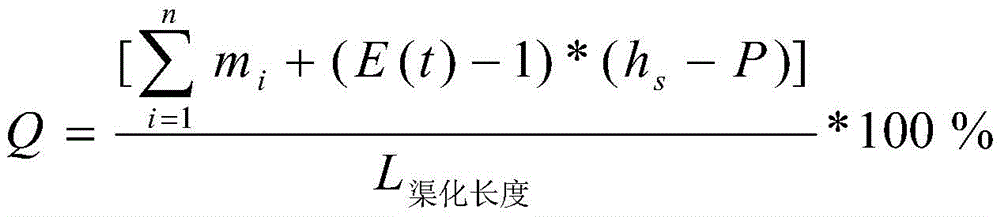
hs=1000/K
E(t)=E(t0)+(QA(t)-QB(t))
wherein E (t) is the number of vehicles at a certain time in the channel length, P is the average vehicle length, miIs the length (m), h of the ith vehiclesFor headway (m/vehicle), K is traffic density (vehicle/Km), the starting point A of the channeling length and the end of the channeling length is B, then the initial vehicle in the road section is E (t)0) The number of vehicles entering from A in time t is QA(t) the number of vehicles coming out of B is QB(t)。
As shown in fig. 4, the relationship between time and cumulative traffic flow. The lane occupancy reflects the density of vehicles on a lane, i.e., the length occupied by all vehicles in a certain instantaneous length of the tunnel as a percentage of the length of a known road segment. As shown in fig. 5, the relationship between the lane occupancy at a certain time and the static parameter lane occupancy minimum value is shown graphically.
To sum up, in (0, L)Length of canalization]Within the range, detecting the real-time dynamic inter-vehicle distance L in the canalization length of a certain moment on the lane, the distance C from the tail end of the vehicle to the tail end B point of the canalization length, and the dynamic lane occupancy Q, wherein three effective parameters form the elimination condition of the lane. The calculation formula is as follows:

wherein, the index part [ X ] represents the value rounding, the value range of Z is judged, and when Z is greater than 0, the lane is eliminated; when Z <0, the phase continues to be executed.
Step 3.4, when the moving lane is not completely eliminated, continuing to execute the moving direction, otherwise, eliminating the moving lane and skipping to step 3.5;
according to the realization of a single lane elimination rule, the release conditions of all lanes in the known moving direction are calculated at the same time, so that whether the moving direction is eliminated or not is judged, a sign function is introduced to construct an operation model, and the calculation formula is as follows:

wherein, the symbolic function is a piecewise function, which is beneficial to the regional division of the mathematical function.
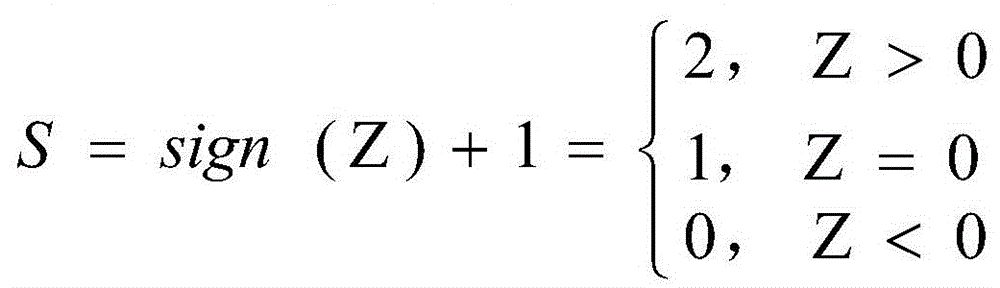
Uj=S1*S2*S3*.....*Si
Wherein SiI (one moving direction may have several lanes, i represents the current moving direction of the several lanes, i is used for making elimination moving direction judgment, i' S value range is defined according to the actual crossing condition, and it is the number of lanes)i2; otherwise Si=0,;UjAn elimination criterion representing the jth major movement direction, when UjWhen the motion direction is equal to 0, the phase of the motion direction is continuously executed; when U is turnedjAnd if not equal to 0, terminating the execution of the movement and selecting the release scheme of the next movement.
3.5, when the elimination trend exists in the release mode, skipping to the step 3.6, otherwise, skipping to the step 3.7;
step 3.6, when the dynamic direction matching is not executed in the last period or the condition of allowing release is met, immediately executing the release mode, otherwise, skipping to the step 3.8;
3.7, all the releasing modes in the north-south direction are eliminated, and the step 3.8 is skipped;
and 3.8, directly operating the next release mode.
Step 4, after the dynamic elimination and release are executed, when the intersection release stopping command is not detected, skipping to step 2, otherwise, skipping to step 5;
and 5, closing the intersection for releasing.
Finally, it should be noted that the above embodiments are only for illustrating the technical solutions of the present invention and not for limiting, and although the present invention has been described in detail with reference to examples, it should be understood by those skilled in the art that modifications or equivalent substitutions may be made on the technical solutions of the present invention without departing from the spirit and scope of the technical solutions of the present invention, which should be covered by the claims of the present invention.
Claims (4)
1. A real-time dynamic intelligent traffic adaptive method based on microwave radar detection is characterized by comprising the following steps:
step 1, defining a crossing moving direction and a release mode, wherein the crossing release takes two periods as a cycle;
step 2, in a first period, detecting real-time dynamic information of the intersection through a microwave radar, and executing static release according to the real-time dynamic information of the intersection;
step 3, in a second period, detecting real-time dynamic information of the intersection through a microwave radar, and executing dynamic elimination and release according to the real-time dynamic information of the intersection and a static release result of the intersection;
step 4, after the dynamic elimination and release are executed, when the intersection release stopping command is not detected, skipping to step 2, otherwise, skipping to step 5;
step 5, closing the crossing for releasing;
in step 2, the specific process of executing static release includes the following steps:
step 2.1, starting a release mode by an east-west straight behavior;
2.2, when any two unreleased moving directions exist in the last period in the east-west direction and the two unreleased moving directions can form a release mode, executing the formed release mode, otherwise, skipping to the step 2.3;
2.3, screening all release modes formed by the motion directions when an unreleased motion direction exists in the last period in the east-west direction, and skipping to the step 3;
in step 3, the specific process of executing dynamic elimination and release includes the following steps:
step 3.1, releasing in any releasing mode in the north-south direction;
step 3.2, counting the vehicle release time t of the current single movement direction, and comparing the vehicle release time t of the current single movement direction with the minimum green time Tmin and the maximum green time Tmax to obtain
Y=(Tmin-t)*(Tmax-t)
When Y <0, skipping to step 3.3, when Y >0 and t < Tmin, releasing the current phase, and when Y >0 and t > Tmax, eliminating the current single motion direction and selecting the next motion direction;
3.3, obtaining dynamic lane occupancy Q, real-time dynamic inter-vehicle distance L in the canalization length and distance C between the tail end of the dynamic final vehicle and the tail end of the canalization length according to the traffic data of the dynamic lane, eliminating the dynamic lane, judging the rest lanes of the dynamic direction and skipping to the step 3.4 when the dynamic lane occupancy Q is smaller than the lane occupancy Qmin, the real-time dynamic inter-vehicle distance L in the canalization length is larger than the maximum inter-vehicle distance Lmax or the distance C between the tail end of the dynamic final vehicle and the tail end of the canalization length is larger than the distance Cmax between the tail end of the dynamic final vehicle and the canalization end;
step 3.4, when the dynamic lane is not completely eliminated, the dynamic lane is continuously executed, otherwise, the dynamic lane is eliminated, and the step 3.5 is skipped;
3.5, when the moving direction which is not eliminated exists in the release mode, skipping to the step 3.6, otherwise, skipping to the step 3.7;
step 3.6, when the dynamic direction matching is not executed in the last period or the condition of allowing release is met, immediately executing the release mode, otherwise, skipping to the step 3.8;
3.7, all the releasing modes in the north-south direction are eliminated, and the step 3.8 is skipped;
and 3.8, directly operating the next release mode.
2. The real-time dynamic intelligent traffic adaptive method based on microwave radar detection as claimed in claim 1, wherein: the crossing moving direction and releasing modes comprise south-north straight moving, south-north left turning, south-left turning and straight moving, north-left turning and straight moving, south-north straight moving and left turning and left releasing, east-north straight moving and left turning and left releasing.
3. The real-time dynamic intelligent traffic adaptive method based on microwave radar detection as claimed in claim 1, wherein: the real-time dynamic information of the intersection obtained through microwave radar detection comprises the number M of each dynamic lane, the channelized length Z, the real-time dynamic inter-vehicle distance L in the channelized length, the total vehicle length PZ, the vehicle flow LA, the tail end dynamic distance C of the last vehicle in the channelized length, and the vehicle passing time t of the current independent dynamic lane is counted.
4. The microwave radar detection-based real-time dynamic intelligent traffic adaptive method according to claim 1, wherein in the step 3.3, the dynamic lane occupancy Q is as follows:
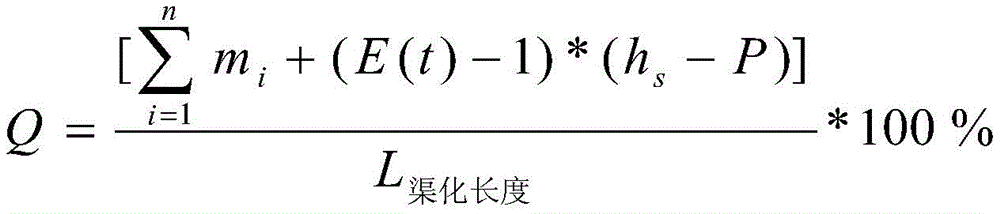
hs=1000/K
E(t)=E(t0)+(QA(t)-QB(t))
wherein E (t) is the number of vehicles at a certain time in the length of the channel, and P is PAverage vehicle length, miM is the length of the ith vehicle, hsTaking m/vehicle as a unit of distance between the vehicle heads, K as a unit of traffic density, vehicle/Km as a unit, taking the starting point A of the channelized length and the tail end of the channelized length as B, and taking the initial vehicle E (t) as the initial vehicle in the road section (the speed of the vehicle is zero)0) The number of vehicles entering from A in time t is QA(t) the number of vehicles coming out of B is QB(t)。
Priority Applications (1)
| Application Number | Priority Date | Filing Date | Title |
|---|---|---|---|
| CN201910983487.2A CN110738861B (en) | 2019-10-16 | 2019-10-16 | Real-time dynamic intelligent traffic self-adaption method based on microwave radar detection |
Applications Claiming Priority (1)
| Application Number | Priority Date | Filing Date | Title |
|---|---|---|---|
| CN201910983487.2A CN110738861B (en) | 2019-10-16 | 2019-10-16 | Real-time dynamic intelligent traffic self-adaption method based on microwave radar detection |
Publications (2)
| Publication Number | Publication Date |
|---|---|
| CN110738861A CN110738861A (en) | 2020-01-31 |
| CN110738861B true CN110738861B (en) | 2021-06-11 |
Family
ID=69270087
Family Applications (1)
| Application Number | Title | Priority Date | Filing Date |
|---|---|---|---|
| CN201910983487.2A Active CN110738861B (en) | 2019-10-16 | 2019-10-16 | Real-time dynamic intelligent traffic self-adaption method based on microwave radar detection |
Country Status (1)
| Country | Link |
|---|---|
| CN (1) | CN110738861B (en) |
Families Citing this family (3)
| Publication number | Priority date | Publication date | Assignee | Title |
|---|---|---|---|---|
| CN112735153A (en) * | 2020-10-23 | 2021-04-30 | 南京理工大学 | Intelligent traffic self-adaptive releasing method based on microwave radar |
| CN113516854B (en) * | 2021-03-25 | 2022-07-08 | 江苏航天大为科技股份有限公司 | Multi-interface coordination self-adaptive control method based on police card and video detector |
| CN116153113B (en) * | 2022-11-28 | 2024-09-06 | 江苏航天大为科技股份有限公司 | Signal lamp non-fixed phase sequence control method |
Citations (7)
| Publication number | Priority date | Publication date | Assignee | Title |
|---|---|---|---|---|
| CN101409016A (en) * | 2008-02-01 | 2009-04-15 | 浙江通衢数码科技有限公司 | Control method for urban road traffic |
| CN104778845A (en) * | 2014-12-29 | 2015-07-15 | 河南科技学院 | Multi-phase-jump and vehicle full-dynamic induction traffic control method |
| CN108806288A (en) * | 2018-07-16 | 2018-11-13 | 北方工业大学 | Urban road intersection self-adaptive control method and device based on single video |
| CN109003444A (en) * | 2018-07-02 | 2018-12-14 | 北方工业大学 | Urban intersection overflow control method based on wide area radar microwave detector |
| CN109637160A (en) * | 2018-11-29 | 2019-04-16 | 中电海康集团有限公司 | A kind of single-point control method under the conditions of dynamic traffic |
| WO2019130299A1 (en) * | 2017-12-31 | 2019-07-04 | Axilion Ltd. | Method, device, and system of dynamic allocation of traffic resources |
| CN110097766A (en) * | 2019-06-03 | 2019-08-06 | 南昌金科交通科技股份有限公司 | It is a kind of to utilize three-dimensional radar inspection optimization traffic control system |
-
2019
- 2019-10-16 CN CN201910983487.2A patent/CN110738861B/en active Active
Patent Citations (7)
| Publication number | Priority date | Publication date | Assignee | Title |
|---|---|---|---|---|
| CN101409016A (en) * | 2008-02-01 | 2009-04-15 | 浙江通衢数码科技有限公司 | Control method for urban road traffic |
| CN104778845A (en) * | 2014-12-29 | 2015-07-15 | 河南科技学院 | Multi-phase-jump and vehicle full-dynamic induction traffic control method |
| WO2019130299A1 (en) * | 2017-12-31 | 2019-07-04 | Axilion Ltd. | Method, device, and system of dynamic allocation of traffic resources |
| CN109003444A (en) * | 2018-07-02 | 2018-12-14 | 北方工业大学 | Urban intersection overflow control method based on wide area radar microwave detector |
| CN108806288A (en) * | 2018-07-16 | 2018-11-13 | 北方工业大学 | Urban road intersection self-adaptive control method and device based on single video |
| CN109637160A (en) * | 2018-11-29 | 2019-04-16 | 中电海康集团有限公司 | A kind of single-point control method under the conditions of dynamic traffic |
| CN110097766A (en) * | 2019-06-03 | 2019-08-06 | 南昌金科交通科技股份有限公司 | It is a kind of to utilize three-dimensional radar inspection optimization traffic control system |
Non-Patent Citations (1)
| Title |
|---|
| 过饱和交叉口群自适应控制方法;刘俊杰等;《传感器与微系统》;20180430;第37卷(第4期);全文 * |
Also Published As
| Publication number | Publication date |
|---|---|
| CN110738861A (en) | 2020-01-31 |
Similar Documents
| Publication | Publication Date | Title |
|---|---|---|
| CN110738861B (en) | Real-time dynamic intelligent traffic self-adaption method based on microwave radar detection | |
| CN113032964B (en) | Bus priority intersection signal control method and device | |
| CN114419903B (en) | Intelligent network connection automobile queue intersection traffic control method and device and vehicle | |
| CN113516854B (en) | Multi-interface coordination self-adaptive control method based on police card and video detector | |
| CN104318788B (en) | A kind of method that improves crossing inlet road space resources utilization ratio | |
| CN109649441B (en) | An energy-saving control method for automatic driving of trains | |
| CN101561971A (en) | Method for controlling priority of active bus signals on basis of lapping phases | |
| CN111243298B (en) | Intelligent traffic control method for ordinary intersections in autonomous driving environment | |
| CN106920403A (en) | A kind of single-point self-adaptation control method based on array radar | |
| WO2020244624A1 (en) | Method and device for calculating duration when green light is given to empty road at intersection | |
| CN113538935A (en) | An inductive control method for optimizing bus punctuality in the environment without dedicated right of way | |
| Wei et al. | Developing an adaptive strategy for connected eco-driving under uncertain traffic condition | |
| CN117523872A (en) | A real-time configuration method and device for signal lights based on V2X | |
| CN109229160A (en) | Cope with boisterous automatic train control method, device and mobile unit | |
| CN115817472B (en) | Intelligent network-connected automobile low-distance parking and starting control method, system, equipment and medium | |
| CN117331381A (en) | An acceleration and deceleration control method and system for a radar lodging device | |
| CN109859475B (en) | Intersection signal control method, device and system based on DBSCAN density clustering | |
| CN105741585B (en) | The track of vehicle smooth control method based on car networking towards fuel-economizing | |
| CN108693883A (en) | A kind of the high-precision parking method and system of Vehicular automatic driving | |
| CN115331459A (en) | T-shaped intersection traffic giving control method in automatic driving environment | |
| CN111028519B (en) | Self-adaptive control method based on video flow detector | |
| CN110175692B (en) | Main line intersection coordination control method based on track data | |
| CN111047865B (en) | Traffic control method at intersection of one-way traffic roads in autonomous driving environment | |
| CN118522164B (en) | Intersection signal machine timing optimization method, system, equipment and storage medium | |
| CN115593419A (en) | A vehicle control method, device, storage medium and vehicle |
Legal Events
| Date | Code | Title | Description |
|---|---|---|---|
| PB01 | Publication | ||
| PB01 | Publication | ||
| SE01 | Entry into force of request for substantive examination | ||
| SE01 | Entry into force of request for substantive examination | ||
| GR01 | Patent grant | ||
| GR01 | Patent grant |