CN110709423A - Combination therapy for cancer treatment with ICOS agonists and OX40 agonists - Google Patents
Combination therapy for cancer treatment with ICOS agonists and OX40 agonists Download PDFInfo
- Publication number
- CN110709423A CN110709423A CN201880038134.9A CN201880038134A CN110709423A CN 110709423 A CN110709423 A CN 110709423A CN 201880038134 A CN201880038134 A CN 201880038134A CN 110709423 A CN110709423 A CN 110709423A
- Authority
- CN
- China
- Prior art keywords
- antibody
- antigen
- icos
- cancer
- amino acid
- Prior art date
- Legal status (The legal status is an assumption and is not a legal conclusion. Google has not performed a legal analysis and makes no representation as to the accuracy of the status listed.)
- Pending
Links
Images


Classifications
-
- C—CHEMISTRY; METALLURGY
- C07—ORGANIC CHEMISTRY
- C07K—PEPTIDES
- C07K16/00—Immunoglobulins [IGs], e.g. monoclonal or polyclonal antibodies
- C07K16/18—Immunoglobulins [IGs], e.g. monoclonal or polyclonal antibodies against material from animals or humans
- C07K16/28—Immunoglobulins [IGs], e.g. monoclonal or polyclonal antibodies against material from animals or humans against receptors, cell surface antigens or cell surface determinants
- C07K16/2875—Immunoglobulins [IGs], e.g. monoclonal or polyclonal antibodies against material from animals or humans against receptors, cell surface antigens or cell surface determinants against the NGF/TNF superfamily, e.g. CD70, CD95L, CD153, CD154
-
- C—CHEMISTRY; METALLURGY
- C07—ORGANIC CHEMISTRY
- C07K—PEPTIDES
- C07K16/00—Immunoglobulins [IGs], e.g. monoclonal or polyclonal antibodies
- C07K16/18—Immunoglobulins [IGs], e.g. monoclonal or polyclonal antibodies against material from animals or humans
- C07K16/28—Immunoglobulins [IGs], e.g. monoclonal or polyclonal antibodies against material from animals or humans against receptors, cell surface antigens or cell surface determinants
- C07K16/2803—Immunoglobulins [IGs], e.g. monoclonal or polyclonal antibodies against material from animals or humans against receptors, cell surface antigens or cell surface determinants against the immunoglobulin superfamily
- C07K16/2818—Immunoglobulins [IGs], e.g. monoclonal or polyclonal antibodies against material from animals or humans against receptors, cell surface antigens or cell surface determinants against the immunoglobulin superfamily against CD28 or CD152
-
- A—HUMAN NECESSITIES
- A61—MEDICAL OR VETERINARY SCIENCE; HYGIENE
- A61P—SPECIFIC THERAPEUTIC ACTIVITY OF CHEMICAL COMPOUNDS OR MEDICINAL PREPARATIONS
- A61P35/00—Antineoplastic agents
-
- C—CHEMISTRY; METALLURGY
- C07—ORGANIC CHEMISTRY
- C07K—PEPTIDES
- C07K16/00—Immunoglobulins [IGs], e.g. monoclonal or polyclonal antibodies
- C07K16/18—Immunoglobulins [IGs], e.g. monoclonal or polyclonal antibodies against material from animals or humans
- C07K16/28—Immunoglobulins [IGs], e.g. monoclonal or polyclonal antibodies against material from animals or humans against receptors, cell surface antigens or cell surface determinants
- C07K16/2878—Immunoglobulins [IGs], e.g. monoclonal or polyclonal antibodies against material from animals or humans against receptors, cell surface antigens or cell surface determinants against the NGF-receptor/TNF-receptor superfamily, e.g. CD27, CD30, CD40, CD95
-
- C—CHEMISTRY; METALLURGY
- C07—ORGANIC CHEMISTRY
- C07K—PEPTIDES
- C07K16/00—Immunoglobulins [IGs], e.g. monoclonal or polyclonal antibodies
- C07K16/18—Immunoglobulins [IGs], e.g. monoclonal or polyclonal antibodies against material from animals or humans
- C07K16/28—Immunoglobulins [IGs], e.g. monoclonal or polyclonal antibodies against material from animals or humans against receptors, cell surface antigens or cell surface determinants
- C07K16/30—Immunoglobulins [IGs], e.g. monoclonal or polyclonal antibodies against material from animals or humans against receptors, cell surface antigens or cell surface determinants from tumour cells
-
- A—HUMAN NECESSITIES
- A61—MEDICAL OR VETERINARY SCIENCE; HYGIENE
- A61K—PREPARATIONS FOR MEDICAL, DENTAL OR TOILETRY PURPOSES
- A61K39/00—Medicinal preparations containing antigens or antibodies
- A61K2039/505—Medicinal preparations containing antigens or antibodies comprising antibodies
- A61K2039/507—Comprising a combination of two or more separate antibodies
-
- A—HUMAN NECESSITIES
- A61—MEDICAL OR VETERINARY SCIENCE; HYGIENE
- A61K—PREPARATIONS FOR MEDICAL, DENTAL OR TOILETRY PURPOSES
- A61K38/00—Medicinal preparations containing peptides
-
- C—CHEMISTRY; METALLURGY
- C07—ORGANIC CHEMISTRY
- C07K—PEPTIDES
- C07K2317/00—Immunoglobulins specific features
- C07K2317/70—Immunoglobulins specific features characterized by effect upon binding to a cell or to an antigen
- C07K2317/75—Agonist effect on antigen
Landscapes
- Health & Medical Sciences (AREA)
- Chemical & Material Sciences (AREA)
- Immunology (AREA)
- Organic Chemistry (AREA)
- Life Sciences & Earth Sciences (AREA)
- General Health & Medical Sciences (AREA)
- Medicinal Chemistry (AREA)
- Biochemistry (AREA)
- Biophysics (AREA)
- Genetics & Genomics (AREA)
- Molecular Biology (AREA)
- Proteomics, Peptides & Aminoacids (AREA)
- Public Health (AREA)
- Veterinary Medicine (AREA)
- General Chemical & Material Sciences (AREA)
- Nuclear Medicine, Radiotherapy & Molecular Imaging (AREA)
- Pharmacology & Pharmacy (AREA)
- Animal Behavior & Ethology (AREA)
- Chemical Kinetics & Catalysis (AREA)
- Cell Biology (AREA)
- Peptides Or Proteins (AREA)
- Medicines Containing Antibodies Or Antigens For Use As Internal Diagnostic Agents (AREA)
- Preparation Of Compounds By Using Micro-Organisms (AREA)
- Micro-Organisms Or Cultivation Processes Thereof (AREA)
- Medicines That Contain Protein Lipid Enzymes And Other Medicines (AREA)
- Pharmaceuticals Containing Other Organic And Inorganic Compounds (AREA)
Abstract
本发明提供了治疗有需要的患者中的癌症的方法,所述方法包括向所述患者依次施用有效量的针对人ICOS的药剂和有效量的针对人OX40的药剂。本发明还提供了抗ICOS抗体或其抗原结合片段和抗OX40抗体或其抗原结合片段,其依次用于治疗有需要的人中的癌症。The present invention provides a method of treating cancer in a patient in need thereof, the method comprising sequentially administering to the patient an effective amount of an agent directed against human ICOS and an effective amount of an agent directed against human OX40. The invention also provides an anti-ICOS antibody, or antigen-binding fragment thereof, and an anti-OX40 antibody, or antigen-binding fragment thereof, for use in the treatment of cancer in a human in need thereof.
Description
发明领域Field of Invention
本发明总体涉及治疗人疾病的免疫疗法。更具体地,本发明涉及免疫调节剂诸如抗ICOS抗体和抗OX40抗体的依序给药在癌症治疗中的用途。The present invention generally relates to immunotherapy for the treatment of human disease. More specifically, the present invention relates to the use of sequential administration of immunomodulatory agents, such as anti-ICOS antibodies and anti-OX40 antibodies, in the treatment of cancer.
发明背景Background of the Invention
癌症免疫是多步骤过程,其被一系列负免疫检查点和正共刺激受体(其当有效触发时可以实现抗肿瘤应答)严格调控(Mellman, I., 等人 (2011) Cancer ImmunotherapyComes of Age. Nature 480(7378), 480-489)。然而,肿瘤已经建立各种机制来通过改变免疫浸润物的应答性来规避免疫清除。在一些情况下,肿瘤将高度依赖于单一机制,并且在这些情况下,有可能用单药免疫调节疗法实现显著的临床活性(Hoos, A. (2016).Development of immuno-oncology drugs - from CTLA4 to PD1 to the nextgenerations. Nat Rev Drug Discov. 15(4), 235-47)。然而,由于肿瘤经常利用多种、重叠和冗余的机制来阻断抗肿瘤免疫应答,因此可能需要组合疗法以在各种各样的肿瘤类型间获得持久的效力。因此,需要新的免疫靶向疗法来改善所有癌症的治疗。Cancer immunity is a multistep process that is tightly regulated by a series of negative immune checkpoints and positive costimulatory receptors that, when effectively triggered, enable antitumor responses (Mellman, I., et al. (2011) Cancer ImmunotherapyComes of Age. Nature 480(7378), 480-489). However, tumors have established various mechanisms to circumvent immune clearance by altering the responsiveness of immune infiltrates. In some cases, tumors will be highly dependent on a single mechanism, and in these cases, it is possible to achieve significant clinical activity with single-agent immunomodulatory therapy (Hoos, A. (2016). Development of immuno-oncology drugs - from CTLA4 to PD1 to the next generations. Nat Rev Drug Discov. 15(4), 235-47). However, because tumors often utilize multiple, overlapping, and redundant mechanisms to block antitumor immune responses, combination therapy may be required to achieve durable efficacy across a wide variety of tumor types. Therefore, new immune-targeted therapies are needed to improve the treatment of all cancers.
因此,需要用于治疗疾病、特别是癌症的免疫调节剂的给药的组合治疗和策略。Therefore, there is a need for combination therapies and strategies for the administration of immunomodulatory agents for the treatment of disease, particularly cancer.
附图简述Brief Description of Drawings
图1是一组图,其显示OX40+ CD4和CD8 T细胞中的抗ICOS抗体(H2L5 IgG4PE)浓度依赖性增加。Figure 1 is a panel of graphs showing a concentration-dependent increase in anti-ICOS antibody (H2L5 IgG4PE) in OX40+ CD4 and CD8 T cells.
图2是一组图,其显示在用癌症患者PBMC的体外测定中,抗ICOS抗体(H2L5IgG4PE)处理增加OX40+ CD4和CD8 T细胞。Figure 2 is a panel of graphs showing that anti-ICOS antibody (H2L5IgG4PE) treatment increases OX40+ CD4 and CD8 T cells in an in vitro assay with cancer patient PBMC.
图3是一组图,其显示抗ICOS抗体(H2L5 IgG4PE)处理增加扩增的TIL培养物中的OX40+ CD4和CD8 T细胞。Figure 3 is a panel of graphs showing that anti-ICOS antibody (H2L5 IgG4PE) treatment increases OX40+ CD4 and CD8 T cells in expanded TIL cultures.
图4是一组图,其显示抗OX40抗体处理增加血液中的ICOS+ CD4和CD8 T细胞,同时降低来自CT26的肿瘤中的ICOS+ CD4。Figure 4 is a panel of graphs showing that anti-OX40 antibody treatment increases ICOS+ CD4 and CD8 T cells in blood, while decreasing ICOS+ CD4 in tumors from CT26.
图5是一组图,其显示抗ICOS抗体处理增加来自携带CT26肿瘤的小鼠的血液中的OX40+ T细胞。Figure 5 is a panel of graphs showing that anti-ICOS antibody treatment increases OX40+ T cells in blood from CT26 tumor bearing mice.
图6是一组图,其显示抗ICOS抗体处理增加来自CT26的血液中的OX40+ T-reg和CD4 T-效应子。Figure 6 is a panel of graphs showing that anti-ICOS antibody treatment increases OX40+ T-reg and CD4 T-effector in blood from CT26.
图7是一组图,其显示抗ICOS抗体处理增加来自CT26的肿瘤中的OX40+ ICOS- T-细胞。Figure 7 is a panel of graphs showing that anti-ICOS antibody treatment increases OX40+ ICOS- T-cells in tumors from CT26.
图8是一组图,其显示huPBMC模型中来自ICOS治疗的A2058黑色素瘤肿瘤的血液和脾脏中的OX40+ T细胞的变化。Figure 8 is a panel of graphs showing changes in OX40+ T cells in blood and spleen from ICOS-treated A2058 melanoma tumors in the huPBMC model.
图9是表格和示意图,其显示本文所述的抗ICOS抗体(17G9克隆)/抗OX40抗体(OX86克隆)同时和分阶段给药研究的研究设计。Figure 9 is a table and schematic showing the study design of the anti-ICOS antibody (17G9 clone)/anti-OX40 antibody (OX86 clone) simultaneous and phased dosing studies described herein.
图10是一组图,其显示用100 µg抗ICOS抗体和100 µg抗OX40抗体组合(组6)、100µg抗OX40抗体(组3)和100 µg抗ICOS抗体(组4)治疗的组中的肿瘤体积和存活率。Figure 10 is a set of graphs showing 100 µg anti-ICOS antibody and 100 µg anti-OX40 antibody combination (group 6), 100 µg anti-OX40 antibody (group 3) and 100 µg anti-ICOS antibody (group 4) in groups treated with Tumor volume and survival.
图11是一组图,其显示用10 µg抗ICOS抗体和100 µg抗OX40抗体组合(组7)、100 µg抗OX40抗体(组3)和10 µg抗ICOS抗体(组5)治疗的组中的肿瘤体积和存活率。Figure 11 is a panel of graphs showing in groups treated with a combination of 10 µg anti-ICOS antibody and 100 µg anti-OX40 antibody (group 7), 100 µg anti-OX40 antibody (group 3) and 10 µg anti-ICOS antibody (group 5) tumor volume and survival rate.
图12一组图,其显示用分阶段给药抗ICOS抗体和抗OX40抗体(用100 µg抗OX40导入/100 µg抗ICOS后续(组9)和适当的对照(组8:100 µg抗OX40导入/100 µg IgG2b后续;组10:100 µg大鼠IgG1导入/100 µg抗ICOS后续)治疗的组的肿瘤体积和存活率。Figure 12 A panel of graphs showing phased dosing of anti-ICOS antibody and anti-OX40 antibody (introduction with 100 μg anti-OX40/100 μg anti-ICOS follow-up (group 9) and appropriate controls (group 8: introduction of 100 μg anti-OX40) /100 µg IgG2b follow-up; Group 10: Tumor volume and survival of groups treated with 100 µg rat IgG1 introduction/100 µg anti-ICOS follow-up).
图13显示表达ICOS和OX40双重阳性T细胞的肿瘤的图和表格。Figure 13 shows a graph and table of tumors expressing ICOS and OX40 double positive T cells.
图14是显示基于TME中的区域进一步分离肿瘤的图。Figure 14 is a graph showing further separation of tumors based on regions in the TME.
图15A-15D是显示肿瘤中T-reg和CD8上的ICOS和OX40表达的图。图15A显示各种肿瘤中的表达ICOS的T调节细胞的比例。图15B显示各种肿瘤中的表达OX40的T调节细胞的比例。图15C显示各种肿瘤中的表达ICOS的细胞毒性T细胞的比例。图15D显示各种肿瘤中的表达OX40的细胞毒性T细胞的比例。Figures 15A-15D are graphs showing ICOS and OX40 expression on T-reg and CD8 in tumors. Figure 15A shows the proportion of ICOS expressing T regulatory cells in various tumors. Figure 15B shows the proportion of OX40 expressing T regulatory cells in various tumors. Figure 15C shows the proportion of ICOS-expressing cytotoxic T cells in various tumors. Figure 15D shows the proportion of OX40 expressing cytotoxic T cells in various tumors.
图16:106-222、人源化106-222 (Hu106)和人受体X61012 (GenBank登录号)VH序列的氨基酸序列的比对。Figure 16: Alignment of amino acid sequences of 106-222, humanized 106-222 (Hu106) and human acceptor X61012 (GenBank accession number) VH sequences.
图17:106-222、人源化106-222 (Hu106)和人受体AJ388641 (GenBank登录号)VL序列的氨基酸序列的比对。Figure 17: Alignment of amino acid sequences of 106-222, humanized 106-222 (Hu106) and human receptor AJ388641 (GenBank accession number) VL sequences.
图18:侧接SpeI和HindIII位点的Hu106 VH基因的核苷酸序列与推导的氨基酸序列。Figure 18: Nucleotide and deduced amino acid sequences of the Hu106 VH gene flanked by SpeI and HindIII sites.
图19:侧接NheI和EcoRI位点的Hu106-222 VL基因的核苷酸序列与推导的氨基酸序列。Figure 19: Nucleotide and deduced amino acid sequences of the Hu106-222 VL gene flanked by NheI and EcoRI sites.
图20:119-122、人源化119-122 (Hu119)和人受体Z14189 (GenBank登录号)VH序列的氨基酸序列的比对。Figure 20: Alignment of amino acid sequences of 119-122, humanized 119-122 (Hu119) and human acceptor Z14189 (GenBank accession number) VH sequences.
图21:119-122、人源化119-122 (Hu119)和人受体M29469 (GenBank登录号) VL序列的氨基酸序列的比对。Figure 21: Alignment of amino acid sequences of 119-122, humanized 119-122 (Hu119) and human acceptor M29469 (GenBank accession number) VL sequences.
图22:侧接SpeI和HindIII位点的Hu119 VH基因的核苷酸序列与推导的氨基酸序列。Figure 22: Nucleotide and deduced amino acid sequences of the Hu119 VH gene flanked by SpeI and HindIII sites.
图23:侧接NheI和EcoRI位点的Hu119 VL基因的核苷酸序列与推导的氨基酸序列。Figure 23: Nucleotide and deduced amino acid sequences of the Hu119 VL gene flanked by NheI and EcoRI sites.
图24:小鼠119-43-1VH cDNA的核苷酸序列与推导的氨基酸序列。Figure 24: Nucleotide sequence and deduced amino acid sequence of mouse 119-43-1 VH cDNA.
图25:小鼠119-43-1 VL cDNA的核苷酸序列和推导的氨基酸序列。Figure 25: Nucleotide sequence and deduced amino acid sequence of mouse 119-43-1 VL cDNA.
图26:设计的侧接Spel和Hindlll位点的119-43-1 VH基因的核苷酸序列与推导的氨基酸序列。Figure 26: Nucleotide and deduced amino acid sequences of the designed 119-43-1 VH gene flanking the Spel and Hindlll sites.
图27:设计的侧接Nhel和EcoRI位点的119-43-1 VL基因的核苷酸序列与推导的氨基酸序列。Figure 27: Nucleotide sequence and deduced amino acid sequence of the designed 119-43-1 VL gene flanked by Nhel and EcoRI sites.
发明概述SUMMARY OF THE INVENTION
在一个方面,本发明提供了治疗有需要的患者中的癌症的方法,其包括向所述患者依次施用有效量的针对人ICOS的药剂和有效量的针对人OX40的药剂。在一个实施方案中,在施用针对人ICOS的药剂之后,施用针对人OX40的药剂。在另一个实施方案中,在施用针对人OX40的药剂之后,施用针对人ICOS的药剂。在一个实施方案中,针对人ICOS的药剂是ICOS激动剂抗体。在一个实施方案中,针对人OX40的药剂是OX40激动剂抗体。In one aspect, the present invention provides a method of treating cancer in a patient in need thereof, comprising sequentially administering to the patient an effective amount of an agent directed against human ICOS and an effective amount of an agent directed against human OX40. In one embodiment, the agent against human OX40 is administered after the agent against human ICOS is administered. In another embodiment, the agent against human ICOS is administered after the agent against human OX40 is administered. In one embodiment, the agent against human ICOS is an ICOS agonist antibody. In one embodiment, the agent against human OX40 is an OX40 agonist antibody.
在一个方面,本发明提供了抗ICOS抗体或其抗原结合片段和抗OX40抗体或其抗原结合片段,其依次用于治疗有需要的人中的癌症。在一个实施方案中,在施用抗ICOS抗体或其抗原结合片段之后,施用抗OX40抗体或其抗原结合片段。在另一个实施方案中,在施用抗OX40抗体或其抗原结合片段之后,施用抗ICOS抗体或其抗原结合片段。在一个实施方案中,所述抗ICOS抗体是ICOS激动剂抗体。在一个实施方案中,所述抗OX40抗体是OX40激动剂抗体。In one aspect, the invention provides an anti-ICOS antibody, or antigen-binding fragment thereof, and an anti-OX40 antibody, or antigen-binding fragment thereof, for use in the treatment of cancer in a human in need thereof. In one embodiment, the anti-OX40 antibody or antigen-binding fragment thereof is administered after administration of the anti-ICOS antibody or antigen-binding fragment thereof. In another embodiment, the anti-ICOS antibody or antigen-binding fragment thereof is administered following administration of the anti-OX40 antibody or antigen-binding fragment thereof. In one embodiment, the anti-ICOS antibody is an ICOS agonist antibody. In one embodiment, the anti-OX40 antibody is an OX40 agonist antibody.
发明详述Detailed description of the invention
定义definition
如本文所用,“ICOS”意指任何诱导型T-细胞共刺激蛋白。ICOS(诱导型T-细胞共刺激剂)的替代名称包括AILIM;CD278;CVID1、JTT-1或JTT-2、MGC39850或8F4。ICOS是在活化的T细胞上表达的CD28-超家族共刺激性分子。由该基因编码的蛋白属于CD28和CTLA-4细胞表面受体家族。其形成同型二聚体并在细胞-细胞信号传导、免疫应答和细胞增殖的调节中发挥重要作用。人ICOS(同种型2)(登录号: UniProtKB - Q9Y6W8-2)的氨基酸序列下面如SEQID NO:39所示。As used herein, "ICOS" means any inducible T-cell costimulatory protein. Alternative names for ICOS (inducible T-cell costimulator) include AILIM; CD278; CVID1, JTT-1 or JTT-2, MGC39850 or 8F4. ICOS is a CD28-superfamily costimulatory molecule expressed on activated T cells. The protein encoded by this gene belongs to the CD28 and CTLA-4 cell surface receptor families. It forms homodimers and plays an important role in the regulation of cell-cell signaling, immune responses and cell proliferation. The amino acid sequence of human ICOS (isoform 2) (accession number: UniProtKB - Q9Y6W8-2) is shown below as SEQ ID NO:39.

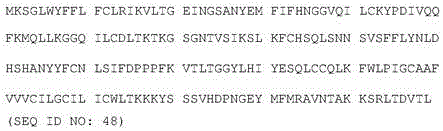
人ICOS(同种型1)(登录号: UniProtKB - Q9Y6W8-1)的氨基酸序列下面如SEQ IDNO:48所示。The amino acid sequence of human ICOS (isoform 1) (accession number: UniProtKB - Q9Y6W8-1) is shown below as SEQ ID NO:48.
ICOS的活化经由通过ICOS-L(B7RP-1/B7-H2)的结合而发生。B7-1和B7-2(CD28和CTLA4的配体)都不结合或活化ICOS。然而,已经显示ICOS-L微弱结合CD28和CTLA-4两者(Yao S等人, “B7-H2 is a costimulatory ligand for CD28 in human”, Immunity, 34(5); 729-40 (2011))。ICOS的表达似乎限于T细胞。ICOS表达水平在不同的T细胞亚群和T细胞活化状态之间变化。已经显示ICOS表达在静息TH17、T滤泡辅助(TFH)和调节性T(Treg)细胞上;然而,不同于CD28;ICOS在幼稚TH1和TH2效应子T-细胞群体上并不高度表达(PaulosCM等人, “The inducible costimulator (ICOS) is critical for the development ofhuman Th17 cells”, Sci Transl Med, 2(55); 55ra78 (2010))。在通过TCR接合而活化后,ICOS表达在CD4+和CD8+效应T-细胞上被高度诱导(Wakamatsu E,等人, “Convergentand divergent effects of costimulatory molecules in conventional andregulatory CD4+ T cells”, Proc Natal Acad Sci USA, 110(3); 1023-8 (2013))。通过ICOS受体的共刺激信号传导仅发生在接受同时TCR活化信号的T细胞中(Sharpe AH和Freeman GJ. “The B7-CD28 Superfamily”, Nat. Rev Immunol, 2(2); 116-26(2002))。在活化的抗原特异性T细胞中,ICOS调节TH1和TH2细胞因子(包括IFN-γ、TNF-α、IL-10、IL-4、IL-13和其他)的产生。ICOS也刺激效应T细胞增殖,尽管程度小于CD28(Sharpe AH和Freeman GJ. “The B7-CD28 Superfamily”, Nat. Rev Immunol, 2(2);116-26 (2002))。针对ICOS的抗体及其在疾病治疗中的使用方法描述于例如WO2012/131004、US20110243929和US20160215059中。US20160215059通过引用并入本文。具有激动剂活性的针对人ICOS的鼠抗体的CDR显示于PCT/EP2012/055735 (WO 2012/131004)中。针对ICOS的抗体也公开于WO 2008/137915、WO 2010/056804、EP 1374902、EP1374901和EP1125585中。针对ICOS的激动剂抗体或ICOS结合蛋白公开于WO2012/13004、WO2014/033327、WO2016/120789、US20160215059和US20160304610中。US2016/0304610中的示例性抗体包括37A10S713。37A10S713的序列在下面作为SEQ ID NO: 49-56再现。Activation of ICOS occurs via binding through ICOS-L (B7RP-1/B7-H2). Neither B7-1 nor B7-2, ligands for CD28 and CTLA4, bind or activate ICOS. However, ICOS-L has been shown to bind both CD28 and CTLA-4 weakly (Yao S et al., "B7-H2 is a costimulatory ligand for CD28 in human", Immunity, 34(5); 729-40 (2011)) . Expression of ICOS appears to be restricted to T cells. ICOS expression levels varied between different T cell subsets and T cell activation states. ICOS has been shown to be expressed on resting TH17 , T follicular helper (TFH) and regulatory T (Treg) cells; however, unlike CD28; ICOS is not expressed on naive TH1 and TH2 effector T-cell populations Not highly expressed (PaulosCM et al., "The inducible costimulator (ICOS) is critical for the development of human Th17 cells", Sci Transl Med, 2(55); 55ra78 (2010)). After activation by TCR engagement, ICOS expression is highly induced on CD4+ and CD8+ effector T- cells (Wakamatsu E, et al., "Convergent and divergent effects of costimulatory molecules in conventional andregulatory CD4+ T cells", Proc Natal Acad Sci USA, 110(3); 1023-8 (2013)). Costimulatory signaling through the ICOS receptor occurs only in T cells receiving concurrent TCR activation signals (Sharpe AH and Freeman GJ. "The B7-CD28 Superfamily", Nat. Rev Immunol, 2(2); 116-26 ( 2002)). In activated antigen-specific T cells, ICOS regulates the production of TH1 and TH2 cytokines, including IFN-γ, TNF-α, IL-10, IL-4, IL-13, and others. ICOS also stimulates effector T cell proliferation, albeit to a lesser extent than CD28 (Sharpe AH and Freeman GJ. "The B7-CD28 Superfamily", Nat. Rev Immunol, 2(2); 116-26 (2002)). Antibodies against ICOS and methods of their use in disease treatment are described, for example, in WO2012/131004, US20110243929 and US20160215059. US20160215059 is incorporated herein by reference. The CDRs of murine antibodies against human ICOS with agonist activity are shown in PCT/EP2012/055735 (WO 2012/131004). Antibodies against ICOS are also disclosed in WO 2008/137915, WO 2010/056804, EP 1374902, EP1374901 and EP1125585. Agonist antibodies or ICOS binding proteins against ICOS are disclosed in WO2012/13004, WO2014/033327, WO2016/120789, US20160215059 and US20160304610. Exemplary antibodies in US2016/0304610 include 37A10S713. The sequence of 37A10S713 is reproduced below as SEQ ID NOs: 49-56.
“针对ICOS的药剂”意指能够结合ICOS的任何化学化合物或生物分子。在一些实施方案中,针对ICOS的药剂是ICOS结合蛋白。在一些其他实施方案中,针对ICOS的药剂是ICOS激动剂。"Agent against ICOS" means any chemical compound or biomolecule capable of binding to ICOS. In some embodiments, the agent directed against ICOS is an ICOS binding protein. In some other embodiments, the agent directed against ICOS is an ICOS agonist.
如本文所用的术语“ICOS结合蛋白”是指能够结合ICOS的抗体和其他蛋白构建体,诸如结构域。在一些情况下,ICOS是人ICOS。术语“ICOS结合蛋白”可以与“ICOS抗原结合蛋白”可互换使用。因此,如本领域中所理解,抗ICOS抗体和/或ICOS抗原结合蛋白将被认为是ICOS结合蛋白。如本文所用,“抗原结合蛋白”是结合抗原(诸如ICOS)的任何蛋白,包括但不限于本文所述的抗体、结构域和其他构建体。如本文所用,ICOS结合蛋白的“抗原结合部分”将包括能够结合ICOS的ICOS结合蛋白的任何部分,包括但不限于抗原结合抗体片段。The term "ICOS binding protein" as used herein refers to antibodies and other protein constructs, such as domains, capable of binding ICOS. In some cases, the ICOS is a human ICOS. The term "ICOS binding protein" may be used interchangeably with "ICOS antigen binding protein". Accordingly, anti-ICOS antibodies and/or ICOS antigen binding proteins would be considered to be ICOS binding proteins, as understood in the art. As used herein, an "antigen binding protein" is any protein that binds an antigen, such as an ICOS, including, but not limited to, the antibodies, domains, and other constructs described herein. As used herein, an "antigen-binding portion" of an ICOS-binding protein shall include any portion of an ICOS-binding protein capable of binding ICOS, including, but not limited to, antigen-binding antibody fragments.
在一个实施方案中,本发明的ICOS抗体包含以下CDR中的任何一个或组合:In one embodiment, the ICOS antibody of the invention comprises any one or a combination of the following CDRs:

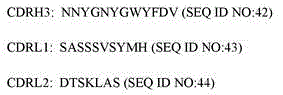

在一些实施方案中,本发明的抗ICOS抗体包含重链可变区,其与SEQ ID NO:46具有至少90%序列同一性。合适地,本发明的ICOS结合蛋白可包含重链可变区,其与SEQ IDNO:46具有约85%、86%、87%、88%、89%、90%、91%、92%、93%、94%、95%、96%、97%、98%、99%或100%序列同一性。In some embodiments, the anti-ICOS antibodies of the invention comprise a heavy chain variable region having at least 90% sequence identity to SEQ ID NO:46. Suitably, the ICOS binding protein of the invention may comprise a heavy chain variable region having about 85%, 86%, 87%, 88%, 89%, 90%, 91%, 92%, 93% relative to SEQ ID NO:46 %, 94%, 95%, 96%, 97%, 98%, 99% or 100% sequence identity.
人源化重链(VH)可变区(H2):Humanized heavy chain ( VH ) variable region (H2):

在本发明的一个实施方案中,所述 ICOS抗体在具有SEQ ID NO:47中所示的氨基酸序列的轻链可变区中包含CDRL1 (SEQ ID NO:43)、CDRL2 (SEQ ID NO:44)和CDRL3 (SEQID NO:45)。包含SEQ ID NO:47中所示的人源化轻链可变区的本发明的ICOS结合蛋白被命名为“L5”。因此,包含SEQ ID NO:46的重链可变区和SEQ ID NO:47的轻链可变区的本发明的ICOS结合蛋白在本文中可被命名为H2L5。In one embodiment of the invention, the ICOS antibody comprises CDRL1 (SEQ ID NO:43), CDRL2 (SEQ ID NO:44) in the light chain variable region having the amino acid sequence shown in SEQ ID NO:47 ) and CDRL3 (SEQ ID NO: 45). The ICOS binding protein of the present invention comprising the humanized light chain variable region shown in SEQ ID NO:47 was designated "L5". Accordingly, the ICOS binding protein of the invention comprising the heavy chain variable region of SEQ ID NO:46 and the light chain variable region of SEQ ID NO:47 may be designated H2L5 herein.
在一些实施方案中,本发明的ICOS结合蛋白包含轻链可变区,其与SEQ ID NO:47中所示的氨基酸序列具有至少90%序列同一性。合适地,本发明的ICOS结合蛋白可包含轻链可变区,其与SEQ ID NO:47具有约85%、86%、87%、88%、89%、90%、91%、92%、93%、94%、95%、96%、97%、98%、99%或100%序列同一性。In some embodiments, the ICOS binding proteins of the invention comprise a light chain variable region having at least 90% sequence identity to the amino acid sequence set forth in SEQ ID NO:47. Suitably, the ICOS binding protein of the invention may comprise a light chain variable region having about 85%, 86%, 87%, 88%, 89%, 90%, 91%, 92%, SEQ ID NO:47, 93%, 94%, 95%, 96%, 97%, 98%, 99% or 100% sequence identity.
人源化轻链(VL)可变区(L5)Humanized light chain ( VL ) variable region (L5)

CDR或最小结合单元可以通过至少一个氨基酸取代、缺失或添加进行修饰,其中变体抗原结合蛋白基本上保留未修饰蛋白(诸如包含SEQ ID NO:46和SEQ ID NO:47的抗体)的生物学特性。A CDR or minimal binding unit can be modified by at least one amino acid substitution, deletion or addition, wherein the variant antigen binding protein substantially retains the biology of the unmodified protein (such as the antibody comprising SEQ ID NO:46 and SEQ ID NO:47) characteristic.
应理解,CDR H1、H2、H3、L1、L2、L3各自都可以单独或与任何其他CDR组合以任何排列或组合进行修饰。在一个实施方案中,通过取代、缺失或添加最多达3个氨基酸(例如1或2个氨基酸,例如1个氨基酸)来修饰CDR。典型地,所述修饰是取代,尤其是保守取代,例如如下表1中所示。It will be appreciated that each of the CDRs H1, H2, H3, L1, L2, L3 can be modified in any permutation or combination, alone or in combination with any other CDR. In one embodiment, the CDRs are modified by substitution, deletion or addition of up to 3 amino acids (
表1Table 1
抗体的亚类部分决定次级效应子功能,诸如补体活化或Fc受体(FcR)结合和抗体依赖性细胞的细胞毒性(ADCC)(Huber,等人, Nature 229(5284): 419-20 (1971);Brunhouse,等人, Mol Immunol 16(11): 907-17 (1979))。在鉴定用于具体应用的最佳抗体类型中,可以考虑抗体的效应子功能。例如,hIgG1抗体具有相对长的半衰期,在固定补体方面非常有效,并且它们结合FcγRI和FcγRII结两者。相比之下,人IgG4抗体具有较短的半衰期,不固定补体并且对FcR具有较低的亲和力。在IgG4的Fc区中用脯氨酸替代丝氨酸228(S228P)降低用hIgG4观察到的异质性并延长血清半衰期(Kabat,等人, “Sequences ofproteins of immunological interest” 5.sup.th Edition (1991); Angal,等人, MolImmunol 30(1): 105-8 (1993))。用谷氨酸替代亮氨酸235(L235E)的第二个突变消除残余FcR结合和补体结合活性(Alegre, 等人, J Immunol 148(11): 3461-8 (1992))。所得的具有两个突变的抗体被称为IgG4PE。hIgG4氨基酸的编号源自EU编号参考资料:Edelman,G.M.等人, Proc. Natl. Acad. USA, 63, 78-85 (1969). PMID: 5257969。 在本发明的一个实施方案中,ICOS抗体是IgG4同种型。在一个实施方案中,ICOS抗体包含IgG4 Fc区,所述IgG4 Fc区包含替代S228P和L235E,可以具有名称IgG4PE。在一个实施方案中,ICOS抗体是H2L5 IgG4PE。Subclass portions of antibodies determine secondary effector functions such as complement activation or Fc receptor (FcR) binding and antibody-dependent cellular cytotoxicity (ADCC) (Huber, et al., Nature 229(5284): 419-20 ( 1971); Brunhouse, et al., Mol Immunol 16(11): 907-17 (1979)). In identifying the best type of antibody for a particular application, the effector function of the antibody can be considered. For example, hIgG1 antibodies have relatively long half-lives, are very efficient at fixing complement, and they bind both FcyRI and FcyRII nodes. In contrast, human IgG4 antibodies have shorter half-lives, do not fix complement and have lower affinity for FcRs. Replacing serine 228 (S228P) with proline in the Fc region of IgG4 reduces the heterogeneity observed with hIgG4 and prolongs serum half-life (Kabat, et al., "Sequences of proteins of immunological interest" 5.sup.th Edition (1991). ); Angal, et al, Mol Immunol 30(1): 105-8 (1993)). A second mutation replacing leucine 235 (L235E) with glutamic acid abolished residual FcR binding and complement binding activity (Alegre, et al, J Immunol 148(11): 3461-8 (1992)). The resulting antibody with two mutations was called IgG4PE. The numbering of hIgG4 amino acids is derived from the EU numbering reference: Edelman, G.M. et al., Proc. Natl. Acad. USA, 63, 78-85 (1969). PMID: 5257969. In one embodiment of the invention, the ICOS antibody is of the IgG4 isotype. In one embodiment, the ICOS antibody comprises an IgG4 Fc region comprising the substitutions S228P and L235E, which may have the designation IgG4PE. In one embodiment, the ICOS antibody is H2L5 IgG4PE.
如本文所用,“ICOS-L”和“ICOS配体”可互换使用,并且是指人ICOS的膜结合的天然配体。ICOS配体是在人中由ICOSLG基因编码的蛋白。ICOSLG也已被命名为CD275(分化簇275)。ICOS-L的替代名称包括B7RP-1和B7-H2。As used herein, "ICOS-L" and "ICOS ligand" are used interchangeably and refer to the membrane-bound native ligand of human ICOS. ICOS ligands are proteins encoded in humans by the ICOSLG gene. ICOSLG has also been named CD275 (cluster of differentiation 275). Alternative names for ICOS-L include B7RP-1 and B7-H2.
如本文所用,“针对OX40的药剂”或“针对OX-40的药剂”意指能够结合OX40的任何化学化合物或生物分子。在一些实施方案中,针对OX40的药剂是OX40激动剂。在一些实施方案中,针对OX40的药剂是OX40结合蛋白。As used herein, "agent against OX40" or "agent against OX-40" means any chemical compound or biomolecule capable of binding OX40. In some embodiments, the agent directed against OX40 is an OX40 agonist. In some embodiments, the agent directed against OX40 is an OX40 binding protein.
如本文所用的术语“OX40结合蛋白”是指能够结合OX40的抗体和其他蛋白构建体,诸如结构域。在一些情况下,所述OX40是人OX40。术语“OX40结合蛋白”可以与“OX40抗原结合蛋白”可互换使用。因此,如本领域中所理解,抗OX40抗体和/或OX40抗原结合蛋白将被认为是OX40结合蛋白。如本文所用,“抗原结合蛋白”是结合抗原、诸如OX40的任何蛋白,包括但不限于本文所述的抗体、结构域和其他构建体。如本文所用,OX40结合蛋白的“抗原结合部分”将包括能够结合OX40的OX40结合蛋白的任何部分,包括但不限于,抗原结合抗体片段。The term "OX40 binding protein" as used herein refers to antibodies and other protein constructs, such as domains, capable of binding OX40. In some instances, the OX40 is human OX40. The term "OX40 binding protein" may be used interchangeably with "OX40 antigen binding protein". Thus, as understood in the art, an anti-OX40 antibody and/or an OX40 antigen binding protein would be considered an OX40 binding protein. As used herein, an "antigen binding protein" is any protein that binds an antigen, such as OX40, including, but not limited to, the antibodies, domains, and other constructs described herein. As used herein, an "antigen-binding portion" of an OX40-binding protein will include any portion of an OX40-binding protein capable of binding OX40, including, but not limited to, antigen-binding antibody fragments.
CD134,也称为OX40,是受体的TNFR-超家族的成员,与CD28不同,其不会在静息幼稚T细胞上组成型表达。OX40是次级共刺激分子,在活化后24至72小时后表达;其配体OX40L也不在静息的抗原呈递细胞上表达,但在其活化后。OX40的表达依赖于T细胞的完全活化;没有CD28的情况下,OX40的表达被延迟并且水平降低四倍。OX40/OX40-配体(OX40受体)/(OX40L)是对于T细胞增殖、存活、细胞因子产生和记忆细胞生成至关重要的一对共刺激分子。早期体外实验表明,通过OX40在CD4+ T细胞上的信号传导导致TH2发育,而不导致TH1发育。这些结果得到体内研究的支持,所述体内研究显示阻断OX40/OX40L相互作用阻止TH2介导的过敏性免疫应答的诱导和维持。然而,阻断OX40/OX40L相互作用改善或预防TH1介导的疾病。此外,显示施用可溶性OX40L或将OX40L基因转移至肿瘤中强烈地增强小鼠中的抗肿瘤免疫。最近的研究还表明,OX40/OX40L可以在促进CD8 T细胞介导的免疫应答中发挥作用。如本文所讨论,OX40信号传导阻断CD4+ CD25+天然存在的调节性T细胞的抑制功能,并且OX40/OX40L对在外周免疫相比于耐受的整体调节中发挥关键作用。OX-40抗体、OX-40融合蛋白及其使用方法公开于美国专利号:US 7,504,101;US 7,758,852;US 7,858,765;US 7,550,140;US 7,960,515;和US 9,006,399和国际公开:WO 2003082919;WO 2003068819;WO2006063067;WO 2007084559;WO 2008051424;WO2012027328;和WO2013028231。CD134, also known as OX40, is a member of the TNFR-superfamily of receptors and, unlike CD28, is not constitutively expressed on resting naive T cells. OX40 is a secondary costimulatory molecule that is expressed 24 to 72 hours after activation; its ligand OX40L is also not expressed on resting antigen-presenting cells, but after its activation. OX40 expression is dependent on full activation of T cells; in the absence of CD28, OX40 expression is delayed and levels are reduced fourfold. OX40/OX40-ligand (OX40 receptor)/(OX40L) is a pair of co-stimulatory molecules critical for T cell proliferation, survival, cytokine production and memory cell generation. Early in vitro experiments showed that signaling on CD4 + T cells via OX40 resulted in TH2 development, but not TH1 development. These results are supported by in vivo studies showing that blocking the OX40/OX40L interaction prevents the induction and maintenance of TH2-mediated allergic immune responses. However, blocking the OX40/OX40L interaction ameliorated or prevented TH1-mediated disease. Furthermore, administration of soluble OX40L or gene transfer of OX40L into tumors was shown to strongly enhance anti-tumor immunity in mice. Recent studies have also shown that OX40/OX40L may play a role in promoting CD8 T cell-mediated immune responses. As discussed herein, OX40 signaling blocks the suppressive function of CD4 + CD25 + naturally occurring regulatory T cells, and the OX40/OX40L pair plays a key role in the overall regulation of peripheral immunity versus tolerance. OX-40 antibodies, OX-40 fusion proteins and methods of use thereof are disclosed in US Patent Nos.: US 7,504,101; US 7,758,852; US 7,858,765; US 7,550,140; US 7,960,515; WO 2007084559; WO 2008051424; WO2012027328; and WO2013028231.
在本文中,本发明的抗原结合蛋白(ABP)或抗OX40抗原结合蛋白是结合OX40的蛋白,并且在一些实施方案中,进行以下中的一种或多种:通过OX40调节信号传导,调节OX40的功能,激动OX40信号传导,刺激OX40功能或共同刺激OX40信号传导。美国专利9,006,399的实施例1公开了OX40结合测定。本领域技术人员将容易地认识到各种其他众所周知的测定法来建立此类功能。Herein, an antigen binding protein (ABP) or anti-OX40 antigen binding protein of the invention is a protein that binds OX40, and in some embodiments, performs one or more of the following: modulation of signaling through OX40, modulation of OX40 function, agonizes OX40 signaling, stimulates OX40 function or co-stimulates OX40 signaling. Example 1 of US Patent 9,006,399 discloses an OX40 binding assay. Those skilled in the art will readily recognize various other well-known assays to establish such functions.
在一个实施方案中,OX40抗原结合蛋白是WO2012/027328 (PCT/US2011/048752)(国际申请日2011年8月23日)中公开的OX40抗原结合蛋白。在另一个实施方案中,所述抗原结合蛋白包含WO2012/027328 (PCT/US2011/048752)(国际申请日2011年8月23日)中公开的抗体的CDR,或与公开的CDR序列具有90%同一性的CDR。在一个进一步实施方案中,所述抗原结合蛋白包含WO2012/027328 (PCT/US2011/048752)(国际申请日2011年8月23日)中公开的抗体的VH、VL或两者,或与公开的VH或VL序列具有90%同一性的VH或VL。In one embodiment, the OX40 antigen binding protein is the OX40 antigen binding protein disclosed in WO2012/027328 (PCT/US2011/048752) (International Application Date August 23, 2011). In another embodiment, the antigen binding protein comprises the CDRs of the antibodies disclosed in WO2012/027328 (PCT/US2011/048752) (International Application Date August 23, 2011), or has 90% of the sequences of the disclosed CDRs Identical CDRs. In a further embodiment, the antigen binding protein comprises the VH, VL or both of the antibodies disclosed in WO2012/027328 (PCT/US2011/048752) (International Application Date August 23, 2011), or with the disclosed A VH or VL sequence is 90% identical to a VH or VL.
在另一个实施方案中,所述OX40抗原结合蛋白公开于WO2013/028231 (PCT/US2012/024570)(国际申请日2012年2月9日)。在另一个实施方案中,所述抗原结合蛋白包含WO2013/028231 (PCT/US2012/024570)(国际申请日2012年2月9日)中公开的抗体的CDR,或与公开的CDR序列具有90%同一性的CDR。在一个进一步实施方案中,所述抗原结合蛋白包含WO2013/028231 (PCT/US2012/024570)(国际申请日2012年2月9日)中公开的抗体的VH、VL或两者,或与公开的VH或VL序列具有90%同一性的VH或VL。In another embodiment, the OX40 antigen binding protein is disclosed in WO2013/028231 (PCT/US2012/024570) (international filing date February 9, 2012). In another embodiment, the antigen binding protein comprises the CDRs of the antibodies disclosed in WO2013/028231 (PCT/US2012/024570) (
在另一个实施方案中,本发明的抗OX40 ABP或抗体包含本文的图16至27中显示的CDR或VH或VL序列中的一个或多个,或与其具有90%同一性的序列。In another embodiment, the anti-OX40 ABP or antibody of the invention comprises one or more of the CDR or VH or VL sequences shown in Figures 16 to 27 herein, or a sequence that is 90% identical thereto.
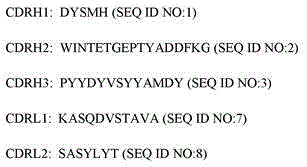
在一个实施方案中,本发明的抗OX40 ABP或抗体包含以下CDR中的任何一个或组合:In one embodiment, the anti-OX40 ABP or antibody of the invention comprises any one or a combination of the following CDRs:
。 .
在一些实施方案中,本发明的抗OX40 ABP或抗体包含重链可变区,其与SEQ IDNO:5具有至少90%序列同一性。合适地,本发明的OX40结合蛋白包含重链可变区,其与SEQID NO:5具有约85%、86%、87%、88%、89%、90%、91%、92%、93%、94%、95%、96%、97%、98%、99%或100%序列同一性。In some embodiments, the anti-OX40 ABP or antibody of the invention comprises a heavy chain variable region having at least 90% sequence identity to SEQ ID NO:5. Suitably, the OX40 binding protein of the invention comprises a heavy chain variable region having about 85%, 86%, 87%, 88%, 89%, 90%, 91%, 92%, 93% of SEQ ID NO:5 , 94%, 95%, 96%, 97%, 98%, 99% or 100% sequence identity.
人源化重链(VH)可变区:Humanized heavy chain ( VH ) variable regions:
。 .
在本发明的一个实施方案中,所述OX40 ABP或抗体在具有SEQ ID NO:11中所示的氨基酸序列的轻链可变区中包含CDRL1 (SEQ ID NO:7)、CDRL2 (SEQ ID NO:8)和CDRL3(SEQ ID NO:9)。在一些实施方案中,本发明的OX40结合蛋白包含SEQ ID NO:11中所示的轻链可变区。在一个实施方案中,本发明的OX40结合蛋白包含SEQ ID NO:5的重链可变区和SEQ ID NO:11的轻链可变区。In one embodiment of the invention, the OX40 ABP or antibody comprises CDRL1 (SEQ ID NO:7), CDRL2 (SEQ ID NO:11), CDRL1 (SEQ ID NO:7), CDRL2 (SEQ ID NO:11) in the light chain variable region having the amino acid sequence shown in SEQ ID NO:11 : 8) and CDRL3 (SEQ ID NO: 9). In some embodiments, the OX40 binding proteins of the invention comprise the light chain variable region set forth in SEQ ID NO:11. In one embodiment, the OX40 binding protein of the invention comprises the heavy chain variable region of SEQ ID NO:5 and the light chain variable region of SEQ ID NO:11.
人源化轻链(VL)可变区Humanized light chain ( VL ) variable region

在一些实施方案中,本发明的OX40结合蛋白包含轻链可变区,其与SEQ ID NO:11中所示的氨基酸序列具有至少90%序列同一性。合适地,本发明的OX40结合蛋白可包含轻链可变区,其与SEQ ID NO:11具有约85%、86%、87%、88%、89%、90%、91%、92%、93%、94%、95%、96%、97%、98%、99%或100%序列同一性。In some embodiments, the OX40 binding proteins of the invention comprise a light chain variable region having at least 90% sequence identity to the amino acid sequence set forth in SEQ ID NO:11. Suitably, the OX40 binding protein of the invention may comprise a light chain variable region having about 85%, 86%, 87%, 88%, 89%, 90%, 91%, 92%, 93%, 94%, 95%, 96%, 97%, 98%, 99% or 100% sequence identity.
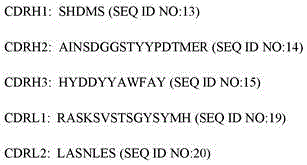
在另一个实施方案中,本发明的抗OX40 ABP或抗体包含以下CDR中的任何一个或组合:In another embodiment, the anti-OX40 ABP or antibody of the invention comprises any one or a combination of the following CDRs:
。 .
在一些实施方案中,本发明的抗OX40 ABP或抗体包含重链可变区,其与SEQ IDNO:17具有至少90%序列同一性。合适地,本发明的OX40结合蛋白可包含重链可变区,其与SEQ ID NO:17具有约85%、86%、87%、88%、89%、90%、91%、92%、93%、94%、95%、96%、97%、98%、99%或100%序列同一性。In some embodiments, the anti-OX40 ABP or antibody of the invention comprises a heavy chain variable region that has at least 90% sequence identity to SEQ ID NO:17. Suitably, the OX40 binding protein of the invention may comprise a heavy chain variable region having about 85%, 86%, 87%, 88%, 89%, 90%, 91%, 92%, 93%, 94%, 95%, 96%, 97%, 98%, 99% or 100% sequence identity.
人源化重链(VH)可变区:Humanized heavy chain ( VH ) variable regions:
。 .
在本发明的一个实施方案中,所述OX40 ABP或抗体在具有SEQ ID NO:23中所示的氨基酸序列的轻链可变区中包含CDRL1 (SEQ ID NO:19)、CDRL2 (SEQ ID NO:20)和CDRL3(SEQ ID NO:21)。在一些实施方案中,本发明的OX40结合蛋白包含SEQ ID NO:23中所示的轻链可变区。在一个实施方案中,本发明的OX40结合蛋白包含SEQ ID NO:17的重链可变区和SEQ ID NO:23的轻链可变区。In one embodiment of the invention, the OX40 ABP or antibody comprises CDRL1 (SEQ ID NO:19), CDRL2 (SEQ ID NO:23), CDRL1 (SEQ ID NO:19), CDRL2 (SEQ ID NO:23) in the light chain variable region having the amino acid sequence shown in SEQ ID NO:23 : 20) and CDRL3 (SEQ ID NO: 21). In some embodiments, the OX40 binding proteins of the invention comprise the light chain variable region set forth in SEQ ID NO:23. In one embodiment, the OX40 binding protein of the invention comprises the heavy chain variable region of SEQ ID NO:17 and the light chain variable region of SEQ ID NO:23.
人源化轻链(VL)可变区Humanized light chain ( VL ) variable region
。 .
在一些实施方案中,本发明的OX40结合蛋白包含轻链可变区,其与SEQ ID NO:23中所示的氨基酸序列具有至少90%序列同一性。合适地,本发明的OX40结合蛋白可包含轻链可变区,其与SEQ ID NO:23具有约85%、86%、87%、88%、89%、90%、91%、92%、93%、94%、95%、96%、97%、98%、99%或100%序列同一性。In some embodiments, the OX40 binding proteins of the invention comprise a light chain variable region having at least 90% sequence identity to the amino acid sequence set forth in SEQ ID NO:23. Suitably, the OX40 binding protein of the invention may comprise a light chain variable region having about 85%, 86%, 87%, 88%, 89%, 90%, 91%, 92%, SEQ ID NO: 23, 93%, 94%, 95%, 96%, 97%, 98%, 99% or 100% sequence identity.
CDR或最小结合单元可以通过至少一个氨基酸取代、缺失或添加进行修饰,其中变体抗原结合蛋白基本上保留未修饰蛋白(诸如包含SEQ ID NO:5和SEQ ID NO:11的抗体或包含SEQ ID NO:17和SEQ ID NO:23的抗体)的生物学特性。A CDR or minimal binding unit can be modified by at least one amino acid substitution, deletion or addition, wherein the variant antigen binding protein remains substantially the unmodified protein (such as the antibody comprising SEQ ID NO: 5 and SEQ ID NO: 11 or the antibody comprising SEQ ID NO: 11) NO: 17 and SEQ ID NO: 23 antibodies).
应理解,CDR H1、H2、H3、L1、L2、L3各自都可以单独或与任何其他CDR组合以任何排列或组合进行修饰。在一个实施方案中,通过取代、缺失或添加最多达3个氨基酸(例如1或2个氨基酸,例如1个氨基酸)来修饰CDR。典型地,所述修饰是取代,尤其是保守取代,例如如表1中所示。It will be appreciated that each of the CDRs H1, H2, H3, L1, L2, L3 can be modified in any permutation or combination, alone or in combination with any other CDR. In one embodiment, the CDRs are modified by substitution, deletion or addition of up to 3 amino acids (
在一个实施方案中,本发明的ABP或抗体包含例如本文的图16-17的106-222抗体的CDR,例如分别具有如图16中所公开的SEQ ID NO 1、2和3中所示的氨基酸序列的CDRH1、CDRH2和CDRH3,和例如分别具有如SEQ ID NO 7、8和9中所示的序列的CDRL1、CDRL2和CDRL3。在一个实施方案中,本发明的ABP或抗体包含如WO2012/027328 (PCT/US2011/048752)(国际申请日2011年8月23日)中所公开的106-222、Hu106或Hu106-222抗体的CDR。在一个进一步实施方案中,本发明的抗OX40 ABP或抗体包含如本文的图16-17中所示的106-222抗体的VH和VL区域,例如,具有如SEQ ID NO:4中所示的氨基酸序列的VH和如图17中具有如SEQ ID NO:10中所示的氨基酸序列的VH。在另一个实施方案中,本发明的ABP或抗体包含具有如本文的图16中的SEQ ID NO:5中所示的氨基酸序列的VH,和具有如本文的图17中的SEQ ID NO:11中所示的氨基酸序列的VL。在一个进一步实施方案中,本发明的抗OX40 ABP或抗体包含如WO2012/027328 (PCT/US2011/048752)(国际申请日2011年8月23日)中所公开的Hu106-222抗体或106-222抗体或Hu106抗体的VH和VL区域。在一个进一步实施方案中,本发明的抗OX40 ABP或抗体是106-222、Hu106-222或Hu106,例如,如WO2012/027328 (PCT/US2011/048752)(国际申请日2011年8月23日)中所公开。在一个进一步实施方案中,本发明的ABP或抗体包含与本段落中的序列具有90%同一性的CDR或VH或VL或抗体序列。In one embodiment, the ABP or antibody of the invention comprises, eg, the CDRs of the 106-222 antibody of Figures 16-17 herein, eg, as shown in
在另一个实施方案中,本发明的抗OX40 ABP或抗体包含例如本文的图20-21的119-122抗体的CDR,例如,分别具有如SEQ ID NO 13、14和15中所示的氨基酸序列的CDRH1、CDRH2和CDRH3。在另一个实施方案中,本发明的抗OX40 ABP或抗体包含如WO2012/027328(PCT/US2011/048752)(国际申请日2011年8月23日)中所公开的119-122或Hu119或Hu119-222抗体的CDR。在一个进一步实施方案中,本发明的抗OX40 ABP或抗体包含具有如本文的图20中的SEQ ID NO:16中所示的氨基酸序列的VH,和具有如本文的图21中所示的SEQ IDNO:22中所示的氨基酸序列的VL。在另一个实施方案中,本发明的抗OX40 ABP或抗体包含具有如SEQ ID NO:17中所示的氨基酸序列的VH,和具有如SEQ ID NO:23中所示的氨基酸序列的VL。在一个进一步实施方案中,本发明的抗OX40 ABP或抗体包含如WO2012/027328 (PCT/US2011/048752)(国际申请日2011年8月23日)中所公开的119-122或Hu119或Hu119-222抗体的VH和VL区域。在一个进一步实施方案中,本发明的ABP或抗体是119-222或Hu119或Hu119-222抗体,例如,如WO2012/027328 (PCT/US2011/048752)(国际申请日2011年8月23日)中所公开。在一个进一步实施方案中,本发明的ABP或抗体包含与本段落中的序列具有90%同一性的CDR或VH或VL或抗体序列。In another embodiment, the anti-OX40 ABP or antibody of the invention comprises, eg, the CDRs of the 119-122 antibody of Figures 20-21 herein, eg, having the amino acid sequences set forth in
在另一个实施方案中,本发明的抗OX40 ABP或抗体包含119-43-1抗体的CDR,例如,如本文的图24-25中所示。在另一个实施方案中,本发明的抗OX40 ABP或抗体包含如WO2013/028231 (PCT/US2012/024570)(国际申请日2012年2月9日)中所公开的119-43-1抗体的CDR。在一个进一步实施方案中,本发明的抗OX40 ABP或抗体包含如图24-27中所示的119-43-1抗体的VH区之一和VL区之一。在一个进一步实施方案中,本发明的抗OX40 ABP或抗体包含如WO2013/028231 (PCT/US2012/024570)(国际申请日2012年2月9日)中所公开的119-43-1抗体的VH和VL区域。在一个进一步实施方案中,本发明的ABP或抗体是如本文的图24-27中所公开的119-43-1或119-43-1嵌合体。在一个进一步实施方案中,本发明的ABP或抗体如WO2013/028231 (PCT/US2012/024570)(国际申请日2012年2月9日)中所公开。在进一步实施方案中,将本段落中描述的ABP或抗体中的任一种人源化。在进一步实施方案中,将本段落中描述的ABP或抗体中的任一种工程改造以制备人源化抗体。在一个进一步实施方案中,本发明的ABP或抗体包含与本段落中的序列具有90%同一性的CDR或VH或VL或抗体序列。In another embodiment, the anti-OX40 ABP or antibody of the invention comprises the CDRs of the 119-43-1 antibody, eg, as shown in Figures 24-25 herein. In another embodiment, the anti-OX40 ABP or antibody of the invention comprises the CDRs of the 119-43-1 antibody as disclosed in WO2013/028231 (PCT/US2012/024570) (
在另一个实施方案中,将本发明的任何抗OX40 ABP或抗体的任何小鼠或嵌合序列工程改造以制备人源化抗体。In another embodiment, any mouse or chimeric sequence of any anti-OX40 ABP or antibody of the invention is engineered to produce a humanized antibody.
在一个实施方案中,本发明的抗OX40 ABP或抗体包含:(a)包含SEQ ID NO:1的氨基酸序列的重链可变区CDR1;(b)包含SEQ ID NO:2的氨基酸序列的重链可变区CDR2;(c)包含SEQ ID NO:3的氨基酸序列的重链可变区CDR3;(d)包含SEQ ID NO:7的氨基酸序列的轻链可变区CDR1;(e)包含SEQ ID NO:8的氨基酸序列的轻链可变区CDR2;和(f)包含SEQ IDNO:9的氨基酸序列的轻链可变区CDR3。In one embodiment, the anti-OX40 ABP or antibody of the invention comprises: (a) a heavy chain variable region CDR1 comprising the amino acid sequence of SEQ ID NO:1; (b) a heavy chain variable region comprising the amino acid sequence of SEQ ID NO:2 chain variable region CDR2; (c) heavy chain variable region CDR3 comprising the amino acid sequence of SEQ ID NO: 3; (d) light chain variable region CDR1 comprising the amino acid sequence of SEQ ID NO: 7; (e) comprising The light chain variable region CDR2 of the amino acid sequence of SEQ ID NO:8; and (f) the light chain variable region CDR3 comprising the amino acid sequence of SEQ ID NO:9.
在另一个实施方案中,本发明的抗OX40 ABP或抗体包含:(a)包含SEQ ID NO:13的氨基酸序列的重链可变区CDR1;(b)包含SEQ ID NO:14的氨基酸序列的重链可变区CDR2;(c)包含SEQ ID NO:15的氨基酸序列的重链可变区CDR3;(d)包含SEQ ID NO:19的氨基酸序列的轻链可变区CDR1;(e)包含SEQ ID NO:20的氨基酸序列的轻链可变区CDR2;和(f)包含SEQ ID NO:21的氨基酸序列的轻链可变区CDR3。In another embodiment, the anti-OX40 ABP or antibody of the invention comprises: (a) a heavy chain variable region CDR1 comprising the amino acid sequence of SEQ ID NO:13; (b) a heavy chain variable region CDR1 comprising the amino acid sequence of SEQ ID NO:14 Heavy chain variable region CDR2; (c) heavy chain variable region CDR3 comprising the amino acid sequence of SEQ ID NO: 15; (d) light chain variable region CDR1 comprising the amino acid sequence of SEQ ID NO: 19; (e) A light chain variable region CDR2 comprising the amino acid sequence of SEQ ID NO:20; and (f) a light chain variable region CDR3 comprising the amino acid sequence of SEQ ID NO:21.
在另一个实施方案中,本发明的抗OX40 ABP或抗体包含:包含SEQ ID NO:1或13的氨基酸序列的重链可变区CDR1;包含SEQ ID NO:2或14的氨基酸序列的重链可变区CDR2;和/或包含SEQ ID NO:3或15的氨基酸序列的重链可变区CDR3,或与其具有90%同一性的重链可变区CDR。In another embodiment, the anti-OX40 ABP or antibody of the invention comprises: a heavy chain variable region CDR1 comprising the amino acid sequence of SEQ ID NO: 1 or 13; a heavy chain comprising the amino acid sequence of SEQ ID NO: 2 or 14 variable region CDR2; and/or heavy chain variable region CDR3 comprising the amino acid sequence of SEQ ID NO: 3 or 15, or a heavy chain variable region CDR having 90% identity thereto.
在又另一个实施方案中,本发明的抗OX40 ABP或抗体包含:包含SEQ ID NO:7或19的氨基酸序列的轻链可变区CDR1;包含SEQ ID NO:8或20的氨基酸序列的轻链可变区CDR2,和/或包含SEQ ID NO:9或21的氨基酸序列的轻链可变区CDR3,或与其具有90%同一性的重链可变区。In yet another embodiment, the anti-OX40 ABP or antibody of the invention comprises: a light chain variable region CDR1 comprising the amino acid sequence of SEQ ID NO: 7 or 19; a light chain variable region CDR1 comprising the amino acid sequence of SEQ ID NO: 8 or 20; The chain variable region CDR2, and/or the light chain variable region CDR3 comprising the amino acid sequence of SEQ ID NO: 9 or 21, or the heavy chain variable region having 90% identity thereto.
在一个进一步实施方案中,本发明的抗OX40 ABP或抗体包含:轻链可变区(“VL”),其包含SEQ ID NO:10、11、22或23的氨基酸序列或与SEQ ID NO:10、11、22或23的氨基酸序列具有至少90%同一性的氨基酸序列。在另一个实施方案中,本发明的抗OX40 ABP或抗体包含重链可变区(“ VH”),其包含SEQ ID NO:4、5、16和17的氨基酸序列或与SEQ ID NO:4、5、16和17的氨基酸序列具有至少90%同一性的氨基酸序列。在另一个实施方案中,本发明的抗OX40 ABP或抗体包含SEQ ID NO:5的可变重链序列和SEQ ID NO:11的可变轻链序列或与其具有90%同一性的序列。在另一个实施方案中,本发明的抗OX40 ABP或抗体包含SEQ IDNO:17的可变重链序列和SEQ ID NO:23的可变轻链序列或与其具有90%同一性的序列。In a further embodiment, the anti-OX40 ABP or antibody of the invention comprises: a light chain variable region ("VL") comprising the amino acid sequence of SEQ ID NO: 10, 11, 22 or 23 or the same as SEQ ID NO: The amino acid sequences of 10, 11, 22 or 23 are amino acid sequences that are at least 90% identical. In another embodiment, the anti-OX40 ABP or antibody of the invention comprises a heavy chain variable region ("VH") comprising the amino acid sequences of SEQ ID NO: 4, 5, 16 and 17 or the same as SEQ ID NO: 4 The amino acid sequences of , 5, 16 and 17 have amino acid sequences that are at least 90% identical. In another embodiment, the anti-OX40 ABP or antibody of the invention comprises the variable heavy chain sequence of SEQ ID NO:5 and the variable light chain sequence of SEQ ID NO:11 or a sequence that is 90% identical thereto. In another embodiment, the anti-OX40 ABP or antibody of the invention comprises the variable heavy chain sequence of SEQ ID NO: 17 and the variable light chain sequence of SEQ ID NO: 23 or a sequence that is 90% identical thereto.
在另一个实施方案中,本发明的抗OX40 ABP或抗体包含由SEQ ID NO:12或24的核酸序列或与SEQ ID NO:12或24的核苷酸序列具有至少90%同一性的核酸序列编码的可变轻链。在另一个实施方案中,本发明的抗OX40 ABP或抗体包含由SEQ ID NO:6或18的核酸序列或与SEQ ID NO:6或18的核苷酸序列具有至少90%同一性的核酸序列编码的可变重链。In another embodiment, the anti-OX40 ABP or antibody of the invention comprises a nucleic acid sequence consisting of the nucleic acid sequence of SEQ ID NO: 12 or 24 or a nucleic acid sequence having at least 90% identity to the nucleotide sequence of SEQ ID NO: 12 or 24 Encoded variable light chain. In another embodiment, the anti-OX40 ABP or antibody of the invention comprises a nucleic acid sequence consisting of the nucleic acid sequence of SEQ ID NO: 6 or 18 or a nucleic acid sequence having at least 90% identity to the nucleotide sequence of SEQ ID NO: 6 or 18 Encoded variable heavy chain.
本文还提供了单克隆抗体。在一个实施方案中,所述单克隆抗体包含可变轻链,所述可变轻链包含SEQ ID NO:10或22的氨基酸序列或与SEQ ID NO:10或22的氨基酸序列具有至少90%同一性的氨基酸序列。进一步提供了包含可变重链的单克隆抗体,所述可变重链包含SEQ ID NO:4或16的氨基酸序列或与SEQ ID NO:4或16的氨基酸序列具有至少90%同一性的氨基酸序列。Monoclonal antibodies are also provided herein. In one embodiment, the monoclonal antibody comprises a variable light chain comprising or at least 90% identical to the amino acid sequence of SEQ ID NO: 10 or 22 identical amino acid sequences. Further provided is a monoclonal antibody comprising a variable heavy chain comprising the amino acid sequence of SEQ ID NO:4 or 16 or an amino acid having at least 90% identity with the amino acid sequence of SEQ ID NO:4 or 16 sequence.
如本文所用,术语“激动剂”是指抗原结合蛋白(包括但不限于抗体),其在与共同信号传导受体接触后引起以下中的一种或多种:(1)刺激或活化受体;(2)增强、增加或促进、诱导或延长受体的活性、功能或存在;和/或(3)增强、增加、促进或诱导受体的表达。可以通过本领域中已知的各种测定法在体外测量激动剂活性,所述测定法诸如但不限于测量细胞信号传导、细胞增殖、免疫细胞活化标志物、细胞因子产生。还可以通过测量替代终点(诸如但不限于测量T细胞增殖或细胞因子产生)的各种测定法在体内测量激动剂活性。As used herein, the term "agonist" refers to an antigen binding protein (including but not limited to an antibody) that upon contact with a common signaling receptor causes one or more of the following: (1) stimulate or activate the receptor (2) enhancing, increasing or promoting, inducing or prolonging the activity, function or presence of the receptor; and/or (3) enhancing, increasing, promoting or inducing the expression of the receptor. Agonist activity can be measured in vitro by various assays known in the art, such as, but not limited to, measuring cell signaling, cell proliferation, markers of immune cell activation, cytokine production. Agonist activity can also be measured in vivo by various assays that measure surrogate endpoints such as, but not limited to, measuring T cell proliferation or cytokine production.
如本文所用,术语“拮抗剂”是指抗原结合蛋白(包括但不限于抗体),其在与共同信号传导受体接触后引起以下中的一种或多种:(1)减弱、阻断或失活受体和/或阻断其天然配体对受体的活化,(2)降低、减少或缩短受体的活性、功能或存在,和/或(3)降低、减少、消除受体的表达。可以通过本领域中已知的各种测定法在体外测量拮抗剂活性,所述测定法诸如但不限于测量细胞信号传导、细胞增殖、免疫细胞活化标志物、细胞因子产生的增加或减少。还可以通过测量替代终点(诸如但不限于测量T细胞增殖或细胞因子产生)的各种测定法在体内测量拮抗剂活性。As used herein, the term "antagonist" refers to an antigen binding protein (including but not limited to an antibody) that upon contact with a common signaling receptor causes one or more of the following: (1) attenuate, block or Inactivate the receptor and/or block the activation of the receptor by its natural ligand, (2) reduce, reduce or shorten the activity, function or presence of the receptor, and/or (3) reduce, reduce, eliminate the activity of the receptor Express. Antagonist activity can be measured in vitro by various assays known in the art, such as, but not limited to, measuring increases or decreases in cell signaling, cell proliferation, markers of immune cell activation, cytokine production. Antagonist activity can also be measured in vivo by various assays that measure surrogate endpoints such as, but not limited to, measuring T cell proliferation or cytokine production.
如本文所用,术语“交叉竞争结合”是指将与本发明的任何药剂竞争结合靶标的任何药剂,诸如抗体。两种抗体之间对结合的竞争可以通过本领域中已知的各种方法(包括流式细胞术、Meso Scale Discovery和ELISA)测试。可以直接测量结合,意味着可以将两种或更多种结合蛋白与共同信号传导受体接触,并且可以测量对一种或每种的结合。或者,可以针对结合或天然配体来测试目标分子的结合,并彼此进行定量比较。As used herein, the term "cross-competitive binding" refers to any agent, such as an antibody, that will compete with any agent of the invention for binding to a target. Competition for binding between two antibodies can be tested by various methods known in the art including flow cytometry, Meso Scale Discovery and ELISA. Binding can be measured directly, meaning that two or more binding proteins can be brought into contact with a common signaling receptor, and binding to one or each can be measured. Alternatively, target molecules can be tested for binding against bound or native ligands and quantitatively compared to each other.
如本文所用的术语“结合蛋白”是指能够结合抗原的抗体和其他蛋白构建体,诸如结构域。The term "binding protein" as used herein refers to antibodies and other protein constructs, such as domains, that are capable of binding an antigen.
术语“抗体”在本文中以最广泛意义使用来指具有免疫球蛋白样结构域(例如IgG、IgM、IgA、IgD或IgE)的分子,并且包括单克隆、重组、多克隆、嵌合、人、人源化、多特异性的抗体,包括双特异性抗体和异源缀合物抗体;单一可变结构域(例如VH、VHH、VL、结构域抗体(dAbTM))、抗原结合抗体片段、Fab、F(ab’)2、Fv、二硫化物连接的Fv、单链Fv、二硫化物连接的scFv、双抗体、TANDABS™等,以及上述任一种的修饰版本。The term "antibody" is used herein in the broadest sense to refer to a molecule having an immunoglobulin-like domain (eg, IgG, IgM, IgA, IgD, or IgE), and includes monoclonal, recombinant, polyclonal, chimeric, human , humanized, multispecific antibodies, including bispecific antibodies and heteroconjugate antibodies; single variable domains (eg, VH , VHH , VL, domain antibodies (dAb ™ )), antigen binding Antibody fragments, Fab, F(ab') 2 , Fv, disulfide linked Fv, single chain Fv, disulfide linked scFv, diabodies, TANDABS™, etc., and modified versions of any of the above.
替代抗体形式包括替代骨架,其中抗原结合蛋白的一个或多个CDR可以被排列在合适的非免疫球蛋白支架或骨架上,诸如亲合体、SpA支架、LDL受体A类结构域、亲和多聚体(avimer)或EGF结构域。Alternative antibody formats include alternative scaffolds in which one or more CDRs of an antigen binding protein can be arranged on a suitable non-immunoglobulin scaffold or scaffold, such as avidin, SpA scaffolds, LDL receptor class A domains, affinity polyproteins, etc. avimer or EGF domain.
术语“结构域”是指折叠的蛋白结构,其保留其独立于蛋白的其余部分的三级结构。通常,结构域负责蛋白的离散的功能特性,并且在许多情况下可以被添加、除去或转移至其他蛋白,而不损失蛋白和/或结构域的其余部分的功能。The term "domain" refers to a folded protein structure that retains its tertiary structure independent of the rest of the protein. Typically, domains are responsible for discrete functional properties of proteins, and in many cases can be added, removed or transferred to other proteins without loss of function of the remainder of the protein and/or domain.
术语“单一可变结构域”是指包含抗体可变结构域特征序列的折叠的多肽结构域。因此,其包括完整抗体可变结构域诸如VH、VHH和VL以及修饰的抗体可变结构域(例如,其中一个或多个环已经被抗体可变结构域的非特征序列替代),或已被截短或包含N-或C-末端延伸的抗体可变结构域,以及至少保留全长结构域的结合活性和特异性的可变结构域的折叠片段。单一可变结构域能够独立于不同的可变区或结构域来结合抗原或表位。“结构域抗体”或“dAb(TM)”可以被认为与“单一可变结构域”相同。单一可变结构域可以是人的单一可变结构域,但也包括来自其他物种的单一可变结构域,诸如啮齿类铰口鲨和骆驼科VHHdAbsTM。骆驼科VHH是衍生自物种(包括骆驼、美洲驼、羊驼、单峰骆驼和原驼)的免疫球蛋白单一可变结构域多肽,其产生天然缺乏轻链的重链抗体。此类VHH结构域可以根据本领域中可得的标准技术人源化,并且此类结构域被认为是“单一可变结构域”。如本文所用,VH包括骆驼科VHH结构域。The term "single variable domain" refers to a folded polypeptide domain comprising sequences characteristic of antibody variable domains. Thus, it includes intact antibody variable domains such as VH , VHH and VL as well as modified antibody variable domains (eg, in which one or more loops have been replaced by non-characteristic sequences of the antibody variable domain), Either antibody variable domains that have been truncated or contain N- or C-terminal extensions, and folded fragments of variable domains that retain at least the binding activity and specificity of the full-length domain. A single variable domain is capable of binding an antigen or epitope independently of different variable regions or domains. A "domain antibody" or "dAb (TM) " can be considered the same as a "single variable domain". The single variable domain may be a human single variable domain, but also includes single variable domains from other species, such as rodent sharks and camelid VHH dAbs ™ . Camelid VHHs are immunoglobulin single variable domain polypeptides derived from species including camelid, llama, alpaca, dromedary, and dromedary, which produce heavy chain antibodies that naturally lack light chains. Such VHH domains can be humanized according to standard techniques available in the art, and such domains are considered "single variable domains". As used herein, VH includes the camelid VHH domain.
可以通过在非抗体蛋白支架上布置一个或多个CDR来提供抗原结合片段。如本文所用的“蛋白支架”包括但不限于免疫球蛋白(Ig)支架,例如IgG支架,其可以是四链或二链抗体,或其可仅包含抗体的Fc区,或其可以包含来自抗体的一个或多个恒定区,所述恒定区可以是人或灵长类来源的,或者其可以是人和灵长类动物恒定区的人工嵌合体。Antigen-binding fragments can be provided by placing one or more CDRs on a non-antibody protein scaffold. "Protein scaffolds" as used herein include, but are not limited to, immunoglobulin (Ig) scaffolds, such as IgG scaffolds, which may be quad- or diabodies, or which may comprise only the Fc region of an antibody, or which may comprise derived from an antibody One or more constant regions of a , which may be of human or primate origin, or which may be an artificial chimera of human and primate constant regions.
蛋白支架可以是Ig支架,例如IgG或IgA支架。IgG支架可以包含抗体的一些或全部结构域(即,CH1、CH2、CH3、VH、VL)。抗原结合蛋白可以包含选自IgG1、IgG2、IgG3、IgG4或IgG4PE的IgG支架。例如,所述支架可以是IgG1。支架可以由抗体的Fc区组成或包含抗体的Fc区,或者是其一部分。The protein scaffold can be an Ig scaffold, such as an IgG or IgA scaffold. An IgG scaffold may comprise some or all domains of an antibody (ie, CH1, CH2, CH3, VH , VL ). The antigen binding protein may comprise an IgG scaffold selected from IgGl, IgG2, IgG3, IgG4 or IgG4PE. For example, the scaffold can be IgGl. The scaffold may consist of, or be part of, the Fc region of an antibody.
亲和力是一个分子(例如本发明的抗原结合蛋白)与另一分子(例如其靶抗原)在单一结合位点的结合强度。可以通过平衡方法(例如酶联免疫吸附测定(ELISA)或放射性免疫测定(RIA))或动力学(例如BIACORETM分析)来测定抗原结合蛋白与其靶标的结合亲和力。例如,实施例5中描述的BiacoreTM方法可用于测量结合亲和力。Affinity is the strength of binding of one molecule (eg, an antigen binding protein of the invention) to another molecule (eg, its target antigen) at a single binding site. The binding affinity of an antigen-binding protein to its target can be determined by equilibrium methods (eg, enzyme-linked immunosorbent assay (ELISA) or radioimmunoassay (RIA)) or kinetics (eg, BIACORE ™ assay). For example, the Biacore (TM) method described in Example 5 can be used to measure binding affinity.
亲合力(avidity)是两个分子在多个位点彼此结合的强度的总和,例如,考虑到相互作用的价数。Avidity is the sum of the strengths with which two molecules bind to each other at multiple sites, eg, taking into account the valence of the interaction.
“分离的”意指将该分子,诸如抗原结合蛋白或核酸,从天然发现其的环境中移出。例如,分子可以从天然与其一起正常存在的物质中纯化出来。例如,样品中分子的质量可以是总质量的95%。"Isolated" means that the molecule, such as an antigen binding protein or nucleic acid, is removed from the environment in which it is naturally found. For example, molecules can be purified from substances with which they are normally found in nature. For example, the mass of the molecules in the sample can be 95% of the total mass.
如本文所用的术语“表达载体”意指可用于将目标核酸引入细胞(诸如真核细胞或原核细胞)或无细胞表达系统中的分离的核酸,其中目标核酸序列被表达为肽链,诸如蛋白。此类表达载体可以是例如包含目标核酸的粘粒、质粒、病毒序列、转座子和线性核酸。一旦将表达载体引入细胞或无细胞表达系统(例如网织红细胞裂解物)中,由目标核酸编码的蛋白通过转录/翻译机制产生。本发明范围内的表达载体可为真核或原核表达提供必要的元件,并且包括病毒启动子驱动的载体,诸如CMV启动子驱动的载体(例如pcDNA3.1、pCEP4及其衍生物)、杆状病毒表达载体,果蝇表达载体;以及由哺乳动物基因启动子,诸如人Ig基因启动子驱动的表达载体。其他实例包括原核表达载体,诸如T7启动子驱动的载体(例如pET41)、乳糖启动子驱动的载体和阿拉伯糖基因启动子驱动的载体。本领域普通技术人员将认识到许多其他合适的表达载体和表达系统。The term "expression vector" as used herein means an isolated nucleic acid that can be used to introduce a nucleic acid of interest into a cell (such as a eukaryotic or prokaryotic cell) or a cell-free expression system, wherein the nucleic acid sequence of interest is expressed as a peptide chain, such as a protein . Such expression vectors can be, for example, cosmids, plasmids, viral sequences, transposons and linear nucleic acids comprising the nucleic acid of interest. Once the expression vector is introduced into a cellular or cell-free expression system (eg, reticulocyte lysate), the protein encoded by the nucleic acid of interest is produced by a transcription/translation mechanism. Expression vectors within the scope of the invention may provide the necessary elements for eukaryotic or prokaryotic expression and include viral promoter-driven vectors such as CMV promoter-driven vectors (eg pcDNA3.1, pCEP4 and derivatives thereof), rod-shaped Viral expression vectors, Drosophila expression vectors; and expression vectors driven by mammalian gene promoters, such as the human Ig gene promoter. Other examples include prokaryotic expression vectors such as T7 promoter driven vectors (eg pET41), lactose promoter driven vectors and arabinose gene promoter driven vectors. Those of ordinary skill in the art will recognize many other suitable expression vectors and expression systems.
如本文所用的术语“重组宿主细胞”意指包含目标核酸序列的细胞,所述目标核酸序列在将其引入细胞之前被分离。例如,目标核酸序列可以在表达载体中,而细胞可以是原核的或真核的。示例性真核细胞是哺乳动物细胞,诸如但不限于COS-1、COS-7、HEK293、BHK21、CHO、BSC-1、HepG2、653、SP2/0、NS0、293、HeLa、骨髓瘤细胞、淋巴瘤细胞或其任何衍生物。最优选地,真核细胞是HEK293、NS0、SP2/0或CHO细胞。大肠杆菌是示例性原核细胞。根据本公开的重组细胞可以通过转染、细胞融合、永生化或本领域中众所周知的其他程序产生。转染入细胞的目标核酸序列,诸如表达载体,可以是染色体外的或被稳定整合至细胞的染色体中。The term "recombinant host cell" as used herein means a cell comprising a nucleic acid sequence of interest that was isolated prior to its introduction into the cell. For example, the nucleic acid sequence of interest can be in an expression vector, and the cell can be prokaryotic or eukaryotic. Exemplary eukaryotic cells are mammalian cells such as, but not limited to, COS-1, COS-7, HEK293, BHK21, CHO, BSC-1, HepG2, 653, SP2/0, NSO, 293, HeLa, myeloma cells, Lymphoma cells or any derivative thereof. Most preferably, the eukaryotic cells are HEK293, NSO, SP2/0 or CHO cells. E. coli is an exemplary prokaryotic cell. Recombinant cells according to the present disclosure can be produced by transfection, cell fusion, immortalization, or other procedures well known in the art. A nucleic acid sequence of interest transfected into a cell, such as an expression vector, can be extrachromosomal or stably integrated into the cell's chromosome.
“嵌合抗体”是指一种类型的工程改造的抗体,其含有衍生自供体抗体的天然存在的可变区(轻链和重链),其与衍生自受体抗体的轻链和重链恒定区缔合。"Chimeric antibody" refers to a type of engineered antibody that contains naturally-occurring variable regions (light and heavy chains) derived from a donor antibody in combination with light and heavy chains derived from an acceptor antibody. Chain constant region association.
“人源化抗体”是指其CDR衍生自非人供体免疫球蛋白的一种类型的工程改造的抗体,该分子的剩余免疫球蛋白衍生部分衍生自一种或多种人免疫球蛋白。另外,可以改变框架支持残基以保持结合亲和力(参见例如,Queen等人 Proc. Natl Acad Sci USA, 86:10029-10032 (1989), Hodgson,等人, Bio/Technology, 9:421 (1991))。合适的人受体抗体可以是通过与供体抗体的核苷酸和氨基酸序列的同源性选自常规数据库、例如KABAT™数据库、Los Alamos数据库和Swiss Protein数据库的抗体。特征在于与供体抗体的框架区同源性(基于氨基酸)的人抗体可以合适于提供重链恒定区和/或重链可变框架区用于插入供体CDR。可以类似的方式选择能够提供轻链恒定或可变框架区的合适的受体抗体。应当注意,不需要受体抗体的重链和轻链源于相同的受体抗体。现有技术描述了生产此类人源化抗体的几种方式-例如参见EP-A-0239400和EP-A-054951。"Humanized antibody" refers to a type of engineered antibody whose CDRs are derived from a non-human donor immunoglobulin and the remaining immunoglobulin-derived portion of the molecule is derived from one or more human immunoglobulins. Additionally, framework support residues can be altered to maintain binding affinity (see, e.g., Queen et al. Proc. Natl Acad Sci USA, 86:10029-10032 (1989), Hodgson, et al ., Bio/Technology , 9:421 (1991) ). Suitable human acceptor antibodies may be antibodies selected from conventional databases, eg, the KABAT™ database, the Los Alamos database, and the Swiss Protein database, by homology to the nucleotide and amino acid sequences of the donor antibody. Human antibodies characterized by homology (on an amino acid basis) to the framework regions of the donor antibody may be suitable to provide heavy chain constant regions and/or heavy chain variable framework regions for insertion into the donor CDRs. Suitable acceptor antibodies capable of providing light chain constant or variable framework regions can be selected in a similar manner. It should be noted that it is not required that the heavy and light chains of the acceptor antibody be derived from the same acceptor antibody. The prior art describes several ways of producing such humanized antibodies - see eg EP-A-0239400 and EP-A-054951.
术语“完全人抗体”包括具有衍生自人种系免疫球蛋白序列的可变区和恒定区(如果存在)的抗体。本发明的人序列抗体可以包括不被人种系免疫球蛋白序列编码的氨基酸残基(例如,通过体外随机或位点特异性诱变引入的突变,或通过体内体细胞突变引入的突变)。完全人抗体包含仅由最终人来源的多核苷酸编码的氨基酸序列或与此类序列相同的氨基酸序列。如本文所意指,由插入转基因小鼠中产生的小鼠基因组中编码人免疫球蛋白的DNA编码的抗体是完全人抗体,因为它们由最终为人来源的DNA编码。在这种情况下,编码人免疫球蛋白的DNA可以在小鼠内重排(以编码抗体),并且也可以发生体细胞突变。由已经在小鼠中经历此类变化的原始人DNA编码的抗体是如本文所意指的完全人抗体。使用此类转基因小鼠使得可以针对人抗原选择完全人抗体。如本领域中所理解,可以使用噬菌体展示技术制备完全人抗体,其中将人DNA文库插入包含人种系DNA序列的用于生成抗体的噬菌体中。The term "fully human antibody" includes antibodies having variable and constant regions (if present) derived from human germline immunoglobulin sequences. Human sequence antibodies of the invention may include amino acid residues not encoded by human germline immunoglobulin sequences (eg, mutations introduced by random or site-specific mutagenesis in vitro, or mutations introduced by somatic mutation in vivo). Fully human antibodies comprise the amino acid sequence encoded only by the polynucleotide of final human origin or the amino acid sequence identical to such sequences. As meant herein, antibodies encoded by DNA encoding human immunoglobulins in the mouse genome produced by insertion into a transgenic mouse are fully human because they are encoded by DNA that is ultimately of human origin. In this case, DNA encoding human immunoglobulins can be rearranged in mice (to encode antibodies), and somatic mutations can also occur. Antibodies encoded by primitive human DNA that have undergone such changes in mice are fully human antibodies as intended herein. The use of such transgenic mice allows selection of fully human antibodies against human antigens. As is understood in the art, fully human antibodies can be prepared using phage display technology, in which a library of human DNA is inserted into phage for antibody production comprising human germline DNA sequences.
术语“供体抗体”是指将其可变区、CDR或其他功能片段或其类似物的氨基酸序列贡献给第一免疫球蛋白配偶体的抗体。因此,供体提供了改变的免疫球蛋白编码区,和所得的表达改变的抗体,其具有供体抗体特征性的抗原特异性和中和活性。The term "donor antibody" refers to an antibody that donates the amino acid sequence of its variable regions, CDRs or other functional fragments or analogs thereof to a first immunoglobulin partner. Thus, the donor provides the altered immunoglobulin coding regions, and the resulting expression-altered antibody, which has the antigenic specificity and neutralizing activity characteristic of the donor antibody.
术语“受体抗体”是指与供体抗体异源的抗体,其向第一免疫球蛋白配偶体贡献编码其重链和/或轻链框架区和/或其重链和/或轻链恒定区的全部(或任何部分)氨基酸序列。人抗体可以是受体抗体。The term "acceptor antibody" refers to an antibody heterologous to a donor antibody that contributes to a first immunoglobulin partner encoding its heavy and/or light chain framework regions and/or its heavy and/or light chain constants The entire (or any part) amino acid sequence of a region. A human antibody can be a recipient antibody.
如本文所用的术语“VH”和“VL”各自是指抗原结合蛋白的重链可变区和轻链可变区。The terms " VH " and " VL " as used herein refer to the heavy and light chain variable regions of an antigen binding protein, respectively.
“CDR”被定义为抗原结合蛋白的互补决定区氨基酸序列。这些是免疫球蛋白重链和轻链的高可变区。在免疫球蛋白的可变部分中存在三个重链CDR(或CDR区)和三个轻链CDR(或CDR区)。因此,如本文所用的“CDR”是指全部三个重链CDR、全部三个轻链CDR、全部重链CDR和轻链CDR、或至少两个CDR。"CDR" is defined as the complementarity determining region amino acid sequence of an antigen binding protein. These are the hypervariable regions of immunoglobulin heavy and light chains. There are three heavy chain CDRs (or CDR regions) and three light chain CDRs (or CDR regions) in the variable portion of an immunoglobulin. Thus, "CDR" as used herein refers to all three heavy chain CDRs, all three light chain CDRs, all heavy chain CDRs and light chain CDRs, or at least two CDRs.
在整个本说明书中,可变结构域序列和全长抗体序列中的氨基酸残基根据Kabat编号惯例编号。类似地,实施例中使用的术语“CDR”、“CDRL1”、“CDRL2”、“CDRL3”、“CDRH1”、“CDRH2”、“CDRH3”遵循Kabat编号惯例。对于进一步信息,参见Kabat等人,Sequences ofProteins of Immunological Interest,第五版,U.S.Department of Health and HumanServices,National Institutes of Health(1991)。Throughout this specification, amino acid residues in variable domain sequences and full-length antibody sequences are numbered according to the Kabat numbering convention. Similarly, the terms "CDR", "CDRL1", "CDRL2", "CDRL3", "CDRH1", "CDRH2", "CDRH3" used in the Examples follow the Kabat numbering convention. For further information, see Kabat et al., Sequences of Proteins of Immunological Interest, Fifth Edition, U.S. Department of Health and Human Services, National Institutes of Health (1991).
对于本领域技术人员显而易见的是,存在可变结构域序列和全长抗体序列中的氨基酸残基的替代编号惯例。也存在CDR序列的替代编号惯例,例如在Chothia等人(1989)Nature 342: 877-883中阐述的那些。抗体的结构和蛋白折叠可意味着其他残基被认为是CDR序列的一部分,且为本领域技术人员所理解为如此。It will be apparent to those skilled in the art that alternative numbering conventions exist for amino acid residues in variable domain sequences and full-length antibody sequences. Alternative numbering conventions for CDR sequences also exist, such as those set forth in Chothia et al. (1989) Nature 342: 877-883. The structure and protein folding of an antibody may imply that other residues are considered part of the CDR sequence, and are understood to be so by those of skill in the art.
技术人员可获得的CDR序列的其他编号惯例包括“AbM”(University of Bath)和“接触(contact)”(University College London)方法。可使用Kabat、Chothia、AbM和接触方法中的至少两种确定最小重叠区域以提供“最小结合单元”。最小结合单元可以是CDR的子部分。Other numbering conventions for CDR sequences available to the skilled artisan include the "AbM" (University of Bath) and "contact" (University College London) methods. At least two of the Kabat, Chothia, AbM and contacting methods can be used to determine the minimum overlapping area to provide a "minimum binding unit". The smallest binding unit can be a sub-portion of a CDR.
查询核酸序列和主题核酸序列之间的“同一性百分比”为“同一性”值,其表示为百分比,其是在进行成对BLASTN比对后,当主题核酸序列与查询核酸序列具有100%查询覆盖率时,通过BLASTN算法计算。查询核酸序列和主题核酸序列之间的此类成对BLASTN比对通过使用在National Center for Biotechnology Institute网站上可得的BLASTN算法的默认设置进行,其中关闭低复杂度区域的过滤器。The "percent identity" between the query nucleic acid sequence and the subject nucleic acid sequence is the "identity" value, expressed as a percentage, when the subject nucleic acid sequence and the query nucleic acid sequence have 100% query When the coverage is calculated, it is calculated by the BLASTN algorithm. Such pairwise BLASTN alignments between query nucleic acid sequences and subject nucleic acid sequences are performed by using the default settings of the BLASTN algorithm available on the National Center for Biotechnology Institute website, with the filter for low complexity regions turned off.
查询氨基酸序列和主题氨基酸序列之间的“同一性百分比”为“同一性”值,其表示为百分比,其是在进行成对BLASTNP比对后,当主题氨基酸序列与查询氨基酸序列具有100%查询覆盖率时,通过BLASTNP算法计算。查询氨基酸序列和主题氨基酸序列之间的此类成对BLASTNP比对通过使用在National Center for Biotechnology Institute网站上可得的BLASTNP算法的默认设置进行,其中关闭低复杂度区域的过滤器。The "percent identity" between the query amino acid sequence and the subject amino acid sequence is the "identity" value, expressed as a percentage, when the subject amino acid sequence and the query amino acid sequence have 100% query after pairwise BLASTNP alignment When the coverage is calculated, it is calculated by the BLASTNP algorithm. Such pairwise BLASTNP alignments between query amino acid sequences and subject amino acid sequences are performed by using the default settings of the BLASTNP algorithm available on the National Center for Biotechnology Institute website, with the filter for low complexity regions turned off.
查询序列可以与主题序列具有100%同一性,或者与主题序列相比,其可以包括最多达特定整数数目的氨基酸或核苷酸改变,使得%同一性小于100%。例如,查询序列与主题序列具有至少50%、60%、70%、75%、80%、85%、90%、95%、96%、97%、98%或99%同一性。这种改变包括至少一个氨基酸缺失、取代(包括保守和非保守取代)或插入,并且其中所述改变可以发生在查询序列的氨基或羧基末端位置,或那些末端位置之间的任何位置,其单独的散布在查询序列中的氨基酸或核苷酸间,或在查询序列内的一个或多个连续组中。The query sequence can be 100% identical to the subject sequence, or it can include up to a specified integer number of amino acid or nucleotide changes compared to the subject sequence such that the % identity is less than 100%. For example, the query sequence is at least 50%, 60%, 70%, 75%, 80%, 85%, 90%, 95%, 96%, 97%, 98%, or 99% identical to the subject sequence. Such alterations include at least one amino acid deletion, substitution (including conservative and non-conservative substitutions) or insertion, and wherein the alteration may occur at the amino- or carboxy-terminal positions of the query sequence, or any position between those terminal positions, which alone are interspersed between amino acids or nucleotides in the query sequence, or in one or more contiguous groups within the query sequence.
可以在查询序列的整个长度(包括CDR)上确定%同一性。或者,%同一性可以排除CDR,例如CDR与主题序列具有100%同一性,并且%同一性变化在查询序列的剩余部分中,使得CDR序列是固定的/完整的。The % identity can be determined over the entire length of the query sequence, including the CDRs. Alternatively, the % identity can exclude CDRs, eg, the CDRs are 100% identical to the subject sequence, and the % identity varies in the remainder of the query sequence, such that the CDR sequence is fixed/intact.
在一个方面,提供了治疗有需要的患者中的癌症的方法,其包括向所述患者依次施用有效量的针对人ICOS的药剂和有效量的针对人OX40的药剂。在一个实施方案中,在施用针对人OX40的药剂之前,施用针对人ICOS的药剂。在另一个实施方案中,在施用针对人ICOS的药剂之前,施用针对人OX40的药剂。在一个实施方案中,针对人ICOS的药剂是抗ICOS抗体或其抗原结合部分。在一个实施方案中,针对人OX40的药剂是抗OX40抗体或其抗原结合部分。In one aspect, there is provided a method of treating cancer in a patient in need thereof, comprising sequentially administering to the patient an effective amount of an agent directed against human ICOS and an effective amount of an agent directed against human OX40. In one embodiment, the agent against human ICOS is administered prior to administration of the agent against human OX40. In another embodiment, the agent against human OX40 is administered prior to administration of the agent against human ICOS. In one embodiment, the agent directed against human ICOS is an anti-ICOS antibody or antigen-binding portion thereof. In one embodiment, the agent directed against human OX40 is an anti-OX40 antibody or antigen-binding portion thereof.
在一个方面,提供了抗ICOS抗体或其抗原结合片段和抗OX40抗体或其抗原结合片段,其依次用于治疗有需要的人中的癌症。在一个实施方案中,在施用抗OX40抗体或其抗原结合片段之前,施用抗ICOS抗体或其抗原结合片段。在另一个实施方案中,在施用抗ICOS抗体或其抗原结合片段之前,施用抗OX40抗体或其抗原结合片段。In one aspect, there is provided an anti-ICOS antibody or antigen-binding fragment thereof and an anti-OX40 antibody or antigen-binding fragment thereof, for use in the treatment of cancer in a human in need thereof. In one embodiment, the anti-ICOS antibody or antigen-binding fragment thereof is administered prior to administration of the anti-OX40 antibody or antigen-binding fragment thereof. In another embodiment, the anti-OX40 antibody or antigen-binding fragment thereof is administered prior to administration of the anti-ICOS antibody or antigen-binding fragment thereof.
在另一个方面,提供了抗ICOS抗体或其抗原结合部分和抗OX40抗体或其抗原结合部分在制备用于治疗癌症的药物中的用途,其中依次施用抗ICOS抗体或其抗原结合部分和抗OX40抗体或其抗原结合部分,且其中在施用抗ICOS抗体或其抗原结合部分之后,施用抗OX40抗体或其抗原结合部分。In another aspect, there is provided the use of an anti-ICOS antibody, or antigen-binding portion thereof, and an anti-OX40 antibody, or antigen-binding portion thereof, in the manufacture of a medicament for the treatment of cancer, wherein the anti-ICOS antibody, or antigen-binding portion thereof, and anti-OX40 are administered sequentially The antibody or antigen-binding portion thereof, and wherein the anti-OX40 antibody or antigen-binding portion thereof is administered subsequent to administration of the anti-ICOS antibody or antigen-binding portion thereof.
本发明还提供了编码本发明的抗ICOS抗体、抗OX40抗体或所述抗体中任一种的抗原结合部分的多核苷酸。在一个实施方案中,提供了宿主细胞,其包含编码本发明的抗ICOS抗体、抗OX40抗体或所述抗体中任一种的抗原结合部分的多核苷酸。本发明还提供了制备抗ICOS抗体、抗OX40抗体或所述抗体的抗原结合部分的方法,其包括以下步骤:a)在合适的条件下培养包含编码本发明的抗ICOS抗体、抗OX40抗体或所述抗体的抗原结合部分的多核苷酸的宿主细胞,以表达所述抗ICOS抗体、抗OX40抗体或所述抗体的抗原结合部分;和b)分离所述抗-ICOS、抗-OX40或所述抗体的抗原结合部分。The present invention also provides polynucleotides encoding the anti-ICOS antibodies, anti-OX40 antibodies, or antigen-binding portions of any of the antibodies of the present invention. In one embodiment, a host cell is provided comprising a polynucleotide encoding an anti-ICOS antibody, an anti-OX40 antibody, or an antigen-binding portion of any of the antibodies of the invention. The present invention also provides a method for preparing an anti-ICOS antibody, an anti-OX40 antibody or an antigen-binding portion of said antibody, comprising the steps of: a) culturing an anti-ICOS antibody, an anti-OX40 antibody or an anti-OX40 antibody encoding an anti-ICOS antibody, an anti-OX40 antibody or a host cell of a polynucleotide of an antigen-binding portion of said antibody to express said anti-ICOS antibody, anti-OX40 antibody, or an antigen-binding portion of said antibody; and b) isolating said anti-ICOS, anti-OX40 or said antibody the antigen-binding portion of the antibody.
在另一个方面,提供了编码抗ICOS抗体或其抗原结合部分的多核苷酸,其中将抗ICOS抗体或其抗原结合部分与抗OX40抗体或其抗原结合部分依次施用于癌症患者,且其中在施用抗ICOS抗体或其抗原结合部分之后,施用抗OX40抗体或其抗原结合部分。In another aspect, a polynucleotide encoding an anti-ICOS antibody or antigen-binding portion thereof is provided, wherein the anti-ICOS antibody or antigen-binding portion thereof is administered to a cancer patient sequentially with an anti-OX40 antibody or antigen-binding portion thereof, and wherein the administration Following the anti-ICOS antibody or antigen-binding portion thereof, the anti-OX40 antibody or antigen-binding portion thereof is administered.
在又另一个方面,提供了编码抗OX40抗体或其抗原结合部分的多核苷酸,其中将抗OX40抗体或其抗原结合部分与抗ICOS抗体或其抗原结合部分依次施用于癌症患者,且其中在施用抗ICOS抗体或其抗原结合部分之后,施用抗OX40抗体或其抗原结合部分。In yet another aspect, a polynucleotide encoding an anti-OX40 antibody or antigen-binding portion thereof is provided, wherein the anti-OX40 antibody or antigen-binding portion thereof and an anti-ICOS antibody or antigen-binding portion thereof are administered sequentially to a cancer patient, and wherein in Following administration of the anti-ICOS antibody or antigen-binding portion thereof, the anti-OX40 antibody or antigen-binding portion thereof is administered.
在另一个方面,提供了包含本文任一方面的多核苷酸的载体。在另一个方面,提供了包含本文任一方面的载体的宿主细胞。In another aspect, vectors comprising the polynucleotides of any of the aspects herein are provided. In another aspect, a host cell comprising the vector of any of the aspects herein is provided.
在又另一个方面,提供了制备抗ICOS抗体或其抗原结合部分的方法,所述方法包括:a)在合适的条件下培养包含本文任一方面的多核苷酸的宿主细胞以表达抗ICOS抗体或其抗原结合部分;和b)分离所述抗ICOS抗体或其抗原结合部分。In yet another aspect, there is provided a method of making an anti-ICOS antibody or antigen-binding portion thereof, the method comprising: a) culturing a host cell comprising the polynucleotide of any aspect herein under suitable conditions to express the anti-ICOS antibody or an antigen-binding portion thereof; and b) isolating the anti-ICOS antibody or antigen-binding portion thereof.
在另一个方面,提供了制备抗OX40抗体或其抗原结合部分的方法,所述方法包括:a)在合适的条件下培养包含本文任一方面的多核苷酸的宿主细胞以表达抗OX40抗体或其抗原结合部分;和b)分离所述抗OX40抗体或其抗原结合部分。In another aspect, there is provided a method of making an anti-OX40 antibody or antigen-binding portion thereof, the method comprising: a) culturing a host cell comprising the polynucleotide of any aspect herein under suitable conditions to express the anti-OX40 antibody or an antigen-binding portion thereof; and b) isolating the anti-OX40 antibody or antigen-binding portion thereof.
在本文任一方面的一个实施方案中,所述抗ICOS抗体是ICOS激动剂。在一个实施方案中,所述抗ICOS抗体包含:包含与SEQ ID NO:46中所示的氨基酸序列具有至少90%同一性的氨基酸序列的VH结构域;和包含与如SEQ ID NO:47中所示的氨基酸序列具有至少90%同一性的氨基酸序列的VL结构域。在另一个实施方案中,所述抗ICOS抗体包含:包含SEQ IDNO:46中所示的氨基酸序列的VH结构域和包含如SEQ ID NO:47中所示的氨基酸序列的VL结构域。在一个实施方案中,所述抗ICOS抗体包含以下中的一种或多种:如SEQ ID NO:40中所示的CDRH1;如SEQ ID NO:41中所示的CDRH2;如SEQ ID NO:42中所示的CDRH3;如SEQ IDNO:43中所示的CDRL1;如SEQ ID NO:44中所示的CDRL2和/或如SEQ ID NO:45中所示的CDRL3或每个CDR的直接等同物,其中所述直接等同物在所述CDR中具有不多于两个氨基酸取代。In one embodiment of any aspect herein, the anti-ICOS antibody is an ICOS agonist. In one embodiment, the anti-ICOS antibody comprises: a VH domain comprising an amino acid sequence that is at least 90% identical to the amino acid sequence set forth in SEQ ID NO:46; and comprising an amino acid sequence as set forth in SEQ ID NO:47 The amino acid sequences shown in have at least 90% identity to the VL domains of the amino acid sequences. In another embodiment, the anti-ICOS antibody comprises: a VH domain comprising the amino acid sequence set forth in SEQ ID NO:46 and a VL domain comprising the amino acid sequence set forth in SEQ ID NO:47. In one embodiment, the anti-ICOS antibody comprises one or more of the following: CDRH1 as set forth in SEQ ID NO:40; CDRH2 as set forth in SEQ ID NO:41; as SEQ ID NO: CDRH3 shown in 42; CDRL1 shown in SEQ ID NO:43; CDRL2 shown in SEQ ID NO:44 and/or CDRL3 shown in SEQ ID NO:45 or the direct equivalent of each CDR wherein the direct equivalent has no more than two amino acid substitutions in the CDR.
在本文任一方面的一个实施方案中,所述抗OX40抗体是OX40激动剂。在一个实施方案中,所述抗OX40抗体包含:包含与SEQ ID NO:5中所示的氨基酸序列具有至少90%同一性的氨基酸序列的VH结构域;和包含与如SEQ ID NO:11中所示的氨基酸序列具有至少90%同一性的氨基酸序列的VL结构域。在另一个实施方案中,所述抗OX40抗体包含:包含SEQ IDNO:5中所示的氨基酸序列的VH结构域和包含如SEQ ID NO:11中所示的氨基酸序列的VL结构域。在一个实施方案中,所述抗OX40抗体包含以下中的一种或多种:如SEQ ID NO:1中所示的CDRH1;如SEQ ID NO:2中所示的CDRH2;如SEQ ID NO:3中所示的CDRH3;如SEQ ID NO:7中所示的CDRL1;如SEQ ID NO:8中所示的CDRL2和/或如SEQ ID NO:9中所示的CDRL3或每个CDR的直接等同物,其中所述直接等同物在所述CDR中具有不多于两个氨基酸取代。In one embodiment of any aspect herein, the anti-OX40 antibody is an OX40 agonist. In one embodiment, the anti-OX40 antibody comprises: a VH domain comprising an amino acid sequence that is at least 90% identical to the amino acid sequence set forth in SEQ ID NO:5; and a VH domain comprising an amino acid sequence as set forth in SEQ ID NO:11 The amino acid sequences shown in have at least 90% identity to the VL domains of the amino acid sequences. In another embodiment, the anti-OX40 antibody comprises: a VH domain comprising the amino acid sequence set forth in SEQ ID NO:5 and a VL domain comprising the amino acid sequence set forth in SEQ ID NO:11. In one embodiment, the anti-OX40 antibody comprises one or more of the following: CDRH1 as set forth in SEQ ID NO:1; CDRH2 as set forth in SEQ ID NO:2; as SEQ ID NO: CDRH3 as shown in 3; CDRL1 as shown in SEQ ID NO:7; CDRL2 as shown in SEQ ID NO:8 and/or CDRL3 as shown in SEQ ID NO:9 or the direct equivalents, wherein said direct equivalents have no more than two amino acid substitutions in said CDRs.
在本文任一方面的一个实施方案中,将针对人ICOS的药剂施用2、3、4、5、6、7、8、9、10、11、12、13、14、15、16、17、18、19、20、21、22、23、24、25、26、27、28、29或30连续天。在本文任一方面的一个实施方案中,将针对人OX40的药剂施用2、3、4、5、6、7、8、9、10、11、12、13、14、15、16、17、18、19、20、21、22、23、24、25、26、27、28、29或30连续天。In one embodiment of any aspect herein, the agent directed against human ICOS is administered 2, 3, 4, 5, 6, 7, 8, 9, 10, 11, 12, 13, 14, 15, 16, 17, 18, 19, 20, 21, 22, 23, 24, 25, 26, 27, 28, 29 or 30 consecutive days. In one embodiment of any aspect herein, the agent directed against human OX40 is administered 2, 3, 4, 5, 6, 7, 8, 9, 10, 11, 12, 13, 14, 15, 16, 17, 18, 19, 20, 21, 22, 23, 24, 25, 26, 27, 28, 29 or 30 consecutive days.
在一个方面,所述癌症选自结肠直肠癌(CRC)、胃癌、食管癌、子宫颈癌、膀胱癌、乳腺癌、头颈癌、卵巢癌、黑色素瘤、肾细胞癌(RCC)、EC鳞状细胞癌、非小细胞肺癌、间皮瘤、胰腺癌和前列腺癌。In one aspect, the cancer is selected from colorectal cancer (CRC), gastric cancer, esophageal cancer, cervical cancer, bladder cancer, breast cancer, head and neck cancer, ovarian cancer, melanoma, renal cell carcinoma (RCC), EC squamous cancer cell carcinoma, non-small cell lung cancer, mesothelioma, pancreatic cancer, and prostate cancer.
在另一个方面,所述癌症选自头颈癌、乳腺癌、肺癌、结肠癌、卵巢癌、前列腺癌、神经胶质瘤、成胶质细胞瘤、星型细胞瘤、多形性成胶质细胞瘤、Bannayan-Zonana综合征、考登病、Lhermitte-Duclos病、炎性乳腺癌、威尔姆氏肿瘤(Wilm's tumor)、尤因氏肉瘤、横纹肌肉瘤、室管膜瘤、髓母细胞瘤、肾癌、肝癌、黑色素瘤、胰腺癌、肉瘤、骨肉瘤、骨巨细胞肿瘤、甲状腺癌、成淋巴细胞性T细胞白血病、慢性髓细胞性白血病、慢性淋巴细胞性白血病、毛细胞白血病、急性成淋巴细胞性白血病、急性髓细胞性白血病、AML、慢性中性粒细胞性白血病、急性成淋巴细胞性T细胞白血病、浆细胞瘤、免疫母细胞性大细胞白血病、套细胞白血病、多发性骨髓瘤原巨核细胞白血病、多发性骨髓瘤、急性巨核细胞白血病、早幼粒细胞性白血病、红细胞白血病、恶性淋巴瘤、霍奇金淋巴瘤、非霍奇金淋巴瘤、成淋巴细胞型T细胞淋巴瘤、伯基特氏淋巴瘤、滤泡性淋巴瘤、神经母细胞瘤、膀胱癌、泌尿道上皮癌、外阴癌、子宫颈癌、子宫内膜癌、肾癌、间皮瘤、食管癌、唾液腺癌、肝细胞癌、胃癌、鼻咽癌、口腔癌、口部癌症、GIST(胃肠间质瘤)和睾丸癌。In another aspect, the cancer is selected from the group consisting of head and neck cancer, breast cancer, lung cancer, colon cancer, ovarian cancer, prostate cancer, glioma, glioblastoma, astrocytoma, glioblastoma multiforme tumor, Bannayan-Zonana syndrome, Cowden disease, Lhermitte-Duclos disease, inflammatory breast cancer, Wilm's tumor, Ewing's sarcoma, rhabdomyosarcoma, ependymoma, medulloblastoma, Kidney cancer, liver cancer, melanoma, pancreatic cancer, sarcoma, osteosarcoma, giant cell tumor of bone, thyroid cancer, lymphoblastic T-cell leukemia, chronic myeloid leukemia, chronic lymphocytic leukemia, hairy cell leukemia, acute Lymphocytic leukemia, acute myeloid leukemia, AML, chronic neutrophilic leukemia, acute lymphoblastic T-cell leukemia, plasmacytoma, immunoblastic large cell leukemia, mantle cell leukemia, multiple myeloma Promegakaryocytic leukemia, multiple myeloma, acute megakaryocytic leukemia, promyelocytic leukemia, erythrocytic leukemia, malignant lymphoma, Hodgkin lymphoma, non-Hodgkin lymphoma, lymphoblastic T-cell lymphoma , Burkitt's lymphoma, follicular lymphoma, neuroblastoma, bladder cancer, urothelial cancer, vulvar cancer, cervical cancer, endometrial cancer, kidney cancer, mesothelioma, esophageal cancer, salivary gland cancer carcinoma, hepatocellular carcinoma, gastric carcinoma, nasopharyngeal carcinoma, oral carcinoma, oral carcinoma, GIST (gastrointestinal stromal tumor) and testicular carcinoma.
本发明的一些实施方案进一步包括将至少一种肿瘤剂和/或至少一种免疫刺激剂施用于所述人。Some embodiments of the invention further comprise administering to the human at least one tumor agent and/or at least one immunostimulatory agent.
在一个方面,所述人具有实体瘤。在一个方面,所述肿瘤选自头颈癌、胃癌、黑色素瘤、肾细胞癌(RCC)、食管癌、非小细胞肺癌、前列腺癌、结肠直肠癌、卵巢癌和胰腺癌。在另一个方面,所述人具有液体肿瘤,诸如弥漫性大B细胞淋巴瘤(DLBCL)、多发性骨髓瘤、慢性成淋巴细胞性白血病(CLL)、滤泡性淋巴瘤、急性骨髓性白血病和慢性髓细胞性白血病。In one aspect, the human has a solid tumor. In one aspect, the tumor is selected from the group consisting of head and neck cancer, gastric cancer, melanoma, renal cell carcinoma (RCC), esophageal cancer, non-small cell lung cancer, prostate cancer, colorectal cancer, ovarian cancer, and pancreatic cancer. In another aspect, the human has a liquid tumor, such as diffuse large B-cell lymphoma (DLBCL), multiple myeloma, chronic lymphoblastic leukemia (CLL), follicular lymphoma, acute myeloid leukemia, and Chronic myeloid leukemia.
本公开还涉及用于治疗癌症或减轻癌症的严重程度的方法,所述癌症选自:脑癌(神经胶质瘤)、成胶质细胞瘤、Bannayan-Zonana综合征、考登病、Lhermitte-Duclos病、乳腺癌、炎性乳腺癌、威尔姆氏肿瘤、尤因氏肉瘤、横纹肌肉瘤、室管膜瘤、髓母细胞瘤、结肠癌、头颈癌、肾癌、肺癌、肝癌、黑色素瘤、卵巢癌、胰腺癌、前列腺癌、肉瘤、骨肉瘤、骨巨细胞瘤、甲状腺癌、成淋巴细胞性T-细胞白血病、慢性髓细胞性白血病、慢性淋巴细胞性白血病、毛细胞白血病、急性成淋巴细胞性白血病、急性髓细胞性白血病、慢性中性粒细胞性白血病、急性成淋巴细胞性T-细胞白血病、浆细胞瘤、免疫母细胞性大细胞白血病、套细胞白血病、多发性骨髓瘤原巨核细胞白血病、多发性骨髓瘤、急性巨核细胞白血病、早幼粒细胞性白血病、红细胞白血病、恶性淋巴瘤、霍奇金淋巴瘤、非霍奇金淋巴瘤、成淋巴细胞型T细胞淋巴瘤、伯基特氏淋巴瘤、滤泡性淋巴瘤、神经母细胞瘤、膀胱癌、泌尿道上皮癌、肺癌、外阴癌、子宫颈癌、子宫内膜癌、肾癌、间皮瘤、食管癌、唾液腺癌、肝细胞癌、胃癌、鼻咽癌、口腔癌、口部癌症、GIST(胃肠间质瘤)和睾丸癌。The present disclosure also relates to methods for treating or lessening the severity of cancer selected from the group consisting of: brain cancer (glioma), glioblastoma, Bannayan-Zonana syndrome, Cowden disease, Lhermitte- Duclos disease, breast cancer, inflammatory breast cancer, Wilm's tumor, Ewing's sarcoma, rhabdomyosarcoma, ependymoma, medulloblastoma, colon cancer, head and neck cancer, kidney cancer, lung cancer, liver cancer, melanoma , ovarian cancer, pancreatic cancer, prostate cancer, sarcoma, osteosarcoma, giant cell tumor of bone, thyroid cancer, lymphoblastic T-cell leukemia, chronic myeloid leukemia, chronic lymphocytic leukemia, hairy cell leukemia, acute Lymphocytic leukemia, acute myeloid leukemia, chronic neutrophilic leukemia, acute lymphoblastic T-cell leukemia, plasmacytoma, immunoblastic large cell leukemia, mantle cell leukemia, multiple myeloma Megakaryocytic leukemia, multiple myeloma, acute megakaryocytic leukemia, promyelocytic leukemia, erythrocytic leukemia, malignant lymphoma, Hodgkin lymphoma, non-Hodgkin lymphoma, lymphoblastic T-cell lymphoma, Burkitt's lymphoma, follicular lymphoma, neuroblastoma, bladder cancer, urothelial cancer, lung cancer, vulvar cancer, cervical cancer, endometrial cancer, kidney cancer, mesothelioma, esophageal cancer, Salivary gland cancer, hepatocellular carcinoma, gastric cancer, nasopharyngeal cancer, oral cancer, oral cancer, GIST (gastrointestinal stromal tumor) and testicular cancer.
如本文所用的术语“治疗”及其语法变型是指治疗性治疗。在提到特定病况时,治疗意味着(1)改善病况或该病况的一种或多种生物临床表现;(2)干扰(a)导致或造成该病况的生物级联中的一个或多个点或(b)病况的一种或多种生物临床表现;(3)缓解与病况或其治疗相关的一种或多种症状、效应或副作用;或(4)减缓病况的发展或该病况的一种或多种生物临床表现。还考虑使用本发明的方法和/或组合物的预防性治疗。技术人员将理解,“预防”不是绝对的术语。在医学中,“预防”被理解为是指药物的预防性施用,以显著降低病况或其生物临床表现的可能性或严重程度,或延迟该病况或其生物临床表现的发生。例如当认为主体处于发展癌症的高风险中时,诸如当主体具有强烈的癌症家族史或当主体暴露于致癌物质时,预防性治疗是适当的。The term "treatment" and grammatical variations thereof as used herein refers to therapeutic treatment. In reference to a particular condition, treating means (1) ameliorating the condition or one or more biological clinical manifestations of the condition; (2) interfering with (a) one or more of the biological cascades that cause or contribute to the condition (b) one or more bioclinical manifestations of the condition; (3) alleviation of one or more symptoms, effects, or side effects associated with the condition or its treatment; or (4) slowing the progression of the condition or the effects of the condition One or more biological clinical manifestations. Prophylactic treatment using the methods and/or compositions of the present invention is also contemplated. The skilled person will understand that "prevention" is not an absolute term. In medicine, "prevention" is understood to mean the prophylactic administration of a drug to significantly reduce the likelihood or severity of a condition or its bioclinical manifestations, or to delay the onset of the condition or its bioclinical manifestations. Prophylactic treatment is appropriate, for example, when the subject is considered to be at high risk of developing cancer, such as when the subject has a strong family history of cancer or when the subject has been exposed to carcinogens.
如本文所用,术语“癌症”、“赘生物”和“肿瘤”可以可互换使用,并且呈单数或复数形式,是指已经历使其变为对宿主生物体具有病理性的恶性转化的细胞。可以通过良好确立的技术,尤其是组织学检查,容易地将原发性癌细胞与非癌细胞区分开。如本文所用的癌细胞的定义不仅包括原发性癌细胞,还包括衍生自癌细胞祖先的任何细胞。这包括转移的癌细胞,以及衍生自癌细胞的体外培养物和细胞系。当提及通常表现为实体瘤的癌症类型时,“临床可检测”的肿瘤是基于肿瘤块可检测到的肿瘤;例如,通过程序诸如计算机断层摄影(CT)扫描、磁共振成像(MRI)、X-射线、超声或身体检查时触诊,和/或其由于从患者可获得的样品中的一种或多种癌症特异性抗原的表达而可检测到。肿瘤可能是造血性(或血液学或血液或血液相关的)癌症,例如衍生自血细胞或免疫细胞的癌症,其可被称为“液体肿瘤”。基于血液肿瘤的临床病况的具体实例包括:白血病,诸如慢性粒细胞性白血病、急性粒细胞性白血病、慢性淋巴细胞性白血病和急性淋巴细胞性白血病;浆细胞恶性肿瘤,诸如多发性骨髓瘤、MGUS和瓦尔登斯特伦氏巨球蛋白血症;淋巴瘤,诸如非霍奇金淋巴瘤、霍奇金淋巴瘤;等。As used herein, the terms "cancer," "neoplasia," and "tumor" are used interchangeably and in the singular or plural to refer to a cell that has undergone a malignant transformation that renders it pathological to the host organism . Primary cancer cells can be easily distinguished from non-cancer cells by well-established techniques, especially histological examination. The definition of cancer cell as used herein includes not only primary cancer cells, but also any cell derived from a cancer cell ancestor. This includes metastatic cancer cells, as well as in vitro cultures and cell lines derived from cancer cells. A "clinically detectable" tumor when referring to the type of cancer that typically presents as a solid tumor is one that is detectable based on the tumor mass; for example, by procedures such as computed tomography (CT) scans, magnetic resonance imaging (MRI), Palpation on X-ray, ultrasound or physical examination, and/or it is detectable due to the expression of one or more cancer-specific antigens in a sample obtainable from the patient. Tumors may be hematopoietic (or hematological or blood or blood related) cancers, such as cancers derived from blood cells or immune cells, which may be referred to as "liquid tumors". Specific examples of hematological tumor-based clinical conditions include: leukemias such as chronic myeloid leukemia, acute myeloid leukemia, chronic lymphocytic leukemia, and acute lymphocytic leukemia; plasma cell malignancies such as multiple myeloma, MGUS and Waldenstrom's macroglobulinemia; lymphomas such as non-Hodgkin lymphoma, Hodgkin lymphoma; etc.
所述癌症可以是其中存在异常数目的母细胞或不希望的细胞增殖或被诊断为血液癌症(包括淋巴性和骨髓性恶性肿瘤)的任何癌症。骨髓性恶性肿瘤包括但不限于:急性骨髓性(或粒细胞性或髓细胞性或原粒细胞性)白血病(未分化或分化的)、急性前骨髓性(或早幼粒细胞性或前髓细胞性或前髓母细胞性)白血病、急性骨髓单核细胞性(或骨髓单核母细胞性)白血病、急性单核细胞性(或单核母细胞性)白血病、红细胞白血病和巨核细胞性(或巨核母细胞性)白血病。这些白血病可以一起称为急性骨髓性(或粒细胞性或髓细胞性的)白血病(AML)。骨髓恶性肿瘤还包括骨髓增值性病症(MPD),其包括但不限于:慢性髓细胞性(或骨髓性)白血病(CML)、慢性骨髓单核细胞性白血病(CMML)、原发性血小板增多症(或血小板增多)和真性红细胞增多症(PCV)。骨髓恶性肿瘤还包括:脊髓发育不良(或骨髓增生异常综合征或MDS),其可被称为难治性贫血(RA)、具有过量母细胞的难治性贫血(RAEB)以及具有过量转化中的母细胞的难治性贫血(RAEBT);以及伴有或不伴有原因不明性髓样化生的骨髓纤维化(MFS)。The cancer may be any cancer in which an abnormal number of blast cells or undesired cell proliferation is present or is diagnosed as a cancer of the blood, including lymphoid and myeloid malignancies. Myeloid malignancies include, but are not limited to: acute myeloid (or myeloid or myeloid or myelocytic) leukemia (undifferentiated or differentiated), acute promyeloid (or promyelocytic or promyelocytic) cellular or premyeloblastic) leukemia, acute myelomonocytic (or myelomonocytic) leukemia, acute monocytic (or monoblastic) leukemia, erythrocytic leukemia and megakaryocytic ( or megakaryoblastic) leukemia. Together, these leukemias may be referred to as acute myeloid (or myeloid or myeloid) leukemia (AML). Myeloid malignancies also include myeloproliferative disorders (MPDs), which include, but are not limited to: chronic myelocytic (or myeloid) leukemia (CML), chronic myelomonocytic leukemia (CMML), essential thrombocythemia (or thrombocytosis) and polycythemia vera (PCV). Myeloid malignancies also include: myelodysplasia (or myelodysplastic syndrome or MDS), which may be referred to as refractory anemia (RA), refractory anemia with excess blasts (RAEB), and refractory anemia of blastocysts (RAEBT); and myelofibrosis (MFS) with or without myeloid metaplasia of unknown cause.
造血癌症还包括淋巴恶性肿瘤,其可影响淋巴结、脾脏、骨髓、外周血和/或结外位点。淋巴癌包括B-细胞恶性肿瘤,其包括但不限于B-细胞非霍奇金淋巴瘤(B-NHL)。B-NHL可以是惰性的(或低度)、中度(或侵袭性)或高度(高侵袭性)。惰性B细胞淋巴瘤包括:滤泡性淋巴瘤(FL);小淋巴细胞性淋巴瘤(SLL);边缘区淋巴瘤(MZL),包括结节MZL、结外MZL、脾MZL和具有绒毛状淋巴细胞的脾MZL;淋巴浆细胞性淋巴瘤(LPL);以及粘膜相关淋巴样组织(MALT或结外边缘区)淋巴瘤。中度B-NHL包括:涉及或不涉及白血病的套细胞淋巴瘤(MCL)、弥漫性大细胞淋巴瘤(DLBCL)、滤泡性大细胞(或3级或3B级)淋巴瘤和原发性纵隔淋巴瘤(PML)。高度B-NHL包括伯基特淋巴瘤(BL)、伯基特样淋巴瘤、小无裂解细胞淋巴瘤(SNCCL)和成淋巴细胞性淋巴瘤。其他B-NHL包括免疫母细胞性淋巴瘤(或免疫细胞瘤)、原发性渗出性淋巴瘤、HIV相关(或AIDS相关)的淋巴瘤和移植后淋巴增值性病症(PTLD)或淋巴瘤。B细胞恶性肿瘤还包括但不限于:慢性淋巴细胞性白血病(CLL)、幼淋巴细胞性白血病(PLL)、瓦尔登斯特伦氏巨球蛋白血症(WM)、毛细胞白血病(HCL)、大颗粒淋巴细胞性(LGL)白血病、急性淋巴性(或淋巴细胞性或成淋巴母细胞性)白血病和卡斯尔曼氏病。NHL还可包括:T-细胞非霍奇金淋巴瘤(T-NHL),其包括但不限于未另作说明(NOS)的T-细胞非霍奇金淋巴瘤、外周T-细胞淋巴瘤(PTCL)、间变性大细胞淋巴瘤(ALCL)、血管免疫母细胞性淋巴样病症(AILD)、鼻自然杀伤(NK)细胞/T-细胞淋巴瘤、γ/δ淋巴瘤、皮肤型T细胞淋巴瘤、蕈样肉芽肿和塞扎里综合征(Sezary syndrome)。Hematopoietic cancers also include lymphoid malignancies that can affect lymph nodes, spleen, bone marrow, peripheral blood, and/or extranodal sites. Lymphomas include B-cell malignancies including, but not limited to, B-cell non-Hodgkin's lymphoma (B-NHL). B-NHL can be indolent (or low grade), moderate (or aggressive) or high grade (highly aggressive). Indolent B-cell lymphomas include: follicular lymphoma (FL); small lymphocytic lymphoma (SLL); marginal zone lymphoma (MZL) including nodular MZL, extranodal MZL, splenic MZL, and villous lymphoma splenic MZL of cells; lymphoplasmacytic lymphoma (LPL); and mucosa-associated lymphoid tissue (MALT or extranodal marginal zone) lymphoma. Moderate B-NHL includes: mantle cell lymphoma (MCL) with or without leukemia, diffuse large cell lymphoma (DLBCL), follicular large cell (or
造血癌症还包括霍奇金淋巴瘤(或疾病),其包括典型霍奇金淋巴瘤,结节硬化型霍奇金淋巴瘤,混合细胞型霍奇金淋巴瘤,淋巴细胞主型(LP)霍奇金淋巴瘤,结节LP霍奇金淋巴瘤和淋巴细胞衰竭型霍奇金淋巴瘤。造血癌症还包括浆细胞疾病或癌症,诸如多发性骨髓瘤(MM),包括郁积型MM,意义未确定(或未知或未明)的单克隆丙种球蛋白病(MGUS),浆细胞瘤(骨,髓外),淋巴浆细胞性淋巴瘤(LPL),瓦尔登斯特伦氏巨球蛋白血症,浆细胞白血病和原发性淀粉样变性病(AL)。造血癌症还可包括额外造血细胞的其他癌症,包括多形核白细胞(或中性粒细胞),嗜碱性粒细胞,嗜酸性粒细胞,树突状细胞,血小板,红细胞和自然杀伤细胞。包括造血细胞的组织,在本发明中被称为“造血细胞组织”,包括骨髓;外周血;胸腺;和外周淋巴组织,诸如脾脏、淋巴结、与粘膜相关的淋巴组织(例如与肠相关淋巴组织)、扁桃体,派伊尔淋巴集结和阑尾,以及与其他粘膜相关的淋巴组织,例如支气管内衬。Hematopoietic cancers also include Hodgkin lymphoma (or disease), which includes classic Hodgkin lymphoma, tuberous sclerosis Hodgkin lymphoma, mixed cell Hodgkin lymphoma, lymphocyte predominant (LP) Hodgkin lymphoma Chikin's lymphoma, nodular LP Hodgkin's lymphoma, and lymphocyte-depleting Hodgkin's lymphoma. Hematopoietic cancers also include plasma cell disorders or cancers such as multiple myeloma (MM), including smoldering MM, monoclonal gammopathy of indeterminate (or unknown or undetermined) significance (MGUS), plasmacytoma (bone, extramedullary), lymphoplasmacytic lymphoma (LPL), Waldenstrom's macroglobulinemia, plasma cell leukemia and primary amyloidosis (AL). Hematopoietic cancers may also include other cancers of additional hematopoietic cells, including polymorphonuclear leukocytes (or neutrophils), basophils, eosinophils, dendritic cells, platelets, red blood cells, and natural killer cells. Tissues including hematopoietic cells, referred to herein as "hematopoietic tissue", include bone marrow; peripheral blood; thymus; and peripheral lymphoid tissue, such as spleen, lymph nodes, mucosa-associated lymphoid tissue (eg, gut-associated lymphoid tissue ), tonsils, Peyer's patches, and appendix, and lymphoid tissue associated with other mucosal membranes, such as the bronchial lining.
如本文所用,术语“化合物A2”意指针对人ICOS的药剂。在一些实施方案中,化合物A2是针对人ICOS的抗体或其抗原结合部分。在一些实施方案中,化合物A2是ICOS激动剂。合适地,化合物A2意指具有如SEQ ID NO:46中所示的重链可变区和如SEQ ID NO:47中所示的轻链可变区的人源化单克隆抗体。As used herein, the term "Compound A2 " means an agent directed against human ICOS. In some embodiments, Compound A 2 is an antibody or antigen-binding portion thereof to human ICOS. In some embodiments, Compound A 2 is an ICOS agonist. Suitably, Compound A 2 means a humanized monoclonal antibody having a heavy chain variable region as shown in SEQ ID NO:46 and a light chain variable region as shown in SEQ ID NO:47.
如本文所用,术语“化合物B2”意指针对人OX40的药剂。在一些实施方案中,化合物B2是OX40激动剂。在一些实施方案中,化合物B2是针对人OX40的抗体或其抗原结合部分。合适地,化合物B2意指具有如SEQ ID NO:5中所示的重链可变区和如SEQ ID NO:11中所示的轻链可变区的人源化单克隆抗体。As used herein, the term "Compound B2 " means an agent directed against human OX40. In some embodiments, Compound B2 is an OX40 agonist. In some embodiments, Compound B2 is an antibody to human OX40, or an antigen-binding portion thereof. Suitably, compound B 2 means a humanized monoclonal antibody having a heavy chain variable region as shown in SEQ ID NO:5 and a light chain variable region as shown in SEQ ID NO:11.
合适地,本发明的组合在“指定时段”内施用。Suitably, the combination of the present invention is administered within a "specified period of time".
如本文所用的术语“指定时段”及其语法变型意指施用化合物A2和化合物B2中的一种和化合物A2和化合物B2中的另一种之间的时间间隔。The term "specified period of time" and grammatical variations thereof as used herein means the time interval between administration of one of Compound A 2 and Compound B 2 and the other of Compound A 2 and Compound B 2 .
合适地,如果化合物在“指定时段”内施用而不是同时施用,则它们两者在彼此的约24小时内施用 - 在该情况下,指定时段将为约24小时;合适地,它们将两者在彼此的约12小时内施用 - 在该情况下,所述指定时段将为约12小时;合适地,它们将两者在彼此的约11小时内施用 - 在该情况下,所述指定时段将为约11小时;合适地,它们将两者在彼此的约10小时内施用 - 在该情况下,所述指定时段将为约10小时;合适地,它们将两者在彼此的约9小时内施用 - 在该情况下,所述指定时段将为约9小时;合适地,它们将两者在彼此的约8小时内施用 - 在该情况下,所述指定时段将为约8小时;合适地,它们将两者在彼此的约7小时内施用 - 在该情况下,所述指定时段将为约7小时;合适地,它们将两者在彼此的约6小时内施用 - 在该情况下,所述指定时段将为约6小时;合适地,它们将两者在彼此的约5小时内施用 - 在该情况下,所述指定时段将为约5小时;合适地,它们将两者在彼此的约4小时内施用 - 在该情况下,所述指定时段将为约4小时;合适地,它们将两者在彼此的约3小时内施用 - 在该情况下,所述指定时段将为约3小时;合适地,它们将在彼此的约2小时内施用 - 在该情况下,所述指定时段将为约2小时;合适地,它们将两者在彼此的约1小时内施用 - 在该情况下,所述指定时段将为约1小时。如本文所用,化合物A2和化合物B2在分开少于约45分钟内的施用被视为同时施用。Suitably, if the compounds are administered within a "specified period" rather than simultaneously, both of them are administered within about 24 hours of each other - in which case the specified period will be about 24 hours; are administered within about 12 hours of each other - in which case the specified period of time will be about 12 hours; suitably they will both be administered within about 11 hours of each other - in which case the specified period of time will be for about 11 hours; suitably they will administer both within about 10 hours of each other - in which case the specified period will be about 10 hours; suitably they will both within about 9 hours of each other Administration - in this case, the designated period will be about 9 hours; suitably, they will both be administered within about 8 hours of each other - in this case, the designated period will be about 8 hours; suitably , they will administer both within about 7 hours of each other - in which case the specified period will be about 7 hours; suitably, they will administer both within about 6 hours of each other - in which case, Said designated period will be about 6 hours; suitably they will both be administered within about 5 hours of each other - in which case said designated period will be about 5 hours; suitably they will both be administered within about 5 hours of each other are administered within about 4 hours of each other - in which case the specified period of time will be about 4 hours; suitably they will both be administered within about 3 hours of each other - in which case the specified period of time will be about 4 hours 3 hours; suitably they will be administered within about 2 hours of each other - in which case the specified period will be about 2 hours; suitably they will be administered both within about 1 hour of each other - in the In this case, the specified time period will be about 1 hour. As used herein, administration of Compound A 2 and Compound B 2 within less than about 45 minutes of separation is considered simultaneous administration.
合适地,当将本发明的组合施用“指定时段”时,将所述化合物共同施用“时间的持续时间”。Suitably, when a combination of the invention is administered for a "designated period of time", the compounds are co-administered for a "duration of time".
如本文所用的术语“时间的持续时间”及其语法变型意指将本发明的两种化合物施用指定的连续天数。除非另有定义,否则连续天数不必以治疗开始起始或以治疗结束终止,只需要连续天数在治疗过程期间的某个点发生。The term "duration of time" and grammatical variations thereof as used herein means that two compounds of the invention are administered for a specified number of consecutive days. Unless otherwise defined, consecutive days do not have to begin with the start of treatment or end with the end of treatment, only that the consecutive days need to occur at some point during the course of treatment.
关于“指定时段”施用:Regarding "designated time" administration:
合适地,两种化合物都将在指定时段内施用至少一天 - 在该情况下,时间的持续时间为至少一天;合适地,在治疗过程期间,两种化合物都将在指定时段内施用连续至少3天 -在该情况下,时间的持续时间将为至少3天;合适地,在治疗过程期间,两种化合物都将在指定时段内施用连续至少5天 - 在该情况下,时间的持续时间将为至少5天;合适地,在治疗过程期间,两种化合物都将在指定时段内施用连续至少7天 - 在该情况下,时间的持续时间将为至少7天;合适地,在治疗过程期间,两种化合物都将在指定时段内施用连续至少14天 - 在该情况下,时间的持续时间将为至少14天;合适地,在治疗过程期间,两种化合物都将在指定时段内施用连续至少30天 - 在该情况下,时间的持续时间将为至少30天。Suitably, both compounds will be administered for at least one day within the specified period - in which case the duration of time is at least one day; suitably, during the course of treatment, both compounds will be administered within the specified period for at least 3 consecutive days. days - in this case, the duration of time will be at least 3 days; suitably, during the course of treatment, both compounds will be administered for at least 5 consecutive days within the specified period - in which case the duration of time will be for at least 5 days; suitably, during the course of treatment, both compounds will be administered for at least 7 consecutive days within the specified period - in which case the duration of time will be at least 7 days; suitably, during the course of treatment , both compounds will be administered for at least 14 consecutive days for the specified period - in which case the duration of time will be at least 14 days; suitably, during the course of treatment, both compounds will be administered for the specified period of time consecutively At least 30 days - In this case, the duration of time will be at least 30 days.
合适地,如果化合物不在“指定时段”内施用,则将它们依次施用。如本文所用的术语“依次施用”及其语法衍生物意指将化合物A2和化合物B2中的一种施用连续两天或更多天,并且随后将化合物A2和化合物B2中的另一种施用连续两天或更多天。在其中施用化合物A2的连续数天的时段期间,施用至少1个剂量、至少2个剂量、至少3个剂量、至少4个剂量、至少5个剂量、至少6个剂量、至少7个剂量、至少8个剂量、至少9个剂量或至少10个剂量的化合物A2。在其中施用化合物B2的连续数天的时段期间,施用至少1个剂量、至少2个剂量、至少3个剂量、至少4个剂量、至少5个剂量、至少6个剂量、至少7个剂量、至少8个剂量、至少9个剂量或至少10个剂量的化合物B2。在其中施用化合物A2的连续数天的时段期间,可以将化合物A2施用每天至少三次,每天至少两次,每天至少一次或每天少于一次,例如每2天一次,每3天一次,每周一次,每2周一次,每3周一次或每4周一次。在其中施用化合物B2的连续数天的时段期间,可以将化合物B2施用每天至少三次,每天至少两次,每天至少一次或每天少于一次,例如每2天一次,每3天一次,每周一次,每2周一次,每3周一次或每4周一次。Suitably, if the compounds are not administered within the "specified period", they are administered sequentially. The term "sequential administration" and its grammatical derivatives, as used herein, means administering one of Compound A 2 and Compound B 2 for two or more consecutive days, and then administering the other of Compound A 2 and Compound B 2 One is administered on two or more consecutive days. At least 1 dose, at least 2 doses, at least 3 doses, at least 4 doses, at least 5 doses, at least 6 doses, at least 7 doses, at least 7 doses, At least 8 doses, at least 9 doses, or at least 10 doses of Compound A2. At least 1 dose, at least 2 doses, at least 3 doses, at least 4 doses, at least 5 doses, at least 6 doses, at least 7 doses, At least 8 doses, at least 9 doses, or at least 10 doses of Compound B2. During the period of consecutive days in which Compound A 2 is administered, Compound A 2 can be administered at least three times a day, at least twice a day, at least once a day, or less than once a day, such as once every 2 days, once every 3 days, every Once a week, every 2 weeks, every 3 weeks or every 4 weeks. During periods of consecutive days in which Compound B is administered, Compound B can be administered at least three times a day , at least twice a day, at least once a day, or less than once a day, such as once every 2 days, once every 3 days, every Once a week, every 2 weeks, every 3 weeks or every 4 weeks.
同样,本文考虑在化合物A2和化合物B2中的一种和化合物A2和化合物B2中的另一种的依次施用之间利用的药物假期。如本文所用,药物假期是在依次施用化合物A2和化合物B2中的一种之后且在施用化合物A2和化合物B2中的另一种之前数天的时段,其中既不施用化合物A2也不施用化合物B2。合适地,所述药物假期将是选自以下的数天的时段:1天、2天、3天、4天、5天、6天、7天、8天、9天、10天、11天、12天、13天和14天。Likewise, drug holidays utilized between sequential administrations of one of Compound A 2 and Compound B 2 and the other of Compound A 2 and the other of Compound B 2 are contemplated herein. As used herein, a drug holiday is a period of several days after the sequential administration of one of Compound A 2 and Compound B 2 and before the administration of the other of Compound A 2 and Compound B 2 , wherein neither Compound A 2 is administered Compound B2 was also not administered. Suitably, the drug holiday will be a period of days selected from: 1 day, 2 days, 3 days, 4 days, 5 days, 6 days, 7 days, 8 days, 9 days, 10 days, 11 days , 12 days, 13 days and 14 days.
依次施用也可以包括将化合物A2和化合物B2中的一种施用连续两天或更多天,且然后将化合物A2和化合物B2两者随后施用连续两天或更多天。依次施用可以包括将化合物A2和化合物B2两者施用连续两天或更多天,且然后将化合物A2和化合物B2中的一种随后施用连续两天或更多天。Sequential administration can also include administering one of Compound A 2 and Compound B 2 for two or more consecutive days, and then administering both Compound A 2 and Compound B 2 subsequently for two or more consecutive days. Sequential administration may include administering both Compound A 2 and Compound B 2 for two or more consecutive days, and then administering one of Compound A 2 and Compound B 2 subsequently for two or more consecutive days.
关于依次施用:Regarding sequential administration:
合适地,将化合物A2和化合物B2中的一种施用连续1至30天,随后为任选的药物假期,随后将化合物A2和化合物B2中的另一种施用连续1至30天。合适地,将化合物A2和化合物B2中的一种施用连续1至21天,随后为任选的药物假期,随后将化合物A2和化合物B2中的另一种施用连续1至21天。合适地,将化合物A2和化合物B2中的一种施用连续1至14天,随后为1至14天的药物假期,随后将化合物A2和化合物B2中的另一种施用连续1至14天。合适地,将化合物A2和化合物B2中的一种施用连续1至7天,随后为1至10天的药物假期,随后将化合物A2和化合物B2中的另一种施用连续1至7天。Suitably, one of Compound A 2 and Compound B 2 is administered for 1 to 30 consecutive days, followed by an optional drug holiday, followed by administration of the other of Compound A 2 and Compound B 2 for 1 to 30 consecutive days . Suitably, one of Compound A 2 and Compound B 2 is administered for 1 to 21 consecutive days, followed by an optional drug holiday, followed by administration of the other of Compound A 2 and Compound B 2 for 1 to 21 consecutive days . Suitably, one of Compound A 2 and Compound B 2 is administered for 1 to 14 consecutive days, followed by a drug holiday of 1 to 14 days, followed by administration of the other of Compound A 2 and Compound B 2 for 1 to 14 consecutive days. 14 days. Suitably, one of Compound A 2 and Compound B 2 is administered for 1 to 7 consecutive days, followed by a drug holiday of 1 to 10 days, followed by administration of the other of Compound A 2 and Compound B 2 for 1 to 10 consecutive days. 7 days.
合适地,将按顺序首先施用化合物B2,随后为任选的药物假期,随后施用化合物A2。合适地,将化合物B2施用连续3至21天,随后为任选的药物假期,随后将化合物A2施用连续3至21天。合适地,将化合物B2施用连续3至21天,随后为1至14天的药物假期,随后将化合物A2施用连续3至21天。合适地,将化合物B2施用连续3至21天,随后为3至14天的药物假期,随后将化合物A2施用连续3至21天。合适地,将化合物B2施用连续21天,随后为任选的药物假期,随后将化合物A2施用连续14天。合适地,将化合物B2施用连续14天,随后为1至14天的药物假期,随后将化合物A2施用连续14天。合适地,将化合物B2施用连续7天,随后为3至10天的药物假期,随后将化合物A2施用连续7天。合适地,将化合物B2施用连续3天,随后为3至14天的药物假期,随后将化合物A2施用连续7天。合适地,将化合物B2施用连续3天,随后为3至10天的药物假期,随后将化合物A2施用连续3天。 Suitably , Compound B2 will be administered first in sequence, followed by an optional drug holiday, followed by Compound A2 . Suitably, Compound B 2 is administered for 3 to 21 consecutive days, followed by an optional drug holiday, followed by Compound A 2 administered for 3 to 21 consecutive days. Suitably, Compound B 2 is administered for 3 to 21 consecutive days, followed by a drug holiday of 1 to 14 days, followed by Compound A 2 administered for 3 to 21 consecutive days. Suitably, Compound B 2 is administered for 3 to 21 consecutive days, followed by a drug holiday of 3 to 14 days, followed by Compound A 2 administered for 3 to 21 consecutive days. Suitably, Compound B 2 is administered for 21 consecutive days, followed by an optional drug holiday, followed by Compound A 2 administered for 14 consecutive days. Suitably, Compound B 2 is administered for 14 consecutive days, followed by a drug holiday of 1 to 14 days, followed by Compound A 2 administered for 14 consecutive days. Suitably, Compound B 2 is administered for 7 consecutive days, followed by a drug holiday of 3 to 10 days, followed by Compound A 2 administered for 7 consecutive days. Suitably, Compound B 2 is administered for 3 consecutive days, followed by a drug holiday of 3 to 14 days, followed by Compound A 2 for 7 consecutive days. Suitably, Compound B 2 is administered for 3 consecutive days, followed by a 3 to 10 day drug holiday, followed by Compound A 2 administered for 3 consecutive days.
应理解,“指定时段”施用和“依次”施用可以随后为重复给药或可以随后为替代给药方案,并且药物假期可以在重复给药或替代给药方案之前。It is to be understood that "timed" administration and "sequential" administration can be followed by a repeat dosing or can be followed by an alternate dosing regimen, and that a drug holiday can precede the repeat or alternate dosing regimen.
本发明的方法也可以与癌症治疗的其他治疗方法一起采用。The methods of the present invention may also be employed in conjunction with other therapeutic methods of cancer treatment.
化合物A2和化合物B2可以通过任何适当的途径施用。合适的途径包括经口、直肠、经鼻、局部(包括经颊和舌下)、肿瘤内、阴道和肠胃外(包括皮下、肌肉内、静脉内、皮内、鞘内和硬膜外)。应理解,优选的途径可以随着例如组合的接受者的状况和待治疗的癌症而变化。还应理解,施用的每种药剂可以通过相同或不同的途径来施用,并且化合物A2和化合物B2可以在药物组合物/制剂中复合在一起。Compound A 2 and Compound B 2 can be administered by any suitable route. Suitable routes include oral, rectal, nasal, topical (including buccal and sublingual), intratumoral, vaginal and parenteral (including subcutaneous, intramuscular, intravenous, intradermal, intrathecal and epidural). It will be appreciated that the preferred route may vary with, for example, the condition of the recipient of the combination and the cancer to be treated. It is also understood that each agent administered may be administered by the same or different routes, and that Compound A 2 and Compound B 2 may be compounded together in a pharmaceutical composition/formulation.
在一个实施方案中,静脉内施用本发明的组合的一种或多种组分。在一个实施方案中,经口施用本发明的组合的一种或多种组分。在另一个实施方案中,肿瘤内施用本发明的组合的一种或多种组分。在另一个实施方案中,全身性、例如静脉内施用本发明的组合的一种或多种组分,且肿瘤内施用本发明的组合的一种或多种其他组分。在任何实施方案中,例如,在本段落中,本发明的组分作为一种或多种药物组合物施用。In one embodiment, one or more components of the combinations of the present invention are administered intravenously. In one embodiment, one or more components of the combinations of the present invention are administered orally. In another embodiment, one or more components of the combinations of the invention are administered intratumorally. In another embodiment, one or more components of the combination of the present invention are administered systemically, eg, intravenously, and one or more other components of the combination of the present invention are administered intratumorally. In any embodiment, eg, in this paragraph, the components of the present invention are administered as one or more pharmaceutical compositions.
在一个方面,提供了用于治疗癌症的方法,其包括向有需要的人施用治疗有效量的(i)抗ICOS抗体或其抗原结合部分以及一种或多种稀释剂、媒介物、赋形剂和/或非活性成分,以及(ii)抗OX40抗体或其抗原结合部分或其抗原结合部分以及一种或多种稀释剂、媒介物、赋形剂和/或非活性成分。在一个实施方案中,与作为单一疗法的任一药剂的施用或同时施用相比,抗ICOS抗体或其抗原结合部分和抗OX40抗体或其抗原结合部分的依次施用提供了协同作用。In one aspect, there is provided a method for treating cancer comprising administering to a human in need thereof a therapeutically effective amount of (i) an anti-ICOS antibody or antigen-binding portion thereof and one or more diluents, vehicles, excipients agents and/or inactive ingredients, and (ii) an anti-OX40 antibody, or antigen-binding portion thereof, or antigen-binding portion thereof, and one or more diluents, vehicles, excipients, and/or inactive ingredients. In one embodiment, sequential administration of an anti-ICOS antibody, or antigen-binding portion thereof, and an anti-OX40 antibody, or antigen-binding portion thereof, provides a synergistic effect as compared to administration of either agent or concurrent administration as monotherapy.
在一个实施方案中,所述抗ICOS抗体或其抗原结合部分包含:包含与SEQ ID NO:7中所示的氨基酸序列具有至少90%同一性的氨基酸序列的VH结构域;和包含与如SEQ IDNO:8中所示的氨基酸序列具有至少90%同一性的氨基酸序列的VL结构域。In one embodiment, the anti-ICOS antibody, or antigen-binding portion thereof, comprises: a VH domain comprising an amino acid sequence that is at least 90% identical to the amino acid sequence set forth in SEQ ID NO:7; The amino acid sequence shown in SEQ ID NO: 8 has at least 90% identity to the VL domains of the amino acid sequences.
在一个实施方案中,提供了治疗癌症的方法,其中以选自每周一次、每两周一次、每三周一次和每四周一次的时间间隔施用抗ICOS抗体或其抗原结合部分。在另一个实施方案中,以选自每周一次、每两周一次、每三周一次和每四周一次的时间间隔施用抗OX40抗体或其抗原结合部分。如本领域中所理解,任一药剂的施用的开始可以通过间隙时段分开。所述间隙时段可以是12小时、1至6天、1周、2周、3周、4周、5周或6周。通过实例的方式,可以在治疗的第1天施用抗ICOS抗体,两周的间隙时段之后,开始在第14天开始的抗OX40抗体疗法。在一个方面,用所述抗ICOS抗体治疗可以继续以例如每一、二、三或四周的时间间隔施用单一IV输注。类似地,用所述抗OX40抗体治疗可以继续以例如每一、二、三或四周的时间间隔施用单一IV输注。In one embodiment, a method of treating cancer is provided wherein the anti-ICOS antibody or antigen-binding portion thereof is administered at an interval selected from the group consisting of weekly, biweekly, every three weeks, and every four weeks. In another embodiment, the anti-OX40 antibody, or antigen-binding portion thereof, is administered at an interval selected from once a week, once every two weeks, once every three weeks, and once every four weeks. As is understood in the art, the initiation of administration of either agent may be separated by interstitial periods. The gap period may be 12 hours, 1 to 6 days, 1 week, 2 weeks, 3 weeks, 4 weeks, 5 weeks or 6 weeks. By way of example, the anti-ICOS antibody can be administered on
在一个实施方案中,所述抗ICOS抗体或其抗原结合部分作为IV输注施用。在一个实施方案中,所述抗OX40抗体或其抗原结合部分作为IV输注施用。在一个方面,所述抗ICOS抗体或其抗原结合部分在抗OX40抗体或其抗原结合部分之前施用。在一个实施方案中,在开始施用所述抗ICOS抗体或其抗原结合部分之后的选自1周、2周、3周和4周的时间点起始抗OX40抗体或其抗原结合部分的施用。在一个方面,所述抗OX40抗体或其抗原结合部分在抗ICOS抗体或其抗原结合部分之前施用。在一个实施方案中,开始抗OX40抗体或抗OX40疗法和开始抗ICOS抗体疗法之间的间隙时段选自1天、1周、2周、3周、4周、5周和6周。In one embodiment, the anti-ICOS antibody or antigen-binding portion thereof is administered as an IV infusion. In one embodiment, the anti-OX40 antibody or antigen-binding portion thereof is administered as an IV infusion. In one aspect, the anti-ICOS antibody or antigen-binding portion thereof is administered prior to the anti-OX40 antibody or antigen-binding portion thereof. In one embodiment, administration of the anti-OX40 antibody or antigen-binding portion thereof is initiated at a time point selected from 1 week, 2 weeks, 3 weeks and 4 weeks after initiation of administration of the anti-ICOS antibody or antigen-binding portion thereof. In one aspect, the anti-OX40 antibody or antigen-binding portion thereof is administered prior to the anti-ICOS antibody or antigen-binding portion thereof. In one embodiment, the gap period between initiation of anti-OX40 antibody or anti-OX40 therapy and initiation of anti-ICOS antibody therapy is selected from 1 day, 1 week, 2 weeks, 3 weeks, 4 weeks, 5 weeks and 6 weeks.
在一个实施方案中,将抗ICOS抗体或其抗原结合部分和所述抗OX40抗体或其抗原结合部分施用于所述人,直至所述人显示疾病进展或不可接受的毒性。在一个实施方案中,提供了用于治疗癌症的方法,其进一步包括将至少一种抗肿瘤剂和/或至少一种免疫调节剂施用于所述人。In one embodiment, the anti-ICOS antibody or antigen-binding portion thereof and the anti-OX40 antibody or antigen-binding portion thereof are administered to the human until the human exhibits disease progression or unacceptable toxicity. In one embodiment, a method for treating cancer is provided, further comprising administering to the human at least one anti-tumor agent and/or at least one immunomodulatory agent.
典型地,在本发明中,对所治疗的易感肿瘤具有活性的任何抗肿瘤剂都可以在癌症治疗中被共同施用。此类药剂的实例可见于Cancer Principles and Practice ofOncology, V.T. Devita, T.S. Lawrence,和S.A. Rosenberg (编辑), 第10版 (2014年12月5日), Lippincott Williams & Wilkins Publishers。本领域普通技术人员将能够基于药物的特定特征和所涉及的癌症来辨别何种药剂组合是可用的。可用于本发明中的典型的抗肿瘤剂包括但不限于:抗微管剂或抗有丝分裂剂诸如二萜类和长春花生物碱;铂配位络合物;烷基化剂诸如氮芥、氧氮磷环类(oxazaphosphorines)、烷基磺酸酯、亚硝基脲和三氮烯;抗生素药剂诸如放线菌素、蒽环类和博来霉素;拓扑异构酶I抑制剂诸如喜树碱;拓扑异构酶II抑制剂诸如表鬼臼毒素;抗代谢物诸如嘌呤和嘧啶类似物和抗-叶酸化合物;激素和激素类似物;信号转导途径抑制剂;非受体酪氨酸激酶血管生成抑制剂;免疫治疗剂;促凋亡剂;细胞周期信号传导抑制剂;蛋白酶体抑制剂;热休克蛋白抑制剂;癌症代谢的抑制剂;和癌症基因治疗剂,诸如基因修饰的T细胞。Typically, in the present invention, any antineoplastic agent that is active against the susceptible tumor being treated can be co-administered in cancer therapy. Examples of such agents can be found in Cancer Principles and Practice of Oncology, V.T. Devita, T.S. Lawrence, and S.A. Rosenberg (eds.), 10th edition (December 5, 2014), Lippincott Williams & Wilkins Publishers. One of ordinary skill in the art will be able to discern which combinations of agents are available based on the specific characteristics of the drug and the cancer involved. Typical antineoplastic agents useful in the present invention include, but are not limited to: anti-microtubule or anti-mitotic agents such as diterpenes and vinca alkaloids; platinum coordination complexes; alkylating agents such as nitrogen mustard, oxygen oxazaphosphorines, alkylsulfonates, nitrosoureas, and triazenes; antibiotic agents such as actinomycins, anthracyclines, and bleomycin; topoisomerase I inhibitors such as camptothecins ; topoisomerase II inhibitors such as epipodophyllotoxin; antimetabolites such as purine and pyrimidine analogs and anti-folate compounds; hormones and hormone analogs; signal transduction pathway inhibitors; non-receptor tyrosine kinase vascular Production inhibitors; immunotherapeutic agents; pro-apoptotic agents; cell cycle signaling inhibitors; proteasome inhibitors; heat shock protein inhibitors; inhibitors of cancer metabolism; and cancer gene therapy agents, such as genetically modified T cells.
用于与本发明的方法或组合组合使用或共同施用的进一步的一种或多种活性组分的实例是抗肿瘤剂。抗肿瘤剂的实例包括但不限于化疗剂;免疫调节剂;免疫调节物和免疫刺激佐剂。An example of a further active ingredient(s) for use in combination or co-administration with the methods or combinations of the present invention is an antineoplastic agent. Examples of antineoplastic agents include, but are not limited to, chemotherapeutic agents; immunomodulatory agents; immunomodulators and immunostimulatory adjuvants.
实施例Example
以下实施例举例说明本发明的各个非限制性方面。The following examples illustrate various non-limiting aspects of the invention.
实施例1:抗ICOS抗体处理增加T细胞上的OX40表达;抗OX40抗体处理增加T细胞上的ICOS表达Example 1: Anti-ICOS antibody treatment increases OX40 expression on T cells; anti-OX40 antibody treatment increases ICOS expression on T cells
如图1中所示,观察到OX40+ CD4和CD8 T细胞中的抗ICOS抗体(H2L5 IgG4PE)浓度依赖性增加。在板结合的抗CD3 (0.6µg/mL)存在的情况下,用各种浓度的板结合的H2L5 IgG4PE或IgG4同种型对照,获得图1中显示的数据。As shown in Figure 1, a concentration-dependent increase in anti-ICOS antibody (H2L5 IgG4PE) in OX40+ CD4 and CD8 T cells was observed. The data shown in Figure 1 were obtained with various concentrations of plate-bound H2L5 IgG4PE or IgG4 isotype controls in the presence of plate-bound anti-CD3 (0.6 µg/mL).
在用癌症患者PBMC的体外测定中,抗ICOS抗体(H2L5 IgG4PE)处理增加OX40+CD4和CD8 T细胞(图2)。图2中显示的数据为用板结合的抗CD3 (0.6µg/mL)和H2L5 IgG4PE(10µg/mL)。抗ICOS抗体(H2L5 IgG4PE)处理在扩增的TIL(肿瘤浸润性淋巴细胞)培养物(0.6 µg/mL的抗CD3和10 µg/mL的H2L5 IgG4PE)中增加OX40+ CD4和CD8 T细胞(图3)。 Anti-ICOS antibody (H2L5 IgG4PE) treatment increased OX40+ CD4 and CD8 T cells in an in vitro assay with cancer patient PBMC (Figure 2). Data shown in Figure 2 are for plate-bound anti-CD3 (0.6 µg/mL) and H2L5 IgG4PE (10 µg/mL). Anti-ICOS antibody (H2L5 IgG4PE) treatment increased OX40+ CD4 and CD8 T cells in expanded TIL (tumor infiltrating lymphocyte) cultures (0.6 µg/mL of anti-CD3 and 10 µg/mL of H2L5 IgG4PE) (Figure 3 ).
在携带CT26肿瘤的小鼠中,抗ICOS抗体处理增加血液中的OX40+ T细胞(图5)。抗ICOS抗体处理增加来自携带CT26肿瘤的小鼠的血液中的OX40+ T-reg和CD4 T-效应子(图6)。观察到EMT6血液中的相似趋势,但T-regs和T-效应子两者的ICOS阳性百分比更高。抗ICOS抗体处理增加来自携带CT26肿瘤的小鼠的肿瘤中的OX40+ ICOS- T-细胞(图7)。基于ICOS和OX40表达的差异门控挑取CT26 TIL的T细胞群体中的OX40表达的增加。观察到在huPBMC(人外周血单核细胞)模型中的来自ICOS处理的A2058黑色素瘤肿瘤的血液和脾脏中的OX40+ T细胞的变化(图8)。In mice bearing CT26 tumors, anti-ICOS antibody treatment increased OX40+ T cells in the blood (Figure 5). Anti-ICOS antibody treatment increased OX40+ T-reg and CD4 T-effector in blood from CT26 tumor bearing mice (Figure 6). A similar trend was observed in EMT6 blood, but with a higher percentage of ICOS positivity for both T-regs and T-effectors. Anti-ICOS antibody treatment increased OX40+ ICOS- T- cells in tumors from CT26 tumor-bearing mice (Figure 7). Increase in OX40 expression in T-cell populations picking CT26 TILs based on differential gating of ICOS and OX40 expression. Changes in OX40+ T cells in blood and spleen from ICOS-treated A2058 melanoma tumors in the huPBMC (human peripheral blood mononuclear cell) model were observed (Figure 8).
抗OX40抗体处理增加血液中的ICOS+ CD4和CD8 T细胞,同时降低来自携带CT26肿瘤的小鼠的肿瘤中的ICOS+ CD4 (图4)。Anti-OX40 antibody treatment increased ICOS+ CD4 and CD8 T cells in the blood, while decreasing ICOS+ CD4 in tumors from CT26 tumor-bearing mice (Figure 4).
实施例2:抗ICOS抗体/抗OX40抗体同时和分阶段给药研究Example 2: Anti-ICOS Antibody/Anti-OX40 Antibody Simultaneous and Phased Dosing Study
在CT26同基因模型中研究抗ICOS抗体(17G9克隆)和抗OX40抗体(OX86克隆)的效力。图9显示进行的抗ICOS抗体(17G9克隆)/抗OX40抗体(OX86克隆)同时和分阶段给药研究的研究设计。将CT26小鼠结肠癌肿瘤细胞的5.0 x 104个细胞/小鼠皮下接种至右后侧腹。给药在随机分组当天开始。如图9中的表格和示意图中所示,实施同时和分阶段给药。The efficacy of anti-ICOS antibody (17G9 clone) and anti-OX40 antibody (OX86 clone) was studied in the CT26 isogenic model. Figure 9 shows the study design of the anti-ICOS antibody (17G9 clone)/anti-OX40 antibody (OX86 clone) simultaneous and staged dosing study conducted. 5.0 x 10⁴ cells/mouse of CT26 mouse colon cancer tumor cells were inoculated subcutaneously into the right posterior flank. Dosing began on the day of randomization. As shown in the table and schematic in Figure 9, simultaneous and staged dosing was performed.
在用100 μg或10 μg抗ICOS抗体和100 μg抗OX40抗体组合的同时给药治疗并用抗ICOS或抗OX40单一疗法与适当同种型对照治疗的组中的肿瘤体积和存活率显示于图10-11中。组3接受100 µg抗OX40单一疗法。观察到一只总共消退;发现3只小鼠在剂量4后48小时死亡,并且1/10只在第46天存活。组4接受100 µg抗ICOS单一疗法。存在0只总共消退,发现2只死亡,在测量前的第12天1只小鼠没有发现,并且2/10只在第46天存活。组5接受10 ug抗ICOS单一疗法。存在0只总共消退,无一发现死亡,0/10只在第46天存活。组6接受100 µg抗OX40和100 µg抗ICOS组合。观察到4只消退,无一发现死亡,并且6/10只在第46天存活。组7接受10 µg抗ICOS和100 µg抗OX40组合。存在2只消退,在第4剂量后48小时发现1只死亡,并且3/10只在第46天存活。与抗OX40和抗ICOS单一疗法各自相比,观察到抗ICOS抗体和抗OX40抗体组合中对存活率的协同作用(图10)。Tumor volume and survival in groups treated with 100 μg or 10 μg of anti-ICOS antibody in combination with 100 μg of anti-OX40 antibody and treated with anti-ICOS or anti-OX40 monotherapy with the appropriate isotype control are shown in Figure 10 -11 in.
图12显示用分阶段给药抗ICOS抗体和抗OX40抗体(用100 µg抗OX40导入/100 µg抗ICOS后续(组9)和适当的对照(组8:100 µg抗OX40导入/100 µg IgG2b后续;组10:100 µg大鼠IgG1导入/100 µg抗ICOS后续)治疗的组的肿瘤体积和存活率。在图12中显示肿瘤体积的图中,垂直线#1指示后续给药的开始,且垂直线#2指示导入给药的结束。Figure 12 shows staged administration of anti-ICOS antibody and anti-OX40 antibody (with 100 µg anti-OX40 lead-in/100 µg anti-ICOS follow-up (group 9) and appropriate controls (group 8: 100 µg anti-OX40 lead-in/100 µg IgG2b follow-up) ; Group 10: Tumor volume and survival of 100 µg rat IgG1 infusion/100 µg anti-ICOS subsequent) treated group. In the graph showing tumor volume in Figure 12,
组8接受100 µg抗OX40导入和100 µg大鼠IgG2b后续。观察到1只总共消退,在第5剂量(后续的第2剂量)后2小时发现2只死亡,并且1/10只在第46天存活。组10接受100 µg大鼠IgG1导入和100 µg抗ICOS后续。观察到0只总共消退,在第6剂量(后续的第3剂量)后1至4小时发现1只死亡,并且0/10只在第46天存活。组9接受100 µg抗OX40导入和100 µg抗ICOS后续。存在1只消退,无一发现死亡,并且2/10只在第46天存活。
实施例3:T细胞上的ICOS和OX40表达Example 3: ICOS and OX40 expression on T cells
图13显示表达ICOS和OX40双重阳性T细胞的肿瘤。食管和黑色素瘤显示最高数目的ICOS和OX40双重阳性T细胞;然而,该研究中仅使用5个黑色素瘤样品。图14显示数据(Clarient Multiomyx),其显示基于TME(肿瘤微环境)中的区域的肿瘤的进一步分离。在图15A-15D中,显示肿瘤中T-reg和CD8上的ICOS和OX40表达。使用不同的亲本群体用于ICOSvs. OX40图的归一化。在头颈、食管和SCLC(小细胞肺癌)肿瘤中发现最高比例的表达ICOS的T调节细胞(T-reg细胞)(图15A)。在子宫颈、食管和黑色素瘤肿瘤中发现最高比例的表达OX40的T调节细胞(图15B)。在头颈、食管、SCLC和黑色素瘤肿瘤中发现最高比例的表达ICOS的细胞毒性T细胞(图15C)。在子宫颈、食管和黑色素瘤肿瘤中发现最高比例的表达OX40的细胞毒性T细胞(图15D)。Figure 13 shows tumors expressing ICOS and OX40 double positive T cells. Esophagus and melanoma showed the highest numbers of ICOS and OX40 double positive T cells; however, only 5 melanoma samples were used in this study. Figure 14 shows data (Clarient Multiomyx) showing further separation of tumors based on regions in the TME (tumor microenvironment). In Figures 15A-15D, ICOS and OX40 expression on T-reg and CD8 in tumors are shown. Different parental populations were used for normalization of ICOS vs. OX40 plots. The highest proportions of ICOS-expressing T regulatory cells (T-reg cells) were found in head and neck, esophagus and SCLC (small cell lung cancer) tumors (Figure 15A). The highest proportions of OX40 expressing T regulatory cells were found in cervical, esophageal and melanoma tumors (Figure 15B). The highest proportions of ICOS-expressing cytotoxic T cells were found in head and neck, esophagus, SCLC and melanoma tumors (Figure 15C). The highest proportions of OX40 expressing cytotoxic T cells were found in cervical, esophageal and melanoma tumors (Figure 15D).
Claims (36)
Applications Claiming Priority (3)
| Application Number | Priority Date | Filing Date | Title |
|---|---|---|---|
| US201762517389P | 2017-06-09 | 2017-06-09 | |
| US62/517389 | 2017-06-09 | ||
| PCT/IB2018/054169 WO2018225035A1 (en) | 2017-06-09 | 2018-06-08 | Combination therapy with icos agonist and ox40 agonist to treat cancer |
Publications (1)
| Publication Number | Publication Date |
|---|---|
| CN110709423A true CN110709423A (en) | 2020-01-17 |
Family
ID=62875073
Family Applications (1)
| Application Number | Title | Priority Date | Filing Date |
|---|---|---|---|
| CN201880038134.9A Pending CN110709423A (en) | 2017-06-09 | 2018-06-08 | Combination therapy for cancer treatment with ICOS agonists and OX40 agonists |
Country Status (7)
| Country | Link |
|---|---|
| US (1) | US20200181275A1 (en) |
| EP (1) | EP3635011A1 (en) |
| JP (1) | JP2020522541A (en) |
| CN (1) | CN110709423A (en) |
| BR (1) | BR112019025913A2 (en) |
| CA (1) | CA3066007A1 (en) |
| WO (1) | WO2018225035A1 (en) |
Families Citing this family (3)
| Publication number | Priority date | Publication date | Assignee | Title |
|---|---|---|---|---|
| WO2018025221A1 (en) * | 2016-08-04 | 2018-02-08 | Glaxosmithkline Intellectual Property Development Limited | Anti-icos and anti-pd-1 antibody combination therapy |
| GB201712032D0 (en) | 2017-07-26 | 2017-09-06 | Bioinvent Int Ab | Antibodies and uses thereof |
| US11242398B2 (en) * | 2017-08-01 | 2022-02-08 | Remd Biotherapeutics, Inc. | Anti-OX40 antibodies and methods of activating OX40 |
Citations (3)
| Publication number | Priority date | Publication date | Assignee | Title |
|---|---|---|---|---|
| US20130280275A1 (en) * | 2010-08-23 | 2013-10-24 | Board Of Regents, The University Of Texas System | Anti-ox40 antibodies and methods of using the same |
| US20160215059A1 (en) * | 2015-01-28 | 2016-07-28 | Glaxosmithkline Intellectual Property Development Limited | Icos binding proteins |
| WO2017025871A1 (en) * | 2015-08-07 | 2017-02-16 | Glaxosmithkline Intellectual Property Development Limited | Combination therapy comprising anti ctla-4 antibodies |
Family Cites Families (25)
| Publication number | Priority date | Publication date | Assignee | Title |
|---|---|---|---|---|
| JPS57106673A (en) | 1980-12-24 | 1982-07-02 | Chugai Pharmaceut Co Ltd | Dibenzo(b,f)(1,4)oxazepin derivative |
| GB8607679D0 (en) | 1986-03-27 | 1986-04-30 | Winter G P | Recombinant dna product |
| US6312700B1 (en) | 1998-02-24 | 2001-11-06 | Andrew D. Weinberg | Method for enhancing an antigen specific immune response with OX-40L |
| JP4210454B2 (en) | 2001-03-27 | 2009-01-21 | 日本たばこ産業株式会社 | Inflammatory bowel disease treatment |
| JP3871503B2 (en) | 1999-08-30 | 2007-01-24 | 日本たばこ産業株式会社 | Immune disease treatment |
| JP4212278B2 (en) | 2001-03-01 | 2009-01-21 | 日本たばこ産業株式会社 | Graft rejection inhibitor |
| NZ534205A (en) | 2001-12-22 | 2006-04-28 | Antibody A 4 | Method for the generation of genetically modified vertebrate precursor lymphocytes and use thereof for the production of heterologous binding proteins |
| IL164376A0 (en) | 2002-04-03 | 2005-12-18 | Applied Research Systems | Ox4or binding agents, their preparation and pharmaceutical compositions containing them |
| US7550140B2 (en) | 2002-06-13 | 2009-06-23 | Crucell Holland B.V. | Antibody to the human OX40 receptor |
| EP1833848A2 (en) | 2004-12-09 | 2007-09-19 | Lajolla Institute for Allergy and Immunology | Novel tnf receptor regulatory domain |
| WO2007084559A2 (en) | 2006-01-13 | 2007-07-26 | Board Of Regents, The University Of Texas System | Methods to treat disease states by influencing the signaling of ox40-receptors and high throughput screening methods for identifying substances therefor |
| GB0620894D0 (en) | 2006-10-20 | 2006-11-29 | Univ Southampton | Human immune therapies using a CD27 agonist alone or in combination with other immune modulators |
| US20080279851A1 (en) | 2007-05-07 | 2008-11-13 | Medlmmune, Llc | Anti-icos antibodies and their use in treatment of oncology, transplantation and autoimmune disease |
| PT2594590E (en) | 2007-12-14 | 2015-01-14 | Bristol Myers Squibb Co | Method of producing binding molecules for the human ox40 receptor |
| CN102438652B (en) | 2008-11-12 | 2014-08-13 | 米迪缪尼有限公司 | Antibody formulation |
| CN101898945B (en) | 2010-07-27 | 2013-05-08 | 大连理工大学 | Method for extracting acetone and butyl alcohol in fermentation liquor by salting out |
| ES2612914T3 (en) | 2011-03-31 | 2017-05-19 | Inserm - Institut National De La Santé Et De La Recherche Médicale | Antibodies directed against Icos and their uses |
| CA2845810C (en) | 2011-08-23 | 2017-03-28 | Board Of Regents, The University Of Texas System | Anti-ox40 antibodies and methods of using the same |
| NZ622452A (en) * | 2012-06-21 | 2017-10-27 | Compugen Ltd | Lsr antibodies, and uses thereof for treatment of cancer |
| ES2684552T3 (en) | 2012-09-03 | 2018-10-03 | Inserm - Institut National De La Santé Et De La Recherche Médicale | Antibodies directed against ICOS to treat graft versus host disease |
| KR20160146747A (en) * | 2014-03-31 | 2016-12-21 | 제넨테크, 인크. | Combination therapy comprising anti-angiogenesis agents and ox40 binding agonists |
| EP3735986A1 (en) | 2015-03-23 | 2020-11-11 | Jounce Therapeutics, Inc. | Antibodies to icos |
| DK3303396T5 (en) * | 2015-05-29 | 2024-10-07 | Bristol Myers Squibb Co | ANTIBODIES AGAINST OX40 AND USES THEREOF |
| NZ739750A (en) * | 2015-09-25 | 2019-11-29 | Genentech Inc | Anti-tigit antibodies and methods of use |
| MA53184A (en) * | 2016-12-15 | 2021-05-26 | Abbvie Biotherapeutics Inc | ANTI-OX40 ANTIBODIES AND THEIR USES |
-
2018
- 2018-06-08 JP JP2019567591A patent/JP2020522541A/en active Pending
- 2018-06-08 BR BR112019025913-9A patent/BR112019025913A2/en not_active Application Discontinuation
- 2018-06-08 US US16/620,782 patent/US20200181275A1/en not_active Abandoned
- 2018-06-08 CN CN201880038134.9A patent/CN110709423A/en active Pending
- 2018-06-08 WO PCT/IB2018/054169 patent/WO2018225035A1/en not_active Ceased
- 2018-06-08 EP EP18739932.4A patent/EP3635011A1/en not_active Withdrawn
- 2018-06-08 CA CA3066007A patent/CA3066007A1/en not_active Abandoned
Patent Citations (3)
| Publication number | Priority date | Publication date | Assignee | Title |
|---|---|---|---|---|
| US20130280275A1 (en) * | 2010-08-23 | 2013-10-24 | Board Of Regents, The University Of Texas System | Anti-ox40 antibodies and methods of using the same |
| US20160215059A1 (en) * | 2015-01-28 | 2016-07-28 | Glaxosmithkline Intellectual Property Development Limited | Icos binding proteins |
| WO2017025871A1 (en) * | 2015-08-07 | 2017-02-16 | Glaxosmithkline Intellectual Property Development Limited | Combination therapy comprising anti ctla-4 antibodies |
Non-Patent Citations (1)
| Title |
|---|
| TODD C. METZGER等: "ICOS Promotes the Function of CD4þ Effector T Cells during Anti-OX40–Mediated Tumor Rejection", 《CANCER RESEARCH》 * |
Also Published As
| Publication number | Publication date |
|---|---|
| US20200181275A1 (en) | 2020-06-11 |
| CA3066007A1 (en) | 2018-12-13 |
| JP2020522541A (en) | 2020-07-30 |
| WO2018225035A1 (en) | 2018-12-13 |
| EP3635011A1 (en) | 2020-04-15 |
| BR112019025913A2 (en) | 2020-06-30 |
Similar Documents
| Publication | Publication Date | Title |
|---|---|---|
| JP7705873B2 (en) | PVRIG binding protein and its medical uses | |
| JP2020532965A (en) | Anti-CD137 molecule and its use | |
| WO2019147735A1 (en) | Antibodies specific to delta 1 chain of t cell receptor | |
| JP2023015171A (en) | Cancer combination therapy | |
| TW202313682A (en) | Uses of anti-icos antibodies | |
| CN110869049A (en) | combination therapy | |
| CN110709423A (en) | Combination therapy for cancer treatment with ICOS agonists and OX40 agonists | |
| JP2022554374A (en) | Anti-TIGIT antibody and use thereof | |
| US20230149543A1 (en) | Combination treatment for cancer based upon an icos antbody and a pd-l1 antibody tgf-bets-receptor fusion protein | |
| US20210324081A1 (en) | Dosing | |
| US20200190195A1 (en) | Combination therapy with icos agonist and ox40 agonist to treat cancer | |
| US20210395367A1 (en) | Dosing | |
| WO2021046293A1 (en) | Dosing regimen for the treatment of cancer with an anti icos agonistic antibody and tremelimumab | |
| US20200190194A1 (en) | Combination therapy |
Legal Events
| Date | Code | Title | Description |
|---|---|---|---|
| PB01 | Publication | ||
| PB01 | Publication | ||
| SE01 | Entry into force of request for substantive examination | ||
| SE01 | Entry into force of request for substantive examination | ||
| WD01 | Invention patent application deemed withdrawn after publication | ||
| WD01 | Invention patent application deemed withdrawn after publication |
Application publication date: 20200117 |