CN110669135B - Bispecific antibody and application thereof - Google Patents
Bispecific antibody and application thereof Download PDFInfo
- Publication number
- CN110669135B CN110669135B CN201910576333.1A CN201910576333A CN110669135B CN 110669135 B CN110669135 B CN 110669135B CN 201910576333 A CN201910576333 A CN 201910576333A CN 110669135 B CN110669135 B CN 110669135B
- Authority
- CN
- China
- Prior art keywords
- ser
- gly
- leu
- val
- thr
- Prior art date
- Legal status (The legal status is an assumption and is not a legal conclusion. Google has not performed a legal analysis and makes no representation as to the accuracy of the status listed.)
- Active
Links
Images


Classifications
-
- C—CHEMISTRY; METALLURGY
- C07—ORGANIC CHEMISTRY
- C07K—PEPTIDES
- C07K16/00—Immunoglobulins [IGs], e.g. monoclonal or polyclonal antibodies
- C07K16/18—Immunoglobulins [IGs], e.g. monoclonal or polyclonal antibodies against material from animals or humans
- C07K16/28—Immunoglobulins [IGs], e.g. monoclonal or polyclonal antibodies against material from animals or humans against receptors, cell surface antigens or cell surface determinants
- C07K16/2803—Immunoglobulins [IGs], e.g. monoclonal or polyclonal antibodies against material from animals or humans against receptors, cell surface antigens or cell surface determinants against the immunoglobulin superfamily
-
- A—HUMAN NECESSITIES
- A61—MEDICAL OR VETERINARY SCIENCE; HYGIENE
- A61K—PREPARATIONS FOR MEDICAL, DENTAL OR TOILETRY PURPOSES
- A61K39/00—Medicinal preparations containing antigens or antibodies
- A61K39/395—Antibodies; Immunoglobulins; Immune serum, e.g. antilymphocytic serum
- A61K39/39533—Antibodies; Immunoglobulins; Immune serum, e.g. antilymphocytic serum against materials from animals
- A61K39/39541—Antibodies; Immunoglobulins; Immune serum, e.g. antilymphocytic serum against materials from animals against normal tissues, cells
-
- A—HUMAN NECESSITIES
- A61—MEDICAL OR VETERINARY SCIENCE; HYGIENE
- A61K—PREPARATIONS FOR MEDICAL, DENTAL OR TOILETRY PURPOSES
- A61K47/00—Medicinal preparations characterised by the non-active ingredients used, e.g. carriers or inert additives; Targeting or modifying agents chemically bound to the active ingredient
-
- A—HUMAN NECESSITIES
- A61—MEDICAL OR VETERINARY SCIENCE; HYGIENE
- A61K—PREPARATIONS FOR MEDICAL, DENTAL OR TOILETRY PURPOSES
- A61K47/00—Medicinal preparations characterised by the non-active ingredients used, e.g. carriers or inert additives; Targeting or modifying agents chemically bound to the active ingredient
- A61K47/06—Organic compounds, e.g. natural or synthetic hydrocarbons, polyolefins, mineral oil, petrolatum or ozokerite
- A61K47/22—Heterocyclic compounds, e.g. ascorbic acid, tocopherol or pyrrolidones
-
- A—HUMAN NECESSITIES
- A61—MEDICAL OR VETERINARY SCIENCE; HYGIENE
- A61K—PREPARATIONS FOR MEDICAL, DENTAL OR TOILETRY PURPOSES
- A61K47/00—Medicinal preparations characterised by the non-active ingredients used, e.g. carriers or inert additives; Targeting or modifying agents chemically bound to the active ingredient
- A61K47/06—Organic compounds, e.g. natural or synthetic hydrocarbons, polyolefins, mineral oil, petrolatum or ozokerite
- A61K47/26—Carbohydrates, e.g. sugar alcohols, amino sugars, nucleic acids, mono-, di- or oligo-saccharides; Derivatives thereof, e.g. polysorbates, sorbitan fatty acid esters or glycyrrhizin
-
- A—HUMAN NECESSITIES
- A61—MEDICAL OR VETERINARY SCIENCE; HYGIENE
- A61P—SPECIFIC THERAPEUTIC ACTIVITY OF CHEMICAL COMPOUNDS OR MEDICINAL PREPARATIONS
- A61P35/00—Antineoplastic agents
-
- A—HUMAN NECESSITIES
- A61—MEDICAL OR VETERINARY SCIENCE; HYGIENE
- A61P—SPECIFIC THERAPEUTIC ACTIVITY OF CHEMICAL COMPOUNDS OR MEDICINAL PREPARATIONS
- A61P35/00—Antineoplastic agents
- A61P35/02—Antineoplastic agents specific for leukemia
-
- C—CHEMISTRY; METALLURGY
- C07—ORGANIC CHEMISTRY
- C07K—PEPTIDES
- C07K16/00—Immunoglobulins [IGs], e.g. monoclonal or polyclonal antibodies
- C07K16/18—Immunoglobulins [IGs], e.g. monoclonal or polyclonal antibodies against material from animals or humans
- C07K16/28—Immunoglobulins [IGs], e.g. monoclonal or polyclonal antibodies against material from animals or humans against receptors, cell surface antigens or cell surface determinants
- C07K16/2803—Immunoglobulins [IGs], e.g. monoclonal or polyclonal antibodies against material from animals or humans against receptors, cell surface antigens or cell surface determinants against the immunoglobulin superfamily
- C07K16/2818—Immunoglobulins [IGs], e.g. monoclonal or polyclonal antibodies against material from animals or humans against receptors, cell surface antigens or cell surface determinants against the immunoglobulin superfamily against CD28 or CD152
-
- G—PHYSICS
- G01—MEASURING; TESTING
- G01N—INVESTIGATING OR ANALYSING MATERIALS BY DETERMINING THEIR CHEMICAL OR PHYSICAL PROPERTIES
- G01N33/00—Investigating or analysing materials by specific methods not covered by groups G01N1/00 - G01N31/00
- G01N33/48—Biological material, e.g. blood, urine; Haemocytometers
- G01N33/50—Chemical analysis of biological material, e.g. blood, urine; Testing involving biospecific ligand binding methods; Immunological testing
- G01N33/68—Chemical analysis of biological material, e.g. blood, urine; Testing involving biospecific ligand binding methods; Immunological testing involving proteins, peptides or amino acids
-
- A—HUMAN NECESSITIES
- A61—MEDICAL OR VETERINARY SCIENCE; HYGIENE
- A61K—PREPARATIONS FOR MEDICAL, DENTAL OR TOILETRY PURPOSES
- A61K39/00—Medicinal preparations containing antigens or antibodies
- A61K2039/505—Medicinal preparations containing antigens or antibodies comprising antibodies
-
- C—CHEMISTRY; METALLURGY
- C07—ORGANIC CHEMISTRY
- C07K—PEPTIDES
- C07K2317/00—Immunoglobulins specific features
- C07K2317/20—Immunoglobulins specific features characterized by taxonomic origin
- C07K2317/24—Immunoglobulins specific features characterized by taxonomic origin containing regions, domains or residues from different species, e.g. chimeric, humanized or veneered
-
- C—CHEMISTRY; METALLURGY
- C07—ORGANIC CHEMISTRY
- C07K—PEPTIDES
- C07K2317/00—Immunoglobulins specific features
- C07K2317/30—Immunoglobulins specific features characterized by aspects of specificity or valency
- C07K2317/31—Immunoglobulins specific features characterized by aspects of specificity or valency multispecific
-
- C—CHEMISTRY; METALLURGY
- C07—ORGANIC CHEMISTRY
- C07K—PEPTIDES
- C07K2317/00—Immunoglobulins specific features
- C07K2317/50—Immunoglobulins specific features characterized by immunoglobulin fragments
- C07K2317/56—Immunoglobulins specific features characterized by immunoglobulin fragments variable (Fv) region, i.e. VH and/or VL
- C07K2317/565—Complementarity determining region [CDR]
-
- C—CHEMISTRY; METALLURGY
- C07—ORGANIC CHEMISTRY
- C07K—PEPTIDES
- C07K2317/00—Immunoglobulins specific features
- C07K2317/60—Immunoglobulins specific features characterized by non-natural combinations of immunoglobulin fragments
- C07K2317/62—Immunoglobulins specific features characterized by non-natural combinations of immunoglobulin fragments comprising only variable region components
- C07K2317/622—Single chain antibody (scFv)
-
- C—CHEMISTRY; METALLURGY
- C07—ORGANIC CHEMISTRY
- C07K—PEPTIDES
- C07K2317/00—Immunoglobulins specific features
- C07K2317/70—Immunoglobulins specific features characterized by effect upon binding to a cell or to an antigen
- C07K2317/73—Inducing cell death, e.g. apoptosis, necrosis or inhibition of cell proliferation
-
- C—CHEMISTRY; METALLURGY
- C07—ORGANIC CHEMISTRY
- C07K—PEPTIDES
- C07K2317/00—Immunoglobulins specific features
- C07K2317/70—Immunoglobulins specific features characterized by effect upon binding to a cell or to an antigen
- C07K2317/76—Antagonist effect on antigen, e.g. neutralization or inhibition of binding
-
- C—CHEMISTRY; METALLURGY
- C07—ORGANIC CHEMISTRY
- C07K—PEPTIDES
- C07K2317/00—Immunoglobulins specific features
- C07K2317/90—Immunoglobulins specific features characterized by (pharmaco)kinetic aspects or by stability of the immunoglobulin
- C07K2317/92—Affinity (KD), association rate (Ka), dissociation rate (Kd) or EC50 value
-
- C—CHEMISTRY; METALLURGY
- C07—ORGANIC CHEMISTRY
- C07K—PEPTIDES
- C07K2317/00—Immunoglobulins specific features
- C07K2317/90—Immunoglobulins specific features characterized by (pharmaco)kinetic aspects or by stability of the immunoglobulin
- C07K2317/94—Stability, e.g. half-life, pH, temperature or enzyme-resistance
-
- G—PHYSICS
- G01—MEASURING; TESTING
- G01N—INVESTIGATING OR ANALYSING MATERIALS BY DETERMINING THEIR CHEMICAL OR PHYSICAL PROPERTIES
- G01N2333/00—Assays involving biological materials from specific organisms or of a specific nature
- G01N2333/435—Assays involving biological materials from specific organisms or of a specific nature from animals; from humans
- G01N2333/705—Assays involving receptors, cell surface antigens or cell surface determinants
- G01N2333/70503—Immunoglobulin superfamily, e.g. VCAMs, PECAM, LFA-3
-
- G—PHYSICS
- G01—MEASURING; TESTING
- G01N—INVESTIGATING OR ANALYSING MATERIALS BY DETERMINING THEIR CHEMICAL OR PHYSICAL PROPERTIES
- G01N2333/00—Assays involving biological materials from specific organisms or of a specific nature
- G01N2333/435—Assays involving biological materials from specific organisms or of a specific nature from animals; from humans
- G01N2333/705—Assays involving receptors, cell surface antigens or cell surface determinants
- G01N2333/70503—Immunoglobulin superfamily, e.g. VCAMs, PECAM, LFA-3
- G01N2333/70521—CD28, CD152
Landscapes
- Health & Medical Sciences (AREA)
- Chemical & Material Sciences (AREA)
- Life Sciences & Earth Sciences (AREA)
- Immunology (AREA)
- Medicinal Chemistry (AREA)
- Organic Chemistry (AREA)
- General Health & Medical Sciences (AREA)
- Veterinary Medicine (AREA)
- Molecular Biology (AREA)
- Pharmacology & Pharmacy (AREA)
- Public Health (AREA)
- Animal Behavior & Ethology (AREA)
- Biochemistry (AREA)
- Engineering & Computer Science (AREA)
- Chemical Kinetics & Catalysis (AREA)
- General Chemical & Material Sciences (AREA)
- Proteomics, Peptides & Aminoacids (AREA)
- Genetics & Genomics (AREA)
- Biophysics (AREA)
- Nuclear Medicine, Radiotherapy & Molecular Imaging (AREA)
- Epidemiology (AREA)
- Hematology (AREA)
- Biomedical Technology (AREA)
- Oil, Petroleum & Natural Gas (AREA)
- Microbiology (AREA)
- Urology & Nephrology (AREA)
- Oncology (AREA)
- Food Science & Technology (AREA)
- Analytical Chemistry (AREA)
- Pathology (AREA)
- Physics & Mathematics (AREA)
- Biotechnology (AREA)
- Bioinformatics & Cheminformatics (AREA)
- Mycology (AREA)
- General Physics & Mathematics (AREA)
- Cell Biology (AREA)
- Peptides Or Proteins (AREA)
- Medicines Containing Antibodies Or Antigens For Use As Internal Diagnostic Agents (AREA)
- Medicinal Preparation (AREA)
- Medicines That Contain Protein Lipid Enzymes And Other Medicines (AREA)
Abstract
本发明公开了一种双特异性抗体及其用途。所述的双特异性抗体第一蛋白功能区和第二蛋白功能区,所述第一蛋白功能区为靶向TIM‑3的蛋白功能区,第一蛋白功能区所对应的靶向TIM‑3的TIM‑3全长抗体与猕猴(Macaca)TIM‑3有弱结合活性,与狨猴(Marmoset)和人TIM‑3有强结合活性并能够激活人NK细胞对肿瘤细胞的杀伤作用。所述的双特异性抗体既能保留单个TIM‑3抗体所具有的激活PBMC(NK)杀伤肿瘤细胞的活性,也能够保持另一个蛋白功能区的原有活性,并能够达到和两个分子联用相当或者更好(协同效应)激活T淋巴细胞的活性。本发明的双特异性抗体(例如LB141)在治疗中具有比PD‑1抗体单独治疗或TIM‑3抗体和PD‑1抗体联合使用更优异的效果。The invention discloses a bispecific antibody and its use. The first protein functional region and the second protein functional region of the bispecific antibody, the first protein functional region is a protein functional region targeting TIM-3, and the corresponding targeting TIM-3 of the first protein functional region The TIM-3 full-length antibody has weak binding activity to rhesus monkey (Macaca) TIM-3, strong binding activity to marmoset (Marmoset) and human TIM-3, and can activate the killing effect of human NK cells on tumor cells. The bispecific antibody can not only retain the activity of activating PBMC (NK) to kill tumor cells possessed by a single TIM-3 antibody, but also can maintain the original activity of another protein functional region, and can achieve linkage with two molecules. Activates the activity of T lymphocytes with equal or better (synergistic effect). The bispecific antibody (eg LB141) of the present invention has a more excellent effect in therapy than PD-1 antibody alone or the combined use of TIM-3 antibody and PD-1 antibody.
Description
技术领域technical field
本发明属于肿瘤治疗和分子免疫学领域,具体涉及一种包含两个蛋白功能区的双特异性抗体,其中一个蛋白功能区为靶向TIM-3的蛋白功能区。The invention belongs to the fields of tumor therapy and molecular immunology, and specifically relates to a bispecific antibody comprising two protein functional regions, wherein one protein functional region is a protein functional region targeting TIM-3.
背景技术Background technique
肿瘤免疫治疗是肿瘤治疗领域近年取的重大突破。近年来针对免疫检查点PD-1/PD-L1的研究异常火热,过去不到一年时间,国内已经有5款PD-1抗体药物上市。在PD-1/PD-L1以外的免疫检查点中,T细胞免疫球蛋白结构域和粘蛋白结构域3(TIM-3)是可能和PD-1/PD-L1联合调控T细胞活性的免疫检查点分子之一。TIM-3在分泌IFN-γ的Th1(T辅助l)CD4+细胞和细胞毒性的CD8+T(Tc1)细胞上表达的跨膜受体蛋白。除在分泌INF-γ的Th1、Tc1表达外,在调节T细胞(Treg)、先天性免疫细胞、包括树突细胞DC、自然杀伤细胞NK、单核细胞monocytes等中均有表达(Anderson A.C.et al,Immunity 44,2016,p989-1004)。TIM-3有多个配体,包括半乳凝素9(galectin-9)、磷脂酰丝氨酸phosphatidylserine、HMGB1以及CEACM-1等。TIM-3一般不在幼稚T细胞上表达,而是在活化的效应T细胞上表达上调,在调节体内的免疫性和耐受度中具有作用。同有些免疫检查点分子不同的是,TIM-3并非只是在T细胞激活后,如Th1、Tc1中高表达,参与协同抑制功能、抑制效应T细胞活性、引起耐受,还在耗竭(exhausted)T细胞中高表达,抑制了T细胞的功能。TIM-3在PD-1抗体治疗的动物模型中高表达,而且联合TIM-3的抗体后显著提高治疗药效。Nigiow SF et al.(Cancer Res.71(10):3540-51,2011)最近研究还发现,PD-1抗体治疗的病人出现耐药,其CD4+、CD8+细胞上TIM-3表达显著提高,这和动物模型上看到的情况一致(Koyama S et al.NatCommunication.2016Feb 17)。因此,TIM-3抗体和PD-1抗体联合治疗不仅可能是提高PD-1抗体治疗有效率的方法之一,而且还可能是PD-1抗体治疗耐药后的病人的有效选择。目前临床试验的TIM-3抗体有Tesaro的TSR-022,用于单独或者和PD-1抗体联用治疗晚期或转移实体瘤和诺华的MGB-453,用于单独或和PD-1抗体联用治疗晚期恶性肿瘤。Tumor immunotherapy is a major breakthrough in the field of tumor treatment in recent years. In recent years, the research on the immune checkpoint PD-1/PD-L1 has been extremely hot. In the past less than a year, 5 PD-1 antibody drugs have been launched in China. Among immune checkpoints other than PD-1/PD-L1, T cell immunoglobulin domain and mucin domain 3 (TIM-3) is an immune system that may cooperate with PD-1/PD-L1 to regulate T cell activity. One of the checkpoint molecules. TIM-3 is a transmembrane receptor protein expressed on IFN-γ-secreting Th1 (T helper 1) CD4+ cells and cytotoxic CD8+ T (Tc1) cells. In addition to the expression of Th1 and Tc1 that secrete INF-γ, it is also expressed in regulatory T cells (Treg), innate immune cells, including dendritic cells DC, natural killer cells NK, monocytes, etc. (Anderson A.C.et al, Immunity 44, 2016, p989-1004). TIM-3 has multiple ligands, including galectin-9, phosphatidylserine, HMGB1, and CEACM-1. TIM-3 is generally not expressed on naive T cells, but is up-regulated on activated effector T cells, and plays a role in regulating immunity and tolerance in vivo. Different from some immune checkpoint molecules, TIM-3 is not only highly expressed in Th1 and Tc1 after T cell activation, it participates in cooperative inhibition, inhibits effector T cell activity, induces tolerance, and is still exhausted (exhausted) T It is highly expressed in cells and inhibits the function of T cells. TIM-3 is highly expressed in animal models treated with PD-1 antibodies, and the combination of TIM-3 antibodies significantly improves the therapeutic efficacy. A recent study by Nigiow SF et al. (Cancer Res.71(10):3540-51, 2011) also found that patients treated with PD-1 antibody developed drug resistance, and the expression of TIM-3 on CD4+ and CD8+ cells was significantly increased, which is Consistent with what is seen in animal models (Koyama S et al. NatCommunication. 2016Feb 17). Therefore, the combination therapy of TIM-3 antibody and PD-1 antibody may not only be one of the methods to improve the efficacy of PD-1 antibody therapy, but also may be an effective choice for patients who are resistant to PD-1 antibody therapy. TIM-3 antibodies currently in clinical trials include Tesaro’s TSR-022, which is used alone or in combination with PD-1 antibodies to treat advanced or metastatic solid tumors, and Novartis’ MGB-453, which is used alone or in combination with PD-1 antibodies Treatment of advanced malignant tumors.
现有技术当中缺乏包含有针对TIM-3的蛋白功能区的双特异性抗体。专利申请US2017114135A中的双特异性抗体尽管将针对TIM-3的抗体作为其蛋白功能区之一,然而该双特异性抗体中的TIM-3抗体与人TIM-3的结合活性弱;且US2017114135A中的TIM-3抗体包括Tim3-0028(用于动物药效评价的分子)、Tim3-0038等和猕猴、狨猴等灵长类动物TIM-3几乎没有结合,因此其在临床前灵长类动物选择(临床前研究)上受到极大限制;而且,双特异性抗体例如Tim3-0028和Tim3-0038激活NK细胞杀伤肿瘤细胞的活性较低。In the prior art, there is a lack of bispecific antibodies that contain protein functional regions targeting TIM-3. Although the bispecific antibody in the patent application US2017114135A uses the antibody against TIM-3 as one of its protein functional regions, the binding activity of the TIM-3 antibody in the bispecific antibody to human TIM-3 is weak; and in US2017114135A TIM-3 antibodies include Tim3-0028 (molecules used for drug efficacy evaluation in animals), Tim3-0038, etc., and TIM-3 in primates such as rhesus monkeys and marmosets has almost no binding, so it is in preclinical primates The selection (preclinical research) is extremely limited; moreover, bispecific antibodies such as Tim3-0028 and Tim3-0038 have low activity in activating NK cells to kill tumor cells.
发明内容Contents of the invention
本发明所要解决的技术问题是为克服现有技术中双特异性抗体中的TIM-3抗体部分以及其对应的单独完整抗体与人TIM-3的结合活性低、且激活PBMC(NK)细胞杀伤肿瘤细胞的活性较低等缺陷,提供一种双特异性抗体及其用途。所述的双特异性抗体包含靶向TIM-3的蛋白功能区以及另一蛋白功能区,所述的双特异性抗体既能保留单个TIM-3抗体所具有的激活PBMC(NK)杀伤肿瘤细胞的活性,也能够保持另一个蛋白功能区所对应的全长抗体的原有活性,并能够达到和两个分子联用相当或者更好(协同效应)激活T淋巴细胞的活性。具体地,发明人意外发现一类TIM-3抗体,其与猕猴的TIM-3有弱结合活性、但是与狨猴以及人的TIM-3有强结合活性,且能够激活人NK细胞对肿瘤的杀伤作用,基于本发明Tim-3抗体序列特异设计的双特异抗体(Sbody)结构稳定,针对双靶点特异性结合活性好,表达量高,纯化工艺简单。而且,所得到的双特异分子(双特异性抗体)细胞功能活性等同和/或优于两个单独的单克隆抗体分子联合作用,更加意想不到的是本发明所设计的双特异抗体分子动物药效,生存优势等均显示协同效果,优于两个单独的单克隆抗体联合作用。而且,双特异抗体还具有单药低成本,方便给药等明显优势。The technical problem to be solved by the present invention is to overcome the low binding activity of the TIM-3 antibody part in the bispecific antibody and its corresponding independent complete antibody to human TIM-3 and the activation of PBMC (NK) cell killing in the prior art. For defects such as low activity of tumor cells, a bispecific antibody and its use are provided. The bispecific antibody includes a protein functional region targeting TIM-3 and another protein functional region, and the bispecific antibody can retain the ability of a single TIM-3 antibody to activate PBMC (NK) to kill tumor cells It can also maintain the original activity of the full-length antibody corresponding to the functional region of another protein, and can achieve the same or better (synergistic effect) activation of T lymphocyte activity as the combination of the two molecules. Specifically, the inventors unexpectedly discovered a class of TIM-3 antibodies that have weak binding activity to TIM-3 from rhesus monkeys, but strong binding activity to TIM-3 from marmosets and humans, and can activate human NK cells against tumors. Killing effect, the bispecific antibody (Sbody) specifically designed based on the Tim-3 antibody sequence of the present invention has a stable structure, good specific binding activity for dual targets, high expression level, and simple purification process. Moreover, the obtained bispecific molecule (bispecific antibody) cell function activity is equal to and/or better than the combined effect of two separate monoclonal antibody molecules, and what is even more unexpected is that the bispecific antibody molecular animal drug designed in the present invention Efficacy, survival advantage, etc. all showed a synergistic effect, which was better than the combined effect of two separate monoclonal antibodies. Moreover, bispecific antibodies also have obvious advantages such as low cost of a single drug and convenient administration.
本发明主要通过以下技术手段解决上述技术问题:The present invention mainly solves the above technical problems through the following technical means:
本发明的第一方面提供一种双特异性抗体,其包含第一蛋白功能区和第二蛋白功能区,所述第一蛋白功能区为靶向TIM-3的蛋白功能区,所述的第一蛋白功能区所对应的靶向TIM-3的TIM-3全长抗体与猕猴(Macaca)TIM-3有弱结合活性,所述的弱结合活性为ELISA测定的EC50值高于1nM,优选高于10nM,更优选检测不到EC50值;且与狨猴(Marmoset)和人TIM-3有强结合活性并能够激活人NK细胞对肿瘤细胞的杀伤作用;所述的强结合活性为ELISA测定的EC50值低于1nM;更优选低于0.5nM;进一步更优选地低于0.2nM;所述激活人NK细胞对肿瘤细胞的杀伤作用和本底即抗体浓度为0μg/mL相比,被杀死的肿瘤细胞增加3%以上,优选5%以上,更优选10%以上。本领域中,抗体与抗原的强结合活性和弱结合活性是相对的,在本申请中,如上所述是以1nM的ELISA测定的EC50值为分界,高于1nM为弱结合,低于1nM为强结合。The first aspect of the present invention provides a bispecific antibody, which comprises a first protein functional region and a second protein functional region, the first protein functional region is a protein functional region targeting TIM-3, and the second protein functional region The TIM-3 full-length antibody targeting TIM-3 corresponding to a protein functional region has weak binding activity to macaque (Macaca) TIM-3, and the weak binding activity is that the EC50 value determined by ELISA is higher than 1nM, preferably higher than At 10nM, the EC50 value is more preferably not detected; and it has strong binding activity with marmoset (Marmoset) and human TIM-3 and can activate the killing effect of human NK cells on tumor cells; the strong binding activity is determined by ELISA The EC50 value is lower than 1nM; more preferably lower than 0.5nM; further more preferably lower than 0.2nM; the killing effect of the activated human NK cells on tumor cells is compared with the background, that is, the antibody concentration is 0 μg/mL, and is killed The tumor cells increase by more than 3%, preferably more than 5%, more preferably more than 10%. In this field, the strong binding activity and weak binding activity of an antibody to an antigen are relative. In this application, as mentioned above, the EC50 value determined by ELISA of 1 nM is used as the cut-off point. Higher than 1 nM is weak binding, and lower than 1 nM is weak binding. strong bond.
所述的“激活人NK细胞对肿瘤细胞的杀伤作用”的测定,可以采用分离出的NK细胞或者未分离出NK细胞的人血细胞(PBMC)进行NK细胞杀伤活性实验,本发明优选后者,因此最终检测的是NK细胞对肿瘤细胞的杀伤活性。本发明所述NK细胞的全称为Natural KillerCell,即:自然杀伤细胞。另外,本发明中测定杀伤的肿瘤细胞采用的是测定乳酸脱氢酶(LDH)活性这一指标,以乳酸脱氢酶释放量的增加百分比代表被杀死的肿瘤细胞的增加百分比。The determination of the "killing effect of activated human NK cells on tumor cells" can be carried out by using isolated NK cells or human blood cells (PBMC) without separating NK cells to carry out NK cell killing activity experiments, the latter is preferred in the present invention, Therefore, the final test is the killing activity of NK cells on tumor cells. The full name of the NK cell in the present invention is Natural Killer Cell, namely: natural killer cell. In addition, the indicator of lactate dehydrogenase (LDH) activity is used to measure the killed tumor cells in the present invention, and the increased percentage of the released amount of lactate dehydrogenase represents the increased percentage of killed tumor cells.
所述的第一蛋白功能区包括重链可变区和轻链可变区,所述的重链可变区较佳地包含氨基酸序列如序列表中SEQ ID NO:1~3所示的CDR(遵循Kabat定义规则,也可以是根据CCG定义的如序列表中SEQ ID NO:26、SEQ ID NO:2和SEQ ID NO:3所示的CDR),或者SEQID NO:4~6所示的CDR(遵循Kabat定义规则,也可以是根据CCG定义的如序列表中SEQ IDNO:27、SEQ ID NO:5和SEQ ID NO:6所示的CDR);所述的轻链可变区较佳地包含氨基酸序列如序列表中SEQ ID NO:7~9或者SEQ ID NO:10~12所示的CDR。The first protein functional region includes a heavy chain variable region and a light chain variable region, and the heavy chain variable region preferably includes an amino acid sequence such as the CDR shown in SEQ ID NO: 1-3 in the sequence listing (Follow the Kabat definition rule, also can be according to the CDR shown in SEQ ID NO:26, SEQ ID NO:2 and SEQ ID NO:3 in the sequence listing as defined by CCG), or shown in SEQID NO:4~6 CDR (follow the Kabat definition rules, and can also be CDRs as shown in SEQ ID NO:27, SEQ ID NO:5 and SEQ ID NO:6 in the sequence listing as defined by CCG); the light chain variable region is preferably Contains amino acid sequences such as the CDRs shown in SEQ ID NOs: 7-9 or SEQ ID NOs: 10-12 in the sequence listing.
较佳地,所述的第一蛋白功能区,其重链可变区包含氨基酸序列如序列表中SEQID NO:1~3所示的CDR,且其轻链可变区包含氨基酸序列如序列表中SEQ ID NO:7~9所示的CDR;或者其重链可变区包含氨基酸序列如序列表中SEQ ID NO:26、SEQ ID NO:2和SEQID NO:3所示的CDR,且其轻链可变区包含氨基酸序列如序列表中SEQ ID NO:7~9所示的CDR;或者其重链可变区包含氨基酸序列如序列表中SEQ ID NO:4~6所示的CDR,且其轻链可变区包含氨基酸序列如序列表中SEQ ID NO:10~12所示的CDR;或者其重链可变区包含氨基酸序列如序列表中SEQ ID NO:27、SEQ ID NO:5和SEQ ID NO:6所示的CDR,且其轻链可变区包含氨基酸序列如序列表中SEQ ID NO:10~12所示的CDR。Preferably, in the first protein functional region, its heavy chain variable region comprises amino acid sequences such as the CDRs shown in SEQID NO: 1-3 in the sequence listing, and its light chain variable region comprises amino acid sequences such as the sequence listing The CDRs shown in SEQ ID NOs: 7-9; or the heavy chain variable region comprises the CDRs whose amino acid sequences are shown in SEQ ID NO: 26, SEQ ID NO: 2 and SEQ ID NO: 3 in the sequence listing, and its The light chain variable region comprises amino acid sequences such as the CDRs shown in SEQ ID NOs: 7-9 in the sequence listing; or the heavy chain variable region comprises amino acid sequences such as the CDRs shown in SEQ ID NOs: 4-6 in the sequence listing, And its light chain variable region comprises amino acid sequences such as the CDR shown in SEQ ID NO: 10-12 in the sequence listing; or its heavy chain variable region comprises amino acid sequences such as SEQ ID NO: 27, SEQ ID NO: 5 and the CDR shown in SEQ ID NO: 6, and its light chain variable region includes the CDR whose amino acid sequence is shown in SEQ ID NO: 10-12 in the sequence listing.
其中,如序列表中SEQ ID NO:1~3所示的序列较佳地依次分别为重链可变区的CDR1、CDR2和CDR3,或如序列表中SEQ ID NO:26、SEQ ID NO:2和SEQ ID NO:3所示的序列较佳地依次分别为重链可变区的CDR1、CDR2和CDR3;且如序列表中SEQ ID NO:7~9所示的序列较佳地依次分别为轻链可变区的CDR1、CDR2和CDR3。如序列表中SEQ ID NO:4~6所示的序列较佳地依次分别为重链可变区的CDR1、CDR2和CDR3,或如序列表中SEQ ID NO:27、SEQID NO:5和SEQ ID NO:6所示的序列较佳地依次分别为重链可变区的CDR1、CDR2和CDR3;且如序列表中SEQ ID NO:10~12所示的序列较佳地依次分别为轻链可变区的CDR1、CDR2和CDR3。Among them, the sequences shown in SEQ ID NO: 1-3 in the sequence listing are preferably respectively CDR1, CDR2 and CDR3 of the heavy chain variable region, or such as SEQ ID NO: 26, SEQ ID NO: 2 and the sequences shown in SEQ ID NO:3 are preferably sequentially respectively CDR1, CDR2 and CDR3 of the heavy chain variable region; and the sequences shown in SEQ ID NO:7~9 in the sequence listing are preferably sequentially respectively are CDR1, CDR2 and CDR3 of the light chain variable region. The sequences shown in SEQ ID NO: 4 to 6 in the sequence listing are preferably respectively CDR1, CDR2 and CDR3 of the heavy chain variable region, or SEQ ID NO: 27, SEQ ID NO: 5 and SEQ ID NO: 5 in the sequence listing. The sequence shown in ID NO:6 is preferably respectively CDR1, CDR2 and CDR3 of the heavy chain variable region in sequence; CDR1, CDR2 and CDR3 of the variable region.
所述的第一蛋白功能区,其重链可变区的氨基酸序列较佳地如序列表中SEQ IDNO:13或者15所示;其轻链可变区的氨基酸序列较佳地如序列表中SEQ ID NO:14或者16所示;较佳地,所述的第一蛋白功能区,其重链可变区,其重链可变区的氨基酸序列如序列表中SEQ ID NO:13所示,且其轻链可变区的氨基酸序列如序列表中SEQ ID NO:14所示;或者其重链可变区的氨基酸序列如序列表中SEQ ID NO:15所示,且其轻链可变区的氨基酸序列如序列表中SEQ ID NO:16所示。In the first protein functional region, the amino acid sequence of its heavy chain variable region is preferably as shown in SEQ ID NO: 13 or 15 in the sequence listing; the amino acid sequence of its light chain variable region is preferably as shown in the sequence listing Shown in SEQ ID NO: 14 or 16; preferably, the first protein functional region, its heavy chain variable region, the amino acid sequence of its heavy chain variable region is shown in SEQ ID NO: 13 in the sequence listing , and the amino acid sequence of its light chain variable region is shown in SEQ ID NO: 14 in the sequence listing; or the amino acid sequence of its heavy chain variable region is shown in SEQ ID NO: 15 in the sequence listing, and its light chain can be The amino acid sequence of the variable region is shown in SEQ ID NO: 16 in the sequence listing.
本发明所述的第一蛋白功能区或第二蛋白功能区优选免疫球蛋白、scFv、Fab、Fab’或者F(ab’)2。为了设计生产工艺简单且保留有效活性的双特异性抗体,本发明的双特异性抗体的形式为类似正常IgG的结构,具体地,分别设计单独的轻链和重链,在轻链和/或重链N端设计能够靶向两个靶点;的轻链和/或者重链,共享相同的重链Fc区域。更佳地,将一个靶点的抗体分子以scFv的形式连到另一靶点完整抗体的轻链或重链的一端。这样既避免表达不同重链Fc带来表达产物的不均一,比如Knob形式的Fc和Hole形式的Fc共表达,表达过程中会有不均一的Fc-Fc配对形式,不仅影响表达量,还给纯化工艺带来很多不便利;也可以避免轻、重链部分区域交换(cross)设计可能对结构活性的影响。The first protein functional region or the second protein functional region in the present invention is preferably immunoglobulin, scFv, Fab, Fab' or F(ab') 2 . In order to design a bispecific antibody with a simple production process and retain effective activity, the bispecific antibody of the present invention has a structure similar to normal IgG, specifically, separate light chain and heavy chain are designed separately, and the light chain and/or The N-terminal design of the heavy chain can target two targets; the light chain and/or the heavy chain, sharing the same heavy chain Fc region. More preferably, the antibody molecule of one target is linked to one end of the light chain or heavy chain of the whole antibody of another target in the form of scFv. This will not only avoid the heterogeneity of the expression product caused by the expression of different heavy chain Fc, such as the co-expression of Knob-form Fc and Hole-form Fc, there will be inhomogeneous Fc-Fc pairing forms during the expression process, which not only affects the expression amount, but also gives The purification process brings a lot of inconvenience; it can also avoid the possible impact on the structure and activity of the light and heavy chain partial region exchange (cross) design.
较佳地,所述的第一蛋白功能区为免疫球蛋白,所述的第二蛋白功能区为scFv;或者所述的第一蛋白功能区为scFv,所述的第二蛋白功能区为免疫球蛋白;所述的scFv中的重链可变区与轻链可变区通过连接子1连接,所述的连接子1优选(G4S)n,所述的n优选为0~10之间的整数,更优选为1、2、3或者4;所述的免疫球蛋白的恒定区较佳地为人抗体恒定区,所述的人抗体恒定区优选包括人抗体轻链恒定区和人抗体重链恒定区,所述的人抗体轻链恒定区优选κ链或者λ链,更优选κ链;所述的人抗体重链恒定区优选人IgG1、IgG2或者IgG4,更优选IgG4。Preferably, the first protein functional region is immunoglobulin, and the second protein functional region is scFv; or the first protein functional region is scFv, and the second protein functional region is immunoglobulin Globulin; the heavy chain variable region and the light chain variable region in the scFv are connected through a linker 1, the linker 1 is preferably (G 4 S) n , and the n is preferably between 0 and 10 An integer between, more preferably 1, 2, 3 or 4; the constant region of the immunoglobulin is preferably a human antibody constant region, and the human antibody constant region preferably includes a human antibody light chain constant region and a human antibody constant region. Heavy chain constant region, the human antibody light chain constant region is preferably κ chain or λ chain, more preferably κ chain; the human antibody heavy chain constant region is preferably human IgG 1 , IgG 2 or IgG 4 , more preferably IgG 4 .
所述scFv为轻链可变区-连接子2-重链可变区(该结构为从N端到C端的排列方式,即将轻链可变区的N末端和重链可变区的C末端暴露出来),其轻链可变区N末端或重链可变区C末端通过连接子2相应地连接在所述的免疫球蛋白轻链和/或重链的C末端或N末端;或所述scFv为重链可变区-连接子2-轻链可变区(将重链可变区的N末端和轻链可变区的C末端暴露出来),其重链可变区N末端或者轻链可变区C末端通过连接子2相应地连接在所述的免疫球蛋白轻链和/或重链的C末端或N末端;所述的连接子2优选(G4S)n,所述的n优选为0~10之间的整数,更优选为1、2、3或者4。The scFv is light chain variable region-linker 2-heavy chain variable region (the structure is arranged from N-terminal to C-terminal, that is, the N-terminal of the light-chain variable region and the C-terminal of the heavy-chain variable region exposed), the N-terminal of the light chain variable region or the C-terminal of the heavy chain variable region is connected to the C-terminal or N-terminal of the immunoglobulin light chain and/or heavy chain through the linker 2; or The scFv is a heavy chain variable region-linker 2-light chain variable region (the N-terminal of the heavy chain variable region and the C-terminal of the light chain variable region are exposed), and the N-terminal of the heavy chain variable region or The C-terminal of the light chain variable region is connected to the C-terminal or N-terminal of the immunoglobulin light chain and/or heavy chain through a linker 2; the linker 2 is preferably (G 4 S) n , so The aforementioned n is preferably an integer between 0 and 10, more preferably 1, 2, 3 or 4.
较佳地,所述连接子为(G4S)3,和/或,所述scFv的数量为两个或四个或六个或八个,其分别对称地连接在所述的免疫球蛋白轻链和/或重链的C末端和/或N末端;Preferably, the linker is (G 4 S) 3 , and/or, the number of the scFv is two or four or six or eight, which are respectively connected symmetrically to the immunoglobulin C-terminal and/or N-terminal of the light chain and/or heavy chain;
更佳地,当所述scFv的数量为两个时:(1)所述scFv为轻链可变区-连接子-重链可变区结构,两个scFv的重链可变区的C末端分别通过(G4S)3对称地连接在所述免疫球蛋白的两条轻链可变区或重链可变区的N末端;或(2),所述scFv为重链可变区-连接子-轻链可变区结构,两个scFv的重链可变区的N末端分别通过(G4S)3对称地连接在所述免疫球蛋白的两条轻链或重链的C末端,且当scFv连接在重链的C末端时,所述重链的C末端的氨基酸由K突变为A。More preferably, when the number of the scFv is two: (1) the scFv is a light chain variable region-linker-heavy chain variable region structure, and the C-terminals of the heavy chain variable regions of the two scFvs are The N-terminals of the two light chain variable regions or the heavy chain variable regions of the immunoglobulin are connected symmetrically via (G 4 S) 3 respectively; or (2), the scFv is the heavy chain variable region- Linker-light chain variable region structure, the N-terminals of the heavy chain variable regions of the two scFvs are symmetrically connected to the C-terminals of the two light chains or heavy chains of the immunoglobulin via (G 4 S) 3 , and when the scFv is linked at the C-terminal of the heavy chain, the amino acid at the C-terminal of the heavy chain is mutated from K to A.
当所述scFv的数量为四个时:(1)四个scFv均为轻链可变区-连接子-重链可变区结构,其中两个scFv的重链可变区的C末端分别通过(G4S)3对称地连接在所述免疫球蛋白的两条重链可变区的N末端、另两个scFv的重链可变区的C末端分别通过(G4S)3对称地连接在所述免疫球蛋白的两条轻链可变区的N末端;(2)四个scFv均为重链可变区-连接子-轻链可变区结构,其中两个scFv的重链可变区的N末端分别通过(G4S)3对称地连接在所述免疫球蛋白的两条轻链的C末端、另两个scFv的重链可变区的N末端分别通过(G4S)3对称地连接在所述免疫球蛋白的两条重链的C末端且C末端的氨基酸由K突变为A;(3)其中两个scFv为轻链可变区-连接子-重链可变区结构,其重链可变区的C末端分别通过(G4S)3对称地连接在所述免疫球蛋白的两条重链可变区或轻链可变区的N末端;另两个scFv为重链可变区-连接子-轻链可变区结构,其重链可变区的N末端分别通过(G4S)3对称地连接在所述免疫球蛋白的两条轻链或重链的C末端,且当scFv连接在重链的C末端时,所述C末端的氨基酸由K突变为A。When the number of the scFv is four: (1) the four scFvs are light chain variable region-linker-heavy chain variable region structures, wherein the C-terminals of the heavy chain variable regions of the two scFv are respectively passed (G 4 S) 3 is symmetrically linked to the N-terminals of the two heavy chain variable regions of the immunoglobulin, and the C-terminals of the heavy chain variable regions of the other two scFvs are symmetrically connected by (G 4 S) 3 connected to the N-terminals of the two light chain variable regions of the immunoglobulin; (2) the four scFvs all have a heavy chain variable region-linker-light chain variable region structure, and the heavy chains of the two scFv The N-terminals of the variable regions are symmetrically connected to the C-terminals of the two light chains of the immunoglobulin via (G 4 S) 3 , and the N-terminals of the heavy chain variable regions of the other two scFvs are respectively connected via (G 4 S) 3 S) 3 are symmetrically connected to the C-terminal of the two heavy chains of the immunoglobulin and the amino acid at the C-terminal is mutated from K to A; (3) where the two scFv are light chain variable region-linker-heavy chain The variable region structure, the C-terminals of the heavy chain variable regions are symmetrically connected to the N-terminals of the two heavy chain variable regions or light chain variable regions of the immunoglobulin through (G 4 S) 3 respectively; The two scFvs have a heavy chain variable region-linker-light chain variable region structure, and the N-terminals of the heavy chain variable regions are symmetrically connected to the two light chains of the immunoglobulin through (G 4 S) 3 . chain or the C-terminus of the heavy chain, and when the scFv is linked at the C-terminus of the heavy chain, the amino acid at the C-terminus is mutated from K to A.
当所述scFv的数量为六个时:(1)四个scFv为轻链可变区-连接子-重链可变区结构,其中两个scFv的重链可变区的C末端分别通过(G4S)3对称地连接在所述免疫球蛋白的两条重链可变区的N末端、另两个scFv的重链可变区的C末端分别通过(G4S)3对称地连接在所述免疫球蛋白的两条轻链可变区的N末端;其余两个scFv为重链可变区-连接子-轻链可变区结构,其重链可变区的N末端分别通过(G4S)3对称地连接在所述免疫球蛋白的两条轻链的C末端或两条重链的C末端,且当scFv连接在重链的C末端时,所述C末端的氨基酸由K突变为A;(2)四个scFv为重链可变区-连接子-轻链可变区结构,其中两个scFv的重链可变区的N末端分别通过(G4S)3对称地连接在所述免疫球蛋白的两条轻链的C末端、另两个scFv的重链可变区的N末端分别通过(G4S)3对称地连接在所述免疫球蛋白的两条重链的C末端,且当scFv连接在重链的C末端时,所述C末端的氨基酸由K突变为A;两个scFv为轻链可变区-连接子-重链可变区结构,其重链可变区的C末端分别通过(G4S)3对称地连接在所述免疫球蛋白的两条轻链可变区或两条重链可变区的N末端。When the number of the scFv is six: (1) four scFvs are light chain variable region-linker-heavy chain variable region structure, wherein the C-terminals of the heavy chain variable regions of the two scFv are respectively passed through ( G 4 S) 3 is symmetrically connected to the N-terminals of the two heavy chain variable regions of the immunoglobulin, and the C-terminals of the heavy chain variable regions of the other two scFvs are symmetrically connected via (G 4 S) 3 At the N-terminals of the two light chain variable regions of the immunoglobulin; the other two scFvs are heavy chain variable region-linker-light chain variable region structures, and the N-terminals of the heavy chain variable regions are respectively passed through (G 4 S) 3 is symmetrically connected to the C-terminals of the two light chains or the C-terminals of the two heavy chains of the immunoglobulin, and when the scFv is connected to the C-terminal of the heavy chain, the amino acid at the C-terminal Mutation from K to A; (2) The four scFvs have a heavy chain variable region-linker-light chain variable region structure, and the N-terminals of the heavy chain variable regions of the two scFvs are respectively passed through (G 4 S) 3 Symmetrically connected to the C-terminals of the two light chains of the immunoglobulin, and the N-terminals of the heavy chain variable regions of the other two scFvs are symmetrically connected to the two ends of the immunoglobulin through (G 4 S) 3 The C-terminus of the heavy chain, and when the scFv is connected to the C-terminus of the heavy chain, the amino acid at the C-terminus is mutated from K to A; the two scFvs are light chain variable region-linker-heavy chain variable region structure , the C-terminals of the heavy chain variable regions are connected symmetrically to the two light chain variable regions or the N-terminals of the two heavy chain variable regions of the immunoglobulin respectively via (G 4 S) 3 .
当所述scFv的数量为八个时:四个scFv为轻链可变区-连接子-重链可变区结构,其中两个scFv的重链可变区的C末端分别通过(G4S)3对称地连接在所述免疫球蛋白的两条重链可变区的N末端、另两个scFv的重链可变区的C末端分别通过(G4S)3对称地连接在所述免疫球蛋白的两条轻链可变区的N末端;其余四个scFv为重链可变区-连接子-轻链可变区结构,其中两个scFv的重链可变区的N末端分别通过(G4S)3对称地连接在所述免疫球蛋白的两条轻链的C末端、另两个scFv的重链可变区的N末端分别通过(G4S)3对称地连接在所述免疫球蛋白的两条重链的C末端且C末端的氨基酸由K突变为A。When the number of scFvs is eight: four scFvs have a light chain variable region-linker-heavy chain variable region structure, wherein the C-terminals of the heavy chain variable regions of the two scFvs are respectively passed through (G 4 S ) 3 are symmetrically connected to the N-terminals of the two heavy chain variable regions of the immunoglobulin, and the C - terminals of the heavy chain variable regions of the other two scFvs are symmetrically connected to the said The N-terminals of the two light chain variable regions of immunoglobulins; the remaining four scFvs have a heavy chain variable region-linker-light chain variable region structure, in which the N-terminals of the heavy chain variable regions of the two scFvs are respectively The C-terminals of the two light chains of the immunoglobulin are connected symmetrically through (G 4 S) 3 , and the N-terminals of the heavy chain variable regions of the other two scFvs are connected symmetrically through (G 4 S) 3 respectively. The C-terminals of the two heavy chains of the immunoglobulin and the amino acids at the C-terminals are mutated from K to A.
上述的与轻链或重链的C末端连接,均指的是与轻链恒定区或重链恒定区的C末端连接。具体的两个、四个、六个和八个scFv与免疫球蛋白连接的方案中,仅描述了通过scFv的重链可变区的C末端与免疫球蛋白的轻链可变区或重链可变区的N末端、或scFv的重链可变区的N末端与免疫球蛋白的轻链恒定区或重链恒定区的C末端相连的例子。此外,scFv也可以通过其轻链可变区的C末端(当其为重链可变区-连接子-轻链可变区结构时)与免疫球蛋白的轻链可变区或重链可变区的N末端、或scFv的轻链可变区的N末端(当其为轻链可变区-连接子-重链可变区结构时)与免疫球蛋白的轻链恒定区或重链恒定区的C末端连接(当scFv与重链的C末端连接时,重链的C末端的氨基酸由K突变为A),这些技术方案也在本发明保护的范围之内。The above-mentioned connection to the C-terminus of the light chain or heavy chain refers to connection to the C-terminus of the light chain constant region or the heavy chain constant region. In the specific schemes of two, four, six and eight scFvs linked to immunoglobulins, only the C-terminus of the heavy chain variable region of the scFv is connected to the light chain variable region or the heavy chain of the immunoglobulin An example in which the N-terminus of the variable region or the N-terminus of the heavy chain variable region of scFv is linked to the light chain constant region or the C-terminus of the heavy chain constant region of an immunoglobulin. In addition, scFv can also be combined with the light chain variable region of an immunoglobulin or the heavy chain variable region through the C-terminus of its light chain variable region (when it is a heavy chain variable region-linker-light chain variable region structure). The N-terminus of the variable region, or the N-terminus of the light chain variable region of scFv (when it is a light chain variable region-linker-heavy chain variable region structure) and the light chain constant region or heavy chain of the immunoglobulin The C-terminal connection of the constant region (when the scFv is connected to the C-terminal of the heavy chain, the amino acid at the C-terminal of the heavy chain is mutated from K to A), these technical solutions are also within the protection scope of the present invention.
或者,本发明所述的双特异性抗体为DVD-Ig(Dual-variable domain Ig)双特异性抗体,其结构是在正常抗体轻、重链的N末端分别再接入另一个抗体的VL和VH,通过两个抗体可变区结合双靶点实现双功能。较佳地,所述的第二蛋白功能区包含正常抗体的轻链和重链,所述第一蛋白功能区包含轻链可变区和重链可变区。Alternatively, the bispecific antibody of the present invention is a DVD-Ig (Dual-variable domain Ig) bispecific antibody, and its structure is that the N-terminals of the light and heavy chains of a normal antibody are respectively inserted into the V L of another antibody. And V H , through two antibody variable regions combined with dual targets to achieve dual functions. Preferably, the second protein functional region includes light chain and heavy chain of normal antibody, and the first protein functional region includes light chain variable region and heavy chain variable region.
更佳地,所述第二蛋白功能区的轻链与所述第一蛋白功能区的轻链可变区之间,所述的重链与所述的重链可变区之间均通过连接子3连接;所述的连接子3优选如SEQIDNO:28氨基酸序列所示的肽段1、如SEQ ID NO:29氨基酸序列所示的肽段2或者(G4S)n,所述的n优选为0~10之间的整数,更优选为1、2、3或者4;More preferably, between the light chain of the second protein functional region and the light chain variable region of the first protein functional region, the heavy chain and the heavy chain variable region are connected by The
进一步更佳地,所述第一蛋白功能区的轻链可变区通过所述肽段1与第二蛋白功能区的轻链可变区的N末端连接,所述第一蛋白功能区的重链可变区的C末端通过所述肽段2与第二蛋白功能区的重链可变区的N末端连接。Further more preferably, the light chain variable region of the first protein functional region is connected to the N-terminal of the light chain variable region of the second protein functional region through the
如上所述的双特异性抗体,所述的第二蛋白功能区优选靶向肿瘤抗原例如PD-1的蛋白功能区,较佳地为抗PD-1抗体,所述的抗PD-1抗体可为全长抗体、抗原抗体结合域蛋白质结合片段、单链抗体、单域抗体或者单区抗体,更佳地为抗PD-1抗体Nivolumab(简称Nivo)、Pembrolizumab(简称Pem)或者Ba08。In the above-mentioned bispecific antibody, the second protein functional region is preferably targeted to the protein functional region of a tumor antigen such as PD-1, preferably an anti-PD-1 antibody, and the anti-PD-1 antibody can be It is a full-length antibody, an antigen-antibody binding domain protein binding fragment, a single chain antibody, a single domain antibody or a single domain antibody, more preferably an anti-PD-1 antibody Nivolumab (Nivo for short), Pembrolizumab (Pem for short) or Ba08.
更佳地,所述的双特异性抗体的轻链的氨基酸序列如序列表中SEQ ID NO:17所示,且所述双特异性抗体的重链的氨基酸序列如序列表中SEQ ID NO:18所示;或者所述双特异性抗体的轻链的氨基酸序列如序列表中SEQ ID NO:17所示,且所述双特异性抗体的重链的氨基酸序列如序列表中SEQ ID NO:19所示;或者所述双特异性抗体的轻链的氨基酸序列如序列表中SEQ ID NO:20所示,且所述双特异性抗体的重链的氨基酸序列如序列表中SEQ ID NO:21所示;或者所述双特异性抗体的轻链的氨基酸序列如序列表中SEQ ID NO:20所示,且所述双特异性抗体的重链的氨基酸序列如序列表中SEQ ID NO:22所示;或者所述双特异性抗体的轻链的氨基酸序列如序列表中SEQ ID NO:23所示,且所述双特异性抗体的重链的氨基酸序列如序列表中SEQ ID NO:24所示;或者所述双特异性抗体的轻链的氨基酸序列如序列表中SEQ ID NO:23所示,且所述双特异性抗体的重链的氨基酸序列如序列表中SEQ ID NO:25所示;或者所述双特异性抗体的轻链的氨基酸序列如序列表中SEQ ID NO:32所示,且所述双特异性抗体的重链的氨基酸序列如序列表中SEQ ID NO:33所示;或者所述双特异性抗体的轻链的氨基酸序列如序列表中SEQ ID NO:34所示,且所述双特异性抗体的重链的氨基酸序列如序列表中SEQ ID NO:33所示。More preferably, the amino acid sequence of the light chain of the bispecific antibody is shown in SEQ ID NO: 17 in the sequence listing, and the amino acid sequence of the heavy chain of the bispecific antibody is shown in SEQ ID NO: 18; or the amino acid sequence of the light chain of the bispecific antibody is shown in SEQ ID NO: 17 in the sequence listing, and the amino acid sequence of the heavy chain of the bispecific antibody is shown in SEQ ID NO in the sequence listing: 19; or the amino acid sequence of the light chain of the bispecific antibody is shown in SEQ ID NO: 20 in the sequence listing, and the amino acid sequence of the heavy chain of the bispecific antibody is shown in SEQ ID NO in the sequence listing: 21; or the amino acid sequence of the light chain of the bispecific antibody is shown in SEQ ID NO: 20 in the sequence listing, and the amino acid sequence of the heavy chain of the bispecific antibody is shown in SEQ ID NO in the sequence listing: 22; or the amino acid sequence of the light chain of the bispecific antibody is shown in SEQ ID NO: 23 in the sequence listing, and the amino acid sequence of the heavy chain of the bispecific antibody is shown in SEQ ID NO in the sequence listing: 24; or the amino acid sequence of the light chain of the bispecific antibody is shown in SEQ ID NO: 23 in the sequence listing, and the amino acid sequence of the heavy chain of the bispecific antibody is shown in SEQ ID NO in the sequence listing: 25; or the amino acid sequence of the light chain of the bispecific antibody is shown in SEQ ID NO: 32 in the sequence listing, and the amino acid sequence of the heavy chain of the bispecific antibody is shown in SEQ ID NO in the sequence listing: 33; or the amino acid sequence of the light chain of the bispecific antibody is shown in SEQ ID NO:34 in the sequence listing, and the amino acid sequence of the heavy chain of the bispecific antibody is shown in SEQ ID NO in the sequence listing: 33.
本发明的第二方面还提供一种编码如上所述的双特异性抗体的DNA序列。The second aspect of the present invention also provides a DNA sequence encoding the above-mentioned bispecific antibody.
本发明的第三方面还提供一种含有如上所述的DNA序列的表达载体。The third aspect of the present invention also provides an expression vector containing the above-mentioned DNA sequence.
本发明的第四方面还提供一种含有如上所述的表达载体的宿主细胞。The fourth aspect of the present invention also provides a host cell containing the above-mentioned expression vector.
本发明的第五方面还提供一种所述的双特异性抗体的制备方法,其包括如下步骤:培养如上所述的宿主细胞,从培养物中获得双特异性抗体。The fifth aspect of the present invention also provides a method for preparing the bispecific antibody, which includes the following steps: culturing the above-mentioned host cells, and obtaining the bispecific antibody from the culture.
本发明的第六方面还提供一种药物组合物,其包含如上所述的双特异性抗体;优选地,所述药物组合物还包括其他抗肿瘤的药物;和/或,缓冲液;更优选地,所述缓冲液为组氨酸或PBS缓冲液,pH5.5-6.0;进一步更优选地,所述组氨酸缓冲液包括10-20mM L-Histidine、50-70mg/mL蔗糖,和0.1-1.0%吐温80或0.01-0.05%吐温20;例如所述组氨酸缓冲液包括10mM L-组氨酸、70mg/mL蔗糖和0.2%吐温80。The sixth aspect of the present invention also provides a pharmaceutical composition, which comprises the above-mentioned bispecific antibody; preferably, the pharmaceutical composition further comprises other anti-tumor drugs; and/or, a buffer; more preferably Preferably, the buffer is histidine or PBS buffer, pH5.5-6.0; further more preferably, the histidine buffer includes 10-20mM L-Histidine, 50-70mg/mL sucrose, and 0.1 - 1.0
本发明的第七方面还提供一种药盒组合,其包含药盒A和药盒B,所述药盒A包含如本发明第一方面所述的双特异性抗体,所述药盒B包含抗肿瘤的药物;优选地,所述药盒A与所述药盒B同时施用,或所述药盒A在所述药盒B之前或之后施用。The seventh aspect of the present invention also provides a kit combination, which includes a kit A and a kit B, the kit A contains the bispecific antibody according to the first aspect of the present invention, and the kit B contains Anti-tumor drugs; preferably, said kit A is administered simultaneously with said kit B, or said kit A is administered before or after said kit B.
本发明的第八方面还提供一种如本发明的第一方面所述的双特异性抗体在制备治疗和/或预防癌症的药物中的应用,所述的癌症优选肺癌、黑素瘤、肾癌、乳腺癌、结肠直肠癌、肝癌、胰腺癌、膀胱癌或者白血病。The eighth aspect of the present invention also provides an application of the bispecific antibody according to the first aspect of the present invention in the preparation of a drug for treating and/or preventing cancer, and the cancer is preferably lung cancer, melanoma, renal cancer, breast cancer, colorectal cancer, liver cancer, pancreatic cancer, bladder cancer or leukemia.
此外,本发明还提供了使用上述第一方面的双特异性抗体、第六方面的药物组合物和第七方面的药盒组合来治疗患有癌症的患者的治疗方法。In addition, the present invention also provides a treatment method for treating patients with cancer by using the combination of the bispecific antibody of the first aspect, the pharmaceutical composition of the sixth aspect and the kit of the seventh aspect.
本发明的第九方面还提供一种如本发明的第一方面所述的双特异性抗体在制备如下药物中的用途:The ninth aspect of the present invention also provides a use of the bispecific antibody according to the first aspect of the present invention in the preparation of the following medicine:
检测样品中TIM-3水平的药物、调节TIM-3活性或者水平的药物、解除TIM-3对机体免疫抑制的药物、激活外周血单个核细胞和/或NK淋巴细胞的药物。Drugs that detect the level of TIM-3 in the sample, drugs that regulate the activity or level of TIM-3, drugs that relieve the immune suppression of the body by TIM-3, and drugs that activate peripheral blood mononuclear cells and/or NK lymphocytes.
或,提供一种如上所述的双特异性抗体在制备如下药物中的用途:Or, a use of the above-mentioned bispecific antibody in the preparation of the following medicine is provided:
检测样品中PD-1和/或TIM-3水平的药物、阻断PD-1与PD-L1或者PD-L2结合的药物、调节TIM-3活性或者水平的药物、调节PD-1活性或者水平的药物、解除PD-1和/或TIM-3对机体免疫抑制的药物、激活T淋巴细胞的药物、提高T淋巴细胞中IL-2表达的药物和/或提高T淋巴细胞中IFN-γ表达的药物、或者激活NK细胞对肿瘤细胞杀伤作用的药物。其中所述双特异性抗体的第二蛋白功能区靶向肿瘤抗原例如PD-1的蛋白功能区。Drugs that detect the level of PD-1 and/or TIM-3 in a sample, drugs that block the combination of PD-1 and PD-L1 or PD-L2, drugs that regulate TIM-3 activity or level, and regulate PD-1 activity or level Drugs, drugs that relieve PD-1 and/or TIM-3 on the body's immune suppression, drugs that activate T lymphocytes, drugs that increase the expression of IL-2 in T lymphocytes, and/or increase the expression of IFN-γ in T lymphocytes Drugs, or drugs that activate NK cells to kill tumor cells. Wherein the second protein functional region of the bispecific antibody targets a tumor antigen such as a protein functional region of PD-1.
在本发明中,除非另有说明,否则本文中使用的科学和技术名词具有本领域技术人员所通常理解的含义。并且,本文中所用的细胞培养、分子遗传学、核酸化学、免疫学实验室操作步骤均为相应领域内广泛使用的常规步骤。同时,为了更好地理解本发明,下面提供相关术语的定义和解释。In the present invention, unless otherwise specified, the scientific and technical terms used herein have the meanings commonly understood by those skilled in the art. Moreover, the laboratory operation steps of cell culture, molecular genetics, nucleic acid chemistry, and immunology used herein are all routine steps widely used in the corresponding fields. Meanwhile, in order to better understand the present invention, definitions and explanations of related terms are provided below.
在本发明中,Tim-3、Tim3、TIM-3和TIM3代表一样的意思。应了解,本发明“第一”、“第二”以及“连接子1(L1)”、“连接子2(L2)”、“连接子3(L3)”和“连接子4(L4)”中的“1”、“2”、“3”和“4”均无实际意义,仅为区分不同位置的连接子,其可以是相同、相似也可以是不同的连接子,例如如SEQ ID NO:28所示的肽段1、如SEQ ID NO:29所示的肽段2或(G4S)n,n为0-10之间的整数或大于10,优选1、2、3或者4。如本文中所使用的,术语EC50是指半最大效应浓度(concentration for50%of maximal effect),是指能引起50%最大效应的浓度。In the present invention, Tim-3, Tim3, TIM-3 and TIM3 represent the same meaning. It should be understood that "first", "second" and "linker 1 (L1)", "linker 2 (L2)", "linker 3 (L3)" and "linker 4 (L4)" of the present invention The "1", "2", "3" and "4" in have no practical meaning, but only to distinguish the linkers at different positions, which can be the same, similar or different linkers, for example, as SEQ ID NO
如本文中所使用的,术语“抗体”是指,是指通常由两对多肽链(每对具有一条"轻"(L)链和一条"重"(H)链)组成的免疫球蛋白分子。从一般意义上,重链可以理解为抗体中分子量较大的多肽链,轻链是指抗体中分子量较小的多肽链。轻链可分类为κ和λ轻链。重链通常可分类为μ、δ、γ、α或ε,并且分别将抗体的同种型定义为IgM、IgD、IgG、IgA和IgE。在轻链和重链内,可变区和恒定区通过大约12或更多个氨基酸的"J"区连接,重链还包含大约3个或更多个氨基酸的"D"区。各重链由重链可变区(VH)和重链恒定区(CH)组成。重链恒定区由3个结构域(CH1、CH2和CH3)组成。各轻链由轻链可变区(VL)和轻链恒定区(CL)组成。轻链恒定区由一个结构域CL组成。抗体的恒定区可介导免疫球蛋白与宿主组织或因子,包括免疫系统的各种细胞(例如,效应细胞)和经典补体系统的第一组分(C1q)的结合。VH和VL区还可被细分为具有高变性的区域[称为互补决定区(CDR)],其间散布有较保守的称为构架区(FR)的区域。各VH和VL由按下列顺序:FR1、CDR1、FR2、CDR2、FR3、CDR3、FR4从氨基末端至羧基末排列的3个CDR和4个FR组成。各重链/轻链对应的可变区(VH和VL)分别形成抗体结合部位。氨基酸至各区域或结构域的分配遵循Kabat EA.Et al.,Sequences of Proteins ofImmunological Interest[National Institutes of Health,Bethesda,Md.(1987and1991)],或Chothia&Lesk(1987)].Mol.Biol.196:901-917;Chothia等人(1989)Nature342:877-883的定义。特别地,重链还可以包含3个以上CDR,例如6、9或12个。例如在本发明的双特异性抗体中,重链可以是IgG抗体的重链的N端连接另一个抗体的ScFv,这种情况下重链含有9个CDR。如本文中所使用的,术语抗体的"抗原结合片段"是指包含全长抗体的片段的多肽,其保持特异性结合全长抗体所结合的相同抗原的能力,和/或与全长抗体竞争对抗原的特异性结合,其也被称为“抗原结合部分”。通常参见Fundamental Immunology,Ch.7(Paul,W.,ed.,第2版,Raven Press,N.Y.(1989),其以其全文通过引用合并入本文,用于所有目的。可通过重组DNA技术或通过完整抗体的酶促或化学断裂产生抗体的抗原结合片段。在一些情况下,抗原结合片段包括Fab、Fab’、F(ab’)2、Fd、Fv、dAb和互补决定区(CDR)片段、单链抗体(例如,scFv)、嵌合抗体、双抗体(diabody)和这样的多肽,其包含足以赋予多肽特异性抗原结合能力的抗体的至少一部分。As used herein, the term "antibody" refers to an immunoglobulin molecule generally composed of two pairs of polypeptide chains, each pair having a "light" (L) chain and a "heavy" (H) chain . In a general sense, a heavy chain can be understood as a polypeptide chain with a larger molecular weight in an antibody, and a light chain refers to a polypeptide chain with a smaller molecular weight in an antibody. Light chains can be classified as kappa and lambda light chains. Heavy chains are generally classified as mu, delta, gamma, alpha, or epsilon, and define the antibody's isotype as IgM, IgD, IgG, IgA, and IgE, respectively. Within the light and heavy chains, the variable and constant regions are joined by a "J" region of about 12 or more amino acids, with the heavy chain also comprising a "D" region of about 3 or more amino acids. Each heavy chain is composed of a heavy chain variable region (VH) and a heavy chain constant region (CH). The heavy chain constant region consists of 3 domains (CH1, CH2 and CH3). Each light chain is composed of a light chain variable region (VL) and a light chain constant region (CL). The light chain constant region consists of one domain, CL. The constant regions of the antibodies mediate the binding of the immunoglobulin to host tissues or factors, including various cells of the immune system (eg, effector cells) and the first component (Clq) of the classical complement system. The VH and VL regions can also be subdivided into regions of high variability called complementarity determining regions (CDRs)] interspersed with more conserved regions called framework regions (FRs). Each VH and VL consists of 3 CDRs and 4 FRs arranged in the following order: FR1, CDR1, FR2, CDR2, FR3, CDR3, FR4, from amino terminus to carboxyl terminus. The variable regions ( VH and VL ) corresponding to each heavy chain/light chain form the antibody binding site, respectively. Assignment of amino acids to regions or domains follows Kabat EA. Et al., Sequences of Proteins of Immunological Interest [National Institutes of Health, Bethesda, Md. (1987 and 1991)], or Chothia & Lesk (1987)]. Mol. Biol. 196: 901-917; defined by Chothia et al. (1989) Nature 342:877-883. In particular, the heavy chain may also comprise more than 3 CDRs, such as 6, 9 or 12. For example, in the bispecific antibody of the present invention, the heavy chain can be the ScFv of another antibody linked to the N-terminal of the heavy chain of the IgG antibody, in this case the heavy chain contains 9 CDRs. As used herein, the term "antigen-binding fragment" of an antibody refers to a polypeptide comprising a fragment of a full-length antibody that retains the ability to specifically bind to the same antigen to which the full-length antibody binds, and/or competes with the full-length antibody Specific binding to an antigen, which is also referred to as an "antigen-binding moiety". See generally Fundamental Immunology, Ch.7 (Paul, W., ed., 2nd ed., Raven Press, NY (1989), which is incorporated herein by reference in its entirety for all purposes. Recombinant DNA techniques or Antigen-binding fragments of antibodies are produced by enzymatic or chemical cleavage of intact antibodies. In some cases, antigen-binding fragments include Fab, Fab', F(ab') 2 , Fd, Fv, dAb, and complementarity determining region (CDR) fragments , single chain antibodies (eg, scFv), chimeric antibodies, diabodies (diabodies), and polypeptides comprising at least a portion of an antibody sufficient to confer specific antigen-binding ability to the polypeptide.
术语“Fab”意指由VL、VH、CL和CH1(或者CH)结构域组成的抗体片段;术语“F(ab’)2”意指包含通过铰链区上的二硫桥连接的两个Fab片段的抗体片段;术语“Fab’”可以通过F(ab’)2片段还原形成,其除了含有Fab以外,还包含游离巯基。The term "Fab" means an antibody fragment consisting of VL, VH, CL and CH1 (or CH) domains; the term "F(ab') 2 " means comprising two Fabs linked by a disulfide bridge at the hinge region Antibody fragments of fragments; the term "Fab'" may be formed by reduction of an F(ab') 2 fragment, which contains, in addition to Fab, a free sulfhydryl group.
在一些情况下,抗体的抗原结合片段是单链抗体(例如,scFv),其中VL和VH结构域通过使其能够产生为单个多肽链的连接体配对形成单价分子[参见,例如,Bird等人,Science 242:423-426(1988)和Huston等人,Proc.Natl.Acad.Sci.USA 85:5879-5883(1988)]。此类scFv分子可具有一般结构:NH2-VL-接头-VH-COOH或NH2-VH-接头-VL-COOH。合适的现有技术接头由重复的G4S氨基酸序列或其变体组成。例如,可使用具有氨基酸序列(G4S)3接头,但也可使用其变体(Holliger等人(1993),Proc.Natl.Acad.Sci.USA 90:6444-6448)。In some instances, the antigen-binding fragment of an antibody is a single-chain antibody (e.g., scFv) in which the VL and VH domains are paired to form a monovalent molecule via a linker that enables production as a single polypeptide chain [see, e.g., Bird et al. , Science 242:423-426 (1988) and Huston et al., Proc. Natl. Acad. Sci. USA 85:5879-5883 (1988)]. Such scFv molecules may have the general structure: NH2 - VL -linker- VH -COOH or NH2 - VH -linker- VL -COOH. Suitable prior art linkers consist of the repeating G4S amino acid sequence or variants thereof. For example, a linker having the amino acid sequence ( G4S)3 can be used, but variants thereof can also be used (Holliger et al. (1993), Proc. Natl. Acad. Sci. USA 90:6444-6448).
可使用本领域技术人员已知的常规技术(例如,重组DNA技术或酶促或化学断裂法)从给定的抗体获得抗体的抗原结合片段(例如,上述抗体片段),并且以与用于完整抗体的方式相同的方式就特异性筛选抗体的抗原结合片段。Antigen-binding fragments of antibodies (e.g., the antibody fragments described above) can be obtained from a given antibody using conventional techniques known to those of skill in the art (e.g., recombinant DNA techniques or enzymatic or chemical fragmentation methods), and can be used in the same way as for the intact Antigen-binding fragments of antibodies are screened for specificity in the same manner as antibodies.
在本文中,除非上下文明确指出,否则当提及术语“抗体”时,其不仅包括完整抗体,而且包括抗体的抗原结合片段。Herein, unless the context clearly dictates otherwise, when the term "antibody" is referred to, it includes not only whole antibodies but also antigen-binding fragments of antibodies.
如本文中所使用的,术语“分离的”指的是从天然状态下经人工手段获得的。如果自然界中出现某一种“分离的”物质或成分,那么可能是其所处的天然环境发生了改变,或从天然环境下分离出该物质,或二者情况均有发生。例如,某一活体动物体内天然存在某种未被分离的多聚核苷酸或多肽,而从这种天然状态下分离出来的高纯度的相同的多聚核苷酸或多肽即称之为“分离的”。术语“分离的”不排除混有人工或合成的物质,也不排除存在不影响物质活性的其它不纯物质。As used herein, the term "isolated" means obtained from the natural state by artificial means. If an "isolated" substance or component occurs in nature, it may be that its natural environment has been altered, the substance has been isolated from its natural environment, or both. For example, a certain unisolated polynucleotide or polypeptide naturally exists in a living animal, and the high-purity identical polynucleotide or polypeptide isolated from this natural state is called "" Detached". The term "isolated" does not exclude the admixture of artificial or synthetic substances, nor the presence of other impure substances which do not affect the activity of the substance.
如本文中所使用的,术语“宿主细胞”是指,可用于导入载体的细胞,其包括但不限于,如大肠杆菌等原核细胞,如酵母细胞等的真菌细胞,如S2果蝇细胞或Sf9等的昆虫细胞,或者如纤维原细胞,CHO细胞,COS细胞,NSO细胞,HeLa细胞,BHK细胞,HEK 293细胞或人细胞等的动物细胞。As used herein, the term "host cell" refers to cells that can be used to introduce vectors, including but not limited to, prokaryotic cells such as Escherichia coli, fungal cells such as yeast cells, such as S2 Drosophila cells or Sf9 etc., or animal cells such as fibroblasts, CHO cells, COS cells, NSO cells, HeLa cells, BHK cells, HEK 293 cells or human cells.
如本文中所使用的,术语“KD”是指特定抗体一抗原相互作用的解离平衡常数,其用于描述抗体与抗原之间的结合亲和力。平衡解离常数越小,抗体一抗原结合越紧密,抗体与抗原之间的亲和力越高。通常,抗体以小于大约10-5M,例如小于大约10-6M、10-7M、10-8M、10-9M或10-10M或更小的解离平衡常数(KD)结合抗原,例如,如使用表面等离子体共振术(SPR)在BIACORE仪中测定的。As used herein, the term "KD" refers to the dissociation equilibrium constant for a particular antibody-antigen interaction, which is used to describe the binding affinity between an antibody and an antigen. The smaller the equilibrium dissociation constant, the tighter the antibody-antigen binding, and the higher the affinity between the antibody and the antigen. Typically, the antibody binds with an equilibrium constant of dissociation (KD) of less than about 10-5 M, such as less than about 10-6 M, 10-7 M, 10-8 M, 10-9 M, or 10-10 M or less Antigens, eg, as determined in a BIACORE instrument using surface plasmon resonance (SPR).
如本文中所使用的,术语“佐剂”是指非特异性免疫增强剂,当其与抗原一起或预先递送入机体时,其可增强机体对抗原的免疫应答或改变免疫应答类型。佐剂有很多种,包括但不限于铝佐剂(例如氢氧化铝)、弗氏佐剂(例如完全弗氏佐剂和不完全弗氏佐剂)、短小棒状杆菌、脂多糖、细胞因子等。弗氏佐剂是目前动物试验中最常用的佐剂。氢氧化铝佐剂则在临床实验中使用较多。As used herein, the term "adjuvant" refers to a non-specific immune enhancer, which can enhance the body's immune response to the antigen or change the type of immune response when it is delivered into the body together with the antigen or in advance. There are many kinds of adjuvants, including but not limited to aluminum adjuvant (such as aluminum hydroxide), Freund's adjuvant (such as complete Freund's adjuvant and incomplete Freund's adjuvant), Corynebacterium pumilus, lipopolysaccharide, cytokines, etc. . Freund's adjuvant is the most commonly used adjuvant in animal experiments. Aluminum hydroxide adjuvant is widely used in clinical trials.
在符合本领域常识的基础上,上述各优选条件,可任意组合,即得本发明各较佳实例。On the basis of conforming to common knowledge in the field, the above-mentioned preferred conditions can be combined arbitrarily to obtain preferred examples of the present invention.
本发明所用试剂和原料均市售可得。The reagents and raw materials used in the present invention are all commercially available.
本发明的积极进步效果在于:The positive progress effect of the present invention is:
本发明中双特异性抗体中靶向TIM-3的蛋白功能区所对应的靶向TIM-3的TIM-3全长抗体与狨猴的、以及人的TIM-3结合活性好。与狨猴TIM-3的结合活性最好可为0.05nM。与人TIM-3的结合活性最好可为0.11nM,比US2017114135A涉及的Tim-3-0028、Tim-3-0038抗体和人TIM-3的结合活性强3-100倍以上。与猕猴Tim-3几乎不结合或者非常微弱的结合。因此为不同于现有技术中TIM-3抗体的一类分子;本发明TIM-3抗体具有很强的激活人PBMC杀伤肿瘤细胞活性,最高可达5.22(乳酸脱氢酶释放量的增加百分比)。The TIM-3 full-length antibody targeting TIM-3 corresponding to the protein functional region targeting TIM-3 in the bispecific antibody of the present invention has good binding activity to marmoset and human TIM-3. The best binding activity to marmoset TIM-3 can be 0.05nM. The best binding activity to human TIM-3 can be 0.11nM, which is more than 3-100 times stronger than the binding activity of Tim-3-0028, Tim-3-0038 antibody and human TIM-3 involved in US2017114135A. Little or very weak binding to macaque Tim-3. Therefore, it is a class of molecules different from the TIM-3 antibody in the prior art; the TIM-3 antibody of the present invention has a strong activity of activating human PBMC to kill tumor cells, up to 5.22 (increase percentage of lactate dehydrogenase release amount) .
本发明中的双特异性抗体在缓冲体系中的性质稳定(特别是在PBS和组氨酸缓冲体系中,例如包含10mM L-组氨酸、70mg/mL蔗糖和0.2%吐温80的缓冲液);本发明中的双特异性抗体保持了和单独抗体相近的结合活性,例如与单独TIM-3抗体或者PD-1抗体比较,双特异性抗体活性(EC50)稍微有所减弱(在比较小的1-3倍范围内),且能保留单个TIM-3抗体所具有的激活PBMC(NK)杀伤肿瘤细胞的活性,也能够保持另一个蛋白功能区的原有活性。例如,本发明优选设计的针对TIM-3和PD-1的双特异分子(1个分子)能够达到和两个分子联用相当或者更好(协同效应)激活T淋巴细胞的活性。单药低成本,更加方便给药等明显优势的情况下,本发明的双特异性抗体(例如LB141)在治疗中具有比PD-1抗体单独治疗或TIM-3抗体和PD-1抗体联合使用更优异的效果。The properties of the bispecific antibody in the present invention are stable in the buffer system (especially in PBS and histidine buffer system, for example, the buffer solution containing 10mM L-histidine, 70mg/mL sucrose and 0.2% Tween 80 ); the bispecific antibody in the present invention maintains a binding activity similar to that of a single antibody, for example, compared with a single TIM-3 antibody or PD-1 antibody, the bispecific antibody activity (EC50) is slightly weakened (in a relatively small In the range of 1-3 times of that), and can retain the activity of activating PBMC (NK) to kill tumor cells possessed by a single TIM-3 antibody, and can also maintain the original activity of another protein functional region. For example, the bispecific molecule (one molecule) preferably designed against TIM-3 and PD-1 in the present invention can achieve the same or better (synergistic effect) activation of T lymphocyte activity as the combination of the two molecules. In the case of low-cost single drug, more convenient administration and other obvious advantages, the bispecific antibody of the present invention (such as LB141) has more advantages in treatment than PD-1 antibody alone or combined use of TIM-3 antibody and PD-1 antibody. more excellent effect.
附图说明Description of drawings
图1a和图1b为本发明TIM-3抗体结合活性特征。其中:图1a,Tim3-0028、Tim3-0038、Ref、ab6、ab32和猕猴(Macaca)TIM-3的结合曲线;图1b,Tim3-0028、Tim3-0038、Ref、ab6、ab32和狨猴(Marmoset)T IM-3的结合曲线。Figure 1a and Figure 1b are the characteristics of the binding activity of the TIM-3 antibody of the present invention. Wherein: Fig. 1a, the binding curve of Tim3-0028, Tim3-0038, Ref, ab6, ab32 and macaque (Macaca) TIM-3; Fig. 1b, Tim3-0028, Tim3-0038, Ref, ab6, ab32 and marmoset ( Binding curve of Marmoset) T IM-3.
图2a和图2b为本发明双特异性抗体凝胶电泳(SDS-PAGE);其中:图2a,左起泳道M:分子量标记(Marker);1:PD-1抗体(Nivo)非变性(non reduced);2:PD-1抗体(Nivo)变性(reduced);3:LB121非变性;4:LB121变性;5:LB122非变性;6:LB122变性;7:LB123非变性;8:LB123变性;图2b,左起泳道M:分子量标记(Marker):1:PD-1抗体(Nivo)非变性;2:PD-1抗体(Nivo)变性;3:LB124非变性;4:LB124变性;5:LB126非变性;6:LB126变性;7:LB127非变性;8:LB127变性;9:LB128非变性;10:LB128变性;11:LB129非变性;12:LB129变性。Figure 2a and Figure 2b are the gel electrophoresis (SDS-PAGE) of the bispecific antibody of the present invention; wherein: Figure 2a, lane M from the left: molecular weight marker (Marker); 1: PD-1 antibody (Nivo) non-denatured (non reduced); 2: PD-1 antibody (Nivo) denatured (reduced); 3: LB121 non-denatured; 4: LB121 denatured; 5: LB122 non-denatured; 6: LB122 denatured; 7: LB123 non-denatured; 8: LB123 denatured; Figure 2b, lane M from left: Molecular weight marker (Marker): 1: PD-1 antibody (Nivo) non-denatured; 2: PD-1 antibody (Nivo) denatured; 3: LB124 non-denatured; 4: LB124 denatured; 5: LB126 non-denatured; 6: LB126 non-denatured; 7: LB127 non-denatured; 8: LB127 denatured; 9: LB128 non-denatured; 10: LB128 denatured; 11: LB129 non-denatured;
图3a、图3b、图3c和图3d为本发明双特异性抗体和人TIM-3和人PD-1的结合活性(ELISA);图3a,本发明双特异性抗体的抗TIM-3抗体的部分用的是ab6序列,ELISA用ab6完整抗体做对照;图3b,双特异性抗体的抗Tim-3抗体部分用的是ab32的抗体序列,ELISA用ab32完整抗体做对照。图3c,双特异性抗体的抗PD-1抗体部分用的是Nivo抗体序列,ELISA用Nivo-完整抗体做对照;图3d,双特异性抗体的抗PD-1抗体部分用的Ba08抗体序列,ELISA用Ba08完整抗体做对照。Figure 3a, Figure 3b, Figure 3c and Figure 3d show the binding activity (ELISA) of the bispecific antibody of the present invention to human TIM-3 and human PD-1; Figure 3a, the anti-TIM-3 antibody of the bispecific antibody of the present invention The part used the ab6 sequence, and the ELISA used the ab6 complete antibody as a control; Figure 3b, the anti-Tim-3 antibody part of the bispecific antibody used the ab32 antibody sequence, and the ELISA used the ab32 complete antibody as a control. Figure 3c, the anti-PD-1 antibody part of the bispecific antibody uses the Nivo antibody sequence, and ELISA uses the Nivo-complete antibody as a control; Figure 3d, the Ba08 antibody sequence used in the anti-PD-1 antibody part of the bispecific antibody, ELISA used Ba08 intact antibody as a control.
图4为本发明双特异性抗体优化设计分子凝胶电泳(SDS-PAGE);左起泳道M:分子量标记(Marker);1:LB132,非变性(non-reduced);2:LB132,变性(reduced);3:LB133,非变性;4:LB133,变性;5:LB134,非变性;6:LB134,变性;7:LB136,非变性;8:LB136,变性;9:LB141,非变性;10:LB141,变性;11:LB143,非变性;12:LB143,变性;13:LB135,非变性;14:LB135,变性。Figure 4 is the molecular gel electrophoresis (SDS-PAGE) of the optimized design of the bispecific antibody of the present invention; lane M from the left: molecular weight marker (Marker); 1: LB132, non-denatured (non-reduced); 2: LB132, denatured ( reduced); 3: LB133, non-denatured; 4: LB133, denatured; 5: LB134, non-denatured; 6: LB134, denatured; 7: LB136, non-denatured; 8: LB136, denatured; 9: LB141, non-denatured; 10 : LB141, denatured; 11: LB143, non-denatured; 12: LB143, denatured; 13: LB135, non-denatured; 14: LB135, denatured.
图5a、图5b和图5c为本发明TIM-3/PD-1双特异性抗体优选设计分子MLR活性评估。Figure 5a, Figure 5b and Figure 5c are the evaluation of MLR activity of the preferred design molecule of the TIM-3/PD-1 bispecific antibody of the present invention.
图6为本发明针对Tim-3和PD-1设计的部分双特异抗体结构图。Fig. 6 is a structural diagram of some bispecific antibodies designed against Tim-3 and PD-1 in the present invention.
图7a为LB141的体内药效,图7b为LB141的体内生存曲线。Fig. 7a is the in vivo efficacy of LB141, and Fig. 7b is the in vivo survival curve of LB141.
具体实施方式Detailed ways
下面通过实施例的方式进一步说明本发明,但并不因此将本发明限制在所述的实施例范围之中。下列实施例中未注明具体条件的实验方法,按照常规方法和条件,或按照商品说明书选择。The present invention is further illustrated below by means of examples, but the present invention is not limited to the scope of the examples. For the experimental methods that do not specify specific conditions in the following examples, select according to conventional methods and conditions, or according to the product instructions.
实施例1抗原、抗体的克隆、表达和纯化Cloning, expression and purification of
本发明所用的人TIM-3、PD-1、PD-L1细胞外区-人IgG1Fc融合蛋白,-his tag蛋白由本发明克隆、表达纯化得到。部分购自如下不同公司:TIM-3-his(货号:TM3-H5229),TIM-3-hFc(货号:TM3-H5258)购自北京百普赛斯生物科技有限公司;TIM-3-his-hFc购自北京义翘神州科技有限公司,货号:10390-H03H。Human TIM-3, PD-1, PD-L1 extracellular region-human IgG1 Fc fusion protein and -his tag protein used in the present invention are obtained by cloning, expression and purification of the present invention. Parts were purchased from the following different companies: TIM-3-his (Cat. No.: TM3-H5229), TIM-3-hFc (Cat. No.: TM3-H5258) were purchased from Beijing Baipusaisi Biotechnology Co., Ltd.; TIM-3-his- hFc was purchased from Beijing Yiqiao Shenzhou Technology Co., Ltd., item number: 10390-H03H.
本发明所用抗体,包括重组抗体、双特异性抗体、Tim-3阳性对照抗体ABTIM3(序列来自US20150218274A1中序列如SEQ ID NO:34所示的重链,序列如SEQ ID NO:22所示的轻链),以下实施例中简称阳性对照或者阳性抗体或对照抗体。PD-1抗体Nivo(Nivolumab/Opidivo,序列来自公开文献,如www.drugbank.ca,或WO2013019906),PD-1抗体Pem(Pembrolizumab/Keytruda,序列来自www.drugbank.ca),PD-1抗体Ba08(序列来自专利CN201410369300、WO2016015685A1),克隆、表达纯化均由本发明完成。Antibodies used in the present invention include recombinant antibodies, bispecific antibodies, Tim-3 positive control antibody ABTIM3 (the sequence is from the heavy chain shown in SEQ ID NO:34 in US20150218274A1, and the light chain shown in SEQ ID NO:22) Chain), referred to as positive control or positive antibody or control antibody in the following examples. PD-1 antibody Nivo (Nivolumab/Opidivo, sequence from public literature, such as www.drugbank.ca, or WO2013019906), PD-1 antibody Pem (Pembrolizumab/Keytruda, sequence from www.drugbank.ca), PD-1 antibody Ba08 (The sequences are from patents CN201410369300 and WO2016015685A1), cloning, expression and purification are all completed by the present invention.
表达克隆所用载体为pTT5载体(Biovector,Cat#:102762)。所有蛋白表达(包括重组蛋白),抗体轻、重链均用pTT5载体经瞬时转染HEK293E细胞(Life TechnologiesCat.No.11625019)表达,后纯化得到。The vector used for expression cloning is pTT5 vector (Biovector, Cat#: 102762). All proteins (including recombinant proteins) were expressed, and the light and heavy chains of the antibody were expressed by transiently transfecting HEK293E cells (Life Technologies Cat. No. 11625019) with pTT5 vector, and then purified.
具体地,293细胞在Gibco FreeStyle 293Expression Medium(Gibco,Cat#12338018)培养基扩培。瞬转开始之前,调节细胞浓度至6~8×10⁵cell/ml,1%FBS(AusGene X FBSExcellent供应商:AusGeneX,China,Cat#FBSSA500-S),37℃8%CO2摇床培养24h,再次镜检存活率>95%,细胞浓度在1.2×10⁶cell/ml。Specifically, 293 cells were expanded in Gibco FreeStyle 293Expression Medium (Gibco, Cat#12338018) medium. Before the start of the transient, adjust the cell concentration to 6-8×10 5 cell/ml, 1% FBS (AusGene X FBSExcellent supplier: AusGeneX, China, Cat#FBSSA500-S), 37
准备300ml培养体系细胞,15ml Opti-MEM(Gibco,Cat#31985070)溶入重链、轻链质粒各150μg(如果是重组蛋白,单个质粒用量为300μg),0.22μm过滤除菌。再取15ml Opti-MEM溶入1mg/ml PEI(Polysciences,Inc,Cat#23966-2)600μl后静置5min。把PEI缓慢加入质粒中,室温孵育10min,边摇晃培养瓶边缓慢滴入质粒PEI混合溶液,37℃8%CO2摇床培养5天收样,3300G离心10min取上清进行纯化。Prepare 300ml culture system cells, dissolve 15ml Opti-MEM (Gibco, Cat#31985070) into 150μg each of the heavy chain and light chain plasmids (if it is a recombinant protein, the amount of a single plasmid is 300μg), and filter to sterilize at 0.22μm. Another 15ml of Opti-MEM was dissolved in 600μl of 1mg/ml PEI (Polysciences, Inc, Cat#23966-2) and allowed to stand for 5min. Slowly add PEI to the plasmid, incubate at room temperature for 10 min, slowly drop into the plasmid PEI mixed solution while shaking the culture bottle, incubate at 37°C with 8% CO 2 for 5 days, collect the sample, and centrifuge at 3300G for 10 min to take the supernatant for purification.
抗体或-Fc融合蛋白纯化:将样品高速离心去除杂质,用PBS(pH为7.4)平衡含有Protein A(Mabselect,GE Healthcare Life Science,Cat#71-5020-91AE)的重力柱(生工生物,Cat#F506606-0001),2-5倍柱体积冲洗。将样品过柱。用5-10倍柱体积的PBS(生工生物,Cat#B548117-0500)冲洗柱子。再用0.1M pH为3.5的乙酸洗脱目的蛋白,后用pH 8.0的Tris-HCl调节至中性,酶标仪测定浓度,分装、储存备用。Antibody or -Fc fusion protein purification: The sample was centrifuged at high speed to remove impurities, and PBS (pH 7.4) was used to balance the gravity column containing Protein A (Mabselect, GE Healthcare Life Science, Cat#71-5020-91AE) Cat#F506606-0001), wash with 2-5 column volumes. Pass the sample through the column. Wash the column with 5-10 column volumes of PBS (Sangon, Cat#B548117-0500). The target protein was then eluted with 0.1M acetic acid with a pH of 3.5, then adjusted to neutrality with Tris-HCl with a pH of 8.0, the concentration was measured by a microplate reader, and then packed and stored for later use.
His Tagged蛋白纯化:将样品高速离心去除杂质。平衡镍柱(Ni smart beads 6FF常州天地人和生物科技有限公司Cat#SA036010):用含有10mM咪唑0.5M NaCl的PBS pH7.4溶液平衡镍柱,2-5倍柱体积冲洗。将样品上清过柱。漂洗杂蛋白:使用含有10mM咪唑0.5MNaCl的PBS pH7.4溶液冲洗层析柱,除去非特异结合的杂蛋白,并收集流出液。用含有250mM咪唑0.5M NaCl的PBS(pH为7.4)洗脱目的蛋白。Buffer置换:将洗脱的目的蛋白过超滤管12000g离心10min(超滤管Merck Millipore Cat#UFC500308),再补加1ml PBS,测定浓度,分装、储存备用。Purification of His Tagged protein: Centrifuge the sample at high speed to remove impurities. Equilibrium nickel column (Ni smart beads 6FF Changzhou Tiandi Renhe Biotechnology Co., Ltd. Cat#SA036010): Equilibrate the nickel column with PBS pH7.4 solution containing 10mM imidazole 0.5M NaCl, wash with 2-5 column volumes. Pass the sample supernatant through the column. Rinse impurity proteins: Use PBS pH7.4 solution containing 10mM imidazole 0.5MNaCl to wash the chromatography column to remove non-specific binding impurity proteins, and collect the effluent. The target protein was eluted with PBS (pH 7.4) containing 250 mM imidazole and 0.5 M NaCl. Buffer replacement: Centrifuge the eluted target protein at 12,000 g for 10 min in an ultrafiltration tube (Ultrafiltration tube Merck Millipore Cat#UFC500308), then add 1ml of PBS, measure the concentration, aliquot and store for later use.
本发明表达重组蛋白序列如下:The present invention expresses the recombinant protein sequence as follows:
人TIM-3序列详见GenBank:Q8TDQ0.3之22-199位氨基酸,其与-hIgG1Fc融合或者与-his Tag融合。本文中GenBank登录号通常是指NCBI Reference Sequence。The human TIM-3 sequence is detailed in GenBank: amino acids 22-199 of Q8TDQ0.3, which is fused with -hIgG1Fc or -his Tag. In this article, the GenBank accession number usually refers to the NCBI Reference Sequence.
猕猴(Macaca)TIM-3蛋白序列的登录号详见GenBank:EHH54703.1。The accession number of Macaca TIM-3 protein sequence is detailed in GenBank: EHH54703.1.
狨猴(Marmoset)TIM-3蛋白序列的登录号详见GenBank:XP_008982203.1。The accession number of the marmoset TIM-3 protein sequence is detailed in GenBank: XP_008982203.1.
NivoVL(Nivolumab/Nivo-轻链可变区)序列为www.drugbank.ca中Nivolumab抗体轻链序列的前107个氨基酸;NivoVH(Nivolumab重链可变区)序列为www.drugbank.ca中Nivolumab抗体重链序列的前113个氨基酸。The NivoVL (Nivolumab/Nivo-light chain variable region) sequence is the first 107 amino acids of the Nivolumab antibody light chain sequence in www.drugbank.ca; the NivoVH (Nivolumab heavy chain variable region) sequence is the Nivolumab antibody antibody in www.drugbank.ca The first 113 amino acids of the heavy chain sequence.
Ba08VL(Ba08轻链可变区)序列为中国专利申请CN201410369300序列表中的SEQID NO:6);Ba08VH(Ba08重链可变区)序列为中国专利申请CN201410369300序列表中的SEQID NO:4)。The sequence of Ba08VL (Ba08 light chain variable region) is SEQ ID NO: 6) in the sequence listing of Chinese patent application CN201410369300; the sequence of Ba08VH (Ba08 heavy chain variable region) is SEQ ID NO: 4) in the sequence listing of Chinese patent application CN201410369300).
PemVL(Pembrolizumab轻链可变区)序列为www.drugbank.ca中Pembrolizumab抗体轻链序列的前111个氨基酸;PemVH(Pembrolizumab重链可变区)序列为www.drugbank.ca中Pembrolizumab抗体重链序列的前120个氨基酸。The PemVL (Pembrolizumab light chain variable region) sequence is the first 111 amino acids of the Pembrolizumab antibody light chain sequence in www.drugbank.ca; the PemVH (Pembrolizumab heavy chain variable region) sequence is the Pembrolizumab antibody heavy chain sequence in www.drugbank.ca The first 120 amino acids of .
人抗体轻链恒定区(κ链)序列为中国申请CN201710348699.4的SEQ ID NO:21;人抗体重链恒定区(hIgG4)序列为中国申请CN201710348699.4的SEQ ID NO:22。The human antibody light chain constant region (κ chain) sequence is SEQ ID NO: 21 of Chinese application CN201710348699.4; the human antibody heavy chain constant region (hIgG4) sequence is SEQ ID NO: 22 of Chinese application CN201710348699.4.
本发明所表达的完整抗体,由轻链和重链组成。轻链由包含上述任意轻链可变区和轻链恒定区κ链(也可以是λ链)组成,重链由包含上述任意重链可变区和重链恒定区hIgG4组成(也可以是hIgG1、hIgG2、hIgG3)。The whole antibody expressed in the present invention consists of light chain and heavy chain. The light chain is composed of any of the above-mentioned light chain variable regions and light chain constant regions κ chain (also can be lambda chain), and the heavy chain is composed of any of the above heavy chain variable regions and heavy chain constant regions hIgG4 (also can be hIgG1 , hIgG2, hIgG3).
实施例2抗TIM-3抗体结合ELISA实验Example 2 Anti-TIM-3 Antibody Binding ELISA Experiment
用pH为7.4的PBS缓冲液将goat-anti-hFc(Jackson,109-005-008)稀释至1μg/ml浓度,以50μl/孔的体积加入96孔酶标板(Corning,CLS3590-100EA)中,于37℃孵育箱中放置2小时。(或者直接用抗原TIM-3,0.5μg/ml包板后直接加待测抗体)。弃去液体后,加入用PBS稀释的5%脱脂牛奶(光明脱脂奶粉)封闭液200μl/孔,37℃孵育箱孵育2.5小时或4℃放置过夜(16-18小时)进行封闭。弃去封闭液,并用PBST缓冲液(pH为7.4的PBS含0.05%tweeen-20)洗板5次后,加入50μl/孔,0.5μg/ml的TIM-3-hFc(实施例1),置37℃孵育箱孵育2小时。孵育结束后,用PBST洗板6次后,加入50μl/孔上清(含检测抗体)或不同浓度的待测抗体,37℃孵育2小时,PBST洗板5次,加入50μl/孔1:2500稀释的HRP标记的二抗(JacksonImmuno Research,115-035-003),37℃孵育1小时。用PBST洗板5次后,加入50μl/孔TMB显色底物(KPL,52-00-03),室温孵育10-15min,加入50μl/孔1M H2SO4终止反应,用MΜLTISKANGo酶标仪(ThermoFisher,51119200)在450nm处读取吸收值,根据OD值计算EC50或者挑选结合活性高的克隆。Dilute goat-anti-hFc (Jackson, 109-005-008) to a concentration of 1 μg/ml with PBS buffer at pH 7.4, and add to a 96-well microtiter plate (Corning, CLS3590-100EA) at a volume of 50 μl/well , placed in a 37°C incubator for 2 hours. (Or directly use the antigen TIM-3, 0.5 μg/ml to coat the plate and directly add the antibody to be tested). After discarding the liquid, add 200 μl/well of 5% skimmed milk (bright skimmed milk powder) blocking solution diluted with PBS, incubate at 37°C for 2.5 hours or place at 4°C overnight (16-18 hours) for blocking. Discard the blocking solution, and wash the
实施例3抗人TIM-3抗体人PBMC对肿瘤细胞杀伤活性实验(抗人TIM-3抗体激活人PBMC对肿瘤细胞杀伤活性实验)Example 3 Anti-human TIM-3 antibody human PBMC tumor cell killing activity test (anti-human TIM-3 antibody activates human PBMC tumor cell killing activity test)
人NK细胞来自人外周血单核细胞(PBMC),PBMC来自健康人捐献的外周血,由本发明分离提取。将PBMC按2.5×10⁵个细胞/孔,K562(ATCC货号:CCL-243TM代理:上海素尔生物科技有限公司)按5×104个细胞/孔铺在96孔板中(Corning 3599)。待测杂交瘤上清抗体,或者纯化抗体加入96孔细胞板中,37℃培养箱中孵育6小时后用LDH检测试剂盒(上海同仁生物科技有限公司,目录号:CK12),按说明书进行检测,用MΜLTISKAN Go酶标仪读取490nm吸收值(OD),计算LDH的释放量变化的百分比,比较待测样品激活人NK细胞(用加大剂量的人PBMC以代替纯的NK细胞)对肿瘤细胞的杀伤活性强弱。Human NK cells come from human peripheral blood mononuclear cells (PBMC), and PBMC comes from peripheral blood donated by healthy people, and is separated and extracted by the present invention. Spread PBMC at 2.5×10 5 cells/well, K562 (ATCC product number: CCL-243 TM agent: Shanghai Sur Biotechnology Co., Ltd.) at 5×10 4 cells/well in a 96-well plate (Corning 3599) . The hybridoma supernatant antibody or purified antibody to be tested was added to a 96-well cell plate, incubated in a 37°C incubator for 6 hours, and then detected with an LDH detection kit (Shanghai Tongren Biotechnology Co., Ltd., catalog number: CK12) according to the instructions , read the 490nm absorbance value (OD) with MMLTISKAN Go microplate reader, calculate the percentage change of the release amount of LDH, and compare the effect of human NK cells activated by the test sample (using increased dose of human PBMC to replace pure NK cells) on the tumor Cell killing activity is strong or weak.
实施例4本发明抗体Biacore亲和力(KD)测定
用Biacore T200,GE Healthcare仪器测定本发明抗体和抗原(人TIM-3)的亲和力。用pH 7.4的运行缓冲液HBS-EP+(10mM HEPES、150mM NaCl、3mM EDTA和0.05%的P20)(所述的百分比为体积比)。先将Protein A(Thermo Pierce,Cat#21181)偶联到生物传感芯片CM5(Cat.#BR-1005-30,GE)上,将芯片用新配制的50mM NHS(N-hydroxysuccinimide)和200mM EDC[1-ethyl-3-(3-dimethylaminopropyl)carbodiimide hydrochloride]激活,然后注入pH4.0 10mM NaAC配制的10μg/ml的Protein A。待测抗体浓度为5μg/ml,抗原TIM-3-his(或PD-1-his)浓度梯度0nM、1.875nM、3.75nM、7.5nM、15nM和30nM,流速30μl/分钟,结合时间为180秒,解离时间为300秒。实验后,用10mM Glycine-HCl,pH 1.5,30μl/min,30s清洗芯片。实验数据用Biacore T200 evaluation version 3.0(GE)软件以1:1Langmuir模型进行拟合,得出亲和力数值KD。Biacore T200, GE Healthcare instrument was used to measure the affinity of the antibody of the present invention and the antigen (human TIM-3). A running buffer HBS-EP+ (10 mM HEPES, 150 mM NaCl, 3 mM EDTA and 0.05% P20) at pH 7.4 was used (the stated percentages are by volume). Firstly, Protein A (Thermo Pierce, Cat#21181) was coupled to the biosensor chip CM5 (Cat.#BR-1005-30, GE), and the chip was filled with newly prepared 50mM NHS (N-hydroxysuccinimide) and 200mM EDC [1-ethyl-3-(3-dimethylaminopropyl)carbodiimide hydrochloride] was activated, and then injected with 10μg/ml Protein A prepared in 10mM NaAC at pH 4.0. The concentration of the antibody to be tested is 5 μg/ml, the concentration gradient of antigen TIM-3-his (or PD-1-his) is 0nM, 1.875nM, 3.75nM, 7.5nM, 15nM and 30nM, the flow rate is 30μl/min, and the binding time is 180 seconds , the dissociation time is 300 seconds. After the experiment, wash the chip with 10mM Glycine-HCl, pH 1.5, 30μl/min, 30s. The experimental data was fitted with a 1:1 Langmuir model using Biacore T200 evaluation version 3.0 (GE) software to obtain the affinity value KD.
实施例5 PD-1抗体和PD-1蛋白结合ELISA实验Example 5 PD-1 antibody and PD-1 protein binding ELISA experiment
用pH 7.4的PBS缓冲液将实施例1表达的PD-1稀释至1μg/ml浓度,以50μl/孔的体积加入96孔酶标板(Corning,CLS3590-100EA)中,于37℃孵育箱中放置2小时。弃去液体后,加入用PBS稀释的5%脱脂牛奶(上海生工生物工程有限公司,A600669-0250)封闭液200μl/孔,37℃孵育箱孵育3小时或4℃放置过夜(16-18小时)进行封闭。弃去封闭液,并用PBST缓冲液(pH7.4PBS含0.05%tweeen-20)洗板5次后,加入50μl/孔用1%BSA 5倍连续稀释的PD-1抗体或者待测抗体,37℃孵育1小时,PBST洗板5次,加入50μl/孔1:2500稀释的HRP标记的二抗(Jackson Immuno Research,115-035-003),37℃孵育1小时。用PBST洗板5次后,加入50μl/孔TMB显色底物(KPL,52-00-03),室温孵育5-10min,加入50μl/孔1M H2SO4终止反应,用MΜLTISKAN Go酶标仪(ThermoFisher,51119200)在450nm处读取吸收值,根据OD值计算EC50。Dilute the PD-1 expressed in Example 1 to a concentration of 1 μg/ml with PBS buffer at pH 7.4, add it to a 96-well microplate (Corning, CLS3590-100EA) at a volume of 50 μl/well, and incubate at 37°C Leave for 2 hours. After discarding the liquid, add 5% skimmed milk diluted with PBS (Shanghai Sangon Bioengineering Co., Ltd., A600669-0250) blocking
实施例6 PD-1抗体阻止PD-1蛋白和其配体PD-L1结合实验(Blocking assay)Example 6 PD-1 Antibody Blocks PD-1 Protein and Its Ligand PD-L1 Binding Experiment (Blocking assay)
用pH为7.4的PBS缓冲液将实施例1表达的PD-1稀释至2μg/ml浓度,以50μl/孔的体积加入96孔酶标板(Corning,CLS3590-100EA)中,于37℃孵育箱中放置2小时。弃去液体后,加入用PBS稀释的5%脱脂牛奶(上海生工生物工程有限公司,A600669-0250)封闭液200μl/孔,37℃孵育箱孵育3小时或4℃放置过夜(16-18小时)进行封闭。弃去封闭液,并用PBST缓冲液(pH7.4PBS含0.05%tweeen-20)洗板5次后,每孔加入25μl用1%BSA 5倍连续稀释的待测PD-1抗体或者待测样品和25μl终浓度为10μg/ml的biotin标记的PD-L1(本发明表达纯化),37℃孵育1小时,PBST洗板5次,加入50μl/孔1:1000稀释的HRP标记的二抗(金斯瑞生物科技有限公司,M00091),37℃孵育1小时。用PBST洗板5次后,加入50μl/孔TMB显色底物(KPL,52-00-03),室温孵育5-10min,加入50μl/孔1M H2SO4终止反应,用MΜLTISKAN Go酶标仪(ThermoFisher,51119200)在450nm处读取吸收值,根据OD值计算IC50。Dilute the PD-1 expressed in Example 1 to a concentration of 2 μg/ml with PBS buffer with a pH of 7.4, add it to a 96-well microplate (Corning, CLS3590-100EA) at a volume of 50 μl/well, and incubate at 37°C for 2 hours. After discarding the liquid, add 5% skimmed milk diluted with PBS (Shanghai Sangon Bioengineering Co., Ltd., A600669-0250) blocking
Biotin标记的试剂盒为Biotin Labeling Kit-NH2,购自东仁化学科技(上海)有限公司,货号LK03。操作方法按说明书进行,标记好的抗体用Mμltiskan GO(ThermoFisher)酶标仪检测浓度后使用。The Biotin labeling kit is Biotin Labeling Kit-NH2, purchased from Dongren Chemical Technology (Shanghai) Co., Ltd., item number LK03. The operation method was carried out according to the instructions, and the labeled antibody was used after the concentration was detected with a Multiskan GO (ThermoFisher) microplate reader.
实施例7抗人TIM-3抗体的发现The discovery of
本发明用人TIM-3作为抗原,免疫小鼠,筛选不同的融合(mab5、mab15、mab35以及mab50等),得到数十万杂交瘤,从这些杂交瘤中进一步筛选得、优选克隆。非常意外地,先后从多个不同杂交瘤融合中、筛选得到多个单克隆细胞株,分别按融合编号为mab5、mab15、mab35以及mab50等,参考中国专利申请CN 201710348699.4和CN 201810197885.7。The present invention uses human TIM-3 as antigen, immunizes mice, and screens different fusions (mab5, mab15, mab35, and mab50, etc.) to obtain hundreds of thousands of hybridomas, and further screens and preferably clones from these hybridomas. Quite unexpectedly, multiple monoclonal cell lines were successively screened from the fusion of multiple different hybridomas, respectively numbered mab5, mab15, mab35, and mab50 according to the fusion numbers. Refer to Chinese patent applications CN 201710348699.4 and CN 201810197885.7.
本实施例所描述本的发明TIM-3抗体的发现过程,包括从抗原免疫到杂交瘤融合筛选得到mab5、mab15以及mab35等不同融合杂交瘤克隆经过进一步筛选、优化,得到单克隆细胞株。从中提取鼠源抗体经计算机优化,人源化设计等得到人源化抗体,优化、筛选得到优选人源化抗体保持和鼠源抗体一样好的结合活性。结合活性优于本发明用阳性对照。更意外的是,其激活人血细胞杀伤活性,单独或者和PD-1抗体联合激活人血细胞T细胞活性优异。且和抗原结合呈现快速结合、慢解离的特性,为药物开发,治疗肿瘤提供了非常好的优势。This example describes the discovery process of the TIM-3 antibody of the present invention, including from antigen immunization to hybridoma fusion screening to obtain different fusion hybridoma clones such as mab5, mab15, and mab35. After further screening and optimization, monoclonal cell lines were obtained. The murine antibody was extracted from it and subjected to computer optimization, humanized design, etc. to obtain a humanized antibody. After optimization and screening, the preferred humanized antibody maintained the same binding activity as the murine antibody. The binding activity is better than the positive control used in the present invention. More unexpectedly, it activates the killing activity of human blood cells, and it has excellent activity of activating human blood cell T cells alone or in combination with PD-1 antibody. And the combination with the antigen presents the characteristics of fast combination and slow dissociation, which provides a very good advantage for drug development and treatment of tumors.
具体地,实验用SJL白小鼠(雌性,4周龄)购自北京维通利华实验动物技术有限公司,动物生产许可证号:SCXK(京)2016-0011。小鼠购进后,实验室环境饲养1周,白天光/夜晚暗周期调节,温度20-25℃;湿度40-60%。小鼠分成3只/组/笼。用实施例1准备的抗原进行免疫。佐剂为Quickantibody(北京博奥龙免疫技术有限公司,货号KX0210041)或者佐剂为Titermax(sigma,T2684-1ML)。抗原与佐剂比例为1:1。100μl/10μg/只,首免,小腿肌肉注射。融合前3天,100μl/25μg/只加强免疫。免疫时间为第0、14、28、42、56天和59天(加强免疫)。分别于第22、36、50和64天,用上述实施例3的ELISA方法检测小鼠血清抗体滴度,选择血清中抗体滴度高并且滴度处于平台期的小鼠进行脾细胞融合,将脾淋巴细胞与骨髓瘤细胞Sp2/0细胞(
对初始优选克隆,进一步进行有限稀释,每一次稀释后7-10天待克隆增殖后,用上述实施例2之ELISA方法,和实施例3的NK实验方法检测各个克隆所分泌抗体(上清)的结合和NK细胞活性。经过多次有限稀释后,得到的单克隆细胞株,其分泌上清保持了很好的结合活性及人NK细胞活性。从这一单克隆细胞株中提取抗体序列,即得到本发明用的优选鼠源抗体序列。For the initial preferred clone, further limited dilution was performed. After each dilution, 7-10 days after the clone was multiplied, the ELISA method of the above-mentioned
实施例8鼠源抗人TIM-3抗体序列鉴定Example 8 Sequence identification of mouse-derived anti-human TIM-3 antibody
从杂交瘤优选得到的单克隆细胞株中提取抗体序列过程为本领域技术人员常用的方法。具体地,收集上述单克隆细胞株,扩增培养后,取1×10⁶个细胞,用Trizol(Invitrogen,15596-018)提取RNA(按照试剂盒说明书步骤),将提取的RNA并反转录成cDNA,反转录试剂盒购自生工生物技术(上海)股份有限公司,Cat#B532435。以反转录得到的cDNA为模板,进行PCR扩增。扩增产物测序,从而得到杂交瘤单克隆细胞株中的抗体轻、重链可变区碱基(编码)序列以及所编码的轻、重链蛋白序列。所用引物参阅Novagen发表的手册TB326 Rev.C0308。根据本领域CDR定义方法包括如下表和CCG定义确定本发明抗体CDR序列。The process of extracting antibody sequences from monoclonal cell lines preferably obtained from hybridomas is a common method used by those skilled in the art. Specifically, collect the above-mentioned monoclonal cell lines, after expansion and culture, take 1×10 6 cells, use Trizol (Invitrogen, 15596-018) to extract RNA (according to the kit instructions), and reverse transcribe the extracted RNA into cDNA, the reverse transcription kit was purchased from Sangon Biotechnology (Shanghai) Co., Ltd., Cat#B532435. The cDNA obtained by reverse transcription was used as a template for PCR amplification. The amplified product is sequenced to obtain the base (coding) sequence of the antibody light and heavy chain variable regions and the encoded light and heavy chain protein sequences in the hybridoma monoclonal cell line. For the primers used, refer to the manual TB326 Rev. C0308 published by Novagen. According to the definition method of CDR in the art, the following table and CCG definition are used to determine the CDR sequence of the antibody of the present invention.
表1抗体CDR定义方法*Table 1 Antibody CDR definition method*
*更多信息可以参阅网站“http://www.bioinf.org.uk/abs/#cdrdef”。*More information can be found on the website "http://www.bioinf.org.uk/abs/#cdrdef".
实施例9本发明TIM-3抗体的人源化Example 9 Humanization of the TIM-3 antibody of the present invention
本实施例描述本发明抗体进行人源化的过程,该过程和方法按本领域许多文献公示的方法进行。This example describes the process of humanizing the antibody of the present invention, and the process and method are carried out according to the methods published in many documents in this field.
具体地,根据抗体标号系统,标记识别抗体轻、重链的CDR区,如上述实施例所述。将鼠源抗体序列和人抗体种系数据库(v-base)比较,找出同源性高的人抗体种系,比如和本发明鼠源单隆抗体轻链同源性高的人抗体种系包含IGKV1D-39*01(F)、IGKV1-12*01(F)、IGKV1-39*01(F)、IGKV1-12*02(F)、IGKV1-17*01(F)、IGKV1-27*01(F)、IGKV1-39*02(P)、IGKV1-6*01(F)、IGKV1-NL1*01(F)以及IGKV1D-12*01(F)等,优选同源性,种系的优选频率等因素,优选IGKV1-39*01(F)为人源化用种系轻链。轻链J基因从hJK1、hJK2.1、hJK2.2、hJK2.3、hJK2.4以及hJK3等同源性高,序列比对中优选hJK2.1。抗体重链同源性高的人抗体种系有IGHV3-7*01(F)、IGHV3-7*02(F)、IGHV3-7*03(F)、IGHV3-48*01(F)、IGHV3-48*02(F)、IGHV3-48*03(F)、IGHV3-21*01(F)、IGHV3-21*02(F)、IGHV3-21*03(F)等,优选IGHV3-21*01(F)。抗体重链J基因和人抗体种系hJH1、hJH2、hJH3.1、hJH3.2、hJH4.1、hJH4.2以及hJH4.3等,优选hJH4.1。将鼠源抗体CDR区移植到所选择的人抗体种系轻、重链模板上,再与IgG轻、重链恒定区重组。然后,以计算机模拟抗体的三维结构为基础,对包埋残基、与CDR区有直接相互作用的残基,以及对VL和VH的构象有重要影响的残基进行回复突变,并对CDR区化学不稳定氨基酸残基优化,得到本发明优化的抗TIM-3人源化抗体分子。Specifically, according to the antibody labeling system, the labels recognize the CDR regions of the light and heavy chains of the antibody, as described in the above examples. Compare the mouse antibody sequence with the human antibody germline database (v-base) to find a human antibody germline with high homology, such as a human antibody germline with high homology to the light chain of the mouse monoclonal antibody of the present invention Including IGKV1D-39*01(F), IGKV1-12*01(F), IGKV1-39*01(F), IGKV1-12*02(F), IGKV1-17*01(F), IGKV1-27* 01(F), IGKV1-39*02(P), IGKV1-6*01(F), IGKV1-NL1*01(F) and IGKV1D-12*01(F), etc., preferably homology, germline Factors such as frequency are preferred, and IGKV1-39*01(F) is preferably the germline light chain for humanization. The light chain J genes have high homology from hJK1, hJK2.1, hJK2.2, hJK2.3, hJK2.4, and hJK3, and hJK2.1 is preferred in sequence alignment. The human antibody germlines with high antibody heavy chain homology include IGHV3-7*01(F), IGHV3-7*02(F), IGHV3-7*03(F), IGHV3-48*01(F), IGHV3 -48*02(F), IGHV3-48*03(F), IGHV3-21*01(F), IGHV3-21*02(F), IGHV3-21*03(F), etc., preferably IGHV3-21* 01(F). Antibody heavy chain J genes and human antibody germlines hJH1, hJH2, hJH3.1, hJH3.2, hJH4.1, hJH4.2 and hJH4.3, etc., preferably hJH4.1. The mouse antibody CDR region is grafted to the selected human antibody germline light and heavy chain templates, and then recombined with IgG light and heavy chain constant regions. Then, based on the three-dimensional structure of the computer-simulated antibody, the buried residues, the residues that directly interact with the CDR region, and the residues that have an important impact on the conformation of VL and VH are back-mutated, and the CDR region The chemically unstable amino acid residues are optimized to obtain the optimized anti-TIM-3 humanized antibody molecule of the present invention.
实施例10本发明TIM-3人源化抗体ab6序列分析Example 10 Sequence analysis of TIM-3 humanized antibody ab6 of the present invention
按照上述实施例7-9方法将从杂交瘤mab5得到的单克隆中提取的鼠源抗体人源化并优化得到优选人源化抗体ab6。The murine antibody extracted from the monoclonal obtained from the hybridoma mab5 was humanized and optimized according to the above-mentioned methods of Examples 7-9 to obtain the preferred humanized antibody ab6.
本发明mab5人源化优选抗体ab6轻链可变区和重链可变区的优选序列分别为:The preferred sequences of the light chain variable region and heavy chain variable region of the mab5 humanized preferred antibody ab6 of the present invention are:
ab6VL:DIQMTQSPSSLSASVGDRVTITCHASQGISSNIGWLQQKPGKAFKGLIYQGSNLEDGVPSRFSGSGSGADYTLTISSLQPEDFATYYCVQFAQFPPTFGQGTKLEIK(SEQ ID NO:14)ab6VL: DIQMTQSPSSLSASVGDRVTITCHASQGISSNIGWLQQKPGKAFKGLIYQGSNLEDGVPSRFSGSGSGADYTLTISSLQPEDFATYYCVQFAQFPPTFGQGTKLEIK (SEQ ID NO: 14)
ab6VH:EVQLVESGGGLVKPGGSLRLSCAASGFTFSDYYMAWVRQAPGKGLEWVANINYDGSNTYYLDSLKSRFTISRDNAKNSLYLQMNSLRAEDTAVYYCARGLYYYGGNYFAYWGQGTLVTVSS(SEQ ID NO:13)ab6VH: EVQLVESGGGLVKPGGSLRLSCAASGFTFSDYYMAWVRQAPGKGLEWVANINYDGSNTYYLDSLKSRFTISRDNAKNSLYLQMNSLRAEDTAVYYCARGLYYYGGNYFAYWGQGTLVTVSS (SEQ ID NO: 13)
上述抗体按上述表1及CCG之方法将其CDR区域进行定义,如表2所示。The CDR regions of the above-mentioned antibodies are defined according to the above-mentioned Table 1 and CCG methods, as shown in Table 2.
表2抗人TIM-3抗体mab5之优选人源化抗体ab6按Kabat定义CDR序列Table 2 The CDR sequence of the preferred humanized antibody ab6 of the anti-human TIM-3 antibody mab5 is defined by Kabat
表3抗人TIM-3抗体mab5之优选人源化抗体ab6按CCG定义CDR序列Table 3 The CDR sequence of the preferred humanized antibody ab6 of the anti-human TIM-3 antibody mab5 is defined by CCG
实施例11 TIM-3人源化抗体ab32序列分析Example 11 Sequence analysis of TIM-3 humanized antibody ab32
按照上述实施例7-9方法从杂交瘤mab15得到的单克隆中提取的鼠源抗体人源化后,优化(比如不同的回复突变位点的组合,见下表),得到优选人源化抗体ab32。After humanization of the murine antibody extracted from the monoclonal obtained from the hybridoma mab15 according to the method of the above-mentioned Examples 7-9, optimization (for example, the combination of different reverse mutation sites, see the table below) was performed to obtain a preferred humanized antibody ab32.
mab15人源化优选抗体ab32轻链可变区和重链可变区的优选序列分别为:The preferred sequences of the humanized mab15 antibody ab32 light chain variable region and heavy chain variable region are respectively:
ab32VL:DIQMTQSPSSLSASVGDRVTITCRASENIYSYLTWYQQKPGKAPKLLIYNAKTLAEGVPSRFSGSGSGTDFTLTISSLQPEDFATYYCQQHYGTPLTFGQGTKLEIK(SEQ ID NO:16)ab32VL: DIQMTQSPSSLSASVGDRVTITCRASENIYSYLTWYQQKPGKAPKLLIYNAKTLAEGVPSRFSGSGSGTDFTLTISSLQPEDFATYYCQQHYGTPLTFGQGTKLEIK (SEQ ID NO: 16)
ab32VH:EVQLVESGGGLVKPGGSLRLSCAASGFTFSDYYMTWVRQAPGKGLEWVSSINYDGRNTYYLDSLKSRFTISRDNAKNSLYLQMNSLRAEDTAVYYCARGYYYYGSSPNYFDYWGQGTLVTVSS(SEQ ID NO:15)ab32VH: EVQLVESGGGLVKPGGSLRLSCAASGFTFSDYYMTWVRQAPGKGLEWVSSINYDGRNTYYLDSLKSRFTISRDNAKNSLYLQMNSLRAEDTAVYYCARGYYYYGSSPNYFDYWGQGTLVTVSS (SEQ ID NO: 15)
上述抗体按上述表1及CCG之方法将其CDR区域进行定义,如下表。The CDR regions of the above-mentioned antibodies are defined according to the above-mentioned Table 1 and the method of CCG, as shown in the following table.
表4抗人TIM-3抗体mab15之优选人源化抗体ab32按Kabat定义CDR序列Table 4 The preferred humanized antibody ab32 of the anti-human TIM-3 antibody mab15 is defined by Kabat in the CDR sequence
表5抗人TIM-3抗体mab15之优选人源化抗体ab32按CCG定义CDR序列Table 5 The preferred humanized antibody ab32 of anti-human TIM-3 antibody mab15 is defined by CCG CDR sequence
实施例13 TIM-3人源化抗体ab6以及ab32活性评价(该实施例中提及的“阳性抗体”即为上述提及的对照抗体ABTIM3)Example 13 Activity evaluation of TIM-3 humanized antibodies ab6 and ab32 (the "positive antibody" mentioned in this example is the control antibody ABTIM3 mentioned above)
将上述实施例9得到的人源化抗体轻、重链可变区按实施例1方法克隆、表达纯化得到完整抗体。这些可变区可以和不同轻、重链恒定区组合,本发明优选IgG4-κ链(hIgG4)恒定区。所表达的优选人源化抗体ab6以及ab32活性用前述实施例分别检测评价结果如下。The light and heavy chain variable regions of the humanized antibody obtained in Example 9 above were cloned, expressed and purified according to the method in Example 1 to obtain a complete antibody. These variable regions can be combined with different light and heavy chain constant regions, IgG4-kappa chain (hIgG4) constant regions are preferred in the present invention. The activities of the expressed preferred humanized antibodies ab6 and ab32 were tested and evaluated using the foregoing examples, and the results are as follows.
表6本发明优选人源化抗体回复突变数目Table 6 The number of back mutations of the preferred humanized antibody of the present invention
表6结果表明ab32没有回复突变即保留了鼠源抗体的活性,即该抗体为完全人源化;而ab6的轻重链均有回复突变。The results in Table 6 show that ab32 retains the activity of the murine antibody without back mutation, that is, the antibody is fully humanized; while both the light and heavy chains of ab6 have back mutations.
用上述Biacore实施例之方法,检测了本发明抗体和抗原的亲和力(KD),结果如下。The affinity (KD) between the antibody of the present invention and the antigen was detected by the method of the Biacore example above, and the results are as follows.
表7本发明优选人源化抗体和人TIM-3亲和力(Biacore)Table 7 The preferred humanized antibody of the present invention and human TIM-3 affinity (Biacore)
表8人源化抗体和人TIM-3的结合活性(ELISA,nM)Table 8 Binding activity of humanized antibody and human TIM-3 (ELISA, nM)
##:ND,not detectable,检测不到结合##: ND, not detectable, no binding detected
表8说明本发明的人源化抗体ab6、ab32和人TIM-3均有很好的结合活性,且比阳性抗体(对照分子,Ref)好。ab6则和猕猴TIM-3完全没有结合。ab32和猕猴TIM-3有很微弱的结合活性,接近检测不到(ND)的水平。这和阳性分子不同,阳性分子和猕猴TIM-3有很好的结合活性,EC50=0.14nM。Table 8 shows that the humanized antibodies ab6, ab32 of the present invention and human TIM-3 all have good binding activity, which is better than the positive antibody (control molecule, Ref). ab6 did not bind to macaque TIM-3 at all. ab32 and macaque TIM-3 have very weak binding activity, close to non-detectable (ND) level. This is different from the positive molecule, which has good binding activity to macaque TIM-3, EC50=0.14nM.
公开专利US20170114135A1中用于PD-1/TIM-3双特异性抗体中的TIM-3抗体(见该专利的Table 2a)或者同猕猴TIM-3(Macaca,即专利中提到的cyTim3,见专利之Table 2a)Biacore检测有结合(~10-7~10-8M)或者“nf”(means no fit possible,most likely dueto no or weak binding)。和猕猴TIM-3有结合的抗体和本发明不是一类抗体(本发明抗体和猕猴TIM-3没有结合,同狨猴TIM-3有很强的结合),nf抗体有几个,包括Tim3-0028、Tim3-0038,其中Tim3-0028为该专利用于crossmab双特异的TIM-3抗体,包括用于该专利实施例18中的in vivo实验的双特异性抗体。为了进一步确认本发明抗TIM-3抗体的特征(和人TIM-3有很强的结合,和猕猴TIM-3没有结合,同狨猴TIM-3有很强的结合),本发明表达了US20170114135A1中的抗体Tim3-0028和Tim3-0038。然后和本发明抗体同时检测了和猕猴、和狨猴TIM-3的活性检测,结果如下表9和图1。The TIM-3 antibody used in the PD-1/TIM-3 bispecific antibody in the published patent US20170114135A1 (see Table 2a of the patent) or the same cyTim-3 (Macaca, cyTim3 mentioned in the patent, see the patent Table 2a) Biacore detection has binding (~10 -7 ~10 -8 M) or "nf" (means no fit possible, most likely due to no or weak binding). The antibody that binds to macaque TIM-3 is not a type of antibody of the present invention (the antibody of the present invention does not bind to macaque TIM-3, but has a strong binding to marmoset TIM-3). There are several nf antibodies, including Tim3- 0028, Tim3-0038, wherein Tim3-0028 is the bispecific TIM-3 antibody used in the patent for crossmab, including the bispecific antibody used in the in vivo experiment in Example 18 of the patent. In order to further confirm the characteristics of the anti-TIM-3 antibody of the present invention (strong binding to human TIM-3, no binding to macaque TIM-3, strong binding to marmoset TIM-3), the present invention expresses US20170114135A1 Antibodies Tim3-0028 and Tim3-0038 in. Then, the antibody of the present invention was tested to detect the activity of TIM-3 in rhesus monkeys and marmosets, and the results are shown in Table 9 and Figure 1 below.
表9本发明人源化抗体和猕猴、狨猴Tim-3独特的结合活性Table 9 The unique binding activity of the humanized antibody of the present invention and macaque and marmoset Tim-3

##:ND,not detectable,检测不到结合;*US20170114135A1,Tim3-0028和Tim3-0038。##: ND, not detectable, no binding detected; *US20170114135A1, Tim3-0028 and Tim3-0038.
上述结果表明,阳性抗体和猕猴TIM-3有很高的结合活性EC50=0.05nM,本发明抗体ab6和ab32和猕猴TIM-3几乎不结合或非常微弱的结合,接近检测不到(ND)的水平了(图1a)这点不同于阳性抗体。公开专利US20170114135A1中的Tim3-0028和Tim3-0038抗体和猕猴TIM-3也完全不结合。而本发明抗TIM-3抗体(ab6,ab32)具有共同的特点,和狨猴TIM-3有很好的结合活性,分别为0.05nM、0.08nM,比阳性抗体(0.51nM)强了近10倍。公开专利US20170114135A1中的Tim3-0028抗体和狨猴TIM-3几乎没有结合(ND),其EC50=36.2nM,这比本发明抗体弱了500倍以上,相差2个数量级以上;Tim3-0038则和狨猴TIM-3完全没有结合,见图1b。The above results show that the positive antibody has a very high binding activity EC50=0.05nM to the macaque TIM-3, and the antibodies ab6 and ab32 of the present invention have little or very weak binding to the macaque TIM-3, close to non-detectable (ND) level (Figure 1a) which is different from positive antibodies. The Tim3-0028 and Tim3-0038 antibodies in the published patent US20170114135A1 also do not bind to macaque TIM-3 at all. However, the anti-TIM-3 antibodies (ab6, ab32) of the present invention have common characteristics, and have good binding activity with marmoset TIM-3, which are 0.05nM and 0.08nM respectively, nearly 10 times stronger than the positive antibody (0.51nM). times. The Tim3-0028 antibody in the published patent US20170114135A1 has almost no binding (ND) to marmoset TIM-3, and its EC50=36.2nM, which is more than 500 times weaker than the antibody of the present invention, with a difference of more than 2 orders of magnitude; Tim3-0038 and Marmoset TIM-3 did not bind at all, see Figure 1b.
此外,和人TIM-3-his的ELISA结果表明,Tim3-0028结合很弱(11.6nM),Tim3-0038结合为0.443nM,同一实验中本发明抗体ab6为0.11nM。这说明了本发明抗体和人TIM-3的结合比Tim3-0028,Tim3-0038的结合活性好3-100倍以上。同时,本发明所通过ELISA方法检测到的Tim3-0028和人TIM-3的结合活性比Tim3-0038要弱很多,这一结果和US20170114135A1公开的biacore数据也是一致的。本发明TIM-3抗体和Tim3-0028,Tim-0038用实施例3方法同时进行NK实验结果如下表9a。In addition, the ELISA results with human TIM-3-his showed that the binding of Tim3-0028 was very weak (11.6nM), the binding of Tim3-0038 was 0.443nM, and the antibody ab6 of the present invention was 0.11nM in the same experiment. This shows that the binding activity of the antibody of the present invention to human TIM-3 is 3-100 times better than that of Tim3-0028 and Tim3-0038. At the same time, the binding activity between Tim3-0028 and human TIM-3 detected by the ELISA method of the present invention is much weaker than that of Tim3-0038. This result is also consistent with the biacore data disclosed in US20170114135A1. The TIM-3 antibody of the present invention, Tim3-0028, and Tim-0038 were simultaneously subjected to NK experiments using the method of Example 3. The results are shown in Table 9a.
表9a本发明TIM-3抗体激活人PBMC杀伤肿瘤细胞活性(增加百分比%)Table 9a TIM-3 antibody of the present invention activates human PBMC to kill tumor cell activity (increase percentage %)
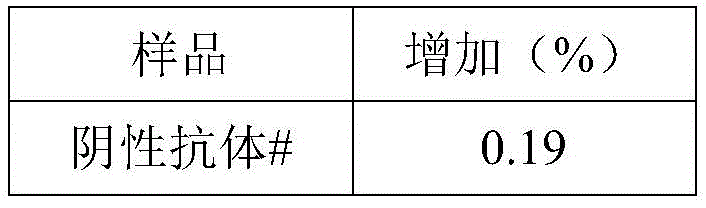
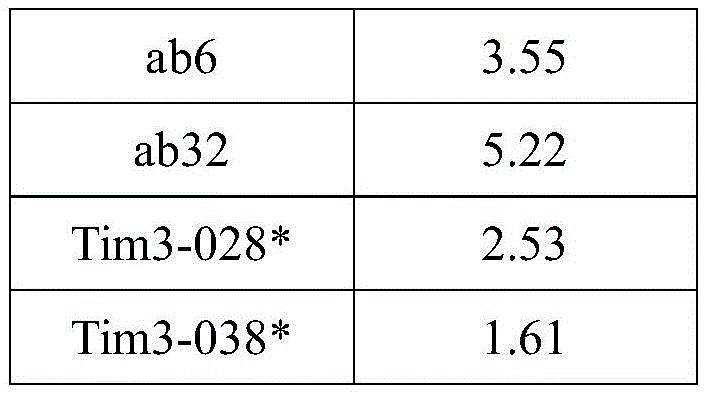
#:和TIM-3没有结合的抗体,作为阴性对照;*US20170114135A1,Tim3-0028和Tim3-0038。#: Antibody that does not bind to TIM-3, as a negative control; *US20170114135A1, Tim3-0028 and Tim3-0038.
表9a结果表明,在同样的抗体浓度下,阴性抗体激活NK细胞杀伤肿瘤细胞活性增加(相对于没有抗体)百分比为0.19%,即近本底(0%)水平。Ab6和ab32均显示很好的激活肿瘤细胞杀伤肿瘤细胞的活性,分别增加3.55%和5.22%。这比Tim3-0028和Tim3-0038的活性强至少40%以上([3.55-2.53]/2.53)至220%以上([5.22-1.61]/1.61)。The results in Table 9a show that at the same antibody concentration, the percentage of increase in the activity of NK cells to kill tumor cells activated by the negative antibody (relative to no antibody) is 0.19%, which is close to the background (0%) level. Both Ab6 and ab32 showed very good activity of activating tumor cells and killing tumor cells, which increased by 3.55% and 5.22% respectively. This is at least 40% more ([3.55-2.53]/2.53) to more than 220% ([5.22-1.61]/1.61 ) more active than Tim3-0028 and Tim3-0038.
上述结果表明,本发明是一类不同于阳性抗体,也不同于公开专利US20170114135A1中的TIM-3抗体,具有独特的结合特性和结合位点。本发明抗体这一共有的特性,为这些抗体在这些非人的灵长类物种上做临床前研究提供了不同的非人的灵长类物种的选择。The above results show that the present invention is a type of antibody that is different from the positive antibody, and also different from the TIM-3 antibody in the published patent US20170114135A1, and has unique binding properties and binding sites. This common property of the antibodies of the present invention provides a choice of different non-human primate species for these antibodies to be used for preclinical research on these non-human primate species.
此外,本发明优选抗体ab6、ab32和对照抗体有不同的抗原结合位点,相应抗体药物开发可显示不同的功效,这些抗体激活人PBMC杀伤肿瘤细胞的功能活性(见下述)证明了这点。In addition, the preferred antibodies ab6, ab32 and the control antibody of the present invention have different antigen binding sites, and the development of corresponding antibody drugs can show different efficacy, which is proved by the functional activity of these antibodies to activate human PBMC to kill tumor cells (see below) .
用实施例3的方法检测了本发明抗体激活人血细胞杀伤肿瘤细胞的活性,结果见下表。The method of Example 3 was used to detect the activity of the antibody of the present invention to activate human blood cells to kill tumor cells, and the results are shown in the table below.
表10人源化抗TIM-3抗体ab32激活人PBMC杀伤肿瘤细胞活性(增加百分比%)Table 10 Humanized anti-TIM-3 antibody ab32 activates human PBMC killing tumor cell activity (increase percentage %)
上述结果说明,ab32和阳性对照在0μg/ml浓度下,基本上显示不出活性(接近本底),在5μg/ml浓度下,ab32和阳性对照激活人PBMC杀伤肿瘤细胞活性分别为12.6%和5.9%;在10μg/ml浓度下,ab32和阳性对照活性分别为14.9%和10.1%。说明ab32在该浓度下活性达到饱和值。同时也表明,本发明抗体ab32在5μg/ml激活人PBMC杀伤肿瘤细胞的活性和10μg/ml对照抗体相当。也就是说ab32激活人PBMC活性比阳性对照至少强1倍以上。Ab6也显示了同样的强于阳性对照抗体的PBMC杀伤活性,见下表11。The above results show that ab32 and the positive control basically show no activity (close to the background) at a concentration of 0 μg/ml, and at a concentration of 5 μg/ml, the activity of ab32 and the positive control to activate human PBMCs to kill tumor cells is 12.6% and 12.6% respectively. 5.9%; at a concentration of 10 μg/ml, the ab32 and positive control activities were 14.9% and 10.1%, respectively. It shows that the activity of ab32 reaches the saturation value at this concentration. It also shows that the activity of the antibody ab32 of the present invention in activating human PBMC to kill tumor cells at 5 μg/ml is equivalent to that of the control antibody at 10 μg/ml. That is to say, ab32 activates human PBMC activity at least 1 times stronger than the positive control. Ab6 also showed the same PBMC killing activity stronger than the positive control antibody, see Table 11 below.
表11人源化抗TIM-3抗体ab6激活人NK细胞杀伤肿瘤细胞活性(增加百分比%)Table 11 Humanized anti-TIM-3 antibody ab6 activates human NK cells to kill tumor cells (increase percentage %)


表11说明:ab6和阳性对照在0μg/ml浓度下,基本上显示不出活性(接近本底1.8%),在5μg/ml浓度下,ab6和阳性对照激活人PBMC杀伤肿瘤细胞活性分别为3.97%和3.91%;在10μg/ml浓度下,ab6和阳性对照活性分别为8.33%和3.95%。说明阳性对照抗体在10μg/ml浓度下活性达到饱和值。同时也表明,本发明抗体ab6在5μg/ml激活人PBMC杀伤肿瘤细胞的活性(3.97%)和10μg/ml对照抗体相当(3.95%)。也就是说ab6激活人NK活性比阳性对照至少强1倍以上。Table 11 illustrates: ab6 and the positive control at a concentration of 0 μg/ml basically show no activity (close to the background 1.8%), and at a concentration of 5 μg/ml, the activity of ab6 and the positive control to activate human PBMC to kill tumor cells is 3.97 % and 3.91%; at a concentration of 10 μg/ml, the ab6 and positive control activities were 8.33% and 3.95%, respectively. It shows that the activity of the positive control antibody reaches the saturation value at the concentration of 10 μg/ml. It also shows that the activity of the antibody ab6 of the present invention in activating human PBMC to kill tumor cells at 5 μg/ml (3.97%) is equivalent to that of the control antibody at 10 μg/ml (3.95%). That is to say, ab6 activates human NK activity at least 1 times stronger than that of the positive control.
上述结果表明,本发明抗体ab6和ab32有其独特的,不同于阳性对照,不同于公开专利US20170114135A1中的TIM-3抗体的结合人和狨猴TIM-3的特点,而且这些抗体还具有比阳性对照、Tim3-0028以及Tim3-0038都有更好的激活人NK细胞杀伤肿瘤细胞的活性。The above results show that the antibodies ab6 and ab32 of the present invention have unique characteristics that are different from the positive control and the TIM-3 antibody in the published patent US20170114135A1 in binding to human and marmoset TIM-3, and these antibodies also have a higher ratio of positive The control, Tim3-0028 and Tim3-0038 all have better activity of activating human NK cells to kill tumor cells.
上述实施例1~13(不包括Tim3-0028,Tim3-0038的工作)可参考本申请人的中国专利申请CN 201710348699.4和CN 201810197885.7。The above-mentioned Examples 1 to 13 (excluding the work of Tim3-0028 and Tim3-0038) can refer to the applicant's Chinese patent applications CN 201710348699.4 and CN 201810197885.7.
实施例14本发明TIM-3抗体用于双特异性抗体设计Example 14 TIM-3 antibody of the present invention is used in bispecific antibody design
本发明抗TIM-3抗体可以和其它多种不同的靶点,包括PD-1靶点抗体以多种形式设计成双特异性抗体。所设计的双特异或者也称双功能抗体,可以同时靶向TIM-3靶点和另外一个靶点。本发明以TIM-3靶点和PD-1靶点为例子,优选多种设计方案得到了各种优选设计。具体设计方案之一如下。The anti-TIM-3 antibody of the present invention can be designed into a bispecific antibody in various forms with other various targets, including PD-1 target antibodies. The designed bispecific or bifunctional antibody can simultaneously target the TIM-3 target and another target. In the present invention, taking the TIM-3 target and the PD-1 target as examples, a variety of design schemes are preferred to obtain various optimal designs. One of the specific design schemes is as follows.
表12本发明靶向TIM-3和PD-1双特靶点双特异性抗体设计方案1# Table 12 The present invention targets TIM-3 and PD-1 bispecific target bispecific

如上表所示,在构建含轻链的序列和含重链的序列过程中其N端包括信号肽序列SP,在表达后信号肽被切除。含轻链的序列指该序列除了包括轻链序列以外,还可以包括与轻链序列连接的scFv;含重链的序列指该序列除了包括重链序列以外,还可以包括与重链序列连接的scFv。As shown in the table above, during the construction of the sequence containing the light chain and the sequence containing the heavy chain, the N-terminus includes the signal peptide sequence SP, and the signal peptide is excised after expression. The sequence containing the light chain means that the sequence may also include the scFv linked to the light chain sequence in addition to the light chain sequence; the sequence containing the heavy chain means that the sequence may also include the scFv linked to the heavy chain sequence in addition to the heavy chain sequence. scFv.
上述T1为PD-1抗体,可以为Pem、Nivo或Ba08;T2为本发明的TIM-3抗体,例如ab6或ab32。T1(scFv)代表针对PD-1抗体的scFv序列;T2(scFv)代表TIM-3抗体的scFv序列。(scFv)n1、(scFv)n2、(scFv)n3和(scFv)n4中的n1、n2、n3与n4分别为自然数,可以是0、1、2、3等,在本发明的具体实施例中,n1、n2、n3、n4中其中至少1个数值为1,其余为0。L1、L2分别为柔性连接子,可以是多个GGGGS(G4S),即(G4S)n,n从0-10或大于10,优选1、2、3或者4。The above T1 is the PD-1 antibody, which can be Pem, Nivo or Ba08; T2 is the TIM-3 antibody of the present invention, such as ab6 or ab32. T1(scFv) represents the scFv sequence of the PD-1 antibody; T2(scFv) represents the scFv sequence of the TIM-3 antibody. n1, n2, n3 and n4 in (scFv) n1 , (scFv) n2 , (scFv) n3 and (scFv) n4 are respectively natural numbers, which can be 0, 1, 2, 3, etc., in specific embodiments of the present invention Among them, at least one value among n1, n2, n3, and n4 is 1, and the rest are 0. L1 and L2 are flexible linkers, which can be multiple GGGGS (G 4 S), ie (G 4 S) n , n is from 0-10 or greater than 10, preferably 1, 2, 3 or 4.
T1(scFv)和T2(scFv)可以是轻链可变区-linker-重链可变区的结构,也可以是重链可变区-linker-轻链可变区的结构(从左到右表示由N端至C端),例如ab6VL-linker-ab6VH、ab32VL-linker-ab32VH、ab6VH-linker-ab6VL和ab6VH-linker-ab6VL。VL,代表抗体轻链可变区序列;VH,代表抗体重链可变区序列。Lc为人抗体κ型轻链恒定区或λ型轻链恒定区,因此本文中VL-Lc值整条轻链,其包括VL-κ和VL-λ等形式。Hc为重链恒定区,包括人抗体重链IgG1、IgG2或IgG4等亚型恒定区,VH-Hc则代表整条重链。“-”是为了清楚表示本发明双特异性抗体的结构而用于区分不同的结构域,其本身不代表任何分子结构,比如ab6VL-linker-ab6VH表示ab6轻链可变区(氨基酸)和重链可变区(氨基酸)通过连接子融合表达的氨基酸序列。T1 (scFv) and T2 (scFv) can be the structure of light chain variable region-linker-heavy chain variable region, or the structure of heavy chain variable region-linker-light chain variable region (from left to right means from N-terminal to C-terminal), such as ab6VL-linker-ab6VH, ab32VL-linker-ab32VH, ab6VH-linker-ab6VL and ab6VH-linker-ab6VL. VL, represents the antibody light chain variable region sequence; VH, represents the antibody heavy chain variable region sequence. Lc is the constant region of the human antibody κ-type light chain or λ-type light chain, so here VL-Lc is the entire light chain, including VL-κ and VL-λ. Hc is the heavy chain constant region, including human antibody heavy chain IgG1, IgG2 or IgG4 and other subtype constant regions, and VH-Hc represents the entire heavy chain. "-" is used to distinguish different structural domains in order to clearly indicate the structure of the bispecific antibody of the present invention, which itself does not represent any molecular structure, such as ab6VL-linker-ab6VH represents the variable region (amino acid) and heavy chain of ab6 light chain Chain variable region (amino acid) Amino acid sequence expressed through linker fusion.
根据上述表12中所设计的,本实施例中具体分子的轻链选取人κ链恒定区;重链选人重链恒定区(Hc),例如人IgG4(hIgG4)。重链中L1序列为(G4S)3,L2序列为G4S,即得具体序列如表12a所示。According to the design in the above Table 12, the light chain of the specific molecule in this embodiment is selected from the human κ chain constant region; the heavy chain is selected from the human heavy chain constant region (Hc), such as human IgG4 (hIgG4). The L1 sequence in the heavy chain is (G 4 S) 3 , the L2 sequence is G 4 S, and the specific sequences are shown in Table 12a.
表12a本发明靶向TIM-3和PD-1双特靶点双特异性抗体设计方案1的具体序列Table 12a The specific sequence of the present invention targeting TIM-3 and PD-1 bispecific target bispecific
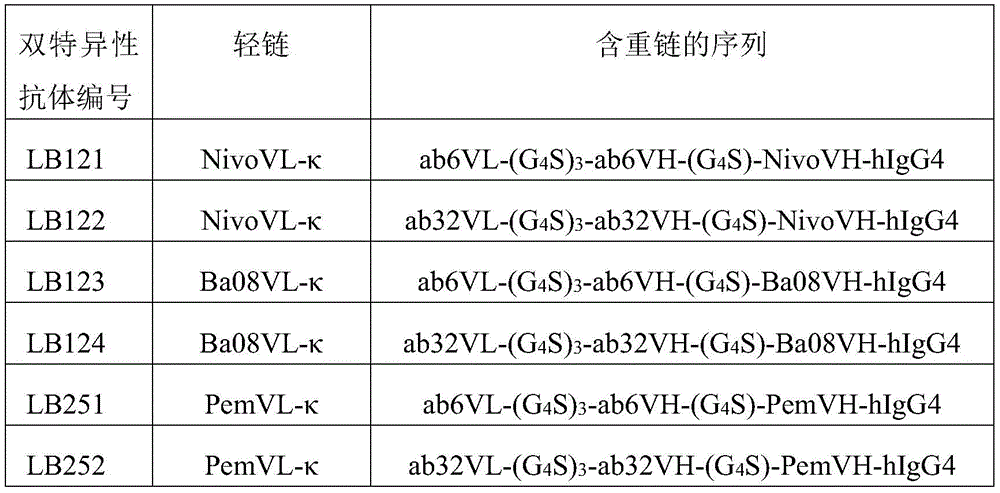
上述分子的轻链N端还包括信号肽SP1序列,如SEQ ID NO:30所示;重链N端还包括信号肽SP2序列,如SEQ ID NO:31所示,因表达终产物中不包括信号肽序列(被剪切掉),所以未示出在表格中。The N-terminus of the light chain of the above molecule also includes a signal peptide SP1 sequence, as shown in SEQ ID NO:30; the N-terminus of the heavy chain also includes a signal peptide SP2 sequence, as shown in SEQ ID NO:31, because the expression end product does not include Signal peptide sequence (truncated), so not shown in the table.
表13本发明靶向TIM-3和PD-1双特靶点双特异性抗体设计方案2# Table 13 The present invention targets TIM-3 and PD-1 bispecific target bispecific

#:表中SP代表信号肽序列,κ为人抗体κ型轻链恒定区,但不限于κ型轻链,也可以是λ型轻链。T1、T2分别代表针对靶点TIM-3和靶点PD-1。上表中,含轻链的序列指该序列除了包括正常完整的轻链序列以外,还包括其它氨基酸片段,例如另一个轻链可变区序列。含重链的序列指该序列除了包括正常完整的重链序列以外,还包括其它氨基酸片段,例如另一个重链可变区序列。轻链可变区和完整的轻链之间、重链可变区和完整的重链之间分别通过连接子L3和L4连接。L3、L4分别为柔性连接子,可以为肽段1即如SEQ ID NO:28所示,或肽段2即如SEQ ID NO:29所示,也可以是多个GGGGS(G4S),即(G4S)n,n为0-10之间的整数或大于10,优选1、2、3或者4。重链恒定区hIgG可以是人抗体IgG1、IgG2或IgG4。具体实施例可以选用特定的值以及特定的linker。#: SP in the table represents the signal peptide sequence, and κ is the constant region of the human antibody κ-type light chain, but not limited to the κ-type light chain, and can also be the λ-type light chain. T1 and T2 represent the target TIM-3 and the target PD-1, respectively. In the above table, the light chain-containing sequence means that the sequence includes other amino acid fragments, such as another light chain variable region sequence, in addition to the normal complete light chain sequence. A heavy chain-containing sequence means that the sequence includes, in addition to the normal complete heavy chain sequence, other amino acid fragments, such as another heavy chain variable region sequence. The light chain variable region and the complete light chain, and the heavy chain variable region and the complete heavy chain are connected by linkers L3 and L4, respectively. L3 and L4 are flexible linkers, which can be
具体到本实施例,根据该方案2本发明设计的LB126、LB127、LB253、LB128、LB129以及LB254分子中L3序列为RTVAAPSVFIFPP(SEQ ID NO:28);L4序列为ASTKGPSVFPLAP(SEQ IDNO:29)。针对靶点PD-1的抗体为Nivo、Ba08或Pem,针对靶点TIM-3的抗体为本发明的ab6或ab32。轻链恒定区为人的κ链恒定区;重链恒定区为hIgG4,具体序列见表13a。Specifically in this embodiment, the L3 sequence in the LB126, LB127, LB253, LB128, LB129 and LB254 molecules designed according to the
表13a本发明靶向TIM-3和PD-1双特靶点双特异性抗体设计方案2的具体序列Table 13a The specific sequence of the present invention targeting TIM-3 and PD-1 bispecific target bispecific
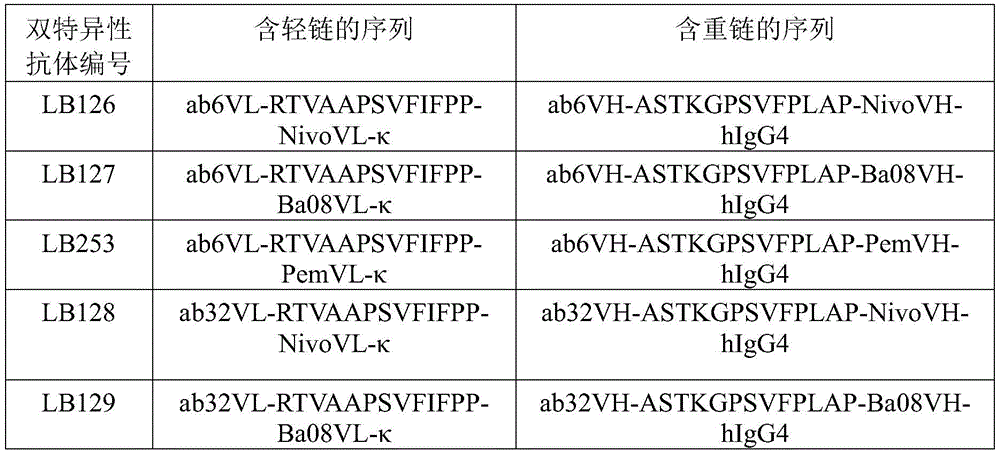

上述分子的轻链N端还包括如SEQ ID NO:30所示的信号肽SP1序列,重链N端还包括如SEQ ID NO:31所示的信号肽SP2序列,因表达终产物中不包括信号肽序列(被剪切掉),所以未示出在表格中。The N-terminus of the light chain of the above molecule also includes the signal peptide SP1 sequence shown in SEQ ID NO: 30, and the N-terminus of the heavy chain also includes the signal peptide SP2 sequence shown in SEQ ID NO: 31, because the final expression product does not include Signal peptide sequence (truncated), so not shown in the table.
实施例15本发明TIM-3和PD-1双特异性抗体稳定性评价Example 15 Stability evaluation of TIM-3 and PD-1 bispecific antibody of the present invention
本发明设计上述TIM-3和PD-1双特异性抗体按实施例1方法克隆、表达纯化。纯化样品储存在PBS(pH7.4)取3μg的样品,依次加上6μl 5×蛋白质加样缓冲液(生工生物工程(上海)股份有限公司,Cat#C508320-0001),非还原样品加6μl不加DTT的5×ProteinLoading Buffer(生工生物工程(上海)股份有限公司,Cat#C516030-0005),用水补齐到30μl,95℃以上水浴5min。上样,聚丙烯酰胺凝胶电泳(PAGE),140v,70min,考马斯亮蓝室温染色。结果见图2。The present invention designs the above-mentioned TIM-3 and PD-1 bispecific antibody to clone, express and purify according to the method in Example 1. Purified samples were stored in PBS (pH7.4) and 3 μg of samples were taken, followed by adding 6 μl of 5× protein loading buffer (Sangon Bioengineering (Shanghai) Co., Ltd., Cat#C508320-0001), and 6 μl of
图2a、图2b(图中的第1、2道为PD-1抗体Nivo,作为抗体轻链,重链之对照)结果显示:LB121、LB122、LB123、LB124以及LB126、LB127、LB128、LB129在PAGE上显示在60kD以下,和正常抗体重链大小接近的地方有一条带,这说明这些分子的重链有不同程度的断裂。且LB121~LB124比LB126~LB129要轻微许多。其中LB121断裂最为轻微。不仅如此,LB126~LB129正常轻链大小(30KD)附近也有一条带,说明这些分子的轻链也出现不同程度的断裂。Figure 2a, Figure 2b (the first and second lanes in the figure are the PD-1 antibody Nivo, as the control of the light chain and heavy chain of the antibody) the results show that: LB121, LB122, LB123, LB124 and LB126, LB127, LB128, LB129 in On PAGE, there is a band below 60kD, which is close to the size of normal antibody heavy chains, which indicates that the heavy chains of these molecules are broken to varying degrees. And LB121~LB124 are much lighter than LB126~LB129. Among them, LB121 fracture is the slightest. Not only that, there is also a band near the normal light chain size (30KD) of LB126~LB129, indicating that the light chains of these molecules are also broken to varying degrees.
综合电泳结果分析,LB121~LB124这种分子结构和特异性设计在表达纯度上显示最优。上述双特异性抗体在PBS(pH7.4缓冲体系)和HAC(醋酸缓冲体系,pH3.5),3μg/ml,4℃条件下,初步观察7天,评估稳定性,结果见下表。According to the comprehensive analysis of electrophoresis results, the molecular structure and specific design of LB121-LB124 showed the best expression purity. The stability of the above bispecific antibody was initially observed for 7 days under the conditions of PBS (pH7.4 buffer system) and HAC (acetic acid buffer system, pH3.5), 3 μg/ml, 4°C, and the stability was evaluated. The results are shown in the table below.
表14本发明TIM-3和PD-1双特异性抗体溶解性能分析Table 14 Analysis of the dissolution performance of the TIM-3 and PD-1 bispecific antibody of the present invention
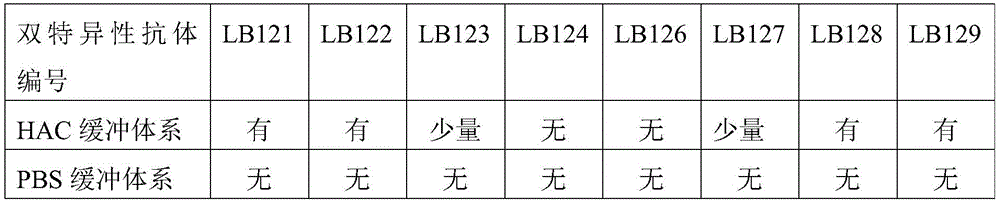
上表中,有、无和少量分别代表有沉淀、无沉淀和少量沉淀。结果表明本发明双特异性抗体在HAC缓冲体系有些有沉淀,但在PBS(pH7.4)的缓冲体系里均稳定。In the above table, there, no and a small amount represent precipitation, no precipitation and a small amount of precipitation, respectively. The results show that the bispecific antibody of the present invention has some precipitation in the HAC buffer system, but is stable in the PBS (pH7.4) buffer system.
实施例16本发明TIM-3和PD-1双特异性抗体结合活性评价Example 16 Evaluation of the binding activity of the TIM-3 and PD-1 bispecific antibody of the present invention
将上述本发明TIM-3和PD-1双特异性抗体用实施例3和实施例5之方法,分别检测其和TIM-3以及PD-1的结合活性,结果见表15和图3。The above-mentioned TIM-3 and PD-1 bispecific antibody of the present invention was tested for its binding activity to TIM-3 and PD-1 using the methods of Example 3 and Example 5, respectively. The results are shown in Table 15 and Figure 3.
表15本发明TIM-3和PD-1双特异性抗体和人TIM-3、人PD-1的结合活性Table 15 Binding activity of TIM-3 and PD-1 bispecific antibody of the present invention to human TIM-3 and human PD-1
#NA:不适用#NA: not applicable
上述结果表明本发明针对TIM-3的双特异性抗体,本发明所设计的TIM-3和PD-1双特异性抗体均保留了TIM-3抗体和PD-1抗体的活性。和单独TIM-3抗体或者PD-1抗体比较,双特异性抗体活性(EC50)稍微有所减弱,比如LB121和TIM-3结合EC50=0.235nM vs ab6和TIM-3的结合活性EC50=0.095;其针对PD-1的结合活性EC50=0.153nM vs Nivo EC50=0.057nM。LB123PD-1结合活性EC50=0.216nM vs Ba081EC50=0.127nM。因此,本发明双特异性抗体和对应的单独完整抗体和相应靶点的结合活性有所减弱,但在比较小的1-3倍范围内。The above results indicate that the TIM-3 bispecific antibody of the present invention, and the TIM-3 and PD-1 bispecific antibody designed in the present invention retain the activity of TIM-3 antibody and PD-1 antibody. Compared with TIM-3 antibody or PD-1 antibody alone, bispecific antibody activity (EC50) is slightly weakened, such as LB121 and TIM-3 binding EC50 = 0.235nM vs ab6 and TIM-3 binding activity EC50 = 0.095; Its binding activity against PD-1 EC50=0.153nM vs Nivo EC50=0.057nM. LB123PD-1 binding activity EC50=0.216nM vs Ba081EC50=0.127nM. Therefore, the binding activity of the bispecific antibody of the present invention and the corresponding single intact antibody to the corresponding target is weakened, but within a relatively small range of 1-3 times.
实施例17本发明TIM-3和PD-1双特异性抗体优化设计Example 17 Optimal design of TIM-3 and PD-1 bispecific antibody of the present invention
根据上述结果,特别是针对上述双特异设计方案1和2(表12和表13)所设计的双特异性抗体出现的重链断裂(见图2),本发明优化设计如下表16。According to the above results, especially for the heavy chain breaks (see Figure 2) of the bispecific antibodies designed in the above
表16本发明靶向TIM-3和PD-1双特靶点双特异性抗体优化设计Table 16 Optimized design of bispecific antibodies targeting TIM-3 and PD-1 bispecific targets of the present invention


上述分子的轻链N端还包括信号肽SP1序列,如SEQ ID NO:30所示;重链N端还包括信号肽SP2序列,如SEQ ID NO:31所示,因表达终产物中不包括信号肽序列(被剪切掉),所以未示出在表格中。The N-terminus of the light chain of the above molecule also includes a signal peptide SP1 sequence, as shown in SEQ ID NO:30; the N-terminus of the heavy chain also includes a signal peptide SP2 sequence, as shown in SEQ ID NO:31, because the expression end product does not include Signal peptide sequence (truncated), so not shown in the table.
所列序列均为表达终产物(双特异性抗体),其轻、重链信号肽序列被切除。上述设计代表分子轻、重链序列如下:The sequences listed are all expression final products (bispecific antibodies), and the signal peptide sequences of the light and heavy chains are excised. The above-mentioned design representative molecular light and heavy chain sequences are as follows:
LB133轻链氨基酸序列:SEQ ID NO:17;LB133重链氨基酸序列:SEQ ID NO:18;LB133 light chain amino acid sequence: SEQ ID NO: 17; LB133 heavy chain amino acid sequence: SEQ ID NO: 18;
LB134轻链氨基酸序列同SEQ ID NO:17;LB134重链氨基酸序列:SEQ ID NO:19;LB134 light chain amino acid sequence is the same as SEQ ID NO: 17; LB134 heavy chain amino acid sequence: SEQ ID NO: 19;
LB135轻链氨基酸序列:SEQ ID NO:20;LB135重链氨基酸序列:SEQ ID NO:21;LB135 light chain amino acid sequence: SEQ ID NO:20; LB135 heavy chain amino acid sequence: SEQ ID NO:21;
LB136轻链氨基酸序列同SEQ ID NO:20;LB136重链氨基酸序列:SEQ ID NO:22;LB136 light chain amino acid sequence is the same as SEQ ID NO:20; LB136 heavy chain amino acid sequence: SEQ ID NO:22;
LB141轻链氨基酸序列:EIVLTQSPATLSLSPGERATLSCRASKGVSTSGYSYLHWYQQKPGQAPRLLIYLASYLESGVPARFSGSGSGTDFTLTISSLEPEDFAVYYCQHSRDLPLTFGGGTKVEIKRTVAAPSVFIFPPSDEQLKSGTASVVCLLNNFYPREAKVQWKVDNALQSGNSQESVTEQDSKDSTYSLSSTLTLSKADYEKHKVYACEVTHQGLSSPVTKSFNRGEC(SEQ ID NO:23)LB141轻链氨基酸序列:EIVLTQSPATLSLSPGERATLSCRASKGVSTSGYSYLHWYQQKPGQAPRLLIYLASYLESGVPARFSGSGSGTDFTLTISSLEPEDFAVYYCQHSRDLPLTFGGGTKVEIKRTVAAPSVFIFPPSDEQLKSGTASVVCLLNNFYPREAKVQWKVDNALQSGNSQESVTEQDSKDSTYSLSSTLTLSKADYEKHKVYACEVTHQGLSSPVTKSFNRGEC(SEQ ID NO:23)
LB141重链氨基酸序列:DIQMTQSPSSLSASVGDRVTITCHASQGISSNIGWLQQKPGKAFKGLIYQGSNLEDGVPSRFSGSGSGADYTLTISSLQPEDFATYYCVQFAQFPPTFGQGTKLEIKGGGGSGGGGSGGGGSEVQLVESGGGLVKPGGSLRLSCAASGFTFSDYYMAWVRQAPGKGLEWVANINYDGSNTYYLDSLKSRFTISRDNAKNSLYLQMNSLRAEDTAVYYCARGLYYYGGNYFAYWGQGTLVTVSSGGGGSGGGGSGGGGSQVQLVQSGVEVKKPGASVKVSCKASGYTFTNYYMYWVRQAPGQGLEWMGGINPSNGGTNFNEKFKNRVTLTTDSSTTTAYMELKSLQFDDTAVYYCARRDYRFDMGFDYWGQGTTVTVSSASTKGPSVFPLAPCSRSTSESTAALGCLVKDYFPEPVTVSWNSGALTSGVHTFPAVLQSSGLYSLSSVVTVPSSSLGTKTYTCNVDHKPSNTKVDKRVESKYGPPCPPCPAPEFLGGPSVFLFPPKPKDTLMISRTPEVTCVVVDVSQEDPEVQFNWYVDGVEVHNAKTKPREEQFNSTYRVVSVLTVLHQDWLNGKEYKCKVSNKGLPSSIEKTISKAKGQPREPQVYTLPPSQEEMTKNQVSLTCLVKGFYPSDIAVEWESNGQPENNYKTTPPVLDSDGSFFLYSRLTVDKSRWQEGNVFSCSVMHEALHNHYTQKSLSLSLGK(SEQ ID NO:24)LB141重链氨基酸序列:DIQMTQSPSSLSASVGDRVTITCHASQGISSNIGWLQQKPGKAFKGLIYQGSNLEDGVPSRFSGSGSGADYTLTISSLQPEDFATYYCVQFAQFPPTFGQGTKLEIKGGGGSGGGGSGGGGSEVQLVESGGGLVKPGGSLRLSCAASGFTFSDYYMAWVRQAPGKGLEWVANINYDGSNTYYLDSLKSRFTISRDNAKNSLYLQMNSLRAEDTAVYYCARGLYYYGGNYFAYWGQGTLVTVSSGGGGSGGGGSGGGGSQVQLVQSGVEVKKPGASVKVSCKASGYTFTNYYMYWVRQAPGQGLEWMGGINPSNGGTNFNEKFKNRVTLTTDSSTTTAYMELKSLQFDDTAVYYCARRDYRFDMGFDYWGQGTTVTVSSASTKGPSVFPLAPCSRSTSESTAALGCLVKDYFPEPVTVSWNSGALTSGVHTFPAVLQSSGLYSLSSVVTVPSSSLGTKTYTCNVDHKPSNTKVDKRVESKYGPPCPPCPAPEFLGGPSVFLFPPKPKDTLMISRTPEVTCVVVDVSQEDPEVQFNWYVDGVEVHNAKTKPREEQFNSTYRVVSVLTVLHQDWLNGKEYKCKVSNKGLPSSIEKTISKAKGQPREPQVYTLPPSQEEMTKNQVSLTCLVKGFYPSDIAVEWESNGQPENNYKTTPPVLDSDGSFFLYSRLTVDKSRWQEGNVFSCSVMHEALHNHYTQKSLSLSLGK(SEQ ID NO:24)
LB143轻链氨基酸序列同SEQ ID NO:23;LB143重链氨基酸序列:SEQ ID NO:25。The amino acid sequence of the light chain of LB143 is the same as SEQ ID NO:23; the amino acid sequence of the heavy chain of LB143 is SEQ ID NO:25.
上述优化设计的TIM-3和PD-1双特异性抗体按实施例1方法克隆、表达纯化,同实施例15方法电泳(PAGE)分析轻、重链情况,见图4。结果表明,优化设计分子LB132、LB133、LB134、LB136、LB141、LB143以及LB135在变性条件下,都没有看到像LB121-LB124(图2)出现的重链、以及LB126-LB129(图2)中出现的重链、轻链断裂的片段。这一意外发现结果表明,本发明设计模式和序列组合具有非常好的表达特点,这为后期作生产、工艺开发提供了巨大的优势。The above optimized TIM-3 and PD-1 bispecific antibody was cloned, expressed and purified according to the method in Example 1, and the light and heavy chains were analyzed by electrophoresis (PAGE) as in Example 15, as shown in Figure 4. The results showed that the optimized design molecules LB132, LB133, LB134, LB136, LB141, LB143 and LB135 did not see heavy chains like LB121-LB124 (Figure 2) and LB126-LB129 (Figure 2) under denaturing conditions. Fragments of heavy and light chain fragments that appear. The result of this unexpected discovery shows that the design pattern and sequence combination of the present invention have very good expression characteristics, which provides a huge advantage for later production and process development.
实施例18本发明TIM-3和PD-1双特异性抗体优化设计分子结合活性评价Example 18 TIM-3 and PD-1 bispecific antibody optimization design of the present invention Molecular binding activity evaluation
将上述本发明TIM-3和PD-1双特异性抗体优化设计用实施例2和实施例5之方法,分别检测其和TIM-3和PD-1的结合活性,结果见表17。The method of Example 2 and Example 5 was used to optimize the design of the above-mentioned TIM-3 and PD-1 bispecific antibody of the present invention, and its binding activity to TIM-3 and PD-1 was detected respectively. The results are shown in Table 17.
表17本发明TIM-3和PD-1双特异性抗体优化设计分子和人TIM-3、人PD-1的结合活性Table 17 Binding activity of TIM-3 and PD-1 bispecific antibody optimization design molecules of the present invention to human TIM-3 and human PD-1


#NA:不适用#NA: not applicable
上述结果表明本发明TIM-3和PD-1双特异性抗体优化设计分子保持了和单独抗TIM-3抗体(ab6、ab32)接近(相差1-2倍)的结合活性,以及和单独PD-1抗体(Nivo、Pem、Ba08)接近(相差1倍以内)的结合活性。The above results show that the optimal design molecule of the TIM-3 and PD-1 bispecific antibody of the present invention maintains a binding activity close to that of the individual anti-TIM-3 antibodies (ab6, ab32) (difference of 1-2 times), and that of the individual PD-1 antibody. 1 Antibodies (Nivo, Pem, Ba08) have close (within 1-fold) binding activity.
实施例19本发明TIM-3和PD-1双特异性抗体优化设计分子激活人PBMC杀伤肿瘤细胞活性评价Example 19 The TIM-3 and PD-1 bispecific antibody of the present invention optimizes the design of molecules to activate human PBMCs and evaluates the activity of killing tumor cells
本发明TIM-3和PD-1双特异性抗体优化设计分子用实施例3方法评价其激活人PBMC杀伤肿瘤细胞活性(TIM-3抗体活性),结果见表18。The optimal design molecule of the TIM-3 and PD-1 bispecific antibody of the present invention was evaluated by the method of Example 3 to evaluate its activity of activating human PBMC to kill tumor cells (TIM-3 antibody activity), and the results are shown in Table 18.
表18本发明TIM-3和PD-1双特异性抗体优化设计分子激活人PBMC(NK)杀伤肿瘤细胞活性(增加百分比%)Table 18 TIM-3 and PD-1 bispecific antibody of the present invention optimized design molecule activates human PBMC (NK) killing tumor cell activity (increase percentage %)
#Neg IgG:无关抗体作为实验的阴性对照#Neg IgG: an irrelevant antibody as a negative control for experiments
上述结果表明,本发明优化设计双特异性抗体保留了ab6、ab32单个抗体所具有的激活PBMC(NK)杀伤肿瘤细胞的活性。The above results show that the optimally designed bispecific antibody of the present invention retains the activity of activating PBMC (NK) to kill tumor cells possessed by the single antibodies ab6 and ab32.
实施例20本发明TIM-3和PD-1双特异性抗体优化设计分子阻止PD-1蛋白和PD-L1配体结合活性评价Example 20 The TIM-3 and PD-1 bispecific antibody of the present invention optimizes the design of molecules to prevent the evaluation of the binding activity of PD-1 protein and PD-L1 ligand
为了评估本发明双特异优化设计抗体的PD-1抗体活性,用上述实施例6之方法评估了其阻止PD-1和PD-1配体(PD-L1)的结合活性。结果见下表。In order to evaluate the PD-1 antibody activity of the bispecific optimized design antibody of the present invention, the method of the above-mentioned Example 6 was used to evaluate its binding activity to prevent PD-1 and PD-1 ligand (PD-L1). The results are shown in the table below.
表19本发明双特异优化设计抗体阻止PD-1和PD-L1结合活性评价Table 19 Evaluation of the binding activity of the bispecific optimized antibody of the present invention to prevent PD-1 and PD-L1
上述结果表明本发明TIM-3和PD-1双特异性抗体优化设计分子保持了和单独PD-1抗体(Nivo、Pem、Ba08)一样的阻止PD-1和其配体PD-L1的结合活性。The above results show that the optimally designed molecule of the TIM-3 and PD-1 bispecific antibody of the present invention maintains the same binding activity of preventing PD-1 and its ligand PD-L1 as that of a single PD-1 antibody (Nivo, Pem, Ba08) .
实施例21本发明TIM-3和PD-1双特异性抗体优化设计分子在混合淋巴细胞反应(MLR assay)中的功能活性评价Example 21 Functional Activity Evaluation of TIM-3 and PD-1 Bispecific Antibody Optimization Design Molecules of the Present Invention in Mixed Lymphocyte Reaction (MLR assay)
用混合淋巴细胞反应(mixed lymphocyte reaction,MLR assay)检测了INF-γ分泌的方法来评估了本发明系列双特异性抗体在激活人血细胞上的活性。即由本发明分离的人血细胞PBMC(由健康志愿者捐献外周血液中分离)诱导得到树突细胞(DC),再刺激来自不同志愿者的T细胞。The activity of the series of bispecific antibodies of the present invention on activating human blood cells was evaluated by detecting the secretion of INF-γ by mixed lymphocyte reaction (MLR assay). That is, dendritic cells (DC) are induced from human blood cell PBMCs isolated in the present invention (isolated from peripheral blood donated by healthy volunteers), and then T cells from different volunteers are stimulated.
具体地,树突细胞(Dentritic cells,DC)培养:在实验第1天,用10%FBS RPMI1640培养基,接种PBMC于6孔板,每孔2ml,2×106/ml,37℃、5%CO2培养箱培养2-4小时后,轻轻吸出悬浮细胞,向贴壁细胞中加入2ml培养基和100ng/ml GM-CSF(Peprotech,Cat#:300-03)和100ng/ml IL-4(Peprotech,Cat#:200-04),继续培养2天后,每孔补加1ml新鲜培养基。第5天,每孔补加3μl 100μg/ml的TNF-α,使终浓度为100ng/ml(TNF-α购自Peprotech,Cat#:AF-300-01A),继续培养2天,所得树突细胞(DC)用于如下实验。Specifically, dendritic cells (DC) culture: On the first day of the experiment, inoculate PBMCs in 6-well plates with 10% FBS RPMI1640 medium, 2ml per well, 2×10 6 /ml, 37°C, 5 After incubating for 2-4 hours in a % CO2 incubator, gently aspirate the suspended cells, add 2ml medium and 100ng/ml GM-CSF (Peprotech, Cat#:300-03) and 100ng/ml IL- 4 (Peprotech, Cat#:200-04), after continuing to culture for 2 days, add 1ml of fresh medium to each well. On the fifth day, 3 μl of 100 μg/ml TNF-α was added to each well to make the
DC刺激PBMC/T细胞(MLR)assay:用10ng/ml anti-CD3抗体(Miltenyl Biotec,Cat#:130-093-387),按100μl/well包被96-well细胞培养板,37℃孵育2小时,用PBS洗一遍。收集上述培养第7天的DC细胞,离心,重悬于10%FBS的RPMI 1640培养基,计数,配成5×10⁴cell/ml,按90μl/well加入上述anti-CD3包被好的96-孔板中。取来自不同志愿者的PBMC细胞,计数,配成5x105cell/ml,按90μl/well加入上述anti-CD3包被并铺有DC细胞的96-孔板中。用PBS按比例配制待测样品,包括阴性抗体,对照抗体,PD-1抗体(根据公开的序列,由本发明按实施例1克隆、表达纯化得到)加入上述96孔板中,20μl/孔。使待测抗体在200μl体系中的浓度为需要的浓度梯度。对照组=90μl PBMC细胞+90μl DC+20μl PBS。细胞培养板置于37℃,5%CO2培养箱孵育6天后,取出细胞培养板,3000rpm离心10min,每孔取出150μl上清进行IFN-γ的检测。DC-stimulated PBMC/T cell (MLR) assay: Coat 96-well cell culture plates with 100 μl/well of anti-CD3 antibody (Miltenyl Biotec, Cat#:130-093-387) at 10 ng/ml, and incubate at 37°C for 2 hours, washed with PBS. Collect the above-mentioned DC cells on the 7th day of culture, centrifuge, resuspend in 10% FBS RPMI 1640 medium, count, make 5×10 4 cell/ml, add the above-mentioned anti-CD3 coated 96 cells at 90 μl/well - in an orifice plate. PBMC cells from different volunteers were collected, counted, prepared into 5× 10 5 cell/ml, and added at 90 μl/well to the 96-well plate coated with anti-CD3 and lined with DC cells. The samples to be tested were prepared in proportion with PBS, including negative antibody, control antibody, and PD-1 antibody (according to the disclosed sequence, obtained by cloning, expression and purification according to Example 1 of the present invention) and added to the above-mentioned 96-well plate, 20 μl/well. Make the concentration of the antibody to be tested in the 200 μl system the required concentration gradient. Control group = 90 μl PBMC cells + 90 μl DC + 20 μl PBS. After the cell culture plate was incubated at 37° C. in a 5% CO 2 incubator for 6 days, the cell culture plate was taken out, centrifuged at 3000 rpm for 10 min, and 150 μl of supernatant was taken from each well for IFN-γ detection.
IFN-γELISA检测方法,按照试剂盒(深圳欣博盛生物科技有限公司;cat:EHC102g)说明书进行操作,步骤如下:The IFN-γELISA detection method was operated according to the instructions of the kit (Shenzhen Xinbosheng Biotechnology Co., Ltd.; cat: EHC102g), and the steps were as follows:
(1)将取出的150μl细胞培养上清以合适的稀释倍数(不同次实验稀释倍数不同,通过预实验确定稀释倍数,本实施例中的稀释倍数为25倍)稀释后加入酶标板中(100μl/well);标准品用标本通用稀释液稀释成不同浓度梯度:1000pg/ml、500pg/ml、250pg/ml、125pg/ml、62.5pg/ml、31.25pg/ml、15.625pg/ml,每孔加100μl;空白孔加标本通用稀释液。(1) Dilute the 150 μl of cell culture supernatant taken out with a suitable dilution factor (the dilution factor is different in different experiments, the dilution factor is determined by the pre-experiment, the dilution factor in this embodiment is 25 times) and then added to the microtiter plate ( 100μl/well); the standard product was diluted into different concentration gradients with the sample universal diluent: 1000pg/ml, 500pg/ml, 250pg/ml, 125pg/ml, 62.5pg/ml, 31.25pg/ml, 15.625pg/ml, each Add 100μl to the well; add universal sample diluent to the blank well.
(2)封板胶纸封住反应孔,37℃,孵育90分钟。(2) Seal the reaction well with adhesive tape and incubate at 37°C for 90 minutes.
(3)洗板5次,每次3分钟,每孔加入100μl生物素抗体工作液,空白孔加生物素化抗体稀释液,新封板胶纸封住反应孔,37℃,孵育60分钟。(3) Wash the
(4)洗板5次,每次3分钟,每孔加入100μl酶结合工作液,空白孔加酶结合稀释液,新封板胶纸封住反应孔,37℃,避光孵育30分钟。(4) Wash the
(5)洗板5次,每次3分钟,每孔加入100μl显色底物TMB,36℃,避光孵育15分钟。(5) Wash the
(6)加入终止液,100μl/孔,混匀后,3分钟内,酶标仪读OD450。(6) Add stop solution, 100 μl/well, and after mixing, read OD450 with a microplate reader within 3 minutes.
结果分析:计算IFN-γ值,并和空白对照相比,换算成增加百分比(%)来评估本发明双特异性抗体在MLR检测中的活性。结果见图5。Result analysis: calculate the IFN-γ value, and compare it with the blank control, and convert it into an increase percentage (%) to evaluate the activity of the bispecific antibody of the present invention in MLR detection. The results are shown in Figure 5.
图5a、b、c结果表明,本发明针对TIM-3和PD-1双特异性抗体优化设计分子,在混合淋巴细胞反应试验中,均显示出活性。且其活性和TIM-3+PD-1两个抗体联合接近或者更强。即本发明优选设计的针对TIM-3和PD-1的双特异分子(1个分子)能够达到和两个分子联用相当或者更好(协同效应)激活T淋巴细胞的活性。单药低成本,更加方便给药等明显优势的情况下,可预计本发明双特异分子体内相当,甚至更好药物效果。The results in Fig. 5a, b, and c show that the optimized design molecules of the present invention for TIM-3 and PD-1 bispecific antibodies all showed activity in the mixed lymphocyte reaction test. And its activity is close to or stronger than the combination of TIM-3+PD-1 two antibodies. That is, the bispecific molecule (one molecule) preferably designed against TIM-3 and PD-1 in the present invention can achieve the same or better (synergistic effect) activation of T lymphocyte activity as the combination of the two molecules. In the case of obvious advantages such as low cost of a single drug and more convenient administration, it can be expected that the bispecific molecule of the present invention has equivalent or even better drug effects in vivo.
实施例22本发明TIM-3和PD-1双特异性抗体更多设计优化和筛选Example 22 More design optimization and screening of the TIM-3 and PD-1 bispecific antibody of the present invention
针对本发明Tim-3抗体序列和PD-1设计了更多双特异抗体,见下表。More bispecific antibodies have been designed against the Tim-3 antibody sequence and PD-1 of the present invention, as shown in the table below.
表20a本发明Tim-3抗体序列和PD-1抗体序列设计的不同双特异抗体分子Table 20a Different bispecific antibody molecules designed by Tim-3 antibody sequence and PD-1 antibody sequence of the present invention


*:此处κ链为人IgG的轻链恒定区(Lc)的κ型轻链。#:hIgG4的C末端连接连接子的时候,其最末端氨基酸K突变为A。本发明申请中,在重链C末端引入scFv的本发明所设计双特异抗体(SBody),均将最末端K突变为A。*: Here, the κ chain is the κ-type light chain of the light chain constant region (Lc) of human IgG. #: When the C-terminus of hIgG4 is connected with a linker, the terminal amino acid K is mutated to A. In the application of the present invention, for the bispecific antibody (SBody) designed by the present invention that introduces scFv at the C-terminus of the heavy chain, the terminal K is mutated to A.
用前述实施例1、实施例2、实施例5表达纯化并检测上述不同双特异抗体和Tim-3,PD-1的结合活性,以及各个设计的表达产量,结果见下表。Using the aforementioned Example 1, Example 2, and Example 5 to express, purify, and detect the binding activity of the above-mentioned different bispecific antibodies to Tim-3 and PD-1, as well as the expression yield of each design, the results are shown in the table below.
表20b针对Tim-3和PD-1双特异抗体不同设计分子的活性评价Table 20b Activity evaluation of different designed molecules for Tim-3 and PD-1 bispecific antibodies

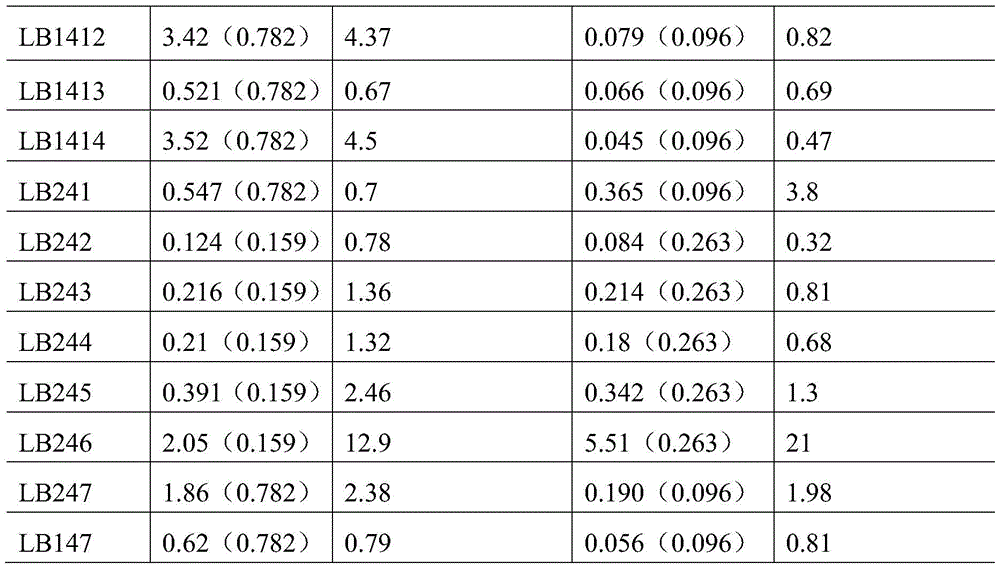
#:括号里面的数值为同实验条件下,同靶点对应的单克隆抗体(对照抗体)的结合活性EC50。*:同样实验条件下,双特异抗体和对应的单克隆抗体的结合活性EC50的比值。比值越大,说明所设计的双特抗体对单靶点的结合力减弱越多,比如比值为2,则说明所设计的双特异抗体对靶点结合活性和对应的单克隆抗体相比减弱了1倍。比值在2以内,说明结合活性没有受到影响;比值在2至5之间,说明结合活性略微有影响,此时应考量另一靶点的比值,若另一靶点比值较小例如在1以内,则该双特异性抗体仍有一定的应用价值。#: The values in the brackets are the binding activity EC 50 of the monoclonal antibody (control antibody) corresponding to the same target under the same experimental conditions. *: The ratio of the binding activity EC 50 of the bispecific antibody to the corresponding monoclonal antibody under the same experimental conditions. The larger the ratio, the more weakened the binding ability of the designed bispecific antibody to the single target. For example, if the ratio is 2, it means that the designed bispecific antibody has weaker binding activity to the target than the corresponding monoclonal antibody. 1 times. If the ratio is within 2, the binding activity is not affected; if the ratio is between 2 and 5, the binding activity is slightly affected. At this time, the ratio of another target should be considered. If the ratio of another target is smaller, for example, within 1 , the bispecific antibody still has certain application value.
上述数据表明,本发明Tim-3抗体以不同设计,包括ab6,ab32scFv的位置,IgG的N末端,或者C末端;scFv拷贝数量2个、4个、6个甚至8个(比如LB246),对双靶点的结合活性影响都不同。意想不到的是,LB141、LB1413、LB242、LB147等优选设计同时保留了对Tim-3和PD-1的结合活性。The above data show that the Tim-3 antibody of the present invention is designed in different ways, including the position of ab6, ab32 scFv, the N-terminal or C-terminal of IgG; the number of copies of scFv is 2, 4, 6 or even 8 (such as LB246). The effects of the binding activity of the two targets are different. Unexpectedly, the preferred designs of LB141, LB1413, LB242, LB147, etc. retain the binding activity to Tim-3 and PD-1 at the same time.
表20c针对Tim-3和PD-1双特异抗体不同设计分子的表达水平评估Table 20c Evaluation of the expression levels of different design molecules of Tim-3 and PD-1 bispecific antibodies
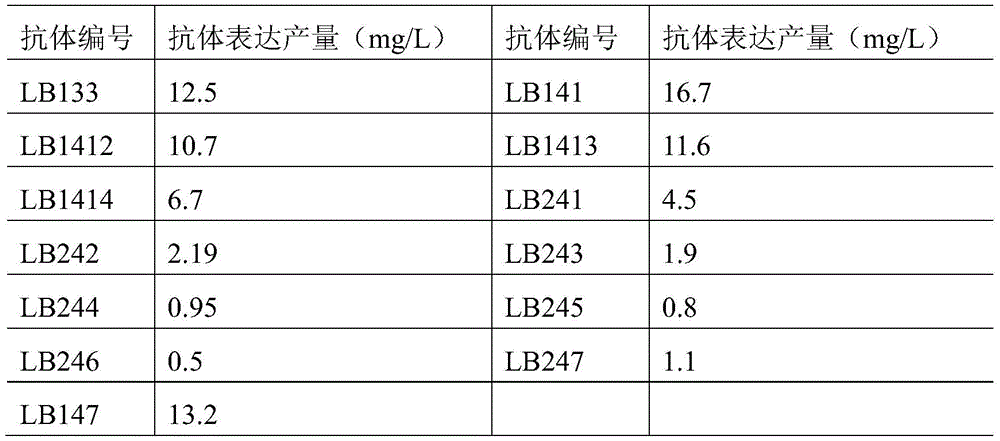
上述结果表明,本发明Tim-3抗体序列和PD-1抗体设计的双特异抗体分子,依据序列的不同,scFv位置,拷贝数不同,活性表达量均有很大差异。LB141、LB1413、LB242、LB147活性最优;LB133、LB141、LB1413、LB1412、LB147表达产量最优。本发明将该序列依赖IgG结构类似(对称)的双特异抗体(sequence-based IgG like bispecific antibody)设计,简称为SBody。代表分子的结构见图6。部分设计(代表)序列编号如下。The above results show that the Tim-3 antibody sequence of the present invention and the bispecific antibody molecule designed by the PD-1 antibody have great differences in activity expression depending on the sequence, scFv position, and copy number. LB141, LB1413, LB242, LB147 had the best activity; LB133, LB141, LB1413, LB1412, LB147 had the best expression yield. The present invention designs the sequence-based IgG like bispecific anti body (sequence-based IgG like bispecific anti body ), which is referred to as SBody for short. The structures of representative molecules are shown in Figure 6. Partial design (representative) sequences are numbered as follows.
LB1413轻链:SEQ ID NO:32;LB1413重链SEQ ID NO:33;LB1413 light chain: SEQ ID NO: 32; LB1413 heavy chain SEQ ID NO: 33;
LB147轻链:SEQ ID NO:34;LB147重链(同LB1413重链,SEQ ID NO:33)。LB147 light chain: SEQ ID NO: 34; LB147 heavy chain (same as LB1413 heavy chain, SEQ ID NO: 33).
实施例23本发明TIM-3和PD-1双特异性抗体优化设计分子动物体内药效评估Example 23 The TIM-3 and PD-1 bispecific antibody of the present invention optimizes the design of molecular animal drug efficacy evaluation in vivo
用人hPD-1/hTIM3双转基因Balb/c品系小鼠Balb/c-hPD-1/hTIM3(购自江苏集萃药康生物科技有限公司,生产许可证编号:SCXK(苏)2018-0008)建立动物药效模型,对本发明双特异性抗体LB141进行了体内药效评估。Human hPD-1/hTIM3 double transgenic Balb/c strain mouse Balb/c-hPD-1/hTIM3 (purchased from Jiangsu Jicui Yaokang Biotechnology Co., Ltd., production license number: SCXK (Su) 2018-0008) was used to establish animals In the pharmacodynamic model, the in vivo pharmacodynamic evaluation of the bispecific antibody LB141 of the present invention was carried out.
CT26细胞(购自中科院细胞所)培养于含10%胎牛血清(上海博升生物科技有限公司,货号:BS-0002-500)的PRIM1640培养基中(上海源培生物科技股份有限公司,货号:L110KJ),在含5%CO2的37℃的细胞培养箱中连续培养。Balb/c-hPD-1/hTIM3雌性小鼠,5只/笼饲养于SPF级环境,温度20~25℃;湿度40%~60%,自由进食进水,定期更换垫料。待CT26细胞长至对数生长期(汇合率在80%-90%)时,用0.25%胰酶消化,收集细胞,并用无血清的PRIM1640培养基洗涤细胞两次,最后用无血清的PRIM1640培养基重悬,细胞计数,调整细胞浓度为5×106细胞/ml用于接种。接种CT26细胞悬液(0.5×106个)100μl于小鼠右肋部皮下,挑选肿瘤细胞长至体积约100-120mm3大小后随机分组,每组6只。CT26 cells (purchased from the Institute of Cells, Chinese Academy of Sciences) were cultured in PRIM1640 medium (Shanghai Yuanpei Biotechnology Co., Ltd., cat. : L110KJ), cultured continuously in a cell culture incubator at 37°C containing 5% CO 2 . Balb/c-hPD-1/hTIM3 female mice, 5 mice/cage, were raised in an SPF-grade environment with a temperature of 20-25°C and a humidity of 40%-60%, with free access to food and water, and regular replacement of litter. When CT26 cells grow to the logarithmic growth phase (confluence rate is 80%-90%), digest with 0.25% trypsin, collect the cells, wash the cells twice with serum-free PRIM1640 medium, and finally culture with serum-free PRIM1640 The base was resuspended, the cells were counted, and the cell concentration was adjusted to 5×10 6 cells/ml for inoculation.
待测样品与阳性对照用PBS配制,无菌。Blank组为PBS。PD-1抗体(Pem,由本发明实施例子1方法克隆表达)为单独用药对照组。PD-1抗体+ab6抗体为联合用药对照组。LB141为待测药物组。给药方式为腹腔注射,PD-1抗体给药剂量为120μg/200μl/只,PD-1抗体和ab6抗体联合用药组给药剂量为PD-1抗体120μg+ab6抗体(Tim3抗体)120μg共200μl/只小鼠给药,LB141给药剂量为160μg/200μl/只(和联合组PD-1抗体,TIM3抗体等摩尔)。各组给药频率均为2次/周,连续2周。The sample to be tested and the positive control are prepared in PBS, sterile. The Blank group is on PBS. PD-1 antibody (Pem, cloned and expressed by the method of Example 1 of the embodiment of the present invention) was used as the control group for single administration. PD-1 antibody + ab6 antibody is the combination control group. LB141 is the drug group to be tested. The administration method is intraperitoneal injection, the dosage of PD-1 antibody is 120μg/200μl/monkey, and the dosage of PD-1 antibody and ab6 antibody combination group is PD-1 antibody 120μg+ab6 antibody (Tim3 antibody) 120μg, a total of 200μl For each mouse, the dose of LB141 was 160 μg/200 μl/mole (equal molar to the combination group PD-1 antibody and TIM3 antibody). The administration frequency of each group was 2 times/week for 2 consecutive weeks.
各注射样品给药当天为第0天。每次给药前测量体重,肿瘤体积,记录数据。本次实验实际给药周期2周,测量周期19天。此外,肿瘤给药测量结束后,继续记录小鼠存活时间,观察到第50天所有肿瘤负荷小鼠死亡,分析计算各组小鼠生存率(%)。The day of administration of each injected sample was defined as
肿瘤大小计算公式:肿瘤体积TV(mm3)=0.5×(肿瘤长径×肿瘤短径2);肿瘤相对体积(RTV)=T/T0或者C/C0。相对肿瘤增长率(T/C%)=100%×(T-T0)/(C-C0);抑瘤率(TGI)=(1-T/C)×100%;其中T0、T分别为样品组实验开始时及实验结束时的肿瘤体积;C0、C分别为对照组实验开始时及实验结束时的肿瘤体积。Tumor size calculation formula: tumor volume TV (mm 3 )=0.5×(tumor long diameter×tumor short diameter 2 ); tumor relative volume (RTV)=T/T0 or C/C0. Relative tumor growth rate (T/C%)=100%×(T-T0)/(C-C0); tumor inhibition rate (TGI)=(1-T/C)×100%; where T0 and T are respectively The tumor volume of the sample group at the beginning of the experiment and at the end of the experiment; C0 and C are the tumor volumes of the control group at the beginning of the experiment and at the end of the experiment, respectively.
图7a结果表明,TIM-3抗体ab6和等量的PD-1抗体联合,药效和单独PD-1抗体没有差别(联合需加大ab6剂量能看到ab6的药效)。意想不到的的是,本发明TIM3和PD-1双特异性抗体LB141显示优于等摩尔剂量的TIM3抗体ab6和PD-1抗体联合药效。特别地,LB141对负荷肿瘤小鼠显示生存率的优势(图7b)。图7b结果表明,LB141治疗的负荷肿瘤小鼠生存率(生存时间)优于TIM3和PD-1抗体联合,优于PD-1抗体单独治疗,优于没有治疗(PBS处理)的小鼠。The results in Figure 7a show that the combination of TIM-3 antibody ab6 and the same amount of PD-1 antibody has no difference in drug efficacy from that of PD-1 antibody alone (it is necessary to increase the dose of ab6 to see the drug effect of ab6). Unexpectedly, the TIM3 and PD-1 bispecific antibody LB141 of the present invention shows better efficacy than the combination of TIM3 antibody ab6 and PD-1 antibody in equimolar doses. In particular, LB141 showed a survival advantage in tumor-bearing mice (Fig. 7b). The results in Figure 7b showed that the survival rate (survival time) of tumor-bearing mice treated with LB141 was better than that of TIM3 and PD-1 antibody combined, better than that of PD-1 antibody alone, and better than that of mice without treatment (PBS treatment).
实施例24本发明TIM-3和PD-1双特异性抗体PK评价Example 24 PK evaluation of TIM-3 and PD-1 bispecific antibody of the present invention
用同实施例23中一样的人TIM-3和PD-1双转基因小鼠,同样饲养条件进行本发明双特异性抗体PK评价。小鼠随机分A、B组,每组3只。小鼠尾静脉注射LB141,20mg/kg/只/200μl。注射前0小时,注射后5分钟、15分钟,45分钟,2、6、23、30、47、53、97、122、143、166、196、214、232、238小时后眼眶取血。所取血样离心,取上清,-20℃保存,待测。等收集完血液样本后,用双夹心ELISA,和PD-1ELISA分别检测LB141结合TIM3和PD-1(双特异性抗体既能结合TIM3,又能结合PD-1)来评价LB141的PK特点。用EXCEL软件分析PK数据,计算LB141的T1/2,结果见下表。The same human TIM-3 and PD-1 double transgenic mice as in Example 23 were used to evaluate the PK of the bispecific antibody of the present invention under the same feeding conditions. The mice were randomly divided into groups A and B, with 3 mice in each group. Mice were injected with LB141 by tail vein, 20mg/kg/mouse/200μl. Orbital blood was collected at 0 hour before injection, 5 minutes, 15 minutes, 45 minutes after injection, and 2, 6, 23, 30, 47, 53, 97, 122, 143, 166, 196, 214, 232, and 238 hours. The collected blood samples were centrifuged, and the supernatant was collected and stored at -20°C until testing. After the blood samples were collected, double-sandwich ELISA and PD-1 ELISA were used to detect the binding of LB141 to TIM3 and PD-1 (bispecific antibodies can bind to both TIM3 and PD-1) to evaluate the PK characteristics of LB141. Use EXCEL software to analyze PK data and calculate T1/2 of LB141, the results are shown in the table below.
表20本发明TIM-3和PD-1双特异性抗体PK评价Table 20 PK evaluation of TIM-3 and PD-1 bispecific antibody of the present invention
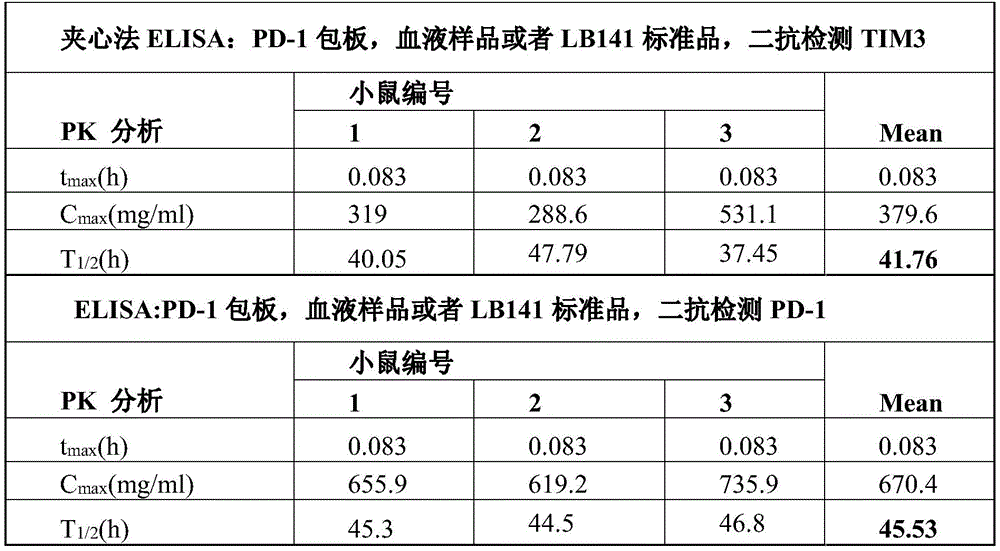
上述结果表明,本发明双特异性抗体LB141注射小鼠体内后,用TIM3和PD-1ELISA得到的tmax一致,T1/2分别为41.76h和45.53小时,非常接近。说明LB141在体内稳定,其中结合TIM-3的部分(scFv)并没有在血液(体内)脱落。表中Cmax的差别是因为定量方法所用二抗(一个针对Tim3,一个针对PD-1)不同。The above results show that after the bispecific antibody LB141 of the present invention is injected into mice, the tmax obtained by TIM3 and PD-1 ELISA are consistent, and the T 1/2 is 41.76h and 45.53 hours, respectively, which are very close. It shows that LB141 is stable in vivo, and the part (scFv) that binds to TIM-3 has not been shed in the blood (in vivo). The difference in Cmax in the table is due to the different secondary antibodies (one for Tim3 and one for PD-1) used in the quantitative method.
实施例25本发明TIM-3和PD-1双特异性抗体制剂配方稳定性评价Example 25 Stability Evaluation of TIM-3 and PD-1 Bispecific Antibody Preparation Formulation of the Present Invention
将本发明双特异性抗体LB141分别用制剂缓冲液和pH7.4的PBS(上海源培生物科技股份有限公司,Cat#B320KJ)配制成15mg/mL,分成等份。冻存于-80℃,放置于37℃7天、第14天后,对各个样品进行结合活性检测(ELISA,方法同前述实施例),以及凝胶电泳(PAGE)分析。结果见下表。The bispecific antibody LB141 of the present invention was prepared into 15 mg/mL with preparation buffer and PBS with pH 7.4 (Shanghai Yuanpei Biotechnology Co., Ltd., Cat#B320KJ), and divided into equal portions. Freeze at -80°C, place at 37°C for 7 days, and after 14 days, each sample was subjected to binding activity detection (ELISA, the method is the same as the previous example) and gel electrophoresis (PAGE) analysis. The results are shown in the table below.
所用制剂缓冲液配方为20mM L-Histidine(上海生工生物工程有限公司,Cat#A604351-0050)、50mg/mL Surcose(上海生工生物工程有限公司,Cat#A610498-0500)和0.02%Tween20(上海生工生物工程有限公司,Cat#A600560-0500),pH6.0。The preparation buffer formula used is 20mM L-Histidine (Shanghai Sangon Bioengineering Co., Ltd., Cat#A604351-0050), 50mg/mL Surcose (Shanghai Sangon Bioengineering Co., Ltd., Cat#A610498-0500) and 0.02% Tween20 ( Shanghai Sangon Bioengineering Co., Ltd., Cat#A600560-0500), pH6.0.
表21本发明双特异性抗体LB141不同溶液体系稳定性评价Table 21 Stability evaluation of different solution systems of the bispecific antibody LB141 of the present invention

*:EC50改变倍数是指EC50和37℃保存0天(即-80℃保存)样品的EC50的比值。比值越大,说明活性减弱越多。*: The change factor of EC50 refers to the ratio of EC50 to the EC50 of the sample stored at 37°C for 0 days (that is, stored at -80°C). The larger the ratio, the more weakened the activity.
上述结果表明,本发明双特异性抗体LB141在高浓度(15mg/mL),37℃保存7天活性稳定,对PD-1和TIM-3的结合活性和0天比较,没有很大改变。37℃保存14天后,对PD-1和TIM-3的结合活性都有减弱,特别是对其与TIM3的结合活性在制剂缓冲液中,活性减弱了47倍。凝聚电泳(PAGE)结果表明,LB141在两种溶解体系里面保存7天,PAGE分析未发现降解。保存14天后,PAGE分析均出现降解。且发现在制剂缓冲液中保存14天的样品比PBS中保存14天的样品降解更加严重。The above results show that the activity of the bispecific antibody LB141 of the present invention is stable at a high concentration (15mg/mL) and stored at 37°C for 7 days, and the binding activity to PD-1 and TIM-3 does not change much compared with that at 0 days. After storage at 37°C for 14 days, the binding activity to both PD-1 and TIM-3 was weakened, especially the binding activity to TIM3 was weakened by 47 times in the preparation buffer. The results of coagulation electrophoresis (PAGE) showed that LB141 was stored in the two dissolution systems for 7 days, and no degradation was found in PAGE analysis. After storage for 14 days, PAGE analysis showed degradation. And it was found that the samples stored in the formulation buffer for 14 days were more degraded than the samples stored in PBS for 14 days.
这些结果表明本发明双特异性抗体在高浓度条件下,37℃保存7天稳定。意外发现,在PBS中保存比在制剂缓冲液(20mM L-Histidine,50mg/mL Surcose,0.02%Tween 20,pH6.0)更稳定。These results indicate that the bispecific antibody of the present invention is stable when stored at 37° C. for 7 days under high concentration conditions. Surprisingly, storage in PBS was found to be more stable than formulation buffer (20 mM L-Histidine, 50 mg/mL Surcose, 0.02
实施例26本发明TIM-3和PD-1双特异性抗体在不同pH值制剂稳定性评价Example 26 Stability evaluation of the TIM-3 and PD-1 bispecific antibody of the present invention at different pH values
将本发明双特异抗体LB141用制剂缓冲液配制成15mg/mL,pH=5.5或者pH=6,分成等份。冻存于-80℃或放置于37℃,7天后,对各个样品进行结合活性检测(ELISA,方法同前述实施例),以及凝胶电泳(PAGE)分析。结果见下表。The bispecific antibody LB141 of the present invention was formulated with a preparation buffer solution of 15 mg/mL, pH=5.5 or pH=6, and divided into equal portions. Freeze at -80°C or place at 37°C. After 7 days, each sample was subjected to binding activity detection (ELISA, the method is the same as the previous example) and gel electrophoresis (PAGE) analysis. The results are shown in the table below.
所用制剂缓冲液配方为10mM L-Histidine(上海生工生物工程有限公司,Cat#A604351-0050),70mg/mL Surcose(上海生工生物工程有限公司,Cat#A610498-0500),0.2%polysorbate 80(Sigma-Aldrich,Cat#59924-100g-F),pH5.5或pH6.0。The formulation buffer used was 10mM L-Histidine (Shanghai Sangon Bioengineering Co., Ltd., Cat#A604351-0050), 70mg/mL Surcose (Shanghai Sangon Bioengineering Co., Ltd., Cat#A610498-0500), 0.2% polysorbate 80 (Sigma-Aldrich, Cat# 59924-100g-F), pH 5.5 or pH 6.0.
表22本发明双特异抗体在不同pH值下稳定性评价Table 22 Stability evaluation of the bispecific antibody of the present invention at different pH values

*:EC50改变倍数是指EC50和37℃保存0天(即-80℃保存)样品的EC50的比值。比值越大,说明活性减弱越多。*: The change factor of EC50 refers to the ratio of EC50 to the EC50 of the sample stored at 37°C for 0 days (that is, stored at -80°C). The larger the ratio, the more weakened the activity.
上述结果表明,以外地,本发明双特异抗体LB141在高浓度(15mg/mL)下,在pH5.5和pH 6.0的制剂缓冲液中,37℃保存7天活性均稳定,对PD-1和TIM-3的结合活性和0天比较,基本没有改变。凝聚电泳(PAGE)结果表明,LB141在两种pH的制剂中保存7天,PAGE分析未发现降解。The above results show that, in addition, the activity of the bispecific antibody LB141 of the present invention is stable at a high concentration (15 mg/mL), in the formulation buffer of pH 5.5 and pH 6.0, and stored at 37°C for 7 days, and has a stable activity against PD-1 and Compared with the 0-day binding activity of TIM-3, there was basically no change. The results of coagulation electrophoresis (PAGE) showed that LB141 was stored in two pH formulations for 7 days, and no degradation was found in PAGE analysis.
这些结果表明本发明双特异抗体在高浓度条件下,在pH5.5和pH6.0的制剂缓冲液(10mM L-Histidine,70mg/mL Surcose,0.2%polysorbate 80)中37℃保存7天均稳定。These results show that the bispecific antibody of the present invention is stable when stored at 37°C for 7 days in preparation buffers (10mM L-Histidine, 70mg/mL Surcose, 0.2% polysorbate 80) at pH 5.5 and pH 6.0 under high concentration conditions .
实施例27本发明TIM-3和PD-1双特异性抗体在pH5.5制剂中温度稳定性评价Example 27 Evaluation of the temperature stability of the TIM-3 and PD-1 bispecific antibody of the present invention in a pH5.5 formulation
将本发明双特异抗体LB141用制剂缓冲液配制成28.5mg/mL(pH=5.5的缓冲液),分成等份。冻存于-80℃或放置于37℃,5天和10天,或放置于40℃,5天和10天后,对各个样品进行结合活性检测(ELISA,方法同前述实施例),以及凝胶电泳(PAGE)分析。结果见下表。Prepare the bispecific antibody LB141 of the present invention with preparation buffer to 28.5 mg/mL (buffer with pH=5.5), and divide it into equal portions. Freeze at -80°C or place at 37°C for 5 days and 10 days, or place at 40°C for 5 days and 10 days, then perform binding activity detection on each sample (ELISA, the method is the same as the previous example), and gel Electrophoresis (PAGE) analysis. The results are shown in the table below.
所用制剂缓冲液配方为10mM L-Histidine(上海生工生物工程有限公司,Cat#A604351-0050),70mg/mL Surcose(上海生工生物工程有限公司,Cat#A610498-0500),0.2%polysorbate 80(Sigma-Aldrich,Cat#59924-100g-F),pH5.5。The formulation buffer used was 10mM L-Histidine (Shanghai Sangon Bioengineering Co., Ltd., Cat#A604351-0050), 70mg/mL Surcose (Shanghai Sangon Bioengineering Co., Ltd., Cat#A610498-0500), 0.2% polysorbate 80 (Sigma-Aldrich, Cat# 59924-100g-F), pH 5.5.
表23本发明双特异抗体在pH5.5缓冲液中不同温度下稳定性评价Table 23 Stability evaluation of the bispecific antibody of the present invention at different temperatures in pH5.5 buffer


*:EC50改变倍数是指EC50和37℃保存0天(即-80℃保存)样品的EC50的比值。比值越大,说明活性减弱越多。*: The change factor of EC50 refers to the ratio of EC50 to the EC50 of the sample stored at 37°C for 0 days (that is, stored at -80°C). The larger the ratio, the more weakened the activity.
上述结果表明,非常意想不到的,本发明双特异抗体LB141在高浓度(28.5mg/mL)下,在pH5.5制剂缓冲液中,37℃保存5天和10天及40℃保存5天和10天活性均稳定,对PD-1和TIM-3的结合活性和0天比较,活性没有改变。凝聚电泳(PAGE)结果表明,LB141在pH5.5的制剂中保存5天和10天及40℃保存5天和10天,PAGE分析均未发现降解。The above results show that, quite unexpectedly, the bispecific antibody LB141 of the present invention was stored at a high concentration (28.5 mg/mL) in pH 5.5 preparation buffer at 37°C for 5 days and 10 days and at 40°C for 5 days and The activity was stable at 10 days, and the binding activity to PD-1 and TIM-3 was not changed compared with that at 0 days. The results of coagulation electrophoresis (PAGE) showed that LB141 was stored in the preparation of pH 5.5 for 5 days and 10 days and 40°C for 5 days and 10 days, and no degradation was found in PAGE analysis.
这些结果表明本发明双特异抗体在高浓度条件下,在pH5.5的制剂缓冲液(10mML-Histidine,70mg/mL Surcose,0.2%polysorbate 80)中37℃和40℃保存10天均稳定。These results show that the bispecific antibody of the present invention is stable at 37°C and 40°C for 10 days in a formulation buffer (10mML-Histidine, 70mg/mL Surcose, 0.2% polysorbate 80) at pH 5.5 under high concentration conditions.
实施例28本发明双特异抗体亲和力评价Example 28 Affinity evaluation of the bispecific antibody of the present invention
用前述实施例4的方法对本发明双特异抗体亲和力检测,结果见下表。The affinity of the bispecific antibody of the present invention was detected by the method of Example 4 above, and the results are shown in the table below.
表24本发明双特异抗体亲和力(Biacore)评价Table 24 Bispecific antibody affinity (Biacore) evaluation of the present invention
上述结果显示本发明双特异抗体LB141和Tim-3、PD-1的亲和力维持在E-09、nM水平,接近单独Pem、Nivo;单独Tim3抗体的亲和力(前述表7)。LB133对PD-1的亲和力到了E-08、10nM级别,即和Pem、Nivo比较亲和力有比较大的降低。带有4份scFvab6的LB247保留了对双靶点的结合活性,但没有加强Tim-3的结合活性。这些结果表明,本发明设计的序列特异双特异抗体LB141显示意外的活性优点,即保留了对双靶点的亲和力。The above results show that the affinity of the bispecific antibody LB141 of the present invention to Tim-3 and PD-1 is maintained at the level of E-09 and nM, which is close to that of Pem and Nivo alone; the affinity of Tim3 alone (Table 7 above). The affinity of LB133 to PD-1 has reached the level of E-08 and 10nM, that is, the affinity of LB133 is relatively lower than that of Pem and Nivo. LB247 with 4 copies of scFvab6 retained the binding activity to dual targets, but did not enhance the binding activity of Tim-3. These results indicate that the sequence-specific bispecific antibody LB141 designed in the present invention has an unexpected activity advantage, that is, it retains the affinity for the dual targets.
实施例29本发明双特异抗体夹心ELISA检测Example 29 Detection of bispecific antibody sandwich ELISA of the present invention
用pH7.4的PBS缓冲液将PD-1(实施例1准备)稀释至1μg/ml浓度,以50μl/孔的体积加入96孔酶标板,于37℃孵育箱中放置2小时。弃去液体后,加入用PBS稀释的5%脱脂牛奶(上海生工生物工程有限公司,A600669-0250)封闭液200μl/孔,4℃放置过夜(16-18小时)进行封闭。弃去封闭液,用PBST缓冲液(pH7.4PBS含0.05%tween-20)洗板5次后,加入10μg/ml起始,用1%BSA 5倍连续稀释的LB141,50μl/孔,37℃孵育1小时,PBST洗板5次,加入50μl/孔1μg/ml的Bio-TIM-3-his(ACROBiosystems,TM-H5229),37℃孵育1小时,PBST洗板5次后,加入50μl/孔1:1000稀释的streptavidin-HRP二抗(南京金斯瑞生物科技有限公司,M00091),37℃孵育1小时。用PBST洗板5次后,加入50μl/孔TMB显色底物(KPL,52-00-03),室温孵育5-10min,加入50μl/孔1M H2SO4终止反应,用MULTISKAN Go酶标仪(ThermoFisher,51119200)在450nm处读取吸收值,根据OD值计算EC50。PD-1 (prepared in Example 1) was diluted to a concentration of 1 μg/ml with PBS buffer solution of pH 7.4, added to a 96-well microplate at a volume of 50 μl/well, and placed in an incubator at 37° C. for 2 hours. After the liquid was discarded, 200 μl/well of blocking solution diluted with 5% skimmed milk (Shanghai Sangon Bioengineering Co., Ltd., A600669-0250) diluted with PBS was added, and placed at 4° C. overnight (16-18 hours) for blocking. Discard the blocking solution, wash the
用pH7.4的PBS缓冲液将TIM-3-hFc(Acro biosystems,22-142)稀释至5μg/ml,以50μl/孔的体积加入96孔酶标板中,于37℃孵育2小时。弃去液体后,加入用PBS稀释的5%脱脂牛奶封闭液200μl/孔,4℃放置过夜(16-18小时)进行封闭。弃去封闭液,并用PBST缓冲液(pH7.4PBS含0.05%tween-20)洗板5次后,加入10μg/ml起始,用1%BSA 5倍连续稀释的LB141,50μl/孔,37℃孵育1小时,PBST洗板5次后,加入50μl/孔10μg/ml的PD-1-his(实施例1准备),37℃孵育1小时,PBST洗板5次后,加入50μl/孔1:2500稀释的anti-his-HRP二抗(南京金斯瑞生物科技有限公司,A00612),37℃孵育1小时。用PBST洗板5次后,加入50μl/孔TMB显色底物(KPL,52-00-03),室温孵育5-10min,加入50μl/孔1M H2SO4终止反应,用MULTISKANGo酶标仪(ThermoFisher,51119200)在450nm处读取吸收值,根据OD值计算EC50。结果见下表。TIM-3-hFc (Acro biosystems, 22-142) was diluted to 5 μg/ml with PBS buffer at pH 7.4, added to a 96-well ELISA plate at a volume of 50 μl/well, and incubated at 37° C. for 2 hours. After the liquid was discarded, 200 μl/well of 5% skimmed milk blocking solution diluted with PBS was added, and left at 4° C. overnight (16-18 hours) for blocking. Discard the blocking solution and wash the
表25针对LAG-3和PD-1双特异抗体双夹心ELISA(EC50,nM)Table 25 Double-sandwich ELISA for LAG-3 and PD-1 bispecific antibody (EC50, nM)

上述结果表明,本发明双特异抗体LB141能同时结合Tim-3和PD-1。结合其中一个靶点没有显著阻止其结合另外一个靶点。The above results show that the bispecific antibody LB141 of the present invention can simultaneously bind Tim-3 and PD-1. Binding to one of the targets did not significantly prevent binding to the other.
实施例30本发明双特异抗体分子量分析(LC-MS)Example 30 Molecular weight analysis (LC-MS) of the bispecific antibody of the present invention
LB141用制剂配方(见实施例27)配制成19mg/mL(pH=5.5)。取10μl LB141至1.5ml离心管中,用无菌水稀释至1μg/μL。加入1μL PNGaseF(Biolabs,P0704L),混匀,37℃反应16h后加入1μL 1M DTT,混匀后37℃孵育1h。用Dionex Ultimate 3000 UHPLC/ThermoScientific Q Exactive(thermo,MS-B20-03),(HPLC,Agilent,5188-2788)进行质谱分析。结果见下表。LB141 was formulated at 19 mg/mL (pH=5.5) using the formulation formulation (see Example 27). Take 10μl LB141 to a 1.5ml centrifuge tube and dilute to 1μg/μL with sterile water. Add 1 μL PNGaseF (Biolabs, P0704L), mix well, react at 37°C for 16 hours, add 1 μL 1M DTT, mix well and incubate at 37°C for 1 hour. Mass spectrometry was performed with Dionex Ultimate 3000 UHPLC/ThermoScientific Q Exactive (thermo, MS-B20-03), (HPLC, Agilent, 5188-2788). The results are shown in the table below.
表26本发明针对LAG-3和PD-1双特异抗体LC-MS分析Table 26 LC-MS analysis of the present invention for LAG-3 and PD-1 bispecific antibody

上述结果表明,本发明双特异抗体LB141轻链检测分子量和理论分子量一致。重链检测分子量和理论分子量相差2.95Da,在仪器的误差范围内(<50ppm)。说明本发明设计、表达纯化的双特异抗体LB141和预期/设计序列一致。The above results show that the detected molecular weight of the light chain of the bispecific antibody LB141 of the present invention is consistent with the theoretical molecular weight. The difference between the detected molecular weight and the theoretical molecular weight of the heavy chain is 2.95Da, which is within the error range of the instrument (<50ppm). It shows that the bispecific antibody LB141 designed, expressed and purified by the present invention is consistent with the expected/designed sequence.
虽然以上描述了本发明的具体实施方式,但是本领域的技术人员应当理解,这些仅是举例说明,在不背离本发明的原理和实质的前提下,可以对这些实施方式做出多种变更或修改。因此,本发明的保护范围由所附权利要求书限定。Although the specific implementations of the present invention have been described above, those skilled in the art should understand that these are only examples, and various changes or changes can be made to these implementations without departing from the principle and essence of the present invention. Revise. Accordingly, the protection scope of the present invention is defined by the appended claims.
SEQUENCE LISTINGSEQUENCE LISTING
<110> 上海健信生物医药科技有限公司<110> Shanghai Jianxin Biomedical Technology Co., Ltd.
<120> 一种双特异性抗体及其用途<120> A bispecific antibody and its use
<130> P19011673C<130> P19011673C
<150> 2018107200488<150> 2018107200488
<151> 2018-07-03<151> 2018-07-03
<160> 34<160> 34
<170> PatentIn version 3.5<170> PatentIn version 3.5
<210> 1<210> 1
<211> 5<211> 5
<212> PRT<212> PRT
<213> Artificial Sequence<213> Artificial Sequence
<220><220>
<223> ab6按Kabat定义重链CDR1<223> ab6 heavy chain CDR1 defined by Kabat
<400> 1<400> 1
Asp Tyr Tyr Met AlaAsp Tyr Tyr Met Ala
1 51 5
<210> 2<210> 2
<211> 17<211> 17
<212> PRT<212> PRT
<213> Artificial Sequence<213> Artificial Sequence
<220><220>
<223> ab6按Kabat定义重链CDR2<223> ab6 heavy chain CDR2 defined by Kabat
<400> 2<400> 2
Asn Ile Asn Tyr Asp Gly Ser Asn Thr Tyr Tyr Leu Asp Ser Leu LysAsn Ile Asn Tyr Asp Gly Ser Asn Thr Tyr Tyr Leu Asp Ser Leu Lys
1 5 10 151 5 10 15
SerSer
<210> 3<210> 3
<211> 12<211> 12
<212> PRT<212> PRT
<213> Artificial Sequence<213> Artificial Sequence
<220><220>
<223> ab6按Kabat定义重链CDR3<223> ab6 heavy chain CDR3 defined by Kabat
<400> 3<400> 3
Gly Leu Tyr Tyr Tyr Gly Gly Asn Tyr Phe Ala TyrGly Leu Tyr Tyr Tyr Gly Gly Asn Tyr Phe Ala Tyr
1 5 101 5 10
<210> 4<210> 4
<211> 5<211> 5
<212> PRT<212> PRT
<213> Artificial Sequence<213> Artificial Sequence
<220><220>
<223> ab32按Kabat定义的重链CDR1<223> ab32 heavy chain CDR1 defined by Kabat
<400> 4<400> 4
Asp Tyr Tyr Met ThrAsp Tyr Tyr Met Thr
1 51 5
<210> 5<210> 5
<211> 17<211> 17
<212> PRT<212> PRT
<213> Artificial Sequence<213> Artificial Sequence
<220><220>
<223> ab32按Kabat定义的重链CDR2<223> ab32 heavy chain CDR2 defined by Kabat
<400> 5<400> 5
Ser Ile Asn Tyr Asp Gly Arg Asn Thr Tyr Tyr Leu Asp Ser Leu LysSer Ile Asn Tyr Asp Gly Arg Asn Thr Tyr Tyr Leu Asp Ser Leu Lys
1 5 10 151 5 10 15
SerSer
<210> 6<210> 6
<211> 14<211> 14
<212> PRT<212> PRT
<213> Artificial Sequence<213> Artificial Sequence
<220><220>
<223> ab32按Kabat定义的重链CDR3<223> ab32 heavy chain CDR3 defined by Kabat
<400> 6<400> 6
Gly Tyr Tyr Tyr Tyr Gly Ser Ser Pro Asn Tyr Phe Asp TyrGly Tyr Tyr Tyr Tyr Gly Ser Ser Pro Asn Tyr Phe Asp Tyr
1 5 101 5 10
<210> 7<210> 7
<211> 11<211> 11
<212> PRT<212> PRT
<213> Artificial Sequence<213> Artificial Sequence
<220><220>
<223> ab6按Kabat定义轻链CDR1<223> ab6 light chain CDR1 defined by Kabat
<400> 7<400> 7
His Ala Ser Gln Gly Ile Ser Ser Asn Ile GlyHis Ala Ser Gln Gly Ile Ser Ser Asn Ile Gly
1 5 101 5 10
<210> 8<210> 8
<211> 7<211> 7
<212> PRT<212> PRT
<213> Artificial Sequence<213> Artificial Sequence
<220><220>
<223> ab6按Kabat定义轻链CDR2<223> ab6 light chain CDR2 defined by Kabat
<400> 8<400> 8
Gln Gly Ser Asn Leu Glu AspGln Gly Ser Asn Leu Glu Asp
1 51 5
<210> 9<210> 9
<211> 9<211> 9
<212> PRT<212> PRT
<213> Artificial Sequence<213> Artificial Sequence
<220><220>
<223> ab6按Kabat定义轻链CDR3<223> ab6 light chain CDR3 defined by Kabat
<400> 9<400> 9
Val Gln Phe Ala Gln Phe Pro Pro ThrVal Gln Phe Ala Gln Phe Pro Pro Thr
1 51 5
<210> 10<210> 10
<211> 11<211> 11
<212> PRT<212> PRT
<213> Artificial Sequence<213> Artificial Sequence
<220><220>
<223> ab32按Kabat定义的轻链CDR1<223> ab32 light chain CDR1 defined by Kabat
<400> 10<400> 10
Arg Ala Ser Glu Asn Ile Tyr Ser Tyr Leu ThrArg Ala Ser Glu Asn Ile Tyr Ser Tyr Leu Thr
1 5 101 5 10
<210> 11<210> 11
<211> 7<211> 7
<212> PRT<212> PRT
<213> Artificial Sequence<213> Artificial Sequence
<220><220>
<223> ab32按Kabat定义的轻链CDR2<223> ab32 light chain CDR2 as defined by Kabat
<400> 11<400> 11
Asn Ala Lys Thr Leu Ala GluAsn Ala Lys Thr Leu Ala Glu
1 51 5
<210> 12<210> 12
<211> 9<211> 9
<212> PRT<212> PRT
<213> Artificial Sequence<213> Artificial Sequence
<220><220>
<223> ab32按Kabat定义的轻链CDR3<223> ab32 light chain CDR3 defined by Kabat
<400> 12<400> 12
Gln Gln His Tyr Gly Thr Pro Leu ThrGln Gln His Tyr Gly Thr Pro Leu Thr
1 51 5
<210> 13<210> 13
<211> 121<211> 121
<212> PRT<212> PRT
<213> Artificial Sequence<213> Artificial Sequence
<220><220>
<223> ab6VH<223>ab6VH
<400> 13<400> 13
Glu Val Gln Leu Val Glu Ser Gly Gly Gly Leu Val Lys Pro Gly GlyGlu Val Gln Leu Val Glu Ser Gly Gly Gly Leu Val Lys Pro Gly Gly
1 5 10 151 5 10 15
Ser Leu Arg Leu Ser Cys Ala Ala Ser Gly Phe Thr Phe Ser Asp TyrSer Leu Arg Leu Ser Cys Ala Ala Ser Gly Phe Thr Phe Ser Asp Tyr
20 25 30 20 25 30
Tyr Met Ala Trp Val Arg Gln Ala Pro Gly Lys Gly Leu Glu Trp ValTyr Met Ala Trp Val Arg Gln Ala Pro Gly Lys Gly Leu Glu Trp Val
35 40 45 35 40 45
Ala Asn Ile Asn Tyr Asp Gly Ser Asn Thr Tyr Tyr Leu Asp Ser LeuAla Asn Ile Asn Tyr Asp Gly Ser Asn Thr Tyr Tyr Leu Asp Ser Leu
50 55 60 50 55 60
Lys Ser Arg Phe Thr Ile Ser Arg Asp Asn Ala Lys Asn Ser Leu TyrLys Ser Arg Phe Thr Ile Ser Arg Asp Asn Ala Lys Asn Ser Leu Tyr
65 70 75 8065 70 75 80
Leu Gln Met Asn Ser Leu Arg Ala Glu Asp Thr Ala Val Tyr Tyr CysLeu Gln Met Asn Ser Leu Arg Ala Glu Asp Thr Ala Val Tyr Tyr Cys
85 90 95 85 90 95
Ala Arg Gly Leu Tyr Tyr Tyr Gly Gly Asn Tyr Phe Ala Tyr Trp GlyAla Arg Gly Leu Tyr Tyr Tyr Gly Gly Asn Tyr Phe Ala Tyr Trp Gly
100 105 110 100 105 110
Gln Gly Thr Leu Val Thr Val Ser SerGln Gly Thr Leu Val Thr Val Ser Ser
115 120 115 120
<210> 14<210> 14
<211> 107<211> 107
<212> PRT<212> PRT
<213> Artificial Sequence<213> Artificial Sequence
<220><220>
<223> ab6VL<223>ab6VL
<400> 14<400> 14
Asp Ile Gln Met Thr Gln Ser Pro Ser Ser Leu Ser Ala Ser Val GlyAsp Ile Gln Met Thr Gln Ser Pro Ser Ser Leu Ser Ala Ser Val Gly
1 5 10 151 5 10 15
Asp Arg Val Thr Ile Thr Cys His Ala Ser Gln Gly Ile Ser Ser AsnAsp Arg Val Thr Ile Thr Cys His Ala Ser Gln Gly Ile Ser Ser Ser Asn
20 25 30 20 25 30
Ile Gly Trp Leu Gln Gln Lys Pro Gly Lys Ala Phe Lys Gly Leu IleIle Gly Trp Leu Gln Gln Lys Pro Gly Lys Ala Phe Lys Gly Leu Ile
35 40 45 35 40 45
Tyr Gln Gly Ser Asn Leu Glu Asp Gly Val Pro Ser Arg Phe Ser GlyTyr Gln Gly Ser Asn Leu Glu Asp Gly Val Pro Ser Arg Phe Ser Gly
50 55 60 50 55 60
Ser Gly Ser Gly Ala Asp Tyr Thr Leu Thr Ile Ser Ser Leu Gln ProSer Gly Ser Gly Ala Asp Tyr Thr Leu Thr Ile Ser Ser Leu Gln Pro
65 70 75 8065 70 75 80
Glu Asp Phe Ala Thr Tyr Tyr Cys Val Gln Phe Ala Gln Phe Pro ProGlu Asp Phe Ala Thr Tyr Tyr Cys Val Gln Phe Ala Gln Phe Pro Pro
85 90 95 85 90 95
Thr Phe Gly Gln Gly Thr Lys Leu Glu Ile LysThr Phe Gly Gln Gly Thr Lys Leu Glu Ile Lys
100 105 100 105
<210> 15<210> 15
<211> 123<211> 123
<212> PRT<212> PRT
<213> Artificial Sequence<213> Artificial Sequence
<220><220>
<223> ab32VH<223>ab32VH
<400> 15<400> 15
Glu Val Gln Leu Val Glu Ser Gly Gly Gly Leu Val Lys Pro Gly GlyGlu Val Gln Leu Val Glu Ser Gly Gly Gly Leu Val Lys Pro Gly Gly
1 5 10 151 5 10 15
Ser Leu Arg Leu Ser Cys Ala Ala Ser Gly Phe Thr Phe Ser Asp TyrSer Leu Arg Leu Ser Cys Ala Ala Ser Gly Phe Thr Phe Ser Asp Tyr
20 25 30 20 25 30
Tyr Met Thr Trp Val Arg Gln Ala Pro Gly Lys Gly Leu Glu Trp ValTyr Met Thr Trp Val Arg Gln Ala Pro Gly Lys Gly Leu Glu Trp Val
35 40 45 35 40 45
Ser Ser Ile Asn Tyr Asp Gly Arg Asn Thr Tyr Tyr Leu Asp Ser LeuSer Ser Ile Asn Tyr Asp Gly Arg Asn Thr Tyr Tyr Leu Asp Ser Leu
50 55 60 50 55 60
Lys Ser Arg Phe Thr Ile Ser Arg Asp Asn Ala Lys Asn Ser Leu TyrLys Ser Arg Phe Thr Ile Ser Arg Asp Asn Ala Lys Asn Ser Leu Tyr
65 70 75 8065 70 75 80
Leu Gln Met Asn Ser Leu Arg Ala Glu Asp Thr Ala Val Tyr Tyr CysLeu Gln Met Asn Ser Leu Arg Ala Glu Asp Thr Ala Val Tyr Tyr Cys
85 90 95 85 90 95
Ala Arg Gly Tyr Tyr Tyr Tyr Gly Ser Ser Pro Asn Tyr Phe Asp TyrAla Arg Gly Tyr Tyr Tyr Tyr Gly Ser Ser Pro Asn Tyr Phe Asp Tyr
100 105 110 100 105 110
Trp Gly Gln Gly Thr Leu Val Thr Val Ser SerTrp Gly Gln Gly Thr Leu Val Thr Val Ser Ser
115 120 115 120
<210> 16<210> 16
<211> 107<211> 107
<212> PRT<212> PRT
<213> Artificial Sequence<213> Artificial Sequence
<220><220>
<223> ab32VL<223>ab32VL
<400> 16<400> 16
Asp Ile Gln Met Thr Gln Ser Pro Ser Ser Leu Ser Ala Ser Val GlyAsp Ile Gln Met Thr Gln Ser Pro Ser Ser Leu Ser Ala Ser Val Gly
1 5 10 151 5 10 15
Asp Arg Val Thr Ile Thr Cys Arg Ala Ser Glu Asn Ile Tyr Ser TyrAsp Arg Val Thr Ile Thr Cys Arg Ala Ser Glu Asn Ile Tyr Ser Tyr
20 25 30 20 25 30
Leu Thr Trp Tyr Gln Gln Lys Pro Gly Lys Ala Pro Lys Leu Leu IleLeu Thr Trp Tyr Gln Gln Lys Pro Gly Lys Ala Pro Lys Leu Leu Ile
35 40 45 35 40 45
Tyr Asn Ala Lys Thr Leu Ala Glu Gly Val Pro Ser Arg Phe Ser GlyTyr Asn Ala Lys Thr Leu Ala Glu Gly Val Pro Ser Arg Phe Ser Gly
50 55 60 50 55 60
Ser Gly Ser Gly Thr Asp Phe Thr Leu Thr Ile Ser Ser Leu Gln ProSer Gly Ser Gly Thr Asp Phe Thr Leu Thr Ile Ser Ser Leu Gln Pro
65 70 75 8065 70 75 80
Glu Asp Phe Ala Thr Tyr Tyr Cys Gln Gln His Tyr Gly Thr Pro LeuGlu Asp Phe Ala Thr Tyr Tyr Cys Gln Gln His Tyr Gly Thr Pro Leu
85 90 95 85 90 95
Thr Phe Gly Gln Gly Thr Lys Leu Glu Ile LysThr Phe Gly Gln Gly Thr Lys Leu Glu Ile Lys
100 105 100 105
<210> 17<210> 17
<211> 214<211> 214
<212> PRT<212> PRT
<213> Artificial Sequence<213> Artificial Sequence
<220><220>
<223> LB133/LB134轻链<223> LB133/LB134 light chain
<400> 17<400> 17
Glu Ile Val Leu Thr Gln Ser Pro Ala Thr Leu Ser Leu Ser Pro GlyGlu Ile Val Leu Thr Gln Ser Pro Ala Thr Leu Ser Leu Ser Pro Gly
1 5 10 151 5 10 15
Glu Arg Ala Thr Leu Ser Cys Arg Ala Ser Gln Ser Val Ser Ser TyrGlu Arg Ala Thr Leu Ser Cys Arg Ala Ser Gln Ser Val Ser Ser Tyr
20 25 30 20 25 30
Leu Ala Trp Tyr Gln Gln Lys Pro Gly Gln Ala Pro Arg Leu Leu IleLeu Ala Trp Tyr Gln Gln Lys Pro Gly Gln Ala Pro Arg Leu Leu Ile
35 40 45 35 40 45
Tyr Asp Ala Ser Asn Arg Ala Thr Gly Ile Pro Ala Arg Phe Ser GlyTyr Asp Ala Ser Asn Arg Ala Thr Gly Ile Pro Ala Arg Phe Ser Gly
50 55 60 50 55 60
Ser Gly Ser Gly Thr Asp Phe Thr Leu Thr Ile Ser Ser Leu Glu ProSer Gly Ser Gly Thr Asp Phe Thr Leu Thr Ile Ser Ser Leu Glu Pro
65 70 75 8065 70 75 80
Glu Asp Phe Ala Val Tyr Tyr Cys Gln Gln Ser Ser Asn Trp Pro ArgGlu Asp Phe Ala Val Tyr Tyr Cys Gln Gln Ser Ser Asn Trp Pro Arg
85 90 95 85 90 95
Thr Phe Gly Gln Gly Thr Lys Val Glu Ile Lys Arg Thr Val Ala AlaThr Phe Gly Gln Gly Thr Lys Val Glu Ile Lys Arg Thr Val Ala Ala
100 105 110 100 105 110
Pro Ser Val Phe Ile Phe Pro Pro Ser Asp Glu Gln Leu Lys Ser GlyPro Ser Val Phe Ile Phe Pro Pro Ser Asp Glu Gln Leu Lys Ser Gly
115 120 125 115 120 125
Thr Ala Ser Val Val Cys Leu Leu Asn Asn Phe Tyr Pro Arg Glu AlaThr Ala Ser Val Val Cys Leu Leu Asn Asn Phe Tyr Pro Arg Glu Ala
130 135 140 130 135 140
Lys Val Gln Trp Lys Val Asp Asn Ala Leu Gln Ser Gly Asn Ser GlnLys Val Gln Trp Lys Val Asp Asn Ala Leu Gln Ser Gly Asn Ser Gln
145 150 155 160145 150 155 160
Glu Ser Val Thr Glu Gln Asp Ser Lys Asp Ser Thr Tyr Ser Leu SerGlu Ser Val Thr Glu Gln Asp Ser Lys Asp Ser Thr Tyr Ser Leu Ser
165 170 175 165 170 175
Ser Thr Leu Thr Leu Ser Lys Ala Asp Tyr Glu Lys His Lys Val TyrSer Thr Leu Thr Leu Ser Lys Ala Asp Tyr Glu Lys His Lys Val Tyr
180 185 190 180 185 190
Ala Cys Glu Val Thr His Gln Gly Leu Ser Ser Pro Val Thr Lys SerAla Cys Glu Val Thr His Gln Gly Leu Ser Ser Pro Val Thr Lys Ser
195 200 205 195 200 205
Phe Asn Arg Gly Glu CysPhe Asn Arg Gly Glu Cys
210 210
<210> 18<210> 18
<211> 698<211> 698
<212> PRT<212> PRT
<213> Artificial Sequence<213> Artificial Sequence
<220><220>
<223> LB133重链<223> LB133 heavy chain
<400> 18<400> 18
Asp Ile Gln Met Thr Gln Ser Pro Ser Ser Leu Ser Ala Ser Val GlyAsp Ile Gln Met Thr Gln Ser Pro Ser Ser Leu Ser Ala Ser Val Gly
1 5 10 151 5 10 15
Asp Arg Val Thr Ile Thr Cys His Ala Ser Gln Gly Ile Ser Ser AsnAsp Arg Val Thr Ile Thr Cys His Ala Ser Gln Gly Ile Ser Ser Ser Asn
20 25 30 20 25 30
Ile Gly Trp Leu Gln Gln Lys Pro Gly Lys Ala Phe Lys Gly Leu IleIle Gly Trp Leu Gln Gln Lys Pro Gly Lys Ala Phe Lys Gly Leu Ile
35 40 45 35 40 45
Tyr Gln Gly Ser Asn Leu Glu Asp Gly Val Pro Ser Arg Phe Ser GlyTyr Gln Gly Ser Asn Leu Glu Asp Gly Val Pro Ser Arg Phe Ser Gly
50 55 60 50 55 60
Ser Gly Ser Gly Ala Asp Tyr Thr Leu Thr Ile Ser Ser Leu Gln ProSer Gly Ser Gly Ala Asp Tyr Thr Leu Thr Ile Ser Ser Leu Gln Pro
65 70 75 8065 70 75 80
Glu Asp Phe Ala Thr Tyr Tyr Cys Val Gln Phe Ala Gln Phe Pro ProGlu Asp Phe Ala Thr Tyr Tyr Cys Val Gln Phe Ala Gln Phe Pro Pro
85 90 95 85 90 95
Thr Phe Gly Gln Gly Thr Lys Leu Glu Ile Lys Gly Gly Gly Gly SerThr Phe Gly Gln Gly Thr Lys Leu Glu Ile Lys Gly Gly Gly Gly Ser
100 105 110 100 105 110
Gly Gly Gly Gly Ser Gly Gly Gly Gly Ser Glu Val Gln Leu Val GluGly Gly Gly Gly Ser Gly Gly Gly Gly Ser Glu Val Gln Leu Val Glu
115 120 125 115 120 125
Ser Gly Gly Gly Leu Val Lys Pro Gly Gly Ser Leu Arg Leu Ser CysSer Gly Gly Gly Leu Val Lys Pro Gly Gly Ser Leu Arg Leu Ser Cys
130 135 140 130 135 140
Ala Ala Ser Gly Phe Thr Phe Ser Asp Tyr Tyr Met Ala Trp Val ArgAla Ala Ser Gly Phe Thr Phe Ser Asp Tyr Tyr Met Ala Trp Val Arg
145 150 155 160145 150 155 160
Gln Ala Pro Gly Lys Gly Leu Glu Trp Val Ala Asn Ile Asn Tyr AspGln Ala Pro Gly Lys Gly Leu Glu Trp Val Ala Asn Ile Asn Tyr Asp
165 170 175 165 170 175
Gly Ser Asn Thr Tyr Tyr Leu Asp Ser Leu Lys Ser Arg Phe Thr IleGly Ser Asn Thr Tyr Tyr Leu Asp Ser Leu Lys Ser Arg Phe Thr Ile
180 185 190 180 185 190
Ser Arg Asp Asn Ala Lys Asn Ser Leu Tyr Leu Gln Met Asn Ser LeuSer Arg Asp Asn Ala Lys Asn Ser Leu Tyr Leu Gln Met Asn Ser Leu
195 200 205 195 200 205
Arg Ala Glu Asp Thr Ala Val Tyr Tyr Cys Ala Arg Gly Leu Tyr TyrArg Ala Glu Asp Thr Ala Val Tyr Tyr Cys Ala Arg Gly Leu Tyr Tyr
210 215 220 210 215 220
Tyr Gly Gly Asn Tyr Phe Ala Tyr Trp Gly Gln Gly Thr Leu Val ThrTyr Gly Gly Asn Tyr Phe Ala Tyr Trp Gly Gln Gly Thr Leu Val Thr
225 230 235 240225 230 235 240
Val Ser Ser Gly Gly Gly Gly Ser Gly Gly Gly Gly Ser Gly Gly GlyVal Ser Ser Gly Gly Gly Gly Ser Gly Gly Gly Gly Ser Gly Gly Gly
245 250 255 245 250 255
Gly Ser Gln Val Gln Leu Val Glu Ser Gly Gly Gly Val Val Gln ProGly Ser Gln Val Gln Leu Val Glu Ser Gly Gly Gly Val Val Gln Pro
260 265 270 260 265 270
Gly Arg Ser Leu Arg Leu Asp Cys Lys Ala Ser Gly Ile Thr Phe SerGly Arg Ser Leu Arg Leu Asp Cys Lys Ala Ser Gly Ile Thr Phe Ser
275 280 285 275 280 285
Asn Ser Gly Met His Trp Val Arg Gln Ala Pro Gly Lys Gly Leu GluAsn Ser Gly Met His Trp Val Arg Gln Ala Pro Gly Lys Gly Leu Glu
290 295 300 290 295 300
Trp Val Ala Val Ile Trp Tyr Asp Gly Ser Lys Arg Tyr Tyr Ala AspTrp Val Ala Val Ile Trp Tyr Asp Gly Ser Lys Arg Tyr Tyr Ala Asp
305 310 315 320305 310 315 320
Ser Val Lys Gly Arg Phe Thr Ile Ser Arg Asp Asn Ser Lys Asn ThrSer Val Lys Gly Arg Phe Thr Ile Ser Arg Asp Asn Ser Lys Asn Thr
325 330 335 325 330 335
Leu Phe Leu Gln Met Asn Ser Leu Arg Ala Glu Asp Thr Ala Val TyrLeu Phe Leu Gln Met Asn Ser Leu Arg Ala Glu Asp Thr Ala Val Tyr
340 345 350 340 345 350
Tyr Cys Ala Thr Asn Asp Asp Tyr Trp Gly Gln Gly Thr Leu Val ThrTyr Cys Ala Thr Asn Asp Asp Tyr Trp Gly Gln Gly Thr Leu Val Thr
355 360 365 355 360 365
Val Ser Ser Ala Ser Thr Lys Gly Pro Ser Val Phe Pro Leu Ala ProVal Ser Ser Ala Ser Thr Lys Gly Pro Ser Val Phe Pro Leu Ala Pro
370 375 380 370 375 380
Cys Ser Arg Ser Thr Ser Glu Ser Thr Ala Ala Leu Gly Cys Leu ValCys Ser Arg Ser Thr Ser Glu Ser Thr Ala Ala Leu Gly Cys Leu Val
385 390 395 400385 390 395 400
Lys Asp Tyr Phe Pro Glu Pro Val Thr Val Ser Trp Asn Ser Gly AlaLys Asp Tyr Phe Pro Glu Pro Val Thr Val Ser Trp Asn Ser Gly Ala
405 410 415 405 410 415
Leu Thr Ser Gly Val His Thr Phe Pro Ala Val Leu Gln Ser Ser GlyLeu Thr Ser Gly Val His Thr Phe Pro Ala Val Leu Gln Ser Ser Gly
420 425 430 420 425 430
Leu Tyr Ser Leu Ser Ser Val Val Thr Val Pro Ser Ser Ser Leu GlyLeu Tyr Ser Leu Ser Ser Val Val Thr Val Pro Ser Ser Ser Leu Gly
435 440 445 435 440 445
Thr Lys Thr Tyr Thr Cys Asn Val Asp His Lys Pro Ser Asn Thr LysThr Lys Thr Tyr Thr Cys Asn Val Asp His Lys Pro Ser Asn Thr Lys
450 455 460 450 455 460
Val Asp Lys Arg Val Glu Ser Lys Tyr Gly Pro Pro Cys Pro Pro CysVal Asp Lys Arg Val Glu Ser Lys Tyr Gly Pro Pro Cys Pro Pro Cys
465 470 475 480465 470 475 480
Pro Ala Pro Glu Phe Leu Gly Gly Pro Ser Val Phe Leu Phe Pro ProPro Ala Pro Glu Phe Leu Gly Gly Pro Ser Val Phe Leu Phe Pro Pro
485 490 495 485 490 495
Lys Pro Lys Asp Thr Leu Met Ile Ser Arg Thr Pro Glu Val Thr CysLys Pro Lys Asp Thr Leu Met Ile Ser Arg Thr Pro Glu Val Thr Cys
500 505 510 500 505 510
Val Val Val Asp Val Ser Gln Glu Asp Pro Glu Val Gln Phe Asn TrpVal Val Val Asp Val Ser Gln Glu Asp Pro Glu Val Gln Phe Asn Trp
515 520 525 515 520 525
Tyr Val Asp Gly Val Glu Val His Asn Ala Lys Thr Lys Pro Arg GluTyr Val Asp Gly Val Glu Val His Asn Ala Lys Thr Lys Pro Arg Glu
530 535 540 530 535 540
Glu Gln Phe Asn Ser Thr Tyr Arg Val Val Ser Val Leu Thr Val LeuGlu Gln Phe Asn Ser Thr Tyr Arg Val Val Ser Val Leu Thr Val Leu
545 550 555 560545 550 555 560
His Gln Asp Trp Leu Asn Gly Lys Glu Tyr Lys Cys Lys Val Ser AsnHis Gln Asp Trp Leu Asn Gly Lys Glu Tyr Lys Cys Lys Val Ser Asn
565 570 575 565 570 575
Lys Gly Leu Pro Ser Ser Ile Glu Lys Thr Ile Ser Lys Ala Lys GlyLys Gly Leu Pro Ser Ser Ile Glu Lys Thr Ile Ser Lys Ala Lys Gly
580 585 590 580 585 590
Gln Pro Arg Glu Pro Gln Val Tyr Thr Leu Pro Pro Ser Gln Glu GluGln Pro Arg Glu Pro Gln Val Tyr Thr Leu Pro Pro Ser Gln Glu Glu
595 600 605 595 600 605
Met Thr Lys Asn Gln Val Ser Leu Thr Cys Leu Val Lys Gly Phe TyrMet Thr Lys Asn Gln Val Ser Leu Thr Cys Leu Val Lys Gly Phe Tyr
610 615 620 610 615 620
Pro Ser Asp Ile Ala Val Glu Trp Glu Ser Asn Gly Gln Pro Glu AsnPro Ser Asp Ile Ala Val Glu Trp Glu Ser Asn Gly Gln Pro Glu Asn
625 630 635 640625 630 635 640
Asn Tyr Lys Thr Thr Pro Pro Val Leu Asp Ser Asp Gly Ser Phe PheAsn Tyr Lys Thr Thr Pro Pro Val Leu Asp Ser Asp Gly Ser Phe Phe
645 650 655 645 650 655
Leu Tyr Ser Arg Leu Thr Val Asp Lys Ser Arg Trp Gln Glu Gly AsnLeu Tyr Ser Arg Leu Thr Val Asp Lys Ser Arg Trp Gln Glu Gly Asn
660 665 670 660 665 670
Val Phe Ser Cys Ser Val Met His Glu Ala Leu His Asn His Tyr ThrVal Phe Ser Cys Ser Val Met His Glu Ala Leu His Asn His Tyr Thr
675 680 685 675 680 685
Gln Lys Ser Leu Ser Leu Ser Leu Gly LysGln Lys Ser Leu Ser Leu Ser Leu Gly Lys
690 695 690 695
<210> 19<210> 19
<211> 700<211> 700
<212> PRT<212> PRT
<213> Artificial Sequence<213> Artificial Sequence
<220><220>
<223> LB134重链<223> LB134 heavy chain
<400> 19<400> 19
Asp Ile Gln Met Thr Gln Ser Pro Ser Ser Leu Ser Ala Ser Val GlyAsp Ile Gln Met Thr Gln Ser Pro Ser Ser Leu Ser Ala Ser Val Gly
1 5 10 151 5 10 15
Asp Arg Val Thr Ile Thr Cys Arg Ala Ser Glu Asn Ile Tyr Ser TyrAsp Arg Val Thr Ile Thr Cys Arg Ala Ser Glu Asn Ile Tyr Ser Tyr
20 25 30 20 25 30
Leu Thr Trp Tyr Gln Gln Lys Pro Gly Lys Ala Pro Lys Leu Leu IleLeu Thr Trp Tyr Gln Gln Lys Pro Gly Lys Ala Pro Lys Leu Leu Ile
35 40 45 35 40 45
Tyr Asn Ala Lys Thr Leu Ala Glu Gly Val Pro Ser Arg Phe Ser GlyTyr Asn Ala Lys Thr Leu Ala Glu Gly Val Pro Ser Arg Phe Ser Gly
50 55 60 50 55 60
Ser Gly Ser Gly Thr Asp Phe Thr Leu Thr Ile Ser Ser Leu Gln ProSer Gly Ser Gly Thr Asp Phe Thr Leu Thr Ile Ser Ser Leu Gln Pro
65 70 75 8065 70 75 80
Glu Asp Phe Ala Thr Tyr Tyr Cys Gln Gln His Tyr Gly Thr Pro LeuGlu Asp Phe Ala Thr Tyr Tyr Cys Gln Gln His Tyr Gly Thr Pro Leu
85 90 95 85 90 95
Thr Phe Gly Gln Gly Thr Lys Leu Glu Ile Lys Gly Gly Gly Gly SerThr Phe Gly Gln Gly Thr Lys Leu Glu Ile Lys Gly Gly Gly Gly Ser
100 105 110 100 105 110
Gly Gly Gly Gly Ser Gly Gly Gly Gly Ser Glu Val Gln Leu Val GluGly Gly Gly Gly Ser Gly Gly Gly Gly Ser Glu Val Gln Leu Val Glu
115 120 125 115 120 125
Ser Gly Gly Gly Leu Val Lys Pro Gly Gly Ser Leu Arg Leu Ser CysSer Gly Gly Gly Leu Val Lys Pro Gly Gly Ser Leu Arg Leu Ser Cys
130 135 140 130 135 140
Ala Ala Ser Gly Phe Thr Phe Ser Asp Tyr Tyr Met Thr Trp Val ArgAla Ala Ser Gly Phe Thr Phe Ser Asp Tyr Tyr Met Thr Trp Val Arg
145 150 155 160145 150 155 160
Gln Ala Pro Gly Lys Gly Leu Glu Trp Val Ser Ser Ile Asn Tyr AspGln Ala Pro Gly Lys Gly Leu Glu Trp Val Ser Ser Ile Asn Tyr Asp
165 170 175 165 170 175
Gly Arg Asn Thr Tyr Tyr Leu Asp Ser Leu Lys Ser Arg Phe Thr IleGly Arg Asn Thr Tyr Tyr Leu Asp Ser Leu Lys Ser Arg Phe Thr Ile
180 185 190 180 185 190
Ser Arg Asp Asn Ala Lys Asn Ser Leu Tyr Leu Gln Met Asn Ser LeuSer Arg Asp Asn Ala Lys Asn Ser Leu Tyr Leu Gln Met Asn Ser Leu
195 200 205 195 200 205
Arg Ala Glu Asp Thr Ala Val Tyr Tyr Cys Ala Arg Gly Tyr Tyr TyrArg Ala Glu Asp Thr Ala Val Tyr Tyr Cys Ala Arg Gly Tyr Tyr Tyr
210 215 220 210 215 220
Tyr Gly Ser Ser Pro Asn Tyr Phe Asp Tyr Trp Gly Gln Gly Thr LeuTyr Gly Ser Ser Pro Asn Tyr Phe Asp Tyr Trp Gly Gln Gly Thr Leu
225 230 235 240225 230 235 240
Val Thr Val Ser Ser Gly Gly Gly Gly Ser Gly Gly Gly Gly Ser GlyVal Thr Val Ser Ser Gly Gly Gly Gly Ser Gly Gly Gly Gly Ser Gly
245 250 255 245 250 255
Gly Gly Gly Ser Gln Val Gln Leu Val Glu Ser Gly Gly Gly Val ValGly Gly Gly Ser Gln Val Gln Leu Val Glu Ser Gly Gly Gly Val Val
260 265 270 260 265 270
Gln Pro Gly Arg Ser Leu Arg Leu Asp Cys Lys Ala Ser Gly Ile ThrGln Pro Gly Arg Ser Leu Arg Leu Asp Cys Lys Ala Ser Gly Ile Thr
275 280 285 275 280 285
Phe Ser Asn Ser Gly Met His Trp Val Arg Gln Ala Pro Gly Lys GlyPhe Ser Asn Ser Gly Met His Trp Val Arg Gln Ala Pro Gly Lys Gly
290 295 300 290 295 300
Leu Glu Trp Val Ala Val Ile Trp Tyr Asp Gly Ser Lys Arg Tyr TyrLeu Glu Trp Val Ala Val Ile Trp Tyr Asp Gly Ser Lys Arg Tyr Tyr
305 310 315 320305 310 315 320
Ala Asp Ser Val Lys Gly Arg Phe Thr Ile Ser Arg Asp Asn Ser LysAla Asp Ser Val Lys Gly Arg Phe Thr Ile Ser Arg Asp Asn Ser Lys
325 330 335 325 330 335
Asn Thr Leu Phe Leu Gln Met Asn Ser Leu Arg Ala Glu Asp Thr AlaAsn Thr Leu Phe Leu Gln Met Asn Ser Leu Arg Ala Glu Asp Thr Ala
340 345 350 340 345 350
Val Tyr Tyr Cys Ala Thr Asn Asp Asp Tyr Trp Gly Gln Gly Thr LeuVal Tyr Tyr Cys Ala Thr Asn Asp Asp Tyr Trp Gly Gln Gly Thr Leu
355 360 365 355 360 365
Val Thr Val Ser Ser Ala Ser Thr Lys Gly Pro Ser Val Phe Pro LeuVal Thr Val Ser Ser Ala Ser Thr Lys Gly Pro Ser Val Phe Pro Leu
370 375 380 370 375 380
Ala Pro Cys Ser Arg Ser Thr Ser Glu Ser Thr Ala Ala Leu Gly CysAla Pro Cys Ser Arg Ser Thr Ser Glu Ser Thr Ala Ala Leu Gly Cys
385 390 395 400385 390 395 400
Leu Val Lys Asp Tyr Phe Pro Glu Pro Val Thr Val Ser Trp Asn SerLeu Val Lys Asp Tyr Phe Pro Glu Pro Val Thr Val Ser Trp Asn Ser
405 410 415 405 410 415
Gly Ala Leu Thr Ser Gly Val His Thr Phe Pro Ala Val Leu Gln SerGly Ala Leu Thr Ser Gly Val His Thr Phe Pro Ala Val Leu Gln Ser
420 425 430 420 425 430
Ser Gly Leu Tyr Ser Leu Ser Ser Val Val Thr Val Pro Ser Ser SerSer Gly Leu Tyr Ser Leu Ser Ser Val Val Thr Val Pro Ser Ser Ser
435 440 445 435 440 445
Leu Gly Thr Lys Thr Tyr Thr Cys Asn Val Asp His Lys Pro Ser AsnLeu Gly Thr Lys Thr Tyr Thr Cys Asn Val Asp His Lys Pro Ser Asn
450 455 460 450 455 460
Thr Lys Val Asp Lys Arg Val Glu Ser Lys Tyr Gly Pro Pro Cys ProThr Lys Val Asp Lys Arg Val Glu Ser Lys Tyr Gly Pro Pro Cys Pro
465 470 475 480465 470 475 480
Pro Cys Pro Ala Pro Glu Phe Leu Gly Gly Pro Ser Val Phe Leu PhePro Cys Pro Ala Pro Glu Phe Leu Gly Gly Pro Ser Val Phe Leu Phe
485 490 495 485 490 495
Pro Pro Lys Pro Lys Asp Thr Leu Met Ile Ser Arg Thr Pro Glu ValPro Pro Lys Pro Lys Asp Thr Leu Met Ile Ser Arg Thr Pro Glu Val
500 505 510 500 505 510
Thr Cys Val Val Val Asp Val Ser Gln Glu Asp Pro Glu Val Gln PheThr Cys Val Val Val Asp Val Ser Gln Glu Asp Pro Glu Val Gln Phe
515 520 525 515 520 525
Asn Trp Tyr Val Asp Gly Val Glu Val His Asn Ala Lys Thr Lys ProAsn Trp Tyr Val Asp Gly Val Glu Val His Asn Ala Lys Thr Lys Pro
530 535 540 530 535 540
Arg Glu Glu Gln Phe Asn Ser Thr Tyr Arg Val Val Ser Val Leu ThrArg Glu Glu Gln Phe Asn Ser Thr Tyr Arg Val Val Ser Val Leu Thr
545 550 555 560545 550 555 560
Val Leu His Gln Asp Trp Leu Asn Gly Lys Glu Tyr Lys Cys Lys ValVal Leu His Gln Asp Trp Leu Asn Gly Lys Glu Tyr Lys Cys Lys Val
565 570 575 565 570 575
Ser Asn Lys Gly Leu Pro Ser Ser Ile Glu Lys Thr Ile Ser Lys AlaSer Asn Lys Gly Leu Pro Ser Ser Ile Glu Lys Thr Ile Ser Lys Ala
580 585 590 580 585 590
Lys Gly Gln Pro Arg Glu Pro Gln Val Tyr Thr Leu Pro Pro Ser GlnLys Gly Gln Pro Arg Glu Pro Gln Val Tyr Thr Leu Pro Pro Ser Gln
595 600 605 595 600 605
Glu Glu Met Thr Lys Asn Gln Val Ser Leu Thr Cys Leu Val Lys GlyGlu Glu Met Thr Lys Asn Gln Val Ser Leu Thr Cys Leu Val Lys Gly
610 615 620 610 615 620
Phe Tyr Pro Ser Asp Ile Ala Val Glu Trp Glu Ser Asn Gly Gln ProPhe Tyr Pro Ser Asp Ile Ala Val Glu Trp Glu Ser Asn Gly Gln Pro
625 630 635 640625 630 635 640
Glu Asn Asn Tyr Lys Thr Thr Pro Pro Val Leu Asp Ser Asp Gly SerGlu Asn Asn Tyr Lys Thr Thr Pro Pro Val Leu Asp Ser Asp Gly Ser
645 650 655 645 650 655
Phe Phe Leu Tyr Ser Arg Leu Thr Val Asp Lys Ser Arg Trp Gln GluPhe Phe Leu Tyr Ser Arg Leu Thr Val Asp Lys Ser Arg Trp Gln Glu
660 665 670 660 665 670
Gly Asn Val Phe Ser Cys Ser Val Met His Glu Ala Leu His Asn HisGly Asn Val Phe Ser Cys Ser Val Met His Glu Ala Leu His Asn His
675 680 685 675 680 685
Tyr Thr Gln Lys Ser Leu Ser Leu Ser Leu Gly LysTyr Thr Gln Lys Ser Leu Ser Leu Ser Leu Gly Lys
690 695 700 690 695 700
<210> 20<210> 20
<211> 218<211> 218
<212> PRT<212> PRT
<213> Artificial Sequence<213> Artificial Sequence
<220><220>
<223> LB135/LB136轻链<223> LB135/LB136 light chain
<400> 20<400> 20
Glu Ile Val Leu Thr Gln Ser Pro Ala Thr Leu Ser Leu Ser Pro GlyGlu Ile Val Leu Thr Gln Ser Pro Ala Thr Leu Ser Leu Ser Pro Gly
1 5 10 151 5 10 15
Glu Arg Ala Thr Ile Ser Cys Arg Ala Ser Lys Gly Val Ser Thr SerGlu Arg Ala Thr Ile Ser Cys Arg Ala Ser Lys Gly Val Ser Thr Ser
20 25 30 20 25 30
Gly Tyr Ser Tyr Leu His Trp Tyr Gln Gln Lys Pro Gly Gln Ala ProGly Tyr Ser Tyr Leu His Trp Tyr Gln Gln Lys Pro Gly Gln Ala Pro
35 40 45 35 40 45
Arg Leu Leu Ile Tyr Leu Ala Ser Tyr Leu Glu Ser Gly Val Pro AlaArg Leu Leu Ile Tyr Leu Ala Ser Tyr Leu Glu Ser Gly Val Pro Ala
50 55 60 50 55 60
Arg Phe Ser Gly Ser Gly Ser Gly Thr Asp Phe Thr Leu Thr Ile SerArg Phe Ser Gly Ser Gly Ser Gly Thr Asp Phe Thr Leu Thr Ile Ser
65 70 75 8065 70 75 80
Ser Leu Glu Pro Glu Asp Phe Ala Thr Tyr Tyr Cys Gln His Ser ArgSer Leu Glu Pro Glu Asp Phe Ala Thr Tyr Tyr Cys Gln His Ser Arg
85 90 95 85 90 95
Glu Leu Pro Leu Thr Phe Gly Thr Gly Thr Lys Val Glu Ile Lys ArgGlu Leu Pro Leu Thr Phe Gly Thr Gly Thr Lys Val Glu Ile Lys Arg
100 105 110 100 105 110
Thr Val Ala Ala Pro Ser Val Phe Ile Phe Pro Pro Ser Asp Glu GlnThr Val Ala Ala Pro Ser Val Phe Ile Phe Pro Pro Ser Asp Glu Gln
115 120 125 115 120 125
Leu Lys Ser Gly Thr Ala Ser Val Val Cys Leu Leu Asn Asn Phe TyrLeu Lys Ser Gly Thr Ala Ser Val Val Cys Leu Leu Asn Asn Asn Phe Tyr
130 135 140 130 135 140
Pro Arg Glu Ala Lys Val Gln Trp Lys Val Asp Asn Ala Leu Gln SerPro Arg Glu Ala Lys Val Gln Trp Lys Val Asp Asn Ala Leu Gln Ser
145 150 155 160145 150 155 160
Gly Asn Ser Gln Glu Ser Val Thr Glu Gln Asp Ser Lys Asp Ser ThrGly Asn Ser Gln Glu Ser Val Thr Glu Gln Asp Ser Lys Asp Ser Thr
165 170 175 165 170 175
Tyr Ser Leu Ser Ser Thr Leu Thr Leu Ser Lys Ala Asp Tyr Glu LysTyr Ser Leu Ser Ser Thr Leu Thr Leu Ser Lys Ala Asp Tyr Glu Lys
180 185 190 180 185 190
His Lys Val Tyr Ala Cys Glu Val Thr His Gln Gly Leu Ser Ser ProHis Lys Val Tyr Ala Cys Glu Val Thr His Gln Gly Leu Ser Ser Pro
195 200 205 195 200 205
Val Thr Lys Ser Phe Asn Arg Gly Glu CysVal Thr Lys Ser Phe Asn Arg Gly Glu Cys
210 215 210 215
<210> 21<210> 21
<211> 705<211> 705
<212> PRT<212> PRT
<213> Artificial Sequence<213> Artificial Sequence
<220><220>
<223> LB135重链<223> LB135 heavy chain
<400> 21<400> 21
Asp Ile Gln Met Thr Gln Ser Pro Ser Ser Leu Ser Ala Ser Val GlyAsp Ile Gln Met Thr Gln Ser Pro Ser Ser Leu Ser Ala Ser Val Gly
1 5 10 151 5 10 15
Asp Arg Val Thr Ile Thr Cys His Ala Ser Gln Gly Ile Ser Ser AsnAsp Arg Val Thr Ile Thr Cys His Ala Ser Gln Gly Ile Ser Ser Ser Asn
20 25 30 20 25 30
Ile Gly Trp Leu Gln Gln Lys Pro Gly Lys Ala Phe Lys Gly Leu IleIle Gly Trp Leu Gln Gln Lys Pro Gly Lys Ala Phe Lys Gly Leu Ile
35 40 45 35 40 45
Tyr Gln Gly Ser Asn Leu Glu Asp Gly Val Pro Ser Arg Phe Ser GlyTyr Gln Gly Ser Asn Leu Glu Asp Gly Val Pro Ser Arg Phe Ser Gly
50 55 60 50 55 60
Ser Gly Ser Gly Ala Asp Tyr Thr Leu Thr Ile Ser Ser Leu Gln ProSer Gly Ser Gly Ala Asp Tyr Thr Leu Thr Ile Ser Ser Leu Gln Pro
65 70 75 8065 70 75 80
Glu Asp Phe Ala Thr Tyr Tyr Cys Val Gln Phe Ala Gln Phe Pro ProGlu Asp Phe Ala Thr Tyr Tyr Cys Val Gln Phe Ala Gln Phe Pro Pro
85 90 95 85 90 95
Thr Phe Gly Gln Gly Thr Lys Leu Glu Ile Lys Gly Gly Gly Gly SerThr Phe Gly Gln Gly Thr Lys Leu Glu Ile Lys Gly Gly Gly Gly Ser
100 105 110 100 105 110
Gly Gly Gly Gly Ser Gly Gly Gly Gly Ser Glu Val Gln Leu Val GluGly Gly Gly Gly Ser Gly Gly Gly Gly Ser Glu Val Gln Leu Val Glu
115 120 125 115 120 125
Ser Gly Gly Gly Leu Val Lys Pro Gly Gly Ser Leu Arg Leu Ser CysSer Gly Gly Gly Leu Val Lys Pro Gly Gly Ser Leu Arg Leu Ser Cys
130 135 140 130 135 140
Ala Ala Ser Gly Phe Thr Phe Ser Asp Tyr Tyr Met Ala Trp Val ArgAla Ala Ser Gly Phe Thr Phe Ser Asp Tyr Tyr Met Ala Trp Val Arg
145 150 155 160145 150 155 160
Gln Ala Pro Gly Lys Gly Leu Glu Trp Val Ala Asn Ile Asn Tyr AspGln Ala Pro Gly Lys Gly Leu Glu Trp Val Ala Asn Ile Asn Tyr Asp
165 170 175 165 170 175
Gly Ser Asn Thr Tyr Tyr Leu Asp Ser Leu Lys Ser Arg Phe Thr IleGly Ser Asn Thr Tyr Tyr Leu Asp Ser Leu Lys Ser Arg Phe Thr Ile
180 185 190 180 185 190
Ser Arg Asp Asn Ala Lys Asn Ser Leu Tyr Leu Gln Met Asn Ser LeuSer Arg Asp Asn Ala Lys Asn Ser Leu Tyr Leu Gln Met Asn Ser Leu
195 200 205 195 200 205
Arg Ala Glu Asp Thr Ala Val Tyr Tyr Cys Ala Arg Gly Leu Tyr TyrArg Ala Glu Asp Thr Ala Val Tyr Tyr Cys Ala Arg Gly Leu Tyr Tyr
210 215 220 210 215 220
Tyr Gly Gly Asn Tyr Phe Ala Tyr Trp Gly Gln Gly Thr Leu Val ThrTyr Gly Gly Asn Tyr Phe Ala Tyr Trp Gly Gln Gly Thr Leu Val Thr
225 230 235 240225 230 235 240
Val Ser Ser Gly Gly Gly Gly Ser Gly Gly Gly Gly Ser Gly Gly GlyVal Ser Ser Gly Gly Gly Gly Ser Gly Gly Gly Gly Ser Gly Gly Gly
245 250 255 245 250 255
Gly Ser Gln Val Gln Leu Val Gln Ser Gly Ala Glu Val Lys Lys ProGly Ser Gln Val Gln Leu Val Gln Ser Gly Ala Glu Val Lys Lys Pro
260 265 270 260 265 270
Gly Ala Ser Val Lys Val Ser Cys Lys Ala Ser Gly Tyr Thr Phe ThrGly Ala Ser Val Lys Val Ser Cys Lys Ala Ser Gly Tyr Thr Phe Thr
275 280 285 275 280 285
Ser Tyr Tyr Met Tyr Trp Val Arg Gln Ala Pro Gly Gln Gly Leu GluSer Tyr Tyr Met Tyr Trp Val Arg Gln Ala Pro Gly Gln Gly Leu Glu
290 295 300 290 295 300
Trp Met Gly Gly Val Asn Pro Ser Asn Gly Gly Thr Asn Phe Asn GluTrp Met Gly Gly Val Asn Pro Ser Asn Gly Gly Thr Asn Phe Asn Glu
305 310 315 320305 310 315 320
Lys Phe Lys Ser Arg Val Thr Ile Thr Ala Asp Lys Ser Thr Ser ThrLys Phe Lys Ser Arg Val Thr Ile Thr Ala Asp Lys Ser Thr Ser Thr
325 330 335 325 330 335
Ala Tyr Met Glu Leu Ser Ser Leu Arg Ser Glu Asp Thr Ala Val TyrAla Tyr Met Glu Leu Ser Ser Leu Arg Ser Glu Asp Thr Ala Val Tyr
340 345 350 340 345 350
Tyr Cys Ala Arg Arg Asp Tyr Arg Tyr Asp Met Gly Phe Asp Tyr TrpTyr Cys Ala Arg Arg Asp Tyr Arg Tyr Asp Met Gly Phe Asp Tyr Trp
355 360 365 355 360 365
Gly Gln Gly Thr Thr Val Thr Val Ser Ser Ala Ser Thr Lys Gly ProGly Gln Gly Thr Thr Val Thr Val Ser Ser Ala Ser Thr Lys Gly Pro
370 375 380 370 375 380
Ser Val Phe Pro Leu Ala Pro Cys Ser Arg Ser Thr Ser Glu Ser ThrSer Val Phe Pro Leu Ala Pro Cys Ser Arg Ser Thr Ser Glu Ser Thr
385 390 395 400385 390 395 400
Ala Ala Leu Gly Cys Leu Val Lys Asp Tyr Phe Pro Glu Pro Val ThrAla Ala Leu Gly Cys Leu Val Lys Asp Tyr Phe Pro Glu Pro Val Thr
405 410 415 405 410 415
Val Ser Trp Asn Ser Gly Ala Leu Thr Ser Gly Val His Thr Phe ProVal Ser Trp Asn Ser Gly Ala Leu Thr Ser Gly Val His Thr Phe Pro
420 425 430 420 425 430
Ala Val Leu Gln Ser Ser Gly Leu Tyr Ser Leu Ser Ser Val Val ThrAla Val Leu Gln Ser Ser Gly Leu Tyr Ser Leu Ser Ser Val Val Thr
435 440 445 435 440 445
Val Pro Ser Ser Ser Leu Gly Thr Lys Thr Tyr Thr Cys Asn Val AspVal Pro Ser Ser Ser Leu Gly Thr Lys Thr Tyr Thr Cys Asn Val Asp
450 455 460 450 455 460
His Lys Pro Ser Asn Thr Lys Val Asp Lys Arg Val Glu Ser Lys TyrHis Lys Pro Ser Asn Thr Lys Val Asp Lys Arg Val Glu Ser Lys Tyr
465 470 475 480465 470 475 480
Gly Pro Pro Cys Pro Pro Cys Pro Ala Pro Glu Phe Leu Gly Gly ProGly Pro Pro Cys Pro Pro Cys Pro Ala Pro Glu Phe Leu Gly Gly Pro
485 490 495 485 490 495
Ser Val Phe Leu Phe Pro Pro Lys Pro Lys Asp Thr Leu Met Ile SerSer Val Phe Leu Phe Pro Pro Lys Pro Lys Asp Thr Leu Met Ile Ser
500 505 510 500 505 510
Arg Thr Pro Glu Val Thr Cys Val Val Val Asp Val Ser Gln Glu AspArg Thr Pro Glu Val Thr Cys Val Val Val Asp Val Ser Gln Glu Asp
515 520 525 515 520 525
Pro Glu Val Gln Phe Asn Trp Tyr Val Asp Gly Val Glu Val His AsnPro Glu Val Gln Phe Asn Trp Tyr Val Asp Gly Val Glu Val His Asn
530 535 540 530 535 540
Ala Lys Thr Lys Pro Arg Glu Glu Gln Phe Asn Ser Thr Tyr Arg ValAla Lys Thr Lys Pro Arg Glu Glu Gln Phe Asn Ser Thr Tyr Arg Val
545 550 555 560545 550 555 560
Val Ser Val Leu Thr Val Leu His Gln Asp Trp Leu Asn Gly Lys GluVal Ser Val Leu Thr Val Leu His Gln Asp Trp Leu Asn Gly Lys Glu
565 570 575 565 570 575
Tyr Lys Cys Lys Val Ser Asn Lys Gly Leu Pro Ser Ser Ile Glu LysTyr Lys Cys Lys Val Ser Asn Lys Gly Leu Pro Ser Ser Ile Glu Lys
580 585 590 580 585 590
Thr Ile Ser Lys Ala Lys Gly Gln Pro Arg Glu Pro Gln Val Tyr ThrThr Ile Ser Lys Ala Lys Gly Gln Pro Arg Glu Pro Gln Val Tyr Thr
595 600 605 595 600 605
Leu Pro Pro Ser Gln Glu Glu Met Thr Lys Asn Gln Val Ser Leu ThrLeu Pro Pro Ser Gln Glu Glu Met Thr Lys Asn Gln Val Ser Leu Thr
610 615 620 610 615 620
Cys Leu Val Lys Gly Phe Tyr Pro Ser Asp Ile Ala Val Glu Trp GluCys Leu Val Lys Gly Phe Tyr Pro Ser Asp Ile Ala Val Glu Trp Glu
625 630 635 640625 630 635 640
Ser Asn Gly Gln Pro Glu Asn Asn Tyr Lys Thr Thr Pro Pro Val LeuSer Asn Gly Gln Pro Glu Asn Asn Tyr Lys Thr Thr Pro Pro Val Leu
645 650 655 645 650 655
Asp Ser Asp Gly Ser Phe Phe Leu Tyr Ser Arg Leu Thr Val Asp LysAsp Ser Asp Gly Ser Phe Phe Leu Tyr Ser Arg Leu Thr Val Asp Lys
660 665 670 660 665 670
Ser Arg Trp Gln Glu Gly Asn Val Phe Ser Cys Ser Val Met His GluSer Arg Trp Gln Glu Gly Asn Val Phe Ser Cys Ser Val Met His Glu
675 680 685 675 680 685
Ala Leu His Asn His Tyr Thr Gln Lys Ser Leu Ser Leu Ser Leu GlyAla Leu His Asn His Tyr Thr Gln Lys Ser Leu Ser Leu Ser Leu Gly
690 695 700 690 695 700
LysLys
705705
<210> 22<210> 22
<211> 707<211> 707
<212> PRT<212> PRT
<213> Artificial Sequence<213> Artificial Sequence
<220><220>
<223> LB136重链<223> LB136 heavy chain
<400> 22<400> 22
Asp Ile Gln Met Thr Gln Ser Pro Ser Ser Leu Ser Ala Ser Val GlyAsp Ile Gln Met Thr Gln Ser Pro Ser Ser Leu Ser Ala Ser Val Gly
1 5 10 151 5 10 15
Asp Arg Val Thr Ile Thr Cys Arg Ala Ser Glu Asn Ile Tyr Ser TyrAsp Arg Val Thr Ile Thr Cys Arg Ala Ser Glu Asn Ile Tyr Ser Tyr
20 25 30 20 25 30
Leu Thr Trp Tyr Gln Gln Lys Pro Gly Lys Ala Pro Lys Leu Leu IleLeu Thr Trp Tyr Gln Gln Lys Pro Gly Lys Ala Pro Lys Leu Leu Ile
35 40 45 35 40 45
Tyr Asn Ala Lys Thr Leu Ala Glu Gly Val Pro Ser Arg Phe Ser GlyTyr Asn Ala Lys Thr Leu Ala Glu Gly Val Pro Ser Arg Phe Ser Gly
50 55 60 50 55 60
Ser Gly Ser Gly Thr Asp Phe Thr Leu Thr Ile Ser Ser Leu Gln ProSer Gly Ser Gly Thr Asp Phe Thr Leu Thr Ile Ser Ser Leu Gln Pro
65 70 75 8065 70 75 80
Glu Asp Phe Ala Thr Tyr Tyr Cys Gln Gln His Tyr Gly Thr Pro LeuGlu Asp Phe Ala Thr Tyr Tyr Cys Gln Gln His Tyr Gly Thr Pro Leu
85 90 95 85 90 95
Thr Phe Gly Gln Gly Thr Lys Leu Glu Ile Lys Gly Gly Gly Gly SerThr Phe Gly Gln Gly Thr Lys Leu Glu Ile Lys Gly Gly Gly Gly Ser
100 105 110 100 105 110
Gly Gly Gly Gly Ser Gly Gly Gly Gly Ser Glu Val Gln Leu Val GluGly Gly Gly Gly Ser Gly Gly Gly Gly Ser Glu Val Gln Leu Val Glu
115 120 125 115 120 125
Ser Gly Gly Gly Leu Val Lys Pro Gly Gly Ser Leu Arg Leu Ser CysSer Gly Gly Gly Leu Val Lys Pro Gly Gly Ser Leu Arg Leu Ser Cys
130 135 140 130 135 140
Ala Ala Ser Gly Phe Thr Phe Ser Asp Tyr Tyr Met Thr Trp Val ArgAla Ala Ser Gly Phe Thr Phe Ser Asp Tyr Tyr Met Thr Trp Val Arg
145 150 155 160145 150 155 160
Gln Ala Pro Gly Lys Gly Leu Glu Trp Val Ser Ser Ile Asn Tyr AspGln Ala Pro Gly Lys Gly Leu Glu Trp Val Ser Ser Ile Asn Tyr Asp
165 170 175 165 170 175
Gly Arg Asn Thr Tyr Tyr Leu Asp Ser Leu Lys Ser Arg Phe Thr IleGly Arg Asn Thr Tyr Tyr Leu Asp Ser Leu Lys Ser Arg Phe Thr Ile
180 185 190 180 185 190
Ser Arg Asp Asn Ala Lys Asn Ser Leu Tyr Leu Gln Met Asn Ser LeuSer Arg Asp Asn Ala Lys Asn Ser Leu Tyr Leu Gln Met Asn Ser Leu
195 200 205 195 200 205
Arg Ala Glu Asp Thr Ala Val Tyr Tyr Cys Ala Arg Gly Tyr Tyr TyrArg Ala Glu Asp Thr Ala Val Tyr Tyr Cys Ala Arg Gly Tyr Tyr Tyr
210 215 220 210 215 220
Tyr Gly Ser Ser Pro Asn Tyr Phe Asp Tyr Trp Gly Gln Gly Thr LeuTyr Gly Ser Ser Pro Asn Tyr Phe Asp Tyr Trp Gly Gln Gly Thr Leu
225 230 235 240225 230 235 240
Val Thr Val Ser Ser Gly Gly Gly Gly Ser Gly Gly Gly Gly Ser GlyVal Thr Val Ser Ser Gly Gly Gly Gly Ser Gly Gly Gly Gly Ser Gly
245 250 255 245 250 255
Gly Gly Gly Ser Gln Val Gln Leu Val Gln Ser Gly Ala Glu Val LysGly Gly Gly Ser Gln Val Gln Leu Val Gln Ser Gly Ala Glu Val Lys
260 265 270 260 265 270
Lys Pro Gly Ala Ser Val Lys Val Ser Cys Lys Ala Ser Gly Tyr ThrLys Pro Gly Ala Ser Val Lys Val Ser Cys Lys Ala Ser Gly Tyr Thr
275 280 285 275 280 285
Phe Thr Ser Tyr Tyr Met Tyr Trp Val Arg Gln Ala Pro Gly Gln GlyPhe Thr Ser Tyr Tyr Met Tyr Trp Val Arg Gln Ala Pro Gly Gln Gly
290 295 300 290 295 300
Leu Glu Trp Met Gly Gly Val Asn Pro Ser Asn Gly Gly Thr Asn PheLeu Glu Trp Met Gly Gly Val Asn Pro Ser Asn Gly Gly Thr Asn Phe
305 310 315 320305 310 315 320
Asn Glu Lys Phe Lys Ser Arg Val Thr Ile Thr Ala Asp Lys Ser ThrAsn Glu Lys Phe Lys Ser Arg Val Thr Ile Thr Ala Asp Lys Ser Thr
325 330 335 325 330 335
Ser Thr Ala Tyr Met Glu Leu Ser Ser Leu Arg Ser Glu Asp Thr AlaSer Thr Ala Tyr Met Glu Leu Ser Ser Ser Leu Arg Ser Glu Asp Thr Ala
340 345 350 340 345 350
Val Tyr Tyr Cys Ala Arg Arg Asp Tyr Arg Tyr Asp Met Gly Phe AspVal Tyr Tyr Cys Ala Arg Arg Asp Tyr Arg Tyr Asp Met Gly Phe Asp
355 360 365 355 360 365
Tyr Trp Gly Gln Gly Thr Thr Val Thr Val Ser Ser Ala Ser Thr LysTyr Trp Gly Gln Gly Thr Thr Val Thr Val Ser Ser Ala Ser Thr Lys
370 375 380 370 375 380
Gly Pro Ser Val Phe Pro Leu Ala Pro Cys Ser Arg Ser Thr Ser GluGly Pro Ser Val Phe Pro Leu Ala Pro Cys Ser Arg Ser Thr Ser Glu
385 390 395 400385 390 395 400
Ser Thr Ala Ala Leu Gly Cys Leu Val Lys Asp Tyr Phe Pro Glu ProSer Thr Ala Ala Leu Gly Cys Leu Val Lys Asp Tyr Phe Pro Glu Pro
405 410 415 405 410 415
Val Thr Val Ser Trp Asn Ser Gly Ala Leu Thr Ser Gly Val His ThrVal Thr Val Ser Trp Asn Ser Gly Ala Leu Thr Ser Gly Val His Thr
420 425 430 420 425 430
Phe Pro Ala Val Leu Gln Ser Ser Gly Leu Tyr Ser Leu Ser Ser ValPhe Pro Ala Val Leu Gln Ser Ser Gly Leu Tyr Ser Leu Ser Ser Ser Val
435 440 445 435 440 445
Val Thr Val Pro Ser Ser Ser Leu Gly Thr Lys Thr Tyr Thr Cys AsnVal Thr Val Pro Ser Ser Ser Leu Gly Thr Lys Thr Tyr Thr Cys Asn
450 455 460 450 455 460
Val Asp His Lys Pro Ser Asn Thr Lys Val Asp Lys Arg Val Glu SerVal Asp His Lys Pro Ser Asn Thr Lys Val Asp Lys Arg Val Glu Ser
465 470 475 480465 470 475 480
Lys Tyr Gly Pro Pro Cys Pro Pro Cys Pro Ala Pro Glu Phe Leu GlyLys Tyr Gly Pro Pro Cys Pro Pro Cys Pro Ala Pro Glu Phe Leu Gly
485 490 495 485 490 495
Gly Pro Ser Val Phe Leu Phe Pro Pro Lys Pro Lys Asp Thr Leu MetGly Pro Ser Val Phe Leu Phe Pro Pro Lys Pro Lys Asp Thr Leu Met
500 505 510 500 505 510
Ile Ser Arg Thr Pro Glu Val Thr Cys Val Val Val Asp Val Ser GlnIle Ser Arg Thr Pro Glu Val Thr Cys Val Val Val Asp Val Ser Gln
515 520 525 515 520 525
Glu Asp Pro Glu Val Gln Phe Asn Trp Tyr Val Asp Gly Val Glu ValGlu Asp Pro Glu Val Gln Phe Asn Trp Tyr Val Asp Gly Val Glu Val
530 535 540 530 535 540
His Asn Ala Lys Thr Lys Pro Arg Glu Glu Gln Phe Asn Ser Thr TyrHis Asn Ala Lys Thr Lys Pro Arg Glu Glu Gln Phe Asn Ser Thr Tyr
545 550 555 560545 550 555 560
Arg Val Val Ser Val Leu Thr Val Leu His Gln Asp Trp Leu Asn GlyArg Val Val Ser Val Leu Thr Val Leu His Gln Asp Trp Leu Asn Gly
565 570 575 565 570 575
Lys Glu Tyr Lys Cys Lys Val Ser Asn Lys Gly Leu Pro Ser Ser IleLys Glu Tyr Lys Cys Lys Val Ser Asn Lys Gly Leu Pro Ser Ser Ser Ile
580 585 590 580 585 590
Glu Lys Thr Ile Ser Lys Ala Lys Gly Gln Pro Arg Glu Pro Gln ValGlu Lys Thr Ile Ser Lys Ala Lys Gly Gln Pro Arg Glu Pro Gln Val
595 600 605 595 600 605
Tyr Thr Leu Pro Pro Ser Gln Glu Glu Met Thr Lys Asn Gln Val SerTyr Thr Leu Pro Pro Ser Gln Glu Glu Met Thr Lys Asn Gln Val Ser
610 615 620 610 615 620
Leu Thr Cys Leu Val Lys Gly Phe Tyr Pro Ser Asp Ile Ala Val GluLeu Thr Cys Leu Val Lys Gly Phe Tyr Pro Ser Asp Ile Ala Val Glu
625 630 635 640625 630 635 640
Trp Glu Ser Asn Gly Gln Pro Glu Asn Asn Tyr Lys Thr Thr Pro ProTrp Glu Ser Asn Gly Gln Pro Glu Asn Asn Tyr Lys Thr Thr Pro Pro
645 650 655 645 650 655
Val Leu Asp Ser Asp Gly Ser Phe Phe Leu Tyr Ser Arg Leu Thr ValVal Leu Asp Ser Asp Gly Ser Phe Phe Leu Tyr Ser Arg Leu Thr Val
660 665 670 660 665 670
Asp Lys Ser Arg Trp Gln Glu Gly Asn Val Phe Ser Cys Ser Val MetAsp Lys Ser Arg Trp Gln Glu Gly Asn Val Phe Ser Cys Ser Val Met
675 680 685 675 680 685
His Glu Ala Leu His Asn His Tyr Thr Gln Lys Ser Leu Ser Leu SerHis Glu Ala Leu His Asn His Tyr Thr Gln Lys Ser Leu Ser Leu Ser
690 695 700 690 695 700
Leu Gly LysLeu Gly Lys
705705
<210> 23<210> 23
<211> 218<211> 218
<212> PRT<212> PRT
<213> Artificial Sequence<213> Artificial Sequence
<220><220>
<223> LB141/LB143轻链<223> LB141/LB143 light chain
<400> 23<400> 23
Glu Ile Val Leu Thr Gln Ser Pro Ala Thr Leu Ser Leu Ser Pro GlyGlu Ile Val Leu Thr Gln Ser Pro Ala Thr Leu Ser Leu Ser Pro Gly
1 5 10 151 5 10 15
Glu Arg Ala Thr Leu Ser Cys Arg Ala Ser Lys Gly Val Ser Thr SerGlu Arg Ala Thr Leu Ser Cys Arg Ala Ser Lys Gly Val Ser Thr Ser
20 25 30 20 25 30
Gly Tyr Ser Tyr Leu His Trp Tyr Gln Gln Lys Pro Gly Gln Ala ProGly Tyr Ser Tyr Leu His Trp Tyr Gln Gln Lys Pro Gly Gln Ala Pro
35 40 45 35 40 45
Arg Leu Leu Ile Tyr Leu Ala Ser Tyr Leu Glu Ser Gly Val Pro AlaArg Leu Leu Ile Tyr Leu Ala Ser Tyr Leu Glu Ser Gly Val Pro Ala
50 55 60 50 55 60
Arg Phe Ser Gly Ser Gly Ser Gly Thr Asp Phe Thr Leu Thr Ile SerArg Phe Ser Gly Ser Gly Ser Gly Thr Asp Phe Thr Leu Thr Ile Ser
65 70 75 8065 70 75 80
Ser Leu Glu Pro Glu Asp Phe Ala Val Tyr Tyr Cys Gln His Ser ArgSer Leu Glu Pro Glu Asp Phe Ala Val Tyr Tyr Cys Gln His Ser Arg
85 90 95 85 90 95
Asp Leu Pro Leu Thr Phe Gly Gly Gly Thr Lys Val Glu Ile Lys ArgAsp Leu Pro Leu Thr Phe Gly Gly Gly Thr Lys Val Glu Ile Lys Arg
100 105 110 100 105 110
Thr Val Ala Ala Pro Ser Val Phe Ile Phe Pro Pro Ser Asp Glu GlnThr Val Ala Ala Pro Ser Val Phe Ile Phe Pro Pro Ser Asp Glu Gln
115 120 125 115 120 125
Leu Lys Ser Gly Thr Ala Ser Val Val Cys Leu Leu Asn Asn Phe TyrLeu Lys Ser Gly Thr Ala Ser Val Val Cys Leu Leu Asn Asn Asn Phe Tyr
130 135 140 130 135 140
Pro Arg Glu Ala Lys Val Gln Trp Lys Val Asp Asn Ala Leu Gln SerPro Arg Glu Ala Lys Val Gln Trp Lys Val Asp Asn Ala Leu Gln Ser
145 150 155 160145 150 155 160
Gly Asn Ser Gln Glu Ser Val Thr Glu Gln Asp Ser Lys Asp Ser ThrGly Asn Ser Gln Glu Ser Val Thr Glu Gln Asp Ser Lys Asp Ser Thr
165 170 175 165 170 175
Tyr Ser Leu Ser Ser Thr Leu Thr Leu Ser Lys Ala Asp Tyr Glu LysTyr Ser Leu Ser Ser Thr Leu Thr Leu Ser Lys Ala Asp Tyr Glu Lys
180 185 190 180 185 190
His Lys Val Tyr Ala Cys Glu Val Thr His Gln Gly Leu Ser Ser ProHis Lys Val Tyr Ala Cys Glu Val Thr His Gln Gly Leu Ser Ser Pro
195 200 205 195 200 205
Val Thr Lys Ser Phe Asn Arg Gly Glu CysVal Thr Lys Ser Phe Asn Arg Gly Glu Cys
210 215 210 215
<210> 24<210> 24
<211> 705<211> 705
<212> PRT<212> PRT
<213> Artificial Sequence<213> Artificial Sequence
<220><220>
<223> LB141重链<223> LB141 heavy chain
<400> 24<400> 24
Asp Ile Gln Met Thr Gln Ser Pro Ser Ser Leu Ser Ala Ser Val GlyAsp Ile Gln Met Thr Gln Ser Pro Ser Ser Leu Ser Ala Ser Val Gly
1 5 10 151 5 10 15
Asp Arg Val Thr Ile Thr Cys His Ala Ser Gln Gly Ile Ser Ser AsnAsp Arg Val Thr Ile Thr Cys His Ala Ser Gln Gly Ile Ser Ser Ser Asn
20 25 30 20 25 30
Ile Gly Trp Leu Gln Gln Lys Pro Gly Lys Ala Phe Lys Gly Leu IleIle Gly Trp Leu Gln Gln Lys Pro Gly Lys Ala Phe Lys Gly Leu Ile
35 40 45 35 40 45
Tyr Gln Gly Ser Asn Leu Glu Asp Gly Val Pro Ser Arg Phe Ser GlyTyr Gln Gly Ser Asn Leu Glu Asp Gly Val Pro Ser Arg Phe Ser Gly
50 55 60 50 55 60
Ser Gly Ser Gly Ala Asp Tyr Thr Leu Thr Ile Ser Ser Leu Gln ProSer Gly Ser Gly Ala Asp Tyr Thr Leu Thr Ile Ser Ser Leu Gln Pro
65 70 75 8065 70 75 80
Glu Asp Phe Ala Thr Tyr Tyr Cys Val Gln Phe Ala Gln Phe Pro ProGlu Asp Phe Ala Thr Tyr Tyr Cys Val Gln Phe Ala Gln Phe Pro Pro
85 90 95 85 90 95
Thr Phe Gly Gln Gly Thr Lys Leu Glu Ile Lys Gly Gly Gly Gly SerThr Phe Gly Gln Gly Thr Lys Leu Glu Ile Lys Gly Gly Gly Gly Ser
100 105 110 100 105 110
Gly Gly Gly Gly Ser Gly Gly Gly Gly Ser Glu Val Gln Leu Val GluGly Gly Gly Gly Ser Gly Gly Gly Gly Ser Glu Val Gln Leu Val Glu
115 120 125 115 120 125
Ser Gly Gly Gly Leu Val Lys Pro Gly Gly Ser Leu Arg Leu Ser CysSer Gly Gly Gly Leu Val Lys Pro Gly Gly Ser Leu Arg Leu Ser Cys
130 135 140 130 135 140
Ala Ala Ser Gly Phe Thr Phe Ser Asp Tyr Tyr Met Ala Trp Val ArgAla Ala Ser Gly Phe Thr Phe Ser Asp Tyr Tyr Met Ala Trp Val Arg
145 150 155 160145 150 155 160
Gln Ala Pro Gly Lys Gly Leu Glu Trp Val Ala Asn Ile Asn Tyr AspGln Ala Pro Gly Lys Gly Leu Glu Trp Val Ala Asn Ile Asn Tyr Asp
165 170 175 165 170 175
Gly Ser Asn Thr Tyr Tyr Leu Asp Ser Leu Lys Ser Arg Phe Thr IleGly Ser Asn Thr Tyr Tyr Leu Asp Ser Leu Lys Ser Arg Phe Thr Ile
180 185 190 180 185 190
Ser Arg Asp Asn Ala Lys Asn Ser Leu Tyr Leu Gln Met Asn Ser LeuSer Arg Asp Asn Ala Lys Asn Ser Leu Tyr Leu Gln Met Asn Ser Leu
195 200 205 195 200 205
Arg Ala Glu Asp Thr Ala Val Tyr Tyr Cys Ala Arg Gly Leu Tyr TyrArg Ala Glu Asp Thr Ala Val Tyr Tyr Cys Ala Arg Gly Leu Tyr Tyr
210 215 220 210 215 220
Tyr Gly Gly Asn Tyr Phe Ala Tyr Trp Gly Gln Gly Thr Leu Val ThrTyr Gly Gly Asn Tyr Phe Ala Tyr Trp Gly Gln Gly Thr Leu Val Thr
225 230 235 240225 230 235 240
Val Ser Ser Gly Gly Gly Gly Ser Gly Gly Gly Gly Ser Gly Gly GlyVal Ser Ser Gly Gly Gly Gly Ser Gly Gly Gly Gly Ser Gly Gly Gly
245 250 255 245 250 255
Gly Ser Gln Val Gln Leu Val Gln Ser Gly Val Glu Val Lys Lys ProGly Ser Gln Val Gln Leu Val Gln Ser Gly Val Glu Val Lys Lys Pro
260 265 270 260 265 270
Gly Ala Ser Val Lys Val Ser Cys Lys Ala Ser Gly Tyr Thr Phe ThrGly Ala Ser Val Lys Val Ser Cys Lys Ala Ser Gly Tyr Thr Phe Thr
275 280 285 275 280 285
Asn Tyr Tyr Met Tyr Trp Val Arg Gln Ala Pro Gly Gln Gly Leu GluAsn Tyr Tyr Met Tyr Trp Val Arg Gln Ala Pro Gly Gln Gly Leu Glu
290 295 300 290 295 300
Trp Met Gly Gly Ile Asn Pro Ser Asn Gly Gly Thr Asn Phe Asn GluTrp Met Gly Gly Ile Asn Pro Ser Asn Gly Gly Thr Asn Phe Asn Glu
305 310 315 320305 310 315 320
Lys Phe Lys Asn Arg Val Thr Leu Thr Thr Asp Ser Ser Thr Thr ThrLys Phe Lys Asn Arg Val Thr Leu Thr Thr Asp Ser Ser Thr Thr Thr Thr
325 330 335 325 330 335
Ala Tyr Met Glu Leu Lys Ser Leu Gln Phe Asp Asp Thr Ala Val TyrAla Tyr Met Glu Leu Lys Ser Leu Gln Phe Asp Asp Thr Ala Val Tyr
340 345 350 340 345 350
Tyr Cys Ala Arg Arg Asp Tyr Arg Phe Asp Met Gly Phe Asp Tyr TrpTyr Cys Ala Arg Arg Asp Tyr Arg Phe Asp Met Gly Phe Asp Tyr Trp
355 360 365 355 360 365
Gly Gln Gly Thr Thr Val Thr Val Ser Ser Ala Ser Thr Lys Gly ProGly Gln Gly Thr Thr Val Thr Val Ser Ser Ala Ser Thr Lys Gly Pro
370 375 380 370 375 380
Ser Val Phe Pro Leu Ala Pro Cys Ser Arg Ser Thr Ser Glu Ser ThrSer Val Phe Pro Leu Ala Pro Cys Ser Arg Ser Thr Ser Glu Ser Thr
385 390 395 400385 390 395 400
Ala Ala Leu Gly Cys Leu Val Lys Asp Tyr Phe Pro Glu Pro Val ThrAla Ala Leu Gly Cys Leu Val Lys Asp Tyr Phe Pro Glu Pro Val Thr
405 410 415 405 410 415
Val Ser Trp Asn Ser Gly Ala Leu Thr Ser Gly Val His Thr Phe ProVal Ser Trp Asn Ser Gly Ala Leu Thr Ser Gly Val His Thr Phe Pro
420 425 430 420 425 430
Ala Val Leu Gln Ser Ser Gly Leu Tyr Ser Leu Ser Ser Val Val ThrAla Val Leu Gln Ser Ser Gly Leu Tyr Ser Leu Ser Ser Val Val Thr
435 440 445 435 440 445
Val Pro Ser Ser Ser Leu Gly Thr Lys Thr Tyr Thr Cys Asn Val AspVal Pro Ser Ser Ser Leu Gly Thr Lys Thr Tyr Thr Cys Asn Val Asp
450 455 460 450 455 460
His Lys Pro Ser Asn Thr Lys Val Asp Lys Arg Val Glu Ser Lys TyrHis Lys Pro Ser Asn Thr Lys Val Asp Lys Arg Val Glu Ser Lys Tyr
465 470 475 480465 470 475 480
Gly Pro Pro Cys Pro Pro Cys Pro Ala Pro Glu Phe Leu Gly Gly ProGly Pro Pro Cys Pro Pro Cys Pro Ala Pro Glu Phe Leu Gly Gly Pro
485 490 495 485 490 495
Ser Val Phe Leu Phe Pro Pro Lys Pro Lys Asp Thr Leu Met Ile SerSer Val Phe Leu Phe Pro Pro Lys Pro Lys Asp Thr Leu Met Ile Ser
500 505 510 500 505 510
Arg Thr Pro Glu Val Thr Cys Val Val Val Asp Val Ser Gln Glu AspArg Thr Pro Glu Val Thr Cys Val Val Val Asp Val Ser Gln Glu Asp
515 520 525 515 520 525
Pro Glu Val Gln Phe Asn Trp Tyr Val Asp Gly Val Glu Val His AsnPro Glu Val Gln Phe Asn Trp Tyr Val Asp Gly Val Glu Val His Asn
530 535 540 530 535 540
Ala Lys Thr Lys Pro Arg Glu Glu Gln Phe Asn Ser Thr Tyr Arg ValAla Lys Thr Lys Pro Arg Glu Glu Gln Phe Asn Ser Thr Tyr Arg Val
545 550 555 560545 550 555 560
Val Ser Val Leu Thr Val Leu His Gln Asp Trp Leu Asn Gly Lys GluVal Ser Val Leu Thr Val Leu His Gln Asp Trp Leu Asn Gly Lys Glu
565 570 575 565 570 575
Tyr Lys Cys Lys Val Ser Asn Lys Gly Leu Pro Ser Ser Ile Glu LysTyr Lys Cys Lys Val Ser Asn Lys Gly Leu Pro Ser Ser Ile Glu Lys
580 585 590 580 585 590
Thr Ile Ser Lys Ala Lys Gly Gln Pro Arg Glu Pro Gln Val Tyr ThrThr Ile Ser Lys Ala Lys Gly Gln Pro Arg Glu Pro Gln Val Tyr Thr
595 600 605 595 600 605
Leu Pro Pro Ser Gln Glu Glu Met Thr Lys Asn Gln Val Ser Leu ThrLeu Pro Pro Ser Gln Glu Glu Met Thr Lys Asn Gln Val Ser Leu Thr
610 615 620 610 615 620
Cys Leu Val Lys Gly Phe Tyr Pro Ser Asp Ile Ala Val Glu Trp GluCys Leu Val Lys Gly Phe Tyr Pro Ser Asp Ile Ala Val Glu Trp Glu
625 630 635 640625 630 635 640
Ser Asn Gly Gln Pro Glu Asn Asn Tyr Lys Thr Thr Pro Pro Val LeuSer Asn Gly Gln Pro Glu Asn Asn Tyr Lys Thr Thr Pro Pro Val Leu
645 650 655 645 650 655
Asp Ser Asp Gly Ser Phe Phe Leu Tyr Ser Arg Leu Thr Val Asp LysAsp Ser Asp Gly Ser Phe Phe Leu Tyr Ser Arg Leu Thr Val Asp Lys
660 665 670 660 665 670
Ser Arg Trp Gln Glu Gly Asn Val Phe Ser Cys Ser Val Met His GluSer Arg Trp Gln Glu Gly Asn Val Phe Ser Cys Ser Val Met His Glu
675 680 685 675 680 685
Ala Leu His Asn His Tyr Thr Gln Lys Ser Leu Ser Leu Ser Leu GlyAla Leu His Asn His Tyr Thr Gln Lys Ser Leu Ser Leu Ser Leu Gly
690 695 700 690 695 700
LysLys
705705
<210> 25<210> 25
<211> 707<211> 707
<212> PRT<212> PRT
<213> Artificial Sequence<213> Artificial Sequence
<220><220>
<223> LB143重链<223> LB143 heavy chain
<400> 25<400> 25
Asp Ile Gln Met Thr Gln Ser Pro Ser Ser Leu Ser Ala Ser Val GlyAsp Ile Gln Met Thr Gln Ser Pro Ser Ser Leu Ser Ala Ser Val Gly
1 5 10 151 5 10 15
Asp Arg Val Thr Ile Thr Cys Arg Ala Ser Glu Asn Ile Tyr Ser TyrAsp Arg Val Thr Ile Thr Cys Arg Ala Ser Glu Asn Ile Tyr Ser Tyr
20 25 30 20 25 30
Leu Thr Trp Tyr Gln Gln Lys Pro Gly Lys Ala Pro Lys Leu Leu IleLeu Thr Trp Tyr Gln Gln Lys Pro Gly Lys Ala Pro Lys Leu Leu Ile
35 40 45 35 40 45
Tyr Asn Ala Lys Thr Leu Ala Glu Gly Val Pro Ser Arg Phe Ser GlyTyr Asn Ala Lys Thr Leu Ala Glu Gly Val Pro Ser Arg Phe Ser Gly
50 55 60 50 55 60
Ser Gly Ser Gly Thr Asp Phe Thr Leu Thr Ile Ser Ser Leu Gln ProSer Gly Ser Gly Thr Asp Phe Thr Leu Thr Ile Ser Ser Leu Gln Pro
65 70 75 8065 70 75 80
Glu Asp Phe Ala Thr Tyr Tyr Cys Gln Gln His Tyr Gly Thr Pro LeuGlu Asp Phe Ala Thr Tyr Tyr Cys Gln Gln His Tyr Gly Thr Pro Leu
85 90 95 85 90 95
Thr Phe Gly Gln Gly Thr Lys Leu Glu Ile Lys Gly Gly Gly Gly SerThr Phe Gly Gln Gly Thr Lys Leu Glu Ile Lys Gly Gly Gly Gly Ser
100 105 110 100 105 110
Gly Gly Gly Gly Ser Gly Gly Gly Gly Ser Glu Val Gln Leu Val GluGly Gly Gly Gly Ser Gly Gly Gly Gly Ser Glu Val Gln Leu Val Glu
115 120 125 115 120 125
Ser Gly Gly Gly Leu Val Lys Pro Gly Gly Ser Leu Arg Leu Ser CysSer Gly Gly Gly Leu Val Lys Pro Gly Gly Ser Leu Arg Leu Ser Cys
130 135 140 130 135 140
Ala Ala Ser Gly Phe Thr Phe Ser Asp Tyr Tyr Met Thr Trp Val ArgAla Ala Ser Gly Phe Thr Phe Ser Asp Tyr Tyr Met Thr Trp Val Arg
145 150 155 160145 150 155 160
Gln Ala Pro Gly Lys Gly Leu Glu Trp Val Ser Ser Ile Asn Tyr AspGln Ala Pro Gly Lys Gly Leu Glu Trp Val Ser Ser Ile Asn Tyr Asp
165 170 175 165 170 175
Gly Arg Asn Thr Tyr Tyr Leu Asp Ser Leu Lys Ser Arg Phe Thr IleGly Arg Asn Thr Tyr Tyr Leu Asp Ser Leu Lys Ser Arg Phe Thr Ile
180 185 190 180 185 190
Ser Arg Asp Asn Ala Lys Asn Ser Leu Tyr Leu Gln Met Asn Ser LeuSer Arg Asp Asn Ala Lys Asn Ser Leu Tyr Leu Gln Met Asn Ser Leu
195 200 205 195 200 205
Arg Ala Glu Asp Thr Ala Val Tyr Tyr Cys Ala Arg Gly Tyr Tyr TyrArg Ala Glu Asp Thr Ala Val Tyr Tyr Cys Ala Arg Gly Tyr Tyr Tyr
210 215 220 210 215 220
Tyr Gly Ser Ser Pro Asn Tyr Phe Asp Tyr Trp Gly Gln Gly Thr LeuTyr Gly Ser Ser Pro Asn Tyr Phe Asp Tyr Trp Gly Gln Gly Thr Leu
225 230 235 240225 230 235 240
Val Thr Val Ser Ser Gly Gly Gly Gly Ser Gly Gly Gly Gly Ser GlyVal Thr Val Ser Ser Gly Gly Gly Gly Ser Gly Gly Gly Gly Ser Gly
245 250 255 245 250 255
Gly Gly Gly Ser Gln Val Gln Leu Val Gln Ser Gly Val Glu Val LysGly Gly Gly Ser Gln Val Gln Leu Val Gln Ser Gly Val Glu Val Lys
260 265 270 260 265 270
Lys Pro Gly Ala Ser Val Lys Val Ser Cys Lys Ala Ser Gly Tyr ThrLys Pro Gly Ala Ser Val Lys Val Ser Cys Lys Ala Ser Gly Tyr Thr
275 280 285 275 280 285
Phe Thr Asn Tyr Tyr Met Tyr Trp Val Arg Gln Ala Pro Gly Gln GlyPhe Thr Asn Tyr Tyr Met Tyr Trp Val Arg Gln Ala Pro Gly Gln Gly
290 295 300 290 295 300
Leu Glu Trp Met Gly Gly Ile Asn Pro Ser Asn Gly Gly Thr Asn PheLeu Glu Trp Met Gly Gly Ile Asn Pro Ser Asn Gly Gly Thr Asn Phe
305 310 315 320305 310 315 320
Asn Glu Lys Phe Lys Asn Arg Val Thr Leu Thr Thr Asp Ser Ser ThrAsn Glu Lys Phe Lys Asn Arg Val Thr Leu Thr Thr Asp Ser Ser Thr
325 330 335 325 330 335
Thr Thr Ala Tyr Met Glu Leu Lys Ser Leu Gln Phe Asp Asp Thr AlaThr Thr Ala Tyr Met Glu Leu Lys Ser Leu Gln Phe Asp Asp Thr Ala
340 345 350 340 345 350
Val Tyr Tyr Cys Ala Arg Arg Asp Tyr Arg Phe Asp Met Gly Phe AspVal Tyr Tyr Cys Ala Arg Arg Asp Tyr Arg Phe Asp Met Gly Phe Asp
355 360 365 355 360 365
Tyr Trp Gly Gln Gly Thr Thr Val Thr Val Ser Ser Ala Ser Thr LysTyr Trp Gly Gln Gly Thr Thr Val Thr Val Ser Ser Ala Ser Thr Lys
370 375 380 370 375 380
Gly Pro Ser Val Phe Pro Leu Ala Pro Cys Ser Arg Ser Thr Ser GluGly Pro Ser Val Phe Pro Leu Ala Pro Cys Ser Arg Ser Thr Ser Glu
385 390 395 400385 390 395 400
Ser Thr Ala Ala Leu Gly Cys Leu Val Lys Asp Tyr Phe Pro Glu ProSer Thr Ala Ala Leu Gly Cys Leu Val Lys Asp Tyr Phe Pro Glu Pro
405 410 415 405 410 415
Val Thr Val Ser Trp Asn Ser Gly Ala Leu Thr Ser Gly Val His ThrVal Thr Val Ser Trp Asn Ser Gly Ala Leu Thr Ser Gly Val His Thr
420 425 430 420 425 430
Phe Pro Ala Val Leu Gln Ser Ser Gly Leu Tyr Ser Leu Ser Ser ValPhe Pro Ala Val Leu Gln Ser Ser Gly Leu Tyr Ser Leu Ser Ser Ser Val
435 440 445 435 440 445
Val Thr Val Pro Ser Ser Ser Leu Gly Thr Lys Thr Tyr Thr Cys AsnVal Thr Val Pro Ser Ser Ser Leu Gly Thr Lys Thr Tyr Thr Cys Asn
450 455 460 450 455 460
Val Asp His Lys Pro Ser Asn Thr Lys Val Asp Lys Arg Val Glu SerVal Asp His Lys Pro Ser Asn Thr Lys Val Asp Lys Arg Val Glu Ser
465 470 475 480465 470 475 480
Lys Tyr Gly Pro Pro Cys Pro Pro Cys Pro Ala Pro Glu Phe Leu GlyLys Tyr Gly Pro Pro Cys Pro Pro Cys Pro Ala Pro Glu Phe Leu Gly
485 490 495 485 490 495
Gly Pro Ser Val Phe Leu Phe Pro Pro Lys Pro Lys Asp Thr Leu MetGly Pro Ser Val Phe Leu Phe Pro Pro Lys Pro Lys Asp Thr Leu Met
500 505 510 500 505 510
Ile Ser Arg Thr Pro Glu Val Thr Cys Val Val Val Asp Val Ser GlnIle Ser Arg Thr Pro Glu Val Thr Cys Val Val Val Asp Val Ser Gln
515 520 525 515 520 525
Glu Asp Pro Glu Val Gln Phe Asn Trp Tyr Val Asp Gly Val Glu ValGlu Asp Pro Glu Val Gln Phe Asn Trp Tyr Val Asp Gly Val Glu Val
530 535 540 530 535 540
His Asn Ala Lys Thr Lys Pro Arg Glu Glu Gln Phe Asn Ser Thr TyrHis Asn Ala Lys Thr Lys Pro Arg Glu Glu Gln Phe Asn Ser Thr Tyr
545 550 555 560545 550 555 560
Arg Val Val Ser Val Leu Thr Val Leu His Gln Asp Trp Leu Asn GlyArg Val Val Ser Val Leu Thr Val Leu His Gln Asp Trp Leu Asn Gly
565 570 575 565 570 575
Lys Glu Tyr Lys Cys Lys Val Ser Asn Lys Gly Leu Pro Ser Ser IleLys Glu Tyr Lys Cys Lys Val Ser Asn Lys Gly Leu Pro Ser Ser Ser Ile
580 585 590 580 585 590
Glu Lys Thr Ile Ser Lys Ala Lys Gly Gln Pro Arg Glu Pro Gln ValGlu Lys Thr Ile Ser Lys Ala Lys Gly Gln Pro Arg Glu Pro Gln Val
595 600 605 595 600 605
Tyr Thr Leu Pro Pro Ser Gln Glu Glu Met Thr Lys Asn Gln Val SerTyr Thr Leu Pro Pro Ser Gln Glu Glu Met Thr Lys Asn Gln Val Ser
610 615 620 610 615 620
Leu Thr Cys Leu Val Lys Gly Phe Tyr Pro Ser Asp Ile Ala Val GluLeu Thr Cys Leu Val Lys Gly Phe Tyr Pro Ser Asp Ile Ala Val Glu
625 630 635 640625 630 635 640
Trp Glu Ser Asn Gly Gln Pro Glu Asn Asn Tyr Lys Thr Thr Pro ProTrp Glu Ser Asn Gly Gln Pro Glu Asn Asn Tyr Lys Thr Thr Pro Pro
645 650 655 645 650 655
Val Leu Asp Ser Asp Gly Ser Phe Phe Leu Tyr Ser Arg Leu Thr ValVal Leu Asp Ser Asp Gly Ser Phe Phe Leu Tyr Ser Arg Leu Thr Val
660 665 670 660 665 670
Asp Lys Ser Arg Trp Gln Glu Gly Asn Val Phe Ser Cys Ser Val MetAsp Lys Ser Arg Trp Gln Glu Gly Asn Val Phe Ser Cys Ser Val Met
675 680 685 675 680 685
His Glu Ala Leu His Asn His Tyr Thr Gln Lys Ser Leu Ser Leu SerHis Glu Ala Leu His Asn His Tyr Thr Gln Lys Ser Leu Ser Leu Ser
690 695 700 690 695 700
Leu Gly LysLeu Gly Lys
705705
<210> 26<210> 26
<211> 10<211> 10
<212> PRT<212> PRT
<213> Artificial Sequence<213> Artificial Sequence
<220><220>
<223> ab6按CCG定义重链CDR1<223> ab6 heavy chain CDR1 as defined by CCG
<400> 26<400> 26
Gly Phe Thr Phe Ser Asp Tyr Tyr Met AlaGly Phe Thr Phe Ser Asp Tyr Tyr Met Ala
1 5 101 5 10
<210> 27<210> 27
<211> 10<211> 10
<212> PRT<212> PRT
<213> Artificial Sequence<213> Artificial Sequence
<220><220>
<223> ab32按CCG定义重链CDR2<223> ab32 heavy chain CDR2 as defined by CCG
<400> 27<400> 27
Gly Phe Thr Phe Ser Asp Tyr Tyr Met ThrGly Phe Thr Phe Ser Asp Tyr Tyr Met Thr
1 5 101 5 10
<210> 28<210> 28
<211> 13<211> 13
<212> PRT<212> PRT
<213> Artificial Sequence<213> Artificial Sequence
<220><220>
<223> 连接子肽段1<223>
<400> 28<400> 28
Arg Thr Val Ala Ala Pro Ser Val Phe Ile Phe Pro ProArg Thr Val Ala Ala Pro Ser Val Phe Ile Phe Pro Pro
1 5 101 5 10
<210> 29<210> 29
<211> 13<211> 13
<212> PRT<212> PRT
<213> Artificial Sequence<213> Artificial Sequence
<220><220>
<223> 连接子肽段2<223>
<400> 29<400> 29
Ala Ser Thr Lys Gly Pro Ser Val Phe Pro Leu Ala ProAla Ser Thr Lys Gly Pro Ser Val Phe Pro Leu Ala Pro
1 5 101 5 10
<210> 30<210> 30
<211> 22<211> 22
<212> PRT<212> PRT
<213> Artificial Sequence<213> Artificial Sequence
<220><220>
<223> 信号肽SP1<223> Signal peptide SP1
<400> 30<400> 30
Met Asp Met Arg Val Pro Ala Gln Leu Leu Gly Leu Leu Leu Leu TrpMet Asp Met Arg Val Pro Ala Gln Leu Leu Gly Leu Leu Leu Leu Trp
1 5 10 151 5 10 15
Phe Pro Gly Ser Arg CysPhe Pro Gly Ser Arg Cys
20 20
<210> 31<210> 31
<211> 19<211> 19
<212> PRT<212> PRT
<213> Artificial Sequence<213> Artificial Sequence
<220><220>
<223> 信号肽SP2<223> Signal peptide SP2
<400> 31<400> 31
Met Glu Phe Gly Leu Ser Trp Leu Phe Leu Val Ala Ile Leu Lys GlyMet Glu Phe Gly Leu Ser Trp Leu Phe Leu Val Ala Ile Leu Lys Gly
1 5 10 151 5 10 15
Val Gln CysVal Gln Cys
<210> 32<210> 32
<211> 476<211> 476
<212> PRT<212> PRT
<213> Artificial Sequence<213> Artificial Sequence
<220><220>
<223> LB1413轻链<223> LB1413 light chain
<400> 32<400> 32
Asp Ile Gln Met Thr Gln Ser Pro Ser Ser Leu Ser Ala Ser Val GlyAsp Ile Gln Met Thr Gln Ser Pro Ser Ser Leu Ser Ala Ser Val Gly
1 5 10 151 5 10 15
Asp Arg Val Thr Ile Thr Cys His Ala Ser Gln Gly Ile Ser Ser AsnAsp Arg Val Thr Ile Thr Cys His Ala Ser Gln Gly Ile Ser Ser Ser Asn
20 25 30 20 25 30
Ile Gly Trp Leu Gln Gln Lys Pro Gly Lys Ala Phe Lys Gly Leu IleIle Gly Trp Leu Gln Gln Lys Pro Gly Lys Ala Phe Lys Gly Leu Ile
35 40 45 35 40 45
Tyr Gln Gly Ser Asn Leu Glu Asp Gly Val Pro Ser Arg Phe Ser GlyTyr Gln Gly Ser Asn Leu Glu Asp Gly Val Pro Ser Arg Phe Ser Gly
50 55 60 50 55 60
Ser Gly Ser Gly Ala Asp Tyr Thr Leu Thr Ile Ser Ser Leu Gln ProSer Gly Ser Gly Ala Asp Tyr Thr Leu Thr Ile Ser Ser Leu Gln Pro
65 70 75 8065 70 75 80
Glu Asp Phe Ala Thr Tyr Tyr Cys Val Gln Phe Ala Gln Phe Pro ProGlu Asp Phe Ala Thr Tyr Tyr Cys Val Gln Phe Ala Gln Phe Pro Pro
85 90 95 85 90 95
Thr Phe Gly Gln Gly Thr Lys Leu Glu Ile Lys Gly Gly Gly Gly SerThr Phe Gly Gln Gly Thr Lys Leu Glu Ile Lys Gly Gly Gly Gly Ser
100 105 110 100 105 110
Gly Gly Gly Gly Ser Gly Gly Gly Gly Ser Glu Val Gln Leu Val GluGly Gly Gly Gly Ser Gly Gly Gly Gly Ser Glu Val Gln Leu Val Glu
115 120 125 115 120 125
Ser Gly Gly Gly Leu Val Lys Pro Gly Gly Ser Leu Arg Leu Ser CysSer Gly Gly Gly Leu Val Lys Pro Gly Gly Ser Leu Arg Leu Ser Cys
130 135 140 130 135 140
Ala Ala Ser Gly Phe Thr Phe Ser Asp Tyr Tyr Met Ala Trp Val ArgAla Ala Ser Gly Phe Thr Phe Ser Asp Tyr Tyr Met Ala Trp Val Arg
145 150 155 160145 150 155 160
Gln Ala Pro Gly Lys Gly Leu Glu Trp Val Ala Asn Ile Asn Tyr AspGln Ala Pro Gly Lys Gly Leu Glu Trp Val Ala Asn Ile Asn Tyr Asp
165 170 175 165 170 175
Gly Ser Asn Thr Tyr Tyr Leu Asp Ser Leu Lys Ser Arg Phe Thr IleGly Ser Asn Thr Tyr Tyr Leu Asp Ser Leu Lys Ser Arg Phe Thr Ile
180 185 190 180 185 190
Ser Arg Asp Asn Ala Lys Asn Ser Leu Tyr Leu Gln Met Asn Ser LeuSer Arg Asp Asn Ala Lys Asn Ser Leu Tyr Leu Gln Met Asn Ser Leu
195 200 205 195 200 205
Arg Ala Glu Asp Thr Ala Val Tyr Tyr Cys Ala Arg Gly Leu Tyr TyrArg Ala Glu Asp Thr Ala Val Tyr Tyr Cys Ala Arg Gly Leu Tyr Tyr
210 215 220 210 215 220
Tyr Gly Gly Asn Tyr Phe Ala Tyr Trp Gly Gln Gly Thr Leu Val ThrTyr Gly Gly Asn Tyr Phe Ala Tyr Trp Gly Gln Gly Thr Leu Val Thr
225 230 235 240225 230 235 240
Val Ser Ser Gly Gly Gly Gly Ser Gly Gly Gly Gly Ser Gly Gly GlyVal Ser Ser Gly Gly Gly Gly Ser Gly Gly Gly Gly Ser Gly Gly Gly
245 250 255 245 250 255
Gly Ser Glu Ile Val Leu Thr Gln Ser Pro Ala Thr Leu Ser Leu SerGly Ser Glu Ile Val Leu Thr Gln Ser Pro Ala Thr Leu Ser Leu Ser
260 265 270 260 265 270
Pro Gly Glu Arg Ala Thr Leu Ser Cys Arg Ala Ser Lys Gly Val SerPro Gly Glu Arg Ala Thr Leu Ser Cys Arg Ala Ser Lys Gly Val Ser
275 280 285 275 280 285
Thr Ser Gly Tyr Ser Tyr Leu His Trp Tyr Gln Gln Lys Pro Gly GlnThr Ser Gly Tyr Ser Tyr Leu His Trp Tyr Gln Gln Lys Pro Gly Gln
290 295 300 290 295 300
Ala Pro Arg Leu Leu Ile Tyr Leu Ala Ser Tyr Leu Glu Ser Gly ValAla Pro Arg Leu Leu Ile Tyr Leu Ala Ser Tyr Leu Glu Ser Gly Val
305 310 315 320305 310 315 320
Pro Ala Arg Phe Ser Gly Ser Gly Ser Gly Thr Asp Phe Thr Leu ThrPro Ala Arg Phe Ser Gly Ser Gly Ser Gly Thr Asp Phe Thr Leu Thr
325 330 335 325 330 335
Ile Ser Ser Leu Glu Pro Glu Asp Phe Ala Val Tyr Tyr Cys Gln HisIle Ser Ser Leu Glu Pro Glu Asp Phe Ala Val Tyr Tyr Cys Gln His
340 345 350 340 345 350
Ser Arg Asp Leu Pro Leu Thr Phe Gly Gly Gly Thr Lys Val Glu IleSer Arg Asp Leu Pro Leu Thr Phe Gly Gly Gly Thr Lys Val Glu Ile
355 360 365 355 360 365
Lys Arg Thr Val Ala Ala Pro Ser Val Phe Ile Phe Pro Pro Ser AspLys Arg Thr Val Ala Ala Pro Ser Val Phe Ile Phe Pro Pro Ser Asp
370 375 380 370 375 380
Glu Gln Leu Lys Ser Gly Thr Ala Ser Val Val Cys Leu Leu Asn AsnGlu Gln Leu Lys Ser Gly Thr Ala Ser Val Val Cys Leu Leu Asn Asn
385 390 395 400385 390 395 400
Phe Tyr Pro Arg Glu Ala Lys Val Gln Trp Lys Val Asp Asn Ala LeuPhe Tyr Pro Arg Glu Ala Lys Val Gln Trp Lys Val Asp Asn Ala Leu
405 410 415 405 410 415
Gln Ser Gly Asn Ser Gln Glu Ser Val Thr Glu Gln Asp Ser Lys AspGln Ser Gly Asn Ser Gln Glu Ser Val Thr Glu Gln Asp Ser Lys Asp
420 425 430 420 425 430
Ser Thr Tyr Ser Leu Ser Ser Thr Leu Thr Leu Ser Lys Ala Asp TyrSer Thr Tyr Ser Leu Ser Ser Thr Leu Thr Leu Ser Lys Ala Asp Tyr
435 440 445 435 440 445
Glu Lys His Lys Val Tyr Ala Cys Glu Val Thr His Gln Gly Leu SerGlu Lys His Lys Val Tyr Ala Cys Glu Val Thr His Gln Gly Leu Ser
450 455 460 450 455 460
Ser Pro Val Thr Lys Ser Phe Asn Arg Gly Glu CysSer Pro Val Thr Lys Ser Phe Asn Arg Gly Glu Cys
465 470 475465 470 475
<210> 33<210> 33
<211> 447<211> 447
<212> PRT<212> PRT
<213> Artificial Sequence<213> Artificial Sequence
<220><220>
<223> LB147/LB1413重链<223> LB147/LB1413 heavy chain
<400> 33<400> 33
Gln Val Gln Leu Val Gln Ser Gly Val Glu Val Lys Lys Pro Gly AlaGln Val Gln Leu Val Gln Ser Gly Val Glu Val Lys Lys Pro Gly Ala
1 5 10 151 5 10 15
Ser Val Lys Val Ser Cys Lys Ala Ser Gly Tyr Thr Phe Thr Asn TyrSer Val Lys Val Ser Cys Lys Ala Ser Gly Tyr Thr Phe Thr Asn Tyr
20 25 30 20 25 30
Tyr Met Tyr Trp Val Arg Gln Ala Pro Gly Gln Gly Leu Glu Trp MetTyr Met Tyr Trp Val Arg Gln Ala Pro Gly Gln Gly Leu Glu Trp Met
35 40 45 35 40 45
Gly Gly Ile Asn Pro Ser Asn Gly Gly Thr Asn Phe Asn Glu Lys PheGly Gly Ile Asn Pro Ser Asn Gly Gly Thr Asn Phe Asn Glu Lys Phe
50 55 60 50 55 60
Lys Asn Arg Val Thr Leu Thr Thr Asp Ser Ser Thr Thr Thr Ala TyrLys Asn Arg Val Thr Leu Thr Thr Thr Asp Ser Ser Thr Thr Thr Ala Tyr
65 70 75 8065 70 75 80
Met Glu Leu Lys Ser Leu Gln Phe Asp Asp Thr Ala Val Tyr Tyr CysMet Glu Leu Lys Ser Leu Gln Phe Asp Asp Thr Ala Val Tyr Tyr Cys
85 90 95 85 90 95
Ala Arg Arg Asp Tyr Arg Phe Asp Met Gly Phe Asp Tyr Trp Gly GlnAla Arg Arg Asp Tyr Arg Phe Asp Met Gly Phe Asp Tyr Trp Gly Gln
100 105 110 100 105 110
Gly Thr Thr Val Thr Val Ser Ser Ala Ser Thr Lys Gly Pro Ser ValGly Thr Thr Val Thr Val Ser Ser Ala Ser Thr Lys Gly Pro Ser Val
115 120 125 115 120 125
Phe Pro Leu Ala Pro Cys Ser Arg Ser Thr Ser Glu Ser Thr Ala AlaPhe Pro Leu Ala Pro Cys Ser Arg Ser Thr Ser Glu Ser Thr Ala Ala
130 135 140 130 135 140
Leu Gly Cys Leu Val Lys Asp Tyr Phe Pro Glu Pro Val Thr Val SerLeu Gly Cys Leu Val Lys Asp Tyr Phe Pro Glu Pro Val Thr Val Ser
145 150 155 160145 150 155 160
Trp Asn Ser Gly Ala Leu Thr Ser Gly Val His Thr Phe Pro Ala ValTrp Asn Ser Gly Ala Leu Thr Ser Gly Val His Thr Phe Pro Ala Val
165 170 175 165 170 175
Leu Gln Ser Ser Gly Leu Tyr Ser Leu Ser Ser Val Val Thr Val ProLeu Gln Ser Ser Gly Leu Tyr Ser Leu Ser Ser Val Val Thr Val Pro
180 185 190 180 185 190
Ser Ser Ser Leu Gly Thr Lys Thr Tyr Thr Cys Asn Val Asp His LysSer Ser Ser Leu Gly Thr Lys Thr Tyr Thr Cys Asn Val Asp His Lys
195 200 205 195 200 205
Pro Ser Asn Thr Lys Val Asp Lys Arg Val Glu Ser Lys Tyr Gly ProPro Ser Asn Thr Lys Val Asp Lys Arg Val Glu Ser Lys Tyr Gly Pro
210 215 220 210 215 220
Pro Cys Pro Pro Cys Pro Ala Pro Glu Phe Leu Gly Gly Pro Ser ValPro Cys Pro Pro Cys Pro Ala Pro Glu Phe Leu Gly Gly Pro Ser Val
225 230 235 240225 230 235 240
Phe Leu Phe Pro Pro Lys Pro Lys Asp Thr Leu Met Ile Ser Arg ThrPhe Leu Phe Pro Pro Lys Pro Lys Asp Thr Leu Met Ile Ser Arg Thr
245 250 255 245 250 255
Pro Glu Val Thr Cys Val Val Val Asp Val Ser Gln Glu Asp Pro GluPro Glu Val Thr Cys Val Val Val Asp Val Ser Gln Glu Asp Pro Glu
260 265 270 260 265 270
Val Gln Phe Asn Trp Tyr Val Asp Gly Val Glu Val His Asn Ala LysVal Gln Phe Asn Trp Tyr Val Asp Gly Val Glu Val His Asn Ala Lys
275 280 285 275 280 285
Thr Lys Pro Arg Glu Glu Gln Phe Asn Ser Thr Tyr Arg Val Val SerThr Lys Pro Arg Glu Glu Gln Phe Asn Ser Thr Tyr Arg Val Val Ser
290 295 300 290 295 300
Val Leu Thr Val Leu His Gln Asp Trp Leu Asn Gly Lys Glu Tyr LysVal Leu Thr Val Leu His Gln Asp Trp Leu Asn Gly Lys Glu Tyr Lys
305 310 315 320305 310 315 320
Cys Lys Val Ser Asn Lys Gly Leu Pro Ser Ser Ile Glu Lys Thr IleCys Lys Val Ser Asn Lys Gly Leu Pro Ser Ser Ile Glu Lys Thr Ile
325 330 335 325 330 335
Ser Lys Ala Lys Gly Gln Pro Arg Glu Pro Gln Val Tyr Thr Leu ProSer Lys Ala Lys Gly Gln Pro Arg Glu Pro Gln Val Tyr Thr Leu Pro
340 345 350 340 345 350
Pro Ser Gln Glu Glu Met Thr Lys Asn Gln Val Ser Leu Thr Cys LeuPro Ser Gln Glu Glu Met Thr Lys Asn Gln Val Ser Leu Thr Cys Leu
355 360 365 355 360 365
Val Lys Gly Phe Tyr Pro Ser Asp Ile Ala Val Glu Trp Glu Ser AsnVal Lys Gly Phe Tyr Pro Ser Asp Ile Ala Val Glu Trp Glu Ser Asn
370 375 380 370 375 380
Gly Gln Pro Glu Asn Asn Tyr Lys Thr Thr Pro Pro Val Leu Asp SerGly Gln Pro Glu Asn Asn Tyr Lys Thr Thr Pro Pro Val Leu Asp Ser
385 390 395 400385 390 395 400
Asp Gly Ser Phe Phe Leu Tyr Ser Arg Leu Thr Val Asp Lys Ser ArgAsp Gly Ser Phe Phe Leu Tyr Ser Arg Leu Thr Val Asp Lys Ser Arg
405 410 415 405 410 415
Trp Gln Glu Gly Asn Val Phe Ser Cys Ser Val Met His Glu Ala LeuTrp Gln Glu Gly Asn Val Phe Ser Cys Ser Val Met His Glu Ala Leu
420 425 430 420 425 430
His Asn His Tyr Thr Gln Lys Ser Leu Ser Leu Ser Leu Gly LysHis Asn His Tyr Thr Gln Lys Ser Leu Ser Leu Ser Leu Gly Lys
435 440 445 435 440 445
<210> 34<210> 34
<211> 478<211> 478
<212> PRT<212> PRT
<213> Artificial Sequence<213> Artificial Sequence
<220><220>
<223> LB147轻链<223> LB147 light chain
<400> 34<400> 34
Asp Ile Gln Met Thr Gln Ser Pro Ser Ser Leu Ser Ala Ser Val GlyAsp Ile Gln Met Thr Gln Ser Pro Ser Ser Leu Ser Ala Ser Val Gly
1 5 10 151 5 10 15
Asp Arg Val Thr Ile Thr Cys Arg Ala Ser Glu Asn Ile Tyr Ser TyrAsp Arg Val Thr Ile Thr Cys Arg Ala Ser Glu Asn Ile Tyr Ser Tyr
20 25 30 20 25 30
Leu Thr Trp Tyr Gln Gln Lys Pro Gly Lys Ala Pro Lys Leu Leu IleLeu Thr Trp Tyr Gln Gln Lys Pro Gly Lys Ala Pro Lys Leu Leu Ile
35 40 45 35 40 45
Tyr Asn Ala Lys Thr Leu Ala Glu Gly Val Pro Ser Arg Phe Ser GlyTyr Asn Ala Lys Thr Leu Ala Glu Gly Val Pro Ser Arg Phe Ser Gly
50 55 60 50 55 60
Ser Gly Ser Gly Thr Asp Phe Thr Leu Thr Ile Ser Ser Leu Gln ProSer Gly Ser Gly Thr Asp Phe Thr Leu Thr Ile Ser Ser Leu Gln Pro
65 70 75 8065 70 75 80
Glu Asp Phe Ala Thr Tyr Tyr Cys Gln Gln His Tyr Gly Thr Pro LeuGlu Asp Phe Ala Thr Tyr Tyr Cys Gln Gln His Tyr Gly Thr Pro Leu
85 90 95 85 90 95
Thr Phe Gly Gln Gly Thr Lys Leu Glu Ile Lys Gly Gly Gly Gly SerThr Phe Gly Gln Gly Thr Lys Leu Glu Ile Lys Gly Gly Gly Gly Ser
100 105 110 100 105 110
Gly Gly Gly Gly Ser Gly Gly Gly Gly Ser Glu Val Gln Leu Val GluGly Gly Gly Gly Ser Gly Gly Gly Gly Ser Glu Val Gln Leu Val Glu
115 120 125 115 120 125
Ser Gly Gly Gly Leu Val Lys Pro Gly Gly Ser Leu Arg Leu Ser CysSer Gly Gly Gly Leu Val Lys Pro Gly Gly Ser Leu Arg Leu Ser Cys
130 135 140 130 135 140
Ala Ala Ser Gly Phe Thr Phe Ser Asp Tyr Tyr Met Thr Trp Val ArgAla Ala Ser Gly Phe Thr Phe Ser Asp Tyr Tyr Met Thr Trp Val Arg
145 150 155 160145 150 155 160
Gln Ala Pro Gly Lys Gly Leu Glu Trp Val Ser Ser Ile Asn Tyr AspGln Ala Pro Gly Lys Gly Leu Glu Trp Val Ser Ser Ile Asn Tyr Asp
165 170 175 165 170 175
Gly Arg Asn Thr Tyr Tyr Leu Asp Ser Leu Lys Ser Arg Phe Thr IleGly Arg Asn Thr Tyr Tyr Leu Asp Ser Leu Lys Ser Arg Phe Thr Ile
180 185 190 180 185 190
Ser Arg Asp Asn Ala Lys Asn Ser Leu Tyr Leu Gln Met Asn Ser LeuSer Arg Asp Asn Ala Lys Asn Ser Leu Tyr Leu Gln Met Asn Ser Leu
195 200 205 195 200 205
Arg Ala Glu Asp Thr Ala Val Tyr Tyr Cys Ala Arg Gly Tyr Tyr TyrArg Ala Glu Asp Thr Ala Val Tyr Tyr Cys Ala Arg Gly Tyr Tyr Tyr
210 215 220 210 215 220
Tyr Gly Ser Ser Pro Asn Tyr Phe Asp Tyr Trp Gly Gln Gly Thr LeuTyr Gly Ser Ser Pro Asn Tyr Phe Asp Tyr Trp Gly Gln Gly Thr Leu
225 230 235 240225 230 235 240
Val Thr Val Ser Ser Gly Gly Gly Gly Ser Gly Gly Gly Gly Ser GlyVal Thr Val Ser Ser Gly Gly Gly Gly Ser Gly Gly Gly Gly Ser Gly
245 250 255 245 250 255
Gly Gly Gly Ser Glu Ile Val Leu Thr Gln Ser Pro Ala Thr Leu SerGly Gly Gly Ser Glu Ile Val Leu Thr Gln Ser Pro Ala Thr Leu Ser
260 265 270 260 265 270
Leu Ser Pro Gly Glu Arg Ala Thr Leu Ser Cys Arg Ala Ser Lys GlyLeu Ser Pro Gly Glu Arg Ala Thr Leu Ser Cys Arg Ala Ser Lys Gly
275 280 285 275 280 285
Val Ser Thr Ser Gly Tyr Ser Tyr Leu His Trp Tyr Gln Gln Lys ProVal Ser Thr Ser Gly Tyr Ser Tyr Leu His Trp Tyr Gln Gln Lys Pro
290 295 300 290 295 300
Gly Gln Ala Pro Arg Leu Leu Ile Tyr Leu Ala Ser Tyr Leu Glu SerGly Gln Ala Pro Arg Leu Leu Ile Tyr Leu Ala Ser Tyr Leu Glu Ser
305 310 315 320305 310 315 320
Gly Val Pro Ala Arg Phe Ser Gly Ser Gly Ser Gly Thr Asp Phe ThrGly Val Pro Ala Arg Phe Ser Gly Ser Gly Ser Gly Thr Asp Phe Thr
325 330 335 325 330 335
Leu Thr Ile Ser Ser Leu Glu Pro Glu Asp Phe Ala Val Tyr Tyr CysLeu Thr Ile Ser Ser Leu Glu Pro Glu Asp Phe Ala Val Tyr Tyr Cys
340 345 350 340 345 350
Gln His Ser Arg Asp Leu Pro Leu Thr Phe Gly Gly Gly Thr Lys ValGln His Ser Arg Asp Leu Pro Leu Thr Phe Gly Gly Gly Thr Lys Val
355 360 365 355 360 365
Glu Ile Lys Arg Thr Val Ala Ala Pro Ser Val Phe Ile Phe Pro ProGlu Ile Lys Arg Thr Val Ala Ala Pro Ser Val Phe Ile Phe Pro Pro
370 375 380 370 375 380
Ser Asp Glu Gln Leu Lys Ser Gly Thr Ala Ser Val Val Cys Leu LeuSer Asp Glu Gln Leu Lys Ser Gly Thr Ala Ser Val Val Cys Leu Leu
385 390 395 400385 390 395 400
Asn Asn Phe Tyr Pro Arg Glu Ala Lys Val Gln Trp Lys Val Asp AsnAsn Asn Phe Tyr Pro Arg Glu Ala Lys Val Gln Trp Lys Val Asp Asn
405 410 415 405 410 415
Ala Leu Gln Ser Gly Asn Ser Gln Glu Ser Val Thr Glu Gln Asp SerAla Leu Gln Ser Gly Asn Ser Gln Glu Ser Val Thr Glu Gln Asp Ser
420 425 430 420 425 430
Lys Asp Ser Thr Tyr Ser Leu Ser Ser Thr Leu Thr Leu Ser Lys AlaLys Asp Ser Thr Tyr Ser Leu Ser Ser Thr Leu Thr Leu Ser Lys Ala
435 440 445 435 440 445
Asp Tyr Glu Lys His Lys Val Tyr Ala Cys Glu Val Thr His Gln GlyAsp Tyr Glu Lys His Lys Val Tyr Ala Cys Glu Val Thr His Gln Gly
450 455 460 450 455 460
Leu Ser Ser Pro Val Thr Lys Ser Phe Asn Arg Gly Glu CysLeu Ser Ser Pro Val Thr Lys Ser Phe Asn Arg Gly Glu Cys
465 470 475465 470 475
Claims (20)
Applications Claiming Priority (2)
| Application Number | Priority Date | Filing Date | Title |
|---|---|---|---|
| CN2018107200488 | 2018-07-03 | ||
| CN201810720048 | 2018-07-03 |
Publications (2)
| Publication Number | Publication Date |
|---|---|
| CN110669135A CN110669135A (en) | 2020-01-10 |
| CN110669135B true CN110669135B (en) | 2022-11-11 |
Family
ID=69059466
Family Applications (2)
| Application Number | Title | Priority Date | Filing Date |
|---|---|---|---|
| CN201910576333.1A Active CN110669135B (en) | 2018-07-03 | 2019-06-28 | Bispecific antibody and application thereof |
| CN201980019463.3A Active CN111902428B (en) | 2018-07-03 | 2019-06-28 | A bispecific antibody and its use |
Family Applications After (1)
| Application Number | Title | Priority Date | Filing Date |
|---|---|---|---|
| CN201980019463.3A Active CN111902428B (en) | 2018-07-03 | 2019-06-28 | A bispecific antibody and its use |
Country Status (5)
| Country | Link |
|---|---|
| US (1) | US20210269521A1 (en) |
| EP (1) | EP3819313A4 (en) |
| JP (1) | JP7352973B2 (en) |
| CN (2) | CN110669135B (en) |
| WO (1) | WO2020007240A1 (en) |
Families Citing this family (12)
| Publication number | Priority date | Publication date | Assignee | Title |
|---|---|---|---|---|
| CN111518214B (en) * | 2019-02-03 | 2023-09-22 | 上海健信生物医药科技有限公司 | Bispecific antibodies targeting CLDN18.2 and preparation methods and applications thereof |
| WO2021169948A1 (en) * | 2020-02-24 | 2021-09-02 | 苏州恒康生命科学有限公司 | Tim3 binding molecule and application thereof |
| WO2021233408A1 (en) * | 2020-05-21 | 2021-11-25 | 迈威(上海)生物科技股份有限公司 | ANTI-α-HEMOLYSIN ANTIBODY AND STABILIZING PREPARATION THEREOF |
| TWI806087B (en) * | 2020-06-30 | 2023-06-21 | 大陸商和鉑醫藥(上海)有限責任公司 | Immune cell engaging multispecific binding protein and its preparation and application |
| CN111748040B (en) * | 2020-07-31 | 2021-09-28 | 杭州皓阳生物技术有限公司 | Multivalent antibodies and methods of making same |
| CN115505041A (en) * | 2021-06-22 | 2022-12-23 | 北京免疫方舟医药科技有限公司 | anti-EphA 2 antibodies and uses thereof |
| US20240391997A1 (en) * | 2021-07-16 | 2024-11-28 | Brightpath Biotherapeutics Co., Ltd. | Anti-tim-3 antigen antibody or antibody derivative, and use thereof |
| CN113603779B (en) * | 2021-08-18 | 2023-06-02 | 深圳市元谷生物科技有限公司 | Antibody combined with human lymphocyte activation gene 3 (LAG-3) and application thereof |
| CA3257929A1 (en) * | 2022-05-31 | 2025-04-22 | Futuregen Biopharmaceutical (Beijing) Co., Ltd. | Anti-cd40 antibody, anti-pd-l1×cd40 bispecific antibody, and use thereof |
| CN115246885B (en) * | 2022-06-30 | 2023-10-24 | 盛禾(中国)生物制药有限公司 | Bispecific antibody and application thereof |
| WO2024153115A1 (en) * | 2023-01-18 | 2024-07-25 | 开拓药业(广东)有限公司 | Anti-alk-1 antibody and use thereof |
| CN118420712A (en) * | 2023-02-01 | 2024-08-02 | 上海健信生物医药科技有限公司 | A trispecific antibody technology platform and its application |
Citations (6)
| Publication number | Priority date | Publication date | Assignee | Title |
|---|---|---|---|---|
| WO2017055404A1 (en) * | 2015-10-02 | 2017-04-06 | F. Hoffmann-La Roche Ag | Bispecific antibodies specific for pd1 and tim3 |
| CN106986939A (en) * | 2017-03-27 | 2017-07-28 | 顺昊细胞生物技术(天津)股份有限公司 | anti-PD-1 and TEM-8 bispecific antibody and application thereof |
| CN107151269A (en) * | 2016-03-04 | 2017-09-12 | 四川科伦博泰生物医药股份有限公司 | A kind of antibody of PDL 1, its medical composition and its use |
| CN107459578A (en) * | 2016-05-31 | 2017-12-12 | 泰州迈博太科药业有限公司 | A kind of targeting CD47 and PD L1 bifunctional fusion proteins |
| TW201831198A (en) * | 2016-12-08 | 2018-09-01 | 美商美國禮來大藥廠 | Anti-tim-3 antibodies for combination with anti-pd-1 antibodies |
| CN108948193A (en) * | 2017-05-18 | 2018-12-07 | 珠海市丽珠单抗生物技术有限公司 | For the antibody molecule of TIM-3, antigen-binding fragment and its medical usage |
Family Cites Families (7)
| Publication number | Priority date | Publication date | Assignee | Title |
|---|---|---|---|---|
| CA2802344C (en) * | 2010-06-18 | 2023-06-13 | The Brigham And Women's Hospital, Inc. | Bi-specific antibodies against tim-3 and pd-1 for immunotherapy in chronic immune conditions |
| KR20190133790A (en) | 2011-08-01 | 2019-12-03 | 제넨테크, 인크. | Methods of treating cancer using pd-1 axis binding antagonists and mek inhibitors |
| JOP20200096A1 (en) * | 2014-01-31 | 2017-06-16 | Children’S Medical Center Corp | TIM-3 Antibody Molecules and Their Uses |
| CN105330740B (en) * | 2014-07-30 | 2018-08-17 | 珠海市丽珠单抗生物技术有限公司 | Anti- PD-1 antibody and its application |
| CA2964830C (en) * | 2014-11-06 | 2024-01-02 | F. Hoffmann-La Roche Ag | Anti-tim3 antibodies and methods of use |
| WO2017087547A1 (en) * | 2015-11-17 | 2017-05-26 | Oncomed Pharmaceuticals, Inc. | Pd-l1-binding agents and uses thereof |
| EP4036116A4 (en) * | 2019-09-27 | 2024-01-24 | Nanjing GenScript Biotech Co., Ltd. | Anti-vhh domain antibodies and use thereof |
-
2019
- 2019-06-28 CN CN201910576333.1A patent/CN110669135B/en active Active
- 2019-06-28 US US17/254,862 patent/US20210269521A1/en active Pending
- 2019-06-28 JP JP2020573186A patent/JP7352973B2/en active Active
- 2019-06-28 WO PCT/CN2019/093548 patent/WO2020007240A1/en not_active Ceased
- 2019-06-28 CN CN201980019463.3A patent/CN111902428B/en active Active
- 2019-06-28 EP EP19831370.2A patent/EP3819313A4/en active Pending
Patent Citations (6)
| Publication number | Priority date | Publication date | Assignee | Title |
|---|---|---|---|---|
| WO2017055404A1 (en) * | 2015-10-02 | 2017-04-06 | F. Hoffmann-La Roche Ag | Bispecific antibodies specific for pd1 and tim3 |
| CN107151269A (en) * | 2016-03-04 | 2017-09-12 | 四川科伦博泰生物医药股份有限公司 | A kind of antibody of PDL 1, its medical composition and its use |
| CN107459578A (en) * | 2016-05-31 | 2017-12-12 | 泰州迈博太科药业有限公司 | A kind of targeting CD47 and PD L1 bifunctional fusion proteins |
| TW201831198A (en) * | 2016-12-08 | 2018-09-01 | 美商美國禮來大藥廠 | Anti-tim-3 antibodies for combination with anti-pd-1 antibodies |
| CN106986939A (en) * | 2017-03-27 | 2017-07-28 | 顺昊细胞生物技术(天津)股份有限公司 | anti-PD-1 and TEM-8 bispecific antibody and application thereof |
| CN108948193A (en) * | 2017-05-18 | 2018-12-07 | 珠海市丽珠单抗生物技术有限公司 | For the antibody molecule of TIM-3, antigen-binding fragment and its medical usage |
Also Published As
| Publication number | Publication date |
|---|---|
| EP3819313A1 (en) | 2021-05-12 |
| CN111902428B (en) | 2023-11-10 |
| US20210269521A1 (en) | 2021-09-02 |
| CN111902428A (en) | 2020-11-06 |
| JP2021530207A (en) | 2021-11-11 |
| CN110669135A (en) | 2020-01-10 |
| JP7352973B2 (en) | 2023-09-29 |
| WO2020007240A1 (en) | 2020-01-09 |
| EP3819313A4 (en) | 2021-09-01 |
Similar Documents
| Publication | Publication Date | Title |
|---|---|---|
| CN110669135B (en) | Bispecific antibody and application thereof | |
| TWI796328B (en) | B7-h3 antibody, antigen-binding fragment thereof and medical application thereof | |
| CN110366560B (en) | anti-B7-H4 antibody, antigen binding fragment thereof and medical application thereof | |
| CN110267989B (en) | anti-CD 40 antibodies, antigen binding fragments thereof and medical uses thereof | |
| WO2019091436A1 (en) | 4-1bb antibody and preparation method and use thereof | |
| CN112079925B (en) | Antibodies and bispecific antibodies targeting LAG-3 and their uses | |
| WO2019015282A1 (en) | Antibody targeting interleukin 17a and preparation method and application thereof | |
| CN115109156A (en) | A kind of nanobody targeting BCMA and its application | |
| CN111375059B (en) | anti-GITR antibody pharmaceutical composition and application thereof | |
| CN116234910A (en) | Antibody binding to human IL-33, its preparation method and use | |
| TW202144433A (en) | Antibody or antigen-binding fragment, preparation method and pharmaceutical use thereof | |
| WO2023125561A1 (en) | Tigit-targeting antibody, bispecific antibody and application thereof | |
| CN116574189A (en) | Various antibodies against human IL-36R and/or human IL-1R3 and uses thereof | |
| WO2022127842A1 (en) | Bispecific antibody targeting il-17a and il-36r and application thereof | |
| CN116284408A (en) | Antibody binding to human MUC17, preparation method and application thereof | |
| CN111848794A (en) | An isolated LAG-3 binding protein and its application | |
| WO2019174637A1 (en) | Completely humanized antibody molecule against tim-3, antigen-binding fragment and medical use thereof | |
| WO2024255683A1 (en) | Anti-bdca2 antibody | |
| CN120699153A (en) | An anti-human MerTK antibody and its application | |
| WO2023020507A1 (en) | Anti-b7-h4 antibody, and preparation method therefor and use thereof | |
| WO2025223473A1 (en) | Anti-gdf-15 antibody and use thereof | |
| KR20170076332A (en) | Immunopotentiator containing anti-Ang2 antibody | |
| HK40070151B (en) | Bispecific antibody and use thereof | |
| CN116284406A (en) | A kind of PD-1 binding protein and its application | |
| CN116003620A (en) | Bispecific antibody binding to PD-1 and Siglec15 |
Legal Events
| Date | Code | Title | Description |
|---|---|---|---|
| PB01 | Publication | ||
| PB01 | Publication | ||
| SE01 | Entry into force of request for substantive examination | ||
| SE01 | Entry into force of request for substantive examination | ||
| GR01 | Patent grant | ||
| GR01 | Patent grant | ||
| CP03 | Change of name, title or address | ||
| CP03 | Change of name, title or address |
Address after: 315336 Zhejiang Province, Ningbo City, Ningbo Qianwei New District, Qiyuan Road 39, Building 1, 212-26 Patentee after: Jianxin Biotechnology (Ningbo) Co., Ltd. Country or region after: China Address before: 201114 room C136, floor 1, No. 189, Xinjun Ring Road, Minhang District, Shanghai Patentee before: L&L BIOPHARMA, Co.,Ltd. Country or region before: China |