CN110667845A - Valve screwing-oriented double-arm operation type flying robot system and method - Google Patents
Valve screwing-oriented double-arm operation type flying robot system and method Download PDFInfo
- Publication number
- CN110667845A CN110667845A CN201910920659.1A CN201910920659A CN110667845A CN 110667845 A CN110667845 A CN 110667845A CN 201910920659 A CN201910920659 A CN 201910920659A CN 110667845 A CN110667845 A CN 110667845A
- Authority
- CN
- China
- Prior art keywords
- flying robot
- coordinate system
- valve
- force feedback
- rotor
- Prior art date
- Legal status (The legal status is an assumption and is not a legal conclusion. Google has not performed a legal analysis and makes no representation as to the accuracy of the status listed.)
- Granted
Links
Images


Classifications
-
- B—PERFORMING OPERATIONS; TRANSPORTING
- B64—AIRCRAFT; AVIATION; COSMONAUTICS
- B64C—AEROPLANES; HELICOPTERS
- B64C39/00—Aircraft not otherwise provided for
- B64C39/02—Aircraft not otherwise provided for characterised by special use
- B64C39/024—Aircraft not otherwise provided for characterised by special use of the remote controlled vehicle type, i.e. RPV
-
- B—PERFORMING OPERATIONS; TRANSPORTING
- B25—HAND TOOLS; PORTABLE POWER-DRIVEN TOOLS; MANIPULATORS
- B25J—MANIPULATORS; CHAMBERS PROVIDED WITH MANIPULATION DEVICES
- B25J13/00—Controls for manipulators
- B25J13/006—Controls for manipulators by means of a wireless system for controlling one or several manipulators
-
- B—PERFORMING OPERATIONS; TRANSPORTING
- B25—HAND TOOLS; PORTABLE POWER-DRIVEN TOOLS; MANIPULATORS
- B25J—MANIPULATORS; CHAMBERS PROVIDED WITH MANIPULATION DEVICES
- B25J19/00—Accessories fitted to manipulators, e.g. for monitoring, for viewing; Safety devices combined with or specially adapted for use in connection with manipulators
- B25J19/007—Means or methods for designing or fabricating manipulators
-
- B—PERFORMING OPERATIONS; TRANSPORTING
- B25—HAND TOOLS; PORTABLE POWER-DRIVEN TOOLS; MANIPULATORS
- B25J—MANIPULATORS; CHAMBERS PROVIDED WITH MANIPULATION DEVICES
- B25J9/00—Programme-controlled manipulators
- B25J9/0084—Programme-controlled manipulators comprising a plurality of manipulators
- B25J9/0087—Dual arms
-
- B—PERFORMING OPERATIONS; TRANSPORTING
- B64—AIRCRAFT; AVIATION; COSMONAUTICS
- B64C—AEROPLANES; HELICOPTERS
- B64C27/00—Rotorcraft; Rotors peculiar thereto
- B64C27/04—Helicopters
- B64C27/08—Helicopters with two or more rotors
-
- B—PERFORMING OPERATIONS; TRANSPORTING
- B64—AIRCRAFT; AVIATION; COSMONAUTICS
- B64U—UNMANNED AERIAL VEHICLES [UAV]; EQUIPMENT THEREFOR
- B64U10/00—Type of UAV
- B64U10/10—Rotorcrafts
-
- B—PERFORMING OPERATIONS; TRANSPORTING
- B64—AIRCRAFT; AVIATION; COSMONAUTICS
- B64U—UNMANNED AERIAL VEHICLES [UAV]; EQUIPMENT THEREFOR
- B64U50/00—Propulsion; Power supply
- B64U50/10—Propulsion
- B64U50/19—Propulsion using electrically powered motors
-
- B—PERFORMING OPERATIONS; TRANSPORTING
- B64—AIRCRAFT; AVIATION; COSMONAUTICS
- B64U—UNMANNED AERIAL VEHICLES [UAV]; EQUIPMENT THEREFOR
- B64U2101/00—UAVs specially adapted for particular uses or applications
-
- B—PERFORMING OPERATIONS; TRANSPORTING
- B64—AIRCRAFT; AVIATION; COSMONAUTICS
- B64U—UNMANNED AERIAL VEHICLES [UAV]; EQUIPMENT THEREFOR
- B64U2101/00—UAVs specially adapted for particular uses or applications
- B64U2101/30—UAVs specially adapted for particular uses or applications for imaging, photography or videography
Landscapes
- Engineering & Computer Science (AREA)
- Mechanical Engineering (AREA)
- Aviation & Aerospace Engineering (AREA)
- Robotics (AREA)
- Chemical & Material Sciences (AREA)
- Combustion & Propulsion (AREA)
- Remote Sensing (AREA)
- Computer Networks & Wireless Communication (AREA)
- Manipulator (AREA)
Abstract
本发明提出了一种面向阀门旋拧的双臂作业型飞行机器人系统及方法,作业型飞行机器人系统由非共线的倾斜六旋翼飞行器、作业装置和主端人机接口装置组成,其中作业装置包括一对二自由度机械臂及机械手组成;主端人机接口装置包括PC机和力反馈手控器;包括如下步骤:构建系统实施平台,所述系统实施平台由非共线的倾斜六旋翼飞行器、作业装置和主端人机接口装置组成;建立作业型飞行机器人系统的运动学和动力学模型;操作员通过主端人机接口装置远程控制进行旋拧阀门作业,建立主端力反馈人机接口设备的动力学模型。本发明解决了传统多旋翼无人机的欠驱动问题,系统的容错性和稳定性大大提高,且融合了视觉反馈与力觉反馈,提高了阀门旋拧作业的效率。

The invention provides a double-arm operation type flying robot system and method for valve screwing. The operation type flying robot system is composed of a non-collinear inclined six-rotor aircraft, a working device and a main-end human-machine interface device, wherein the working device It consists of a pair of two-degree-of-freedom manipulator arms and a manipulator; the main human-machine interface device includes a PC and a force feedback hand controller; it includes the following steps: constructing a system implementation platform, the system implementation platform consists of non-collinear tilting six rotors The aircraft, the operation device and the main-end human-machine interface device are composed; the kinematics and dynamics model of the operational flying robot system is established; the operator remotely controls the valve-screw operation through the main-end human-machine interface device, and establishes the main-end force feedback human. Dynamic models of machine interface devices. The invention solves the under-actuated problem of the traditional multi-rotor unmanned aerial vehicle, greatly improves the fault tolerance and stability of the system, and integrates the visual feedback and the force sense feedback to improve the efficiency of the valve screwing operation.
Description
技术领域technical field
本发明涉及一种多旋翼无人机空中作业系统,尤其涉及一种搭载机械臂的非共线倾斜式六旋翼飞行器面向阀门旋拧的作业系统及方法。The invention relates to an aerial operation system of a multi-rotor unmanned aerial vehicle, in particular to a non-collinear inclined six-rotor aircraft equipped with a mechanical arm, and an operation system and method for screwing facing a valve.
背景技术Background technique
随着无人机技术的不断发展,飞行控制理论研究的不断深入,使得多旋翼飞行器的应用领域越来越广泛,诸如航拍摄影、安全巡检和农林植保等等。但是多旋翼的欠驱动性一直是无人机领域一个亟待解决的问题,尤其是涉及多旋翼无人机与物理环境交互方面,所以发明一种全驱动、可靠性高的无人机也是目前国内外研究的热点。With the continuous development of UAV technology and the continuous deepening of flight control theory research, the application fields of multi-rotor aircraft are becoming more and more extensive, such as aerial photography, security inspection and agricultural, forestry and plant protection. However, the under-actuation of multi-rotors has always been an urgent problem to be solved in the field of UAVs, especially in terms of the interaction between multi-rotor UAVs and the physical environment. Therefore, the invention of a fully-driven and highly reliable UAV is currently a domestic issue. research hotspots.
核能发电已经成为目前电力生产的一大趋势,但是它的工作环境具有高放射性、高温、高压等特点。因此一当发生安全事故,核电站环境将会变得更加高危,操作人员更加不宜进入现场进行作业。旋拧阀门是核电救灾的一个重要环节,利用无人机携带机械臂进入救灾现场旋拧阀门,将作业空间扩展到三维空间,从而可以快速的飞越地面屏障进入作业现场。Nuclear power generation has become a major trend in current power production, but its working environment is characterized by high radioactivity, high temperature, and high pressure. Therefore, in the event of a safety accident, the environment of the nuclear power plant will become more dangerous, and it is even more difficult for operators to enter the site for operations. Twisting the valve is an important part of nuclear power disaster relief. The drone is used to carry the robotic arm into the disaster relief site to screw the valve, expanding the working space to three-dimensional space, so that it can quickly fly over the ground barrier and enter the working site.
发明内容SUMMARY OF THE INVENTION
本发明的目的是为了解决上述存在的问题,针对多旋翼无人机与物理环境交互时要求稳定性强,可靠性高等特点以及核电救灾中旋拧阀门的任务要求,本发明通过使用一种非共线的倾斜式六旋翼飞行器来执行阀门旋拧任务,解决了传统多旋翼无人机的欠驱动问题;建立安全有效的主端控制通道,提高阀门旋拧作业的效率。The purpose of the present invention is to solve the above-mentioned problems, aiming at the characteristics of strong stability and high reliability when the multi-rotor UAV interacts with the physical environment and the task requirements of screwing the valve in nuclear power disaster relief, the present invention uses a non- The collinear inclined six-rotor aircraft is used to perform the valve screwing task, which solves the under-actuation problem of traditional multi-rotor drones; establishes a safe and effective main-end control channel to improve the efficiency of valve screwing operations.
为达到上述目的,本发明采用的方法是:一种面向阀门旋拧的双臂作业型飞行机器人系统,包括非共线的倾斜式六旋翼飞行器、作业装置和主端人机接口装置;所述的非共线倾斜式六旋翼飞行器包括六旋翼中心架、飞行控制器、倾斜机构和摄像头;所述倾斜机构包括六旋翼机架、无刷电机倾斜底座、无刷电机和螺旋桨;所述作业装置包括一个或多个机械关节、一个或多个用于连接和驱动连杆的舵机以及末端用于夹住物体的机械手;所述主端人机接口装置包括PC机和力反馈手控器;所述的力反馈手控器具有三个位置自由度、三个关节自由度和一对按键;其中三个位置自由度能够控制飞行机器人的运动,包括上下运动、前后运动、左右运动;关节自由度用于控制机械臂关节转动,按键用于控制机械手的张合;力反馈手控器输出信息给PC机,PC机再与飞行机器人通讯传送控制信号;所述的摄像头将实时图像传送给PC机,操作员根据接收到的视觉反馈在线决策,操作员通过主端人机接口设备远程操控从端的飞行器作业系统执行阀门旋拧任务,力反馈再通过手控器返回给操作员。In order to achieve the above object, the method adopted in the present invention is: a double-arm operation type flying robot system facing the valve rotation, including a non-collinear inclined six-rotor aircraft, a working device and a main-end human-machine interface device; the described The non-collinear tilting six-rotor aircraft includes a six-rotor center frame, a flight controller, a tilting mechanism and a camera; the tilting mechanism includes a six-rotor frame, a brushless motor tilting base, a brushless motor and a propeller; the working device It includes one or more mechanical joints, one or more steering gears for connecting and driving connecting rods, and a manipulator at the end for clamping objects; the main-end human-machine interface device includes a PC and a force feedback hand controller; The force feedback hand controller has three positional degrees of freedom, three joint degrees of freedom and a pair of buttons; wherein three positional degrees of freedom can control the movement of the flying robot, including up and down movement, front and rear movement, and left and right movement; joint degrees of freedom It is used to control the rotation of the joints of the manipulator, and the buttons are used to control the opening and closing of the manipulator; the force feedback hand controller outputs information to the PC, and the PC communicates with the flying robot to transmit control signals; the camera transmits the real-time image to the PC , the operator makes online decisions based on the received visual feedback. The operator remotely controls the aircraft operating system on the slave side to perform the valve screwing task through the master man-machine interface device, and the force feedback is returned to the operator through the hand controller.
作为本发明的一种改进,所述的机械手内壁附着弧形形状的海绵体,一方面可以增加机械手与阀门接触的摩擦力,另一方面可以降低摩擦对机械手内壁的磨损。As an improvement of the present invention, the arc-shaped sponge body is attached to the inner wall of the manipulator, which can increase the friction between the manipulator and the valve on the one hand, and reduce the friction wear on the inner wall of the manipulator on the other hand.
作为本发明的一种改进,六旋翼飞行器中心架采用碳纤维材料制成。As an improvement of the present invention, the center frame of the hexacopter is made of carbon fiber material.
作为本发明的一种改进,所述的作业装置采用合成树脂3D打印加工而成。As an improvement of the present invention, the working device is made of synthetic resin 3D printing.
本发明还公开了上述一种面向阀门旋拧的双臂作业型飞行机器人系统的设计方法,包括如下步骤:The invention also discloses the above-mentioned design method of the double-arm operation type flying robot system facing the valve screwing, comprising the following steps:
步骤一:构建系统实施平台,所述系统实施平台由非共线的倾斜式六旋翼飞行器、作业装置和主端人机接口装置组成;Step 1: constructing a system implementation platform, the system implementation platform is composed of a non-collinear inclined six-rotor aircraft, a working device and a main-end human-machine interface device;
步骤二:根据六旋翼飞行器的螺旋桨倾斜角度α、β,建立携带双臂的倾斜式六旋翼飞行器作业系统的运动学和动力学模型;Step 2: According to the propeller inclination angles α and β of the hexacopter, establish the kinematics and dynamics model of the operating system of the tilting hexacopter carrying two arms;
步骤三:操作员通过力反馈手控器远程控制作业装置进行旋拧阀门作业,建立主端力反馈人机接口设备的动力学模型。Step 3: The operator remotely controls the operation device through the force feedback hand controller to perform the valve screwing operation, and establishes the dynamic model of the main end force feedback man-machine interface device.
步骤一中,构建系统实施平台,包括如下步骤:In step 1, the construction of the system implementation platform includes the following steps:
步骤1.1:所述非共线倾斜式六旋翼飞行器包括六旋翼中心架、飞行控制器、倾斜机构和摄像头;Step 1.1: The non-collinear tilting hexarotor aircraft includes a hexarotor center frame, a flight controller, a tilting mechanism and a camera;
步骤1.2:所述作业装置包括一个或多个机械关节、一个或多个用于连接和驱动连杆的舵机以及末端用于夹住物体的机械手;Step 1.2: The working device includes one or more mechanical joints, one or more steering gears for connecting and driving the connecting rods, and a manipulator at the end for clamping objects;
步骤1.3:所述主端人机接口装置包括PC机和力反馈手控器;Step 1.3: The main-end human-machine interface device includes a PC and a force feedback hand controller;
步骤1.4:假设螺旋桨的旋转中心与倾斜机构的质心相重合,以第i个螺旋桨的旋转中心为原点,建立螺旋桨坐标系{Oi},其中i表示螺旋桨的序号,i={1,2,3,4,5,6}。Li表示螺旋桨旋转中心到六旋翼飞行器质心之间的距离,为了保证六个螺旋桨的中心位于一个平面上,我们设置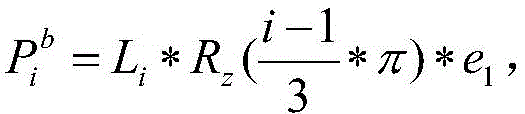
步骤1.5:αi表示第i个螺旋桨相对于轴Xi的倾斜角,βi表示第i个螺旋桨相对于轴yi的倾斜角;Step 1.5: α i represents the inclination angle of the i-th propeller relative to the axis X i , and β i represents the inclination angle of the i-th propeller relative to the axis y i ;
步骤二中,建立携带双臂的倾斜式六旋翼飞行器作业系统的运动学和动力学模型,包括如下步骤:In
步骤2.1:假设六旋翼飞行器、机械臂都是刚体,忽略其弹性形变,且质量分布均匀。对相关坐标系做如下定义:固连在地面上的基坐标系{OW}为世界惯性坐标系,包括XW、yW、ZW三个基准轴;{Ob}为机体坐标系,以六旋翼飞行机器人的重心为原点,包括Xb、yb、Zb三个基准轴;{Oe}为机械臂末端坐标系,包括Xe、ye、Ze三个基准轴;Step 2.1: Assume that the hexacopter and the manipulator are rigid bodies, ignoring their elastic deformation, and the mass distribution is uniform. The relevant coordinate system is defined as follows: the base coordinate system {O W } fixed on the ground is the world inertial coordinate system, including three reference axes X W , y W , and Z W ; {O b } is the body coordinate system, Take the center of gravity of the six-rotor flying robot as the origin, including three reference axes X b , y b , and Z b ; {O e } is the coordinate system of the end of the robot arm, including three reference axes X e , y e , and Z e ;
步骤2.2:令P=[x,y,z]T表示机体坐标系{Ob}的原点在世界惯性坐标系{OW}中的位置矢量,Ω=[p,q,r]T表示机体坐标系{Ob}相对于世界惯性坐标系{OW}的角速度,Φ=[φ,θ,ψ]T表示机体坐标系{Ob}在世界惯性坐标系{OW}中用欧拉角表示的姿态向量,其中,Φ是绕Xb轴的横滚角,θ是绕yb轴的俯仰角,Ψ是绕Zb轴的偏航角。坐标系{Ob}到坐标系{OW}的旋转矩阵Rb w可以表示为:Step 2.2: Let P=[x, y, z] T represent the position vector of the origin of the body coordinate system {O b } in the world inertial coordinate system {O W }, Ω=[p, q, r] T represents the body The angular velocity of the coordinate system {O b } relative to the world inertial coordinate system {O W }, Φ=[φ, θ, ψ] T represents the body coordinate system {O b } in the world inertia coordinate system {O W } using Euler Angle represents the attitude vector, where Φ is the roll angle around the X b axis, θ is the pitch angle around the y b axis, and Ψ is the yaw angle around the Z b axis. The rotation matrix R b w from the coordinate system {O b } to the coordinate system {O W } can be expressed as:
Rb w=R(x,φ)R(y,θ)R(z,ψ)R b w =R(x,φ)R(y,θ)R(z,ψ)
步骤2.3:对于二自由度的机械臂,表示机械臂末端坐标系{Oe}的原点在世界惯性坐标系{Ow}中的位置矢量和姿态矢量分别为Pe w和Φe w。其与六旋翼飞行机器人的位置和姿态有如下关系:Step 2.3: For a manipulator with two degrees of freedom, the position vector and attitude vector representing the origin of the coordinate system {O e } at the end of the manipulator in the world inertial coordinate system {O w } are P e w and Φ e w , respectively. It is related to the position and attitude of the six-rotor flying robot as follows:
Pe w=P+Pe bRb w P e w =P+P e b R b w
Φe w=Φe bRb w Φ e w =Φ e b R b w
其中,Pe b和Φe b分别为机械臂末端在机体坐标系{Ob}的位置和姿态。Among them, P e b and Φ e b are the position and attitude of the end of the manipulator in the body coordinate system {O b }, respectively.
步骤2.4:对于由非共线倾斜式六旋翼飞行机器人和机械臂组成的复合系统,由于机械臂在实际旋拧阀门过程中与六旋翼飞行器可以看作刚性连接,并且各关节的运动是平滑缓慢的,这种缓慢的变化仅影响复合系统的重心和转动惯量,对飞行机器人系统而言可以看成变化的静态状态。综合以上分析,本项目将飞行机器人和机械臂二者间的耦合当作外部扰动,对复合系统静态情况下的动力学进行建模分析,采用牛顿-欧拉动力学方程构建复合系统动力学方程:Step 2.4: For the composite system consisting of a non-collinear inclined hexa-rotor flying robot and a robotic arm, since the robotic arm can be regarded as a rigid connection with the hexa-rotor during the actual valve rotation process, and the motion of each joint is smooth and slow. However, this slow change only affects the center of gravity and rotational inertia of the composite system, which can be regarded as a changing static state for the flying robot system. Based on the above analysis, this project regards the coupling between the flying robot and the manipulator as an external disturbance, and models and analyzes the dynamics of the composite system under static conditions. The Newton-Eulerian dynamic equation is used to construct the composite system dynamic equation:


其中,m表示复合系统的质量,G=[0,0,-mg]T表示复合系统的重力矢量,U=[f1,f2,f3,f4,f5,f6]T表示螺旋桨产生的升力大小矩阵,Im表示复合系统重心处的惯性张量,向量rG=[xG,yG,zG]T表示复合系统的重心在机体坐标系{Ob}中的偏移。Fb(α,β)表示桨叶作用于复合系统上的推动力矢量,τAM(α,β)为作用于复合系统的输入扭矩,包括电机推力和与电机旋转方向相反的反作用力产生的扭矩两部分,Fenv为复合系统与外部环境的交互力,τFenv为复合系统与外部环境的交互力矩。Among them, m represents the mass of the composite system, G=[0,0,-mg] T represents the gravity vector of the composite system, U=[f 1 , f 2 , f 3 , f 4 , f 5 , f 6 ] T represents The lift magnitude matrix generated by the propeller, I m represents the inertia tensor at the center of gravity of the composite system, and the vector r G = [x G , y G , z G ] T represents the offset of the center of gravity of the composite system in the body coordinate system {O b } shift. F b (α, β) represents the propelling force vector acting on the composite system by the blade, and τ AM (α, β) is the input torque acting on the composite system, including the thrust of the motor and the reaction force in the opposite direction to the rotation of the motor. Torque has two parts, F env is the interaction force between the composite system and the external environment, and τ Fenv is the interaction torque between the composite system and the external environment.
步骤三中,操作员通过力反馈手控器远程控制作业装置进行旋拧阀门作业,建立主端力反馈人机接口设备的动力学模型,包括如下步骤:In
步骤3.1:利用力反馈手控器作为遥操作控制系统的主端设备,所述的力反馈手控器具有三个位置自由度、三个关节自由度和一对按键;其中三个位置自由度能够控制飞行机器人的运动,包括上下运动、前后运动、左右运动,三个关节自由度能够控制机械臂关节的转动,按键能够控制机械手的张合;手控器输出信息给PC机,PC机再与飞行机器人通讯传送控制信号;Step 3.1: Use the force feedback hand controller as the main end device of the remote operation control system. The force feedback hand controller has three position degrees of freedom, three joint degrees of freedom and a pair of buttons; Control the movement of the flying robot, including up and down movement, forward and backward movement, and left and right movement. The three joint degrees of freedom can control the rotation of the robotic arm joints, and the buttons can control the opening and closing of the robotic arm; the hand controller outputs information to the PC, and the PC then communicates with the robot. The flying robot communicates and transmits control signals;
步骤3.2:六旋翼下的摄像头将实时图像传送给PC机,操作员根据接收到的视觉反馈在线决策,操作员通过主端人机接口设备远程操控从端的飞行器作业系统执行阀门旋拧任务,力反馈再通过手控器返回给操作员;主端力反馈人机接口设备可视为一个完全驱动的常规机械系统,经过重力补偿的动力学模型可以简化为:Step 3.2: The camera under the six-rotor transmits the real-time image to the PC. The operator makes decisions online based on the received visual feedback. The operator remotely controls the aircraft operating system on the slave side to perform the valve screwing task through the human-machine interface device on the master side. The feedback is then returned to the operator through the hand controller; the main-end force feedback human-machine interface device can be regarded as a fully driven conventional mechanical system, and the gravity-compensated dynamic model can be simplified as:

其中,q∈R3是力反馈人机接口设备末端执行器的位置,Mm∈R3×3是惯性矩阵,fh∈R3是操作员施加于力反馈人机接口设备上的力,fc∈R3是主端本地控制力。where q ∈ R 3 is the position of the end effector of the force feedback HMI device, M m ∈ R 3×3 is the inertia matrix, f h ∈ R 3 is the force exerted by the operator on the force feedback HMI device, f c ∈ R 3 is the master local control force.
有益效果:与现有技术相比,本发明具有如下显著优势:Beneficial effect: Compared with the prior art, the present invention has the following significant advantages:
本发明通过使用一种非共线的倾斜式六旋翼飞行器来执行阀门旋拧任务,系统的容错性和稳定性大大提高。1、全驱动的倾斜式六旋翼飞行器能够提供六自由度的驱动力,解决了传统多旋翼无人机的欠驱动问题,同时增加了旋拧阀门时的稳定性和灵活性;2、本发明的双臂作业型机器人系统质量轻,六旋翼飞行器构架采用碳纤维材料,机械臂采用合成树脂3D打印加工而成;3、本发明的主端人机接口装置利用力反馈手控器远程控制作业系统进行阀门旋拧作业,融合了操作员接收到的视觉反馈与手控器接收到的力觉反馈,提高了阀门旋拧作业的效率。By using a non-collinear inclined six-rotor aircraft to perform the valve screwing task, the fault tolerance and stability of the system are greatly improved. 1. The fully-driven inclined six-rotor aircraft can provide a driving force of six degrees of freedom, which solves the problem of under-driving of traditional multi-rotor drones, and at the same time increases the stability and flexibility when turning the valve; 2. The present invention The dual-arm operation robot system is light in weight, the six-rotor aircraft frame is made of carbon fiber material, and the mechanical arm is made of synthetic resin 3D printing; 3. The main-end human-machine interface device of the present invention uses a force feedback hand controller to remotely control the operation system The valve screwing operation combines the visual feedback received by the operator with the force feedback received by the hand controller, which improves the efficiency of the valve screwing operation.
附图说明Description of drawings
图1是本发明的系统结构示意图;Fig. 1 is the system structure schematic diagram of the present invention;
图2是本发明中螺旋桨绕Xi轴旋转示意图;Fig. 2 is a schematic diagram of the rotation of the propeller around the X i axis in the present invention;
图3是本发明中螺旋桨绕yi轴旋转示意图;3 is a schematic diagram of the rotation of the propeller around the y i axis in the present invention;
图4是本发明中二自由度机械臂及机械手结构图;4 is a structural diagram of a two-degree-of-freedom manipulator and a manipulator in the present invention;
图5是发明中作业型飞行机器人复合系统坐标系示意图;5 is a schematic diagram of the coordinate system of the composite system of the operational flying robot in the invention;
图6是本发明中力反馈手控器结构图。FIG. 6 is a structural diagram of the force feedback hand controller in the present invention.
具体实施方式Detailed ways
下面结合附图和实例对本发明的技术方案作进一步说明。The technical solutions of the present invention will be further described below with reference to the accompanying drawings and examples.
本发明针对多旋翼无人机与物理环境交互时要求稳定性强,可靠性高等特点以及核电救灾中旋拧阀门的任务要求,本发明通过使用一种非共线的倾斜式六旋翼飞行器来执行阀门旋拧任务,系统的容错性和稳定性大大提高,解决了传统多旋翼无人机的欠驱动问题,增加了旋拧阀门时的稳定性和灵活性。The invention aims at the characteristics of strong stability and high reliability when the multi-rotor UAV interacts with the physical environment and the task requirements of screwing the valve in nuclear power disaster relief. For the valve screwing task, the fault tolerance and stability of the system are greatly improved, which solves the under-actuation problem of traditional multi-rotor UAVs and increases the stability and flexibility when screwing the valve.
如图1所示,本实施例公开的一种面向阀门旋拧的双臂作业型飞行机器人系统,包括非共线的倾斜式六旋翼飞行器、作业装置和主端人机接口装置。As shown in FIG. 1 , the present embodiment discloses a double-arm operation type flying robot system for valve rotation, which includes a non-collinear inclined hexarotor aircraft, an operation device and a main-end human-machine interface device.
所述的非共线倾斜式六旋翼飞行器包括六旋翼中心架1、飞行控制器2、倾斜机构3和摄像头4;所述倾斜机构包括六旋翼机架3-1、无刷电机倾斜底座3-2、无刷电机3-4和螺旋桨3-3。所述作业装置包括一个或多个机械关节5-1、5-2、一个或多个用于连接和驱动连杆的舵机5-3、5-4、5-5以及末端用于夹住物体的机械手5-6。The non-collinear tilting hexa-rotor aircraft includes a hexa-rotor center frame 1, a
所述主端人机接口装置包括PC机6和力反馈手控器7。所述的力反馈手控器具有三个位置自由度、三个关节自由度和一对按键;其中三个位置自由度7-1、7-2、7-3能够控制飞行机器人的运动,包括上下运动、前后运动、左右运动;关节自由度7-4能够控制机械臂关节5-1转动,关节自由度7-5能够控制机械臂关节5-2转动;按键7-6能够控制机械手5-6的张合。The master man-machine interface device includes a
力反馈手控器7输出信息给PC机6,PC机6再与飞行机器人通讯传送控制信号;所述的摄像头4将实时图像传送给PC机6,操作员根据接收到的视觉反馈在线决策,操作员通过主端人机接口设备远程操控从端的飞行器作业系统执行阀门8旋拧任务,力反馈再通过手控器返回给操作员。The force
所述的机械手5-6内壁附着弧形形状的海绵体。六旋翼飞行器中心架采用碳纤维材料制成。所述的作业装置采用合成树脂3D打印加工而成。An arc-shaped sponge body is attached to the inner wall of the manipulator 5-6. The center frame of the hexacopter is made of carbon fiber material. The working device is made of synthetic resin 3D printing.
本实施例还公开了一种面向阀门旋拧的双臂作业型飞行机器人系统的设计方法,包括如下步骤:The present embodiment also discloses a design method of a dual-arm operation type flying robot system facing valve screwing, including the following steps:
步骤一:构建系统实施平台,所述系统实施平台由非共线的倾斜式六旋翼飞行器、作业装置和主端人机接口装置组成;Step 1: constructing a system implementation platform, the system implementation platform is composed of a non-collinear inclined six-rotor aircraft, a working device and a main-end human-machine interface device;
步骤二:根据六旋翼飞行器的螺旋桨倾斜角度α、β,建立携带双臂的倾斜式六旋翼飞行器作业系统的运动学和动力学模型;Step 2: According to the propeller inclination angles α and β of the hexacopter, establish the kinematics and dynamics model of the operating system of the tilting hexacopter carrying two arms;
步骤三:操作员通过力反馈手控器远程控制作业装置进行旋拧阀门作业,建立主端力反馈人机接口设备的动力学模型。Step 3: The operator remotely controls the operation device through the force feedback hand controller to perform the valve screwing operation, and establishes the dynamic model of the main end force feedback man-machine interface device.
步骤一中,构建系统实施平台,包括如下步骤:In step 1, the construction of the system implementation platform includes the following steps:
步骤1.1:如图1所示,所述非共线倾斜式六旋翼飞行器包括六旋翼中心架1、飞行控制器2、倾斜机构3和摄像头4;Step 1.1: As shown in Figure 1, the non-collinear tilting hexarotor aircraft includes a hexarotor center frame 1, a
步骤1.1.1:如图2所示,所述倾斜机构包括六旋翼机架3-1、无刷电机倾斜底座3-2、无刷电机3-4和螺旋桨3-3;Step 1.1.1: As shown in Figure 2, the tilting mechanism includes a six-rotor frame 3-1, a brushless motor tilting base 3-2, a brushless motor 3-4 and a propeller 3-3;
步骤1.2:如图4所示,所述作业装置包括一个或多个机械关节5-1、5-2、一个或多个用于连接和驱动连杆的舵机5-3、5-4、5-5以及末端用于夹住物体的机械手5-6;Step 1.2: As shown in Figure 4, the working device includes one or more mechanical joints 5-1, 5-2, one or more steering gears 5-3, 5-4, 5-5 and a manipulator 5-6 at the end for gripping objects;
步骤1.2.1:所述机械手内壁附着弧形形状的海绵体,一方面可以增加机械手与阀门接触的摩擦力,另一方面可以降低摩擦对机械手内壁的磨损;Step 1.2.1: An arc-shaped sponge is attached to the inner wall of the manipulator, which on the one hand can increase the friction between the manipulator and the valve, and on the other hand can reduce the friction wear on the inner wall of the manipulator;
步骤1.3:如图1所示,所述主端人机接口装置包括PC机6和力反馈手控器7;Step 1.3: As shown in Figure 1, the main-end human-machine interface device includes a
步骤1.4:假设螺旋桨的旋转中心与倾斜机构的质心相重合,如图2所示,以第i个螺旋桨的旋转中心为原点,建立螺旋桨坐标系{Oi},其中i表示螺旋桨的序号,i={1,2,3,4,5,6},包括Xi、yi、Zi三个基准轴,Xi表示穿过螺旋桨旋转中心并沿着机架向外延伸的方向,Zi为第i个是螺旋桨旋转的轴,与产生拉力的方向一致,yi表示垂直于Xi和yi的方向,Li表示螺旋桨旋转中心到六旋翼飞行器质心之间的距离,为了保证六个螺旋桨的中心位于一个平面上,我们设置
步骤1.5:如图2所示,αi表示第i个螺旋桨相对于轴Xi的倾斜角,如图3所示,βi表示第i个螺旋桨相对于轴yi的倾斜角;六旋翼的倾转角度α、β在飞行前进行调整,根据指定轨迹的需要改变角度,α=(α1,α2,α3,α4,α5,α6),β=(β1,β2,β3,β4,β5,β6),我们对倾斜角做如下约束:α1=±α2=±α3=±α4=±α5=±α6=α,β1=±β2=±β3=±β4=±β5=±β6=β;Step 1.5: As shown in Figure 2, α i represents the inclination angle of the i-th propeller relative to the axis X i , as shown in Figure 3, β i represents the inclination angle of the i-th propeller relative to the axis y i ; The tilt angles α and β are adjusted before flight, and the angles are changed according to the needs of the specified trajectory, α=(α 1 ,α 2 ,α 3 ,α 4 ,α 5 ,α 6 ), β=(β 1 ,β 2 , β 3 , β 4 , β 5 , β 6 ), we make the following constraints on the tilt angle: α 1 = ±α 2 = ±α 3 = ±α 4 = ±α 5 = ±α 6 = α, β 1 = ±β 2 = ±β 3 = ±β 4 = ±β 5 = ±β 6 =β;
步骤二中,建立携带双臂的倾斜式六旋翼飞行器作业系统的运动学和动力学模型,包括如下步骤:In
步骤2.1:假设六旋翼飞行器、机械臂都是刚体,忽略其弹性形变,且质量分布均匀。如图5所示,对相关坐标系做如下定义:固连在地面上的基坐标系{OW}为世界惯性坐标系,包括XW、yW、ZW三个基准轴;{Ob}为机体坐标系,以六旋翼飞行机器人的重心为原点,包括Xb、yb、Zb三个基准轴;{Oe}为机械臂末端坐标系,包括Xe、ye、Ze三个基准轴;Step 2.1: Assume that the hexacopter and the manipulator are rigid bodies, ignoring their elastic deformation, and the mass distribution is uniform. As shown in Figure 5, the relevant coordinate system is defined as follows: the base coordinate system {O W } fixed on the ground is the world inertial coordinate system, including three reference axes X W , y W , and Z W ; {O b } is the body coordinate system, with the center of gravity of the six-rotor flying robot as the origin, including three reference axes X b , y b , and Z b ; {O e } is the coordinate system of the end of the manipulator, including X e , y e , Z e three reference axes;
步骤2.2:如图所示,令P=[x,y,z]T表示机体坐标系{Ob}的原点在世界惯性坐标系{OW}中的位置矢量,Ω=[p,q,r]T表示机体坐标系{Ob}相对于世界惯性坐标系{OW}的角速度,Φ=[φ,θ,ψ]T表示机体坐标系{Ob}在世界惯性坐标系{OW}中用欧拉角表示的姿态向量,其中,Φ是绕Xb轴的横滚角,θ是绕yb轴的俯仰角,Ψ是绕Zb轴的偏航角。坐标系{Ob}到坐标系{OW}的旋转矩阵Rb w可以表示为:Step 2.2: As shown in the figure, let P=[x, y, z] T represent the position vector of the origin of the body coordinate system {O b } in the world inertial coordinate system {O W }, Ω=[p, q, r] T represents the angular velocity of the body coordinate system {O b } relative to the world inertial coordinate system {O W }, Φ=[φ, θ, ψ] T represents the body coordinate system {O b } in the world inertial coordinate system {O W The attitude vector represented by Euler angles in }, where Φ is the roll angle around the X b axis, θ is the pitch angle around the y b axis, and Ψ is the yaw angle around the Z b axis. The rotation matrix R b w from the coordinate system {O b } to the coordinate system {O W } can be expressed as:
Rb w=R(x,φ)R(y,θ)R(z,ψ)R b w =R(x,φ)R(y,θ)R(z,ψ)
步骤2.3:对于二自由度的机械臂,表示机械臂末端坐标系{Oe}的原点在世界惯性坐标系{Ow}中的位置矢量和姿态矢量分别为Pe w和Φe w。其与六旋翼飞行机器人的位置和姿态有如下关系:Step 2.3: For a manipulator with two degrees of freedom, the position vector and attitude vector representing the origin of the coordinate system {O e } at the end of the manipulator in the world inertial coordinate system {O w } are P e w and Φ e w , respectively. It is related to the position and attitude of the six-rotor flying robot as follows:
Pe w=P+Pe bRb w P e w =P+P e b R b w
Φe w=Φe bRb w Φ e w =Φ e b R b w
其中,Pe b和Φe b分别为机械臂末端在机体坐标系{Ob}的位置和姿态。Among them, P e b and Φ e b are the position and attitude of the end of the manipulator in the body coordinate system {O b }, respectively.
步骤2.4:对于由非共线倾斜式六旋翼飞行机器人和机械臂组成的复合系统,由于机械臂在实际旋拧阀门过程中与六旋翼飞行器可以看作刚性连接,并且各关节的运动是平滑缓慢的,这种缓慢的变化仅影响复合系统的重心和转动惯量,对飞行机器人系统而言可以看成变化的静态状态。综合以上分析,本项目将飞行机器人和机械臂二者间的耦合当作外部扰动,对复合系统静态情况下的动力学进行建模分析,采用牛顿-欧拉动力学方程构建复合系统动力学方程:Step 2.4: For the composite system consisting of a non-collinear inclined hexa-rotor flying robot and a robotic arm, since the robotic arm can be regarded as a rigid connection with the hexa-rotor during the actual valve rotation process, and the motion of each joint is smooth and slow. However, this slow change only affects the center of gravity and rotational inertia of the composite system, which can be regarded as a changing static state for the flying robot system. Based on the above analysis, this project regards the coupling between the flying robot and the manipulator as an external disturbance, and models and analyzes the dynamics of the composite system under static conditions. The Newton-Eulerian dynamic equation is used to construct the composite system dynamic equation:


其中,m表示复合系统的质量,G=[0,0,-mg]T表示复合系统的重力矢量,U=[f1,f2,f3,f4,f5,f6]T表示螺旋桨产生的升力大小矩阵,Im表示复合系统重心处的惯性张量,向量rG=[xG,yG,zG]T表示复合系统的重心在机体坐标系{Ob}中的偏移。Fb(α,β)表示桨叶作用于复合系统上的推动力矢量,τAM(α,β)为作用于复合系统的输入扭矩,包括电机推力和与电机旋转方向相反的反作用力产生的扭矩两部分,Fenv为复合系统与外部环境的交互力,τFenv为复合系统与外部环境的交互力矩。Among them, m represents the mass of the composite system, G=[0,0,-mg] T represents the gravity vector of the composite system, U=[f 1 , f 2 , f 3 , f 4 , f 5 , f 6 ] T represents The lift magnitude matrix generated by the propeller, I m represents the inertia tensor at the center of gravity of the composite system, and the vector r G = [x G , y G , z G ] T represents the offset of the center of gravity of the composite system in the body coordinate system {O b } shift. F b (α, β) represents the propelling force vector acting on the composite system by the blade, and τ AM (α, β) is the input torque acting on the composite system, including the thrust of the motor and the reaction force in the opposite direction to the rotation of the motor. Torque has two parts, F env is the interaction force between the composite system and the external environment, and τ Fenv is the interaction torque between the composite system and the external environment.
步骤2.4.1:所述
步骤2.4.2:所述τAM(α,β)U=τf+τd,τf为螺旋桨升力产生的力矩,

步骤三中,操作员通过力反馈手控器远程控制作业装置进行旋拧阀门作业,包括如下步骤:In
步骤3.1:利用力反馈手控器作为遥操作控制系统的主端设备,如图6所示,所述的力反馈手控器具有三个位置自由度、三个关节自由度和一对按键;其中三个位置自由度7-1、7-2、7-3能够控制飞行机器人的运动,包括上下运动、前后运动、左右运动;关节自由度7-4能够控制机械臂关节5-1转动,关节自由度7-5能够控制机械臂关节5-2转动;按键7-6能够控制机械手5-6的张合;手控器输出信息给PC机,PC机再与飞行机器人通讯传送控制信号;Step 3.1: Use the force feedback hand controller as the main terminal device of the remote operation control system, as shown in Figure 6, the force feedback hand controller has three position degrees of freedom, three joint degrees of freedom and a pair of buttons; wherein The three positional degrees of freedom 7-1, 7-2, and 7-3 can control the motion of the flying robot, including up and down motion, front and rear motion, and left and right motion; the joint degree of freedom 7-4 can control the rotation of the robotic arm joint 5-1, the joint The degrees of freedom 7-5 can control the rotation of the manipulator joints 5-2; the buttons 7-6 can control the opening and closing of the manipulator 5-6; the hand controller outputs information to the PC, and the PC communicates with the flying robot to transmit control signals;
步骤3.2:六旋翼下的摄像头4将实时图像传送给PC机,操作员根据接收到的视觉反馈在线决策,操作员通过主端人机接口设备远程操控从端的飞行器作业系统执行阀门8旋拧任务,力反馈再通过手控器返回给操作员;主端力反馈人机接口设备可视为一个完全驱动的常规机械系统,经过重力补偿的动力学模型可以简化为:Step 3.2: The

其中,q∈R3是力反馈人机接口设备末端执行器的位置,Mm∈R3×3是惯性矩阵,fh∈R3是操作员施加于力反馈人机接口设备上的力,fc∈R3是主端本地控制力。where q ∈ R 3 is the position of the end effector of the force feedback HMI device, M m ∈ R 3×3 is the inertia matrix, f h ∈ R 3 is the force exerted by the operator on the force feedback HMI device, f c ∈ R 3 is the master local control force.
Claims (8)


Priority Applications (1)
| Application Number | Priority Date | Filing Date | Title |
|---|---|---|---|
| CN201910920659.1A CN110667845B (en) | 2019-09-27 | 2019-09-27 | A dual-arm operation type flying robot system and method for valve screwing |
Applications Claiming Priority (1)
| Application Number | Priority Date | Filing Date | Title |
|---|---|---|---|
| CN201910920659.1A CN110667845B (en) | 2019-09-27 | 2019-09-27 | A dual-arm operation type flying robot system and method for valve screwing |
Publications (2)
| Publication Number | Publication Date |
|---|---|
| CN110667845A true CN110667845A (en) | 2020-01-10 |
| CN110667845B CN110667845B (en) | 2022-04-08 |
Family
ID=69079474
Family Applications (1)
| Application Number | Title | Priority Date | Filing Date |
|---|---|---|---|
| CN201910920659.1A Active CN110667845B (en) | 2019-09-27 | 2019-09-27 | A dual-arm operation type flying robot system and method for valve screwing |
Country Status (1)
| Country | Link |
|---|---|
| CN (1) | CN110667845B (en) |
Cited By (11)
| Publication number | Priority date | Publication date | Assignee | Title |
|---|---|---|---|---|
| CN111604910A (en) * | 2020-06-19 | 2020-09-01 | 天津工业大学 | A foreign object removal device for electric maintenance drones |
| CN111923047A (en) * | 2020-08-11 | 2020-11-13 | 北京航空航天大学 | Attitude control method for rotor unmanned aerial vehicle with arm aiming at mass center offset and base floating |
| CN112415086A (en) * | 2020-11-16 | 2021-02-26 | 东南大学 | High-altitude metal pipeline flaw detection system based on teleoperation flying mechanical arm |
| CN112936258A (en) * | 2021-01-25 | 2021-06-11 | 西湖大学 | Man-machine cooperation system and method for aerial work robot |
| CN112944287A (en) * | 2021-02-08 | 2021-06-11 | 西湖大学 | Aerial repair system with active light source |
| CN113282110A (en) * | 2021-07-23 | 2021-08-20 | 季华实验室 | Flying robot and human cooperative operation method and device and flying robot |
| CN113580127A (en) * | 2021-07-09 | 2021-11-02 | 天津工业大学 | Multi-rotor aircraft humanoid double-mechanical-arm system and dynamic self-balancing control design method thereof |
| CN114212250A (en) * | 2022-01-14 | 2022-03-22 | 北京航空航天大学 | Novel six-rotor aircraft with horizontal attitude locking capability |
| CN115520376A (en) * | 2022-09-27 | 2022-12-27 | 哈尔滨工业大学 | Air-ground dual-purpose mobile operation platform based on vector rotor wing and pose control system and method thereof |
| CN116372964A (en) * | 2023-06-05 | 2023-07-04 | 西湖大学 | Aerial robotic system with switchable end effector sets |
| CN117885921A (en) * | 2024-01-03 | 2024-04-16 | 华南理工大学 | A drone with arms and control method thereof |
Citations (5)
| Publication number | Priority date | Publication date | Assignee | Title |
|---|---|---|---|---|
| CN104965516A (en) * | 2015-06-15 | 2015-10-07 | 东南大学 | Method for controlling four-rotor aircraft to perform grabbing operation in the air based on visual and force feedback |
| CN108045566A (en) * | 2017-12-07 | 2018-05-18 | 浙江海洋大学 | A kind of multi-functional quadrotor of bionical human hand |
| CN108706097A (en) * | 2018-07-27 | 2018-10-26 | 江苏优埃唯智能科技有限公司 | A kind of captive rotor flying robot with double-manipulator |
| CN109164829A (en) * | 2018-10-23 | 2019-01-08 | 哈尔滨工业大学(深圳) | A kind of flight mechanical arm system and control method based on device for force feedback and VR perception |
| US10406685B1 (en) * | 2017-04-20 | 2019-09-10 | X Development Llc | Robot end effector control |
-
2019
- 2019-09-27 CN CN201910920659.1A patent/CN110667845B/en active Active
Patent Citations (5)
| Publication number | Priority date | Publication date | Assignee | Title |
|---|---|---|---|---|
| CN104965516A (en) * | 2015-06-15 | 2015-10-07 | 东南大学 | Method for controlling four-rotor aircraft to perform grabbing operation in the air based on visual and force feedback |
| US10406685B1 (en) * | 2017-04-20 | 2019-09-10 | X Development Llc | Robot end effector control |
| CN108045566A (en) * | 2017-12-07 | 2018-05-18 | 浙江海洋大学 | A kind of multi-functional quadrotor of bionical human hand |
| CN108706097A (en) * | 2018-07-27 | 2018-10-26 | 江苏优埃唯智能科技有限公司 | A kind of captive rotor flying robot with double-manipulator |
| CN109164829A (en) * | 2018-10-23 | 2019-01-08 | 哈尔滨工业大学(深圳) | A kind of flight mechanical arm system and control method based on device for force feedback and VR perception |
Non-Patent Citations (1)
| Title |
|---|
| 连杰: "《一种作业型四旋翼飞行器系统设计》", 《中国优秀硕士学位论文全文数据库(电子期刊)》 * |
Cited By (17)
| Publication number | Priority date | Publication date | Assignee | Title |
|---|---|---|---|---|
| CN111604910A (en) * | 2020-06-19 | 2020-09-01 | 天津工业大学 | A foreign object removal device for electric maintenance drones |
| CN111923047A (en) * | 2020-08-11 | 2020-11-13 | 北京航空航天大学 | Attitude control method for rotor unmanned aerial vehicle with arm aiming at mass center offset and base floating |
| CN112415086B (en) * | 2020-11-16 | 2023-09-19 | 东南大学 | A high-altitude metal pipeline flaw detection system based on teleoperated flying manipulator |
| CN112415086A (en) * | 2020-11-16 | 2021-02-26 | 东南大学 | High-altitude metal pipeline flaw detection system based on teleoperation flying mechanical arm |
| CN112936258A (en) * | 2021-01-25 | 2021-06-11 | 西湖大学 | Man-machine cooperation system and method for aerial work robot |
| CN112944287A (en) * | 2021-02-08 | 2021-06-11 | 西湖大学 | Aerial repair system with active light source |
| CN113580127A (en) * | 2021-07-09 | 2021-11-02 | 天津工业大学 | Multi-rotor aircraft humanoid double-mechanical-arm system and dynamic self-balancing control design method thereof |
| CN113580127B (en) * | 2021-07-09 | 2024-03-29 | 天津工业大学 | Multi-rotor aircraft humanoid double-mechanical-arm system and dynamic self-balancing control design method thereof |
| CN113282110B (en) * | 2021-07-23 | 2021-10-22 | 季华实验室 | Cooperative operation method and device of flying robot and human, and flying robot |
| CN113282110A (en) * | 2021-07-23 | 2021-08-20 | 季华实验室 | Flying robot and human cooperative operation method and device and flying robot |
| CN114212250A (en) * | 2022-01-14 | 2022-03-22 | 北京航空航天大学 | Novel six-rotor aircraft with horizontal attitude locking capability |
| CN115520376A (en) * | 2022-09-27 | 2022-12-27 | 哈尔滨工业大学 | Air-ground dual-purpose mobile operation platform based on vector rotor wing and pose control system and method thereof |
| CN115520376B (en) * | 2022-09-27 | 2023-08-25 | 哈尔滨工业大学 | Air-ground dual-purpose mobile operation platform and its position and attitude control system and control method |
| CN116372964A (en) * | 2023-06-05 | 2023-07-04 | 西湖大学 | Aerial robotic system with switchable end effector sets |
| CN116372964B (en) * | 2023-06-05 | 2024-02-20 | 西湖大学 | Aerial robotic system with switchable end effector set |
| CN117885921A (en) * | 2024-01-03 | 2024-04-16 | 华南理工大学 | A drone with arms and control method thereof |
| WO2025145621A1 (en) * | 2024-01-03 | 2025-07-10 | 华南理工大学 | Arm-equipped unmanned aerial vehicle and control method therefor |
Also Published As
| Publication number | Publication date |
|---|---|
| CN110667845B (en) | 2022-04-08 |
Similar Documents
| Publication | Publication Date | Title |
|---|---|---|
| CN110667845B (en) | A dual-arm operation type flying robot system and method for valve screwing | |
| CN108519814B (en) | Man-machine interaction operating system | |
| CN104965516B (en) | A kind of view-based access control model and the quadrotor of force feedback carry out the control method of aerial crawl operation | |
| CN103213129B (en) | Position/force hybrid control method for space manipulator | |
| CN107309872A (en) | A kind of flying robot and its control method with mechanical arm | |
| CN112415086B (en) | A high-altitude metal pipeline flaw detection system based on teleoperated flying manipulator | |
| CN205075054U (en) | A robot for high -risk operation | |
| WO2023173764A1 (en) | Fusion system of mechanical arm and dexterous hand, and movement control method therefor | |
| CN108638068B (en) | A design method of a flying robot control system carrying a redundant manipulator | |
| CN111687821A (en) | Rotary parallel flying mechanical arm system and expected rotation angle calculating method | |
| CN106393049A (en) | Robot used for high risk operation | |
| CN109240343B (en) | Rope-tied robot approaching target pose integrated control method | |
| CN112684805A (en) | High-mobility micro unmanned aerial vehicle control method considering attitude constraint | |
| CN112684705A (en) | Four-rotor aircraft formation tracking control method | |
| CN111590567B (en) | Space manipulator teleoperation planning method based on Omega handle | |
| CN113580127B (en) | Multi-rotor aircraft humanoid double-mechanical-arm system and dynamic self-balancing control design method thereof | |
| Cheng et al. | Approach and maneuver for failed spacecraft de-tumbling via space teleoperation robot system | |
| WO2025179628A1 (en) | Multi-modal shared teleoperation system and method for three-arm space robot | |
| CN115431271A (en) | Anti-interference pointing control method for tail end of aircraft mechanical arm | |
| Bogdanov et al. | Control system of a manipulator of the anthropomorphic robot Fedor | |
| WO2026020703A1 (en) | Anti-disturbance control method for cable-driven flying robot | |
| CN108279562A (en) | A kind of flight mechanical arm based on sliding formwork PID control | |
| Wu et al. | Aerial grasping based on VR perception and haptic control | |
| CN108227723A (en) | A kind of underwater robot and its application process of stability analysis and structure optimization | |
| CN116237938B (en) | A coordinated motion planning method for a rotorcraft manipulator based on the use of redundant degrees of freedom |
Legal Events
| Date | Code | Title | Description |
|---|---|---|---|
| PB01 | Publication | ||
| PB01 | Publication | ||
| SE01 | Entry into force of request for substantive examination | ||
| SE01 | Entry into force of request for substantive examination | ||
| GR01 | Patent grant | ||
| GR01 | Patent grant |