CN110658818B - Multi-objective optimization intelligent operation control prediction method for novel power supply train - Google Patents
Multi-objective optimization intelligent operation control prediction method for novel power supply train Download PDFInfo
- Publication number
- CN110658818B CN110658818B CN201910934799.4A CN201910934799A CN110658818B CN 110658818 B CN110658818 B CN 110658818B CN 201910934799 A CN201910934799 A CN 201910934799A CN 110658818 B CN110658818 B CN 110658818B
- Authority
- CN
- China
- Prior art keywords
- train
- data
- power supply
- time
- speed
- Prior art date
- Legal status (The legal status is an assumption and is not a legal conclusion. Google has not performed a legal analysis and makes no representation as to the accuracy of the status listed.)
- Active
Links
Images


Classifications
-
- G—PHYSICS
- G05—CONTROLLING; REGULATING
- G05D—SYSTEMS FOR CONTROLLING OR REGULATING NON-ELECTRIC VARIABLES
- G05D1/00—Control of position, course, altitude or attitude of land, water, air or space vehicles, e.g. using automatic pilots
- G05D1/02—Control of position or course in two dimensions
- G05D1/021—Control of position or course in two dimensions specially adapted to land vehicles
- G05D1/0212—Control of position or course in two dimensions specially adapted to land vehicles with means for defining a desired trajectory
- G05D1/0223—Control of position or course in two dimensions specially adapted to land vehicles with means for defining a desired trajectory involving speed control of the vehicle
-
- G—PHYSICS
- G05—CONTROLLING; REGULATING
- G05D—SYSTEMS FOR CONTROLLING OR REGULATING NON-ELECTRIC VARIABLES
- G05D1/00—Control of position, course, altitude or attitude of land, water, air or space vehicles, e.g. using automatic pilots
- G05D1/02—Control of position or course in two dimensions
- G05D1/021—Control of position or course in two dimensions specially adapted to land vehicles
- G05D1/0212—Control of position or course in two dimensions specially adapted to land vehicles with means for defining a desired trajectory
- G05D1/0221—Control of position or course in two dimensions specially adapted to land vehicles with means for defining a desired trajectory involving a learning process
-
- G—PHYSICS
- G05—CONTROLLING; REGULATING
- G05D—SYSTEMS FOR CONTROLLING OR REGULATING NON-ELECTRIC VARIABLES
- G05D1/00—Control of position, course, altitude or attitude of land, water, air or space vehicles, e.g. using automatic pilots
- G05D1/02—Control of position or course in two dimensions
- G05D1/021—Control of position or course in two dimensions specially adapted to land vehicles
- G05D1/0276—Control of position or course in two dimensions specially adapted to land vehicles using signals provided by a source external to the vehicle
-
- G—PHYSICS
- G06—COMPUTING OR CALCULATING; COUNTING
- G06N—COMPUTING ARRANGEMENTS BASED ON SPECIFIC COMPUTATIONAL MODELS
- G06N3/00—Computing arrangements based on biological models
- G06N3/02—Neural networks
- G06N3/04—Architecture, e.g. interconnection topology
- G06N3/045—Combinations of networks
-
- G—PHYSICS
- G06—COMPUTING OR CALCULATING; COUNTING
- G06N—COMPUTING ARRANGEMENTS BASED ON SPECIFIC COMPUTATIONAL MODELS
- G06N3/00—Computing arrangements based on biological models
- G06N3/02—Neural networks
- G06N3/08—Learning methods
Landscapes
- Engineering & Computer Science (AREA)
- Physics & Mathematics (AREA)
- General Physics & Mathematics (AREA)
- Theoretical Computer Science (AREA)
- Automation & Control Theory (AREA)
- Remote Sensing (AREA)
- Radar, Positioning & Navigation (AREA)
- Aviation & Aerospace Engineering (AREA)
- Biophysics (AREA)
- Mathematical Physics (AREA)
- General Health & Medical Sciences (AREA)
- Molecular Biology (AREA)
- Computing Systems (AREA)
- General Engineering & Computer Science (AREA)
- Data Mining & Analysis (AREA)
- Evolutionary Computation (AREA)
- Software Systems (AREA)
- Computational Linguistics (AREA)
- Biomedical Technology (AREA)
- Artificial Intelligence (AREA)
- Life Sciences & Earth Sciences (AREA)
- Health & Medical Sciences (AREA)
- Electric Propulsion And Braking For Vehicles (AREA)
- Train Traffic Observation, Control, And Security (AREA)
Abstract
Description
技术领域technical field
本发明涉及了计算机深度学习领域中的工控运行预测回归方法,尤其是涉及了一种面向新型供电列车的多目标优化智能运行控制预测方法。The invention relates to an industrial control operation prediction regression method in the field of computer deep learning, in particular to a multi-objective optimization intelligent operation control prediction method for a new type of power supply train.
背景技术Background technique
面向多目标优化的列车运行控制模型技术新颖,涉及的参数多、关联关系复杂,传统的基于机理和专家知识的建模方式难以应对。为此,需要采用数据驱动的机器学习方法来构建相关模型。The multi-objective optimization-oriented train operation control model is novel in technology, involves many parameters, and has complex correlations, which are difficult to deal with by the traditional modeling methods based on mechanism and expert knowledge. To do this, a data-driven machine learning approach is required to build relevant models.
列车运行控制直接影响到列车运行过程中的能量消耗,为了保证列车的正常运行,在求解面向多目标优化的列车运行控制策略过程中,需要将列车供电系统参数作为输入数据,通过深度神经网络计算出经过优化的列车运行控制策略。The train operation control directly affects the energy consumption during the train operation. In order to ensure the normal operation of the train, in the process of solving the train operation control strategy for multi-objective optimization, it is necessary to take the parameters of the train power supply system as input data, and calculate the parameters through the deep neural network. The optimized train operation control strategy is obtained.
通过上述分析,发现列车运行的优化若直接使用大数据深度学习的方法进行建模,则总是存在未定数据。Through the above analysis, it is found that if the optimization of train operation is directly modeled by the method of big data deep learning, there will always be undetermined data.
因此,新型供电列车运行控制的参数多、关联关系复杂,可用数据少,难以直接构建模型。传统的基于机理和专家知识建模的方法建模时间长,成本代价高,模型准确率不支持直接用于实际场景。Therefore, the operation control of the new-type power train has many parameters, complex correlations, and few available data, so it is difficult to build a model directly. The traditional modeling method based on mechanism and expert knowledge has long modeling time and high cost, and the model accuracy does not support direct use in actual scenarios.
发明内容SUMMARY OF THE INVENTION
为了解决背景技术中存在的技术问题,本发明提出了一种面向新型供电列车的多目标优化智能运行控制预测方法,采用基于经验建模和数据驱动建模相结合,通过多次迭代进行优化建模构建相关模型,解决了新型供电列车运行控制模型参数多、关联关系复杂、可用数据少和难以直接构建模型的技术问题,也解决了建模时间长、成本代价高、模型准确率不支持于实际场景的问题,获得了突出显著的预测效果。In order to solve the technical problems existing in the background technology, the present invention proposes a multi-objective optimization intelligent operation control prediction method for a new type of power supply train, which adopts a combination of experience-based modeling and data-driven modeling, and optimizes the construction through multiple iterations. It solves the technical problems of the new-type power train operation control model with many parameters, complex correlation, less available data, and difficulty in building the model directly. It also solves the long modeling time, high cost, and model accuracy that does not support The problem of the actual scene has obtained a prominent and significant prediction effect.
本发明所采用的技术方案是:The technical scheme adopted in the present invention is:
本发明神经网络模型进行了二次优化,提取出经验知识和列车运行约束条件,解决了由于模型训练依赖数据从而不好训练模型的困难,并提高了模型预测的准确性,能实现节能的目的。The neural network model of the present invention performs secondary optimization, extracts experience knowledge and train operation constraints, solves the difficulty of training the model due to data-dependent model training, improves the accuracy of model prediction, and can achieve the purpose of energy saving .
所述方法步骤具体如下:The method steps are as follows:
1)由新型供电列车的静态/动态大数据得到原始数据,再进行参数化/正则化得到标准化数据,接着对标准化数据进行归一化获得列车信息序列数据,从而提高模型准确性;1) Obtain the original data from the static/dynamic big data of the new power train, then perform parameterization/regularization to obtain standardized data, and then normalize the standardized data to obtain train information sequence data, thereby improving the accuracy of the model;
静态大数据是包括新型供电列车的线路条件、列车条件、储能系统条件等方面的数据。动态大数据是包括新型供电列车的行驶运行数据、储能系统状态等方面的数据。Static big data is data including the line conditions, train conditions, and energy storage system conditions of new power supply trains. Dynamic big data is data including the running data of new power trains and the status of energy storage systems.
2)利用列车信息序列数据中的局部数据结合实际运行时间采用列车动力学方程进行处理计算得到理想条件下的列车运行状态数据;2) Using the local data in the train information sequence data combined with the actual running time and using the train dynamics equation to process and calculate to obtain the train running state data under ideal conditions;
通过上述步骤,把参数化和正则化后的数据映射到了一个隐空间,并得到列车在理想条件下的列车运行状态数据,数据中包含了列车运行的相关特征。Through the above steps, the parameterized and regularized data are mapped to a latent space, and the train running state data of the train under ideal conditions is obtained, and the data contains the relevant characteristics of the train operation.
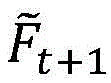
3)将步骤二得到的列车运行状态数据和新型供电列车上真实测得的各个时刻牵引力一起输入到长短期记忆网络中进行训练得到基础模型,即将列车实际运行的瞬时速度为预测量v和新型供电列车上真实测得的各个时刻牵引力一起输入;将步骤一输出的列车信息序列数据划分为多个部分,每个部分作为一个样本,将多个样本依次输入到基础模型中依次并再次进行训练得到了带有知识的基础模型;模型中利用输入的数据对列车在下一时刻t+1所需要的牵引力Ft+1进行预测,并计算下一时刻t+1的牵引力和真实的下一时刻t+1的牵引力之间的平方损失,通过采用随机梯度下降方法最小化求解平方损失激励函数,从而完成训练;3) Input the train running state data obtained in step 2 and the traction force actually measured at each moment on the new-type power supply train into the long-term and short-term memory network for training to obtain the basic model, that is, the instantaneous speed of the actual operation of the train is the predicted value v and the new-type power supply train. The traction force actually measured at each moment on the power train is input together; the train information sequence data output in step 1 is divided into multiple parts, each part is used as a sample, and multiple samples are input into the basic model in turn and trained again. The basic model with knowledge is obtained; the input data is used in the model to predict the traction force F t+1 required by the train at the next time t+1, and calculate the traction force at the next time t+1 and the real next time. The squared loss between the traction forces of t+1 is minimized by using the stochastic gradient descent method to solve the squared loss excitation function to complete the training;
所述的带有知识的基础模型包含列车运行过程的特征和理想约束条件。The described basic model with knowledge contains the characteristics and ideal constraints of the train operation process.
4)针对真实采集的当前时刻的新型供电列车的速度,输入到带有知识的基础模型中进行预测输出获得下一时刻的牵引力。4) According to the real collected speed of the new-type power supply train at the current moment, input it into the basic model with knowledge to predict and output to obtain the traction force at the next moment.
所述步骤1),静态以及动态大数据具体是:Described step 1), static and dynamic big data are specifically:
1.a)将静态线路条件数据向量P={p1,p2,p3,p4,p5},分别为坡度p1、曲线p2、列车位置p3、感应线圈部署位置p4、充电能力p5;1.a) Set the static line condition data vector P={p 1 , p 2 , p 3 , p 4 , p 5 }, which are respectively the slope p 1 , the curve p 2 , the train position p 3 , and the induction coil deployment position p 4 , charging capacity p 5 ;
将静态列车条件数据向量B={b1,b2,b3,b4},分别为最大载客量b1、车重b2、最大加速度b3、最大减速度b4;Set the static train condition data vector B={b 1 , b 2 , b 3 , b 4 }, respectively the maximum passenger capacity b 1 , the vehicle weight b 2 , the maximum acceleration b 3 , and the maximum deceleration b 4 ;
将静态储能系统条件数据向量W={w1,w2,w3,w4},分别为额定容量w1、额定电压w2、充电电流w3、额定输出功率w4;Set the static energy storage system condition data vector W={w 1 , w 2 , w 3 , w 4 }, which are respectively rated capacity w 1 , rated voltage w 2 , charging current w 3 , and rated output power w 4 ;
将动态运行数据向量H={h1,h2,h3,h4},分别为速度h1、牵引功率h2、动态载客量(动态车重)h3、动态加/减速度h4;The dynamic running data vector H = {h 1 , h 2 , h 3 , h 4 }, respectively, speed h 1 , traction power h 2 , dynamic passenger capacity (dynamic vehicle weight) h 3 , dynamic acceleration/deceleration h 4 ;
将动态储能系统状态数据向量Q={q1,q2,q3,q4},分别为储能系统电压q1、放电电流q2、充电电压q3、充电电流q4。The dynamic energy storage system state data vector Q={q 1 , q 2 , q 3 , q 4 } is respectively the energy storage system voltage q 1 , the discharge current q 2 , the charging voltage q 3 , and the charging current q 4 .
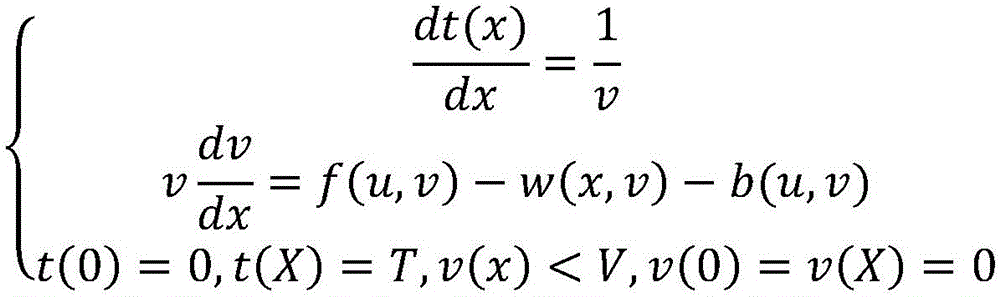
所述步骤2)中,具体是利用列车信息序列数据中的实际运行位置和实际运行时间采用以下公式的列车动力学方程进行处理计算得到列车实际运行的瞬时速度v,作为理想条件下的列车运行状态数据;In the step 2), the actual running position and actual running time in the train information sequence data are processed and calculated by using the train dynamics equation of the following formula to obtain the instantaneous speed v of the actual running of the train, as the train running under ideal conditions. status data;
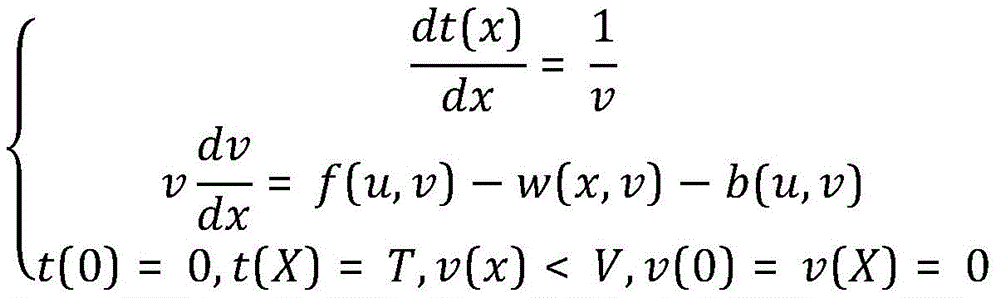
式中:x表示列车在线路上的实际运行位置;t(x)表示列车在位置x处的实际运行时间;T表示列车运行完全程的规定时间;V表示列车在线路上允许的最高运行速度;X表示线路全长;v表示列车实际运行的瞬时速度;f(u,v)表示牵引力函数,与列车输入控制序列和运行速度有关;w(x,v)表示列车运行附加阻力函数,与列车运行速度和列车运行位置有关;b(u,v)表示列车制动力函数,与列车输入控制序列和运行速度有关;u表示列车输入控制序列,为随时间变化的值序列,具体范围值为[-1~1],其中某一时刻下‘-1’表示最大制动,‘0’表示惰行,“1”表示最大牵引,(-1,0)为部分制动,(0,1)为部分牵引。In the formula: x represents the actual running position of the train on the line; t(x) represents the actual running time of the train at the position x; T represents the specified time for the train to complete the whole journey; V represents the maximum allowed running speed of the train on the line; X represents the full length of the line; v represents the instantaneous speed of the actual train operation; f(u, v) represents the traction force function, which is related to the train input control sequence and operating speed; w(x, v) represents the additional resistance function of the train operation, which is related to the train operation Speed is related to the running position of the train; b(u, v) represents the train braking force function, which is related to the train input control sequence and operating speed; u represents the train input control sequence, which is a value sequence that changes with time, and the specific range is [- 1~1], in which '-1' means maximum braking at a certain moment, '0' means coasting, "1" means maximum traction, (-1, 0) is partial braking, (0, 1) is partial braking traction.
所述步骤3)中的平方损失激励函数

其中,Ft+1为真实的下一时刻t+1的牵引力,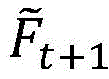
所述步骤4)之后,根据带有知识的基础模型的中间参数进一步解码到输出特征空间,获得预测的下一时刻的新型供电列车的速度和当前时刻至下一时刻前所消耗的能量,从而获得了时间速度的数据和时间能耗的数据。After the step 4), the intermediate parameters of the basic model with knowledge are further decoded into the output feature space to obtain the predicted speed of the new power supply train at the next moment and the energy consumed from the current moment to the next moment, so that The data of time speed and time energy consumption were obtained.
具体采用以下公式计算获得预测的下一时刻的新型供电列车的速度:Specifically, the following formula is used to calculate the predicted speed of the new power supply train at the next moment:
v0=0v 0 = 0
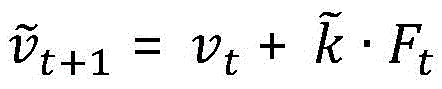

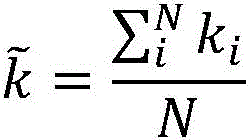
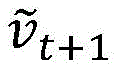
其中,ki表示第i个样本经基础模型处理获得的计算拟合参数,N为步骤3)中的样本总数;
具体采用以下公式计算获得预测的当前时刻至下一时刻前所消耗的能量:Specifically, the following formula is used to calculate the energy consumed from the current time to the next time when the prediction is obtained:

noiseGaussian=N(μ,σ2)noise Gaussian = N(μ,σ 2 )
其中,
本发明输入和输出可以很好地映射到同一空间,并在空间中数据分布会接近,预测力到输出和真实力到输出也会非常接近,能获得准确的时间速度的数据和时间能耗的数据。通过长短期记忆网络作为基础的带有知识的基础模型二次训练处理后,可很好地将空间特征映射到连续空间上,从而很好地进行预测。The input and output of the present invention can be well mapped to the same space, and the data distribution in the space will be close, the predicted force to the output and the real force to the output will be very close, and accurate time speed data and time energy consumption can be obtained. data. After the secondary training of the basic model with knowledge based on the long short-term memory network, the spatial features can be well mapped to the continuous space, so as to make good predictions.
本发明中,真实的牵引力等真实的数据均通过安装在新型供电列车上的传感器的检测信号或者驱动器本身的反馈信号直接获得。In the present invention, the real data such as the real traction force are directly obtained through the detection signal of the sensor installed on the new-type power supply train or the feedback signal of the driver itself.
本发明首先通过结合深度学习的方法,抽取出列车运行的基本特征和约束条件,得到长短期记忆网络基础模型,再利用真实列车运行数据再次训练基础模型,得到符合现实列车运行数据分布的模型。The invention first extracts the basic characteristics and constraints of train operation by combining the method of deep learning, obtains the basic model of long and short-term memory network, and then uses the real train operation data to retrain the basic model to obtain a model conforming to the distribution of real train operation data.
本发明方法步骤中,长短期记忆网络的采用主要是为了解决序列相关的问题。对于普通的全连接神经网络来说,每次都单独的对一个输入进行训练,而每个输入之间是没有关系的,但是对于某些任务需要考虑输入之间的相关关系,如牵引力的预测中,输入是一个时间序列,采用长短期记忆网络的结构来构建牵引力预测模型,可捕获数据中的长短期依赖关系,可捕获序列输入的上下文信息,而不会依靠当前输入来得到输出结果。In the method steps of the present invention, the long short-term memory network is mainly used to solve the problem of sequence correlation. For ordinary fully connected neural networks, one input is trained separately each time, and there is no relationship between each input, but for some tasks, the correlation between inputs needs to be considered, such as the prediction of traction In , the input is a time series, and the structure of the long-term and short-term memory network is used to build a traction prediction model, which can capture the long-term and short-term dependencies in the data, and can capture the context information of the sequence input without relying on the current input to get the output.
本发明具有到有益效果是:The present invention has beneficial effects as follows:
本发明方法结合了深度学习和统计学习,利用传统的基于经验和机理的建模方法,通过对列车运行控制进行简化,绕过了列车运行控制尚未确定的问题,并用长短期记忆网络提取并学习了经验知识,降低了训练数据量,提高了模型预测的准确性。The method of the invention combines deep learning and statistical learning, uses the traditional modeling method based on experience and mechanism, simplifies the train operation control, bypasses the undetermined problem of the train operation control, and uses the long and short-term memory network to extract and learn The empirical knowledge is reduced, the amount of training data is reduced, and the accuracy of model prediction is improved.
与传统的方法相比,本发明不依赖大量数据,提高了模型准确率并方便直接用于现实应用。Compared with the traditional method, the present invention does not rely on a large amount of data, improves the accuracy of the model, and is convenient for direct use in practical applications.
附图说明Description of drawings
图1是本发明方法的逻辑结构图;Fig. 1 is the logical structure diagram of the method of the present invention;
图2是长短期记忆网络基础模型结构图;Figure 2 is a structural diagram of the basic model of the long short-term memory network;
图3是实施例基于真实数据做的列车时间速度预测实验结果图;Fig. 3 is the result diagram of the train time speed prediction experiment done based on real data in the embodiment;
图4是实施例基于真实数据做的列车时间能耗预测实验结果图。FIG. 4 is a graph showing the experimental results of train time energy consumption prediction based on real data according to the embodiment.
具体实施方式Detailed ways
下面结合附图和实施例对本发明作进一步说明。The present invention will be further described below with reference to the accompanying drawings and embodiments.
如图1所示,本发明实施例及其实施工作过程如下:As shown in Figure 1, an embodiment of the present invention and its implementation work process are as follows:
1)由新型供电列车的静态/动态大数据得到原始数据,再进行参数化/正则化得到标准化数据,接着对标准化数据进行归一化获得列车信息序列数据;1) Obtain the original data from the static/dynamic big data of the new power train, then perform parameterization/regularization to obtain standardized data, and then normalize the standardized data to obtain train information sequence data;
静态以及动态大数据具体是:Static and dynamic big data are:
1.a)静态线路条件数据向量P={p1,p2,p3,p4,p5},分别为坡度p1、曲线p2、列车位置p3、感应线圈部署位置p4、充电能力p5;1.a) Static line condition data vector P={p 1 , p 2 , p 3 , p 4 , p 5 }, which are gradient p 1 , curve p 2 , train position p 3 , induction coil deployment position p 4 , charging capacity p 5 ;
将静态列车条件数据向量B={b1,b2,b3,b4},分别为最大载客量b1、车重b2、最大加速度b3、最大减速度b4;Set the static train condition data vector B={b 1 , b 2 , b 3 , b 4 }, respectively the maximum passenger capacity b 1 , the vehicle weight b 2 , the maximum acceleration b 3 , and the maximum deceleration b 4 ;
将静态储能系统条件数据向量W={w1,w2,w3,w4},分别为额定容量w1、额定电压w2、充电电流w3、额定输出功率w4;Set the static energy storage system condition data vector W={w 1 , w 2 , w 3 , w 4 }, which are respectively rated capacity w 1 , rated voltage w 2 , charging current w 3 , and rated output power w 4 ;
将动态运行数据向量H={h1,h2,h3,h4},分别为速度h1、牵引功率h2、动态载客量(动态车重)h3、动态加/减速度h4;The dynamic running data vector H = {h 1 , h 2 , h 3 , h 4 }, respectively, speed h 1 , traction power h 2 , dynamic passenger capacity (dynamic vehicle weight) h 3 , dynamic acceleration/deceleration h 4 ;
将动态储能系统状态数据向量Q={q1,q2,q3,q4},分别为储能系统电压q1、放电电流q2、充电电压q3、充电电流q4。The dynamic energy storage system state data vector Q={q 1 , q 2 , q 3 , q 4 } is respectively the energy storage system voltage q 1 , the discharge current q 2 , the charging voltage q 3 , and the charging current q 4 .
2)利用列车信息序列数据中的实际运行位置和实际运行时间采用以下公式的列车动力学方程进行处理计算得到列车实际运行的瞬时速度v,作为理想条件下的列车运行状态数据;2) Using the actual running position and actual running time in the train information sequence data, the train dynamics equation of the following formula is used to process and calculate to obtain the instantaneous speed v of the actual running of the train, as the train running state data under ideal conditions;

式中:x表示列车在线路上的实际运行位置;t(x)表示列车在位置x处的实际运行时间;T表示列车运行完全程的规定时间;V表示列车在线路上允许的最高运行速度;X表示线路全长;v表示列车实际运行的瞬时速度;f(u,v)表示牵引力函数,与列车输入控制序列和运行速度有关;w(x,v)表示列车运行附加阻力函数,与列车运行速度和列车运行位置有关;b(u,v)表示列车制动力函数,与列车输入控制序列和运行速度有关;u表示列车输入控制序列,为随时间变化的值序列,具体范围值为[-1~1],其中某一时刻下‘-1’表示最大制动,‘0’表示惰行,“1”表示最大牵引,(-1,0)为部分制动,(0,1)为部分牵引。在该实验中x的具体范围值为[0~1660],T为133,V为780,X为1669.463。In the formula: x represents the actual running position of the train on the line; t(x) represents the actual running time of the train at the position x; T represents the specified time for the train to complete the whole journey; V represents the maximum running speed allowed by the train on the line; X represents the full length of the line; v represents the instantaneous speed of the actual train operation; f(u, v) represents the traction force function, which is related to the train input control sequence and operating speed; w(x, v) represents the additional resistance function of the train operation, which is related to the train operation. Speed is related to the running position of the train; b(u, v) represents the train braking force function, which is related to the train input control sequence and running speed; u represents the train input control sequence, which is a value sequence that changes with time, and the specific range is [- 1~1], where '-1' means maximum braking at a certain moment, '0' means coasting, "1" means maximum traction, (-1, 0) is partial braking, (0, 1) is partial braking traction. In this experiment, the specific range of x is [0~1660], T is 133, V is 780, and X is 1669.463.
3)将步骤二得到的列车运行状态数据和新型供电列车上真实测得的各个时刻牵引力一起输入到长短期记忆网络中进行训练得到基础模型,即将列车实际运行的瞬时速度为预测量v和新型供电列车上真实测得的各个时刻牵引力一起输入;例如t时刻,列车牵引力为5090,瞬时速度0,输入到长短期记忆网络中;t+1时刻,列车牵引力为5090,瞬时速度为13,输入到长短期记忆网络中。图2为长短期记忆网络结构。将步骤一输出的列车信息序列数据划分为多个部分,每个部分作为一个样本,将多个样本依次输入到基础模型中依次并再次进行训练得到了带有知识的基础模型;模型中利用输入的数据对列车在下一时刻t+1所需要的牵引力Ft+1进行预测,并计算下一时刻t+1的牵引力和真实的下一时刻t+1的牵引力之间的平方损失,通过采用随机梯度下降方法最小化求解平方损失激励函数,从而完成训练;3) Input the train running state data obtained in step 2 and the traction force actually measured at each moment on the new-type power train into the long-term and short-term memory network for training to obtain the basic model, that is, the instantaneous speed of the actual train operation is the predicted value v and the new-type power supply train. The traction force at each moment actually measured on the power train is input together; for example, at time t, the traction force of the train is 5090, and the instantaneous speed is 0, and it is input into the long-term memory network; at time t+1, the traction force of the train is 5090, and the instantaneous speed is 13, input into long short-term memory networks. Figure 2 shows the structure of the long short-term memory network. The train information sequence data output in step 1 is divided into multiple parts, each part is used as a sample, and multiple samples are input into the basic model in turn and trained again to obtain a basic model with knowledge; the model uses the input Predict the traction force F t+1 required by the train at the next time t+1, and calculate the square loss between the traction force at the next time t+1 and the real traction force at the next time t+1, by using The stochastic gradient descent method minimizes the squared loss excitation function to complete the training;
平方损失激励函数

其中,Ft+1为真实的下一时刻t+1的牵引力,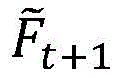
4)针对真实采集的当前时刻的新型供电列车的速度,输入到带有知识的基础模型中进行预测输出获得下一时刻的牵引力。例如t时刻,列车速度为13,预测下一时刻的牵引力。4) According to the real collected speed of the new-type power supply train at the current moment, input it into the basic model with knowledge to predict and output to obtain the traction force at the next moment. For example, at time t, the train speed is 13, and the traction force at the next time is predicted.
5)根据带有知识的基础模型的中间参数进一步解码到输出特征空间,获得预测的下一时刻的新型供电列车的速度和当前时刻至下一时刻前所消耗的能量,从而获得了时间速度的数据和时间能耗的数据。图3和图4表示基于真实数据做的列车时间速度预测实验结果,从图中可看出列车通过模型优化后,能耗降低6.3%,速度更加平缓,旅客舒适性更高。5) According to the intermediate parameters of the basic model with knowledge, it is further decoded into the output feature space, and the predicted speed of the new power supply train at the next moment and the energy consumed from the current moment to the next moment are obtained, so as to obtain the time speed. Data and time energy consumption data. Figures 3 and 4 show the experimental results of train time and speed prediction based on real data. It can be seen from the figures that after the train passes the model optimization, the energy consumption is reduced by 6.3%, the speed is smoother, and the passenger comfort is higher.
具体采用以下公式计算获得预测的下一时刻的新型供电列车的速度:Specifically, the following formula is used to calculate the predicted speed of the new power supply train at the next moment:
v0=0v 0 = 0


其中,ki表示第i个样本经基础模型处理获得的计算拟合参数,N为步骤3)中的样本总数;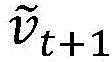
具体采用以下公式计算获得预测的当前时刻至下一时刻前所消耗的能量:Specifically, the following formula is used to calculate the energy consumed from the current time to the next time when the prediction is obtained:

nosiseGaussian=N(μ,σ2)noise Gaussian =N(μ,σ 2 )
其中,
本发明充分利用了专家经验,不依赖大量数据,降低了训练数据量,利用长短期记忆网络,得到符合现实列车运行数据分布的模型,提高了模型准确率并方便直接用于现实应用。The invention makes full use of expert experience, does not rely on a large amount of data, reduces the amount of training data, uses a long and short-term memory network to obtain a model conforming to the actual train running data distribution, improves the accuracy of the model and is convenient for direct use in practical applications.
Claims (3)






Priority Applications (1)
| Application Number | Priority Date | Filing Date | Title |
|---|---|---|---|
| CN201910934799.4A CN110658818B (en) | 2019-09-29 | 2019-09-29 | Multi-objective optimization intelligent operation control prediction method for novel power supply train |
Applications Claiming Priority (1)
| Application Number | Priority Date | Filing Date | Title |
|---|---|---|---|
| CN201910934799.4A CN110658818B (en) | 2019-09-29 | 2019-09-29 | Multi-objective optimization intelligent operation control prediction method for novel power supply train |
Publications (2)
| Publication Number | Publication Date |
|---|---|
| CN110658818A CN110658818A (en) | 2020-01-07 |
| CN110658818B true CN110658818B (en) | 2020-08-21 |
Family
ID=69038401
Family Applications (1)
| Application Number | Title | Priority Date | Filing Date |
|---|---|---|---|
| CN201910934799.4A Active CN110658818B (en) | 2019-09-29 | 2019-09-29 | Multi-objective optimization intelligent operation control prediction method for novel power supply train |
Country Status (1)
| Country | Link |
|---|---|
| CN (1) | CN110658818B (en) |
Families Citing this family (1)
| Publication number | Priority date | Publication date | Assignee | Title |
|---|---|---|---|---|
| CN112183728B (en) * | 2020-09-29 | 2021-07-20 | 上海松鼠课堂人工智能科技有限公司 | Deep learning-based learning strategy generation method and system |
Citations (9)
| Publication number | Priority date | Publication date | Assignee | Title |
|---|---|---|---|---|
| CN106952161A (en) * | 2017-03-31 | 2017-07-14 | 洪志令 | A kind of recent forward prediction method of stock based on shot and long term memory depth learning network |
| CN108983788A (en) * | 2018-08-15 | 2018-12-11 | 上海海事大学 | The unmanned sanitation cart intelligence control system and method excavated based on big data |
| CN109204390A (en) * | 2018-09-29 | 2019-01-15 | 交控科技股份有限公司 | A kind of Train control method based on deep learning |
| KR101951595B1 (en) * | 2018-05-18 | 2019-02-22 | 한양대학교 산학협력단 | Vehicle trajectory prediction system and method based on modular recurrent neural network architecture |
| CN109508812A (en) * | 2018-10-09 | 2019-03-22 | 南京航空航天大学 | A kind of aircraft Trajectory Prediction method based on profound memory network |
| CN109783843A (en) * | 2018-12-05 | 2019-05-21 | 交控科技股份有限公司 | Analogue system vehicle dynamic model speed predicting method based on LSTM |
| CN109814523A (en) * | 2018-12-04 | 2019-05-28 | 合肥工业大学 | Fault diagnosis method based on CNN-LSTM deep learning method and multi-attribute time series data |
| CN110210174A (en) * | 2019-06-21 | 2019-09-06 | 西南交通大学 | A kind of EMU axle box bearing temperature predicting method based on multilayer LSTM |
| CN110262251A (en) * | 2019-07-11 | 2019-09-20 | 电子科技大学 | The prediction of flight control system data and aided diagnosis method based on LSTM neural network |
Family Cites Families (1)
| Publication number | Priority date | Publication date | Assignee | Title |
|---|---|---|---|---|
| CN106844949B (en) * | 2017-01-18 | 2020-01-10 | 清华大学 | Training method of bidirectional LSTM model for realizing energy-saving control of locomotive |
-
2019
- 2019-09-29 CN CN201910934799.4A patent/CN110658818B/en active Active
Patent Citations (9)
| Publication number | Priority date | Publication date | Assignee | Title |
|---|---|---|---|---|
| CN106952161A (en) * | 2017-03-31 | 2017-07-14 | 洪志令 | A kind of recent forward prediction method of stock based on shot and long term memory depth learning network |
| KR101951595B1 (en) * | 2018-05-18 | 2019-02-22 | 한양대학교 산학협력단 | Vehicle trajectory prediction system and method based on modular recurrent neural network architecture |
| CN108983788A (en) * | 2018-08-15 | 2018-12-11 | 上海海事大学 | The unmanned sanitation cart intelligence control system and method excavated based on big data |
| CN109204390A (en) * | 2018-09-29 | 2019-01-15 | 交控科技股份有限公司 | A kind of Train control method based on deep learning |
| CN109508812A (en) * | 2018-10-09 | 2019-03-22 | 南京航空航天大学 | A kind of aircraft Trajectory Prediction method based on profound memory network |
| CN109814523A (en) * | 2018-12-04 | 2019-05-28 | 合肥工业大学 | Fault diagnosis method based on CNN-LSTM deep learning method and multi-attribute time series data |
| CN109783843A (en) * | 2018-12-05 | 2019-05-21 | 交控科技股份有限公司 | Analogue system vehicle dynamic model speed predicting method based on LSTM |
| CN110210174A (en) * | 2019-06-21 | 2019-09-06 | 西南交通大学 | A kind of EMU axle box bearing temperature predicting method based on multilayer LSTM |
| CN110262251A (en) * | 2019-07-11 | 2019-09-20 | 电子科技大学 | The prediction of flight control system data and aided diagnosis method based on LSTM neural network |
Non-Patent Citations (3)
| Title |
|---|
| LLR: Learning learning rates by LSTM for training neural networks;Changyong Yu 等;《Neurocomputing》;20200204;第1-10页 * |
| 基于LSTM长短期记忆网络的超短期风速预测;魏昱洲;《电子测量与仪器学报》;20190215;第64-71页 * |
| 基于循环神经网络的数据库查询开销预测;毕里缘 等;《软件学报》;20171206;第799-810页 * |
Also Published As
| Publication number | Publication date |
|---|---|
| CN110658818A (en) | 2020-01-07 |
Similar Documents
| Publication | Publication Date | Title |
|---|---|---|
| Zhao et al. | Adaptive swarm intelligent offloading based on digital twin-assisted prediction in VEC | |
| CN112000084B (en) | Intelligent BIT design method of controller module based on 1D-CNN and GRU-SVM | |
| CN110223517A (en) | Short-term traffic flow forecast method based on temporal correlation | |
| CN107697070A (en) | Driving behavior Forecasting Methodology and device, unmanned vehicle | |
| CN107909179A (en) | The prediction model construction method and vehicle energy management method of a kind of plug-in hybrid vehicle driving cycle | |
| CN103699771B (en) | A kind of sight-clustering method of cooling load prediction | |
| CN110837915B (en) | Low-voltage load point prediction and probability prediction method for power system based on hybrid integrated deep learning | |
| CN109255726A (en) | A kind of ultra-short term wind power prediction method of Hybrid Intelligent Technology | |
| CN113886454A (en) | Cloud resource prediction method based on LSTM-RBF | |
| CN109816204A (en) | A security situation prediction method for subway operation based on GA-SVM | |
| CN112198799B (en) | A deep learning-based high-speed train parking control method and system | |
| CN112906945A (en) | Traffic flow prediction method, system and computer readable storage medium | |
| CN118116200B (en) | Traffic flow prediction method and system based on CNN-LSTM-At | |
| CN115730635A (en) | A load forecasting method for electric vehicles | |
| CN110658818B (en) | Multi-objective optimization intelligent operation control prediction method for novel power supply train | |
| Chen et al. | Real-time analytical solution to energy management for hybrid electric vehicles using intelligent driving cycle recognition | |
| CN117371331A (en) | Aeroengine remaining life prediction method based on KDDIN | |
| CN112149896A (en) | Attention mechanism-based mechanical equipment multi-working-condition fault prediction method | |
| CN119670820B (en) | Generative adversarial network and method for generalized generation of autonomous driving test scenarios | |
| Cao et al. | Research on regional traffic flow prediction based on MGCN-WOALSTM | |
| CN119622400A (en) | Distribution network carrying capacity assessment method and system for large-scale vehicle charging loads | |
| CN112232570A (en) | Forward active total electric quantity prediction method and device and readable storage medium | |
| CN115907000B (en) | Small sample learning method for power system optimal power flow prediction | |
| Sachdeva et al. | Gapformer: Fast autoregressive transformers meet rnns for personalized adaptive cruise control | |
| Wang et al. | Research on parking space prediction based on long short-term memory |
Legal Events
| Date | Code | Title | Description |
|---|---|---|---|
| PB01 | Publication | ||
| PB01 | Publication | ||
| SE01 | Entry into force of request for substantive examination | ||
| SE01 | Entry into force of request for substantive examination | ||
| GR01 | Patent grant | ||
| GR01 | Patent grant |