CN110650935A - Articles comprising ceramics and methods of making the same - Google Patents
Articles comprising ceramics and methods of making the same Download PDFInfo
- Publication number
- CN110650935A CN110650935A CN201880031134.6A CN201880031134A CN110650935A CN 110650935 A CN110650935 A CN 110650935A CN 201880031134 A CN201880031134 A CN 201880031134A CN 110650935 A CN110650935 A CN 110650935A
- Authority
- CN
- China
- Prior art keywords
- ceramic
- nanometers
- polycrystalline
- article
- rare earth
- Prior art date
- Legal status (The legal status is an assumption and is not a legal conclusion. Google has not performed a legal analysis and makes no representation as to the accuracy of the status listed.)
- Pending
Links
Images


Classifications
-
- C—CHEMISTRY; METALLURGY
- C04—CEMENTS; CONCRETE; ARTIFICIAL STONE; CERAMICS; REFRACTORIES
- C04B—LIME, MAGNESIA; SLAG; CEMENTS; COMPOSITIONS THEREOF, e.g. MORTARS, CONCRETE OR LIKE BUILDING MATERIALS; ARTIFICIAL STONE; CERAMICS; REFRACTORIES; TREATMENT OF NATURAL STONE
- C04B35/00—Shaped ceramic products characterised by their composition; Ceramics compositions; Processing powders of inorganic compounds preparatory to the manufacturing of ceramic products
- C04B35/01—Shaped ceramic products characterised by their composition; Ceramics compositions; Processing powders of inorganic compounds preparatory to the manufacturing of ceramic products based on oxide ceramics
- C04B35/10—Shaped ceramic products characterised by their composition; Ceramics compositions; Processing powders of inorganic compounds preparatory to the manufacturing of ceramic products based on oxide ceramics based on aluminium oxide
- C04B35/111—Fine ceramics
-
- C—CHEMISTRY; METALLURGY
- C04—CEMENTS; CONCRETE; ARTIFICIAL STONE; CERAMICS; REFRACTORIES
- C04B—LIME, MAGNESIA; SLAG; CEMENTS; COMPOSITIONS THEREOF, e.g. MORTARS, CONCRETE OR LIKE BUILDING MATERIALS; ARTIFICIAL STONE; CERAMICS; REFRACTORIES; TREATMENT OF NATURAL STONE
- C04B35/00—Shaped ceramic products characterised by their composition; Ceramics compositions; Processing powders of inorganic compounds preparatory to the manufacturing of ceramic products
- C04B35/01—Shaped ceramic products characterised by their composition; Ceramics compositions; Processing powders of inorganic compounds preparatory to the manufacturing of ceramic products based on oxide ceramics
-
- C—CHEMISTRY; METALLURGY
- C04—CEMENTS; CONCRETE; ARTIFICIAL STONE; CERAMICS; REFRACTORIES
- C04B—LIME, MAGNESIA; SLAG; CEMENTS; COMPOSITIONS THEREOF, e.g. MORTARS, CONCRETE OR LIKE BUILDING MATERIALS; ARTIFICIAL STONE; CERAMICS; REFRACTORIES; TREATMENT OF NATURAL STONE
- C04B35/00—Shaped ceramic products characterised by their composition; Ceramics compositions; Processing powders of inorganic compounds preparatory to the manufacturing of ceramic products
- C04B35/01—Shaped ceramic products characterised by their composition; Ceramics compositions; Processing powders of inorganic compounds preparatory to the manufacturing of ceramic products based on oxide ceramics
- C04B35/10—Shaped ceramic products characterised by their composition; Ceramics compositions; Processing powders of inorganic compounds preparatory to the manufacturing of ceramic products based on oxide ceramics based on aluminium oxide
- C04B35/111—Fine ceramics
- C04B35/117—Composites
-
- C—CHEMISTRY; METALLURGY
- C04—CEMENTS; CONCRETE; ARTIFICIAL STONE; CERAMICS; REFRACTORIES
- C04B—LIME, MAGNESIA; SLAG; CEMENTS; COMPOSITIONS THEREOF, e.g. MORTARS, CONCRETE OR LIKE BUILDING MATERIALS; ARTIFICIAL STONE; CERAMICS; REFRACTORIES; TREATMENT OF NATURAL STONE
- C04B35/00—Shaped ceramic products characterised by their composition; Ceramics compositions; Processing powders of inorganic compounds preparatory to the manufacturing of ceramic products
- C04B35/01—Shaped ceramic products characterised by their composition; Ceramics compositions; Processing powders of inorganic compounds preparatory to the manufacturing of ceramic products based on oxide ceramics
- C04B35/44—Shaped ceramic products characterised by their composition; Ceramics compositions; Processing powders of inorganic compounds preparatory to the manufacturing of ceramic products based on oxide ceramics based on aluminates
-
- C—CHEMISTRY; METALLURGY
- C04—CEMENTS; CONCRETE; ARTIFICIAL STONE; CERAMICS; REFRACTORIES
- C04B—LIME, MAGNESIA; SLAG; CEMENTS; COMPOSITIONS THEREOF, e.g. MORTARS, CONCRETE OR LIKE BUILDING MATERIALS; ARTIFICIAL STONE; CERAMICS; REFRACTORIES; TREATMENT OF NATURAL STONE
- C04B35/00—Shaped ceramic products characterised by their composition; Ceramics compositions; Processing powders of inorganic compounds preparatory to the manufacturing of ceramic products
- C04B35/50—Shaped ceramic products characterised by their composition; Ceramics compositions; Processing powders of inorganic compounds preparatory to the manufacturing of ceramic products based on rare-earth compounds
-
- C—CHEMISTRY; METALLURGY
- C04—CEMENTS; CONCRETE; ARTIFICIAL STONE; CERAMICS; REFRACTORIES
- C04B—LIME, MAGNESIA; SLAG; CEMENTS; COMPOSITIONS THEREOF, e.g. MORTARS, CONCRETE OR LIKE BUILDING MATERIALS; ARTIFICIAL STONE; CERAMICS; REFRACTORIES; TREATMENT OF NATURAL STONE
- C04B35/00—Shaped ceramic products characterised by their composition; Ceramics compositions; Processing powders of inorganic compounds preparatory to the manufacturing of ceramic products
- C04B35/622—Forming processes; Processing powders of inorganic compounds preparatory to the manufacturing of ceramic products
- C04B35/64—Burning or sintering processes
-
- C—CHEMISTRY; METALLURGY
- C04—CEMENTS; CONCRETE; ARTIFICIAL STONE; CERAMICS; REFRACTORIES
- C04B—LIME, MAGNESIA; SLAG; CEMENTS; COMPOSITIONS THEREOF, e.g. MORTARS, CONCRETE OR LIKE BUILDING MATERIALS; ARTIFICIAL STONE; CERAMICS; REFRACTORIES; TREATMENT OF NATURAL STONE
- C04B2235/00—Aspects relating to ceramic starting mixtures or sintered ceramic products
- C04B2235/02—Composition of constituents of the starting material or of secondary phases of the final product
- C04B2235/30—Constituents and secondary phases not being of a fibrous nature
- C04B2235/32—Metal oxides, mixed metal oxides, or oxide-forming salts thereof, e.g. carbonates, nitrates, (oxy)hydroxides, chlorides
- C04B2235/3205—Alkaline earth oxides or oxide forming salts thereof, e.g. beryllium oxide
- C04B2235/3206—Magnesium oxides or oxide-forming salts thereof
-
- C—CHEMISTRY; METALLURGY
- C04—CEMENTS; CONCRETE; ARTIFICIAL STONE; CERAMICS; REFRACTORIES
- C04B—LIME, MAGNESIA; SLAG; CEMENTS; COMPOSITIONS THEREOF, e.g. MORTARS, CONCRETE OR LIKE BUILDING MATERIALS; ARTIFICIAL STONE; CERAMICS; REFRACTORIES; TREATMENT OF NATURAL STONE
- C04B2235/00—Aspects relating to ceramic starting mixtures or sintered ceramic products
- C04B2235/02—Composition of constituents of the starting material or of secondary phases of the final product
- C04B2235/30—Constituents and secondary phases not being of a fibrous nature
- C04B2235/32—Metal oxides, mixed metal oxides, or oxide-forming salts thereof, e.g. carbonates, nitrates, (oxy)hydroxides, chlorides
- C04B2235/3217—Aluminum oxide or oxide forming salts thereof, e.g. bauxite, alpha-alumina
-
- C—CHEMISTRY; METALLURGY
- C04—CEMENTS; CONCRETE; ARTIFICIAL STONE; CERAMICS; REFRACTORIES
- C04B—LIME, MAGNESIA; SLAG; CEMENTS; COMPOSITIONS THEREOF, e.g. MORTARS, CONCRETE OR LIKE BUILDING MATERIALS; ARTIFICIAL STONE; CERAMICS; REFRACTORIES; TREATMENT OF NATURAL STONE
- C04B2235/00—Aspects relating to ceramic starting mixtures or sintered ceramic products
- C04B2235/02—Composition of constituents of the starting material or of secondary phases of the final product
- C04B2235/30—Constituents and secondary phases not being of a fibrous nature
- C04B2235/32—Metal oxides, mixed metal oxides, or oxide-forming salts thereof, e.g. carbonates, nitrates, (oxy)hydroxides, chlorides
- C04B2235/3217—Aluminum oxide or oxide forming salts thereof, e.g. bauxite, alpha-alumina
- C04B2235/3222—Aluminates other than alumino-silicates, e.g. spinel (MgAl2O4)
-
- C—CHEMISTRY; METALLURGY
- C04—CEMENTS; CONCRETE; ARTIFICIAL STONE; CERAMICS; REFRACTORIES
- C04B—LIME, MAGNESIA; SLAG; CEMENTS; COMPOSITIONS THEREOF, e.g. MORTARS, CONCRETE OR LIKE BUILDING MATERIALS; ARTIFICIAL STONE; CERAMICS; REFRACTORIES; TREATMENT OF NATURAL STONE
- C04B2235/00—Aspects relating to ceramic starting mixtures or sintered ceramic products
- C04B2235/02—Composition of constituents of the starting material or of secondary phases of the final product
- C04B2235/30—Constituents and secondary phases not being of a fibrous nature
- C04B2235/32—Metal oxides, mixed metal oxides, or oxide-forming salts thereof, e.g. carbonates, nitrates, (oxy)hydroxides, chlorides
- C04B2235/3224—Rare earth oxide or oxide forming salts thereof, e.g. scandium oxide
-
- C—CHEMISTRY; METALLURGY
- C04—CEMENTS; CONCRETE; ARTIFICIAL STONE; CERAMICS; REFRACTORIES
- C04B—LIME, MAGNESIA; SLAG; CEMENTS; COMPOSITIONS THEREOF, e.g. MORTARS, CONCRETE OR LIKE BUILDING MATERIALS; ARTIFICIAL STONE; CERAMICS; REFRACTORIES; TREATMENT OF NATURAL STONE
- C04B2235/00—Aspects relating to ceramic starting mixtures or sintered ceramic products
- C04B2235/02—Composition of constituents of the starting material or of secondary phases of the final product
- C04B2235/30—Constituents and secondary phases not being of a fibrous nature
- C04B2235/32—Metal oxides, mixed metal oxides, or oxide-forming salts thereof, e.g. carbonates, nitrates, (oxy)hydroxides, chlorides
- C04B2235/3224—Rare earth oxide or oxide forming salts thereof, e.g. scandium oxide
- C04B2235/3227—Lanthanum oxide or oxide-forming salts thereof
-
- C—CHEMISTRY; METALLURGY
- C04—CEMENTS; CONCRETE; ARTIFICIAL STONE; CERAMICS; REFRACTORIES
- C04B—LIME, MAGNESIA; SLAG; CEMENTS; COMPOSITIONS THEREOF, e.g. MORTARS, CONCRETE OR LIKE BUILDING MATERIALS; ARTIFICIAL STONE; CERAMICS; REFRACTORIES; TREATMENT OF NATURAL STONE
- C04B2235/00—Aspects relating to ceramic starting mixtures or sintered ceramic products
- C04B2235/02—Composition of constituents of the starting material or of secondary phases of the final product
- C04B2235/30—Constituents and secondary phases not being of a fibrous nature
- C04B2235/32—Metal oxides, mixed metal oxides, or oxide-forming salts thereof, e.g. carbonates, nitrates, (oxy)hydroxides, chlorides
- C04B2235/3224—Rare earth oxide or oxide forming salts thereof, e.g. scandium oxide
- C04B2235/3229—Cerium oxides or oxide-forming salts thereof
-
- C—CHEMISTRY; METALLURGY
- C04—CEMENTS; CONCRETE; ARTIFICIAL STONE; CERAMICS; REFRACTORIES
- C04B—LIME, MAGNESIA; SLAG; CEMENTS; COMPOSITIONS THEREOF, e.g. MORTARS, CONCRETE OR LIKE BUILDING MATERIALS; ARTIFICIAL STONE; CERAMICS; REFRACTORIES; TREATMENT OF NATURAL STONE
- C04B2235/00—Aspects relating to ceramic starting mixtures or sintered ceramic products
- C04B2235/02—Composition of constituents of the starting material or of secondary phases of the final product
- C04B2235/30—Constituents and secondary phases not being of a fibrous nature
- C04B2235/32—Metal oxides, mixed metal oxides, or oxide-forming salts thereof, e.g. carbonates, nitrates, (oxy)hydroxides, chlorides
- C04B2235/3231—Refractory metal oxides, their mixed metal oxides, or oxide-forming salts thereof
- C04B2235/3232—Titanium oxides or titanates, e.g. rutile or anatase
-
- C—CHEMISTRY; METALLURGY
- C04—CEMENTS; CONCRETE; ARTIFICIAL STONE; CERAMICS; REFRACTORIES
- C04B—LIME, MAGNESIA; SLAG; CEMENTS; COMPOSITIONS THEREOF, e.g. MORTARS, CONCRETE OR LIKE BUILDING MATERIALS; ARTIFICIAL STONE; CERAMICS; REFRACTORIES; TREATMENT OF NATURAL STONE
- C04B2235/00—Aspects relating to ceramic starting mixtures or sintered ceramic products
- C04B2235/02—Composition of constituents of the starting material or of secondary phases of the final product
- C04B2235/30—Constituents and secondary phases not being of a fibrous nature
- C04B2235/32—Metal oxides, mixed metal oxides, or oxide-forming salts thereof, e.g. carbonates, nitrates, (oxy)hydroxides, chlorides
- C04B2235/3231—Refractory metal oxides, their mixed metal oxides, or oxide-forming salts thereof
- C04B2235/3244—Zirconium oxides, zirconates, hafnium oxides, hafnates, or oxide-forming salts thereof
-
- C—CHEMISTRY; METALLURGY
- C04—CEMENTS; CONCRETE; ARTIFICIAL STONE; CERAMICS; REFRACTORIES
- C04B—LIME, MAGNESIA; SLAG; CEMENTS; COMPOSITIONS THEREOF, e.g. MORTARS, CONCRETE OR LIKE BUILDING MATERIALS; ARTIFICIAL STONE; CERAMICS; REFRACTORIES; TREATMENT OF NATURAL STONE
- C04B2235/00—Aspects relating to ceramic starting mixtures or sintered ceramic products
- C04B2235/02—Composition of constituents of the starting material or of secondary phases of the final product
- C04B2235/30—Constituents and secondary phases not being of a fibrous nature
- C04B2235/32—Metal oxides, mixed metal oxides, or oxide-forming salts thereof, e.g. carbonates, nitrates, (oxy)hydroxides, chlorides
- C04B2235/3231—Refractory metal oxides, their mixed metal oxides, or oxide-forming salts thereof
- C04B2235/3244—Zirconium oxides, zirconates, hafnium oxides, hafnates, or oxide-forming salts thereof
- C04B2235/3248—Zirconates or hafnates, e.g. zircon
-
- C—CHEMISTRY; METALLURGY
- C04—CEMENTS; CONCRETE; ARTIFICIAL STONE; CERAMICS; REFRACTORIES
- C04B—LIME, MAGNESIA; SLAG; CEMENTS; COMPOSITIONS THEREOF, e.g. MORTARS, CONCRETE OR LIKE BUILDING MATERIALS; ARTIFICIAL STONE; CERAMICS; REFRACTORIES; TREATMENT OF NATURAL STONE
- C04B2235/00—Aspects relating to ceramic starting mixtures or sintered ceramic products
- C04B2235/02—Composition of constituents of the starting material or of secondary phases of the final product
- C04B2235/30—Constituents and secondary phases not being of a fibrous nature
- C04B2235/32—Metal oxides, mixed metal oxides, or oxide-forming salts thereof, e.g. carbonates, nitrates, (oxy)hydroxides, chlorides
- C04B2235/3287—Germanium oxides, germanates or oxide forming salts thereof, e.g. copper germanate
-
- C—CHEMISTRY; METALLURGY
- C04—CEMENTS; CONCRETE; ARTIFICIAL STONE; CERAMICS; REFRACTORIES
- C04B—LIME, MAGNESIA; SLAG; CEMENTS; COMPOSITIONS THEREOF, e.g. MORTARS, CONCRETE OR LIKE BUILDING MATERIALS; ARTIFICIAL STONE; CERAMICS; REFRACTORIES; TREATMENT OF NATURAL STONE
- C04B2235/00—Aspects relating to ceramic starting mixtures or sintered ceramic products
- C04B2235/02—Composition of constituents of the starting material or of secondary phases of the final product
- C04B2235/30—Constituents and secondary phases not being of a fibrous nature
- C04B2235/34—Non-metal oxides, non-metal mixed oxides, or salts thereof that form the non-metal oxides upon heating, e.g. carbonates, nitrates, (oxy)hydroxides, chlorides
- C04B2235/3418—Silicon oxide, silicic acids or oxide forming salts thereof, e.g. silica sol, fused silica, silica fume, cristobalite, quartz or flint
-
- C—CHEMISTRY; METALLURGY
- C04—CEMENTS; CONCRETE; ARTIFICIAL STONE; CERAMICS; REFRACTORIES
- C04B—LIME, MAGNESIA; SLAG; CEMENTS; COMPOSITIONS THEREOF, e.g. MORTARS, CONCRETE OR LIKE BUILDING MATERIALS; ARTIFICIAL STONE; CERAMICS; REFRACTORIES; TREATMENT OF NATURAL STONE
- C04B2235/00—Aspects relating to ceramic starting mixtures or sintered ceramic products
- C04B2235/02—Composition of constituents of the starting material or of secondary phases of the final product
- C04B2235/30—Constituents and secondary phases not being of a fibrous nature
- C04B2235/34—Non-metal oxides, non-metal mixed oxides, or salts thereof that form the non-metal oxides upon heating, e.g. carbonates, nitrates, (oxy)hydroxides, chlorides
- C04B2235/3427—Silicates other than clay, e.g. water glass
- C04B2235/3436—Alkaline earth metal silicates, e.g. barium silicate
- C04B2235/3445—Magnesium silicates, e.g. forsterite
-
- C—CHEMISTRY; METALLURGY
- C04—CEMENTS; CONCRETE; ARTIFICIAL STONE; CERAMICS; REFRACTORIES
- C04B—LIME, MAGNESIA; SLAG; CEMENTS; COMPOSITIONS THEREOF, e.g. MORTARS, CONCRETE OR LIKE BUILDING MATERIALS; ARTIFICIAL STONE; CERAMICS; REFRACTORIES; TREATMENT OF NATURAL STONE
- C04B2235/00—Aspects relating to ceramic starting mixtures or sintered ceramic products
- C04B2235/02—Composition of constituents of the starting material or of secondary phases of the final product
- C04B2235/30—Constituents and secondary phases not being of a fibrous nature
- C04B2235/42—Non metallic elements added as constituents or additives, e.g. sulfur, phosphor, selenium or tellurium
-
- C—CHEMISTRY; METALLURGY
- C04—CEMENTS; CONCRETE; ARTIFICIAL STONE; CERAMICS; REFRACTORIES
- C04B—LIME, MAGNESIA; SLAG; CEMENTS; COMPOSITIONS THEREOF, e.g. MORTARS, CONCRETE OR LIKE BUILDING MATERIALS; ARTIFICIAL STONE; CERAMICS; REFRACTORIES; TREATMENT OF NATURAL STONE
- C04B2235/00—Aspects relating to ceramic starting mixtures or sintered ceramic products
- C04B2235/02—Composition of constituents of the starting material or of secondary phases of the final product
- C04B2235/30—Constituents and secondary phases not being of a fibrous nature
- C04B2235/44—Metal salt constituents or additives chosen for the nature of the anions, e.g. hydrides or acetylacetonate
- C04B2235/442—Carbonates
-
- C—CHEMISTRY; METALLURGY
- C04—CEMENTS; CONCRETE; ARTIFICIAL STONE; CERAMICS; REFRACTORIES
- C04B—LIME, MAGNESIA; SLAG; CEMENTS; COMPOSITIONS THEREOF, e.g. MORTARS, CONCRETE OR LIKE BUILDING MATERIALS; ARTIFICIAL STONE; CERAMICS; REFRACTORIES; TREATMENT OF NATURAL STONE
- C04B2235/00—Aspects relating to ceramic starting mixtures or sintered ceramic products
- C04B2235/02—Composition of constituents of the starting material or of secondary phases of the final product
- C04B2235/50—Constituents or additives of the starting mixture chosen for their shape or used because of their shape or their physical appearance
- C04B2235/54—Particle size related information
- C04B2235/5409—Particle size related information expressed by specific surface values
-
- C—CHEMISTRY; METALLURGY
- C04—CEMENTS; CONCRETE; ARTIFICIAL STONE; CERAMICS; REFRACTORIES
- C04B—LIME, MAGNESIA; SLAG; CEMENTS; COMPOSITIONS THEREOF, e.g. MORTARS, CONCRETE OR LIKE BUILDING MATERIALS; ARTIFICIAL STONE; CERAMICS; REFRACTORIES; TREATMENT OF NATURAL STONE
- C04B2235/00—Aspects relating to ceramic starting mixtures or sintered ceramic products
- C04B2235/02—Composition of constituents of the starting material or of secondary phases of the final product
- C04B2235/50—Constituents or additives of the starting mixture chosen for their shape or used because of their shape or their physical appearance
- C04B2235/54—Particle size related information
- C04B2235/5418—Particle size related information expressed by the size of the particles or aggregates thereof
-
- C—CHEMISTRY; METALLURGY
- C04—CEMENTS; CONCRETE; ARTIFICIAL STONE; CERAMICS; REFRACTORIES
- C04B—LIME, MAGNESIA; SLAG; CEMENTS; COMPOSITIONS THEREOF, e.g. MORTARS, CONCRETE OR LIKE BUILDING MATERIALS; ARTIFICIAL STONE; CERAMICS; REFRACTORIES; TREATMENT OF NATURAL STONE
- C04B2235/00—Aspects relating to ceramic starting mixtures or sintered ceramic products
- C04B2235/02—Composition of constituents of the starting material or of secondary phases of the final product
- C04B2235/50—Constituents or additives of the starting mixture chosen for their shape or used because of their shape or their physical appearance
- C04B2235/54—Particle size related information
- C04B2235/5418—Particle size related information expressed by the size of the particles or aggregates thereof
- C04B2235/5427—Particle size related information expressed by the size of the particles or aggregates thereof millimeter or submillimeter sized, i.e. larger than 0,1 mm
-
- C—CHEMISTRY; METALLURGY
- C04—CEMENTS; CONCRETE; ARTIFICIAL STONE; CERAMICS; REFRACTORIES
- C04B—LIME, MAGNESIA; SLAG; CEMENTS; COMPOSITIONS THEREOF, e.g. MORTARS, CONCRETE OR LIKE BUILDING MATERIALS; ARTIFICIAL STONE; CERAMICS; REFRACTORIES; TREATMENT OF NATURAL STONE
- C04B2235/00—Aspects relating to ceramic starting mixtures or sintered ceramic products
- C04B2235/02—Composition of constituents of the starting material or of secondary phases of the final product
- C04B2235/50—Constituents or additives of the starting mixture chosen for their shape or used because of their shape or their physical appearance
- C04B2235/54—Particle size related information
- C04B2235/5418—Particle size related information expressed by the size of the particles or aggregates thereof
- C04B2235/5445—Particle size related information expressed by the size of the particles or aggregates thereof submicron sized, i.e. from 0,1 to 1 micron
-
- C—CHEMISTRY; METALLURGY
- C04—CEMENTS; CONCRETE; ARTIFICIAL STONE; CERAMICS; REFRACTORIES
- C04B—LIME, MAGNESIA; SLAG; CEMENTS; COMPOSITIONS THEREOF, e.g. MORTARS, CONCRETE OR LIKE BUILDING MATERIALS; ARTIFICIAL STONE; CERAMICS; REFRACTORIES; TREATMENT OF NATURAL STONE
- C04B2235/00—Aspects relating to ceramic starting mixtures or sintered ceramic products
- C04B2235/02—Composition of constituents of the starting material or of secondary phases of the final product
- C04B2235/50—Constituents or additives of the starting mixture chosen for their shape or used because of their shape or their physical appearance
- C04B2235/54—Particle size related information
- C04B2235/549—Particle size related information the particle size being expressed by crystallite size or primary particle size
-
- C—CHEMISTRY; METALLURGY
- C04—CEMENTS; CONCRETE; ARTIFICIAL STONE; CERAMICS; REFRACTORIES
- C04B—LIME, MAGNESIA; SLAG; CEMENTS; COMPOSITIONS THEREOF, e.g. MORTARS, CONCRETE OR LIKE BUILDING MATERIALS; ARTIFICIAL STONE; CERAMICS; REFRACTORIES; TREATMENT OF NATURAL STONE
- C04B2235/00—Aspects relating to ceramic starting mixtures or sintered ceramic products
- C04B2235/60—Aspects relating to the preparation, properties or mechanical treatment of green bodies or pre-forms
- C04B2235/604—Pressing at temperatures other than sintering temperatures
-
- C—CHEMISTRY; METALLURGY
- C04—CEMENTS; CONCRETE; ARTIFICIAL STONE; CERAMICS; REFRACTORIES
- C04B—LIME, MAGNESIA; SLAG; CEMENTS; COMPOSITIONS THEREOF, e.g. MORTARS, CONCRETE OR LIKE BUILDING MATERIALS; ARTIFICIAL STONE; CERAMICS; REFRACTORIES; TREATMENT OF NATURAL STONE
- C04B2235/00—Aspects relating to ceramic starting mixtures or sintered ceramic products
- C04B2235/65—Aspects relating to heat treatments of ceramic bodies such as green ceramics or pre-sintered ceramics, e.g. burning, sintering or melting processes
-
- C—CHEMISTRY; METALLURGY
- C04—CEMENTS; CONCRETE; ARTIFICIAL STONE; CERAMICS; REFRACTORIES
- C04B—LIME, MAGNESIA; SLAG; CEMENTS; COMPOSITIONS THEREOF, e.g. MORTARS, CONCRETE OR LIKE BUILDING MATERIALS; ARTIFICIAL STONE; CERAMICS; REFRACTORIES; TREATMENT OF NATURAL STONE
- C04B2235/00—Aspects relating to ceramic starting mixtures or sintered ceramic products
- C04B2235/65—Aspects relating to heat treatments of ceramic bodies such as green ceramics or pre-sintered ceramics, e.g. burning, sintering or melting processes
- C04B2235/656—Aspects relating to heat treatments of ceramic bodies such as green ceramics or pre-sintered ceramics, e.g. burning, sintering or melting processes characterised by specific heating conditions during heat treatment
- C04B2235/6562—Heating rate
-
- C—CHEMISTRY; METALLURGY
- C04—CEMENTS; CONCRETE; ARTIFICIAL STONE; CERAMICS; REFRACTORIES
- C04B—LIME, MAGNESIA; SLAG; CEMENTS; COMPOSITIONS THEREOF, e.g. MORTARS, CONCRETE OR LIKE BUILDING MATERIALS; ARTIFICIAL STONE; CERAMICS; REFRACTORIES; TREATMENT OF NATURAL STONE
- C04B2235/00—Aspects relating to ceramic starting mixtures or sintered ceramic products
- C04B2235/65—Aspects relating to heat treatments of ceramic bodies such as green ceramics or pre-sintered ceramics, e.g. burning, sintering or melting processes
- C04B2235/656—Aspects relating to heat treatments of ceramic bodies such as green ceramics or pre-sintered ceramics, e.g. burning, sintering or melting processes characterised by specific heating conditions during heat treatment
- C04B2235/6567—Treatment time
-
- C—CHEMISTRY; METALLURGY
- C04—CEMENTS; CONCRETE; ARTIFICIAL STONE; CERAMICS; REFRACTORIES
- C04B—LIME, MAGNESIA; SLAG; CEMENTS; COMPOSITIONS THEREOF, e.g. MORTARS, CONCRETE OR LIKE BUILDING MATERIALS; ARTIFICIAL STONE; CERAMICS; REFRACTORIES; TREATMENT OF NATURAL STONE
- C04B2235/00—Aspects relating to ceramic starting mixtures or sintered ceramic products
- C04B2235/65—Aspects relating to heat treatments of ceramic bodies such as green ceramics or pre-sintered ceramics, e.g. burning, sintering or melting processes
- C04B2235/658—Atmosphere during thermal treatment
-
- C—CHEMISTRY; METALLURGY
- C04—CEMENTS; CONCRETE; ARTIFICIAL STONE; CERAMICS; REFRACTORIES
- C04B—LIME, MAGNESIA; SLAG; CEMENTS; COMPOSITIONS THEREOF, e.g. MORTARS, CONCRETE OR LIKE BUILDING MATERIALS; ARTIFICIAL STONE; CERAMICS; REFRACTORIES; TREATMENT OF NATURAL STONE
- C04B2235/00—Aspects relating to ceramic starting mixtures or sintered ceramic products
- C04B2235/65—Aspects relating to heat treatments of ceramic bodies such as green ceramics or pre-sintered ceramics, e.g. burning, sintering or melting processes
- C04B2235/658—Atmosphere during thermal treatment
- C04B2235/6582—Hydrogen containing atmosphere
-
- C—CHEMISTRY; METALLURGY
- C04—CEMENTS; CONCRETE; ARTIFICIAL STONE; CERAMICS; REFRACTORIES
- C04B—LIME, MAGNESIA; SLAG; CEMENTS; COMPOSITIONS THEREOF, e.g. MORTARS, CONCRETE OR LIKE BUILDING MATERIALS; ARTIFICIAL STONE; CERAMICS; REFRACTORIES; TREATMENT OF NATURAL STONE
- C04B2235/00—Aspects relating to ceramic starting mixtures or sintered ceramic products
- C04B2235/70—Aspects relating to sintered or melt-casted ceramic products
- C04B2235/74—Physical characteristics
- C04B2235/76—Crystal structural characteristics, e.g. symmetry
-
- C—CHEMISTRY; METALLURGY
- C04—CEMENTS; CONCRETE; ARTIFICIAL STONE; CERAMICS; REFRACTORIES
- C04B—LIME, MAGNESIA; SLAG; CEMENTS; COMPOSITIONS THEREOF, e.g. MORTARS, CONCRETE OR LIKE BUILDING MATERIALS; ARTIFICIAL STONE; CERAMICS; REFRACTORIES; TREATMENT OF NATURAL STONE
- C04B2235/00—Aspects relating to ceramic starting mixtures or sintered ceramic products
- C04B2235/70—Aspects relating to sintered or melt-casted ceramic products
- C04B2235/74—Physical characteristics
- C04B2235/78—Grain sizes and shapes, product microstructures, e.g. acicular grains, equiaxed grains, platelet-structures
-
- C—CHEMISTRY; METALLURGY
- C04—CEMENTS; CONCRETE; ARTIFICIAL STONE; CERAMICS; REFRACTORIES
- C04B—LIME, MAGNESIA; SLAG; CEMENTS; COMPOSITIONS THEREOF, e.g. MORTARS, CONCRETE OR LIKE BUILDING MATERIALS; ARTIFICIAL STONE; CERAMICS; REFRACTORIES; TREATMENT OF NATURAL STONE
- C04B2235/00—Aspects relating to ceramic starting mixtures or sintered ceramic products
- C04B2235/70—Aspects relating to sintered or melt-casted ceramic products
- C04B2235/80—Phases present in the sintered or melt-cast ceramic products other than the main phase
-
- C—CHEMISTRY; METALLURGY
- C04—CEMENTS; CONCRETE; ARTIFICIAL STONE; CERAMICS; REFRACTORIES
- C04B—LIME, MAGNESIA; SLAG; CEMENTS; COMPOSITIONS THEREOF, e.g. MORTARS, CONCRETE OR LIKE BUILDING MATERIALS; ARTIFICIAL STONE; CERAMICS; REFRACTORIES; TREATMENT OF NATURAL STONE
- C04B2235/00—Aspects relating to ceramic starting mixtures or sintered ceramic products
- C04B2235/70—Aspects relating to sintered or melt-casted ceramic products
- C04B2235/80—Phases present in the sintered or melt-cast ceramic products other than the main phase
- C04B2235/85—Intergranular or grain boundary phases
-
- C—CHEMISTRY; METALLURGY
- C04—CEMENTS; CONCRETE; ARTIFICIAL STONE; CERAMICS; REFRACTORIES
- C04B—LIME, MAGNESIA; SLAG; CEMENTS; COMPOSITIONS THEREOF, e.g. MORTARS, CONCRETE OR LIKE BUILDING MATERIALS; ARTIFICIAL STONE; CERAMICS; REFRACTORIES; TREATMENT OF NATURAL STONE
- C04B2235/00—Aspects relating to ceramic starting mixtures or sintered ceramic products
- C04B2235/70—Aspects relating to sintered or melt-casted ceramic products
- C04B2235/96—Properties of ceramic products, e.g. mechanical properties such as strength, toughness, wear resistance
Landscapes
- Chemical & Material Sciences (AREA)
- Engineering & Computer Science (AREA)
- Ceramic Engineering (AREA)
- Manufacturing & Machinery (AREA)
- Materials Engineering (AREA)
- Structural Engineering (AREA)
- Organic Chemistry (AREA)
- Compositions Of Oxide Ceramics (AREA)
- Inorganic Chemistry (AREA)
- Composite Materials (AREA)
Abstract
本发明提供了陶瓷,其包含至少一种多晶金属氧化物和无定形相的陶瓷,其中金属氧化物包含具有晶界和三相点的晶体,其中无定形相存在于晶界和三相点处。通过本文所述的方法制造的示例性制品包括电子器件外壳(例如,表壳、蜂窝电话壳或平板电脑壳)。
The present invention provides a ceramic comprising at least one polycrystalline metal oxide and an amorphous phase, wherein the metal oxide comprises crystals having grain boundaries and a triple point, and wherein the amorphous phase is present at the grain boundaries and the triple point. Exemplary articles manufactured by the methods described herein include electronic device housings (e.g., watch cases, cellular phone cases, or tablet cases).
Description
相关申请的交叉引用CROSS-REFERENCE TO RELATED APPLICATIONS
本申请要求于2018年5月7日提交的美国临时专利申请62/667985和2017年5月12日提交的美国临时专利申请62/505377的权益,这些申请的公开内容全文以引用的方式并入本文。This application claims the benefit of US Provisional Patent Application 62/667985, filed May 7, 2018, and US Provisional Patent Application 62/505,377, filed May 12, 2017, the disclosures of which are incorporated by reference in their entirety This article.
背景技术Background technique
大量的无定形(包括玻璃)和玻璃陶瓷组合物是已知的。大多数氧化物玻璃体系利用熟知的玻璃生成体,诸如SiO2、B2O3、P2O5、GeO2、TeO2、As2O3和V2O5以有助于玻璃的形成。用这些玻璃生成体形成的一些玻璃组合物可被热处理以形成玻璃陶瓷。由此类玻璃形成体形成的玻璃和玻璃陶瓷的上使用温度通常小于1200℃,通常为约700℃-800℃。玻璃陶瓷倾向于比由其形成玻璃陶瓷的玻璃具有更高的耐温性。此外,已知玻璃和玻璃陶瓷的许多特性受到玻璃形成体的固有特性的限制。例如,对于基于SiO2、B2O3和P2O5的玻璃和玻璃陶瓷,杨氏模量、硬度和强度受到此类玻璃生成体的限制。例如与Al2O3或ZrO2相比,此类玻璃和玻璃陶瓷通常具有较差的机械性能。期望具有与Al2O3或ZrO2的机械性能相类似的机械性能的玻璃陶瓷。Numerous amorphous (including glass) and glass-ceramic compositions are known. Most oxide glass systems utilize well - known glass formers such as SiO2 , B2O3 , P2O5 , GeO2 , TeO2 , As2O3 , and V2O5 to facilitate glass formation. Some glass compositions formed with these glass formers can be heat treated to form glass-ceramics. Glasses and glass-ceramics formed from such glass formers typically have an upper use temperature of less than 1200°C, typically about 700°C to 800°C. Glass ceramics tend to have a higher temperature resistance than the glass from which they are formed. Furthermore, many properties of known glasses and glass-ceramics are limited by the inherent properties of glass formers. For example, for glasses and glass - ceramics based on SiO2 , B2O3 and P2O5 , Young's modulus, hardness and strength are limited by such glass formers . Such glasses and glass-ceramics generally have poor mechanical properties compared to eg Al 2 O 3 or ZrO 2 . Glass - ceramics with mechanical properties similar to those of Al2O3 or ZrO2 are desired.
将陶瓷成形为具有复杂几何形状的部件是一个费力且昂贵的过程。虽然已经设计了许多生坯技术,诸如压丸、注塑成型、注浆成型、凝胶浇铸等,但与烧结至全密度(诸如收缩、翘曲和裂纹)相关的问题仍然存在。在实施过程中,许多陶瓷制品被加工成处于完全致密状态的最终形状。通常,通过研磨和抛光来制备最终的表面光洁度;各种表面结构也被加工。在许多情况下,加工和精加工可总计达陶瓷最终成本的50%,并且因此是不可取的。积极地寻求使近网成形部件具有最少后续精加工的新型方法。Shaping ceramics into parts with complex geometries is a laborious and expensive process. While many green body techniques have been devised, such as pelletizing, injection molding, slip casting, gel casting, etc., problems associated with sintering to full density such as shrinkage, warpage and cracking remain. In practice, many ceramic articles are processed to their final shape in a fully densified state. Typically, the final surface finish is prepared by grinding and polishing; various surface structures are also processed. In many cases, machining and finishing can add up to 50% of the final cost of the ceramic and is therefore not desirable. New approaches to near-wire forming parts with minimal post-finishing are actively sought.
各种压力辅助固结方法是本领域已知的,并且包括热压、压模挤出、热等静压、烧结锻造以及它们的变型。这些固结方法通过在热压、压模挤出和烧结锻造中通过使用冲头直接施加外力,或间接地通过密封容器的气体加压(如在热等静压中)来辅助。在后一种方法中,将待固结的材料放置在金属或玻璃容器中,并且从大气中抽空和密封。将密封材料机械压制,从而用气体对容器进行等静压,并使容器收缩。Various pressure-assisted consolidation methods are known in the art and include hot pressing, die extrusion, hot isostatic pressing, sinter forging, and variations thereof. These consolidation methods are assisted by the direct application of external force through the use of punches in hot pressing, die extrusion and sinter forging, or indirectly by gas pressurization of the sealed vessel (as in hot isostatic pressing). In the latter method, the material to be consolidated is placed in a metal or glass container, evacuated from the atmosphere and sealed. The sealing material is mechanically pressed, isostatically pressing the container with a gas, and shrinking the container.
表现出玻璃化转变温度Tg的玻璃可成功地从玻璃粉末固结成制品,并且如果需要,通过加热至介于Tg-Tx范围之间的温度(Tx为结晶温度)再成形(参见,例如,美国专利7,625,509(Rosenflanz等人))。在许多情况下,玻璃转化为玻璃陶瓷伴随着通常不可取的收缩。 Glasses exhibiting a glass transition temperature, Tg , can be successfully consolidated from glass powders into articles and, if desired, reshaped ( See, eg, US Patent 7,625,509 (Rosenflanz et al.)). In many cases, glass transitions to glass ceramics are accompanied by generally undesirable shrinkage.
发明内容SUMMARY OF THE INVENTION
令人惊奇的是,申请人已发现用于制备包含来自纳米晶玻璃陶瓷的结晶材料的制品的方法,从而消除了与从玻璃至玻璃陶瓷转化相关的大部分,或至少显著降低的收缩。Surprisingly, Applicants have discovered a method for preparing articles comprising crystalline material from nanocrystalline glass-ceramics, thereby eliminating most, or at least significantly reduced, shrinkage associated with the conversion from glass to glass-ceramic.
在一个方面,本公开描述了第一陶瓷,基于陶瓷的总重量计,其包含至少85重量%(在一些实施方案中,至少90重量%,或甚至至少95重量%;在一些实施方案中,在92重量%至99重量%,93重量%至98重量%,或甚至94重量%至97重量%范围内)的至少一种多晶金属氧化物,和至少1重量%(在一些实施方案中,至少2重量%、3重量%、4重量%、5重量%、10重量%、15重量%或甚至至少20重量%;在一些实施方案中,在1重量%至15重量%,1重量%至10重量%,1重量%至5重量%,或甚至1重量%至20重量%范围内)的无定形相,该无定形相包含基于理论氧化物的B2O3、GeO2、P2O5或SiO2中的至少一种,其中金属氧化物包含具有晶界和三相点的晶体,其中该无定形相存在于和晶界和三相点处,其中陶瓷为三维陶瓷制品的形式,其中制品具有弯曲半径为至少1mm(在一些实施方案中,至少2mm、3mm、4mm、5mm、10mm、15mm、20mm、25mm、30mm或甚至至少40mm;在一些实施方案中,在1mm至40mm,1mm至30mm,1mm至25mm,1mm至20mm,1mm至10mm,或甚至5mm至10mm范围内)的至少一个部分,其中制品具有至少0.3mm(在一些实施方案中,至少0.4mm、0.5mm、0.6mm、0.7mm、0.8mm、0.9mm、1mm或甚至至少1.5mm;在一些实施方案中,在0.3mm至1.5mm,0.3mm至1mm,或甚至0.4mm至0.8mm的范围内)的厚度,并且其中制品的任何暴露表面不含大于100微米的表面特征。In one aspect, the present disclosure describes a first ceramic comprising at least 85 wt% (in some embodiments, at least 90 wt%, or even at least 95 wt%, based on the total weight of the ceramic; in some embodiments, in the range of 92 to 99 wt%, 93 to 98 wt%, or even 94 to 97 wt%) of at least one polycrystalline metal oxide, and at least 1 wt% (in some embodiments) , at least 2 wt%, 3 wt%, 4 wt%, 5 wt%, 10 wt%, 15 wt% or even at least 20 wt%; in some embodiments, at 1 wt% to 15 wt%, 1 wt% to 10 wt%, 1 wt% to 5 wt%, or even in the range of 1 wt% to 20 wt%) of an amorphous phase comprising B2O3, GeO2 , P2 based on theoretical oxides At least one of O or SiO, wherein the metal oxide comprises crystals with grain boundaries and triple points, wherein the amorphous phase exists at the grain boundaries and triple points, wherein the ceramic is in the form of a three-dimensional ceramic article , wherein the article has a bend radius of at least 1 mm (in some embodiments, at least 2 mm, 3 mm, 4 mm, 5 mm, 10 mm, 15 mm, 20 mm, 25 mm, 30 mm, or even at least 40 mm; 1 mm to 30 mm, 1 mm to 25 mm, 1 mm to 20 mm, 1 mm to 10 mm, or even in the range of 5 mm to 10 mm) at least a portion, wherein the article has at least 0.3 mm (in some embodiments, at least 0.4 mm, 0.5 mm, 0.6 mm) mm, 0.7 mm, 0.8 mm, 0.9 mm, 1 mm, or even at least 1.5 mm; in some embodiments, in the range of 0.3 mm to 1.5 mm, 0.3 mm to 1 mm, or even 0.4 mm to 0.8 mm) thickness, And wherein any exposed surface of the article is free of surface features greater than 100 microns.
在另一方面,本公开描述了第二陶瓷,其包含多晶氧化锆、第一多晶稀土铝酸盐、不同的第二多晶稀土铝酸盐和包含基于理论氧化物的SiO2、Al2O3和稀土氧化物的无定形相,其中多晶氧化锆以及第一多晶稀土铝酸盐和第二多晶稀土铝酸盐包含具有晶界的晶体,其中第一结晶稀土铝酸盐的晶体为针形的,并且其中无定形相存在于晶界处。In another aspect, the present disclosure describes a second ceramic comprising polycrystalline zirconia, a first polycrystalline rare earth aluminate, a second, different polycrystalline rare earth aluminate, and SiO2 , Al comprising theoretical oxides 2 O 3 and an amorphous phase of rare earth oxide, wherein polycrystalline zirconia and the first polycrystalline rare earth aluminate and the second polycrystalline rare earth aluminate comprise crystals with grain boundaries, wherein the first crystalline rare earth aluminate The crystals are needle-shaped and in which the amorphous phase exists at the grain boundaries.
在另一方面,本公开描述了第三陶瓷,其包含多晶氧化锆、多晶氧化铝、多晶铝酸钇和无定形相,其包含基于理论氧化物的SiO2、Al2O3和钇氧化物,其中多晶氧化锆、多晶氧化铝和多晶铝酸钇包含具有晶界的晶体,并且其中无定形相存在于晶界处。In another aspect, the present disclosure describes a third ceramic comprising polycrystalline zirconia, polycrystalline alumina, polycrystalline yttrium aluminate, and an amorphous phase comprising SiO 2 , Al 2 O 3 and based on theoretical oxides Yttrium oxides, in which polycrystalline zirconia, polycrystalline alumina, and polycrystalline yttrium aluminate contain crystals having grain boundaries, and in which amorphous phases exist at the grain boundaries.
在本申请中:In this application:
“弯曲半径”是通过使用低速金刚石锯(以商品名“TECHCUT 4”得自加利福尼亚州兰乔多明格斯的联合高科技产品公司(Allied High Tech Products Inc.,RanchoDominguez,CA))横切3D样品确定。横截面被安装在安装树脂中(以商品名“EPOMET”购自伊利诺伊州布勒夫湖的标乐有限公司(Buehler Ltd.,Lake Bluff,IL))。所得的树脂圆柱体的直径为约2.5厘米(1英寸)并且长度为约1.9厘米(0.75英寸)(即,高)。使用常规研磨机/抛光机(以商品名“BETA”购自标乐有限公司(Buehler Ltd.))和常规金刚石浆液对安装的样品进行抛光,以获得样品的抛光横截面,其中最终抛光步骤使用1微米金刚石浆液(以商品名“METADI”购自标乐有限公司)。将样品置于光学显微镜下(以商品名“VHX”购自日本大阪的基恩士(Keyence,Osaka,Japan))并成像。使用以商品名“Keyence”得自基恩士(Keyence)的圆圈装配到弯曲陶瓷上,其中适合陶瓷弯曲区域的圆的半径为弯曲半径。"Bend Radius" is the 3D cross cut by using a low speed diamond saw (obtained under the trade designation "TECHCUT 4" from Allied High Tech Products Inc., Rancho Dominguez, CA) Sample ok. The cross-sections were mounted in mounting resin (available under the trade designation "EPOMET" from Buehler Ltd., Lake Bluff, IL). The resulting resin cylinder was about 2.5 centimeters (1 inch) in diameter and about 1.9 centimeters (0.75 inches) in length (ie, tall). The mounted samples were polished using a conventional grinder/polisher (available from Buehler Ltd. under the trade designation "BETA") and conventional diamond slurries to obtain polished cross-sections of the samples, with the final polishing step using 1 micron diamond slurry (purchased from Buehler Limited under the trade name "METADI"). The samples were placed under an optical microscope (purchased under the trade designation "VHX" from Keyence, Osaka, Japan) and imaged. A circle available from Keyence under the trade designation "Keyence" was used to fit onto the curved ceramic, where the radius of the circle that fits into the ceramic curved area is the bend radius.
“陶瓷”包括无定形材料、玻璃、结晶陶瓷、玻璃陶瓷、以及它们的组合;"Ceramic" includes amorphous materials, glasses, crystalline ceramics, glass ceramics, and combinations thereof;
“复合金属氧化物”是指包含两种或更多种不同的金属氧元素和氧的金属氧化物(例如,CeAl11O18、Dy3Al5O12、MgAl2O4和Y3Al5O12);"Composite metal oxide" refers to a metal oxide containing two or more different metal oxygen elements and oxygen (eg, CeAl 11 O 18 , Dy 3 Al 5 O 12 , MgAl 2 O 4 , and Y 3 Al 5 ) O 12 );
“复合Al2O3金属氧化物”是指包含基于理论氧化物的Al2O3和一种或多种不是Al的金属元素的复合金属氧化物(例如,CeAl11O18、Dy3Al5O12、MgAl2O4和Y3Al5O12);"Composite Al 2 O 3 metal oxide" refers to a composite metal oxide (eg, CeAl 11 O 18 , Dy 3 Al 5 ) comprising Al 2 O 3 based on theoretical oxides and one or more metal elements other than Al O 12 , MgAl 2 O 4 and Y 3 Al 5 O 12 );
“复合Al2O3·REO”是指包含基于理论氧化物的Al2O3和稀土氧化物(例如,CeAl11O18和Dy3Al5O12)的复合金属氧化物;"Composite Al 2 O 3 ·REO" refers to a composite metal oxide comprising Al 2 O 3 and rare earth oxides (eg, CeAl 11 O 18 and Dy 3 Al 5 O 12 ) based on theoretical oxides;
“复合Al2O3·Y2O3”是指包含基于理论氧化物的Al2O3和Y2O3的复合金属氧化物(例如,Y3Al5O12);"Composite Al 2 O 3 ·Y 2 O 3 " refers to a composite metal oxide comprising Al 2 O 3 and Y 2 O 3 based on theoretical oxides (eg, Y 3 Al 5 O 12 );
“玻璃”是指表现出玻璃化转变温度的无定形材料;"glass" means an amorphous material that exhibits a glass transition temperature;
“玻璃陶瓷”是指包含通过热处理无定形材料形成的晶体的陶瓷;"glass-ceramic" means a ceramic comprising crystals formed by heat-treating an amorphous material;
“Tg”是指通过本文所述的标题为“差热分析”的测试确定的玻璃化转变温度;”" Tg " means the glass transition temperature determined by the test described herein entitled "Differential Thermal Analysis";"
“Tx”指通过本文所述的标题为“差热分析”的测试确定的结晶温度;”"Tx" means the crystallization temperature determined by the test described herein entitled "Differential Thermal Analysis";"
“稀土氧化物”是指氧化铈(例如,CeO2)、氧化镝(例如,Dy2O3)、氧化铒(例如,Er2O3)、氧化铕(例如,Eu2O3)、钆(例如,Gd2O3)、氧化钬(例如,Ho2O3)、氧化镧(例如,La2O3)、氧化镥(例如,Lu2O3)、氧化钕(例如,Nd2O3)、氧化镨(例如,Pr6O11)、氧化钐(例如,Sm2O)、铽(例如,Tb2O3)、氧化钍(例如,Th4O7)、铥(例如,Tm2O3)和氧化镱(例如,Yb2O3)以及它们的组合;并且"Rare earth oxide" refers to cerium oxide (eg, CeO 2 ), dysprosium oxide (eg, Dy 2 O 3 ), erbium oxide (eg, Er 2 O 3 ), europium oxide (eg, Eu 2 O 3 ), gadolinium oxide (eg, Gd2O3), holmium oxide (eg, Ho2O3 ), lanthanum oxide (eg, La2O3 ) , lutetium oxide (eg, Lu2O3 ), neodymium oxide (eg, Nd2O ) 3 ), praseodymium oxide (eg, Pr 6 O 11 ), samarium oxide (eg, Sm 2 O ), terbium (eg, Tb 2 O 3 ), thorium oxide (eg, Th 4 O 7 ), thulium (eg, Tm 2 O 3 ) and ytterbium oxide (eg, Yb 2 O 3 ) and combinations thereof; and
“REO”是指稀土氧化物。"REO" refers to rare earth oxides.
此外,应该理解,在本文除非指明,例如在玻璃陶瓷中,金属氧化物(例如,Al2O3、复合Al2O3·金属氧化物等)为晶体,否则其可为无定形、晶体或部分无定形和部分晶体。例如如果玻璃陶瓷包含Al2O3和ZrO2,则3Al2O3和ZrO2可各自为无定形态、晶态、或部分无定形态和部分结晶态,或甚至作为与另一种金属氧化物的反应产物(例如,除非指明,例如,Al2O3作为结晶Al2O3存在,或Al2O3的特定结晶相(例如,αAl2O3),其可作为结晶Al2O3和/或作为一种或多种结晶复合Al2O3·金属氧化物的一部分)。Furthermore, it should be understood that unless specified herein, such as in glass - ceramics, the metal oxide (eg, Al2O3 , composite Al2O3.metal oxide , etc.) is crystalline, otherwise it may be amorphous, crystalline or Partly amorphous and part crystalline. For example, if the glass-ceramic contains Al 2 O 3 and ZrO 2 , then 3 Al 2 O 3 and ZrO 2 may each be amorphous, crystalline, or partially amorphous and partially crystalline, or even as a combination with another metal Reaction products of oxides (eg, unless specified, eg, Al 2 O 3 exists as crystalline Al 2 O 3 , or a specific crystalline phase of Al 2 O 3 (eg, αAl 2 O 3 ), which may be present as crystalline Al 2 O 3 3 and/or as part of one or more crystalline composite Al 2 O 3 ·metal oxides).
此外,应当理解,通过加热未表现出Tg的无定形材料而形成的玻璃陶瓷可能实际上不包含玻璃,而是可能包含未表现出Tg的晶体和无定形材料。Furthermore, it should be understood that glass-ceramics formed by heating amorphous materials that do not exhibit Tg may not actually contain glass, but may contain crystalline and amorphous materials that do not exhibit Tg .
在另一方面,第一陶瓷可例如通过以下方法制成,该方法包括:In another aspect, the first ceramic can be made, for example, by a method comprising:
提供具有体积、第一形状的陶瓷预成形件,该陶瓷预成形件包含多晶结晶金属氧化物和包含基于理论氧化物的B2O3、GeO2、P2O5或SiO2中的至少一种的无定形相;A ceramic preform having a bulk, first shape is provided, the ceramic preform comprising a polycrystalline crystalline metal oxide and comprising at least one of B 2 O 3 , GeO 2 , P 2 O 5 or SiO 2 based on theoretical oxides an amorphous phase;
提供主表面;provide primary surfaces;
将预成形件的至少一部分放置成与主表面接触;以及placing at least a portion of the preform in contact with the major surface; and
在足够的温度和足够的压力下加热预成形件,以形成具有不同的第二形状的制品(即,具有至少两个边缘的3D制品)。The preform is heated at a sufficient temperature and pressure to form an article having a second, different shape (ie, a 3D article having at least two edges).
在另一方面,第二陶瓷可例如通过以下方法制成,该方法包括:In another aspect, the second ceramic can be made, for example, by a method comprising:
提供具有体积、第一形状的陶瓷预成形件,所述陶瓷预成形件包含多晶氧化锆、第一多晶稀土铝酸盐、不同的第二多晶稀土铝酸盐和包含基于理论氧化物的SiO2、Al2O3和稀土氧化物的无定形相;A ceramic preform having a bulk, first shape is provided, the ceramic preform comprising polycrystalline zirconia, a first polycrystalline rare earth aluminate, a second, different polycrystalline rare earth aluminate and an oxide comprising a theoretical basis Amorphous phases of SiO 2 , Al 2 O 3 and rare earth oxides;
提供主表面;provide primary surfaces;
将预成形件的至少一部分放置成与主表面接触;以及placing at least a portion of the preform in contact with the major surface; and
在足够的温度和足够的压力下加热预成形件,以形成具有不同的第二形状的制品(即,具有至少两个边缘的3D制品)。The preform is heated at a sufficient temperature and pressure to form an article having a second, different shape (ie, a 3D article having at least two edges).
在另一方面,第三陶瓷可例如通过以下方法制成,该方法包括:In another aspect, the third ceramic can be made, for example, by a method comprising:
提供具有体积、第一形状的陶瓷预成形件,所述陶瓷预成形件包含多晶氧化锆、多晶稀土铝酸盐、多晶铝酸钇和包含基于理论氧化物的SiO2、Al2O3和稀土氧化物的无定形相;A ceramic preform having a bulk, first shape is provided, the ceramic preform comprising polycrystalline zirconia, polycrystalline rare earth aluminate, polycrystalline yttrium aluminate, and SiO2 , Al2O comprising theoretical oxides 3 and the amorphous phase of rare earth oxides;
提供主表面;provide primary surfaces;
将预成形件的至少一部分放置成与主表面接触;以及placing at least a portion of the preform in contact with the major surface; and
在足够的温度和足够的压力下加热预成形件,以形成具有不同的第二形状的制品(即,具有至少两个边缘的3D制品)。The preform is heated at a sufficient temperature and pressure to form an article having a second, different shape (ie, a 3D article having at least two edges).
本文所述方法的优点可包括在加工期间使用较小的重量和最小的非期望形状变化来实现陶瓷片的连续加工(例如,由于相变或翘曲而导致的收缩)。在一些情况下,玻璃陶瓷材料从玻璃相到玻璃陶瓷相的结晶可伴随有强烈放热时间(如差热分析(DTA)扫描中所示)和显著量的体积变化(例如,在任何尺寸上大于5%),这是由于玻璃在结晶时的自由空间消除。此类体积变化继而可导致制品的微观或宏裂纹形成或甚至完全断裂。令人惊奇的是,申请人已发现,在已发生结晶(或主要结晶)事件之后,从而在玻璃陶瓷状态下进行固结和/或再成形过程以便最小化不期望的效应,诸如收缩、翘曲和/或破裂的可能性是有利的。Advantages of the methods described herein may include enabling continuous processing of ceramic sheets with less weight and minimal undesired shape changes during processing (eg, shrinkage due to phase changes or warping). In some cases, crystallization of glass-ceramic materials from glass phase to glass-ceramic phase can be accompanied by a strong exothermic time (as shown in a differential thermal analysis (DTA) scan) and a significant amount of volume change (eg, in any dimension greater than 5%), which is due to the elimination of free space in the glass during crystallization. Such volume changes can in turn lead to micro- or macro-crack formation or even complete fracture of the article. Surprisingly, applicants have found that after a crystallization (or predominately crystallization) event has occurred, the consolidation and/or reshaping process is performed in the glass-ceramic state in order to minimize undesired effects such as shrinkage, warping The possibility of warping and/or rupture is advantageous.
通过本文所述的方法制造的示例性制品包括电子器件外壳(例如,表壳、蜂窝电话壳或平板电脑壳)。Exemplary articles made by the methods described herein include electronic device housings (eg, watch cases, cell phone cases, or tablet computer cases).
附图说明Description of drawings
图1为可用于本文所述的一些实施方案的示例性模制装置的透视图。1 is a perspective view of an exemplary molding apparatus that may be used with some embodiments described herein.
图2为图1所示示例性模制装置的透视图,其具有定位在模具腔体的至少一部分中的预成形件。2 is a perspective view of the exemplary molding apparatus shown in FIG. 1 with a preform positioned in at least a portion of a mold cavity.
图3为由图1所示的示例性模制装置形成的示例性制品的透视图。FIG. 3 is a perspective view of an exemplary article formed from the exemplary molding apparatus shown in FIG. 1 .
图4为由图1所示的示例性模制装置形成的另一示例性制品的透视图。FIG. 4 is a perspective view of another exemplary article formed from the exemplary molding apparatus shown in FIG. 1 .
图5为由图1所示的示例性模制装置形成的另一示例性制品的透视图。FIG. 5 is a perspective view of another exemplary article formed from the exemplary molding apparatus shown in FIG. 1 .
图6示出了实施例1的经热处理的小珠(线601)和玻璃珠(线602)的差热分析(DTA)扫描图。6 shows differential thermal analysis (DTA) scans of the heat-treated beads (line 601 ) and glass beads (line 602 ) of Example 1. FIG.
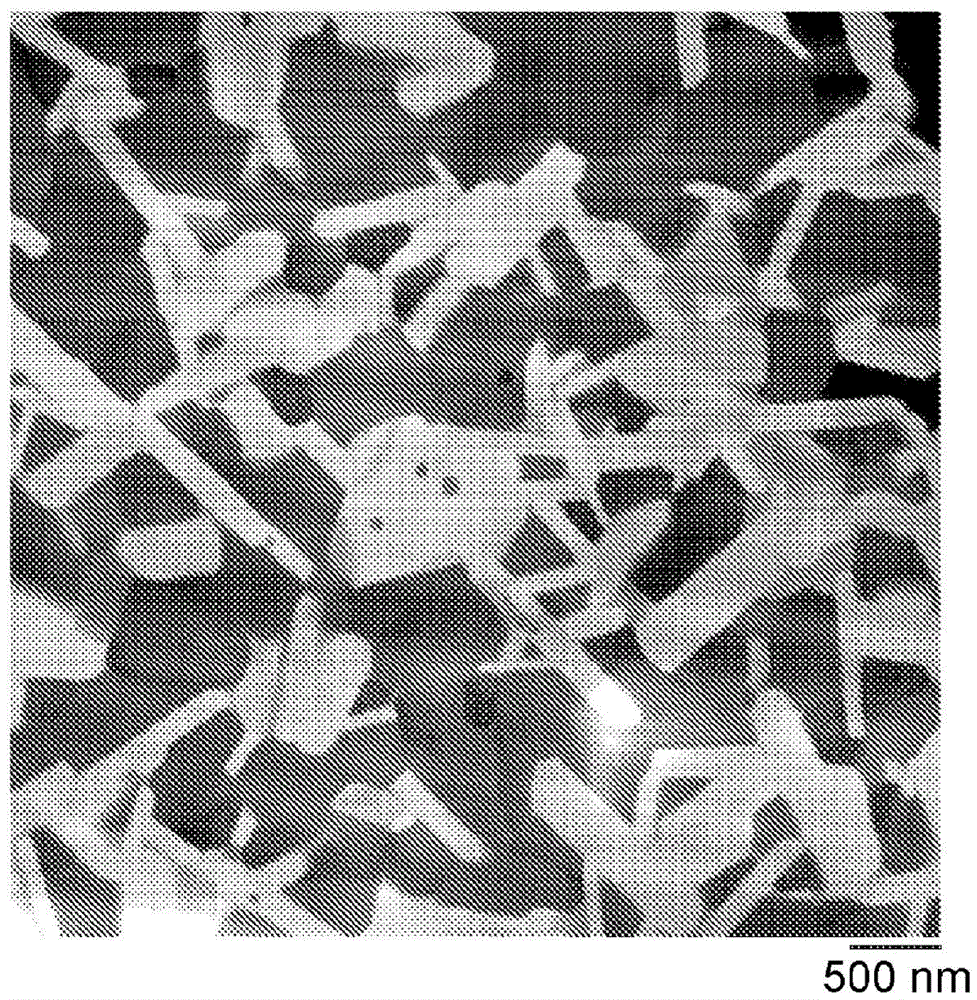
图7A和图7B为经热处理的实施例6材料的聚焦离子束铣削部分的扫描透射电子显微镜(STEM)亮场数字图像。7A and 7B are scanning transmission electron microscopy (STEM) bright field digital images of a focused ion beam milled portion of the heat treated Example 6 material.
图8示出了通过能量色散X射线光谱(EDXS)测定的实施例6的无定形晶界相的组成。Figure 8 shows the composition of the amorphous grain boundary phase of Example 6 as determined by energy dispersive X-ray spectroscopy (EDXS).
具体实施方式Detailed ways
基于陶瓷的总重量计,第一陶瓷包含至少85重量%(在一些实施方案中,至少90重量%,或甚至至少95重量%;在一些实施方案中,在92重量%至99重量%,93重量%至98重量%,或甚至94重量%至97重量%范围内)的至少一种多晶金属氧化物,和至少1重量%(在一些实施方案中,至少2重量%、3重量%、4重量%、5重量%、10重量%、15重量%或甚至至少20重量%;在一些实施方案中,在1重量%至15重量%,1重量%至10重量%,1重量%至5重量%,或甚至1重量%至20重量%范围内)的无定形相,该无定形相包含基于理论氧化物的B2O3、GeO2、P2O5或SiO2中的至少一种,其中金属氧化物包含具有晶界和三相点的晶体,其中该无定形相存在于和晶界和三相点处,其中陶瓷为三维陶瓷制品的形式,其中制品具有弯曲半径为至少1mm(在一些实施方案中,至少2mm、3mm、4mm、5mm、10mm、15mm、20mm、25mm、30mm或甚至至少40mm;在一些实施方案中,在1mm至40mm,1mm至30mm,1mm至25mm,1mm至20mm,1mm至10mm,或甚至5mm至10mm范围内)的至少一个部分,其中制品具有至少0.3mm(在一些实施方案中,至少0.4mm、0.5mm、0.6mm、0.7mm、0.8mm、0.9mm、1mm或甚至至少1.5mm;在一些实施方案中,在0.3mm至1.5mm,0.3mm至1mm,或甚至0.4mm至0.8mm的范围内)的厚度,并且其中制品的任何暴露表面不含(即,零)大于100微米的表面特征。此类表面特征的缺乏使用白光干涉仪(以商品名““CONTOUR ELITE X”得自马萨诸塞州比勒利卡的布鲁克公司(BRUKER,Billerica,MA))来测定。将至少5mm乘5mm的抛光的陶瓷区域置于0.5x放大率下的5X光学透镜下。在x-y平面中使用白光进行5微米背面扫描。为了获得足够大的区域(即,10毫米×10毫米),将一系列100个1×1mm2图像缝编在一起。以商品名“THE MOUNTAINSMAPUNIVERSAL”购自马萨诸塞州比勒利卡的布鲁克公司的软件发现最大的特征尺寸,其小于100微米。Based on the total weight of the ceramic, the first ceramic comprises at least 85 wt% (in some embodiments, at least 90 wt%, or even at least 95 wt%; in some embodiments, between 92 wt% and 99 wt%, 93 wt% wt % to 98 wt %, or even in the range of 94 wt % to 97 wt %) of at least one polycrystalline metal oxide, and at least 1 wt % (in some embodiments, at least 2 wt %, 3 wt %, 4 wt%, 5 wt%, 10 wt%, 15 wt%, or even at least 20 wt%; in some embodiments, at 1 wt% to 15 wt%, 1 wt% to 10 wt%, 1 wt% to 5 wt% % by weight, or even in the range of 1% to 20% by weight) of an amorphous phase comprising at least one of B 2 O 3 , GeO 2 , P 2 O 5 or SiO 2 based on theoretical oxides , wherein the metal oxide comprises crystals having grain boundaries and triple points, wherein the amorphous phase exists at the grain boundaries and the triple points, and wherein the ceramic is in the form of a three-dimensional ceramic article, wherein the article has a bending radius of at least 1 mm ( In some embodiments, at least 2 mm, 3 mm, 4 mm, 5 mm, 10 mm, 15 mm, 20 mm, 25 mm, 30 mm, or even at least 40 mm; in some embodiments, between 1 mm and 40 mm, 1 mm to 30 mm, 1 mm to 25 mm, 1 mm to 20mm, at least a portion in the range of 1mm to 10mm, or even 5mm to 10mm), wherein the article has at least 0.3mm (in some embodiments, at least 0.4mm, 0.5mm, 0.6mm, 0.7mm, 0.8mm, 0.9mm) , 1 mm, or even at least 1.5 mm; in some embodiments, in the range of 0.3 mm to 1.5 mm, 0.3 mm to 1 mm, or even 0.4 mm to 0.8 mm), and wherein any exposed surface of the article is free of ( That is, zero) surface features greater than 100 microns. The absence of such surface features was determined using a white light interferometer (obtained under the trade designation "CONTOUR ELITE X" from BRUKER, Billerica, MA). Polished The ceramic area was placed under a 5X optical lens at 0.5x magnification. A 5 micron back scan was performed using white light in the xy plane. To obtain a sufficiently large area (i.e., 10 mm x 10 mm), a series of 100 1× The 1 mm 2 images were stitched together. Software available under the trade designation "THE MOUNTAINSMAP UNIVERSAL" from Bruker, Billerica, MA found the largest feature size, which was less than 100 microns.
在一些实施方案中,本文所述的第一陶瓷包括具有不同晶体形态(例如,等轴的、细长的、针形的、片状、针状)的至少两种结晶金属氧化物。在本文所述的第一陶瓷的一些实施方案中,至少一种金属氧化物的金属氧化物晶体是针形的。在本文所述的第一陶瓷的一些实施方案中,金属氧化物为Al2O3、ZrO2、RexOy(例如,La2O3、CeO2、Gd2O3中的至少一种)、Y2O3、TiO2、MgO、复合ReO*Al2O3(例如,LaAl11O18或LaAlO3)、复合MgO*Al2O3(例如,MgAl2O4)、复合TiO2*Al2O3(例如,Al2TiO5)或Y3Al5O12中的至少一种,其中每个Re为至少一种独立地具有价态Rev的稀土阳离子,其中O的价态为2,并且其中x(Rev)=2y。In some embodiments, the first ceramics described herein include at least two crystalline metal oxides having different crystal morphologies (eg, equiaxed, elongated, acicular, platelet, acicular). In some embodiments of the first ceramics described herein, the metal oxide crystals of the at least one metal oxide are needle-shaped. In some embodiments of the first ceramics described herein, the metal oxide is at least one of Al 2 O 3 , ZrO 2 , RexO y ( eg, La 2 O 3 , CeO 2 , Gd 2 O 3 ) ), Y 2 O 3 , TiO 2 , MgO, composite ReO*Al 2 O 3 (eg, LaAl 11 O 18 or LaAlO 3 ), composite MgO*Al 2 O 3 (eg, MgAl 2 O 4 ), composite TiO 2 *At least one of Al 2 O 3 (eg, Al 2 TiO 5 ) or Y 3 Al 5 O 12 , where each Re is at least one rare earth cation independently having a valence state Rev, where the valence state of O is 2, and where x( Rev )=2y.
在本文所述的第一陶瓷的一些实施方案中,基于陶瓷的总重量计,多晶结晶金属氧化物包含至少50重量%(在一些实施方案中,至少60重量%、70重量%、75重量%、80重量%、90重量%、95重量%、96或甚至至少97重量%;在一些实施方案中,在50重量%至97重量%、60重量%至97重量%、70重量%至97重量%、75重量%至97重量%、80重量%至97重量%、或甚至90重量%至97重量%的范围内)的基于理论氧化物的Al2O3。In some embodiments of the first ceramics described herein, the polycrystalline crystalline metal oxide comprises at least 50 wt% (in some embodiments, at least 60 wt%, 70 wt%, 75 wt%, based on the total weight of the ceramic) %, 80%, 90%, 95%, 96, or even at least 97%; in some embodiments, at 50% to 97%, 60% to 97%, 70% to 97% wt %, 75 wt % to 97 wt %, 80 wt % to 97 wt %, or even 90 wt % to 97 wt %) of Al 2 O 3 based on the theoretical oxide.
在本文所述的第一陶瓷的一些实施方案中,基于陶瓷的总重量计,多晶结晶金属氧化物包含至少50重量%(在一些实施方案中,至少60重量%、70重量%、75重量%、80重量%、90重量%、95重量%、96或甚至至少97重量%;在一些实施方案中,在50重量%至97重量%、60重量%至97重量%、70重量%至97重量%、75重量%至97重量%、80重量%至97重量%、或甚至90重量%至97重量%范围内)的基于理论氧化物的ZrO2。In some embodiments of the first ceramics described herein, the polycrystalline crystalline metal oxide comprises at least 50 wt% (in some embodiments, at least 60 wt%, 70 wt%, 75 wt%, based on the total weight of the ceramic) %, 80%, 90%, 95%, 96, or even at least 97%; in some embodiments, at 50% to 97%, 60% to 97%, 70% to 97% wt %, 75 wt % to 97 wt %, 80 wt % to 97 wt %, or even 90 wt % to 97 wt %) of ZrO 2 based on the theoretical oxide.
在本文所述的第一陶瓷的一些实施方案中,基于陶瓷的总重量计,多晶结晶金属氧化物包含至少20重量%(在一些实施方案中,至少25重量%、30重量%、40重量%、50重量%、60重量%、70重量%、75或甚至至少80重量%;在一些实施方案中,在20重量%至80重量%、30重量%至70重量%、35重量%至65重量%、或甚至40重量%至60重量%范围内)的基于理论氧化物的至少一种稀土氧化物铝酸盐。在本文所述的第一陶瓷的一些实施方案中,多晶结晶金属氧化物包含Y3Al5O12或稀土铝酸盐中的至少一种(例如,ReAl11O18或ReAlO3中的至少一种,其中Re为独立地为La、Ce、Gd、Dy或Er中的至少一种)。在本文所述的第一陶瓷的一些实施方案中,Y3Al5O12或稀土铝酸盐中的至少一种包含具有平均尺寸大于100纳米(在一些实施方案中,大于150纳米、200纳米、250纳米、500纳米、750纳米、1000纳米、1500纳米、2000纳米或甚至大于2500纳米)的晶体。In some embodiments of the first ceramic described herein, the polycrystalline crystalline metal oxide comprises at least 20 wt% (in some embodiments, at least 25 wt%, 30 wt%, 40 wt%, based on the total weight of the ceramic) %, 50%, 60%, 70%, 75, or even at least 80%; in some embodiments, between 20% to 80%, 30% to 70%, 35% to 65% % by weight, or even in the range of 40% to 60% by weight) based on the theoretical oxide of at least one rare earth oxide aluminate. In some embodiments of the first ceramics described herein, the polycrystalline crystalline metal oxide comprises at least one of Y 3 Al 5 O 12 or a rare earth aluminate (eg, at least one of ReAl 11 O 18 or ReAlO 3 one, wherein Re is independently at least one of La, Ce, Gd, Dy or Er). In some embodiments of the first ceramics described herein, at least one of Y 3 Al 5 O 12 or a rare earth aluminate comprises particles having an average size greater than 100 nanometers (in some embodiments, greater than 150 nanometers, 200 nanometers) , 250 nm, 500 nm, 750 nm, 1000 nm, 1500 nm, 2000 nm or even greater than 2500 nm).
第二陶瓷包含多晶氧化锆、第一多晶稀土铝酸盐(例如,LaAlO3、CeAlO3、Er3Al5O12、GdAlO3或Dy3Al5O12中的至少一种)、不同的第二多晶稀土铝酸盐(例如,LaAl11O18或CeAl11O18中的至少一种)和包含基于理论氧化物的SiO2、Al2O3和稀土氧化物的无定形相,其中多晶氧化锆以及第一多晶稀土铝酸盐和第二多晶稀土铝酸盐包含具有晶界的晶体,其中第一结晶稀土铝酸盐的晶体为针形的,并且其中无定形相存在于晶界处。The second ceramic comprises polycrystalline zirconia, a first polycrystalline rare earth aluminate (eg, at least one of LaAlO 3 , CeAlO 3 , Er 3 Al 5 O 12 , GdAlO 3 or Dy 3 Al 5 O 12 ), different a second polycrystalline rare earth aluminate (eg, at least one of LaAl 11 O 18 or CeAl 11 O 18 ) and an amorphous phase comprising SiO 2 , Al 2 O 3 and rare earth oxides based on theoretical oxides, wherein the polycrystalline zirconia and the first polycrystalline rare earth aluminate and the second polycrystalline rare earth aluminate comprise crystals having grain boundaries, wherein the crystals of the first crystalline rare earth aluminate are needle-shaped, and wherein the amorphous phase exist at grain boundaries.
在本文所述的第二陶瓷的一些实施方案中,基于陶瓷的总重量计,多晶氧化锆以至少10重量%(在一些实施方案中,至少20重量%、25重量%、30重量%或甚至至少40重量%;在一些实施方案中,在10重量%至40重量%、10重量%至30重量%、或甚至10重量%至25重量%范围内)的量基于理论氧化物存在。在本文所述的第二陶瓷的一些实施方案中,基于陶瓷的总重量计,第一多晶稀土铝酸盐以至少30重量%(在一些实施方案中,至少40重量%、至少50重量%、60重量%、70重量%或甚至至少75重量%;在一些实施方案中,在30重量%至75重量%或甚至40重量%至45重量%范围内)的量基于理论氧化物存在。在本文所述的第二陶瓷的一些实施方案中,基于陶瓷的总重量计,第二多晶稀土铝酸盐以至少15重量%(在一些实施方案中,至少20重量%、至少25重量%、30重量%、35重量%或甚至至少40重量%;在一些实施方案中,在15重量%至40重量%或甚至20重量%至30重量%范围内)的量基于理论氧化物存在。In some embodiments of the second ceramic described herein, the polycrystalline zirconia is present in at least 10 wt% (in some embodiments, at least 20 wt%, 25 wt%, 30 wt% or Even at least 40 wt%; in some embodiments, in an amount ranging from 10 wt% to 40 wt%, 10 wt% to 30 wt%, or even 10 wt% to 25 wt%) based on the theoretical oxide. In some embodiments of the second ceramic described herein, the first polycrystalline rare earth aluminate is present in an amount of at least 30 wt% (in some embodiments, at least 40 wt%, at least 50 wt%, based on the total weight of the ceramic) , 60 wt %, 70 wt %, or even at least 75 wt %; in some embodiments, in the range of 30 to 75 wt % or even 40 to 45 wt %) is present based on the theoretical oxide. In some embodiments of the second ceramic described herein, the second polycrystalline rare earth aluminate is present in an amount of at least 15 wt% (in some embodiments, at least 20 wt%, at least 25 wt%, based on the total weight of the ceramic) , 30 wt %, 35 wt %, or even at least 40 wt %; in some embodiments, in the range of 15 wt % to 40 wt % or even 20 wt % to 30 wt %) is present based on the theoretical oxide.
在本文所述的第二陶瓷的一些实施方案中,第一稀土铝酸盐包含具有平均尺寸为至少50纳米(在一些实施方案中,至少100纳米、150纳米、200纳米、250纳米或甚至至少500纳米)的晶体。In some embodiments of the second ceramics described herein, the first rare earth aluminate comprises particles having an average size of at least 50 nanometers (in some embodiments, at least 100 nanometers, 150 nanometers, 200 nanometers, 250 nanometers, or even at least 50 nanometers) 500 nm) crystals.
可以通过根据ASTM标准E112-96“用于确定平均晶粒尺寸的标准测试方法”(“Standard Test Methods for Determining Average Grain Size”)的线截距法确定陶瓷的平均晶体尺寸。将样品装配在通常为直径约2.5cm且高约1.9cm的圆柱体树脂的装配树脂(诸如可以商品名“TRANSOPTIC POWDER”得自伊利诺伊州布勒夫湖的标乐公司(Buehler,Lake Bluff,IL)的树脂)中。采用抛光机(诸如以商品名“EPOMET 3”得自标乐公司的抛光机)利用常规的打磨技术制备装配部分。利用金刚石砂轮抛光样品约3分钟,接着用45、30、15、9、3和1微米的研磨液分别抛光5分钟。为已装配并抛光的样品溅镀一薄层金-钯,并利用扫描电子显微镜(诸如JEOL SEM Model JSM 840A)观察。如下利用样品中发现的微结构的典型后向散射电子(BSE)显微图来确定平均晶体尺寸。计数与每单位长度(NL)的横截显微图绘制的随机直线相交的晶体数目。利用这一数目根据以下公式确定平均晶体尺寸。The average crystal size of a ceramic can be determined by the line intercept method according to ASTM Standard E112-96 "Standard Test Methods for Determining Average Grain Size". The samples were mounted in a mounting resin (such as available from Buehler, Lake Bluff, IL under the trade designation "TRANSOPTIC POWDER", typically a cylindrical resin of about 2.5 cm in diameter and about 1.9 cm in height. ) in the resin). Assembly parts are prepared using conventional grinding techniques using a polisher, such as that available from Buehler under the trade designation "EPOMET 3". The samples were polished with a diamond wheel for about 3 minutes, followed by 45, 30, 15, 9, 3, and 1 micron slurries for 5 minutes, respectively. The assembled and polished samples were sputtered with a thin layer of gold-palladium and observed using a scanning electron microscope such as a JEOL SEM Model JSM 840A. The average crystal size is determined as follows using a typical backscattered electron (BSE) micrograph of the microstructure found in the sample. The number of crystals intersecting a random straight line drawn per unit length ( NL ) of the cross-sectional micrograph was counted. Using this number, the average crystal size is determined according to the following formula.
平均晶体尺寸=1.56×NLM,Average crystal size = 1.56 × N L M,
其中NL为每单位长度相交的晶体数,并且M为显微图的放大倍率。where NL is the number of intersecting crystals per unit length, and M is the magnification of the micrograph.
在本文所述的第二陶瓷的一些实施方案中,第二稀土铝酸盐包含平均尺寸为至少200纳米(在一些实施方案中,至少250纳米、300纳米、400纳米、500纳米、1000纳米或甚至5微米;在一些实施方案中,在200纳米至5微米,或甚至400纳米至2微米范围内)晶体。In some embodiments of the second ceramics described herein, the second rare earth aluminate comprises an average size of at least 200 nanometers (in some embodiments, at least 250 nanometers, 300 nanometers, 400 nanometers, 500 nanometers, 1000 nanometers or even 5 microns; in some embodiments, in the range of 200 nanometers to 5 microns, or even 400 nanometers to 2 microns) crystals.
在本文所述的第二陶瓷的一些实施方案中,基于陶瓷的总重量计,无定形相以至少1重量%(在一些实施方案中,至少2重量%、3重量%、4重量%、5重量%、10重量%、15重量%或甚至至少20重量%;在一些实施方案中,在1重量%至20重量%、1重量%至15重量%、1重量%至10重量%或甚至1重量%至5重量%范围内)的量基于理论氧化物存在。In some embodiments of the second ceramic described herein, the amorphous phase is present in at least 1 wt% (in some embodiments, at least 2 wt%, 3 wt%, 4 wt%, 5 wt%, based on the total weight of the ceramic) wt %, 10 wt %, 15 wt %, or even at least 20 wt %; in some embodiments, between 1 wt % to 20 wt %, 1 wt % to 15 wt %, 1 wt % to 10 wt %, or even 1 wt % % to 5% by weight) are present in amounts based on the theoretical oxide.
第三陶瓷包含多晶氧化锆、多晶氧化铝、多晶铝酸钇(例如,Y3Al5O12)和无定形相,其包含基于理论氧化物的SiO2、Al2O3和钇氧化物,其中多晶氧化锆、多晶氧化铝和多晶铝酸钇包含具有晶界的晶体,并且其中无定形相存在于晶界处。The third ceramic includes polycrystalline zirconia, polycrystalline alumina, polycrystalline yttrium aluminate (eg, Y 3 Al 5 O 12 ), and an amorphous phase including SiO 2 , Al 2 O 3 and yttrium based on theoretical oxides Oxides in which polycrystalline zirconia, polycrystalline alumina and polycrystalline yttrium aluminate comprise crystals having grain boundaries and in which amorphous phases exist at the grain boundaries.
在所述的第三陶瓷的一些实施方案中,基于陶瓷的总重量计,多晶氧化锆以至少10重量%(在一些实施方案中,至少20重量%、25重量%、30重量%或甚至至少40重量%;在一些实施方案中,在10重量%至40重量%、10重量%至30重量%、或甚至10重量%至25重量%范围内)的量基于理论氧化物存在。In some embodiments of the third ceramic described, the polycrystalline zirconia is present in an amount of at least 10 wt % (in some embodiments, at least 20 wt %, 25 wt %, 30 wt %, or even at least 10 wt %, based on the total weight of the ceramic) at least 40% by weight; in some embodiments, in an amount ranging from 10% to 40%, 10% to 30%, or even 10% to 25% by weight) based on the theoretical oxide.
在本文所述的第三陶瓷的一些实施方案中,基于陶瓷的总重量计,多晶氧化铝以至少15重量%(在一些实施方案中,至少20重量%、25重量%、30重量%、35重量%或甚至至少40重量%;在一些实施方案中,在15重量%至40重量%或甚至20重量%至30重量%范围内)的量基于理论氧化物存在。In some embodiments of the third ceramic described herein, the polycrystalline alumina is present in at least 15 wt% (in some embodiments, at least 20 wt%, 25 wt%, 30 wt%, 35 wt% or even at least 40 wt%; in some embodiments, in the range of 15 wt% to 40 wt% or even 20 wt% to 30 wt%) is present based on the theoretical oxide.
在本文所述的第三陶瓷的一些实施方案中,氧化铝包含平均尺寸为至少50纳米(在一些实施方案中,至少100纳米、150纳米、200纳米、250纳米或甚至至少500纳米)的晶体。In some embodiments of the third ceramic described herein, the alumina comprises crystals having an average size of at least 50 nanometers (in some embodiments, at least 100 nanometers, 150 nanometers, 200 nanometers, 250 nanometers, or even at least 500 nanometers) .
在本文所述的第三陶瓷的一些实施方案中,铝酸钇包含平均尺寸为至少200纳米(在一些实施方案中,至少250纳米、300纳米、400纳米、500纳米、1000纳米或甚至5微米;在一些实施方案中,在200纳米至5微米,或甚至400纳米至2微米范围内)的晶体。In some embodiments of the third ceramic described herein, the yttrium aluminate comprises an average size of at least 200 nanometers (in some embodiments, at least 250 nanometers, 300 nanometers, 400 nanometers, 500 nanometers, 1000 nanometers, or even 5 micrometers) ; in some embodiments, in the range of 200 nanometers to 5 micrometers, or even 400 nanometers to 2 micrometers).
在本文所述的第三陶瓷的一些实施方案中,基于陶瓷的总重量计,无定形相以至少1重量%(在一些实施方案中,至少2重量%、3重量%、4重量%、5重量%、10重量%、15重量%或甚至至少20重量%;在一些实施方案中,在1重量%至20重量%、1重量%至15重量%、1重量%至10重量%或甚至1重量%至5重量%范围内)的量基于理论氧化物存在。In some embodiments of the third ceramic described herein, the amorphous phase is present in at least 1 wt% (in some embodiments, at least 2 wt%, 3 wt%, 4 wt%, 5 wt%, based on the total weight of the ceramic wt %, 10 wt %, 15 wt %, or even at least 20 wt %; in some embodiments, between 1 wt % to 20 wt %, 1 wt % to 15 wt %, 1 wt % to 10 wt %, or even 1 wt % % to 5% by weight) are present in amounts based on the theoretical oxide.
在本文所述的第一、第二和第三陶瓷的一些实施方案中,基于陶瓷的总重量计,总共包含不大于20重量%(在一些实施方案中,不大于15重量%、10重量%、5重量%、4重量%、3重量%、2重量%或甚至不大于1重量%;在一些实施方案中,在1重量%至20重量%,1重量%至15重量%,或甚至1重量%至10重量%范围内)的基于理论氧化物的B2O3、GeO2、P2O5和SiO2。In some embodiments of the first, second, and third ceramics described herein, based on the total weight of the ceramic, the total comprises no more than 20 wt% (in some embodiments, no more than 15 wt%, 10 wt% , 5 wt %, 4 wt %, 3 wt %, 2 wt %, or even no more than 1 wt %; in some embodiments, at 1 wt % to 20 wt %, 1 wt % to 15 wt %, or even 1 B 2 O 3 , GeO 2 , P 2 O 5 and SiO 2 based on theoretical oxides in the range of wt % to 10 wt %).
在本文所述的第一、第二和第三陶瓷的一些实施方案中,无定形相包含Y2O3-Al2O3-SiO2。In some embodiments of the first, second, and third ceramics described herein, the amorphous phase comprises Y2O3 - Al2O3 - SiO2 .
在本文所述的第一、第二和第三陶瓷的一些实施方案中,基于陶瓷的总重量计,无定形相包含至少5重量%(在一些实施方案中,至少10重量%、20重量%、25重量%、30重量%、40重量%或甚至至少50重量%;在一些实施方案中,在5重量%至50重量%,10重量%至40重量%,或甚至20重量%至35重量%)的基于理论氧化物的B2O3、GeO2、P2O5或SiO2中的至少一种。In some embodiments of the first, second, and third ceramics described herein, the amorphous phase comprises at least 5 wt% (in some embodiments, at least 10 wt%, 20 wt%, based on the total weight of the ceramic) , 25 wt %, 30 wt %, 40 wt %, or even at least 50 wt %; in some embodiments, at 5 wt % to 50 wt %, 10 wt % to 40 wt %, or even 20 wt % to 35 wt % %) of at least one of B 2 O 3 , GeO 2 , P 2 O 5 or SiO 2 based on the theoretical oxide.
在本文所述的第一、第二和第三陶瓷的一些实施方案中,包含平均尺寸不大于100纳米(在一些实施方案中,不大于90纳米、85纳米、80纳米、75纳米、70纳米、65纳米、60纳米、55纳米、50纳米、45纳米、40纳米、35纳米、30纳米、25或甚至不大于20纳米)的晶体。In some embodiments of the first, second and third ceramics described herein, comprising an average size of not greater than 100 nanometers (in some embodiments, not greater than 90 nanometers, 85 nanometers, 80 nanometers, 75 nanometers, 70 nanometers) , 65 nm, 60 nm, 55 nm, 50 nm, 45 nm, 40 nm, 35 nm, 30 nm, 25 nm, or even no larger than 20 nm).
在本文所述的第一、第二和第三陶瓷的一些实施方案中,基于陶瓷的总体积计,包含至少90体积%(在一些实施方案中,至少91体积%、92体积%、92.5体积%、93体积%、94体积%、95体积%、96体积%、97体积%、97.5体积%、98体积%、99体积%、99.5体积%、99.6体积%、99.7体积%、99.8或甚至至少99.9体积%)的晶体不大于100纳米(在一些实施方案中,不大于90纳米、85纳米、80纳米、75纳米、70纳米、65纳米、60纳米、55纳米、50纳米、45纳米、40纳米、35纳米、30纳米、25或甚至不大于20纳米)的尺寸。In some embodiments of the first, second, and third ceramics described herein, comprise at least 90 vol% (in some embodiments, at least 91 vol%, 92 vol%, 92.5 vol%, based on the total volume of the ceramic) %, 93% by volume, 94% by volume, 95% by volume, 96% by volume, 97% by volume, 97.5% by volume, 98% by volume, 99% by volume, 99.5% by volume, 99.6% by volume, 99.7% by volume, 99.8% by volume, or even at least 99.9 vol%) crystals no larger than 100 nm (in some embodiments, no larger than 90 nm, 85 nm, 80 nm, 75 nm, 70 nm, 65 nm, 60 nm, 55 nm, 50 nm, 45 nm, 40 nm nanometers, 35 nanometers, 30 nanometers, 25 nanometers, or even no larger than 20 nanometers).
在本文所述的第一、第二和第三陶瓷的一些实施方案中,基本上由平均尺寸不大于100纳米(在一些实施方案中,不大于90纳米、85纳米、80纳米、75纳米、70纳米、65纳米、60纳米、55纳米、50纳米、45纳米、40纳米、35纳米、30纳米、25或甚至不大于20纳米)的晶体组成。In some embodiments of the first, second, and third ceramics described herein, substantially consist of an average size of no greater than 100 nanometers (in some embodiments, no greater than 90 nanometers, 85 nanometers, 80 nanometers, 75 nanometers, 70 nanometers, 65 nanometers, 60 nanometers, 55 nanometers, 50 nanometers, 45 nanometers, 40 nanometers, 35 nanometers, 30 nanometers, 25 nanometers or even no larger than 20 nanometers).
在本文所述的第一、第二和第三陶瓷的一些实施方案中,包含平均尺寸大于100纳米(在一些实施方案中,大于150纳米、175纳米或甚至大于200纳米)的晶体。In some embodiments of the first, second, and third ceramics described herein, crystals having an average size greater than 100 nanometers (in some embodiments, greater than 150 nanometers, 175 nanometers, or even greater than 200 nanometers) are included.
在本文所述的第一、第二和第三陶瓷的一些实施方案中,基于玻璃陶瓷制品的总体积计,包含至少90体积%(在一些实施方案中,至少91体积%、92体积%、92.5体积%、94体积%、95体积%、96体积%、97体积%、97.5体积%、98体积%、99体积%、99.5体积%、99.6体积%、99.7体积%、99.8或甚至至少99.9体积%)的平均尺寸大于50纳米(在一些实施方案中,大于75纳米、100纳米、150或甚至大于200纳米)的晶体。In some embodiments of the first, second and third ceramics described herein, comprise at least 90 vol% (in some embodiments, at least 91 vol%, 92 vol%, 92 vol%, 92.5 vol%, 94 vol%, 95 vol%, 96 vol%, 97 vol%, 97.5 vol%, 98 vol%, 99 vol%, 99.5 vol%, 99.6 vol%, 99.7 vol%, 99.8 or even at least 99.9 vol% %) crystals with an average size greater than 50 nanometers (in some embodiments, greater than 75 nanometers, 100 nanometers, 150 nanometers, or even greater than 200 nanometers).
在本文所述的第一、第二和第三陶瓷的一些实施方案中,具有彼此各自垂直的x、y和z尺寸,其中x、y和z尺寸中的每一者各自为至少0.3毫米(在一些实施方案中,至少0.4毫米、0.5毫米、1毫米、2毫米、3毫米、4毫米或甚至至少5毫米)。在一些实施方案中,x和y尺寸为至少1毫米、2毫米、3毫米、4毫米或甚至至少5毫米,并且z尺寸为至少0.1毫米、0.2毫米、0.3毫米、0.4毫米或甚至至少0.5毫米。在视觉上或者利用显微镜法确定材料的x、y和z尺寸,具体取决于尺寸的量级。例如,报告的z尺寸为球体直径、涂层厚度或棱柱形状的最大长度。In some embodiments of the first, second, and third ceramics described herein, have x, y, and z dimensions that are each perpendicular to each other, wherein each of the x, y, and z dimensions are each at least 0.3 millimeters ( In some embodiments, at least 0.4 mm, 0.5 mm, 1 mm, 2 mm, 3 mm, 4 mm, or even at least 5 mm). In some embodiments, the x and y dimensions are at least 1 millimeter, 2 millimeters, 3 millimeters, 4 millimeters, or even at least 5 millimeters, and the z dimension is at least 0.1 millimeters, 0.2 millimeters, 0.3 millimeters, 0.4 millimeters, or even at least 0.5 millimeters . The x, y and z dimensions of the material are determined visually or microscopically, depending on the magnitude of the dimensions. For example, the reported z-dimension is the diameter of the sphere, the thickness of the coating, or the maximum length of the prismatic shape.
在本文所述的第一、第二和第三陶瓷的一些实施方案中,通过“流动特性测试”。对于片材的平坦部分,“流动特性测试”按如下方式进行。切割样品的平坦部分并将其置于外部为约80×60毫米并且内部为44×58毫米的矩形3维(3D)石墨模具中,其具有曲率半径为Bf的斜边(石墨购自宾夕法尼亚州圣玛丽斯城的美尔森集团(Mersen,St.Marys,PA),并被加工以提供指定的内部尺寸)。将具有待测试样品于其内的模具置于N2环境中的热压机内部(以商品名“HP-50”购自加利福尼亚州布雷亚的热能技术有限公司(Thermal TechnologyInc.,Brea,CA))。将1千克的碳(3英寸(7.6cm)杆,4英寸(10.2cm)高,购自美尔森集团(Mersen))放置在模具上。然后将样品以10℃/分钟加热至1350℃并在N2流量(40cm3/分钟))中,在1350℃下保持90分钟以保护石墨模具。将样品在模具中以10℃/分钟的速率冷却至室温。将冷却的模具/样品从炉中取出,并且将样品从模具中移除。测量受热的样品的弯曲半径Cf(“受热弯曲半径”)。如果受热弯曲半径Cf小于曲率半径Bf的1.5倍,则样品通过流动特性测试。In some embodiments of the first, second and third ceramics described herein, the "Flow Properties Test" is passed. For the flat portion of the sheet, the "Flow Properties Test" was performed as follows. A flat portion of the sample was cut and placed into a rectangular 3-dimensional (3D) graphite mold approximately 80 x 60 mm on the outside and 44 x 58 mm on the inside, with beveled edges with a radius of curvature Bf (graphite was purchased from Pennsylvania Mersen, St. Marys, PA, and machined to provide specified interior dimensions). The mold with the sample to be tested therein was placed inside a heated press (available from Thermal Technology Inc., Brea, CA, under the trade designation "HP-50") in a N2 environment ). A 1 kg piece of carbon (3 inch (7.6 cm) rod, 4 inch (10.2 cm) high, purchased from Mersen) was placed on the mold. The sample was then heated to 1350°C at 10°C/min and held at 1350°C for 90 minutes in a N2 flow (40 cm3 /min) to protect the graphite mold. The samples were cooled to room temperature in the mold at a rate of 10°C/min. The cooled mold/sample was removed from the furnace and the sample was removed from the mold. The bend radius C f ("heated bend radius") of the heated sample is measured. If the heated bend radius C f is less than 1.5 times the curvature radius B f , the sample passes the flow characteristic test.
对于片材的弯曲部分,“流动特性测试”按如下方式进行。切割具有初始弯曲半径Ac mm大于零的样品,并且放置于外部为约80×60毫米并且内部为44×58毫米的矩形3D石墨模具中,其具有曲率半径为Bc的斜边,使得弯曲半径Ac为其Bc的曲率半径的至少3倍(石墨购自美尔森集团(Mersen),并被加工以提供指定的内部尺寸)。将具有待测试样品于其内的模具置于N2环境中的热压机内部(“HP-50”)。将1千克的碳(3英寸(7.6cm)杆,4英寸(10.2cm)高,购自美尔森集团(Mersen))放置在模具上。然后将样品以10℃/分钟加热至1350℃并在N2流量(40cm3/分钟))中,在1350℃下保持90分钟以保护石墨模具。将样品在模具中以10℃/分钟的速率冷却至室温。将冷却的模具/样品从炉中取出,并且将样品从模具中移除。测量受热的样品的弯曲半径Cc(“受热弯曲半径”)。如果受热弯曲半径C小于曲率半径Bc的1.5倍,则样品通过流动特性测试。For the bent portion of the sheet, the "flow property test" was performed as follows. A sample with an initial bend radius A c mm greater than zero was cut and placed in a rectangular 3D graphite mold of approximately 80 x 60 mm outside and 44 x 58 mm inside, with beveled edges with a radius of curvature B c such that the bend The radius Ac is at least 3 times the radius of curvature of its B c ( graphite was purchased from Mersen and machined to provide the specified internal dimensions). The mold with the sample to be tested inside was placed inside a hot press ("HP-50") in a N2 environment. A 1 kg piece of carbon (3 inch (7.6 cm) rod, 4 inch (10.2 cm) high, purchased from Mersen) was placed on the mold. The sample was then heated to 1350°C at 10°C/min and held at 1350°C for 90 minutes in a N2 flow (40 cm3 /min) to protect the graphite mold. The samples were cooled to room temperature in the mold at a rate of 10°C/min. The cooled mold/sample was removed from the furnace and the sample was removed from the mold. The bend radius C c ("heated bend radius") of the heated sample is measured. If the heated bend radius C is less than 1.5 times the radius of curvature B c , the sample passes the flow characteristic test.
在本文所述的第二和第三陶瓷的一些实施方案中,为三维陶瓷制品的形式,其中制品具有弯曲半径为至少1mm(在一些实施方案中,至少2mm、3mm、4mm、5mm、10mm、15mm、20mm、25mm、30mm或甚至至少40mm;在一些实施方案中,在1mm至40mm,1mm至30mm,1mm至25mm,1mm至20mm,1mm至10mm,或甚至5mm至10mm的范围内)的至少一个部分,其中制品具有至少0.3mm(在一些实施方案中,至少0.4mm、0.5mm、0.6mm、0.7mm、0.8mm、0.9mm、1mm或甚至至少1.5mm;在一些实施方案中,在0.3mm至1.5mm,0.3mm至1mm或甚至0.4mm至0.8mm范围内)的厚度。In some embodiments of the second and third ceramics described herein, in the form of a three-dimensional ceramic article, wherein the article has a bend radius of at least 1 mm (in some embodiments, at least 2 mm, 3 mm, 4 mm, 5 mm, 10 mm, 15mm, 20mm, 25mm, 30mm, or even at least 40mm; in some embodiments, at least in the range of 1mm to 40mm, 1mm to 30mm, 1mm to 25mm, 1mm to 20mm, 1mm to 10mm, or even 5mm to 10mm) A portion wherein the article has at least 0.3 mm (in some embodiments, at least 0.4 mm, 0.5 mm, 0.6 mm, 0.7 mm, 0.8 mm, 0.9 mm, 1 mm, or even at least 1.5 mm; in some embodiments, at 0.3 mm mm to 1.5mm, 0.3mm to 1mm or even 0.4mm to 0.8mm) thickness.
在一些实施方案中,本文所述的第一、第二和第三陶瓷具有平均微硬度,基于20次测量,为至少10GPa(在一些实施方案中,至少11GPa、12GPa、13GPa、14GPa、15GPa、16GPa、17GPa或甚至至少18GPa;在一些实施方案中,在10GPa至18GPa,或甚至12GPa至15GPa的范围内)。玻璃陶瓷和/或结晶陶瓷的平均微硬度可如下测定。将材料部分装配在通常直径约2.5cm和高度约1.9cm的圆柱体树脂的装配树脂(可以商品名“TRANSOPTIC POWDER”购自伊利诺伊州布勒夫湖的标乐有限公司(Buehler Ltd.,Lake Bluff,IL))中。采用抛光机(可以商品名“EPOMET 3”购自标乐有限公司(Buehler,Ltd.)的抛光机)利用常规的打磨技术制备装配部分。利用金刚石砂轮抛光样品约3分钟,接着用45、30、15、9、3和1微米的金刚石浆液分别抛光5分钟。采用常规的显微硬度测试仪(以商品名“MITUTOYO MVK-VL”购自日本东京三丰株式会社(Mitutoyo Corporation,Tokyo,Japan))进行微硬度的量度,显微硬度测试仪配有采用100克压印负载的维氏(Vickers)压头。微硬度测量根据在“用于材料的微硬度的ASTM测试方法E384测试方法”(“ASTM Test Method E384 Test Methods forMicrohardness of Materials”)(1991年)中所述的指南来进行,该公开以引用的方式并入本文。In some embodiments, the first, second, and third ceramics described herein have an average microhardness, based on 20 measurements, of at least 10 GPa (in some embodiments, at least 11 GPa, 12 GPa, 13 GPa, 14 GPa, 15 GPa, 16GPa, 17GPa, or even at least 18GPa; in some embodiments, in the range of 10GPa to 18GPa, or even 12GPa to 15GPa). The average microhardness of glass ceramics and/or crystalline ceramics can be determined as follows. Assembly resin (available under the trade designation "TRANSOPTIC POWDER" from Buehler Ltd., Lake Bluff, IL , IL)). Assembly parts were prepared using conventional grinding techniques using a polisher (available under the trade designation "EPOMET 3" from Buehler, Ltd.). The samples were polished with a diamond wheel for about 3 minutes, followed by 5 minutes with 45, 30, 15, 9, 3 and 1 micron diamond slurries, respectively. The microhardness was measured using a conventional microhardness tester (purchased under the trade name "MITUTOYO MVK-VL" from Mitutoyo Corporation, Tokyo, Japan), equipped with a 100 Vickers indenter for gram impression load. Microhardness measurements were made according to the guidelines described in "ASTM Test Method E384 Test Methods for Microhardness of Materials" (1991), which publication is cited in method is incorporated herein.
在一些实施方案中,本文所述的第一、第二和第三陶瓷具有弯曲强度,为至少500MPa(在一些实施方案中,至少600MPa、700MPa、800MPa、900MPa、1000MPa1200MPa或甚至至少1500MPa;在一些实施方案中,在500MPa至1500MPa,或甚至700MPa至1200MPa的范围内)。弯曲强度如下测定。通过将9克的经热处理的小珠置于外径为160毫米、内径为20毫米和高为100毫米(石墨得自美尔森集团(Mersen))的圆形石墨模具中,然后加工成指定的内部尺寸,来制备20-mm的盘。然后将模具在玻璃压机(以商品名“GMP”,得自日本东京的东芝公司(Toshiba,Tokyo,Japan))中热压,并且以40℃/分钟加热至880℃,在用活性氮气冷却至室温之前,在15000Nm的压力下保持10分钟。使用低速金刚石锯(以商品名“TECHCUT 4”购自加利福尼亚州兰乔多明格斯的联合高科技产品公司(Allied High Tech ProductsInc.,Rancho Dominguez,CA))将所得圆盘切成0.8mm厚的圆盘。使用以下概述加热盘:以3℃/分钟从20℃加热至830℃,保持在830℃2小时,以1℃/分钟从830℃加热至875℃,保持在875℃2小时,以1℃/分钟从875℃加热至900℃,保持在900℃2小时,以1℃/分钟从900℃加热至1000℃,保持在1000℃1小时,以3℃/分钟从1000℃加热至1400℃,保持在1400℃1小时,并且以3℃/分钟从1400℃加热至20℃。利用金刚石砂轮抛光玻璃陶瓷盘约3分钟,接着利用45微米、30微米、15微米、9微米和3微米的金刚石浆液分别抛光三分钟。采用双轴弯曲强度测定强度。将下侧放置在由三个直径为3mm,在直径为8mm的圆上以120°的间隔隔开的钢球组成的支撑件上。将支撑件和样品放置在具有垂直冲头的夹具中,所述垂直冲头位于样品的上侧的中心。与晶片接触的冲头直径为1.8mm。将夹具加载到万能试验机(标示为“系列1101”,得自宾夕法尼亚州巴特勒的应用测试系统公司(Applied Test Systems,Inc.,Butler,PA))中。冲头以0.2mm/分钟的速率推入薄片中,直至样品破碎。记录断裂时的负载。由下式计算强度值:In some embodiments, the first, second, and third ceramics described herein have a flexural strength of at least 500 MPa (in some embodiments, at least 600 MPa, 700 MPa, 800 MPa, 900 MPa, 1000 MPa, 1200 MPa, or even at least 1500 MPa; in some In embodiments, in the range of 500 MPa to 1500 MPa, or even 700 MPa to 1200 MPa). The bending strength was measured as follows. By placing 9 grams of heat-treated beads in a circular graphite mold with an outer diameter of 160 mm, an inner diameter of 20 mm and a height of 100 mm (graphite obtained from Mersen), then machined to the specified , to prepare 20-mm discs. The mold was then hot pressed in a glass press (under the trade name "GMP" from Toshiba, Tokyo, Japan) and heated to 880°C at 40°C/min, cooled with active nitrogen It was held at a pressure of 15000 Nm for 10 minutes before reaching room temperature. The resulting disc was cut to 0.8 mm thickness using a low speed diamond saw (available under the trade designation "TECHCUT 4" from Allied High Tech Products Inc., Rancho Dominguez, CA) of the disc. Use the following outlined heating plate: heat from 20 °C to 830 °C at 3 °C/min, hold at 830 °C for 2 hr, heat from 830 °C to 875 °C at 1 °C/min, hold at 875 °C for 2 hr, hold at 1 °C/min Heating from 875°C to 900°C in minutes, holding at 900°C for 2 hours, heating from 900°C to 1000°C at 1°C/min, holding at 1000°C for 1 hour, heating from 1000°C to 1400°C at 3°C/min, holding 1 hour at 1400°C and heating from 1400°C to 20°C at 3°C/min. The glass-ceramic discs were polished with a diamond wheel for about 3 minutes, followed by 45 micron, 30 micron, 15 micron, 9 micron and 3 micron diamond slurries for three minutes respectively. Strength was measured using biaxial flexural strength. The underside was placed on a support consisting of three steel balls of 3 mm diameter spaced at 120° intervals on a circle of 8 mm diameter. The support and sample were placed in a jig with a vertical punch centered on the upper side of the sample. The diameter of the punch in contact with the wafer is 1.8 mm. The fixture was loaded into a universal testing machine (designated "Series 1101", available from Applied Test Systems, Inc., Butler, PA). The punch was pushed into the sheet at a rate of 0.2 mm/min until the sample broke. Record the load at break. The intensity value is calculated by:
S=-0.2387P(X-Y)/d2 S=-0.2387P(XY)/d 2
其中:in:
P=断裂时的负载,以牛顿为单位P = load at break, in Newtons
X=(1+v)ln(r2/r3)2+[(1-v)/2](r2/r3)2 X=(1+v)ln(r 2 /r 3 ) 2 +[(1-v)/2](r 2 /r 3 ) 2
Y=(1+v)[1+ln(r1/r3)2]+(1-v)/(r1/r3)2 Y=(1+v)[1+ln(r 1 /r 3 ) 2 ]+(1-v)/(r 1 /r 3 ) 2
其中:in:
v=泊松比v = Poisson's ratio
r1=支撑件环的半径,以mm为单位r 1 = radius of support ring in mm
r2=上冲头接触半径,以mm为单位r 2 = upper punch contact radius in mm
r3=样品的半径,以mm为单位r 3 = radius of the sample in mm
d=样品的厚度,以mm为单位。d = thickness of the sample in mm.
在一些实施方案中,本文所述的第一、第二和第三陶瓷为制品的形式,其具有平均表面粗糙度Ra小于20nm的任何暴露表面。使用白光干涉仪(“CONTOUR ELITE X8”)测定平均表面粗糙度RA。将至少5mm乘5mm的抛光的陶瓷区域置于0.5x放大率下的5X光学透镜下。在x-y平面中使用白光进行5微米背面扫描。为了获得足够大的区域(即,10毫米×10毫米),将一系列100个1×1mm2图像缝编在一起。以商品名“THE MOUNTAINSMAP UNIVERSAL”购买的软件计算平均表面粗糙度Ra。In some embodiments, the first, second, and third ceramics described herein are in the form of articles having any exposed surface having an average surface roughness Ra of less than 20 nm. The average surface roughness RA was measured using a white light interferometer ("CONTOUR ELITE X8"). A polished ceramic area of at least 5mm by 5mm is placed under a 5X optical lens at 0.5x magnification. A 5 micron backside scan was performed using white light in the xy plane. To obtain a sufficiently large area (ie, 10 mm x 10 mm), a series of 100 1 x 1 mm 2 images were stitched together. The average surface roughness Ra was calculated by software purchased under the trade name "THE MOUNTAINSMAP UNIVERSAL".
在本文所述的第一、第二和第三陶瓷的一些实施方案中,具有如模制的(与加工表面相比)外表面。In some embodiments of the first, second and third ceramics described herein, there is an outer surface as molded (as compared to the machined surface).
在本文所述的第一、第二和第三陶瓷的一些实施方案中,具有无泽面光洁度。In some embodiments of the first, second and third ceramics described herein, there is a matte finish.
第一陶瓷可例如通过以下方法制成,所述方法包括:The first ceramic can be made, for example, by a method comprising:
提供具有体积、第一形状的陶瓷预成形件,该陶瓷预成形件包含多晶结晶金属氧化物和包含基于理论氧化物的B2O3、GeO2、P2O5或SiO2中的至少一种的无定形相;A ceramic preform having a bulk, first shape is provided, the ceramic preform comprising a polycrystalline crystalline metal oxide and comprising at least one of B 2 O 3 , GeO 2 , P 2 O 5 or SiO 2 based on theoretical oxides an amorphous phase;
提供主表面;provide primary surfaces;
将预成形件的至少一部分放置成与主表面接触;以及placing at least a portion of the preform in contact with the major surface; and
在足够的温度和足够的压力下加热预成形件,以形成具有不同的第二形状的制品(即,具有至少两个边缘的3D制品)。The preform is heated at a sufficient temperature and pressure to form an article having a second, different shape (ie, a 3D article having at least two edges).
在用于制备本文所述的第一陶瓷示例性方法的一些实施方案中,预成形件包含针形的晶体,其包含至少一种稀土铝酸盐(例如,LaAl11O18或CeAl11O18中的至少一种)(基于陶瓷预成形件的总重量计,在一些实施方案中,至少15重量%(在一些实施方案中,至少20重量%、25重量%、30重量%、35重量%或甚至至少40重量%;在一些实施方案中,在15重量%至40重量%,或甚至20重量%至30重量%的范围内的至少一种稀土铝酸盐)。In some embodiments of the exemplary method for making the first ceramic described herein, the preform comprises needle-shaped crystals comprising at least one rare earth aluminate (eg, LaAl 11 O 18 or CeAl 11 O 18 ) at least one of) (based on the total weight of the ceramic preform, in some embodiments, at least 15 wt % (in some embodiments, at least 20 wt %, 25 wt %, 30 wt %, 35 wt %) or even at least 40% by weight; in some embodiments, at least one rare earth aluminate in the range of 15% to 40% by weight, or even 20% to 30% by weight).
在用于制备第一陶瓷示例性方法的一些实施方案中,预成形件的至少一种稀土铝酸盐包含平均尺寸为至少200纳米(在一些实施方案中,至少250纳米、300纳米、400纳米、500纳米、1000纳米或甚至5微米;在一些实施方案中,在200纳米至5微米,或甚至400纳米至2微米范围内)的晶体。In some embodiments of the exemplary method for making the first ceramic, the at least one rare earth aluminate of the preform comprises an average size of at least 200 nanometers (in some embodiments, at least 250 nanometers, 300 nanometers, 400 nanometers) , 500 nanometers, 1000 nanometers, or even 5 micrometers; in some embodiments, in the range of 200 nanometers to 5 micrometers, or even 400 nanometers to 2 micrometers).
第二陶瓷可例如通过以下方法制成,所述方法包括:The second ceramic can be made, for example, by a method comprising:
提供具有体积、第一形状的陶瓷预成形件,所述陶瓷预成形件包含多晶氧化锆、第一多晶稀土铝酸盐(例如,LaAl11O18)、不同的第二多晶稀土铝酸盐(例如,LaAlO3)和包含基于理论氧化物的SiO2、Al2O3和稀土氧化物的无定形相;A ceramic preform having a bulk, first shape is provided, the ceramic preform comprising polycrystalline zirconia, a first polycrystalline rare earth aluminate (eg, LaAl 11 O 18 ), a second, different polycrystalline rare earth aluminum acid salts (eg LaAlO 3 ) and amorphous phases comprising SiO 2 , Al 2 O 3 and rare earth oxides based on theoretical oxides;
提供主表面;provide primary surfaces;
将预成形件的至少一部分放置成与主表面接触;以及placing at least a portion of the preform in contact with the major surface; and
在足够的温度和足够的压力下加热预成形件,以形成具有不同的第二(即,具有至少两个边缘的3D制品)形状的制品。The preform is heated at a sufficient temperature and pressure to form an article having a different second (ie, a 3D article with at least two edges) shape.
在用于制备本文所述的第二陶瓷示例性方法的一些实施方案中,预成形件包含第一稀土铝酸盐的针形的晶体,(基于陶瓷预成形件的总重量计,在一些实施方案中,至少15重量%(在一些实施方案中,至少20重量%、25重量%、30重量%、35重量%或甚至至少40重量%;在一些实施方案中,在15重量%至40重量%,或甚至20重量%至30重量%范围内)的第一稀土铝酸盐)。In some embodiments of the exemplary method for making the second ceramic described herein, the preform comprises needle-shaped crystals of the first rare earth aluminate, (based on the total weight of the ceramic preform, in some implementations In embodiments, at least 15% by weight (in some embodiments, at least 20%, 25%, 30%, 35%, or even at least 40% by weight; in some embodiments, between 15% and 40% by weight) %, or even in the range of 20% to 30% by weight) of the first rare earth aluminate).
在用于制备本文所述的第二陶瓷示例性方法的一些实施方案中,预成形件的第一和第二稀土铝酸盐各自包含平均尺寸为至少200纳米(在一些实施方案中,至少250纳米、300纳米、400纳米、500纳米、1000纳米或甚至5微米;在一些实施方案中,在200纳米至5微米,或甚至400纳米至2微米范围内)的晶体。In some embodiments of the exemplary method for making the second ceramic described herein, the first and second rare earth aluminates of the preform each comprise an average size of at least 200 nanometers (in some embodiments, at least 250 nanometers). nanometers, 300 nanometers, 400 nanometers, 500 nanometers, 1000 nanometers, or even 5 micrometers; in some embodiments, in the range of 200 nanometers to 5 micrometers, or even 400 nanometers to 2 micrometers).
第三陶瓷可例如通过以下方法制成,该方法包括:The third ceramic can be made, for example, by a method comprising:
提供具有体积、第一形状的陶瓷预成形件,所述陶瓷预成形件包含多晶氧化锆、多晶氧化铝、多晶铝酸钇(例如,Y3Al5O12)和包含基于理论氧化物的SiO2、Al2O3和氧化钇的无定形相;A ceramic preform having a bulk, first shape is provided, the ceramic preform comprising polycrystalline zirconia, polycrystalline alumina, polycrystalline yttrium aluminate (eg, Y 3 Al 5 O 12 ) and a Amorphous phases of SiO 2 , Al 2 O 3 and yttrium oxide;
提供主表面;provide primary surfaces;
将预成形件的至少一部分放置成与主表面接触;以及placing at least a portion of the preform in contact with the major surface; and
在足够的温度和足够的压力下加热预成形件,以形成具有不同的第二形状的制品(即,具有至少两个边缘的3D制品)。The preform is heated at a sufficient temperature and pressure to form an article having a second, different shape (ie, a 3D article having at least two edges).
在用于制备本文所述的第三陶瓷示例性方法的一些实施方案中,预成形件包含氧化铝晶体,(基于陶瓷预成形件的总重量计,在一些实施方案中,至少15重量%(在一些实施方案中,至少20重量%、25重量%、30重量%、35重量%或甚至至少40重量%;在一些实施方案中,在15重量%至40重量%,或甚至20重量%至30重量%范围内的氧化铝)。In some embodiments of the exemplary method for making the third ceramic described herein, the preform comprises alumina crystals, (based on the total weight of the ceramic preform, in some embodiments, at least 15% by weight ( In some embodiments, at least 20%, 25%, 30%, 35%, or even at least 40% by weight; in some embodiments, between 15% and 40% by weight, or even between 20% and 20% by weight Alumina in the range of 30% by weight).
在用于制备本文所述的第三陶瓷示例性方法的一些实施方案中,预成形件的铝酸钇和氧化铝包含平均尺寸为至少200纳米(在一些实施方案中,至少250纳米、300纳米、400纳米、500纳米、1000纳米或甚至5微米;在一些实施方案中,在200纳米至5微米,或甚至400纳米至2微米范围内)的晶体。In some embodiments of the exemplary method for making the third ceramic described herein, the yttrium aluminate and alumina of the preform comprise an average size of at least 200 nanometers (in some embodiments, at least 250 nanometers, 300 nanometers , 400 nanometers, 500 nanometers, 1000 nanometers, or even 5 micrometers; in some embodiments, in the range of 200 nanometers to 5 micrometers, or even 400 nanometers to 2 micrometers).
在用于制备本文所述的第三陶瓷示例性方法的一些实施方案中,预成形件的铝酸钇和氧化铝各自包含平均尺寸为至少200纳米(在一些实施方案中,至少250纳米、300纳米、400纳米、500纳米、1000纳米或甚至5微米;在一些实施方案中,在200纳米至5微米,或甚至400纳米至2微米范围内)的晶体。In some embodiments of the exemplary method for making the third ceramic described herein, the yttrium aluminate and alumina of the preform each comprise an average size of at least 200 nanometers (in some embodiments, at least 250 nanometers, 300 nanometers nanometers, 400 nanometers, 500 nanometers, 1000 nanometers, or even 5 micrometers; in some embodiments, in the range of 200 nanometers to 5 micrometers, or even 400 nanometers to 2 micrometers).
在用于制备本文所述的陶瓷的方法的一些实施方案中,该方法还包括提供与第一主表面相对的第二主表面;以及将预成形件的至少一部分放置成与第二主表面接触。在一些实施方案中,第一形状为平面的。In some embodiments of the method for making the ceramics described herein, the method further comprises providing a second major surface opposite the first major surface; and placing at least a portion of the preform in contact with the second major surface . In some embodiments, the first shape is planar.
在用于制备本文所述的陶瓷的方法的一些实施方案中,加热在1000℃至1500℃的范围内(在一些实施方案中,在1050℃至1450℃,1100℃至1400℃,1150℃至1400℃,或甚至1200℃至1400℃的范围内)进行。在用于制备本文所述的陶瓷的方法的一些实施方案中,加热的至少一部分在至少0.1MPa(在一些实施方案中,至少0.2MPa、0.5MPa、1MPa、5MPa、10MPa、25MPa、50MPa、100或甚至至少200MPa;在一些实施方案中,在0.1MPa至200MPa,0.2MPa至200MPa,0.5MPa至200MPa,1MPa至200MPa,5MPa至200MPa,或甚至10MPa至200MPa的范围内)的压力下进行。在用于制备本文所述陶瓷的方法的一些实施方案中,加热进行至少30秒(在一些实施方案中,至少45秒、1分钟或甚至至少1小时;在一些实施方案中,在30秒至1小时,45秒至1小时,或甚至1分钟至1小时的范围内)的时间。In some embodiments of the methods for making the ceramics described herein, heating is in the range of 1000°C to 1500°C (in some embodiments, 1050°C to 1450°C, 1100°C to 1400°C, 1150°C to 1150°C) 1400°C, or even in the range of 1200°C to 1400°C). In some embodiments of the methods for making the ceramics described herein, at least a portion of the heating is at least 0.1 MPa (in some embodiments, at least 0.2 MPa, 0.5 MPa, 1 MPa, 5 MPa, 10 MPa, 25 MPa, 50 MPa, 100 MPa) or even at least 200 MPa; in some embodiments, at a pressure in the range of 0.1 MPa to 200 MPa, 0.2 MPa to 200 MPa, 0.5 MPa to 200 MPa, 1 MPa to 200 MPa, 5 MPa to 200 MPa, or even 10 MPa to 200 MPa). In some embodiments of the methods for making the ceramics described herein, heating is performed for at least 30 seconds (in some embodiments, at least 45 seconds, 1 minute, or even at least 1 hour; in some embodiments, between 30 seconds and 1 hour, 45 seconds to 1 hour, or even 1 minute to 1 hour).
用于制备本文所述的第一、第二和第三陶瓷预成形件可例如由具有适用成分的玻璃陶瓷颗粒制成。The first, second and third ceramic preforms used to prepare the herein described can be made, for example, from glass ceramic particles having suitable compositions.
玻璃陶瓷颗粒包括纳米晶玻璃陶瓷颗粒可通过本领域已知的技术提供。玻璃陶瓷颗粒包括纳米晶玻璃陶瓷(例如,颗粒)可通过热处理适当成分的无定形材料(例如,玻璃)来提供,使得无定形材料转变为玻璃陶瓷。Glass-ceramic particles, including nanocrystalline glass-ceramic particles, can be provided by techniques known in the art. Glass-ceramic particles, including nanocrystalline glass-ceramics (eg, particles) can be provided by heat-treating an amorphous material (eg, glass) of the appropriate composition such that the amorphous material is converted to a glass-ceramic.
示例性氧化物包含基于理论氧化物的玻璃陶瓷,其包括玻璃陶瓷纳米晶和/或结晶陶瓷,包括铝Al2O3、Y2O3、ZrO2、HfO2、Ga2O3、REO、Bi2O3、MgO、Nb2O5、Ta2O5、CaO、BaO或至少一种过渡金属氧化物(例如,Sc、Ti、V、Cr、Mn、Fe、Co、Ni、Cu和Zn的氧化物、B2O3、GeO2、SiO2、TeO2、As2O3、P2O5、TeO2以及它们的复合金属氧化物)。Exemplary oxides include glass-ceramics based on theoretical oxides, including glass-ceramic nanocrystals and/or crystalline ceramics, including aluminum Al 2 O 3 , Y 2 O 3 , ZrO 2 , HfO 2 , Ga 2 O 3 , REO, Bi 2 O 3 , MgO, Nb 2 O 5 , Ta 2 O 5 , CaO, BaO, or at least one transition metal oxide (eg, Sc, Ti, V, Cr, Mn, Fe, Co, Ni, Cu, and Zn) oxides, B 2 O 3 , GeO 2 , SiO 2 , TeO 2 , As 2 O 3 , P 2 O 5 , TeO 2 and their composite metal oxides).
在一些实施方案中,玻璃陶瓷,包括纳米晶玻璃陶瓷和/或结晶陶瓷,其包含基于理论氧化物的Al2O3(分别基于玻璃陶瓷和/或结晶陶瓷的总重量计,在一些实施方案中,至少20重量%、25重量%、30重量%、35重量%、40重量%、45重量%、50重量%、55重量%、60重量%、65重量%、70重量%、75重量%、80重量%或甚至至少85重量%;在一些实施方案中,在20重量%至85重量%,25重量%至85重量%,35重量%至85重量%,或甚至50重量%至85重量%的范围内的Al2O3)。In some embodiments, glass-ceramics, including nanocrystalline glass-ceramics and/or crystalline ceramics, comprise Al 2 O 3 based on theoretical oxides (based on the total weight of the glass-ceramic and/or crystalline ceramic, respectively, in some embodiments Among them, at least 20%, 25%, 30%, 35%, 40%, 45%, 50%, 55%, 60%, 65%, 70%, 75% by weight , 80% by weight, or even at least 85% by weight; in some embodiments, at 20% to 85% by weight, 25% to 85% by weight, 35% to 85% by weight, or even 50% to 85% by weight % of Al 2 O 3 ).
在一些实施方案中,玻璃陶瓷,包括纳米晶玻璃陶瓷或包括和/或结晶陶瓷,其包含基于理论氧化物的Al2O3、Y2O3、ZrO2、HfO2、Ga2O3、REO、Bi2O3、MgO、Nb2O5、Ta2O5、CaO、BaO或至少一种过渡金属氧化物(例如Sc、Ti、V、Cr、Mn、Fe、Co、Ni、Cu和Zn的氧化物,以及它们的复合金属氧化物)中的至少两种。In some embodiments, glass-ceramics, including nanocrystalline glass-ceramics or including and/or crystalline ceramics, comprise Al 2 O 3 , Y 2 O 3 , ZrO 2 , HfO 2 , Ga 2 O 3 , based on theoretical oxides REO, Bi 2 O 3 , MgO, Nb 2 O 5 , Ta 2 O 5 , CaO, BaO or at least one transition metal oxide (eg Sc, Ti, V, Cr, Mn, Fe, Co, Ni, Cu and Zn oxides, and their composite metal oxides) at least two.
在一些实施方案中,纳米晶玻璃陶瓷和/或结晶陶瓷包含基于理论氧化物的Al2O3、REO和ZrO2或HfO2中的至少一种。在一些实施方案中,分别基于玻璃陶瓷和/或结晶陶瓷的总重量计,玻璃陶瓷,包括纳米晶玻璃陶瓷和/或结晶陶瓷共同包含至少80重量%(在一些实施方案中,至少85重量%、90重量%、95重量%、96重量%、97重量%、98重量%、99重量%、99.5重量%或甚至100重量%)的基于理论氧化物的Al2O3、REO和ZrO2或HfO2中的至少一种。In some embodiments, the nanocrystalline glass-ceramic and/or crystalline ceramic comprises at least one of Al 2 O 3 , REO and ZrO 2 or HfO 2 based on theoretical oxides. In some embodiments, the glass-ceramics, including nanocrystalline glass-ceramics and/or crystalline ceramics, collectively comprise at least 80 weight percent (in some embodiments, at least 85 weight percent), based on the total weight of the glass-ceramic and/or crystalline ceramic, respectively , 90 wt %, 95 wt %, 96 wt %, 97 wt %, 98 wt %, 99 wt %, 99.5 wt % or even 100 wt %) based on theoretical oxides of Al 2 O 3 , REO and ZrO 2 or At least one of HfO 2 .
在一些实施方案中,玻璃陶瓷,包括纳米晶玻璃陶瓷和/或结晶陶瓷包含基于理论氧化物的Al2O3、Y2O3和ZrO2或HfO2中的至少一种。在一些实施方案中,分别基于玻璃陶瓷和/或结晶陶瓷的总重量计,玻璃陶瓷,包括纳米晶玻璃陶瓷和/或结晶陶瓷总共包含至少80重量%(在一些实施方案中,至少85重量%、90重量%、95重量%、96重量%、97重量%、98重量%、99重量%、99.5重量%或甚至100重量%)的基于理论氧化物的Al2O3、Y2O3和ZrO2或HfO2中的至少一种。In some embodiments, glass-ceramics, including nanocrystalline glass-ceramics and/or crystalline ceramics, comprise at least one of Al 2 O 3 , Y 2 O 3 , and ZrO 2 or HfO 2 based on theoretical oxides. In some embodiments, the glass-ceramics, including nanocrystalline glass-ceramics and/or crystalline ceramics, comprise at least 80 weight percent (in some embodiments, at least 85 weight percent) in total, based on the total weight of the glass-ceramic and/or crystalline ceramic, respectively , 90 wt %, 95 wt %, 96 wt %, 97 wt %, 98 wt %, 99 wt %, 99.5 wt % or even 100 wt %) based on theoretical oxides of Al 2 O 3 , Y 2 O 3 and At least one of ZrO 2 or HfO 2 .
在一些实施方案中,分别基于玻璃陶瓷和/或结晶陶瓷的总重量计,玻璃陶瓷,包括纳米晶玻璃陶瓷和/或结晶陶瓷总共包含不超过20重量%(在一些实施方案中15重量%、10重量%、5重量%、4重量%、3重量%、2重量%、1重量%或甚至0重量%)的基于理论氧化物的As2O3、B2O3、GeO2、P2O5、SiO2、TeO2和V2O5。In some embodiments, the glass-ceramics, including nanocrystalline glass-ceramics and/or crystalline ceramics, comprise no more than 20 wt. % (in some embodiments 15 wt. %, 15 wt. 10 wt%, 5 wt%, 4 wt%, 3 wt%, 2 wt%, 1 wt% or even 0 wt%) of As 2 O 3 , B 2 O 3 , GeO 2 , P 2 based on theoretical oxides O 5 , SiO 2 , TeO 2 and V 2 O 5 .
在一些实施方案中,玻璃陶瓷,包括纳米晶玻璃陶瓷和/或结晶陶瓷包含至少一种复合金属氧化物(例如,复合Al2O3·氧化物、复合Al2O3·REO,和/或复合Al2O3·Y2O3)。In some embodiments, glass-ceramics, including nanocrystalline glass - ceramics and/or crystalline ceramics, comprise at least one complex metal oxide (eg, complex Al2O3.oxide , complex Al2O3.REO , and/or composite Al 2 O 3 ·Y 2 O 3 ).
在一些实施方案中,分别基于玻璃陶瓷和/或结晶陶瓷的总重量计,玻璃陶瓷,包括纳米晶玻璃陶瓷和/或结晶陶瓷包含不大于20重量%(在一些实施方案中,不大于10重量%、5重量%、4重量%、3重量%、2重量%、1重量%或甚至0重量%)的基于理论氧化物的SiO2。In some embodiments, the glass-ceramic, including nanocrystalline glass-ceramic and/or crystalline ceramic, comprises no more than 20 wt % (in some embodiments, no more than 10 wt. %, based on the total weight of the glass-ceramic and/or crystalline ceramic, respectively %, 5 wt %, 4 wt %, 3 wt %, 2 wt %, 1 wt % or even 0 wt %) of SiO 2 based on the theoretical oxide.
在一些实施方案中,分别基于玻璃陶瓷和/或结晶陶瓷的总重量计,纳米晶陶瓷晶和/或结晶陶瓷总共包含小于20重量%(在一些实施方案中,小于15重量%、10重量%、5重量%、4重量%、3重量%、2重量%、1重量%或甚至0重量%)的基于理论氧化物的SiO2、B2O3和P2O5。In some embodiments, the nanocrystalline ceramic crystals and/or crystalline ceramics comprise less than 20 wt % (in some embodiments, less than 15 wt %, 10 wt %, in some embodiments, less than 15 wt %, , 5 wt %, 4 wt %, 3 wt %, 2 wt %, 1 wt % or even 0 wt %) based on theoretical oxides of SiO 2 , B 2 O 3 and P 2 O 5 .
合适的玻璃陶瓷颗粒可通过本领域已知的技术提供。美国专利7,563,294(Rosenflanz)、7,501,000(Rosenflanz等人)、7,501,001(Rosenflanz等人)、7,168,267(Rosenflanz等人)、7,101,819(Rosenflanz等人)、7,147,544(Rosenflanz)、7,510,585(Rosenflanz)、7,563,293(Rosenflanz)、7,737,063(Rosenflanz)、7,507,268(Rosenflanz)、8,056,370(Rosenflanz等人)、7,497,093(Rosenflanz)、8,003,217(Rosenflanz)、7,297,171(Rosenflanz)、7,598,188(Rosenflanz等人)、7,281,970(Endres等人);美国专利申请公布2007/0256454(Rosenflanz等人)、2007/0270299(Rosenflanz等人)和2011/0253582(Lenius等人);以及Rosenflanz等人的“基于氧化铝和稀土氧化物的块状玻璃和超硬纳米陶瓷”,《自然》,第430卷,第761-64页(2004年)(“Bulk Glasses andUltrahard Nanoceramics Based on Alumina and Rare-Earth Oxides”,Nature 430,761-64(2004)),其公开内容以引用方式并入本文,报道了可结晶以提供玻璃陶瓷,包括纳米晶玻璃陶瓷颗粒的示例性玻璃组合物。也可以通过其他技术获得示例性玻璃陶瓷颗粒和预成形件,诸如直接熔铸、熔融雾化、无容悬浮、激光旋转熔融以及本领域技术人员所知的其他方法(参见,例如《陶瓷的快速固化》,Brockway等人著,金属与陶瓷信息中心,国防信息分析中心的一个部门,俄亥俄州哥伦布,1984年1月(Rapid Solidification of Ceramics,Brockway et al.,Metals And Ceramics Information Center,A Department ofDefense Information Analysis Center,Columbus,OH,January,1984))。Suitable glass-ceramic particles can be provided by techniques known in the art. US Patents 7,563,294 (Rosenflanz), 7,501,000 (Rosenflanz et al), 7,501,001 (Rosenflanz et al), 7,168,267 (Rosenflanz et al), 7,101,819 (Rosenflanz et al), 7,147,544 (Rosenflanz), 7,510,585 (Rosenflanz et al), 7,563 7,737,063 (Rosenflanz); 7,507,268 (Rosenflanz); 8,056,370 (Rosenflanz et al.); 7,497,093 (Rosenflanz); 8,003,217 (Rosenflanz); 2007/0256454 (Rosenflanz et al.), 2007/0270299 (Rosenflanz et al.), and 2011/0253582 (Lenius et al.); and "Alumina and Rare Earth Oxide-Based Bulk Glasses and Superhard Nanoceramics" by Rosenflanz et al. , Nature, Vol. 430, pp. 761-64 (2004) ("Bulk Glasses and Ultrahard Nanoceramics Based on Alumina and Rare-Earth Oxides", Nature 430, 761-64 (2004)), the disclosure of which is incorporated by reference By way of incorporation herein, exemplary glass compositions that can be crystallized to provide glass-ceramics, including nanocrystalline glass-ceramic particles, are reported. Exemplary glass-ceramic particles and preforms can also be obtained by other techniques, such as direct melting, melt atomization, non-tolerance suspension, laser spin melting, and other methods known to those skilled in the art (see, e.g., "Rapid Solidification of Ceramics. , Brockway et al., Metals And Ceramics Information Center, A Department of Defense Information Analysis Center, Columbus, Ohio, January 1984 ( Rapid Solidification of Ceramics , Brockway et al., Metals And Ceramics Information Center, A Department of Defense Information Analysis Center, Columbus, OH, January, 1984)).
可用于形成玻璃陶瓷颗粒或预成形件的金属氧化物包括Al2O3、TiO2、Y2O3、稀土氧化物(REO),诸如CeO2、Dy2O3、Er2O3、Eu2O3、Gd2O3、Ho2O3、La2O3、Lu2O3、Nd2O3、Pr6O11、Sm2O3、Tb2O3、Th4O7、Tm2O3和Yb2O3;ZrO2、HfO2、Ta2O5、Nb2O5、Bi2O3、WO3、V2O5、Ga2O3和碱土金属氧化物(例如,CaO和BaO)。用于实施本公开的可用的玻璃的示例包括包含REO-TiO2、REO-ZrO2-TiO2、REO-Nb2O5、REO-Ta2O5、REO-Nb2O5-ZrO2、REO-Ta2O5-ZrO2、CaO-Nb2O5、CaO-Ta2O5、BaO-TiO2、REO-Al2O3、REO-Al2O3-ZrO2、REO-Al2O3-ZrO2-SiO2、Y2O3-Al2O3-ZrO2、Y2O3-Al2O3-ZrO2-SiO2和SrO-Al2O3-ZrO2玻璃的那些。可用的玻璃配方包括为共晶组合物或接近共晶组合物的配方。除了这些组合物和多个组合物以外,还可参见例如美国专利7,563,294(Rosenflanz)、7,501,000(Rosenflanz等人)、7,501,001(Rosenflanz等人)、7,168,267(Rosenflanz等人)、7,101,819(Rosenflanz等人)、7,147,544(Rosenflanz)、7,510,585(Rosenflanz)、7,563,293(Rosenflanz)、7,737,063(Rosenflanz)、7,507,268(Rosenflanz)、8,056,370(Rosenflanz等人)、7,497,093(Rosenflanz)、8,003,217(Rosenflanz)、7,297,171(Rosenflanz)、7,598,188(Rosenflanz等人)、7,281,970(Endres等人);美国专利申请公布2007/0256454(Rosenflanz等人)、2007/0270299(Rosenflanz等人)和2011/0253582(Lenius等人);以及Rosenflanz等人的“基于氧化铝和稀土氧化物的大块玻璃和超硬纳米陶瓷”,《自然》第430卷,第761-64页(2004年)(“Bulk glasses andultrahard nanoceramics based on alumina and rare-earth oxides”,Nature 430,761-64(2004)),该公开内容以引用的方式并入本文,其它组合物,包括共晶组合物对于本领域内的技术人员来说在回顾本公开之后将显而易见。Metal oxides that can be used to form glass ceramic particles or preforms include Al 2 O 3 , TiO 2 , Y 2 O 3 , rare earth oxides (REO) such as CeO 2 , Dy 2 O 3 , Er 2 O 3 , Eu 2 O 3 , Gd 2 O 3 , Ho 2 O 3 , La 2 O 3 , Lu 2 O 3 , Nd 2 O 3 , Pr 6 O 11 , Sm 2 O 3 , Tb 2 O 3 , Th 4 O 7 , Tm 2 O 3 and Yb 2 O 3 ; ZrO 2 , HfO 2 , Ta 2 O 5 , Nb 2 O 5 , Bi 2 O 3 , WO 3 , V 2 O 5 , Ga 2 O 3 and alkaline earth oxides (eg, CaO and BaO). Examples of useful glasses for practicing the present disclosure include REO- TiO2 , REO - ZrO2 - TiO2 , REO- Nb2O5 , REO - Ta2O5 , REO - Nb2O5 - ZrO2, REO-Ta 2 O 5 -ZrO 2 , CaO-Nb 2 O 5 , CaO-Ta 2 O 5 , BaO-TiO 2 , REO-Al 2 O 3 , REO-Al 2 O 3 -ZrO 2 , REO-Al 2 Those of O 3 -ZrO 2 -SiO 2 , Y 2 O 3 -Al 2 O 3 -ZrO 2 , Y 2 O 3 -Al 2 O 3 -ZrO 2 -SiO 2 and SrO-Al 2 O 3 -ZrO 2 glasses . Useful glass formulations include those that are eutectic compositions or near eutectic compositions. In addition to these compositions and compositions, see, eg, US Pat. 7,147,544(Rosenflanz)、7,510,585(Rosenflanz)、7,563,293(Rosenflanz)、7,737,063(Rosenflanz)、7,507,268(Rosenflanz)、8,056,370(Rosenflanz等人)、7,497,093(Rosenflanz)、8,003,217(Rosenflanz)、7,297,171(Rosenflanz)、7,598,188(Rosenflanz et al), 7,281,970 (Endres et al); US Patent Application Publications 2007/0256454 (Rosenflanz et al), 2007/0270299 (Rosenflanz et al) and 2011/0253582 (Lenius et al); "Bulk glasses and ultrahard nanoceramics based on alumina and rare-earth oxides", Nature 430, 761-64 (2004) ("Bulk glasses and ultrahard nanoceramics based on alumina and rare-earth oxides", Nature 430,761 -64 (2004)), the disclosure of which is incorporated herein by reference, other compositions, including co-crystal compositions, will be apparent to those skilled in the art upon review of this disclosure.
用于实施本公开的可用组合物的附加示例可见于美国专利2,150,694(Morey);Topol,L.E.等人的“通过激光旋转熔融和自由下降冷却形成新型氧化物玻璃”),《非晶体固体杂志》第12卷,第377-390页(1973年)(“Formation of new oxide glasses by laserspin melting and free fall cooling”,J.Non-Crystal.Solids,12,377-390(1973));Topol,L.E.的“通过激光旋转熔融和自由下降冷却形成新型镧系元素氧化物玻璃”,《非晶体固体杂志》第15卷,第116-124页(1974年)(“Formation of new lanthanide oxideglasses by laser spin melting and free-fall cooling,”J.Non-Crystall.Solids,15,116-124(1974))中;Shishido T.等人的“通过使用激光束快速淬火获得的Ln-M-O”玻璃”,《材料科学杂志》,第13卷,第1006-1014页(1978年)(“Ln-M-O”glasses obtained byrapid quenching using laser beam,J.Mater.Sci.,13,1006-1014(1978))中;以及Tatsumisago M.的“在系统Li2O-RO-Nb2O5(R=Ba、Ca、Mg)中快速淬火玻璃的红外光谱”,《美国陶瓷学会杂志》第66卷,第2辑,第117-119页(1983年)(“Infrared Spectra of RapidlyQuenched Glasses in the Systems,Li2O-RO-Nb2O5(R=Ba,Ca,Mg),”J.Amer.Ceram.Soc.,Vol.66,No.2,pp.117-119(1983))中。Additional examples of useful compositions for practicing the present disclosure can be found in US Pat. No. 2,150,694 (Morey); Topol, LE et al., "Formation of Novel Oxide Glasses by Laser Spinning and Free Fall Cooling"), Journal of Amorphous Solids Volume 12, pp. 377-390 (1973) ("Formation of new oxide glasses by laserspin melting and free fall cooling", J. Non-Crystal. Solids, 12, 377-390 (1973)); Topol, LE's ""Formation of new lanthanide oxideglasses by laser spin melting and free fall cooling", Journal of Amorphous Solids, vol. 15, pp. 116-124 (1974) ("Formation of new lanthanide oxideglasses by laser spin melting and free -fall cooling, "J. Non-Crystall. Solids, 15, 116-124 (1974)); Shishido T. et al. "Ln-MO" Glasses Obtained by Rapid Quenching Using a Laser Beam", Journal of Materials Science, Vol. 13, pp. 1006-1014 (1978) ("Ln-MO" glasses obtained by rapid quenching using laser beam, J. Mater. Sci., 13, 1006-1014 (1978)); and Tatsumisago M.'s "Infrared spectroscopy of rapidly quenched glass in the system Li 2 O-RO-Nb 2 O 5 (R=Ba, Ca, Mg)", Journal of the American Ceramic Society, Vol. 66, Vol. 2, pp. 117-119 (1983) ("Infrared Spectra of RapidlyQuenched Glasses in the Systems, Li2O-RO-Nb2O5 (R=Ba, Ca, Mg)," J. Amer. Ceram. Soc., Vol. 66, No. 2, pp. 117-119 (1983)).
可用作或提供玻璃陶瓷颗粒的无定形材料(例如玻璃),包含无定形材料的陶瓷,包含无定形材料的颗粒等可例如通过加热(包括在火焰中)适当的金属氧化物源以形成熔体,理想地为均一化熔体,然后快速冷却所述熔体以提供无定形材料来制备。无定形材料的实施方案例如可以通过在任何适宜的炉(例如,感应加热炉、燃气炉或电炉)或例如等离子炉中熔融金属氧化物源进行制备。冷却所得的熔体(例如,将熔体排放至冷却介质中(例如,高速喷气流、流体、金属板(包括冷冻过的金属板)、金属辊(包括冷冻过的金属辊)和金属球(包括冷冻过的金属球))。Amorphous materials (eg, glass) that can be used as or provided as glass-ceramic particles, ceramics containing amorphous materials, particles containing amorphous materials, etc., can be formed, for example, by heating (including in a flame) a suitable metal oxide source to form a molten metal. A body, ideally a homogeneous melt, is prepared by rapidly cooling the melt to provide an amorphous material. Embodiments of amorphous materials can be prepared, for example, by melting a metal oxide source in any suitable furnace (eg, induction, gas, or electric) or, for example, a plasma furnace. Cool the resulting melt (e.g., discharge the melt into a cooling medium (e.g., high-velocity jets, fluids, metal sheets (including frozen metal sheets), metal rolls (including frozen metal rolls), and metal balls ( including frozen metal balls)).
无定形材料的实施方案可利用例如美国专利6,254,981(Castle)中所公开的焰熔法来制备,其公开内容以引用方式并入本文。在这一方法中,将一种或者数种金属氧化物源材料(例如,以颗粒形式,有时称作“进料颗粒”)直接送入喷燃器(如甲烷-空气喷燃器、乙炔-氧喷燃器、氢-氧喷燃器等等),并随后利用例如水、冷却油或空气淬火。例如,可以通过研磨、团聚(例如,喷雾干燥)、熔融、或烧结金属氧化物源形成进料颗粒。送入火焰的进料颗粒的尺寸通常决定了所得的包含颗粒的无定形材料的尺寸。Embodiments of amorphous materials can be prepared using the flame melting process, for example, as disclosed in US Pat. No. 6,254,981 (Castle), the disclosure of which is incorporated herein by reference. In this method, one or more metal oxide source materials (eg, in particulate form, sometimes referred to as "feed particles") are fed directly to a burner (eg, methane-air burners, acetylene- Oxygen burners, hydrogen-oxygen burners, etc.) and then quenched with, for example, water, cooling oil or air. For example, the feed particles can be formed by grinding, agglomerating (eg, spray drying), melting, or sintering the metal oxide source. The size of the feed particles to the flame generally determines the size of the resulting particle-containing amorphous material.
无定形材料的实施方案还可通过其他技术获得,诸如:包括自由降落冷却的激光纺丝熔体法、泰勒线技术、等离子管技术、锤砧技术、离心骤冷法、气枪喷涂细片冷却法、单辊和双辊骤冷法、辊-板骤冷法以及悬滴熔体提取法(参见,例如《陶瓷的快速固化》,Brockway等人,金属和陶瓷信息中心,俄亥俄州哥伦布的国防部情报分析中心,1月,1984年(Rapid Solidification of Ceramics,Brockway et al.,Metals And CeramicsInformation Center,A Department of Defense Information Analysis Center,Columbus,OH,January,1984),其公开内容以引用方式并入本文)。无定形材料的实施方案还可通过其他技术获得,诸如:合适前体的热(包括火焰或激光或等离子辅助的)高温分解、金属前体的物理蒸汽合成(PVS)以及机械化学处理。Embodiments of amorphous materials may also be obtained by other techniques, such as: laser spinning melt process including free fall cooling, Taylor wire technology, plasma tube technology, hammer anvil technology, centrifugal quenching, air gun spray flake cooling , single-roll and twin-roll quenching, roll-to-plate quenching, and pendant drop melt extraction (see, e.g., Rapid Solidification of Ceramics, Brockway et al., Metals and Ceramics Information Center, Department of Defense, Columbus, OH Intelligence Analysis Center, January, 1984 (Rapid Solidification of Ceramics, Brockway et al., Metals And Ceramics Information Center, A Department of Defense Information Analysis Center, Columbus, OH, January, 1984), the disclosure of which is incorporated by reference This article). Embodiments of amorphous materials may also be obtained by other techniques, such as thermal (including flame or laser or plasma assisted) pyrolysis of suitable precursors, physical vapor synthesis (PVS) of metal precursors, and mechanochemical processing.
可用的无定形材料制剂包括处于或接近一种或者数种共晶组合物(例如,二元和三元共晶组合物)的制剂。除了本文所公开的组合物以外,本领域的技术人员在阅读本公开之后,其他组合物,包括四元和其他更多元共晶组合物,可变得显而易见。Useful formulations of amorphous materials include formulations at or near one or several co-crystal compositions (eg, binary and ternary co-crystal compositions). In addition to the compositions disclosed herein, other compositions, including quaternary and other more eutectic compositions, may become apparent to those skilled in the art upon reading this disclosure.
基于理论氧化物的Al2O3的来源(包括商业来源)包括矾土(既包括天然存在的矾土,又包括合成生产的矾土)、锻烧矾土、水合氧化铝(例如,水软铝石和水铝矿)、铝、拜耳法氧化铝、铝矿石、γ氧化铝、α氧化铝、铝盐、硝酸铝、以及它们的组合。Al2O3源可以包含或者仅提供Al2O3。另选地,Al2O3源可以包含,或提供Al2O3,以及至少一种不是Al2O3的金属氧化物(包括为或包含复合Al2O3·金属氧化物(例如,Dy3Al5O12、Y3Al5O12、CeAl11O18等)的材料)。Sources (including commercial sources) of Al2O3 based on theoretical oxides include bauxite (both naturally occurring and synthetically produced), calcined bauxite, hydrated alumina (eg, water softener) bauxite and gibbsite), aluminum, Bayer alumina, bauxite, gamma alumina, alpha alumina, aluminum salts, aluminum nitrate, and combinations thereof. The Al 2 O 3 source may contain or only provide Al 2 O 3 . Alternatively, the Al 2 O 3 source may comprise, or provide Al 2 O 3 , and at least one metal oxide other than Al 2 O 3 (including being or comprising a composite Al 2 O 3 metal oxide (eg, Dy 3 Al 5 O 12 , Y 3 Al 5 O 12 , CeAl 11 O 18 , etc.).
稀土金属氧化物的来源(包括商业来源)包括稀土金属氧化物粉末、稀土金属、包含稀土金属的矿石(例如氟碳铈矿和独居石)、稀土金属盐、硝酸稀土金属和碳酸稀土金属。稀土金属氧化物源可以包含或者仅提供稀土金属氧化物。另选地,稀土金属氧化物源可以包含或提供稀土金属氧化物以及除稀土金属氧化物之外的一种或多种金属氧化物(包括包含复合稀土氧化物和其他金属氧化物(例如,Dy3Al5O12、CeAl11O18等的材料)。Sources, including commercial sources, of rare earth metal oxides include rare earth metal oxide powders, rare earth metals, ores containing rare earth metals (eg, bastnaesite and monazite), rare earth metal salts, rare earth metal nitrates, and rare earth metal carbonates. The source of rare earth metal oxides may contain or provide only rare earth metal oxides. Alternatively, the source of rare earth metal oxides may contain or provide rare earth metal oxides and one or more metal oxides other than rare earth metal oxides (including containing complex rare earth oxides and other metal oxides (eg, Dy 3 Al 5 O 12 , CeAl 11 O 18 etc.).
包括商业来源在内的来源,基于理论氧化物的Y2O3包括氧化钇粉末、钇、含钇矿石以及钇盐(如碳酸钇、硝酸钇、氯化钇、氢氧化钇、以及它们的组合)。Y2O3源可以包含或者仅提供Y2O3。另选地,Y2O3源可以包含或提供Y2O3,以及一种或多种不是Y2O3的金属氧化物(包括包含复合Y2O3·金属氧化物(例如,Y3Al5O12)的材料)。Sources including commercial sources, Y2O3 based on theoretical oxides include yttrium oxide powder, yttrium, yttrium-containing ores, and yttrium salts such as yttrium carbonate, yttrium nitrate, yttrium chloride, yttrium hydroxide, and combinations thereof ). The source of Y 2 O 3 may contain or provide only Y 2 O 3 . Alternatively, the Y 2 O 3 source may comprise or provide Y 2 O 3 , and one or more metal oxides other than Y 2 O 3 (including those comprising complex Y 2 O 3 . metal oxides (eg, Y 3 ) Al 5 O 12 ) material).
包括商业来源在内的来源,基于理论氧化物的ZrO2包含氧化锆粉末、锆砂、锆、含锆矿石以及锆盐(例如,碳酸锆、乙酸锆、硝酸锆、氯化锆、氢氧化锆以及它们的组合)。此外,或另选地,ZrO2源可以包含,或提供ZrO2,以及诸如HfO2的其他金属氧化物。包括商业来源在内的来源,基于理论氧化物的HfO2包含二氧化铪粉末、铪、含铪矿石以及铪盐。此外,或另选地,HfO2源可以包含或提供HfO2,以及诸如ZrO2的其他金属氧化物。Sources including commercial sources, ZrO based on theoretical oxides include zirconium oxide powder, zirconium sand, zirconium, zirconium-containing ores, and zirconium salts (eg, zirconium carbonate, zirconium acetate, zirconium nitrate, zirconium chloride, zirconium hydroxide and their combinations). Additionally, or alternatively, the ZrO 2 source may contain, or provide, ZrO 2 , as well as other metal oxides such as HfO 2 . Sources, including commercial sources, based on theoretical oxides of HfO include hafnium dioxide powder, hafnium, hafnium-containing ores, and hafnium salts. Additionally, or alternatively, the HfO 2 source may contain or provide HfO 2 , as well as other metal oxides such as ZrO 2 .
其他可用的金属氧化物也可包括基于理论氧化物的BaO、CaO、Cr2O3、CoO、Fe2O3、GeO2、Li2O、MgO、MnO、NiO、Na2O、Sc2O3、SrO、TiO2、ZnO以及它们的组合。包括商业来源在内的来源包括氧化物自身、复合氧化物、矿石、碳酸盐、乙酸盐、硝酸盐、氯化物、氢氧化物等。添加这些金属氧化物以改变所得颗粒的物理特性和/或改善加工。这些金属氧化物通常以玻璃陶瓷的重量计在0%至50%(在一些实施方案中,0%至25%)的任何位置添加,这取决于例如所期望的特性。Other useful metal oxides may also include BaO, CaO, Cr2O3 , CoO, Fe2O3 , GeO2 , Li2O , MgO, MnO , NiO , Na2O, Sc2O based on theoretical oxides 3. SrO, TiO2 , ZnO, and combinations thereof. Sources, including commercial sources, include oxides themselves, complex oxides, ores, carbonates, acetates, nitrates, chlorides, hydroxides, and the like. These metal oxides are added to alter the physical properties of the resulting particles and/or improve processing. These metal oxides are typically added anywhere from 0% to 50% (in some embodiments, 0% to 25%) by weight of the glass-ceramic, depending on, for example, the desired properties.
具体选择金属氧化物源和其他添加剂用于制备根据本公开的陶瓷时通常考虑,例如所期望的结晶度,如果有的话,所得的陶瓷所期望的物理特性(例如,硬度或韧性),避免或最小化不可取的杂质的存在,所得的陶瓷所期望的特征,和/或用来制备陶瓷的具体工艺(包括设备以及熔化和/或固化之前和/或期间原材料的任何提纯)。The specific selection of metal oxide sources and other additives for use in the preparation of ceramics according to the present disclosure generally considers, for example, the desired crystallinity, if any, the desired physical properties (eg, hardness or toughness) of the resulting ceramic, avoiding Or minimize the presence of undesirable impurities, desirable characteristics of the resulting ceramic, and/or the specific process used to make the ceramic (including equipment and any purification of the raw materials before and/or during melting and/or solidification).
在一些情况下,可能期望掺入有限量的基于理论氧化物的其他氧化物,诸如Na2O、P2O5、SiO2、TeO2、V2O3以及它们的组合。包括商业来源在内的来源包括氧化物自身、复合氧化物、矿石、碳酸盐、乙酸盐、硝酸盐、氯化物、氢氧化物等。可添加这些金属氧化物,例如以改变所得颗粒的物理特性和/或改善加工。取决于例如所需特性,按玻璃陶瓷的重量计,这些金属氧化物在使用时通常以大于0至20%(在一些实施方案中大于0至15%、0至10%,0至5%,或甚至0至2%)添加。In some cases, it may be desirable to incorporate limited amounts of other oxides based on theoretical oxides, such as Na2O , P2O5 , SiO2 , TeO2 , V2O3 , and combinations thereof. Sources, including commercial sources, include oxides themselves, complex oxides, ores, carbonates, acetates, nitrates, chlorides, hydroxides, and the like. These metal oxides can be added, for example, to alter the physical properties of the resulting particles and/or to improve processing. These metal oxides are typically used at greater than 0 to 20% (in some embodiments greater than 0 to 15%, 0 to 10%, 0 to 5%, or even 0 to 2%) added.
在一些实施方案中,通过将包含至少一种具有负氧化物生成焓的金属(例如,Al、Ca、Cu、Cr、Fe、Li、Mg、Ni、Ag、Ti、Zr、以及它们的组合)M或其合金的颗粒金属材料添加至熔体中,或换句话讲,使它们与其他原材料组合的方法获得金属氧化物源的至少一部分(在一些实施方案中,至少10重量%、15重量%、20重量%、25重量%、30重量%、35重量%、40重量%、45重量%、或甚至至少50重量%)可能是有利的。虽然不想受理论的约束,但据信与金属氧化相关的放热反应产生的热量有利于形成均匀的熔体及所得的无定形材料。例如,据信由原材料内的氧化反应生成的附加热消除了或最小化不充分的热传递,并因此有利于熔体的形成和均匀性,尤其是在形成具有超过150微米的x、y和z尺寸的无定形颗粒时。虽然不想受到理论的限制,还据信获得的额外热量有助于推进多种化学反应和物理过程(如致密化和球化)的完成。此外,虽然不想受到理论的限制,据信在一些实施方案中,氧化反应产生的额外热量的存在实际上使熔体能够形成,否则,就会由于材料的高熔点而是困难的或否则不可行的。In some embodiments, by including at least one metal having a negative oxide formation enthalpy (eg, Al, Ca, Cu, Cr, Fe, Li, Mg, Ni, Ag, Ti, Zr, and combinations thereof) The addition of particulate metal materials of M or alloys thereof to the melt, or in other words, the process of combining them with other raw materials obtains at least a portion (in some embodiments, at least 10 wt %, 15 wt %, 15 wt %) of the metal oxide source %, 20 wt %, 25 wt %, 30 wt %, 35 wt %, 40 wt %, 45 wt %, or even at least 50 wt %) may be advantageous. While not wishing to be bound by theory, it is believed that the heat generated by the exothermic reaction associated with metal oxidation facilitates the formation of a homogeneous melt and resulting amorphous material. For example, it is believed that the additional heat generated by the oxidation reaction within the raw material eliminates or minimizes insufficient heat transfer, and thus facilitates melt formation and uniformity, especially when forming x, y, and z-dimension amorphous particles. While not wishing to be bound by theory, it is also believed that the additional heat gained helps to facilitate the completion of various chemical reactions and physical processes such as densification and spheroidization. Furthermore, while not wishing to be bound by theory, it is believed that in some embodiments, the presence of additional heat from the oxidation reaction actually enables the formation of a melt that would otherwise be difficult or otherwise not feasible due to the high melting point of the material of.
添加某些金属氧化物可改变玻璃陶瓷和/或结晶材料的特性和/或晶体结构或微结构,以及陶瓷制备中的原材料和中间体的处理。例如,已观察到诸如MgO、CaO、Li2O和Na2O的氧化物添加以改变无定形材料的Tg(对于玻璃)和Tx(其中Tx为结晶温度)两者。虽然不想受理论的约束,但据信此类添加剂影响玻璃的形成。此外,例如,此类氧化物添加剂可以降低整个体系的熔融温度(即,使体系移向较低的熔融共晶体),并方便无定形材料的形成。多组分体系中的复杂共晶(四元等)可导致更好的无定形材料形成能力。也可以用添加某些金属氧化物,诸如MgO、CaO、Li2O和Na2O来影响液体熔体的粘度以及其“加工”范围内的玻璃的粘度。将卤素(例如,氟和氯)或硫属元素化物(例如硫化物、硒化物和碲化物)中的至少一种掺入到无定形材料中以及由其制成的玻璃陶瓷中也在本公开的范围内。The addition of certain metal oxides can alter the properties and/or crystal structure or microstructure of glass-ceramics and/or crystalline materials, as well as the handling of raw materials and intermediates in ceramic preparation. For example, the addition of oxides such as MgO, CaO, Li2O and Na2O has been observed to alter both the Tg (for glass) and Tx (where Tx is the crystallization temperature ) of amorphous materials. While not wishing to be bound by theory, it is believed that such additives affect glass formation. Furthermore, for example, such oxide additives can lower the melting temperature of the overall system (ie, move the system toward a lower melting eutectic) and facilitate the formation of amorphous materials. Complex co-crystals (quaternary, etc.) in multi-component systems can lead to better amorphous material formation capabilities. The addition of certain metal oxides, such as MgO, CaO, Li2O , and Na2O, can also be used to affect the viscosity of the liquid melt and the viscosity of the glass in its "processing" range. Incorporation of at least one of halogens (eg, fluorine and chlorine) or chalcogenides (eg, sulfides, selenides, and tellurides) into amorphous materials and glass-ceramics made therefrom is also in the present disclosure In the range.
无定形材料和包含无定形材料的陶瓷的结晶也可受到某些材料的添加的影响。例如,某些金属、金属氧化物(例如,钛酸盐和锆酸盐),以及氟化物,例如可以用作成核剂,导致有益的晶体异相成核。此外,添加某些氧化物可改变在加热时无定形材料的亚稳态相性质,除去玻璃光泽。在另一个方面,对于包含结晶ZrO2的陶瓷,可能期望的是添加已知为稳定的四方/立方的ZrO2形式的金属氧化物(例如,Y2O3、TiO2、CaO和MgO)。Crystallization of amorphous materials and ceramics containing amorphous materials can also be affected by the addition of certain materials. For example, certain metals, metal oxides (eg, titanates and zirconates), and fluorides, for example, can be used as nucleating agents, leading to beneficial crystalline heteronucleation. In addition, the addition of certain oxides can alter the metastable phase properties of amorphous materials upon heating, removing vitreous luster. In another aspect, for ceramics comprising crystalline ZrO2, it may be desirable to add metal oxides ( eg, Y2O3 , TiO2 , CaO, and MgO ) known as stable tetragonal/cubic forms of ZrO2.
金属氧化物源和其他添加剂的具体选择通常考虑到例如所得陶瓷的所期望的组成和微结构,所期望的结晶度(如果有的话),所得陶瓷的所期望的物理特性(例如,硬度或韧性),避免或最小化不可取的杂质的存在,所得陶瓷的期望特性,和/或用来制备陶瓷的具体方法(包括设备和原材料在融合和/或固化之前和/或在融合和/或固化期间的任何纯化)。The specific selection of the metal oxide source and other additives generally takes into account, for example, the desired composition and microstructure of the resulting ceramic, the desired crystallinity (if any), the desired physical properties (eg, hardness or toughness), the avoidance or minimization of the presence of undesirable impurities, the desired properties of the resulting ceramic, and/or the specific method used to prepare the ceramic (including equipment and raw materials prior to fusion and/or curing and/or during fusion and/or any purification during curing).
金属氧化物源和其他添加剂可为适合用来制备玻璃陶瓷的方法和设备的任何形式。可使用本领域已知的用于制备氧化物无定形材料和无定形金属的技术和设备来熔融和淬灭原材料。期望的冷却速率包括50K/s和更大的那些。本领域已知的冷却技术包括辊激冷。例如,辊激冷的方法可通过以下来实施:利用通常高于熔点达20℃至200℃的温度熔融金属氧化物源,并利用高压(例如,使用诸如空气、氩或氮)将熔体喷射到一个或多个高速旋转辊上冷却/骤冷。通常,辊由金属制成并被水冷。金属叠箱模具也可以用于冷却/骤冷熔体。The metal oxide source and other additives can be in any form suitable for the method and apparatus used to prepare the glass-ceramic. The raw materials can be melted and quenched using techniques and equipment known in the art for preparing oxide amorphous materials and amorphous metals. Desired cooling rates include those of 50K/s and greater. Cooling techniques known in the art include roll chilling. For example, the method of roll chilling can be carried out by melting a source of metal oxide with a temperature typically 20°C to 200°C above the melting point, and spraying the melt with high pressure (eg, using such as air, argon, or nitrogen) Cool/quench on one or more high speed rotating rolls. Typically, the rolls are made of metal and water-cooled. Metal stack molds can also be used to cool/quench melts.
用于形成熔体、冷却/淬火熔体和/或换句话讲形成无定形材料的其他技术包括汽相淬火、熔融提取、等离子喷涂以及气体或离心雾化。汽相淬火可例如通过溅射实施,其中金属合金或金属氧化物源形成被使用的溅射靶。将目标固定在溅射设备中的预定位置,并且将待涂布的基底放置在与目标相对的位置处。10-3托的氧气和Ar气的典型压力,在介于目标和基底之间产生放电,并且Ar或氧离子与目标碰撞以开始反应溅射,从而将组合物膜沉积在基底上。Other techniques for forming melts, cooling/quenching melts, and/or otherwise forming amorphous materials include vapor phase quenching, melt extraction, plasma spraying, and gas or centrifugal atomization. Vapor quenching can be carried out, for example, by sputtering, wherein a metal alloy or metal oxide source forms the sputtering target used. The target is fixed in a predetermined position in the sputtering apparatus, and the substrate to be coated is placed opposite the target. Typical pressures of oxygen and Ar gases of 10 −3 Torr generate a discharge between the target and the substrate, and Ar or oxygen ions collide with the target to initiate reactive sputtering, thereby depositing a film of the composition on the substrate.
气体雾化涉及熔融进料颗粒至将其转变成熔体。通过接触击穿空气射流使此类熔体的细流雾化(即,将细流分成细小的小滴)。随后收回所得基本上离散的、大致椭圆体的包含颗粒(例如小珠)的无定形材料。小珠尺寸的示例包括具有直径在约5微米至约3mm范围内的那些。熔融提取可例如如美国专利5,605,870(Strom Olsen等人)中所公开的进行实施,其公开内容以引用方式并入本文。利用激光束加热的无模玻璃形成技术,如例如在2001年4月4日公布的PCT公布WO 01/27046 A1中所公开的,也可用于制备玻璃陶瓷,其公开内容以引用方式并入本文。Gas atomization involves melting feed particles to convert them into a melt. A stream of such melt is atomized (ie, the stream is divided into fine droplets) by contact with a jet of breakdown air. The resulting substantially discrete, generally ellipsoidal, amorphous material containing particles (eg, beads) is then recovered. Examples of bead sizes include those having diameters ranging from about 5 microns to about 3 mm. Melt extraction can be performed, for example, as disclosed in US Pat. No. 5,605,870 (Strom Olsen et al.), the disclosure of which is incorporated herein by reference. Moldless glass forming techniques utilizing laser beam heating, as disclosed, for example, in PCT Publication WO 01/27046 A1, published April 4, 2001, can also be used to prepare glass-ceramics, the disclosure of which is incorporated herein by reference .
据信冷却速率影响淬火无定形材料的性质。例如,玻璃化转变温度、玻璃密度以及其他性质通常随冷却速率而改变。The cooling rate is believed to affect the properties of the quenched amorphous material. For example, glass transition temperature, glass density, and other properties generally vary with cooling rate.
也可以在受控气氛,诸如还原、中性或氧化环境下快速冷却,以保持和/或影响冷却期间所需的氧化状态等。所述气氛还可以通过由过冷却液体影响结晶动力学来影响无定形材料形成。例如,与在空气中相比,已报导氩气氛中Al2O3熔体无结晶的较大过冷度。Rapid cooling may also be performed in a controlled atmosphere, such as a reducing, neutral or oxidizing environment, to maintain and/or affect the desired oxidation state, etc. during cooling. The atmosphere can also affect amorphous material formation by affecting crystallization kinetics by the supercooled liquid. For example, larger degrees of undercooling have been reported for Al2O3 melts without crystallization in an argon atmosphere compared to in air.
材料的微结构或相组成(玻璃态/无定形/晶体)可以多种方式测定。例如,可使用光学显微镜、电子显微镜、差热分析(DTA)和X射线衍射(XRD)获得各种信息。The microstructure or phase composition (glassy/amorphous/crystalline) of a material can be determined in a variety of ways. For example, various information can be obtained using optical microscopy, electron microscopy, differential thermal analysis (DTA) and X-ray diffraction (XRD).
利用光学显微镜法时,无定形材料通常由于缺乏诸如晶界的光散射中心而主要为透明的,但多晶材料显示出晶体结构并由于光散射效应而为不透明的。Amorphous materials are generally mainly transparent due to the lack of light scattering centers such as grain boundaries when using optical microscopy, but polycrystalline materials exhibit a crystalline structure and are opaque due to light scattering effects.
可利用-100+120目粒级(即在介于150微米开口尺寸和125微米开口尺寸的筛网之间收集的筛分)计算对于小珠的无定形颗粒的收率百分比。按以下的方式进行测量。在载玻片上铺展单层小珠。使用光学显微镜观察小珠。使用光学显微镜目镜中的十字准线作为导向,根据其光学透明度计数沿直线放置的无定形的或者晶态的小珠的数目。对总共500个小珠计数,并通过无定形小珠的量除以所计数的总小珠来确定无定形收率的百分比。The percent yield of amorphous particles for beads can be calculated using the -100+120 mesh fraction (ie, the sieve collected between a screen with an opening size of 150 microns and an opening size of 125 microns). The measurement is carried out in the following manner. Spread a monolayer of beads on a glass slide. Observe the beads using a light microscope. Using the crosshairs in the optical microscope eyepiece as a guide, the number of amorphous or crystalline beads placed in a straight line was counted according to their optical clarity. A total of 500 beads were counted and the percent amorphous yield was determined by dividing the amount of amorphous beads by the total beads counted.
使用DTA,如果材料相应的DTA迹线包含放热的结晶信号(Tx),就将该材料分类为无定形的。如果相同的迹线在低于Tx的温度下还包含吸热信号(Tg),就认为它是由玻璃相组成的。如果材料的DTA迹线不包含此类事件,就认为其包含结晶相。Using DTA, a material is classified as amorphous if its corresponding DTA trace contains an exothermic crystallization signal (Tx). If the same trace also contains an endothermic signal ( Tg ) at temperatures below Tx, it is considered to be composed of a glassy phase. If the DTA trace of a material does not contain such events, it is considered to contain a crystalline phase.
可利用以下方法进行差热分析(DTA)。可利用-140+170目粒级(即在105微米开口尺寸和90微米开口尺寸的筛网之间收集的筛分)进行DTA操作(使用诸如可以商品名“NETZSCH STA 409 DTA/TGA”得自德国泽尔布的耐驰仪器(Netzsch Instruments,Selb,Germany)的仪器)。将一定量的每个筛分样品(通常约400毫克(mg))置于100微升的Al2O3样品夹持器上。在静止空气中以10℃/分钟的速率将每个样品由室温(约25℃)加热至1100℃。根据示例中的“差热分析”,玻璃化转变温度Tg明显为DTA扫描中的吸热峰;不存在吸热结果指示不存在玻璃化转变(参见例如图6中的线601)。Differential thermal analysis (DTA) can be performed using the following method. DTA operations can be performed using -140+170 mesh fractions (ie sieves collected between 105 micron opening size and 90 micron opening size screens) (using materials such as those available under the trade designation "NETZSCH STA 409 DTA/TGA" Instruments of Netzsch Instruments, Selb, Germany). An amount of each sieved sample (usually about 400 milligrams (mg)) was placed on a 100 microliter Al2O3 sample holder. Each sample was heated from room temperature (about 25°C) to 1100°C in still air at a rate of 10°C/min. According to the "differential thermal analysis" in the example, the glass transition temperature Tg is clearly an endothermic peak in the DTA scan; the absence of an endothermic result indicates the absence of a glass transition (see eg
利用粉末x射线衍射、XRD(使用例如可以商品名“PHILLIPS XRG 3100”得自新泽西州莫瓦市的飞利浦公司(Phillips,Mahwah,NJ)的x射线衍射仪,具有1.54050埃的铜Kα1辐射),可以通过结晶材料的XRD迹线中存在的峰部与结晶相的XRD图谱的比较确定存在于材料中的相,所述XRD图谱见衍射数据国际中心(International Center for DiffractionData)公布的JCPDS(粉末衍射标准联合委员会(Joint Committee on Powder DiffractionStandards))数据库。此外,可以利用XRD定性确定相的类型。存在宽漫射强度峰部被认为是材料的无定形性质的指示。同时存在宽峰部和轮廓分明的峰部被认为是玻璃基质内晶体物质存在的指示。Using powder x-ray diffraction, XRD (using, for example, an x-ray diffractometer available from Phillips, Mahwah, NJ, available under the trade designation "PHILLIPS XRG 3100", with 1.54050 Angstroms of copper Kα1 radiation) , the phase present in the material can be determined by comparing the peaks present in the XRD trace of the crystalline material with the XRD pattern of the crystalline phase, which is shown in the JCPDS (Powder Powder) published by the International Center for Diffraction Data. Joint Committee on Powder Diffraction Standards) database. In addition, the type of phase can be qualitatively determined using XRD. The presence of a broad diffuse intensity peak is considered to be indicative of the amorphous nature of the material. The presence of both broad peaks and well-defined peaks is considered to be indicative of the presence of crystalline material within the glass matrix.
初始形成的无定形材料或陶瓷(包括结晶之前的玻璃)的尺寸可大于期望的尺寸。可使用本领域已知的破碎和/或粉碎技术,包括辊式破碎、卡纳里研磨、颚板破碎、锤磨作用、球磨研磨、喷射研磨和冲击破碎将无定形材料或陶瓷转变成较小的碎片。在一些情况下,期望具有至少两个破碎步骤。例如,在陶瓷成形(固化)之后,其可为大于所期望材料的形式。第一破碎步骤可涉及压碎这些相对较大的团块或“包块”以形成较小的片。这些包块的这种破碎可用锤磨机、冲击破碎机或颚式破碎机来完成。然后可随后粉碎这些较小的片以产生所期望的粒度分布。为了产生所期望的粒度分布,可能需要执行多个压碎步骤。一般来讲,对破碎条件进行优化以获得所期望的颗粒形状和粒度分布。如果具有所需尺寸的所得颗粒太大,则可将其再破碎,或如果它们太小,则“再循环”并且用作用于再熔融的原材料。The size of the initially formed amorphous material or ceramic (including glass prior to crystallization) may be larger than desired. Amorphous materials or ceramics can be converted into smaller materials using crushing and/or comminution techniques known in the art, including roll crushing, canary grinding, jaw crushing, hammer milling, ball milling, jet milling, and impact crushing. shards. In some cases, it is desirable to have at least two crushing steps. For example, after the ceramic is formed (cured), it may be in a larger-than-desired material. The first crushing step may involve crushing these relatively large clumps or "clumps" to form smaller pieces. This breaking of these bales can be accomplished with hammer mills, impact crushers or jaw crushers. These smaller flakes can then be subsequently comminuted to produce the desired particle size distribution. Multiple crushing steps may need to be performed in order to produce the desired particle size distribution. In general, crushing conditions are optimized to obtain the desired particle shape and particle size distribution. If the resulting particles of the desired size are too large, they can be recrushed, or if they are too small, "recycled" and used as raw material for remelting.
预成形件可例如通过将熔体浇注或成形到模具中,冷却,然后使所得的至少部分无定形材料结晶来形成。预成形件可例如通过聚结来形成。聚结其实就是由至少两个较小颗粒形成较大尺寸的本体。例如,包含颗粒的无定形材料可形成较大的粒度。例如,用于聚结的温度和压力可以取决于无定形材料的组成以及所得材料的必需密度。温度应低于玻璃结晶温度Tx,并且对于玻璃,应高于玻璃化转变温度。在某些实施方案中,在约850℃至约1100℃(在一些实施方案中,约900℃至1000℃)范围内的至少一种温度下进行加热。通常,无定形材料在聚结期间处于压力(例如,大于零至至少1GPa)下,以有助于无定形材料的聚结。在一个示例性实施方案中,将一定量的颗粒置于模具中并在高于玻璃化转变的温度下进行热压,其中玻璃的粘性流动导致聚结成相对大的主体。典型的聚结技术的示例包括热压、热等静压和热挤出。通常,一般期望在进一步热处理之前冷却所得的聚结体。热处理之后,如果需要,聚结体可被压碎成较小的粒度或所需的粒度分布。The preform can be formed, for example, by casting or forming the melt into a mold, cooling, and then crystallizing the resulting at least partially amorphous material. The preform can be formed, for example, by coalescence. Agglomeration is essentially the formation of a larger-sized body from at least two smaller particles. For example, amorphous materials containing particles can form larger particle sizes. For example, the temperature and pressure used for coalescence may depend on the composition of the amorphous material and the necessary density of the resulting material. The temperature should be below the glass crystallization temperature Tx , and for glass, above the glass transition temperature. In certain embodiments, the heating is performed at at least one temperature in the range of about 850°C to about 1100°C (in some embodiments, about 900°C to 1000°C). Typically, the amorphous material is under pressure (eg, greater than zero to at least 1 GPa) during coalescence to facilitate coalescence of the amorphous material. In an exemplary embodiment, a quantity of particles is placed in a mold and hot pressed at a temperature above the glass transition, where the viscous flow of the glass results in coalescence into relatively large bodies. Examples of typical coalescence techniques include hot pressing, hot isostatic pressing, and hot extrusion. In general, it is generally desirable to cool the resulting agglomerates prior to further heat treatment. After heat treatment, if desired, the agglomerates can be crushed to a smaller particle size or desired particle size distribution.
本公开还涵盖了进行其他的热处理,以进一步改善材料的必需性质。例如,可以进行热等静压处理(例如,在约900℃至约1400℃的温度下),以移除残余孔隙、提高材料密度。The present disclosure also contemplates performing other heat treatments to further improve the necessary properties of the material. For example, hot isostatic pressing (eg, at a temperature of about 900°C to about 1400°C) can be performed to remove residual pores and increase the density of the material.
无定形材料和/或玻璃陶瓷(例如,颗粒)的聚结也可通过多种方法来实现,包括无压烧结或压力烧结(例如烧结、等离子体辅助烧结、热压、热等静压、热锻造和热挤出)。Coalescing of amorphous materials and/or glass-ceramics (eg, particles) can also be accomplished by a variety of methods, including pressureless sintering or pressure sintering (eg, sintering, plasma-assisted sintering, hot pressing, hot isostatic pressing, thermal forging and hot extrusion).
可以多种方法,包括本领域已知的用于热处理无定形材料(例如,玻璃)以提供玻璃陶瓷的那些中的任何一种进行热处理。例如,可以分批进行热处理,例如利用电阻式、感应式或气体加热炉。另选地,可采用例如回转窑进行例如连续热处理。在采用回转窑的情况下,将材料直接送入在所述高温下运行的窑。处于高温的时间可以在数秒(在一些实施方案中,甚至小于5秒)至数分钟至数小时的范围内。温度可在900℃到1600℃范围内的任何温度变化,通常在介于1200℃到1500℃之间。本发明还涵盖连续批量执行某些热处理(例如用于成核步骤)以及其他方法(例如用于所述晶体生长)步骤以及获得所需的密度。对于成核步骤,温度通常在介于约900℃至约1100℃范围变化,在一些实施方案中,约925℃至约1050℃。同样对于密度步骤,温度通常在约1100℃至约1600℃的范围内(在一些实施方案中,约1200℃至约1500℃)。例如,该热处理可通过将材料直接送入高温的加热炉来进行。例如,另选地,可以将材料送入温度低得多的(例如室温)加热炉,然后以预定的加热速率加热至所需的温度。在不为空气的气氛中进行的热处理在本公开的范围内。在一些情况下,在还原气氛中热处理甚至可能更为可取。此外,例如,可期望在气体压力下热处理,例如在热等静压处理炉,或气压炉中热处理。Heat treatment can be performed in a variety of ways, including any of those known in the art for heat treating amorphous materials (eg, glass) to provide glass-ceramics. For example, the heat treatment can be carried out in batches, for example using resistance, induction or gas heating furnaces. Alternatively, continuous heat treatment, for example, may be performed using, for example, a rotary kiln. In the case of a rotary kiln, the material is fed directly into the kiln operating at the high temperature. The time at elevated temperature may range from seconds (in some embodiments, even less than 5 seconds) to minutes to hours. The temperature can vary anywhere from 900°C to 1600°C, typically between 1200°C and 1500°C. The present invention also contemplates performing certain thermal treatments (eg, for the nucleation step) and other method (eg, for the crystal growth) steps in a continuous batch and to achieve the desired density. For the nucleation step, the temperature typically ranges from about 900°C to about 1100°C, in some embodiments, about 925°C to about 1050°C. Also for the density step, the temperature is typically in the range of about 1100°C to about 1600°C (in some embodiments, about 1200°C to about 1500°C). For example, the heat treatment can be carried out by feeding the material directly into a high temperature furnace. For example, alternatively, the material can be fed into a furnace at a much lower temperature (eg, room temperature) and then heated to the desired temperature at a predetermined heating rate. Heat treatments performed in an atmosphere other than air are within the scope of this disclosure. In some cases, heat treatment in a reducing atmosphere may even be preferable. In addition, for example, heat treatment under gas pressure, such as in a hot isostatic pressing furnace, or a gas pressure furnace, may be desired.
热处理无定形材料以至少部分地结晶无定形材料以提供玻璃陶瓷。用于形成玻璃-陶瓷的某些玻璃的热处理在本领域中是熟知的。对于多种玻璃而言,用于使玻璃-陶瓷成核并生长的加热条件是已知的。另选地,本领域的技术人员可使用本领域已知的技术通过玻璃的时间温度转变(TTT)研究确定合适的条件。本领域的技术人员在阅读本公开和本领域之后应当能够为特定的无定形材料提供TTT曲线,确定合适的成核和/或晶体生长条件以提供玻璃陶瓷。The amorphous material is heat treated to at least partially crystallize the amorphous material to provide a glass-ceramic. The heat treatment of certain glasses used to form glass-ceramics is well known in the art. Heating conditions for nucleating and growing glass-ceramics are known for many glasses. Alternatively, one skilled in the art can determine suitable conditions by time temperature transition (TTT) studies of glass using techniques known in the art. One of skill in the art, after reading this disclosure and the art, should be able to provide a TTT curve for a particular amorphous material and determine suitable nucleation and/or crystal growth conditions to provide a glass-ceramic.
通常,玻璃陶瓷强度高于用于形成它们的无定形材料的强度。从而,可以根据,例如无定形材料转变成晶体陶瓷相的程度调整材料强度。另选地,或除此之外,材料强度还可以受例如产生的成核位点数的影响,其继而可用于影响结晶相的晶体数目并继而影响晶体尺寸。有关形成玻璃陶瓷的附加细节,参见,例如《玻璃陶瓷》麦克米伦学术出版社有限公司,第2版,1979年(Glass-Ceramics,P.W.McMillan,Academic Press,Inc.,2nd edition,1979),其公开内容以引用方式并入本文。Generally, glass-ceramics are stronger than the amorphous materials from which they are formed. Thus, the strength of the material can be adjusted depending, for example, on the extent to which the amorphous material is transformed into a crystalline ceramic phase. Alternatively, or in addition, the material strength can also be affected, for example, by the number of nucleation sites created, which in turn can be used to affect the number of crystals in the crystalline phase and thus the crystal size. For additional details on forming glass-ceramics, see, eg, Glass-Ceramics, Macmillan Academic Press, Inc., 2nd edition, 1979 (Glass-Ceramics, PWMcMillan, Academic Press, Inc., 2nd edition, 1979), Its disclosure is incorporated herein by reference.
例如,在一些示例性的用于制备玻璃陶瓷的无定形材料的热处理期间,在温度超过约900℃下已观察到形成诸如La2Zr2O7的相,并且如果存在ZrO2,则为立方/四方ZrO2在一些情况下,为单斜的ZrO2。虽然不想受理论的约束,但是据信有关氧化锆的相为由无定形材料成核的第一相。据信,Al2O3、ReAlO3(其中Re为至少一种稀土阳离子)、ReA111O18、Re3Al5O12、Y3Al5O12等相的形成通常发生在高于约925℃的温度。通常,该成核步骤期间的微晶尺寸是纳米数量级的。例如,已观察到小至10至15纳米的晶体。对于至少一些实施方案,在约1300℃热处理约1小时将提供完全的结晶。一般来讲,成核与晶体生长的每一步骤的热处理时间均可在数秒钟(在一些实施方案中,甚至小于5秒钟)至数分钟至一小时或更多的范围内。For example, the formation of phases such as La2Zr2O7 , and if ZrO2 is present, cubic , has been observed to form at temperatures in excess of about 900°C during the heat treatment of some exemplary amorphous materials for making glass ceramics / Tetragonal ZrO 2 is, in some cases, monoclinic ZrO 2 . While not wishing to be bound by theory, it is believed that the zirconia-related phase is the first phase nucleated by the amorphous material. It is believed that the formation of phases such as Al 2 O 3 , ReAlO 3 (wherein Re is at least one rare earth cation), ReAl 11 O 18 , Re 3 Al 5 O 12 , Y 3 Al 5 O 12 , etc. typically occurs above about 925 ℃ temperature. Typically, the crystallite size during this nucleation step is on the order of nanometers. For example, crystals as small as 10 to 15 nanometers have been observed. For at least some embodiments, thermal treatment at about 1300°C for about 1 hour will provide complete crystallization. In general, heat treatment times for each step of nucleation and crystal growth can range from seconds (in some embodiments, even less than 5 seconds) to minutes to an hour or more.
所得晶体的尺寸通常可至少部分地由成核和/或结晶时间和/或温度控制。虽然通常期望具有小晶体(例如,以不大于微米,或甚至不大于纳米的顺序),但玻璃陶瓷可制成具有较大晶体尺寸(例如,至少1-10微米,至少10-25微米,或至少50-100微米)。虽然不想受理论的约束,但本领域一般认为,晶体的尺寸越细(对于相同的密度),陶瓷的机械特性(例如,硬度和强度)就越高。The size of the resulting crystals can generally be controlled, at least in part, by nucleation and/or crystallization time and/or temperature. While it is generally desirable to have small crystals (eg, in the order of no greater than microns, or even no greater than nanometers), glass-ceramics can be made with larger crystal sizes (eg, at least 1-10 microns, at least 10-25 microns, or at least 50-100 microns). While not wishing to be bound by theory, it is generally accepted in the art that the finer the size of the crystals (for the same density), the higher the mechanical properties (eg, hardness and strength) of the ceramic.
可存在于根据本公开的玻璃陶瓷的实施方案中的结晶相的示例,包括基于理论氧化物的:Al2O3(例如,α-Al2O3)、Y2O3、REO、HfO2、ZrO2(例如,立方ZrO2和四方ZrO2)、BaO、CaO、Cr2O3、CoO、Fe2O3、GeO2、Li2O、MgO、MnO、NiO、Na2O、P2O5、Sc2O3、SiO2、SrO、TeO2、TiO2、V2O3、Y2O3、ZnO、“复合金属氧化物”(包括“复合Al2O3·金属氧化物”(例如,复合Al2O3·REO(例如,ReA1O3(例如GdA1O3·LaA1O3)、ReAl11O18(例如,LaAl11O18)和Re3Al5O12(例如,Dy3Al5O12))、复合Al2O3·Y2O3(例如,Y3Al5O12)和复合ZrO2·REO(例如,Re2Zr2O7(例如,La2Zr2O7)))以及它们的组合。Examples of crystalline phases that may exist in embodiments of glass-ceramics according to the present disclosure include theoretical oxide based: Al 2 O 3 (eg, α-Al 2 O 3 ), Y 2 O 3 , REO, HfO 2 , ZrO 2 (eg cubic ZrO 2 and tetragonal ZrO 2 ), BaO, CaO, Cr 2 O 3 , CoO, Fe 2 O 3 , GeO 2 , Li 2 O, MgO, MnO, NiO, Na 2 O, P 2 O 5 , Sc 2 O 3 , SiO 2 , SrO, TeO 2 , TiO 2 , V 2 O 3 , Y 2 O 3 , ZnO, “composite metal oxides” (including “composite Al 2 O 3 ·metal oxides” (for example, composite Al 2 O 3 ·REO (for example, ReA1O 3 (for example, GdA1O 3 ·LaA1O 3 ), ReAl 11 O 18 (for example, LaAl 11 O 18 ) and Re 3 Al 5 O 12 (for example, Dy 3 Al 5 ) O 12 )), complex Al 2 O 3 ·Y 2 O 3 (eg, Y 3 Al 5 O 12 ), and complex ZrO 2 ·REO (eg, Re 2 Zr 2 O 7 (eg, La 2 Zr 2 O 7 ) )) and their combinations.
用其他阳离子替代复合Al2O3·金属氧化物(例如,复合Al2O3·Y2O3(例如,表现出石榴石晶体结构的铝酸钇))中的一部分钇和/或铝阳离子也在本公开的范围内。例如,可以用选自:Cr、Ti、Sc、Fe、Mg、Ca、Si、Co、以及它们的组合的元素的至少一种阳离子取代复合Al2O3·Y2O3中的部分Al阳离子。例如,可以用选组:Ce、Dy、Er、Eu、Gd、Ho、La、Lu、Nd、Pr、Sm、Th、Tm、Yb、Fe、Ti、Mn、V、Cr、Co、Ni、Cu、Mg、Ca、Sr、以及它们的组合的元素的至少一种阳离子取代复合Al2O3·Y2O3中的部分Y阳离子。类似地,替代氧化铝中的一部分铝阳离子也在本公开的范围内。例如,Cr、Ti、Sc、Fe、Mg、Ca、Si和Co可替代氧化铝中的铝。上述阳离子的取代可以影响熔融材料的特性(例如,硬度、韧度、强度、热导率等)。Replacing a portion of the yttrium and/or aluminum cations in the composite Al 2 O 3 · metal oxide (eg, composite Al 2 O 3 · Y 2 O 3 (eg, yttrium aluminate exhibiting a garnet crystal structure)) with other cations Also within the scope of this disclosure. For example, part of the Al cations in the composite Al 2 O 3 ·Y 2 O 3 may be substituted with at least one cation of elements selected from the group consisting of: Cr, Ti, Sc, Fe, Mg, Ca, Si, Co, and combinations thereof . For example, the selection group can be used: Ce, Dy, Er, Eu, Gd, Ho, La, Lu, Nd, Pr, Sm, Th, Tm, Yb, Fe, Ti, Mn, V, Cr, Co, Ni, Cu At least one cation of the elements of , Mg, Ca, Sr, and combinations thereof replaces part of the Y cations in the composite Al 2 O 3 ·Y 2 O 3 . Similarly, substituting a portion of the aluminum cations in the alumina is within the scope of the present disclosure. For example, Cr, Ti, Sc, Fe, Mg, Ca, Si and Co can replace aluminum in alumina. Substitution of the cations described above can affect the properties of the molten material (eg, hardness, toughness, strength, thermal conductivity, etc.).
用其他阳离子替代复合Al2O3·金属氧化物(例如,复合Al2O3·REO)中的一部分稀土和/或铝阳离子也在本公开的范围内。例如,可以用选自:Cr、Ti、Sc、Fe、Mg、Ca、Si、Co、以及它们的组合的元素的至少一种阳离子取代复合Al2O3·REO中的部分Al阳离子。例如,可以用选自:Y、Fe、Ti、Mn、V、Cr、Co、Ni、Cu、Mg、Ca、Sr、以及它们的组合的元素的至少一种阳离子取代复合Al2O3·REO中的部分Y阳离子。类似地,替代氧化铝中的一部分铝阳离子也在本公开的范围内。例如,Cr、Ti、Sc、Fe、Mg、Ca、Si和Co可替代氧化铝中的铝。上述阳离子的取代可以影响熔融材料的特性(例如,硬度、韧度、强度、热导率等)。It is also within the scope of the present disclosure to replace a portion of the rare earth and/or aluminum cations in the composite Al2O3.metal oxide (eg, composite Al2O3.REO ) with other cations. For example, some of the Al cations in the composite Al 2 O 3 ·REO may be replaced with at least one cation of elements selected from the group consisting of: Cr, Ti, Sc, Fe, Mg, Ca, Si, Co, and combinations thereof. For example, the composite Al 2 O 3 ·REO may be substituted with at least one cation of elements selected from the group consisting of: Y, Fe, Ti, Mn, V, Cr, Co, Ni, Cu, Mg, Ca, Sr, and combinations thereof Part of the Y cation in . Similarly, substituting a portion of the aluminum cations in the alumina is within the scope of the present disclosure. For example, Cr, Ti, Sc, Fe, Mg, Ca, Si and Co can replace aluminum in alumina. Substitution of the cations described above can affect the properties of the molten material (eg, hardness, toughness, strength, thermal conductivity, etc.).
通常,纳米晶玻璃陶瓷颗粒具有至少20微米(在一些实施方案中,至少25微米、30微米、35微米、40微米、45微米、50微米、55微米、60微米、65微米、70微米或甚至75微米;在一些实施方案中,在20微米至150微米、50微米至120微米、75微米至120微米或甚至75微米至100微米范围内)的平均粒度。Typically, the nanocrystalline glass ceramic particles have at least 20 microns (in some embodiments, at least 25 microns, 30 microns, 35 microns, 40 microns, 45 microns, 50 microns, 55 microns, 60 microns, 65 microns, 70 microns or even 75 microns; in some embodiments, in the range of 20 microns to 150 microns, 50 microns to 120 microns, 75 microns to 120 microns, or even 75 microns to 100 microns).
此外,关于预成形件,所述预成形件具有近似于成品体积(即,在30%以内)的体积。例如,预成形件可以在单独的操作过程中形成,该操作注重预成形件的质量与一致性(如消除与接合操作有关的缺陷)。Furthermore, with regard to preforms, the preforms have a volume that approximates that of the finished product (ie, within 30%). For example, the preforms may be formed in a separate operation that focuses on the quality and consistency of the preforms (eg, eliminating defects associated with the joining operation).
图1为可用于本公开一些实施方案的示例性模制装置的透视图。如图1所示,模具装置10包括第一模具部分20与第二模具部分30。第一模具部分20具有具有凹入部分40的模具表面25。第二模具部分30具有带凹入部分50的模具表面35。当第一模具部分20的模具表面25与第二模具部分30的模具表面35准直并接触时,形成具有空隙体积的腔体。1 is a perspective view of an exemplary molding apparatus that may be used with some embodiments of the present disclosure. As shown in FIG. 1 , the
图2为图1所示的示例性模塑设备的透视图,具有被分段以用于再成形的预成形件,例如以提供为至少1mm(在一些实施方案中,至少2mm、3mm、4mm、5mm、10mm、15mm、20mm、25,30mm或甚至至少40mm;在一些实施方案中,在1mm至40mm,1mm至30mm,1mm至25mm,1mm至20mm,1mm至10mm,或甚至5mm至10mm的范围内)的弯曲半径。如图2所示,预成形件70定位在第二模具部分30的凹入部分的至少一部分中。将预成形件70插入模具装置10后,将模具表面25与模具表面35彼此相对放置并施加压力,以保持预成形件70与每个凹陷部分40、50接触。然后使预成形件70经受加热,同时向模塑设备10施加压力以迫使模具表面25、35朝向彼此。加热和施加的压力可导致预成形件70变形,通常呈现模具腔体60的形状。2 is a perspective view of the exemplary molding apparatus shown in FIG. 1 with a preform segmented for reshaping, eg, to provide at least 1 mm (in some embodiments, at least 2 mm, 3 mm, 4 mm , 5mm, 10mm, 15mm, 20mm, 25, 30mm, or even at least 40mm; in some embodiments, at 1mm to 40mm, 1mm to 30mm, 1mm to 25mm, 1mm to 20mm, 1mm to 10mm, or even 5mm to 10mm range) bending radius. As shown in FIG. 2 , the
模具装置和用于加热与施压的热压设备可以是本领域技术人员所熟知的任何种类。在一些实施方案中,使用本领域技术人员所熟知的技术制备的模具表面,其至少一部分为再成形的制品提供光学平滑表面。在一些实施方案中,模具表面的至少一部分为再成形的制品提供图案、小特征或所需的表面光洁度。The mold set-up and the thermocompression equipment for heating and applying pressure can be of any kind known to those skilled in the art. In some embodiments, at least a portion of the mold surface prepared using techniques well known to those skilled in the art provides an optically smooth surface for the reshaped article. In some embodiments, at least a portion of the mold surface provides a pattern, small features, or desired surface finish to the reshaped article.
图3为来自图1所示的示例性模具装置的示例性制品的透视图。如图3所示,制品300具有与模具腔体基本上相同的形状,因为预成形件的体积与模具腔体的体积基本上相同。FIG. 3 is a perspective view of an exemplary article from the exemplary mold set-up shown in FIG. 1 . As shown in Figure 3, the
图4为用图1所示的示例性模制装置形成的示例性制品的透视图,其中预成形件具有比模具腔体更小的体积。如图4所示,主体400具有与模具腔体相同的整体形状,但所有的外边缘都具有半径,这是因为玻璃坯体预成形件与模具腔体之间的体积差值。4 is a perspective view of an exemplary article formed with the exemplary molding apparatus shown in FIG. 1, wherein the preform has a smaller volume than the mold cavity. As shown in Figure 4, the
为了达到理想的再成形,模具腔体的空隙体积应为预成形件体积的70至130%。在一些实施方案中,模具腔体的空隙体积为预成形件体积的至少75%(或至少80%、85%、90%、95%或甚至100%)。在一些实施方案中,模具腔体的空隙体积为预成形件体积的105%(或110%、115%、120%、125%、或甚至130%)。在一些实施方案中,预成形件的体积与模具腔体的空隙体积基本上相等(即,差值小于3%)。For ideal reshaping, the void volume of the mold cavity should be 70 to 130% of the preform volume. In some embodiments, the void volume of the mold cavity is at least 75% (or at least 80%, 85%, 90%, 95%, or even 100%) of the volume of the preform. In some embodiments, the void volume of the mold cavity is 105% (or 110%, 115%, 120%, 125%, or even 130%) of the preform volume. In some embodiments, the volume of the preform is substantially equal to the void volume of the mold cavity (ie, the difference is less than 3%).
图5为用图1所示的示例性模制装置形成的示例性制品的透视图,并且预成形件具有比模具腔体更大的体积。如图5所示,再成形的制品500包含毛边80。在本公开的上下文中,“毛边”是指与再成形的制品共同形成并与其相连的任何多余的材料,只因模制方法的局限性而存在,并且换句话讲是不期望的。在一些实施方案中,毛边会在后续操作中被移除,例如机械加工操作。在其他实施方案中,在使用再成形的制品之前,不必移除毛边。5 is a perspective view of an exemplary article formed with the exemplary molding apparatus shown in FIG. 1 and with the preform having a larger volume than the mold cavity. As shown in FIG. 5 , the reshaped
在本公开的上下文中,术语腔体的“空隙体积”是指再成形预成形件时,当模具的各部分(即,相对于彼此移动以“打开”和“关闭”模具,或是向预成形件施加压力的模具部件)达到最紧密位置时测得的腔体总体积,小于任何“腔口体积”。术语“腔口体积”是指与腔体流体连接的任何空隙部件,诸如例如,洞、通道、狭槽、夹层空间和其他空隙,除了带入毛边部件,它们不会影响再成形制品的所需形状。组成腔口体积的特征可以因多种原因而存在,包括(例如)传送气体进出模具,作为喷射器的通道,或作为多余预成形件玻璃材料的毛边体积。In the context of this disclosure, the term "void volume" of a cavity refers to when the parts of the mold (i.e., move relative to each other to "open" and "close" the mold, or move toward the preform when the preform is reshaped The total volume of the cavity measured at the tightest position of the mold part on which the formed part applies pressure, less than any "cavity volume". The term "orifice volume" refers to any void features in fluid connection with the cavity, such as, for example, holes, channels, slots, intervening spaces, and other voids that do not affect the desired re-formed article except for the introduction of flash features shape. The features that make up the cavity volume can exist for a variety of reasons, including, for example, conveying gas into and out of the mold, as a channel for an injector, or as a flash volume of excess preform glass material.
预成形件的形状可以是任何几何形状。在一些实施方案中,预成形件为平面的。在一些实施方案中,预成形件接近所需再成形的制品的形状,以减少必须进行的再成形的量。在一些实施方案中,要进行多次再成形操作,以达到所需的形状。在另一个实施方案中,可以在成形和再成形过程中加入其他预成形件,以制备各区域具有不同特性(例如,颜色、成份、结晶度、硬度、透明性等)的制品。这些区域可表示成品中的层或分立的部分。The shape of the preform can be any geometric shape. In some embodiments, the preform is planar. In some embodiments, the preform approximates the shape of the desired reshaped article to reduce the amount of reshaping that must be performed. In some embodiments, multiple reshaping operations are performed to achieve the desired shape. In another embodiment, other preforms may be added during the forming and reshaping process to produce articles with regions having different properties (eg, color, composition, crystallinity, hardness, clarity, etc.). These regions can represent layers or discrete parts in the finished product.
在一些实施方案中,为相对再成形的小预成形件(即,小于约10mm3),而在其他实施方案中,为相对较大的预成形件(即,大于约10mm3)。In some embodiments, relatively reshaped small preforms (ie, less than about 10 mm 3 ), while in other embodiments, relatively large preforms (ie, greater than about 10 mm 3 ).
在一些实施方案中,关于将玻璃陶瓷固结或再成形的加热在1000℃至1500℃的范围内(在一些实施方案中,在1050℃至1500℃,1100℃至1500℃,1150℃至1500℃,1200℃至1500℃,1250℃至1500℃,1300℃至1500℃,1350℃至1500℃,1400℃至1500℃,1300℃至1400℃,或甚至1200℃至1400℃的范围内)进行。In some embodiments, the heating for consolidating or reshaping the glass-ceramic is in the range of 1000°C to 1500°C (in some embodiments, 1050°C to 1500°C, 1100°C to 1500°C, 1150°C to 1500°C °C, 1200°C to 1500°C, 1250°C to 1500°C, 1300°C to 1500°C, 1350°C to 1500°C, 1400°C to 1500°C, 1300°C to 1400°C, or even 1200°C to 1400°C) .
在一些实施方案中,关于将玻璃陶瓷固结或再成形的加热在高于玻璃陶瓷中的玻璃的结晶温度(Tx,如通过DTA测量)至少100℃的温度下(在一些实施方案中,至少150℃、200℃、250℃、300℃、350℃或甚至400℃;在一些实施方案中,在100℃至400℃,200℃至400℃,200℃至300℃,或甚至250℃至350℃的范围内)进行。In some embodiments, the heating for consolidating or reshaping the glass-ceramic is at a temperature of at least 100°C above the crystallization temperature (Tx, as measured by DTA) of the glass in the glass-ceramic (in some embodiments, At least 150°C, 200°C, 250°C, 300°C, 350°C, or even 400°C; in some embodiments, at 100°C to 400°C, 200°C to 400°C, 200°C to 300°C, or even 250°C to within the range of 350°C).
在一些实施方案中,关于将玻璃陶瓷固结或再成形的加热的至少一部分在至少0.01MPa的压力下(在一些实施方案中,至少0.02MPa、0.05MPa、0.1MPa、0.5MPa、1MPa、2.5MPa、5MPa、10MPa或甚至至少20MPa;在一些实施方案中,在0.01MPa至20MPa,0.02MPa至20MPa,0.05MPa至20MPa,0.1MPa至20MPa,0.5MPa至20MPa,或甚至1MPa至20MPa的范围内)进行。In some embodiments, at least a portion of the heating for consolidating or reshaping the glass-ceramic is at a pressure of at least 0.01 MPa (in some embodiments, at least 0.02 MPa, 0.05 MPa, 0.1 MPa, 0.5 MPa, 1 MPa, 2.5 MPa, 5 MPa, 10 MPa, or even at least 20 MPa; in some embodiments, in the range of 0.01 MPa to 20 MPa, 0.02 MPa to 20 MPa, 0.05 MPa to 20 MPa, 0.1 MPa to 20 MPa, 0.5 MPa to 20 MPa, or even 1 MPa to 20 MPa )conduct.
在一些实施方案中,将玻璃陶瓷的固结或再成形的加热进行至少30秒(在一些实施方案中,至少45秒、1分钟或甚至至少3小时;在一些实施方案中,在30秒至3小时,45秒至3小时,或甚至1分钟至3小时范围内)的时间。In some embodiments, the heating for consolidation or reshaping of the glass-ceramic is performed for at least 30 seconds (in some embodiments, at least 45 seconds, 1 minute, or even at least 3 hours; in some embodiments, between 30 seconds and 30 seconds) 3 hours, 45 seconds to 3 hours, or even 1 minute to 3 hours).
由热处理无定形态以提供玻璃陶瓷形成的晶体可具有例如针型、等轴、柱状或压扁的长条木板状特征。结晶陶瓷也可具有例如针形、等轴、柱状或压扁的长条木板状特征。Crystals formed by heat treating the amorphous form to provide the glass-ceramic may have, for example, needle-shaped, equiaxed, columnar, or flattened elongated plank-like features. Crystalline ceramics can also have, for example, needle-shaped, equiaxed, columnar, or flattened elongated plank-like features.
通常,玻璃陶瓷和/或结晶陶瓷的(真)密度(有时也称为比重)通常为理论密度的至少70%(在一些实施方案中,至少75%、80%、85%、90%、92%、95%、96%、97%、98%、99%、99.5%或甚至100%)。Typically, the (true) density (sometimes also referred to as the specific gravity) of the glass-ceramic and/or crystalline ceramic is at least 70% (in some embodiments, at least 75%, 80%, 85%, 90%, 92%) of the theoretical density %, 95%, 96%, 97%, 98%, 99%, 99.5% or even 100%).
在一些实施方案中,玻璃陶瓷和/或结晶陶瓷具有至少10GPa(在一些实施方案中,至少11GPa、12GPa、13GPa、14GPa、15GPa、16GPa、17GPa或甚至至少18GPa;在一些实施方案中,在10GPa至18GPa,或甚至12GPa至15GPa范围内)的平均微硬度。In some embodiments, the glass-ceramic and/or crystalline ceramic has at least 10 GPa (in some embodiments, at least 11 GPa, 12 GPa, 13 GPa, 14 GPa, 15 GPa, 16 GPa, 17 GPa, or even at least 18 GPa; to 18GPa, or even in the range of 12GPa to 15GPa).
通过本文所述的方法制造的示例性制品包括电子器件外壳(例如,表壳、蜂窝电话壳或平板电脑壳)。Exemplary articles made by the methods described herein include electronic device housings (eg, watch cases, cell phone cases, or tablet computer cases).
示例性实施方案Exemplary Embodiment
1A.一种陶瓷,基于陶瓷的总重量计,其包含至少85重量%(在一些实施方案中,至少90重量%,或甚至至少95重量%;在一些实施方案中,在92重量%至99重量%,93重量%至98重量%,或甚至94重量%至97重量%范围内)的至少一种多晶金属氧化物,和至少1重量%(在一些实施方案中,至少2重量%、3重量%、4重量%、5重量%、10重量%、15重量%或甚至至少20重量%;在一些实施方案中,在1重量%至15重量%,1重量%至10重量%,1重量%至5重量%,或甚至1重量%至20重量%范围内)的无定形相,该无定形相包含基于理论氧化物的B2O3、GeO2、P2O5或SiO2中的至少一种,其中金属氧化物包含具有晶界和三相点的晶体,其中该无定形相存在于和晶界和三相点处,其中陶瓷为三维陶瓷制品的形式,其中制品具有弯曲半径为至少1mm(在一些实施方案中,至少2mm、3mm、4mm、5mm、10mm、15mm、20mm、25mm、30mm或甚至至少40mm;在一些实施方案中,在1mm至40mm,1mm至30mm,1mm至25mm,1mm至20mm,1mm至10mm,或甚至5mm至10mm的范围内)的至少两个边缘,其中制品具有至少0.3mm(在一些实施方案中,至少0.4mm、0.5mm、0.6mm、0.7mm、0.8mm、0.9mm、1mm或甚至至少1.5mm;在一些实施方案中,在0.3mm至1.5mm,0.3mm至1mm,或甚至0.4mm至0.8mm的范围内)的厚度,并且其中制品的任何暴露表面不含大于100微米的表面特征。1A. A ceramic comprising at least 85 wt % (in some embodiments, at least 90 wt %, or even at least 95 wt %; in some embodiments, between 92 wt % and 99 wt %, based on the total weight of the ceramic % by weight, 93% to 98% by weight, or even in the range of 94% to 97% by weight) of at least one polycrystalline metal oxide, and at least 1% by weight (in some embodiments, at least 2% by weight, 3 wt%, 4 wt%, 5 wt%, 10 wt%, 15 wt%, or even at least 20 wt%; in some embodiments, at 1 wt% to 15 wt%, 1 wt% to 10 wt%, 1 % to 5 % by weight, or even in the range of 1% to 20 % by weight) of an amorphous phase comprised in B2O3, GeO2 , P2O5 or SiO2 based on theoretical oxides at least one of wherein the metal oxide comprises crystals having grain boundaries and triple points, wherein the amorphous phase exists at the grain boundaries and triple points, wherein the ceramic is in the form of a three-dimensional ceramic article, wherein the article has a bending radius is at least 1 mm (in some embodiments, at least 2 mm, 3 mm, 4 mm, 5 mm, 10 mm, 15 mm, 20 mm, 25 mm, 30 mm, or even at least 40 mm; in some embodiments, at least 1 mm to 40 mm, 1 mm to 30 mm, 1 mm to 25mm, 1mm to 20mm, 1mm to 10mm, or even in the range of 5mm to 10mm) at least two edges, wherein the article has at least 0.3mm (in some embodiments, at least 0.4mm, 0.5mm, 0.6mm, 0.7mm) , 0.8mm, 0.9mm, 1mm, or even at least 1.5mm; in some embodiments, in the range of 0.3mm to 1.5mm, 0.3mm to 1mm, or even 0.4mm to 0.8mm), and wherein the Any exposed surface is free of surface features greater than 100 microns.
2A.根据示例性实施方案1A所述的陶瓷,其中制品的任何暴露表面具有小于20nm的平均表面粗糙度Ra。2A. The ceramic of exemplary embodiment 1A, wherein any exposed surface of the article has an average surface roughness Ra of less than 20 nm.
3A.根据前述A示例性实施方案中任一项所述的陶瓷,其中存在至少两种结晶金属氧化物,其具有不同的晶体形态(例如,等轴、细长、针形、片状、针状等)。3A. The ceramic of any of the preceding A exemplary embodiments, wherein there are at least two crystalline metal oxides having different crystal morphologies (eg, equiaxed, elongated, acicular, platelet, acicular) status, etc.).
4A.根据前述A示例性实施方案中任一项所述的陶瓷,其中至少一种金属氧化物的金属氧化物晶体是针形的。4A. The ceramic of any of the preceding A exemplary embodiments, wherein the metal oxide crystals of the at least one metal oxide are needle-shaped.
5A.根据前述A示例性实施方案中任一项所述的陶瓷,其具有至少10GPa(在一些实施方案中,至少11GPa、12GPa、13GPa、14GPa、15GPa、16GPa、17GPa或甚至至少18GPa;在一些实施方案中,在10GPa至18GPa,或甚至12GPa至15GPa范围内)的平均硬度。5A. The ceramic of any of the preceding A exemplary embodiments, having at least 10 GPa (in some embodiments, at least 11 GPa, 12 GPa, 13 GPa, 14 GPa, 15 GPa, 16 GPa, 17 GPa, or even at least 18 GPa; in some In embodiments, an average hardness in the range of 10 GPa to 18 GPa, or even 12 GPa to 15 GPa).
6A.根据前述A示例性实施方案中任一项所述的陶瓷,其具有至少500MPa(在一些实施方案中,至少600MPa、700MPa、800MPa、900MPa、1000MPa、1200MPa或甚至至少1500MPa;在一些实施方案中,在500MPa至1500MPa,或甚至700MPa至1200MPa范围内)的弯曲强度。6A. The ceramic of any of the preceding A exemplary embodiments, having at least 500 MPa (in some embodiments, at least 600 MPa, 700 MPa, 800 MPa, 900 MPa, 1000 MPa, 1200 MPa, or even at least 1500 MPa; in some embodiments , in the range of 500 MPa to 1500 MPa, or even 700 MPa to 1200 MPa).
7A.根据前述A示例性实施方案中任一项所述的陶瓷,其中无定形相具有第一熔点,其中多晶金属氧化物具有第二熔点,并且其中第二熔点大于第一熔点(在一些实施方案中,至少100、150、200、250、500、800、1000或甚至至少1500;在一些实施方案中,在大于100至1500,或甚至150至800的范围内)。7A. The ceramic of any of the preceding A exemplary embodiments, wherein the amorphous phase has a first melting point, wherein the polycrystalline metal oxide has a second melting point, and wherein the second melting point is greater than the first melting point (in some In embodiments, at least 100, 150, 200, 250, 500, 800, 1000, or even at least 1500; in some embodiments, in the range of greater than 100 to 1500, or even 150 to 800).
8A.根据前述A示例性实施方案中任一项所述的陶瓷,其中金属氧化物为Al2O3、ZrO2、RexOy(例如,La2O3、CeO2、Gd2O3中的至少一种),Y2O3、TiO2、MgO、复合ReO*Al2O3(例如,LaAl11O18或LaAlO3)、复合MgO*Al2O3(例如,MgAl2O4)、复合TiO2*Al2O3(例如,Al2TiO5)或Y3Al5O12中的至少一种,其中每个Re为独立地具有价态Rev的至少一种稀土阳离子,其中O的价态为2,并且其中x(Rev)=2y。8A. The ceramic of any of the preceding A exemplary embodiments, wherein the metal oxide is Al 2 O 3 , ZrO 2 , Rex O y ( eg, La 2 O 3 , CeO 2 , Gd 2 O 3 ) at least one of), Y 2 O 3 , TiO 2 , MgO, composite ReO*Al 2 O 3 (eg, LaAl 11 O 18 or LaAlO 3 ), composite MgO*Al 2 O 3 (eg, MgAl 2 O 4 ) ), at least one of composite TiO 2 *Al 2 O 3 (eg, Al 2 TiO 5 ), or Y 3 Al 5 O 12 , wherein each Re is at least one rare earth cation independently having a valence state Rev, where the valence state of O is 2, and where x( Rev )=2y.
9A.根据前述A示例性实施方案中任一项所述的陶瓷,其中基于陶瓷的总重量计,多晶结晶金属氧化物包含基于理论氧化物的至少50重量%(在一些实施方案中,至少60重量%、70重量%、75重量%、80重量%、90重量%、95重量%、96或甚至至少97重量%;在一些实施方案中,在50重量%至97重量%、60重量%至97重量%、70重量%至97重量%、75重量%至97重量%、80重量%至97重量%、或甚至90重量%至97重量%范围内)的Al2O3。9A. The ceramic of any of the preceding A exemplary embodiments, wherein the polycrystalline crystalline metal oxide comprises at least 50 wt% (in some embodiments, at least 60 wt%, 70 wt%, 75 wt%, 80 wt%, 90 wt%, 95 wt%, 96 or even at least 97 wt%; in some embodiments, between 50 wt% to 97 wt%, 60 wt% to 97 wt%, 70 wt% to 97 wt%, 75 wt% to 97 wt%, 80 wt% to 97 wt%, or even 90 wt% to 97 wt% ) of Al2O3 .
10A.根据前述A示例性实施方案中任一项所述的陶瓷,其中基于陶瓷的总重量计,多晶结晶金属氧化物包含基于理论氧化物的至少50重量%(在一些实施方案中,至少60重量%、70重量%、75重量%、80重量%、90重量%、95重量%、96或甚至至少97重量%;在一些实施方案中,在50重量%至97重量%、60重量%至97重量%、70重量%至97重量%、75重量%至97重量%、80重量%至97重量%、或甚至90重量%至97重量%范围内)的ZrO2。10A. The ceramic of any of the preceding A exemplary embodiments, wherein the polycrystalline crystalline metal oxide comprises at least 50 wt% (in some embodiments, at least 60 wt%, 70 wt%, 75 wt%, 80 wt%, 90 wt%, 95 wt%, 96 or even at least 97 wt%; in some embodiments, between 50 wt% to 97 wt%, 60 wt% to 97 wt%, 70 wt% to 97 wt%, 75 wt% to 97 wt%, 80 wt% to 97 wt%, or even 90 wt% to 97 wt% ) of ZrO2.
11A.根据前述A示例性实施方案中任一项所述的陶瓷,其中基于陶瓷的总重量计,多晶结晶金属氧化物包含基于理论氧化物的至少20重量%(在一些实施方案中,至少25重量%、30重量%、40重量%、50重量%、60重量%、70重量%、75或甚至至少80重量%;在一些实施方案中,在20重量%至80重量%、30重量%至70重量%、35重量%至65重量%、或甚至40重量%至60重量%范围内)的至少一种稀土氧化物铝酸盐。11A. The ceramic of any of the preceding A exemplary embodiments, wherein the polycrystalline crystalline metal oxide comprises at least 20 wt% (in some embodiments, at least 25%, 30%, 40%, 50%, 60%, 70%, 75, or even at least 80%; in some embodiments, from 20% to 80%, 30% to 70 wt%, 35 wt% to 65 wt%, or even 40 wt% to 60 wt%) of at least one rare earth oxide aluminate.
12A.根据前述A示例性实施方案中任一项所述的陶瓷,其中多晶结晶金属氧化物包含Y3Al5O12或稀土铝酸盐中的至少一种(例如,ReAl11O18或ReAlO3中的至少一种,其中Re为独立地为La、Ce、Gd、Dy或Er中的至少一种)。12A. The ceramic of any of the preceding A exemplary embodiments, wherein the polycrystalline crystalline metal oxide comprises at least one of Y 3 Al 5 O 12 or a rare earth aluminate (eg, ReAl 11 O 18 or At least one of ReAlO 3 , wherein Re is independently at least one of La, Ce, Gd, Dy or Er).
13A.根据前述A示例性实施方案中任一项所述的陶瓷,其中Y3Al5O12或稀土铝酸盐中的至少一种包含平均尺寸大于100纳米(在一些实施方案中,大于150纳米、200纳米、250纳米、500纳米、750纳米、1000纳米、1500纳米、2000纳米或甚至大于2500纳米)的晶体。13A. The ceramic of any of the preceding A exemplary embodiments, wherein at least one of Y 3 Al 5 O 12 or a rare earth aluminate comprises an average size greater than 100 nanometers (in some embodiments, greater than 150 nanometers). nanometers, 200 nanometers, 250 nanometers, 500 nanometers, 750 nanometers, 1000 nanometers, 1500 nanometers, 2000 nanometers, or even larger than 2500 nanometers).
14A.根据前述A示例性实施方案中任一项所述的陶瓷,基于陶瓷的总重量计,其总共包含不大于20重量%(在一些实施方案中,不大于15重量%、10重量%、5重量%、4重量%、3重量%、2重量%或甚至不大于1重量%;在一些实施方案中,在1重量%至20重量%,1重量%至15重量%,或甚至1重量%至10重量%范围内)的基于理论氧化物的B2O3、GeO2、P2O5和SiO2。14A. The ceramic of any one of the preceding A exemplary embodiments, comprising in total no more than 20 wt % (in some embodiments, no more than 15 wt %, 10 wt %, 10 wt %, 5 wt%, 4 wt%, 3 wt%, 2 wt%, or even no more than 1 wt%; in some embodiments, at 1 wt% to 20 wt%, 1 wt% to 15 wt%, or even 1 wt% % to 10% by weight) based on theoretical oxides of B 2 O 3 , GeO 2 , P 2 O 5 and SiO 2 .
15A.根据前述A示例性实施方案中任一项所述的陶瓷,其中无定形相包含ReO-Al2O3-SiO2。15A. The ceramic of any of the preceding A Exemplary Embodiments, wherein the amorphous phase comprises ReO- Al2O3 - SiO2 .
16A.根据前述A示例性实施方案中任一项所述的陶瓷,其中基于陶瓷的总重量计,无定形相包含基于理论氧化物的平均尺寸为至少5重量%(在一些实施方案中,至少10重量%、20重量%、25重量%、30重量%、40重量%或甚至至少50重量%;在一些实施方案中,在5重量%至50重量%,10重量%至40重量%,或甚至20重量%至35重量%)的B2O3、GeO2、P2O5或SiO2中的至少一种。16A. The ceramic of any of the preceding A exemplary embodiments, wherein the amorphous phase comprises an average size based on theoretical oxides of at least 5 wt % (in some embodiments, at least 10 wt%, 20 wt%, 25 wt%, 30 wt%, 40 wt%, or even at least 50 wt%; in some embodiments, at 5 wt% to 50 wt%, 10 wt% to 40 wt%, or even 20% to 35% by weight) of at least one of B 2 O 3 , GeO 2 , P 2 O 5 or SiO 2 .
17A.根据前述A示例性实施方案中任一项所述的陶瓷,其包含平均尺寸不大于100纳米(在一些实施方案中,不大于90纳米、85纳米、80纳米、75纳米、70纳米、65纳米、60纳米、55纳米、50纳米、45纳米、40纳米、35纳米、30纳米、25或甚至不大于20纳米)的晶体。17A. The ceramic of any of the preceding A exemplary embodiments, comprising an average size of not greater than 100 nanometers (in some embodiments, not greater than 90 nanometers, 85 nanometers, 80 nanometers, 75 nanometers, 70 nanometers, 65 nm, 60 nm, 55 nm, 50 nm, 45 nm, 40 nm, 35 nm, 30 nm, 25 nm, or even no larger than 20 nm).
18A.根据前述A示例性实施方案中任一项所述的陶瓷,基于陶瓷的总体积计,其包含至少90体积%(在一些实施方案中,至少91体积%、92体积%、92.5体积%、93体积%、94体积%、95体积%、96体积%、97体积%、97.5体积%、98体积%、99体积%、99.5体积%、99.6体积%、99.7体积%、99.8或甚至至少99.9体积%)的晶体,其平均尺寸不大于100纳米(在一些实施方案中,不大于90纳米、85纳米、80纳米、75纳米、70纳米、65纳米、60纳米、55纳米、50纳米、45纳米、40纳米、35纳米、30纳米、25或甚至不大于20纳米)。18A. The ceramic of any of the preceding A exemplary embodiments, comprising at least 90 vol% (in some embodiments, at least 91 vol%, 92 vol%, 92.5 vol%, based on the total volume of the ceramic) , 93 vol%, 94 vol%, 95 vol%, 96 vol%, 97 vol%, 97.5 vol%, 98 vol%, 99 vol%, 99.5 vol%, 99.6 vol%, 99.7 vol%, 99.8 or even at least 99.9 vol% volume %) crystals with an average size of no greater than 100 nanometers (in some embodiments, no greater than 90 nanometers, 85 nanometers, 80 nanometers, 75 nanometers, 70 nanometers, 65 nanometers, 60 nanometers, 55 nanometers, 50 nanometers, 45 nanometers nanometers, 40 nanometers, 35 nanometers, 30 nanometers, 25 nanometers or even no larger than 20 nanometers).
19A.根据前述示例性实施方案1A至18A中任一项所述的陶瓷,其基本上由平均尺寸不大于100纳米(在一些实施方案中,不大于90纳米、85纳米、80纳米、75纳米、70纳米、65纳米、60纳米、55纳米、50纳米、45纳米、40纳米、35纳米、30纳米、25或甚至不大于20纳米)的晶体组成。19A. The ceramic of any one of the preceding Exemplary Embodiments 1A to 18A, substantially consisting of an average size of not greater than 100 nanometers (in some embodiments, not greater than 90 nanometers, 85 nanometers, 80 nanometers, 75 nanometers) , 70 nm, 65 nm, 60 nm, 55 nm, 50 nm, 45 nm, 40 nm, 35 nm, 30 nm, 25 nm, or even no larger than 20 nm).
20A.根据示例性实施方案1A至18A中任一项所述的陶瓷,其包含平均尺寸大于100纳米(在一些实施方案中,大于150纳米、175纳米或甚至大于200纳米)的晶体。20A. The ceramic of any one of Exemplary Embodiments 1A to 18A, comprising crystals having an average size greater than 100 nanometers (in some embodiments, greater than 150 nanometers, 175 nanometers, or even greater than 200 nanometers).
21A.根据示例性实施方案1A至16A或20A中任一项所述的陶瓷,基于玻璃陶瓷制品的总体积计,其包含至少90体积%(在一些实施方案中,至少91体积%、92体积%、92.5体积%、94体积%、95体积%、96体积%、97体积%、97.5体积%、98体积%、99体积%、99.5体积%、99.6体积%、99.7体积%、99.8或甚至至少99.9体积%)的平均尺寸大于50纳米(在一些实施方案中,大于75纳米、100纳米、150或甚至大于200纳米)的晶体。21A. The ceramic of any one of Exemplary Embodiments 1A to 16A or 20A, comprising at least 90 vol% (in some embodiments, at least 91 vol%, 92 vol%, based on the total volume of the glass-ceramic article) %, 92.5% by volume, 94% by volume, 95% by volume, 96% by volume, 97% by volume, 97.5% by volume, 98% by volume, 99% by volume, 99.5% by volume, 99.6% by volume, 99.7% by volume, 99.8% by volume, or even at least 99.9% by volume) crystals with an average size greater than 50 nanometers (in some embodiments, greater than 75 nanometers, 100 nanometers, 150 nanometers, or even greater than 200 nanometers).
22A.根据前述A示例性实施方案中任一项所述的陶瓷,其具有彼此各自垂直的x、y和z尺寸,其中x、y和z尺寸中的每一者为至少0.3毫米(在一些实施方案中,至少0.4毫米、0.5毫米、1毫米、2毫米、3毫米、4毫米或甚至至少5毫米)。在一些实施方案中,x和y尺寸为至少1毫米、2毫米、3毫米、4毫米或甚至至少5毫米,并且z尺寸为至少0.1毫米、0.2毫米、0.3毫米、0.4毫米或甚至至少0.5毫米。22A. The ceramic of any of the preceding A exemplary embodiments, having x, y, and z dimensions that are each perpendicular to each other, wherein each of the x, y, and z dimensions is at least 0.3 millimeters (in some In embodiments, at least 0.4 mm, 0.5 mm, 1 mm, 2 mm, 3 mm, 4 mm, or even at least 5 mm). In some embodiments, the x and y dimensions are at least 1 millimeter, 2 millimeters, 3 millimeters, 4 millimeters, or even at least 5 millimeters, and the z dimension is at least 0.1 millimeters, 0.2 millimeters, 0.3 millimeters, 0.4 millimeters, or even at least 0.5 millimeters .
23A.根据前述A示例性实施方案所述的陶瓷,其通过流特性测试。23A. The ceramic of the preceding A exemplary embodiment, which passes a flow property test.
24A.根据前述A示例性实施方案中任一项所述的陶瓷,其具有如模制的(如与机械加工的表面相比)的外表面。24A. The ceramic of any of the preceding A Exemplary Embodiments having an outer surface as molded (as compared to a machined surface).
25A.根据前述A示例性实施方案中任一项所述的陶瓷,其中制品为电子器件外壳(例如,表壳、蜂窝电话壳或平板电脑壳)。25A. The ceramic of any of the preceding A Exemplary Embodiments, wherein the article is an electronic device housing (eg, a watch case, cell phone case, or tablet computer case).
1B.一种形成根据前述A示例性实施方案中任一项所述的陶瓷制品的方法,该方法包括:1B. A method of forming a ceramic article according to any of the preceding A exemplary embodiments, the method comprising:
提供具有体积、第一形状的陶瓷预成形件,该陶瓷预成形件包含多晶结晶金属氧化物和包含基于理论氧化物的B2O3、GeO2、P2O5或SiO2中的至少一种的无定形相;A ceramic preform having a bulk, first shape is provided, the ceramic preform comprising a polycrystalline crystalline metal oxide and comprising at least one of B 2 O 3 , GeO 2 , P 2 O 5 or SiO 2 based on theoretical oxides an amorphous phase;
提供主表面;provide primary surfaces;
将预成形件的至少一部分放置成与主表面接触;以及placing at least a portion of the preform in contact with the major surface; and
在足够的温度和足够的压力下加热预成形件,以形成具有不同的第二形状的制品(即,具有至少两个边缘的3D制品)。The preform is heated at a sufficient temperature and pressure to form an article having a second, different shape (ie, a 3D article having at least two edges).
2B.根据示例性实施方案1B所述的方法,其中预成形件包含针形晶体,该针形晶体包含至少一种稀土铝酸盐(基于陶瓷预成形件的总重量计,在一些实施方案中,至少15重量%(在一些实施方案中,至少20重量%、25重量%、30重量%、35重量%或甚至至少40重量%;在一些实施方案中,在15重量%至40重量%,或甚至20重量%至30重量%范围内)的至少一种稀土铝酸盐)。2B. The method of exemplary embodiment IB, wherein the preform comprises needle-shaped crystals comprising at least one rare earth aluminate (based on the total weight of the ceramic preform, in some embodiments) , at least 15% by weight (in some embodiments, at least 20%, 25%, 30%, 35%, or even at least 40% by weight; in some embodiments, between 15% and 40% by weight, or even in the range of 20% to 30% by weight) of at least one rare earth aluminate).
3B.根据示例性实施方案2B所述的方法,其中预成形件的稀土铝酸盐为Al11O18或CeAl11O18中的至少一种。3B. The method of exemplary embodiment 2B, wherein the rare earth aluminate of the preform is at least one of Al 11 O 18 or CeAl 11 O 18 .
4B.根据示例性实施方案1B或3B中任一项所述的方法,其中预成形件的至少一种稀土铝酸盐包含平均尺寸为至少200纳米(在一些实施方案中,至少250纳米、300纳米、400纳米、500纳米、1000纳米或甚至5微米;在一些实施方案中,在200纳米至5微米,或甚至400纳米至2微米范围内)的晶体。4B. The method of any one of Exemplary Embodiments IB or 3B, wherein the at least one rare earth aluminate of the preform comprises an average size of at least 200 nanometers (in some embodiments, at least 250 nanometers, 300 nanometers nanometers, 400 nanometers, 500 nanometers, 1000 nanometers, or even 5 micrometers; in some embodiments, in the range of 200 nanometers to 5 micrometers, or even 400 nanometers to 2 micrometers).
5B.根据前述B实施方案中任一项所述的方法,其还包括:5B. The method of any one of the preceding B embodiments, further comprising:
提供第二主表面,该第二主表面与第一主表面相背对;providing a second major surface opposite the first major surface;
以及as well as
将所述预成形件的至少一部分放置成与第二主表面接触。At least a portion of the preform is placed in contact with the second major surface.
6B.根据前述B示例性实施方案中任一项所述的方法,其中第一形状为平面的。6B. The method of any of the preceding B exemplary embodiments, wherein the first shape is planar.
7B.根据前述B示例性实施方案中任一项所述的方法,其中加热在1000℃至1500℃的范围内(在一些实施方案中,在1050℃至1450℃,1100℃至1400℃,1150℃至1400℃,或甚至1200℃至1400℃的范围内)进行。7B. The method of any of the preceding B exemplary embodiments, wherein heating is in the range of 1000°C to 1500°C (in some embodiments, 1050°C to 1450°C, 1100°C to 1400°C, 1150°C °C to 1400 °C, or even in the range of 1200 °C to 1400 °C).
8B.根据前述B示例性实施方案中任一项所述的方法,其中加热的至少一部分在至少0.1MPa(在一些实施方案中,至少0.2MPa、0.5MPa、1MPa、5MPa、10MPa、25MPa、50MPa、100或甚至至少200MPa;在一些实施方案中,在0.1MPa至200MPa,0.2MPa至200MPa,0.5MPa至200MPa,1MPa至200MPa,5MPa至200MPa,或甚至10MPa至200MPa范围内)的压力下进行。8B. The method of any of the preceding B exemplary embodiments, wherein at least a portion of the heating is at at least 0.1 MPa (in some embodiments, at least 0.2 MPa, 0.5 MPa, 1 MPa, 5 MPa, 10 MPa, 25 MPa, 50 MPa) , 100 or even at least 200 MPa; in some embodiments, at a pressure ranging from 0.1 MPa to 200 MPa, 0.2 MPa to 200 MPa, 0.5 MPa to 200 MPa, 1 MPa to 200 MPa, 5 MPa to 200 MPa, or even 10 MPa to 200 MPa).
9B.根据前述B示例性实施方案中任一项所述的方法,其中加热进行至少30秒(在一些实施方案中,至少45秒、1分钟或甚至至少1小时;在一些实施方案中,在30秒至1小时,45秒至1小时,或甚至1分钟至1小时范围内)的时间。9B. The method of any of the preceding B exemplary embodiments, wherein heating is performed for at least 30 seconds (in some embodiments, at least 45 seconds, 1 minute, or even at least 1 hour; 30 seconds to 1 hour, 45 seconds to 1 hour, or even 1 minute to 1 hour).
1C.一种陶瓷,其包含多晶氧化锆、第一多晶稀土铝酸盐、不同的第二多晶稀土铝酸盐和包含基于理论氧化物的SiO2、Al2O3和稀土氧化物的无定形相,其中多晶氧化锆以及第一多晶稀土铝酸盐和第二多晶稀土铝酸盐包含具有晶界的晶体,其中第一结晶稀土铝酸盐的晶体为针形的,并且其中无定形相存在于晶界处。1C. A ceramic comprising polycrystalline zirconia, a first polycrystalline rare earth aluminate, a second different polycrystalline rare earth aluminate and comprising SiO 2 , Al 2 O 3 and rare earth oxides based on theoretical oxides the amorphous phase, wherein the polycrystalline zirconia and the first polycrystalline rare earth aluminate and the second polycrystalline rare earth aluminate comprise crystals having grain boundaries, wherein the crystals of the first crystalline rare earth aluminate are needle-shaped, And wherein the amorphous phase exists at the grain boundary.
2C.根据示例性实施方案1C中所述的陶瓷,其中陶瓷为三维陶瓷制品的形式,其中制品具有弯曲半径为至少1mm(在一些实施方案中,至少2mm、3mm、4mm、5mm、10mm、15mm、20mm、25mm、30mm或甚至至少40mm;在一些实施方案中,在1mm至40mm,1mm至30mm,1mm至25mm,1mm至20mm,1mm至10mm,或甚至5mm至10mm范围内)的至少一个部分,其中制品具有至少0.3mm(在一些实施方案中,至少0.4mm、0.5mm、0.6mm、0.7mm、0.8mm、0.9mm、1mm或甚至至少1.5mm;在一些实施方案中,在0.3mm至1.5mm,0.3mm至1mm或甚至0.4mm至0.8mm范围内)的厚度。2C. The ceramic of exemplary embodiment 1C, wherein the ceramic is in the form of a three-dimensional ceramic article, wherein the article has a bending radius of at least 1 mm (in some embodiments, at least 2 mm, 3 mm, 4 mm, 5 mm, 10 mm, 15 mm) , 20mm, 25mm, 30mm, or even at least 40mm; in some embodiments, at least a portion in the range of 1mm to 40mm, 1mm to 30mm, 1mm to 25mm, 1mm to 20mm, 1mm to 10mm, or even 5mm to 10mm) , wherein the article has at least 0.3 mm (in some embodiments, at least 0.4 mm, 0.5 mm, 0.6 mm, 0.7 mm, 0.8 mm, 0.9 mm, 1 mm, or even at least 1.5 mm; in some embodiments, at least 0.3 mm to 1.5mm, 0.3mm to 1mm or even 0.4mm to 0.8mm thickness).
3C.根据前述C示例性实施方案中任一项所述的陶瓷,其中基于陶瓷的总重量计,多晶氧化锆以至少10重量%(在一些实施方案中,至少20重量%、25重量%、30重量%或甚至至少40重量%;在一些实施方案中,在10重量%至40重量%、10重量%至30重量%、或甚至10重量%至25重量%范围内)的量基于理论氧化物存在。3C. The ceramic of any of the preceding C exemplary embodiments, wherein the polycrystalline zirconia is present in an amount of at least 10 wt% (in some embodiments, at least 20 wt%, 25 wt%, based on the total weight of the ceramic) , 30% by weight, or even at least 40% by weight; in some embodiments, amounts ranging from 10% to 40%, 10% to 30%, or even 10% to 25% by weight) are based on theory Oxides are present.
4C.根据前述C示例性实施方案中任一项所述的陶瓷,其中基于陶瓷的总重量计,第一多晶稀土铝酸盐以至少30重量%(在一些实施方案中,至少40重量%、50重量%、60重量%、70重量%或甚至至少75重量%;在一些实施方案中,在30重量%至75重量%或甚至40重量%至45重量%范围内)的量基于理论氧化物的存在。4C. The ceramic of any of the preceding C exemplary embodiments, wherein the first polycrystalline rare earth aluminate is present in an amount of at least 30 wt% (in some embodiments, at least 40 wt%, based on the total weight of the ceramic) , 50 wt %, 60 wt %, 70 wt %, or even at least 75 wt %; in some embodiments, in the range of 30 to 75 wt % or even 40 to 45 wt %) based on theoretical oxidation existence of things.
5C.根据示例性实施方案4C中所述的陶瓷,其中基于陶瓷的总重量计,第二多晶稀土铝酸盐以至少15重量%在(在一些实施方案中,至少20重量%、25重量%、30重量%、35重量%或甚至至少40重量%;在一些实施方案中,在15重量%至40重量%或甚至20重量%至30重量%范围内)的量基于理论氧化物存在。5C. The ceramic of exemplary embodiment 4C, wherein the second polycrystalline rare earth aluminate is present in at least 15 wt % (in some embodiments, at least 20 wt %, 25 wt %, based on the total weight of the ceramic) %, 30 wt %, 35 wt %, or even at least 40 wt %; in some embodiments, in the range of 15 to 40 wt % or even 20 to 30 wt %) based on the theoretical oxide.
6C.根据前述C示例性实施方案中任一项所述的陶瓷,其中第一稀土铝酸盐为LaAlO3、CeAlO3、Er3Al5O12、GdAlO3或Dy3Al5O12中的至少一种。6C. The ceramic of any of the preceding C exemplary embodiments, wherein the first rare earth aluminate is LaAlO 3 , CeAlO 3 , Er 3 Al 5 O 12 , GdAlO 3 , or Dy 3 Al 5 O 12 . at least one.
7C.根据示例性实施方案6C中所述的陶瓷,其中第一稀土铝酸盐包含平均尺寸为至少50纳米(在一些实施方案中,至少100纳米、150纳米、200纳米、250纳米或甚至至少500纳米)的晶体。7C. The ceramic of exemplary embodiment 6C, wherein the first rare earth aluminate comprises an average size of at least 50 nanometers (in some embodiments, at least 100 nanometers, 150 nanometers, 200 nanometers, 250 nanometers, or even at least 50 nanometers) 500 nm) crystals.
8C.根据示例性实施方案6C或7C中任一项所述的陶瓷,其中第二稀土铝酸盐为LaAl11O18或CeAl11O18中的至少一种。8C. The ceramic of any of Exemplary Embodiments 6C or 7C, wherein the second rare earth aluminate is at least one of LaAl 11 O 18 or CeAl 11 O 18 .
9C.根据示例性实施方案8C中所述的陶瓷,其中第二稀土铝酸盐包含平均尺寸为至少200纳米(在一些实施方案中,至少250纳米、300纳米、400纳米、500纳米、1000纳米或甚至5微米);在一些实施方案中,在200纳米至5微米,或甚至400纳米至2微米范围内)的晶体。9C. The ceramic of exemplary embodiment 8C, wherein the second rare earth aluminate comprises an average size of at least 200 nanometers (in some embodiments, at least 250 nanometers, 300 nanometers, 400 nanometers, 500 nanometers, 1000 nanometers) or even 5 micrometers); in some embodiments, in the range of 200 nanometers to 5 micrometers, or even 400 nanometers to 2 micrometers).
10C.根据前述C示例性实施方案中任一项所述的陶瓷,其中基于陶瓷的总重量计,无定形相以至少1重量%(在一些实施方案中,至少2重量%、3重量%、4重量%、5重量%、10重量%、15重量%或甚至至少20重量%;在一些实施方案中,在1重量%至15重量%、1重量%至10重量%、1重量%至5重量%或甚至1重量%至20重量%范围内)的量基于理论氧化物存在。10C. The ceramic of any of the preceding C exemplary embodiments, wherein the amorphous phase is present in at least 1 wt% (in some embodiments, at least 2 wt%, 3 wt%, 4 wt%, 5 wt%, 10 wt%, 15 wt%, or even at least 20 wt%; in some embodiments, at 1 wt% to 15 wt%, 1 wt% to 10 wt%, 1 wt% to 5 wt% % by weight or even in an amount ranging from 1% to 20% by weight) is present based on the theoretical oxide.
11C.根据前述C示例性实施方案中任一项所述的陶瓷,其包含平均尺寸不大于100纳米(在一些实施方案中,不大于90纳米、85纳米、80纳米、75纳米、70纳米、65纳米、60纳米、55纳米、50纳米、45纳米、40纳米、35纳米、30纳米、25或甚至不大于20纳米)的晶体。11C. The ceramic of any of the preceding C exemplary embodiments, comprising an average size of not greater than 100 nanometers (in some embodiments, not greater than 90 nanometers, 85 nanometers, 80 nanometers, 75 nanometers, 70 nanometers, 65 nm, 60 nm, 55 nm, 50 nm, 45 nm, 40 nm, 35 nm, 30 nm, 25 nm, or even no larger than 20 nm).
12C.根据前述C示例性实施方案中任一项所述的陶瓷,基于陶瓷的总体积计,其包含至少90体积%(在一些实施方案中,至少91体积%、92体积%、92.5体积%、93体积%、94体积%、95体积%、96体积%、97体积%、97.5体积%、98体积%、99体积%、99.5体积%、99.6体积%、99.7体积%、99.8或甚至至少99.9体积%)的晶体,其平均尺寸不大于100纳米(在一些实施方案中,不大于90纳米、85纳米、80纳米、75纳米、70纳米、65纳米、60纳米、55纳米、50纳米、45纳米、40纳米、35纳米、30纳米、25或甚至不大于20纳米)。12C. The ceramic of any of the preceding C exemplary embodiments, comprising at least 90 vol% (in some embodiments, at least 91 vol%, 92 vol%, 92.5 vol%, based on the total volume of the ceramic) , 93 vol%, 94 vol%, 95 vol%, 96 vol%, 97 vol%, 97.5 vol%, 98 vol%, 99 vol%, 99.5 vol%, 99.6 vol%, 99.7 vol%, 99.8 or even at least 99.9 vol% volume %) crystals with an average size of no greater than 100 nanometers (in some embodiments, no greater than 90 nanometers, 85 nanometers, 80 nanometers, 75 nanometers, 70 nanometers, 65 nanometers, 60 nanometers, 55 nanometers, 50 nanometers, 45 nanometers nanometers, 40 nanometers, 35 nanometers, 30 nanometers, 25 nanometers or even no larger than 20 nanometers).
13C.根据前述示例性实施方案1C至11C中任一项所述的陶瓷,其基本上由平均尺寸不大于100纳米(在一些实施方案中,不大于90纳米、85纳米、80纳米、75纳米、70纳米、65纳米、60纳米、55纳米、50纳米、45纳米、40纳米、35纳米、30纳米、25或甚至不大于20纳米)的晶体组成。13C. The ceramic of any one of the preceding exemplary embodiments 1C to 11C, which consists essentially of an average size of not greater than 100 nanometers (in some embodiments, not greater than 90 nanometers, 85 nanometers, 80 nanometers, 75 nanometers) , 70 nm, 65 nm, 60 nm, 55 nm, 50 nm, 45 nm, 40 nm, 35 nm, 30 nm, 25 nm, or even no larger than 20 nm).
14C.根据示例性实施方案1C至10C中任一项所述的陶瓷,其包含平均尺寸大于100纳米(在一些实施方案中,大于150纳米、175纳米或甚至大于200纳米)的晶体。14C. The ceramic of any one of Exemplary Embodiments 1C to 10C, comprising crystals having an average size greater than 100 nanometers (in some embodiments, greater than 150 nanometers, 175 nanometers, or even greater than 200 nanometers).
15C.根据示例性实施方案1C至10C或14C中任一项所述的陶瓷,基于陶瓷的总体积计,其包含至少90体积%(在一些实施方案中,至少91体积%、92体积%、92.5体积%、94体积%、95体积%、96体积%、97体积%、97.5体积%、98体积%、99体积%、99.5体积%、99.6体积%、99.7体积%、99.8或甚至至少99.9体积%)的平均尺寸大于50纳米(在一些实施方案中,大于75纳米、100纳米、150或甚至大于200纳米)的晶体。15C. The ceramic of any one of Exemplary Embodiments 1C to 10C or 14C, comprising at least 90 vol% (in some embodiments, at least 91 vol%, 92 vol%, 92 vol%, 92.5 vol%, 94 vol%, 95 vol%, 96 vol%, 97 vol%, 97.5 vol%, 98 vol%, 99 vol%, 99.5 vol%, 99.6 vol%, 99.7 vol%, 99.8 or even at least 99.9 vol% %) crystals with an average size greater than 50 nanometers (in some embodiments, greater than 75 nanometers, 100 nanometers, 150 nanometers, or even greater than 200 nanometers).
16C.根据前述C示例性实施方案中任一项所述的陶瓷,其具有至少10GPa(在一些实施方案中,至少11GPa、12GPa、13GPa、14GPa、15GPa、16GPa、17GPa或甚至至少18GPa;在一些实施方案中,在10GPa至18GPa,或甚至12GPa至15GPa范围内)的平均硬度。16C. The ceramic of any of the preceding C exemplary embodiments having at least 10 GPa (in some embodiments, at least 11 GPa, 12 GPa, 13 GPa, 14 GPa, 15 GPa, 16 GPa, 17 GPa, or even at least 18 GPa; in some In embodiments, an average hardness in the range of 10 GPa to 18 GPa, or even 12 GPa to 15 GPa).
17C.根据前述C示例性实施方案中任一项所述的陶瓷,其具有至少500MPa(在一些实施方案中,至少600MPa、700MPa、800MPa、900MPa、1000MPa、1200MPa或甚至至少1500MPa;在一些实施方案中,在500MPa至1500MPa,或甚至700MPa至1200MPa范围内)的弯曲强度。17C. The ceramic of any of the preceding C exemplary embodiments having at least 500 MPa (in some embodiments, at least 600 MPa, 700 MPa, 800 MPa, 900 MPa, 1000 MPa, 1200 MPa, or even at least 1500 MPa; in some embodiments , in the range of 500 MPa to 1500 MPa, or even 700 MPa to 1200 MPa).
18C.根据前述C示例性实施方案中任一项所述的陶瓷,其具有至少500MPa(在一些实施方案中,至少600MPa、700MPa、800MPa、900MPa、1000MPa、1200MPa或甚至至少1500MPa;在一些实施方案中,在500MPa至1500MPa,或甚至700MPa至1200MPa范围内)的弯曲强度。18C. The ceramic of any of the preceding C exemplary embodiments having at least 500 MPa (in some embodiments, at least 600 MPa, 700 MPa, 800 MPa, 900 MPa, 1000 MPa, 1200 MPa, or even at least 1500 MPa; in some embodiments , in the range of 500 MPa to 1500 MPa, or even 700 MPa to 1200 MPa).
19C.根据前述C示例性实施方案中任一项所述的陶瓷,具有彼此各自垂直的x、y和z尺寸,其中x、y和z尺寸中的每一者为至少0.5毫米(在一些实施方案中,至少1毫米、2毫米、3毫米、4毫米或甚至至少5毫米)。在一些实施方案中,x和y尺寸为至少1毫米、2毫米、3毫米、4毫米或甚至至少5毫米,并且z尺寸为至少0.1毫米、0.2毫米、0.3毫米、0.4毫米或甚至至少0.5毫米。19C. The ceramic of any of the preceding C exemplary embodiments, having x, y, and z dimensions that are each perpendicular to each other, wherein each of the x, y, and z dimensions is at least 0.5 millimeters (in some implementations). scheme, at least 1 mm, 2 mm, 3 mm, 4 mm or even at least 5 mm). In some embodiments, the x and y dimensions are at least 1 millimeter, 2 millimeters, 3 millimeters, 4 millimeters, or even at least 5 millimeters, and the z dimension is at least 0.1 millimeters, 0.2 millimeters, 0.3 millimeters, 0.4 millimeters, or even at least 0.5 millimeters .
20C.根据前述C示例性实施方案中任一项所述的陶瓷,其具有至少20nm的表面粗糙度。20C. The ceramic of any of the preceding C exemplary embodiments having a surface roughness of at least 20 nm.
21C.根据前述C示例性实施方案所述的陶瓷,其通过流特性测试。21 C. The ceramic of the preceding C Exemplary Embodiment, which passes the flow property test.
22C.根据前述C示例性实施方案中任一项所述的陶瓷,其具有如模制的(如与机械加工的表面相比)的外表面。22C. The ceramic of any of the preceding C Exemplary Embodiments having an outer surface as molded (as compared to a machined surface).
23C.根据前述C示例性实施方案中任一项所述的陶瓷,其中制品为电子器件外壳(例如,表壳、蜂窝电话壳或平板电脑壳)。23C. The ceramic of any of the preceding Exemplary Embodiments C, wherein the article is an electronic device housing (eg, a watch case, cell phone case, or tablet computer case).
1D.一种形成根据前述C示例性实施方案中任一项所述的陶瓷制品的方法,该方法包括:1D. A method of forming a ceramic article according to any one of the preceding C exemplary embodiments, the method comprising:
提供具有体积、第一形状的陶瓷预成形件,所述陶瓷预成形件包含多晶氧化锆、第一多晶稀土铝酸盐、不同的第二多晶稀土铝酸盐和包含基于理论氧化物的SiO2、Al2O3和稀土氧化物的无定形相;A ceramic preform having a bulk, first shape is provided, the ceramic preform comprising polycrystalline zirconia, a first polycrystalline rare earth aluminate, a second, different polycrystalline rare earth aluminate and an oxide comprising a theoretical basis Amorphous phases of SiO 2 , Al 2 O 3 and rare earth oxides;
提供主表面;provide primary surfaces;
将预成形件的至少一部分放置成与主表面接触;以及placing at least a portion of the preform in contact with the major surface; and
在足够的温度和足够的压力下加热预成形件,以形成具有不同的第二形状的制品(即,具有至少两个边缘的3D制品)。The preform is heated at a sufficient temperature and pressure to form an article having a second, different shape (ie, a 3D article having at least two edges).
2D.根据示例性实施方案1D所述的方法,其中预成形件包含第一稀土铝酸盐的针形晶体(在一些实施方案中,至少15重量%(基于陶瓷预成形件的总重量计,至少15重量%(在一些实施方案中,至少20重量%、25重量%、30重量%、35重量%或甚至至少40重量%;在一些实施方案中在15重量%至40重量%,或甚至20重量%至30重量%范围内)的第一稀土铝酸盐)。2D. The method of exemplary embodiment ID, wherein the preform comprises needle-shaped crystals of the first rare earth aluminate (in some embodiments, at least 15 wt % (based on the total weight of the ceramic preform, At least 15 wt% (in some embodiments, at least 20 wt%, 25 wt%, 30 wt%, 35 wt%, or even at least 40 wt%; in some embodiments between 15 wt% and 40 wt%, or even 20% to 30% by weight) of the first rare earth aluminate).
3D.根据示例性实施方案2D所述的方法,其中预成形件的第一稀土铝酸盐为LaAl11O18,并且其中预成形件的第二稀土铝酸盐为LaAlO3。3D. The method of exemplary embodiment 2D, wherein the first rare earth aluminate of the preform is LaAl 11 O 18 , and wherein the second rare earth aluminate of the preform is LaAlO 3 .
4D.根据示例性实施方案1D至3D中任一项所述的方法,其中预成形件的第一稀土铝酸盐和第二稀土铝酸盐各自包含平均尺寸为至少200纳米(在一些实施方案中,至少250纳米、300纳米、400纳米、500纳米、1000纳米或甚至5微米;在一些实施方案中,在200纳米至5微米,或甚至400纳米至2微米范围内)的晶体。4D. The method of any one of Exemplary Embodiments ID to 3D, wherein the first rare earth aluminate and the second rare earth aluminate of the preform each comprise an average size of at least 200 nanometers (in some embodiments) , at least 250 nanometers, 300 nanometers, 400 nanometers, 500 nanometers, 1000 nanometers, or even 5 micrometers; in some embodiments, in the range of 200 nanometers to 5 micrometers, or even 400 nanometers to 2 micrometers).
5D.根据前述D实施方案中任一项所述的方法,其还包括:5D. The method of any one of the preceding D embodiments, further comprising:
提供第二主表面,该第二主表面与第一主表面相背对;providing a second major surface opposite the first major surface;
以及as well as
将预成形件的至少一部分放置成与第二主表面接触。At least a portion of the preform is placed in contact with the second major surface.
6D.根据前述D示例性实施方案中任一项所述的方法,其中第一形状为平面的。6D. The method of any of the preceding D exemplary embodiments, wherein the first shape is planar.
7D.根据前述D示例性实施方案中任一项所述的方法,其中加热在1000℃至1500℃的范围内(在一些实施方案中,在1050℃至1450℃,1100℃至1400℃,1150℃至1400℃,或甚至1200℃至1400℃的范围内)进行。7D. The method of any of the preceding D exemplary embodiments, wherein heating is in the range of 1000°C to 1500°C (in some embodiments, 1050°C to 1450°C, 1100°C to 1400°C, 1150°C °C to 1400 °C, or even in the range of 1200 °C to 1400 °C).
8D.根据前述D示例性实施方案中任一项所述的方法,其中加热的至少一部分在至少0.1MPa(在一些实施方案中,至少0.2MPa、0.5MPa、1MPa、5MPa、10MPa、25MPa、50MPa、100或甚至至少200MPa;在一些实施方案中,在0.1MPa至200MPa,0.2MPa至200MPa,0.5MPa至200MPa,1MPa至200MPa,5MPa至200MPa,或甚至10MPa至200MPa的范围内)的压力下进行。8D. The method of any of the preceding D exemplary embodiments, wherein at least a portion of the heating is at at least 0.1 MPa (in some embodiments, at least 0.2 MPa, 0.5 MPa, 1 MPa, 5 MPa, 10 MPa, 25 MPa, 50 MPa) , 100 or even at least 200 MPa; in some embodiments, at a pressure in the range of 0.1 MPa to 200 MPa, 0.2 MPa to 200 MPa, 0.5 MPa to 200 MPa, 1 MPa to 200 MPa, 5 MPa to 200 MPa, or even 10 MPa to 200 MPa) .
9D.根据前述D示例性实施方案中任一项所述的方法,其中加热进行至少30秒(在一些实施方案中,至少45秒、1分钟或甚至至少1小时;在一些实施方案中,在30秒至1小时,45秒至1小时,或甚至1分钟至1小时范围内)的时间。9D. The method of any of the preceding D exemplary embodiments, wherein heating is performed for at least 30 seconds (in some embodiments, at least 45 seconds, 1 minute, or even at least 1 hour; 30 seconds to 1 hour, 45 seconds to 1 hour, or even 1 minute to 1 hour).
1E.一种陶瓷,其包含多晶氧化锆、多晶氧化铝、多晶铝酸钇和包含基于理论氧化物的SiO2、Al2O3和钇氧化物的无定形相,其中多晶氧化锆、多晶氧化铝和多晶铝酸钇包含具有晶界的晶体,并且其中无定形相存在于晶界处。1E. A ceramic comprising polycrystalline zirconia, polycrystalline alumina, polycrystalline yttrium aluminate and an amorphous phase comprising SiO2 , Al2O3 and yttrium oxide based on theoretical oxides, wherein the polycrystalline oxides Zirconium, polycrystalline alumina, and polycrystalline yttrium aluminate contain crystals having grain boundaries, and wherein amorphous phases exist at the grain boundaries.
2E.根据示例性实施方案1E中所述的陶瓷,其中陶瓷为三维陶瓷制品的形式,其中制品具有弯曲半径为至少1mm(在一些实施方案中,至少2mm、3mm、4mm、5mm、10mm、15mm、20mm、25mm、30mm或甚至至少40mm;在一些实施方案中,在1mm至40mm,1mm至30mm,1mm至25mm,1mm至20mm,1mm至10mm,或甚至5mm至10mm范围内)的至少一个部分,其中制品具有至少0.3mm(在一些实施方案中,至少0.4mm、0.5mm、0.6mm、0.7mm、0.8mm、0.9mm、1mm或甚至至少1.5mm;在一些实施方案中,在0.3mm至1.5mm,0.3mm至1mm或甚至0.4mm至0.8mm范围内)的厚度。2E. The ceramic of exemplary embodiment IE, wherein the ceramic is in the form of a three-dimensional ceramic article, wherein the article has a bending radius of at least 1 mm (in some embodiments, at least 2 mm, 3 mm, 4 mm, 5 mm, 10 mm, 15 mm) , 20mm, 25mm, 30mm, or even at least 40mm; in some embodiments, at least a portion in the range of 1mm to 40mm, 1mm to 30mm, 1mm to 25mm, 1mm to 20mm, 1mm to 10mm, or even 5mm to 10mm) , wherein the article has at least 0.3 mm (in some embodiments, at least 0.4 mm, 0.5 mm, 0.6 mm, 0.7 mm, 0.8 mm, 0.9 mm, 1 mm, or even at least 1.5 mm; in some embodiments, at least 0.3 mm to 1.5mm, 0.3mm to 1mm or even 0.4mm to 0.8mm thickness).
3E.根据前述E示例性实施方案中任一项所述的陶瓷,其中基于陶瓷的总重量计,多晶氧化锆以至少10重量%(在一些实施方案中,至少20重量%、25重量%、30重量%或甚至至少40重量%;在一些实施方案中,在10重量%至40重量%、10重量%至30重量%、或甚至10重量%至25重量%范围内)的量基于理论氧化物存在。3E. The ceramic of any of the preceding E exemplary embodiments, wherein the polycrystalline zirconia is present in at least 10 wt% (in some embodiments, at least 20 wt%, 25 wt%, based on the total weight of the ceramic) , 30% by weight, or even at least 40% by weight; in some embodiments, amounts ranging from 10% to 40%, 10% to 30%, or even 10% to 25% by weight) are based on theory Oxides are present.
4E.根据示例性实施方案3E中所述的陶瓷,其中基于陶瓷的总重量计,多晶氧化铝以至少15重量%在(在一些实施方案中,至少20重量%、25重量%、30重量%、35重量%或甚至至少40重量%;在一些实施方案中,在15重量%至40重量%或甚至20重量%至30重量%范围内)的量基于理论氧化物存在。4E. The ceramic of exemplary embodiment 3E, wherein the polycrystalline alumina is at least 15 wt % (in some embodiments, at least 20 wt %, 25 wt %, 30 wt %, based on the total weight of the ceramic) %, 35% by weight, or even at least 40% by weight; in some embodiments, in the range of 15% to 40% by weight, or even 20% to 30% by weight) based on the theoretical oxide.
5E.根据示例性实施方案4E中所述的陶瓷,其中氧化铝包含具有平均尺寸为至少50纳米(在一些实施方案中,至少100纳米、150纳米、200纳米、250纳米或甚至至少500纳米)的晶体。5E. The ceramic according to exemplary embodiment 4E, wherein the alumina comprises particles having an average size of at least 50 nanometers (in some embodiments, at least 100 nanometers, 150 nanometers, 200 nanometers, 250 nanometers, or even at least 500 nanometers) of crystals.
6E.根据示例性实施方案4E或5E中任一项所述的陶瓷,其中铝酸钇为Y3Al5O12。6E. The ceramic of any of Exemplary Embodiments 4E or 5E, wherein the yttrium aluminate is Y3Al5O12 .
7E.根据示例性实施方案6E中所述的陶瓷,其中铝酸钇包含具有平均尺寸为至少200纳米(在一些实施方案中,至少250纳米、300纳米、400纳米、500纳米、1000纳米或甚至5微米;在一些实施方案中,在200纳米至5微米,或甚至400纳米至2微米范围内)的晶体。7E. The ceramic of exemplary embodiment 6E, wherein the yttrium aluminate comprises particles having an average size of at least 200 nanometers (in some embodiments, at least 250 nanometers, 300 nanometers, 400 nanometers, 500 nanometers, 1000 nanometers, or even 5 microns; in some embodiments, in the range of 200 nanometers to 5 microns, or even 400 nanometers to 2 microns).
8E.根据前述E示例性实施方案中任一项所述的陶瓷,其中基于陶瓷的总重量计,无定形相以至少1重量%(在一些实施方案中,至少2重量%、3重量%、4重量%、5重量%、10重量%、15重量%或甚至至少20重量%;在一些实施方案中,在1重量%至15重量%、1重量%至10重量%、1重量%至5重量%或甚至1重量%至20重量%范围内)的量基于理论氧化物存在。8E. The ceramic of any of the preceding E exemplary embodiments, wherein the amorphous phase is present in at least 1 wt % (in some embodiments, at least 2 wt %, 3 wt %, 4 wt%, 5 wt%, 10 wt%, 15 wt%, or even at least 20 wt%; in some embodiments, at 1 wt% to 15 wt%, 1 wt% to 10 wt%, 1 wt% to 5 wt% % by weight or even in an amount ranging from 1% to 20% by weight) is present based on the theoretical oxide.
9E.根据前述E示例性实施方案中任一项所述的陶瓷,其包含平均尺寸不大于100纳米(在一些实施方案中,不大于90纳米、85纳米、80纳米、75纳米、70纳米、65纳米、60纳米、55纳米、50纳米、45纳米、40纳米、35纳米、30纳米、25或甚至不大于20纳米)的晶体。9E. The ceramic of any of the preceding E exemplary embodiments, comprising an average size of not greater than 100 nanometers (in some embodiments, not greater than 90 nanometers, 85 nanometers, 80 nanometers, 75 nanometers, 70 nanometers, 65 nm, 60 nm, 55 nm, 50 nm, 45 nm, 40 nm, 35 nm, 30 nm, 25 nm, or even no larger than 20 nm).
10E.根据前述E示例性实施方案中任一项所述的陶瓷,基于陶瓷的总体积计,其包含至少90体积%(在一些实施方案中,至少91体积%、92体积%、92.5体积%、93体积%、94体积%、95体积%、96体积%、97体积%、97.5体积%、98体积%、99体积%、99.5体积%、99.6体积%、99.7体积%、99.8或甚至至少99.9体积%)的晶体,其平均尺寸不大于100纳米(在一些实施方案中,不大于90纳米、85纳米、80纳米、75纳米、70纳米、65纳米、60纳米、55纳米、50纳米、45纳米、40纳米、35纳米、30纳米、25或甚至不大于20纳米)。10E. The ceramic of any of the preceding E exemplary embodiments, comprising at least 90 vol% (in some embodiments, at least 91 vol%, 92 vol%, 92.5 vol%, based on the total volume of the ceramic) , 93 vol%, 94 vol%, 95 vol%, 96 vol%, 97 vol%, 97.5 vol%, 98 vol%, 99 vol%, 99.5 vol%, 99.6 vol%, 99.7 vol%, 99.8 or even at least 99.9 vol% volume %) crystals with an average size of no greater than 100 nanometers (in some embodiments, no greater than 90 nanometers, 85 nanometers, 80 nanometers, 75 nanometers, 70 nanometers, 65 nanometers, 60 nanometers, 55 nanometers, 50 nanometers, 45 nanometers nanometers, 40 nanometers, 35 nanometers, 30 nanometers, 25 nanometers or even no larger than 20 nanometers).
11E.根据前述示例性实施方案1E至10E中任一项所述的陶瓷,其基本上由平均尺寸不大于100纳米(在一些实施方案中,不大于90纳米、85纳米、80纳米、75纳米、70纳米、65纳米、60纳米、55纳米、50纳米、45纳米、40纳米、35纳米、30纳米、25或甚至不大于20纳米)的晶体组成。11E. The ceramic of any one of the preceding exemplary embodiments 1E to 10E, which consists essentially of an average size of not greater than 100 nanometers (in some embodiments, not greater than 90 nanometers, 85 nanometers, 80 nanometers, 75 nanometers) , 70 nm, 65 nm, 60 nm, 55 nm, 50 nm, 45 nm, 40 nm, 35 nm, 30 nm, 25 nm, or even no larger than 20 nm).
12E.根据示例性实施方案1E至10E中任一项所述的陶瓷,其包含平均尺寸大于100纳米(在一些实施方案中,大于150纳米、175纳米或甚至大于200纳米)的晶体。12E. The ceramic of any one of Exemplary Embodiments IE to 1OE, comprising crystals having an average size greater than 100 nanometers (in some embodiments, greater than 150 nanometers, 175 nanometers, or even greater than 200 nanometers).
13E.根据示例性实施方案1E至9E或12E中任一项所述的陶瓷,基于陶瓷的总体积计,其包含至少90体积%(在一些实施方案中,至少91体积%、92体积%、92.5体积%、94体积%、95体积%、96体积%、97体积%、97.5体积%、98体积%、99体积%、99.5体积%、99.6体积%、99.7体积%、99.8或甚至至少99.9体积%)的平均尺寸大于50纳米(在一些实施方案中,大于75纳米、100纳米、150或甚至大于200纳米)的晶体。13E. The ceramic of any one of Exemplary Embodiments IE to 9E or 12E, comprising at least 90 vol % (in some embodiments, at least 91 vol %, 92 vol %, 92 vol %, 92.5 vol%, 94 vol%, 95 vol%, 96 vol%, 97 vol%, 97.5 vol%, 98 vol%, 99 vol%, 99.5 vol%, 99.6 vol%, 99.7 vol%, 99.8 or even at least 99.9 vol% %) crystals with an average size greater than 50 nanometers (in some embodiments, greater than 75 nanometers, 100 nanometers, 150 nanometers, or even greater than 200 nanometers).
14E.根据前述E示例性实施方案中任一项所述的陶瓷,其具有至少10GPa(在一些实施方案中,至少11GPa、12GPa、13GPa、14GPa、15GPa、16GPa、17GPa或甚至至少18GPa;在一些实施方案中,在10GPa至18GPa,或甚至12GPa至15GPa范围内)的平均硬度。14E. The ceramic of any of the preceding E exemplary embodiments, having at least 10 GPa (in some embodiments, at least 11 GPa, 12 GPa, 13 GPa, 14 GPa, 15 GPa, 16 GPa, 17 GPa, or even at least 18 GPa; in some In embodiments, an average hardness in the range of 10 GPa to 18 GPa, or even 12 GPa to 15 GPa).
15E.根据前述E示例性实施方案中任一项所述的陶瓷,其具有至少500MPa(在一些实施方案中,至少600MPa、700MPa、800MPa、900MPa、1000MPa、1200MPa或甚至至少1500MPa;在一些实施方案中,在500MPa至1500MPa,或甚至700MPa至1200MPa范围内)的弯曲强度。15E. The ceramic of any of the preceding E exemplary embodiments, having at least 500 MPa (in some embodiments, at least 600 MPa, 700 MPa, 800 MPa, 900 MPa, 1000 MPa, 1200 MPa, or even at least 1500 MPa; in some embodiments , in the range of 500 MPa to 1500 MPa, or even 700 MPa to 1200 MPa).
16E.根据前述E示例性实施方案中任一项所述的陶瓷,具有彼此各自垂直的x、y和z尺寸,其中x、y和z尺寸中的每一者为至少0.5毫米(在一些实施方案中,至少1毫米、2毫米、3毫米、4毫米或甚至至少5毫米)。在一些实施方案中,x和y尺寸为至少1毫米、2毫米、3毫米、4毫米或甚至至少5毫米,并且z尺寸为至少0.1毫米、0.2毫米、0.3毫米、0.4毫米或甚至至少0.5毫米。16E. The ceramic of any of the preceding E exemplary embodiments, having x, y, and z dimensions that are each perpendicular to each other, wherein each of the x, y, and z dimensions is at least 0.5 millimeters (in some implementations). scheme, at least 1 mm, 2 mm, 3 mm, 4 mm or even at least 5 mm). In some embodiments, the x and y dimensions are at least 1 millimeter, 2 millimeters, 3 millimeters, 4 millimeters, or even at least 5 millimeters, and the z dimension is at least 0.1 millimeters, 0.2 millimeters, 0.3 millimeters, 0.4 millimeters, or even at least 0.5 millimeters .
17E.前述E示例性实施方案中任一项所述的陶瓷,其具有至少20的表面粗糙度。17E. The ceramic of any of the preceding E Exemplary Embodiments having a surface roughness of at least 20.
18E.根据前述E示例性实施方案所述的陶瓷,其通过流特性测试。18E. The ceramic of the preceding E exemplary embodiment, which passes a flow property test.
19E.根据前述E示例性实施方案中任一项所述的陶瓷,其具有如模制的(如与机械加工的表面相比)的外表面。19E. The ceramic of any of the preceding E Exemplary Embodiments, having an outer surface as molded (as compared to a machined surface).
20E.根据前述E示例性实施方案中任一项所述的陶瓷,其中制品为电子器件外壳(例如,表壳、蜂窝电话壳或平板电脑壳)。20E. The ceramic of any of the preceding E exemplary embodiments, wherein the article is an electronic device housing (eg, a watch case, cell phone case, or tablet computer case).
1F.一种形成根据前述E示例性实施方案中任一项所述的陶瓷制品的方法,该方法包括:1F. A method of forming a ceramic article according to any one of the preceding E exemplary embodiments, the method comprising:
提供具有体积、第一形状的陶瓷预成形件,所述陶瓷预成形件包含多晶氧化锆、多晶氧化铝、多晶铝酸钇和包含基于理论氧化物的SiO2、Al2O3和稀土氧化物的无定形相;A ceramic preform having a bulk, first shape is provided, the ceramic preform comprising polycrystalline zirconia, polycrystalline alumina, polycrystalline yttrium aluminate and comprising SiO2 , Al2O3 and SiO2 based on theoretical oxides and Amorphous phases of rare earth oxides;
提供主表面;provide primary surfaces;
将预成形件的至少一部分放置成与主表面接触;以及placing at least a portion of the preform in contact with the major surface; and
在足够的温度和足够的压力下加热预成形件,以形成具有不同的第二形状的制品(即,具有至少两个边缘的3D制品)。The preform is heated at a sufficient temperature and pressure to form an article having a second, different shape (ie, a 3D article having at least two edges).
2F.根据示例性实施方案1F所述的方法,其中预成形件包含氧化铝(在一些实施方案中,至少15重量%(基于陶瓷预成形件的总重量计,在一些实施方案中,至少20重量%、25重量%、30重量%、35重量%或甚至至少40重量%;在一些实施方案中,在15重量%至40重量%,或甚至20重量%至30重量%的氧化铝的范围内)。2F. The method of exemplary embodiment IF, wherein the preform comprises alumina (in some embodiments, at least 15 wt% (based on the total weight of the ceramic preform, in some embodiments, at least 20 wt %, 25 wt %, 30 wt %, 35 wt %, or even at least 40 wt %; in some embodiments, in the range of 15 wt % to 40 wt %, or even 20 wt % to 30 wt % alumina Inside).
3F.根据示例性实施方案1F或2F中任一项所述的方法,其中预成形件的铝酸钇为Y3Al5O12。3F. The method of any of Exemplary Embodiments IF or 2F, wherein the yttrium aluminate of the preform is Y3Al5O12 .
4F.根据示例性实施方案1F至3F中任一项所述的方法,其中预成形件的铝酸钇或稀土铝酸盐包含平均尺寸为至少200纳米(在一些实施方案中,至少250纳米、300纳米、400纳米、500纳米、1000纳米或甚至5微米;在一些实施方案中,在200纳米至5微米,或甚至400纳米至2微米范围内)的晶体。4F. The method of any one of Exemplary Embodiments 1F to 3F, wherein the yttrium aluminate or rare earth aluminate of the preform comprises an average size of at least 200 nanometers (in some embodiments, at least 250 nanometers, 300 nanometers, 400 nanometers, 500 nanometers, 1000 nanometers, or even 5 micrometers; in some embodiments, in the range of 200 nanometers to 5 micrometers, or even 400 nanometers to 2 micrometers).
5F.根据示例性实施方案2F至4F中任一项所述的方法,其中预成形件的铝酸钇或氧化铝各自包含平均尺寸为至少200纳米(在一些实施方案中,至少250纳米、300纳米、400纳米、500纳米、1000纳米或甚至5微米;在一些实施方案中,在200纳米至5微米,或甚至400纳米至2微米范围内)的晶体。5F. The method of any one of Exemplary Embodiments 2F to 4F, wherein the yttrium aluminate or alumina of the preform each comprises an average size of at least 200 nanometers (in some embodiments, at least 250 nanometers, 300 nanometers nanometers, 400 nanometers, 500 nanometers, 1000 nanometers, or even 5 micrometers; in some embodiments, in the range of 200 nanometers to 5 micrometers, or even 400 nanometers to 2 micrometers).
6F.根据前述F实施方案中任一项所述的方法,其还包括:6F. The method of any one of the preceding F embodiments, further comprising:
提供第二主表面,该第二主表面与第一主表面相背对;providing a second major surface opposite the first major surface;
以及as well as
将预成形件的至少一部分放置成与第二主表面接触。At least a portion of the preform is placed in contact with the second major surface.
7F.根据前述F示例性实施方案中任一项所述的方法,其中第一形状为平面的。7F. The method of any of the preceding F exemplary embodiments, wherein the first shape is planar.
8F.根据前述F示例性实施方案中任一项所述的方法,其中加热在1000℃至1500℃的范围内(在一些实施方案中,在1050℃至1450℃,1100℃至1400℃,1150℃至1400℃,或甚至1200℃至1400℃的范围内)进行。8F. The method of any of the preceding F exemplary embodiments, wherein heating is in the range of 1000°C to 1500°C (in some embodiments, 1050°C to 1450°C, 1100°C to 1400°C, 1150°C °C to 1400 °C, or even in the range of 1200 °C to 1400 °C).
9F.根据前述F示例性实施方案中任一项所述的方法,其中加热的至少一部分在至少0.1MPa(在一些实施方案中,至少0.2MPa、0.5MPa、1MPa、5MPa、10MPa、25MPa、50MPa、100或甚至至少200MPa;在一些实施方案中,在0.1MPa至200MPa,0.2MPa至200MPa,0.5MPa至200MPa,1MPa至200MPa,5MPa至200MPa,或甚至10MPa至200MPa的范围内)的压力下进行。9F. The method of any of the preceding F exemplary embodiments, wherein at least a portion of the heating is at at least 0.1 MPa (in some embodiments, at least 0.2 MPa, 0.5 MPa, 1 MPa, 5 MPa, 10 MPa, 25 MPa, 50 MPa) , 100 or even at least 200 MPa; in some embodiments, at a pressure in the range of 0.1 MPa to 200 MPa, 0.2 MPa to 200 MPa, 0.5 MPa to 200 MPa, 1 MPa to 200 MPa, 5 MPa to 200 MPa, or even 10 MPa to 200 MPa) .
10F.根据前述F示例性实施方案中任一项所述的方法,其中加热进行至少30秒(在一些实施方案中,至少45秒、1分钟或甚至至少1小时;在一些实施方案中,在30秒至1小时,45秒至1小时,或甚至1分钟至1小时范围内)的时间。10F. The method of any one of the preceding F exemplary embodiments, wherein heating is performed for at least 30 seconds (in some embodiments, at least 45 seconds, 1 minute, or even at least 1 hour; 30 seconds to 1 hour, 45 seconds to 1 hour, or even 1 minute to 1 hour).
以下实施例进一步说明了本发明的优点和实施方案,但是这些实施例中所提到的具体材料及其量以及其它条件和细节均不应被解释为是对本发明的不当限制。除非另外指明,否则所有份数和百分比均按重量计。The following examples further illustrate advantages and embodiments of the present invention, but the particular materials and amounts thereof recited in these examples, as well as other conditions and details, should not be construed to unduly limit this invention. All parts and percentages are by weight unless otherwise indicated.
实施例Example
实施例1Example 1
向12加仑(约45升)混合器中装入53千克粉末(如表1中所示)、27千克水和1.6千克分散剂(以商品名“DAXAD 30”得自宾夕法尼亚州安布勒的GEO特种化学品公司(GEOSpecialty Chemicals,Ampler,PA),并使用高剪切搅拌器(以商品名“15HP DISPERSER”得自新泽西州哈里森的豪美公司(Hockmeyer,Harrison,NJ))以2000rpm高剪切混合15分钟。然后将材料填充到5加仑(18.9升)的桶中,并且使其静置过夜以完成由La2O3和水的组合所引起的放热。A 12 gallon (about 45 liter) mixer was charged with 53 kg of powder (as shown in Table 1), 27 kg of water, and 1.6 kg of dispersant (available from GEO, Ambler, PA under the trade designation "
然后将所得浆液两次通过加载有0.5毫米氧化钇稳定的氧化锆(YSZ)研磨介质(得自日本东京的东曹株式会社(Tosoh,Tokyo,Japan),以400克/分钟,以2000转/分钟旋转的高能量砂磨机(以型号LMZ2得自德国泽尔布的耐驰仪器公司(Netzsch Instruments,Selb,Germany))以实现均匀混合,并将粒度分布的第90个百分位降至低于1微米。The resulting slurry was then passed twice through a 0.5 mm yttria-stabilized zirconia (YSZ) grinding media (available from Tosoh, Tokyo, Japan) at 400 g/min at 2000 rpm A high-energy sand mill (available from Netzsch Instruments, Selb, Germany, model LMZ2, model LMZ2) with a minute rotation to achieve uniform mixing and reduce the 90th percentile of the particle size distribution to below 1 micron.
表1Table 1
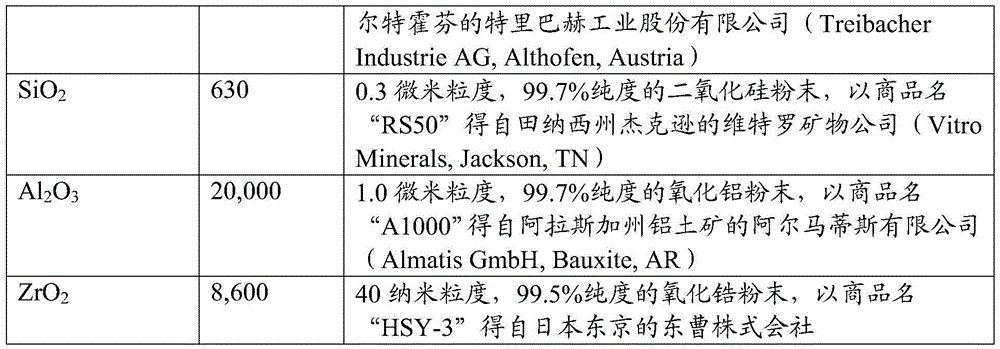
将约20千克浆液喷雾干燥(以型号48得自马里兰州兰多斯城的SDS喷雾干燥公司(SDS Spray Drying,Randallstown,MD)并筛选以提供尺寸在约63至180微米范围内的附聚物。喷雾干燥器的直径为4英尺(1.2米),直侧面为8英尺(2.4米)。喷雾干燥器以打开模式操作(系统不是闭环的)-空气经由1马力鼓风机(得自新泽西州恩格尔伍德的航空技术公司(Air Tech Inc.,Englewood,NJ)引入到加热器中,并且在离开袋式除尘器后直接排出。在操作期间,通过电加热器加热批量干燥气体并通过干燥室(通过顶部进入并通过底部离开),并最后转移到旋风除尘器和袋式除尘器。旋风分离器将产物固体与气流分离;将收集在袋式除尘器中的固体丢弃。干燥室入口处的大量干燥气体温度为约180℃,而干燥室的出口为约100℃。以约117克/分钟,经由气动式蠕动泵(以商品名“96410-25”得自伊利诺伊州弗农山的马斯特菲公司(Masterflex,Vernon Hills,IL)利用两个平行的铂固化的有机硅管材来提供浆液。利用内部混合的双流体压力喷雾雾化喷嘴(以商品名“FLUID CAP 60100”和“AIR CAP 170”得自伊利诺伊州惠顿的喷雾系统公司(Spraying Systems Co.,Wheaton,IL)将浆液垂直向上雾化。雾化气体为氮气,以约10psi(0.07MPa)和3.3标准立方英尺/分钟(90标准升/分钟(SLPM))提供。About 20 kilograms of the slurry were spray dried (obtained as Model 48 from SDS Spray Drying, Randallstown, MD) and screened to provide agglomerates ranging in size from about 63 to 180 microns . The spray dryer is 4 feet (1.2 meters) in diameter and 8 feet (2.4 meters) on the straight side. The spray dryer is operated in open mode (the system is not closed loop) - air is passed through a 1 hp blower (obtained from Englewood, NJ Air Tech Inc. (Air Tech Inc., Englewood, NJ) is introduced into the heater and discharged directly after leaving the baghouse. During operation, the bulk drying gas is heated by an electric heater and passed through the drying chamber (through the top enter and exit through the bottom), and finally transfer to the cyclone and baghouse. The cyclone separates the product solids from the gas stream; the solids collected in the baghouse are discarded. A large amount of dry gas at the entrance to the drying chamber The temperature was about 180° C. and the outlet of the drying chamber was about 100° C. At about 117 g/min, via an air-operated peristaltic pump (under the trade designation "96410-25" from Masterfield, Mount Vernon, Illinois) (Masterflex, Vernon Hills, IL) utilized two parallel platinum-cured silicone tubing to provide the slurry. Internally mixed two-fluid pressure spray atomizing nozzles (available under the trade names "FLUID CAP 60100" and "AIR CAP 170" were used to provide the slurry. The slurry was atomized vertically upward from Spraying Systems Co., Wheaton, IL. The atomizing gas was nitrogen at about 10 psi (0.07 MPa) and 3.3 standard cubic feet per minute (90 standard liters). / min (SLPM)) provided.
将喷雾干燥的颗粒的一部分送入氢/氧喷灯火焰中以生成熔融的玻璃小珠。用于熔融颗粒的喷枪为台式燃烧器(以商品名“PM2D MODEL B”得自宾夕法尼亚州赫勒敦的伯利恒设备公司(Bethlehem Apparatus Co.,Hellertown,PA))。氢气和氧气的流速设置如下:对于内环,氢气流速为8SLPM并且氧气流速为3SLPM。对于外环,氢气流速为23SLPM并且氧气流速为9.8SLPM。将干燥并过筛的粒子直接馈送到喷灯火焰中进行熔融,其中它们被熔融并传送至表面上有冷水流动(约8升/分钟)的倾斜不锈钢表面(约51厘米(20英寸)宽,以及45度的倾斜角)上,以形成淬火小珠。A portion of the spray-dried particles were sent into a hydrogen/oxygen burner flame to generate molten glass beads. The lance used to melt the particles was a benchtop burner (obtained under the trade designation "PM2D MODEL B" from Bethlehem Apparatus Co., Hellertown, PA). The flow rates of hydrogen and oxygen were set as follows: for the inner loop, the hydrogen flow rate was 8 SLPM and the oxygen flow rate was 3 SLPM. For the outer ring, the hydrogen flow rate was 23 SLPM and the oxygen flow rate was 9.8 SLPM. The dried and sieved particles were fed directly into a blowtorch flame for melting, where they were melted and delivered to a sloping stainless steel surface (about 51 cm (20 in) wide) with a flow of cold water (about 8 liters/min) over the surface, and 45-degree tilt angle) to form quenched beads.
将所得的淬火小珠收集在盘中,并在110℃下干燥。小珠为透明的并且形状为球形。The resulting quenched beads were collected in a pan and dried at 110°C. The beads are transparent and spherical in shape.
对于差热分析(DTA),筛选小珠材料的一部分以保持90微米-125微米的尺寸范围。DTA运行使用热分析设备(以商品名“NETZSCH DSC 404F1”得自耐驰仪器公司(NETZSCHInstruments)进行。将所述量的每个经筛选的样品(100毫克)置于铂样品盘中。在静压空气中以20℃/分钟的速度将每种样品从室温(约25℃)加热至1600℃。For differential thermal analysis (DTA), a portion of the bead material was screened to maintain a size range of 90-125 microns. DTA runs were performed using thermal analysis equipment (available from NETZSCH Instruments under the trade designation "NETZSCH DSC 404F1". The stated amount of each screened sample (100 mg) was placed in a platinum sample pan. Each sample was heated from room temperature (about 25°C) to 1600°C in compressed air at a rate of 20°C/min.
参见图6,线602为对于实施例1的玻璃珠材料绘制的DTA数据。参见图6的线602,所述材料在840℃附近的温度下表现出吸热事件。据信该事件是由于材料的玻璃化转变Tg所引起。在约934℃下,观察到放热事件。据信该事件是由于材料的结晶Tx所引起。6,
将100克玻璃珠置于加热炉中(以型号DT-31-FL6得自科罗拉多州丹佛市的玳尔特克公司(Deltech Inc.,Denver,CO))并在1100℃下热处理1小时。参见图6,线601为在1100℃下热处理的实施例1材料的绘制的DTA数据。参见图6的线601,所述材料不表现出吸热事件。这是热处理材料不具有Tg的证据。100 grams of glass beads were placed in a furnace (obtained from Deltech Inc., Denver, CO as model DT-31-FL6) and heat treated at 1100°C for 1 hour. Referring to Figure 6,
经热处理的小珠的晶粒尺寸和结晶度通过场发射扫描电子显微镜(FE-SEM)(以商品名“HITACHI S-4800”得自英国梅登黑德的日立公司(Hitachi Ltd.,Maidenhead,UK)来测定。用薄Au-Pd层涂布经热处理的小珠的破碎表面以使样品具有导电性。在2.0或5.0千伏下以150,000倍放大率操作时获得图像(即电子显微图)。使用具有150,000倍放大率的FE-SEM显微图来进行晶粒度测量。对于每个样品分析从烧结体的不同区域获取的三个或四个显微图。画出穿过显微图的高度的大致等间距间隔开的十条水平线。在每条线上观察到的晶界交叉点的数量被计数并用于计算交叉点之间的平均距离。每条线的平均距离乘以1.56以确定晶粒尺寸,并且针对每个样品的所有显微图的所有线对该值取平均。经热处理的实施例1材料的平均晶体尺寸被确定为57nm。The grain size and crystallinity of the heat-treated beads were obtained from Hitachi Ltd., Maidenhead, UK under the tradename "HITACHI S-4800" by Field Emission Scanning Electron Microscopy (FE-SEM) UK) to determine. The fractured surface of the heat-treated beads was coated with a thin layer of Au-Pd to render the sample conductive. Images (i.e. electron micrographs) were obtained while operating at 150,000X magnification at 2.0 or 5.0 kV ). Grain size measurements were performed using FE-SEM micrographs with 150,000X magnification. Three or four micrographs taken from different regions of the sintered body were analyzed for each sample. Draw through the micrographs Ten roughly equally spaced horizontal lines of the height of the figure. The number of grain boundary intersections observed on each line was counted and used to calculate the average distance between the intersections. The average distance for each line was multiplied by 1.56 to give The grain size was determined and the value averaged for all lines of all micrographs for each sample. The average crystal size of the heat treated Example 1 material was determined to be 57 nm.
将约5克经热处理的小珠放置在外径为160毫米,内径为20毫米且高度为100毫米的圆形石墨模具中(石墨得自宾夕法尼亚州圣玛丽斯城的美尔森集团(Mersen,St.Marys,PA),然后加工成指定的内部尺寸),并且使用单轴压制设备(以商品名“HP-50”得自加利福尼亚州布雷亚的热力技术公司(Thermal Technology Inc.,Brea,CA))热压。在氩气氛和13.8兆帕(MPa)(2000磅/平方英寸(2ksi))压力下,使用以5℃/分钟的连续加热进行热压。监测与压实相关联的收缩位移。初始收缩温度为1120℃。继续收缩直至温度达到1200℃,在此温度点收缩停止。所得压实的盘为约20毫米直径和约3mm厚。进行附加的热压操作,以制备附加的圆片。About 5 grams of heat-treated beads were placed in a circular graphite mold with an outer diameter of 160 mm, an inner diameter of 20 mm and a height of 100 mm (graphite was obtained from Mersen, St. Marys, PA), and then machined to the specified internal dimensions) and using a uniaxial press equipment (obtained under the trade designation "HP-50" from Thermal Technology Inc., Brea, CA) ) hot pressing. Hot pressing was performed using continuous heating at 5°C/min under an argon atmosphere and a pressure of 13.8 megapascals (MPa) (2000 pounds per square inch (2 ksi)). Shrinkage displacement associated with compaction is monitored. The initial shrinkage temperature was 1120°C. The shrinkage is continued until the temperature reaches 1200°C, at which point the shrinkage stops. The resulting compacted disk was about 20 mm in diameter and about 3 mm thick. Additional hot pressing operations were performed to produce additional discs.
所得热压玻璃材料的密度使用气体比重瓶(以商品名“ACCUPUYC 1330”得自佐治亚州诺克洛斯的麦克仪器公司(Micromeritics,Norcross,GA)测量,并且发现为5.25克/cm3,这为理论密度的99%。The density of the resulting hot pressed glass material was measured using a gas pycnometer (obtained under the trade designation "ACCUPUYC 1330" from Micromeritics, Norcross, GA) and was found to be 5.25 grams/ cm3 , which is 99% of theoretical density.
如下测定所得热压材料的平均微硬度。热压材料的片(尺寸在约2毫米-5毫米)被安装在安装树脂中(以商品名“EPOMET”得自伊利诺伊州布勒夫湖的标乐有限公司(BuehlerLtd.,Lake Bluff,IL))。所得的树脂圆柱体的直径为约2.5厘米(1英寸)并且长度为约1.9厘米(0.75英寸)(即,高)。使用常规研磨机/抛光机(以商品名“BETA”得自标乐有限公司(Buehler Ltd.))和常规金刚石浆液,以使用1微米金刚石浆液(以商品名“METADI”得自标乐有限公司(Buehler Ltd.))的最终抛光步骤对安装的样品进行抛光,以获得样品的抛光横截面。The average microhardness of the obtained hot-pressed material was determined as follows. Sheets of hot-pressed material (approximately 2-5 mm in size) were mounted in mounting resin (obtained under the trade designation "EPOMET" from Buehler Ltd., Lake Bluff, IL) ). The resulting resin cylinder was about 2.5 centimeters (1 inch) in diameter and about 1.9 centimeters (0.75 inches) in length (ie, tall). A conventional grinder/polisher (available under the trade name "BETA" from Buehler Ltd.) and conventional diamond slurries were used to use a 1 micron diamond slurry (available under the trade name "METADI" from Buehler Ltd. (Buehler Ltd.)) polished the mounted samples to obtain polished cross-sections of the samples.
使用配有Vickers压头的常规微硬度测试仪(以商品名“MITUTOYO MVK-VL”得自日本东京的三丰株式会社(Mitutoyo Corporation,Tokyo,Japan)的仪器),使用500克的缩进负载进行微硬度测量。微硬度测量根据在“用于材料的微硬度ASTM测试方法E384测试方法(1991年)”(ASTM Test Method E384 Test Methods for Microhardness of Materials(1991))中所述的指南来进行,该公开以引用的方式并入本文。基于5次测量的平均值,热压材料的平均微硬度为15.4吉帕斯卡(GPa)。A conventional microhardness tester equipped with a Vickers indenter (an instrument available from Mitutoyo Corporation, Tokyo, Japan under the trade designation "MITUTOYO MVK-VL") was used with an indentation load of 500 grams Perform microhardness measurements. Microhardness measurements were made according to the guidelines described in "ASTM Test Method E384 Test Methods for Microhardness of Materials (1991)", which publication is incorporated by reference way to be incorporated into this article. Based on the average of 5 measurements, the average microhardness of the hot-pressed material was 15.4 gigapascals (GPa).
实施例2Example 2
以下表2中所列的量将材料与904克水混合以提供母料含水的悬浮液。The materials were mixed with 904 grams of water in the amounts listed in Table 2 below to provide an aqueous suspension of the masterbatch.
表2Table 2
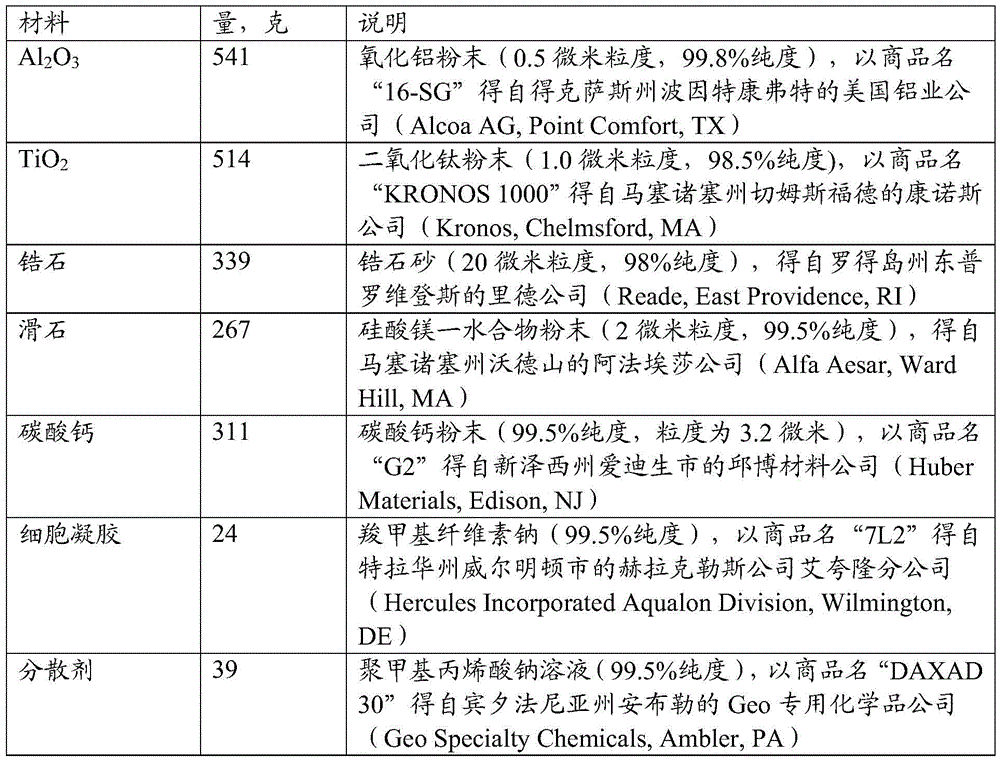
将细胞凝胶非常缓慢地加入水中,并且用高剪切搅拌器(以商品名“SCOTTTURBIN,型号M1110SE得自加利福尼亚州阿德兰托的Adelanto,CA的海沃德戈登公司(Hayward Gordon,Adelanto,CA))以1800rpm,随着30分钟的混合完全溶解。接着,在单独加入粉末之前加入分散剂。然后将混合物在具有1cm圆柱形氧化铝介质(得自新泽西州克利夫顿的格伦米尔斯公司(Glenn Mills,Clifton,NJ))的氧化铝研磨广口瓶中以100rpm研磨24小时,以制备粒度小于2微米的第90个百分位的均匀悬浮液。The cell gel was added very slowly to the water and was obtained from Hayward Gordon, Adelanto, CA with a high shear mixer (under the trade designation "SCOTTTURBIN, model M1110SE"). , CA)) at 1800 rpm with 30 minutes of mixing for complete dissolution. Next, the dispersant was added before the powders were added separately. The mixture was then immersed in a 1 cm cylindrical alumina medium (obtained from Glenmere, Clifton, NJ). (Glenn Mills, Clifton, NJ) in an alumina grinding jar at 100 rpm for 24 hours to produce a uniform suspension with a particle size of less than 2 microns at the 90th percentile.
将浆液喷雾干燥(“型号48”)并筛选以提供尺寸在约63至180微米范围内的附聚物。The slurry was spray dried ("Model 48") and screened to provide agglomerates in the range of about 63 to 180 microns in size.
将喷雾干燥的颗粒的一部分送入氢/氧喷灯火焰中以生成熔融的玻璃小珠。用于熔融颗粒的喷枪为台式燃烧器(以商品名“PM2D MODEL B”得自宾夕法尼亚州赫勒敦的伯利恒设备公司(Bethlehem Apparatus Co.,Hellertown,PA))。氢气和氧气的流速设置如下:对于内环,氢流速为8标准升/分钟(SLPM)并且氧气流速为3SLPM。对于外环,氢气流速为23(SLPM)并且氧气流速为9.8SLPM。将干燥并过筛的粒子直接馈送到喷灯火焰中进行熔融,其中它们被熔融并传送至表面上有冷水流动(约8升/分钟)的倾斜不锈钢表面(约51厘米(20英寸)宽,以及45度的倾斜角)上,以形成淬火小珠。A portion of the spray-dried particles were sent into a hydrogen/oxygen burner flame to generate molten glass beads. The lance used to melt the particles was a benchtop burner (obtained under the trade designation "PM2D MODEL B" from Bethlehem Apparatus Co., Hellertown, PA). The flow rates of hydrogen and oxygen were set as follows: for the inner loop, the hydrogen flow rate was 8 standard liters per minute (SLPM) and the oxygen flow rate was 3 SLPM. For the outer ring, the hydrogen flow rate was 23 (SLPM) and the oxygen flow rate was 9.8 SLPM. The dried and sieved particles were fed directly into a blowtorch flame for melting, where they were melted and delivered to a sloping stainless steel surface (about 51 cm (20 in) wide) with a flow of cold water (about 8 liters/min) over the surface, and 45-degree tilt angle) to form quenched beads.
将所得的淬火小珠收集在盘中,并在110℃下干燥。小珠为透明的并且形状为球形。The resulting quenched beads were collected in a pan and dried at 110°C. The beads are transparent and spherical in shape.
将100克火焰形成的小珠置于加热炉(型号DT-31-FL6)中,并且在1050℃下以20℃/分钟的加热和冷却速率热处理1小时。100 grams of flame formed beads were placed in a heating furnace (Model DT-31-FL6) and heat treated at 1050°C for 1 hour at a heating and cooling rate of 20°C/min.
将约5克的经热处理的小珠放置在具有外径为160毫米,内径为20毫米且高度为100毫米的圆形石墨模具中(石墨得美尔森集团(Mersen),然后加工成指定的内部尺寸),并且使用单轴压制设备(“HP-50”)热压。在氩气氛和20兆帕(MPa)(3000磅/平方英寸(3ksi))压力下,使用以5℃/分钟的连续加热进行热压。监测与压实相关联的收缩位移。初始收缩温度为1110℃。继续收缩直至温度达到1210℃,在此温度点收缩停止。所得压实的盘为约20毫米直径和约3mm厚。该盘具有如示例1中所述测定的理论密度的99%的密度。About 5 grams of heat-treated beads were placed in a circular graphite mold (Graphite from Mersen) having an outer diameter of 160 mm, an inner diameter of 20 mm and a height of 100 mm, and then machined to the specified internal dimensions), and hot pressed using a uniaxial pressing equipment ("HP-50"). Hot pressing was performed using continuous heating at 5°C/min under an argon atmosphere and a pressure of 20 megapascals (MPa) (3000 pounds per square inch (3 ksi)). Shrinkage displacement associated with compaction is monitored. The initial shrinkage temperature was 1110°C. The shrinkage continued until the temperature reached 1210°C, at which point the shrinkage stopped. The resulting compacted disk was about 20 mm in diameter and about 3 mm thick. The disk had a density of 99% of the theoretical density determined as described in Example 1.
实施例3Example 3
如对于实施例2所述制备实施例3样品,不同的是用于使母料含水的材料示于下表3中。Example 3 samples were prepared as described for Example 2, except that the materials used to make the masterbatch hydrated are shown in Table 3 below.
表3table 3
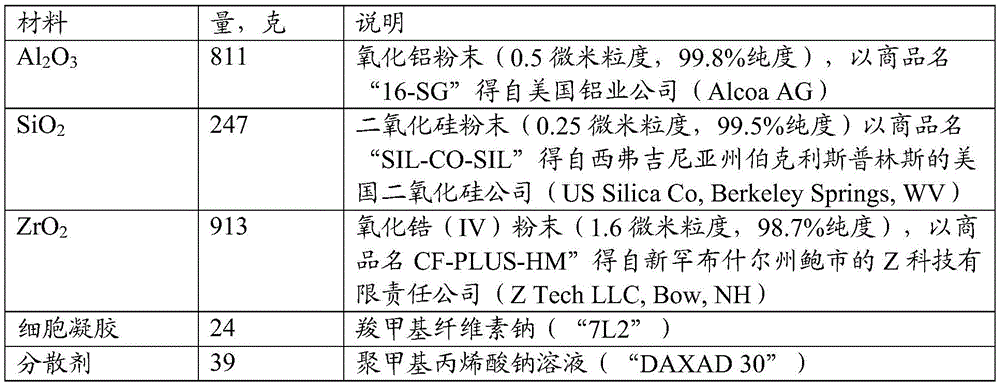
如示例2中所述加热并热压100克火焰形成的小珠。将约5克的经热处理的小珠放置在具有外径为160毫米,内径为20毫米且高度为100毫米的圆形石墨模具中(石墨得美尔森集团(Mersen),然后加工以提供指定的内部尺寸),并且使用单轴压制设备(“HP-50”)热压。在氩气氛和20兆帕(MPa)(3000磅/平方英寸(3ksi))压力下,使用以5℃/分钟的连续加热进行热压。监测与压实相关联的收缩位移。初始收缩温度为1110℃。初始收缩温度为1120℃。继续收缩直至温度达到1220℃,在此温度点收缩停止。所得的固结盘的直径为约20毫米,并且厚度为约3毫米,并且为理论密度的99%,如实施例1中所述测定的。100 grams of flame formed beads were heated and hot pressed as described in Example 2. About 5 grams of heat-treated beads were placed in a circular graphite mold (Graphite from Mersen) having an outer diameter of 160 mm, an inner diameter of 20 mm and a height of 100 mm, and then processed to provide the specified internal dimensions) and hot-pressed using a uniaxial pressing equipment ("HP-50"). Hot pressing was performed using continuous heating at 5°C/min under an argon atmosphere and a pressure of 20 megapascals (MPa) (3000 pounds per square inch (3 ksi)). Shrinkage displacement associated with compaction is monitored. The initial shrinkage temperature was 1110°C. The initial shrinkage temperature was 1120°C. The shrinkage continued until the temperature reached 1220°C, at which point the shrinkage stopped. The resulting consolidated disk was about 20 millimeters in diameter and about 3 millimeters thick, and was 99% of theoretical density, as determined as described in Example 1 .
实施例4Example 4
通过将如实施例1中所述制备的50克玻璃珠在得自包封在单轴压制设备(“HP-50”)中的护罩里的75毫米圆形石墨模具(得自美尔森集团(Mersen))中,以930℃的温度和20,000千克的负载热压40分钟,来制备0.7毫米厚的玻璃片。By placing 50 grams of glass beads prepared as described in Example 1 in a 75 mm circular graphite mold (available from Mersen) in a shroud enclosed in a uniaxial pressing apparatus ("HP-50") Group (Mersen)), hot pressing at a temperature of 930° C. and a load of 20,000 kg for 40 minutes to prepare 0.7 mm thick glass sheets.
然后使用常规研磨机/抛光机(以商品名“BETA”得自标乐有限公司(BuehlerLtd.))和常规金刚石浆液,以使用1微米金刚石浆液(以商品名“METADI”得自标乐有限公司(Buehler Ltd.))的最终抛光步骤对冰球抛光,以获得样品的抛光横截面至0.7毫米并喷水法切割成58×44毫米的片。然后将平坦片材放置在介于两个平的氧化铝100mm乘80mm片之间(以商品名“CARBOLITE RH1-1500”得自科罗拉多州戈尔登的阔斯泰公司(Coorstek,Golden,CO))并且使用以下概述加热:以3℃/分钟从20℃加热至830℃,保持在830℃2小时,以1℃/分钟从830℃加热至875℃,保持在875℃2小时,以1℃/分钟从875℃加热至900℃,保持在900℃2小时,以1℃/分钟从900℃加热至1000℃,保持在1000℃1小时,以3℃/分钟从1000℃加热至1150℃,保持在1150℃1小时,并且以3℃/分钟从1150℃加热至20℃。A conventional grinder/polisher (available under the trade name "BETA" from Buehler Ltd.) and conventional diamond slurries were then used to use a 1 micron diamond slurry (available under the trade name "METADI" from Buehler Ltd. (Buehler Ltd.)), the pucks were polished to obtain polished cross-sections of the samples to 0.7 mm and water-jet cut into 58 x 44 mm pieces. The flat sheet was then placed between two
如实施例1中所述测量所得的纳米晶玻璃陶瓷片的平均微硬度。基于5次测量的平均值,平均微硬度为14GPa。The average microhardness of the resulting nanocrystalline glass-ceramic sheets was measured as described in Example 1. Based on the average of 5 measurements, the average microhardness was 14 GPa.
然后将44×58毫米的纳米晶玻璃陶瓷片放置在N2环境中的热压机内部的外部为约80×60毫米并且内部为44×58毫米的矩形3维(3D)石墨模具中,其中斜边导致最终模制的玻璃约2毫米高度(石墨得自美尔森集团(Mersen),并且被机加工以提供指定的内部尺寸)(“HP-50”)。以15℃/分钟的速率加热至950℃,在950℃保持1.5小时,然后以10℃/分钟的速率加热至1200℃。在10分钟后,在温度下,将20千克的负载施加到样品上。The 44 x 58 mm nanocrystalline glass-ceramic sheets were then placed in a rectangular 3-dimensional (3D) graphite mold with an outer dimension of approximately 80 x 60 mm and an inner dimension of 44 x 58 mm inside a hot press in a N2 environment, where The beveled edges resulted in a final molded glass of approximately 2 mm height (graphite was obtained from Mersen and was machined to provide the specified internal dimensions) ("HP-50"). Heat to 950°C at a rate of 15°C/min, hold at 950°C for 1.5 hours, then heat to 1200°C at a rate of 10°C/min. After 10 minutes, at temperature, a load of 20 kg was applied to the sample.
对压机的位移进行跟踪,并且每当部件移动0.1毫米时,施加另一个10千克的负载直至最终负载为150千克。在一小时范围总位移等于1.6毫米,之后将加热炉以2℃/分钟倾斜降温至800℃,然后以15℃/分钟降温至室温。The displacement of the press was tracked and each time the part moved 0.1 mm, another 10 kg load was applied until the final load was 150 kg. The total displacement over one hour was equal to 1.6 mm, after which the furnace was ramped down to 800°C at 2°C/min and then to room temperature at 15°C/min.
所得的三维部分由于其与石墨模具的相互作用而显示出一些变色。如根据ASTMD116-86(2016年)通过阿基米德方法测定的,三维部分的密度为理论密度的99%。The resulting three-dimensional part showed some discoloration due to its interaction with the graphite mold. The density of the three-dimensional part is 99% of the theoretical density as determined by the Archimedes method according to ASTM D116-86 (2016).
为了制备最终的白色陶瓷,将三维片材放置在加热炉(型号DT-31-FL6)内,其中700克质量由填充有3mm YSZ研磨介质(得自日本东京的东曹株式会社(Tosoh,Tokyo,Japan))的氧化铝坩埚(得自阔斯泰公司(Coorstek))提供,所述坩埚保持在沿平坦中心向下以防止膨胀,并且以10℃/分钟从室温加热至1300℃,保持在1300℃下2小时,然后以10℃/分钟倾斜降温至室温。To prepare the final white ceramic, the three-dimensional sheet was placed in a heating furnace (model DT-31-FL6) with a 700-gram mass filled with 3 mm YSZ grinding media (available from Tosoh, Tokyo, Japan). , Japan)) supplied with an alumina crucible (from Coorstek) held down the flat center to prevent expansion and heated from room temperature to 1300°C at 10°C/min, maintained at 2 hours at 1300°C, then ramp down to room temperature at 10°C/min.
实施例5Example 5
将如实施例4中所述制备的0.6毫米厚的平坦玻璃片放置在模具中,以有助于将200克放置在模具的顶部上,以有助于坍塌。将其在20分钟内加热至800℃,在800℃下保持20分钟,在10分钟内加热至823℃,在823℃下保持30分钟,在5分钟内倾斜升温至828℃,在828℃下保持30分钟,然后在30分钟内冷却至室温。A 0.6 mm thick flat glass sheet prepared as described in Example 4 was placed in the mold to help place 200 grams on top of the mold to aid collapse. It was heated to 800°C in 20 minutes, held at 800°C for 20 minutes, heated to 823°C in 10 minutes, held at 823°C for 30 minutes, ramped to 828°C in 5 minutes, held at 828°C Hold for 30 minutes, then cool to room temperature in 30 minutes.
然后将片材在大箱式炉(“CARBOLITE RH1-1500”)中的平坦氧化铝片上结晶。将其以3℃/分钟加热至820℃,在820℃下保持2小时,以1℃/分钟倾斜升温至875℃,在875℃下保持2小时,以1℃/分钟加热至900℃,在900℃下保持2小时,以1℃/分钟加热至1200℃,在1200℃下保持2小时,并以1℃/分钟从1200℃冷却至室温。所得三维成型的玻璃陶瓷片的密度为如根据ASTM D116-86(2016年)通过阿基米德密度测定的理论密度的99%。The sheets were then crystallized on flat alumina sheets in a large box furnace ("CARBOLITE RH1-1500"). It was heated to 820°C at 3°C/min, held at 820°C for 2 hours, ramped up to 875°C at 1°C/min, held at 875°C for 2 hours, heated to 900°C at 1°C/min, and then heated to 900°C at 1°C/min. Hold at 900°C for 2 hours, heat to 1200°C at 1°C/min, hold at 1200°C for 2 hours, and cool from 1200°C to room temperature at 1°C/min. The resulting three-dimensionally shaped glass-ceramic sheet had a density of 99% of the theoretical density as determined by Archimedes' Density according to ASTM D116-86 (2016).
三维玻璃陶瓷片具有约44毫米宽和58毫米长的尺寸,具有圆角并且具有向上弯曲的边缘以提供约2毫米的总部件高度并且还具有穹顶形的中心区(第一形状)。将部件放置在加热炉中的平坦氧化铝块上(型号DT-31-FL6)。将约50毫米宽和37毫米长的第二氧化铝块(得自阔斯泰公司(Coorstek))和填充有3mm YSZ研磨介质(得自东曹株式会社(Tosoh))的氧化铝坩埚(得自阔斯泰公司(Coorstek))提供的附加质量总计700克(约3Kg压力)居中放置在玻璃陶瓷片的顶部上。以3.5℃/分钟的速率将加热炉加热至1300℃,并且保持4小时。在加热过程之后,玻璃陶瓷的初始穹顶形的中心区为基本上平坦的(第二形状)。The three-dimensional glass-ceramic sheet had dimensions of about 44 mm wide and 58 mm long, had rounded corners and had upwardly curved edges to provide a total part height of about 2 mm and also had a domed central region (first shape). Place the part on a flat alumina block (model DT-31-FL6) in a furnace. A second alumina block (obtained from Coorstek) about 50 mm wide and 37 mm long and an alumina crucible (obtained from Tosoh) filled with 3 mm YSZ grinding media (obtained from Tosoh). An additional mass of 700 grams (approximately 3 Kg pressure) supplied from Coorstek was placed centrally on top of the glass ceramic sheet. The furnace was heated to 1300°C at a rate of 3.5°C/min and held for 4 hours. After the heating process, the initial dome-shaped central region of the glass-ceramic is substantially flat (second shape).
实施例6Example 6
实施例6如对于实施例4所述的那样制备,不同的是(a)使用以下概述加热平坦片材:以3℃/分钟从20℃加热至830℃,保持2小时,以1℃/分钟从830℃加热至875℃,保持2小时,以1℃/分钟从875℃加热至900℃,保持2小时,以1℃/分钟从900℃加热至1000℃,保持1小时,以3℃/分钟从1000℃加热至1400℃,保持在1400℃1小时,并且以3℃/分钟从1400℃加热至20℃;和(b)将玻璃陶瓷片以10℃/分钟的速率加热至1350℃,在1350℃保持1.5小时,然后以10℃/分钟冷却至室温;以及(c)在启动加热炉之前,将1千克石墨棒(得自美尔森集团(Mersen))放置在模具上,而不是将20千克的负载施加到样品上。Example 6 was prepared as described for Example 4, except (a) the flat sheet was heated using the following outline: from 20°C to 830°C at 3°C/min for 2 hours, at 1°C/min Heated from 830°C to 875°C, held for 2 hours, heated from 875°C to 900°C at 1°C/min, held for 2 hours, heated from 900°C to 1000°C at 1°C/min, held for 1 hour, held at 3°C/minute min from 1000°C to 1400°C, hold at 1400°C for 1 hour, and heat from 1400°C to 20°C at 3°C/min; and (b) heat the glass ceramic sheet to 1350°C at a rate of 10°C/min, held at 1350°C for 1.5 hours, then cooled to room temperature at 10°C/min; and (c) before starting the furnace, a 1 kg graphite rod (from Mersen) was placed on the mold instead of A load of 20 kg was applied to the sample.
所得的三维部件为100%成形的(其完全适形于石墨模具)。由于其与石墨模具的相互作用而显示出一些变色。如根据ASTM D116-86(2016年)通过阿基米德方法测定的,三维部分的密度为理论密度的99%。The resulting three-dimensional part was 100% shaped (it fully conformed to the graphite mold). Shows some discoloration due to its interaction with the graphite mold. The density of the three-dimensional portion is 99% of the theoretical density as determined by the Archimedes method according to ASTM D116-86 (2016).
图7A和7B为经热处理的示例6材料的聚焦离子束(FIB)铣削部分的扫描透射电子显微镜(STEM)亮场数字图像。图7A示出结晶ZrO2和稀土铝酸盐(仪器放大率20,000X)。图7B示出了ZrO2、LaAl11O18和LaAlO3相,连同无定形晶界相(仪器放大率110,000X)。使用传统的FIB样品制备技术来制备TEM薄层。更具体地,沉积金-钯薄层以标记样品的表面,随后使用标准脱模技术在FIB扫描电子显微镜(SEM)(以商品名“FEI QUANTA 200 3D DUAL BEAMSEM/FIB”得自俄勒冈州希尔斯伯勒的FEI公司(FEI Company,Hillsboro,OR)上进行聚焦光束离子铣削。7A and 7B are scanning transmission electron microscopy (STEM) bright field digital images of a focused ion beam (FIB) milled portion of heat-treated Example 6 material. Figure 7A shows crystalline ZrO2 and rare earth aluminate (instrument magnification 20,000X ). Figure 7B shows the ZrO 2 , LaAl 11 O 18 and LaAlO 3 phases, along with the amorphous grain boundary phase (instrument magnification 110,000X). TEM thin layers were prepared using conventional FIB sample preparation techniques. More specifically, a thin layer of gold-palladium was deposited to mark the surface of the sample, followed by a FIB Scanning Electron Microscope (SEM) (under the trade designation "
使用元素X射线绘图,使用具有检测器(以商品名“SUPER X EDS得自布鲁克公司(Bruker Corporation)),通过能量色散X射线光谱(以商品名“FEI OSIRIS S/TEM”得自马萨诸塞州比勒利卡的布鲁克公司(Bruker Corporation,Billerica,MA))收集的x射线数据,来测定无定形境界相的组成(参见图8)。使用x射线微分析软件(以商品名“ESPIRIT1.9”得自布鲁克公司(Bruker Corporation))完成分析。图8中的X射线标测图以110,000X放大倍率在200keV的加速电压下收集33分钟(使用图像漂移校正)。突出显示x射线标测图的子部分,并且将光谱数据与其他突出显示的区域进行比较。因此,逐粒比较可在相同的图像中进行。Elemental X-ray mapping was used with a detector (obtained from Bruker Corporation under the trade name "SUPER X EDS") by energy dispersive X-ray spectroscopy (obtained under the trade name "FEI OSIRIS S/TEM" from Beacon, Mass. The composition of the amorphous realm phase was determined using x-ray data collected by Bruker Corporation, Billerica, MA) (see Figure 8). X-ray microanalysis software (under the trade name "ESPIRIT 1.9") was used. Obtained from Bruker Corporation) to complete the analysis. The X-ray map in Figure 8 was collected at 110,000X magnification at an accelerating voltage of 200 keV for 33 minutes (using image drift correction). Highlights of the x-ray map subsections and compare the spectral data with other highlighted regions. Therefore, particle-by-particle comparisons can be made in the same image.
实施例7Example 7
向2升搅拌器中装入1千克粉末(如下表4中所示)、500克水和25克分散剂(“DAXAD30”),并且使用高剪切搅拌器(“SCOTT TURBIN;”型号M1110SE)以2000rpm高剪切混合15分钟。A 2 liter mixer was charged with 1 kg of powder (as shown in Table 4 below), 500 grams of water and 25 grams of dispersant ("DAXAD30") and a high shear mixer ("SCOTT TURBIN;" model M1110SE) was used High shear mixing at 2000 rpm for 15 minutes.
表4Table 4

然后将材料填充到1升的广口瓶中,并且使其静置过夜以完成由La2O3和水的组合所引起的放热。The material was then filled into a 1 liter jar and allowed to stand overnight to complete the exotherm caused by the combination of La2O3 and water.
然后将所得浆液用加载有0.1毫米氧化钇稳定的氧化锆(YSZ)研磨介质(得自日本东京东曹株式会社),以高能量砂磨机研磨(以型号PML2得自瑞士乌茨维尔布勒公司(Buhler,Uzwil,Switzerland)),以1350转/分钟(rpm)旋转2小时以实现均匀混合,并将粒度分布的第90个百分位降至低于1微米。The resulting slurry was then ground with a high energy sand mill (model PML2 from Uzwil Buhler, Switzerland) loaded with 0.1 mm yttria-stabilized zirconia (YSZ) grinding media (available from Tosoh Corporation, Tokyo, Japan). Company (Buhler, Uzwil, Switzerland)), spinning at 1350 revolutions per minute (rpm) for 2 hours to achieve uniform mixing and reduce the 90th percentile of particle size distribution to below 1 micron.
平坦预成形件和最终模塑部件的制备如实施例6所述。样品在从模具中取出后未完全成形。其模塑量仅为约40%。The preparation of flat preforms and final molded parts was as described in Example 6. The sample was not fully formed after removal from the mold. Its molding weight is only about 40%.
实施例8Example 8
向2升搅拌器中装入1千克氧化锆粉末(40纳米粒度,99.5%纯度;以商品名“HSY-3”得自东曹株式会社)、500克水和25克分散剂(“DAXAD 30”),并且使用高剪切搅拌器“SCOTT TURBIN;”型号M1110SE)以2000rpm高剪切混合15分钟。然后将材料填充至1升广口瓶中。A 2 liter stirrer was charged with 1 kg of zirconia powder (40 nm particle size, 99.5% purity; obtained from Tosoh Corporation under the trade name "HSY-3"), 500 grams of water and 25 grams of dispersant ("
然后将所得浆液用加载有0.1毫米氧化钇稳定的氧化锆(YSZ)研磨介质(得自东曹株式会社),以高能量砂磨机研磨(型号PML2),以1350转/分钟(rpm)旋转2小时以实现均匀混合,并将粒度分布的第90个百分位降至低于1微米。The resulting slurry was then milled with a high energy sand mill (model PML2) loaded with 0.1 mm yttria-stabilized zirconia (YSZ) milling media (available from Tosoh Corporation), spun at 1350 revolutions per minute (rpm) 2 hours to achieve uniform mixing and reduce the 90th percentile of particle size distribution to below 1 micron.
使用5mm氧化锆介质(得自东曹株式会社(Tosoh)),在250℃下在干燥烘箱中(以商品名“QMAX”得自明尼苏达州明尼阿波利斯的迪斯派奇公司(Despatch,Minneapolis,MN)的铝盘中干燥浆液过夜,并且使用行星球磨机(以商品名“E-MAX”得自德国哈恩的莱驰公司(Retsch,Haan,Germany))以1200rpm研磨2小时。Using 5 mm zirconia media (available from Tosoh) at 250°C in a drying oven (available under the trade designation "QMAX" from Despatch, Minneapolis, MN) The slurry was dried overnight in an aluminum pan in Minneapolis, MN, and milled using a planetary ball mill (obtained under the trade designation "E-MAX" from Retsch, Haan, Germany) at 1200 rpm for 2 hours.
平坦预成形件和最终模塑部件的制备如实施例6所述,不同的是用于制备陶瓷预成形件的温度在1400℃下进行。样品在从模具中取出后未完全成形。其模塑量仅为约50%。The preparation of flat preforms and final molded parts was as described in Example 6, except that the temperature used to prepare the ceramic preforms was carried out at 1400°C. The sample was not fully formed after removal from the mold. Its molding weight is only about 50%.
实施例9Example 9
向2升搅拌器中装入1.09千克粉末(如下表5中所示)、500克水和25克分散剂(“DAXAD 30”),并且使用高剪切搅拌器(“SCOTT TURBIN;”型号M1110SE)以2000rpm高剪切混合15分钟。然后将材料填充至1升广口瓶中。A 2 liter mixer was charged with 1.09 kg of powder (as shown in Table 5 below), 500 grams of water and 25 grams of dispersant ("
表5table 5
然后将所得浆液用加载有0.1毫米氧化钇稳定的氧化锆(YSZ)研磨介质(得自东曹株式会社),以高能量砂磨机研磨(型号PML2),以1350转/分钟(rpm)旋转2小时以实现均匀混合,并将粒度分布的第90个百分位降至低于1微米。The resulting slurry was then milled with a high energy sand mill (model PML2) loaded with 0.1 mm yttria-stabilized zirconia (YSZ) milling media (available from Tosoh Corporation), spun at 1350 revolutions per minute (rpm) 2 hours to achieve uniform mixing and reduce the 90th percentile of particle size distribution to below 1 micron.
使用5mm氧化锆介质(得自东曹株式会社),在250℃下在干燥烘箱中“QMax”)的铝盘中干燥浆液过夜,并且使用行星球磨机(“E-Max”)以1200rpm研磨2小时。The slurry was dried overnight at 250°C in an aluminum pan in a drying oven "QMax") using 5 mm zirconia media (obtained from Tosoh Corporation) and milled using a planetary ball mill ("E-Max") at 1200 rpm for 2 hours .
平坦预成形件和最终模塑部件的制备如实施例6所述,不同的是用于制备陶瓷预成形件的温度在1400℃下进行。样品在从模具中取出后未完全成形。其模塑量仅为约50%。The preparation of flat preforms and final molded parts was as described in Example 6, except that the temperature used to prepare the ceramic preforms was carried out at 1400°C. The sample was not fully formed after removal from the mold. Its molding weight is only about 50%.
在不脱离本发明的范围和实质的情况下,本公开的可预知的变型和更改对本领域的技术人员来说将显而易见。本发明不应受限于本申请中为了说明目的所示出的实施方案。Predictable variations and modifications of this disclosure will become apparent to those skilled in the art without departing from the scope and spirit of this invention. The present invention should not be limited to the embodiments shown in this application for illustrative purposes.
Claims (17)
Applications Claiming Priority (5)
| Application Number | Priority Date | Filing Date | Title |
|---|---|---|---|
| US201762505377P | 2017-05-12 | 2017-05-12 | |
| US62/505,377 | 2017-05-12 | ||
| US201862667985P | 2018-05-07 | 2018-05-07 | |
| US62/667,985 | 2018-05-07 | ||
| PCT/IB2018/053267 WO2018207132A1 (en) | 2017-05-12 | 2018-05-10 | Articles comprising ceramics and method of making the same |
Publications (1)
| Publication Number | Publication Date |
|---|---|
| CN110650935A true CN110650935A (en) | 2020-01-03 |
Family
ID=62495830
Family Applications (1)
| Application Number | Title | Priority Date | Filing Date |
|---|---|---|---|
| CN201880031134.6A Pending CN110650935A (en) | 2017-05-12 | 2018-05-10 | Articles comprising ceramics and methods of making the same |
Country Status (5)
| Country | Link |
|---|---|
| US (1) | US20210078908A1 (en) |
| EP (1) | EP3621935B1 (en) |
| JP (1) | JP7153674B2 (en) |
| CN (1) | CN110650935A (en) |
| WO (1) | WO2018207132A1 (en) |
Cited By (3)
| Publication number | Priority date | Publication date | Assignee | Title |
|---|---|---|---|---|
| CN114994039A (en) * | 2022-05-27 | 2022-09-02 | 钢铁研究总院有限公司 | Ceramic material microstructure characterization method and system based on surface height information |
| CN114994038A (en) * | 2022-05-27 | 2022-09-02 | 钢铁研究总院有限公司 | Ceramic material microstructure full-field high-throughput cross-scale in-situ characterization method |
| CN115135616A (en) * | 2020-02-17 | 2022-09-30 | 士卓曼研究院股份公司 | Glass-ceramic and method for producing same |
Families Citing this family (4)
| Publication number | Priority date | Publication date | Assignee | Title |
|---|---|---|---|---|
| JP7011548B2 (en) | 2017-07-14 | 2022-01-26 | キヤノン株式会社 | Powder for ceramic molding, ceramic molding, and its manufacturing method |
| CN111825442B (en) * | 2020-07-21 | 2023-04-07 | 长沙麓桥科技有限公司 | Sr, ni and Cr co-doped LaAlO 3 Method for preparing ceramic material and product thereof |
| CN116535206B (en) * | 2022-01-26 | 2025-01-14 | 比亚迪股份有限公司 | Zirconia ceramic, preparation method thereof and electronic product shell |
| CN115594503B (en) * | 2022-12-14 | 2023-04-14 | 中国人民解放军国防科技大学 | Calcium and iron co-doped NdAlO 3 Ceramic material and preparation method and application thereof |
Citations (9)
| Publication number | Priority date | Publication date | Assignee | Title |
|---|---|---|---|---|
| US5326519A (en) * | 1990-12-11 | 1994-07-05 | Nils Claussen | Process of preparing zirconium oxide-containing ceramic formed bodies |
| WO2001056948A1 (en) * | 2000-02-02 | 2001-08-09 | 3M Innovative Properties Company | FUSED A1203-Mg0-RARE EARTH OXIDE EUTECTIC ABRASIVE PARTICLES, ABRASIVE ARTICLES, AND METHODS OF MAKING AND USING THE SAME |
| WO2002008146A1 (en) * | 2000-07-19 | 2002-01-31 | 3M Innovative Properties Company | Fused al2o3-rare earth oxide-zro2 eutectic materials, abrasive particles, abrasive articles, and methods of making and using the same |
| WO2003011786A1 (en) * | 2001-08-02 | 2003-02-13 | 3M Innovative Properties Company | Glass-ceramics |
| CN1537085A (en) * | 2001-08-02 | 2004-10-13 | 3M | Al2O3-rare earth oxide-ZrO2/HfO2 materials and methods of making and using the same |
| CN1620490A (en) * | 2002-02-21 | 2005-05-25 | 3M创新有限公司 | Abrasive particles containing sintered, polycrystalline zirconia |
| US20050137076A1 (en) * | 2003-12-18 | 2005-06-23 | 3M Innovative Properties Company | Transparent fused crystalline ceramic, and method of making the same |
| CN1906266A (en) * | 2003-12-18 | 2007-01-31 | 3M创新有限公司 | Alumina-yttria particles and methods of making the same |
| WO2013003213A1 (en) * | 2011-06-28 | 2013-01-03 | 3M Innovative Properties Company | Glass-ceramics and methods of making the same |
Family Cites Families (18)
| Publication number | Priority date | Publication date | Assignee | Title |
|---|---|---|---|---|
| BE417297A (en) | 1935-09-03 | |||
| US5605870A (en) | 1993-05-28 | 1997-02-25 | Martinex Science, Inc. | Ceramic fibers, and methods, machines and compositions of matter for making same |
| US6254981B1 (en) | 1995-11-02 | 2001-07-03 | Minnesota Mining & Manufacturing Company | Fused glassy particulates obtained by flame fusion |
| US6482758B1 (en) | 1999-10-14 | 2002-11-19 | Containerless Research, Inc. | Single phase rare earth oxide-aluminum oxide glasses |
| US6607570B1 (en) * | 2000-02-02 | 2003-08-19 | 3M Innovative Properties Company | Fused Al2O3-rare earth oxide eutectic abrasive particles, abrasive articles, and methods of making and using the same |
| US7625509B2 (en) | 2001-08-02 | 2009-12-01 | 3M Innovative Properties Company | Method of making ceramic articles |
| ATE378293T1 (en) | 2001-08-02 | 2007-11-15 | 3M Innovative Properties Co | METHOD FOR PRODUCING OBJECTS FROM GLASS AND GLASS CERAMIC OBJECTS PRODUCED IN THIS WAY |
| CN1608036B (en) | 2001-08-02 | 2010-09-22 | 3M创新有限公司 | Al2O3-Y2O3-ZrO2/HfO2 material and its preparation and use method |
| US7563294B2 (en) | 2001-08-02 | 2009-07-21 | 3M Innovative Properties Company | Abrasive particles and methods of making and using the same |
| US8056370B2 (en) | 2002-08-02 | 2011-11-15 | 3M Innovative Properties Company | Method of making amorphous and ceramics via melt spinning |
| US6984261B2 (en) * | 2003-02-05 | 2006-01-10 | 3M Innovative Properties Company | Use of ceramics in dental and orthodontic applications |
| US7297171B2 (en) | 2003-09-18 | 2007-11-20 | 3M Innovative Properties Company | Methods of making ceramics comprising Al2O3, REO, ZrO2 and/or HfO2 and Nb205 and/or Ta2O5 |
| US7497093B2 (en) | 2004-07-29 | 2009-03-03 | 3M Innovative Properties Company | Method of making ceramic articles |
| US7281970B2 (en) | 2005-12-30 | 2007-10-16 | 3M Innovative Properties Company | Composite articles and methods of making the same |
| US7598188B2 (en) | 2005-12-30 | 2009-10-06 | 3M Innovative Properties Company | Ceramic materials and methods of making and using the same |
| US20070256454A1 (en) | 2006-05-03 | 2007-11-08 | 3M Innovative Properties Company | Method of reshaping a glass body |
| US20070270299A1 (en) | 2006-05-17 | 2007-11-22 | 3M Innovative Properties Company | Glass-ceramics and methods of making same |
| BRPI0923559A2 (en) | 2008-12-23 | 2016-01-26 | 3M Innovative Properties Co | moldable articles, method of manufacture thereof and molding method |
-
2018
- 2018-05-10 CN CN201880031134.6A patent/CN110650935A/en active Pending
- 2018-05-10 EP EP18728967.3A patent/EP3621935B1/en active Active
- 2018-05-10 JP JP2019562394A patent/JP7153674B2/en active Active
- 2018-05-10 WO PCT/IB2018/053267 patent/WO2018207132A1/en not_active Ceased
- 2018-05-10 US US16/611,906 patent/US20210078908A1/en not_active Abandoned
Patent Citations (10)
| Publication number | Priority date | Publication date | Assignee | Title |
|---|---|---|---|---|
| US5326519A (en) * | 1990-12-11 | 1994-07-05 | Nils Claussen | Process of preparing zirconium oxide-containing ceramic formed bodies |
| WO2001056948A1 (en) * | 2000-02-02 | 2001-08-09 | 3M Innovative Properties Company | FUSED A1203-Mg0-RARE EARTH OXIDE EUTECTIC ABRASIVE PARTICLES, ABRASIVE ARTICLES, AND METHODS OF MAKING AND USING THE SAME |
| WO2002008146A1 (en) * | 2000-07-19 | 2002-01-31 | 3M Innovative Properties Company | Fused al2o3-rare earth oxide-zro2 eutectic materials, abrasive particles, abrasive articles, and methods of making and using the same |
| WO2003011786A1 (en) * | 2001-08-02 | 2003-02-13 | 3M Innovative Properties Company | Glass-ceramics |
| CN1537085A (en) * | 2001-08-02 | 2004-10-13 | 3M | Al2O3-rare earth oxide-ZrO2/HfO2 materials and methods of making and using the same |
| CN1620490A (en) * | 2002-02-21 | 2005-05-25 | 3M创新有限公司 | Abrasive particles containing sintered, polycrystalline zirconia |
| US20050137076A1 (en) * | 2003-12-18 | 2005-06-23 | 3M Innovative Properties Company | Transparent fused crystalline ceramic, and method of making the same |
| CN1906266A (en) * | 2003-12-18 | 2007-01-31 | 3M创新有限公司 | Alumina-yttria particles and methods of making the same |
| WO2013003213A1 (en) * | 2011-06-28 | 2013-01-03 | 3M Innovative Properties Company | Glass-ceramics and methods of making the same |
| CN103619769A (en) * | 2011-06-28 | 2014-03-05 | 3M创新有限公司 | Glass-ceramics and methods of making the same |
Cited By (3)
| Publication number | Priority date | Publication date | Assignee | Title |
|---|---|---|---|---|
| CN115135616A (en) * | 2020-02-17 | 2022-09-30 | 士卓曼研究院股份公司 | Glass-ceramic and method for producing same |
| CN114994039A (en) * | 2022-05-27 | 2022-09-02 | 钢铁研究总院有限公司 | Ceramic material microstructure characterization method and system based on surface height information |
| CN114994038A (en) * | 2022-05-27 | 2022-09-02 | 钢铁研究总院有限公司 | Ceramic material microstructure full-field high-throughput cross-scale in-situ characterization method |
Also Published As
| Publication number | Publication date |
|---|---|
| EP3621935A1 (en) | 2020-03-18 |
| WO2018207132A1 (en) | 2018-11-15 |
| US20210078908A1 (en) | 2021-03-18 |
| JP2020519558A (en) | 2020-07-02 |
| JP7153674B2 (en) | 2022-10-14 |
| EP3621935B1 (en) | 2023-11-08 |
Similar Documents
| Publication | Publication Date | Title |
|---|---|---|
| JP5921608B2 (en) | Composite article and method of making the composite article | |
| JP7153674B2 (en) | Article containing ceramic and method for making same | |
| EP1778596B1 (en) | Method of making glass-ceramic articles | |
| US20090075807A1 (en) | Method and article from aluminum oxide glass and articles made therefrom | |
| WO2003011776A1 (en) | Method of making articles from glass and glass ceramic articles so produced | |
| CN1852868A (en) | Ceramics comprising Al2o3, Y2o3, Zro2 and/or Hfo2, and Nb2o5 and/or Ta2o5 and methods of making the same | |
| CN1852869A (en) | Ceramics comprising Ai2o3, Reo, Zro2 and/or Hfo2, and Nb2o5 and/or Ta2o5 and methods of making the same | |
| US20100255978A1 (en) | Method of making ceramic articles from glass | |
| CN101351420B (en) | Ceramic materials and methods of making and using the same | |
| US11608287B2 (en) | Articles comprising crystalline materials and method of making the same | |
| US20070151166A1 (en) | Method of making abrasive articles, cutting tools, and cutting tool inserts | |
| US20070154713A1 (en) | Ceramic cutting tools and cutting tool inserts, and methods of making the same |
Legal Events
| Date | Code | Title | Description |
|---|---|---|---|
| PB01 | Publication | ||
| PB01 | Publication | ||
| SE01 | Entry into force of request for substantive examination | ||
| SE01 | Entry into force of request for substantive examination | ||
| AD01 | Patent right deemed abandoned | ||
| AD01 | Patent right deemed abandoned |
Effective date of abandoning: 20230818 |