CN110547806B - An online gesture recognition method and system based on surface electromyography signals - Google Patents
An online gesture recognition method and system based on surface electromyography signals Download PDFInfo
- Publication number
- CN110547806B CN110547806B CN201910859186.9A CN201910859186A CN110547806B CN 110547806 B CN110547806 B CN 110547806B CN 201910859186 A CN201910859186 A CN 201910859186A CN 110547806 B CN110547806 B CN 110547806B
- Authority
- CN
- China
- Prior art keywords
- action
- model
- samples
- signal
- gesture
- Prior art date
- Legal status (The legal status is an assumption and is not a legal conclusion. Google has not performed a legal analysis and makes no representation as to the accuracy of the status listed.)
- Active
Links
- 238000002567 electromyography Methods 0.000 title claims abstract description 47
- 238000000034 method Methods 0.000 title claims abstract description 46
- 230000009471 action Effects 0.000 claims abstract description 68
- 238000012549 training Methods 0.000 claims abstract description 9
- 239000013598 vector Substances 0.000 claims description 23
- 238000013461 design Methods 0.000 claims description 5
- 238000004364 calculation method Methods 0.000 claims description 4
- 230000003183 myoelectrical effect Effects 0.000 claims description 4
- 239000000284 extract Substances 0.000 claims description 3
- 238000000605 extraction Methods 0.000 claims description 3
- 238000012706 support-vector machine Methods 0.000 claims description 3
- 230000009916 joint effect Effects 0.000 claims description 2
- 238000012545 processing Methods 0.000 claims description 2
- 230000003068 static effect Effects 0.000 claims 1
- 210000003205 muscle Anatomy 0.000 abstract description 8
- 238000013473 artificial intelligence Methods 0.000 abstract description 2
- 230000008569 process Effects 0.000 abstract description 2
- 208000012661 Dyskinesia Diseases 0.000 abstract 1
- 238000010586 diagram Methods 0.000 description 6
- 238000002474 experimental method Methods 0.000 description 6
- 238000005516 engineering process Methods 0.000 description 5
- 230000000474 nursing effect Effects 0.000 description 4
- 230000002159 abnormal effect Effects 0.000 description 3
- 238000009825 accumulation Methods 0.000 description 2
- 238000001514 detection method Methods 0.000 description 2
- 230000006872 improvement Effects 0.000 description 2
- 238000005452 bending Methods 0.000 description 1
- 238000011161 development Methods 0.000 description 1
- 239000003651 drinking water Substances 0.000 description 1
- 235000020188 drinking water Nutrition 0.000 description 1
- 230000000694 effects Effects 0.000 description 1
- 230000003993 interaction Effects 0.000 description 1
- 238000012986 modification Methods 0.000 description 1
- 230000004048 modification Effects 0.000 description 1
- 230000008092 positive effect Effects 0.000 description 1
- 230000009467 reduction Effects 0.000 description 1
- 238000011160 research Methods 0.000 description 1
- 238000012360 testing method Methods 0.000 description 1
- XLYOFNOQVPJJNP-UHFFFAOYSA-N water Substances O XLYOFNOQVPJJNP-UHFFFAOYSA-N 0.000 description 1
Images


Classifications
-
- A—HUMAN NECESSITIES
- A61—MEDICAL OR VETERINARY SCIENCE; HYGIENE
- A61B—DIAGNOSIS; SURGERY; IDENTIFICATION
- A61B5/00—Measuring for diagnostic purposes; Identification of persons
- A61B5/103—Measuring devices for testing the shape, pattern, colour, size or movement of the body or parts thereof, for diagnostic purposes
- A61B5/11—Measuring movement of the entire body or parts thereof, e.g. head or hand tremor or mobility of a limb
- A61B5/1124—Determining motor skills
- A61B5/1125—Grasping motions of hands
-
- A—HUMAN NECESSITIES
- A61—MEDICAL OR VETERINARY SCIENCE; HYGIENE
- A61B—DIAGNOSIS; SURGERY; IDENTIFICATION
- A61B5/00—Measuring for diagnostic purposes; Identification of persons
- A61B5/24—Detecting, measuring or recording bioelectric or biomagnetic signals of the body or parts thereof
- A61B5/316—Modalities, i.e. specific diagnostic methods
- A61B5/389—Electromyography [EMG]
-
- A—HUMAN NECESSITIES
- A61—MEDICAL OR VETERINARY SCIENCE; HYGIENE
- A61B—DIAGNOSIS; SURGERY; IDENTIFICATION
- A61B5/00—Measuring for diagnostic purposes; Identification of persons
- A61B5/72—Signal processing specially adapted for physiological signals or for diagnostic purposes
- A61B5/7235—Details of waveform analysis
- A61B5/7264—Classification of physiological signals or data, e.g. using neural networks, statistical classifiers, expert systems or fuzzy systems
- A61B5/7267—Classification of physiological signals or data, e.g. using neural networks, statistical classifiers, expert systems or fuzzy systems involving training the classification device
Landscapes
- Health & Medical Sciences (AREA)
- Life Sciences & Earth Sciences (AREA)
- Engineering & Computer Science (AREA)
- Physics & Mathematics (AREA)
- Molecular Biology (AREA)
- General Health & Medical Sciences (AREA)
- Biophysics (AREA)
- Pathology (AREA)
- Artificial Intelligence (AREA)
- Biomedical Technology (AREA)
- Heart & Thoracic Surgery (AREA)
- Medical Informatics (AREA)
- Veterinary Medicine (AREA)
- Surgery (AREA)
- Animal Behavior & Ethology (AREA)
- Public Health (AREA)
- Physiology (AREA)
- Oral & Maxillofacial Surgery (AREA)
- Dentistry (AREA)
- Evolutionary Computation (AREA)
- Fuzzy Systems (AREA)
- Mathematical Physics (AREA)
- Computer Vision & Pattern Recognition (AREA)
- Psychiatry (AREA)
- Signal Processing (AREA)
- Measurement And Recording Of Electrical Phenomena And Electrical Characteristics Of The Living Body (AREA)
Abstract
本发明属于人工智能技术领域,公开了一种基于表面肌电信号的手势动作在线识别方法及系统,实时采集肱三头肌、肘肌、肱二头肌、肱桡肌四个通道的表面肌电信号;然后进行小波阈值去噪处理;提取处理后信号的均方根(RMS)特征和前4阶AR模型参数特征,最后用SVM投票法和聚类思想联合判别实时动作。每间隔0.05s识别一次。每种动作的训练样本个数只采集10个,样本数和特征种类数少,方便实时识别;利用SVM投票法和聚类思想联合判别,可以提高识别正确率;聚类思想的应用在一定程度上拒绝了对异常动作的识别。

The invention belongs to the technical field of artificial intelligence, and discloses a method and system for on-line recognition of gesture actions based on surface electromyography signals, which collects surface muscles of four channels of triceps brachii, elbow muscle, biceps brachii and brachioradialis in real time. Then, the wavelet threshold denoising process is performed; the root mean square (RMS) feature of the processed signal and the parameter features of the first 4-order AR model are extracted. Finally, the SVM voting method and the clustering idea are used to jointly discriminate the real-time action. It is recognized every 0.05s. The number of training samples for each action is only 10, and the number of samples and feature types is small, which is convenient for real-time identification; the use of SVM voting method and clustering idea joint judgment can improve the recognition accuracy; the application of clustering idea to a certain extent The identification of abnormal movements was rejected.
Description
技术领域technical field
本发明属于人工智能技术领域,尤其涉及一种基于表面肌电信号的手势动作在线识别方法及系统。The invention belongs to the technical field of artificial intelligence, and in particular relates to a method and system for on-line recognition of gesture actions based on surface electromyography signals.
背景技术Background technique
目前,最接近的现有技术:Currently, the closest existing technology:
随着科技的发展,对手势识别技术的研究已经成为热门课题,基于手势识别技术的应用也开始渗透到人们生活的方方面面,这是一项技术走向热门的标志。表面肌电信号的应用领域主要在人机交互和假肢控制。With the development of science and technology, research on gesture recognition technology has become a hot topic, and applications based on gesture recognition technology have also begun to penetrate into all aspects of people's lives, which is a sign that a technology is becoming popular. The application areas of surface EMG signals are mainly in human-computer interaction and prosthetic control.
在传统基于表面肌电信号的手势识别中,采用了类似语音识别的结构,即信号采集-活动段检测-特征提取-分类。这种方法需要对活动段进行检测后再识别。In the traditional gesture recognition based on surface EMG signals, a structure similar to speech recognition is adopted, that is, signal acquisition-active segment detection-feature extraction-classification. This method needs to detect the active segment and then identify it.
对于基于表面肌电信号手势的识别,目前大多数方法虽然能达到很高的识别精度,但由于使用特征过多,不方便实时控制;而单一地使用时域特征或频域特征又会大大降低精度;另外,识别算法的复杂度对硬件也提出了相应的要求,否则实时性难以保证。For gesture recognition based on surface EMG signals, although most of the current methods can achieve high recognition accuracy, they are inconvenient for real-time control due to the use of too many features; and the single use of time-domain features or frequency-domain features will greatly reduce In addition, the complexity of the recognition algorithm also puts forward corresponding requirements for the hardware, otherwise the real-time performance is difficult to guarantee.
另外,许多识别算法鲁棒性不强,只对于几种固定的手势识别效果较好。In addition, many recognition algorithms are not robust, and only perform well for a few fixed gestures.
现在亟需一种可操作性强,算法易于实现的手势在线识别方法,并且能同时兼顾准确性和实时性。There is an urgent need for an online gesture recognition method with strong operability and easy algorithm implementation, which can take into account both accuracy and real-time performance.
综上所述,现有技术存在的问题是:To sum up, the problems existing in the prior art are:
(1)每次识别之前都需要进行活动段检测。(1) Active segment detection is required before each recognition.
(1)使用特征过多,不方便实时识别;单一地使用时域特征或频域特征会大大降低精度。(1) Too many features are used, which is inconvenient for real-time identification; the single use of time-domain features or frequency-domain features will greatly reduce the accuracy.
(2)识别算法的复杂度对硬件也提出了相应的要求,否则实时性难以保证。(2) The complexity of the recognition algorithm also puts forward corresponding requirements for the hardware, otherwise the real-time performance is difficult to guarantee.
(3)许多识别算法鲁棒性不强,只对于几种固定的手势识别效果较好。(3) The robustness of many recognition algorithms is not strong, and the recognition effect is good only for several fixed gestures.
解决上述技术问题的难度:The difficulty of solving the above technical problems:
对于固定的若干种手势,使用特征和算法过多虽然可以提高正确率,但是实时性难以保证,另外识别算法的复杂度对硬件也提出了相应的要求。准确性和实时性难以兼顾。For several fixed gestures, using too many features and algorithms can improve the accuracy rate, but it is difficult to guarantee the real-time performance. In addition, the complexity of the recognition algorithm also puts forward corresponding requirements on the hardware. Accuracy and real-time performance are difficult to balance.
为了提高算法鲁棒性,需要确定通用性和代表性强的特征和采集信号的肌肉位置,使算法能适用于更多种手势。In order to improve the robustness of the algorithm, it is necessary to determine the general and representative features and the muscle positions of the collected signals, so that the algorithm can be applied to more gestures.
解决上述技术问题的意义:The significance of solving the above technical problems:
首先,可以降低硬件设计的难度和复杂度,使整个系统的软硬件均易于实现;其次,在不降低太大正确率情况下,较高的实时性使得系统性能更优;最后,算法鲁棒性的提升有助于应用面变得更广。First, it can reduce the difficulty and complexity of hardware design, making the hardware and software of the entire system easy to implement; secondly, without reducing the accuracy rate too much, the higher real-time performance makes the system performance better; finally, the algorithm is robust The improvement of sexuality helps the application to become wider.
发明内容SUMMARY OF THE INVENTION
针对传统手势在线识别算法中算法鲁棒性不强及实时性和准确性难以兼顾的问题,本发明提供了一种基于表面肌电信号的手势动作在线识别方法及系统。Aiming at the problems of weak algorithm robustness and difficulty in both real-time and accuracy in traditional gesture online recognition algorithms, the present invention provides an online gesture action recognition method and system based on surface EMG signals.
本发明是这样实现的,一种基于表面肌电信号的手势动作在线识别方法,包括:采集肱三头肌、肘肌、肱二头肌、肱桡肌四个通道的表面肌电信号。The present invention is implemented in this way, an online gesture recognition method based on surface EMG signals, comprising: collecting surface EMG signals of four channels of triceps brachii, elbow muscle, biceps brachii and brachioradialis.
提取通过降噪处理后表面肌电信号的前4阶AR模型参数特征和RMS特征,作为每个动作分类识别所使用的特征。The first 4-order AR model parameter features and RMS features of the surface EMG signal after noise reduction are extracted as the features used for each action classification and recognition.
用SVM投票法和聚类思想联合判别实时动作;聚类思想的应用在一定程度上拒绝了对异常动作的识别。The SVM voting method and the clustering idea are used to jointly discriminate real-time actions; the application of the clustering idea rejects the identification of abnormal actions to a certain extent.
进一步,所述基于表面肌电信号的手势动作在线识别方法包括如下步骤:Further, the method for on-line recognition of gesture actions based on surface EMG signals includes the following steps:
步骤一,选取所要识别的若干动作。
步骤二,采集训练样本。每种动作采集10个样本,使用硬件设备提取原始的表面肌电信号;进行小波阈值去噪处理。Step 2: Collect training samples. 10 samples were collected for each action, and the original surface EMG signal was extracted by hardware equipment; wavelet threshold denoising was performed.
步骤三,特征提取与选择。对于每个动作样本,肱三头肌、肘肌、肱二头肌、肱桡肌四个通道的表面肌电信号均提取AR模型参数特征和RMS特征,其中,AR模型参数特征提取前4阶参数。The third step is feature extraction and selection. For each action sample, the AR model parameter features and RMS features are extracted from the surface EMG signals of the four channels of the triceps, elbow, biceps, and brachioradialis. Among them, the AR model parameter features are extracted from the first 4 orders. parameter.
步骤四,手势实时识别。在任意两类动作样本之间设计一个SVM,k个类别的样本需设计k(k-1)/2个SVM,同时计算每类样本的平均特征向量与该类样本特征向量之间的最大距离Dmax。Step 4: Real-time gesture recognition. Design an SVM between any two types of action samples, k(k-1)/2 SVMs need to be designed for samples of k categories, and calculate the maximum distance between the average feature vector of each class of samples and the feature vector of this class of samples Dmax.
进一步,所述步骤三中,所述时间序列的均方根(RMS)特征可参照以下公式计算:Further, in the

式中,RMS是均方根肌电值,N代表肌电信号样本数,X(t)是肌电信号值。In the formula, RMS is the root mean square EMG value, N represents the number of EMG signal samples, and X(t) is the EMG signal value.
所述AR模型的定义为白噪声的输入和过去p个信号值进行累加:The AR model is defined as the input of white noise and the accumulation of the past p signal values:

由上式可知,当模型系数确定后,受到白噪声激励的系统模型随之确定。使用伯格法(burg)迭代求解AR模型的各阶系数,在求解AR模型各阶系数之前,还应确定所构建具体模型阶数p。It can be seen from the above formula that when the model coefficients are determined, the system model excited by white noise is determined accordingly. The Burg method is used to iteratively solve the coefficients of each order of the AR model. Before solving the coefficients of each order of the AR model, the order p of the specific model to be constructed should also be determined.
进一步,采用最终预测误差(FPE)准则对AR模型进行定阶。最终预测误差定义为:Further, the final prediction error (FPE) criterion is used to order the AR model. The final prediction error is defined as:

式中,N为时间序列的长度,p为AR模型阶数,σ2为模型方差。where N is the length of the time series, p is the AR model order, and σ2 is the model variance.
进一步,所述步骤四中SVM采用高斯核函数,表达式为:Further, SVM adopts Gaussian kernel function in described

式中,x,z分别为两个不同的特征向量,σ为标准差参数。In the formula, x and z are two different eigenvectors, respectively, and σ is the standard deviation parameter.
所述距离计算采用欧式距离公式,表达式为:The distance calculation adopts the Euclidean distance formula, and the expression is:

式中,d12为两个特征向量之间的距离,n为特征向量的维数,x1k和x2k分别为两个不同的特征向量。In the formula, d 12 is the distance between two eigenvectors, n is the dimension of the eigenvectors, and x 1k and x 2k are two different eigenvectors respectively.
进一步,所述步骤四中,动作在训练时,选择动作所对应的向量作为训练集,得到相应的SVM;在实时分类时,把对应的向量分别对结果进行测试;采取投票形式,最后得到一组结果。Further, in the
所述用SVM投票法和聚类思想联合进行动作识别,具体操作包括:The SVM voting method and the clustering idea are used to jointly perform action recognition, and the specific operations include:
若待分类动作特征向量与得票最多的那个类别样本的平均特征向量之间的距离小于等于Dmax,则判断待分类动作为该类动作,否则放弃本次分类,每隔 0.05s识别一次。If the distance between the feature vector of the action to be classified and the average feature vector of the category sample with the most votes is less than or equal to Dmax, the action to be classified is judged to be this type of action, otherwise the classification will be abandoned and the recognition will be performed every 0.05s.
本发明的另一目的在于提供一种实施所述基于表面肌电信号的手势动作在线识别方法的基于表面肌电信号的手势在线识别控制系统。Another object of the present invention is to provide an online gesture recognition control system based on surface myoelectric signals that implements the method for online gesture action recognition based on surface myoelectric signals.
本发明的另一目的在于提供一种实施所述基于表面肌电信号的手势动作在线识别方法的基于表面肌电信号的手势动作在线识别装置。Another object of the present invention is to provide an online identification device for gesture action based on surface EMG signal that implements the method for online identification of gesture action based on surface EMG signal.
综上所述,本发明的优点及积极效果为:To sum up, the advantages and positive effects of the present invention are:
本发明只提取肌电信号的均方根特征和AR模型特征,每种类别样本只提取 10个,提取样本数和特征种类数少,方便实时识别;而SVM算法又非常适用于小样本的分类问题,利用SVM投票法和聚类思想联合判别,可以提高识别正确率,因为聚类思想的应用在一定程度上拒绝了对异常动作的识别;另外,通用性和代表性强的特征和采集信号的肌肉位置使算法能适用于更多种手势,本专利所使用特征为均方根和前四阶AR模型系数特征,所确定的肌肉位置为肱三头肌、肘肌、肱二头肌、肱桡肌;最后,每隔极短时间识别一次,可以避免活动段检测。The present invention only extracts the root mean square feature and AR model feature of the EMG signal, only 10 samples of each category are extracted, and the number of extracted samples and feature types is small, which is convenient for real-time identification; and the SVM algorithm is very suitable for the classification of small samples Using the SVM voting method and the clustering idea to jointly discriminate can improve the recognition accuracy, because the application of the clustering idea rejects the identification of abnormal actions to a certain extent; The muscle position of the algorithm can be applied to more kinds of gestures. The features used in this patent are the root mean square and the first four-order AR model coefficient features, and the determined muscle positions are triceps, elbow, biceps, biceps, Brachioradialis; finally, identification at very short intervals can avoid detection of active segments.
使用本专利所述方法,采集10位健康成年人手臂表面肌电信号,每人随机做出动作,包括但不限于以下四种动作:屈肘、抬臂、外展和静止。分别统计每人100次识别的正确率。以上四种具体动作、识别正确率及硬件设备见附图。Using the method described in this patent, the surface EMG signals of the arms of 10 healthy adults were collected, and each person randomly performed actions, including but not limited to the following four actions: elbow flexion, arm lift, abduction and rest. The correct rate of each 100 recognitions was counted separately. The above four specific actions, recognition accuracy rates and hardware devices are shown in the accompanying drawings.
附图说明Description of drawings
图1是本发明实施例提供的基于表面肌电信号的手势动作在线识别方法流程图。FIG. 1 is a flowchart of an online gesture recognition method based on surface EMG signals provided by an embodiment of the present invention.
图2是本发明实施例提供的SVM算法示意图。FIG. 2 is a schematic diagram of an SVM algorithm provided by an embodiment of the present invention.
图3是本发明中所做实验涉及到的屈肘、抬臂、外展和静止四种动作示意图。Figure 3 is a schematic diagram of four movements involved in the experiment of the present invention, including elbow flexion, arm lift, abduction and rest.
图4是本发明中所做实验识别正确率散点图。FIG. 4 is a scatter diagram of the recognition accuracy rate of experiments done in the present invention.
图5是本发明中所做实验所使用的表面肌电信号采集设备。Fig. 5 is the surface electromyographic signal acquisition equipment used in the experiments in the present invention.
具体实施方式Detailed ways
为了使本发明的目的、技术方案及优点更加清楚明白,以下结合实施例,对本发明进行进一步详细说明。应当理解,此处所描述的具体实施例仅仅用以解释本发明,并不用于限定本发明。In order to make the objectives, technical solutions and advantages of the present invention clearer, the present invention will be further described in detail below with reference to the embodiments. It should be understood that the specific embodiments described herein are only used to explain the present invention, but not to limit the present invention.
对于简单粗手势的识别,由于使用特征过多,不方便实时控制;单一地使用时域特征或频域特征会大大降低精度。识别算法的复杂度对硬件也提出了相应的要求,否则实时性难以保证。现有技术在手势在线识别过程中难以兼顾准确性和实时性,且算法的鲁棒性不够好。For the recognition of simple rough gestures, it is inconvenient for real-time control due to the use of too many features; the single use of time-domain features or frequency-domain features will greatly reduce the accuracy. The complexity of the recognition algorithm also puts forward corresponding requirements for the hardware, otherwise the real-time performance is difficult to guarantee. In the prior art, it is difficult to take into account the accuracy and real-time performance in the process of online gesture recognition, and the robustness of the algorithm is not good enough.
针对现有技术存在的问题,本发明提供了一种基于表面肌电信号的手势动作在线识别方法,下面结合附图对本发明作详细的描述。In view of the problems existing in the prior art, the present invention provides an online gesture action recognition method based on surface EMG signals. The present invention will be described in detail below with reference to the accompanying drawings.
本发明实施例提供的基于表面肌电信号的手势动作在线识别方法,采集肱三头肌、肘肌、肱二头肌、肱桡肌四个通道的表面肌电信号;提取通过预处理后表面肌电信号的前4阶AR模型参数特征和RMS特征,作为每个动作分类识别所使用的特征;用SVM投票法和聚类思想联合判别实时动作。聚类思想的应用在一定程度上拒绝了对异常动作的识别。The method for online gesture action recognition based on surface EMG signals provided by the embodiment of the present invention collects surface EMG signals of four channels of triceps brachii, elbow muscle, biceps brachii, and brachioradialis muscle; The first 4-order AR model parameter features and RMS features of EMG signals are used as the features used for each action classification and recognition; SVM voting method and clustering idea are used to jointly discriminate real-time actions. The application of clustering idea rejects the identification of abnormal actions to a certain extent.
如图1所示,一种基于表面肌电信号的手势动作在线识别方法,包括如下步骤:As shown in Figure 1, an online gesture recognition method based on surface EMG signal includes the following steps:
S101:选取所要识别的若干动作,例如动作屈肘、抬起手臂等。S101: Select several actions to be recognized, such as bending the elbow, raising the arm, and the like.
S102:采集训练样本。每种动作采集10个样本,使用硬件设备提取原始的表面肌电信号,然后进行信号降噪处理。S102: Collect training samples. 10 samples were collected for each action, and the original surface EMG signal was extracted by hardware equipment, and then the signal was denoised.
S103:特征提取与选择。对于每个动作样本,肱三头肌、肘肌、肱二头肌、肱桡肌四个通道的表面肌电信号均提取AR模型参数特征和RMS特征,其中, AR模型参数特征提取前4阶参数。S103: Feature extraction and selection. For each action sample, the surface EMG signals of the four channels of triceps, elbow, biceps, and brachioradialis are used to extract AR model parameter features and RMS features. Among them, AR model parameter features are extracted from the first 4 steps parameter.
S104:手势实时识别。在任意两类动作样本之间设计一个SVM,k个类别的样本需设计k(k-1)/2个SVM,同时计算每类样本的平均特征向量与该类样本特征向量之间的最大距离Dmax。S104: Real-time gesture recognition. Design an SVM between any two types of action samples, k(k-1)/2 SVMs need to be designed for samples of k categories, and calculate the maximum distance between the average feature vector of each class of samples and the feature vector of this class of samples Dmax.
在本发明实施例中,步骤S103中,时间序列的均方根(RMS)特征可参照以下公式计算:In this embodiment of the present invention, in step S103, the root mean square (RMS) feature of the time series can be calculated with reference to the following formula:
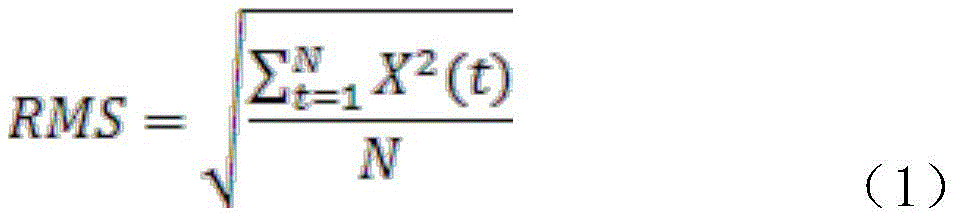
式中,RMS是均方根肌电值,N代表肌电信号样本数,X(t)是肌电信号值。In the formula, RMS is the root mean square EMG value, N represents the number of EMG signal samples, and X(t) is the EMG signal value.
所述AR模型的定义为白噪声的输入和过去p个信号值进行累加:The AR model is defined as the input of white noise and the accumulation of the past p signal values:

对于模型建立和识别的关键是确定其系数。由上式可知,当模型系数确定后,假定中受到白噪声激励的系统模型就随之确定。这里使用伯格法(burg)迭代求解AR模型的各阶系数,在求解AR模型各阶系数之前,还应该确定所构建具体模型阶数p。The key to model building and identification is to determine its coefficients. It can be seen from the above formula that when the model coefficients are determined, the assumed system model excited by white noise is determined accordingly. Here, the Burg method is used to iteratively solve the coefficients of each order of the AR model. Before solving the coefficients of each order of the AR model, the order p of the specific model to be constructed should also be determined.
在本发明实施例中,采用最终预测误差(FPE)准则对AR模型进行定阶。最终预测误差定义为:In the embodiment of the present invention, the final prediction error (FPE) criterion is used to determine the order of the AR model. The final prediction error is defined as:

式中,N为时间序列的长度,p为AR模型阶数,σ2为模型方差。where N is the length of the time series, p is the AR model order, and σ2 is the model variance.
在本发明实施例中,所述步骤S104中SVM采用高斯核函数,表达式为:In the embodiment of the present invention, in the step S104, the SVM adopts a Gaussian kernel function, and the expression is:

式中,x,z分别为两个不同的特征向量,σ为标准差参数。In the formula, x and z are two different eigenvectors, respectively, and σ is the standard deviation parameter.
所述距离计算采用欧式距离公式,表达式为:The distance calculation adopts the Euclidean distance formula, and the expression is:

式中,d12为两个特征向量之间的距离,n为特征向量的维数,x1k和x2k分别为两个不同的特征向量。In the formula, d 12 is the distance between two eigenvectors, n is the dimension of the eigenvectors, and x 1k and x 2k are two different eigenvectors respectively.
在本发明实施例中,步骤S104中,动作在训练时,选择动作所对应的向量作为训练集,得到相应的SVM;在实时分类时,把对应的向量分别对结果进行测试;采取投票形式,最后得到一组结果。In the embodiment of the present invention, in step S104, when the action is being trained, the vector corresponding to the action is selected as the training set, and the corresponding SVM is obtained; in the real-time classification, the corresponding vectors are respectively tested for the results; in the form of voting, Finally get a set of results.
在本发明实施例中,步骤S104中,所述用SVM投票法和聚类思想联合进行动作识别,具体操作包括:In the embodiment of the present invention, in step S104, the SVM voting method and the clustering idea are used to jointly perform action recognition, and the specific operations include:
若待分类动作特征向量与得票最多的那个类别样本的平均特征向量之间的距离小于等于Dmax,则判断待分类动作为该类动作,否则放弃本次分类,每隔 0.05s识别一次。If the distance between the feature vector of the action to be classified and the average feature vector of the category sample with the most votes is less than or equal to Dmax, the action to be classified is judged to be this type of action, otherwise the classification will be abandoned and the recognition will be performed every 0.05s.
下面结合实施例对本发明作进一步描述。The present invention will be further described below in conjunction with the examples.
实施例1Example 1
本发明提供一种基于表面肌电信号的手势动作在线识别方法在医疗护理方面的应用。The invention provides an application of an online gesture action recognition method based on surface electromyography signals in medical care.
某医院医疗护理人员所在护理室与病房是分开的,病人平时住在病房内,只有病人需要帮助的时候,如喝水、上厕所,医护人员才会护理病人。病人手臂上带有获取表面肌电信号的设备,该设备会将信号实时发送到护理室的电脑上,电脑通过运算判断若干种特定的手势动作。如果识别某动作在较短的时间内出现了两次,则认为该病人需要帮助,每一种帮助的内容对应一种手势。如屈肘表示要喝水。The nursing room where the medical and nursing staff are located in a hospital is separate from the ward. The patient usually lives in the ward. Only when the patient needs help, such as drinking water or going to the toilet, the medical staff will take care of the patient. The patient's arm is equipped with a device for acquiring surface EMG signals, which will send the signal to the computer in the nursing room in real time, and the computer will determine several specific gestures through operations. If it is recognized that a certain action occurs twice in a short period of time, it is considered that the patient needs help, and the content of each kind of help corresponds to a gesture. If you bend your elbows, you need to drink water.
为了保证识别的实时性和准确性,可以使用本发明的一种基于表面肌电信号的手势动作在线识别方法。In order to ensure the real-time performance and accuracy of the recognition, an on-line recognition method of gesture action based on the surface electromyography signal of the present invention can be used.
首先,确定肱三头肌、肘肌、肱二头肌、肱桡肌四个通道的表面肌电信号采集频率为1000HZ,然后使用算法实时进行信号的降噪处理。信号的处理在上位机上完成(即护理室的电脑上)。然后,每隔0.05s识别一次,每次每个通道取该识别时刻与1s前时刻这个时间段,形成新的时间序列,四个通道时间序列均如此操作。所使用特征为四个通道的AR模型系数和均方根特征,识别方法: SVM投票法和聚类思想联合进行识别,其中SVM采用高斯核函数。First, the surface EMG signal acquisition frequency of the four channels of triceps, elbow, biceps, and brachioradialis is determined to be 1000HZ, and then the algorithm is used to denoise the signals in real time. Signal processing is done on the host computer (ie, on the computer in the nursing room). Then, it is recognized every 0.05s, and each channel takes the time period of the recognition time and the time 1s before to form a new time series. The four channel time series are all done in this way. The features used are the AR model coefficients and root mean square features of four channels, and the identification method: SVM voting method and clustering idea are combined for identification, in which SVM adopts Gaussian kernel function.
实施例2Example 2
本发明提供一种用SVM投票法和聚类思想联合进行动作识别。具体包括:The present invention provides a joint action recognition using SVM voting method and clustering idea. Specifically include:
假设有四类A,B,C,D四类动作。在训练的时候选择A,B;A,C;A,D;B,C; B,D;C,D所对应的向量作为训练集,然后得到六个SVM,在实时分类的时候,把对应的向量分别对六个结果进行测试,然后采取投票形式,最后得到一组结果。Suppose there are four types of actions A, B, C, and D. During training, select A, B; A, C; A, D; B, C; B, D; The vectors of , respectively, test the six results, then take the form of voting, and finally get a set of results.
投票是这样的:The vote goes like this:
A=B=C=D=0;A=B=C=D=0;
(A,B)-classifier如果是A win,则A=A+1;otherwise,B=B+1;(A,B)-classifier If it is A win, then A=A+1; otherwise, B=B+1;
(A,C)-classifier如果是A win,则A=A+1;otherwise,C=C+1;(A,C)-classifier If it is A win, then A=A+1; otherwise, C=C+1;
......
(C,D)-classifier如果是A win,则C=C+1;otherwise,D=D+1;(C, D)-classifier If it is A win, then C=C+1; otherwise, D=D+1;
保留得票最多的那个类别。最后使用聚类思想联合进行动作识别,具体操作:若待分类动作特征向量与得票最多的那个类别样本的平均特征向量之间的距离小于等于Dmax,则判断待分类动作为该类动作,否则放弃本次分类。其中 Dmax为得票最多的那个类别样本的平均特征向量与该类样本特征向量之间的最大距离。The category with the most votes is reserved. Finally, the clustering idea is used to jointly perform action recognition. The specific operation is as follows: if the distance between the feature vector of the action to be classified and the average feature vector of the category sample with the most votes is less than or equal to Dmax, the action to be classified is judged to be this type of action, otherwise it is abandoned. this classification. Where Dmax is the maximum distance between the average feature vector of the class sample with the most votes and the feature vector of the class sample.
在本发明实施例中,图2是本发明实施例提供的SVM算法示意图。In an embodiment of the present invention, FIG. 2 is a schematic diagram of an SVM algorithm provided by an embodiment of the present invention.
图3是本发明中所做实验涉及到的屈肘、抬臂、外展和静止四种动作示意图。FIG. 3 is a schematic diagram of four movements of elbow flexion, arm lift, abduction and rest involved in the experiment in the present invention.
图4是本发明中所做实验识别正确率散点图。FIG. 4 is a scatter diagram of the recognition accuracy rate of experiments done in the present invention.
图5是本发明中所做实验所使用的表面肌电信号采集设备。Fig. 5 is the surface electromyographic signal acquisition equipment used in the experiments in the present invention.
以上所述仅为本发明的较佳实施例而已,并不用以限制本发明,凡在本发明的精神和原则之内所作的任何修改、等同替换和改进等,均应包含在本发明的保护范围之内。The above descriptions are only preferred embodiments of the present invention and are not intended to limit the present invention. Any modifications, equivalent replacements and improvements made within the spirit and principles of the present invention shall be included in the protection of the present invention. within the range.
Claims (7)


Priority Applications (1)
| Application Number | Priority Date | Filing Date | Title |
|---|---|---|---|
| CN201910859186.9A CN110547806B (en) | 2019-09-11 | 2019-09-11 | An online gesture recognition method and system based on surface electromyography signals |
Applications Claiming Priority (1)
| Application Number | Priority Date | Filing Date | Title |
|---|---|---|---|
| CN201910859186.9A CN110547806B (en) | 2019-09-11 | 2019-09-11 | An online gesture recognition method and system based on surface electromyography signals |
Publications (2)
| Publication Number | Publication Date |
|---|---|
| CN110547806A CN110547806A (en) | 2019-12-10 |
| CN110547806B true CN110547806B (en) | 2022-05-31 |
Family
ID=68739901
Family Applications (1)
| Application Number | Title | Priority Date | Filing Date |
|---|---|---|---|
| CN201910859186.9A Active CN110547806B (en) | 2019-09-11 | 2019-09-11 | An online gesture recognition method and system based on surface electromyography signals |
Country Status (1)
| Country | Link |
|---|---|
| CN (1) | CN110547806B (en) |
Families Citing this family (2)
| Publication number | Priority date | Publication date | Assignee | Title |
|---|---|---|---|---|
| CN111401166A (en) * | 2020-03-06 | 2020-07-10 | 中国科学技术大学 | Robust gesture recognition method based on electromyographic information decoding |
| CN111714122A (en) * | 2020-06-22 | 2020-09-29 | 北京海益同展信息科技有限公司 | Electromyographic pattern recognition method, electromyographic pattern recognition device, electromyographic pattern recognition equipment and computer-readable storage medium |
Citations (4)
| Publication number | Priority date | Publication date | Assignee | Title |
|---|---|---|---|---|
| CN104915436A (en) * | 2015-06-24 | 2015-09-16 | 合肥工业大学 | Adaptive multi-tag predication method |
| CN107169504A (en) * | 2017-03-30 | 2017-09-15 | 湖北工业大学 | A kind of hand-written character recognition method based on extension Non-linear Kernel residual error network |
| CN107408144A (en) * | 2014-11-14 | 2017-11-28 | Zoll医疗公司 | Estimation of medical precursor events |
| WO2017210654A2 (en) * | 2016-06-02 | 2017-12-07 | Schuster Matthew | Methods and devices for assessing a captured motion |
Family Cites Families (7)
| Publication number | Priority date | Publication date | Assignee | Title |
|---|---|---|---|---|
| CN101317794B (en) * | 2008-03-11 | 2010-04-14 | 清华大学 | Multi-finger and multi-free artificial hand use myoelectric control ability detection training method |
| CN103345641A (en) * | 2013-07-16 | 2013-10-09 | 杭州电子科技大学 | Hand electromyographic signal motion recognition method based on wavelet entropy and support vector machine |
| CN103984962B (en) * | 2014-05-30 | 2017-03-29 | 河北工业大学 | A kind of ectoskeleton walking mode recognition methods based on electromyographic signal |
| CN105426842B (en) * | 2015-11-19 | 2018-08-14 | 浙江大学 | Multiclass hand motion recognition method based on support vector machines and surface electromyogram signal |
| KR102619981B1 (en) * | 2016-02-02 | 2024-01-02 | 삼성전자주식회사 | Gesture classification apparatus and method using electromyogram signals |
| WO2019126625A1 (en) * | 2017-12-22 | 2019-06-27 | Butterfly Network, Inc. | Methods and apparatuses for identifying gestures based on ultrasound data |
| CN108564105A (en) * | 2018-02-28 | 2018-09-21 | 浙江工业大学 | Online gesture recognition method for myoelectric individual difference problem |
-
2019
- 2019-09-11 CN CN201910859186.9A patent/CN110547806B/en active Active
Patent Citations (4)
| Publication number | Priority date | Publication date | Assignee | Title |
|---|---|---|---|---|
| CN107408144A (en) * | 2014-11-14 | 2017-11-28 | Zoll医疗公司 | Estimation of medical precursor events |
| CN104915436A (en) * | 2015-06-24 | 2015-09-16 | 合肥工业大学 | Adaptive multi-tag predication method |
| WO2017210654A2 (en) * | 2016-06-02 | 2017-12-07 | Schuster Matthew | Methods and devices for assessing a captured motion |
| CN107169504A (en) * | 2017-03-30 | 2017-09-15 | 湖北工业大学 | A kind of hand-written character recognition method based on extension Non-linear Kernel residual error network |
Non-Patent Citations (3)
| Title |
|---|
| Benatti,S 等.A sub-10mW Real-Time Implementation for EMG Hand Gesture Recognition based on a Multi-Core Biomedical SoC.《2017 7TH IEEE INTERNATIONAL WORKSHOP ON ADVANCES IN SENSORS AND INTERFACES (IWASI)》.2017,第139-144页. * |
| 刘聪 等.结合级联仿射变换和K-means聚类的全局运动估计.《湖北工业大学学报》.2018,第1-12页. * |
| 张秋余 等.基于特征包支持向量机的手势识别.《计算机应用》.2012,第3392-3396页. * |
Also Published As
| Publication number | Publication date |
|---|---|
| CN110547806A (en) | 2019-12-10 |
Similar Documents
| Publication | Publication Date | Title |
|---|---|---|
| Chaudhary et al. | Convolutional neural network based approach towards motor imagery tasks EEG signals classification | |
| CN107157477B (en) | Electroencephalogram signal feature recognition system and method | |
| WO2021114761A1 (en) | Lung rale artificial intelligence real-time classification method, system and device of electronic stethoscope, and readable storage medium | |
| CN108670200A (en) | A kind of sleep sound of snoring classification and Detection method and system based on deep learning | |
| CN103345600A (en) | Electrocardiosignal data processing method | |
| CN109330584B (en) | Electrocardiosignal identity recognition method and system based on dictionary learning and sparse representation | |
| CN107066514A (en) | The Emotion identification method and system of the elderly | |
| CN109394258A (en) | A kind of classification method, device and the terminal device of lung's breath sound | |
| CN110639169B (en) | CPM lower limb rehabilitation training method and system based on games and EMG signals | |
| CN108681685A (en) | A kind of body work intension recognizing method based on human body surface myoelectric signal | |
| CN110547806B (en) | An online gesture recognition method and system based on surface electromyography signals | |
| CN114384999B (en) | User-independent EMG gesture recognition system based on adaptive learning | |
| CN107049308A (en) | A kind of idea control system based on deep neural network | |
| CN110786849B (en) | Electrocardiosignal identity recognition method and system based on multi-view discriminant analysis | |
| Mayor et al. | Dexterous hand gestures recognition based on low-density sEMG signals for upper-limb forearm amputees | |
| CN106845348B (en) | A gesture recognition method based on arm surface EMG signals | |
| CN116910464A (en) | A myoelectric signal prosthetic hand control system and method | |
| CN103488995A (en) | Method for identifying rotation of neck | |
| CN113536954A (en) | Gesture recognition method based on human body electromyographic signals | |
| CN118402800A (en) | A hand movement and intention recognition method and system based on vision and electromyography signal fusion | |
| CN111243728A (en) | Intelligent traditional Chinese medicine four-diagnosis information fusion system, method and storage medium | |
| Fraiwan et al. | Voiceless Arabic vowels recognition using facial EMG | |
| Mendes et al. | Subvocal speech recognition based on EMG signal using independent component analysis and neural network MLP | |
| Xu et al. | Convolutional Neural Network-Based Identity Recognition Using ECG at Different Water Temperatures During Bathing. | |
| CN106843509B (en) | A brain-computer interface system |
Legal Events
| Date | Code | Title | Description |
|---|---|---|---|
| PB01 | Publication | ||
| PB01 | Publication | ||
| SE01 | Entry into force of request for substantive examination | ||
| SE01 | Entry into force of request for substantive examination | ||
| GR01 | Patent grant | ||
| GR01 | Patent grant |