CN110532699B - Fault Diagnosis Method of Hydrometallurgical Dense Washing Process Based on Fuzzy DCD - Google Patents
Fault Diagnosis Method of Hydrometallurgical Dense Washing Process Based on Fuzzy DCD Download PDFInfo
- Publication number
- CN110532699B CN110532699B CN201910817143.4A CN201910817143A CN110532699B CN 110532699 B CN110532699 B CN 110532699B CN 201910817143 A CN201910817143 A CN 201910817143A CN 110532699 B CN110532699 B CN 110532699B
- Authority
- CN
- China
- Prior art keywords
- event
- node
- dcd
- expert
- thickener
- Prior art date
- Legal status (The legal status is an assumption and is not a legal conclusion. Google has not performed a legal analysis and makes no representation as to the accuracy of the status listed.)
- Active
Links
Images


Classifications
-
- Y—GENERAL TAGGING OF NEW TECHNOLOGICAL DEVELOPMENTS; GENERAL TAGGING OF CROSS-SECTIONAL TECHNOLOGIES SPANNING OVER SEVERAL SECTIONS OF THE IPC; TECHNICAL SUBJECTS COVERED BY FORMER USPC CROSS-REFERENCE ART COLLECTIONS [XRACs] AND DIGESTS
- Y02—TECHNOLOGIES OR APPLICATIONS FOR MITIGATION OR ADAPTATION AGAINST CLIMATE CHANGE
- Y02P—CLIMATE CHANGE MITIGATION TECHNOLOGIES IN THE PRODUCTION OR PROCESSING OF GOODS
- Y02P10/00—Technologies related to metal processing
- Y02P10/20—Recycling
Landscapes
- Testing And Monitoring For Control Systems (AREA)
- Management, Administration, Business Operations System, And Electronic Commerce (AREA)
Abstract
The invention belongs to the technical field of fault diagnosis in a hydrometallurgical dense washing process, and particularly relates to a fault diagnosis method in a hydrometallurgical dense washing process based on fuzzy DCD. The method comprises the following steps: determining a DCD event and an event variable in a dense washing process, wherein the DCD event comprises a node event and an intermediate event; determining a causal relationship and a connection probability between event variables according to the DCD events and the event variables, and establishing a causal graph model; and monitoring whether the dense washing process is abnormal or not in real time through real-time running data acquired in the actual process, if the variable is monitored to be in an abnormal state, dividing an intermediate event in a causal graph structure model into an abnormal interval by using a fuzzy thought, and describing the abnormal interval by using a membership function to obtain a fault diagnosis result. The method can combine qualitative information with quantitative information, and carry out online fault diagnosis according to the monitored abnormal phenomenon, so as to give out fault reasons.
Description
Technical Field
The invention belongs to the technical field of fault diagnosis in a hydrometallurgy dense washing process, and particularly relates to a fault diagnosis method in the hydrometallurgy dense washing process based on fuzzy DCD.
Background
With the rapid development of social economy, the demand of mineral resources is increasing day by day, but the reserves of high-grade ores are declining constantly, and the hydrometallurgical process is receiving high attention from all countries in the world. The hydrometallurgy is a common metallurgical method for processing low-grade ores, and has the advantages of high efficiency, cleanness and environmental protection compared with the traditional pyrometallurgy, although China is one of a few countries with abundant mineral resources and various mineral types in the world, the overall quality of the mineral products in China is not high in terms of the quality of the ores, so that the metallurgy technology for effectively and environmentally utilizing the low-grade mineral resources is particularly important, and the aims of changing waste ores into excellent ores, ores with one ore and more ores and ores with small ores are achieved.
In the complex industrial process of hydrometallurgy, the occurrence of faults not only directly affects the production benefit, but also can cause serious safety problems and other problems, and under the conditions, the method has great significance for efficiently and accurately diagnosing faults in the hydrometallurgy process in order to effectively utilize low-grade metal mineral resources. The invention takes the dense washing process of hydrometallurgy as the research background, carries out real-time monitoring and fault diagnosis on the dense washing process, and the technological process of the dense washing process of hydrometallurgy is shown in figure 1.
The process of the thickening and washing is to separate the solution and the solid, to recover the liquid gold in the solution, the solid is discarded or further processed, the process mainly depends on a thickener to separate the solid phase and the liquid phase in the ore raw material, the main work of the thickener is to settle and concentrate the non-concentrated ore pulp from the upstream, the non-concentrated ore pulp enters the thickener through a pipeline, the thickener utilizes a rake to stir the ore pulp, and the homogenization treatment is realized by stirring the ore pulp, so that the phenomenon of uneven distribution of the ore pulp is prevented. In addition, the stirring action of the rakes keeps the ore pulp moving, prevents the bottom of the ore pulp from being condensed, ensures that the ore pulp does not press the rakes, and achieves the purpose of preventing faults.
With the continuous improvement of the automation level, the scale of the system is continuously enlarged, the complexity of the system is rapidly increased, and the problems of huge shutdown loss, high maintenance cost, serious accident consequences and the like need to be solved urgently. Therefore, the method has important significance for comprehensively improving the safety and the reliability of the large complex system, and the fault diagnosis technology provides a solution for the problems. The traditional fault diagnosis method for the hydrometallurgical process is mainly a data processing-based method based on PCA, but the hydrometallurgical production process is relatively complex, the process parameters are more, and many variables which are difficult to directly monitor are contained, and the fault diagnosis by adopting the data-based method under the background is difficult.
The overall hydrometallurgical process, in addition to the quantitative data information that can be obtained, contains a lot of knowledge and information that cannot be accurately described with data, such as qualitative information like expert experience and mechanism knowledge. Therefore, the method is considerable, quantitative and qualitative information coexist in the hydrometallurgy process, and how to effectively process information with various forms and different characteristics has important significance on an efficient and accurate fault diagnosis method due to the fact that the information is determined to be mixed with uncertain information. The method based on knowledge, namely the dynamic causal graph, is gradually applied to complex industrial fault diagnosis due to a plurality of advantages, the fault diagnosis method based on the dynamic causal graph can combine qualitative information with quantitative information, so that the method not only contains data information, but also contains qualitative information such as expert experience, the information diversity avoids information loss, the defect of the diagnosis method using a single information form can be overcome, and the method has good application prospect for fault diagnosis in a complex production process, such as hydrometallurgy.
Disclosure of Invention
Technical problem to be solved
Aiming at the existing technical problems, the invention provides a fault diagnosis method for a hydrometallurgy dense washing process based on fuzzy DCD, which can combine qualitative information with quantitative information, carry out online fault diagnosis according to the monitored abnormal phenomenon and give out fault reasons.
(II) technical scheme
The invention provides a fuzzy DCD-based fault diagnosis method for a hydrometallurgy dense washing process, which comprises the following steps of:
a1, determining a DCD event in a dense washing process: determining a DCD event in a dense washing process, and determining event variables related to the hydrometallurgy dense washing process, wherein the DCD event comprises a node event and an intermediate event;
a2, DCD structure learning: determining a causal relationship and a connection probability between the event variables according to the DCD events and the event variables, and establishing a causal graph model;
a3, DCD online process fault diagnosis: and monitoring whether the dense washing process is abnormal or not in real time through real-time running data acquired in the actual process, if the variable is monitored to be in an abnormal state, dividing an intermediate event in a structural model of the cause and effect diagram into an abnormal interval by using a fuzzy thought, and describing the abnormal interval by using a membership function to obtain a fault diagnosis result.
Further, in the step A1, in the process of determining the DCD event in the dense washing process, the process state variable is used as a node event of the causal graph, the abnormality or the fault is used as a basic event of the causal graph, and the basic event and the node event of the causal graph are determined by analyzing the fault and the cause thereof commonly found in the process.
Further, in the step A2, a causal graph model is established by using a causal graph structure learning method based on a priori knowledge.
Further, the causal graph structure learning method based on the prior knowledge comprises the following steps:
1) The method comprises the steps of collecting knowledge and experience information of multiple experts in advance, and effectively fusing the knowledge and the experience information of the multiple experts, wherein the fusion mode is that the credibility is used as a weight factor of connection probability, the weighted average is carried out on the weight factor to obtain the estimation of the connection probability value of the multiple experts on the same pair of nodes, and the estimation is used as priori knowledge;
2) And performing compression coding on the acquired multi-expert prior knowledge, and then fusing the multi-expert prior knowledge into an MDL function of the causal graph to obtain an MDL scoring function of the causal graph structure.
Further, the step 1) specifically comprises:
let U be a space of points, any one of which is represented by x, and a set of values V on U by a true membership function t V And a false membership function f V Denotes t V (x) Is a lower bound on degree of membership of x, f, derived from evidence supporting x V (x) Then the negative lower bound of membership, t, for x derived from evidence against x V (x) And f V (x) Will be within the interval [0,1]Is associated with each of the elementsI.e. t V :U→[0,1],f V :U→[0,1],t V (x)+f V (x)≤1,0≤t V (x)≤1,0≤f V (x) Less than or equal to 1, let x = [ t = x ,1-f x ],y=[t y ,1-f y ]Are two Vague sets on the domain U, and the similarity measure method of the improved Vague set is shown as the following formula:

the element x is the value of the confidence upper limit, the mean value and the confidence lower limit of the probability value;
the specific steps for obtaining the final probability value of the event are as follows:
step 1: respectively acquiring every two experts to the same node pair (V) i ,V j ) Probability value of between And based on said probability value>
 Obtaining the probability value similarity of the node pair>
 And construct a similarity matrix M (V) i ,V j ):
Wherein, for expert k to node pair (V) i ,V j ) Given a probability value, <' > based on>
 For expert l pairs of nodes (V) i ,V j ) The given probability value->


In the formula: n is the number of experts;
step 2: according to the similarity matrix M (V) i ,V j ) Calculating the average similarity of each expert

And 3, step 3: according to the average similarity of each expert Calculating the relative similarity of each expert->

And 4, step 4: according to the self-estimated credibility of each expert obtained in advance Calculating relative confidence in each expert>

And 5: according to the relative similarity of each expert And relative confidence level>
 Calculating the final confidence level @ of each expert>

In the formula: beta is more than or equal to 0 and less than or equal to 1, and when the beta =0, only the similarity of the opinions of the experts is considered in order to not consider the self-estimation credibility of the experts; when the beta =1, only the self-evaluation credibility of the experts is considered in order to not consider the similarity of the opinions of the experts;
and 6: final confidence of each expert Carrying out weighted average to obtain node pairs (V) fusing multi-bit expert knowledge and experience information i ,V j ) In the probability value(s) in>

Further, the MDL function of the cause and effect graph consists of two parts: structure code length and data code length DL data (B);
The structure code length comprises a code length DL Dim (B) And description length DL str (B) Code length DL Dim (B) And description length DL str (B) Respectively satisfy the following formula:

in the formula: s i For the ith node V in the code length i The number of states of (c); n is the total number of nodes; s j Is node V j The jth parent node pa (V) i ) The number of states of (c); m is the number of samples in the data sample set;

in the formula: k is a radical of i To describe the ith node X in the length i The number of parent nodes;
the data code length DL data (B) The following formula is satisfied:

in the formula: p is a radical of i Parameters calculated by the i data samples; q. q.s i Parameters learned through the causal graph structure and the i data samples;
the MDL scoring function of the causal graph structure satisfies the following formula:

considering the influence of the prior knowledge on the compression coding, the MDL scoring function of the causal graph structure satisfies the following formula:
score MDL =IDL Dim (B)+DL str (B)+DL data (B)
in the formula:

wherein when alpha is more than or equal to 0.5 and less than 1, alpha is a directed edge V j →V i Value of probability of ambiguity present, by number of ambiguities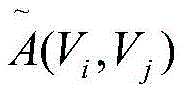 Defuzzification is carried out to obtain the product, beta = 1-alpha, is V j →V i There is no ambiguity possibility, and in this case, the information entropy value H (α) = - (α log) for information included in the probability value 2 α+βlog 2 Beta) is represented by; when alpha is more than 0 and less than 0.5, alpha is directed edge V j →V i The quantity of the existing negative information is converted into the quantity of the positive information.
Further, the step A3 specifically includes the following steps:
step 1: combining historical data and pre-obtained expert experience to each node event X in the causal graph i Dividing abnormal interval
Step 2: using a trapezoidal distribution function as the membership function mu A (x) Describing the abnormal interval to obtain the membership mu of each node event Xi (x) (ii) a The membership function mu A (x) The following formula is satisfied:

and step 3: according to the membership mu of each node event Xi (x) Simplifying a cause and effect diagram: when node event X i Degree of membership mu of Xi (x) =0, said node event X i If the node is in a normal state, deleting the node and the directed edge connected with the node;when node event X i Degree of membership mu of Xi (x) When the node event is more than 0, the node event X i Has a μ for abnormal state Xi (x) The membership degree of the node is kept, and the node and the directed edge connected with the node are reserved;
and 4, step 4: reasoning and diagnosing according to the simplified causal graph to obtain the posterior probability Pr (Bi | E) of each possible cause event;
and 5: with the membership degree mu of each node event Xi (x) As a credibility factor, the posterior probability Pr (Bi | E) of each possible cause event is evaluated and compared to obtain the sequencing probability Pr of each possible cause event f (Bi | E), and possibly a diagnostic result.
Further, the evaluation in step 5 is: multiplying the posterior probability Pr (Bi | E) of each possible causal event by all of the causal events B i Directly connected node event X k Degree of membership mu of Xk (x) Obtaining the sequencing probability Pr of each possible reason event f (Bi|E)。
Further, in the step A1, the basic event variables include: the device comprises a first thickener slurry pump, a first thickener discharge hole, a first thickener incoming material flow, a first thickener incoming material concentration, a first thickener lifting device, a second thickener slurry pump, a second thickener discharge hole, a second thickener lifting device, a barren liquor pool liquid level and a barren liquor pool variable frequency pump;
the node event variables include: the thickener comprises a first thickener underflow concentration, a first thickener underflow flow, a first thickener overflow turbidity, a first thickener underflow harrow pressure, a second thickener underflow flow, a second thickener underflow concentration, a second thickener flow and a second thickener underflow harrow pressure.
(III) advantageous effects
The beneficial effects of the invention are:
(1) The method for determining the causal graph only by means of empirical knowledge is replaced by a DCD structure learning algorithm based on prior information, the difficulty of providing knowledge by experts is reduced, and the accuracy of fault diagnosis is further improved, so that the fault diagnosis technology is more suitable for the hydrometallurgy dense washing process;
(2) The expert knowledge and the process data are combined and analyzed to obtain a preliminary probability value, so that the subjectivity of the expert knowledge is reduced, the expert knowledge and the data are effectively fused, and the accuracy of the obtained probability value is ensured;
(3) The fuzzy idea is introduced into the reasoning process as an improved method, the original numerical value limit is fuzzified, a section of interval is used for replacing a numerical value, and the interval is described by a membership function, so that the method overcomes the defect of over-idealization that the abnormal phenomenon is judged by the point value to a certain extent, the process of entering a diagnosis mechanism is more reasonable, and the fault diagnosis accuracy is improved;
(4) The real-time fault diagnosis result is provided, so that the working personnel can put forward and implement a solution to the current production fault in time, the loss of the production benefit and the economic benefit of an enterprise is reduced, and the potential safety hazard is reduced.
Drawings
FIG. 1 is a process flow diagram of a hydrometallurgical dense scrubbing process of the present invention;
FIG. 2 is a flow chart of a fault diagnosis method in a hydrometallurgical dense washing process according to the present invention;
FIG. 3 is a schematic structural diagram of an initial causality diagram of a hydrometallurgical dense scrubbing process according to the present invention;
FIG. 4 is a graph illustrating MDL values of 3 learning algorithms according to the present invention;
FIG. 5 is a schematic diagram of an optimized structural matrix according to the present invention;
FIG. 6 is a dynamic causal graph model of a hydrometallurgical densification process according to the present invention;
FIG. 7 is a graph showing the variation of MDL values learned by the results of the present invention;
FIG. 8 is a graph showing a half-trapezoidal distribution according to the present invention;
FIG. 9 is a conditional probability chart of the abnormal incoming material flow of the N5 thickener in the present invention;
FIG. 10 is a graph of the results of the real-time diagnosis of the abnormal flow of the incoming material of the N5 thickener in the present invention;
FIG. 11 is a conditional probability chart of overflow turbidity anomaly of the N5 thickener in accordance with the present invention;
FIG. 12 is a graph showing the results of real-time diagnosis of abnormal overflow turbidity of the N5 thickener according to the present invention;
FIG. 13 shows a diagram of X in the present invention 3 And X 4 An abnormal membership curve;
FIG. 14 shows a conventional inference method E = X in the present invention 3 A ranked probability result graph of cause events;
FIG. 15 shows a conventional inference method E = X in the present invention 3 X 4 A ranked probability result graph of cause events;
FIG. 16 is a graph showing the sequencing probability results of the improved inference method for the reason events at the time of sampling point 85 in the present invention;
FIG. 17 is a graph showing the sequencing probability results of the improved inference method for the reason events at the time of sampling point 100 in the present invention;
FIG. 18 is a graph of the sequencing probability results of the improved inference method sampling point 135 time cause events in the present invention;
FIG. 19 shows a schematic diagram of a diagram B 1 A real-time result graph of the occurrence probability of an event as an example;
FIG. 20 is a graph of the ranking probability of improved inference method cause events in accordance with the present invention;
FIG. 21 is a graph of the real-time diagnosis of the improved inference method of the present invention;
FIG. 22 is a graph of the probability of the cause events for the conventional inference method of the present invention;
FIG. 23 is a diagram of the real-time diagnosis result of the conventional inference method according to the present invention;
Detailed Description
For the purpose of better explaining the present invention and to facilitate understanding, the present invention will be described in detail by way of specific embodiments with reference to the accompanying drawings.
The embodiment provides a fault diagnosis method for a hydrometallurgical dense washing process based on a fuzzy Dynamic cause and effect Diagram (DCD), as shown in fig. 2, comprising the following steps:
a1, determining a DCD event in a dense washing process: determining a DCD event in a dense washing process, and determining event variables related to the hydrometallurgy dense washing process, wherein the DCD event comprises a node event and an intermediate event;
a2, DCD structure learning: according to the DCD event and the event variables, determining the causal relationship and the connection probability among the event variables, and establishing a causal graph model;
a3, DCD online process fault diagnosis: and monitoring whether the dense washing process is abnormal or not in real time through real-time running data acquired in the actual process, if the variable is monitored to be in an abnormal state, dividing an intermediate event in a causal graph structure model into an abnormal interval by using a fuzzy thought, and describing the abnormal interval by using a membership function to obtain a fault diagnosis result.
A1, heavy washing process DCD event determination
The causal graph model comprises a structure and parameters of a causal graph, and event variables involved in a hydrometallurgy dense washing process are firstly defined before the structure is built and the parameters are determined. During the DCD event for a defined heavy wash process, the present invention follows the following principles: the process state variables are used as cause and effect graph node events, and the abnormity or fault is used as a cause and effect graph basic event, so that the basic event and the node event of the cause and effect graph need to be determined through analyzing the faults and the reasons thereof which are common in the process.
After analyzing the main variable abnormal condition of the dense washing process and the main fault cause thereof, the principle followed by the invention determines 9 monitoring variables and 10 fault cause variables of the dense washing process as node events and basic events of the cause-and-effect diagram of the dense washing process, as shown in table 1.
Table 1 event definition table

A2, DCD structure learning
After the node events and the basic events of the cause and effect graph are determined, the cause and effect relationship among the variables is determined. The traditional dynamic cause-and-effect graph is established mainly by relying on the experience knowledge of experts and field personnel to acquire the cause-and-effect relationship among variables, and the method is not suitable for complex industrial processes. Therefore, the invention provides a causal graph structure learning method based on prior knowledge to obtain a more optimal causal graph structure, and the initial causal graph structure of the hydrometallurgy dense washing process obtained by the mechanism knowledge is shown in figure 3.
1) Acquisition of multiple expert prior knowledge
In an actual industrial process, the acquired information usually contains knowledge and experience of multiple experts, so that the knowledge of the multiple experts needs to be effectively fused. The main idea of the fusion method provided by the invention is to use the credibility as a weight factor of the connection probability value, and to perform weighted average on the weight factor to obtain the estimation of the connection probability between the same pair of nodes by multiple experts. Considering that the degree of similarity of causal relationship probability values given by different experts aiming at the same pair of nodes can reflect the credibility of the probability values, the method calculates the final credibility of the experts by carrying out weighted summation on the similarity of the probability values and the self-estimation credibility of the experts, and then uses the final credibility as a weight factor.
Let U be a space of points (objects) where any one element is denoted by x. A Vague set V on U using a true membership function t V And a false membership function f V Denotes, t V (x) Is a lower bound on degree of membership of x, f, derived from evidence supporting x V (x) Then the negative lower bound of membership, t, for x derived from evidence against x V (x) And f V (x) Will be within the interval [0,1]Is associated with each of the elements, i.e. t V :U→[0,1],f V :U→[0,1],t V (x)+f V (x)≤1,0≤t V (x)≤1,0≤f V (x) Less than or equal to 1. Let x = [ t ] x ,1-f x ],y=[t y ,1-f y ]Are two Vague sets on the domain U, and the similarity measure method of the improved Vague set is shown as the following formula:

in the context of the present invention, the element x is the position of the probability valueThe values of the confidence upper limit, the mean value and the confidence lower limit. The confidence upper limit of the probability value is used as an example for explanation, and the element a i Representing confidence limits of probability values given by experts for the same causal strength, and the set U representing the set of confidence limits of probability values between the same pair of nodes given by all experts, i.e. U = { a = 1 ,...,a n N is the number of experts, t V (a i ) And f V (a i ) Respectively a supporting and a resisting element a i And E, the membership function of U is given by an expert according to experience and practical conditions. And &>
 Respectively represent a i The corresponding membership value, the mean value of the probability value and the lower confidence limit are the same.
The specific steps for obtaining the final probability value of the event are as follows:
step 1: respectively calculating every two experts to the same node pair (V) according to the algorithm of the sum fuzzy number i ,V j ) Probability value of between And based on said probability value>
 Obtaining the probability value similarity of the node pair>
 And construct a similarity matrix M (V) i ,V j ):
Wherein, for expert k to node pair (V) i ,V j ) Given a probability value, <' > based on>
 For expert l pairs of nodes (V) i ,V j ) Given a probability value, <' > based on>


In the formula: n is the number of experts;
and 2, step: according to the similarity matrix M (V) i ,V j ) Calculating the average similarity of each expert

And step 3: according to the average similarity of each expert Calculating the relative similarity of each expert->

And 4, step 4: according to the self-estimation of each expert obtained in advanceReliability of service Calculating the relative confidence level of each expert->

And 5: according to the relative similarity of each expert And relative confidence->
 Calculating the final confidence level @ of each expert>

In the formula: beta is more than or equal to 0 and less than or equal to 1, and when the beta =0, only the similarity of the opinions of the experts is considered in order to not consider the self-estimation credibility of the experts; when the beta =1, only the self-evaluation credibility of the expert is considered in order to not consider the similarity of the expert opinions;
step 6: final confidence of each expert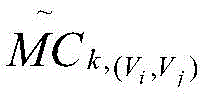 Carrying out weighted average to obtain node pairs (V) fusing multi-bit expert knowledge and experience information i ,V j ) Is greater than or equal to>

2) Minimum description length scoring function for fusing prior information
In order to better utilize quantitative information in the prior knowledge, the method provided by the invention blends the previously acquired multi-expert prior knowledge into a minimum score description length function after compression coding to obtain a new score criterion, so that the method is more suitable for causal graph structure learning. In combination with the causal graph properties, the MDL function of the causal graph consists of two parts: structure code length and data code length DL of causal graph data (B)。
a) The structure code length comprises a code length DL Dim (B) And description length DL str (B) Code length DL Dim (B) And description length DL str (B) Respectively satisfy the following formulas:

in the formula: s i For the ith node V in the code length i The number of states of (1); n is the total number of nodes; s j Is node V j Jth parent node pa (V) i ) The number of states of (c); m is the number of samples in the data sample set;

in the formula: k is a radical of i To describe the ith node X in the length i The number of parent nodes;
b) Data code length DL data (B) The following formula is satisfied:

in the formula: p is a radical of i Parameters calculated by the i data samples; q. q of i Parameters learned through the causal graph structure and the i data samples;
in summary, the MDL score function of the cause and effect graph structure satisfies the following equation:

the acquired prior information is strength information, and further quantification of causal relationship is performed, so that the influence of prior knowledge on compression coding is mainly considered, and an MDL scoring function of a causal graph structure satisfies the following formula:
score MDL =IDL Dim (B)+DL str (B)+DL data (B)
in the formula:

wherein when alpha is more than or equal to 0.5 and less than 1, alpha is a directed edge V j →V i Value of probability of ambiguity existing, by number of ambiguities Performing defuzzification to obtain a product with beta = 1-alpha and V j →V i There is no fuzzy possibility, and in this case, the information entropy value H (α) = - (α log) for information included in the probability value 2 α+βlog 2 Beta) is represented by; when alpha is more than 0 and less than 0.5, alpha is directed edge V j →V i The quantity of the existing negative information is converted into the quantity of the positive information.
Combining the 3 scoring measures of MDL scoring + no prior information (MDL-none prior information, MDL-NPI), MDL scoring + conventional prior information (MDL-common PI, MDL-CPI) and improved MDL scoring + fuzzy prior information (imDL-fuzzy PI, IMDL-FPI) with the structure learning simulation of the simulated annealing search algorithm, under the simulation condition of the sample number of 800, the MDL value curves of the 3 learning algorithms are shown in FIG. 4, wherein straight lines represent the MDL values of the standard causal graph under the current simulation condition. As can be seen by observing and comparing MDL value curves of the 3 algorithms, the stable value of the IMDL-FPI algorithm is closest to the MDL value of a standard cause-and-effect diagram, and the MDL-CPI algorithm is second to the MDL-CPI algorithm, and the difference is the MDL-NPI algorithm. It is easy to know that the more the score value after the algorithm is stabilized is close to the standard value, the more the structure learned by the algorithm is close to the standard structure, so that fig. 4 proves that the IMDL-FPI algorithm is superior to the MDL-CPI algorithm, and the MDL-CPI algorithm is superior to the MDL-NPI. In conclusion, the structure learning algorithm provided by the invention can effectively improve the learning precision of the causal graph structure model.
According to the dynamic cause-effect graph modeling method, the optimized structure matrix shown in fig. 5 is output through a simulated annealing algorithm, so that the dynamic cause-effect graph model of the hydrometallurgy thickening process shown in fig. 6 is obtained, wherein a dotted line in fig. 6 represents that the initial cause-effect graph exists but a directed edge does not exist after structure learning, and a dotted line represents that the initial cause-effect graph does not exist but an increased directed edge exists after structure learning. In the whole iterative process of the search algorithm, continuous reduction and optimization of the MDL value prove continuous improvement and optimization of the causal graph structure, in order to realize detection of the structure optimization process, the MDL value which is subjected to result learning according to 800 data sample sets is changed as shown in FIG. 7, the MDL value is continuously reduced, and finally the value is converged to be close to a stable MDL value, so that the causal graph structure is the optimal causal graph structure which is learned by the structure learning algorithm.
A3, DCD on-line process fault diagnosis
When the online process fault diagnosis is carried out, the fuzzy idea is introduced into the reasoning process as an improved method, the original numerical value limit is fuzzified, a section of interval is used for replacing a numerical value, the interval is described by using a membership function, each reading in the interval corresponds to a membership degree for the abnormal condition, and the membership degree is used as a credible factor to act on the sequencing probability of each latest possible fault event. The method overcomes the defect of over-idealization that the abnormal phenomenon is judged by the point value to a certain extent, so that the process of entering a diagnosis mechanism is more reasonable, the integrity of information is better saved, and the method has a certain promotion effect on improving the fault diagnosis accuracy. The DCD online process fault diagnosis method specifically comprises the following steps:
step 1: combining historical data and pre-obtained expert experience to each node event X in the causal graph i Dividing abnormal interval
And 2, step: using a trapezoidal distribution function as the membership function mu A (x) Describing the abnormal interval to obtain the membership mu of each node event Xi (x) (ii) a The membership function mu A (x) Distribution curve of (D) is shown in FIG. 8, the membership function μ A (x) The following formula is satisfied:

and step 3: according to the membership mu of each node event Xi (x) Simplifying the cause and effect diagram: when node event X i Degree of membership μ of Xi (x) =0, said node event X i If the node is in a normal state, deleting the node and the directed edge connected with the node; when node event X i Degree of membership mu of Xi (x) When the node is more than 0, the node event X i Has a μ for abnormal state Xi (x) The membership degree of the node is kept, and the node and the connected directed edge of the node are kept;
and 4, step 4: reasoning and diagnosing according to the simplified causal graph to obtain the posterior probability Pr (Bi | E) of each possible cause event;
and 5: with the membership degree mu of each node event Xi (x) As a credibility factor, evaluating and comparing the posterior probability Pr (Bi | E) of each possible reason event to obtain the sequencing probability Pr of each possible reason event f (Bi | E), and possibly a diagnostic result;
the evaluation method comprises the following steps: multiplying the posterior probability Pr (Bi | E) of each possible causal event by all of the causal events B i Directly connected node event X k Degree of membership mu of Xk (x) Obtaining each possible sourceProbability of ordering Pr due to events f (Bi|E)。
The device adopted by the invention comprises a hydrometallurgy thickener intelligent fault diagnosis system, an upper computer, a PLC and a field sensing transmission part. The on-site sensing and transmitting part comprises detecting instruments for concentration, pressure, flow and the like, the detecting instruments are installed on the site of the hydrometallurgy process, the detecting instruments transmit acquired signals to the PLC through a Profibus-DP bus, the PLC transmits the acquired signals to the upper computer at regular time through the Ethernet, and the upper computer transmits the received data to the intelligent fault diagnosis system of the hydrometallurgy thickener to perform on-line process fault diagnosis.
The functions of each part of the device are as follows:
1) The field sensing and transmitting part: the device comprises detection instruments of concentration, pressure, flow and the like, which are composed of sensors and are responsible for collecting and transmitting process data;
2) PLC: the system is in charge of A/D conversion of the collected signals and transmitting the signals to an upper computer through an Ethernet;
3) An upper computer: and collecting local PLC data, transmitting the local PLC data to the hydrometallurgy thickener intelligent fault diagnosis system, entering an inference mechanism and diagnosing the fault reason.
The fault diagnosis technology of the hydrometallurgy dense washing process based on the fuzzy DCD provided by the invention comprises the following steps: the method comprises the following steps of (1) determining DCD events in a dense washing process, (2) learning DCD structures, (3) diagnosing DCD online process faults, (4) comparing and explaining a conventional reasoning method and an improved reasoning method.
The method for diagnosing the faults in the hydrometallurgical dense washing process based on the fuzzy DCD is mainly oriented to the dense washing process, and a process detection system mainly comprises concentration detection, pressure detection, flow detection and the like. The embodiment also provides a specific application process of the method, which comprises the following steps:
the PLC controller adopts Simens 400 series CPU 414-2, has Profibus DP port connecting distributed IO, is equipped with an Ethernet communication module for PLC, is used for an upper computer to access PLC data, and is placed in a PLC cabinet in a central control room, and PLC signal transmission software adopts C #2008 programming software, and the upper computer adopts a WINDOW XP operating system by selecting an i7 associative computer.
The concentration of the ore pulp is measured on line by a BDSM type online concentration meter of Beijing mining and metallurgy research institute. The sensor sends a beam of ultrasonic pulse to a measured medium, the ultrasonic wave is attenuated due to scattering and absorption of suspended particles when passing through the suspended particles, the attenuation of the ultrasonic wave in the sludge or the solid suspended matters is related to the sludge concentration or the solid suspended matter concentration in the liquid, and the sludge or the solid suspended matter concentration can be calculated by measuring the attenuation value of the ultrasonic wave.
The pressure is detected on line by a DSIII pressure detector produced by SIEMENS company, the pressure of a medium directly acts on the sensitive diaphragm, a Wheatstone bridge consisting of resistors distributed on the sensitive diaphragm realizes the conversion from the pressure to an electric signal by utilizing the piezoresistive effect, and a millivolt signal generated by the sensitive element is amplified into an industrial standard current signal by an electronic circuit.
The dissolved oxygen concentration was measured on-line by an oxygen amount measuring sensor model inpro6870+ M400 manufactured by mettlerlington corporation. The oxygen measuring sensor consists of cathode, counter electrode with current and reference electrode without current, the electrode is immersed in electrolyte, the sensor is covered with diaphragm, the diaphragm separates the electrode and electrolyte from the measured liquid, only dissolved gas can permeate the diaphragm, so that the sensor is protected, the electrolyte can be prevented from escaping, and the pollution and poisoning caused by invasion of foreign matter can be prevented. The current signal is sent to the transducer, and the oxygen content is calculated by using the relationship curve between the oxygen content and the oxygen partial pressure and temperature stored in the transducer, and then converted into a standard signal to be output.
The method comprises the steps that a detection instrument is installed on the site of the hydrometallurgy process, the detection instrument transmits collected signals to a PLC through Profibus-DP, the PLC transmits the collected signals to an upper computer through Ethernet at regular time, and the upper computer transmits received data to an intelligent fault diagnosis system of the hydrometallurgy thickener to perform online fault diagnosis.
First step, dense wash process DCD event determination: the event variables involved in the hydrometallurgical dense scrubbing process are first specified. In determining event variables, the present invention follows the following principles: and taking the process state variable as a causal graph node event, and taking the abnormity or the fault as a causal graph basic event. Therefore, the basic events and node events of the cause and effect graph need to be determined through analyzing the faults and reasons thereof which are common in the process.
Step two, DCD structure learning: the invention provides a causal graph structure learning method based on prior knowledge. The method is mainly divided into two parts: firstly, extracting multi-expert knowledge as prior information, wherein the prior information mainly comprises causal relationships and connection probability values among partial nodes, and obtaining an initial causal graph structure based on the causal relationships; and then, carrying out compression coding on the connection probability values, fusing the connection probability values into a minimum description length scoring function, and obtaining an optimal causal graph structure by using an improved scoring function and a structure search algorithm.
Thirdly, fault diagnosis in the DCD online process: when the online process fault diagnosis is carried out, the fuzzy thought is introduced into the reasoning process as an improved method, the original numerical value limit is fuzzified, a section of interval is used for replacing a numerical value, the interval is described by using a membership function, and the membership is used as a confidence factor to act on the sequencing probability of each latest possible fault event. The method overcomes the defect of over-idealization that the abnormal phenomenon is judged by the point value to a certain extent, so that the process of entering a diagnosis mechanism is more reasonable, the integrity of information is better saved, and the method has a certain promotion effect on improving the fault diagnosis accuracy.
The data used is that 1000 groups of sample data are collected from a certain high copper ore dense washing simulation platform, and after analyzing and learning the collected historical production data, a probability table of basic events and connection events of a dense washing process causal graph model is determined, as shown in tables 2 and 3.
TABLE 2 probability of basic events for heavy wash process

TABLE 3X 5 、X 6 Abnormal connection event parameter table

The hydrometallurgy concentration washing process has 10 common faults, which respectively correspond to 10B type event variables of a concentration washing process cause-and-effect diagram. When each variable in the process is observed in real time, when the variable is observed to enter an abnormal state, a causal graph reasoning process is started to diagnose faults, the fault reason is determined, and specific fault events are diagnosed.
Two common faults in the dense washing process are diagnosed and analyzed below.
(1) Abnormal fault analysis of incoming material flow of N5 thickener
Collecting 200 samples, and monitoring N5 overflow flow X from the sampling time of 100 th sample 5 Abnormality, i.e. evidence E = X 5 . Firstly, the corresponding cut set expression CS is calculated s -f and DCS s -f are respectively as follows:
X 5 =P 75 B 7 ∪P 45 X 4 =P 75 B 7 ∪P 45 P 34 B 3 ∪P 45 P 14 B 1

as can be seen from the established cause and effect diagram of the dense washing process, the causative variable which may cause the abnormal N5 overflow flow rate is B 1 、B 3 And B 7 . And (3) substituting the related variable parameters into the reasoning process according to the fault diagnosis step of the causal graph to calculate the conditional probability of each basic event, wherein the result is shown in FIG. 9.
From the comparison of posterior probability values in fig. 9, it can be determined that the cause of the abnormality of the overflow flow rate of the N5 thickener is B 7 I.e. an abnormal flow of N5 feed. The analysis of actual conditions shows that the flow of the incoming material of the N5 thickener is abnormally large, and the overflow flow can be increased under the condition that the flow of the underflow is not obviously changed. N is a radical of hydrogenThe real-time diagnosis result of the overflow flow abnormity of the 5-type thickener is shown in fig. 10, wherein the abscissa represents the sampling moment, and the ordinate represents the common fault reason in the thickening process. As can be analyzed from fig. 10, the abnormal overflow flow of the N5 thickener starts to be monitored at the 100 th sampling time, the diagnostic process is started, and the fault source is diagnosed as B 7 。
(2) Incoming material concentration abnormity fault analysis of N5 thickener
In the actual production process of dense washing, the condition of the N5 overflow turbidity is mainly observed by field operators. Now, simulation verification is carried out, 200 groups of samples are collected, and N5 overflow turbidity X is observed from the sampling moment of 120 th sample 6 Abnormality, i.e. evidence E = X 6 . According to the reasoning and calculating steps of the causal graph, firstly, corresponding cut set expressions CS are calculated s -f and DCS s -f are respectively as follows:
X 6 =P 86 B 8 ∪P 56 X 5 =P 86 B 8 ∪P 56 P 75 B 7 ∪P 56 P 45 P 34 B 3 ∪P 56 P 45 P 14 B 1

as can be seen from the cause and effect diagram of the dense washing process, B is a causative variable which may cause an overflow turbidity abnormality 1 、B 3 、B 7 And B 8 Substituting the relevant variable parameters into the reasoning process to calculate the conditional probability of each basic event, and obtaining the result as shown in fig. 11. Comparing the obtained conditional probability value to judge that the cause of the abnormal overflow turbidity of the N5 thickener is B 8 Namely the concentration of the incoming material of the N5 thickener is abnormal. When the incoming material entering the thickener is abnormal in concentration, the amount of solid matters in the thickener is directly influenced, when the incoming material is excessively high in concentration, the overflow turbidity is abnormal, and the real-time diagnosis result is shown in fig. 12.
(3) According to the introduction, the acquisition of the causal graph evidence is the beginning of entering a diagnosis reasoning mechanism, and has important significance, and the conventional method of giving a point value limit through an expert easily causes information loss, so that the subsequent diagnosis result is influenced. An improved method is introduced, which mainly introduces a fuzzy idea into the process, fuzzifies an original numerical value limit, replaces a numerical value by a section of interval, describes the interval by a membership function, considers that each reading in the interval corresponds to a membership degree for an abnormal condition, and acts the membership degree as a confidence factor on the ranking probability of the latest possible fault events. The method overcomes the defect of over-idealization that abnormal phenomena are judged by point values to a certain extent, so that the process of entering a diagnosis mechanism is more reasonable, the integrity of information is better preserved, and a certain promotion effect on improving the fault diagnosis accuracy is achieved.
1) Conventional reasoning method
According to the dynamic causal graph model of the hydrometallurgy dense washing process, the concentration X of the underflow of the N5 thickener is introduced 3 And the underflow flow X of the N5 thickener 4 The abnormal phenomenon of (2) is analyzed as an example. Sampling is carried out in real time in the experimental process, and the underflow concentration X of the N5 thickener is monitored at the 80 th sampling point 3 The reading begins to enter an abnormal interval, and is observed and X simultaneously 3 Reading other intermediate events directly connected, and observing the underflow flow X of the N5 thickener at the 90 th sampling point 4 And entering an abnormal interval. X by expert division 3 And X 4 The reading interval and the membership function can obtain X 3 And X 4 The abnormal membership of (2) is shown in FIG. 13.
The present invention will be described below by taking several representative sampling points as examples to compare the conventional inference method with the improved inference method. The conventional causal graph reasoning method mainly depends on that an expert gives a point value as an abnormal limit, and the abnormality is considered to occur above (or below) the limit, as can be seen from FIG. 13, X is observed at the 120 th sampling point 3 Abnormality occurs, i.e. evidence E = X 3 . At 150 th sampling point X 4 Abnormality occurs, i.e. evidence E = X 3 X 4 . At sample 120 time, evidenceE=X 3 Using the conventional cause and effect diagram reasoning mechanism to carry out fault diagnosis reasoning and calculate a fault cause event B 7 And B 8 The result of the diagnosis is shown in fig. 14. It is easy to conclude from FIG. 14 that at X 3 In the case of an anomaly, the basic event B is most likely 7 And (4) causing. X was observed by the 150 th sample point 4 Entry anomaly, evidence E = X 3 X 4 Calculating the failure cause event B 1 、B 3 、B 7 And B 8 The result of the diagnosis is shown in FIG. 15. It can be easily concluded from FIG. 15 that X 3 And X 4 Most likely by a basic event B 1 And (4) causing. In an actual production process, a fault is generally considered to occur when the probability value of the fault cause event exceeds a certain threshold. This threshold is usually summarized by experts through long-term field experience, and when the occurrence probability does not exceed the threshold, these events are considered to have a failure trend, and field workers should pay attention. And when the probability value of the related reason events gradually increases and exceeds the threshold value given by the expert, the fault is considered to occur. In a hydrometallurgical actual production process, the expert gives corresponding thresholds for different events. The following analysis is made here with the threshold equal to 0.5 as an example. When the mean value of the probability values of the reason events is greater than 0.5, the events are considered to occur; when the average value of the occurrence probability of the event is less than 0.5, the event is considered to have an occurrence trend, and the change trend should be checked in time and focused on.
With reference to fig. 22, a graph of the real-time diagnosis results shown in fig. 23 was obtained. As can be seen, X is detected at 120 samples 3 Entering into reasoning mechanism to diagnose the abnormality reason as B 7 X detected at the 150 th sample point 4 Abnormality, diagnosis of the cause of abnormality B 1 。
2) Improved reasoning method
As can be seen from FIG. 13, at the 80 th sampling point X 3 Entering an abnormal interval and sampling a point X at a 90 th sampling point 4 And (5) entering an abnormal interval, and selecting 85, 100 and 135 sampling points respectively below to carry out reasoning. From FIG. 13, the 85 th sampling point time X 3 The degree of membership of the anomaly is 0.125,according to the step of reasoning calculation, calculating the fault cause event B 7 And B 8 And (4) to obtain a diagnosis result graph shown in fig. 16. As can be seen from fig. 16, the probability value of the cause event is B at the maximum 7 Event, at this time B 7 The mean probability of occurrence of events is less than 0.5, and B is considered to be 7 Events have a tendency to fail, and attention should be paid.
At the 100 th sampling point time X 3 And X 4 Are 0.25 and 0.17. According to the step of reasoning calculation, calculating a fault reason event B 7 And B 8 And obtaining a diagnosis result graph shown in fig. 17. As can be seen from fig. 17, the probability value of the cause event is B at the maximum 1 Event, at this time B 1 The average occurrence probability of the events is less than 0.5, and B is considered to be 7 Events have a tendency to fail, and attention should be paid.
At the 135 th sampling point time X 3 And X 4 Are 0.75 and 1.0. According to the step of reasoning calculation, calculating the fault cause event B 7 And B 8 And a diagnostic result graph shown in fig. 18 is obtained. As can be seen from fig. 18, the probability value of the cause event is B at the maximum 1 Event, at this time B 1 The average occurrence probability of the events is greater than 0.5, and B is considered to be 7 The event is the cause of the failure.
According to the data monitored in real time in the operation process and the reasoning process, the real-time result of the probability of each reason event can be obtained, wherein B is used 1 For example, the real-time result graph of the occurrence probability is shown in FIG. 19, wherein the x-axis represents B 1 Probability value of occurrence, y-axis represents sample point, z-axis represents B 1 Degree of membership of the probability values. In order to ensure the intuitiveness of the image, the mean value of the probability fuzzy numbers of each event is extracted for observation and sequencing, and the obtained real-time sequencing probability result graph is shown in fig. 20.
As can be seen from FIG. 20, after the 80 th sample point, X 3 And X 4 The readings enter an abnormal interval in sequence, each sampling point is subjected to reasoning calculation, possible fault reasons at the sampling point can be obtained, and calculation can be known from the 80 th sampling point to the 135 th sampling pointMeanwhile, the occurrence probability of the related cause events is relatively small and less than 0.5, and the cause events are considered to have a tendency to occur, and the field workers should pay attention. With the further development of the abnormal phenomenon, the probability value of the possible cause event is gradually increased, and when the threshold value given by the expert is exceeded, the fault is considered to occur. Through the above analysis, a real-time diagnosis result graph as shown in fig. 21 can be obtained in combination with fig. 20.
3) Comparative analysis
Comparing the improved fuzzy inference mechanism real-time diagnosis result graph in fig. 21 with the conventional inference mechanism real-time diagnosis result graph in fig. 23, it can be seen that the conventional method generates misjudgment in a time period from a sampling point 80 to a sampling point 135, and information is easily lost in the conventional "point value" method, so that a diagnosis error occurs, and the fault diagnosis accuracy is affected. As can be seen from fig. 21, the improved method achieves tracking of the failure trend during the time period from sample point 105 to sample point 135. According to the analysis, on one hand, the improved method can better store and utilize the known prior information, and reduce the misjudgment rate under some conditions; on the other hand, the failure can be predicted to some extent. Based on the two aspects, the improved fuzzy diagnosis mechanism can improve the fault diagnosis accuracy rate and has higher applicability.
The technical principles of the present invention have been described above in connection with specific embodiments, which are intended to explain the principles of the present invention and should not be construed as limiting the scope of the present invention in any way. Based on the explanations herein, those skilled in the art will be able to conceive of other embodiments of the invention without inventive step, which shall fall within the scope of the invention.
Claims (6)
1. A fuzzy DCD-based fault diagnosis method for a hydrometallurgical dense washing process is characterized by comprising the following steps:
a1, determining a DCD event in a dense washing process: determining a DCD event in a dense washing process, and determining event variables related to the hydrometallurgy dense washing process, wherein the DCD event comprises a node event and an intermediate event;
a2, DCD structure learning: determining a causal relationship and a connection probability between the event variables according to the DCD events and the event variables, and establishing a causal graph model;
a3, DCD online process fault diagnosis: monitoring whether the dense washing process is abnormal or not in real time through real-time running data acquired in the actual process, if the variable is monitored to be in an abnormal state, dividing an intermediate event in a causal graph structure model into an abnormal interval by using a fuzzy thought, and describing the abnormal interval by using a membership function to obtain a fault diagnosis result;
a1, in the process of determining the DCD events in the dense washing process, using process state variables as node events of a causal graph, using abnormity or faults as basic events of the causal graph, and analyzing common faults and reasons thereof in the process to determine the basic events and the node events of the causal graph;
in the step A2, a causal graph model is established by using a causal graph structure learning method based on prior knowledge;
the causal graph structure learning method based on the prior knowledge comprises the following steps:
step 1) acquiring knowledge and experience information of multiple experts in advance, and effectively fusing the knowledge and the experience information of the multiple experts, wherein the fusion mode is that the credibility is used as a weight factor of the connection probability, the weighted average is carried out on the weight factor to obtain the estimation of the connection probability value of the multiple experts on the same pair of nodes, and the estimation is used as priori knowledge;
and 2) carrying out compression coding on the obtained multi-expert prior knowledge, and then fusing the multi-expert prior knowledge into an MDL function of the causal graph to obtain an MDL scoring function of the causal graph structure.
2. The fuzzy DCD based hydrometallurgical dense wash process fault diagnosis method of claim 1, wherein,
the step 1) specifically comprises the following steps:
let U be a space of points, any one of which is represented by x, and a set of values V on U by a true membership function t V And a false membership function f V Denotes, t V (x) Is a lower bound on degree of membership of x, f, derived from evidence supporting x V (x) Then the negative lower bound of membership, t, for x derived from evidence against x V (x) And f V (x) Will be within the interval [0,1]Is associated with each of the elements, i.e. t V :U→[0,1],f V :U→[0,1],t V (x)+f V (x)≤1,0≤t V (x)≤1,0≤f V (x) Less than or equal to 1, let x = [ t = x ,1-f x ],y=[t y ,1-f y ]Are two Vague sets on the discourse domain U, and the similarity measure of the improved Vague set is shown as follows:

the element x is the value of the confidence upper limit, the mean value and the confidence lower limit of the probability value;
the specific steps for obtaining the final probability value of the event are as follows:
step 1: respectively acquiring every two experts to the same node pair (V) i ,V j ) Probability value of (2) between And based on said probability value->
 Obtaining the similarity of the probability value of the node pair>
 And construct a similarity matrix M (V) i ,V j ):
Wherein, k pairs of nodes for expert (V) i ,V j ) The given probability value->
 For expert l pairs of nodes (V) i ,V j ) The given probability value->


In the formula: n is the number of experts;
step 2: according to the similarity matrix M (V) i ,V j ) Calculating the average similarity of each expert

And step 3: according to the average similarity of each expert Calculating the relative similarity of each expert->

And 4, step 4: according to the self-estimation credibility of each expert obtained in advance Calculating the relative confidence of each expert

And 5: according to the relative similarity of each expert And relative confidence->
 Calculating the final confidence level @ of each expert>

In the formula: beta is more than or equal to 0 and less than or equal to 1, and when the beta =0, only the similarity of the opinions of the experts is considered for not considering the self-estimation credibility of the experts; when the beta =1, only the self-evaluation credibility of the expert is considered in order to not consider the similarity of the expert opinions;
step 6: final confidence of each expert Weighted average is carried out to obtain a section fusing multi-bit expert knowledge and experience informationPoint pair (V) i ,V j ) Is greater than or equal to>

3. The fuzzy DCD based hydrometallurgical dense wash process fault diagnosis method of claim 2, wherein,
the MDL function of the cause and effect graph consists of two parts: structure code length and data code length DL data (B);
The structure code length comprises a code length DL Dim (B) And description length DL str (B) Code length DL Dim (B) And description length DL str (B) Respectively satisfy the following formulas:

in the formula: s. the i For the ith node V in the code length i The number of states of (1); n is the total number of nodes; s j Is node V j Jth parent node pa (V) i ) The number of states of (1); m is the number of samples in the data sample set;

in the formula: k is a radical of i To describe the ith node X in the length i The number of parent nodes;
the data code length DL data (B) The following formula is satisfied:

in the formula: p is a radical of i Parameters calculated by the i data samples; q. q.s i Parameters learned through the causal graph structure and the i data samples;
the MDL scoring function of the causal graph structure satisfies the following formula:

considering the influence of the prior knowledge on the compression coding, the MDL scoring function of the causal graph structure satisfies the following formula:
score MDL =IDL Dim (B)+DL str (B)+DL data (B)
in the formula:

wherein when alpha is more than or equal to 0.5 and less than 1, alpha is a directed edge V j →V i Value of probability of ambiguity present, by number of ambiguities Performing defuzzification to obtain a product with beta = 1-alpha and V j →V i There is no ambiguity possibility, and in this case, the information entropy value H (α) = - (α log) for information included in the probability value 2 α+βlog 2 Beta) is represented by; when alpha is more than 0 and less than 0.5, alpha is directed edge V j →V i The quantity of the existing negative information is converted into the quantity of the positive information.
4. The fuzzy DCD-based hydrometallurgical dense washing process fault diagnosis method of claim 3, wherein said step A3 specifically comprises the steps of:
step 1: combining historical data and pre-obtained expert experience to perform event X on each node in the causal graph i Dividing an abnormal interval
Step 2: using a trapezoidal distribution function as the membership function mu A (x) Describing the abnormal interval to obtain the membership mu of each node event Xi (x) (ii) a The membership function mu A (x) The following formula is satisfied:

and step 3: according to the membership mu of each node event Xi (x) Simplifying a cause and effect diagram: when node event X i Degree of membership μ of Xi (x) When =0, the node event X i If the node is in a normal state, deleting the node and the directed edge connected with the node; when node event X i Degree of membership mu of Xi (x) When the node event is more than 0, the node event X i Has a mu value for abnormal states Xi (x) The membership degree of the node is kept, and the node and the directed edge connected with the node are reserved;
and 4, step 4: reasoning and diagnosing according to the simplified causal graph to obtain the posterior probability Pr (Bi | E) of each possible cause event;
and 5: according to the membership degree mu of each node event Xi (x) As a credibility factor, evaluating and comparing the posterior probability Pr (Bi | E) of each possible reason event to obtain the sequencing probability Pr of each possible reason event f (Bi | E), and possibly a diagnostic result.
5. The fuzzy DCD based hydrometallurgical dense wash process fault diagnosis method of claim 4, wherein said evaluation in step 5 is: multiplying the posterior probability Pr (Bi | E) of each possible causal event by all of the causal events B i Are directly connected with each otherNode event X of k Degree of membership mu of Xk (x) Obtaining the sequencing probability Pr of each possible reason event f (Bi|E)。
6. The fuzzy DCD based hydrometallurgical dense wash process fault diagnosis method of claim 1, wherein in said step A1, the basic event variables comprise: the device comprises a first thickener slurry pump, a first thickener discharge hole, a first thickener incoming flow, a first thickener incoming material concentration, a first thickener lifting device, a second thickener slurry pump, a second thickener discharge hole, a second thickener lifting device, a lean solution pool liquid level and a lean solution pool variable frequency pump;
the node event variables include: the concentration of the underflow of the first thickener, the flow of the overflow of the first thickener, the turbidity of the overflow of the first thickener, the pressure of the bottom rake of the first thickener, the flow of the underflow of the second thickener, the concentration of the underflow of the second thickener, the flow of the feeding water of the second thickener and the pressure of the bottom rake of the second thickener.
Priority Applications (1)
| Application Number | Priority Date | Filing Date | Title |
|---|---|---|---|
| CN201910817143.4A CN110532699B (en) | 2019-08-30 | 2019-08-30 | Fault Diagnosis Method of Hydrometallurgical Dense Washing Process Based on Fuzzy DCD |
Applications Claiming Priority (1)
| Application Number | Priority Date | Filing Date | Title |
|---|---|---|---|
| CN201910817143.4A CN110532699B (en) | 2019-08-30 | 2019-08-30 | Fault Diagnosis Method of Hydrometallurgical Dense Washing Process Based on Fuzzy DCD |
Publications (2)
| Publication Number | Publication Date |
|---|---|
| CN110532699A CN110532699A (en) | 2019-12-03 |
| CN110532699B true CN110532699B (en) | 2023-04-14 |
Family
ID=68665889
Family Applications (1)
| Application Number | Title | Priority Date | Filing Date |
|---|---|---|---|
| CN201910817143.4A Active CN110532699B (en) | 2019-08-30 | 2019-08-30 | Fault Diagnosis Method of Hydrometallurgical Dense Washing Process Based on Fuzzy DCD |
Country Status (1)
| Country | Link |
|---|---|
| CN (1) | CN110532699B (en) |
Families Citing this family (3)
| Publication number | Priority date | Publication date | Assignee | Title |
|---|---|---|---|---|
| CN111199123B (en) * | 2020-01-03 | 2023-06-13 | 长沙有色冶金设计研究院有限公司 | Simulation optimization method for high-concentration full-tailing thickening process |
| CN113256275B (en) * | 2021-07-14 | 2021-11-02 | 支付宝(杭州)信息技术有限公司 | Expert system update method, business processing method and device |
| CN115793594B (en) * | 2021-09-09 | 2025-10-17 | 中国船舶集团有限公司第七一一研究所 | Fault diagnosis method |
Citations (3)
| Publication number | Priority date | Publication date | Assignee | Title |
|---|---|---|---|---|
| WO2007134495A1 (en) * | 2006-05-16 | 2007-11-29 | Zhan Zhang | A method for constructing an intelligent system processing uncertain causal relationship information |
| CN107169658A (en) * | 2017-05-18 | 2017-09-15 | 东北大学 | The method for diagnosing faults of hydrometallurgy concentrator based on confidence level |
| CN108762238A (en) * | 2018-06-15 | 2018-11-06 | 东北大学 | A kind of wet metallurgical leaching process method for diagnosing faults based on DCD |
-
2019
- 2019-08-30 CN CN201910817143.4A patent/CN110532699B/en active Active
Patent Citations (3)
| Publication number | Priority date | Publication date | Assignee | Title |
|---|---|---|---|---|
| WO2007134495A1 (en) * | 2006-05-16 | 2007-11-29 | Zhan Zhang | A method for constructing an intelligent system processing uncertain causal relationship information |
| CN107169658A (en) * | 2017-05-18 | 2017-09-15 | 东北大学 | The method for diagnosing faults of hydrometallurgy concentrator based on confidence level |
| CN108762238A (en) * | 2018-06-15 | 2018-11-06 | 东北大学 | A kind of wet metallurgical leaching process method for diagnosing faults based on DCD |
Non-Patent Citations (1)
| Title |
|---|
| 基于改进的动态因果图推理算法的复杂工业过程运行状态在线评价;常玉清等;《控制理论与应用》(第03期);全文 * |
Also Published As
| Publication number | Publication date |
|---|---|
| CN110532699A (en) | 2019-12-03 |
Similar Documents
| Publication | Publication Date | Title |
|---|---|---|
| CN107065834B (en) | Fault diagnosis method of thickener in hydrometallurgical process | |
| CN107169658B (en) | Reliability-based fault diagnosis method for hydrometallurgical thickener | |
| CN110532699B (en) | Fault Diagnosis Method of Hydrometallurgical Dense Washing Process Based on Fuzzy DCD | |
| CN112414694B (en) | Equipment multistage abnormal state identification method and device based on multivariate state estimation technology | |
| CN108762238B (en) | DCD-based hydrometallurgy leaching process fault diagnosis method | |
| CN111191855B (en) | Water quality abnormal event identification and early warning method based on pipe network multi-element water quality time sequence data | |
| CN116991130B (en) | An intelligent automation control system and method for petrochemical production | |
| CN119721876B (en) | A metal casting process quality monitoring system and method for intelligent manufacturing | |
| CN104062953A (en) | Gold hydrometallurgy process running state online evaluation method | |
| CN101025618A (en) | Power plant thermal equipment intelligent state diagnosing and analyzing system | |
| CN111784537A (en) | A method, device and electronic device for monitoring state parameters of distribution network | |
| CN116720091A (en) | A motor fault analysis method | |
| CN106886154A (en) | Hydrometallurgy whole process modeling method and optimization method based on interval number | |
| Samhouri et al. | An intelligent machine condition monitoring system using time-based analysis: neuro-fuzzy versus neural network | |
| CN112016193B (en) | Online prediction method and system for lubrication failure of shield tunneling machine system | |
| CN117786549A (en) | Speed reducer health state evaluation method, system, equipment and medium based on combined weighting method | |
| CN115204669B (en) | Method and system for determining abnormal behavior of sewage treatment plants based on electricity consumption data | |
| CN107121490B (en) | A Method for Evaluation of Operating State in Hydrometallurgical Process | |
| CN107563656B (en) | Evaluation Method for Operational Status of Gold Hydrometallurgical Cyanide Leaching Process | |
| CN119284746B (en) | Crane operation and maintenance method based on machine learning, electronic equipment and computer readable storage medium | |
| CN115034306A (en) | Aluminium electrolysis fault prediction and safe operation and maintenance method based on extension neural network | |
| CN112591887B (en) | Sludge bulking diagnosis method based on nuclear principal component analysis and Bayesian network | |
| CN119622646A (en) | A sewage treatment inspection system and method | |
| CN118623941A (en) | Coolant status monitoring and early warning system based on sensor | |
| CN119822177A (en) | Method for predicting residual life of elevator in tropical and subtropical island areas |
Legal Events
| Date | Code | Title | Description |
|---|---|---|---|
| PB01 | Publication | ||
| PB01 | Publication | ||
| SE01 | Entry into force of request for substantive examination | ||
| SE01 | Entry into force of request for substantive examination | ||
| GR01 | Patent grant | ||
| GR01 | Patent grant |