CN110517735B - Dissipative particle dynamics method for simulating gel film interface polymerization reaction process - Google Patents
Dissipative particle dynamics method for simulating gel film interface polymerization reaction process Download PDFInfo
- Publication number
- CN110517735B CN110517735B CN201910859079.6A CN201910859079A CN110517735B CN 110517735 B CN110517735 B CN 110517735B CN 201910859079 A CN201910859079 A CN 201910859079A CN 110517735 B CN110517735 B CN 110517735B
- Authority
- CN
- China
- Prior art keywords
- dpd
- interfacial polymerization
- soluble monomer
- chloride
- molecules
- Prior art date
- Legal status (The legal status is an assumption and is not a legal conclusion. Google has not performed a legal analysis and makes no representation as to the accuracy of the status listed.)
- Active
Links
Images


Classifications
-
- G—PHYSICS
- G16—INFORMATION AND COMMUNICATION TECHNOLOGY [ICT] SPECIALLY ADAPTED FOR SPECIFIC APPLICATION FIELDS
- G16C—COMPUTATIONAL CHEMISTRY; CHEMOINFORMATICS; COMPUTATIONAL MATERIALS SCIENCE
- G16C10/00—Computational theoretical chemistry, i.e. ICT specially adapted for theoretical aspects of quantum chemistry, molecular mechanics, molecular dynamics or the like
-
- C—CHEMISTRY; METALLURGY
- C08—ORGANIC MACROMOLECULAR COMPOUNDS; THEIR PREPARATION OR CHEMICAL WORKING-UP; COMPOSITIONS BASED THEREON
- C08G—MACROMOLECULAR COMPOUNDS OBTAINED OTHERWISE THAN BY REACTIONS ONLY INVOLVING UNSATURATED CARBON-TO-CARBON BONDS
- C08G69/00—Macromolecular compounds obtained by reactions forming a carboxylic amide link in the main chain of the macromolecule
- C08G69/02—Polyamides derived from amino-carboxylic acids or from polyamines and polycarboxylic acids
- C08G69/26—Polyamides derived from amino-carboxylic acids or from polyamines and polycarboxylic acids derived from polyamines and polycarboxylic acids
-
- G—PHYSICS
- G06—COMPUTING OR CALCULATING; COUNTING
- G06F—ELECTRIC DIGITAL DATA PROCESSING
- G06F17/00—Digital computing or data processing equipment or methods, specially adapted for specific functions
-
- G—PHYSICS
- G16—INFORMATION AND COMMUNICATION TECHNOLOGY [ICT] SPECIALLY ADAPTED FOR SPECIFIC APPLICATION FIELDS
- G16C—COMPUTATIONAL CHEMISTRY; CHEMOINFORMATICS; COMPUTATIONAL MATERIALS SCIENCE
- G16C20/00—Chemoinformatics, i.e. ICT specially adapted for the handling of physicochemical or structural data of chemical particles, elements, compounds or mixtures
- G16C20/10—Analysis or design of chemical reactions, syntheses or processes
-
- G—PHYSICS
- G16—INFORMATION AND COMMUNICATION TECHNOLOGY [ICT] SPECIALLY ADAPTED FOR SPECIFIC APPLICATION FIELDS
- G16C—COMPUTATIONAL CHEMISTRY; CHEMOINFORMATICS; COMPUTATIONAL MATERIALS SCIENCE
- G16C20/00—Chemoinformatics, i.e. ICT specially adapted for the handling of physicochemical or structural data of chemical particles, elements, compounds or mixtures
- G16C20/30—Prediction of properties of chemical compounds, compositions or mixtures
-
- G—PHYSICS
- G16—INFORMATION AND COMMUNICATION TECHNOLOGY [ICT] SPECIALLY ADAPTED FOR SPECIFIC APPLICATION FIELDS
- G16C—COMPUTATIONAL CHEMISTRY; CHEMOINFORMATICS; COMPUTATIONAL MATERIALS SCIENCE
- G16C20/00—Chemoinformatics, i.e. ICT specially adapted for the handling of physicochemical or structural data of chemical particles, elements, compounds or mixtures
- G16C20/80—Data visualisation
-
- G—PHYSICS
- G16—INFORMATION AND COMMUNICATION TECHNOLOGY [ICT] SPECIALLY ADAPTED FOR SPECIFIC APPLICATION FIELDS
- G16C—COMPUTATIONAL CHEMISTRY; CHEMOINFORMATICS; COMPUTATIONAL MATERIALS SCIENCE
- G16C60/00—Computational materials science, i.e. ICT specially adapted for investigating the physical or chemical properties of materials or phenomena associated with their design, synthesis, processing, characterisation or utilisation
-
- C—CHEMISTRY; METALLURGY
- C08—ORGANIC MACROMOLECULAR COMPOUNDS; THEIR PREPARATION OR CHEMICAL WORKING-UP; COMPOSITIONS BASED THEREON
- C08J—WORKING-UP; GENERAL PROCESSES OF COMPOUNDING; AFTER-TREATMENT NOT COVERED BY SUBCLASSES C08B, C08C, C08F, C08G or C08H
- C08J2377/00—Characterised by the use of polyamides obtained by reactions forming a carboxylic amide link in the main chain; Derivatives of such polymers
Landscapes
- Engineering & Computer Science (AREA)
- Theoretical Computer Science (AREA)
- Computing Systems (AREA)
- Chemical & Material Sciences (AREA)
- Bioinformatics & Cheminformatics (AREA)
- Bioinformatics & Computational Biology (AREA)
- Life Sciences & Earth Sciences (AREA)
- Crystallography & Structural Chemistry (AREA)
- Chemical Kinetics & Catalysis (AREA)
- Physics & Mathematics (AREA)
- Health & Medical Sciences (AREA)
- Analytical Chemistry (AREA)
- Data Mining & Analysis (AREA)
- Organic Chemistry (AREA)
- Polymers & Plastics (AREA)
- Medicinal Chemistry (AREA)
- General Health & Medical Sciences (AREA)
- Spectroscopy & Molecular Physics (AREA)
- General Physics & Mathematics (AREA)
- General Engineering & Computer Science (AREA)
- Software Systems (AREA)
- Mathematical Physics (AREA)
- Databases & Information Systems (AREA)
- Dispersion Chemistry (AREA)
- Separation Using Semi-Permeable Membranes (AREA)
- Manufacturing & Machinery (AREA)
- Materials Engineering (AREA)
- Polyesters Or Polycarbonates (AREA)
- Manufacture Of Macromolecular Shaped Articles (AREA)
Abstract
The invention belongs to the field of high-performance membrane materials, and particularly relates to a method for simulating dissipative particle dynamics in a gel membrane interface polymerization reaction process by using a computer. The method comprises the following steps: 1) determining each substance component in a hydrogel phase and an oil phase of an interfacial polymerization system; 2) respectively constructing a DPD model of a solvent, a gel film material and water-soluble monomer molecules in a hydrogel phase and a DPD model of an organic solvent and oil-soluble monomer molecules in an oil phase; 3) establishing an interface polymerization reaction system DPD model consisting of a hydrogel phase and an oil phase; 4) calculating interaction parameters among all DPD beads, namely conservative force parameters; 5) carrying out DPD simulation by using Materials Studio software, and obtaining a motion trail file and a related calculation file of each DPD bead after system balance; 6) and observing the structural characteristics of the separation layer of the gel composite membrane generated by the interfacial polymerization reaction according to the simulation result, and researching influence factors determining the performance of the separation layer in the interfacial polymerization process by combining with a calculation file. The invention provides theoretical basis for systematic research on main control factors of interfacial polymerization reaction of the separation layer of the gel composite membrane, and has important guiding significance for preparing the high-performance separation membrane by improving the experimental process of the interfacial polymerization reaction.
Description
Technical Field
The invention belongs to the field of high-performance membrane materials, and particularly relates to a method for simulating dissipative particle dynamics in a gel membrane interface polymerization reaction process by using a computer.
Background
With the occurrence of the problems of water resource shortage, increasingly serious water pollution and the like, the membrane separation technology is used as one of economic and efficient technologies of sewage treatment, seawater desalination and brackish water desalination, and has wide market application prospect. The membrane material, as the core of the membrane separation technology, will directly affect the membrane separation performance and the application of the membrane technology. The preparation of high-performance membrane materials is a hot spot of continuous development and research in the industry and academia. Currently commercialized reverse osmosis membranes, nanofiltration membranes and organic solvent resistant nanofiltration composite membranes are generally prepared by interfacial polymerization of a water-soluble monomer in a water phase and a polybasic acid chloride monomer in an oil phase on the surface of a base membrane to form a polyamide selective separation layer. In the interfacial polymerization process, the monomer concentration, the reaction time and the structure of the base membrane are key factors influencing the performance of the finally prepared polyamide composite membrane.
Recently, researchers have replaced conventional ultrafiltration membrane by adding high molecular polymer (such as Kevlar fiber) to the reaction solution to form a gel membrane, thereby preparing ultra-thin polyamide composite membrane with excellent performance. The performance of the polyamide composite membrane prepared by interfacial polymerization with the participation of the gel membrane is superior to that of the composite membrane prepared by the conventional ultrafiltration base membrane, so that the development and utilization of the gel composite membrane become hot spots of research. Although great progress has been made in the synthesis of novel membrane materials and in the modification of membrane materials, there is still insufficient research and explanation on the microstructure properties and mechanism of interfacial polymerization during the preparation of high-performance membrane materials. Therefore, the method is very important for researching the microstructure characteristics and mechanism in the process of preparing the high-performance composite membrane by the interfacial polymerization reaction.
At present, widely applied experimental characterization methods and detection methods (such as SEM, TEM, AFM and the like) are difficult to meet the requirements of quantitatively analyzing the surface microscopic characteristics and dynamic change processes of water-soluble monomers in a gel film system and interfacial polymerization at an atomic molecular level, and are also difficult to explain the interfacial polymerization mechanism at a molecular atomic level. Therefore, it is still a great challenge to experimentally precisely control the structure and performance of the polymer composite membrane in which the gel membrane participates. Compared with experimental means, computer simulation can help researchers understand possible influences of interfacial polymerization reaction processes, clear monomer/solvent concentrations, structures, chemical properties and the like on polymerization reactions from a microscopic view point, and is a powerful means for researching interfacial polymerization reaction mechanisms of separation membranes. The Dissipative Particle Dynamics (DPD) simulation technology can make up the defects of experimental means, provides a new thought for deeply researching thermodynamic and kinetic influence factors of the interfacial polymerization reaction of a composite membrane separation layer, and provides a reliable theoretical basis for exploring an interfacial polymerization reaction mechanism so as to further improve the interfacial polymerization process and obtain a high-performance membrane material.
Disclosure of Invention
Aiming at the defects of the prior art, the invention provides a method for researching and researching thermodynamic and kinetic influence factors of interfacial polymerization reaction of a separation layer of a gel composite membrane from a microscopic angle by using Materials Studio calculation software and DPD simulation so as to develop the understanding of the interfacial polymerization reaction mechanism of a high-performance separation membrane.
The purpose of the invention is realized by the following technical scheme:
the method comprises the following steps:
determining various material components and chemical structures thereof in a hydrogel phase and an oil phase of an interfacial polymerization system, wherein the hydrogel phase comprises a solvent, a gel membrane material and a water-soluble monomer, and the oil phase comprises an organic solvent and an oil-soluble monomer;
step two, respectively constructing a DPD model of the solvent, the gel film material and the water-soluble monomer molecules in the hydrogel phase and a DPD model of the organic solvent and the oil-soluble monomer molecules in the oil phase;
step three, establishing an interface polymerization reaction system DPD structure model consisting of a hydrogel phase and an oil phase;
step four, calculating interaction parameters among all DPD beads, namely conservative force parameters;
fifthly, carrying out DPD simulation by using Materials Studio software, and after the system is balanced, obtaining a motion trail file and a related calculation file of each DPD bead;
and step six, observing the structural characteristics of the separation layer of the gel composite membrane generated by the interfacial polymerization reaction according to the simulation result of the step five, and analyzing influence factors for determining the performance of the separation layer in the interfacial polymerization process by combining with a calculation file.
Furthermore, the solvent in the hydrogel phase is water, and the material of the gel membrane is one of poly-p-phenylene terephthalamide, chitosan, cellulose, sodium alginate or polyvinyl alcohol.
Further, the water-soluble monomer is one of piperazine, 2-methylpiperazine, 2, 5-dimethylpiperazine, 4-aminomethylpiperazine, 2, 5-diethylpiperazine, α -cyclodextrin, β -cyclodextrin, γ -cyclodextrin, δ -cyclodextrin, p-phenylenediamine, m-phenylenediamine, sym-benzenetriamine, diaminotoluene, ethylenediamine, propylenediamine, xylylenediamine, 1, 3-diaminocyclohexane or 1, 4-diaminocyclohexane, and the concentration of the water-soluble monomer is 0.01 to 8.0 wt%.
Further, the water-soluble monomer is preferably piperazine, m-phenylenediamine or cyclodextrin.
Further, the organic solvent in the oil phase is one or more of n-hexane, cyclohexane, heptane, octane, naphtha, Isopar-E, Isopar-G, Isopar-L or mineral oil, the oil-soluble monomer in the oil phase is a polybasic acyl chloride monomer and is one of trimesoyl chloride, terephthaloyl chloride, isophthaloyl chloride, terephthaloyl chloride, benzene trisulfonyl chloride, tricaprylyl chloride, butanetriacyl chloride, pentanedioyl chloride, glutaroyl chloride, adipoyl chloride, maleoyl chloride, cyclopropane triacyl chloride, cyclobutane tetracoyl chloride, cyclopentane diacid chloride, cyclopentane triacyl chloride, cyclopentane tetracoyl chloride, cyclohexane diacid chloride, cyclohexane triacyl chloride or cyclohexane tetracoyl chloride, and the concentration of the oil-soluble monomer is 0.01-4.0 wt%.
Further, the second step is as follows:
(1) coarse granulating each substance in the system according to chemical structures of solvents, gel film materials and monomers in the hydrogel phase and the oil phase, and defining DPD beads of different types;
(2) the bead types are set by using a Materials Visualizer module of Materials Studio software, and corresponding DPD beads are used for constructing DPD models of solvent molecules, gel film material molecules, water-soluble monomer molecules, organic solvent molecules and oil-soluble monomer molecules.
Further, the third step is as follows:
(1) building a cubic box by using Materials Studio software, averagely dividing the box into an upper layer and a lower layer, setting the upper layer as an organic phase in the interfacial polymerization reaction process, placing an organic solvent and an oil-soluble monomer, setting the lower layer as a hydrogel phase in the interfacial polymerization reaction process, and placing solvent molecules, gel film material molecules and a water-soluble monomer;
(2) the number of solvent molecules, gel film material molecules, water-soluble monomer molecules, organic solvent molecules, and oil-soluble monomer molecules is determined by the monomer concentration required for the interfacial polymerization reaction.
Further, the fourth step specifically includes: the Flory-Huggins parameters of the beads are obtained by molecular dynamics simulation or through a reference document, and then the interaction parameters among the coarse-grained beads are calculated according to a DPD theory.
Further, the fifth step specifically includes:
(1) selecting a Geometry Optimization task in a Mesocite module to carry out structural Optimization on the constructed interfacial polymerization reaction system, and fixing the positions of the molecules of the gel membrane material in a solvent phase of the interfacial polymerization reaction system after Optimization;
(2) carrying out DPD simulation on the interface polymerization system DPD model obtained by the construction method in the third step and the conservative force parameter obtained in the fourth step by utilizing a Mesocite module of Materials Studio software to obtain a stable equilibrium state interface polymerization structure;
(3) and outputting and storing a motion track file and a related calculation file of each bead in the DPD simulation, wherein the related files refer to an interaction energy file, a concentration file, a density file, a radial distribution function file, a mean square displacement file and a mutual distance file.
Further, the sixth step is as follows:
(1) outputting the structure of the gel film interface polymerization system DPD model obtained in the fifth step when the model reaches a stable equilibrium state, and observing the motion tracks of all DPD beads;
(2) according to the motion track file and the related calculation file of the water-soluble monomer and the oil-soluble monomer bead which are mutually reacted, making a snap chart to reflect a track evolution diagram of the structure of a polymer layer formed by the interface polymerization reaction of the two monomers at the interface along with time; calculating an evolution diagram of the concentrations of the water-soluble monomer and the oil-soluble monomer in the interface polymerization layer along with time, and investigating the concentration distribution of the two monomers near the interface polymerization layer at different times; analyzing the influence of the gel material on the water-soluble monomer and the rate of the water-soluble monomer participating in the interfacial polymerization reaction according to the motion tracks of the water-soluble monomer and the molecules of the gel film material;
(3) through the analysis, the factors determining the structure and the performance of the polymer and the influence rule thereof in the interfacial polymerization reaction process are obtained.
Aiming at the interfacial polymerization reaction process of the separation layer of the gel composite membrane, the DPD simulation is combined with experimental research, the influence of each factor on the structure and the performance of the separation layer of the gel composite membrane is researched, the reaction mechanism of the interfacial polymerization process is explored from a microscopic angle, and a theoretical basis is laid for obtaining a high-performance membrane material by improving the interfacial polymerization process.
The DPD simulation method disclosed by the invention is used for researching the interfacial polymerization reaction mechanism of the separation layer of the gel composite membrane, and compared with the traditional method, the DPD simulation method has the following remarkable advantages: (1) the structure and performance of a gel composite membrane separation layer formed by interfacial polymerization reaction can be researched on a mesoscale, and the influence mechanism of each factor in the interfacial polymerization reaction process can be researched; (2) a dynamic visual effect diagram of the interfacial polymerization reaction can be provided, which is beneficial to further and deeply knowing the mechanism of the interfacial polymerization reaction; (3) the research result makes up the defects of experimental means, and the formation process of the gel composite membrane separation layer and the influence factors of the structure and the performance of the gel composite membrane separation layer can be visually observed from a microscopic angle; (4) the method can be applied to the fields of relevant chemistry, environment and life sciences such as membrane material preparation, water treatment and the like.
Drawings
FIG. 1 is a model diagram of DPD coarse granulation of solvents, gel membrane materials and monomers in a hydrogel phase and an organic phase in an interfacial polymerization process in example 2;
FIG. 2 distribution diagram of the materials in the initial state of the hydrogel phase and the oil phase of the interfacial polymerization in example 2;
figure 3 in example 2, the separation layer of the composite membrane formed by interfacial polymerization of PIP in the hydrogel phase and TMC in the oil phase at equilibrium is shown.
Detailed Description
For better understanding of the present invention, the technical solution of the present invention is further described in detail with reference to the specific embodiments, but the present invention is not limited thereto, and modifications or equivalent substitutions may be made to the technical solution of the present invention without departing from the spirit and scope of the technical solution of the present invention.
Example 1
In the embodiment, Materials Studio software and a DPD simulation method are used for simulating an interfacial polymerization reaction process of a gel composite membrane separation layer on a computing server and exploring a reaction mechanism, and the method mainly comprises the following aspects:
determining various material components and chemical structures thereof in a hydrogel phase and an oil phase of an interfacial polymerization system, wherein the hydrogel phase comprises a solvent, a gel membrane material and a water-soluble monomer, and the oil phase comprises an organic solvent and an oil-soluble monomer;
step two, respectively constructing a DPD model of the solvent, the gel film material and the water-soluble monomer molecules in the hydrogel phase and a DPD model of the organic solvent and the oil-soluble monomer molecules in the oil phase;
step three, establishing an interface polymerization reaction system DPD structure model consisting of a hydrogel phase and an oil phase;
step four, calculating interaction parameters among all DPD beads, namely conservative force parameters;
fifthly, carrying out DPD simulation by using Materials Studio software, and after the system is balanced, obtaining a motion trail file and a related calculation file of each DPD bead;
and step six, observing the structural characteristics of the separation layer of the gel composite membrane generated by the interfacial polymerization reaction according to the simulation result of the step five, and researching influence factors determining the performance of the separation layer in the interfacial polymerization process by combining with a calculation file.
The method comprises the following specific steps:
(1) determining various material components and chemical structures thereof in a hydrogel phase and an oil phase of an interfacial polymerization system, wherein the hydrogel phase comprises a solvent, a gel membrane material and a water-soluble monomer, the oil phase comprises an organic solvent and an oil-soluble monomer, different interfacial polymerization monomers and gel membrane materials can form gel composite membrane separation layers with different structures and properties, and a proper solvent, gel membrane material and monomer can be selected according to actual conditions;
(2) coarse granulating each substance in the system according to chemical structures of a solvent, a gel film material and a monomer in the water phase and the oil phase, and defining DPD beads of different types;
(3) setting the types of beads by using a Materials Visualizer module of Materials Studio software, and constructing a DPD molecular model of water molecules, gel film material molecules, water-soluble monomer molecules, organic solvent molecules and oil-soluble monomer molecules by using corresponding DPD beads;
(4) building a cubic box by using Materials Studio software, averagely dividing the box into an upper layer and a lower layer, setting the upper layer as an organic phase in the interfacial polymerization reaction process, placing an organic solvent and an oil-soluble monomer, setting the lower layer as a hydrogel phase in the interfacial polymerization reaction process, and placing water molecules, gel film material molecules and water-soluble monomers; the number of water molecules, gel film material molecules, water-soluble monomer molecules, organic solvent molecules, and oil-soluble monomer molecules is determined by the concentration required for the interfacial polymerization reaction;
(5) the Flory-Huggins parameters of the beads are obtained by molecular dynamics simulation or through a reference, and then the interaction (conservative force) parameters between the coarse-grained beads are calculated according to a DPD theory, wherein the relationship between the Flory-Huggins parameters and the DPD conservative force parameters is as shown in formulas 1 and 2:


wherein, aiiRepresents the interaction force parameter between identical DPD beads;
aijrepresenting the interaction force parameters between different DPD beads.
In the formula, NmRepresents the level of coarse grain in the DPD simulation, namely: the number of water molecules contained in one DPD bead;
kBt represents an energy unit in the DPD simulation;
ρ represents the density of the DPD analog system, and ρ is 3 in this embodiment;
χijthe Flory-Huggins parameters between different DPD beads are shown and can be obtained through molecular dynamics simulation or from credible scientific literature.
(6) Selecting a Geometry Optimization task in a Mesocite module, and carrying out structural Optimization on the constructed interface aggregation system, wherein the Optimization conditions are set as follows: selecting a self-calculated DPD force field, optimizing the mass and selecting 'Customized', selecting 'EWald' method by electrostatic interaction and selecting 'Bead based' by Van der Waals force, wherein the truncation distance is After optimization, fixing the position of the gel membrane material molecule in the water phase of an interfacial polymerization system;
(7) carrying out DPD simulation on the gel film interface polymerization system DPD model obtained by the construction method in the step (4) and the conservative force parameter obtained in the step (5) by utilizing a facility module of Materials Studio software to obtain a stable equilibrium state interface polymerization structure; the force fields selected in the DPD simulation process are consistent with those in the step (6) and are conservative force parameters obtained by calculation according to formulas 1 and 2, and the simulation time and the step length can be adjusted according to the actual condition and the size of a simulation system;
(8) outputting and storing a motion track file and a related calculation file of each bead in the DPD simulation, wherein the related files refer to an interaction energy file, a concentration file, a density file, a radial distribution function file, a mean square displacement file and a mutual distance file;
(9) outputting the structure of the gel film interface polymerization system DPD model obtained in the step (7) when the model reaches a stable equilibrium state, and observing the motion tracks of all DPD beads;
(10) according to a motion track file and a related calculation file of mutually-reacted water-soluble monomers and oil-soluble monomer beads, making a fast graph to reflect a track evolution graph of a structure of a polymer layer formed by the interface polymerization reaction of the two monomers at an interface along with time, calculating an evolution graph of the concentrations of the water-soluble monomers and the oil-soluble monomers in the interface polymerization layer along with time, observing the concentration distribution of the two monomers near the interface polymerization layer at different times, and analyzing the influence of a gel material on the water-soluble monomers and the rate of the water-soluble monomers participating in the interface polymerization reaction according to the motion tracks of the water-soluble monomers and molecules of the gel film material;
(11) through the analysis, the factors determining the structure and the performance of the polymer and the influence rule thereof in the interfacial polymerization reaction process are analyzed.
Example 2
In the embodiment, poly (p-phenylene terephthalamide) (also known as Kevlar, the structure of which is abbreviated as PPTA) is selected to prepare the gel membrane, and the separation layer of the composite membrane is formed by interfacial polymerization of a water-soluble piperazine monomer and a trimesoyl chloride monomer in n-hexane, and the specific steps are as follows:
(1) determining each material component and chemical structure in gel phase and oil phase of interfacial polymerization system, wherein the solvent, gel membrane material and water-soluble monomer in the hydrogel phase are respectively water (H)2O), poly (p-phenylene terephthalamide) (PPTA) and piperazine (PIP), the organic solvent and the oil-soluble monomer in the oil phase being n-Hexane (Hexane) and trimesoyl chloride (TMC), respectively;
(2) according to the molecular structures of water, PPTA, PIP, Hexane and TMC, performing coarse granulation on all substances in the system, and defining different types of DPD beads, as shown in the Bead type column in figure 1;
(3) the kind of beads is set by using a Materials Visualizer module of Materials Studio software, and corresponding DPD beads are used for constructing DPD models of water molecules, PIP molecules, Hexane molecules and TMC molecules, as shown in the column of Coarse-grained molecules in FIG. 1;
(4) the volume is constructed by using Materials Studio software The square box is divided into an upper layer and a lower layer (the volume is respectively)
 ) The upper layer is an organic phase in the interfacial polymerization reaction process, and is placed with Hexane and TMC molecules, the lower layer is a hydrogel phase in the interfacial polymerization reaction process, and is placed with water molecules, PPTA molecules and PIP molecules, and the well-constructed interfacial polymerization system is shown in fig. 2, wherein: the composition of the oil phase is Hexane/TMC (0.95: 0.05), the composition of the hydrogel phase is water/PPTA/PIP (0.85: 0.05: 0.1), and for observation, water molecules in the hydrogel phase and Hexane molecules in the oil phase are set to be invisible;
the Flory-Huggins parameters of the beads are obtained by molecular dynamics simulation or through a reference, and then the interaction (conservative force) parameters between the coarse-grained beads are calculated according to a DPD theory, wherein the relationship between the Flory-Huggins parameters and the DPD conservative force parameters is as shown in formulas 1 and 2: the same as example 1;
(5) selecting a Geometry Optimization task in a Mesocite module, and carrying out structural Optimization on the constructed interface aggregation system, wherein the Optimization conditions are set as follows: selecting a self-calculated DPD force field, optimizing the mass and selecting 'Customized', selecting 'EWald' method by electrostatic interaction and selecting 'Bead based' by Van der Waals force, wherein the truncation distance is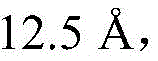 After optimization, fixing the position of the gel membrane material molecule in the water phase of an interfacial polymerization system;
(6) carrying out DPD simulation of 500000 steps (about 75ns) on a system with an optimized structure by utilizing a Mesocite module of Materials Studio software to obtain a stable equilibrium state interface aggregation structure, wherein force fields selected in the DPD simulation process are consistent with those in the step (6) and are conservative force parameters obtained by calculation according to formulas 1 and 2, and motion tracks of all DPD beads of one frame are stored in every 500 steps;
(7) after the equilibrium state is reached, outputting and storing a motion trail file of PIP molecules and TMC molecules in DPD simulation and a related calculation file, wherein the related file refers to an interaction energy file, a concentration file, a density file, a radial distribution function file, a mean square displacement file and a mutual distance file;
(8) outputting the structure of the interface polymerization system DPD model obtained in the step (7) when the model reaches a stable equilibrium state, and observing the motion tracks of all DPD beads;
(9) according to a motion trail file and a related calculation file of DPD molecules of PIP and TMC monomers which generate interface polymerization reaction, making a fast graph reflecting a time-dependent trajectory evolution diagram of the structure of a polymer layer formed by the interface polymerization reaction of the two monomers at an interface, calculating a time-dependent evolution diagram of the concentrations of PIP and TMC in the interface polymerization layer, observing the concentration distribution of the two monomers near the interface polymerization layer at different times, and analyzing the influence of PPTA on PIP and the rate of participation of the PIP in the interface polymerization reaction according to the motion trails of PIP and PPTA;
(10) in equilibrium, PIP in the hydrogel phase and TMC in the oil phase snap through the interfacial polymerization forming a separation layer of the composite membrane as shown in figure 3. Through the analysis, PPTA in the hydrogel phase has a strong adsorption effect on PIP molecules, one part of the PIP molecules is adsorbed on a PPTA chain in the diffusion process of the PIP molecules in the hydrogel phase, and the other part of the PIP molecules is continuously diffused to an interface polymerization layer to participate in an interface polymerization reaction; in the interfacial polymerization reaction process, a polyamide polymer film is generated through the interfacial polymerization reaction of D beads in PIP molecules and C beads in TMC molecules, and the concentrations of PPTA, PIP and TMC monomers have important influence on the thickness, the pore diameter and the porosity of the formed polymer film.
Although the preferred embodiments of the present patent have been described in detail, the present patent is not limited to the above embodiments, and various changes can be made without departing from the spirit of the present patent within the knowledge of those skilled in the art.
Claims (9)
1. A method of simulating dissipative particle dynamics during gel film interfacial polymerization, comprising: the method comprises the following steps:
determining various material components and chemical structures thereof in a hydrogel phase and an oil phase of an interfacial polymerization system, wherein the hydrogel phase comprises a solvent, a gel membrane material and a water-soluble monomer, and the oil phase comprises an organic solvent and an oil-soluble monomer;
step two, respectively constructing a DPD model of the solvent, the gel film material and the water-soluble monomer molecules in the hydrogel phase and a DPD model of the organic solvent and the oil-soluble monomer molecules in the oil phase;
step three, establishing an interface polymerization reaction system DPD structure model consisting of a hydrogel phase and an oil phase;
step four, obtaining Flory-Huggins parameters among DPD beads by adopting molecular dynamics simulation or from credible scientific literature, and calculating interaction parameters among the coarse grained beads according to the DPD theory, namely conservative force parameters; wherein the relationship between Flory-Huggins parameters and DPD conservative force parameters is as described in formulas (1) and (2):
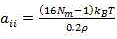

aiirepresents the interaction force parameter between identical DPD beads;
aijrepresents the interaction force parameter between different DPD beads;
in the formula: n is a radical ofmRepresents the level of coarse grain in the DPD simulation, namely: the number of water molecules contained in one DPD bead;
kBt represents an energy unit in the DPD simulation;
ρ represents the density of the DPD simulation system;
χijexpressing Flory-Huggins parameters among different DPD beads, and obtaining the parameters through molecular dynamics simulation or from credible scientific literature;
fifthly, carrying out DPD simulation by using Materials Studio software, and after the system is balanced, obtaining a motion trail file and a related calculation file of each DPD bead;
and step six, observing the structural characteristics of the separation layer of the gel composite membrane generated by the interfacial polymerization reaction according to the simulation result of the step five, and analyzing influence factors for determining the performance of the separation layer in the interfacial polymerization process by combining with a calculation file.
2. The method of claim 1 for modeling dissipative particle dynamics during gel film interfacial polymerization, wherein: the solvent in the hydrogel phase is water, and the material of the hydrogel membrane is one of poly-p-phenylene terephthalamide, chitosan, cellulose, sodium alginate or polyvinyl alcohol.
3. The method of claim 1, wherein the water-soluble monomer is one of piperazine, 2-methylpiperazine, 2, 5-dimethylpiperazine, 4-aminomethylpiperazine, 2, 5-diethylpiperazine, α -cyclodextrin, β -cyclodextrin, γ -cyclodextrin, δ -cyclodextrin, p-phenylenediamine, m-phenylenediamine, trimesamine, diaminotoluene, ethylenediamine, propylenediamine, xylylenediamine, 1, 3-diaminocyclohexane, or 1, 4-diaminocyclohexane, and the concentration of the water-soluble monomer is 0.01 to 8.0 wt%.
4. The method of claim 1 for modeling dissipative particle dynamics during gel film interfacial polymerization, wherein: the water-soluble monomer is piperazine, m-phenylenediamine or cyclodextrin.
5. The method of claim 1 for modeling dissipative particle dynamics during gel film interfacial polymerization, wherein: the organic solvent in the oil phase is one or more of n-hexane, cyclohexane, heptane, octane, naphtha, Isopar-E, Isopar-G, Isopar-L or mineral oil, the oil-soluble monomer in the oil phase is a polybasic acyl chloride monomer and is one of trimesoyl chloride, terephthaloyl chloride, isophthaloyl chloride, terephthaloyl chloride, benzene trisulfonyl chloride, tricarbonyl chloride, butanetriacyl chloride, pentatricoyl chloride, glutaroyl chloride, adipoyl chloride, maleoyl chloride, cyclopropane triacyl chloride, cyclobutane tetracoyl chloride, cyclopentane diacid chloride, cyclopentane triacyl chloride, cyclopentane tetracoyl chloride, cyclohexane diacid chloride, cyclohexane triacyl chloride or cyclohexane tetracoyl chloride, and the concentration of the oil-soluble monomer is 0.01-4.0 wt%.
6. The method of claim 1 for modeling dissipative particle dynamics during gel film interfacial polymerization, wherein: the second step is as follows: (1) coarsely granulating various substances in a system according to chemical structures of solvents, gel film materials and monomers in a hydrogel phase and an oil phase, and defining DPD beads of different types; (2) setting the types of the beads by using a Materials Visualizer module of Materials Studio software, and constructing DPD models of solvent molecules, gel film material molecules, water-soluble monomer molecules, organic solvent molecules and oil-soluble monomer molecules by using corresponding DPD beads.
7. The method of claim 1 for modeling dissipative particle dynamics during gel film interfacial polymerization, wherein: the third step is as follows:
(1) building a cubic box by using Materials Studio software, averagely dividing the box into an upper layer and a lower layer, setting the upper layer as an organic phase in the interfacial polymerization reaction process, placing an organic solvent and an oil-soluble monomer, setting the lower layer as a hydrogel phase in the interfacial polymerization reaction process, and placing solvent molecules, gel film material molecules and a water-soluble monomer;
(2) the number of solvent molecules, gel film material molecules, water-soluble monomer molecules, organic solvent molecules, and oil-soluble monomer molecules is determined by the monomer concentration required for the interfacial polymerization reaction.
8. The method of claim 1 for modeling dissipative particle dynamics during gel film interfacial polymerization, wherein: the fifth step is specifically as follows:
(1) selecting a Geometry Optimization task in a Mesocite module to carry out structural Optimization on the constructed interfacial polymerization reaction system, and fixing the positions of the molecules of the gel membrane material in a solvent phase of the interfacial polymerization reaction system after Optimization;
(2) carrying out DPD simulation on the interface polymerization system DPD model obtained by the construction method in the third step and the conservative force parameter obtained in the fourth step by utilizing a Mesocite module of Materials Studio software to obtain a stable equilibrium state interface polymerization structure;
(3) and outputting and storing a motion track file of each bead in the DPD simulation and a related calculation file, wherein the related calculation file refers to an interaction energy file, a concentration file, a density file, a radial distribution function file, a mean square displacement file and a mutual distance file.
9. The method of claim 1 for modeling dissipative particle dynamics during gel film interfacial polymerization, wherein: the sixth step is as follows:
(1) outputting the structure of the gel film interface polymerization system DPD model obtained in the fifth step when the model reaches a stable equilibrium state, and observing the motion tracks of all DPD beads;
(2) according to the motion track file and the related calculation file of the water-soluble monomer and the oil-soluble monomer bead which are mutually reacted, making a snap chart to reflect a track evolution diagram of the structure of a polymer layer formed by the interface polymerization reaction of the two monomers at the interface along with time; calculating an evolution diagram of the concentrations of the water-soluble monomer and the oil-soluble monomer in the interface polymerization layer along with time, and investigating the concentration distribution of the two monomers near the interface polymerization layer at different times; analyzing the influence of the gel material on the water-soluble monomer and the rate of the water-soluble monomer participating in the interfacial polymerization reaction according to the motion tracks of the water-soluble monomer and the molecules of the gel film material;
(3) through the analysis, the factors determining the structure and the performance of the polymer and the influence rule thereof in the interfacial polymerization reaction process are obtained.
Priority Applications (2)
| Application Number | Priority Date | Filing Date | Title |
|---|---|---|---|
| CN201910859079.6A CN110517735B (en) | 2019-09-11 | 2019-09-11 | Dissipative particle dynamics method for simulating gel film interface polymerization reaction process |
| US16/827,488 US20210074386A1 (en) | 2019-09-11 | 2020-03-23 | Dissipative particle dynamics method for simulating interfacial polymerization process of hydrogel membrane |
Applications Claiming Priority (1)
| Application Number | Priority Date | Filing Date | Title |
|---|---|---|---|
| CN201910859079.6A CN110517735B (en) | 2019-09-11 | 2019-09-11 | Dissipative particle dynamics method for simulating gel film interface polymerization reaction process |
Publications (2)
| Publication Number | Publication Date |
|---|---|
| CN110517735A CN110517735A (en) | 2019-11-29 |
| CN110517735B true CN110517735B (en) | 2020-04-21 |
Family
ID=68630628
Family Applications (1)
| Application Number | Title | Priority Date | Filing Date |
|---|---|---|---|
| CN201910859079.6A Active CN110517735B (en) | 2019-09-11 | 2019-09-11 | Dissipative particle dynamics method for simulating gel film interface polymerization reaction process |
Country Status (2)
| Country | Link |
|---|---|
| US (1) | US20210074386A1 (en) |
| CN (1) | CN110517735B (en) |
Families Citing this family (17)
| Publication number | Priority date | Publication date | Assignee | Title |
|---|---|---|---|---|
| CN110929426B (en) * | 2019-12-20 | 2022-06-10 | 自然资源部天津海水淡化与综合利用研究所 | Membrane pollution simulation analysis method |
| CN111739589B (en) * | 2020-06-29 | 2022-07-05 | 青岛科技大学 | Mesoscale-based simulation method for dissolving lignin by eutectic solvent |
| CN113223624B (en) * | 2021-02-05 | 2023-04-28 | 中南大学 | Cross-scale simulation method for predicting microstructure evolution in colloid shearing motion process |
| CN113742977B (en) * | 2021-09-15 | 2024-05-10 | Oppo广东移动通信有限公司 | Design method, device and terminal of organic polymer-inorganic interface |
| CN114283894B (en) * | 2021-12-23 | 2024-02-27 | 中国石油大学(北京) | Method for establishing foam system microscopic model |
| CN114444300B (en) * | 2022-01-24 | 2024-11-22 | 青岛理工大学 | A method and system for testing performance of polycarboxylic acid water reducing agent in concrete system |
| CN115169083B (en) * | 2022-06-17 | 2024-03-19 | 山东科技大学 | A method for calculating pyrolysis kinetic parameters of polymer matrix composites |
| CN115301085A (en) * | 2022-08-24 | 2022-11-08 | 郑州大学 | Low-pressure nanofiltration membrane for treating mono/divalent salt and/or antibiotic wastewater and preparation method thereof |
| CN115532080A (en) * | 2022-08-25 | 2022-12-30 | 上海工程技术大学 | Preparation method of solvent-resistant PPTA/MOFs composite nanofiltration membrane |
| CN115547418B (en) * | 2022-09-23 | 2025-07-15 | 华南理工大学 | A method for constructing a dissipative particle dynamics force field and a coarse-grained model with topological structure and its application |
| CN116130013B (en) * | 2023-02-22 | 2025-06-10 | 华南理工大学 | Method for analyzing glass phase separation based on molecular dynamics simulation |
| CN116525038B (en) * | 2023-04-19 | 2025-08-01 | 上海交通大学 | Optimal synthesis method, system, equipment and medium for hydrogel |
| CN116864040B (en) * | 2023-05-22 | 2025-10-17 | 华南理工大学 | Automatic simulation method for self-assembly crosslinking process of high polymer nano material based on coarse-grain simulation technology |
| CN116959644B (en) * | 2023-08-01 | 2026-01-06 | 天津工业大学 | A method for calculating the adsorption energy of MOF materials during the interfacial polymerization process to prepare composite films. |
| CN118807490B (en) * | 2024-06-20 | 2025-10-31 | 中国科学院过程工程研究所 | Composite nanofiltration membrane based on oil immersed gel coating and preparation method thereof |
| CN119558159B (en) * | 2025-01-27 | 2025-05-06 | 同济大学 | Simulation method and system for aramid fiber honeycomb core gum dipping process based on dissipative particle dynamics |
| CN121148501A (en) * | 2025-11-18 | 2025-12-16 | 同济大学 | Thermal response hydrogel construction method based on solid-liquid interface repulsive force and water content |
Citations (5)
| Publication number | Priority date | Publication date | Assignee | Title |
|---|---|---|---|---|
| CN1113500A (en) * | 1994-05-19 | 1995-12-20 | 通用电气公司 | A compolex stabilizer composition to improve the melt stability and color stability of polycarbonates |
| EP1935652A1 (en) * | 2006-12-21 | 2008-06-25 | Agfa Graphics N.V. | Inkjet Printing methods and ink sets |
| CN101528805A (en) * | 2006-08-07 | 2009-09-09 | 沙伯基础创新塑料知识产权有限公司 | Polysiloxane copolymers,thermoplastic composition, and articles formed therefrom |
| CN108840991A (en) * | 2018-03-28 | 2018-11-20 | 四川大学 | The hydrophobic water-base polyurethane material and its preparation method and application of outer layer hydrophilic inner layer |
| CN110064312A (en) * | 2019-04-29 | 2019-07-30 | 袁书珊 | A kind of high throughput solvent resistant interfacial polymerization composite membrane and preparation method thereof |
Family Cites Families (2)
| Publication number | Priority date | Publication date | Assignee | Title |
|---|---|---|---|---|
| CN104268405B (en) * | 2014-09-26 | 2017-12-08 | 安徽大学 | A kind of illiteracy support Caro molecular simulation research method of kinetics of polymerization reaction process |
| CN107001548B (en) * | 2014-12-02 | 2020-04-10 | 三菱化学株式会社 | Curable composition and film |
-
2019
- 2019-09-11 CN CN201910859079.6A patent/CN110517735B/en active Active
-
2020
- 2020-03-23 US US16/827,488 patent/US20210074386A1/en not_active Abandoned
Patent Citations (5)
| Publication number | Priority date | Publication date | Assignee | Title |
|---|---|---|---|---|
| CN1113500A (en) * | 1994-05-19 | 1995-12-20 | 通用电气公司 | A compolex stabilizer composition to improve the melt stability and color stability of polycarbonates |
| CN101528805A (en) * | 2006-08-07 | 2009-09-09 | 沙伯基础创新塑料知识产权有限公司 | Polysiloxane copolymers,thermoplastic composition, and articles formed therefrom |
| EP1935652A1 (en) * | 2006-12-21 | 2008-06-25 | Agfa Graphics N.V. | Inkjet Printing methods and ink sets |
| CN108840991A (en) * | 2018-03-28 | 2018-11-20 | 四川大学 | The hydrophobic water-base polyurethane material and its preparation method and application of outer layer hydrophilic inner layer |
| CN110064312A (en) * | 2019-04-29 | 2019-07-30 | 袁书珊 | A kind of high throughput solvent resistant interfacial polymerization composite membrane and preparation method thereof |
Non-Patent Citations (1)
| Title |
|---|
| 高分子体系活性聚合反应的计算机模拟研究;刘鸿;《中国博士学位论文全文数据库 工程科技I辑》;20100815;正文第1-5章 * |
Also Published As
| Publication number | Publication date |
|---|---|
| CN110517735A (en) | 2019-11-29 |
| US20210074386A1 (en) | 2021-03-11 |
Similar Documents
| Publication | Publication Date | Title |
|---|---|---|
| CN110517735B (en) | Dissipative particle dynamics method for simulating gel film interface polymerization reaction process | |
| Peng et al. | Extreme Li-Mg selectivity via precise ion size differentiation of polyamide membrane | |
| Zhang et al. | Molecular insights into the composition–structure–property relationships of polyamide thin films for reverse osmosis desalination | |
| Shen et al. | When self-assembly meets interfacial polymerization | |
| Wang et al. | Aqueous two-phase interfacial assembly of COF membranes for water desalination | |
| You et al. | Electrostatic-modulated interfacial polymerization toward ultra-permselective nanofiltration membranes | |
| Muscatello et al. | Multiscale molecular simulations of the formation and structure of polyamide membranes created by interfacial polymerization | |
| Shefer et al. | Applying transition-state theory to explore transport and selectivity in salt-rejecting membranes: A critical review | |
| Sun et al. | Synthesis of ion imprinted nanocomposite membranes for selective adsorption of lithium | |
| Liu et al. | Ion–ion selectivity of synthetic membranes with confined nanostructures | |
| Antwi-Baah et al. | Recent hydrophobic metal-organic frameworks and their applications | |
| Kong et al. | An atomistic simulation study on POC/PIM mixed-matrix membranes for gas separation | |
| Chen et al. | Trade-off between endocrine-disrupting compound removal and water permeance of the polyamide nanofiltration membrane: phenomenon and molecular insights | |
| Xu et al. | Recent advances in continuous MOF membranes for gas separation and pervaporation | |
| Müllner et al. | Morphological properties of methacrylate-based polymer monoliths: from gel porosity to macroscopic inhomogeneities | |
| Itliong et al. | Investigation of reverse ionic diffusion in forward-osmosis-aided dewatering of microalgae: A molecular dynamics study | |
| Liyana-Arachchi et al. | Ultrathin molecular-layer-by-layer polyamide membranes: insights from atomistic molecular simulations | |
| Zhang et al. | Unveiling the molecular mechanisms of thickness-dependent water dynamics in an ultrathin free-standing polyamide membrane | |
| Shoemaker et al. | Correlations in charged multipore systems: implications for enhancing selectivity and permeability in nanoporous membranes | |
| CN110600084B (en) | Dissipative particle dynamics method for researching interfacial polymerization reaction mechanism of composite film | |
| Zhao et al. | Design and preparation of molecularly imprinted membranes for selective separation of acteoside | |
| Song et al. | Scalable pillar [5] arene-integrated poly (arylate-amide) molecular sieve membranes to separate light gases | |
| Kaija et al. | High-pressure methane adsorption in porous Lennard-Jones crystals | |
| Yan et al. | Precise selection and separation of ribavirin by nanoconfined imprinted MOFs membrane | |
| Lu et al. | Impact of charge homogeneity on ion selectivity in polyamide membranes |
Legal Events
| Date | Code | Title | Description |
|---|---|---|---|
| PB01 | Publication | ||
| PB01 | Publication | ||
| SE01 | Entry into force of request for substantive examination | ||
| SE01 | Entry into force of request for substantive examination | ||
| GR01 | Patent grant | ||
| GR01 | Patent grant |