CN110508263B - Adsorbing material for blood purification and preparation method thereof - Google Patents
Adsorbing material for blood purification and preparation method thereof Download PDFInfo
- Publication number
- CN110508263B CN110508263B CN201910781387.1A CN201910781387A CN110508263B CN 110508263 B CN110508263 B CN 110508263B CN 201910781387 A CN201910781387 A CN 201910781387A CN 110508263 B CN110508263 B CN 110508263B
- Authority
- CN
- China
- Prior art keywords
- porous cellulose
- ligand
- cellulose cloth
- solution
- cloth
- Prior art date
- Legal status (The legal status is an assumption and is not a legal conclusion. Google has not performed a legal analysis and makes no representation as to the accuracy of the status listed.)
- Active
Links
- 239000000463 material Substances 0.000 title claims abstract description 47
- 210000004369 blood Anatomy 0.000 title claims abstract description 36
- 239000008280 blood Substances 0.000 title claims abstract description 36
- 238000000746 purification Methods 0.000 title claims abstract description 18
- 238000002360 preparation method Methods 0.000 title claims abstract description 10
- 239000001913 cellulose Substances 0.000 claims abstract description 65
- 229920002678 cellulose Polymers 0.000 claims abstract description 65
- 239000004744 fabric Substances 0.000 claims abstract description 58
- 239000003446 ligand Substances 0.000 claims abstract description 32
- 239000002158 endotoxin Substances 0.000 claims abstract description 25
- 238000000034 method Methods 0.000 claims abstract description 25
- 230000000844 anti-bacterial effect Effects 0.000 claims abstract description 21
- 238000001179 sorption measurement Methods 0.000 claims abstract description 20
- AFOSIXZFDONLBT-UHFFFAOYSA-N divinyl sulfone Chemical compound C=CS(=O)(=O)C=C AFOSIXZFDONLBT-UHFFFAOYSA-N 0.000 claims abstract description 16
- 239000011159 matrix material Substances 0.000 claims abstract description 14
- 239000011148 porous material Substances 0.000 claims abstract description 10
- 230000004913 activation Effects 0.000 claims abstract description 6
- -1 vinyl sulfonyl Chemical group 0.000 claims abstract description 4
- 239000012670 alkaline solution Substances 0.000 claims abstract description 3
- 239000000243 solution Substances 0.000 claims description 30
- 102000016943 Muramidase Human genes 0.000 claims description 27
- 108010014251 Muramidase Proteins 0.000 claims description 27
- 108010062010 N-Acetylmuramoyl-L-alanine Amidase Proteins 0.000 claims description 27
- 229960000274 lysozyme Drugs 0.000 claims description 27
- 235000010335 lysozyme Nutrition 0.000 claims description 27
- 239000004325 lysozyme Substances 0.000 claims description 27
- 239000003463 adsorbent Substances 0.000 claims description 23
- 238000002791 soaking Methods 0.000 claims description 18
- 108010093965 Polymyxin B Proteins 0.000 claims description 15
- VEXZGXHMUGYJMC-UHFFFAOYSA-N Hydrochloric acid Chemical compound Cl VEXZGXHMUGYJMC-UHFFFAOYSA-N 0.000 claims description 14
- SBKRTALNRRAOJP-BWSIXKJUSA-N N-[(2S)-4-amino-1-[[(2S,3R)-1-[[(2S)-4-amino-1-oxo-1-[[(3S,6S,9S,12S,15R,18R,21S)-6,9,18-tris(2-aminoethyl)-15-benzyl-3-[(1R)-1-hydroxyethyl]-12-(2-methylpropyl)-2,5,8,11,14,17,20-heptaoxo-1,4,7,10,13,16,19-heptazacyclotricos-21-yl]amino]butan-2-yl]amino]-3-hydroxy-1-oxobutan-2-yl]amino]-1-oxobutan-2-yl]-6-methylheptanamide (6S)-N-[(2S)-4-amino-1-[[(2S,3R)-1-[[(2S)-4-amino-1-oxo-1-[[(3S,6S,9S,12S,15R,18R,21S)-6,9,18-tris(2-aminoethyl)-15-benzyl-3-[(1R)-1-hydroxyethyl]-12-(2-methylpropyl)-2,5,8,11,14,17,20-heptaoxo-1,4,7,10,13,16,19-heptazacyclotricos-21-yl]amino]butan-2-yl]amino]-3-hydroxy-1-oxobutan-2-yl]amino]-1-oxobutan-2-yl]-6-methyloctanamide sulfuric acid Polymers OS(O)(=O)=O.CC(C)CCCCC(=O)N[C@@H](CCN)C(=O)N[C@@H]([C@@H](C)O)C(=O)N[C@@H](CCN)C(=O)N[C@H]1CCNC(=O)[C@@H](NC(=O)[C@H](CCN)NC(=O)[C@H](CCN)NC(=O)[C@H](CC(C)C)NC(=O)[C@@H](Cc2ccccc2)NC(=O)[C@@H](CCN)NC1=O)[C@@H](C)O.CC[C@H](C)CCCCC(=O)N[C@@H](CCN)C(=O)N[C@@H]([C@@H](C)O)C(=O)N[C@@H](CCN)C(=O)N[C@H]1CCNC(=O)[C@@H](NC(=O)[C@H](CCN)NC(=O)[C@H](CCN)NC(=O)[C@H](CC(C)C)NC(=O)[C@@H](Cc2ccccc2)NC(=O)[C@@H](CCN)NC1=O)[C@@H](C)O SBKRTALNRRAOJP-BWSIXKJUSA-N 0.000 claims description 14
- 229920002873 Polyethylenimine Polymers 0.000 claims description 14
- 229960003548 polymyxin b sulfate Drugs 0.000 claims description 14
- XLYOFNOQVPJJNP-UHFFFAOYSA-N water Substances O XLYOFNOQVPJJNP-UHFFFAOYSA-N 0.000 claims description 11
- BVKZGUZCCUSVTD-UHFFFAOYSA-L Carbonate Chemical compound [O-]C([O-])=O BVKZGUZCCUSVTD-UHFFFAOYSA-L 0.000 claims description 6
- 238000001994 activation Methods 0.000 claims description 6
- 239000000654 additive Substances 0.000 claims description 6
- 239000007853 buffer solution Substances 0.000 claims description 6
- 239000012535 impurity Substances 0.000 claims description 6
- 238000001035 drying Methods 0.000 claims description 4
- 238000005406 washing Methods 0.000 claims description 4
- 241000894006 Bacteria Species 0.000 abstract description 14
- 239000003153 chemical reaction reagent Substances 0.000 abstract description 8
- 241000192125 Firmicutes Species 0.000 abstract description 7
- 239000000758 substrate Substances 0.000 abstract description 6
- 230000003213 activating effect Effects 0.000 abstract description 5
- 230000000694 effects Effects 0.000 abstract description 5
- 125000006850 spacer group Chemical group 0.000 abstract description 3
- 230000003385 bacteriostatic effect Effects 0.000 abstract description 2
- 125000002924 primary amino group Chemical group [H]N([H])* 0.000 abstract description 2
- 206010040047 Sepsis Diseases 0.000 description 14
- 210000002381 plasma Anatomy 0.000 description 9
- 238000002835 absorbance Methods 0.000 description 7
- 201000010099 disease Diseases 0.000 description 7
- 208000037265 diseases, disorders, signs and symptoms Diseases 0.000 description 7
- 238000012360 testing method Methods 0.000 description 7
- 239000001963 growth medium Substances 0.000 description 6
- 239000008363 phosphate buffer Substances 0.000 description 6
- 230000015572 biosynthetic process Effects 0.000 description 5
- 238000006243 chemical reaction Methods 0.000 description 5
- 238000002474 experimental method Methods 0.000 description 5
- 238000003786 synthesis reaction Methods 0.000 description 5
- 206010018910 Haemolysis Diseases 0.000 description 4
- 238000010168 coupling process Methods 0.000 description 4
- ATDGTVJJHBUTRL-UHFFFAOYSA-N cyanogen bromide Chemical compound BrC#N ATDGTVJJHBUTRL-UHFFFAOYSA-N 0.000 description 4
- 230000008588 hemolysis Effects 0.000 description 4
- 208000015181 infectious disease Diseases 0.000 description 4
- 239000000047 product Substances 0.000 description 4
- 210000001519 tissue Anatomy 0.000 description 4
- QCVGEOXPDFCNHA-UHFFFAOYSA-N 5,5-dimethyl-2,4-dioxo-1,3-oxazolidine-3-carboxamide Chemical compound CC1(C)OC(=O)N(C(N)=O)C1=O QCVGEOXPDFCNHA-UHFFFAOYSA-N 0.000 description 3
- 241000222122 Candida albicans Species 0.000 description 3
- 102000002322 Egg Proteins Human genes 0.000 description 3
- 108010000912 Egg Proteins Proteins 0.000 description 3
- 241000588724 Escherichia coli Species 0.000 description 3
- 241000191967 Staphylococcus aureus Species 0.000 description 3
- 230000008901 benefit Effects 0.000 description 3
- 229940095731 candida albicans Drugs 0.000 description 3
- 230000008878 coupling Effects 0.000 description 3
- 238000005859 coupling reaction Methods 0.000 description 3
- 235000014103 egg white Nutrition 0.000 description 3
- 210000000969 egg white Anatomy 0.000 description 3
- 238000011013 endotoxin removal Methods 0.000 description 3
- 230000003100 immobilizing effect Effects 0.000 description 3
- 239000013642 negative control Substances 0.000 description 3
- 239000006916 nutrient agar Substances 0.000 description 3
- 230000001717 pathogenic effect Effects 0.000 description 3
- 239000013641 positive control Substances 0.000 description 3
- 230000008569 process Effects 0.000 description 3
- 241000304886 Bacilli Species 0.000 description 2
- 241000193830 Bacillus <bacterium> Species 0.000 description 2
- 241000283690 Bos taurus Species 0.000 description 2
- BRLQWZUYTZBJKN-UHFFFAOYSA-N Epichlorohydrin Chemical compound ClCC1CO1 BRLQWZUYTZBJKN-UHFFFAOYSA-N 0.000 description 2
- 241000283973 Oryctolagus cuniculus Species 0.000 description 2
- 206010040070 Septic Shock Diseases 0.000 description 2
- 244000052616 bacterial pathogen Species 0.000 description 2
- HRQGCQVOJVTVLU-UHFFFAOYSA-N bis(chloromethyl) ether Chemical compound ClCOCCl HRQGCQVOJVTVLU-UHFFFAOYSA-N 0.000 description 2
- 229910052799 carbon Inorganic materials 0.000 description 2
- 125000004432 carbon atom Chemical group C* 0.000 description 2
- PFKFTWBEEFSNDU-UHFFFAOYSA-N carbonyldiimidazole Chemical compound C1=CN=CN1C(=O)N1C=CN=C1 PFKFTWBEEFSNDU-UHFFFAOYSA-N 0.000 description 2
- 210000002421 cell wall Anatomy 0.000 description 2
- 230000008859 change Effects 0.000 description 2
- 238000012258 culturing Methods 0.000 description 2
- 230000006378 damage Effects 0.000 description 2
- 238000010790 dilution Methods 0.000 description 2
- 239000012895 dilution Substances 0.000 description 2
- 125000002887 hydroxy group Chemical group [H]O* 0.000 description 2
- 230000002757 inflammatory effect Effects 0.000 description 2
- 230000000968 intestinal effect Effects 0.000 description 2
- 239000007788 liquid Substances 0.000 description 2
- 238000009630 liquid culture Methods 0.000 description 2
- 230000000813 microbial effect Effects 0.000 description 2
- 238000012986 modification Methods 0.000 description 2
- 230000004048 modification Effects 0.000 description 2
- 230000010412 perfusion Effects 0.000 description 2
- 239000008055 phosphate buffer solution Substances 0.000 description 2
- 230000036303 septic shock Effects 0.000 description 2
- 239000008354 sodium chloride injection Substances 0.000 description 2
- JQWHASGSAFIOCM-UHFFFAOYSA-M sodium periodate Chemical compound [Na+].[O-]I(=O)(=O)=O JQWHASGSAFIOCM-UHFFFAOYSA-M 0.000 description 2
- 239000000126 substance Substances 0.000 description 2
- OTLLEIBWKHEHGU-UHFFFAOYSA-N 2-[5-[[5-(6-aminopurin-9-yl)-3,4-dihydroxyoxolan-2-yl]methoxy]-3,4-dihydroxy-6-(hydroxymethyl)oxan-2-yl]oxy-3,5-dihydroxy-4-phosphonooxyhexanedioic acid Chemical compound C1=NC=2C(N)=NC=NC=2N1C(C(C1O)O)OC1COC1C(CO)OC(OC(C(O)C(OP(O)(O)=O)C(O)C(O)=O)C(O)=O)C(O)C1O OTLLEIBWKHEHGU-UHFFFAOYSA-N 0.000 description 1
- LZKGFGLOQNSMBS-UHFFFAOYSA-N 4,5,6-trichlorotriazine Chemical compound ClC1=NN=NC(Cl)=C1Cl LZKGFGLOQNSMBS-UHFFFAOYSA-N 0.000 description 1
- 208000010444 Acidosis Diseases 0.000 description 1
- 208000007788 Acute Liver Failure Diseases 0.000 description 1
- 206010000804 Acute hepatic failure Diseases 0.000 description 1
- 206010001052 Acute respiratory distress syndrome Diseases 0.000 description 1
- 241000193738 Bacillus anthracis Species 0.000 description 1
- 238000009631 Broth culture Methods 0.000 description 1
- 206010007882 Cellulitis Diseases 0.000 description 1
- 208000028399 Critical Illness Diseases 0.000 description 1
- 206010051055 Deep vein thrombosis Diseases 0.000 description 1
- 208000037487 Endotoxemia Diseases 0.000 description 1
- 208000004232 Enteritis Diseases 0.000 description 1
- 102000004190 Enzymes Human genes 0.000 description 1
- 108090000790 Enzymes Proteins 0.000 description 1
- 239000004593 Epoxy Substances 0.000 description 1
- 241000233866 Fungi Species 0.000 description 1
- WQZGKKKJIJFFOK-GASJEMHNSA-N Glucose Natural products OC[C@H]1OC(O)[C@H](O)[C@@H](O)[C@@H]1O WQZGKKKJIJFFOK-GASJEMHNSA-N 0.000 description 1
- 201000009906 Meningitis Diseases 0.000 description 1
- 206010027417 Metabolic acidosis Diseases 0.000 description 1
- 241001465754 Metazoa Species 0.000 description 1
- MSFSPUZXLOGKHJ-UHFFFAOYSA-N Muraminsaeure Natural products OC(=O)C(C)OC1C(N)C(O)OC(CO)C1O MSFSPUZXLOGKHJ-UHFFFAOYSA-N 0.000 description 1
- OVRNDRQMDRJTHS-UHFFFAOYSA-N N-acelyl-D-glucosamine Natural products CC(=O)NC1C(O)OC(CO)C(O)C1O OVRNDRQMDRJTHS-UHFFFAOYSA-N 0.000 description 1
- MNLRQHMNZILYPY-MDMHTWEWSA-N N-acetyl-alpha-D-muramic acid Chemical group OC(=O)[C@@H](C)O[C@H]1[C@H](O)[C@@H](CO)O[C@H](O)[C@@H]1NC(C)=O MNLRQHMNZILYPY-MDMHTWEWSA-N 0.000 description 1
- OVRNDRQMDRJTHS-FMDGEEDCSA-N N-acetyl-beta-D-glucosamine Chemical group CC(=O)N[C@H]1[C@H](O)O[C@H](CO)[C@@H](O)[C@@H]1O OVRNDRQMDRJTHS-FMDGEEDCSA-N 0.000 description 1
- MBLBDJOUHNCFQT-LXGUWJNJSA-N N-acetylglucosamine Natural products CC(=O)N[C@@H](C=O)[C@@H](O)[C@H](O)[C@H](O)CO MBLBDJOUHNCFQT-LXGUWJNJSA-N 0.000 description 1
- 108010013639 Peptidoglycan Proteins 0.000 description 1
- 206010035664 Pneumonia Diseases 0.000 description 1
- 239000004793 Polystyrene Substances 0.000 description 1
- 208000013616 Respiratory Distress Syndrome Diseases 0.000 description 1
- 241000295644 Staphylococcaceae Species 0.000 description 1
- 206010041925 Staphylococcal infections Diseases 0.000 description 1
- 206010042220 Stress ulcer Diseases 0.000 description 1
- 206010043376 Tetanus Diseases 0.000 description 1
- 206010047249 Venous thrombosis Diseases 0.000 description 1
- 241000700605 Viruses Species 0.000 description 1
- 206010048038 Wound infection Diseases 0.000 description 1
- 238000009825 accumulation Methods 0.000 description 1
- 230000001154 acute effect Effects 0.000 description 1
- 231100000836 acute liver failure Toxicity 0.000 description 1
- 206010069351 acute lung injury Diseases 0.000 description 1
- 238000007259 addition reaction Methods 0.000 description 1
- 201000000028 adult respiratory distress syndrome Diseases 0.000 description 1
- 239000003242 anti bacterial agent Substances 0.000 description 1
- 239000007864 aqueous solution Substances 0.000 description 1
- 230000001580 bacterial effect Effects 0.000 description 1
- 239000003899 bactericide agent Substances 0.000 description 1
- 230000009286 beneficial effect Effects 0.000 description 1
- 238000012925 biological evaluation Methods 0.000 description 1
- 210000000601 blood cell Anatomy 0.000 description 1
- 230000008081 blood perfusion Effects 0.000 description 1
- 239000003183 carcinogenic agent Substances 0.000 description 1
- 239000000969 carrier Substances 0.000 description 1
- 125000002091 cationic group Chemical group 0.000 description 1
- 210000004027 cell Anatomy 0.000 description 1
- 238000007385 chemical modification Methods 0.000 description 1
- 239000003795 chemical substances by application Substances 0.000 description 1
- 208000003167 cholangitis Diseases 0.000 description 1
- 238000004140 cleaning Methods 0.000 description 1
- 239000011248 coating agent Substances 0.000 description 1
- 238000000576 coating method Methods 0.000 description 1
- 230000001332 colony forming effect Effects 0.000 description 1
- 150000001875 compounds Chemical class 0.000 description 1
- 238000007796 conventional method Methods 0.000 description 1
- 238000005520 cutting process Methods 0.000 description 1
- 230000007547 defect Effects 0.000 description 1
- 239000008367 deionised water Substances 0.000 description 1
- 229910021641 deionized water Inorganic materials 0.000 description 1
- 238000011161 development Methods 0.000 description 1
- 206010013023 diphtheria Diseases 0.000 description 1
- 208000009190 disseminated intravascular coagulation Diseases 0.000 description 1
- 239000012153 distilled water Substances 0.000 description 1
- 239000003814 drug Substances 0.000 description 1
- 208000000718 duodenal ulcer Diseases 0.000 description 1
- 230000009881 electrostatic interaction Effects 0.000 description 1
- 230000007613 environmental effect Effects 0.000 description 1
- 229940088598 enzyme Drugs 0.000 description 1
- 238000011156 evaluation Methods 0.000 description 1
- 239000002095 exotoxin Substances 0.000 description 1
- 231100000776 exotoxin Toxicity 0.000 description 1
- 239000000835 fiber Substances 0.000 description 1
- 229920001002 functional polymer Polymers 0.000 description 1
- 102000034238 globular proteins Human genes 0.000 description 1
- 108091005896 globular proteins Proteins 0.000 description 1
- 150000004676 glycans Chemical class 0.000 description 1
- 230000036541 health Effects 0.000 description 1
- 229920000669 heparin Polymers 0.000 description 1
- ZFGMDIBRIDKWMY-PASTXAENSA-N heparin Chemical compound CC(O)=N[C@@H]1[C@@H](O)[C@H](O)[C@@H](COS(O)(=O)=O)O[C@@H]1O[C@@H]1[C@@H](C(O)=O)O[C@@H](O[C@H]2[C@@H]([C@@H](OS(O)(=O)=O)[C@@H](O[C@@H]3[C@@H](OC(O)[C@H](OS(O)(=O)=O)[C@H]3O)C(O)=O)O[C@@H]2O)CS(O)(=O)=O)[C@H](O)[C@H]1O ZFGMDIBRIDKWMY-PASTXAENSA-N 0.000 description 1
- 229960001008 heparin sodium Drugs 0.000 description 1
- 230000007062 hydrolysis Effects 0.000 description 1
- 238000006460 hydrolysis reaction Methods 0.000 description 1
- 230000003993 interaction Effects 0.000 description 1
- TWNIBLMWSKIRAT-VFUOTHLCSA-N levoglucosan Chemical group O[C@@H]1[C@@H](O)[C@H](O)[C@H]2CO[C@@H]1O2 TWNIBLMWSKIRAT-VFUOTHLCSA-N 0.000 description 1
- 229920002521 macromolecule Polymers 0.000 description 1
- 239000002609 medium Substances 0.000 description 1
- 244000005700 microbiome Species 0.000 description 1
- 238000002156 mixing Methods 0.000 description 1
- 239000000203 mixture Substances 0.000 description 1
- 229950006780 n-acetylglucosamine Drugs 0.000 description 1
- 201000008383 nephritis Diseases 0.000 description 1
- 231100000252 nontoxic Toxicity 0.000 description 1
- 230000003000 nontoxic effect Effects 0.000 description 1
- 235000015097 nutrients Nutrition 0.000 description 1
- 238000005580 one pot reaction Methods 0.000 description 1
- 210000000056 organ Anatomy 0.000 description 1
- 244000045947 parasite Species 0.000 description 1
- 239000002245 particle Substances 0.000 description 1
- 230000035778 pathophysiological process Effects 0.000 description 1
- 238000011056 performance test Methods 0.000 description 1
- 206010034674 peritonitis Diseases 0.000 description 1
- 230000035699 permeability Effects 0.000 description 1
- 239000002504 physiological saline solution Substances 0.000 description 1
- 239000002861 polymer material Substances 0.000 description 1
- 229920000024 polymyxin B Polymers 0.000 description 1
- 229960005266 polymyxin b Drugs 0.000 description 1
- 229920001282 polysaccharide Polymers 0.000 description 1
- 239000005017 polysaccharide Substances 0.000 description 1
- 229920002223 polystyrene Polymers 0.000 description 1
- 239000000843 powder Substances 0.000 description 1
- 150000003138 primary alcohols Chemical class 0.000 description 1
- 238000005086 pumping Methods 0.000 description 1
- 230000009467 reduction Effects 0.000 description 1
- 238000009877 rendering Methods 0.000 description 1
- 238000011160 research Methods 0.000 description 1
- 238000012827 research and development Methods 0.000 description 1
- 150000003333 secondary alcohols Chemical class 0.000 description 1
- 230000028327 secretion Effects 0.000 description 1
- 238000000926 separation method Methods 0.000 description 1
- 230000035939 shock Effects 0.000 description 1
- 208000015339 staphylococcus aureus infection Diseases 0.000 description 1
- 238000006467 substitution reaction Methods 0.000 description 1
- 239000006228 supernatant Substances 0.000 description 1
- 230000003319 supportive effect Effects 0.000 description 1
- 230000008718 systemic inflammatory response Effects 0.000 description 1
- 238000002560 therapeutic procedure Methods 0.000 description 1
- 231100000167 toxic agent Toxicity 0.000 description 1
- 239000003440 toxic substance Substances 0.000 description 1
- 230000002485 urinary effect Effects 0.000 description 1
- 125000000391 vinyl group Chemical group [H]C([*])=C([H])[H] 0.000 description 1
- 238000005303 weighing Methods 0.000 description 1
Images


Classifications
-
- B—PERFORMING OPERATIONS; TRANSPORTING
- B01—PHYSICAL OR CHEMICAL PROCESSES OR APPARATUS IN GENERAL
- B01J—CHEMICAL OR PHYSICAL PROCESSES, e.g. CATALYSIS OR COLLOID CHEMISTRY; THEIR RELEVANT APPARATUS
- B01J20/00—Solid sorbent compositions or filter aid compositions; Sorbents for chromatography; Processes for preparing, regenerating or reactivating thereof
- B01J20/22—Solid sorbent compositions or filter aid compositions; Sorbents for chromatography; Processes for preparing, regenerating or reactivating thereof comprising organic material
- B01J20/24—Naturally occurring macromolecular compounds, e.g. humic acids or their derivatives
-
- B—PERFORMING OPERATIONS; TRANSPORTING
- B01—PHYSICAL OR CHEMICAL PROCESSES OR APPARATUS IN GENERAL
- B01J—CHEMICAL OR PHYSICAL PROCESSES, e.g. CATALYSIS OR COLLOID CHEMISTRY; THEIR RELEVANT APPARATUS
- B01J20/00—Solid sorbent compositions or filter aid compositions; Sorbents for chromatography; Processes for preparing, regenerating or reactivating thereof
- B01J20/22—Solid sorbent compositions or filter aid compositions; Sorbents for chromatography; Processes for preparing, regenerating or reactivating thereof comprising organic material
- B01J20/26—Synthetic macromolecular compounds
- B01J20/261—Synthetic macromolecular compounds obtained by reactions only involving carbon to carbon unsaturated bonds
-
- B—PERFORMING OPERATIONS; TRANSPORTING
- B01—PHYSICAL OR CHEMICAL PROCESSES OR APPARATUS IN GENERAL
- B01J—CHEMICAL OR PHYSICAL PROCESSES, e.g. CATALYSIS OR COLLOID CHEMISTRY; THEIR RELEVANT APPARATUS
- B01J20/00—Solid sorbent compositions or filter aid compositions; Sorbents for chromatography; Processes for preparing, regenerating or reactivating thereof
- B01J20/28—Solid sorbent compositions or filter aid compositions; Sorbents for chromatography; Processes for preparing, regenerating or reactivating thereof characterised by their form or physical properties
- B01J20/28054—Solid sorbent compositions or filter aid compositions; Sorbents for chromatography; Processes for preparing, regenerating or reactivating thereof characterised by their form or physical properties characterised by their surface properties or porosity
-
- B—PERFORMING OPERATIONS; TRANSPORTING
- B01—PHYSICAL OR CHEMICAL PROCESSES OR APPARATUS IN GENERAL
- B01J—CHEMICAL OR PHYSICAL PROCESSES, e.g. CATALYSIS OR COLLOID CHEMISTRY; THEIR RELEVANT APPARATUS
- B01J20/00—Solid sorbent compositions or filter aid compositions; Sorbents for chromatography; Processes for preparing, regenerating or reactivating thereof
- B01J20/28—Solid sorbent compositions or filter aid compositions; Sorbents for chromatography; Processes for preparing, regenerating or reactivating thereof characterised by their form or physical properties
- B01J20/28054—Solid sorbent compositions or filter aid compositions; Sorbents for chromatography; Processes for preparing, regenerating or reactivating thereof characterised by their form or physical properties characterised by their surface properties or porosity
- B01J20/28057—Surface area, e.g. B.E.T specific surface area
- B01J20/28059—Surface area, e.g. B.E.T specific surface area being less than 100 m2/g
Landscapes
- Chemical & Material Sciences (AREA)
- Analytical Chemistry (AREA)
- Organic Chemistry (AREA)
- Chemical Kinetics & Catalysis (AREA)
- External Artificial Organs (AREA)
- Solid-Sorbent Or Filter-Aiding Compositions (AREA)
Abstract
The invention discloses an adsorbing material for blood purification and a preparation method thereof, wherein the adsorbing material takes porous cellulose cloth as a matrix, a first ligand capable of combining endotoxin and a second ligand with an antibacterial effect are fixed on the matrix, and the matrix has a porous structure with the pore diameter of 5-600 mu m and a pore diameter of 0.5cm2~12m2The active surface of (1). The invention uses divinyl sulfone activation method, the substrate is activated by divinyl sulfone in alkaline solution to generate active vinyl sulfonyl, the intermediate can directly react with ligand containing amino, ligand is coupled by covalence, and the activating reagent is equal to that a spacer arm is introduced into the activating reagent; the blood purification porous cellulose cloth adsorption material prepared by the method has a good effect of removing endotoxin, has a good bactericidal and bacteriostatic effect on gram-negative bacteria and gram-positive bacteria, and is high in safety.
Description
Technical Field
The invention relates to the technical field of biomedical materials and blood purification, in particular to an adsorbing material for blood purification and a preparation method thereof.
Background
Sepsis is a complex process of infection by a variety of microorganisms (bacteria, fungi, viruses, parasites, etc.) and systemic inflammatory responses. Infection at essentially any site can lead to sepsis, such as pneumonia, enteritis, peritonitis, cholangitis, urinary system infection, cellulitis, meningitis, and the like. Sepsis, high incidence and mortality, is a leading cause of death in Intensive Care Units (ICU). Fleischmann et al report that the incidence of sepsis in developed countries worldwide in the last 10 years is 437/(10 ten thousand years), the fatality rate is 17%, and the rate is sharply increased at 8% -13% per year in 2016; the incidence rate of severe sepsis is 270/(10 ten thousand years), and the fatality rate is 26%; patient mortality consistent with the Sepsis3.0 septic shock is over 40%. Professor Dubin in Beijing's cooperative Hospital reports that the prevalence rates of severe sepsis in surgical ICU and comprehensive ICU in China are 8.7% and 37.3%, respectively, which are similar to data from Europe. Although great progress has been made in the supportive treatment of critical illness, sepsis remains a leading cause of death in intensive care unit patients worldwide.
Gram bacteria include gram-negative bacteria and gram-positive bacteria, most of the intestinal bacteria belong to gram-negative bacteria, and the intestinal bacteria generate endotoxin which can induce sepsis; most pyogenes belong to gram-positive bacteria, which can produce exotoxin to cause diseases, and the common gram-positive bacteria include: staphylococci, streptococci, pneumococci, anthrax bacillus, diphtheria bacillus, tetanus bacillus, etc. Large-scale epidemiological data show that sepsis and septic shock caused by gram-positive bacteria are increased remarkably in recent years, and the incidence rate of the sepsis reaches over 50 percent at present. The incidence of staphylococcus aureus infection is the first place, and is the main pathogenic bacteria of burn wound infection, acute liver failure, blood-borne nephritis and other diseases. The severity and fatality rate of the disease are equivalent to those of gram-negative bacteria, and the disease usually occurs and cooperates with gram-negative bacteria pyosis, so that the pathophysiological process of sepsis is worsened, and the life of a patient is seriously threatened. In addition, the acute increase of inflammatory factors is closely related to diseases such as sepsis caused by gram-positive bacteria infection. Common complications of sepsis include shock, acute lung injury, acute respiratory distress syndrome, deep vein thrombosis, stress ulcers, metabolic acidosis, Disseminated Intravascular Coagulation (DIC), and even multiple organ insufficiency.
Many diseases occur and develop as a result of accumulation of pathogenic agents in the body. The method can specifically and effectively remove the pathogenic factors from the body by purifying blood without causing damage to the body, and is a problem which is continuously explored in clinical medicine for nearly twenty years. The principle of adsorption therapy is that a certain ligand is firmly combined on a fixed carrier to construct an adsorption column, and the pathogenic factor in the blood of a patient is specifically eliminated by an extracorporeal circulation method, so that the blood is purified, and the aim of treating diseases is fulfilled. The current blood purification method for sepsis mainly adsorbs endotoxin alone or adsorbs inflammatory factors alone, but simultaneous adsorption of pathogenic bacteria and endotoxin is not discovered temporarily. Cellulose is the most abundant and reproducible natural macromolecular compound in the nature, and has the advantages of low price, degradability, environmental friendliness and the like. Cellulose is structurally a macromolecular polysaccharide composed of D-glucose through beta-1, 4-glycosidic bonds, hydroxyl groups on each anhydroglucose unit are positioned at C-2, C-3 and C-6 positions, the cellulose has the typical reaction property of primary alcohol and secondary alcohol, and functional polymer materials with different purposes can be prepared through a series of chemical modifications. Therefore, all countries in the world pay great attention to the research and development of cellulose. An important application of cellulose is cellulose adsorbent, the development and application of which begin in the early 50 s, and various brands and series of cellulose commodities are sold at home and abroad at present. Due to the limitation of preparation means, most of the cellulose adsorbents sold in the market are in powder or particle shapes, and the pore structure is not good, so that the application range of the cellulose adsorbents is limited to a great extent. The porous cellulose cloth material just makes up the defects of the existing cellulose commodity, can control the porosity, and has the advantages of large specific surface, good permeability and mechanical property, and the like.
Currently, cyanogen bromide, trichlorotriazine, carbonyldiimidazole, sodium periodate, epichlorohydrin and the like are generally used as coupling reagents used for research. Cyanogen bromide is a highly toxic substance, so that the synthetic process has great harm to human bodies and the environment; and the cyanogen bromide coupling method is easy to fall off and enter a human body, and has larger side effect on patients, so the synthesis process is not ideal. Yuanyu and Jialing cloud et al respectively adopt epichlorohydrin (publication number: CN 1239210C) and carbonyldiimidazole (publication number: CN 100493695C) as coupling reagents to activate carriers to couple PMB, although the two methods avoid using hypertoxic cyanogen bromide, the materials prepared by the methods are safer to use, the reaction steps in the preparation process are more, the adsorption materials can be synthesized by five chemical reactions, the method is complex, the difference between batches of the obtained adsorption materials is large, the performance is unstable, and the adsorption materials only adsorb endotoxin. Japanese patent publication No. JPH04270965A discloses an endotoxin-adsorbing material which is a woven fiber of polystyrene having polymyxin B on the surface, but the technical route thereof uses a substance that easily causes the residue of chloromethyl ether, a highly irritating chemical substance, and the chloromethyl ether is a highly carcinogenic substance, which presents a great safety hazard to the health of patients, and the adsorbing material mainly adsorbs endotoxin.
Disclosure of Invention
In view of the above problems, the present invention is directed to overcoming the disadvantages of the prior art and providing an adsorbent for blood purification, which can bind and adsorb endotoxin, has an antibacterial effect, and has high safety and low side effects.
In order to achieve the purpose, the invention adopts the technical scheme that:
an adsorbing material for blood purification, which takes porous cellulose cloth as a matrix, wherein a first ligand capable of binding endotoxin and a second ligand with antibacterial effect are fixed on the matrix, and the matrix has a porous structure with the pore diameter of 5-600 μm and 0.5cm2~12m2The active surface of (1).
Preferably, the first ligand is polymyxin B sulfate or polyethyleneimine.
Preferably, the second ligand is lysozyme.
Preferably, the active surface is surface modified using a divinyl sulfone activation process. It should be noted that PMB (polymyxin B sulfate) and PEI (polyethyleneimine) are two common cationic ligands, and can effectively adsorb endotoxin through electrostatic interaction. Lysozyme is widely distributed in nature as an antibacterial agent of biological enzymes, exists in human tissues and secretions, animal tissues, plant tissues and microbial cells, and is most commonly applied when the content of egg white is the largest. The egg white lysozyme can effectively hydrolyze peptidoglycan of bacterial cell walls, and the hydrolysis site of the egg white lysozyme is a beta-1, 4 glycosidic bond between a carbon atom at the 1 position of N-acetylmuramic acid and a carbon atom at the 4 position of N-acetylglucosamine; the lysozyme is used as a natural globular protein, can selectively decompose microbial cell walls without damaging other tissues, is non-toxic and harmless, and is a natural bactericide with good safety performance.
Preferably, the first ligand and the second ligand are coupled by covalent bonds.
Preferably, the pore size is 70 to 170 μm.
As another aspect of the present invention, the present invention provides a method for preparing an adsorbent material for blood purification, comprising the steps of:
1) pretreating the porous cellulose cloth to remove impurities, oil stains and residual additives on the surface of the cloth;
2) soaking the porous cellulose cloth pretreated in the step 1) by using a carbonate buffer solution, adding a divinyl sulfone solution with the volume fraction of 5-15%, and soaking and reacting for 1-4 hours at the temperature of 25-40 ℃;
3) soaking the product obtained in the step 2) in 10-50 mg/mL polymyxin B sulfate solution or 5-35% by mass of polyethyleneimine solution for 6-24 hours;
4) soaking the product obtained in the step 3) in 0.1-100 mg/mL lysozyme water solution, and reacting for 6-24 h at 24-37 ℃ to obtain the adsorbing material.
Preferably, the pretreatment in step 1) comprises: soaking the porous cellulose cloth in 0.2-1 mol/L hydrochloric acid solution for 24h, then washing the porous cellulose cloth with water until no hydrochloric acid residue exists, removing impurities, oil stains and residual additives on the surface of the porous cellulose cloth, drying and storing the porous cellulose cloth in a dryer for later use.
Preferably, the pH of the carbonate buffer solution is 9-11.
Preferably, the pH value of the lysozyme aqueous solution is 6-9.
In conclusion, the beneficial effects of the invention are as follows:
the invention uses divinyl sulfone activation method, the substrate (porous cellulose cloth) is activated by divinyl sulfone in alkaline solution to generate active vinyl sulfonyl, the intermediate can directly react with ligand containing amino, ligand is coupled by covalence, and the activating reagent is equal to a spacer arm introduced by the activating reagent;
the blood purification porous cellulose cloth adsorption material prepared by the method has a good effect of removing endotoxin, has a good bactericidal and bacteriostatic effect on gram-negative bacteria and gram-positive bacteria, and is high in safety.
Drawings
FIG. 1 is a photograph of the surface of an adsorbent material according to the present invention;
FIG. 2 is a photograph of FIG. 1 at a partial magnification;
FIG. 3 is a synthesis scheme of the adsorbent material of the present invention;
FIG. 4 is a more specific synthesis scheme of the adsorbent of the present invention.
Detailed Description
In some embodiments, the invention relates to an adsorbing material for blood purification which selectively adsorbs endotoxin from whole blood or blood plasma and has antibacterial effect and a preparation method thereof, wherein the preparation method mainly comprises that porous cellulose cloth is taken as a substrate, and the substrate has a porous structure with the pore diameter of 5-600 mu m and 0.5cm2~12m2As shown in fig. 1 and 2, the substrate is activated by a divinyl sulfone activation method and polymyxin B sulfate or polyethyleneimine is immobilized, and a step of immobilizing lysozyme is further performed. The divinyl sulfone has higher reaction activity and is an activating reagent stronger than an epoxy compound, and a vinyl group is easy to perform addition reaction with hydroxyl on cellulose cloth, so that a space connecting arm extends out of the surface of the matrix, an active group is introduced through one-step reaction, and the ligand can be efficiently coupled without connecting a spacer arm. The preparation method is simple, and the obtained productThe adsorbing material has good endotoxin adsorption performance, antibacterial property, blood compatibility and safety.
In some embodiments, the present invention provides an adsorbent for blood purification which selectively adsorbs endotoxin from blood or plasma and has an antibacterial effect, comprising:
passing blood or plasma through an integrated separation matrix having a porous structure with pore sizes of 5-600 μm and 0.5cm2~12m2By immobilizing a first ligand on said matrix for binding to endotoxin, while simultaneously immobilizing a second ligand for rendering it antibacterial.
In some embodiments, the immobilized first ligand is polymyxin b sulfate (pmb) or Polyethyleneimine (PEI) and the second ligand is lysozyme.
In some embodiments, the substrate is a porous cellulose cloth.
In some embodiments, the surface is modified using divinyl sulfone (DVS) activation.
In some embodiments, covalent coupling is used between different ligands coupled on the matrix.
In some embodiments, the matrix pore size is preferably 70 μm to 170 μm.
In some embodiments, the present invention provides a method for preparing an adsorbent material for blood purification, the synthetic route is shown in fig. 3 and 4, and the method comprises the following steps:
1) pretreating the porous cellulose cloth;
2) soaking the pretreated porous cellulose cloth in 1mol/L carbonate buffer solution with the pH value of 9-11, adding divinyl sulfone solution with the volume fraction of 5% -15%, soaking and reacting for 1-4 h at the temperature of 25-40 ℃, and oscillating at the rotating speed of 180 rpm;
3) soaking the product obtained in the step 2) in 10-50 mg/mL PMB solution or 5-35% polyethyleneimine solution for 6-24 h, and oscillating at the rotating speed of 180 rpm;
4) soaking the product obtained in the step 3) in 0.1-100 mg/mL lysozyme water solution, controlling the pH value within a range of 6-9, reacting for 6-24 h at 24-37 ℃, and oscillating at a rotating speed of 180 rpm. The porous cellulose cloth adsorbing material for purifying blood prepared by the method has good blood compatibility, good clearance rate on endotoxin and antibacterial effect.
In some embodiments, the pretreatment in step 1) above is: soaking the porous cellulose cloth in 0.2-1 mol/L hydrochloric acid solution for 24h, cleaning the porous cellulose cloth with water after removing the hydrochloric acid solution until no hydrochloric acid residue exists, removing impurities, oil stains and residual additives on the surface of the porous cellulose cloth, drying the porous cellulose cloth and storing the dried porous cellulose cloth in a dryer for later use.
To better illustrate the objects, aspects and advantages of the present invention, the present invention will be further described with reference to the accompanying drawings and specific embodiments. It should be understood that the examples of the present invention are illustrative of the present invention and not restrictive. Modifications made in accordance with the spirit of the invention are within the scope of the invention as claimed. Unless otherwise specified, concentrations of reagents in the present application are mass concentrations. Unless otherwise specified, the experimental methods in the present invention are all conventional methods.
Example 1
Cutting porous cellulose cloth into a shape of 1cm x 1cm, soaking in 0.5mol/L hydrochloric acid solution for 24h, taking out, washing with deionized water for several times until no hydrochloric acid residue exists, naturally drying in a ventilated place to remove impurities, oil stains and residual additives on the surface of the cloth sample, and storing in a dryer for later use. Labeled M0.
20g of M0 was placed in a 2000mL Erlenmeyer flask with a lid, soaked with 1000mL of 1mol/L carbonate buffer solution of pH 11, 100mL of divinyl sulfone solution was added, soaked at 25 ℃ for 2 hours and agitated at 180rpm to obtain porous cellulose cloth containing active acetyl sulfonyl group, labeled M1.
Example 2 Synthesis of porous cellulose cloth adsorbent Material with PMB + Lysozyme as ligand
5g of M1 prepared in example 1 was placed in 20mg/mL PMB (polymyxin B sulfate) solution (dissolved in PBS pH 7.4) and soaked at 25 ℃ for 24 hours at a shaking speed of 180rpm to obtain PMB ligand-coupled porous cellulose cloth labeled M2-1.
5g M1 was placed in 50mg/mL PMB solution (dissolved in PBS pH 7.4), and soaked at 25 ℃ for 24 hours with shaking at 180rpm to obtain PMB ligand-coupled porous cellulose cloth labeled M2-2.
2.5g M2-1 was placed in 0.2M phosphate buffer of lysozyme at a concentration of 0.1mg/mL at pH 6 and reacted for 6h to give a porous cellulose cloth adsorbent labeled M3-1.
2.5g M2-1 was placed in 0.2M phosphate buffer of lysozyme at a concentration of 20mg/mL at pH 6 and reacted for 6h to give a porous cellulose cloth adsorbent labeled M3-2.
2.5g M2-2 was placed in 0.2M phosphate buffer of lysozyme at a concentration of 0.1mg/mL at pH 6 and reacted for 6h to give a porous cellulose cloth adsorbent labeled M3-3.
2.5g M2-2 was placed in 0.2M phosphate buffer of lysozyme at a concentration of 20mg/mL at pH 6 and reacted for 6h to give a porous cellulose cloth adsorbent labeled M3-4.
Example 3 Synthesis of porous cellulose cloth adsorbent Material with PEI + Lysozyme as ligand
And (3) placing 5g M1 in a 5% PEI (polyethyleneimine) solution, soaking and reacting for 2 hours at 40 ℃, and oscillating at the rotating speed of 180rpm to obtain the PEI ligand-coupled porous cellulose cloth, wherein the label is M2-3.
And (3) placing 5g M1 in 10% PEI solution, soaking and reacting for 2 hours at 40 ℃, and oscillating at the rotating speed of 180rpm to obtain the PEI ligand-coupled porous cellulose cloth, wherein the mark is M2-4.
2.5g M2-3 was placed in 0.2M phosphate buffer of lysozyme at a concentration of 0.1mg/mL at pH 6 and reacted for 6h to give a porous cellulose cloth adsorbent labeled M3-5.
Placing 2.5g M2-3 in 0.2M phosphate buffer solution of lysozyme with pH of 6 and lysozyme concentration of 20mg/mL, and reacting for 6h to obtain porous cellulose cloth adsorbing material, which is marked as M3-6.
2.5g M2-4 was placed in 0.2M phosphate buffer of lysozyme at a concentration of 0.1mg/mL at pH 6 and reacted for 6h to give a porous cellulose cloth adsorbent labeled M3-7.
And 2.5g M2-4 is placed in 0.2M phosphate buffer solution of lysozyme with pH 6 and 20mg/mL of lysozyme, and the reaction is carried out for 6h, so as to obtain porous cellulose cloth adsorbing material which is marked as M3-8.
Example 4 Performance test-clearance of endotoxin from plasma
Clinically, the endotoxin concentration in normal human plasma is lower than 0.053EU/mL, and the plasma endotoxin concentration of endotoxemia patients is generally distributed in 0.1 to 1.0 EU/mL. Washing the prepared blood purification adsorbing material M3-1 with a large amount of water, pumping to constant weight, weighing 0.1g of blood purification material, placing into a conical flask, adding 3mL of 1EU/mL bovine plasma endotoxin solution, statically adsorbing for 2h, testing the endotoxin content in bovine plasma before and after adsorption, and calculating the endotoxin removal rate of the adsorbing material. Examples of adsorption performance tests of the blood purification and adsorption materials M3-2, M3-3, M3-4, M3-5, M3-6, M3-7 and M3-8 are the same as those of M3-1. See table 1 for specific data.
TABLE 1 adsorption Performance of porous cellulose cloth adsorption Material for endotoxin
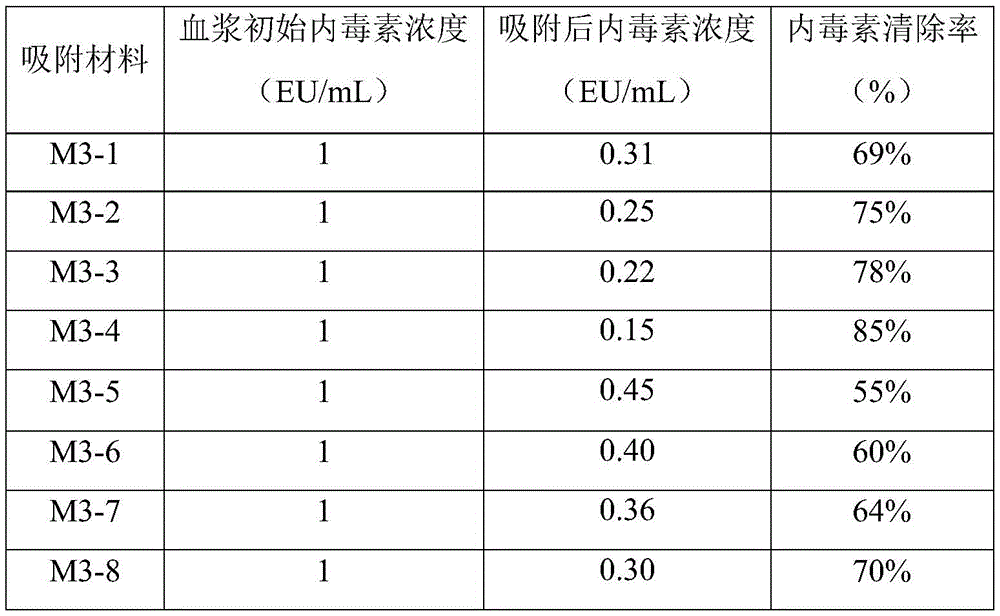
Abbreviations: PMB ═ polymyxin B sulfate; PEI ═ polyethyleneimine; lysozyme ═ lysozyme.
As can be seen from the endotoxin adsorption results in Table 1 above, the adsorption materials prepared in examples 2 and 3 of the present invention have good endotoxin removal rate, and can significantly reduce the concentration of endotoxin in plasma. For example, the adsorption material M3-4 in example 2 can even achieve an endotoxin removal rate of more than 80%.
Example 5 colony counting method antibacterial test
Respectively placing unmodified porous cellulose cloth and modified porous cellulose cloth M3-8 in liquid culture medium, culturing for 24h at 37 +/-1 ℃ in an incubator, taking out 0.1mL of liquid culture medium, adding 0.9mL of sterile nutrient broth culture medium for gradient dilution, then placing 0.1mL of culture solution on the surface of nutrient agar culture medium, uniformly coating the nutrient agar culture medium with the culture solution, culturing for 24h at 37 +/-1 ℃, calculating the colony number on the nutrient agar culture medium, observing the antibacterial activity of a sample, and calculating the antibacterial rate by the following formula:
R(%)=(logA-logB)/logA
in the above formula: a is CFU/mL (colony forming unit) after unmodified porous cellulose cloth is cultured; and B is CFU/mL after the modified porous cellulose cloth is cultured.
The influence of the sample on the number of bacteria can be calculated from the dilution ratio of the culture solution and the number of colonies. Since the unmodified porous cellulose cloth had no antibacterial effect, the number of bacteria in the blank could be considered as the number of bacteria that normally grow in the liquid medium. The experimental data are shown in table 2, and the table 2 shows that the modified porous cellulose cloth has an antibacterial rate of 96.43% for staphylococcus aureus, an antibacterial rate of 46.49% for escherichia coli and an antibacterial rate of 64.04% for candida albicans. Namely, the modified porous cellulose cloth has the following antibacterial effects on several bacteria: staphylococcus aureus > candida albicans > escherichia coli. Wherein Staphylococcus aureus and Candida albicans are gram positive bacilli, and Escherichia coli is gram negative bacilli.
TABLE 2 antibacterial test data by colony counting method
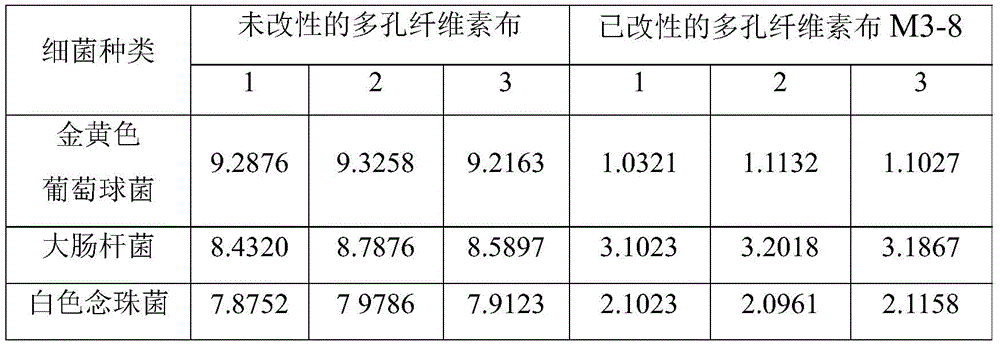
Example 6 hemolysis experiment
Hemolysis experiments are carried out according to the experimental selection of interaction with blood in GB/T16886.4-2003 section 4 of medical device biology evaluation and the experimental method of GB/T16175-2008 of biological evaluation of medical organosilicon materials. 1g of the adsorbing material prepared in the example 2 is added into each tube of the sample group, and then 10ml of sodium chloride injection is added; adding 10ml of sodium chloride injection into each tube of the negative control group; 10ml of distilled water was added to each tube of the positive control group. Each set operated 3 tubes in parallel. Placing all test tubes in constant temperature water bath (37 + -1) deg.C, keeping the temperature for 30min, adding 0.2ml diluted rabbit blood into each test tube, mixing, and placing in water bath (37 + -1) deg.C for keeping the temperature for 60 min. The liquid in the pouring tube was centrifuged at 800g for 5 min. The supernatant was pipetted into a cuvette and the absorbance was measured with a spectrophotometer at 545nm wavelength. The absorbance of the sample combination control group was averaged over 3 tubes. The absorbance of the negative control tube should not be greater than 0.03, the absorbance of the positive control tube should be 0.8 + -0.3, otherwise, the test should be repeated.
The hemolysis rate is (a-B)/(C-B) × 100%, wherein,
a-absorbance of the sample set;
b-absorbance of negative control group;
c-absorbance of positive control group.
The results show that the hemolysis rates of the adsorbing materials in example 4 are all less than 1 percent and less than 5 percent which is required by the national standard. This shows that the adsorbent synthesized in example 4 has good blood compatibility.
Example 7 blood compatibility test
1g of each adsorbent in example 4 was soaked in physiological saline for 10 hours and then placed in a column, 10mL of heparin sodium anticoagulated whole rabbit blood was injected into the column by a syringe, and the mixture was perfused at a flow rate of 20mL/min for 2 hours while an empty column was added for a control experiment. The change of each component of blood before and after perfusion is measured by a Beckman LH750 blood cell analyzer.
The result shows that the change of the main components in the blood before and after perfusion is not large, and the reduction percentage is within 5%, so that the adsorbing material in the embodiment 4 has good blood compatibility and can be applied to whole blood perfusion.
Finally, it should be noted that the above embodiments are only used for illustrating the technical solutions of the present invention and not for limiting the protection scope of the present invention, and although the present invention is described in detail with reference to the preferred embodiments, it should be understood by those skilled in the art that modifications or equivalent substitutions can be made on the technical solutions of the present invention without departing from the spirit and scope of the technical solutions of the present invention.
Claims (9)
1. The adsorption material for purifying blood is characterized in that the adsorption material takes porous cellulose cloth as a matrix, a first ligand capable of binding endotoxin and a second ligand with an antibacterial effect are fixed on the matrix, and the matrix has a porous structure with the pore size of 5 mu m-600 mu m and 0.5cm2~12 m2An active surface of (a);
the active surface is surface modified by a divinyl sulfone activation method, wherein the divinyl sulfone activation method is that the porous cellulose cloth is activated by divinyl sulfone in an alkaline solution to generate an active vinyl sulfonyl group.
2. The adsorbent material according to claim 1, wherein the first ligand is polymyxin B sulfate or polyethyleneimine.
3. The adsorbent material of claim 1, wherein the second ligand is lysozyme.
4. The adsorbent material of claim 1, wherein the first ligand and the second ligand are coupled via a covalent bond.
5. The adsorption material according to claim 1, characterized in that the pore size is between 70 μm and 170 μm.
6. A preparation method of an adsorbing material for blood purification comprises the following steps:
1) pretreating the porous cellulose cloth to remove impurities, oil stains and residual additives on the surface of the cloth;
2) soaking the porous cellulose cloth pretreated in the step 1) by using a carbonate buffer solution, adding a divinyl sulfone solution with the volume fraction of 5-15%, and soaking and reacting for 1-4 hours at the temperature of 25-40 ℃;
3) soaking the product obtained in the step 2) in 10-50 mg/mL polymyxin B sulfate solution or 5-35% by mass of polyethyleneimine solution for 6-24 hours;
4) soaking the product obtained in the step 3) in 0.1-100 mg/mL lysozyme water solution, and reacting for 6-24 h at 24-37 ℃ to obtain the adsorbing material.
7. The method of claim 6, wherein the pre-treating in step 1) comprises: soaking the porous cellulose cloth in 0.2-1 mol/L hydrochloric acid solution for 24h, then washing the porous cellulose cloth with water until no hydrochloric acid residue exists, removing impurities, oil stains and residual additives on the surface of the porous cellulose cloth, drying and storing the porous cellulose cloth in a dryer for later use.
8. The method according to claim 6, wherein the carbonate buffer solution has a pH of 9 to 11.
9. The method according to claim 6, wherein the aqueous lysozyme solution has a pH of 6 to 9.
Priority Applications (1)
| Application Number | Priority Date | Filing Date | Title |
|---|---|---|---|
| CN201910781387.1A CN110508263B (en) | 2019-08-22 | 2019-08-22 | Adsorbing material for blood purification and preparation method thereof |
Applications Claiming Priority (1)
| Application Number | Priority Date | Filing Date | Title |
|---|---|---|---|
| CN201910781387.1A CN110508263B (en) | 2019-08-22 | 2019-08-22 | Adsorbing material for blood purification and preparation method thereof |
Publications (2)
| Publication Number | Publication Date |
|---|---|
| CN110508263A CN110508263A (en) | 2019-11-29 |
| CN110508263B true CN110508263B (en) | 2022-02-22 |
Family
ID=68626247
Family Applications (1)
| Application Number | Title | Priority Date | Filing Date |
|---|---|---|---|
| CN201910781387.1A Active CN110508263B (en) | 2019-08-22 | 2019-08-22 | Adsorbing material for blood purification and preparation method thereof |
Country Status (1)
| Country | Link |
|---|---|
| CN (1) | CN110508263B (en) |
Families Citing this family (4)
| Publication number | Priority date | Publication date | Assignee | Title |
|---|---|---|---|---|
| CN111057153B (en) * | 2019-12-06 | 2021-09-07 | 广州康盛生物科技股份有限公司 | Immunoglobulin binding protein and preparation method and application thereof |
| CN111569842A (en) * | 2020-06-02 | 2020-08-25 | 威海威高生命科技有限公司 | Composite adsorbent and preparation method thereof |
| CN113797900B (en) * | 2021-09-29 | 2023-11-10 | 广州康盛生物科技股份有限公司 | Adsorption material for blood purification, preparation method and application thereof, adsorption column and blood adsorption device |
| CN114011389B (en) * | 2021-12-08 | 2023-10-31 | 广州康盛生物科技股份有限公司 | Blood purification material for sepsis and preparation method and application thereof |
Citations (5)
| Publication number | Priority date | Publication date | Assignee | Title |
|---|---|---|---|---|
| CN1053046A (en) * | 1989-12-07 | 1991-07-17 | 黛丝化学工业株式会社 | Separation method and separating agent |
| JP2012046843A (en) * | 2010-08-26 | 2012-03-08 | Asahi Kasei Fibers Corp | Waterproof cellulose sheet |
| CN103933947A (en) * | 2014-04-10 | 2014-07-23 | 大连理工大学 | Blood purification material for removing rheumatoid factors, and preparation method thereof |
| CN107486176A (en) * | 2017-09-11 | 2017-12-19 | 广州康盛生物科技有限公司 | A kind of sorbing material for blood purification and preparation method thereof |
| CN110052228A (en) * | 2019-04-25 | 2019-07-26 | 泉州师范学院 | It is a kind of with light stress hydrophobe transition response function cellulose aerogels microballoon and preparation method thereof |
Family Cites Families (1)
| Publication number | Priority date | Publication date | Assignee | Title |
|---|---|---|---|---|
| CA2729340C (en) * | 2008-06-26 | 2017-07-11 | Cytosorbents, Inc. | Removal of myoglobin from blood and/or physiological fluids |
-
2019
- 2019-08-22 CN CN201910781387.1A patent/CN110508263B/en active Active
Patent Citations (5)
| Publication number | Priority date | Publication date | Assignee | Title |
|---|---|---|---|---|
| CN1053046A (en) * | 1989-12-07 | 1991-07-17 | 黛丝化学工业株式会社 | Separation method and separating agent |
| JP2012046843A (en) * | 2010-08-26 | 2012-03-08 | Asahi Kasei Fibers Corp | Waterproof cellulose sheet |
| CN103933947A (en) * | 2014-04-10 | 2014-07-23 | 大连理工大学 | Blood purification material for removing rheumatoid factors, and preparation method thereof |
| CN107486176A (en) * | 2017-09-11 | 2017-12-19 | 广州康盛生物科技有限公司 | A kind of sorbing material for blood purification and preparation method thereof |
| CN110052228A (en) * | 2019-04-25 | 2019-07-26 | 泉州师范学院 | It is a kind of with light stress hydrophobe transition response function cellulose aerogels microballoon and preparation method thereof |
Also Published As
| Publication number | Publication date |
|---|---|
| CN110508263A (en) | 2019-11-29 |
Similar Documents
| Publication | Publication Date | Title |
|---|---|---|
| CN110508263B (en) | Adsorbing material for blood purification and preparation method thereof | |
| Gorgieva et al. | Bacterial cellulose: Production, modification and perspectives in biomedical applications | |
| CN101058058B (en) | A porous membrane material with taurine ligand immobilized on the surface, its preparation method and its application in blood lipid adsorption and separation | |
| CN113152091A (en) | Polysaccharide-based hydrogel-based fabric for visually detecting escherichia coli and pH response and preparation method thereof | |
| CN103230781A (en) | Heparin-phenylalanine adsorption material for blood purification method for removing endotoxin | |
| CN106668845B (en) | Preparation method of thrombin-immobilized chitosan/silk fibroin microspheres | |
| CN110507848B (en) | Enzyme-loaded bacterial cellulose-based composite antibacterial hydrogel dressing and preparation method thereof | |
| Abady et al. | Recent advancements in biosensors using biopolymers | |
| CN105384957A (en) | Preparation method of orderly nanofiber membrane based on bacterial cellulose | |
| CN102645473A (en) | Kaolin nanotube/hemoglobin/ionic liquid nanocomposite film-modified electrode and preparation method and application thereof | |
| CN113813396B (en) | Kanamycin grafted cellulose-based antibacterial material and preparation method thereof | |
| CN102743985B (en) | Preparation method for polysulfone-serine affinity membrane used for removing endotoxin | |
| Şenel et al. | Comparison of adsorption performances of metal–chelated polyamide hollow fibre membranes in lysozyme separation | |
| CN101069751B (en) | Protein A immuo adsorption material and preparing method | |
| CN113797900B (en) | Adsorption material for blood purification, preparation method and application thereof, adsorption column and blood adsorption device | |
| CN112853747A (en) | Preparation method of long-acting antibacterial polyester fiber based on composite nano silver and special device thereof | |
| CN102181068B (en) | Polyurethane material subjected to photo-induced graft surface modification by fungi polysaccharide and preparation method thereof | |
| CN111154010B (en) | Medical cationic polymer biopolymer material, preparation method and application | |
| CN101322934B (en) | Preparation method of endotoxin adsorbent | |
| CN113845691B (en) | Two-dimensional or three-dimensional cellulose-based porous antibacterial material and preparation method thereof | |
| CN114272426B (en) | Graphene oxide modified medical absorbent cotton and preparation method thereof | |
| CN115260315B (en) | Modification method of cellulose, betaine type amphoteric cellulose, and preparation method and application thereof | |
| CN117839640B (en) | Adsorption material for blood filtration and preparation method thereof | |
| JPH0975430A (en) | Method for removing contaminant | |
| RU2253871C1 (en) | Method for immunosorbent production |
Legal Events
| Date | Code | Title | Description |
|---|---|---|---|
| PB01 | Publication | ||
| PB01 | Publication | ||
| SE01 | Entry into force of request for substantive examination | ||
| SE01 | Entry into force of request for substantive examination | ||
| CB02 | Change of applicant information | ||
| CB02 | Change of applicant information |
Address after: 510000 Shenzhou street, Science City, Guangzhou high tech Industrial Development Zone, Guangdong 8 Applicant after: Guangzhou Kangsheng Biotechnology Co., Ltd Address before: 510000 Shenzhou Street, Science City, Guangzhou High-tech Industrial Development Zone, Guangzhou, Guangdong Province Applicant before: Guangzhou Kang Huai Biology Science and Technology Co., Ltd. |
|
| GR01 | Patent grant | ||
| GR01 | Patent grant |