Disclosure of Invention
The invention aims to provide a preparation method of high-strength injectable multiphase calcium phosphate-based bone cement, which not only has good injectability and anti-collapsibility, but also has excellent mechanical properties and can provide enough mechanical support for damaged parts.
Therefore, the invention is realized by the following technical scheme: a preparation method of high-strength injectable multiphase calcium phosphate-based bone cement comprises the following steps:
1) mixing alpha-tricalcium phosphate powder, semi-hydrated calcium sulfate powder and bioactive glass powder as raw materials;
2) putting the mixed raw materials, agate medium balls and absolute ethyl alcohol into a ball mill for ball milling;
3) taking out the wet materials subjected to ball milling, and placing the wet materials in a drying oven at the temperature of 60-100 ℃ for drying for 5-10 hours to obtain bone cement powder;
4) and uniformly mixing the bone cement powder and the polyglutamic acid powder to obtain multiphase calcium phosphate-based bone cement powder, uniformly mixing the multiphase calcium phosphate-based bone cement powder with a meglumine curing liquid, and curing and molding the slurry to obtain the high-strength multiphase calcium phosphate-based bone cement material.
Compared with the prior art, the invention has the beneficial effects that:
(1) the polyglutamic acid not only has the performances of water solubility, biodegradability, high viscosity and the like, but also contains a large number of carboxyl groups on molecular chains, and can effectively combine free calcium ions released in the hydration reaction process of calcium phosphate cement so as to form a forming nuclear site, induce the generation of hydroxyapatite and improve the mechanical property of the cement.
(2) The introduction of the bioactive glass can improve the bioactivity of the bone cement material, and Si ions released by the degradation of the bioactive glass are beneficial to promoting the bone induction capability of the material, so that the bone regeneration and repair are accelerated.
(3) The meglumine serving as the curing liquid of the bone cement can reduce the liquid phase used by the hydration reaction of the bone cement, and improve the density of the bone cement so as to improve the mechanical property of the bone cement. In addition, the pH value of the meglumine aqueous solution is alkaline, so that the acidity caused by degradation of polyglutamic acid can be relieved.
The high-strength multiphase calcium phosphate-based bone cement prepared by the invention can be used as a bone repair scaffold, has excellent mechanical properties, good biocompatibility, bioactivity and bone conduction activity, and can be used as a bone tissue repair material. In the degradation process, Ca is removed2+And PO4 3-Can also release Si ions for promoting bone induction, is suitable for being used as a vertebral body filler in PVP/PKP minimally invasive surgery, and has great application potential in the field of bone tissue repair. The preparation method provided by the invention has the advantages of simple process and good product comprehensive performance, and can be used for large-scale production and application.
The calcium sulfate hemihydrate is obtained by heating calcium sulfate dihydrate at the temperature of 100-150 ℃ for 12-24 hours.
The molecular weight of the polyglutamic acid is preferably 150-200 KDa.
The mass fractions of alpha-tricalcium phosphate, calcium sulfate hemihydrate and bioactive glass in the raw material are preferably 76wt%, 19wt% and 5 wt%.
The mass percentage of the polyglutamic acid in the multiphase calcium phosphate-based bone cement powder is preferably 5-40 wt%.
The further improvement of the invention is that the raw materials, the agate medium balls and the absolute ethyl alcohol are ball-milled for 8-12 hours at the rotating speed of 400-900 rpm according to the mass ratio of 1 (28-32) to (10-14).
The curing liquid is an aqueous solution of meglumine, wherein the mass fraction of the meglumine is 3-10 wt%. In the slurry in the step (4), the liquid-solid ratio of the multiphase calcium phosphate-based bone cement powder to the curing liquid is (0.30-0.60) ml/g.
The further improvement of the invention is that the slurry obtained in the step (4) is injected into a mold for molding, then is taken out, is put into an environment with the temperature of 37 +/-0.5 ℃ and the relative humidity of 100 percent for hydration for 6 to 8 days, and then the high-strength multiphase calcium phosphate-based bone cement is obtained. After curing, the mechanical compression strength reaches 113.68 +/-7.11 MPa, and the invention has injectability and can meet the filling requirements of different vertebral bodies.
Detailed Description
Example 1
A preparation method of high-strength injectable multiphase calcium phosphate-based bone cement comprises the following steps:
1) mixing alpha-tricalcium phosphate powder, semi-hydrated calcium sulfate powder and bioactive glass powder as raw materials; wherein the calcium sulfate hemihydrate is obtained by heating calcium sulfate dihydrate at 100-150 ℃ for 12-24 hours;
the preparation method of the bioactive glass comprises the following steps: firstly, 1.8g of calcium nitrate tetrahydrate is added into 5ml of ethyl orthosilicate, then 16 ml of a mixed solution of deionized water and absolute ethyl alcohol with a molar ratio of 1:1 is added into the mixture, and finally 6g of glacial acetic acid is added into the mixture. The sol is obtained by reaction with stirring, and the obtained sol is dried in an oven at 60 ℃ for 12 to 24 hours to obtain xerogel. And (3) placing the xerogel in a muffle furnace, heating to 550-750 ℃ at the heating rate of 5-10 ℃/min, preserving the heat for 2 hours, and naturally cooling to obtain the bioactive glass.
In the raw materials, the mass fractions of the alpha-tricalcium phosphate, the calcium sulfate hemihydrate and the bioactive glass are 76wt%, 19wt% and 5wt%, respectively.
2) Putting the mixed raw materials, agate medium balls and absolute ethyl alcohol into a ball mill for ball milling; the raw materials are fully and uniformly mixed, and the particle size of the raw materials is uniform through ball milling; during ball milling, the raw materials, the agate medium balls and the absolute ethyl alcohol are ball milled for 8-12 hours at the rotating speed of 400-900 r/min according to the mass ratio of 1:30: 12.
3) Taking out the wet material which is ball-milled and contains absolute ethyl alcohol, and placing the wet material in a drying oven at the temperature of 60-100 ℃ for drying for 5-10 hours to obtain bone cement powder;
4) uniformly mixing bone cement powder and polyglutamic acid powder to obtain multiphase calcium phosphate-based bone cement powder, and adding the multiphase calcium phosphate-based bone cement powder into a curing liquid, wherein the curing liquid is a meglumine solution with the mass fraction of 6wt% (1.2 g of meglumine is added into 18.8ml of deionized water to prepare the meglumine curing liquid with the mass fraction of 6 wt%); the molecular weight of the polyglutamic acid is 150-200KDa, and the mass content of the polyglutamic acid powder in the multiphase calcium phosphate-based bone cement powder is 20 wt%; and (3) uniformly mixing the multiphase calcium phosphate-based bone cement powder and the curing liquid in a solid-liquid ratio of 1g to 0.6ml to obtain slurry, namely the injectable multiphase calcium phosphate-based bone cement material.
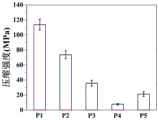
The slurry is injected into a cavity for molding and then taken out, the molded cement is placed in an environment with the temperature of 37 ℃ and the relative humidity of 100% for hydration for 7 days, and then the hydrated cement is taken out to obtain the high-strength multiphase calcium phosphate-based bone cement, which is marked as P1, and the compressive strength of the cement can reach 113.68 +/-7.11 MPa after 7 days.
Example 2
A preparation method of high-strength injectable multiphase calcium phosphate-based bone cement comprises the following steps:
1) premixing alpha-tricalcium phosphate powder, semi-hydrated calcium sulfate powder and bioactive glass powder serving as raw materials; in the raw materials, the mass fractions of the alpha-tricalcium phosphate, the calcium sulfate hemihydrate and the bioactive glass are 76wt%, 19wt% and 5wt%, respectively;
2) putting the premixed raw materials, agate medium balls and absolute ethyl alcohol into a ball mill for ball milling; the raw materials are fully and uniformly mixed, and the particle size of the raw materials is uniform through ball milling; during ball milling, the raw materials, the agate medium balls and the absolute ethyl alcohol are ball milled for 8-12 hours at the rotating speed of 400-900 r/min according to the mass ratio of 1:30: 12.
3) Taking out the wet material which is ball-milled and contains absolute ethyl alcohol, and placing the wet material in a drying oven at the temperature of 60-100 ℃ for drying for 5-10 hours to obtain bone cement powder;
4) uniformly mixing bone cement powder and polyglutamic acid powder to obtain multiphase calcium phosphate-based bone cement powder, and putting the multiphase calcium phosphate-based bone cement powder into a curing liquid, wherein the curing liquid is meglumine solution with the mass fraction of 6 wt%; the molecular weight of the polyglutamic acid is 150-200KDa, and the mass content of the polyglutamic acid powder in the multiphase calcium phosphate-based bone cement powder is 15 wt%; the multiphase calcium phosphate-based bone cement and the curing liquid are mixed uniformly in a solid-liquid ratio of 1g to 0.60ml to obtain slurry, namely the injectable multiphase calcium phosphate-based bone cement material.
After the slurry is injected into a cavity for molding, the slurry is placed in an environment with the temperature of 37 ℃ and the relative humidity of 100% for hydration for 7 days, and then the slurry is taken out to obtain the high-strength multiphase calcium phosphate-based bone cement, which is marked as P2, and the compressive strength of the cement can reach 73.67 +/-5.35 MPa after 7 days.
Example 3
A preparation method of high-strength injectable multiphase calcium phosphate-based bone cement comprises the following steps:
1) premixing alpha-tricalcium phosphate powder, semi-hydrated calcium sulfate powder and bioactive glass powder serving as raw materials; in the raw materials, the mass fractions of the alpha-tricalcium phosphate, the calcium sulfate hemihydrate and the bioactive glass are 76wt%, 19wt% and 5wt%, respectively;
2) putting the mixed raw materials, agate medium balls and absolute ethyl alcohol into a ball mill for ball milling; the raw materials are fully and uniformly mixed, and the particle size of the raw materials is uniform through ball milling; during ball milling, the raw materials, the agate medium balls and the absolute ethyl alcohol are ball milled for 8-12 hours at the rotating speed of 400-600 revolutions per minute in the mass ratio of 1:30: 12.
3) Taking out the wet material which is ball-milled and contains absolute ethyl alcohol, and placing the wet material in a drying oven at the temperature of 60-100 ℃ for drying for 5-10 hours to obtain bone cement powder;
4) uniformly mixing bone cement powder and polyglutamic acid powder to obtain the multiphase calcium phosphate-based bone cement powder, and putting the multiphase calcium phosphate-based bone cement powder into a curing liquid, wherein the curing liquid is meglumine solution with the mass fraction of 6 wt%; the molecular weight of the polyglutamic acid is 150-200KDa, and the mass content of the polyglutamic acid powder in the multiphase calcium phosphate-based bone cement powder is 10 wt%; the multiphase calcium phosphate-based bone cement and the curing liquid are mixed uniformly in a solid-liquid ratio of 1g to 0.60ml to obtain slurry, namely the injectable multiphase calcium phosphate-based bone cement material.
After the slurry is injected into a cavity for molding, the slurry is placed in an environment with the temperature of 37 ℃ and the relative humidity of 100% for hydration for 7 days, and then the slurry is taken out to obtain the high-strength multiphase calcium phosphate-based bone cement, which is marked as P3, and the compression strength of the cement can reach 35.62 +/-3.92 MPa after 7 days.
Comparative example 1
The preparation method of the stent of the comparative example comprises the following specific steps:
(1) placing alpha-tricalcium phosphate and calcium sulfate hemihydrate into a planetary ball mill for ball milling according to the mass ratio of 1: 0.20-0.40. And after the ball milling is finished, drying the wet material subjected to the ball milling to obtain the required bone cement powder.
(2) Adding 1.2g of meglumine into 18.8ml of deionized water to prepare a meglumine curing liquid with the mass fraction of 6%; and uniformly mixing the bone cement powder and the curing liquid according to the solid-liquid ratio of 1g to 0.45ml to obtain bone cement paste.
(3) And (3) after the bone cement paste is formed, placing the bone cement paste in an oven with the temperature of 37 ℃ and the relative humidity of 100% for hydration for 7 days, and taking out the bone cement paste to obtain the bone cement bracket, wherein the bone cement bracket is marked as P4, and the compressive strength of the bone cement bracket can reach 7.67 +/-1 MPa after 7 days.
Comparative example 2
The preparation method of the stent of the comparative example comprises the following specific steps:
(1) placing beta-tricalcium phosphate and bioactive glass into a planetary ball mill for ball milling according to the mass ratio of 1: 0.10-0.40. And after the ball milling is finished, drying the wet material subjected to the ball milling to obtain the required bone cement powder.
(2) Adding 2.0g of polyglutamic acid into 18.0 ml of deionized water to prepare polyglutamic acid curing liquid with the mass fraction of 10 wt%; and uniformly mixing the bone cement powder and the curing liquid according to the solid-liquid ratio of 1g to 0.60ml to obtain bone cement paste.
(3) And (3) after the bone cement paste is formed, placing the bone cement paste in an oven with the temperature of 37 ℃ and the relative humidity of 100% for hydration for 7 days, and taking out the bone cement paste to obtain the bone cement bracket, wherein the bone cement bracket is marked as P5, and the compressive strength of the bone cement bracket can reach 21.15 +/-3.14 MPa after 7 days.
The bone repair scaffolds prepared in examples 1-3 and comparative examples 1-2 were subjected to the following performance tests.
Compressive strength
Fig. 1 is a graph showing the compressive strength of the bone cement scaffolds P1, P2, P3, P4 and P5 prepared in example 1, example 2, example 3, comparative example 1 and comparative example 2. The height of the bracket is 9.0 plus or minus 1.0mm, the diameter is 4.5 plus or minus 0.5mm, and the loading rate is 1.0 mm/min.
Resistance to collapsibility
Fig. 2, 3, 4, 5 and 6 are physical diagrams of the bone cement slurries prepared in example 1, 2, 3, comparative example 1 and 2, respectively, after being directly injected into PBS for 6 hours. The cement bars in fig. 2, 3, 4 and 6 remained intact in PBS without collapse; the cement strip in fig. 5 is fully collapsed.
The present invention is not limited to the above-mentioned embodiments, and based on the technical solutions disclosed in the present invention, those skilled in the art can make some substitutions and modifications to some technical features without creative efforts according to the disclosed technical contents, and these substitutions and modifications are all within the protection scope of the present invention. The method is within the protection scope of the invention as long as the following steps and value ranges are included, and the method comprises the following steps:
1) mixing alpha-tricalcium phosphate powder, semi-hydrated calcium sulfate powder and bioactive glass powder as raw materials; wherein the calcium sulfate hemihydrate is obtained by heating calcium sulfate dihydrate at the temperature of 100-150 ℃ for 12-24 hours; in the raw materials, the mass fractions of the alpha-tricalcium phosphate, the calcium sulfate hemihydrate and the bioactive glass are 76wt%, 19wt% and 5wt%, respectively.
2) Putting the mixed raw materials, agate medium balls and absolute ethyl alcohol into a ball mill for ball milling; the raw materials are fully and uniformly mixed, and the particle size of the raw materials is uniform through ball milling; during ball milling, the raw materials, the agate medium balls and the absolute ethyl alcohol are ball milled for 8 to 12 hours at the rotating speed of 400-900 revolutions per minute according to the mass ratio of 1 (28 to 32) to (10 to 14).
3) Taking out the wet material which is ball-milled and contains absolute ethyl alcohol, and placing the wet material in a drying oven at 60-100 ℃ for drying for 5-10 hours to obtain bone cement powder.
4) Uniformly mixing bone cement powder and polyglutamic acid powder to obtain multiphase calcium phosphate-based bone cement powder, and adding the multiphase calcium phosphate-based bone cement powder into a curing liquid, wherein the curing liquid is meglumine solution with the mass fraction of 3-10 wt%; the molecular weight of the polyglutamic acid is 150-200KDa, and the mass content of the polyglutamic acid powder in the multiphase calcium phosphate-based bone cement powder is 5-40 wt%; and (3) uniformly mixing the multiphase calcium phosphate-based bone cement powder and the curing liquid in a liquid-solid ratio of (0.30-0.60) ml/g, injecting the obtained slurry into a cavity for molding, placing the molded slurry in an environment with the temperature of 37 +/-0.5 ℃ and the relative humidity of 100% for hydrating for 6-8 days, and taking out the hydrated slurry to obtain the high-strength multiphase calcium phosphate bone cement.