CN110489218B - Vehicle-mounted fog computing system task unloading method based on semi-Markov decision process - Google Patents
Vehicle-mounted fog computing system task unloading method based on semi-Markov decision process Download PDFInfo
- Publication number
- CN110489218B CN110489218B CN201910681783.7A CN201910681783A CN110489218B CN 110489218 B CN110489218 B CN 110489218B CN 201910681783 A CN201910681783 A CN 201910681783A CN 110489218 B CN110489218 B CN 110489218B
- Authority
- CN
- China
- Prior art keywords
- expressed
- task
- vehicle
- computing
- expression
- Prior art date
- Legal status (The legal status is an assumption and is not a legal conclusion. Google has not performed a legal analysis and makes no representation as to the accuracy of the status listed.)
- Active
Links
Images


Classifications
-
- G—PHYSICS
- G06—COMPUTING OR CALCULATING; COUNTING
- G06F—ELECTRIC DIGITAL DATA PROCESSING
- G06F9/00—Arrangements for program control, e.g. control units
- G06F9/06—Arrangements for program control, e.g. control units using stored programs, i.e. using an internal store of processing equipment to receive or retain programs
- G06F9/46—Multiprogramming arrangements
- G06F9/48—Program initiating; Program switching, e.g. by interrupt
- G06F9/4806—Task transfer initiation or dispatching
- G06F9/4843—Task transfer initiation or dispatching by program, e.g. task dispatcher, supervisor, operating system
- G06F9/485—Task life-cycle, e.g. stopping, restarting, resuming execution
- G06F9/4856—Task life-cycle, e.g. stopping, restarting, resuming execution resumption being on a different machine, e.g. task migration, virtual machine migration
-
- H—ELECTRICITY
- H04—ELECTRIC COMMUNICATION TECHNIQUE
- H04W—WIRELESS COMMUNICATION NETWORKS
- H04W24/00—Supervisory, monitoring or testing arrangements
- H04W24/06—Testing, supervising or monitoring using simulated traffic
Landscapes
- Engineering & Computer Science (AREA)
- Software Systems (AREA)
- Theoretical Computer Science (AREA)
- Computer Networks & Wireless Communication (AREA)
- Signal Processing (AREA)
- Physics & Mathematics (AREA)
- General Engineering & Computer Science (AREA)
- General Physics & Mathematics (AREA)
- Management, Administration, Business Operations System, And Electronic Commerce (AREA)
- Traffic Control Systems (AREA)
Abstract
Description
技术领域Technical Field
本发明涉及车用无线通信技术领域,具体为基于半马尔可夫决策过程的车载雾计算系统任务卸载方法。The present invention relates to the technical field of vehicle wireless communication, and in particular to a task unloading method of a vehicle-mounted fog computing system based on a semi-Markov decision process.
背景技术Background Art
自动驾驶、视频流、车载游戏等新兴车载应用的发展,使车辆控制过程中产生了大量计算复杂度高、时延敏感的任务。车载雾计算利用现代车辆丰富的计算资源和可靠的无线连接,成为了一种有效的解决方案。车载雾计算的核心是招募周围有空闲资源的车辆作为雾服务器。将任务从云/边缘服务器卸载到临近且密集分布的雾服务器,能够保障快速地在本地网络中处理计算任务,满足无人驾驶等任务的实时性的需求。The development of emerging in-vehicle applications such as autonomous driving, video streaming, and in-vehicle gaming has resulted in a large number of computationally complex and latency-sensitive tasks in the vehicle control process. In-vehicle fog computing has become an effective solution by leveraging the abundant computing resources and reliable wireless connections of modern vehicles. The core of in-vehicle fog computing is to recruit vehicles with idle resources around as fog servers. Offloading tasks from cloud/edge servers to nearby and densely distributed fog servers can ensure that computing tasks can be processed quickly in the local network, meeting the real-time requirements of tasks such as autonomous driving.
任务卸载是车载雾计算的核心技术,它通过车辆间合作共同处理计算任务,充分利用网络内车辆的计算资源以满足其中成员车辆的计算需求。针对于车载网络中的任务卸载,一个重要的衡量参数就是时延,车辆必须在一个安全时延允许的范围内进行数据传输并得到计算结果。现有技术中,计算求解最优卸载策略时,对于延时的考虑相对只侧重某一种时延、或者某一个过程中的时延,导致的结果是得出的卸载策略不够贴合实际情况,进而无法使系统获得更合理的收益。Task offloading is the core technology of vehicle-mounted fog computing. It processes computing tasks through cooperation between vehicles and makes full use of the computing resources of vehicles in the network to meet the computing needs of member vehicles. For task offloading in vehicle networks, an important measurement parameter is latency. Vehicles must transmit data and obtain calculation results within a safe latency range. In the prior art, when calculating and solving the optimal offloading strategy, the consideration of latency only focuses on a certain latency or the latency in a certain process. As a result, the resulting offloading strategy is not in line with the actual situation, and thus the system cannot obtain more reasonable benefits.
发明内容Summary of the invention
为了解决现有技术中对时延考虑种类不全面,导致卸载策略不够贴合实际的问题,本发明提供基于半马尔可夫决策过程的车载雾计算系统任务卸载方法,其可以根据任务卸载过程的实际情况全面的考虑各种时延,得到更符合实际情况的卸载策略,进而使系统获得更多的长期收益。In order to solve the problem that the types of delays are not comprehensively considered in the prior art, resulting in unrealistic unloading strategies, the present invention provides a task unloading method for a vehicle-mounted fog computing system based on a semi-Markov decision process, which can comprehensively consider various delays according to the actual situation of the task unloading process, obtain an unloading strategy that is more in line with the actual situation, and thus enable the system to obtain more long-term benefits.
本发明的技术方案是这样的:基于半马尔可夫决策过程的车载雾计算系统任务卸载方法,其包括以下步骤:The technical solution of the present invention is as follows: a method for unloading tasks of a vehicle-mounted fog computing system based on a semi-Markov decision process, which comprises the following steps:
S1:基于半马尔可夫决策模型定义系统的状态集合S,系统的状态集合表示如下:S1: Based on the semi-Markov decision model, the state set S of the system is defined. The state set of the system is expressed as follows:
S={s|s=(M,n1,…,nN,e)}S={s|s=(M,n 1 ,…,n N ,e)}
其中,M表示当前系统中计算单元的总数目,ni表示正在被i个计算单元处理的任务数量,e表示一种特定的事件;Where M represents the total number of computing units in the current system, ni represents the number of tasks being processed by i computing units, and e represents a specific event;
S2:定义系统的动作集合Ac:S2: Define the action set A c of the system:

其中:在动作集合Ac中,-1表示没有采取任何动作,0表示当系统中计算资源缺乏时,系统拒绝卸载并丢掉该任务的决策,{A,D1,…,Di,…,DN,F+1,F-1}表示事件集合,N表示任务最多可以被N个计算单元处理,Di表示被i个计算单元处理的任务离开系统,F+1和F-1分别表示车辆到达和离开系统,A表示有一个任务到达系统;Where: in the action set A c , -1 means no action is taken, 0 means that when the computing resources in the system are insufficient, the system refuses to offload and discards the decision of the task, {A, D 1 ,…, D i ,…, D N , F +1 , F -1 } represents the event set, N means that the task can be processed by at most N computing units, D i means that the task processed by i computing units leaves the system, F +1 and F -1 respectively represent the arrival and departure of vehicles in the system, and A means that a task arrives in the system;
S3:定义系统的奖励模型;S3: Define the reward model of the system;
S4:定义系统的转移概率;S4: Define the transition probability of the system;
S5:求解车载雾计算系统中的最优卸载策略;S5: Solve the optimal offloading strategy in the vehicle-mounted fog computing system;
其特征在于:Features:
步骤S3中,在状态s采取动作a的系统奖励可以表示为立即收益和开销的差值,表示如下:In step S3, the system reward for taking action a in state s can be expressed as the difference between the immediate benefit and the cost, as follows:
R(s,a)=I(s,a)-C(s,a)R(s,a)=I(s,a)-C(s,a)
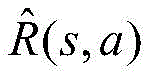
其中,I(s,a)表示采取一个确定的动作后系统所获得的立即收益,C(s,a)表示采取动作后系统到达下一个状态的折扣后的系统期望开销;Among them, I(s,a) represents the immediate benefit obtained by the system after taking a certain action, and C(s,a) represents the discounted expected cost of the system to reach the next state after taking the action;
在状态s下采取动作a的所述立即收益的表达如下The immediate benefit of taking action a in state s is expressed as follows
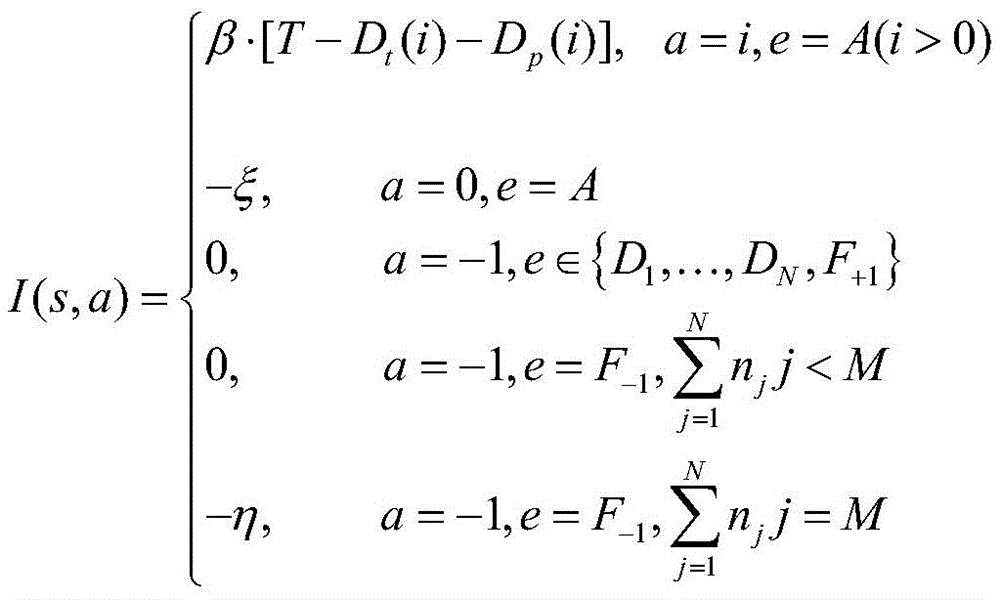
其中:in:
e表示一种特定的事件,Di表示被i个计算单元处理的任务离开系统,ξ、η表示系统被惩罚,β是节省时延的单位价格;e represents a specific event, D i represents the task processed by the i-th computing unit leaving the system, ξ, η represent the system being punished, and β is the unit price of saving latency;
T是本地处理任务需要的时延;T is the latency required for local processing of tasks;
Dt(i)表示请求车辆发送给i个计算单元的传输时延;D t (i) represents the transmission delay from the requesting vehicle to the i-th computing unit;
Dp(i)表示系统将任务卸载给i个计算单元处理需要的时延。D p (i) represents the delay required for the system to offload the task to i computing units for processing.
其进一步特征在于:It is further characterized by:
步骤3中,所述请求车辆发送给i个计算单元的传输时延Dt(i)的表达式为:In
Dt(i)=i·E[Di];D t (i) = i·E[D i ];
E[Di]表示在每个退避时隙中发送子任务给一个计算单元的平均时延,其表达式为:E[D i ] represents the average delay of sending a subtask to a computing unit in each backoff slot, and its expression is:
E[Di]=E[N]·Tslot(i);E[D i ]=E[N]·T slot (i);
E[N]表示成功传输子任务所需的平均时隙个数;E[N] represents the average number of time slots required for successful transmission of a subtask;
Tslot表示发送子任务给i个计算单元其中一个的平均时隙长度;T slot represents the average time slot length for sending a subtask to one of the i computing units;
所述平均时隙长度Tslot(i)的表达式为:The expression of the average time slot length T slot (i) is:
Tslot(i)=Pidle·slottime+Pc·Tc(i)+Ps·Ts(i)其中:T slot (i)=P idle ·slottime+P c ·T c (i)+P s ·T s (i)where:
Pidle表示时隙空闲的概率,其表达式为:P idle represents the probability of a time slot being idle, and its expression is:
Pidle=(1-τ)M;P idle =(1-τ) M ;
Ps表示发送成功的概率,其表示式为: Ps represents the probability of successful transmission, which is expressed as:
Ps=Mτ(1-τ)M-1; Ps = Mτ(1-τ) M-1 ;
Pc表示遭遇碰撞的概率,其表达式为: Pc represents the probability of encountering a collision, and its expression is:
Pc=1-Pidle-Ps;P c =1-P idle -P s ;
Tc(i)表示第i个子任务遭遇碰撞的时长;T c (i) represents the duration of the collision encountered by the i-th subtask;
Ts(i)表示第i个子任务发送成功的时长;T s (i) represents the duration of successful sending of the i-th subtask;
slottime表示时隙的长度;slottime indicates the length of the time slot;
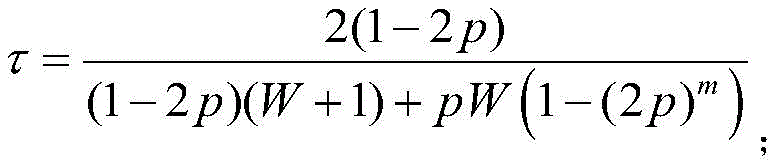
τ表示传输概率,其表达式为:τ represents the transmission probability, which is expressed as:
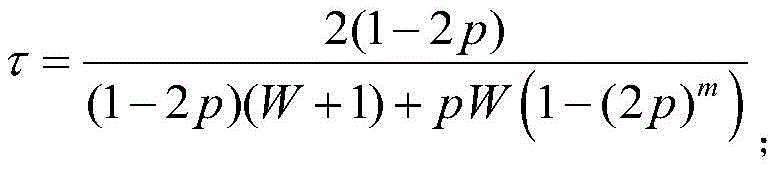
p表示碰撞概率,其表达式为:p represents the collision probability, which is expressed as:
p=1-(1-τ)M-1;p=1-(1-τ) M-1 ;
所述平均时隙个数E[N]表达式为:The average number of time slots E[N] is expressed as:
E[N]=E[N1]+E[N2];E[N] = E[N 1 ] + E[N 2 ];
其中:in:


m表示数据包重传次数,m represents the number of packet retransmissions.
W表示最小竞争窗口;W represents the minimum contention window;
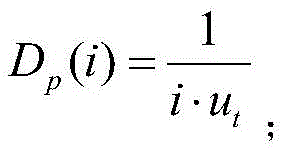
步骤S3中,所述系统将任务卸载给i个计算单元处理需要的时延Dp(i)的表达式为:In step S3, the system offloads the task to i computing units for processing. The delay D p (i) required is expressed as:
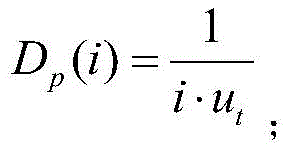
ut表示一个计算单元的服务速率;u t represents the service rate of a computing unit;
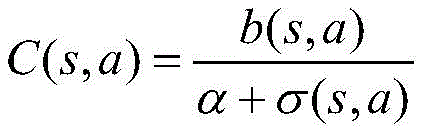
步骤S3中,所述折扣后的系统期望开销C(s,a)表示为:In step S3, the discounted system expected cost C(s,a) is expressed as:

其中:in:
b(s,a)表示消耗速率,其表达式为:b(s,a) represents the consumption rate, which is expressed as:
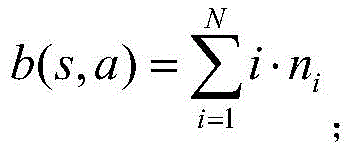
σ(s,a)表示期望的服务速率;σ(s,a) represents the expected service rate;
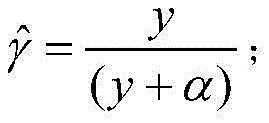
α为折扣因子;α is the discount factor;
所述期望的服务速率σ(s,a)为系统中当前状态可能发生的所有时间的速率的和,表达式为:The expected service rate σ(s,a) is the sum of the rates of all possible times of the current state in the system, expressed as:

其中:in:
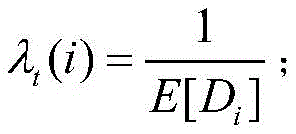
λt(i)表示在动作i下的任务到达率,其表达式为:λ t (i) represents the task arrival rate under action i, and its expression is:

μt表示任务服务速率;μ t represents the task service rate;
λf、μf分别表示车辆的到达率、离开率;λ f and μ f represent the arrival rate and departure rate of vehicles respectively;

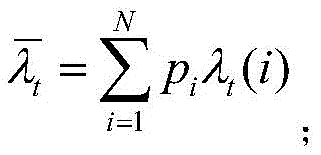
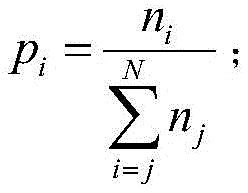
pi表示为任务被i个计算单元处理的概率,其表达式为: Pi represents the probability that a task is processed by i computing units, and its expression is:

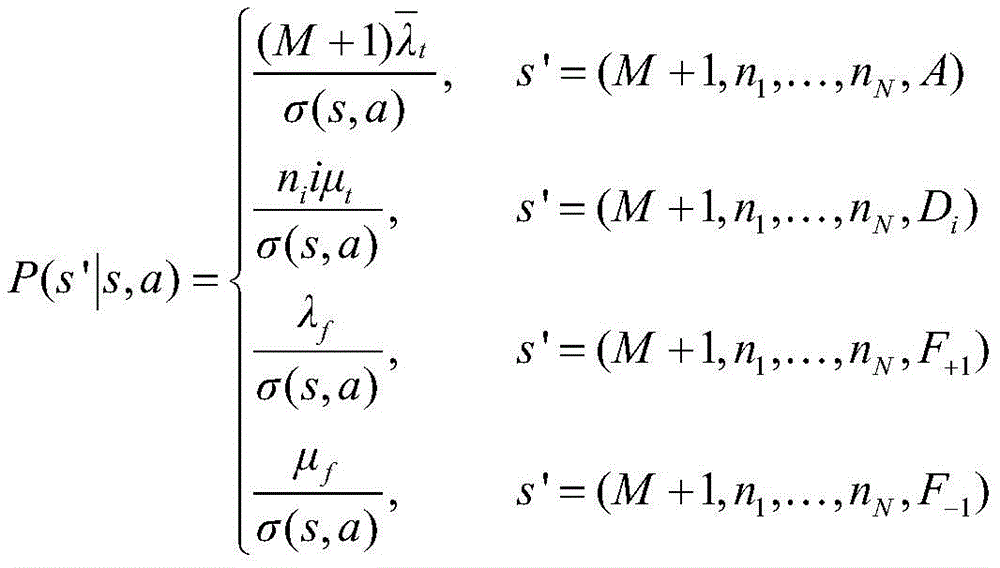
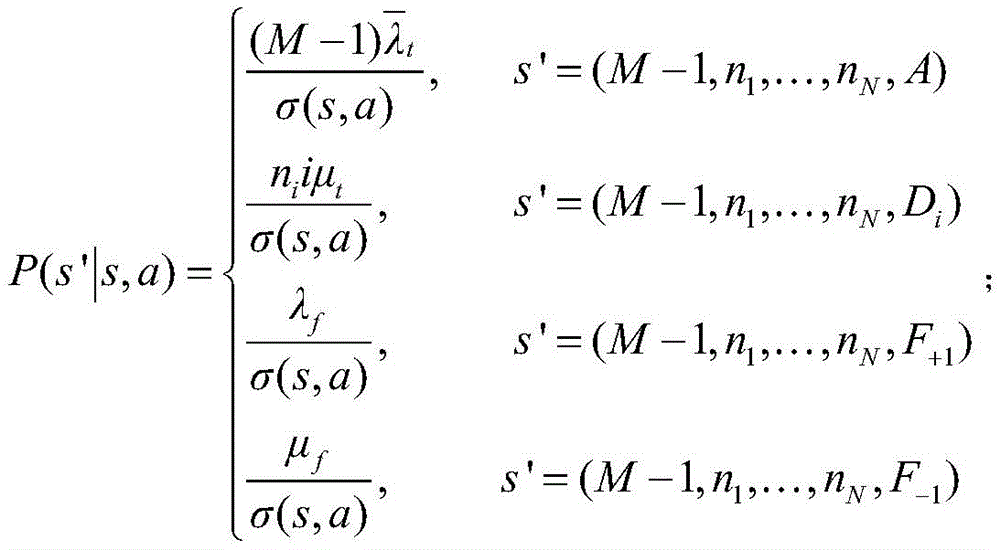
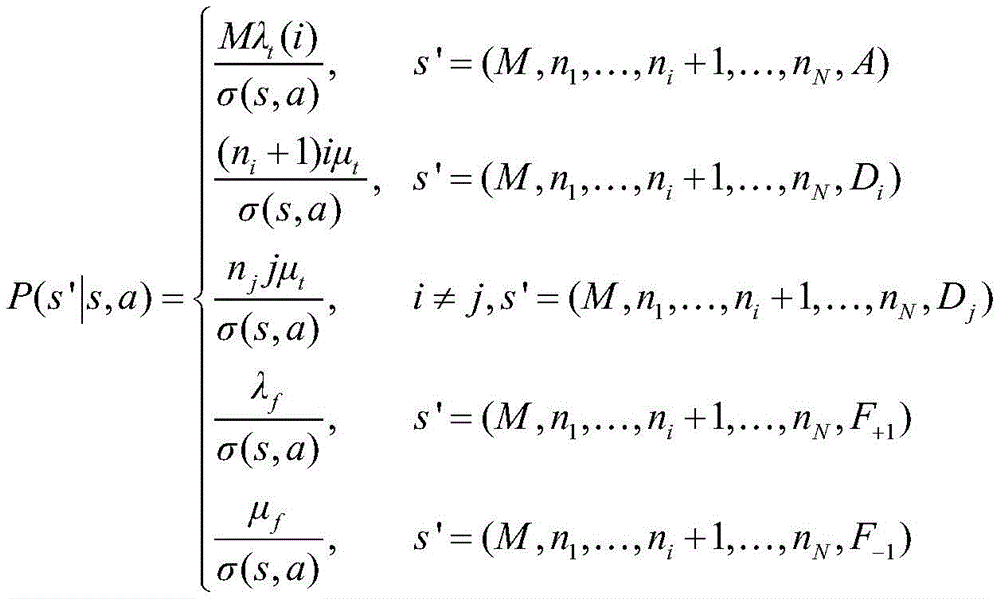
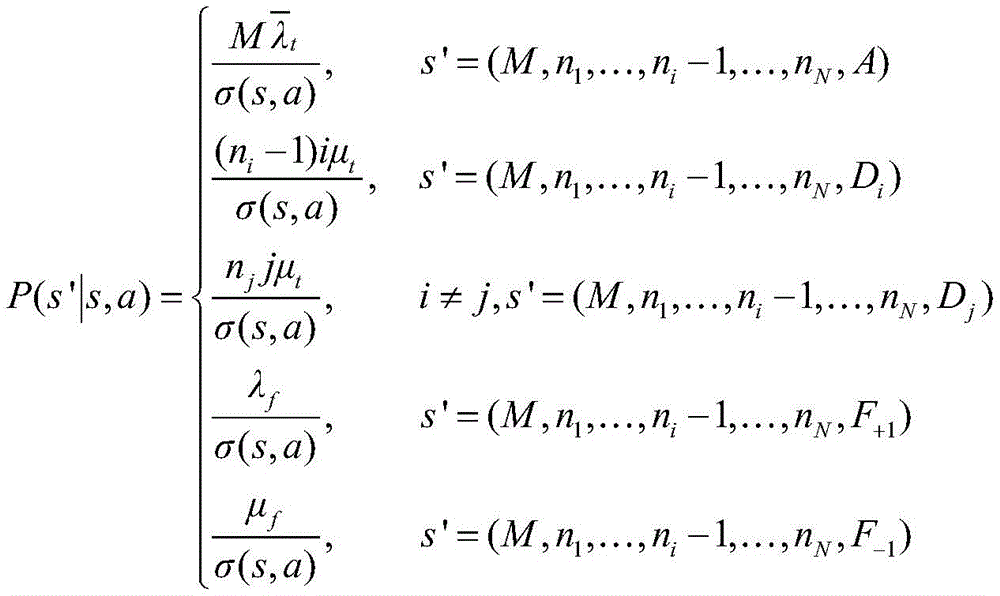
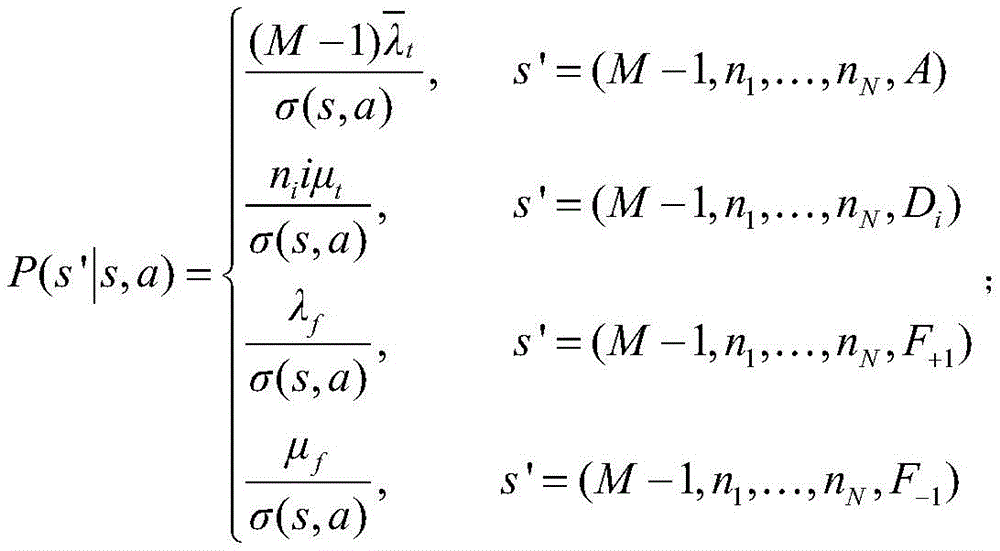
步骤S4中,所述转移概率为P(s′|s,a),其中s为当前状态,s′为下一个状态,其具体表达式为:In step S4, the transition probability is P(s′|s,a), where s is the current state and s′ is the next state. The specific expression is:
(1)s=(M,n1,...,nN,A),a=i,即请求达到并卸载给i个计算单元处理时:(1)s=(M,n 1 ,...,n N ,A),a=i, that is, when the request arrives and is offloaded to i computing units for processing:

(2)s=(M,n1,...,nN,Di),a=-1,即分配给i辆车的请求离开时:(2)s=(M,n 1 ,...,n N ,D i ),a=-1, that is, when the request assigned to vehicle i leaves:
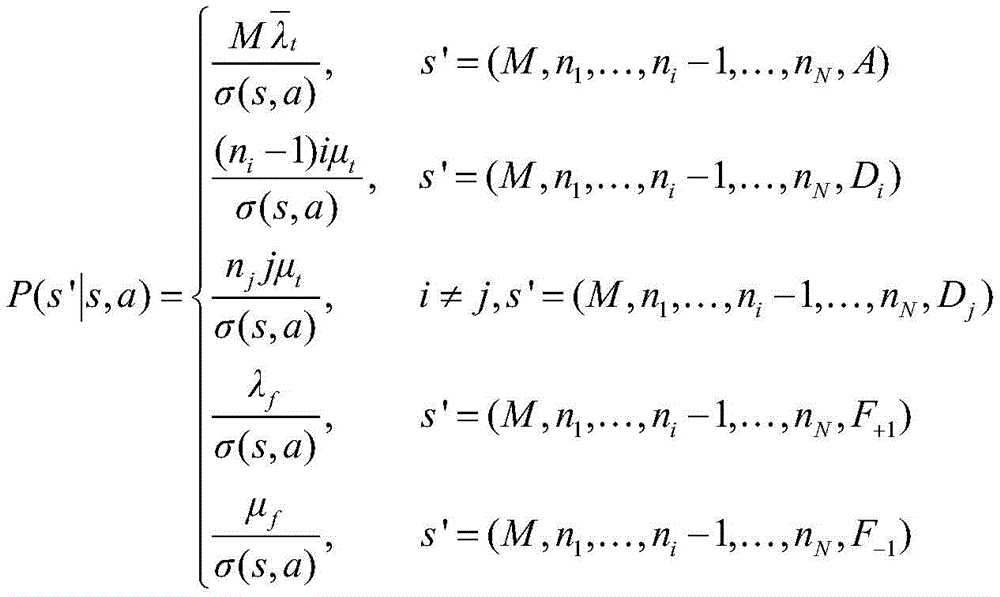
(3)s=(M,n1,...,nN,F+1),a=-1,即车辆到达时,(3)s=(M,n 1 ,...,n N ,F +1 ),a=-1, that is, when the vehicle arrives,
(4)s=(M,n1,...,nN,F-1),a=-1,即车辆离开时:(4)s=(M,n 1 ,...,n N ,F -1 ),a=-1, that is, when the vehicle leaves:
步骤S5中,所述最优卸载策略的计算方法为,通过在值迭代算法,根据贝尔曼最优方程计算状态s在动作a下的最大值函数,第k+1次迭代的值函数计算如下:In step S5, the optimal unloading strategy is calculated by calculating the maximum value function of state s under action a according to the Bellman optimal equation in the value iteration algorithm. The value function of the k+1th iteration is calculated as follows:

其中:in:

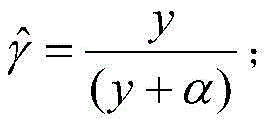

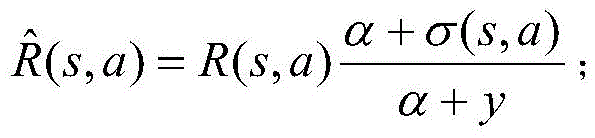
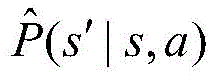
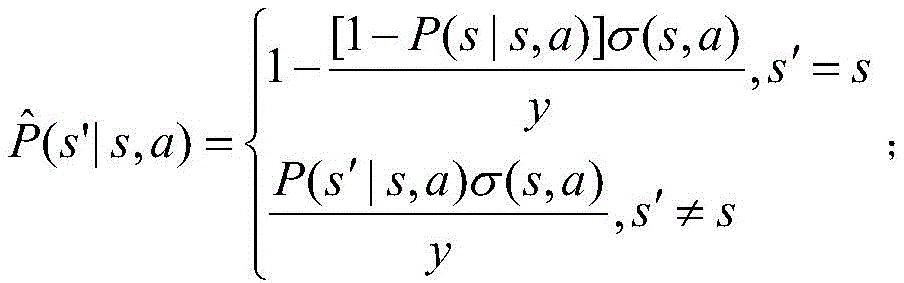
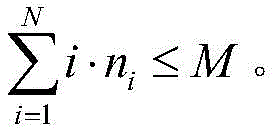
步骤S1中,M和ni满足下面的条件:In step S1, M and ni satisfy the following conditions:
本发明提供的基于半马尔可夫决策过程的车载雾计算系统任务卸载方法,全面的考虑了车辆和任务变化特征以及卸载过程的传输时延和发送时延,建立基于半马尔可夫决策过程的任务卸载模型,然后分别定义状态、动作、奖励和转移概率,最后根据值函数迭代算法获得最优卸载方案;因为在动作集合中,考虑了所有可能发生的决策,即:系统根据事件的不同,分配不同的计算单元;在定义系统的奖励模型的时候,综合考虑了不同的状态:任务达到和离开系统、车辆到达和离开系统,以及了本地处理任务需要的时延、请求车辆发送给计算单元的传输时延、系统将任务卸载给计算单元处理需要的时延;在做出决策的时候,同时考虑动作、状态、系统资源状况,以及任务卸载过程中涉及到的各种时延,所以,本技术方案中对于任务卸载过程的描述更加完整,进而后续计算获得的卸载策略更加贴近现实状况,更具合理性。且本发明的技术方案,计算复杂度适中,系统模型简单合理。仿真结果表明,该方案在保证任务卸载时延的前提下,能获得更多的系统长期收益。The vehicle-mounted fog computing system task unloading method based on the semi-Markov decision process provided by the present invention comprehensively considers the vehicle and task change characteristics and the transmission delay and sending delay of the unloading process, establishes a task unloading model based on the semi-Markov decision process, and then defines the state, action, reward and transfer probability respectively, and finally obtains the optimal unloading scheme according to the value function iteration algorithm; because in the action set, all possible decisions are considered, that is: the system allocates different computing units according to different events; when defining the reward model of the system, different states are comprehensively considered: the task arrives and leaves the system, the vehicle arrives and leaves the system, and the delay required for local processing of the task, the transmission delay of the request vehicle to the computing unit, and the delay required for the system to unload the task to the computing unit for processing; when making a decision, the action, state, system resource status, and various delays involved in the task unloading process are considered at the same time, so the description of the task unloading process in the technical scheme is more complete, and then the unloading strategy obtained by subsequent calculation is closer to the actual situation and more reasonable. And the technical scheme of the present invention has moderate computational complexity and a simple and reasonable system model. Simulation results show that this scheme can obtain more long-term system benefits while ensuring the task offloading delay.
附图说明BRIEF DESCRIPTION OF THE DRAWINGS
图1为本发明的系统组成结构示意图;FIG1 is a schematic diagram of the system composition structure of the present invention;
图2为本发明状态转移示例图;FIG2 is a diagram showing an example of state transition of the present invention;
图3为μt取值为25时,本发明中卸载方案和基于贪婪算法的卸载方案的长期受益对比示例图;FIG3 is a comparative example diagram of the long-term benefits of the unloading solution of the present invention and the unloading solution based on the greedy algorithm when the value of μ t is 25;
图4为μt取值为50时,本发明中卸载方案和基于贪婪算法的卸载方案的长期受益对比示例图。FIG4 is a diagram showing a comparison of the long-term benefits of the unloading solution in the present invention and the unloading solution based on the greedy algorithm when the value of μ t is 50.
具体实施方式DETAILED DESCRIPTION
本发明针对单向行驶的高速公路场景,其中车辆的到达和离开遵循泊松过程。一旦车辆加入到车载雾网络中,它的计算资源就被虚拟化添加到计算资源池中,以供车载雾系统调度分配。如图1所示,此时V1刚好有任务到达,并将卸载请求提交到车载雾系统,系统根据当前状态作出卸载决策,即分配V、V3和V4来协助处理V1的任务。作出决策后,系统状态进行更新,V2、V3和V4变成忙碌的计算单元。The present invention is aimed at the scenario of one-way highway, in which the arrival and departure of vehicles follow the Poisson process. Once a vehicle joins the vehicle-mounted fog network, its computing resources are virtualized and added to the computing resource pool for scheduling and allocation by the vehicle-mounted fog system. As shown in Figure 1, at this time, V1 just has a task arriving and submits an unloading request to the vehicle-mounted fog system. The system makes an unloading decision based on the current state, that is, assigns V, V3 and V4 to assist in processing V1's task. After making the decision, the system state is updated, and V2, V3 and V4 become busy computing units.
本发明基于半马尔可夫决策过程的车载雾计算系统任务卸载方法,其包括以下步骤。The present invention discloses a method for unloading tasks of a vehicle-mounted fog computing system based on a semi-Markov decision process, which comprises the following steps.
S1:基于半马尔可夫决策模型定义系统的状态集合S,系统的状态集合表示如下:S1: Based on the semi-Markov decision model, the state set S of the system is defined. The state set of the system is expressed as follows:
S={s|s=(M,n1,…,nN,e)}S={s|s=(M,n 1 ,…,n N ,e)}
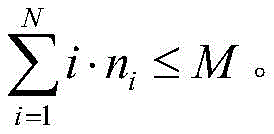
其中,M表示当前系统中计算单元的总数目,ni表示正在被i个计算单元处理的任务数量,e表示一种特定的事件;并且,系统中忙碌的计算单元不能超过总的计算单元数目,即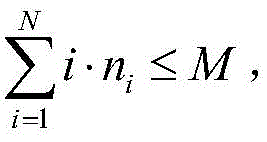
S2:基于半马尔可夫决策过程,定义系统的动作集合Ac,动作集合里面记录所有可能发生的决策,即系统在不同的事件下分配多少个计算单元。动作从集合{-1,0,1,2,...,N}中选取。由于动作和状态两者相互关联,在状态s下采取动作a记录为a(s)。这里a(s)=-1表示没有采取任何动作。a(s)=0表示当系统中计算资源缺乏时,系统拒绝卸载并丢掉该任务的决策。a(s)=i表示系统分配i个计算单元来处理任务。当系统中任务离开,车辆到达或离开时,不需要采取任何动作;当有任务到达,系统可能选择卸载给i个计算单元处理或者丢弃掉任务。事件和动作之间的关系表示如下:S2: Based on the semi-Markov decision process, define the system's action set A c , which records all possible decisions, that is, how many computing units the system allocates under different events. Actions are selected from the set {-1, 0, 1, 2, ..., N}. Since the action and state are interrelated, the action a taken in state s is recorded as a(s). Here a(s) = -1 means that no action is taken. a(s) = 0 means that when the computing resources in the system are insufficient, the system refuses to unload and discard the decision of the task. a(s) = i means that the system allocates i computing units to process the task. When a task leaves the system and a vehicle arrives or leaves, no action is required; when a task arrives, the system may choose to unload to i computing units for processing or discard the task. The relationship between events and actions is expressed as follows:

其中:在动作集合Ac中,-1表示没有采取任何动作,0表示当系统中计算资源缺乏时,系统拒绝卸载并丢掉该任务的决策,{A,D1,…,Di,…,DN,F+1,F-1}表示事件集合,N表示任务最多可以被N个计算单元处理,Di表示被i个计算单元处理的任务离开系统,F+1和F-1分别表示车辆到达和离开系统,A表示有一个任务到达系统。Among them: in the action set A c , -1 means no action is taken, 0 means that when the computing resources in the system are insufficient, the system refuses to offload and drops the decision of the task, {A, D 1 ,…, D i ,…, D N , F +1 , F -1 } represents the event set, N means that the task can be processed by at most N computing units, D i means that the task processed by i computing units leaves the system, F +1 and F -1 mean that the vehicle arrives and leaves the system respectively, and A means that a task arrives in the system.
S3:定义系统的奖励模型;本发明综合考虑传输时延、处理时延、当前可用的计算资源以及车辆和任务的变化特征来衡量车载雾计算系统中任务卸载的奖励。当采取一个确定的动作,系统会获得一个立即收益I(s,a),当采取动作后,系统需要经历一段时间到达下个状态,在这小段时间内系统的开销为R(s,a)。在状态s采取动作a的系统奖励可以表示为立即收益和开销的差值,表示如下:S3: Define the reward model of the system; the present invention comprehensively considers the transmission delay, processing delay, currently available computing resources, and the changing characteristics of vehicles and tasks to measure the reward for task offloading in the vehicle-mounted fog computing system. When a certain action is taken, the system will obtain an immediate benefit I(s,a). After the action is taken, the system needs to go through a period of time to reach the next state. During this short period of time, the system overhead is R(s,a). The system reward for taking action a in state s can be expressed as the difference between the immediate benefit and the overhead, as follows:
R(s,a)=I(s,a)-C(s,a)R(s,a)=I(s,a)-C(s,a)
其中,I(s,a)表示采取一个确定的动作后系统所获得的立即收益,C(s,a)表示采取动作后系统到达下一个状态的折扣后的系统期望开销;Among them, I(s,a) represents the immediate benefit obtained by the system after taking a certain action, and C(s,a) represents the discounted expected cost of the system to reach the next state after taking the action;
立即收益的计算方式可划分为以下几种:The calculation methods of immediate benefits can be divided into the following categories:
1.当a=i,e=A时:1. When a=i, e=A:
当任务到达并且系统中计算资源充足时,系统将任务卸载给i个计算单元处理,这种情况下相对于本地处理,卸载给多个车辆处理更节省时延,从而给系统带来了收益。由于任务卸载的时延包括处理时延和传输时延,在这种情况下立即收益可表示为β·[T-Dt(i)-Dp(i)],其中β是节省时延的单位价格,T是本地处理任务需要的时延,Dt(i)是请求车辆发送任务给i个计算单元所需要的时延,Dp(i)是任务被i个计算单元处理需要的时延;When a task arrives and the system has sufficient computing resources, the system offloads the task to i computing units for processing. In this case, compared with local processing, offloading to multiple vehicles for processing saves more latency, thus bringing benefits to the system. Since the latency of task offloading includes processing latency and transmission latency, the immediate benefit in this case can be expressed as β·[TD t (i)-D p (i)], where β is the unit price of latency saving, T is the latency required for local processing of the task, D t (i) is the latency required for the requesting vehicle to send the task to i computing units, and D p (i) is the latency required for the task to be processed by i computing units;
2.当a=0,e=A时:2. When a=0, e=A:
当任务到达并且系统中计算资源匮乏时,系统丢弃了该任务,这种情况下,请求车辆没有获取到任务中的信息,不能帮助车辆做出相应的驾驶决策。所以这个动作对系统来说是不利的,那么系统就需要被惩罚ξ;When a task arrives and the system is short of computing resources, the system discards the task. In this case, the requesting vehicle does not obtain the information in the task and cannot help the vehicle make corresponding driving decisions. Therefore, this action is disadvantageous to the system, and the system needs to be punished.
3.当a=-1,e∈{D1,…,DN,F+1}时:3. When a=-1, e∈{D 1 ,…,D N ,F +1 }:
当任务离开或车辆到达时,系统不需要采取任何动作,所以没有获得任何收益;When a task leaves or a vehicle arrives, the system does not need to take any action, so no benefit is gained;
4.当a=-1,e=F-1,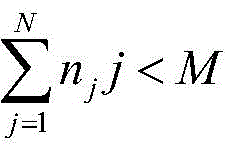
当车辆离开并且系统仍然剩余空闲的计算单元时,这种情况下,系统也没有任何收益;When the vehicle leaves and the system still has idle computing units left, in this case, the system also does not gain anything;
5.当a=-1,e=F-1,
当车辆离开并且系统中计算单元都全被占用时,即没有空闲的计算单元,此时任何一个车辆离开都会造成任务卸载中断,这对系统是不利的,因此要给予一个惩罚η。When the vehicle leaves and all computing units in the system are occupied, that is, there are no idle computing units, any vehicle leaving at this time will cause task unloading interruption, which is not good for the system, so a penalty η is given.
综上所述,在状态s下采取动作a的立即收益的表达如下To summarize, the immediate benefit of taking action a in state s is expressed as follows
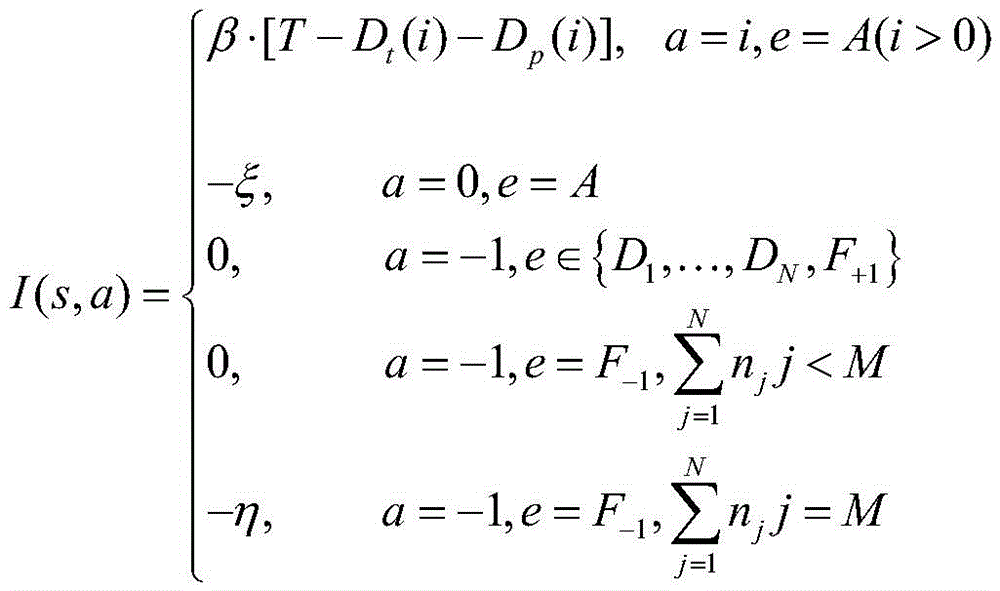
其中:in:
e表示一种特定的事件,Di表示被i个计算单元处理的任务离开系统,ξ、η表示系统被惩罚,β是节省时延的单位价格;e represents a specific event, D i represents the task processed by the i-th computing unit leaving the system, ξ, η represent the system being punished, and β is the unit price of saving latency;
T是本地处理任务需要的时延;T is the latency required for local processing of tasks;
Dp(i)表示系统将任务卸载给i个计算单元处理需要的时延,其表达式为:D p (i) represents the delay required for the system to offload tasks to i computing units for processing, and its expression is:

ut表示一个计算单元的服务速率;u t represents the service rate of a computing unit;
Dt(i)表示请求车辆发送给i个计算单元的传输时延,其表达式为: Dt (i) represents the transmission delay from the requesting vehicle to the i-th computing unit, and its expression is:
Dt(i)=i·E[Di];D t (i) = i·E[D i ];
E[Di]表示在每个退避时隙中发送子任务给一个计算单元的平均时延,其表达式为:E[D i ] represents the average delay of sending a subtask to a computing unit in each backoff slot, and its expression is:
E[Di]=E[N]·Tslot(i);E[D i ]=E[N]·T slot (i);
E[N]表示成功传输子任务所需的平均时隙个数,其表达式为:E[N] represents the average number of time slots required for successful transmission of a subtask, and its expression is:
E[N]=E[N1]+E[N2];E[N] = E[N 1 ] + E[N 2 ];
其中:in:


m表示数据包重传次数,W表示最小竞争窗口;m represents the number of packet retransmissions, and W represents the minimum contention window;
Tslot表示发送子任务给i个计算单元其中一个的平均时隙长度,其表达式为:T slot represents the average time slot length for sending a subtask to one of the i computing units, and its expression is:
Tslot(i)=Pidle·slottime+Pc·Tc(i)+Ps·Ts(i)T slot (i)=P idle ·slottime+P c ·T c (i)+P s ·T s (i)
其中:in:
Pidle表示时隙空闲的概率,其表达式为:Pidle=(1-τ)M;P idle represents the probability of a time slot being idle, and its expression is: P idle = (1-τ)M;
Ps表示发送成功的概率,其表示式为:Ps=Mτ(1-τ)M-1; Ps represents the probability of successful transmission, which is expressed as: Ps = Mτ(1-τ) M-1 ;
Pc表示遭遇碰撞的概率,其表达式为:Pc=1-Pidle-Ps;P c represents the probability of encountering a collision, and its expression is: P c =1-P idle -P s ;
Tc(i)表示第i个子任务遭遇碰撞的时长;T c (i) represents the duration of the collision encountered by the i-th subtask;
Ts(i)表示第i个子任务发送成功的时长;T s (i) represents the duration of successful sending of the i-th subtask;
slottime表示时隙的长度;slottime indicates the length of the time slot;
τ表示传输概率,其表达式为:τ represents the transmission probability, which is expressed as:

p表示碰撞概率,其表达式为:p represents the collision probability, which is expressed as:
p=1-(1-τ)M-1;p=1-(1-τ) M-1 ;
折扣后的系统期望开销C(s,a)表示为:The discounted system expected cost C(s,a) is expressed as:
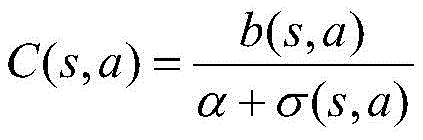
其中:in:
b(s,a)表示消耗速率,其表达式为:b(s,a) represents the consumption rate, which is expressed as:
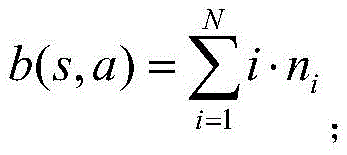
α为折扣因子;α is the discount factor;
σ(s,a)表示期望的服务速率,为系统中当前状态可能发生的所有时间的速率的和,其表达式为:σ(s,a) represents the expected service rate, which is the sum of the rates of all times that the current state may occur in the system, and its expression is:

其中:in:
λt(i)表示在动作i下的任务到达率,其表达式为:λ t (i) represents the task arrival rate under action i, and its expression is:
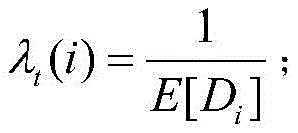
μt表示任务服务速率;μ t represents the task service rate;
λf、μf分别表示车辆的到达率、离开率;λ f and μ f represent the arrival rate and departure rate of vehicles respectively;


pi表示为任务被i个计算单元处理的概率,其表达式为: Pi represents the probability that a task is processed by i computing units, and its expression is:
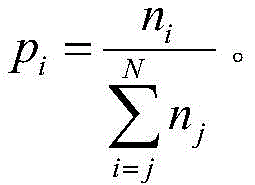
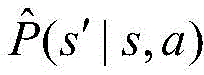
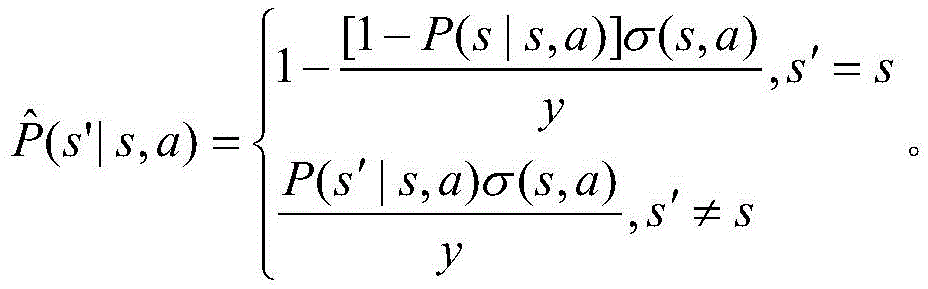
S4:定义系统的转移概率;参照说明书附图的图2,在半马尔可夫决策过程中,根据当前的状态s和动作a,分四种情况计算转移概率P(s'|s,a)。转移概率为P(s′|s,a),其中s为当前状态,s′为下一个状态,其具体表达式为:S4: Define the transition probability of the system; refer to Figure 2 of the attached figure of the specification. In the semi-Markov decision process, according to the current state s and action a, the transition probability P(s'|s,a) is calculated in four cases. The transition probability is P(s'|s,a), where s is the current state and s' is the next state. Its specific expression is:
(1)s=(M,n1,...,nN,A),a=i,即请求达到并卸载给i个计算单元处理时:(1)s=(M,n 1 ,...,n N ,A),a=i, that is, when the request arrives and is offloaded to i computing units for processing:
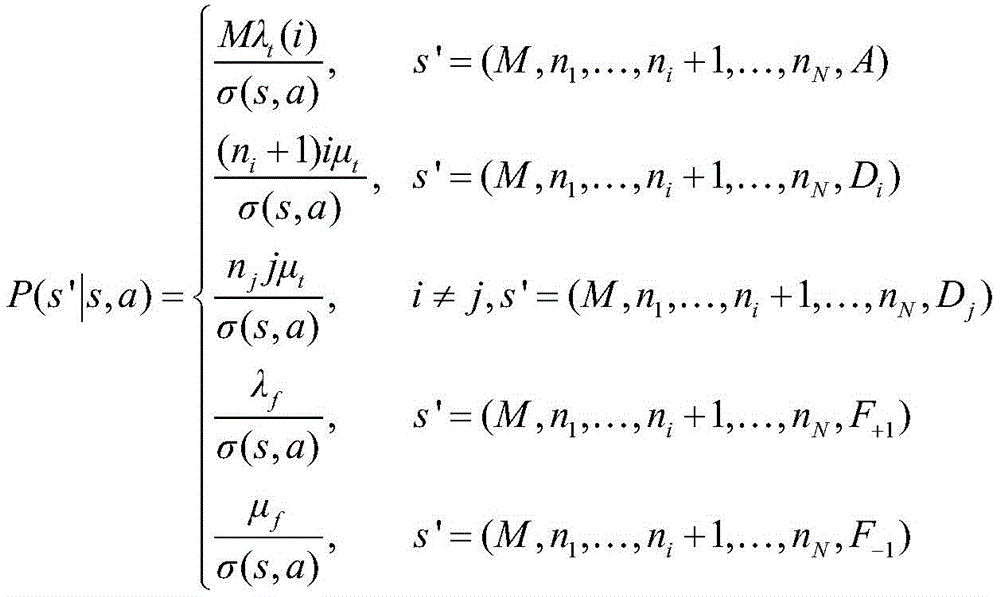
(2)s=(M,n1,...,nN,Di),a=-1,即分配给i辆车的请求离开时:(2)s=(M,n 1 ,...,n N ,D i ),a=-1, that is, when the request assigned to vehicle i leaves:
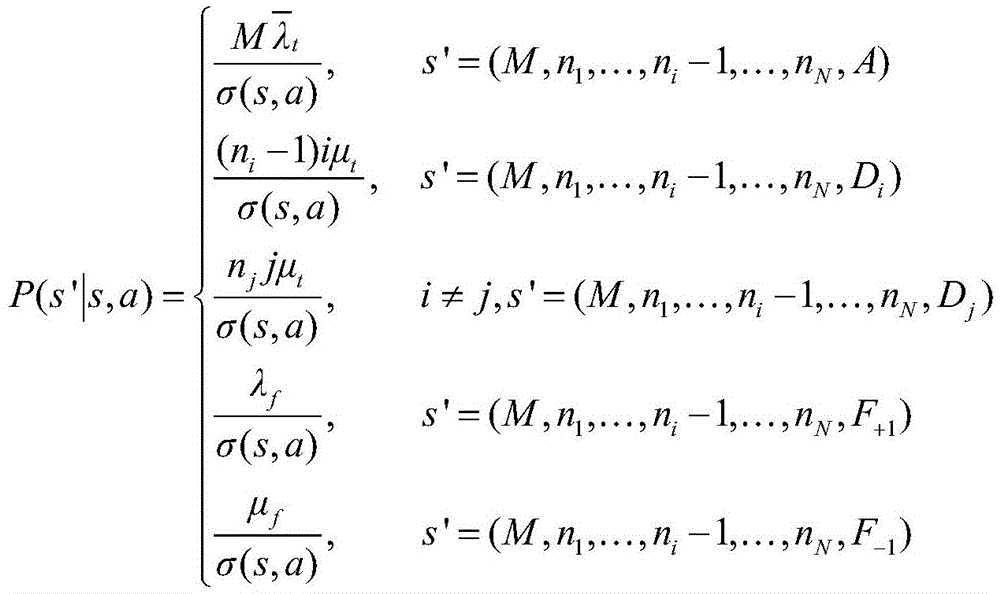
(3)s=(M,n1,...,nN,F+1),a=-1,即车辆到达时,(3)s=(M,n 1 ,...,n N ,F +1 ),a=-1, that is, when the vehicle arrives,

(4)s=(M,n1,...,nN,F-1),a=-1,即车辆离开时:(4)s=(M,n 1 ,...,n N ,F -1 ),a=-1, that is, when the vehicle leaves:

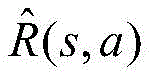
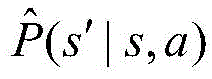
S5:求解车载雾计算系统中的最优卸载策略;最优卸载策略的计算方法为,通过在值迭代算法,根据贝尔曼最优方程计算状态s在动作a下的最大值函数,第k+1次迭代的值函数计算如下:S5: Solve the optimal unloading strategy in the vehicle-mounted fog computing system; the optimal unloading strategy is calculated by using the value iteration algorithm and the Bellman optimal equation to calculate the maximum value function of the state s under the action a. The value function of the k+1th iteration is calculated as follows:

其中:in:



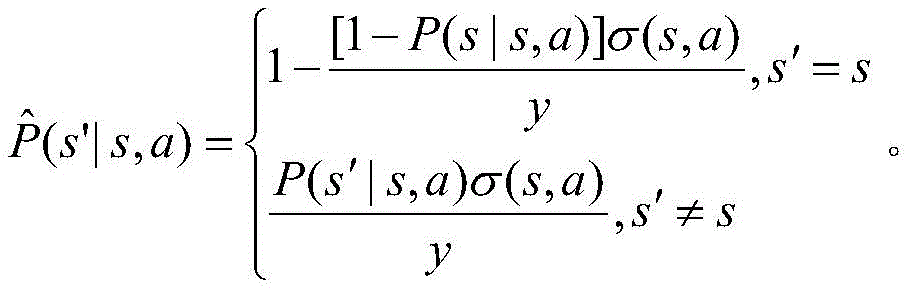
由上,值迭代算法的伪代码如下所示:From the above, the pseudo code of the value iteration algorithm is as follows:

其中,值迭代算法中的收敛误差为:Among them, the convergence error in the value iteration algorithm is:
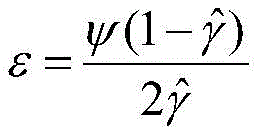
其中ψ表示一个大于0的数,可以根据迭代收敛情况取值。Where ψ represents a number greater than 0, which can be determined according to the iterative convergence.
参照说明书附图中的图2,示例中当前状态为(10,1,1,1,A),当前发生的事件是任务到达,如果当前可能采取的动作为1、2或3,即,a=1、a=2、a=3那么相应的下个状态及转移概率如图1所示。当采取动作1时,系统有6中转移情况,即(10,2,1,1,A)、(10,2,1,1,D1)、(10,2,1,1,D2)、(10,2,1,1,D3)、(10,2,1,1,F+1)和(10,2,1,1,F-1),横线上值表示分别对应的转移概率。同理,当采取动作2、3时,状态同样有6种转移情况。图2中,每个可能的状态转移的转移概率通过分数表示,分子是单个事件的速率,分母是总的期望速率,两者比值表示转移概率;如,a=1时,(10,2,1,1,A)情况发生的概率为10λt(1)/σ。Referring to Figure 2 of the accompanying drawings of the specification, in the example, the current state is (10, 1, 1, 1, A), and the current event is the arrival of the task. If the possible actions currently taken are 1, 2, or 3, that is, a = 1, a = 2, a = 3, then the corresponding next state and transition probability are shown in Figure 1. When taking
图3和图4表达了在不同的任务到达率下,本发明中卸载方案和基于贪婪算法的卸载方案,在性能方面的不同表现。其中,横坐标表示系统所支持的最大车辆数目,纵坐标表示系统获得的长期收益。Figures 3 and 4 show the different performances of the unloading scheme in the present invention and the unloading scheme based on the greedy algorithm under different task arrival rates. The horizontal axis represents the maximum number of vehicles supported by the system, and the vertical axis represents the long-term benefits obtained by the system.
可以看出在当K取值在5~12间变化,图3中的任务到达率为25,图4中的任务到达率为50,本发明卸载方案的性能都是优于基于贪婪算法的卸载方案,也即是说,本发明方案较贪婪算法获得更多的长期收益。It can be seen that when the value of K varies between 5 and 12, the task arrival rate in FIG3 is 25, and the task arrival rate in FIG4 is 50, the performance of the unloading scheme of the present invention is better than the unloading scheme based on the greedy algorithm, that is to say, the scheme of the present invention obtains more long-term benefits than the greedy algorithm.
Claims (2)












Priority Applications (1)
| Application Number | Priority Date | Filing Date | Title |
|---|---|---|---|
| CN201910681783.7A CN110489218B (en) | 2019-07-26 | 2019-07-26 | Vehicle-mounted fog computing system task unloading method based on semi-Markov decision process |
Applications Claiming Priority (1)
| Application Number | Priority Date | Filing Date | Title |
|---|---|---|---|
| CN201910681783.7A CN110489218B (en) | 2019-07-26 | 2019-07-26 | Vehicle-mounted fog computing system task unloading method based on semi-Markov decision process |
Publications (2)
| Publication Number | Publication Date |
|---|---|
| CN110489218A CN110489218A (en) | 2019-11-22 |
| CN110489218B true CN110489218B (en) | 2023-03-28 |
Family
ID=68548515
Family Applications (1)
| Application Number | Title | Priority Date | Filing Date |
|---|---|---|---|
| CN201910681783.7A Active CN110489218B (en) | 2019-07-26 | 2019-07-26 | Vehicle-mounted fog computing system task unloading method based on semi-Markov decision process |
Country Status (1)
| Country | Link |
|---|---|
| CN (1) | CN110489218B (en) |
Families Citing this family (6)
| Publication number | Priority date | Publication date | Assignee | Title |
|---|---|---|---|---|
| CN111611063B (en) * | 2020-05-27 | 2023-04-11 | 江南大学 | Cloud-aware mobile fog computing system task unloading method based on 802.11p |
| CN111988805B (en) * | 2020-08-28 | 2022-03-29 | 重庆邮电大学 | A Device-Edge Collaboration Method for Reliable Delay Guarantee |
| CN112365099B (en) * | 2020-12-08 | 2024-03-19 | 南京大学 | A non-deterministic separation method for web server cluster scaling |
| CN113326076B (en) * | 2021-05-28 | 2022-10-18 | 江南大学 | Fleet task offloading method based on semi-Markov decision process vehicle fog assistance |
| CN115175136A (en) * | 2022-05-25 | 2022-10-11 | 南京航空航天大学 | Low-delay vehicle-mounted edge calculation method based on semi-Markov process |
| CN118113472B (en) * | 2024-03-12 | 2024-11-15 | 南京大学 | A semi-Markov-based smart service response capability optimization method |
Citations (4)
| Publication number | Priority date | Publication date | Assignee | Title |
|---|---|---|---|---|
| US20150178620A1 (en) * | 2011-07-07 | 2015-06-25 | Toyota Motor Europe Nv/Sa | Artificial memory system and method for use with a computational machine for interacting with dynamic behaviours |
| CN109451462A (en) * | 2018-11-16 | 2019-03-08 | 湖南大学 | A kind of In-vehicle networking frequency spectrum resource allocation method based on semi-Markov chain |
| CN109831522A (en) * | 2019-03-11 | 2019-05-31 | 西南交通大学 | A kind of vehicle connection cloud and mist system dynamic resource Optimal Management System and method based on SMDP |
| CN109905860A (en) * | 2019-02-28 | 2019-06-18 | 华北电力大学 | An optimization scheme for server recruitment and task offloading based on vehicle fog computing |
-
2019
- 2019-07-26 CN CN201910681783.7A patent/CN110489218B/en active Active
Patent Citations (4)
| Publication number | Priority date | Publication date | Assignee | Title |
|---|---|---|---|---|
| US20150178620A1 (en) * | 2011-07-07 | 2015-06-25 | Toyota Motor Europe Nv/Sa | Artificial memory system and method for use with a computational machine for interacting with dynamic behaviours |
| CN109451462A (en) * | 2018-11-16 | 2019-03-08 | 湖南大学 | A kind of In-vehicle networking frequency spectrum resource allocation method based on semi-Markov chain |
| CN109905860A (en) * | 2019-02-28 | 2019-06-18 | 华北电力大学 | An optimization scheme for server recruitment and task offloading based on vehicle fog computing |
| CN109831522A (en) * | 2019-03-11 | 2019-05-31 | 西南交通大学 | A kind of vehicle connection cloud and mist system dynamic resource Optimal Management System and method based on SMDP |
Non-Patent Citations (2)
| Title |
|---|
| SMDP-Based Coordinated Virtual Machine Allocations in Cloud-Fog Computing Systems;Qizhen Li;《IEEE Internet of Things Journal》;20180404;全文 * |
| 雾计算环境下的资源缓存机制研究;赵晟伟;《中国优秀硕士学位论文全文数据库 信息科技辑》;20190115;全文 * |
Also Published As
| Publication number | Publication date |
|---|---|
| CN110489218A (en) | 2019-11-22 |
Similar Documents
| Publication | Publication Date | Title |
|---|---|---|
| CN110489218B (en) | Vehicle-mounted fog computing system task unloading method based on semi-Markov decision process | |
| CN113810233B (en) | A Distributed Computing Offloading Method Based on Computational Network Collaboration in Random Networks | |
| CN112822234B (en) | Task unloading method based on deep reinforcement learning in Internet of vehicles | |
| CN115292032B (en) | Task unloading method in intelligent edge computing system with multi-user access | |
| CN109656703A (en) | A kind of mobile edge calculations auxiliary vehicle task discharging method | |
| CN111211830A (en) | A method for satellite uplink bandwidth resource allocation based on Markov prediction | |
| CN111831427A (en) | A distributed inter-vehicle task offloading method based on mobile edge computing | |
| CN114980029B (en) | An offloading method based on task correlation in connected vehicles | |
| CN115629873A (en) | System and method for controlling unloading of vehicle-road cloud cooperative tasks and stability of task queue | |
| CN111866810B (en) | A kind of vehicle networking spectrum allocation method and device | |
| CN115858048A (en) | A Dynamic Arrival Edge Offloading Method for Mixed Critical Class Tasks | |
| CN114501374B (en) | Dynamic service deployment method, system, device and storage medium for Internet of Vehicles | |
| CN115103313A (en) | Method and system for collaborative processing of smart highway tasks based on location prediction | |
| CN111611063B (en) | Cloud-aware mobile fog computing system task unloading method based on 802.11p | |
| CN118055160A (en) | Edge computing server task allocation system and method | |
| CN117793801A (en) | Vehicle task offloading scheduling method and system based on hybrid reinforcement learning | |
| CN115243220B (en) | Partial task offloading and resource allocation method based on LSTM-DDPG | |
| CN109327367A (en) | A CAN FD Bus Message Scheduling Method Based on Offset | |
| CN114786156B (en) | Deep learning-based vehicle networking optimization task edge unloading method | |
| CN114513815B (en) | A method for optimizing energy consumption of task offloading for non-uniform speed vehicle users | |
| CN116744367A (en) | Offloading method based on double-layer offloading mechanism and multi-agent algorithm under Internet of Vehicles | |
| US7289527B2 (en) | Admission control in networked services | |
| CN117076131B (en) | Task allocation method and device, electronic equipment and storage medium | |
| CN113438153B (en) | Vehicle-mounted gateway, intelligent vehicle and control method | |
| CN113365311B (en) | A Distributed Wireless Transmission Method Under Time and Energy Constraints |
Legal Events
| Date | Code | Title | Description |
|---|---|---|---|
| PB01 | Publication | ||
| PB01 | Publication | ||
| SE01 | Entry into force of request for substantive examination | ||
| SE01 | Entry into force of request for substantive examination | ||
| GR01 | Patent grant | ||
| GR01 | Patent grant |