CN110483980B - Composite electromagnetic shielding material and preparation method and application thereof - Google Patents
Composite electromagnetic shielding material and preparation method and application thereof Download PDFInfo
- Publication number
- CN110483980B CN110483980B CN201910810950.3A CN201910810950A CN110483980B CN 110483980 B CN110483980 B CN 110483980B CN 201910810950 A CN201910810950 A CN 201910810950A CN 110483980 B CN110483980 B CN 110483980B
- Authority
- CN
- China
- Prior art keywords
- lignin
- electromagnetic shielding
- ferroferric oxide
- modified
- minutes
- Prior art date
- Legal status (The legal status is an assumption and is not a legal conclusion. Google has not performed a legal analysis and makes no representation as to the accuracy of the status listed.)
- Active
Links
- 239000000463 material Substances 0.000 title claims abstract description 76
- 239000002131 composite material Substances 0.000 title claims abstract description 19
- 238000002360 preparation method Methods 0.000 title claims abstract description 15
- 229920005610 lignin Polymers 0.000 claims abstract description 86
- SZVJSHCCFOBDDC-UHFFFAOYSA-N ferrosoferric oxide Chemical compound O=[Fe]O[Fe]O[Fe]=O SZVJSHCCFOBDDC-UHFFFAOYSA-N 0.000 claims abstract description 70
- OKTJSMMVPCPJKN-UHFFFAOYSA-N Carbon Chemical compound [C] OKTJSMMVPCPJKN-UHFFFAOYSA-N 0.000 claims abstract description 60
- 239000002041 carbon nanotube Substances 0.000 claims abstract description 60
- 229910021393 carbon nanotube Inorganic materials 0.000 claims abstract description 60
- 229910003002 lithium salt Inorganic materials 0.000 claims abstract description 42
- 159000000002 lithium salts Chemical class 0.000 claims abstract description 42
- 239000004814 polyurethane Substances 0.000 claims abstract description 33
- 229920002635 polyurethane Polymers 0.000 claims abstract description 31
- 229920005862 polyol Polymers 0.000 claims abstract description 30
- 150000003077 polyols Chemical class 0.000 claims abstract description 30
- 238000001035 drying Methods 0.000 claims abstract description 29
- 239000003054 catalyst Substances 0.000 claims abstract description 27
- 239000012948 isocyanate Substances 0.000 claims abstract description 19
- 150000002513 isocyanates Chemical class 0.000 claims abstract description 19
- 239000002994 raw material Substances 0.000 claims abstract description 19
- 230000009471 action Effects 0.000 claims abstract description 9
- 238000011065 in-situ storage Methods 0.000 claims abstract description 5
- 238000006116 polymerization reaction Methods 0.000 claims abstract description 5
- 238000004891 communication Methods 0.000 claims abstract description 4
- 238000003756 stirring Methods 0.000 claims description 45
- 238000010438 heat treatment Methods 0.000 claims description 40
- 238000002156 mixing Methods 0.000 claims description 40
- IJGRMHOSHXDMSA-UHFFFAOYSA-N Atomic nitrogen Chemical compound N#N IJGRMHOSHXDMSA-UHFFFAOYSA-N 0.000 claims description 38
- ZMXDDKWLCZADIW-UHFFFAOYSA-N N,N-Dimethylformamide Chemical compound CN(C)C=O ZMXDDKWLCZADIW-UHFFFAOYSA-N 0.000 claims description 35
- 239000005057 Hexamethylene diisocyanate Substances 0.000 claims description 26
- 239000006185 dispersion Substances 0.000 claims description 26
- OKKJLVBELUTLKV-UHFFFAOYSA-N Methanol Chemical compound OC OKKJLVBELUTLKV-UHFFFAOYSA-N 0.000 claims description 24
- RRAMGCGOFNQTLD-UHFFFAOYSA-N hexamethylene diisocyanate Chemical compound O=C=NCCCCCCN=C=O RRAMGCGOFNQTLD-UHFFFAOYSA-N 0.000 claims description 24
- 239000007788 liquid Substances 0.000 claims description 23
- 239000002048 multi walled nanotube Substances 0.000 claims description 23
- -1 lithium tetrafluoroborate Chemical compound 0.000 claims description 21
- 229910052757 nitrogen Inorganic materials 0.000 claims description 21
- 239000004721 Polyphenylene oxide Substances 0.000 claims description 20
- 229920000570 polyether Polymers 0.000 claims description 20
- 239000002202 Polyethylene glycol Substances 0.000 claims description 18
- 229910001496 lithium tetrafluoroborate Inorganic materials 0.000 claims description 18
- 239000000203 mixture Substances 0.000 claims description 18
- 229920001223 polyethylene glycol Polymers 0.000 claims description 18
- 229920001730 Moisture cure polyurethane Polymers 0.000 claims description 16
- 239000006087 Silane Coupling Agent Substances 0.000 claims description 16
- 239000001267 polyvinylpyrrolidone Substances 0.000 claims description 15
- 229920000036 polyvinylpyrrolidone Polymers 0.000 claims description 15
- 235000013855 polyvinylpyrrolidone Nutrition 0.000 claims description 15
- 239000003960 organic solvent Substances 0.000 claims description 11
- XLYOFNOQVPJJNP-UHFFFAOYSA-N water Chemical compound O XLYOFNOQVPJJNP-UHFFFAOYSA-N 0.000 claims description 9
- 239000008367 deionised water Substances 0.000 claims description 8
- 229910021641 deionized water Inorganic materials 0.000 claims description 8
- 238000000034 method Methods 0.000 claims description 8
- 238000001132 ultrasonic dispersion Methods 0.000 claims description 7
- UPMLOUAZCHDJJD-UHFFFAOYSA-N 4,4'-Diphenylmethane Diisocyanate Chemical compound C1=CC(N=C=O)=CC=C1CC1=CC=C(N=C=O)C=C1 UPMLOUAZCHDJJD-UHFFFAOYSA-N 0.000 claims description 5
- 238000006243 chemical reaction Methods 0.000 claims description 5
- 239000002109 single walled nanotube Substances 0.000 claims description 4
- DVKJHBMWWAPEIU-UHFFFAOYSA-N toluene 2,4-diisocyanate Chemical group CC1=CC=C(N=C=O)C=C1N=C=O DVKJHBMWWAPEIU-UHFFFAOYSA-N 0.000 claims description 4
- 229920005906 polyester polyol Polymers 0.000 claims description 3
- RNFJDJUURJAICM-UHFFFAOYSA-N 2,2,4,4,6,6-hexaphenoxy-1,3,5-triaza-2$l^{5},4$l^{5},6$l^{5}-triphosphacyclohexa-1,3,5-triene Chemical compound N=1P(OC=2C=CC=CC=2)(OC=2C=CC=CC=2)=NP(OC=2C=CC=CC=2)(OC=2C=CC=CC=2)=NP=1(OC=1C=CC=CC=1)OC1=CC=CC=C1 RNFJDJUURJAICM-UHFFFAOYSA-N 0.000 claims description 2
- NQRXDWHFTVCVDI-UHFFFAOYSA-N N=C=O.N=C=O.CC(C)(C)C Chemical compound N=C=O.N=C=O.CC(C)(C)C NQRXDWHFTVCVDI-UHFFFAOYSA-N 0.000 claims description 2
- 239000003513 alkali Substances 0.000 claims description 2
- 150000002009 diols Chemical class 0.000 claims description 2
- 239000003063 flame retardant Substances 0.000 claims description 2
- 125000000623 heterocyclic group Chemical group 0.000 claims description 2
- MHCFAGZWMAWTNR-UHFFFAOYSA-M lithium perchlorate Chemical compound [Li+].[O-]Cl(=O)(=O)=O MHCFAGZWMAWTNR-UHFFFAOYSA-M 0.000 claims description 2
- 229920001610 polycaprolactone Polymers 0.000 claims description 2
- 239000004632 polycaprolactone Substances 0.000 claims description 2
- 239000004417 polycarbonate Substances 0.000 claims description 2
- 229920000515 polycarbonate Polymers 0.000 claims description 2
- 229920001343 polytetrafluoroethylene Polymers 0.000 claims description 2
- 239000004810 polytetrafluoroethylene Substances 0.000 claims description 2
- 229920000909 polytetrahydrofuran Polymers 0.000 claims description 2
- BDHFUVZGWQCTTF-UHFFFAOYSA-M sulfonate Chemical compound [O-]S(=O)=O BDHFUVZGWQCTTF-UHFFFAOYSA-M 0.000 claims description 2
- WJIOHMVWGVGWJW-UHFFFAOYSA-N 3-methyl-n-[4-[(3-methylpyrazole-1-carbonyl)amino]butyl]pyrazole-1-carboxamide Chemical compound N1=C(C)C=CN1C(=O)NCCCCNC(=O)N1N=C(C)C=C1 WJIOHMVWGVGWJW-UHFFFAOYSA-N 0.000 claims 1
- 229910001486 lithium perchlorate Inorganic materials 0.000 claims 1
- 238000010521 absorption reaction Methods 0.000 abstract description 5
- 230000000052 comparative effect Effects 0.000 description 45
- 230000000694 effects Effects 0.000 description 10
- 239000004094 surface-active agent Substances 0.000 description 10
- 239000011159 matrix material Substances 0.000 description 7
- 229910052751 metal Inorganic materials 0.000 description 7
- 239000002184 metal Substances 0.000 description 7
- SJRJJKPEHAURKC-UHFFFAOYSA-N N-Methylmorpholine Chemical compound CN1CCOCC1 SJRJJKPEHAURKC-UHFFFAOYSA-N 0.000 description 3
- ZMANZCXQSJIPKH-UHFFFAOYSA-N Triethylamine Chemical compound CCN(CC)CC ZMANZCXQSJIPKH-UHFFFAOYSA-N 0.000 description 3
- 230000007613 environmental effect Effects 0.000 description 3
- 230000004048 modification Effects 0.000 description 3
- 238000012986 modification Methods 0.000 description 3
- 239000002105 nanoparticle Substances 0.000 description 3
- 238000012545 processing Methods 0.000 description 3
- 239000000126 substance Substances 0.000 description 3
- 230000002195 synergetic effect Effects 0.000 description 3
- 239000002028 Biomass Substances 0.000 description 2
- JUJWROOIHBZHMG-UHFFFAOYSA-N Pyridine Chemical compound C1=CC=NC=C1 JUJWROOIHBZHMG-UHFFFAOYSA-N 0.000 description 2
- 239000003575 carbonaceous material Substances 0.000 description 2
- 238000000354 decomposition reaction Methods 0.000 description 2
- 230000005672 electromagnetic field Effects 0.000 description 2
- 230000005670 electromagnetic radiation Effects 0.000 description 2
- 238000003912 environmental pollution Methods 0.000 description 2
- 239000007787 solid Substances 0.000 description 2
- 238000012876 topography Methods 0.000 description 2
- GTEXIOINCJRBIO-UHFFFAOYSA-N 2-[2-(dimethylamino)ethoxy]-n,n-dimethylethanamine Chemical compound CN(C)CCOCCN(C)C GTEXIOINCJRBIO-UHFFFAOYSA-N 0.000 description 1
- HVCNXQOWACZAFN-UHFFFAOYSA-N 4-ethylmorpholine Chemical compound CCN1CCOCC1 HVCNXQOWACZAFN-UHFFFAOYSA-N 0.000 description 1
- 229910013063 LiBF 4 Inorganic materials 0.000 description 1
- 229910001290 LiPF6 Inorganic materials 0.000 description 1
- HBBGRARXTFLTSG-UHFFFAOYSA-N Lithium ion Chemical compound [Li+] HBBGRARXTFLTSG-UHFFFAOYSA-N 0.000 description 1
- SVYKKECYCPFKGB-UHFFFAOYSA-N N,N-dimethylcyclohexylamine Chemical compound CN(C)C1CCCCC1 SVYKKECYCPFKGB-UHFFFAOYSA-N 0.000 description 1
- 238000003723 Smelting Methods 0.000 description 1
- GSEJCLTVZPLZKY-UHFFFAOYSA-N Triethanolamine Chemical compound OCCN(CCO)CCO GSEJCLTVZPLZKY-UHFFFAOYSA-N 0.000 description 1
- 239000000956 alloy Substances 0.000 description 1
- 229910045601 alloy Inorganic materials 0.000 description 1
- 150000001412 amines Chemical class 0.000 description 1
- 150000001450 anions Chemical class 0.000 description 1
- 239000012298 atmosphere Substances 0.000 description 1
- 230000005540 biological transmission Effects 0.000 description 1
- 230000015572 biosynthetic process Effects 0.000 description 1
- 150000001721 carbon Chemical class 0.000 description 1
- 150000001723 carbon free-radicals Chemical class 0.000 description 1
- 125000003178 carboxy group Chemical group [H]OC(*)=O 0.000 description 1
- 239000003795 chemical substances by application Substances 0.000 description 1
- 229920001940 conductive polymer Polymers 0.000 description 1
- 229920001577 copolymer Polymers 0.000 description 1
- 125000004122 cyclic group Chemical group 0.000 description 1
- 230000003247 decreasing effect Effects 0.000 description 1
- 230000007547 defect Effects 0.000 description 1
- 230000007123 defense Effects 0.000 description 1
- 238000001514 detection method Methods 0.000 description 1
- XXBDWLFCJWSEKW-UHFFFAOYSA-N dimethylbenzylamine Chemical compound CN(C)CC1=CC=CC=C1 XXBDWLFCJWSEKW-UHFFFAOYSA-N 0.000 description 1
- GVGUFUZHNYFZLC-UHFFFAOYSA-N dodecyl benzenesulfonate;sodium Chemical compound [Na].CCCCCCCCCCCCOS(=O)(=O)C1=CC=CC=C1 GVGUFUZHNYFZLC-UHFFFAOYSA-N 0.000 description 1
- 229920001971 elastomer Polymers 0.000 description 1
- 239000003792 electrolyte Substances 0.000 description 1
- 238000005516 engineering process Methods 0.000 description 1
- 239000000945 filler Substances 0.000 description 1
- 230000036541 health Effects 0.000 description 1
- 230000020169 heat generation Effects 0.000 description 1
- 229920001519 homopolymer Polymers 0.000 description 1
- 230000006872 improvement Effects 0.000 description 1
- 238000002347 injection Methods 0.000 description 1
- 239000007924 injection Substances 0.000 description 1
- 150000002500 ions Chemical class 0.000 description 1
- 238000002955 isolation Methods 0.000 description 1
- 229910001540 lithium hexafluoroarsenate(V) Inorganic materials 0.000 description 1
- 229910001416 lithium ion Inorganic materials 0.000 description 1
- 239000000696 magnetic material Substances 0.000 description 1
- 230000007246 mechanism Effects 0.000 description 1
- 229910044991 metal oxide Inorganic materials 0.000 description 1
- 150000004706 metal oxides Chemical class 0.000 description 1
- 239000002245 particle Substances 0.000 description 1
- 230000035515 penetration Effects 0.000 description 1
- 238000011056 performance test Methods 0.000 description 1
- 229920000867 polyelectrolyte Polymers 0.000 description 1
- 229920000728 polyester Polymers 0.000 description 1
- 239000011148 porous material Substances 0.000 description 1
- 230000008569 process Effects 0.000 description 1
- UMJSCPRVCHMLSP-UHFFFAOYSA-N pyridine Natural products COC1=CC=CN=C1 UMJSCPRVCHMLSP-UHFFFAOYSA-N 0.000 description 1
- 229940080264 sodium dodecylbenzenesulfonate Drugs 0.000 description 1
- 239000002910 solid waste Substances 0.000 description 1
- 238000003860 storage Methods 0.000 description 1
- 239000000758 substrate Substances 0.000 description 1
- 238000003786 synthesis reaction Methods 0.000 description 1
- 238000012360 testing method Methods 0.000 description 1
Images


Classifications
-
- C—CHEMISTRY; METALLURGY
- C08—ORGANIC MACROMOLECULAR COMPOUNDS; THEIR PREPARATION OR CHEMICAL WORKING-UP; COMPOSITIONS BASED THEREON
- C08G—MACROMOLECULAR COMPOUNDS OBTAINED OTHERWISE THAN BY REACTIONS ONLY INVOLVING UNSATURATED CARBON-TO-CARBON BONDS
- C08G18/00—Polymeric products of isocyanates or isothiocyanates
- C08G18/06—Polymeric products of isocyanates or isothiocyanates with compounds having active hydrogen
- C08G18/28—Polymeric products of isocyanates or isothiocyanates with compounds having active hydrogen characterised by the compounds used containing active hydrogen
- C08G18/30—Low-molecular-weight compounds
- C08G18/32—Polyhydroxy compounds; Polyamines; Hydroxyamines
- C08G18/3203—Polyhydroxy compounds
- C08G18/3206—Polyhydroxy compounds aliphatic
-
- C—CHEMISTRY; METALLURGY
- C08—ORGANIC MACROMOLECULAR COMPOUNDS; THEIR PREPARATION OR CHEMICAL WORKING-UP; COMPOSITIONS BASED THEREON
- C08G—MACROMOLECULAR COMPOUNDS OBTAINED OTHERWISE THAN BY REACTIONS ONLY INVOLVING UNSATURATED CARBON-TO-CARBON BONDS
- C08G18/00—Polymeric products of isocyanates or isothiocyanates
- C08G18/06—Polymeric products of isocyanates or isothiocyanates with compounds having active hydrogen
- C08G18/28—Polymeric products of isocyanates or isothiocyanates with compounds having active hydrogen characterised by the compounds used containing active hydrogen
- C08G18/40—High-molecular-weight compounds
- C08G18/64—Macromolecular compounds not provided for by groups C08G18/42 - C08G18/63
- C08G18/6492—Lignin containing materials; Wood resins; Wood tars; Derivatives thereof
-
- C—CHEMISTRY; METALLURGY
- C08—ORGANIC MACROMOLECULAR COMPOUNDS; THEIR PREPARATION OR CHEMICAL WORKING-UP; COMPOSITIONS BASED THEREON
- C08G—MACROMOLECULAR COMPOUNDS OBTAINED OTHERWISE THAN BY REACTIONS ONLY INVOLVING UNSATURATED CARBON-TO-CARBON BONDS
- C08G18/00—Polymeric products of isocyanates or isothiocyanates
- C08G18/06—Polymeric products of isocyanates or isothiocyanates with compounds having active hydrogen
- C08G18/28—Polymeric products of isocyanates or isothiocyanates with compounds having active hydrogen characterised by the compounds used containing active hydrogen
- C08G18/65—Low-molecular-weight compounds having active hydrogen with high-molecular-weight compounds having active hydrogen
- C08G18/6505—Low-molecular-weight compounds having active hydrogen with high-molecular-weight compounds having active hydrogen the low-molecular compounds being compounds of group C08G18/32 or polyamines of C08G18/38
- C08G18/6511—Low-molecular-weight compounds having active hydrogen with high-molecular-weight compounds having active hydrogen the low-molecular compounds being compounds of group C08G18/32 or polyamines of C08G18/38 compounds of group C08G18/3203
-
- C—CHEMISTRY; METALLURGY
- C08—ORGANIC MACROMOLECULAR COMPOUNDS; THEIR PREPARATION OR CHEMICAL WORKING-UP; COMPOSITIONS BASED THEREON
- C08K—Use of inorganic or non-macromolecular organic substances as compounding ingredients
- C08K3/00—Use of inorganic substances as compounding ingredients
- C08K3/02—Elements
- C08K3/04—Carbon
- C08K3/041—Carbon nanotubes
-
- C—CHEMISTRY; METALLURGY
- C08—ORGANIC MACROMOLECULAR COMPOUNDS; THEIR PREPARATION OR CHEMICAL WORKING-UP; COMPOSITIONS BASED THEREON
- C08K—Use of inorganic or non-macromolecular organic substances as compounding ingredients
- C08K3/00—Use of inorganic substances as compounding ingredients
- C08K3/18—Oxygen-containing compounds, e.g. metal carbonyls
- C08K3/20—Oxides; Hydroxides
- C08K3/22—Oxides; Hydroxides of metals
-
- C—CHEMISTRY; METALLURGY
- C08—ORGANIC MACROMOLECULAR COMPOUNDS; THEIR PREPARATION OR CHEMICAL WORKING-UP; COMPOSITIONS BASED THEREON
- C08K—Use of inorganic or non-macromolecular organic substances as compounding ingredients
- C08K3/00—Use of inorganic substances as compounding ingredients
- C08K3/38—Boron-containing compounds
-
- C—CHEMISTRY; METALLURGY
- C08—ORGANIC MACROMOLECULAR COMPOUNDS; THEIR PREPARATION OR CHEMICAL WORKING-UP; COMPOSITIONS BASED THEREON
- C08K—Use of inorganic or non-macromolecular organic substances as compounding ingredients
- C08K9/00—Use of pretreated ingredients
- C08K9/04—Ingredients treated with organic substances
-
- C—CHEMISTRY; METALLURGY
- C08—ORGANIC MACROMOLECULAR COMPOUNDS; THEIR PREPARATION OR CHEMICAL WORKING-UP; COMPOSITIONS BASED THEREON
- C08K—Use of inorganic or non-macromolecular organic substances as compounding ingredients
- C08K9/00—Use of pretreated ingredients
- C08K9/04—Ingredients treated with organic substances
- C08K9/06—Ingredients treated with organic substances with silicon-containing compounds
-
- H—ELECTRICITY
- H05—ELECTRIC TECHNIQUES NOT OTHERWISE PROVIDED FOR
- H05K—PRINTED CIRCUITS; CASINGS OR CONSTRUCTIONAL DETAILS OF ELECTRIC APPARATUS; MANUFACTURE OF ASSEMBLAGES OF ELECTRICAL COMPONENTS
- H05K9/00—Screening of apparatus or components against electric or magnetic fields
- H05K9/0073—Shielding materials
- H05K9/0081—Electromagnetic shielding materials, e.g. EMI, RFI shielding
-
- C—CHEMISTRY; METALLURGY
- C08—ORGANIC MACROMOLECULAR COMPOUNDS; THEIR PREPARATION OR CHEMICAL WORKING-UP; COMPOSITIONS BASED THEREON
- C08K—Use of inorganic or non-macromolecular organic substances as compounding ingredients
- C08K3/00—Use of inorganic substances as compounding ingredients
- C08K3/18—Oxygen-containing compounds, e.g. metal carbonyls
- C08K3/20—Oxides; Hydroxides
- C08K3/22—Oxides; Hydroxides of metals
- C08K2003/2265—Oxides; Hydroxides of metals of iron
- C08K2003/2275—Ferroso-ferric oxide (Fe3O4)
-
- C—CHEMISTRY; METALLURGY
- C08—ORGANIC MACROMOLECULAR COMPOUNDS; THEIR PREPARATION OR CHEMICAL WORKING-UP; COMPOSITIONS BASED THEREON
- C08K—Use of inorganic or non-macromolecular organic substances as compounding ingredients
- C08K2201/00—Specific properties of additives
- C08K2201/011—Nanostructured additives
Landscapes
- Chemical & Material Sciences (AREA)
- Health & Medical Sciences (AREA)
- Chemical Kinetics & Catalysis (AREA)
- Medicinal Chemistry (AREA)
- Polymers & Plastics (AREA)
- Organic Chemistry (AREA)
- Engineering & Computer Science (AREA)
- Materials Engineering (AREA)
- Electromagnetism (AREA)
- Physics & Mathematics (AREA)
- Microelectronics & Electronic Packaging (AREA)
- Nanotechnology (AREA)
- Life Sciences & Earth Sciences (AREA)
- Wood Science & Technology (AREA)
- Shielding Devices Or Components To Electric Or Magnetic Fields (AREA)
- Carbon And Carbon Compounds (AREA)
- Compositions Of Macromolecular Compounds (AREA)
Abstract
The invention relates to a composite electromagnetic shielding material and a preparation method and application thereof, belonging to the technical field of electromagnetic shielding materials. The preparation raw materials comprise: lignin-modified polyurethane, carbon nanotubes, nano ferroferric oxide and inorganic lithium salt. The lignin modified polyurethane is a lignin modified polyurethane oligomer obtained by in-situ polymerization of isocyanate, polyol and lignin under the action of a catalyst. And adding the modified nano ferroferric oxide, the carbon nano tube and the inorganic lithium salt into the oligomer, and curing and drying under certain conditions to obtain the lignin modified electromagnetic shielding material. The electromagnetic shielding material has wide frequency absorption range and high-efficiency electromagnetic shielding, and is widely applied to microwave darkrooms, microwave communication information, electromagnetic protection, portable mobile equipment and the like.
Description
Technical Field
The invention belongs to the technical field of electromagnetic shielding materials, and particularly relates to a flexible electromagnetic shielding material based on polyurethane, lignin, carbon nanotubes, nano ferroferric oxide and inorganic lithium salt, and a preparation method and application thereof.
Background
Electromagnetic radiation brought by the rapidly developing electronic industry has the defects of information leakage, serious interference on the operation of surrounding electronic equipment, harm to human health and the like, and becomes a big nuisance after being polluted by noise, atmosphere, water and solid waste. Meanwhile, international military equipment is in fierce competition, and military weapons, equipment, defense penetration and the like face huge threats along with the emergence of novel radars and detectors. The electromagnetic shielding material can protect military secrets, improve the electromagnetic compatibility of weaponry, improve the environmental pollution caused by electromagnetic radiation and electromagnetic leakage, and is widely applied to civil fields such as microwave darkrooms, microwave communication information, electromagnetic protection and the like.
At present, most of electromagnetic shielding materials are obtained by simply blending or modifying carbon materials, some metal shielding materials and organic matrixes, and the electromagnetic shielding materials prepared by the methods have narrow shielding performance and narrow electromagnetic shielding frequency and need to improve the electromagnetic shielding effect. And the metal resources with natural electromagnetic shielding effect are increasingly exhausted, the environmental problems caused by the smelting process are increasingly serious, the processing is difficult, the quality of the finished product is heavy, secondary interference is caused by the strong reflection effect of electromagnetic waves, and the like, so that the applicability of the alloy is limited. The conductive polymer and the carbon material agent are easy to agglomerate and need to be processed and manufactured by other matrix materials. Therefore, in order to relieve the pressure of non-renewable resources and alleviate the increasingly serious environmental problems, the exploration of an electromagnetic shielding material which has a wide absorption frequency band, good mechanical properties and no pollution is urgent.
The biomass energy is taken as renewable energy, can balance the demand of energy and is more and more valued by people. The lignin has the advantages of wide source, low price, environmental friendliness, good biocompatibility, degradability and the like, and is called as a biomass material with the most application potential, however, no report that the lignin is used for electromagnetic shielding materials exists in the prior art. The lignin is an important ecological environment material and is naturally renewable. Meanwhile, the lignin also has the advantages of degradability, cyclic utilization and application. Microscopically, the lignin has a micron-nanometer multi-scale pore structure, the mechanical properties of other materials can be enhanced by the natural skeleton form of the lignin, and the surface of a porous channel is rich in a large number of active sites (carbon free radicals C) and groups (free hydroxyl-OH, carboxyl-COOH and the like) and can perform a series of physical and chemical reactions to enhance the compatibility with a matrix. And the lignin expands the transmission path of the electromagnetic waves in the composite material, so that incident waves are repeatedly scattered and reflected, and the absorption of the electromagnetic waves is enhanced.
Generally, inorganic lithium salts generally have the advantages of low price, difficult decomposition, simple synthesis and the like, wherein LiBF4 has a relatively small anion radius, so the electrolyte lithium salt has relatively weak coordination capacity with lithium ions and is easy to dissociate in an organic solvent, thereby improving the conductivity of a matrix, and LiBF4 has high thermal stability and is difficult to decompose at high temperature.
The nano ferroferric oxide is a common magnetic material, can directionally move under an external magnetic field, has the characteristics of superparamagnetism within a certain range of particle size, heat generation under the action of an external alternating electromagnetic field and the like, and has stable chemical properties, so the nano ferroferric oxide has wide application.
In the prior art, the electromagnetic shielding material is usually prepared by using rigid solid or rubber as a substrate and using metal series, metal oxide series and carbon series as fillers, and the flexible electromagnetic shielding material is less. Polyurethanes have wide commercial applications because they can be molded, injection molded, extruded and recycled, and can be easily modified by changing raw materials, preparation conditions, and the like. Polyurethanes can be made in a wide variety of chemical structures, including homopolymers or copolymers containing polyether or polyester moieties, which have found widespread use in the home and industry. The invention mixes lignin, polyurethane, carbon nano tube, nano ferroferric oxide and inorganic lithium salt to prepare the composite electromagnetic shielding material.
Disclosure of Invention
In order to solve the problems of narrow electromagnetic shielding frequency, weak electromagnetic shielding effect, environmental pollution and the like, the technology invents a novel electromagnetic shielding material based on lignin, polyurethane, carbon nano tubes, nano ferroferric oxide, inorganic lithium salt and the like.
The composite electromagnetic shielding material provided by the invention comprises the following raw materials: lignin-modified polyurethane, carbon nanotubes, nano ferroferric oxide and inorganic lithium salt. The lignin modified polyurethane is a lignin modified polyurethane oligomer obtained by in-situ polymerization of isocyanate, polyol and lignin under the action of a catalyst. The electromagnetic shielding material is obtained by adding modified nano ferroferric oxide, a carbon nano tube and inorganic lithium salt into the lignin modified polyurethane oligomer.
Preferably, the lignin content is 15-20% in the frequency range of 8.2-26.5GHz based on the total mass of the lignin-modified polyurethane, the carbon nanotube, the metal shielding material and the inorganic lithium salt, and at this time, the electromagnetic shielding efficiency is more than 99.9%.
The isocyanate is not particularly limited, and is preferably Toluene Diisocyanate (TDI), diphenylmethane diisocyanate (MDI), Hexamethylene Diisocyanate (HDI), 4-dicyclohexylmethane diisocyanate (H)12MDI), trimethylethane diisocyanate (TMDI), and Hexamethylene Diisocyanate (HDI) is more preferable from the viewpoint of flexibility.
The polyol is not particularly limited, and is preferably a polyester polyol including polyethylene glycol (PEG), polycaprolactone polyol, polycarbonate diol, and the like; the polyether polyol is preferably active polyether polyol, flame-retardant polyether polyol, graft polyether polyol, polytetrahydrofuran polyol or heterocycle modified polyether polyol; more preferably polyethylene glycol (PEG).
The surfactant is not particularly limited and includes polyvinylpyrrolidone, sodium dodecylbenzenesulfonate, and more preferably polyvinylpyrrolidone.
The carbon nanotubes are not particularly limited, and may be single-walled carbon nanotubes, multi-walled carbon nanotubes, surfactant-modified single-walled or multi-walled carbon nanotubes, and more preferably surfactant-modified multi-walled carbon nanotubes.
The silane coupling agent is not particularly limited and includes KH602, a151, a171, a 172.
The size of the nano ferroferric oxide can be 10-300nm, and more preferably the size of the nano ferroferric oxide is 40-60 nm. Still more preferably, the metal shielding material is nano ferroferric oxide modified by a silane coupling agent.
The lignin is not particularly limited, and may be various lignin, organosollignin, alkali lignin, sulfonate lignin, etc., or may be modified lignin, and organosollignin is more preferable.
The catalyst is not particularly limited, and N, N-dimethylcyclohexylamine, bis (2-dimethylaminoethyl) ether, N ' -tetramethylalkylenediamine, triethylamine, N-dimethylbenzylamine, a solid amine, N-ethylmorpholine, N-methylmorpholine, N ' -diethylpiperazine, triethanolamine, pyridine and N, N ' -dimethylpyridine are used.
The inorganic lithium salt is not particularly limited, and includes lithium perchlorate (LiClO4), lithium tetrafluoroborate (LiBF4), lithium hexafluoroarsenate (LiAsF6) or lithium hexafluorophosphate (LiPF6), and more preferably lithium tetrafluoroborate (LiBF 4).
The invention also provides a preparation method of the electromagnetic shielding material, which comprises the following steps: 1) carrying out in-situ polymerization on isocyanate, polyether polyol and lignin under the action of a catalyst to obtain a lignin modified polyurethane prepolymer; 2) adding a carbon nano tube dispersion liquid, a modified metal shielding material and an inorganic lithium salt into a reaction system of the lignin chemical modified polyurethane prepolymer, mixing, and continuing to react to further react the lignin modified polyurethane prepolymer to generate the lignin modified polyurethane prepolymer; 3) and curing and drying to obtain the electromagnetic shielding material.
Preferably, the preparation method comprises the following steps:
(1) preparing silane coupling agent modified nano ferroferric oxide: mixing a silane coupling agent, deionized water and methanol (the mass ratio is 1-3: 1-3: 6-8), performing ultrasonic dispersion, adding nano ferroferric oxide (1-10% of the total mass of the silane coupling agent, the deionized water and the methanol), continuing stirring and drying;
(2) preparing a carbon nano tube dispersion liquid: mixing the carbon nano tube, DMF and polyvinylpyrrolidone, and then performing ultrasonic dispersion (the mass ratio is 70-90: 300) and 500: 1-10);
(3) preparing an electromagnetic shielding material: mixing N-N dimethylformamide and lignin, adding polyether polyol, isocyanate and a catalyst, mixing, stirring and dissolving, and then heating to react to obtain a lignin modified polyurethane prepolymer; and (2) adding the carbon nano tube dispersion liquid in the step (2), the silane coupling agent modified nano ferroferric oxide in the step (1) and inorganic lithium salt (3-10: 3-10: 1-10) into the lignin modified polyurethane prepolymer, and finally curing and drying to obtain the electromagnetic shielding material.
Preferably, the isocyanate in step (3) is HDI, and the preparation step of the lignin-modified polyurethane prepolymer is:
mixing N-N dimethylformamide and lignin, stirring for 10-20 minutes at the mixing temperature of 25-35 ℃, adding polyether polyol, isocyanate and a catalyst, heating to 70-80 ℃, and stirring for reacting for 20-30 minutes.
Preferably, the isocyanate in step (3) is MDI, and the preparation step of the lignin-modified polyurethane prepolymer is: mixing N-N dimethylformamide and lignin, stirring for 10-20 minutes at the mixing temperature of 25-35 ℃, adding polyether polyol, isocyanate and a catalyst, introducing nitrogen into an oil bath, heating to 50-60 ℃ for reaction for 20-30 minutes, and heating to 60-70 ℃ for reaction for 20-30 minutes.
Preferably, the isocyanate in step (3) is TDI, and the preparation of the lignin-modified polyurethane prepolymer comprises the following steps: mixing N-N dimethylformamide and lignin, stirring for 10-20 minutes at the mixing temperature of 25-35 ℃, adding polyether polyol, isocyanate and a catalyst, introducing nitrogen into an oil bath, heating to 85-90 ℃, and reacting for 2-3 hours.
Preferably, the method for preparing the silane coupling agent modified nano ferroferric oxide, which is described in the step (1), comprises the following steps: mixing a silane coupling agent, deionized water and methanol at room temperature, performing ultrasonic dispersion for 0.5-1 hour, adding nano ferroferric oxide, stirring for 1-2 hours, and drying at 80-100 ℃ for 5-8 hours.
Preferably, the preparation method may comprise the following steps:
(1) modification of nano ferroferric oxide: mixing a silane coupling agent, deionized water and methanol at room temperature, performing ultrasonic dispersion for 0.5-1 hour, adding nano ferroferric oxide, stirring for 1-2 hours, and drying at 80-100 ℃ for 5-8 hours;
(2) preparing a carbon nano tube dispersion liquid: mixing the carbon nano tube, DMF (dimethyl formamide) and polyvinylpyrrolidone, and then ultrasonically dispersing for 1-2 hours;
(3) mixing raw materials: mixing N-N dimethylformamide and lignin at room temperature, stirring for 10-20 minutes, adding polyol, isocyanate and a catalyst, and stirring for 10-20 minutes at room temperature; heating to 70-75 ℃ in an oil bath under nitrogen for 10-15 minutes, and heating to 75-80 ℃ for 10-15 minutes to obtain an oligomer; then adding the modified nano ferroferric oxide obtained in the step (1), the carbon nano tube modified in the step (2) and an inorganic lithium salt, and reacting for 30-45 minutes; and pouring the obtained mixture into a polytetrafluoroethylene mold, and quickly curing and drying at 50-60 ℃ for 5-8 hours to obtain the flexible electromagnetic shielding material based on lignin, polyurethane, carbon nano tubes, nano ferroferric oxide and inorganic lithium salt.
In the step (1), the nano ferroferric oxide used in the step of modifying the nano ferroferric oxide is dried and then used, preferably dried at 60-100 ℃ for 0.5-5 hours.
In the step (3), in the step of mixing the raw materials, the polyether polyol, the lignin and the nano ferroferric oxide are dried and used, preferably dried at 50-120 ℃ for 0.5-12 hours.
In addition, the invention also provides a material which has wide frequency absorption range and high-efficiency electromagnetic shielding and is widely applied to microwave darkrooms, microwave communication information, electromagnetic protection, portable mobile equipment and the like.
Compared with the prior art, the invention unexpectedly discovers that the flexible electromagnetic shielding material prepared from the lignin modified polyurethane, the carbon nano tube, the metal shielding material and the inorganic lithium salt has wide wave-absorbing frequency band and excellent shielding efficiency. The reason is the synergistic effect of lignin, carbon nano tubes, nano ferroferric oxide and inorganic lithium salt.
Performance testing
The electromagnetic shielding performance detection method is that the flexible electromagnetic shielding material based on lignin, polyurethane, carbon nanotubes, nano ferroferric oxide and inorganic lithium salt is respectively cut into a rectangular sheet sample with the length of 22.88mm, the width of 10.16mm and the thickness of 2mm, a rectangular sheet sample with the length of 15.8mm, the width of 9mm and the thickness of 2mm, and a rectangular sheet sample with the length of 10.68mm, the width of 4.32mm and the thickness of 2mm, the electromagnetic shielding effectiveness of the samples is measured in frequency bands of 8.2-12.4GHz, 12.4-18GHz and 18-26.5GHz by adopting a digital vector network analyzer, and the performance test results are shown in a figure 2a, a figure 2b, a figure 2c, a figure 3a, a figure 3b, figures 3c and 4, a figure 5, a figure 6a, figure 6b and figure 6 c.
Drawings
FIG. 1: cross-sectional morphology of the electromagnetic shielding material prepared in example 5.
FIG. 2 a: the electromagnetic shielding effectiveness of the electromagnetic shielding materials prepared in comparative examples 1, 2, 3, 4, 5, 6, and 7 in the range of 8.2-12.4 GHz;
FIG. 2 b: the electromagnetic shielding effectiveness of the electromagnetic shielding materials prepared in comparative examples 1, 2, 3, 4, 5, 6 and 7 is in the range of 12.4-18 GHz;
FIG. 2 c: the electromagnetic shielding materials prepared in comparative examples 1, 2, 3, 4, 5, 6 and 7 have electromagnetic shielding effectiveness in the range of 18-26.6 GHz.
FIG. 3 a: the electromagnetic shielding materials prepared in the embodiments 1, 2, 3 and 4 have electromagnetic shielding effectiveness in the range of 8.2-12.4 GHz;
FIG. 3 b: the electromagnetic shielding materials prepared in the embodiments 1, 2, 3 and 4 have electromagnetic shielding effectiveness in the range of 12.4-18 GHz;
FIG. 3 c: the electromagnetic shielding materials prepared in the embodiments 1, 2, 3 and 4 have electromagnetic shielding effectiveness in the range of 18-26.6 GHz.
FIG. 4: the electromagnetic shielding materials prepared in the embodiments 3, 4 and 5 have electromagnetic shielding effectiveness in the range of 8.2-18 GHz;
FIG. 5: the electromagnetic shielding materials prepared in the embodiments 3, 4 and 5 have electromagnetic shielding effectiveness in the range of 18-26.5 GHz.
FIG. 6 a: the electromagnetic shielding material prepared in example 6 has electromagnetic shielding effectiveness in the range of 8.2-12.4 GHz;
FIG. 6 b: the electromagnetic shielding material prepared in example 6 has electromagnetic shielding effectiveness in the range of 12.4-18 GHz;
FIG. 6 c: the electromagnetic shielding material prepared in example 6 has electromagnetic shielding effectiveness in the range of 18-26.5 GHz.
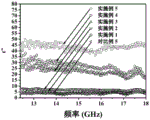
FIG. 7 a: electromagnetic parameters of the electromagnetic shielding materials prepared in the comparative example 5, the example 1, the example 2, the example 3, the example 4 and the example 5 are in the range of 12.4-18 GHz;
FIG. 7 b: electromagnetic parameters of the electromagnetic shielding materials prepared in the comparative example 5, the example 1, the example 2, the example 3, the example 4 and the example 5 are in the range of 12.4-18 GHz;
Detailed Description
Table one: t5 ℃ and T10 ℃ of the electromagnetic shielding materials prepared in comparative example 1, comparative example 2, example 1, example 2 and example 3;
watch 1

Table two: t5 ℃ and T10 ℃ of the electromagnetic shielding materials prepared in comparative example 1, comparative example 5, example 3, example 4 and example 5;
watch two

Table three: mechanical properties of the electromagnetic shielding materials prepared in comparative example 1, comparative example 2, example 1, example 2, example 3, example 4, example 5, and example 6.
Watch III
| Young's modulus (MPa) | |
| Comparative example 1 | 15 |
| Comparative example 2 | 28 |
| Example 1 | 31.7 |
| Example 2 | 32.9 |
| Example 3 | 34.1 |
| Example 4 | 41.9 |
| Example 5 | 62.3 |
| Example 6 | 35.1 |
Comparative example 1
Mixing raw materials: adding 8 ml of N-N dimethylformamide into a three-neck flask, stirring for 10 minutes at room temperature, adding 2003.285 g of polyethylene glycol, 3.602 g of hexamethylene diisocyanate HDI and 0.14 g of catalyst, stirring for 20 minutes at room temperature, putting the three-neck flask into an oil bath, introducing nitrogen, heating to 75 ℃, reacting for 10 minutes, heating to 80 ℃, reacting for 10 minutes, adding 0.213 g of lithium tetrafluoroborate, reacting for 30 minutes, putting the mixture into an oven at 55 ℃, and curing and drying for 6 hours.
Comparative example 2
Mixing raw materials: adding 8 ml of N-N dimethylformamide and 0.568 g of organic solvent lignin into a three-neck flask, stirring for 10 minutes at room temperature, adding 2003.018 g of polyethylene glycol, 3.301 g of hexamethylene diisocyanate HDI and 0.14 g of catalyst, stirring for 20 minutes at room temperature, putting the three-neck flask into an oil bath, introducing nitrogen, heating to 75 ℃, reacting for 10 minutes, heating to 80 ℃, reacting for 10 minutes, adding 0.213 g of lithium tetrafluoroborate, reacting for 30 minutes, putting the mixture into an oven at 55 ℃, and curing and drying for 6 hours.
Comparative example 3
Modification of nano ferroferric oxide: ultrasonically dispersing 20 ml of silane coupling agent, 40 ml of deionized water and 140 ml of methanol for 1 hour at room temperature, adding 5.00 g of nano ferroferric oxide, stirring for 2 hours, drying in an oven at 85 ℃, and drying for 6 hours.
Mixing raw materials: adding 8 ml of N-N dimethylformamide into a three-neck flask, stirring for 10 minutes at room temperature, adding 3.188 g of polyethylene glycol, 3.486 g of hexamethylene diisocyanate and 0.14 g of catalyst, stirring for 20 minutes at room temperature, putting the three-neck flask into an oil bath, introducing nitrogen, heating to 75 ℃, reacting for 10 minutes, heating to 80 ℃, reacting for 10 minutes, adding 0.213 g of modified nano ferroferric oxide and 0.213 g of lithium tetrafluoroborate, reacting for 30 minutes, putting the mixture into an oven at 55 ℃, and curing and drying for 6 hours.
Comparative example 4
Preparing a surfactant modified multi-walled carbon nanotube dispersion liquid: 0.213 g of multi-wall carbon nano-tube, 2 ml of DMF and 0.01 g of polyvinylpyrrolidone are mixed and then ultrasonically dispersed for 2 hours.
Mixing raw materials: adding 8 ml of N-N dimethylformamide into a three-neck flask, stirring at room temperature for 10 minutes, adding 2003.183 g of polyethylene glycol, 3.481 g of hexamethylene diisocyanate and 0.14 g of catalyst, stirring at room temperature for 20 minutes, putting the three-neck flask into an oil bath, introducing nitrogen, heating to 75 ℃, reacting for 10 minutes, heating to 80 ℃, reacting for 10 minutes, adding the obtained carbon nanotube dispersion and 0.213 g of lithium tetrafluoroborate, reacting for 30 minutes, putting the mixture into an oven at 55 ℃, and curing and drying for 6 hours.
Comparative example 5
Preparing a surfactant modified multi-walled carbon nanotube dispersion liquid: 0.213 g of multi-wall carbon nano-tube, 2 ml of DMF and 0.01 g of polyvinylpyrrolidone are mixed and then ultrasonically dispersed for 2 hours.
Mixing raw materials: adding 8 ml of N-N dimethylformamide into a three-neck flask, stirring for 10 minutes at room temperature, adding 2003.084 g of polyethylene glycol, 3.367 g of hexamethylene diisocyanate HDI and 0.14 g of catalyst, stirring for 20 minutes at room temperature, putting the three-neck flask into an oil bath, introducing nitrogen, heating to 75 ℃, reacting for 10 minutes, heating to 80 ℃, reacting for 10 minutes, adding 0.213 g of modified nano ferroferric oxide, adding the carbon nanotube dispersion and 0.213 g of lithium tetrafluoroborate, reacting for 30 minutes, putting the mixture into an oven at 55 ℃, and curing and drying for 6 hours.
Comparative example 6
Mixing raw materials: adding 8 ml of N-N dimethylformamide and 0.568 g of organic solvent lignin into a three-neck flask, stirring for 10 minutes at room temperature, adding 2002.916 g of polyethylene glycol, 3.190 g of hexamethylene diisocyanate HDI and 0.14 g of catalyst, stirring for 20 minutes at room temperature, putting the three-neck flask into an oil bath, introducing nitrogen, heating to 75 ℃, reacting for 10 minutes, heating to 80 ℃, reacting for 10 minutes, adding 0.213 g of modified nano ferroferric oxide and 0.213 g of lithium tetrafluoroborate, reacting for 30 minutes, putting the mixture into an oven at 55 ℃, and curing and drying for 6 hours.
Comparative example 7
Preparing a surfactant modified multi-walled carbon nanotube dispersion liquid: 0.213 g of multi-wall carbon nano-tube, 2 ml of DMF and 0.01 g of polyvinylpyrrolidone are mixed and then ultrasonically dispersed for 2 hours.
Mixing raw materials: adding 8 ml of N-N dimethylformamide and 0.568 g of organic solvent lignin into a three-neck flask, stirring for 10 minutes at room temperature, adding 2002.911 g of polyethylene glycol, 3.185 g of hexamethylene diisocyanate HDI and 0.14 g of catalyst, stirring for 20 minutes at room temperature, putting the three-neck flask into an oil bath, introducing nitrogen, heating to 75 ℃, reacting for 10 minutes, heating to 80 ℃, reacting for 10 minutes, adding the obtained carbon nanotube dispersion and 0.213 g of lithium tetrafluoroborate, reacting for 30 minutes, putting the mixture into an oven at 55 ℃, and curing and drying for 6 hours.
Example 1
Modification of nano ferroferric oxide: ultrasonically dispersing 20 ml of silane coupling agent, 40 ml of deionized water and 140 ml of methanol for 1 hour at room temperature, adding 5.00 g of nano ferroferric oxide, stirring for 2 hours, drying in an oven at 85 ℃, and drying for 6 hours.
Preparing a surfactant modified multi-walled carbon nanotube dispersion liquid: 0.213 g of multi-wall carbon nano-tube, 2 ml of DMF and 0.01 g of polyvinylpyrrolidone are mixed and then ultrasonically dispersed for 2 hours.
Mixing raw materials: adding 8 ml of N-N dimethylformamide and 0.568 g of organic solvent lignin into a three-neck flask, stirring for 10 minutes at room temperature, adding 2002.809 g of polyethylene glycol, 3.074 g of hexamethylene diisocyanate and 0.14 g of catalyst, stirring for 20 minutes at room temperature, putting the three-neck flask into an oil bath, introducing nitrogen, heating to 75 ℃, reacting for 10 minutes, heating to 80 ℃, reacting for 10 minutes, adding 0.213 g of modified nano ferroferric oxide, the carbon nanotube dispersion liquid obtained above and 0.213 g of lithium tetrafluoroborate, reacting for 30 minutes, putting the mixture into an oven at 55 ℃, and curing and drying for 6 hours.
Example 2
Preparing a surfactant modified multi-walled carbon nanotube dispersion liquid: 0.355 g of multi-wall carbon nano-tube, 3 ml of DMF and 0.18 g of polyvinylpyrrolidone are mixed and then ultrasonically dispersed for 2 hours.
Mixing raw materials: adding 8 ml of N-N dimethylformamide and 0.568 g of organic solvent lignin into a three-neck flask, stirring for 10 minutes at room temperature, adding 2002.670 g of polyethylene glycol, 2.921 g of hexamethylene diisocyanate and 0.14 g of catalyst, stirring for 20 minutes at room temperature, putting the three-neck flask into an oil bath, introducing nitrogen, heating to 75 ℃, reacting for 10 minutes, heating to 80 ℃, reacting for 10 minutes, adding 0.355 g of modified nano ferroferric oxide, the carbon nanotube dispersion liquid obtained above and 0.213 g of lithium tetrafluoroborate, reacting for 30 minutes, putting the mixture into an oven at 55 ℃, and curing and drying for 6 hours.
Example 3
Preparing a surfactant modified multi-walled carbon nanotube dispersion liquid: 0.497 g of multi-wall carbon nano-tube, 4 ml of DMF and 0.025 g of polyvinylpyrrolidone are mixed and then ultrasonically dispersed for 2 hours.
Mixing raw materials: adding 8 ml of N-N dimethylformamide and 0.568 g of organic solvent lignin into a three-neck flask, stirring for 10 minutes at room temperature, adding 2002.531 g of polyethylene glycol, 2.769 g of hexamethylene diisocyanate and 0.14 g of catalyst, stirring for 20 minutes at room temperature, putting the three-neck flask into an oil bath, introducing nitrogen, heating to 75 ℃, reacting for 10 minutes, heating to 80 ℃, reacting for 10 minutes, adding 0.497 g of modified nano ferroferric oxide, the carbon nanotube dispersion liquid obtained above and 0.213 g of lithium tetrafluoroborate, reacting for 30 minutes, putting the mixture into an oven at 55 ℃, and curing and drying for 6 hours.
Example 4
Preparing a surfactant modified multi-walled carbon nanotube dispersion liquid: 0.497 g of multi-wall carbon nano-tube, 4 ml of DMF and 0.025 g of polyvinylpyrrolidone are mixed and then ultrasonically dispersed for 2 hours.
Mixing raw materials: adding 8 ml of N-N dimethylformamide and 0.923 g of organic solvent lignin into a three-neck flask, stirring at room temperature for 10 minutes, adding 2002.361 g of polyethylene glycol, 2.584 g of hexamethylene diisocyanate and 0.14 g of catalyst, stirring at room temperature for 20 minutes, putting the three-neck flask into an oil bath, introducing nitrogen, heating to 75 ℃, reacting for 10 minutes, heating to 80 ℃, reacting for 10 minutes, adding 0.497 g of modified nano ferroferric oxide, the carbon nanotube dispersion liquid obtained above and 0.213 g of lithium tetrafluoroborate, reacting for 30 minutes, putting the mixture into an oven at 55 ℃, and curing and drying for 6 hours.
Example 5
Preparing a surfactant modified multi-walled carbon nanotube dispersion liquid: 0.497 g of multi-wall carbon nano-tube, 4 ml of DMF and 0.025 g of polyvinylpyrrolidone are mixed and then ultrasonically dispersed for 2 hours.
Mixing raw materials: adding 8 ml of N-N dimethylformamide and 1.278 g of organic solvent lignin, stirring for 10 minutes at room temperature, adding 2002.186 g of polyethylene glycol, 2.395 g of hexamethylene diisocyanate and 0.14 g of catalyst, stirring for 20 minutes at room temperature, putting the three-necked flask into an oil bath, introducing nitrogen, heating to 75 ℃, reacting for 10 minutes, heating to 80 ℃, reacting for 10 minutes, adding 0.497 g of modified nano ferroferric oxide, the carbon nanotube dispersion liquid obtained above and 0.213 g of lithium tetrafluoroborate, reacting for 30 minutes, putting the mixture into an oven at 55 ℃, and curing and drying for 6 hours.
Example 6
Preparing a surfactant modified multi-walled carbon nanotube dispersion liquid: 0.497 g of multi-wall carbon nano-tube, 4 ml of DMF and 0.025 g of polyvinylpyrrolidone are mixed and then ultrasonically dispersed for 2 hours.
Mixing raw materials: adding 8 ml of N-N dimethyl formamide and 0.568 g of organic solvent lignin into a three-neck flask, stirring for 10 minutes at room temperature, adding 2002.633 g of polyethylene glycol, 2.880 g of hexamethylene diisocyanate and 0.14 g of catalyst, stirring for 20 minutes at room temperature, putting the three-neck flask into an oil bath, introducing nitrogen, heating to 75 ℃, reacting for 10 minutes, heating to 80 ℃, reacting for 10 minutes, adding 0.497 g of modified nano ferroferric oxide and the carbon nano tube dispersion liquid obtained above, reacting for 30 minutes, putting the mixture into an oven at 55 ℃, and curing and drying for 6 hours.
The scanning in fig. 1 shows that the surface micro-topography of example 5 is relatively smooth, the micro-topography of the cross section of example 5 shows typical ductile fracture, and the carbon nanotubes are uniformly dispersed in the lignin-based polyurethane matrix and have good interface compatibility.
From fig. 2(a) (b) (c), it can be seen that the electromagnetic shielding effectiveness of comparative example 1, comparative example 2, comparative example 3, comparative example 4, comparative example 6, and comparative example 7 at 8.2 to 26.5GHz is shown, except that comparative example 1 contains only polyurethane and inorganic lithium salt, comparative example 2 contains polyurethane, lignin, and inorganic lithium salt, comparative example 3 contains polyurethane, nano-sized magnetite and inorganic lithium salt, comparative example 4 contains polyurethane, carbon nanotube, and inorganic lithium salt, comparative example 5 contains polyurethane, carbon nanotube, nano-sized magnetite and inorganic lithium salt, comparative example 6 contains polyurethane, lignin, nano-sized magnetite and inorganic lithium salt, and comparative example 7 contains polyurethane, lignin, carbon nanotube, and inorganic lithium salt. As can be seen from fig. 2(a), (b) and (c), the polyurethane and the inorganic lithium salt have certain electromagnetic shielding effectiveness, because the inorganic lithium salt exists in the form of ions in the matrix, so that the conductivity of the matrix is enhanced, and the electromagnetic shielding performance is enhanced. The electromagnetic shielding effect of adding lignin, nano ferroferric oxide and carbon nano tubes into PU and inorganic lithium salt separately, or adding lignin and nano ferroferric oxide, or adding lignin and carbon nano tubes is not obvious.
From FIGS. 3(a) (b) (c), electromagnetic shielding effectiveness of comparative example 5, example 1, example 2, and example 3 at 8.2-26.5GHz can be seen. In comparative example 5, when nano ferroferric oxide and carbon nanotubes were added to PU and inorganic lithium salt, the maximum electromagnetic shielding effectiveness reached 23dB (i.e., the electromagnetic shielding efficiency was 99.49%) in the frequency range of 8.2-26.5GHz, but the frequency width of the electromagnetic shielding effectiveness not less than 20dB (i.e., the electromagnetic shielding efficiency was 99%) was only 1 GHz. In the embodiment 1, the lignin is added, and the maximum electromagnetic shielding effectiveness reaches 25dB (namely the electromagnetic shielding efficiency is 99.68%) in the frequency range of 8.2-26.5GHz, which proves that the lignin has a certain effect of increasing the electromagnetic shielding. The difference between the embodiments 1, 2 and 3 is that the contents of the carbon nano tube and the nano ferroferric oxide are different. It can be seen that the electromagnetic shielding effectiveness of the material gradually increases with the increase of the content of the carbon nanotube and the nano ferroferric oxide, because the complete conductive network is formed inside the matrix with the increase of the content of the carbon nanotube and the nano ferroferric oxide, thereby increasing the electromagnetic shielding effectiveness. The mechanism is the reflection action of incident electromagnetic waves at the material interface on one hand, namely the electromagnetic waves are reflected at the surface of the material, which is the most important electromagnetic wave attenuation action; in addition, a certain absorption effect exists on the interface, because the nano ferroferric oxide can adjust impedance to achieve certain impedance matching, and the material can generate vortex under the action of an electromagnetic field induced by electromagnetic waves to dissipate the electromagnetic waves in the form of heat energy, which shows that the lignin, the carbon nano tube, the nano ferroferric oxide and the inorganic lithium salt play a synergistic effect on the electromagnetic shielding effect of the material.
Further, we compared the role of lignin in electromagnetic shielding materials. Fig. 4 and 5 are graphs of electromagnetic shielding effectiveness at 8.2-26.5GHz in examples 3, 4 and 5. Examples 3, 4 and 5 differ in the lignin content, which is 8%, 13% and 18% lignin, respectively. The maximum value of the embodiment 4 in the frequency range of 8.2-26.5GHz is 38dB (namely, the electromagnetic shielding efficiency is 99.985%), and the frequency width of the electromagnetic shielding effectiveness is more than or equal to 20dB (namely, the electromagnetic shielding efficiency is 99%) reaches 18.3 GHz. The maximum value of the embodiment 5 in the frequency range of 8.2-26.5GHz is 52dB (namely the electromagnetic shielding efficiency is 99.9995%), and the frequency width of the electromagnetic shielding effectiveness which is more than or equal to 20dB (namely the electromagnetic shielding efficiency is 99%) reaches 18.3GHz (8.2-26.5 GHz). The lignin is used as a polyelectrolyte and can form a more complete power network with the carbon nano tube and the nano ferroferric oxide, so that the electromagnetic shielding efficiency is enhanced. On the other hand, as the lignin is increased, the lignin and the carbon nano tube can form an isolation structure, and electromagnetic waves are reflected for multiple times in the structure to generate eddy currents and lose energy of the electromagnetic waves, so that the electromagnetic shielding efficiency is enhanced. The lignin, the carbon nano tube, the nano ferroferric oxide and the inorganic lithium salt play a synergistic role in the electromagnetic shielding effectiveness of the material. This shows that the addition of lignin has an unexpected effect on the improvement of the electromagnetic shielding performance of the material.
FIG. 7(a) (b) is a graph showing the electromagnetic shielding effectiveness at 8.2-26.5GHz in example 6. Example 6 has a maximum value of 35.2dB (i.e., 99.94% electromagnetic shielding efficiency) in the frequency range of 8.2-26.5GHz, and a frequency width of 13.8GHz (8.2-26.5GHz) with an electromagnetic shielding effectiveness of 20dB or more (i.e., 99% electromagnetic shielding efficiency). The maximum value of the embodiment 3 in the frequency range of 8.2-26.5GHz is 36dB (namely the electromagnetic shielding efficiency is 99.975%), and the frequency width of the electromagnetic shielding effectiveness which is more than or equal to 20dB (namely the electromagnetic shielding efficiency is 99%) reaches 17.8 GHz. Example 6 is different from example 3 in whether lithium salt is added or not, it can be seen that the electromagnetic shielding effectiveness of example 3 is superior to that of example 6, which shows that lithium salt has a certain effect in electromagnetic shielding.
From fig. 7(a) (b) it can be seen that the electromagnetic parameters of comparative example 5, example 1, example 2, example 3, example 4, example 5 at 12.4-18GHz, epsilon' denotes the real part of the dielectric and epsilon "denotes the imaginary part of the dielectric, from which it can be seen that examples 3, 4, example 5 have very high real and imaginary parts of the dielectric, indicating that electrical storage and dissipation dominate in electromagnetic shielding.
In table one, it can be seen that T5 ℃ and T10 ℃ of the electromagnetic shielding materials prepared in comparative example 1, comparative example 2, example 1, example 2 and example 3, and T5 ℃ of comparative example 1 is 273 ℃, after the nano ferroferric oxide and the carbon nanotubes are added, T5 ℃ is slightly lowered relative to comparative example 1, but as the content of the nano ferroferric oxide and the carbon nanotubes is increased, T5 ℃ is slightly raised, probably because the carbon nanotubes can improve certain thermal stability, and T10 ℃ is not greatly changed, so that the processing requirements are met.
In table two, it can be seen that the electromagnetic shielding materials prepared in comparative example 1, comparative example 5, example 3, example 4 and example 5 have T5 ℃ and T10 ℃, the T5 ℃ of comparative example 5 is 270 ℃, the T5 ℃ is decreased to some extent as the lignin content increases, and the T5 ℃ of example 5 is 260 ℃, because the decomposition temperature of lignin is relatively low, and the T10 ℃ is not changed much, which satisfies the processing requirements.
The third table shows the mechanical strength of comparative example 1, comparative example 2, example 1, example 2, example 3, example 4, example 5, and example 6. The Young modulus is obviously increased to 62.3 MPa. The addition of the rigid carbon nano tube and the nano ferroferric oxide can improve the modulus of the material.
Claims (10)
1. A composite electromagnetic shielding material is prepared from the following raw materials: the lignin-modified polyurethane comprises lignin-modified polyurethane, a carbon nano tube, nano ferroferric oxide and inorganic lithium salt, wherein the total mass of the lignin-modified polyurethane, the carbon nano tube, the nano ferroferric oxide and the inorganic lithium salt is 79-91%, and the dosage ranges of the carbon nano tube, the nano ferroferric oxide and the inorganic lithium salt are respectively 3-7%.
2. The composite electromagnetic shielding material of claim 1, wherein the lignin-modified polyurethane is a lignin-modified polyurethane oligomer obtained by in-situ polymerization of 2.10-3.60 g of isocyanate, 2.08-3.29 g of polyol and 0.50-1.28 g of lignin under the action of a catalyst, wherein the lignin comprises organic solvent lignin, alkali lignin or sulfonate lignin;
the isocyanate is selected from toluene diisocyanate TDI, diphenylmethane diisocyanate MDI, hexamethylene diisocyanate HDI, 4-dicyclohexyl methane diisocyanate H12MDI or trimethylethane diisocyanate TMDI.
3. The composite electromagnetic shielding material of claim 2,
the polyol is selected from polyester polyols or polyether polyols, the polyester polyols comprising: a polycaprolactone polyol or a polycarbonate diol, said polyether polyol comprising: polyethylene glycol, flame-retardant polyether polyol, graft polyether polyol, polytetrahydrofuran polyol or heterocycle modified polyether polyol.
4. A composite electromagnetic shielding material according to any one of claims 1 to 3, wherein the carbon nanotubes are single-walled carbon nanotubes, multi-walled carbon nanotubes, surfactant-modified single-walled carbon nanotubes or surfactant-modified multi-walled carbon nanotubes;
the inorganic lithium salt includes: lithium perchlorate, lithium tetrafluoroborate, lithium hexafluoroarsenate or lithium hexafluorophosphate.
5. A composite electromagnetic shielding material according to any one of claims 1 to 3, wherein the nano ferroferric oxide has a size of 10 to 300nm, and is a silane coupling agent surface-modified nano ferroferric oxide.
6. A method for preparing a composite electromagnetic shielding material according to any one of claims 1 to 5, comprising the steps of:
(1) carrying out in-situ polymerization on isocyanate, polyether polyol and lignin under the action of a catalyst to obtain a lignin modified polyurethane prepolymer;
(2) adding a carbon nano tube dispersion liquid, modified nano ferroferric oxide and inorganic lithium salt into a reaction system of the lignin modified polyurethane prepolymer, mixing, and continuing to react to further react the lignin modified polyurethane prepolymer to generate a lignin modified polyurethane prepolymer compounded by the carbon nano tube, the modified nano ferroferric oxide and the inorganic lithium salt;
(3) and curing and drying to obtain the composite electromagnetic shielding material.
7. The method for preparing a composite electromagnetic shielding material according to claim 6,
the isocyanate is HDI, and the preparation method of the lignin-modified polyurethane prepolymer comprises the following steps:
mixing N-N dimethylformamide and lignin, stirring for 5-20 minutes at the mixing temperature of 25-35 ℃, and adding polyether polyol, isocyanate and a catalyst into the mixture; and then heating to 70-80 ℃, stirring and reacting for 20-30 minutes, or heating to 50-80 ℃ under the condition of introducing nitrogen into an oil bath, reacting for 10-30 minutes, then heating to 60-80 ℃ and reacting for 10-30 minutes, or heating to 60-90 ℃ under the condition of introducing nitrogen into an oil bath, and reacting for 2-3 hours.
8. The method for preparing a composite electromagnetic shielding material according to claim 6,
the preparation of the modified nano ferroferric oxide comprises the following steps: silane coupling agent, deionized water and methanol are mixed according to the mass ratio of 1-3: 1-3: 6-8, performing ultrasonic dispersion, adding nano ferroferric oxide, continuously stirring and drying to obtain silane coupling agent modified nano ferroferric oxide;
preparing the carbon nano tube dispersion liquid: carbon nano tubes, DMF and polyvinylpyrrolidone are mixed according to the mass ratio of 70-90: 300-500: 1-10, mixing and then carrying out ultrasonic dispersion;
mixing N-N dimethylformamide and lignin, adding polyether polyol, isocyanate and a catalyst, mixing, stirring and dissolving, and then heating to react to obtain a lignin modified polyurethane prepolymer; and then adding the carbon nano tube dispersion liquid, the silane coupling agent modified nano ferroferric oxide and inorganic lithium salt into the lignin modified polyurethane prepolymer, and finally curing and drying to obtain the composite electromagnetic shielding material.
9. The method for preparing a composite electromagnetic shielding material according to claim 6,
the preparation of the modified nano ferroferric oxide comprises the following steps: mixing a silane coupling agent, deionized water and methanol at room temperature, performing ultrasonic dispersion for 0.5-1 hour, adding nano ferroferric oxide, stirring for 1-2 hours, and drying at 80-100 ℃ for 5-8 hours;
preparing the carbon nano tube dispersion liquid: mixing the carbon nano tube, DMF (dimethyl formamide) and polyvinylpyrrolidone, and then ultrasonically dispersing for 1-2 hours;
mixing N-N dimethylformamide and lignin at room temperature, stirring for 5-10 minutes, adding polyol, isocyanate and a catalyst, and stirring for 5-10 minutes at room temperature; heating the mixture to 50-60 ℃ in an oil bath under nitrogen, reacting for 20-30 minutes, and heating the mixture to 60-70 ℃ to react for 20-30 minutes to obtain an oligomer; then adding a carbon nano tube, modified nano ferroferric oxide and inorganic lithium salt, and reacting for 30-45 minutes; and pouring the obtained mixture into a polytetrafluoroethylene mold, and quickly curing and drying at 35-80 ℃ for 4-12 hours to obtain the composite electromagnetic shielding material based on lignin modified polyurethane, carbon nano tubes, nano ferroferric oxide and inorganic lithium salt.
10. Use of the composite electromagnetic shielding material prepared by the method of any one of claims 1 to 5 and 6 to 9 in microwave darkroom, microwave communication information, electromagnetic protection and portable mobile equipment.
Priority Applications (1)
| Application Number | Priority Date | Filing Date | Title |
|---|---|---|---|
| CN201910810950.3A CN110483980B (en) | 2019-08-30 | 2019-08-30 | Composite electromagnetic shielding material and preparation method and application thereof |
Applications Claiming Priority (1)
| Application Number | Priority Date | Filing Date | Title |
|---|---|---|---|
| CN201910810950.3A CN110483980B (en) | 2019-08-30 | 2019-08-30 | Composite electromagnetic shielding material and preparation method and application thereof |
Publications (2)
| Publication Number | Publication Date |
|---|---|
| CN110483980A CN110483980A (en) | 2019-11-22 |
| CN110483980B true CN110483980B (en) | 2021-05-25 |
Family
ID=68555193
Family Applications (1)
| Application Number | Title | Priority Date | Filing Date |
|---|---|---|---|
| CN201910810950.3A Active CN110483980B (en) | 2019-08-30 | 2019-08-30 | Composite electromagnetic shielding material and preparation method and application thereof |
Country Status (1)
| Country | Link |
|---|---|
| CN (1) | CN110483980B (en) |
Families Citing this family (2)
| Publication number | Priority date | Publication date | Assignee | Title |
|---|---|---|---|---|
| CN110938354B (en) * | 2019-12-11 | 2021-07-30 | 东北师范大学 | A kind of composite paint film electromagnetic shielding material and preparation method |
| CN120005144A (en) * | 2025-04-18 | 2025-05-16 | 扬州斯帕克实业有限公司 | A polyurethane-based porous composite wave-absorbing material and a preparation method thereof |
Citations (9)
| Publication number | Priority date | Publication date | Assignee | Title |
|---|---|---|---|---|
| JPH0433207A (en) * | 1990-05-28 | 1992-02-04 | Sanyo Chem Ind Ltd | Semiconductive elastic resin composition |
| KR20010010433A (en) * | 1999-07-20 | 2001-02-15 | 전종한 | Conductive Polyurethane Composition |
| WO2010124260A1 (en) * | 2009-04-24 | 2010-10-28 | Lockheed Martin Corporation | Cnt-infused emi shielding composite and coating |
| CN104371271A (en) * | 2013-08-15 | 2015-02-25 | 北京国浩传感器技术研究院(普通合伙) | New corrosion resistant composite wave absorbing material |
| CN106497048A (en) * | 2016-10-27 | 2017-03-15 | 中国科学院理化技术研究所 | Preparation method of anisotropic conductive polymer composite film |
| CN107857853A (en) * | 2016-09-22 | 2018-03-30 | 河南海纳德新材料有限公司 | Polyurethane inhales wave resistance combustion porous material and preparation method thereof |
| CN107857852A (en) * | 2016-09-22 | 2018-03-30 | 河南海纳德新材料有限公司 | Polyurethane wave-absorbing material and preparation method thereof |
| CN108774390A (en) * | 2018-06-22 | 2018-11-09 | 四川大学 | A kind of stratiform foaming absorbing material and preparation method thereof |
| CN109776749A (en) * | 2019-01-14 | 2019-05-21 | 长春工业大学 | A lignin-based flexible electromagnetic shielding material |
Family Cites Families (1)
| Publication number | Priority date | Publication date | Assignee | Title |
|---|---|---|---|---|
| CN111770958A (en) * | 2017-10-11 | 2020-10-13 | 钢筋分子设计有限责任公司 | Shielding formulations using discrete carbon nanotubes with target oxidation levels and formulations thereof |
-
2019
- 2019-08-30 CN CN201910810950.3A patent/CN110483980B/en active Active
Patent Citations (9)
| Publication number | Priority date | Publication date | Assignee | Title |
|---|---|---|---|---|
| JPH0433207A (en) * | 1990-05-28 | 1992-02-04 | Sanyo Chem Ind Ltd | Semiconductive elastic resin composition |
| KR20010010433A (en) * | 1999-07-20 | 2001-02-15 | 전종한 | Conductive Polyurethane Composition |
| WO2010124260A1 (en) * | 2009-04-24 | 2010-10-28 | Lockheed Martin Corporation | Cnt-infused emi shielding composite and coating |
| CN104371271A (en) * | 2013-08-15 | 2015-02-25 | 北京国浩传感器技术研究院(普通合伙) | New corrosion resistant composite wave absorbing material |
| CN107857853A (en) * | 2016-09-22 | 2018-03-30 | 河南海纳德新材料有限公司 | Polyurethane inhales wave resistance combustion porous material and preparation method thereof |
| CN107857852A (en) * | 2016-09-22 | 2018-03-30 | 河南海纳德新材料有限公司 | Polyurethane wave-absorbing material and preparation method thereof |
| CN106497048A (en) * | 2016-10-27 | 2017-03-15 | 中国科学院理化技术研究所 | Preparation method of anisotropic conductive polymer composite film |
| CN108774390A (en) * | 2018-06-22 | 2018-11-09 | 四川大学 | A kind of stratiform foaming absorbing material and preparation method thereof |
| CN109776749A (en) * | 2019-01-14 | 2019-05-21 | 长春工业大学 | A lignin-based flexible electromagnetic shielding material |
Non-Patent Citations (2)
| Title |
|---|
| Electromagnetic interference shielding performance of polyurethane composites:A comparative study of GNs-IL/Fe3O4 and MWCNTs-IL/Fe3O4 hybrid fillers;Guolong Sang et al.;《Composites Part B》;20190121;第164卷;第467-475页 * |
| 木质素基电磁屏蔽材料的制备及性能研究;张佳;《中国学位论文全文数据库》;20201208;全文 * |
Also Published As
| Publication number | Publication date |
|---|---|
| CN110483980A (en) | 2019-11-22 |
Similar Documents
| Publication | Publication Date | Title |
|---|---|---|
| Gahlout et al. | EMI shielding response of polypyrrole-MWCNT/polyurethane composites | |
| Zachariah et al. | Hybrid materials for electromagnetic shielding: A review | |
| CN109776749B (en) | Lignin-based flexible electromagnetic shielding material | |
| Fang et al. | Layer-structured silver nanowire/polyaniline composite film as a high performance X-band EMI shielding material | |
| Rohini et al. | Electromagnetic wave suppressors derived from crosslinked polymer composites containing functional particles: Potential and key challenges | |
| Drakakis et al. | A study of the electromagnetic shielding mechanisms in the GHz frequency range of graphene based composite layers | |
| Ghosh et al. | Micro-computed tomography enhanced cross-linked carboxylated acrylonitrile butadiene rubber with the decoration of new generation conductive carbon black for high strain tolerant electromagnetic wave absorber | |
| Menon et al. | Mussel-inspired self-healing polyurethane with “flower-like” magnetic MoS2 as efficient microwave absorbers | |
| Fan et al. | Polyurethane/polydopamine/graphene auxetic composite foam with high-efficient and tunable electromagnetic interference shielding performance | |
| Zeng et al. | EMI shielding performance of phenolic-based carbon foam modified with GO/SiO2 hybrid nanomaterials | |
| CN114957786B (en) | Electromagnetic shielding composite material with asymmetric structure, preparation method thereof and electromagnetic shielding device | |
| CN110483980B (en) | Composite electromagnetic shielding material and preparation method and application thereof | |
| He et al. | Electrical conductivity and electromagnetic interference shielding effectiveness of carbon black/sisal fiber/polyamide/polypropylene composites | |
| Deeraj et al. | EMI shielding materials based on thermosetting polymers | |
| Wang et al. | Lightweight MWCNT/hollow mesoporous carbon/WPU composite material with excellent electromagnetic shielding performance | |
| Lee et al. | Preparation and characteristics of conducting polymer-coated MWCNTs as electromagnetic interference shielding materials | |
| CN105482213A (en) | Halogen-free flame-retardant noise suppression sheet and preparation method thereof | |
| Faisal et al. | Polyaniline-stannous oxide composites: novel material for broadband EMI shielding | |
| CN118459976B (en) | Electromagnetic absorption polyurethane film material and preparation method thereof | |
| Singh et al. | Carbon Nanotubes based Composites for Electromagnetic Absorption-A Review | |
| EP1930364A1 (en) | Polymer composite material structures comprising carbon based conductive loads | |
| CN111393948A (en) | Preparation method of material with good wave-absorbing effect | |
| CN111073296B (en) | Wave-absorbing patch and preparation method thereof | |
| Hasani et al. | Effect of Thickness and Conductivity on Electromagnetic Interference Shielding Effectiveness of Bio Composite Shields | |
| Wang et al. | Easily manufacture lightweight EPDM/POE/KB foam with high electromagnetic shielding efficiency and high absorption coefficient through chemical foaming |
Legal Events
| Date | Code | Title | Description |
|---|---|---|---|
| PB01 | Publication | ||
| PB01 | Publication | ||
| SE01 | Entry into force of request for substantive examination | ||
| SE01 | Entry into force of request for substantive examination | ||
| GR01 | Patent grant | ||
| GR01 | Patent grant | ||
| TR01 | Transfer of patent right |
Effective date of registration: 20250317 Address after: No. 1688 Hangkong Street, Changchun City, Jilin Province, China 130000 Patentee after: CHANGCHUN KINWA HIGH TECHNOLOGY CO.,LTD. Country or region after: China Address before: 130024 No. 5268 Renmin Street, Nanguan District, Jilin, Changchun Patentee before: Northeast Normal University Country or region before: China |
|
| TR01 | Transfer of patent right |