CN110382097B - Asymmetric membrane - Google Patents
Asymmetric membrane Download PDFInfo
- Publication number
- CN110382097B CN110382097B CN201980001476.8A CN201980001476A CN110382097B CN 110382097 B CN110382097 B CN 110382097B CN 201980001476 A CN201980001476 A CN 201980001476A CN 110382097 B CN110382097 B CN 110382097B
- Authority
- CN
- China
- Prior art keywords
- structural unit
- group
- formula
- polyimide resin
- derived
- Prior art date
- Legal status (The legal status is an assumption and is not a legal conclusion. Google has not performed a legal analysis and makes no representation as to the accuracy of the status listed.)
- Active
Links
Classifications
-
- B—PERFORMING OPERATIONS; TRANSPORTING
- B01—PHYSICAL OR CHEMICAL PROCESSES OR APPARATUS IN GENERAL
- B01D—SEPARATION
- B01D71/00—Semi-permeable membranes for separation processes or apparatus characterised by the material; Manufacturing processes specially adapted therefor
- B01D71/06—Organic material
- B01D71/58—Other polymers having nitrogen in the main chain, with or without oxygen or carbon only
- B01D71/62—Polycondensates having nitrogen-containing heterocyclic rings in the main chain
- B01D71/64—Polyimides; Polyamide-imides; Polyester-imides; Polyamide acids or similar polyimide precursors
-
- B—PERFORMING OPERATIONS; TRANSPORTING
- B01—PHYSICAL OR CHEMICAL PROCESSES OR APPARATUS IN GENERAL
- B01D—SEPARATION
- B01D53/00—Separation of gases or vapours; Recovering vapours of volatile solvents from gases; Chemical or biological purification of waste gases, e.g. engine exhaust gases, smoke, fumes, flue gases, aerosols
- B01D53/22—Separation of gases or vapours; Recovering vapours of volatile solvents from gases; Chemical or biological purification of waste gases, e.g. engine exhaust gases, smoke, fumes, flue gases, aerosols by diffusion
- B01D53/228—Separation of gases or vapours; Recovering vapours of volatile solvents from gases; Chemical or biological purification of waste gases, e.g. engine exhaust gases, smoke, fumes, flue gases, aerosols by diffusion characterised by specific membranes
-
- B—PERFORMING OPERATIONS; TRANSPORTING
- B01—PHYSICAL OR CHEMICAL PROCESSES OR APPARATUS IN GENERAL
- B01D—SEPARATION
- B01D69/00—Semi-permeable membranes for separation processes or apparatus characterised by their form, structure or properties; Manufacturing processes specially adapted therefor
- B01D69/02—Semi-permeable membranes for separation processes or apparatus characterised by their form, structure or properties; Manufacturing processes specially adapted therefor characterised by their properties
-
- B—PERFORMING OPERATIONS; TRANSPORTING
- B01—PHYSICAL OR CHEMICAL PROCESSES OR APPARATUS IN GENERAL
- B01D—SEPARATION
- B01D69/00—Semi-permeable membranes for separation processes or apparatus characterised by their form, structure or properties; Manufacturing processes specially adapted therefor
- B01D69/06—Flat membranes
-
- B—PERFORMING OPERATIONS; TRANSPORTING
- B01—PHYSICAL OR CHEMICAL PROCESSES OR APPARATUS IN GENERAL
- B01D—SEPARATION
- B01D69/00—Semi-permeable membranes for separation processes or apparatus characterised by their form, structure or properties; Manufacturing processes specially adapted therefor
- B01D69/08—Hollow fibre membranes
-
- B—PERFORMING OPERATIONS; TRANSPORTING
- B01—PHYSICAL OR CHEMICAL PROCESSES OR APPARATUS IN GENERAL
- B01D—SEPARATION
- B01D69/00—Semi-permeable membranes for separation processes or apparatus characterised by their form, structure or properties; Manufacturing processes specially adapted therefor
- B01D69/12—Composite membranes; Ultra-thin membranes
- B01D69/125—In situ manufacturing by polymerisation, polycondensation, cross-linking or chemical reaction
-
- C—CHEMISTRY; METALLURGY
- C08—ORGANIC MACROMOLECULAR COMPOUNDS; THEIR PREPARATION OR CHEMICAL WORKING-UP; COMPOSITIONS BASED THEREON
- C08G—MACROMOLECULAR COMPOUNDS OBTAINED OTHERWISE THAN BY REACTIONS ONLY INVOLVING UNSATURATED CARBON-TO-CARBON BONDS
- C08G73/00—Macromolecular compounds obtained by reactions forming a linkage containing nitrogen with or without oxygen or carbon in the main chain of the macromolecule, not provided for in groups C08G12/00 - C08G71/00
- C08G73/06—Polycondensates having nitrogen-containing heterocyclic rings in the main chain of the macromolecule
- C08G73/10—Polyimides; Polyester-imides; Polyamide-imides; Polyamide acids or similar polyimide precursors
- C08G73/1003—Preparatory processes
- C08G73/1007—Preparatory processes from tetracarboxylic acids or derivatives and diamines
-
- C—CHEMISTRY; METALLURGY
- C08—ORGANIC MACROMOLECULAR COMPOUNDS; THEIR PREPARATION OR CHEMICAL WORKING-UP; COMPOSITIONS BASED THEREON
- C08G—MACROMOLECULAR COMPOUNDS OBTAINED OTHERWISE THAN BY REACTIONS ONLY INVOLVING UNSATURATED CARBON-TO-CARBON BONDS
- C08G73/00—Macromolecular compounds obtained by reactions forming a linkage containing nitrogen with or without oxygen or carbon in the main chain of the macromolecule, not provided for in groups C08G12/00 - C08G71/00
- C08G73/06—Polycondensates having nitrogen-containing heterocyclic rings in the main chain of the macromolecule
- C08G73/10—Polyimides; Polyester-imides; Polyamide-imides; Polyamide acids or similar polyimide precursors
- C08G73/1075—Partially aromatic polyimides
- C08G73/1078—Partially aromatic polyimides wholly aromatic in the diamino moiety
-
- C—CHEMISTRY; METALLURGY
- C08—ORGANIC MACROMOLECULAR COMPOUNDS; THEIR PREPARATION OR CHEMICAL WORKING-UP; COMPOSITIONS BASED THEREON
- C08K—Use of inorganic or non-macromolecular organic substances as compounding ingredients
- C08K5/00—Use of organic ingredients
- C08K5/0008—Organic ingredients according to more than one of the "one dot" groups of C08K5/01 - C08K5/59
- C08K5/0025—Crosslinking or vulcanising agents; including accelerators
-
- C—CHEMISTRY; METALLURGY
- C08—ORGANIC MACROMOLECULAR COMPOUNDS; THEIR PREPARATION OR CHEMICAL WORKING-UP; COMPOSITIONS BASED THEREON
- C08K—Use of inorganic or non-macromolecular organic substances as compounding ingredients
- C08K5/00—Use of organic ingredients
- C08K5/16—Nitrogen-containing compounds
- C08K5/34—Heterocyclic compounds having nitrogen in the ring
- C08K5/35—Heterocyclic compounds having nitrogen in the ring having also oxygen in the ring
- C08K5/353—Five-membered rings
-
- C—CHEMISTRY; METALLURGY
- C08—ORGANIC MACROMOLECULAR COMPOUNDS; THEIR PREPARATION OR CHEMICAL WORKING-UP; COMPOSITIONS BASED THEREON
- C08L—COMPOSITIONS OF MACROMOLECULAR COMPOUNDS
- C08L79/00—Compositions of macromolecular compounds obtained by reactions forming in the main chain of the macromolecule a linkage containing nitrogen with or without oxygen or carbon only, not provided for in groups C08L61/00 - C08L77/00
- C08L79/04—Polycondensates having nitrogen-containing heterocyclic rings in the main chain; Polyhydrazides; Polyamide acids or similar polyimide precursors
- C08L79/08—Polyimides; Polyester-imides; Polyamide-imides; Polyamide acids or similar polyimide precursors
-
- B—PERFORMING OPERATIONS; TRANSPORTING
- B01—PHYSICAL OR CHEMICAL PROCESSES OR APPARATUS IN GENERAL
- B01D—SEPARATION
- B01D53/00—Separation of gases or vapours; Recovering vapours of volatile solvents from gases; Chemical or biological purification of waste gases, e.g. engine exhaust gases, smoke, fumes, flue gases, aerosols
- B01D53/22—Separation of gases or vapours; Recovering vapours of volatile solvents from gases; Chemical or biological purification of waste gases, e.g. engine exhaust gases, smoke, fumes, flue gases, aerosols by diffusion
- B01D2053/221—Devices
- B01D2053/223—Devices with hollow tubes
- B01D2053/224—Devices with hollow tubes with hollow fibres
-
- B—PERFORMING OPERATIONS; TRANSPORTING
- B01—PHYSICAL OR CHEMICAL PROCESSES OR APPARATUS IN GENERAL
- B01D—SEPARATION
- B01D2256/00—Main component in the product gas stream after treatment
- B01D2256/10—Nitrogen
-
- B—PERFORMING OPERATIONS; TRANSPORTING
- B01—PHYSICAL OR CHEMICAL PROCESSES OR APPARATUS IN GENERAL
- B01D—SEPARATION
- B01D2256/00—Main component in the product gas stream after treatment
- B01D2256/12—Oxygen
-
- B—PERFORMING OPERATIONS; TRANSPORTING
- B01—PHYSICAL OR CHEMICAL PROCESSES OR APPARATUS IN GENERAL
- B01D—SEPARATION
- B01D2256/00—Main component in the product gas stream after treatment
- B01D2256/16—Hydrogen
-
- B—PERFORMING OPERATIONS; TRANSPORTING
- B01—PHYSICAL OR CHEMICAL PROCESSES OR APPARATUS IN GENERAL
- B01D—SEPARATION
- B01D2256/00—Main component in the product gas stream after treatment
- B01D2256/20—Carbon monoxide
-
- B—PERFORMING OPERATIONS; TRANSPORTING
- B01—PHYSICAL OR CHEMICAL PROCESSES OR APPARATUS IN GENERAL
- B01D—SEPARATION
- B01D2256/00—Main component in the product gas stream after treatment
- B01D2256/24—Hydrocarbons
- B01D2256/245—Methane
-
- B—PERFORMING OPERATIONS; TRANSPORTING
- B01—PHYSICAL OR CHEMICAL PROCESSES OR APPARATUS IN GENERAL
- B01D—SEPARATION
- B01D2257/00—Components to be removed
- B01D2257/10—Single element gases other than halogens
- B01D2257/102—Nitrogen
-
- B—PERFORMING OPERATIONS; TRANSPORTING
- B01—PHYSICAL OR CHEMICAL PROCESSES OR APPARATUS IN GENERAL
- B01D—SEPARATION
- B01D2257/00—Components to be removed
- B01D2257/10—Single element gases other than halogens
- B01D2257/104—Oxygen
-
- B—PERFORMING OPERATIONS; TRANSPORTING
- B01—PHYSICAL OR CHEMICAL PROCESSES OR APPARATUS IN GENERAL
- B01D—SEPARATION
- B01D2257/00—Components to be removed
- B01D2257/10—Single element gases other than halogens
- B01D2257/108—Hydrogen
-
- B—PERFORMING OPERATIONS; TRANSPORTING
- B01—PHYSICAL OR CHEMICAL PROCESSES OR APPARATUS IN GENERAL
- B01D—SEPARATION
- B01D2257/00—Components to be removed
- B01D2257/30—Sulfur compounds
- B01D2257/304—Hydrogen sulfide
-
- B—PERFORMING OPERATIONS; TRANSPORTING
- B01—PHYSICAL OR CHEMICAL PROCESSES OR APPARATUS IN GENERAL
- B01D—SEPARATION
- B01D2257/00—Components to be removed
- B01D2257/50—Carbon oxides
- B01D2257/504—Carbon dioxide
-
- B—PERFORMING OPERATIONS; TRANSPORTING
- B01—PHYSICAL OR CHEMICAL PROCESSES OR APPARATUS IN GENERAL
- B01D—SEPARATION
- B01D2257/00—Components to be removed
- B01D2257/80—Water
-
- B—PERFORMING OPERATIONS; TRANSPORTING
- B01—PHYSICAL OR CHEMICAL PROCESSES OR APPARATUS IN GENERAL
- B01D—SEPARATION
- B01D2258/00—Sources of waste gases
- B01D2258/06—Polluted air
-
- B—PERFORMING OPERATIONS; TRANSPORTING
- B01—PHYSICAL OR CHEMICAL PROCESSES OR APPARATUS IN GENERAL
- B01D—SEPARATION
- B01D2323/00—Details relating to membrane preparation
- B01D2323/12—Specific ratios of components used
-
- B—PERFORMING OPERATIONS; TRANSPORTING
- B01—PHYSICAL OR CHEMICAL PROCESSES OR APPARATUS IN GENERAL
- B01D—SEPARATION
- B01D2323/00—Details relating to membrane preparation
- B01D2323/30—Cross-linking
-
- B—PERFORMING OPERATIONS; TRANSPORTING
- B01—PHYSICAL OR CHEMICAL PROCESSES OR APPARATUS IN GENERAL
- B01D—SEPARATION
- B01D2325/00—Details relating to properties of membranes
- B01D2325/02—Details relating to pores or porosity of the membranes
- B01D2325/022—Asymmetric membranes
-
- Y—GENERAL TAGGING OF NEW TECHNOLOGICAL DEVELOPMENTS; GENERAL TAGGING OF CROSS-SECTIONAL TECHNOLOGIES SPANNING OVER SEVERAL SECTIONS OF THE IPC; TECHNICAL SUBJECTS COVERED BY FORMER USPC CROSS-REFERENCE ART COLLECTIONS [XRACs] AND DIGESTS
- Y02—TECHNOLOGIES OR APPLICATIONS FOR MITIGATION OR ADAPTATION AGAINST CLIMATE CHANGE
- Y02C—CAPTURE, STORAGE, SEQUESTRATION OR DISPOSAL OF GREENHOUSE GASES [GHG]
- Y02C20/00—Capture or disposal of greenhouse gases
- Y02C20/40—Capture or disposal of greenhouse gases of CO2
-
- Y—GENERAL TAGGING OF NEW TECHNOLOGICAL DEVELOPMENTS; GENERAL TAGGING OF CROSS-SECTIONAL TECHNOLOGIES SPANNING OVER SEVERAL SECTIONS OF THE IPC; TECHNICAL SUBJECTS COVERED BY FORMER USPC CROSS-REFERENCE ART COLLECTIONS [XRACs] AND DIGESTS
- Y02—TECHNOLOGIES OR APPLICATIONS FOR MITIGATION OR ADAPTATION AGAINST CLIMATE CHANGE
- Y02P—CLIMATE CHANGE MITIGATION TECHNOLOGIES IN THE PRODUCTION OR PROCESSING OF GOODS
- Y02P20/00—Technologies relating to chemical industry
- Y02P20/151—Reduction of greenhouse gas [GHG] emissions, e.g. CO2
Landscapes
- Chemical & Material Sciences (AREA)
- Chemical Kinetics & Catalysis (AREA)
- Health & Medical Sciences (AREA)
- Medicinal Chemistry (AREA)
- Polymers & Plastics (AREA)
- Organic Chemistry (AREA)
- Engineering & Computer Science (AREA)
- Analytical Chemistry (AREA)
- General Chemical & Material Sciences (AREA)
- Oil, Petroleum & Natural Gas (AREA)
- Macromolecular Compounds Obtained By Forming Nitrogen-Containing Linkages In General (AREA)
- Separation Using Semi-Permeable Membranes (AREA)
Abstract
Description
技术领域technical field
本发明涉及对废气分离处理、工业气体用气体分离等有用的非对称膜。The present invention relates to asymmetric membranes useful for waste gas separation treatment, gas separation for industrial gases, and the like.
背景技术Background technique
1997年的防止全球变暖会议中,规定了发达国家的温室效应气体排出量削减目标,因此,要求削减在温室效应气体内、释放到大气中最多的CO2气体的排出量。另一方面,已知有从气体混合物中选择性地分离目标气体的气体分离膜,特别是高分子气体分离膜的透过性、加工性优异,因此,可以期待作为用于分离由火力发电厂、工厂等大量排出的CO2气体的用途。例如专利文献1中公开了如下内容:工业上广泛使用由醋酸纤维素形成的气体分离膜。In 1997, the Global Warming Prevention Conference established the reduction target of greenhouse gas emissions in developed countries. Therefore, it is required to reduce the emission of CO 2 gas, which is released into the atmosphere the most among the greenhouse gases. On the other hand, gas separation membranes for selectively separating target gases from gas mixtures are known. In particular, polymer gas separation membranes are excellent in permeability and processability, and therefore, they are expected to be used for separation by thermal power plants. , the use of CO 2 gas emitted in large quantities in factories, etc. For example, Patent Document 1 discloses that gas separation membranes made of cellulose acetate are widely used industrially.
另外,专利文献2中,为了提供具有气体透过性和气体分离选择性均优异、高压条件下也表现优异的气体透过性和气体分离选择性、且也不易受到存在于天然气体中的甲苯等杂质的影响的气体分离层的气体分离膜,公开了一种气体分离膜,其具有气体分离层,所述气体分离层是含有使用以3,5-二硝基-2,4,6-三甲基苯磺酰胺为代表的特定二胺的聚酰亚胺化合物而成的。In addition, in Patent Document 2, in order to provide both excellent gas permeability and gas separation selectivity, excellent gas permeability and gas separation selectivity even under high pressure conditions, and less susceptible to toluene existing in natural gas A gas separation membrane of a gas separation layer affected by impurities such as It consists of a polyimide compound of a specific diamine represented by trimethylbenzenesulfonamide.
现有技术文献prior art literature
专利文献Patent Literature
专利文献1:日本特公平3-001055号公报Patent Document 1: Japanese Patent Publication No. 3-001055
专利文献2:国际公开第2017/002407号Patent Document 2: International Publication No. 2017/002407
发明内容SUMMARY OF THE INVENTION
发明要解决的问题Invention to solve problem
然而,专利文献1中公开的醋酸纤维素等纤维素酯的溶剂溶解性差,因此,存在加工成薄膜状等时的加工性差的问题。另外,在要求进一步的效率化时,从CO2透过性与CO2选择性的均衡性的观点出发,尚不能说具有可以充分满足的性能。However, since cellulose esters such as cellulose acetate disclosed in Patent Document 1 have poor solvent solubility, there is a problem that the processability when processed into a film or the like is poor. In addition, when further efficiency improvement is required, from the viewpoint of the balance between CO 2 permeability and CO 2 selectivity, it cannot be said that it has sufficiently satisfactory performance.
另外,高分子膜在分离天然气体等气体时被暴露于高压下时,有时引起高分子膜的增塑化。增塑化了的高分子膜的CO2选择性会降低。进一步根据情况,由于增塑化而CO2选择性有时不可逆地降低。引起不可逆的CO2选择性降低时,即使取出至大气中,CO2选择性也不恢复,因此,存在制品寿命较短的问题。In addition, when the polymer membrane is exposed to high pressure during separation of gas such as natural gas, plasticization of the polymer membrane may occur. The CO 2 selectivity of the plasticized polymer membrane is reduced. Further depending on the circumstances, the CO 2 selectivity may be irreversibly lowered due to plasticization. When the irreversible CO 2 selectivity drop is caused, the CO 2 selectivity does not recover even if it is taken out into the atmosphere, so there is a problem that the product life is short.
专利文献2中公开了一种气体分离膜,其使用以原钛酸四异丙酯等为交联剂的芳香族聚酰亚胺作为分离层。该气体分离膜对甲苯等杂质的耐增塑性良好,但关于由高压的CO2而可能引起的不可逆的CO2选择性的降低,没有具体的记载,也没有考虑。Patent Document 2 discloses a gas separation membrane using, as a separation layer, an aromatic polyimide using tetraisopropyl orthotitanate or the like as a crosslinking agent. This gas separation membrane has good plasticization resistance to impurities such as toluene, but there is no specific description and consideration of irreversible reduction in CO 2 selectivity that may be caused by high-pressure CO 2 .
本发明要解决的课题在于,提供:兼顾优异的CO2透过性与CO2选择性、且作为CO2选择性恢复率高的气体分离膜有用的非对称膜。The problem to be solved by the present invention is to provide an asymmetric membrane that is useful as a gas separation membrane having a high CO 2 selectivity recovery rate while achieving both excellent CO 2 permeability and CO 2 selectivity.
用于解决问题的方案solution to the problem
本发明人等为了解决上述课题而进行了深入研究,结果发现:包含通过交联剂将具有特定结构的重复单元的聚酰亚胺树脂交联而成的交联聚酰亚胺树脂的非对称膜可以解决上述课题,完成了本发明。The inventors of the present invention have conducted intensive studies in order to solve the above-mentioned problems, and as a result, have found that an asymmetric polyimide resin including a cross-linked polyimide resin obtained by cross-linking a polyimide resin having a repeating unit having a specific structure with a cross-linking agent The film can solve the above-mentioned problems, and the present invention has been completed.
即,本发明涉及以下的非对称膜。That is, the present invention relates to the following asymmetric membranes.
<1>一种非对称膜,其为包含通过交联剂将聚酰亚胺树脂交联而成的交联聚酰亚胺树脂的非对称膜,<1> An asymmetric film comprising a cross-linked polyimide resin obtained by cross-linking a polyimide resin with a cross-linking agent,
前述聚酰亚胺树脂具有源自四羧酸二酐的结构单元(A)、和源自二胺的结构单元(B),The aforementioned polyimide resin has a structural unit (A) derived from tetracarboxylic dianhydride and a structural unit (B) derived from diamine,
前述结构单元(A)包含源自下述式(a-1)所示的化合物的结构单元(A-1),前述结构单元(B)包含源自下述式(b-1)的结构单元(B-1),前述结构单元(B)100mol%中的该结构单元(B-1)的比率为0.1~50mol%,前述交联剂为包含2个以上与羧基键合的官能团的化合物。The aforementioned structural unit (A) includes a structural unit (A-1) derived from a compound represented by the following formula (a-1), and the aforementioned structural unit (B) includes a structural unit derived from the following formula (b-1) (B-1) The ratio of the structural unit (B-1) in 100 mol % of the structural unit (B) is 0.1 to 50 mol %, and the crosslinking agent is a compound containing two or more functional groups bonded to a carboxyl group.

(式(b-1)中,Q1和Q2各自独立地为包含芳香族基团、脂肪族烃基和/或脂环式烃基的基团,X为单键、取代或无取代的亚烷基、羰基、醚基、下述式(b-1-i)所示的基团、或下述式(b-1-ii)所示的基团,p为0~2的整数,m1为0~4的整数,m2为0~4的整数。其中,p为0的情况下,m1为1~4的整数。)(In formula (b-1), Q 1 and Q 2 are each independently a group containing an aromatic group, aliphatic hydrocarbon group and/or alicyclic hydrocarbon group, and X is a single bond, a substituted or unsubstituted alkylene group, carbonyl group, ether group, group represented by the following formula (b-1-i), or group represented by the following formula (b-1-ii), p is an integer of 0 to 2, and m1 is An integer of 0 to 4, and m2 is an integer of 0 to 4. However, when p is 0, m1 is an integer of 1 to 4.)

(式(b-1-i)中,m3为0~5的整数;式(b-1-ii)中,m4为0~5的整数,需要说明的是,式(b-1)中,m1+m2+m3+m4为1以上,p为2的情况下,各自独立地选择2个X和2个m2~m4。)(In formula (b-1-i), m3 is an integer of 0 to 5; in formula (b-1-ii), m4 is an integer of 0 to 5. It should be noted that in formula (b-1), When m1+m2+m3+m4 is 1 or more, and p is 2, two X and two m2 to m4 are independently selected.)
<2>根据上述<1>所述的非对称膜,其中,前述结构单元(B-1)为源自下述式(b-1-1)所示的化合物的结构单元(B-1-1)。<2> The asymmetric film according to the above <1>, wherein the structural unit (B-1) is a structural unit (B-1-) derived from a compound represented by the following formula (b-1-1). 1).

(式(b-1-1)中,X、p、m1和m2与前述式(b-1)中的X、p、m1和m2为相同含义。)(In the formula (b-1-1), X, p, m1 and m2 have the same meanings as X, p, m1 and m2 in the aforementioned formula (b-1).)
<3>根据上述<1>或<2>所述的非对称膜,其中,前述结构单元(B-1)为源自下述式(b-1-11)所示的化合物的结构单元(B-1-11)。<3> The asymmetric film according to the above <1> or <2>, wherein the structural unit (B-1) is a structural unit (B-1) derived from a compound represented by the following formula (b-1-11). B-1-11).

<4>根据上述<1>~<3>中任一项所述的非对称膜,其中,前述结构单元(B)还包含结构单元(B-2),所述结构单元(B-2)为选自由源自下述式(b-2-1)所示的化合物的结构单元(B-2-1)、源自下述式(b-2-2)所示的化合物的结构单元(B-2-2)和源自下述式(b-2-3)所示的化合物的结构单元(B-2-3)组成的组中的至少1者,前述结构单元(B)100mol%中的该结构单元(B-2)的比率为10~99.9mol%。<4> The asymmetric film according to any one of the above <1> to <3>, wherein the structural unit (B) further includes a structural unit (B-2), the structural unit (B-2) is a structural unit (B-2-1) derived from a compound represented by the following formula (b-2-1) and a structural unit (B-2-1) derived from a compound represented by the following formula (b-2-2). B-2-2) and at least one of the group consisting of a structural unit (B-2-3) derived from a compound represented by the following formula (b-2-3), the aforementioned structural unit (B) 100 mol% The ratio of this structural unit (B-2) in 10-99.9 mol%.
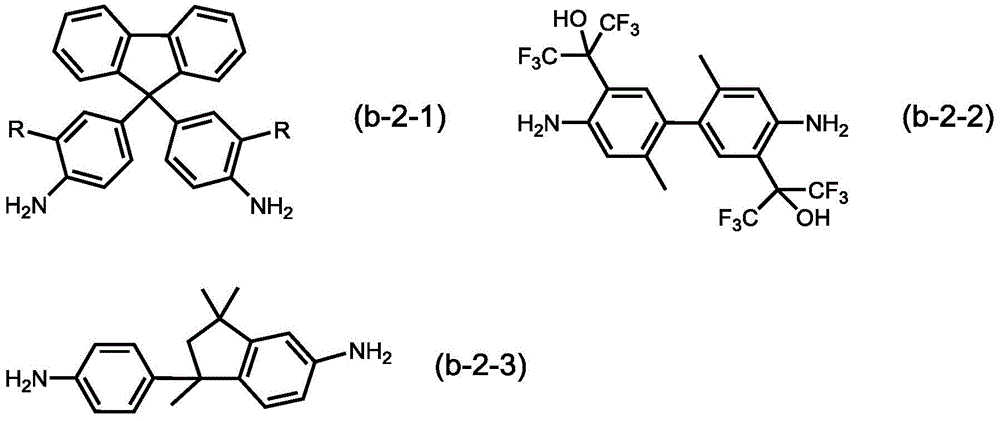
(式(b-2-1)中,R各自独立地为氢原子、氟原子或甲基。)(In formula (b-2-1), R is each independently a hydrogen atom, a fluorine atom or a methyl group.)
<5>根据上述<1>~<4>中任一项所述的非对称膜,其中,前述交联剂为分子内具有2个以上噁唑基的化合物。<5> The asymmetric film according to any one of the above <1> to <4>, wherein the crosslinking agent is a compound having two or more oxazole groups in the molecule.
<6>根据上述<1>~<4>中任一项所述的非对称膜,其中,前述交联剂为分子内具有2个以上羟基的化合物。<6> The asymmetric film according to any one of the above <1> to <4>, wherein the crosslinking agent is a compound having two or more hydroxyl groups in the molecule.
<7>根据上述<1>~<6>中任一项所述的非对称膜,其为中空纤维状。<7> The asymmetric membrane according to any one of the above <1> to <6>, which is in the form of a hollow fiber.
<8>根据上述<1>~<6>中任一项所述的非对称膜,其为薄膜状。<8> The asymmetric film according to any one of the above <1> to <6>, which is in the form of a thin film.
<9>根据上述<1>~<8>中任一项所述的非对称膜,其为气体分离膜。<9> The asymmetric membrane according to any one of the above <1> to <8>, which is a gas separation membrane.
发明的效果effect of invention
本发明的非对称膜可以兼顾优异的CO2透过性与CO2选择性,且CO2选择性恢复率高、制品寿命长。The asymmetric membrane of the present invention can achieve both excellent CO 2 permeability and CO 2 selectivity, and has high CO 2 selectivity recovery rate and long product life.
具体实施方式Detailed ways
[非对称膜][Asymmetric membrane]
本实施方式的非对称膜为包含通过交联剂将聚酰亚胺树脂交联而成的交联聚酰亚胺树脂的非对称膜,The asymmetric film of the present embodiment is an asymmetric film including a cross-linked polyimide resin obtained by cross-linking a polyimide resin with a cross-linking agent,
前述聚酰亚胺树脂具有源自四羧酸二酐的结构单元(A)、和源自二胺的结构单元(B),The aforementioned polyimide resin has a structural unit (A) derived from tetracarboxylic dianhydride and a structural unit (B) derived from diamine,
前述结构单元(A)包含源自下述式(a-1)所示的化合物的结构单元(A-1),The aforementioned structural unit (A) includes a structural unit (A-1) derived from a compound represented by the following formula (a-1),
前述结构单元(B)包含源自下述式(b-1)的结构单元(B-1),前述结构单元(B)100mol%中的该结构单元(B-1)的比率为0.1~50mol%,The aforementioned structural unit (B) includes a structural unit (B-1) derived from the following formula (b-1), and the ratio of the aforementioned structural unit (B-1) in 100 mol % of the aforementioned structural unit (B) is 0.1 to 50 mol %,
前述交联剂为包含2个以上与羧基键合的官能团的化合物。The said crosslinking agent is a compound containing two or more functional groups which couple|bonded with a carboxyl group.
本实施方式中“非对称膜”是指,至少由气体透过性的多孔层、和具有气体分离能力的致密层这2层形成的具备非对称结构的膜。致密层具有根据气体种类透过速度实质上不同程度的致密度,具有基于气体种类的分离功能。另一方面,多孔层为以不具有实质的气体分离功能的程度具有多孔性的层,且孔径未必恒定,可以从大的孔依次成为细的孔,进一步连续地形成致密层。本实施方式中的聚酰亚胺树脂至少包含于非对称膜的致密层中。In the present embodiment, the "asymmetric membrane" refers to a membrane having an asymmetric structure formed of at least two layers, a gas-permeable porous layer and a dense layer having a gas separation ability. The dense layer has a substantially different degree of density depending on the gas permeation rate, and has a separation function based on the gas type. On the other hand, the porous layer is a layer having porosity to such an extent that it does not have a substantial gas separation function, and the pore diameter is not necessarily constant, and a dense layer can be formed successively from large pores to fine pores. The polyimide resin in this embodiment is contained in at least the dense layer of the asymmetric film.
本实施方式的非对称膜包含通过交联剂将聚酰亚胺树脂交联而成的交联聚酰亚胺树脂。以下,对本实施方式中的聚酰亚胺树脂和交联剂进行说明。The asymmetric film of the present embodiment includes a cross-linked polyimide resin obtained by cross-linking a polyimide resin with a cross-linking agent. Hereinafter, the polyimide resin and the crosslinking agent in this embodiment will be described.
<聚酰亚胺树脂><Polyimide resin>
本实施方式中的聚酰亚胺树脂具有源自四羧酸二酐的结构单元(A)和源自二胺的结构单元B,结构单元A包含源自下述式(a-1)所示的化合物的结构单元(A-1),结构单元B包含源自下述式(b-1)所示的化合物的结构单元(B-1)。The polyimide resin in this embodiment has a structural unit (A) derived from a tetracarboxylic dianhydride and a structural unit B derived from a diamine, and the structural unit A includes a structural unit derived from the following formula (a-1) The structural unit (A-1) of the compound of , and the structural unit B includes the structural unit (B-1) derived from the compound represented by the following formula (b-1).

(式(b-1)中,Q1和Q2各自独立地为包含芳香族基团、脂肪族烃基和/或脂环式烃基的基团,X为单键、取代或无取代的亚烷基、羰基、醚基、下述式(b-1-i)所示的基团、或下述式(b-1-ii)所示的基团,p为0~2的整数,m1为0~4的整数,m2为0~4的整数。其中,p为0的情况下,m1为1~4的整数。)(In formula (b-1), Q 1 and Q 2 are each independently a group containing an aromatic group, aliphatic hydrocarbon group and/or alicyclic hydrocarbon group, and X is a single bond, a substituted or unsubstituted alkylene group, carbonyl group, ether group, group represented by the following formula (b-1-i), or group represented by the following formula (b-1-ii), p is an integer of 0 to 2, and m1 is An integer of 0 to 4, and m2 is an integer of 0 to 4. However, when p is 0, m1 is an integer of 1 to 4.)

(式(b-1-i)中,m3为0~5的整数;式(b-1-ii)中,m4为0~5的整数。需要说明的是,式(b-1)中,m1+m2+m3+m4为1以上,p为2的情况下,各自独立地选择2个X和2个m2~m4。)(In formula (b-1-i), m3 is an integer of 0 to 5; in formula (b-1-ii), m4 is an integer of 0 to 5. It should be noted that in formula (b-1), When m1+m2+m3+m4 is 1 or more, and p is 2, two X and two m2 to m4 are independently selected.)
(结构单元(A))(Structural Unit (A))
结构单元(A)为源自占聚酰亚胺树脂的四羧酸二酐的结构单元,包含源自下述式(a-1)所示的化合物的结构单元(A-1)。The structural unit (A) is a structural unit derived from tetracarboxylic dianhydride of a polyimide resin, and includes a structural unit (A-1) derived from a compound represented by the following formula (a-1).
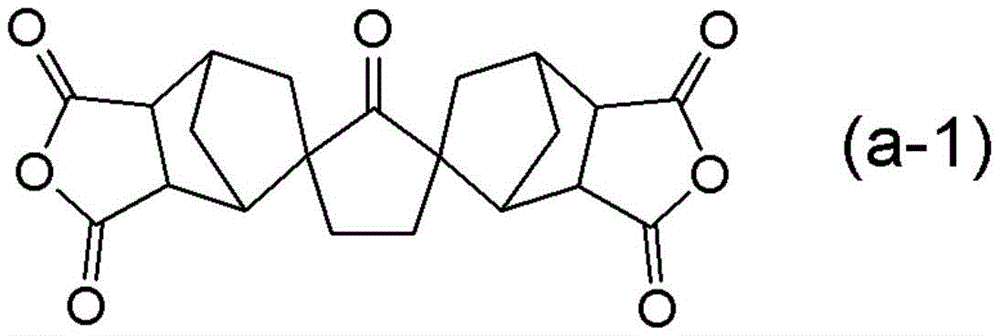
式(a-1)所示的化合物为降冰片烷-2-螺-α-环戊酮-α’-螺-2”-降冰片烷-5,5”,6,6”-四羧酸二酐(CpODA)。The compound represented by formula (a-1) is norbornane-2-spiro-α-cyclopentanone-α'-spiro-2"-norbornane-5,5",6,6"-tetracarboxylic acid Dianhydride (CpODA).
通过结构单元(A)包含结构单元(A-1),从而可以提供作为兼顾优异的CO2透过性与CO2选择性的气体分离膜有用的非对称膜。By including the structural unit (A-1) in the structural unit (A), an asymmetric membrane useful as a gas separation membrane having both excellent CO 2 permeability and CO 2 selectivity can be provided.
结构单元(A)中的结构单元(A-1)的比率优选0.1~100mol%。也可以为1mol%以上,也可以为5mol%以上,也可以为10mol%以上,也可以为30mol%以上,也可以为50mol%以上,也可以为70mol%以上,也可以为90mol%以上。另外,结构单元(A-1)的比率的上限值没有特别限定,为100mol%。即,结构单元(A)可以仅由结构单元(A-1)构成。The ratio of the structural unit (A-1) in the structural unit (A) is preferably 0.1 to 100 mol %. It may be 1 mol% or more, 5 mol% or more, 10 mol% or more, 30 mol% or more, 50 mol% or more, 70 mol% or more, or 90 mol% or more. Moreover, the upper limit of the ratio of a structural unit (A-1) is not specifically limited, It is 100 mol%. That is, the structural unit (A) may be composed of only the structural unit (A-1).
结构单元(A)可以包含除结构单元(A-1)以外的结构单元。作为提供这样的结构单元的四羧酸二酐,没有特别限定,例如可以举出具有下式(I-1)~(I-28)所示的基团的四羧酸二酐。式(I-1)~(I-28)中的*表示与羧基的键合部位,1分子中4个羧基脱水缩合而形成2个酸酐。X1~X3各自独立地表示单键或2价的连接基团,L表示-CH=CH-或-CH2-,R1和R2各自独立地表示氢原子或取代基。The structural unit (A) may contain structural units other than the structural unit (A-1). Although it does not specifically limit as a tetracarboxylic dianhydride which provides such a structural unit, For example, the tetracarboxylic dianhydride which has a group represented by following formula (I-1) - (I-28) is mentioned. * in formulas (I-1) to (I-28) represents a bonding site with a carboxyl group, and four carboxyl groups in one molecule are dehydrated and condensed to form two acid anhydrides. X 1 to X 3 each independently represent a single bond or a divalent linking group, L represents -CH=CH- or -CH 2 -, and R 1 and R 2 each independently represent a hydrogen atom or a substituent.

作为提供除结构单元(A-1)以外的结构单元的四羧酸二酐的具体例,可以举出均苯四酸二酐、3,3’,4,4’-联苯四羧酸二酐、9,9’-双(3,4-二羧基苯基)芴二酐、2,3,3’,4’-联苯四羧酸二酐、2,2-双(3,4-二羧基苯基)丙烷二酐、2,2-双(2,3-二羧基苯基)丙烷二酐、2,2-双(3,4-二羧基苯基)-1,1,1,3,3,3-六氟丙烷二酐、2,2-双(2,3-二羧基苯基)-1,1,1,3,3,3-六氟丙烷二酐、双(3,4-二羧基苯基)砜二酐、双(3,4-二羧基苯基)醚二酐、双(2,3-二羧基苯基)醚二酐、3,3’,4,4’-二苯甲酮四羧酸二酐、2,2’,3,3’-二苯甲酮四羧酸二酐、4,4-(对苯二氧)双邻苯二甲酸二酐和4,4-(间苯二氧)双邻苯二甲酸二酐等芳香族四羧酸二酐;1,2,4,5-环己烷四羧酸二酐(HPMDA)和1,2,3,4-环丁烷四羧酸二酐等脂环式四羧酸二酐(其中,除式(a-1)所示的化合物之外);以及亚乙基四羧酸二酐和1,2,3,4-丁烷四羧酸二酐等脂肪族四羧酸二酐。Specific examples of tetracarboxylic dianhydrides that provide structural units other than the structural unit (A-1) include pyromellitic dianhydride and 3,3',4,4'-biphenyltetracarboxylic acid di- Anhydride, 9,9'-bis(3,4-dicarboxyphenyl)fluorene dianhydride, 2,3,3',4'-biphenyltetracarboxylic dianhydride, 2,2-bis(3,4- Dicarboxyphenyl)propane dianhydride, 2,2-bis(2,3-dicarboxyphenyl)propane dianhydride, 2,2-bis(3,4-dicarboxyphenyl)-1,1,1, 3,3,3-hexafluoropropane dianhydride, 2,2-bis(2,3-dicarboxyphenyl)-1,1,1,3,3,3-hexafluoropropane dianhydride, bis(3, 4-Dicarboxyphenyl)sulfone dianhydride, bis(3,4-dicarboxyphenyl)ether dianhydride, bis(2,3-dicarboxyphenyl)ether dianhydride, 3,3',4,4' - Benzophenone tetracarboxylic dianhydride, 2,2',3,3'-benzophenone tetracarboxylic dianhydride, 4,4-(terephthalic dioxy)diphthalic dianhydride and 4 Aromatic tetracarboxylic dianhydride such as ,4-(isophenylene dioxy)diphthalic dianhydride; 1,2,4,5-cyclohexanetetracarboxylic dianhydride (HPMDA) and 1,2,3 , Alicyclic tetracarboxylic dianhydrides such as 4-cyclobutanetetracarboxylic dianhydride (wherein, except for compounds represented by formula (a-1)); and ethylene tetracarboxylic dianhydride and 1, Aliphatic tetracarboxylic dianhydrides such as 2,3,4-butanetetracarboxylic dianhydride.
需要说明的是,本说明书中,芳香族四羧酸二酐是指包含1个以上芳香环的四羧酸二酐,脂环式四羧酸二酐是指包含1个以上脂环、且不含芳香环的四羧酸二酐,脂肪族四羧酸二酐是指不含芳香环也不含脂环的四羧酸二酐。In addition, in this specification, an aromatic tetracarboxylic dianhydride refers to a tetracarboxylic dianhydride containing one or more aromatic rings, and an alicyclic tetracarboxylic dianhydride refers to a tetracarboxylic dianhydride containing one or more alicyclic rings and no The aromatic ring-containing tetracarboxylic dianhydride and the aliphatic tetracarboxylic dianhydride refer to a tetracarboxylic dianhydride containing neither an aromatic ring nor an alicyclic ring.
结构单元(A)中任意包含的除结构单元(A-1)以外的结构单元可以为1种,也可以为2种以上。The structural unit other than the structural unit (A-1) arbitrarily included in the structural unit (A) may be one type or two or more types.
(结构单元(B))(Structural unit (B))
结构单元(B)为源自占聚酰亚胺树脂的二胺的结构单元,且包含源自下述式(b-1)所示的化合物的结构单元(B-1)。The structural unit (B) is a structural unit derived from a diamine of a polyimide resin, and includes a structural unit (B-1) derived from a compound represented by the following formula (b-1).

(式(b-1)中,Q1和Q2各自独立地为包含芳香族基团、脂肪族烃基和/或脂环式烃基的基团,X为单键、取代或无取代的亚烷基、羰基、醚基、下述式(b-1-i)所示的基团、或下述式(b-1-ii)所示的基团,p为0~2的整数,m1为0~4的整数,m2为0~4的整数。其中,p为0的情况下,m1为1~4的整数。)(In formula (b-1), Q 1 and Q 2 are each independently a group containing an aromatic group, aliphatic hydrocarbon group and/or alicyclic hydrocarbon group, and X is a single bond, a substituted or unsubstituted alkylene group, carbonyl group, ether group, group represented by the following formula (b-1-i), or group represented by the following formula (b-1-ii), p is an integer of 0 to 2, and m1 is An integer of 0 to 4, and m2 is an integer of 0 to 4. However, when p is 0, m1 is an integer of 1 to 4.)

(式(b-1-i)中,m3为0~5的整数;式(b-1-ii)中,m4为0~5的整数。需要说明的是,式(b-1)中,m1+m2+m3+m4为1以上,p为2的情况下,各自独立地选择2个X和2个m2~m4。)(In formula (b-1-i), m3 is an integer of 0 to 5; in formula (b-1-ii), m4 is an integer of 0 to 5. It should be noted that in formula (b-1), When m1+m2+m3+m4 is 1 or more, and p is 2, two X and two m2 to m4 are independently selected.)
式(b-1)中,Q1和Q2各自独立地为包含芳香族基团、脂肪族烃基和/或脂环式烃基的基团。这些基团可以被包含杂原子和/或卤素原子的基团所取代。In formula (b-1), Q 1 and Q 2 are each independently a group containing an aromatic group, an aliphatic hydrocarbon group and/or an alicyclic hydrocarbon group. These groups may be substituted with groups containing heteroatoms and/or halogen atoms.
作为芳香族基团,可以举出苯环、萘环等。脂肪族烃基可以为直链状也可以为支链状。另外,脂肪族烃基可以为饱和也可以为不饱和。脂肪族烃基的碳数优选1~12、更优选2~10、进一步优选3~8。作为脂环式烃基,可以举出环己烷环、环戊烷环等。As an aromatic group, a benzene ring, a naphthalene ring, etc. are mentioned. The aliphatic hydrocarbon group may be linear or branched. In addition, the aliphatic hydrocarbon group may be saturated or unsaturated. 1-12 are preferable, as for carbon number of aliphatic hydrocarbon group, 2-10 are more preferable, 3-8 are still more preferable. As an alicyclic hydrocarbon group, a cyclohexane ring, a cyclopentane ring, etc. are mentioned.
Q1和Q2各自独立地可以为芳香族基团、脂肪族烃基或脂环式烃基,也可以为芳香族基团、脂肪族烃基和脂环式烃基中的2种以上的组合。例如可以为包含芳香族基团和脂肪族烃基的基团。Q 1 and Q 2 may each independently be an aromatic group, an aliphatic hydrocarbon group, or an alicyclic hydrocarbon group, or may be a combination of two or more of an aromatic group, an aliphatic hydrocarbon group, and an alicyclic hydrocarbon group. For example, it may be a group containing an aromatic group and an aliphatic hydrocarbon group.
结构单元(B-1)优选为源自下述式(b-1-1)所示的化合物的结构单元(B-1-1)。式(b-1-1)所示的化合物是式(b-1)中的Q1和Q2为苯环的化合物。The structural unit (B-1) is preferably a structural unit (B-1-1) derived from a compound represented by the following formula (b-1-1). The compound represented by formula (b-1-1) is a compound in which Q 1 and Q 2 in formula (b-1) are benzene rings.

(式(b-1-1)中,X、p、m1和m2与前述式(b-1)中的X、p、m1和m2为相同含义。(In the formula (b-1-1), X, p, m1 and m2 have the same meanings as X, p, m1 and m2 in the aforementioned formula (b-1).
作为式(b-1)所示的化合物的具体例,可以举出下述式(b-1-11)~(b-1-17)所示的化合物。Specific examples of the compound represented by the formula (b-1) include compounds represented by the following formulae (b-1-11) to (b-1-17).

另外,作为式(b-1)所示的化合物的其他具体例,可以举出2,4,6-三甲基-3,5-二硝基苯甲酸、二氨基萘羧酸、赖氨酸、α-氨基苯基丙氨酸、2-氨基亮氨酸、2,3-二氨基丁酸、3,4-二氨基环己烷羧酸等。In addition, as another specific example of the compound represented by formula (b-1), 2,4,6-trimethyl-3,5-dinitrobenzoic acid, diaminonaphthalenecarboxylic acid, lysine can be mentioned , α-aminophenylalanine, 2-aminoleucine, 2,3-diaminobutyric acid, 3,4-diaminocyclohexanecarboxylic acid, etc.
上述化合物中,优选式(b-1-11)所示的化合物,更优选下述式(b-1-111)所示的化合物、即、3,5-二氨基苯甲酸(3,5-DABA)。Among the above-mentioned compounds, a compound represented by the formula (b-1-11) is preferable, and a compound represented by the following formula (b-1-111), that is, 3,5-diaminobenzoic acid (3,5-diaminobenzoic acid) is more preferable. DABA).
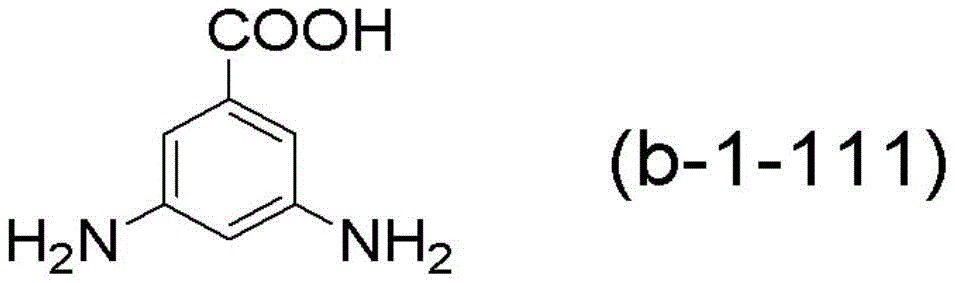
结构单元(B-1)是对聚酰亚胺树脂提供羧基的结构单元。通过聚酰亚胺树脂具有羧基,从而借助后述的交联剂的聚酰亚胺树脂彼此的交联成为可能,可以形成交联聚酰亚胺树脂。而且,包含这样的交联聚酰亚胺树脂,从而可以提供即使在高压下使用也不易增塑化、CO2选择性恢复率高的非对称膜。The structural unit (B-1) is a structural unit which provides a carboxyl group to the polyimide resin. When the polyimide resin has a carboxyl group, the crosslinking of the polyimide resins via the crosslinking agent described later becomes possible, and the crosslinked polyimide resin can be formed. Furthermore, by including such a crosslinked polyimide resin, it is possible to provide an asymmetric membrane that is not easily plasticized and has a high CO 2 selective recovery rate even when used under high pressure.
因此,通过结构单元B包含结构单元(B-1),从而可以提供CO2选择性恢复率高的非对称膜。Therefore, when the structural unit B includes the structural unit (B-1), an asymmetric membrane having a high CO 2 selective recovery rate can be provided.
结构单元(B)中的结构单元(B-1)的比率为0.1~50mol%。结构单元(B)中的结构单元(B-1)的比率如果为50mol%以下,则在保持优异的CO2透过性和CO2选择性的同时,借助后述的交联剂的聚酰亚胺树脂彼此的交联适当进行,可以提供CO2选择性恢复率高的非对称膜。The ratio of the structural unit (B-1) in the structural unit (B) is 0.1 to 50 mol %. If the ratio of the structural unit (B-1) in the structural unit (B) is 50 mol % or less, the polyacylide by the crosslinking agent described later can maintain excellent CO 2 permeability and CO 2 selectivity. The crosslinking of the imine resins with each other is appropriately performed, and an asymmetric membrane with a high CO 2 selective recovery rate can be provided.
结构单元(B)中的结构单元(B-1)的比率优选1~50mol%、更优选5~40mol%、进一步优选8~30mol%、进一步优选10~25mol%。The ratio of the structural unit (B-1) in the structural unit (B) is preferably 1 to 50 mol %, more preferably 5 to 40 mol %, further preferably 8 to 30 mol %, further preferably 10 to 25 mol %.
作为除结构单元(B-1)以外的结构单元,可以举出源自脂环式二胺的结构单元、源自脂肪族二胺的结构单元、源自芳香族二胺的结构单元。作为除结构单元(B-1)以外的结构单元,优选源自芳香族二胺的结构单元。As a structural unit other than a structural unit (B-1), the structural unit derived from alicyclic diamine, the structural unit derived from aliphatic diamine, and the structural unit derived from aromatic diamine are mentioned. As the structural unit other than the structural unit (B-1), a structural unit derived from an aromatic diamine is preferable.
需要说明的是,本说明书中,芳香族二胺是指包含1个以上芳香环的二胺,脂环式二胺是指包含1个以上脂环、且不含芳香环的二胺,脂肪族二胺是指不含芳香环也不含脂环的二胺。In addition, in this specification, aromatic diamine refers to a diamine containing one or more aromatic rings, alicyclic diamine refers to a diamine containing one or more alicyclic rings and does not contain an aromatic ring, and aliphatic diamine refers to a diamine containing no aromatic ring. The diamine refers to a diamine that contains neither an aromatic ring nor an alicyclic ring.
结构单元(B)中任意包含的除结构单元(B-1)以外的结构单元可以为1种,也可以为2种以上。The structural unit other than the structural unit (B-1) arbitrarily included in the structural unit (B) may be one type or two or more types.
作为脂环式二胺,没有特别限定,例如可以举出1,3-双(氨基甲基)环己烷、1,4-双(氨基甲基)环己烷等。It does not specifically limit as an alicyclic diamine, For example, 1, 3- bis (aminomethyl) cyclohexane, 1, 4- bis (aminomethyl) cyclohexane, etc. are mentioned.
作为脂肪族二胺,没有特别限定,例如可以举出乙二胺、六亚甲基二胺等。Although it does not specifically limit as aliphatic diamine, For example, ethylenediamine, hexamethylenediamine, etc. are mentioned.
作为芳香族二胺,没有特别限定,例如可以举出苯二胺和其衍生物、二氨基联苯化合物和其衍生物、二氨基二苯基化合物和其衍生物、二氨基三苯基化合物和其衍生物、二氨基萘和其衍生物、氨基苯基氨基茚满和其衍生物、二氨基四苯基化合物和其衍生物、二氨基六苯基化合物和其衍生物、Cardo型芴二胺衍生物等。The aromatic diamine is not particularly limited, and examples thereof include phenylenediamine and derivatives thereof, diaminobiphenyl compounds and derivatives thereof, diaminodiphenyl compounds and derivatives thereof, diaminotriphenyl compounds and Its derivatives, diaminonaphthalene and its derivatives, aminophenylaminoindan and its derivatives, diaminotetraphenyl compounds and their derivatives, diaminohexaphenyl compounds and their derivatives, Cardo-type fluorene diamine Derivatives etc.
作为苯二胺,可以举出间苯二胺、对苯二胺等,作为苯二胺衍生物,例如可以举出2,4-二氨基甲苯、2,4-三苯二胺等键合有甲基、乙基等烷基的二胺。Examples of phenylenediamine include m-phenylenediamine, p-phenylenediamine, and the like, and examples of phenylenediamine derivatives include 2,4-diaminotoluene, 2,4-triphenylenediamine, etc. Diamines of alkyl groups such as methyl and ethyl.
二氨基联苯化合物是2个氨基苯基用苯基彼此键合而成的,例如可以举出4,4’-二氨基联苯、4,4’-二氨基-2,2’-双(三氟甲基)联苯、5,5’-(1,1,1,3,3,3-六氟-2-羟基异丙基)-2,2’-二甲基联苯-4,4’-二胺(后述的式(b-2-2)所示的化合物)等。The diaminobiphenyl compound is formed by bonding two aminophenyl groups with phenyl groups, for example, 4,4'-diaminobiphenyl, 4,4'-diamino-2,2'-bis( trifluoromethyl)biphenyl, 5,5'-(1,1,1,3,3,3-hexafluoro-2-hydroxyisopropyl)-2,2'-dimethylbiphenyl-4, 4'-diamine (a compound represented by the formula (b-2-2) described later) and the like.
二氨基二苯基化合物是2个氨基苯基借助其他基团以苯基彼此键合而成的。作为其他基团,可以举出醚键、磺酰键、硫醚键、基于亚烷基或其衍生物基团的键、亚氨键、偶氮键、氧化膦键、酰胺键、脲键等。亚烷基键可以举出碳数为1~6左右者,其衍生物基团是亚烷基的氢原子的1个以上被卤素原子等所取代的基团。作为二氨基二苯基化合物,例如可以举出3,3’-二氨基二苯醚、3,4’-二氨基二苯醚、4,4’-二氨基二苯醚、3,3’-二氨基二苯基砜、3,4’-二氨基二苯基砜、4,4’-二氨基二苯基砜、3,3’-二氨基二苯基甲烷、3,4’-二氨基二苯基甲烷、4,4’-二氨基二苯基甲烷、4,4’-二氨基二苯基硫醚、3,3’-二氨基二苯基酮、3,4’-二氨基二苯基酮、2,2-双(对氨基苯基)丙烷、2,2’-双(对氨基苯基)六氟丙烷、4-甲基-2,4-双(对氨基苯基)-1-戊烯、4-甲基-2,4-双(对氨基苯基)-2-戊烯、亚氨基二苯胺、4-甲基-2,4-双(对氨基苯基)戊烷、双(对氨基苯基)氧化膦、4,4’-二氨基偶氮苯、4,4’-二氨基二苯基尿素、4,4’-二氨基二苯基酰胺、1,4-双(4-氨基苯氧基)苯、1,3-双(4-氨基苯氧基)苯、1,3-双(3-氨基苯氧基)苯、4,4’-双(4-氨基苯氧基)联苯、双[4-(4-氨基苯氧基)苯基]砜、双[4-(3-氨基苯氧基)苯基]砜、2,2-双[4-(4-氨基苯氧基)苯基]丙烷、2,2-双[4-(4-氨基苯氧基)苯基]六氟丙烷等。The diaminodiphenyl compound is formed by bonding 2 aminophenyl groups to each other with phenyl groups via other groups. Examples of other groups include ether bonds, sulfonyl bonds, thioether bonds, bonds based on alkylene groups or derivatives thereof, imino bonds, azo bonds, phosphine oxide bonds, amide bonds, urea bonds, and the like. . Examples of the alkylene bond include those having about 1 to 6 carbon atoms, and the derivative group thereof is a group in which at least one hydrogen atom of the alkylene group is substituted with a halogen atom or the like. Examples of the diaminodiphenyl compound include 3,3'-diaminodiphenyl ether, 3,4'-diaminodiphenyl ether, 4,4'-diaminodiphenyl ether, 3,3'-diaminodiphenyl ether, Diaminodiphenylsulfone, 3,4'-diaminodiphenylsulfone, 4,4'-diaminodiphenylsulfone, 3,3'-diaminodiphenylmethane, 3,4'-diamino Diphenylmethane, 4,4'-diaminodiphenylmethane, 4,4'-diaminodiphenyl sulfide, 3,3'-diaminodiphenyl ketone, 3,4'-diaminodiphenyl ketone Phenyl ketone, 2,2-bis(p-aminophenyl)propane, 2,2'-bis(p-aminophenyl)hexafluoropropane, 4-methyl-2,4-bis(p-aminophenyl)- 1-pentene, 4-methyl-2,4-bis(p-aminophenyl)-2-pentene, iminodiphenylamine, 4-methyl-2,4-bis(p-aminophenyl)pentane , bis(p-aminophenyl)phosphine oxide, 4,4'-diaminoazobenzene, 4,4'-diaminodiphenylurea, 4,4'-diaminodiphenylamide, 1,4- Bis(4-aminophenoxy)benzene, 1,3-bis(4-aminophenoxy)benzene, 1,3-bis(3-aminophenoxy)benzene, 4,4'-bis(4- Aminophenoxy)biphenyl, bis[4-(4-aminophenoxy)phenyl]sulfone, bis[4-(3-aminophenoxy)phenyl]sulfone, 2,2-bis[4- (4-Aminophenoxy)phenyl]propane, 2,2-bis[4-(4-aminophenoxy)phenyl]hexafluoropropane, and the like.
二氨基三苯基化合物是2个氨基苯基和1个亚苯基均借助其他基团键合而成的,其他基团可以举出与二氨基二苯基化合物同样的基团。作为二氨基三苯基化合物,例如可以举出1,3-双(间氨基苯氧基)苯、1,3-双(对氨基苯氧基)苯、1,4-双(对氨基苯氧基)苯等。The diaminotriphenyl compound is formed by bonding two aminophenyl groups and one phenylene group via other groups, and the other groups include the same groups as the diaminodiphenyl compound. Examples of the diaminotriphenyl compound include 1,3-bis(m-aminophenoxy)benzene, 1,3-bis(p-aminophenoxy)benzene, 1,4-bis(p-aminophenoxy)benzene base) benzene, etc.
作为二氨基萘,例如可以举出1,5-二氨基萘和2,6-二氨基萘。As diaminonaphthalene, 1, 5- diaminonaphthalene and 2, 6- diaminonaphthalene are mentioned, for example.
作为氨基苯基氨基茚满,例如可以举出5-氨基-1-(对氨基苯基)-1,3,3-三甲基茚满(后述的式(b-2-3)所示的化合物)、6-氨基-1-(对氨基苯基)-1,3,3-三甲基茚满。Examples of aminophenylaminoindan include 5-amino-1-(p-aminophenyl)-1,3,3-trimethylindane (represented by the formula (b-2-3) described later) compound), 6-amino-1-(p-aminophenyl)-1,3,3-trimethylindane.
作为二氨基四苯基化合物,例如可以举出4,4’-双(对氨基苯氧基)联苯、2,2’-双[p-(p’-氨基苯氧基)苯基]丙烷、2,2’-双[p-(p’-氨基苯氧基)联苯]丙烷、2,2’-双[p-(间氨基苯氧基)苯基]二苯甲酮等。Examples of the diaminotetraphenyl compound include 4,4'-bis(p-aminophenoxy)biphenyl, 2,2'-bis[p-(p'-aminophenoxy)phenyl]propane , 2,2'-bis[p-(p'-aminophenoxy)biphenyl]propane, 2,2'-bis[p-(m-aminophenoxy)phenyl]benzophenone, etc.
作为Cardo型芴二胺衍生物,例如可以举出9,9-双(4-氨基苯基)芴(后述的式(b-2-1)所示的化合物)等。As a Cardo-type fluorene diamine derivative, 9, 9-bis (4-aminophenyl) fluorene (the compound represented by the formula (b-2-1) mentioned later) etc. are mentioned, for example.
需要说明的是,作为芳香族二胺,可以为上述二胺的氢原子被选自由卤素原子、甲基、甲氧基、氰基、苯基等组成的组中的至少1种取代基所取代的化合物。另外,芳香族二胺可以单独使用1种,也可以组合2种以上而使用。In addition, as the aromatic diamine, the hydrogen atom of the above-mentioned diamine may be substituted with at least one substituent selected from the group consisting of a halogen atom, a methyl group, a methoxy group, a cyano group, a phenyl group, and the like compound of. Moreover, an aromatic diamine may be used individually by 1 type, and may be used in combination of 2 or more types.
作为除结构单元(B-1)以外的结构单元,从优异的CO2透过性和CO2选择性的观点出发,优选结构单元(B-2),所述结构单元(B-2)为选自由源自下述式(b-2-1)所示的化合物的结构单元(B-2-1)、源自下述式(b-2-2)所示的化合物的结构单元(B-2-2)和源自下述式(b-2-3)所示的化合物的结构单元(B-2-3)组成的组中的至少1者。As the structural unit other than the structural unit (B-1), from the viewpoint of excellent CO 2 permeability and CO 2 selectivity, the structural unit (B-2) is preferable, and the structural unit (B-2) is Selected from a structural unit (B-2-1) derived from a compound represented by the following formula (b-2-1), and a structural unit (B) derived from a compound represented by the following formula (b-2-2) -2-2) and at least one of the group consisting of the structural unit (B-2-3) derived from the compound represented by the following formula (b-2-3).

(式(b-2-1)中,R各自独立地为氢原子、氟原子或甲基。)(In formula (b-2-1), R is each independently a hydrogen atom, a fluorine atom or a methyl group.)
式(b-2-1)中,R各自独立地为氢原子、氟原子或甲基,优选为氢原子。作为式(b-2-1)所示的化合物,可以举出9,9-双(4-氨基苯基)芴(BAFL)、9,9-双(3-氟-4-氨基苯基)芴、和9,9-双(3-甲基-4-氨基苯基)芴等,优选9,9-双(4-氨基苯基)芴。In formula (b-2-1), R is each independently a hydrogen atom, a fluorine atom or a methyl group, preferably a hydrogen atom. Examples of the compound represented by the formula (b-2-1) include 9,9-bis(4-aminophenyl)fluorene (BAFL), 9,9-bis(3-fluoro-4-aminophenyl) Fluorene, 9,9-bis(3-methyl-4-aminophenyl)fluorene, etc., preferably 9,9-bis(4-aminophenyl)fluorene.
式(b-2-2)所示的化合物为5,5’-(1,1,1,3,3,3-六氟-2-羟基异丙基)-2,2’-二甲基联苯-4,4’-二胺(HFA-mTB)。The compound represented by formula (b-2-2) is 5,5'-(1,1,1,3,3,3-hexafluoro-2-hydroxyisopropyl)-2,2'-dimethyl Biphenyl-4,4'-diamine (HFA-mTB).
式(b-2-3)所示的化合物为5-氨基-1-(对氨基苯基)-1,3,3-三甲基茚满(TMDA)。The compound represented by formula (b-2-3) is 5-amino-1-(p-aminophenyl)-1,3,3-trimethylindane (TMDA).
结构单元(B)中的结构单元(B-2)的比率优选50~99.9mol%、更优选50~99mol%、进一步优选60~95mol%、进一步优选70~92mol%、进一步优选75~90mol%。The ratio of the structural unit (B-2) in the structural unit (B) is preferably 50 to 99.9 mol %, more preferably 50 to 99 mol %, still more preferably 60 to 95 mol %, still more preferably 70 to 92 mol %, still more preferably 75 to 90 mol % .
本实施方式中,从所得聚酰亚胺薄膜的机械强度的观点出发,聚酰亚胺树脂的数均分子量优选5000~100000。需要说明的是,聚酰亚胺树脂的数均分子量例如可以通过基于凝胶过滤色谱法测定的标准聚甲基丙烯酸甲酯(PMMA)换算值而求出。In this embodiment, from the viewpoint of the mechanical strength of the obtained polyimide film, the number average molecular weight of the polyimide resin is preferably 5,000 to 100,000. In addition, the number average molecular weight of a polyimide resin can be calculated|required by the standard polymethyl methacrylate (PMMA) conversion value measured by gel filtration chromatography, for example.
<聚酰亚胺树脂的制造方法><Manufacturing method of polyimide resin>
聚酰亚胺树脂可以用上述四羧酸成分和二胺成分而制造,其制造方法没有特别限定。例如可以举出:(i)溶液聚合法;(ii)得到聚酰胺酸溶液、制膜并酰亚胺化的方法;(iii)得到羧酸成分与二胺成分的盐或低聚物后、进行固相聚合的方法;(iv)以四羧酸二酐和二异氰酸酯为原料的方法等以往公知的方法,也可以组合使用各方法。另外,反应时,可以使用酸、叔胺类、酐等以往公知的催化剂等。The polyimide resin can be produced using the above-mentioned tetracarboxylic acid component and diamine component, and the production method thereof is not particularly limited. For example, (i) a solution polymerization method; (ii) a method for obtaining a polyamic acid solution, forming a film, and imidizing; (iii) after obtaining a salt or oligomer of a carboxylic acid component and a diamine component, The method of performing solid-phase polymerization; (iv) the method using tetracarboxylic dianhydride and diisocyanate as a raw material is a conventionally known method, and each method can also be used in combination. In addition, at the time of the reaction, conventionally known catalysts such as acids, tertiary amines, anhydrides, and the like can be used.
本实施方式中的聚酰亚胺树脂通常作为有机溶剂溶液制造。作为有机溶剂,没有特别限定,例如可以举出N-甲基-2-吡咯烷酮、N,N-二甲基乙酰胺、N,N-二乙基乙酰胺、N,N-二甲基甲酰胺、N,N-二乙基甲酰胺、N-甲基己内酰胺、六甲基磷酰胺、四亚甲基砜、二甲基亚砜、间甲酚、苯酚、对氯苯酚、2-氯-4-羟基甲苯、二甘醇二甲醚、三甘醇二甲醚、四甘醇二甲醚、二氧杂环己烷、γ-丁内酯、二氧戊环、环己酮、环戊酮等,它们可以单独使用,也可以组合使用2种以上。从由聚酰亚胺和溶剂形成的聚酰亚胺清漆的性能的观点出发,优选单独使用、或组合使用N-甲基-2-吡咯烷酮(NMP)、N,N-二甲基乙酰胺(DMAC)、γ-丁内酯(GBL)。The polyimide resin in this embodiment is usually produced as an organic solvent solution. The organic solvent is not particularly limited, and examples thereof include N-methyl-2-pyrrolidone, N,N-dimethylacetamide, N,N-diethylacetamide, and N,N-dimethylformamide. , N,N-diethylformamide, N-methylcaprolactam, hexamethylphosphoramide, tetramethylene sulfone, dimethyl sulfoxide, m-cresol, phenol, p-chlorophenol, 2-chloro-4 -Hydroxytoluene, diglyme, triglyme, tetraglyme, dioxane, gamma-butyrolactone, dioxolane, cyclohexanone, cyclopentanone etc., they can be used individually or in combination of 2 or more types. From the viewpoint of the performance of the polyimide varnish composed of a polyimide and a solvent, N-methyl-2-pyrrolidone (NMP), N,N-dimethylacetamide (N-methyl-2-pyrrolidone (NMP), N,N-dimethylacetamide ( DMAC), gamma-butyrolactone (GBL).
另外,利用溶液聚合进行制造的情况下,可以与前述有机溶剂一起以聚合物不析出的程度使用己烷、庚烷、苯、甲苯、二甲苯、氯苯、邻二氯苯等不良溶剂。In addition, in the case of production by solution polymerization, a poor solvent such as hexane, heptane, benzene, toluene, xylene, chlorobenzene, and o-dichlorobenzene can be used together with the above-mentioned organic solvent to such an extent that the polymer does not precipitate.
聚酰亚胺树脂的有机溶剂溶液例如可以用下述(1)~(3)的方法制造。The organic solvent solution of the polyimide resin can be produced, for example, by the following methods (1) to (3).
(1)在二胺成分的有机溶剂溶液中添加四羧酸成分,或在四羧酸成分的有机溶剂溶液中添加二胺成分,在优选80℃以下,特别是在室温附近至其以下的温度下保持0.5~3小时。在所得反应中间体的聚酰胺酸溶液中添加甲苯或二甲苯等共沸脱水溶剂,通过共沸将生成水去除至体系外的同时,进行脱水反应,得到聚酰亚胺树脂的有机溶剂溶液。(1) The tetracarboxylic acid component is added to the organic solvent solution of the diamine component, or the diamine component is added to the organic solvent solution of the tetracarboxylic acid component, preferably at a temperature of 80° C. or lower, especially around room temperature or lower. Keep it down for 0.5 to 3 hours. An azeotropic dehydration solvent such as toluene or xylene is added to the polyamic acid solution of the obtained reaction intermediate, and the dehydration reaction is performed while removing the produced water by azeotropy to obtain an organic solvent solution of the polyimide resin.
(2)在上述(1)中得到的反应中间体的聚酰胺酸溶液中加入乙酸酐等脱水剂并酰亚胺化后,添加甲醇等对聚酰亚胺的溶解能力不良的溶剂,使聚酰亚胺沉淀。通过过滤、清洗和干燥将该沉淀物以固体的形式分离后,溶解于有机溶剂,得到聚酰亚胺树脂的有机溶剂溶液。(2) After adding a dehydrating agent such as acetic anhydride to the polyamic acid solution of the reaction intermediate obtained in the above (1) and imidizing it, a solvent having poor solubility in polyimide such as methanol is added to make the polyamide Imide precipitation. After the precipitate was separated as a solid by filtration, washing and drying, it was dissolved in an organic solvent to obtain an organic solvent solution of polyimide resin.
(3)上述(1)中,用甲酚等高沸点溶剂制备聚酰胺酸溶液,直接在150~220℃下保持3~12小时,使其聚酰亚胺化后,添加甲醇等对聚酰亚胺的溶解能力不良的溶剂,使聚酰亚胺沉淀。通过过滤、清洗和干燥将该沉淀物以固体的形式分离后,溶解于N,N-二甲基乙酰胺等有机溶剂,得到聚酰亚胺树脂的有机溶剂溶液。(3) In the above (1), a polyamic acid solution is prepared with a high boiling point solvent such as cresol, and the solution is kept at 150 to 220° C. for 3 to 12 hours as it is to make polyimide. A solvent with poor dissolving ability of imine precipitates polyimide. After separating the precipitate as a solid by filtration, washing and drying, it is dissolved in an organic solvent such as N,N-dimethylacetamide to obtain an organic solvent solution of a polyimide resin.
以溶液聚合制造本实施方式中的聚酰亚胺树脂的情况下,作为催化剂,优选使用叔胺化合物。作为叔胺化合物,可以举出三甲胺、三乙胺(TEA)、三丙胺、三丁胺、三乙醇胺、N,N-二甲基乙醇胺、N,N-二乙基乙醇胺、三亚乙基二胺、N-甲基吡咯烷、N-乙基吡咯烷、N-甲基哌啶、N-乙基哌啶、咪唑、吡啶、喹啉、异喹啉等。When producing the polyimide resin in this embodiment by solution polymerization, it is preferable to use a tertiary amine compound as a catalyst. Examples of the tertiary amine compound include trimethylamine, triethylamine (TEA), tripropylamine, tributylamine, triethanolamine, N,N-dimethylethanolamine, N,N-diethylethanolamine, triethylenediamine Amine, N-methylpyrrolidine, N-ethylpyrrolidine, N-methylpiperidine, N-ethylpiperidine, imidazole, pyridine, quinoline, isoquinoline, etc.
另外,聚酰亚胺树脂的溶液的浓度优选1~50质量%、更优选10~40质量%。Moreover, 1-50 mass % is preferable and, as for the density|concentration of the solution of a polyimide resin, 10-40 mass % is more preferable.
聚酰亚胺树脂的有机溶剂溶液中,也可以添加氟系、聚硅氧烷系等表面活性剂。通过添加表面活性剂,从而变得容易得到表面平滑性良好的薄膜。To the organic solvent solution of the polyimide resin, surfactants such as fluorine-based and polysiloxane-based surfactants may be added. By adding a surfactant, it becomes easy to obtain a film with good surface smoothness.
本实施方式中,对于聚酰亚胺树脂的制造中使用的四羧酸成分与二胺成分的投入量比,优选相对于四羧酸成分1摩尔,二胺成分为0.9~1.1摩尔。In this embodiment, it is preferable that the input amount ratio of the tetracarboxylic acid component and the diamine component used for manufacture of the polyimide resin is 0.9 to 1.1 mol of the diamine component with respect to 1 mol of the tetracarboxylic acid component.
另外,本实施方式中,为了制造聚酰亚胺树脂,除前述四羧酸成分和二胺成分之外,也可以使用封端剂。作为封端剂,优选单胺类或二羧酸类。作为导入的封端剂的投入量,相对于四羧酸成分1摩尔,优选0.0001~0.1摩尔、特别优选0.001~0.06摩尔。作为单胺类封端剂,例如推荐甲胺、乙胺、丙胺、丁胺、苄胺、4-甲基苄胺、4-乙基苄胺、4-十二烷基苄胺、3-甲基苄胺、3-乙基苄胺、苯胺、3-甲基苯胺、4-甲基苯胺等。其中,可以适合使用苄胺、苯胺。作为二羧酸类封端剂,优选二羧酸类,可以使其一部分闭环。例如推荐邻苯二甲酸、邻苯二甲酸酐、4-氯邻苯二甲酸、四氟邻苯二甲酸、2,3-二苯甲酮二羧酸、3,4-二苯甲酮二羧酸、环己烷-1,2-二羧酸、环戊烷-1,2-二羧酸、4-环己烯-1,2-二羧酸等。其中,可以适合使用邻苯二甲酸、邻苯二甲酸酐。Moreover, in this embodiment, in order to manufacture a polyimide resin, you may use a terminal blocking agent other than the said tetracarboxylic-acid component and a diamine component. As the blocking agent, monoamines or dicarboxylic acids are preferable. The input amount of the terminal blocking agent to be introduced is preferably 0.0001 to 0.1 mol, particularly preferably 0.001 to 0.06 mol, relative to 1 mol of the tetracarboxylic acid component. As the monoamine type blocking agent, for example, methylamine, ethylamine, propylamine, butylamine, benzylamine, 4-methylbenzylamine, 4-ethylbenzylamine, 4-dodecylbenzylamine, 3-methylbenzylamine are recommended. Benzylamine, 3-ethylbenzylamine, aniline, 3-methylaniline, 4-methylaniline, etc. Among them, benzylamine and aniline can be suitably used. As a dicarboxylic acid type end-capping agent, a dicarboxylic acid type is preferable, and a part can be ring-closed. For example, phthalic acid, phthalic anhydride, 4-chlorophthalic acid, tetrafluorophthalic acid, 2,3-benzophenone dicarboxylic acid, 3,4-benzophenone dicarboxylic acid are recommended Acid, cyclohexane-1,2-dicarboxylic acid, cyclopentane-1,2-dicarboxylic acid, 4-cyclohexene-1,2-dicarboxylic acid, etc. Among them, phthalic acid and phthalic anhydride can be suitably used.
本实施方式中的聚酰亚胺树脂的有机溶剂溶液中,可以包含以往公知的抗氧化剂、热稳定剂、紫外线吸收剂、填充剂等其他成分。The organic solvent solution of the polyimide resin in the present embodiment may contain other components such as conventionally known antioxidants, thermal stabilizers, ultraviolet absorbers, and fillers.
本实施方式中的聚酰亚胺树脂的溶剂溶解性优异,因此,可溶于宽范围的通常的有机溶剂。因此,具有用聚酰亚胺树脂成型为薄膜状等的膜时加工性优异的优点。The polyimide resin in the present embodiment has excellent solvent solubility, and therefore, is soluble in a wide range of common organic solvents. Therefore, it has an advantage of being excellent in workability when it is formed into a film such as a film with a polyimide resin.
<交联剂><Crosslinking agent>
本实施方式中的交联剂为包含2个以上与羧基键合的官能团的化合物。作为交联剂,只要能将上述聚酰亚胺树脂交联就没有特别限定,可以使用以往公知的材料。例如可以举出多元醇化合物、环氧化合物、三聚氰胺化合物、噁唑啉化合物、异氰酸酯系化合物、胺系化合物、碳二亚胺系化合物、硅烷偶联化合物、肼化合物、氮丙啶化合物等。作为交联剂,例如可以使用乙二醇、丙二醇(1,2-丙二醇)、三亚甲基二醇(1,3-丙二醇、PDO)、1,3-双(4,5-二氢-2-噁唑基)苯(1,3-PBO)、乙二胺等。The crosslinking agent in this embodiment is a compound containing two or more functional groups bonded to a carboxyl group. As a crosslinking agent, if it can bridge|crosslink the said polyimide resin, it will not specifically limit, A conventionally well-known thing can be used. For example, polyol compounds, epoxy compounds, melamine compounds, oxazoline compounds, isocyanate compounds, amine compounds, carbodiimide compounds, silane coupling compounds, hydrazine compounds, aziridine compounds and the like can be mentioned. As the crosslinking agent, for example, ethylene glycol, propylene glycol (1,2-propylene glycol), trimethylene glycol (1,3-propylene glycol, PDO), 1,3-bis(4,5-dihydro-2) can be used -oxazolyl)benzene (1,3-PBO), ethylenediamine, etc.
另外,作为本实施方式中能使用的交联剂,优选分子内具有2个以上噁唑基的化合物(多官能噁唑啉化合物)。噁唑基具有与羧基的反应性,羧基与噁唑基反应时,如以下所示那样,形成酰胺酯键。加热至80℃以上时,该反应特别容易进行。Moreover, as a crosslinking agent which can be used in this embodiment, the compound (polyfunctional oxazoline compound) which has two or more oxazolyl groups in a molecule|numerator is preferable. The oxazolyl group has reactivity with the carboxyl group, and when the carboxyl group reacts with the oxazolyl group, as shown below, an amide ester bond is formed. The reaction proceeds particularly easily when heated above 80°C.

本实施方式的聚酰亚胺树脂具有羧基,因此,将包含本实施方式的聚酰亚胺树脂和交联剂的组合物加热时,借助交联剂,聚酰亚胺树脂彼此交联,形成交联聚酰亚胺树脂。借助交联剂的聚酰亚胺树脂彼此的交联适当进行,从而可以提供CO2选择性恢复率高的非对称膜。需要说明的是,噁唑基与羧基的反应在室温下基本不进行,因此,包含本实施方式的聚酰亚胺树脂和交联剂的组合物的保存稳定性优异。The polyimide resin of the present embodiment has a carboxyl group. Therefore, when the composition containing the polyimide resin of the present embodiment and the crosslinking agent is heated, the polyimide resins are crosslinked with each other by the crosslinking agent to form Cross-linked polyimide resin. The crosslinking of the polyimide resins by the crosslinking agent proceeds appropriately, and an asymmetric membrane having a high CO 2 selective recovery rate can be provided. In addition, since the reaction of an oxazole group and a carboxyl group does not progress substantially at room temperature, the storage stability of the composition containing the polyimide resin of this embodiment and a crosslinking agent is excellent.
作为多官能噁唑啉化合物的具体例,可以举出1,3-双(4,5-二氢-2-噁唑基)苯、1,4-双(4,5-二氢-2-噁唑基)苯、2,2’-双(2-噁唑啉)、株式会社日本触媒制的“K-2010E”、“K-2020E”、“K-2030E”、2,6-双(4-异丙基-2-噁唑啉-2-基)吡啶、2,6-双(4-苯基-2-噁唑啉-2-基)吡啶、2,2’-异丙叉基双(4-苯基-2-噁唑啉)、2,2’-异丙叉基双(4-叔丁基-2-噁唑啉)等。Specific examples of the polyfunctional oxazoline compound include 1,3-bis(4,5-dihydro-2-oxazolyl)benzene, 1,4-bis(4,5-dihydro-2- oxazolyl)benzene, 2,2'-bis(2-oxazoline), "K-2010E", "K-2020E", "K-2030E", 2,6-bis( 4-Isopropyl-2-oxazolin-2-yl)pyridine, 2,6-bis(4-phenyl-2-oxazolin-2-yl)pyridine, 2,2'-isopropylidene Bis(4-phenyl-2-oxazoline), 2,2'-isopropylidene bis(4-tert-butyl-2-oxazoline) and the like.
作为多官能噁唑啉化合物,优选包含键合有至少2个噁唑基的苯环的化合物,更优选1,3-双(4,5-二氢-2-噁唑基)苯。The polyfunctional oxazoline compound is preferably a compound containing a benzene ring to which at least two oxazolyl groups are bonded, and more preferably 1,3-bis(4,5-dihydro-2-oxazolyl)benzene.
多官能噁唑啉化合物可以单独使用,也可以组合2种以上而使用。The polyfunctional oxazoline compound may be used alone or in combination of two or more.
使用多官能噁唑啉化合物作为交联剂的情况下,优选的是,以交联剂中的噁唑基与聚酰亚胺树脂中的羧基的摩尔比(噁唑基/羧基)成为1/4~1/0.5的范围的比率,将聚酰亚胺树脂与交联剂进行配混。前述摩尔比更优选1/4~1/1、进一步优选1/2~1/1。When using a polyfunctional oxazoline compound as a crosslinking agent, it is preferable that the molar ratio (oxazolyl group/carboxyl group) of the oxazole group in the crosslinking agent to the carboxyl group in the polyimide resin be 1/ The polyimide resin and the crosslinking agent are blended in a ratio in the range of 4 to 1/0.5. The aforementioned molar ratio is more preferably 1/4 to 1/1, further preferably 1/2 to 1/1.
需要说明的是,上述摩尔比是指,交联剂中所含的噁唑基、与聚酰亚胺树脂的制造中使用的提供结构单元(B-1)的化合物中所含的羧基的摩尔比,基于交联剂的添加量和提供结构单元(B-1)的化合物的添加量而计算。In addition, the said molar ratio means the mole of the oxazolyl group contained in the crosslinking agent and the carboxyl group contained in the compound that provides the structural unit (B-1) used for the manufacture of the polyimide resin The ratio is calculated based on the addition amount of the crosslinking agent and the addition amount of the compound providing the structural unit (B-1).
另外,作为本实施方式中能使用的其他交联剂,优选分子内具有2个以上羟基的化合物(多元醇化合物)。羟基具有与羧基的反应性,羧基与羟基发生反应时,形成酯键。加热至150℃以上时,该反应特别容易进行。Moreover, as another crosslinking agent which can be used in this embodiment, the compound (polyol compound) which has two or more hydroxyl groups in a molecule|numerator is preferable. The hydroxyl group has reactivity with the carboxyl group, and when the carboxyl group reacts with the hydroxyl group, an ester bond is formed. The reaction proceeds particularly easily when heated above 150°C.
使用多元醇化合物作为交联剂的情况下,优选的是,以交联剂中的羟基与聚酰亚胺树脂中的羧基的摩尔比(羟基/羧基)成为1/4~1/0.5的范围的比率,将聚酰亚胺树脂与交联剂进行配混。前述摩尔比更优选1/4~1/1、进一步优选1/2~1/1。When using a polyol compound as a crosslinking agent, it is preferable that the molar ratio (hydroxyl group/carboxyl group) of the hydroxyl group in the crosslinking agent to the carboxyl group in the polyimide resin be in the range of 1/4 to 1/0.5 The ratio of the polyimide resin and the crosslinking agent are compounded. The aforementioned molar ratio is more preferably 1/4 to 1/1, further preferably 1/2 to 1/1.
需要说明的是,上述摩尔比是指,交联剂中所含的羟基、与聚酰亚胺树脂的制造中使用的提供结构单元(B-1)的化合物中所含的羧基的摩尔比,基于交联剂的添加量和提供结构单元(B-1)的化合物的添加量而计算。In addition, the above-mentioned molar ratio refers to the molar ratio of the hydroxyl group contained in the crosslinking agent to the carboxyl group contained in the compound that provides the structural unit (B-1) used in the production of the polyimide resin, It is calculated based on the addition amount of the crosslinking agent and the addition amount of the compound providing the structural unit (B-1).
本实施方式的非对称膜至少由气体透过性的多孔层、和具有气体分离能力的致密层这2层形成。本实施方式的非对称膜中,优选上述交联聚酰亚胺树脂至少包含于致密层。上述交联聚酰亚胺树脂也可以包含于多孔层。The asymmetric membrane of the present embodiment is formed of at least two layers of a gas-permeable porous layer and a dense layer having gas separation ability. In the asymmetric film of the present embodiment, it is preferable that the above-mentioned crosslinked polyimide resin is contained in at least the dense layer. The above-mentioned crosslinked polyimide resin may be contained in the porous layer.
本实施方式的非对称膜的形状没有特别限定,优选中空纤维状或薄膜状。The shape of the asymmetric membrane of the present embodiment is not particularly limited, but a hollow fiber shape or a thin film shape is preferable.
本实施方式的非对称膜兼顾优异的CO2透过性与CO2选择性。The asymmetric membrane of the present embodiment has both excellent CO 2 permeability and CO 2 selectivity.
作为CO2透过性,二氧化碳的透过系数PCO2的值优选10Barrer以上、更优选15Barrer以上、进一步优选18Barrer以上、进一步优选20Barrer以上。透过系数的单位为“Barrer”,是1Barrer=10-10cm3(STP)·cm/cm2·sec·cmHg。As CO 2 permeability, the value of the carbon dioxide permeability coefficient P CO 2 is preferably 10 Barrer or more, more preferably 15 Barrer or more, still more preferably 18 Barrer or more, and still more preferably 20 Barrer or more. The unit of transmission coefficient is "Barrer", which is 1 Barrer=10 −10 cm 3 (STP)·cm/cm 2 ·sec·cmHg.
作为CO2选择性,二氧化碳相对于甲烷的分离度αPCO2/PCH4的值优选27以上、更优选30以上、进一步优选33以上、进一步优选36以上、进一步优选40以上。As CO 2 selectivity, the value of the separation degree αP CO2 /P CH4 of carbon dioxide with respect to methane is preferably 27 or more, more preferably 30 or more, still more preferably 33 or more, still more preferably 36 or more, and still more preferably 40 or more.
CO2透过性和CO2选择性可以用后述的实施例中记载的方法测定。The CO 2 permeability and CO 2 selectivity can be measured by the methods described in the examples described later.
另外,本实施方式的非对称膜体现高的CO2选择性恢复率。In addition, the asymmetric membrane of the present embodiment exhibits a high CO 2 selective recovery rate.
CO2选择性恢复率通过如下求出:将非对称膜暴露于4MPa的混合气体中2周后,取出至大气中,测定1个月后的αPCO2/PCH4,基于曝露于混合气体前的αPCO2/PCH4,算出CO2选择性的恢复率。CO2选择性恢复率具体而言用后述的实施例中记载的方法测定。The CO 2 selective recovery rate was obtained by exposing the asymmetric membrane to a mixed gas of 4 MPa for 2 weeks, taking it out to the atmosphere, and measuring αP CO2 /P CH4 after one month. αP CO2 /P CH4 , the recovery rate of CO 2 selectivity was calculated. Specifically, the CO 2 selective recovery rate was measured by the method described in the examples to be described later.
CO2选择性恢复率优选90%以上、更优选92%以上、进一步优选95%以上。The CO 2 selective recovery rate is preferably 90% or more, more preferably 92% or more, and further preferably 95% or more.
[非对称膜的制造方法][Manufacturing method of asymmetric film]
本实施方式的非对称膜例如可以通过以由聚酰亚胺树脂得到的聚酰亚胺树脂膜为致密层,并将多孔层层叠在该致密层上等而得到。聚酰亚胺树脂膜例如利用如下的干式制膜法或湿式制膜法,形成为薄膜状或中空纤维状,从而可以得到各种形状的聚酰亚胺树脂膜,所述干式制膜法是以使用由上述四羧酸成分和二胺成分得到的聚酰胺酸(聚酰亚胺前体)、或有机溶剂可溶性的聚酰亚胺等有机溶剂溶液作为制膜用的涂液,形成该涂液的薄膜,从涂液的薄膜去除溶剂并固化的干燥工序为主体并制膜的方法,所述湿式制膜法是使涂液的薄膜与凝固液接触并凝固、固化的方法。另外,聚酰亚胺树脂膜的制造中,使用表面平滑的材料(例如玻璃板、平面平滑的铜板、表面平滑的金属辊或带等)作为基材而制膜,形成均质膜后,从基材剥离膜,从而可以以极薄的薄膜状得到均质膜。The asymmetric film of the present embodiment can be obtained, for example, by using a polyimide resin film obtained from a polyimide resin as a dense layer, and laminating a porous layer on the dense layer. The polyimide resin film can be formed into a thin film or hollow fiber form by, for example, the following dry film forming method or wet film forming method, whereby polyimide resin films of various shapes can be obtained. The method is to use a polyamic acid (polyimide precursor) obtained from the above-mentioned tetracarboxylic acid component and a diamine component, or an organic solvent solution such as an organic solvent-soluble polyimide as a coating solution for film formation, forming The thin film of the coating liquid is a method of forming a film mainly by removing the solvent from the thin film of the coating liquid and curing the drying step. In addition, in the production of polyimide resin film, a material with a smooth surface (for example, a glass plate, a flat copper plate, a metal roll or a belt with a smooth surface, etc.) is used as a base material to form a film, and after forming a homogeneous film, the The substrate peels off the film, so that a homogeneous film can be obtained in the form of an extremely thin film.
构成本实施方式的非对称膜的聚酰亚胺树脂膜包含通过上述交联剂将上述聚酰亚胺树脂交联而成的交联聚酰亚胺树脂。即,构成本实施方式的非对称膜的聚酰亚胺树脂膜包含借助交联剂的聚酰亚胺树脂彼此的交联物即交联聚酰亚胺树脂。The polyimide resin film which comprises the asymmetric film of this embodiment contains the crosslinked polyimide resin which bridge|crosslinked the said polyimide resin with the said crosslinking agent. That is, the polyimide resin film which comprises the asymmetric film of this embodiment contains the crosslinked polyimide resin which is a crosslinked product of the polyimide resins via a crosslinking agent.
聚酰亚胺树脂膜的制造方法中,只要包括在聚酰亚胺树脂与交联剂的交联反应进行的温度(优选80℃以上、更优选100℃以上、进一步优选150℃以上)下进行交联的工序就没有特别限制。例如可以举出如下方法:将含有上述聚酰亚胺树脂和交联剂的有机溶剂溶液涂布于玻璃板、金属板、塑料等平滑的支撑体上,或成型为薄膜状后,进行加热。通过该加热处理,从而边使溶液中的聚酰亚胺树脂与交联剂的交联反应进行,边可以去除溶液中所含的反应溶剂、稀释溶剂等有机溶剂。在前述支撑体的表面,可以根据需要预先涂布脱模剂。In the manufacturing method of a polyimide resin film, it is only necessary to carry out at a temperature (preferably 80°C or higher, more preferably 100°C or higher, further preferably 150°C or higher) at which the crosslinking reaction of the polyimide resin and the crosslinking agent proceeds. The step of crosslinking is not particularly limited. For example, a method of applying an organic solvent solution containing the above-mentioned polyimide resin and a crosslinking agent to a smooth support such as a glass plate, a metal plate, and a plastic, or molding it into a film, and then heating it is exemplified. By this heat treatment, organic solvents such as a reaction solvent and a dilution solvent contained in the solution can be removed while the crosslinking reaction between the polyimide resin and the crosslinking agent in the solution proceeds. On the surface of the aforementioned support, a release agent may be applied in advance if necessary.
作为加热处理,优选以下的方法。即,优选的是,在60~150℃的温度下,使有机溶剂蒸发,形成自支撑性膜后,从支撑体将该自支撑性膜剥离,将该自支撑性膜的端部固定,在所使用的有机溶剂的沸点以上的温度下进行干燥,制造聚酰亚胺树脂膜。另外,优选在氮气气氛下进行干燥。干燥气氛的压力可以为减压、常压、加压,均可。将自支撑性膜干燥而制造聚酰亚胺树脂膜时的加热温度没有特别限定,优选250~400℃。As heat treatment, the following method is preferable. That is, after evaporating the organic solvent at a temperature of 60 to 150° C. to form a self-supporting film, the self-supporting film is peeled off from the support, and the end of the self-supporting film is fixed, and the The polyimide resin film is produced by drying at a temperature equal to or higher than the boiling point of the organic solvent used. In addition, drying is preferably performed in a nitrogen atmosphere. The pressure of the drying atmosphere may be reduced pressure, normal pressure, or increased pressure. Although the heating temperature at the time of drying a self-supporting film and manufacturing a polyimide resin film is not specifically limited, 250-400 degreeC is preferable.
聚酰亚胺树脂膜的厚度可以根据用途等而适宜选择,优选1~250μm、更优选5~100μm、进一步优选10~80μm的范围。厚度为1~250μm,从而作为自立膜的实用的使用成为可能。聚酰亚胺树脂膜的厚度通过调整聚酰亚胺清漆的固体成分浓度、粘度从而可以容易控制。The thickness of the polyimide resin film can be appropriately selected according to the application and the like, but is preferably in the range of 1 to 250 μm, more preferably 5 to 100 μm, and even more preferably 10 to 80 μm. The thickness is 1 to 250 μm, and practical use as a self-supporting film is possible. The thickness of the polyimide resin film can be easily controlled by adjusting the solid content concentration and viscosity of the polyimide varnish.
非对称膜例如可以通过使作为致密层(X)的聚酰亚胺树脂膜与其他多孔膜层叠或贴合而制造。进而,聚酰亚胺树脂膜的制造法中,使用多孔膜作为基材,从而可以得到聚酰亚胺树脂膜一体地形成于多孔膜的表面的非对称膜。此处,作为多孔膜,没有特别限定,例如可以举出纳米过滤膜、超滤膜、精密过滤膜、织布、无纺布等气体透过性的膜。作为无纺布,可以将由聚酯、聚丙烯、聚丙烯腈、聚乙烯、聚酰胺等形成的纤维单独使用或组合多种而使用。无纺布例如可以通过将均匀地分散于水中的主体纤维和粘结剂纤维在圆网、长网等上进行抄造,在干燥机中进行干燥,从而制造。另外,出于去除起毛,或改善机械性质等目的,也优选将无纺布用2根辊夹持而实施压热加工。The asymmetric membrane can be produced, for example, by laminating or bonding a polyimide resin membrane serving as a dense layer (X) to another porous membrane. Furthermore, in the manufacturing method of a polyimide resin film, by using a porous film as a base material, the asymmetric film in which the polyimide resin film was integrally formed on the surface of a porous film can be obtained. Here, the porous membrane is not particularly limited, and examples thereof include gas-permeable membranes such as nanofiltration membranes, ultrafiltration membranes, microfiltration membranes, woven fabrics, and nonwoven fabrics. As the nonwoven fabric, fibers made of polyester, polypropylene, polyacrylonitrile, polyethylene, polyamide, etc. can be used alone or in combination of two or more. The nonwoven fabric can be produced by, for example, forming the main fibers and the binder fibers uniformly dispersed in water on a rotary wire, a Fourdrinier wire, or the like, and drying them in a dryer. In addition, for the purpose of removing fuzz or improving mechanical properties, it is also preferable to perform autoclaving by sandwiching the nonwoven fabric with two rolls.
另外,非对称膜也可以通过如下方法而制造:将适当的溶剂中溶解有聚酰亚胺的制膜原液直接流延或涂布在平滑的玻璃板上,使溶剂的一部分蒸发恒定时间后,浸渍在非溶剂中,进行脱溶剂,从而制造。另外,同时从双重管结构的中空丝纺丝喷嘴的环状口将上述制膜原液向凝固液中挤出、并且从圆状口将非溶剂向凝固液中挤出,从而也可以制膜为中空丝膜。使用上述湿式法制膜而成的非对称膜干燥后,可以作为气体分离膜使用。干燥法可以为常规方法,例如在室温下风干后,进行真空干燥或加热干燥。所得聚酰亚胺膜采用具有致密层、和用于支撑其的由同一聚酰亚胺形成的多孔层的非对称结构。Alternatively, an asymmetric film can be produced by directly casting or coating a film-forming stock solution in which polyimide is dissolved in an appropriate solvent on a smooth glass plate, and after evaporating a part of the solvent for a constant time, then It is produced by immersing in a non-solvent and removing the solvent. In addition, by simultaneously extruding the above-mentioned membrane-forming stock solution into the coagulation liquid from the annular port of the hollow fiber spinning nozzle of the double tube structure, and extruding the non-solvent into the coagulation liquid from the circular port, the membrane can also be formed as hollow fiber membrane. The asymmetric membrane formed by the above wet method can be used as a gas separation membrane after drying. The drying method may be a conventional method, for example, vacuum drying or heat drying after air-drying at room temperature. The obtained polyimide film has an asymmetric structure having a dense layer and a porous layer formed of the same polyimide for supporting the same.
本实施方式的非对称膜由于使用溶剂溶解性优异的聚酰亚胺树脂,因此,加工性优异,另外,兼具优异的CO2透过性和CO2选择性。进而,CO2选择性恢复率高,制品寿命长。Since the asymmetric membrane of the present embodiment uses a polyimide resin having excellent solvent solubility, it is excellent in processability, and has both excellent CO 2 permeability and CO 2 selectivity. Furthermore, the CO 2 selective recovery rate is high, and the product life is long.
本实施方式的非对称膜可以用于由混入有空气的富氧、富氮、焊接气体等的使用过的氦气中氦气的回收或纯化、天然气体中的氦气的浓缩、由氨吹扫气体的氢的回收、合成气体中的一氧化碳/氢的摩尔比调节、由加氢脱硫工厂的吹扫气体的氢的回收、原油回收时注入的二氧化碳气体由烃的分离或回收、天然气体中的二氧化碳气体的分离或去除、由通过厌氧性微生物分解而产生的生物气体的甲烷的分离或回收等,特别是作为废气分离处理、工业气体用的气体分离膜是有用的。此外,不仅适合用于利用反渗透的水的脱盐、汽油和柴油燃料的深度脱硫那样的非水性液体分离、乙醇/水的分离、水性/有机混合物的渗透汽化脱水、CO2/CH4、CO2/N2、H2/CH4、O2/N2、H2S/CH4、烯烃/链烷烃、异构烷烃/正构烷烃的分离、和其他轻质气体混合物的分离那样的、各种液体、气体和蒸气的分离,还可以适合用于催化反应和燃料电池用途等其他用途。The asymmetric membrane of this embodiment can be used for recovery or purification of helium gas in used helium gas mixed with air, nitrogen-enriched gas, welding gas, etc., concentration of helium gas in natural gas, blowing from ammonia Recovery of hydrogen in purge gas, adjustment of carbon monoxide/hydrogen molar ratio in synthesis gas, recovery of hydrogen in purge gas from hydrodesulfurization plants, separation or recovery of carbon dioxide gas injected from hydrocarbons in crude oil recovery, in natural gas Separation or removal of carbon dioxide gas, separation or recovery of methane from biogas generated by decomposition of anaerobic microorganisms, etc., are particularly useful as gas separation membranes for waste gas separation treatment and industrial gases. In addition, it is suitable not only for desalination of water by reverse osmosis, non-aqueous liquid separation such as deep desulfurization of gasoline and diesel fuel, separation of ethanol/water, pervaporation dehydration of aqueous/organic mixture, CO 2 /CH 4 , CO 2 /N 2 , H 2 /CH 4 , O 2 /N 2 , H 2 S/CH 4 , separation of olefins/paraffins, isoparaffins/n-paraffins, and separation of other light gas mixtures, The separation of various liquids, gases and vapors can also be suitable for other applications such as catalytic reactions and fuel cell applications.
实施例Example
以下中,根据实施例对本发明具体地进行说明。但是,本发明不受这些实施例的任何限制。Hereinafter, the present invention will be specifically described based on examples. However, the present invention is not limited in any way by these examples.
实施例和比较例中使用的四羧酸成分、二胺成分、交联剂、以及其简称如以下所述。The tetracarboxylic acid component, the diamine component, the crosslinking agent, and the abbreviations thereof used in Examples and Comparative Examples are as follows.
<四羧酸成分><Tetracarboxylic acid component>
CpODA:降冰片烷-2-螺-α-环戊酮-α’-螺-2”-降冰片烷-5,5”,6,6”-四羧酸二酐(JXTG Nippon Oil&Energy Corporation制;式(a-1)所示的化合物)CpODA: norbornane-2-spiro-α-cyclopentanone-α'-spiro-2"-norbornane-5,5",6,6"-tetracarboxylic dianhydride (manufactured by JXTG Nippon Oil & Energy Corporation; compound represented by formula (a-1))
HPMDA:1,2,4,5-环己烷四羧酸二酐(三菱瓦斯化学株式会社制)HPMDA: 1,2,4,5-cyclohexanetetracarboxylic dianhydride (manufactured by Mitsubishi Gas Chemical Co., Ltd.)
<二胺成分><Diamine component>
3,5-DABA:3,5-二氨基苯甲酸(日本纯良药品株式会社制;式(b-111)所示的化合物)3,5-DABA: 3,5-diaminobenzoic acid (manufactured by Junya Pharmaceutical Co., Ltd.; compound represented by formula (b-111))
BAFL:9,9-双(4-氨基苯基)芴(田冈化学工业株式会社制;式(b-2-1)所示的化合物)BAFL: 9,9-bis(4-aminophenyl)fluorene (manufactured by Tagoka Chemical Industry Co., Ltd.; compound represented by formula (b-2-1))
HFA-mTB:5,5’-(1,1,1,3,3,3-六氟-2-羟基异丙基)-2,2’-二甲基联苯-4,4’-二胺(Central Glass Co.,Ltd.制;式(b-2-2)所示的化合物)HFA-mTB: 5,5'-(1,1,1,3,3,3-hexafluoro-2-hydroxyisopropyl)-2,2'-dimethylbiphenyl-4,4'-diphenyl Amine (manufactured by Central Glass Co., Ltd.; compound represented by formula (b-2-2))
TMDA:5-氨基-1-(对氨基苯基)-1,3,3-三甲基茚满(日本纯良药品株式会社制;式(b-2-3)所示的化合物)TMDA: 5-amino-1-(p-aminophenyl)-1,3,3-trimethylindane (manufactured by Junya Pharmaceutical Co., Ltd.; compound represented by formula (b-2-3))
<交联剂><Crosslinking agent>
1,3-PBO:1,3-双(4,5-二氢-2-噁唑基)苯(三国制药工业株式会社制)1,3-PBO: 1,3-bis(4,5-dihydro-2-oxazolyl)benzene (manufactured by Mikuni Pharmaceutical Co., Ltd.)
PDO:1,3-丙二醇(DuPont Co.,Ltd.制)PDO: 1,3-Propanediol (manufactured by DuPont Co., Ltd.)
实施例1Example 1
在具备安装有不锈钢制半月型搅拌叶片、氮气导入管、冷凝管的迪安-斯达克榻分水器、温度计、玻璃制端盖的1L的五口圆底烧瓶中,投入BAFL31.361g(0.090摩尔)、3,5-DABA 1.522g(0.010摩尔)、和γ-丁内酯(三菱化学株式会社制)105.961g,在体系内温度70℃、氮气气氛下、转速200rpm下进行搅拌,得到溶液。BAFL31.361g ( 0.090 mol), 1.522 g (0.010 mol) of 3,5-DABA, and 105.961 g of γ-butyrolactone (manufactured by Mitsubishi Chemical Co., Ltd.), were stirred at a temperature of 70° C. in the system, under a nitrogen atmosphere, and at a rotational speed of 200 rpm to obtain solution.
在该溶液中,同时添加CpODA 38.438g(0.100摩尔)、和γ-丁内酯(三菱化学株式会社制)26.490g后,投入作为酰亚胺化催化剂的三乙胺(关东化学株式会社制)0.506g和三亚乙基二胺(东京化成工业株式会社制)0.056g,在有罩加热器中加热,用约20分钟使反应体系内温度升高至190℃。捕集蒸馏去除的成分,根据粘度上升调整转速的同时,将反应体系内温度保持为190℃,回流3小时。To this solution, 38.438 g (0.100 mol) of CpODA and 26.490 g of γ-butyrolactone (manufactured by Mitsubishi Chemical Co., Ltd.) were simultaneously added, and then triethylamine (manufactured by Kanto Chemical Co., Ltd.) was added as an imidization catalyst. 0.506 g and 0.056 g of triethylenediamine (manufactured by Tokyo Chemical Industry Co., Ltd.) were heated in a covered heater, and the temperature in the reaction system was raised to 190° C. over about 20 minutes. The components removed by distillation were collected, and the temperature in the reaction system was maintained at 190° C. while the rotational speed was adjusted according to the increase in viscosity, and refluxed for 3 hours.
之后,添加γ-丁内酯(三菱化学株式会社制)478.614g,将反应体系内温度冷却至120℃后,进一步搅拌约3小时而均匀化,得到固体成分浓度10.0质量%的聚酰亚胺树脂溶液(1)。Then, 478.614 g of γ-butyrolactone (manufactured by Mitsubishi Chemical Co., Ltd.) was added, and the temperature in the reaction system was cooled to 120° C., followed by further stirring for about 3 hours to homogenize to obtain a polyimide having a solid content concentration of 10.0% by mass. Resin solution (1).
接着,在聚酰亚胺树脂溶液(1)100g中,添加作为交联剂的1,3-PBO0.159g(0.00074摩尔),在室温下搅拌1小时后,得到包含交联剂和聚酰亚胺树脂的固体成分浓度10.14质量%的聚酰亚胺清漆。需要说明的是,基于1,3-PBO的添加量和3,5-DABA的添加量而计算的噁唑基/羧基的摩尔比为1/1。Next, 0.159 g (0.00074 mol) of 1,3-PBO as a crosslinking agent was added to 100 g of the polyimide resin solution (1), and after stirring at room temperature for 1 hour, a crosslinking agent and polyimide were obtained. A polyimide varnish having a solid content concentration of amine resin of 10.14 mass %. In addition, the molar ratio of an oxazolyl group/carboxyl group calculated based on the addition amount of 1,3-PBO and the addition amount of 3,5-DABA is 1/1.
接着,对玻璃板上涂布所得聚酰亚胺清漆,在热板下以80℃保持20分钟,之后,在氮气气氛下、在热风干燥机中、以350℃加热30分钟,使溶剂蒸发,得到厚度50μm的薄膜。Next, the obtained polyimide varnish was applied to a glass plate, kept under a hot plate at 80° C. for 20 minutes, and then heated at 350° C. for 30 minutes in a hot air dryer under a nitrogen atmosphere to evaporate the solvent. A film with a thickness of 50 μm was obtained.
比较例1Comparative Example 1
对于聚酰亚胺树脂溶液(1)不添加交联剂1,3-PBO,除此之外,通过与实施例1同样的方法,制作聚酰亚胺清漆。即,将聚酰亚胺树脂溶液(1)直接作为聚酰亚胺清漆使用。A polyimide varnish was produced by the same method as Example 1 except that the crosslinking agent 1,3-PBO was not added to the polyimide resin solution (1). That is, the polyimide resin solution (1) is used as it is as a polyimide varnish.
使用所得聚酰亚胺清漆,通过与实施例1同样的方法,制作薄膜,得到厚度50μm的薄膜(非对称膜)。Using the obtained polyimide varnish, a thin film was produced by the same method as in Example 1, and a thin film (asymmetric film) having a thickness of 50 μm was obtained.
实施例2Example 2
实施例1中,将CpODA的量由38.438g(0.100摩尔)变更为17.219g(0.050摩尔),追加HPMDA 11.208g(0.050摩尔),除此之外,通过与实施例1同样的方法,制作聚酰亚胺树脂溶液,得到固体成分浓度10质量%的聚酰亚胺树脂溶液(2)。In Example 1, except that the amount of CpODA was changed from 38.438 g (0.100 mol) to 17.219 g (0.050 mol), and 11.208 g (0.050 mol) of HPMDA was added, a polymer was prepared in the same manner as in Example 1. The imide resin solution was obtained to obtain a polyimide resin solution (2) having a solid content concentration of 10% by mass.
接着,在聚酰亚胺树脂溶液(2)100g中,添加作为交联剂的1,3-PBO 0.176g(0.00082摩尔),在室温下搅拌1小时后,得到包含交联剂和聚酰亚胺树脂的固体成分浓度10.16质量%的聚酰亚胺清漆。需要说明的是,基于1,3-PBO的添加量和3,5-DABA的添加量而计算的噁唑基/羧基的摩尔比为1/1。Next, 0.176 g (0.00082 mol) of 1,3-PBO as a crosslinking agent was added to 100 g of the polyimide resin solution (2), and after stirring at room temperature for 1 hour, a crosslinking agent and polyimide were obtained. A polyimide varnish having a solid content concentration of amine resin of 10.16 mass %. In addition, the molar ratio of an oxazolyl group/carboxyl group calculated based on the addition amount of 1,3-PBO and the addition amount of 3,5-DABA is 1/1.
使用所得聚酰亚胺清漆,通过与实施例1同样的方法,制作薄膜,得到厚度50μm的薄膜(非对称膜)。Using the obtained polyimide varnish, a thin film was produced by the same method as in Example 1, and a thin film (asymmetric film) having a thickness of 50 μm was obtained.
实施例3Example 3
实施例1中,将BAFL 31.361g(0.090摩尔)变更为HFA-mTB 48.991g(0.090摩尔),除此之外,通过与实施例1同样的方法,制作聚酰亚胺树脂溶液,得到固体成分浓度10.00质量%的聚酰亚胺树脂溶液(3)。In Example 1, except having changed BAFL 31.361g (0.090mol) to HFA-mTB 48.991g (0.090mol), by the method similar to Example 1, the polyimide resin solution was produced, and the solid content was obtained. A polyimide resin solution (3) with a concentration of 10.00 mass %.
接着,在聚酰亚胺树脂溶液(3)100g中,添加作为交联剂的1,3-PBO 0.122g(0.00056摩尔),在室温下搅拌1小时后,得到包含交联剂和聚酰亚胺树脂的固体成分浓度10.13质量%的聚酰亚胺清漆。需要说明的是,基于1,3-PBO的添加量和3,5-DABA的添加量而计算的噁唑基/羧基的摩尔比为1/1。Next, 0.122 g (0.00056 mol) of 1,3-PBO as a crosslinking agent was added to 100 g of the polyimide resin solution (3), and after stirring at room temperature for 1 hour, a crosslinking agent and polyimide were obtained. A polyimide varnish having a solid content concentration of amine resin of 10.13% by mass. In addition, the molar ratio of an oxazolyl group/carboxyl group calculated based on the addition amount of 1,3-PBO and the addition amount of 3,5-DABA is 1/1.
使用所得聚酰亚胺清漆,通过与实施例1同样的方法,制作薄膜,得到厚度50μm的薄膜(非对称膜)。Using the obtained polyimide varnish, a thin film was produced by the same method as in Example 1, and a thin film (asymmetric film) having a thickness of 50 μm was obtained.
实施例4Example 4
实施例1中,将BAFL 31.361g(0.090摩尔)变更为TMDA 23.975g(0.090摩尔),除此之外,通过与实施例1同样的方法,制作聚酰亚胺树脂溶液,得到固体成分浓度10.00质量%的聚酰亚胺树脂溶液(4)。In Example 1, except having changed BAFL 31.361 g (0.090 mol) to TMDA 23.975 g (0.090 mol), a polyimide resin solution was prepared in the same manner as in Example 1 to obtain a solid content concentration of 10.00 Mass % polyimide resin solution (4).
接着,在聚酰亚胺树脂溶液(4)100g中,添加作为交联剂的1,3-PBO 0.169g(0.00078摩尔),在室温下搅拌1小时后,得到包含交联剂和聚酰亚胺树脂的固体成分浓度10.14质量%的聚酰亚胺清漆。需要说明的是,基于1,3-PBO的添加量和3,5-DABA的添加量而计算的噁唑基/羧基的摩尔比为1/1。Next, 0.169 g (0.00078 mol) of 1,3-PBO as a crosslinking agent was added to 100 g of the polyimide resin solution (4), and after stirring at room temperature for 1 hour, a crosslinking agent and polyimide were obtained. A polyimide varnish having a solid content concentration of amine resin of 10.14 mass %. In addition, the molar ratio of an oxazolyl group/carboxyl group calculated based on the addition amount of 1,3-PBO and the addition amount of 3,5-DABA is 1/1.
使用所得聚酰亚胺清漆,通过与实施例1同样的方法,制作薄膜,得到厚度50μm的薄膜(非对称膜)。Using the obtained polyimide varnish, a thin film was produced by the same method as in Example 1, and a thin film (asymmetric film) having a thickness of 50 μm was obtained.
实施例5Example 5
实施例1中,在聚酰亚胺树脂溶液(1)100g中,将作为交联剂的1,3-PBO 0.159g(0.00074摩尔)变更为PDO 0.059g(0.00074摩尔),除此之外,通过与实施例1同样的方法,制作聚酰亚胺清漆。In Example 1, except having changed 0.159 g (0.00074 mol) of 1,3-PBO as a crosslinking agent to 0.059 g (0.00074 mol) of PDO in 100 g of the polyimide resin solution (1), By the same method as Example 1, a polyimide varnish was produced.
需要说明的是,基于PDO的添加量和3,5-DABA的添加量而计算的羟基/羧基的摩尔比为1/1。In addition, the molar ratio of hydroxyl group / carboxyl group calculated based on the addition amount of PDO and the addition amount of 3,5-DABA was 1/1.
使用所得聚酰亚胺清漆,通过与实施例1同样的方法,制作薄膜,得到厚度50μm的薄膜(非对称膜)。Using the obtained polyimide varnish, a thin film was produced by the same method as in Example 1, and a thin film (asymmetric film) having a thickness of 50 μm was obtained.
比较例2Comparative Example 2
使用由三醋酸纤维素(TAC)形成的膜厚50μm的薄膜(LOFO公司制)。A film with a thickness of 50 μm (manufactured by LOFO Corporation) made of triacetate cellulose (TAC) was used.

[CO2透过性和CO2选择性的评价][Evaluation of CO 2 permeability and CO 2 selectivity]
使用实施例1~5和比较例1~2中得到的薄膜,如以下测定二氧化碳的透过系数PCO2(Barrer)和甲烷的透过系数PCH4,进而,求出二氧化碳相对于甲烷的分离度αPCO2/PCH4。Using the thin films obtained in Examples 1 to 5 and Comparative Examples 1 to 2, the permeability coefficient P CO2 (Barrer) of carbon dioxide and the permeability coefficient P CH4 of methane were measured as follows, and further, the degree of separation of carbon dioxide with respect to methane was obtained αP CO2 /P CH4 .
透过系数(P)的单位为Barrer(1Barrer=10-10cm3(STP)·cm/cm2·sec·cmHg)。The unit of the transmission coefficient (P) is Barrer (1 Barrer=10 −10 cm 3 (STP)·cm/cm 2 ·sec·cmHg).
组成为CH4/CO2=90/10(mL/mL),向实施例和比较例中得到的薄膜供给温度为40℃的气体,通过向透过侧以10mL/分钟供给作为吹扫气体的氩气的等压法测定各薄膜的透过系数。The composition was CH 4 /CO 2 =90/10 (mL/mL), and a gas at a temperature of 40° C. was supplied to the films obtained in the examples and comparative examples, and 10 mL/min was supplied as a purge gas to the permeation side. The permeation coefficient of each film was measured by the isobaric method of argon.
PCH4=(CH4透过流量)/(膜面积)·(膜厚)·(CH4供给分压-CH4透过分压)P CH4 = (CH 4 permeate flow rate)/(membrane area)·(film thickness)·(CH 4 supply partial pressure-CH 4 permeation partial pressure)
PCO2=(CO2透过流量)/(膜面积)·(膜厚)·(CO2供给分压-CO2透过分压)P CO2 = (CO 2 permeation flow rate) / (membrane area) · (film thickness) · (CO 2 supply partial pressure - CO 2 permeation partial pressure)
αPCO2/PCH4=PCO2/PCH4 αP CO2 /P CH4 =P CO2 /P CH4
试验中使用的薄膜面积设为8.5cm2。将结果示于表1。The area of the film used in the test was set to 8.5 cm 2 . The results are shown in Table 1.
[CO2选择性恢复率的评价][Evaluation of CO2 Selective Recovery Rate]
使用实施例1~5和比较例1~2中得到的薄膜,如以下测定CO2选择性恢复率。Using the thin films obtained in Examples 1 to 5 and Comparative Examples 1 to 2, the CO 2 selective recovery rate was measured as follows.
将实施例和比较例中得到的薄膜暴露于4MPa的混合气体(25%CO2、40%甲烷、20%乙烷、15%丙烷)中2周后,取出至大气中,测定1个月后的αPCO2/PCH4。由曝露于混合气体前的αPCO2/PCH4算出性能的恢复率。The thin films obtained in the examples and comparative examples were exposed to a mixed gas of 4 MPa (25% CO 2 , 40% methane, 20% ethane, 15% propane) for 2 weeks, then taken out to the atmosphere and measured for 1 month. αP CO2 /P CH4 . The recovery rate of performance was calculated from αP CO2 /P CH4 before exposure to the mixed gas.
对于αPCO2/PCH4,通过与前项同样的等压法测定。αP CO2 /P CH4 was measured by the same isobaric method as in the previous item.
[表1][Table 1]
表1Table 1

比较例1中,虽然可以兼顾优异的CO2透过性与CO2选择性,但CO2选择性恢复率低。另外,比较例2中,虽然CO2选择性恢复率高,但CO2透过性和CO2选择性均不充分。In Comparative Example 1, although excellent CO 2 permeability and CO 2 selectivity can be achieved at the same time, the CO 2 selectivity recovery rate is low. In addition, in Comparative Example 2, although the CO 2 selective recovery rate was high, both the CO 2 permeability and CO 2 selectivity were insufficient.
与此相对,本实施方式的非对称膜可以兼顾优异的CO2透过性与CO2选择性,且CO2选择性恢复率高。On the other hand, the asymmetric membrane of the present embodiment can achieve both excellent CO 2 permeability and CO 2 selectivity, and has a high CO 2 selectivity recovery rate.
产业上的可利用性Industrial Availability
本发明的非对称膜作为废气分离处理、工业气体用的气体分离膜是有用的。The asymmetric membrane of the present invention is useful as a gas separation membrane for waste gas separation treatment and industrial gas.
Claims (9)


Applications Claiming Priority (5)
| Application Number | Priority Date | Filing Date | Title |
|---|---|---|---|
| JP2018018307 | 2018-02-05 | ||
| JP2018-018307 | 2018-02-05 | ||
| JP2018248386 | 2018-12-28 | ||
| JP2018-248386 | 2018-12-28 | ||
| PCT/JP2019/003204 WO2019151337A1 (en) | 2018-02-05 | 2019-01-30 | Asymmetric membrane |
Publications (2)
| Publication Number | Publication Date |
|---|---|
| CN110382097A CN110382097A (en) | 2019-10-25 |
| CN110382097B true CN110382097B (en) | 2020-07-07 |
Family
ID=67479965
Family Applications (1)
| Application Number | Title | Priority Date | Filing Date |
|---|---|---|---|
| CN201980001476.8A Active CN110382097B (en) | 2018-02-05 | 2019-01-30 | Asymmetric membrane |
Country Status (4)
| Country | Link |
|---|---|
| US (1) | US10610834B2 (en) |
| KR (1) | KR102047641B1 (en) |
| CN (1) | CN110382097B (en) |
| WO (1) | WO2019151337A1 (en) |
Families Citing this family (6)
| Publication number | Priority date | Publication date | Assignee | Title |
|---|---|---|---|---|
| CN111116912B (en) * | 2019-12-31 | 2022-12-06 | 山东华夏神舟新材料有限公司 | Polyimide resin and its preparation method, method for preparing polyimide film/cross-linked polyimide film using it |
| JP7739057B2 (en) * | 2020-06-17 | 2025-09-16 | エボニック オペレーションズ ゲーエムベーハー | Crosslinked hollow fiber membrane and new method for producing same |
| JP7547137B2 (en) * | 2020-09-23 | 2024-09-09 | 積水化学工業株式会社 | Resin materials and multilayer printed wiring boards |
| CN113372554B (en) * | 2021-06-10 | 2022-08-16 | 中国科学院宁波材料技术与工程研究所 | Semi-alicyclic polyimide and application of film thereof in gas separation |
| JP7468822B1 (en) * | 2022-07-14 | 2024-04-16 | Ube株式会社 | Gas separation system and method for producing methane-enriched gas |
| WO2024195265A1 (en) * | 2023-03-23 | 2024-09-26 | 日東電工株式会社 | Separation functional layer, separation membrane, and method for producing separation functional layer |
Citations (11)
| Publication number | Priority date | Publication date | Assignee | Title |
|---|---|---|---|---|
| CN101432060A (en) * | 2006-04-28 | 2009-05-13 | 帝国创新有限公司 | Asymmetric membranes for use in nanofiltration |
| CN102906097A (en) * | 2010-02-09 | 2013-01-30 | 吉坤日矿日石能源株式会社 | Norbornane-2-spiro-α-cycloalkanone-α'-spiro-2''-norbornane-5,5'',6,6''-tetracarboxylic dianhydrides, norbornane- 2-spiro-α-cycloalkanone-α'-spiro-2''-norbornane-5,5'',6,6''-tetracarboxylic acid and its esters, norbornane-2-spiro -Production of α-cycloalkanone-α'-spiro-2''-norbornane-5,5'',6,6''-tetracarboxylic dianhydrides |
| JP2013169485A (en) * | 2012-02-17 | 2013-09-02 | Fujifilm Corp | Composite membrane for gas separation, production method therefor, gas separation module using same, gas separation device, and gas separation method |
| CN104797327A (en) * | 2012-11-20 | 2015-07-22 | 环球油品公司 | Cross-linked polyimide membranes for separations |
| CN105289337A (en) * | 2015-11-04 | 2016-02-03 | 中国科学院山西煤炭化学研究所 | Crosslinking polyimide gas separation membrane and preparation method |
| JP2016222798A (en) * | 2015-05-29 | 2016-12-28 | 三菱瓦斯化学株式会社 | Polyimide resin |
| WO2017002407A1 (en) * | 2015-06-30 | 2017-01-05 | 富士フイルム株式会社 | Gas separation membrane, gas separation module, gas separation device, gas separation method, and polyimide compound |
| JP2017133027A (en) * | 2016-09-13 | 2017-08-03 | Jxtgエネルギー株式会社 | Polyimide, method for producing polyimide, polyimide solution and polyimide film |
| JP2017176986A (en) * | 2016-03-30 | 2017-10-05 | 宇部興産株式会社 | Carbon dioxide separation method |
| CN107261869A (en) * | 2016-04-08 | 2017-10-20 | 财团法人纺织产业综合研究所 | Polyimide composition and method for producing separation membrane |
| TW201739793A (en) * | 2016-05-06 | 2017-11-16 | 三菱瓦斯化學股份有限公司 | Polyimide resin |
Family Cites Families (6)
| Publication number | Priority date | Publication date | Assignee | Title |
|---|---|---|---|---|
| JPH031055A (en) | 1989-05-29 | 1991-01-07 | Sharp Corp | Cooling and heating apparatus |
| US20030131731A1 (en) * | 2001-12-20 | 2003-07-17 | Koros William J. | Crosslinked and crosslinkable hollow fiber mixed matrix membrane and method of making same |
| TWI730946B (en) * | 2014-10-23 | 2021-06-21 | 日商宇部興產股份有限公司 | Polyimide precursor, polyimide, and polyimide film |
| TWI629095B (en) * | 2016-04-08 | 2018-07-11 | 財團法人紡織產業綜合研究所 | Polyimide composition and preparation method of separation membrane |
| CN109922956A (en) * | 2016-11-11 | 2019-06-21 | 宇部兴产株式会社 | Laminate comprising polyimide film and hard conating |
| JP6880485B2 (en) | 2017-02-03 | 2021-06-02 | 三菱瓦斯化学株式会社 | Asymmetric membrane |
-
2019
- 2019-01-30 KR KR1020197025036A patent/KR102047641B1/en active Active
- 2019-01-30 WO PCT/JP2019/003204 patent/WO2019151337A1/en not_active Ceased
- 2019-01-30 US US16/487,581 patent/US10610834B2/en active Active
- 2019-01-30 CN CN201980001476.8A patent/CN110382097B/en active Active
Patent Citations (11)
| Publication number | Priority date | Publication date | Assignee | Title |
|---|---|---|---|---|
| CN101432060A (en) * | 2006-04-28 | 2009-05-13 | 帝国创新有限公司 | Asymmetric membranes for use in nanofiltration |
| CN102906097A (en) * | 2010-02-09 | 2013-01-30 | 吉坤日矿日石能源株式会社 | Norbornane-2-spiro-α-cycloalkanone-α'-spiro-2''-norbornane-5,5'',6,6''-tetracarboxylic dianhydrides, norbornane- 2-spiro-α-cycloalkanone-α'-spiro-2''-norbornane-5,5'',6,6''-tetracarboxylic acid and its esters, norbornane-2-spiro -Production of α-cycloalkanone-α'-spiro-2''-norbornane-5,5'',6,6''-tetracarboxylic dianhydrides |
| JP2013169485A (en) * | 2012-02-17 | 2013-09-02 | Fujifilm Corp | Composite membrane for gas separation, production method therefor, gas separation module using same, gas separation device, and gas separation method |
| CN104797327A (en) * | 2012-11-20 | 2015-07-22 | 环球油品公司 | Cross-linked polyimide membranes for separations |
| JP2016222798A (en) * | 2015-05-29 | 2016-12-28 | 三菱瓦斯化学株式会社 | Polyimide resin |
| WO2017002407A1 (en) * | 2015-06-30 | 2017-01-05 | 富士フイルム株式会社 | Gas separation membrane, gas separation module, gas separation device, gas separation method, and polyimide compound |
| CN105289337A (en) * | 2015-11-04 | 2016-02-03 | 中国科学院山西煤炭化学研究所 | Crosslinking polyimide gas separation membrane and preparation method |
| JP2017176986A (en) * | 2016-03-30 | 2017-10-05 | 宇部興産株式会社 | Carbon dioxide separation method |
| CN107261869A (en) * | 2016-04-08 | 2017-10-20 | 财团法人纺织产业综合研究所 | Polyimide composition and method for producing separation membrane |
| TW201739793A (en) * | 2016-05-06 | 2017-11-16 | 三菱瓦斯化學股份有限公司 | Polyimide resin |
| JP2017133027A (en) * | 2016-09-13 | 2017-08-03 | Jxtgエネルギー株式会社 | Polyimide, method for producing polyimide, polyimide solution and polyimide film |
Also Published As
| Publication number | Publication date |
|---|---|
| CN110382097A (en) | 2019-10-25 |
| KR102047641B1 (en) | 2019-11-21 |
| KR20190103470A (en) | 2019-09-04 |
| US20190381463A1 (en) | 2019-12-19 |
| US10610834B2 (en) | 2020-04-07 |
| WO2019151337A1 (en) | 2019-08-08 |
Similar Documents
| Publication | Publication Date | Title |
|---|---|---|
| CN110382097B (en) | Asymmetric membrane | |
| EP0820805B1 (en) | Use of a polyhydrazidoimide membrane for the seperation of air | |
| CA2834670C (en) | Gas separation membrane comprising fluorinated polyimide | |
| US8575414B2 (en) | Membrane system for natural gas upgrading | |
| CN105555838B (en) | For the self-crosslinkable of separation and the aromatic polyimide film through self-crosslinking | |
| US9718923B2 (en) | High molecular weight, monoesterified polymide polymer containing a small amount of bulky diamine | |
| JPH03106426A (en) | Semipermeable diaphragm formed of polyimide resin and method of separating one component from gas mixture | |
| US9718033B2 (en) | Uncrosslinked, high molecular weight, polyimide polymer containing a small amount of bulky diamine | |
| EP0900588B1 (en) | Gas separation membranes based on regiospecific polyamide-imides | |
| TW201735991A (en) | Polyimide composition and preparation method of separation membrane | |
| JP6880485B2 (en) | Asymmetric membrane | |
| JP6551640B1 (en) | Asymmetric membrane | |
| JP5747730B2 (en) | Polyimide gas separation membrane and gas separation method | |
| US9718032B2 (en) | Uncrosslinked, high molecular weight, monoesterified polyimide polymer containing a small amount of bulky diamine | |
| JPH08198964A (en) | Polyimide gas separation membrane | |
| JP2003038942A (en) | Separation membrane | |
| JPH0970523A (en) | Method for producing polyimide separation membrane and polyimide hollow fiber composite membrane | |
| JPH0924260A (en) | Poly (imidazopyrrolone-imide) copolymer separation membrane and method for producing the same | |
| JPH08243367A (en) | Method for manufacturing polyimide composite film | |
| TW202410958A (en) | Porous film and composite film | |
| WO2017111989A1 (en) | Uncrosslinked high molecular weight, monoesterified polyimide polymer containing a small amount of bulky diamine |
Legal Events
| Date | Code | Title | Description |
|---|---|---|---|
| PB01 | Publication | ||
| PB01 | Publication | ||
| SE01 | Entry into force of request for substantive examination | ||
| SE01 | Entry into force of request for substantive examination | ||
| GR01 | Patent grant | ||
| GR01 | Patent grant |