CN110323396B - Lithium ion battery composite diaphragm and preparation method thereof - Google Patents
Lithium ion battery composite diaphragm and preparation method thereof Download PDFInfo
- Publication number
- CN110323396B CN110323396B CN201910543767.1A CN201910543767A CN110323396B CN 110323396 B CN110323396 B CN 110323396B CN 201910543767 A CN201910543767 A CN 201910543767A CN 110323396 B CN110323396 B CN 110323396B
- Authority
- CN
- China
- Prior art keywords
- woven fabric
- nano
- coating
- inorganic powder
- modified
- Prior art date
- Legal status (The legal status is an assumption and is not a legal conclusion. Google has not performed a legal analysis and makes no representation as to the accuracy of the status listed.)
- Active
Links
- HBBGRARXTFLTSG-UHFFFAOYSA-N Lithium ion Chemical compound [Li+] HBBGRARXTFLTSG-UHFFFAOYSA-N 0.000 title claims abstract description 38
- 229910001416 lithium ion Inorganic materials 0.000 title claims abstract description 38
- 238000002360 preparation method Methods 0.000 title claims abstract description 31
- 239000002131 composite material Substances 0.000 title claims abstract description 20
- 239000004745 nonwoven fabric Substances 0.000 claims abstract description 111
- 238000000576 coating method Methods 0.000 claims abstract description 77
- VYPSYNLAJGMNEJ-UHFFFAOYSA-N Silicium dioxide Chemical compound O=[Si]=O VYPSYNLAJGMNEJ-UHFFFAOYSA-N 0.000 claims abstract description 70
- 239000011248 coating agent Substances 0.000 claims abstract description 66
- -1 polypropylene Polymers 0.000 claims abstract description 40
- 239000000758 substrate Substances 0.000 claims abstract description 39
- 239000004743 Polypropylene Substances 0.000 claims abstract description 38
- 229920001155 polypropylene Polymers 0.000 claims abstract description 38
- 235000012239 silicon dioxide Nutrition 0.000 claims abstract description 25
- 239000011148 porous material Substances 0.000 claims abstract description 24
- VVQNEPGJFQJSBK-UHFFFAOYSA-N Methyl methacrylate Chemical compound COC(=O)C(C)=C VVQNEPGJFQJSBK-UHFFFAOYSA-N 0.000 claims abstract description 20
- 239000005543 nano-size silicon particle Substances 0.000 claims abstract description 19
- 230000003014 reinforcing effect Effects 0.000 claims abstract description 19
- 238000000926 separation method Methods 0.000 claims abstract description 14
- 239000007788 liquid Substances 0.000 claims abstract description 13
- LFQSCWFLJHTTHZ-UHFFFAOYSA-N Ethanol Chemical compound CCO LFQSCWFLJHTTHZ-UHFFFAOYSA-N 0.000 claims description 76
- 239000000843 powder Substances 0.000 claims description 63
- 239000011259 mixed solution Substances 0.000 claims description 35
- 239000002245 particle Substances 0.000 claims description 35
- 239000002033 PVDF binder Substances 0.000 claims description 33
- 229920002981 polyvinylidene fluoride Polymers 0.000 claims description 33
- 229920001971 elastomer Polymers 0.000 claims description 29
- 239000005060 rubber Substances 0.000 claims description 29
- 238000003756 stirring Methods 0.000 claims description 27
- 239000000377 silicon dioxide Substances 0.000 claims description 26
- 238000001035 drying Methods 0.000 claims description 25
- 239000000243 solution Substances 0.000 claims description 23
- 235000019441 ethanol Nutrition 0.000 claims description 21
- 239000000853 adhesive Substances 0.000 claims description 20
- 230000001070 adhesive effect Effects 0.000 claims description 20
- QIGBRXMKCJKVMJ-UHFFFAOYSA-N Hydroquinone Chemical compound OC1=CC=C(O)C=C1 QIGBRXMKCJKVMJ-UHFFFAOYSA-N 0.000 claims description 18
- 239000003960 organic solvent Substances 0.000 claims description 17
- 238000005406 washing Methods 0.000 claims description 17
- ZMXDDKWLCZADIW-UHFFFAOYSA-N N,N-Dimethylformamide Chemical compound CN(C)C=O ZMXDDKWLCZADIW-UHFFFAOYSA-N 0.000 claims description 15
- 238000007792 addition Methods 0.000 claims description 15
- 239000006087 Silane Coupling Agent Substances 0.000 claims description 14
- DBMJMQXJHONAFJ-UHFFFAOYSA-M Sodium laurylsulphate Chemical compound [Na+].CCCCCCCCCCCCOS([O-])(=O)=O DBMJMQXJHONAFJ-UHFFFAOYSA-M 0.000 claims description 14
- 239000011253 protective coating Substances 0.000 claims description 12
- IXPNQXFRVYWDDI-UHFFFAOYSA-N 1-methyl-2,4-dioxo-1,3-diazinane-5-carboximidamide Chemical compound CN1CC(C(N)=N)C(=O)NC1=O IXPNQXFRVYWDDI-UHFFFAOYSA-N 0.000 claims description 10
- 239000007864 aqueous solution Substances 0.000 claims description 10
- 239000003292 glue Substances 0.000 claims description 10
- 238000002156 mixing Methods 0.000 claims description 10
- 235000010413 sodium alginate Nutrition 0.000 claims description 10
- 229940005550 sodium alginate Drugs 0.000 claims description 10
- 239000000661 sodium alginate Substances 0.000 claims description 10
- XLYOFNOQVPJJNP-UHFFFAOYSA-N water Substances O XLYOFNOQVPJJNP-UHFFFAOYSA-N 0.000 claims description 10
- RWCCWEUUXYIKHB-UHFFFAOYSA-N benzophenone Chemical compound C=1C=CC=CC=1C(=O)C1=CC=CC=C1 RWCCWEUUXYIKHB-UHFFFAOYSA-N 0.000 claims description 9
- 239000012965 benzophenone Substances 0.000 claims description 9
- 238000000034 method Methods 0.000 claims description 9
- 238000005096 rolling process Methods 0.000 claims description 9
- CSCPPACGZOOCGX-UHFFFAOYSA-N Acetone Chemical compound CC(C)=O CSCPPACGZOOCGX-UHFFFAOYSA-N 0.000 claims description 8
- GWEVSGVZZGPLCZ-UHFFFAOYSA-N Titan oxide Chemical compound O=[Ti]=O GWEVSGVZZGPLCZ-UHFFFAOYSA-N 0.000 claims description 8
- 238000010438 heat treatment Methods 0.000 claims description 8
- 230000006835 compression Effects 0.000 claims description 6
- 238000007906 compression Methods 0.000 claims description 6
- 239000011812 mixed powder Substances 0.000 claims description 5
- 238000012986 modification Methods 0.000 claims description 5
- 230000004048 modification Effects 0.000 claims description 5
- 238000009210 therapy by ultrasound Methods 0.000 claims description 5
- IAZDPXIOMUYVGZ-UHFFFAOYSA-N Dimethylsulphoxide Chemical compound CS(C)=O IAZDPXIOMUYVGZ-UHFFFAOYSA-N 0.000 claims description 4
- 229920000459 Nitrile rubber Polymers 0.000 claims description 4
- 230000001678 irradiating effect Effects 0.000 claims description 4
- 239000000203 mixture Substances 0.000 claims description 4
- 229920003048 styrene butadiene rubber Polymers 0.000 claims description 4
- 239000004408 titanium dioxide Substances 0.000 claims description 4
- FXHOOIRPVKKKFG-UHFFFAOYSA-N N,N-Dimethylacetamide Chemical compound CN(C)C(C)=O FXHOOIRPVKKKFG-UHFFFAOYSA-N 0.000 claims description 2
- SECXISVLQFMRJM-UHFFFAOYSA-N N-Methylpyrrolidone Chemical compound CN1CCCC1=O SECXISVLQFMRJM-UHFFFAOYSA-N 0.000 claims description 2
- MCMNRKCIXSYSNV-UHFFFAOYSA-N ZrO2 Inorganic materials O=[Zr]=O MCMNRKCIXSYSNV-UHFFFAOYSA-N 0.000 claims description 2
- TWNQGVIAIRXVLR-UHFFFAOYSA-N oxo(oxoalumanyloxy)alumane Chemical compound O=[Al]O[Al]=O TWNQGVIAIRXVLR-UHFFFAOYSA-N 0.000 claims description 2
- RVTZCBVAJQQJTK-UHFFFAOYSA-N oxygen(2-);zirconium(4+) Chemical compound [O-2].[O-2].[Zr+4] RVTZCBVAJQQJTK-UHFFFAOYSA-N 0.000 claims description 2
- 229920003229 poly(methyl methacrylate) Polymers 0.000 claims description 2
- 239000004926 polymethyl methacrylate Substances 0.000 claims description 2
- 239000012528 membrane Substances 0.000 claims 2
- 230000000694 effects Effects 0.000 abstract description 9
- 238000010521 absorption reaction Methods 0.000 abstract description 5
- 238000011049 filling Methods 0.000 abstract description 3
- 230000002829 reductive effect Effects 0.000 abstract description 3
- 230000014759 maintenance of location Effects 0.000 abstract description 2
- 230000000052 comparative effect Effects 0.000 description 9
- 239000000463 material Substances 0.000 description 5
- 238000006116 polymerization reaction Methods 0.000 description 5
- 239000004698 Polyethylene Substances 0.000 description 2
- 230000009286 beneficial effect Effects 0.000 description 2
- 238000009826 distribution Methods 0.000 description 2
- 239000000835 fiber Substances 0.000 description 2
- 239000012982 microporous membrane Substances 0.000 description 2
- 229920000573 polyethylene Polymers 0.000 description 2
- 238000003825 pressing Methods 0.000 description 2
- 230000000903 blocking effect Effects 0.000 description 1
- 239000002270 dispersing agent Substances 0.000 description 1
- 239000006185 dispersion Substances 0.000 description 1
- 239000003792 electrolyte Substances 0.000 description 1
- 230000007613 environmental effect Effects 0.000 description 1
- 238000002474 experimental method Methods 0.000 description 1
- 239000004744 fabric Substances 0.000 description 1
- 239000003112 inhibitor Substances 0.000 description 1
- 230000002401 inhibitory effect Effects 0.000 description 1
- 238000009413 insulation Methods 0.000 description 1
- 150000002500 ions Chemical class 0.000 description 1
- 238000002955 isolation Methods 0.000 description 1
- 230000036961 partial effect Effects 0.000 description 1
- 230000035515 penetration Effects 0.000 description 1
- 239000012466 permeate Substances 0.000 description 1
- 229920000098 polyolefin Polymers 0.000 description 1
- 230000002265 prevention Effects 0.000 description 1
- 238000012545 processing Methods 0.000 description 1
- 238000012797 qualification Methods 0.000 description 1
- 239000002994 raw material Substances 0.000 description 1
- 238000006467 substitution reaction Methods 0.000 description 1
- 238000004381 surface treatment Methods 0.000 description 1
- 238000012360 testing method Methods 0.000 description 1
- 238000009736 wetting Methods 0.000 description 1
Classifications
-
- H—ELECTRICITY
- H01—ELECTRIC ELEMENTS
- H01M—PROCESSES OR MEANS, e.g. BATTERIES, FOR THE DIRECT CONVERSION OF CHEMICAL ENERGY INTO ELECTRICAL ENERGY
- H01M10/00—Secondary cells; Manufacture thereof
- H01M10/05—Accumulators with non-aqueous electrolyte
- H01M10/052—Li-accumulators
- H01M10/0525—Rocking-chair batteries, i.e. batteries with lithium insertion or intercalation in both electrodes; Lithium-ion batteries
-
- H—ELECTRICITY
- H01—ELECTRIC ELEMENTS
- H01M—PROCESSES OR MEANS, e.g. BATTERIES, FOR THE DIRECT CONVERSION OF CHEMICAL ENERGY INTO ELECTRICAL ENERGY
- H01M50/00—Constructional details or processes of manufacture of the non-active parts of electrochemical cells other than fuel cells, e.g. hybrid cells
- H01M50/40—Separators; Membranes; Diaphragms; Spacing elements inside cells
- H01M50/403—Manufacturing processes of separators, membranes or diaphragms
-
- H—ELECTRICITY
- H01—ELECTRIC ELEMENTS
- H01M—PROCESSES OR MEANS, e.g. BATTERIES, FOR THE DIRECT CONVERSION OF CHEMICAL ENERGY INTO ELECTRICAL ENERGY
- H01M50/00—Constructional details or processes of manufacture of the non-active parts of electrochemical cells other than fuel cells, e.g. hybrid cells
- H01M50/40—Separators; Membranes; Diaphragms; Spacing elements inside cells
- H01M50/409—Separators, membranes or diaphragms characterised by the material
- H01M50/411—Organic material
-
- H—ELECTRICITY
- H01—ELECTRIC ELEMENTS
- H01M—PROCESSES OR MEANS, e.g. BATTERIES, FOR THE DIRECT CONVERSION OF CHEMICAL ENERGY INTO ELECTRICAL ENERGY
- H01M50/00—Constructional details or processes of manufacture of the non-active parts of electrochemical cells other than fuel cells, e.g. hybrid cells
- H01M50/40—Separators; Membranes; Diaphragms; Spacing elements inside cells
- H01M50/409—Separators, membranes or diaphragms characterised by the material
- H01M50/44—Fibrous material
-
- Y—GENERAL TAGGING OF NEW TECHNOLOGICAL DEVELOPMENTS; GENERAL TAGGING OF CROSS-SECTIONAL TECHNOLOGIES SPANNING OVER SEVERAL SECTIONS OF THE IPC; TECHNICAL SUBJECTS COVERED BY FORMER USPC CROSS-REFERENCE ART COLLECTIONS [XRACs] AND DIGESTS
- Y02—TECHNOLOGIES OR APPLICATIONS FOR MITIGATION OR ADAPTATION AGAINST CLIMATE CHANGE
- Y02E—REDUCTION OF GREENHOUSE GAS [GHG] EMISSIONS, RELATED TO ENERGY GENERATION, TRANSMISSION OR DISTRIBUTION
- Y02E60/00—Enabling technologies; Technologies with a potential or indirect contribution to GHG emissions mitigation
- Y02E60/10—Energy storage using batteries
Landscapes
- Chemical & Material Sciences (AREA)
- Chemical Kinetics & Catalysis (AREA)
- Electrochemistry (AREA)
- General Chemical & Material Sciences (AREA)
- Engineering & Computer Science (AREA)
- Manufacturing & Machinery (AREA)
- Materials Engineering (AREA)
- Cell Separators (AREA)
Abstract
The invention discloses a lithium ion battery composite diaphragm and a preparation method thereof, and the lithium ion battery composite diaphragm comprises two layers of modified non-woven fabric substrate films, a thermal protection coating between the two layers of modified non-woven fabric substrate films, and a reinforcing coating on the surface of the two layers of modified non-woven fabrics opposite to the thermal protection coating; the double-layer polypropylene non-woven fabric and the thermal protection coating between the two layers of non-woven fabrics are adopted, so that the liquid absorption and retention, puncture resistance and thermal pore closure properties of the diaphragm are improved while the separation properties of the diaphragm to a positive electrode and a negative electrode are ensured, and the enhanced coating is coated on the surfaces of the two layers of non-woven fabrics, so that the heat conduction capability of the diaphragm is reduced, and the thermal shrinkage of the diaphragm is reduced; according to the invention, the hydrophilicity of the polypropylene non-woven fabric is improved, the nano silicon dioxide is filled in the pores of the non-woven fabric, and the methyl methacrylate is grafted on the surfaces of the non-woven fabric and the nano silicon dioxide, so that the nano silicon dioxide is combined in the pores of the non-woven fabric, a good filling effect is achieved, and the pores of the non-woven fabric are more uniform.
Description
Technical Field
The invention belongs to the technical field of lithium ion batteries, and particularly relates to a lithium ion battery composite diaphragm and a preparation method thereof.
Background
The lithium ion battery is a most important secondary battery in the current market due to the characteristics of high energy density and environmental friendliness, the structure of the lithium ion battery comprises a positive electrode, a negative electrode and a diaphragm, wherein the diaphragm is used for separating the positive electrode from the negative electrode and ensuring that ions in electrolyte can penetrate through the diaphragm, the structure is one of the structures for determining the performance of the lithium ion battery, if the diaphragm is damaged in the working process, the positive electrode and the negative electrode can be in contact with each other to generate short circuit, and potential safety hazards are brought to the use of the lithium ion battery.
In the prior art, a lithium ion battery diaphragm is mainly composed of an organic microporous membrane, a polyethylene, polypropylene film or a composite film thereof is commonly used, although polyethylene and polypropylene materials can work at a temperature of more than 100 ℃, because the organic microporous membrane is formed by hot stretching, even if the temperature does not reach a softening point, obvious thermal shrinkage can occur to affect the isolation effect of the diaphragm, and even the lithium ion battery is short-circuited and burnt, the existing lithium ion battery diaphragm adopts non-woven fabrics as the raw material of the battery diaphragm, but because the non-woven fabrics have large and uneven pore diameter and uneven pore distribution, the non-woven fabrics need to be modified during use to ensure that the non-woven fabrics have good pore distribution, and meanwhile, the heat resistance and heat insulation capability of the non-woven fabrics are improved to improve the safety performance of the lithium ion battery, in order to solve the problems, the invention provides the following technical scheme.
Disclosure of Invention
The invention aims to provide a lithium ion battery composite diaphragm and a preparation method thereof.
The technical problems to be solved by the invention are as follows:
1. in the prior art, a non-woven fabric is used as a base material of a diaphragm, and the non-woven fabric has larger pores and is unevenly distributed, so that the non-woven fabric cannot play a good separation role and cannot be directly used as the base material of the diaphragm, and how to treat the non-woven fabric can enable the pores to meet the requirements of a lithium ion battery;
2. in the practical use process of the lithium ion battery diaphragm, due to external or internal factors, the temperature of the lithium ion battery is higher, so that the diaphragm is thermally contracted, the anode and the cathode are in contact with each other to form a short circuit, the temperature resistance of the lithium ion battery is improved, and the safety of the lithium ion battery is improved;
3. the non-woven fabric material made of the polyolefin material has low surface energy and strong hydrophobicity, thereby affecting the water absorption capacity and the water retention capacity and reducing the cycle performance of the lithium ion battery.
The purpose of the invention can be realized by the following technical scheme:
a lithium ion battery composite diaphragm comprises two layers of modified non-woven fabric substrate films, a thermal protection coating between the two layers of modified non-woven fabric substrate films and a reinforcing coating on the surface of the two layers of modified non-woven fabrics opposite to the thermal protection coating, wherein the modified non-woven fabric substrate films are formed by modifying polypropylene non-woven fabrics, the thickness of the polypropylene non-woven fabrics is 25-60 mu m, the porosity is 30-65%, and the pore diameter is 0.5-3 mu m;
the thickness of the thermal protection coating is 6-10 mu m, and the thickness of the reinforced coating is 3-8 mu m;
the preparation method of the lithium ion battery composite diaphragm comprises the following steps:
the method comprises the following steps: preparation of modified nonwoven Fabric substrate film
S11, preparing an ethanol/water mixed solution of a silane coupling agent, adding nano-silica into the mixed solution, ultrasonically stirring and dispersing the nano-silica at the temperature of 50-60 ℃ for 50-60min, performing solid-liquid separation to obtain the nano-silica, washing the nano-silica with absolute ethanol, and drying the washed nano-silica to obtain modified nano-silica for later use, wherein the particle size of the nano-silica is 200-500 nm;
s12, adding modified nano-silica, benzophenone and sodium dodecyl sulfate into absolute ethyl alcohol, heating to 45-50 ℃, stirring to fully dissolve the sodium dodecyl sulfate, adding photoinitiator TPO and hydroquinone, keeping the temperature, immersing the polypropylene non-woven fabric into the solution, performing ultrasonic treatment for 5-6min, irradiating by ultraviolet light for 8-12min, wherein the concentration of the benzophenone is 50-60g/L, the concentration of the sodium dodecyl sulfate is 3.5-5g/L, the concentration of the photoinitiator TPO is 2-3.5g/L, the concentration of the hydroquinone is 2-5g/L, the mass ratio of the nano-silica to the polypropylene non-woven fabric is 1:200-430, the sodium dodecyl sulfate accelerates the penetration and wetting of the non-woven fabric, the photoinitiator TPO promotes the self-polymerization of methyl methacrylate, and the hydroquinone plays a role in inhibiting the self-polymerization of the methyl methacrylate as a polymerization inhibitor, controlling the self-polymerization speed of the methyl methacrylate;
s13, taking out the polypropylene non-woven fabric, drying, adding the polypropylene non-woven fabric into an ethanol solution of methyl methacrylate, wherein the volume ratio of methyl methacrylate to ethanol is 2-4.5:3, taking out after ultraviolet irradiation for 15-18min, washing with ethanol, drying, adding the washed polypropylene non-woven fabric into acetone, ultrasonically washing for 20-35min, taking out, and drying to obtain hydrophilic modified non-woven fabric with polymethyl methacrylate grafted on the surface and pores;
in the step, the methyl methacrylate is grafted on the surface of the non-woven fabric, so that the hydrophilicity of the polypropylene non-woven fabric is improved, meanwhile, in the step S12, the non-woven fabric and the modified nano-silica are mixed and vibrated, the nano-silica is filled in pores of the non-woven fabric, and the methyl methacrylate is grafted on the surfaces of the non-woven fabric and the nano-silica, so that the nano-silica is combined in the pores of the non-woven fabric, a good filling effect is achieved, the pores of the non-woven fabric are more uniform, and in the process, although the methyl methacrylate is grafted on the surface of the nano-silica, the hydrophilicity of the nano-silica is reduced to a certain extent, the methyl methacrylate is beneficial to the modification of the non-woven fabric as a whole;
step two: preparation of thermal protective coating
Adding polyvinylidene fluoride into an organic solvent, wherein the addition amount of polyvinylidene fluoride is 20-40g/100mL, adding vulcanized nano rubber particles and inorganic powder after polyvinylidene fluoride is completely dissolved, and uniformly stirring and mixing to obtain the thermal protection coating, wherein the mass ratio of the mixed powder of the vulcanized nano rubber particles and the inorganic powder to the organic solution of the polyvinylidene fluoride is 1:4-6, and the mass ratio of the vulcanized nano rubber to the inorganic powder is 4: 1-1.5;
the vulcanized nano rubber particles are at least one of vulcanized nano styrene-butadiene rubber and nano nitrile-butadiene rubber, the particle size of the nano rubber particles is 200-350nm, and the particle size of the vulcanized nano rubber particles is smaller than the pore size of the non-woven fabric, so that the vulcanized nano rubber particles can be partially filled into pores of the non-woven fabric and cannot cause blockage, when the working temperature of the lithium ion battery is over 110 ℃ for a long time, the vulcanized nano rubber particles are softened to achieve a hole closing effect, the rigidity of the vulcanized nano rubber particles is strong, when the lithium ion battery works at normal temperature, a good puncture-proof effect is achieved, and the safety is improved.
Step three: preparation of thermal protective coating
Respectively coating thermal protection coatings on one surfaces of two modified non-woven fabric substrate films, bonding the surfaces of the two modified non-woven fabric substrate films coated with the thermal protection coatings together, rolling by using a compression roller, after the adhesive is cured, rolling for a plurality of times by using the compression roller again to flatten the non-woven fabric substrate film, and forming a thermal protection coating between the two modified non-woven fabric substrate films;
in the step, the thermal protection coating partially permeates into the non-woven fabric substrate film by primary rolling, so that the thermal protection coatings on the two layers of non-woven fabric substrate films are mutually attached and uniformly distributed;
step four: preparation of reinforced coatings
S21, preparing an ethanol/water mixed solution of a silane coupling agent, adding inorganic powder into the mixed solution, ultrasonically stirring and dispersing for 50-60min at the temperature of 50-60 ℃, carrying out solid-liquid separation to take out the inorganic powder, washing the inorganic powder with absolute ethanol, and drying to obtain modified inorganic powder for later use, wherein the silane coupling agent is combined with the surface of the inorganic powder in the step;
s22, preparing a sodium alginate aqueous solution with pH of 7-9 and concentration of 2% -3%, adding the inorganic powder obtained in the previous step, and uniformly stirring and dispersing to obtain an aqueous mixed glue solution for later use, wherein the addition amount of the modified inorganic powder in the sodium alginate aqueous solution is 35-55g/100 mL;
s23, adding polyvinylidene fluoride into an organic solvent to dissolve, so as to obtain an adhesive mixed solution, wherein the addition amount of polyvinylidene fluoride is 20-40g/100mL, adding the aqueous mixed glue solution obtained in the previous step into the adhesive mixed solution, wherein the volume ratio of the aqueous mixed glue solution to the adhesive mixed solution is 1:3-4, uniformly mixing and stirring, heating and dehydrating at the temperature of 75-90 ℃, and defoaming in vacuum so as to obtain the enhanced coating;
the inorganic powder is one or a mixture of at least two of silicon dioxide, aluminum oxide, titanium dioxide and zirconium dioxide, and the particle size of the inorganic powder is 40-800 nm;
the organic solvent is at least one of dimethylformamide, dimethylacetamide, dimethyl sulfoxide and N-methylpyrrolidone;
in the step, firstly, the inorganic powder is well dispersed by the sodium alginate aqueous solution, and then the dispersed inorganic powder is uniformly mixed with the adhesive mixed solution, so that the inorganic powder is prevented from being polymerized into clusters, the dispersibility of the inorganic powder is improved, and the reinforced coating further plays a role in separation;
step five: preparation of the reinforcing coating
And coating the reinforcing coating on the surface of the modified non-woven fabric substrate film opposite to the thermal protection coating, and drying to obtain the reinforcing coating.
The invention has the beneficial effects that:
1. the invention carries out hydrophilic modification on the polypropylene non-woven fabric through methyl methacrylate, benzophenone is used as a photoinitiator, methyl methacrylate is grafted to the fiber surface of the polypropylene non-woven fabric, thereby improving the hydrophilic effect of the polypropylene fiber cloth, and simultaneously after the nano silicon dioxide is treated by the silane coupling agent, dispersing the mixture by using sodium dodecyl sulfate as a dispersing agent, adding the polypropylene non-woven fabric into the mixture, the ultrasonic treatment enables the nano-silica particles to be uniformly filled into the pores of the polypropylene non-woven fabric, then ultraviolet irradiation is carried out to graft the methyl methacrylate to the surface of the polypropylene non-woven fabric, meanwhile, partial methyl methacrylate is subjected to polymerization reaction, so that the nano silicon dioxide is tightly combined in pores of the non-woven fabric, a good filling effect is achieved, and the pores of the non-woven fabric are more uniform;
according to the invention, the thermal protection coating is arranged between the two layers of polypropylene non-woven fabrics, the vulcanized nano rubber particles are added in the thermal protection coating, and the particle size of the vulcanized nano rubber particles is smaller than the aperture of the non-woven fabrics, so that the vulcanized nano rubber particles can be partially filled into the pores of the non-woven fabrics without causing blockage, when the working temperature of the lithium ion battery is above 110 ℃ for a long time, the vulcanized nano rubber particles are softened to play a role in closing the pores, and the vulcanized nano rubber particles have stronger rigidity, so that a good puncture-proof effect is achieved when the lithium ion battery works at normal temperature, and the safety is improved. The liquid absorption and retention, puncture prevention and hot hole blocking properties of the diaphragm are improved while the separation properties of the positive electrode and the negative electrode of the diaphragm are ensured;
the surfaces of the two layers of non-woven fabrics are also coated with the enhanced coating, the enhanced coating uniformly disperses the inorganic powder subjected to surface treatment by utilizing the colloidal property of the sodium alginate aqueous solution in the preparation process, and then subsequent dispersion operation is carried out, so that the inorganic powder can be effectively prevented from being polymerized into clusters, the dispersibility of the inorganic powder is improved, and the mechanical property and the separation effect of the enhanced coating are improved.
Detailed Description
The technical solutions in the embodiments of the present invention will be clearly and completely described below, and it is obvious that the described embodiments are only a part of the embodiments of the present invention, and not all embodiments. All other embodiments, which can be derived by a person skilled in the art from the embodiments given herein without making any creative effort, shall fall within the protection scope of the present invention.
Example 1
A lithium ion battery composite diaphragm comprises two layers of modified non-woven fabric substrate films, a thermal protection coating between the two layers of modified non-woven fabric substrate films and a reinforcing coating on the surface of the two layers of modified non-woven fabrics opposite to the thermal protection coating, wherein the modified non-woven fabric substrate films are formed by modifying polypropylene non-woven fabrics, the thickness of the polypropylene non-woven fabrics is 40 mu m, the porosity is 45%, and the pore diameter is 0.5-3 mu m;
the thickness of the thermal protection coating is 8 μm, and the thickness of the reinforcing coating is 5 μm;
the preparation method of the lithium ion battery composite diaphragm comprises the following steps:
the method comprises the following steps: preparation of modified nonwoven Fabric substrate film
S11, preparing an ethanol/water mixed solution of a silane coupling agent, adding nano silicon dioxide into the mixed solution, ultrasonically stirring and dispersing for 60min at the temperature of 60 ℃, carrying out solid-liquid separation, taking out the nano silicon dioxide, washing with absolute ethanol, and drying to obtain modified nano silicon dioxide for later use, wherein the nano silicon dioxide is 300nm grade;
s12, adding modified nano silicon dioxide, benzophenone and sodium dodecyl sulfate into absolute ethyl alcohol, heating to 50 ℃, stirring to fully dissolve the sodium dodecyl sulfate, adding a photoinitiator TPO and hydroquinone, keeping the temperature, immersing the polypropylene non-woven fabric into the solution, performing ultrasonic treatment for 5-6min, and irradiating by ultraviolet light for 8-12min, wherein the concentration of the benzophenone is 50-60g/L, the concentration of the sodium dodecyl sulfate is 3.5-5g/L, the concentration of the photoinitiator TPO is 2-3.5g/L, the concentration of the hydroquinone is 2-5g/L, and the mass ratio of the nano silicon dioxide to the polypropylene non-woven fabric is 1: 300;
s13, taking out the polypropylene non-woven fabric, drying, adding the polypropylene non-woven fabric into an ethanol solution of methyl methacrylate, wherein the volume ratio of methyl methacrylate to ethanol is 1:1, taking out after ultraviolet irradiation for 16min, washing with ethanol, drying, adding the polypropylene non-woven fabric into acetone, ultrasonically washing for 30min, taking out, and drying;
step two: preparation of thermal protective coating
Adding polyvinylidene fluoride into an organic solvent, wherein the addition amount of polyvinylidene fluoride is 25g/100mL, adding vulcanized nano rubber particles and inorganic powder after polyvinylidene fluoride is completely dissolved, and uniformly stirring and mixing to obtain a thermal protection coating, wherein the mass ratio of the mixed powder of the vulcanized nano rubber particles and the inorganic powder to the organic solution of the polyvinylidene fluoride is 1:4, and the mass ratio of the vulcanized nano rubber to the inorganic powder is 4: 1.5;
the vulcanized nano rubber particles are at least one of vulcanized nano styrene-butadiene rubber and nano nitrile-butadiene rubber, and the nano rubber particles are 200nm grade;
step three: preparation of thermal protective coatings
Respectively coating a thermal protective coating on one surface of each of two modified non-woven fabric substrate films, adhering the surfaces of the two modified non-woven fabric substrate films coated with the thermal protective coating together, rolling by using a pressing roller, after the adhesive is cured, rolling for a plurality of times by using the pressing roller again to flatten the non-woven fabric substrate film, and forming a thermal protective coating between the two modified non-woven fabric substrate films;
step four: preparation of reinforced coatings
S21, preparing an ethanol/water mixed solution of a silane coupling agent, adding inorganic powder into the mixed solution, ultrasonically stirring and dispersing for 60min at the temperature of 60 ℃, carrying out solid-liquid separation to obtain the inorganic powder, washing the inorganic powder with absolute ethanol, and drying to obtain modified inorganic powder for later use, wherein the silane coupling agent is combined with the surface of the inorganic powder in the step;
s22, preparing a sodium alginate aqueous solution with pH of 7 and concentration of 2%, adding the inorganic powder obtained in the previous step, and uniformly stirring and dispersing to obtain an aqueous mixed glue solution for later use, wherein the addition amount of the modified inorganic powder in the sodium alginate aqueous solution is 45g/100 mL;
s23, adding polyvinylidene fluoride into an organic solvent to dissolve, so as to obtain an adhesive mixed solution, adding 25g/100mL of polyvinylidene fluoride into the adhesive mixed solution, uniformly mixing and stirring the aqueous mixed solution and the adhesive mixed solution in a volume ratio of 1:3.5, heating and dehydrating at the temperature of 80 ℃, and defoaming in vacuum to obtain the reinforced coating;
the inorganic powder is silicon dioxide, and the silicon dioxide is 100nm grade;
the organic solvent is dimethylformamide;
step five: preparation of the reinforcing coating
And coating the reinforcing coating on the surface of the modified non-woven fabric substrate film opposite to the thermal protection coating, and drying to obtain the reinforcing coating.
Example 2
The structure of the lithium ion battery composite diaphragm is the same as that of the embodiment 1;
the preparation method of the lithium ion battery composite diaphragm comprises the following steps:
the method comprises the following steps: preparation of modified nonwoven Fabric substrate film
S11, preparing an ethanol/water mixed solution of a silane coupling agent, adding nano silicon dioxide into the mixed solution, ultrasonically stirring and dispersing for 60min at the temperature of 60 ℃, carrying out solid-liquid separation, taking out the nano silicon dioxide, washing with absolute ethanol, and drying to obtain modified nano silicon dioxide for later use, wherein the nano silicon dioxide is 400nm grade;
s12, adding modified nano silicon dioxide, benzophenone and sodium dodecyl sulfate into absolute ethyl alcohol, heating to 50 ℃, stirring to fully dissolve the sodium dodecyl sulfate, adding a photoinitiator TPO and hydroquinone, keeping the temperature, immersing the polypropylene non-woven fabric into the solution, performing ultrasonic treatment for 5-6min, and irradiating by ultraviolet light for 8-12min, wherein the concentration of the benzophenone is 50-60g/L, the concentration of the sodium dodecyl sulfate is 3.5-5g/L, the concentration of the photoinitiator TPO is 2-3.5g/L, the concentration of the hydroquinone is 2-5g/L, and the mass ratio of the nano silicon dioxide to the polypropylene non-woven fabric is 1: 200;
s13, taking out the polypropylene non-woven fabric, drying, adding the polypropylene non-woven fabric into an ethanol solution of methyl methacrylate, wherein the volume ratio of methyl methacrylate to ethanol is 4.5:3, taking out after ultraviolet irradiation for 15min, washing with ethanol, drying, adding the polypropylene non-woven fabric into acetone, ultrasonically washing for 30min, taking out, and drying;
step two: preparation of thermal protective coating
Adding polyvinylidene fluoride into an organic solvent, wherein the addition amount of polyvinylidene fluoride is 40g/100mL, adding vulcanized nano rubber particles and inorganic powder into polyvinylidene fluoride after polyvinylidene fluoride is completely dissolved, and uniformly stirring and mixing to obtain a thermal protection coating, wherein the mass ratio of the mixed powder of the vulcanized nano rubber particles and the inorganic powder to the organic solution of polyvinylidene fluoride is 1:4, and the mass ratio of the vulcanized nano rubber to the inorganic powder is 4: 1.5;
the vulcanized nano rubber particles are at least one of vulcanized nano styrene-butadiene rubber and nano nitrile-butadiene rubber, and the particle size of the nano rubber particles is 200nm grade;
step three: preparation of thermal protective coatings
Respectively coating thermal protection coatings on one surfaces of two modified non-woven fabric substrate films, bonding the surfaces of the two modified non-woven fabric substrate films coated with the thermal protection coatings together, rolling by using a compression roller, after the adhesive is cured, rolling for a plurality of times by using the compression roller again to flatten the non-woven fabric substrate film, and forming a thermal protection coating between the two modified non-woven fabric substrate films;
step four: preparation of reinforced coatings
S21, preparing an ethanol/water mixed solution of a silane coupling agent, adding inorganic powder into the mixed solution, ultrasonically stirring and dispersing for 60min at the temperature of 60 ℃, carrying out solid-liquid separation to obtain the inorganic powder, washing the inorganic powder with absolute ethanol, and drying to obtain modified inorganic powder for later use, wherein the silane coupling agent is combined with the surface of the inorganic powder in the step;
s22, preparing a sodium alginate aqueous solution with pH of 7 and concentration of 2%, adding the inorganic powder obtained in the previous step, and uniformly stirring and dispersing to obtain an aqueous mixed glue solution for later use, wherein the addition amount of the modified inorganic powder in the sodium alginate aqueous solution is 50g/100 mL;
s23, adding polyvinylidene fluoride into an organic solvent to dissolve, so as to obtain an adhesive mixed solution, adding the polyvinylidene fluoride into the adhesive mixed solution, wherein the addition amount of the polyvinylidene fluoride is 30g/100mL, adding the aqueous mixed glue solution obtained in the previous step into the adhesive mixed solution, wherein the volume ratio of the aqueous mixed glue solution to the adhesive mixed solution is 1:3, uniformly mixing and stirring, heating and dehydrating at the temperature of 80 ℃, and defoaming in vacuum to obtain the enhanced coating;
the inorganic powder is titanium dioxide, and the titanium dioxide is 200nm grade;
the organic solvent is dimethylformamide;
step five: preparation of the reinforcing coating
And coating the reinforcing coating on the surface, opposite to the thermal protection coating, of the modified non-woven fabric substrate film, and drying to obtain the reinforcing coating.
Comparative example 1
Comparative example 1, comparative example 2 no reinforcing coating was used.
Comparative example 2
Comparative example 1, the reinforced coating of comparative example 2 was prepared by the following method:
s1, preparing an ethanol/water mixed solution of a silane coupling agent, adding inorganic powder into the mixed solution, ultrasonically stirring and dispersing for 60min at the temperature of 60 ℃, carrying out solid-liquid separation to obtain the inorganic powder, washing the inorganic powder with absolute ethanol, and drying to obtain modified inorganic powder for later use, wherein the silane coupling agent is combined with the surface of the inorganic powder in the step;
s2, adding polyvinylidene fluoride into an organic solvent to dissolve the polyvinylidene fluoride to obtain an adhesive mixed solution, wherein the addition amount of the polyvinylidene fluoride is 25g/100mL, adding the inorganic powder subjected to modification treatment in the previous step into the adhesive mixed solution, the addition amount of the inorganic powder is 9g/70mL, mixing and stirring uniformly, and performing vacuum defoaming to obtain the enhanced coating;
the inorganic powder is silicon dioxide, and the silicon dioxide is 100nm grade;
the organic solvent is dimethylformamide.
Comparative example 3
Comparative example 1, comparative example 3 the thermal protective coating was prepared by the following method:
adding polyvinylidene fluoride into an organic solvent, wherein the addition amount of polyvinylidene fluoride is 25g/100mL, after polyvinylidene fluoride is completely dissolved, adding inorganic powder, and uniformly stirring and mixing to obtain the thermal protection coating, wherein the mass ratio of the added inorganic powder to the polyvinylidene fluoride organic solution is 1: 4.
Results and analysis of the experiments
The heat shrinkage performance (processing at 150 ℃ for 30min) of the diaphragm and the liquid absorption rate of the diaphragm are detected, the lithium ion battery applied to the diaphragm is subjected to furnace heat test (150 ℃), the qualification rate is counted, one group of 20 samples are obtained, and the specific results are shown in table 1:
TABLE 1

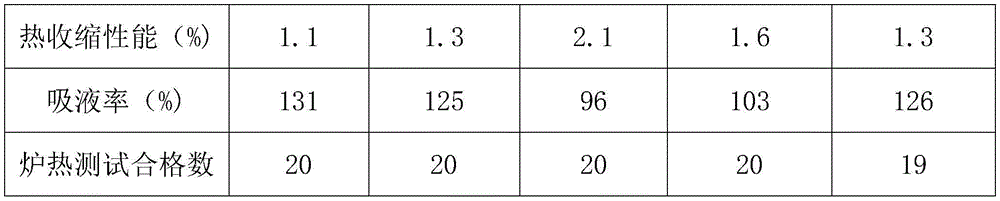
From the results in table 1, it can be seen that the composite separator of the present invention has good liquid absorption performance, low shrinkage and high temperature safety.
The foregoing is merely exemplary and illustrative of the present invention and various modifications, additions and substitutions may be made by those skilled in the art to the specific embodiments described without departing from the scope of the invention as defined in the following claims.
Claims (5)
1. A lithium ion battery composite diaphragm is characterized by comprising two layers of modified non-woven fabric substrate films, a thermal protection coating between the two layers of modified non-woven fabric substrate films and a reinforcing coating on the surface of the two layers of modified non-woven fabrics opposite to the thermal protection coating, wherein the modified non-woven fabric substrate films are formed by modifying polypropylene non-woven fabrics, the thickness of the polypropylene non-woven fabrics is 25-60 mu m, the porosity is 30-65%, and the pore diameter is 0.5-3 mu m;
the thickness of the thermal protection coating is 6-10 μm, and the thickness of the reinforcing coating is 3-8 μm;
the preparation method of the lithium ion battery composite diaphragm comprises the following steps:
the method comprises the following steps: preparation of modified nonwoven Fabric substrate film
Carrying out hydrophilic modification on the non-woven fabric substrate membrane;
step two: preparation of thermal protective coating
Adding polyvinylidene fluoride into a first organic solvent, wherein the addition amount of polyvinylidene fluoride is 20-40g/100mL, adding mixed powder of vulcanized nano rubber particles and first inorganic powder after polyvinylidene fluoride is completely dissolved, and uniformly stirring and mixing to obtain a thermal protection coating;
step three: preparation of thermal protective coatings
Respectively coating thermal protection coatings on one surfaces of two modified non-woven fabric substrate films, then pasting the surfaces of the two modified non-woven fabric substrate films coated with the thermal protection coatings together, rolling by using a compression roller, after the adhesive is cured, rolling by using the compression roller again to enable the non-woven fabric substrate film to be flat, and forming a thermal protection coating between the two modified non-woven fabric substrate films;
step four: preparation of reinforced coatings
S21, preparing an ethanol/water mixed solution of a silane coupling agent, adding second inorganic powder into the mixed solution, ultrasonically stirring and dispersing for 50-60min at the temperature of 50-60 ℃, carrying out solid-liquid separation, taking out the second inorganic powder, washing with absolute ethanol, and drying to obtain modified inorganic powder for later use;
s22, preparing a sodium alginate aqueous solution with pH of 7-9 and concentration of 2% -3%, adding the modified inorganic powder obtained in the previous step, and uniformly stirring and dispersing to obtain an aqueous mixed glue solution for later use, wherein the addition amount of the modified inorganic powder in the sodium alginate aqueous solution is 35-55g/100 mL;
s23, adding polyvinylidene fluoride into a second organic solvent to dissolve, so as to obtain an adhesive mixed solution, wherein the addition amount of polyvinylidene fluoride is 20-40g/100mL, adding the aqueous mixed glue solution obtained in the previous step into the adhesive mixed solution, wherein the volume ratio of the aqueous mixed glue solution to the adhesive mixed solution is 1:3-4, uniformly mixing and stirring, heating and dehydrating at the temperature of 75-90 ℃, and defoaming in vacuum so as to obtain the enhanced coating;
step five: preparation of the reinforcing coating
Coating the reinforcing coating on the surface, opposite to the thermal protection coating, of the modified non-woven fabric substrate film, and drying to obtain a reinforcing coating;
the preparation method of the modified non-woven fabric substrate film comprises the following specific steps:
s11, preparing an ethanol/water mixed solution of a silane coupling agent, adding nano-silica into the mixed solution, ultrasonically stirring and dispersing for 50-60min at the temperature of 50-60 ℃, carrying out solid-liquid separation to obtain the nano-silica, washing the nano-silica with absolute ethanol, and drying to obtain modified nano-silica for later use, wherein the particle size of the nano-silica is 200-500 nm;
s12, adding modified nano silicon dioxide, benzophenone and sodium dodecyl sulfate into absolute ethyl alcohol, heating to 45-50 ℃, stirring to fully dissolve the sodium dodecyl sulfate, adding photoinitiator TPO and hydroquinone, keeping the temperature, immersing the polypropylene non-woven fabric into the solution, performing ultrasonic treatment for 5-6min, and irradiating by ultraviolet light for 8-12min, wherein the concentration of the benzophenone is 50-60g/L, the concentration of the sodium dodecyl sulfate is 3.5-5g/L, the concentration of the photoinitiator TPO is 2-3.5g/L, the concentration of the hydroquinone is 2-5g/L, and the mass ratio of the nano silicon dioxide to the polypropylene non-woven fabric is 1: 200-;
s13, taking out the polypropylene non-woven fabric, drying, adding the polypropylene non-woven fabric into an ethanol solution of methyl methacrylate, wherein the volume ratio of methyl methacrylate to ethanol is 2-4.5:3, taking out after ultraviolet irradiation for 15-18min, washing with ethanol, drying, adding the polypropylene non-woven fabric into acetone, ultrasonically washing for 20-35min, taking out, and drying to obtain the hydrophilic modified non-woven fabric with the surface and pores grafted with the polymethyl methacrylate.
2. The lithium ion battery composite membrane as claimed in claim 1, wherein in the second step, the vulcanized nano rubber particles are at least one of vulcanized nano styrene-butadiene rubber and nano nitrile-butadiene rubber, and the particle size of the nano rubber particles is 200-350 nm.
3. The lithium ion battery composite separator according to claim 1, wherein the first inorganic powder and the second inorganic powder are one or a mixture of at least two of silicon dioxide, aluminum oxide, titanium dioxide and zirconium dioxide, and the particle size of the first inorganic powder and the particle size of the second inorganic powder are 40-800 nm.
4. The lithium ion battery composite separator according to claim 1, wherein the first organic solvent and the second organic solvent are at least one of dimethylformamide, dimethylacetamide, dimethylsulfoxide, and N-methylpyrrolidone.
5. The lithium ion battery composite separator according to claim 1, wherein the mass ratio of the mixed powder of the vulcanized nano-rubber particles and the first inorganic powder in the second step to the first organic solvent of polyvinylidene fluoride is 1:4-6, and the mass ratio of the vulcanized nano-rubber to the first inorganic powder is 4: 1-1.5.
Priority Applications (1)
| Application Number | Priority Date | Filing Date | Title |
|---|---|---|---|
| CN201910543767.1A CN110323396B (en) | 2019-06-21 | 2019-06-21 | Lithium ion battery composite diaphragm and preparation method thereof |
Applications Claiming Priority (1)
| Application Number | Priority Date | Filing Date | Title |
|---|---|---|---|
| CN201910543767.1A CN110323396B (en) | 2019-06-21 | 2019-06-21 | Lithium ion battery composite diaphragm and preparation method thereof |
Publications (2)
| Publication Number | Publication Date |
|---|---|
| CN110323396A CN110323396A (en) | 2019-10-11 |
| CN110323396B true CN110323396B (en) | 2022-08-30 |
Family
ID=68121137
Family Applications (1)
| Application Number | Title | Priority Date | Filing Date |
|---|---|---|---|
| CN201910543767.1A Active CN110323396B (en) | 2019-06-21 | 2019-06-21 | Lithium ion battery composite diaphragm and preparation method thereof |
Country Status (1)
| Country | Link |
|---|---|
| CN (1) | CN110323396B (en) |
Families Citing this family (5)
| Publication number | Priority date | Publication date | Assignee | Title |
|---|---|---|---|---|
| CN111063849A (en) * | 2019-11-08 | 2020-04-24 | 扬州工业职业技术学院 | Dual-drive self-assembly-based lithium ion battery isolating membrane and preparation method thereof |
| CN111628134B (en) * | 2020-06-05 | 2022-05-31 | 淮北市吉耐新材料科技有限公司 | Polyethylene microporous diaphragm and preparation method thereof |
| CN111933879A (en) * | 2020-07-21 | 2020-11-13 | 清华大学 | Lithium ion battery |
| CN111916632A (en) * | 2020-07-24 | 2020-11-10 | 清华大学 | Composite particle for battery, battery separator, and lithium ion battery |
| CN118943654B (en) * | 2023-12-04 | 2025-09-09 | 江苏双星彩塑新材料股份有限公司 | Lithium battery diaphragm and preparation method thereof |
Citations (9)
| Publication number | Priority date | Publication date | Assignee | Title |
|---|---|---|---|---|
| CN102529247A (en) * | 2012-01-19 | 2012-07-04 | 苏州大学 | Inorganic/organic composite porous lithium battery diaphragm and preparation method thereof |
| CN102623658A (en) * | 2012-03-12 | 2012-08-01 | 宁德新能源科技有限公司 | Diaphragm and preparation method thereof, and lithium ion battery |
| CN103127841A (en) * | 2011-11-28 | 2013-06-05 | 中化蓝天集团有限公司 | Polyvinylidene fluoride hydrophilic modified membrane and preparation method thereof |
| CN103199209A (en) * | 2013-04-01 | 2013-07-10 | 中国海诚工程科技股份有限公司 | Non-woven ceramic membrane with excellent closed-pore performance for lithium ion battery and technology |
| CN103928649A (en) * | 2014-04-10 | 2014-07-16 | 佛山市金辉高科光电材料有限公司 | Novel modified non-woven fabric lithium-ion battery diaphragm and preparation method thereof |
| CN105185937A (en) * | 2015-10-23 | 2015-12-23 | 旭成(福建)科技股份有限公司 | Non-woven fabric ceramic diaphragm for lithium ion battery and preparation method of non-woven fabric ceramic diaphragm |
| CN105304846A (en) * | 2015-11-10 | 2016-02-03 | 天能电池集团有限公司 | Composite non-woven fabric ceramic diaphragm for lithium ion battery and preparation method thereof |
| CN105470435A (en) * | 2016-01-13 | 2016-04-06 | 浙江天能能源科技有限公司 | Non-woven fabric based multi-layer composite diaphragm for lithium ion battery and preparation method of multi-layer composite diaphragm |
| CN109841779A (en) * | 2017-11-24 | 2019-06-04 | 深圳市比亚迪锂电池有限公司 | A kind of battery diaphragm and preparation method thereof and battery |
-
2019
- 2019-06-21 CN CN201910543767.1A patent/CN110323396B/en active Active
Patent Citations (9)
| Publication number | Priority date | Publication date | Assignee | Title |
|---|---|---|---|---|
| CN103127841A (en) * | 2011-11-28 | 2013-06-05 | 中化蓝天集团有限公司 | Polyvinylidene fluoride hydrophilic modified membrane and preparation method thereof |
| CN102529247A (en) * | 2012-01-19 | 2012-07-04 | 苏州大学 | Inorganic/organic composite porous lithium battery diaphragm and preparation method thereof |
| CN102623658A (en) * | 2012-03-12 | 2012-08-01 | 宁德新能源科技有限公司 | Diaphragm and preparation method thereof, and lithium ion battery |
| CN103199209A (en) * | 2013-04-01 | 2013-07-10 | 中国海诚工程科技股份有限公司 | Non-woven ceramic membrane with excellent closed-pore performance for lithium ion battery and technology |
| CN103928649A (en) * | 2014-04-10 | 2014-07-16 | 佛山市金辉高科光电材料有限公司 | Novel modified non-woven fabric lithium-ion battery diaphragm and preparation method thereof |
| CN105185937A (en) * | 2015-10-23 | 2015-12-23 | 旭成(福建)科技股份有限公司 | Non-woven fabric ceramic diaphragm for lithium ion battery and preparation method of non-woven fabric ceramic diaphragm |
| CN105304846A (en) * | 2015-11-10 | 2016-02-03 | 天能电池集团有限公司 | Composite non-woven fabric ceramic diaphragm for lithium ion battery and preparation method thereof |
| CN105470435A (en) * | 2016-01-13 | 2016-04-06 | 浙江天能能源科技有限公司 | Non-woven fabric based multi-layer composite diaphragm for lithium ion battery and preparation method of multi-layer composite diaphragm |
| CN109841779A (en) * | 2017-11-24 | 2019-06-04 | 深圳市比亚迪锂电池有限公司 | A kind of battery diaphragm and preparation method thereof and battery |
Also Published As
| Publication number | Publication date |
|---|---|
| CN110323396A (en) | 2019-10-11 |
Similar Documents
| Publication | Publication Date | Title |
|---|---|---|
| CN110323396B (en) | Lithium ion battery composite diaphragm and preparation method thereof | |
| CN112103451B (en) | Multifunctional composite diaphragm for high-stability water-based zinc-based battery and preparation method thereof | |
| CN103872282B (en) | A kind of polymer lithium cell diaphragm and preparation method thereof | |
| CN103346281A (en) | Sodium alginate-based lithium battery diaphragm and preparation method thereof | |
| CN107978717A (en) | A kind of compound lithium-sulfur cell membrane and its preparation method and application | |
| WO2020034168A1 (en) | Porous lithium ion battery separator film employing cross-linked polymer and linear polymer, preparation method and application thereof | |
| CN105070862A (en) | Non-woven type power lithium battery diaphragm and preparation method thereof | |
| CN102931370A (en) | Organic/inorganic composite nanofiber membrane of lithium ion power battery and preparation method of organic/inorganic composite nanofiber membrane | |
| CN207731986U (en) | A diaphragm with good wetting effect | |
| CN111063849A (en) | Dual-drive self-assembly-based lithium ion battery isolating membrane and preparation method thereof | |
| CN113506950A (en) | Preparation method of pore-foaming agent regulated and controlled micro-nano porous structure aramid fiber nanofiber-based battery diaphragm | |
| CN111403665A (en) | Ceramic-coated lithium battery diaphragm and preparation method thereof | |
| CN114421091A (en) | Preparation method of lithium battery composite diaphragm with multilayer structure | |
| CN105185939A (en) | Lithium ion battery separator with low thermal shrinkage rate and preparation method therefor | |
| CN109428033A (en) | Lithium ion battery separator and preparation method thereof | |
| CN105619991B (en) | A kind of composite lithium ion cell diaphragm material and preparation method thereof | |
| CN114400297A (en) | Lithium ion battery composite pole piece containing aerogel coating and preparation method thereof | |
| CN107681113B (en) | Positive electrode sheet, preparation method thereof, and secondary battery | |
| CN111916630B (en) | A composite separator and its preparation method and battery | |
| CN104577198A (en) | Core/shell structure fiber film-based gel polymer electrolyte and preparation method thereof | |
| CN110137416A (en) | A kind of polyolefin lithium electric separator preparation method | |
| CN117477168A (en) | Isolation film for sodium ion battery and preparation method thereof | |
| CN106784545B (en) | Paper-structure composite lithium battery diaphragm and preparation method thereof | |
| CN117013192A (en) | Functionalized aramid nanofiber-based battery diaphragm and preparation method and application thereof | |
| CN110444719A (en) | High-strength composite lithium ion battery diaphragm |
Legal Events
| Date | Code | Title | Description |
|---|---|---|---|
| PB01 | Publication | ||
| PB01 | Publication | ||
| SE01 | Entry into force of request for substantive examination | ||
| SE01 | Entry into force of request for substantive examination | ||
| GR01 | Patent grant | ||
| GR01 | Patent grant | ||
| TR01 | Transfer of patent right |
Effective date of registration: 20221221 Address after: 223010 # 3 Factory Building in Comprehensive Bonded Zone, No. 90 Yingbin Avenue, Huai'an Economic and Technological Development Zone, Jiangsu Province Patentee after: Jiangsu Jiesi New Energy Technology Co.,Ltd. Address before: No. 182, Dongfeng Road, High-tech Industrial Development Zone, Fuxin City, Liaoning Province, 123000 Patentee before: Wang Kuan |
|
| TR01 | Transfer of patent right |