CN110283777B - A method for continuous culture of shrimp cells - Google Patents
A method for continuous culture of shrimp cells Download PDFInfo
- Publication number
- CN110283777B CN110283777B CN201910622127.XA CN201910622127A CN110283777B CN 110283777 B CN110283777 B CN 110283777B CN 201910622127 A CN201910622127 A CN 201910622127A CN 110283777 B CN110283777 B CN 110283777B
- Authority
- CN
- China
- Prior art keywords
- culture
- matrigel
- prawn
- shrimp
- cells
- Prior art date
- Legal status (The legal status is an assumption and is not a legal conclusion. Google has not performed a legal analysis and makes no representation as to the accuracy of the status listed.)
- Active
Links
- 241000238557 Decapoda Species 0.000 title claims abstract description 111
- 238000000034 method Methods 0.000 title claims abstract description 15
- 210000004027 cell Anatomy 0.000 claims abstract description 93
- 108010082117 matrigel Proteins 0.000 claims abstract description 41
- 239000001963 growth medium Substances 0.000 claims abstract description 16
- 210000005105 peripheral blood lymphocyte Anatomy 0.000 claims abstract description 9
- 238000012136 culture method Methods 0.000 claims abstract description 6
- FAPWRFPIFSIZLT-UHFFFAOYSA-M Sodium chloride Chemical compound [Na+].[Cl-] FAPWRFPIFSIZLT-UHFFFAOYSA-M 0.000 claims description 15
- 239000002609 medium Substances 0.000 claims description 14
- 238000011084 recovery Methods 0.000 claims description 11
- UCSJYZPVAKXKNQ-HZYVHMACSA-N streptomycin Chemical compound CN[C@H]1[C@H](O)[C@@H](O)[C@H](CO)O[C@H]1O[C@@H]1[C@](C=O)(O)[C@H](C)O[C@H]1O[C@@H]1[C@@H](NC(N)=N)[C@H](O)[C@@H](NC(N)=N)[C@H](O)[C@H]1O UCSJYZPVAKXKNQ-HZYVHMACSA-N 0.000 claims description 10
- 230000003204 osmotic effect Effects 0.000 claims description 9
- 210000001672 ovary Anatomy 0.000 claims description 8
- 239000006228 supernatant Substances 0.000 claims description 8
- 238000012258 culturing Methods 0.000 claims description 7
- 239000011780 sodium chloride Substances 0.000 claims description 7
- XOAAWQZATWQOTB-UHFFFAOYSA-N taurine Chemical compound NCCS(O)(=O)=O XOAAWQZATWQOTB-UHFFFAOYSA-N 0.000 claims description 6
- 229930182555 Penicillin Natural products 0.000 claims description 5
- JGSARLDLIJGVTE-MBNYWOFBSA-N Penicillin G Chemical compound N([C@H]1[C@H]2SC([C@@H](N2C1=O)C(O)=O)(C)C)C(=O)CC1=CC=CC=C1 JGSARLDLIJGVTE-MBNYWOFBSA-N 0.000 claims description 5
- 239000006285 cell suspension Substances 0.000 claims description 5
- 239000011159 matrix material Substances 0.000 claims description 5
- 229940049954 penicillin Drugs 0.000 claims description 5
- 229960005322 streptomycin Drugs 0.000 claims description 5
- 108090000379 Fibroblast growth factor 2 Proteins 0.000 claims description 4
- APKFDSVGJQXUKY-KKGHZKTASA-N Amphotericin-B Natural products O[C@H]1[C@@H](N)[C@H](O)[C@@H](C)O[C@H]1O[C@H]1C=CC=CC=CC=CC=CC=CC=C[C@H](C)[C@@H](O)[C@@H](C)[C@H](C)OC(=O)C[C@H](O)C[C@H](O)CC[C@@H](O)[C@H](O)C[C@H](O)C[C@](O)(C[C@H](O)[C@H]2C(O)=O)O[C@H]2C1 APKFDSVGJQXUKY-KKGHZKTASA-N 0.000 claims description 3
- 108091003079 Bovine Serum Albumin Proteins 0.000 claims description 3
- WQZGKKKJIJFFOK-GASJEMHNSA-N Glucose Natural products OC[C@H]1OC(O)[C@H](O)[C@@H](O)[C@@H]1O WQZGKKKJIJFFOK-GASJEMHNSA-N 0.000 claims description 3
- FFEARJCKVFRZRR-BYPYZUCNSA-N L-methionine Chemical compound CSCC[C@H](N)C(O)=O FFEARJCKVFRZRR-BYPYZUCNSA-N 0.000 claims description 3
- ONIBWKKTOPOVIA-UHFFFAOYSA-N Proline Natural products OC(=O)C1CCCN1 ONIBWKKTOPOVIA-UHFFFAOYSA-N 0.000 claims description 3
- APKFDSVGJQXUKY-INPOYWNPSA-N amphotericin B Chemical compound O[C@H]1[C@@H](N)[C@H](O)[C@@H](C)O[C@H]1O[C@H]1/C=C/C=C/C=C/C=C/C=C/C=C/C=C/[C@H](C)[C@@H](O)[C@@H](C)[C@H](C)OC(=O)C[C@H](O)C[C@H](O)CC[C@@H](O)[C@H](O)C[C@H](O)C[C@](O)(C[C@H](O)[C@H]2C(O)=O)O[C@H]2C1 APKFDSVGJQXUKY-INPOYWNPSA-N 0.000 claims description 3
- 229960003942 amphotericin b Drugs 0.000 claims description 3
- 239000008103 glucose Substances 0.000 claims description 3
- HNDVDQJCIGZPNO-UHFFFAOYSA-N histidine Natural products OC(=O)C(N)CC1=CN=CN1 HNDVDQJCIGZPNO-UHFFFAOYSA-N 0.000 claims description 3
- 229930182817 methionine Natural products 0.000 claims description 3
- 239000000203 mixture Substances 0.000 claims description 3
- 239000000843 powder Substances 0.000 claims description 3
- UIIMBOGNXHQVGW-UHFFFAOYSA-M sodium bicarbonate Substances [Na+].OC([O-])=O UIIMBOGNXHQVGW-UHFFFAOYSA-M 0.000 claims description 3
- 229960003080 taurine Drugs 0.000 claims description 3
- 102000009024 Epidermal Growth Factor Human genes 0.000 claims description 2
- KDXKERNSBIXSRK-UHFFFAOYSA-N Lysine Natural products NCCCCC(N)C(O)=O KDXKERNSBIXSRK-UHFFFAOYSA-N 0.000 claims description 2
- 239000004472 Lysine Substances 0.000 claims description 2
- 238000001816 cooling Methods 0.000 claims description 2
- 239000012528 membrane Substances 0.000 claims description 2
- IFGCUJZIWBUILZ-UHFFFAOYSA-N sodium 2-[[2-[[hydroxy-(3,4,5-trihydroxy-6-methyloxan-2-yl)oxyphosphoryl]amino]-4-methylpentanoyl]amino]-3-(1H-indol-3-yl)propanoic acid Chemical compound [Na+].C=1NC2=CC=CC=C2C=1CC(C(O)=O)NC(=O)C(CC(C)C)NP(O)(=O)OC1OC(C)C(O)C(O)C1O IFGCUJZIWBUILZ-UHFFFAOYSA-N 0.000 claims description 2
- 229910000030 sodium bicarbonate Inorganic materials 0.000 claims description 2
- 238000000967 suction filtration Methods 0.000 claims description 2
- 238000005406 washing Methods 0.000 claims description 2
- 102100024785 Fibroblast growth factor 2 Human genes 0.000 claims 1
- BNIILDVGGAEEIG-UHFFFAOYSA-L disodium hydrogen phosphate Chemical compound [Na+].[Na+].OP([O-])([O-])=O BNIILDVGGAEEIG-UHFFFAOYSA-L 0.000 claims 1
- 229910000397 disodium phosphate Inorganic materials 0.000 claims 1
- 239000012894 fetal calf serum Substances 0.000 claims 1
- 238000009472 formulation Methods 0.000 claims 1
- 239000002244 precipitate Substances 0.000 claims 1
- 230000001502 supplementing effect Effects 0.000 claims 1
- 210000004698 lymphocyte Anatomy 0.000 abstract description 17
- 230000004083 survival effect Effects 0.000 abstract description 7
- 230000000694 effects Effects 0.000 abstract description 5
- 239000003085 diluting agent Substances 0.000 abstract description 3
- 238000005516 engineering process Methods 0.000 abstract description 3
- 238000000926 separation method Methods 0.000 abstract description 2
- 229940121363 anti-inflammatory agent Drugs 0.000 abstract 1
- 239000002260 anti-inflammatory agent Substances 0.000 abstract 1
- 239000000701 coagulant Substances 0.000 abstract 1
- 239000000243 solution Substances 0.000 description 13
- LOKCTEFSRHRXRJ-UHFFFAOYSA-I dipotassium trisodium dihydrogen phosphate hydrogen phosphate dichloride Chemical compound P(=O)(O)(O)[O-].[K+].P(=O)(O)([O-])[O-].[Na+].[Na+].[Cl-].[K+].[Cl-].[Na+] LOKCTEFSRHRXRJ-UHFFFAOYSA-I 0.000 description 8
- 239000002953 phosphate buffered saline Substances 0.000 description 8
- 238000002360 preparation method Methods 0.000 description 8
- 210000001519 tissue Anatomy 0.000 description 8
- 239000007640 basal medium Substances 0.000 description 6
- 238000000338 in vitro Methods 0.000 description 5
- 102000003974 Fibroblast growth factor 2 Human genes 0.000 description 3
- 108091005804 Peptidases Proteins 0.000 description 3
- 239000004365 Protease Substances 0.000 description 3
- HEMHJVSKTPXQMS-UHFFFAOYSA-M Sodium hydroxide Chemical compound [OH-].[Na+] HEMHJVSKTPXQMS-UHFFFAOYSA-M 0.000 description 3
- 239000003146 anticoagulant agent Substances 0.000 description 3
- 229940127219 anticoagulant drug Drugs 0.000 description 3
- DEGAKNSWVGKMLS-UHFFFAOYSA-N calcein Chemical compound O1C(=O)C2=CC=CC=C2C21C1=CC(CN(CC(O)=O)CC(O)=O)=C(O)C=C1OC1=C2C=C(CN(CC(O)=O)CC(=O)O)C(O)=C1 DEGAKNSWVGKMLS-UHFFFAOYSA-N 0.000 description 3
- 210000004748 cultured cell Anatomy 0.000 description 3
- 210000000087 hemolymph Anatomy 0.000 description 3
- 239000000017 hydrogel Substances 0.000 description 3
- 238000002955 isolation Methods 0.000 description 3
- 210000004962 mammalian cell Anatomy 0.000 description 3
- 229960002378 oftasceine Drugs 0.000 description 3
- 230000008569 process Effects 0.000 description 3
- 239000013535 sea water Substances 0.000 description 3
- 238000010186 staining Methods 0.000 description 3
- 235000009161 Espostoa lanata Nutrition 0.000 description 2
- 240000001624 Espostoa lanata Species 0.000 description 2
- LFQSCWFLJHTTHZ-UHFFFAOYSA-N Ethanol Chemical compound CCO LFQSCWFLJHTTHZ-UHFFFAOYSA-N 0.000 description 2
- 102100037486 Reverse transcriptase/ribonuclease H Human genes 0.000 description 2
- 102000004142 Trypsin Human genes 0.000 description 2
- 108090000631 Trypsin Proteins 0.000 description 2
- 241000700605 Viruses Species 0.000 description 2
- 238000009360 aquaculture Methods 0.000 description 2
- 244000144974 aquaculture Species 0.000 description 2
- 239000012091 fetal bovine serum Substances 0.000 description 2
- 238000011081 inoculation Methods 0.000 description 2
- 238000001000 micrograph Methods 0.000 description 2
- 230000002611 ovarian Effects 0.000 description 2
- 239000011734 sodium Substances 0.000 description 2
- 230000001954 sterilising effect Effects 0.000 description 2
- 210000000115 thoracic cavity Anatomy 0.000 description 2
- 239000012588 trypsin Substances 0.000 description 2
- VBEQCZHXXJYVRD-GACYYNSASA-N uroanthelone Chemical compound C([C@@H](C(=O)N[C@H](C(=O)N[C@@H](CS)C(=O)N[C@@H](CC(N)=O)C(=O)N[C@@H](CS)C(=O)N[C@H](C(=O)N[C@@H]([C@@H](C)CC)C(=O)NCC(=O)N[C@@H](CC=1C=CC(O)=CC=1)C(=O)N[C@@H](CO)C(=O)NCC(=O)N[C@@H](CC(O)=O)C(=O)N[C@@H](CCCNC(N)=N)C(=O)N[C@@H](CS)C(=O)N[C@@H](CCC(N)=O)C(=O)N[C@@H]([C@@H](C)O)C(=O)N[C@@H](CCCNC(N)=N)C(=O)N[C@@H](CC(O)=O)C(=O)N[C@@H](CC(C)C)C(=O)N[C@@H](CCCNC(N)=N)C(=O)N[C@@H](CC=1C2=CC=CC=C2NC=1)C(=O)N[C@@H](CC=1C2=CC=CC=C2NC=1)C(=O)N[C@@H](CCC(O)=O)C(=O)N[C@@H](CC(C)C)C(=O)N[C@@H](CCCNC(N)=N)C(O)=O)C(C)C)[C@@H](C)O)NC(=O)[C@H](CO)NC(=O)[C@H](CC(O)=O)NC(=O)[C@H](CC(C)C)NC(=O)[C@H](CO)NC(=O)[C@H](CCC(O)=O)NC(=O)[C@@H](NC(=O)[C@H](CC=1NC=NC=1)NC(=O)[C@H](CCSC)NC(=O)[C@H](CS)NC(=O)[C@@H](NC(=O)CNC(=O)CNC(=O)[C@H](CC(N)=O)NC(=O)[C@H](CC(C)C)NC(=O)[C@H](CS)NC(=O)[C@H](CC=1C=CC(O)=CC=1)NC(=O)CNC(=O)[C@H](CC(O)=O)NC(=O)[C@H](CC=1C=CC(O)=CC=1)NC(=O)[C@H](CO)NC(=O)[C@H](CO)NC(=O)[C@H]1N(CCC1)C(=O)[C@H](CS)NC(=O)CNC(=O)[C@H]1N(CCC1)C(=O)[C@H](CC=1C=CC(O)=CC=1)NC(=O)[C@H](CO)NC(=O)[C@@H](N)CC(N)=O)C(C)C)[C@@H](C)CC)C1=CC=C(O)C=C1 VBEQCZHXXJYVRD-GACYYNSASA-N 0.000 description 2
- IXPNQXFRVYWDDI-UHFFFAOYSA-N 1-methyl-2,4-dioxo-1,3-diazinane-5-carboximidamide Chemical compound CN1CC(C(N)=N)C(=O)NC1=O IXPNQXFRVYWDDI-UHFFFAOYSA-N 0.000 description 1
- 101800003838 Epidermal growth factor Proteins 0.000 description 1
- 102000035195 Peptidases Human genes 0.000 description 1
- 210000001015 abdomen Anatomy 0.000 description 1
- 230000003187 abdominal effect Effects 0.000 description 1
- 230000001464 adherent effect Effects 0.000 description 1
- 230000002776 aggregation Effects 0.000 description 1
- 238000004220 aggregation Methods 0.000 description 1
- 235000001014 amino acid Nutrition 0.000 description 1
- 150000001413 amino acids Chemical class 0.000 description 1
- 210000004102 animal cell Anatomy 0.000 description 1
- 210000002469 basement membrane Anatomy 0.000 description 1
- 210000004369 blood Anatomy 0.000 description 1
- 239000008280 blood Substances 0.000 description 1
- 238000009835 boiling Methods 0.000 description 1
- 239000013553 cell monolayer Substances 0.000 description 1
- 230000003833 cell viability Effects 0.000 description 1
- 230000008859 change Effects 0.000 description 1
- 239000003795 chemical substances by application Substances 0.000 description 1
- 230000007812 deficiency Effects 0.000 description 1
- 230000029087 digestion Effects 0.000 description 1
- 102000038379 digestive enzymes Human genes 0.000 description 1
- 108091007734 digestive enzymes Proteins 0.000 description 1
- 238000010790 dilution Methods 0.000 description 1
- 239000012895 dilution Substances 0.000 description 1
- 201000010099 disease Diseases 0.000 description 1
- 208000037265 diseases, disorders, signs and symptoms Diseases 0.000 description 1
- 230000006862 enzymatic digestion Effects 0.000 description 1
- 229940116977 epidermal growth factor Drugs 0.000 description 1
- 210000002615 epidermis Anatomy 0.000 description 1
- 238000002474 experimental method Methods 0.000 description 1
- 238000000605 extraction Methods 0.000 description 1
- 239000007850 fluorescent dye Substances 0.000 description 1
- 239000000499 gel Substances 0.000 description 1
- 239000003102 growth factor Substances 0.000 description 1
- 235000018977 lysine Nutrition 0.000 description 1
- 238000004519 manufacturing process Methods 0.000 description 1
- 238000002844 melting Methods 0.000 description 1
- 230000008018 melting Effects 0.000 description 1
- 239000012982 microporous membrane Substances 0.000 description 1
- 238000005457 optimization Methods 0.000 description 1
- 238000004806 packaging method and process Methods 0.000 description 1
- 230000003950 pathogenic mechanism Effects 0.000 description 1
- 239000008188 pellet Substances 0.000 description 1
- 210000005259 peripheral blood Anatomy 0.000 description 1
- 239000011886 peripheral blood Substances 0.000 description 1
- 238000001556 precipitation Methods 0.000 description 1
- 239000000047 product Substances 0.000 description 1
- 238000000746 purification Methods 0.000 description 1
- 238000005070 sampling Methods 0.000 description 1
- 235000010413 sodium alginate Nutrition 0.000 description 1
- 229940005550 sodium alginate Drugs 0.000 description 1
- 239000000661 sodium alginate Substances 0.000 description 1
- 235000017557 sodium bicarbonate Nutrition 0.000 description 1
- 238000004659 sterilization and disinfection Methods 0.000 description 1
- WPLOVIFNBMNBPD-ATHMIXSHSA-N subtilin Chemical compound CC1SCC(NC2=O)C(=O)NC(CC(N)=O)C(=O)NC(C(=O)NC(CCCCN)C(=O)NC(C(C)CC)C(=O)NC(=C)C(=O)NC(CCCCN)C(O)=O)CSC(C)C2NC(=O)C(CC(C)C)NC(=O)C1NC(=O)C(CCC(N)=O)NC(=O)C(CC(C)C)NC(=O)C(NC(=O)C1NC(=O)C(=C/C)/NC(=O)C(CCC(N)=O)NC(=O)C(CC(C)C)NC(=O)C(C)NC(=O)CNC(=O)C(NC(=O)C(NC(=O)C2NC(=O)CNC(=O)C3CCCN3C(=O)C(NC(=O)C3NC(=O)C(CC(C)C)NC(=O)C(=C)NC(=O)C(CCC(O)=O)NC(=O)C(NC(=O)C(CCCCN)NC(=O)C(N)CC=4C5=CC=CC=C5NC=4)CSC3)C(C)SC2)C(C)C)C(C)SC1)CC1=CC=CC=C1 WPLOVIFNBMNBPD-ATHMIXSHSA-N 0.000 description 1
- 239000013589 supplement Substances 0.000 description 1
- 239000000725 suspension Substances 0.000 description 1
- 238000010257 thawing Methods 0.000 description 1
- 230000001988 toxicity Effects 0.000 description 1
- 231100000419 toxicity Toxicity 0.000 description 1
- 229910021642 ultra pure water Inorganic materials 0.000 description 1
- 239000012498 ultrapure water Substances 0.000 description 1
- 229960004854 viral vaccine Drugs 0.000 description 1
- XLYOFNOQVPJJNP-UHFFFAOYSA-N water Substances O XLYOFNOQVPJJNP-UHFFFAOYSA-N 0.000 description 1
- 238000004383 yellowing Methods 0.000 description 1
Images


Classifications
-
- C—CHEMISTRY; METALLURGY
- C12—BIOCHEMISTRY; BEER; SPIRITS; WINE; VINEGAR; MICROBIOLOGY; ENZYMOLOGY; MUTATION OR GENETIC ENGINEERING
- C12N—MICROORGANISMS OR ENZYMES; COMPOSITIONS THEREOF; PROPAGATING, PRESERVING, OR MAINTAINING MICROORGANISMS; MUTATION OR GENETIC ENGINEERING; CULTURE MEDIA
- C12N5/00—Undifferentiated human, animal or plant cells, e.g. cell lines; Tissues; Cultivation or maintenance thereof; Culture media therefor
- C12N5/06—Animal cells or tissues; Human cells or tissues
- C12N5/0601—Invertebrate cells or tissues, e.g. insect cells; Culture media therefor
-
- C—CHEMISTRY; METALLURGY
- C12—BIOCHEMISTRY; BEER; SPIRITS; WINE; VINEGAR; MICROBIOLOGY; ENZYMOLOGY; MUTATION OR GENETIC ENGINEERING
- C12N—MICROORGANISMS OR ENZYMES; COMPOSITIONS THEREOF; PROPAGATING, PRESERVING, OR MAINTAINING MICROORGANISMS; MUTATION OR GENETIC ENGINEERING; CULTURE MEDIA
- C12N2500/00—Specific components of cell culture medium
- C12N2500/30—Organic components
-
- C—CHEMISTRY; METALLURGY
- C12—BIOCHEMISTRY; BEER; SPIRITS; WINE; VINEGAR; MICROBIOLOGY; ENZYMOLOGY; MUTATION OR GENETIC ENGINEERING
- C12N—MICROORGANISMS OR ENZYMES; COMPOSITIONS THEREOF; PROPAGATING, PRESERVING, OR MAINTAINING MICROORGANISMS; MUTATION OR GENETIC ENGINEERING; CULTURE MEDIA
- C12N2500/00—Specific components of cell culture medium
- C12N2500/30—Organic components
- C12N2500/32—Amino acids
-
- C—CHEMISTRY; METALLURGY
- C12—BIOCHEMISTRY; BEER; SPIRITS; WINE; VINEGAR; MICROBIOLOGY; ENZYMOLOGY; MUTATION OR GENETIC ENGINEERING
- C12N—MICROORGANISMS OR ENZYMES; COMPOSITIONS THEREOF; PROPAGATING, PRESERVING, OR MAINTAINING MICROORGANISMS; MUTATION OR GENETIC ENGINEERING; CULTURE MEDIA
- C12N2500/00—Specific components of cell culture medium
- C12N2500/30—Organic components
- C12N2500/34—Sugars
-
- C—CHEMISTRY; METALLURGY
- C12—BIOCHEMISTRY; BEER; SPIRITS; WINE; VINEGAR; MICROBIOLOGY; ENZYMOLOGY; MUTATION OR GENETIC ENGINEERING
- C12N—MICROORGANISMS OR ENZYMES; COMPOSITIONS THEREOF; PROPAGATING, PRESERVING, OR MAINTAINING MICROORGANISMS; MUTATION OR GENETIC ENGINEERING; CULTURE MEDIA
- C12N2500/00—Specific components of cell culture medium
- C12N2500/60—Buffer, e.g. pH regulation, osmotic pressure
-
- C—CHEMISTRY; METALLURGY
- C12—BIOCHEMISTRY; BEER; SPIRITS; WINE; VINEGAR; MICROBIOLOGY; ENZYMOLOGY; MUTATION OR GENETIC ENGINEERING
- C12N—MICROORGANISMS OR ENZYMES; COMPOSITIONS THEREOF; PROPAGATING, PRESERVING, OR MAINTAINING MICROORGANISMS; MUTATION OR GENETIC ENGINEERING; CULTURE MEDIA
- C12N2500/00—Specific components of cell culture medium
- C12N2500/70—Undefined extracts
- C12N2500/80—Undefined extracts from animals
- C12N2500/82—Undefined extracts from animals from invertebrates
-
- C—CHEMISTRY; METALLURGY
- C12—BIOCHEMISTRY; BEER; SPIRITS; WINE; VINEGAR; MICROBIOLOGY; ENZYMOLOGY; MUTATION OR GENETIC ENGINEERING
- C12N—MICROORGANISMS OR ENZYMES; COMPOSITIONS THEREOF; PROPAGATING, PRESERVING, OR MAINTAINING MICROORGANISMS; MUTATION OR GENETIC ENGINEERING; CULTURE MEDIA
- C12N2500/00—Specific components of cell culture medium
- C12N2500/70—Undefined extracts
- C12N2500/80—Undefined extracts from animals
- C12N2500/84—Undefined extracts from animals from mammals
-
- C—CHEMISTRY; METALLURGY
- C12—BIOCHEMISTRY; BEER; SPIRITS; WINE; VINEGAR; MICROBIOLOGY; ENZYMOLOGY; MUTATION OR GENETIC ENGINEERING
- C12N—MICROORGANISMS OR ENZYMES; COMPOSITIONS THEREOF; PROPAGATING, PRESERVING, OR MAINTAINING MICROORGANISMS; MUTATION OR GENETIC ENGINEERING; CULTURE MEDIA
- C12N2501/00—Active agents used in cell culture processes, e.g. differentation
- C12N2501/10—Growth factors
- C12N2501/11—Epidermal growth factor [EGF]
-
- C—CHEMISTRY; METALLURGY
- C12—BIOCHEMISTRY; BEER; SPIRITS; WINE; VINEGAR; MICROBIOLOGY; ENZYMOLOGY; MUTATION OR GENETIC ENGINEERING
- C12N—MICROORGANISMS OR ENZYMES; COMPOSITIONS THEREOF; PROPAGATING, PRESERVING, OR MAINTAINING MICROORGANISMS; MUTATION OR GENETIC ENGINEERING; CULTURE MEDIA
- C12N2501/00—Active agents used in cell culture processes, e.g. differentation
- C12N2501/10—Growth factors
- C12N2501/115—Basic fibroblast growth factor (bFGF, FGF-2)
-
- C—CHEMISTRY; METALLURGY
- C12—BIOCHEMISTRY; BEER; SPIRITS; WINE; VINEGAR; MICROBIOLOGY; ENZYMOLOGY; MUTATION OR GENETIC ENGINEERING
- C12N—MICROORGANISMS OR ENZYMES; COMPOSITIONS THEREOF; PROPAGATING, PRESERVING, OR MAINTAINING MICROORGANISMS; MUTATION OR GENETIC ENGINEERING; CULTURE MEDIA
- C12N2513/00—3D culture
Landscapes
- Engineering & Computer Science (AREA)
- Health & Medical Sciences (AREA)
- Biomedical Technology (AREA)
- Life Sciences & Earth Sciences (AREA)
- Chemical & Material Sciences (AREA)
- Biotechnology (AREA)
- Organic Chemistry (AREA)
- Bioinformatics & Cheminformatics (AREA)
- Genetics & Genomics (AREA)
- Wood Science & Technology (AREA)
- Zoology (AREA)
- Microbiology (AREA)
- Biochemistry (AREA)
- General Engineering & Computer Science (AREA)
- General Health & Medical Sciences (AREA)
- Cell Biology (AREA)
- Micro-Organisms Or Cultivation Processes Thereof (AREA)
Abstract
本发明通过建立有效的对虾细胞3D培养与传代培养方法,从而提供了一种对虾细胞连续培养技术,可将其应用于对虾永生性细胞系的建立。本发明优化了基质胶的添加比例,从而提供了一种用于对虾细胞3D培养的基质胶制备方法;本发明还优化了对虾细胞完全培养基的配方,并选其作为对虾血淋巴细胞的抗凝剂与稀释剂,选用了基质胶表面附着生长的3D培养方式,从而提供了一种对虾外周血淋巴细胞的分离与3D培养技术,对虾血淋巴细胞以圆形单个细胞和细胞团/球的方式附着生长于基质胶表面,其存活和生长能力均优于2D培养效果;本发明还提供了一种3D培养对虾细胞的传代方法,传代后的对虾血淋巴细胞可以很好地附着于基质胶表面生长,传代后的存活率可高达90%以上。

By establishing an effective 3D culture and subculture method for shrimp cells, the present invention provides a continuous culture technology for shrimp cells, which can be applied to the establishment of an immortal shrimp cell line. The invention optimizes the addition ratio of the matrigel, thereby providing a method for preparing the matrigel for 3D culture of shrimp cells; the invention also optimizes the formula of the complete culture medium for shrimp cells, and selects it as the anti-inflammatory agent of shrimp blood lymphocytes. Coagulant and diluent, the 3D culture method of attaching and growing on the surface of Matrigel is selected, thus providing a separation and 3D culture technology of shrimp peripheral blood lymphocytes. It attaches to and grows on the surface of Matrigel, and its survival and growth ability are better than the 2D culture effect; the invention also provides a 3D cultured shrimp cell passaging method, and the subcultured shrimp blood lymphocytes can be well attached to the Matrigel. Surface growth, the survival rate after passage can be as high as 90% or more.
Description
技术领域technical field
本发明属于动物细胞、组织培养技术领域,具体涉及一种对虾细胞连续培养方法。The invention belongs to the technical field of animal cell and tissue culture, and in particular relates to a continuous culture method for shrimp cells.
背景技术Background technique
对虾病毒病的频繁爆发已给对虾养殖业带来了沉重打击,成为制约对虾养殖业可持续发展的瓶颈问题。对虾永生化细胞系的建立可为对虾病毒的分离纯化及其致病机理研究、生产高效的抗病毒疫苗等提供有效的研究手段与载体。虽然国内外专家学者在对虾细胞建系上进行了大量的探索和努力,但由于在目前已建立的培养体系下的对虾细胞几乎不分裂,而且对虾细胞对包括胰蛋白酶在内的各种蛋白酶极其敏感,因而传代困难,导致对虾永生性细胞系一直未能成功建立。The frequent outbreak of shrimp virus disease has brought a heavy blow to the shrimp aquaculture industry and has become a bottleneck restricting the sustainable development of the shrimp aquaculture industry. The establishment of the shrimp immortalized cell line can provide an effective research method and carrier for the isolation and purification of shrimp virus, its pathogenic mechanism research, and the production of high-efficiency antiviral vaccines. Although domestic and foreign experts and scholars have made a lot of exploration and efforts on the establishment of shrimp cell lines, because the shrimp cells in the established culture system hardly divide, and shrimp cells are extremely sensitive to various proteases including trypsin Sensitive and thus difficult to passage, resulting in the unsuccessful establishment of immortalized shrimp cell lines.
目前,对虾的各种体外培养尝试都是基于二维(2D)培养方式展开的,即细胞接种于培养瓶、培养皿和培养板中,以细胞单层的方式生长和存活。目前,在对虾细胞的2D培养举步维艰的现状下,有必要开展对虾细胞的3D培养尝试,以期提高对虾细胞的体外生长和存活能力。又由于3D培养细胞不是贴壁生长的,因而细胞的传代可以不使用包括胰蛋白酶在内的各种消化酶,从而减少传代时蛋白酶对对虾细胞的伤害,使对虾细胞的体外连续培养成为可能。但是,目前对虾细胞3D培养传代的效果并不好。At present, various in vitro culture attempts of prawns are based on two-dimensional (2D) culture, that is, cells are seeded in culture flasks, culture dishes and culture plates to grow and survive as a cell monolayer. At present, under the current situation that the 2D culture of shrimp cells is difficult, it is necessary to carry out 3D culture experiments of shrimp cells in order to improve the in vitro growth and survival ability of shrimp cells. And because the 3D cultured cells are not adherent to the wall, the cells can be passaged without the use of various digestive enzymes including trypsin, thereby reducing the damage of the protease to the shrimp cells during passage, making it possible to continuously culture the shrimp cells in vitro. However, at present, the effect of 3D culture and passage of shrimp cells is not good.
发明内容SUMMARY OF THE INVENTION
本发明的目的是提供一种对虾细胞连续培养方法,并将其应用于对虾永生性细胞系的建立,从而弥补现有技术的不足。The purpose of the present invention is to provide a continuous culture method for shrimp cells, and apply the method to the establishment of an immortal shrimp cell line, thereby making up for the deficiencies of the prior art.
本发明首先提供一种对虾细胞的3D培养方法,是将对虾细胞悬液加入到已铺有基质胶的培养孔中,再补加对虾细胞完全培养基,再放置于CO2培养箱中进行培养,培养期间更换对虾细胞完全培养基;The present invention first provides a 3D culture method for prawn cells, which is to add the prawn cell suspension into the culture hole that has been covered with matrigel, then add the prawn cell complete medium, and then place it in a CO 2 incubator for culturing , replace the complete medium of shrimp cells during the culture;
其中已铺有基质胶的培养孔,是将4℃预冷的基质胶以55-80μL/cm2的比例加入到培养孔中;基质胶摊平后,凝固制成的;The culture wells that have been covered with Matrigel are prepared by adding pre-cooled Matrigel at a ratio of 55-80 μL/cm 2 to the culture wells; after the Matrigel is flattened, it is solidified;
所述的对虾细胞,为对虾外周血淋巴细胞;The prawn cells are prawn peripheral blood lymphocytes;
所述的对虾细胞完全培养基,是在对虾细胞基础培养基中,使用前加入了15%胎牛血清、20%卵巢提取液、20μg/L碱性成纤维细胞生长因子bFGF和20μg/L表皮生长因子EGF,The prawn cell complete culture medium is in the prawn cell basal medium, before use, 15% fetal bovine serum, 20% ovary extract, 20 μg/L basic fibroblast growth factor bFGF and 20 μg/L epidermis are added. Growth factor EGF,
其中对虾细胞基础培养基的配方为:20.55g/L Leibovitz's L-15培养基(粉末)、5g/L NaCl、2g/L葡萄糖、1g/L NaHCO3、166.7mg/L组氨酸,50mg/L赖氨酸,50mg/L甲硫氨酸,33.3mg/L色氨酸,30mg/L脯氨酸,30mg/L牛磺酸、0.25mg/L两性霉素B、100IU/L青霉素和100mg/L链霉素,pH值7.2-7.4。The formula of the shrimp cell basal medium is: 20.55g/L Leibovitz's L-15 medium (powder), 5g/L NaCl, 2g/L glucose, 1g/L NaHCO 3 , 166.7mg/L histidine, 50mg/L L-Lysine, 50mg/L Methionine, 33.3mg/L Tryptophan, 30mg/L Proline, 30mg/L Taurine, 0.25mg/L Amphotericin B, 100IU/L Penicillin and 100mg /L streptomycin, pH 7.2-7.4.
所述的卵巢提取液,是将对虾卵巢组织匀浆后,用上述的对虾细胞基础培养基在4℃提取,提取液在4℃,10000rpm离心取上清;上清液依次用0.45和0.22um滤膜抽滤除菌制成的。The ovary extract is obtained by homogenizing the ovary tissue of the prawns, then using the above-mentioned prawn cell basal medium to extract at 4°C, and the extract is centrifuged at 4°C and 10,000 rpm to obtain the supernatant; Made of filter membrane sterilization.
所述的培养,是在28℃、3%CO2培养箱中培养;The culturing is carried out in a 28°C, 3% CO 2 incubator;
本发明还提供一种对虾3D培养细胞的传代方法,是将上述培养在基质胶表面的对虾细胞用0-4℃预冷的PBS溶液洗涤细胞后,加入与对虾细胞完全培养基的渗透压相同的细胞回收液,然后在0-4℃条件下将基质胶溶解;将溶解的基质胶细胞悬液在3000g,4℃离心5-10分钟,弃上清;将沉淀用对虾细胞完全培养基重悬,接种至新的培养板中的基质胶上进行传代培养。The present invention also provides a method for passage of shrimp 3D cultured cells, which is to wash the above-mentioned shrimp cells cultured on the surface of Matrigel with PBS solution pre-cooled at 0-4°C, and then add the same osmotic pressure as that of the shrimp cell complete culture medium. The cell recovery solution was obtained, and then the Matrigel was dissolved at 0-4 °C; the dissolved Matrigel cell suspension was centrifuged at 3000g, 4 °C for 5-10 minutes, and the supernatant was discarded; Suspended, inoculated onto Matrigel in a new culture plate for subculture.
其中PBS溶液的配方:12.0g/L NaCl,0.3g/L KCl,4.5g/LNa2HPO4·12H2O和0.3g/L的KH2PO4,pH值7.2~7.4,高压灭菌,4℃保存。The formula of PBS solution: 12.0g/L NaCl, 0.3g/L KCl, 4.5g/L Na 2 HPO 4 ·12H 2 O and 0.3g/L KH 2 PO 4 , pH 7.2~7.4, autoclaved, Store at 4°C.
其中细胞回收液的渗透压为560-620mOsm/kg。The osmotic pressure of the cell recovery solution is 560-620 mOsm/kg.
本发明所制备的基质胶可有效促进对虾细胞的聚集与成球,实现立体生长;对虾细胞的最适渗透压明显高于哺乳动物细胞,本发明采用对虾细胞完全培养基作为抗凝剂和稀释剂,以及采用调高洗涤细胞用的PBS溶液和细胞回收液的渗透压,有效避免了对虾血淋巴细胞在抽取和传代过程中的低渗破裂问题,提高了对虾血淋巴细胞的分离和回收效率;接种4h后及时换液的措施,有效缓解了培养基的黑化进程,减少黑化对对虾血淋巴细胞的毒性;对虾血淋巴细胞明显比哺乳动物细胞小,采用较高的离心速度,可保证对虾血淋巴细胞的充分沉淀和回收;细胞回收液对基质胶的溶解过程中,不涉及蛋白酶的消化作用,避免了酶法消化传代对对虾细胞的伤害;3D培养的对虾细胞以不铺展的圆形单个细胞或细胞球的方式立体生长,有利于细胞的体外存活和分裂。The matrigel prepared by the invention can effectively promote the aggregation and spheroidization of prawn cells and realize three-dimensional growth; the optimum osmotic pressure of prawn cells is obviously higher than that of mammalian cells, and the invention adopts the complete culture medium of prawn cells as an anticoagulant and a dilution agent. The osmotic pressure of the PBS solution used for washing cells and the cell recovery solution was increased, which effectively avoided the problem of hypotonic rupture during the extraction and passage of shrimp blood lymphocytes, and improved the separation and recovery efficiency of shrimp blood lymphocytes. ; The measures of changing the medium in time after 4 hours of inoculation can effectively alleviate the blackening process of the medium and reduce the toxicity of the blackened shrimp blood lymphocytes; the shrimp blood lymphocytes are obviously smaller than mammalian cells, and a higher centrifugal speed can be used. Ensure sufficient precipitation and recovery of shrimp blood lymphocytes; in the process of dissolving Matrigel in the cell recovery solution, the digestion of protease is not involved, avoiding the damage to shrimp cells by enzymatic digestion and passage; 3D cultured shrimp cells are not spreadable. The three-dimensional growth of round single cells or cell spheres is conducive to the survival and division of cells in vitro.
附图说明Description of drawings
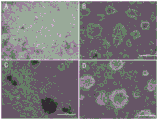
图1:对虾外周血淋巴细胞的3D培养结果图,其中A、B、C和D分别为接种到基质胶表面6h、1d、4d和5d的光镜照片。Figure 1: 3D culture results of lymphocytes in peripheral blood of shrimp, where A, B, C and D are light microscope photos of inoculated on the surface of Matrigel for 6h, 1d, 4d and 5d, respectively.
图2:对虾外周血淋巴细胞3D培养9天后Calcein染色结果。A、B和C分别为荧光共聚焦显微镜下的光镜照片(A)、荧光照片(B)和合并照片(C)。Figure 2: Calcein staining results of 3D cultured shrimp peripheral blood lymphocytes for 9 days. A, B and C are the light micrographs (A), fluorescence photographs (B) and combined photographs (C) under a fluorescence confocal microscope, respectively.
图3:对虾3D培养血淋巴细胞传代3天后Calcein染色结果。A、B和C分别为荧光共聚焦显微镜下的光镜照片(A)、荧光照片(B)和合并照片(C)。Figure 3: Calcein staining results after 3 days of passage of blood lymphocytes in 3D cultured shrimp. A, B and C are the light micrographs (A), fluorescence photographs (B) and combined photographs (C) under a fluorescence confocal microscope, respectively.
具体实施方式Detailed ways
申请人在对虾细胞的培养过程中发现,当把对虾细胞接种到基质水凝胶的表面时,可明显改善对虾细胞的离体生长与存活能力,在基质水凝胶表面形成很大的细胞团;但将对虾细胞包埋到基质水凝胶内部,培养效果反而不如接种到凝胶表面的效果好。而海藻酸钠用于对虾细胞3D培养的效果不好,易污染,对虾细胞以圆形单个细胞存在,不形成细胞球,不能很好地存活与生长。而且申请人发现,对虾血淋巴细胞的渗透压远高于哺乳动物细胞,如果使用普通的生理盐水或磷酸盐缓冲液(PBS)作为其抗凝剂和稀释剂,血淋巴细胞会因为低渗而很快裂解,故本发明采用对虾细胞完全培养基或调高了渗透压的PBS溶液作为对虾血淋巴的抗凝剂和稀释剂。In the process of culturing prawn cells, the applicant found that when the prawn cells were inoculated on the surface of the matrix hydrogel, the in vitro growth and survival ability of the prawn cells could be significantly improved, and a large cell mass was formed on the surface of the matrix hydrogel. However, when prawn cells are embedded in the matrix hydrogel, the culture effect is not as good as the effect of inoculation on the surface of the gel. However, the effect of sodium alginate for 3D culture of shrimp cells is not good, and it is easy to be polluted. The shrimp cells exist as circular single cells, do not form cell spheres, and cannot survive and grow well. Moreover, the applicant found that the osmotic pressure of shrimp blood lymphocytes is much higher than that of mammalian cells. If ordinary normal saline or phosphate buffered saline (PBS) is used as its anticoagulant and diluent, the blood lymphocytes will be reduced due to hypotonicity. It is quickly lysed, so the present invention adopts the shrimp cell complete culture medium or the PBS solution whose osmotic pressure has been increased as the anticoagulant and diluent of the shrimp hemolymph.
正是在上面发现的基础上,本发明建立和优化对虾细胞的3D培养与传代方法,从而提供一种对虾细胞连续培养技术,为对虾永生性细胞系的建立奠定基础。It is on the basis of the above findings that the present invention establishes and optimizes a 3D culture and passage method for shrimp cells, thereby providing a continuous culture technology for shrimp cells, and laying a foundation for the establishment of a shrimp immortal cell line.
为更好地解释本发明,以对虾外周血淋巴细胞的3D培养与传代为例,进一步阐释本发明的主要内容:In order to better explain the present invention, take the 3D culture and passage of prawn peripheral blood lymphocytes as an example to further explain the main content of the present invention:
实施例1:制备用于对虾细胞3D培养的基质胶Example 1: Preparation of Matrigel for 3D culture of shrimp cells
采用的基质胶产品为
具体步骤如下:Specific steps are as follows:
(1)基质胶的融化。将装有基质胶的离心管于4℃冰箱中,冰浴过夜,融化后摇匀;(1) Melting of Matrigel. Place the centrifuge tube containing Matrigel in a refrigerator at 4°C in an ice bath overnight, and shake well after thawing;
(2)基质胶的铺板。将培养板和枪头置冰上预冷,以55-80μl/cm2的比例向培养板中加入基质胶;(2) Matrigel laying. Pre-cool the culture plate and pipette tips on ice, and add Matrigel to the culture plate at a ratio of 55-80 μl/cm 2 ;
(3)基质胶自然摊平后,将培养板置于37℃培养箱中凝固30min,待用。(3) After the matrigel was naturally flattened, the culture plate was placed in a 37° C. incubator to solidify for 30 minutes, and it was set aside for use.
上述提及的基质胶添加比例是经过反复优化的结果,加入的基质胶自然摊平后,使其不充满整个培养孔的底部,而是与培养孔的侧壁之间尚留有一定的空隙。但是在培养孔中央可以形成足够大的基质胶平台,用于支持对虾细胞的3D培养。The above-mentioned Matrigel addition ratio is the result of repeated optimization. After the added Matrigel is naturally flattened, it does not fill the bottom of the entire culture well, but there is still a certain gap between it and the side wall of the culture well. . However, a matrigel platform large enough to support the 3D culture of shrimp cells can be formed in the center of the culture well.
实施例2对虾外周血淋巴细胞的分离与3D培养。Example 2 Isolation and 3D culture of peripheral blood lymphocytes of shrimp.
对虾外周血淋巴细胞的分离与3D培养的具体步骤如下:The specific steps for the isolation and 3D culture of shrimp peripheral blood lymphocytes are as follows:
(1)将对虾于含有1000IU/mL青霉素和1000μg/mL链霉素的煮沸消毒海水中处理12-24h;(1) Treat the prawns in boiled sterilized seawater containing 1000IU/mL penicillin and 1000μg/mL streptomycin for 12-24h;
(2)抽取血淋巴之前,将对虾浸泡于75%的酒精中消毒3-5分钟,使其麻醉;(2) Before extracting hemolymph, soak the prawns in 75% alcohol for 3-5 minutes to sterilize them to anesthetize them;
(3)先后用碘伏棉球和75%酒精棉球擦拭取材部位,即对虾腹下胸血窦处;(3) Wipe the sampling site with iodophor cotton balls and 75% alcohol cotton balls successively, that is, the thoracic sinus in the lower abdomen of the shrimp;
(4)用1-mL注射器吸取约0.2-0.5mL对虾细胞完全培养基后,从对虾腹下胸血窦处抽取对虾血淋巴细胞,并马上混匀;(4) After sucking about 0.2-0.5mL of the shrimp cell complete medium with a 1-mL syringe, extract the shrimp blood lymphocytes from the lower abdominal thoracic sinus of the shrimp, and mix immediately;
(5)抽血后将注射器针头取下,缓慢将注射器中的对虾血淋巴细胞悬液,打入实施例1制备的已铺有基质胶的培养孔中;(5) after the blood is drawn, the needle of the syringe is removed, and the shrimp blood lymphocyte suspension in the syringe is slowly injected into the culture hole prepared in Example 1 and covered with Matrigel;
(6)补加对虾细胞完全培养基,于28℃、3%CO2培养箱中培养;(6) Supplement complete medium for shrimp cells, and cultivate in a 28°C, 3% CO 2 incubator;
(7)4h后,对虾血淋巴细胞贴壁后,换液;(7) After 4h, after the shrimp blood lymphocytes adhered to the wall, the medium was changed;
(8)之后,根据对虾细胞完全培养基颜色的改变(即变黄),及时换液,约1-2天换一次液。(8) After that, according to the change of the color of the shrimp cell complete medium (that is, yellowing), the medium should be changed in time, and the medium should be changed every 1-2 days.
上述煮沸消毒海水的制备方法:自然海水经纱布和滤纸过滤后,煮沸消毒5分钟,冷却后加入1000IU/mL青霉素和1000μg/mL链霉素。The preparation method of the above-mentioned boiling and sterilizing seawater: after the natural seawater is filtered through gauze and filter paper, it is boiled and sterilized for 5 minutes, and after cooling, 1000 IU/mL penicillin and 1000 μg/mL streptomycin are added.
上述对虾细胞完全培养基的配制方法:The preparation method of above-mentioned prawn cell complete culture medium:
(1)对虾细胞基础培养基的制备。即在1升超纯水中溶解20.55g Leibovitz's L-15培养基(粉末)、5g NaCl、2g葡萄糖、1g NaHCO3、166.7mg组氨酸,50mg赖氨酸,50mg甲硫氨酸,33.3mg色氨酸,30mg脯氨酸,30mg牛磺酸、0.25mg两性霉素B、1.0×10⁵IU青霉素和100mg链霉素。调节pH值至7.2-7.4,用0.22μm微孔滤膜过滤除菌,分装保存于-20℃;(1) Preparation of shrimp cell basal medium. That is, dissolve 20.55g of Leibovitz's L-15 medium (powder), 5g of NaCl, 2g of glucose, 1g of NaHCO3, 166.7mg of histidine, 50mg of lysine, 50mg of methionine, 33.3mg of chromophore in 1 liter of ultrapure water amino acid, 30 mg proline, 30 mg taurine, 0.25 mg amphotericin B, 1.0 x 10⁵ IU penicillin and 100 mg streptomycin. Adjust the pH value to 7.2-7.4, filter and sterilize with a 0.22μm microporous membrane, and store in aliquots at -20°C;
(2)对虾细胞完全培养基的制备。临用前,在上述对虾细胞基础培养基中,添加15%胎牛血清、20%卵巢提取液、20μg/L碱性成纤维细胞生长因子(bFGF)和20μg/L表皮生长因子(EGF)。(2) Preparation of complete culture medium for shrimp cells. Before use, 15% fetal bovine serum, 20% ovarian extract, 20 μg/L basic fibroblast growth factor (bFGF) and 20 μg/L epidermal growth factor (EGF) were added to the above-mentioned prawn cell basal medium.
上述卵巢提取液的制备方法:取对虾卵巢组织,于50-mL离心管中剪碎;然后使用组织匀浆器,将组织彻底磨碎;以20mL/g组织的比例,向卵巢组织匀浆中加入预冷的对虾细胞基础培养基,4℃冰箱过夜;4℃,10000rpm离心15min,取上清;4℃,10000rpm离心30min,取上清;依次用0.45和0.22um滤膜抽滤除菌,分装保存于-20℃。The preparation method of the above-mentioned ovary extract: take the ovary tissue of prawns and chop them into pieces in a 50-mL centrifuge tube; then use a tissue homogenizer to thoroughly pulverize the tissue; add 20 mL/g tissue to the ovarian tissue homogenate Add pre-cooled prawn cell basal medium, refrigerate at 4°C overnight; centrifuge at 10,000 rpm for 15 minutes at 4°C, take the supernatant; centrifuge at 4°C, 10,000 rpm for 30 minutes, take the supernatant; sterilize by suction filtration with 0.45 and 0.22um filters in turn, Store in aliquots at -20°C.
培养结果如图1所示,对虾血淋巴细胞以圆形单个细胞和细胞团/球的方式附着于基质胶表面立体生长,1天后即可聚集形成直径50-110um的大的细胞团/球。细胞活性荧光染料Calcein染色结果如附图2所示,3D培养9天后的细胞团/球的表面和内部细胞均为活细胞,可观察到强的绿色荧光信号。可见,3D培养对虾血淋巴细胞的存活和生长能力均优于2D培养效果。The culture results are shown in Figure 1. The shrimp blood lymphocytes adhered to the surface of Matrigel in the form of circular single cells and cell clusters/spheres and grew three-dimensionally. After 1 day, they could aggregate to form large cell clusters/spheres with a diameter of 50-110um. The results of staining with the cell viability fluorescent dye Calcein are shown in Figure 2. The surface and inner cells of the cell mass/sphere after 9 days of 3D culture are live cells, and a strong green fluorescence signal can be observed. It can be seen that the survival and growth ability of 3D cultured shrimp blood lymphocytes are better than that of 2D cultured.
实施例3:对虾3D培养细胞的传代培养Example 3: Subculture of shrimp 3D cultured cells
以接种和生长于基质胶表面的对虾血淋巴细胞的传代为例,具体步骤如下:Taking the passage of shrimp blood lymphocytes inoculated and grown on the surface of Matrigel as an example, the specific steps are as follows:
(1)以冰上预冷的PBS溶液洗涤细胞1次;(1) Wash cells once with ice-cold PBS solution;
(2)以2mL/培养皿(φ35mm)的比例加入改进后的细胞回收液(Corning,Cat.NO.354253);将培养皿置于冰上,期间将其左右振摇,至基质胶溶解;(2) Add the improved cell recovery solution (Corning, Cat. NO. 354253) at a ratio of 2mL/culture dish (φ35mm); place the culture dish on ice, and shake it left and right during the period until the Matrigel dissolves;
(3)将溶解的基质胶-细胞悬液收集到1.5mL离心管中,3000g,4℃离心5-10分钟,弃上清;(3) Collect the dissolved Matrigel-cell suspension into a 1.5mL centrifuge tube, centrifuge at 3000g at 4°C for 5-10 minutes, and discard the supernatant;
(4)对虾细胞完全培养基重悬细胞沉淀,接种至新的培养板中的基质胶上,于28℃,3%CO2培养箱中静置培养。(4) The cell pellets were resuspended in the shrimp cell complete medium, inoculated onto Matrigel in a new culture plate, and cultured in a 28°C, 3% CO 2 incubator.
上述PBS溶液的配制方法:分别称取12.0g NaCl,0.3g KCl,4.5gNa2HPO4·12H2O和0.3g的KH2PO4溶于1L纯水中,溶解,用3M NaOH调节pH值至7.2~7.4,高压灭菌,分装后4℃保存备用。The preparation method of above-mentioned PBS solution: Weigh 12.0g NaCl, 0.3g KCl, 4.5g Na 2 HPO 4 12H 2 O and 0.3g KH 2 PO 4 respectively, dissolve in 1L pure water, dissolve, adjust pH value with 3M NaOH Go to 7.2~7.4, autoclave, and store at 4°C for later use after packaging.
上述改进后的细胞回收液的制备方法:在细胞回收液(Corning,Cat.NO.354253)中加入20mg/mL NaCl,调高渗透压至560-620mOsm/kg。The preparation method of the above-mentioned improved cell recovery solution: add 20 mg/mL NaCl to the cell recovery solution (Corning, Cat. NO. 354253), and increase the osmotic pressure to 560-620 mOsm/kg.
如图3所示,传代后的对虾血淋巴可以很好地附着于基质胶表面生长,传代后的存活率可高达90%以上。As shown in Figure 3, the hemolymph of the prawns after passage can be well attached to the surface of Matrigel for growth, and the survival rate after passage can be as high as 90%.
本发明的方法还可以适用于对虾其他组织来源的细胞。The method of the present invention can also be applied to cells derived from other tissues of prawns.
Claims (1)
Priority Applications (2)
| Application Number | Priority Date | Filing Date | Title |
|---|---|---|---|
| CN201910622127.XA CN110283777B (en) | 2019-07-10 | 2019-07-10 | A method for continuous culture of shrimp cells |
| US16/860,315 US11873509B2 (en) | 2019-07-10 | 2020-04-28 | Method for continuous culture of shrimp cells |
Applications Claiming Priority (1)
| Application Number | Priority Date | Filing Date | Title |
|---|---|---|---|
| CN201910622127.XA CN110283777B (en) | 2019-07-10 | 2019-07-10 | A method for continuous culture of shrimp cells |
Publications (2)
| Publication Number | Publication Date |
|---|---|
| CN110283777A CN110283777A (en) | 2019-09-27 |
| CN110283777B true CN110283777B (en) | 2020-12-29 |
Family
ID=68022093
Family Applications (1)
| Application Number | Title | Priority Date | Filing Date |
|---|---|---|---|
| CN201910622127.XA Active CN110283777B (en) | 2019-07-10 | 2019-07-10 | A method for continuous culture of shrimp cells |
Country Status (2)
| Country | Link |
|---|---|
| US (1) | US11873509B2 (en) |
| CN (1) | CN110283777B (en) |
Families Citing this family (4)
| Publication number | Priority date | Publication date | Assignee | Title |
|---|---|---|---|---|
| CN111534489B (en) * | 2020-04-29 | 2022-07-12 | 清华大学 | T lymphocyte amplification method based on 3D printing |
| CN113025557B (en) * | 2021-04-07 | 2021-12-14 | 华南师范大学 | Improved L-15 culture medium and application thereof in culture of prawn muscle cells |
| CN115261300A (en) * | 2022-08-31 | 2022-11-01 | 广东省农业科学院动物科学研究所 | Method for extracting and culturing shrimp intestinal cells |
| CN115354014B (en) * | 2022-09-16 | 2023-09-26 | 中国海洋大学 | A medium for long-term culture and continuous passage of shrimp cells |
Family Cites Families (6)
| Publication number | Priority date | Publication date | Assignee | Title |
|---|---|---|---|---|
| CN101448527B (en) * | 2006-05-19 | 2013-12-18 | 香港大学 | Cell-matrix microspheres, methods of preparation and uses |
| CN103232969B (en) * | 2013-05-06 | 2014-07-09 | 中国海洋大学 | Prawn cell culture medium |
| US10292382B2 (en) * | 2014-04-03 | 2019-05-21 | Biopredic International Sarl | No-spin cryopreservation technique and resulting products |
| CN104694460A (en) * | 2015-02-13 | 2015-06-10 | 武汉大学深圳研究院 | Culture medium for normal epithelial cell of human or mammal, culture methods, normal epithelial cell and application of normal epithelial cell |
| CN105754928B (en) * | 2016-05-16 | 2019-03-19 | 中国海洋大学 | A kind of separation of prawn embryonic cell and cultural method |
| CN108130314B (en) * | 2018-01-24 | 2022-05-17 | 郑州大学第一附属医院 | Monoclonal cell culture method |
-
2019
- 2019-07-10 CN CN201910622127.XA patent/CN110283777B/en active Active
-
2020
- 2020-04-28 US US16/860,315 patent/US11873509B2/en active Active
Also Published As
| Publication number | Publication date |
|---|---|
| US11873509B2 (en) | 2024-01-16 |
| CN110283777A (en) | 2019-09-27 |
| US20210009943A1 (en) | 2021-01-14 |
Similar Documents
| Publication | Publication Date | Title |
|---|---|---|
| CN110283777B (en) | A method for continuous culture of shrimp cells | |
| CN110050782B (en) | A kind of stem cell cryopreservation liquid and its preparation method and cryopreservation method | |
| CN105765060B (en) | Method for producing amniotic mesenchymal cell composition, cryopreservation method, and therapeutic agent | |
| CN102634480B (en) | Method for isolating and culturing liver primary cells | |
| CN106967674B (en) | A kind of isolation and culture method of sheep rumen epithelial cells | |
| CN112458040B (en) | A method for isolating and culturing adult yak rumen epithelial cells | |
| CN109652366A (en) | For treating the placenta mesenchyma stem cell preparation of premature ovarian failure | |
| CN102424813A (en) | Simple extraction method of high-purity mouse skeletal muscle satellite cells | |
| CN110684724A (en) | A method and application of 3D cultured spermatid cells of Chinese Wutang snakehead testis | |
| CN103232969A (en) | Prawn cell culture medium | |
| CN108239621B (en) | Method for separating, amplifying, cryopreserving and reviving placenta sub-totipotent stem cells | |
| CN104630135B (en) | Method for preparing hepatic stem cells on large scale and application thereof | |
| CN107787960B (en) | The cryopreservation solution of retinal pigment epithelial cells and its application | |
| CN109971700A (en) | A method for culturing primary gill cells of pufferfish with dark stripes | |
| CN115747154B (en) | Culture medium for long-term culture of fish muscle stem cells | |
| CN111635860B (en) | A system and culture method for stem cell culture | |
| CN101451121B (en) | Construction method of Epinephelus fuscoguttatus heart cell line | |
| CN109182256B (en) | Separation culture and induction method of precursor adipocytes of nibea albiflora | |
| CN101948518B (en) | Method for preparing functional protein RJCPs by royal jelly and application | |
| Guo et al. | Long-term in-vitro culture and subculture of the hemocytes of swimming crab Portunus trituberculatus | |
| CN101451122B (en) | Construction method of Epinephelus fuscoguttatus swim bladder cell line | |
| CN113957037B (en) | Perch gill cell line, construction and application method thereof | |
| CN114107181B (en) | A kind of sturgeon embryo cell line, culture medium and preparation method thereof | |
| CN113637631B (en) | Extraction and culture method of rat peritoneal mesothelial cells | |
| CN109792972B (en) | In-vitro culture method for cysticercus cellulosae |
Legal Events
| Date | Code | Title | Description |
|---|---|---|---|
| PB01 | Publication | ||
| PB01 | Publication | ||
| SE01 | Entry into force of request for substantive examination | ||
| SE01 | Entry into force of request for substantive examination | ||
| GR01 | Patent grant | ||
| GR01 | Patent grant |