CN110264277B - Data processing method and device executed by computing equipment, medium and computing equipment - Google Patents
Data processing method and device executed by computing equipment, medium and computing equipment Download PDFInfo
- Publication number
- CN110264277B CN110264277B CN201910557742.7A CN201910557742A CN110264277B CN 110264277 B CN110264277 B CN 110264277B CN 201910557742 A CN201910557742 A CN 201910557742A CN 110264277 B CN110264277 B CN 110264277B
- Authority
- CN
- China
- Prior art keywords
- vector
- commodity
- interactive
- user
- target
- Prior art date
- Legal status (The legal status is an assumption and is not a legal conclusion. Google has not performed a legal analysis and makes no representation as to the accuracy of the status listed.)
- Active
Links
Images


Classifications
-
- G—PHYSICS
- G06—COMPUTING OR CALCULATING; COUNTING
- G06F—ELECTRIC DIGITAL DATA PROCESSING
- G06F16/00—Information retrieval; Database structures therefor; File system structures therefor
- G06F16/90—Details of database functions independent of the retrieved data types
- G06F16/95—Retrieval from the web
- G06F16/953—Querying, e.g. by the use of web search engines
- G06F16/9535—Search customisation based on user profiles and personalisation
-
- G—PHYSICS
- G06—COMPUTING OR CALCULATING; COUNTING
- G06F—ELECTRIC DIGITAL DATA PROCESSING
- G06F18/00—Pattern recognition
- G06F18/20—Analysing
- G06F18/21—Design or setup of recognition systems or techniques; Extraction of features in feature space; Blind source separation
- G06F18/214—Generating training patterns; Bootstrap methods, e.g. bagging or boosting
-
- G—PHYSICS
- G06—COMPUTING OR CALCULATING; COUNTING
- G06Q—INFORMATION AND COMMUNICATION TECHNOLOGY [ICT] SPECIALLY ADAPTED FOR ADMINISTRATIVE, COMMERCIAL, FINANCIAL, MANAGERIAL OR SUPERVISORY PURPOSES; SYSTEMS OR METHODS SPECIALLY ADAPTED FOR ADMINISTRATIVE, COMMERCIAL, FINANCIAL, MANAGERIAL OR SUPERVISORY PURPOSES, NOT OTHERWISE PROVIDED FOR
- G06Q30/00—Commerce
- G06Q30/02—Marketing; Price estimation or determination; Fundraising
- G06Q30/0201—Market modelling; Market analysis; Collecting market data
-
- G—PHYSICS
- G06—COMPUTING OR CALCULATING; COUNTING
- G06Q—INFORMATION AND COMMUNICATION TECHNOLOGY [ICT] SPECIALLY ADAPTED FOR ADMINISTRATIVE, COMMERCIAL, FINANCIAL, MANAGERIAL OR SUPERVISORY PURPOSES; SYSTEMS OR METHODS SPECIALLY ADAPTED FOR ADMINISTRATIVE, COMMERCIAL, FINANCIAL, MANAGERIAL OR SUPERVISORY PURPOSES, NOT OTHERWISE PROVIDED FOR
- G06Q30/00—Commerce
- G06Q30/02—Marketing; Price estimation or determination; Fundraising
- G06Q30/0241—Advertisements
- G06Q30/0251—Targeted advertisements
- G06Q30/0255—Targeted advertisements based on user history
Landscapes
- Engineering & Computer Science (AREA)
- Business, Economics & Management (AREA)
- Theoretical Computer Science (AREA)
- Strategic Management (AREA)
- Finance (AREA)
- Development Economics (AREA)
- Accounting & Taxation (AREA)
- Data Mining & Analysis (AREA)
- Physics & Mathematics (AREA)
- General Physics & Mathematics (AREA)
- Databases & Information Systems (AREA)
- Entrepreneurship & Innovation (AREA)
- Game Theory and Decision Science (AREA)
- Economics (AREA)
- General Business, Economics & Management (AREA)
- Marketing (AREA)
- General Engineering & Computer Science (AREA)
- Computer Vision & Pattern Recognition (AREA)
- Bioinformatics & Cheminformatics (AREA)
- Artificial Intelligence (AREA)
- Bioinformatics & Computational Biology (AREA)
- Evolutionary Biology (AREA)
- Evolutionary Computation (AREA)
- Life Sciences & Earth Sciences (AREA)
- Machine Translation (AREA)
- Image Analysis (AREA)
- Information Retrieval, Db Structures And Fs Structures Therefor (AREA)
Abstract
The invention provides a data processing method and device executed by computing equipment, a medium and the computing equipment. The method comprises the steps of obtaining a training sample set, wherein the training sample set comprises a plurality of pieces of training data, and each piece of training data at least comprises identification information of the following objects: a center object, a context object and an object targeted by a target operation; the identification information of the context object and the identification information of the center object are adjacent to each other in the arrangement position in the same behavior sequence, the behavior sequence comprises the identification information of one or more objects operated by a user, and the identification information of the objects is arranged in the behavior sequence according to the time sequence of the operation of the objects; acquiring attribute information of each object in each object according to the identification information of each object in each piece of training data; the vector generation model is trained based on the identification information and attribute information of each of the individual objects, such that the trained vector generation model can be used to output object vectors characterizing the objects.
Description
Technical Field
The embodiment of the invention relates to the technical field of computers, in particular to a data processing method and device executed by a computing device, a medium and the computing device.
Background
This section is intended to provide a background or context to the embodiments of the invention that are recited in the claims. The description herein is not admitted to be prior art by inclusion in this section.
With the rapid development of computer technology, the way for users to acquire information is enriched. For example, a user may learn about news information using an application in a computing device, conduct searches using an application, transact online using an application, and so forth. Specifically, for example, online shopping has become the mainstream shopping mode of users, and the e-commerce website provides an intelligent and attentive function to improve the shopping experience of users.
However, in the process of implementing the present invention, the inventor finds that processing the operation data generated in the process of the user interacting on the internet by using the related technology cannot better depict the user interest, sense the user intention and promote the user to be converted into the user who completes the purchasing behavior.
Disclosure of Invention
Therefore, in the prior art, the related art processing the operation data generated in the online interaction process of the user cannot better depict the user interest, sense the user intention and promote the user to be converted into the user completing the purchasing behavior, which is a very annoying process.
To this end, there is a great need for an improved data processing method and apparatus, medium, and computing device that better characterizes user interests, senses user intent, and facilitates user translation into a user completing a purchase.
In this context, embodiments of the present invention are intended to provide a data processing method and apparatus executed by a computing device, a medium, and a computing device.
In a first aspect of embodiments of the present invention, there is provided a data processing method performed by a computing device, comprising: obtaining a training sample set, wherein the training sample set comprises a plurality of pieces of training data, and each piece of training data at least comprises identification information of the following objects: a center object, a context object and an object targeted by a target operation; the identification information of the context object and the identification information of the center object are arranged at adjacent positions in the same behavior sequence, the behavior sequence comprises identification information of one or more objects operated by a user, and the identification information of the objects is arranged in the behavior sequence according to the time sequence of the operation of the objects.
In a second aspect of embodiments of the present invention, there is provided a data processing apparatus to be executed by a computing device, comprising: the first obtaining module is configured to obtain a training sample set, where the training sample set includes a plurality of pieces of training data, and each piece of training data at least includes identification information of: a center object, a context object and an object targeted by a target operation; the identification information of the context object and the identification information of the center object are arranged at adjacent positions in the same behavior sequence, the behavior sequence comprises the identification information of one or more objects operated by a user, and the identification information of the objects is arranged in the behavior sequence according to the time sequence of the operation of the objects; a second obtaining module, configured to obtain attribute information of each object in each piece of training data according to identification information of each object in each piece of training data; and a training module, configured to train a vector generation model based on the identification information and the attribute information of each object in the objects, so that the trained vector generation model can be used to output an object vector representing the object.
In a third aspect of embodiments of the present invention, there is provided a medium storing computer-executable instructions for implementing the method as described above when executed by a processing unit.
In a fourth aspect of embodiments of the present invention, there is provided a computing device comprising: a processing unit; and a storage unit storing computer executable instructions for implementing the method as described above when executed by the processing unit.
According to the data processing method and device, the medium and the computing equipment executed by the computing equipment, a training sample set is obtained, wherein each piece of training data comprises a central object, a context object and identification information of an object aimed at by a target operation, the identification information of the context object and the identification information of the central object are adjacent to each other in the arrangement position of the same behavior sequence, and the identification information of the objects is arranged in the behavior sequence according to the time sequence of the operation of the objects; the vector generation model is trained based on the identification information and the attribute information of each object, the trained vector generation model can be used for outputting object vectors representing the objects, the object vectors of the objects can be output through technologies such as big data, machine learning and deep learning based on the cooperation of data and an algorithm, so that the interest and the perception of users are described, the requirement expression path of the users can be shortened, the probability of interrupting the purchasing process of the users is reduced, and better experience is brought to the users.
Drawings
The above and other objects, features and advantages of exemplary embodiments of the present invention will become readily apparent from the following detailed description read in conjunction with the accompanying drawings. Several embodiments of the invention are illustrated by way of example, and not by way of limitation, in the figures of the accompanying drawings and in which:
fig. 1 schematically illustrates an application scenario diagram of a data processing method and an apparatus thereof according to an embodiment of the present invention;
FIG. 2 schematically shows a flow diagram of a data processing method performed by a computing device according to an embodiment of the invention;
FIG. 3 is a schematic diagram illustrating a structure of a vector characterization model fused with attribute information according to an embodiment of the present invention;
FIG. 4 schematically shows a flow chart of a data processing method according to another embodiment of the invention;
FIG. 5 schematically shows a flow diagram for constructing a user vector for a target user according to an embodiment of the invention;
FIG. 6 schematically illustrates a flow diagram for constructing a search term vector for a target user, in accordance with an embodiment of the present invention;
FIG. 7 schematically illustrates a flow diagram for real-time recommendation of a target object according to an embodiment of the invention;
FIG. 8 schematically illustrates a flow diagram for real-time recommendation of a target object according to another embodiment of the invention;
FIG. 9 schematically illustrates a flow diagram for personalizing a recommendation target object, in accordance with another embodiment of the present invention;
FIG. 10 schematically shows a block diagram of a data processing apparatus executed by a computing device according to an embodiment of the present invention;
FIG. 11 schematically shows a program product for implementing a data processing method according to an embodiment of the present invention; and
fig. 12 schematically shows a block diagram of a computing device for implementing a data processing method according to an embodiment of the present invention.
In the drawings, the same or corresponding reference numerals indicate the same or corresponding parts.
Detailed Description
The principles and spirit of the present invention will be described with reference to a number of exemplary embodiments. It is understood that these embodiments are given solely for the purpose of enabling those skilled in the art to better understand and to practice the invention, and are not intended to limit the scope of the invention in any way. Rather, these embodiments are provided so that this disclosure will be thorough and complete, and will fully convey the scope of the disclosure to those skilled in the art.
As will be appreciated by one skilled in the art, embodiments of the present invention may be embodied as a system, apparatus, device, method, or computer program product. Accordingly, the present disclosure may be embodied in the form of: entirely hardware, entirely software (including firmware, resident software, micro-code, etc.), or a combination of hardware and software.
According to the embodiment of the invention, a data processing method and device executed by a computing device, a medium and the computing device are provided.
In this context, it is to be understood that the meanings of the terms involved are as follows.
The sequence of behaviors: various interaction behaviors generated by the user and the goods are ranked based on the time sequence (the interaction behaviors include, but are not limited to, browsing detailed pages of the goods, adding the goods to shopping carts, viewing comments on the goods, sharing the goods, and the like).
Embedding Model (Embedding Model): refers to a model that embeds a high-dimensional space into a continuous vector space of much lower dimension.
And (3) searching shading: default search terms for presentation in the search box to guide the triggering of the user to conduct a search.
And (3) searching and finding: the system is used for presenting a personalized batch of search terms for the user to select and use.
Vector characterization: refers to a vector representing an object (which may be, for example, a user, a commodity, a search term) as a multidimensional space.
Search intention: the search terms or commodities that the user is consciously willing to search for may not be expressed through the sequence of query behaviors.
Moreover, any number of elements in the drawings are by way of example and not by way of limitation, and any nomenclature is used solely for differentiation and not by way of limitation.
The principles and spirit of the present invention are explained in detail below with reference to several representative embodiments of the invention.
Summary of The Invention
The inventor finds that with the rapid development of computer technology, the method for acquiring information by a user is enriched. For example, a user may learn about news information using an application in a computing device, conduct searches using an application, transact online using an application, and so forth.
Specifically, for example, online shopping has become the mainstream shopping mode of users, and the e-commerce website provides an intelligent and attentive function to improve the shopping experience of users. In the whole shopping process of the user, the search is a frequently used function which can express the purchase demand of the user. In the related art, since each person has different written expressions for the same product, a user inputs a search term to search for a product, and the search term may be adjusted multiple times to locate a target product during use, a plurality of models are required to be built to produce data to be recommended when a plurality of data are recommended in multiple dimensions based on the search intention of the user. However, the technology cannot represent the relevance of users, commodities and search terms from the same feature space, and cannot perform global unified model optimization, so that some users can be naturally lost in the process of adjusting the search terms.
Meanwhile, the inventor finds that the related technology generally only focuses on what a user searches at present, cannot infer the search intention according to the change of a user adjusting a search term and a real-time clicked commodity, and cannot make search intention judgment based on a real-time behavior sequence. For example, when a user wants to buy a tonic, and after searching ginseng, bird's nest, and honey in sequence, the user may leave the page without finding the desired product. Therefore, if the search word sequence of the user is a requirement expression path, the user is easy to lose when the requirement expression path is long.
Therefore, the operation data (such as operation data of searching, browsing, clicking and the like) generated in the online interaction process of the user by adopting the related technology cannot better depict the user interest, perceive the user intention and promote the user to be converted into the user completing the purchasing behavior.
Based on the above analysis, the inventors conceived that by obtaining a training sample set in which each piece of training data includes a center object, a context object, and identification information of an object targeted by a target operation, the identification information of the context object is adjacent to an arrangement position of the identification information of the center object in the same behavior sequence, and the identification information of the objects is arranged in the order of time in which the objects are operated in the behavior sequence; the vector generation model is trained based on the identification information and the attribute information of each object, the trained vector generation model can be used for outputting object vectors representing the objects, the object vectors of the objects can be output through technologies such as big data, machine learning and deep learning based on the cooperation of data and an algorithm, so that the interest and the perception of users are described, the requirement expression path of the users can be shortened, the probability of interrupting the purchasing process of the users is reduced, and better experience is brought to the users.
Having described the general principles of the invention, various non-limiting embodiments of the invention are described in detail below.
Application scene overview
First, an application scenario of the data processing method and the apparatus thereof according to the embodiment of the present invention is described in detail with reference to fig. 1.
Fig. 1 schematically shows an application scenario diagram of a data processing method and a device thereof according to an embodiment of the present invention.
As shown in fig. 1, the system architecture according to this embodiment may include terminal devices 101, 102, 103, a network 104, and a server 105. The network 104 serves as a medium for providing communication links between the terminal devices 101, 102, 103 and the server 105. Network 104 may include various connection types, such as wired and/or wireless communication links, and so forth.
The user may use the terminal devices 101, 102, 103 to interact with the server 105 via the network 104 to receive or send messages or the like. The terminal devices 101, 102, 103 may have client applications installed thereon.
The terminal devices 101, 102, 103 may be various electronic devices having a display screen, including but not limited to smart phones, tablet computers, laptop portable computers, desktop computers, and the like.
The server 105 may be a server providing various services, such as a background management server (for example only) providing support for data requested by a user with the terminal device 101, 102, 103. The background management server may analyze and perform other processing on the received user request, and feed back a processing result (for example, obtain information or data according to the user request) to the terminal device.
It should be noted that the data processing method provided by the embodiment of the present invention may be generally executed by the server 105. Accordingly, the data processing apparatus provided by the embodiment of the present invention may be generally disposed in the server 105. The data processing method provided by the embodiment of the present invention may also be executed by a server or a server cluster that is different from the server 105 and is capable of communicating with the terminal devices 101, 102, 103 and/or the server 105. Correspondingly, the data processing apparatus provided in the embodiment of the present invention may also be disposed in a server or a server cluster different from the server 105 and capable of communicating with the terminal devices 101, 102, 103 and/or the server 105. Alternatively, the data processing method provided by the embodiment of the present invention may also be executed by the terminal device 101, 102, or 103, or may also be executed by another terminal device different from the terminal device 101, 102, or 103. Accordingly, the data processing apparatus provided in the embodiment of the present invention may also be disposed in the terminal device 101, 102, or 103, or disposed in another terminal device different from the terminal device 101, 102, or 103.
For example, the training sample set may be stored in any of the terminal devices 101, 102, or 103, such as but not limited to terminal device 101, or stored on an external storage device and may be imported into terminal device 101. Then, the terminal device 101 may locally execute the data processing method provided by the embodiment of the present invention, or send the training sample set to another terminal device, server, or server cluster, and the other terminal device, server, or server cluster that receives the training sample set executes the data processing method provided by the embodiment of the present invention.
It should be understood that the number of terminal devices, networks, and servers in fig. 1 is merely illustrative. There may be any number of terminal devices, networks, and servers, as desired for an implementation.
It should be noted that fig. 1 is only an example of a system architecture of an application scenario to which the embodiment of the present invention may be applied to help those skilled in the art understand the technical content of the present invention, and does not mean that the embodiment of the present invention may not be applied to other devices, systems, environments or scenarios.
Exemplary method
A data processing method performed by a computing device according to an exemplary embodiment of the present invention is described below with reference to fig. 2 in conjunction with the application scenario of fig. 1. It should be noted that the above application scenarios are merely illustrated for the convenience of understanding the spirit and principles of the present invention, and the embodiments of the present invention are not limited in this respect. Rather, embodiments of the present invention may be applied to any scenario where applicable.
Fig. 2 schematically shows a flow chart of a data processing method performed by a computing device according to an embodiment of the present invention.
As shown in fig. 2, the data processing method performed by the computing device according to the embodiment of the present invention includes operations S210 to S230.
In operation S210, a training sample set is obtained, where the training sample set includes a plurality of pieces of training data, and each piece of training data includes at least identification information of: a center object, a context object and an object targeted by a target operation; the identification information of the context object and the identification information of the center object are arranged at adjacent positions in the same behavior sequence, the behavior sequence comprises the identification information of one or more objects operated by a user, and the identification information of the objects is arranged in the behavior sequence according to the time sequence of the operation of the objects.
According to an embodiment of the present invention, obtaining the training sample set comprises: the method comprises the steps of obtaining behavior logs of a plurality of users in a preset time period, processing the behavior logs of each user in the plurality of users, constructing a behavior sequence corresponding to each user to obtain the behavior sequences of the plurality of users, and constructing a training sample set according to the behavior sequences of the plurality of users.
According to an embodiment of the present invention, the behavior log of each user may include behavior records of the user in multiple sessions, and each behavior record may serve as a behavior path of the user. The behavior paths of the user can be divided into two types, one is an exploration type path and the other is a purchase type path. Here, the search-type route is a route in which the user does not purchase the product at the end, and the purchase-type route is a route in which the user purchases the product at the end.
For example, the user has the following two behavior paths.
Purchase type path: (V, I _1) → (V, I _2) → (V, I _3) → (V, I _4) → (V, I _5) → (B, I _5) → (V, I _3) → (V, I _8) → (V, I _9) → (V, I _7) → (V, I _10) → (V, I _9) → (B, I _ 9);
(II) search type route: (V, I _1) → (V, I _2) → (V, I _3) → (V, I _4) → (V, I _8) → (V, I _ 7).
Wherein V represents non-purchasing behavior (including but not limited to browsing, viewing comments, collecting, sharing, etc.), B represents purchasing behavior (including but not limited to entering a shopping cart, placing orders, etc.), and I _ I represents identification information of the goods. For a purchase type path, the user may go through a browse-buy-browse-buy such path; for exploratory paths, the user is always browsing without any shopping behavior.
When the behavior log of each user is processed and a behavior sequence corresponding to each user is constructed, the behavior path of the user can be disassembled.
According to the embodiment of the invention, in the e-market scene, a user often sees other things after adding a commodity into a shopping cart, and the interest shift may occur at this time, so that the purchasing type path can be further disassembled, and the purchasing behavior is used as a disassembling node to perform the following disassembling on the purchasing type path.
part 1: i _1, I _2, I _3, I _4, I _ 5: a behavior sequence I;
part 2: i _1, I _2, I _3, I _4, I _5, I _3, I _8, I _9, I _7, I _10, I _ 9: and (5) performing a second action sequence.
According to the embodiment of the invention, for the exploration type path, the user always browses commodities and does not buy the commodities, so that the commodity sequence is not required to be split, but the commodities which continuously and repeatedly appear can be deduplicated, and the following sequence is obtained.
part 3: i _1, I _2, I _3, I _4, I _8, I _ 7: and (5) performing a third action sequence.
According to the embodiment of the present invention, in the action sequence, the identification information of the articles is arranged in the chronological order in which the articles were operated.
According to the embodiment of the invention, based on the behavior sequence obtained by splitting, a training sample set can be constructed based on the SkipGram and Global purchase (Global) information.
According to an embodiment of the present invention, the training sample set includes a plurality of pieces of training data, each piece of training data including at least identification information of: a center object, a context object, and an object targeted by the target operation.
According to an embodiment of the present invention, the basic format of each piece of training data may be: center object (hereinafter center): context objects (hereinafter contexts): global purchase objects (hereinafter referred to as global).
In operation S220, attribute information of each object in each object is obtained according to the identification information of each object in each piece of training data.
According to the embodiment of the present invention, for each commodity in the training data, there is corresponding attribute information (such as category, price, production place, etc.), and the file format is: id, p _1, p _2, and p _3 (commodity Id, commodity attribute 1, commodity attribute 2, and commodity attribute 3), and the attribute information of the commodity related to each piece of training data in the training sample set may be organized in the above file format into a Map file, where the Map file is a mapping file containing attribute information corresponding to the commodity. In the model training process, the attribute information of each commodity can be acquired through the identification information of each object and the Map file. Then the corresponding embedding vector characterization (embedding) operation is carried out. By means of arranging the commodity attributes through the Map file, on one hand, the extended commodity attributes can be obtained conveniently, and the format center of the training data does not need to be changed: contexts: global; on the other hand, the storage space and the access time consumption of the training data can be greatly reduced.
In operation S230, a vector generation model is trained based on the identification information and the attribute information of each of the respective objects, so that the trained vector generation model can be used to output an object vector characterizing the object.
According to an embodiment of the present invention, when training a vector generation model, for each piece of training data center: contexts: the closer the spatial distances of global, center and contexts, and center and global, the better. Therefore, the advantage of matrix operation can be combined, when the loss function of the vector generation model is constructed, the similarity between center and contexts and the similarity between center and global can be calculated at one time, and then the constraint of negative sampling is added. For negative sampling, a mode of constructing a negative sample in a batch (the number of training data processed by a model at one time) can be adopted, the mode is simple and effective, sampling can be performed according to the occurrence frequency of the sample, meanwhile, the training data can be accelerated by combining matrix operation, and distributed training can be performed conveniently. After obtaining the negative sample, a loss function of pair-wise can be further constructed.
In the vector generation model, the vector corresponding to the commodity is not a vector obtained by directly performing vector representation (embedding) on the commodity, but a vector obtained by fusing the vector of the commodity itself and the vectors of various kinds of attribute information corresponding to the commodity, and the commodity vector representation based on the user behavior can be learned through the fused vector, and the attribute information of the commodity can be learned.
By the embodiment of the invention, a training sample set is obtained, wherein each piece of training data comprises a central object, a context object and identification information of an object aimed at by a target operation, the identification information of the context object is adjacent to the arrangement position of the identification information of the central object in the same behavior sequence, and the identification information of the objects is arranged in the behavior sequence according to the time sequence of the operation of the objects; the vector generation model is trained based on the identification information and the attribute information of each object, the trained vector generation model can be used for outputting object vectors representing the objects, the object vectors of the objects can be output through technologies such as big data, machine learning and deep learning based on the cooperation of data and an algorithm, so that the interest and the perception of users are described, the requirement expression path of the users can be shortened, the probability of interrupting the purchasing process of the users is reduced, and better experience is brought to the users.
The vector generation model will be further explained with reference to the specific embodiments.
According to an embodiment of the present invention, the vector generative model has a loss function (one) comprising:

wherein, representing a first initial vector obtained by performing vector initialization on identification information and attribute information of a center object (i.e. center) in each piece of training data;
 representing a second initial vector obtained by performing vector initialization on identification information and attribute information of context objects (i.e. contexts) in each piece of training data;
 a third initial vector representing a result of vector initialization of identification information and attribute information of an object targeted by a target operation (which may be global, for example) in each piece of training data; r is ii Representing elements on a diagonal line of a result matrix obtained after matrix multiplication is carried out on the first initial vector and the third initial vector; r is ij Representing elements of the result matrix other than the elements on the diagonal; b represents the number of pieces of training data processed by the vector generation model in parallel; n represents the number of the context objects, and α is a weight coefficient.
According to the embodiment of the invention, the characterization process of the object vector is further described below, which mainly relates to the following five parts, and each part of the calculation process can be efficiently completed through matrix operation, wherein an object is taken as a commodity, and an object vector is taken as a commodity vector.
(1) Batch similarity calculation
Assuming that the commodity vector of each commodity is denoted as v, the vector dimension is (1, d), and the batch size is denoted as b, the number of pieces of training data processed in parallel by the characterization vector generation model is large.
The center (center object) can be expressed by the following expression (two), abbreviated as C, and the dimension of C is (b, d).

For contexts (context object), assuming that the context object contains n items, it can be expressed as the following formula (three), abbreviated as S, and the dimension of S is (b, n, d).
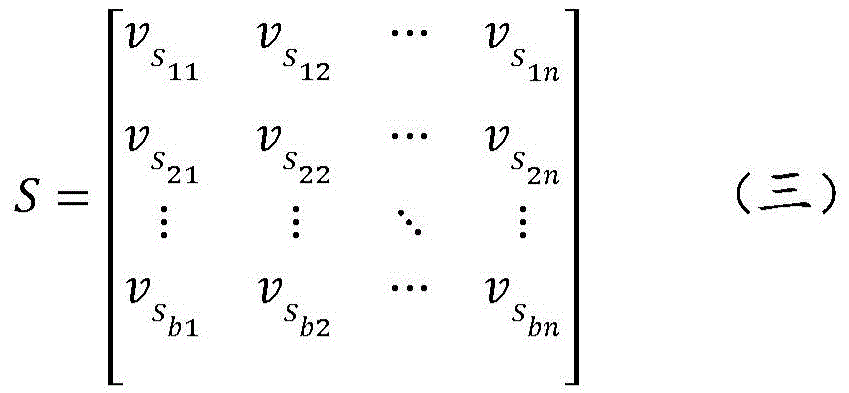
For global (global purchase object), similar to center (center object), it can be expressed as following formula (four), abbreviated as G, and the dimension of G is known as (b, d).

Expanding C one-dimensionally to obtain C _ expand Wherein, C _ expand Has the dimension (b, 1, d).
Thus, the similarity between center and contexts can be determined by C expand ·S T The dimension is (b, 1, d) × (b, d, n) ═ b, 1, n, and (b, n) is obtained by compressing one dimension.
Similarly, the similarity between center and global can be determined by taking the diagonal diag (C G) of the matrix T ) The dimension is (b, 1).
In this way, the similarity calculation for constructing two positive samples is completed, and a part of the loss function (one) can be further calculated.

σ denotes a sigmoid function, and Squeeze denotes a compression dimension function.
(2) Negative sampling in batch
After the positive samples are constructed, the acquisition of the negative samples needs to be considered, and assuming that no negative samples are added, the result of model training is that all vectors become the same, because the loss of the above equation (five) can be minimized.
In the vector generation model of the present invention, for a specific sample, other global information in the current batch is selected as a negative sample of the current center, and considering that there may exist multiple positive samples that are actually centers in the same batch, but the positive samples are regarded as negative samples, therefore, a weight α is given to all other global information in the same batch.
If the data distribution is random enough, in a batch, when the batch sample size (batch _ size) is large enough (the actual number can be determined according to actual conditions), the number of samples which are positive in the negative sample set is necessarily smaller than the number of samples which are real negative for any sample (the number which is equivalent to visiting a street with strangers is certainly larger than the number of acquaintances meeting on a random road). For example, assuming that the positive samples are always 4, the batch _ size is selected to be 2001, and α is selected to be 0.002, then the negative sample set is equal to contributing 2000 × 0.002 to 4 samples, even if the mixed positive samples are larger than the number of samples in the positive sample set, such as 100, the amount of these noise contributions is only 100 × 0.002 to 0.2, and can be ignored compared to 4 for the positive samples. Therefore, in this case, it is equivalent to train the vector generation model with 4 positive samples, 3.8 negative samples and 0.2 noise data, and the vector generation model can be trained well.
(3) Construction of a loss function for pair-wise
In the model training, it is equivalent to obtain several negative samples corresponding to one global sample, and it is better that the global sample is closer to the center than the negative sample, and it is more reasonable to adopt the following pair-wise manner, and the specific formula is described below.

Wherein, representing the similarity between center and global,
 indicating the similarity of center and negative examples.
According to the above logic, all samples except the samples are considered for each sample in the batch, the operation is very time-consuming if the operation is performed by using a loop, and the operation of using the loop is difficult to implement when constructing the loss under various deep learning model frameworks, and even if the code is implemented, the operation is very complicated. In contrast, the present invention can easily solve this problem by using matrix operations, and directly calculate all the required results.
And performing matrix multiplication on the vector C of the center and the vector G of the global to obtain a new matrix R, wherein the dimension of the new matrix R is (b, b).

As can be seen from matrix (seven), r is for the ith row ii Is just in the formula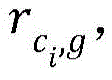 And all r ij (i ≠ j) is
 Thus, all r need only be constructed for each row ii -r ij (i ≠ j) may be used.
First, the diagonal portion of R is obtained and recorded as R diag 。
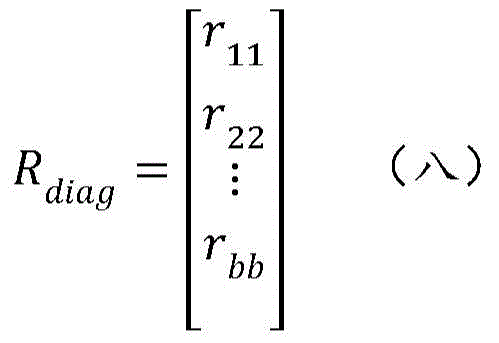
Then, using a matrix broadcast operation, through R diag And R are subtracted to obtain the following matrix (nine).
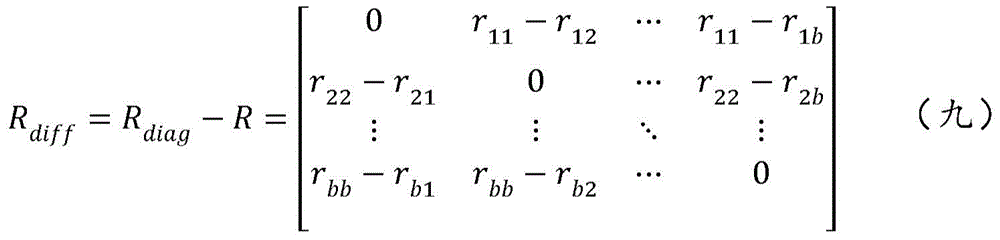
As can be seen from the matrix (nine), r is obtained at each row of the matrix (nine) i i-r i j, (i ≠ j), the portion of 0 is constant, does not affect the training of the loss function loss, and can be ignored. Therefore, the portion of the loss function (one) can be obtained by the formula (ten).

Considering the sample-within-batch fused sample weight α, a weight constraint is eventually added to equation (ten) when determining the penalty function.
The loss function of the matrix pattern of the present invention is as follows (eleven).

The meaning of each parameter in the formula (eleven) is the same as that in the formula (five) and the formula (ten), and the specific description can refer to the description of the formula (five) and the formula (ten) in the present invention, and is not described herein again.
(4) Commodity attribute fusion embedding
After the Loss function Loss is constructed, other attribute information of the commodity needs to be fused into the vector representation.
Fig. 3 schematically shows a schematic diagram of a vector characterization model structure fused with attribute information according to an embodiment of the present invention.
As shown in fig. 3, while performing vector representation on the identification information of the commodity, each attribute may also be embedded and represented by using a Map file, and the attribute of the commodity may be, for example, applicable season, commodity category, applicable crowd, and the like. And then splicing the vectors of the attributes (a sum-up or transverse splicing mode can be adopted). Thus, the vector representation V of the identification information of the commodity can be obtained I Vector V fused with its corresponding attribute P Will finally [ V ] I ,V P ]As a vector characterization of the commodity, the commodity vector v mentioned in (1) the batch similarity calculation is used.
In an e-commerce scene, good determination of the relationship between the commodity and the user is needed to effectively recommend the commodity to the user. After the commodity vector is constructed, the user vector can be constructed based on the commodity vector and the behavior sequence of the user at the whole station, and the user and the commodity are subjected to vector representation in the same vector space by combining an Embedding algorithm.
There are generally two ways to construct a user vector according to embodiments of the present invention.
The first is to conduct embedding operations (i.e., embedding characterization operations) on both in a model and then learn their vector characterization based on historical interaction behavior of the user and the goods. A common method is graph-embedding (graph-embedding), in which a node vector is learned by using both a user and a commodity as nodes of a network.
The second is a commodity vector aggregation based approach. For example, in a classical Youtube model, a model is trained by predicting next click, and then a vector capable of representing a user is output after interaction history is input by using the model and calculation is performed layer by layer, or a commodity vector interacted by the user is aggregated into a user vector through certain logic.
However, in any scheme, it is critical to ensure that the product vector and the user vector are constructed in the same vector space. In actual business, similarity calculation between vectors can be used to obtain the association between users and commodities, and in addition, a scheme similar to Local Sensitive Hashing (LSH) can be used to obtain commodities closest to a specific user or users closest to a specific commodity.
In order to simultaneously consider the vector effect and the high efficiency of engineering, the invention selects a vector aggregation mode. And a plurality of aggregated key logics such as time attenuation, cumulative weighting, adaptive attention mechanism and the like are designed, which will be described in detail below.
The method shown in fig. 2 is further described with reference to fig. 4-8 in conjunction with specific embodiments.
Fig. 4 schematically shows a flow chart of a data processing method according to another embodiment of the present invention. In this embodiment, operations S410 through S430 are included in addition to operations S210 through S230 described above with reference to FIG. 2. The description of operations S210 to S230 is omitted herein for the sake of brevity of description.
As shown in fig. 4, the data processing method further includes operations S410 to S430.
In operation S410, a target behavior sequence of a target user is acquired.
According to the embodiment of the invention, the target behavior sequence of the target user can be obtained according to the identification information of the target user. For example, the behavior sequence generated when the target user interacts with the network may be obtained according to the account information of the target user. The target behavior sequence may be a behavior sequence of the target user or a partial behavior sequence of the target user.
According to the embodiment of the invention, the behavior sequence can be divided into an offline application behavior sequence and an online application behavior sequence based on the acquisition mode of the behavior sequence; the behavior sequences are divided into user short-term interest behavior sequences and long-term interest behavior sequences based on the length of the behavior sequences, namely the behavior sequences of users and commodities with different time spans can be divided into user short-term interest behavior sequences and long-term interest behavior sequences, wherein the long-term interest behavior sequences are long in time span, and the short-term interest behavior sequences are short in time span. When the target behavior sequence of the target user is obtained, the application scene can be comprehensively considered to select a proper behavior sequence.
In operation S420, a plurality of first interaction objects involved by the target behavior sequence are determined.
According to embodiments of the present invention, for example, one of the target behavior sequences of the target user is to browse a thin jacket, browse a short sleeve, click a long sleeve, and put a single long sleeve. The first interactive object may include a thin coat, short sleeves, and long sleeves.
In operation S430, a user vector of the target user is constructed according to the first interaction object vector corresponding to each of the plurality of first interaction objects and the target behavior sequence, wherein the user vector of the target user is used for characterizing one or more associated objects of interest of the target user.
According to an embodiment of the invention, the set of objects of the first interactive object is, for example, { o } 1 ,o 2 ,...o m Will be abbreviated asO; the first interaction object vector of the first interaction object in the set of objects is { v } 1 ,v 2 ,...v m 1.. m), abbreviated as O v . The target user corresponds to a target row sequence of l 1 ,l 2 ,...l n ;l i E.g. O, the object involved in the target behavior sequence is a subset of O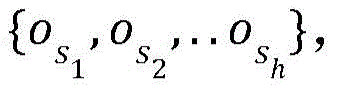 Is marked as O sub 。O sub The vector corresponding to the object in (1) is recorded as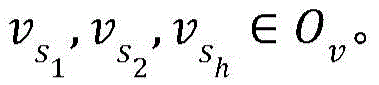
FIG. 5 schematically shows a flow diagram for constructing a user vector for a target user according to an embodiment of the invention.
As shown in fig. 5, constructing the user vector of the target user includes operations S431 to S432.
In operation S431, a weight for each of the plurality of first interactive objects is determined according to the target behavior sequence.
According to an embodiment of the present invention, the weight of each first interactive object may be the same or different.
In operation S432, a user vector of the target user is constructed according to the weight for each first interactive object and the first interactive object vector of each first interactive object.
According to an embodiment of the present invention, constructing the user vector of the target user according to the weight for each first interactive object and the first interactive object vector of each first interactive object comprises:
and (4) constructing a user vector of the target user according to the weight for each first interactive object and the first interactive object vector of each first interactive object according to the following formula (twelve).

Wherein, V U To representThe user vector of the target user, h represents the number of the first interactive objects; v. of top A first interaction object vector representing a first interaction object with the largest weight; a first interactive object vector representing any one of the first interactive objects;
 a similarity calculation function between the first interactive object vector representing the first interactive object with the largest weight and the first interactive object vector of any one first interactive object; decapay (j) represents a time decay function; l. the j Representing a sequence of behaviors of a target user;
 a first interactive object involved in a sequence of behaviors representing a target user.
Equation (twelve) is explained below by way of an example. For example, there is the following ordered sequence of behaviors: a, a, b, c, b. Wherein the closer to the left, the closer to the current time, where a, b, c represent different objects, which may be, for example, merchandise.
According to the embodiment of the present invention, the behavior closer to the current time can be weighted more strongly on the description of the user interest, so a decay factor can be added, and for simplicity, 1/n can be used as the weight of the corresponding object. For the above behavior sequence, the weights of the respective objects can be obtained as follows: 1,1/2,1/3,1/4,1/5.
For each object, the sum of the weighted sums for each object is calculated. Wherein:
a:(1+1/2)=3/2;
b:(1/3+1/5)=8/15;
c:(1/4)=1/4。
by comparing the cumulative sum of the weights of the individual objects, it can be seen that the first interactive object v representing the largest weight is top Is object a. The object a can be taken as the main interest pair of the target userElephant, then sim (V) is calculated a ,V b ) And sim (V) a ,V c ) Wherein sim can be set arbitrarily, and cosine calculation can be generally selected.
Finally, according to the formula (twelve), the user vector V is obtained U 。
V U =V a ×3/2×sim(V a ,V a )+V b ×8/15×sim(V a ,V b )+V c ×1/4×sim(V a ,V c )。
According to the embodiment of the invention, the vector generation model constructed based on the behavior sequence of the user removes negative sampling in the calculation process, and directly performs matrix operation to calculate loss, so that the training performance can be greatly improved, and 3 million pieces of data can be processed in about 6 minutes according to the actual operation result.
According to the embodiment of the invention, the construction of the search term vector can be carried out from the perspective of the construction of the user vector. The relation between the search term and the clicked commodity is similar to the relation between the user and the commodity interacted with the user, so that the construction of the search term can be completed in an aggregation mode, but in consideration of the fact that the search term also has the situations of word segmentation, new words and the like, preprocessing operations are performed before aggregation.
FIG. 6 schematically shows a flowchart for constructing a search term vector for a target user according to an embodiment of the present invention.
As shown in fig. 6, constructing the search term vector of the target user includes operations S610 to S630.
In operation S610, an ordered click sequence generated based on a search term search is acquired.
In operation S620, a plurality of second interaction objects to which the ordered click sequence relates is determined.
According to embodiments of the present invention, for example, one of the ordered sequences of clicks of the target user is clicking on a different garment being sold, e.g., clicking on a short sleeve, clicking on a long sleeve, clicking on a thin jacket. The second interactive object may include short sleeves, long sleeves, and thin coats.
In operation S630, a search term vector is constructed according to the second interaction object vector and the ordered click sequence of each of the plurality of second interaction objects, wherein the search term vector is used for characterizing one or more associated objects associated with the search term.
According to an embodiment of the present invention, constructing the search term vector according to the second interactive object vector and the ordered click sequence of each of the plurality of second interactive objects comprises: determining a weight for each of a plurality of second interactive objects according to the ordered click sequence; and constructing a search term vector according to the weight for each second interactive object and the second interactive object vector of each second interactive object.
According to an embodiment of the present invention, a search term vector may be constructed according to the following formula (thirteen).

According to the embodiment of the present invention, wherein, in formula (thirteen), h represents the number of the second interactive objects; v. of top A second interaction object vector representing a second interaction object with the largest weight; a second interaction object vector representing a second interaction object;
 a similarity calculation function between the second interactive object vector representing the second interactive object with the largest weight and the second interactive object vector of each second interactive object; l j Representing a sequence of behaviors of the target user;
 a second interactive object involved in the sequence of behaviors representing the target user.
With regard to the introduction of the formula (thirteen), reference may be made to the above description of the formula (twelve) according to an embodiment of the present invention. The main difference between formula (thirteen) and formula (twelfth) is that escape (j) in formula (twelfth) is replaced with 1.
Unlike user vector aggregation, the vocabulary itself is expanded when constructing the term vector. For a search word which never appears, the vector description of the search word can be obtained by using a vector after word segmentation or an aggregation mode, which is basically consistent with the use of the word vector in the natural language processing technology, so the mode of constructing the search word vector can be called as the search word vector representation based on the historical behaviors of the user.
For example, there are a series of terms and their corresponding click sequences. In the invention, the minimum participle granularity is represented by letters, for example, a search word abc can be participled into a, b and c.
Search term one abc: i _1, I _2, I _4 (click sequence one);
and a search term two b: i _3, I _2 (click sequence two);
search term triab: i _1, I _4, I _6, I _8 (click sequence three).
The following contents can be obtained by performing word segmentation processing on the search word (while retaining the original content).
(one) for a search term, abc:
abc,I_1,I_2,I_4;
a,I_1,I_2,I_4;
b,I_1,I_2,I_4;
c,I_1,I_2,I_4。
(II) for the search term two b:
b,I_3,I_2。
(III) for the search term triab:
ab,I_1,I_4,I_6,I_8;
a,I_1,I_4,I_6,I_8;
b,I_1,I_4,I_6,I_8。
and aggregating commodities corresponding to each word obtained by word segmentation.
abc,I_1,I_2,I_4;
ab,I_1,I_4,I_6,I_8;
a,I_1,I_2,I_4,I_6,I_8;
b,I_1,I_2,I_3,I_4,I_6,I_8;
c,I_1,I_2,I_4。
And (5) determining the main commodity with the maximum weight according to the calculation formula (thirteen) for constructing the search term vector, calculating the attention weight, and finally obtaining the search term vector.
By the embodiment of the invention, users, commodities and search terms can be represented simultaneously in a unified vector space. In a search recommendation scene, multi-dimensional data correlation recommendation from a user to a commodity, from the user to a search term, from the search term to the search term and from the search term to the commodity is supported. In a targeted promotion scenario, after determining the goods, a list of target people of interest may be determined for traffic marketing based on the spatial distance between the vectors.
FIG. 7 schematically shows a flow chart for real-time recommendation of a target object according to an embodiment of the invention.
As shown in fig. 7, recommending a target object in real time includes operations S710 to S720.
In operation S710, real-time operation information currently input by a target user is acquired in real time.
According to the embodiment of the invention, the real-time operation information currently input by the target user can be acquired when the target user searches. Deducing real-time intention of the user based on the real-time operation information currently input by the target user, deducing search intention of the user based on the evolution of the real-time behavior sequence of the user, and recommending related search words and potential purchase demand commodities of the user.
In operation S720, a target object is recommended to a target user according to the object vector and/or the search term vector and the real-time operation information currently input by the user.
According to the embodiment of the invention, recommending the target object to the target user according to the object vector and/or the search word vector and the real-time operation information currently input by the target user comprises the following steps: vectorizing the real-time operation information currently input by a user to obtain a real-time behavior vector; determining a first similar vector similar to the real-time behavior vector, wherein the first similar vector is one or more of an object vector and a search term vector; and determining a target object from the objects corresponding to the first similarity vector.
According to the embodiment of the invention, for example, the real-time operation information currently input by the user is the keywords ginseng and bird's nest input by the user, the ginseng and the bird's nest can be vectorized to obtain the real-time behavior vectors corresponding to the ginseng and the bird's nest, and then the first similar vector similar to the real-time behavior vectors corresponding to the ginseng and the bird's nest is determined from a large number of object vectors and search word vectors. For example, the object vector and the search term vector include vectors of commodities such as sea cucumber, dendrobium, donkey-hide gelatin and the like, and since the commodities such as the sea cucumber, the dendrobium, the donkey-hide gelatin and the like, as well as the ginseng and the bird's nest are all nourishing products, the vectors may have high similarity with vectors corresponding to the ginseng and the bird's nest, the vectors of the commodities such as the sea cucumber, the dendrobium, the donkey-hide gelatin and the like can be determined as vectors with similar real-time behavior vectors corresponding to the ginseng and the bird's nest, and then the target commodity is determined from the commodities such as the sea cucumber, the dendrobium, the donkey-hide gelatin and the like and recommended to the target user.
According to the embodiment of the invention, when determining the first similarity vector similar to the real-time behavior vector, the similarity between the real-time behavior vector and the object vector and the similarity between the real-time behavior vector and the search term vector can be calculated first, and then the vector with the highest similarity is taken as the first similarity vector.
FIG. 8 schematically shows a flow diagram for real-time recommendation of a target object according to another embodiment of the invention.
As shown in fig. 8, when a user operates a commodity on the internet, an operation behavior sequence is generated, and the operation behavior sequence relates to an interactive commodity operated by the user. When the target object is recommended in real time, the search terms input by the user in real time can be obtained, the commodities related to the search terms and the categories of the interactive commodities are counted in real time, and the commodities corresponding to the categories 1-3 are obtained. And vectorizing the commodities corresponding to the categories 1 to 3 to obtain the category vectors 1 to 3. According to the embodiment of the invention, the category vector closest to the search word vector corresponding to the current search word is selected as the activation category vector, and the search word vector and the activation category vector are subjected to weighted fusion to generate the final search vector. Based on online Nearest Neighbor vector query (ANN for short), the vector retrieval system can find one or more vectors which are closest to the vector in space by giving a vector, recall the object vector which is closest to the retrieval word vector, and thus recommend the commodities represented by the recalled object vector and realize the real-time identification of the search intention of the user.
By the embodiment of the invention, the suggested search words can be generated based on the real-time search behavior expansion of the user, the vector representation of the user behavior is used, and commodities related to the user behavior semantics can be recalled.
FIG. 9 schematically illustrates a flow diagram for personalizing a recommended target object, in accordance with another embodiment of the present invention.
As shown in fig. 9, before the personalized recommendation target object can be used for the user to perform real-time search, the method includes operations S910 to S940.
In operation S910, an object vector, a user vector, and a search term vector associated with a target user are acquired.
In operation S920, a second similarity between each two vectors of the object vector, the user vector, and the search term vector associated with the target user is determined.
According to the embodiment of the invention, a second similarity between the object vector and the user vector, a second similarity between the object vector and the search term vector and a second similarity between the search term vector and the user vector can be determined.
According to the embodiment of the invention, in order to ensure the service performance of personalized intention identification of a high-flow scene, the similarity between every two vectors in an object vector, a user vector and a search word vector associated with a target user can be calculated in advance, and meanwhile, the calculation result is stored in a relational database to support efficient query.
In operation S930, the second similarity between each two vectors is compared with a preset threshold.
According to the embodiment of the invention, the second similarity between the object vector and the user vector can be compared with a preset threshold, the second similarity between the object vector and the search word vector can be compared with a preset threshold, and the second similarity between the search word vector and the user vector can be compared with a preset threshold.
In operation S940, a search object is determined according to a plurality of objects corresponding to vectors having a second similarity greater than or equal to a preset threshold.
According to the embodiment of the present invention, for example, the second similarity between the object vector and the user vector is 0.6, the second similarity between the object vector and the search term vector is 0.7, the second similarity between the search term vector and the user vector is 0.9, and the preset threshold is 0.8. The vectors with the second similarity greater than or equal to the preset threshold value can be determined as the search term vector and the user vector. A search object is determined from a plurality of objects to which the search term vector and the user vector relate.
According to the embodiment of the present invention, determining the search object according to the object corresponding to the vector having the second similarity greater than or equal to the preset threshold includes: and carrying out duplication elimination treatment on a plurality of objects corresponding to the vectors with the second similarity being greater than or equal to a preset threshold value, and determining the objects obtained after duplication elimination as search objects.
According to the embodiment of the present invention, for example, as in the foregoing example, the vectors with the second similarity greater than or equal to the preset threshold are determined as the search word vector and the user vector, the object related to the search word vector and the user vector is deduplicated, and the object obtained after the deduplication is determined as the search object.
According to an embodiment of the present invention, after a search object is determined from objects corresponding to the second similarity vector, the search object may be displayed in a target display manner in the search box.
According to the embodiment of the invention, the target display mode can be displayed in a mode of searching for the shading, and can also be displayed in a mode of searching for the finding.
By the embodiment of the invention, before the search function is used, the interested object identification information is provided and displayed in the search frame in a display mode of searching the shading, and meanwhile, a batch of search terms which the user wants to search can be generated and displayed.
By the embodiment of the invention, the query intention of the user can be sensed, and after enough user behavior data is captured, the search words or commodities required by the user can be presented in time, so that the loss probability of the user is reduced, and the shopping conversion is promoted.
According to the embodiment of the present invention, it should be noted that, although the above embodiment is mainly described with respect to the commodity recommendation in the e-commerce scenario, it is understood by those skilled in the art that the present invention is not limited thereto. For example, the present invention may also be applied to other recommendation scenarios such as news recommendation, recipe recommendation, etc., and the present invention is not described herein again.
Exemplary devices
Having described the method of an exemplary embodiment of the present invention, a data processing apparatus executed by a computing device of an exemplary embodiment of the present invention is described next with reference to fig. 10.
FIG. 10 schematically shows a block diagram of a data processing apparatus executed by a computing device according to an embodiment of the present invention.
As shown in fig. 10, the data processing apparatus 1000 executed by the computing device includes a first acquisition module 1010, a second acquisition module 1020, and a training module 1030.
The first obtaining module 1010 is configured to obtain a training sample set, where the training sample set includes a plurality of pieces of training data, and each piece of training data at least includes identification information of: a center object, a context object and an object targeted by a target operation; the identification information of the context object and the identification information of the center object are arranged at adjacent positions in the same behavior sequence, the behavior sequence comprises the identification information of one or more objects operated by a user, and the identification information of the objects is arranged in the behavior sequence according to the time sequence of the operation of the objects;
the second obtaining module 1020 is configured to obtain attribute information of each object in each piece of training data according to the identification information of each object in each piece of training data; and
the training module 1030 is configured to train a vector generation model based on the identification information and the attribute information of each of the objects, so that the trained vector generation model can be used to output an object vector representing the object.
According to the data processing apparatus executed by a computing device according to an embodiment of the present invention, by obtaining a training sample set, where each piece of training data includes a center object, a context object, and identification information of an object targeted by a target operation, the identification information of the context object is adjacent to an arrangement position of the identification information of the center object in the same behavior sequence, and the identification information of the objects is arranged in the behavior sequence in the order of time in which the objects are operated; the vector generation model is trained based on the identification information and the attribute information of each object, the trained vector generation model can be used for outputting object vectors representing the objects, the object vectors of the objects can be output through technologies such as big data, machine learning and deep learning based on the cooperation of data and an algorithm, so that the interest and the perception of users are described, the requirement expression path of the users can be shortened, the probability of interrupting the purchasing process of the users is reduced, and better experience is brought to the users.
According to an embodiment of the present invention, the vector generation model has a loss function, and the loss function includes:

wherein, representing a first initial vector obtained by carrying out vector initialization on the identification information and the attribute information of the central object in each piece of training data;
 representing a second initial vector obtained by carrying out vector initialization on the identification information and the attribute information of the context object in each piece of training data;
 representing a third initial vector obtained by performing vector initialization on identification information and attribute information of an object targeted by the target operation in each piece of training data; r is ii The element on the diagonal line of the result matrix obtained by matrix multiplication of the first initial vector and the third initial vector is shown; r is ij Representing elements of the result matrix other than the elements on the diagonal; b represents the number of pieces of training data processed in parallel by the vector generation model; n represents the number of the context objects, and α is a weight coefficient.
According to an embodiment of the present invention, the data processing apparatus 1000 executed by the computing device further includes a third obtaining module, a first determining module, and a first constructing module.
The third acquisition module is used for acquiring a target behavior sequence of a target user;
the first determining module is used for determining a plurality of first interaction objects related to the target behavior sequence; and
the first construction module is configured to construct a user vector of the target user according to the first interaction object vector corresponding to each of the plurality of first interaction objects and the target behavior sequence, where the user vector of the target user is used to characterize one or more related objects that are of interest to the target user.
According to an embodiment of the present invention, the first building block is configured to: determining a weight for each of the plurality of first interaction objects according to the target behavior sequence; and constructing a user vector of the target user according to the weight of each first interactive object and the first interactive object vector of each first interactive object.
According to an embodiment of the present invention, constructing the user vector of the target user according to the weight for each first interactive object and the first interactive object vector of each first interactive object includes:
constructing a user vector of the target user according to the weight of each first interactive object and the first interactive object vector of each first interactive object according to the following formula:

wherein, V U Representing a user vector of a target user, and h represents the number of the first interaction objects; v. of top A first interaction object vector representing a first interaction object with the largest weight; a first interactive object vector representing any one of the first interactive objects;
 a similarity calculation function between the first interactive object vector representing the first interactive object with the largest weight and the first interactive object vector of any one first interactive object; decapay (j) represents a time decay function; l j Representing the behavior sequence of the target user;
 representing the first interactive object to which the sequence of actions of the target user relates.
According to an embodiment of the present invention, the data processing apparatus 1000 executed by the computing device further comprises a fourth obtaining module, a second determining module, and a second constructing module.
The fourth acquisition module is used for acquiring an ordered click sequence generated based on search term searching;
the second determining module is used for determining a plurality of second interactive objects related to the ordered click sequence; and
the second constructing module is used for constructing a search term vector according to the second interactive object vector of each second interactive object in the plurality of second interactive objects and the ordered click sequence, wherein the search term vector is used for representing one or more associated objects associated with the search term.
According to an embodiment of the present invention, the second building block is configured to: determining a weight for each of the plurality of second interactive objects based on the ordered click sequence; and constructing the search term vector according to the weight of each second interactive object and the second interactive object vector of each second interactive object.
According to an embodiment of the present invention, the data processing apparatus 1000 executed by the computing device further includes a fifth obtaining module and a first recommending module.
The fifth acquisition module is used for acquiring the real-time operation information currently input by the target user in real time;
and the first recommending module is used for recommending a target object to the target user according to the object vector and/or the search word vector and the real-time operation information currently input by the user.
According to an embodiment of the present invention, the first recommending module is configured to: vectorizing the real-time operation information currently input by the user to obtain a real-time behavior vector; determining a first similarity vector similar to the real-time behavior vector, wherein the first similarity vector is one or more of the object vector and the search term vector; and determining the target object from the objects corresponding to the first similarity vector.
According to an embodiment of the present invention, the data processing apparatus 1000 executed by the computing device further includes a sixth obtaining module, a third determining module, a comparing module, and a fourth determining module.
The sixth acquisition module is used for acquiring an object vector, a user vector and a search word vector which are associated with the target user;
the third determining module is used for determining a second similarity between every two vectors in the object vector, the user vector and the search term vector which are associated with the target user;
the comparison module is used for comparing the second similarity between every two vectors with a preset threshold; and
a fourth determining module, configured to determine the search object according to multiple objects corresponding to vectors with the second similarity being greater than or equal to the preset threshold.
According to an embodiment of the present invention, the fourth determining module is configured to: carrying out de-duplication processing on a plurality of objects corresponding to the vectors with the second similarity greater than or equal to the preset threshold; and determining the object obtained after the duplication removal as the search object.
According to an embodiment of the present invention, the data processing apparatus 1000 executed by the computing device further includes a display module configured to display the search object in a target display manner in the search box after determining the search object from the objects corresponding to the second similarity vector.
According to an embodiment of the present invention, the first obtaining module is configured to obtain behavior logs of a plurality of users within a predetermined time period; processing the behavior log of each user in a plurality of users, and constructing a behavior sequence corresponding to each user to obtain the behavior sequences of the users; and constructing the training sample set according to the behavior sequences of the plurality of users.
Exemplary Medium
Having described the apparatus of the exemplary embodiments of the present invention, a medium of the exemplary embodiments of the present invention for storing computer-executable instructions, which when executed by a processing unit, implement the data processing method as described above, will next be described with reference to fig. 11.
In some possible embodiments, aspects of the present invention may also be implemented in the form of a program product including program code for causing a computing device to perform the steps in the data processing method according to various exemplary embodiments of the present invention described in the above section "exemplary method" of this specification when the program product is run on the computing device, for example, the computing device may perform operation S210 as shown in fig. 2, obtaining a training sample set; operation S220, obtaining attribute information of each object in each object according to the identification information of each object in each piece of training data; in operation S230, a vector generation model is trained based on the identification information and the attribute information of each of the respective objects, so that the trained vector generation model can be used to output an object vector characterizing the object.
The program product may employ any combination of one or more readable media. The readable medium may be a readable signal medium or a readable storage medium. A readable storage medium may be, for example, but not limited to, an electronic, magnetic, optical, electromagnetic, infrared, or semiconductor system, apparatus, or device, or any combination of the foregoing. More specific examples (a non-exhaustive list) of the readable storage medium include: an electrical connection having one or more wires, a portable disk, a hard disk, a Random Access Memory (RAM), a read-only memory (ROM), an erasable programmable read-only memory (EPROM or flash memory), an optical fiber, a portable compact disc read-only memory (CD-ROM), an optical storage device, a magnetic storage device, or any suitable combination of the foregoing.
Fig. 11 schematically shows a program product for implementing a data processing method according to an embodiment of the present invention.
As shown in fig. 11, a program product 110 implementing a data processing method according to an embodiment of the present invention is described, which may employ a portable compact disc read only memory (CD-ROM) and include program code, and may be run on a computing device, such as a personal computer. However, the program product of the present invention is not limited in this respect, and in this document, a readable storage medium may be any tangible medium that can contain, or store a program for use by or in connection with an instruction execution system, apparatus, or device.
A readable signal medium may include a propagated data signal with readable program code embodied therein, for example, in baseband or as part of a carrier wave. Such a propagated data signal may take any of a variety of forms, including, but not limited to, electro-magnetic, optical, or any suitable combination thereof. A readable signal medium may also be any readable medium that is not a readable storage medium and that can communicate, propagate, or transport a program for use by or in connection with an instruction execution system, apparatus, or device.
Program code embodied on a readable medium may be transmitted using any appropriate medium, including but not limited to wireless, wireline, optical fiber cable, RF, etc., or any suitable combination of the foregoing.
Program code for carrying out operations for aspects of the present invention may be written in any combination of one or more programming languages, including an object oriented programming language such as Java, C + + or the like and conventional procedural programming languages, such as the "C" programming language or similar programming languages. The program code may execute entirely on the user computing device, partly on the user device, partly on a remote computing device, or entirely on the remote computing device or server. In the case of a remote computing device, the remote computing device may be connected to the user computing device over any kind of network, including a Local Area Network (LAN) or a Wide Area Network (WAN), or may be connected to an external computing device (e.g., over the internet using an internet service provider).
Exemplary computing device
Having described the method, medium, and apparatus of exemplary embodiments of the present invention, a computing device of exemplary embodiments of the present invention is described next with reference to fig. 12, which includes a processing unit and a storage unit, the storage unit storing computer-executable instructions, which when executed by the processing unit, are used to implement the data processing method described above.
The embodiment of the invention also provides the computing equipment. As will be appreciated by one skilled in the art, aspects of the present invention may be embodied as a system, method or program product. Thus, various aspects of the invention may be embodied in the form of: an entirely hardware embodiment, an entirely software embodiment (including firmware, microcode, etc.) or an embodiment combining hardware and software aspects that may all generally be referred to herein as a "circuit," module "or" system.
In some possible embodiments, a computing device according to the present invention may include at least one processing unit, and at least one memory unit. Wherein the storage unit stores program code which, when executed by the processing unit, causes the processing unit to perform the steps in the data processing method according to various exemplary embodiments of the present invention described in the above section "exemplary method" of the present specification. For example, the processing unit may perform operation S210 as shown in fig. 2, obtaining a training sample set; operation S220, obtaining attribute information of each object in each object according to the identification information of each object in each piece of training data; in operation S230, a vector generation model is trained based on the identification information and the attribute information of each of the respective objects, so that the trained vector generation model can be used to output an object vector characterizing the object.
Fig. 12 schematically shows a block diagram of a computing device for implementing a data processing method according to an embodiment of the present invention.
A data processing computing device 120 according to this embodiment of the invention is described below with reference to fig. 12. The computing device 120 shown in FIG. 12 is only one example and should not impose any limitations on the functionality or scope of use of embodiments of the present invention.
As shown in fig. 12, computing device 120 is in the form of a general purpose computing device. Components of computing device 120 may include, but are not limited to: the at least one processing unit 1201, the at least one memory unit 1202, and the bus 1203 connecting the various system components (including the memory unit 1202 and the processing unit 1201).
The storage unit 1202 may include readable media in the form of volatile memory, such as Random Access Memory (RAM)12021 and/or cache memory 12022, and may further include Read Only Memory (ROM) 12023.
It should be noted that although in the above detailed description several units/modules or sub-units/modules of the apparatus are mentioned, such a division is merely exemplary and not mandatory. Indeed, the features and functionality of two or more of the units/modules described above may be embodied in one unit/module according to embodiments of the invention. Conversely, the features and functions of one unit/module described above may be further divided into embodiments by a plurality of units/modules.
Moreover, while the operations of the method of the invention are depicted in the drawings in a particular order, this does not require or imply that the operations must be performed in this particular order, or that all of the illustrated operations must be performed, to achieve desirable results. Additionally or alternatively, certain steps may be omitted, multiple steps combined into one step execution, and/or one step broken down into multiple step executions.
While the spirit and principles of the invention have been described with reference to several particular embodiments, it is to be understood that the invention is not limited to the disclosed embodiments, nor is the division of aspects, which is for convenience only as the features in such aspects may not be combined to benefit. The invention is intended to cover various modifications and equivalent arrangements included within the spirit and scope of the appended claims.
Claims (28)
1. A data processing method performed by a computing device, comprising:
obtaining a training sample set, wherein the training sample set comprises a plurality of pieces of training data, and each piece of training data comprises identification information of the following commodities: the center commodity, the context commodity and the commodity targeted by the target operation, wherein the format of each piece of training data is as follows: center commodity: context goods: the commodity targeted by the target operation; the arrangement positions of the identification information of the context commodity and the identification information of the center commodity in the same behavior sequence are adjacent, the behavior sequence comprises the identification information of one or more commodities operated by a user, and the identification information of the commodities is arranged in the behavior sequence according to the time sequence of the operation of the commodities;
acquiring attribute information of each commodity in each commodity according to the identification information of each commodity in each piece of training data; and
training a vector generation model based on the identification information and the attribute information of each commodity in each commodity, so that the trained vector generation model can be used for outputting commodity vectors representing commodities.
2. The method of claim 1, wherein the vector generation model has a loss function comprising:

wherein, representing a first initial vector obtained by performing vector initialization on the identification information and the attribute information of the center commodity in each piece of training data;
 representing a second initial vector obtained by carrying out vector initialization on the identification information and the attribute information of the context commodity in each piece of training data;
 representing a third initial vector obtained by performing vector initialization on the identification information and the attribute information of the commodity targeted by the target operation in each piece of training data; r is ii Representing elements on a diagonal line of a result matrix obtained after matrix multiplication is carried out on the first initial vector and the third initial vector; r is ij Representing elements of the result matrix other than the elements on the diagonal; representing the number of pieces of training data processed in parallel by the vector generation model; the number of the context commodities is represented as a weight coefficient.
3. The method of claim 1, further comprising:
acquiring a target behavior sequence of a target user;
determining a plurality of first interactive commodities related to the target behavior sequence; and
constructing a user vector of the target user according to the first interactive commodity vector corresponding to each first interactive commodity in the plurality of first interactive commodities and the target behavior sequence, wherein the user vector of the target user is used for representing one or more related commodities which are interested by the target user.
4. The method of claim 3, wherein the constructing the user vector for the target user comprises:
determining a weight for each of the plurality of first interactive merchandise from the sequence of target behaviors; and
and constructing a user vector of the target user according to the weight of each first interactive commodity and the first interactive commodity vector of each first interactive commodity.
5. The method of claim 4, wherein constructing the user vector for the target user according to the weight for the each first interactive commodity and the first interactive commodity vector for the each first interactive commodity comprises:
constructing a user vector of the target user according to the weight of each first interactive commodity and the first interactive commodity vector of each first interactive commodity according to the following formula:

wherein, U representing a user vector of a target user, and h representing the number of the first interactive commodities; v. of top A first interactive commodity vector representing a first interactive commodity with a largest weight; a first interactive merchandise vector representing any one of the first interactive merchandise;
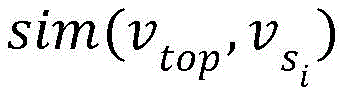 a similarity calculation function between the first interactive commodity vector of the first interactive commodity with the maximum weight and the first interactive commodity vector of any one first interactive commodity; decapay (j) represents a time decay function; l j Representing the order of behavior of the target userColumns;
 and representing the first interactive commodity which is related by the behavior sequence of the target user.
6. The method of claim 3, further comprising:
acquiring an ordered click sequence generated based on search term searching;
determining a plurality of second interactive commodities to which the ordered click sequence relates; and
and constructing a search term vector according to the second interactive commodity vector of each second interactive commodity in the plurality of second interactive commodities and the ordered click sequence, wherein the search term vector is used for representing one or more associated commodities associated with the search term.
7. The method of claim 6, wherein said constructing a search term vector comprises:
determining a weight for each of the plurality of second interactive merchandise from the ordered click sequence; and
and constructing the search term vector according to the weight aiming at each second interactive commodity and the second interactive commodity vector of each second interactive commodity.
8. The method of claim 6, further comprising:
acquiring the current real-time operation information input by the target user in real time; and
and recommending target commodities to the target user according to the commodity vector and/or the search term vector and the real-time operation information currently input by the user.
9. The method of claim 8, wherein recommending a target commodity to the target user according to the commodity vector and/or the search term vector and the real-time operation information currently input by the target user comprises:
vectorizing the real-time operation information currently input by the user to obtain a real-time behavior vector;
determining a first similar vector similar to the real-time behavior vector, wherein the first similar vector is one or more of the commodity vector and the search term vector; and
and determining the target commodity from commodities corresponding to the first similarity vector.
10. The method of claim 6, further comprising:
acquiring a commodity vector, a user vector and a search term vector which are associated with the target user;
determining a second similarity between every two vectors in the commodity vector, the user vector and the search term vector which are associated with the target user;
comparing the second similarity between every two vectors with a preset threshold value; and
and determining to search commodities according to a plurality of commodities corresponding to the vectors with the second similarity being greater than or equal to the preset threshold.
11. The method of claim 10, wherein determining the search product according to the product corresponding to the vector with the second similarity greater than or equal to the preset threshold comprises:
carrying out duplicate removal processing on a plurality of commodities corresponding to the vectors with the second similarity being greater than or equal to the preset threshold; and
and determining the commodity obtained after the weight is removed as the search commodity.
12. The method of claim 11, further comprising:
and after determining the commodity obtained after the duplication removal as the search commodity, displaying the search commodity in a target display mode in a search frame.
13. The method of claim 1, wherein obtaining a training sample set comprises:
acquiring behavior logs of a plurality of users in a preset time period;
processing the behavior log of each user in a plurality of users, and constructing a behavior sequence corresponding to each user to obtain the behavior sequences of the users; and
and constructing the training sample set according to the behavior sequences of the plurality of users.
14. A data processing apparatus for execution by a computing device, comprising:
the system comprises a first acquisition module, a first storage module and a second acquisition module, wherein the first acquisition module is used for acquiring a training sample set, the training sample set comprises a plurality of pieces of training data, and each piece of training data comprises identification information of the following commodities: the center commodity, the context commodity and the commodity targeted by the target operation, wherein the format of each piece of training data is as follows: center commodity: context goods: the commodity targeted by the target operation; the arrangement positions of the identification information of the context commodity and the identification information of the center commodity in the same behavior sequence are adjacent, the behavior sequence comprises the identification information of one or more commodities operated by a user, and the identification information of the commodities is arranged in the behavior sequence according to the time sequence of the operation of the commodities;
the second obtaining module is used for obtaining attribute information of each commodity in each commodity according to the identification information of each commodity in each piece of training data; and
and the training module is used for training a vector generation model based on the identification information and the attribute information of each commodity in each commodity, so that the trained vector generation model can be used for outputting commodity vectors representing the commodities.
15. The apparatus of claim 14, wherein the vector generative model has a loss function comprising:

wherein, representing a first initial vector obtained by performing vector initialization on the identification information and the attribute information of the center commodity in each piece of training data;
 representing a second initial vector obtained by carrying out vector initialization on the identification information and the attribute information of the context commodity in each piece of training data;
 representing a third initial vector obtained by performing vector initialization on the identification information and the attribute information of the commodity targeted by the target operation in each piece of training data; r is ii Representing elements on a diagonal line of a result matrix obtained after matrix multiplication is carried out on the first initial vector and the third initial vector; r is ij Representing elements of the result matrix other than the elements on the diagonal; b represents the number of pieces of training data processed by the vector generation model in parallel; n represents the number of the context commodities, and alpha is a weight coefficient.
16. The apparatus of claim 14, further comprising:
the third acquisition module is used for acquiring a target behavior sequence of a target user;
the first determining module is used for determining a plurality of first interactive commodities related to the target behavior sequence; and
a first constructing module, configured to construct a user vector of the target user according to the target behavior sequence and a first interactive commodity vector corresponding to each of the plurality of first interactive commodities, where the user vector of the target user is used to characterize one or more associated commodities that are of interest to the target user.
17. The apparatus of claim 16, wherein the first building block is to:
determining a weight for each of the plurality of first interactive merchandise according to the target behavior sequence; and
and constructing a user vector of the target user according to the weight of each first interactive commodity and the first interactive commodity vector of each first interactive commodity.
18. The apparatus of claim 17, wherein constructing the user vector for the target user according to the weight for the each first interactive commodity and the first interactive commodity vector for the each first interactive commodity comprises:
constructing a user vector of the target user according to the weight of each first interactive commodity and the first interactive commodity vector of each first interactive commodity according to the following formula:

wherein, V U Representing a user vector of a target user, and h representing the number of the first interactive commodities; v. of top A first interactive commodity vector representing a first interactive commodity with a largest weight; a first interactive merchandise vector representing any one of the first interactive merchandise;
 a similarity calculation function between the first interactive commodity vector representing the first interactive commodity with the largest weight and the first interactive commodity vector of any one first interactive commodity; decapay (j) represents a time decay function; l j Representing a sequence of behaviors of the target user;
 and representing the first interactive commodity which is related by the behavior sequence of the target user.
19. The apparatus of claim 16, further comprising:
the fourth acquisition module is used for acquiring an ordered click sequence generated based on search term searching;
the second determining module is used for determining a plurality of second interactive commodities related to the ordered click sequence; and
and the second construction module is used for constructing a search term vector according to the second interactive commodity vector of each second interactive commodity in the plurality of second interactive commodities and the ordered click sequence, wherein the search term vector is used for representing one or more associated commodities associated with the search term.
20. The apparatus of claim 19, wherein the second building block is configured to:
determining a weight for each of the plurality of second interactive merchandise from the ordered click sequence; and
and constructing the search term vector according to the weight aiming at each second interactive commodity and the second interactive commodity vector of each second interactive commodity.
21. The apparatus of claim 19, further comprising:
the fifth acquisition module is used for acquiring the real-time operation information currently input by the target user in real time; and
and the first recommending module is used for recommending the target commodity to the target user according to the commodity vector and/or the search term vector and the real-time operation information currently input by the user.
22. The apparatus of claim 21, wherein the first recommendation module is to:
vectorizing the real-time operation information currently input by the user to obtain a real-time behavior vector;
determining a first similar vector similar to the real-time behavior vector, wherein the first similar vector is one or more of the commodity vector and the search term vector; and
and determining the target commodity from commodities corresponding to the first similarity vector.
23. The apparatus of claim 19, further comprising:
a sixth obtaining module, configured to obtain a commodity vector, a user vector, and a search term vector that are associated with the target user;
the third determining module is used for determining a second similarity between every two vectors in the commodity vector, the user vector and the search term vector which are associated with the target user;
the comparison module is used for comparing the second similarity between every two vectors with a preset threshold value; and
and the fourth determining module is used for determining search commodities according to the plurality of commodities corresponding to the vectors of which the second similarity is greater than or equal to the preset threshold.
24. The apparatus of claim 23, wherein the fourth determining means is configured to:
carrying out duplicate removal processing on a plurality of commodities corresponding to the vectors with the second similarity being greater than or equal to the preset threshold; and
and determining the commodity obtained after the weight is removed as the search commodity.
25. The apparatus of claim 24, further comprising:
and the display module is used for displaying the searched commodity in a target display mode in the search frame after the commodity obtained after the duplication removal is determined as the searched commodity.
26. The apparatus of claim 14, wherein the first obtaining means is configured to:
acquiring behavior logs of a plurality of users in a preset time period;
processing the behavior log of each user in a plurality of users, and constructing a behavior sequence corresponding to each user to obtain the behavior sequences of the users; and
and constructing the training sample set according to the behavior sequences of the plurality of users.
27. A medium storing computer executable instructions for implementing the method of any one of claims 1 to 13 when executed by a processing unit.
28. A computing device, comprising:
a processing unit; and
a storage unit storing computer-executable instructions for implementing the method of any one of claims 1 to 13 when executed by the processing unit.
Priority Applications (1)
| Application Number | Priority Date | Filing Date | Title |
|---|---|---|---|
| CN201910557742.7A CN110264277B (en) | 2019-06-25 | 2019-06-25 | Data processing method and device executed by computing equipment, medium and computing equipment |
Applications Claiming Priority (1)
| Application Number | Priority Date | Filing Date | Title |
|---|---|---|---|
| CN201910557742.7A CN110264277B (en) | 2019-06-25 | 2019-06-25 | Data processing method and device executed by computing equipment, medium and computing equipment |
Publications (2)
| Publication Number | Publication Date |
|---|---|
| CN110264277A CN110264277A (en) | 2019-09-20 |
| CN110264277B true CN110264277B (en) | 2022-08-16 |
Family
ID=67921503
Family Applications (1)
| Application Number | Title | Priority Date | Filing Date |
|---|---|---|---|
| CN201910557742.7A Active CN110264277B (en) | 2019-06-25 | 2019-06-25 | Data processing method and device executed by computing equipment, medium and computing equipment |
Country Status (1)
| Country | Link |
|---|---|
| CN (1) | CN110264277B (en) |
Families Citing this family (5)
| Publication number | Priority date | Publication date | Assignee | Title |
|---|---|---|---|---|
| CN110852755B (en) * | 2019-11-06 | 2022-05-17 | 支付宝(杭州)信息技术有限公司 | User identification method and device for transaction scenarios |
| CN111291125B (en) * | 2020-02-18 | 2024-05-14 | 广州腾讯科技有限公司 | Data processing method and related equipment |
| CN113822687B (en) * | 2020-06-19 | 2024-10-29 | 阿里巴巴集团控股有限公司 | Data processing method, device, equipment and storage medium |
| CN111523682B (en) * | 2020-07-03 | 2020-10-23 | 支付宝(杭州)信息技术有限公司 | Method and device for training interactive prediction model and predicting interactive object |
| CN112907334B (en) * | 2021-03-24 | 2024-04-26 | 杭州网易再顾科技有限公司 | Object recommendation method and device |
Citations (5)
| Publication number | Priority date | Publication date | Assignee | Title |
|---|---|---|---|---|
| CN104090932A (en) * | 2014-06-24 | 2014-10-08 | 海信集团有限公司 | Content recommending method and device |
| CN107273436A (en) * | 2017-05-24 | 2017-10-20 | 北京京东尚科信息技术有限公司 | The training method and trainer of a kind of recommended models |
| CN108898459A (en) * | 2018-06-25 | 2018-11-27 | 中国联合网络通信集团有限公司 | A kind of Method of Commodity Recommendation and device |
| CN109002488A (en) * | 2018-06-26 | 2018-12-14 | 北京邮电大学 | A kind of recommended models training method and device based on first path context |
| CN109446413A (en) * | 2018-09-25 | 2019-03-08 | 上海交通大学 | Serializing recommended method based on item associations relationship |
Family Cites Families (1)
| Publication number | Priority date | Publication date | Assignee | Title |
|---|---|---|---|---|
| TWI602135B (en) * | 2016-06-15 | 2017-10-11 | 崑山科技大學 | Character monitoring method of store recommendation sequence |
-
2019
- 2019-06-25 CN CN201910557742.7A patent/CN110264277B/en active Active
Patent Citations (5)
| Publication number | Priority date | Publication date | Assignee | Title |
|---|---|---|---|---|
| CN104090932A (en) * | 2014-06-24 | 2014-10-08 | 海信集团有限公司 | Content recommending method and device |
| CN107273436A (en) * | 2017-05-24 | 2017-10-20 | 北京京东尚科信息技术有限公司 | The training method and trainer of a kind of recommended models |
| CN108898459A (en) * | 2018-06-25 | 2018-11-27 | 中国联合网络通信集团有限公司 | A kind of Method of Commodity Recommendation and device |
| CN109002488A (en) * | 2018-06-26 | 2018-12-14 | 北京邮电大学 | A kind of recommended models training method and device based on first path context |
| CN109446413A (en) * | 2018-09-25 | 2019-03-08 | 上海交通大学 | Serializing recommended method based on item associations relationship |
Non-Patent Citations (2)
| Title |
|---|
| Context-Aware Commodity Recommendation Information Service in E-commerce;Yongqiang Zhang等;《2012 Sixth International Conference on Internet Computing for Science and Engineering》;20120716;第20-25页 * |
| 基于消费性格的新商品推荐方法;张光前 等;《管理科学》;20150331;第28卷(第2期);第60-68页 * |
Also Published As
| Publication number | Publication date |
|---|---|
| CN110264277A (en) | 2019-09-20 |
Similar Documents
| Publication | Publication Date | Title |
|---|---|---|
| Malhotra et al. | An intelligent approach to design of E-Commerce metasearch and ranking system using next-generation big data analytics | |
| CN110264277B (en) | Data processing method and device executed by computing equipment, medium and computing equipment | |
| Alamdari et al. | An image-based product recommendation for E-commerce applications using convolutional neural networks | |
| JP7451747B2 (en) | Methods, devices, equipment and computer readable storage media for searching content | |
| US8380727B2 (en) | Information processing device and method, program, and recording medium | |
| US10360623B2 (en) | Visually generated consumer product presentation | |
| CN107644036B (en) | Method, device and system for pushing data object | |
| CN108960945A (en) | Method of Commodity Recommendation and device | |
| CN110110233B (en) | Information processing method, device, medium and computing equipment | |
| CN111859160A (en) | A method and system for session sequence recommendation based on graph neural network | |
| US9767417B1 (en) | Category predictions for user behavior | |
| CN112149003B (en) | Commodity community recommendation method, device and computer equipment | |
| CN111444304A (en) | Method and device for search ranking | |
| CN107730346A (en) | The method and apparatus of article cluster | |
| CN111429161B (en) | Feature extraction method, feature extraction device, storage medium and electronic equipment | |
| US9767204B1 (en) | Category predictions identifying a search frequency | |
| CN110069713B (en) | A personalized recommendation method based on user context awareness | |
| CN114065063A (en) | Information processing method, information processing apparatus, storage medium, and electronic device | |
| US10474670B1 (en) | Category predictions with browse node probabilities | |
| US20250316062A1 (en) | Self-supervised audio-visual learning for correlating music and video | |
| US10387934B1 (en) | Method medium and system for category prediction for a changed shopping mission | |
| CN118626727A (en) | A personalized recommendation method based on dynamic user portrait | |
| CN113793161B (en) | Advertisement delivery method, advertisement delivery device, readable storage medium and electronic device | |
| Sun et al. | VSEM-SAMMI: an explainable multimodal learning approach to predict user-generated image helpfulness and product sales | |
| Bonomo et al. | Customer recommendation based on profile matching and customized campaigns in on-line social networks |
Legal Events
| Date | Code | Title | Description |
|---|---|---|---|
| PB01 | Publication | ||
| PB01 | Publication | ||
| SE01 | Entry into force of request for substantive examination | ||
| SE01 | Entry into force of request for substantive examination | ||
| GR01 | Patent grant | ||
| GR01 | Patent grant |