CN110222297B - Identification method of tag user and related equipment - Google Patents
Identification method of tag user and related equipment Download PDFInfo
- Publication number
- CN110222297B CN110222297B CN201910531099.0A CN201910531099A CN110222297B CN 110222297 B CN110222297 B CN 110222297B CN 201910531099 A CN201910531099 A CN 201910531099A CN 110222297 B CN110222297 B CN 110222297B
- Authority
- CN
- China
- Prior art keywords
- user
- target
- target user
- directed graph
- label
- Prior art date
- Legal status (The legal status is an assumption and is not a legal conclusion. Google has not performed a legal analysis and makes no representation as to the accuracy of the status listed.)
- Active
Links
Images


Classifications
-
- G—PHYSICS
- G06—COMPUTING OR CALCULATING; COUNTING
- G06F—ELECTRIC DIGITAL DATA PROCESSING
- G06F16/00—Information retrieval; Database structures therefor; File system structures therefor
- G06F16/90—Details of database functions independent of the retrieved data types
- G06F16/95—Retrieval from the web
- G06F16/958—Organisation or management of web site content, e.g. publishing, maintaining pages or automatic linking
Landscapes
- Engineering & Computer Science (AREA)
- Databases & Information Systems (AREA)
- Theoretical Computer Science (AREA)
- Data Mining & Analysis (AREA)
- Physics & Mathematics (AREA)
- General Engineering & Computer Science (AREA)
- General Physics & Mathematics (AREA)
- Information Retrieval, Db Structures And Fs Structures Therefor (AREA)
- Management, Administration, Business Operations System, And Electronic Commerce (AREA)
Abstract
The embodiment of the invention provides a tag user identification method and related equipment, which are used for quickly identifying tag users in a live broadcast platform, purifying a network environment and providing user experience in the platform. The method comprises the following steps: constructing a target directed graph, wherein the target directed graph indicates the information interaction relation between any two users in a live broadcast platform; calculating the weight of an edge connected with a vertex corresponding to a target user in the target directed graph, wherein the target user is a user of a label to be identified; determining initial label scores of users corresponding to all vertexes in the target directed graph; iteratively calculating the label score of the target user according to the initial label score and the weight of the edge connected with the vertex corresponding to the target user; judging whether the label score of the target user is greater than a preset threshold value when a preset iteration termination condition is reached; and if so, determining that the target user is the label user.
Description
Technical Field
The invention relates to the field of big data wind control, in particular to a tag user identification method and related equipment.
Background
With the progress of network communication technology and the increasing speed of broadband networks, the video live broadcast technology is developed and applied more and more.
On the live platform, there is a social function that users in the live platform can send data messages to each other. However, some black industries use in-station credits to send some pornography and spam in-station credits with advertising content to users in live platforms, greatly compromising the user experience in the platform. Therefore, there is a need for an effective method to quickly identify malicious users of spam in these spam outlets.
The existing method is generally to directly use a statistical method to count the number of the sent station internal letters of each private letter user in the live broadcast platform, the reply proportion and the like, a malicious private letter user may send station internal letters in a large number, but the reply proportion is very low, so that the malicious user is difficult to identify through the reply proportion. Or the content of the in-station mail is identified, and the content containing the advertisement and the pornographic content is found, but the content using the url and the like has no obvious abnormality, so the method is difficult to play a role.
Disclosure of Invention
The embodiment of the invention provides a tag user identification method and related equipment, which are used for quickly identifying tag users in a live broadcast platform, purifying a network environment and providing user experience in the platform.
A first aspect of an embodiment of the present invention provides a method for identifying a tag user, including:
constructing a target directed graph, wherein the target directed graph indicates the information interaction relation between any two users in a live broadcast platform;
calculating the weight of an edge connected with a vertex corresponding to a target user in the target directed graph, wherein the target user is a user of a label to be identified;
determining initial label scores of users corresponding to all vertexes in the target directed graph;
iteratively calculating the label score of the target user according to the initial label score and the weight of the edge connected with the vertex corresponding to the target user;
judging whether the label score of the target user is greater than a preset threshold value when a preset iteration termination condition is reached;
and if so, determining that the target user is the label user.
Optionally, the calculating the weight of the edge connected to the vertex corresponding to the target user in the target directed graph includes:
calculating the weight of an edge connected with a vertex corresponding to the target user in the target directed graph through the following formula:

wherein, wi→jIs the weight of the edge connected between the vertex corresponding to the target user i and the vertex corresponding to the user j in the target directed graph, wherein the user j is one user of all the users which have sent the information, si→jThe number of information, r, sent to the user j for the target user ij→iNumber of messages received from said user j for said target user i, si→kNumber of messages sent to user k for said target user i, rk→iNumber of information received from the target user i for the user k, SiAll use of transmitted information for said target user iAnd the user k is any one user in the user set.
Optionally, the iteratively calculating the label score of the target user according to the initial label score and the weight of the edge connected to the vertex corresponding to the target user includes:
calculating a tag score for the target user by iteratively performing the following formula:

wherein S isk(i) For the label score of the target user i in the k-th iteration, alpha and beta are weight coefficients, the value is between 0 and 1, alpha + beta is less than or equal to 1, wj→iAnd the weight of the edge between the vertex corresponding to the target user i and the vertex corresponding to the user j in the target directed graph is pointed to, in-deg re (i) is the set of the in-degree vertices of the vertex corresponding to the target user i, and | out-deg re (i) | is the number of the out-degree vertices of the vertex corresponding to the target user i.
Optionally, the method further comprises:
judging whether the iteration times reach a preset value or not, and if so, determining that the preset iteration termination condition is met;
or the like, or, alternatively,
and judging whether the label score of the target user is converged, if so, determining that the preset iteration termination condition is met.
Optionally, the method further comprises:
when the label score of the target user is not larger than the preset threshold value, determining that the target user is not a label user.
A second aspect of the embodiments of the present invention provides an apparatus for identifying a tag user, including:
the system comprises a construction unit, a display unit and a display unit, wherein the construction unit is used for constructing a target directed graph which indicates the information interaction relationship between any two users in a live broadcast platform;
the calculation unit is used for calculating the weight of an edge connected with a vertex corresponding to a target user in the target directed graph, wherein the target user is a user of a label to be identified;
the first determining unit is used for determining initial label scores of users corresponding to all vertexes in the target directed graph;
the processing unit is used for iteratively calculating the label score of the target user according to the initial label score and the weight of the edge connected with the vertex corresponding to the target user;
the judging unit is used for judging whether the label score of the target user is larger than a preset threshold value when a preset iteration termination condition is reached;
and the second determining unit is used for determining that the target user is the tag user when the tag score of the target user is greater than the preset threshold value.
Optionally, the computing unit is specifically configured to:
calculating the weight of an edge connected with a vertex corresponding to the target user in the target directed graph through the following formula:
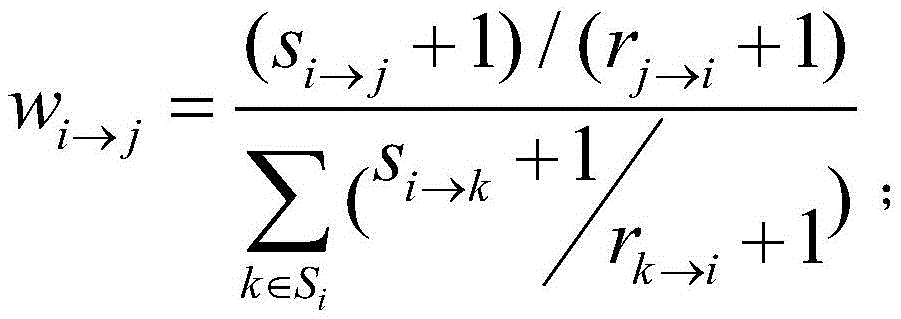
wherein, wi→jIs the weight of the edge connected between the vertex corresponding to the target user i and the vertex corresponding to the user j in the target directed graph, wherein the user j is one user of all the users which have sent the information, si→jThe number of information, r, sent to the user j for the target user ij→iNumber of messages received from said user j for said target user i, si→kNumber of messages sent to user k for said target user i, rk→iNumber of information received from the target user i for the user k, SiAnd all the user sets for sending information for the target user i, wherein the user k is any one user in the user sets.
Optionally, the processing unit is specifically configured to:
calculating a tag score for the target user by iteratively performing the following formula:

wherein S isk(i) For the label score of the target user i in the k-th iteration, alpha and beta are weight coefficients, the value is between 0 and 1, alpha + beta is less than or equal to 1, wj→iAnd the weight of the edge between the vertex corresponding to the target user i and the vertex corresponding to the user j in the target directed graph is pointed to, in-deg re (i) is the set of the in-degree vertices of the vertex corresponding to the target user i, and | out-deg re (i) | is the number of the out-degree vertices of the vertex corresponding to the target user i.
Optionally, the determining unit is further configured to:
judging whether the iteration times reach a preset value or not, and if so, determining that the preset iteration termination condition is met;
or the like, or, alternatively,
and judging whether the label score of the target user is converged, if so, determining that the preset iteration termination condition is met.
Optionally, the second determining unit is further configured to:
when the label score of the target user is not larger than the preset threshold value, determining that the target user is not a label user.
A third aspect of the present invention provides an electronic device, comprising a memory and a processor, wherein the processor is configured to implement the steps of the method for identifying a tag user as described in any one of the above items when executing a computer management-like program stored in the memory.
A fourth aspect of the present invention provides a computer-readable storage medium having a computer management-like program stored thereon, characterized in that: the computer management program, when executed by a processor, implements the steps of the method for tag user identification as described in any of the above.
In summary, it can be seen that, in the embodiment provided by the present invention, a directed graph may be constructed, weights of edges connected to a target user in the directed graph are calculated, label scores of the target user are iteratively calculated based on the weights of the edges and initial label scores of users corresponding to vertices in the target directed graph, and when the label scores are greater than a preset threshold, the target user is determined to be a label user. Therefore, in the application, the receiving and sending proportion does not need to be set, the content of the information does not need to be concerned, and compared with the prior art, the effects of quickly identifying the tag user in the live broadcast platform, purifying the network environment, improving the user experience and the like can be achieved.
Drawings
Fig. 1 is a schematic flowchart of an identification method for a tag user according to an embodiment of the present invention;
fig. 2 is a schematic diagram of an embodiment of an identification apparatus for a tag user according to an embodiment of the present invention;
fig. 3 is a schematic hardware structure diagram of an identification apparatus for a tag user according to an embodiment of the present invention;
fig. 4 is a schematic diagram of an embodiment of an electronic device according to an embodiment of the present invention;
fig. 5 is a schematic diagram of an embodiment of a computer-readable storage medium according to an embodiment of the present invention.
Detailed Description
The terms "first," "second," "third," "fourth," and the like in the description and in the claims, as well as in the drawings, if any, are used for distinguishing between similar elements and not necessarily for describing a particular sequential or chronological order. It will be appreciated that the data so used may be interchanged under appropriate circumstances such that the embodiments described herein may be practiced otherwise than as specifically illustrated or described herein. Furthermore, the terms "comprises," "comprising," and "having," and any variations thereof, are intended to cover a non-exclusive inclusion, such that a process, method, system, article, or apparatus that comprises a list of steps or elements is not necessarily limited to those steps or elements expressly listed, but may include other steps or elements not expressly listed or inherent to such process, method, article, or apparatus. The technical solutions in the embodiments of the present invention will be clearly and completely described below with reference to the drawings in the embodiments of the present invention, and it is obvious that the described embodiments are only a part of the embodiments of the present invention, and not all of the embodiments.
The method for identifying the tag user is described below from the perspective of an identification device of the tag user, which may be a server or a service unit in the server, and is not particularly limited.
Referring to fig. 1, fig. 1 is a schematic flow chart of a method for identifying a tag user according to an embodiment of the present invention, where the method includes:
101. and constructing a target directed graph.
In this embodiment, the identification device of the tag user may construct a target directed graph, where the target directed graph indicates an information interaction relationship between any two users in the live broadcast platform. It is understood that the information interaction herein refers to the in-station information interaction between users in the live broadcast platform, and may also be other forms of interaction, which is not limited specifically. The identification device of the tag user can regard the user who sends the stop-in message or receives the stop-in message in the live broadcast platform as a vertex, if the user A sends a private message to the user B, an edge that the vertex corresponding to the user A points to the vertex corresponding to the user B is formed, and a directed graph, namely a target directed graph, of the stop-in message interaction between the user and the user in the live broadcast platform can be formed according to the method.
102. And calculating the weight of the edge connected with the vertex corresponding to the target user in the target directed graph.
In this embodiment, the identification device of the tag user may calculate the weight of an edge connected to a vertex corresponding to a target user in the target directed graph, where the target user is a user of the tag to be identified. Specifically, the identification device of the tag user may calculate the weight of the edge connected to the target vertex in the target directed graph by the following formula:

wherein, wi→jThe weighted user j, which is the edge between the vertex corresponding to the target user i and the vertex corresponding to the user j in the target directed graph, is one of all the users who have sent information, si→jThe amount of information, r, sent to user j for target user ij→iThe amount of information, s, received from user j for target user ii→kThe amount of information, r, sent to user k for target user ik→iThe amount of information received from target user i for user k, SiAnd a user k is any one user in the user set.
It should be noted that after the weight of the edge connected to the target vertex in the target directed graph is obtained, normalization processing may be performed on the weight, so that the weight is between 0 and 1, which is convenient for subsequent calculation.
103. And determining the initial label scores of the users corresponding to the vertexes in the target directed graph.
In this embodiment, the identification device of the tag user may determine the initial tag score of each vertex in the target line graph. Specifically, for a known malicious user in the live platform, the initial tag score is set to 1 at the initial time, and the initial tag scores of other users are set to 0. The known malicious user may be a user who adopts some specific rules or is reported, and is not limited herein.
It should be noted that, the weight of the edge connected to the vertex corresponding to the target user in the target directed graph may be calculated through step 102, and the initial label score of the user corresponding to each vertex in the target directed graph may be determined through step 103, however, there is no sequential limitation between these two steps, and step 102 may be executed first, or step 103 may be executed simultaneously, which is not specifically limited.
104. And iteratively calculating the label score of the target user according to the initial label score and the weight of the edge connected with the vertex corresponding to the target user.
In this embodiment, the identification apparatus of the tag user may iteratively calculate the tag score of the target user according to the initial tag score and the weight of the edge connected to the vertex corresponding to the target user, specifically:
the tag score for the target user may be calculated by iteratively performing the following formula:

wherein S isk(i) For the label score of the target user i in the k-th iteration, alpha and beta are weight coefficients, the value is between 0 and 1, alpha + beta is less than or equal to 1, wj→iAnd the weight of the edge between the vertex corresponding to the user j in the target directed graph and the vertex corresponding to the target user i is set, wherein in-deg re (i) is the in-degree vertex set of the vertex corresponding to the target user i, and l out-deg re (i) | is the number of out-degree vertices of the vertex corresponding to the target user i.
It should be noted that after each iteration is completed, whether the iteration number reaches a preset value or not can be further judged, if so, the preset iteration termination condition is determined to be met, the iteration calculation is terminated, and if not, the preset iteration termination condition is determined not to be met, and the iteration calculation is continued until the iteration number reaches the preset value; or judging whether the label score of the target user is converged, if so, determining that a preset iteration termination condition is met, terminating the iterative computation, otherwise, determining that the preset iteration termination condition is not met, and continuing the iterative computation until the label score of the target user is converged.
105. And judging whether the label score of the target user is larger than a preset threshold value when a preset iteration termination condition is reached, if so, executing step 106, and if not, executing step 107.
In this embodiment, the identification device of the tag user iteratively calculates the tag score of the target user according to the initial tag score and the weight of the edge connected to the vertex corresponding to the target user, and when a preset iteration termination condition is reached, determines whether the tag score of the target user is greater than a preset threshold, if so, executes step 106, and if not, executes step 107.
106. And determining that the target user is the tag user.
In this embodiment, when the tag score of the target user is greater than the preset threshold, it is determined that the target user is a tag user.
107. Other operations are performed.
In this embodiment, when the tag score of the target user is not greater than the preset threshold, it is determined that the target user is not the tag user.
The following is described with reference to a specific example:
assuming that there are 5 user nodes in the target directed graph corresponding to the live broadcast platform, which are respectively used as A, B, C, D, E, and at this time, it is desirable to know whether B is a label user, and it is first necessary to calculate the weight of an edge connected to B in the target directed graph by the following formula:
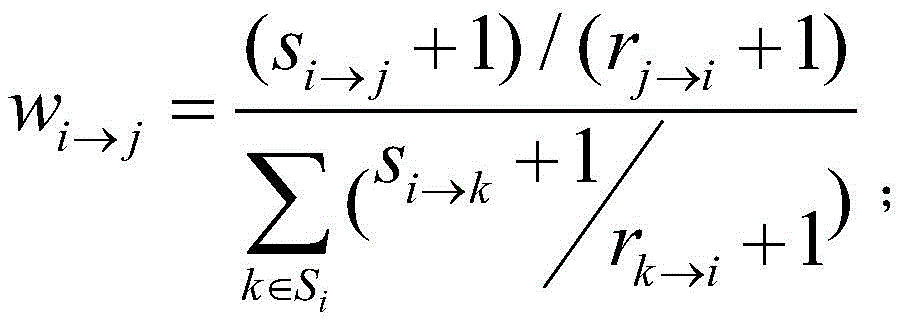
assuming that the weights of the edges connected with B in the target directed graph are obtained as follows:
w(A->B)=0.1;
w(C->B)=0.9;
w(B->D)=0.4;
w(B->E)=0.3;
knowing that A is a malicious user, the initial label score is 1, C is a normal user, the initial label score is 0, and whether other users are unknown to the label, iteratively calculating the label score of B by using the weight of the edge between the edges connected with B in the target directed graph according to the following formula:

in the formula, alpha is 0.7, beta is 0.2;
in the first round of calculation:
S1(B)=(1-0.7-0.2)+0.7*(0.1*1+0.9*0)/(0.1+0.9)+0.2*0=0.17;
in the second round:
S2(B)=(1-0.7-0.2)+0.7*(0.1*1+0.9*0)/(0.1+0.9)+0.2*0.17=0.2034。
after two rounds of setting the preset threshold 0.8 of the tag score (here, the preset value is 2), S2(B) is 0.2034 which is lower than the threshold, so that the user B is not a malicious user who sends spam.
In summary, it can be seen that, in the embodiment provided by the present invention, a directed graph may be constructed, weights of edges connected to a target user in the directed graph are calculated, label scores of the target user are iteratively calculated based on the weights of the edges and initial label scores of users corresponding to vertices in the target directed graph, and when the label scores are greater than a preset threshold, the target user is determined to be a label user. Therefore, in the application, the receiving and sending proportion does not need to be set, the content of the information does not need to be concerned, and compared with the prior art, the effects of quickly identifying the tag user in the live broadcast platform, purifying the network environment, improving the user experience and the like can be achieved.
The above describes the method for identifying a tag user in the embodiment of the present invention, and the following describes an identification apparatus for a tag user in the embodiment of the present invention.
Referring to fig. 2, an embodiment of an identification apparatus for a tag user according to an embodiment of the present invention includes:
the constructing unit 201 is configured to construct a target directed graph, where the target directed graph indicates an information interaction relationship between any two users in a live broadcast platform;
a calculating unit 202, configured to calculate a weight of an edge connected to a vertex corresponding to a target user in the target directed graph, where the target user is a user of a to-be-identified label;
a first determining unit 203, configured to determine initial label scores of users corresponding to vertices in the target directed graph;
a processing unit 204, configured to iteratively calculate a label score of the target user according to the initial label score and a weight of an edge connected to a vertex corresponding to the target user;
a determining unit 205, configured to determine whether a tag score of the target user is greater than a preset threshold when a preset iteration termination condition is reached;
a second determining unit 206, configured to determine that the target user is a tag user when the tag score of the target user is greater than the preset threshold.
Optionally, the computing unit 202 is specifically configured to:
calculating the weight of an edge connected with a vertex corresponding to the target user in the target directed graph through the following formula:

wherein, wi→jIs the weight of the edge connected between the vertex corresponding to the target user i and the vertex corresponding to the user j in the target directed graph, wherein the user j is one user of all the users which have sent the information, si→jThe number of information, r, sent to the user j for the target user ij→iNumber of messages received from said user j for said target user i, si→kNumber of messages sent to user k for said target user i, rk→iNumber of information received from the target user i for the user k, SiAnd all the user sets for sending information for the target user i, wherein the user k is any one user in the user sets.
Optionally, the processing unit 204 is specifically configured to:
calculating a tag score for the target user by iteratively performing the following formula:

wherein S isk(i) For the label score of the target user i in the k-th iteration, alpha and beta are weight coefficients, the value is between 0 and 1, alpha + beta is less than or equal to 1, wj→iIs a stand forAnd the vertex corresponding to the user j in the target directed graph points to the weight of the edge between the vertices corresponding to the target user i, wherein in-deg re (i) is an in-degree vertex set of the vertex corresponding to the target user i, and | out-deg re (i) | is the number of out-degree vertices of the vertex corresponding to the target user i.
Optionally, the determining unit 205 is further configured to:
judging whether the iteration times reach a preset value or not, and if so, determining that the preset iteration termination condition is met;
or the like, or, alternatively,
and judging whether the label score of the target user is converged, if so, determining that the preset iteration termination condition is met.
Optionally, the second determining unit 206 is further configured to:
when the label score of the target user is not larger than the preset threshold value, determining that the target user is not a label user.
Fig. 2 above describes the identification apparatus of the tag user in the embodiment of the present invention from the perspective of the modular functional entity, and the following describes the identification apparatus of the tag user in the embodiment of the present invention in detail from the perspective of hardware processing, referring to fig. 3, an embodiment of an identification apparatus 300 of the tag user in the embodiment of the present invention includes:
an input device 301, an output device 302, a processor 303 and a memory 304 (wherein the number of the processor 303 may be one or more, and one processor 303 is taken as an example in fig. 3). In some embodiments of the present invention, the input device 301, the output device 302, the processor 303 and the memory 304 may be connected by a bus or other means, wherein the connection by the bus is exemplified in fig. 3.
Wherein, by calling the operation instruction stored in the memory 304, the processor 303 is configured to perform the following steps:
constructing a target directed graph, wherein the target directed graph indicates the information interaction relation between any two users in a live broadcast platform;
calculating the weight of an edge connected with a vertex corresponding to a target user in the target directed graph, wherein the target user is a user of a label to be identified;
determining initial label scores of users corresponding to all vertexes in the target directed graph;
iteratively calculating the label score of the target user according to the initial label score and the weight of the edge connected with the vertex corresponding to the target user;
judging whether the label score of the target user is greater than a preset threshold value when a preset iteration termination condition is reached;
and if so, determining that the target user is the label user.
In a specific implementation, when the processor 320 executes the computer program 311, any of the embodiments corresponding to fig. 1 may be implemented.
As shown in fig. 4, an embodiment of the present invention provides an electronic device, which includes a memory 410, a processor 420, and a computer program 411 stored in the memory 420 and running on the processor 420, and when the processor 420 executes the computer program 411, the following steps are implemented:
constructing a target directed graph, wherein the target directed graph indicates the information interaction relation between any two users in a live broadcast platform;
calculating the weight of an edge connected with a vertex corresponding to a target user in the target directed graph, wherein the target user is a user of a label to be identified;
determining initial label scores of users corresponding to all vertexes in the target directed graph;
iteratively calculating the label score of the target user according to the initial label score and the weight of the edge connected with the vertex corresponding to the target user;
judging whether the label score of the target user is greater than a preset threshold value when a preset iteration termination condition is reached;
and if so, determining that the target user is the label user.
In a specific implementation, when the processor 420 executes the computer program 411, any of the embodiments corresponding to fig. 1 may be implemented.
Since the electronic device described in this embodiment is a device used for implementing an identification apparatus of a tag user in the embodiment of the present invention, based on the method described in the embodiment of the present invention, a person skilled in the art can understand a specific implementation manner of the electronic device of this embodiment and various variations thereof, so that how to implement the method in the embodiment of the present invention by the electronic device is not described in detail herein, and as long as the person skilled in the art implements the device used for implementing the method in the embodiment of the present invention, the device used for implementing the method in the embodiment of the present invention belongs to the scope of the present invention.
Referring to fig. 5, fig. 5 is a schematic diagram illustrating an embodiment of a computer-readable storage medium according to the present invention.
As shown in fig. 5, the present embodiment provides a computer-readable storage medium 500 having a computer program 511 stored thereon, the computer program 511 implementing the following steps when executed by a processor:
constructing a target directed graph, wherein the target directed graph indicates the information interaction relation between any two users in a live broadcast platform;
calculating the weight of an edge connected with a vertex corresponding to a target user in the target directed graph, wherein the target user is a user of a label to be identified;
determining initial label scores of users corresponding to all vertexes in the target directed graph;
iteratively calculating the label score of the target user according to the initial label score and the weight of the edge connected with the vertex corresponding to the target user;
judging whether the label score of the target user is greater than a preset threshold value when a preset iteration termination condition is reached;
and if so, determining that the target user is the label user.
In a specific implementation, the computer program 511 may implement any of the embodiments corresponding to fig. 1 when executed by a processor.
It should be noted that, in the foregoing embodiments, the descriptions of the respective embodiments have respective emphasis, and reference may be made to relevant descriptions of other embodiments for parts that are not described in detail in a certain embodiment.
As will be appreciated by one skilled in the art, embodiments of the present invention may be provided as a method, system, or computer program product. Accordingly, the present invention may take the form of an entirely hardware embodiment, an entirely software embodiment or an embodiment combining software and hardware aspects. Furthermore, the present invention may take the form of a computer program product embodied on one or more computer-usable storage media (including, but not limited to, disk storage, CD-ROM, optical storage, and the like) having computer-usable program code embodied therein.
The present invention is described with reference to flowchart illustrations and/or block diagrams of methods, apparatus (systems), and computer program products according to embodiments of the invention. It will be understood that each flow and/or block of the flow diagrams and/or block diagrams, and combinations of flows and/or blocks in the flow diagrams and/or block diagrams, can be implemented by computer program instructions. These computer program instructions may be provided to a processor of a general purpose computer, special purpose computer, embedded computer, or other programmable tag user identification device to produce a machine, such that the instructions, which execute via the processor of the computer or other programmable tag user identification device, create means for implementing the functions specified in the flowchart flow or flows and/or block diagram block or blocks.
These computer program instructions may also be stored in a computer-readable memory that can direct a computer or other programmable tag user's identification device to function in a particular manner, such that the instructions stored in the computer-readable memory produce an article of manufacture including instruction means which implement the function specified in the flowchart flow or flows and/or block diagram block or blocks.
These computer program instructions may also be loaded onto a computer or other programmable tag user's identification device to cause a series of operational steps to be performed on the computer or other programmable device to produce a computer implemented process such that the instructions which execute on the computer or other programmable device provide steps for implementing the functions specified in the flowchart flow or flows and/or block diagram block or blocks.
Embodiments of the present invention further provide a computer program product, where the computer program product includes computer software instructions, and when the computer software instructions are executed on a processing device, the processing device executes a flow in the method for designing a wind farm digital platform in the embodiment corresponding to fig. 1.
The computer program product includes one or more computer instructions. When loaded and executed on a computer, cause the processes or functions described in accordance with the embodiments of the invention to occur, in whole or in part. The computer may be a general purpose computer, a special purpose computer, a network of computers, or other programmable device. The computer instructions may be stored on a computer readable storage medium or transmitted from one computer readable storage medium to another, for example, from one website, computer, server, or data center to another website, computer, server, or data center via wire (e.g., coaxial cable, fiber optic, Digital Subscriber Line (DSL)) or wireless (e.g., infrared, wireless, microwave, etc.). The computer-readable storage medium can be any available medium that a computer can store or a data storage device, such as a server, a data center, etc., that is integrated with one or more available media. The usable medium may be a magnetic medium (e.g., floppy disk, hard disk, magnetic tape), an optical medium (e.g., DVD), or a semiconductor medium (e.g., Solid State Disk (SSD)), among others.
It is clear to those skilled in the art that, for convenience and brevity of description, the specific working processes of the above-described systems, apparatuses and units may refer to the corresponding processes in the foregoing method embodiments, and are not described herein again.
In the embodiments provided in the present invention, it should be understood that the disclosed system, apparatus and method may be implemented in other ways. For example, the above-described apparatus embodiments are merely illustrative, and for example, the division of the units is only one logical division, and other divisions may be realized in practice, for example, a plurality of units or components may be combined or integrated into another system, or some features may be omitted, or not executed. In addition, the shown or discussed mutual coupling or direct coupling or communication connection may be an indirect coupling or communication connection through some interfaces, devices or units, and may be in an electrical, mechanical or other form.
The units described as separate parts may or may not be physically separate, and parts displayed as units may or may not be physical units, may be located in one place, or may be distributed on a plurality of network units. Some or all of the units can be selected according to actual needs to achieve the purpose of the solution of the embodiment.
In addition, functional units in the embodiments of the present invention may be integrated into one processing unit, or each unit may exist alone physically, or two or more units are integrated into one unit. The integrated unit can be realized in a form of hardware, and can also be realized in a form of a software functional unit.
The integrated unit, if implemented in the form of a software functional unit and sold or used as a stand-alone product, may be stored in a computer readable storage medium. Based on such understanding, the technical solution of the present invention may be embodied in the form of a software product, which is stored in a storage medium and includes instructions for causing a computer device (which may be a personal computer, a server, or a network device) to execute all or part of the steps of the method according to the embodiments of the present invention. And the aforementioned storage medium includes: various media capable of storing program codes, such as a usb disk, a removable hard disk, a Read-Only Memory (ROM), a Random Access Memory (RAM), a magnetic disk, or an optical disk.
The above-mentioned embodiments are only used for illustrating the technical solutions of the present invention, and not for limiting the same; although the present invention has been described in detail with reference to the foregoing embodiments, it will be understood by those of ordinary skill in the art that: the technical solutions described in the foregoing embodiments may still be modified, or some technical features may be equivalently replaced; such modifications and substitutions do not depart from the spirit and scope of the corresponding technical solutions of the embodiments of the present invention.
Claims (8)
1. A method for identifying a tag user, comprising:
constructing a target directed graph, wherein the target directed graph indicates the information interaction relation between any two users in a live broadcast platform;
calculating the weight of an edge connected with a vertex corresponding to a target user in the target directed graph, wherein the target user is a user of a label to be identified, and the method comprises the following steps: calculating the weight of an edge connected with a vertex corresponding to the target user in the target directed graph through the following formula:
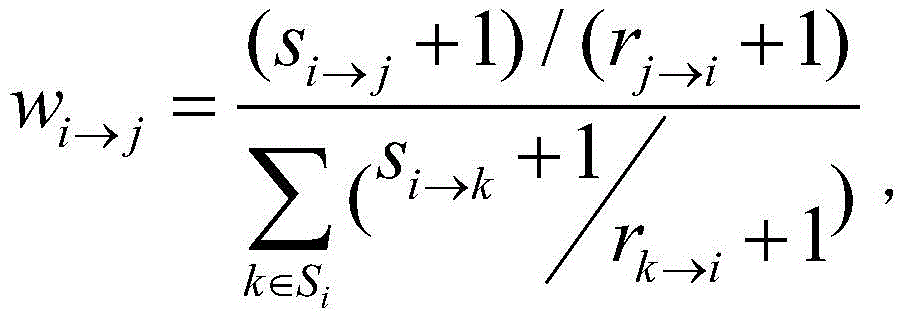
wherein, wi→jIs the weight of the edge connected between the vertex corresponding to the target user i and the vertex corresponding to the user j in the target directed graph, wherein the user j is one user of all the users which have sent the information, si→jThe number of information, r, sent to the user j for the target user ij→iThe number of information received from the user j for the target user i, si → k is the number of information sent from the target user i to the user k, rk→iNumber of information received from the target user i for the user k, SiAll user sets for sending information for the target user i, wherein the user k is any one user in the user sets;
determining initial label scores of users corresponding to all vertexes in the target directed graph;
iteratively calculating the label score of the target user according to the initial label score and the weight of the edge connected with the vertex corresponding to the target user;
judging whether the label score of the target user is greater than a preset threshold value when a preset iteration termination condition is reached;
and if so, determining that the target user is the label user.
2. The method of claim 1, wherein iteratively computing the label score of the target user based on the initial label score and the weight of the edge connected to the vertex corresponding to the target user comprises:
calculating a tag score for the target user by iteratively performing the following formula:

wherein S isk(i) For the label score of the target user i in the k-th iteration, alpha and beta are weight coefficients, the value is between 0 and 1, alpha + beta is less than or equal to 1, wj→iAnd the weight of the edge between the vertex corresponding to the target user i and the vertex corresponding to the user j in the target directed graph is pointed to, in-deg re (i) is the set of the in-degree vertices of the vertex corresponding to the target user i, and | out-deg re (i) | is the number of the out-degree vertices of the vertex corresponding to the target user i.
3. The method according to claim 1 or 2, characterized in that the method further comprises:
judging whether the iteration times reach a preset value or not, and if so, determining that the preset iteration termination condition is met;
or the like, or, alternatively,
and judging whether the label score of the target user is converged, if so, determining that the preset iteration termination condition is met.
4. The method according to claim 1 or 2, characterized in that the method further comprises:
when the label score of the target user is not larger than the preset threshold value, determining that the target user is not a label user.
5. An apparatus for identifying a tag user, comprising:
the system comprises a construction unit, a display unit and a display unit, wherein the construction unit is used for constructing a target directed graph which indicates the information interaction relationship between any two users in a live broadcast platform;
a calculating unit, configured to calculate a weight of an edge connected to a vertex corresponding to a target user in the target directed graph, where the target user is a user of a to-be-identified label, and the weight of the edge connected to the vertex corresponding to the target user in the target directed graph is calculated through a formula as follows:

wherein, wi→jIs the weight of the edge connected between the vertex corresponding to the target user i and the vertex corresponding to the user j in the target directed graph, wherein the user j is one user of all the users which have sent the information, si→jThe number of information, r, sent to the user j for the target user ij→iNumber of messages received from said user j for said target user i, si→kNumber of messages sent to user k for said target user i, rk→iNumber of information received from the target user i for the user k, SiAll user sets for sending information for the target user i, wherein the user k is any one user in the user sets;
the first determining unit is used for determining initial label scores of users corresponding to all vertexes in the target directed graph;
the processing unit is used for iteratively calculating the label score of the target user according to the initial label score and the weight of the edge connected with the vertex corresponding to the target user;
the judging unit is used for judging whether the label score of the target user is larger than a preset threshold value when a preset iteration termination condition is reached;
and the second determining unit is used for determining that the target user is the tag user when the tag score of the target user is greater than the preset threshold value.
6. The apparatus according to claim 5, wherein the processing unit is specifically configured to:
calculating a tag score for the target user by iteratively performing the following formula:

wherein S isk(i) For the label score of the target user i in the k-th iteration, alpha and beta are weight coefficients, the value is between 0 and 1, alpha + beta is less than or equal to 1, wj→iAnd the weight of the edge between the vertex corresponding to the target user i and the vertex corresponding to the user j in the target directed graph is pointed to, in-deg re (i) is the set of the in-degree vertices of the vertex corresponding to the target user i, and | out-deg re (i) | is the number of the out-degree vertices of the vertex corresponding to the target user i.
7. An electronic device comprising a memory, a processor, wherein the processor is configured to implement the steps of the method for tag user identification according to any one of claims 1 to 4 when executing a computer management class program stored in the memory.
8. A computer-readable storage medium having stored thereon a computer management-like program, characterized in that: the computer management class program, when being executed by a processor, implements the steps of the method of identification of a tag user according to any one of claims 1 to 4.
Priority Applications (1)
| Application Number | Priority Date | Filing Date | Title |
|---|---|---|---|
| CN201910531099.0A CN110222297B (en) | 2019-06-19 | 2019-06-19 | Identification method of tag user and related equipment |
Applications Claiming Priority (1)
| Application Number | Priority Date | Filing Date | Title |
|---|---|---|---|
| CN201910531099.0A CN110222297B (en) | 2019-06-19 | 2019-06-19 | Identification method of tag user and related equipment |
Publications (2)
| Publication Number | Publication Date |
|---|---|
| CN110222297A CN110222297A (en) | 2019-09-10 |
| CN110222297B true CN110222297B (en) | 2021-07-23 |
Family
ID=67817754
Family Applications (1)
| Application Number | Title | Priority Date | Filing Date |
|---|---|---|---|
| CN201910531099.0A Active CN110222297B (en) | 2019-06-19 | 2019-06-19 | Identification method of tag user and related equipment |
Country Status (1)
| Country | Link |
|---|---|
| CN (1) | CN110222297B (en) |
Families Citing this family (2)
| Publication number | Priority date | Publication date | Assignee | Title |
|---|---|---|---|---|
| CN112699237B (en) * | 2020-12-24 | 2021-10-15 | 百度在线网络技术(北京)有限公司 | Label determination method, device and storage medium |
| CN113365113B (en) * | 2021-05-31 | 2022-09-09 | 武汉斗鱼鱼乐网络科技有限公司 | Target node identification method and device |
Citations (6)
| Publication number | Priority date | Publication date | Assignee | Title |
|---|---|---|---|---|
| US8595262B1 (en) * | 2012-03-29 | 2013-11-26 | Amazon Technologies, Inc. | Resource resolution in computing environments using directed graphs |
| CN106599249A (en) * | 2016-12-20 | 2017-04-26 | 西南石油大学 | Method for carrying out micro-blog forwarding prediction based on cluster gravitation modeling |
| CN108174296A (en) * | 2018-01-02 | 2018-06-15 | 武汉斗鱼网络科技有限公司 | Malicious user identification method and device |
| CN108228706A (en) * | 2017-11-23 | 2018-06-29 | 中国银联股份有限公司 | For identifying the method and apparatus of abnormal transaction corporations |
| CN108809946A (en) * | 2018-05-18 | 2018-11-13 | 哈尔滨工业大学深圳研究生院 | Vehicle-mounted net Malware spread restraint based on node influence power |
| CN109257617A (en) * | 2018-09-30 | 2019-01-22 | 武汉斗鱼网络科技有限公司 | A kind of determining method and relevant device that suspicion user in platform is broadcast live |
Family Cites Families (4)
| Publication number | Priority date | Publication date | Assignee | Title |
|---|---|---|---|---|
| US9092547B2 (en) * | 2012-09-19 | 2015-07-28 | Wal-Mart Stores, Inc. | Transforming a graph to a tree in accordance with analyst guidance |
| US10642867B2 (en) * | 2017-09-15 | 2020-05-05 | Adobe Inc. | Clustering based on a directed graph |
| CN109658120B (en) * | 2017-10-12 | 2022-11-29 | 腾讯科技(深圳)有限公司 | Service data processing method and device |
| CN109033233B (en) * | 2018-06-29 | 2021-05-28 | 武汉斗鱼网络科技有限公司 | A method, storage medium, electronic device and system for recommending a live broadcast room |
-
2019
- 2019-06-19 CN CN201910531099.0A patent/CN110222297B/en active Active
Patent Citations (6)
| Publication number | Priority date | Publication date | Assignee | Title |
|---|---|---|---|---|
| US8595262B1 (en) * | 2012-03-29 | 2013-11-26 | Amazon Technologies, Inc. | Resource resolution in computing environments using directed graphs |
| CN106599249A (en) * | 2016-12-20 | 2017-04-26 | 西南石油大学 | Method for carrying out micro-blog forwarding prediction based on cluster gravitation modeling |
| CN108228706A (en) * | 2017-11-23 | 2018-06-29 | 中国银联股份有限公司 | For identifying the method and apparatus of abnormal transaction corporations |
| CN108174296A (en) * | 2018-01-02 | 2018-06-15 | 武汉斗鱼网络科技有限公司 | Malicious user identification method and device |
| CN108809946A (en) * | 2018-05-18 | 2018-11-13 | 哈尔滨工业大学深圳研究生院 | Vehicle-mounted net Malware spread restraint based on node influence power |
| CN109257617A (en) * | 2018-09-30 | 2019-01-22 | 武汉斗鱼网络科技有限公司 | A kind of determining method and relevant device that suspicion user in platform is broadcast live |
Also Published As
| Publication number | Publication date |
|---|---|
| CN110222297A (en) | 2019-09-10 |
Similar Documents
| Publication | Publication Date | Title |
|---|---|---|
| CN106355431B (en) | Cheating flow detection method and device and terminal | |
| CN108985954B (en) | Method for establishing association relation of each identifier and related equipment | |
| CN109600344B (en) | Method and device for identifying risk group and electronic equipment | |
| CN106886518A (en) | A kind of method of microblog account classification | |
| CN105335409A (en) | Target user determination method and device and network server | |
| US9418119B2 (en) | Method and system to determine a category score of a social network member | |
| CN108537586A (en) | Data processing method and device based on user's portrait | |
| CN109257617B (en) | Method for determining suspected user in live broadcast platform and related equipment | |
| CN105894028B (en) | User identification method and device | |
| CN110175438A (en) | Share account detection method and relevant device | |
| CN110224859B (en) | Method and system for identifying a group | |
| CN109218769B (en) | Recommendation method for live broadcast room and related equipment | |
| CN110569509A (en) | risk group identification method and device | |
| CN110689084B (en) | A kind of abnormal user identification method and device | |
| CN111126928B (en) | Method and device for auditing release content | |
| CN110876072B (en) | Batch registered user identification method, storage medium, electronic device and system | |
| CN110222297B (en) | Identification method of tag user and related equipment | |
| CN108053247A (en) | A kind of false amount identification model generation method, false amount recognition methods and computing device | |
| CN109905722B (en) | Method for determining suspected node and related equipment | |
| CN115423030A (en) | Method and device for device identification | |
| CN109951725B (en) | Recommendation method for live broadcast room and related equipment | |
| CN109460930B (en) | Method for determining risk account and related equipment | |
| CN106257507A (en) | The methods of risk assessment of user behavior and device | |
| CN109120955B (en) | Recommendation method for live broadcast room and related equipment | |
| CN113901316A (en) | Information pushing method and device, electronic equipment and storage medium |
Legal Events
| Date | Code | Title | Description |
|---|---|---|---|
| PB01 | Publication | ||
| PB01 | Publication | ||
| SE01 | Entry into force of request for substantive examination | ||
| SE01 | Entry into force of request for substantive examination | ||
| GR01 | Patent grant | ||
| GR01 | Patent grant |