CN110222089B - Constraint double-clustering mining and missing value prediction method based on order preserving submatrix - Google Patents
Constraint double-clustering mining and missing value prediction method based on order preserving submatrix Download PDFInfo
- Publication number
- CN110222089B CN110222089B CN201910468279.9A CN201910468279A CN110222089B CN 110222089 B CN110222089 B CN 110222089B CN 201910468279 A CN201910468279 A CN 201910468279A CN 110222089 B CN110222089 B CN 110222089B
- Authority
- CN
- China
- Prior art keywords
- column
- row
- matrix
- columns
- rows
- Prior art date
- Legal status (The legal status is an assumption and is not a legal conclusion. Google has not performed a legal analysis and makes no representation as to the accuracy of the status listed.)
- Active
Links
Images


Classifications
-
- G—PHYSICS
- G06—COMPUTING OR CALCULATING; COUNTING
- G06F—ELECTRIC DIGITAL DATA PROCESSING
- G06F16/00—Information retrieval; Database structures therefor; File system structures therefor
- G06F16/20—Information retrieval; Database structures therefor; File system structures therefor of structured data, e.g. relational data
- G06F16/24—Querying
- G06F16/245—Query processing
- G06F16/2458—Special types of queries, e.g. statistical queries, fuzzy queries or distributed queries
- G06F16/2465—Query processing support for facilitating data mining operations in structured databases
-
- G—PHYSICS
- G06—COMPUTING OR CALCULATING; COUNTING
- G06F—ELECTRIC DIGITAL DATA PROCESSING
- G06F16/00—Information retrieval; Database structures therefor; File system structures therefor
- G06F16/20—Information retrieval; Database structures therefor; File system structures therefor of structured data, e.g. relational data
- G06F16/28—Databases characterised by their database models, e.g. relational or object models
- G06F16/284—Relational databases
- G06F16/285—Clustering or classification
Landscapes
- Engineering & Computer Science (AREA)
- Databases & Information Systems (AREA)
- Theoretical Computer Science (AREA)
- Physics & Mathematics (AREA)
- Data Mining & Analysis (AREA)
- General Physics & Mathematics (AREA)
- General Engineering & Computer Science (AREA)
- Fuzzy Systems (AREA)
- Computational Linguistics (AREA)
- Software Systems (AREA)
- Probability & Statistics with Applications (AREA)
- Mathematical Physics (AREA)
- Information Retrieval, Db Structures And Fs Structures Therefor (AREA)
- Complex Calculations (AREA)
Abstract
The invention discloses a constraint bi-clustering mining and missing value prediction method based on an order preserving submatrix, which comprises the following steps of: s1, receiving the request and mining the double clustering mode of the data matrix; s2, calculating the overlapping degree and the coverage rate of the rows and the columns; s3, judging whether the row-column coverage rate is converged, if not, performing the step S4, otherwise, performing the step S9; s4, randomly disturbing the arrangement sequence of rows and columns in the data matrix, and sorting the candidate column set; s5, judging whether the candidate column set is empty; s6, judging whether qualified columns exist in the candidate column set or not; s7, expanding a column set and a row set of the double clustering mode according to the newly selected qualified columns; s8, judging whether the current double-clustering mode meets the requirement of the sparse order-preserving sub-matrix model; s9, calculating the missing value of each double clustering mode; and S10, returning the final double-cluster set and the missing value. Therefore, the method effectively improves the quality of the double clustering mode and the accuracy of missing value prediction.
Description
Technical Field
The invention relates to the field of double-cluster pattern mining, in particular to a constraint double-cluster mining and missing value prediction method based on an order-preserving submatrix.
Background
The general clustering is to cluster data according to all attributes of the data, and this clustering method is called conventional clustering. Traditional clustering can only search global information, and cannot find local information, and a large amount of interesting information is hidden in the local information. In order to better search local information in the data matrix, the concept of double clustering is proposed. The so-called dual clustering, also called sub-matrix pattern, is a sub-matrix composed of a group of row subsets and a group of column subsets with local similarity in the data matrix, and it means that the group of rows has some local similarity in the group of column subsets. And the clustering mining captures interesting local similarity in the data matrix by mining all sub-matrices in the data matrix which meet a pre-defined sub-matrix model. For example, in the field of recommendation systems, for the Netflix movie rating data matrix, a dual cluster class refers to a sub-matrix consisting of a set of subsets of users and a set of subsets of movies with local similarity, which indicates that the preferences of the users for the set of movies are similar.
The current research on bi-clustering is mainly divided into two categories: unconstrained bi-clustering and partitioned bi-clustering. Unconstrained bi-clustering guarantees the quality of mined patterns, but it is mainly studied in smaller data matrices, which is impractical in real-world applications such as recommendation systems and text mining, since overlap and coverage constraints are not taken into account during mining, which may lead to problems such as explosion in the number of patterns in the search space and high redundancy between patterns. While the partition binary clustering is effective for processing large data matrix, it limits the mode to grid distribution, i.e. the data matrix is forcedly divided into sub-matrices which are not mutually intersected, so that the quality of each single mode cannot be guaranteed.
Order Preserving Submatrix Models (OPSM) are a representative class of submatrix models, and a large number of studies have shown that OPSM models and their relaxed-condition variant models are able to facilitate the discovery of interesting biological correlations well. However, these methods do not scale well when the data matrix becomes very large. In addition, overlapping or coverage constraints are not considered in the mining process of the ordered submatrix pattern, and the problem of sparse matrices is not solved.
Disclosure of Invention
Aiming at the defects of the prior art, the invention provides a constraint bi-clustering mining and missing value prediction method based on an order preserving sub-matrix, aiming at the limitations of the existing bi-clustering method, the method adds the constraint of the overlapping degree and the coverage rate in the bi-clustering mining process to control the distribution of the modes, avoids the mode redundancy and mode quantity explosion, and effectively improves the quality of the modes; meanwhile, in order to process a sparse data matrix, a sparse order-preserving sub-matrix model is provided, so that missing values are allowed to exist in a mode; finally, a linear fitting method is provided for calculating the missing value in the mode, so that the accuracy of missing value prediction is effectively improved.
The invention is realized by at least one of the following technical schemes.
A constraint bi-clustering mining and missing value prediction method based on an order preserving submatrix comprises the following steps:
s1, inputting the request content of the double-clustering pattern mining by the user, receiving the request by the computer, and mining the double-clustering pattern of the data matrix to be mined in the request content;
s2, calculating the overlapping degree and the coverage rate of the rows and the columns of the current double-clustering mode set;
s3, judging whether the coverage rates of the rows and the columns are converged, if not, performing a step S4, and if so, performing a step S9;
s4, randomly disturbing the arrangement sequence of rows and columns in the data matrix, initializing a candidate column set of the double clustering mode by using the column set of the data matrix after the arrangement sequence is disturbed, and then sorting the columns in the candidate column set from small to large according to the overlapping degree, if the overlapping degrees of two columns are the same, sorting the columns from small to large according to the random arrangement sequence of the columns;
s5, judging whether the candidate column set is empty, if yes, returning to the step S2 to update the coverage rate and the overlapping degree information of the rows and the columns of the mined current dual clustering pattern set, and if not, performing the step S6;
s6, traversing all elements in the candidate column set from beginning to end, and judging whether a column exists or not, so that if the column is added to the tail end of the column set of the current double-clustering mode, the effective row number corresponding to the new column set of the double-clustering mode is not less than the minimum row number threshold value specified by a predefined sparse order-preserving sub-matrix model, and the column is expanded, the maximum row overlapping degree of the double-clustering mode set cannot be increased, if so, marking the corresponding column as a qualified column and performing a step S7, otherwise, performing a step S8;
s7, updating the current double clustering mode: adding the qualified column selected in the step S6 to the end of the column set of the current double clustering mode, and adding the corresponding effective row to the row set of the current double clustering mode;
s8, judging whether the current double-clustering mode accords with the specification of the sparse order-preserving sub-matrix model, if so, storing the current double-clustering mode in a double-clustering mode set, and if not, discarding the current double-clustering mode;
s9, traversing the current dual cluster mode set, and calculating a missing value in each dual cluster mode according to a linear fitting method;
and S10, outputting the calculation results of the finally mined double-clustering mode set and the missing value.
Further, the contents of the request for mining the bi-cluster patterns in step S1 include a data matrix to be mined, a request for calculating missing values, a density threshold α, and a size threshold r of rows and columns in each bi-cluster patternminAnd tmin;
The data matrix to be mined is denoted as M (R, T), where R is the row set of the data matrix, and R ═ R1,...,rm},rmRepresents the mth row of the data matrix, T is the column set of the data matrix, and T ═ T1,...,tn},tnRepresents the nth column of the data matrix;
the objective of the request is to mine a set of sub-matrix pattern sets γ, i.e., a bi-cluster pattern set, that satisfy a sparse order-preserving sub-matrix model, such that each sub-matrix contains at least rminLine and tminThe concentration of the columns and the effective elements in each row is not less than the concentration threshold value alpha, and the arrangement sequence of the effective elements in each row is a subsequence of the arrangement sequence of the columns in the submatrix column set, so that the coverage rate of the rows and the columns of the submatrix pattern set gamma on the data matrix M to be mined is maximized, and the overlapping degree is minimized.
Further, the sub-matrix mined in step S1 allows missing values to exist if the element M (r) in the data matrix is Mm,tn) The location of which stores a known value, then the element M (r)m,tn) Is a valid element or value, if the location does not store any value, then element M (r) is said to bem,tn) Is a missing element or a missing value;
the definition of the order-preserving submatrix is as follows: one sub-matrix (P, Q) given one matrix M (R, T) and M, (P, Q) is called the order-preserving sub-matrix (OPSM)If and only if there is a linear order T of QQSuch that each row in P satisfies this order TQWherein The data matrix M (R, T) and the sub-matrix M (P, Q) thereof are respectively represented by simple symbols M and (P, Q);
in order to allow missing values to exist in the mined sub-matrix, a density threshold α is given on the basis of the ordered sub-matrix model if (P, Q) satisfies the following condition:
(1) the density of each row in P on Q is not less than the density threshold α, i.e.: d (r, Q) is more than or equal to alpha, and r belongs to P;
(2) linear order T with QQSo that the arrangement order of the effective elements of each row in P is TQIs a sparse order preserving sub-matrix (sopmc), then (P, Q);
the density of the sub-matrix (P, Q) is D (P, Q), D (P, Q) is the proportion of effective elements in all elements of the sub-matrix (P, Q), and the calculation formula is as follows:

where ε (P, Q) represents the number of active elements in the sub-matrix (P, Q), | P | × | Q | represents the total number of elements of the matrix; similarly, the row density of the r-th row in the sub-matrix (P, Q) is:

where ε ({ r }, Q) represents the number of valid elements on column set Q at row r, | Q | represents the number of elements of column set Q.
Further, the overlapping degree of the rows or columns in step S2 refers to the number of times that a row or a column in the data matrix is covered by all the binary patterns, i.e. the binary pattern set; the coverage rate of the rows or the columns is the proportion of the number of covered rows or covered columns to the total number of rows or covered columns; the row and column overlap and coverage are calculated as follows:
a set of submatrix pattern sets γ { (P) for data matrices M (R, T) and M1,Q1),(P2,Q2),...,(Pk,Qk) And k submatrices are contained in the sub-moment pattern set gamma, and the number of the submatrices covering the element M (r, t) in gamma is represented by d (r, t), namely:
d(r,t)=|{(Pi,Qi)|(Pi,Qi)∈γ,r∈Pi,t∈Qi}|
let d (r, t) be the degree of overlap of element M (r, t); the maximum overlapping degree of the sub-matrix mode set gamma on the matrix M (R, T) is represented by v (gamma):

to improve the computational efficiency, the overlapping degree of each element in the matrix is simplified into a single row overlapping degree and a single column overlapping degree, wherein the overlapping degree of the r-th row is dR(r) denotes the number of patterns in γ that cover any element in row r; similarly, the overlap of the t-th column is represented by dT(t) denotes the number of patterns in γ covering any element in the t-th column, and thus the maximum row overlap v of the set of sub-matrix patterns γRRefers to the maximum value of the overlap of all single rows in the matrix M (R, T), the maximum column overlap vTRefers to the maximum value of the degree of overlap of all the individual columns in the matrix M, i.e.:
νR=max{dR(r)|r∈R}
νT=max{dT(t)|t∈T}
the coverage rate comprises two indexes of row coverage rate and column coverage rate, and is respectively represented by cR(gamma) and cT(γ) where row coverage refers to the proportion of rows covered by at least one sub-matrix in R and similarly column coverage refers to the proportion of columns covered by at least one sub-matrix in T, the calculation formula is:

wherein, | R | represents the number of rows in the data matrix to be mined, | T | represents the number of columns in the data matrix to be mined, and k represents the number of submatrices contained in the submatrix pattern set γ.
Further, step S3 determines whether the coverage of the rank has converged: firstly, judging whether the coverage rates of the rows and the columns of the current iteration reach 100%, if so, indicating that the coverage rates of the rows and the columns are converged, otherwise, comparing the coverage rates of the rows and the columns of the current iteration with the coverage rates of the rows and the columns of the previous iteration, if the difference between the coverage rates of the rows and the columns of the two iterations is less than 0.01, indicating that the coverage rates of the rows and the columns are converged, otherwise, indicating that the coverage rates of the rows and the columns are not converged.
Further, the sparse order-preserving submatrix model in step S6 is defined as: in the double-cluster mode, the number of elements of the row set is not less than the minimum row number threshold rminThe number of elements of the column set is not less than the minimum column count threshold tminThe density of the effective rows is not less than the density threshold alpha, and each row must meet the order-preserving condition;
the order-preserving condition is that the arrangement order of the effective values of the row on the column set is a subsequence of the arrangement order of the columns in the column set;
the effective row is as follows: rows that satisfy the new column set order and have row densities no less than α; the density of the effective rows refers to the proportion of the number of effective values of the effective rows on the column set to the total number of elements of the column set.
Further, the sequence and the subsequence are respectively defined as follows:
in a column set containing h elements, Q ═ t1,...,th},thH is an h-th element of the column set Q, h is 1 to ihOne linear order of Q is TQ=[ti1<ti2<...<tih]Wherein, tihDenotes the subscript h ═ i in the column set QhThe degree relation < satisfies the antisymmetry, transitivity and linearity, such a column set Q is said to be the order TQIs onUnion set;
in two orders T1、T2And their association set Q1And Q2In, if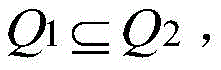 For any pair of ti,tj∈Q1,tiAnd tjRespectively represent a set Q1Two of any elements, i.e. tiColumn and tjColumns; t is ti<tjAt Q1And Q2If the two are simultaneously true, then it is called T1Is T2A subsequence of (1); in the order TQ=[ti1<ti2<...<tih]Defining an additional operation with the q-th column of the candidate set
 Indicates that the qth column is added to the order TQThe end of (c), namely:

further, the specific process of updating the dual clustering pattern in step S7 is as follows: adding the qualified column selected in the step S6 to the end of the column set of the current double clustering mode, deleting the column from the candidate column set, and adding the corresponding effective row to the row set of the current double clustering mode;
the qualified columns satisfy the following two conditions:
(1) the effective row number of the column is not less than the minimum row number threshold value specified by a pre-defined sparse order-preserving sub-matrix model;
(2) the maximum row overlapping degree of the current double-clustering mode set gamma is not increased after the column is added into the column set Q of the current mode;
if the column meets both conditions, the column is a qualified column;
the valid line of step S7 satisfies the following condition:
(1) qualified columnAfter adding to the end of the column set Q of the submatrix M (P, Q), the order of the active elements in the active rows is the new linear order corresponding to the new column set Q' ═ qou { t }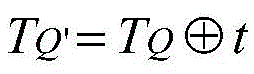 A subsequence of (1);
(2) the density D (r, Q) of the active rows is not less than the density threshold α.
Further, the specific process of determining whether the current dual-cluster mode conforms to the rule of the sparse order-preserving sub-matrix model in step S8 is as follows: firstly, calculating the number of rows and columns of the current dual-clustering mode, and then judging whether the number of rows and columns of the mode is not less than the minimum row number threshold value r specified by the order-preserving sub-matrix modelminAnd a minimum column count threshold tminAnd the density of the effective elements in each row is not less than the density threshold value alpha, the arrangement sequence of the effective values of each row on the pattern column set is a subsequence of the arrangement sequence of the columns in the pattern column set, if so, the effective elements are stored in the double-clustering pattern set, and if not, the effective elements are discarded.
Further, the calculation formula of the missing value in step S9 is:
M′(rm,tn)=ak+b
a=(y2-y1)/(x2-x1)
b=(x2y1-x1y2)/(x2-x1)
wherein x1And x2Subscript, y, representing two valid values in the same row and nearest proximity to the missing value1And y2Denotes the corresponding effective value, a denotes the slope of the line on which the two effective values lie, k denotes the index of the missing value, b denotes the intercept of the line, M' (r)m,tn) And (4) representing the predicted value of the missing element in the mth row and the nth column in the matrix.
Compared with the prior art, the invention has the following advantages and beneficial effects:
1. the invention provides a double cluster mining method with constraint, which controls the distribution of modes by adding the overlap degree and coverage constraint in the double cluster mining process, avoids mode redundancy and mode quantity explosion, and effectively improves the quality of the modes.
2. The invention provides a sparse order-preserving sub-matrix model on the basis of the existing order-preserving sub-matrix model, so that missing values are allowed to exist in the mined mode, the expandability of the method is improved, and the sparse data matrix can be effectively processed.
3. The invention provides a linear fitting method for calculating the missing value in the mode, and the accuracy of missing value prediction is effectively improved.
Drawings
FIG. 1 is a flowchart of a constrained bi-cluster mining and missing value prediction method based on an order-preserving sub-matrix according to an embodiment of the present invention;
fig. 2 is an exemplary diagram of calculating missing values by using a linear fitting method in the embodiment of the present invention.
Detailed Description
The present invention will be described in further detail with reference to examples and drawings, but the present invention is not limited thereto.
The embodiment of the invention adds two limiting conditions of coverage rate constraint and overlapping degree constraint on the basis of the traditional double clustering method, firstly defines a sparse order-preserving sub-matrix model, then repeatedly scans a data matrix, continuously searches and excavates the double clustering mode which accords with the predefined sparse order-preserving sub-matrix model, preferentially selects the rows and columns which are not covered or have less overlapping degree to expand the current double clustering mode in the excavating process, if more modes which accord with the conditions can not be excavated to cover new rows and columns, which means that the row and column coverage rate is already converged, at the moment, the data matrix is stopped being scanned, and finally, the missing value in each double clustering mode is calculated according to a linear fitting method. Therefore, the method is suitable for the sparse data matrix, the distribution and the overlapping degree of the dug dual-cluster mode are controlled, and the quality of the dual-cluster mode and the accuracy of missing value prediction are effectively improved.
The method for constrained bi-cluster mining and missing value prediction based on the order-preserving sub-matrix provided by the embodiment of the invention is explained in detail below, and comprises the following steps:
s1, inputting the request content of the double-clustering pattern mining by the user, receiving the request by the computer, and mining the double-clustering pattern of the data matrix to be mined in the request content;
the request content of the double clustering mode mining comprises a data matrix to be mined, missing value requests for calculating each double clustering mode, a density threshold value alpha and a size threshold value r of a row and a columnminAnd tmin;
The data matrix to be mined is denoted as M (R, T), where R is the row set of the data matrix, and R ═ R1,...,rm},rmRepresents the mth row of the data matrix, T is the column set of the data matrix, and T ═ T1,...,tn},tnRepresents the nth column of the data matrix;
the objective of the request is to mine a set of sub-matrix pattern sets γ, i.e., a bi-cluster pattern set, that satisfy a sparse order-preserving sub-matrix model, such that each sub-matrix contains at least rminLine and tminThe concentration of the columns and the effective elements in each row is not less than the concentration threshold value alpha, and the arrangement sequence of the effective elements in each row is a subsequence of the arrangement sequence of the columns in the submatrix column set, so that the coverage rate of the rows and the columns of the submatrix pattern set gamma on the data matrix M to be mined is maximized, and the overlapping degree is minimized.
Further, the sub-matrix mined in step S1 allows missing values to exist if the element M (r) in the data matrix is Mm,tn) The location of which stores a known value, then the element M (r)m,tn) Is a valid element or value, if the location does not store any value, then element M (r) is said to bem,tn) Is a missing element or a missing value;
the definition of the order-preserving submatrix is as follows: a sub-matrix (P, Q) giving a matrix M (R, T) and M, (P, Q) is called an order-preserving sub-matrix (OPSM) if and only if there is a linear order T of QQSuch that each row in P satisfies this order TQWherein The data matrix M (R, T) and the sub-matrix M (P, Q) thereof are respectively represented by simple symbols M and (P, Q);
in order to allow missing values to exist in the mined sub-matrix, a density threshold α is given on the basis of the ordered sub-matrix model if (P, Q) satisfies the following condition:
(1) the density of each row in P on Q is not less than the density threshold α, i.e.: d (r, Q) is more than or equal to alpha, and r belongs to P;
(2) linear order T with QQSo that the arrangement order of the effective elements of each row in P is TQIs a sparse order preserving sub-matrix (sopmc), then (P, Q);
the density of the sub-matrix (P, Q) is D (P, Q), D (P, Q) is the proportion of effective elements in all elements of the sub-matrix (P, Q), and the calculation formula is as follows:
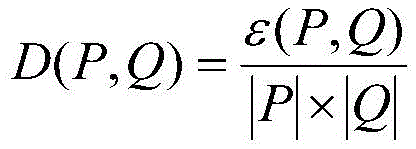
where ε (P, Q) represents the number of active elements in the sub-matrix (P, Q), | P | × | Q | represents the total number of elements of the matrix; similarly, the row density of the r-th row in the sub-matrix (P, Q) is:
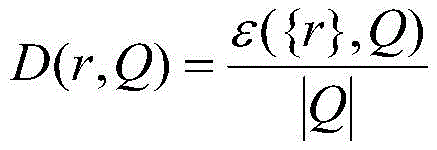
where ε ({ r }, Q) represents the number of valid elements on column set Q at row r, | Q | represents the number of elements of column set Q.
S2, calculating the overlapping degree and the coverage rate of the rows and the columns of the current double-clustering mode set;
the overlapping degree of the rows or columns in step S2 refers to the number of times that a row or a column in the data matrix is covered by all the binary patterns, i.e., the binary pattern set; the coverage rate of the rows or the columns is the proportion of the number of covered rows or covered columns to the total number of rows or covered columns; the row and column overlap and coverage are calculated as follows:
data matrixA set of submatrix pattern sets γ { (P) of M (R, T) and M1,Q1),(P2,Q2),...,(Pk,Qk) And k submatrices are contained in the sub-moment pattern set gamma, and the number of the submatrices covering the element M (r, t) in gamma is represented by d (r, t), namely:
d(r,t)=|{(Pi,Qi)|(Pi,Qi)∈γ,r∈Pi,t∈Qi}|
let d (r, t) be the degree of overlap of element M (r, t); the maximum overlapping degree of the sub-matrix mode set gamma on the matrix M (R, T) is represented by v (gamma):

to improve the computational efficiency, the overlapping degree of each element in the matrix is simplified into a single row overlapping degree and a single column overlapping degree, wherein the overlapping degree of the r-th row is dR(r) denotes the number of patterns in γ that cover any element in row r; similarly, the overlap of the t-th column is represented by dT(t) denotes the number of patterns in γ covering any element in the t-th column, and thus the maximum row overlap v of the set of sub-matrix patterns γRRefers to the maximum value of the overlap of all single rows in the matrix M (R, T), the maximum column overlap vTRefers to the maximum value of the degree of overlap of all the individual columns in the matrix M, i.e.:
νR=max{dR(r)|r∈R}
νT=max{dT(t)|t∈T}
the coverage rate comprises two indexes of row coverage rate and column coverage rate, and is respectively represented by cR(gamma) and cT(γ) where row coverage refers to the proportion of rows covered by at least one sub-matrix in R and similarly column coverage refers to the proportion of columns covered by at least one sub-matrix in T, the calculation formula is:

wherein, | R | represents the number of rows in the data matrix to be mined, | T | represents the number of columns in the data matrix to be mined, and k represents the number of submatrices contained in the submatrix pattern set γ.
S3, judging whether the coverage rates of the rows and the columns are converged, if not, performing a step S4, and if so, performing a step S9;
judging whether the coverage rates of the rows and the columns are converged, specifically: firstly, judging whether the coverage rates of the rows and the columns of the current iteration reach 100%, if so, indicating that the coverage rates of the rows and the columns are converged, otherwise, comparing the coverage rates of the rows and the columns of the current iteration with the coverage rates of the rows and the columns of the previous iteration, if the difference between the coverage rates of the rows and the columns of the two iterations is less than 0.01, indicating that the coverage rates of the rows and the columns are converged, otherwise, indicating that the coverage rates of the rows and the columns are not converged.
S4, randomly disturbing the arrangement sequence of rows and columns in the data matrix, initializing a candidate column set of the double clustering mode by using the column set of the data matrix after the arrangement sequence is disturbed, and then sorting the columns in the candidate column set from small to large according to the overlapping degree, if the overlapping degrees of two columns are the same, sorting the columns from small to large according to the random arrangement sequence of the columns;
s5, judging whether the candidate column set is empty, if yes, returning to the step S2 to update the coverage rate and the overlapping degree information of the rows and the columns of the mined current dual clustering pattern set, and if not, performing the step S6;
s6, traversing all elements in the candidate column set from beginning to end, and judging whether a column exists or not, so that if the column is added to the tail end of the column set of the current double-clustering mode, the effective row number corresponding to the new column set of the double-clustering mode is not less than the minimum row number threshold value specified by a predefined sparse order-preserving sub-matrix model, and the column is expanded, the maximum row overlapping degree of the double-clustering mode set cannot be increased, if so, marking the corresponding column as a qualified column and performing a step S7, otherwise, performing a step S8;
the sparse order-preserving submatrix model is specified as follows: in the double-cluster mode, the number of elements of the row set is not less than the minimum row number threshold rminRow by rowThe number of elements of the set is not less than the minimum column number threshold tminThe density of the effective rows is not less than the density threshold alpha, and each row must meet the order-preserving condition;
the order-preserving condition is that the arrangement order of the effective values of the row on the column set is a subsequence of the arrangement order of the columns in the column set;
the effective row is as follows: rows that satisfy the new column set order and have row densities no less than α; the density of the effective rows refers to the proportion of the number of effective values of the effective rows on the column set to the total number of elements of the column set.
The order and the subsequence are defined as follows:
in a column set containing h elements, Q ═ t1,...,th},thH is an h-th element of the column set Q, h is 1 to ihOne linear order of Q is TQ=[ti1<ti2<...<tih]Wherein, tihDenotes the subscript h ═ i in the column set QhThe degree relation < satisfies the antisymmetry, transitivity and linearity, such a column set Q is said to be the order TQAn association set of (a);
in two orders T1、T2And their association set Q1And Q2In, if For any pair of ti,tj∈Q1,tiAnd tjRespectively represent a set Q1Two of any elements, i.e. tiColumn and tjColumns; t is ti<tjAt Q1And Q2If the two are simultaneously true, then it is called T1Is T2A subsequence of (1); in the order TQ=[ti1<ti2<...<tih]Defining an additional operation with the q-th column of the candidate set
 Indicates that the qth column is added to the order TQThe end of (c), namely:

s7, updating the current double clustering mode: adding the qualified column selected in the step S6 to the end of the column set of the current double clustering mode, and adding the corresponding effective row to the row set of the current double clustering mode;
the specific process of updating the double clustering pattern comprises the following steps: adding the qualified column selected in the step S6 to the end of the column set of the current double clustering mode, deleting the column from the candidate column set, and adding the corresponding effective row to the row set of the current double clustering mode;
the qualified columns satisfy the following two conditions:
(1) the effective row number of the column is not less than the minimum row number threshold value specified by a pre-defined sparse order-preserving sub-matrix model;
(2) the maximum row overlapping degree of the current double-clustering mode set gamma is not increased after the column is added into the column set Q of the current mode;
if the column meets both conditions, the column is a qualified column;
the effective row meets the following conditions:
(1) after the eligible columns are added to the end of the column set Q of the submatrix M (P, Q), the order of the valid elements in the valid rows is the new linear order corresponding to the new column set Q' ═ qou { t } A subsequence of (1);
(2) the density D (r, Q) of the active rows is not less than the density threshold α.
And S8, judging whether the current double-clustering mode accords with the specification of the sparse order-preserving sub-matrix model, if so, storing the current double-clustering mode in a double-clustering mode set, and otherwise, discarding the current double-clustering mode. The specific process is as follows: firstly, calculating the number of rows and columns of the current dual-clustering mode, and then judging whether the number of rows and columns of the mode is not less than the minimum row number threshold value specified by the order-preserving sub-matrix modelrminAnd a minimum column count threshold tminAnd the density of the effective elements in each row is not less than the density threshold value alpha, the arrangement sequence of the effective values of each row on the pattern column set is a subsequence of the arrangement sequence of the columns in the pattern column set, if so, the effective elements are stored in the double-clustering pattern set, and if not, the effective elements are discarded.
S9, traversing the current dual cluster mode set, and calculating the missing value in each dual cluster mode according to a linear fitting method, wherein the calculation formula is as follows:
M′(rm,tn)=ak+b
a=(y2-y1)/(x2-x1)
b=(x2y1-x1y2)/(x2-x1)
wherein x1And x2Subscript, y, representing two valid values in the same row and nearest proximity to the missing value1And y2Denotes the corresponding effective value, a denotes the slope of the line on which the two effective values lie, k denotes the index of the missing value, b denotes the intercept of the line, M' (r)m,tn) And (4) representing the predicted value of the missing element in the mth row and the nth column in the matrix.
And S10, returning the calculation results of the finally mined double-clustering mode set and the missing value.
A flowchart of the constrained dual-cluster mining and missing value prediction method based on the order-preserving sub-matrix provided in this embodiment is shown in fig. 1, and specifically includes the following steps:
The input data format is that three numbers are input for each row, the middle is separated by a blank space, the three numbers respectively represent the row, the column and the element value of the data matrix, for example, "123" represents that the element value of the 1 st row and the 2 nd column in the data matrix is 3.
And 102, calculating the row-column overlapping degree and the coverage rate, wherein the row-column overlapping degree and the coverage rate comprise two steps of updating the row-column overlapping degree of the data matrix according to the newly mined mode and calculating the row-column coverage rate.
The algorithm for calculating the degree of overlap is as follows:
CalOverlapping Algorithm:
inputting: submatrix pattern (P, Q)
And (3) outputting: the line overlap vector rowOverlap [ m ] and the column overlap vector colOverlap [ n ]

The algorithm for calculating the coverage rate is as follows:
CalCoverage Algorithm:
inputting: the line overlap vector rowOverlap [ m ] and the column overlap vector colOverlap [ n ]
And (3) outputting: RowCoverage and ColCoverage for row and column coverage


firstly, judging whether the coverage rate of the ranks of the current iteration reaches 100%, if not, comparing the coverage rate of the ranks of the current iteration with the coverage rate of the ranks of the previous iteration, if the difference of the coverage rates of the ranks of the two times is less than 0.01, indicating that the coverage rates of the ranks are converged, and performing step 112, otherwise, continuing the next iteration.
And 104, randomly disordering the arrangement sequence of rows and columns in the data matrix, so as to dig out more different modes.
And 105, initializing a candidate column set candiCol by using the column set of the data matrix after random scrambling in the step 104, and then sorting the columns in the candidate column set from small to large according to the column overlapping degree, and if the column overlapping degrees of two columns are the same, sorting from small to large according to the array sequence after random scrambling.
judging whether a certain column is a qualified column, namely judging whether the certain column meets the following two conditions:
(1) the effective row number of the column is not less than the minimum row number threshold value r specified by a pre-defined sparse order-preserving sub-matrix modelmin
(2) The maximum row overlapping degree v of the double clustering mode set gamma is not caused after the column is added into the column set Q of the current modeRThe size of the mixture is increased, and the mixture is,
if both the two conditions are met, the column is called as a qualified column;
wherein, the effective rows of a certain column t should satisfy the following conditions:
(1) after adding the column t to the end of the column set Q of the current mode (P, Q), the order of the active elements in the active rows is the new linear order corresponding to the new column set Q' ═ qou { t } A subsequence of (1);
(2) the density D (r, Q) of the active rows is not less than the density threshold α.
The algorithm for judging whether the column t is qualified is as follows:
CheckCol Algorithm:
inputting: column t, Current mode (P, Q)
And (3) outputting: true, indicating qualified; false, indicating failure

the specific process is as follows: firstly, calculating the number of rows and columns of the current dual-clustering mode, and then judging whether the number of rows and columns of the mode is not less than the minimum row number threshold value r specified by the order-preserving sub-matrix modelminAnd a minimum column count threshold tminAnd the density of the effective elements in each row is not less than the density threshold value alpha, the arrangement sequence of the effective values of each row on the pattern column set is a subsequence of the arrangement sequence of the columns in the pattern column set, if so, the effective elements are stored in the double-clustering pattern set, and if not, the effective elements are discarded.
The algorithm for adding the pattern is as follows:
AddSopsm Algorithm:
inputting: current mode (P, Q)
And (3) outputting: set of patterns gamma

And step 111, storing the current mode in the dual clustering mode set gamma.
wherein, the calculation formula of the deficiency value is as follows:
M′(rm,tn)=ak+b
a=(y2-y1)/(x2-x1)
b=(x2y1-x1y2)/(x2-x1)
wherein x1And x2Subscript, y, representing two valid values in the same row and nearest proximity to the missing value1And y2Denotes the corresponding effective value, a denotes the slope of the line on which the two effective values lie, k denotes the index of the missing value, b denotes the intercept of the line, M' (r)m,tn) And (4) representing the predicted value of the missing element in the mth row and the nth column in the matrix.
The algorithm for calculating the deficiency value is as follows:
Predict Algorithm:
inputting: set of patterns gamma
And (3) outputting: mode set gamma after calculating missing values

Fig. 2 is an exemplary diagram of calculating missing values by using a linear fitting method according to an embodiment of the present invention, for a score data matrix in a recommendation system, each row of the score data matrix M represents a user, each column represents a commodity, a sparse preserved-sequence submatrix (P, Q) with missing values is mined from the score data matrix M on the left side in fig. 2, the sparse preserved-sequence submatrix is a submatrix with 3 rows and 4 columns, an arrangement sequence of each row on a column set is linearly increased, and a row subset P { r ═ r { (r) } is provided in the column set1,r2,r3Denotes 3 users, respectively, and the column subset Q ═ t1,t2,t3,t4Each of the 4 items is represented by a number in a matrix representing the value of the item's credit to the user, e.g. user r1For goods t3Is 4, the symbol "-" indicates a missing value, indicating the userThe item is not scored and this sub-matrix indicates the user r1,r2,r3Are { t } pairs1,t2,t3,t4The scores of the 4 commodities have local similarity, that is to say, the 3 users have similarity to the preferences of the 4 commodities; the right side is the result of prediction calculation of the missing value in the left submatrix according to the Predict Algorithm method, and the predicted value represents the predicted credit value of a certain user for a certain commodity.
In summary, the embodiment of the present invention is a constrained dual-cluster mining and missing value prediction method based on an order-preserving sub-matrix, and the method is based on a traditional dual-cluster method, in which two limiting conditions, namely a coverage constraint and an overlap constraint, are added, a sparse order-preserving sub-matrix model is defined first, then a data matrix is repeatedly scanned, a dual-cluster mode that meets the predefined sparse order-preserving sub-matrix model is continuously searched and mined, in the mining process, rows and columns that are never covered or have less overlap are preferentially selected to expand the current dual-cluster mode, if more patterns that meet the conditions cannot be mined to cover new rows and columns, which means that the row-column coverage rate has converged, the scanning of the data matrix is stopped at this time, and finally, a missing value in each dual-cluster mode is calculated according to a linear fitting method. Therefore, the method is suitable for the sparse data matrix, the distribution and the overlapping degree of the dug dual-cluster mode are controlled, and the quality of the dual-cluster mode and the accuracy of missing value prediction are effectively improved.
The above description is only for the preferred embodiment of the present invention, but the scope of the present invention is not limited thereto, and any person skilled in the art can substitute or change the technical solution of the present invention and the inventive concept within the scope of the present invention disclosed by the present invention.
Claims (10)
1. A constraint bi-clustering mining and missing value prediction method based on an order preserving submatrix is characterized by comprising the following steps:
s1, inputting the request content of the double-clustering pattern mining by the user, receiving the request by the computer, and mining the double-clustering pattern of the data matrix to be mined in the request content; the double cluster is a submatrix consisting of a group of user subsets and a group of movie subsets with local similarity, and the submatrix indicates that the preference of users to the group of movies is similar;
s2, calculating the overlapping degree and the coverage rate of the rows and the columns of the current double-clustering mode set;
s3, judging whether the coverage rates of the rows and the columns are converged, if not, performing a step S4, and if so, performing a step S9;
s4, randomly disturbing the arrangement sequence of rows and columns in the data matrix, initializing a candidate column set of the double clustering mode by using the column set of the data matrix after the arrangement sequence is disturbed, and then sorting the columns in the candidate column set from small to large according to the overlapping degree, if the overlapping degrees of two columns are the same, sorting the columns from small to large according to the random arrangement sequence of the columns;
s5, judging whether the candidate column set is empty, if yes, returning to the step S2 to update the coverage rate and the overlapping degree information of the rows and the columns of the mined current dual clustering pattern set, and if not, performing the step S6;
s6, traversing all elements in the candidate column set from beginning to end, and judging whether a column exists or not, so that if the column is added to the tail end of the column set of the current double-clustering mode, the effective row number corresponding to the new column set of the double-clustering mode is not less than the minimum row number threshold value specified by a predefined sparse order-preserving sub-matrix model, and the column is expanded, the maximum row overlapping degree of the double-clustering mode set cannot be increased, if so, marking the corresponding column as a qualified column and performing a step S7, otherwise, performing a step S8;
s7, updating the current double clustering mode: adding the qualified column selected in the step S6 to the end of the column set of the current double clustering mode, and adding the corresponding effective row to the row set of the current double clustering mode;
s8, judging whether the current double-clustering mode accords with the specification of the sparse order-preserving sub-matrix model, if so, storing the current double-clustering mode in a double-clustering mode set, and if not, discarding the current double-clustering mode;
s9, traversing the current dual cluster mode set, and calculating a missing value in each dual cluster mode according to a linear fitting method;
and S10, outputting the finally excavated double-clustering-mode set and the calculation result of the missing value, traversing the double-clustering-mode set to obtain the prediction result of the missing value in the data matrix, wherein the prediction result represents the prediction scoring value of a certain user on a certain commodity.
2. The method as claimed in claim 1, wherein the request content of the bi-cluster pattern mining in step S1 includes the data matrix to be mined, the missing value request in each bi-cluster pattern, the density threshold α, and the size threshold r of the row and columnminAnd tmin;
The data matrix to be mined is denoted as M (R, T), where R is the row set of the data matrix, and R ═ R1,...,rm},rmRepresents the mth row of the data matrix, T is the column set of the data matrix, and T ═ T1,...,tn},tnRepresents the nth column of the data matrix;
the objective of the request is to mine a set of sub-matrix pattern sets γ, i.e., a bi-cluster pattern set, that satisfy a sparse order-preserving sub-matrix model, such that each sub-matrix contains at least rminLine and tminThe concentration of the columns and the effective elements in each row is not less than the concentration threshold value alpha, and the arrangement sequence of the effective elements in each row is a subsequence of the arrangement sequence of the columns in the submatrix column set, so that the coverage rate of the rows and the columns of the submatrix pattern set gamma on the data matrix M to be mined is maximized, and the overlapping degree is minimized.
3. The method as claimed in claim 1 or 2, wherein the order-preserving sub-matrix-based constrained bi-cluster mining and missing value prediction method allows the missing value in the sub-matrix mined in step S1 if the element M (r) in the data matrix is the same as the element M (r)m,tn) The location of which stores a known value, then the element M (r)m,tn) Is provided withAn effective element or value, if the location does not store any value, then element M (r) is said to bem,tn) Is a missing element or a missing value;
the definition of the order-preserving submatrix is as follows: a sub-matrix (P, Q) giving a matrix M (R, T) and M, (P, Q) is called an order-preserving sub-matrix (OPSM) if and only if there is a linear order T of QQSuch that each row in P satisfies this order TQWherein The data matrix M (R, T) and the sub-matrix M (P, Q) thereof are respectively represented by simple symbols M and (P, Q);
in order to allow missing values to exist in the mined sub-matrix, a density threshold α is given on the basis of the ordered sub-matrix model if (P, Q) satisfies the following condition:
(1) the density of each row in P on Q is not less than the density threshold α, i.e.: d (r, Q) is more than or equal to alpha, and r belongs to P;
(2) linear order T with QQSo that the arrangement order of the effective elements of each row in P is TQIn the sub-sequence of (a) to (b),
then (P, Q) is the sparse order preserving sub-matrix (sopmc);
the density of the sub-matrix (P, Q) is D (P, Q), D (P, Q) is the proportion of effective elements in all elements of the sub-matrix (P, Q), and the calculation formula is as follows:

where ε (P, Q) represents the number of active elements in the sub-matrix (P, Q), | P | × | Q | represents the total number of elements of the matrix; similarly, the row density of the r-th row in the sub-matrix (P, Q) is:

where ε ({ r }, Q) represents the number of valid elements on column set Q at row r, | Q | represents the number of elements of column set Q.
4. The method according to claim 1 or 2, wherein the overlapping degree of the rows or columns in step S2 is the number of times that a row or a column in the data matrix is covered by all the bi-cluster patterns, i.e. the bi-cluster pattern set; the coverage rate of the rows or the columns is the proportion of the number of covered rows or covered columns to the total number of rows or covered columns; the row and column overlap and coverage are calculated as follows:
a set of submatrix pattern sets γ { (P) for data matrices M (R, T) and M1,Q1),(P2,Q2),...,(Pk,Qk) And k submatrices are contained in the sub-moment pattern set gamma, and the number of the submatrices covering the element M (r, t) in gamma is represented by d (r, t), namely:
d(r,t)=|{(Pi,Qi)|(Pi,Qi)∈γ,r∈Pi,t∈Qi}|
let d (r, t) be the degree of overlap of element M (r, t); the maximum overlapping degree of the sub-matrix mode set gamma on the matrix M (R, T) is represented by v (gamma):

to improve the computational efficiency, the overlapping degree of each element in the matrix is simplified into a single row overlapping degree and a single column overlapping degree, wherein the overlapping degree of the r-th row is dR(r) denotes the number of patterns in γ that cover any element in row r; similarly, the overlap of the t-th column is represented by dT(t) denotes the number of patterns in γ covering any element in the t-th column, and thus the maximum row overlap v of the set of sub-matrix patterns γRRefers to the maximum value of the overlap of all single rows in the matrix M (R, T), the maximum column overlap vTRefers to the maximum value of the degree of overlap of all the individual columns in the matrix M, i.e.:
νR=max{dR(r)|r∈R}
νT=max{dT(t)|t∈T}
the coverage rate comprises two indexes of row coverage rate and column coverage rate, and is respectively represented by cR(gamma) and cT(γ) where row coverage refers to the proportion of rows covered by at least one sub-matrix in R and similarly column coverage refers to the proportion of columns covered by at least one sub-matrix in T, the calculation formula is:

wherein, | R | represents the number of rows in the data matrix to be mined, | T | represents the number of columns in the data matrix to be mined, and k represents the number of submatrices contained in the submatrix pattern set γ.
5. The method of claim 1, wherein the step S3 is performed to determine whether the coverage of rows and columns has converged or not: firstly, judging whether the coverage rates of the rows and the columns of the current iteration reach 100%, if so, indicating that the coverage rates of the rows and the columns are converged, otherwise, comparing the coverage rates of the rows and the columns of the current iteration with the coverage rates of the rows and the columns of the previous iteration, if the difference between the coverage rates of the rows and the columns of the two iterations is less than 0.01, indicating that the coverage rates of the rows and the columns are converged, otherwise, indicating that the coverage rates of the rows and the columns are not converged.
6. The method according to claim 1, wherein the sparse order-preserving sub-matrix model defined in step S6 is defined as: in the double-cluster mode, the number of elements of the row set is not less than the minimum row number threshold rminThe number of elements of the column set is not less than the minimum column count threshold tminThe density of the effective rows is not less than the density threshold alpha, and each row must meet the order-preserving condition;
the order-preserving condition is that the arrangement order of the effective values of the row on the column set is a subsequence of the arrangement order of the columns in the column set;
the effective row is as follows: rows that satisfy the new column set order and have row densities no less than α; the density of the effective rows refers to the proportion of the number of effective values of the effective rows on the column set to the total number of elements of the column set.
7. The method of claim 6, wherein the order and the sub-order are defined as follows:
in a column set containing h elements, Q ═ t1,...,th},thH is an h-th element of the column set Q, h is 1 to ihOne linear order of Q is TQ=[ti1<ti2<...<tih]Wherein, tihDenotes the subscript h ═ i in the column set QhThe degree relation < satisfies the antisymmetry, transitivity and linearity, such a column set Q is said to be the order TQAn association set of (a);
in two orders T1、T2And their association set Q1And Q2In, if For any pair of ti,tj∈Q1,tiAnd tjRespectively represent a set Q1Two of any elements, i.e. tiColumn and tjColumns; t is ti<tjAt Q1And Q2If the two are simultaneously true, then it is called T1Is T2A subsequence of (1); in the order TQ=[ti1<ti2<...<tih]Defining an additional operation with the q-th column of the candidate set
 Indicates that the qth column is added to the order TQThe end of (c), namely:

8. the method according to claim 1, wherein the specific process of updating the bi-cluster pattern in step S7 comprises: adding the qualified column selected in the step S6 to the end of the column set of the current double clustering mode, deleting the column from the candidate column set, and adding the corresponding effective row to the row set of the current double clustering mode;
the qualified columns satisfy the following two conditions:
(1) the effective row number of the column is not less than the minimum row number threshold value specified by a pre-defined sparse order-preserving sub-matrix model;
(2) the maximum row overlapping degree of the current double-clustering mode set gamma is not increased after the column is added into the column set Q of the current mode;
if the column meets both conditions, the column is a qualified column;
the valid line of step S7 satisfies the following condition:
(1) after the eligible columns are added to the end of the column set Q of the submatrix M (P, Q), the order of the valid elements in the valid rows is the new linear order corresponding to the new column set Q' ═ qou { t } A subsequence of (1);
(2) the density D (r, Q) of the active rows is not less than the density threshold α.
9. The method for constrained bi-cluster mining and missing value prediction based on an order-preserving sub-matrix according to claim 1, wherein the specific process of determining whether the current bi-cluster mode conforms to the sparse order-preserving sub-matrix model in step S8 is as follows: firstly, calculating the number of rows and columns of the current double-clustering mode, and then judging whether the number of rows and columns of the mode is not less than the order preservation numberMinimum line number threshold r specified by submatrix modelminAnd a minimum column count threshold tminAnd the density of the effective elements in each row is not less than the density threshold value alpha, the arrangement sequence of the effective values of each row on the pattern column set is a subsequence of the arrangement sequence of the columns in the pattern column set, if so, the effective elements are stored in the double-clustering pattern set, and if not, the effective elements are discarded.
10. The method according to claim 1, wherein the missing value is calculated in step S9 according to the following formula:
M′(rm,tn)=ak+b
a=(y2-y1)/(x2-x1)
b=(x2y1-x1y2)/(x2-x1)
wherein x1And x2Subscript, y, representing two valid values in the same row and nearest proximity to the missing value1And y2Denotes the corresponding effective value, a denotes the slope of the line on which the two effective values lie, k denotes the index of the missing value, b denotes the intercept of the line, M' (r)m,tn) And (4) representing the predicted value of the missing element in the mth row and the nth column in the matrix.
Priority Applications (1)
| Application Number | Priority Date | Filing Date | Title |
|---|---|---|---|
| CN201910468279.9A CN110222089B (en) | 2019-05-31 | 2019-05-31 | Constraint double-clustering mining and missing value prediction method based on order preserving submatrix |
Applications Claiming Priority (1)
| Application Number | Priority Date | Filing Date | Title |
|---|---|---|---|
| CN201910468279.9A CN110222089B (en) | 2019-05-31 | 2019-05-31 | Constraint double-clustering mining and missing value prediction method based on order preserving submatrix |
Publications (2)
| Publication Number | Publication Date |
|---|---|
| CN110222089A CN110222089A (en) | 2019-09-10 |
| CN110222089B true CN110222089B (en) | 2021-05-14 |
Family
ID=67819083
Family Applications (1)
| Application Number | Title | Priority Date | Filing Date |
|---|---|---|---|
| CN201910468279.9A Active CN110222089B (en) | 2019-05-31 | 2019-05-31 | Constraint double-clustering mining and missing value prediction method based on order preserving submatrix |
Country Status (1)
| Country | Link |
|---|---|
| CN (1) | CN110222089B (en) |
Families Citing this family (2)
| Publication number | Priority date | Publication date | Assignee | Title |
|---|---|---|---|---|
| CN115292439A (en) * | 2021-04-18 | 2022-11-04 | 华为技术有限公司 | A data processing method and related equipment |
| CN115099120B (en) * | 2022-07-21 | 2025-05-23 | 南京理工大学 | SPH algorithm fragment identification method based on LS-DYNA |
Citations (6)
| Publication number | Priority date | Publication date | Assignee | Title |
|---|---|---|---|---|
| CN103455578A (en) * | 2013-08-23 | 2013-12-18 | 华南师范大学 | Association rule and bi-clustering-based airline customer data mining method |
| CN106294288A (en) * | 2016-07-27 | 2017-01-04 | 中南大学 | A kind of distributed non-negative matrix factorization method |
| CN106844637A (en) * | 2017-01-19 | 2017-06-13 | 北京工业大学 | Method is recommended based on the film for just giving cluster to prune improvement multi-objective genetic algorithm |
| US10114923B1 (en) * | 2015-04-06 | 2018-10-30 | EMC IP Holding Company LLC | Metagenomics-based biological surveillance system using big data profiles |
| CN109284773A (en) * | 2018-08-15 | 2019-01-29 | 西南交通大学 | Traffic travel endpoint identification method based on multi-layer agglomerative hierarchical clustering algorithm |
| CN109657149A (en) * | 2018-12-25 | 2019-04-19 | 合肥学院 | A kind of recommended method and system based on generation confrontation network and double focusing class |
Family Cites Families (1)
| Publication number | Priority date | Publication date | Assignee | Title |
|---|---|---|---|---|
| US20170046510A1 (en) * | 2015-08-14 | 2017-02-16 | Qualcomm Incorporated | Methods and Systems of Building Classifier Models in Computing Devices |
-
2019
- 2019-05-31 CN CN201910468279.9A patent/CN110222089B/en active Active
Patent Citations (6)
| Publication number | Priority date | Publication date | Assignee | Title |
|---|---|---|---|---|
| CN103455578A (en) * | 2013-08-23 | 2013-12-18 | 华南师范大学 | Association rule and bi-clustering-based airline customer data mining method |
| US10114923B1 (en) * | 2015-04-06 | 2018-10-30 | EMC IP Holding Company LLC | Metagenomics-based biological surveillance system using big data profiles |
| CN106294288A (en) * | 2016-07-27 | 2017-01-04 | 中南大学 | A kind of distributed non-negative matrix factorization method |
| CN106844637A (en) * | 2017-01-19 | 2017-06-13 | 北京工业大学 | Method is recommended based on the film for just giving cluster to prune improvement multi-objective genetic algorithm |
| CN109284773A (en) * | 2018-08-15 | 2019-01-29 | 西南交通大学 | Traffic travel endpoint identification method based on multi-layer agglomerative hierarchical clustering algorithm |
| CN109657149A (en) * | 2018-12-25 | 2019-04-19 | 合肥学院 | A kind of recommended method and system based on generation confrontation network and double focusing class |
Non-Patent Citations (1)
| Title |
|---|
| 基于数字签名与Trie的保序子矩阵约束查询;姜涛等;《软件学报》;20170831;第28卷(第8期);第2175-2195页 * |
Also Published As
| Publication number | Publication date |
|---|---|
| CN110222089A (en) | 2019-09-10 |
Similar Documents
| Publication | Publication Date | Title |
|---|---|---|
| CN110362723B (en) | Topic feature representation method, device and storage medium | |
| KR102092263B1 (en) | How to find K poles within a certain processing time | |
| Ziegler et al. | Mining data with random forests: current options for real‐world applications | |
| Alomari et al. | A hybrid filter-wrapper gene selection method for cancer classification | |
| Hayat et al. | Mem-PHybrid: hybrid features-based prediction system for classifying membrane protein types | |
| KR20160073406A (en) | Systems and methods for using paired-end data in directed acyclic structure | |
| WO2023191927A1 (en) | Web-scale personalized visual search recommendation service | |
| US20170351807A1 (en) | Methods and systems for designing gene panels | |
| CN107203558B (en) | Object recommendation method and device, and recommendation information processing method and device | |
| CN110222089B (en) | Constraint double-clustering mining and missing value prediction method based on order preserving submatrix | |
| CN111915414A (en) | Method and apparatus for presenting target object sequence to target user | |
| CN114417058B (en) | A method, apparatus, computer device, and storage medium for selecting video footage. | |
| Dehzangi et al. | A mixture of physicochemical and evolutionary–based feature extraction approaches for protein fold recognition | |
| Lampros et al. | Sequence-based protein structure prediction using a reduced state-space hidden Markov model | |
| Condon et al. | Efficient codon optimization with motif engineering | |
| CN111400314A (en) | Method and device for retrieving node vector from database using vector graph index | |
| Chen et al. | Frequent patterns mining in multiple biological sequences | |
| Zhou et al. | Deep triplet residual quantization | |
| Wu et al. | TADO: Time-varying Attention with Dual-Optimizer Model | |
| Tang | Random forest missing data approaches | |
| CN118941326A (en) | A method and system for predicting e-commerce user repurchase behavior based on improved algorithm | |
| CN110990697A (en) | Content recommendation method, device, equipment and storage medium | |
| US20240211454A1 (en) | Calculation device, calculation method, and recording medium | |
| Kuchimanchi et al. | Optimizing short-term data association for multiple object tracking | |
| CN117150146B (en) | A recommendation algorithm based on label neighborhood model and label matrix factorization model |
Legal Events
| Date | Code | Title | Description |
|---|---|---|---|
| PB01 | Publication | ||
| PB01 | Publication | ||
| SE01 | Entry into force of request for substantive examination | ||
| SE01 | Entry into force of request for substantive examination | ||
| GR01 | Patent grant | ||
| GR01 | Patent grant |