CN110218578B - Process and system for upgrading heavy oil using catalytic hydrocracking and thermal coking - Google Patents
Process and system for upgrading heavy oil using catalytic hydrocracking and thermal coking Download PDFInfo
- Publication number
- CN110218578B CN110218578B CN201910450595.3A CN201910450595A CN110218578B CN 110218578 B CN110218578 B CN 110218578B CN 201910450595 A CN201910450595 A CN 201910450595A CN 110218578 B CN110218578 B CN 110218578B
- Authority
- CN
- China
- Prior art keywords
- coking
- feedstock
- heavy oil
- reactor
- hydrocracking
- Prior art date
- Legal status (The legal status is an assumption and is not a legal conclusion. Google has not performed a legal analysis and makes no representation as to the accuracy of the status listed.)
- Active
Links
Images


Classifications
-
- C—CHEMISTRY; METALLURGY
- C10—PETROLEUM, GAS OR COKE INDUSTRIES; TECHNICAL GASES CONTAINING CARBON MONOXIDE; FUELS; LUBRICANTS; PEAT
- C10G—CRACKING HYDROCARBON OILS; PRODUCTION OF LIQUID HYDROCARBON MIXTURES, e.g. BY DESTRUCTIVE HYDROGENATION, OLIGOMERISATION, POLYMERISATION; RECOVERY OF HYDROCARBON OILS FROM OIL-SHALE, OIL-SAND, OR GASES; REFINING MIXTURES MAINLY CONSISTING OF HYDROCARBONS; REFORMING OF NAPHTHA; MINERAL WAXES
- C10G69/00—Treatment of hydrocarbon oils by at least one hydrotreatment process and at least one other conversion process
- C10G69/02—Treatment of hydrocarbon oils by at least one hydrotreatment process and at least one other conversion process plural serial stages only
- C10G69/06—Treatment of hydrocarbon oils by at least one hydrotreatment process and at least one other conversion process plural serial stages only including at least one step of thermal cracking in the absence of hydrogen
-
- B—PERFORMING OPERATIONS; TRANSPORTING
- B01—PHYSICAL OR CHEMICAL PROCESSES OR APPARATUS IN GENERAL
- B01J—CHEMICAL OR PHYSICAL PROCESSES, e.g. CATALYSIS OR COLLOID CHEMISTRY; THEIR RELEVANT APPARATUS
- B01J23/00—Catalysts comprising metals or metal oxides or hydroxides, not provided for in group B01J21/00
- B01J23/16—Catalysts comprising metals or metal oxides or hydroxides, not provided for in group B01J21/00 of arsenic, antimony, bismuth, vanadium, niobium, tantalum, polonium, chromium, molybdenum, tungsten, manganese, technetium or rhenium
- B01J23/24—Chromium, molybdenum or tungsten
- B01J23/28—Molybdenum
-
- B—PERFORMING OPERATIONS; TRANSPORTING
- B01—PHYSICAL OR CHEMICAL PROCESSES OR APPARATUS IN GENERAL
- B01J—CHEMICAL OR PHYSICAL PROCESSES, e.g. CATALYSIS OR COLLOID CHEMISTRY; THEIR RELEVANT APPARATUS
- B01J27/00—Catalysts comprising the elements or compounds of halogens, sulfur, selenium, tellurium, phosphorus or nitrogen; Catalysts comprising carbon compounds
- B01J27/02—Sulfur, selenium or tellurium; Compounds thereof
- B01J27/04—Sulfides
- B01J27/043—Sulfides with iron group metals or platinum group metals
-
- B—PERFORMING OPERATIONS; TRANSPORTING
- B01—PHYSICAL OR CHEMICAL PROCESSES OR APPARATUS IN GENERAL
- B01J—CHEMICAL OR PHYSICAL PROCESSES, e.g. CATALYSIS OR COLLOID CHEMISTRY; THEIR RELEVANT APPARATUS
- B01J27/00—Catalysts comprising the elements or compounds of halogens, sulfur, selenium, tellurium, phosphorus or nitrogen; Catalysts comprising carbon compounds
- B01J27/02—Sulfur, selenium or tellurium; Compounds thereof
- B01J27/04—Sulfides
- B01J27/047—Sulfides with chromium, molybdenum, tungsten or polonium
-
- B—PERFORMING OPERATIONS; TRANSPORTING
- B01—PHYSICAL OR CHEMICAL PROCESSES OR APPARATUS IN GENERAL
- B01J—CHEMICAL OR PHYSICAL PROCESSES, e.g. CATALYSIS OR COLLOID CHEMISTRY; THEIR RELEVANT APPARATUS
- B01J27/00—Catalysts comprising the elements or compounds of halogens, sulfur, selenium, tellurium, phosphorus or nitrogen; Catalysts comprising carbon compounds
- B01J27/02—Sulfur, selenium or tellurium; Compounds thereof
- B01J27/04—Sulfides
- B01J27/047—Sulfides with chromium, molybdenum, tungsten or polonium
- B01J27/051—Molybdenum
-
- B—PERFORMING OPERATIONS; TRANSPORTING
- B01—PHYSICAL OR CHEMICAL PROCESSES OR APPARATUS IN GENERAL
- B01J—CHEMICAL OR PHYSICAL PROCESSES, e.g. CATALYSIS OR COLLOID CHEMISTRY; THEIR RELEVANT APPARATUS
- B01J35/00—Catalysts, in general, characterised by their form or physical properties
- B01J35/60—Catalysts, in general, characterised by their form or physical properties characterised by their surface properties or porosity
- B01J35/66—Pore distribution
-
- B—PERFORMING OPERATIONS; TRANSPORTING
- B01—PHYSICAL OR CHEMICAL PROCESSES OR APPARATUS IN GENERAL
- B01J—CHEMICAL OR PHYSICAL PROCESSES, e.g. CATALYSIS OR COLLOID CHEMISTRY; THEIR RELEVANT APPARATUS
- B01J35/00—Catalysts, in general, characterised by their form or physical properties
- B01J35/60—Catalysts, in general, characterised by their form or physical properties characterised by their surface properties or porosity
- B01J35/66—Pore distribution
- B01J35/69—Pore distribution bimodal
-
- B—PERFORMING OPERATIONS; TRANSPORTING
- B01—PHYSICAL OR CHEMICAL PROCESSES OR APPARATUS IN GENERAL
- B01J—CHEMICAL OR PHYSICAL PROCESSES, e.g. CATALYSIS OR COLLOID CHEMISTRY; THEIR RELEVANT APPARATUS
- B01J37/00—Processes, in general, for preparing catalysts; Processes, in general, for activation of catalysts
- B01J37/04—Mixing
-
- B—PERFORMING OPERATIONS; TRANSPORTING
- B01—PHYSICAL OR CHEMICAL PROCESSES OR APPARATUS IN GENERAL
- B01J—CHEMICAL OR PHYSICAL PROCESSES, e.g. CATALYSIS OR COLLOID CHEMISTRY; THEIR RELEVANT APPARATUS
- B01J37/00—Processes, in general, for preparing catalysts; Processes, in general, for activation of catalysts
- B01J37/08—Heat treatment
- B01J37/082—Decomposition and pyrolysis
- B01J37/086—Decomposition of an organometallic compound, a metal complex or a metal salt of a carboxylic acid
-
- B—PERFORMING OPERATIONS; TRANSPORTING
- B01—PHYSICAL OR CHEMICAL PROCESSES OR APPARATUS IN GENERAL
- B01J—CHEMICAL OR PHYSICAL PROCESSES, e.g. CATALYSIS OR COLLOID CHEMISTRY; THEIR RELEVANT APPARATUS
- B01J37/00—Processes, in general, for preparing catalysts; Processes, in general, for activation of catalysts
- B01J37/20—Sulfiding
-
- C—CHEMISTRY; METALLURGY
- C10—PETROLEUM, GAS OR COKE INDUSTRIES; TECHNICAL GASES CONTAINING CARBON MONOXIDE; FUELS; LUBRICANTS; PEAT
- C10B—DESTRUCTIVE DISTILLATION OF CARBONACEOUS MATERIALS FOR PRODUCTION OF GAS, COKE, TAR, OR SIMILAR MATERIALS
- C10B55/00—Coking mineral oils, bitumen, tar, and the like or mixtures thereof with solid carbonaceous material
-
- C—CHEMISTRY; METALLURGY
- C10—PETROLEUM, GAS OR COKE INDUSTRIES; TECHNICAL GASES CONTAINING CARBON MONOXIDE; FUELS; LUBRICANTS; PEAT
- C10B—DESTRUCTIVE DISTILLATION OF CARBONACEOUS MATERIALS FOR PRODUCTION OF GAS, COKE, TAR, OR SIMILAR MATERIALS
- C10B57/00—Other carbonising or coking processes; Features of destructive distillation processes in general
- C10B57/04—Other carbonising or coking processes; Features of destructive distillation processes in general using charges of special composition
- C10B57/045—Other carbonising or coking processes; Features of destructive distillation processes in general using charges of special composition containing mineral oils, bitumen, tar or the like or mixtures thereof
-
- C—CHEMISTRY; METALLURGY
- C10—PETROLEUM, GAS OR COKE INDUSTRIES; TECHNICAL GASES CONTAINING CARBON MONOXIDE; FUELS; LUBRICANTS; PEAT
- C10G—CRACKING HYDROCARBON OILS; PRODUCTION OF LIQUID HYDROCARBON MIXTURES, e.g. BY DESTRUCTIVE HYDROGENATION, OLIGOMERISATION, POLYMERISATION; RECOVERY OF HYDROCARBON OILS FROM OIL-SHALE, OIL-SAND, OR GASES; REFINING MIXTURES MAINLY CONSISTING OF HYDROCARBONS; REFORMING OF NAPHTHA; MINERAL WAXES
- C10G47/00—Cracking of hydrocarbon oils, in the presence of hydrogen or hydrogen- generating compounds, to obtain lower boiling fractions
- C10G47/02—Cracking of hydrocarbon oils, in the presence of hydrogen or hydrogen- generating compounds, to obtain lower boiling fractions characterised by the catalyst used
- C10G47/10—Cracking of hydrocarbon oils, in the presence of hydrogen or hydrogen- generating compounds, to obtain lower boiling fractions characterised by the catalyst used with catalysts deposited on a carrier
- C10G47/12—Inorganic carriers
-
- C—CHEMISTRY; METALLURGY
- C10—PETROLEUM, GAS OR COKE INDUSTRIES; TECHNICAL GASES CONTAINING CARBON MONOXIDE; FUELS; LUBRICANTS; PEAT
- C10G—CRACKING HYDROCARBON OILS; PRODUCTION OF LIQUID HYDROCARBON MIXTURES, e.g. BY DESTRUCTIVE HYDROGENATION, OLIGOMERISATION, POLYMERISATION; RECOVERY OF HYDROCARBON OILS FROM OIL-SHALE, OIL-SAND, OR GASES; REFINING MIXTURES MAINLY CONSISTING OF HYDROCARBONS; REFORMING OF NAPHTHA; MINERAL WAXES
- C10G9/00—Thermal non-catalytic cracking, in the absence of hydrogen, of hydrocarbon oils
- C10G9/005—Coking (in order to produce liquid products mainly)
-
- B—PERFORMING OPERATIONS; TRANSPORTING
- B01—PHYSICAL OR CHEMICAL PROCESSES OR APPARATUS IN GENERAL
- B01J—CHEMICAL OR PHYSICAL PROCESSES, e.g. CATALYSIS OR COLLOID CHEMISTRY; THEIR RELEVANT APPARATUS
- B01J35/00—Catalysts, in general, characterised by their form or physical properties
- B01J35/50—Catalysts, in general, characterised by their form or physical properties characterised by their shape or configuration
-
- C—CHEMISTRY; METALLURGY
- C10—PETROLEUM, GAS OR COKE INDUSTRIES; TECHNICAL GASES CONTAINING CARBON MONOXIDE; FUELS; LUBRICANTS; PEAT
- C10G—CRACKING HYDROCARBON OILS; PRODUCTION OF LIQUID HYDROCARBON MIXTURES, e.g. BY DESTRUCTIVE HYDROGENATION, OLIGOMERISATION, POLYMERISATION; RECOVERY OF HYDROCARBON OILS FROM OIL-SHALE, OIL-SAND, OR GASES; REFINING MIXTURES MAINLY CONSISTING OF HYDROCARBONS; REFORMING OF NAPHTHA; MINERAL WAXES
- C10G2300/00—Aspects relating to hydrocarbon processing covered by groups C10G1/00 - C10G99/00
- C10G2300/20—Characteristics of the feedstock or the products
- C10G2300/201—Impurities
- C10G2300/205—Metal content
- C10G2300/206—Asphaltenes
Landscapes
- Chemical & Material Sciences (AREA)
- Engineering & Computer Science (AREA)
- Organic Chemistry (AREA)
- Chemical Kinetics & Catalysis (AREA)
- Materials Engineering (AREA)
- Oil, Petroleum & Natural Gas (AREA)
- General Chemical & Material Sciences (AREA)
- Physics & Mathematics (AREA)
- Thermal Sciences (AREA)
- Inorganic Chemistry (AREA)
- Production Of Liquid Hydrocarbon Mixture For Refining Petroleum (AREA)
Abstract
Description
本申请为申请号201380051146.2、申请日为2013年7月26日、发明名称为“使用催化加氢裂化和热焦化改质重油的方法和系统”的发明专利申请的分案申请。This application is a divisional application of the invention patent application with application number 201380051146.2, application date July 26, 2013, and invention name “Method and system for upgrading heavy oil using catalytic hydrocracking and thermal coking”.
技术领域Technical Field
本发明属于将包括显著量的沥青质和沸点高于524℃(975°F)的烃类的烃原料改质成沸点更低、质量更好的物质的领域。The present invention is in the field of upgrading hydrocarbon feedstocks including significant amounts of asphaltenes and hydrocarbons boiling above 524°C (975°F) into lower boiling, better quality materials.
背景技术Background Art
对于精制矿物燃料的世界需求正在不断增加,并会不可避免地超过高品质原油的供应,无论是作为实际短缺的结果还是由于石油卡特尔的行动。在这两种情况下,由于原油的价格上升或原油的短缺加剧,对于更好地开发低品质原料并从中提取燃料值的方式的需求增加。当处理低品质原料的更经济方式变得可用时,这种原料可能赶上,或甚至超过作为用于操作汽车、卡车、农用设备、飞机、和依赖内燃机的其他交通工具的精制矿物燃料的主要来源的高品质原油。The world demand for refined fossil fuels is increasing and will inevitably outstrip the supply of high-quality crude oil, whether as a result of actual shortages or due to the actions of the oil cartel. In both cases, as the price of crude oil rises or the shortage of crude oil increases, the need for better ways to exploit and extract fuel value from low-quality raw materials increases. When more economical ways to process low-quality raw materials become available, such raw materials may catch up with, or even surpass, high-quality crude oil as the primary source of refined fossil fuels for operating cars, trucks, farm equipment, airplanes, and other vehicles that rely on internal combustion engines.
低品质原料包括相对高的量的具有524℃(975°F)或更高的沸点的烃类。它们也含有相对高浓度的硫、氮和金属。高沸点馏分典型地具有高的分子量和/或低的氢/碳比并包括统称为“沥青质”的复杂化合物。沥青质难以处理并通常导致常规催化剂和加氢处理设备的污染。Low-quality feedstocks include relatively high amounts of hydrocarbons with boiling points of 524°C (975°F) or higher. They also contain relatively high concentrations of sulfur, nitrogen and metals. The high-boiling fractions typically have high molecular weights and/or low hydrogen/carbon ratios and include complex compounds collectively referred to as "asphaltenes". Asphaltenes are difficult to handle and often result in contamination of conventional catalysts and hydroprocessing equipment.
含有相对高浓度的沥青质、硫、氮和金属的低品质原料的实例包括重油和油砂沥青,以及桶底部沉积物和常规炼油工艺剩余的残渣(统称“重油”)。术语“桶底部沉积物”和“残渣”(或者“渣油”)通常是指具有至少343℃(650°F)的沸点的常压塔底部沉积物,或者具有至少524℃(975°F)的沸点的真空塔底部沉积物。术语“渣油沥青”、“减压渣油”和“真空降低原油(a vacuum reduced crude)”(VRC)通常用于指代具有至少524℃(975°F)的沸点的馏分。Examples of low-quality feedstocks containing relatively high concentrations of asphaltenes, sulfur, nitrogen, and metals include heavy oils and oil sands bitumens, as well as barrel bottoms and residues remaining from conventional oil refining processes (collectively "heavy oils"). The terms "barrel bottoms" and "residues" (or "residue") generally refer to atmospheric tower bottoms having a boiling point of at least 343°C (650°F), or vacuum tower bottoms having a boiling point of at least 524°C (975°F). The terms "residue bitumen," "vacuum residue," and "a vacuum reduced crude" (VRC) are generally used to refer to fractions having a boiling point of at least 524°C (975°F).
相比之下,Alberta轻原油含有约9%(体积)的减压渣油,而Lloydminster重油含有约41%(体积)的减压渣油,Cold Lake沥青含有约50%(体积)的减压渣油,以及Athabasca沥青含有约51%(体积)的减压渣油。渣油含有更高浓度的在或高于约343℃(650°F)时沸腾的馏分,真空塔底部沉积物几乎完全包含在或高于约524℃(975°F)时沸腾的馏分。In comparison, Alberta light crude contains about 9% by volume of vacuum residue, while Lloydminster heavy oil contains about 41% by volume of vacuum residue, Cold Lake bitumen contains about 50% by volume of vacuum residue, and Athabasca bitumen contains about 51% by volume of vacuum residue. Residues contain a higher concentration of fractions boiling at or above about 343°C (650°F), and vacuum tower bottoms contain almost entirely fractions boiling at or above about 524°C (975°F).
在常规的石油炼制工艺中,通常通过常压蒸馏塔分馏原油,产生具有不同的沸点的馏分,包括:气体、轻石脑油、重石脑油、喷气燃料、煤油、柴油、常压瓦斯油和常压底部沉积物(或常压减压原油)。在这些产物中,气体经历最终产生包括燃料、丁烷、液化石油气(LPG)等产物的气体处理。最有商业价值的馏分是低沸点液体馏分,其经历进一步的加氢处理,包括加氢裂化和加氢处理,得到汽油调和产品、喷气燃料、煤油和柴油。最高沸点馏分(常压底部沉积物)进一步通过真空蒸馏塔分馏,产生具有越来越高的沸点的馏分,包括:气体、轻减压瓦斯油、重减压瓦斯油、减压渣油(或真空降低原油)和沥青。轻减压瓦斯油和重减压瓦斯油进一步处理以产生汽油调和产品,同时通常进一步通过炼焦器处理减压渣油,即,通过热裂解改造高沸点的重油(通常是减压渣油)的系统,从而形成改质的烃类和焦炭。In conventional petroleum refining processes, crude oil is usually fractionated by atmospheric distillation towers to produce fractions with different boiling points, including: gas, light naphtha, heavy naphtha, jet fuel, kerosene, diesel, atmospheric gas oil and atmospheric bottom sediment (or atmospheric vacuum crude oil). Among these products, the gas undergoes gas treatment that ultimately produces products including fuel, butane, liquefied petroleum gas (LPG), etc. The most commercially valuable fraction is the low-boiling liquid fraction, which undergoes further hydroprocessing, including hydrocracking and hydroprocessing, to obtain gasoline blending products, jet fuel, kerosene and diesel. The highest boiling point fraction (atmospheric bottom sediment) is further fractionated by a vacuum distillation tower to produce fractions with increasingly higher boiling points, including: gas, light vacuum gas oil, heavy vacuum gas oil, vacuum residue (or vacuum reduced crude oil) and asphalt. Light and heavy vacuum gas oils are further processed to produce gasoline blending products, while vacuum residue is typically further processed through a coker, i.e., a system that reforms high boiling heavy oils (usually vacuum residue) by thermal cracking to form upgraded hydrocarbons and coke.
焦化是炼油厂用于将石油渣油(来自原油的常压和真空蒸馏的残渣)改质和转化成液体和气体产物流,留下固体浓缩碳物质、石油焦的热裂解工艺。焦化产物包括气体、焦化石脑油、焦化瓦斯油和石油焦,其中焦化石脑油和焦化瓦斯油是更具有商业价值的馏分,并可以进一步加工得到煤油、柴油和汽油调和产品。根据石油焦的结构,焦炭产品包括针状焦炭、海绵焦炭、球状焦炭和阳极级焦炭。Coking is a thermal cracking process used in oil refineries to reform and convert petroleum resid (the residue from atmospheric and vacuum distillation of crude oil) into liquid and gaseous product streams, leaving behind a solid concentrated carbon material, petroleum coke. Coking products include gas, coker naphtha, coker gas oil and petroleum coke, of which coker naphtha and coker gas oil are the more commercially valuable fractions and can be further processed to obtain kerosene, diesel and gasoline blending products. Depending on the structure of petroleum coke, coke products include needle coke, sponge coke, shot coke and anode grade coke.
将重油转化为有用的最终产品需要大量的处理,包括降低重油的沸点,增加氢/碳比,和除去如金属、硫、氮和高碳形成化合物的杂质。使用常规的负载型催化剂来改质常压塔底部沉积物的催化加氢裂化工艺的实例包括利用细固体催化剂颗粒的浆料床加氢处理、利用固体多相催化剂的固定床加氢处理、利用固体多相催化剂的沸腾床或者膨胀床加氢处理,以及利用固体多相催化剂并且是固定床加氢处理的一种版本的移动床加氢处理。用于改质真空塔底部沉积物的非催化工艺包括如渣油焦化(存在许多工业化工艺,包括延迟焦化、流化焦化和埃克森美孚公司专有的
当焦炭在加氢处理工艺而不是焦化中形成时,其容易污染设备并使反应器和催化剂失活,从而需要大量的维护、昂贵的维修和增加的催化剂。即使焦炭在焦化工艺中形成,其需要在焦化反应器中利用高压水和蒸汽除焦,这消耗大量的时间、能量、空间和水。焦化也容易导致除了焦化反应器之外的焦化系统(例如炉、渣油进料管线、过滤器、焦化分馏塔和进料管线)内的堵塞和污染。When coke is formed in the hydrotreating process rather than in coking, it tends to contaminate equipment and deactivate reactors and catalysts, requiring extensive maintenance, expensive repairs, and increased catalyst. Even if coke is formed in the coking process, it requires decoking in the coking reactor using high pressure water and steam, which consumes a lot of time, energy, space, and water. Coking also tends to cause blockage and contamination in the coking system (e.g., furnaces, residual oil feed lines, filters, coking fractionators, and feed lines) other than the coking reactor.
利用现有的加氢处理系统使相对低的转化水平恶化不能够以与重油作为一个整体时相同的转化水平按比例地转化沥青质馏分。不成比例的转化的结果是处理过的原料中的沥青质渐进累积,伴随着焦炭和沉积物更可能地在反应器和其他处理设备中形成。除了设备污染,焦炭和沉积物会导致残留的渣油在用作燃料油时不稳定。The relatively low conversion levels are exacerbated by the inability to convert the asphaltene fraction proportionally at the same conversion level as the heavy oil as a whole using existing hydroprocessing systems. The result of the disproportionate conversion is a progressive accumulation of asphaltenes in the processed feedstock, with the increased likelihood of coke and sediment formation in reactors and other processing equipment. In addition to equipment fouling, coke and sediment can cause the remaining residual oil to be unstable when used as a fuel oil.
鉴于上述情况,存在持续但未满足的需求去开发可以以商业水平用于改质重油原料的改进的加氢处理方法和系统。还存在未满足的需求去开发可以用于改质真空塔底部沉积物和其他低级重油原料,增加改质的液体烃产品同时减少焦炭形成的加氢处理方法和系统。In view of the above, there is a continuing but unmet need to develop improved hydroprocessing methods and systems that can be used to upgrade heavy oil feedstocks at a commercial level. There is also an unmet need to develop hydroprocessing methods and systems that can be used to upgrade vacuum tower bottoms and other low-grade heavy oil feedstocks, increase the upgraded liquid hydrocarbon products while reducing coke formation.
发明内容Summary of the invention
本发明涉及通过组合利用金属硫化物催化剂(例如,胶体或分子催化剂)的加氢裂化工艺和焦化工艺改质重油的加氢处理方法和系统。当一起使用时,这两种工艺增加高沸点馏分向低沸点馏分的总转化率并且增加C4+馏分产率。The present invention relates to a hydroprocessing method and system for upgrading heavy oil by combining a hydrocracking process using a metal sulfide catalyst (e.g., a colloidal or molecular catalyst) and a coking process. When used together, these two processes increase the overall conversion rate of high boiling point fractions to low boiling point fractions and increase the C4+ fraction yield.
该方法和系统涉及在重油原料、预焦化加氢裂化反应器和焦化反应器中分散的活性催化剂金属硫化物催化剂(例如,胶体或分子催化剂)的使用。活性催化剂是良好分散的并优先与重油原料中的沥青质和其它焦炭形成前体缔合,促进减少沥青质或其它焦炭形成前体的量的改质反应,增加改质物质中的氢/碳比,降低改质物质中的烃类的沸点,增加产量和转化率,改进改质的液体烃产品的质量,以及减少焦炭的形成。该方法和系统可以用于改质真空塔底部沉积物和其他低级重油原料。The method and system involve the use of an active catalyst metal sulfide catalyst (e.g., a colloidal or molecular catalyst) dispersed in a heavy oil feedstock, a pre-coking hydrocracking reactor, and a coking reactor. The active catalyst is well dispersed and preferentially associates with asphaltenes and other coke-forming precursors in the heavy oil feedstock, promotes a reforming reaction that reduces the amount of asphaltenes or other coke-forming precursors, increases the hydrogen/carbon ratio in the reformed material, reduces the boiling point of hydrocarbons in the reformed material, increases yield and conversion, improves the quality of reformed liquid hydrocarbon products, and reduces the formation of coke. The method and system can be used to reform vacuum tower bottom sediments and other low-grade heavy oil feedstocks.
由于大多数的常规加氢裂化工艺不适于处理沥青质和其他焦炭形成前体,常规的焦化是改质真空降低原油的主要商业方法。代替直接将真空降低原油引入炼焦器中,本发明首先在预焦化反应器中改质真空降低原油或者其他重油原料,该预焦化反应器具有分散在整个原料中的精细分散的活性金属硫化物加氢处理催化剂(例如,胶体尺寸的催化剂颗粒或分子),显著部分的催化剂与原料中存在的沥青质分子缔合。由于沥青质分子在加氢裂化温度下形成自由基,紧密缔合的催化剂颗粒催化沥青质自由基和氢之间的反应,从而优先地促进有益的改质反应以形成更小的烃分子而不是形成焦炭和沉淀物。结果,重油原料中发现的沥青质馏分可以与原料中的其他烃类一起改质成更有用的物质而不是仅仅成为焦炭和沉积物前体,其充其量是焦化工艺中的低价值产物,或者在最坏的情况下是可以快速地使催化剂失活和/或污染处理设备、需要基本上更大量的催化剂和/或昂贵的停工和清理操作的有害的副产物。Conventional coking is the primary commercial method for upgrading vacuum-reduced crude oils because most conventional hydrocracking processes are not suitable for handling asphaltenes and other coke-forming precursors. Instead of introducing vacuum-reduced crude oil directly into a coker, the present invention first upgrades vacuum-reduced crude oil or other heavy oil feedstocks in a pre-coking reactor having a finely dispersed active metal sulfide hydrotreating catalyst (e.g., colloidal-sized catalyst particles or molecules) dispersed throughout the feedstock, with a significant portion of the catalyst associated with asphaltene molecules present in the feedstock. As asphaltene molecules form free radicals at hydrocracking temperatures, the tightly associated catalyst particles catalyze the reaction between the asphaltene free radicals and hydrogen, thereby preferentially promoting beneficial upgrading reactions to form smaller hydrocarbon molecules rather than forming coke and precipitates. As a result, the asphaltene fraction found in the heavy oil feedstock can be upgraded along with the other hydrocarbons in the feedstock into more useful materials rather than merely becoming coke and sediment precursors, which at best are low-value products in the coking process, or at worst are deleterious by-products that can quickly deactivate catalysts and/or foul processing equipment, requiring substantially larger amounts of catalyst and/or expensive shutdown and cleanup operations.
本发明可以增加炼焦器中的改质液体烃类的形成并且降低焦炭的形成。该优点还减少了延迟焦化中的焦化鼓的在线-离线焦化-除焦循环的频率,这需要反复的停工、用高压蒸汽和水除焦以及高温高压循环。较低的除焦频率大大地提高了设备使用寿命和降低了运营成本。The present invention can increase the formation of upgraded liquid hydrocarbons and reduce the formation of coke in the coker. This advantage also reduces the frequency of the online-offline coking-decoking cycle of the coker drum in delayed coking, which requires repeated shutdowns, decoking with high-pressure steam and water, and high-temperature and high-pressure cycles. The lower decoking frequency greatly increases the equipment service life and reduces operating costs.
本发明的一个方面涉及一种用于加氢处理重油原料以降低焦炭形成和增加改质的液体烃类产物的产生的方法,包括:(1)制备由沸点高于约343℃的大量烃类(包括沥青质或者其他焦炭形成前体)和分散在整个重油原料中的良好分散的金属硫化物催化剂(例如,胶体或分子催化剂)组成的重油原料;(2)将氢和带有催化剂颗粒的重油原料引入预焦化加氢裂化反应器;(3)将重油原料加热或者保持在加氢裂化温度下从而从重油原料形成烃自由基,催化剂颗粒催化氢和烃自由基之间的改质反应从而产生改质物质,改质反应减少沥青质或其他焦炭形成前体的量,增加改质物质中的氢/碳比,以及降低与重油原料相比的改质物质中的烃类的沸点;(4)将改质物质与残留的催化剂颗粒和氢一起转移至分离器以从液体烃馏分分离出气态和挥发性馏分,残留的催化剂颗粒分散在液体烃馏分中;(5)将至少一部分液体烃馏分引入一个或者多个焦化反应器中,引起液体烃馏分的热裂解以形成焦炭和改质的烃产物;以及(6)从所述改质的烃产物分离出焦炭。One aspect of the present invention relates to a method for hydrotreating a heavy oil feedstock to reduce coke formation and increase the production of upgraded liquid hydrocarbon products, comprising: (1) preparing a heavy oil feedstock composed of a large amount of hydrocarbons having a boiling point greater than about 343°C (including asphaltenes or other coke-forming precursors) and a well-dispersed metal sulfide catalyst (e.g., a colloidal or molecular catalyst) dispersed throughout the heavy oil feedstock; (2) introducing hydrogen and the heavy oil feedstock with catalyst particles into a pre-coking hydrocracking reactor; (3) heating or maintaining the heavy oil feedstock at a hydrocracking temperature to form hydrocarbon free radicals from the heavy oil feedstock, the catalyst particles catalyzing the hydrogen and hydrocarbon free radicals to form hydrocarbon free radicals; and The invention relates to a method for producing a modified material by a modification reaction between the bases, wherein the modification reaction reduces the amount of asphaltene or other coke-forming precursors, increases the hydrogen/carbon ratio in the modified material, and reduces the boiling point of hydrocarbons in the modified material compared to the heavy oil feedstock; (4) transferring the modified material together with the residual catalyst particles and hydrogen to a separator to separate gaseous and volatile fractions from a liquid hydrocarbon fraction, wherein the residual catalyst particles are dispersed in the liquid hydrocarbon fraction; (5) introducing at least a portion of the liquid hydrocarbon fraction into one or more coking reactors to cause thermal cracking of the liquid hydrocarbon fraction to form coke and modified hydrocarbon products; and (6) separating the coke from the modified hydrocarbon products.
本发明的另一个方面涉及加氢处理重油原料以形成焦炭和改质烃产物的加氢处理系统,包括:(1)由沸点高于约343℃的大量烃类和分散在整个原料中的金属硫化物催化剂(例如,胶体或分子催化剂)组成的重油原料;(2)在使用过程中连同氢一起将重油原料加热或者保持在加氢裂化温度下以便将重油原料中的至少一部分高沸点烃类转化成低沸点烃类从而形成改质物质的预焦化加氢裂化反应器,该预焦化加氢裂化反应器由(i)处于反应器底部的用于引入重油原料和氢的输入端口和(ii)处于反应器顶部的用于抽出改质物质、金属硫化物催化剂颗粒和氢的输出端口组成;(3)从改质物质中的较高沸点的液体烃馏分分离出气态和挥发性馏分的分离器,该分离器由(i)用于将改质物质引入分离器的输入端口,(ii)用于抽出气态和挥发性馏分的第一输出端口,和(iii)用于抽出液体烃馏分的第二输出端口组成;和(4)被配置成接收和处理液体烃馏分的一个或多个焦化反应器,该一个或者多个焦化反应器是热焦化反应器,诸如渣油焦化。适用于本发明的市售焦化工艺的实例是延迟焦化、流化焦化和埃克森美孚
保护床可任选地在上述方法和系统中使用从而在将液体烃馏分引入焦化反应器之前从预焦化反应器产生的该液体烃馏分中除去金属,以便改进所得到的石油焦的质量。该保护床包含用于加氢处理液体烃馏分的固体负载型催化剂,其中,该固体负载型催化剂从所述液体烃馏分中去除至少一部分残留的金属硫化物催化剂颗粒和金属污染物。A guard bed may optionally be used in the above-described method and system to remove metals from a liquid hydrocarbon fraction produced in a pre-coking reactor before the liquid hydrocarbon fraction is introduced into a coking reactor, so as to improve the quality of the resulting petroleum coke. The guard bed comprises a solid supported catalyst for hydrotreating the liquid hydrocarbon fraction, wherein the solid supported catalyst removes at least a portion of the residual metal sulfide catalyst particles and metal contaminants from the liquid hydrocarbon fraction.
在根据本发明的方法和系统中使用的金属硫化物催化剂通常在原料的加氢处理之前或者加氢处理时在重油原料内原位形成。根据一个实施方案,包含有机金属化合物或络合物的油溶性催化剂前体与包含含硫分子的重油原料混合并且充分地混合以便在形成催化剂之前实现前体在原料内的高度分散。催化剂前体可以包括如Mo、Ni、Co、W、Fe、V和它们的组合的催化金属。金属的配体可以包括2-乙基己酸盐、环烷酸盐(naphthanate)、辛酸盐、六羰基、五羰基、3-环戊基丙酸盐、环己烷丁酸、联苯-2-羧酸、4-庚基苯甲酸、5-苯基戊酸、香叶酸、10-十一碳烯酸、十二烷酸、辛酸、2-乙基己酸、环烷酸(naphthanic acid)、五羰基、六羰基和类似物。示例性的催化剂前体是包含大约15重量%的钼的2-乙基己酸钼络合物。另一示例性催化剂前体是包含大约15重量%的钼的3-环戊基丙酸钼络合物。The metal sulfide catalyst used in the method and system according to the present invention is usually formed in situ in the heavy oil feedstock before the hydrotreatment of the raw material or during the hydrotreatment. According to one embodiment, the oil-soluble catalyst precursor comprising an organometallic compound or complex is mixed with the heavy oil feedstock comprising sulfur-containing molecules and fully mixed to achieve the high dispersion of the precursor in the raw material before the catalyst is formed. The catalyst precursor can include the catalytic metals such as Mo, Ni, Co, W, Fe, V and their combination. The ligand of the metal can include 2-ethylhexanoate, naphthenate (naphthanate), octanoate, hexacarbonyl, pentacarbonyl, 3-cyclopentyl propionate, cyclohexanebutyric acid, biphenyl-2-carboxylic acid, 4-heptylbenzoic acid, 5-phenylpentanoic acid, geranic acid, 10-undecenoic acid, dodecanoic acid, octanoic acid, 2-ethylhexanoic acid, naphthenic acid (naphthanic acid), pentacarbonyl, hexacarbonyl and the like. An exemplary catalyst precursor is a 2-ethylhexanoic acid platinum complex comprising about 15 weight % of the molybdenum. Another exemplary catalyst precursor is a molybdenum 3-cyclopentylpropionate complex containing about 15 weight percent molybdenum.
为了确保催化剂前体在原料内的完全混合,催化剂前体优选地与烃油稀释剂(例如,减压瓦斯油、澄清油、循环油或轻瓦斯油)预混以制成稀释的前体混合物,之后该前体混合物与重油原料混合。选择催化剂前体的分解温度以致足够高从而在原料内的催化剂前体均匀混合之前该催化剂前体抵抗过早的分解。随后,在加氢处理之前或者加氢处理时,将原料加热至足以分解催化剂前体并且导致硫化氢从含硫烃分子释放的温度,导致已经与原料均匀混合的催化剂前体产生单独的金属硫化物催化剂分子和/或优选是胶体尺寸(例如,小于约1μm,优选小于约500nm,更优选小于约100nm,甚至更优选小于约10nm,更特别优选小于约5nm,以及最优选小于约1nm)的极小颗粒。In order to ensure complete mixing of the catalyst precursor in the feedstock, the catalyst precursor is preferably premixed with a hydrocarbon oil diluent (e.g., vacuum gas oil, clarified oil, cycle oil or light gas oil) to form a diluted precursor mixture, which is then mixed with the heavy oil feedstock. The decomposition temperature of the catalyst precursor is selected so that it is high enough to resist premature decomposition before the catalyst precursor in the feedstock is uniformly mixed. Subsequently, before or during hydroprocessing, the feedstock is heated to a temperature sufficient to decompose the catalyst precursor and cause hydrogen sulfide to be released from the sulfur-containing hydrocarbon molecules, resulting in the catalyst precursor that has been uniformly mixed with the feedstock to produce individual metal sulfide catalyst molecules and/or preferably very small particles of colloidal size (e.g., less than about 1 μm, preferably less than about 500 nm, more preferably less than about 100 nm, even more preferably less than about 10 nm, more particularly preferably less than about 5 nm, and most preferably less than about 1 nm).
上述方法和系统带来的益处包括与常规加氢裂化和焦化工艺相比,转化水平提高以及烃产量和质量改质、焦炭的形成减少、除焦频率降低、能量和水消耗减少、设备污染减少、更宽范围的可改质原料以及负载型催化剂在与良好分散的金属硫化物催化剂组合使用时的更有效利用。The benefits provided by the above-described methods and systems include increased conversion levels and improved hydrocarbon yield and quality, reduced coke formation, reduced decoking frequency, reduced energy and water consumption, reduced equipment fouling, a wider range of upgradable feedstocks, and more efficient utilization of supported catalysts when used in combination with well-dispersed metal sulfide catalysts, compared to conventional hydrocracking and coking processes.
本发明的这些和其他优点以及特征通过下面的描述和所附的权利要求将变得更加明显,或者可以通过下文所述的本发明的实践而得知。These and other advantages and features of the present invention will become more fully apparent from the following description and appended claims, or may be learned by the practice of the invention as set forth hereinafter.
附图说明BRIEF DESCRIPTION OF THE DRAWINGS
为了进一步阐明本发明的上述和其它优点以及特征,通过参照附图中示出的本发明的具体实施方式而提出本发明的更具体的描述。应该理解,这些附图仅仅描绘本发明的典型实施方式,因此不应该认为是限制本发明的范围。将利用附图用附加特征和细节描述和解释本发明,其中:In order to further illustrate the above and other advantages and features of the present invention, a more specific description of the present invention is provided by referring to the specific embodiments of the present invention shown in the accompanying drawings. It should be understood that these drawings only depict typical embodiments of the present invention and should not be considered to limit the scope of the present invention. The present invention will be described and explained with additional features and details using the accompanying drawings, in which:
图1是示意性地示出根据本发明的用于改质重油原料的加氢处理系统的框图;FIG1 is a block diagram schematically showing a hydroprocessing system for upgrading a heavy oil feedstock according to the present invention;
图2示意性地示出根据本发明的包括延迟炼焦器的示例性加氢处理系统;FIG2 schematically illustrates an exemplary hydroprocessing system including a delayed coker according to the present invention;
图3是示意性地示出用于制备重油原料以包括在其中分散的胶体或者分子催化剂的示例性工艺的流程图;FIG3 is a flow chart schematically illustrating an exemplary process for preparing a heavy oil feedstock to include a colloidal or molecular catalyst dispersed therein;
图4描绘了用于沥青质分子的假设化学结构;Figure 4 depicts a hypothetical chemical structure for an asphaltene molecule;
图5示意性地示出与沥青质分子缔合的催化剂分子或者胶体尺寸的催化剂颗粒;FIG5 schematically shows catalyst molecules or colloid-sized catalyst particles associated with asphaltene molecules;
图6A和图6B示意性地描绘尺寸为大约1nm的二硫化钼晶体的俯视图和侧视图;6A and 6B schematically depict top and side views of a molybdenum disulfide crystal having a size of approximately 1 nm;
图7是示意性地示出根据用于改质重油原料的本发明的示例性加氢处理方法的流程图;7 is a flow chart schematically illustrating an exemplary hydroprocessing method according to the present invention for upgrading a heavy oil feedstock;
图8A和8B是示意性地示出根据本发明的用于改质重油原料的加氢处理系统的可选示例性实施方案的框图;8A and 8B are block diagrams schematically illustrating alternative exemplary embodiments of a hydroprocessing system for upgrading a heavy oil feedstock according to the present invention;
图9是根据本发明的使用胶体或者分子催化剂和炼焦器的上游热分离器的两相预焦化加氢裂化反应器的示意图;9 is a schematic diagram of a two-phase pre-coking hydrocracking reactor using a colloidal or molecular catalyst and an upstream hot separator of the coker according to the present invention;
图10是根据本发明的两相预焦化加氢裂化反应器、三相沸腾床预焦化加氢裂化反应器和炼焦器的上游热分离器的示意图;以及10 is a schematic diagram of a two-phase pre-coking hydrocracking reactor, a three-phase ebullated bed pre-coking hydrocracking reactor and an upstream hot separator of a coker according to the present invention; and
图11是根据本发明的两相预焦化加氢裂化反应器、热分离器和炼焦器的上游固定床预焦化加氢裂化反应器的示意图。11 is a schematic diagram of a two-phase pre-coking hydrocracking reactor, a hot separator and an upstream fixed-bed pre-coking hydrocracking reactor of a coker according to the present invention.
具体实施方式DETAILED DESCRIPTION
I.引言和定义 I. Introduction and Definitions
本发明涉及通过使用加氢裂化反应器改质重油原料的方法和系统,该加氢裂化反应器使用金属硫化物催化剂(例如,胶体或者分子催化剂)和该加氢裂化反应器的下游焦化反应器,从而与常规的加氢裂化或焦化方法和系统相比,增加产量和转化率、改进改质的液体烃的质量,并减少焦炭的形成。根据一个实施方案,该方法和系统使用至少一种预焦化加氢裂化反应器、至少一个分离器和至少一个焦化反应器。本发明的加氢处理方法和系统可以单独利用金属硫化物催化剂(例如,胶体或分子催化剂)或与固体负载型催化剂组合使用。(多个)加氢裂化反应器的下游焦化工艺可以是任何焦化工艺,如渣油焦化,包括延迟焦化、流化焦化、
术语“焦化”指的是将石油渣油(例如,来自原油的常压和减压蒸馏的底部沉积物)转化成改质的液体和气体产物,留下固体浓缩碳材料,或“石油焦”。The term "coking" refers to the conversion of petroleum residues (eg, bottoms from atmospheric and vacuum distillation of crude oil) into upgraded liquid and gaseous products, leaving behind a solid concentrated carbon material, or "petroleum coke."
术语“炼焦器”和“焦化系统”可互换使用并且指的是在实施焦化工艺中使用的装置系统。术语“焦化反应器”指的是其中发生相当水平的热裂解的焦化系统的装置单元。例如,在延迟焦化工艺中,焦炭鼓是焦化反应器的实例。The terms "coker" and "coking system" are used interchangeably and refer to a system of equipment used in carrying out the coking process. The term "coking reactor" refers to an equipment unit of a coking system in which a substantial level of thermal cracking occurs. For example, in a delayed coking process, a coke drum is an example of a coking reactor.
术语“焦化分馏器”、“炼焦器分馏器”、“组合蒸馏塔”和“主分馏器”指的是焦化系统中的接收重油进料(通常为真空降低原油)和炼焦器塔顶馏出物,并且将其成分分馏成气体、汽油、柴油、重焦化瓦斯油和返回到焦化反应器中的焦炭流的装置单元。The terms "coker fractionator," "coker fractionator," "combined distillation tower," and "main fractionator" refer to the unit of equipment in a coking system that receives a heavy oil feed (usually vacuum reduced crude oil) and coker overheads and fractionates their components into gas, gasoline, diesel, heavy coker gas oil, and a coke stream that is returned to the coking reactor.
术语“胶体催化剂”和“胶体分散催化剂”指的是粒度为胶体尺寸的催化剂颗粒,例如,直径小于约1μm,优选直径小于约500nm,更优选直径小于约100nm,甚至更优选直径小于约10nm,更特别地优选小于约5nm,以及最优选直径小于约1nm。术语“胶体催化剂”包括但不限于分子或分子状分散催化剂化合物。The terms "colloidal catalyst" and "colloidally dispersed catalyst" refer to catalyst particles having a colloidal size, for example, less than about 1 μm in diameter, preferably less than about 500 nm in diameter, more preferably less than about 100 nm in diameter, even more preferably less than about 10 nm in diameter, more particularly preferably less than about 5 nm, and most preferably less than about 1 nm in diameter. The term "colloidal catalyst" includes, but is not limited to, molecular or molecularly dispersed catalyst compounds.
术语“分子催化剂”和“分子状分散催化剂”指的是基本上“溶解”或完全与重油烃原料、非挥发性液体烃馏分、塔底馏分、渣油或者可以在其中发现催化剂的其他原料或者产物中的其他催化剂化合物或者分子分离的催化剂化合物。它也指的是非常小的只包含少量结合在一起的催化剂分子(例如,15个分子以下)的催化剂颗粒。The terms "molecular catalyst" and "molecularly dispersed catalyst" refer to catalyst compounds that are substantially "dissolved" or completely separated from other catalyst compounds or molecules in a heavy hydrocarbon feedstock, a non-volatile liquid hydrocarbon fraction, a bottoms fraction, a resid, or other feedstock or product in which the catalyst may be found. It also refers to very small catalyst particles that contain only a small number of catalyst molecules bound together (e.g., 15 molecules or less).
术语“残留的催化剂”、“残留的分子催化剂”和“残留的胶体催化剂”指的是从一个容器转移到另一个时(例如,从加氢裂化反应器到热分离器、另一加氢处理反应器或者蒸馏塔)保留在改质原料或者物质中的金属硫化物催化剂颗粒。The terms "residual catalyst," "residual molecular catalyst," and "residual colloidal catalyst" refer to metal sulfide catalyst particles that remain in an upgraded feedstock or material when transferred from one vessel to another (e.g., from a hydrocracking reactor to a hot separator, another hydroprocessing reactor, or a distillation column).
术语“调节的原料”指的是其中已经并入和充分混合了油溶性催化剂前体组合物从而使得在催化剂前体分解以及良好分散的活性金属硫化物催化剂颗粒(例如,胶体或者分子催化剂)原位形成时,该催化剂将包括在原料内分散的胶体或者分子催化剂颗粒的重油原料。The term "conditioned feedstock" refers to a heavy oil feedstock into which an oil-soluble catalyst precursor composition has been incorporated and thoroughly mixed so that upon decomposition of the catalyst precursor and formation of well-dispersed active metal sulfide catalyst particles (e.g., colloidal or molecular catalyst) in situ, the catalyst will include colloidal or molecular catalyst particles dispersed within the feedstock.
术语“加氢裂化”指的是一种工艺,该工艺的主要目的是降低重油原料的沸程,并且其中该原料的大部分被转化成具有比原始原料的沸程低的沸程的产物。加氢裂化通常涉及较大的烃分子分裂成具有更少数量的碳原子和更高的氢/碳比的更小分子片段。加氢裂化发生的机制通常涉及在分裂过程中形成烃自由基,然后用氢封端自由基末端或者基团。在加氢裂化过程中与氢自由基反应的氢原子或者自由基在活性催化剂位点处或者通过活性催化剂位点产生。The term "hydrocracking" refers to a process whose primary purpose is to reduce the boiling range of a heavy oil feedstock and in which a substantial portion of the feedstock is converted into products having a boiling range lower than that of the original feedstock. Hydrocracking generally involves the splitting of larger hydrocarbon molecules into smaller molecular fragments having a smaller number of carbon atoms and a higher hydrogen/carbon ratio. The mechanism by which hydrocracking occurs generally involves the formation of hydrocarbon free radicals during the splitting process and then the termination of the free radical ends or groups with hydrogen. The hydrogen atoms or free radicals that react with the hydrogen free radicals during the hydrocracking process are generated at or by the active catalyst sites.
术语“加氢处理”指的是一种更温和的操作,该操作的主要目的是为了从原料中去除如硫、氮、氧、卤化物和痕量金属的杂质以及使烯烃饱和和/或通过使烃自由基与氢反应而不是使其与自身反应来使烃自由基稳定。该主要目的不是改变原料的沸程。通常使用固定床反应器实施加氢处理,尽管其他加氢处理反应器也可以用于加氢处理,其他加氢处理反应器的实例是沸腾床加氢处理装置。The term "hydroprocessing" refers to a milder operation whose primary purpose is to remove impurities such as sulfur, nitrogen, oxygen, halides and trace metals from the feedstock and to saturate olefins and/or stabilize hydrocarbon free radicals by reacting them with hydrogen rather than with themselves. The primary purpose is not to change the boiling range of the feedstock. Hydroprocessing is typically carried out using a fixed bed reactor, although other hydroprocessing reactors may also be used for hydroprocessing, an example of another hydroprocessing reactor being an ebullated bed hydrotreater.
当然,“加氢裂化”还可以涉及从原料除去硫和氮以及烯烃饱和以及通常与“加氢处理”相关的其他反应。术语“加氢处理”和“加氢转化”应广义地指“加氢裂化”和“加氢处理”工艺两者,这限定范围的相对端,以及处于该范围中,介于该范围之间,沿着该范围的一切。Of course, "hydrocracking" may also involve the removal of sulfur and nitrogen from the feedstock as well as olefin saturation and other reactions typically associated with "hydroprocessing." The terms "hydroprocessing" and "hydroconversion" shall broadly refer to both "hydrocracking" and "hydrotreating" processes, which define the opposite ends of the range, as well as everything in between, between, and along the range.
术语“固体负载型催化剂”,“多孔负载型催化剂”和“负载型催化剂”指的是通常用于传统沸腾床和固定床加氢处理系统的催化剂,包括主要为加氢裂化或加氢脱金属设计的催化剂以及主要为加氢处理设计的催化剂。这类催化剂通常包含(i)具有大的表面积和大量相互连接的直径不均匀的通道或孔的催化剂载体和(ⅱ)在孔中分散的如钴、镍、钨和钼的硫化物的活性催化剂的微粒。例如,由标准催化剂公司(Criterion Catalyst)制造的重油加氢裂化催化剂,标准317(Criterion 317)三叶型催化剂,具有双模态孔径分布,其中80%的孔在30至300埃的范围内,其中峰值在100埃处,以及20%的孔在1000至7000埃的范围内,其中峰值在4000埃处。由于负载型催化剂需要保持机械完整性以防止在反应器中过度分解和形成过多细粉并保持足够高的表面积,固体催化剂载体的孔具有有限的尺寸。负载型催化剂通常产生为圆柱形颗粒、球形固体或挤出物。The terms "solid supported catalyst", "porous supported catalyst" and "supported catalyst" refer to catalysts commonly used in conventional ebullating bed and fixed bed hydroprocessing systems, including catalysts designed primarily for hydrocracking or hydrodemetallization as well as catalysts designed primarily for hydroprocessing. Such catalysts typically comprise (i) a catalyst support having a large surface area and a large number of interconnected channels or pores of non-uniform diameter and (ii) particles of an active catalyst such as sulfides of cobalt, nickel, tungsten and molybdenum dispersed in the pores. For example, a heavy oil hydrocracking catalyst manufactured by Criterion Catalyst, Criterion 317 trilobate catalyst, has a bimodal pore size distribution in which 80% of the pores are in the range of 30 to 300 angstroms with a peak at 100 angstroms, and 20% of the pores are in the range of 1000 to 7000 angstroms with a peak at 4000 angstroms. Since supported catalysts need to maintain mechanical integrity to prevent excessive decomposition and formation of excessive fines in the reactor and to maintain a sufficiently high surface area, the pores of the solid catalyst support have a limited size.Supported catalysts are usually produced as cylindrical particles, spherical solids or extrudates.
术语“重油原料”指的是重质原油、油砂沥青、桶底部沉积物和炼油工艺剩余的残渣(例如,减粘裂化炉底部沉积物),以及包含相当数量的高沸点烃馏分(例如,在或者高于343℃(650°F)时沸腾,更特别是在或高于约524℃(975°F)时沸腾)的和/或包括显著量的可以使固体负载型催化剂失活和/或引起或者导致焦炭前体和沉积物的形成的沥青质的任何其他较低质量的物质。重油原料的实例包括但不限于,Lloydminster重油、Cold Lake沥青、Athabasca沥青、Maya、Isthmus、Ku-Maloob-Zaap(“Ku”)、Boscan、Ural、Siberian、常压塔底部沉积物、真空塔底部沉积物、残余物(或“渣油”)、渣油沥青、减压渣油以及对原油、来自焦油砂的沥青、液化煤、油页岩或者煤焦油原料进行蒸馏、热分离等之后剩下的和包含较高沸点馏分和/或沥青质的非挥发性液体烃馏分。The term "heavy oil feedstock" refers to heavy crude oils, oil sands bitumen, barrel bottoms, and residues remaining from oil refining processes (e.g., visbreaker bottoms), as well as any other lower mass material that contains substantial amounts of high boiling hydrocarbon fractions (e.g., boiling at or above 343°C (650°F), more particularly boiling at or above about 524°C (975°F)) and/or includes significant amounts of asphaltenes that may deactivate solid supported catalysts and/or cause or contribute to the formation of coke precursors and deposits. Examples of heavy oil feedstocks include, but are not limited to, Lloydminster heavy oil, Cold Lake bitumen, Athabasca bitumen, Maya, Isthmus, Ku-Maloob-Zaap ("Ku"), Boscan, Ural, Siberian, atmospheric tower bottoms, vacuum tower bottoms, residue (or "residue"), residual oil bitumen, vacuum residue, and the non-volatile liquid hydrocarbon fraction remaining after distillation, thermal separation, etc. of crude oil, bitumen from tar sands, liquefied coal, oil shale, or coal tar feedstocks and containing higher boiling point fractions and/or asphaltenes.
术语“加氢裂化反应器”指的是其中在氢和加氢裂化催化剂存在下以原料的加氢裂化(即,降低沸点范围)是主要目的任何容器。加氢裂化反应器的特征在于具有可以引入重油原料和氢的输入端口,可以排出改质的原料或者物质的输出端口,以及足够的热能以便形成烃自由基从而导致较大的烃分子碎裂成更小的分子。加氢裂化反应器的实例包括但不限于,两相加氢裂化反应器(即,两相,气-液系统)、沸腾床反应器(即,三相,气-液-固系统)、固定床反应器(即,包括在固体负载型催化剂的固定床上向下滴流的液体进料的三相系统,伴随着氢通常同向地流动,但在某些情况下有可能反向地流动)。The term "hydrocracking reactor" refers to any vessel in which hydrocracking (i.e., lowering the boiling range) of a feedstock in the presence of hydrogen and a hydrocracking catalyst is the primary purpose. A hydrocracking reactor is characterized by having an input port through which a heavy oil feedstock and hydrogen can be introduced, an output port through which the upgraded feedstock or material can be discharged, and sufficient thermal energy to form hydrocarbon free radicals to cause the fragmentation of larger hydrocarbon molecules into smaller molecules. Examples of hydrocracking reactors include, but are not limited to, a two-phase hydrocracking reactor (i.e., a two-phase, gas-liquid system), an ebullating bed reactor (i.e., a three-phase, gas-liquid-solid system), a fixed bed reactor (i.e., a three-phase system comprising a liquid feed trickling down over a fixed bed of solid supported catalyst, with hydrogen flowing generally in the same direction, but possibly in the opposite direction in some cases).
术语“加氢裂化温度”指的是实现重油原料的显著加氢裂化所需的最低温度。通常,加氢裂化温度优选落入约395℃(743°F)至约460℃(860°F)的范围内,更优选落入约410℃(770°F)至约450℃(842°F)的范围内,并且最优选落入约420℃(788°F)至约445℃(833°F)的范围内。应该理解的是,实现加氢裂化所需的温度可以根据重油原料的性质和化学组成变化。加氢裂化的程度也可以通过改变原料的空速(即,原料在反应器中的停留时间)同时维持反应器在一固定的温度下赋予。对于具有高反应性和/或高浓度的沥青质的重油原料通常需要更温和的反应器温度和更长的原料空速。The term "hydrocracking temperature" refers to the minimum temperature required to achieve significant hydrocracking of a heavy oil feedstock. Typically, the hydrocracking temperature preferably falls within the range of about 395°C (743°F) to about 460°C (860°F), more preferably within the range of about 410°C (770°F) to about 450°C (842°F), and most preferably within the range of about 420°C (788°F) to about 445°C (833°F). It should be understood that the temperature required to achieve hydrocracking can vary depending on the properties and chemical composition of the heavy oil feedstock. The degree of hydrocracking can also be imparted by varying the space velocity of the feedstock (i.e., the residence time of the feedstock in the reactor) while maintaining the reactor at a fixed temperature. Milder reactor temperatures and longer feedstock space velocities are generally required for heavy oil feedstocks with high reactivity and/or high concentrations of asphaltenes.
术语“气-液浆相加氢裂化反应器”指的是包括连续液相和在液相内形成气态气泡的“浆料”的气态分散相的加氢处理反应器。液相通常包括可以包含低浓度的金属硫化物催化剂(例如,胶体催化剂或分子大小的催化剂)的烃原料,并且气相通常包括氢气、硫化氢和汽化的低沸点烃产物。“气-液浆相加氢裂化反应器”不应该与常规的浆相反应器混淆,常规的浆相反应器包括三相:通常是微米级或者更大的固体颗粒浆料催化剂相,气相和液相。The term "gas-liquid slurry hydrocracking reactor" refers to a hydroprocessing reactor comprising a continuous liquid phase and a gaseous dispersed phase forming a "slurry" of gaseous bubbles within the liquid phase. The liquid phase typically comprises a hydrocarbon feedstock that may contain a low concentration of a metal sulfide catalyst (e.g., a colloidal catalyst or a molecular-sized catalyst), and the gas phase typically comprises hydrogen, hydrogen sulfide, and vaporized low-boiling hydrocarbon products. A "gas-liquid slurry hydrocracking reactor" should not be confused with a conventional slurry phase reactor, which comprises three phases: a solid particle slurry catalyst phase, typically in the micrometer range or larger, a gas phase, and a liquid phase.
当固体催化剂与液体和气体一起使用时使用术语“气-液-固的三相浆料加氢裂化反应器”。气体可以包含氢气、硫化氢和汽化了的低沸点烃产物。术语“浆相反应器”应广义地指两种类型的反应器(例如,具有胶体或分子催化剂的那些,具有微米级或更大颗粒的催化剂的那些,以及包括两者的那些)。在大多数情况下,应指至少包括胶体或分子催化剂的反应器。The term "gas-liquid-solid three-phase slurry hydrocracking reactor" is used when a solid catalyst is used with a liquid and a gas. The gas may contain hydrogen, hydrogen sulfide, and vaporized low-boiling hydrocarbon products. The term "slurry phase reactor" shall broadly refer to both types of reactors (e.g., those with colloidal or molecular catalysts, those with catalysts of micron-sized or larger particles, and those including both). In most cases, a reactor including at least a colloidal or molecular catalyst shall be referred to.
术语“沥青质”指的是通常在如丙烷、丁烷、戊烷、己烷和庚烷的石蜡族溶剂中不溶并且包括由如硫、氮、氧和金属的杂原子保持在一起的稠环化合物片状结构(sheet)的重油原料馏分。沥青质广泛地包括具有80~160000个碳原子的一系列复杂的化合物,其中通过溶液技术所测定的主导分子量在5000至10000的范围内。原油中的约80-90%的金属都包含在沥青质馏分中,其与较高浓度的非金属杂原子一起使得沥青质分子比原油中的其他烃亲水性更高而疏水性更低。The term "asphaltenes" refers to a fraction of heavy oil feedstocks that is generally insoluble in paraffinic solvents such as propane, butane, pentane, hexane and heptane and comprises sheets of fused ring compounds held together by heteroatoms such as sulfur, nitrogen, oxygen and metals. Asphaltenes broadly include a series of complex compounds having 80 to 160,000 carbon atoms, with the predominant molecular weight being in the range of 5,000 to 10,000 as determined by solution techniques. About 80-90% of the metals in crude oil are contained in the asphaltene fraction, which together with the higher concentration of non-metallic heteroatoms makes the asphaltene molecules more hydrophilic and less hydrophobic than other hydrocarbons in crude oil.
用于描述正在或已经进行了加氢处理的原料或者所得到的物质或者产物时,术语“改质”、“改质的”和“改质的”指的是原料的分子量降低、原料的沸点范围降低、沥青质的浓度降低、烃自由基的浓度降低、和/或如硫、氮、氧、卤化物和金属的杂质的量减少中的一种或者多种。The terms "upgrading," "upgraded," and "upgraded" when used to describe a feedstock that is being or has been hydroprocessed, or the resulting material or product, refer to one or more of a reduction in the molecular weight of the feedstock, a reduction in the boiling point range of the feedstock, a reduction in the concentration of asphaltenes, a reduction in the concentration of hydrocarbon radicals, and/or a reduction in the amount of impurities such as sulfur, nitrogen, oxygen, halides, and metals.
II.示例性加氢处理方法和系统 II. Exemplary Hydroprocessing Methods and Systems
图1示意性示出了根据本发明的加氢处理系统100,其包括(a)配置成接收具有分散于其中的金属硫化物催化剂(例如,胶体或分子催化剂)并且产生改质物质106的制备的重油原料102的预焦化加氢裂化反应器104;(b)分离器108,从预焦化加氢裂化反应器104排出的改质物质106被转移至该分离器108内,从而从非挥发性液体烃馏分110分离气态和挥发性馏分116;和(c)通过热裂解改质非挥发性液体烃馏分110以形成改质液体烃产物114和石油焦炭118的炼焦器112。1 schematically shows a
制备的重油原料102可以包括任何所需的化石燃料原料和/或它们的馏分,包括但不限于一种或多种重质原油、油砂沥青、来自原油的桶底馏分、常压塔底部沉积物、减压塔底部沉积物、煤焦油、液化煤以及其他渣油馏分。The prepared
可以利用根据本发明的加氢处理方法和系统有利地改质重油原料102的共同特点是它们包括显著份量的高沸点烃(即,等于或高于343℃(650°F),更特别是等于或者高于约524℃(975℉))和/或沥青质。预焦化加氢裂化反应器104可以包括本领域已知的任何加氢裂化反应器或反应器系统,包括但不限于气-液浆相反应器、气-液-固浆相反应器、沸腾床反应器、固定床反应器或者移动床反应器中的一种或者多种。沸腾床、固定床、移动床和气-液-固浆相反应器是由固体催化剂、液体原料和包含氢、硫化氢以及汽化的低沸点烃的气体组成的三相浆料系统。根据本发明的加氢处理系统100内的预焦化加氢裂化反应器104和传统的加氢裂化反应器之间的显著区别是引入到预焦化加氢裂化反应器104内的重油原料102包括金属硫化物催化剂(例如,胶体或分子催化剂)和/或能够在进料加热器(未示出)和/或预焦化加氢裂化反应器104本身内原位形成活性金属硫化物催化剂的良好分散的催化剂前体。良好分散的金属硫化物催化剂(在下面更详细地讨论其形成)可以单独地或与例如常规的固体负载型催化剂(例如,具有位于孔内的活性催化剂位点的多孔催化剂)的其他催化剂组合使用。A common feature of
分离器108可以包括一个或更多个热分离器、蒸馏塔、分馏器或本领域中已知的其它分离器。当分离器108是热分离器时,加氢处理系统100内的热分离器和传统系统中使用的热分离器之间的区别在于,引入到热分离器内的改质原料或者物质包括分散在其中的残余的金属硫化物催化剂(例如,胶体或分子催化剂)以及溶解的氢。结果是,热分离器内产生的和/或当从预焦化加氢裂化反应器104排出时存留在改质原料内的任何烃自由基(包括沥青质自由基)可以进一步在热分离器108中加氢处理。
更具体地,从预焦化加氢裂化反应器104转移到热分离器108中的改质物质内的金属硫化物催化剂能够催化热分离器108内的烃自由基和氢之间的有益改质或加氢处理反应。与不利用良好分散的金属硫化物催化剂(如胶体或分子催化剂)相比,结果是改质原料更加稳定、沉积物和焦炭前体的形成减少,以及热分离器108的污染减少。More specifically, the metal sulfide catalyst within the upgraded material transferred from the
加氢处理系统100的炼焦器112可以是延迟炼焦器、流化炼焦器、重油热分解装置(flexicoker)或其变体,只要该焦化系统被设置成接收和通过热裂解处理非挥发性液体馏分110(如真空降低原油(VRC))以形成作为主要产物的改质液体烃产品和作为副产物的石油焦炭。液体馏分110包含的金属(包括胶体或分子催化剂金属颗粒)可以与石油焦炭产物一起沉淀出。The
在进入一个或多个焦化反应器之前,使用含固体负载型催化剂的保护床可任选地从液体馏分110中去除在该系统中使用的金属硫化物催化剂颗粒。因此,图1的方案中的加氢处理系统可以被实现为包括:(1)由相当数量的沸点高于约650°F的烃类和分散在整个原料中的金属硫化物催化剂(例如,胶态或分子催化剂)组成的重油原料;(2)在使用过程中加热或者保持重油原料与氢一起处于加氢裂化温度以便将重油原料中的至少一部分较高沸点的烃转化成较低沸点的烃从而形成改质物质的预焦化加氢裂化反应器,该预焦化加氢裂化反应器由(i)处于反应器底部的用于引入重油原料和氢的输入端口和(ii)处于反应器顶部的用于抽出改质物质、金属硫化物催化剂和氢的输出端口组成;(3)从改质物质中的液体烃馏分分离出气态和挥发性馏分的分离器,该分离器由(i)用于将改质物质引入分离器的输入端口,(ii)用于抽出气态和挥发性馏分的第一输出端口,和(iii)用于抽出液体烃馏分的第二输出端口组成;和(4)被配置成接收和处理净化的液体烃馏分以便产生改质烃产物和焦炭的一个或多个焦化反应器。可以包括用于加氢处理液体烃馏分的含有固体负载型催化剂的可选保护床,以便在过程中的某一时刻使固体负载型催化剂从液体烃馏分中去除至少一部分残留的金属硫化物催化剂颗粒、金属污染物、硫和其它杂质。Prior to entering the one or more coking reactors, the metal sulfide catalyst particles used in the system may be optionally removed from the
图2示出根据本发明的集成了加氢裂化和延迟焦化的示例性精炼系统200。该精炼系统200自身可以包括在更详细和复杂的炼油系统内的模块,包括作为改质的一部分加入预先存在的炼油系统内的模块。精制系统200更具体地包括蒸馏塔202,包括显著的较高沸点烃馏分的初始进料204被引入到蒸馏塔202内。以举例的方式而非限制,从包括沸点高于370°(698°F)的物质的较高沸点液体烃馏分208中分离气体和/或沸点低于370℃(698°F)的较低沸点烃类206。较低沸点烃类206可以作为分离器232的进料251或者包括汽油、柴油、喷气燃料、煤油等的直馏流改质产物252在下游进一步处理。在该实施方案中,较高沸点液体烃馏分208有利地在该术语的含义内包括“重油原料”。FIG. 2 shows an
油溶性催化剂前体210与沸点在250-524℃(482-975°F)范围内(优选沸点介于360-500℃(680-932°F)之间)的烃油馏分或稀释剂211预混,并在预混合器212中混合一段时间以形成稀释的前体混合物213,其中催化剂前体210与稀释剂211充分地混合。举例来说,预混合器212可以是在线静态混合器。稀释的前体混合物213与重油原料208在调节室214内合并以便将催化剂前体210完全地分散在重油原料208内并且形成调节的原料215。调节室214可以是高剪切混合装置和/或可以包括用于原料208的缓冲容器。缓冲容器通常用于抑制下游处理单元之前的流量波动并且可以用于混合。举例来说,腔室214中的混合可以由循环泵系统组成。The oil-
使用多级泵218压缩调节的原料215。泵218可以由许多压缩级组成,每一级提供调节的原料215内的催化剂前体210的额外混合和混配,以形成其中催化剂前体210在整个原料208中更完全地混合的最终调节的原料216。The conditioned
将最终调节的原料216引入到预加热器或炉220中以便将最终调节的原料216加热至为约150℃(270°F)的温度,优选比浆相反应器222中的温度低约100℃(180°F)。当最终调节的原料216经过预加热器或炉220并且加热至比催化剂前体的分解温度高的温度时,在整个原料208中分散的油溶性催化剂前体210分解并且与重油原料208释放的硫合并以产生金属硫化物催化剂(例如,胶体或分子催化剂)。这产生在压力下引入浆相反应器222的制备原料221。氢气224(优选预热过)也在压力下引入到反应器222内以实现反应器222内的制备原料221的加氢裂化。从浆相反应器222的下游产生的重油渣油底部沉积物226可任选地再循环回到反应器222。渣油底部沉积物226可有利地包括分散在其中的残留胶体或分子催化剂。循环气体228有利地包括氢。浆相反应器222可以包含如常规的沸腾床反应器中的循环通道、循环泵和分配器栅板以促进反应物、催化剂和热的更均匀分散(例如,以类似于常规沸腾床反应器的方式)。The final conditioned
将浆相反应器222内的制备原料221加热或保持在加氢裂化温度,这导致或允许与催化剂和氢气在反应器222中组合的制备原料221改质以便形成在反应器222的顶部处排出的改质物质230。根据一个实施方案,将改质物质230直接转移至分离器232(例如,热分离器或蒸馏塔),任选地与来自第一蒸馏塔202的较低沸点馏分206的至少一部分251和/或下游产生的再循环气体228一起。可选地,可以将改质物质230引入处于分离器232的上游或下游的一个或多个加氢处理反应器(未示出)。The
气体和挥发性液体254从232的顶部排出并送到下游以便进一步处理。较高沸点液体烃馏分236从分离器232的底部排出并进一步处理。根据一个实施方案,将液体烃馏分236引入到真空蒸馏塔238中以便分离可以通过真空蒸馏挥发的较低沸点馏分256和从真空塔238的底部排出的具有较低质量的高沸点渣油馏分240,而且具有较低质量的高沸点渣油馏分240用作延迟焦化系统的焦化分馏塔260的炼焦器进料的真空降低原油(VRC)242和/或用作循环回到浆相反应器222的残渣226,如上所述。Gas and
较低沸点馏分256一般包括轻真空瓦斯油和重真空瓦斯油。较低沸点馏分256可以与从第一蒸馏塔202排出的较低沸点馏分252的至少一部分以及从分离器232移出的气体和挥发性液体254合并并且引入混合进料加氢处理器或者加氢裂化反应器(未示出)中以便下游处理以产生汽油和其他石油产品。The
将真空降低原油(VRC)242引入到焦化分馏器260中,其合并了VRC进料242和来自塔顶返回管线259的炼焦器塔顶馏出物(因此焦化分馏器也被称为组合蒸馏塔)。焦化分馏器分馏其内容物成较轻的改质产物流258和焦化流261。较轻的改质产物流258包括气体、焦化石脑油和焦化瓦斯油。Vacuum reduced crude (VRC) 242 is introduced into a
通过炼焦器进料泵262将焦化流261引入炉264。炼焦器进料泵262通常由带有蒸汽驱动涡轮泵作为备用的电动机驱动。压力可以超过35巴(500psig),其中机械密封操作高达382℃(720°F)。炼焦器炉264加热焦化流261至焦化温度,约500℃(930°F),压力是约4巴(60psig)。在可选的实施方案中,其他的流可以添加到炼焦器进料流261中,诸如常规直馏减压渣油。例如,在一些实施方案中,少于100%的炼焦器进料首先通过浆料加氢裂化工艺处理,其余的进料到炼焦器内而不首先通过浆相反应器加氢处理。The
然后,焦化流通过传输线265和打开的供给阀268a引入到在线焦炭鼓270a中,其中发生热裂解反应,从而产生焦炭和炼焦器蒸汽塔顶馏出物。可以很好地使传输线265隔热从而防止焦化和堵塞。传输线越短,加热和热裂解反应之间的延迟越短。该延迟赋予该工艺其名字“延迟焦化”。The coking stream is then introduced through
焦炭鼓270a中的热裂解反应导致固体焦炭和炼焦器蒸汽塔顶馏出物的形成。炼焦器蒸汽塔顶馏出物通过炼焦器塔顶输出端口管线271a和打开的炼焦器塔顶输出端口阀272a排出,通过炼焦器塔顶回流管线259返回到焦化分馏器260。输出端口管线271a和回流管线259的温度是大约443℃(830°F)。通过注入作为急冷油的热重焦化瓦斯油(未示出)到管线271a内以防止管线中的焦化,可以降低温度约28℃(50°F)。The thermal cracking reaction in the
这里实施的延迟焦化系统有两个交替的焦炭鼓以允许连续运行,其中,在线焦炭鼓270a经历焦化反应而离线焦炭鼓270b正在发生除焦。这两个鼓在焦化和除焦之间交替,从而允许连续运行。如这里所示的,离线焦炭鼓270b中形成的焦炭通过液压焦炭切割移出,其中高压水用于从离线焦炭鼓270b切割出焦炭。水压范围可以在86巴(1250psig)到275巴(4000psig)的范围内并且流速可以在2.8立方米/分钟(750GPM)到4.7立方米/分钟(1250GPM)的范围内。切割水泵284是多级桶式或者中开多级泵。泵284可以由电动机或蒸汽驱动的涡轮机提供动力。The delayed coking system implemented here has two alternating coke drums to allow continuous operation, wherein the
从焦炭鼓270b切断的湿焦炭通过焦炭输出端口管线273b和打开的焦炭输出端口阀278b排出,通过焦炭输送管线279b传送到湿焦炭接收器280,在那里水从焦炭分离并且通过切割水泵284和水循环管线285、打开的进水口阀276b和进水管线277b回收,并且再次用于除焦。The wet coke cut off from the
除焦也涉及蒸出和用水骤冷。当焦炭鼓正在进行除焦,通过打开的放空阀274b和放空输出端口管线275将蒸汽和烃蒸汽导入到包括急冷塔290、放空冷凝器294和沉降鼓296的放空系统中。该放空系统用于污染控制和增加的烃回收两者。在诸如鼓270b的鼓蒸出和通过水注射冷却期间,其中将从焦炭剥离的蒸汽和烃导入急冷塔290。在急冷塔290中,烃类冷凝并在瓦斯油返回管线291中作为瓦斯油返回至焦化分馏器260。与急冷塔290移出的烃类混合的蒸汽在放空冷凝器294中随着一些油冷凝。油和冷凝水在沉降鼓296中分离并且作为气体297a、轻焦化瓦斯油297b和酸水297c排出。Decoking also involves steaming out and quenching with water. While the coke drum is undergoing decoking, steam and hydrocarbon vapors are introduced into a vent system comprising a quench
两个焦炭鼓之间的在线离线交替通过一系列的工艺流和成对的水阀控制,例如,进料阀268a-b和进水阀276a-b。The on-line and off-line switching between the two coke drums is controlled by a series of process streams and pairs of water valves, for example, feed
来自焦化259的改质的液体烃产物可以分别地或者与其他改质流252、254、256组合地进一步处理以产生汽油和其他改质的烃产物。The upgraded liquid hydrocarbon products from coking 259 may be further processed, either individually or in combination with other upgraded
A.活性金属硫化物催化剂的制备和特征 A. Preparation and Characterization of Active Metal Sulfide Catalysts
根据本发明的方法包括制备重油原料的预备步骤以便具有分散在其中的金属硫化物催化剂(例如,胶体或者分子催化剂),在图3描绘的流程图中将其实例作为方法300示意性地示出。根据一个实施方案,油溶性催化剂前体组合物与稀释的烃流预混以形成稀释的催化剂组合物,如步骤302中。The process according to the present invention includes a preliminary step of preparing a heavy oil feedstock so as to have a metal sulfide catalyst (e.g., a colloidal or molecular catalyst) dispersed therein, an example of which is schematically shown in the flow chart depicted in Figure 3 as
油溶性催化剂前体优选具有在约100℃(212°F)至约350℃(662°F)范围内的分解温度,更优选在约150℃(302°F)至约300℃(572°F)的范围内,以及最优选在约175℃(347°F)至约250℃(482°F)的范围内。催化剂前体的实例包括有机金属络合物或者化合物,更具体而言,包括过渡金属和有机酸的油溶性化合物或者络合物。催化剂前体组合物包括至少一种过渡金属和至少一种有机部分。可用的过渡催化剂金属的实例包括Mo、Ni、Co、W、Fe、V和它们的组合。有机部分的实例包括但不限于包括或者衍生自3-环戊基丙酸、环己烷丁酸、联苯-2-羧酸、4-庚基苯甲酸、5-苯基戊酸、香叶酸、10-十一碳烯酸、正十二烷酸、辛酸、2-乙基己酸、环烷酸、五羰基或六羰基的配体。示例性前体组合物包括但不限于2-乙基己酸钼、环烷酸钼、环烷酸钒、辛酸钒、六羰基钼、六羰基钒、五羰基铁、3-环戊基丙酸钼、环己烷丁酸钼、联苯-2-羧酸钼、4-庚基苯甲酸钼、5-苯基戊酸钼、香叶酸钼、10-十一碳烯酸钼、十二烷酸钼。The oil soluble catalyst precursor preferably has a decomposition temperature in the range of about 100°C (212°F) to about 350°C (662°F), more preferably in the range of about 150°C (302°F) to about 300°C (572°F), and most preferably in the range of about 175°C (347°F) to about 250°C (482°F). Examples of catalyst precursors include organometallic complexes or compounds, more specifically, oil soluble compounds or complexes of transition metals and organic acids. The catalyst precursor composition includes at least one transition metal and at least one organic moiety. Examples of useful transition catalyst metals include Mo, Ni, Co, W, Fe, V, and combinations thereof. Examples of organic moieties include, but are not limited to, ligands including or derived from 3-cyclopentylpropionic acid, cyclohexanebutyric acid, biphenyl-2-carboxylic acid, 4-heptylbenzoic acid, 5-phenylpentanoic acid, geranic acid, 10-undecenoic acid, n-dodecanoic acid, octanoic acid, 2-ethylhexanoic acid, cycloalkanoic acid, pentacarbonyl or hexacarbonyl. Exemplary precursor compositions include, but are not limited to, 2-ethylhexanoic acid molybdenum, cycloalkanoic acid molybdenum, cycloalkanoic acid vanadium, octanoic acid vanadium, hexacarbonyl molybdenum, hexacarbonyl vanadium, pentacarbonyl iron, 3-cyclopentylpropionic acid molybdenum, cyclohexanebutyric acid molybdenum, biphenyl-2-carboxylic acid molybdenum, 4-heptylbenzoic acid molybdenum, 5-phenylpentanoic acid molybdenum, geranic acid molybdenum, 10-undecenoic acid molybdenum, dodecanoic acid molybdenum.
本发明的技术人员可以按照本发明选择导致所选择的前体组合物的均匀混合而在形成活性金属硫化物催化剂之前不大量分解的混合温度分布。One skilled in the art can select a mixing temperature profile in accordance with the present invention that results in intimate mixing of a selected precursor composition without substantial decomposition prior to forming an active metal sulfide catalyst.
适用的烃稀释剂的实例包括但不限于真空瓦斯油(其通常具有360-524℃的沸程)(680-975°F)、澄清油或循环油(其通常具有360-550℃的沸程)(680-1022°F)和轻瓦斯油(其通常具有200-360℃的沸程)(392-680°F)。Examples of suitable hydrocarbon diluents include, but are not limited to, vacuum gas oil (which typically has a boiling range of 360-524°C) (680-975°F), clarified oil or cycle oil (which typically has a boiling range of 360-550°C) (680-1022°F), and light gas oil (which typically has a boiling range of 200-360°C) (392-680°F).
催化剂前体与烃油稀释剂的比例优选在约1:500至约1:1的范围内,更优选在约1:150至约1:2的范围内,且最优选在约1:100至约1:5(例如,1:100、1:50、1:30或1:10)的范围内。The ratio of catalyst precursor to hydrocarbon oil diluent is preferably in the range of about 1:500 to about 1:1, more preferably in the range of about 1:150 to about 1:2, and most preferably in the range of about 1:100 to about 1:5 (e.g., 1:100, 1:50, 1:30 or 1:10).
催化剂前体在一温度下与烃稀释剂有利地混合,显著部分的催化剂前体在低于该温度时开始分解,优选地,该温度在约25℃(77°F)至约250℃(482°F)的范围内,更优选在约50℃(122°F)至约200℃(392°F)的范围内,并且最优选在约75℃(167°F)至约150℃(302°F)的范围内,以形成稀释的前体混合物。应该理解的是,经稀释的前体混合物形成的实际温度通常在很大程度上取决于所利用的特定前体的分解温度。催化剂前体优选地与烃油稀释剂混合一段时间,该段时间在约1秒至约20分钟的范围内,更优选地在约5秒至约10分钟的范围内,并且最优选在约20秒至约5分钟的范围内。实际混合时间(至少部分地)取决于温度(即,这会影响流体的粘度)和混合强度。混合强度(至少部分地)取决于级数,例如,对于直列式静态混合器。The catalyst precursor is advantageously mixed with the hydrocarbon diluent at a temperature below which a significant portion of the catalyst precursor begins to decompose, preferably in the range of about 25°C (77°F) to about 250°C (482°F), more preferably in the range of about 50°C (122°F) to about 200°C (392°F), and most preferably in the range of about 75°C (167°F) to about 150°C (302°F), to form a diluted precursor mixture. It should be understood that the actual temperature at which the diluted precursor mixture is formed will generally depend to a large extent on the decomposition temperature of the particular precursor utilized. The catalyst precursor is preferably mixed with the hydrocarbon oil diluent for a period of time in the range of about 1 second to about 20 minutes, more preferably in the range of about 5 seconds to about 10 minutes, and most preferably in the range of about 20 seconds to about 5 minutes. The actual mixing time depends (at least in part) on the temperature (i.e., this affects the viscosity of the fluid) and the intensity of the mixing. The intensity of mixing depends (at least in part) on the number of stages, for example, for an in-line static mixer.
然而直接混合催化剂前体和重油原料也在本发明的范围内,在这种情况下应该注意的是在前体发生大量分解之前使组分混合足以在原料内完全混合前体的一段时间。例如,Cyr等人的美国专利第5578197号(其内容通过引用并入)描述了一种方法,通过该方法2-乙基己酸钼与沥青减压塔渣油在得到的混合物在反应容器中加热以形成催化剂化合物和实现加氢裂化之前混合24小时(参见第10栏,4-43行)。然而,在测试环境中混合24小时是可以接受的,但是这么长的混合时间可能使得某些工业作业过于昂贵。While it is also within the scope of the present invention to directly mix the catalyst precursor and the heavy oil feedstock, in which case it should be noted that the components are mixed for a period of time sufficient to completely mix the precursor within the feedstock before substantial decomposition of the precursor occurs. For example, U.S. Pat. No. 5,578,197 to Cyr et al., the contents of which are incorporated by reference, describes a process by which molybdenum 2-ethylhexanoate is mixed with asphalt vacuum tower residue for 24 hours before the resulting mixture is heated in a reaction vessel to form the catalyst compound and to effect hydrocracking (see column 10, lines 4-43). However, mixing for 24 hours is acceptable in a testing environment, but such a long mixing time may make certain industrial operations too expensive.
在混合稀释的前体混合物和重油原料之前,预混合催化剂前体和烃稀释剂有助于完全地和均匀地混合原料内的前体,尤其是有助于大规模工业作业所需的相对短的时间在经济上可行。形成稀释的前体混合物通过以下缩短总混合时间:(1)减少或消除了极性更大的催化剂前体和重油原料之间的溶解度差异,(2)减少或消除了催化剂前体和重油原料之间的流变学差异,和/或(3)使催化剂前体分子破裂以形成在烃油稀释剂内的更容易分散在重油原料内的溶质。在重油原料包含水(例如,冷凝水)的情况下首先形成稀释的前体混合物特别有利。否则,水对极性催化剂前体的更大亲和力会导致前体的局部凝聚,导致差的分散性和微米级或者更大催化剂颗粒的形成。烃油稀释剂优选基本上不含水(即,含有小于约0.5%的水)以防止相当数量的微米级或者更大的催化剂颗粒形成。Premixing the catalyst precursor and the hydrocarbon diluent prior to mixing the diluted precursor mixture with the heavy oil feedstock facilitates thorough and uniform mixing of the precursors within the feedstock, and particularly facilitates economic feasibility of the relatively short time required for large-scale commercial operations. Forming the diluted precursor mixture shortens the overall mixing time by: (1) reducing or eliminating solubility differences between the more polar catalyst precursor and the heavy oil feedstock, (2) reducing or eliminating rheological differences between the catalyst precursor and the heavy oil feedstock, and/or (3) breaking up the catalyst precursor molecules to form solutes in the hydrocarbon oil diluent that are more easily dispersed within the heavy oil feedstock. Forming the diluted precursor mixture first is particularly advantageous in the case where the heavy oil feedstock contains water (e.g., condensed water). Otherwise, the greater affinity of water for the polar catalyst precursor can result in localized agglomeration of the precursor, resulting in poor dispersibility and the formation of micron-sized or larger catalyst particles. The hydrocarbon oil diluent is preferably substantially free of water (i.e., contains less than about 0.5% water) to prevent the formation of a significant number of micron-sized or larger catalyst particles.
如在图3中所示的方法300的步骤304中,稀释的前体混合物与重油原料组合并且以使得催化剂前体在整个原料中分散并且产生调节的原料的足够时间和方式混合,在该调节的原料中催化剂前体在前体分解之前在重油原料内完全地混合。为了获得催化剂前体在重油原料内的充分混合以随后基于前体的分解产生金属硫化物催化剂(例如,胶体或者分子催化剂),稀释的催化剂混合物和重油原料优选地混合一段时间,该段时间在约1秒至约20分钟的范围内,更优选在约5秒至约10分钟的范围内,并且最优选在约20秒至约3分钟的范围内。增加混合工艺的活力和/或剪切能量通常降低实现完全混合所需的时间。As shown in
可以用于实现催化剂前体和重油原料完全混合的混合装置的实例包括但不限于诸如在带有螺旋桨或涡轮叶轮的容器中产生的混合的高剪切混合;多个静态直列式混合器;多个静态直列式混合器与直列式高剪切混合器的组合;多个静态直列式混合器与直列式高剪切混合器的组合;随后进行缓冲容器中的泵循环的多个静态直列式混合器与直列式高剪切混合器的组合;随后是一个或者多个多级离心泵的以上的组合;以及一个或者多个多级离心泵。根据一个实施方案,利用具有多个腔室的高能量泵可以实施连续的而不是间歇的混合,在该多个腔室内催化剂前体组合物和重油原料作为泵送过程本身的一部分搅动和混合。前述混合装置还可以用于上面所讨论的预混合过程,其中催化剂前体与烃油稀释剂混合以形成催化剂前体混合物。Examples of mixing devices that can be used to achieve complete mixing of the catalyst precursor and the heavy oil feedstock include, but are not limited to, high shear mixing such as mixing produced in a vessel with a propeller or turbine impeller; multiple static inline mixers; a combination of multiple static inline mixers and an inline high shear mixer; a combination of multiple static inline mixers and an inline high shear mixer; a combination of multiple static inline mixers and an inline high shear mixer followed by pump circulation in a buffer vessel; a combination of the above followed by one or more multistage centrifugal pumps; and one or more multistage centrifugal pumps. According to one embodiment, continuous rather than intermittent mixing can be implemented using a high energy pump with multiple chambers in which the catalyst precursor composition and the heavy oil feedstock are agitated and mixed as part of the pumping process itself. The aforementioned mixing device can also be used in the premixing process discussed above, in which the catalyst precursor is mixed with a hydrocarbon oil diluent to form a catalyst precursor mixture.
根据一个实施方案,根据逐步稀释的良好的工程实践,稀释的前体混合物可以首先与约10-30%(例如,20%)的重油原料混合,所得的混合重油原料可以与另一30-50%(例如,40%)的重油原料混合,并且所得的50-70(例如,60%)的混合重油原料可以与其余30-50%(例如,40%)的重油混合,以在重油原料中完全地分散催化剂前体。上述百分数仅仅是说明性和非限制性的。在本文描述的合适混合装置或者方法中对混合时间的有力坚持应该仍然用于该逐步稀释方法。According to one embodiment, in accordance with good engineering practice of stepwise dilution, the diluted precursor mixture can be first mixed with about 10-30% (e.g., 20%) of the heavy oil feedstock, the resulting mixed heavy oil feedstock can be mixed with another 30-50% (e.g., 40%) of the heavy oil feedstock, and the resulting 50-70 (e.g., 60%) of the mixed heavy oil feedstock can be mixed with the remaining 30-50% (e.g., 40%) of the heavy oil to completely disperse the catalyst precursor in the heavy oil feedstock. The above percentages are merely illustrative and non-limiting. The strong adherence to mixing time in a suitable mixing device or method described herein should still be used for this stepwise dilution method.
在重油原料在室温下是固体或非常粘稠的情况下,可有利地加热这类原料以软化它们并产生具有足够低的粘度的原料以便允许催化剂前体良好地混合到原料组合物内。这些重油原料包括但不限于重质原油、油砂沥青、常压塔底部沉积物、减压塔底部沉积物、渣油、减粘裂化炉底部沉积物、煤焦油、油页岩重油和液化煤。通常,降低重油原料的粘度会降低实现油溶性前体组合物在原料内的彻底和充分混合所需的时间。然而,原料不应加热至超过该催化剂前体发生显著分解的温度直到完成彻底和完全的混合以形成调节的原料。催化剂前体的过早分解通常导致形成微米级或更大的催化剂颗粒而不是胶体或分子催化剂。重油原料和稀释的前体混合物优选在约25℃(77°F)至约350℃(662°F)的温度范围内混合和调节,更优选的范围为约50℃(122°F)至约300℃(572°F),最优选的范围为约75℃(167°F)至约250℃(482°F)以产生调节的原料。In the case where the heavy oil raw material is solid or very viscous at room temperature, this type of raw material can be advantageously heated to soften them and produce a raw material with sufficiently low viscosity so as to allow the catalyst precursor to be well mixed in the raw material composition. These heavy oil raw materials include but are not limited to heavy crude oil, oil sands asphalt, atmospheric tower bottoms, vacuum tower bottoms, residual oil, visbreaking furnace bottoms, coal tar, oil shale heavy oil and liquefied coal. Usually, reducing the viscosity of the heavy oil raw material can reduce the time required for the thorough and full mixing of the oil-soluble precursor composition in the raw material. However, the raw material should not be heated to a temperature that exceeds the significant decomposition of the catalyst precursor until the complete and complete mixing to form the raw material of the adjustment. The premature decomposition of the catalyst precursor usually results in the formation of micron-level or larger catalyst particles rather than colloid or molecular catalysts. The heavy oil feedstock and the diluted precursor mixture are preferably mixed and conditioned within a temperature range of about 25°C (77°F) to about 350°C (662°F), more preferably within a range of about 50°C (122°F) to about 300°C (572°F), and most preferably within a range of about 75°C (167°F) to about 250°C (482°F) to produce a conditioned feedstock.
催化剂前体已经充分混合在整个重油原料中以得到调节的原料之后,加热该组合物到其中的催化剂前体发生显著分解的温度以释放出催化剂金属而从其形成最终的活化催化剂。根据一个实施方案,来自前体的金属与释放自重油原料的硫反应以产生金属硫化物化合物,其是最终的活性催化剂。在重油原料包括足够或过量的硫的情况下,最终的活性催化剂可以通过加热至足以从中释放硫的温度而原位形成。在一些情况下,硫可以在该前体分解的相同温度下释放。在其他情况下,可能需要进一步加热至更高的温度。After the catalyst precursor has been thoroughly mixed throughout the heavy oil feedstock to obtain a conditioned feedstock, the composition is heated to a temperature at which the catalyst precursor undergoes significant decomposition to release the catalyst metal and form the final activated catalyst therefrom. According to one embodiment, the metal from the precursor reacts with the sulfur released from the heavy oil feedstock to produce a metal sulfide compound, which is the final active catalyst. In the case where the heavy oil feedstock includes sufficient or excessive sulfur, the final active catalyst can be formed in situ by heating to a temperature sufficient to release sulfur therefrom. In some cases, sulfur can be released at the same temperature at which the precursor decomposes. In other cases, further heating to a higher temperature may be required.
如果催化剂前体在整个重油原料中完全地混合,至少很大一部分的释放的金属离子将从其他金属离子掩蔽或者遮蔽从而它们可以基于与硫反应形成金属硫化物化合物而形成分子态分散的催化剂。在一些情况下,可能会发生轻微的附聚,从而产生胶体尺寸的催化剂颗粒。然而,应该相信,注意在整个原料中完全地混合前体将产生单独的催化剂分子而不是颗粒。简单地混合而未能充分地混合,催化剂前体与原料在一起通常会导致形成微米级或更大的大团聚的金属硫化物化合物。If the catalyst precursor is thoroughly mixed throughout the heavy oil feedstock, at least a significant portion of the released metal ions will be shielded or masked from other metal ions so that they can form molecularly dispersed catalysts based on reaction with sulfur to form metal sulfide compounds. In some cases, slight agglomeration may occur, resulting in colloidal-sized catalyst particles. However, it is believed that careful mixing of the precursor throughout the feedstock will produce individual catalyst molecules rather than particles. Simply mixing, without sufficient mixing, the catalyst precursor and feedstock together will generally result in the formation of large agglomerates of metal sulfide compounds on the micron scale or larger.
为了形成金属硫化物催化剂,优选将该混合的原料组合物加热到为约225℃(437°F)至大约450℃(842°F)的温度范围,更优选范围为约275℃(527°F)至约440℃(824°F),且最优选范围为约310℃(590°F)至约420℃(788°F)。根据一个实施方案,将调节的原料加热到比预焦化加氢裂化反应器内的加氢裂化温度低约150℃(270°F)的温度,优选比加氢裂化温度低约100℃(180°F)。根据一个实施方案,在将重油原料引入预焦化加氢裂化反应器内之前在预热期间形成金属硫化物催化剂(例如,胶体或分子催化剂)。根据另一实施方案,至少一部分金属硫化物催化剂(例如,胶体或分子催化剂)在预焦化加氢裂化反应器本身内原位形成。在一些情况下,在被引入加氢裂化反应器之前或之后,当将重油原料加热至加氢裂化温度时可以形成金属硫化物催化剂(例如,胶体或分子催化剂)。以重油原料的重量计,催化剂中的催化剂金属的初始浓度优选在约百万分之5(ppm)至约500ppm的范围内,更优选在约15ppm至约300ppm的范围内,并且最优选在约25ppm至约175ppm的范围内。当从非挥发性渣油馏分中除去挥发性馏分时催化剂可以变得更浓(例如,高达5000ppm)。To form the metal sulfide catalyst, the mixed feed composition is preferably heated to a temperature in the range of about 225°C (437°F) to about 450°C (842°F), more preferably in the range of about 275°C (527°F) to about 440°C (824°F), and most preferably in the range of about 310°C (590°F) to about 420°C (788°F). According to one embodiment, the conditioned feed is heated to a temperature about 150°C (270°F) below the hydrocracking temperature in the pre-coking hydrocracking reactor, preferably about 100°C (180°F) below the hydrocracking temperature. According to one embodiment, the metal sulfide catalyst (e.g., colloidal or molecular catalyst) is formed during preheating prior to introducing the heavy oil feed into the pre-coking hydrocracking reactor. According to another embodiment, at least a portion of the metal sulfide catalyst (e.g., colloidal or molecular catalyst) is formed in situ in the pre-coking hydrocracking reactor itself. In some cases, a metal sulfide catalyst (e.g., a colloidal or molecular catalyst) may be formed when the heavy oil feedstock is heated to a hydrocracking temperature, either before or after being introduced into the hydrocracking reactor. The initial concentration of the catalyst metal in the catalyst is preferably in the range of about 5 parts per million (ppm) to about 500 ppm, more preferably in the range of about 15 ppm to about 300 ppm, and most preferably in the range of about 25 ppm to about 175 ppm, based on the weight of the heavy oil feedstock. The catalyst may become more concentrated (e.g., up to 5000 ppm) when the volatile fraction is removed from the non-volatile residual oil fraction.
在重油原料包括显著量的沥青质分子的情况下,催化剂分子或胶体颗粒会优先与沥青质分子缔合,或者与沥青质分子靠得很近。对于本发明的一个实施方案,重油原料包括至少约10wt%的沥青质或其它焦炭形成前体。根据本发明工艺中的改质反应使沥青质或者其他焦炭形成前体的量减少至少20wt%,更优选减少至少40wt%,甚至更优选减少至少60wt%。In the case where the heavy oil feedstock includes a significant amount of asphaltene molecules, the catalyst molecules or colloidal particles will preferentially associate with the asphaltene molecules, or be in close proximity to the asphaltene molecules. For one embodiment of the present invention, the heavy oil feedstock includes at least about 10 wt% asphaltene or other coke forming precursors. The upgrading reaction in the process according to the present invention reduces the amount of asphaltene or other coke forming precursors by at least 20 wt%, more preferably by at least 40 wt%, and even more preferably by at least 60 wt%.
由于具有相当数量的带有链烷烃侧链的稠合芳族和环烷环,沥青质是包括相对低的氢/碳比的复杂的烃分子。图4描述了Chevron的A.G.Bridge和同事开发的一种假想的沥青质分子结构。由稠合芳族和环烷环组成的片状结构(sheet)通过诸如硫或氮的杂原子和/或聚亚甲基桥、硫代醚键以及钒和镍络合物保持在一起。沥青质馏分也包含比原油或其余的减压渣油更高的硫和氮含量,并且其也包含更高浓度的碳形成化合物(即,形成焦炭前体和沉积物的那些)。Asphaltenes are complex hydrocarbon molecules that include a relatively low hydrogen/carbon ratio due to the presence of a considerable number of fused aromatic and cycloalkane rings with paraffinic side chains. FIG. 4 depicts a hypothetical asphaltene molecular structure developed by A.G. Bridge and coworkers of Chevron. The sheet structure consisting of fused aromatic and cycloalkane rings is held together by heteroatoms such as sulfur or nitrogen and/or polymethylene bridges, thioether bonds, and vanadium and nickel complexes. The asphaltene fraction also contains higher sulfur and nitrogen contents than crude oil or the remaining vacuum residue, and it also contains higher concentrations of carbon-forming compounds (i.e., those that form coke precursors and deposits).
由于沥青质分子通常相比于重油原料中包含的其它烃类亲水性更高且疏水性更低,沥青质对金属硫化物催化剂(例如,胶体或分子催化剂)具有更大的亲和力。因为胶体或分子催化剂往往是非常亲水的,单独的颗粒或分子将倾向于朝着重油原料中的更亲水的部分或分子迁移。图5示意性示出了与沥青质分子缔合或者靠得很近的催化剂分子或胶体颗粒“X”。Asphaltenes have a greater affinity for metal sulfide catalysts (e.g., colloidal or molecular catalysts) because asphaltene molecules are generally more hydrophilic and less hydrophobic than other hydrocarbons contained in the heavy oil feedstock. Because colloidal or molecular catalysts tend to be very hydrophilic, individual particles or molecules will tend to migrate toward the more hydrophilic portions or molecules in the heavy oil feedstock. FIG. 5 schematically illustrates a catalyst molecule or colloidal particle "X" associated with or in close proximity to an asphaltene molecule.
虽然催化剂化合物的高极性性质导致或允许胶体或分子催化剂与沥青质分子缔合,正是高极性催化剂化合物和疏水性重油原料之间的一般不相容性使得在前体分解和金属硫化物催化剂(例如,胶体或分子催化剂)形成之前有必要进行油溶性催化剂前体组合物在重油原料内的上述均匀或者完全混合。由于金属催化剂化合物是高极性的,如果直接加入或者作为水溶液或油和水乳剂的一部分,它们不能有效地以胶体或分子形式分散在重油原料中。这些方法不可避免地产生微米级或更大的催化剂颗粒。While the highly polar nature of the catalyst compounds causes or allows the colloidal or molecular catalyst to associate with the asphaltene molecules, it is the general incompatibility between the highly polar catalyst compounds and the hydrophobic heavy oil feedstock that necessitates the above-described uniform or thorough mixing of the oil-soluble catalyst precursor composition within the heavy oil feedstock prior to precursor decomposition and formation of the metal sulfide catalyst (e.g., colloidal or molecular catalyst). Because the metal catalyst compounds are highly polar, they cannot be effectively dispersed in colloidal or molecular form within the heavy oil feedstock if added directly or as part of an aqueous solution or oil and water emulsion. These methods inevitably produce catalyst particles that are micrometers or larger.
现在参照图6A和6B,其示意性地描绘了纳米级的二硫化钼晶体。图6A是俯视图,而图6B是二硫化钼晶体的侧视图。二硫化钼的分子通常形成平的六方晶体,其中单层钼(Mo)原子夹在硫(S)原子层之间。唯一的用于催化的活性位点位于钼原子被暴露的晶体边缘上。较小的晶体具有在边缘处暴露的更高百分比的钼原子。Reference is now made to Figures 6A and 6B, which schematically depict nanoscale molybdenum disulfide crystals. Figure 6A is a top view, while Figure 6B is a side view of a molybdenum disulfide crystal. Molecules of molybdenum disulfide typically form flat hexagonal crystals in which a monolayer of molybdenum (Mo) atoms is sandwiched between layers of sulfur (S) atoms. The only active sites for catalysis are located on the edges of the crystals where molybdenum atoms are exposed. Smaller crystals have a higher percentage of molybdenum atoms exposed at the edges.
钼原子的直径约为0.3nm,而硫原子的直径约为0.2nm。二硫化钼的纳米级的晶体具有夹在14个硫原子之间的7个钼原子。如图6A所示,七分之六(85.7%)的总钼原子将在边缘处暴露并且可用于催化活性。与此相反,二硫化钼的微米级的晶体具有几百万个原子,只有约0.2%的总钼原子在晶体边缘处暴露并且可用于催化活性。微米级的晶体中的其余99.8%的钼原子嵌入在晶体内部中,因此不可用于催化。这意味着纳米级的二硫化钼颗粒至少在理论上在提供活性催化剂位点方面比微米级的颗粒数量级更有效。The diameter of a molybdenum atom is about 0.3 nm, while the diameter of a sulfur atom is about 0.2 nm. A nanoscale crystal of molybdenum disulfide has 7 molybdenum atoms sandwiched between 14 sulfur atoms. As shown in Figure 6A, six-sevenths (85.7%) of the total molybdenum atoms will be exposed at the edges and available for catalytic activity. In contrast, a micron-sized crystal of molybdenum disulfide has several million atoms, and only about 0.2% of the total molybdenum atoms are exposed at the edges of the crystal and available for catalytic activity. The remaining 99.8% of the molybdenum atoms in the micron-sized crystal are embedded in the interior of the crystal and are therefore unavailable for catalysis. This means that nanoscale molybdenum disulfide particles are, at least in theory, orders of magnitude more effective than micron-sized particles in providing active catalyst sites.
在实践中,形成更小的催化剂颗粒导致在整个原料中的更多的催化剂颗粒和更均匀地分布的催化剂位点。简单的数学指示形成纳米级的颗粒而不是微米级的颗粒将导致取决于催化剂晶体的尺寸和形状的大约1003(或1百万)到10003(或10亿)倍的更多颗粒。这意味着存在大约1百万至10亿倍的活性催化剂位点所驻留的原料内的点或者位置。此外,认为纳米级或更小的二硫化钼颗粒与沥青质分子紧密缔合,如图5所示。相反,认为微米级或更大的催化剂颗粒太大以致于不能与沥青质分子缔合或者在沥青质分子内缔合。In practice, forming smaller catalyst particles results in more catalyst particles and more evenly distributed catalyst sites throughout the feedstock. Simple mathematics indicates that forming nanometer-sized particles rather than micrometer-sized particles will result in approximately 100 3 (or 1 million) to 1000 3 (or 1 billion) times more particles, depending on the size and shape of the catalyst crystals. This means that there are approximately 1 million to 1 billion times more points or locations within the feedstock where active catalyst sites reside. In addition, nanometer-sized or smaller molybdenum disulfide particles are believed to be tightly associated with asphaltene molecules, as shown in Figure 5. In contrast, micrometer-sized or larger catalyst particles are believed to be too large to associate with or within asphaltene molecules.
B.加氢处理方法 B. Hydrotreating Methods
图7是示意性地示出根据本发明的用于加氢处理重油原料以相比于传统的加氢裂化或热焦化改质方法形成数量和质量提高的改质液体烃产物和数量减少的焦炭的示例方法700的流程图。7 is a flow chart schematically illustrating an
首先,将重油原料与氢气一起引入预焦化加氢裂化反应器中,如在方法700的步骤702中。该重油原料最初含有至少约30wt%,或更优选至少约50wt%,或甚至更优选至少约80wt%的具有至少约524℃(975°F)的沸点的烃。在将原料引入预焦化加氢裂化反应器之前,金属硫化物催化剂(例如,胶体或分子催化剂)可以在重油原料内原位形成,或者至少一部分金属硫化物催化剂可以在预焦化加氢裂化反应器本身内原位产生。可以用于该方法的这个第一步骤或子部分的合适的加氢裂化反应器的实例包括气-液浆相反应器、气-液-固浆相反应器、沸腾床反应器、固定床反应器和移动床反应器。First, a heavy oil feedstock is introduced into a pre-coking hydrocracking reactor along with hydrogen, such as in
然后,将重油原料加热或保持在加氢裂化温度以便从重油原料中的烃分子形成烃自由基,如在方法700的步骤704中。可以将原料引入到已经加热到加氢裂化温度的预焦化加氢裂化反应器内,或者可以在预焦化加氢裂化反应器内加热到加氢裂化温度以产生烃自由基。The heavy oil feedstock is then heated or maintained at a hydrocracking temperature to form hydrocarbon free radicals from hydrocarbon molecules in the heavy oil feedstock, as in
原料内的金属硫化物催化剂(例如,胶体或分子催化剂)催化预焦化加氢裂化反应器内的烃自由基和氢之间的反应以形成改质原料或物质,如在方法700的步骤706中。改质的反应减少沥青质或其它焦炭形成前体的量,增加改质物质中的氢/碳比,以及降低与重油原料相比的改质物质中的烃类的沸点。根据一个实施方案,为了确保高的转化率和生产量,将过量的氢引入预焦化加氢裂化反应器中。The metal sulfide catalyst (e.g., a colloidal or molecular catalyst) within the feedstock catalyzes the reaction between hydrocarbon radicals and hydrogen within the pre-coking hydrocracking reactor to form an upgraded feedstock or material, as in
将改质物质从预焦化加氢裂化反应器排出并且转移到分离器,如在方法700的步骤708中。如下面更详细地讨论,可以可选地将改质物质引入到一个或多个另外的预焦化加氢反应器用于进一步在分离器的上游或下游改质。分离器允许或导致气体和挥发性液体从非挥发性液体烃馏分中分离,如在方法700的步骤710中。气态和挥发性液体烃馏分有利地从分离器的顶部排出而非挥发性(或者更小挥发性)的液体烃馏分从分离器的底部排出。The upgraded material is discharged from the pre-coking hydrocracking reactor and transferred to a separator, as in
在一个实施方案中,分离器包括热分离器。由于热分离器中的高温,液体烃馏分中的剩余金属硫化物催化剂(例如,胶体或分子催化剂)可能继续催化残留或新加入的氢和热分离器内存留和/或新产生的烃自由基之间的氢化反应。因为催化氢化反应继续进行,热分离器内的温度可以保持在或接近加氢裂化温度而不会由于焦炭前体和沉积物的形成而污染设备,否则如果放任沥青质自由基互相以及与其他烃自由基反应而不是用氢封端就会在热分离器中发生焦炭前体和沉积物的形成。In one embodiment, the separator comprises a hot separator. Due to the high temperatures in the hot separator, the remaining metal sulfide catalyst (e.g., colloidal or molecular catalyst) in the liquid hydrocarbon fraction may continue to catalyze hydrogenation reactions between residual or newly added hydrogen and hydrocarbon radicals remaining and/or newly generated in the hot separator. Because the catalytic hydrogenation reaction continues, the temperature in the hot separator can be maintained at or near the hydrocracking temperature without contaminating the equipment due to the formation of coke precursors and deposits, which would otherwise occur in the hot separator if the asphaltene radicals were allowed to react with each other and other hydrocarbon radicals instead of being terminated with hydrogen.
将从分离器底部排出的非挥发性(或更小挥发性)的液体烃馏分的至少一部分转移到一个或更多个焦化反应器,如在方法700的步骤712中,导致液体烃馏分的热裂解以形成改质的烃产物和石油焦炭。在本发明的实施方案中,引入到焦化反应器中的液体烃馏分的至少一部分包括真空降低原油(VRC)。焦化反应器可以是延迟焦化反应器、流化焦化反应器、
在方法中使用的金属硫化物催化剂颗粒(例如,胶体或分子催化剂)可以作为分离器或蒸馏塔的底部处的回收物从工艺流回收。任选地,该加氢处理方法包括在将液体烃馏分引入到一个或更多个焦化反应器内之前,将液体烃馏分引入到包含固体负载型催化剂的保护床内,固体负载型催化剂去除液体工艺流中的残留胶体或分子催化剂和杂质的至少一部分。The metal sulfide catalyst particles (e.g., colloidal or molecular catalyst) used in the process can be recovered from the process stream as a recycle at the bottom of a separator or distillation column. Optionally, the hydroprocessing process includes introducing the liquid hydrocarbon fraction into a guard bed comprising a solid supported catalyst prior to introducing the liquid hydrocarbon fraction into one or more coking reactors, the solid supported catalyst removing at least a portion of the residual colloidal or molecular catalyst and impurities in the liquid process stream.
最后,分离改质的烃产物和焦炭以便进一步处理或储存,如在方法700的步骤714中。由金属硫化物催化剂(例如,胶体或分子催化剂)促进的预焦化加氢裂化反应减少焦炭形成的沥青质和其它前体,并增加所处理的流的氢/碳比。相比于传统的改质工艺,根据本发明的工艺导致更高的转化水平和产量以及质量提高的改质烃。它还减少焦炭形成和设备污染,尤其是在炼焦器中,实现了更宽范围的较低质量的原料的加工。Finally, the upgraded hydrocarbon product and coke are separated for further processing or storage, such as in
出于本发明的目的,基于炼焦器中形成的焦炭的量定义术语“转化率”。换句话说,%转化率=100×(渣油原料-形成的焦炭)/(渣油原料)。所公开的方法通常将至少约60wt%的烃从具有至少524℃(975°F)的沸点转化成具有小于524℃(975°F)的沸点;优选至少约70wt%,更优选至少约80wt%,并且最优选至少约85wt%。与不存在由分子或胶体催化剂催化的预焦化加氢裂化反应的其它类似的焦化方法相比,本发明的实施方案提高转化率至少4wt%,或者更优选提高至少10wt%。For purposes of the present invention, the term "conversion" is defined based on the amount of coke formed in the coker. In other words, % conversion = 100 x (residual feedstock - coke formed) / (residual feedstock). The disclosed process typically converts at least about 60 wt% of the hydrocarbons from having a boiling point of at least 524°C (975°F) to having a boiling point of less than 524°C (975°F); preferably at least about 70 wt%, more preferably at least about 80 wt%, and most preferably at least about 85 wt%. Embodiments of the present invention increase conversion by at least 4 wt%, or more preferably by at least 10 wt%, compared to other similar coking processes in the absence of a pre-coking hydrocracking reaction catalyzed by a molecular or colloidal catalyst.
根据本发明的方法产生至少70wt%的C4+烃和小于524℃(975°F)的沸点。优选地,与不存在由分子或胶体催化剂催化的预焦化加氢裂化反应的其它类似的焦化方法相比,该方法使C4+烃的产量和小于524℃(975°F)的沸点提高至少10%。与不存在由分子或胶体催化剂催化的预焦化加氢裂化反应的其它类似的焦化方法相比,根据本发明实现的方法减少焦炭形成至少20wt%,或者更优选地减少至少50wt%。The process according to the present invention produces at least 70 wt% C4+ hydrocarbons and boiling points less than 524°C (975°F). Preferably, the process increases the production of C4+ hydrocarbons and boiling points less than 524°C (975°F) by at least 10% compared to other similar coking processes in the absence of a pre-coking hydrocracking reaction catalyzed by a molecular or colloidal catalyst. The process achieved according to the present invention reduces coke formation by at least 20 wt%, or more preferably by at least 50 wt%, compared to other similar coking processes in the absence of a pre-coking hydrocracking reaction catalyzed by a molecular or colloidal catalyst.
C.加氢处理系统 C. Hydroprocessing system
如上所述,在通过焦化反应器处理之前,烃类的处理流可以进行额外的改质反应。图8A-8B示意性地示出根据本发明的示例性系统结构,其是图1中所示的结构的变化形式。可以将图1的系统实现为包括浆相预焦化加氢裂化反应器902和热分离器904,下面参照图9更详细地示出和描述其设计和操作。在可选的实施方案中,至少一个预焦化加氢裂化反应器可以包括沸腾床加氢裂化反应器1030,下面参照图10更详细地示出和描述其设计和操作。在另一个实施方案中,至少一个预焦化加氢裂化反应器可以包括固定床加氢裂化反应器1160,下面参照图11更详细地示出和描述其设计和操作。As described above, the treated stream of hydrocarbons may be subjected to additional upgrading reactions prior to processing through the coking reactor. Figures 8A-8B schematically illustrate an exemplary system structure according to the present invention, which is a variation of the structure shown in Figure 1. The system of Figure 1 can be implemented to include a slurry phase
上述系统的变化形式可以具有图8A-8B中例举的结构。系统结构可以包括第二预焦化加氢裂化反应器和任选的第二分离器。两个加氢裂化反应器中的每一个可以包括但不限于浆相反应器、沸腾床反应器或固定床反应器。两个预焦化加氢裂化反应器中的第一个优选是包括含有重油原料和分散于其中的金属硫化物催化剂(例如,胶体或分子催化剂)的液相和主要含有氢的气相的浆相反应器。分离器可包括一个或多个热分离器、蒸馏塔、分馏器、或者本领域已知的任何其他分离器,其中该两个分离器中的第一个优选是热分离器。本领域的技术人员根据本发明可以设计基于图1的结构的其他结构变化形式-组合涉及分子/胶体催化剂的加氢裂化反应和焦化的热裂解反应。Variations of the above-mentioned system may have the structures exemplified in Figures 8A-8B. The system structure may include a second pre-coking hydrocracking reactor and an optional second separator. Each of the two hydrocracking reactors may include, but is not limited to, a slurry phase reactor, an ebullating bed reactor, or a fixed bed reactor. The first of the two pre-coking hydrocracking reactors is preferably a slurry phase reactor comprising a liquid phase containing a heavy oil feedstock and a metal sulfide catalyst (e.g., a colloid or molecular catalyst) dispersed therein and a gas phase mainly containing hydrogen. The separator may include one or more hot separators, a distillation tower, a fractionator, or any other separator known in the art, wherein the first of the two separators is preferably a hot separator. Those skilled in the art may design other structural variations of the structure based on Figure 1 according to the present invention - combining the hydrocracking reaction involving a molecular/colloidal catalyst and the thermal cracking reaction of coking.
图8A所示的实施方案在第一预焦化加氢裂化反应器804之后和分离器812之前,在系统中增加了第二预焦化加氢裂化反应器808。该系统包括至少(1)由沸点高于约650°F的大量烃类和分散在整个原料中的金属硫化物催化剂(例如,胶体或分子催化剂)组成的重油原料802;(2)连同氢一起将重油原料802加热或者保持在加氢裂化温度下以便将重油原料中的至少一部分高沸点烃类转化成低沸点烃类从而形成改质物质806的预焦化加氢裂化反应器804;(3)进一步改质改质物质806以形成将要引入到分离器812内的进一步改质的物质810的第二预焦化加氢裂化反应器808;(4)从进一步改质的物质810中的液体烃馏分814中分离出气态和挥发性馏分816的分离器812;和(5)被配置成接收和处理液体烃馏分814并且形成和分离改质的液体烃产物820和焦炭822的一个或者多个焦化系统818。In the embodiment shown in FIG. 8A , a second pre-coking hydrocracking reactor 808 is added to the system after the first
图8B中示出的可选实施方案在第一分离器848和炼焦器868之间在系统中增加了第二预焦化加氢裂化反应器854和第二分离器858。第二预焦化加氢裂化反应器858改质来自第一分离器848的液体烃馏分850以形成将要引入第二分离器858的进一步改质的物质856,第二分离器858从进一步改质的物质856中的液体烃馏分860中分离气态和挥发性馏分862,然后通过炼焦器868进一步处理进一步改质的物质856中的液体烃馏分860,从而得到改质液体烃产物870和焦炭872。The optional embodiment shown in Figure 8B adds a second
图9示意性地示出了加氢处理系统900,其包括两相浆相加氢裂化反应器902和热分离器904。在混合器910内用催化剂前体908混合和调节重油原料906,优选在第一预混合前体组合物908和稀释剂907以形成稀释的前体混合物909之后。来自混合器910的调节的原料通过泵912(如上所述的,其也用作多级混合装置以进一步地分散催化剂前体组合物)加压,经过预加热器914,并且通过位于或者接近反应器902的底部的输入端口918与氢气916一起连续地进料到反应器902内。处于反应器902底部处的搅拌器920引起液相内的混合,从而有助于更均匀地分散由加氢裂化反应产生的热量。可选地,或者除了搅拌器920之外,反应器902可包括如常规的沸腾床反应器中的循环通道、循环泵和分配器栅板(未示出)(参见图10)以促进反应物、催化剂和热量的更均匀分散。将氢示意性地描绘为原料306中的气体气泡922。将原料906中的胶体或分子催化剂示意性地描绘为催化剂颗粒924。应该理解,气体气泡922和催化剂颗粒924放大示出以便可以在图中看见它们。9 schematically illustrates a
重油原料906在氢和胶体或分子催化剂的存在下在浆相反应器902内催化改质以形成改质原料926,改质原料926通过位于或者接近浆相反应器902的顶部的输出端口928从浆相反应器902连续地排出并且随后进料到分离器904内,任选地在经过可选的加氢处理装置930之后。The
热分离器904中的改质原料926包含残留或分子催化剂,示意性地示出为热分离器904中的催化剂颗粒924',以及剩余的氢,示意性地示出为气泡922'。可以在反应器902内的加氢裂化温度的约20°F(约11℃)内的温度下运行热分离器904,使分离器904的顶部排出的挥发性馏分905与分离器904的底部排出的非挥发性液体馏分907分离。仍然存在和/或在非挥发性馏分907和残留氢气922'内形成的烃自由基之间的有益改质反应可以通过热分离器904内的残留胶体或分子催化剂924'催化。The upgraded
液体馏分907从热分离器904排出并转移到一个或多个焦化反应器以形成改质的液体烃产物和焦炭。在将液体馏分907引入到一个或多个焦化反应器中之前,可以任选地通过包含固体负载型催化剂的保护床(未示出)除去非挥发性馏分907中的胶体或分子催化剂。The
图10示意性地示出了加氢处理系统1000,其包括浆相加氢裂化反应器1002、热分离器1004和设置在浆相反应器1002和热分离器1004之间的沸腾床反应器1030。浆相反应器1002以与加氢处理系统900中基本相同的方式产生改质原料1026,除了将改质原料1026进料到沸腾床反应器1030而不是热分离器904中。改质原料1026通过泵1032可选地加压并且通过位于或者接近沸腾床反应器1030底部的输入端口1036与补充的氢1034一起引入到沸腾床反应器1030内。改质原料1026包含残留或分子催化剂,示意性地示出为沸腾床反应器1030内的催化剂颗粒1024'。沸腾床反应器1030还包括位于或者接近沸腾床反应器1030的顶部的输出端口1038,通过该输出端口排出进一步加氢处理的原料1040。10 schematically shows a
沸腾床反应器1030还包括含有多孔负载型催化剂1044的膨胀催化剂区1042,多孔负载型催化剂1044通过原料和气体穿过沸腾床反应器1030的向上运动保持在对抗重力的膨胀或流化状态。膨胀催化区1042的下端由具有泡罩的分配器栅板1046限定,分配器栅板1046使膨胀催化剂区1042与下部的负载型催化剂自由区1048分离,负载型催化剂自由区1048位于沸腾床反应器1030的底部和分配器栅板1046之间。分配器栅板1046在整个反应器中均匀地分配氢气和原料并且防止负载型催化剂1044由于重力落入下部负载型催化剂自由区1048中。膨胀催化剂区1042的上端是当负载型催化剂1044达到给定水平的膨胀或者分离时向下的重力开始等于或者超过原料和气体向上运动穿过沸腾床反应器1030的向上的力时处于的高度。膨胀催化剂区1042的上面是上部负载型催化剂自由区1050。残留胶体或分子催化剂1024'在沸腾床反应器1030内的整个原料中分散,包括膨胀催化剂区1022和负载型催化剂自由区1048,1050。The
沸腾床反应器1030内的原料通过在沸腾床反应器1030的中心设置的循环通道1052以及在沸腾床反应器1030的底部处设置的沸腾泵1054连续地从沸腾床反应器1030的上部负载型催化剂自由区1050循环至下部负载型催化剂自由区1048。循环通道1052的顶部处是漏斗形的循环杯1056,原料通过该循环杯1056从上部负载型催化剂自由区1050抽出。向下抽出穿过循环通道1052的原料进入下部催化剂自由区1048,然后向上穿过分配器栅板1046并且进入膨胀催化剂区1042,在膨胀催化剂区1042中该原料与通过输入端口1036进入沸腾床反应器1030的新鲜的改质原料1026和补充的氢气1034混合。连续地循环混合的原料向上穿过沸腾床反应器1030有利地保持负载型催化剂1044在膨胀催化剂区1042内处于膨胀或流化状态,最大程度地减少通道作用,控制反应速率,以及将放热氢化反应释放的热量保持在安全的水平。The feedstock in the
通过催化剂投入管1058将新鲜负载型催化剂1044引入到沸腾床反应器1030中,更具体地引入到膨胀催化剂区1042中,催化剂投入管1058穿过沸腾床反应器1030的顶部或底部并直接进入膨胀催化剂区1042。通过催化剂抽出管1060从膨胀催化剂区1042排出废的负载型催化剂1044,催化剂抽出管1060从膨胀催化剂区1042的下端穿过分配器栅板1046和沸腾床反应器1030的底部两者。应该理解,催化剂抽出管1060不能区分完全废的催化剂、部分废但是活跃的催化剂和新鲜的催化剂从而使得随机分布的负载型催化剂1044作为“废的”催化剂从沸腾床反应器1030排出。这具有浪费一定量的负载型催化剂1044的影响。另一方面,沸腾床反应器1030内的残留的金属硫化物催化剂(例如,胶体或分子催化剂)的存在(示意性地示出为催化剂颗粒1024')提供了额外的催化氢化活性,既在膨胀催化剂区1042内也在下部和上部的负载型催化剂自由区1048、1050内。自由基的封端最大程度地减少沉积物和焦炭前体的形成,沉积物和焦炭前体的形成通常是使负载型催化剂失活的原因。这可能具有降低否则实施期望的加氢处理反应所需的负载型催化剂1044的量的效果。它也可以降低排出和补充负载型催化剂1044所必需的速率。Fresh supported
然后,将从沸腾床反应器1030排出的进一步加氢处理的原料1040引入到热分离器1004中。在沸腾床反应器1030内大约20°F(约11℃)内的加氢处理温度的温度下有利地操作热分离器1004,使热分离器1004的顶部排出的挥发性馏分1005与热分离器1004的底部排出的非挥发性馏分1007分离。非挥发性馏分1007通常包含分散于其中的示意性地示出为催化剂颗粒1024″的残留的胶体或分子催化剂和示意性地示出为气泡1022″的残留氢气。The further
最后,非挥发性馏分1007可从热分离器1004排出并转移到一个或多个焦化反应器中以形成改质的液体烃产物和焦炭。Finally, the
图11示意性地示出了加氢处理系统1100,其包括浆相反应器1102、热分离器1104,和固定床反应器1160。浆相反应器1102以与加氢处理系统900中的浆相反应器902(图9)基本相同的方式产生改质原料1118,而且热分离器1104以与加氢处理系统900中的热分离器904基本相同的方式从非挥发性馏分1107分离出挥发性馏分1105。改质原料1118含有残留的胶体或分子催化剂,示意性地示出为热分离器1104内的催化剂颗粒1124'。然而,将非挥发性馏分1107引入到固定床反应器1160中用于进一步的加氢处理。可以将固定床反应器1160设计成根据在固定床反应器1160内使用的固体负载型催化剂的操作温度和/或类型实施加氢裂化和/或加氢处理反应。11 schematically illustrates a
固定床反应器1160更具体地包括处于顶部的输入端口1162和处于底部的输出端口1166,非挥发性馏分1107和补充氢气1164通过输入端口1162引入,进一步加氢处理的原料1188通过输出端口1166排出。固定床反应器1160还包括含有填充的多孔负载型催化剂的多个竖直堆叠和间隔开的催化剂床1170。各催化剂床1170的上面是分配器格栅1172,其有助于更均匀地分配向下穿过催化剂床1170的原料流。负载型催化剂自由区1174存在在每个催化剂床1170的上面和下面。如果不预先通过保护床去除残留的胶体或分子催化剂1124',其仍然分散在固定床反应器1160内的整个原料中,在催化剂床1170和负载型催化剂自由区1174两者中。可以提供位于固定床反应器1160的中心和/或底部中的辅助端口1176,冷却油和/或急冷氢(hydrogen quench)可以通过辅助端口1176引入从而冷却由加氢处理反应产生的热量,控制反应速率,从而帮助防止固定床反应器1160内的焦炭前体和沉积物和/或过量气体的形成。The fixed
然后从固定床反应器1160排出进一步加氢处理的原料1188,分离成挥发性和非挥发性的馏分,其中将后者转移到产生改质的烃产物和焦炭的一个或者多个焦化反应器中,通过焦化系统分离改质的烃产物和焦炭用于储存和进一步的下游处理。The further
III.实施例 III. Embodiment
下面的实施例描述了测试研究,该测试研究证明相比于常规加氢裂化工艺或常规焦化工艺,利用金属硫化物催化剂(例如,胶体或分子催化剂)在加氢裂化反应器中加氢裂化石油常压或者减压渣油,随后在炼焦器中处理得到的残渣的效果和优点。The following examples describe test studies demonstrating the effects and advantages of hydrocracking petroleum atmospheric or vacuum residues in a hydrocracking reactor using a metal sulfide catalyst (e.g., a colloidal or molecular catalyst) followed by processing the resulting residue in a coker, as compared to conventional hydrocracking processes or conventional coking processes.
在实施例中使用的重油原料包括:75W%的Cold Lake和25W%的Athabasca减压渣油、Black Rock常压渣油、Black Rock减压渣油、Murphy减压渣油、Ku减压渣油和ArabMedium减压渣油的混合物。The heavy oil feedstock used in the examples includes a mixture of 75W% Cold Lake and 25W% Athabasca vacuum residue, Black Rock atmospheric residue, Black Rock vacuum residue, Murphy vacuum residue, Ku vacuum residue and Arab Medium vacuum residue.
加氢裂化反应器过程产生连同改质残渣一起的馏出物、烃类气体、硫化氢和氨。这些产物的数量和质量随着原料、空速、氢气分压和反应温度以及催化剂浓度变化。当在炼焦器中处理时改质残渣产生额外的馏出物。用金属硫化物催化剂(例如,胶体或分子催化剂)加氢裂化和随后焦化所加氢裂化的残渣的组合工艺相对于在任一工艺中独立地处理这些给料产生显著增加的馏分产率。The hydrocracking reactor process produces distillates, hydrocarbon gases, hydrogen sulfide and ammonia along with the upgraded residue. The quantity and quality of these products vary with feedstock, space velocity, hydrogen partial pressure and reaction temperature and catalyst concentration. The upgraded residue produces additional distillates when processed in a coker. The combined process of hydrocracking with a metal sulfide catalyst (e.g., a colloidal or molecular catalyst) and subsequently coking the hydrocracked residue produces significantly increased fraction yields relative to processing these feedstocks independently in either process.
已经证明,通过使用胶体或分子催化剂加氢裂化减压渣油而不进行焦化可以实现高达83wt%的残渣转化率。不进一步处理残渣,得到的残渣可以作为低价值的船用燃料出售。通过仅焦化该相同的给料实现的转化率预期在72和85wt%之间变化。在每个如下所示的18个实施例中,组合工艺的总转化率比只使用加氢裂化或焦化本身更高。据估计总转化率增长介于4.7和15.5wt%之间。It has been demonstrated that up to 83 wt% residue conversion can be achieved by hydrocracking vacuum residue using a colloidal or molecular catalyst without coking. Without further treatment of the residue, the resulting residue can be sold as a low-value marine fuel. The conversion achieved by coking only the same feedstock is expected to vary between 72 and 85 wt%. In each of the 18 examples shown below, the total conversion of the combined process is higher than using only hydrocracking or coking alone. It is estimated that the total conversion increase is between 4.7 and 15.5 wt%.
实施例1-5Examples 1-5
实施例1-5是测试本发明实施的利用75wt%Cold Lake和25wt%Athabasca减压渣油的混合物作为原料的加氢处理工艺的运行。表1示出了各种减压渣油的性质,以及用于该测试运行的75/25混合物的性质。Examples 1-5 are runs testing a hydroprocessing process implemented in accordance with the present invention utilizing a mixture of 75 wt% Cold Lake and 25 wt% Athabasca vacuum residues as feedstock. Table 1 shows the properties of the various vacuum residues, as well as the properties of the 75/25 mixture used in the test runs.
表1Table 1

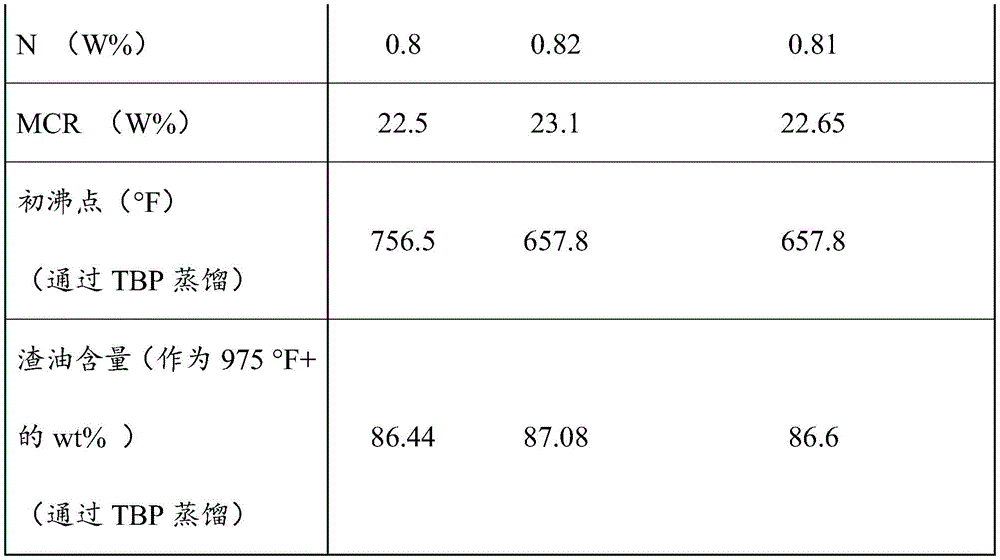
预焦化加氢裂化反应的结果是基于根据本发明实施的试验性的加氢裂化反应器,而焦化反应结果是基于假设的焦化系统。该试验性的加氢裂化反应器由两个反应器阶段组成,每个阶段具有2910cc的内部容积。每个阶段利用连续地从靠近反应器的顶部抽出反应器液体并且将其返回到反应器底部的外部泵循环回路而被返混。反应器操作为鼓泡塔反应器,不使用固体负载型催化剂。将2-乙基己酸钼用作催化剂前体,其首先与稀释剂(真空瓦斯油)混合以产生稀释的催化剂前体混合物。然后将该稀释的催化剂前体混合物混合至上述减压渣油原料混合物中。调整数量,从而使得稀释的催化剂前体混合物构成总进料混合物的1wt%,而总进料混合物中装载的催化剂前体为以重量计的150ppm(作为钼)。然后定期将这种预混合的进料混合物装入进料容器中,这种预混合的进料混合物从该进料容器被连续地泵入二阶段反应器系统中。The results of the pre-coking hydrocracking reaction are based on an experimental hydrocracking reactor implemented according to the present invention, while the coking reaction results are based on a hypothetical coking system. The experimental hydrocracking reactor consists of two reactor stages, each with an internal volume of 2910cc. Each stage is back-mixed using an external pump circulation loop that continuously extracts reactor liquid from the top near the reactor and returns it to the bottom of the reactor. The reactor is operated as a bubble column reactor without a solid supported catalyst. 2-Ethylhexanoic acid molybdenum is used as a catalyst precursor, which is first mixed with a diluent (vacuum gas oil) to produce a diluted catalyst precursor mixture. The diluted catalyst precursor mixture is then mixed into the above-mentioned vacuum residue feed mixture. The quantity is adjusted so that the diluted catalyst precursor mixture constitutes 1wt% of the total feed mixture, and the catalyst precursor loaded in the total feed mixture is 150ppm (as molybdenum) by weight. This premixed feed mixture is then regularly loaded into a feed container, and this premixed feed mixture is continuously pumped into a two-stage reactor system from the feed container.
对于每个实施例1至5,从特定的24小时周期选择性能结果,这代表在各条件下的第2至第4天操作,从而确保该结果反映线外单元操作(lined-out unit operation)。对于这些实施例,这两种反应器阶段保持在通常的温度下,该通常的温度在如表2所示的实施例之间不同。其他的操作条件对于这些实施例保持为常数值。液时空速保持为0.37新鲜进料体积/反应器体积/小时,压力为2200psig,并且氢气进料速率为4800scf/bbl新鲜进料。对于每个实施例,使用真实的沸点装置蒸馏,在指定的操作天数期间从单元收集的液体产物,以获得产物馏分的产率和性质。这些结果在表2中示出。特别值得注意的是减压渣油产物馏分(975°F+)的性质,其为假设的下游焦化步骤中的性能的预测提供关键数据,如下面所讨论的。For each example 1 to 5, performance results are selected from a specific 24-hour period, which represents the 2nd to 4th day of operation under each condition, thereby ensuring that the results reflect line-out unit operation. For these examples, the two reactor stages are maintained at a common temperature, which is different between the examples shown in Table 2. Other operating conditions are maintained as constant values for these examples. The liquid hourly space velocity is maintained at 0.37 fresh feed volume/reactor volume/hour, the pressure is 2200psig, and the hydrogen feed rate is 4800scf/bbl fresh feed. For each example, the liquid product collected from the unit during the specified operating days is distilled using a real boiling point device to obtain the yield and properties of the product fraction. These results are shown in Table 2. It is particularly noteworthy that the properties of the vacuum residue product fraction (975°F+) provide key data for the prediction of the performance in the hypothetical downstream coking step, as discussed below.
表2Table 2
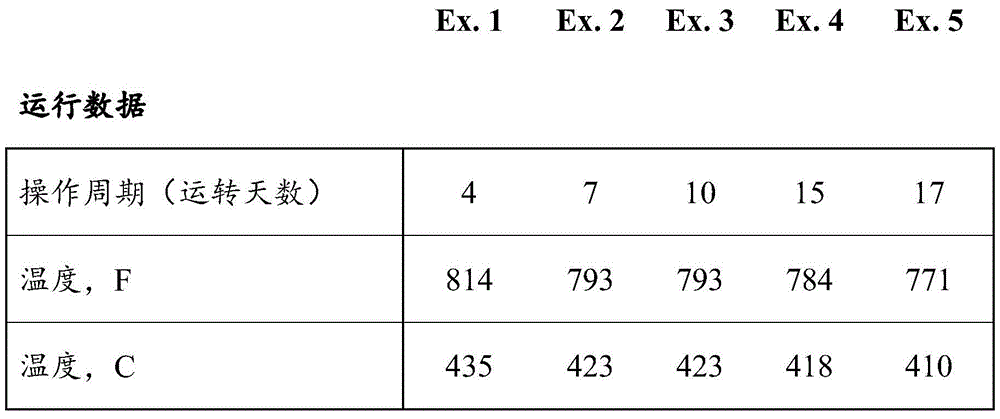
渣油产物馏分(975F+)的性质,从TBP蒸馏获得Properties of the residual oil product fraction (975F+), obtained from TBP distillation
加氢裂化工艺性能Hydrocracking process performance

为了预测将处理每一实施例的减压渣油产物馏分的下游焦化单元的性能,使用已经发表的相关性。这从书“Process Chemistry of Petroleum Macromolecues”(IA Wiehe,CRC出版社,第1版,2008年)获得。利用该参考书的第351页的以下等式可以计算有助于焦化操作的理论(预期)焦炭:To predict the performance of the downstream coking unit that will process the vacuum residue product fraction of each example, a published correlation was used. This was obtained from the book "Process Chemistry of Petroleum Macromolecues" (IA Wiehe, CRC Press, 1st edition, 2008). The theoretical (expected) coke that would contribute to the coking operation can be calculated using the following equation on page 351 of the reference book:
A(100)=11.28(L)+3.8(100–L)A(100)=11.28(L)+3.8(100–L)
其中,A是炼焦器进料中的氢含量,11.28是所得到的炼焦器衍生液体中的氢含量,3.8是所得焦炭中的氢含量,L是将成为炼焦器衍生液体的炼焦器进料的重量百分比。Where A is the hydrogen content of the coker feed, 11.28 is the hydrogen content of the resulting coker derived liquid, 3.8 is the hydrogen content of the resulting coke, and L is the weight percent of the coker feed that will become coker derived liquid.
另外,上述参考书的第390页提供了各种渣油改质技术的预期液体产率的表格。列出的三个商业焦化技术具有介于59和61%之间的液体产率,而第四演示的焦化技术示出为具有66%的液体产率。基于该数据,65%的焦化产率用于计算本实施例的液体产率。In addition, page 390 of the above-mentioned reference book provides a table of expected liquid yields for various residue upgrading technologies. The three commercial coking technologies listed have liquid yields between 59 and 61%, while the fourth demonstrated coking technology is shown to have a liquid yield of 66%. Based on this data, a coking yield of 65% is used to calculate the liquid yield of this example.
在此基础上,本发明的组合加氢裂化和焦化工艺的性能特性可以与单独工艺的那些相比。这在表3中示出。转化率值表示转化成沸点低于524℃(975°F)的烃的沸点为至少524℃(975°F)的烃的重量百分比。对于每个实施例,每个单独的工艺(加氢裂化和焦化)的转化率在本发明的组合工艺的转化率旁边示出。标记为Δ的列代表本发明的工艺相对于两个单独工艺的较高值的改进(以绝对百分点计)。值得注意的是,相对于仅通过常规的热焦化工艺或加氢裂化所提供的最佳转化率,组合工艺将转化率提高了约5至15%。On this basis, the performance characteristics of the combined hydrocracking and coking process of the present invention can be compared with those of the individual processes. This is shown in Table 3. The conversion values represent the weight percentage of hydrocarbons having a boiling point of at least 524°C (975°F) that are converted into hydrocarbons having a boiling point below 524°C (975°F). For each example, the conversion of each individual process (hydrocracking and coking) is shown next to the conversion of the combined process of the present invention. The column marked Δ represents the improvement (in absolute percentage points) of the process of the present invention relative to the higher value of the two individual processes. It is noteworthy that the combined process increases the conversion by about 5 to 15% relative to the best conversion provided by conventional thermal coking processes or hydrocracking alone.
表3Table 3

类似地,表3示出了单独的工艺和本发明的组合工艺的具有低于975°F的沸点的C4+烃馏出物的产率。对于实施例1至5,与单独地通过任一工艺获得的最佳C4+馏分产率相比,组合工艺使C4+馏分提高11.45-17.7个绝对百分点。与转化率和C4+产率结果互补,组合的加氢裂化和热裂解工艺大幅减少焦炭形成,减少焦炭形成24.86-59.92%。Similarly, Table 3 shows the yields of C4+ hydrocarbon distillates having a boiling point below 975°F for the individual processes and the combined process of the present invention. For Examples 1 to 5, the combined process increases the C4+ fraction by 11.45-17.7 absolute percentage points compared to the best C4+ fraction yield obtained by either process alone. Complementing the conversion and C4+ yield results, the combined hydrocracking and thermal cracking process significantly reduces coke formation, reducing coke formation by 24.86-59.92%.
实施例6-9Embodiment 6-9
以与上述实施例类似的方式进行实施例6-9,其中,在连续流试验单元中进行加氢裂化测试,利用所引用的文献参考的方法预测焦化性能。对于这些实施例,测试几种不同的原料组合物。对于实施例6,测试Black Rock常压渣油。实施例7和8使用Black Rock减压渣油。实施例9使用Murphy减压渣油。每种这些进料的性质总结于表4中。Examples 6-9 were conducted in a similar manner to the above examples, wherein hydrocracking tests were conducted in a continuous flow test unit, using the methods of the cited literature references to predict coking performance. For these examples, several different feed compositions were tested. For Example 6, Black Rock atmospheric residue was tested. Examples 7 and 8 used Black Rock vacuum residue. Example 9 used Murphy vacuum residue. The properties of each of these feeds are summarized in Table 4.
表4Table 4
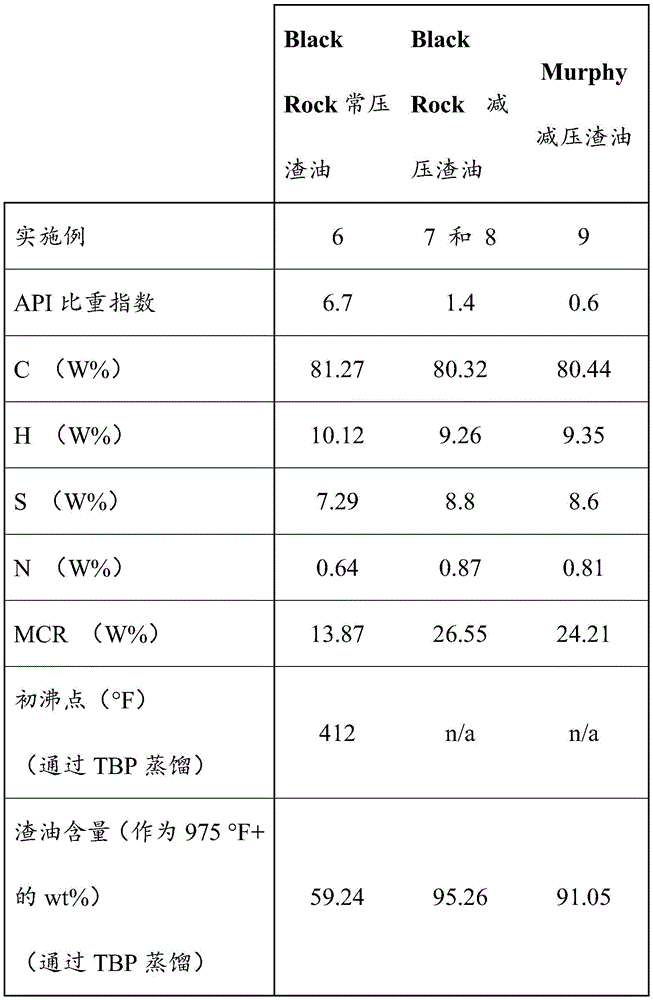
实施例6-9的测试条件在几个方面与前面的实施例中的那些不同。加氢裂化测试单元只由具有2910cc内部容积的单一反应器阶段组成。除了改变各个实施例之间的温度,也存在压力、液时空速、氢进料率和催化剂浓度的变化;这些通过表5中的条件示出。表5也示出每个实施例的加氢裂化性能结果。The test conditions for Examples 6-9 differed from those in the previous Examples in several respects. The hydrocracking test unit consisted of only a single reactor stage with an internal volume of 2910 cc. In addition to varying the temperature between the various Examples, there were also variations in pressure, liquid hourly space velocity, hydrogen feed rate, and catalyst concentration; these are shown by the conditions in Table 5. Table 5 also shows the hydrocracking performance results for each Example.
表5Table 5

渣油产物馏分的性质(975F+),从TBP蒸馏获得Properties of the residual oil product fraction (975F+) obtained from TBP distillation


加氢裂化工艺性能Hydrocracking process performance
类似于前面的实施例,基于表5中的加氢裂化测试的结果和从文献获得的焦化相关性为实施例6至9预测下游焦化单元的性能。表6示出结果,使单独的工艺(加氢裂化和焦化)的524℃+(975°F+)减压渣油转化率与本发明的组合工艺的524℃+(975°F+)减压渣油转化率比较。与通过单独地焦化或加氢裂化获得的最佳转化率相比,组合工艺将转化率提高了4.76至15.54个绝对百分点。Similar to the previous examples, the performance of the downstream coking unit was predicted for Examples 6 to 9 based on the results of the hydrocracking tests in Table 5 and coking correlations obtained from the literature. Table 6 shows the results, comparing the 524°C+ (975°F+) vacuum resid conversion of the separate processes (hydrocracking and coking) with the 524°C+ (975°F+) vacuum resid conversion of the combined process of the present invention. The combined process increased the conversion by 4.76 to 15.54 absolute percentage points compared to the best conversion obtained by coking or hydrocracking alone.
表6Table 6

类似地,在单独的工艺和本发明的组合工艺之间比较C4+馏分产率。与任一单独的工艺产生的最佳C4+馏分产率相比,组合工艺提高C4+馏分产率10.41-16.14个百分点。与转化率和C4+产率结果互补,组合加氢裂化和热裂解的工艺大幅减少焦炭形成,减少焦炭形成30.67-70.36%。Similarly, the C4+ fraction yield was compared between the individual processes and the combined process of the present invention. The combined process increased the C4+ fraction yield by 10.41-16.14 percentage points compared to the best C4+ fraction yield produced by any individual process. Complementary to the conversion and C4+ yield results, the process combining hydrocracking and thermal cracking significantly reduced coke formation, reducing coke formation by 30.67-70.36%.
实施例10-13Examples 10-13
以类似于前面的实施例的方式进行实施例10至13。在这种情况下,所有实施例使用Ku 850°F+减压渣油,其性质示于表7中。Examples 10 to 13 were carried out in a manner similar to the previous examples. In this case, all examples used
表7Table 7
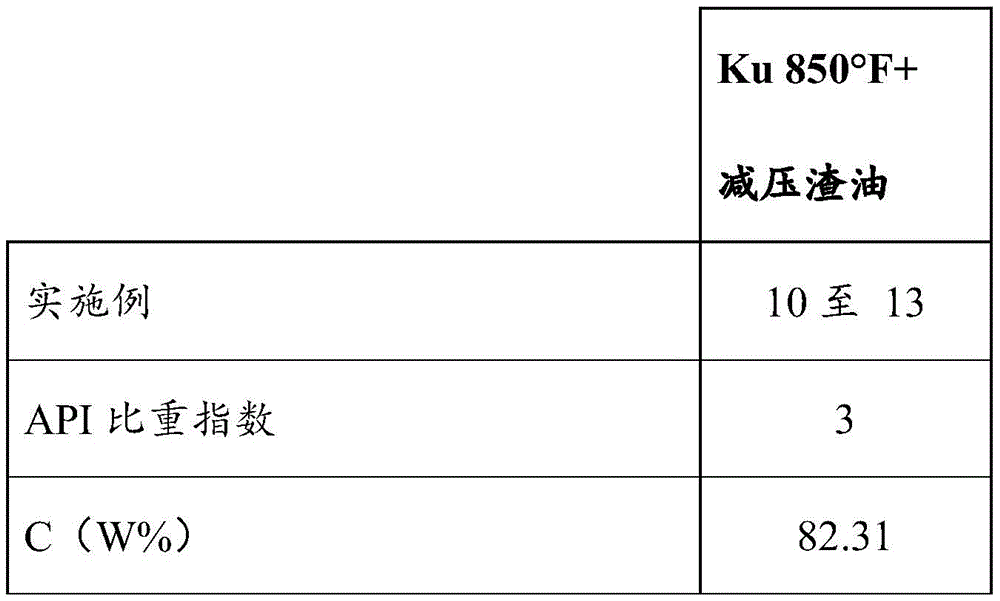
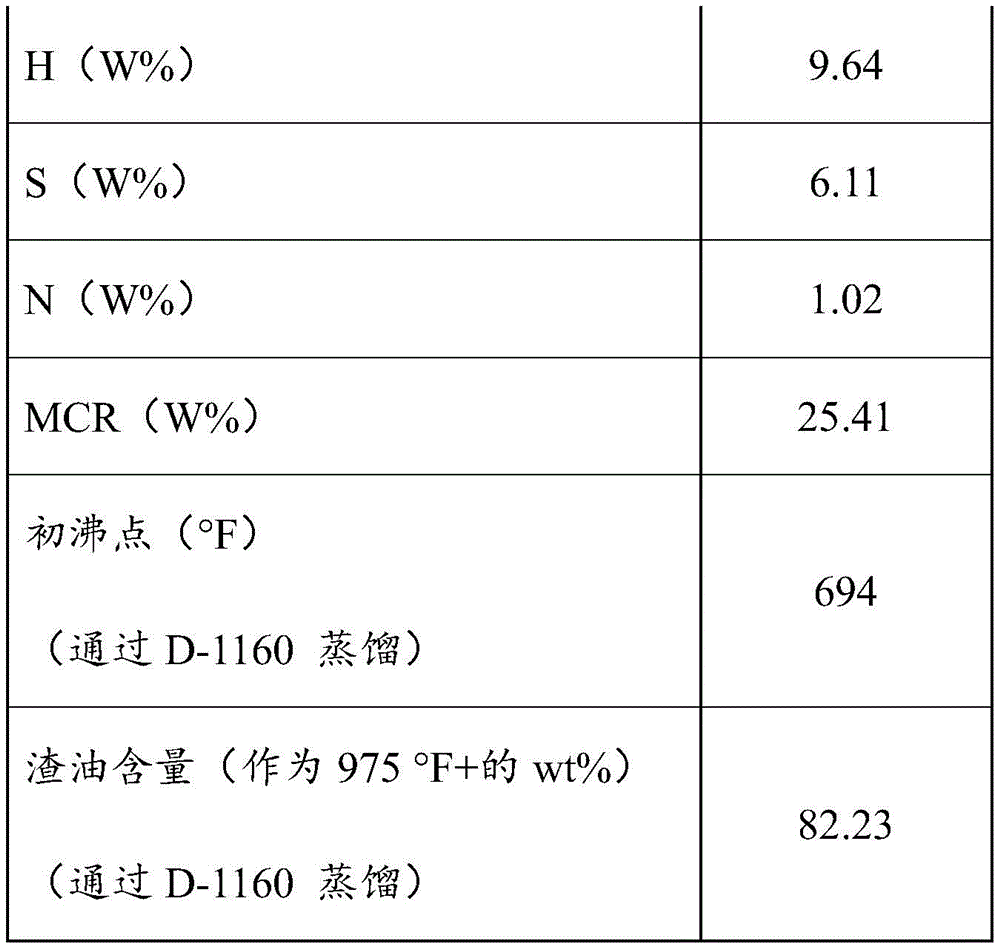
对于实施例10-13,加氢裂化试验单元由具有2910cc内部容积的单一反应器阶段组成。对于这些实施例大多数操作条件保持在恒定水平,其中,反应器温度是815°F(435℃),压力为2500psig,氢气进料速率为5600scf/bbl新鲜进料,以及液时空速是0.35体积新鲜进料/体积反应器/小时。这些实施例之间的唯一区别是催化剂浓度,其在按重量计的51至508ppm范围内(作为钼),如表8所示。For Examples 10-13, the hydrocracking test unit consisted of a single reactor stage with an internal volume of 2910 cc. Most operating conditions were maintained at constant levels for these examples, with the reactor temperature being 815°F (435°C), the pressure being 2500 psig, the hydrogen feed rate being 5600 scf/bbl fresh feed, and the liquid hourly space velocity being 0.35 volume fresh feed/volume reactor/hour. The only difference between these examples was the catalyst concentration, which ranged from 51 to 508 ppm by weight (as molybdenum), as shown in Table 8.
表8Table 8

渣油产物馏分(975F+)的性质,从TBP蒸馏获得Properties of the residual oil product fraction (975F+), obtained from TBP distillation
加氢裂化工艺性能Hydrocracking process performance
表8还显示了加氢裂化工艺的性能结果,包括减压渣油产物馏分(975F+)的性质、工艺残渣转化率和产物馏分的产率。正如对前面的实施例进行的,然后利用从上述文献参考获得的相关性预测下游焦化工艺的性能,从而允许单独的工艺(加氢裂化和焦化)的性能与本发明的组合工艺的性能比较。结果示于表9中。对于减压渣油转化率,与任一单独的工艺获得的最佳结果相比,组合工艺使转化率增加11.85至15.54个百分点。Table 8 also shows the performance results of the hydrocracking process, including the properties of the vacuum residue product fraction (975F+), process residue conversion, and the yield of the product fraction. As was done for the previous examples, the performance of the downstream coking process was then predicted using correlations obtained from the above literature references, allowing the performance of the individual processes (hydrocracking and coking) to be compared with the performance of the combined process of the present invention. The results are shown in Table 9. For vacuum residue conversion, the combined process increased conversion by 11.85 to 15.54 percentage points compared to the best results obtained with either individual process.
表9Table 9
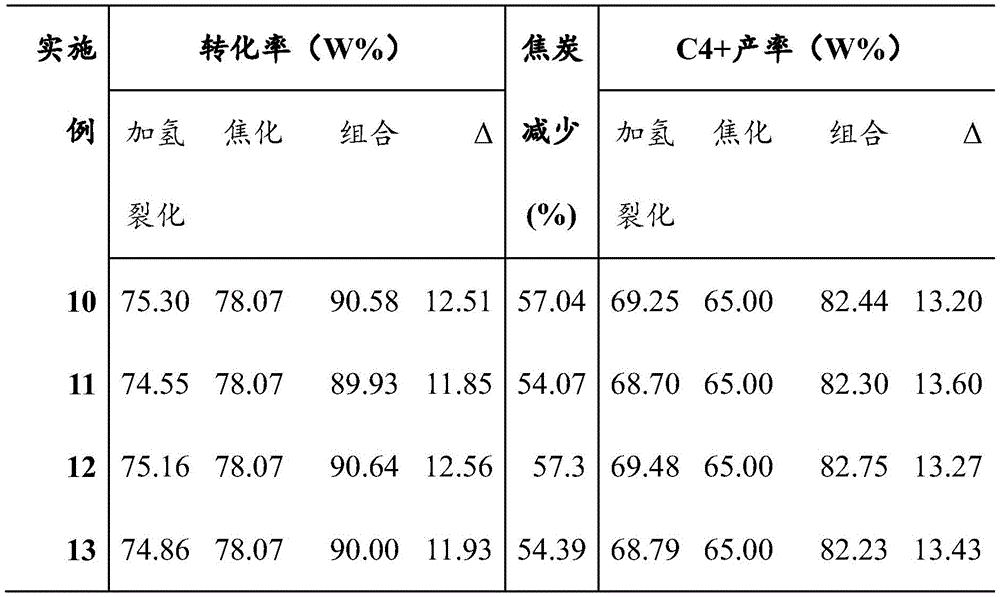
类似地,对单独的工艺和本发明的组合工艺示出C4+馏分产率。与任一单独的工艺获得的最佳结果相比,组合工艺改进C4+馏分产率13.27-13.60个百分点。与转化率和C4+产率结果互补,组合加氢裂化和热裂解的工艺大幅减少焦炭形成,减少焦炭形成54.07-57.3%。Similarly, the C4+ fraction yield is shown for the individual processes and the combined process of the present invention. The combined process improves the C4+ fraction yield by 13.27-13.60 percentage points compared to the best result obtained with either individual process. Complementary to the conversion and C4+ yield results, the process combining hydrocracking and thermal cracking significantly reduces coke formation, reducing coke formation by 54.07-57.3%.
实施例14-18Examples 14-18
以类似于前面的实施例的方式进行实施例14至18。在这种情况下,原料是ArabMedium减压渣油,其性质示于表10中。Examples 14 to 18 were carried out in a manner similar to the previous examples. In this case, the feedstock was Arab Medium vacuum residue, the properties of which are shown in Table 10.
表10Table 10

对于实施例14至18,加氢裂化试验单元由各自具有2910cc内部容积的两个反应器阶段组成。对于这些实施例,反应器温度保持为803°F(428℃)并且压力为2250psig。其他条件如表11所示的变化。For Examples 14 to 18, the hydrocracking test unit consisted of two reactor stages each with an internal volume of 2910 cc. For these examples, the reactor temperature was maintained at 803°F (428°C) and the pressure was 2250 psig. Other conditions were varied as shown in Table 11.
表11Table 11

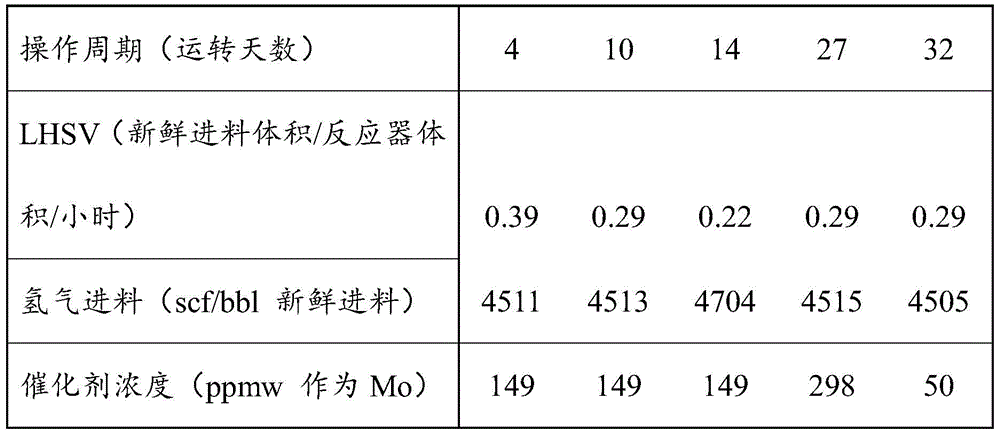
渣油产物馏分的性质(975F+),从TBP蒸馏获得Properties of the residual oil product fraction (975F+) obtained from TBP distillation
加氢裂化工艺性能Hydrocracking process performance
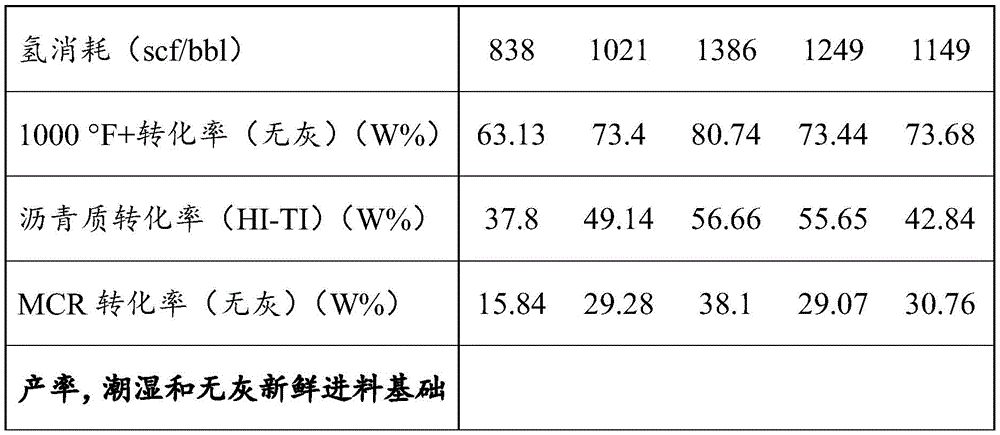

表11还显示了加氢裂化工艺的性能结果,包括减压渣油产物馏分(1000°F+)的性质、工艺残渣转化率和产物馏分的产率。正如对前面的实施例进行的,然后利用从上述文献参考获得的相关性预测下游焦化工艺的性能,从而允许单独的工艺(加氢裂化和焦化)的性能与本发明的组合工艺的性能比较。结果示于表12中。对于减压渣油转化率,与任一单独的工艺获得的最佳结果相比,组合工艺使转化率增加4.83至8.31个百分点。Table 11 also shows the performance results of the hydrocracking process, including the properties of the vacuum residue product fraction (1000°F+), process residue conversion, and the yield of the product fraction. As was done for the previous examples, the performance of the downstream coking process was then predicted using correlations obtained from the above literature references, allowing the performance of the individual processes (hydrocracking and coking) to be compared with the performance of the combined process of the present invention. The results are shown in Table 12. For vacuum residue conversion, the combined process increased conversion by 4.83 to 8.31 percentage points compared to the best results obtained with either individual process.
表12Table 12

类似地,在单独的工艺和本发明的组合工艺之间比较C4+馏分产率。与任一单独的工艺提供的最佳产率相比,组合工艺改进C4+馏分产率11.66-17.33个百分点。与转化率和C4+产率结果互补,组合加氢裂化和热裂解的工艺大幅减少焦炭形成,减少焦炭形成29.12-45.35%。Similarly, the C4+ fraction yield was compared between the individual processes and the combined process of the present invention. The combined process improved the C4+ fraction yield by 11.66-17.33 percentage points compared to the best yield provided by any individual process. Complementary to the conversion and C4+ yield results, the process combining hydrocracking and thermal cracking significantly reduced coke formation, reducing coke formation by 29.12-45.35%.
本发明可以以其他特定形式体现而不背离其精神或本质特征。应该认为所述实施方案在所有方面都仅是说明性的而不是限制性的。因此,本发明的范围由所附权利要求而不是由前面的描述指示。进入权利要求的等效形式的含义和范围内的所有改变包含在权利要求的范围内。The present invention may be embodied in other specific forms without departing from its spirit or essential characteristics. It should be considered that the described embodiments are only illustrative and not restrictive in all aspects. Therefore, the scope of the present invention is indicated by the appended claims rather than by the preceding description. All changes within the meaning and scope of the equivalent forms of the claims are included in the scope of the claims.
Claims (34)

Priority Applications (1)
| Application Number | Priority Date | Filing Date | Title |
|---|---|---|---|
| CN201910450595.3A CN110218578B (en) | 2012-07-30 | 2013-07-26 | Process and system for upgrading heavy oil using catalytic hydrocracking and thermal coking |
Applications Claiming Priority (5)
| Application Number | Priority Date | Filing Date | Title |
|---|---|---|---|
| US13/561,479 | 2012-07-30 | ||
| US13/561,479 US9644157B2 (en) | 2012-07-30 | 2012-07-30 | Methods and systems for upgrading heavy oil using catalytic hydrocracking and thermal coking |
| CN201910450595.3A CN110218578B (en) | 2012-07-30 | 2013-07-26 | Process and system for upgrading heavy oil using catalytic hydrocracking and thermal coking |
| PCT/US2013/052422 WO2014022243A1 (en) | 2012-07-30 | 2013-07-26 | Methods and systems for upgrading heavy oil using catalytic hydrocracking and thermal coking |
| CN201380051146.2A CN105518109A (en) | 2012-07-30 | 2013-07-26 | Method and system for upgrading heavy oil using catalytic hydrocracking and thermal coking |
Related Parent Applications (1)
| Application Number | Title | Priority Date | Filing Date |
|---|---|---|---|
| CN201380051146.2A Division CN105518109A (en) | 2012-07-30 | 2013-07-26 | Method and system for upgrading heavy oil using catalytic hydrocracking and thermal coking |
Publications (2)
| Publication Number | Publication Date |
|---|---|
| CN110218578A CN110218578A (en) | 2019-09-10 |
| CN110218578B true CN110218578B (en) | 2023-04-18 |
Family
ID=49993827
Family Applications (2)
| Application Number | Title | Priority Date | Filing Date |
|---|---|---|---|
| CN201910450595.3A Active CN110218578B (en) | 2012-07-30 | 2013-07-26 | Process and system for upgrading heavy oil using catalytic hydrocracking and thermal coking |
| CN201380051146.2A Pending CN105518109A (en) | 2012-07-30 | 2013-07-26 | Method and system for upgrading heavy oil using catalytic hydrocracking and thermal coking |
Family Applications After (1)
| Application Number | Title | Priority Date | Filing Date |
|---|---|---|---|
| CN201380051146.2A Pending CN105518109A (en) | 2012-07-30 | 2013-07-26 | Method and system for upgrading heavy oil using catalytic hydrocracking and thermal coking |
Country Status (6)
| Country | Link |
|---|---|
| US (2) | US9644157B2 (en) |
| JP (1) | JP6204471B2 (en) |
| CN (2) | CN110218578B (en) |
| CA (1) | CA2879715C (en) |
| EA (1) | EA034779B1 (en) |
| WO (1) | WO2014022243A1 (en) |
Families Citing this family (51)
| Publication number | Priority date | Publication date | Assignee | Title |
|---|---|---|---|---|
| MXPA06012528A (en) | 2004-04-28 | 2007-08-02 | Headwaters Heavy Oil Llc | Ebullated bed hydroprocessing methods and systems and methods of upgrading an existing ebullated bed system. |
| US9644157B2 (en) | 2012-07-30 | 2017-05-09 | Headwaters Heavy Oil, Llc | Methods and systems for upgrading heavy oil using catalytic hydrocracking and thermal coking |
| US20150329790A1 (en) * | 2014-05-15 | 2015-11-19 | Shuwu Yang | Systems and methods for producing a crude product |
| EP2947135A1 (en) | 2014-05-22 | 2015-11-25 | Shell Internationale Research Maatschappij B.V. | Fuel compositions |
| FR3027911B1 (en) * | 2014-11-04 | 2018-04-27 | IFP Energies Nouvelles | METHOD FOR CONVERTING PETROLEUM LOADS COMPRISING A BOILING BED HYDROCRACKING STEP, MATURATION STEP AND SEDIMENT SEPARATION STEP FOR THE PRODUCTION OF LOW SEDIMENT FOLDS |
| CN106147840A (en) * | 2015-04-16 | 2016-11-23 | 神华集团有限责任公司 | The method of coal tar system cleaning fuel and coal the system method cleaning fuel and the cleaning fuel obtained |
| US9879188B2 (en) * | 2015-07-27 | 2018-01-30 | Saudi Arabian Oil Company | Integrated ebullated-bed hydroprocessing, fixed bed hydroprocessing and coking process for whole crude oil conversion into hydrotreated distillates and petroleum green coke |
| US11414607B2 (en) | 2015-09-22 | 2022-08-16 | Hydrocarbon Technology & Innovation, Llc | Upgraded ebullated bed reactor with increased production rate of converted products |
| US11414608B2 (en) * | 2015-09-22 | 2022-08-16 | Hydrocarbon Technology & Innovation, Llc | Upgraded ebullated bed reactor used with opportunity feedstocks |
| CN106929101B (en) * | 2015-12-31 | 2018-12-25 | 中国石油天然气股份有限公司 | A kind of processing method of producing diesel oil from shale oil |
| TWI736611B (en) * | 2016-04-25 | 2021-08-21 | 荷蘭商蜆殼國際研究所 | An ebullated bed process for high conversion of heavy hydrocarbons with a low sediment yield |
| TWI736612B (en) * | 2016-04-25 | 2021-08-21 | 荷蘭商蜆殼國際研究所 | An ebullated bed process for high conversion of heavy hydrocarbons with a low sediment yield |
| US11421164B2 (en) | 2016-06-08 | 2022-08-23 | Hydrocarbon Technology & Innovation, Llc | Dual catalyst system for ebullated bed upgrading to produce improved quality vacuum residue product |
| CN106051791B (en) * | 2016-07-05 | 2018-10-23 | 戴志刚 | Petroleum residual oil burning energy generation device |
| KR101793144B1 (en) | 2016-07-13 | 2017-11-03 | 단국대학교 산학협력단 | Hydrogenation Reaction Composition For Heavy Oil Upgrading With Aromatic Coal Compound And Hydrogenation Reaction Process |
| CN106247318B (en) * | 2016-07-23 | 2018-11-13 | 东阳市善水环境工程有限公司 | Petroleum residual oil combustion conversion device |
| US10301556B2 (en) * | 2016-08-24 | 2019-05-28 | Saudi Arabian Oil Company | Systems and methods for the conversion of feedstock hydrocarbons to petrochemical products |
| CA3037670C (en) * | 2016-09-30 | 2025-05-13 | Hindustan Petroleum Corporation Limited | A process for upgrading heavy hydrocarbons |
| CN108102692B (en) * | 2016-11-25 | 2019-11-15 | 中国石油化工股份有限公司 | A kind of process of coal-based feedstocks production needle coke |
| CN108102712B (en) * | 2016-11-25 | 2019-11-15 | 中国石油化工股份有限公司 | A kind of combined technical method of mixed raw material production needle coke |
| US11732203B2 (en) | 2017-03-02 | 2023-08-22 | Hydrocarbon Technology & Innovation, Llc | Ebullated bed reactor upgraded to produce sediment that causes less equipment fouling |
| MX2018002577A (en) * | 2017-03-02 | 2018-11-09 | Hydrocarbon Tech & Innovation Llc | Upgraded ebullated bed reactor with less fouling sediment. |
| US10968399B2 (en) | 2017-04-07 | 2021-04-06 | Citgo Petroleum Corporation | Online coke removal in a heater pass |
| CA3066585C (en) * | 2017-06-19 | 2022-05-24 | Hindustan Petroleum Corporation Limited | Process for the preparation of hydrocarbon soluble organometallic catalysts |
| FR3074699B1 (en) | 2017-12-13 | 2019-12-20 | IFP Energies Nouvelles | PROCESS FOR HYDROCONVERSION OF HEAVY HYDROCARBON CHARGE INTO HYBRID REACTOR |
| CN108067168A (en) * | 2017-12-13 | 2018-05-25 | 煤炭科学技术研究院有限公司 | Heterogeneous slurry bed system hydrocracking unit and method |
| CA3022405C (en) | 2017-12-19 | 2022-03-15 | Indian Oil Corporation Limited | Two stage thermal cracking process with multistage separation system |
| CN110013801A (en) * | 2018-01-10 | 2019-07-16 | 何巨堂 | The hydrocarbon material hydrogenator system of socket type containing upper reaction zone and product gas-liquid separation zone |
| RU2671817C1 (en) * | 2018-06-27 | 2018-11-07 | Андрей Владиславович Курочкин | Installation for hydroconversion of residual oil fractions |
| KR102088997B1 (en) * | 2018-07-17 | 2020-03-13 | 한국화학연구원 | Catalyst precursor for hydrocracking and method for hydrocracking of heavy oil using thereof |
| CA3057131C (en) | 2018-10-17 | 2024-04-23 | Hydrocarbon Technology And Innovation, Llc | Upgraded ebullated bed reactor with no recycle buildup of asphaltenes in vacuum bottoms |
| CN110003946B (en) * | 2019-05-17 | 2021-07-30 | 国家能源投资集团有限责任公司 | System and method for blending indirect liquefied oil and direct liquefied oil to produce gasoline and diesel |
| CN112023852B (en) * | 2019-06-03 | 2023-05-09 | 中国石油化工股份有限公司 | Production device for preparing cyclohexene by benzene partial hydrogenation |
| US11384300B2 (en) | 2019-12-19 | 2022-07-12 | Saudi Arabian Oil Company | Integrated process and system to upgrade crude oil |
| US11286429B2 (en) * | 2020-06-25 | 2022-03-29 | Saudi Arabian Oil Company | Process for heavy oil upgrading utilizing hydrogen and water |
| US11370973B2 (en) * | 2020-07-10 | 2022-06-28 | Saudi Arabian Oil Company | Processes and systems for producing one or more of benzene, toluene, or mixed xylenes |
| CN111925814A (en) * | 2020-07-22 | 2020-11-13 | 山东益大新材料股份有限公司 | Delayed coking system and method for producing coal-series and oil-series needle coke in time-sharing manner |
| CN112574770B (en) * | 2020-11-03 | 2021-10-26 | 大连理工大学 | Preparation method of high-quality coal-based needle coke |
| CN113322091A (en) * | 2020-12-23 | 2021-08-31 | 航天环境工程有限公司 | System for pneumatically removing coke powder outside delayed coking fractionating tower, use method and application |
| CN113322090A (en) * | 2020-12-23 | 2021-08-31 | 航天环境工程有限公司 | Delayed coking fractionating tower pneumatic coke powder removing device, use method and application |
| FR3125060B1 (en) | 2021-07-08 | 2024-09-27 | Ifp Energies Now | HYDROCONVERSION IN A DRIVEN BED OF A HEAVY HYDROCARBON FEED COMPRISING THE MIXTURE OF SAID FEED WITH A CATALYST PRECURSOR CONTAINING AN ORGANIC ADDITIVE |
| FR3125059B1 (en) | 2021-07-08 | 2024-09-27 | Ifp Energies Now | HYDROCONVERSION IN A BOILING-DRIVEN HYBRID BED OF A HEAVY HYDROCARBON FEEDSTOCK COMPRISING THE MIXTURE OF SAID FEEDSTOCK WITH A CATALYST PRECURSOR CONTAINING AN ORGANIC ADDITIVE |
| FR3125057B1 (en) | 2021-07-08 | 2024-10-04 | Ifp Energies Now | HYDROCONVERSION IN A BOILING-ENTRAINED HYBRID BED OF A HEAVY HYDROCARBON FEEDSTOCK COMPRISING THE PREMIXTURE OF SAID FEEDSTOCK WITH AN ORGANIC ADDITIVE |
| FR3125058B1 (en) | 2021-07-08 | 2024-09-27 | Ifp Energies Now | HYDROCONVERSION IN A DRIVEN BED OF A HEAVY HYDROCARBON FEED COMPRISING THE PREMIXTURE OF SAID FEED WITH AN ORGANIC ADDITIVE |
| US11834616B2 (en) * | 2021-08-17 | 2023-12-05 | Hydrocarbon Technology & Innovation, Llc | Efficient hydroprocessing and solvent deasphalting of heavy oil with sequential addition of dispersed catalyst |
| CN116020563B (en) * | 2021-10-25 | 2025-11-14 | 中国石油化工股份有限公司 | Preparation method of unsupported multimetal hydrogenation catalysts |
| CN116410788B (en) * | 2021-12-31 | 2024-08-13 | 中国石油天然气股份有限公司 | Inferior heavy oil slurry bed hydrocracking treatment equipment and treatment method |
| US20230383198A1 (en) * | 2022-05-26 | 2023-11-30 | Hydrocarbon Technology & Innovation, Llc | Method and system for introducing catalyst precursor into heavy oil using parallel mixer lines and bypass line |
| US12497569B2 (en) * | 2022-05-26 | 2025-12-16 | Hydrocarbon Technology & Innovation, Llc | Method and system for mixing catalyst precursor into heavy oil using a high boiling hydrocarbon diluent |
| CN114950329A (en) * | 2022-07-29 | 2022-08-30 | 水之革(山东)环保科技有限责任公司 | Industrialized preparation production device and method for vulcanized zero-valent iron |
| US20240409830A1 (en) * | 2023-06-08 | 2024-12-12 | Axens | Integrated Process for Complete Conversion of Residue Feedstock |
Citations (2)
| Publication number | Priority date | Publication date | Assignee | Title |
|---|---|---|---|---|
| CN1219570A (en) * | 1997-12-08 | 1999-06-16 | 中国石油化工总公司抚顺石油化工研究院 | Treatment method for inferior heavy and residual oil |
| CN1950484A (en) * | 2004-04-28 | 2007-04-18 | 上游重油有限公司 | Hydroprocessing method and system for upgrading heavy oil using a colloidal or molecular catalyst |
Family Cites Families (276)
| Publication number | Priority date | Publication date | Assignee | Title |
|---|---|---|---|---|
| US2850552A (en) | 1952-06-30 | 1958-09-02 | Phillips Petroleum Co | Control of reactions involving fluids of different densities |
| US3019180A (en) * | 1959-02-20 | 1962-01-30 | Socony Mobil Oil Co Inc | Conversion of high boiling hydrocarbons |
| US3161585A (en) | 1962-07-02 | 1964-12-15 | Universal Oil Prod Co | Hydrorefining crude oils with colloidally dispersed catalyst |
| US3254017A (en) | 1963-08-23 | 1966-05-31 | Exxon Research Engineering Co | Process for hydrocracking heavy oils in two stages |
| NL297593A (en) | 1964-03-05 | 1900-01-01 | ||
| US3267021A (en) | 1964-03-30 | 1966-08-16 | Chevron Res | Multi-stage hydrocracking process |
| US3362972A (en) | 1964-06-29 | 1968-01-09 | Halcon International Inc | Process for the preparation of certain molybdenum and vanadium salts |
| US3297563A (en) | 1964-08-17 | 1967-01-10 | Union Oil Co | Treatment of heavy oils in two stages of hydrotreating |
| DE1220394B (en) | 1964-09-12 | 1966-07-07 | Glanzstoff Koeln Ges Mit Besch | Device for the continuous mixing and homogenizing of liquids of different viscosities |
| US3578690A (en) | 1968-06-28 | 1971-05-11 | Halcon International Inc | Process for preparing molybdenum acid salts |
| US3595891A (en) | 1969-09-17 | 1971-07-27 | Jefferson Chem Co Inc | Process for hydrocarbon soluble metal salts |
| US3622497A (en) | 1970-01-22 | 1971-11-23 | Universal Oil Prod Co | Slurry process using vanadium sulfide for converting hydrocarbonaceous black oil |
| US3622498A (en) | 1970-01-22 | 1971-11-23 | Universal Oil Prod Co | Slurry processing for black oil conversion |
| US3694352A (en) | 1970-02-24 | 1972-09-26 | Universal Oil Prod Co | Slurry hydrorefining of black oils with mixed vanadium and manganese sulfides |
| US3694351A (en) | 1970-03-06 | 1972-09-26 | Gulf Research Development Co | Catalytic process including continuous catalyst injection without catalyst removal |
| US3870623A (en) | 1971-12-21 | 1975-03-11 | Hydrocarbon Research Inc | Hydroconversion process of residuum oils |
| FR2184404B1 (en) | 1972-05-15 | 1974-09-27 | Inst Francais Du Petrole | |
| US3907852A (en) | 1972-06-23 | 1975-09-23 | Exxon Research Engineering Co | Silylhydrocarbyl phosphines and related compounds |
| JPS518642B2 (en) * | 1972-08-02 | 1976-03-18 | ||
| US3816020A (en) | 1972-10-19 | 1974-06-11 | Selgo Pumps Inc | Pump |
| US3892389A (en) | 1972-11-29 | 1975-07-01 | Bekaert Sa Nv | Device and method for injecting liquids into a mixing head |
| DE2315114B2 (en) | 1973-03-27 | 1979-08-23 | Basf Ag, 6700 Ludwigshafen | Process for mixing liquids with large differences in viscosity |
| JPS5740811B2 (en) | 1973-05-08 | 1982-08-30 | ||
| US4125455A (en) | 1973-09-26 | 1978-11-14 | Texaco Inc. | Hydrotreating heavy residual oils |
| US4068830A (en) | 1974-01-04 | 1978-01-17 | E. I. Du Pont De Nemours And Company | Mixing method and system |
| US4066561A (en) | 1974-01-04 | 1978-01-03 | Mobil Oil Corporation | Organometallic compounds and compositions thereof with lubricants |
| US3983028A (en) | 1974-07-01 | 1976-09-28 | Standard Oil Company (Indiana) | Process for recovering upgraded products from coal |
| US3915842A (en) | 1974-07-22 | 1975-10-28 | Universal Oil Prod Co | Catalytic conversion of hydrocarbon mixtures |
| US3919074A (en) | 1974-08-22 | 1975-11-11 | Universal Oil Prod Co | Process for the conversion of hydrocarbonaceous black oil |
| US3992285A (en) | 1974-09-23 | 1976-11-16 | Universal Oil Products Company | Process for the conversion of hydrocarbonaceous black oil |
| US3953362A (en) | 1975-04-30 | 1976-04-27 | Olin Corporation | Molybdenum salt catalysts and methods of preparing them |
| US4022681A (en) | 1975-12-24 | 1977-05-10 | Atlantic Richfield Company | Production of monoaromatics from light pyrolysis fuel oil |
| US4067798A (en) | 1976-02-26 | 1978-01-10 | Standard Oil Company (Indiana) | Catalytic cracking process |
| US4077867A (en) | 1976-07-02 | 1978-03-07 | Exxon Research & Engineering Co. | Hydroconversion of coal in a hydrogen donor solvent with an oil-soluble catalyst |
| US4066530A (en) | 1976-07-02 | 1978-01-03 | Exxon Research & Engineering Co. | Hydroconversion of heavy hydrocarbons |
| US4067799A (en) | 1976-07-02 | 1978-01-10 | Exxon Research And Engineering Company | Hydroconversion process |
| US4298454A (en) | 1976-07-02 | 1981-11-03 | Exxon Research And Engineering Company | Hydroconversion of an oil-coal mixture |
| US4192735A (en) | 1976-07-02 | 1980-03-11 | Exxon Research & Engineering Co. | Hydrocracking of hydrocarbons |
| US4148750A (en) | 1977-01-10 | 1979-04-10 | Exxon Research & Engineering Co. | Redispersion of noble metals on supported catalysts |
| US4181601A (en) | 1977-06-17 | 1980-01-01 | The Lummus Company | Feed hydrotreating for improved thermal cracking |
| CA1097245A (en) | 1977-11-22 | 1981-03-10 | Chandra P. Khulbe | Thermal hydrocracking of heavy hydrocarbon oils with heavy oil recycle |
| US4151070A (en) | 1977-12-20 | 1979-04-24 | Exxon Research & Engineering Co. | Staged slurry hydroconversion process |
| US4169038A (en) * | 1978-03-24 | 1979-09-25 | Exxon Research & Engineering Co. | Combination hydroconversion, fluid coking and gasification |
| US4178227A (en) | 1978-03-24 | 1979-12-11 | Exxon Research & Engineering Co. | Combination hydroconversion, fluid coking and gasification |
| US4196072A (en) | 1978-05-23 | 1980-04-01 | Exxon Research & Engineering Co. | Hydroconversion process |
| US4226742A (en) | 1978-07-14 | 1980-10-07 | Exxon Research & Engineering Co. | Catalyst for the hydroconversion of heavy hydrocarbons |
| US4313818A (en) | 1978-10-30 | 1982-02-02 | Exxon Research & Engineering Co. | Hydrocracking process utilizing high surface area catalysts |
| FR2456774A1 (en) | 1979-05-18 | 1980-12-12 | Inst Francais Du Petrole | PROCESS FOR HYDROTREATING LIQUID PHASE HEAVY HYDROCARBONS IN THE PRESENCE OF A DISPERSE CATALYST |
| US4411768A (en) | 1979-12-21 | 1983-10-25 | The Lummus Company | Hydrogenation of high boiling hydrocarbons |
| SE416889B (en) | 1979-12-27 | 1981-02-16 | Imo Industri Ab | PROCEDURE FOR MIXING TWO VARIETIES WITH DIFFERENT VISCOSITY AND THE IMPLEMENTATION PROCEDURE |
| FR2473056A1 (en) | 1980-01-04 | 1981-07-10 | Inst Francais Du Petrole | METHOD FOR HYDROPROCESSING HEAVY HYDROCARBONS IN THE PRESENCE OF A MOLYBDENATED CATALYST |
| JPS601056B2 (en) | 1980-02-19 | 1985-01-11 | 千代田化工建設株式会社 | Hydrotreatment of heavy hydrocarbon oils containing asphaltenes |
| US4305808A (en) | 1980-04-14 | 1981-12-15 | Mobil Oil Corporation | Catalytic hydrocracking |
| US4338183A (en) | 1980-10-14 | 1982-07-06 | Uop Inc. | Method of solvent extraction of coal by a heavy oil |
| US4325802A (en) | 1980-11-17 | 1982-04-20 | Pentanyl Technologies, Inc. | Method of liquefaction of carbonaceous materials |
| US4485008A (en) | 1980-12-05 | 1984-11-27 | Exxon Research And Engineering Co. | Liquefaction process |
| US4370221A (en) | 1981-03-03 | 1983-01-25 | Her Majesty The Queen In Right Of Canada, As Represented By The Minister Of Energy, Mines And Resources | Catalytic hydrocracking of heavy oils |
| NL8103703A (en) | 1981-08-06 | 1983-03-01 | Stamicarbon | PROCESS FOR PREPARING A POLYMERIZATION CATALYST AND PREPARING ETHENE POLYMERS THEREOF |
| US4465630A (en) | 1981-08-24 | 1984-08-14 | Asahi Kasei Kogyo Kabushiki Kaisha | Tetraazaannulene cobalt complex compounds and method for preparation therefor |
| US4389301A (en) | 1981-10-22 | 1983-06-21 | Chevron Research Company | Two-step hydroprocessing of heavy hydrocarbonaceous oils |
| US4422927A (en) | 1982-01-25 | 1983-12-27 | The Pittsburg & Midway Coal Mining Co. | Process for removing polymer-forming impurities from naphtha fraction |
| US4420008A (en) | 1982-01-29 | 1983-12-13 | Mobil Oil Corporation | Method for transporting viscous crude oils |
| CA1183098A (en) | 1982-02-24 | 1985-02-26 | Kenneth R. Dymock | Hydrogenation of carbonaceous material |
| US4808007A (en) | 1982-05-13 | 1989-02-28 | Komax Systems, Inc. | Dual viscosity mixer |
| US4475711A (en) | 1982-08-30 | 1984-10-09 | Honeywell Inc. | High pressure gas valve |
| US4485004A (en) | 1982-09-07 | 1984-11-27 | Gulf Canada Limited | Catalytic hydrocracking in the presence of hydrogen donor |
| US4427532A (en) * | 1982-09-28 | 1984-01-24 | Mobil Oil Corporation | Coking of coal with petroleum residua |
| JPS59108091A (en) | 1982-12-10 | 1984-06-22 | Chiyoda Chem Eng & Constr Co Ltd | Hydrocracking method for heavy hydrocarbons |
| US4592827A (en) | 1983-01-28 | 1986-06-03 | Intevep, S.A. | Hydroconversion of heavy crudes with high metal and asphaltene content in the presence of soluble metallic compounds and water |
| JPS59142848A (en) | 1983-02-02 | 1984-08-16 | Toshitaka Ueda | Catalyst |
| GB2142930B (en) | 1983-03-19 | 1987-07-01 | Asahi Chemical Ind | A process for cracking a heavy hydrocarbon |
| US4454023A (en) | 1983-03-23 | 1984-06-12 | Alberta Oil Sands Technology & Research Authority | Process for upgrading a heavy viscous hydrocarbon |
| US4430207A (en) | 1983-05-17 | 1984-02-07 | Phillips Petroleum Company | Demetallization of hydrocarbon containing feed streams |
| US4513098A (en) | 1983-06-28 | 1985-04-23 | Mobil Oil Corporation | Multimetallic catalysts and their method of preparation from organometallic precursors |
| FR2549389A1 (en) | 1983-07-19 | 1985-01-25 | Centre Nat Rech Scient | HYDROCARBON HYDROTREATMENT CATALYST, PREPARATION AND APPLICATION THEREOF |
| US4564441A (en) | 1983-08-05 | 1986-01-14 | Phillips Petroleum Company | Hydrofining process for hydrocarbon-containing feed streams |
| JPS6044587A (en) | 1983-08-22 | 1985-03-09 | Mitsubishi Heavy Ind Ltd | Hydrocracking reactor |
| US4508616A (en) | 1983-08-23 | 1985-04-02 | Intevep, S.A. | Hydrocracking with treated bauxite or laterite |
| US4762812A (en) | 1983-08-29 | 1988-08-09 | Chevron Research Company | Heavy oil hydroprocess including recovery of molybdenum catalyst |
| US5178749A (en) | 1983-08-29 | 1993-01-12 | Chevron Research And Technology Company | Catalytic process for treating heavy oils |
| US5164075A (en) | 1983-08-29 | 1992-11-17 | Chevron Research & Technology Company | High activity slurry catalyst |
| US5094991A (en) | 1983-08-29 | 1992-03-10 | Chevron Research Company | Slurry catalyst for hydroprocessing heavy and refractory oils |
| US5162282A (en) | 1983-08-29 | 1992-11-10 | Chevron Research And Technology Company | Heavy oil hydroprocessing with group VI metal slurry catalyst |
| US4857496A (en) | 1983-08-29 | 1989-08-15 | Chevron Research Company | Heavy oil hydroprocessing with Group VI metal slurry catalyst |
| US4970190A (en) | 1983-08-29 | 1990-11-13 | Chevron Research Company | Heavy oil hydroprocessing with group VI metal slurry catalyst |
| US4710486A (en) | 1983-08-29 | 1987-12-01 | Chevron Research Company | Process for preparing heavy oil hydroprocessing slurry catalyst |
| US4824821A (en) | 1983-08-29 | 1989-04-25 | Chevron Research Company | Dispersed group VIB metal sulfide catalyst promoted with Group VIII metal |
| US4557824A (en) | 1984-01-31 | 1985-12-10 | Phillips Petroleum Company | Demetallization of hydrocarbon containing feed streams |
| US5017712A (en) | 1984-03-09 | 1991-05-21 | Arco Chemical Technology, Inc. | Production of hydrocarbon-soluble salts of molybdenum for epoxidation of olefins |
| JPS6115739A (en) | 1984-04-25 | 1986-01-23 | Toa Nenryo Kogyo Kk | Hydrotreating catalyst |
| US4652311A (en) | 1984-05-07 | 1987-03-24 | Shipley Company Inc. | Catalytic metal of reduced particle size |
| US4557823A (en) | 1984-06-22 | 1985-12-10 | Phillips Petroleum Company | Hydrofining process for hydrocarbon containing feed streams |
| US4578181A (en) | 1984-06-25 | 1986-03-25 | Mobil Oil Corporation | Hydrothermal conversion of heavy oils and residua with highly dispersed catalysts |
| US5055174A (en) | 1984-06-27 | 1991-10-08 | Phillips Petroleum Company | Hydrovisbreaking process for hydrocarbon containing feed streams |
| US4579646A (en) | 1984-07-13 | 1986-04-01 | Atlantic Richfield Co. | Bottoms visbreaking hydroconversion process |
| US4551230A (en) | 1984-10-01 | 1985-11-05 | Phillips Petroleum Company | Demetallization of hydrocarbon feed streams with nickel arsenide |
| US4561964A (en) | 1984-10-01 | 1985-12-31 | Exxon Research And Engineering Co. | Catalyst for the hydroconversion of carbonaceous materials |
| US4568657A (en) | 1984-10-03 | 1986-02-04 | Intevep, S.A. | Catalyst formed of natural clay for use in the hydrodemetallization and hydroconversion of heavy crudes and residues and method of preparation of same |
| US4613427A (en) | 1984-10-03 | 1986-09-23 | Intevep, S.A. | Process for the demetallization and hydroconversion of heavy crudes and residues using a natural clay catalyst |
| US4590172A (en) | 1984-10-26 | 1986-05-20 | Atlantic Richfield Company | Preparation of soluble molybdenum catalysts for epoxidation of olefins |
| US4608152A (en) | 1984-11-30 | 1986-08-26 | Phillips Petroleum Company | Hydrovisbreaking process for hydrocarbon containing feed streams |
| US4585545A (en) | 1984-12-07 | 1986-04-29 | Ashland Oil, Inc. | Process for the production of aromatic fuel |
| US4824611A (en) | 1984-12-18 | 1989-04-25 | Mooney Chemicals, Inc. | Preparation of hydrocarbon-soluble transition metal salts of organic carboxylic acids |
| US4633001A (en) | 1984-12-18 | 1986-12-30 | Mooney Chemicals, Inc. | Preparation of transition metal salt compositions of organic carboxylic acids |
| US4582432A (en) | 1984-12-20 | 1986-04-15 | Usm Corporation | Rotary processors and methods for mixing low viscosity liquids with viscous materials |
| US4652647A (en) | 1984-12-26 | 1987-03-24 | Exxon Research And Engineering Company | Aromatic-metal chelate compositions |
| US4812228A (en) | 1985-09-10 | 1989-03-14 | Mobil Oil Corporation | Process for hydrotreating residual petroleum oil |
| US4674885A (en) | 1985-01-04 | 1987-06-23 | Massachusetts Institute Of Technology | Mixing liquids of different viscosity |
| CN1019003B (en) | 1985-02-14 | 1992-11-11 | 森纳·吉尔伯特 | Calcium carbonate-containing water treatment device and equipment composed thereof |
| JPH0662958B2 (en) | 1985-02-28 | 1994-08-17 | 富士スタンダ−ドリサ−チ株式会社 | Pyrolysis of heavy oil |
| US4592830A (en) | 1985-03-22 | 1986-06-03 | Phillips Petroleum Company | Hydrovisbreaking process for hydrocarbon containing feed streams |
| JPS6239634A (en) | 1985-08-13 | 1987-02-20 | Asahi Chem Ind Co Ltd | Production of polyp-phenylene terephthalamide based film |
| DE3673548D1 (en) | 1985-04-24 | 1990-09-27 | Shell Int Research | HYDROCONVERSION CATALYST AND METHOD. |
| US4567156A (en) | 1985-04-29 | 1986-01-28 | Exxon Research And Engineering Co. | Oil soluble chromium catalyst |
| US4676886A (en) * | 1985-05-20 | 1987-06-30 | Intevep, S.A. | Process for producing anode grade coke employing heavy crudes characterized by high metal and sulfur levels |
| US4614726A (en) * | 1985-06-21 | 1986-09-30 | Ashland Oil, Inc. | Process for cooling during regeneration of fluid cracking catalyst |
| US4606809A (en) | 1985-07-01 | 1986-08-19 | Air Products And Chemicals, Inc. | Hydroconversion of heavy oils |
| US5108581A (en) | 1985-09-09 | 1992-04-28 | Exxon Research And Engineering Company | Hydroconversion of heavy feeds by use of both supported and unsupported catalysts |
| US4678557A (en) | 1985-09-09 | 1987-07-07 | Intevep, S.A. | Process for the regeneration of spent catalyst used in the upgrading of heavy hydrocarbon feedstocks |
| US4626340A (en) | 1985-09-26 | 1986-12-02 | Intevep, S.A. | Process for the conversion of heavy hydrocarbon feedstocks characterized by high molecular weight, low reactivity and high metal contents |
| US4746419A (en) | 1985-12-20 | 1988-05-24 | Amoco Corporation | Process for the hydrodemetallation hydrodesulfuration and hydrocracking of a hydrocarbon feedstock |
| US4707245A (en) | 1985-12-20 | 1987-11-17 | Lummus Crest, Inc. | Temperature control for hydrogenation reactions |
| US4734186A (en) | 1986-03-24 | 1988-03-29 | Phillips Petroleum Company | Hydrofining process |
| US4701435A (en) | 1986-04-07 | 1987-10-20 | Intevep, S.A. | Catalyst and method of preparation from a naturally occurring material |
| US4740295A (en) | 1986-04-21 | 1988-04-26 | Exxon Research And Engineering Company | Hydroconversion process using a sulfided molybdenum catalyst concentrate |
| US4765882A (en) | 1986-04-30 | 1988-08-23 | Exxon Research And Engineering Company | Hydroconversion process |
| US4693991A (en) | 1986-05-02 | 1987-09-15 | Phillips Petroleum Company | Hydrotreating catalyst composition |
| US4713167A (en) | 1986-06-20 | 1987-12-15 | Uop Inc. | Multiple single-stage hydrocracking process |
| US4695369A (en) | 1986-08-11 | 1987-09-22 | Air Products And Chemicals, Inc. | Catalytic hydroconversion of heavy oil using two metal catalyst |
| US4724069A (en) | 1986-08-15 | 1988-02-09 | Phillips Petroleum Company | Hydrofining process for hydrocarbon containing feed streams |
| US4716142A (en) | 1986-08-26 | 1987-12-29 | Sri International | Catalysts for the hydrodenitrogenation of organic materials and process for the preparation of the catalysts |
| US5166118A (en) | 1986-10-08 | 1992-11-24 | Veba Oel Technologie Gmbh | Catalyst for the hydrogenation of hydrocarbon material |
| DE3634275A1 (en) | 1986-10-08 | 1988-04-28 | Veba Oel Entwicklungs Gmbh | METHOD FOR HYDROGENATING CONVERSION OF HEAVY AND RESIDUAL OILS |
| US4762814A (en) | 1986-11-14 | 1988-08-09 | Phillips Petroleum Company | Hydrotreating catalyst and process for its preparation |
| US4707246A (en) | 1986-11-14 | 1987-11-17 | Phillips Petroleum Company | Hydrotreating catalyst and process |
| CA1305467C (en) | 1986-12-12 | 1992-07-21 | Nobumitsu Ohtake | Additive for the hydroconversion of a heavy hydrocarbon oil |
| US4764266A (en) | 1987-02-26 | 1988-08-16 | Mobil Oil Corporation | Integrated hydroprocessing scheme for production of premium quality distillates and lubricants |
| US4851109A (en) | 1987-02-26 | 1989-07-25 | Mobil Oil Corporation | Integrated hydroprocessing scheme for production of premium quality distillates and lubricants |
| GB8726838D0 (en) | 1987-11-17 | 1987-12-23 | Shell Int Research | Preparation of light hydrocarbon distillates |
| US4802972A (en) | 1988-02-10 | 1989-02-07 | Phillips Petroleum Company | Hydrofining of oils |
| FR2627105B3 (en) | 1988-02-16 | 1990-06-08 | Inst Francais Du Petrole | PROCESS FOR PRESULFURIZING A HYDROCARBON PROCESSING CATALYST |
| US4834865A (en) | 1988-02-26 | 1989-05-30 | Amoco Corporation | Hydrocracking process using disparate catalyst particle sizes |
| EP0343045B1 (en) | 1988-05-19 | 1992-07-15 | Institut Français du Pétrole | Catalytic composition comprising a metal sulfide suspended in an asphaltene containing liquid and hydrocarbon feed hydroviscoreduction process |
| CA1300068C (en) | 1988-09-12 | 1992-05-05 | Keith Belinko | Hydrocracking of heavy oil in presence of ultrafine iron sulphate |
| US5114900A (en) | 1988-09-30 | 1992-05-19 | Union Carbide Chemicals & Plastics Technology Corporation | Alkoxylation using modified calcium-containing bimetallic or polymetallic catalysts |
| US5191131A (en) | 1988-12-05 | 1993-03-02 | Research Association For Utilization Of Light Oil | Process for preparation of lower aliphatic hydrocarbons |
| US4959140A (en) | 1989-03-27 | 1990-09-25 | Amoco Corporation | Two-catalyst hydrocracking process |
| US5578197A (en) | 1989-05-09 | 1996-11-26 | Alberta Oil Sands Technology & Research Authority | Hydrocracking process involving colloidal catalyst formed in situ |
| US5013427A (en) | 1989-07-18 | 1991-05-07 | Amoco Corportion | Resid hydrotreating with resins |
| US4983273A (en) | 1989-10-05 | 1991-01-08 | Mobil Oil Corporation | Hydrocracking process with partial liquid recycle |
| CA2004882A1 (en) | 1989-12-07 | 1991-06-07 | Roger K. Lott | Process for reducing coke formation during hydroconversion of heavy hydrocarbons |
| US5038392A (en) | 1990-02-12 | 1991-08-06 | International Business Machines Corporation | Method and apparatus for adaptive image processing by recognizing a characterizing indicium in a captured image of a document |
| US5154818A (en) | 1990-05-24 | 1992-10-13 | Mobil Oil Corporation | Multiple zone catalytic cracking of hydrocarbons |
| US5039392A (en) | 1990-06-04 | 1991-08-13 | Exxon Research And Engineering Company | Hydroconversion process using a sulfided molybdenum catalyst concentrate |
| EP0460300A1 (en) | 1990-06-20 | 1991-12-11 | Akzo Nobel N.V. | Process for the preparation of a presulphided catalyst; Process for the preparation of a sulphided catalyst, and use of said catalyst |
| KR920702252A (en) | 1990-07-05 | 1992-09-03 | 원본미기재 | Highly Active Slurry Catalytic Method |
| US5622616A (en) | 1991-05-02 | 1997-04-22 | Texaco Development Corporation | Hydroconversion process and catalyst |
| US5868923A (en) | 1991-05-02 | 1999-02-09 | Texaco Inc | Hydroconversion process |
| US5229347A (en) | 1991-05-08 | 1993-07-20 | Intevep, S.A. | Catalyst for mild hydrocracking of cracked feedstocks and method for its preparation |
| US5134108A (en) | 1991-05-22 | 1992-07-28 | Engelhard Corporation | Process for preparing catalyst with copper or zinc and with chromium, molybdenum, tungsten, or vanadium, and product thereof |
| US5171916A (en) | 1991-06-14 | 1992-12-15 | Mobil Oil Corp. | Light cycle oil conversion |
| US5364524A (en) | 1991-07-11 | 1994-11-15 | Mobil Oil Corporation | Process for treating heavy oil |
| US5358634A (en) | 1991-07-11 | 1994-10-25 | Mobil Oil Corporation | Process for treating heavy oil |
| US5281328A (en) | 1991-07-24 | 1994-01-25 | Mobil Oil Corporation | Hydrocracking with ultra large pore size catalysts |
| US5474977A (en) | 1991-08-26 | 1995-12-12 | Uop | Catalyst for the hydroconversion of asphaltene-containing hydrocarbonaceous charge stocks |
| FR2680983B1 (en) | 1991-09-10 | 1993-10-29 | Institut Francais Petrole | CONTINUOUS MIXER DEVICE, METHOD AND USE IN A PUMP INSTALLATION OF A HIGH VISCOSITY FLUID. |
| CA2073417C (en) | 1991-11-22 | 2004-04-20 | Michael K. Porter | Improved hydroconversion process |
| US5372705A (en) | 1992-03-02 | 1994-12-13 | Texaco Inc. | Hydroprocessing of heavy hydrocarbonaceous feeds |
| FR2689137B1 (en) | 1992-03-26 | 1994-05-27 | Inst Francais Du Petrole | PROCESS FOR HYDRO CONVERSION OF HEAVY FRACTIONS IN LIQUID PHASE IN THE PRESENCE OF A DISPERSE CATALYST AND POLYAROMATIC ADDITIVE. |
| CA2093412C (en) | 1992-04-20 | 2002-12-31 | Gerald Verdell Nelson | Novel hydroconversion process employing catalyst with specified pore size distribution |
| CA2088402C (en) | 1993-01-29 | 1997-07-08 | Roger Kai Lott | Hydrocracking process involving colloidal catalyst formed in situ |
| US5332709A (en) | 1993-03-22 | 1994-07-26 | Om Group, Inc. (Mooney Chemicals, Inc.) | Stabilized aqueous solutions for preparing catalysts and process for preparing catalysts |
| JPH06287574A (en) | 1993-04-07 | 1994-10-11 | Ishikawajima Harima Heavy Ind Co Ltd | Hydrocracker for hydrocarbon oil |
| JP3604414B2 (en) | 1993-05-31 | 2004-12-22 | アルバータ オイル サンズ テクノロジー アンド リサーチ オーソリティ | Hydrocracking method using in-situ prepared colloidal catalyst |
| US5452954A (en) | 1993-06-04 | 1995-09-26 | Halliburton Company | Control method for a multi-component slurrying process |
| US5396010A (en) | 1993-08-16 | 1995-03-07 | Mobil Oil Corporation | Heavy naphtha upgrading |
| US6270654B1 (en) | 1993-08-18 | 2001-08-07 | Ifp North America, Inc. | Catalytic hydrogenation process utilizing multi-stage ebullated bed reactors |
| JPH0762355A (en) | 1993-08-30 | 1995-03-07 | Nippon Oil Co Ltd | Hydroprocessing of heavy oil with suppressed carbonaceous production |
| US5374348A (en) | 1993-09-13 | 1994-12-20 | Energy Mines & Resources - Canada | Hydrocracking of heavy hydrocarbon oils with heavy hydrocarbon recycle |
| JPH0790282A (en) | 1993-09-27 | 1995-04-04 | Asahi Chem Ind Co Ltd | Cracking and hydrogenation treatment of heavy oil |
| US6015485A (en) | 1994-05-13 | 2000-01-18 | Cytec Technology Corporation | High activity catalysts having a bimodal mesopore structure |
| ZA961830B (en) | 1995-03-16 | 1997-10-31 | Inst Francais Du Petrole | Catalytic hydroconversion process for heavy petroleum feedstocks. |
| US5597236A (en) | 1995-03-24 | 1997-01-28 | Chemineer, Inc. | High/low viscosity static mixer and method |
| IT1275447B (en) | 1995-05-26 | 1997-08-07 | Snam Progetti | PROCEDURE FOR THE CONVERSION OF HEAVY CRUDE AND DISTILLATION DISTILLATION RESIDUES |
| ATE190242T1 (en) | 1995-10-05 | 2000-03-15 | Sulzer Chemtech Ag | MIXING DEVICE FOR MIXING A LOW VISCOSE FLUID INTO A HIGH VISCOSITY FLUID |
| US5755955A (en) | 1995-12-21 | 1998-05-26 | Petro-Canada | Hydrocracking of heavy hydrocarbon oils with conversion facilitated by control of polar aromatics |
| WO1997029841A2 (en) | 1996-02-14 | 1997-08-21 | Texaco Development Corporation | Low pressure process for the hydroconversion of heavy hydrocarbo ns |
| US6139723A (en) | 1996-02-23 | 2000-10-31 | Hydrocarbon Technologies, Inc. | Iron-based ionic liquid catalysts for hydroprocessing carbonaceous feeds |
| US5871638A (en) | 1996-02-23 | 1999-02-16 | Hydrocarbon Technologies, Inc. | Dispersed anion-modified phosphorus-promoted iron oxide catalysts |
| US5866501A (en) | 1996-02-23 | 1999-02-02 | Pradhan; Vivek R. | Dispersed anion-modified iron oxide catalysts for hydroconversion processes |
| US6190542B1 (en) | 1996-02-23 | 2001-02-20 | Hydrocarbon Technologies, Inc. | Catalytic multi-stage process for hydroconversion and refining hydrocarbon feeds |
| EP0888420B1 (en) | 1996-03-15 | 2000-01-05 | Petro-Canada | Hydrotreating of heavy hydrocarbon oils with control of particle size of particulate additives |
| US5852146A (en) | 1996-06-27 | 1998-12-22 | Union Carbide Chemicals & Plastics Technology Corporation | Catalyst for the production of olefin polymers |
| CA2207654C (en) | 1996-08-16 | 2001-06-05 | Otto P. Strausz | Catalyst for hydrocracking heavy oil |
| US6059957A (en) | 1996-09-16 | 2000-05-09 | Texaco Inc. | Methods for adding value to heavy oil |
| US5935419A (en) | 1996-09-16 | 1999-08-10 | Texaco Inc. | Methods for adding value to heavy oil utilizing a soluble metal catalyst |
| EP0838259A1 (en) | 1996-10-23 | 1998-04-29 | Sulzer Chemtech AG | Device for feeding additives to a high viscous liquid stram |
| US6495487B1 (en) | 1996-12-09 | 2002-12-17 | Uop Llc | Selective bifunctional multimetallic reforming catalyst |
| US6086749A (en) | 1996-12-23 | 2000-07-11 | Chevron U.S.A. Inc. | Catalyst and method for hydroprocessing a hydrocarbon feed stream in a reactor containing two or more catalysts |
| US5954945A (en) | 1997-03-27 | 1999-09-21 | Bp Amoco Corporation | Fluid hydrocracking catalyst precursor and method |
| US6712955B1 (en) | 1997-07-15 | 2004-03-30 | Exxonmobil Research And Engineering Company | Slurry hydroprocessing using bulk multimetallic catalysts |
| US5962364A (en) | 1997-07-30 | 1999-10-05 | Bp Amoco Corporation | Process for synthesis of molybdenum sulfide dimers |
| GB9717953D0 (en) | 1997-08-22 | 1997-10-29 | Smithkline Beecham Biolog | Vaccine |
| CA2216671C (en) | 1997-09-24 | 2000-12-05 | Richard Anthony Mcfarlane | Process for dispersing transition metal catalytic particles in heavy oil |
| DE19745904A1 (en) | 1997-10-17 | 1999-04-22 | Hoechst Ag | Water-soluble metal colloid solution, used as catalyst for fuel cells and electrolysis cells |
| US5925235A (en) | 1997-12-22 | 1999-07-20 | Chevron U.S.A. Inc. | Middle distillate selective hydrocracking process |
| US6090858A (en) | 1998-03-18 | 2000-07-18 | Georgia Tech Reseach Corporation | Shape control method for nanoparticles for making better and new catalysts |
| FR2776297B1 (en) | 1998-03-23 | 2000-05-05 | Inst Francais Du Petrole | PROCESS FOR THE CONVERSION OF OIL HEAVY FRACTIONS COMPRISING A STEP OF HYDROTREATMENT IN A FIXED BED, A STEP OF CONVERSION INTO A BOILING BED AND A STEP OF CATALYTIC CRACKING |
| US6214195B1 (en) | 1998-09-14 | 2001-04-10 | Nanomaterials Research Corporation | Method and device for transforming chemical compositions |
| ATE296163T1 (en) | 1999-04-08 | 2005-06-15 | Albemarle Netherlands Bv | METHOD FOR SULFIDATION OF AN ORGANIC NITROGEN AND CARBONYL HYDROTREATMENT CATALYST |
| JP3824464B2 (en) | 1999-04-28 | 2006-09-20 | 財団法人石油産業活性化センター | Method for hydrocracking heavy oils |
| FR2794370B1 (en) | 1999-06-03 | 2003-10-17 | Biovector Therapeutics | POLYEPITOPIC PROTEIN FRAGMENTS, THEIR OBTAINMENT AND THEIR USES IN PARTICULAR IN VACCINATION |
| WO2001001408A1 (en) | 1999-06-28 | 2001-01-04 | Sony Corporation | Optical recording medium and method for reading optical recording medium |
| US6217746B1 (en) | 1999-08-16 | 2001-04-17 | Uop Llc | Two stage hydrocracking process |
| US20020179493A1 (en) | 1999-08-20 | 2002-12-05 | Environmental & Energy Enterprises, Llc | Production and use of a premium fuel grade petroleum coke |
| FR2797883B1 (en) | 1999-08-24 | 2004-12-17 | Inst Francais Du Petrole | PROCESS FOR PRODUCING OILS WITH A HIGH VISCOSITY INDEX |
| JP4505084B2 (en) | 1999-09-13 | 2010-07-14 | アイノベックス株式会社 | Method for producing metal colloid and metal colloid produced by the method |
| US6559090B1 (en) | 1999-11-01 | 2003-05-06 | W. R. Grace & Co.-Conn. | Metallocene and constrained geometry catalyst systems employing agglomerated metal oxide/clay support-activator and method of their preparation |
| US7026443B1 (en) | 1999-12-10 | 2006-04-11 | Epimmune Inc. | Inducing cellular immune responses to human Papillomavirus using peptide and nucleic acid compositions |
| US6379532B1 (en) | 2000-02-17 | 2002-04-30 | Uop Llc | Hydrocracking process |
| US6454932B1 (en) | 2000-08-15 | 2002-09-24 | Abb Lummus Global Inc. | Multiple stage ebullating bed hydrocracking with interstage stripping and separating |
| JP3842086B2 (en) | 2000-08-28 | 2006-11-08 | 財団法人石油産業活性化センター | Catalyst for fluid catalytic cracking of heavy hydrocarbon oil and fluid catalytic cracking method |
| US6596155B1 (en) | 2000-09-26 | 2003-07-22 | Uop Llc | Hydrocracking process |
| DE10048844A1 (en) | 2000-10-02 | 2002-04-11 | Basf Ag | Process for the production of platinum metal catalysts |
| US6550960B2 (en) | 2000-10-11 | 2003-04-22 | The Procter & Gamble Company | Apparatus for in-line mixing and process of making such apparatus |
| CN1098337C (en) | 2000-11-02 | 2003-01-08 | 中国石油天然气股份有限公司 | A new hydrogenation process of atmospheric heavy oil suspension bed using multi-metallic liquid catalyst |
| US7348365B2 (en) | 2001-04-30 | 2008-03-25 | Postech Foundation | Colloid solution of metal nanoparticles, metal-polymer nanocomposites and methods for preparation thereof |
| EP1392418B1 (en) | 2001-06-01 | 2006-04-19 | E. I. du Pont de Nemours and Company | Process for blending fluids of widely differing viscosities |
| US20030094400A1 (en) | 2001-08-10 | 2003-05-22 | Levy Robert Edward | Hydrodesulfurization of oxidized sulfur compounds in liquid hydrocarbons |
| JP2003193074A (en) | 2001-10-17 | 2003-07-09 | Asahi Denka Kogyo Kk | Method for reducing nitrogen oxides in flue gas and fuel composition |
| US6686308B2 (en) | 2001-12-03 | 2004-02-03 | 3M Innovative Properties Company | Supported nanoparticle catalyst |
| CN1195829C (en) * | 2002-04-04 | 2005-04-06 | 中国石油化工股份有限公司 | Poor heavy and residual oil weight-lightening process |
| US7090767B2 (en) | 2002-05-02 | 2006-08-15 | Equistar Chemicals, Lp | Hydrodesulfurization of gasoline fractions |
| CN1203032C (en) | 2002-11-12 | 2005-05-25 | 石油大学(北京) | Preparing method for alkylate agent using compound ion as catalyst |
| US6698197B1 (en) | 2002-11-26 | 2004-03-02 | Eaton Corporation | Hydraulically actuated by-pass valve |
| PT1572839E (en) | 2002-12-20 | 2006-10-31 | Eni Spa | PROCESS FOR THE TRANSFORMATION OF HEAVY RAW MATERIALS, SUCH AS RAW HEAVY OILS AND DISTILLATION WASTES |
| US7214308B2 (en) * | 2003-02-21 | 2007-05-08 | Institut Francais Du Petrole | Effective integration of solvent deasphalting and ebullated-bed processing |
| JP4231307B2 (en) | 2003-03-03 | 2009-02-25 | 田中貴金属工業株式会社 | Metal colloid and catalyst using the metal colloid as a raw material |
| US7011807B2 (en) | 2003-07-14 | 2006-03-14 | Headwaters Nanokinetix, Inc. | Supported catalysts having a controlled coordination structure and methods for preparing such catalysts |
| CN1333044C (en) | 2003-09-28 | 2007-08-22 | 中国石油化工股份有限公司 | Method for cracking hydrocarbon oil |
| DE10349343A1 (en) | 2003-10-23 | 2005-06-02 | Basf Ag | Stabilization of hydroformylation catalysts based on phosphoramidite ligands |
| US20050109674A1 (en) | 2003-11-20 | 2005-05-26 | Advanced Refining Technologies Llc | Hydroconversion catalysts and methods of making and using same |
| JP4942911B2 (en) | 2003-11-28 | 2012-05-30 | 東洋エンジニアリング株式会社 | Hydrocracking catalyst, method for hydrocracking heavy oil |
| US20060289340A1 (en) | 2003-12-19 | 2006-12-28 | Brownscombe Thomas F | Methods for producing a total product in the presence of sulfur |
| US20070012595A1 (en) | 2003-12-19 | 2007-01-18 | Brownscombe Thomas F | Methods for producing a total product in the presence of sulfur |
| JP4313237B2 (en) | 2004-03-29 | 2009-08-12 | 新日本石油株式会社 | Hydrocracking catalyst and method for producing liquid hydrocarbon |
| MXPA06012528A (en) | 2004-04-28 | 2007-08-02 | Headwaters Heavy Oil Llc | Ebullated bed hydroprocessing methods and systems and methods of upgrading an existing ebullated bed system. |
| US7517446B2 (en) | 2004-04-28 | 2009-04-14 | Headwaters Heavy Oil, Llc | Fixed bed hydroprocessing methods and systems and methods for upgrading an existing fixed bed system |
| US10941353B2 (en) | 2004-04-28 | 2021-03-09 | Hydrocarbon Technology & Innovation, Llc | Methods and mixing systems for introducing catalyst precursor into heavy oil feedstock |
| CA2467499C (en) | 2004-05-19 | 2012-07-17 | Nova Chemicals Corporation | Integrated process to convert heavy oils from oil sands to petrochemical feedstock |
| JP4313265B2 (en) | 2004-07-23 | 2009-08-12 | 新日本石油株式会社 | Hydrodesulfurization catalyst and hydrodesulfurization method for petroleum hydrocarbons |
| FR2875509B1 (en) | 2004-09-20 | 2006-11-24 | Inst Francais Du Petrole | METHOD OF HYDROCONVERSION OF HEAVY LOAD WITH DISPERSED CATALYST |
| CN100425676C (en) | 2005-04-29 | 2008-10-15 | 中国石油化工股份有限公司 | Hydrogenation cracking catalyst composition |
| US7790018B2 (en) | 2005-05-11 | 2010-09-07 | Saudia Arabian Oil Company | Methods for making higher value products from sulfur containing crude oil |
| CN1966618A (en) | 2005-11-14 | 2007-05-23 | 波克股份有限公司 | Hydrogen donor solvent production and use in resid hydrocracking processes |
| US7594990B2 (en) | 2005-11-14 | 2009-09-29 | The Boc Group, Inc. | Hydrogen donor solvent production and use in resid hydrocracking processes |
| US7708877B2 (en) | 2005-12-16 | 2010-05-04 | Chevron Usa Inc. | Integrated heavy oil upgrading process and in-line hydrofinishing process |
| US7670984B2 (en) | 2006-01-06 | 2010-03-02 | Headwaters Technology Innovation, Llc | Hydrocarbon-soluble molybdenum catalyst precursors and methods for making same |
| US7842635B2 (en) | 2006-01-06 | 2010-11-30 | Headwaters Technology Innovation, Llc | Hydrocarbon-soluble, bimetallic catalyst precursors and methods for making same |
| US7618530B2 (en) | 2006-01-12 | 2009-11-17 | The Boc Group, Inc. | Heavy oil hydroconversion process |
| US7906010B2 (en) | 2006-01-13 | 2011-03-15 | Exxonmobil Chemical Patents Inc. | Use of steam cracked tar |
| US7704377B2 (en) | 2006-03-08 | 2010-04-27 | Institut Francais Du Petrole | Process and installation for conversion of heavy petroleum fractions in a boiling bed with integrated production of middle distillates with a very low sulfur content |
| JP4813933B2 (en) | 2006-03-16 | 2011-11-09 | 株式会社神戸製鋼所 | Hydrocracking method of heavy petroleum oil |
| US8372264B2 (en) * | 2006-11-17 | 2013-02-12 | Roger G. Etter | System and method for introducing an additive into a coking process to improve quality and yields of coker products |
| US8034232B2 (en) | 2007-10-31 | 2011-10-11 | Headwaters Technology Innovation, Llc | Methods for increasing catalyst concentration in heavy oil and/or coal resid hydrocracker |
| US8080155B2 (en) | 2007-12-20 | 2011-12-20 | Chevron U.S.A. Inc. | Heavy oil upgrade process including recovery of spent catalyst |
| US8142645B2 (en) | 2008-01-03 | 2012-03-27 | Headwaters Technology Innovation, Llc | Process for increasing the mono-aromatic content of polynuclear-aromatic-containing feedstocks |
| US7897035B2 (en) | 2008-09-18 | 2011-03-01 | Chevron U.S.A. Inc. | Systems and methods for producing a crude product |
| US20110017637A1 (en) | 2009-07-21 | 2011-01-27 | Bruce Reynolds | Systems and Methods for Producing a Crude Product |
| US9109165B2 (en) * | 2008-11-15 | 2015-08-18 | Uop Llc | Coking of gas oil from slurry hydrocracking |
| US9523048B2 (en) | 2009-07-24 | 2016-12-20 | Lummus Technology Inc. | Pre-sulfiding and pre-conditioning of residuum hydroconversion catalysts for ebullated-bed hydroconversion processes |
| US9790440B2 (en) | 2011-09-23 | 2017-10-17 | Headwaters Technology Innovation Group, Inc. | Methods for increasing catalyst concentration in heavy oil and/or coal resid hydrocracker |
| US9644157B2 (en) | 2012-07-30 | 2017-05-09 | Headwaters Heavy Oil, Llc | Methods and systems for upgrading heavy oil using catalytic hydrocracking and thermal coking |
| JP6287574B2 (en) | 2014-05-20 | 2018-03-07 | 富士通株式会社 | COMMUNICATION METHOD, COMMUNICATION SYSTEM, AND COMMUNICATION DEVICE |
| US11414607B2 (en) | 2015-09-22 | 2022-08-16 | Hydrocarbon Technology & Innovation, Llc | Upgraded ebullated bed reactor with increased production rate of converted products |
| US11414608B2 (en) | 2015-09-22 | 2022-08-16 | Hydrocarbon Technology & Innovation, Llc | Upgraded ebullated bed reactor used with opportunity feedstocks |
-
2012
- 2012-07-30 US US13/561,479 patent/US9644157B2/en active Active
-
2013
- 2013-07-26 CN CN201910450595.3A patent/CN110218578B/en active Active
- 2013-07-26 EA EA201590288A patent/EA034779B1/en not_active IP Right Cessation
- 2013-07-26 CA CA2879715A patent/CA2879715C/en active Active
- 2013-07-26 WO PCT/US2013/052422 patent/WO2014022243A1/en not_active Ceased
- 2013-07-26 CN CN201380051146.2A patent/CN105518109A/en active Pending
- 2013-07-26 JP JP2015525478A patent/JP6204471B2/en active Active
-
2015
- 2015-08-26 US US14/836,792 patent/US9969946B2/en active Active
Patent Citations (2)
| Publication number | Priority date | Publication date | Assignee | Title |
|---|---|---|---|---|
| CN1219570A (en) * | 1997-12-08 | 1999-06-16 | 中国石油化工总公司抚顺石油化工研究院 | Treatment method for inferior heavy and residual oil |
| CN1950484A (en) * | 2004-04-28 | 2007-04-18 | 上游重油有限公司 | Hydroprocessing method and system for upgrading heavy oil using a colloidal or molecular catalyst |
Also Published As
| Publication number | Publication date |
|---|---|
| US20150361360A1 (en) | 2015-12-17 |
| JP2015527452A (en) | 2015-09-17 |
| CN110218578A (en) | 2019-09-10 |
| EA201590288A1 (en) | 2015-06-30 |
| WO2014022243A1 (en) | 2014-02-06 |
| US9969946B2 (en) | 2018-05-15 |
| JP6204471B2 (en) | 2017-09-27 |
| EA034779B1 (en) | 2020-03-19 |
| CN105518109A (en) | 2016-04-20 |
| CA2879715C (en) | 2021-05-04 |
| US9644157B2 (en) | 2017-05-09 |
| US20140027344A1 (en) | 2014-01-30 |
| CA2879715A1 (en) | 2014-02-06 |
Similar Documents
| Publication | Publication Date | Title |
|---|---|---|
| CN110218578B (en) | Process and system for upgrading heavy oil using catalytic hydrocracking and thermal coking | |
| US8034232B2 (en) | Methods for increasing catalyst concentration in heavy oil and/or coal resid hydrocracker | |
| US9790440B2 (en) | Methods for increasing catalyst concentration in heavy oil and/or coal resid hydrocracker | |
| CN108531215B (en) | Upgraded ebullated bed reactor with reduced fouling deposits | |
| KR102826010B1 (en) | Upgraded ebullated bed reactor with no recycle buildup of asphaltenes in vacuum bottoms | |
| MXPA06012581A (en) | METHOD AND HYDROPROCESSING SYSTEM TO IMPROVE HEAVY OIL USING A COLOIDAL OR MOLECULAR CATALYST. | |
| CN109563416B (en) | Dual catalyst system for ebullated bed upgrading to produce improved quality vacuum residuum products | |
| CN108699451B (en) | Upgraded ebullated bed reactor with increased productivity of conversion products | |
| CN118028017A (en) | Ebullated bed reactor using upgrades of opportunistic feedstock | |
| EA041150B1 (en) | METHOD OF MODERNIZATION OF BOILING-BED REACTOR FOR MINOR SLUDGE POLLUTION | |
| EA040322B1 (en) | DUAL CATALYTIC SYSTEM FOR ENRICHING BOILING BED TO PRODUCE A BETTER QUALITY VACUUM RESIDUE PRODUCT |
Legal Events
| Date | Code | Title | Description |
|---|---|---|---|
| PB01 | Publication | ||
| PB01 | Publication | ||
| SE01 | Entry into force of request for substantive examination | ||
| SE01 | Entry into force of request for substantive examination | ||
| GR01 | Patent grant | ||
| GR01 | Patent grant | ||
| CP01 | Change in the name or title of a patent holder |
Address after: Utah, USA Patentee after: HYDROCARBON TECHNOLOGY & INNOVATION, LLC Address before: Utah, USA Patentee before: HEADWATERS HEAVY OIL, LLC |
|
| CP01 | Change in the name or title of a patent holder |