CN110191241B - A voice communication method and related device - Google Patents
A voice communication method and related device Download PDFInfo
- Publication number
- CN110191241B CN110191241B CN201910517494.3A CN201910517494A CN110191241B CN 110191241 B CN110191241 B CN 110191241B CN 201910517494 A CN201910517494 A CN 201910517494A CN 110191241 B CN110191241 B CN 110191241B
- Authority
- CN
- China
- Prior art keywords
- terminal
- call
- voice
- user
- terminals
- Prior art date
- Legal status (The legal status is an assumption and is not a legal conclusion. Google has not performed a legal analysis and makes no representation as to the accuracy of the status listed.)
- Active
Links
Images





Classifications
-
- H—ELECTRICITY
- H04—ELECTRIC COMMUNICATION TECHNIQUE
- H04M—TELEPHONIC COMMUNICATION
- H04M3/00—Automatic or semi-automatic exchanges
- H04M3/42—Systems providing special services or facilities to subscribers
- H04M3/42187—Lines and connections with preferential service
-
- H—ELECTRICITY
- H04—ELECTRIC COMMUNICATION TECHNIQUE
- H04M—TELEPHONIC COMMUNICATION
- H04M3/00—Automatic or semi-automatic exchanges
- H04M3/42—Systems providing special services or facilities to subscribers
- H04M3/42348—Location-based services which utilize the location information of a target
- H04M3/42357—Location-based services which utilize the location information of a target where the information is provided to a monitoring entity such as a potential calling party or a call processing server
-
- H—ELECTRICITY
- H04—ELECTRIC COMMUNICATION TECHNIQUE
- H04M—TELEPHONIC COMMUNICATION
- H04M3/00—Automatic or semi-automatic exchanges
- H04M3/42—Systems providing special services or facilities to subscribers
- H04M3/42365—Presence services providing information on the willingness to communicate or the ability to communicate in terms of media capability or network connectivity
- H04M3/42374—Presence services providing information on the willingness to communicate or the ability to communicate in terms of media capability or network connectivity where the information is provided to a monitoring entity such as a potential calling party or a call processing server
-
- H—ELECTRICITY
- H04—ELECTRIC COMMUNICATION TECHNIQUE
- H04M—TELEPHONIC COMMUNICATION
- H04M3/00—Automatic or semi-automatic exchanges
- H04M3/42—Systems providing special services or facilities to subscribers
- H04M3/54—Arrangements for diverting calls for one subscriber to another predetermined subscriber
Landscapes
- Engineering & Computer Science (AREA)
- Signal Processing (AREA)
- Telephone Function (AREA)
Abstract
Description
技术领域technical field
本申请涉及通信技术领域,尤其涉及一种语音通信方法及相关装置。The present application relates to the field of communication technologies, and in particular, to a voice communication method and related apparatus.
背景技术Background technique
随着通信技术的发展,智能控制技术、信息技术得到了飞速地发展,各种移动智能终端普及的同时,智能化也逐渐应用到传统的家居设备中,智能家居这一概念逐渐走进用户生活,用户可通过其移动终端控制家中的智能设备,使用户的生活更加方便。With the development of communication technology, intelligent control technology and information technology have developed rapidly. At the same time as various mobile intelligent terminals are popularized, intelligence is gradually applied to traditional household equipment, and the concept of smart home gradually enters the user's life. , the user can control the smart devices at home through his mobile terminal, making the user's life more convenient.
目前,家庭局域网具有通话功能的智能设备都是单独通话的。例如个人电脑上接收到的语音来电只能在个人电脑上接听,手机上接听到的来电只能在手机上接听。在家中,当用户与来电设备相隔较远时,例如,手机在卧室,用户在客厅,用户可能无法察觉到设备的来电提醒(铃声或振动),因此可能会导致用户漏接来电,影响用户的体验。At present, the smart devices with the call function in the home LAN are all talking individually. For example, a voice call received on a personal computer can only be answered on the personal computer, and an incoming call received on a mobile phone can only be answered on the mobile phone. At home, when the user is far away from the incoming call device, for example, the mobile phone is in the bedroom and the user is in the living room, the user may not be aware of the device's incoming call reminder (ringing or vibration), which may cause the user to miss incoming calls and affect the user's performance. experience.
发明内容SUMMARY OF THE INVENTION
本申请提供了一种语音通信方法及相关装置,实现了家庭中通话设备之间的来电呼叫与语音通话的转移,避免用户漏接通话设备上的来电,提高了用户体验。The present application provides a voice communication method and a related device, which realizes the transfer of incoming calls and voice calls between call devices in a home, prevents users from missing incoming calls on the call devices, and improves user experience.
第一方面,本申请提供了一种语音通信方法,包括:首先,第一终端接收到语音来电。然后当第一终端判断语音来电超时未接听,或者第一终端正在通话中,第一终端获取多个终端上报的用户位置。其中,多个终端中的任一终端与该第一终端不同。第一终端根据该多个终端上报的用户位置,从该多个终端中确定出第二终端。其中,在多个终端中第二终端与用户距离最近。第一终端将语音来电转移至第二终端上接听。In a first aspect, the present application provides a voice communication method, including: first, a first terminal receives an incoming voice call. Then, when the first terminal determines that the voice incoming call has not been answered over time, or the first terminal is on a call, the first terminal acquires user locations reported by multiple terminals. Wherein, any terminal among the multiple terminals is different from the first terminal. The first terminal determines the second terminal from the multiple terminals according to the user positions reported by the multiple terminals. Among the multiple terminals, the second terminal is the closest to the user. The first terminal transfers the voice call to the second terminal for answering.
通过本申请提出了一种语音通信方法,实现了在终端接收到语音来电之后,若终端被占用或超时未接听,终端可以从其他具备通话能力的终端中,根据各终端的上报的用户位置,确定出最优的接听终端,并将语音来电转移至该接听终端上。这样,通过家庭中各通话终端之间的语音来电的转移,避免了用户漏接通话终端上的语音来电,提高了用户体验。The present application proposes a voice communication method, which realizes that after the terminal receives a voice call, if the terminal is occupied or does not answer the call after a timeout, the terminal can select the user location reported by each terminal from other terminals capable of calling, Determine the optimal answering terminal, and transfer the voice call to the answering terminal. In this way, by transferring the voice calls between the call terminals in the family, it is avoided that the user misses the voice calls on the call terminals, and the user experience is improved.
在一种可能的实现方式中,上述第一终端获取多个终端上报的用户位置,具体包括:第一终端获取多个终端上报的用户的声纹能量值。其中,所述声纹能量值越高表示上报所述声纹能量值的终端距离用户越近。在第一终端获取多个终端上报的用户位置后,该第一终端根据该多个终端上报的声纹能力值,从该多个终端中确定出第二终端;其中,在该多个终端中该第二终端的声纹能量值最高。这样,第一终端可以通过用户的声纹能量值确定出距离用户最近的终端,并将语音来电转移至用户最近的终端,避免了用户漏接语音来电。In a possible implementation manner, the above-mentioned first terminal acquiring user positions reported by multiple terminals specifically includes: the first terminal acquiring voiceprint energy values of users reported by multiple terminals. The higher the voiceprint energy value is, the closer the terminal that reports the voiceprint energy value is to the user. After the first terminal acquires the user positions reported by the multiple terminals, the first terminal determines the second terminal from the multiple terminals according to the voiceprint capability values reported by the multiple terminals; wherein, among the multiple terminals The voiceprint energy value of the second terminal is the highest. In this way, the first terminal can determine the terminal closest to the user according to the voiceprint energy value of the user, and transfer the voice call to the terminal closest to the user, thereby preventing the user from missing a voice call.
在一种可能的实现方式中,该方法还包括:首先,第一终端获取该多个终端上报的通话频率。其中,该通话频率为该终端的通话次数与路由器上连接的所有终端的总通话次数之比。然后,当该多个终端中有多个距离用户最近的终端时,第一终端根据该通话频率,从多个距离用户最近的终端中,确定出该第二终端。其中,在多个距离用户最近的终端中第二终端通话频率最大。这样,在距离用户最近的终端有多个时,可以进一步根据个终端的通话频率,选出用户常用通话的第二终端,提高了用户的体验。In a possible implementation manner, the method further includes: first, the first terminal acquires the call frequencies reported by the multiple terminals. The call frequency is the ratio of the number of calls of the terminal to the total number of calls of all terminals connected to the router. Then, when there are multiple terminals closest to the user in the multiple terminals, the first terminal determines the second terminal from the multiple terminals closest to the user according to the calling frequency. Wherein, among the terminals closest to the user, the second terminal has the highest calling frequency. In this way, when there are multiple terminals closest to the user, the second terminal frequently used by the user can be selected according to the call frequency of each terminal, which improves the user experience.
在一种可能的实现方式中,该方法还包括:首先,第一终端获取上述多个终端上报的语音能力优先级。其中,该语音能力优先级由终端的设备类型确定。当多个距离用户最近的终端中有多个通话频率最大的终端时,第一终端根据语音能力优先级,从多个距离用户最近且通话频率最大的终端中,确定出第二终端。其中,在多个距离用户最近且通话频率最大的终端中,该第二终端的语音能力优先级最高。这样,在距离用户最近的终端有多个时,可以进一步根据各终端的语音能力优先级,选出语音能力优先级最高的第二终端,提高了用户的体验。In a possible implementation manner, the method further includes: first, the first terminal acquires the voice capability priorities reported by the above-mentioned multiple terminals. The priority of the voice capability is determined by the device type of the terminal. When there are multiple terminals with the highest calling frequency among the multiple terminals closest to the user, the first terminal determines the second terminal from the multiple terminals closest to the user and having the highest calling frequency according to the priority of the voice capability. Wherein, among multiple terminals that are closest to the user and have the highest calling frequency, the voice capability of the second terminal has the highest priority. In this way, when there are multiple terminals closest to the user, the second terminal with the highest voice capability priority can be further selected according to the voice capability priority of each terminal, which improves the user experience.
在一种可能的实现方式中,第一终端将语音来电转移至第二终端接听,具体包括:第一终端接收联系人的终端发送的该联系人的语音数据,并接收该第二终端发送的用户的语音数据。该第一终端将联系人的语音数据发送给第二终端,并将用户的语音数据发送该联系人的终端。In a possible implementation manner, the first terminal transfers the voice call to the second terminal for answering, which specifically includes: the first terminal receives the voice data of the contact sent by the contact's terminal, and receives the voice data sent by the second terminal. User's voice data. The first terminal sends the voice data of the contact to the second terminal, and sends the voice data of the user to the terminal of the contact.
在一种可能的实现方式中,在该第一终端接收联系人的终端发送的联系人的语音数据,并接收第二终端发送的用户的语音数据之前,该方法还包括:首先,第一终端发送来电指令给第二终端。其中,该来电指令用于指示第二终端输出来电提醒。然后,第一终端接收该第二终端发送的接听确认。响应于该接听确认,第一终端接收联系人的终端发送的联系人的语音数据,并接收该第二终端发送的用户的语音数据。In a possible implementation manner, before the first terminal receives the voice data of the contact sent by the terminal of the contact and receives the voice data of the user sent by the second terminal, the method further includes: first, the first terminal Send an incoming call instruction to the second terminal. Wherein, the incoming call instruction is used to instruct the second terminal to output an incoming call reminder. Then, the first terminal receives the answering confirmation sent by the second terminal. In response to the answering confirmation, the first terminal receives the contact's voice data sent by the contact's terminal, and receives the user's voice data sent by the second terminal.
在一种可能的实现方式中,在该第一终端将语音来电转移至该第二终端上接听之前,该方法还包括:该第一终端与第二终端建立连接。In a possible implementation manner, before the first terminal transfers the voice call to the second terminal for answering, the method further includes: establishing a connection between the first terminal and the second terminal.
在一种可能的实现方式中,在第二终端接听上述联系人的来电后,第一终端还可以周期性获取上述多个终端中除第二终端之外的各终端上报的用户位置,并确定出第三终端。其中,第三终端为上述多个终端中除第二终端之外距离用户最近的终端。在确定出第三终端后,第一终端可以将语音通话转移至第三终端上,不再转移至第二终端上。In a possible implementation manner, after the second terminal answers the call from the contact, the first terminal may also periodically acquire the user location reported by each terminal except the second terminal among the above-mentioned multiple terminals, and determine out of the third terminal. The third terminal is the terminal closest to the user among the above-mentioned multiple terminals except the second terminal. After the third terminal is determined, the first terminal may transfer the voice call to the third terminal and not to the second terminal.
在一种可能的实现方式中,在第二终端接听上述联系人的来电后,第一终端还可以接收用户的转接操作。在接收到用户的转接操作之后,第一终端可以获取上述多个终端中除第二终端之外的各终端上报的用户位置,并确定出第三终端。其中,第三终端为上述多个终端中除第二终端之外距离用户最近的终端。在确定出第三终端后,第一终端可以将语音通话转移至第三终端上,不再转移至第二终端上。In a possible implementation manner, after the second terminal answers the call from the above-mentioned contact, the first terminal may also receive the user's transfer operation. After receiving the user's transfer operation, the first terminal may acquire the user location reported by each terminal except the second terminal among the above-mentioned multiple terminals, and determine the third terminal. The third terminal is the terminal closest to the user among the above-mentioned multiple terminals except the second terminal. After the third terminal is determined, the first terminal may transfer the voice call to the third terminal and not to the second terminal.
在一种可能的实现方式中,第一终端将联系人的来电转移至第二终端上,第一终端检测第二终端已经输出来电提醒但超时未接听,则终端1可以从上述多个终端中除第二终端之外的其他终端中,根据其他终端上报的用户位置,确定出第三终端。其中,第三终端为上述其他终端中距离用户最近的终端。在确定出第三终端后,第一终端可以将联系人的来电转移至第三终端上,不再转移至第二终端。In a possible implementation manner, the first terminal transfers the incoming call of the contact to the second terminal, and the first terminal detects that the second terminal has output an incoming call reminder but does not answer the call after a timeout, and then the terminal 1 can select from the above-mentioned multiple terminals. Among other terminals except the second terminal, the third terminal is determined according to the user location reported by the other terminals. The third terminal is the terminal closest to the user among the other terminals mentioned above. After the third terminal is determined, the first terminal may transfer the incoming call of the contact to the third terminal, and not to the second terminal.
在一种可能的实现方式中,在第一终端接收到语音来电后,可以先判断第一终端是否开启通话转移功能,若开启,则当语音来电未接听,或者第一终端正在通话中,第一终端获取多个终端上报的用户位置。若关闭通话转移功能,则第一终端输出来电提醒,等待接收用户接听操作。In a possible implementation manner, after the first terminal receives a voice call, it may first determine whether the call transfer function is enabled on the first terminal. If enabled, when the voice call is not answered or the first terminal is on a call, the A terminal obtains user locations reported by multiple terminals. If the call transfer function is turned off, the first terminal outputs an incoming call reminder, and waits for an answering operation of the receiving user.
第二方面,本申请提供另一种语音通信方法,包括:首先,第一终端接收语音来电。然后,当第一终端判断该语音来电超时未接听,或者第一终端正在通话中,第一终端获取多个终端上报的用户位置、通话频率、语音能力优先级和设备状态。其中,上述多个终端中的任一终端与该第一终端不同。然后,第一终端根据上述多个终端上报的用户位置、通话频率、语音能力优先级和设备状态值,从上述多个终端中确定出第二终端。接着,第一终端将该语音来电转移至第二终端上接听。In a second aspect, the present application provides another voice communication method, including: first, the first terminal receives an incoming voice call. Then, when the first terminal determines that the voice call has not been answered over time, or the first terminal is on a call, the first terminal obtains the user location, call frequency, voice capability priority and device status reported by multiple terminals. Wherein, any terminal among the above-mentioned multiple terminals is different from the first terminal. Then, the first terminal determines the second terminal from the multiple terminals according to the user location, call frequency, voice capability priority, and device status values reported by the multiple terminals. Next, the first terminal transfers the voice call to the second terminal for answering.
本申请提出了一种语音通信方法,实现了在终端接收到语音来电之后,若终端被占用或超时未接听,终端可以从其他具备通话能力的终端中,根据各终端的上报的用户位置、语音能力优先级、通话频率和设备状态,确定出最优的接听终端,并将来电呼叫与语音通话转移至该接听终端上。这样,通过家庭中各通话终端之间的来电呼叫与语音通话的转移,避免了用户漏接通话终端上的语音来电,提高了用户体验。The present application proposes a voice communication method, which realizes that after the terminal receives a voice call, if the terminal is occupied or does not answer the call after a timeout, the terminal can select from other terminals capable of calling according to the user location, voice and voice reported by each terminal. Ability priority, call frequency and device status, determine the optimal answering terminal, and transfer incoming calls and voice calls to the answering terminal. In this way, by transferring the incoming call and the voice call between the various call terminals in the family, it is avoided that the user misses the voice call on the call terminal, and the user experience is improved.
第三方面,本申请提供了另一种语音通信方法,包括:首先,当第一终端正在与联系人的终端进行语音通话时,第一终端接收用户的通话转移操作。然后,响应于该通话转移操作,第一终端获取多个终端上报的用户位置。其中,上述多个终端中的任一终端与所述第一终端不同。接着,第一终端根据上述多个终端上报的用户位置,从上述多个终端中确定出第二终端;其中,在上述多个终端中该第二终端与用户距离最近。最后,第一终端将语音通话转移至第二终端。In a third aspect, the present application provides another voice communication method, including: first, when the first terminal is in a voice call with a terminal of a contact, the first terminal receives a call transfer operation of the user. Then, in response to the call transfer operation, the first terminal acquires user locations reported by multiple terminals. Wherein, any terminal among the above-mentioned multiple terminals is different from the first terminal. Next, the first terminal determines a second terminal from the multiple terminals according to the user positions reported by the multiple terminals; wherein, among the multiple terminals, the second terminal is the closest to the user. Finally, the first terminal transfers the voice call to the second terminal.
通过本申请提供了一种语音通信方法,用户在通过第一终端(如智能手机)与联系人进行通话时,第一终端可以根据其他终端的上报的用户位置,确定出语音通话的第二终端,并将语音通话转移至第二终端(例如智能电视)上,这样,可以在用户在室内移动的过程中,提升用户与联系人的通话效果。The present application provides a voice communication method. When a user communicates with a contact through a first terminal (such as a smart phone), the first terminal can determine the second terminal for the voice call according to the user location reported by other terminals. , and transfer the voice call to the second terminal (such as a smart TV), so that the effect of the call between the user and the contact can be improved when the user moves indoors.
第四方面,本申请提供了一种终端,包括一个或多个处理器、一个或多个存储器和收发器。该一个或多个存储器、收发器和一个或多个处理器耦合,一个或多个存储器用于存储计算机程序代码,计算机程序代码包括计算机指令,当一个或多个处理器执行计算机指令时,使得终端执行上述任一方面任一项可能的实现方式中的语音通信方法。In a fourth aspect, the present application provides a terminal including one or more processors, one or more memories, and a transceiver. The one or more memories, the transceiver and the one or more processors are coupled, and the one or more memories are used to store computer program code, the computer program code comprising computer instructions that, when executed by the one or more processors, cause the computer instructions The terminal executes the voice communication method in any possible implementation manner of any one of the foregoing aspects.
第五方面,本申请实施例提供了一种计算机存储介质,包括计算机指令,当计算机指令在终端上运行时,使得终端执行上述任一方面任一项可能的实现方式中的语音通信方法。In a fifth aspect, the embodiments of the present application provide a computer storage medium, including computer instructions, when the computer instructions are executed on the terminal, the terminal can execute the voice communication method in any possible implementation manner of any one of the above aspects.
第六方面,本申请实施例提供了一种计算机程序产品,当计算机程序产品在计算机上运行时,使得计算机执行上述任一方面任一项可能的实现方式中的语音通信方法。In a sixth aspect, an embodiment of the present application provides a computer program product that, when the computer program product runs on a computer, enables the computer to execute the voice communication method in any of the possible implementations of any of the foregoing aspects.
第七方面,本申请提供了另一种语音通信方法,包括:首先,中枢设备接收第一终端发送的通话转移请求。然后,响应于第一终端发送的通话转移请求,中枢设备获取多个终端上报的用户位置。其中,多个终端中的任一终端与第一终端不同。接着,第一终端与上述多个终端都连接在该中枢设备上。接着,中枢设备根据上述多个终端上报的用户位置,从上述多个终端中确定出第二终端。其中,在上述多个终端中该第二终端与用户距离最近。最后,中枢设备发送来电通知给第二终端,该来电通知用于第二终端输出来电提醒。In a seventh aspect, the present application provides another voice communication method, including: first, the central device receives a call transfer request sent by the first terminal. Then, in response to the call transfer request sent by the first terminal, the central device acquires user locations reported by multiple terminals. Wherein, any terminal among the multiple terminals is different from the first terminal. Next, the first terminal and the above-mentioned multiple terminals are all connected to the central device. Next, the central device determines the second terminal from the multiple terminals according to the user positions reported by the multiple terminals. Wherein, among the above-mentioned multiple terminals, the second terminal is the closest to the user. Finally, the central device sends an incoming call notification to the second terminal, and the incoming call notification is used for the second terminal to output an incoming call reminder.
通过本申请提出了一种语音通信方法,实现了在终端接收到语音来电之后,若终端被占用或超时未接听,中枢设备可以根据各终端的上报的用户位置,从与中枢设备连接的其他具备通话能力的终端中,确定出最优的接听终端。中枢设备将语音来电转移至该接听终端上。这样,通过家庭中各通话终端之间的语音来电的转移,避免了用户漏接通话终端上的语音来电,提高了用户体验。The present application proposes a voice communication method, which realizes that after the terminal receives a voice call, if the terminal is occupied or does not answer the call after a timeout, the central device can, according to the user location reported by each terminal, connect to the central device from other devices connected to the central device. Among the terminals with call capability, the optimal answering terminal is determined. The central device transfers the incoming voice call to the answering terminal. In this way, by transferring the voice calls between the call terminals in the family, it is avoided that the user misses the voice calls on the call terminals, and the user experience is improved.
在一种可能的实现方式中,在中枢设备发送来电通知给第二终端后,该方法还包括:该中枢设备接收第二终端发送的接听指令。响应于该接听指令,中枢设备接收联系人的终端发送的联系人的语音数据,并接收第二终端发送的用户的语音数据。中枢设备将该联系人的语音数据发送给第二终端,并将该用户的语音数据发送给联系人的终端。In a possible implementation manner, after the central device sends an incoming call notification to the second terminal, the method further includes: the central device receives an answering instruction sent by the second terminal. In response to the answering instruction, the central device receives the contact's voice data sent by the contact's terminal, and receives the user's voice data sent by the second terminal. The central device sends the voice data of the contact to the second terminal, and sends the voice data of the user to the terminal of the contact.
第八方面,本申请提供了另一种语音通信方法,包括:首先,服务器接收到第一终端发送的通话转移请求。然后,响应于通话转移请求,服务器获取多个终端上报的用户位置。其中,多个终端中的任一终端与所述第一终端不同。接着,服务器根据上述多个终端上报的用户位置,从上述多个终端中确定出第二终端。其中,在上述多个终端中该第二终端与用户距离最近。最后,服务器发送来电通知给第二终端,该来电通知用于第二终端输出来电提醒。In an eighth aspect, the present application provides another voice communication method, including: first, the server receives a call transfer request sent by the first terminal. Then, in response to the call transfer request, the server obtains user locations reported by multiple terminals. Wherein, any terminal among the multiple terminals is different from the first terminal. Next, the server determines the second terminal from the multiple terminals according to the user positions reported by the multiple terminals. Wherein, among the above-mentioned multiple terminals, the second terminal is the closest to the user. Finally, the server sends an incoming call notification to the second terminal, where the incoming call notification is used for the second terminal to output an incoming call reminder.
通过本申请提出了一种语音通信方法,实现了在终端接收到语音来电之后,若终端被占用或超时未接听,服务器可以根据各终端的上报的用户位置,从与服务器连接的其他具备通话能力的终端中,确定出最优的接听终端。服务器将语音来电转移至该接听终端上。这样,通过各通话终端之间的语音来电的转移,避免了用户漏接通话终端上的语音来电,提高了用户体验。The present application proposes a voice communication method, which realizes that after the terminal receives a voice call, if the terminal is occupied or does not answer the call after a timeout, the server can, according to the user location reported by each terminal, connect to the server from other devices with the ability to call Among the terminals, the optimal answering terminal is determined. The server transfers the voice call to the answering terminal. In this way, by transferring the voice calls between the call terminals, it is avoided that the user misses the voice calls on the call terminals, and the user experience is improved.
在一种可能的实现方式中,在服务器发送来电通知给第二终端后,该方法还包括:该服务器接收第二终端发送的接听指令。响应于该接听指令,服务器接收联系人的终端发送的联系人的语音数据,并接收第二终端发送的用户的语音数据。服务器将该联系人的语音数据发送给第二终端,并将该用户的语音数据发送给联系人的终端。In a possible implementation manner, after the server sends an incoming call notification to the second terminal, the method further includes: the server receives an answering instruction sent by the second terminal. In response to the answering instruction, the server receives the contact's voice data sent by the contact's terminal, and receives the user's voice data sent by the second terminal. The server sends the voice data of the contact to the second terminal, and sends the voice data of the user to the terminal of the contact.
附图说明Description of drawings
图1为本申请实施例提供的一种终端的结构示意图;FIG. 1 is a schematic structural diagram of a terminal according to an embodiment of the present application;
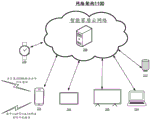
图2为本申请实施例提供的一种网络架构示意图;2 is a schematic diagram of a network architecture provided by an embodiment of the present application;
图3为本申请实施例提供的一种语音通信方法的流程示意图;3 is a schematic flowchart of a voice communication method provided by an embodiment of the present application;
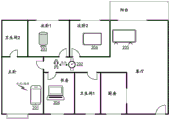
图4为本申请实施例提供的一种语音通信场景示意图;4 is a schematic diagram of a voice communication scenario provided by an embodiment of the present application;
图5为本申请另一实施例提供的一种语音通信场景示意图;FIG. 5 is a schematic diagram of a voice communication scenario provided by another embodiment of the present application;
图6为本申请另一实施例提供的一种语音通信场景示意图;FIG. 6 is a schematic diagram of a voice communication scenario provided by another embodiment of the present application;
图7为本申请另一实施例提供的一种语音通信方法的流程示意图;7 is a schematic flowchart of a voice communication method provided by another embodiment of the present application;
图8A-8C为本申请另一实施例提供的一种语音通信方法的场景示意图;8A-8C are schematic diagrams of scenarios of a voice communication method provided by another embodiment of the present application;
图9A-9C为本申请另一实施例提供的一种语音通信方法的场景示意图;9A-9C are schematic diagrams of scenarios of a voice communication method provided by another embodiment of the present application;
图10为本申请另一实施例提供的一种语音通信方法的流程示意图;10 is a schematic flowchart of a voice communication method provided by another embodiment of the present application;
图11为本申请另一实施例提供的一种网络架构示意图;FIG. 11 is a schematic diagram of a network architecture provided by another embodiment of the present application;
图12为本申请另一实施例提供的一种语音通信方法的流程示意图。FIG. 12 is a schematic flowchart of a voice communication method provided by another embodiment of the present application.
具体实施方式Detailed ways
下面将结合附图对本申请实施例中的技术方案进行清除、详尽地描述。其中,在本申请实施例的描述中,除非另有说明,“/”表示或的意思,例如,A/B可以表示A或B;文本中的“和/或”仅仅是一种描述关联对象的关联关系,表示可以存在三种关系,例如,A和/或B,可以表示:单独存在A,同时存在A和B,单独存在B这三种情况,另外,在本申请实施例的描述中,“多个”是指两个或多于两个。The technical solutions in the embodiments of the present application will be cleared and described in detail below with reference to the accompanying drawings. Wherein, in the description of the embodiments of the present application, unless otherwise specified, “/” means or, for example, A/B can mean A or B; “and/or” in the text is only a description of an associated object The association relationship indicates that there can be three kinds of relationships, for example, A and/or B can indicate that A exists alone, A and B exist at the same time, and B exists alone. In addition, in the description of the embodiments of this application , "plurality" means two or more than two.
以下,术语“第一”、“第二”仅用于描述目的,而不能理解为暗示或暗示相对重要性或者隐含指明所指示的技术特征的数量。由此,限定有“第一”、“第二”的特征可以明示或者隐含地包括一个或者更多个该特征,在本申请实施例的描述中,除非另有说明,“多个”的含义是两个或两个以上。Hereinafter, the terms "first" and "second" are only used for descriptive purposes, and should not be construed as implying or implying relative importance or implying the number of indicated technical features. Therefore, the features defined as "first" and "second" may explicitly or implicitly include one or more of the features. In the description of the embodiments of the present application, unless otherwise specified, the "multiple" The meaning is two or more.
图1示出了终端100的结构示意图。FIG. 1 shows a schematic structural diagram of a terminal 100 .
下面以终端100为例对实施例进行具体说明。应该理解的是,图1所示终端100仅是一个范例,并且终端100可以具有比图1中所示的更多的或者更少的部件,可以组合两个或多个的部件,或者可以具有不同的部件配置。图中所示出的各种部件可以在包括一个或多个信号处理和/或专用集成电路在内的硬件、软件、或硬件和软件的组合中实现。The embodiment will be specifically described below by taking the terminal 100 as an example. It should be understood that the terminal 100 shown in FIG. 1 is only an example, and the terminal 100 may have more or less components than those shown in FIG. 1 , may combine two or more components, or may have Different part configurations. The various components shown in the figures may be implemented in hardware, software, or a combination of hardware and software, including one or more signal processing and/or application specific integrated circuits.
终端100可以包括:处理器110,外部存储器接口120,内部存储器121,通用串行总线(universal serial bus,USB)接口130,充电管理模块140,电源管理模块141,电池142,天线1,天线2,移动通信模块150,无线通信模块160,音频模块170,扬声器170A,受话器170B,麦克风170C,耳机接口170D,传感器模块180,按键190,马达191,指示器192,摄像头193,显示屏194,以及用户标识模块(subscriber identification module,SIM)卡接口195等。其中传感器模块180可以包括压力传感器180A,陀螺仪传感器180B,气压传感器180C,磁传感器180D,加速度传感器180E,距离传感器180F,接近光传感器180G,指纹传感器180H,温度传感器180J,触摸传感器180K,环境光传感器180L,骨传导传感器180M等。The terminal 100 may include: a
可以理解的是,本发明实施例示意的结构并不构成对终端100的具体限定。在本申请另一些实施例中,终端100可以包括比图示更多或更少的部件,或者组合某些部件,或者拆分某些部件,或者不同的部件布置。图示的部件可以以硬件,软件或软件和硬件的组合实现。It can be understood that, the structures illustrated in the embodiments of the present invention do not constitute a specific limitation on the terminal 100 . In other embodiments of the present application, the terminal 100 may include more or less components than shown, or some components may be combined, or some components may be separated, or different component arrangements. The illustrated components may be implemented in hardware, software, or a combination of software and hardware.
处理器110可以包括一个或多个处理单元,例如:处理器110可以包括应用处理器(application processor,AP),调制解调处理器,图形处理器(graphics processingunit,GPU),图像信号处理器(image signal processor,ISP),控制器,存储器,视频编解码器,数字信号处理器(digital signal processor,DSP),基带处理器,和/或神经网络处理器(neural-network processing unit,NPU)等。其中,不同的处理单元可以是独立的器件,也可以集成在一个或多个处理器中。The
其中,控制器可以是终端100的神经中枢和指挥中心。控制器可以根据指令操作码和时序信号,产生操作控制信号,完成取指令和执行指令的控制。The controller may be the nerve center and command center of the terminal 100 . The controller can generate an operation control signal according to the instruction operation code and timing signal, and complete the control of fetching and executing instructions.
处理器110中还可以设置存储器,用于存储指令和数据。在一些实施例中,处理器110中的存储器为高速缓冲存储器。该存储器可以保存处理器110刚用过或循环使用的指令或数据。如果处理器110需要再次使用该指令或数据,可从所述存储器中直接调用。避免了重复存取,减少了处理器110的等待时间,因而提高了系统的效率。A memory may also be provided in the
在一些实施例中,处理器110可以包括一个或多个接口。接口可以包括集成电路(inter-integrated circuit,I2C)接口,集成电路内置音频(inter-integrated circuitsound,I2S)接口,脉冲编码调制(pulse code modulation,PCM)接口,通用异步收发传输器(universal asynchronous receiver/transmitter,UART)接口,移动产业处理器接口(mobile industry processor interface,MIPI),通用输入输出(general-purposeinput/output,GPIO)接口,用户标识模块(subscriber identity module,SIM)接口,和/或通用串行总线(universal serial bus,USB)接口等。In some embodiments, the
I2C接口是一种双向同步串行总线,包括一根串行数据线(serial data line,SDA)和一根串行时钟线(derail clock line,SCL)。在一些实施例中,处理器110可以包含多组I2C总线。处理器110可以通过不同的I2C总线接口分别耦合触摸传感器180K,充电器,闪光灯,摄像头193等。例如:处理器110可以通过I2C接口耦合触摸传感器180K,使处理器110与触摸传感器180K通过I2C总线接口通信,实现终端100的触摸功能。The I2C interface is a bidirectional synchronous serial bus that includes a serial data line (SDA) and a serial clock line (SCL). In some embodiments, the
I2S接口可以用于音频通信。在一些实施例中,处理器110可以包含多组I2S总线。处理器110可以通过I2S总线与音频模块170耦合,实现处理器110与音频模块170之间的通信。在一些实施例中,音频模块170可以通过I2S接口向无线通信模块160传递音频信号,实现通过蓝牙耳机接听电话的功能。The I2S interface can be used for audio communication. In some embodiments, the
PCM接口也可以用于音频通信,将模拟信号抽样,量化和编码。在一些实施例中,音频模块170与无线通信模块160可以通过PCM总线接口耦合。在一些实施例中,音频模块170也可以通过PCM接口向无线通信模块160传递音频信号,实现通过蓝牙耳机接听电话的功能。所述I2S接口和所述PCM接口都可以用于音频通信。The PCM interface can also be used for audio communications, sampling, quantizing and encoding analog signals. In some embodiments, the
UART接口是一种通用串行数据总线,用于异步通信。该总线可以为双向通信总线。它将要传输的数据在串行通信与并行通信之间转换。在一些实施例中,UART接口通常被用于连接处理器110与无线通信模块160。例如:处理器110通过UART接口与无线通信模块160中的蓝牙模块通信,实现蓝牙功能。在一些实施例中,音频模块170可以通过UART接口向无线通信模块160传递音频信号,实现通过蓝牙耳机播放音乐的功能。The UART interface is a universal serial data bus used for asynchronous communication. The bus may be a bidirectional communication bus. It converts the data to be transmitted between serial communication and parallel communication. In some embodiments, a UART interface is typically used to connect the
MIPI接口可以被用于连接处理器110与显示屏194,摄像头193等外围器件。MIPI接口包括摄像头串行接口(camera serial interface,CSI),显示屏串行接口(displayserial interface,DSI)等。在一些实施例中,处理器110和摄像头193通过CSI接口通信,实现终端100的拍摄功能。处理器110和显示屏194通过DSI接口通信,实现终端100的显示功能。The MIPI interface can be used to connect the
GPIO接口可以通过软件配置。GPIO接口可以被配置为控制信号,也可被配置为数据信号。在一些实施例中,GPIO接口可以用于连接处理器110与摄像头193,显示屏194,无线通信模块160,音频模块170,传感器模块180等。GPIO接口还可以被配置为I2C接口,I2S接口,UART接口,MIPI接口等。The GPIO interface can be configured by software. The GPIO interface can be configured as a control signal or as a data signal. In some embodiments, the GPIO interface may be used to connect the
USB接口130是符合USB标准规范的接口,具体可以是Mini USB接口,Micro USB接口,USB Type C接口等。USB接口130可以用于连接充电器为终端100充电,也可以用于终端100与外围设备之间传输数据。也可以用于连接耳机,通过耳机播放音频。该接口还可以用于连接其他电子设备,例如AR设备等。The USB interface 130 is an interface that conforms to the USB standard specification, and may specifically be a Mini USB interface, a Micro USB interface, a USB Type C interface, and the like. The USB interface 130 can be used to connect a charger to charge the terminal 100, and can also be used to transmit data between the terminal 100 and peripheral devices. It can also be used to connect headphones to play audio through the headphones. The interface can also be used to connect other electronic devices, such as AR devices.
可以理解的是,本发明实施例示意的各模块间的接口连接关系,只是示意性说明,并不构成对终端100的结构限定。在本申请另一些实施例中,终端100也可以采用上述实施例中不同的接口连接方式,或多种接口连接方式的组合。It can be understood that, the interface connection relationship between the modules illustrated in the embodiment of the present invention is only a schematic illustration, and does not constitute a structural limitation of the terminal 100 . In other embodiments of the present application, the terminal 100 may also adopt different interface connection manners in the foregoing embodiments, or a combination of multiple interface connection manners.
充电管理模块140用于从充电器接收充电输入。其中,充电器可以是无线充电器,也可以是有线充电器。在一些有线充电的实施例中,充电管理模块140可以通过USB接口130接收有线充电器的充电输入。在一些无线充电的实施例中,充电管理模块140可以通过终端100的无线充电线圈接收无线充电输入。充电管理模块140为电池142充电的同时,还可以通过电源管理模块141为电子设备供电。The
电源管理模块141用于连接电池142,充电管理模块140与处理器110。电源管理模块141接收电池142和/或充电管理模块140的输入,为处理器110,内部存储器121,外部存储器,显示屏194,摄像头193,和无线通信模块160等供电。电源管理模块141还可以用于监测电池容量,电池循环次数,电池健康状态(漏电,阻抗)等参数。在其他一些实施例中,电源管理模块141也可以设置于处理器110中。在另一些实施例中,电源管理模块141和充电管理模块140也可以设置于同一个器件中。The power management module 141 is used for connecting the battery 142 , the
终端100的无线通信功能可以通过天线1,天线2,移动通信模块150,无线通信模块160,调制解调处理器以及基带处理器等实现。The wireless communication function of the terminal 100 may be implemented by the antenna 1, the antenna 2, the
天线1和天线2用于发射和接收电磁波信号。终端100中的每个天线可用于覆盖单个或多个通信频带。不同的天线还可以复用,以提高天线的利用率。例如:可以将天线1复用为无线局域网的分集天线。在另外一些实施例中,天线可以和调谐开关结合使用。Antenna 1 and Antenna 2 are used to transmit and receive electromagnetic wave signals. Each antenna in terminal 100 may be used to cover a single or multiple communication frequency bands. Different antennas can also be reused to improve antenna utilization. For example, the antenna 1 can be multiplexed as a diversity antenna of the wireless local area network. In other embodiments, the antenna may be used in conjunction with a tuning switch.
移动通信模块150可以提供应用在终端100上的包括2G/3G/4G/5G等无线通信的解决方案。移动通信模块150可以包括至少一个滤波器,开关,功率放大器,低噪声放大器(lownoise amplifier,LNA)等。移动通信模块150可以由天线1接收电磁波,并对接收的电磁波进行滤波,放大等处理,传送至调制解调处理器进行解调。移动通信模块150还可以对经调制解调处理器调制后的信号放大,经天线1转为电磁波辐射出去。在一些实施例中,移动通信模块150的至少部分功能模块可以被设置于处理器110中。在一些实施例中,移动通信模块150的至少部分功能模块可以与处理器110的至少部分模块被设置在同一个器件中。The
调制解调处理器可以包括调制器和解调器。其中,调制器用于将待发送的低频基带信号调制成中高频信号。解调器用于将接收的电磁波信号解调为低频基带信号。随后解调器将解调得到的低频基带信号传送至基带处理器处理。低频基带信号经基带处理器处理后,被传递给应用处理器。应用处理器通过音频设备(不限于扬声器170A,受话器170B等)输出声音信号,或通过显示屏194显示图像或视频。在一些实施例中,调制解调处理器可以是独立的器件。在另一些实施例中,调制解调处理器可以独立于处理器110,与移动通信模块150或其他功能模块设置在同一个器件中。The modem processor may include a modulator and a demodulator. Wherein, the modulator is used to modulate the low frequency baseband signal to be sent into a medium and high frequency signal. The demodulator is used to demodulate the received electromagnetic wave signal into a low frequency baseband signal. Then the demodulator transmits the demodulated low-frequency baseband signal to the baseband processor for processing. The low frequency baseband signal is processed by the baseband processor and passed to the application processor. The application processor outputs sound signals through audio devices (not limited to the speaker 170A, the
无线通信模块160可以提供应用在终端100上的包括无线局域网(wireless localarea networks,WLAN)(如无线保真(wireless fidelity,Wi-Fi)网络),蓝牙(bluetooth,BT),全球导航卫星系统(global navigation satellite system,GNSS),调频(frequencymodulation,FM),近距离无线通信技术(near field communication,NFC),红外技术(infrared,IR)等无线通信的解决方案。无线通信模块160可以是集成至少一个通信处理模块的一个或多个器件。无线通信模块160经由天线2接收电磁波,将电磁波信号调频以及滤波处理,将处理后的信号发送到处理器110。无线通信模块160还可以从处理器110接收待发送的信号,对其进行调频,放大,经天线2转为电磁波辐射出去。The wireless communication module 160 may provide applications on the terminal 100 including wireless local area networks (WLAN) (such as wireless fidelity (Wi-Fi) networks), bluetooth (BT), global navigation satellite system ( global navigation satellite system, GNSS), frequency modulation (frequency modulation, FM), near field communication technology (near field communication, NFC), infrared technology (infrared, IR) and other wireless communication solutions. The wireless communication module 160 may be one or more devices integrating at least one communication processing module. The wireless communication module 160 receives electromagnetic waves via the antenna 2 , frequency modulates and filters the electromagnetic wave signals, and sends the processed signals to the
在一些实施例中,终端100的天线1和移动通信模块150耦合,天线2和无线通信模块160耦合,使得终端100可以通过无线通信技术与网络以及其他设备通信。所述无线通信技术可以包括全球移动通讯系统(global system for mobile communications,GSM),通用分组无线服务(general packet radio service,GPRS),码分多址接入(code divisionmultiple access,CDMA),宽带码分多址(wideband code division multiple access,WCDMA),时分码分多址(time-division code division multiple access,TD-SCDMA),长期演进(long term evolution,LTE),BT,GNSS,WLAN,NFC,FM,和/或IR技术等。所述GNSS可以包括全球卫星定位系统(global positioning system,GPS),全球导航卫星系统(globalnavigation satellite system,GLONASS),北斗卫星导航系统(beidou navigationsatellite system,BDS),准天顶卫星系统(quasi-zenith satellite system,QZSS)和/或星基增强系统(satellite based augmentation systems,SBAS)。In some embodiments, the antenna 1 of the terminal 100 is coupled with the
终端100通过GPU,显示屏194,以及应用处理器等实现显示功能。GPU为图像处理的微处理器,连接显示屏194和应用处理器。GPU用于执行数学和几何计算,用于图形渲染。处理器110可包括一个或多个GPU,其执行程序指令以生成或改变显示信息。The terminal 100 implements a display function through a GPU, a display screen 194, an application processor, and the like. The GPU is a microprocessor for image processing, and is connected to the display screen 194 and the application processor. The GPU is used to perform mathematical and geometric calculations for graphics rendering.
显示屏194用于显示图像,视频等。显示屏194包括显示面板。显示面板可以采用液晶显示屏(liquid crystal display,LCD),有机发光二极管(organic light-emittingdiode,OLED),有源矩阵有机发光二极体或主动矩阵有机发光二极体(active-matrixorganic light emitting diode 的,AMOLED),柔性发光二极管(flex light-emittingdiode,FLED),Miniled,MicroLed,Micro-oLed,量子点发光二极管(quantum dot lightemitting diodes,QLED)等。在一些实施例中,终端100可以包括1个或N个显示屏194,N为大于1的正整数。Display screen 194 is used to display images, videos, and the like. Display screen 194 includes a display panel. The display panel can be a liquid crystal display (LCD), an organic light-emitting diode (OLED), an active-matrix organic light-emitting diode or an active-matrix organic light-emitting diode (active-matrix organic light-emitting diode). , AMOLED), flexible light-emitting diode (flex light-emitting diode, FLED), Miniled, MicroLed, Micro-oLed, quantum dot light-emitting diodes (quantum dot light emitting diodes, QLED) and so on. In some embodiments, the terminal 100 may include one or N display screens 194 , where N is a positive integer greater than one.
终端100可以通过ISP,摄像头193,视频编解码器,GPU,显示屏194以及应用处理器等实现拍摄功能。The terminal 100 can realize the shooting function through the ISP, the camera 193, the video codec, the GPU, the display screen 194 and the application processor.
ISP用于处理摄像头193反馈的数据。例如,拍照时,打开快门,光线通过镜头被传递到摄像头感光元件上,光信号转换为电信号,摄像头感光元件将所述电信号传递给ISP处理,转化为肉眼可见的图像。ISP还可以对图像的噪点,亮度,肤色进行算法优化。ISP还可以对拍摄场景的曝光,色温等参数优化。在一些实施例中,ISP可以设置在摄像头193中。The ISP is used to process the data fed back by the camera 193 . For example, when taking a photo, the shutter is opened, the light is transmitted to the camera photosensitive element through the lens, the light signal is converted into an electrical signal, and the camera photosensitive element transmits the electrical signal to the ISP for processing, and converts it into an image visible to the naked eye. ISP can also perform algorithm optimization on image noise, brightness, and skin tone. ISP can also optimize the exposure, color temperature and other parameters of the shooting scene. In some embodiments, the ISP may be provided in the camera 193 .
摄像头193用于捕获静态图像或视频。物体通过镜头生成光学图像投射到感光元件。感光元件可以是电荷耦合器件(charge coupled device,CCD)或互补金属氧化物半导体(complementary metal-oxide-semiconductor,CMOS)光电晶体管。感光元件把光信号转换成电信号,之后将电信号传递给ISP转换成数字图像信号。ISP将数字图像信号输出到DSP加工处理。DSP将数字图像信号转换成标准的RGB,YUV等格式的图像信号。在一些实施例中,终端100可以包括1个或N个摄像头193,N为大于1的正整数。Camera 193 is used to capture still images or video. The object is projected through the lens to generate an optical image onto the photosensitive element. The photosensitive element may be a charge coupled device (CCD) or a complementary metal-oxide-semiconductor (CMOS) phototransistor. The photosensitive element converts the optical signal into an electrical signal, and then transmits the electrical signal to the ISP to convert it into a digital image signal. The ISP outputs the digital image signal to the DSP for processing. DSP converts digital image signals into standard RGB, YUV and other formats of image signals. In some embodiments, the terminal 100 may include 1 or N cameras 193 , where N is a positive integer greater than 1.
数字信号处理器用于处理数字信号,除了可以处理数字图像信号,还可以处理其他数字信号。例如,当终端100在频点选择时,数字信号处理器用于对频点能量进行傅里叶变换等。A digital signal processor is used to process digital signals, in addition to processing digital image signals, it can also process other digital signals. For example, when the terminal 100 selects a frequency point, the digital signal processor is used to perform Fourier transform on the energy of the frequency point, and so on.
视频编解码器用于对数字视频压缩或解压缩。终端100可以支持一种或多种视频编解码器。这样,终端100可以播放或录制多种编码格式的视频,例如:动态图像专家组(moving picture experts group,MPEG)1,MPEG2,MPEG3,MPEG4等。Video codecs are used to compress or decompress digital video. Terminal 100 may support one or more video codecs. In this way, the terminal 100 can play or record videos in various encoding formats, such as: Moving Picture Experts Group (moving picture experts group, MPEG) 1, MPEG2, MPEG3, MPEG4 and so on.
NPU为神经网络(neural-network,NN)计算处理器,通过借鉴生物神经网络结构,例如借鉴人脑神经元之间传递模式,对输入信息快速处理,还可以不断的自学习。通过NPU可以实现终端100的智能认知等应用,例如:图像识别,人脸识别,语音识别,文本理解等。The NPU is a neural-network (NN) computing processor. By drawing on the structure of biological neural networks, such as the transfer mode between neurons in the human brain, it can quickly process the input information, and can continuously learn by itself. Applications such as intelligent cognition of the terminal 100 can be implemented through the NPU, such as image recognition, face recognition, speech recognition, text understanding, and the like.
外部存储器接口120可以用于连接外部存储卡,例如Micro SD卡,实现扩展终端100的存储能力。外部存储卡通过外部存储器接口120与处理器110通信,实现数据存储功能。例如将音乐,视频等文件保存在外部存储卡中。The
内部存储器121可以用于存储计算机可执行程序代码,所述可执行程序代码包括指令。处理器110通过运行存储在内部存储器121的指令,从而执行终端100的各种功能应用以及数据处理。内部存储器121可以包括存储程序区和存储数据区。其中,存储程序区可存储操作系统,至少一个功能所需的应用程序(比如声音播放功能,图像播放功能等)等。存储数据区可存储终端100使用过程中所创建的数据(比如音频数据,电话本等)等。此外,内部存储器121可以包括高速随机存取存储器,还可以包括非易失性存储器,例如至少一个磁盘存储器件,闪存器件,通用闪存存储器(universal flash storage,UFS)等。Internal memory 121 may be used to store computer executable program code, which includes instructions. The
终端100可以通过音频模块170,扬声器170A,受话器170B,麦克风170C,耳机接口170D,以及应用处理器等实现音频功能。例如音乐播放,录音等。The terminal 100 may implement audio functions through an
音频模块170用于将数字音频信息转换成模拟音频信号输出,也用于将模拟音频输入转换为数字音频信号。音频模块170还可以用于对音频信号编码和解码。在一些实施例中,音频模块170可以设置于处理器110中,或将音频模块170的部分功能模块设置于处理器110中。The
扬声器170A,也称“喇叭”,用于将音频电信号转换为声音信号。终端100可以通过扬声器170A收听音乐,或收听免提通话。Speaker 170A, also referred to as a "speaker", is used to convert audio electrical signals into sound signals. The terminal 100 can listen to music through the speaker 170A, or listen to a hands-free call.
受话器170B,也称“听筒”,用于将音频电信号转换成声音信号。当终端100接听电话或语音信息时,可以通过将受话器170B靠近人耳接听语音。The
麦克风170C,也称“话筒”,“传声器”,用于将声音信号转换为电信号。当拨打电话或发送语音信息时,用户可以通过人嘴靠近麦克风170C发声,将声音信号输入到麦克风170C。终端100可以设置至少一个麦克风170C。在另一些实施例中,终端100可以设置两个麦克风170C,除了采集声音信号,还可以实现降噪功能。在另一些实施例中,终端100还可以设置三个,四个或更多麦克风170C,实现采集声音信号,降噪,还可以识别声音来源,实现定向录音功能等。The
耳机接口170D用于连接有线耳机。耳机接口170D可以是USB接口130,也可以是3.5mm的开放移动电子设备平台(open mobile terminal platform,OMTP)标准接口,美国蜂窝电信工业协会(cellular telecommunications industry association of the USA,CTIA)标准接口。The earphone jack 170D is used to connect wired earphones. The earphone port 170D may be the USB port 130 or a 3.5mm open mobile terminal platform (OMTP) standard port, a cellular telecommunications industry association of the USA (CTIA) standard port.
压力传感器180A用于感受压力信号,可以将压力信号转换成电信号。在一些实施例中,压力传感器180A可以设置于显示屏194。压力传感器180A的种类很多,如电阻式压力传感器,电感式压力传感器,电容式压力传感器等。电容式压力传感器可以是包括至少两个具有导电材料的平行板。当有力作用于压力传感器180A,电极之间的电容改变。终端100根据电容的变化确定压力的强度。当有触摸操作作用于显示屏194,终端100根据压力传感器180A检测所述触摸操作强度。终端100也可以根据压力传感器180A的检测信号计算触摸的位置。在一些实施例中,作用于相同触摸位置,但不同触摸操作强度的触摸操作,可以对应不同的操作指令。例如:当有触摸操作强度小于第一压力阈值的触摸操作作用于短消息应用图标时,执行查看短消息的指令。当有触摸操作强度大于或等于第一压力阈值的触摸操作作用于短消息应用图标时,执行新建短消息的指令。The pressure sensor 180A is used to sense pressure signals, and can convert the pressure signals into electrical signals. In some embodiments, the pressure sensor 180A may be provided on the display screen 194 . There are many types of pressure sensors 180A, such as resistive pressure sensors, inductive pressure sensors, capacitive pressure sensors, and the like. The capacitive pressure sensor may be comprised of at least two parallel plates of conductive material. When a force is applied to the pressure sensor 180A, the capacitance between the electrodes changes. The terminal 100 determines the intensity of the pressure according to the change in capacitance. When a touch operation acts on the display screen 194, the terminal 100 detects the intensity of the touch operation according to the pressure sensor 180A. The terminal 100 may also calculate the touched position according to the detection signal of the pressure sensor 180A. In some embodiments, touch operations acting on the same touch position but with different touch operation intensities may correspond to different operation instructions. For example, when a touch operation whose intensity is less than the first pressure threshold acts on the short message application icon, the instruction for viewing the short message is executed. When a touch operation with a touch operation intensity greater than or equal to the first pressure threshold acts on the short message application icon, the instruction to create a new short message is executed.
陀螺仪传感器180B可以用于确定终端100的运动姿态。在一些实施例中,可以通过陀螺仪传感器180B确定终端100围绕三个轴(即,x,y和z轴)的角速度。陀螺仪传感器180B可以用于拍摄防抖。示例性的,当按下快门,陀螺仪传感器180B检测终端100抖动的角度,根据角度计算出镜头模组需要补偿的距离,让镜头通过反向运动抵消终端100的抖动,实现防抖。陀螺仪传感器180B还可以用于导航,体感游戏场景。The gyro sensor 180B may be used to determine the motion attitude of the terminal 100 . In some embodiments, the angular velocity of terminal 100 about three axes (ie, x, y, and z axes) may be determined by gyro sensor 180B. The gyro sensor 180B can be used for image stabilization. Exemplarily, when the shutter is pressed, the gyroscope sensor 180B detects the angle at which the terminal 100 shakes, calculates the distance to be compensated by the lens module according to the angle, and allows the lens to counteract the shake of the terminal 100 through reverse motion to achieve anti-shake. The gyro sensor 180B can also be used for navigation and somatosensory game scenarios.
气压传感器180C用于测量气压。在一些实施例中,终端100通过气压传感器180C测得的气压值计算海拔高度,辅助定位和导航。The air pressure sensor 180C is used to measure air pressure. In some embodiments, the terminal 100 calculates the altitude through the air pressure value measured by the air pressure sensor 180C to assist in positioning and navigation.
磁传感器180D包括霍尔传感器。终端100可以利用磁传感器180D检测翻盖皮套的开合。在一些实施例中,当终端100是翻盖机时,终端100可以根据磁传感器180D检测翻盖的开合。进而根据检测到的皮套的开合状态或翻盖的开合状态,设置翻盖自动解锁等特性。The magnetic sensor 180D includes a Hall sensor. The terminal 100 can detect the opening and closing of the flip holster using the magnetic sensor 180D. In some embodiments, when the terminal 100 is a flip machine, the terminal 100 can detect the opening and closing of the flip according to the magnetic sensor 180D. Further, according to the detected opening and closing state of the leather case or the opening and closing state of the flip cover, characteristics such as automatic unlocking of the flip cover are set.
加速度传感器180E可检测终端100在各个方向上(一般为三轴)加速度的大小。当终端100静止时可检测出重力的大小及方向。还可以用于识别电子设备姿态,应用于横竖屏切换,计步器等应用。The acceleration sensor 180E can detect the magnitude of the acceleration of the terminal 100 in various directions (generally three axes). When the terminal 100 is stationary, the magnitude and direction of gravity can be detected. It can also be used to identify the posture of electronic devices, and can be used in applications such as horizontal and vertical screen switching, pedometers, etc.
距离传感器180F,用于测量距离。终端100可以通过红外或激光测量距离。在一些实施例中,拍摄场景,终端100可以利用距离传感器180F测距以实现快速对焦。Distance sensor 180F for measuring distance. The terminal 100 can measure the distance through infrared or laser. In some embodiments, when shooting a scene, the terminal 100 can use the distance sensor 180F to measure the distance to achieve fast focusing.
接近光传感器180G可以包括例如发光二极管(LED)和光检测器,例如光电二极管。发光二极管可以是红外发光二极管。终端100通过发光二极管向外发射红外光。终端100使用光电二极管检测来自附近物体的红外反射光。当检测到充分的反射光时,可以确定终端100附近有物体。当检测到不充分的反射光时,终端100可以确定终端100附近没有物体。终端100可以利用接近光传感器180G检测用户手持终端100贴近耳朵通话,以便自动熄灭屏幕达到省电的目的。接近光传感器180G也可用于皮套模式,口袋模式自动解锁与锁屏。Proximity light sensor 180G may include, for example, light emitting diodes (LEDs) and light detectors, such as photodiodes. The light emitting diodes may be infrared light emitting diodes. The terminal 100 emits infrared light to the outside through light emitting diodes. The terminal 100 detects infrared reflected light from nearby objects using a photodiode. When sufficient reflected light is detected, it can be determined that there is an object near the terminal 100 . When insufficient reflected light is detected, the terminal 100 may determine that there is no object near the terminal 100 . The terminal 100 can use the proximity light sensor 180G to detect that the user holds the terminal 100 close to the ear to talk, so as to automatically turn off the screen to save power. Proximity light sensor 180G can also be used in holster mode, pocket mode automatically unlocks and locks the screen.
环境光传感器180L用于感知环境光亮度。终端100可以根据感知的环境光亮度自适应调节显示屏194亮度。环境光传感器180L也可用于拍照时自动调节白平衡。环境光传感器180L还可以与接近光传感器180G配合,检测终端100是否在口袋里,以防误触。The ambient light sensor 180L is used to sense ambient light brightness. The terminal 100 can adaptively adjust the brightness of the display screen 194 according to the perceived ambient light brightness. The ambient light sensor 180L can also be used to automatically adjust the white balance when taking pictures. The ambient light sensor 180L can also cooperate with the proximity light sensor 180G to detect whether the terminal 100 is in a pocket, so as to prevent accidental touch.
指纹传感器180H用于采集指纹。终端100可以利用采集的指纹特性实现指纹解锁,访问应用锁,指纹拍照,指纹接听来电等。The fingerprint sensor 180H is used to collect fingerprints. The terminal 100 can use the collected fingerprint characteristics to unlock the fingerprint, access the application lock, take a picture with the fingerprint, answer the incoming call with the fingerprint, and the like.
温度传感器180J用于检测温度。在一些实施例中,终端100利用温度传感器180J检测的温度,执行温度处理策略。例如,当温度传感器180J上报的温度超过阈值,终端100执行降低位于温度传感器180J附近的处理器的性能,以便降低功耗实施热保护。在另一些实施例中,当温度低于另一阈值时,终端100对电池142加热,以避免低温导致终端100异常关机。在其他一些实施例中,当温度低于又一阈值时,终端100对电池142的输出电压执行升压,以避免低温导致的异常关机。The temperature sensor 180J is used to detect the temperature. In some embodiments, the terminal 100 uses the temperature detected by the temperature sensor 180J to execute a temperature processing strategy. For example, when the temperature reported by the temperature sensor 180J exceeds a threshold value, the terminal 100 reduces the performance of the processor located near the temperature sensor 180J, so as to reduce power consumption and implement thermal protection. In other embodiments, when the temperature is lower than another threshold, the terminal 100 heats the battery 142 to avoid abnormal shutdown of the terminal 100 due to low temperature. In some other embodiments, when the temperature is lower than another threshold, the terminal 100 boosts the output voltage of the battery 142 to avoid abnormal shutdown caused by low temperature.
触摸传感器180K,也称“触控面板”。触摸传感器180K可以设置于显示屏194,由触摸传感器180K与显示屏194组成触摸屏,也称“触控屏”。触摸传感器180K用于检测作用于其上或附近的触摸操作。触摸传感器可以将检测到的触摸操作传递给应用处理器,以确定触摸事件类型。可以通过显示屏194提供与触摸操作相关的视觉输出。在另一些实施例中,触摸传感器180K也可以设置于终端100的表面,与显示屏194所处的位置不同。Touch sensor 180K, also called "touch panel". The touch sensor 180K may be disposed on the display screen 194 , and the touch sensor 180K and the display screen 194 form a touch screen, also called a “touch screen”. The touch sensor 180K is used to detect a touch operation on or near it. The touch sensor can pass the detected touch operation to the application processor to determine the type of touch event. Visual output related to touch operations may be provided through display screen 194 . In other embodiments, the touch sensor 180K may also be disposed on the surface of the terminal 100 , which is different from the position where the display screen 194 is located.
骨传导传感器180M可以获取振动信号。在一些实施例中,骨传导传感器180M可以获取人体声部振动骨块的振动信号。骨传导传感器180M也可以接触人体脉搏,接收血压跳动信号。在一些实施例中,骨传导传感器180M也可以设置于耳机中,结合成骨传导耳机。音频模块170可以基于所述骨传导传感器180M获取的声部振动骨块的振动信号,解析出语音信号,实现语音功能。应用处理器可以基于所述骨传导传感器180M获取的血压跳动信号解析心率信息,实现心率检测功能。The bone conduction sensor 180M can acquire vibration signals. In some embodiments, the bone conduction sensor 180M can acquire the vibration signal of the vibrating bone mass of the human voice. The bone conduction sensor 180M can also contact the pulse of the human body and receive the blood pressure beating signal. In some embodiments, the bone conduction sensor 180M can also be disposed in the earphone, combined with the bone conduction earphone. The
按键190包括开机键,音量键等。按键190可以是机械按键。也可以是触摸式按键。终端100可以接收按键输入,产生与终端100的用户设置以及功能控制有关的键信号输入。The keys 190 include a power-on key, a volume key, and the like. Keys 190 may be mechanical keys. It can also be a touch key. The terminal 100 may receive key input and generate key signal input related to user settings and function control of the terminal 100 .
马达191可以产生振动提示。马达191可以用于来电振动提示,也可以用于触摸振动反馈。例如,作用于不同应用(例如拍照,音频播放等)的触摸操作,可以对应不同的振动反馈效果。作用于显示屏194不同区域的触摸操作,马达191也可对应不同的振动反馈效果。不同的应用场景(例如:时间提醒,接收信息,闹钟,游戏等)也可以对应不同的振动反馈效果。触摸振动反馈效果还可以支持自定义。Motor 191 can generate vibrating cues. The motor 191 can be used for vibrating alerts for incoming calls, and can also be used for touch vibration feedback. For example, touch operations acting on different applications (such as taking pictures, playing audio, etc.) can correspond to different vibration feedback effects. The motor 191 can also correspond to different vibration feedback effects for touch operations on different areas of the display screen 194 . Different application scenarios (for example: time reminder, receiving information, alarm clock, games, etc.) can also correspond to different vibration feedback effects. The touch vibration feedback effect can also support customization.
指示器192可以是指示灯,可以用于指示充电状态,电量变化,也可以用于指示消息,未接来电,通知等。The indicator 192 can be an indicator light, which can be used to indicate the charging state, the change of the power, and can also be used to indicate a message, a missed call, a notification, and the like.
SIM卡接口195用于连接SIM卡。SIM卡可以通过插入SIM卡接口195,或从SIM卡接口195拔出,实现和终端100的接触和分离。终端100可以支持1个或N个SIM卡接口,N为大于1的正整数。SIM卡接口195可以支持Nano SIM卡,Micro SIM卡,SIM卡等。同一个SIM卡接口195可以同时插入多张卡。所述多张卡的类型可以相同,也可以不同。SIM卡接口195也可以兼容不同类型的SIM卡。SIM卡接口195也可以兼容外部存储卡。终端100通过SIM卡和网络交互,实现通话以及数据通信等功能。在一些实施例中,终端100采用eSIM,即:嵌入式SIM卡。eSIM卡可以嵌在终端100中,不能和终端100分离。The
目前,在现有技术中,当用户不方便在移动终端上接听电话时,用户可以通过如下方式转接电话:1、用户提前开启移动终端呼叫转移功能,并让用户填写接听终端的电话号码,移动终端可以将接听终端的电话号码发送给移动通信网的网络侧设备,网络侧设备可以将移动终端的号码与接听终端的电话号码绑定在一起,当网络侧设备接收到针对移动终端的呼叫请求时,网络侧设备可以将针对移动终端的呼叫请求,转移至接听终端上,从而可以让接听终端接听打给移动终端的电话。但是这样,一旦用户开启移动终端呼叫转移功能之后,打给移动终端的所有电话,都会被转移至接听终端,若用户想继续使用移动终端接听电话,却忘记关闭呼叫转移功能时,会漏接很多电话,给用户造成了不便。At present, in the prior art, when the user is inconvenient to answer the call on the mobile terminal, the user can transfer the call in the following ways: 1. The user enables the call forwarding function of the mobile terminal in advance, and asks the user to fill in the phone number of the answering terminal, The mobile terminal can send the phone number of the answering terminal to the network-side device of the mobile communication network, and the network-side device can bind the mobile terminal's number with the phone number of the answering terminal. When the network-side device receives a call for the mobile terminal When requested, the network side device can transfer the call request for the mobile terminal to the answering terminal, so that the answering terminal can answer the call to the mobile terminal. But in this way, once the user turns on the call forwarding function of the mobile terminal, all calls made to the mobile terminal will be forwarded to the answering terminal. If the user wants to continue to use the mobile terminal to answer calls, but forgets to turn off the call forwarding function, many calls will be missed. phone, causing inconvenience to users.
2、用户可以将移动终端通过蓝牙或Wi-Fi技术,与耳机或音箱相连,当移动终端接听到来电时,移动终端会默认将来电呼叫和语音通话转移至耳机或音箱,并通过耳机或者音箱采集用户的声音。当用户需要用移动终端来进行通话时,移动终端需要接收用户选择输入,才能够将通话切换回移动终端上,给用户造成了繁杂的操作步骤,且在用户切换语音通话的过程中,用户容易漏掉部分通话内容,给用户造成了不便。2. The user can connect the mobile terminal to the headset or speaker through Bluetooth or Wi-Fi technology. When the mobile terminal receives an incoming call, the mobile terminal will transfer the incoming call and voice call to the headset or speaker by default, and use the headset or speaker. Capture the user's voice. When the user needs to use the mobile terminal to make a call, the mobile terminal needs to receive the user's selection input to switch the call back to the mobile terminal, which causes complicated operation steps for the user, and in the process of switching the voice call, the user easily Missing part of the call content caused inconvenience to the user.
针对上述问题,本申请提出了一种语音通信方法,实现了在终端接收到语音来电之后,若终端被占用或超时未接听,终端可以从家庭局域网内其他具备通话能力的终端中,根据各终端的语音能力参数(例如语音能力优先级m、通话频率n、用户声音能量值x、用户位置值y、设备状态值s等),确定出最优的接听终端,并将来电呼叫与语音通话转移至该接听终端上。这样,通过家庭中各通话终端之间的来电呼叫与语音通话的转移,避免了用户漏接通话终端上的语音来电,提高了用户体验。In view of the above problems, the present application proposes a voice communication method, which realizes that after the terminal receives a voice call, if the terminal is occupied or does not answer the call after a timeout, the terminal can select from other terminals capable of calling in the home local area network, according to each terminal. voice capability parameters (such as voice capability priority m, call frequency n, user voice energy value x, user location value y, device status value s, etc.), determine the optimal answering terminal, and transfer incoming calls to voice calls to the answering terminal. In this way, by transferring the incoming call and the voice call between the various call terminals in the family, it is avoided that the user misses the voice call on the call terminal, and the user experience is improved.
下面介绍本申请实施例提供的一种网络架构。The following introduces a network architecture provided by an embodiment of the present application.
请参照图2,图2示出了本申请实施例中提供的一种网络架构200示意图。如图2所示,该网络架构200包括多个终端。其中,该终端可以包括智能手机201、智能手表202、智能音箱203、个人电脑204、智能电视205、平板电脑206等,本申请对此不作任何限制。Please refer to FIG. 2 , which shows a schematic diagram of a network architecture 200 provided in an embodiment of the present application. As shown in FIG. 2, the network architecture 200 includes a plurality of terminals. The terminal may include a
其中,该多个终端都可以具备通话能力,该多个终端可以通过如下方式接收到呼叫与通通话:1、该多个终端都可以接收来自移动通信网中电路交换域(circuit switcheddomain,CS域)的来电呼叫或通话。2、该多个终端可以接收来自移动通信网中IP多媒体子系统(IP multimedia subsystem,IMS)中基于VoLTE技术的来电呼叫或通话。3、该多个终端可以接收来自因特网(Internet)中基于VoIP技术的来电呼叫或通话。Wherein, the multiple terminals can all have the ability to talk, and the multiple terminals can receive calls and make calls in the following ways: 1. The multiple terminals can receive calls from the circuit switched domain (CS domain, CS domain) in the mobile communication network. ) for incoming calls or calls. 2. The multiple terminals can receive incoming calls or calls based on the VoLTE technology in an IP multimedia subsystem (IP multimedia subsystem, IMS) in the mobile communication network. 3. The multiple terminals can receive incoming calls or calls from the Internet (Internet) based on the VoIP technology.
该多个终端都可以通过有线或无线保真(wireless fidelity,WiFi)连接的方式连接至局域网(local area network,LAN)。在该网络架构200中的终端的结构可以参考上述图1所示的终端100,在此不再赘述。比如该多个终端连接到同一个路由器。The multiple terminals can all be connected to a local area network (LAN) through a wired or wireless fidelity (wireless fidelity, WiFi) connection. For the structure of the terminal in the network architecture 200, reference may be made to the terminal 100 shown in FIG. 1, which is not repeated here. For example, the multiple terminals are connected to the same router.
在一种可能的实现方式中,该网络架构200的局域网中还包括有中枢设备207,该中枢设备207可以与网络架构200中的多个终端(例如终端201、终端202、终端203、终端204、终端205和终端206。)连接。该中枢设备207可以是路由器、网关、智能设备控制器等。该中枢设备207可以包括有存储器、处理器和收发器,存储器可以用于存储有该多个终端各自的语音能力参数(例如语音能力优先级m、通话频率n、声纹能量值x,用户位置值y,设备状态值s等)。处理器可以用于当连接到局域网的某个终端需要转接来电时,从多个终端各自的语音能力参数中,确定出接听终端。收发器可用于与连接到局域网的该多个终端进行通信。In a possible implementation manner, the local area network of the network architecture 200 further includes a
在一种可能的实现方式中,该网络架构200的还包括服务器208,其中,该服务器208可以是智能家居云网络中的服务器,其数量不限于一个,可以是多个,在此不作限定。其中,该服务器208可以包括存储器、处理器和收发器,其中,存储器可以用于存储有该多个终端各自的语音能力参数(例如语音能力优先级m,通话频率n,声纹能量值x,用户位置值y,设备状态值s等)。收发器可以用于与局域网中各终端进行通信。处理器可用于处理局域网中各终端的获取数据请求,并指示收发器下发多个终端各自的语音能力参数给各终端。In a possible implementation manner, the network architecture 200 further includes a
下面结合上述图2所示的网络架构200,以及应用场景,具体解释本申请实施例提供的一种语音通信方法。在本申请实施例中,接收到语音来电的终端可以被称为第一终端,接听终端可以被称为第二终端。In the following, a voice communication method provided by an embodiment of the present application is explained in detail with reference to the network architecture 200 shown in FIG. 2 and an application scenario. In this embodiment of the present application, a terminal that receives an incoming voice call may be referred to as a first terminal, and a terminal that receives an incoming call may be referred to as a second terminal.
在一些应用场景中,家庭内的局域网中具有多个具备通话能力的终端,例如智能手机、智能手表、智能音箱、个人电脑、智能电视和智能平板等。用户可以通过任一终端(例如智能手机)接收到语音来电,当用户长时间未接听时,或者来电设备已经被占用(例如正在通话中),用户可能会漏接来电,给用户造成不便。因此,本申请实施例提供了一种语音通信方法,终端1(例如智能手机)接收到来电后,当终端1超时未接收到用户的接听操作或者该终端已经被占用(例如正在通话中)时,终端1可以根据其他终端的语音能力参数(例如语音能力优先级m,通话频率n,声纹能量值x,用户位置y,设备状态值s等),确定出该来电的接听终端(例如智能电视),并将来电转移至接听终端(例如智能电视)上。这样,可以避免用户错过终端上的来电,提高了用户体验。In some application scenarios, there are multiple terminals capable of calling in the local area network in the home, such as smart phones, smart watches, smart speakers, personal computers, smart TVs, and smart tablets. A user can receive a voice call through any terminal (such as a smart phone). When the user does not answer for a long time, or the calling device is already occupied (for example, during a call), the user may miss an incoming call, causing inconvenience to the user. Therefore, the embodiment of the present application provides a voice communication method. After the terminal 1 (such as a smart phone) receives an incoming call, when the terminal 1 times out and does not receive an answering operation from the user or the terminal is already occupied (such as during a call) , the terminal 1 can determine the answering terminal (such as a smart phone) according to the voice capability parameters of other terminals (such as voice capability priority m, call frequency n, voiceprint energy value x, user location y, device status value s, etc.). TV), and transfer the incoming call to the answering terminal (such as a smart TV). In this way, the user can be prevented from missing an incoming call on the terminal, thereby improving the user experience.
请参照图3,图3示出了本申请实施例中提供的一种语音通信方法。其中,局域网中可以包括N个具备通话能力的终端,N为大于2的整数。局域网是指N个具备通话能力的终端都连接在一个路由器上构成的计算机网络。其中,局域网中的多个具备通话能力的终端可以绑定有同一个用户账号。在图3所示实施例中,任一个接收到来电的终端都可以被称为终端1。例如智能手机接收到来电时,智能手机可以被称为终端1,当智能电视接收到来电时,智能电视可以被称为终端1,在此不作任何限定。如图3所示,该方法包括:Referring to FIG. 3 , FIG. 3 shows a voice communication method provided in an embodiment of the present application. Wherein, the local area network may include N terminals with call capability, where N is an integer greater than 2. A local area network refers to a computer network in which N terminals with call capability are connected to a router. Wherein, multiple terminals with call capability in the local area network may be bound to the same user account. In the embodiment shown in FIG. 3 , any terminal that receives an incoming call may be referred to as terminal 1 . For example, when a smart phone receives an incoming call, the smart phone can be referred to as terminal 1, and when a smart TV receives an incoming call, the smart TV can be referred to as terminal 1, which is not limited herein. As shown in Figure 3, the method includes:
S301、终端1接收到来电。S301. Terminal 1 receives an incoming call.
其中,该来电可以指语音来电。联系人的终端(即发起呼叫的终端)可以通过移动通信网络中CS域拨打语音电话给终端1,联系人的终端还可以通过移动通信网络中IMS网络拨打基于VoLTE技术的语音电话给终端1,联系人的终端还可以通过因特网(Internet)拨打基于VoIP技术的语音电话给终端1。The incoming call may refer to a voice incoming call. The terminal of the contact (that is, the terminal that initiates the call) can make a voice call to the terminal 1 through the CS domain in the mobile communication network, and the terminal of the contact can also make a voice call based on the VoLTE technology to the terminal 1 through the IMS network in the mobile communication network, The terminal of the contact person can also make a voice call based on the VoIP technology to the terminal 1 through the Internet (Internet).
S302、终端1输出来电提醒。S302, the terminal 1 outputs an incoming call reminder.
终端1在接收到联系人的终端拨打过来的电话后,可以输出来电提醒。其中,该来电提醒可以包括以下至少一种:铃声提醒、机械振动提醒和来电显示提醒(例如终端1在显示屏上显示联系人的联系方式等)。After receiving the call from the contact's terminal, the terminal 1 can output an incoming call reminder. The incoming call reminder may include at least one of the following: a ringtone reminder, a mechanical vibration reminder, and an incoming call display reminder (for example, the terminal 1 displays the contact information of the contact on the display screen, etc.).
S303、终端1判断是否开启通话转移功能,若是,则S304、终端1与局域网中的其他各终端建立连接。若否,则终端1与局域网中的其他各终端不建立连接。In S303, the terminal 1 determines whether the call transfer function is enabled, and if so, in S304, the terminal 1 establishes a connection with other terminals in the local area network. If not, the terminal 1 does not establish a connection with other terminals in the local area network.
其中,终端1可以在接收到联系人的来电之前,接收用户的设置输入,响应于用户的设置输入,终端1可以开启或关闭通话转移功能。这样,终端1可以根据用户的需求,转移接收到的来电,提高了用户的体验。可以理解地,通话转移功能是将本终端收到的来电呼叫或语音通话转出到其他终端上,由其他终端进行来电提醒,和/或采集用户的语音,播放来电方(即联系人)的语音。当终端1开启通话转移功能时,终端1接收到来电且需要将来电转出,则终端1收到的来电呼叫转出到其他终端上,由其他终端进行来电提醒,当其他终端上检测到用户接听来电,终端1将语音通话转移到其他终端上。当终端1开启通话转移功能时,终端1正在进行语音通话且需要将通话转出,则终端1将语音通话转移到其他终端上。The terminal 1 may receive a user's setting input before receiving an incoming call from the contact, and in response to the user's setting input, the terminal 1 may enable or disable the call transfer function. In this way, the terminal 1 can transfer the received incoming call according to the user's requirement, which improves the user's experience. Understandably, the call transfer function is to transfer the incoming call or voice call received by the terminal to other terminals, and the other terminal will remind the incoming call, and/or collect the user's voice, and play the caller (ie the contact) voice. When terminal 1 enables the call transfer function, terminal 1 receives an incoming call and needs to transfer the incoming call, then the incoming call received by terminal 1 is transferred to other terminals, and the other terminal will remind the incoming call. When the other terminal detects the user After answering the incoming call, terminal 1 transfers the voice call to other terminals. When the call transfer function is enabled on the terminal 1, and the terminal 1 is making a voice call and needs to transfer the call, the terminal 1 transfers the voice call to another terminal.
当终端1判断已经开启通话转移功能之后,终端1可以与局域网中的其他各终端(终端2、终端3、……、终端N)建立连接。其中,该连接可以是基于TCP/IP协议的连接,在该基于TCP/IP协议的连接下,终端1可以基于VoIP技术将来电(包括呼叫和语音通话)转移至转接设备。该连接可以是Wi-Fi直连。该连接还可以是通过路由器建立的连接。若两个设备支持蓝牙功能时,该连接还可以是蓝牙连接,等等。这样,终端1在确定需要转移来电之后,可以及时将来电转移至转接设备(例如终端2),无需用户等待过多时间,减少了转移来电所带来的时延。After the terminal 1 determines that the call transfer function has been enabled, the terminal 1 can establish a connection with other terminals (terminal 2, terminal 3, . . . , terminal N) in the local area network. The connection may be a connection based on the TCP/IP protocol. Under the connection based on the TCP/IP protocol, the terminal 1 may transfer incoming calls (including calls and voice calls) to the transfer device based on the VoIP technology. The connection may be Wi-Fi Direct. The connection can also be a connection established through a router. If the two devices support the Bluetooth function, the connection may also be a Bluetooth connection, and so on. In this way, after the terminal 1 determines that the incoming call needs to be transferred, it can transfer the incoming call to the transfer device (for example, the terminal 2) in time, without requiring the user to wait too much time, and reducing the delay caused by transferring the incoming call.
在一种可能的实现方式中,若终端1是从中枢设备或者服务器上获取其他各终端的语音能力参数时,终端1可以在确定出接听设备之后,只与转接设备建立连接。这样,在终端1只与转接设备建立连接,减少无线资源消耗。In a possible implementation manner, if the terminal 1 obtains the voice capability parameters of other terminals from the hub device or the server, the terminal 1 may only establish a connection with the switching device after determining the answering device. In this way, the terminal 1 only establishes a connection with the switching device, thereby reducing wireless resource consumption.
S305、终端1判断来电是否超时未被接听或者终端1是否被占用,若是,则S306、终端1获取局域网中其他各终端的语音能力参数。In S305, the terminal 1 judges whether the incoming call is overtime and is not answered or whether the terminal 1 is occupied, and if so, in S306, the terminal 1 obtains the voice capability parameters of other terminals in the local area network.
在终端1与局域网中的其他各终端建立连接之后,终端1可以先判断终端1是否已经被占用,若是,则终端1可以获取其他各终端(终端2、终端3、……、终端N)的语音能力参数,若未被占用,则终端1可以判断在接收到的来电之后是否超过指定时间阈值(例如10s)未接收到用户的接听操作。若超过指定时间阈值未接听,则终端1获取其他各终端(终端2、终端3、……、终端N)的语音能力参数。其中,语音能力参数包括:语音能力优先级m,通话频率n,声纹能量值x,用户位置值y,设备状态值s。其中:After the terminal 1 establishes a connection with other terminals in the local area network, the terminal 1 can first determine whether the terminal 1 has been occupied, and if so, the terminal 1 can obtain the If the voice capability parameter is not occupied, the terminal 1 can determine whether the user's answering operation has not been received for more than a specified time threshold (for example, 10s) after receiving an incoming call. If there is no answer after the specified time threshold, the terminal 1 acquires the voice capability parameters of the other terminals (terminal 2, terminal 3, . . . , terminal N). The voice capability parameters include: voice capability priority m, call frequency n, voiceprint energy value x, user location value y, and device state value s. in:
1、语音能力优先级m用于表示终端的通话效果,终端的通话效果越好,语音能力优先级越大,。例如,终端1的语音能力优先级m可以为1,终端2的语音能力优先级n可以为0.5,则表示终端1的通话效果比终端2的通话效果好。终端的语音能力优先级是由终端的类型确定的。示例性的,终端类型与终端语音能力值的对应关系可以如下列表1所示:1. The voice capability priority m is used to indicate the call effect of the terminal. The better the call effect of the terminal, the higher the voice capability priority. For example, the voice capability priority m of terminal 1 may be 1, and the voice capability priority n of terminal 2 may be 0.5, which means that the call effect of terminal 1 is better than that of terminal 2. The voice capability priority of a terminal is determined by the type of terminal. Exemplarily, the corresponding relationship between the terminal type and the terminal voice capability value may be as shown in Table 1 below:
表1Table 1


由上表1可以看出,智能手机类终端的语音能力值可以是1,平板电脑类终端的语音能力值可以是0.8,智能音箱类终端的语音能力值可以是0.6,智能电视类终端的语音能力值可以是0.5,智能手表类终端的语音能力值可以是0.4,个人电脑类终端的语音能力值可以是0.3。上述表1所示内容,仅仅用于解释本申请,不应构成限定。As can be seen from Table 1 above, the voice capability value of a smartphone terminal can be 1, that of a tablet terminal can be 0.8, that of a smart speaker terminal can be 0.6, and that of a smart TV terminal can be 0.6. The capability value may be 0.5, the voice capability value of the smart watch type terminal may be 0.4, and the voice capability value of the personal computer type terminal may be 0.3. The content shown in Table 1 above is only used to explain the present application and should not be construed as a limitation.
2、通话频率n用于表示终端接通语音通话的频繁程度,通话频率n越大表示终端接通语音通话次数越频繁。其中,通话频率n可以为该终端的通话次数与局域网中所有终端的总通话次数之比。其中,局域网中的任一终端都可以周期性(例如周期可以是一周,一个月等等)发送通话次数给其他终端。终端在接收其他终端各自的通话次数之后,可以确定出局域网中所有终端的总通话次数。示例性的,假设局域网中有6个终端,分别为智能手机、平板电脑、智能音箱、智能电视、智能手表、个人电脑。这6个终端的通话次数与通话频率n可以如下表2所示:2. The call frequency n is used to indicate the frequency with which the terminal connects to voice calls. The larger the call frequency n is, the more frequently the terminal connects to voice calls. The call frequency n may be the ratio of the number of calls of the terminal to the total number of calls of all terminals in the local area network. Wherein, any terminal in the local area network may periodically (for example, the period may be a week, a month, etc.) send the number of calls to other terminals. The terminal may determine the total number of calls of all terminals in the local area network after receiving the respective number of calls of other terminals. Exemplarily, it is assumed that there are 6 terminals in the local area network, which are a smart phone, a tablet computer, a smart speaker, a smart TV, a smart watch, and a personal computer. The number of calls and the call frequency n of these six terminals can be shown in Table 2 below:
表2Table 2
由上表2可以看出,智能手机的通话次数为80、平板电脑的通话次数为20、智能音箱的通话次数为20,智能电视的通话次数为60,智能手表的通话次数为10,个人电脑的通话次数为10。其中,局域网中这6个终端的总通话次数为200。因此,智能手机的通话频率为0.4,平板电脑的通话频率为0.1,智能音箱的通话频率为0.1,智能电视的通话频率为0.3,智能手表的通话频率为0.05,个人电脑的通话频率为0.05。上述表2所示内容,仅仅用于解释本申请,不应构成限定。As can be seen from Table 2 above, the number of calls made by smartphones is 80, that of tablet computers is 20, that of smart speakers is 20, that of smart TVs is 60, that of smart watches is 10, and that of personal computers is 10. The number of calls is 10. Among them, the total number of calls of the six terminals in the local area network is 200. Therefore, a smartphone has a call frequency of 0.4, a tablet has a call frequency of 0.1, a smart speaker has a call frequency of 0.1, a smart TV has a call frequency of 0.3, a smart watch has a call frequency of 0.05, and a PC has a call frequency of 0.05. The content shown in Table 2 above is only used to explain the present application, and should not be construed as a limitation.
3、声纹能量值x用于表示终端接收到用户的声音大小,声纹能量值越大,表示该用户越靠近此终端。其中,终端可以通过麦克风实时采集声音,终端根据采集到的声音计算用户的声纹能量值。示例性的,假设局域网中有6个终端,分别为智能手机、平板电脑、智能音箱、智能电视、智能手表、个人电脑。这6个终端采集到的用户声音能力值x可以如下表3所示:3. The voiceprint energy value x is used to indicate the loudness of the user's voice received by the terminal. The larger the voiceprint energy value is, the closer the user is to the terminal. The terminal may collect sounds in real time through a microphone, and the terminal calculates the user's voiceprint energy value according to the collected sounds. Exemplarily, it is assumed that there are 6 terminals in the local area network, which are a smart phone, a tablet computer, a smart speaker, a smart TV, a smart watch, and a personal computer. The user voice capability value x collected by the six terminals can be shown in Table 3 below:
表3table 3


由上表3可以看出,智能手机的声纹能量值为0.23、平板电脑的声纹能量值为0、智能音箱的声纹能量值为0.25,智能电视的声纹能量值为0.55,智能手表的声纹能量值为0.5,个人电脑的声纹能量值为0。上述表3所示内容,仅仅用于解释本申请,不应构成限定。As can be seen from Table 3 above, the voiceprint energy value of a smartphone is 0.23, that of a tablet is 0, that of a smart speaker is 0.25, that of a smart TV is 0.55, and that of a smart watch is 0.55. The voiceprint energy value is 0.5 for the PC and 0 for the PC. The content shown in Table 3 above is only used to explain the present application and should not be construed as a limitation.
4、用户位置值y用于表示终端与用户的位置关系。例如,用户位置值y为1时,则表示用户在该终端周围。当用户位置值y为0时,则表示该终端未检测用户在该终端的周围。终端可以通过摄像头获取该终端周围的图像,并从图像中检测用户是否与该终端处于家庭户型图中的同一位置(例如都在卧室),若是,则该终端的用户位置值y为1;若否,则该终端的用户位置值y为0。其中,该摄像头可以是终端自身的摄像头,还可以是连接在局域网中单独的摄像头。当该摄像头为连接在局域网中单独的摄像头时,摄像头在获取到用户的位置(例如在卧室)之后,可以将用户的位置(例如在卧室)发送给局域网中的各终端。当该终端不具备获取用户的位置的能力时(例如摄像头已损坏或未配置有摄像头),该终端的用户位置y为0.5。示例性的,假设局域网中有6个终端,分别为智能手机、平板电脑、智能音箱、智能电视、智能手表、个人电脑。其中,智能手机可以在主卧中,智能音箱可以在次卧1中,平板电脑可以在次卧2中,智能电视和智能手表可以在客厅处。当用户处在客厅时,这6个终端采集到用户位置值y可以如下表4所示:4. The user location value y is used to represent the location relationship between the terminal and the user. For example, when the user location value y is 1, it means that the user is around the terminal. When the user location value y is 0, it means that the terminal does not detect that the user is around the terminal. The terminal can obtain the image around the terminal through the camera, and detect from the image whether the user and the terminal are in the same position in the family layout map (for example, both are in the bedroom), if so, the user position value y of the terminal is 1; if If not, the user location value y of the terminal is 0. The camera may be the camera of the terminal itself, or may be a separate camera connected to the local area network. When the camera is a separate camera connected in the local area network, after the camera obtains the user's location (eg, in the bedroom), the camera can send the user's location (eg, in the bedroom) to each terminal in the local area network. When the terminal does not have the ability to obtain the user's location (for example, the camera is damaged or not equipped with a camera), the user location y of the terminal is 0.5. Exemplarily, it is assumed that there are 6 terminals in the local area network, which are a smart phone, a tablet computer, a smart speaker, a smart TV, a smart watch, and a personal computer. Among them, the smart phone can be in the master bedroom, the smart speaker can be in the second bedroom 1, the tablet computer can be in the second bedroom 2, and the smart TV and smart watch can be in the living room. When the user is in the living room, the user location value y collected by these six terminals can be shown in Table 4 below:
表4Table 4
由上表4可以看出,智能手机的用户位置值y为0,表示用户不在智能手机的周围。平板电脑的用户位置值y为0,表示用户不在智能手机的周围。智能电视的用户位置值y为1,表示用户在智能电视的周围。智能手表的用户位置y为1,表示用户在智能手表的周围。个人电脑的用户位置y为0,表示用户不在个人电脑的周围。上述表4所示内容,仅仅用于解释本申请,不应构成限定。It can be seen from Table 4 above that the user location value y of the smartphone is 0, which means that the user is not around the smartphone. The user location value y of the tablet is 0, indicating that the user is not around the smartphone. The user location value y of the smart TV is 1, indicating that the user is around the smart TV. The user position y of the smart watch is 1, which means that the user is around the smart watch. The user position y of the PC is 0, indicating that the user is not around the PC. The content shown in Table 4 above is only used to explain the present application and should not be construed as a limitation.
5、设备状态值s用于表示终端当前是否可用于接听语音通话。当该终端当前处于空闲状态,可用于接听语音通话时,该设备状态值s为1。当该终端当前处于被占用状态时,例如该终端正在语音通话中,该设备状态值s为0.5。当该终端当前处于不可用状态时,例如该终端已关闭通话转入功能,即该终端不接收其他终端的转移来的通话,该设备状态值s为0。其中,终端可以接收用户的输入,关闭通话接入功能,终端还可以在正在通话时关闭通话转入功能,在此不作限定。示例性的,假设局域网中有6个终端,分别为智能手机、平板电脑、智能音箱、智能电视、智能手表、个人电脑。这6个终端的设备状态值s可以如下表5所示:5. The device state value s is used to indicate whether the terminal is currently available for answering a voice call. When the terminal is currently in an idle state and can be used to answer a voice call, the device state value s is 1. When the terminal is currently in an occupied state, for example, the terminal is in a voice call, the device state value s is 0.5. When the terminal is currently in an unavailable state, for example, the terminal has turned off the call transfer function, that is, the terminal does not receive calls transferred from other terminals, and the device state value s is 0. Wherein, the terminal may receive the user's input, turn off the call access function, and the terminal may also turn off the call transfer function when a call is in progress, which is not limited herein. Exemplarily, it is assumed that there are 6 terminals in the local area network, which are a smart phone, a tablet computer, a smart speaker, a smart TV, a smart watch, and a personal computer. The device status values s of these six terminals can be shown in Table 5 below:
表5table 5
由上述表5可以看出,智能手机的设备状态值s为1,即表示智能手机当前可用于接听语音通话。平板电脑的设备状态值s为0.5,即表示平板电脑当前为占用状态(例如正在通话中)。智能音箱的设备状态值s为1,即表示智能音箱当前可用于接听语音通话。智能电视的设备状态值s为1,即表示智能电视当前可用于接听语音通话。智能手表的设备状态值s为1,即表示智能手表当前可用于接听语音通话。个人电脑的设备状态值s为0,即表示智能手表当前不可用于接听语音通话。It can be seen from Table 5 above that the device status value s of the smart phone is 1, which means that the smart phone can currently be used to answer voice calls. The device state value s of the tablet computer is 0.5, which means that the tablet computer is currently in an occupied state (for example, in a call). The device status value s of the smart speaker is 1, which means that the smart speaker can currently be used to answer voice calls. The device status value s of the smart TV is 1, which means that the smart TV can currently be used to answer voice calls. The device status value s of the smart watch is 1, which means that the smart watch can currently be used to answer voice calls. The device status value s of the personal computer is 0, which means that the smart watch is currently unavailable for receiving voice calls.
在一种可能的实现方式中,其他终端各自的语音能力参数存储于其他终端本地的存储器上。例如,终端2的语音能力参数存储于终端2本地的存储器上,终端3的语音能力参数存储于终端3本地的存储器上,……,终端N的语音能力参数存储于终端N本地的存储器上。终端1可以发送语音能力参数的获取指令给局域网中的其他终端(终端2、终端3、……、终端N),其他终端(终端2、终端3、……、终端N)在接收到语音能力参数的获取指令后,可以将各自的语音能力参数发送给终端1。In a possible implementation manner, the respective voice capability parameters of the other terminals are stored in the local memory of the other terminals. For example, the voice capability parameters of terminal 2 are stored in the local storage of terminal 2, the voice capability parameters of terminal 3 are stored in the local storage of terminal 3, ..., the voice capability parameters of terminal N are stored in the local storage of terminal N. Terminal 1 can send an acquisition command of the voice capability parameter to other terminals (terminal 2, terminal 3, ..., terminal N) in the local area network, and other terminals (terminal 2, terminal 3, ..., terminal N) receive the voice capability After the parameter acquisition instruction, the respective voice capability parameters can be sent to the terminal 1 .
在一种可能的实现方式中,其他终端各自的语音能力参数存储于局域网中的中枢设备上。局域网中的每个终端可以将各自的语音能力参数发送给中枢设备207。当终端1判定接收到的来电超过指定时间阈值未接收到用户的接听操作或者终端1已经被占用(例如正在通话中),终端1可以向中枢设备207发送语音能力参数的获取指令。中枢设备207在接收到语音能力参数的获取指令后,可以将其他终端(终端2、终端3、……、终端N)的语音能力参数发送给终端1。In a possible implementation manner, the respective voice capability parameters of other terminals are stored on the central device in the local area network. Each terminal in the local area network can send its own voice capability parameter to the
在一种可能的实现方式中,其他终端各自的语音能力参数存储于智能家居云的服务器208上。局域网中的每个终端可以连接至服务器208,局域网中的每个终端可以将各自的语音能力参数发送给服务器208。当终端1判断接收到的来电超过指定时间阈值未接收到用户的接听操作或者终端1已经被占用(例如正在通话中),终端1可以向服务器208发送语音能力参数的获取指令。服务器208在接收到语音能力参数的获取指令后,可以将其他终端(终端2、终端3、……、终端N)的语音能力参数发送给终端1。In a possible implementation manner, the respective voice capability parameters of other terminals are stored on the
下面介绍终端1如何确定出来电转移的接听终端。The following describes how the terminal 1 determines the answering terminal for outgoing call transfer.
S307、终端1根据其他各终端的语音能力参数,确定出接听终端。其中,该接听终端用于接收终端1转移的来电。S307: Terminal 1 determines the answering terminal according to the voice capability parameters of other terminals. Wherein, the answering terminal is used to receive the incoming call transferred by the terminal 1 .
其中,语音能力参数可以包括语音能力优先级m,通话频率n,声纹能量值x,用户位置值y,设备状态值s。针对语音能力参数的文字描述,可以参考前述实施例,在此不再赘述。The voice capability parameter may include a voice capability priority m, a call frequency n, a voiceprint energy value x, a user location value y, and a device state value s. For the text description of the speech capability parameter, reference may be made to the foregoing embodiments, and details are not repeated here.
在一种可能的实现方式中,终端1可以从其他终端中筛选出当前可进行通话的设备(即设备状态值s为1的终端),例如终端2、终端3、……、终端N,当前都可以进行通话。终端1可以先比较其他终端各自的声纹能量值x的大小。若当前可以进行通话的终端(终端2、终端3、……、终端N)中仅有一个声纹能量值x最大的终端(例如,终端2),则终端1可以将该声音能量值x最大的终端(例如终端2)确定为接听终端。In a possible implementation manner, terminal 1 can screen out devices that can currently conduct a call (that is, a terminal whose device status value s is 1) from other terminals, such as terminal 2, terminal 3, ..., terminal N, and the current can make calls. Terminal 1 may first compare the respective voiceprint energy values x of other terminals. If there is only one terminal (for example, terminal 2) with the largest voiceprint energy value x among the terminals (terminal 2, terminal 3, . The terminal (for example, terminal 2) is determined to be the answering terminal.
若当前可以进行通话的终端(终端2、终端3、……、终端N)中有多个声纹能量值x最大的终端(例如终端2、终端3、终端4和终端5),则终端1可以比较该多个声纹能量值x最大的终端(例如终端2、终端3、终端4和终端5)各自的用户位置值y的大小。若该多个声纹能量值x最大的终端(例如终端2、终端3、终端4和终端5)中仅有一个用户位置值y最大的终端(例如终端2),则终端1可以将该声音能量值x最大且用户位置值y最大的终端(例如终端2)确定为转移终端。If there are multiple terminals (for example, terminal 2, terminal 3, terminal 4, and terminal 5) with the largest voiceprint energy value x among the terminals (terminal 2, terminal 3, . The magnitudes of the respective user location values y of the multiple terminals with the largest voiceprint energy value x (for example, terminal 2, terminal 3, terminal 4, and terminal 5) may be compared. If there is only one terminal (for example, terminal 2) with the largest user position value y among the multiple terminals with the largest voiceprint energy value x (for example, terminal 2, terminal 3, terminal 4, and terminal 5), then terminal 1 may The terminal (eg, terminal 2) with the largest energy value x and the largest user location value y is determined as the transfer terminal.
若该多个声纹能量值x最大的终端(例如终端2、终端3、终端4和终端5)中有多个用户位置值y最大的终端(例如终端2、终端3和终端4),则终端1可以比较该声音能量值x最大且用户位置值y最大的终端(例如终端2、终端3和终端4)各自的通话频率n大小。若该多个声纹能量值x最大且用户位置值y最大的终端(例如终端2、终端3和终端4)中仅有一个通话频率n最大的终端(例如终端2),则终端可以将该声纹能量值x最大、且用户位置y最大、且通话频率n最大的终端(例如终端2)确定为转移终端。If the multiple terminals with the largest voiceprint energy value x (for example, terminal 2, terminal 3, terminal 4, and terminal 5) have multiple terminals with the largest user location value y (for example, terminal 2, terminal 3, and terminal 4), then The terminal 1 can compare the respective call frequencies n of the terminals with the largest sound energy value x and the largest user location value y (for example, terminal 2, terminal 3, and terminal 4). If there is only one terminal (for example, terminal 2) with the largest call frequency n among the multiple terminals with the largest voiceprint energy value x and the largest user location value y (for example, terminal 2, terminal 3, and terminal 4), the terminal may The terminal (for example, terminal 2) with the largest voiceprint energy value x, the largest user position y, and the largest call frequency n (for example, terminal 2) is determined as the transfer terminal.
若该多个声纹能量值x最大且用户位置y最大的终端(例如终端2、终端3和终端4)中有多个通话频率n最大的终端(例如终端2和终端3),则终端1可以比较该声音能量值x最大、且用户位置值y最大、且通话频率n最大的终端(例如终端2和终端3)各自的语音能力优先级m值大小。若该多个声纹能量值x最大且用户位置值y最大且通话频率n最大的终端(例如终端2和终端3)中仅有一个语音能力优先级m最大的终端(例如终端2),则终端可以将该声音能量值x最大、且用户位置y最大、且通话频率n最大、且语音能力优先级m最大的终端(例如终端2)确定为接听终端。If the multiple terminals with the largest voiceprint energy value x and the largest user position y (such as terminal 2, terminal 3 and terminal 4) have multiple terminals (such as terminal 2 and terminal 3) with the largest call frequency n (such as terminal 2 and terminal 3), then terminal 1 The voice capability priority m of each terminal (eg, terminal 2 and terminal 3) with the largest voice energy value x, the largest user location value y, and the largest call frequency n can be compared. If there is only one terminal (such as terminal 2) with the highest voice capability priority m (such as terminal 2) among the multiple terminals with the largest voiceprint energy value x, the largest user location value y and the largest call frequency n (such as terminal 2 and terminal 3), then The terminal may determine the terminal (for example, terminal 2) with the largest sound energy value x, the largest user location y, the largest calling frequency n, and the largest voice capability priority m (eg, terminal 2) as the answering terminal.
若声音能量值x最大、且用户位置y最大、且通话频率n最大、且语音能力优先级m最大的终端有多个,则终端1可以从该多个终端中随机选择一个终端作为接听终端。If there are multiple terminals with the largest voice energy value x, the largest user location y, the largest calling frequency n, and the largest voice capability priority m, the terminal 1 can randomly select a terminal from the multiple terminals as the answering terminal.
可以理解的是,终端1可以根据用户的声纹能量值x和/或用户位置值y确定出用户位置。终端1可以根据用户位置、语音能力优先级m、通话频率n以及设备状态值s中的一项或多项,确定出接听终端。例如,终端1可以只根据声纹能力值x,确定出接听终端(例如终端2)。其中,接听终端为除终端1之外的其他终端中声纹能力值x最大的一个。又例如,终端1可以根据声纹能力值x和通话频率n,确定出接听终端(例如终端2)。其中,接听终端为除终端1之外的其他终端中声纹能力x最大且通话频率n最大的一个。It can be understood that the terminal 1 can determine the user's location according to the user's voiceprint energy value x and/or the user's location value y. The terminal 1 can determine the answering terminal according to one or more of the user's location, the voice capability priority m, the call frequency n, and the device state value s. For example, the terminal 1 may only determine the answering terminal (for example, the terminal 2) according to the voiceprint capability value x. The answering terminal is the one with the largest voiceprint capability value x among other terminals except terminal 1 . For another example, the terminal 1 may determine the answering terminal (for example, the terminal 2 ) according to the voiceprint capability value x and the call frequency n. The answering terminal is the one with the largest voiceprint capability x and the largest call frequency n among other terminals except terminal 1 .
在一种可能的实现方式中,终端1可以根据如下公式(1)计算其他终端各自的转接能力值V。其中:In a possible implementation manner, the terminal 1 may calculate the respective switching capability values V of other terminals according to the following formula (1). in:
V=f(a*m,b*n,c*x,d*y)*s 公式(1)V=f(a*m, b*n, c*x, d*y)*s Formula (1)
其中,m为语音能力优先级,n为通话频率,x为声纹能量值,y为用户位置值,s为设备状态值,a为语音能力优先级的权重,b为通话频率的权重,c为声纹能力值的权重,d为用户位置值的权重。f(z1,z2,z3,z4)为运算函数,其中,该运算函数f(z1,z2,z3,z4)可以求和函数。即,Among them, m is the voice capability priority, n is the call frequency, x is the voiceprint energy value, y is the user location value, s is the device status value, a is the voice capability priority weight, b is the call frequency weight, c is the weight of the voiceprint capability value, and d is the weight of the user position value. f(z1, z2, z3, z4) is an operation function, wherein the operation function f(z1, z2, z3, z4) can be a summation function. which is,
V=(a*m+b*n+c*x+d*y)*s 公式(2)V=(a*m+b*n+c*x+d*y)*s Formula (2)
终端1在计算出其他终端(终端2、终端3、……、终端N)各自的语音能力值V之后,可以将转接能力值V最大的终端(例如终端2)作为接听终端。After the terminal 1 calculates the respective voice capability values V of the other terminals (terminal 2, terminal 3, .
其中,上述语音能力参数(语音能力优先级m或通话频率n或声纹能量值x或用户位置值y)对接听终端的确定结果影响越大,其权重越大。例如,对接听终端的确定影响:声纹能量值x大于用户位置值y大于通话频率n大于语音能力优先级m,则c>d>b>a。在一种可能的实现方式中,语音能力参数各自的权重可变。局域网中的任一终端可以接收用户的输入操作,重新设置语音能力参数各自的权重。Wherein, the above-mentioned voice capability parameter (voice capability priority m or call frequency n or voiceprint energy value x or user location value y) has a greater influence on the determination result of the listening terminal, and its weight is greater. For example, the impact on the determination of the listening terminal: the voiceprint energy value x is greater than the user location value y is greater than the call frequency n is greater than the voice capability priority m, then c>d>b>a. In a possible implementation manner, the respective weights of the speech capability parameters are variable. Any terminal in the local area network can receive the user's input operation and reset the respective weights of the voice capability parameters.
下面通过上述公式(2),示例性的介绍如何根据语音能力参数,确定出接听终端。The following formula (2) is used to exemplarily introduce how to determine the answering terminal according to the voice capability parameter.
示例性的,如图4所示,家庭局域网中可以有6个具备通话能力的终端,例如智能手机201、智能手表202、智能音箱203、个人电脑204、智能电视205、平板电脑206。其中,智能手机201位于家庭户型图的主卧位置处,智能手表202位于家庭户型图的客厅位置处,智能音箱203位于家庭户型图的次卧1位置处,个人电脑204位于家庭户型图的书房位置处,智能电视205位于家庭户型图的客厅位置处,平板电脑206位于家庭户型图的次卧2位置处。当智能手机201接收到来电时,用户在家庭户型图的客厅处,与智能手表202和智能电视205所处位置相同。Exemplarily, as shown in FIG. 4 , there may be 6 terminals with call capability in the home LAN, such as
其中,家庭局域网中各终端的语音能力参数(语音能力优先级m,通话频率n,声纹能量值x,用户位置值y,设备状态值s)可以如下表6所示:Among them, the voice capability parameters of each terminal in the home LAN (voice capability priority m, call frequency n, voiceprint energy value x, user location value y, device status value s) can be shown in Table 6 below:
表6Table 6

由上表6可以看出,智能手机201的语音能力优先级m1为1,智能手机201的通话频率n1为0.4,智能手机201的声纹能量值x1为0.23,智能手机201的用户位置值y1为0,智能手机201的设备状态值s1为0.5。智能手表202的语音能力优先级m2为0.4,智能手表202的通话频率n2为0.05,智能手表202的声纹能量值x2为0.4,智能手表202的用户位置值y2为1,智能手表202的设备状态值s2为1。智能音箱203的语音能力优先级m3为0.6,智能音箱203的通话频率n3为0.1,智能音箱203的声纹能量值x3为0.25,智能音箱203的用户位置值y3为0.5,智能音箱203的设备状态值s3为1。个人电脑204的语音能力优先级m4为0.3,个人电脑204的通话频率n4为0.05,个人电脑204的声纹能量值x4为0.2,个人电脑204的用户位置值y4为0,个人电脑204的设备状态值s4为0。智能电视205的语音能力优先级m5为0.5,智能电视205的通话频率n5为0.3,智能电视205的声纹能量值x5为0.55,智能电视205的用户位置值y5为1,智能电视205的设备状态值s5为1。平板电脑206的语音能力优先级m6为0.8,平板电脑206的通话频率n6为0.1,平板电脑206的声纹能量值x6为0.2,平板电脑206的用户位置值y6为0,平板电脑206的设备状态值s6为0.5。上述表6仅仅用于解释本申请,不应构成限定。It can be seen from Table 6 above that the voice capability priority m 1 of the
其中,示例性的,语音能力优先级m对应的权重值a可以为0.1,通话频率n对应的权重值b可以为0.2,声纹能量值x对应的权重值c可以为0.5,用户位置值y对应的权重值d可以为0.2。For example, the weight value a corresponding to the voice capability priority m may be 0.1, the weight value b corresponding to the call frequency n may be 0.2, the weight value c corresponding to the voiceprint energy value x may be 0.5, and the user location value y The corresponding weight value d may be 0.2.
当智能手机201接收到来电,获取到其他各终端的语音能力参数后,智能手机201可以通过上述公式(2),计算出其他各终端的转接能力值V。例如,智能手表202的转接能力值V2为0.45,智能音箱203的转接能力值V3为0.305,个人电脑204的转接能力值V4为0,智能电视205的转接能力值V5为0.585,平板电脑206的转接能力值V6为0.1。由于智能电视205的转接能力值V5为0.585,在其他终端(智能手表202、智能音箱203、个人电脑204、智能电视205和平板电脑206)中的转接能力值最大,智能手机201可以确定智能电视205为接听终端。上述示例仅仅用于解释本申请,不应构成限定,具体实现过程中,家庭局域网中的任一设备都可以接收到来电,在此不一一赘述。When the
又示例性的,如图5所示,家庭局域网中可以有6个具备通话能力的终端,例如智能手机201、智能手表202、智能音箱203、个人电脑204、智能电视205、平板电脑206。其中,智能手机201位于家庭户型图的主卧位置处,智能手表202位于家庭户型图的客厅位置处,智能音箱203位于家庭户型图的次卧1位置处,个人电脑204位于家庭户型图的书房位置处,智能电视205位于家庭户型图的客厅位置处,平板电脑206位于家庭户型图的次卧2位置处。当智能手机201接收到来电时,用户可以在家庭户型图的阳台处,和家庭局域网中的各终端所处位置都不相同。其中,家庭局域网中的各终端都无法获取到声纹能量值x和用户位置值y。In another example, as shown in FIG. 5 , there may be 6 terminals capable of calling in the home local area network, such as a
其中,家庭局域网中各终端的语音能力参数(语音能力优先级m,通话频率n,声纹能量值x,用户位置值y,设备状态值s)可以如下表7所示:Among them, the voice capability parameters of each terminal in the home LAN (voice capability priority m, call frequency n, voiceprint energy value x, user location value y, device status value s) can be shown in Table 7 below:
表7Table 7

由上表7可以看出,智能手机201的语音能力优先级m1为1,智能手机201的通话频率n1为0.4,智能手机201的声纹能量值x1为0,智能手机201的用户位置值y1为0,智能手机201的设备状态值s1为0.5。智能手表202的语音能力优先级m2为0.4,智能手表202的通话频率n2为0.05,智能手表202的声纹能量值x2为0,智能手表202的用户位置值y2为0,智能手表202的设备状态值s2为1。智能音箱203的语音能力优先级m3为0.6,智能音箱203的通话频率n3为0.1,智能音箱203的声纹能量值x3为0,智能音箱203的用户位置值y3为0,智能音箱203的设备状态值s3为1。个人电脑204的语音能力优先级m4为0.3,个人电脑204的通话频率n4为0.05,个人电脑204的声纹能量值x4为0,个人电脑204的用户位置值y4为0,个人电脑204的设备状态值s4为0。智能电视205的语音能力优先级m5为0.5,智能电视205的通话频率n5为0.3,智能电视205的声纹能量值x5为0,智能电视205的用户位置值y5为0,智能电视205的设备状态值s5为0.5。平板电脑206的语音能力优先级m6为0.8,平板电脑206的通话频率n6为0.1,平板电脑206的声纹能量值x6为0,平板电脑206的用户位置值y6为0,平板电脑206的设备状态值s6为0.5。上述表7仅仅用于解释本申请,不应构成限定。As can be seen from Table 7 above, the voice capability priority m 1 of the
其中,示例性的,语音能力优先级m对应的权重值a可以为0.1,通话频率n对应的权重值b可以为0.2,声纹能量值x对应的权重值c可以为0.5,用户位置值y对应的权重值d可以为0.2。For example, the weight value a corresponding to the voice capability priority m may be 0.1, the weight value b corresponding to the call frequency n may be 0.2, the weight value c corresponding to the voiceprint energy value x may be 0.5, and the user location value y The corresponding weight value d may be 0.2.
当智能手机201接收到来电,获取到其他各终端的语音能力参数后,智能手机201可以通过上述公式(2),计算出其他各终端的转接能力值V。例如,智能手表202的转接能力值V2为0.05,智能音箱203的转接能力值V3为0.08,个人电脑204的转接能力值V4为0,智能电视205的转接能力值V5为0.055,平板电脑206的转接能力值V6为0.05。由于智能音箱203的转接能力值V3为0.08,在其他终端(智能手表202、智能音箱203、个人电脑204、智能电视205和平板电脑206)中的转接能力值最大,智能手机201可以确定智能音箱203为接听终端。上述示例仅仅用于解释本申请,不应构成限定,具体实现过程中,家庭局域网中的任一设备都可以接收到来电,在此不一一赘述。When the
在一种可能的实现方式中,终端1可以在上述步骤S307、根据其他各终端的语音能力参数,确定出接听终端之前,接收用户的输入操作(例如语音输入等),将终端1接收到的来电转移至局域网中的指定终端。示例性的,如图6所示,家庭局域网中可以有6个具备通话能力的终端,例如智能手机201、智能手表202、智能音箱203、个人电脑204、智能电视205、平板电脑206。其中,智能手机201位于家庭户型图的主卧位置处,智能手表202位于家庭户型图的客厅位置处,智能音箱203位于家庭户型图的次卧1位置处,个人电脑204位于家庭户型图的书房位置处,智能电视205位于家庭户型图的客厅位置处,平板电脑206位于家庭户型图的次卧2位置处。当智能手机201接收到来电时,智能手机201可以接收用户的语音输入(例如“小艺小艺,转接到客厅电视”),响应于该语音输入,智能手机201可以将接收到的来电转移至处于客厅的智能电视205上。上述示例仅仅用于解释本申请,不应构成限定。In a possible implementation manner, the terminal 1 may receive an input operation (such as voice input, etc.) from the user before determining the answering terminal according to the voice capability parameters of other terminals in the above step S307, The incoming call is forwarded to the designated terminal in the local area network. Exemplarily, as shown in FIG. 6 , there may be 6 terminals with call capability in the home LAN, such as
在一种可能的实现方式中,上述步骤S306和步骤S307,可以由中枢设备或服务器来执行。即,中枢设备或服务器可以获取局域网中各终端的语音能力参数。中枢设备或服务器可以根据除终端1以外的其他各终端的语音能力参数,确定出接听终端。然后,中枢设备或服务器可以将接听终端的标识(例如终端2的IP地址)发送给终端1。In a possible implementation manner, the above steps S306 and S307 may be performed by a central device or a server. That is, the central device or the server can acquire the voice capability parameters of each terminal in the local area network. The central device or server may determine the answering terminal according to the voice capability parameters of other terminals except terminal 1 . Then, the central device or the server can send the identification of the answering terminal (for example, the IP address of the terminal 2 ) to the terminal 1 .
下面介绍终端1将接收到来电呼叫转移给接听终端(终端2)的过程。The following describes the process of the terminal 1 transferring the incoming call to the receiving terminal (terminal 2).
S308、终端1发送来电指令给终端2。S308: Terminal 1 sends an incoming call instruction to terminal 2.
由于终端1和其他终端都通过局域网连接,因此,终端1可以通过局域网将来电指令发送给终端2。Since the terminal 1 and other terminals are connected through the local area network, the terminal 1 can send the incoming call instruction to the terminal 2 through the local area network.
S309、终端2输出来电提醒。S309, the terminal 2 outputs an incoming call reminder.
终端2在接收到终端1发送来的来电指令后,响应于该来电指令,终端1可以输出来电提醒。其中,终端2输出的来电提醒可以包括一下至少一种:铃声提醒、机械振动提醒和来电显示提醒(例如终端2在显示屏上显示联系人的联系方式等)。After the terminal 2 receives the incoming call instruction sent by the terminal 1, in response to the incoming call instruction, the terminal 1 can output an incoming call reminder. The incoming call reminder output by the terminal 2 may include at least one of the following: a ringtone reminder, a mechanical vibration reminder, and an incoming call display reminder (for example, the terminal 2 displays the contact information of the contact on the display screen, etc.).
在一种可能的实现方式中,为了避免同一联系人的来电在两个终端上同时输出来电提醒,终端2在接收到终端1发送的来电指令后,终端2可以返回来电确认信息给终端1,终端1在接收到来电确认信息之后,可以停止输出来电提醒。In a possible implementation manner, in order to prevent an incoming call from the same contact from outputting an incoming call reminder on two terminals at the same time, after terminal 2 receives the incoming call instruction sent by terminal 1, terminal 2 can return the call confirmation information to terminal 1, After receiving the call confirmation information, the terminal 1 can stop outputting the call reminder.
S310、终端2可以接收用户的接听操作。响应于用户的接听操作,S311、终端2可以返回接听确认信息给终端1。S310. The terminal 2 may receive the answering operation of the user. In response to the user's answering operation, S311 , the terminal 2 may return answering confirmation information to the terminal 1 .
在终端2输出来电提醒之后,终端2可以接收用户的接听操作(例如点击终端2屏幕上显示的接听按钮或者点击终端2上的接听物理按键),响应于该接听操作,终端2可以返回接听确认给终端1。响应于该接听确认,终端1可以将语音转移至终端2上。After the terminal 2 outputs the incoming call reminder, the terminal 2 can receive the answering operation of the user (for example, click the answer button displayed on the screen of the terminal 2 or click the answer physical button on the terminal 2), and in response to the answering operation, the terminal 2 can return the answer confirmation to terminal 1. In response to the answering confirmation, the terminal 1 can transfer the voice to the terminal 2.
下面具体介绍在终端1在接收到终端2返回的接听确认信息之后,终端1将语音通话转移给接听终端(终端2)的过程。The following specifically describes the process of transferring the voice call to the answering terminal (terminal 2 ) after the terminal 1 receives the answering confirmation information returned by the terminal 2 .
S312、终端1接收联系人的语音数据。S312. The terminal 1 receives the voice data of the contact.
其中:in:
1、CS域语音通话:联系人的终端可以采集联系人的声音,并通过移动通信网中的CS域与终端1建立通话连接,将声音信号发送给终端1。1. CS domain voice call: The contact's terminal can collect the contact's voice, establish a call connection with the terminal 1 through the CS domain in the mobile communication network, and send the voice signal to the terminal 1.
2、VoLTE语音通话:联系人的终端可以采集联系人的声音,并将联系人的声音,通过语音压缩算法,对联系人的声音进行压缩编码处理,生成联系人的语音数据。然后将语音数据封装成语音数据包,并通过移动通信网中的IMS,将联系人的语音数据包发送给终端1。2. VoLTE voice call: The terminal of the contact can collect the voice of the contact, and use the voice compression algorithm to compress and encode the voice of the contact to generate the voice data of the contact. Then, the voice data is encapsulated into a voice data packet, and the contact's voice data packet is sent to the terminal 1 through the IMS in the mobile communication network.
3、VoIP语音通话:联系人的终端可以采集联系人的声音,通过语音压缩算法,对联系人的声音进行压缩编码处理,生成联系人的语音数据,然后通过IP协议等相关协议将语音数据封装成语音数据包,并通过Internet将联系人的语音数据包发送给终端1。3. VoIP voice call: the terminal of the contact can collect the voice of the contact, compress and encode the voice of the contact through the voice compression algorithm, generate the voice data of the contact, and then encapsulate the voice data through the IP protocol and other related protocols into voice data packets, and send the contact's voice data packets to terminal 1 through the Internet.
S313、终端1将联系人的语音数据发送给终端2。S313 , the terminal 1 sends the voice data of the contact to the terminal 2 .
其中,当终端1转移的语音通话是CS域语音通话,终端1在接收到联系人的声音信号后,可以将联系人的声音信号,通过语音压缩算法,进行压缩编码处理,生成联系人的语音数据,并通过IP协议等相关协议将语音数据封装成语音数据包。然后,终端1通过局域网将联系人的语音数据包发送给终端2。Wherein, when the voice call transferred by the terminal 1 is a CS domain voice call, after receiving the voice signal of the contact, the terminal 1 can compress and encode the voice signal of the contact through a voice compression algorithm to generate the voice of the contact Data, and encapsulate the voice data into voice data packets through IP protocol and other related protocols. Then, the terminal 1 sends the voice data packet of the contact to the terminal 2 through the local area network.
当终端1转移的语音通话是VoLTE语音通话或VoIP语音通话时,终端1在接收到联系人的语音数据包之后,可以通过局域网将联系人的语音数据包转发给终端2。When the voice call transferred by terminal 1 is a VoLTE voice call or a VoIP voice call, after receiving the voice data packet of the contact, terminal 1 can forward the voice data packet of the contact to terminal 2 through the local area network.
S314、终端2在接收到联系人的语音数据之后,播放该联系人的语音数据。S314. After receiving the voice data of the contact, the terminal 2 plays the voice data of the contact.
终端2在接收到终端1发送的联系人的语音数据包后,可以从该联系人的语音数据包中,获取到联系人的语音数据,并播放该联系人的语音数据。After receiving the voice data packet of the contact sent by the terminal 1, the terminal 2 can acquire the voice data of the contact from the voice data packet of the contact, and play the voice data of the contact.
S315、终端2通过麦克风采集声音,生成用户的语音数据。S315. The terminal 2 collects the sound through the microphone to generate the voice data of the user.
S316、终端2将用户的语音数据发送给终端1。S316 , the terminal 2 sends the user's voice data to the terminal 1 .
在步骤S311、终端2返回接听确认给终端1之后,终端2可以通过麦克风持续采集用户的声音以及周围环境的声音。终端2可以将麦克风采集到的声音(包括用户的声音和周围环境声音),通过语音压缩算法,对采集到的声音进行压缩编码处理,生成用户的语音数据,并将用户的语音数据封装成语音数据包。然后,终端2通过局域网将用户的语音数据包发送给终端1。In step S311, after the terminal 2 returns the answering confirmation to the terminal 1, the terminal 2 can continuously collect the user's voice and the surrounding environment through the microphone. The terminal 2 can compress and encode the sound collected by the microphone (including the user's voice and the surrounding environment sound) through the voice compression algorithm, generate the user's voice data, and encapsulate the user's voice data into a voice. data pack. Then, the terminal 2 sends the user's voice data packet to the terminal 1 through the local area network.
S317、终端1接收到终端2发送的用户的语音数据之后,将用户的语音数据发送给联系人的终端。S317: After receiving the user's voice data sent by the terminal 2, the terminal 1 sends the user's voice data to the terminal of the contact.
其中,in,
当终端1转移的语音通话是CS域的语音通话时,终端1在接收到终端2发送的用户的语音数据后,将用户的语音数据转换成用户的声音信号,并将用户的声音信号通过移动通信网络中的CS域发送给联系人的终端。联系人的终端在接收到终端1发送的用户的声音信号后,可以从用户的声音信号中解析出用户的声音并播放。When the voice call transferred by terminal 1 is a voice call in the CS domain, after receiving the user's voice data sent by terminal 2, terminal 1 converts the user's voice data into the user's voice signal, and transmits the user's voice signal through mobile The CS domain in the communication network is sent to the terminal of the contact. After receiving the user's voice signal sent by the terminal 1, the terminal of the contact can parse the user's voice from the user's voice signal and play it.
当终端1转移的语音通话是VoLTE语音通话时,终端1在接收到终端2发送的用户的语音数据之后,可以将用户的语音数据通过IMS,转发给联系人的终端。联系人的终端在接收到用户的语音数据后,可以播放该用户的语音数据。When the voice call transferred by terminal 1 is a VoLTE voice call, after receiving the user's voice data sent by terminal 2, terminal 1 can forward the user's voice data to the contact's terminal through the IMS. After receiving the user's voice data, the terminal of the contact can play the user's voice data.
当终端1转移的语音通话是VoIP语音通话时,终端1在接收到终端2发送的用户的语音数据之后,可以将用户的语音数据通过Internet,转发给联系人的终端。联系人的终端在接收到用户的语音数据后,可以播放该用户的语音数据。When the voice call transferred by terminal 1 is a VoIP voice call, after receiving the user's voice data sent by terminal 2, terminal 1 can forward the user's voice data to the contact's terminal through the Internet. After receiving the user's voice data, the terminal of the contact can play the user's voice data.
上述步骤S312-S314和S315-S317之间没有先后顺序,下述实施例中也类似。The above steps S312-S314 and S315-S317 have no order, and the same is also true in the following embodiments.
在一些可能的实现方式中,上述步骤S313和S316可以经由中枢设备或服务器来进行转发。In some possible implementations, the above steps S313 and S316 may be forwarded via a central device or a server.
在一些应用场景中,家庭内的局域网中具有多个具备通话能力的终端,例如智能手机、智能手表、智能音箱、个人电脑、智能电视和智能平板等。用户通过任一终端(例如智能手机)与联系人进行语音通话。由于家庭局域中的许多终端移动性差,无法根据用户移动,当用户在家中走动时,终端的语音通话效果会变差。因此,本申请实施例提供了一种语音通信方法,用户在通过终端1(如智能手机)与联系人进行通话时,终端1可以根据其他终端的语音能力参数(例如语音能力优先级m,通话频率n,声纹能量值x,用户位置y,终端状态值s等),确定出语音通话的接听终端(例如智能电视),并将语音通话转移至接听终端(例如智能电视)上,这样,可以在用户在室内移动的过程中,提升用户与联系人的通话效果。In some application scenarios, there are multiple terminals capable of calling in the local area network in the home, such as smart phones, smart watches, smart speakers, personal computers, smart TVs, and smart tablets. The user makes a voice call with the contact through any terminal (eg smartphone). Since many terminals in the home local area have poor mobility and cannot move according to the user, when the user moves around the home, the voice call effect of the terminal will deteriorate. Therefore, the embodiment of the present application provides a voice communication method. When a user communicates with a contact through a terminal 1 (such as a smart phone), the terminal 1 can make a call according to the voice capability parameters of other terminals (for example, the voice capability priority m). frequency n, voiceprint energy value x, user location y, terminal state value s, etc.), determine the answering terminal (such as a smart TV) of the voice call, and transfer the voice call to the answering terminal (such as a smart TV), so, In the process of the user moving indoors, the call effect between the user and the contact can be improved.
请参照图7,图7示出了本申请实施例中提供的一种语音通信方法。其中,局域网中可以包括N个具备通话能力的终端,N为大于2的整数,在图7所示实施例中,任一个正在通话的的终端都可以被称为终端1,例如用户正在使用智能手机与联系人通话时,智能手机可以被称为终端1,当用户正在使用智能电视与联系人通话时,智能电视可以被称为终端1,在此不作任何限定。如图7所示,该方法包括:Referring to FIG. 7 , FIG. 7 shows a voice communication method provided in an embodiment of the present application. Wherein, the local area network may include N terminals with call capability, where N is an integer greater than 2. In the embodiment shown in FIG. 7, any terminal that is talking can be called terminal 1. For example, a user is using a smart When the mobile phone is talking with the contact, the smart phone can be called the terminal 1, and when the user is using the smart TV to talk with the contact, the smart TV can be called the terminal 1, which is not limited herein. As shown in Figure 7, the method includes:
S701、终端1与局域网中的其他各终端建立连接。S701. The terminal 1 establishes a connection with other terminals in the local area network.
终端1可以与局域网中的其他各终端(终端2、终端3、……、终端N)建立连接,其中,该连接可以是基于TCP/IP协议的连接,在该基于TCP/IP协议的连接下,终端1可以基于VoIP技术将来电(包括呼叫和通话)转移至转接设备。该连接还可以是Wi-Fi直连。该连接还可以是通过路由器建立的连接。若两个设备支持蓝牙功能时,该连接还可以是蓝牙连接。Terminal 1 can establish a connection with other terminals (terminal 2, terminal 3, . , the terminal 1 can transfer incoming calls (including calls and conversations) to the transfer device based on the VoIP technology. The connection may also be Wi-Fi Direct. The connection can also be a connection established through a router. If the two devices support the Bluetooth function, the connection may also be a Bluetooth connection.
在一种可能的实现方式中,若终端1是从中枢设备或者服务器上获取其他各终端的语音能力参数时,终端1可以在确定出接听设备之后,只与转接设备建立连接。这样,在终端1只与转接设备建立连接。In a possible implementation manner, if the terminal 1 obtains the voice capability parameters of other terminals from the hub device or the server, the terminal 1 may only establish a connection with the switching device after determining the answering device. In this way, the terminal 1 only establishes a connection with the switching device.
S702、终端1与联系人的终端进行语音通话。S702. The terminal 1 conducts a voice call with the terminal of the contact.
其中,终端1与联系人的终端进行的语音通话可以是上述CS域的语音通话,还可以是上述VoLTE语音通话,还可以是上述VoIP语音通话,在此不再赘述。The voice call between the terminal 1 and the contact's terminal may be the above-mentioned CS domain voice call, the above-mentioned VoLTE voice call, or the above-mentioned VoIP voice call, which will not be repeated here.
S703、终端1接收用户的通话转移操作。S703. The terminal 1 receives the call transfer operation of the user.
该通话转移操作可以是用户在终端1的显示屏上点击通话转接控件,或者用户的语音指令输入(例如“小艺小艺,通话跟着我走”)等。The call transfer operation may be that the user clicks the call transfer control on the display screen of the terminal 1, or the user's voice command input (for example, "Xiaoyi Xiaoyi, follow me on the call") or the like.
下面接收终端1如何确定出接听终端。其中,下述步骤S704至步骤S705,可以周期性(例如每2秒)执行。The following is how the receiving terminal 1 determines the receiving terminal. Wherein, the following steps S704 to S705 may be performed periodically (for example, every 2 seconds).
S704、响应于用户的通话转移操作,终端1获取局域网中各终端的语音能力参数。S704. In response to the user's call transfer operation, the terminal 1 acquires the voice capability parameters of each terminal in the local area network.
其中,语音能力参数包括:语音能力优先级m,通话频率n,声纹能量值x,用户位置值y,设备状态值s。具体内容可以参考前述图3所示实施例中的步骤S306,在此不再赘述。The voice capability parameters include: voice capability priority m, call frequency n, voiceprint energy value x, user location value y, and device state value s. For specific content, reference may be made to step S306 in the foregoing embodiment shown in FIG. 3 , which will not be repeated here.
S705、终端1根据各终端的语音能力参数,确定出接听终端。该接听终端用于接听与联系人的终端进行的通话。S705. The terminal 1 determines the answering terminal according to the voice capability parameter of each terminal. The answering terminal is used to answer the call with the terminal of the contact.
其中,当终端1确定出的接听终端为终端1自身时,终端1可以不进行通话转接。当终端1确定出的接听终端为局域网中的其他终端时,终端1可以将与联系人的终端进行的通话转接至该接听终端,此时,终端1可以用于中转联系人的终端与接听终端之间的语音数据。其中,终端1确定出接听终端的具体过程可以参考前述图3所实施例中的步骤S307,在此不再赘述。Wherein, when the answering terminal determined by the terminal 1 is the terminal 1 itself, the terminal 1 may not perform call transfer. When the answering terminal determined by the terminal 1 is another terminal in the local area network, the terminal 1 can transfer the call with the contact's terminal to the answering terminal. At this time, the terminal 1 can be used to transfer the contact's terminal and answer the call. Voice data between terminals. Wherein, for the specific process of determining the answering terminal by the terminal 1, reference may be made to step S307 in the embodiment shown in FIG. 3 , which will not be repeated here.
示例性的,如图8A所示,家庭局域网中可以有6个具备通话能力的终端,例如智能手机201、智能手表202、智能音箱203、个人电脑204、智能电视205、平板电脑206。其中,智能手机201位于家庭户型图的主卧位置处,智能音箱203位于家庭户型图的次卧1位置处,个人电脑204位于家庭户型图的书房位置处,智能电视205位于家庭户型图的客厅位置处,平板电脑206位于家庭户型图的次卧2位置处。当用户通过智能手机201与联系人进行通话时,用户可以随身携带智能手表202。由于用户随身携带智能手表202,智能手表202可以检测到用户的位置与智能手表202处于同一位置,即用户位置值y2恒为1。Exemplarily, as shown in FIG. 8A , there may be 6 terminals with call capability in the home LAN, such as
其中,家庭局域网中各终端的语音能力参数(语音能力优先级m,通话频率n,声纹能量值x,用户位置值y,设备状态值s)可以如下表8所示:Among them, the voice capability parameters of each terminal in the home LAN (voice capability priority m, call frequency n, voiceprint energy value x, user location value y, device status value s) can be shown in Table 8 below:
表8Table 8


由上表8可以看出,智能手机201的语音能力优先级m1为1,智能手机201的通话频率n1为0.4,智能手机201的声纹能量值x1为0.6,智能手机201的用户位置值y1为1,智能手机201的设备状态值s1为1。智能手表202的语音能力优先级m2为0.4,智能手表202的通话频率n2为0.05,智能手表202的声纹能量值x2为0.55,智能手表202的用户位置值y2为1,智能手表202的设备状态值s2为1。智能音箱203的语音能力优先级m3为0.6,智能音箱203的通话频率n3为0.1,智能音箱203的声纹能量值x3为0.35,智能音箱203的用户位置值y3为0,智能音箱203的设备状态值s3为1。个人电脑204的语音能力优先级m4为0.3,个人电脑204的通话频率n4为0.05,个人电脑204的声纹能量值x4为0.35,个人电脑204的用户位置值y4为0,个人电脑204的设备状态值s4为0。智能电视205的语音能力优先级m5为0.5,智能电视205的通话频率n5为0.3,智能电视205的声纹能量值x5为0.2,智能电视205的用户位置值y5为0,智能电视205的设备状态值s5为1。平板电脑206的语音能力优先级m6为0.8,平板电脑206的通话频率n6为0.1,平板电脑206的声纹能量值x6为0.2,平板电脑206的用户位置值y6为0,平板电脑206的设备状态值s6为1。上述表8仅仅用于解释本申请,不应构成限定。It can be seen from Table 8 above that the voice capability priority m 1 of the
其中,示例性的,语音能力优先级m对应的权重值a可以为0.1,通话频率n对应的权重值b可以为0.2,声纹能量值x对应的权重值c可以为0.5,用户位置值y对应的权重值d可以为0.2。For example, the weight value a corresponding to the voice capability priority m may be 0.1, the weight value b corresponding to the call frequency n may be 0.2, the weight value c corresponding to the voiceprint energy value x may be 0.5, and the user location value y The corresponding weight value d may be 0.2.
智能手机201可以通过上述公式(2),计算出其他各终端的转接能力值V。例如,智能手机201的转接能力值V1为0.68,智能手表202的转接能力值V2为0.525,智能音箱203的转接能力值V3为0.255,个人电脑204的转接能力值V4为0,智能电视205的转接能力值V5为0.21,平板电脑206的转接能力值V6为0.2。由于智能手机201的转接能力值V1为0.68,在各终端(智能手机201、智能手表202、智能音箱203、个人电脑204、智能电视205和平板电脑206)中的转接能力值最大,智能手机201可以确定智能手机201自身为接听终端。上述示例仅仅用于解释本申请,不应构成限定。The
如图8B所示,智能手机201在接收到用户的通话转移操作之后,用户携带着智能手表202可以走动到书房与次卧之间的走廊。此时,家庭局域网中各终端的语音能力参数(语音能力优先级m,通话频率n,声纹能量值x,用户位置值y,设备状态值s)可以如下表9所示:As shown in FIG. 8B , after the
表9Table 9


由上表9可以看出,智能手机201的语音能力优先级m1为1,智能手机201的通话频率n1为0.4,智能手机201的声纹能量值x1为0.3,智能手机201的用户位置值y1为0,智能手机201的设备状态值s1为1。智能手表202的语音能力优先级m2为0.4,智能手表202的通话频率n2为0.05,智能手表202的声纹能量值x2为0.6,智能手表202的用户位置值y2为1,智能手表202的设备状态值s2为1。智能音箱203的语音能力优先级m3为0.6,智能音箱203的通话频率n3为0.1,智能音箱203的声纹能量值x3为0.35,智能音箱203的用户位置值y3为0,智能音箱203的设备状态值s3为1。个人电脑204的语音能力优先级m4为0.3,个人电脑204的通话频率n4为0.05,个人电脑204的声纹能量值x4为0.35,个人电脑204的用户位置值y4为0,个人电脑204的设备状态值s4为0。智能电视205的语音能力优先级m5为0.5,智能电视205的通话频率n5为0.3,智能电视205的声纹能量值x5为0.2,智能电视205的用户位置值y5为0,智能电视205的设备状态值s5为1。平板电脑206的语音能力优先级m6为0.8,平板电脑206的通话频率n6为0.1,平板电脑206的声纹能量值x6为0.2,平板电脑206的用户位置值y6为0,平板电脑206的设备状态值s6为1。上述表9仅仅用于解释本申请,不应构成限定。As can be seen from Table 9 above, the voice capability priority m 1 of the
其中,示例性的,语音能力优先级m对应的权重值a可以为0.1,通话频率n对应的权重值b可以为0.2,声纹能量值x对应的权重值c可以为0.5,用户位置值y对应的权重值d可以为0.2。For example, the weight value a corresponding to the voice capability priority m may be 0.1, the weight value b corresponding to the call frequency n may be 0.2, the weight value c corresponding to the voiceprint energy value x may be 0.5, and the user location value y The corresponding weight value d may be 0.2.
当智能手机201接收到来电,获取到其他各终端的语音能力参数后,智能手机201可以通过上述公式(2),计算出其他各终端的转接能力值V。例如,智能手机201的转接能力值V1为0.33,智能手表202的转接能力值V2为0.55,智能音箱203的转接能力值V3为0.255,个人电脑204的转接能力值V4为0,智能电视205的转接能力值V5为0.21,平板电脑206的转接能力值V6为0.2。由于智能手表202的转接能力值V3为0.55,在局域网中各终端(智能手机201、智能手表202、智能音箱203、个人电脑204、智能电视205和平板电脑206)中的转接能力值最大,智能手机201可以确定智能手表202为接听终端。于是,智能手机201可以将通话转移至智能手表202上。上述示例仅仅用于解释本申请,不应构成限定。When the
如图8C所示,智能手机201在接收到用户的通话转移操作之后,用户携带着智能手表202可以走动到客厅。其中,用户与智能手表202和智能电视205同处于客厅,客厅中的智能电视205可以获取到用户的位置,即智能电视205的用户位置值y5为1。此时,家庭局域网中各终端的语音能力参数(语音能力优先级m,通话频率n,声纹能量值x,用户位置值y,设备状态值s)可以如下表10所示:As shown in FIG. 8C , after the
表10Table 10
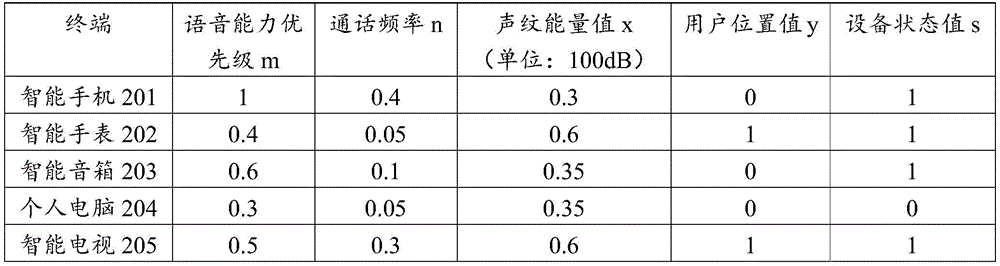

由上表10可以看出,智能手机201的语音能力优先级m1为1,智能手机201的通话频率n1为0.4,智能手机201的声纹能量值x1为0.3,智能手机201的用户位置值y1为0,智能手机201的设备状态值s1为1。智能手表202的语音能力优先级m2为0.4,智能手表202的通话频率n2为0.05,智能手表202的声纹能量值x2为0.6,智能手表202的用户位置值y2为1,智能手表202的设备状态值s2为1。智能音箱203的语音能力优先级m3为0.6,智能音箱203的通话频率n3为0.1,智能音箱203的声纹能量值x3为0.35,智能音箱203的用户位置值y3为0,智能音箱203的设备状态值s3为1。个人电脑204的语音能力优先级m4为0.3,个人电脑204的通话频率n4为0.05,个人电脑204的声纹能量值x4为0.35,个人电脑204的用户位置值y4为0,个人电脑204的设备状态值s4为0。智能电视205的语音能力优先级m5为0.5,智能电视205的通话频率n5为0.3,智能电视205的声纹能量值x5为0.6,智能电视205的用户位置值y5为1,智能电视205的设备状态值s5为1。平板电脑206的语音能力优先级m6为0.8,平板电脑206的通话频率n6为0.1,平板电脑206的声纹能量值x6为0.2,平板电脑206的用户位置值y6为0,平板电脑206的设备状态值s6为1。上述表10仅仅用于解释本申请,不应构成限定。It can be seen from Table 10 above that the voice capability priority m 1 of the
其中,示例性的,语音能力优先级m对应的权重值a可以为0.1,通话频率n对应的权重值b可以为0.2,声纹能量值x对应的权重值c可以为0.5,用户位置值y对应的权重值d可以为0.2。For example, the weight value a corresponding to the voice capability priority m may be 0.1, the weight value b corresponding to the call frequency n may be 0.2, the weight value c corresponding to the voiceprint energy value x may be 0.5, and the user location value y The corresponding weight value d may be 0.2.
当智能手机201接收到来电,获取到其他各终端的语音能力参数后,智能手机201可以通过上述公式(2),计算出其他各终端的转接能力值V。例如,智能手机201的转接能力值V1为0.33,智能手表202的转接能力值V2为0.55,智能音箱203的转接能力值V3为0.255,个人电脑204的转接能力值V4为0,智能电视205的转接能力值V5为0.61,平板电脑206的转接能力值V6为0.2。由于智能电视202的转接能力值V5为0.61,在局域网中各终端(智能手机201、智能手表202、智能音箱203、个人电脑204、智能电视205和平板电脑206)中的转接能力值最大,智能手机201可以确定智能电视205为接听终端。于是,智能手机201可以将通话转移至智能电视205。上述示例仅仅用于解释本申请,不应构成限定。When the
示例性的,如图9A所示,家庭局域网中可以有6个具备通话能力的终端,例如智能手机201、智能手表202、智能音箱203、个人电脑204、智能电视205、平板电脑206。其中,智能手机201位于家庭户型图的主卧位置处,智能手表202位于家庭户型图的客厅位置处,智能音箱203位于家庭户型图的次卧1位置处,个人电脑204位于家庭户型图的书房位置处,智能电视205位于家庭户型图的客厅位置处,平板电脑206位于家庭户型图的次卧2位置处。当用户通过智能手机201与联系人进行通话时,智能手机201的用户位置值y1为1。Exemplarily, as shown in FIG. 9A , there may be 6 terminals with call capability in the home LAN, such as
其中,家庭局域网中各终端的语音能力参数(语音能力优先级m,通话频率n,声纹能量值x,用户位置值y,设备状态值s)可以如下表11所示:Among them, the voice capability parameters of each terminal in the home LAN (voice capability priority m, call frequency n, voiceprint energy value x, user location value y, device status value s) can be shown in Table 11 below:
表11Table 11


由上表11可以看出,智能手机201的语音能力优先级m1为1,智能手机201的通话频率n1为0.4,智能手机201的声纹能量值x1为0.6,智能手机201的用户位置值y1为1,智能手机201的设备状态值s1为1。智能手表202的语音能力优先级m2为0.4,智能手表202的通话频率n2为0.05,智能手表202的声纹能量值x2为0.2,智能手表202的用户位置值y2为0,智能手表202的设备状态值s2为1。智能音箱203的语音能力优先级m3为0.6,智能音箱203的通话频率n3为0.1,智能音箱203的声纹能量值x3为0.35,智能音箱203的用户位置值y3为0,智能音箱203的设备状态值s3为1。个人电脑204的语音能力优先级m4为0.3,个人电脑204的通话频率n4为0.05,个人电脑204的声纹能量值x4为0.35,个人电脑204的用户位置值y4为0,个人电脑204的设备状态值s4为0。智能电视205的语音能力优先级m5为0.5,智能电视205的通话频率n5为0.3,智能电视205的声纹能量值x5为0.2,智能电视205的用户位置值y5为0,智能电视205的设备状态值s5为1。平板电脑206的语音能力优先级m6为0.8,平板电脑206的通话频率n6为0.1,平板电脑206的声纹能量值x6为0.2,平板电脑206的用户位置值y6为0,平板电脑206的设备状态值s6为1。上述表11仅仅用于解释本申请,不应构成限定。It can be seen from Table 11 above that the voice capability priority m 1 of the
其中,示例性的,语音能力优先级m对应的权重值a可以为0.1,通话频率n对应的权重值b可以为0.2,声纹能量值x对应的权重值c可以为0.5,用户位置值y对应的权重值d可以为0.2。For example, the weight value a corresponding to the voice capability priority m may be 0.1, the weight value b corresponding to the call frequency n may be 0.2, the weight value c corresponding to the voiceprint energy value x may be 0.5, and the user location value y The corresponding weight value d may be 0.2.
智能手机201可以通过上述公式(2),计算出其他各终端的转接能力值V。例如,智能手机201的转接能力值V1为0.68,智能手表202的转接能力值V2为0.15,智能音箱203的转接能力值V3为0.255,个人电脑204的转接能力值V4为0,智能电视205的转接能力值V5为0.21,平板电脑206的转接能力值V6为0.2。由于智能手机201的转接能力值V1为0.68,在各终端(智能手机201、智能手表202、智能音箱203、个人电脑204、智能电视205和平板电脑206)中的转接能力值最大,智能手机201可以确定智能手机201自身为接听终端。上述示例仅仅用于解释本申请,不应构成限定。The
如图9B所示,智能手机201在接收到用户的通话转移操作之后,用户可以走动到书房与次卧之间的走廊。此时,家庭局域网中的各终端都无法获取到用户的位置,即用户位置y都为0。其中,家庭局域网中各终端的语音能力参数(语音能力优先级m,通话频率n,声纹能量值x,用户位置值y,设备状态值s)可以如下表12所示:As shown in FIG. 9B , after the
表12Table 12
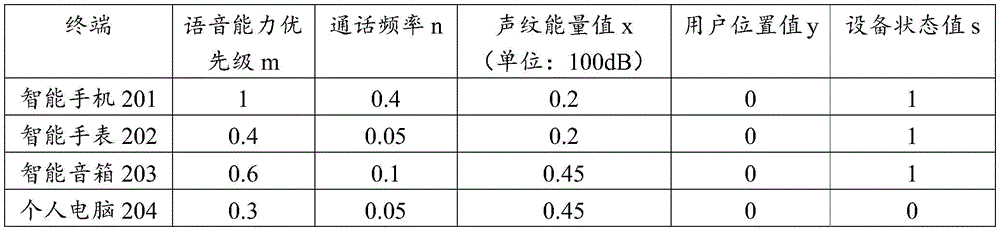

由上表12可以看出,智能手机201的语音能力优先级m1为1,智能手机201的通话频率n1为0.4,智能手机201的声纹能量值x1为0.2,智能手机201的用户位置值y1为0,智能手机201的设备状态值s1为1。智能手表202的语音能力优先级m2为0.4,智能手表202的通话频率m2为0.05,智能手表202的声纹能量值x2为0.2,智能手表202的用户位置值y2为0,智能手表202的设备状态值s2为1。智能音箱203的语音能力优先级m3为0.6,智能音箱203的通话频率n3为0.1,智能音箱203的声纹能量值x3为0.45,智能音箱203的用户位置值y3为0,智能音箱203的设备状态值s3为1。个人电脑204的语音能力优先级m4为0.3,个人电脑204的通话频率n4为0.05,个人电脑204的声纹能量值x4为0.45,个人电脑204的用户位置值y4为0,个人电脑204的设备状态值s4为0。智能电视205的语音能力优先级m5为0.5,智能电视205的通话频率n5为0.3,智能电视205的声纹能量值x5为0.2,智能电视205的用户位置值y5为0,智能电视205的设备状态值s5为1。平板电脑206的语音能力优先级m6为0.8,平板电脑206的通话频率n6为0.1,平板电脑206的声纹能量值x6为0.2,平板电脑206的用户位置值y6为0,平板电脑206的设备状态值s6为1。上述表12仅仅用于解释本申请,不应构成限定。It can be seen from Table 12 above that the voice capability priority m 1 of the
其中,示例性的,语音能力优先级m对应的权重值a可以为0.1,通话频率n对应的权重值b可以为0.2,声纹能量值x对应的权重值c可以为0.5,用户位置值y对应的权重值d可以为0.2。For example, the weight value a corresponding to the voice capability priority m may be 0.1, the weight value b corresponding to the call frequency n may be 0.2, the weight value c corresponding to the voiceprint energy value x may be 0.5, and the user location value y The corresponding weight value d may be 0.2.
智能手机201可以通过上述公式(2),计算出其他各终端的转接能力值V。例如,智能手机201的转接能力值V1为0.28,智能手表202的转接能力值V2为0.15,智能音箱203的转接能力值V3为0.305,个人电脑204的转接能力值V4为0,智能电视205的转接能力值V5为0.21,平板电脑206的转接能力值V6为0.2。由于智能音箱203的转接能力值V3为0.305,在各终端(智能手机201、智能手表202、智能音箱203、个人电脑204、智能电视205和平板电脑206)中的转接能力值最大,智能手机201可以确定智能音箱203为接听终端。于是,智能手机201可以将语音通话转移至智能音箱203上。上述示例仅仅用于解释本申请,不应构成限定。The
如图9C所示,当智能音箱203接听通话时,用户可以走动到客厅。其中,用户与智能手表202和智能电视205同处于客厅,客厅中的智能电视205可以获取到用户的位置,即智能手表202的用户位置值y2为1,智能电视205的用户位置值y5为1。此时,家庭局域网中各终端的语音能力参数(语音能力优先级m,通话频率n,声纹能量值x,用户位置值y,设备状态值s)可以如下表13所示:As shown in FIG. 9C, when the
表13Table 13


由上表13可以看出,智能手机201的语音能力优先级m1为1,智能手机201的通话频率n1为0.4,智能手机201的声纹能量值x1为0.2,智能手机201的用户位置值y1为0,智能手机201的设备状态值s1为1。智能手表202的语音能力优先级m2为0.4,智能手表202的通话频率n2为0.05,智能手表202的声纹能量值x2为0.5,智能手表202的用户位置值y2为1,智能手表202的设备状态值s2为1。智能音箱203的语音能力优先级m3为0.6,智能音箱203的通话频率n3为0.1,智能音箱203的声纹能量值x3为0.3,智能音箱203的用户位置值y3为0,智能音箱203的设备状态值s3为1。个人电脑204的语音能力优先级m4为0.3,个人电脑204的通话频率n4为0.05,个人电脑204的声纹能量值x4为0.3,个人电脑204的用户位置值y4为0,个人电脑204的设备状态值s4为0。智能电视205的语音能力优先级m5为0.5,智能电视205的通话频率n5为0.3,智能电视205的声纹能量值x5为0.6,智能电视205的用户位置值y5为1,智能电视205的设备状态值s5为1。平板电脑206的语音能力优先级m6为0.8,平板电脑206的通话频率n6为0.1,平板电脑206的声纹能量值x6为0.35,平板电脑206的用户位置值y6为0,平板电脑206的设备状态值s6为1。上述表13仅仅用于解释本申请,不应构成限定。It can be seen from Table 13 above that the voice capability priority m 1 of the
其中,示例性的,语音能力优先级m对应的权重值a可以为0.1,通话频率n对应的权重值b可以为0.2,声纹能量值x对应的权重值c可以为0.5,用户位置值y对应的权重值d可以为0.2。For example, the weight value a corresponding to the voice capability priority m may be 0.1, the weight value b corresponding to the call frequency n may be 0.2, the weight value c corresponding to the voiceprint energy value x may be 0.5, and the user location value y The corresponding weight value d may be 0.2.
智能手机201可以通过上述公式(2),计算出其他各终端的转接能力值V。其中,智能手机201的转接能力值V1为0.28,智能手表202的转接能力值V2为0.5,智能音箱203的转接能力值V3为0.23,个人电脑204的转接能力值V4为0,智能电视205的转接能力值V5为0.61,平板电脑206的转接能力值V6为0.275。由于智能电视205的转接能力值V5为0.61,在各终端(智能手机201、智能手表202、智能音箱203、个人电脑204、智能电视205和平板电脑206)中的转接能力值最大,智能手机201可以确定智能电视205为接听终端。于是,智能手机201可以将语音通话转移至智能电视205上。上述示例仅仅用于解释本申请,不应构成限定。The
在一种可能的实现方式中,终端1在确定出接听终端之后,可以判断接听终端的转接能力值V是否比当前通话终端的转接能力值V高出指定阈值(例如0.2),若是,则终端1将语音通话转移至该接听终端上。示例性的,例如指定阈值可以是0.2。接听终端(例如终端2)的转接能力值为0.61,当前通话终端(例如终端3)的转接能力值V为0.23,接听终端的转接能力值V(即0.61)比当前通话终端的转接能力值V(即0.23)的差值为0.38,差值高于指定阈值(即0.2)。因此,终端1可以将语音通话转移至接听终端上。这样,可以避免通话设备的频繁切换。In a possible implementation manner, after the terminal 1 determines the answering terminal, it can determine whether the switching capability value V of the answering terminal is higher than the switching capability value V of the current calling terminal by a specified threshold (for example, 0.2), and if so, Then the terminal 1 transfers the voice call to the answering terminal. Illustratively, for example, the specified threshold may be 0.2. The transfer capability value of the answering terminal (for example, terminal 2) is 0.61, and the transfer capability value V of the current calling terminal (for example, terminal 3) is 0.23. The difference of the receiving capacity value V (ie 0.23) is 0.38, which is higher than the specified threshold (ie 0.2). Therefore, the terminal 1 can transfer the voice call to the answering terminal. In this way, frequent switching of the calling device can be avoided.
在一种可能的实现方式中,终端1可以在确定出接听终端之后,可以检测用户的声纹能量,声纹能量在指定声纹能量阈值(例如10dB)以下且持续一定的时间(例如0.5秒)时,终端1转移通话至接听终端上。这样,由于用户说话过程中,在每一句话结尾时,用户的声纹能量最小,在用户的声纹能量小于一定阈值时,切换转移通话,可以避免转移通话过程中,通话终端采集到用户的话语不完整。In a possible implementation manner, the terminal 1 can detect the voiceprint energy of the user after determining the answering terminal, and the voiceprint energy is below a specified voiceprint energy threshold (for example, 10 dB) and lasts for a certain period of time (for example, 0.5 seconds). ), terminal 1 transfers the call to the answering terminal. In this way, since the user's voiceprint energy is the smallest at the end of each sentence during the user's speech, when the user's voiceprint energy is less than a certain threshold, the transfer call can be switched, which can avoid that the call terminal collects the user's data during the transfer call. The speech is incomplete.
下面介绍语音通话转移的过程。The following describes the process of voice call transfer.
S706、终端1接收联系人的语音数据。S706: Terminal 1 receives the voice data of the contact.
具体内容,可以参考前述图3所示实施例的步骤S312,在此不再赘述。For specific content, reference may be made to step S312 in the aforementioned embodiment shown in FIG. 3 , and details are not repeated here.
S707、终端1将联系人的语音数据发送给终端2。S707: Terminal 1 sends the voice data of the contact to terminal 2.
具体内容,可以参考前述图3所示实施例的步骤S313,在此不再赘述。For specific content, reference may be made to step S313 in the aforementioned embodiment shown in FIG. 3 , which will not be repeated here.
S708、终端2在接收到联系人的语音数据之后,播放该联系人的语音数据。S708: After receiving the voice data of the contact, the terminal 2 plays the voice data of the contact.
具体内容,可以参考前述图3所示实施例的步骤S314,在此不再赘述。For specific content, reference may be made to step S314 in the aforementioned embodiment shown in FIG. 3 , which will not be repeated here.
S709、终端2通过麦克风采集声音,并生成用户的语音数据。S709, the terminal 2 collects the sound through the microphone, and generates the voice data of the user.
具体内容,可以参考前述图3所示实施例的步骤S315,在此不再赘述。For specific content, reference may be made to step S315 in the foregoing embodiment shown in FIG. 3 , which will not be repeated here.
S710、终端2将用户的声音数据发送给终端1。S710 , the terminal 2 sends the user's voice data to the terminal 1 .
具体内容,可以参考前述图3所示实施例的步骤S316,在此不再赘述。For specific content, reference may be made to step S316 in the aforementioned embodiment shown in FIG. 3 , which will not be repeated here.
S711、终端1发送用户的语音数据给联系人的终端。S711. The terminal 1 sends the user's voice data to the terminal of the contact.
具体内容,可以参考前述图3所示实施例的步骤S317,在此不再赘述。For specific content, reference may be made to step S317 in the aforementioned embodiment shown in FIG. 3 , which will not be repeated here.
在一些可能的实现方式中,上述步骤S704和步骤S705,可以由中枢设备或服务器来执行。即,中枢设备或服务器可以获取局域网中各终端的语音能力参数。中枢设备或服务器可以根据其他各终端的语音能力参数,确定出接听终端。然后,中枢设备或服务器可以将接听终端的标识(例如终端2的IP地址)发送给终端1。In some possible implementations, the above steps S704 and S705 may be performed by a central device or a server. That is, the central device or the server can acquire the voice capability parameters of each terminal in the local area network. The central device or server may determine the answering terminal according to the voice capability parameters of other terminals. Then, the central device or the server can send the identification of the answering terminal (for example, the IP address of the terminal 2 ) to the terminal 1 .
在一些可能的实现方式中,上述步骤S707和S710可以经由中枢设备或服务器来进行转发。In some possible implementations, the above steps S707 and S710 may be forwarded via a central device or a server.
在一些应用场景中,终端1可以正在与联系人A的终端进行通话,这时,终端1又可以接收到联系人B的终端的来电呼叫。由于终端1无法同时与两个以上联系人的终端同时进行通话,因此,在一种可能的实现方式中,终端1可以将联系人B的终端的来电呼叫通过上述图3所示实施例中确定接听终端的步骤,确定出接听终端(例如终端2)。并且,终端1可以将来自于联系人B的终端的来电呼叫转接至接听终端(例如终端2)上,并由接听终端与联系人B的终端进行通话。在一种可能的实现方式中,终端1可以将与联系人A的终端的语音通话转移至接听终端(例如终端2)上,并由终端1接听来自于联系人B的终端的来电。其中,终端1转移呼叫或通话的过程可以参考前述图3或图7所示实施例,在此不再赘述。这样,可以避免漏接来电,提高了用户的体验。In some application scenarios, the terminal 1 may be talking with the terminal of the contact A, and at this time, the terminal 1 may receive an incoming call from the terminal of the contact B again. Since terminal 1 cannot talk with terminals of more than two contacts at the same time, in a possible implementation manner, terminal 1 can determine the incoming call of the terminal of contact B through the above-mentioned embodiment shown in FIG. 3 . In the step of answering the terminal, the answering terminal (for example, terminal 2) is determined. In addition, the terminal 1 can transfer the incoming call from the terminal of the contact B to the answering terminal (for example, the terminal 2), and the answering terminal communicates with the terminal of the contact B. In a possible implementation manner, terminal 1 may transfer the voice call with contact A's terminal to an answering terminal (for example, terminal 2), and terminal 1 answers the incoming call from contact B's terminal. The process of transferring a call or a call by the terminal 1 may refer to the foregoing embodiment shown in FIG. 3 or FIG. 7 , which will not be repeated here. In this way, missed calls can be avoided, and user experience can be improved.
在一些应用场景中,局域网中可以有多个具备通话能力的终端,同时,局域网中还可以有中枢设备,该中枢设备具有路由功能,当终端1接收到联系人的终端通过Internet拨打的VoIP语音电话时,终端1与联系人的终端在通话过程中的语音数据包,都需要经过该中枢设备中转。当终端1被占用或者超时未接听联系人终端拨打的VoIP语音电话时,该中枢设备可以采集局域网中各终端的语音能力参数,并从局域网的各终端中确定出接听终端(例如终端2),将该VoIP语音电话的语音数据包转发至该接听终端(例如终端2)。这样,通过中枢设备计算出接听终端,可以减少终端运算负担,降低转移呼叫或通话时的时延。In some application scenarios, there may be multiple terminals with call capability in the local area network. At the same time, there may also be a central device in the local area network. The central device has a routing function. When terminal 1 receives the VoIP voice dialed by the terminal of the contact through the Internet When making a phone call, the voice data packets between the terminal 1 and the contact's terminal during the call need to be transferred through the central device. When terminal 1 is occupied or fails to answer the VoIP voice call dialed by the contact terminal over time, the central device can collect the voice capability parameters of each terminal in the local area network, and determine the answering terminal (for example, terminal 2) from each terminal in the local area network, The voice data packets of the VoIP voice call are forwarded to the receiving terminal (for example, terminal 2). In this way, by calculating the answering terminal through the central device, the computing burden of the terminal can be reduced, and the delay when transferring a call or a conversation can be reduced.
请参考图10,图10为本申请实施例提供的一种语音通信方法,该方法包括:Please refer to FIG. 10. FIG. 10 is a voice communication method provided by an embodiment of the present application, and the method includes:
S1001、中枢设备与各终端建立连接。S1001, a central device establishes a connection with each terminal.
其中。中枢设备可以分别与局域网中的各终端(终端1、终端2、……、终端N)建立连接。该连接可以是无线(例如Wi-Fi连接)或者有线连接。如果各个终端已经和路由器建立连接,则可以跳过此步骤。in. The central device can establish connections with each terminal (terminal 1, terminal 2, . . . , terminal N) in the local area network, respectively. The connection may be wireless (eg, a Wi-Fi connection) or a wired connection. If each terminal has established a connection with the router, you can skip this step.
S1002、中枢设备接收到发给终端1的呼叫指示信息。S1002, the central device receives the call indication information sent to the terminal 1.
中枢设备可以接收到联系人的终端依托Internet发送来的呼叫指示信息,其中,该呼叫指示信息包括有呼叫发送方的地址信息(联系人的终端的IP地址)以及接收方地址信息(例如终端1的IP地址)。该呼叫指示信息用于指示终端1输出来电提醒。The central device can receive the call indication information sent by the contact's terminal relying on the Internet, wherein the call indication information includes the address information of the call sender (the IP address of the contact's terminal) and the address information of the recipient (for example, the terminal 1 IP address). The call indication information is used to instruct the terminal 1 to output an incoming call reminder.
S1003、中枢设备将呼叫指示信息转发给终端1。S1003 , the central device forwards the call indication information to the terminal 1 .
中枢设备可以根据接收方地址信息,将该呼叫指示信息发送给终端1。The central device may send the call indication information to the terminal 1 according to the address information of the recipient.
S1004、终端1输出来电提醒。S1004, the terminal 1 outputs an incoming call reminder.
终端1在接收到中枢设备转发的呼叫指示信息之后,响应于该呼叫指示信息,终端1可以输出来电提醒。其中,该来电提醒可以包括该来电提醒可以包括以下至少一种:铃声提醒、机械振动提醒和来电显示提醒(例如终端1在显示屏上显示联系人的联系方式等)。After receiving the call indication information forwarded by the central device, the terminal 1 can output an incoming call reminder in response to the call indication information. The incoming call reminder may include at least one of the following: a ringtone reminder, a mechanical vibration reminder, and an incoming call display reminder (for example, the terminal 1 displays the contact information of the contact on the display screen, etc.).
S1005、终端1判断是否开启通话转移功能。若是,则S1006、终端1判断来电是否超时未被接听或者终端1是否被占用,若是,则S1007、终端1发送通话转移请求给中枢设备。若终端1未开启通话转移功能时,终端1输出来电提醒。S1005, the terminal 1 determines whether the call transfer function is enabled. If so, in S1006, the terminal 1 determines whether the incoming call has not been answered over time or whether the terminal 1 is occupied, and if so, in S1007, the terminal 1 sends a call transfer request to the central device. If the call transfer function is not enabled on the terminal 1, the terminal 1 outputs an incoming call reminder.
其中,终端1可以在接收到联系人的来电之前,接收用户的设置输入,响应于用户的设置输入,终端1可以开启或关闭通话转移功能。这样,终端1可以根据用户的需求,转移接收到的来电,提高了用户的体验。The terminal 1 may receive a user's setting input before receiving an incoming call from the contact, and in response to the user's setting input, the terminal 1 may enable or disable the call transfer function. In this way, the terminal 1 can transfer the received incoming call according to the user's requirement, which improves the user's experience.
当终端1判断已开启通话转移功能之后,终端1可以先判断终端1是否已经被占用,若是,则终端1可以向中枢设备发送通话转移请求。若未被占用,则终端1可以判断在接收到的来电之后是否超过指定时间阈值(例如10s)未接收到用户的接听操作,若超过指定时间阈值未接听,则终端1可以向中枢设备发送通话转移请求。After the terminal 1 determines that the call transfer function is enabled, the terminal 1 can first determine whether the terminal 1 is occupied, and if so, the terminal 1 can send a call transfer request to the central device. If it is not occupied, the terminal 1 can determine whether the user's answering operation has not been received for more than a specified time threshold (for example, 10s) after the incoming call is received. transfer request.
在一种可能的实现方式中,局域网中的终端在开启通话转移功能后,可以上报给中枢设备。因此,上述步骤S1005和步骤S1006可以由中枢设备执行。即,中枢设备可以判断终端1是否开启通话转移功能,若是,则中枢设备判断来电是否超时未被接听或者终端1是否被占用,若是,则中枢设备执行步骤S1008、中枢设备获取各终端的语音能力参数。In a possible implementation manner, the terminal in the local area network can report to the central device after enabling the call transfer function. Therefore, the above steps S1005 and S1006 may be performed by the hub device. That is, the central device can determine whether the call transfer function is enabled on the terminal 1, and if so, the central device determines whether the incoming call has not been answered over time or whether the terminal 1 is occupied, and if so, the central device executes step S1008, and the central device obtains the voice capabilities of each terminal parameter.
S1008、中枢设备获取各终端的语音能力参数。S1008. The central device acquires voice capability parameters of each terminal.
在中枢设备接收到终端1发送的通话转移请求之后,响应于该通话转移请求,中枢设备可以根据获取局域网中各终端(终端1、终端2、……、终端N)的语音能力参数。其中,语音能力参数包括:语音能力优先级m,通话频率n,声纹能量值x,用户位置值y,设备状态值s。针对语音能力参数的具体说明,可以参考前述图3所示实施例中的步骤S306,在此不再赘述。After the central device receives the call transfer request sent by the terminal 1, in response to the call transfer request, the central device can obtain the voice capability parameters of each terminal (terminal 1, terminal 2, ..., terminal N) in the local area network according to. The voice capability parameters include: voice capability priority m, call frequency n, voiceprint energy value x, user location value y, and device state value s. For the specific description of the speech capability parameter, reference may be made to step S306 in the embodiment shown in FIG. 3 , which will not be repeated here.
S1009、中枢设备根据其他各终端的语音能力参数确定出接听终端(例如接听终端为终端2)。S1009, the central device determines the answering terminal (for example, the answering terminal is terminal 2) according to the voice capability parameters of other terminals.
其中,中枢设备在接收到各终端的语音能力参数之后,可以根据其他各终端(终端2、……、终端N)的语音能力参数,确定出接听设备(如终端2)。中枢设备确定出接听设备的过程可以参考前述图3所示实施例中的步骤S307中终端1确定出接听设备的过程,在此不再赘述。Wherein, after receiving the voice capability parameters of each terminal, the central device can determine the answering device (eg, terminal 2) according to the voice capability parameters of other terminals (terminal 2, ..., terminal N). For the process of determining the answering device by the central device, reference may be made to the process in which the terminal 1 determines the answering device in step S307 in the embodiment shown in FIG. 3 , and details are not repeated here.
S1010、中枢设备向终端2发送来电指令。S1010 , the central device sends an incoming call instruction to the terminal 2 .
S1011、中枢设备发送呼叫结束指令给终端1。S1011 , the central device sends a call end instruction to the terminal 1 .
S1012、终端2响应于接收到的来电指令,输出来电提醒。S1012: The terminal 2 outputs an incoming call reminder in response to the received incoming call instruction.
其中,该来电提醒可以包括该来电提醒可以包括以下至少一种:铃声提醒、机械振动提醒和来电显示提醒(例如终端2在显示屏上显示联系人的联系方式等)。The incoming call reminder may include at least one of the following: a ringtone reminder, a mechanical vibration reminder, and an incoming call display reminder (for example, the terminal 2 displays the contact information of the contact on the display screen, etc.).
S1013、终端1响应于接收到的来电结束指令,结束输出来电提醒。S1013: Terminal 1, in response to the received call end instruction, finishes outputting an incoming call reminder.
这样,通过上述步骤S1010至步骤S1013,可以避免同一联系人的来电在两个终端上同时输出来电提醒。In this way, through the above steps S1010 to S1013, it can be avoided that an incoming call reminder from the same contact is output on two terminals at the same time.
S1014、终端2接收用户的接听操作。S1015、终端2返回接听确认给中枢设备。S1014, the terminal 2 receives the answering operation of the user. S1015, the terminal 2 returns the answering confirmation to the central device.
在终端2输出来电提醒之后,终端2可以接收用户的接听操作(例如点击终端2屏幕上显示的接听按钮或者点击终端2上的接听物理按键),响应于该接听操作,终端2可以返回接听确认给中枢设备。After the terminal 2 outputs the incoming call reminder, the terminal 2 can receive the answering operation of the user (for example, click the answering button displayed on the screen of the terminal 2 or click the answering physical button on the terminal 2), and in response to the answering operation, the terminal 2 can return the answering confirmation to the central device.
S1016、中枢设备在接收终端2返回的接听确认后,接收联系人的语音数据。S1016: After receiving the answering confirmation returned by the terminal 2, the central device receives the voice data of the contact.
中枢设备在接收到终端2返回的接听确认之后,可以通过Internet向联系人的终端请求联系人的语音数据。联系人的终端在接收到该请求之后,就会采集联系人的声音,生成联系人的语音数据,并以数据包的形式将联系人的语音数据发给中枢设备。After receiving the answering confirmation returned by the terminal 2, the central device can request the contact's voice data from the contact's terminal through the Internet. After receiving the request, the terminal of the contact will collect the voice of the contact, generate voice data of the contact, and send the voice data of the contact to the central device in the form of data packets.
S1017、中枢设备将联系人的语音数据,发送给终端2。S1017 , the central device sends the voice data of the contact to the terminal 2 .
中枢设备在接收到联系人的语音数据之后,可以将联系人的语音数据以数据包的形式转发给终端2。After receiving the voice data of the contact, the central device may forward the voice data of the contact to the terminal 2 in the form of data packets.
S1018、终端2在接收到联系人的语音数据之后,播放联系人的语音数据。S1018. After receiving the voice data of the contact, the terminal 2 plays the voice data of the contact.
终端2在接收到中枢设备发送的联系人的语音数据包后,可以从该联系人的语音数据包中,获取到联系人的语音数据,并播放该联系人的语音数据。After receiving the voice data packet of the contact sent by the central device, the terminal 2 can acquire the voice data of the contact from the voice data packet of the contact, and play the voice data of the contact.
S1019、终端2通过麦克风采集声音,生成用户的语音数据。S1019 , the terminal 2 collects the sound through the microphone, and generates the voice data of the user.
S1020、终端2将用户的语音数据发送给中枢设备。S1020. The terminal 2 sends the user's voice data to the central device.
在步骤S1015、终端2返回接听确认给中枢设备之后,终端2可以通过麦克风持续采集用户的声音以及周围环境的声音。终端2可以将麦克风采集到的声音(包括用户的声音和周围环境声音),通过语音压缩算法,对采集到的声音进行压缩编码处理,生成用户的语音数据,并将用户的语音数据封装成语音数据包。然后,终端2通过局域将用户的语音数据包发送给中枢设备。In step S1015, after the terminal 2 returns the answering confirmation to the central device, the terminal 2 can continuously collect the user's voice and the surrounding environment through the microphone. The terminal 2 can compress and encode the sound collected by the microphone (including the user's voice and the surrounding environment sound) through the voice compression algorithm, generate the user's voice data, and encapsulate the user's voice data into a voice. data pack. Then, the terminal 2 sends the user's voice data packet to the central device through the local area.
S1021、中枢设备将用户的语音数据转发给联系人的终端。S1021. The central device forwards the user's voice data to the terminal of the contact.
中枢设备在接收到终端2发送的用户的语音数据包之后,可以将用户的语音数据包通过Internet,转发给联系人的终端,联系人的终端在接收到用户的语音数据包后,可以从用户的语音数据包中解析出用户的语音数据,并播放该用户的语音数据。After receiving the user's voice data packet sent by terminal 2, the central device can forward the user's voice data packet to the contact's terminal through the Internet. After receiving the user's voice data packet, the contact's terminal can send the user's voice data packet from the user. The voice data of the user is parsed from the voice data packet of the user, and the voice data of the user is played.
上述步骤S1016-S1018和S1019-S1021之间没有先后顺序,下述实施例中也类似。The above steps S1016-S1018 and S1019-S1021 are not in order, and the following embodiments are also similar.
上述语音通话转移时,若终端1和终端2建立连接,可以由终端1直接转移给终端2,即当终端1收到联系人的语音数据后,发送给终端2,终端2采集到用户的语音数据后发送给终端1,由终端1发送给联系人的终端。上述语音通话转移也可以有服务器代替中枢设备实现。During the above voice call transfer, if terminal 1 and terminal 2 establish a connection, terminal 1 can directly transfer it to terminal 2, that is, when terminal 1 receives the voice data of the contact, it sends it to terminal 2, and terminal 2 collects the user's voice. The data is then sent to Terminal 1, which is then sent to the contact's terminal. The above voice call transfer can also be implemented by a server instead of a central device.
上述中枢设备可以不是局域网中的路由器,可以是除了终端1以外的其他终端。The above-mentioned central device may not be a router in the local area network, but may be other terminals except the terminal 1 .
下面介绍本申请实施例提供的另一种网络架构。Another network architecture provided by the embodiments of the present application is introduced below.
请参见图11,图11示出了本申请实施例提供的另一种网络架构1100示意图。其中,该网络架构1100中包括有多个终端。其中,该终端可以包括:智能手机201、智能手表202、智能音箱203、个人电脑204、智能电视205、平板电脑206等,本申请对此不作任何限制。在该网络架构1100中的终端的结构可以参考上述图1所示的终端100,在此不再赘述。Referring to FIG. 11 , FIG. 11 shows a schematic diagram of another network architecture 1100 provided by an embodiment of the present application. Wherein, the network architecture 1100 includes a plurality of terminals. The terminal may include: a
其中,该多个终端都可以具备通话能力,该多个终端可以通过如下方式接收到来电与通通话:1、该多个终端都可以接收来自移动通信网中电路交换域(circuit switcheddomain,CS 域)的来电呼叫或通话。2、该多个终端可以接收来自移动通信网中IP多媒体子系统(IPmultimedia subsystem,IMS)中基于VoLTE技术的来电呼叫或通话。3、该多个终端可以接收来自因特网(Internet)中基于VoIP技术的来电呼叫或通话。Wherein, the multiple terminals can all have the ability to talk, and the multiple terminals can receive incoming calls and calls in the following ways: 1. The multiple terminals can all receive calls from the circuit switched domain (CS domain, CS domain) in the mobile communication network. ) for incoming calls or calls. 2. The multiple terminals can receive incoming calls or calls based on the VoLTE technology in an IP multimedia subsystem (IPmultimedia subsystem, IMS) in the mobile communication network. 3. The multiple terminals can receive incoming calls or calls from the Internet (Internet) based on the VoIP technology.
该多个终端都通过Internet连接上智能家居云网络中的服务器208。该服务器208可以是智能家居云网络中的服务器,其数量不限于一个,可以是多个,在此不作限定。其中,该服务器208可以包括存储器、处理器和收发器,其中,存储器可以用于存储有该多个终端各自的语音能力参数(例如语音能力优先级m,通话频率n,声纹能量值x,用户位置值y,设备状态值s等)。收发器可以用于与各终端进行通信。处理器可用于处理各终端的获取数据请求,并指示收发器下发多个终端各自的语音能力参数给各终端。The multiple terminals are all connected to the
下面结合上述图11所示的网络架构1100,以及应用场景,具体介绍本申请实施例提供的一种语音通信方法。The following describes a voice communication method provided by an embodiment of the present application in detail with reference to the network architecture 1100 shown in FIG. 11 and an application scenario.
在一些应用场景中,家中可以有多个具备通话能力的终端,例如智能手机、智能手表、智能音箱、个人电脑,智能电视和智能平板等。这些具备通话能力的终端都可以通过Internet连接上智能家居云的服务器。用户可以通过任一终端(例如智能手机)接收到语音来电,当用户长时间未接听时,或者来电设备已经被占用(例如正在通话中),用户可能会漏接来电,给用户造成不便。因此,本申请实施例提供了一种语音通信方法,终端1(例如智能手机)接收到来电后,当终端1超时未接收到用户的接听操作或者该终端已经被占用(例如正在通话中)时,服务器可以根据其他终端的语音能力参数(例如语音能力优先级m,通话频率n,声纹能量值x,用户位置y,设备状态值s等),确定出该来电的接听终端(例如智能电视),并将终端1上的来电转移至接听终端(例如智能电视)上。这样,可以避免用户错过终端上的来电,提高了用户体验。In some application scenarios, there may be multiple terminals capable of calling, such as smartphones, smart watches, smart speakers, personal computers, smart TVs, and smart tablets. These terminals with call capability can be connected to the server of the smart home cloud through the Internet. A user can receive a voice call through any terminal (such as a smart phone). When the user does not answer for a long time, or the calling device is already occupied (for example, during a call), the user may miss an incoming call, causing inconvenience to the user. Therefore, the embodiment of the present application provides a voice communication method. After the terminal 1 (such as a smart phone) receives an incoming call, when the terminal 1 times out and does not receive an answering operation from the user or the terminal is already occupied (such as during a call) , the server can determine the answering terminal (such as a smart TV) according to the voice capability parameters of other terminals (such as voice capability priority m, call frequency n, voiceprint energy value x, user location y, device status value s, etc.). ), and transfer the incoming call on terminal 1 to the answering terminal (such as a smart TV). In this way, the user can be prevented from missing an incoming call on the terminal, thereby improving the user experience.
请参照图12,图12示出了本申请实施例中提供的一种语音通信方法。其中,服务器上连接的N个具备通话能力的终端,N为大于2的整数,其中,该N个具备通话能力的终端在服务器上绑定同一个账户。在图12所示实施例中,任一个接收到来电的终端都可以被称为终端1。例如智能手机接收到来电时,智能手机可以被称为终端1,当智能电视接收到来电时,智能电视可以被称为终端1,在此不作任何限定。如图12所示,该方法包括:Referring to FIG. 12, FIG. 12 shows a voice communication method provided in an embodiment of the present application. Wherein, N terminals with call capability connected to the server, N is an integer greater than 2, wherein the N terminals with call capability are bound to the same account on the server. In the embodiment shown in FIG. 12 , any terminal that receives an incoming call may be referred to as terminal 1 . For example, when a smart phone receives an incoming call, the smart phone can be referred to as terminal 1, and when a smart TV receives an incoming call, the smart TV can be referred to as terminal 1, which is not limited herein. As shown in Figure 12, the method includes:
S1201、服务器与各终端建立连接。S1201, the server establishes a connection with each terminal.
其中,各终端可以通过Internet连接上服务器。Among them, each terminal can connect to the server through the Internet.
S1202、终端1接收到来电。S1202: Terminal 1 receives an incoming call.
其中,该来电可以指语音来电。联系人的终端可以通过移动通信网络中CS域拨打语音电话给终端1,联系人的终端还可以通过移动通信网络中IMS网络拨打基于VoLTE技术的语音电话给终端1,联系人的终端还可以通过因特网(Internet)拨打基于VoIP技术的语音电话给终端1。The incoming call may refer to a voice incoming call. The terminal of the contact can make a voice call to the terminal 1 through the CS domain in the mobile communication network, the terminal of the contact can also make a voice call based on the VoLTE technology to the terminal 1 through the IMS network in the mobile communication network, and the terminal of the contact can also make a voice call to the terminal 1 through the IMS network in the mobile communication network. The Internet (Internet) dials a voice call based on the VoIP technology to the terminal 1 .
S1203、终端1输出来电提醒。S1203: Terminal 1 outputs an incoming call reminder.
终端1在接收到联系人的终端拨打过来的电话后,可以输出来电提醒。其中,该来电提醒可以包括以下至少一种:铃声提醒、机械振动提醒和来电显示提醒(例如终端1在显示屏上显示联系人的联系方式等)。After receiving the call from the contact's terminal, the terminal 1 can output an incoming call reminder. The incoming call reminder may include at least one of the following: a ringtone reminder, a mechanical vibration reminder, and an incoming call display reminder (for example, the terminal 1 displays the contact information of the contact on the display screen, etc.).
S1204、终端1判断是否开启通话转移功能,若是,则S1205、终端1判断是否超时未接听或者是否被占用,若是,则S1206、终端1发送通话转移请求给服务器。若终端1未开启通话转移功能,则由终端1输出来电提醒,并由终端1接收用户的接听操作,接听来电。In S1204, the terminal 1 determines whether the call transfer function is enabled. If yes, then in S1205, the terminal 1 determines whether it has not answered the call or is occupied. If so, then S1206, the terminal 1 sends a call transfer request to the server. If the call forwarding function is not enabled on the terminal 1, the terminal 1 outputs an incoming call reminder, and the terminal 1 receives the user's answering operation to answer the incoming call.
其中,终端1可以在接收到联系人的来电之前,接收用户的设置输入,响应于用户的设置输入,终端1可以开启或关闭通话转移功能。这样,终端1可以根据用户的需求,转移接收到的来电,提高了用户的体验。The terminal 1 may receive a user's setting input before receiving an incoming call from the contact, and in response to the user's setting input, the terminal 1 may enable or disable the call transfer function. In this way, the terminal 1 can transfer the received incoming call according to the user's requirement, which improves the user's experience.
其中,终端1可以先判断终端1是否已经被占用,若是,则终端1可以发送通话转移请求给服务器。若未被占用,则终端1可以判断在接收到来电之后是否超过指定时间阈值(例如10s),若是,则终端1可以发送通话转移请求给服务器。The terminal 1 may first determine whether the terminal 1 is already occupied, and if so, the terminal 1 may send a call transfer request to the server. If it is not occupied, the terminal 1 can determine whether the specified time threshold (for example, 10s) is exceeded after receiving the incoming call, and if so, the terminal 1 can send a call transfer request to the server.
S1207、服务器获取各终端的语音能力参数。S1207. The server acquires voice capability parameters of each terminal.
在服务器接收到终端1发送的通话转移请求之后,响应于该通话转移请求,服务器可以根据获取各终端(终端1、终端2、……、终端N)的语音能力参数。其中,语音能力参数包括:语音能力优先级m,通话频率n,声纹能量值x,用户位置值y,设备状态值s。针对语音能力参数的具体说明,可以参考前述图3所示实施例中的步骤S306,在此不再赘述。After the server receives the call transfer request sent by the terminal 1, in response to the call transfer request, the server can obtain the voice capability parameters of each terminal (terminal 1, terminal 2, . . . , terminal N) according to. The voice capability parameters include: voice capability priority m, call frequency n, voiceprint energy value x, user location value y, and device state value s. For the specific description of the speech capability parameter, reference may be made to step S306 in the embodiment shown in FIG. 3 , which will not be repeated here.
S1208、服务器根据其他各终端的语音能力参数,确定出接听终端(例如接听终端为终端2)。S1208, the server determines the answering terminal (for example, the answering terminal is Terminal 2) according to the voice capability parameters of other terminals.
其中,服务器在接收到各终端的语音能力参数之后,可以根据其他各终端(终端2、……、终端N)的语音能力参数,确定出接听设备。服务器确定出接听设备的过程可以参考前述图3所示实施例中的步骤S307中终端1确定出接听设备的过程,在此不再赘述。Wherein, after receiving the voice capability parameters of each terminal, the server may determine the answering device according to the voice capability parameters of other terminals (terminal 2, . . . , terminal N). For the process of determining the answering device by the server, reference may be made to the process in which the terminal 1 determines the answering device in step S307 in the embodiment shown in FIG. 3 , which will not be repeated here.
下面介绍终端1将接收到来电呼叫转移给接听终端(终端2)的过程。The following describes the process of the terminal 1 transferring the incoming call to the receiving terminal (terminal 2).
S1209、服务器发送来电指令给终端2。S1209 , the server sends an incoming call instruction to the terminal 2 .
S1210、终端2输出来电提醒。S1210. Terminal 2 outputs an incoming call reminder.
其中,该来电提醒可以包括该来电提醒可以包括以下至少一种:铃声提醒、机械振动提醒和来电显示提醒(例如终端2在显示屏上显示联系人的联系方式等)。The incoming call reminder may include at least one of the following: a ringtone reminder, a mechanical vibration reminder, and an incoming call display reminder (for example, the terminal 2 displays the contact information of the contact on the display screen, etc.).
S1211、服务器发送来电结束指令给终端1。S1211 , the server sends an incoming call termination instruction to the terminal 1 .
S1212、终端1结束输出来电提醒。S1212: Terminal 1 finishes outputting an incoming call reminder.
这样,通过上述步骤S1010至步骤S1013,可以避免同一联系人的来电在两个终端上同时输出来电提醒。In this way, through the above steps S1010 to S1013, it can be avoided that an incoming call reminder from the same contact is output on two terminals at the same time.
S1213、终端2接收用户的接听操作。S1214、终端2返回接听确认给服务器。S1213. The terminal 2 receives the answering operation of the user. S1214, the terminal 2 returns the answering confirmation to the server.
在终端2输出来电提醒之后,终端2可以接收用户的接听操作(例如点击终端2屏幕上显示的接听按钮或者点击终端2上的接听物理按键),响应于该接听操作,终端2可以返回接听确认给服务器。After the terminal 2 outputs the incoming call reminder, the terminal 2 can receive the answering operation of the user (for example, click the answering button displayed on the screen of the terminal 2 or click the answering physical button on the terminal 2), and in response to the answering operation, the terminal 2 can return the answering confirmation to the server.
S1215、服务器转发接听确认给终端1。S1215 , the server forwards the answering confirmation to the terminal 1 .
服务器转发接听确认给终端1之后,响应于该接听确认,终端1可以将语音通话转移至终端2上。After the server forwards the answering confirmation to the terminal 1, the terminal 1 can transfer the voice call to the terminal 2 in response to the answering confirmation.
上述步骤S1209-S1210和S1211-S1212之间没有先后顺序,其他实施例中也类似。The above steps S1209-S1210 and S1211-S1212 are not in order, and the same is true in other embodiments.
下面具体介绍终端1将语音通话转移至接听终端(终端2)的过程。The following specifically describes the process of the terminal 1 transferring the voice call to the answering terminal (terminal 2).
S1216、终端1接收联系人的语音数据。S1216: Terminal 1 receives the voice data of the contact.
其中:in:
1、CS域语音通话:联系人的终端可以采集联系人的声音,并通过移动通信网中的CS域与终端1建立通话连接,将声音信号发送给终端1。1. CS domain voice call: The contact's terminal can collect the contact's voice, establish a call connection with the terminal 1 through the CS domain in the mobile communication network, and send the voice signal to the terminal 1.
2、VoLTE语音通话:联系人的终端还可以采集联系人的声音,并将联系人的声音,通过语音压缩算法,对联系人的声音进行压缩编码处理,生成联系人的语音数据。然后将语音数据封装成语音数据包,并通过移动通信网中的IMS,将联系人的语音数据包发送给终端1。2. VoLTE voice call: The terminal of the contact can also collect the voice of the contact, and use the voice compression algorithm to compress and encode the voice of the contact to generate the voice data of the contact. Then, the voice data is encapsulated into a voice data packet, and the contact's voice data packet is sent to the terminal 1 through the IMS in the mobile communication network.
3、VoIP语音通话:联系人的终端还可以采集联系人的声音,通过语音压缩算法,对联系人的声音进行压缩编码处理,生成联系人的语音数据,然后通过IP协议等相关协议将语音数据封装成语音数据包,并通过Internet将联系人的语音数据包发送给终端1。3. VoIP voice call: The terminal of the contact can also collect the voice of the contact, and use the voice compression algorithm to compress and encode the voice of the contact to generate the voice data of the contact, and then convert the voice data through IP protocol and other related protocols. It is encapsulated into voice data packets, and the contact's voice data packets are sent to terminal 1 through the Internet.
S1217、终端1将联系人的语音数据发送给服务器。S1217: Terminal 1 sends the voice data of the contact to the server.
其中,当终端1转移的语音通话是CS域语音通话,终端1在接收到联系人的声音信号后,可以将联系人的声音信号,通过语音压缩算法,进行压缩编码处理,生成联系人的语音数据,并通过IP协议等相关协议将语音数据封装成语音数据包。然后,终端1通过Internet将联系人的语音数据包发送给服务器。Wherein, when the voice call transferred by the terminal 1 is a CS domain voice call, after receiving the voice signal of the contact, the terminal 1 can compress and encode the voice signal of the contact through a voice compression algorithm to generate the voice of the contact Data, and encapsulate the voice data into voice data packets through IP protocol and other related protocols. Then, the terminal 1 sends the voice data packet of the contact to the server through the Internet.
当终端1转移的语音通话是VoLTE语音通话或VoIP语音通话时,终端1在接收到联系人的语音数据包之后,可以通过Internet将联系人的语音数据包转发给服务器。When the voice call transferred by the terminal 1 is a VoLTE voice call or a VoIP voice call, after receiving the voice data packet of the contact, the terminal 1 can forward the voice data packet of the contact to the server through the Internet.
S1218、服务器将联系人的语音数据发送给终端2。S1218 , the server sends the voice data of the contact to the terminal 2 .
S1219、终端2播放联系人的语音数据。S1219: Terminal 2 plays the voice data of the contact.
终端2在接收到终端1发送的联系人的语音数据包后,可以从该联系人的语音数据包中,获取到联系人的语音数据,并播放该联系人的语音数据。After receiving the voice data packet of the contact sent by the terminal 1, the terminal 2 can acquire the voice data of the contact from the voice data packet of the contact, and play the voice data of the contact.
S1220、终端2通过麦克风采集声音,生成用户的语音数据。S1221、终端2将用户的语音数据发送给服务器。S1220. The terminal 2 collects sound through a microphone to generate voice data of the user. S1221: Terminal 2 sends the user's voice data to the server.
在步骤S1214、终端2返回接听确认给服务器之后,终端2可以通过麦克风持续采集用户的声音以及周围环境的声音。终端2可以将麦克风采集到的声音(包括用户的声音和周围环境声音),通过语音压缩算法,对采集到的声音进行压缩编码处理,生成用户的语音数据,并将用户的语音数据封装成语音数据包。然后,终端2通过Internet将用户的语音数据包发送给服务器。In step S1214, after the terminal 2 returns the answering confirmation to the server, the terminal 2 can continuously collect the user's voice and the surrounding environment through the microphone. The terminal 2 can compress and encode the sound collected by the microphone (including the user's voice and the surrounding environment sound) through the voice compression algorithm, generate the user's voice data, and encapsulate the user's voice data into a voice. data pack. Then, the terminal 2 sends the user's voice data packet to the server through the Internet.
S1222、服务器将用户的语音数据转发给终端1。S1222 , the server forwards the voice data of the user to the terminal 1 .
S1223、终端1发送用户的语音数据给联系人的终端。S1223: Terminal 1 sends the user's voice data to the terminal of the contact.
其中,in,
当终端1转移的语音通话是CS域的语音通话时,终端1在接收到服务器发送的用户的语音数据包之后,可以从用户的语音数据包中解析出用户的语音数据,并将用户的语音数据转换成用户的声音信号,并将用户的声音信号通过移动通信网络中的CS域发送给联系人的终端,联系人的终端在接收到终端1发送的用户的声音信号后,可以从用户的声音信号中解析出用户的声音并播放。When the voice call transferred by terminal 1 is a voice call in the CS domain, after receiving the user's voice data packet sent by the server, terminal 1 can parse the user's voice data from the user's voice data packet, and convert the user's voice The data is converted into the user's voice signal, and the user's voice signal is sent to the contact's terminal through the CS domain in the mobile communication network. After receiving the user's voice signal sent by the terminal 1, the contact's terminal can The user's voice is parsed from the voice signal and played.
当终端1转移的语音通话是VoLTE语音通话时,终端1在接收到服务器发送的用户的语音数据包之后,可以将用户的语音数据包通过IMS,转发给联系人的终端,联系人的终端在接收到用户的语音数据包后,可以从用户的语音数据包中解析出用户的语音数据,并播放该用户的语音数据。When the voice call transferred by terminal 1 is a VoLTE voice call, after receiving the user's voice data packet sent by the server, terminal 1 can forward the user's voice data packet to the contact's terminal through the IMS, and the contact's terminal is in After receiving the user's voice data packet, the user's voice data can be parsed from the user's voice data packet, and the user's voice data can be played.
当终端1转移的语音通话是VoIP语音通话时,终端1在接收到服务器发送的用户的语音数据包之后,可以将用户的语音数据包通过Internet,转发给联系人的终端,联系人的终端在接收到用户的语音数据包后,可以从用户的语音数据包中解析出用户的语音数据,并播放该用户的语音数据。When the voice call transferred by terminal 1 is a VoIP voice call, after receiving the user's voice data packet sent by the server, terminal 1 can forward the user's voice data packet to the contact's terminal through the Internet, and the contact's terminal is in After receiving the user's voice data packet, the user's voice data can be parsed from the user's voice data packet, and the user's voice data can be played.
上述语音通话转移时,若终端1和终端2建立连接,可以由终端1直接转移给终端2,即当终端1收到联系人的语音数据后,发送给终端2,终端2采集到用户的语音数据后发送给终端1,由终端1发送给联系人的终端。上述语音通话转移也可以由中枢设备代替服务器实现。During the above voice call transfer, if terminal 1 and terminal 2 establish a connection, terminal 1 can directly transfer it to terminal 2, that is, when terminal 1 receives the voice data of the contact, it sends it to terminal 2, and terminal 2 collects the user's voice. The data is then sent to Terminal 1, which is then sent to the contact's terminal. The above-mentioned voice call transfer can also be implemented by the central device instead of the server.
在一些可能的实现方式中,终端1(即接收到语音来电的终端)可以将联系人的来电转移至终端2上接听,终端2接听联系人的来电后,终端1还可以周期性获取语音能力参数,按照上述实施例中的规则,确定出新的接听终端(例如终端3)。在确定出新的接听终端(例如终端3)后,终端1可以将语音通话转移至新的接听终端(例如终端3)上,不再转移到终端2上。In some possible implementations, terminal 1 (that is, the terminal that receives the voice call) can transfer the call from the contact to terminal 2 for answering. After terminal 2 answers the call from the contact, terminal 1 can also periodically acquire the voice capability. parameter, according to the rules in the above-mentioned embodiment, to determine a new answering terminal (for example, terminal 3). After determining the new answering terminal (for example, terminal 3 ), terminal 1 can transfer the voice call to the new answering terminal (for example, terminal 3 ), instead of transferring it to terminal 2 .
在一些可能的实现方式中,终端1可以将联系人的来电转移至终端2上接听,终端2接听联系人的来电后,终端2或者终端1可以接收用户的转接操作,在接收到用户的转接操作之后,终端1可以获取语音能力参数,按照上述实施例中的规则,确定出新的接听终端(例如终端3)。在确定出新的接听终端(例如终端3)后,终端1可以将语音通话,转移至新的接听终端(例如终端3)上,不再转移到终端2上。In some possible implementations, terminal 1 can transfer the call from the contact to terminal 2 to answer. After terminal 2 answers the call from the contact, terminal 2 or terminal 1 can receive the user's transfer operation. After the handover operation, the terminal 1 may acquire the voice capability parameter, and determine a new answering terminal (eg, terminal 3 ) according to the rules in the above-mentioned embodiment. After determining a new answering terminal (for example, terminal 3 ), terminal 1 can transfer the voice call to the new answering terminal (for example, terminal 3 ), and not to terminal 2 .
在一些可能的实现方式中,终端1将联系人的来电转移至终端2上,终端2已经输出来电提醒,但终端2超时未接听。终端1可以选择从除终端1和终端2之外的其他终端中,根据语音能力参数,按照上述实施例中的规则,确定出新的接听终端(例如终端3)。在确定出新的接听终端(例如终端3)后,终端1可以将来电转移至新的接听终端(例如终端3)上。In some possible implementations, the terminal 1 transfers the incoming call of the contact to the terminal 2, and the terminal 2 has output an incoming call reminder, but the terminal 2 does not answer the time out. Terminal 1 may choose to determine a new answering terminal (for example, terminal 3 ) from other terminals other than terminal 1 and terminal 2, according to the voice capability parameter, and according to the rules in the foregoing embodiment. After determining the new answering terminal (for example, terminal 3), terminal 1 may transfer the incoming call to the new answering terminal (for example, terminal 3).
上述终端1可以替换为中枢设备或服务器。The above-mentioned terminal 1 may be replaced with a central device or a server.
在上述的本申请实施例中,各终端的语音能力参数值可以存储于各个终端上,也可以存储于中枢设备、服务器上(如各个终端周期性地将语音能力参数值上报给中枢设备、服务器)。在本申请实施例中,可以由接收到来电的终端、中枢设备或服务器,根据各终端的语音能力参数,确定出来电转移或云通话转移的接听终端,在执行通话转移时,可以由收到来电的终端直接转给接听终端,也可以经由中枢设备或服务器转给接听终端,确定接听终端的几种方案可以和转接来电的几种方案进行不同的组合,在此不作限定。本申请中各图示实施例未详述的内容可以参考其他图示实施例。In the above-mentioned embodiment of the present application, the voice capability parameter value of each terminal may be stored on each terminal, and may also be stored on the central device or server (for example, each terminal periodically reports the voice capability parameter value to the central device and server). ). In this embodiment of the present application, the terminal, the central device, or the server that receives the incoming call can determine the answering terminal for outgoing call transfer or cloud call transfer according to the voice capability parameters of each terminal. The incoming call terminal is directly transferred to the answering terminal, or can be transferred to the answering terminal via the central device or server. Several schemes for determining the answering terminal can be combined with several schemes for transferring incoming calls, which are not limited here. For the content not described in detail in each of the illustrated embodiments in this application, reference may be made to other illustrated embodiments.
在本申请的实施例中,N个具备通话能力的终端可以不在一个局域网中,可以是绑定同一账号的N个终端,或者这N个具备通话能力的终端通过其他方式相关联。In the embodiment of the present application, the N terminals with call capability may not be in a local area network, but may be N terminals bound to the same account, or the N terminals with call capability are associated in other ways.
以上所述,以上实施例仅用以说明本申请的技术方案,而非对其限制;尽管参照前述实施例对本申请进行了详细的说明,本领域的普通技术人员应当理解:其依然可以对前述各实施例所记载的技术方案进行修改,或者对其中部分技术特征进行等同替换;而这些修改或者替换,并不使相应技术方案的本质脱离本申请各实施例技术方案的范围。As mentioned above, the above embodiments are only used to illustrate the technical solutions of the present application, but not to limit them; although the present application has been described in detail with reference to the foregoing embodiments, those of ordinary skill in the art should understand: The technical solutions described in the embodiments are modified, or some technical features thereof are equivalently replaced; and these modifications or replacements do not make the essence of the corresponding technical solutions deviate from the scope of the technical solutions of the embodiments of the present application.
Claims (13)
Priority Applications (2)
| Application Number | Priority Date | Filing Date | Title |
|---|---|---|---|
| CN201910517494.3A CN110191241B (en) | 2019-06-14 | 2019-06-14 | A voice communication method and related device |
| PCT/CN2020/095751 WO2020249062A1 (en) | 2019-06-14 | 2020-06-12 | Voice communication method and related device |
Applications Claiming Priority (1)
| Application Number | Priority Date | Filing Date | Title |
|---|---|---|---|
| CN201910517494.3A CN110191241B (en) | 2019-06-14 | 2019-06-14 | A voice communication method and related device |
Publications (2)
| Publication Number | Publication Date |
|---|---|
| CN110191241A CN110191241A (en) | 2019-08-30 |
| CN110191241B true CN110191241B (en) | 2021-06-29 |
Family
ID=67721888
Family Applications (1)
| Application Number | Title | Priority Date | Filing Date |
|---|---|---|---|
| CN201910517494.3A Active CN110191241B (en) | 2019-06-14 | 2019-06-14 | A voice communication method and related device |
Country Status (2)
| Country | Link |
|---|---|
| CN (1) | CN110191241B (en) |
| WO (1) | WO2020249062A1 (en) |
Families Citing this family (23)
| Publication number | Priority date | Publication date | Assignee | Title |
|---|---|---|---|---|
| CN110191241B (en) * | 2019-06-14 | 2021-06-29 | 华为技术有限公司 | A voice communication method and related device |
| CN110737337A (en) * | 2019-10-18 | 2020-01-31 | 向勇 | human-computer interaction system |
| CN112929481B (en) * | 2019-11-20 | 2022-04-12 | Oppo广东移动通信有限公司 | Incoming call processing method and device, electronic equipment and computer readable storage medium |
| CN112887926B (en) | 2019-11-30 | 2022-08-09 | 华为技术有限公司 | Calling method and device |
| CN113098920A (en) * | 2020-01-09 | 2021-07-09 | 京东方科技集团股份有限公司 | Session establishment method, device and related equipment |
| CN111464689A (en) | 2020-01-22 | 2020-07-28 | 华为技术有限公司 | An audio output method and terminal device |
| CN113411759B (en) | 2020-02-29 | 2023-03-31 | 华为技术有限公司 | Voice call transfer method and electronic equipment |
| CN113364921A (en) * | 2020-03-05 | 2021-09-07 | 华为技术有限公司 | Call method, system and equipment |
| CN111445612A (en) * | 2020-04-02 | 2020-07-24 | 北京声智科技有限公司 | Unlocking method, control equipment, electronic equipment and access control system |
| CN113671840B (en) * | 2020-05-13 | 2024-10-22 | 青岛海尔洗衣机有限公司 | A method, device, equipment and storage medium for controlling household electrical appliances |
| CN111786963B (en) * | 2020-06-12 | 2022-10-28 | 青岛海尔科技有限公司 | Method and device for realizing communication process, storage medium and electronic device |
| CN111988426B (en) * | 2020-08-31 | 2023-07-18 | 深圳康佳电子科技有限公司 | Communication method and device based on voiceprint recognition, intelligent terminal and storage medium |
| CN112422733A (en) * | 2020-11-19 | 2021-02-26 | Oppo广东移动通信有限公司 | Notification reminder method, device, terminal and storage medium |
| CN115412639B (en) * | 2021-05-27 | 2025-10-14 | 华为技术有限公司 | Network call transfer method and terminal |
| CN113296729A (en) * | 2021-06-01 | 2021-08-24 | 青岛海尔科技有限公司 | Prompt message broadcasting method, device and system, storage medium and electronic device |
| CN113572731B (en) * | 2021-06-18 | 2022-08-26 | 荣耀终端有限公司 | Voice communication method, personal computer, terminal and computer readable storage medium |
| CN113595866A (en) * | 2021-06-21 | 2021-11-02 | 青岛海尔科技有限公司 | Method and device for establishing audio and video call among multiple devices |
| CN121001048A (en) * | 2021-12-08 | 2025-11-21 | 荣耀终端股份有限公司 | Distributed call conflict handling methods, systems, electronic devices and storage media |
| CN113923305B (en) * | 2021-12-14 | 2022-06-21 | 荣耀终端有限公司 | Multi-screen cooperative communication method, system, terminal and storage medium |
| CN116266855A (en) * | 2021-12-17 | 2023-06-20 | 华为技术有限公司 | Electronic equipment and its voice transmission method and medium |
| CN114885059A (en) * | 2022-06-15 | 2022-08-09 | 中国电信股份有限公司 | Method and device for acquiring opposite-end recording state in mobile network and electronic equipment |
| CN119697797A (en) * | 2023-09-22 | 2025-03-25 | 华为技术有限公司 | A communication method, electronic device and system |
| CN119449949B (en) * | 2024-11-05 | 2026-01-27 | 珠海格力电器股份有限公司 | Intelligent interaction method, system, electronic device and computer readable storage medium |
Citations (6)
| Publication number | Priority date | Publication date | Assignee | Title |
|---|---|---|---|---|
| CN104581665A (en) * | 2014-12-17 | 2015-04-29 | 广东欧珀移动通信有限公司 | Method and device for call transfer |
| CN105101131A (en) * | 2015-06-18 | 2015-11-25 | 小米科技有限责任公司 | Method and device for answering incoming call |
| CN105228118A (en) * | 2015-09-28 | 2016-01-06 | 小米科技有限责任公司 | Call transferring method, device and terminal equipment |
| CN105959191A (en) * | 2016-07-01 | 2016-09-21 | 上海卓易云汇智能技术有限公司 | Control method of smart home system for intelligently answering incoming calls and system thereof |
| CN106713682A (en) * | 2016-11-25 | 2017-05-24 | 深圳市国华识别科技开发有限公司 | Call transfer method and system |
| CN108900502A (en) * | 2018-06-27 | 2018-11-27 | 佛山市云米电器科技有限公司 | It is a kind of based on home furnishings intelligent interconnection communication means, system |
Family Cites Families (11)
| Publication number | Priority date | Publication date | Assignee | Title |
|---|---|---|---|---|
| US8798603B2 (en) * | 2008-07-14 | 2014-08-05 | Centurylink Intellectual Property Llc | System and method for providing emergency call forwarding services |
| CN102752479B (en) * | 2012-05-30 | 2014-12-03 | 中国农业大学 | Scene detection method of vegetable diseases |
| CN104427137A (en) * | 2013-08-29 | 2015-03-18 | 鸿富锦精密工业(深圳)有限公司 | Telephone device, server and automatic call forwarding method |
| KR102213640B1 (en) * | 2013-09-23 | 2021-02-08 | 삼성전자주식회사 | Apparatus and method for exporting information related to a home device of a user device in a home network system |
| CN104468962B (en) * | 2013-09-24 | 2018-06-01 | 联想(北京)有限公司 | The processing method and electronic equipment of a kind of call request |
| CN106941660A (en) * | 2016-01-05 | 2017-07-11 | 中兴通讯股份有限公司 | A kind of call transferring method, apparatus and system |
| CN105721728A (en) * | 2016-02-16 | 2016-06-29 | 上海斐讯数据通信技术有限公司 | Call forwarding method based on WiFi and intelligent terminal |
| CN106535149B (en) * | 2016-11-25 | 2020-05-05 | 深圳市国华识别科技开发有限公司 | Terminal automatic call transfer method and system |
| CN106817683A (en) * | 2017-04-12 | 2017-06-09 | 北京奇虎科技有限公司 | Display methods, the apparatus and system of transinformation of sending a telegram here |
| CN108735216B (en) * | 2018-06-12 | 2020-10-16 | 广东小天才科技有限公司 | A method for searching questions based on semantic recognition and tutoring equipment |
| CN110191241B (en) * | 2019-06-14 | 2021-06-29 | 华为技术有限公司 | A voice communication method and related device |
-
2019
- 2019-06-14 CN CN201910517494.3A patent/CN110191241B/en active Active
-
2020
- 2020-06-12 WO PCT/CN2020/095751 patent/WO2020249062A1/en not_active Ceased
Patent Citations (6)
| Publication number | Priority date | Publication date | Assignee | Title |
|---|---|---|---|---|
| CN104581665A (en) * | 2014-12-17 | 2015-04-29 | 广东欧珀移动通信有限公司 | Method and device for call transfer |
| CN105101131A (en) * | 2015-06-18 | 2015-11-25 | 小米科技有限责任公司 | Method and device for answering incoming call |
| CN105228118A (en) * | 2015-09-28 | 2016-01-06 | 小米科技有限责任公司 | Call transferring method, device and terminal equipment |
| CN105959191A (en) * | 2016-07-01 | 2016-09-21 | 上海卓易云汇智能技术有限公司 | Control method of smart home system for intelligently answering incoming calls and system thereof |
| CN106713682A (en) * | 2016-11-25 | 2017-05-24 | 深圳市国华识别科技开发有限公司 | Call transfer method and system |
| CN108900502A (en) * | 2018-06-27 | 2018-11-27 | 佛山市云米电器科技有限公司 | It is a kind of based on home furnishings intelligent interconnection communication means, system |
Also Published As
| Publication number | Publication date |
|---|---|
| CN110191241A (en) | 2019-08-30 |
| WO2020249062A1 (en) | 2020-12-17 |
Similar Documents
| Publication | Publication Date | Title |
|---|---|---|
| CN110191241B (en) | A voice communication method and related device | |
| CN110138937B (en) | A calling method, device and system | |
| CN110191442B (en) | Bluetooth connection method, equipment and system | |
| CN112640505B (en) | Transmission rate control method and equipment | |
| CN114710768B (en) | Bluetooth connection method and related device | |
| CN112312366B (en) | Method, electronic equipment and system for realizing functions through NFC (near field communication) tag | |
| WO2020107485A1 (en) | Bluetooth connection method and device | |
| CN111835907A (en) | A method, device and system for transferring services across electronic devices | |
| CN110401767B (en) | Information processing method and device | |
| WO2022156555A1 (en) | Screen brightness adjustment method, apparatus, and terminal device | |
| CN114125789B (en) | Communication method, terminal device and storage medium | |
| WO2022100610A1 (en) | Screen projection method and apparatus, and electronic device and computer-readable storage medium | |
| CN112806092B (en) | Microphone MIC switching method and device | |
| CN115525366A (en) | Screen projection method and related device | |
| CN114554012A (en) | Incoming call answering method, electronic equipment and storage medium | |
| WO2022206771A1 (en) | Screen projection method, electronic device, and system | |
| EP4254195A1 (en) | Data backup method, electronic device, data backup system and chip system | |
| CN111935705A (en) | Data service management method and device, computer readable medium and terminal equipment | |
| WO2022135144A1 (en) | Self-adaptive display method, electronic device, and storage medium | |
| WO2022095752A1 (en) | Frame demultiplexing method, electronic device and storage medium | |
| CN115119336B (en) | Earphone connection system, earphone connection method, earphone, electronic device and readable storage medium | |
| CN113467747B (en) | Volume adjusting method, electronic device and storage medium | |
| WO2022142795A1 (en) | Device recognition method and device | |
| CN114500725B (en) | Target content transmission method, master device, slave device, and storage medium | |
| CN117459241A (en) | Login method, electronic equipment and storage media |
Legal Events
| Date | Code | Title | Description |
|---|---|---|---|
| PB01 | Publication | ||
| PB01 | Publication | ||
| SE01 | Entry into force of request for substantive examination | ||
| SE01 | Entry into force of request for substantive examination | ||
| GR01 | Patent grant | ||
| GR01 | Patent grant |