CN110190879B - Energy Efficiency Optimization Method for Massive MIMO System Based on Low Precision ADC - Google Patents
Energy Efficiency Optimization Method for Massive MIMO System Based on Low Precision ADC Download PDFInfo
- Publication number
- CN110190879B CN110190879B CN201910364651.1A CN201910364651A CN110190879B CN 110190879 B CN110190879 B CN 110190879B CN 201910364651 A CN201910364651 A CN 201910364651A CN 110190879 B CN110190879 B CN 110190879B
- Authority
- CN
- China
- Prior art keywords
- energy efficiency
- user
- objective function
- matrix
- massive mimo
- Prior art date
- Legal status (The legal status is an assumption and is not a legal conclusion. Google has not performed a legal analysis and makes no representation as to the accuracy of the status listed.)
- Active
Links
Images


Classifications
-
- H—ELECTRICITY
- H04—ELECTRIC COMMUNICATION TECHNIQUE
- H04B—TRANSMISSION
- H04B7/00—Radio transmission systems, i.e. using radiation field
- H04B7/02—Diversity systems; Multi-antenna system, i.e. transmission or reception using multiple antennas
- H04B7/04—Diversity systems; Multi-antenna system, i.e. transmission or reception using multiple antennas using two or more spaced independent antennas
- H04B7/0413—MIMO systems
-
- H—ELECTRICITY
- H04—ELECTRIC COMMUNICATION TECHNIQUE
- H04B—TRANSMISSION
- H04B7/00—Radio transmission systems, i.e. using radiation field
- H04B7/02—Diversity systems; Multi-antenna system, i.e. transmission or reception using multiple antennas
- H04B7/04—Diversity systems; Multi-antenna system, i.e. transmission or reception using multiple antennas using two or more spaced independent antennas
- H04B7/0413—MIMO systems
- H04B7/0426—Power distribution
-
- H—ELECTRICITY
- H04—ELECTRIC COMMUNICATION TECHNIQUE
- H04L—TRANSMISSION OF DIGITAL INFORMATION, e.g. TELEGRAPHIC COMMUNICATION
- H04L41/00—Arrangements for maintenance, administration or management of data switching networks, e.g. of packet switching networks
- H04L41/14—Network analysis or design
- H04L41/145—Network analysis or design involving simulating, designing, planning or modelling of a network
-
- Y—GENERAL TAGGING OF NEW TECHNOLOGICAL DEVELOPMENTS; GENERAL TAGGING OF CROSS-SECTIONAL TECHNOLOGIES SPANNING OVER SEVERAL SECTIONS OF THE IPC; TECHNICAL SUBJECTS COVERED BY FORMER USPC CROSS-REFERENCE ART COLLECTIONS [XRACs] AND DIGESTS
- Y02—TECHNOLOGIES OR APPLICATIONS FOR MITIGATION OR ADAPTATION AGAINST CLIMATE CHANGE
- Y02D—CLIMATE CHANGE MITIGATION TECHNOLOGIES IN INFORMATION AND COMMUNICATION TECHNOLOGIES [ICT], I.E. INFORMATION AND COMMUNICATION TECHNOLOGIES AIMING AT THE REDUCTION OF THEIR OWN ENERGY USE
- Y02D30/00—Reducing energy consumption in communication networks
- Y02D30/70—Reducing energy consumption in communication networks in wireless communication networks
Landscapes
- Engineering & Computer Science (AREA)
- Computer Networks & Wireless Communication (AREA)
- Signal Processing (AREA)
- Power Engineering (AREA)
- Radio Transmission System (AREA)
- Mobile Radio Communication Systems (AREA)
Abstract
Description
技术领域technical field
本发明属于信息与通信工程技术领域,涉及无线通信系统中的大规模MIMO技术,具体是一种基于低精度ADC大规模MIMO系统的能效优化方法。The invention belongs to the technical field of information and communication engineering, and relates to a massive MIMO technology in a wireless communication system, in particular to an energy efficiency optimization method based on a low-precision ADC massive MIMO system.
背景技术Background technique
大规模多输入多输出(MIMO)系统通过充分利用空间分集技术,可以大幅提高系统的信道容量和系统的可靠性,因此受到学术界和工业界的广泛关注。在大规模MIMO系统中,接收端的每根天线上部署的数模转化器(ADC)能够将模拟信号转换成数字信号,其功率消耗会随着量化比特数的提高而呈指数级增长。因此,配置低精度ADC的大规模MIMO系统成为当下学术界的研究热点。对于采用MRC接收的低精度ADC大规模MIMO上行通信系统,现有研究大多仅针对其频谱效率进行优化,没有考虑系统功耗问题,且在优化过程中,大多仅对用户发射功率优化,同时考虑导频长度、用户功率和量化比特数研究较少。Massive multiple-input multiple-output (MIMO) systems can greatly improve the system's channel capacity and system reliability by making full use of space diversity technology, so they have received extensive attention from academia and industry. In a massive MIMO system, a digital-to-analog converter (ADC) deployed on each antenna at the receiver can convert an analog signal into a digital signal, and its power consumption increases exponentially with the number of quantization bits. Therefore, massive MIMO systems with low-precision ADCs have become a research hotspot in the current academic circles. For the low-precision ADC massive MIMO uplink communication system using MRC reception, most of the existing research only optimizes its spectral efficiency without considering the system power consumption. Pilot length, user power and number of quantization bits are less studied.
发明内容SUMMARY OF THE INVENTION
为了解决现有低精度ADC大规模MIMO系统能效问题,本发明提供一种基于能效最大化的资源联合优化方案。本发明针对采用MRC接收的低精度ADC大规模MIMO上行链路,将对导频长度、发射功率和量化比特数的进行联合优化,并以导频长度和用户端的最高发射功率的限制作为约束因子从而建立起能效最优化模型,再根据分数规划的性质,把原始的分式形式的优化问题转换成等价的减式形式,进而采用交替优化算法来优化导频长度、发射功率和量化比特数。In order to solve the energy efficiency problem of the existing low-precision ADC massive MIMO system, the present invention provides a resource joint optimization scheme based on energy efficiency maximization. Aiming at the low-precision ADC massive MIMO uplink received by MRC, the present invention will jointly optimize the length of the pilot frequency, the transmission power and the number of quantized bits, and take the limitation of the length of the pilot frequency and the maximum transmission power of the user terminal as the constraint factor Thus, an energy efficiency optimization model is established, and then according to the nature of fractional programming, the original fractional optimization problem is converted into an equivalent subtractive form, and an alternate optimization algorithm is used to optimize the pilot length, transmit power, and quantization bits. .
本发明解决其技术问题所采用的技术方案的具体步骤如下:The concrete steps of the technical solution adopted by the present invention to solve the technical problems are as follows:
步骤1.确定系统模型并进行问题描述;
1-1.考虑配置低精度ADC的单小区大规模MIMO上行链路系统,小区中央的基站配有M根天线,服务于小区内的K个单天线用户。G表示基站和K个用户之间的信道矩阵,可以表示成:1-1. Consider a single-cell massive MIMO uplink system configured with a low-precision ADC. The base station in the center of the cell is equipped with M antennas to serve K single-antenna users in the cell. G represents the channel matrix between the base station and K users, which can be expressed as:
G=H×D1/2 G=H×D 1/2
\*MERGEFORMAT(1)\*MERGEFORMAT(1)
其中,H表示M×K维的快衰落系数矩阵,D=diag{β1,β2,…,βK}表示大尺度衰落矩阵。Among them, H represents a fast fading coefficient matrix of M×K dimension, and D=diag{β 1 ,β 2 ,...,β K } represents a large-scale fading matrix.
1-2.采用最小均方误差(MMSE)对信道进行估计,则信道矩阵G1-2. Use the minimum mean square error (MMSE) to estimate the channel, then the channel matrix G

\*MERGEFORMAT(2)\*MERGEFORMAT(2)
其中

1-3.采用AQWN模型对ADC的量化过程建模,则经过低精度ADC量化器后,输出为:1-3. Using the AQWN model to model the quantization process of the ADC, after passing through the low-precision ADC quantizer, the output is:

\*MERGEFORMAT(3)\*MERGEFORMAT(3)
其中,α=1-ρ,ρ为量化信噪比的倒数,p表示发射功率,x是用户的发送信号,n表示加性高斯白噪声,nq表示量化噪声,b表示低精度ADC的量化比特数,当b≤5时,其对应的α如表1所示。当b>5时,其对应的α值可以表示为

\*MERGEFORMAT(4)\*MERGEFORMAT(4)
其中IM表示M×M维的单位制,。GH表示信道矩阵G的共轭转置矩阵。where IM represents the unit system of M×M dimension, . GH represents the conjugate transpose matrix of the channel matrix G.
1-4.采用最大比合并接收(MRC)。则第k个用户的接收信号表示为:1-4. Adopt maximum ratio combining reception (MRC). Then the received signal of the kth user is expressed as:

\*MERGEFORMAT(5)\*MERGEFORMAT(5)
其中Pd表示用户的发射功率,gk是信道矩阵G的第k列,表示用户k到基站的信道,gk H表示gk的共轭转置,xk是用户k的发送信号,n表示加性高斯白噪声,nq表示量化噪声。where P d represents the transmit power of the user, g k is the kth column of the channel matrix G, which represents the channel from user k to the base station, g k H represents the conjugate transpose of g k , x k is the transmitted signal of user k, n represents additive white Gaussian noise, and n q represents quantization noise.
1-5.假设噪声方差值为1,通过对矩阵的随机理论加以应用推导出用户k的上行速率:1-5. Assuming that the noise variance value is 1, the uplink rate of user k is deduced by applying the random theory of the matrix:

\*MERGEFORMAT(6)\*MERGEFORMAT(6)
其中,
因此,系统的频谱效率可以表示为:Therefore, the spectral efficiency of the system can be expressed as:

\*MERGEFORMAT(7)\*MERGEFORMAT(7)
能效EE定义为每焦耳能量所能成功传输的比特数(bits/J)。因此,大规模MIMO上行链路系统能效函数可以表示为:Energy efficiency EE is defined as the number of bits (bits/J) that can be successfully transmitted per joule of energy. Therefore, the energy efficiency function of massive MIMO uplink system can be expressed as:

\*MERGEFORMAT(8)\*MERGEFORMAT(8)
其中Ptb、Ptu分别表示收发链路功耗,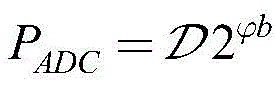

1-6.在实际的通信系统中,除了需要导频长度限制,还对每个用户的最高发射功率进行限制。因此,大规模MIMO上行通信系统中基于能效优化的资源分配问题可以表述为如下的约束优化问题:1-6. In an actual communication system, in addition to the pilot length limitation, the maximum transmit power of each user is also limited. Therefore, the resource allocation problem based on energy efficiency optimization in massive MIMO uplink communication systems can be formulated as the following constrained optimization problem:

s.t.C1:0<pd≤Pmax stC1:0<p d ≤P max
C2:KτTC2: KτT
\*MERGEFORMAT(9)\*MERGEFORMAT(9)
其中C1,C2表示两个约束条件,Pmax表示用户可提供的最高发射功率,K和T分别表示最小和最大导频长度。Among them, C1 and C2 represent two constraints, P max represents the maximum transmit power that the user can provide, and K and T represent the minimum and maximum pilot lengths, respectively.
由于上述问题是一个带约束的非凸优化问题,难以获得最优解,因此将利用分数规划的性质将目标问题进行转化。Since the above problem is a constrained non-convex optimization problem, it is difficult to obtain the optimal solution, so the objective problem will be transformed by using the properties of fractional programming.
步骤2.目标函数的转化
2-1.凸转化2-1. Convex Transformation
公式(9)中的分数目标函数归类为非线性分数规划问题。通过使用分数规划的性质,可实现能效最大化,当且仅当:The fractional objective function in Equation (9) is classified as a nonlinear fractional programming problem. By using the properties of fractional programming, energy efficiency can be maximized if and only if:

\*MERGEFORMAT(10)\*MERGEFORMAT(10)
其中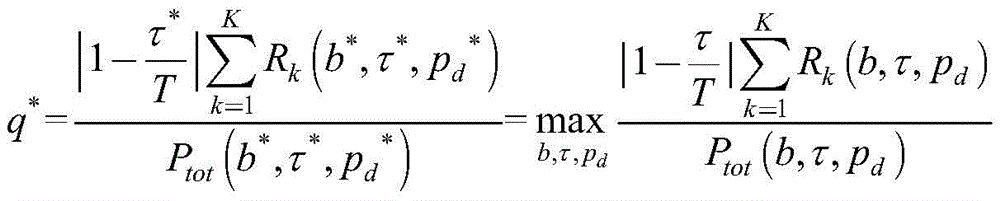
因此初始的最优化问题可以转化成:So the initial optimization problem can be transformed into:

s.t.C1:0<pd≤Pmax stC1:0<p d ≤P max
C2:KτTC2: KτT
\*MERGEFORMAT(11)\*MERGEFORMAT(11)
由于上式(11)是一个凸优化问题。因此,可以利用凸优化的方法来求解目标函数。Since the above formula (11) is a convex optimization problem. Therefore, the method of convex optimization can be used to solve the objective function.
2-2.基于交替优化的能效资源分配2-2. Energy Efficiency Resource Allocation Based on Alternate Optimization
转化后目标函数(11)仍难以求解,因此将目标函数(11)进行分解,首先给定q;然后在b值确定的情况下,对τ、pp进行交替优化,循环直至收敛,具体:After the transformation, the objective function (11) is still difficult to solve. Therefore, the objective function (11) is decomposed, and q is given first; then, when the value of b is determined, τ and pp are alternately optimized, and the cycle is repeated until convergence. Specifically:
2-2-1.给定q=0,qi=q0,τ=τ0,pd=pd0b=12-2-1. Given q=0, q i =q 0 , τ=τ 0 , p d =p d0 b=1
2-2-2.当qi-q>δ时,进入步骤2-2-3,否则步骤2-2-7;2-2-2. When qi -q>δ, go to step 2-2-3, otherwise step 2-2-7 ;
2-2-3.q=qi; 2-2-3.q =qi;
2-2-4当b<16进入步骤2-2-5,否则跳转至步骤2-2-9;2-2-4 When b<16, go to step 2-2-5, otherwise jump to step 2-2-9;
2-2-5输入
2-2-6输入τ0,以Q2为目标函数优化pd,得到使Q2取最大值时的
2-2-7循环执行步骤2-2-5、2-2-6至Q2收敛2-2-7 Loop steps 2-2-5, 2-2-6 until Q2 converges
2-2-8 b=b+1,进入步骤2-2-4;2-2-8 b=b+1, go to step 2-2-4;
2-2-9将使Q2最大的
2-2-10返回步骤2-2-2,2-2-10 Return to step 2-2-2,
2-2-11返回
本方案中的步骤2-2-5和2-2-6可以由牛顿迭代法求解。Steps 2-2-5 and 2-2-6 in this scheme can be solved by Newton iteration method.
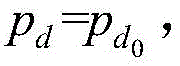
以步骤2-2-5为例,给定初始值

s.t.C2s.t.C2
\*MERGEFORMAT(12)\*MERGEFORMAT(12)
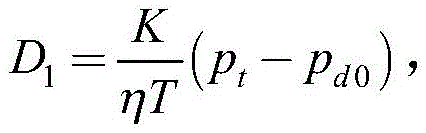
将b0=b0,

\*MERGEFORMAT(13)\*MERGEFORMAT(13)
其中



Q3关于τ分别求一次导和二次导,经计算可以得到
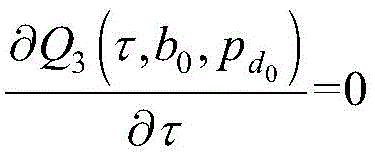
同理可证步骤2-2-6。Similarly, steps 2-2-6 can be proved.
本发明有益效果如下:The beneficial effects of the present invention are as follows:
相较于采用高精度ADC的大规模MIMO系统,本发明中采用低精度ADC虽然会造成频谱效率部分损失,但是大大降低了系统的总功耗与成本。通过采用本发明中的基于交替优化算法的能效优化方案,可以在满足导频长度和用户最高发射功率限制的情况下,迭代出能效最大的导频长度、发射功率和量化比特数。Compared with a massive MIMO system using a high-precision ADC, although the use of a low-precision ADC in the present invention may cause a partial loss of spectral efficiency, it greatly reduces the total power consumption and cost of the system. By adopting the energy efficiency optimization scheme based on the alternating optimization algorithm in the present invention, the pilot length, the transmission power and the number of quantization bits with the maximum energy efficiency can be iteratively obtained under the condition of satisfying the pilot length and the user's maximum transmission power limit.
附图说明Description of drawings
图1为本发明方案所适用的低精度ADC大规模MIMO上行系统接收模型结构。FIG. 1 is the structure of the reception model of the low-precision ADC massive MIMO uplink system to which the solution of the present invention is applied.
图2为本发明方案和已有算法在不同量化比特数情况下频谱效率性能对比的仿真图Fig. 2 is the simulation diagram of the spectral efficiency performance comparison between the scheme of the present invention and the existing algorithm under the condition of different quantization bit numbers
图3为本发明方案和已有算法在不同量化比特数情况下能量效率性能对比的仿真图Fig. 3 is the simulation diagram of the energy efficiency performance comparison between the scheme of the present invention and the existing algorithm under the condition of different quantization bits
图4为本发明方案和已有算法在不同天线数情况下能量效率性能对比的仿真图Fig. 4 is a simulation diagram showing the comparison of energy efficiency performance between the scheme of the present invention and the existing algorithm under the condition of different antenna numbers
具体实施方式Detailed ways
下面结合附图和附表对本发明实施例作详细说明。The embodiments of the present invention will be described in detail below with reference to the accompanying drawings and accompanying tables.
表1 不同量化比特数b下α的近似值Table 1 Approximate values of α under different quantization bits b
表1Table 1
表2为本发明方案在仿真中所需要的系统参数值Table 2 is the system parameter values required by the scheme of the present invention in the simulation
表2Table 2

由表2可知,本发明方案对所需的系统参数和算法初始值进行了设置,将基站端每根天线的电路功率消耗设置为10mW,用户初始化发射功率一律设为0.1W,基站天线初始化为128根,每个用户最低速率设为1.2bit/s,每个用户最高发射速率限制为0.1W,算法循环结束的阈值设置为0.01。针对特定的系统需求可将参数按要求进行重新设置。It can be seen from Table 2 that the scheme of the present invention sets the required system parameters and initial values of the algorithm, and sets the circuit power consumption of each antenna at the base station to 10mW, the user initialization transmission power is uniformly set to 0.1W, and the base station antenna is initialized to 128, the minimum rate of each user is set to 1.2bit/s, the maximum transmission rate of each user is limited to 0.1W, and the threshold for the end of the algorithm cycle is set to 0.01. The parameters can be reset as required for specific system requirements.
图2给出了基站天线数为M=100和M=200两种情况下频谱效率随量化比特数变化的仿真结果。从图2中可以看出,随着量化比特数提高,系统频谱效率随之提高,然后趋向于稳定,还可以看出在相同量化比特数和基站天线数的情况下,本发明方案的频谱效率明显高于只对导频长度优化方案的频谱效率。Figure 2 shows the simulation results of the variation of the spectral efficiency with the number of quantization bits when the number of base station antennas is M=100 and M=200. It can be seen from Figure 2 that with the increase of the number of quantized bits, the system spectral efficiency increases accordingly, and then tends to be stable. Significantly higher than the spectral efficiency of the pilot-length-only optimization scheme.
图3给出了基站天线数为M=100和M=200两种情况下能量效率随量化比特数变化的仿真结果。从图3中可以看出,随着量化比特数提高,系统能量效率先是随之提高,再开始下降。这是由于量化所需能耗随着量化比特数的增加而增加,当量化比特数提高到一定值的时候,其对应的频谱效率不再提高,但是其对应的量化器功耗还在呈指数增长,使得系统总功耗增加,而能量效率降低。从图中还可以看出在相同量化比特数和基站天线数的情况下,本发明方案的能量效率明显高于只对导频长度优化方案的能量效率。Figure 3 shows the simulation results of the variation of the energy efficiency with the number of quantization bits when the number of base station antennas is M=100 and M=200. As can be seen from Figure 3, as the number of quantization bits increases, the system energy efficiency first increases and then begins to decrease. This is because the energy consumption required for quantization increases with the increase of the number of quantization bits. When the number of quantization bits increases to a certain value, the corresponding spectral efficiency is no longer improved, but the corresponding power consumption of the quantizer is still exponential. increase, so that the total power consumption of the system increases, while the energy efficiency decreases. It can also be seen from the figure that the energy efficiency of the solution of the present invention is obviously higher than the energy efficiency of the only pilot length optimization solution under the same number of quantization bits and the number of base station antennas.
图4给出了不同天线数情况下系统的能量效率。从图4中可以看出,随着天线数的提高,系统能量效率先是随之提高,再开始下降这是由于开始随着天线数增加,使得系统总功耗增加,能量效率降低。Figure 4 shows the energy efficiency of the system for different numbers of antennas. It can be seen from Figure 4 that with the increase of the number of antennas, the energy efficiency of the system first increases and then begins to decrease. This is because the total power consumption of the system increases and the energy efficiency decreases with the increase of the number of antennas.
本技术领域中的普通技术人员应当认识到,以上实施例仅是用来说明本发明,而并非作为对本发明的限定,只要在本发明的范围内,对以上实施例的变化、变形都将落在本发明的保护范围。Those of ordinary skill in the art should realize that the above embodiments are only used to illustrate the present invention, but not as a limitation of the present invention. As long as the changes and deformations of the above embodiments are within the scope of the present invention within the protection scope of the present invention.
Claims (2)












Priority Applications (1)
| Application Number | Priority Date | Filing Date | Title |
|---|---|---|---|
| CN201910364651.1A CN110190879B (en) | 2019-04-30 | 2019-04-30 | Energy Efficiency Optimization Method for Massive MIMO System Based on Low Precision ADC |
Applications Claiming Priority (1)
| Application Number | Priority Date | Filing Date | Title |
|---|---|---|---|
| CN201910364651.1A CN110190879B (en) | 2019-04-30 | 2019-04-30 | Energy Efficiency Optimization Method for Massive MIMO System Based on Low Precision ADC |
Publications (2)
| Publication Number | Publication Date |
|---|---|
| CN110190879A CN110190879A (en) | 2019-08-30 |
| CN110190879B true CN110190879B (en) | 2020-08-11 |
Family
ID=67715513
Family Applications (1)
| Application Number | Title | Priority Date | Filing Date |
|---|---|---|---|
| CN201910364651.1A Active CN110190879B (en) | 2019-04-30 | 2019-04-30 | Energy Efficiency Optimization Method for Massive MIMO System Based on Low Precision ADC |
Country Status (1)
| Country | Link |
|---|---|
| CN (1) | CN110190879B (en) |
Families Citing this family (10)
| Publication number | Priority date | Publication date | Assignee | Title |
|---|---|---|---|---|
| CN112751601A (en) * | 2019-10-31 | 2021-05-04 | 中兴通讯股份有限公司 | Communication control method, communication control device, base station, and storage medium |
| CN111294098B (en) * | 2020-02-12 | 2022-02-11 | 中山大学 | Large-scale multi-antenna system signal detection method for low-precision ADC |
| CN111313946A (en) * | 2020-02-24 | 2020-06-19 | 杭州电子科技大学 | Large-scale MIMO energy efficiency optimization method based on low-precision ADC |
| CN111446992B (en) * | 2020-04-03 | 2022-03-22 | 重庆邮电大学 | Method for allocating resources with maximized minimum energy efficiency in wireless power supply large-scale MIMO network |
| CN112702094B (en) * | 2020-12-21 | 2022-02-11 | 杭州电子科技大学 | Large-scale MIMO system energy efficiency optimization method based on adjustable precision ADC |
| CN113179109B (en) * | 2021-04-26 | 2022-03-29 | 南京盛航海运股份有限公司 | Honeycomb-removing large-scale MIMO uplink spectrum efficiency optimization method |
| CN113660062B (en) * | 2021-08-11 | 2022-07-12 | 东南大学 | Low-precision ADC quantization bit number distribution method based on deep reinforcement learning in non-cellular large-scale distributed MIMO system |
| CN114172763B (en) * | 2021-11-16 | 2023-03-24 | 浙江大学 | Pilot frequency optimization design method and device for hybrid large-scale MIMO system |
| CN114302487B (en) * | 2021-12-28 | 2024-03-05 | 中南大学 | Energy efficiency optimization method, device and equipment based on self-adaptive particle swarm power distribution |
| CN114499667B (en) * | 2022-01-28 | 2023-06-13 | 上海交通大学 | Device and method for optimizing gain of bidirectional optical amplifier in single-fiber bidirectional optical fiber link |
Citations (2)
| Publication number | Priority date | Publication date | Assignee | Title |
|---|---|---|---|---|
| CN104821838A (en) * | 2015-04-24 | 2015-08-05 | 浙江理工大学 | Energy efficiency maximization-based multi-user information and energy simultaneous transmission transceiver design method |
| CN106899337A (en) * | 2017-03-16 | 2017-06-27 | 东南大学 | A kind of extensive MIMO relay system multi-user power distribution method using mixing ADC |
Family Cites Families (2)
| Publication number | Priority date | Publication date | Assignee | Title |
|---|---|---|---|---|
| US8570914B2 (en) * | 2010-08-09 | 2013-10-29 | Corning Cable Systems Llc | Apparatuses, systems, and methods for determining location of a mobile device(s) in a distributed antenna system(s) |
| CN107135544A (en) * | 2017-04-06 | 2017-09-05 | 杭州电子科技大学 | An Energy Efficiency Resource Allocation Method Based on Interference Dynamic Update |
-
2019
- 2019-04-30 CN CN201910364651.1A patent/CN110190879B/en active Active
Patent Citations (2)
| Publication number | Priority date | Publication date | Assignee | Title |
|---|---|---|---|---|
| CN104821838A (en) * | 2015-04-24 | 2015-08-05 | 浙江理工大学 | Energy efficiency maximization-based multi-user information and energy simultaneous transmission transceiver design method |
| CN106899337A (en) * | 2017-03-16 | 2017-06-27 | 东南大学 | A kind of extensive MIMO relay system multi-user power distribution method using mixing ADC |
Also Published As
| Publication number | Publication date |
|---|---|
| CN110190879A (en) | 2019-08-30 |
Similar Documents
| Publication | Publication Date | Title |
|---|---|---|
| CN110190879B (en) | Energy Efficiency Optimization Method for Massive MIMO System Based on Low Precision ADC | |
| CN108809375B (en) | Low-precision large-scale antenna system based on probability integer and coding modulation method thereof | |
| CN110492915A (en) | A kind of power distribution method based on the short packet transmission of MIMO-NOMA | |
| CN101667896B (en) | User selection method for multi-user MIMO communication system based on codebook | |
| CN108234101B (en) | Pilot signal design method for maximizing energy efficiency and large-scale multi-antenna system | |
| CN105263135B (en) | A Robust Security Design Method for MIMO Communication System | |
| CN105162507A (en) | Signal to leakage noise ratio (SLNR)-based two-stage precoding method in large-sale MIMO FDD system | |
| CN107135544A (en) | An Energy Efficiency Resource Allocation Method Based on Interference Dynamic Update | |
| CN104869626A (en) | Uplink large-scale MIMO system power control method based on receiver with low complexity | |
| CN104039004A (en) | Method for heterogeneous user pilot frequency power optimal distribution in large-scale multi-input multi-output system | |
| CN101984572A (en) | Self-adaption precoding matrix indexing feedback method adaptive to joint transmission | |
| CN113660062B (en) | Low-precision ADC quantization bit number distribution method based on deep reinforcement learning in non-cellular large-scale distributed MIMO system | |
| CN102088789A (en) | Channel information feedback adaptive transmission and bandwidth allocation method used in wireless communication | |
| CN101562505B (en) | Multi-user dispatching method for multi-input multi-output system | |
| CN103873205B (en) | MIMO user selection algorithm based on MMSE precoding and simulated annealing algorithm | |
| CN117062235A (en) | A highly energy-efficient transmission method in cellular-free large-scale URLLC systems | |
| CN106357315B (en) | An energy-efficient resource allocation method for large multi-antenna networks with incomplete CSI | |
| CN107241799A (en) | The resource allocation of Energy Efficient and interference alignment integrated processes in heterogeneous network | |
| CN104717035A (en) | Interference alignment method of cellular network based on D2D communication | |
| CN101854235B (en) | User selection method and device in multi-input multi-output system | |
| CN113067787B (en) | A precoding method for wireless power transfer system based on finite feedback | |
| CN110190880A (en) | A generalized spatial modulation incremental transmit antenna combination selection method | |
| CN101483467A (en) | Method for MIMO multiple access channel throughput maximization | |
| CN112636795A (en) | Minimum rate guarantee-based multi-cell large-scale MIMO (multiple input multiple output) high-spectrum-efficiency power distribution method | |
| CN107104715B (en) | An Interference Alignment Method Based on Antenna Selection |
Legal Events
| Date | Code | Title | Description |
|---|---|---|---|
| PB01 | Publication | ||
| PB01 | Publication | ||
| SE01 | Entry into force of request for substantive examination | ||
| SE01 | Entry into force of request for substantive examination | ||
| GR01 | Patent grant | ||
| GR01 | Patent grant | ||
| TR01 | Transfer of patent right | ||
| TR01 | Transfer of patent right |
Effective date of registration: 20220707 Address after: Room 2202, 22 / F, Wantong building, No. 3002, Sungang East Road, Sungang street, Luohu District, Shenzhen City, Guangdong Province Patentee after: Shenzhen dragon totem technology achievement transformation Co.,Ltd. Address before: 310018 No. 2 street, Xiasha Higher Education Zone, Hangzhou, Zhejiang Patentee before: HANGZHOU DIANZI University |
|
| TR01 | Transfer of patent right | ||
| TR01 | Transfer of patent right |
Effective date of registration: 20221116 Address after: Room 506, No. 28, Kaitai Avenue, Huangpu District, Guangzhou, Guangdong 510000 (office only) Patentee after: Zhongke Lianxin (Guangzhou) Technology Co.,Ltd. Address before: Room 2202, 22 / F, Wantong building, No. 3002, Sungang East Road, Sungang street, Luohu District, Shenzhen City, Guangdong Province Patentee before: Shenzhen dragon totem technology achievement transformation Co.,Ltd. |