CN110123342B - Internet addiction detection method and system based on brain waves - Google Patents
Internet addiction detection method and system based on brain waves Download PDFInfo
- Publication number
- CN110123342B CN110123342B CN201910307964.3A CN201910307964A CN110123342B CN 110123342 B CN110123342 B CN 110123342B CN 201910307964 A CN201910307964 A CN 201910307964A CN 110123342 B CN110123342 B CN 110123342B
- Authority
- CN
- China
- Prior art keywords
- brain wave
- addiction
- module
- internet addiction
- energy
- Prior art date
- Legal status (The legal status is an assumption and is not a legal conclusion. Google has not performed a legal analysis and makes no representation as to the accuracy of the status listed.)
- Active
Links
Images


Classifications
-
- A—HUMAN NECESSITIES
- A61—MEDICAL OR VETERINARY SCIENCE; HYGIENE
- A61B—DIAGNOSIS; SURGERY; IDENTIFICATION
- A61B5/00—Measuring for diagnostic purposes; Identification of persons
- A61B5/16—Devices for psychotechnics; Testing reaction times ; Devices for evaluating the psychological state
- A61B5/165—Evaluating the state of mind, e.g. depression, anxiety
-
- A—HUMAN NECESSITIES
- A61—MEDICAL OR VETERINARY SCIENCE; HYGIENE
- A61B—DIAGNOSIS; SURGERY; IDENTIFICATION
- A61B5/00—Measuring for diagnostic purposes; Identification of persons
- A61B5/24—Detecting, measuring or recording bioelectric or biomagnetic signals of the body or parts thereof
- A61B5/316—Modalities, i.e. specific diagnostic methods
- A61B5/369—Electroencephalography [EEG]
- A61B5/372—Analysis of electroencephalograms
- A61B5/374—Detecting the frequency distribution of signals, e.g. detecting delta, theta, alpha, beta or gamma waves
-
- A—HUMAN NECESSITIES
- A61—MEDICAL OR VETERINARY SCIENCE; HYGIENE
- A61B—DIAGNOSIS; SURGERY; IDENTIFICATION
- A61B5/00—Measuring for diagnostic purposes; Identification of persons
- A61B5/72—Signal processing specially adapted for physiological signals or for diagnostic purposes
- A61B5/7235—Details of waveform analysis
- A61B5/7264—Classification of physiological signals or data, e.g. using neural networks, statistical classifiers, expert systems or fuzzy systems
- A61B5/7267—Classification of physiological signals or data, e.g. using neural networks, statistical classifiers, expert systems or fuzzy systems involving training the classification device
Landscapes
- Health & Medical Sciences (AREA)
- Life Sciences & Earth Sciences (AREA)
- Engineering & Computer Science (AREA)
- Physics & Mathematics (AREA)
- Psychiatry (AREA)
- Veterinary Medicine (AREA)
- Animal Behavior & Ethology (AREA)
- Artificial Intelligence (AREA)
- Public Health (AREA)
- General Health & Medical Sciences (AREA)
- Surgery (AREA)
- Biophysics (AREA)
- Pathology (AREA)
- Biomedical Technology (AREA)
- Heart & Thoracic Surgery (AREA)
- Medical Informatics (AREA)
- Molecular Biology (AREA)
- Psychology (AREA)
- Evolutionary Computation (AREA)
- Educational Technology (AREA)
- Social Psychology (AREA)
- Child & Adolescent Psychology (AREA)
- Hospice & Palliative Care (AREA)
- Developmental Disabilities (AREA)
- Fuzzy Systems (AREA)
- Mathematical Physics (AREA)
- Computer Vision & Pattern Recognition (AREA)
- Physiology (AREA)
- Signal Processing (AREA)
- Measurement And Recording Of Electrical Phenomena And Electrical Characteristics Of The Living Body (AREA)
Abstract
本发明公开了一种基于脑电波的网瘾检测方法和系统,首先采集不同测试者的脑电波信号,计算滤波处理后的脑电波信号能量特征矩阵;然后对能量特征矩阵进行训练,获得训练好的分类模型;最后将被测试者的脑电波信号输入分类模型中,输出被测试者的网瘾程度。本发明将脑电波与网瘾检测相结合,通过采集不同网瘾程度的青少年上网后的脑电波信息,使用基于深度学习映射核函数的ELM训练分类模型,使用该模型对青少年的网瘾程度进行判断,该分类模型在保证学习精度的前提下,比传统训练模型具有更快的学习速度和更强的泛化能力。有助于改善过去网瘾判断的主观性,为医师判断青少年网络成瘾提供一种客观的真实的辅助诊断方案。

The invention discloses a method and system for detecting Internet addiction based on brain waves. First, the brain wave signals of different testers are collected, and the energy characteristic matrix of the brain wave signals after filtering processing is calculated; Finally, the test subject's brainwave signal is input into the classification model, and the test subject's degree of Internet addiction is output. The invention combines brainwaves and Internet addiction detection, collects brainwave information of teenagers with different degrees of Internet addiction after surfing the Internet, uses an ELM based on deep learning mapping kernel function to train a classification model, and uses the model to evaluate the degree of Internet addiction of teenagers. It is judged that the classification model has a faster learning speed and stronger generalization ability than the traditional training model under the premise of ensuring the learning accuracy. It helps to improve the subjectivity of the past judgment of Internet addiction, and provides an objective and real auxiliary diagnosis scheme for doctors to judge the Internet addiction of teenagers.
Description
技术领域technical field
本发明属于脑机接口辅助诊断技术领域,涉及一种基于脑电波的网瘾检测方法及系统。The invention belongs to the technical field of brain-computer interface auxiliary diagnosis, and relates to a method and system for detecting Internet addiction based on brain waves.
背景技术Background technique
脑电波(Electroencephalogram,EEG)是一种使用电生理指标记录大脑活动的方法,大脑在活动时,大量神经元同步发生的突触后电位经总和后形成的。脑电波或脑电图是一种比较敏感的客观指标,不仅可以用于脑科学的基础理论研究,而且更重要的意义在于它的临床实践的应用,与人类的生命健康息息相关。但其分析困难,不容易直接发现大脑波动与实际模式的对应,利用机器学习原理,能够准确地忽略共性干扰,发现脑电波与实际情况结合的特殊模式。Electroencephalogram (EEG) is a method of recording brain activity using electrophysiological indicators. When the brain is active, the postsynaptic potentials generated synchronously by a large number of neurons are summed up. EEG or EEG is a relatively sensitive objective indicator, which can not only be used for the basic theoretical research of brain science, but also has a more important significance in its application in clinical practice, which is closely related to human life and health. However, its analysis is difficult, and it is not easy to directly find the correspondence between brain waves and actual patterns. Using the principle of machine learning, it can accurately ignore common interference and find special patterns that combine brain waves with actual situations.
网络和计算机在给人类的生产和生活方式带来极大方便的同时,也对人的心理和心理学的发展产生了重要的影响。随着信息技术的发展,产生了一种新的行为成瘾---网络成瘾。青少年已经成为网民的重要组成部分,网络在促进青少年快速成长发展的同时,也给他们带来了诸多不良影响,青少年过分沉迷网络形成网瘾,不仅严重影响了自身正常的学习、生活、人际交往和身心健康,也给社会带来巨大危害。但对于网络成瘾的判断还于上依赖于网时间、行为观察或调查问卷等方面,带有强烈的主观性。The network and computer not only bring great convenience to human production and life style, but also have an important impact on the development of human psychology and psychology. With the development of information technology, there is a new behavioral addiction---Internet addiction. Teenagers have become an important part of netizens. While promoting the rapid growth and development of young people, the Internet has also brought many adverse effects to them. Teenagers are too addicted to the Internet to form Internet addiction, which not only seriously affects their normal study, life, and interpersonal communication. and physical and mental health, but also bring great harm to society. However, the judgment of Internet addiction still relies on Internet time, behavior observation or questionnaires, etc., with strong subjectivity.
发明内容SUMMARY OF THE INVENTION
为解决现有技术中存在的不足,本发明提供了一种基于脑电波的网瘾检测方法及系统,该系统主要利用机器学习原理,检测青少年上网后的脑电波的波动情况,为监护人和医师提供青少年网络成瘾状态的真实客观反馈,解决现有的监测方法主观性较强的问题。In order to solve the deficiencies in the prior art, the present invention provides a method and system for detecting Internet addiction based on brain waves. The system mainly uses the principle of machine learning to detect the fluctuations of brain waves of teenagers after surfing the Internet, which is helpful for guardians and physicians. Provide real and objective feedback of adolescents' Internet addiction status, and solve the problem of strong subjectivity of existing monitoring methods.
为了解决上述技术问题,本发明采用如下技术方案予以实现:In order to solve the above-mentioned technical problems, the present invention adopts the following technical solutions to realize:
本发明公开的一种基于脑电波的网瘾检测方法,包括:A brainwave-based internet addiction detection method disclosed in the present invention includes:
步骤1,采集不同测试者的脑电波信号,所述的脑电波信号标注以无网瘾、轻度网络成瘾、中度网络成瘾和重度网络成瘾,形成脑电波数据训练集;
步骤2,对步骤1采集的脑电波信号以滑动时间窗进行截取,对截取的脑电波信号进行滤波处理;
步骤3,计算滤波处理后的脑电波信号能量特征矩阵;
步骤4,对能量特征矩阵进行训练,获得训练好的分类模型;
步骤5,采集被测试者的脑电波信号,经过步骤2至步骤3的处理后,获得能量特征矩阵,将能量特征矩阵输入步骤4训练好的分类模型,输出被测试者的网瘾程度。Step 5: Collect the brainwave signals of the test subject, obtain the energy characteristic matrix after processing from
具体的,所述的步骤2包括:Specifically, the
步骤2.1,对采集的多通道脑电波信号通过滑动时间窗口进行划分,得到多个样本段信号;Step 2.1, dividing the collected multi-channel brainwave signals through a sliding time window to obtain multiple sample segment signals;
步骤2.2,对多个样本段信号分别通过50Hz陷波滤波器和0.1~50Hz带通滤波器去除噪音,再利用独立成分分析算法去除眼电影响;Step 2.2, remove noise through a 50Hz notch filter and a 0.1-50Hz bandpass filter for the multiple sample segment signals respectively, and then use an independent component analysis algorithm to remove the influence of electroophthalmology;
步骤2.3,对经过步骤2.2预处理后的脑电波信号采用db4小波基进行分解,得到多个子频带;Step 2.3, using the db4 wavelet basis to decompose the brainwave signal preprocessed in step 2.2 to obtain multiple sub-bands;
所述的步骤3包括:Described
步骤3.1,利用式(1)计算每一子频带计算的能量特征,Step 3.1, use formula (1) to calculate the energy characteristics of each sub-band calculation,

其中,

步骤3.2,利用式(2)对所有子频带进行归一化处理,得到能量特征矩阵,Step 3.2, use formula (2) to normalize all sub-bands to obtain the energy characteristic matrix,

式中,
具体的,所述的步骤3获得能量特征矩阵后,还包括采用局部保持投影方法对特征矩阵进行降维处理。Specifically, after the energy characteristic matrix is obtained in the
具体的,所述的步骤4通过基于深度学习核映射的ELM对能量特征矩阵进行训练,其中深度学习核映射的ELM损失函数为:Specifically, in the

式中,Φ(xj;w)为深度学习映射核函数,xj为输入的第j个样本,Wi为第i个隐层神经元输入权重,βi为第i个隐层神经元输出权重,bi为第i个隐层神经元的偏置,tj为第j个样本类别;g(.)表示激活函数,N表示样本个数,L表示单层神经网络隐层神经元个数。In the formula, Φ(x j ; w) is the deep learning mapping kernel function, x j is the jth input sample, Wi is the input weight of the ith hidden layer neuron, and β i is the ith hidden layer neuron Output weight, b i is the bias of the ith hidden layer neuron, t j is the jth sample category; g(.) represents the activation function, N represents the number of samples, and L represents the hidden layer neuron of the single-layer neural network number.
本发明还公开了一种基于脑电波的网瘾检测系统,包括:The invention also discloses a brainwave-based internet addiction detection system, comprising:
脑电波采集模块,用于采集测试者的脑电波信号;The brain wave acquisition module is used to collect the tester's brain wave signal;
数据预处理模块,用于对脑电波采集模块采集的无网瘾、轻度网络成瘾、中度网络成瘾、重度网络成瘾的测试者对应的脑电波信号进行划分和滤波处理;The data preprocessing module is used to divide and filter the brainwave signals corresponding to the testers without Internet addiction, mild Internet addiction, moderate Internet addiction, and severe Internet addiction collected by the brain wave acquisition module;
脑电波特征提取模块,用于计算数据预处理模块处理后的脑电波信号的能量特征矩阵;The brainwave feature extraction module is used to calculate the energy feature matrix of the brainwave signal processed by the data preprocessing module;
网瘾检测模型训练模块,用于对脑电波特征提取模块获得的能量特征矩阵进行训练,获得训练好的分类模型;The Internet addiction detection model training module is used to train the energy feature matrix obtained by the brainwave feature extraction module to obtain a trained classification model;
检测模块,用于将脑电波采集模块采集的测试者的脑电波信号,依次经过数据预处理模块和脑电波特征提取模块获得能量特征矩阵,再利用网瘾检测模型训练模块训练好的分类模型进行检测,输出分类结果;The detection module is used to obtain the energy characteristic matrix of the tester's brain wave signal collected by the brain wave acquisition module through the data preprocessing module and the brain wave feature extraction module in turn, and then use the classification model trained by the Internet addiction detection model training module to carry out Detection, output classification results;
网瘾监测模块,用于判断测试者处于无网瘾、轻度网络成瘾、中度网络成瘾还是重度网络成瘾,如果判断为网络成瘾,发出预警。The Internet addiction monitoring module is used to judge whether the tester has no Internet addiction, mild Internet addiction, moderate Internet addiction or severe Internet addiction. If it is judged to be Internet addiction, an early warning is issued.
具体的,所述的脑电波采集模块包括若干电极、数模转换器和控制芯片,电极连接在数模转换器的输入端,数模转换器的输出端与控制芯片连接。Specifically, the brainwave acquisition module includes a plurality of electrodes, a digital-to-analog converter and a control chip, the electrodes are connected to the input end of the digital-to-analog converter, and the output end of the digital-to-analog converter is connected to the control chip.
具体的,所述的数据预处理模块包括:Specifically, the data preprocessing module includes:
对采集的多通道脑电波信号通过滑动时间窗口进行划分,得到多个样本段信号;Divide the collected multi-channel brainwave signals through a sliding time window to obtain multiple sample segment signals;
对各个通道的样本段信号分别通过50Hz陷波滤波器和0.1~50Hz带通滤波器去除噪音,再利用独立成分分析算法去除眼电影响;The sample segment signals of each channel are respectively removed by a 50Hz notch filter and a 0.1-50Hz bandpass filter to remove noise, and then an independent component analysis algorithm is used to remove the influence of eye electricity;
对每一通道预处理后的脑电波信号采用db4小波基进行分解,得到多个子频带;The preprocessed brainwave signal of each channel is decomposed using the db4 wavelet basis to obtain multiple sub-bands;
所述的脑电波特征提取模块包括:The brainwave feature extraction module includes:
利用式(1)计算划分后每一子频带计算的能量特征,Use formula (1) to calculate the energy characteristics of each sub-band after division,

其中,

利用式(2)对所有子频带进行归一化处理,Use formula (2) to normalize all sub-bands,

式中,
最终得到所有子频带的脑电波信号的能量特征矩阵。Finally, the energy characteristic matrix of the brainwave signals of all sub-bands is obtained.
进一步的,该检测系统还包括脑电波特征降维模块,用于采用局部保持投影方法对脑电波特征提取模块获得的脑电波信号能量特征矩阵进行降维处理。Further, the detection system further includes a brainwave feature dimensionality reduction module, which is used to perform dimensionality reduction processing on the brainwave signal energy feature matrix obtained by the brainwave feature extraction module by using the local preservation projection method.
具体的,所述的网瘾检测模型训练模块中,通过基于深度学习映射核函数的ELM损失函数对能量特征矩阵进行训练,其中ELM损失函数为:Specifically, in the training module of the Internet addiction detection model, the energy feature matrix is trained through the ELM loss function based on the deep learning mapping kernel function, wherein the ELM loss function is:

式中,Φ(xj;w)为深度学习映射核函数,xj为输入的第j个样本,Wi为第i个隐层神经元输入权重,βi为第i个隐层神经元输出权重,bi为第i个隐层神经元的偏置,tj为第j个样本类别;g(.)表示激活函数,N表示样本个数,L表示单层神经网络隐层神经元个数。In the formula, Φ(x j ; w) is the deep learning mapping kernel function, x j is the jth input sample, Wi is the input weight of the ith hidden layer neuron, and β i is the ith hidden layer neuron Output weight, b i is the bias of the ith hidden layer neuron, t j is the jth sample category; g(.) represents the activation function, N represents the number of samples, and L represents the hidden layer neuron of the single-layer neural network number.
与现有技术相比,本发明的有益效果是:Compared with the prior art, the beneficial effects of the present invention are:
本发明将脑电波与网瘾检测相结合,通过采集不同网瘾程度的青少年上网后的脑电波信息,对这些脑电波信息进行特征提取后,使用基于深度学习映射核函数的ELM对能量特征矩阵进行训练,得到分类模型,使用该模型对青少年的网瘾程度进行判断,该分类模型在保证学习精度的前提下,比传统训练模型具有更快的学习速度和更强的泛化能力。有助于改善过去网瘾判断的主观性,为医师判断青少年网络成瘾提供一种客观的真实的辅助诊断方案。The invention combines brain waves with internet addiction detection, collects brain wave information of teenagers with different degrees of internet addiction after surfing the Internet, performs feature extraction on these brain wave information, and uses ELM based on deep learning mapping kernel function to map the energy feature matrix. Carry out training to obtain a classification model, and use this model to judge the degree of Internet addiction of teenagers. The classification model has a faster learning speed and stronger generalization ability than the traditional training model under the premise of ensuring the learning accuracy. It helps to improve the subjectivity of the past judgment of Internet addiction, and provides an objective and real auxiliary diagnosis scheme for doctors to judge the Internet addiction of teenagers.
附图说明Description of drawings
图1是本发明的检测流程图。Fig. 1 is the detection flow chart of the present invention.
图2是本发明检测系统的结构示意图。FIG. 2 is a schematic structural diagram of the detection system of the present invention.
图3是db4小波基示意图。Figure 3 is a schematic diagram of the db4 wavelet basis.
图4是测试者脑电波信号示意图。FIG. 4 is a schematic diagram of a tester's brain wave signal.
图5是脑电波小波包分解示意图。FIG. 5 is a schematic diagram of the decomposition of brain wave wavelet packets.
具体实施方式Detailed ways
本发明所述的网瘾程度包括无网瘾、轻度网络成瘾、中度网络成瘾和重度网络成瘾,其中网瘾程度的判断基于大数据统计的青少年网瘾调查问卷,该问卷涵盖了上网时间、上网目的和上网影响等多维度问题。The degree of Internet addiction described in the present invention includes no Internet addiction, mild Internet addiction, moderate Internet addiction and severe Internet addiction, wherein the judgment of the degree of Internet addiction is based on a questionnaire for adolescent Internet addiction statistics based on big data, and the questionnaire covers Multi-dimensional issues such as Internet access time, Internet access purpose, and Internet access impact are analyzed.
本发明主要利用机器学习原理,将脑电波与网瘾检测结合,公开了一种基于脑电波的网瘾检测方法及检测系统。其中,参考图1,本发明公开的检测方法包括:The invention mainly utilizes the principle of machine learning, combines brain waves with internet addiction detection, and discloses an internet addiction detection method and detection system based on brain waves. Wherein, with reference to Figure 1, the detection method disclosed in the present invention includes:
步骤1,采集不同测试者的脑电波信号,所述的脑电波信号标注以无网瘾、轻度网络成瘾、中度网络成瘾和重度网络成瘾,形成脑电波数据集;
步骤2,对步骤1采集的脑电波信号以滑动时间窗进行截取,对截取的脑电波信号进行滤波处理,具体包括:
步骤2.1,对采集的多通道脑电波信号通过滑动时间窗口进行划分,得到多个样本段信号,将多个样本段信号下采样至200Hz;Step 2.1, dividing the collected multi-channel brainwave signals through a sliding time window to obtain multiple sample segment signals, and down-sampling the multiple sample segment signals to 200 Hz;
步骤2.2,对多个样本段信号分别通过50Hz陷波滤波器和0.1~50Hz带通滤波器去除噪音,再利用独立成分分析算法去除眼电影响;Step 2.2, remove noise through a 50Hz notch filter and a 0.1-50Hz bandpass filter for the multiple sample segment signals respectively, and then use an independent component analysis algorithm to remove the influence of electroophthalmology;
步骤2.3,对经过步骤2.2预处理后的脑电波信号采用db4小波基进行分解,得到多个子频带;Step 2.3, using the db4 wavelet basis to decompose the brainwave signal preprocessed in step 2.2 to obtain multiple sub-bands;
步骤3,计算滤波处理后的脑电波信号能量特征矩阵,具体包括:Step 3: Calculate the energy characteristic matrix of the brainwave signal after filtering, specifically including:
步骤3.1,利用式(1)计算每一子频带计算的能量特征,Step 3.1, use formula (1) to calculate the energy characteristics of each sub-band calculation,

其中,

步骤3.2,利用式(2)对所有子频带进行归一化处理,得到能量特征矩阵,Step 3.2, use formula (2) to normalize all sub-bands to obtain the energy characteristic matrix,

式中,
进一步的,在本发明的一个优选实施例中,在经过步骤3获得能量特征矩阵后,还采用局部保持投影方法对特征矩阵进行降维处理。Further, in a preferred embodiment of the present invention, after the energy feature matrix is obtained through
步骤4,对能量特征矩阵进行训练,获得训练好的分类模型。在本发明的一个优选实施例中,采用基于深度学习映射核函数的ELM损失函数对能量特征矩阵进行训练,其中深度学习核映射的ELM损失函数为:

式中,Φ(xj;w)为深度学习映射核函数,xj为输入的第j个样本,Φ(xj;w)表示将样本xj通过深度神经网络参数w映射到高纬可分空间,Wi为第i个隐层神经元输入权重,βi为第i个隐层神经元输出权重,bi为第i个隐层神经元的偏置,tj为第j个样本类别;g(.)表示激活函数,N表示样本个数,L表示单层神经网络隐层神经元个数。In the formula, Φ(x j ; w) is the deep learning mapping kernel function, x j is the jth sample of the input, Φ(x j ; w) represents that the sample x j is mapped to the high latitude variable through the deep neural network parameter w. Divided space, Wi is the input weight of the ith hidden layer neuron, β i is the output weight of the ith hidden layer neuron, b i is the bias of the ith hidden layer neuron, t j is the jth sample Category; g(.) represents the activation function, N represents the number of samples, and L represents the number of neurons in the hidden layer of the single-layer neural network.
步骤5,采集被测试者的脑电波信号,经过步骤2进行预处理,如图4所示为本发明的一个实施例中采集的脑电波信号示意图,图3为db4小波基示意图,图5为本实施例采集的脑电波经过小波包分解后的示意图,可以看出,该实施例采用db4小波基进行3层小波包分解,得到8个子频带;
然后再通过步骤3获得能量特征矩阵,将能量特征矩阵输入步骤4训练好的分类模型,即可输出被测试者的网瘾程度。Then, the energy characteristic matrix is obtained through
本发明还公开了一种基于脑电波的网瘾检测系统,参照图2所示,该检测系统包括:The present invention also discloses an internet addiction detection system based on brain waves. Referring to FIG. 2 , the detection system includes:
1、脑电波采集模块,用于采集测试者的脑电波信号;1. Brain wave acquisition module, used to collect the tester's brain wave signal;
脑电波采集模块包括若干电极、数模转换器和控制芯片,电极连接在数模转换器的输入端,数模转换器的输出端与控制芯片连接。电极是按照国际10-20导联系统布置Fp1、Fp2、F3、F4、F7、F8处的干电极以及2个置于左右乳突处的参考电极。The brain wave acquisition module includes several electrodes, a digital-to-analog converter and a control chip, the electrodes are connected to the input end of the digital-to-analog converter, and the output end of the digital-to-analog converter is connected to the control chip. The electrodes were dry electrodes arranged at Fp1, Fp2, F3, F4, F7, and F8 according to the international 10-20 lead system, and two reference electrodes were placed at the left and right mastoids.
2、数据预处理模块,用于对脑电波采集模块采集的无网瘾、轻度网络成瘾、中度网络成瘾、重度网络成瘾的测试者对应的脑电波信号进行划分和滤波处理;具体过程如下:2. The data preprocessing module is used to divide and filter the brainwave signals corresponding to the testers without Internet addiction, mild Internet addiction, moderate Internet addiction, and severe Internet addiction collected by the brain wave acquisition module; The specific process is as follows:
对采集的多通道脑电波信号通过滑动时间窗口进行划分,得到多个样本段信号;Divide the collected multi-channel brainwave signals through a sliding time window to obtain multiple sample segment signals;
对各个通道的样本段信号分别通过50Hz陷波滤波器和0.1~50Hz带通滤波器去除噪音,再利用独立成分分析算法去除眼电影响;The sample segment signals of each channel are respectively removed by a 50Hz notch filter and a 0.1-50Hz bandpass filter to remove noise, and then an independent component analysis algorithm is used to remove the influence of eye electricity;
对每一通道预处理后的脑电波信号采用db4小波基进行分解,得到多个子频带;在本发明的一个实施例中,如图5所示,采用db4小波基进行3层小波包分解,得到8个子频带。The preprocessed brainwave signal of each channel is decomposed using the db4 wavelet base to obtain multiple sub-bands; in an embodiment of the present invention, as shown in FIG. 8 subbands.
3、脑电波特征提取模块,用于计算数据预处理模块处理后的脑电波信号的能量特征矩阵;具体包括:3. The brainwave feature extraction module, which is used to calculate the energy feature matrix of the brainwave signal processed by the data preprocessing module; specifically includes:
利用式(1)计算划分后每一子频带计算的能量特征,Use formula (1) to calculate the energy characteristics of each sub-band after division,

其中,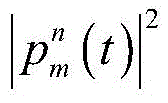

利用式(2)对所有子频带进行归一化处理,Use formula (2) to normalize all sub-bands,

式中,
经过脑电波特征提取模块后,可得到所有子频带的脑电波信号的能量特征矩阵。After the brainwave feature extraction module, the energy feature matrix of the brainwave signals of all sub-bands can be obtained.
作为本方案的一个优选实施例,该检测系统还包括脑电波特征降维模块,优选的,本发明用于采用局部保持投影方法对脑电波特征提取模块获得的脑电波信号能量特征矩阵进行降维处理。降维后的脑电波能量特征分类效果提高。As a preferred embodiment of this solution, the detection system further includes a brainwave feature dimensionality reduction module. Preferably, the present invention is used to reduce the dimension of the brainwave signal energy feature matrix obtained by the brainwave feature extraction module by using the local preservation projection method. deal with. The classification effect of brain wave energy features after dimensionality reduction is improved.
4、网瘾检测模型训练模块,用于对脑电波特征提取模块获得的能量特征矩阵进行训练,获得训练好的分类模型。4. The Internet addiction detection model training module is used to train the energy feature matrix obtained by the brain wave feature extraction module to obtain a trained classification model.
在本发明的一个优选实施例中,通过基于深度学习核映射的ELM对能量特征矩阵进行训练,在训练模型在保证学习精度的前提下,比传统训练模型具有更快的学习速度和更强的泛化能力,其中ELM损失函数为:In a preferred embodiment of the present invention, the energy feature matrix is trained through ELM based on deep learning kernel mapping, and the training model has a faster learning speed and stronger learning accuracy than the traditional training model under the premise of ensuring the learning accuracy. Generalization ability, where the ELM loss function is:

式中,Φ(xj;w)为深度学习映射核函数,xj为输入的第j个样本,Wi为第i个隐层神经元输入权重,βi为第i个隐层神经元输出权重,bi为第i个隐层神经元的偏置,tj为第j个样本类别;g(.)表示激活函数,N表示样本个数,L表示单层神经网络隐层神经元个数。In the formula, Φ(x j ; w) is the deep learning mapping kernel function, x j is the jth input sample, Wi is the input weight of the ith hidden layer neuron, and β i is the ith hidden layer neuron Output weight, b i is the bias of the ith hidden layer neuron, t j is the jth sample category; g(.) represents the activation function, N represents the number of samples, and L represents the hidden layer neuron of the single-layer neural network number.
5、检测模块,用于将脑电波采集模块采集的测试者的脑电波信号,依次经过数据预处理模块和脑电波特征提取模块获得能量特征矩阵,再利用网瘾检测模型训练模块训练好的分类模型进行检测,输出分类结果。5. The detection module is used to obtain the energy characteristic matrix of the tester's brain wave signal collected by the brain wave acquisition module through the data preprocessing module and the brain wave feature extraction module in turn, and then use the Internet addiction detection model training module to train the classification. The model performs detection and outputs classification results.
由于检测模块每隔一时间段会输出一个分类结果,网瘾监测模块将统计该段时间内网瘾程度的分布,将比例最大的网瘾程度fimax作为该被试者网瘾程度的输出,Since the detection module will output a classification result every time period, the Internet addiction monitoring module will count the distribution of the Internet addiction degree within this period, and take the Internet addiction degree f imax with the largest proportion as the output of the Internet addiction degree of the subject.

6、网瘾监测模块,用于判断测试者处于无网瘾、轻度网络成瘾、中度网络成瘾还是重度网络成瘾,如果判断为网络成瘾,发出预警。6. The Internet addiction monitoring module is used to judge whether the tester has no Internet addiction, mild Internet addiction, moderate Internet addiction or severe Internet addiction. If it is judged to be Internet addiction, an early warning will be issued.
将检测模块输出的结果依次发送至监护人APP和医师客户端。如果判断为网络成瘾,则同时发出预警提示,如果医师判断为网瘾程度需入院就诊,可以通过客户端向监护人APP发送提示。The results output by the detection module are sent to the guardian APP and the physician client in turn. If it is judged to be Internet addiction, an early warning prompt will be issued at the same time. If the doctor judges that the degree of Internet addiction needs to be admitted to the hospital, a prompt can be sent to the guardian APP through the client.
本发明的数据预处理模块,脑电波特征提取模块,网瘾检测模型训练模块,检测模块,网瘾监测模块均集成在计算机的控制芯片内。The data preprocessing module, the brain wave feature extraction module, the internet addiction detection model training module, the detection module and the internet addiction monitoring module of the present invention are all integrated in the control chip of the computer.
以下给出本发明的一个具体实施例,以验证本发明系统和方法的有效性。A specific embodiment of the present invention is given below to verify the effectiveness of the system and method of the present invention.
本发明的一个具体实施例中,采用Young在1996年编制的《网络成瘾测验》对训练集被测试者打上标签。该量表一共由20道题目组成,每道题有5个选择项目,属于五级量表,1=几乎没有,2=偶尔,3=有时,4=经常,5=总是,该量表要求被试根据自己的情况完成问卷。最后是根据被测试者在该量表上所得的总分来判定被测试者是否网络成瘾以及他网络成瘾的程度。40分以下无网瘾,40-60轻度网络成瘾,60-80中度网络成瘾,80-100重度网络成瘾。In a specific embodiment of the present invention, the "Internet Addiction Test" compiled by Young in 1996 is used to label the test subjects in the training set. The scale consists of 20 items in total, and each item has 5 options. It belongs to a five-level scale, 1 = almost never, 2 = occasionally, 3 = sometimes, 4 = often, 5 = always, the scale The subjects were asked to complete the questionnaire according to their own circumstances. Finally, according to the test subject's total score on the scale, it is determined whether the test subject has Internet addiction and the degree of his Internet addiction. No Internet addiction below 40 points, 40-60 mild Internet addiction, 60-80 moderate Internet addiction, 80-100 severe Internet addiction.
根据Young《网络成瘾测验》对10名被试进行网瘾程度检测,5人正常,3人轻度,1人中度,1人重度,用于标注随后的脑电样本。然后利用开源脑电采集设备收集被试者上网后的脑电波信号,如图4所示,对该脑电波数据进行预处理,被试得到600段脑电片段样本,经过小波包分解得到8个子频带,提取特征和局部保持投影特征降维后,送入训练的分类模型中进行分类。然后采用10折交叉验证评价方法,平均准确率达到85%。According to Young's "Internet Addiction Test", 10 subjects were tested for the degree of Internet addiction, 5 were normal, 3 were mild, 1 was moderate, and 1 was severe, which was used to label the subsequent EEG samples. Then, the open-source EEG acquisition equipment was used to collect the brainwave signals of the subjects after surfing the Internet. As shown in Figure 4, the brainwave data was preprocessed. The subjects obtained 600 EEG segment samples, and 8 subsections were obtained through wavelet packet decomposition. After dimensionality reduction of frequency bands, extracted features and locally preserved projection features, they are sent to the trained classification model for classification. Then the 10-fold cross-validation evaluation method was adopted, and the average accuracy rate reached 85%.
需要说明的是,本发明并不局限于上述实施例,在本发明公开的技术方案的基础上,本领域的技术人员根据所公开的技术内容,不需要创造性的劳动就可以对其中的一些技术特征作出一些替换和变形,这些替换和变形均在本发明的保护范围内。It should be noted that the present invention is not limited to the above-mentioned embodiments. On the basis of the technical solutions disclosed in the present invention, those skilled in the art can modify some of the technical solutions without creative work according to the disclosed technical content. Some replacements and modifications are made to the features, and these replacements and modifications are all within the protection scope of the present invention.
Claims (5)


Priority Applications (1)
| Application Number | Priority Date | Filing Date | Title |
|---|---|---|---|
| CN201910307964.3A CN110123342B (en) | 2019-04-17 | 2019-04-17 | Internet addiction detection method and system based on brain waves |
Applications Claiming Priority (1)
| Application Number | Priority Date | Filing Date | Title |
|---|---|---|---|
| CN201910307964.3A CN110123342B (en) | 2019-04-17 | 2019-04-17 | Internet addiction detection method and system based on brain waves |
Publications (2)
| Publication Number | Publication Date |
|---|---|
| CN110123342A CN110123342A (en) | 2019-08-16 |
| CN110123342B true CN110123342B (en) | 2021-06-08 |
Family
ID=67570274
Family Applications (1)
| Application Number | Title | Priority Date | Filing Date |
|---|---|---|---|
| CN201910307964.3A Active CN110123342B (en) | 2019-04-17 | 2019-04-17 | Internet addiction detection method and system based on brain waves |
Country Status (1)
| Country | Link |
|---|---|
| CN (1) | CN110123342B (en) |
Families Citing this family (5)
| Publication number | Priority date | Publication date | Assignee | Title |
|---|---|---|---|---|
| CN111513732A (en) * | 2020-04-29 | 2020-08-11 | 山东大学 | Intelligent psychological stress assessment early warning system for various groups of people under epidemic disease condition |
| CN112754440A (en) * | 2021-01-07 | 2021-05-07 | 广州番禺职业技术学院 | System and method for preventing user network addiction |
| CN113392734A (en) * | 2021-05-31 | 2021-09-14 | 上海市精神卫生中心(上海市心理咨询培训中心) | Electroencephalogram feature screening method, addiction evaluation method and system for identifying addiction people |
| CN113598794B (en) * | 2021-08-12 | 2024-12-17 | 中南民族大学 | Training method and system for ice toxin addict detection model |
| CN117056831A (en) * | 2023-10-13 | 2023-11-14 | 南京龙垣信息科技有限公司 | Method for identifying heart monologue based on convolutional neural network |
Citations (8)
| Publication number | Priority date | Publication date | Assignee | Title |
|---|---|---|---|---|
| WO2008083442A1 (en) * | 2007-01-10 | 2008-07-17 | Brc Operations Pty Limited | Method for formulating combination medications for adhd |
| CN201453836U (en) * | 2009-06-24 | 2010-05-12 | 王志忠 | Brain wave feedback internet addiction withdrawal apparatus |
| CN201676403U (en) * | 2010-05-25 | 2010-12-22 | 顾磊 | Brain wave adjustment instrument |
| EP2651496A2 (en) * | 2010-12-14 | 2013-10-23 | The Regents Of The University Of California | Devices, systems and methods for the treatment of medical disorders |
| CN107260187A (en) * | 2017-07-24 | 2017-10-20 | 中国科学院心理研究所 | A kind of method and its system that habituation drug craving is induced in reality environment |
| CN107979565A (en) * | 2016-10-21 | 2018-05-01 | 中国移动通信有限公司研究院 | A kind of control method and device of network access |
| CN109144241A (en) * | 2018-06-20 | 2019-01-04 | 安徽师范大学 | Online shopping habituation control system |
| CN109300529A (en) * | 2018-09-12 | 2019-02-01 | 阿呆科技(北京)有限公司 | Intervened based on artificial intelligence and the craving targeting of virtual reality/augmented reality drug addiction and rescues system |
Family Cites Families (16)
| Publication number | Priority date | Publication date | Assignee | Title |
|---|---|---|---|---|
| US8150508B2 (en) * | 2006-03-29 | 2012-04-03 | Catholic Healthcare West | Vagus nerve stimulation method |
| US8652040B2 (en) * | 2006-12-19 | 2014-02-18 | Valencell, Inc. | Telemetric apparatus for health and environmental monitoring |
| CN101927052A (en) * | 2009-06-26 | 2010-12-29 | 王志忠 | Drug-detoxifying apparatus based on brain wave biofeedback |
| EP3063751A4 (en) * | 2013-10-31 | 2017-08-02 | Haruta, Pau-San | Computing technologies for diagnosis and therapy of language-related disorders |
| US20160345855A1 (en) * | 2013-12-13 | 2016-12-01 | Northwestern University | Methods of treating brain disorders or identifying biomarkers related thereto |
| US10413235B2 (en) * | 2014-04-25 | 2019-09-17 | The General Hospital Corporation | Hybrid system for treating mental and emotional disorders with responsive brain stimulation |
| US20160191484A1 (en) * | 2014-07-09 | 2016-06-30 | Intelmate Llc | Secure Inmate Digital Storage |
| US20160098592A1 (en) * | 2014-10-01 | 2016-04-07 | The Governing Council Of The University Of Toronto | System and method for detecting invisible human emotion |
| US10045737B2 (en) * | 2015-06-14 | 2018-08-14 | Facense Ltd. | Clip-on device with inward-facing cameras |
| US10113913B2 (en) * | 2015-10-03 | 2018-10-30 | Facense Ltd. | Systems for collecting thermal measurements of the face |
| CN109416729A (en) * | 2016-04-18 | 2019-03-01 | 麻省理工学院 | Feature is extracted from physiological signal |
| CN107007290B (en) * | 2017-03-27 | 2019-09-20 | 广州视源电子科技股份有限公司 | EEG relaxation recognition method and device based on time domain and phase space |
| CN107714057A (en) * | 2017-10-01 | 2018-02-23 | 南京邮电大学盐城大数据研究院有限公司 | A kind of three classification Emotion identification model methods based on convolutional neural networks |
| CN108478216A (en) * | 2018-02-06 | 2018-09-04 | 杭州电子科技大学 | A kind of epileptic seizure intelligent Forecasting early period based on convolutional neural networks |
| CN109497997A (en) * | 2018-12-10 | 2019-03-22 | 杭州妞诺科技有限公司 | Based on majority according to the seizure detection and early warning system of acquisition |
| CN109376556B (en) * | 2018-12-17 | 2020-12-18 | 华中科技大学 | An attack method for EEG brain-computer interface based on convolutional neural network |
-
2019
- 2019-04-17 CN CN201910307964.3A patent/CN110123342B/en active Active
Patent Citations (8)
| Publication number | Priority date | Publication date | Assignee | Title |
|---|---|---|---|---|
| WO2008083442A1 (en) * | 2007-01-10 | 2008-07-17 | Brc Operations Pty Limited | Method for formulating combination medications for adhd |
| CN201453836U (en) * | 2009-06-24 | 2010-05-12 | 王志忠 | Brain wave feedback internet addiction withdrawal apparatus |
| CN201676403U (en) * | 2010-05-25 | 2010-12-22 | 顾磊 | Brain wave adjustment instrument |
| EP2651496A2 (en) * | 2010-12-14 | 2013-10-23 | The Regents Of The University Of California | Devices, systems and methods for the treatment of medical disorders |
| CN107979565A (en) * | 2016-10-21 | 2018-05-01 | 中国移动通信有限公司研究院 | A kind of control method and device of network access |
| CN107260187A (en) * | 2017-07-24 | 2017-10-20 | 中国科学院心理研究所 | A kind of method and its system that habituation drug craving is induced in reality environment |
| CN109144241A (en) * | 2018-06-20 | 2019-01-04 | 安徽师范大学 | Online shopping habituation control system |
| CN109300529A (en) * | 2018-09-12 | 2019-02-01 | 阿呆科技(北京)有限公司 | Intervened based on artificial intelligence and the craving targeting of virtual reality/augmented reality drug addiction and rescues system |
Non-Patent Citations (2)
| Title |
|---|
| Longitudinal Changes in Neural Connectivity in Patients With Internet Gaming Disorder: A Resting-State EEG Coherence Study;Park Sunyoung;《Frontiers in Psychiatry》;20180607;第1-7页 * |
| 网络游戏脑疲劳检测的微电子系统设计;何国松;《中国优秀硕士论文电子期刊网》;20110131;第1-69页 * |
Also Published As
| Publication number | Publication date |
|---|---|
| CN110123342A (en) | 2019-08-16 |
Similar Documents
| Publication | Publication Date | Title |
|---|---|---|
| CN110123342B (en) | Internet addiction detection method and system based on brain waves | |
| CN111466876B (en) | An auxiliary diagnosis system for Alzheimer's disease based on fNIRS and graph neural network | |
| Gevins et al. | Automated analysis of the electrical activity of the human brain (EEG): A progress report | |
| Wagh et al. | Performance evaluation of multi-channel electroencephalogram signal (EEG) based time frequency analysis for human emotion recognition | |
| CN101690659B (en) | Brain wave analysis method | |
| Kalayci et al. | Wavelet preprocessing for automated neural network detection of EEG spikes | |
| Halford | Computerized epileptiform transient detection in the scalp electroencephalogram: Obstacles to progress and the example of computerized ECG interpretation | |
| Gurudath et al. | Drowsy driving detection by EEG analysis using wavelet transform and K-means clustering | |
| Buettner et al. | High-performance diagnosis of sleep disorders: a novel, accurate and fast machine learning approach using electroencephalographic data | |
| CN109770924A (en) | A kind of tired classification method based on Hadamard product building brain function network and Method Using Relevance Vector Machine | |
| CN112704503B (en) | Electrocardiosignal noise processing method | |
| CN111150410A (en) | Psychological stress evaluation method based on the fusion of ECG signal and EMG signal | |
| CN104757968A (en) | Statistical evaluation method for intermediate data of paroxysmal conditions of children's absence epilepsy | |
| CN107479702A (en) | A kind of human emotion's dominance classifying identification method using EEG signals | |
| Bairagi et al. | Epileptic seizure identification in EEG signals using DWT, ANN and sequential window algorithm | |
| CN106943150A (en) | Mental fatigue detecting system and its method for use | |
| CN107292296A (en) | A kind of human emotion wake-up degree classifying identification method of use EEG signals | |
| VG et al. | Analysis and classification of stress among students using EEG as biomarker | |
| Saini et al. | Discriminatory features based on wavelet energy for effective analysis of electroencephalogram during mental tasks | |
| Qin et al. | Research on emotion recognition of bimodal bioelectrical features based on DS evidence theory | |
| CN113598791B (en) | Consciousness disturbance classification method based on time-space convolution neural network used by resting state electroencephalogram | |
| Samarpita et al. | Differentiating mental stress levels: Analysing machine learning algorithms comparatively for eeg-based mental stress classification using mne-python | |
| Martins et al. | A Comparison of Machine Learning Techniques for the Detection of Type-4 PhotoParoxysmal Responses in Electroencephalographic Signals | |
| Poojitha et al. | Eeg based early detection of autism using convolutional neural networks | |
| CN112656373B (en) | Physical fatigue detection method and system based on brain network topological law |
Legal Events
| Date | Code | Title | Description |
|---|---|---|---|
| PB01 | Publication | ||
| PB01 | Publication | ||
| SE01 | Entry into force of request for substantive examination | ||
| SE01 | Entry into force of request for substantive examination | ||
| GR01 | Patent grant | ||
| GR01 | Patent grant |