Background
Currently, single-channel blind separation refers to simultaneously receiving a target signal and one or more interference signals under a single-antenna receiving condition, and separating the target signal and the interference signals by using a blind signal separation method by using a received mixed signal under the condition of lacking prior information of the target signal and the interference signals. The main reason why the time-frequency aliasing signals are difficult to separate is that the problem is underdetermined, because only one receiving signal is needed, but a plurality of source signals are to be separated, therefore, other useful characteristics or prior information of the signals must be fully mined, a new method is searched to solve the problem, and the underdetermined problem is converted into an overdetermined or positive-definite condition. Existing signal separation methods are filter design based methods and multi-user detection based methods. The first prior art is as follows: a separation method for single antenna receiving time-frequency overlapping signals is provided based on the cycle stationarity of source signals by adopting a BA-FRESH filterAccording to the method, the BA-FRESH filter parameters are set by using the combined parameter estimation result of the second-order cyclic cumulant, and signal time-frequency overlapping signal blind separation is carried out. The algorithm firstly needs to calculate the circular autocorrelation of the received signal and solves the filter parameters based on the maximum correlation criterion, the algorithm needs to solve the optimal solution of the matrix, the complexity is high, the timeliness is poor, and the bit error rate can reach 10 only when the signal-to-noise ratio is larger than 10dB-2. In the second "single-channel time-frequency aliasing communication signal blind separation research" in the prior art, the problem of time-frequency aliasing signal blind separation is divided into two cases of same-symbol-rate and different-symbol-rate digital signal blind separation, and the blind separation problem of the same-symbol-rate digital communication signal mixture is decomposed into component signal parameter estimation problems, including estimation of amplitude, phase and time delay, and signal separation problems under known parameters. Aiming at the problem of signal separation, the second prior art provides a separation method based on lattice reduction and decision feedback. The characteristic parameters of the signals need to be estimated firstly, but the prior art cannot achieve higher parameter estimation precision, so that the separation performance of the signals is influenced, and the complexity of a decision feedback system is higher, and the received data is required to be long enough. In general, the algorithm has high requirements on signal to noise ratio and high complexity.
In summary, the problems of the prior art are as follows: the existing algorithm has high complexity, poor timeliness and higher requirement on signal-to-noise ratio;
the difficulty of solving the technical problems is as follows:
the single-channel blind separation is to receive a target signal and one or more interference signals simultaneously under the condition of single-antenna reception, and separate the target signal and the interference signals by using a blind signal separation method by using a received mixed signal under the condition of lacking prior information of the target signal and the interference signals. The main reason for the difficulty in separating time-frequency aliased signals is that this is an underdetermined problem, since only one received signal is needed to separate out multiple source signals. If the problems of high complexity and low timeliness of the existing algorithm are solved, other better algorithms need to be found.
The significance of solving the technical problems is as follows:
in real life, a plurality of signals in a frequency band often occur, and even time-frequency overlapping occurs. In this case, the useful signal cannot be directly acquired. In order to ensure normal communication, it is necessary to separate such signals that overlap in time and frequency. In the field of medical signal processing, single-channel blind separation is widely applied to various electrophysiological signal processing, for example, the electrocardiogram of pregnant mothers in biomedicine is formed by mixing the heartbeats of mothers and fetuses. For the mixed signal received by the electronic device, how to extract the signal of interest is an important research topic.
Disclosure of Invention
Aiming at the problems in the prior art, the invention provides a time-frequency overlapping signal blind separation method based on frequency spectrum symmetry and a wireless communication system.
The invention is realized in this way, a time-frequency overlapping signal blind separation method based on frequency spectrum symmetry, the time-frequency overlapping signal blind separation method based on frequency spectrum symmetry transforms the received signal to the frequency domain, and judges whether the effective signal is interfered by other digital signals in the frequency domain; if the effective signal is interfered, finding out the uncontaminated single side band information; by using the symmetry of frequency spectrum and taking the central carrier frequency as the center, the amplitude of the single-sideband signal is subjected to even symmetry, and the phase is subjected to odd symmetry; performing Fourier inversion on the acquired separation signal to obtain a time domain signal; and then directly demodulating the time domain signal to obtain the transmission information.
Further, the time-frequency overlapping signal blind separation method based on spectrum symmetry specifically includes:
(1) judging whether the valid signal is polluted or not;
(1a) carrying out Fourier transform on the received signal to obtain a frequency domain signal;
(1b) estimating 3dB bandwidth of a signal using a center of gravity method
And a central carrier frequency
Correcting the estimated value of the central carrier frequency by using a frequency spectrum refining algorithm to obtain
(1c) Bandwidth of 3dB to be estimated
And a central carrier frequency
With the theoretical 3dB bandwidth B and the center carrier frequency f of the effective signal
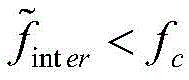
cIn comparison, if
Or
Determining that the valid signal is contaminated;
(2) finding out sideband information of the effective signal which is not polluted;
(2a) solving the cyclic cumulant of the signal according to the cyclic stationarity of the signal;
(2b) smoothing the circulating cumulant, and extracting the characteristic of a cumulant discrete spectral line;
(2c) according to the characteristic of cumulant discrete spectral line, the central carrier frequency of interference signal is obtained
And bandwidth
(2d) If it is
And is
And judging that the lower sideband of the effective signal is not polluted, and intercepting the information of the lower sideband of the signal. If it is
And is
Judging that the upper sideband of the effective signal is not polluted, and intercepting the information of the upper sideband of the signal;
(3) separation is achieved in the frequency domain by utilizing sideband properties;
(3a) by utilizing sideband property, the amplitude of the intercepted single sideband signal is even symmetric and the phase is odd symmetric by taking the carrier frequency as a center;
(3b) carrying out Fourier inversion on the signals obtained by symmetry and recovering the signals to a time domain;
(4) demodulating;
(4a) and demodulating the time domain signal to obtain code element information.
Further, the specifically determining whether the valid signal is contaminated includes;
carrying out Fourier transform on the received signal to obtain a frequency domain signal;
estimating 3dB bandwidth of a signal using a center of gravity method
And a central carrier frequency
Correcting the estimated value of the central carrier frequency by using a frequency spectrum refining algorithm to obtain
The center of gravity method is described as follows: the frequency spectrum of the received signal being R
s(k),R
s(k) Maximum amplitude of R
s(k
0) Find all of them greater than 0.5R
s(k
0) Can calculate an estimate of the 3dB bandwidth of the received signal
Where Δ t is the sampling interval, where k represents Rs(k) Wherein all are greater than 0.5Rs(k0) The serial number of the spectral line of (1);
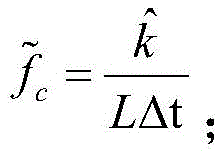
estimate of center carrier frequency
Is as follows;
in the formula, L is the number of points of Fourier transform of the signal;
bandwidth of 3dB to be estimated
And a central carrier frequency
With the theoretical 3dB bandwidth B and the center carrier frequency f of the effective signal
cIn comparison, if
Or
The valid signal is determined to be contaminated.
Further, the finding of the sideband information that the effective signal is not polluted specifically includes:
the cyclostationarity of the signal means that the statistic of the signal has periodicity, and Fourier expansion can be carried out on the statistic of the signal; the fourth-order cyclic cumulant refers to a Fourier series expansion coefficient of a time-varying fourth-order cumulant, and the time-varying fourth-order cumulant cx,4,0(t,0) is as defined below;
cx,4,0(t,0)=mx,4,0(t,0)-3mx,2,0(t,0)2;
wherein m isx,4,0(t,0) denotes the fourth power, m, of the received signal x (t)x,2,0(t,0) is the square of the received signal x (t);
smoothing the circulating cumulant, and extracting the characteristic of a cumulant discrete spectral line;
smoothing with the following formula;
wherein { W (k) } denotes a sequence to be smoothed, { S (k) } denotes a sequence after smoothing, and c (n) denotes a weighting coefficient
w refers to the weighted window length;
according to the characteristic of cumulant discrete spectral line, the central carrier frequency of interference signal is obtained
And bandwidth
If it is
And is
And judging that the lower sideband of the effective signal is not polluted, and intercepting the information of the lower sideband of the signal. If it is
And is
Then the upper sideband of the effective signal is judged not to be polluted, and the sideband information on the signal is intercepted。
Another objective of the present invention is to provide a wireless communication system applying the time-frequency overlapping signal blind separation method based on spectrum symmetry.
Through simulation comparison, the bit error rate can reach 10 only when the signal-to-noise ratio is more than 10dB in the prior art-2When the signal-to-noise ratio is larger than 7dB, the bit error rate performance reaches 10-2Compared with the prior art, the method improves the efficiency by 3 dB. The invention has the advantages and positive effects that: the invention does not need to estimate parameters such as component signal amplitude, phase and time delay one by one, only needs to judge whether the effective signal is polluted or not, determines the sideband information of the signal which is not polluted, can realize signal blind separation by using half of frequency spectrum information in the frequency domain, and has low complexity and high timeliness. The best performance of single sideband demodulation has been achieved.
The invention can be used in the field of signal processing, and for signals with complete time domain overlapping and maximum frequency domain overlapping degree not more than 50%, the invention can use the sideband relationship between the upper and lower side bands of the signals to make spectrum symmetry on the signals in the frequency domain, thereby realizing the separation of time-frequency aliasing signals. The method has the advantages of low complexity, simplicity in implementation and the like.
Detailed Description
In order to make the objects, technical solutions and advantages of the present invention more apparent, the present invention is further described in detail with reference to the following embodiments. It should be understood that the specific embodiments described herein are merely illustrative of the invention and are not intended to limit the invention.
The invention provides a novel blind separation algorithm for overcoming the condition that time-frequency aliasing signals are difficult to separate blindly. The algorithm is based on the single sideband characteristics of the signal, and the signal is symmetrically processed in the frequency domain to obtain complete signal information. The invention is suitable for digital signals with aliasing degree not exceeding 50% of the bandwidth of the digital signals. Has the advantages of simple operation and high practical value.
The following detailed description of the principles of the invention is provided in connection with the accompanying drawings.
As shown in fig. 1, the time-frequency overlapping signal blind separation method based on spectrum symmetry provided by the embodiment of the present invention includes the following steps:
s101: converting the received signal to a frequency domain, and judging whether the effective signal is interfered by other digital signals in the frequency domain; if the effective signal is interfered, finding out the uncontaminated single side band information;
s102: by using the symmetry of frequency spectrum and taking the central carrier frequency as the center, the amplitude of the single-sideband signal is subjected to even symmetry, and the phase is subjected to odd symmetry;
s103: performing Fourier inversion on the acquired separation signal to obtain a time domain signal; and then directly demodulating the time domain signal to obtain the transmission information.
The application of the principles of the present invention will now be described in further detail with reference to the accompanying drawings.
As shown in fig. 2, the time-frequency overlapping signal blind separation method based on spectrum symmetry provided in the embodiment of the present invention specifically includes the following steps:
judging whether the effective signal is polluted or not;
carrying out Fourier transform on the received signal to obtain a frequency domain signal;
estimating 3dB bandwidth of a signal using a center of gravity method
And a central carrier frequency
Correcting the estimated value of the central carrier frequency by using a frequency spectrum refining algorithm to obtain
The center of gravity method is described as follows: suppose that the frequency spectrum of the received signal is R
s(k),R
s(k) Maximum amplitude of R
s(k
0) Find all of them greater than 0.5R
s(k
0) Can calculate an estimate of the 3dB bandwidth of the received signal
Where Δ t is the sampling interval, where k represents Rs(k) Wherein all are greater than 0.5Rs(k0) The line number of (2).
Estimate of center carrier frequency
Is as follows;
in the formula, L is the number of points of the signal subjected to fourier transform.
The spectrum refinement algorithm is any one of a Chirp-Z transform spectrum refinement method or a zoomft spectrum refinement method.
Bandwidth of 3dB to be estimated
And a central carrier frequency
With the theoretical 3dB bandwidth B and the center carrier frequency f of the effective signal
cComparisonIf, if
Or
The valid signal is determined to be contaminated.
Secondly, finding out the sideband information of the effective signal which is not polluted; solving the cyclic cumulant of the signal according to the cyclic stationarity of the signal;
the cyclostationarity of the signal means that the statistic of the signal has periodicity, and Fourier expansion can be carried out on the statistic of the signal;
the cyclic accumulation of the signal includes a cyclic autocorrelation function, a cyclic conjugate autocorrelation function, and a fourth order cyclic accumulation. A cyclic autocorrelation function refers to the product of a signal and its own time delay conjugate. A cyclic conjugate autocorrelation function refers to the product of a signal and its own time delay. The fourth-order cyclic cumulant refers to a Fourier series expansion coefficient of a time-varying fourth-order cumulant, and the time-varying fourth-order cumulant cx,4,0(t,0) is as defined below;
cx,4,0(t,0)=mx,4,0(t,0)-3mx,2,0(t,0)2;
wherein m isx,4,0(t,0) denotes the fourth power, m, of the received signal x (t)x,2,0(t,0) the square of the received signal x (t).
And smoothing the circulating cumulant, and extracting the characteristic of the cumulant discrete spectral line.
Smoothing with the following formula;
wherein { W (k) } denotes a sequence to be smoothed, { S (k) } denotes a sequence after smoothing, and c (n) denotes a weighting coefficient
w refers to the weighted window length.
Discrete spectral lines exist in the cyclic accumulation quantity of the signal with the cyclic stationarity, and the position of the discrete spectral line is related to the central carrier frequency and the code element rate parameter of the signal. The cyclic accumulation amount of the signal with the cyclic stability has independent superposition, and a plurality of signal sources are not influenced mutually. Therefore, the cyclic accumulation amount of the signals can be utilized to estimate the central carrier frequency and the bandwidth of the time-frequency overlapping signals.
According to the characteristic of cumulant discrete spectral line, the central carrier frequency of interference signal is obtained
And bandwidth
If it is
And is
And judging that the lower sideband of the effective signal is not polluted, and intercepting the information of the lower sideband of the signal. If it is
And is
And judging that the upper sideband of the effective signal is not polluted, and intercepting the information of the upper sideband of the signal.
Thirdly, realizing separation in a frequency domain by utilizing sideband properties;
by utilizing sideband property, the amplitude of the intercepted single sideband signal is even symmetric and the phase is odd symmetric by taking the carrier frequency as a center;
the sideband property means that the real signal Fourier transform has conjugate symmetry, i.e., the real signal spectral amplitude is even symmetric about frequency and the spectral phase is odd symmetric about center.
And performing Fourier inversion on the signals obtained by symmetry to restore the signals to a time domain.
Step four, demodulating the time domain signal to obtain code element information; and carrying out blind matching and down-sampling on the obtained time domain signals, and after synchronization, carrying out hard decision to recover transmission information.
The application effect of the present invention will be described in detail with reference to simulation experiments.
1. Simulation conditions are as follows:
matlab R2014 software is used in the simulation experiment, binary phase shift keying BPSK is adopted as a digital modulation mode, a forming function is raised cosine roll-off forming, a forming coefficient is 0.35, carrier frequency is 7MHz, a modulation signal baud rate is 500KBuad, a received signal sampling rate is 100MHz, received signal sampling time is 8ms, 1000 independent Monte-Carlo simulation experiments are carried out under each signal-to-noise ratio, and an additive white Gaussian noise channel is adopted as a channel.
2. Simulation content and result analysis thereof:
under the simulation condition, the BPSK signal which has spectrum aliasing and the bandwidth of the aliasing part does not exceed 50% of the bandwidth of the BPSK signal is recovered by a spectrum symmetry method. In the simulation, the bit error rate is taken as a performance measurement standard. Fig. 3 shows the influence of the spectrum symmetry method on the constellation of BPSK signals when the simulated signal-to-noise ratio is 20 dB. Fig. 4 is a diagram for measuring the performance of the blind separation by the spectrum symmetry method according to the invention by using the error rate, and the invention adopts hard decision decoding.
As can be seen from fig. 3, the original constellation diagram, which is influenced by noise and dispersed in the same direction and the orthogonal direction, is subjected to the symmetric processing, and then the constellation diagram is only dispersed in the same direction. This is because the spectrum of gaussian white noise does not have a conjugate symmetry property. Under an additive white Gaussian noise channel, the received signal is symmetrical, and meanwhile, noise is also symmetrically processed. The total power of the noise is substantially unchanged at this time, but the noise power is doubled on the real axis. Since the actual axis noise mainly affects the BPSK demodulation performance, this will have a certain effect on the demodulation performance.
As can be seen from fig. 4, the error code performance of the blind separation signal of the present invention is 3dB worse than the theoretical performance of the double-sideband transmission signal, but the single-sideband demodulation has reached the best performance.
Taking BPSK signals as an example, the bit error rate performance of the present invention is simulated under additive white gaussian noise. Fruit of Chinese wolfberryThe test result shows that the bit error rate of the invention reaches 10 already when the signal to noise ratio is 7dB-2Compared with the traditional method, the bit error rate is improved by nearly 3dB under the same condition.
The above description is only for the purpose of illustrating the preferred embodiments of the present invention and is not to be construed as limiting the invention, and any modifications, equivalents and improvements made within the spirit and principle of the present invention are intended to be included within the scope of the present invention.