CN110079607B - A primer set, method for detecting blood sample species and application - Google Patents
A primer set, method for detecting blood sample species and application Download PDFInfo
- Publication number
- CN110079607B CN110079607B CN201910268882.2A CN201910268882A CN110079607B CN 110079607 B CN110079607 B CN 110079607B CN 201910268882 A CN201910268882 A CN 201910268882A CN 110079607 B CN110079607 B CN 110079607B
- Authority
- CN
- China
- Prior art keywords
- concentration
- blood
- dna
- primer
- species
- Prior art date
- Legal status (The legal status is an assumption and is not a legal conclusion. Google has not performed a legal analysis and makes no representation as to the accuracy of the status listed.)
- Active
Links
- 239000008280 blood Substances 0.000 title claims abstract description 101
- 210000004369 blood Anatomy 0.000 title claims abstract description 101
- 238000000034 method Methods 0.000 title claims abstract description 33
- XHEFDIBZLJXQHF-UHFFFAOYSA-N fisetin Chemical compound C=1C(O)=CC=C(C(C=2O)=O)C=1OC=2C1=CC=C(O)C(O)=C1 XHEFDIBZLJXQHF-UHFFFAOYSA-N 0.000 claims abstract description 34
- 238000007397 LAMP assay Methods 0.000 claims abstract description 29
- 238000001514 detection method Methods 0.000 claims abstract description 26
- 239000003153 chemical reaction reagent Substances 0.000 claims abstract description 21
- VKJGBAJNNALVAV-UHFFFAOYSA-M Berberine chloride (TN) Chemical compound [Cl-].C1=C2CC[N+]3=CC4=C(OC)C(OC)=CC=C4C=C3C2=CC2=C1OCO2 VKJGBAJNNALVAV-UHFFFAOYSA-M 0.000 claims abstract description 20
- 235000011990 fisetin Nutrition 0.000 claims abstract description 17
- 238000000605 extraction Methods 0.000 claims abstract description 16
- 238000005516 engineering process Methods 0.000 claims abstract description 12
- HITDPRAEYNISJU-UHFFFAOYSA-N amenthoflavone Natural products Oc1ccc(cc1)C2=COc3c(C2=O)c(O)cc(O)c3c4cc(ccc4O)C5=COc6cc(O)cc(O)c6C5=O HITDPRAEYNISJU-UHFFFAOYSA-N 0.000 claims abstract 4
- YUSWMAULDXZHPY-UHFFFAOYSA-N amentoflavone Chemical compound C1=CC(O)=CC=C1C1=CC(=O)C2=C(O)C=C(O)C(C=3C(=CC=C(C=3)C=3OC4=CC(O)=CC(O)=C4C(=O)C=3)O)=C2O1 YUSWMAULDXZHPY-UHFFFAOYSA-N 0.000 claims abstract 4
- HVSKSWBOHPRSBD-UHFFFAOYSA-N amentoflavone Natural products Oc1ccc(cc1)C2=CC(=O)c3c(O)cc(O)c(c3O2)c4cc(ccc4O)C5=COc6cc(O)cc(O)c6C5=O HVSKSWBOHPRSBD-UHFFFAOYSA-N 0.000 claims abstract 4
- NQJGJBLOXXIGHL-UHFFFAOYSA-N podocarpusflavone A Natural products COc1ccc(cc1)C2=CC(=O)c3c(O)cc(O)c(c3O2)c4cc(ccc4O)C5=COc6cc(O)cc(O)c6C5=O NQJGJBLOXXIGHL-UHFFFAOYSA-N 0.000 claims abstract 4
- IAZDPXIOMUYVGZ-UHFFFAOYSA-N Dimethylsulphoxide Chemical compound CS(C)=O IAZDPXIOMUYVGZ-UHFFFAOYSA-N 0.000 claims description 48
- 239000000243 solution Substances 0.000 claims description 43
- OIRDTQYFTABQOQ-KQYNXXCUSA-N adenosine Chemical compound C1=NC=2C(N)=NC=NC=2N1[C@@H]1O[C@H](CO)[C@@H](O)[C@H]1O OIRDTQYFTABQOQ-KQYNXXCUSA-N 0.000 claims description 26
- 239000002184 metal Substances 0.000 claims description 16
- 108010067770 Endopeptidase K Proteins 0.000 claims description 15
- 230000009089 cytolysis Effects 0.000 claims description 14
- 239000002126 C01EB10 - Adenosine Substances 0.000 claims description 13
- KCXVZYZYPLLWCC-UHFFFAOYSA-N EDTA Chemical compound OC(=O)CN(CC(O)=O)CCN(CC(O)=O)CC(O)=O KCXVZYZYPLLWCC-UHFFFAOYSA-N 0.000 claims description 13
- 229960005305 adenosine Drugs 0.000 claims description 13
- 239000000203 mixture Substances 0.000 claims description 13
- 229940086319 nattokinase Drugs 0.000 claims description 13
- 108010073682 nattokinase Proteins 0.000 claims description 13
- 229940012957 plasmin Drugs 0.000 claims description 13
- 239000013504 Triton X-100 Substances 0.000 claims description 12
- 229920004890 Triton X-100 Polymers 0.000 claims description 12
- QKNYBSVHEMOAJP-UHFFFAOYSA-N 2-amino-2-(hydroxymethyl)propane-1,3-diol;hydron;chloride Chemical compound Cl.OCC(N)(CO)CO QKNYBSVHEMOAJP-UHFFFAOYSA-N 0.000 claims description 10
- 239000007853 buffer solution Substances 0.000 claims description 10
- 229920001213 Polysorbate 20 Polymers 0.000 claims description 8
- 239000000256 polyoxyethylene sorbitan monolaurate Substances 0.000 claims description 8
- 235000010486 polyoxyethylene sorbitan monolaurate Nutrition 0.000 claims description 8
- 239000002904 solvent Substances 0.000 claims description 8
- 102000016928 DNA-directed DNA polymerase Human genes 0.000 claims description 7
- 108010014303 DNA-directed DNA polymerase Proteins 0.000 claims description 7
- KWIUHFFTVRNATP-UHFFFAOYSA-N Betaine Natural products C[N+](C)(C)CC([O-])=O KWIUHFFTVRNATP-UHFFFAOYSA-N 0.000 claims description 6
- KWIUHFFTVRNATP-UHFFFAOYSA-O N,N,N-trimethylglycinium Chemical compound C[N+](C)(C)CC(O)=O KWIUHFFTVRNATP-UHFFFAOYSA-O 0.000 claims description 6
- WCUXLLCKKVVCTQ-UHFFFAOYSA-M Potassium chloride Chemical compound [Cl-].[K+] WCUXLLCKKVVCTQ-UHFFFAOYSA-M 0.000 claims description 6
- 229960003237 betaine Drugs 0.000 claims description 6
- 239000000463 material Substances 0.000 claims description 4
- 239000011259 mixed solution Substances 0.000 claims description 3
- 238000010438 heat treatment Methods 0.000 claims description 2
- 241000282414 Homo sapiens Species 0.000 abstract description 35
- 241000894007 species Species 0.000 abstract description 29
- 238000006243 chemical reaction Methods 0.000 abstract description 16
- 101000591187 Homo sapiens Notch homolog 2 N-terminal-like protein A Proteins 0.000 abstract description 7
- 108090000623 proteins and genes Proteins 0.000 abstract description 7
- 102100034093 Notch homolog 2 N-terminal-like protein A Human genes 0.000 abstract description 4
- 108700026220 vif Genes Proteins 0.000 abstract 1
- 108020004414 DNA Proteins 0.000 description 40
- 230000003321 amplification Effects 0.000 description 22
- 238000003199 nucleic acid amplification method Methods 0.000 description 22
- 239000006166 lysate Substances 0.000 description 20
- 230000002934 lysing effect Effects 0.000 description 11
- GAMYVSCDDLXAQW-AOIWZFSPSA-N Thermopsosid Natural products O(C)c1c(O)ccc(C=2Oc3c(c(O)cc(O[C@H]4[C@H](O)[C@@H](O)[C@H](O)[C@H](CO)O4)c3)C(=O)C=2)c1 GAMYVSCDDLXAQW-AOIWZFSPSA-N 0.000 description 8
- 229930003944 flavone Natural products 0.000 description 8
- 150000002212 flavone derivatives Chemical class 0.000 description 8
- 235000011949 flavones Nutrition 0.000 description 8
- VHBFFQKBGNRLFZ-UHFFFAOYSA-N vitamin p Natural products O1C2=CC=CC=C2C(=O)C=C1C1=CC=CC=C1 VHBFFQKBGNRLFZ-UHFFFAOYSA-N 0.000 description 8
- 241001465754 Metazoa Species 0.000 description 7
- 230000000694 effects Effects 0.000 description 6
- 239000001103 potassium chloride Substances 0.000 description 6
- XLYOFNOQVPJJNP-UHFFFAOYSA-N water Chemical compound O XLYOFNOQVPJJNP-UHFFFAOYSA-N 0.000 description 6
- 241000251468 Actinopterygii Species 0.000 description 5
- 241000283690 Bos taurus Species 0.000 description 5
- 241000282326 Felis catus Species 0.000 description 5
- 241001494479 Pecora Species 0.000 description 5
- 239000008367 deionised water Substances 0.000 description 5
- 229910021641 deionized water Inorganic materials 0.000 description 5
- 230000035945 sensitivity Effects 0.000 description 5
- 238000007400 DNA extraction Methods 0.000 description 4
- 240000005578 Rivina humilis Species 0.000 description 4
- 239000000872 buffer Substances 0.000 description 4
- 238000003752 polymerase chain reaction Methods 0.000 description 4
- 238000012360 testing method Methods 0.000 description 4
- HEMHJVSKTPXQMS-UHFFFAOYSA-M Sodium hydroxide Chemical compound [OH-].[Na+] HEMHJVSKTPXQMS-UHFFFAOYSA-M 0.000 description 3
- 208000007536 Thrombosis Diseases 0.000 description 3
- 229930003935 flavonoid Natural products 0.000 description 3
- 150000002215 flavonoids Chemical class 0.000 description 3
- 235000017173 flavonoids Nutrition 0.000 description 3
- 239000010413 mother solution Substances 0.000 description 3
- UXVMQQNJUSDDNG-UHFFFAOYSA-L Calcium chloride Chemical compound [Cl-].[Cl-].[Ca+2] UXVMQQNJUSDDNG-UHFFFAOYSA-L 0.000 description 2
- 230000004544 DNA amplification Effects 0.000 description 2
- BLRPTPMANUNPDV-UHFFFAOYSA-N Silane Chemical compound [SiH4] BLRPTPMANUNPDV-UHFFFAOYSA-N 0.000 description 2
- FAPWRFPIFSIZLT-UHFFFAOYSA-M Sodium chloride Chemical compound [Na+].[Cl-] FAPWRFPIFSIZLT-UHFFFAOYSA-M 0.000 description 2
- 239000011324 bead Substances 0.000 description 2
- 238000010170 biological method Methods 0.000 description 2
- 239000001110 calcium chloride Substances 0.000 description 2
- 229910001628 calcium chloride Inorganic materials 0.000 description 2
- 235000011148 calcium chloride Nutrition 0.000 description 2
- 230000000052 comparative effect Effects 0.000 description 2
- 238000001962 electrophoresis Methods 0.000 description 2
- 239000011521 glass Substances 0.000 description 2
- 238000007689 inspection Methods 0.000 description 2
- 238000002156 mixing Methods 0.000 description 2
- 210000002569 neuron Anatomy 0.000 description 2
- 108020004707 nucleic acids Proteins 0.000 description 2
- 102000039446 nucleic acids Human genes 0.000 description 2
- 150000007523 nucleic acids Chemical class 0.000 description 2
- 102000004169 proteins and genes Human genes 0.000 description 2
- 238000012216 screening Methods 0.000 description 2
- 230000000405 serological effect Effects 0.000 description 2
- 229910000077 silane Inorganic materials 0.000 description 2
- 239000000126 substance Substances 0.000 description 2
- 241001552669 Adonis annua Species 0.000 description 1
- 241000282472 Canis lupus familiaris Species 0.000 description 1
- 241000218645 Cedrus Species 0.000 description 1
- 241000218691 Cupressaceae Species 0.000 description 1
- PMATZTZNYRCHOR-CGLBZJNRSA-N Cyclosporin A Chemical compound CC[C@@H]1NC(=O)[C@H]([C@H](O)[C@H](C)C\C=C\C)N(C)C(=O)[C@H](C(C)C)N(C)C(=O)[C@H](CC(C)C)N(C)C(=O)[C@H](CC(C)C)N(C)C(=O)[C@@H](C)NC(=O)[C@H](C)NC(=O)[C@H](CC(C)C)N(C)C(=O)[C@H](C(C)C)NC(=O)[C@H](CC(C)C)N(C)C(=O)CN(C)C1=O PMATZTZNYRCHOR-CGLBZJNRSA-N 0.000 description 1
- 108010036949 Cyclosporine Proteins 0.000 description 1
- 102000004190 Enzymes Human genes 0.000 description 1
- 108090000790 Enzymes Proteins 0.000 description 1
- VEXZGXHMUGYJMC-UHFFFAOYSA-N Hydrochloric acid Chemical compound Cl VEXZGXHMUGYJMC-UHFFFAOYSA-N 0.000 description 1
- 108091005804 Peptidases Proteins 0.000 description 1
- 239000004365 Protease Substances 0.000 description 1
- 238000011529 RT qPCR Methods 0.000 description 1
- 102100037486 Reverse transcriptase/ribonuclease H Human genes 0.000 description 1
- 241000282887 Suidae Species 0.000 description 1
- 239000007984 Tris EDTA buffer Substances 0.000 description 1
- 239000007983 Tris buffer Substances 0.000 description 1
- 238000004458 analytical method Methods 0.000 description 1
- 239000003146 anticoagulant agent Substances 0.000 description 1
- 229940127219 anticoagulant drug Drugs 0.000 description 1
- 239000000427 antigen Substances 0.000 description 1
- 102000036639 antigens Human genes 0.000 description 1
- 108091007433 antigens Proteins 0.000 description 1
- 230000009286 beneficial effect Effects 0.000 description 1
- 238000002306 biochemical method Methods 0.000 description 1
- 230000015572 biosynthetic process Effects 0.000 description 1
- 238000004159 blood analysis Methods 0.000 description 1
- 210000004556 brain Anatomy 0.000 description 1
- 239000011449 brick Substances 0.000 description 1
- DEGAKNSWVGKMLS-UHFFFAOYSA-N calcein Chemical compound O1C(=O)C2=CC=CC=C2C21C1=CC(CN(CC(O)=O)CC(O)=O)=C(O)C=C1OC1=C2C=C(CN(CC(O)=O)CC(=O)O)C(O)=C1 DEGAKNSWVGKMLS-UHFFFAOYSA-N 0.000 description 1
- 230000015556 catabolic process Effects 0.000 description 1
- 210000004027 cell Anatomy 0.000 description 1
- 229960001265 ciclosporin Drugs 0.000 description 1
- 108091036078 conserved sequence Proteins 0.000 description 1
- 230000001054 cortical effect Effects 0.000 description 1
- 229930182912 cyclosporin Natural products 0.000 description 1
- 230000002380 cytological effect Effects 0.000 description 1
- 238000006731 degradation reaction Methods 0.000 description 1
- 230000001934 delay Effects 0.000 description 1
- 238000011161 development Methods 0.000 description 1
- 230000004069 differentiation Effects 0.000 description 1
- 229940000406 drug candidate Drugs 0.000 description 1
- 229940088598 enzyme Drugs 0.000 description 1
- 239000003777 experimental drug Substances 0.000 description 1
- 210000005260 human cell Anatomy 0.000 description 1
- 229910000041 hydrogen chloride Inorganic materials 0.000 description 1
- IXCSERBJSXMMFS-UHFFFAOYSA-N hydrogen chloride Substances Cl.Cl IXCSERBJSXMMFS-UHFFFAOYSA-N 0.000 description 1
- 230000008676 import Effects 0.000 description 1
- 238000000338 in vitro Methods 0.000 description 1
- 230000005764 inhibitory process Effects 0.000 description 1
- 238000011901 isothermal amplification Methods 0.000 description 1
- 230000001404 mediated effect Effects 0.000 description 1
- 239000013642 negative control Substances 0.000 description 1
- 239000002773 nucleotide Substances 0.000 description 1
- 125000003729 nucleotide group Chemical group 0.000 description 1
- 229960002378 oftasceine Drugs 0.000 description 1
- 239000013641 positive control Substances 0.000 description 1
- 238000001556 precipitation Methods 0.000 description 1
- 238000002360 preparation method Methods 0.000 description 1
- 230000008569 process Effects 0.000 description 1
- 238000012545 processing Methods 0.000 description 1
- 239000000047 product Substances 0.000 description 1
- 235000019419 proteases Nutrition 0.000 description 1
- 238000003753 real-time PCR Methods 0.000 description 1
- 239000011780 sodium chloride Substances 0.000 description 1
- 210000000130 stem cell Anatomy 0.000 description 1
- 239000011550 stock solution Substances 0.000 description 1
- 239000006228 supernatant Substances 0.000 description 1
- 238000003786 synthesis reaction Methods 0.000 description 1
- 230000009466 transformation Effects 0.000 description 1
- 238000000844 transformation Methods 0.000 description 1
- LENZDBCJOHFCAS-UHFFFAOYSA-N tris Chemical compound OCC(N)(CO)CO LENZDBCJOHFCAS-UHFFFAOYSA-N 0.000 description 1
- AUIINJJXRXMPGT-UHFFFAOYSA-K trisodium 3-hydroxy-4-[(2-hydroxy-4-sulfonatonaphthalen-1-yl)diazenyl]naphthalene-2,7-disulfonate Chemical compound [Na+].[Na+].[Na+].Oc1cc(c2ccccc2c1N=Nc1c(O)c(cc2cc(ccc12)S([O-])(=O)=O)S([O-])(=O)=O)S([O-])(=O)=O AUIINJJXRXMPGT-UHFFFAOYSA-K 0.000 description 1
- 229910021642 ultra pure water Inorganic materials 0.000 description 1
- 239000012498 ultrapure water Substances 0.000 description 1
Images


Classifications
-
- C—CHEMISTRY; METALLURGY
- C12—BIOCHEMISTRY; BEER; SPIRITS; WINE; VINEGAR; MICROBIOLOGY; ENZYMOLOGY; MUTATION OR GENETIC ENGINEERING
- C12Q—MEASURING OR TESTING PROCESSES INVOLVING ENZYMES, NUCLEIC ACIDS OR MICROORGANISMS; COMPOSITIONS OR TEST PAPERS THEREFOR; PROCESSES OF PREPARING SUCH COMPOSITIONS; CONDITION-RESPONSIVE CONTROL IN MICROBIOLOGICAL OR ENZYMOLOGICAL PROCESSES
- C12Q1/00—Measuring or testing processes involving enzymes, nucleic acids or microorganisms; Compositions therefor; Processes of preparing such compositions
- C12Q1/68—Measuring or testing processes involving enzymes, nucleic acids or microorganisms; Compositions therefor; Processes of preparing such compositions involving nucleic acids
- C12Q1/6844—Nucleic acid amplification reactions
-
- C—CHEMISTRY; METALLURGY
- C12—BIOCHEMISTRY; BEER; SPIRITS; WINE; VINEGAR; MICROBIOLOGY; ENZYMOLOGY; MUTATION OR GENETIC ENGINEERING
- C12Q—MEASURING OR TESTING PROCESSES INVOLVING ENZYMES, NUCLEIC ACIDS OR MICROORGANISMS; COMPOSITIONS OR TEST PAPERS THEREFOR; PROCESSES OF PREPARING SUCH COMPOSITIONS; CONDITION-RESPONSIVE CONTROL IN MICROBIOLOGICAL OR ENZYMOLOGICAL PROCESSES
- C12Q1/00—Measuring or testing processes involving enzymes, nucleic acids or microorganisms; Compositions therefor; Processes of preparing such compositions
- C12Q1/68—Measuring or testing processes involving enzymes, nucleic acids or microorganisms; Compositions therefor; Processes of preparing such compositions involving nucleic acids
- C12Q1/6876—Nucleic acid products used in the analysis of nucleic acids, e.g. primers or probes
- C12Q1/6888—Nucleic acid products used in the analysis of nucleic acids, e.g. primers or probes for detection or identification of organisms
Landscapes
- Chemical & Material Sciences (AREA)
- Life Sciences & Earth Sciences (AREA)
- Organic Chemistry (AREA)
- Proteomics, Peptides & Aminoacids (AREA)
- Analytical Chemistry (AREA)
- Zoology (AREA)
- Wood Science & Technology (AREA)
- Health & Medical Sciences (AREA)
- Engineering & Computer Science (AREA)
- Microbiology (AREA)
- Immunology (AREA)
- Molecular Biology (AREA)
- Biotechnology (AREA)
- Biophysics (AREA)
- Physics & Mathematics (AREA)
- Biochemistry (AREA)
- Bioinformatics & Cheminformatics (AREA)
- General Engineering & Computer Science (AREA)
- General Health & Medical Sciences (AREA)
- Genetics & Genomics (AREA)
- Chemical Kinetics & Catalysis (AREA)
- Measuring Or Testing Involving Enzymes Or Micro-Organisms (AREA)
Abstract
Description
技术领域technical field
本发明属于生物技术领域,具体涉及一种引物组、检测血液样品种属的方法及应用。The invention belongs to the field of biotechnology, and in particular relates to a primer set, a method and application for detecting the species of a blood sample.
背景技术Background technique
血痕是最常见的物证检材,是法医检验中最常遇到和最重要的检验项目,约占法医物证检验的80%左右。凡在现场、致伤物、衣物上发现的可疑血液或血痕均涉及血痕检验。当可疑斑痕确定为血痕后,应快速确定其种属来源,明确血痕是动物血还是人血。Bloodstain is the most common material evidence inspection material, and it is the most frequently encountered and important inspection item in forensic examination, accounting for about 80% of forensic material evidence examination. All suspicious blood or bloodstains found on the scene, wounded objects, and clothing are involved in bloodstain testing. When a suspicious stain is determined to be a blood stain, the source of its species should be quickly determined, and whether the blood stain is animal blood or human blood.
目前,血痕种属鉴定有许多方法,包括血清学方法、细胞学方法、分子生物学方法及生物化学方法。其中,血清学的沉淀反应最为简便,但容易被其他抗原干扰检测结果,尤其是混合样品检验中常常造成误检。而分子生物学方法最为准确,如聚合酶链式反应(PCR),但是由于凝血块DNA提取效率较低和分子生物学方法操作较为繁琐、对设备和检测人员技能要求较高、痕量样品中检测灵敏度低等原因,限制了该方法在血痕检测方面的应用。环介导等温扩增技术对于血痕种属鉴定着有简单、快速、特异性强等优点。但是,目前环介导等温扩增技术所用的指示剂主要为钙黄绿素、羟基萘酚蓝、SYBR Green等,现有的指示剂存在区分度低,或存在背景噪音大,或对扩增反应具有一定抑制作用等缺点。At present, there are many methods for the identification of bloodstain species, including serological methods, cytological methods, molecular biological methods and biochemical methods. Among them, the serological precipitation reaction is the most simple, but it is easy to be interfered with the test results by other antigens, especially in the mixed sample test, which often causes false detection. Molecular biology methods are the most accurate, such as polymerase chain reaction (PCR). The low detection sensitivity and other reasons limit the application of this method in blood stain detection. The loop-mediated isothermal amplification technique has the advantages of simplicity, rapidity and strong specificity for the identification of bloodstained species. However, the indicators used in the current loop-mediated isothermal amplification technology are mainly calcein, hydroxynaphthol blue, SYBR Green, etc. The existing indicators have low discrimination, or have large background noise, or have no effect on the amplification reaction. Certain inhibition and other disadvantages.
可见,目前对于血液样品种属并没有一种快速高效且准确的检测方法,有必要开发一种检测血液样品种属的方法,解决凝血块DNA提取效率较低,分子生物学方法操作较为繁琐、痕量样品中检测灵敏度低的技术问题。。It can be seen that there is currently no fast, efficient and accurate detection method for the species of blood samples. It is necessary to develop a method for detecting the species of blood samples to solve the problem that the DNA extraction efficiency of blood clots is low, and the operation of molecular biological methods is cumbersome. Technical issues with low detection sensitivity in trace samples. .
发明内容SUMMARY OF THE INVENTION
针对现有技术存在的问题,本发明的目的是提供一种引物组、检测血液样品种属的方法及应用。解决凝血块DNA提取效率较低,分子生物学方法操作较为繁琐、痕量样品中检测灵敏度低的技术问题。In view of the problems existing in the prior art, the purpose of the present invention is to provide a primer set, a method and application for detecting the species of a blood sample. The technical problems of low extraction efficiency of clot DNA, complicated operation of molecular biology methods and low detection sensitivity in trace samples are solved.
为达到上述目的,本发明采用如下技术方案:To achieve the above object, the present invention adopts the following technical solutions:
一种引物组,包括引物FIP、BIP、LF、LB、F3和B3,其中F3:TGTGACATTCCAGGACACTGA primer set, including primers FIP, BIP, LF, LB, F3 and B3, wherein F3: TGTGACATTCCAGGACACTG
B3:GGCAGTTGCACTCAAAAGTGB3: GGCAGTTGCACTCAAAAGTG
FIP:CTGGCCTGTGAAGCCCTGAAGCCAGCATGGTGGCATCTGFIP: CTGGCCTGTGAAGCCCTGAAGCCAGCATGGTGGCATCTG
BIP:GACAGCCTGTATGTGCCCTGTTCACCAGTCTGCCGACAGBIP: GACAGCCTGTATGTGCCCTGTTCACCAGTCTGCCGACAG
LF:CTGGTAGGAACCAGGCAGGTTLF: CTGGTAGGAACCAGGCAGGTT
LB:GCACCCTCGCCTTGTGTCAAT。LB: GCACCCTCGCCTTGTGTCAAT.
一种检测血液样品种属的方法,包括利用DNA快速提取试剂提取血液中的DNA,然后加入环介导等温扩增指示剂和引物组采用环介导等温扩增技术进行血液样品种属检测,所述的环介导等温扩增指示剂包括非瑟酮、穗花杉双黄酮或盐酸小檗碱,所述的引物组为本发明所述的引物组。A method for detecting the species of a blood sample, comprising using a DNA rapid extraction reagent to extract DNA in blood, then adding a loop-mediated isothermal amplification indicator and a primer set to detect the species of the blood sample by using the loop-mediated isothermal amplification technology, The loop-mediated isothermal amplification indicator includes fisetin, cyperflavone or berberine hydrochloride, and the primer set is the primer set of the present invention.
进一步地,所述的盐酸小檗碱的浓度为50~150μM,非瑟酮的浓度为50~100μM,穗花杉双黄酮的浓度为100~150μM,所述的环介导等温扩增指示剂中的溶剂DMSO的浓度为2.5%~5%(v/v)。Further, the concentration of the berberine hydrochloride is 50-150 μM, the concentration of fisetin is 50-100 μM, and the concentration of flavone is 100-150 μM, and the ring-mediated isothermal amplification indicator is The concentration of the solvent DMSO is 2.5% to 5% (v/v).
进一步地,所述DNA快速提取试剂包括溶解液和裂解液;Further, the DNA rapid extraction reagent includes a lysing solution and a lysing solution;
所述的溶解液包括纳豆激酶、纤溶酶、腺苷和EDTA的混合溶液,所述的纳豆激酶浓度为100~1000FU/mL,所述的纤溶酶浓度为1~10U/mL,所述的腺苷浓度为5~30μg/mL,所述的EDTA浓度为0.1~10mM;The dissolving solution comprises a mixed solution of nattokinase, plasmin, adenosine and EDTA, the concentration of the nattokinase is 100-1000FU/mL, the concentration of the plasmin is 1-10U/mL, The adenosine concentration is 5-30 μg/mL, and the EDTA concentration is 0.1-10 mM;
所述的裂解液包括蛋白酶K,Triton X-100和CaCl2的混合溶液,所述的蛋白酶K浓度为2~20mg/mL,所述的Triton X-100占裂解液的0.1%~1%,其中“%”是指以体积计的质量百分数,所述的CaCl2浓度为1~10mM。The lysing solution includes a mixed solution of proteinase K, Triton X-100 and CaCl 2 , the proteinase K concentration is 2-20 mg/mL, and the Triton X-100 accounts for 0.1%-1% of the lysing solution, Wherein "%" refers to the mass percentage by volume, and the CaCl 2 concentration is 1-10 mM.
进一步地,具体包括以下步骤:Further, the following steps are specifically included:
步骤一:在血痕样品中加入DNA快速提取试剂,然后在金属浴条件下孵育得到DNA模板;Step 1: Add DNA rapid extraction reagent to the blood stain sample, and then incubate in a metal bath to obtain a DNA template;
步骤二:向步骤一得到的DNA模板中加入缓冲溶液、Tween-20、dNTP、Bst DNAPolymerase、环介导等温扩增指示剂和引物混合物,得到待检测血液样品,然后进行血液样品种属检测。Step 2: Add buffer solution, Tween-20, dNTP, Bst DNAPolymerase, loop-mediated isothermal amplification indicator and primer mixture to the DNA template obtained in
具体地,所述的引物混合物包括本发明所述的引物组,所述的引物FIP浓度为20μM,所述的BIP浓度为20μM,所述的引物LF浓度为10μM,所述的引物LB浓度为10μM,所述的引物F3浓度为5μM,所述的引物B3浓度为5μM。Specifically, the primer mixture includes the primer set of the present invention, the primer FIP concentration is 20 μM, the BIP concentration is 20 μM, the primer LF concentration is 10 μM, and the primer LB concentration is 10 μM, the primer F3 concentration is 5 μM, and the primer B3 concentration is 5 μM.
具体地,所述的缓冲液由甜菜碱、KCl、Tris-HCl、(NH4)2SO4和MgSO4按照物质的量浓度比为400~600:25~50:5~10:5~10:3~4配置而成。Specifically, the buffer solution is composed of betaine, KCl, Tris-HCl, (NH 4 ) 2 SO 4 and MgSO 4 according to the substance concentration ratio of 400~600:25~50:5~10:5~10 : 3 to 4 are configured.
具体地,所述的Tris-HCl的pH值为6.8~8.8。Specifically, the pH value of the Tris-HCl is 6.8-8.8.
优选的,包括以下步骤:Preferably, it includes the following steps:
步骤一:在血痕样品中加入0.1mL溶解液,在温度为37℃的金属浴中孵育20min,然后加入0.1mL裂解液在温度为65℃的金属浴中孵育20min,再在温度为100℃的金属浴中加热5min得到DNA模板;Step 1: Add 0.1 mL of lysis solution to the blood-stained sample, incubate in a metal bath with a temperature of 37 °C for 20 min, then add 0.1 mL of lysis solution and incubate in a metal bath with a temperature of 65 °C for 20 min, and then incubate in a metal bath with a temperature of 100 °C for 20 min. Heating in a metal bath for 5 min to obtain a DNA template;
步骤二:取1~2μL步骤一得到的DNA模板,向其中加入缓冲溶液、0.1%的Tween-20、1.4mM的dNTP、8U的Bst DNA Polymerase、1μl的环介导等温扩增指示剂和1μL的引物混合物,得到待检测血液样品,进行血液样品种属检测;Step 2: Take 1-2 μL of the DNA template obtained in
所述的DNA快速提取试剂包括溶解液和裂解液,所述溶解液包括500FU/mL的纳豆激酶、10U/mL的纤溶酶、30μg/mL的腺苷浓度和1mM的EDTA,所述裂解液包括10mg/mL的蛋白酶K、1%的Triton X-100和5mM的CaCl2;Described DNA rapid extraction reagent comprises lysate and lysate, described lysate comprises the nattokinase of 500FU/mL, the plasmin of 10U/mL, the adenosine concentration of 30μg/mL and the EDTA of 1mM, described lysate. The solution included 10 mg/mL proteinase K, 1% Triton X-100 and 5 mM CaCl 2 ;
所述的环介导等温扩增指示剂包括浓度为2.5mM的盐酸小檗碱、1.875mM的非瑟酮或3.0mM的穗花杉双黄酮,所述环介导等温扩增指示剂的溶剂为DMSO,所述DMSO的浓度为2.5~5%(v/v);The loop-mediated isothermal amplification indicator comprises berberine hydrochloride, 1.875 mM fisetin or 3.0 mM cyclosporine at a concentration of 2.5 mM, and the solvent of the loop-mediated isothermal amplification indicator is: DMSO, the concentration of the DMSO is 2.5-5% (v/v);
所述的缓冲溶液包括浓度为20mM的Tris-HCl、浓度为50mM的KCl、浓度为10mM(NH4)2SO4和浓度为8mM MgSO4。The buffer solution included Tris-HCl at a concentration of 20 mM, KCl at a concentration of 50 mM, (NH 4 ) 2 SO 4 at a concentration of 10 mM and MgSO 4 at a concentration of 8 mM.
本发明所述的引物组或本发明所述的检测血液样品种属的方法用于检测血液样品种属的应用。Application of the primer set of the present invention or the method for detecting the species of a blood sample of the present invention for detecting the species of a blood sample.
本发明与现有技术相比具有以下的有益效果:Compared with the prior art, the present invention has the following beneficial effects:
(1)本发明选择的基因序列仅存在于人类中,提高了检测特异性,同时对引物进行筛选,提出了一种检测效率和特异性均高于现有检测方法的检测血液样品种属的方法;(1) The gene sequence selected by the present invention only exists in human beings, which improves the detection specificity. At the same time, the primers are screened, and a detection efficiency and specificity are both higher than those of the existing detection methods. method;
(2)本发明以非瑟酮、穗花杉双黄酮或盐酸小檗碱等作为环介导等温扩增指示剂,增加了反应结果的色差,使结果易于区分;(2) In the present invention, fisetin, flavone or berberine hydrochloride, etc. are used as loop-mediated isothermal amplification indicators, which increases the color difference of the reaction results and makes the results easy to distinguish;
(3)能够充分溶解已经凝固的血痕,并快速释放DNA,操作简单,DNA损失较少。(3) It can fully dissolve the coagulated bloodstain and release DNA quickly, with simple operation and less DNA loss.
附图说明Description of drawings
图1是不同引物组的特异性及扩增效率比较(1P、2P、3P、4P和5P分别为5组引物的阳性扩增曲线,2N和3N分别为第2组合第3组引物的非特异性扩增曲线);Figure 1 is a comparison of the specificity and amplification efficiency of different primer sets (1P, 2P, 3P, 4P and 5P are the positive amplification curves of the 5 sets of primers, respectively, 2N and 3N are the non-specificity of the second set of primers and the third set of primers, respectively Amplification curve);
图2是人源DNA检测结果;Fig. 2 is the detection result of human DNA;
图3是不同溶解液和裂解液提取DNA对比;Figure 3 is a comparison of DNA extracted from different lysing solutions and lysing solutions;
图4是人血和其他动物血液混合后提取的DNA电泳图(1:人血;2:人血+狗血;3:人血+猪血;4:人血+牛血;5:人血+羊血;6:人血+鱼血;7:人血+猫血;8:狗血;9:猪血;10:牛血;11:羊血;12:鱼血;13:猫血;M:1kb DNA Ladder);Figure 4 is an electrophoresis image of DNA extracted after mixing human blood and other animal blood (1: human blood; 2: human blood+dog blood; 3: human blood+pig blood; 4: human blood+bovine blood; 5: human blood + sheep blood; 6: human blood + fish blood; 7: human blood + cat blood; 8: dog blood; 9: pig blood; 10: cow blood; 11: sheep blood; 12: fish blood; 13: cat blood; M: 1kb DNA Ladder);
图5是人血和其他动物血液混合后的扩增结果(1:人血;2:人血+狗血;3:人血+猪血;4:人血+牛血;5:人血+羊血;6:人血+鱼血;7:人血+猫血;8:狗血;9:猪血;10:牛血;11:羊血;12:鱼血;13:猫血;14:ddH2O);Figure 5 is the amplification results after mixing human blood and other animal blood (1: human blood; 2: human blood+dog blood; 3: human blood+pig blood; 4: human blood+bovine blood; 5: human blood+ sheep blood; 6: human blood + fish blood; 7: human blood + cat blood; 8: dog blood; 9: pig blood; 10: cow blood; 11: sheep blood; 12: fish blood; 13: cat blood; 14 :ddH 2 O);
图6是1%(A)和5%(B)DMSO作为盐酸小檗碱溶剂条件下的扩增结果;Figure 6 is the amplification results under the condition of 1% (A) and 5% (B) DMSO as berberine hydrochloride solvent;
图7是不同指示剂条件下的扩增结果(A-非瑟酮;B-穗花杉双黄酮);Fig. 7 is the amplification result under different indicator conditions (A-fisetin; B- cypress flavonoid);
以下结合说明书附图和具体实施方式对本发明做具体说明。The present invention will be described in detail below with reference to the accompanying drawings and specific embodiments.
具体实施方式Detailed ways
以下给出本发明的具体实施例,需要说明的是本发明并不局限于以下具体实施例,凡在本申请技术方案基础上做的等同变换均落入本发明的保护范围。Specific embodiments of the present invention are given below. It should be noted that the present invention is not limited to the following specific embodiments, and all equivalent transformations made on the basis of the technical solutions of the present application fall into the protection scope of the present invention.
本发明主要是提供一种引物组、检测血液样品种属的方法及应用,并基于NOTCH2NL基因的种属特异性,利用环介导等温扩增技术的实用性和高灵敏度,建立一种疑似人源痕量未知样品种属快速鉴定体系,提高案件侦破效率。Human Notch homolog 2N-terminal-like protein(NOTCH2NL)是一种能够延迟皮质干细胞分化为神经元,从而导致大脑在整个发育过程中产生更多的神经元的基因。目前,该基因仅存在于人类细胞中,因此,选择NOTCH2NL基因作为检测靶基因,具有极高的种属特异性。The invention mainly provides a primer set, a method and application for detecting the species of a blood sample, and based on the species specificity of NOTCH2NL gene and the practicability and high sensitivity of the loop-mediated isothermal amplification technology, to establish a suspected human The rapid identification system for the species of unknown samples with traces of source, improves the efficiency of case detection. Human Notch homolog 2N-terminal-like protein (NOTCH2NL) is a gene that delays the differentiation of cortical stem cells into neurons, leading to the creation of more neurons in the brain throughout development. At present, this gene only exists in human cells. Therefore, the NOTCH2NL gene is selected as the detection target gene, which has extremely high species specificity.
环介导等温扩增技术(loop-mediated isothermal amplification,LAMP)是一种能够在恒温65℃条件下进行体外扩增的技术,具有简单、快速、特异性强等优点。该技术灵敏度高于普通PCR技术10-100倍,且不依赖任何特殊仪器即可完成扩增及结果分析,检测成本及实用性均优于PCR技术。Loop-mediated isothermal amplification (LAMP) is a technology that can perform in vitro amplification at a constant temperature of 65 °C, and has the advantages of simplicity, rapidity, and high specificity. The sensitivity of this technology is 10-100 times higher than that of ordinary PCR technology, and amplification and result analysis can be completed without any special equipment. The detection cost and practicability are better than PCR technology.
本发明中用到的实验药品与试剂具体信息如下:The specific information of the experimental drugs and reagents used in the present invention is as follows:
生化试剂与生物学试剂:Bst DNA Polymerase(购自NEB公司);dNTP(购自北京百奥莱博生物科技有限公司);蛋白酶K(购自生工生物工程(上海)股份有限公司);硅烷基磁珠(购自天根生化科技(北京)有限公司)纳豆激酶(购自西安绿天生物技术有限公司);纤溶酶(购自西安瑞盈生物科技有限公司);穗花杉双黄酮、盐酸小檗碱、非瑟酮、腺苷(购自上海阿拉丁生化科技股份有限公司);Biochemical reagents and biological reagents: Bst DNA Polymerase (purchased from NEB Company); dNTP (purchased from Beijing Biolab Biotechnology Co., Ltd.); Proteinase K (purchased from Sangon Bioengineering (Shanghai) Co., Ltd.); Silane Magnetic beads (purchased from Tiangen Biochemical Technology (Beijing) Co., Ltd.) nattokinase (purchased from Xi'an Lutian Biotechnology Co., Ltd.); plasmin (purchased from Xi'an Ruiying Biotechnology Co., Ltd.); Berberine hydrochloride, fisetin, adenosine (purchased from Shanghai Aladdin Biochemical Technology Co., Ltd.);
普通试剂:Tris、EDTA、NaCl、NaOH、HCl、KCl、(NH4)2SO4、MgSO4、Tween-20、DMSO、Triton X-100、甜菜碱等常规化学试剂,均从西安晶博生物科技有限公司购买,为进口分装产品。Common reagents: Tris, EDTA, NaCl, NaOH, HCl, KCl, (NH 4 ) 2 SO 4 , MgSO 4 , Tween-20, DMSO, Triton X-100, betaine and other conventional chemical reagents, all from Xi'an Jingbo Biotechnology Co., Ltd. to buy, for the import of sub-packaged products.
溶液与缓冲液:除穗花杉双黄酮、盐酸小檗碱、非瑟酮用DMSO溶解外,其余所有溶液与缓冲液均采用去离子超纯水配制。Solutions and buffers: All other solutions and buffers were prepared with deionized ultrapure water, except for the flavone, berberine hydrochloride and fisetin dissolved in DMSO.
DNA快速提取试剂:DNA快速提取试剂包括溶解液和裂解液。溶解液包括纳豆激酶、纤溶酶、腺苷和EDTA,其中,纳豆激酶浓度为100~1000FU/mL,纤溶酶浓度为1~10U/mL,腺苷浓度为5~30μg/mL,EDTA浓度为0.1~10mM;裂解液包括蛋白酶K,Triton X-100和CaCl2,其中,蛋白酶K浓度为2~20mg/mL,Triton X-100占裂解液的0.1%~1%,其中“%”是指以体积计的质量百分数,CaCl2浓度为1~10mM。DNA rapid extraction reagent: DNA rapid extraction reagent includes lysate and lysate. The lysing solution includes nattokinase, plasmin, adenosine and EDTA, wherein the concentration of nattokinase is 100-1000FU/mL, the concentration of plasmin is 1-10U/mL, and the concentration of adenosine is 5-30μg/mL, The concentration of EDTA is 0.1-10mM; the lysate contains proteinase K, Triton X-100 and CaCl 2 , wherein the concentration of proteinase K is 2-20mg/mL, and Triton X-100 accounts for 0.1%-1% of the lysate, of which "%" ” refers to the mass percentage by volume, and the CaCl 2 concentration is 1 to 10 mM.
血痕样品的处理:血痕为一次性采血针(施莱)采集的指腹血滴在干净的玻璃片上晾干30min形成。取1cm×0.5cm大小的血痕装入1.5mL离心管中,加入0.1mL上述配置的溶解液,在37℃金属浴条件下孵育20min,然后加入上述配置的0.1mL裂解液,在温度为65℃金属浴中孵育20min,然后100℃金属浴加热5min,使蛋白酶K及其他可能残留的蛋白质失活,作为模板用于血痕的种属鉴定。Treatment of bloodstain samples: bloodstains are formed from finger pulp blood drops collected by a disposable lancet (Shlai) and dried on a clean glass slide for 30 minutes. Take a 1cm × 0.5cm bloodstain into a 1.5mL centrifuge tube, add 0.1mL of the above-configured lysis solution, incubate for 20 min in a metal bath at 37°C, and then add 0.1mL of the above-configured lysis solution at a temperature of 65°C Incubate in a metal bath for 20 min, and then heat in a metal bath at 100°C for 5 min to inactivate proteinase K and other possible residual proteins, which are used as templates for species identification of bloodstains.
环介导等温扩增技术指示剂的制备:配置浓度为1.25~2.5mM的非瑟酮、浓度为2.5~3.75mM的穗花杉双黄酮或浓度为1.25~3.75mM的盐酸小檗碱,使用时每25μl反应体系加入1μl上述指示剂。即最终实际用量:盐酸小檗碱的加入量为50~150μM,穗花杉双黄酮的最终浓度为100~150μM,非瑟酮的加入量为5~100μM。环介导等温扩增技术指示剂的溶剂为DMSO,DMSO存在增加指示剂的溶解度、降低背景噪音、降低核酸Tm值,更易变性,提高特异性的作用。Preparation of indicator for loop-mediated isothermal amplification technology: configure fisetin at a concentration of 1.25-2.5 mM, flavone at a concentration of 2.5-3.75 mM or berberine hydrochloride at a concentration of 1.25-3.75 mM. Add 1 μl of the above indicator per 25 μl reaction system. That is, the final actual dosage: the addition amount of berberine hydrochloride is 50-150 μM, the final concentration of flavone is 100-150 μM, and the addition amount of fisetin is 5-100 μM. The solvent of the indicator of the loop-mediated isothermal amplification technology is DMSO. DMSO has the functions of increasing the solubility of the indicator, reducing the background noise, reducing the Tm value of the nucleic acid, making it more volatile and improving the specificity.
引物的处理:将江苏金唯智生物科技有限公司合成的人源特异性引物用去离子水配制成FIP和BIP浓度均为20μM、LF和LB浓度均为10μM、F3和B3浓度均为5μM的25×引物混合物(25×是指该浓度为工作浓度的25倍,使用时每25μL反应体系加入1μL即为工作浓度)。所用引物序列如下:Treatment of primers: The human-specific primers synthesized by Jiangsu Jinweizhi Biotechnology Co., Ltd. were prepared with deionized water to prepare 25 with FIP and BIP concentrations of 20 μM, LF and LB concentrations of 10 μM, and F3 and B3 concentrations of 5 μM. × Primer mix (25× means that the concentration is 25 times the working concentration, and adding 1 μL per 25 μL reaction system is the working concentration). The primer sequences used are as follows:
F3:TGTGACATTCCAGGACACTGF3: TGTGACATTCCAGGACACTG
B3:GGCAGTTGCACTCAAAAGTGB3: GGCAGTTGCACTCAAAAGTG
FIP:CTGGCCTGTGAAGCCCTGAAGCCAGCATGGTGGCATCTGFIP: CTGGCCTGTGAAGCCCTGAAGCCAGCATGGTGGCATCTG
BIP:GACAGCCTGTATGTGCCCTGTTCACCAGTCTGCCGACAGBIP: GACAGCCTGTATGTGCCCTGTTCACCAGTCTGCCGACAG
LF:CTGGTAGGAACCAGGCAGGTTLF: CTGGTAGGAACCAGGCAGGTT
LB:GCACCCTCGCCTTGTGTCAATLB: GCACCCTCGCCTTGTGTCAAT
血液样品的检测:最终检测体系总体积为25μL,包含甜菜碱、KCl、Tris-HCl(pH=8.8)、(NH4)2SO4、MgSO4、Tween-20。其中,缓冲液由甜菜碱、KCl、Tris-HCl、(NH4)2SO4、MgSO4按照物质的量浓度比为400~600:25~50:5~10:5~10:3~4混合而成,Tris-HCl的pH值为6.8~8.8;此外,反应体系还包括1.4mM的dNTP、8U Bst DNA Polymerase、1μL的2.5mM盐酸小檗碱母液、1μL的25×引物混合物以及2μL的DNA模板,然后加入去离子水补足至25μL。Detection of blood samples: The total volume of the final detection system is 25 μL, including betaine, KCl, Tris-HCl (pH=8.8), (NH 4 ) 2 SO 4 , MgSO 4 , and Tween-20. Among them, the buffer solution is composed of betaine, KCl, Tris-HCl, (NH 4 ) 2 SO 4 , MgSO 4 according to the substance concentration ratio of 400~600:25~50:5~10:5~10:3~4 The pH value of Tris-HCl is 6.8-8.8; in addition, the reaction system also includes 1.4mM dNTP, 8U Bst DNA Polymerase, 1μL 2.5mM berberine hydrochloride stock solution,
血液样品的检测过程为:将环介导等温扩增试剂和缓冲液混合,加入1μL指示剂、1μL引物、1~2μL待测DNA模板(即核酸),然后置于63~67℃恒温条件下反应30~60min,再升温至83~87℃反应5min即可;最后将反应管置于500nm蓝光灯下观察,亮绿色为阳性,砖红色为阴性。The detection process of the blood sample is as follows: mix the loop-mediated isothermal amplification reagent and buffer, add 1 μL indicator, 1 μL primer, 1-2 μL DNA template (ie nucleic acid) to be tested, and then place it under the constant temperature of 63-67 °C The reaction was carried out for 30-60 min, and then heated to 83-87 °C for 5 min; finally, the reaction tube was placed under a 500 nm blue light for observation, bright green was positive, and brick red was negative.
或将反应体系置于实时荧光定量PCR仪上,设置扩增条件为:65℃、45sec扩增;65℃、15sec收集荧光;共60个循环,然后85℃、5min后终止反应,有扩增曲线的为阳性,无扩增曲线的为阴性,同时可以通过扩增曲线对样品进行定量分析。Or place the reaction system on a real-time fluorescence quantitative PCR instrument, and set the amplification conditions as follows: 65°C, 45sec amplification; 65°C, 15sec collection of fluorescence; a total of 60 cycles, and then the reaction is terminated after 85°C, 5min, and there is amplification The curve is positive, and the sample without the amplification curve is negative. At the same time, the sample can be quantitatively analyzed by the amplification curve.
实施例1:遵从上述技术方案,本实施例给出引物组的具体筛选方法及筛选结果。Embodiment 1: Following the above technical solution, this embodiment provides specific screening methods and screening results of primer sets.
根据NCBI数据库的查询,人源特异性基因Homo sapiens notch 2 N-terminallike A(NOTCH2NLA)保守序列为:GenBank:BC019835.1(https://www.ncbi.nlm.nih.gov/nucleotide/BC019835.1?report=genbank&log$=nuclalign&blast_rank=3&RID=2DR4CPJ6014),以人类口腔拭子提取的DNA作为模板,并在http://primerexplorer.jp/e/网站设计引物,其中5组引物序列如表1所示,引物合成由苏州金唯智生物科技有限公司完成。比较其扩增效率和特异性。最终获得一组特异性和扩增效率最佳的引物组。According to the query of the NCBI database, the conserved sequence of the human-specific gene Homo sapiens
表1各组引物编号及引物序列Table 1 Primer numbers and primer sequences of each group
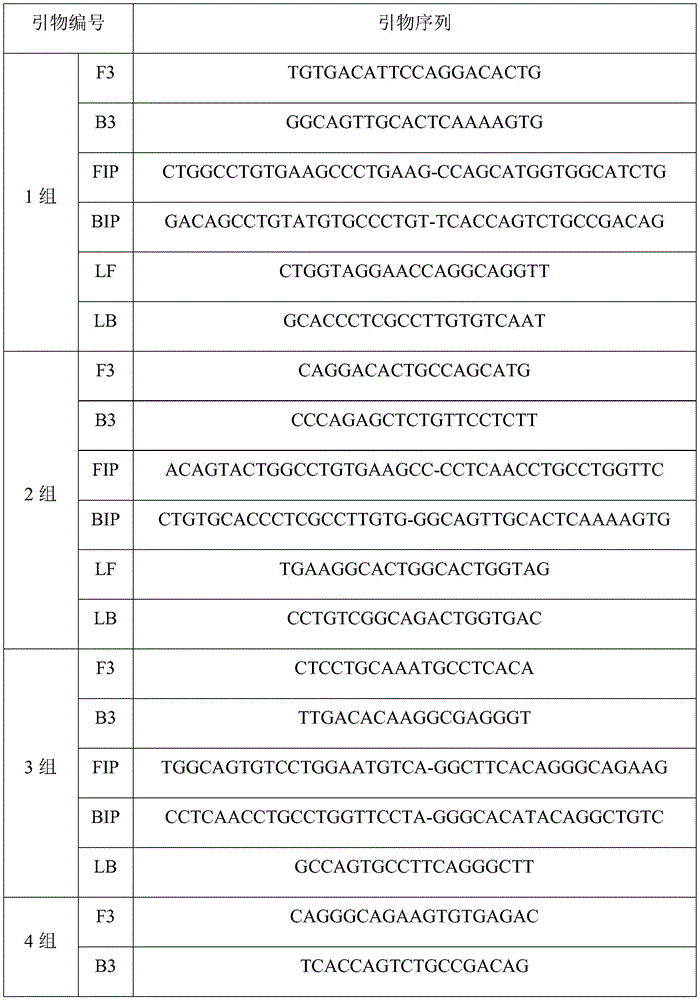

对上述5组引物组的特异性及扩增效率进行比较,将其置于实时荧光定量PCR仪上,设置扩增条件为:65℃、45sec扩增;65℃、15sec收集荧光;共60个循环,然后85℃、5min后终止反应。每组引物设置两个阳性组,两个阴性组,对上述5组引物组的特异性及扩增效率进行比较。结果如图1所示,第1组引物能够在12-13min检测到人源DNA,扩增效率明显高于其他几组,且无非特异性扩增。第2组和第3组引物能够较快速的检测到人源DNA,但在30min以后均出现了不同程度的非特异性扩增,而第4组合第5组虽然未出现非特异性扩增,但扩增效率明显低于第1组引物。因此选用第一组引物作为最佳引物组。The specificity and amplification efficiency of the above five primer sets were compared, and they were placed on a real-time quantitative PCR instrument. Cycle, then terminate the reaction after 5 min at 85°C. Two positive groups and two negative groups were set for each set of primers, and the specificity and amplification efficiency of the above five primer sets were compared. The results are shown in Figure 1. The first group of primers can detect human DNA within 12-13 minutes, and the amplification efficiency is significantly higher than that of other groups, and there is no non-specific amplification. The primers of
实施例2:本实施例给出检测血液样品种属的方法,包括以下步骤:Embodiment 2: This embodiment provides a method for detecting blood sample species, including the following steps:
步骤一:在血痕样品中加入DNA快速提取试剂,然后在金属浴条件下孵育得到DNA模板;Step 1: Add DNA rapid extraction reagent to the blood stain sample, and then incubate in a metal bath to obtain a DNA template;
DNA快速提取试剂包括溶解液和裂解液,溶解液包括500FU/mL的纳豆激酶、10U/mL的纤溶酶、30μg/mL的腺苷浓度和1mM的EDTA,所述裂解液包括10mg/mL的蛋白酶K、1%的Triton X-100和5mM的CaCl2;其中“%”是指以体积计的质量百分数。具体操作步骤:称取250mg纳豆激酶、10mg纤溶酶并加入8mL去离子水,然后加入100μL 300μg/mL腺苷和50μL0.5M EDTA,并加离子水定容至10mL,即得溶解液。量取100mg蛋白酶K,100μL Triton X-100,500μL 0.1M CaCl2溶液,并用去离子水定容至10mL,即得裂解液。DNA rapid extraction reagent includes lysate and lysate, the lysate includes 500FU/mL nattokinase, 10U/mL plasmin, 30μg/mL adenosine concentration and 1mM EDTA, the lysate includes 10mg/mL of proteinase K, 1% Triton X-100 and 5 mM CaCl2 ; where "%" refers to mass percent by volume. Specific operation steps: Weigh 250 mg of nattokinase, 10 mg of plasmin and add 8 mL of deionized water, then add 100 μL of 300 μg/mL adenosine and 50 μL of 0.5M EDTA, and add ionized water to make up the volume to 10 mL to obtain a solution. Measure 100 mg of proteinase K, 100 μL of Triton X-100, and 500 μL of 0.1 M CaCl 2 solution, and dilute to 10 mL with deionized water to obtain a lysis solution.
血痕为一次性采血针(施莱)采集的指腹血滴在干净的玻璃片上晾干30min形成。取1cm×0.5cm大小的血痕装入1.5mL离心管中,加入0.1mL的上述配置的溶解液,在37℃金属浴条件下孵育20min,然后加入0.1mL的裂解液,在温度为65℃金属浴中孵育20min,然后100℃金属浴加热5min,使蛋白酶K及其他可能残留的蛋白质失活,作为模板用于血痕的种属鉴定。The bloodstain is formed by the blood drop of the finger pulp collected by a disposable lancet (Shlai) and dried on a clean glass slide for 30min. Take 1cm×0.5cm bloodstain and put it into a 1.5mL centrifuge tube, add 0.1mL of the above-configured lysis solution, incubate at 37°C for 20min in a metal bath, and then add 0.1mL of lysis solution, at a temperature of 65°C metal Incubate in the bath for 20 min, and then heat in a metal bath at 100°C for 5 min to inactivate proteinase K and other possible residual proteins, which are used as templates for species identification of bloodstains.
步骤二:取1~2μL步骤一得到的DNA模板,向其加入缓冲溶液、Tween-20、dNTP、BstDNA Polymerase、环介导等温扩增指示剂和引物混合物,得到待检测血液样品,然后进行血液样品种属检测。Step 2: Take 1-2 μL of the DNA template obtained in
此实施例的环介导等温扩增指示剂为盐酸小檗碱,精确称取6.30mg盐酸小檗碱,溶于10mL 2.5%DMSO溶液中,即为2.5mM盐酸小檗碱母液(25倍的储存液)。最终每25μL待检测体系中加入1μL盐酸小檗碱母液,体系中盐酸小檗碱的最终浓度为100μM。将环介导等温扩增试剂和缓冲液混合,混合后的体系包含20mM Tris-HCl(pH=8.8)、50mM KCl、10mM(NH4)2SO4、8mM MgSO4、0.1%Tween-20、0.8M甜菜碱、1.4mM dNTP、8U Bst DNA Polymerase,然后加入1μL指示剂、1μL的引物然后置于63~67℃恒温条件下反应30~60min,再升温至83~87℃反应5min即可;最后将反应管置于470nm波长的蓝光灯下观察。结果如图2所示,阳性(P)结果可以观察到亮绿色荧光,阴性(N)结果无荧光。阳性样品与阴性样品区别极为明显,不会因主观判断导致误判。此外,当体系中盐酸小檗碱的加入量为50μM或150μM时,均能明显区别阳性结果与阴性结果。The loop-mediated isothermal amplification indicator in this embodiment is berberine hydrochloride. Accurately weigh 6.30 mg of berberine hydrochloride and dissolve it in 10 mL of 2.5% DMSO solution, which is the 2.5 mM berberine hydrochloride mother solution (25 times the storage solution). Finally, 1 μL of berberine hydrochloride mother solution was added to every 25 μL of the system to be detected, and the final concentration of berberine hydrochloride in the system was 100 μM. The loop-mediated isothermal amplification reagent and buffer were mixed, and the mixed system contained 20 mM Tris-HCl (pH=8.8), 50 mM KCl, 10 mM (NH4) 2 SO 4 , 8 mM MgSO 4 , 0.1% Tween-20, 0.8 M betaine, 1.4mM dNTP, 8U Bst DNA Polymerase, then add 1μL of indicator, 1μL of primers, then place the reaction at a constant temperature of 63-67℃ for 30-60min, and then heat up to 83-87℃ for 5min; finally The reaction tube was observed under a blue light with a wavelength of 470 nm. The results are shown in Fig. 2, bright green fluorescence can be observed in positive (P) results, and no fluorescence in negative (N) results. The difference between positive samples and negative samples is very obvious, and there will be no misjudgment due to subjective judgment. In addition, when the amount of berberine hydrochloride added in the system was 50 μM or 150 μM, the positive and negative results could be clearly distinguished.
引物的处理步骤为:将江苏金唯智生物科技有限公司合成的人源特异性引物用去离子水配制成FIP和BIP浓度均为20μM、LF和LB浓度均为10μM、F3和B3浓度均为5μM的25×引物混合物。所用引物序列如下:The processing steps of the primers are as follows: the human-specific primers synthesized by Jiangsu Jinweizhi Biotechnology Co., Ltd. are prepared with deionized water to prepare FIP and BIP concentrations of 20 μM, LF and LB concentrations of 10 μM, and F3 and B3 concentrations of 5 μM. 25x primer mix. The primer sequences used are as follows:
F3:TGTGACATTCCAGGACACTGF3: TGTGACATTCCAGGACACTG
B3:GGCAGTTGCACTCAAAAGTGB3: GGCAGTTGCACTCAAAAGTG
FIP:CTGGCCTGTGAAGCCCTGAAGCCAGCATGGTGGCATCTGFIP: CTGGCCTGTGAAGCCCTGAAGCCAGCATGGTGGCATCTG
BIP:GACAGCCTGTATGTGCCCTGTTCACCAGTCTGCCGACAGBIP: GACAGCCTGTATGTGCCCTGTTCACCAGTCTGCCGACAG
LF:CTGGTAGGAACCAGGCAGGTTLF: CTGGTAGGAACCAGGCAGGTT
LB:GCACCCTCGCCTTGTGTCAATLB: GCACCCTCGCCTTGTGTCAAT
实施例3Example 3
本实施例公开了DNA快速提取试剂中不同组份的溶解液和裂解液的含量对DNA提取效率的影响。This example discloses the effects of the contents of different components of the lysing solution and lysing solution in the DNA rapid extraction reagent on the DNA extraction efficiency.
取100μL新鲜静脉血(和血痕的来源操作方法一样),置于不加抗凝剂的采血管中,静置,待血液凝固。加入200μL不同组份的溶解液,37℃孵育20min。然后加入200μL裂解液,65℃孵育20min,最后经过100℃变性处理5min。然后经过硅烷基磁珠提取上清中的DNA,并用购自天根等生物公司的TE缓冲液定容至50μL。通过Nanodrop2000紫外-可见分光光度计测量DNA浓度,不同组份的溶解液和裂解液组成及所提取的DNA浓度如表1所示。Take 100 μL of fresh venous blood (same as the source of blood stains), put it in a blood collection tube without anticoagulant, let it stand, and wait for the blood to coagulate. Add 200 μL of lysates of different components and incubate at 37°C for 20 min. Then 200 μL of lysate was added, incubated at 65 °C for 20 min, and finally denatured at 100 °C for 5 min. Then, the DNA in the supernatant was extracted by silane-based magnetic beads, and the volume was adjusted to 50 μL with TE buffer purchased from Tiangen and other biological companies. The DNA concentration was measured by Nanodrop2000 UV-Vis spectrophotometer.
表1.不同组份的溶解液和裂解液对DNA提取效率的影响Table 1. Effects of different compositions of lysate and lysate on DNA extraction efficiency


不同组份的溶解液和裂解液提取相同体积血液的DNA结果如图3所示,其中,标号M为DNA电泳的参照组,购自天根生物公司。当纳豆激酶、纤溶酶和腺苷浓度较低时(A组),血凝块不能完全溶解,导致DNA得率显著降低。当血凝块充分溶解后,经过蛋白酶K和TritonX-100裂解细胞提取DNA,而蛋白酶的活性可以被CaCl2激活,提高酶活10倍以上,因此,当裂解液中的CaCl2浓度需高于溶解液中的EDTA浓度时,DNA得率最高,如图3中标号E所示,即包含纳豆激酶浓度为500FU/mL、纤溶酶浓度为10U/mL、腺苷浓度为30μg/mL和EDTA浓度为1mM的溶解液,包含蛋白酶K浓度为10mg/mL,Triton X-100含量为1%,其中“%”是指以体积计的质量百分数,CaCl2浓度为5mM的裂解液,溶解液和裂解液组成DNA快速提取试剂;可看出同样血液样品量的条件下E组的DNA得率明显高于其他组合的DNA得率。Figure 3 shows the results of extracting DNA from the same volume of blood from lysing solution and lysing solution of different components, where the symbol M is the reference group for DNA electrophoresis, which was purchased from Tiangen Biological Company. When the concentrations of nattokinase, plasmin and adenosine were low (group A), the blood clot could not be completely dissolved, resulting in a significant decrease in DNA yield. When the blood clot is fully dissolved, the cells are lysed by proteinase K and TritonX-100 to extract DNA, and the activity of the protease can be activated by CaCl 2 , increasing the enzyme activity by more than 10 times. Therefore, when the concentration of CaCl 2 in the lysis solution is higher than When the concentration of EDTA in the lysate, the DNA yield is the highest, as shown by the symbol E in Figure 3, that is, the concentration of nattokinase is 500FU/mL, the concentration of plasmin is 10U/mL, the concentration of adenosine is 30 μg/mL and Lysate with 1 mM EDTA, 10 mg/mL Proteinase K, 1% Triton X-100, where "%" refers to mass percent by volume, lysate with 5 mM CaCl2 , lysate It can be seen that the DNA yield of group E is significantly higher than that of other combinations under the same blood sample amount.
实施例4Example 4
为检验凝血块DNA提取方法在有其他种属动物血液干扰情况下的提取效率及检测效果,本实施例将人血分别与狗、猪、牛、羊、鱼、猫的血液进行混合,提取其DNA,并进行扩增,鉴定其是否包含人源DNA。种属鉴定以人血作为阳性对照,单纯动物血液作为阴性对照。结果如图4和图5所示,从图4可以看出所提基因组较为完整,未出现降解现象,图5中1为单纯人血的DNA扩增结果,2-7为人血和不同血液的DNA混合物,均能检测到人源的DNA;而8-13只包含动物血液样品,均未检测到荧光信号,说明该引物组具有较高的特异性,且不受动物血液的干扰,可以用于案发现场血痕的快速种属鉴定。In order to test the extraction efficiency and detection effect of the clot DNA extraction method under the interference of other species of animal blood, in this example, human blood was mixed with the blood of dogs, pigs, cattle, sheep, fish, and cats, respectively, and the blood was extracted. DNA, and amplified to determine whether it contains human DNA. For species identification, human blood was used as a positive control, and pure animal blood was used as a negative control. The results are shown in Figure 4 and Figure 5. It can be seen from Figure 4 that the proposed genome is relatively complete and no degradation occurs. In Figure 5, 1 is the DNA amplification result of pure human blood, and 2-7 are the results of DNA amplification from human blood and different blood. DNA mixtures can detect human DNA; while 8-13 samples contain animal blood, no fluorescent signal can be detected, indicating that the primer set has high specificity and is not disturbed by animal blood, and can be used with Rapid species identification of bloodstains at the crime scene.
实施例5:Example 5:
本实施例与实施例2的区别在于使用5%(v/v)DMSO作为指示剂的溶剂,结果如图6(B)所示,阳性结果为亮绿色荧光,阴性结果基本上观察不到荧光信号,阳性结果与阴性结果区别极为明显,辨识度极高。The difference between this example and Example 2 is that 5% (v/v) DMSO is used as the solvent of the indicator. The results are shown in Figure 6(B), the positive result is bright green fluorescence, and the negative result is basically no fluorescence. Signal, the difference between positive results and negative results is very obvious, and the recognition degree is very high.
对比例1Comparative Example 1
本对比例与实施例2的区别在于使用1%(v/v)DMSO作为指示剂的溶剂,结果如图6(A)所示,阳性结果为亮绿色荧光,阴性虽然也能观察到淡绿色荧光,但区别不如2.5~5%明显。阳性结果与阴性结果区别较为明显,辨识度较高。The difference between this comparative example and Example 2 is that 1% (v/v) DMSO is used as the solvent of the indicator. The results are shown in Figure 6(A), the positive result is bright green fluorescence, although the negative result can also be observed light green Fluorescence, but the difference is not as obvious as 2.5 to 5%. The difference between positive results and negative results is more obvious, and the recognition degree is higher.
实施例6:Example 6:
本实施例与实施例1的区别在于称取19.38mg穗花杉双黄酮,溶于10mL2.5%(v/v)DMSO溶液中,即为3.0mM穗花杉双黄酮母液,每25μL反应体系加入1μL,体系中穗花杉双黄酮的最终浓度为120μM。结果如图7(A)所示,以穗花杉双黄酮作为指示剂,阳性结果与阴性结果的区别极为显著,不易造成主观误判。此外,当体系中穗花杉双黄酮的加入量为100μM或150μM时,均能明显区别阳性结果与阴性结果。The difference between this example and Example 1 is that 19.38 mg of the flavonoids were weighed and dissolved in 10 mL of 2.5% (v/v) DMSO solution, that is, 3.0 mM of the flavonoids of cedar, and 1 μL was added to each 25 μL reaction system. , the final concentration of flavone in the system was 120 μM. The results are shown in Fig. 7(A), using the flavone as an indicator, the difference between the positive result and the negative result is extremely significant, and it is not easy to cause subjective misjudgment. In addition, when the amount of flavone added in the system was 100 μM or 150 μM, the positive and negative results could be clearly distinguished.
实施例7Example 7
本实施例7与实施例1的区别在于称取4.02mg非瑟酮,溶于10mL 2.5%(v/v)DMSO溶液中,即为1.875mM非瑟酮母液,每25μL反应体系加入1μL,体系中非瑟酮的最终浓度为75μM。结果如图7(B)所示,以非瑟酮作为指示剂,阳性结果与阴性结果区别极为显著,不易造成主观误判。此外,当体系中非瑟酮的加入量为50μM或100μM时,均能明显区别阳性结果与阴性结果。The difference between Example 7 and Example 1 is that 4.02 mg of fisetin was weighed and dissolved in 10 mL of 2.5% (v/v) DMSO solution, which was 1.875 mM fisetin mother solution, and 1 μL was added to each 25 μL reaction system, and the system The final concentration of fisetin was 75 μM. The results are shown in Figure 7(B), with fisetin as the indicator, the difference between the positive results and the negative results is extremely significant, and it is not easy to cause subjective misjudgment. In addition, when the amount of fisetin in the system was 50 μM or 100 μM, the positive and negative results could be clearly distinguished.
Claims (8)
Priority Applications (1)
| Application Number | Priority Date | Filing Date | Title |
|---|---|---|---|
| CN201910268882.2A CN110079607B (en) | 2019-04-04 | 2019-04-04 | A primer set, method for detecting blood sample species and application |
Applications Claiming Priority (1)
| Application Number | Priority Date | Filing Date | Title |
|---|---|---|---|
| CN201910268882.2A CN110079607B (en) | 2019-04-04 | 2019-04-04 | A primer set, method for detecting blood sample species and application |
Publications (2)
| Publication Number | Publication Date |
|---|---|
| CN110079607A CN110079607A (en) | 2019-08-02 |
| CN110079607B true CN110079607B (en) | 2022-08-02 |
Family
ID=67414226
Family Applications (1)
| Application Number | Title | Priority Date | Filing Date |
|---|---|---|---|
| CN201910268882.2A Active CN110079607B (en) | 2019-04-04 | 2019-04-04 | A primer set, method for detecting blood sample species and application |
Country Status (1)
| Country | Link |
|---|---|
| CN (1) | CN110079607B (en) |
Citations (6)
| Publication number | Priority date | Publication date | Assignee | Title |
|---|---|---|---|---|
| CN1087996A (en) * | 1993-09-14 | 1994-06-15 | 浙江省物资学校电子仪器厂 | A kind of blood strain identification reagent and preparation method thereof |
| CN103403543A (en) * | 2011-01-25 | 2013-11-20 | 阿尔玛克诊断有限公司 | Colon cancer gene expression signatures and methods of use |
| CN104263821A (en) * | 2014-09-15 | 2015-01-07 | 吉林大学 | Species identification kit for old animal sample and preparation method of species identification kit |
| WO2017067942A1 (en) * | 2015-10-19 | 2017-04-27 | Institut Pasteur | Detection of microbial pathogens related to bacterial infections through amplification especially by rt-lamp |
| CN106801097A (en) * | 2017-02-17 | 2017-06-06 | 湖北医药学院 | Ring mediated isothermal amplification method based on the exclusive gene of plasmodium falciparum ring bodies |
| CN108267571A (en) * | 2017-01-03 | 2018-07-10 | 中国医学科学院医学实验动物研究所 | A kind of blood kind sentences method for distinguishing |
-
2019
- 2019-04-04 CN CN201910268882.2A patent/CN110079607B/en active Active
Patent Citations (6)
| Publication number | Priority date | Publication date | Assignee | Title |
|---|---|---|---|---|
| CN1087996A (en) * | 1993-09-14 | 1994-06-15 | 浙江省物资学校电子仪器厂 | A kind of blood strain identification reagent and preparation method thereof |
| CN103403543A (en) * | 2011-01-25 | 2013-11-20 | 阿尔玛克诊断有限公司 | Colon cancer gene expression signatures and methods of use |
| CN104263821A (en) * | 2014-09-15 | 2015-01-07 | 吉林大学 | Species identification kit for old animal sample and preparation method of species identification kit |
| WO2017067942A1 (en) * | 2015-10-19 | 2017-04-27 | Institut Pasteur | Detection of microbial pathogens related to bacterial infections through amplification especially by rt-lamp |
| CN108267571A (en) * | 2017-01-03 | 2018-07-10 | 中国医学科学院医学实验动物研究所 | A kind of blood kind sentences method for distinguishing |
| CN106801097A (en) * | 2017-02-17 | 2017-06-06 | 湖北医药学院 | Ring mediated isothermal amplification method based on the exclusive gene of plasmodium falciparum ring bodies |
Non-Patent Citations (3)
| Title |
|---|
| "Human-Specific NOTCH2NL Genes Affect Notch Signaling and Cortical Neurogenesis";Ian T. Fiddes et al.;《Cell》;20180531;第173卷;第1356-1369页 * |
| "Human-Specific NOTCH2NL Genes Expand Cortical Neurogenesis through Delta/Notch Regulation";Ikuo K. Suzuki et al.;《Cell》;20180531;第173卷;第1370-1384页 * |
| "运用分子生物学方法鉴定生物检材种属的研究进展";骆宏等;《中国法医学杂志》;20071231;第22卷(第2期);第108-110页 * |
Also Published As
| Publication number | Publication date |
|---|---|
| CN110079607A (en) | 2019-08-02 |
Similar Documents
| Publication | Publication Date | Title |
|---|---|---|
| CN106947838B (en) | African swine fever virus non-structural gene real-time fluorescence LAMP (loop-mediated isothermal amplification) detection primer group, kit and detection method | |
| AU2014373622B2 (en) | Nucleic acid detection method and kit | |
| CN111534635B (en) | Integrated molecular diagnosis system and application thereof in tracing of animal sources of beta coronaviruses | |
| CN111808975B (en) | Deer species source identification primer pair of deer antler product and identification method thereof | |
| CN101906486B (en) | Gene chip for detecting various fish pathogens and detecting method thereof | |
| CN106434921B (en) | A kind of microbial sources tracking molecular marked compound and its high-flux detection method detected for a variety of fecal pollution sources | |
| CN104561327B (en) | A dual fluorescent PCR method for simultaneous detection of horse and donkey-derived components | |
| CN101696453B (en) | Method for preparing reverse transcription loop-mediated isothermal amplification (RT-LAMP) reaction kit for detecting bovine viral diarrhea viruses | |
| CN108034761A (en) | A kind of reagent, method and application differentiated for FMDV and SVA | |
| CN116064835B (en) | Primer and probe combination for detecting humanized component based on RPA technology, kit and detection method and application | |
| CN105603120B (en) | GeXP multiple rapid detection primer and detection method for detecting bluetongue virus, bovine viral diarrhea virus and foot-and-mouth disease virus | |
| CN106350609A (en) | Reagent and detection method for detecting vesicular stomatitis virus, and applications | |
| CN110079607B (en) | A primer set, method for detecting blood sample species and application | |
| CN105586438B (en) | GeXP multiple rapid detection primers and detection method for detecting akabane virus, foot-and-mouth disease virus and bluetongue virus | |
| CN105039517A (en) | PCR-HRM primer and method for distinguishing five types of rodent helicobacters | |
| CN110964849B (en) | Method for eliminating African swine fever virus detection false positive and kit for detecting African swine fever virus | |
| CN116949212A (en) | Primer group and kit for detecting infectious disease pathogen and application of primer group and kit | |
| CN110894551A (en) | RAA constant-temperature fluorescence detection method and reagent for grass carp hemorrhagic disease type I virus (GCRV-I) | |
| CN106367530B (en) | A kind of primer sets and detection method of four kinds of rat parvovirus strains of quick discriminating | |
| CN109136386B (en) | Quantitative PCR method and kit for rapid typing and tracing of yarrowia carotovora | |
| CN118345200B (en) | RPA primer set, kit and application for endothelial herpes simplex virus | |
| CN112575122A (en) | Dual PCR primer group for rapidly detecting duck type 2 adenovirus and duck circovirus as well as detection method and application thereof | |
| CN111154836A (en) | Targeted nucleic acid capture and detection methods | |
| CN112501310B (en) | A LAMP detection primer set, kit and method for bovine-derived components | |
| CN115852017B (en) | A method to identify the purity of onion male sterile three-line matching hybrids based on SNP molecular markers |
Legal Events
| Date | Code | Title | Description |
|---|---|---|---|
| PB01 | Publication | ||
| PB01 | Publication | ||
| SE01 | Entry into force of request for substantive examination | ||
| SE01 | Entry into force of request for substantive examination | ||
| GR01 | Patent grant | ||
| GR01 | Patent grant | ||
| TR01 | Transfer of patent right | ||
| TR01 | Transfer of patent right |
Effective date of registration: 20231130 Address after: Room 40502, Unit 4, Building 1, North District, Yichui Shangfu, No. 31 Zhangba'er Road, High tech Zone, Xi'an City, Shaanxi Province, 710065 Patentee after: Xi'an Haitaike Biotechnology Co.,Ltd. Address before: 710062 No. 199 South Changan Road, Shaanxi, Xi'an Patentee before: Shaanxi Normal University |