CN110028664B - Silane-terminated polyether and preparation method thereof - Google Patents
Silane-terminated polyether and preparation method thereof Download PDFInfo
- Publication number
- CN110028664B CN110028664B CN201910348056.9A CN201910348056A CN110028664B CN 110028664 B CN110028664 B CN 110028664B CN 201910348056 A CN201910348056 A CN 201910348056A CN 110028664 B CN110028664 B CN 110028664B
- Authority
- CN
- China
- Prior art keywords
- silane
- terminated polyether
- branched
- anhydride
- equal
- Prior art date
- Legal status (The legal status is an assumption and is not a legal conclusion. Google has not performed a legal analysis and makes no representation as to the accuracy of the status listed.)
- Active
Links
- 229920000570 polyether Polymers 0.000 title claims abstract description 82
- 239000004721 Polyphenylene oxide Substances 0.000 title claims abstract description 81
- 238000002360 preparation method Methods 0.000 title abstract description 19
- BLRPTPMANUNPDV-UHFFFAOYSA-N Silane Chemical compound [SiH4] BLRPTPMANUNPDV-UHFFFAOYSA-N 0.000 claims abstract description 33
- 229910000077 silane Inorganic materials 0.000 claims abstract description 33
- 238000006243 chemical reaction Methods 0.000 claims abstract description 24
- 125000003545 alkoxy group Chemical group 0.000 claims abstract description 20
- RIOQSEWOXXDEQQ-UHFFFAOYSA-N triphenylphosphine Chemical compound C1=CC=CC=C1P(C=1C=CC=CC=1)C1=CC=CC=C1 RIOQSEWOXXDEQQ-UHFFFAOYSA-N 0.000 claims abstract description 20
- 239000003054 catalyst Substances 0.000 claims abstract description 19
- 238000001816 cooling Methods 0.000 claims abstract description 13
- 238000007599 discharging Methods 0.000 claims abstract description 10
- GYZLOYUZLJXAJU-UHFFFAOYSA-N diglycidyl ether Chemical compound C1OC1COCC1CO1 GYZLOYUZLJXAJU-UHFFFAOYSA-N 0.000 claims abstract description 7
- 239000002994 raw material Substances 0.000 claims abstract description 7
- 150000008064 anhydrides Chemical class 0.000 claims abstract description 6
- 238000004519 manufacturing process Methods 0.000 claims abstract description 6
- XLYOFNOQVPJJNP-UHFFFAOYSA-N water Substances O XLYOFNOQVPJJNP-UHFFFAOYSA-N 0.000 claims abstract description 3
- 238000000034 method Methods 0.000 claims description 16
- -1 methoxy, ethoxy Chemical group 0.000 claims description 16
- KKEYFWRCBNTPAC-UHFFFAOYSA-N Terephthalic acid Chemical compound OC(=O)C1=CC=C(C(O)=O)C=C1 KKEYFWRCBNTPAC-UHFFFAOYSA-N 0.000 claims description 10
- 239000000203 mixture Substances 0.000 claims description 10
- WNLRTRBMVRJNCN-UHFFFAOYSA-N adipic acid Chemical compound OC(=O)CCCCC(O)=O WNLRTRBMVRJNCN-UHFFFAOYSA-N 0.000 claims description 8
- 125000000217 alkyl group Chemical group 0.000 claims description 8
- XNGIFLGASWRNHJ-UHFFFAOYSA-N phthalic acid Chemical compound OC(=O)C1=CC=CC=C1C(O)=O XNGIFLGASWRNHJ-UHFFFAOYSA-N 0.000 claims description 8
- QQVIHTHCMHWDBS-UHFFFAOYSA-N isophthalic acid Chemical compound OC(=O)C1=CC=CC(C(O)=O)=C1 QQVIHTHCMHWDBS-UHFFFAOYSA-N 0.000 claims description 6
- VYKXQOYUCMREIS-UHFFFAOYSA-N methylhexahydrophthalic anhydride Chemical compound C1CCCC2C(=O)OC(=O)C21C VYKXQOYUCMREIS-UHFFFAOYSA-N 0.000 claims description 5
- MWSKJDNQKGCKPA-UHFFFAOYSA-N 6-methyl-3a,4,5,7a-tetrahydro-2-benzofuran-1,3-dione Chemical compound C1CC(C)=CC2C(=O)OC(=O)C12 MWSKJDNQKGCKPA-UHFFFAOYSA-N 0.000 claims description 4
- LGRFSURHDFAFJT-UHFFFAOYSA-N Phthalic anhydride Natural products C1=CC=C2C(=O)OC(=O)C2=C1 LGRFSURHDFAFJT-UHFFFAOYSA-N 0.000 claims description 4
- 239000001361 adipic acid Substances 0.000 claims description 4
- 235000011037 adipic acid Nutrition 0.000 claims description 4
- JHIWVOJDXOSYLW-UHFFFAOYSA-N butyl 2,2-difluorocyclopropane-1-carboxylate Chemical compound CCCCOC(=O)C1CC1(F)F JHIWVOJDXOSYLW-UHFFFAOYSA-N 0.000 claims description 4
- FPYJFEHAWHCUMM-UHFFFAOYSA-N maleic anhydride Chemical compound O=C1OC(=O)C=C1 FPYJFEHAWHCUMM-UHFFFAOYSA-N 0.000 claims description 4
- 238000007142 ring opening reaction Methods 0.000 claims description 4
- QQQSFSZALRVCSZ-UHFFFAOYSA-N triethoxysilane Chemical compound CCO[SiH](OCC)OCC QQQSFSZALRVCSZ-UHFFFAOYSA-N 0.000 claims description 4
- OFOBLEOULBTSOW-UHFFFAOYSA-N Malonic acid Chemical compound OC(=O)CC(O)=O OFOBLEOULBTSOW-UHFFFAOYSA-N 0.000 claims description 3
- KDYFGRWQOYBRFD-UHFFFAOYSA-N Succinic acid Natural products OC(=O)CCC(O)=O KDYFGRWQOYBRFD-UHFFFAOYSA-N 0.000 claims description 3
- 150000008065 acid anhydrides Chemical class 0.000 claims description 3
- KDYFGRWQOYBRFD-NUQCWPJISA-N butanedioic acid Chemical compound O[14C](=O)CC[14C](O)=O KDYFGRWQOYBRFD-NUQCWPJISA-N 0.000 claims description 3
- 125000002496 methyl group Chemical group [H]C([H])([H])* 0.000 claims description 3
- 229920005862 polyol Polymers 0.000 claims description 3
- 150000003077 polyols Chemical class 0.000 claims description 3
- 150000003242 quaternary ammonium salts Chemical class 0.000 claims description 3
- 125000000467 secondary amino group Chemical group [H]N([*:1])[*:2] 0.000 claims description 3
- MTEZSDOQASFMDI-UHFFFAOYSA-N 1-trimethoxysilylpropan-1-ol Chemical compound CCC(O)[Si](OC)(OC)OC MTEZSDOQASFMDI-UHFFFAOYSA-N 0.000 claims description 2
- 229920000180 alkyd Polymers 0.000 claims description 2
- 238000006482 condensation reaction Methods 0.000 claims description 2
- 125000001142 dicarboxylic acid group Chemical group 0.000 claims description 2
- 238000010438 heat treatment Methods 0.000 claims description 2
- 150000001991 dicarboxylic acids Chemical class 0.000 claims 2
- 150000003856 quaternary ammonium compounds Chemical class 0.000 claims 1
- 229920005989 resin Polymers 0.000 abstract description 5
- 239000011347 resin Substances 0.000 abstract description 5
- 125000002887 hydroxy group Chemical group [H]O* 0.000 abstract description 3
- QGZKDVFQNNGYKY-UHFFFAOYSA-N Ammonia Chemical compound N QGZKDVFQNNGYKY-UHFFFAOYSA-N 0.000 abstract 2
- 229910021529 ammonia Inorganic materials 0.000 abstract 1
- 239000000047 product Substances 0.000 description 13
- 239000000565 sealant Substances 0.000 description 9
- 238000005086 pumping Methods 0.000 description 8
- 239000000376 reactant Substances 0.000 description 8
- 229920001451 polypropylene glycol Polymers 0.000 description 6
- BPSIOYPQMFLKFR-UHFFFAOYSA-N trimethoxy-[3-(oxiran-2-ylmethoxy)propyl]silane Chemical compound CO[Si](OC)(OC)CCCOCC1CO1 BPSIOYPQMFLKFR-UHFFFAOYSA-N 0.000 description 5
- 230000000052 comparative effect Effects 0.000 description 4
- 125000000524 functional group Chemical group 0.000 description 4
- 239000012948 isocyanate Substances 0.000 description 4
- BASFCYQUMIYNBI-UHFFFAOYSA-N platinum Chemical compound [Pt] BASFCYQUMIYNBI-UHFFFAOYSA-N 0.000 description 4
- 239000004814 polyurethane Substances 0.000 description 4
- 229920002635 polyurethane Polymers 0.000 description 4
- 229920006395 saturated elastomer Polymers 0.000 description 4
- 239000004526 silane-modified polyether Substances 0.000 description 4
- 125000003903 2-propenyl group Chemical group [H]C([*])([H])C([H])=C([H])[H] 0.000 description 3
- 150000002513 isocyanates Chemical class 0.000 description 3
- 125000001997 phenyl group Chemical group [H]C1=C([H])C([H])=C(*)C([H])=C1[H] 0.000 description 3
- 238000007086 side reaction Methods 0.000 description 3
- JXUKBNICSRJFAP-UHFFFAOYSA-N triethoxy-[3-(oxiran-2-ylmethoxy)propyl]silane Chemical compound CCO[Si](OCC)(OCC)CCCOCC1CO1 JXUKBNICSRJFAP-UHFFFAOYSA-N 0.000 description 3
- XNWFRZJHXBZDAG-UHFFFAOYSA-N 2-METHOXYETHANOL Chemical compound COCCO XNWFRZJHXBZDAG-UHFFFAOYSA-N 0.000 description 2
- 239000004593 Epoxy Substances 0.000 description 2
- 239000000853 adhesive Substances 0.000 description 2
- 230000001070 adhesive effect Effects 0.000 description 2
- 125000003178 carboxy group Chemical group [H]OC(*)=O 0.000 description 2
- MTHSVFCYNBDYFN-UHFFFAOYSA-N diethylene glycol Chemical compound OCCOCCO MTHSVFCYNBDYFN-UHFFFAOYSA-N 0.000 description 2
- 238000009826 distribution Methods 0.000 description 2
- 238000001035 drying Methods 0.000 description 2
- 239000001257 hydrogen Substances 0.000 description 2
- 229910052739 hydrogen Inorganic materials 0.000 description 2
- 238000006459 hydrosilylation reaction Methods 0.000 description 2
- 150000002540 isothiocyanates Chemical class 0.000 description 2
- 239000000463 material Substances 0.000 description 2
- 239000003960 organic solvent Substances 0.000 description 2
- 229910052697 platinum Inorganic materials 0.000 description 2
- 229920000642 polymer Polymers 0.000 description 2
- 238000011160 research Methods 0.000 description 2
- PXQLVRUNWNTZOS-UHFFFAOYSA-N sulfanyl Chemical compound [SH] PXQLVRUNWNTZOS-UHFFFAOYSA-N 0.000 description 2
- 238000004383 yellowing Methods 0.000 description 2
- LFQSCWFLJHTTHZ-UHFFFAOYSA-N Ethanol Chemical compound CCO LFQSCWFLJHTTHZ-UHFFFAOYSA-N 0.000 description 1
- 239000005057 Hexamethylene diisocyanate Substances 0.000 description 1
- UFHFLCQGNIYNRP-UHFFFAOYSA-N Hydrogen Chemical compound [H][H] UFHFLCQGNIYNRP-UHFFFAOYSA-N 0.000 description 1
- 239000005058 Isophorone diisocyanate Substances 0.000 description 1
- 239000002202 Polyethylene glycol Substances 0.000 description 1
- XSTXAVWGXDQKEL-UHFFFAOYSA-N Trichloroethylene Chemical compound ClC=C(Cl)Cl XSTXAVWGXDQKEL-UHFFFAOYSA-N 0.000 description 1
- OBNDGIHQAIXEAO-UHFFFAOYSA-N [O].[Si] Chemical group [O].[Si] OBNDGIHQAIXEAO-UHFFFAOYSA-N 0.000 description 1
- 125000005376 alkyl siloxane group Chemical group 0.000 description 1
- 239000012752 auxiliary agent Substances 0.000 description 1
- 230000015572 biosynthetic process Effects 0.000 description 1
- 239000004566 building material Substances 0.000 description 1
- 239000011248 coating agent Substances 0.000 description 1
- 238000000576 coating method Methods 0.000 description 1
- 239000013065 commercial product Substances 0.000 description 1
- 238000011109 contamination Methods 0.000 description 1
- KORSJDCBLAPZEQ-UHFFFAOYSA-N dicyclohexylmethane-4,4'-diisocyanate Chemical compound C1CC(N=C=O)CCC1CC1CCC(N=C=O)CC1 KORSJDCBLAPZEQ-UHFFFAOYSA-N 0.000 description 1
- 230000007613 environmental effect Effects 0.000 description 1
- 125000003700 epoxy group Chemical group 0.000 description 1
- 230000032050 esterification Effects 0.000 description 1
- 238000005886 esterification reaction Methods 0.000 description 1
- RTZKZFJDLAIYFH-UHFFFAOYSA-N ether Substances CCOCC RTZKZFJDLAIYFH-UHFFFAOYSA-N 0.000 description 1
- 125000001495 ethyl group Chemical group [H]C([H])([H])C([H])([H])* 0.000 description 1
- 238000009472 formulation Methods 0.000 description 1
- RRAMGCGOFNQTLD-UHFFFAOYSA-N hexamethylene diisocyanate Chemical compound O=C=NCCCCCCN=C=O RRAMGCGOFNQTLD-UHFFFAOYSA-N 0.000 description 1
- 150000002431 hydrogen Chemical class 0.000 description 1
- 239000003999 initiator Substances 0.000 description 1
- IQPQWNKOIGAROB-UHFFFAOYSA-N isocyanate group Chemical group [N-]=C=O IQPQWNKOIGAROB-UHFFFAOYSA-N 0.000 description 1
- NIMLQBUJDJZYEJ-UHFFFAOYSA-N isophorone diisocyanate Chemical compound CC1(C)CC(N=C=O)CC(C)(CN=C=O)C1 NIMLQBUJDJZYEJ-UHFFFAOYSA-N 0.000 description 1
- 150000004757 linear silanes Chemical class 0.000 description 1
- 239000011159 matrix material Substances 0.000 description 1
- 238000002156 mixing Methods 0.000 description 1
- 231100000572 poisoning Toxicity 0.000 description 1
- 230000000607 poisoning effect Effects 0.000 description 1
- 229920001223 polyethylene glycol Polymers 0.000 description 1
- 229920000151 polyglycol Polymers 0.000 description 1
- 239000010695 polyglycol Substances 0.000 description 1
- 239000004588 polyurethane sealant Substances 0.000 description 1
- 238000007342 radical addition reaction Methods 0.000 description 1
- 150000003254 radicals Chemical class 0.000 description 1
- 239000004590 silicone sealant Substances 0.000 description 1
- 239000000126 substance Substances 0.000 description 1
- 238000003786 synthesis reaction Methods 0.000 description 1
- 230000002194 synthesizing effect Effects 0.000 description 1
- JOYRKODLDBILNP-UHFFFAOYSA-N urethane group Chemical group NC(=O)OCC JOYRKODLDBILNP-UHFFFAOYSA-N 0.000 description 1
Classifications
-
- C—CHEMISTRY; METALLURGY
- C08—ORGANIC MACROMOLECULAR COMPOUNDS; THEIR PREPARATION OR CHEMICAL WORKING-UP; COMPOSITIONS BASED THEREON
- C08G—MACROMOLECULAR COMPOUNDS OBTAINED OTHERWISE THAN BY REACTIONS ONLY INVOLVING UNSATURATED CARBON-TO-CARBON BONDS
- C08G65/00—Macromolecular compounds obtained by reactions forming an ether link in the main chain of the macromolecule
- C08G65/02—Macromolecular compounds obtained by reactions forming an ether link in the main chain of the macromolecule from cyclic ethers by opening of the heterocyclic ring
- C08G65/32—Polymers modified by chemical after-treatment
- C08G65/329—Polymers modified by chemical after-treatment with organic compounds
- C08G65/331—Polymers modified by chemical after-treatment with organic compounds containing oxygen
- C08G65/332—Polymers modified by chemical after-treatment with organic compounds containing oxygen containing carboxyl groups, or halides, or esters thereof
- C08G65/3322—Polymers modified by chemical after-treatment with organic compounds containing oxygen containing carboxyl groups, or halides, or esters thereof acyclic
-
- C—CHEMISTRY; METALLURGY
- C08—ORGANIC MACROMOLECULAR COMPOUNDS; THEIR PREPARATION OR CHEMICAL WORKING-UP; COMPOSITIONS BASED THEREON
- C08G—MACROMOLECULAR COMPOUNDS OBTAINED OTHERWISE THAN BY REACTIONS ONLY INVOLVING UNSATURATED CARBON-TO-CARBON BONDS
- C08G65/00—Macromolecular compounds obtained by reactions forming an ether link in the main chain of the macromolecule
- C08G65/02—Macromolecular compounds obtained by reactions forming an ether link in the main chain of the macromolecule from cyclic ethers by opening of the heterocyclic ring
- C08G65/32—Polymers modified by chemical after-treatment
- C08G65/329—Polymers modified by chemical after-treatment with organic compounds
- C08G65/331—Polymers modified by chemical after-treatment with organic compounds containing oxygen
- C08G65/332—Polymers modified by chemical after-treatment with organic compounds containing oxygen containing carboxyl groups, or halides, or esters thereof
- C08G65/3324—Polymers modified by chemical after-treatment with organic compounds containing oxygen containing carboxyl groups, or halides, or esters thereof cyclic
-
- C—CHEMISTRY; METALLURGY
- C08—ORGANIC MACROMOLECULAR COMPOUNDS; THEIR PREPARATION OR CHEMICAL WORKING-UP; COMPOSITIONS BASED THEREON
- C08G—MACROMOLECULAR COMPOUNDS OBTAINED OTHERWISE THAN BY REACTIONS ONLY INVOLVING UNSATURATED CARBON-TO-CARBON BONDS
- C08G65/00—Macromolecular compounds obtained by reactions forming an ether link in the main chain of the macromolecule
- C08G65/02—Macromolecular compounds obtained by reactions forming an ether link in the main chain of the macromolecule from cyclic ethers by opening of the heterocyclic ring
- C08G65/32—Polymers modified by chemical after-treatment
- C08G65/329—Polymers modified by chemical after-treatment with organic compounds
- C08G65/331—Polymers modified by chemical after-treatment with organic compounds containing oxygen
- C08G65/332—Polymers modified by chemical after-treatment with organic compounds containing oxygen containing carboxyl groups, or halides, or esters thereof
- C08G65/3324—Polymers modified by chemical after-treatment with organic compounds containing oxygen containing carboxyl groups, or halides, or esters thereof cyclic
- C08G65/3326—Polymers modified by chemical after-treatment with organic compounds containing oxygen containing carboxyl groups, or halides, or esters thereof cyclic aromatic
-
- C—CHEMISTRY; METALLURGY
- C08—ORGANIC MACROMOLECULAR COMPOUNDS; THEIR PREPARATION OR CHEMICAL WORKING-UP; COMPOSITIONS BASED THEREON
- C08G—MACROMOLECULAR COMPOUNDS OBTAINED OTHERWISE THAN BY REACTIONS ONLY INVOLVING UNSATURATED CARBON-TO-CARBON BONDS
- C08G65/00—Macromolecular compounds obtained by reactions forming an ether link in the main chain of the macromolecule
- C08G65/02—Macromolecular compounds obtained by reactions forming an ether link in the main chain of the macromolecule from cyclic ethers by opening of the heterocyclic ring
- C08G65/32—Polymers modified by chemical after-treatment
- C08G65/329—Polymers modified by chemical after-treatment with organic compounds
- C08G65/336—Polymers modified by chemical after-treatment with organic compounds containing silicon
-
- C—CHEMISTRY; METALLURGY
- C09—DYES; PAINTS; POLISHES; NATURAL RESINS; ADHESIVES; COMPOSITIONS NOT OTHERWISE PROVIDED FOR; APPLICATIONS OF MATERIALS NOT OTHERWISE PROVIDED FOR
- C09J—ADHESIVES; NON-MECHANICAL ASPECTS OF ADHESIVE PROCESSES IN GENERAL; ADHESIVE PROCESSES NOT PROVIDED FOR ELSEWHERE; USE OF MATERIALS AS ADHESIVES
- C09J171/00—Adhesives based on polyethers obtained by reactions forming an ether link in the main chain; Adhesives based on derivatives of such polymers
-
- C—CHEMISTRY; METALLURGY
- C08—ORGANIC MACROMOLECULAR COMPOUNDS; THEIR PREPARATION OR CHEMICAL WORKING-UP; COMPOSITIONS BASED THEREON
- C08G—MACROMOLECULAR COMPOUNDS OBTAINED OTHERWISE THAN BY REACTIONS ONLY INVOLVING UNSATURATED CARBON-TO-CARBON BONDS
- C08G2650/00—Macromolecular compounds obtained by reactions forming an ether link in the main chain of the macromolecule
- C08G2650/02—Macromolecular compounds obtained by reactions forming an ether link in the main chain of the macromolecule characterized by the type of post-polymerisation functionalisation
- C08G2650/04—End-capping
Landscapes
- Chemical & Material Sciences (AREA)
- Chemical Kinetics & Catalysis (AREA)
- Organic Chemistry (AREA)
- General Chemical & Material Sciences (AREA)
- Health & Medical Sciences (AREA)
- Medicinal Chemistry (AREA)
- Polymers & Plastics (AREA)
- Polyethers (AREA)
- Silicon Polymers (AREA)
Abstract
The invention provides silane terminated polyether, which has the following structural general formula:
Description
Technical Field
The invention belongs to the field of chemical industry, and relates to polyether, in particular to silane-terminated polyether and a preparation method thereof.
Background
Polyurethane sealants contain free isocyanate groups which are harmful to the human body and are prone to generate bubbles when cured. Silicone sealants have low tear strength, poor paintability and are prone to contamination of building materials. The silane modified sealant does not contain isocyanate and organic solvent, has better coating property, stain resistance and mechanical strength, and is the main development direction of the sealant at home and abroad.
The silane modified sealant is prepared by taking silane terminated polyether as a basic polymer and other auxiliary agents as auxiliary materials, and silicon oxygen groups at the tail ends of molecular chains are hydrolyzed under the action of moisture to form a cross-linked network during curing. The product competitiveness is closely related to the synthesis process and the cost of the silane terminated polyether. At present, related domestic patents are mostly sealant formula researches of different functions performed by taking commercially available silane-terminated polyether as matrix resin, such as patents CN108048015A, CN107022333A, CN106947423A, CN106634771A, CN108676536A, CN107099269A, CN106634768A, CN106497486A, CN1995140A, CN108467706A and the like, and the researches on the structure and production process of silane-terminated polyether are less.
The prior art mainly comprises two structures and preparation processes related to silane terminated polyether. One is a polyurethane method, and for example, patent 108164680a discloses a preparation method of a medium-high modulus silane modified polyether resin material, and the preparation method is a typical polyurethane method. The practice proves that the method has the following problems: firstly, in order to ensure that the product does not have yellowing in appearance and has long service life, expensive aliphatic isocyanates must be used, such as: isophorone diisocyanate, hexamethylene diisocyanate, hydrogenated MDI and the like are used as raw materials, so that the product cost is increased; secondly, the reaction of polyether and isocyanate is a reaction of 2 functional groups to 2 functional groups, and side reactions such as molecular chain growth and the like are easy to occur at high temperature, so that the viscosity of the product is increased, and the molecular weight distribution is widened. Patent CN108130033A discloses a structure of linear silane modified block polyether, which does not disclose a preparation process, but can be seen from the urethane group of the general structural formula to be prepared by a polyurethane method; patent CN107955571A discloses a low-viscosity silane modified polyether-based adhesive and a preparation method thereof, wherein an isothiocyanate alkoxy silane is adopted to end-cap hydroxyl polyether, and the essence is still a polyurethane method. Although the method provided by the patent is simpler, the price of the isothiocyanate alkoxy silane is extremely expensive, the source is less, the purchase is difficult, the product cost is greatly increased, and the sealant is not sold in the market at present.
The other is an active hydrogen addition method, for example, patent CN107903863A discloses a silane modified polyether-based adhesive and a mercapto radical addition preparation method thereof, wherein a click chemical reaction is carried out between terminal double bonds of allyl polyether and mercapto alkoxy silane to prepare silane terminated polyether. The preparation process is novel and simple, but the mercaptoalkoxy silane is expensive and has few sources, and in most cases, an organic solvent is added to ensure that auxiliaries such as a free radical initiator and the like adopted in the reaction can form a uniform system with each reactant, so that the environmental protection performance of the product is poor; patent 108102089A discloses a method for preparing a silane-modified polyether intermediate, which comprises subjecting dihydrodisiloxane and allyl polyether to hydrosilylation reaction under the action of a platinum catalyst to generate hydrosilylation-terminated polyether, adding vinylsiloxane, and continuing to perform hydrosilylation reaction to obtain alkoxysilane-terminated polyether. On one hand, the preparation process needs to adopt a platinum catalyst with high price, and in order to prevent catalyst poisoning, the reaction environment needs to be strictly controlled to be anhydrous and anaerobic, so that the product cost is increased; on the other hand, the reaction of the allyl polyether and the dihydrodisiloxane is the reaction of 2 functional groups to 2 functional groups, and side reactions such as molecular chain growth and the like are easy to occur at high temperature, so that the viscosity of the product is increased, and the molecular weight distribution is widened.
Disclosure of Invention
Aiming at the technical problems in the prior art, the invention provides silane terminated polyether and a preparation method thereof, and the silane terminated polyether and the preparation method thereof solve the technical problems that the preparation process in the prior art has more side reactions and the raw materials are expensive.
The invention provides silane terminated polyether, which has the following general formula:

wherein R is a straight or branched chain C1-C10An alkoxy group;
R1is saturated or unsaturated C4-C10Any one of straight chain or branched chain alkyl, saturated or unsaturated methyl cyclohexyl and phenyl;
R2is straight chain or branched C1-C10Alkyl, straight or branched C1-C10An alkoxy group;
R3is straight chain or branched C1-C10An alkyl group;
R3' is straight-chain or branched C1-C10Alkyl, straight or branched C1-C10An alkoxy group;
x is more than or equal to 1 and less than or equal to 200, Y is more than or equal to 1 and less than or equal to 200, X and Y are integers, and z is 1, 2, 3 or 4.
Further, R1Is methylcyclohexyl, phenyl or C4Straight chain alkyl radical, R2Is C2、C3Or C4Straight chain alkyl radical, R3Is methyl or ethyl.
Further, R3' is methoxy, ethoxy or methyl.
The invention also provides a preparation method of the silane-terminated polyether, which comprises the following steps:
(1): adding 100 parts by weight of hydroxyl-terminated polyether into a reaction kettle, wherein the structural formula of the hydroxyl-terminated polyether is as follows:

(2): vacuumizing at 80-120 deg.C for 1-3h to remove water;
(3): adjusting the temperature to 90-150 ℃, adding anhydride with the mole number z times that of the hydroxyl-terminated polyether, and carrying out ring-opening reaction on the anhydride for 2-4h to obtain carboxyl-terminated polyether; or heating to 180 ℃ and 220 ℃, adding dicarboxylic acid with the mole number z times that of the hydroxyl-terminated polyether, vacuumizing while reacting, and carrying out alkyd condensation reaction for 4-6h to obtain carboxyl-terminated polyether, wherein the general structures of the anhydride and the carboxyl-terminated polyether are as follows:
the structural formula of the acid anhydride is:


the structural formula of the carboxyl-terminated polyether is as follows:

(4): adjusting the temperature to 100 ℃ and 120 ℃, adding glycidyl ether alkoxy silane with the mole number z times that of polyether and a catalyst to continue reacting for 1-3h, wherein the catalyst is secondary amine, quaternary ammonium salt or triphenylphosphine, and the glycidyl ether alkoxy silane has the following structure:

R3is straight chain or branched C1-C10An alkyl group; r3' is straight-chain or branched C 1-C10Alkyl, straight or branched C1-C10An alkoxy group;
(5): cooling and discharging to obtain the silane terminated polyether, wherein the structure of the silane terminated polyether is shown as the following general formula:
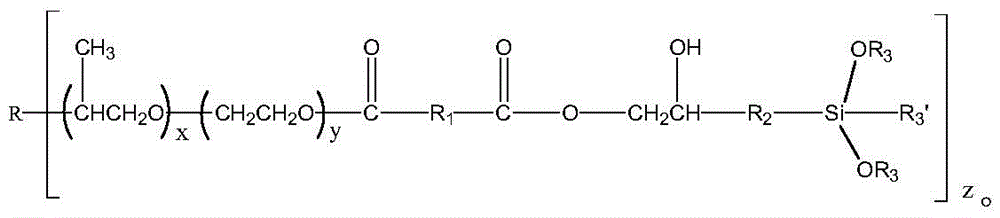
further, the hydroxyl-terminated polyether in the step (1) is one or a mixture of more than two of polyether polyols with the functionality of z 1, 2, 3 or 4 and the molecular weight of 200-.
Further, the acid anhydride in the step (3) is one or a mixture of more than two of maleic anhydride, methyltetrahydrophthalic anhydride, methylhexahydrophthalic anhydride and phthalic anhydride.
Further, the dicarboxylic acid in step (3) is one or a mixture of two or more of succinic acid, adipic acid, terephthalic acid, phthalic acid and isophthalic acid.
Further, the glycidyl ether alkoxy silane in the step (4) is one or a mixture of two of gamma-glycidyl ether oxypropyl trimethoxy silane and gamma-glycidyl ether oxypropyl triethoxy silane in any proportion.
Further, the catalyst in the step (4) is one or a mixture of more than two of a secondary amine compound, a quaternary ammonium salt compound or triphenylphosphine.
Further, the adding amount of the catalyst in the step (4) is 0.1-1% of the total weight of the reaction raw materials.
The invention discovers a process route for synthesizing silane terminated polyether without adding isocyanate and active hydrogen, and obtains a novel silane terminated polyether structure which is not reported in other patents.
According to the invention, the polyether polyol terminal hydroxyl is carboxylated, and then the terminal carboxyl and the alkyl siloxane containing epoxy groups are subjected to an epoxy ring-opening reaction, so that the silane-terminated polyether is obtained. The preparation method provided by the invention has the advantages of simple and safe production process, common and easily-obtained production raw materials and low purchase cost, and can be used for preparing modified polyether resins with different functionalities, different molecular weights, different viscosities and different silane end capping.
Compared with the prior art, the preparation process provided by the invention has the following characteristics: 1, no easy-yellowing and easy-aging groups exist in the polymer structure, and the weather resistance is good; 2. all raw materials are bulk products, the source is wide, and the price is low; and 3, the related esterification and epoxy ring-opening reactions are common reactions in modern industry, and the process is mature.
Detailed Description
The present invention will now be described in detail with reference to the accompanying tables and examples
Example 1
100g of polypropylene glycol monomethyl ether (x is 17, y is 0, and z is 1) with the molecular weight of 1000g/mol is added into a three-neck flask provided with a stirrer and a thermometer, the temperature is increased to 80 ℃, vacuum pumping is carried out for 3h, the temperature is continuously increased to 90 ℃, 10g of maleic anhydride is added, and the reaction is carried out for 4h, so as to obtain the carboxyl-terminated polyether.
And (3) raising the temperature of the reactants to 100 ℃, adding 23.6g of gamma-glycidoxypropyltrimethoxysilane and 0.13g (total weight is 0.1%) of triphenylphosphine catalyst, continuing to react for 2 hours, cooling to 50 ℃, and discharging to obtain the silane-terminated polyether.
Example 2
100g of polyglycol ether diol (x is 0, y is 45, and z is 2) with the molecular weight of 2000g/mol is added into a three-neck flask provided with a stirrer and a thermometer, the temperature is increased to 100 ℃, the flask is vacuumized for 2h, the temperature is continuously increased to 120 ℃, 16.8g of methyl hexahydrophthalic anhydride is added, and the reaction is carried out for 3h, so that the carboxyl-terminated polyether is obtained.
And (3) raising the temperature of the reactants to 110 ℃, adding 27.8g of gamma-glycidyl ether oxypropyl triethoxysilane and 1.44g (total weight is 1%) of a quaternary ammonium salt catalyst, continuing to react for 2 hours, cooling to 50 ℃, and discharging to obtain the silane terminated polyether.
Example 3
300g of polypropylene glycol ether triol (x is 100, y is 1 and z is 3) with the molecular weight of 6000g/mol is added into a three-neck flask provided with a stirrer and a thermometer, the temperature is increased to 120 ℃, the vacuum is pumped for 1h, the temperature is continuously increased to 150 ℃, 22.2g of phthalic anhydride is added, and the reaction is carried out for 2h, so that the carboxyl-terminated polyether is obtained.
And raising the temperature of the reactants to 120 ℃, adding 20.9g of gamma-glycidoxypropyltriethoxysilane, 17.7g of gamma-glycidoxypropyltrimethoxysilane and 1.80g (0.5 percent of the total weight) of secondary amine catalyst, continuing to react for 2 hours, cooling to 50 ℃, and discharging to obtain the silane terminated polyether.
Example 4
500g of a polypropylene glycol ether tetrahydric alcohol with a molecular weight of 20000g/mol (x is 264, y is 100, z is 4) is added into a three-neck flask provided with a stirrer and a thermometer, the temperature is increased to 110 ℃, vacuum pumping is carried out for 1h, the temperature is continuously increased to 140 ℃, and a mixture of 8.2g of methyl tetrahydrophthalic anhydride and 8.4g of methyl hexahydrophthalic anhydride is added for reaction for 2h, so as to obtain the carboxyl terminated polyether.
And (3) raising the temperature of the reactants to 120 ℃, adding 11.1g of gamma-glycidoxypropyltriethoxysilane, 14.2g of gamma-glycidoxypropyltrimethoxysilane and 1.70g (total weight is 0.5%) of triphenylphosphine catalyst, continuing to react for 2 hours, cooling to 50 ℃, and discharging to obtain the silane-terminated polyether.
Example 5
100g of polypropylene glycol ether diol (x is 17, y is 0, z is 2) with the molecular weight of 1000g/mol and 100g of polyethylene glycol monomethyl ether (x is 0, y is 4, z is 1) with the molecular weight of 200g/mol are added into a three-neck flask with a stirrer and a thermometer, the temperature is increased to 120 ℃, the vacuum pumping is carried out for 2h, the temperature is continuously increased to 180 ℃, 175g of adipic acid is added, the reaction is carried out for 2h, the vacuum pumping is carried out for further reaction for 4h, and the carboxyl-terminated polyether is obtained.
And (3) cooling the temperature of the reactants to 100 ℃, adding 283.2g of gamma-glycidoxypropyltrimethoxysilane and 1.51g (total weight is 0.2%) of triphenylphosphine catalyst, continuing to react for 2h, cooling to 50 ℃, and discharging to obtain the silane-terminated polyether.
Example 6
100g of polypropylene glycol ether diol (x is 170, y is 2, z is 2) with the molecular weight of 10000g/mol is added into a three-neck flask with a stirrer and a thermometer, the temperature is increased to 100 ℃, the vacuum pumping is carried out for 2h, the temperature is continuously increased to 200 ℃, 3.35g of terephthalic acid is added, the reaction is carried out for 1h, the vacuum pumping is carried out, the reaction is continuously carried out for 5h, and the carboxyl-terminated polyether is obtained.
And (3) cooling the temperature of the reactants to 110 ℃, adding 5.56g of gamma-glycidyl ether oxypropyl triethoxysilane and 0.87g (total weight is 0.8%) of triphenylphosphine catalyst, continuing to react for 2h, cooling to 50 ℃, and discharging to obtain the silane-terminated polyether.
Example 7
300g of polypropylene glycol ether diol (x 105, y 200, z 3) with the molecular weight of 15000g/mol is added into a three-neck flask provided with a stirrer and a thermometer, the temperature is increased to 100 ℃, the vacuum pumping is carried out for 2h, the temperature is continuously increased to 200 ℃, a mixture of 4.98g of terephthalic acid and 4.98g of phthalic acid is added, the reaction is carried out for 3h, the vacuum pumping is carried out, the reaction is continuously carried out for 3h, and the carboxyl-terminated polyether is obtained.
And (3) cooling the temperature of the reactants to 100 ℃, adding 8.34g of gamma-glycidoxypropyltriethoxysilane, 7.08g of gamma-glycidoxypropyltrimethoxysilane and 1.3g (total weight is 0.4%) of triphenylphosphine catalyst, continuing to react for 2 hours, cooling to 50 ℃, and discharging to obtain the silane-terminated polyether.
Examples 8 to 14
Silane-terminated polyether sealants (corresponding to examples 8-14 in sequence) were prepared by mixing the silane-terminated polyethers obtained in examples 1-7 in the following proportions.

Comparative example
The formulation was also prepared in the proportions described above, using the silane-terminated resin product S303 from Bell corporation of Japan.
The surface dry time, elongation at break, tear strength and hardness were measured for the silane terminated polyether sealants of examples 8-14 and comparative examples using the following test criteria:
surface drying time: GB/T13477.5
Tensile strength and elongation at break: GB/T528-2009
Tear strength: GBT529-1991
Hardness: GBT531.1-2008
The test results are shown in the following table:

according to the test data in the table, the surface drying time of the sealant prepared in the embodiment is short, the tensile strength and the tear strength are improved, on the basis, the hardness and the elongation at break of the products in some embodiments are higher than those in comparative examples, the hardness and the elongation at break of some products are lower than those in comparative examples, and the sealant can be selected according to the working condition and the actual performance requirement of the product application.
It is specifically noted that any silane-terminated polyether prepared by the method of the present invention is within the scope of the present invention, as long as the intermediate structure thereof corresponds to the general structural formula in step (3), whether purchased as a commercial product or synthesized by itself.
Claims (7)
1. A silane terminated polyether characterized by the following general structural formula:

wherein R is a straight or branched chain C1-C10An alkoxy group;
R1is a radical derived from maleic anhydride, methyltetrahydrophthalic anhydride, methylhexahydrophthalic anhydride, phthalic anhydride, or R1Are radicals derived from dicarboxylic acids in the group succinic acid, adipic acid, terephthalic acid, phthalic acid and isophthalic acid;
R2is straight chain or branched C1-C10An alkyl group;
R3is straight chain or branched C1-C10An alkyl group;
R3' is straight-chain or branched C1-C10Alkyl, straight or branched C1-C10An alkoxy group;
x is more than or equal to 1 and less than or equal to 200, Y is more than or equal to 1 and less than or equal to 200, and X and Y are integers.
2. The silane-terminated polyether of claim 1, wherein: r3' is methoxy, ethoxy or methyl.
3. A process for preparing a silane-terminated polyether as claimed in claim 1, comprising the steps of:
1) adding 100 parts by weight of hydroxyl-terminated polyether into a reaction kettle, wherein the structural formula of the hydroxyl-terminated polyether is as follows: wherein R is a straight or branched chain C1-C10An alkoxy group; x is more than or equal to 1 and less than or equal to 200, Y is more than or equal to 1 and less than or equal to 200, and X and Y are integers;
2) vacuumizing at 80-120 deg.C for 1-3h to remove water;
3) adjusting the temperature to 90-150 ℃, adding anhydride with the mole number equal to that of the hydroxyl-terminated polyether, and carrying out ring-opening reaction on the anhydride for 2-4h to obtain carboxyl-terminated polyether; or heating to 180 ℃ and 220 ℃, adding dicarboxylic acid with the mole number equal to that of the hydroxyl-terminated polyether, vacuumizing while reacting, and carrying out alkyd condensation reaction for 4-6h to obtain carboxyl-terminated polyether, wherein the structural formula of the acid anhydride is as follows:  The structural formula of the dicarboxylic acid structure is as follows: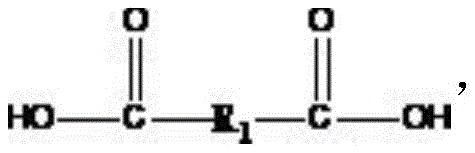
the structural formula of the carboxyl-terminated polyether is as follows: R1is a radical derived from maleic anhydride, methyltetrahydrophthalic anhydride, methylhexahydrophthalic anhydride, phthalic anhydride, or R1Are radicals derived from dicarboxylic acids in the group succinic acid, adipic acid, terephthalic acid, phthalic acid and isophthalic acid;
4) adjusting the temperature to 100 ℃ and 120 ℃, adding glycidyl ether alkoxy silane with the mole number equal to that of polyether and a catalyst to continue reacting for 1-3h, wherein the catalyst is secondary amine, quaternary ammonium salt or triphenylphosphine, and the structure of the glycidyl ether alkoxy silane is as follows: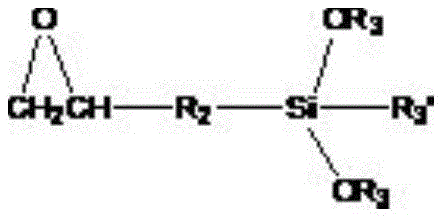 R2is straight chain or branched C1-C10An alkyl group;
R3is straight chain or branched C1-C10An alkyl group; r3' is straight-chain or branched C1-C10Alkyl, straight or branched C1-C10An alkoxy group;
5) cooling and discharging to obtain the silane terminated polyether, wherein the structure of the silane terminated polyether is shown as the following general formula:

4. the method for preparing silane-terminated polyether according to claim 3, wherein the hydroxyl-terminated polyether in step (1) is one or more of polyether polyols having molecular weight of 200-20000 g/mol.
5. The method for preparing silane-terminated polyether according to claim 3, wherein the glycidyl ether alkoxy silane in the step (4) is one or a mixture of two of gamma-glycidyl ether oxypropyl trimethoxy silane and gamma-glycidyl ether oxypropyl triethoxy silane in any ratio.
6. The method for preparing silane-terminated polyether according to claim 3, wherein the catalyst in step (4) is one or a mixture of more than two of secondary amine compound, quaternary ammonium compound or triphenylphosphine.
7. The method for preparing silane-terminated polyether according to claim 3, wherein the amount of catalyst added in step (4) is 0.1-1% of the total weight of the reaction raw materials.
Priority Applications (1)
| Application Number | Priority Date | Filing Date | Title |
|---|---|---|---|
| CN201910348056.9A CN110028664B (en) | 2019-04-28 | 2019-04-28 | Silane-terminated polyether and preparation method thereof |
Applications Claiming Priority (1)
| Application Number | Priority Date | Filing Date | Title |
|---|---|---|---|
| CN201910348056.9A CN110028664B (en) | 2019-04-28 | 2019-04-28 | Silane-terminated polyether and preparation method thereof |
Publications (2)
| Publication Number | Publication Date |
|---|---|
| CN110028664A CN110028664A (en) | 2019-07-19 |
| CN110028664B true CN110028664B (en) | 2021-08-03 |
Family
ID=67240453
Family Applications (1)
| Application Number | Title | Priority Date | Filing Date |
|---|---|---|---|
| CN201910348056.9A Active CN110028664B (en) | 2019-04-28 | 2019-04-28 | Silane-terminated polyether and preparation method thereof |
Country Status (1)
| Country | Link |
|---|---|
| CN (1) | CN110028664B (en) |
Families Citing this family (7)
| Publication number | Priority date | Publication date | Assignee | Title |
|---|---|---|---|---|
| CN110527471A (en) * | 2019-08-23 | 2019-12-03 | 安徽蓝色经典新材料科技有限公司 | A kind of MS sealant processing technology |
| CN111154095B (en) * | 2020-01-14 | 2022-08-02 | 万华化学集团股份有限公司 | Silicon modified macromolecular monomer stabilizer and preparation method and application thereof |
| CN112321816B (en) * | 2020-11-27 | 2023-01-10 | 扬州晨化新材料股份有限公司 | Silane terminated polyether and preparation method thereof |
| CN112552870B (en) * | 2020-12-29 | 2022-08-02 | 烟台信友新材料有限公司 | High-strength high-hardness UV/moisture dual-curing MS glue and preparation method thereof |
| CN115160576B (en) * | 2022-08-18 | 2023-11-14 | 杭州潜阳科技股份有限公司 | Synthesis method and application of solvent-free room-temperature curing organic silicon hybrid resin |
| CN117209746B (en) * | 2023-10-15 | 2025-07-04 | 江西蓝星星火有机硅有限公司 | Silane end capped polyether resin and preparation method and application thereof |
| CN118667146A (en) * | 2024-05-23 | 2024-09-20 | 浙江皇马科技股份有限公司 | Low-viscosity nontoxic silane end-capped polyether resin and preparation method thereof |
Citations (2)
| Publication number | Priority date | Publication date | Assignee | Title |
|---|---|---|---|---|
| CN101514243A (en) * | 2008-02-21 | 2009-08-26 | 赢创戈尔德施米特有限公司 | New polyether alcohols containing alkoxysilyl groups and method for production |
| WO2012130674A2 (en) * | 2011-03-29 | 2012-10-04 | Evonik Goldschmidt Gmbh | Alkoxysilyl-containing adhesive sealants having an increased rupture stress |
Family Cites Families (1)
| Publication number | Priority date | Publication date | Assignee | Title |
|---|---|---|---|---|
| JP4892208B2 (en) * | 2005-07-26 | 2012-03-07 | トヨタ自動車株式会社 | Coating film forming method and coated article |
-
2019
- 2019-04-28 CN CN201910348056.9A patent/CN110028664B/en active Active
Patent Citations (2)
| Publication number | Priority date | Publication date | Assignee | Title |
|---|---|---|---|---|
| CN101514243A (en) * | 2008-02-21 | 2009-08-26 | 赢创戈尔德施米特有限公司 | New polyether alcohols containing alkoxysilyl groups and method for production |
| WO2012130674A2 (en) * | 2011-03-29 | 2012-10-04 | Evonik Goldschmidt Gmbh | Alkoxysilyl-containing adhesive sealants having an increased rupture stress |
Also Published As
| Publication number | Publication date |
|---|---|
| CN110028664A (en) | 2019-07-19 |
Similar Documents
| Publication | Publication Date | Title |
|---|---|---|
| CN110028664B (en) | Silane-terminated polyether and preparation method thereof | |
| KR100547526B1 (en) | Polyurethane prepolymers containing alkoxysilane end groups, methods for their preparation and their use for the production of encapsulants | |
| CN101993522B (en) | Novel urethane-containing silylated prepolymers and process for preparation thereof | |
| EP2134767B1 (en) | Process for making hydrolyzable silylated polymers | |
| KR20100041766A (en) | Process for producing polyurethane foams based on specific alkoxysilane-functional polymers | |
| EP3707220B1 (en) | Silane modified polymers and use of the same in adhesive compositions | |
| CN108587548B (en) | Silane-terminated modified polycarbonate polyurethane adhesive resin and preparation method and application thereof | |
| CN115010903B (en) | Silane end-capped resin based on mercapto-click reaction and synthesis method thereof | |
| JP2007510766A (en) | Moisture curable polyetherurethane having reactive silane groups and use thereof | |
| WO2025242161A1 (en) | Low-viscosity non-toxic silane-terminated polyether resin and preparation method therefor | |
| US20130079538A1 (en) | Alkoxysilane functionalized isocyanate based materials | |
| WO2011081409A2 (en) | Substituted aminosilane having hydroxy group and silane-modified polyurethane prepolymer prepared using same | |
| CN113461902A (en) | Siloxane-terminated polymer homo-polymerization preparation method and moisture-curing composition | |
| KR100945300B1 (en) | Additives for improving hydrolysis of polyurethane compounds, preparation methods thereof and polyurethane compositions using the same | |
| JP7719411B1 (en) | Method for producing polyether compounds | |
| JP2026012126A (en) | Method for producing polyether compounds having reactive silicon groups | |
| KR101641109B1 (en) | Polyurethane having alicyclic diisocyanate and method for preparing the same | |
| JP2025522011A (en) | Silane Terminated Polymers | |
| KR101212104B1 (en) | Polyorganosiloxane modified polyurethane hybrid compound, preparation method thereof, and the use thereof | |
| JP2026012128A (en) | Method for producing polyether compounds having reactive silicon groups | |
| WO2026014467A1 (en) | Method for producing polyether compound, method for producing polyether compound having reactive silicon group, method for producing polyether compound having urethane bond, and method for producing polyether compound having polymerizable unsaturated group | |
| JP2893197B2 (en) | Production method of epoxy urethane resin | |
| WO2026014466A1 (en) | Method for producing polyether compound, method for producing polyether compound having reactive silicon group, method for producing polyether compound having urethane bond, and method for producing polyether compound having polymerizable unsaturated group | |
| RU2567554C1 (en) | Method of obtaining moisture-curing polyurethane binding agent with terminal alkoxysilane groups | |
| JP2026012127A (en) | Method for producing polyether compounds having reactive silicon groups |
Legal Events
| Date | Code | Title | Description |
|---|---|---|---|
| PB01 | Publication | ||
| PB01 | Publication | ||
| SE01 | Entry into force of request for substantive examination | ||
| SE01 | Entry into force of request for substantive examination | ||
| GR01 | Patent grant | ||
| GR01 | Patent grant | ||
| TR01 | Transfer of patent right |
Effective date of registration: 20221201 Address after: 311201 Block 6, Down Park, Xintang Sub district Office, Xiaoshan District, Hangzhou, Zhejiang Patentee after: Hangzhou Daniu New Materials Co.,Ltd. Address before: Room 812, building 1, 100 Qinzhou Road, Xuhui District, Shanghai 200235 Patentee before: Shanghai Yuanye Sports Technology Co.,Ltd. |
|
| TR01 | Transfer of patent right |