CN110021044B - Method for calculating coordinates of shot object by using double-fisheye image and image acquisition device - Google Patents
Method for calculating coordinates of shot object by using double-fisheye image and image acquisition device Download PDFInfo
- Publication number
- CN110021044B CN110021044B CN201810023066.0A CN201810023066A CN110021044B CN 110021044 B CN110021044 B CN 110021044B CN 201810023066 A CN201810023066 A CN 201810023066A CN 110021044 B CN110021044 B CN 110021044B
- Authority
- CN
- China
- Prior art keywords
- fisheye
- image
- lens
- coordinates
- azimuth
- Prior art date
- Legal status (The legal status is an assumption and is not a legal conclusion. Google has not performed a legal analysis and makes no representation as to the accuracy of the status listed.)
- Expired - Fee Related
Links
Images


Classifications
-
- G—PHYSICS
- G01—MEASURING; TESTING
- G01B—MEASURING LENGTH, THICKNESS OR SIMILAR LINEAR DIMENSIONS; MEASURING ANGLES; MEASURING AREAS; MEASURING IRREGULARITIES OF SURFACES OR CONTOURS
- G01B11/00—Measuring arrangements characterised by the use of optical techniques
- G01B11/002—Measuring arrangements characterised by the use of optical techniques for measuring two or more coordinates
-
- G—PHYSICS
- G06—COMPUTING OR CALCULATING; COUNTING
- G06T—IMAGE DATA PROCESSING OR GENERATION, IN GENERAL
- G06T7/00—Image analysis
- G06T7/70—Determining position or orientation of objects or cameras
- G06T7/73—Determining position or orientation of objects or cameras using feature-based methods
-
- G—PHYSICS
- G06—COMPUTING OR CALCULATING; COUNTING
- G06T—IMAGE DATA PROCESSING OR GENERATION, IN GENERAL
- G06T2207/00—Indexing scheme for image analysis or image enhancement
- G06T2207/10—Image acquisition modality
- G06T2207/10016—Video; Image sequence
Landscapes
- Physics & Mathematics (AREA)
- General Physics & Mathematics (AREA)
- Engineering & Computer Science (AREA)
- Computer Vision & Pattern Recognition (AREA)
- Theoretical Computer Science (AREA)
- Length Measuring Devices By Optical Means (AREA)
Abstract
Description
技术领域technical field
本发明涉及一种图像获取装置及方法,尤其涉及一种利用双鱼眼图像计算所摄物体坐标的方法及图像获取装置。The invention relates to an image acquisition device and method, in particular to a method for calculating the coordinates of a photographed object using a double fisheye image and an image acquisition device.
背景技术Background technique
游戏机是现代人家庭娱乐不可或缺的电子产品之一。为了增加玩家与游戏内容的互动,许多游戏机已摒除传统手把的控制模式,加入了体感检测的元素。通过红外线等传感器检测使用者于空间中的移动或动作,并反应于游戏内容的操控,而大幅增加游戏的娱乐性。Game consoles are one of the indispensable electronic products for modern family entertainment. In order to increase the interaction between players and game content, many game consoles have abandoned the traditional handle control mode and added elements of motion detection. Sensors such as infrared rays are used to detect the user's movement or action in the space, and respond to the control of the game content, thereby greatly increasing the entertainment of the game.
除了早期的红外线感测定位技术之外,近期的游戏机更导入了光球检测技术,当使用者手持光球遥杆在空间中挥舞时,游戏机会通过配置其上的双镜头拍摄光球的图像,并根据光球在图像中的位置计算光球在空间中的位置。In addition to the early infrared sensing and positioning technology, recent game consoles have also introduced photosphere detection technology. When the user holds the photoball joystick and waved it in the space, the game machine will take pictures of the photosphere through the dual lenses on it. image, and calculate the position of the photosphere in space according to the position of the photosphere in the image.
然而,由于传统镜头的视野(field of view,FOV)有限,此将使得上述双镜头的拍摄范围会受到限制,连带使得使用者的移动空间也受到限制。而若将此镜头替换成视野较广的鱼眼镜头,则因为鱼眼镜头所获取的图像会有变形,需要进行鱼眼校正后才能用来定位,但校正过程需要经过几何转换(geometry transformation),此将降低视频图像的管线期间(pipeline duration),而有可能需要通过增加图框率(frame rate)来解决。However, due to the limited field of view (FOV) of the traditional lens, this will limit the shooting range of the above-mentioned dual lens, and also limit the moving space of the user. However, if this lens is replaced with a fisheye lens with a wider field of view, the image obtained by the fisheye lens will be distorted, and fisheye correction must be performed before it can be used for positioning, but the correction process requires geometric transformation (geometry transformation) , which will reduce the pipeline duration of the video image, and may need to be solved by increasing the frame rate.
发明内容Contents of the invention
本发明提供一种利用双鱼眼图像计算所摄物体坐标的方法及图像获取装置,可在不进行几何转换的情况下,使用双鱼眼图像计算出物体于空间中的三维坐标。The invention provides a method for calculating the coordinates of a photographed object using a double fisheye image and an image acquisition device, which can use the double fisheye image to calculate the three-dimensional coordinates of the object in space without geometric transformation.
本发明的利用双鱼眼图像计算所摄物体坐标的方法适用于具有第一鱼眼镜头及第二鱼眼镜头的图像获取装置。其中,第一鱼眼镜头及第二鱼眼镜头之间具有基线距离。所述方法是利用第一鱼眼镜头及第二鱼眼镜头分别获取包括一物体的第一鱼眼图像及第二鱼眼图像。接着,检测此物体在第一鱼眼图像及第二鱼眼图像中的第一坐标及第二坐标,然后根据此第一坐标及第二坐标,计算物体在第一鱼眼镜头及第二鱼眼镜头的图像传感器平面上相对于第一鱼眼图像及第二鱼眼图像的鱼眼中心的第一方位角及第二方位角,之后则利用第一鱼眼镜头及第二鱼眼镜头的镜头曲线,分别将第一坐标与第一鱼眼图像的鱼眼中心的第一距离以及第二坐标与第二鱼眼图像的鱼眼中心的第二距离转换为第一入射角及第二入射角。最后,根据所述的第一方位角、第二方位角、第一入射角、第二入射角以及基线距离,利用三角函数计算物体的三维坐标。The method for calculating coordinates of a photographed object by using a double fisheye image of the present invention is applicable to an image acquisition device having a first fisheye lens and a second fisheye lens. Wherein, there is a baseline distance between the first fisheye lens and the second fisheye lens. The method is to use the first fish-eye lens and the second fish-eye lens to respectively acquire a first fish-eye image and a second fish-eye image including an object. Next, detect the first coordinate and the second coordinate of the object in the first fisheye image and the second fisheye image, and then calculate the position of the object in the first fisheye lens and the second fisheye lens according to the first coordinate and the second coordinate. The first azimuth angle and the second azimuth angle relative to the fisheye center of the first fisheye image and the second fisheye image on the image sensor plane of the eye lens, and then use the first fisheye lens and the second fisheye lens The lens curve converts the first distance between the first coordinate and the fisheye center of the first fisheye image and the second distance between the second coordinate and the fisheye center of the second fisheye image into the first incident angle and the second incident angle respectively horn. Finally, according to the first azimuth angle, the second azimuth angle, the first incident angle, the second incident angle and the baseline distance, trigonometric functions are used to calculate the three-dimensional coordinates of the object.
在本发明的一实施例中,所述的物体包括发光装置,而所述检测物体在第一鱼眼图像及第二鱼眼图像中的第一坐标及第二坐标的步骤包括分别检测第一鱼眼图像及第二鱼眼图像中亮度或颜色分量大于预设值的多个像素,而以这些像素所形成区域的中心或重心在第一鱼眼图像及第二鱼眼图像中的坐标作为所述的第一坐标及第二坐标。In an embodiment of the present invention, the object includes a light emitting device, and the step of detecting the first coordinate and the second coordinate of the object in the first fisheye image and the second fisheye image includes respectively detecting the first A plurality of pixels in the fisheye image and the second fisheye image whose brightness or color components are greater than a preset value, and the coordinates of the center or center of gravity of the area formed by these pixels in the first fisheye image and the second fisheye image are used as The first coordinate and the second coordinate.
在本发明的一实施例中,所述物体所发出的光在第一鱼眼镜头上的入射角与此光在第一鱼眼镜头的图像传感器上的投影半径呈正比,以及所述物体所发出的光在第二鱼眼镜头上的入射角与此光在第二鱼眼镜头的图像传感器上的投影半径呈正比。In an embodiment of the present invention, the incident angle of the light emitted by the object on the first fisheye lens is proportional to the projection radius of the light on the image sensor of the first fisheye lens, and the angle of incidence of the light emitted by the object is The incident angle of the emitted light on the second fisheye lens is proportional to the projection radius of the light on the image sensor of the second fisheye lens.
在本发明的一实施例中,假设所述第一方位角为

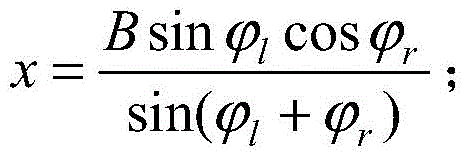
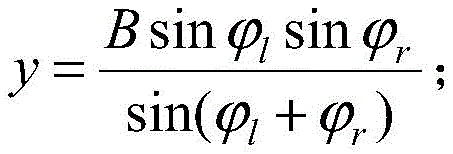
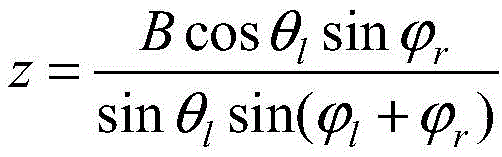
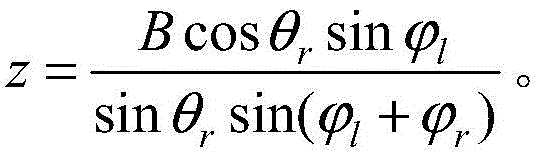
在本发明的一实施例中,所述第一鱼眼镜头的光轴及第二鱼眼镜头的光轴具有一夹角,使得第一鱼眼镜头的视野与第二鱼眼镜头的视野包括重叠区域及非重叠区域。其中,当所述物体出现在重叠区域时,根据所述的第一方位角、第二方位角、第一入射角、第二入射角以及基线距离,利用三角函数计算此物体的三维坐标;以及当所述物体出现在非重叠区域时,根据所述的第一方位角、第二方位角、第一入射角、第二入射角以及基线距离,利用三角函数计算此物体的二维坐标。In an embodiment of the present invention, the optical axis of the first fisheye lens and the optical axis of the second fisheye lens have an included angle, so that the field of view of the first fisheye lens and the field of view of the second fisheye lens include Overlapping and non-overlapping areas. Wherein, when the object appears in the overlapping area, according to the first azimuth angle, the second azimuth angle, the first incident angle, the second incident angle and the baseline distance, the trigonometric function is used to calculate the three-dimensional coordinates of the object; and When the object appears in the non-overlapping area, according to the first azimuth angle, the second azimuth angle, the first incident angle, the second incident angle and the baseline distance, the two-dimensional coordinates of the object are calculated using trigonometric functions.
本发明的图像获取装置包括图像获取模块、物体检测模块、方位角计算模块、入射角计算模块及坐标计算模块。图像获取模块是利用第一鱼眼镜头及第二鱼眼镜头分别获取包括一物体的第一鱼眼图像及第二鱼眼图像。物体检测模块是检测所述物体在第一鱼眼图像及第二鱼眼图像中的第一坐标及第二坐标。方位角计算模块是根据所述的第一坐标及第二坐标,计算所述物体在第一鱼眼镜头及第二鱼眼镜头的图像传感器平面上相对于第一鱼眼图像及第二鱼眼图像的鱼眼中心的第一方位角及第二方位角。入射角计算模块是利用第一鱼眼镜头及第二鱼眼镜头的镜头曲线,分别将第一坐标与第一鱼眼图像的鱼眼中心的第一距离以及第二坐标与第二鱼眼图像的鱼眼中心的第二距离转换为第一入射角及第二入射角。坐标计算模块是根据所述的第一方位角、第二方位角、第一入射角、第二入射角以及第一鱼眼镜头与第二鱼眼镜头之间的基线距离,利用三角函数计算所述物体的三维坐标。The image acquisition device of the present invention includes an image acquisition module, an object detection module, an azimuth angle calculation module, an incident angle calculation module and a coordinate calculation module. The image acquiring module uses the first fisheye lens and the second fisheye lens to respectively acquire a first fisheye image and a second fisheye image including an object. The object detection module detects the first coordinates and the second coordinates of the object in the first fisheye image and the second fisheye image. The azimuth calculation module is based on the first coordinates and the second coordinates, and calculates the object relative to the first fisheye image and the second fisheye image on the image sensor plane of the first fisheye lens and the second fisheye lens. The first azimuth and the second azimuth of the fisheye center of the image. The incident angle calculation module uses the lens curves of the first fisheye lens and the second fisheye lens to respectively calculate the first distance between the first coordinate and the fisheye center of the first fisheye image and the second coordinate and the second fisheye image The second distance from the center of the fisheye is converted into the first incident angle and the second incident angle. The coordinate calculation module is based on the first azimuth, the second azimuth, the first angle of incidence, the second angle of incidence, and the baseline distance between the first fisheye lens and the second fisheye lens, using trigonometric functions to calculate the The three-dimensional coordinates of the object.
在本发明的一实施例中,所述的物体包括发光装置,而所述物体检测模块包括分别检测第一鱼眼图像及第二鱼眼图像中亮度或颜色分量大于预设值的多个像素,而以这些像素所形成区域的中心或重心在第一鱼眼图像及第二鱼眼图像中的坐标作为第一坐标及第二坐标。In an embodiment of the present invention, the object includes a light-emitting device, and the object detection module includes a plurality of pixels that respectively detect brightness or color components in the first fisheye image and the second fisheye image that are greater than a preset value , and the coordinates of the center or center of gravity of the area formed by these pixels in the first fisheye image and the second fisheye image are used as the first coordinates and the second coordinates.
在本发明的一实施例中,所述的物体所发出的光在第一鱼眼镜头上的入射角与此光在第一鱼眼镜头的图像传感器上的投影半径呈正比,以及所述的物体所发出的光在第二鱼眼镜头上的入射角与此光在第二鱼眼镜头的图像传感器上的投影半径呈正比。In an embodiment of the present invention, the incident angle of the light emitted by the object on the first fisheye lens is proportional to the projection radius of the light on the image sensor of the first fisheye lens, and the The incident angle of the light emitted by the object on the second fisheye lens is proportional to the projection radius of the light on the image sensor of the second fisheye lens.
在本发明的一实施例中,假设所述的第一方位角为

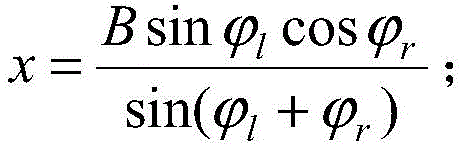

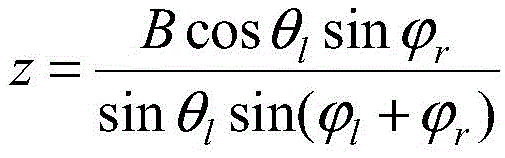
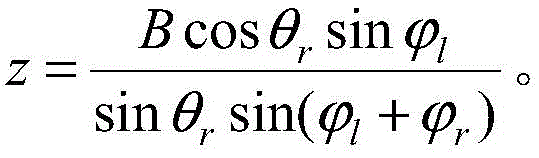
在本发明的一实施例中,所述的第一鱼眼镜头的光轴及第二鱼眼镜头的光轴具有一夹角,使得第一鱼眼镜头的视野与第二鱼眼镜头的视野包括重叠区域及非重叠区域,其中当物体出现在重叠区域时,坐标计算模块包括根据第一方位角、第二方位角、第一入射角、第二入射角以及基线距离,利用三角函数计算物体的三维坐标;以及当物体出现在重叠区域时,坐标计算模块包括根据第一方位角、第二方位角、第一入射角、第二入射角以及基线距离,利用三角函数计算物体的二维坐标。In an embodiment of the present invention, the optical axis of the first fisheye lens and the optical axis of the second fisheye lens have an included angle, so that the field of view of the first fisheye lens and the field of view of the second fisheye lens Including overlapping areas and non-overlapping areas, wherein when the object appears in the overlapping area, the coordinate calculation module includes using trigonometric functions to calculate the object according to the first azimuth angle, the second azimuth angle, the first incident angle, the second incident angle and the baseline distance and when the object appears in the overlapping area, the coordinate calculation module includes calculating the two-dimensional coordinates of the object according to the first azimuth, the second azimuth, the first angle of incidence, the second angle of incidence, and the baseline distance using trigonometric functions .
基于上述,本发明的利用双鱼眼图像计算所摄物体坐标的方法及图像获取装置利用双鱼眼镜头获取物体图像,并在不进行几何转换的情况,直接使用物体在双鱼眼图像中的坐标计算由物体发射的光在鱼眼镜头上的入射角以及在镜头平面上的方位角,最后利用三角定位的方式,计算该物体在空间中的三维坐标。Based on the above, the method for calculating the coordinates of a photographed object using a double fisheye image and the image acquisition device of the present invention use a double fisheye lens to acquire an object image, and directly use the coordinates of the object in the double fisheye image to calculate the The incident angle of the light emitted by the object on the fisheye lens and the azimuth angle on the lens plane, and finally use the triangulation method to calculate the three-dimensional coordinates of the object in space.
为让本发明的上述特征和优点能更明显易懂,下文特举实施例,并配合附图作详细说明如下。In order to make the above-mentioned features and advantages of the present invention more comprehensible, the following specific embodiments are described in detail with reference to the accompanying drawings.
附图说明Description of drawings
图1是依照本发明一实施例所显示的双摄像头图像获取装置的方块图;FIG. 1 is a block diagram of a dual-camera image acquisition device shown according to an embodiment of the present invention;
图2是依照本发明一实施例所显示的双摄像头图像获取装置的摄像方法的流程图;FIG. 2 is a flow chart of an imaging method of a dual-camera image acquisition device shown according to an embodiment of the present invention;
图3A至图3B是依照本发明一实施例所显示的双摄像头图像获取装置20的摄像方法的范例;3A to 3B are examples of the imaging method of the dual-camera image acquisition device 20 shown according to an embodiment of the present invention;
图4是依照本发明一实施例所显示的双摄像头图像获取装置的方块图。FIG. 4 is a block diagram of a dual-camera image acquisition device according to an embodiment of the present invention.
附图标号说明:Explanation of reference numbers:
10:图像获取装置10: Image acquisition device
12:第一鱼眼镜头12: The first fisheye lens
14:第二鱼眼镜头14: Second fisheye lens
16:存储装置16: storage device
161:图像获取模块161: Image acquisition module
162:物体检测模块162: Object detection module
163:方位角计算模块163: Azimuth calculation module
164:入射角计算模块164: Incident angle calculation module
165:坐标计算模块165: Coordinate calculation module
18:处理器18: Processor
32:鱼眼镜头32: Fisheye lens
34:图像传感器34: Image sensor
36:鱼眼图像36: Fisheye image
θ、θl、θr:入射角θ, θ l , θ r : angle of incidence
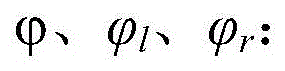
O、Ol、Or:鱼眼中心O, O l , O r : Fisheye center
P:投影点P: projected point
R:有效投影平径R: effective projected flat diameter
r:投影平径r: projected flat diameter
T、T’:物体T, T': object
M:P点在基线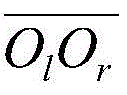
S202~S210:本发明一实施例的利用双鱼眼图像计算所摄物体坐标的方法步骤S202-S210: Method steps for calculating the coordinates of the photographed object using the double fisheye image according to an embodiment of the present invention
具体实施方式detailed description
由于鱼眼镜头采用等距镜头(Equi-Distance lens),其自物体(例如光球)接收的光的入射角会与此光在图像传感器上的投影半径呈近乎线性的关系。据此,本发明即通过检测物体在鱼眼图像中的位置,利用上述关系反推物体发光的入射角,结合物体在镜头平面上的方位角,利用三角定位的方式,即可计算出物体于空间中的三维坐标。藉此,本发明可在增加拍摄视野且不进行几何转换的情况下,实现所摄物体的三维坐标计算。Since the fisheye lens adopts an equi-distance lens, the incident angle of light received from an object (such as a photosphere) will have a nearly linear relationship with the projection radius of the light on the image sensor. Accordingly, the present invention detects the position of the object in the fisheye image, uses the above relationship to deduce the incident angle of the object’s light emission, and combines the azimuth angle of the object on the lens plane to calculate the position of the object at Three-dimensional coordinates in space. Thereby, the present invention can realize the calculation of the three-dimensional coordinates of the photographed object under the condition of increasing the photographing field of view without performing geometric transformation.
图1是依照本发明一实施例所显示的图像获取装置的方块图。请参照图1,本实施例的图像获取装置10例如是手机、平板电脑、笔记本电脑、导航装置、行车纪录器、数码相机、数码摄影机(Digital video camcorder,DVC)等具备摄像功能的电子装置。图像获取装置10中包括第一鱼眼镜头12、第二鱼眼镜头14、存储装置16及处理器18,其功能分述如下:FIG. 1 is a block diagram of an image acquisition device according to an embodiment of the invention. Referring to FIG. 1 , the
第一鱼眼镜头12及第二鱼眼镜头14分别包括镜头及图像传感器,其中所述镜头是采用视角接近、等于或超过180度的定焦或变焦镜头,其可使得位于其视野(Field ofView,FOV)内的被摄物体成像在图像传感器上。图像传感器中配置有电荷耦合元件(Chargecoupled device,CCD)、互补性氧化金属半导体(Complementary metal-oxidesemiconductor,CMOS)元件或其他种类的感光元件,而可感测进入镜头的光线强度,从而获取图像信号以产生鱼眼图像。第一鱼眼镜头12及第二鱼眼镜头14之间例如具有一基线距离。The
存储装置16例如是任何形式的固定式或可移动式随机存取存储器(randomaccess memory,RAM)、只读存储器(read-only memory,ROM)、快闪存储器(flash memory)或类似元件或上述元件的组合。在本实施例中,存储装置16用以记录图像获取模块161、物体检测模块162、方位角计算模块163、入射角计算模块164及坐标计算模块165,这些模块例如是存储在存储装置16中的程序。The
处理器18例如是中央处理单元(Central Processing Unit,CPU),或是其他可程序化的一般用途或特殊用途的微处理器(Microprocessor)、数码信号处理器(DigitalSignal Processor,DSP)、可程序化控制器、特殊应用集成电路(Application SpecificIntegrated Circuits,ASIC)、可程序化逻辑装置(Programmable Logic Device,PLD)或其他类似装置或这些装置的组合。处理器18连接第一鱼眼镜头12、第二鱼眼镜头14及存储装置16,而配置用以从存储装置16载入图像获取模块161、物体检测模块162、方位角计算模块163、入射角计算模块164及坐标计算模块165的程序,据以执行本申请利用双鱼眼图像计算所摄物体坐标的方法。The
详言之,图2是依照本发明一实施例所显示的利用双鱼眼图像计算所摄物体坐标的方法的流程图。请同时参照图1及图2,本实施例的方法适用于图1的图像获取装置10,以下即搭配图像获取装置10中的各项元件说明本案的利用双鱼眼图像计算所摄物体坐标的方法的详细步骤。In detail, FIG. 2 is a flow chart of a method for calculating coordinates of a captured object using a double fisheye image according to an embodiment of the present invention. Please refer to FIG. 1 and FIG. 2 at the same time. The method of this embodiment is applicable to the
首先,处理器18执行图像获取模块161,以利用第一鱼眼镜头12及第二鱼眼镜头14分别获取包括一物体的第一鱼眼图像及第二鱼眼图像(步骤S202)。其中,所述物体例如是白色、蓝色、红色、绿色或其他易辨识颜色的光球,其例如是配置在遥杆、遥控器、虚拟实境的头戴式显示器、头盔或是手环、手表等可穿戴式装置上,而可通过发出白光或其他颜色的光,让图像获取装置10可辨识出手持或配戴此物体之使用者的动作。First, the
接着,处理器18执行物体检测模块162,以检测物体在第一鱼眼图像及第二鱼眼图像中的第一坐标及第二坐标(步骤S204)。其中,物体检测模块162例如会分别检测第一鱼眼图像及第二鱼眼图像中亮度或某一颜色分量大于预设值的多个像素,而以这些像素所形成区域的中心或重心在第一鱼眼图像及第二鱼眼图像中的坐标作为所述的第一坐标及第二坐标。Next, the
详言之,若所述物体为光球,则此物体在鱼眼图像中将以亮度较高或某一颜色分量较高的圆形(或椭圆形)区域呈现,因此,物体检测模块162即通过将鱼眼图像中各个像素的亮度值与预设值比较,以检测出物体(白色光球),或是将鱼眼图像中各个像素的某个颜色分量(例如R、G、B)的像素值(例如蓝色分量的像素值)与预设值比较,以检测出具有该颜色的物体(例如蓝色光球)。另一方面,鱼眼镜头所拍摄的物体,会依其偏离鱼眼中心的距离而产生不同程度的形变(例如圆形的光球会变成椭圆形),因此,在确定物体于鱼眼图像中的坐标时,物体检测模块162例如会计算此物体的中心(例如范围可涵括此物体的最小矩形的中心)或重心,而以此中心或重心在鱼眼图像中的坐标作为物体的坐标。Specifically, if the object is a photosphere, the object will appear as a circular (or elliptical) area with higher brightness or a higher color component in the fisheye image. Therefore, the
然后,处理器18执行方位角计算模块163,以根据第一坐标及第二坐标,计算物体在第一鱼眼镜头及第二鱼眼镜头的图像传感器平面上相对于第一鱼眼图像及第二鱼眼图像的鱼眼中心的第一方位角及第二方位角(步骤S206)。此外,处理器18还会执行入射角计算模块164,以利用第一鱼眼镜头12及第二鱼眼镜头14的镜头曲线,分别将前述第一坐标与第一鱼眼图像的鱼眼中心的第一距离以及前述第二坐标与第二鱼眼图像的鱼眼中心的第二距离转换为第一入射角及第二入射角(步骤S208)。其中,处理器18执行的顺序并不限于上述的步骤S206、步骤S208,亦可先执行步骤S208、再执行步骤S206,或同时执行。Then, the
第一鱼眼镜头12及第二鱼眼镜头14所拍摄物体在其图像传感器平面上的投影半径,会依据其镜头曲线而有不同。在一实施例中,若第一鱼眼镜头12与第二鱼眼镜头14是采用等距镜头(Equi-Distance lens),则其所接收光的入射角会与此光在图像传感器上的投影半径呈近乎线性的关系。意即,由物体所发出的光在第一鱼眼镜头12上的入射角与此光在第一鱼眼镜头12的图像传感器上的投影半径呈正比;另一方面,由物体所发出的光在第二鱼眼镜头14上的入射角与此光在第二鱼眼镜头14的图像传感器上的投影半径呈正比。而在另一实施例中,第一鱼眼镜头12与第二鱼眼镜头14所接收光的入射角与此光在图像传感器上的投影半径彼此间也可具有多项式函数的关系,此关系可通过预先取得镜头曲线,或预先测定不同角度入射光在图像传感器上的投影半径,而预先取得。The projection radii of the objects photographed by the
举例来说,图3A是依照本发明一实施例所显示的物体在鱼眼镜头的投影半径与入射角的关系示意图,图3B是依照本发明一实施例所显示的物体在鱼眼图像中的位置与方位角的关系示意图。请先参照图3A,由物体T所发出的光例如是以入射角θ入射鱼眼镜头32,并经由鱼眼镜头32的折射,在图像传感器34所在的图像传感器平面上距离鱼眼中心O为投影平径r的位置上呈像。其中,鱼眼镜头32在图像传感器平面上的有效投影平径为R。根据鱼眼镜头32的镜头曲线,前述的入射角θ与投影平径r的关系例如为θ=k·r,其中k为常数且可预先测得。藉此,若使用此鱼眼镜头32拍摄任意物体,即可依据该物体在所拍摄鱼眼图像中的位置,利用上述关系反推由此物体发光的入射角θ。另一方面,请参照图3B,依据物体T’在鱼眼图像36中的位置,即可以贯穿鱼眼图像36的鱼眼中心O的x轴为基准,计算出物体T’相对于鱼眼中心O的方位角
在计算出物体相对于鱼眼中心的方位角以及由物体与鱼眼中心的距离所计算出的入射角之后,处理器18即执行坐标计算模块165,而根据前述的第一方位角、第二方位角、第一入射角、第二入射角以及基线距离,利用三角函数计算所述物体的三维坐标(步骤S210)。After calculating the azimuth angle of the object relative to the fisheye center and the incident angle calculated by the distance between the object and the fisheye center, the
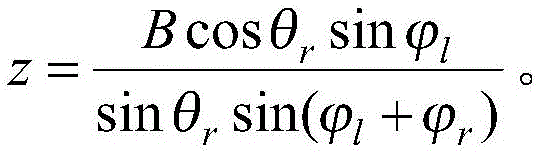
详言之,图4是依照本发明一实施例所显示的计算物体三维坐标的示意图。请参照图4,假设Ol与Or分别是左、右鱼眼镜头的鱼眼中心,P点是物体T在镜头平面上的投影点,M点是P点在基线
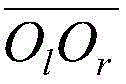

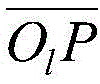

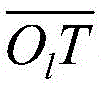
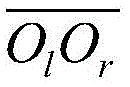


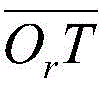

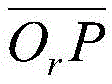

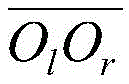


基于前述的方位角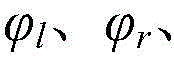
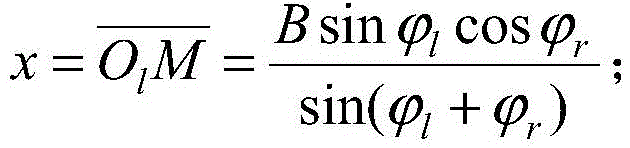

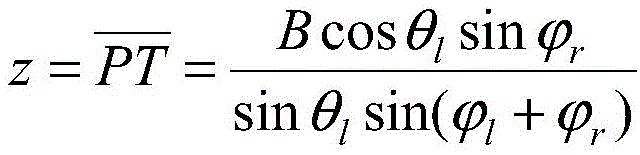

通过上述方法,本实施例的图像获取装置10即可在不进行鱼眼校正的情况下,实现所摄物体的三维坐标计算,且其所拍摄范围相较于传统镜头更广。Through the above method, the
需说明的是,在上述实施例中,图像获取装置的两个鱼眼镜头的光轴预设为平行。而在其他实施例中,两个鱼眼镜头的光轴也可不平行,即两个鱼眼镜头的光轴之间具有夹角。此夹角愈大,代表两个鱼眼镜头视野所涵盖的范围愈大,可支援物体位置检测的角度也愈大。It should be noted that, in the above embodiments, the optical axes of the two fisheye lenses of the image acquisition device are preset to be parallel. In other embodiments, the optical axes of the two fisheye lenses may not be parallel, that is, there is an included angle between the optical axes of the two fisheye lenses. The larger the included angle, the larger the field of view of the two fisheye lenses, and the larger the angle that can support object position detection.
基于人眼感受深度的范围有限,但对于两侧物体的感受较为明显。本发明一实施例的图像获取装置是采用光轴不平行的两个鱼眼镜头,其光轴之间的夹角将使得两个鱼眼镜头的视野包括重叠区域及非重叠区域。其中,当有物体出现在重叠区域时,图像获取装置即可根据前述实施例所计算的第一方位角、第二方位角、第一入射角、第二入射角以及基线距离,利用三角函数计算此物体的三维坐标。而当有物体出现在非重叠区域时,图像获取装置则可根据第一方位角、第二方位角、第一入射角、第二入射角以及基线距离,利用三角函数计算此物体的二维坐标。其中,虽然位于非重叠区域中的物体会因为只被一个鱼眼镜头拍摄到,因此无法计算出深度。但由于物体的二维坐标仍可被计算出,因此仍有助于对位于视野边缘的物体进行定位。Based on the limited range of human eyes' perception of depth, the perception of objects on both sides is more obvious. The image acquisition device in one embodiment of the present invention uses two fisheye lenses whose optical axes are not parallel, and the angle between the optical axes will make the fields of view of the two fisheye lenses include overlapping areas and non-overlapping areas. Wherein, when an object appears in the overlapping area, the image acquisition device can use trigonometric functions to calculate The 3D coordinates of this object. When an object appears in the non-overlapping area, the image acquisition device can calculate the two-dimensional coordinates of the object by using trigonometric functions according to the first azimuth angle, the second azimuth angle, the first incident angle, the second incident angle, and the baseline distance . Among them, although the objects located in the non-overlapping area will be captured by only one fisheye lens, the depth cannot be calculated. However, since the two-dimensional coordinates of objects can still be calculated, it still helps to locate objects at the edge of the field of view.
综上所述,本发明的利用双鱼眼图像计算所摄物体坐标的方法及图像获取装置依据物体在双鱼眼镜头所拍摄图像中的位置,分别计算出物体发光进入鱼眼镜头的入射角以及物体在镜头平面上的方位角,进而计算出物体于空间中的三维坐标。藉此,本发明实施例可在不进行几何转换的情况下,实现所摄物体的三维坐标计算,且可在增加检测范围的同时,减少检测物体所需的运算量。To sum up, the method for calculating the coordinates of the captured object using the double fisheye image and the image acquisition device of the present invention calculate the incident angle of the object's light entering the fisheye lens and the angle of incidence of the object according to the position of the object in the image captured by the double fisheye lens. The azimuth angle on the lens plane, and then calculate the three-dimensional coordinates of the object in space. Thereby, the embodiment of the present invention can realize the calculation of the three-dimensional coordinates of the photographed object without performing geometric transformation, and can increase the detection range while reducing the amount of computation required for detecting the object.
虽然本发明已以实施例揭示如上,然其并非用以限定本发明,任何所属技术领域中技术人员,在不脱离本发明的精神和范围内,当可作些许的更改与润饰,故本发明的保护范围当视权利要求所界定的为准。Although the present invention has been disclosed above with the embodiments, it is not intended to limit the present invention. Any person skilled in the art can make some changes and modifications without departing from the spirit and scope of the present invention. Therefore, the present invention The scope of protection shall prevail as defined by the claims.
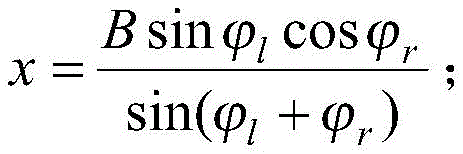
Claims (8)




Priority Applications (1)
| Application Number | Priority Date | Filing Date | Title |
|---|---|---|---|
| CN201810023066.0A CN110021044B (en) | 2018-01-10 | 2018-01-10 | Method for calculating coordinates of shot object by using double-fisheye image and image acquisition device |
Applications Claiming Priority (1)
| Application Number | Priority Date | Filing Date | Title |
|---|---|---|---|
| CN201810023066.0A CN110021044B (en) | 2018-01-10 | 2018-01-10 | Method for calculating coordinates of shot object by using double-fisheye image and image acquisition device |
Publications (2)
| Publication Number | Publication Date |
|---|---|
| CN110021044A CN110021044A (en) | 2019-07-16 |
| CN110021044B true CN110021044B (en) | 2022-12-20 |
Family
ID=67188028
Family Applications (1)
| Application Number | Title | Priority Date | Filing Date |
|---|---|---|---|
| CN201810023066.0A Expired - Fee Related CN110021044B (en) | 2018-01-10 | 2018-01-10 | Method for calculating coordinates of shot object by using double-fisheye image and image acquisition device |
Country Status (1)
| Country | Link |
|---|---|
| CN (1) | CN110021044B (en) |
Families Citing this family (1)
| Publication number | Priority date | Publication date | Assignee | Title |
|---|---|---|---|---|
| CN110675445B (en) * | 2019-09-27 | 2022-06-21 | 深兰科技(上海)有限公司 | Visual positioning method, device and storage medium |
Citations (11)
| Publication number | Priority date | Publication date | Assignee | Title |
|---|---|---|---|---|
| JPH11261868A (en) * | 1998-03-13 | 1999-09-24 | Fujitsu Ltd | Fisheye lens camera apparatus, image distortion correction method thereof, and image extraction method |
| JP2007192832A (en) * | 2007-03-06 | 2007-08-02 | Iwate Univ | Calibration method for fisheye camera. |
| WO2009017331A1 (en) * | 2007-07-29 | 2009-02-05 | Nanophotonics Co., Ltd. | Method and apparatus for obtaining panoramic and rectilinear images using rotationally symmetric wide-angle lens |
| CN101814181A (en) * | 2010-03-17 | 2010-08-25 | 天津理工大学 | Unfolding method for restoration of fisheye image |
| JP2011091528A (en) * | 2009-10-21 | 2011-05-06 | Olympus Corp | Imaging apparatus and imaging method |
| KR20140090775A (en) * | 2013-01-10 | 2014-07-18 | 염철희 | Correction method of distortion image obtained by using fisheye lens and image display system implementing thereof |
| US8798451B1 (en) * | 2013-06-15 | 2014-08-05 | Gyeongil Kweon | Methods of obtaining panoramic images using rotationally symmetric wide-angle lenses and devices thereof |
| CN106157256A (en) * | 2015-04-22 | 2016-11-23 | Tcl集团股份有限公司 | A kind of fisheye image correcting method and correcting fisheye image device |
| KR101694651B1 (en) * | 2016-02-15 | 2017-01-09 | 이화여자대학교 산학협력단 | Distortion compensation apparatus and method for wide-angle imaging lens using three-dimensional position estimate |
| CN106357991A (en) * | 2015-07-14 | 2017-01-25 | 旺玖科技股份有限公司 | Image processing method, image processing apparatus, and display system |
| CN107274341A (en) * | 2017-05-18 | 2017-10-20 | 合肥工业大学 | Quick binocular flake Panorama Mosaic method based on fixed splicing parameter |
Family Cites Families (3)
| Publication number | Priority date | Publication date | Assignee | Title |
|---|---|---|---|---|
| JP4095491B2 (en) * | 2003-05-19 | 2008-06-04 | 本田技研工業株式会社 | Distance measuring device, distance measuring method, and distance measuring program |
| KR100955483B1 (en) * | 2008-08-12 | 2010-04-30 | 삼성전자주식회사 | 3D grid map making method and control method of automatic driving device using same |
| TWI423659B (en) * | 2010-11-09 | 2014-01-11 | Avisonic Technology Corp | Image corretion method and related image corretion system thereof |
-
2018
- 2018-01-10 CN CN201810023066.0A patent/CN110021044B/en not_active Expired - Fee Related
Patent Citations (11)
| Publication number | Priority date | Publication date | Assignee | Title |
|---|---|---|---|---|
| JPH11261868A (en) * | 1998-03-13 | 1999-09-24 | Fujitsu Ltd | Fisheye lens camera apparatus, image distortion correction method thereof, and image extraction method |
| JP2007192832A (en) * | 2007-03-06 | 2007-08-02 | Iwate Univ | Calibration method for fisheye camera. |
| WO2009017331A1 (en) * | 2007-07-29 | 2009-02-05 | Nanophotonics Co., Ltd. | Method and apparatus for obtaining panoramic and rectilinear images using rotationally symmetric wide-angle lens |
| JP2011091528A (en) * | 2009-10-21 | 2011-05-06 | Olympus Corp | Imaging apparatus and imaging method |
| CN101814181A (en) * | 2010-03-17 | 2010-08-25 | 天津理工大学 | Unfolding method for restoration of fisheye image |
| KR20140090775A (en) * | 2013-01-10 | 2014-07-18 | 염철희 | Correction method of distortion image obtained by using fisheye lens and image display system implementing thereof |
| US8798451B1 (en) * | 2013-06-15 | 2014-08-05 | Gyeongil Kweon | Methods of obtaining panoramic images using rotationally symmetric wide-angle lenses and devices thereof |
| CN106157256A (en) * | 2015-04-22 | 2016-11-23 | Tcl集团股份有限公司 | A kind of fisheye image correcting method and correcting fisheye image device |
| CN106357991A (en) * | 2015-07-14 | 2017-01-25 | 旺玖科技股份有限公司 | Image processing method, image processing apparatus, and display system |
| KR101694651B1 (en) * | 2016-02-15 | 2017-01-09 | 이화여자대학교 산학협력단 | Distortion compensation apparatus and method for wide-angle imaging lens using three-dimensional position estimate |
| CN107274341A (en) * | 2017-05-18 | 2017-10-20 | 合肥工业大学 | Quick binocular flake Panorama Mosaic method based on fixed splicing parameter |
Non-Patent Citations (1)
| Title |
|---|
| 基于坐标投影的鱼眼图像校正方法研究;霍薇薇等;《电子测量技术》;20140531;第37卷(第5期);第25-28页 * |
Also Published As
| Publication number | Publication date |
|---|---|
| CN110021044A (en) | 2019-07-16 |
Similar Documents
| Publication | Publication Date | Title |
|---|---|---|
| CN109194876B (en) | Image processing method, apparatus, electronic device, and computer-readable storage medium | |
| CN108718373B (en) | Image device | |
| CN107424186B (en) | Depth information measuring method and device | |
| US9978148B2 (en) | Motion sensor apparatus having a plurality of light sources | |
| CN107396080A (en) | Method and system for generating depth information | |
| JP2017112602A (en) | Image calibrating, stitching and depth rebuilding method of panoramic fish-eye camera and system thereof | |
| US10298858B2 (en) | Methods to combine radiation-based temperature sensor and inertial sensor and/or camera output in a handheld/mobile device | |
| US10212353B2 (en) | Display control apparatus and method of controlling display control apparatus | |
| CN108053363A (en) | Background blurring processing method, device and equipment | |
| JP6556013B2 (en) | PROCESSING DEVICE, PROCESSING SYSTEM, IMAGING DEVICE, PROCESSING METHOD, PROGRAM, AND RECORDING MEDIUM | |
| TWI635256B (en) | Phase focusing based positioning method and system thereof | |
| CN114846608A (en) | Electronic device including image sensor and method of operating the same | |
| US10762658B2 (en) | Method and image pick-up apparatus for calculating coordinates of object being captured using fisheye images | |
| TWI599809B (en) | Lens module array, image sensing device and fusing method for digital zoomed images | |
| CN107563329A (en) | Image processing method, device, computer-readable recording medium and mobile terminal | |
| CN110021044B (en) | Method for calculating coordinates of shot object by using double-fisheye image and image acquisition device | |
| TWI725279B (en) | Method and image pick-up apparatus for calculating coordinates of object being captured using dual fisheye images | |
| CN115760560A (en) | Depth information acquisition method and device, equipment and storage medium | |
| CN112598716B (en) | Multi-mode image registration method, device and system | |
| TWI646506B (en) | Method for calculating object coordinates by using fisheye image and image capturing device | |
| CN109696122A (en) | The method and video capturing device of taken the photograph object coordinates are calculated using flake image | |
| TWM640759U (en) | Omni-directional image-taking apparatus with motion correction | |
| CN204334737U (en) | Camera assembly | |
| CN119963652B (en) | Calibration method of camera parameters and related equipment | |
| TW201642008A (en) | Image capturing device and dynamic focus method thereof |
Legal Events
| Date | Code | Title | Description |
|---|---|---|---|
| PB01 | Publication | ||
| PB01 | Publication | ||
| SE01 | Entry into force of request for substantive examination | ||
| SE01 | Entry into force of request for substantive examination | ||
| GR01 | Patent grant | ||
| GR01 | Patent grant | ||
| CF01 | Termination of patent right due to non-payment of annual fee |
Granted publication date: 20221220 |
|
| CF01 | Termination of patent right due to non-payment of annual fee |