Disclosure of Invention
One of the purposes of the invention is to solve the problem of low stereoselectivity in the synthesis of chiral deuterated compounds in the prior art and provide a preparation method of (R) -2- (alpha-deuterium-alpha-alkyl-alpha-aryl) nitrogen heteroaryl compounds.
The invention also aims to provide a (R) -2- (alpha-deuterium-alpha-alkyl-alpha-aryl) nitrogen heteroaryl compound aiming at the blank field of deuteration of the nitrogen heteroaryl compound, and a preparation method and application of the compound.
The invention adopts the following technical scheme:
(R) -2- (α -deuterium- α -alkyl- α -aryl) azaaryl compounds, which are compounds having the following general structural formula (II):
wherein the azaaryl group is a quinolyl group, a 6-methoxyquinolyl group, an isoquinolyl group and a benzothiazolyl group, R is an isopropyl group and an ethyl group, and Ar is a phenyl group, a 4-trifluoromethylphenyl group and a 2-naphthyl group.
The preparation method of the (R) -2- (alpha-deuterium-alpha-alkyl-alpha-aryl) nitrogen heteroaryl compound comprises the steps of dispersing 2- (alpha-chloro-alpha-alkyl-alpha-aryl) nitrogen heteroaryl shown in a formula I, a photosensitizer DPZ, a chiral catalyst CPA, Hans ester HEH, a deuterium source and sodium bicarbonate in an organic solvent, degassing at the temperature of not higher than-78 ℃, placing at the temperature of 20-30 ℃, irradiating by using a 3-10W blue lamp, reacting for 20-40 minutes, and separating and purifying after the reaction is finished to obtain the (R) -2- (alpha-deuterium-alpha-alkyl-alpha-aryl) nitrogen heteroaryl compound shown in a formula II; wherein, the sodium bicarbonate is used for removing hydrogen chloride generated by the reaction;
the preparation method comprises the following synthetic route:
further, the photosensitizer DPZ is added in an amount of 0.8-5%, preferably 1%, of the molar amount of the 2- (α -chloro- α -alkyl- α -aryl) azaaryl compound.
Further, the addition amount of the chiral catalyst CPA is 18-25%, preferably 20% of the molar amount of the 2- (alpha-chloro-alpha-alkyl-alpha-aryl) nitrogen heteroaryl compound.
Furthermore, the addition amount of the hanster HEH is 130-180%, preferably 150% of the molar amount of the 2- (alpha-chloro-alpha-alkyl-alpha-aryl) nitrogen heteroaryl compound.
Further, the deuterium source is heavy water, and the addition amount of the heavy water is 90-200 times, preferably 100 times of the molar amount of the 2- (alpha-chloro-alpha-alkyl-alpha-aryl) nitrogen heteroaryl compound.
Furthermore, the adding amount of the sodium bicarbonate is 120-180% of the molar amount of the 2- (alpha-chloro-alpha-alkyl-alpha-aryl) nitrogen heteroaryl compound, and the preferable adding amount is 150%.
Further, the organic solvent is mesitylene.
The (R) -2- (alpha-deuterium-alpha-alkyl-alpha-aryl) nitrogen heteroaryl compound is applied to the preparation of anti-cancer drugs.
The invention has the following beneficial effects:
(1) the (R) -2- (alpha-deuterium-alpha-alkyl-alpha-aryl) nitrogen heteroaryl compound provided by the invention has the enantiomeric excess of about 90 percent which is far higher than 50 percent reported at present, and has great application potential in anticancer drugs.
(2) The synthesis method provided by the invention has the advantages of high deuteration rate of over 99 percent, high yield, mild reaction conditions, environmental friendliness, no metal participation, low photocatalyst dosage and short reaction time, and lays a good foundation for future large-scale production.
Detailed Description
In order to make the technical purpose, technical solutions and advantageous effects of the present invention more clear, the technical solutions of the present invention are further described below with reference to specific embodiments.
In the following examples, the photosensitizer used was 5, 6-bis- (2- (5-methoxy) thienyl) -2, 3-Dicyanopyrazine (DPZ), the synthesis of which is referenced in the following documents: y, ZHao, C, Zhang, K.F. Chin, O. Pytela, G.Wei, H. Liu, F. Bureš, Z. Jiang, Dicyanopyrazine-derived push–pull chromophores for highly efficient photoredox catalysis RSC Adv.2014, 4, 30062.。
The chiral catalyst is spiro phosphoric acid (CPA) substituted by 2-tert-butylphenyl at the 3,3' position, and the synthesis thereof is referred to the following documents: F. xu, D. Huang, C. Han, W. Shen, X. Lin, Y. Wang, SPINOL-Derived phosphorus Acids Synthesis and Application in Enantioselective Friedel-Crafts Reaction of industries with Imines.J. Org. Chem.2010, 75, 8677.。
Examples 1 to 6 As starting material, an α -chloroquinoline compound can be referred to in the following references (J. Org. Chem.2008, 739140) preparation; EXAMPLE 7 Synthesis of starting Material 1- (2-benzothiazolyl) -2-methyl-1-phenylpropanolChem. Commun.2012, 48, 9771.
Hans ester, sodium bicarbonate, D2Both O and mesitylene are available from Bailingwei science and technology, Inc.
Example 1
(R) The specific preparation steps of the (E) -2- (2-methyl-1-phenylpropyl-1-d) quinoline are as follows:
the preparation process comprises the following steps: a dry 25 mL schlenk tube was charged with 29.6 mg (0.1 mmol) of 2- (1-chloro-2-methyl-1-phenylpropyl) quinoline, DPZ (0.35 mg, 0.001 mmol), CPA (1.16 mg, 0.02 mmol), HEH (38 mg, 0.15 mmol), D2O (200 mg, 10 mmol), sodium bicarbonate (12.6 mg, 0.15 mmol), 3 mL mesitylene, capping, degassing 2-3 times with a vacuum pump at a temperature not higher than-78 ℃ for 5-10 min each time, placing at 25 ℃, irradiating with a 3W blue lamp, reacting for 20 min, separating by column chromatography (petroleum ether/ethyl acetate = 20-4: 1, volume ratio), concentrating by rotary evaporation, and vacuum drying (drying at 25 ℃ for 1 hour) to obtain 19.8 mg of white solid (the solid is obtained)R) -2- (2-methyl-1-phenylpropyl-1-d) quinoline in a yield of 75% and an enantiomeric excess of 93%Deuterium substitution rate>99 percent. The nuclear magnetism and mass spectrum data are as follows:1H NMR (300 MHz, CDCl3) δ 8.17 – 7.90 (m, 2H), 7.78 – 7.57 (m, 2H), 7.54 – 7.39 (m, 3H), 7.34 (d, J = 8.5 Hz, 1H), 7.28 –7.18 (m, 2H), 7.17 – 7.07 (m, 1H), 2.86 – 2.67 (m, 1H), 1.00 – 0.75 (m, 6H); 13C NMR (75 MHz, CDCl3) δ 163.9, 142.8, 136.3, 129.2, 129.1, 128.5, 128.4, 127.4, 126.8, 126.4, 125.8, 121.1, 31.9, 21.7, 21.4; HRMS (ESI) m/z 263.1647 (M+H+), calc. for C19H19DN 263.1654.
example 2
(R) The specific preparation steps of the (E) -2- (2-methyl-1- (4- (trifluoromethyl) phenyl) propyl-1-d) quinoline are as follows:
in this example, the 2- (1-chloro-2-methyl-1-phenylpropyl) quinoline in example 1 was replaced with 2- (1-chloro-2-methyl-1- (4- (s-trifluoromethyl)) propyl) quinoline, and the other steps were carried out in the same manner as in example 1 to give 22.4 mg of (S) (b) as a colorless oilR) -2- (2-methyl-1- (4- (trifluoromethyl) phenyl) propyl-1-d) quinoline in 68% yield. Enantiomeric excess of 95%, deuteration rate>99 percent. The nuclear magnetism and mass spectrum data are as follows:1H NMR (300 MHz, CDCl3) δ 8.28 – 7.95 (m, 2H), 7.81 – 7.59 (m, 4H), 7.51 – 7.45 (m, 3H), 7.34 (d, J = 8.4 Hz, 1H), 2.89 – 2.85 (m, 1H), 0.93 – 0.85 (m, 6H); 13C NMR (75 MHz, CDCl3) δ 162.8, 147.0, 136.5, 129.4, 129.2, 128.8, 128.4, 127.4, 126.9, 126.0, 125.3, 125.3, 125.2, 125.2, 122.4, 121.2, 32.2, 21.6, 21.3; HRMS (ESI) m/z 331.1519 (M+H+), calc. for C20H18DF3N 331.1527.
example 3
(R) The specific preparation steps of the (E) -2- (2-methyl-1- (2-naphthyl) propyl-1-d) quinoline are as follows:
in this example, 2- (1-chloro-2-methyl-1-phenylpropyl) quinoline in example 1 was replaced with 2- (1-chloro-2-methyl-1- (2-naphthyl) propyl) quinoline to give 22.5 mg of (2- (1-chloro-2-methyl-1-naphthyl) propyl) quinoline as a colorless oilR) -2- (2-methyl-1- (2-naphthyl) propyl-1-d) quinoline in 72% yield with 88% enantiomeric excess and deuteration rate>99 percent. The nuclear magnetism and mass spectrum data are as follows:1H NMR (300 MHz, CDCl3) δ 8.13 (d, J = 8.3 Hz, 1H), 8.00 (d, J = 8.6 Hz, 1H), 7.91 (s, 1H), 7.84 – 7.63 (m, 6H), 7.50 –7.33 (m, 4H), 3.00 – 2.90 (m, 1H), 0.96 (d, J = 6.4 Hz, 6H); 13C NMR (75 MHz, CDCl3) δ 163.7, 147.6, 140.4, 136.3, 133.5, 132.3, 129.3, 129.1, 128.0, 127.7, 127.5, 127.4, 127.0, 126.8, 126.8, 125.8, 125.4, 121.3, 31.7, 21.7, 21.5; HRMS (ESI) m/z 313.1802 (M+H+), calc. for C23H21DN 313.1810.
example 4
(R) The specific preparation steps of the (E) -2- (1-phenylpropyl-1-d) quinoline are as follows:
in this example, 2- (1-chloro-2-methyl-1-phenylpropyl) quinoline in example 1 was replaced with 2- (1-chloro-1-phenylpropyl) quinoline to give 21.1mg of (C) (1-chloro-1-phenylpropyl) quinoline as a colorless oilR) -2- (1-phenylpropyl-1-d) quinoline in 85% yield, 87% enantiomeric excess and deuteration rate>99 percent. The nuclear magnetism and mass spectrum data are as follows:1H NMR (300 MHz, CDCl3) δ 8.11 (d, J = 8.4 Hz, 1H), 8.00 (d, J = 8.6 Hz, 1H), 7.79 – 7.63 (m, 2H), 7.48 (t, J = 7.5 Hz, 1H), 7.40 (d, J = 7.3 Hz, 2H), 7.34 – 7.13 (m, 4H), 4.20 – 4.18 (m, 0.05H), 2.43 – 2.32 (m, 1H), 2.27 – 2.15 (m, 1H), 0.95 (t, J = 7.3 Hz, 3H); 13C NMR (75 MHz, CDCl3) δ 164.1, 147.6, 143.2, 136.4, 129.3, 129.1, 128.4, 128.2, 127.4, 126.8, 126.4, 125.9, 120.9, 27.7, 12.6; HRMS (ESI) m/z 249.1491 (M+H+), calc. for C18H17DN 249.1497.
example 5
(R) The specific preparation steps of the (E) -6-methoxy-2- (2-methyl-1-phenylpropyl-1-d) quinoline are as follows:
in this example, 2- (1-chloro-2-methyl-1-phenylpropyl) quinoline in example 1 was replaced with 2- (1-chloro-2-methyl-1-phenylpropyl) -6-methoxyquinoline to give 21.9 mg of (C) (a colorless oil)R) -6-methoxy-2- (2-methyl-1-phenylpropyl-1-d) quinoline in 75% yield, enantiomeric excess of 90%, deuteration rate>99 percent. The nuclear magnetism and mass spectrum data are as follows:1H NMR (300 MHz, CDCl3) δ 7.98 (d, J = 9.2 Hz, 1H), 7.89 (d, J = 8.5 Hz, 1H), 7.48 (d, J= 7.3 Hz, 2H), 7.35 – 7.20 (m, 4H), 7.15 (t, J = 7.3 Hz, 1H), 6.98 (d, J = 2.6 Hz, 1H), 3.88 (s, 3H), 2.87 – 2.65 (m, 1H), 0.93 – 0.86 (m, 6H); 13C NMR (75 MHz, CDCl3) δ 161.5, 157.2, 143.8, 143.2, 135.0, 130.6, 128.4, 128.3, 127.6, 126.2, 121.6 , 121.3, 105.0, 55.5, 32.0, 21.7, 21.4; HRMS (ESI) m/z 293.1752 (M+H+), calc. for C20H21DNO 293.1759.
example 6
(R) The specific preparation steps of the (E) -1- (2-methyl-1-phenylpropyl-1-d) isoquinoline are as follows:
in this example, 2- (1-chloro-2-methyl-1-phenylpropyl) quinoline in example 1 was replaced with 1- (1-chloro-2-methyl-1-phenylpropyl) isoquinoline to give 20.4 mg of a white solid (i.e., (1-chloro-2-methyl-1-phenylpropyl)R) -1- (2-methyl-1-phenylpropyl-1-d) isoquinoline, yield 78%, enantiomeric excess 82%, deuteration rate 93%. The nuclear magnetism and mass spectrum data are as follows:1H NMR (300 MHz, CDCl3) δ 8.59 (d, J = 5.6 Hz, 1H), 8.36 (d, J = 8.1 Hz, 1H), 7.77 (d, J = 7.8 Hz, 1H), 7.64 – 7.45 (m, 5H), 7.29 – 7.18 (m, 2H), 7.15 – 7.08 (m, 1H), 4.45 (d, J = 10.9 Hz, 0.08H), 3.14 – 2.84 (m, 1H), 0.93 – 0.85 (m, 6H); 13C NMR (75 MHz, CDCl3) δ 162.6, 142.9, 141.8, 136.4, 129.5, 128.6, 128.2, 127.5, 127.5, 127.0, 126.2, 124.8, 119.0, 32.7, 22.0, 21.5; HRMS (ESI) m/z 263.1646 (M+H+), calc. for C19H19DN 263.1653.
example 7
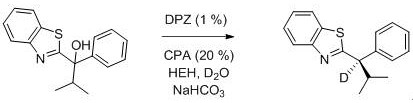
(R) The specific preparation steps of the (E) -2- (2-methyl-1-phenylpropyl-1-d) benzothiazole are as follows:
in this example, 2- (1-chloro-2-methyl-1-phenylpropyl) quinoline in example 1 was replaced with 1- (2-benzothiazolyl) -2-methyl-1-phenylpropanol to give 19.0 mg of a white solid (R) -2- (2-methyl-1-phenylpropyl-1-d) benzothiazole in 71% yield, 80% enantiomeric excess and 93% deuteration rate. The nuclear magnetism and mass spectrum data are as follows:1H NMR (300 MHz, CDCl3) δ 7.93 (d, J = 8.1 Hz, 1H), 7.72 (d, J = 7.8 Hz, 1H), 7.41 – 7.31 (m, 3H), 7.28 – 7.07 (m, 4H), 3.92 (d, J = 10.5 Hz, 0.07H), 2.68 – 2.54 (m, 1H), 0.97 (d, J= 6.5 Hz, 3H), 0.82 (d, J = 6.6 Hz, 3H); 13C NMR (75 MHz, CDCl3) δ 174.5, 153.0, 141.0, 135.0, 128.6, 128.5, 127.1, 125.8, 124.6, 122.8, 121.4, 33.6, 21.6, 21.2; HRMS (ESI) m/z 269.1211 (M+H+), calc. for C17H17DNS 269.1217.
evaluation of biological Activity
1. Cellular level
Four cell lines of breast cancer MCF-7, liver cancer H beta G2, cervical cancer Hela and colon cancer HCT-116 are taken, and cells in logarithmic phase are inoculated on a 96-well cell culture plate by 6000-8000 cells per well. ZZX (target products prepared in examples 1 to 7) with corresponding concentration is respectively added 24 h after cell spotting, supernatant is discarded after 48 h of action, 50 mu L of 1 mg/mL MTT solution is added into each hole, 100 mu L of dimethyl sulfoxide is added into each hole after continuous culture for 4 h, and the OD value is measured at 490 nm wavelength by using a full-wavelength microplate reader after 30 min of oscillation by using a formula: the cell inhibition rate = (1-absorbance value of experimental group/absorbance value of control group) × 100% (the invention sets up control group at the same time, the control group is not added with any corresponding compound group, the experimental group is added with corresponding compound group), the cell inhibition rate is calculated, the statistics are as following table 1:
as can be seen from table 1, the chiral 2- (α -deuterium- α -alkyl- α -aryl) azaaryl compounds prepared in embodiments 1 to 7 of the present invention exhibit certain activities on four types of cancer cells, i.e., breast cancer MCF-7, liver cancer H β G2, cervical cancer Hela, and colon cancer HCT-116, and are expected to be applied to the preparation of anticancer drugs.
Finally, it should be noted that: the above embodiments are merely illustrative and not restrictive of the technical solutions of the present invention, and any equivalent substitutions and modifications or partial substitutions made without departing from the spirit and scope of the present invention should be included in the scope of the claims of the present invention.