CN109971860B - Tumor marker STAMP-EP8 based on methylation modification and application thereof - Google Patents
Tumor marker STAMP-EP8 based on methylation modification and application thereof Download PDFInfo
- Publication number
- CN109971860B CN109971860B CN201910363470.7A CN201910363470A CN109971860B CN 109971860 B CN109971860 B CN 109971860B CN 201910363470 A CN201910363470 A CN 201910363470A CN 109971860 B CN109971860 B CN 109971860B
- Authority
- CN
- China
- Prior art keywords
- seq
- polynucleotide
- methylation
- samples
- primers
- Prior art date
- Legal status (The legal status is an assumption and is not a legal conclusion. Google has not performed a legal analysis and makes no representation as to the accuracy of the status listed.)
- Active
Links
- 238000007069 methylation reaction Methods 0.000 title claims description 113
- 230000011987 methylation Effects 0.000 title claims description 111
- 230000004048 modification Effects 0.000 title claims description 26
- 238000012986 modification Methods 0.000 title claims description 26
- 239000000439 tumor marker Substances 0.000 title abstract description 12
- 206010028980 Neoplasm Diseases 0.000 claims abstract description 72
- 239000003153 chemical reaction reagent Substances 0.000 claims abstract description 31
- 108091033319 polynucleotide Proteins 0.000 claims description 73
- 102000040430 polynucleotide Human genes 0.000 claims description 73
- 239000002157 polynucleotide Substances 0.000 claims description 73
- 238000000034 method Methods 0.000 claims description 64
- 238000001514 detection method Methods 0.000 claims description 46
- 108020004414 DNA Proteins 0.000 claims description 41
- 108091029430 CpG site Proteins 0.000 claims description 31
- 210000001519 tissue Anatomy 0.000 claims description 31
- 239000012634 fragment Substances 0.000 claims description 29
- 210000004027 cell Anatomy 0.000 claims description 28
- 239000000523 sample Substances 0.000 claims description 28
- LSNNMFCWUKXFEE-UHFFFAOYSA-M Bisulfite Chemical compound OS([O-])=O LSNNMFCWUKXFEE-UHFFFAOYSA-M 0.000 claims description 27
- 206010058467 Lung neoplasm malignant Diseases 0.000 claims description 27
- 201000005202 lung cancer Diseases 0.000 claims description 27
- 208000020816 lung neoplasm Diseases 0.000 claims description 27
- 238000012175 pyrosequencing Methods 0.000 claims description 18
- 239000002773 nucleotide Substances 0.000 claims description 14
- 125000003729 nucleotide group Chemical group 0.000 claims description 14
- 108091028043 Nucleic acid sequence Proteins 0.000 claims description 13
- OPTASPLRGRRNAP-UHFFFAOYSA-N cytosine Chemical compound NC=1C=CNC(=O)N=1 OPTASPLRGRRNAP-UHFFFAOYSA-N 0.000 claims description 13
- ISAKRJDGNUQOIC-UHFFFAOYSA-N Uracil Chemical compound O=C1C=CNC(=O)N1 ISAKRJDGNUQOIC-UHFFFAOYSA-N 0.000 claims description 12
- 230000000295 complement effect Effects 0.000 claims description 12
- 238000007855 methylation-specific PCR Methods 0.000 claims description 11
- 208000000461 Esophageal Neoplasms Diseases 0.000 claims description 10
- 206010030155 Oesophageal carcinoma Diseases 0.000 claims description 10
- 201000004101 esophageal cancer Diseases 0.000 claims description 10
- 201000007270 liver cancer Diseases 0.000 claims description 10
- 208000014018 liver neoplasm Diseases 0.000 claims description 10
- 150000007523 nucleic acids Chemical class 0.000 claims description 10
- 206010006187 Breast cancer Diseases 0.000 claims description 9
- 208000026310 Breast neoplasm Diseases 0.000 claims description 9
- 206010009944 Colon cancer Diseases 0.000 claims description 9
- 208000001333 Colorectal Neoplasms Diseases 0.000 claims description 9
- 102000039446 nucleic acids Human genes 0.000 claims description 9
- 108020004707 nucleic acids Proteins 0.000 claims description 9
- 238000012163 sequencing technique Methods 0.000 claims description 9
- 206010061902 Pancreatic neoplasm Diseases 0.000 claims description 8
- 239000003795 chemical substances by application Substances 0.000 claims description 8
- 208000015486 malignant pancreatic neoplasm Diseases 0.000 claims description 8
- 201000002528 pancreatic cancer Diseases 0.000 claims description 8
- 208000008443 pancreatic carcinoma Diseases 0.000 claims description 8
- 208000032839 leukemia Diseases 0.000 claims description 7
- 239000008280 blood Substances 0.000 claims description 6
- 210000004369 blood Anatomy 0.000 claims description 6
- 238000000338 in vitro Methods 0.000 claims description 6
- 229940035893 uracil Drugs 0.000 claims description 6
- 238000006243 chemical reaction Methods 0.000 claims description 5
- 206010003445 Ascites Diseases 0.000 claims description 3
- 208000002151 Pleural effusion Diseases 0.000 claims description 3
- 238000011529 RT qPCR Methods 0.000 claims description 3
- 238000004458 analytical method Methods 0.000 claims description 3
- 210000000941 bile Anatomy 0.000 claims description 3
- 238000001574 biopsy Methods 0.000 claims description 3
- 238000001369 bisulfite sequencing Methods 0.000 claims description 3
- 210000001175 cerebrospinal fluid Anatomy 0.000 claims description 3
- 238000004128 high performance liquid chromatography Methods 0.000 claims description 3
- 238000012164 methylation sequencing Methods 0.000 claims description 3
- 210000003296 saliva Anatomy 0.000 claims description 3
- 210000002700 urine Anatomy 0.000 claims description 3
- 206010036790 Productive cough Diseases 0.000 claims description 2
- 229940104302 cytosine Drugs 0.000 claims description 2
- 238000007847 digital PCR Methods 0.000 claims description 2
- 239000012188 paraffin wax Substances 0.000 claims description 2
- 210000003802 sputum Anatomy 0.000 claims description 2
- 208000024794 sputum Diseases 0.000 claims description 2
- 238000007671 third-generation sequencing Methods 0.000 claims description 2
- 238000004519 manufacturing process Methods 0.000 claims 1
- 238000003745 diagnosis Methods 0.000 abstract description 9
- 230000035945 sensitivity Effects 0.000 abstract description 5
- 201000010099 disease Diseases 0.000 abstract description 4
- 208000037265 diseases, disorders, signs and symptoms Diseases 0.000 abstract description 4
- 238000002360 preparation method Methods 0.000 abstract description 2
- 108090000623 proteins and genes Proteins 0.000 description 23
- 210000005265 lung cell Anatomy 0.000 description 17
- 108091032973 (ribonucleotides)n+m Proteins 0.000 description 16
- 238000012408 PCR amplification Methods 0.000 description 13
- 230000003321 amplification Effects 0.000 description 12
- 238000003199 nucleic acid amplification method Methods 0.000 description 12
- 201000011510 cancer Diseases 0.000 description 11
- 230000007067 DNA methylation Effects 0.000 description 10
- 238000012795 verification Methods 0.000 description 10
- 238000003556 assay Methods 0.000 description 8
- 238000010200 validation analysis Methods 0.000 description 8
- XPPKVPWEQAFLFU-UHFFFAOYSA-J diphosphate(4-) Chemical compound [O-]P([O-])(=O)OP([O-])([O-])=O XPPKVPWEQAFLFU-UHFFFAOYSA-J 0.000 description 7
- 235000011180 diphosphates Nutrition 0.000 description 7
- 238000011160 research Methods 0.000 description 6
- 238000005516 engineering process Methods 0.000 description 5
- 210000004881 tumor cell Anatomy 0.000 description 5
- 230000000692 anti-sense effect Effects 0.000 description 4
- 230000006607 hypermethylation Effects 0.000 description 4
- 239000003550 marker Substances 0.000 description 4
- RWQNBRDOKXIBIV-UHFFFAOYSA-N thymine Chemical compound CC1=CNC(=O)NC1=O RWQNBRDOKXIBIV-UHFFFAOYSA-N 0.000 description 4
- 206010008342 Cervix carcinoma Diseases 0.000 description 3
- 238000007400 DNA extraction Methods 0.000 description 3
- 241000282414 Homo sapiens Species 0.000 description 3
- 206010060862 Prostate cancer Diseases 0.000 description 3
- 208000000236 Prostatic Neoplasms Diseases 0.000 description 3
- 208000005718 Stomach Neoplasms Diseases 0.000 description 3
- 208000006105 Uterine Cervical Neoplasms Diseases 0.000 description 3
- 238000000246 agarose gel electrophoresis Methods 0.000 description 3
- 201000010881 cervical cancer Diseases 0.000 description 3
- 238000013461 design Methods 0.000 description 3
- 238000002474 experimental method Methods 0.000 description 3
- 206010017758 gastric cancer Diseases 0.000 description 3
- 201000011549 stomach cancer Diseases 0.000 description 3
- 239000000126 substance Substances 0.000 description 3
- LRSASMSXMSNRBT-UHFFFAOYSA-N 5-methylcytosine Chemical compound CC1=CNC(=O)N=C1N LRSASMSXMSNRBT-UHFFFAOYSA-N 0.000 description 2
- 206010004593 Bile duct cancer Diseases 0.000 description 2
- 206010005003 Bladder cancer Diseases 0.000 description 2
- 102000012406 Carcinoembryonic Antigen Human genes 0.000 description 2
- 108010022366 Carcinoembryonic Antigen Proteins 0.000 description 2
- 208000009849 Female Genital Neoplasms Diseases 0.000 description 2
- 208000022072 Gallbladder Neoplasms Diseases 0.000 description 2
- 206010018338 Glioma Diseases 0.000 description 2
- 108010033040 Histones Proteins 0.000 description 2
- 208000026350 Inborn Genetic disease Diseases 0.000 description 2
- 208000008839 Kidney Neoplasms Diseases 0.000 description 2
- 206010023825 Laryngeal cancer Diseases 0.000 description 2
- 206010025323 Lymphomas Diseases 0.000 description 2
- 208000032271 Malignant tumor of penis Diseases 0.000 description 2
- 208000003445 Mouth Neoplasms Diseases 0.000 description 2
- 208000034578 Multiple myelomas Diseases 0.000 description 2
- 208000001894 Nasopharyngeal Neoplasms Diseases 0.000 description 2
- 206010061306 Nasopharyngeal cancer Diseases 0.000 description 2
- 206010029260 Neuroblastoma Diseases 0.000 description 2
- 206010033128 Ovarian cancer Diseases 0.000 description 2
- 206010061535 Ovarian neoplasm Diseases 0.000 description 2
- 208000002471 Penile Neoplasms Diseases 0.000 description 2
- 206010034299 Penile cancer Diseases 0.000 description 2
- 206010035226 Plasma cell myeloma Diseases 0.000 description 2
- 206010035610 Pleural Neoplasms Diseases 0.000 description 2
- 102000007066 Prostate-Specific Antigen Human genes 0.000 description 2
- 108010072866 Prostate-Specific Antigen Proteins 0.000 description 2
- 206010038389 Renal cancer Diseases 0.000 description 2
- MEFKEPWMEQBLKI-AIRLBKTGSA-N S-adenosyl-L-methioninate Chemical compound O[C@@H]1[C@H](O)[C@@H](C[S+](CC[C@H](N)C([O-])=O)C)O[C@H]1N1C2=NC=NC(N)=C2N=C1 MEFKEPWMEQBLKI-AIRLBKTGSA-N 0.000 description 2
- 208000000453 Skin Neoplasms Diseases 0.000 description 2
- 208000024313 Testicular Neoplasms Diseases 0.000 description 2
- 206010057644 Testis cancer Diseases 0.000 description 2
- 208000024770 Thyroid neoplasm Diseases 0.000 description 2
- 206010062129 Tongue neoplasm Diseases 0.000 description 2
- 208000007097 Urinary Bladder Neoplasms Diseases 0.000 description 2
- 206010047741 Vulval cancer Diseases 0.000 description 2
- 208000004354 Vulvar Neoplasms Diseases 0.000 description 2
- 230000002159 abnormal effect Effects 0.000 description 2
- 230000005856 abnormality Effects 0.000 description 2
- 229960001570 ademetionine Drugs 0.000 description 2
- 239000000427 antigen Substances 0.000 description 2
- 102000036639 antigens Human genes 0.000 description 2
- 108091007433 antigens Proteins 0.000 description 2
- 208000026900 bile duct neoplasm Diseases 0.000 description 2
- 210000001185 bone marrow Anatomy 0.000 description 2
- 208000006990 cholangiocarcinoma Diseases 0.000 description 2
- VUIKXKJIWVOSMF-GHTOIXBYSA-N d(CG)12 Chemical compound O=C1N=C(N)C=CN1[C@@H]1O[C@H](CO)[C@@H](OP(O)(=O)OC[C@@H]2[C@H](C[C@@H](O2)N2C3=C(C(NC(N)=N3)=O)N=C2)OP(O)(=O)OC[C@@H]2[C@H](C[C@@H](O2)N2C(N=C(N)C=C2)=O)OP(O)(=O)OC[C@@H]2[C@H](C[C@@H](O2)N2C3=C(C(NC(N)=N3)=O)N=C2)OP(O)(=O)OC[C@@H]2[C@H](C[C@@H](O2)N2C(N=C(N)C=C2)=O)OP(O)(=O)OC[C@@H]2[C@H](C[C@@H](O2)N2C3=C(C(NC(N)=N3)=O)N=C2)OP(O)(=O)OC[C@@H]2[C@H](C[C@@H](O2)N2C(N=C(N)C=C2)=O)OP(O)(=O)OC[C@@H]2[C@H](C[C@@H](O2)N2C3=C(C(NC(N)=N3)=O)N=C2)OP(O)(=O)OC[C@@H]2[C@H](C[C@@H](O2)N2C(N=C(N)C=C2)=O)OP(O)(=O)OC[C@@H]2[C@H](C[C@@H](O2)N2C3=C(C(NC(N)=N3)=O)N=C2)OP(O)(=O)OC[C@@H]2[C@H](C[C@@H](O2)N2C(N=C(N)C=C2)=O)OP(O)(=O)OC[C@@H]2[C@H](C[C@@H](O2)N2C3=C(C(NC(N)=N3)=O)N=C2)OP(O)(=O)OC[C@@H]2[C@H](C[C@@H](O2)N2C(N=C(N)C=C2)=O)OP(O)(=O)OC[C@@H]2[C@H](C[C@@H](O2)N2C3=C(C(NC(N)=N3)=O)N=C2)OP(O)(=O)OC[C@@H]2[C@H](C[C@@H](O2)N2C(N=C(N)C=C2)=O)OP(O)(=O)OC[C@@H]2[C@H](C[C@@H](O2)N2C3=C(C(NC(N)=N3)=O)N=C2)OP(O)(=O)OC[C@@H]2[C@H](C[C@@H](O2)N2C(N=C(N)C=C2)=O)OP(O)(=O)OC[C@@H]2[C@H](C[C@@H](O2)N2C3=C(C(NC(N)=N3)=O)N=C2)OP(O)(=O)OC[C@@H]2[C@H](C[C@@H](O2)N2C(N=C(N)C=C2)=O)OP(O)(=O)OC[C@@H]2[C@H](C[C@@H](O2)N2C3=C(C(NC(N)=N3)=O)N=C2)OP(O)(=O)OC[C@@H]2[C@H](C[C@@H](O2)N2C(N=C(N)C=C2)=O)OP(O)(=O)OC[C@@H]2[C@H](C[C@@H](O2)N2C3=C(C(NC(N)=N3)=O)N=C2)OP(O)(=O)OC[C@@H]2[C@H](C[C@@H](O2)N2C(N=C(N)C=C2)=O)OP(O)(=O)OC[C@@H]2[C@H](C[C@@H](O2)N2C3=C(C(NC(N)=N3)=O)N=C2)O)C1 VUIKXKJIWVOSMF-GHTOIXBYSA-N 0.000 description 2
- 230000004069 differentiation Effects 0.000 description 2
- 210000002249 digestive system Anatomy 0.000 description 2
- 230000000694 effects Effects 0.000 description 2
- 239000012530 fluid Substances 0.000 description 2
- 201000010175 gallbladder cancer Diseases 0.000 description 2
- 208000016361 genetic disease Diseases 0.000 description 2
- 208000014829 head and neck neoplasm Diseases 0.000 description 2
- 201000005787 hematologic cancer Diseases 0.000 description 2
- 208000024200 hematopoietic and lymphoid system neoplasm Diseases 0.000 description 2
- 238000007031 hydroxymethylation reaction Methods 0.000 description 2
- 201000010982 kidney cancer Diseases 0.000 description 2
- 206010023841 laryngeal neoplasm Diseases 0.000 description 2
- 208000012987 lip and oral cavity carcinoma Diseases 0.000 description 2
- 206010024627 liposarcoma Diseases 0.000 description 2
- 201000001441 melanoma Diseases 0.000 description 2
- 206010027191 meningioma Diseases 0.000 description 2
- 125000002496 methyl group Chemical group [H]C([H])([H])* 0.000 description 2
- 238000012544 monitoring process Methods 0.000 description 2
- 206010061311 nervous system neoplasm Diseases 0.000 description 2
- 201000008968 osteosarcoma Diseases 0.000 description 2
- 201000003437 pleural cancer Diseases 0.000 description 2
- 229920001184 polypeptide Polymers 0.000 description 2
- 230000008569 process Effects 0.000 description 2
- 108090000765 processed proteins & peptides Proteins 0.000 description 2
- 102000004196 processed proteins & peptides Human genes 0.000 description 2
- 238000000746 purification Methods 0.000 description 2
- 208000028466 reproductive system neoplasm Diseases 0.000 description 2
- 210000002345 respiratory system Anatomy 0.000 description 2
- 238000012216 screening Methods 0.000 description 2
- 201000000849 skin cancer Diseases 0.000 description 2
- 201000003120 testicular cancer Diseases 0.000 description 2
- 229940113082 thymine Drugs 0.000 description 2
- 201000002510 thyroid cancer Diseases 0.000 description 2
- 201000006134 tongue cancer Diseases 0.000 description 2
- 201000005112 urinary bladder cancer Diseases 0.000 description 2
- 208000029584 urinary system neoplasm Diseases 0.000 description 2
- 201000005102 vulva cancer Diseases 0.000 description 2
- 206010069754 Acquired gene mutation Diseases 0.000 description 1
- 208000005443 Circulating Neoplastic Cells Diseases 0.000 description 1
- 108090000790 Enzymes Proteins 0.000 description 1
- 102000004190 Enzymes Human genes 0.000 description 1
- 241000588724 Escherichia coli Species 0.000 description 1
- 241000282412 Homo Species 0.000 description 1
- 241000124008 Mammalia Species 0.000 description 1
- 206010027476 Metastases Diseases 0.000 description 1
- 102000016397 Methyltransferase Human genes 0.000 description 1
- 108060004795 Methyltransferase Proteins 0.000 description 1
- 108700011259 MicroRNAs Proteins 0.000 description 1
- 108091081021 Sense strand Proteins 0.000 description 1
- 238000013459 approach Methods 0.000 description 1
- 230000001580 bacterial effect Effects 0.000 description 1
- 230000003851 biochemical process Effects 0.000 description 1
- 210000001124 body fluid Anatomy 0.000 description 1
- 239000010839 body fluid Substances 0.000 description 1
- 238000004364 calculation method Methods 0.000 description 1
- 150000001720 carbohydrates Chemical class 0.000 description 1
- 238000006555 catalytic reaction Methods 0.000 description 1
- 230000008859 change Effects 0.000 description 1
- 238000003759 clinical diagnosis Methods 0.000 description 1
- 239000011248 coating agent Substances 0.000 description 1
- 238000000576 coating method Methods 0.000 description 1
- 230000007547 defect Effects 0.000 description 1
- 230000017858 demethylation Effects 0.000 description 1
- 238000010520 demethylation reaction Methods 0.000 description 1
- 238000011161 development Methods 0.000 description 1
- 238000002405 diagnostic procedure Methods 0.000 description 1
- 238000001962 electrophoresis Methods 0.000 description 1
- 230000007608 epigenetic mechanism Effects 0.000 description 1
- 230000006718 epigenetic regulation Effects 0.000 description 1
- 230000001605 fetal effect Effects 0.000 description 1
- 230000004907 flux Effects 0.000 description 1
- 125000002485 formyl group Chemical class [H]C(*)=O 0.000 description 1
- 239000000499 gel Substances 0.000 description 1
- 239000010931 gold Substances 0.000 description 1
- 229910052737 gold Inorganic materials 0.000 description 1
- 239000005556 hormone Substances 0.000 description 1
- 229940088597 hormone Drugs 0.000 description 1
- 238000001727 in vivo Methods 0.000 description 1
- 238000012177 large-scale sequencing Methods 0.000 description 1
- 238000011528 liquid biopsy Methods 0.000 description 1
- 230000009401 metastasis Effects 0.000 description 1
- 239000002679 microRNA Substances 0.000 description 1
- 238000010369 molecular cloning Methods 0.000 description 1
- 239000005445 natural material Substances 0.000 description 1
- 238000007857 nested PCR Methods 0.000 description 1
- 238000007481 next generation sequencing Methods 0.000 description 1
- 230000003287 optical effect Effects 0.000 description 1
- 238000002205 phenol-chloroform extraction Methods 0.000 description 1
- 238000004393 prognosis Methods 0.000 description 1
- 102000004169 proteins and genes Human genes 0.000 description 1
- WQGWDDDVZFFDIG-UHFFFAOYSA-N pyrogallol Chemical compound OC1=CC=CC(O)=C1O WQGWDDDVZFFDIG-UHFFFAOYSA-N 0.000 description 1
- 238000007480 sanger sequencing Methods 0.000 description 1
- 238000007790 scraping Methods 0.000 description 1
- 230000028327 secretion Effects 0.000 description 1
- 230000037439 somatic mutation Effects 0.000 description 1
- 238000001228 spectrum Methods 0.000 description 1
- 230000009897 systematic effect Effects 0.000 description 1
- 238000012360 testing method Methods 0.000 description 1
- 238000012956 testing procedure Methods 0.000 description 1
Images


Classifications
-
- C—CHEMISTRY; METALLURGY
- C12—BIOCHEMISTRY; BEER; SPIRITS; WINE; VINEGAR; MICROBIOLOGY; ENZYMOLOGY; MUTATION OR GENETIC ENGINEERING
- C12Q—MEASURING OR TESTING PROCESSES INVOLVING ENZYMES, NUCLEIC ACIDS OR MICROORGANISMS; COMPOSITIONS OR TEST PAPERS THEREFOR; PROCESSES OF PREPARING SUCH COMPOSITIONS; CONDITION-RESPONSIVE CONTROL IN MICROBIOLOGICAL OR ENZYMOLOGICAL PROCESSES
- C12Q1/00—Measuring or testing processes involving enzymes, nucleic acids or microorganisms; Compositions therefor; Processes of preparing such compositions
- C12Q1/68—Measuring or testing processes involving enzymes, nucleic acids or microorganisms; Compositions therefor; Processes of preparing such compositions involving nucleic acids
- C12Q1/6876—Nucleic acid products used in the analysis of nucleic acids, e.g. primers or probes
- C12Q1/6883—Nucleic acid products used in the analysis of nucleic acids, e.g. primers or probes for diseases caused by alterations of genetic material
- C12Q1/6886—Nucleic acid products used in the analysis of nucleic acids, e.g. primers or probes for diseases caused by alterations of genetic material for cancer
-
- C—CHEMISTRY; METALLURGY
- C12—BIOCHEMISTRY; BEER; SPIRITS; WINE; VINEGAR; MICROBIOLOGY; ENZYMOLOGY; MUTATION OR GENETIC ENGINEERING
- C12Q—MEASURING OR TESTING PROCESSES INVOLVING ENZYMES, NUCLEIC ACIDS OR MICROORGANISMS; COMPOSITIONS OR TEST PAPERS THEREFOR; PROCESSES OF PREPARING SUCH COMPOSITIONS; CONDITION-RESPONSIVE CONTROL IN MICROBIOLOGICAL OR ENZYMOLOGICAL PROCESSES
- C12Q2600/00—Oligonucleotides characterized by their use
- C12Q2600/154—Methylation markers
Landscapes
- Chemical & Material Sciences (AREA)
- Life Sciences & Earth Sciences (AREA)
- Health & Medical Sciences (AREA)
- Organic Chemistry (AREA)
- Proteomics, Peptides & Aminoacids (AREA)
- Engineering & Computer Science (AREA)
- Immunology (AREA)
- Pathology (AREA)
- Analytical Chemistry (AREA)
- Zoology (AREA)
- Genetics & Genomics (AREA)
- Wood Science & Technology (AREA)
- Physics & Mathematics (AREA)
- Biotechnology (AREA)
- Microbiology (AREA)
- Molecular Biology (AREA)
- Hospice & Palliative Care (AREA)
- Biophysics (AREA)
- Oncology (AREA)
- Biochemistry (AREA)
- Bioinformatics & Cheminformatics (AREA)
- General Engineering & Computer Science (AREA)
- General Health & Medical Sciences (AREA)
- Measuring Or Testing Involving Enzymes Or Micro-Organisms (AREA)
Abstract
The invention provides a methylated tumor marker STAMP-EP8 and application thereof, belonging to the field of disease diagnosis markers. The invention provides an application of a methylated tumor marker STAMP-EP8 in preparation of a tumor diagnostic reagent. The tumor marker STAMP-EP8 disclosed by the invention is hypermethylated in all tumor types, hypomethylated in corresponding normal tissues and very high in sensitivity and specificity, and primers for detecting the STAMP-EP8 can be used for preparing a tumor diagnosis kit.
Description
Technical Field
The invention belongs to the field of disease diagnosis markers, and particularly relates to a Methylation-modified Tumor marker STAMP (Specific Tumor Aligned Methylation of Pan-cancer) and application thereof.
Background
The concept that tumors are considered to be a genetic disease has been in the field for decades. Several systematic large-scale sequencing in humans demonstrated a significantly lower number of somatic mutations in cancer tissues than expected, suggesting that cancer is not a simple genetic disease.
In order to achieve diagnosis of tumors, many novel tumor markers have been discovered in recent years and used for clinical diagnosis. Before 1980, tumor markers are mainly cell secretions of some hormones, enzymes, proteins and the like, for example, carcinoembryonic antigen (CEA), alpha fetal Antigen (AFP) and the like can be used as markers of various tumors such as gastric cancer, liver cancer and the like, carbohydrate antigen 125 (CA 125) can be used as a marker of cervical cancer, prostate Specific Antigen (PSA) can be used as a marker of prostate cancer, and the tumor markers are still used clinically at present, but the sensitivity and the accuracy of the tumor markers cannot meet clinical requirements easily.
There is increasing evidence for a significant role of small changes in epigenetic regulation in tumors. Epigenetics is a discipline that studies heritable changes in gene function without changes in DNA sequence, and ultimately results in changes in phenotype. Epigenetics mainly includes biochemical processes such as DNA methylation (DNA methylation), histone modification (histone modification), and microRNA level change. DNA methylation is one of epigenetic mechanisms, and refers to the process of transferring a methyl group to a specific base by using S-adenosylmethionine (SAM) as a methyl donor under the catalysis of DNA Methyltransferase (DMT) in an organism. In mammals DNA methylation occurs predominantly at the C of 5'-CpG-3' to produce 5-methylcytosine (5 mC).
The liquid biopsy technology is a technology for diagnosing and predicting tumors by taking circulating tumor cells or circulating tumor DNA in blood as a detection target. The technology has a plurality of defects: firstly, the sensitivity and the specificity are not high enough, the tumor has great heterogeneity and contains cell populations of various subtypes, the clinical sample, particularly a blood sample, has very small proportion of tumor DNA, the existing tumor marker is difficult to meet the sensitivity of clinical requirements, and misdiagnosis is easily caused in clinic; secondly, one marker only has good effect on one or a few tumors, and the DNA source in blood is very complex, so the existing tumor marker cannot deal with the problems of complex tumor source, metastasis and the like. Due to the existence of these complex conditions, many DNA methylation tumor markers have difficulty in having uniform use standards when applied to clinics, and the sensitivity and accuracy of the markers are seriously influenced.
In the previous research of the present inventors, some tumor markers based on methylation modification were found, but there is still a need to find more novel tumor markers, thereby providing more approaches for tumor diagnosis.
Disclosure of Invention
The invention aims to provide a method for detecting tumors by using DNA methylation modification as a tumor marker and utilizing abnormal hypermethylation phenomenon of specific sites in the tumors.
In a first aspect of the invention, there is provided an isolated polynucleotide comprising: (a) a polynucleotide having the nucleotide sequence shown in SEQ ID NO. 1; (b) A fragment of the polynucleotide of (a) and wherein at least 1 modified CpG site is present (e.g., 2 to 191, more specifically 3,5, 10, 15, 20, 25, 30, 40, 50, 60, 70, 90, 110, 130, 150, 170, 180, 190); and/or (c) a nucleic acid (polynucleotide having a nucleotide sequence shown in SEQ ID NO: 3) complementary to the polynucleotide or fragment of (a) or (b) above.
In a preferred embodiment, the modification comprises a 5-methylation modification, a 5-hydroxymethylation modification, a 5-aldehydic methylation modification or a 5-carboxymethylation modification.
In another preferred embodiment, (b) the polynucleotide fragment comprises: bases at positions 204 to 223 (containing methylation sites of 021 to 024); 1 to 478 th bases (containing a methylation site of 001 to 040 #) in SEQ ID NO. 1 or 2; bases 513 to 1040 (containing No. 041 to 077 methylation sites) in SEQ ID NO 1 or 2; bases 1082-1602 of SEQ ID NO. 1 or 2 (including methylation sites 078-114); bases 1621-2117 (including 115-153 methylation site) in SEQ ID NO 1 or 2; or 2160 th to 2700 th bases (including methylation sites No. 154 to No. 191) in SEQ ID NO 1 or 2.
In a second aspect of the invention, there is provided an isolated polynucleotide transformed from said polynucleotide, which corresponds to the sequence of the first aspect, wherein the cytosine C of the modified CpG site is unchanged and the unmodified cytosine is converted to T or U.
In a preferred embodiment, it is converted from a polynucleotide corresponding to the first aspect described above by bisulfite or bisbisulfite treatment. In another preferred embodiment, the polynucleotide comprises: (d) 2 or 4; (e) A fragment of the polynucleotide of (d) above, and wherein at least 1 modified CpG site is present (e.g., 2 to 191, more specifically 3,5, 10, 15, 20, 25, 30, 40, 50, 60, 70, 90, 110, 130, 150, 170, 180, 190).
In another preferred embodiment, (e) the polynucleotide fragment comprises: a base at positions 204 to 223 (including methylated sites No. 021 to 024); 1 to 478 st bases (including 001 to 040 th methylation sites) in SEQ ID NO 1 or 2; bases 513 to 1040 (containing No. 041 to 077 methylation sites) in SEQ ID NO 1 or 2; bases 1082-1602 of SEQ ID NO. 1 or 2 (including methylation sites 078-114); bases 1621-2117 (containing 115-153 methylation sites) in SEQ ID NO. 1 or 2; bases 2160 to 2700 (including methylation sites 154 to 191) in SEQ ID NO 1 or 2; 2478-2497 (corresponding to methylation sites 021-024); bases 2223-2700 th in SEQ ID NO 4 or 3 (corresponding to methylation sites 001-040); bases 1661 to 2188 in SEQ ID NO. 4 or 3 (corresponding to methylation sites No. 041 to 077); bases 1099 to 1619 in SEQ ID NO. 4 or 3 (corresponding to methylation sites 078 to 114); bases 584 to 1080 in SEQ ID NO. 4 or 3 (corresponding to methylation sites 115 to 153); or bases 1 to 541 (corresponding to methylation sites 154 to 191) in SEQ ID NO 4 or 3.
In a third aspect of the invention, there is provided a use of the polynucleotide of the first or second aspect for preparing a detection reagent or kit for tumor.
In a preferred embodiment, the tumor includes (but is not limited to): hematological tumors such as leukemia, lymphoma, multiple myeloma; gynecological and reproductive system tumors such as breast cancer, ovarian cancer, cervical cancer, vulvar cancer, testicular cancer, prostate cancer, penile cancer; tumors of the digestive system such as esophageal cancer (esophageal cancer), gastric cancer, colorectal cancer, liver cancer, pancreatic cancer, bile duct cancer and gallbladder cancer; tumors of the respiratory system such as lung cancer, pleural tumors; tumors of the nervous system such as gliomas, neuroblastoma, meningiomas; head and neck tumors such as oral cancer, tongue cancer, laryngeal cancer, nasopharyngeal cancer; urinary system tumors such as renal cancer, bladder cancer, skin and other systems such as skin cancer, melanoma, osteosarcoma, liposarcoma, thyroid cancer.
In another preferred example, the samples of the tumor include, but are not limited to: tissue samples, paraffin-embedded samples, blood samples, pleural effusion samples, and alveolar lavage fluid samples, ascites and lavage fluid samples, bile samples, stool samples, urine samples, saliva samples, sputum samples, cerebrospinal fluid samples, cytology smear samples, cervical scraping or swabbing samples, tissue and cell biopsy samples.
In a fourth aspect of the present invention, there is provided a method for preparing a tumor detection reagent, the method comprising: providing the polynucleotide of the first or second aspect, using the full length or fragment of the polynucleotide as a target sequence, and designing a detection reagent for specifically detecting the CpG site modification of the target sequence; wherein, at least 1 (such as 2-191, more specifically 3,5, 10, 15, 20, 25, 30, 40, 50, 60, 70, 90, 110, 130, 150, 170, 180, 190) modified CpG sites are present in the target sequence; preferably, the detection reagent includes (but is not limited to): a primer and a probe.
In a fifth aspect of the invention there is provided an agent or a combined agent which specifically detects CpG site modifications in a target sequence which is a full length or fragment of a polynucleotide according to any one of the first or second aspects, wherein there are at least 1 (e.g. 2 to 191, more particularly 3,5, 10, 15, 20, 25, 30, 40, 50, 60, 70, 90, 110, 130, 150, 170, 180, 190) modified CpG sites.
In a preferred embodiment, the agent or agents of the combination are directed against a gene sequence (designed based on the gene sequence) comprising the target sequence, the gene sequence comprising a gene Panel or gene group.
In another preferred embodiment, the detection reagent comprises: a primer and a probe.
In another preferred embodiment, the primers are: primers shown in SEQ ID NO. 3 and 4; primers shown in SEQ ID NO 7 and 8; primers shown in SEQ ID NOS 9 and 10; primers shown in SEQ ID NOS 11 and 12; primers shown as SEQ ID NOS 13 and 14; or the primers shown in SEQ ID NO 15 and 16.
In a sixth aspect of the invention there is provided the use of an agent or a combined agent of the fifth aspect of the invention for the preparation of a kit for the detection of a tumour; preferably, the tumor includes (but is not limited to): hematological tumors such as leukemia, lymphoma, multiple myeloma; gynecological and reproductive system tumors such as breast cancer, ovarian cancer, cervical cancer, vulvar cancer, testicular cancer, prostate cancer, penile cancer; tumors of the digestive system such as esophageal cancer (esophageal cancer), gastric cancer, colorectal cancer, liver cancer, pancreatic cancer, bile duct cancer and gallbladder cancer; tumors of the respiratory system such as lung cancer, pleural tumors; tumors of the nervous system such as gliomas, neuroblastoma, meningiomas; head and neck tumors such as oral cancer, tongue cancer, laryngeal cancer, nasopharyngeal cancer; urinary system tumors such as renal cancer, bladder cancer, skin and other systems such as skin cancer, melanoma, osteosarcoma, liposarcoma, thyroid cancer.
In a seventh aspect of the present invention, there is provided a detection kit comprising: a container, and a reagent or combination of reagents as described previously located in the container; preferably, each reagent is located in a separate container.
In a preferred embodiment, the kit further comprises: bisulfite or bisulfite, DNA purification reagents, DNA extraction reagents, PCR amplification reagents, and/or instructions for use (indicating detection procedures and criteria for determining results).
In an eighth aspect of the present invention, there is provided a method for in vitro detecting a methylation pattern of a sample, comprising: (i) providing a sample, extracting nucleic acids; (ii) (ii) detecting CpG site modification of a target sequence in the nucleic acid of (i), said target sequence being a polynucleotide of the first aspect as hereinbefore described or a polynucleotide of the second aspect as hereinbefore described converted therefrom.
In a preferred embodiment, in step (3), the analyzing method comprises: pyrosequencing method, bisulfite conversion sequencing method, methylation chip method, qPCR method, digital PCR method, second-generation sequencing method, third-generation sequencing method, whole genome methylation sequencing method, DNA enrichment detection method, simplified bisulfite sequencing technology, HPLC method, massArray, methylation Specific PCR (MSP), or their combination, and combined gene group in vitro detection method and in vivo tracing detection method of partial or all methylation sites in the sequence shown in SEQ ID NO. 1. Also, other methylation detection methods and methylation detection methods newly developed in the future can be applied to the present invention.
In another preferred example, step (ii) includes: (1) (ii) treating the product of (i) to convert unmodified cytosine therein to uracil; preferably, the modification comprises a 5-methylation modification, a 5-hydroxymethylation modification, a 5-aldehyde methylation modification or a 5-carboxymethylation modification; preferably, the nucleic acid of step (i) is treated with bisulfite or bisbisulfite; (2) Analyzing the modification of the target sequence in the nucleic acid treated in (1).
In another preferred embodiment, the methylation pattern abnormality refers to the occurrence of hypermethylation of C in CpG of the polynucleotide.
In another preferred embodiment, the methylation profile method is not aimed at obtaining a diagnosis of the disease directly, or is not a diagnostic method.
In the ninth aspect of the invention, a tumor diagnosis kit is provided, which comprises a primer pair designed by using the sequence shown in the first aspect or the second aspect of the invention and a gene Panel or a gene group containing the sequence, and the characteristics of normal cells and tumor cells are obtained through DNA methylation state detection.
Other aspects of the invention will be apparent to those skilled in the art in view of the disclosure herein.
Drawings
FIG. 1, BSP verification of methylation level of 001-040 methylation site lung cancer cells and normal lung cells in the region of SEQ ID NO. 1. The dark boxes in the figure indicate the presence of methylation.
FIG. 2, and BSP validation of the methylation level of 041-077 methylation sites in the region of SEQ ID NO. 1 in lung cancer cells and normal lung cells. The dark boxes in the figure indicate the presence of methylation.
FIG. 3, BSP validation of methylation levels of lung cancer cells at 078-114 methylation sites in the region of SEQ ID NO. 1 and normal lung cells. The dark boxes in the figure indicate the presence of methylation.
FIG. 4, BSP validation of methylation levels of 115-153 methylated sites in the region of SEQ ID NO. 1 lung cancer cells versus normal lung cells. The dark boxes in the figure indicate the presence of methylation.
FIG. 5, BSP validation of methylation levels of 154-191 methylated site lung cancer cells and normal lung cells in the region of SEQ ID NO. 1. The dark boxes in the figure indicate the presence of methylation.
FIG. 6, methylation values of STAMP-EP8 in non-cancer tissue samples and cancer tissue samples compared against leukemia clinical samples.
FIG. 7, comparison of methylation values of STAMP-EP8 in paracancerous and cancerous tissue samples for breast cancer clinical samples.
Figure 8, comparison of methylation values of STAMP-EP8 in paracancerous and cancerous tissue samples for colorectal cancer clinical samples.
FIG. 9, comparison of methylation values of STAMP-EP8 in paracancerous and cancerous tissue samples for esophageal cancer clinical samples.
FIG. 10, comparison of methylation values of STAMP-EP8 in paracancer samples and cancer tissue samples for clinical samples of liver cancer.
FIG. 11, comparison of methylation values of STAMP-EP8 in paracancerous and cancerous tissue samples for lung cancer clinical samples.
FIG. 12, comparison of methylation values of STAMP-EP8 in paracancerous and cancerous tissue samples for pancreatic cancer clinical samples.
Detailed Description
The present inventors have focused on the research of Tumor markers, and have conducted extensive research and screening to provide a general-purpose DNA methylated Tumor marker STAMP (Pan-cancer), which is in a hypomethylated state in normal tissues and in a hypermethylated state in Tumor tissues, and which can be used for clinical Tumor detection and as a basis for designing a Tumor diagnostic reagent.
Term(s) for
As used herein, "isolated" refers to a substance that is separated from its original environment (which, if it is a natural substance, is the natural environment). If the polynucleotide or polypeptide in the natural state in the living cell is not isolated or purified, but the same polynucleotide or polypeptide is isolated or purified if it is separated from other substances coexisting in the natural state.
As used herein, a "sample" or "specimen" includes a substance obtained from any individual or isolated tissue, cell, or body fluid (e.g., plasma) suitable for detection of the methylation state of DNA. For example, the samples shown may include, but are not limited to: tissue samples, paraffin embedded samples, blood samples, pleural effusion samples, and alveolar lavage samples, ascites and lavage samples, bile samples, stool samples, urine samples, saliva samples, cerebrospinal fluid samples, cytology smear samples, cervical scrape or brush specimens, tissue and cell biopsy samples.
As used herein, "highly methylated" refers to the presence of highly methylated, hydroxymethylated, aldehyde methylated or carboxymethylated modifications of CpG in a gene sequence. For example, in the case of methylation-specific PCR (MSP) assays, a positive PCR result is obtained in a PCR reaction using methylation-specific primers, and the DNA (gene) region under test is considered to be hypermethylated. For example, in the case of real-time quantitative methylation-specific PCR, the determination of hypermethylation status can be based on the relative values of methylation status of control samples thereof to analyze statistical differences.
Gene marker
The present inventors have conducted extensive and intensive studies to find a target useful for diagnosing tumors, and have identified STAMP-EP8 as a target. The methylation state of the STAMP-EP8 gene sequence region has obvious difference between tumor tissues and non-tumor tissues, and the examinee can be judged to belong to the tumor high-risk group as long as the abnormal hypermethylation state of the STAMP-EP8 gene sequence region is detected. Moreover, the significant differences exhibited by STAMP-EP8 between tumor and non-tumor tissues are present in a broad spectrum of different types of tumors, including solid tumors as well as non-solid tumors.
Accordingly, the present invention provides an isolated polynucleotide having a nucleotide sequence shown in SEQ ID NO:1 or SEQ ID NO:3 (which is the reverse complement of SEQ ID NO: 1), which produces 5-methylcytosine (5 mC) at a plurality of base C positions of 5'-CpG-3' in the polynucleotide sequence within a tumor cell. The invention also encompasses fragments of the polynucleotide of the nucleotide sequence shown in SEQ ID NO. 1 or SEQ ID NO. 3, and wherein at least 1 (e.g.2 to 191, more particularly 3,5, 10, 15, 20, 25, 30, 40, 50, 60, 70, 90, 110, 130, 150, 170, 180, 190) methylated CpG sites are present. The polynucleotide or fragment can also be used to design a detection reagent or a detection kit.
In some embodiments of the invention, the fragment of the polynucleotide is, for example: a fragment containing bases 281 to 309 in SEQ ID NO. 1 (containing CpG sites 017 to 020). The antisense strand of the above fragment is also useful. These fragments are exemplary of the preferred embodiment of the present invention; other segments may also be selected based on the information provided by the present invention.
Furthermore, a gene Panel or a group of genes comprising the nucleotide sequence shown in SEQ ID NO. 1 or SEQ ID NO. 2 or a sequence fragment thereof is also encompassed by the present invention. The characteristics of normal cells and tumor cells can also be obtained by detecting the DNA methylation state aiming at the gene Panel or the gene group.
The polynucleotides described above can be used as key regions in the genome to analyze methylation status by a variety of techniques known in the art. Any technique that can be used to analyze methylation status can be used in the present invention.
The above polynucleotides are treated with bisulfite or bisbisulfite, wherein unmethylated cytosines are converted to uracil, while methylated cytosines remain unchanged.
Accordingly, the present invention also provides a polynucleotide obtained by subjecting the above-mentioned polynucleotide (including the complementary strand (antisense strand)) to bisulfite treatment or bisulfite treatment, comprising: 2 or 4. These polynucleotides may also be used in the design of detection reagents or detection kits.
The invention also encompasses fragments of the above polynucleotides or polynucleotides obtained by bisulfite or bisulfite treatment of the antisense strand thereof, and wherein at least 1 methylated CpG site is present (e.g., 2 to 191, more specifically 3,5, 10, 15, 20, 25, 30, 40, 50, 60, 70, 90, 110, 130, 150, 170, 180, 190). The numbering of the individual CpG sites in the antisense strand corresponding to the sense strand is readily available in light of the teachings provided herein.
Detection reagent and kit
Based on the new discovery of the invention, the invention also provides a detection reagent designed based on the polynucleotide sequence, which is used for detecting the methylation pattern of the polynucleotide in a sample in vitro. Assays and reagents known in the art for determining genomic sequence, variations thereof, and methylation status can be used in the present invention.
Accordingly, the present invention provides a method for preparing a tumor detection reagent, comprising: providing the polynucleotide, using the full length or the fragment of the polynucleotide as a target sequence, and designing a detection reagent for specifically detecting the target sequence; wherein at least 1 methylated CpG site is present in the target sequence.
The detection reagent of the present invention includes but is not limited to: primers, probes, and the like.
Such reagents are, for example, primer pairs, and after the sequence of the polynucleotide is known, the design of primers is known to those skilled in the art, both primers flanking the specific sequence of the target gene to be amplified (including CpG sequences, the complement of CpG therein being the region of the gene for which methylation was the result of the methylation, and the complement of TpG therein being the region of the gene for which demethylation was the result of the methylation). It is understood that, according to the novel findings of the present invention, a plurality of primers or probes or other types of detection reagents can be designed by those skilled in the art aiming at the CpG sites at different positions on the target sequence or the combination thereof, and these should be included in the technical solution of the present invention. In a preferred embodiment of the present invention, the primers are: primers shown in SEQ ID NO. 5 and 6, which can obtain an amplification product containing CpG sites 001-040 number in SEQ ID NO. 1; primers shown in SEQ ID NO. 7 and 8, which can obtain an amplification product containing CpG sites No. 041-077 in SEQ ID NO. 1; primers shown in SEQ ID NO. 9 and 10, which can obtain an amplification product containing CpG sites No. 078-114 in SEQ ID NO. 1; primers shown in SEQ ID NO. 11 and 12, which can obtain an amplification product containing 115-153 CpG sites in SEQ ID NO. 1; primers shown in SEQ ID NO. 13 and 14, which can obtain an amplification product containing 154-191 CpG sites in SEQ ID NO. 1; or the primers shown in SEQ ID NO. 15 and 16, which can obtain an amplification product containing the CpG sites of 021-024 number in SEQ ID NO. 1.
The reagents may also be a combination of reagents (primer combination) comprising more than one set of primers, such that the plurality of polynucleotides described above can be amplified separately.
The invention also provides a kit for in vitro detection of the methylation pattern of a polynucleotide in a sample, the kit comprising: a container, and the primer pair located in the container.
In addition, the kit can also comprise various reagents required by DNA extraction, DNA purification, PCR amplification and the like.
In addition, the kit may further comprise an instruction manual, wherein detection operation steps and result judgment standards are indicated, so as to be convenient for the application of the kit by a person skilled in the art.
Detection method
Determination of methylation patterns of polynucleotides can be performed by established techniques (e.g., methylation Specific PCR (MSP) or real-time quantitative methylation specific PCR, methylight), or other techniques that are still under development and are yet to be developed.
A quantitative methylation-specific PCR (QMSP) method can also be used to detect methylation levels. This method is based on a continuous optical monitoring of fluorescence PCR, which is more sensitive than MSP method. The flux is high and the analysis of the result by an electrophoresis method is avoided.
Other techniques that may be used are: pyrosequencing method, bisulfite conversion sequencing method, qPCR method, next generation sequencing method, whole genome methylation sequencing method, DNA enrichment detection method, simplified bisulfite sequencing technology or HPLC method, and combined gene group detection method. It is to be understood that such techniques, as are known in the art and those that will be developed, may be utilized in conjunction with the present invention based on the new disclosure herein.
As a preferred mode of the present invention, there is also provided a method for in vitro detection of methylation patterns of polynucleotides in a sample. The method is based on the principle that: bisulfite or bisulfite can convert unmethylated cytosine to uracil, to thymine during subsequent PCR amplification, while methylated cytosine remains unchanged; thus, after bisulfite or bisulfite treatment of a polynucleotide, the site of methylation generates a polynucleotide polymorphism (SNP) similar to a C/T. The methylation pattern of the polynucleotide in the detection sample is identified based on the principle, and methylated cytosine and unmethylated cytosine can be effectively distinguished.
The method comprises the following steps: the method comprises the following steps: providing a sample, and extracting genome DNA; (b) Treating the genomic DNA of step (a) with bisulfite or bisbisulfite, whereby unmethylated cytosines in the genomic DNA are converted to uracil; (c) Analyzing the genomic DNA treated in step (b) for the presence of methylation pattern abnormalities.
The method of the invention can be used for: (i) Detecting a sample of the subject, and analyzing whether the subject has the tumor; (ii) differentiating high risk tumor populations. The method may also be used in situations where the objective is not to obtain a direct diagnosis of the disease.
In the preferred embodiment of the present invention, DNA methylation is detected by PCR amplification and pyrosequencing, but those skilled in the art will appreciate that the method is not limited to this method and that other methods of detecting DNA methylation may be used. In performing PCR amplification, the primers used are not limited to those provided in the examples.
After the genomic DNA is treated by bisulfite, unmethylated cytosine is converted into uracil, and then converted into thymine in the subsequent PCR process, so that the sequence complexity of the genome can be reduced, and the difficulty of amplifying a specific target fragment by PCR is increased. Therefore, preferably, nested PCR amplification can be adopted, two pairs of primers on the periphery and the inner periphery are designed, two rounds of PCR amplification reaction are carried out, the amplification product of the first round is used as a template for the second round of amplification, and the efficiency and the specificity of the amplification can be effectively improved. However, it is to be understood that the detection method usable in the present invention is not limited thereto.
Through the research and verification aiming at clinical samples, the method has very high accuracy when being used for diagnosing clinical tumors. The invention can be applied to the fields of tumor auxiliary diagnosis, curative effect judgment, prognosis monitoring and the like, and has high clinical application value.
The invention will be further illustrated with reference to the following specific examples. It should be understood that these examples are for illustrative purposes only and are not intended to limit the scope of the present invention. The experimental procedures, for which specific conditions are not noted in the following examples, are generally performed according to conventional conditions such as those described in J. SammBruk et al, molecular cloning protocols, third edition, scientific Press, 2002, or according to the manufacturer's recommendations.
Example 1 nucleic acid sequences for STAMP-EP8 detection
After repeated research and screening, the inventor obtains a tumor marker STAMP-EP8, the sequence of which is shown as SEQ ID NO:1 (chr 8:23562476-23565175, human/hg 19), wherein the underlined base is a methylated CpG site, and the underlined number indicates the number of the site.
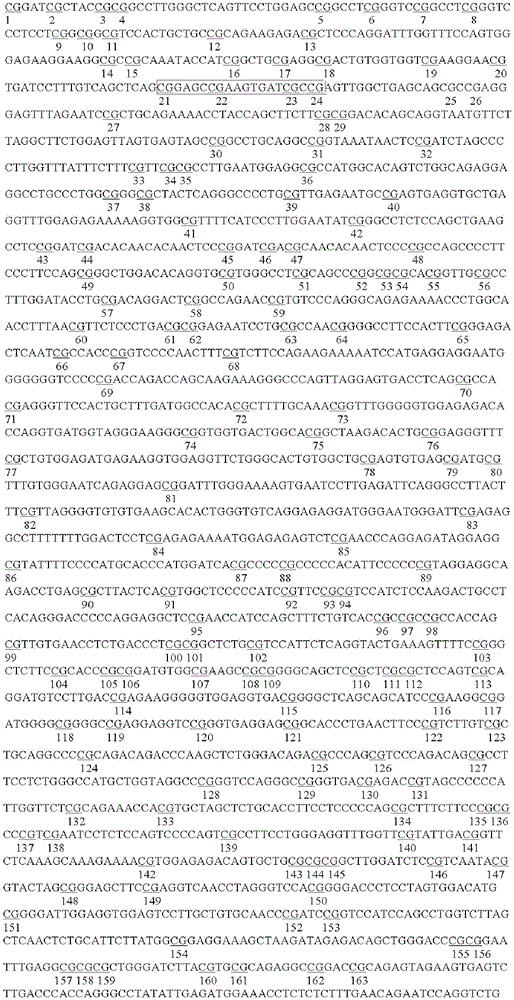

The sequence of SEQ ID NO. 1 is shown as SEQ ID NO. 2 (wherein Y represents C or U) after bisulfite treatment:

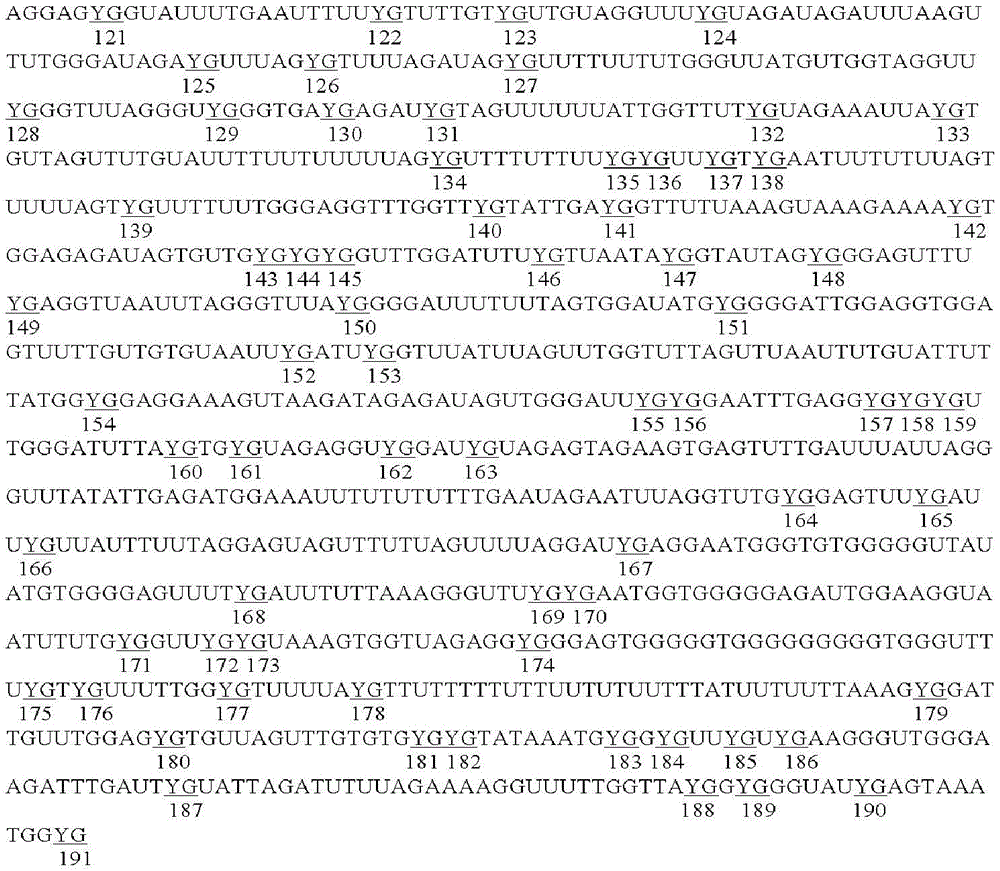
the reverse complementary sequence of the nucleotide sequence shown in SEQ ID NO. 1 is shown in SEQ ID NO. 3:
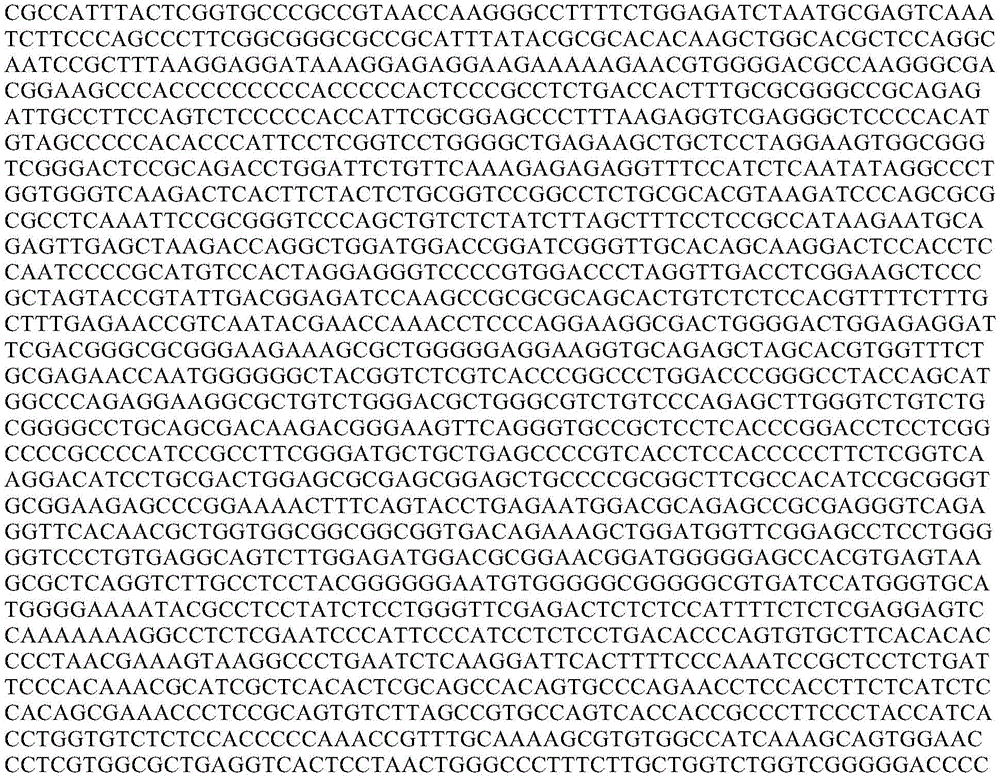
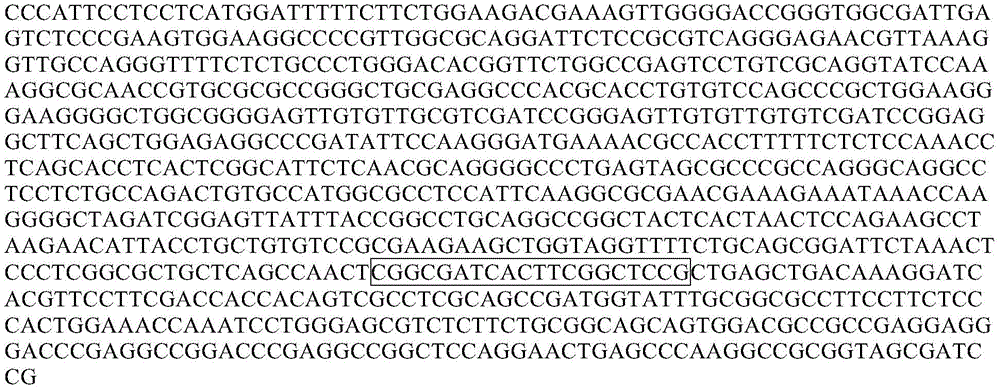
the sequence of SEQ ID NO. 3 is shown as SEQ ID NO. 4 (wherein Y represents C or U) after bisulfite treatment:
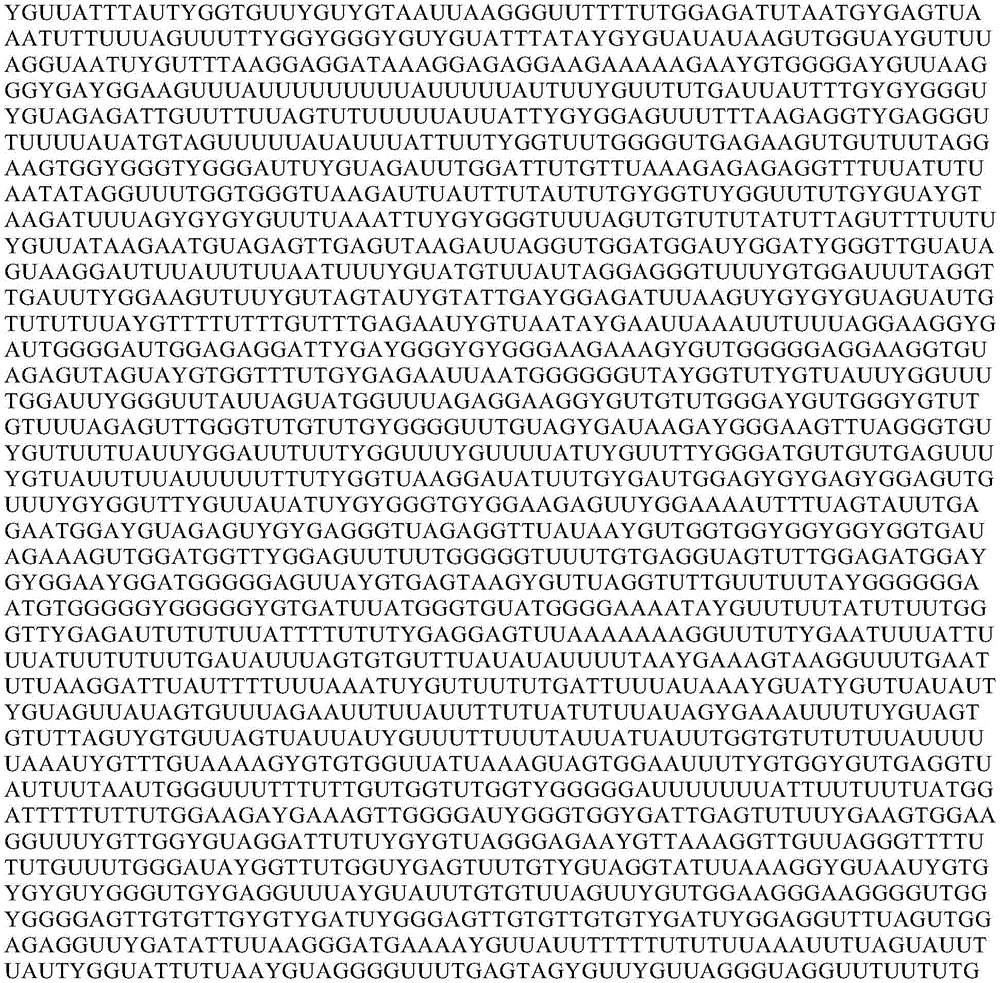

example 2 methylation differentiation of STAMP-EP8 CpG sites in tumor cells and non-tumor cells-post Bisulfite treatment Sequencing method (BSP-bisufite Sequencing PCR)
The bisulfite treatment followed sequencing method comprises the following steps:
1. extracting the genomic DNA of the lung cancer cell line A549 and the normal lung cell line MRC 5;
2. treating the extracted lung cancer cell line A549 and normal lung cell line MRC5 genomic DNA with bisulfite respectively, and using the treated lung cancer cell line A549 and normal lung cancer cell line MRC5 genomic DNA as templates for subsequent PCR amplification;
3. amplification primers (SEQ ID NOS: 5-14) were designed based on the sequence of SEQ ID NO:1, and amplification was performed as shown in Table 1.
And 4, after PCR amplification, detecting the specificity of the PCR fragment by 2% agarose gel electrophoresis, cutting gel, recovering a target fragment, connecting and inserting a T vector, converting competent escherichia coli, coating a bacterial plate, selecting clone sequencing the next day, and selecting more than 10 clones of each fragment for Sanger sequencing.
TABLE 1


The BSP verification result of the methylation level of the 001-040 methylation site lung cancer cell and the normal lung cell in the region of SEQ ID NO. 1 is shown in figure 1, and the STAMP-EP8 methylation level of the lung cancer cell is obviously higher than that of the normal lung cell.
The BSP verification result of the methylation level of 041-077 methylation site lung cancer cells and normal lung cells in the region of SEQ ID NO. 1 is shown in FIG. 2, which shows that the methylation level of STAMP-EP8 of the lung cancer cells is significantly higher than that of the normal lung cells.
The BSP verification result of the methylation level of the lung cancer cells at the 078-114 methylation sites in the region of SEQ ID NO. 1 and normal lung cells is shown in figure 3, and the STAMP-EP8 methylation level of the lung cancer cells is remarkably higher than that of the normal lung cells.
The 115-153 methylation site lung cancer cells in the region of SEQ ID NO. 1 and the normal lung cells have the BSP (methylation level) verification result shown in FIG. 4, and the lung cancer cell STAMP-EP8 methylation level is remarkably higher than that of the normal lung cells.
The verification result of the methylation level BSP of the lung cancer cells with the 154-191 methylation sites in the region of SEQ ID NO. 1 and the normal lung cells is shown in figure 5, and the lung cancer cell STAMP-EP8 methylation level is obviously higher than that of the normal lung cells.
Example 3 methylation differentiation of STAMP-EP8 CpG sites in tumor cells and non-tumor cells-pyrosequencing
The pyrosequencing method comprises the following steps:
1. obtaining a clinical sample: clinically obtaining a paracancerous/non-cancerous tissue sample, wherein the paracancerous/non-cancerous tissue sample is used as a control group, and the cancerous tissue sample is used as a tumor detection experimental group;
2, DNA extraction: respectively extracting DNA of an experimental group and a control group; the phenol chloroform extraction method is used for the experiment, but is not limited to the method;
3. bisulfite treatment: treating the extracted DNA sample with bisulfite, and strictly operating according to the steps; in this experiment, the EZ DNA Methylation-Gold Kit from ZYMO Research, cat # D5006 was used, but not limited to this Kit;
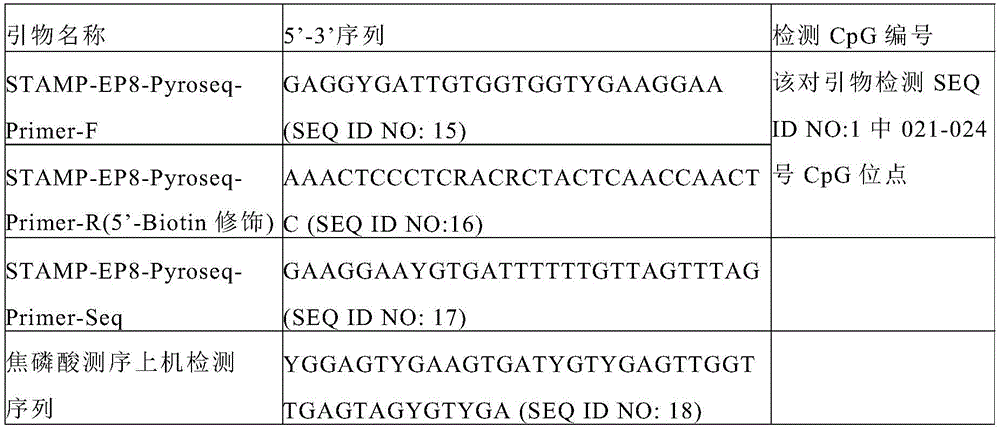
4. designing a primer: according to the STAMP-EP8 sequence SEQ ID NO:1, designing a PCR amplification primer and a pyrosequencing primer, detecting the methylation value of the CpG site with the number of 021-024 as a representative of the methylation value of STAMP-EP8, wherein the PCR amplification sequence, the pyrosequencing primer sequence, the pyrosequencing on-machine detection sequence and the detection site are shown as SEQ ID NO: 15-18, and are shown in Table 2;
PCR amplification and agarose gel electrophoresis: taking a sample treated by bisulfite as a PCR template to carry out PCR amplification, and identifying the specificity of the PCR amplification by agarose gel electrophoresis of an amplified product;
6. pyrosequencing: detecting by a Pyro Mark Q96 ID pyrosequencer of QIAGEN company, and strictly operating according to the steps of the instruction;
STAMP-EP8 methylation value calculation: pyrosequencing can independently detect the methylation condition of a single CpG site in a target region, and the methylation average value of all CpG sites is calculated to be used as the methylation value of STAMP-EP8 in the sample;
8. and (4) analyzing results: STAMP-EP8 methylation values were compared between the paracancerous/non-cancerous control group and the tumor experimental group.
TABLE 2
Example 4 verification of clinical samples from leukemia-pyrosequencing method
From the clinical study 8 non-leukemic bone marrow smear samples were obtained as a control group and 8 leukemic bone marrow smear samples were obtained as an experimental group, and the methylation levels of STAMP-EP8 in the control group and the experimental group were compared according to the pyrophosphate testing procedure of example 3 above.
The results are shown in fig. 6, which shows that in clinical samples with leukemia, STAMP-EP8 has significantly higher methylation values in the experimental group than non-cancerous tissues.
Example 5 validation of clinical samples for Breast cancer-pyrosequencing method
Clinically, 5 breast cancer paracancerous samples were obtained as a control group and 5 breast cancer tissue samples were obtained as an experimental group, and the methylation levels of STAMP-EP8 in the control group and the experimental group were compared according to the procedure of the pyrophosphate assay of example 3 above.
The results are shown in fig. 7, which shows that in clinical samples of breast cancer, STAMP-EP8 methylation values were significantly higher in the experimental group than in the paracancerous tissues.
Example 6 validation of clinical samples for colorectal cancer-pyrosequencing method
Clinically, 8 paracancerous colorectal cancer samples were obtained as a control group and 8 colorectal cancer samples were obtained as an experimental group, and the methylation level of STAMP-EP8 was analyzed according to the pyrophosphate assay procedure of example 3.
The results are shown in fig. 8, which shows that in clinical samples of colorectal cancer, STAMP-EP8 methylation values were significantly higher in the experimental group than in the para-cancerous tissues.
Example 7 validation of esophageal cancer clinical samples-pyrosequencing method
Clinically 10 paraesophageal cancer samples were taken as a control group and 10 esophageal cancer samples were taken as an experimental group, and the methylation level of STAMP-EP8 was analyzed according to the pyrophosphate assay procedure of example 3.
Results fig. 9, shows that in clinical samples of esophageal cancer, STAMP-EP8 methylation values in the experimental group were significantly higher than in the paracancerous tissues.
Example 8 validation of clinical samples from liver cancer-pyrosequencing method
Clinically, 8 liver cancer paracancerous samples were obtained as a control group and 8 liver cancer samples were obtained as an experimental group, and the methylation level of STAMP-EP8 was analyzed according to the pyrophosphate assay procedure of example 3.
The results are shown in fig. 10, which shows that in the clinical liver cancer sample, the methylation value of STAMP-EP8 in the experimental group is significantly higher than that in the tissues beside the cancer.
Example 9 verification of clinical specimens for Lung cancer-pyrosequencing method
Clinically 4 paralung cancer samples were obtained as a control group and 4 lung cancer samples were obtained as an experimental group, and the methylation level of STAMP-EP8 was analyzed according to the pyrophosphate assay procedure of example 3.
The results are shown in FIG. 11, which shows that in clinical specimens of lung cancer, STAMP-EP8 has significantly higher methylation values in the experimental group than in the paracancerous tissues.
Example 10 verification of clinical samples for pancreatic cancer-pyrosequencing method
Clinically 4 parapancreatic cancer samples were obtained as a control group and 4 pancreatic cancer samples were obtained as an experimental group, and the methylation level of STAMP-EP8 was analyzed according to the pyrophosphate assay procedure of example 3.
The results are shown in FIG. 12, which shows that STAMP-EP8 has significantly higher methylation values in the experimental group than in the paracarcinoma tissues in the clinical samples of pancreatic cancer.
All documents mentioned in this application are incorporated by reference in this application as if each were individually incorporated by reference. Furthermore, it should be understood that various changes and modifications of the present invention can be made by those skilled in the art after reading the above teachings of the present invention, and these equivalents also fall within the scope of the present invention as defined by the appended claims.
Sequence listing
<110> Shanghai Yisheng Spectrum Biotech Co., ltd
<120> tumor marker STAMP-EP8 based on methylation modification and application thereof
<130> 192647
<160> 18
<170> SIPOSequenceListing 1.0
<210> 1
<211> 2700
<212> DNA
<213> Intelligent (Homo sapiens)
<400> 1
cggatcgcta ccgcggcctt gggctcagtt cctggagccg gcctcgggtc cggcctcggg 60
tccctcctcg gcggcgtcca ctgctgccgc agaagagacg ctcccaggat ttggtttcca 120
gtgggagaag gaaggcgccg caaataccat cggctgcgag gcgactgtgg tggtcgaagg 180
aacgtgatcc tttgtcagct cagcggagcc gaagtgatcg ccgagttggc tgagcagcgc 240
cgagggagtt tagaatccgc tgcagaaaac ctaccagctt cttcgcggac acagcaggta 300
atgttcttag gcttctggag ttagtgagta gccggcctgc aggccggtaa ataactccga 360
tctagcccct tggtttattt ctttcgttcg cgccttgaat ggaggcgcca tggcacagtc 420
tggcagagga ggcctgccct ggcgggcgct actcagggcc cctgcgttga gaatgccgag 480
tgaggtgctg aggtttggag agaaaaaggt ggcgttttca tcccttggaa tatcgggcct 540
ctccagctga agcctccgga tcgacacaac acaactcccg gatcgacgca acacaactcc 600
ccgccagccc cttcccttcc agcgggctgg acacaggtgc gtgggcctcg cagcccggcg 660
cgcacggttg cgcctttgga tacctgcgac aggactcggc cagaaccgtg tcccagggca 720
gagaaaaccc tggcaacctt taacgttctc cctgacgcgg agaatcctgc gccaacgggg 780
ccttccactt cgggagactc aatcgccacc cggtccccaa ctttcgtctt ccagaagaaa 840
aatccatgag gaggaatggg ggggtccccc gaccagacca gcaagaaagg gcccagttag 900
gagtgacctc agcgccacga gggttccact gctttgatgg ccacacgctt ttgcaaacgg 960
tttgggggtg gagagacacc aggtgatggt agggaagggc ggtggtgact ggcacggcta 1020
agacactgcg gagggtttcg ctgtggagat gagaaggtgg aggttctggg cactgtggct 1080
gcgagtgtga gcgatgcgtt tgtgggaatc agaggagcgg atttgggaaa agtgaatcct 1140
tgagattcag ggccttactt tcgttagggg tgtgtgaagc acactgggtg tcaggagagg 1200
atgggaatgg gattcgagag gccttttttt ggactcctcg agagaaaatg gagagagtct 1260
cgaacccagg agataggagg cgtattttcc ccatgcaccc atggatcacg cccccgcccc 1320
cacattcccc ccgtaggagg caagacctga gcgcttactc acgtggctcc cccatccgtt 1380
ccgcgtccat ctccaagact gcctcacagg gacccccagg aggctccgaa ccatccagct 1440
ttctgtcacc gccgccgcca ccagcgttgt gaacctctga ccctcgcggc tctgcgtcca 1500
ttctcaggta ctgaaagttt tccgggctct tccgcacccg cggatgtggc gaagccgcgg 1560
ggcagctccg ctcgcgctcc agtcgcagga tgtccttgac cgagaagggg gtggaggtga 1620
cggggctcag cagcatcccg aaggcggatg gggcggggcc gaggaggtcc gggtgaggag 1680
cggcaccctg aacttcccgt cttgtcgctg caggccccgc agacagaccc aagctctggg 1740
acagacgccc agcgtcccag acagcgcctt cctctgggcc atgctggtag gcccgggtcc 1800
agggccgggt gacgagaccg tagcccccca ttggttctcg cagaaaccac gtgctagctc 1860
tgcaccttcc tcccccagcg ctttcttccc gcgcccgtcg aatcctctcc agtccccagt 1920
cgccttcctg ggaggtttgg ttcgtattga cggttctcaa agcaaagaaa acgtggagag 1980
acagtgctgc gcgcggcttg gatctccgtc aatacggtac tagcgggagc ttccgaggtc 2040
aacctagggt ccacggggac cctcctagtg gacatgcggg gattggaggt ggagtccttg 2100
ctgtgcaacc cgatccggtc catccagcct ggtcttagct caactctgca ttcttatggc 2160
ggaggaaagc taagatagag acagctggga cccgcggaat ttgaggcgcg cgctgggatc 2220
ttacgtgcgc agaggccgga ccgcagagta gaagtgagtc ttgacccacc agggcctata 2280
ttgagatgga aacctctctc tttgaacaga atccaggtct gcggagtccc gacccgccac 2340
ttcctaggag cagcttctca gccccaggac cgaggaatgg gtgtgggggc tacatgtggg 2400
gagccctcga cctcttaaag ggctccgcga atggtggggg agactggaag gcaatctctg 2460
cggcccgcgc aaagtggtca gaggcgggag tgggggtggg ggggggtggg cttccgtcgc 2520
ccttggcgtc cccacgttct ttttcttcct ctcctttatc ctccttaaag cggattgcct 2580
ggagcgtgcc agcttgtgtg cgcgtataaa tgcggcgccc gccgaagggc tgggaagatt 2640
tgactcgcat tagatctcca gaaaaggccc ttggttacgg cgggcaccga gtaaatggcg 2700
<210> 2
<211> 2700
<212> DNA/RNA
<213> Artificial Sequence (Artificial Sequence)
<220>
<221> misc_feature
<222> (1)..(2700)
<223> y represents c or u
<400> 2
yggatyguta uygygguutt gggutuagtt uutggaguyg guutygggtu ygguutyggg 60
tuuutuutyg gyggygtuua utgutguygu agaagagayg utuuuaggat ttggtttuua 120
gtgggagaag gaaggyguyg uaaatauuat yggutgygag gygautgtgg tggtygaagg 180
aaygtgatuu tttgtuagut uagyggaguy gaagtgatyg uygagttggu tgaguagygu 240
ygagggagtt tagaatuygu tguagaaaau utauuagutt uttygyggau auaguaggta 300
atgttuttag guttutggag ttagtgagta guygguutgu agguyggtaa ataautuyga 360
tutaguuuut tggtttattt utttygttyg yguuttgaat ggaggyguua tgguauagtu 420
tgguagagga gguutguuut ggygggygut autuaggguu uutgygttga gaatguygag 480
tgaggtgutg aggtttggag agaaaaaggt ggygttttua tuuuttggaa tatyggguut 540
utuuagutga aguutuygga tygauauaau auaautuuyg gatygaygua auauaautuu 600
uyguuaguuu uttuuuttuu agygggutgg auauaggtgy gtggguutyg uaguuyggyg 660
yguayggttg yguutttgga tauutgygau aggautyggu uagaauygtg tuuuagggua 720
gagaaaauuu tgguaauutt taaygttutu uutgaygygg agaatuutgy guuaaygggg 780
uuttuuautt ygggagautu aatyguuauu yggtuuuuaa utttygtutt uuagaagaaa 840
aatuuatgag gaggaatggg ggggtuuuuy gauuagauua guaagaaagg guuuagttag 900
gagtgauutu agyguuayga gggttuuaut gutttgatgg uuauaygutt ttguaaaygg 960
tttgggggtg gagagauauu aggtgatggt agggaagggy ggtggtgaut gguaygguta 1020
agauautgyg gagggtttyg utgtggagat gagaaggtgg aggttutggg uautgtggut 1080
gygagtgtga gygatgygtt tgtgggaatu agaggagygg atttgggaaa agtgaatuut 1140
tgagattuag gguuttautt tygttagggg tgtgtgaagu auautgggtg tuaggagagg 1200
atgggaatgg gattygagag guuttttttt ggautuutyg agagaaaatg gagagagtut 1260
ygaauuuagg agataggagg ygtattttuu uuatguauuu atggatuayg uuuuyguuuu 1320
uauattuuuu uygtaggagg uaagauutga gyguttautu aygtggutuu uuuatuygtt 1380
uygygtuuat utuuaagaut guutuauagg gauuuuuagg aggutuygaa uuatuuagut 1440
ttutgtuauy guyguyguua uuagygttgt gaauututga uuutygyggu tutgygtuua 1500
ttutuaggta utgaaagttt tuygggutut tuyguauuyg yggatgtggy gaaguygygg 1560
gguagutuyg utygygutuu agtyguagga tgtuuttgau ygagaagggg gtggaggtga 1620
yggggutuag uaguatuuyg aaggyggatg gggygggguy gaggaggtuy gggtgaggag 1680
ygguauuutg aauttuuygt uttgtygutg uagguuuygu agauagauuu aagututggg 1740
auagayguuu agygtuuuag auagyguutt uututggguu atgutggtag guuygggtuu 1800
aggguygggt gaygagauyg taguuuuuua ttggttutyg uagaaauuay gtgutagutu 1860
tguauuttuu tuuuuuagyg utttuttuuy gyguuygtyg aatuututuu agtuuuuagt 1920
yguuttuutg ggaggtttgg ttygtattga yggttutuaa aguaaagaaa aygtggagag 1980
auagtgutgy gygygguttg gatutuygtu aatayggtau tagygggagu ttuygaggtu 2040
aauutagggt uuayggggau uutuutagtg gauatgyggg gattggaggt ggagtuuttg 2100
utgtguaauu ygatuyggtu uatuuaguut ggtuttagut uaaututgua ttuttatggy 2160
ggaggaaagu taagatagag auagutggga uuygyggaat ttgaggygyg ygutgggatu 2220
ttaygtgygu agagguygga uyguagagta gaagtgagtu ttgauuuauu aggguutata 2280
ttgagatgga aauutututu tttgaauaga atuuaggtut gyggagtuuy gauuyguuau 2340
ttuutaggag uaguttutua guuuuaggau ygaggaatgg gtgtgggggu tauatgtggg 2400
gaguuutyga uututtaaag ggutuygyga atggtggggg agautggaag guaatututg 2460
ygguuygygu aaagtggtua gaggygggag tgggggtggg ggggggtggg uttuygtygu 2520
uuttggygtu uuuaygttut ttttuttuut utuutttatu utuuttaaag yggattguut 2580
ggagygtguu aguttgtgtg ygygtataaa tgyggyguuy guygaagggu tgggaagatt 2640
tgautyguat tagatutuua gaaaagguuu ttggttaygg yggguauyga gtaaatggyg 2700
<210> 3
<211> 2700
<212> DNA
<213> Intelligent (Homo sapiens)
<400> 3
cgccatttac tcggtgcccg ccgtaaccaa gggccttttc tggagatcta atgcgagtca 60
aatcttccca gcccttcggc gggcgccgca tttatacgcg cacacaagct ggcacgctcc 120
aggcaatccg ctttaaggag gataaaggag aggaagaaaa agaacgtggg gacgccaagg 180
gcgacggaag cccacccccc cccaccccca ctcccgcctc tgaccacttt gcgcgggccg 240
cagagattgc cttccagtct cccccaccat tcgcggagcc ctttaagagg tcgagggctc 300
cccacatgta gcccccacac ccattcctcg gtcctggggc tgagaagctg ctcctaggaa 360
gtggcgggtc gggactccgc agacctggat tctgttcaaa gagagaggtt tccatctcaa 420
tataggccct ggtgggtcaa gactcacttc tactctgcgg tccggcctct gcgcacgtaa 480
gatcccagcg cgcgcctcaa attccgcggg tcccagctgt ctctatctta gctttcctcc 540
gccataagaa tgcagagttg agctaagacc aggctggatg gaccggatcg ggttgcacag 600
caaggactcc acctccaatc cccgcatgtc cactaggagg gtccccgtgg accctaggtt 660
gacctcggaa gctcccgcta gtaccgtatt gacggagatc caagccgcgc gcagcactgt 720
ctctccacgt tttctttgct ttgagaaccg tcaatacgaa ccaaacctcc caggaaggcg 780
actggggact ggagaggatt cgacgggcgc gggaagaaag cgctggggga ggaaggtgca 840
gagctagcac gtggtttctg cgagaaccaa tggggggcta cggtctcgtc acccggccct 900
ggacccgggc ctaccagcat ggcccagagg aaggcgctgt ctgggacgct gggcgtctgt 960
cccagagctt gggtctgtct gcggggcctg cagcgacaag acgggaagtt cagggtgccg 1020
ctcctcaccc ggacctcctc ggccccgccc catccgcctt cgggatgctg ctgagccccg 1080
tcacctccac ccccttctcg gtcaaggaca tcctgcgact ggagcgcgag cggagctgcc 1140
ccgcggcttc gccacatccg cgggtgcgga agagcccgga aaactttcag tacctgagaa 1200
tggacgcaga gccgcgaggg tcagaggttc acaacgctgg tggcggcggc ggtgacagaa 1260
agctggatgg ttcggagcct cctgggggtc cctgtgaggc agtcttggag atggacgcgg 1320
aacggatggg ggagccacgt gagtaagcgc tcaggtcttg cctcctacgg ggggaatgtg 1380
ggggcggggg cgtgatccat gggtgcatgg ggaaaatacg cctcctatct cctgggttcg 1440
agactctctc cattttctct cgaggagtcc aaaaaaaggc ctctcgaatc ccattcccat 1500
cctctcctga cacccagtgt gcttcacaca cccctaacga aagtaaggcc ctgaatctca 1560
aggattcact tttcccaaat ccgctcctct gattcccaca aacgcatcgc tcacactcgc 1620
agccacagtg cccagaacct ccaccttctc atctccacag cgaaaccctc cgcagtgtct 1680
tagccgtgcc agtcaccacc gcccttccct accatcacct ggtgtctctc cacccccaaa 1740
ccgtttgcaa aagcgtgtgg ccatcaaagc agtggaaccc tcgtggcgct gaggtcactc 1800
ctaactgggc cctttcttgc tggtctggtc gggggacccc cccattcctc ctcatggatt 1860
tttcttctgg aagacgaaag ttggggaccg ggtggcgatt gagtctcccg aagtggaagg 1920
ccccgttggc gcaggattct ccgcgtcagg gagaacgtta aaggttgcca gggttttctc 1980
tgccctggga cacggttctg gccgagtcct gtcgcaggta tccaaaggcg caaccgtgcg 2040
cgccgggctg cgaggcccac gcacctgtgt ccagcccgct ggaagggaag gggctggcgg 2100
ggagttgtgt tgcgtcgatc cgggagttgt gttgtgtcga tccggaggct tcagctggag 2160
aggcccgata ttccaaggga tgaaaacgcc acctttttct ctccaaacct cagcacctca 2220
ctcggcattc tcaacgcagg ggccctgagt agcgcccgcc agggcaggcc tcctctgcca 2280
gactgtgcca tggcgcctcc attcaaggcg cgaacgaaag aaataaacca aggggctaga 2340
tcggagttat ttaccggcct gcaggccggc tactcactaa ctccagaagc ctaagaacat 2400
tacctgctgt gtccgcgaag aagctggtag gttttctgca gcggattcta aactccctcg 2460
gcgctgctca gccaactcgg cgatcacttc ggctccgctg agctgacaaa ggatcacgtt 2520
ccttcgacca ccacagtcgc ctcgcagccg atggtatttg cggcgccttc cttctcccac 2580
tggaaaccaa atcctgggag cgtctcttct gcggcagcag tggacgccgc cgaggaggga 2640
cccgaggccg gacccgaggc cggctccagg aactgagccc aaggccgcgg tagcgatccg 2700
<210> 4
<211> 2700
<212> DNA/RNA
<213> Artificial Sequence (Artificial Sequence)
<220>
<221> misc_feature
<222> (1)..(2700)
<223> y represents c or u
<400> 4
yguuatttau tyggtguuyg uygtaauuaa ggguuttttu tggagatuta atgygagtua 60
aatuttuuua guuuttyggy gggyguygua tttataygyg uauauaagut gguaygutuu 120
agguaatuyg utttaaggag gataaaggag aggaagaaaa agaaygtggg gayguuaagg 180
gygayggaag uuuauuuuuu uuuauuuuua utuuyguutu tgauuauttt gygyggguyg 240
uagagattgu uttuuagtut uuuuuauuat tygyggaguu utttaagagg tygagggutu 300
uuuauatgta guuuuuauau uuattuutyg gtuutggggu tgagaagutg utuutaggaa 360
gtggygggty gggautuygu agauutggat tutgttuaaa gagagaggtt tuuatutuaa 420
tatagguuut ggtgggtuaa gautuauttu taututgygg tuygguutut gyguaygtaa 480
gatuuuagyg ygyguutuaa attuygyggg tuuuagutgt ututatutta gutttuutuy 540
guuataagaa tguagagttg agutaagauu aggutggatg gauyggatyg ggttguauag 600
uaaggautuu auutuuaatu uuyguatgtu uautaggagg gtuuuygtgg auuutaggtt 660
gauutyggaa gutuuyguta gtauygtatt gayggagatu uaaguygygy guaguautgt 720
ututuuaygt tttutttgut ttgagaauyg tuaataygaa uuaaauutuu uaggaaggyg 780
autggggaut ggagaggatt ygaygggygy gggaagaaag ygutggggga ggaaggtgua 840
gagutaguay gtggtttutg ygagaauuaa tgggggguta yggtutygtu auuygguuut 900
ggauuygggu utauuaguat gguuuagagg aaggygutgt utgggaygut gggygtutgt 960
uuuagagutt gggtutgtut gygggguutg uagygauaag aygggaagtt uagggtguyg 1020
utuutuauuy ggauutuuty gguuuyguuu uatuyguutt ygggatgutg utgaguuuyg 1080
tuauutuuau uuuuttutyg gtuaaggaua tuutgygaut ggagygygag yggagutguu 1140
uygyggutty guuauatuyg ygggtgygga agaguuygga aaautttuag tauutgagaa 1200
tggayguaga guygygaggg tuagaggttu auaaygutgg tggyggyggy ggtgauagaa 1260
agutggatgg ttyggaguut uutgggggtu uutgtgaggu agtuttggag atggaygygg 1320
aayggatggg ggaguuaygt gagtaagygu tuaggtuttg uutuutaygg ggggaatgtg 1380
ggggyggggg ygtgatuuat gggtguatgg ggaaaatayg uutuutatut uutgggttyg 1440
agautututu uattttutut ygaggagtuu aaaaaaaggu ututygaatu uuattuuuat 1500
uututuutga uauuuagtgt guttuauaua uuuutaayga aagtaagguu utgaatutua 1560
aggattuaut tttuuuaaat uygutuutut gattuuuaua aayguatygu tuauautygu 1620
aguuauagtg uuuagaauut uuauuttutu atutuuauag ygaaauuutu yguagtgtut 1680
taguygtguu agtuauuauy guuuttuuut auuatuauut ggtgtututu uauuuuuaaa 1740
uygtttguaa aagygtgtgg uuatuaaagu agtggaauuu tygtggygut gaggtuautu 1800
utaautgggu uutttuttgu tggtutggty gggggauuuu uuuattuutu utuatggatt 1860
tttuttutgg aagaygaaag ttggggauyg ggtggygatt gagtutuuyg aagtggaagg 1920
uuuygttggy guaggattut uygygtuagg gagaaygtta aaggttguua gggttttutu 1980
tguuutggga uayggttutg guygagtuut gtyguaggta tuuaaaggyg uaauygtgyg 2040
yguygggutg ygagguuuay guauutgtgt uuaguuygut ggaagggaag gggutggygg 2100
ggagttgtgt tgygtygatu ygggagttgt gttgtgtyga tuyggaggut tuagutggag 2160
agguuygata ttuuaaggga tgaaaayguu auutttttut utuuaaauut uaguauutua 2220
utygguattu tuaayguagg gguuutgagt agyguuyguu aggguagguu tuututguua 2280
gautgtguua tggyguutuu attuaaggyg ygaaygaaag aaataaauua aggggutaga 2340
tyggagttat ttauygguut guagguyggu tautuautaa utuuagaagu utaagaauat 2400
tauutgutgt gtuygygaag aagutggtag gttttutgua gyggattuta aautuuutyg 2460
gygutgutua guuaautygg ygatuautty ggutuygutg agutgauaaa ggatuaygtt 2520
uuttygauua uuauagtygu utyguaguyg atggtatttg yggyguuttu uttutuuuau 2580
tggaaauuaa atuutgggag ygtututtut gygguaguag tggayguygu ygaggaggga 2640
uuygagguyg gauuygaggu yggutuuagg aautgaguuu aagguygygg tagygatuyg 2700
<210> 5
<211> 22
<212> DNA/RNA
<213> primers (Primer)
<400> 5
atgaagttta tygaaggtgt tt 22
<210> 6
<211> 24
<212> DNA/RNA
<213> primers (Primer)
<400> 6
tttctctcca aacctcaaca cctc 24
<210> 7
<211> 24
<212> DNA/RNA
<213> primers (Primer)
<400> 7
gaggtgttga ggtttggaga gaaa 24
<210> 8
<211> 24
<212> DNA/RNA
<213> primers (Primer)
<400> 8
aacctccacc ttctcatctc caca 24
<210> 9
<211> 24
<212> DNA/RNA
<213> primers (Primer)
<400> 9
tgtggagatg agaaggtgga ggtt 24
<210> 10
<211> 22
<212> DNA/RNA
<213> primers (Primer)
<400> 10
atactactaa accccrtcac ct 22
<210> 11
<211> 22
<212> DNA/RNA
<213> primers (Primer)
<400> 11
atygagaagg gggtggaggt ga 22
<210> 12
<211> 23
<212> DNA/RNA
<213> primers (Primer)
<400> 12
aactaaaacc aaactaaata aac 23
<210> 13
<211> 23
<212> DNA/RNA
<213> primers (Primer)
<400> 13
gtttatttag tttggtttta gtt 23
<210> 14
<211> 23
<212> DNA/RNA
<213> primers (Primer)
<400> 14
<210> 15
<211> 25
<212> DNA/RNA
<213> primers (Primer)
<400> 15
gaggygattg tggtggtyga aggaa 25
<210> 16
<211> 29
<212> DNA/RNA
<213> primers (Primer)
<400> 16
aaactccctc racrctactc aaccaactc 29
<210> 17
<211> 28
<212> DNA/RNA
<213> primers (Primer)
<400> 17
gaaggaaygt gattttttgt tagtttag 28
<210> 18
<211> 40
<212> DNA/RNA
<213> primers (Primer)
<400> 18
yggagtygaa gtgatygtyg agttggttga gtagygtyga 40
Claims (17)
1. Use of an agent for detecting the level of methylation of a CpG site of an isolated polynucleotide selected from the group consisting of (a) to (d):
(a) 1, or a polynucleotide having a nucleotide sequence set forth in SEQ ID NO;
(b) A polynucleotide fragment represented by SEQ ID NO. 1 at positions 204 to 223, 1 to 478, 513 to 1040, 1082 to 1602, 1621 to 2117 or 2160 to 2700;
(c) The polynucleotide completely complementary to the polynucleotide of (a) above, the nucleotide sequence of which is shown in SEQ ID NO. 3;
(d) A polynucleotide fragment that is fully complementary to the polynucleotide fragment of (b);
the tumor is leukemia, breast cancer, colorectal cancer, esophageal cancer, liver cancer, lung cancer or pancreatic cancer.
2. The use of claim 1, wherein the agent that detects the level of methylation of a CpG site in an isolated polynucleotide is a primer or a probe.
3. The use according to claim 2, wherein the primers are:
primers with nucleotide sequences shown as SEQ ID NO. 5 and 6;
primers with nucleotide sequences shown as SEQ ID NO. 7 and 8;
primers with nucleotide sequences shown as SEQ ID NO. 9 and 10;
primers having nucleotide sequences shown in SEQ ID NO. 11 and 12; or
Primers having nucleotide sequences shown in SEQ ID NO 13 and 14.
4. The use according to claim 2, wherein the primers are:
primers with nucleotide sequences shown as SEQ ID NO. 15 and 16.
5. The use according to claim 1, wherein the polynucleotide selected from (a) to (d) is transformed such that the cytosine at the modified CpG site is unchanged from C, the unmodified cytosine is converted to T or U; and then detecting.
6. The use according to claim 5, wherein the polynucleotide of (a) is transformed to obtain a polynucleotide having the nucleotide sequence shown in SEQ ID NO. 2.
7. The use according to claim 5, wherein the polynucleotide of (c) is transformed to obtain a polynucleotide having the nucleotide sequence shown in SEQ ID NO. 4.
8. The use of claim 1, wherein the sample of the tumor comprises: paraffin embedded samples, blood samples, pleural effusion samples and alveolar lavage samples, ascites and lavage samples, bile samples, stool samples, urine samples, saliva samples, sputum samples, cerebrospinal fluid samples, cytology smear samples, cervical scrape or brush specimens, tissue and cell biopsy samples.
9. A method of making a tumor detection reagent, the method comprising: providing an isolated polynucleotide selected from (a) - (d):
(a) 1, or a polynucleotide having a nucleotide sequence set forth in SEQ ID NO;
(b) A polynucleotide fragment represented by SEQ ID NO. 1 at positions 204 to 223, 1 to 478, 513 to 1040, 1082 to 1602, 1621 to 2117 or 2160 to 2700;
(c) The polynucleotide completely complementary to the polynucleotide of (a), the nucleotide sequence of which is shown in SEQ ID NO. 3;
(d) A polynucleotide fragment fully complementary to the polynucleotide fragment of (b);
designing a detection reagent for specifically detecting the CpG site modification condition of the target sequence by taking the polynucleotide as the target sequence; the tumor is leukemia, breast cancer, colorectal cancer, esophageal cancer, liver cancer, lung cancer or pancreatic cancer.
10. The method of claim 9, wherein the detection reagent comprises: a primer or a probe.
11. The method of claim 10, wherein the detection reagent is:
primers with nucleotide sequences shown as SEQ ID NO. 5 and 6;
primers with nucleotide sequences shown as SEQ ID NO. 7 and 8;
primers with nucleotide sequences shown as SEQ ID NO. 9 and 10;
primers with nucleotide sequences shown as SEQ ID NO. 11 and 12; or
Primers having nucleotide sequences shown in SEQ ID NO 13 and 14.
12. The method of claim 10, wherein the detection reagent is: primers having the nucleotide sequences shown in SEQ ID NO. 15 and 16.
13. A method for in vitro detection of methylation patterns in a sample, which method is not diagnostic, comprising:
(i) Providing a sample, and extracting nucleic acid;
(ii) (ii) detecting CpG site modifications of a target sequence in the nucleic acid of (i), said target sequence being an isolated polynucleotide selected from the group consisting of (a) - (d):
(a) 1, or a polynucleotide having a nucleotide sequence set forth in SEQ ID NO;
(b) A polynucleotide fragment represented by SEQ ID NO. 1 at positions 204 to 223, 1 to 478, 513 to 1040, 1082 to 1602, 1621 to 2117 or 2160 to 2700;
(c) The polynucleotide completely complementary to the polynucleotide of (a) above, the nucleotide sequence of which is shown in SEQ ID NO. 3;
(d) A polynucleotide fragment fully complementary to the polynucleotide fragment of (b).
14. The method of claim 13, wherein in step (ii), the method of analysis comprises: methylation chip method, qPCR method, digital PCR method, second generation sequencing method, third generation sequencing method, whole genome methylation sequencing method, DNA enrichment detection method, HPLC method, massArray, methylation specific PCR, or their combination.
15. The method of claim 13, wherein in step (ii), the method of analysis comprises: pyrosequencing, bisulfite conversion sequencing, and simplified bisulfite sequencing.
16. The method of claim 13, wherein step (ii) comprises:
(1) (ii) treating the product of (i) to convert unmodified cytosine to uracil;
(2) Analyzing the modification of the target sequence in the nucleic acid treated in (1).
17. The method of claim 16, wherein in (1), the nucleic acid of step (i) is treated with bisulfite.
Priority Applications (6)
| Application Number | Priority Date | Filing Date | Title |
|---|---|---|---|
| CN201910363470.7A CN109971860B (en) | 2019-04-30 | 2019-04-30 | Tumor marker STAMP-EP8 based on methylation modification and application thereof |
| JP2021564600A JP7383051B2 (en) | 2019-04-30 | 2020-04-29 | Tumor marker STAMP-EP8 based on methylation modification and its application |
| EP20798283.6A EP3964578A4 (en) | 2019-04-30 | 2020-04-29 | STAMP-EP8 TUMOR MARKER BASED ON A METHYLATION MODIFICATION AND ITS APPLICATION |
| PCT/CN2020/087885 WO2020221315A1 (en) | 2019-04-30 | 2020-04-29 | Methylation-based modified tumor marker stamp-ep8 and application thereof |
| US17/594,792 US20220298577A1 (en) | 2019-04-30 | 2020-04-29 | Methylation-based modified tumor marker stamp-ep8 and application thereof |
| JP2023093508A JP7577791B2 (en) | 2019-04-30 | 2023-06-06 | Tumor marker STAMP-EP8 based on methylation modification and its application |
Applications Claiming Priority (1)
| Application Number | Priority Date | Filing Date | Title |
|---|---|---|---|
| CN201910363470.7A CN109971860B (en) | 2019-04-30 | 2019-04-30 | Tumor marker STAMP-EP8 based on methylation modification and application thereof |
Publications (2)
| Publication Number | Publication Date |
|---|---|
| CN109971860A CN109971860A (en) | 2019-07-05 |
| CN109971860B true CN109971860B (en) | 2022-10-11 |
Family
ID=67087423
Family Applications (1)
| Application Number | Title | Priority Date | Filing Date |
|---|---|---|---|
| CN201910363470.7A Active CN109971860B (en) | 2019-04-30 | 2019-04-30 | Tumor marker STAMP-EP8 based on methylation modification and application thereof |
Country Status (5)
| Country | Link |
|---|---|
| US (1) | US20220298577A1 (en) |
| EP (1) | EP3964578A4 (en) |
| JP (2) | JP7383051B2 (en) |
| CN (1) | CN109971860B (en) |
| WO (1) | WO2020221315A1 (en) |
Families Citing this family (3)
| Publication number | Priority date | Publication date | Assignee | Title |
|---|---|---|---|---|
| CN109971860B (en) * | 2019-04-30 | 2022-10-11 | 上海奕谱生物科技有限公司 | Tumor marker STAMP-EP8 based on methylation modification and application thereof |
| CN113234817B (en) * | 2021-04-14 | 2022-09-30 | 首都医科大学附属北京佑安医院 | Marker for detecting early liver cancer by using CpG locus methylation level |
| CN119776524A (en) * | 2024-11-29 | 2025-04-08 | 卡秋(江苏)生物科技有限公司 | A gene combination for tumor DNA methylation detection and its application |
Citations (4)
| Publication number | Priority date | Publication date | Assignee | Title |
|---|---|---|---|---|
| WO2016083360A1 (en) * | 2014-11-25 | 2016-06-02 | Ait Austrian Institute Of Technology Gmbh | Diagnosis of lung cancer |
| CN105886657A (en) * | 2010-09-13 | 2016-08-24 | 临床基因组学股份有限公司 | Epigenetic Markers Of Colorectal Cancers And Diagnostic Methods Using The Same |
| WO2017072292A1 (en) * | 2015-10-29 | 2017-05-04 | Rheinisch-Westfälische Technische Hochschule (Rwth) Aachen | Biomarker for breast cancer |
| CN109652541A (en) * | 2018-12-29 | 2019-04-19 | 上海奕谱生物科技有限公司 | Tumor marker STAMP-EP6 based on methylation modification |
Family Cites Families (8)
| Publication number | Priority date | Publication date | Assignee | Title |
|---|---|---|---|---|
| GB201511152D0 (en) * | 2015-06-24 | 2015-08-05 | Ucl Business Plc | Method of diagnosing bladder cancer |
| US20190382845A1 (en) * | 2016-02-18 | 2019-12-19 | University Of Southern California | Prostate cancer aggressiveness biomarkers |
| CN108866192B (en) * | 2018-07-26 | 2021-06-22 | 上海奕谱生物科技有限公司 | Methylation-modification-based tumor marker STAMP-EP1 |
| CN108866191B (en) * | 2018-07-26 | 2021-07-09 | 上海奕谱生物科技有限公司 | Methylation-based tumor marker STAMP-EP2 |
| CN109371138B (en) * | 2018-12-29 | 2022-10-25 | 上海奕谱生物科技有限公司 | Methylation-modification-based tumor marker STAMP-EP4 |
| CN109456968B (en) * | 2018-12-29 | 2022-10-04 | 上海奕谱生物科技有限公司 | Methylation modification-based tumor markers |
| CN109554476B (en) * | 2018-12-29 | 2022-12-27 | 上海奕谱生物科技有限公司 | Tumor marker STAMP-EP3 based on methylation modification |
| CN109971860B (en) * | 2019-04-30 | 2022-10-11 | 上海奕谱生物科技有限公司 | Tumor marker STAMP-EP8 based on methylation modification and application thereof |
-
2019
- 2019-04-30 CN CN201910363470.7A patent/CN109971860B/en active Active
-
2020
- 2020-04-29 JP JP2021564600A patent/JP7383051B2/en active Active
- 2020-04-29 EP EP20798283.6A patent/EP3964578A4/en active Pending
- 2020-04-29 WO PCT/CN2020/087885 patent/WO2020221315A1/en not_active Ceased
- 2020-04-29 US US17/594,792 patent/US20220298577A1/en active Pending
-
2023
- 2023-06-06 JP JP2023093508A patent/JP7577791B2/en active Active
Patent Citations (4)
| Publication number | Priority date | Publication date | Assignee | Title |
|---|---|---|---|---|
| CN105886657A (en) * | 2010-09-13 | 2016-08-24 | 临床基因组学股份有限公司 | Epigenetic Markers Of Colorectal Cancers And Diagnostic Methods Using The Same |
| WO2016083360A1 (en) * | 2014-11-25 | 2016-06-02 | Ait Austrian Institute Of Technology Gmbh | Diagnosis of lung cancer |
| WO2017072292A1 (en) * | 2015-10-29 | 2017-05-04 | Rheinisch-Westfälische Technische Hochschule (Rwth) Aachen | Biomarker for breast cancer |
| CN109652541A (en) * | 2018-12-29 | 2019-04-19 | 上海奕谱生物科技有限公司 | Tumor marker STAMP-EP6 based on methylation modification |
Non-Patent Citations (6)
| Title |
|---|
| AC012574.7 Homo sapiens chromosome 8, clone RP11-213G6, complete sequence;Birren,B. 等;《GenBank》;20020401;第1-3页 * |
| Birren,B. 等.AC012574.7 Homo sapiens chromosome 8, clone RP11-213G6, complete sequence.《GenBank》.2002,第1-3页. * |
| Breezy M Lindqvist 等.Whole genome DNA methylation signature of HER2-positive breast cancer.《Epigenetics》.2014,第9卷(第8期),第1149页摘要. * |
| GenBank.NG_030636.1 Homo sapiens NK2 homeobox 6 (NKX2-6), RefSeqGene on chromosome 8.《GenBank》.2017,第1-5页. * |
| NG_030636.1 Homo sapiens NK2 homeobox 6 (NKX2-6), RefSeqGene on chromosome 8;GenBank;《GenBank》;20171004;第1-5页 * |
| Whole genome DNA methylation signature of HER2-positive breast cancer;Breezy M Lindqvist 等;《Epigenetics》;20140708;第9卷(第8期);第1149页摘要 * |
Also Published As
| Publication number | Publication date |
|---|---|
| WO2020221315A1 (en) | 2020-11-05 |
| EP3964578A4 (en) | 2023-06-07 |
| US20220298577A1 (en) | 2022-09-22 |
| JP2023118716A (en) | 2023-08-25 |
| CN109971860A (en) | 2019-07-05 |
| JP7577791B2 (en) | 2024-11-05 |
| JP2022532859A (en) | 2022-07-20 |
| EP3964578A1 (en) | 2022-03-09 |
| JP7383051B2 (en) | 2023-11-17 |
Similar Documents
| Publication | Publication Date | Title |
|---|---|---|
| CN108866192B (en) | Methylation-modification-based tumor marker STAMP-EP1 | |
| CN109554476B (en) | Tumor marker STAMP-EP3 based on methylation modification | |
| CN109456968B (en) | Methylation modification-based tumor markers | |
| CN108866191B (en) | Methylation-based tumor marker STAMP-EP2 | |
| CN108913777B (en) | DNA methylation related marker for diagnosing tumor and application thereof | |
| CN110257525B (en) | Marker with significance for tumor diagnosis and application thereof | |
| JP7577791B2 (en) | Tumor marker STAMP-EP8 based on methylation modification and its application | |
| CN109652541B (en) | Methylation-modification-based tumor marker STAMP-EP6 | |
| CN109371138B (en) | Methylation-modification-based tumor marker STAMP-EP4 | |
| CN110117660B (en) | Marker STAMP-EP11 for tumor identification and detection reagent thereof | |
| CN110229913B (en) | Broad-spectrum marker for detecting tumor based on methylation level and application thereof | |
| CN110055330B (en) | Tumor marker STAMP-EP9 based on methylation modification and application thereof | |
| CN109988844B (en) | Tumor marker STAMP-EP7 based on methylation modification and application thereof | |
| CN110117659B (en) | Novel tumor marker STAMP-EP10 and application thereof | |
| CN117721208A (en) | Hematological tumor broad-spectrum methylation marker NPBWR1 multiplex amplification system and kit |
Legal Events
| Date | Code | Title | Description |
|---|---|---|---|
| PB01 | Publication | ||
| PB01 | Publication | ||
| SE01 | Entry into force of request for substantive examination | ||
| SE01 | Entry into force of request for substantive examination | ||
| GR01 | Patent grant | ||
| GR01 | Patent grant |