CN109952304B - A class of compounds that inhibit and degrade CDK - Google Patents
A class of compounds that inhibit and degrade CDK Download PDFInfo
- Publication number
- CN109952304B CN109952304B CN201880004082.3A CN201880004082A CN109952304B CN 109952304 B CN109952304 B CN 109952304B CN 201880004082 A CN201880004082 A CN 201880004082A CN 109952304 B CN109952304 B CN 109952304B
- Authority
- CN
- China
- Prior art keywords
- integer
- substituents
- compound
- independently
- formula
- Prior art date
- Legal status (The legal status is an assumption and is not a legal conclusion. Google has not performed a legal analysis and makes no representation as to the accuracy of the status listed.)
- Expired - Fee Related
Links
Classifications
-
- C—CHEMISTRY; METALLURGY
- C07—ORGANIC CHEMISTRY
- C07D—HETEROCYCLIC COMPOUNDS
- C07D471/00—Heterocyclic compounds containing nitrogen atoms as the only ring hetero atoms in the condensed system, at least one ring being a six-membered ring with one nitrogen atom, not provided for by groups C07D451/00 - C07D463/00
- C07D471/02—Heterocyclic compounds containing nitrogen atoms as the only ring hetero atoms in the condensed system, at least one ring being a six-membered ring with one nitrogen atom, not provided for by groups C07D451/00 - C07D463/00 in which the condensed system contains two hetero rings
- C07D471/04—Ortho-condensed systems
-
- A—HUMAN NECESSITIES
- A61—MEDICAL OR VETERINARY SCIENCE; HYGIENE
- A61P—SPECIFIC THERAPEUTIC ACTIVITY OF CHEMICAL COMPOUNDS OR MEDICINAL PREPARATIONS
- A61P35/00—Antineoplastic agents
-
- A—HUMAN NECESSITIES
- A61—MEDICAL OR VETERINARY SCIENCE; HYGIENE
- A61K—PREPARATIONS FOR MEDICAL, DENTAL OR TOILETRY PURPOSES
- A61K31/00—Medicinal preparations containing organic active ingredients
- A61K31/33—Heterocyclic compounds
- A61K31/395—Heterocyclic compounds having nitrogen as a ring hetero atom, e.g. guanethidine or rifamycins
- A61K31/495—Heterocyclic compounds having nitrogen as a ring hetero atom, e.g. guanethidine or rifamycins having six-membered rings with two or more nitrogen atoms as the only ring heteroatoms, e.g. piperazine or tetrazines
- A61K31/505—Pyrimidines; Hydrogenated pyrimidines, e.g. trimethoprim
- A61K31/519—Pyrimidines; Hydrogenated pyrimidines, e.g. trimethoprim ortho- or peri-condensed with heterocyclic rings
-
- A—HUMAN NECESSITIES
- A61—MEDICAL OR VETERINARY SCIENCE; HYGIENE
- A61K—PREPARATIONS FOR MEDICAL, DENTAL OR TOILETRY PURPOSES
- A61K31/00—Medicinal preparations containing organic active ingredients
- A61K31/33—Heterocyclic compounds
- A61K31/395—Heterocyclic compounds having nitrogen as a ring hetero atom, e.g. guanethidine or rifamycins
- A61K31/535—Heterocyclic compounds having nitrogen as a ring hetero atom, e.g. guanethidine or rifamycins having six-membered rings with at least one nitrogen and one oxygen as the ring hetero atoms, e.g. 1,2-oxazines
-
- A—HUMAN NECESSITIES
- A61—MEDICAL OR VETERINARY SCIENCE; HYGIENE
- A61K—PREPARATIONS FOR MEDICAL, DENTAL OR TOILETRY PURPOSES
- A61K31/00—Medicinal preparations containing organic active ingredients
- A61K31/33—Heterocyclic compounds
- A61K31/395—Heterocyclic compounds having nitrogen as a ring hetero atom, e.g. guanethidine or rifamycins
- A61K31/54—Heterocyclic compounds having nitrogen as a ring hetero atom, e.g. guanethidine or rifamycins having six-membered rings with at least one nitrogen and one sulfur as the ring hetero atoms, e.g. sulthiame
-
- A—HUMAN NECESSITIES
- A61—MEDICAL OR VETERINARY SCIENCE; HYGIENE
- A61P—SPECIFIC THERAPEUTIC ACTIVITY OF CHEMICAL COMPOUNDS OR MEDICINAL PREPARATIONS
- A61P37/00—Drugs for immunological or allergic disorders
- A61P37/02—Immunomodulators
-
- C—CHEMISTRY; METALLURGY
- C07—ORGANIC CHEMISTRY
- C07D—HETEROCYCLIC COMPOUNDS
- C07D487/00—Heterocyclic compounds containing nitrogen atoms as the only ring hetero atoms in the condensed system, not provided for by groups C07D451/00 - C07D477/00
- C07D487/02—Heterocyclic compounds containing nitrogen atoms as the only ring hetero atoms in the condensed system, not provided for by groups C07D451/00 - C07D477/00 in which the condensed system contains two hetero rings
- C07D487/04—Ortho-condensed systems
-
- C—CHEMISTRY; METALLURGY
- C07—ORGANIC CHEMISTRY
- C07D—HETEROCYCLIC COMPOUNDS
- C07D498/00—Heterocyclic compounds containing in the condensed system at least one hetero ring having nitrogen and oxygen atoms as the only ring hetero atoms
- C07D498/02—Heterocyclic compounds containing in the condensed system at least one hetero ring having nitrogen and oxygen atoms as the only ring hetero atoms in which the condensed system contains two hetero rings
- C07D498/04—Ortho-condensed systems
-
- C—CHEMISTRY; METALLURGY
- C07—ORGANIC CHEMISTRY
- C07D—HETEROCYCLIC COMPOUNDS
- C07D513/00—Heterocyclic compounds containing in the condensed system at least one hetero ring having nitrogen and sulfur atoms as the only ring hetero atoms, not provided for in groups C07D463/00, C07D477/00 or C07D499/00 - C07D507/00
- C07D513/02—Heterocyclic compounds containing in the condensed system at least one hetero ring having nitrogen and sulfur atoms as the only ring hetero atoms, not provided for in groups C07D463/00, C07D477/00 or C07D499/00 - C07D507/00 in which the condensed system contains two hetero rings
- C07D513/04—Ortho-condensed systems
Landscapes
- Chemical & Material Sciences (AREA)
- Organic Chemistry (AREA)
- Health & Medical Sciences (AREA)
- Life Sciences & Earth Sciences (AREA)
- General Health & Medical Sciences (AREA)
- Veterinary Medicine (AREA)
- Public Health (AREA)
- Pharmacology & Pharmacy (AREA)
- Medicinal Chemistry (AREA)
- Animal Behavior & Ethology (AREA)
- Chemical Kinetics & Catalysis (AREA)
- General Chemical & Material Sciences (AREA)
- Nuclear Medicine, Radiotherapy & Molecular Imaging (AREA)
- Epidemiology (AREA)
- Immunology (AREA)
- Engineering & Computer Science (AREA)
- Bioinformatics & Cheminformatics (AREA)
- Pharmaceuticals Containing Other Organic And Inorganic Compounds (AREA)
Abstract
本发明提供了一类抑制并降解CDK的化合物,具体地,本发明提供了一种如下式I所示的化合物;其中,各基团的定义如说明书中所述。本发明的化合物具有很好的周期蛋白依赖性激酶CDK抑制活性,可以用于制备治疗CDK活性相关的疾病的药物。 The present invention provides a class of compounds that inhibit and degrade CDK, specifically, the present invention provides a compound represented by the following formula I; wherein, the definitions of each group are as described in the specification. The compounds of the present invention have good cyclin-dependent kinase CDK inhibitory activity, and can be used to prepare medicines for treating diseases related to CDK activity. 
Description
Technical Field
The invention belongs to the field of medicines, and particularly relates to a compound for inhibiting and degrading cyclin dependent kinase CDK, and preparation and application thereof. The compounds of the invention are useful for treating cell proliferative disorders, such as cancer.
Background
Cyclin-dependent kinases (CDKs) are a class of serine (Ser)/threonine (T11r) kinases that are important signal transduction molecules within cells, and CDK is formed with cyclins that are involved in the growth, proliferation, dormancy or entry into apoptosis of cells. The CDK family includes 1-13, cyclins are classified into A-L, and different CDKs are respectively connected with different cyclins.
CDK specific activation is closely associated with proliferation of some tumors, with CDK pathway abnormalities present in about 80% of human tumors. Many reported indications for CDK inhibitors in clinical studies include tumors such as breast cancer, ovarian epithelial cancer, liposarcoma, non-small cell lung cancer, liver cancer, mantle cell lymphoma, melanoma, multiple myeloma, and head and neck cancer.
CDK inhibitors can also be used in the treatment of various autoimmune disorders. For example, rheumatoid arthritis is characterized by synovial tissue proliferation, and the CDK inhibitor P16 protein inhibits synovial fibroblasts (Taniguchi k.et al, Nat Med.1999, 5: 760-767). CDK inhibitors are effective against other cell proliferative disorders including psoriasis, lupus characterized by keratinocyte hyperproliferation.
Accordingly, the skilled person is working to develop compounds capable of inhibiting the activity of cyclin-dependent kinases CDK.
Disclosure of Invention
The invention aims to provide a compound capable of inhibiting and degrading cyclin dependent kinase CDK, and preparation and application thereof.
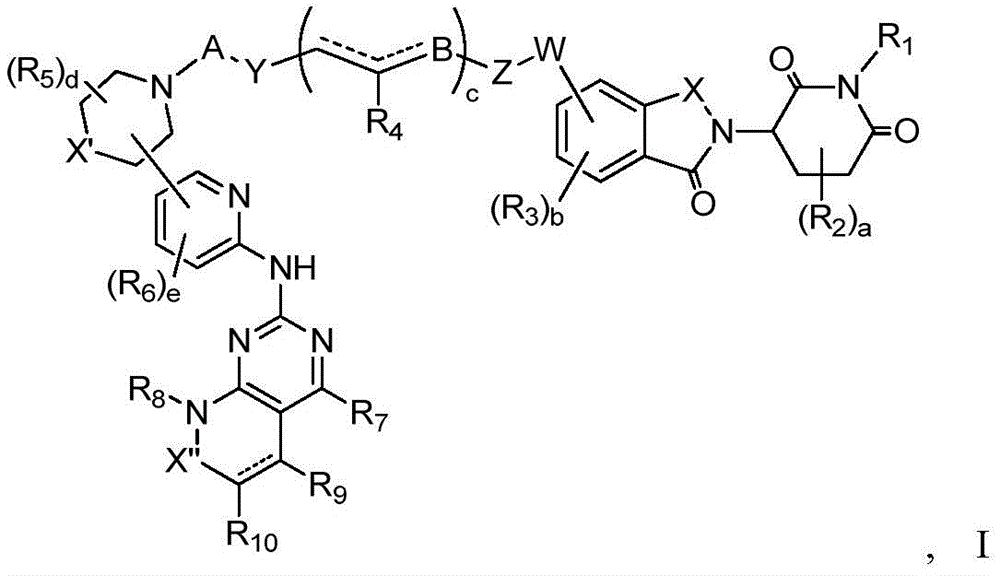
In a first aspect of the invention, there is provided a compound of formula I, or a pharmaceutically acceptable salt thereof:

wherein:
-represents a single bond

A is absent or selected from C (═ O), C (═ O) X1, SOX1, SO2X1, C with or without substituents1-8Hydrocarbyl, C with or without substituents1-8Cycloalkyl group, and C with or without substituent1-8A heterocyclic hydrocarbon group; wherein X1 is absent or selected from (CR)35R36)kO、(CR35R36)kS and NR14(ii) a Wherein R is35、R36、R14Each independently selected from H, C with or without substituents1-8With or without substituents C1-8And C with or without substituents1-8K is an integer between 0 and 3;
w is absent or selected from O, NR17、-X2C(=O)X3、-X2S(=O)gX3; wherein R is17Is H, C with or without substituents1-8With or without substituents C1-8Cycloalkyl, with or without substituents C1-8The heterocyclic hydrocarbon group of (a); wherein X2 and X3 are independently deleted or selected from O, S, NR18、(CH2)gO; wherein each g is an integer from 0 to 2; wherein R is18Is H, C with or without substituents1-8With or without substituents C1-8Cycloalkyl, with or without substituents C1-8The heterocyclic hydrocarbon group of (a);
y is (CR)22R23)h、CHX4(CR22R23)h、CX4=CH(CR22R23)hOr (CR)22R23)h(ii) a Wherein h is an integer between 0 and 30; wherein R is22、R23Each independently selected from H, cyano, hydroxy, amino, C with or without substituents1-8With or without substituents C1-8Cycloalkyl, with or without substituents C1-8A heterocyclic hydrocarbon group of (A), C with or without substituents1-8Hydrocarbyloxy groups of (a); wherein X4 ═ H, halogen, cyano, nitro, hydroxy, with or without substituent C1-8Hydrocarbyloxy, with or without substituents C1-8Alkoxycarbonyl, with or without substituents C1-8Amino, with or without substituents C1-8Ester group, with or without substituents C1-8Aminocarbonyl, with or without substituents C1-8Hydrocarbyl, with or without substituents C1-8Cycloalkyl, with or withoutWith substituents C1-8A heterocyclic hydrocarbon group;
z is (CR)24R25)i、CHX5(CR24R25)i、CX5=CH(CR24R25)iOr C ≡ C (CR)24R25)i(ii) a Wherein i is an integer between 0 and 30; wherein R is24、R25Each independently selected from H, cyano, hydroxy, amino, C with or without substituents1-8With or without substituents C1-8Cycloalkyl, with or without substituents C1-8Heterocycloalkyl radicals, with or without substituents C1-8A hydrocarbyloxy group; wherein X5 ═ H, halogen, cyano, nitro, hydroxy, with or without substituent C1-8With or without substituents C1-8Alkoxycarbonyl, with or without substituents C1-8Amino, with or without substituents C1-8Ester group, with or without substituents C1-8Aminocarbonyl, with or without substituents C1-8Hydrocarbyl, with or without substituents C1-8Cycloalkyl, with or without substituents C1-8A heterocyclic hydrocarbon group;
b is absent or selected from O, C ═ O, S, NR15、-NR15C(=O)-、-C(=O)NR15-、-C(=O)O-、OC(=O)O-、-NR15C(=O)O-、-OC(=O)NR15-、-NR15C(=O)NR16-, C with or without substituents1-12With or without substituents C1-12And C with or without substituents1-12The heterocyclic hydrocarbon group of (a); wherein R is15、R16Each independently selected from H, C with or without substituents1-8With or without substituents C1-8And C with or without substituents1-8The heterocyclic hydrocarbon group of (a);
x is selected from CR19R20、C(=O)、S(=O)、SO2、NR21(ii) a Wherein R is19、R20Each independently selected from H, cyano, hydroxy, amino, with or withoutC of a substituent1-8With or without substituents C1-8Cycloalkyl, with or without substituents C1-8A heterocyclic hydrocarbon group of (A), C with or without substituents1-8Hydrocarbyloxy groups of (a); wherein R is21Selected from H, C with or without substituents1-8With or without substituents C1-8Cycloalkyl, with or without substituents C1-8The heterocyclic hydrocarbon group of (a);
x ' is absent or when X ' is not substituted, X ' is selected from NH, CH2O, S, C (═ O), S (═ O), and S (═ O)2(ii) a X' when substituted is selected from N, and CH;
x' is absent or selected from C (═ O), CH2S (═ O), and S (═ O)2;
R1、R8Each independently selected from: H. with or without substituents C1-8Hydrocarbyl, C with or without substituents1-8Cycloalkyl, C with or without substituents1-8Heterocycloalkyl, C with or without substituents1-6An acyl group;
R2、R5each independently selected from: hydrogen, OR26、NR27R28Cyano, halogen, C with or without substituents1-8Hydrocarbyl, with or without substituents C1-8Cycloalkyl, with or without substituents C1-8Heterocycloalkyl, C with or without substituents1-6Acyl, C with or without substituents1-6An amide group; wherein R is26、R27、R28Each independently selected from H, C with or without substituents1-8With or without substituents C1-8Cycloalkyl, C with or without substituents1-8A heterocyclic hydrocarbon group;
R3、R6、R7、R9、R10each independently selected from: H. OR (OR)29、NR30R31Cyano, halogen, nitro, C with or without substituents1-8Hydrocarbyl, cycloalkyl, heteroCycloalkyl, X6S (═ O)jR32、X6C(=O)R33(ii) a Wherein j is an integer between 0 and 2; wherein R is29,R30,R31,R32,R33Each independently selected from H, C with or without substituents1-8Hydrocarbyl, C1 with or without substituents-8Cycloalkyl, C with or without substituents1-8Heterocyclic hydrocarbyl, amino; wherein X6 is absent or selected from O, S, NR34(ii) a Wherein R is34Is H, C with or without substituents1-8With or without substituents C1-8Cycloalkyl, C with or without substituents1-8A heterocyclic hydrocarbon group;
R4selected from H, cyano, carboxyl, C with or without substituents1-8With or without substituents C1-8A hydrocarbyloxycarbonyl group;
a is an integer between 0 and 5 (e.g., 1, 2, 3, 4, 5);
b is an integer between 0 and 3 (e.g., 1, 2, 3);
c is an integer between 0 and 30 (e.g., 1, 2, 3, 4, 5, 6, 7, 8, 9);
d is an integer between 0 and 9 (e.g., 1, 2, 3, 4, 5, 6, 7, 8, 9);
e is an integer between 0 and 3 (e.g., 1, 2, 3).
In another preferred embodiment, a is absent; w is-X2C (═ O) X3, where X3 is NR18And X2 is absent, or X2 is NR18X3 absent; y is (CR)22R23)hWherein R is22、R23Each independently selected from H, hydroxy, C with or without substituents1-4H is an integer between 1 and 6; z is (CR)24R25)iWherein R is24、R25Each independently selected from H, hydroxy, C with or without substituents1-4I is an integer between 1 and 6; c is 0.
In another preferred embodiment, a is absent; w is absent or is O; y is (CR)22R23)hWherein R is22、R23Each independently selected from H, hydroxy, C with or without substituents1-4H is an integer between 0 and 3; b is O; z is (CR)24R25)iWherein R is24、R25Each independently selected from H, hydroxy, C with or without substituents1-4I is an integer between 0 and 3; c is an integer between 1 and 6.
In another preferred embodiment, a is C (═ O) X1, where X1 is absent or selected from (CR)35R36)kO, and (CR)35R36)kS, where k is an integer between 0 and 2, R35、R36Each independently is hydrogen or C1-4Alkyl groups of (a); w is NR17Wherein R is17Is H, or C with or without substituents1-4A hydrocarbon group of (a); y is (CR)22R23)hWherein R is22、R23Each independently selected from H, hydroxy, C with or without substituents1-4H is an integer between 0 and 3; z is (CR)24R25)iWherein R is24、R25Each independently selected from H, hydroxy, C with or without substituents1-4I is an integer between 0 and 3; b is O; c is an integer between 1 and 4.
In another preferred embodiment, A is SO2X1, wherein X1 is absent or selected from O, and S; w is O; y is (CR)22R23)hWherein R is22、R23Each independently selected from H, hydroxy, C with or without substituents1-4H is an integer between 1 and 6; z is (CR)24R25)iWherein R is24、R25Each independently selected from H, hydroxy, C with or without substituents1-4I is an integer between 0 and 3; c is 0.
In another preferred embodiment, a is absent; w is NR17Wherein R is17Is H, or C with or without substituents1-4A hydrocarbon group of (a); y is (CR)22R23)hWherein R is22、R23Each of which isIndependently selected from H, hydroxy, C with or without substituents1-4H is an integer between 0 and 3; z is (CR)24R25)iWherein R is24、R25Each independently selected from H, hydroxy, C with or without substituents1-4I is an integer between 0 and 4; b is O; c is an integer between 1 and 6.
In another preferred embodiment, a is absent; deletion of W; y is (CR)22R23)hWherein R is22、R23Each independently selected from H, hydroxy, C with or without substituents1-4H is an integer between 0 and 3; z is (CR)24R25)iWherein R is24、R25Each independently selected from H, hydroxy, C with or without substituents1-4I is an integer between 0 and 3; b is O; c is an integer between 1 and 10.
In another preferred example, W is-X2C (═ O) X3 —; wherein X2 is NR18X3 is (CH)2)gO; wherein each g is an integer from 0 to 2; wherein R is18Is H, or C with or without substituents1-6A hydrocarbon group of (1).
In another preferred embodiment, R8Selected from: with or without substituents C3-8Cycloalkyl, or C with or without substituents3-8A heterocyclic hydrocarbon group.
In another preferred embodiment, R10Is X6C (═ O) R33(ii) a Wherein X6 is absent or selected from O, NR34(ii) a Wherein R is34Is H, C with or without substituents1-8A hydrocarbon group of (a); r33Selected from H, C with or without substituents1-8A hydrocarbon group, and an amine group (preferably a dimethylamino group).
In another preferred embodiment, R9Selected from: H. cyano, halogen, nitro, C with or without substituents1-8Hydrocarbyl (preferably C)1-3Alkyl groups).
In another preferred embodiment, any of the substituents is selected from the group consisting of: halogen, unsubstituted or halogenated C1-C6 alkyl, unsubstituted or halogenated C1-C6 alkoxy, unsubstituted or halogenated C2-C6 alkoxyalkyl, unsubstituted or halogenated C3-C8 cycloalkyl, unsubstituted or halogenated C2-C6 alkylcarbonyl, unsubstituted or halogenated C1-C6 alkylene-hydroxy, unsubstituted or C1-C6 alkyl-substituted amine.
In another preferred embodiment, the compound has the structure of formula I':
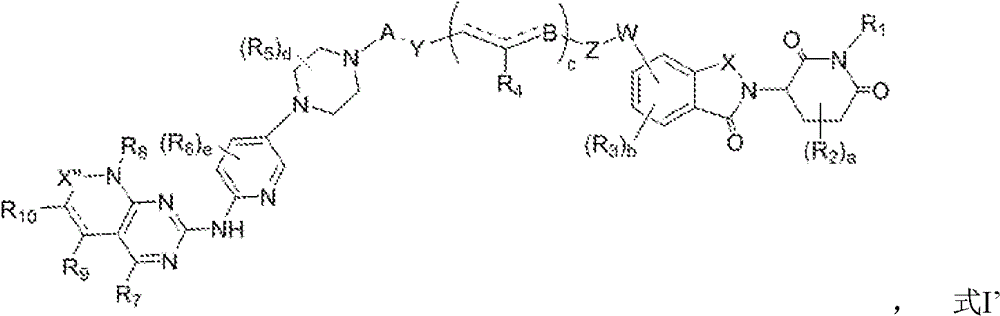
wherein each substituent is as described above.
In another preferred embodiment, in formula I, or I', represents a single bond.
In another preferred example, X is C (═ O).
In another preferred embodiment, R1、R8Each independently selected from: H. with or without substituents C1-4Alkyl, and C with or without substituents1-8A cycloalkyl group.
In another preferred embodiment, R2、R5Each independently selected from: hydrogen, and C with or without substituents1-4An alkyl group.
In another preferred embodiment, R3Selected from: hydrogen, and C with or without substituents1-4An alkyl group.
In another preferred embodiment, R6Selected from: hydrogen, C with or without substituents1-4Alkyl, OR29Wherein R is29Selected from H, C with or without substituents1-6An alkyl group.
In another preferred embodiment, R7Selected from: hydrogen, and C with or without substituents1-4An alkyl group.
In another preferred embodiment, R8Selected from: H. and C with or without substituents3-8A cycloalkyl group.
In a further preferred embodiment of the method,R9selected from: hydrogen, and C with or without substituents1-4An alkyl group.
In another preferred embodiment, R10Selected from: halogen, cyano, nitro, C with or without substituents1-4Alkyl, C (═ O) NR37R38Wherein R is37,R38Each independently selected from H, C with or without substituents1-4An alkyl group.
In another preferred embodiment, R4Selected from H, cyano, C with or without substituents1-6An alkyl group.
In another preferred embodiment, the structure of the compound is represented by formula I ″:

in another preferred embodiment, in formula I ', X' is selected from N, and CH.
In another preferred embodiment, X "is absent or selected from C (═ O), and CH2。
In another preferred embodiment, each of C1-8The cycloalkyl group is preferably C3-8Cycloalkyl (e.g. C)3-8Cycloalkyl groups).
In another preferred embodiment, each of C1-8The heterocyclic hydrocarbon group is preferably C3-8Heterocyclic hydrocarbon radicals (e.g. C)3-8Heterocycloalkyl).
In a second aspect of the present invention, there is provided a pharmaceutical composition comprising a compound of the first aspect, or a pharmaceutically acceptable salt, prodrug thereof, and a pharmaceutically acceptable carrier.
In another preferred embodiment, the effective amount refers to a therapeutically effective amount or an inhibitory effective amount, preferably 0.01 to 99.99%.
In another preferred embodiment, the pharmaceutical composition further comprises one or more additional antineoplastic agents.
In another preferred embodiment, the pharmaceutical composition is for use in inhibiting the activity of cyclin dependent kinase CDK.
In another preferred embodiment, the pharmaceutical composition is for use in the treatment of a disease associated with the activity or expression level of a cyclin dependent kinase CDK.
In a third aspect of the invention, there is provided the use of a compound according to the first aspect of the invention for:
(a) preparing a medicament for treating a disorder associated with activity or expression of a cyclin dependent kinase CDK;
(b) preparing a cyclin dependent kinase CDK targeted inhibitor or degrader;
(c) non-therapeutically inhibiting or degrading cyclin dependent kinase CDK in vitro;
(d) non-therapeutically inhibiting tumor cell proliferation in vitro; and/or
(e) Treating a disease associated with activity or expression of cyclin dependent kinase CDK.
In another preferred embodiment, the disease includes tumor, autoimmune disease, etc.
In another preferred example, the tumor includes breast cancer, ovarian epithelial cancer, liposarcoma, non-small cell lung cancer, liver cancer, mantle cell lymphoma, melanoma, multiple myeloma, head and neck cancer, and the like.
In another preferred embodiment, the autoimmune disease comprises rheumatoid arthritis, psoriasis, systemic lupus erythematosus, multiple sclerosis, organ transplant rejection, and the like.
In a fourth aspect of the invention, there is provided a process for the preparation of a compound of formula I as described in the first aspect of the invention, comprising the steps of:

(a) reacting a compound shown in a formula IV with a compound shown in a formula II in an inert solvent to obtain a compound shown in a formula I;
in the above formulae, each group is as defined above, M1Is a leaving group.
In another preferred example, the method further comprises the steps of:

(b) reacting a compound of formula III with a compound of formula V in an inert solvent to give a compound of formula II, M1、M2Is a leaving group.
In a fifth aspect of the invention there is provided a method of inhibiting or degrading a cyclin dependent kinase CDK comprising the steps of: administering to the subject an inhibitory effective amount of a compound of formula I as described in the first aspect of the invention or a pharmaceutically acceptable salt thereof, or administering to the subject an inhibitory effective amount of a pharmaceutical composition as described in the fourth aspect of the invention.
In another preferred embodiment, the inhibition is an in vitro non-therapeutic inhibition.
In another preferred embodiment, when an inhibitory effective amount of a compound of formula I according to claim 1 or a pharmaceutically acceptable salt thereof is administered to a subject, said inhibitory effective amount is 0.001-500nmol/L, preferably 0.01-200 nmol/L.
In a sixth aspect of the invention, there is provided a method of treating a disorder associated with cyclin dependent kinase CDK activity or expression, comprising: administering to a subject a therapeutically effective amount of a compound of formula I according to the first aspect of the invention, or a pharmaceutical composition according to the fourth aspect of the invention.
In another preferred embodiment, the subject is a mammal; preferably, the mammal is a human.
In another preferred embodiment, the disease associated with cyclin-dependent kinase CDK activity or expression is a tumor or an autoimmune disease.
In a seventh aspect of the invention, there is provided a method of inhibiting cell proliferation in vitro, the method comprising: administering to the subject an inhibitory effective amount of a compound of formula I as described in the first aspect of the invention, or a pharmaceutical composition as described in the second aspect of the invention.
In another preferred embodiment, the cell is a tumor cell.
It is to be understood that within the scope of the present invention, the above-described features of the present invention and those specifically described below (e.g., in the examples) may be combined with each other to form new or preferred embodiments. Not to be reiterated herein, but to the extent of space.
Detailed Description
The present inventors have made extensive and intensive studies to prepare a compound having a structure represented by formula I and found that it has cyclin-dependent kinase CDK inhibitory and degrading activities. The compounds have inhibitory effect on cyclin-dependent kinase CDK at very low concentration, and have excellent inhibitory activity, so that the compounds can be used for treating diseases related to cyclin-dependent kinase CDK sex or expression level, such as tumors. The present invention has been completed based on this finding.
The invention discloses a novel compound and application thereof in inhibiting and degrading cyclin dependent kinase CDK. These compounds inhibit and degrade cyclin dependent kinase CDK and are useful in the treatment of non-small cell lung cancer.
Term(s) for
In the present invention, the term "C1-8The hydrocarbyl group means a functional group containing only carbon and hydrogen atoms, wherein the number of carbon atoms is 1 to 8. The hydrocarbyl group can be regarded as a radical remaining after the corresponding hydrocarbon loses one hydrogen atom, and can be an alkyl group, a cycloalkyl group, an alkenyl group, an alkynyl group or the like; the structure can be straight chain, branched chain or cyclic; may be aliphatic or aromatic.
The term "C1-6The "alkyl group" means a straight or branched alkyl group having 1 to 6 carbon atoms, such as methyl, ethyl, propyl, isopropyl, butyl, isobutyl, sec-butyl, tert-butyl, or the like.
The term "alkoxy" as used herein includes O-alkyl, wherein "alkyl" is as defined above.
The term "halo" as used herein, unless otherwise indicated, includes fluoro, chloro, bromo or iodo.
The compounds of the present invention may contain double bonds. When containing such double bonds, the compounds of the present invention exist in cis, trans, or mixtures thereof.
Halogen as used herein includes fluorine, chlorine, bromine and iodine.
Unless otherwise indicated, alkyl groups and the alkyl portion of alkoxy groups referred to herein may be straight chain, branched chain or cyclic.
In the present invention, the term "cycloalkyl group" refers to a functional group containing both carbon and hydrogen atoms. Including cycloalkyl, cycloalkenyl (containing at least one carbon-carbon double bond), and aryl. They may be monocyclic, bicyclic and polycyclic. They may be spiro or fused rings.
In the present invention, the term "heterocyclic hydrocarbon group" means a functional group containing carbon, hydrogen and at least one heteroatom other than carbon and hydrogen. Including heterocycloalkyl, heterocycloalkenyl (containing at least one carbon-carbon double bond), and heteroaryl. One or more of the ring-forming atoms in the ring is a heteroatom. The heteroatoms may be O, N and S atoms, and various combinations thereof. They may be monocyclic, bicyclic and polycyclic. They may be spiro or fused rings.
In the present invention, the term "substituent" includes, but is not limited to, fluorine, chlorine, bromine, cyano, hydroxyl, amino, C1-6Hydrocarbyloxy, C1-6Halogenated hydrocarbon group, C1-6Acyl radical, C1-6A sulfonyl group.
The term "hydrocarbyloxy" as used herein refers to an O-hydrocarbyl group, wherein "hydrocarbyl" is as defined above.
The term "alkoxycarbonyl" as used herein refers to a C (═ O) O-hydrocarbyl group, where "hydrocarbyl" is as defined above.
The term "amine" as used herein refers to N (H or hydrocarbyl 1) (H or hydrocarbyl 2) wherein "hydrocarbyl" is as defined above, e.g. -N (C)1-6Alkyl) (C1-6Alkyl groups).
The term "aminocarbonyl" as used herein refers to C (═ O) -amine groups, where "amine groups" are as defined above.
The term "amido", as used herein, refers to an N (H or hydrocarbyl) -C (═ O) -hydrocarbyl group, where the "hydrocarbyl group" is as defined above.
As used herein, the terms "comprising," "including," or "including" mean that the various ingredients may be used together in a mixture or composition of the invention. Thus, the terms "consisting essentially of and" consisting of are encompassed by the term "comprising.
In the present invention, the term "pharmaceutically acceptable" ingredient refers to a substance that is suitable for use in humans and/or animals without undue adverse side effects (such as toxicity, irritation, and allergic response), i.e., at a reasonable benefit/risk ratio.
In the present invention, the term "effective amount" refers to an amount of a therapeutic agent that treats, alleviates, or prevents a target disease or condition, or an amount that exhibits a detectable therapeutic or prophylactic effect. The precise effective amount for a subject will depend upon the size and health of the subject, the nature and extent of the disorder, and the therapeutic agent and/or combination of therapeutic agents selected for administration. Therefore, it is not useful to specify an exact effective amount in advance. However, for a given condition, the effective amount can be determined by routine experimentation and can be determined by a clinician.
Herein, unless otherwise specified, the term "substituted" means that one or more hydrogen atoms on a group are replaced with a substituent selected from the group consisting of: halogen, unsubstituted or halogenated C1-6Alkyl, unsubstituted or halogenated C2-6Acyl, unsubstituted or halogenated C1-6Alkyl-hydroxy.
Unless otherwise specified, all occurrences of a compound in the present invention are intended to include all possible optical isomers, such as a single chiral compound, or a mixture of various chiral compounds (i.e., a racemate). In all compounds of the present invention, each chiral carbon atom may optionally be in the R configuration or the S configuration, or a mixture of the R configuration and the S configuration.
As used herein, the term "compounds of the invention" refers to compounds of formula I. The term also includes various crystalline forms, pharmaceutically acceptable salts, hydrates or solvates of the compounds of formula I.
As used herein, the term "pharmaceutically acceptable salt" refers to a salt of a compound of the present invention with an acid or base that is suitable for use as a pharmaceutical. Pharmaceutically acceptable salts include inorganic and organic salts. One preferred class of salts is that formed by reacting a compound of the present invention with an acid. Suitable acids for forming the salts include, but are not limited to: inorganic acids such as hydrochloric acid, hydrobromic acid, hydrofluoric acid, sulfuric acid, nitric acid, phosphoric acid, etc., organic acids such as formic acid, acetic acid, propionic acid, oxalic acid, malonic acid, succinic acid, fumaric acid, maleic acid, lactic acid, malic acid, tartaric acid, citric acid, picric acid, methanesulfonic acid, phenylmethanesulfonic acid, benzenesulfonic acid, etc.; and acidic amino acids such as aspartic acid and glutamic acid.
Compounds and pharmaceutically acceptable salts thereof
The present invention relates to compounds of formula I or a pharmaceutically acceptable salt thereof;

wherein:
-represents a single bond

A is absent or selected from C (═ O), C (═ O) X1, SOX1, SO2X1, C with or without substituents1-8Hydrocarbyl, C with or without substituents1-8Cycloalkyl group, and C with or without substituent1-8A heterocyclic hydrocarbon group; wherein X1 is absent or selected from (CR)35R36)kO、(CR35R36)kS and NR14(ii) a Wherein R is35、R36、R14Each independently selected from H, C with or without substituents1-8With or without substituents C1-8And C with or without substituents1-8K is an integer between 0 and 3;
w is absent or selected from O, NR17、-X2C(=O)X3、-X2S(=O)gX3; whereinR17Is H, C with or without substituents1-8With or without substituents C1-8Cycloalkyl, with or without substituents C1-8The heterocyclic hydrocarbon group of (a); wherein X2 and X3 are independently deleted or selected from O, S, NR18(ii) a Wherein g is an integer from 0 to 2; wherein R is18Is H, C with or without substituents1-8With or without substituents C1-8Cycloalkyl, with or without substituents C1-8The heterocyclic hydrocarbon group of (a);
y is (CR)22R23)h、CHX4(CR22R23)h、CX4=CH(CR22R23)hOr (CR)22R23)h(ii) a Wherein h is an integer between 0 and 30; wherein R is22、R23Each independently selected from H, cyano, hydroxy, amino, C with or without substituents1-8With or without substituents C1-8Cycloalkyl, with or without substituents C1-8A heterocyclic hydrocarbon group of (A), C with or without substituents1-8Hydrocarbyloxy groups of (a); wherein X4 ═ H, halogen, cyano, nitro, hydroxy, with or without substituent C1-8Hydrocarbyloxy, with or without substituents C1-8Alkoxycarbonyl, with or without substituents C1-8Amino, with or without substituents C1-8Ester group, with or without substituents C1-8Aminocarbonyl, with or without substituents C1-8Hydrocarbyl, with or without substituents C1-8Cycloalkyl, with or without substituents C1-8A heterocyclic hydrocarbon group;
z is (CR)24R25)i、CHX5(CR24R25)i、CX5=CH(CR24R25)iOr C ≡ C (CR)24R25)i(ii) a Wherein i is an integer between 0 and 30; wherein R is24、R25Each independently selected from H, cyano, hydroxy, amino, C with or without substituents1-8With or without substituents C1-8Cycloalkyl, with or without substituents C1-8Heterocycloalkyl radicals, with or without substituents C1-8A hydrocarbyloxy group; wherein X5 ═ H, halogen, cyano, nitro, hydroxy, with or without substituent C1-8With or without substituents C1-8Alkoxycarbonyl, with or without substituents C1-8Amino, with or without substituents C1-8Ester group, with or without substituents C1-8Aminocarbonyl, with or without substituents C1-8Hydrocarbyl, with or without substituents C1-8Cycloalkyl, with or without substituents C1-8A heterocyclic hydrocarbon group;
b is absent or selected from O, C ═ O, S, NR15、-NR15C(=O)-、-C(=O)NR15-、-C(=O)O-、OC(=O)O-、-NR15C(=O)O-、-OC(=O)NR15-、-NR15C(=O)NR16-, C with or without substituents1-12With or without substituents C1-12And C with or without substituents1-12The heterocyclic hydrocarbon group of (a); wherein R is15、R16Each independently selected from H, C with or without substituents1-8With or without substituents C1-8And C with or without substituents1-8The heterocyclic hydrocarbon group of (a);
x is selected from CR19R20、C(=O)、S(=O)、SO2、NR2(ii) a Wherein R is19、R20Each independently selected from H, cyano, hydroxy, amino, C with or without substituents1-8With or without substituents C1-8Cycloalkyl, with or without substituents C1-8A heterocyclic hydrocarbon group of (A), C with or without substituents1-8Hydrocarbyloxy groups of (a); wherein R is21Selected from H, C with or without substituents1-8With or without substituents C1-8Cycloalkyl, with or without substituents C1-8The heterocyclic hydrocarbon group of (a);
x 'is absent or when X' is not substituted,x' is selected from NH and CH2O, S, C (═ O), S (═ O), and S (═ O)2(ii) a X' when substituted is selected from N, and CH;
x' is absent or selected from C (═ O), CH2S (═ O), and S (═ O)2;
R1、R8Each independently selected from: H. with or without substituents C1-8Hydrocarbyl, with or without substituents C1-8Cycloalkyl, with or without substituents C1-8Heterocycloalkyl, C with or without substituents1-6An acyl group;
R2、R5each independently selected from: hydrogen, OR26、NR27R28Cyano, halogen, C with or without substituents1-8Hydrocarbyl, with or without substituents C1-8Cycloalkyl, with or without substituents C1-8Heterocycloalkyl, C with or without substituents1-6Acyl, C with or without substituents1-6An amide group; wherein R is26、R27、R28Each independently selected from H, C with or without substituents1-8With or without substituents C1-8Cycloalkyl, C with or without substituents1-8A heterocyclic hydrocarbon group;
R3、R6、R7、R9、R10each independently selected from: H. OR (OR)29、NR30R31Cyano, halogen, nitro, C with or without substituents1-8Hydrocarbyl, cycloalkyl, heterocycloalkyl, X6S (═ O)jR32、X6C(=O)R33(ii) a Wherein j is an integer between 0 and 2; wherein R is29,R30,R31,R32,R33Each independently selected from H, C with or without substituents1-8Hydrocarbyl, C with or without substituents1-8Cycloalkyl, C with or without substituents1-8Heterocyclic hydrocarbyl, amino; wherein X6 is absent or selected from O, S, NR34(ii) a Wherein R is34Is H, C with or without substituents1-8With or without substituents C1-8Cycloalkyl, C with or without substituents1-8A heterocyclic hydrocarbon group;
R4selected from H, cyano, carboxyl, C with or without substituents1-8With or without substituents C1-8A hydrocarbyloxycarbonyl group;
a is an integer between 0 and 5 (e.g., 1, 2, 3, 4, 5);
b is an integer between 0 and 3 (e.g., 1, 2, 3);
c is an integer between 0 and 30 (e.g., 1, 2, 3, 4, 5, 6, 7, 8, 9);
d is an integer between 0 and 9 (e.g., 1, 2, 3, 4, 5, 6, 7, 8, 9);
e is an integer between 0 and 3 (e.g., 1, 2, 3).
In another preferred embodiment, each of the C1-8 cyclic hydrocarbon groups is preferably a C3-8 cyclic hydrocarbon group (e.g., a C3-8 cycloalkyl group).
In another preferred embodiment, each of the C1-8 heterocyclic hydrocarbon groups is preferably a C3-8 heterocyclic hydrocarbon group (e.g., a 4-10 membered heterocycloalkyl group containing 3-8 carbon atoms).
In a preferred embodiment of the invention, the compound is selected from the group consisting of:


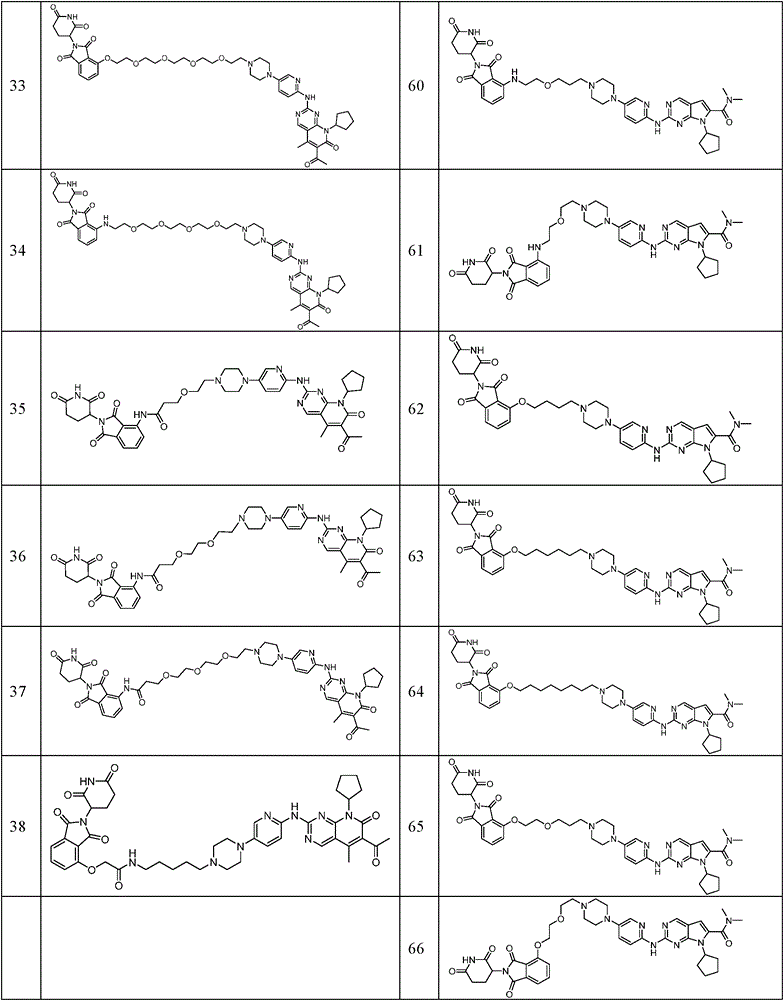
the compound package of the present invention may form pharmaceutically acceptable salts with inorganic acids, organic acids or bases. The inorganic acid includes but is not limited to hydrochloric acid, hydrobromic acid, nitric acid, perchloric acid, sulfuric acid or phosphoric acid, etc.; such organic acids include, but are not limited to, methanesulfonic acid, trifluoromethanesulfonic acid, ethanesulfonic acid, benzenesulfonic acid, p-toluenesulfonic acid, fumaric acid, oxalic acid, acetic acid, maleic acid, ascorbic acid, lactic acid, tartaric acid, malonic acid, glycolic acid, succinic acid, propionic acid, and the like; the base includes, but is not limited to, inorganic salts and amines.
The term pharmaceutically acceptable salts refers to those salts which are, according to medical judgment, suitable for use in contact with the tissues of humans and mammals without excessive toxicity, irritation, allergic response, and the like. Pharmaceutically acceptable salts are well known in the art.
The invention also encompasses pharmaceutical compositions containing prodrugs of compounds of formula I. Prodrugs include compounds wherein the precursor molecule is covalently bonded to a free carboxyl, hydroxyl, amino or amine group of the compound of formula I via a carbonate, carbamate, amide, alkyl ester, phosphate, phosphoramidate linkage.
Preparation of the Compounds
Preparation method
The process for the preparation of the compounds of formula I according to the invention is described in more detail below, but these particular processes do not limit the invention in any way. The compounds of the present invention may also be conveniently prepared by optionally combining various synthetic methods described in the present specification or known in the art, and such combinations may be readily carried out by those skilled in the art to which the present invention pertains.
The following reaction scheme illustrates the preparation of the compounds of the present invention. Unless otherwise indicated, A, B, W, Y, Z, X, X', X ", a, b, c, d, e, R in the reaction schemes and subsequent discussion1、R2、R3、R4、R5、R6、R7、R8、R9、R10Is as defined above, M1、M2Is a leaving group.
In a preferred embodiment of the present invention, the present invention provides a process for the preparation of a compound of formula I according to the present invention, comprising the steps of:

(a) reacting a compound shown in a formula IV with a compound shown in a formula II in an inert solvent to obtain a compound shown in a formula I;
in the above formulae, each group is as defined above, M1Is a leaving group.
In another preferred example, the method further comprises the steps of:

(b) reacting a compound of formula III with a compound of formula V in an inert solvent to give a compound of formula II, M1、M2Is a leaving group.
In general, compounds of formula I can be obtained from formula III as described in the following scheme:
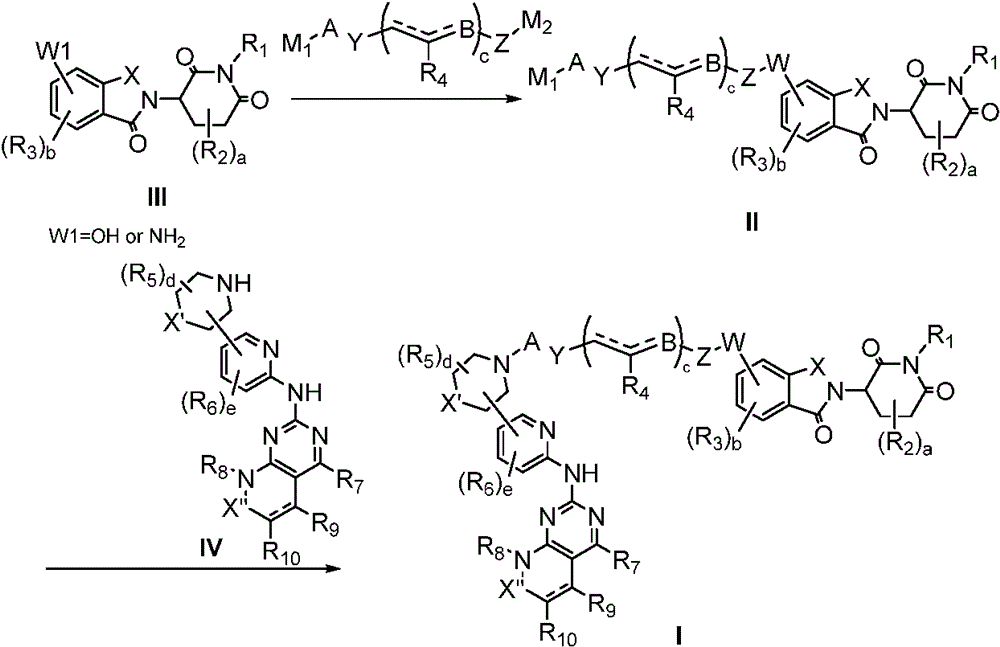
in compound II, when W is an ether, it can be prepared by direct nucleophilic substitution of formula III (W1 ═ OH) with an intermediate containing a leaving group under the action of a base, or by reaction with an alcohol using a mitsunobu reaction; when W is ester, carbamate (NHCO)2) When the compound is prepared, the compound can be prepared by reacting formula III (W1 ═ OH) with acyl chloride, activated ester (amide), carboxylic acid and isocyanate under the action of alkali; when W is an amine, formula III (W1 ═ NH) can be used2) Direct nucleophilic substitution with an intermediate containing a leaving group under the action of a base can also be prepared by using a compound of formula III (W1 ═ NH)2) (ii) reductive amination with aldehydes/ketones; when W is an amide, alkoxycarbonylamine (OCONH), or urea, formula III (W1 ═ NH) can be used2) Reacting with corresponding acyl chloride, activated ester (amide), carboxylic acid and isocyanate under the action of alkali.
In compound I, when A is linked to the nitrogen atom by a C-N bond, it can be prepared by direct substitution or reductive amination; when A is attached to the nitrogen atom by means of an amide, urea, carbamate, sulfonamide, thioamide, it can be prepared from the corresponding acid chlorides, activated esters (amides), carboxylic acids, isocyanates, sulfonyl chlorides, sulfuryl chlorides.
In general, depending on the nature of the linkages A and W, compounds I may also be obtained by linking formula IV to an intermediate chain and then reacting with formula III. The chemical synthesis method is the same as that described above.
The compounds of formula III, IV can be obtained by known synthetic methods or readily obtained by commercial purchase.
Use of compounds of formula I
The compounds of formula I may be used for one or more of the following uses:
(a) preparing a medicament for treating a disorder associated with activity or expression of a cyclin dependent kinase CDK;
(b) preparing a cyclin dependent kinase CDK targeted inhibitor or degrader;
(c) non-therapeutically inhibiting or degrading cyclin dependent kinase CDK in vitro;
(d) non-therapeutically inhibiting cell proliferation in vitro; and/or
(e) Treating a disease associated with activity or expression of cyclin dependent kinase CDK.
In another preferred embodiment, the disease associated with cyclin-dependent kinase CDK activity or expression is a tumor or an autoimmune disease.
The compounds of formula I of the present invention are useful for preparing a pharmaceutical composition comprising: (i) an effective amount of a compound of formula I, or a pharmaceutically acceptable salt thereof; and (ii) a pharmaceutically acceptable carrier.
In another preferred embodiment, the effective amount refers to a therapeutically effective amount or an inhibitory effective amount.
The compounds of formula I of the present invention may also be used in a method for inhibiting or degrading cyclin dependent kinase CDK, either in vitro non-therapeutic or therapeutic.
In another preferred embodiment, when an inhibitory effective amount of a compound of formula I of the present invention or a pharmaceutically acceptable salt thereof is administered to a subject, said inhibitory effective amount is 0.001-500nmol/L, preferably 0.01-200 nmol/L.
In particular, the present invention also provides a method of treating a disease associated with cyclin dependent kinase CDK activity or expression comprising: administering to the subject a therapeutically effective amount of a compound of formula I, or said pharmaceutical composition comprising a compound of formula I as an active ingredient.
Pharmaceutical compositions and methods of administration
Since the compound of the present invention has excellent inhibitory activity against cyclin dependent kinase CDK, the compound of the present invention and its various crystalline forms, pharmaceutically acceptable inorganic or organic salts, hydrates or solvates, and pharmaceutical compositions containing the compound of the present invention as a main active ingredient can be used for the treatment, prevention and alleviation of diseases associated with CDK activity or expression level. According to the prior art, the compounds of the present invention are useful in the treatment of diseases including tumors and the like.
The pharmaceutical composition of the present invention comprises the compound of the present invention or a pharmacologically acceptable salt thereof in a safe and effective amount range and a pharmacologically acceptable excipient or carrier. Wherein "safe and effective amount" means: the amount of the compound is sufficient to significantly improve the condition without causing serious side effects. Typically, the pharmaceutical composition contains 1-2000mg of a compound of the invention per dose, more preferably, 5-200mg of a compound of the invention per dose. Preferably, said "dose" is a capsule or tablet.
"pharmaceutically acceptable carrier" refers to: one or more compatible solid or liquid fillers or gel substances which are suitable for human use and must be of sufficient purity and sufficiently low toxicity. By "compatible" is meant herein that the components of the composition are capable of intermixing with and with the compounds of the present invention without significantly diminishing the efficacy of the compounds. Examples of pharmaceutically acceptable carrier moieties are cellulose and its derivatives (e.g. sodium carboxymethylcellulose, sodium ethylcellulose, cellulose acetate, etc.), gelatinGelatin, pulvis Talci, solid lubricant (such as stearic acid, magnesium stearate), calcium sulfate, vegetable oil (such as soybean oil, oleum Sesami, peanut oil, oleum Olivarum, etc.), polyalcohol (such as propylene glycol, glycerol, mannitol, sorbitol, etc.), emulsifier (such as propylene glycol, glycerol, mannitol, sorbitol, etc.) ) Wetting agents (e.g., sodium lauryl sulfate), coloring agents, flavoring agents, stabilizers, antioxidants, preservatives, pyrogen-free water, and the like.
The mode of administration of the compounds or pharmaceutical compositions of the present invention is not particularly limited, and representative modes of administration include (but are not limited to): oral, intratumoral, rectal, parenteral (intravenous, intramuscular or subcutaneous), and topical administration.
Solid dosage forms for oral administration include capsules, tablets, pills, powders and granules. In these solid dosage forms, the active compound is mixed with at least one conventional inert excipient (or carrier), such as sodium citrate or dicalcium phosphate, or with the following ingredients: (a) fillers or extenders, for example, starch, lactose, sucrose, glucose, mannitol and silicic acid; (b) binders, for example, hydroxymethylcellulose, alginates, gelatin, polyvinylpyrrolidone, sucrose and acacia; (c) humectants, for example, glycerol; (d) disintegrating agents, for example, agar-agar, calcium carbonate, potato or tapioca starch, alginic acid, certain complex silicates, and sodium carbonate; (e) slow solvents, such as paraffin; (f) absorption accelerators, e.g., quaternary ammonium compounds; (g) wetting agents, such as cetyl alcohol and glycerol monostearate; (h) adsorbents, for example, kaolin; and (i) lubricants, for example, talc, calcium stearate, magnesium stearate, solid polyethylene glycols, sodium lauryl sulfate, or mixtures thereof. In capsules, tablets and pills, the dosage forms may also comprise buffering agents.
Solid dosage forms such as tablets, dragees, capsules, pills, and granules can be prepared using coatings and shells such as enteric coatings and other materials well known in the art. They may contain opacifying agents and the release of the active compound or compounds in such compositions may be delayed in release in a certain part of the digestive tract. Examples of embedding components which can be used are polymeric substances and wax-like substances. If desired, the active compound may also be in microencapsulated form with one or more of the above-mentioned excipients.
Liquid dosage forms for oral administration include pharmaceutically acceptable emulsions, solutions, suspensions, syrups or tinctures. In addition to the active compounds, the liquid dosage forms may contain inert diluents commonly employed in the art such as, for example, water or other solvents, solubilizing agents and emulsifiers such as ethyl alcohol, isopropyl alcohol, ethyl carbonate, ethyl acetate, propylene glycol, 1, 3-butylene glycol, dimethylformamide and oils, in particular, cottonseed, groundnut, corn germ, olive, castor and sesame oils or mixtures of such materials and the like.
In addition to these inert diluents, the compositions may also contain adjuvants such as wetting agents, emulsifying and suspending agents, sweetening, flavoring, and perfuming agents.
Suspensions, in addition to the active compounds, may contain suspending agents as, for example, ethoxylated isostearyl alcohols, polyoxyethylene sorbitol and sorbitan esters, microcrystalline cellulose, aluminum methoxide and agar, or mixtures of these substances, and the like.
Compositions for parenteral injection may comprise physiologically acceptable sterile aqueous or anhydrous solutions, dispersions, suspensions or emulsions, and sterile powders for reconstitution into sterile injectable solutions or dispersions. Suitable aqueous and nonaqueous carriers, diluents, solvents or vehicles include water, ethanol, polyols and suitable mixtures thereof.
Dosage forms for topical administration of the compounds of the present invention include ointments, powders, patches, sprays, and inhalants. The active ingredient is mixed under sterile conditions with a physiologically acceptable carrier and any preservatives, buffers, or propellants which may be required if necessary.
The compounds of the present invention may be administered alone or in combination with other pharmaceutically acceptable compounds.
When the pharmaceutical composition is used, a safe and effective amount of the compound of the present invention is suitable for mammals (such as human beings) to be treated, wherein the administration dose is a pharmaceutically-considered effective administration dose, and for a human body with a weight of 60kg, the daily administration dose is usually 1 to 2000mg, preferably 5 to 500 mg. Of course, the particular dosage will depend upon such factors as the route of administration, the health of the patient, and the like, and is within the skill of the skilled practitioner.
The main advantages of the invention include:
1. provides a compound shown as a formula I.
2. Novel CDK inhibitors and degradants which inhibit the activity of CDKs and degrade CDKs enzymes at very low concentrations, and their preparation and use are provided.
3. Pharmaceutical compositions for treating diseases associated with CDK enzymatic activity are provided.
The invention will be further illustrated with reference to the following specific examples. It should be understood that these examples are for illustrative purposes only and are not intended to limit the scope of the present invention. The experimental procedures, in which specific conditions are not noted in the following examples, are generally carried out under conventional conditions or conditions recommended by the manufacturers. Unless otherwise indicated, percentages and parts are percentages and parts by weight.
EXAMPLE 1 preparation of Compound 3
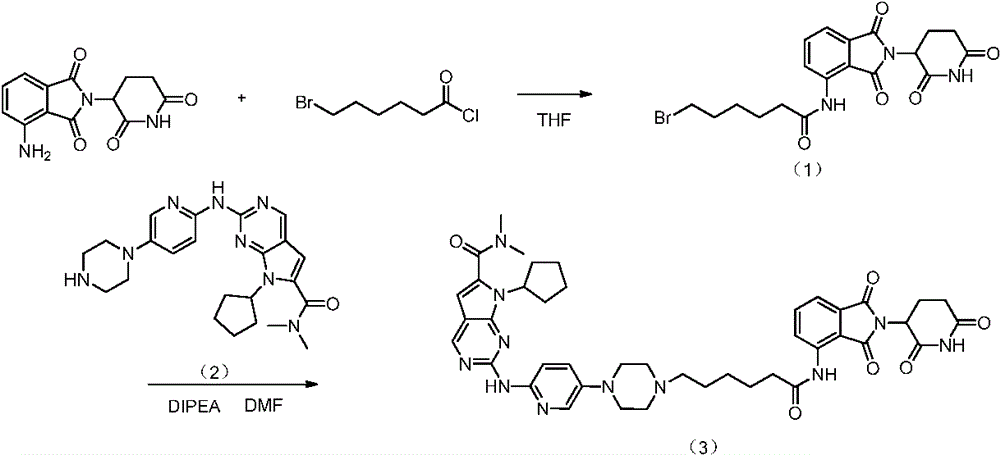
The first step is as follows:
2.14g of 6-bromohexanoyl chloride and 1.37g of pomalidomide are dissolved in 50ml of THF and stirred under reflux for 8 h. The solvent was removed under reduced pressure, and column chromatography was performed to give 1.22g of compound (1). Ms (esi): 450[ M + H ]]+。
The second step is that:
dissolving 1.00g of the compound (1), 1.19g of the compound (2) and 0.57g of diisopropylethylamine in 30ml of DMF, stirring at 80 ℃ for 6 hours, cooling to room temperature, concentrating, and performing column chromatography to obtain 1.21g of the compound (3), yield: 66.7 percent. Ms (esi): 804[ M + H ]]+。1H NMR(400MHz,CDCl3)δ:9.79(br,1H),8.70(s,1H),8.34(d,J=9.2Hz,1H),8.24(s,1H),8.03(d,J=3.2Hz,1H),7.49(dd,J=8.4,7.6Hz,1H),7.33(dd,J=9.6,3.2Hz,1H),7.11(d,J=6.8Hz,1H),6.91(d,J=8.4Hz,1H),6.52(t,J=5.6Hz,1H),6.43(s,1H),4.90(dd,J=12.0,5.6Hz,1H),4.78(m,1H),3.64-3.76(m,4H),3.15(s,6H),2.53-2.90(m,6H),2.39(t,J=7.2Hz,2H),1.35-2.16(m,18H)。
EXAMPLE 2 preparation of Compound 8
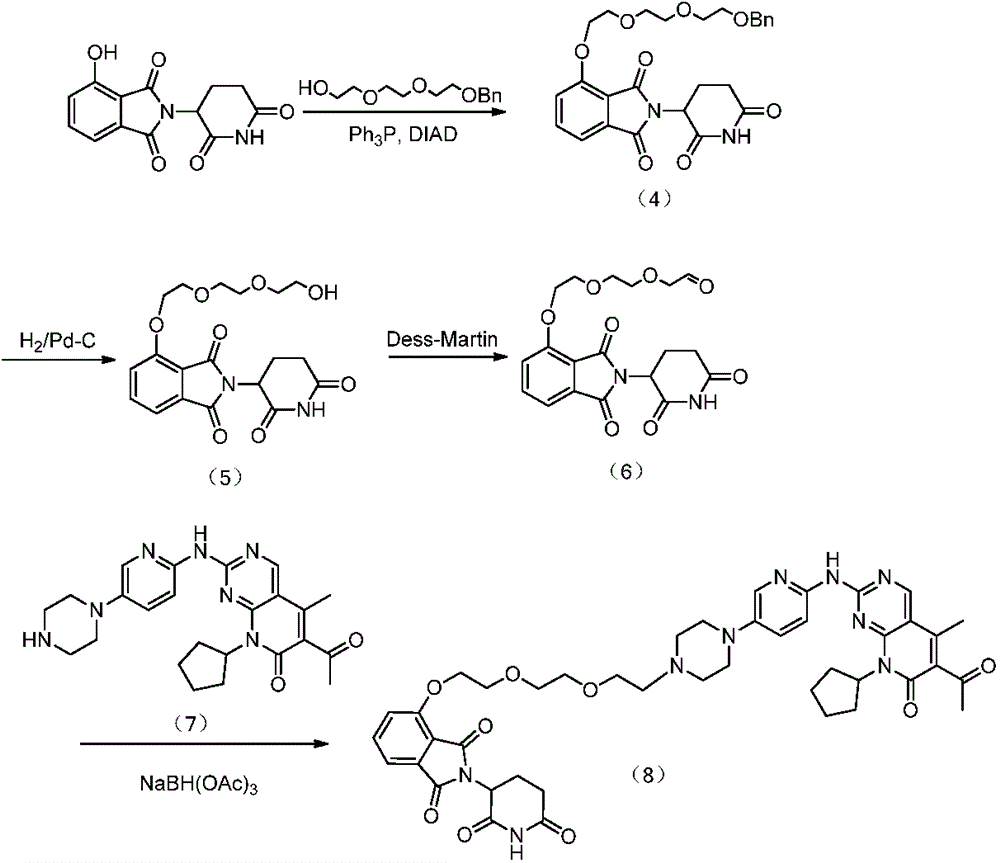
The first step is as follows:
100mg of 4-hydroxythalidomide, 96mg of triethylene glycol monobenzyl ether and 100mg of triphenylphosphine were dissolved in 10ml of anhydrous THF, and 95mg of DIAD was added dropwise thereto, followed by reaction at room temperature for 2 hours. THF was removed under reduced pressure, and column chromatography was performed to purify the residue to give 110mg of the compound (4). Ms (esi): 497[ M + H]+。
The second step is that:
100mg of compound (4) and 100mg of 10% Pd-C were added to 10ml of methanol, and the mixture was hydrogenated at room temperature overnight. Filtration, concentration of the filtrate and purification of the residue by column chromatography gave 40mg of compound (5). Ms (esi): 407[ M + H]+。
The third step:
30mg of the compound (5) was dissolved in 5ml of DCM, and 47mg of Dess-martin oxidant was added thereto to conduct a reaction at room temperature for 3 hours. Adding NaHCO3Saturated aqueous solution and Na2S2O3Stirring for 5min to obtain organic layer, and treating with anhydrous Na2S2O3Drying and concentrating to dryness to obtain the compound (6) which is directly used for the next reaction.
After dissolving Compound (6) in DCM 5ml, 50mg of starting Material (7) and NaBH (OAc) were added330mg, at room temperature overnight, and after DCM was distilled off under reduced pressure and purified by column chromatography, 30mg of compound (8) was obtained. Ms (esi): 836[ M + H ]]+。1H NMR(400MHz,CDCl3)δ:9.85(br,1H),8.83(s,1H),8.75(br,1H),8.15(d,J=8.8Hz,1H),8.07(d,J=2.8Hz,1H),7.67(dd,J=8.4,7.6Hz,1H),7.47(d,J=6.8Hz,1H),7.32(dd,J=8.8,2.8Hz 1H),7.26(d,J=8.4Hz,1H),5.87(m,1H),4.95(dd,J=12.0,5.2Hz,1H),4.35(t,J=4.8Hz,2H),3.95(t,J=4.8Hz,2H),3.80(m,2H),3.66(m,4H),3.22(m,4H),2.68-2.92(m,8H),2.55(s,3H),2.48-2.65(m,1H),2.37(s,3H),2.30-2.41(m,2H),2.00-2.16(m,3H),1.86(br,2H),1.67(m,2H)。
EXAMPLE 3 preparation of Compound 11

The first step is as follows:
benzyl 2- (2- (2-bromoethoxy) ethoxy) acetate 174mg, potassium carbonate 100mg, potassium iodide 20mg and pomalidomide 100mg were added to 20ml of DMF (N, N-dimethylformamide) and reacted at 80 ℃ overnight. The reaction solution was purified by column chromatography to give 113mg of the compound (9). Ms (esi): 510[ M + H]+。
The second step is that:
100mg of Compound (9) and 10% Pd-C100mg were added to 10ml of methanol, and the mixture was hydrogenated at room temperature overnight. Filtration, concentration of the filtrate and purification of the residue by column chromatography gave 73mg of compound (10). MS (ESI negative ion): 418[ M-H ]]-。
The third step:
50mg of the compound (10) and 50mg of the starting material (7) were dissolved in 5ml of methylene chloride, and 20mg of HOBt (1-hydroxybenzotriazole) and 40mg of EDC (1- (3-dimethylaminopropyl) -3-ethylcarbodiimide hydrochloride) were added to the solution to conduct a reaction at room temperature overnight. Dichloromethane was distilled off under reduced pressure, and column chromatography purification was performed to obtain compound (11), 32mg. ms (ESI): 849[ M + H ]]+。1H NMR(400MHz,CDCl3)δ9.73(br,1H),8.82(s,1H),8.52(br,1H),8.14(d,J=9.2Hz,1H),8.08(d,J=2.8Hz,1H),7.49(dd,J=8.4,7.2Hz,1H),7.33(dd,J=9.2,2.8Hz,1H),7.11(d,J=7.2Hz,1H),6.91(d,J=8.4Hz,1H),6.52(t,J=5.6Hz,1H),5.87(m,1H),4.90(dd,J=12.0,5.2Hz,1H),4.53(br,2H),3.58-3.76(m,10H),3.48(dd,J=11.2,5.6Hz,2H),3.22(t,J=4.8Hz,4H),2.65-2.91(m,4H),2.55(s,3H),2.37(s,3H),2.30-2.39(m,2H),2.00-2.16(m,2H),1.62-1.92(m 4H)。
EXAMPLE 4 preparation of Compound 14

The first step is as follows:
200mg of the starting material (7) was dissolved in 20ml of methylene chloride, and 100mg of triethylamine and 135mg of 5-benzyloxypentanesulfonyl chloride were added to the solution to conduct a reaction at room temperature overnight. The solvent was distilled off under reduced pressure, and column chromatography purification was carried out to give 254mg of the compound (12). Ms (esi): 688[ M + H]+。
The second step is that:
200mg of compound (12) and 200mg of 10% Pd-C were added to 20ml of methanol, and the mixture was hydrogenated at room temperature overnight. Filtration, concentration of the filtrate and purification by column chromatography gave compound (13)161mg. ms (ESI): 598[ M + H ]]+。
The third step:
50mg of 4-hydroxythalidomide, 50mg of triphenylphosphine and 80mg of the compound (13) were dissolved in 5ml of anhydrous tetrahydrofuran, and 50mg of DIAD (diisopropyl azodicarboxylate) was added dropwise and reacted at room temperature for 3 hours. The tetrahydrofuran was removed under reduced pressure, and column chromatography was performed to purify the residue to obtain 36mg of the compound (14). Ms (esi): 854[ M + H ]]+。1H NMR(400MHz,CDCl3)δ9.92(br,1H),8.83(s,1H),8.75(br,1H),8.16(d,J=8.4Hz,1H),8.08(d,J=2.8Hz,1H),7.67(dd,J=8.4,7.6Hz,1H),7.49(d,J=7.2Hz,1H),7.33(dd,J=8.4,2.8Hz 1H),7.25(d,J=8.4Hz,1H),5.82(m,1H),4.93(dd,J=12.0,5.6Hz,1H),3.95(t,J=7.2Hz,2H),3.78(t,J=6.8Hz,2H),3.50-3.68(m,4H),2.55(s,3H),2.37(s,3H),2.32-2.73(m,4H),2.00-2.26(m,10H),1.34-1.92(m,8H)。
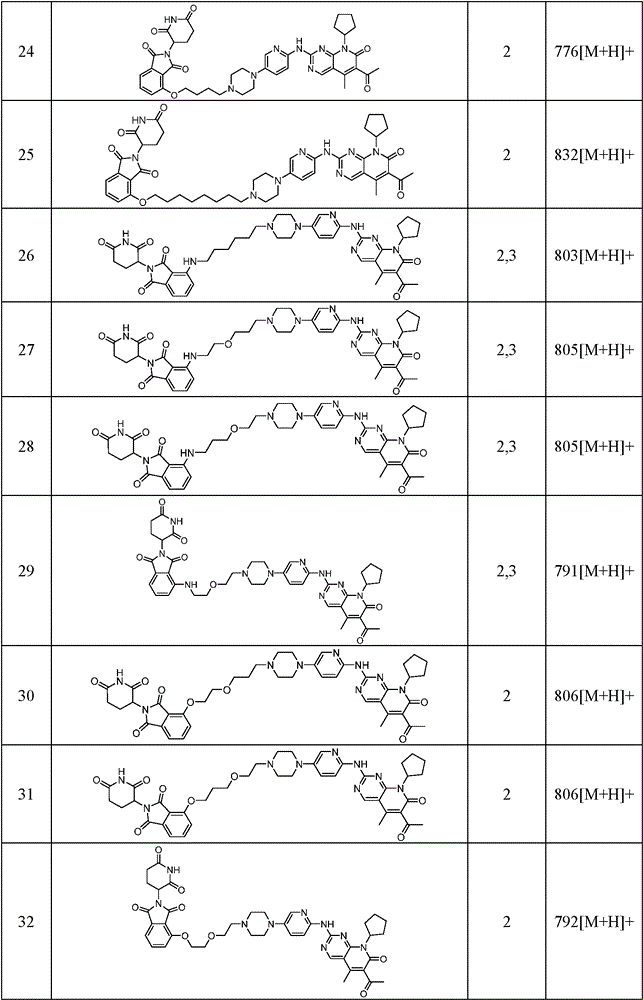
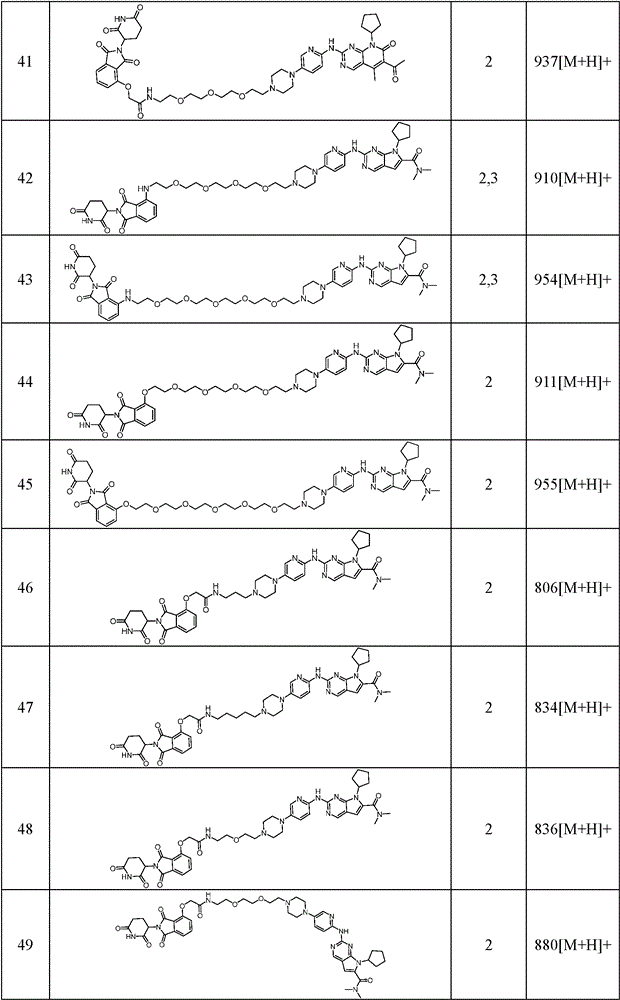
Similarly, the following compounds were prepared by methods analogous to the above examples:




EXAMPLE 5 test of the inhibitory Activity of Compounds on CDK4/6 by the Caliper assay
The experimental procedure was as follows:
1 Xkinase reaction buffer (50mM HEPES, pH 7.5; 0.0015% Brij-35) and kinase reaction stop solution (100mM HEPES, pH 7.5; 0.0015% Brij-35; 0.2% Coating Reagent; 50mM EDTA) were prepared;
preparing an experimental sample: to a 96-well plate, 100. mu.L of 5. mu.M sample solution (dissolved in 100% DMSO) was added to obtain 50X sample solution. Two wells containing 100 μ L of 100% DMSO alone were placed on the same plate as controls. One was used as no-load control and the other as no-load control. mu.L of the sample and 90. mu.L of 1 Xkinase reaction buffer were added to a 96-well plate as a transfer plate. The plates were shaken for 10 minutes.
Preparing a test plate: samples prepared in 96-well transfer plates were taken 5. mu.L each to 384-well plates.
Kinase reaction: mu.L of a 2.5 XCDK 4/6 kinase solution (kinase diluted with 1 Xkinase reaction buffer) was added to 5. mu.L of a 5 Xcompound solution (dissolved in DMSO, diluted 10 times with water), incubated at room temperature for 10min and 10. mu.L of a 2.5 Xsubstrate peptide solution (FAM-labeled peptide and ATP diluted in 1 Xkinase reaction buffer) was added.
Termination of the kinase reaction: after a reaction time at 28 ℃ 25. mu.L of a kinase reaction stop solution was added.
Fluorescence (F) was tested on Caliper, and data were collected and the rate of kinase activity inhibition was calculated:
percent inhibition of kinase activity ═ FDMSO control-FSample (I))/(FDMSO control-FNegative control) X 100%, DMSO as a solution control, no kinase as a negative control.
The results show that the inhibitory activity of compound (100nM) against CDK4/6 is shown in the following Table:

EXAMPLE 6 Western blot assay for Compound-degrading CDK4/6 protein Activity
Cell lines: MCF-7 cell lines (human breast cancer cells available from ATCC) were cultured in MEM containing 10% bovine serum at 37 ℃ in 5% CO2And culturing in an incubator with saturated humidity.
A DMSO control group and a compound dry group (1 mu M) are arranged, cells are collected after 24 hours of treatment, 100 mu L of precooled cell lysate is added, the cells are lysed for 30min on ice, total cell protein is extracted, and the protein concentration is determined and quantified by a bicinchoninic acid (BCA) method. Conventionally preparing gel, loading, performing electrophoresis, then transferring a membrane, sealing, respectively adding rabbit anti-human CDK4 (1: 450) and rabbit anti-human CDK6 (1: 150), incubating overnight at 4 ℃, adding secondary antibody IgG (1: 5000) after rinsing, developing by ECL developer after rinsing, scanning and imaging by a Bio-Rad gel imaging system, and performing computer software processing and analysis. The control was referenced to glyceraldehyde phosphate dehydrogenase (GAPDH).
Gray scale analysis was performed on each band using Image J software to calculate the degradation rate of compounds degrading CDK4/6 protein.
The degradation rate of the compounds on CDK4/6 protein in MCF-7 cells is shown in the following table:

remarking: in the above tables, "-" represents no degradation activity, "+" represents a degradation rate of 10% -30%, "+ +" represents a degradation rate of 30% -50%, "+ + + + + + +" represents a degradation rate of 50% -90%, and "+ + + + + + +" represents a degradation rate of more than 90%.
Example 7 MTT assay for the inhibition of proliferation of MCF-7 cell line (human breast cancer cell) by Compounds of formula
The proliferation inhibitory effect of the compounds on MCF-7 cells (commercially available from ATCC) was determined in vitro using the MTT assay. The method comprises the following specific steps:
culturing MCF-7 cells in 1640 culture medium of 10% calf serum, inoculating to 96-well plate, and culturing at 2 × 10⁵Cells/well, 5% CO at 37 ℃2In an incubator. Each compound was dissolved in Dimethylsulfoxide (DMSO) to give a solution having a concentration of 10mM, which was diluted with phosphate buffer to a desired concentration, and the diluted solution was added to the above 96-well plate at 2 wells per concentration and 10. mu.l per well, and each concentration was subjected to two parallel tests. DMSO was diluted accordingly in a gradient and added to the plate as a control.
Subjecting the 96-well plate to 5% CO at 37 deg.C2After 48 hours of incubation in the cell incubator, 20. mu.l of 5mg/ml MTT solution was added to each well and incubation continued in the incubator for 3-4 hours. Mu.l of the dissolution solution was added to each well, and the incubation was continued overnight in the incubator to sufficiently dissolve the formed formazan crystals. The light absorption at 492nm was determined.
The relative viability of the cells after compound treatment was calculated from the light absorption values.
IC of compound on MCF-7 cells was calculated by software50。
The in vitro proliferation inhibitory effect of the synthesized compounds on MCF-7 cells is shown in the following table:
| compound numbering | IC50(nM) |
| 3 | 80 |
| 8 | 200 |
| 15 | 220 |
| 16 | 300 |
| 21 | 160 |
The results show that the synthesized compound has good activity of inhibiting MCF-7 cells.
Example 8 CCK8 assay for inhibition of proliferation of T47D cell line (human breast cancer cell)
The proliferation inhibitory effect of compounds on T47D cells (available from ATCC) was determined in vitro using CCK8 assay. The method comprises the following specific steps:
culturing T47D cells in 1640 culture medium containing 10% calf serum, inoculating to 96-well plate, and culturing at 1.5 × 10⁵Per ml, 5% CO at 37 ℃2In an incubator. Each compound and the positive drug (Ribociclib) were dissolved in dimethyl sulfoxide (DMSO) to obtain a solution having a concentration of 100mM, which was diluted with a medium to a desired concentration, and the solution was added to the above 96-well plate at a concentration of 3 wells each and 50. mu.l per well. DMSO was diluted accordingly in a gradient and added to the plate as a control.
Subjecting the 96-well plate to 5% CO at 37 deg.C2After 72 hours of incubation in the cell incubator, 110. mu.l of 9% CCK8 solution was added to each well and incubation in the incubator was continued for 4 hours. Measurement of450nm light absorption.
The relative viability of the cells after compound treatment was calculated from the light absorption values. IC of compound on inhibition of T47D cell proliferation was calculated by software50。
The in vitro proliferation inhibitory effect of the synthesized compounds on T47D cells is shown in the following table:

the results show that the synthesized compound has good activity of inhibiting the proliferation of T47D cells.
All documents referred to herein are incorporated by reference into this application as if each were individually incorporated by reference. Furthermore, it should be understood that various changes and modifications of the present invention can be made by those skilled in the art after reading the above teachings of the present invention, and these equivalents also fall within the scope of the present invention as defined by the appended claims.
Claims (9)



Applications Claiming Priority (3)
| Application Number | Priority Date | Filing Date | Title |
|---|---|---|---|
| CN201710837228X | 2017-09-17 | ||
| CN201710837228.XA CN109516989B (en) | 2017-09-17 | 2017-09-17 | CDK (CDK kinase) inhibiting and degrading compound |
| PCT/CN2018/105713 WO2019052535A1 (en) | 2017-09-17 | 2018-09-14 | Compound for inhibiting and degrading cdk |
Publications (2)
| Publication Number | Publication Date |
|---|---|
| CN109952304A CN109952304A (en) | 2019-06-28 |
| CN109952304B true CN109952304B (en) | 2021-08-24 |
Family
ID=65722403
Family Applications (2)
| Application Number | Title | Priority Date | Filing Date |
|---|---|---|---|
| CN201710837228.XA Expired - Fee Related CN109516989B (en) | 2017-09-17 | 2017-09-17 | CDK (CDK kinase) inhibiting and degrading compound |
| CN201880004082.3A Expired - Fee Related CN109952304B (en) | 2017-09-17 | 2018-09-14 | A class of compounds that inhibit and degrade CDK |
Family Applications Before (1)
| Application Number | Title | Priority Date | Filing Date |
|---|---|---|---|
| CN201710837228.XA Expired - Fee Related CN109516989B (en) | 2017-09-17 | 2017-09-17 | CDK (CDK kinase) inhibiting and degrading compound |
Country Status (3)
| Country | Link |
|---|---|
| US (1) | US11236090B2 (en) |
| CN (2) | CN109516989B (en) |
| WO (1) | WO2019052535A1 (en) |
Families Citing this family (12)
| Publication number | Priority date | Publication date | Assignee | Title |
|---|---|---|---|---|
| CN109422733A (en) * | 2017-09-03 | 2019-03-05 | 上海美志医药科技有限公司 | One kind inhibits and the compound for the tyrosine protein kinase ALK that degrades |
| JP7569688B2 (en) | 2017-12-22 | 2024-10-18 | ハイバーセル,インコーポレイテッド | Aminopyridine derivatives as phosphatidylinositol phosphate kinase inhibitors |
| WO2020023480A1 (en) * | 2018-07-23 | 2020-01-30 | Dana-Farber Cancer Institute, Inc. | Degradation of cyclin-dependent kinase 4/6 (cdk4/6) by conjugation of cdk4/6 inhibitors with e3 ligase ligand and methods of use |
| TW202112767A (en) | 2019-06-17 | 2021-04-01 | 美商佩特拉製藥公司 | Aminopyridine derivatives as phosphatidylinositol phosphate kinase inhibitors |
| CN110305126A (en) * | 2019-06-19 | 2019-10-08 | 浙江省医学科学院 | A compound based on CRBN ligand-induced CDK4/6 degradation and its preparation method, pharmaceutical composition and application |
| JP7636388B2 (en) * | 2019-08-05 | 2025-02-26 | ダナ-ファーバー キャンサー インスティテュート,インコーポレイテッド | Degradation inducer of cyclin-dependent kinase 7 (cdk7) and use thereof |
| US12122763B2 (en) | 2020-07-21 | 2024-10-22 | Ubix Therapeutics, Inc. | Substituted piperidines for androgen receptor degradation |
| US20230295118A1 (en) * | 2022-03-18 | 2023-09-21 | EnhancedBio Inc. | Compounds and methods for the targeted degradation of cyclin dependent kinases |
| TW202406904A (en) * | 2022-04-25 | 2024-02-16 | 大陸商上海岸闊醫藥科技有限公司 | Cdk inhibitors, pharmaceutical compositions, and therapeutic applications |
| TW202440571A (en) * | 2022-12-16 | 2024-10-16 | 大陸商上海岸闊醫藥科技有限公司 | Compounds and uses thereof |
| WO2026002044A1 (en) * | 2024-06-25 | 2026-01-02 | 标新生物医药科技(上海)有限公司 | Bifunctional protein degraders containing sulfur/oxygen substituted glutarimide-based isoindolinone skeleton, and use thereof |
| CN118908958B (en) * | 2024-07-19 | 2025-09-16 | 山东第一医科大学(山东省医学科学院) | CDK4/6 small molecule fluorescent probe and preparation method and application thereof |
Citations (4)
| Publication number | Priority date | Publication date | Assignee | Title |
|---|---|---|---|---|
| WO2014063061A1 (en) * | 2012-10-19 | 2014-04-24 | Dana-Farber Cancer Institute, Inc. | Hydrophobically tagged small molecules as inducers of protein degradation |
| WO2016015605A1 (en) * | 2014-07-26 | 2016-02-04 | Sunshine Lake Pharma Co., Ltd. | Compounds as cdk small-molecule inhibitors and uses thereof |
| WO2017185031A1 (en) * | 2016-04-22 | 2017-10-26 | Dana-Farber Cancer Institute, Inc. | Degradation of cyclin-dependent kinase 4/6 (cdk4/6) by conjugation of cdk4/6 inhibitors with e3 ligase ligand and methods of use |
| WO2018106870A1 (en) * | 2016-12-08 | 2018-06-14 | Icahn School Of Medicine At Mount Sinai | Compositions and methods for treating cdk4/6-mediated cancer |
-
2017
- 2017-09-17 CN CN201710837228.XA patent/CN109516989B/en not_active Expired - Fee Related
-
2018
- 2018-09-14 CN CN201880004082.3A patent/CN109952304B/en not_active Expired - Fee Related
- 2018-09-14 WO PCT/CN2018/105713 patent/WO2019052535A1/en not_active Ceased
-
2020
- 2020-03-17 US US16/821,845 patent/US11236090B2/en active Active
Patent Citations (4)
| Publication number | Priority date | Publication date | Assignee | Title |
|---|---|---|---|---|
| WO2014063061A1 (en) * | 2012-10-19 | 2014-04-24 | Dana-Farber Cancer Institute, Inc. | Hydrophobically tagged small molecules as inducers of protein degradation |
| WO2016015605A1 (en) * | 2014-07-26 | 2016-02-04 | Sunshine Lake Pharma Co., Ltd. | Compounds as cdk small-molecule inhibitors and uses thereof |
| WO2017185031A1 (en) * | 2016-04-22 | 2017-10-26 | Dana-Farber Cancer Institute, Inc. | Degradation of cyclin-dependent kinase 4/6 (cdk4/6) by conjugation of cdk4/6 inhibitors with e3 ligase ligand and methods of use |
| WO2018106870A1 (en) * | 2016-12-08 | 2018-06-14 | Icahn School Of Medicine At Mount Sinai | Compositions and methods for treating cdk4/6-mediated cancer |
Also Published As
| Publication number | Publication date |
|---|---|
| CN109952304A (en) | 2019-06-28 |
| US20200216450A1 (en) | 2020-07-09 |
| WO2019052535A1 (en) | 2019-03-21 |
| CN109516989A (en) | 2019-03-26 |
| CN109516989B (en) | 2021-12-31 |
| US11236090B2 (en) | 2022-02-01 |
Similar Documents
| Publication | Publication Date | Title |
|---|---|---|
| CN109952304B (en) | A class of compounds that inhibit and degrade CDK | |
| CN109422752B (en) | Compound with functions of inhibiting and degrading Bruton tyrosine protein kinase Btk activity | |
| CN109963844B (en) | A class of compounds that inhibit and degrade tyrosine protein kinase ALK | |
| CN110352188B (en) | Fluoroallylamine derivatives and use thereof | |
| EP1656373A2 (en) | Derivatives of 2-acylamino-4-phenylthiazole, preparation method thereof and use of same as chemokineantagonists | |
| CN110546151A (en) | apoptosis-inducing agent | |
| CN111662294A (en) | Compound with activity of degrading Btk | |
| CN109937203B (en) | A class of compounds with the activity of inhibiting and degrading tyrosine protein kinases JAK1 or JAK2 | |
| US12428375B2 (en) | Compounds and compositions for treating conditions associated with LPA receptor activity | |
| CN109963853B (en) | Compound with activity of degrading tyrosine protein kinase JAK3 | |
| CN116514902A (en) | Deuterated peptidomimetic compounds and application thereof | |
| JP7523146B2 (en) | 3-(2-(heteroaryl)-pyridin-4-yl)-5-(trifluoromethyl)-1,2,4-oxadiazole derivatives as HDAC6 inhibitors - Patents.com | |
| CN113490669A (en) | Compound with activity of degrading Btk | |
| JP2022504082A (en) | 2,6-dimethyl-N-((pyridin-4-yl) methyl) imidazole [1,2-b] pyridazine-8-amine and 2,5-dimethyl-N-[(pyridine) for treating viral infections -4-yl) Methyl] pyrazolo [1,5-a] pyrimidine-7-amine derivative | |
| US9598381B2 (en) | SMYD2 inhibitors | |
| WO2023116734A1 (en) | Fused pyrrolidine compounds and compositions for treatment of respiratory viral infections | |
| FR2995605A1 (en) | MACROLIDE DERIVATIVES, THEIR PREPARATION AND THEIR THERAPEUTIC APPLICATION. | |
| WO2001005402A1 (en) | Preventive and therapeutic agents for cancer | |
| US20250188092A1 (en) | Rifamycin analogs | |
| HK40122633A (en) | Jak inhibitor analogs, formulations, and uses thereof | |
| WO2023206655A1 (en) | PI3Kδ INHIBITOR AND USE THEREOF |
Legal Events
| Date | Code | Title | Description |
|---|---|---|---|
| PB01 | Publication | ||
| PB01 | Publication | ||
| SE01 | Entry into force of request for substantive examination | ||
| SE01 | Entry into force of request for substantive examination | ||
| GR01 | Patent grant | ||
| GR01 | Patent grant | ||
| CF01 | Termination of patent right due to non-payment of annual fee | ||
| CF01 | Termination of patent right due to non-payment of annual fee |
Granted publication date: 20210824 |