CN109942582B - A PET probe targeting tropomyosin kinase TRK fusion protein and its synthesis and application - Google Patents
A PET probe targeting tropomyosin kinase TRK fusion protein and its synthesis and application Download PDFInfo
- Publication number
- CN109942582B CN109942582B CN201910198843.XA CN201910198843A CN109942582B CN 109942582 B CN109942582 B CN 109942582B CN 201910198843 A CN201910198843 A CN 201910198843A CN 109942582 B CN109942582 B CN 109942582B
- Authority
- CN
- China
- Prior art keywords
- compound
- reaction
- follows
- molecular structure
- pet probe
- Prior art date
- Legal status (The legal status is an assumption and is not a legal conclusion. Google has not performed a legal analysis and makes no representation as to the accuracy of the status listed.)
- Expired - Fee Related
Links
Images


Landscapes
- Medicines Containing Antibodies Or Antigens For Use As Internal Diagnostic Agents (AREA)
Abstract
本发明涉及一种靶向原肌球蛋白激酶TRK融合蛋白的PET探针及其合成与应用。PET探针,其分子结构如下:
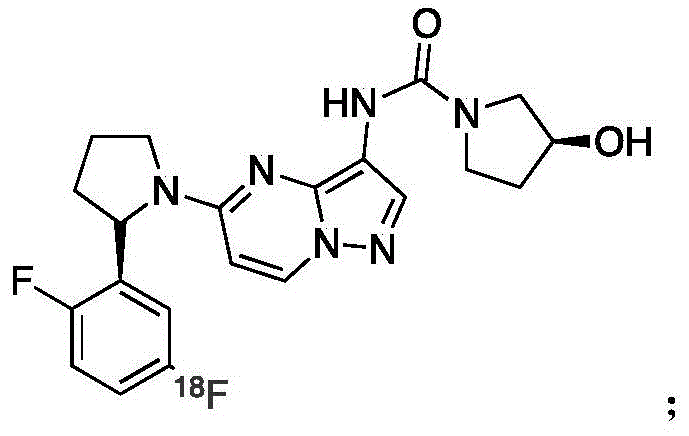

The invention relates to a PET probe targeting tropomyosin kinase TRK fusion protein and its synthesis and application. PET probe, its molecular structure is as follows:
Description
技术领域technical field
本发明属于探针合成技术领域,尤其是涉及一种靶向原肌球蛋白激酶TRK融合蛋白的PET探针及其合成与应用。The invention belongs to the technical field of probe synthesis, in particular to a PET probe targeting tropomyosin kinase TRK fusion protein and its synthesis and application.
背景技术Background technique
原肌球蛋白受体激酶((tropomyosin receptor kinase,简称Trk)是一类酪氨酸激酶受体,主要由NTRK基因编码。Trk受体分为TrkA(分子量140kD)、TrkB(145kD)和TrkC(145kD)。原肌球蛋白是一类膜蛋白受体,主要包括膜外配体结合区,跨膜区与膜内ATP结合区。TrkA、TrkB、TrkC的膜外接合区展现了高度的相似性。Trk在中枢神经系统与外周神经系统的生理、发育及功能中发挥着重要的作用。正常的Trk受体通过与结合膜外配体结合后,形成二聚体并引起膜内激酶区的磷酸化与活化,从而引发下游信号通路的激活,进而促进细胞的增殖与分化。NTRK基因重排与融合是在多种癌症中常见的现象,广泛存在于多种癌症中(如直肠癌、非小细胞肺癌、乳腺癌、胶质瘤、星型细胞瘤、婴儿纤维肉瘤、甲状腺癌、胃肠道间质瘤等),并编码了多种原激球蛋白激酶Trk融合蛋白。这些融合蛋白能够在没有配体的情况下,激活下游的通路并促进肿瘤的形成与细胞增殖。因此,Trk融合蛋白也成为了癌症领域光谱的药物靶点及诊断标志物。目前为止,临床上运用的检测NTRK融合的技术手段主要包括NGS测序,FISH以及IHC。Tropomyosin receptor kinase (Trk for short) is a class of tyrosine kinase receptors, mainly encoded by the NTRK gene. Trk receptors are divided into TrkA (molecular weight 140kD), TrkB (145kD) and TrkC ( 145kD).Tropomyosin is a type of membrane protein receptor, mainly including the ligand binding region outside the membrane, the transmembrane region and the ATP binding region in the membrane. The outer membrane junction region of TrkA, TrkB, TrkC shows a high degree of similarity .Trk plays an important role in the physiology, development and function of the central nervous system and the peripheral nervous system. The normal Trk receptor forms a dimer and causes phosphorylation of the kinase domain in the membrane after binding to the ligand outside the membrane. NTRK gene rearrangements and fusions are common phenomena in a variety of cancers, and are widely present in a variety of cancers (such as rectal cancer, non-small cell cell lung cancer, breast cancer, glioma, astrocytoma, infantile fibrosarcoma, thyroid cancer, gastrointestinal stromal tumor, etc.), and encodes a variety of prokalukin kinase Trk fusion proteins. These fusion proteins can be used in In the absence of ligands, it activates downstream pathways and promotes tumor formation and cell proliferation. Therefore, Trk fusion proteins have also become drug targets and diagnostic markers in the field of cancer. So far, clinically used detection of NTRK fusions The technical means mainly include NGS sequencing, FISH and IHC.
发明内容SUMMARY OF THE INVENTION
本发明的目的就是为了克服上述现有技术存在的缺陷而提供一种靶向原肌球蛋白激酶TRK融合蛋白的PET探针及其合成与应用。The purpose of the present invention is to provide a PET probe targeting tropomyosin kinase TRK fusion protein and its synthesis and application in order to overcome the above-mentioned defects in the prior art.
在本发明中,将现有的新型临床药物Larotrectinib进行放射性标记,从而研发出新型的TRK PET探针,以用于临床及临床前的诊断与疗效评估。In the present invention, the existing new clinical drug Larotrectinib is radiolabeled to develop a new type of TRK PET probe for clinical and preclinical diagnosis and efficacy evaluation.
本发明的目的可以通过以下技术方案来实现:The object of the present invention can be realized through the following technical solutions:
一种靶向原肌球蛋白激酶TRK融合蛋白的PET探针,其分子结构如下:A PET probe targeting tropomyosin kinase TRK fusion protein, its molecular structure is as follows:

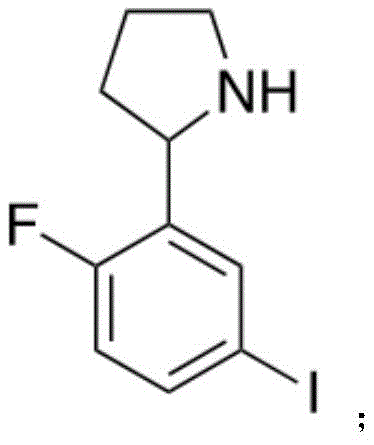
一种所述PET探针的小分子前体,其分子结构如下:A small molecule precursor of the PET probe, the molecular structure of which is as follows:

所述PET探针的合成方法,包括以下步骤:The method for synthesizing the PET probe comprises the following steps:
将化合物11溶于无水DMSO中,加入K222与碳酸钾,然后加入18F(111GBq),进行反应,然后加入HCl,反应,反应后进行纯化分离,得到所述PET探针;
所述化合物11分子结构如下:The molecular structure of
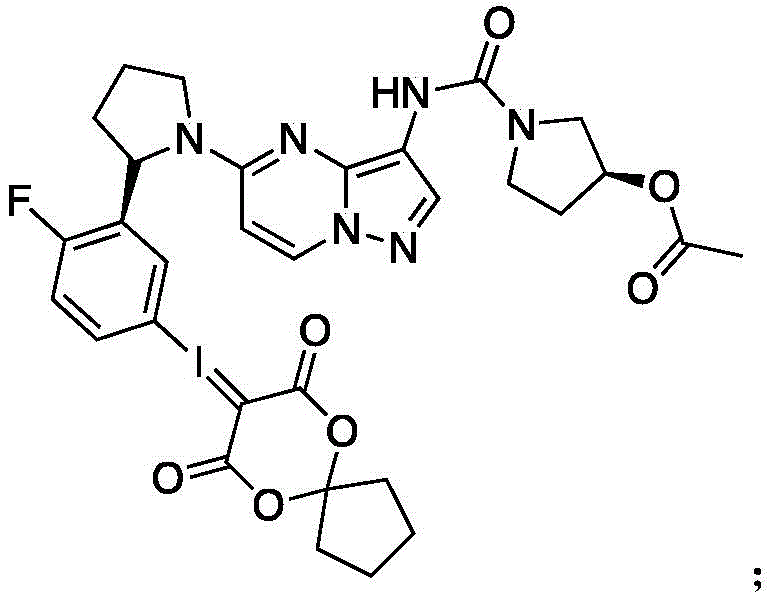
所述化合物11是通过以下方法合成得到的:The
将化合物9加入到CHCl3中,并加入Oxone与TFA,搅拌反应后,进行减压浓缩,将浓缩产物加入到溶有6,10-dioxaspiro[4.5]decane-7,9-dione的EtOH中,室温下发应后,等反应结束后,进行手性拆分得到终化合物11;Compound 9 was added to CHCl 3 , and Oxone and TFA were added. After stirring the reaction, concentrated under reduced pressure. The concentrated product was added to EtOH dissolved in 6,10-dioxaspiro[4.5]decane-7,9-dione, After the reaction is carried out at room temperature, after the reaction is completed, chiral resolution is carried out to obtain the
所述化合物9分子结构如下:The molecular structure of compound 9 is as follows:

所述化合物9是通过以下方法合成得到的:The compound 9 was synthesized by the following method:
将化合物8、TFA加入到DCM中,在冰浴的条件下加入acetyl chloride,进行反应,反应结束后,进行纯化得到化合物9;
所述化合物8分子结构如下:The molecular structure of
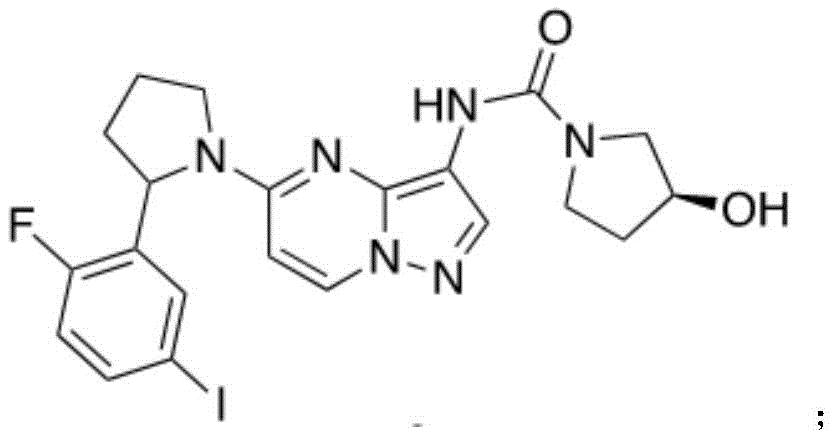
所述化合物8是通过以下方法合成得到的:The
将化合物7溶于DCM中,加入CDI,加入(S)-pyrrolidin-3-ol,进行反应,反应结束后,分离得到化合物8;Compound 7 was dissolved in DCM, CDI was added, (S)-pyrrolidin-3-ol was added, and the reaction was carried out. After the reaction was completed,
所述化合物7分子结构如下:The molecular structure of compound 7 is as follows:

所述化合物7是通过以下方法合成得到的:The compound 7 is synthesized by the following method:
将化合物6、加入到EtOH中,加入HCl与Fe,并在N2保护的条件下反应,反应结束后,进行分离得到化合物7;Compound 6 was added to EtOH, HCl and Fe were added, and the reaction was carried out under the protection of N 2 . After the reaction was completed, compound 7 was obtained by separation;
所述化合物6分子结构如下:The molecular structure of compound 6 is as follows:
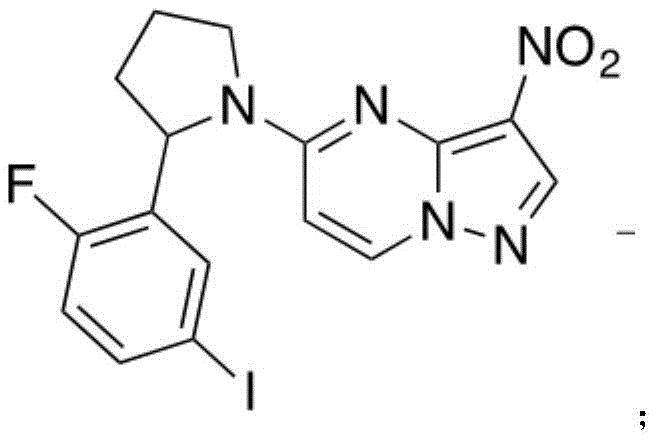
所述化合物6是通过以下方法合成得到的:The compound 6 is synthesized by the following method:
将化合物4与化合物5混合,随后在N2的保护条件下加入EtOH与THF,再加入TFA,进行反应,反应结束后,进行分离得到化合物6;Compound 4 is mixed with
所述化合物4分子结构如下:The molecular structure of compound 4 is as follows:
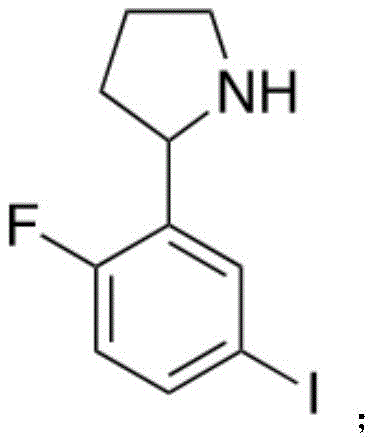
所述化合物5分子结构如下:The molecular structure of

所述化合物4是通过以下方法合成得到的:The compound 4 is synthesized by the following method:
将化合物3溶于MeOH中,并加入乙酸、NaBH4,进行反应,反应结束后,进行分离得到化合物4;
所述化合物3分子结构如下:
所述化合物3是通过以下方法合成得到的:The
在无水THF中加入NaH、化合物2及1-vinylpyrrolidin-2-one,搅拌反应,然后冷却至室温,然后缓慢加入HCl溶液继续反应,反应结束后,进行分离得到化合物3;Add NaH, compound 2 and 1-vinylpyrrolidin-2-one to anhydrous THF, stir the reaction, then cool to room temperature, then slowly add HCl solution to continue the reaction, after the reaction, separate to obtain
所述化合物2分子结构如下:
所述化合物2是通过以下方法合成得到的:The compound 2 is synthesized by the following method:
将化合物1溶于EtOH,然后滴加H2SO4,将混合物搅拌,反应,反应结束后,进行分离得到化合物2;Compound 1 was dissolved in EtOH, then H 2 SO 4 was added dropwise, the mixture was stirred and reacted, and after the reaction was completed, compound 2 was obtained by separation;
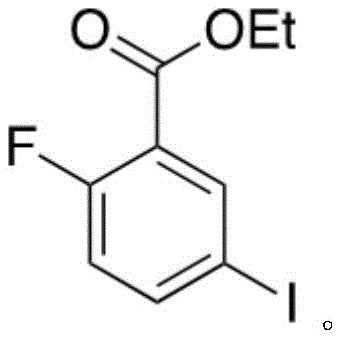
所述化合物1分子结构如下:
本发明所述PET探针用于制备临床或临床前的诊断和/或疗效评估的药物的应用,可用于放射化学标记,临床前动物影像等方法的研究。The application of the PET probe of the present invention for preparing medicines for clinical or preclinical diagnosis and/or efficacy evaluation can be used for the research of methods such as radiochemical labeling and preclinical animal imaging.
与现有技术相比,本发明研发出了新型的TRK PET探针,具有TRK特异性,用于探测TRK融合蛋白在肿瘤组织中的表达,从而为临床检查提供可靠的诊断与分子表型的数据。Compared with the prior art, the present invention develops a new type of TRK PET probe with TRK specificity, which is used to detect the expression of TRK fusion protein in tumor tissue, thereby providing reliable diagnosis and molecular phenotype for clinical examination. data.
附图说明Description of drawings
图1为靶向于TRK融合蛋白PET探针前体的合成路线图;Fig. 1 is the synthetic roadmap of PET probe precursor targeting TRK fusion protein;
图2为PET探针的放射化学制备路线图;Fig. 2 is the radiochemical preparation roadmap of PET probe;
图3为化合物2的TLC层析结果;Fig. 3 is the TLC chromatography result of compound 2;
图4为化合物3的TLC层析结果;Fig. 4 is the TLC chromatography result of
图5为化合物4的TLC层析结果;Fig. 5 is the TLC chromatography result of compound 4;
图6为化合物6的TLC层析结果;Fig. 6 is the TLC chromatography result of compound 6;
图7为化合物7的TLC层析结果;Fig. 7 is the TLC chromatography result of compound 7;
图8为化合物9合成反应的TLC层析结果。FIG. 8 is the TLC chromatography result of the synthesis reaction of compound 9. FIG.
具体实施方式Detailed ways
本发明在已知的化合物LOXO-101的基础上进行进一步的改造,将其设计并制备成一个拥有18F标记的PET探针。这个过程主要包括两个部分:1.PET探针化合物前体的制备,2.PET探针的放射化学标记。The present invention further transforms the known compound LOXO-101, and designs and prepares it into a PET probe with 18 F label. This process mainly includes two parts: 1. Preparation of PET probe compound precursor, 2. Radiochemical labeling of PET probe.
下面结合附图和具体实施例对本发明进行详细说明。The present invention will be described in detail below with reference to the accompanying drawings and specific embodiments.
实施例1、PET探针化合物前体的制备(如图1):Example 1. Preparation of PET probe compound precursor (as shown in Figure 1):
(1)化合物2合成方法:(1) Compound 2 synthesis method:
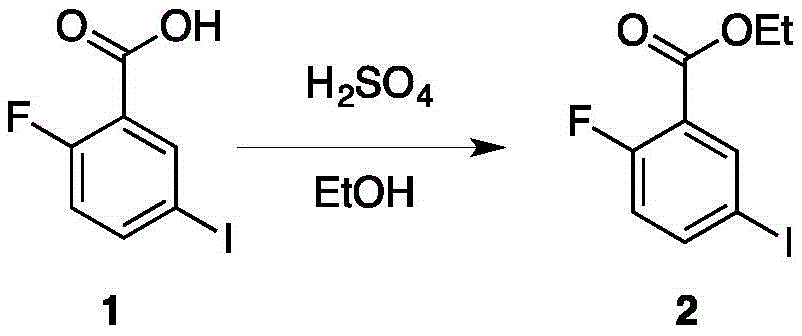
将化合物1(20.0g,75.2mmol,1eq)溶于70mL EtOH。然后逐渐滴加H2SO4(7.37g,75.1mmol,4.01mL,1eq).将混合物在100℃下搅拌5h,并用TLC(Dichloromethane/Methanol=10/1,Rf=0.87)检测反应的进度。当反应完成后,反应物在减压的情况下被浓缩。浓缩产物经过萃取(EOtOH 200mL,NaHCO3饱和溶液(100.0mL x 2)后,取有机层,并加入无水Na2SO4干燥。经过进一步蒸干得到最终油状产物2(21.0g,71.4mmol,94.9%yield)。Compound 1 (20.0 g, 75.2 mmol, 1 eq) was dissolved in 70 mL of EtOH. Then H 2 SO 4 (7.37 g, 75.1 mmol, 4.01 mL, 1 eq) was gradually added dropwise. The mixture was stirred at 100° C. for 5 h, and the progress of the reaction was checked by TLC (Dichloromethane/Methanol=10/1, Rf=0.87). When the reaction was complete, the reaction was concentrated under reduced pressure. The concentrated product was extracted (EOtOH 200 mL, NaHCO 3 saturated solution (100.0 mL x 2), the organic layer was taken, and anhydrous Na 2 SO 4 was added to dry. After further evaporation to dryness, the final oily product 2 (21.0 g, 71.4 mmol, 94.9% yield).
图3为此反应的TLC层析结果。Figure 3 TLC chromatography results for this reaction.
(2)化合物3合成方法:(2)
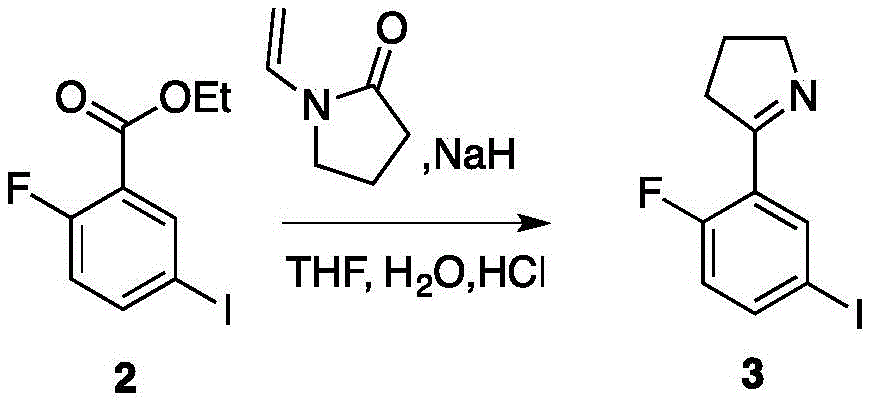
在无水THF(131.0mL)中加入NaH(3.71g,92.8mmol,60.0%purity,1.3eq),化合物2(21.0g,71.4mmol,1eq)及1-vinylpyrrolidin-2-one(8.49g,76.4mmol,8.17mL,1.07eq)。混合物在80℃下搅拌3小时,然后冷却至室温。然后缓慢加入10%的HCl溶液(30mL)并在100℃下搅拌10小时。反应进度经过TLC(Petroleum ether/Ethyl acetate=4/1,Rf=0.68)探测。当反应结束后,在冰浴的条件下,逐渐加入1M NaOH溶液,将反应溶液的pH值调整至8.0。并用DCM(50.0mL x 2)进行进一步的萃取,并通过柱层析(SiO2,Petroleum ether/Ethylacetate=8/1to 5/1),得到白色化合物3(1.60g,5.53mmol,7.75%yield).图4为此反应的TLC层析结果。In anhydrous THF (131.0 mL) were added NaH (3.71 g, 92.8 mmol, 60.0% purity, 1.3 eq), compound 2 (21.0 g, 71.4 mmol, 1 eq) and 1-vinylpyrrolidin-2-one (8.49 g, 76.4 mmol, 8.17 mL, 1.07 eq). The mixture was stirred at 80°C for 3 hours and then cooled to room temperature. Then 10% HCl solution (30 mL) was added slowly and stirred at 100°C for 10 hours. The progress of the reaction was detected by TLC (Petroleum ether/Ethyl acetate=4/1, Rf=0.68). After the reaction, under the condition of ice bath, 1M NaOH solution was gradually added to adjust the pH value of the reaction solution to 8.0. and further extracted with DCM (50.0 mL x 2) and passed through column chromatography ( SiO2 , Petroleum ether/Ethylacetate=8/1 to 5/1) to give white compound 3 (1.60 g, 5.53 mmol, 7.75% yield) . Figure 4 TLC chromatography results for this reaction.
化合物3的核磁共振数据为:The NMR data of
1H NMR:ET20681-25-P1A CDCl3 Varian_S_400MHz8.29(dd,J=2.2,6.8Hz,1H),7.67(ddd,J=2.3,4.6,8.7Hz,1H),6.87(dd,J=8.6,10.8Hz,1H),4.08-3.97(m,2H),2.98(dtd,J=2.2,5.4,11.0Hz,2H),2.12-1.97(m,2H) 1 H NMR: ET20681-25-P1A CDCl 3 Varian_S_400MHz 8.29 (dd, J=2.2, 6.8 Hz, 1H), 7.67 (ddd, J=2.3, 4.6, 8.7 Hz, 1H), 6.87 (dd, J=8.6 ,10.8Hz,1H),4.08-3.97(m,2H),2.98(dtd,J=2.2,5.4,11.0Hz,2H),2.12-1.97(m,2H)
(3)化合物4合成方法:(3) Compound 4 synthesis method:

将化合物3(1.60g,5.53mmol,1eq)溶于10mL MeOH中,并加入乙酸(2.10g,34.9mmol,2.00mL,6.32eq)。在冰浴的条件下向反应物中加入NaBH4(209.4mg,5.53mmol,1eq)。混合物在室温的条件下搅拌5小时,并用TLC(Petroleum ether/Ethyl acetate=3/1,Rf=0.06)监测反应进度。当反应完全时,将反应产物进行减压浓缩。对浓缩后的产品用饱和Na2CO3将pH值调节至8,并用EtOAc(20.0mLx 4)进行萃取,并用无水Na2SO4进行干燥,然后进行减压蒸馏,得到无色油状化合物4(1.60g,5.50mmol,99.3%yield)。图5为此反应的TLC层析结果。Compound 3 (1.60 g, 5.53 mmol, 1 eq) was dissolved in 10 mL of MeOH, and acetic acid (2.10 g, 34.9 mmol, 2.00 mL, 6.32 eq) was added. To the reaction was added NaBH4 (209.4 mg, 5.53 mmol, 1 eq) under ice bath conditions. The mixture was stirred at room temperature for 5 hours, and the progress of the reaction was monitored by TLC (Petroleum ether/Ethyl acetate=3/1, Rf=0.06). When the reaction was complete, the reaction product was concentrated under reduced pressure. The concentrated product was adjusted to
(4)化合物6合成方法:(4) Compound 6 synthesis method:
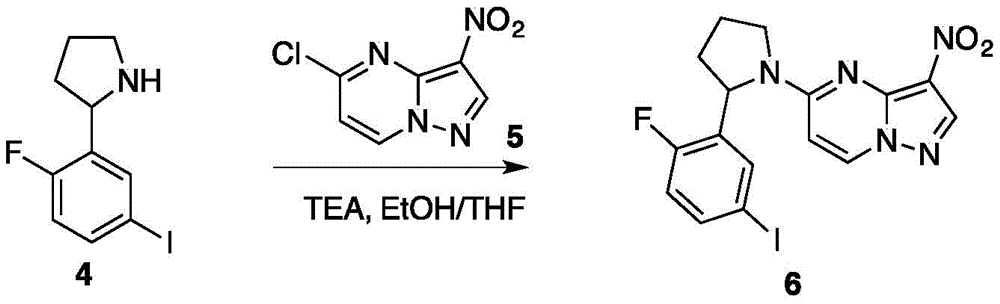
将化合物4(1.15g,5.77mmol,1.05eq)与化合物5(1.60g,5.50mmol,1eq)加入圆底烧瓶中。随后在N2的保护条件下加入12mL EtOH与3mL THF。随后将反应溶液本温度调至40℃,并通过滴液漏斗向圆底烧瓶中加入TFA(1.95g,19.2mmol,2.68mL,3.5eq)。待液体加完后,反应物温度调至50℃并在此温度下搅拌5h。反应通过TLC(Dichloromethane/Methanol=10/1,Rf=0.37)进行监测。当反应结束时,对反应溶液进行过滤,并收集过滤物进行烘干,得到白色固体状化合物6(2.10g,4.63mmol,84.3%yield)。图6为此反应的TLC层析结果。Compound 4 (1.15 g, 5.77 mmol, 1.05 eq) and compound 5 (1.60 g, 5.50 mmol, 1 eq) were added to a round bottom flask. Then 12 mL of EtOH and 3 mL of THF were added under the protection of N2 . The temperature of the reaction solution was then adjusted to 40°C, and TFA (1.95 g, 19.2 mmol, 2.68 mL, 3.5 eq) was added to the round bottom flask through a dropping funnel. After the liquid was added, the temperature of the reactant was adjusted to 50°C and stirred at this temperature for 5h. The reaction was monitored by TLC (Dichloromethane/Methanol=10/1, Rf=0.37). When the reaction was completed, the reaction solution was filtered, and the filtrate was collected and dried to obtain compound 6 (2.10 g, 4.63 mmol, 84.3% yield) as a white solid. Figure 6 TLC chromatography results for this reaction.
(5)化合物7合成方法:(5) Compound 7 synthesis method:

将反应物6(1.90g,4.19mmol,1eq)加入到30mL EtOH中,随后加入HCl(30.0mL)与Fe(2.34g,41.9mmol,10eq),并在N2保护的条件下将反应物在60℃条件下加热1小时。用TLCTLC(Ethyl acetate,Rf=0.30)进行反应的监测,当反应结束后,将反应物倒入200mL水中并用固体Na2CO3将反应体系的pH调节至8.通过进一步用EtOAc(100.0mL x 3)进行萃取,收集有机层并用无水Na2SO4进行干燥。通过进一步的减压蒸馏得到黄色固体状化合物7(1.80g,crude)。图7为此反应的TLC层析结果。Reactant 6 (1.90 g, 4.19 mmol, 1 eq) was added to 30 mL of EtOH, followed by HCl (30.0 mL) and Fe (2.34 g, 41.9 mmol, 10 eq), and the reactant was added under N2 protection in Heated at 60°C for 1 hour. The monitoring of the reaction was performed with TLCTLC (Ethyl acetate, Rf=0.30), when the reaction was over, the reaction was poured into 200 mL of water and the pH of the reaction system was adjusted to 8 with solid Na 2 CO 3 . 3) Extraction was performed, and the organic layer was collected and dried with anhydrous Na 2 SO 4 . Compound 7 (1.80 g, crude) was obtained as a yellow solid by further distillation under reduced pressure. Figure 7 TLC chromatography results for this reaction.
化合物7的核磁共振数据为:The NMR data of compound 7 are:
1H NMR:ET21514-5-P1A1 CDCl3 Varian_S_400MHz8.07(d,J=7.5Hz,1H),7.62(s,1H),7.52(ddd,J=2.2,4.9,8.4Hz,1H),7.35(dd,J=2.1,6.9Hz,1H),6.84(dd,J=8.6,10.1Hz,1H),5.87(br s,1H),5.28(br s,1H),3.98-3.86(m,1H),3.80-3.68(m,1H),2.81(br s,2H),2.52-2.35(m,1H),2.08-2.04(m,1H),2.03-1.96(m,2H) 1 H NMR: ET21514-5-P1A1 CDCl 3 Varian_S_400MHz 8.07 (d, J=7.5Hz, 1H), 7.62 (s, 1H), 7.52 (ddd, J=2.2, 4.9, 8.4Hz, 1H), 7.35 ( dd,J=2.1,6.9Hz,1H),6.84(dd,J=8.6,10.1Hz,1H),5.87(br s,1H),5.28(br s,1H),3.98-3.86(m,1H) ,3.80-3.68(m,1H),2.81(br s,2H),2.52-2.35(m,1H),2.08-2.04(m,1H),2.03-1.96(m,2H)
(6)化合物8合成方法:(6)

将化合物7(1.80g,4.25mmol,1eq)溶于10mL DCM中。随后加入CDI(1.38g,8.51mmol,2eq).在常温下搅拌2小时后,加入(S)-pyrrolidin-3-ol(741.0mg,8.51mmol,686.1uL,2eq)。反应物在常温下搅拌半小时,并用TLC(Dichloromethane/Methanol=10/1,Rf=0.32)监测反应进度。当反应结束后,反应物用50.0mL水进行稀释并用EtOAc(50.0mL x3)进行萃取。将萃取所得的有机层用饱和食盐水进行冲洗并进一步用无水Na2SO4进行干燥。通过进一步的浓缩与柱层析(SiO2,Petroleum ether/Ethyl acetate=50/1to 0/1)得到褐色化合物8(2.00g,3.73mmol,87.7%yield).Compound 7 (1.80 g, 4.25 mmol, 1 eq) was dissolved in 10 mL of DCM. CDI (1.38 g, 8.51 mmol, 2 eq) was then added. After stirring at room temperature for 2 hours, (S)-pyrrolidin-3-ol (741.0 mg, 8.51 mmol, 686.1 uL, 2 eq) was added. The reactants were stirred at room temperature for half an hour, and the progress of the reaction was monitored by TLC (Dichloromethane/Methanol=10/1, Rf=0.32). When the reaction was complete, the reaction was diluted with 50.0 mL of water and extracted with EtOAc (50.0 mL x 3). The organic layer obtained by extraction was washed with saturated brine and further dried over anhydrous Na 2 SO 4 . The brown compound 8 (2.00 g, 3.73 mmol, 87.7% yield) was obtained by further concentration and column chromatography (SiO 2 , Petroleum ether/Ethyl acetate=50/1 to 0/1).
化合物8的核磁共振数据为:The NMR data of
1H NMR:ET21476-4-P1A MeOD Varian_S_400MHzδ=8.29-8.12(m,2H),7.92(s,1H),7.56(br d,J=7.5Hz,2H),7.37(br d,J=6.2Hz,1H),7.14-7.05(m,1H),6.93(br t,J=9.4Hz,1H),4.46(br d,J=1.8Hz,2H),3.84-3.71(m,2H),3.57(br d,J=6.8Hz,4H),2.13-2.05(m,4H),1.98(s,2H) 1 H NMR: ET21476-4-P1A MeOD Varian_S_400MHzδ=8.29-8.12(m,2H),7.92(s,1H),7.56(br d,J=7.5Hz,2H),7.37(br d,J=6.2Hz ,1H),7.14-7.05(m,1H),6.93(br t,J=9.4Hz,1H),4.46(br d,J=1.8Hz,2H),3.84-3.71(m,2H),3.57( br d, J=6.8Hz, 4H), 2.13-2.05(m, 4H), 1.98(s, 2H)
(7)化合物9合成方法:(7) Compound 9 synthesis method:

将化合物8(2.00g,3.73mmol,1eq),TFA(754.6mg,7.46mmol,1.04mL,2.0eq)加入到10.0mL DCM中。随后在冰浴的条件下加入acetyl chloride(439.1mg,5.59mmol,399.1uL,1.5eq)。反应化合物在常温下搅拌5小时.并用TLC(Dichloromethane/Methanol=10/1,Rf=0.32)监测反应进度。当反应结束后,对反应物进行减压浓缩,并用柱层析(SiO2,DCM/Methanol=10/1)进行纯化得到黄色固体状化合物9(0.800g,1.38mmol,37.1%yield)。图8为此反应的TLC层析结果。Compound 8 (2.00 g, 3.73 mmol, 1 eq), TFA (754.6 mg, 7.46 mmol, 1.04 mL, 2.0 eq) was added to 10.0 mL of DCM. Acetyl chloride (439.1 mg, 5.59 mmol, 399.1 uL, 1.5 eq) was then added under ice bath conditions. The reaction mixture was stirred at room temperature for 5 hours. The progress of the reaction was monitored by TLC (Dichloromethane/Methanol=10/1, Rf=0.32). When the reaction was completed, the reactant was concentrated under reduced pressure, and purified by column chromatography (SiO 2 , DCM/Methanol=10/1) to obtain compound 9 (0.800 g, 1.38 mmol, 37.1% yield) as a yellow solid. Figure 8 TLC chromatography results for this reaction.
化合物9的核磁共振数据为:The NMR data of compound 9 are:
1H NMR:ET21476-5-P1A MeOD Bruker_F_400MHzδ=9.59(br s,1H),9.12(br s,1H),8.85(br s,1H),8.65(br d,J=6.2Hz,1H),8.19(br t,J=9.4Hz,1H),6.76-6.49(m,2H),5.32-5.19(m,1H),5.10-4.65(m,5H),3.75(br s,1H),3.53-3.32(m,3H),3.30(s,3H),3.27(br s,1H) 1 H NMR: ET21476-5-P1A MeOD Bruker_F_400MHzδ=9.59(br s,1H),9.12(br s,1H),8.85(br s,1H),8.65(br d,J=6.2Hz,1H),8.19 (br t, J=9.4Hz, 1H), 6.76-6.49(m, 2H), 5.32-5.19(m, 1H), 5.10-4.65(m, 5H), 3.75(br s, 1H), 3.53-3.32 (m,3H),3.30(s,3H),3.27(br s,1H)
(8)化合物11合成方法:(8) Synthesis method of compound 11:
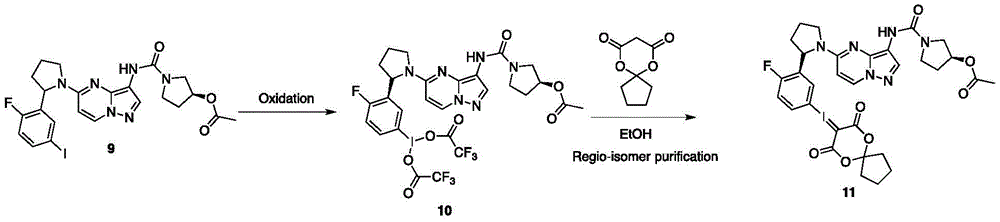
将化合物9(0.5g,0.62mmol)加入到10mL CHCl3中,并加入1mL Oxone与0.5mLTFA。在室温下搅拌反应4小时后,进行减压浓缩,将浓缩产物加入到溶有6,10-dioxaspiro[4.5]decane-7,9-dione(0.22g,1.24mmol)的10mL EtOH中,室温下发应2h后,用LCMS进行检测,等反应结束后,进行手性拆分得到终产物11(180mg).Compound 9 (0.5 g, 0.62 mmol) was added to 10 mL of CHCl3 , and 1 mL of Oxone and 0.5 mL of TFA were added. The reaction was stirred at room temperature for 4 hours, concentrated under reduced pressure, and the concentrated product was added to 10 mL of EtOH in which 6,10-dioxaspiro[4.5]decane-7,9-dione (0.22 g, 1.24 mmol) was dissolved at room temperature. After 2 hours of reaction, LCMS was used for detection, and after the reaction was completed, chiral resolution was performed to obtain the final product 11 (180 mg).
实施例2、PET探针的放射化学标记(如图2):Example 2. Radiochemical labeling of PET probes (as shown in Figure 2):
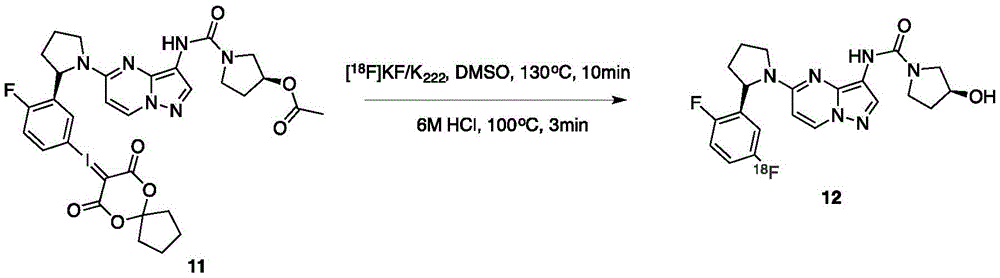
将前体11(3.0mg)溶于无水1mL DMSO中,加入10mg K222与3mg碳酸钾,然后加入18F(111GBq),并在130℃条件下反应10分钟,然后加入6M HCl 1mL,并在100℃下反应3分钟。待反应结束后,用HPLC(C18,Dynamax 250·21.4mm;Varian)进行纯化,流速为6.0mL/min,流动相为10mM NaH2PO4 buffer(pH 6.7)and ethanol(47.5:52.5,v/v),最后将收集到的组分经过C18 Sep-Pak(Waters)进行收集,然后用1mL EtOH进行冲洗并收集到9mL的生理盐水瓶子中,得到相应的放射性PET探针,放射化学产率为20%。The precursor 11 (3.0 mg) was dissolved in anhydrous 1 mL of DMSO, 10 mg of K 222 and 3 mg of potassium carbonate were added, and then 18F (111 GBq) was added, and reacted at 130 ° C for 10 minutes, then 6 M HCl 1 mL was added, and in The reaction was carried out at 100°C for 3 minutes. After the reaction, HPLC (C18, Dynamax 250·21.4mm; Varian) was used for purification, the flow rate was 6.0mL/min, and the mobile phase was 10mM NaH2PO4 buffer (pH 6.7) and ethanol (47.5:52.5, v/v), Finally, the collected components were collected by C18 Sep-Pak (Waters), then rinsed with 1 mL of EtOH and collected into a 9 mL physiological saline bottle to obtain the corresponding radioactive PET probe with a radiochemical yield of 20%.
本发明研发出了新型的TRK PET探针,具有TRK特异性,用于探测TRK融合蛋白在肿瘤组织中的表达,从而为临床检查提供可靠的诊断与分子表型的数据。The invention develops a new type of TRK PET probe with TRK specificity, which is used to detect the expression of TRK fusion protein in tumor tissue, thereby providing reliable diagnosis and molecular phenotype data for clinical examination.
Trk在中枢神经系统与外周神经系统的生理、发育及功能中发挥着重要的作用。正常的Trk受体通过与结合膜外配体结合后,形成二聚体并引起膜内激酶区的磷酸化与活化,从而引发下游信号通路的激活,进而促进细胞的增殖与分化。NTRK基因重排与融合是在多种癌症中常见的现象,广泛存在于多种癌症中(如直肠癌、非小细胞肺癌、乳腺癌、胶质瘤、星型细胞瘤、婴儿纤维肉瘤、甲状腺癌、胃肠道间质瘤等),并编码了多种原激球蛋白激酶Trk融合蛋白。这些融合蛋白能够在没有配体的情况下,激活下游的通路并促进肿瘤的形成与细胞增殖。因此,Trk融合蛋白也成为了癌症领域光谱的药物靶点及诊断标志物。目前为止,临床上运用的检测NTRK融合的技术手段主要包括NGS测序,FISH以及IHC。此发明针对Trk融合蛋白将现有的小分子化合物进行改造,从而进一步形成能够特异性的诊断Trk融合蛋白表达的分子探针,从而为临床上对肿瘤的特征进行分子诊断提供可靠的分子分型数据,并指导相关的Trk融合蛋白的临床用药。Trk plays an important role in the physiology, development and function of the central and peripheral nervous systems. The normal Trk receptor binds to the ligand outside the membrane, forms a dimer and causes the phosphorylation and activation of the kinase domain in the membrane, thereby triggering the activation of downstream signaling pathways, thereby promoting cell proliferation and differentiation. NTRK gene rearrangements and fusions are common phenomena in a variety of cancers, widely present in a variety of cancers (such as rectal cancer, non-small cell lung cancer, breast cancer, glioma, astrocytoma, infantile fibrosarcoma, thyroid cancer, gastrointestinal stromal tumor, etc.), and encodes a variety of protocalin kinase Trk fusion proteins. These fusion proteins can activate downstream pathways and promote tumor formation and cell proliferation in the absence of ligands. Therefore, Trk fusion protein has also become a spectral drug target and diagnostic marker in the field of cancer. So far, the clinical techniques used to detect NTRK fusions mainly include NGS sequencing, FISH and IHC. This invention transforms existing small molecular compounds for Trk fusion protein, thereby further forming a molecular probe that can specifically diagnose the expression of Trk fusion protein, thereby providing reliable molecular typing for clinical molecular diagnosis of tumor characteristics data, and guide the clinical medication of related Trk fusion proteins.
上述的对实施例的描述是为便于该技术领域的普通技术人员能理解和使用发明。熟悉本领域技术的人员显然可以容易地对这些实施例做出各种修改,并把在此说明的一般原理应用到其他实施例中而不必经过创造性的劳动。因此,本发明不限于上述实施例,本领域技术人员根据本发明的揭示,不脱离本发明范畴所做出的改进和修改都应该在本发明的保护范围之内。The foregoing description of the embodiments is provided to facilitate understanding and use of the invention by those of ordinary skill in the art. It will be apparent to those skilled in the art that various modifications to these embodiments can be readily made, and the generic principles described herein can be applied to other embodiments without inventive step. Therefore, the present invention is not limited to the above-mentioned embodiments, and improvements and modifications made by those skilled in the art according to the disclosure of the present invention without departing from the scope of the present invention should all fall within the protection scope of the present invention.
Claims (6)





Priority Applications (1)
| Application Number | Priority Date | Filing Date | Title |
|---|---|---|---|
| CN201910198843.XA CN109942582B (en) | 2019-03-15 | 2019-03-15 | A PET probe targeting tropomyosin kinase TRK fusion protein and its synthesis and application |
Applications Claiming Priority (1)
| Application Number | Priority Date | Filing Date | Title |
|---|---|---|---|
| CN201910198843.XA CN109942582B (en) | 2019-03-15 | 2019-03-15 | A PET probe targeting tropomyosin kinase TRK fusion protein and its synthesis and application |
Publications (2)
| Publication Number | Publication Date |
|---|---|
| CN109942582A CN109942582A (en) | 2019-06-28 |
| CN109942582B true CN109942582B (en) | 2020-12-01 |
Family
ID=67010112
Family Applications (1)
| Application Number | Title | Priority Date | Filing Date |
|---|---|---|---|
| CN201910198843.XA Expired - Fee Related CN109942582B (en) | 2019-03-15 | 2019-03-15 | A PET probe targeting tropomyosin kinase TRK fusion protein and its synthesis and application |
Country Status (1)
| Country | Link |
|---|---|
| CN (1) | CN109942582B (en) |
Families Citing this family (4)
| Publication number | Priority date | Publication date | Assignee | Title |
|---|---|---|---|---|
| WO2021187878A1 (en) * | 2020-03-17 | 2021-09-23 | 제이투에이치바이오텍 주식회사 | Compound for inhibiting mutagenic trk fusion protein, and pharmaceutical use and manufacturing method thereof |
| CN112174967A (en) * | 2020-10-13 | 2021-01-05 | 上海健康医学院 | Alkoxy substituted Latricinib compound and preparation method and application thereof |
| CN112341464A (en) * | 2020-10-15 | 2021-02-09 | 上海健康医学院 | Halogen-substituted Latricinib compound |
| CN114478345B (en) * | 2022-02-10 | 2024-06-14 | 中瀚(齐河县)生物医药科技有限公司 | Preparation method of (R) -2- (2, 5-difluorophenyl) pyrrolidine |
Family Cites Families (5)
| Publication number | Priority date | Publication date | Assignee | Title |
|---|---|---|---|---|
| AU2009246687B2 (en) * | 2008-05-13 | 2012-08-09 | Irm Llc | Fused nitrogen containing heterocycles and compositions thereof as kinase inhibitors |
| PT3372605T (en) * | 2008-10-22 | 2021-12-09 | Array Biopharma Inc | Substituted pyrazolo[1,5-a]pyrimidine compounds as trk kinase inhibitors |
| CN106458960B (en) * | 2014-03-07 | 2020-10-23 | 通用医疗公司 | Iodine (III) -mediated radiofluorination |
| CN109384806B (en) * | 2017-08-03 | 2021-04-27 | 王璐 | A [ 2 ]18F]Novel preparation method of FBPA (FBPA) |
| CN109705124B (en) * | 2018-12-14 | 2021-09-24 | 上海健康医学院 | A kind of radioactive fluorine-labeled Larotrectinib compound and preparation method thereof |
-
2019
- 2019-03-15 CN CN201910198843.XA patent/CN109942582B/en not_active Expired - Fee Related
Also Published As
| Publication number | Publication date |
|---|---|
| CN109942582A (en) | 2019-06-28 |
Similar Documents
| Publication | Publication Date | Title |
|---|---|---|
| CN109942582B (en) | A PET probe targeting tropomyosin kinase TRK fusion protein and its synthesis and application | |
| CN104817605B (en) | 2‑(The oxygen benzyl of 1 ', 2 ', 3 ' triazole 4 ')1,3,4,6 O acetyl group D glucose and its preparation method and application | |
| WO2010003313A1 (en) | Icotinib hydrochloride, synthesis, crystallographic form, medical combination, and uses thereof | |
| CN104945456B (en) | 2‑(The Oxymethylene pyridine of 1 ', 2 ', 3 ' triazole 4 ')1,3,4,6 O acetyl group D glucose and its preparation method and application | |
| CN109563082B (en) | Nuclear magnetic resonance imaging compound, its intermediate, nuclear magnetic resonance imaging agent and application, and nuclear magnetic resonance imaging method | |
| CN119661555A (en) | A pharmaceutically acceptable salt of a condensed ring compound, its crystal form and use | |
| CN114014872B (en) | Artesunate derivative and preparation method and application thereof | |
| JP2022536188A (en) | Fused ring compounds as dual FGFR and VEGFR inhibitors | |
| Yang et al. | Design, synthesis, and discovery of Eudistomin Y derivatives as lysosome-targeted antiproliferation agents | |
| Gunawan et al. | Divergent reactivity of usnic acid and evaluation of its derivatives for antiproliferative activity against cancer cells | |
| KR101315152B1 (en) | Novel organic compound and method for producing radioactive halogen-labeled organic compound using the same | |
| WO2021023194A1 (en) | Crystal forms c and e of pyrazin-2(1h)-one compound and preparation method therefor | |
| WO2011120303A1 (en) | Gambogic acid derivatives, preparative methods and uses thereof | |
| CN111646946A (en) | A substituted benzimidazole compound and composition comprising the compound | |
| CN111253339B (en) | Synthetic preparation method of curcumin derivatives and application of curcumin derivatives in cancer treatment | |
| WO2025246560A1 (en) | Pyrrolo[3,2-b]pyridine top/hdac double-target inhibitor, preparation method therefor, pharmaceutical composition thereof, and use thereof | |
| CN110240598B (en) | Preparation method of formamide derivative and intermediate compound thereof | |
| CN103113353B (en) | Triazole compounds, medical composition thereof and preparation and application of triazole compounds | |
| CN103910643B (en) | Anti-cancer activity ketone derivative as well as synthetic method and application thereof | |
| JP2022533440A (en) | Crystal forms of c-MET/AXL inhibitors | |
| Marminon et al. | Synthesis of N-benzylated indole-, indazole-and benzotriazole-4, 7-diones | |
| CN109336940A (en) | A class of galactose-containing acridone derivatives and preparation method and application thereof | |
| Zhang et al. | The design, synthesis and cellular imaging of a tumor-anchored, potent and cell-permeable BRD4-targeted fluorescent ligands | |
| CN109020895A (en) | A kind of synthetic method of the 1- benzamido group substituted benzimidazole of metal catalytic | |
| CN112341464A (en) | Halogen-substituted Latricinib compound |
Legal Events
| Date | Code | Title | Description |
|---|---|---|---|
| PB01 | Publication | ||
| PB01 | Publication | ||
| SE01 | Entry into force of request for substantive examination | ||
| SE01 | Entry into force of request for substantive examination | ||
| GR01 | Patent grant | ||
| GR01 | Patent grant | ||
| CF01 | Termination of patent right due to non-payment of annual fee |
Granted publication date: 20201201 |
|
| CF01 | Termination of patent right due to non-payment of annual fee |