CN109857833B - Rule engine implementation method and device and electronic equipment - Google Patents
Rule engine implementation method and device and electronic equipment Download PDFInfo
- Publication number
- CN109857833B CN109857833B CN201811648322.1A CN201811648322A CN109857833B CN 109857833 B CN109857833 B CN 109857833B CN 201811648322 A CN201811648322 A CN 201811648322A CN 109857833 B CN109857833 B CN 109857833B
- Authority
- CN
- China
- Prior art keywords
- rule
- operator
- business
- business rules
- rules
- Prior art date
- Legal status (The legal status is an assumption and is not a legal conclusion. Google has not performed a legal analysis and makes no representation as to the accuracy of the status listed.)
- Active
Links
Images



Landscapes
- Management, Administration, Business Operations System, And Electronic Commerce (AREA)
Abstract
The invention provides a method, a device and electronic equipment for realizing a rule engine, wherein the method comprises the following steps: carrying out abstract analysis of rules on the business logic to obtain business rules, carrying out inductive summarization based on the business rules, and establishing a basic rule operator; based on the logic relation between different business rules, a logic relation operator between all the business rules is established; and expressing all the business rules in the business logic by using the basic rule operator and the logic relation operator to obtain the business rules expressed by the operators, and forming the rule engine based on the business rules expressed by the operators. The invention can effectively improve the expandability of the rule engine, reduce the use cost of the rule engine and ensure that the maintenance of the rule engine is more convenient and faster.
Description
Technical Field
The invention relates to the technical field of computers, in particular to a method and a device for realizing a rule engine and electronic equipment.
Background
In the IT field, the advent of rule engines enabled developers to be freed from complex rule logic decisions and thereby focus on business code development. The application of the rule engine in promotion, red envelope and other operation items is more and more extensive. Along with the increasing abundance of operation activity means and the increasing number of corresponding rules, the matching efficiency and the expandability of the rules become standards for measuring the quality of a rule engine.
Currently, the most widely used rule engine is Drools, which is based on the RETE algorithm, is fast and efficient, and is commonly used in some large projects. While Drools has many advantages in large enterprise project applications, it is not suitable for flexible and diverse internet projects, mainly in: drools is expensive to use; the Drools' rules are described using a Domain Specific Language (DSL), and are only suitable for describing simple rules, and for complex rules, special configuration is required, and maintenance is inconvenient; drools is suitable for large enterprise projects, but is less scalable for flexible and diverse internet projects.
Disclosure of Invention
In order to overcome the above problems or at least partially solve the above problems, the present invention provides a method, an apparatus, and an electronic device for implementing a rule engine, so as to effectively improve the scalability of the rule engine, reduce the use cost of the rule engine, and enable the maintenance of the rule engine to be more convenient and faster.
In a first aspect, the present invention provides a method for implementing a rule engine, including: carrying out abstract analysis of rules on the business logic to obtain business rules, carrying out inductive summarization based on the business rules, and establishing a basic rule operator; based on the logic relation between different business rules, a logic relation operator between all the business rules is established; and expressing all the business rules in the business logic by using the basic rule operator and the logic relation operator to obtain the business rules expressed by the operators, and forming the rule engine based on the business rules expressed by the operators.
Further, after the step of representing all the business rules in the business logic and obtaining the business rules represented by operators, the method further includes: based on the business rules represented by all the operators, creating an inverted index of the business rules represented by all the operators in a memory; correspondingly, the step of constructing the rule engine based on the business rules represented by the operators further comprises: and constructing the rule engine based on the business rules represented by the operators and the inverted index.
Wherein, the step of performing rule abstract analysis on the service logic and obtaining the service rule further comprises: extracting a condition-result (if-then) statement according to the language description of the business logic, and constructing the business rule based on the condition-result statement.
The business rule comprises a condition unit and a decision unit; correspondingly, the step of performing inductive summarization based on the business rules and establishing a basic rule operator further comprises: based on all the business rules, the basic rule operator is established by inductive summarization of the condition-result statement as follows: rule is condition + decision; in the formula, the condition represents a setting condition which needs to be met when a corresponding decision is made in the rule, and the decision represents a behavior decision which needs to be made when the corresponding setting condition is met;
correspondingly, the step of representing all the business rules in the business logic by using the basic rule operator and the logical relation operator to obtain the business rules represented by the operators further includes: respectively expressing the condition units and the decision units of all the business rules by using the basic rule operator to obtain basic business rules expressed by the operator, wherein the basic business rules expressed by the operator comprise the condition operator units and the decision operator units; expressing the logical relations among the condition units of different business rules and the logical relations among the decision units respectively by using the logical relation operators to obtain the logical relations expressed by the operators; and constructing the business rules expressed by the operators based on the basic business rules expressed by the operators and the logical relations expressed by the operators.
Wherein the step of establishing a logical relationship operator between the business rules based on the logical relationship between the different business rules further comprises: based on the logic relation among the condition units in different business rules, establishing a logic relation operator among the condition units; and establishing a logical relation operator between the decision units based on the logical relation between the decision units in different business rules.
Wherein the step of creating an inverted index in the memory about the business rules represented by all the operators based on the business rules represented by all the operators further comprises: respectively coding the business rules represented by each operator to obtain unique codes corresponding to the business rules represented by each operator; extracting an operator condition unit in the business rule represented by each operator to be used as an index key, and determining the unique code of the business rule represented by the operator to be used as an index value; and creating the inverted index in the memory based on the index key and the index value corresponding to the business rule represented by each operator.
Further, after the step of creating an inverted index of the business rules for all the operator representations in the memory, the method further comprises: and constructing a modification logic of the inverted index, and adjusting the inverted index synchronously based on the business rule before change and the business rule after change when the business rule changes.
In a second aspect, the present invention provides a rule engine implementing apparatus, including: the basic rule operator establishing module is used for carrying out rule abstract analysis on the business logic to obtain the business rule, carrying out inductive summary based on the business rule and establishing a basic rule operator; the logic relation operator establishing module is used for establishing a logic relation operator among the business rules based on the logic relation among the different business rules; and the rule engine generation module is used for expressing all the business rules in the business logic by using the basic rule operator and the logic relation operator, acquiring the business rules expressed by the operators and forming the rule engine based on the business rules expressed by the operators.
In a third aspect, the present invention provides an electronic device comprising: at least one processor, and at least one memory communicatively coupled to the processor; the memory stores a computer program operable on the processor, and the processor implements the rule engine implementation method as described above when executing the computer program.
In a fourth aspect, the present invention provides a non-transitory computer readable storage medium storing computer instructions that cause the computer to perform a rules engine implementation method as described above.
According to the rule engine implementation method, device and electronic equipment provided by the invention, the business rules are abstracted, the rule operator is defined, various business rules are combined at will through the operator, the method has good expansibility, can meet the requirement of complex rules, and can be well suitable for scenes with flexible and changeable business, many rules and high access amount.
Drawings
FIG. 1 is a flow chart of a method for implementing a rules engine according to an embodiment of the present invention;
FIG. 2 is a diagram illustrating logical relation operators of conditions in a rule engine implementation method according to an embodiment of the present invention;
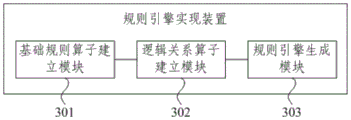
FIG. 3 is a schematic structural diagram of a rule engine implementation apparatus according to an embodiment of the present invention;
fig. 4 is a block diagram of an electronic device according to an embodiment of the present invention.
Detailed Description
In order to make the objects, technical solutions and advantages of the present invention clearer, the technical solutions of the present invention will be clearly and completely described below with reference to the accompanying drawings in the embodiments of the present invention, and it is obvious that the described embodiments are some, but not all, embodiments of the present invention. All other embodiments, which can be obtained by a person skilled in the art without any inventive step based on the embodiments of the present invention, are within the scope of the present invention.
Considering that the problems of high use cost, inconvenient maintenance, poor expandability and the like exist in the rule engine Drools which are widely used at present, the embodiment of the invention provides a new implementation idea of the rule engine: and abstracting the business rules to be processed, defining a rule operator according to an abstract result, and randomly combining various business rules through the operator to realize a final rule engine. The rule engine has good expansibility, so that the requirements of more complex and flexible rules can be met.
In addition, in order to determine whether the rule is valid, the rule needs to be determined item by item, and if the number of the rules is large, the process is time-consuming. Therefore, the embodiment of the invention considers that the matching speed of the rule is improved by establishing the memory inverted index for the rule, so that the processing speed when the large-data-volume rule sends a request is improved. The implementation method based on the embodiment of the invention can quickly construct a set of efficient and extensible lightweight rule engine, and is suitable for scenes with flexible and variable services and multiple rules and high access.
As an aspect of the embodiment of the present invention, the embodiment provides a method for implementing a rule engine, and referring to fig. 1, the method is a flowchart of the method for implementing a rule engine according to the embodiment of the present invention, and includes:
and S1, carrying out rule abstract analysis on the business logic to obtain the business rules, carrying out inductive summary based on the business rules, and establishing a basic rule operator.
It will be understood that for conventional business logic, it is often expressed in a business logic language. The business logic language expression may include related business rules, and the business rules may be obtained by performing abstract analysis on the business logic language.
And then, for different business rules, further analyzing, inducing and summarizing the business rules, and describing a summarizing result by using an equation to obtain a final equation expression of the same type of business rules, namely a basic rule operator. It can be understood that the basic rule operator refers to the induction summary of the business rule, and the rule is expressed by an equation, that is, the basic rule operator. The specific rule types are different, and the basic rule operators are also different.
Wherein, the service logic is the process description of each service feature completed by the combination of the building block assembly and the basic call processing module in the intelligent network. And the intelligent network is a network architecture for generating and providing new services for telecommunications. The business logic in the embodiment of the invention contains processing rules about a certain transaction, for example, "If new user: then full 100 minus 10 ".
S2, based on the logic relation between different business rules, the logic relation operator between each business rule is established.
It will be appreciated that for different business rules, there may be some logical relationship between them. And establishing a logical formula among the business rules as a logical relation operator according to the logical relation by analyzing the logical relation of different business rules.
For example, for rule "If new user: then 100 less 10 full of the product, and If off-season product: the hen 9.5 discount offer "AND" If new user AND off-season commodity: then 100 full minus 10& &9.5 discount offer ", the third rule" new user AND off-season commodity "is the merge of the first two rules" new user "AND" off-season commodity ". That is, if the condition of the third rule is the condition of the first rule & & the condition of the second rule, the equation can be defined as the logical relationship operator between the three rules.
S3, using the basic rule operator and the logic relation operator to express all the business rules in the business logic, obtaining the business rules expressed by the operators, and forming a rule engine based on the business rules expressed by the operators.
It is understood that all business rules in the business logic are represented using the base rules operator and the inter-rule logical relationship operator of all rules defined according to the above steps. That is, a business rule expressed in a natural language or a computer language is expressed in a form having an arithmetic structure defined by a basic rule operator, and a basic business rule expressed by the operator is obtained.
In addition, a plurality of business rules in the business logic are expressed by a logical relation operator according to different logical relations, and the logical relation expressed by the operator is obtained. The operator represents a logical relationship, for example, the condition of the third rule & & & & & & & & & & & & & & & & & & & & & & & & & & & & & & & &.
It can be understood that the basic business rule of the operator representation and the logical relationship of the operator representation in the embodiment of the present invention together constitute the business rule of the operator representation.
And then, orderly arranging according to the obtained business rules expressed by the operators, namely the basic business rules expressed by the operators and the logical relations expressed by the operators to form a corresponding rule engine. Then, under the condition of knowing the query condition, the rule engine can be utilized to query the corresponding processing strategy.
It is understood that the order in the above ordered arrangement can be implemented according to a preset arbitrary ordering rule. For example, the operation may be implemented according to the order of occurrence of the operation rules in the operation logic, or according to the order of frequency of occurrence of the same operation rules in the operation logic, or according to the order of time sequence in the operation rules represented by the operators.
According to the rule engine implementation method provided by the embodiment of the invention, the business rules are abstracted, the rule operator is defined, various business rules are combined at will through the operator, the method has good expansibility, can meet the requirements of complex rules, and can be well suitable for scenes with flexible and changeable business, more rules, high access quantity and the like.
Further, on the basis of the foregoing embodiment, after the step of representing all business rules in the business logic and obtaining the business rules represented by the operators, the method further includes: based on the business rules represented by all the operators, an inverted index of the business rules represented by all the operators is created in the memory.
Correspondingly, the step of constructing the rule engine based on the business rules represented by the operators further comprises: and forming a rule engine based on the business rules expressed by the operators and the inverted indexes.
It can be understood that, considering that when the rule engine of the above embodiment is used for querying or applying, in order to determine whether the rule is valid, the rule needs to be determined item by item, and if the number of the rules is large, the process will consume a lot of time, and the processing efficiency is seriously affected. Therefore, in the embodiment, the business rules represented by all the operators are analyzed and decomposed, the inverted indexes are established for the business rules represented by the operators, and the inverted indexes are written into the memory when the application items are started.
Correspondingly, when the rule engine is formed, the business rules expressed by the operators related to the business rules and the logical relations expressed by the operators are considered, and the inverted indexes are introduced, so that the three form the final rule engine. In the process of matching the rules by applying the rule engine, when the retrieval condition is known, firstly, the rules related to the retrieval condition are determined by using the inverted index, and then, according to the related rules, the rules are matched with the retrieval condition to determine the finally matched rules.
It will be appreciated that where the inverted index results from the need in an actual application to look up records based on the value of an attribute, each entry in such an index table includes an attribute value and the address of the respective record having that attribute value. In general, the forward index is used to find the attribute value by looking up the record, and the backward index is used to determine the position of the record according to the attribute value, but not to determine the attribute value according to the record. In the embodiment of the invention, the forward index is an index from the rule label to the business rule represented by the specific operator, namely the rule label needs to be inquired to determine the specific rule corresponding to the retrieval condition, so that a decision result is obtained. The inverted index is an index formed by forming index keys based on business rules expressed by operators and using rule labels of specific rules respectively related to the index keys as index values. The inverted index is to inquire the index key formed based on the business rule expressed by the operator according to the retrieval condition to determine the rule label of the related specific rule.
Considering that in practical application, the business logic will make corresponding changes with the operation decision, in order to enable the rule engine to continue to be applicable, in one embodiment, after the step of creating the inverted index of the business rules represented by all the operators in the memory, the method further comprises: and constructing a modification logic of the inverted index, and synchronously adjusting the inverted index based on the business rule before the change and the business rule after the change when the business rule changes.
It can be understood that only the reverse index associated with the changed business rule is adjusted when the reverse index is adjusted. If a certain business rule changes, the corresponding reverse index is found out according to the condition and decision information of the business rule before the change. And performing reverse processing on the changed rule independently, and replacing the reverse index corresponding to the rule before the change by using a new reverse index obtained by processing.
According to the rule engine implementation method provided by the embodiment of the invention, the matching speed of the rules can be improved by establishing the inverted memory index for the rules, so that the processing speed of concurrent requests of the large-data-volume rules is improved.
Optionally, the step of performing rule abstract analysis on the service logic and obtaining the service rule further includes: and extracting condition-result statements according to the language description of the business logic, and forming business rules based on the condition-result statements.
It can be understood that, considering that in practical applications, the business rule is usually described in the form of if-then, for the obtaining idea of such business rule, the embodiment first analyzes and decomposes the language description of the business logic in the project, and extracts all the condition-result statements therein. And then, for each condition-result statement, respectively forming a corresponding business rule according to the if and then sentence pattern structures.
The rule engine implementation method provided by the embodiment of the invention can rapidly and effectively solve the extraction problem of the conditional-result sentence business rules by analyzing and decomposing the business logic in the project and extracting all the conditional-result sentences and constructing the sentence business rules based on the conditional-result sentence business rules, thereby more conveniently and rapidly retrieving and matching the rules.
In one embodiment, the business rule comprises a condition unit and a decision unit;
correspondingly, the step of summarizing and summarizing based on the business rules and establishing a basic rule operator further comprises the following steps: based on all business rules, through inductive summarization of condition-result statements, a basic rule operator is established as follows: rule is condition + decision; in the formula, the condition represents a setting condition which needs to be met when a corresponding decision is made in the rule, and the decision represents a behavior decision which needs to be made when the corresponding setting condition is met;
correspondingly, the step of expressing all the business rules in the business logic by using the basic rule operator and the logic relation operator to obtain the business rules expressed by the operators further comprises the following steps:
respectively expressing the condition units and the decision units of all the business rules by using a basic rule operator to obtain basic business rules expressed by the operator, wherein the basic business rules expressed by the operator comprise a condition operator unit and a decision operator unit;
respectively expressing the logical relations among the condition units of different business rules and the logical relations among the decision units by using a logical relation operator to obtain the logical relations expressed by the operator;
and constructing the business rules expressed by the operators based on the basic business rules expressed by the operators and the logical relations expressed by the operators.
It can be understood that, according to the above embodiment, in the business rule of the condition-result sentence pattern, the sentence pattern includes two parts, one part is used as the judgment condition, and the other part is used as the corresponding decision behavior satisfying the condition, and the corresponding parts are respectively used as the condition unit and the decision unit.
Then, under the business rule of this kind of structure, when establishing the basic rule operator, the following method is followed: for all business rules, the operator form can be summarized according to the sentence structure, namely, the basic rule operator is as follows: rule is condition + decision. And then, on the basis, respectively utilizing a basic rule operator and a logical relation operator to represent each business rule again.
Specifically, for each business rule, the condition unit and the decision unit are decomposed and expressed according to the structural form of the basic rule operator to obtain the operator expression form corresponding to each business rule, namely the basic business rule expressed by the operator.
The basic business rule expressed by the operator also comprises a conditional operator unit and a decision operator unit correspondingly to the condition unit and the decision unit in the business rule.
Specifically, the logical relationship between the business rules is expressed by a logical relationship operator. Specifically, expressing the logical relationship between the condition units in different business rules by using a logical relationship operator to obtain the logical relationship expressed by the operator related to the condition; and expressing the logical relationship among the decision units in different business rules by using a logical relationship operator to obtain the logical relationship expressed by the operator related to the decision.
It will be appreciated that the logical relationship of the operator representation for the condition and the logical relationship of the operator representation for the decision in the application project together constitute the logical relationship of the operator representations.
Then, for all business logics in the application project, the basic business rules represented by the operators corresponding to all the business rules and the logical relationships represented by the operators jointly form the business rules represented by the operators corresponding to the business logics.
The rule engine implementation method provided by the embodiment of the invention expresses the business rules of the condition-result sentence pattern through the rule operator, and respectively establishes the logical relations between the condition units and the decision units in different rules, so that each business rule and the relation among the business rules can be more finely expressed, and when the retrieval condition is known, the related rules can be more quickly and accurately positioned.
In another embodiment, the step of establishing a logical relationship operator between business rules based on logical relationships between different business rules further includes:
based on the logic relation among the condition units in different business rules, establishing a logic relation operator among the condition units;
and establishing a logical relation operator between the decision units based on the logical relation between the decision units in different business rules.
It can be understood that, according to the above embodiment, for the business rules of the condition-result schema, each business rule includes two components, namely, a condition unit and a decision unit. Then, for different business rules, after decomposing according to the two parts, the logic relation between the corresponding condition unit and the decision unit in different business rules is analyzed.
And then, for the condition units in different business rules, establishing a logical expression among the condition units according to the logical relation among the condition units, wherein the logical expression is used as a logical relation operator among the condition units. Similarly, for the decision units in different business rules, a logical formula between the decision units is established according to the logical relationship between the decision units to serve as a logical relationship operator between the decision units.
According to the rule engine implementation method provided by the embodiment of the invention, the business rules of the condition-result sentence pattern are decomposed, the logical relations between the condition units and the decision units in different business rules are analyzed, and finally, the logical relation operators of the condition units and the logical relation operators of the decision units of each business rule are respectively established, so that all relevant business rules can be rapidly matched according to the retrieval conditions.
According to the above embodiment, optionally, the step of creating, in the memory, the inverted index of the business rules expressed by all the operators based on the business rules expressed by all the operators further includes:
respectively encoding the business rules represented by the operators to obtain unique codes corresponding to the business rules represented by the operators;
extracting an operator condition unit in the business rule represented by each operator to be used as an index key, and determining the unique code of the business rule represented by the operator to be used as an index value;
and creating an inverted index in the memory based on the index key and the index value corresponding to the business rule represented by each operator.
It can be understood that for known search conditions, in order to more quickly match out relevant rules among business rules represented by different operators, the method is implemented by establishing an inverted index of the business rules represented by the operators. Specifically, the method comprises the following steps:
first, a unique code is assigned to each business rule represented by an operator obtained according to the above embodiment. That is, for the business rule represented by each operator, a code is correspondingly allocated, and the code corresponding to each rule is unique and corresponds to the rule uniquely, so that the code is used as the unique code of the business rule represented by the operator. E.g., rule 1, rule 2,.. or rule N.
And then, for the business rule expressed by each operator, respectively extracting the corresponding operator condition unit, and taking the operator condition unit as an index key. And simultaneously, determining a unique code corresponding to the business rule represented by the operator, and taking the unique code as an index value of the rule.
And finally, establishing a corresponding reverse index for all the service rules expressed by the operators according to the index keys and the index values respectively corresponding to the rules, and writing the reverse index into a memory when the application items are started.
In the actual rule matching application, when a condition is known, the rule term applicable to the date can be quickly searched, and the database does not need to be traversed through all rules, so that the searching efficiency of the rules is greatly improved.
To further illustrate the technical solution of the present invention, the following example process flow is provided, but not limiting the scope of the present invention.
Step 1, abstract analysis is carried out on business rules, and the business rules are combined through operators.
Business rules are typically described in the form of if-then. For example, as shown in table 1, an example table of if-then business rules.
TABLE 1 example table of if-then business rules

By generalizing and summarizing a series of rules, the basic composition form of the rules, namely the basic rule operator, can be obtained:
rule is condition + policy.
The statement can be defined as a complete rule as long as the statement contains two attribute components of the condition and the policy.
Furthermore, there is a certain relationship between the conditions or policies of different rules. For example, as in rule 1 and rule 2 of Table 1, the conditions in both rules (new and old) can only be satisfied at the same time, and belong to a mutually exclusive relationship. While the conditions of rule 1 and rule 3 may be satisfied at the same time, this case can be described by rule 4, specifically, rule 4 condition is equal to rule 1 condition and rule 3 condition. To describe such a relationship, a logical relationship operator of a condition such as and (simultaneously satisfied, and, & &) and or (arbitrarily satisfied, or, |) or the like may be defined.
Similarly, policies in a rule may also operate with operators. For example, as shown in rule 1, rule 3, and rule 4 in table 1, a logical relationship operator of the policies may be defined to represent the relationship between the three policies, specifically, rule 4 policy is equal to rule 1 policy and rule 3 policy.
Taking a logical relation operator of a condition as an example, the logical relation that can represent the condition among different rules is shown in fig. 2, and fig. 2 is a schematic diagram of the logical relation operator of the condition in the rule engine implementation method according to the embodiment of the present invention. The conditions in different rules in the graph meet certain logical relations, and the related conditions are logically associated according to the logical relations among the different conditions.
With the basic rule operator, the logical relation operator of the condition and the logical relation operator of the strategy, various rules can be arbitrarily combined by the operators, so that the creation of complex rules is realized.
And step 2, establishing a memory inverted index for the rule.
In general, the forward index is the corresponding relationship between a rule label and a business rule represented by an operator, that is, the corresponding relationship between a rule label and a specific rule. In these specific rules, the condition values and decision values of the rules are included. In practical application, the search condition is generally known, and a decision result is obtained by querying the index table according to the search condition.
That is, in order to determine whether a rule is valid, the rule needs to be determined item by item. And if the number of rules is large, the process is very time consuming. If the rule meeting the current condition can be screened out at one time, the processing time is greatly shortened.
By utilizing the inverted index technology, the problems can be solved, and the purpose of primary screening is achieved. Specifically, when the project is started, the rules combined according to the steps, namely the business rules expressed by the operators, are pulled from the database. Then, an inverted index of the business rules represented by all the operators is created in the memory. Wherein the inverted index may be modified simultaneously when the rule changes.
Specifically, each index in the forward index may be analyzed to extract a condition value in the index values, and each condition value is used as an index number, and a rule label corresponding to a specific rule including each condition value is used as an index value to establish a new index, that is, the reverse index constituting the forward index.
For example, when the reverse index of the rule is established, the forward index of the rule is known as shown in table 2, which is a regular forward index table according to an embodiment of the present invention. In the index table, each rule label is used as an index number, a specific rule is used as an index value, and the index value specifically comprises a condition value and a decision value of the rule. Therefore, when the index table is used for retrieval, each index number (i.e., rule label) needs to be traversed, and final decision output is obtained by verifying whether the specific rules corresponding to the index numbers contain condition values corresponding to the retrieval conditions one by one. That is, the forward index is the correspondence of a rule label to a specific rule content.
Based on the forward index of table 2, a rule reverse index can be created as shown in table 3, which is a table of rule reverse indexes according to an embodiment of the present invention. When the reverse index is established, the condition values in each specific rule can be obtained by traversing each rule label of the forward index in table 2, and the condition values are used as index keys, the rule labels of the specific rules containing the condition values are used as index values, and an index table from the condition values to the rule labels is established, so that the reverse index table of table 3 can be obtained. It can be seen that the inverted index is transformed into a correspondence of the condition value of the rule to the rule label. When the inverted index is used for retrieval, the index key can be inquired according to the retrieval condition, the rule label corresponding to the specific rule is directly positioned, and the decision value corresponding to the retrieval condition is determined according to the specific rule corresponding to the rule label.
TABLE 2 regular positive index Table according to an embodiment of the present invention

Table 3 a rule inverted index table according to an embodiment of the present invention

As shown in the above example, after inverting the rules in Table 2, Table 3 is obtained, and then the inverted table data is loaded into the memory. When a condition is known, such as the date in the table above, the rule term applicable to the date can be quickly found without traversing all the rules for the database, so that the rule searching efficiency is greatly improved.
As another aspect of the embodiment of the present invention, the embodiment provides a rule engine implementation apparatus according to the above embodiment, and referring to fig. 3, a schematic structural diagram of a rule engine implementation apparatus according to the embodiment of the present invention is shown. The method comprises the following steps: a basic rule operator establishing module 301, a logical relation operator establishing module 302 and a rule engine generating module 303.
The basic rule operator establishing module 301 is configured to perform rule abstract analysis on the service logic, obtain a service rule, perform induction summary based on the service rule, and establish a basic rule operator; the logical relation operator establishing module 302 is configured to establish a logical relation operator between the business rules based on a logical relation between different business rules; the rule engine generating module 303 is configured to use the basic rule operator and the logical relationship operator to represent all the business rules in the business logic, obtain the business rules represented by the operators, and form a rule engine based on the business rules represented by the operators.
It can be understood that the rule engine implementation apparatus of this embodiment at least includes a basic rule operator establishing module 301, a logical relationship operator establishing module 302, and a rule engine generating module 303, which are used to implement the rule engine in the foregoing embodiments. Therefore, the description and definition in the rule engine implementation method in each embodiment described above may be used for understanding each functional module in the embodiment of the present invention, and reference may be specifically made to the embodiment described above, and details are not described here again.
In addition, it is understood that, in the embodiment of the present invention, the relevant functional module may be implemented by a hardware processor (hardware processor).
According to the rule engine implementation device provided by the embodiment of the invention, the relevant function modules are arranged in the device, the business rules are abstracted, the rule operators are defined, and various business rules are combined at will through the operators, so that the rule engine implementation device has good expansibility, can meet the requirement of complex rules, and can be well suitable for scenes with flexible and changeable business, more rules and high access amount.
As another aspect of the embodiment of the present invention, the embodiment provides an electronic device according to the above embodiment, and with reference to fig. 4, is a block diagram of a structure of an electronic device according to an embodiment of the present invention, including: at least one processor 401 and at least one memory 402 communicatively coupled to the processor 401. The memory 402 stores a computer program that can run on the processor 401, and when the processor 401 executes the computer program, the rule engine implementation method described in the above embodiments is implemented.
It should be understood that the electronic device of this embodiment at least includes a processor 401 and a memory 402, and the processor 401 and the memory 402 form a communication connection therebetween, and can perform transmission of mutual information and instructions, for example, the processor 401 reads program instructions of the rule engine implementation method from the memory 402.
When the electronic device is running, the processor 401 calls the program instructions in the memory 402 to execute the methods provided by the above-mentioned method embodiments, including for example: performing abstract analysis of rules on the business logic to obtain business rules, and performing inductive summarization based on the business rules to establish a basic rule operator; and performing abstract analysis of rules on the business logic, and the step of obtaining the business rules further comprises: and extracting condition-result statements according to the language description of the business logic, and forming business rules and the like based on the condition-result statements.
In another embodiment of the present invention, a non-transitory computer-readable storage medium is provided, which stores computer instructions, and the computer instructions cause a computer to execute the rules engine implementation method as described in the above embodiment.
It will be appreciated that the logic instructions stored in the memory 402 may be implemented in software functional units and stored in a computer readable storage medium when sold or used as a stand-alone article of manufacture. Alternatively, all or part of the steps of implementing the method embodiments may be implemented by hardware related to program instructions, where the program may be stored in a computer-readable storage medium, and when executed, the program performs the steps including the method embodiments; and the aforementioned storage medium includes: various media capable of storing program codes, such as a U disk, a removable hard disk, a ROM, a RAM, a magnetic disk, or an optical disk.
The above described embodiments of the electronic device are merely illustrative, wherein the units illustrated as separate components may or may not be physically separate, may be located in one place, or may be distributed over different network elements. Some or all of the modules can be selected according to actual needs to achieve the purpose of the scheme of the embodiment. One of ordinary skill in the art can understand and implement it without inventive effort.
Through the above description of the embodiments, those skilled in the art will clearly understand that each embodiment can be implemented by software plus a necessary general hardware platform, and certainly can also be implemented by hardware. With this understanding, the technical solutions mentioned above may be embodied in the form of a software product, which may be stored in a computer-readable storage medium, such as ROM/RAM, magnetic disk, optical disk, etc., and includes instructions for causing a computer device (such as a personal computer, a server, or a network device, etc.) to execute the method described in the method embodiments or some parts of the method embodiments.
According to the electronic device and the non-transitory computer readable storage medium provided by the embodiment of the invention, the business rules are abstracted, the rule operator is defined, various business rules are combined at will through the operator, the expansibility is good, the requirement of complex rules can be met, and the electronic device and the non-transitory computer readable storage medium are well suitable for scenes with flexible and changeable business, multiple rules and high access amount.
In addition, it should be understood by those skilled in the art that the terms "comprises," "comprising," or any other variation thereof, in the specification of the present invention, are intended to cover a non-exclusive inclusion, such that a process, method, article, or apparatus that comprises a list of elements does not include only those elements but may include other elements not expressly listed or inherent to such process, method, article, or apparatus. Without further limitation, an element defined by the phrase "comprising an … …" does not exclude the presence of other identical elements in a process, method, article, or apparatus that comprises the element.
In the description of the present invention, numerous specific details are set forth. However, it is understood that embodiments of the invention may be practiced without these specific details. In some instances, well-known methods, structures and techniques have not been shown in detail in order not to obscure an understanding of this description. Similarly, it should be appreciated that in the foregoing description of exemplary embodiments of the invention, various features of the invention are sometimes grouped together in a single embodiment, figure, or description thereof for the purpose of streamlining the disclosure and aiding in the understanding of one or more of the various inventive aspects.
However, the disclosed method should not be interpreted as reflecting an intention that: that the invention as claimed requires more features than are expressly recited in each claim. Rather, as the following claims reflect, inventive aspects lie in less than all features of a single foregoing disclosed embodiment. Thus, the claims following the detailed description are hereby expressly incorporated into this detailed description, with each claim standing on its own as a separate embodiment of this invention.
Finally, it should be noted that: the above examples are only intended to illustrate the technical solution of the present invention, but not to limit it; although the invention has been described in detail with reference to the foregoing embodiments, it will be understood by those skilled in the art that: the technical solutions described in the foregoing embodiments may still be modified, or some technical features may be equivalently replaced; and such modifications or substitutions do not depart from the spirit and scope of the corresponding technical solutions of the embodiments of the present invention.
Claims (8)
1. A method for implementing a rules engine, comprising:
carrying out abstract analysis of rules on the business logic to obtain business rules, carrying out inductive summarization based on the business rules, and establishing a basic rule operator;
based on the logic relation between different business rules, a logic relation operator between all the business rules is established;
expressing all the business rules in the business logic by using the basic rule operator and the logical relation operator to obtain the business rules expressed by the operators, and forming the rule engine based on the business rules expressed by the operators;
further, after the step of representing all the business rules in the business logic and obtaining the business rules represented by operators, the method further includes:
based on the business rules represented by all the operators, creating an inverted index of the business rules represented by all the operators in a memory;
correspondingly, the step of constructing the rule engine based on the business rules represented by the operators further comprises:
constructing the rule engine based on the business rules represented by the operators and the inverted index;
wherein the step of creating an inverted index in the memory about the business rules represented by all the operators based on the business rules represented by all the operators further comprises:
respectively coding the business rules represented by each operator to obtain unique codes corresponding to the business rules represented by each operator;
extracting an operator condition unit in the business rule represented by each operator to be used as an index key, and determining the unique code of the business rule represented by the operator to be used as an index value;
and creating the inverted index in the memory based on the index key and the index value corresponding to the business rule represented by each operator.
2. The method of claim 1, wherein the step of performing an abstract analysis of rules on the business logic to obtain the business rules further comprises:
and extracting condition-result statements according to the language description of the business logic, and constructing the business rules based on the condition-result statements.
3. The method of claim 2, wherein the business rule comprises a condition unit and a decision unit;
correspondingly, the step of performing inductive summarization based on the business rules and establishing a basic rule operator further comprises:
based on all the business rules, the basic rule operator is established by inductive summarization of the condition-result statement as follows:
rule is condition + decision;
in the formula, the condition represents a setting condition which needs to be met when a corresponding decision is made in the rule, and the decision represents a behavior decision which needs to be made when the corresponding setting condition is met;
correspondingly, the step of representing all the business rules in the business logic by using the basic rule operator and the logical relation operator to obtain the business rules represented by the operators further includes:
respectively expressing the condition units and the decision units of all the business rules by using the basic rule operator to obtain basic business rules expressed by the operator, wherein the basic business rules expressed by the operator comprise the condition operator units and the decision operator units;
expressing the logical relations among the condition units of different business rules and the logical relations among the decision units respectively by using the logical relation operators to obtain the logical relations expressed by the operators;
and constructing the business rules expressed by the operators based on the basic business rules expressed by the operators and the logical relations expressed by the operators.
4. The method of claim 3, wherein the step of establishing a logical relationship operator between the business rules based on the logical relationship between the different business rules further comprises:
based on the logic relation among the condition units in different business rules, establishing a logic relation operator among the condition units;
and establishing a logical relation operator between the decision units based on the logical relation between the decision units in different business rules.
5. The method of claim 1, wherein after the step of creating an inverted index of business rules for all of the operator representations in the memory, further comprising:
and constructing a modification logic of the inverted index, and adjusting the inverted index synchronously based on the business rule before change and the business rule after change when the business rule changes.
6. A rules engine implementation apparatus, comprising:
the basic rule operator establishing module is used for carrying out rule abstract analysis on the business logic to obtain the business rule, carrying out inductive summary based on the business rule and establishing a basic rule operator;
the logic relation operator establishing module is used for establishing a logic relation operator among the business rules based on the logic relation among the different business rules;
a rule engine generating module, configured to use the basic rule operator and the logical relationship operator to represent all the business rules in the business logic, obtain the business rules represented by the operators, and form the rule engine based on the business rules represented by the operators;
wherein the rules engine generation module is further configured to: based on the business rules represented by all the operators, creating an inverted index of the business rules represented by all the operators in a memory;
correspondingly, when the step of constructing the rule engine based on the business rule expressed by the operator is performed, the rule engine generation module is specifically configured to:
constructing the rule engine based on the business rules represented by the operators and the inverted index;
the rule engine generation module is specifically configured to, when performing the step of creating an inverted index about the business rules expressed by all the operators in the memory based on the business rules expressed by all the operators:
respectively coding the business rules represented by each operator to obtain unique codes corresponding to the business rules represented by each operator;
extracting an operator condition unit in the business rule represented by each operator to be used as an index key, and determining the unique code of the business rule represented by the operator to be used as an index value;
and creating the inverted index in the memory based on the index key and the index value corresponding to the business rule represented by each operator.
7. An electronic device, comprising: at least one processor, and at least one memory communicatively coupled to the processor;
the memory has stored therein a computer program operable on the processor, which when executed by the processor, implements the method of any of claims 1 to 5.
8. A non-transitory computer-readable storage medium storing computer instructions that cause a computer to perform the method of any one of claims 1-5.
Priority Applications (1)
| Application Number | Priority Date | Filing Date | Title |
|---|---|---|---|
| CN201811648322.1A CN109857833B (en) | 2018-12-30 | 2018-12-30 | Rule engine implementation method and device and electronic equipment |
Applications Claiming Priority (1)
| Application Number | Priority Date | Filing Date | Title |
|---|---|---|---|
| CN201811648322.1A CN109857833B (en) | 2018-12-30 | 2018-12-30 | Rule engine implementation method and device and electronic equipment |
Publications (2)
| Publication Number | Publication Date |
|---|---|
| CN109857833A CN109857833A (en) | 2019-06-07 |
| CN109857833B true CN109857833B (en) | 2021-06-08 |
Family
ID=66893598
Family Applications (1)
| Application Number | Title | Priority Date | Filing Date |
|---|---|---|---|
| CN201811648322.1A Active CN109857833B (en) | 2018-12-30 | 2018-12-30 | Rule engine implementation method and device and electronic equipment |
Country Status (1)
| Country | Link |
|---|---|
| CN (1) | CN109857833B (en) |
Families Citing this family (9)
| Publication number | Priority date | Publication date | Assignee | Title |
|---|---|---|---|---|
| CN112825070A (en) * | 2019-11-21 | 2021-05-21 | 高新兴科技集团股份有限公司 | Rule processing method and device based on data flow of Internet of things and storage medium |
| CN116503173A (en) * | 2020-04-16 | 2023-07-28 | Gotcex 有限公司 | Rule engine and modeling method, modeling device and instruction processing method thereof |
| CN111932076B (en) * | 2020-07-09 | 2023-12-12 | 车智互联(北京)科技有限公司 | Rule configuration and release method and device and computing equipment |
| CN112130895B (en) * | 2020-08-04 | 2022-04-15 | 中科天玑数据科技股份有限公司 | Model issuing method and device for portability and storage medium |
| CN112882687A (en) * | 2020-12-10 | 2021-06-01 | 宝付网络科技(上海)有限公司 | Method for realizing efficient universal rule engine |
| CN113434123A (en) * | 2021-07-07 | 2021-09-24 | 北京自如信息科技有限公司 | Service processing method and device and electronic equipment |
| CN115630184A (en) * | 2021-07-14 | 2023-01-20 | 奇安信科技集团股份有限公司 | Image content risk semantic identification method, device, computer equipment and medium |
| CN116048471A (en) * | 2021-10-28 | 2023-05-02 | 上海宝信软件股份有限公司 | Extensible data preprocessing system and method |
| CN116048484A (en) * | 2022-11-18 | 2023-05-02 | 华信永道(北京)科技股份有限公司 | A general-purpose rule engine system and a processing method for the rule engine system |
Family Cites Families (5)
| Publication number | Priority date | Publication date | Assignee | Title |
|---|---|---|---|---|
| CN105335133B (en) * | 2014-06-18 | 2018-10-09 | 国际商业机器公司 | Method and apparatus for generating business rule model |
| CN105573737A (en) * | 2014-10-30 | 2016-05-11 | 中国科学院声学研究所 | Method for increasing operating efficiency of rule engines |
| CN105786950A (en) * | 2015-12-30 | 2016-07-20 | 北京锐安科技有限公司 | Method and device for processing data |
| KR20170130741A (en) * | 2016-05-19 | 2017-11-29 | 삼성에스디에스 주식회사 | System and method for managing rules |
| CN108399066A (en) * | 2018-01-25 | 2018-08-14 | 链家网(北京)科技有限公司 | A kind of regulation engine implementation method and device |
-
2018
- 2018-12-30 CN CN201811648322.1A patent/CN109857833B/en active Active
Also Published As
| Publication number | Publication date |
|---|---|
| CN109857833A (en) | 2019-06-07 |
Similar Documents
| Publication | Publication Date | Title |
|---|---|---|
| CN109857833B (en) | Rule engine implementation method and device and electronic equipment | |
| CN111459985B (en) | Identification information processing method and device | |
| US8108367B2 (en) | Constraints with hidden rows in a database | |
| Gilson et al. | From web data to visualization via ontology mapping | |
| US11106719B2 (en) | Heuristic dimension reduction in metadata modeling | |
| US20170357653A1 (en) | Unsupervised method for enriching rdf data sources from denormalized data | |
| US20150100568A1 (en) | Automatic definition of entity collections | |
| US10467276B2 (en) | Systems and methods for merging electronic data collections | |
| CN118394896A (en) | Data query method, device, computer equipment and storage medium | |
| US20240220876A1 (en) | Artificial intelligence (ai) based data product provisioning | |
| CN119166740A (en) | Knowledge base construction method, data processing method, device, storage medium and program product | |
| JP5844824B2 (en) | SPARQL query optimization method | |
| Wu et al. | Mining skyline patterns from big data environments based on a spark framework | |
| CN113761213B (en) | Knowledge graph-based data query system, method and terminal equipment | |
| CN115906858A (en) | Text processing method, system and electronic device | |
| US12321864B2 (en) | Multi-hop search for entity relationships | |
| CN120407870A (en) | Information retrieval system, method, terminal, medium and product based on multi-channel recall | |
| CN119106104A (en) | A content retrieval method, device, equipment, intelligent agent and storage medium | |
| CN118797156A (en) | Component recommendation method, system, device and medium | |
| Atzori et al. | Gdup: De-duplication of scholarly communication big graphs | |
| CN107436919B (en) | A Modeling Method of Cloud Manufacturing Standard Service Based on Ontology and BOSS | |
| US11573721B2 (en) | Quality-performance optimized identification of duplicate data | |
| Walha et al. | From user generated content to social data warehouse: processes, operations and data modelling | |
| Dong et al. | Teledata: data mining, social network analysis and statistics analysis system based on cloud computing in telecommunication industry | |
| Zhang et al. | A text mining based method for policy recommendation |
Legal Events
| Date | Code | Title | Description |
|---|---|---|---|
| PB01 | Publication | ||
| PB01 | Publication | ||
| SE01 | Entry into force of request for substantive examination | ||
| SE01 | Entry into force of request for substantive examination | ||
| TA01 | Transfer of patent application right | ||
| TA01 | Transfer of patent application right |
Effective date of registration: 20210330 Address after: 101309 room 24, 62 Farm Road, Erjie village, Yangzhen, Shunyi District, Beijing Applicant after: Beijing fangjianghu Technology Co.,Ltd. Address before: Unit 05, room 112, 1st floor, office building, Nangang Industrial Zone, economic and Technological Development Zone, Binhai New Area, Tianjin 300457 Applicant before: BEIKE TECHNOLOGY Co.,Ltd. |
|
| GR01 | Patent grant | ||
| GR01 | Patent grant |