Detailed Description
In the following detailed description of illustrative embodiments, reference is made to the accompanying drawings, which form a part hereof. These embodiments are described in sufficient detail to enable those skilled in the art to practice the invention, and it is to be understood that other embodiments may be utilized and that logical structural, mechanical, fluidic, electrical, and chemical changes may be made without departing from the spirit or scope of the present invention. To avoid detail not necessary to enable those skilled in the art to practice the embodiments described herein, the description may omit certain information known to those skilled in the art. The following detailed description is, therefore, not to be taken in a limiting sense, and the scope of the illustrative embodiments is defined only by the appended claims.
During completion of a well and after primary cementing, it may be desirable in some instances to cement a portion of the wellbore that extends above a previously cemented portion of the wellbore. In these cases, a "squeeze" operation may be employed in which cement is deployed from the top down (i.e., downhole) at intervals in the wellbore. The present disclosure relates to subassemblies, systems, and methods for diverting fluid in a wellbore, for example, to divert a cement slurry from a working string (e.g., drill string, running string, completion string, or the like) to an annulus between an outer surface of the string and a wellbore wall, thereby forming a cement boundary over the interval and isolating the wellbore from the surrounding geographic region or other wellbore wall.
The disclosed subassemblies, systems, and methods allow an operator to perform a top-down squeeze cementing operation immediately after a conventional cementing operation and then return to a standard circulation path after the squeeze work is complete. To this end, a diverter assembly is disclosed having the following capabilities: allowing displacement-based devices (e.g., cement displacement darts) and fluids to pass through their centers and continue downhole while maintaining the ability to open ball-actuated ports or orifices that provide a path to a ring outside of the subassembly. A top-down cementing or "squeeze" operation is performed by opening an orifice for the fluid to be diverted from the tool string to flow a cement slurry or similar fluid downhole in a loop. After cement circulation, the orifice may be closed so that the tool string may be pressurized to set a tool, such as a liner hanger. The closure may also be ball actuated in addition to a liner hanger or other tool. To this end, a second ball may be used to close the valve, and may also be used to actuate and set a liner hanger or similar tool downhole from the diverter assembly.
Cementing may be accomplished in this manner for any number of reasons. For example, regulatory requirements may require cementing from the hydrocarbon found region to the wellbore region uphole near and above the previously cemented region, or the cement interval may receive cement from the bottom hole assembly and benefit from additional cement applied from the top of the interval.
Turning now to the figures, fig. 1 illustrates a schematic diagram of an offshore platform 142 operating a tool string 128 including a diverter assembly 100, which is a downhole tool that may be used in a top-down crushing operation or for setting a liner hanger, according to an illustrative embodiment. The diverter assembly 100 of FIG. 1 may be deployed to enable a top-down squeeze operation to be applied downhole from the diverter assembly 100 in the region 148 and to set a liner hanger 150 downhole from the diverter assembly 100. The tool string 128 may be a drill string, a completion string, a landing string, or other suitable type of work string for completing or maintaining a well. In some embodiments, the work string may be a pad-laying string. In the embodiment of fig. 1, the tool string 128 is deployed through a blowout preventer 139 in a subsea well 138 accessed through an offshore platform 142. A fluid supply 132, which may be a pump system coupled to a cement slurry or other fluid reservoir, is positioned on the offshore platform 142 and is operable to supply pressurized fluid to the tool string 128. As referenced herein, an "offshore platform" 142 may be a floating platform, a platform anchored to the sea floor 140, or a vessel.
Alternatively, fig. 2 illustrates a schematic of the drilling rig 104 with the tool string 128 deployed to the land-based well 102. The tool string 128 includes the diverter assembly 100 according to the illustrative embodiment. The drilling rig 104 is positioned at a surface 124 of the well 102. Well 102 includes a wellbore 130 extending from a surface 124 of well 102 to a subsurface formation. Well 102 and rig 104 are illustrated onshore in fig. 2.
Fig. 1 and 2 each illustrate a possible use or deployment of a diverter assembly 100 that may be used in either case in a tool string 128 to apply a top-down squeeze operation and then assist in setting a liner hanger or with another downhole device. In the embodiment illustrated in fig. 1 and 2, the wellbore 130 has been formed by a drilling process in which earth, rock, and other subterranean material has been cut from a formation by a drill bit operated via a drill string to create the wellbore 130. During or after the drilling process, a portion of the wellbore may be cased using the casing 146. From time to time, it may be necessary to deploy cement via a work string to form a casing in the uncased region 148 of the well above the casing 146. In some embodiments, the work string may be a pad-laying string. This is typically done in a top-down squeeze operation, where cement is delivered to the wellbore through a work string and squeezed into the formation by diverting the cement to an annulus 136 between the wall of the wellbore 130 and the tool and liner/casing string 128 and applying pressure via the fluid supply 132.
The tool string 128 may refer to a collection of tubes, mandrels, or conduits as a single component, or alternatively, to individual tubes, mandrels, or conduits that make up a tubing string. The diverter assembly 100 may be used in other types of tool strings or components thereof where it is desirable to divert fluid flow from the interior of the tool string to the exterior of the tool string. As referenced herein, the term tool string is not meant to be limiting in nature, but may include a laying tool or any other type of tool string used in completion and maintenance operations. The tool string 128 may include a channel disposed longitudinally in the tool string 128 that is configured to allow fluid communication between the surface 124 of the well 102 and the downhole location 134.
Lowering of the tool string 128 may be accomplished by a lift assembly 106 associated with a derrick 114 positioned on or near the rig 104 or offshore platform 142. The lift assembly 106 may include a hook 110, a cable 108, a travel block (not shown), and a crane (not shown) that work together cooperatively to raise or lower a swivel 116 coupled to the upper end of the tool string 128. The tool string 128 may be raised or lowered as needed to add additional sections of pipe to the tool string 128 to position the distal end of the tool string 128 at a downhole location 134 in the wellbore 130. A fluid supply 132 may be used to deliver fluid (e.g., cement slurry) to the tool string 128. The fluid supply 132 may include a pressurization device, such as a pump, to actively deliver pressurized fluid to the tool string 128.
An illustrative embodiment of a downhole tool diverter assembly 200 is shown in fig. 3-5. The diverter assembly 200 includes a pipe section, which may be an outer sleeve 204, that may be inserted between upper and lower sections of a tool string or pipe disposed therein. To facilitate coupling to the tool string, the end of the outer sleeve 204 may be manufactured with standard API threads and attached in line with other elements of the tool string as a component directly downhole from the tool joint adapter. Alternatively, the tool joint adapter feature may be incorporated into the diverter assembly itself. The outer sleeve 202 has an inlet 240 at an uphole end and an outlet 242 at a downhole end. Guide features, such as pins 228, extend into the interior bore of the outer sleeve 204 and may be assembled to the outer sleeve 204 or integrally formed with the outer sleeve 204.
The inner sleeve 202 is positioned within the outer sleeve 204 and has an outer diameter that allows the inner sleeve 202 to fit tightly within the inner bore of the outer sleeve 204. The inner sleeve 202 has circuitous slots 210 configured to receive the pins 228 to guide movement of the inner sleeve 202 within the outer sleeve 204. The circuitous slot 210 includes three longitudinal tracks parallel to the longitudinal axis 201 of the inner sleeve 202. In the illustrative embodiment of FIG. 3, the circuitous slot 210 includes a first longitudinal rail 212, a second longitudinal rail 214, and a third longitudinal rail 216. The second longitudinal rail 214 may be offset from the first longitudinal rail 212 by a rotational and/or axial distance to such an extent that the uphole portion of the second longitudinal rail 214 is uphole from the uphole portion of the first longitudinal rail 212. Similarly, the third longitudinal rail 216 may be offset from the second longitudinal rail 214 by a rotational and/or axial distance such that an uphole portion of the third longitudinal rail 216 is uphole from an uphole portion of the second longitudinal rail 214. First longitudinal rail 212 may be connected to second longitudinal rail 214 by a first transition rail 218 that forms a diagonal uphole path from first longitudinal rail 212 to second longitudinal rail 214. Accordingly, second longitudinal rail 214 may be connected to third longitudinal rail 216 by a second transition rail 220 that forms a diagonal uphole path from second longitudinal rail 214 to third longitudinal rail 216. In some embodiments, the intersection between first transition track 218 and second longitudinal track 214 is uphole from the intersection between second longitudinal track 214 and second transition track 220.
It should be noted that while the longitudinal rails are shown as being substantially perpendicular or parallel to the longitudinal axis 201 of the inner sleeve 202, the longitudinal rails may not be parallel (e.g., a curved or angled shape may alternatively be used) without departing from the scope of the present invention. Further, while the illustrative embodiment shows three longitudinal rails and two transition rails, any number of additional longitudinal rails and corresponding transition rails may be used to provide additional indexed positions of the inner sleeve 202 relative to the outer sleeve 204, as described in more detail below.
Inner sleeve 202 includes a first aperture 206, which in some configurations may be aligned with a second aperture 208 formed in outer sleeve 204. In the embodiment of fig. 3-5, the first aperture 206 and the second aperture 208 are (a) misaligned when the inner sleeve 202 is in a first position relative to the outer sleeve 204 that corresponds to the pin 228 being positioned in the uphole portion of the first longitudinal track 212; (b) the inner sleeve 202 is aligned with respect to the outer sleeve 204 in a second position corresponding to the pin 228 being positioned in the uphole portion of the second longitudinal track 214; and (c) is misaligned when the inner sleeve 202 is in a third position relative to the outer sleeve 204 that corresponds to the pin 228 being positioned in the uphole portion of the third longitudinal track 216. Accordingly, the first aperture 206 may be positioned on the inner sleeve 202 at a distance relative to the uphole portion of the second longitudinal track 214 that corresponds to the position of the second aperture 208 of the outer sleeve 204 relative to the pin 228. To facilitate sealing engagement between the inner sleeve 202 and the outer sleeve 204, the inner sleeve 202 and/or the outer sleeve 204 may be formed with a groove 222 to receive a seal or sealing element 224, such as an o-ring or similar seal.
In the embodiment of fig. 3-5, the first and second apertures 206, 208 are shown arranged in a single column longitudinally along the inner and outer sleeves 202, 204, respectively. In some embodiments, each of the first aperture 206 and the second aperture 208 may include multiple columns of apertures or arrays of apertures. In this embodiment, alignment of the first aperture 206 relative to the second aperture 208 may be achieved primarily by generating a rotational displacement of the inner sleeve 202 relative to the outer sleeve 204.
In fig. 3A, the diverter assembly is shown in a first configuration in which the first aperture 206 is misaligned with the second aperture 208. In fig. 4, the work string including diverter assembly 200 may have transitioned from tensioned to compressed and back while being rotated to cause inner sleeve 202 to be displaced relative to outer sleeve 204 by pin 228 traveling along first transition track 218 and to the uphole portion of second longitudinal track 214. Positioning the pin 228 in the uphole portion of the second longitudinal track 214 corresponds to the diverter assembly 200 being in a second configuration in which the first aperture 206 is aligned with the second aperture 208 such that fluid within the diverter assembly 200 is permitted to flow through the first aperture 206 and the second aperture 208 to the annulus surrounding the outer sleeve 204.
Similarly, in fig. 5, the work string including diverter assembly 200 may again have transitioned from tensioned to compressed and rearward while being rotated to cause inner sleeve 202 to be displaced relative to outer sleeve 204 by pin 228 traveling along second transition track 220 and to the uphole portion of third longitudinal track 216. Positioning the pin 228 in the uphole portion of the third longitudinal track 216 corresponds to the diverter assembly 200 being in a third configuration in which the first aperture 206 is again misaligned with the second aperture 208 such that fluid within the diverter assembly 200 is not permitted to flow through the first aperture 206 and the second aperture 208.
An alternative embodiment of the diverter assembly 300 is described with respect to fig. 6-8. As with the diverter assembly 200 of fig. 3-5, the diverter assembly 300 includes an outer sleeve 304 that may be inserted between the upper and lower sections of a tool string or a pipe disposed therein. The outer sleeve 304 has an inlet 340 at an uphole end and an outlet 342 at a downhole end. Guide features, such as pins 326, extend into the inner bore of outer sleeve 304 and may be assembled to outer sleeve 304 or integrally formed with outer sleeve 304.
Inner sleeve 302 is positioned within outer sleeve 304 and has an outer diameter that allows the inner sleeve to slidingly engage the inner bore of outer sleeve 304. The inner sleeve 302 has circuitous slots 310 configured to receive pins 326 to guide movement of the inner sleeve 302 within the outer sleeve 304. The circuitous slot 310 includes three longitudinal tracks parallel to the longitudinal axis 301 of the inner sleeve 302. In the illustrative embodiment of FIG. 6, the circuitous slot 310 includes a first longitudinal rail 312, a second longitudinal rail 314, and a third longitudinal rail 316. The second longitudinal rail 314 may be offset from the first longitudinal rail 312 by a rotational and/or axial distance to such an extent that the uphole portion of the second longitudinal rail 314 is uphole or downhole from the uphole portion of the first longitudinal rail 312. Similarly, the third longitudinal rail 316 may be offset from the second longitudinal rail 314 by a rotational and/or axial distance to such an extent that an uphole portion of the third longitudinal rail 316 is uphole or downhole from an uphole portion of the second longitudinal rail 314. First longitudinal rail 312 may be connected to second longitudinal rail 314 by a first transition rail 318 that forms a diagonal uphole path from first longitudinal rail 312 to second longitudinal rail 314. Accordingly, second longitudinal rail 314 may be connected to third longitudinal rail 316 by a second transition rail 320 that forms a diagonal uphole path from second longitudinal rail 314 to third longitudinal rail 316.
The inner sleeve 302 includes a first aperture 306, which in some configurations may be aligned with a second aperture 308 formed in the outer sleeve 304. In the embodiment of fig. 6-8, the first aperture 306 and the second aperture 308(a) are misaligned when the inner sleeve 302 is in a first position relative to the outer sleeve 304 that corresponds to the pin 326 being positioned in the uphole portion of the first longitudinal track 312; (b) the inner sleeve 302 is aligned with respect to the outer sleeve 304 in a second position corresponding to the pin 326 being positioned in the uphole portion of the second longitudinal track 314; and (c) is misaligned when the inner sleeve 302 is in a third position relative to the outer sleeve 304 that corresponds to the pin 326 being positioned in the uphole portion of the third longitudinal track 316. Thus, the first aperture 306 may be positioned on the inner sleeve 302 relative to the uphole portion of the second longitudinal track 314 at a distance corresponding to the position of the second aperture 308 of the outer sleeve 304 relative to the pin 326. To facilitate sealing engagement between the inner sleeve 302 and the outer sleeve 304, the inner sleeve 302 and/or the outer sleeve 304 may be formed with a groove 322 to receive a seal or sealing element 324, such as an o-ring or similar seal.
In the embodiment of fig. 6-8, the first apertures 306 and the second apertures 308 are shown spaced apart by an angular distance along the inner sleeve 302 and the outer sleeve 304, respectively, in a single row. In some embodiments, each of the first apertures 306 and the second apertures 308 may comprise a plurality of rows of apertures, or an array of apertures. Thus, the embodiment of fig. 6-8 may be understood to disclose an arrangement in which the first aperture 306 is aligned with the second aperture 308 primarily by axial displacement of the inner sleeve 302 relative to the outer sleeve 304.
In some embodiments, the inner sleeve may include a first array of apertures and the outer sleeve may include a second array of apertures, and the first apertures may be aligned with the second apertures by displacing the inner sleeve relative to the outer sleeve, the displacement being primarily axial, primarily rotational, or a combination thereof.
In fig. 6A, the diverter assembly 300 is shown in a first configuration in which the first aperture 306 is misaligned with the second aperture 308. In fig. 7, the work string including diverter assembly 300 may have transitioned from tensioned to compressed and back while being rotated to cause inner sleeve 302 to be displaced relative to outer sleeve 304 by pin 326 traveling along first transition track 318 and to the uphole portion of second longitudinal track 314. Positioning the pin 326 in the uphole portion of the second longitudinal track 314 corresponds to the diverter assembly 300 being in a second configuration in which the first aperture 306 is aligned with the second aperture 308 such that fluid within the diverter assembly 300 is permitted to flow through the first aperture 306 and the second aperture 308.
Similarly, in fig. 8, the work string including diverter assembly 300 may again have transitioned from tensioned to compressed and back while being rotated to cause inner sleeve 302 to be displaced relative to outer sleeve 304 by pin 326 traveling along second transition track 320 and to the uphole portion of third longitudinal track 316. Positioning the pin 326 in the uphole portion of the third longitudinal track 316 corresponds to the diverter assembly 300 being in a third configuration in which the first aperture 306 is again misaligned with the second aperture 308 such that fluid within the diverter assembly 300 is not permitted to flow through the first aperture 306 and the second aperture 308 to the annulus surrounding the outer sleeve 304.
Another alternative embodiment of a diverter assembly 400 is described with respect to fig. 9-14. The illustrative embodiment is similar in many respects to the embodiment of fig. 3-8. As with the diverter assembly 200 of fig. 3-5, the diverter assembly 400 includes an outer sleeve 404 that may be inserted between the upper and lower sections of a tool string or a pipe disposed therein. The outer sleeve 404 has an inlet 440 at an uphole end and an outlet 442 at a downhole end. Guide features, such as pins 426, extend into the interior bore of the outer sleeve 404 and may be assembled to the outer sleeve 404 or integrally formed with the outer sleeve 404.
Inner sleeve 402 is positioned within outer sleeve 404 and has an outer diameter that allows inner sleeve 402 to slidingly engage the inner bore of outer sleeve 404. The inner sleeve 402 has circuitous slots 410 configured to receive pins 426 to guide movement of the inner sleeve 402 within the outer sleeve 404. The circuitous slot 410 includes two longitudinal rails parallel to the longitudinal axis 401 of the inner sleeve 402, as shown in fig. 9B. In the illustrative embodiment of fig. 9, the circuitous slot 410 includes a first longitudinal rail 412 and a second longitudinal rail 414. The second longitudinal rail 414 may be offset from the first longitudinal rail 412 by a rotational and/or axial distance to such an extent that the uphole portion of the second longitudinal rail 414 is uphole or downhole from the uphole portion of the first longitudinal rail 412. First longitudinal rail 412 may be connected to second longitudinal rail 414 by a first transition rail 418 that forms a diagonal uphole path from first longitudinal rail 412 to second longitudinal rail 414.
The inner sleeve 402 includes a first aperture 406, which in some configurations may be aligned with a second aperture 408 formed in the outer sleeve 404. In the embodiment of fig. 9-14, the first and second apertures 406, 408(a) are misaligned when the inner sleeve 402 is in a first position relative to the outer sleeve 404 that corresponds to the pin 426 being positioned in the uphole portion of the first longitudinal track 412; (b) the inner sleeve 402 is aligned with respect to the outer sleeve 404 in a second position corresponding to the pin 426 being positioned in the downhole portion of the first longitudinal track 412; and (c) misaligned when the inner sleeve 402 is in a third position relative to the outer sleeve 404 that corresponds to the pin 426 being positioned in the uphole portion of the second longitudinal track 414. Thus, the first aperture 406 may be positioned on the inner sleeve 402 relative to the uphole portion of the first longitudinal track 412 at a distance corresponding to the position of the second aperture 408 of the outer sleeve 404 relative to the pin 426. To facilitate sealing engagement between the inner sleeve 402 and the outer sleeve 404, the inner sleeve 402 and/or the outer sleeve 404 may be formed with a groove 422 to receive a seal or sealing element 424, such as an o-ring or similar seal.
The diverter assembly 400 differs from the previously described embodiments in several respects. The downhole portion of inner sleeve 402 may, for example, include a smaller diameter section to provide a gap between the outer diameter of the downhole portion of the inner sleeve and the inner diameter of outer sleeve 404 for spring 428, which may be a coil spring or similar compression spring. The spring 428 may be compressed against the shoulder 425 of the inner sleeve 402 by a cap 430 coupled to a downhole portion of the outer sleeve 404. The inner sleeve 402 may also include a seal seat 432 for receiving a sealing member. The downhole portion of inner sleeve 402 may have a reduced section of material at and below seal seat 432 such that the sealing member may be forced out through seal seat 432 after application of a preselected force.
In the embodiment of fig. 9-14, the first and second apertures 406, 408 are shown spaced apart by an angular distance along the inner and outer sleeves 402, 404, respectively, in a single row. In some embodiments, each of the first and second orifices 406, 408 may comprise multiple rows of orifices, or arrays of orifices. Thus, the embodiment of fig. 9-14 may be understood to disclose an arrangement in which the first aperture 406 is aligned with the second aperture 408 primarily by axial displacement of the inner sleeve 402 relative to the outer sleeve 404.
In fig. 9A, the diverter assembly 400 is shown in a first configuration in which the first aperture 406 is misaligned with the second aperture 408. In fig. 10, a sealing member 436 is shown deployed to the seal seat 432 of the inner sleeve 402, which may be a ball or dart. In fig. 11, a pressure differential has been applied across sealing member 436 to create a pressure differential sufficient to cause spring 428 to compress, causing pin 426 to track to the downhole portion of first longitudinal rail 412. Here, the diverter assembly 400 is in a second configuration in which the first aperture 406 is aligned with the second aperture 408 such that fluid is permitted to flow through the inlet 440 of the diverter assembly 400 and through the first and second apertures 406, 408 to the ring surrounding the outer sleeve 404.
In fig. 12, the pressure differential across the sealing member 436 has been reduced such that the force generated by the spring 428 pushes the inner sleeve 402 back toward the inlet 440, allowing the rotational force to push the pin 426 through the first transition track 418 and into the second longitudinal track 414.
In some embodiments, it should be noted that the circuitous slot 410 may be substantially "Y" or "V" shaped and arranged such that the spring 428 force will direct the pin 426 to the second longitudinal track 414 or the second location within the circuitous slot 410 without the need to rotate the work string. FIG. 13 illustrates the diverter assembly 400 after the pressure differential across the seal member 436 has increased to a second predetermined threshold to cause the seal member 436 to extrude out of the seal seat 432. In fig. 14, the spring 428 has expanded to transition the diverter assembly 400 to a third configuration in which the fluid flow path from the inlet 440 to the outlet 442 is unobstructed and the first aperture 406 is misaligned with the second aperture to restrict fluid flow from the inner sleeve 402 to the second aperture 408.
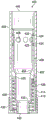
Another embodiment of a diverter assembly 500 is described with respect to fig. 15-20. In the illustrative embodiment, the diverter assembly 500 includes an outer sleeve 504 having a first aperture 508 extending from an inner bore of the outer sleeve 504 through an outer surface of the outer sleeve 504. The outer fastening apertures 538 extend from the inner bore of the outer sleeve 504 and are configured to receive fasteners, here illustrated as second shear fasteners 562 (in view of the first shear fasteners 541 described below). The shear fastener may be a shear pin or a shear screw operable to fail by shearing when subjected to a predetermined shear force. The outer sleeve 504 includes an uphole portion 564 having a first inner diameter and a downhole portion 566 having a second inner diameter. The second inner diameter may be smaller than the first inner diameter.
The diverter assembly 500 also includes an intermediate sleeve 502 positioned within an outer sleeve 504. The middle sleeve 502 similarly has an uphole portion 568 and a downhole portion 570. The uphole portion 568 has a first outer diameter and the downhole portion 570 has a second outer diameter that is smaller than the first outer diameter. The intermediate sleeve 502 includes an intermediate flow path 506 or conduit that extends from an interior bore of the uphole portion 568 of the intermediate sleeve 502 to a cavity 572 formed between the uphole portion 564 of the outer sleeve 504 and the downhole portion 570 of the intermediate sleeve 502. The intermediate sleeve 502 includes a first intermediate fastening aperture 536 and a second intermediate fastening aperture 537.
The diverter assembly 500 also includes an inner sleeve 501 positioned within the uphole portion 568 of the intermediate sleeve 502. Inner sleeve 501 has an outer sealing surface 574 that abuts upper shoulder 576. The inner sleeve 501 also has a seal seat 532 and an inner fastening aperture 539 extending from an outer surface of the inner sleeve 501.
In some embodiments, outer sealing surface 574 of inner sleeve 501 includes groove 522 for receiving seal 524, similar to the grooves and seals described above with respect to previously discussed embodiments. Similar grooves 522 and seals 524 may be positioned in intermediate sleeve 502 and or outer sleeve 504.
A first shear fastener 541, similar to the second shear fastener 562, extends from the first intermediate fastening aperture 536 to the inner fastening aperture 539 when the diverter assembly is in the first configuration. Similarly, when diverter assembly 500 is in the first configuration, second shear fasteners 562 extend from outer fastening apertures 538 to second intermediate fastening apertures 537, wherein outer sealing surface 574 of inner sleeve 501 restricts flow across intermediate flow path 506 when diverter assembly is in the first configuration. The diverter assembly 500 is shown in a first configuration in fig. 15 and 16.
The seal seat 532 of the inner sleeve 501 is positioned at or near the inlet 540 of the diverter assembly 500 and is operable to receive a projectile-type seal member 578, such as a sealing ball or dart. Accordingly, the first shear fastener 541 is operable to fail upon application of a first preselected pressure differential across the projectile-type sealing member 578, and the diverter assembly 500 is operable to transition to a second configuration in which the inner sleeve 501 has been slid downhole from the inlet of the intermediate flow path 506 after the first shear fastener 541 failed, as shown in fig. 18. In the second configuration, fluid flowing into the inlet 540 of the diverter assembly is restricted from flowing to the outlet 542 by the projectile seal member 478 and is directed through the intermediate flow path 506 to the first aperture 508 via the cavity 572. When the upper shoulder 576 of the inner sleeve 501 engages the inner shoulder 577 of the middle sleeve 502, the diverter assembly 500 is stabilized in the second configuration.
In some embodiments, the second shear fastener 562 is operable to fail at a second preselected pressure differential across the projectile seal member 578 when the diverter sub-assembly 500 is in the second configuration. After failure of the second shear fastener 562, the diverter assembly 500 is operable to transition to a third configuration in which the uphole portion 568 of the intermediate sleeve 502 restricts flow across the first bore 508, as shown in fig. 20. In some embodiments, the second preselected pressure differential may be created by an increase in the volumetric flow rate from a fluid supply source (as shown in fig. 1 and 2) at the inlet of the diverter assembly 500. In some embodiments, a second preselected pressure differential may be created (in whole or in part) by deploying an additive to the fluid circulating to the diverter assembly 500. Examples of such additives include particles or foam spheres (e.g., Perf-Pac spheres), which may partially restrict flow to increase the pressure differential and subsequently pump downhole and out of the diverter assembly 500.
Fig. 19 shows the diverter assembly 500 in a transitional configuration, in which the outer shoulder 580 of the intermediate sleeve 502 engages the sealing shoulder 582 of the outer sleeve 504, and the projectile-type sealing member 578 is still positioned within the inner sleeve 501. The inner sleeve 501 has a thinner material at the downhole portion and, in turn, is operable to allow the projectile seal member 578 to extrude through the seal seat 532 upon application of a preselected pressure differential across the projectile seal member 578.
As shown in fig. 20, in the third configuration, the first aperture 508 of the outer sleeve 504 is blocked by the intermediate sleeve 502 and the internal flow path from the inlet 540 to the outlet 542 of the diverter assembly 500 is relatively unobstructed.
In operation, the systems and tools described above may be used in the context of a top-down squeeze operation, for example, by diverting fluid flow from a work string to a ring surrounding the work string, as described with respect to fig. 1 and 2 above. For example, the diverter assemblies 200 and 300 of fig. 3-5 and 6-8, respectively, may be operated according to the following illustrative method. Here, it should be noted that many of the reference numbers applicable to diverter assembly 200 and related methods are indexed by 100 to describe similar features of diverter assembly 300, and that illustrative methods applicable to the operation of these embodiments may not be discussed further for the sake of brevity. In accordance with the illustrative method, as shown in fig. 3 and 3A, when the diverter assembly 200 is in the first configuration, the fluid supply may be operated to supply pressurized fluid, which may include drilling fluid, spacers, cement slurry, or any other suitable fluid, to the inlet 240 of the diverter assembly.
The displacement of the work string coupled downhole to the steering gear assembly 200 relative to the portion of the work string coupled uphole to the steering gear assembly 200 induces the pin 228 to follow the transition path 218. For example, the work string may be compressed and rotated to cause the pin 228 to follow the circuitous slot 210 downhole along the first longitudinal track 212 and tensioned to cause the pin 228 to follow the circuitous slot uphole and across the first transition track 218 to the second longitudinal slot 214. When the pin 228 reaches the uphole portion of the second longitudinal slot 214, the diverter assembly is in a second configuration in which the first aperture 206 of the inner sleeve 202 is aligned with the second aperture 208 of the outer sleeve, as shown in fig. 4. In the second configuration, the alignment of the apertures permits fluid to flow from the inlet 240 through the first aperture 206 and the second aperture 208 to the surrounding ring. At or about this point, a downhole valve or sealing mechanism may be operated to restrict fluid flow within the workstring downhole from the diverter assembly 200, thereby diverting fluid flow to the annulus, e.g., to perform a top-down squeeze operation.
After the squeeze or similar operation, the work string may again be compressed and rotated to cause the pin 228 to follow the circuitous slot 210 downhole along the second longitudinal track 214, and then tensioned to cause the pin 228 to follow the circuitous slot uphole and across the second transition track 220 to the third longitudinal slot 216. When the pin 228 reaches the uphole portion of the third longitudinal slot 214, the diverter assembly is in a third configuration in which the first aperture 206 of the inner sleeve 202 is again misaligned with the second aperture 208 of the outer sleeve, as shown in fig. 5. In the third configuration, the misalignment of the apertures prevents fluid flow from the inlet 240 through the first aperture 206 and the second aperture 208 to the surrounding annulus, thereby resulting in restoration of downhole flow within the work string. At or about this time, a downhole valve or sealing mechanism may be operated to facilitate fluid flow within the workstring downhole from the diverter assembly 200.
Another illustrative method is described with respect to fig. 9-14. According to the illustrative method, as shown in fig. 9 and 9A, when the diverter assembly 400 is in the first configuration, the fluid supply may be operated to supply pressurized fluid to the inlet 440 of the diverter assembly 400. To transition the diverter assembly 400 to the second configuration, the seal member 436 is deployed to the seal seat 432, as shown in fig. 10. Next, the fluid supply may be operated to create a pressure differential across the sealing member 436 sufficient to compress the spring 428. Upon compression of the spring 428, the first aperture 406 of the inner sleeve 402 is aligned with the second aperture 408 of the outer sleeve 404 to bring the diverter assembly into the second configuration. In the second configuration, fluid is permitted to flow from the inlet 440 of the diverter assembly 400 and through the first and second apertures 406, 408 to the ring, for example, to perform a top-down squeezing operation.
After the squeezing operation is completed, the pressure differential across the sealing member 436 may be reduced such that the spring 428 pushes the inner sleeve 402 back uphole relative to the outer sleeve 404 as shown in fig. 12. Rotation of the portion of the work string coupled downhole to the diverter assembly 400 relative to the portion of the work string coupled uphole to the diverter assembly 400 induces the pin 426 to follow the transition path 418 into the second longitudinal track 414. At this stage, the first aperture 406 is again misaligned with the second aperture 408, and the pressure differential across the sealing member 436 may be increased to a second predetermined threshold to cause the sealing member 436 to extrude out of the seal seat 432, as shown in fig. 3. The extrusion of the sealing member 436 permits the spring 428 to urge the inner sleeve 402 uphole relative to the outer sleeve 404 such that the diverter assembly 400 is balanced in the third configuration. In this third configuration, the fluid flow path from the inlet 440 to the outlet is again unobstructed and fluid is permitted to flow downhole through the diverter assembly 400.
According to another illustrative embodiment, an illustrative method of operating the diverter assembly 500 according to the embodiment of fig. 15-20 includes directing a flow of fluid in a workstring (e.g., workstring 128 of fig. 1 and 2). The method includes directing flow toward an outlet 542 of the diverter sub-assembly 500 toward an inlet 540 of the diverter assembly 500. When the diverter assembly 500 is in the first configuration, fluid flows downhole from the inlet 540 through the diverter assembly 500 and through the outlet 542, as shown in fig. 16.
To divert fluid flow from the inlet 540 to the annulus surrounding the diverter assembly 500, a sealing member (e.g., a projectile-type sealing member 578) is lowered into the work string and circulated to land at the seal seat 532 of the inner sleeve 501, as shown in fig. 17. The sealing member blocks fluid flow through the diverter assembly 500 and allows a pressure differential to be established between the inlet 540 and the outlet 542 across the seal formed by the seal seat 532 and the sealing member. When the pressure differential reaches a first predetermined threshold, the first shear fastener 536 fails and the inner sleeve 501 is released to slide downhole within the middle sleeve 502 until the upper shoulder 576 of the inner sleeve 501 engages the inner shoulder 577 of the middle sleeve 502, as shown in fig. 18.
When upper shoulder 576 of inner sleeve 501 engages inner shoulder 577 of middle sleeve 502, fluid flow from inlet 540 to middle flow path 506 is unrestricted and permitted to flow to cavity 572 and through first aperture 508 to the aforementioned annulus. At this stage, a fluid, such as cement slurry, may be deployed to the ring to perform the pressing operation (as discussed above). After the squeeze is complete, flow through the work string may be resumed by closing the intermediate fluid flow path 506. To do so, the volumetric flow rate may be increased until the pressure differential across the projectile-type sealing member 578 reaches a second predetermined threshold, thereby causing the second shear fastener 562 to fail.
Failure of the second shear fastener 562 releases the intermediate sleeve 502 to slide downhole within the outer sleeve 504 until the outer shoulder 580 of the intermediate sleeve 502 engages the sealing shoulder 582 thereby constricting the cavity 572. The contraction of the cavity 572 closes the intermediate fluid flow path 506, thereby restricting flow from the first aperture 508 to the annulus, as shown in fig. 19. To resume downhole flow through the work string, the fluid supply may be operated to increase the pressure differential at the seal member 578 to a third predetermined threshold to cause the seal member 578 to extrude out of the seal seat 532 and into the work string.
The scope of the claims is intended to broadly cover the disclosed embodiments and any such modifications. Furthermore, the following clauses represent additional embodiments of the present disclosure and are to be considered within the scope of the present disclosure:
clause 1: a downhole tool subassembly having an outer sleeve with: a first set of apertures extending from an inner bore of the outer sleeve through an outer surface of the outer sleeve; and an outer fastening aperture extending from the inner bore of the outer sleeve. The outer sleeve includes an uphole portion having a first inner diameter and a downhole portion having a second inner diameter that is smaller than the first inner diameter. The downhole tool subassembly also includes an intermediate sleeve positioned within the outer sleeve and having an uphole portion and a downhole portion. The uphole portion of the intermediate sleeve has a first outer diameter and the downhole portion has a second outer diameter that is smaller than the first outer diameter. The intermediate sleeve also includes an intermediate flow path extending from an inner bore of the intermediate sleeve to a cavity formed between the uphole portion of the outer sleeve and the downhole portion of the intermediate sleeve. Additionally, the intermediate sleeve includes a first intermediate fastening aperture and a second intermediate fastening aperture. The downhole tool subassembly also includes an inner sleeve positioned within the intermediate sleeve and having an uphole portion with an outer sealing portion and a shoulder, the inner sleeve further including a seal seat and an inner fastening aperture extending from an outer surface of the inner sleeve. A first shear fastener extends from the second intermediate fastening aperture to the inner fastening aperture when the downhole tool is in a first configuration. A second shear fastener extends from the outer fastening aperture to the first intermediate fastening aperture when the downhole tool is in the first configuration. The outer sealing portion of the inner sleeve restricts flow across the intermediate flow path when the downhole tool is in the first configuration.
Clause 2: the downhole tool subassembly according to clause 1, wherein the seal seat is operable to receive a projectile-type sealing member, and wherein the first shear fastener is operable to fail at a first preselected pressure differential across the projectile-type sealing member, and the downhole tool subassembly is operable to transition to a second configuration after the first shear fastener fails, in which the inner sleeve is positioned downhole from an inlet of the intermediate flow path.
Clause 3: the downhole tool subassembly according to clauses 1 or 2, wherein when the downhole tool subassembly is in the second configuration, the outer shoulder of the inner sleeve engages the inner shoulder of the intermediate sleeve, and the inner bore of the intermediate sleeve is fluidly coupled to the first set of apertures.
Clause 4: the downhole tool subassembly according to any of clauses 1-3, wherein the second shear fastener is operable to fail at a second preselected pressure differential across the projectile sealing member when the downhole tool subassembly is in the second configuration, and wherein the downhole tool subassembly is operable to transition to a third configuration in which the uphole portion of the intermediate sleeve restricts flow across the first set of apertures.
Clause 5: the downhole tool subassembly according to clause 5, wherein the outer shoulder of the intermediate sleeve engages the inner shoulder of the outer sleeve when the downhole tool subassembly is in the third configuration.
Clause 6: the downhole tool subassembly according to clause 6, wherein the inner sleeve is operable to allow the projectile seal member to extrude through the seal seat after applying a third preselected pressure differential across the projectile seal member.
Clause 7: the downhole tool subassembly according to any of clauses 1-6, wherein the sealing surface of the inner sleeve comprises a groove for receiving a seal, and wherein the downhole tool subassembly comprises a seal positioned within the groove.
Clause 8: the downhole tool subassembly according to any of clauses 1-7, wherein the downhole portion of the intermediate sleeve comprises a groove for receiving a seal, and wherein the downhole tool subassembly comprises a seal positioned within the groove.
Clause 9: a method of directing fluid flow in a work string includes directing flow from an uphole portion of a downhole tool subassembly to a downhole portion of the tool subassembly through the downhole tool subassembly. The downhole tool subassembly includes an outer sleeve comprising: a first set of apertures extending from an inner bore of the outer sleeve through an outer surface of the outer sleeve; and an outer fastening aperture extending from the inner bore of the outer sleeve. The outer sleeve also includes an uphole portion having a first inner diameter and a downhole portion having a second inner diameter that is less than the first inner diameter. The downhole tool assembly also includes an intermediate sleeve positioned within the outer sleeve and having an uphole portion and a downhole portion. The uphole portion has a first outer diameter and the downhole portion has a second outer diameter that is less than the first outer diameter. The intermediate sleeve also includes an intermediate flow path extending from an inner bore of the intermediate sleeve to a cavity formed between the uphole portion of the outer sleeve and the downhole portion of the intermediate sleeve. Additionally, the intermediate sleeve includes a first intermediate fastening aperture and a second intermediate fastening aperture. The downhole tool assembly also includes an inner sleeve positioned within the intermediate sleeve and having an uphole portion with an outer sealing portion and a shoulder. The inner sleeve also includes a seal seat and an inner fastening aperture extending from an outer surface of the inner sleeve. A first shear fastener extends from the second intermediate fastening aperture to the inner fastening aperture when the downhole tool is in a first configuration. A second shear fastener extends from the outer fastening aperture to the first intermediate fastening aperture when the downhole tool is in the first configuration. The outer sealing portion of the inner sleeve restricts flow across the intermediate flow path when the downhole tool is in the first configuration.
Clause 10: the method of clause 9, further comprising deploying a sealing member to the seal seat and impeding flow across the inner sleeve of the downhole tool subassembly.
Clause 11: the method of clause 10, further comprising establishing a pressure differential across the inner sleeve sufficient to cause failure of the first shear fastener such that the downhole tool subassembly transitions to a second configuration after failure of the first shear fastener, the inner sleeve positioned downhole from an inlet of the intermediate flow path, the method further comprising providing a fluid flow across the intermediate flow path.
Clause 12: the method of clause 11, further comprising establishing a second pressure differential across the inner sleeve sufficient to cause the second shear fastener to fail such that the downhole tool subassembly transitions to a third configuration in which an outer shoulder of the intermediate sleeve engages an inner shoulder of the outer sleeve.
Clause 13: the method of clause 12, wherein establishing the second pressure differential comprises increasing a volumetric flow rate across the intermediate flow path.
Clause 14: the method of clause 13, further comprising establishing a third pressure differential across the inner sleeve sufficient to cause the projectile sealing member to extrude through the seal seat.
Clause 15: a system for diverting flow from a work string includes a fluid supply source, a work string, and a downhole tool subassembly. The downhole tool subassembly includes an outer sleeve having: a first set of apertures extending from an inner bore of the outer sleeve through an outer surface of the outer sleeve; and an outer fastening aperture extending from the inner bore of the outer sleeve. The outer sleeve also includes an uphole portion having a first inner diameter and a downhole portion having a second inner diameter that is less than the first inner diameter. The downhole tool subassembly also includes an intermediate sleeve positioned within the outer sleeve and having an uphole portion and a downhole portion. The uphole portion has a first outer diameter and the downhole portion has a second outer diameter that is less than the first outer diameter. The intermediate sleeve also includes an intermediate flow path extending from an inner bore of the intermediate sleeve to a cavity formed between the uphole portion of the outer sleeve and the downhole portion of the intermediate sleeve. The intermediate sleeve further includes a first intermediate fastening aperture and a second intermediate fastening aperture. The downhole tool subassembly also includes an inner sleeve positioned within the intermediate sleeve and having an uphole portion with an outer sealing portion and a shoulder. The inner sleeve includes a seal seat and an inner fastening aperture extending from an outer surface of the inner sleeve. A first shear fastener extends from the second intermediate fastening aperture to the inner fastening aperture when the downhole tool is in a first configuration, and a second shear fastener extends from the outer fastening aperture to the first intermediate fastening aperture when the downhole tool is in the first configuration. The outer sealing portion of the inner sleeve restricts flow across the intermediate flow path when the downhole tool is in the first configuration.
Clause 16: the system according to clause 15, wherein the seal seat is operable to receive a projectile-type sealing member, and wherein the first shear fastener is operable to fail at a first preselected pressure differential across the projectile-type sealing member, and downhole tool subassembly is operable to transition to a second configuration after the first shear fastener fails, in which the inner sleeve is positioned downhole from an inlet of the intermediate flow path.
Clause 17: the system of clauses 15 or 16, wherein when the downhole tool subassembly is in the second configuration, an outer shoulder of the inner sleeve engages an inner shoulder of the intermediate sleeve, and the inner bore of the intermediate sleeve is fluidly coupled to the first set of apertures.
Clause 18: the system according to any of clauses 15-17, wherein the second shear fastener is operable to fail at a second preselected pressure differential across the projectile sealing member when the downhole tool subassembly is in the second configuration, and wherein the downhole tool subassembly is operable to transition to a third configuration in which the uphole portion of the intermediate sleeve restricts flow across the first set of apertures.
Clause 19: the system of clause 18, wherein the outer shoulder of the intermediate sleeve engages the inner shoulder of the outer sleeve when the downhole tool subassembly is in the third configuration.
Clause 20: the system according to clause 19, wherein the inner sleeve is operable to allow the projectile-type sealing member to extrude through the seal seat after application of a third preselected pressure differential across the projectile-type sealing member.
Unless otherwise specified, any use of the terms "connected," "engaged," "coupled," "attached," or any other term in any form to describe an interaction between elements in the foregoing disclosure is not intended to limit the interaction to direct interaction between the elements, but may also include indirect interaction between the described elements. As used herein, the singular forms "a", "an" and "the" are intended to include the plural forms as well, unless the context clearly indicates otherwise. As used throughout this document, "or" does not necessarily exclude each other, unless otherwise indicated. It will be further understood that the terms "comprises" and/or "comprising," when used in this specification and/or claims, specify the presence of stated features, steps, operations, elements, and/or components, but do not preclude the presence or addition of one or more other features, steps, operations, elements, components, and/or groups thereof. In addition, the steps and components described in the above embodiments and figures are merely illustrative and do not imply that any particular step or component is a requirement of the claimed embodiments.
It will be apparent from the foregoing that embodiments of the invention have been provided with significant advantages. Although the embodiments have been shown in only a few of its forms, it is not limited thereto but is susceptible to various changes and modifications without departing from the spirit thereof.