CN109842528B - A deployment method of service function chain based on SDN and NFV - Google Patents
A deployment method of service function chain based on SDN and NFV Download PDFInfo
- Publication number
- CN109842528B CN109842528B CN201910209653.3A CN201910209653A CN109842528B CN 109842528 B CN109842528 B CN 109842528B CN 201910209653 A CN201910209653 A CN 201910209653A CN 109842528 B CN109842528 B CN 109842528B
- Authority
- CN
- China
- Prior art keywords
- vnf
- service function
- function chain
- nfv
- network
- Prior art date
- Legal status (The legal status is an assumption and is not a legal conclusion. Google has not performed a legal analysis and makes no representation as to the accuracy of the status listed.)
- Active
Links
Images


Landscapes
- Data Exchanges In Wide-Area Networks (AREA)
Abstract
一种基于SDN和NFV的服务功能链的部署方法,建立基于SDN网络和NFV架构的结合框架以及模块化部署服务功能链,然后在SDN网络和NFV架构中的策略控制器内进行服务功能链的部署算法,策略控制器在用户流量进入网络后,通过服务功能链的部署算法判断用户流量所需要的网络服务功能是否和底层所拥有的VNF匹配,如若不匹配,策略控制则通知NFV的管理和编排组件缺失的VNF信息,NFV的管理和编排组件在得到消息后通过NFV底层设施资源将所有需要的VNF以模块化的策略部署到相应的虚拟机内,完成整个部署操作。本发明保证服务功能链的低时延,高服务功能链的资源利用率,降低了整个SFC的部署时间。
A deployment method of service function chain based on SDN and NFV, establishes a combined framework based on SDN network and NFV architecture and modularly deploys service function chain, and then implements service function chain in the policy controller in SDN network and NFV architecture. Deployment algorithm. After the user traffic enters the network, the policy controller determines whether the network service function required by the user traffic matches the VNF owned by the bottom layer through the deployment algorithm of the service function chain. If it does not match, the policy control will notify the NFV management and For the missing VNF information of the orchestration component, the NFV management and orchestration component deploys all the required VNFs to the corresponding virtual machines in a modularized strategy through the NFV underlying facility resources after getting the message to complete the entire deployment operation. The invention ensures low time delay of the service function chain, high resource utilization rate of the service function chain, and reduces the deployment time of the entire SFC.
Description
技术领域technical field
本发明属于网络通信中用户交互阶段网络服务功能部署领域,具体涉及一种基于SDN和NFV的服务功能链的部署方法。The invention belongs to the field of network service function deployment in a user interaction stage in network communication, and in particular relates to a deployment method of a service function chain based on SDN and NFV.
背景技术Background technique
在网络中,用户的一次请求可能需要经过或使用不同的网络功能,一般情况下,该请求需要经过的网络功能的顺序也是特定的,这条由流量所经过的不同的网络功能所形成的路径被称为服务功能链(Service Function Chain,SFC),换句话说服务功能链就是由不同的网络服务功能通过特定的顺序组合形成的一条串行链,该链的组合顺序一般由某一具体的用户请求来决定。在传统网络中,服务功能链的部署一般通过增强网关或者静态服务功能链来实现。增强网关的设计理念是将某条具体请求所需要使用的网络功能全部部署到网关内部,形成一种增强型网关,这种方法虽然可以满足业务要求,但是该方法通常具有性能损耗高、带宽限制大以及接口开放程度差等缺点,不利于推广;而静态服务功能链方法本质上将不同的网络功能嵌入到具体的硬件设备中,不同的网络功能对应不同的硬件设备,同一个硬件设备只能处理某一个单一的网络功能,因此被称作静态服务功能链,然而该方法因为具体功能和设备之间耦合度太高容易造成部署成本昂贵、不利于网络功能的扩展以及缺乏灵活性等问题,也不是服务功能链的最优部署方式。In the network, a user's request may need to pass through or use different network functions. Generally, the order of the network functions that the request needs to pass through is also specific. This path is formed by the different network functions that the traffic passes through. It is called Service Function Chain (SFC). In other words, a service function chain is a serial chain formed by combining different network service functions in a specific order. The combination order of the chain is generally determined by a specific order. User requests to decide. In traditional networks, the deployment of service function chains is generally implemented by enhancing gateways or static service function chains. The design concept of the enhanced gateway is to deploy all the network functions required for a specific request into the gateway to form an enhanced gateway. Although this method can meet business requirements, it usually has high performance loss and bandwidth limitations. However, the static service function chain method essentially embeds different network functions into specific hardware devices. Different network functions correspond to different hardware devices, and the same hardware device can only A single network function is processed, so it is called a static service function chain. However, due to the high coupling between specific functions and devices, this method is likely to cause problems such as expensive deployment, unfavorable expansion of network functions, and lack of flexibility. Nor is it the optimal deployment of service function chains.
SDN和NFV技术的出现,为服务功能链提供了一种高效的、动态的以及扩展性极强的部署方案。从服务功能链的传统部署方案来看,主要存在以下不足:1)网络服务功能总是内嵌在网关中或者特定设备中,不利于扩展和维护;2)服务功能链的部署速度慢,成本高;3)网络的不确定性容易造成服务功能链的性能低下;4)如果服务功能链中某一个网络功能损坏会导致整个链的不可用;5)服务功能链的出错代价很大,并且恢复速度很慢。但是由SDN和NFV提供的服务功能链的解决方案可以完美解决上述问题。首先SDN将网络控制和数据转发功能分开,以实现集中和可编程的网络控制,SDN的特性正是简化和增强网络控制、灵活和高效的网络管理以及提高网络服务性能。SDN使整个网络变得简单和高效,为服务功能链的部署提供了优越的网络环境,SDN控制器对网络的整体控制,可以时刻保持对服务功能链状态的感知。其次NFV利用了虚拟化的技术将服务功能与基础设施分离。使得服务功能不再内嵌到某一个特定硬件中,这样当某一个具体的网络功能损坏时,只需要利用虚拟化技术重新初始化一个VNF,大大缩短了故障恢复时间,节省了人力成本,除此之外NFV也使得VNF的开发更简单和高效以及VNF在后期的维护和扩展也更灵活。The emergence of SDN and NFV technologies provides an efficient, dynamic and highly scalable deployment solution for service function chains. From the perspective of the traditional deployment scheme of the service function chain, there are mainly the following shortcomings: 1) The network service function is always embedded in the gateway or in a specific device, which is not conducive to expansion and maintenance; 2) The deployment speed of the service function chain is slow and the cost 3) The uncertainty of the network can easily lead to low performance of the service function chain; 4) If a network function in the service function chain is damaged, the entire chain will be unavailable; 5) The error cost of the service function chain is very high, and Recovery is slow. However, the solution of service function chain provided by SDN and NFV can perfectly solve the above problems. First of all, SDN separates network control and data forwarding functions to achieve centralized and programmable network control. The characteristics of SDN are to simplify and enhance network control, flexible and efficient network management, and improve network service performance. SDN makes the entire network simple and efficient, and provides a superior network environment for the deployment of service function chains. The overall control of the network by the SDN controller can keep the perception of the status of the service function chain at all times. Second, NFV uses virtualization technology to separate service functions from infrastructure. The service function is no longer embedded in a specific hardware, so that when a specific network function is damaged, only one VNF needs to be re-initialized by using virtualization technology, which greatly shortens the failure recovery time and saves labor costs. In addition, NFV also makes the development of VNF simpler and more efficient, and the maintenance and expansion of VNF in the later stage is also more flexible.
SDN和NFV技术的出现,为服务功能链提供了一种高效的、动态的以及扩展性极强的部署方案。从服务功能链的传统解决方案来看,主要存在了以下不足:1)网络服务功能总是内嵌在网关中或者特定设备中,不利于扩展和维护;2)服务功能链的部署速度慢,成本高;3)网络的不确定性容易造成服务功能链的性能低下;4)如果服务功能链中某一个网络功能损坏会导致整个链的不可用;5)服务功能链的出错代价很大,并且恢复速度很慢。The emergence of SDN and NFV technologies provides an efficient, dynamic and highly scalable deployment solution for service function chains. From the traditional solution of service function chain, there are mainly the following deficiencies: 1) The network service function is always embedded in the gateway or in a specific device, which is not conducive to expansion and maintenance; 2) The deployment speed of the service function chain is slow, The cost is high; 3) The uncertainty of the network can easily lead to the low performance of the service function chain; 4) If a certain network function in the service function chain is damaged, the entire chain will be unusable; 5) The error cost of the service function chain is very high, And recovery is slow.
发明内容SUMMARY OF THE INVENTION
本发明的目的在于针对现有解决方案的不足,提供一种基于SDN和NFV的服务功能链的部署方法。The purpose of the present invention is to provide a method for deploying a service function chain based on SDN and NFV, aiming at the deficiencies of the existing solutions.
为实现上述目的,本发明采用如下的技术方案:For achieving the above object, the present invention adopts the following technical scheme:
一种基于SDN和NFV的服务功能链的部署方法,首先建立基于SDN网络和NFV架构的结合框架以及模块化部署服务功能链,然后在SDN网络和NFV架构中的策略控制器内进行服务功能链的部署算法,策略控制器在用户流量进入网络后,通过服务功能链的部署算法判断用户流量所需要的网络服务功能是否和底层所拥有的VNF匹配,如若不匹配,策略控制器则通知NFV的管理和编排组件缺失的VNF信息,NFV的管理和编排组件在得到消息后通过NFV底层设施资源将所有需要的VNF以模块化的策略部署到相应的虚拟机内,完成整个部署操作。A method for deploying service function chain based on SDN and NFV. First, a combined framework based on SDN network and NFV architecture and a modular deployment service function chain are established, and then the service function chain is carried out in the policy controller in the SDN network and NFV architecture. After the user traffic enters the network, the policy controller determines whether the network service function required by the user traffic matches the VNF owned by the bottom layer through the deployment algorithm of the service function chain. If it does not match, the policy controller notifies the NFV For the missing VNF information of the management and orchestration components, the management and orchestration components of NFV deploy all the required VNFs to the corresponding virtual machines in a modularized strategy through the NFV underlying facilities resources to complete the entire deployment operation after getting the message.
本发明进一步的改进在于,基于SDN网络和NFV架构的结合框架的工作过程为:当用户请求到来时,策略控制器根据用户的需求制定具体的服务功能链策略,并下发给SDN控制器集群,与此同时也将流分类策略下发给流分类器;SDN控制器根据服务功能链策略下发对应的流表至Open vSwitch,Open vSwitch根据流表对业务流量进行转发,送到相应的VNF处理,VNF对进入的业务流量进行处理后,将业务流量发送回Open vSwitch;服务功能链上所有的VNFs对流量处理完成后,业务流量被转发出服务功能链网络。A further improvement of the present invention is that the working process based on the combined framework of the SDN network and the NFV architecture is as follows: when a user request arrives, the policy controller formulates a specific service function chain policy according to the user's needs, and issues it to the SDN controller cluster At the same time, it also sends the flow classification policy to the flow classifier; the SDN controller sends the corresponding flow table to the Open vSwitch according to the service function chain policy, and the Open vSwitch forwards the service traffic according to the flow table and sends it to the corresponding VNF After processing the incoming service traffic, the VNF sends the service traffic back to the Open vSwitch; after all VNFs on the service function chain complete the processing of the traffic, the service traffic is forwarded out of the service function chain network.
本发明进一步的改进在于,进行服务功能链的部署算法的具体过程如下:A further improvement of the present invention is that the specific process of the deployment algorithm of the service function chain is as follows:
(1)某个用户的一条流量进入网络进行数据传输请求;(1) A piece of traffic from a user enters the network for a data transmission request;
(2)当流量进入后,策略控制器根据请求的网络服务功能,将用户需要使用的网络服务功能标记成集合SFC={VNF1,VNF2,.....,VNFn},然后策略控制器根据NFV管理和编排组件提供的VNF信息,即虚拟机的集合VM={V1,V2,…,Vn}判断虚拟机的集合VM中是否包含所有的VNF;如若是则执行步骤(8),否则继续执行步骤(3);(2) When the traffic enters, the policy controller marks the network service functions that the user needs to use into a set SFC={VNF 1 , VNF 2 ,..., VNF n } according to the requested network service functions, and then the policy The controller judges whether the set VM of virtual machines contains all VNFs according to the VNF information provided by the NFV management and orchestration components, that is, the set of virtual machines VM={V 1 , V 2 ,..., V n }; if so, execute the steps (8), otherwise continue to perform step (3);
(3)如果虚拟机的集合VM={V1,V2,...,Vn}中所有的VM和此时要部署的任意VNFi都不满足Vic+Vim<Cs或者Ct-Cs+Vic+Vim<=Ct×80%,则此时所有的VM都达到一种极限状态,则执行步骤(4),否则执行步骤(5);(3) If all VMs in the set of virtual machines VM = { V 1 , V 2 , . t -C s +V ic +V im <=C t ×80%, then all VMs reach a limit state at this time, then execute step (4), otherwise execute step (5);
其中,Vic代表第i个VNF部署时需要的内存资源,Vim代表第i个VNF运行时所需要的CPU资源,虚拟机总资源Ct=Cc+Cm,Cc代表虚拟机CPU资源,Cm代表虚拟机的内存资源,Cs代表虚拟机剩余CPU资源和内存资源总和;Among them, V ic represents the memory resources required for the i-th VNF deployment, V im represents the CPU resources required for the i-th VNF to run, the total virtual machine resources C t =C c +C m , and C c represents the virtual machine CPU resource, C m represents the memory resources of the virtual machine, and C s represents the sum of the remaining CPU resources and memory resources of the virtual machine;
(4)启动备用虚拟机,将所有需要部署的VNF集合全部部署到备用虚拟机中,继续执行步骤(8);(4) Start the standby virtual machine, deploy all the VNF sets that need to be deployed into the standby virtual machine, and continue to perform step (8);
(5)选定需要部署的VNF的上一个VNF所处虚拟机的位置,上一个VNF可能处于多个虚拟机内,根据顺序策略选择具体的VM;判断该虚拟机和需要部署的VNFi是否满足Vic+Vim<Cs和Ct-Cs+Vic+Vim<=Ct×80%,如若满足,则执行步骤(7),否则执行步骤(6);(5) Select the location of the virtual machine where the previous VNF of the VNF to be deployed is located. The previous VNF may be in multiple virtual machines. Select a specific VM according to the sequence policy; determine whether the virtual machine and the VNF i to be deployed are not Satisfy V ic +V im <C s and C t -C s +V ic +V im <=C t ×80%, if so, execute step (7), otherwise execute step (6);
(6)根据Dcx<Dci,1<=c<n,1=<x<=n,i={1,2,...,x-1,x+1,...,n}原则,选择合适的虚拟机位置部署VNFi;(6) According to D cx < D ci , 1 <= c < n, 1 = < x <= n, i = {1, 2, . . . , x-1, x+1, . . . , n} principle, select the appropriate virtual machine location to deploy VNF i ;
其中,Dcx为Vc所处服务器到Vx所处服务器之间的物理距离,Dci为Vc所处服务器到Vi所处服务器之间的物理距离;Wherein, D cx is the physical distance between the server where V c is located to the server where V x is located, and D ci is the physical distance between the server where V c is located and the server where V i is located;
(7)判断是否所有需要的VNFs都部署完成,如果是,则执行步骤(8),否则执行步骤(5);(7) Judge whether all required VNFs are deployed, if so, execute step (8), otherwise execute step (5);
(8)完成所有部署任务后,更新虚拟机的集合VM={V1,V2,...,Vn}中每一个VM的状态信息以及里面所有VNFs的状态信息;(8) After completing all deployment tasks, update the state information of each VM in the set of virtual machines VM={V 1 , V 2 , . . . , V n } and the state information of all VNFs in it;
(9)判断虚拟机状态和所有VNFs的状态是否满足规定,如果是,则执行步骤(10),否则执行步骤(11);(9) Judging whether the state of the virtual machine and the state of all VNFs meet the requirements, if so, execute step (10), otherwise execute step (11);
(10)更新所有VNFs和VM的状态信息;(10) Update the status information of all VNFs and VMs;
(11)所有需要的VNFs都已处于就绪状态,部署算法结束。(11) All required VNFs are in the ready state, and the deployment algorithm ends.
本发明进一步的改进在于,对于任何一个新部署的VNFi,假设在服务功能链上该VNFi上一个VNFi-1已经部署在Vc中,新部署的VNFi需要实例化在Vx中,则VNFi部署过程中在满足Vic+Vim<Cs和Ct-Cs+Vic+Vim<=Ct×80%的基础上,也满足如下约束:A further improvement of the present invention is that, for any newly deployed VNF i , it is assumed that a VNF i-1 on the VNF i has been deployed in V c on the service function chain, and the newly deployed VNF i needs to be instantiated in V x , on the basis of satisfying V ic +V im <C s and C t -C s +V ic +V im <=C t ×80% during the deployment of VNF i , the following constraints are also satisfied:
Dcx<Dci,1<=c<n,1=<x<=n,i={1,2,...,x-1,x+1,...,n} (3-3)D cx < D ci , 1<=c<n, 1=<x<=n, i={1,2,...,x-1,x+1,...,n} (3-3 )
式3-3中,Dcx为Vc所处服务器到Vx所处服务器之间的物理距离,Dci为Vc所处服务器到Vi所处服务器之间的物理距离。In Equation 3-3, D cx is the physical distance between the server where V c is located to the server where V x is located, and D ci is the physical distance between the server where V c is located and the server where V i is located.
本发明进一步的改进在于,进行服务功能链的部署算法前还进行以下过程:对于一次需要新增VNF的情况,当一条服务功能链的请求经过特定的网络服务功能时,经过网络地址转换,防火墙以及入侵防御系统,此时由SDN控制器通过实时掌控底层设备的运行状况,发现记录表中并没有入侵防御系统的注册信息,在合适的虚拟机当中部署该网络服务功能。A further improvement of the present invention is that the following process is also performed before the deployment algorithm of the service function chain: for a situation where a new VNF needs to be added, when a request for a service function chain passes through a specific network service function, through network address translation, firewall And the intrusion prevention system. At this time, the SDN controller controls the operation status of the underlying equipment in real time and finds that there is no registration information of the intrusion prevention system in the record table, and deploys the network service function in a suitable virtual machine.
本发明进一步的改进在于,进行服务功能链的部署算法前还进行以下过程:对于一次需要删除VNF的情况,在每一个虚拟机中都配置一张VNF的临时状态表,该状态表每一行记录每一个VNF被使用时的ID号,该ID号可以由该条网络流量的一些特征值生成,之外还记录每一个VNF上次被使用的时间到现在时间的差值。A further improvement of the present invention lies in that before the deployment algorithm of the service function chain is performed, the following process is also performed: for a situation where a VNF needs to be deleted, a temporary state table of a VNF is configured in each virtual machine, and each row of the state table records The ID number of each VNF when it is used, the ID number can be generated from some characteristic values of the network traffic, and the difference between the time when each VNF was last used to the present time is also recorded.
本发明进一步的改进在于,进行服务功能链的部署算法前还进行以下过程:对于一次需要更新VNF的情况,一条服务功能链经过深度包检测,服务质量以及系统入侵检测,当流量正在服务功能链上进行转发时,发现服务质量功能故障,此时对服务质量功能进行更新。A further improvement of the present invention is that the following process is also performed before the deployment algorithm of the service function chain: for a situation where VNF needs to be updated, a service function chain undergoes deep packet inspection, service quality and system intrusion detection. When forwarding on the Internet, it is found that the quality of service function is faulty, and the quality of service function is updated at this time.
与现有技术相比,本发明具有的有益效果:使用SDN网络和NFV架构是保证服务功能链的高效部署的前提,所以本发明首先设计一个基于SDN网络和NFV架构下服务功能链的部署框架,该框架是服务功能链部署的理论框架,也是该发明中服务功能链部署的基础环境,SDN网络为服务功能链的部署提供灵活的网络环境,而NFV架构为则为其提供充足的底层资源。然后在保证考虑VNF(Virtual Network Function,虚拟网络功能)全生命周期的情况下,给出一个基于VNFs模块化的SFC的部署算法;VNFs模块化部署思想是将相同的功能模块从不同的VNFs中抽象出来统一使用,类似于数据包头解析,协议解析,数据包分类等操作模块基本上都存在于每一个VNF中,可以将这些共同的操作模块抽象出来只提供一份供所有的VNF使用,这样既可以节省更多的系统资源也有利于促进VNF的开发和更新;除此之外,该算法在部署服务功能链时总是优先于就近的虚拟机,通过一种就近原则,将需要的VNF部署在离上一个VNF最近的虚拟机内;并且当某些VNF超过一定时间未被使用或者虚拟机容量达到某个额定的指标后会进行删除VNF或者虚拟机容量将降回操作,因此该算法与传统算法对比在考虑最短时延的情况下也兼顾资源的利用率。Compared with the prior art, the present invention has the beneficial effects: the use of SDN network and NFV architecture is the premise to ensure the efficient deployment of service function chains, so the present invention first designs a deployment framework based on service function chains under SDN network and NFV architecture , this framework is the theoretical framework of service function chain deployment, and also the basic environment for service function chain deployment in this invention. SDN network provides a flexible network environment for the deployment of service function chain, while NFV architecture provides sufficient underlying resources for it. . Then, under the condition that the whole life cycle of VNF (Virtual Network Function) is guaranteed to be considered, a deployment algorithm of SFC based on VNFs modularization is given; It is abstracted and used uniformly, similar to the operation modules such as packet header parsing, protocol parsing, and packet classification, which basically exist in every VNF. These common operation modules can be abstracted and only one copy is provided for all VNFs to use, so that It can not only save more system resources, but also help to promote the development and update of VNF; in addition, the algorithm always takes priority over the nearest virtual machine when deploying the service function chain. It is deployed in the virtual machine closest to the previous VNF; and when some VNFs have not been used for a certain period of time or the virtual machine capacity reaches a certain rated index, the VNF will be deleted or the virtual machine capacity will be reduced back to the operation, so this algorithm Compared with the traditional algorithm, it also takes into account the utilization of resources while considering the shortest delay.
附图说明Description of drawings
图1为基于SDN和NFV的服务功能链框架图。Figure 1 is a framework diagram of service function chain based on SDN and NFV.
图2为虚拟机集群示意图。FIG. 2 is a schematic diagram of a virtual machine cluster.
图3为正常部署和模块化部署对比图。Figure 3 is a comparison diagram of normal deployment and modular deployment.
图4为一次需要新增VNF的示例图。Figure 4 is an example diagram of a need to add a VNF at one time.
图5为一次需要删除VNF的示例图。Figure 5 is an example of a need to delete a VNF once.
图6为一次需要更新VNF的示例图。Figure 6 is an example diagram of a need to update the VNF at one time.
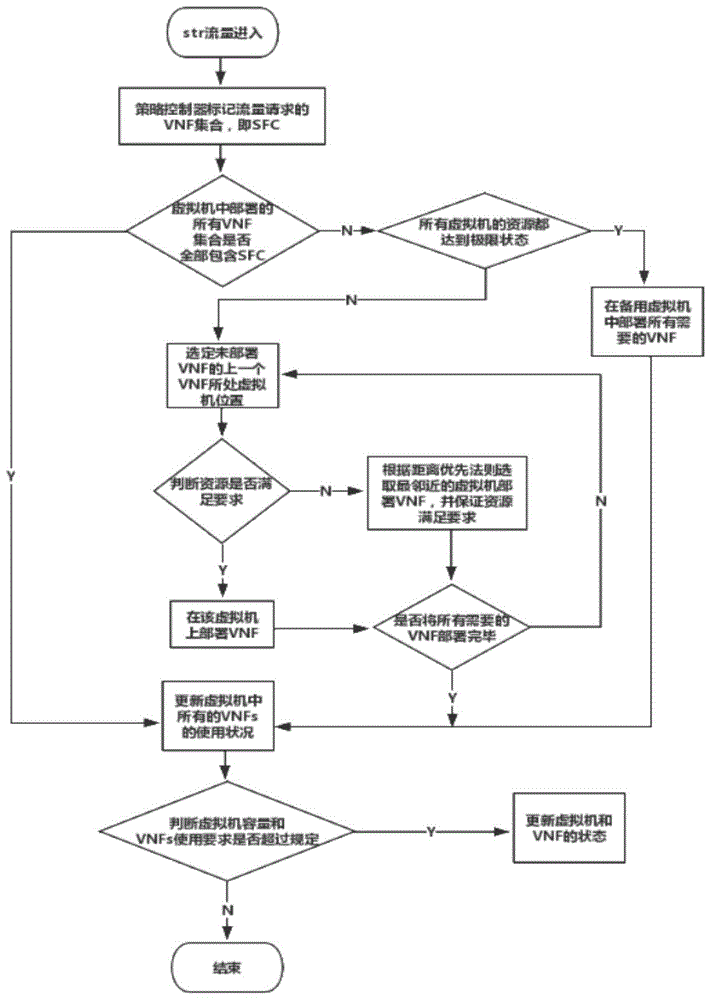
图7为服务功能链部署算法流程图。Figure 7 is a flowchart of the service function chain deployment algorithm.
图8为相关算法时延对比图。FIG. 8 is a comparison diagram of time delay of related algorithms.
图9为相关算法资源利用率对比图。FIG. 9 is a comparison diagram of resource utilization ratio of related algorithms.
具体实施方式Detailed ways
下面结合附图对本发明进行详细说明。The present invention will be described in detail below with reference to the accompanying drawings.
本发明的基于SDN和NFV的服务功能链的部署方法为:首先设计基于SDN网络和NFV架构的结合框架以及模块化策略部署服务功能链,然后在SDN网络和NFV架构中的策略控制器内进行服务功能链的部署算法,策略控制器在用户流量进入网络后,通过服务功能链的部署算法判断用户流量所需要的网络服务功能是否和底层所拥有的VNF匹配,如若不匹配,策略控制器则通过北向接口通知NFV的管理和编排组件缺失的VNF信息,NFV的管理和编排组件在得到消息后通过NFV底层设施资源将所有需要的VNF以模块化的策略部署到合适的虚拟机内,完成整个部署操作。The method for deploying a service function chain based on SDN and NFV of the present invention is as follows: first, a combined framework based on SDN network and NFV architecture and a modular policy deployment service function chain are designed, and then a policy controller in the SDN network and NFV architecture is implemented. The deployment algorithm of the service function chain. After the user traffic enters the network, the policy controller judges whether the network service function required by the user traffic matches the VNF owned by the bottom layer through the deployment algorithm of the service function chain. The NFV management and orchestration components are notified of the missing VNF information through the northbound interface. After receiving the message, the NFV management and orchestration components deploy all the required VNFs to the appropriate virtual machines through the NFV underlying facility resources in a modularized strategy to complete the entire process. Deployment operation.
具体包括以下步骤:Specifically include the following steps:
第一步,建立基于SDN和NFV的服务功能链框架;The first step is to establish a service function chain framework based on SDN and NFV;
如图1所示,框架基本的业务流程:当用户请求到来时,策略控制器根据用户的特定需求制定具体的服务功能链策略,并下发给SDN控制器集群,与此同时也将流分类策略下发给流分类器。SDN控制器根据服务功能链的策略下发对应的流表至Open vSwitch,OpenvSwitch根据流表对业务流量进行转发,送到相应的VNF处理,VNF对进入的业务流量进行处理后,把业务流量发送回Open vSwitch;服务功能链上所有的VNFs对流量处理完成后,业务流量被转发出服务功能链网络。在这个过程中可能会存在VNFs的动态变化,这需要SDN控制器、策略控制器以及NFV管理和编排组件共同协作完成。As shown in Figure 1, the basic business process of the framework: When a user request arrives, the policy controller formulates a specific service function chain policy according to the specific needs of the user, and sends it to the SDN controller cluster, and also classifies the flow at the same time. The policy is delivered to the flow classifier. The SDN controller sends the corresponding flow table to the Open vSwitch according to the policy of the service function chain. The OpenvSwitch forwards the service traffic according to the flow table and sends it to the corresponding VNF for processing. After the VNF processes the incoming service traffic, it sends the service traffic. Back to the Open vSwitch; after all VNFs on the service function chain complete the traffic processing, the service traffic is forwarded out of the service function chain network. There may be dynamic changes of VNFs in this process, which requires the cooperation of SDN controller, policy controller, and NFV management and orchestration components.
如图1所示,该框架包含以下几个部分:As shown in Figure 1, the framework consists of the following parts:
1)NFV管理和编排组件。用于对VNFs以及底层物理和虚拟资源的管理,并且以软件的方式运行在SDN架构的应用层,网络管理员可以通过GUI的方式对业务链的VNFs进行创建、修改、删除等操作,当然NFV管理器都是可以自动化完成这些所有针对VNFs的操作;除此之外,NFV管理器负责了VNFs的整个生命周期的管理;虚拟设施管理器则负责整个NFVI组件的管理,为VNFs的各种操作提供底层资源支持。最关键的是,NFV编排器中运行了服务功能链的部署算法,并且通过北向接口直接和SDN通信。1) NFV management and orchestration components. It is used to manage VNFs and underlying physical and virtual resources, and runs in the application layer of the SDN architecture in the form of software. Network administrators can create, modify, and delete VNFs in the business chain through GUI. Of course, NFV The manager can automate all these operations for VNFs; in addition, the NFV manager is responsible for the management of the entire life cycle of VNFs; the virtual facility manager is responsible for the management of the entire NFVI component for various operations of VNFs Provide low-level resource support. Most importantly, the NFV orchestrator runs the deployment algorithm of the service function chain and communicates directly with the SDN through the northbound interface.
2)策略控制器。当接受到用户的请求后,来制定服务功能链的策略,比如服务功能链的顺序策略和流量的分类策略。策略控制器一方面把流分类策略下发到流分类器;另一方面根据不同的请求,把服务功能链制定好的顺序策略下发到SDN控制器,从而控制业务流量走向。策略控制器可以通过标准的API接口和NFV编排器进行通信,这是非常必要的,因为在网络中某一个具体的VNF可能都被其他流量在使用,策略控制器通过北向接口和SDN控制器通信,并告知SDN控制器某一时刻需要重新初始化某些VNFs,当SDN控制器收到消息后,仍然通过北向接口将信息传递给NFV编排器,NFV编排器则调用NFV管理器初始化需要的VNF,并通过标准API接口告诉策略控制器所有需要的VNFs已经初始化完成,并准备就绪。2) Policy controller. After receiving the user's request, formulate the policy of the service function chain, such as the sequence policy of the service function chain and the classification policy of the traffic. On the one hand, the policy controller sends the traffic classification policy to the traffic classifier; on the other hand, according to different requests, it sends the sequence policy formulated by the service function chain to the SDN controller, so as to control the service flow direction. The policy controller can communicate with the NFV orchestrator through a standard API interface, which is very necessary because a specific VNF in the network may be used by other traffic, and the policy controller communicates with the SDN controller through the northbound interface , and inform the SDN controller that some VNFs need to be re-initialized at a certain time. When the SDN controller receives the message, it still passes the information to the NFV orchestrator through the northbound interface, and the NFV orchestrator calls the NFV manager to initialize the required VNFs. And tell the policy controller through the standard API interface that all the required VNFs have been initialized and are ready.
3)流分类器。根据策略控制器下发的策略,对进入网络中的业务流量进行分类,并进行标识。对业务流量的标识有很多种方式,可以在报文中加入新的标识字段,也可以使用报文原有的字段,如VLAN ID、IP地址等。流分类器的主要目的是将一些特殊流标记出来,因为对某些用户需求,很多网络服务功能必须出现在服务功能链的首端或者尾端,而服务功能链中VNFs的个数是决定整条服务功能链性能的关键因素,如果能提前确定某一个VNF的位置,对于提高服务功能链的性能和减少网络时延方面有很大的帮助。3) Flow classifier. According to the policy issued by the policy controller, the service traffic entering the network is classified and identified. There are many ways to identify service traffic. You can add a new identification field to the packet, or use the original fields of the packet, such as VLAN ID and IP address. The main purpose of the flow classifier is to mark some special flows, because for some user requirements, many network service functions must appear at the beginning or the end of the service function chain, and the number of VNFs in the service function chain is determined. It is a key factor in the performance of a service function chain. If the location of a certain VNF can be determined in advance, it will be of great help in improving the performance of the service function chain and reducing network delay.
4)SDN控制器。在图1中SDN控制器以集群的形式存在,通过北向接口和策略控制器交互,把由用户的需求制定的服务功能链的策略转化为具体的转发表项,并通过OpenFlow协议下发至Open vSwitch。通过SDN的集中化控制,可以灵活高效的指定服务功能链的路径,实现服务功能链具体流量转发。除此之外SDN控制器可以通过北向接口向策略控制器提供网络状态信息,以供策略控制器完成服务功能链的策略制定,反过来策略控制器也可以通过北向接口向SDN控制器反馈需要重新初始化的VNFs。4) SDN controller. In Figure 1, the SDN controller exists in the form of a cluster. It interacts with the policy controller through the northbound interface, and converts the policy of the service function chain formulated by the user's needs into a specific forwarding entry, and sends it to OpenFlow through the OpenFlow protocol. vSwitch. Through the centralized control of SDN, the path of the service function chain can be specified flexibly and efficiently, and the specific traffic forwarding of the service function chain can be realized. In addition, the SDN controller can provide network status information to the policy controller through the northbound interface, so that the policy controller can complete the policy formulation of the service function chain. In turn, the policy controller can also feedback to the SDN controller through the northbound interface. Initialized VNFs.
5)SDN交换机。支持OpenFlow协议的交换机,这里使用了Open vSwitch。接受SDN控制器的统一管理,根据SDN控制器下发的流表进行流量转发。5) SDN switch. Switches that support OpenFlow protocol, Open vSwitch is used here. Accept the unified management of the SDN controller, and forward traffic according to the flow table issued by the SDN controller.
6)虚拟网络功能。图1中以防火墙、网络地址转换以及深度包检测为例。服务功能链中可以根据不同的业务需求加入各种网络服务功能,连接到Open vSwitch的相应端口,处理来自Open vSwitch转发的业务流量。这里所有的网络服务功能都是由NFV产生的虚拟网络功能,可以根据业务类型和需求进行灵活的扩展,共享底层的硬件资源。6) Virtual network function. Figure 1 takes firewall, network address translation and deep packet inspection as examples. Various network service functions can be added to the service function chain according to different business requirements, connected to the corresponding ports of the Open vSwitch, and process the business traffic forwarded by the Open vSwitch. All network service functions here are virtual network functions generated by NFV, which can be flexibly expanded according to business types and needs, and share the underlying hardware resources.
参见图1,图1中有一条服务功能链,由黑色曲线路径标记,可以看出,流量进入网络以后,由策略控制器制定服务功能链的策略并通过北向接口下发给SDN控制器,SDN控制器通过OpenFlow协议引导流量依次通过防火墙和深度包检测,防火墙和深度包检测是由NFV架构提供的虚拟网络功能,也就是VNF,而防火墙和深度包检测则构成一条服务功能链。Referring to Figure 1, there is a service function chain in Figure 1, which is marked by a black curve path. It can be seen that after the traffic enters the network, the policy controller formulates the policy of the service function chain and sends it to the SDN controller through the northbound interface. The controller guides traffic through the OpenFlow protocol through the firewall and deep packet inspection. Firewall and deep packet inspection are virtual network functions provided by the NFV architecture, that is, VNF, while firewall and deep packet inspection constitute a service function chain.
第二步,设计基于模块化的策略部署服务功能链;The second step is to design a service function chain based on a modular strategy deployment;
模块化的思想来源于软件设计中的可复用思想,通过抽象出一些通用接口,减少了代码的冗余量、提高软件开发的效率和系统的可扩展性。鉴于此思想,在不同的VNFs中必然包含了相同的多个功能模块,例如:数据包头解析,协议解析,数据包分类等等,这些操作基本存在于每一个VNF中,可以通过将这些通用的功能模块抽象出来只提供一份然后供其他所有的VNF一起使用,这样通过复用一些模块可以节省更多的系统资源,尤其是在部署量很大的时候。除此之外,模块化部署VNF带来的另一个好处是极大简化了VNF的开发工作,促进了VNF的开发和更新,让开发者专注于VNF自身的功能特性而忽略一些通用模块。例如,在更新VNF的功能时,可以只考虑更新通用模块,让其他的VNFs只需要复用更新后的通用模块,不需要再对每一个VNF都做重复的工作。在开发新的VNF时,只需要开发核心的功能而复用通用的模块,不需要再开发所用功能,节省了时间,提高了效率。这都是模块化部署带来的好处。The idea of modularity comes from the idea of reusability in software design. By abstracting some common interfaces, the redundancy of the code is reduced, the efficiency of software development and the scalability of the system are improved. In view of this idea, different VNFs must contain the same multiple functional modules, such as: packet header parsing, protocol parsing, packet classification, etc. These operations basically exist in every VNF, and these general The function module is abstracted to provide only one copy and then used by all other VNFs, so that more system resources can be saved by reusing some modules, especially when the deployment volume is large. In addition, another advantage brought by modular deployment of VNF is that it greatly simplifies the development of VNF, promotes the development and update of VNF, and allows developers to focus on the functional characteristics of VNF itself and ignore some common modules. For example, when updating the functions of a VNF, you can only consider updating the general module, so that other VNFs only need to reuse the updated general module, and do not need to repeat the work for each VNF. When developing a new VNF, only the core functions need to be developed and the common modules are reused, and there is no need to develop the functions used, which saves time and improves efficiency. These are the benefits of modular deployment.
SFC(服务功能链)部署时,首先考虑VNF的初始化,本发明假设一种最极端的方式,所有的虚拟机都是从最初状态开始。依据历史经验向一些特定的虚拟机中初始化一批可能会使用率较高的VNFs,这些使用率较高的VNFs可能会随着时间的不同而变化,然而这只是一个初始状态的设定,并不影响SFC后续的部署和调度。图2是虚拟机集群示意图,参见图2,所有的虚拟和物理资源都是由NFV的基础设施服务提供,并由NFV管理和编排组件统一管理和调配。假设在5台虚拟机中初始化了一部分VNFs,例如在虚拟机1中初始化了深度包检测(Deep Packet Inspection,DPI)以及防火墙(Firewall,FW);在虚拟机2中初始化了防火墙、网络地址转换(Network Address Translation,NAT)以及系统入侵检测(IntrusionDetection System,IDS),初始化所占用的服务器资源必然满足服务器空闲资源,而且初始化所占用的服务器资源一般小于服务器总资源的50%,服务器的资源通常指CPU和内存资源。除此之外,还保留了一部分空闲的虚拟机以作备用,如虚拟机6和虚拟机7。When the SFC (Service Function Chain) is deployed, the initialization of the VNF is considered first. The present invention assumes a most extreme way, in which all virtual machines start from the initial state. Initialize a batch of VNFs that may be highly used in some specific virtual machines based on historical experience. These VNFs with higher utilization may change over time, but this is only an initial state setting, and It does not affect the subsequent deployment and scheduling of SFC. Figure 2 is a schematic diagram of a virtual machine cluster. Referring to Figure 2, all virtual and physical resources are provided by NFV infrastructure services, and are uniformly managed and provisioned by NFV management and orchestration components. Assume that some VNFs are initialized in 5 virtual machines, for example, deep packet inspection (DPI) and firewall (Firewall, FW) are initialized in
所有虚拟机初始化的状态,除了参考一些历史经验外,是一个相对随机的过程。在不考虑模块化的前提下,其余VNFs的部署过程只是VNFs生命周期的动态变化,例如业务要求需要新增一些VNFs、某些VNFs在虚拟机内长期未被使用需要关闭以及需要更新某些VNFs的功能等等。模块化的思想来源于软件设计中的可复用思想,通过抽象出一些通用接口,减少了代码的冗余量、提高软件开发的效率和系统的可扩展性。鉴于此思想,在不同的VNFs中必然包含了相同的功能模块,例如:数据包头解析,协议解析,数据包分类等等,这些操作基本存在于每一个VNF中。如图3中(a)所示,在理想情况下,虚拟机1中部署了网络地址转换和深度包检测,并未考虑通用模块,两者各占资源2%,虚拟机中空闲资源96%;在图3中(b)中,虚拟机1中使用通用模块,将协议解析和包头解析抽象出来,而网络地址转换和深度包检测共用这些通用模块,可以看出系统的空闲资源剩余97%,相对于图3中(a)中虚拟机1节省了1%的资源。可以看出当VNFs的部署量很大时,采用这种模块化的思想,可以节省更多的系统资源。The initialization state of all virtual machines is a relatively random process, except for some historical experience. Without considering the modularity, the deployment process of the remaining VNFs is only a dynamic change of the VNFs life cycle, such as business requirements need to add some VNFs, some VNFs need to be closed if they have not been used in the virtual machine for a long time, and some VNFs need to be updated function, etc. The idea of modularity comes from the idea of reusability in software design. By abstracting some common interfaces, the redundancy of the code is reduced, the efficiency of software development and the scalability of the system are improved. In view of this idea, different VNFs must contain the same functional modules, such as: packet header parsing, protocol parsing, packet classification, etc. These operations basically exist in every VNF. As shown in (a) in Figure 3, in an ideal situation, network address translation and deep packet inspection are deployed in
第三步,进行服务功能链的部署算法;The third step is to carry out the deployment algorithm of the service function chain;
考虑一次需要新增VNF的情况,如图4所示,假设当前虚拟机中部署的实例如此,虚拟机的排列顺序并不代表实际数据中心或者云场景中虚拟机所处设备的物理距离。当一条服务功能链的请求需要经过特定的网络服务功能时,如图4中所示,需要经过网络地址转换,防火墙以及入侵防御系统(Intrusion Prevention System,IPS),此时由SDN控制器通过实时掌控底层设备的运行状况,发现记录表中并没有入侵防御系统的注册信息,即所有的(示例中的5个)虚拟机中都未部署入侵防御系统,因此则需要在合适的虚拟机当中部署该网络服务功能,这是一次VNF需要新增的示例,而新VNF部署的位置可能取决于上一个VNF所处的虚拟机的位置。考虑到低时延的因素,本发明的算法总是要保证新的VNF部署在最邻近的虚拟机中,这是因为现今的网络基本以分布式的形式存在,而分布式下物理距离和时延是呈正相关性的。Consider a situation where a new VNF needs to be added, as shown in Figure 4. Assuming that the current instance is deployed in the virtual machine, the arrangement order of the virtual machine does not represent the physical distance of the device where the virtual machine is located in the actual data center or cloud scenario. When a request of a service function chain needs to go through a specific network service function, as shown in Figure 4, it needs to go through network address translation, firewall and Intrusion Prevention System (IPS). Control the operating status of the underlying equipment, and find that there is no intrusion prevention system registration information in the record table, that is, all (5 in the example) virtual machines have not deployed intrusion prevention systems, so they need to be deployed in suitable virtual machines. This network service function is an example where a VNF needs to be added, and the location of the new VNF deployment may depend on the location of the virtual machine where the previous VNF is located. Considering the factor of low delay, the algorithm of the present invention always ensures that the new VNF is deployed in the nearest virtual machine, because the current network basically exists in a distributed form, and the physical distance and time under distributed delay is positively correlated.
考虑一次需要删除VNF的情况,如图4所示,在每一个虚拟机中都配置一张VNF的临时状态表,该状态表每一行记录了每一个VNF被使用时的ID号,该ID号可以由该条网络流量的一些特征值生成,如访问网络的时间、业务类型以及相关协议等等,除此之外还记录了每一个VNF上次被使用的时间到现在时间的差值。例如在虚拟机1中的VNF的临时状态表中,第一行表示了深度包检测在3分钟前被ID号为某一个值的网络流量所访问。可以想象到的是,当虚拟机中部署了越来越多的实例后,虚拟机的容量将达到上线,资源也会被占满,这会严重影响运行在虚拟机当中的VNF,除此之外由于同一个VNF可以部署在不同的虚拟机当中,因此许多虚拟机当中的VNF可能很长时间都是未被使用的状态,例如图4所示的虚拟机2中,防火墙功能有17分钟都是未被使用状态,考虑到资源利用率和性能的因素,本发明的算法中将超过某一时间阈值未被使用的VNF实例都会在虚拟机中删除,这样既可以提高资源利用率和性能,而且在进行VNF部署的时候可以缩短时延。Consider a situation where a VNF needs to be deleted. As shown in Figure 4, a temporary VNF state table is configured in each virtual machine. Each row of the state table records the ID number of each VNF when it is used. The ID number It can be generated from some characteristic values of the network traffic, such as the time of accessing the network, service type and related protocols, etc. In addition, it also records the difference between the time when each VNF was last used to the present time. For example, in the temporary state table of the VNF in
考虑一次需要更新VNF的情况,如图5所示,一条服务功能链需要经过深度包检测,服务质量(Quality of Service,QoS)以及系统入侵检测,当流量正在服务功能链上进行转发时,发现服务质量功能故障,此时需要对服务质量功能进行更新,考虑到低时延因素,流量不会等待VNF的更新完成,而是选择就近的相同服务进行转发。因此当发生功能故障时,图6中的转发路径将会变成虚拟机1至虚拟机4至虚拟机5,而虚拟机3中的服务质量功能将会在后台重新初始化并且部署在虚拟机3中。Consider a situation where VNF needs to be updated. As shown in Figure 5, a service function chain needs to undergo deep packet inspection, quality of service (QoS) and system intrusion detection. When traffic is being forwarded on the service function chain, it is found that If the quality of service function fails, the quality of service function needs to be updated. Considering the low latency factor, the traffic will not wait for the update of the VNF to complete, but select the same nearby service for forwarding. So when a functional failure occurs, the forwarding path in Figure 6 will become
对上述3种情况进行分析后,或者根据实际需要中存在的情况进行分析后,进行以下过程:After analyzing the above three situations, or after analyzing the situations existing in actual needs, the following processes are performed:
首先将用户请求中包含的所有网络功能列出一个集合SFC={VNF1,VNF2,.....,VNFn},定义Cc代表了虚拟机CPU资源,Cm代表了虚拟机的内存资源,Cs代表了虚拟机剩余CPU资源和内存资源总和,则虚拟机总资源Ct=Cc+Cm,假设某一个VNFi所需要的虚拟机总资源为Vic+Vim,其中Vic代表第i个VNF部署时需要的内存资源,Vim代表第i个VNF运行时所需要的CPU资源,则部署VNFi时,需要满足如下约束:First, list all the network functions contained in the user request as a set SFC={VNF 1 , VNF 2 , ....., VNF n }, define C c to represent the virtual machine CPU resources, and C m to represent the virtual machine's Memory resources, C s represents the sum of the remaining CPU resources and memory resources of the virtual machine, then the total virtual machine resources C t =C c +C m , assuming that the total virtual machine resources required by a certain VNF i are V ic +V im , Where V ic represents the memory resources required for the i-th VNF deployment, and V im represents the CPU resources required for the i-th VNF to run. When deploying VNF i , the following constraints need to be met:
Vic+Vim<Cs (3-1)V ic +V im <C s (3-1)
Ct-Cs+Vic+Vim<=Ct×80% (3-2)C t -C s +V ic +V im <=C t ×80% (3-2)
定义虚拟机的集合VM={V1,V2,...,Vm,...,Vn},Dmn表示Vm所处服务器到Vn所处服务器之间的物理距离。如果新部署的VNFi就处于服务功能链上一个VNFi-1所在的虚拟机内,则此时m=n,所以Vm所处服务器到Vn所处服务器之间的物理距离Dmn=0。在进行VNF部署的时候尽量保证物理距离最小,以减少时延。因此对于任何一个新部署的VNFi,假设在服务功能链上该VNFi上一个VNFi-1已经部署在了Vc中,而新部署的VNFi需要实例化在Vx中,则VNFi部署过程中在满足(3-1)和(3-2)式的基础上,也应满足如下约束:Define a set of virtual machines VM={V 1 , V 2 , ..., V m , ..., V n }, D mn represents the physical distance between the server where V m is located to the server where V n is located. If the newly deployed VNF i is located in the virtual machine where a VNF i-1 on the service function chain is located, then m=n at this time, so the physical distance between the server where V m is located and the server where V n is located D mn = 0. When deploying VNFs, try to keep the physical distance as small as possible to reduce latency. Therefore, for any newly deployed VNF i , it is assumed that a VNF i-1 on the VNF i has been deployed in V c on the service function chain, and the newly deployed VNF i needs to be instantiated in V x , then VNF i In the deployment process, on the basis of satisfying equations (3-1) and (3-2), the following constraints should also be satisfied:
Dcx<Dci,1<=c<n,1=<x<=n,i={1,2,...,x-1,x+1,...,n} (3-3)D cx < D ci , 1<=c<n, 1=<x<=n, i={1,2,...,x-1,x+1,...,n} (3-3 )
式3-3中,Dcx为Vc所处服务器到Vx所处服务器之间的物理距离,Dci为Vc所处服务器到Vi所处服务器之间的物理距离。In Equation 3-3, D cx is the physical distance between the server where V c is located to the server where V x is located, and D ci is the physical distance between the server where V c is located and the server where V i is located.
对于服务功能链来说,定义每一个VNFi在处理请求时消耗的总时长为Tvi,那么对于一个用户请求的服务功能链中SFC={VNF1,VNF2,.....,VNFn}所有VNF消耗的总时长则是该服务功能链处理需求的总时长Tt,可以表达为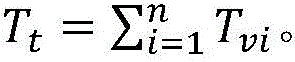



式中,Tnewt为最终的消耗时长,
资源的利用率也是一个需要考虑的方面,假设对于任何一个VNFi刚被初始化的那一刻的时间为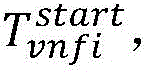
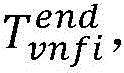

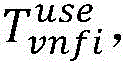




式中,

整个服务功能链的性能从如下两个方面来考虑,定义当虚拟机达到Ct×75%后又强制降回50%的次数为Countvi,每一次虚拟机强制降回50%时选择要删除的VNF都是根据最近最少使用(Least Recently Used,LRU)策略,而虚拟机两次发生降回时间的时间间隔是Tbetween。The performance of the entire service function chain is considered from the following two aspects. The number of times the virtual machine is forced to drop back to 50% after reaching C t × 75% is defined as Count vi , and each time the virtual machine is forced to drop back to 50%, it is selected to be deleted. The VNFs are based on the least recently used (Least Recently Used, LRU) policy, and the time interval between the two occurrences of the fallback time of the virtual machine is T between .
假设每次虚拟机降回50%时所用的时间为Timevi,需要删除的VNF集合记作VNF={VNF1,VNF2,...,VNFk},则删除的VNF集合中每个VNF的存活时间集合为

式中,Psfc为整个虚拟机的评判标准。In the formula, P sfc is the evaluation standard of the entire virtual machine.
定义目标函数为(3-10),该目标函数的值代表整体服务功能链的评判标准为f(i,k,n),其值越高越好。The objective function is defined as (3-10), and the value of the objective function represents the evaluation standard of the overall service function chain as f(i, k, n). The higher the value, the better.

本发明的服务功能链部署算法的流程图如图7所示,具体步骤及分析如下:The flowchart of the service function chain deployment algorithm of the present invention is shown in Figure 7, and the specific steps and analysis are as follows:
(1)某个用户的一条流量进入网络进行数据传输请求;(1) A piece of traffic from a user enters the network for a data transmission request;
(2)当流量进入后,策略控制器根据请求的网络服务功能,将用户需要使用的网络服务功能标记成SFC={VNF1,VNF2,.....,VNFn},然后策略控制器根据NFV管理和编排组件提供的VNF信息,即VM={V1,V2,...,Vn}判断VM集合中是否包含所有的VNF。如若是则执行步骤(8),否则继续执行步骤(3);(2) When the traffic enters, the policy controller marks the network service function that the user needs to use as SFC={VNF 1 , VNF 2 , ..... , VNF n } according to the requested network service function, and then the policy controls According to the VNF information provided by the NFV management and orchestration component, that is, VM= { V 1 , V 2 , . If so, execute step (8), otherwise continue to execute step (3);
(3)此时考虑一种极端情况,如果VM={V1,V2,...,Vn}中所有的VM和此时要部署的任意VNFi都不满足Vic+Vim<Cs或者Ct-Cs+Vic+Vim<=Ct×80%,则此时所有的VM都达到一种极限状态,则执行步骤(4),否则执行步骤(5)。(3) Consider an extreme case at this time, if all VMs in VM={V 1 , V 2 , ..., V n } and any VNF i to be deployed at this time do not satisfy V ic +V im < C s or C t -C s +V ic +V im <=C t ×80%, then all VMs reach a limit state at this time, then step (4) is performed, otherwise step (5) is performed.
(4)启动备用虚拟机,将所有需要部署的VNF集合全部部署到备用虚拟机中,继续执行步骤(8);(4) Start the standby virtual machine, deploy all the VNF sets that need to be deployed into the standby virtual machine, and continue to perform step (8);
(5)选定需要部署的VNF的上一个VNF所处虚拟机的位置,上一个VNF可能处于多个虚拟机内,而选择是根据顺序策略选择具体的VM。判断该虚拟机和需要部署的VNFi是否满足Vic+Vim<Cs和Ct-Cs+Vic+Vim<=Ct×80%,如若满足,则执行步骤(7),否则执行步骤(6);(5) Select the location of the virtual machine where the previous VNF of the VNF to be deployed is located. The previous VNF may be located in multiple virtual machines, and the selection is to select a specific VM according to a sequence policy. Determine whether the virtual machine and the VNF i to be deployed satisfy V ic +V im <C s and C t -C s +V ic +V im <=C t ×80%, if so, perform step (7), Otherwise, go to step (6);
(6)根据Dcx<Dci,1<=c<n,1=<x<=n,i={1,2,...,x-1,x+1,...,n}原则,选择合适的虚拟机位置部署VNFi。(6) According to D cx < D ci , 1 <= c < n, 1 = < x <= n, i = {1, 2, . . . , x-1, x+1, . . . , n} In principle, choose a suitable virtual machine location to deploy VNF i .
(7)判断是否所有需要的VNFs都部署完成,如果是,则执行步骤(8),否则执行步骤(5);(7) Judge whether all required VNFs are deployed, if so, execute step (8), otherwise execute step (5);
(8)完成所有部署任务后,更新VM={V1,V2,...,Vn}集合中每一个VM的状态信息以及里面所有VNFs的状态信息;(8) After completing all deployment tasks, update the state information of each VM in the set of VM={V 1 , V 2 , . . . , V n } and the state information of all VNFs in it;
(9)判断虚拟机状态和所有VNFs的状态是否满足规定,例如VNF是否超过15分钟未被使用、虚拟机的使用资源是否超过Ct×75%等等,如果是则执行步骤(10),否则执行步骤(11);(9) Determine whether the status of the virtual machine and all VNFs meet the requirements, such as whether the VNF has not been used for more than 15 minutes, whether the used resources of the virtual machine exceed C t × 75%, etc., if so, execute step (10), Otherwise, go to step (11);
(10)更新所有VNFs和VM的状态信息,例如执行VM的降回操作、VNFs的删除操作等等;(10) Update the status information of all VNFs and VMs, such as performing VM dropback operations, VNFs deletion operations, etc.;
(11)所有需要的VNFs都已处于就绪状态,部署算法结束。(11) All required VNFs are in the ready state, and the deployment algorithm ends.
部署算法与传统算法的对比图如图8和图9所示,图8中,随机部署算法对于网络时延有很明显的随机性,并且时延长,而贪心算法则在部署中会随着部署VNF个数的增多不能求得全局最优解,也会导致时延增长,而本发明提出的部署算法随着需要部署VNF的个数增多呈稳定的线性变化,比较稳定。图9中,随机部署算法和贪心算法都不考虑资源回收的情况,随着虚拟机的使用时长的增加容易导致资源利用率逐渐降低,而本发明的部署算法会考虑删除长时间未用的VNF,这样资源利用率则稳定在某一个区间范围。通过对比,本发明提出的部署算法优于传统的部署算法。Figure 8 and Figure 9 show the comparison between the deployment algorithm and the traditional algorithm. In Figure 8, the random deployment algorithm has obvious randomness to the network delay, and the time is prolonged, while the greedy algorithm will change with the deployment during deployment. The increase of the number of VNFs cannot obtain the global optimal solution, and also leads to the increase of delay, while the deployment algorithm proposed by the present invention exhibits a stable linear change with the increase of the number of VNFs to be deployed, which is relatively stable. In Fig. 9, neither the random deployment algorithm nor the greedy algorithm considers resource recovery. With the increase of the usage time of the virtual machine, the resource utilization rate is likely to gradually decrease, and the deployment algorithm of the present invention will consider deleting the VNFs that have not been used for a long time. , so that the resource utilization rate is stable within a certain range. By comparison, the deployment algorithm proposed by the present invention is superior to the traditional deployment algorithm.
本发明的基于SDN和NFV的服务功能链部署方法,主要能够实现以下四个目标:The SDN and NFV-based service function chain deployment method of the present invention can mainly achieve the following four goals:
(1)保证服务功能链的低时延:端到端流量经过服务功能链时保证低时延应该是算法的主要目标,算法应能根据VNF的不同变化(例如:新增、更新以及删除)快速做出响应,保证服务功能链上的流量正确转发。考虑到用户的特殊性,用户总是希望在网络交互中有更好的体验性,因此算法在部署VNF的时候更多的应该考虑时延因素,满足低时延是提高用户体验性的重要方式。(1) Guarantee low latency of service function chain: ensuring low latency when end-to-end traffic passes through the service function chain should be the main goal of the algorithm, and the algorithm should be able to change according to different VNFs (such as adding, updating, and deleting) Respond quickly to ensure the correct forwarding of traffic on the service function chain. Considering the particularity of users, users always hope to have a better experience in network interaction, so the algorithm should consider the delay factor more when deploying VNF, and satisfying low delay is an important way to improve user experience. .
(2)提高服务功能链的资源利用率:传统服务功能链的解决方式中,很难保证资源利用率的问题,因为总是绕不开紧耦合的问题,无论是传统网络中控制平面和数据平面紧耦合,还是传统网络服务功能中具体网络服务功能和特定硬件的紧耦合,这种耦合性和高资源利用率两者之间本身就是矛盾的,因为耦合本身就意味着冗余和难以扩展和维护。因此算法在部署VNF的时候也应该考虑资源利用率的因素。(2) Improve the resource utilization rate of the service function chain: In the solution of the traditional service function chain, it is difficult to ensure the problem of resource utilization, because the problem of tight coupling cannot be avoided, whether it is the control plane and data in the traditional network. Flat tight coupling is also the tight coupling of specific network service functions and specific hardware in traditional network service functions. This kind of coupling and high resource utilization are contradictory in themselves, because coupling itself means redundancy and difficulty in expansion. And maintenance. Therefore, the algorithm should also consider the factor of resource utilization when deploying VNF.
(3)提高服务功能链的性能:一般来说,具体功能内嵌到特定的硬件设备中形成的网络服务功能的性能肯定优于由NFV提供的虚拟网络服务功能,这也是耦合性带来的为数不多的好处。但是SDN网络提供的灵活网络环境和NFV提供的统一化管理可以弥补这部分劣势,尽管如此,提高服务功能链的性能也是该部署算法考虑的因素之一。(3) Improve the performance of the service function chain: Generally speaking, the performance of the network service function formed by embedding specific functions into a specific hardware device is definitely better than the virtual network service function provided by NFV, which is also brought by the coupling. Few benefits. However, the flexible network environment provided by SDN network and the unified management provided by NFV can make up for this part of the disadvantage. Nevertheless, improving the performance of the service function chain is also one of the factors considered in the deployment algorithm.
(4)降低算法的复杂度:SDN的集中化管控可以实时的掌控服务功能链上的每一个VNF的状态信息,对于每一次VNF的状态变化都可以通过北向接口向NFV的管理和编排组件传递信息,NFV管理器利用NFV基础设施提供的底层资源快速的调整VNF的状态,从而完成一次VNF的状态变化。正是由于SDN和NFV提供的技术支持,因此部署算法应该尽可能的简单高效,运行时间尽可能的短,从而缩短整个SFC的部署时间。(4) Reduce the complexity of the algorithm: The centralized management and control of SDN can control the status information of each VNF in the service function chain in real time, and each VNF status change can be transmitted to the NFV management and orchestration components through the northbound interface Information, the NFV manager uses the underlying resources provided by the NFV infrastructure to quickly adjust the state of the VNF, thereby completing a state change of the VNF. Because of the technical support provided by SDN and NFV, the deployment algorithm should be as simple and efficient as possible, and the running time should be as short as possible, thereby shortening the deployment time of the entire SFC.
上述四个目标中,低时延是设计算法的主要目标,提高资源利用率和提高性能则是在保证低时延的情况下才考虑的次要目标,而降低算法复杂度的核心也是为了降低服务功能链的低时延。Among the above four goals, low latency is the main goal of designing the algorithm, and improving resource utilization and improving performance are secondary goals that are considered under the condition of ensuring low latency, and the core of reducing algorithm complexity is also to reduce Low latency for service function chains.
Claims (5)
Priority Applications (1)
| Application Number | Priority Date | Filing Date | Title |
|---|---|---|---|
| CN201910209653.3A CN109842528B (en) | 2019-03-19 | 2019-03-19 | A deployment method of service function chain based on SDN and NFV |
Applications Claiming Priority (1)
| Application Number | Priority Date | Filing Date | Title |
|---|---|---|---|
| CN201910209653.3A CN109842528B (en) | 2019-03-19 | 2019-03-19 | A deployment method of service function chain based on SDN and NFV |
Publications (2)
| Publication Number | Publication Date |
|---|---|
| CN109842528A CN109842528A (en) | 2019-06-04 |
| CN109842528B true CN109842528B (en) | 2020-10-27 |
Family
ID=66885976
Family Applications (1)
| Application Number | Title | Priority Date | Filing Date |
|---|---|---|---|
| CN201910209653.3A Active CN109842528B (en) | 2019-03-19 | 2019-03-19 | A deployment method of service function chain based on SDN and NFV |
Country Status (1)
| Country | Link |
|---|---|
| CN (1) | CN109842528B (en) |
Families Citing this family (22)
| Publication number | Priority date | Publication date | Assignee | Title |
|---|---|---|---|---|
| US20220255797A1 (en) * | 2019-07-23 | 2022-08-11 | Idac Holdings, Inc. | Methods, apparatus, and systems for dynamically assembling transient devices via micro services for optimized human-centric experiences |
| CN110505099B (en) * | 2019-08-28 | 2021-11-19 | 重庆邮电大学 | Service function chain deployment method based on migration A-C learning |
| CN110535705B (en) * | 2019-08-30 | 2022-04-26 | 西安邮电大学 | A Service Function Chain Construction Method for Adaptive User Delay Requirements |
| CN110912731B (en) * | 2019-10-29 | 2022-07-26 | 广州丰石科技有限公司 | NFV-based system and method for realizing service identification and topology analysis by adopting DPI technology |
| US11258885B2 (en) * | 2019-12-10 | 2022-02-22 | Mellanox Technologies, Ltd. | Flexible parser in a networking device |
| CN111093203B (en) * | 2019-12-30 | 2022-04-29 | 重庆邮电大学 | A low-cost intelligent deployment method of service function chain based on environment awareness |
| CN111163004B (en) * | 2019-12-31 | 2023-03-31 | 奇安信科技集团股份有限公司 | Service chain data processing method and device and computer equipment |
| CN111800352B (en) * | 2020-06-30 | 2023-02-17 | 中国联合网络通信集团有限公司 | Service function chain deployment method and storage medium based on load balancing |
| CN112511432B (en) * | 2020-11-12 | 2022-01-25 | 中国科学院计算技术研究所 | Method and system for configuring and transmitting virtualization SFC (Small form factor) route of Overlay network |
| CN112543119B (en) * | 2020-11-27 | 2022-02-18 | 西安交通大学 | A service function chain reliability deployment method based on deep reinforcement learning |
| CN112637032B (en) * | 2020-11-30 | 2022-03-15 | 中国联合网络通信集团有限公司 | Service function chain deployment method and device |
| CN114765579B (en) * | 2021-01-11 | 2024-11-08 | 中国移动通信有限公司研究院 | A data transmission method, device, related equipment and storage medium |
| CN114828136A (en) * | 2021-01-29 | 2022-07-29 | 华为技术有限公司 | Method, device, system and storage medium for sending flow |
| CN113179299B (en) * | 2021-04-19 | 2022-06-21 | 温州职业技术学院 | Service function chain collaborative control system and method for industrial Internet applications |
| CN113411207B (en) * | 2021-05-28 | 2022-09-20 | 中国人民解放军战略支援部队信息工程大学 | Service function circulation arrangement basic platform and method of intelligent network service function chain |
| CN113395334B (en) * | 2021-05-31 | 2022-12-13 | 河南信大网御科技有限公司 | Service function chain online updating method, system and equipment |
| CN113242266B (en) * | 2021-07-12 | 2021-11-30 | 深圳市永达电子信息股份有限公司 | NFV-based dynamic intrusion detection method and system |
| CN113472811B (en) * | 2021-08-23 | 2022-08-02 | 北京交通大学 | Heterogeneous service function chain forwarding protocol and method in intelligent fusion identification network |
| CN114143181B (en) * | 2021-10-23 | 2023-02-07 | 西安电子科技大学 | An intent-driven spatial information network orchestration system and method |
| CN114172937B (en) * | 2022-01-19 | 2023-12-29 | 广州市宝思信息科技有限公司 | Dynamic service function chain orchestration method and system based on deep reinforcement learning |
| CN115955407B (en) * | 2022-09-30 | 2024-08-30 | 中国联合网络通信集团有限公司 | Instance management method, device, equipment and storage medium |
| CN116318945B (en) * | 2023-03-09 | 2023-10-20 | 南京航空航天大学 | Multi-target service function chain deployment method based on endophytic dynamic defense architecture |
Citations (3)
| Publication number | Priority date | Publication date | Assignee | Title |
|---|---|---|---|---|
| CN108092803A (en) * | 2017-12-08 | 2018-05-29 | 江苏省邮电规划设计院有限责任公司 | The method that network element level parallelization service function is realized in network function virtualized environment |
| CN108139934A (en) * | 2015-08-03 | 2018-06-08 | 诺基亚通信公司 | Load and software configuration control between composite service function chain |
| CN108259238A (en) * | 2018-01-10 | 2018-07-06 | 重庆邮电大学 | The method that network function service chaining maps in data center |
Family Cites Families (3)
| Publication number | Priority date | Publication date | Assignee | Title |
|---|---|---|---|---|
| US9762402B2 (en) * | 2015-05-20 | 2017-09-12 | Cisco Technology, Inc. | System and method to facilitate the assignment of service functions for service chains in a network environment |
| CN106487556B (en) * | 2015-08-28 | 2020-05-22 | 中兴通讯股份有限公司 | Deployment method and device for service function SF |
| CN107332913B (en) * | 2017-07-04 | 2020-03-27 | 电子科技大学 | Optimized deployment method of service function chain in 5G mobile network |
-
2019
- 2019-03-19 CN CN201910209653.3A patent/CN109842528B/en active Active
Patent Citations (3)
| Publication number | Priority date | Publication date | Assignee | Title |
|---|---|---|---|---|
| CN108139934A (en) * | 2015-08-03 | 2018-06-08 | 诺基亚通信公司 | Load and software configuration control between composite service function chain |
| CN108092803A (en) * | 2017-12-08 | 2018-05-29 | 江苏省邮电规划设计院有限责任公司 | The method that network element level parallelization service function is realized in network function virtualized environment |
| CN108259238A (en) * | 2018-01-10 | 2018-07-06 | 重庆邮电大学 | The method that network function service chaining maps in data center |
Non-Patent Citations (1)
| Title |
|---|
| 基于SDN和NFV的业务链管理系统研究;杨绍光等;《信息通信技术》;20160415;第1-4章 * |
Also Published As
| Publication number | Publication date |
|---|---|
| CN109842528A (en) | 2019-06-04 |
Similar Documents
| Publication | Publication Date | Title |
|---|---|---|
| CN109842528B (en) | A deployment method of service function chain based on SDN and NFV | |
| Alsaeedi et al. | Toward adaptive and scalable OpenFlow-SDN flow control: A survey | |
| US9219718B2 (en) | System and method for supporting sub-subnet in an infiniband (IB) network | |
| Houidi et al. | Adaptive virtual network provisioning | |
| US10263889B2 (en) | Data forwarding method, device, and system in software-defined networking | |
| Guo et al. | Secondnet: a data center network virtualization architecture with bandwidth guarantees | |
| TW202026896A (en) | Asynchronous object manager in a network routing environment | |
| CN100555948C (en) | A kind of switching equipment of in the stack exchanger system, being coupled of being used for | |
| CN104025513B (en) | Apparatus and method for the control level in data center network | |
| US11894978B1 (en) | Computing power scheduling methods, apparatus, electronic devices and storage media | |
| US20150350023A1 (en) | Data center network architecture | |
| US10404773B2 (en) | Distributed cluster processing system and packet processing method thereof | |
| US20160315809A1 (en) | METHODS, SYSTEMS, AND COMPUTER READABLE MEDIA FOR MULTI-LAYER ORCHESTRATION IN SOFTWARE DEFINED NETWORKS (SDNs) | |
| CN104303467A (en) | Integrated heterogeneous software-defined network | |
| US12213049B2 (en) | State pooling for stateful re-homing in a disaggregated radio access network | |
| TWI636679B (en) | Virtual area network configuration system and method and computer program product thereof | |
| WO2009062351A1 (en) | Method for stacking system merging | |
| CN112929206A (en) | Method and device for configuring cloud physical machine in cloud network environment | |
| US11881997B1 (en) | Determining reorder commands for remote reordering of policy rules | |
| US20080059620A1 (en) | Method and apparatus for persisting SNMP MIB integer indexes across multiple network elements | |
| Van Asten | Increasing robustness of software-defined networks | |
| He et al. | Asco: an availability-aware service chain orchestration | |
| TWI526033B (en) | Method and system for networking | |
| CN113132129A (en) | Network management method, device and system, and storage medium | |
| US12284469B2 (en) | Improving recovery time of execution instances in a passive optical network (PON) |
Legal Events
| Date | Code | Title | Description |
|---|---|---|---|
| PB01 | Publication | ||
| PB01 | Publication | ||
| SE01 | Entry into force of request for substantive examination | ||
| SE01 | Entry into force of request for substantive examination | ||
| GR01 | Patent grant | ||
| GR01 | Patent grant |