CN109831801B - Base station caching method for user behavior prediction based on deep learning neural network - Google Patents
Base station caching method for user behavior prediction based on deep learning neural network Download PDFInfo
- Publication number
- CN109831801B CN109831801B CN201910006278.2A CN201910006278A CN109831801B CN 109831801 B CN109831801 B CN 109831801B CN 201910006278 A CN201910006278 A CN 201910006278A CN 109831801 B CN109831801 B CN 109831801B
- Authority
- CN
- China
- Prior art keywords
- user
- base station
- cache
- neural network
- model
- Prior art date
- Legal status (The legal status is an assumption and is not a legal conclusion. Google has not performed a legal analysis and makes no representation as to the accuracy of the status listed.)
- Active
Links
Images


Landscapes
- Mobile Radio Communication Systems (AREA)
- Management, Administration, Business Operations System, And Electronic Commerce (AREA)
Abstract
The invention discloses a base station caching algorithm for user behavior prediction based on a deep learning neural network, which comprises the following steps: recording the requirements of a base station service user for a period of time, and determining a training set U of the neural network after the requirements are sorted and preprocessed; and training and fitting the training set data U by using a neural network algorithm in deep learning, including DNN and RNN, and establishing a user demand behavior model. And predicting the demand of the user at the next time by using the user demand behavior model. And pre-caching data obtained by model prediction in a cache of the base station by using a base station cache strategy so as to ensure that the data can be directly obtained from the base station cache when a user needs the data. And recording the real requirement of the user and comparing the real requirement with the prediction data, continuously perfecting the model and continuing to perform the step 3-5, so that the requirement behavior model of the user is continuously perfected, and the prediction accuracy is improved.
Description
Technical Field
The invention belongs to the field of wireless communication, relates to a communication technology of a base station cache strategy, and particularly relates to a base station cache algorithm for user behavior prediction based on a deep learning neural network.
Background
With the commercial and widespread deployment of 4G networks, users can enjoy increasingly high-speed data services. This further stimulates the use of mobile devices (smartphones, tablets, etc.) by users, and thus the traffic load of cellular networks has increased dramatically. A recent prediction showed that data traffic on wireless networks in 2018 would be as high as 190 octets, and more importantly more than half of it would be transmitted over 4G/LTE networks. The 4G is also a wireless access network of a traditional cellular structure, and although some advanced technologies such as relay, OFDM, MIMO, anti-interference measures and the like are adopted to increase system capacity and improve service quality, the continuously increasing user and network requirements cannot be met, and a single wireless access network of a traditional cellular structure increasingly becomes a bottleneck that seriously affects user experience. Therefore, heterogeneous cellular technology is one of the currently superior solutions.
Although wider network coverage is achieved with low cost and low power consumption, how to maintain the carrying capacity of small cell base stations during peak hours becomes a technical bottleneck due to the relatively weak load capacity of small cells themselves compared to conventional cells. Caching at these small cell base stations has been proposed, where popular files are pre-fetched and stored locally, in order to avoid an optimization strategy of the bottleneck of the backhaul connection link to the core network of limited capacity. Heterogeneous cells are expected to become a key feature to improve network performance and efficiency of the upcoming 5G cellular networks, enabling macro cells to be deployed with small cells. The cache is deployed in the base station of the heterogeneous cellular network, and the caching of the file with high popularity becomes a mainstream solution. And a brand-new user behavior prediction model based on a neural network is provided for the caching strategy of the base station, the behavior of the user is analyzed, and the caching is performed in advance so as to meet the higher performance requirement.
The neural network is used as a carrier of deep learning, and a data model matched with a training data set can be established by learning and fitting a large amount of training data. Neural networks can be largely classified into Deep Neural Networks (DNN) and Recurrent Neural Networks (RNN). And the neural network can better fit nonlinear data, so that the neural network has good effect on the aspect of establishing a user behavior model.
Disclosure of Invention
The purpose of the invention is as follows: the invention provides a base station caching algorithm for user behavior prediction based on a deep learning neural network.
The technical scheme is as follows: in order to achieve the purpose, the invention adopts the following technical scheme:
a base station caching algorithm for user behavior prediction based on a deep learning neural network comprises the following steps:
s1, supposing that a base station provides service for K users, recording the requirements of the users on the base station for each user of the service, sorting the requirements, numbering files, and determining a training set U of a neural network after recording a preprocessing method of the numbering of each required file;
s2, using a neural network algorithm in deep learning, including DNN and RNN, taking the requirement of the user at the previous period as input and the requirement at the next moment as output for training set data of any user; fitting by using a gradient descent method, wherein a loss function is a difference value between prediction and reality; after multiple times of training and fitting, establishing a user demand behavior model;
s3, inputting the user requirement of the previous period of time by using the established user requirement behavior model, and predicting the requirement of the user at the next time; acquiring the requirement of a user at the next moment;
s4, pre-buffering the obtained requirements in a base station cache, and reasonably buffering the requirements of a plurality of users in the base station by using a base station cache strategy so as to ensure that the requirements can be directly obtained from the base station cache when the users require;
and S5, when the user really needs, recording the real need of the user and comparing the real need with the prediction data, updating the data set, continuing training, continuously improving the model and continuing the steps S3-S5, so that the model of the user' S need behavior is continuously improved, and the prediction accuracy is improved.
Further, the neural network-based model building of step S2 is to model the user behavior through a multi-layer RNN neural network, wherein the number of nodes in each layer can be designed according to the following formula

m=log2n

M is the number of hidden nodes, n is the number of input nodes, l is the number of output nodes, but finally w is determined to be a constant through testing, and the model is used for predicting the user behavior and the file popularity.
Further, in step S2, the gradient descent method specifically includes:
the gradient being the derivative of the function at the current position, i.e. Where θ is an argument, f (θ) is a function of θ,
 represents a gradient; the principle of the gradient descent method can be simply expressed as

The real requirements of the users which are converted into the digital signals are substituted into f (theta) to obtain a descending gradient, and the gradient is led into a neural network structure, so that the optimal descending speed of the network can be obtained, and better fitting can be completed; after each gradient descent, the loss function is calculated, and if the loss function is still large, the gradient descent is used again.
Further, in step S4, the base station buffer policy is any one of the following two, where a is an arbitrary constant:
1) and caching a future demands of the user in the base station, and updating all a pre-cached contents of the base station if the future demands do not accord with the pre-caching every time the user demands. If the demand is consistent with the pre-caches, the cache content is not updated until the demand is inconsistent or a pre-caches are all demanded, and the cache content is updated;
2) and caching a demands of the users in the base station, and recording a user demand updating model if the a demands do not accord with the pre-caching every time the user demands. And after a users demand, updating the cache content of the base station.
Further, the step S5 of updating the data set and continuing the training means that the user behavior prediction model will optimize itself over time and continuously improve the approach to the real behavior.
Further, a behavior model is established for each user, and the model for each user is different.
Has the advantages that: the invention utilizes deep learning to build a behavior model aiming at the user, and can follow the habit of the user to modify and better match the behavior of the user. Meanwhile, only the historical behavior of the user is required to be fitted. The running speed and the fitting effect of the algorithm are optimized, the iteration times of the algorithm are greatly reduced, and the real behavior of the user can be more quickly approached. With a deep learning neural network, the amount of feedback required is reduced. The user behavior model of the deep learning neural network has extremely high fitting degree; see figure 2 in particular.
Drawings
FIG. 1 is an algorithmic flow diagram of an embodiment of the present invention;
FIG. 2 is a diagram illustrating a relationship between a loss rate predicted by a user behavior and training times using a 5-layer neural network structure according to the present invention;
FIG. 3 is a diagram showing a relationship curve between the accuracy of user behavior prediction and training times by using a 5-layer neural network structure according to the present invention.
Detailed Description
The technical scheme of the invention is further described in the following by combining the drawings and the detailed description.
A base station caching algorithm for user behavior prediction based on a deep learning neural network comprises the following steps:
s1, supposing that a base station provides service for K users, recording the requirements of the users on the base station for each user of the service, sorting the requirements, numbering files, and determining a training set U of a neural network after recording a preprocessing method of the numbering of each required file;
s2, using a neural network algorithm in deep learning, including DNN and RNN, taking the requirement of the user at the previous period as input and the requirement at the next moment as output for training set data of any user; fitting by using a gradient descent method, wherein a loss function is a difference value between prediction and reality; after multiple times of training and fitting, establishing a user demand behavior model;
the model building based on the neural network models the user behavior through a multi-layer RNN neural network, wherein the design of the number of nodes of each layer can be referred to the formula as follows

m=log2n

M is the number of hidden nodes, n is the number of input nodes, l is the number of output nodes, but finally w is determined to be a constant through testing, and the model is used for predicting the user behavior and the file popularity.
The gradient descent method specifically comprises the following steps:
the gradient being the derivative of the function at the current position, i.e.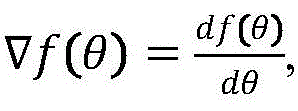 Where θ is an argument, f (θ) is a function of θ,
 represents a gradient; the principle of the gradient descent method can be simply expressed as

The real requirements of the users which are converted into the digital signals are substituted into f (theta) to obtain a descending gradient, and the gradient is led into a neural network structure, so that the optimal descending speed of the network can be obtained, and better fitting can be completed; after each gradient descent, the loss function is calculated, and if the loss function is still large, the gradient descent is used again.
S3, inputting the user requirement of the previous period of time by using the established user requirement behavior model, and predicting the requirement of the user at the next time; acquiring the requirement of a user at the next moment;
s4, pre-buffering the obtained requirements in a base station cache, and reasonably buffering the requirements of a plurality of users in the base station by using a base station cache strategy so as to ensure that the requirements can be directly obtained from the base station cache when the users require;
the base station cache strategy is any one of the following two types, wherein a is any constant:
1) and caching a future demands of the user in the base station, and updating all a pre-cached contents of the base station if the future demands do not accord with the pre-caching every time the user demands. If the demand is consistent with the pre-caches, the cache content is not updated until the demand is inconsistent or a pre-caches are all demanded, and the cache content is updated;
2) and caching a demands of the users in the base station, and recording a user demand updating model if the a demands do not accord with the pre-caching every time the user demands. And after a users demand, updating the cache content of the base station.
And S5, when the user really needs, recording the real need of the user and comparing the real need with the prediction data, updating the data set, continuing training, continuously improving the model and continuing the steps S3-S5, so that the model of the user' S need behavior is continuously improved, and the prediction accuracy is improved.
Updating the data set and continuing training means that the user behavior prediction model optimizes itself over time and is continuously perfected to approach the true behavior.
A behavior model is established for each user, and the model for each user is different.
Examples
As shown in fig. 1, in a heterogeneous cellular network. The user's needs are pre-buffered in the micro base station, thereby reducing network stress during peak periods. The specific working steps are as follows.
Assume a heterogeneous cellular network in which a cache is deployed in a micro base station S1. For any user, we prefer to use the micro base station to serve it. Meanwhile, the user behavior is fitted and modeled by using the previous behavior habit of the user and the deep learning neural network.
And S2, specifically, the model is established in a mode that a DBN neural network is utilized to apply a user data set and a gradient descent algorithm of a BP neural network to carry out mass training.
And S3, when the last request of the user is finished, obtaining the predicted data of the next behavior of the user through a neural network model, and pre-caching the data in the cache of the micro base station after the data is obtained through the macro base station.
And S4, comparing the data with the data pre-buffered in the micro base station when the user has a request. And if the prediction is correct, directly acquiring from the micro base station. If not, the macro base station directly acquires the information.
And S5, bringing the requirements of the user into the model, and performing fitting training to obtain a more accurate model.
Claims (5)





Priority Applications (1)
| Application Number | Priority Date | Filing Date | Title |
|---|---|---|---|
| CN201910006278.2A CN109831801B (en) | 2019-01-04 | 2019-01-04 | Base station caching method for user behavior prediction based on deep learning neural network |
Applications Claiming Priority (1)
| Application Number | Priority Date | Filing Date | Title |
|---|---|---|---|
| CN201910006278.2A CN109831801B (en) | 2019-01-04 | 2019-01-04 | Base station caching method for user behavior prediction based on deep learning neural network |
Publications (2)
| Publication Number | Publication Date |
|---|---|
| CN109831801A CN109831801A (en) | 2019-05-31 |
| CN109831801B true CN109831801B (en) | 2021-09-28 |
Family
ID=66860069
Family Applications (1)
| Application Number | Title | Priority Date | Filing Date |
|---|---|---|---|
| CN201910006278.2A Active CN109831801B (en) | 2019-01-04 | 2019-01-04 | Base station caching method for user behavior prediction based on deep learning neural network |
Country Status (1)
| Country | Link |
|---|---|
| CN (1) | CN109831801B (en) |
Families Citing this family (4)
| Publication number | Priority date | Publication date | Assignee | Title |
|---|---|---|---|---|
| CN111865863B (en) * | 2020-07-20 | 2021-07-20 | 山东大学 | An OFDM signal detection method based on RNN neural network |
| CN114338416B (en) * | 2020-09-29 | 2023-04-07 | 中国移动通信有限公司研究院 | Space-time multi-index prediction method and device and storage medium |
| CN112947959B (en) * | 2021-01-29 | 2025-02-07 | 京东方科技集团股份有限公司 | An update method, device, server and storage medium for an AI service platform |
| CN112819523B (en) * | 2021-01-29 | 2024-03-26 | 上海数鸣人工智能科技有限公司 | Marketing prediction method combining inner/outer product feature interaction and Bayesian neural network |
Citations (5)
| Publication number | Priority date | Publication date | Assignee | Title |
|---|---|---|---|---|
| CN106658598A (en) * | 2016-12-08 | 2017-05-10 | 南京邮电大学 | Service migration method based on content caching and network state awareness |
| CN107241790A (en) * | 2017-05-24 | 2017-10-10 | 沈阳航空航天大学 | Base station collaboration Energy Saving Strategy based on content caching |
| CN108153830A (en) * | 2017-12-13 | 2018-06-12 | 东南大学 | Active cache control method based on study in cordless communication network |
| CN108307446A (en) * | 2018-01-05 | 2018-07-20 | 华中科技大学 | A kind of wireless network edge cooperation caching System and method for based on software definition |
| CN108668287A (en) * | 2018-04-19 | 2018-10-16 | 西安交通大学 | A kind of active cache method based on user content popularity and movement rule |
Family Cites Families (5)
| Publication number | Priority date | Publication date | Assignee | Title |
|---|---|---|---|---|
| WO2017196821A1 (en) * | 2016-05-09 | 2017-11-16 | Strong Force Iot Portfolio 2016, Llc | Methods and systems for the industrial internet of things |
| US11048248B2 (en) * | 2016-05-09 | 2021-06-29 | Strong Force Iot Portfolio 2016, Llc | Methods and systems for industrial internet of things data collection in a network sensitive mining environment |
| US20180046920A1 (en) * | 2016-08-10 | 2018-02-15 | Paypal, Inc. | User Data Learning Based on Recurrent Neural Networks with Long Short Term Memory |
| CN107886167B (en) * | 2016-09-29 | 2019-11-08 | 北京中科寒武纪科技有限公司 | Neural network computing device and method |
| CN108462605B (en) * | 2018-02-06 | 2022-03-15 | 国家电网公司 | Data prediction method and device |
-
2019
- 2019-01-04 CN CN201910006278.2A patent/CN109831801B/en active Active
Patent Citations (5)
| Publication number | Priority date | Publication date | Assignee | Title |
|---|---|---|---|---|
| CN106658598A (en) * | 2016-12-08 | 2017-05-10 | 南京邮电大学 | Service migration method based on content caching and network state awareness |
| CN107241790A (en) * | 2017-05-24 | 2017-10-10 | 沈阳航空航天大学 | Base station collaboration Energy Saving Strategy based on content caching |
| CN108153830A (en) * | 2017-12-13 | 2018-06-12 | 东南大学 | Active cache control method based on study in cordless communication network |
| CN108307446A (en) * | 2018-01-05 | 2018-07-20 | 华中科技大学 | A kind of wireless network edge cooperation caching System and method for based on software definition |
| CN108668287A (en) * | 2018-04-19 | 2018-10-16 | 西安交通大学 | A kind of active cache method based on user content popularity and movement rule |
Non-Patent Citations (3)
| Title |
|---|
| B-CaB: Optimizing the SP"s Bidding for Cache and Band Resources in Virtualized Wireless Networks;Yuwei Yan等;《2016 International Conference on Network and Information Systems for Computers (ICNISC)》;20170612;全文 * |
| Profiling user behaviour for efficient and resilient cloud management;C. People等;《2014 International Conference on Advances in Computing, Communications and Informatics (ICACCI)》;20140927;全文 * |
| Synthesizing 3D Shapes via Modeling Multi-view Depth Maps and Silhouettes with Deep Generative Networks;Amir Arsalan Soltani等;《2017 IEEE Conference on Computer Vision and Pattern Recognition (CVPR)》;20171109;全文 * |
Also Published As
| Publication number | Publication date |
|---|---|
| CN109831801A (en) | 2019-05-31 |
Similar Documents
| Publication | Publication Date | Title |
|---|---|---|
| CN109831801B (en) | Base station caching method for user behavior prediction based on deep learning neural network | |
| CN110809306B (en) | Terminal access selection method based on deep reinforcement learning | |
| Zhao et al. | A TP-DDPG algorithm based on cache assistance for task offloading in urban rail transit | |
| CN112218337B (en) | A cache policy decision method in mobile edge computing | |
| CN111698728B (en) | Topology control system for dynamic network and control method thereof | |
| CN109218747B (en) | A classification and caching method for video services based on user mobility in ultra-dense heterogeneous networks | |
| CN109391681A (en) | V2X mobility prediction based on MEC unloads scheme with content caching | |
| CN110213776B (en) | WiFi unloading method based on Q learning and multi-attribute decision | |
| CN115278708A (en) | A mobile edge computing resource management method for federated learning | |
| CN110035478A (en) | A kind of dynamic multi-channel cut-in method under high-speed mobile scene | |
| CN108093435A (en) | Cellular downlink network energy efficiency optimization system and method based on caching popular content | |
| CN110290510A (en) | Edge cooperative caching method under layered wireless network supporting D2D communication | |
| Manzoor et al. | Federated learning empowered mobility-aware proactive content offloading framework for fog radio access networks | |
| Huang et al. | Federated learning based QoS-aware caching decisions in fog-enabled internet of things networks | |
| CN113573320A (en) | SFC deployment method based on improved actor-critic algorithm in edge network | |
| CN112565377A (en) | Content grading optimization caching method for user service experience in Internet of vehicles | |
| Yang et al. | Efficient vehicular edge computing: A novel approach with asynchronous federated and deep reinforcement learning for content caching in VEC | |
| WO2023246343A1 (en) | Data processing method and apparatus, and computer device, storage medium and product | |
| CN118265000A (en) | Mobile perception edge collaborative caching method based on deep reinforcement learning in Internet of vehicles | |
| Li et al. | Edge caching for D2D enabled hierarchical wireless networks with deep reinforcement learning | |
| Tao et al. | O-RAN-based digital twin function virtualization for sustainable IoV service response: An asynchronous hierarchical reinforcement learning approach | |
| CN115906630B (en) | A 5G base station energy consumption optimization method based on federated learning | |
| CN116801316A (en) | Method for task offloading in hybrid edge computing systems based on deep reinforcement learning | |
| CN118740929A (en) | A content deployment optimization method for drone collaborative caching in 6G networks | |
| CN109996208A (en) | Vacuum tube high-speed flight train train-ground communication method based on C-RAN framework |
Legal Events
| Date | Code | Title | Description |
|---|---|---|---|
| PB01 | Publication | ||
| PB01 | Publication | ||
| SE01 | Entry into force of request for substantive examination | ||
| SE01 | Entry into force of request for substantive examination | ||
| GR01 | Patent grant | ||
| GR01 | Patent grant |