CN1097970C - Network structure and protocol for telecommunication network - Google Patents
Network structure and protocol for telecommunication network Download PDFInfo
- Publication number
- CN1097970C CN1097970C CN93116906A CN93116906A CN1097970C CN 1097970 C CN1097970 C CN 1097970C CN 93116906 A CN93116906 A CN 93116906A CN 93116906 A CN93116906 A CN 93116906A CN 1097970 C CN1097970 C CN 1097970C
- Authority
- CN
- China
- Prior art keywords
- signaling
- node
- service
- network
- telephone
- Prior art date
- Legal status (The legal status is an assumption and is not a legal conclusion. Google has not performed a legal analysis and makes no representation as to the accuracy of the status listed.)
- Expired - Lifetime
Links
Images


Classifications
-
- H—ELECTRICITY
- H04—ELECTRIC COMMUNICATION TECHNIQUE
- H04Q—SELECTING
- H04Q3/00—Selecting arrangements
-
- H—ELECTRICITY
- H04—ELECTRIC COMMUNICATION TECHNIQUE
- H04Q—SELECTING
- H04Q3/00—Selecting arrangements
- H04Q3/0016—Arrangements providing connection between exchanges
- H04Q3/0025—Provisions for signalling
-
- H—ELECTRICITY
- H04—ELECTRIC COMMUNICATION TECHNIQUE
- H04Q—SELECTING
- H04Q3/00—Selecting arrangements
- H04Q3/0016—Arrangements providing connection between exchanges
Landscapes
- Engineering & Computer Science (AREA)
- Computer Networks & Wireless Communication (AREA)
- Telephonic Communication Services (AREA)
- Communication Control (AREA)
- Exchange Systems With Centralized Control (AREA)
- Data Exchanges In Wide-Area Networks (AREA)
Abstract
用于电信网络的网络结构和信令规约。电信网络的结点经连线网络和信令网络互连起来。不同结点上与连线相关的软件组经第一规约彼此通信;不同结点上与第业务相关的软件组经第二规约彼此通信。在信令网络中,于一个呼叫的起始结点与同一呼叫的终结点之间建立直通信令通路,在起始和终结结点上附加新业务特性时,不需要在连线网络中同一呼叫的路由所经过的节点上和节点之间补充这种新的业务特性。
Network architecture and signaling protocols for telecommunications networks. The nodes of the telecommunication network are interconnected via wiring network and signaling network. The software groups related to connection on different nodes communicate with each other through the first protocol; the software groups related to the second service on different nodes communicate with each other through the second protocol. In the signaling network, a direct communication signaling path is established between the originating node of a call and the termination point of the same call. When adding new service features to the originating and terminating nodes, it is not necessary to have the same This new service feature is supplemented on and between nodes that the routing of the call passes through.
Description
本发明总地涉及电信网络的网络结构和信令规约,例如,电话网络和包括计算机软件控制的一些电话交换机的电信业务网络。具体地说,本发明涉及一种在位于电信网络的具有第一业务相关软件部分的第一节点和位于电信网络的具有第二业务相关软件部分的第二节点之间建立信号路径的发命令的方法,以及一种在电信网络中发信令的方法。The present invention relates generally to the network architecture and signaling protocols of telecommunication networks, such as telephone networks and telecommunication service networks including some telephone exchanges controlled by computer software. In particular, the present invention relates to a method for issuing commands for establishing a signal path between a first node located in a telecommunications network having a first service-related software part and a second node located in a telecommunications network having a second service-related software part method, and a method of signaling in a telecommunications network.
所谓网络结构指的是,在电话交换机之间提供各种功能以及这些功能彼此如何通信的方法。当各种功能彼此通信时所采用的那些规则和协定称为规约。The so-called network structure refers to the method of providing various functions between telephone exchanges and how these functions communicate with each other. Those rules and conventions that are adopted when various functions communicate with each other are called protocols.
如图1所示,艾利森公司的月刊“Ericsson Review”1976年第二期图9C中示出在电话网络中如何进行电话交换。标号10和12标出两个本地交换机,用户20连接到这种本地交换机上。标号11标出能够把不同本地交换机之间的通信连接起来的转接交换机。图1所示的网络中,借助于中继线30把电话交换机10、11、12连接起来。在图1所示的特定网络中,因为在所有本地交换机之间都有直通的中继线,所以,电话交接机11是转接交换机。在图1网络中,感兴趣的特点是通信可以通过转接交换机11在本地交换机10与12之间转换。标号40标出所谓共用信道信令的信令连线。当前电话网络的一般特点是,信令连线与中继线是分开的。在过去技术的情况下,信令例如利用在交换机之间以中继线上的双音频而对中继线起作用。如上所述,在当今技术中,信令网络已与中继线分开。电话网络中的信令发生在电话网络交换机之间,并且,意于控制通信,其中包括叉簧开关用户状态的转换以及与被呼叫用户相关的地址信息的传送。As shown in Fig. 1, Fig. 9C of Allison's monthly magazine "Ericsson Review", No. 2, 1976, shows how telephone switching is performed in a telephone network.
如图2所示,Ericsson Televerket和Studentlitteratur 1986年出版的教科书“Telecommunications,Telephone Networks 1”第42-43页总体地示出图1电话网络中电话交换机10、11或12之一。更准确地说,只描述那些与构成本发明基础的技术问题相关的功能。在为本地交换机10时的电话交换机包括控制耦合装置的计算机100。耦合装置包括用户接口101、交换设备102、中继接口103。交换设备102用作在用户接口101与中继线接口103之间为电话呼叫连接电话信道。计算机100控制从用户20通过用户线25和用户接口101,到本地交换机10的信令。类似地,在中继线那一侧,计算机100控制中继线电路30通过中继线接口103到交换设备102的连接。计算机100还有一个通过信号端子通向信号网络的接口104。计算机执行软件110的一些项目,软件110具备电话交换机中的各种功能(例如,控制呼叫的连线)或维护功能(例如,收集计费信息)。软件110的这些项目可以通过信号端子104,与其它电话交换机中的软件项目通信。当软件110与其它电话交换机中的软件通信时,采用了图2中标为P40的规约。尽管这些规约在图2中是单独示出的,但是,在信号连线40中是这样来利用这些规约的。As shown in Figure 2, the textbook "Telecommunications, Telephone Networks 1" published by Ericsson Televerket and Studentlitteratur in 1986, pages 42-43 generally shows one of the
当今在电话网络中流行的信令技术以根据CCTTT或ANSI建议的共用信道信令为基础。The signaling techniques prevailing in telephone networks today are based on shared channel signaling according to the CCTTT or ANSI recommendations.
当要建立从一个电话交换机到另一个电话交换机的电话连线时,即,当用户已经举起电话机的受话器,并且已经通过用户接口101向电话交换机10发送用户B(该呼叫应该建立到用户B上)的号码,电话交换机10中已经识别了B号码的各位时,在所示情况下,假定:被拨号码所涉及的用户不在自己的电话交换机10中,而是在另一个电话交换机(例如,图1所示电话交换机12)内。为了建立到被呼叫用户(在本地交换机12中的B用户)的呼叫连线,采用了所谓的电路相关信令处理,在这种处理中,选择了在电话交换机10与12之间的中继线30,且信令涉及到对中继线中被选择的电路。通常,是在中继线中选择能够发射电话呼叫的时隙。根据该时隙来发射信号,且利用在这两个电话交换机中相应软件都能够诠释的规约P40来发出信令。这样,连线并不对电话交换机10和12中的软件直接起作用,而是电话交换机10通过参考所选择被采用的实际电路而与电话交换机12通信。当发信令时,所采用的规约是例如TUP(电话用户部分)或ISUP(综合业务数字网络用户部分)。这样,软件110为了在中继线上电话交换机之间建立电话呼叫连线,在信令连线40上所采用的规约就是这一P40。When a telephone connection from one telephone exchange to another is to be established, that is, when the user has lifted the handset of the telephone and has sent user B to the
在这种发信令过程的情况下,只有那些在它们之间具有直通中继线的电话交换机,彼此才能通信。根据图3所示,如果在连接到不同本地交换机10和12上,且彼此之间缺少直通中继线30的两个用户21与22之间要建立电话呼叫,则必须通过一个或一个以上的转接电话交换机11的媒介来建立呼叫联系。这是因为信号必须总与中继线中的某一电路有关。In the case of this signaling procedure, only those telephone exchanges which have cut-through trunks between them can communicate with each other. As shown in FIG. 3, if a telephone call is to be established between two
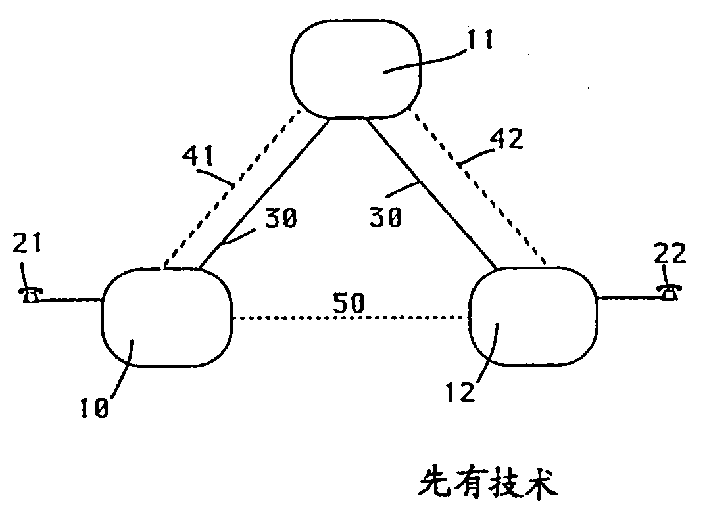
如图3所示,伦敦Peter Peregrinus Ltd.1991年出版的Richard J.Manterfield编写的教科书“Common Channel Signalling”中简单地示出三个电话交换机之间的转接情况,即,在两个本地电话交换机10、12,与一个转接交换机11之间,该转接交接机11使本地交换机10与12之间的通信通过。在图示情况下,本地交换机10上的A用户21已打电话给另一本地交换机12上的B用户22。这样,当建立呼叫联系时,在本地交换机10与12之间未直接发出信令,且信号必须经转接交换机11。实际上,把本地交换机10与12之间的呼叫联系分成两半,这两半在转接交换机中互相连接起来。本地交换机10选择到转接交换机11的中继线电路,并采用P41规约来建立到转接交换机11的那一半联系。转接交换机11通过选择在中继线30上的中继线电路、并采用规约P42以建立到本地交换机12的另一联系通路,来建立到本地交换机12的其它联系。当本地交换机12已经接收到该呼叫时,转接交换机11则连通来自A用户21的呼叫,并且在原则上,转接交换机11对呼叫是透明的。As shown in Figure 3, the textbook "Common Channel Signaling" written by Richard J. Manterfield, published by Peter Peregrinus Ltd. in London in 1991, simply shows the transfer situation between three telephone exchanges, that is, in two local telephones Between the
提供给用户21和22的电话服务取决于在连接中起作用的所有电话交换机10、11、12中的软件,还取决于这些交换机为了在其间进行通信而采用的那些规约P41和P42。如果要引入一种新功能(例如,在号码已占线的情况下的自动回叫),则需要在建立从A用户到B用户的连接过程中起作用的全部电话交换机内的软件都执行这一新功能,还需要在这些软件之间所采用的规约P41和规约P42能够管理和控制这一新功能。这样,当引入一种新功能时,需要改变全部这三个电话交换机和全部规约。因为电话呼叫可以通过一个地区中电话网络内的很多种不同通路连接起来,所以,需要全部电话交换机支持本地交换机提供给用户的功能。这是一个缺点,特别是当希望在网络里提供面向特定种类用户(例如,在特定公司里的那些用户)的功能时。即使这个公司可能只在几个电话交换机中有用户连线(例如,在一个城市里有4个工作地点连接到同一城市内的不同电话交换机上),改变这几个电话交换机中的软件也是不够的,因为一个呼叫可以沿着有关地区中网络内的不同路由而通过。所以,当希望引入新功能时,需要不同电话交换机之间的规约能够互相兼容。当有关公司分布在该地区的许多不同工作地点时,需要修改大量的、不同的电话交换机。The telephony services provided to the
当今电话网络遇到的另一个问题涉及到从一个用户到另一个用户电话呼叫的路由。一般来说,电话号码和电话网络是按一定层次建立起来的,因此,电话号码的不同部分涉及到不同的地理区域。通常,边远区前面加上地区路由号码,该地区路由号码对应于用作路由号码交换机的路由号码区,该路由号码交换机管理到位于该路由号码区内全部用户的输入通信。电话号码的另外部分(一般为该号码的前两位或前三位)用来标出已知用户所连接的本地交换机。参看图4,如上述教科书“Telecommunications,Telephone Networks 1”第133页那样,示出一些本地电话交换机10、12、14、15,其中,交换机10和14连接到位于路由号码区18中的路由号码交换机16上,而本地电话交换机12和15连接到位于另一路由号码区19中的另一路由号码交换机17上,路由号码交换机16和17连接到转接交换台11上。假定:应该把从属于交换机10(图4最左方)的一个用户的电话呼叫连接到连接到本地交换机12(图4最右方)的另一用户上。本地交换机10将不识别本地交换机12中该用户的B号码,而是把B号码传送到其路由号码交换机16上,路由号码交换机16本身识别出那个号码与另一个路由号码有关,所以,把该呼叫传送到转接交换机11上。转接交换机11使该呼叫通到用户B的路由号码区内,更准确地说,通到路由号码区19中的路由号码交换机17上。路由号码交换机17分析B号码的其它部分,以便建立用户B所连接的本地交换机,并且,路由号码交换机17把该呼叫切换到这一本地交换机(在所示情况下,为本地交换机12)上。这种电话呼叫路由方法的缺点是,当用户在由不同电话交换机服务的区域之间搬家时,该用户被强制改变其电话号码。当改建或扩建电话网络、用户的连线需要从一个电话交换机搬到另一个电话交换机时,该用户还可能被强制改变其电话号码。这对各个用户来说,呈现为缺点,对网络经营者来说,也可能要增加成本,因为他必须在合适的时间改建该网络,还要通知与改建(要变动用户号码)有关的全部用户。这类通知会产生很大花费。Another problem encountered with today's telephone networks involves the routing of telephone calls from one user to another. Generally, telephone numbers and telephone networks are organized hierarchically, so that different parts of a telephone number refer to different geographical areas. Typically, the outlying area is preceded by an area routing number corresponding to a routing number area serving as a routing number switch that manages incoming communications to all subscribers located within the routing number area. The other part of the telephone number (usually the first two or three digits of the number) is used to identify the local exchange to which the known subscriber is connected. Referring to Figure 4, as in the aforementioned textbook "Telecommunications,
当代电话网络包括在电话交换机与电话网络中其它装置之间直接发信令的另一种可能性。这样的发信令基于电话交换机或某种其它装置中的软件直接访问另一电话交换机或某一其它装置中某些功能的能力。这仅仅允许在电话网络中装置的不同元件之间建立通信信道,而不涉及当连接通话时,到中继线电路的发信令处理。这种直接寻址方法一般用于访问电话网络中的中心功能,例如,所谓免费电话业务(瑞典的020号,美国的800号)或者用户呼叫移动电话网络中的数据库。Contemporary telephone networks include another possibility for direct signaling between telephone exchanges and other devices in the telephone network. Such signaling is based on the ability of software in a telephone switch or some other device to directly access certain functions in another telephone switch or some other device. This only allows communication channels to be established between the different elements of the equipment in the telephone network and does not involve the signaling process to the trunk circuit when a call is connected. This direct addressing method is generally used for accessing central functions in the telephone network, for example so-called toll free services (020 in Sweden, 800 in the US) or subscriber calls to databases in mobile telephone networks.
图5示出包括与图3所示相同装置的一般实例,图5附加了中心装置13,该中心装置13借助于规约P43(规约P43适合于装置13所提供的功能)允许进行对话。规约P43与规约P41、规约P42不同。当用户21要求访问有关业务(例如,与智能网络有关的020号,或者与移动电话网络有关的010号)时,电话交换机10发现:管理不了所请求的那个号码,因此,把这种呼叫传送到电话交换机11上,电话交换机11发现:这一呼叫指向要求特殊处理的指南号码,因而,调用能够管理这种指南号码的电话交换机3中的软件。一般为网络数据库的装置13通过公开用户21的呼叫所应通信的电话号码,来响应电话交换机11的询问。在电话交换机11与13之间的信令并不是与电路相关的,当电话交换机11已经弄清楚该呼叫所应通信的目标时,信令就以上述方式、借助于电路切换信令对相关电话交换机起作用了。当为了得到对于在网络中哪里有所需功能的回答而调用装置13中的软件,且装置13包括记载了用户位于哪里的网络数据库时,可以采用自由信令,利用电话号码与用户地理位置的固定关系来解决这个问题。这种解决方法意味着:可以采用自由信令,且在网络内实现了能够执行特定业务的中心功能,这种解决方法的缺点是,需要修改选定的、标准的电话交换机(即,图5所示的电话交换机10、11和12)中的软件。例如,图5中的电话交换机11需要包括识别移动电话号码010或者020的软件。识别不了这些号码的交换机在交换机层次中应该把这些号码向上传送。识别这些号码的交换机必须能够与数据库开始通信,而且,为此目的,必须能够采用不同的规约。从建立连线方面来看,只有某几个电话交换机能够识别这种业务呼叫号码(010、020等),这是一个缺点。例如,在移动电话网络的情况下,80%左右的通信包括通过位于电话交换机近区内的交换机与移动用户之间的通信。如果电话交换机10具有能够识别这种业务呼叫号码的功能,则为了建立到B那一侧的联系,在网络中选择最佳路由也是可能的。修改电话交换机中的软件是贵的。因此,对于通过修改每一个电话交换机的软件从呼叫连线方面可以得到的那些好处,与这种软件修改所需的费用进行了折衷。然而除了利用例如010和020号码来识别的那些业务以外,需要能够以相同方法引入和识别很多种业务的电信网络。当把一种新业务引入网络内时,如果需要修改在利用对应于规约P43(规约P43自适应于要引入的特定业务)的网络内每一个电话交换机中的软件,那将是灾难性的。Figure 5 shows a general example comprising the same means as shown in Figure 3, with the addition of a central means 13 which allows dialogue by means of a protocol P43 adapted to the functions provided by the
本发明涉及提供一种用于通信系统的网络结构和所用的规约,当实现本发明的技术标准时,利用本发明即可消除上述所遇到的缺点。The present invention relates to the provision of a network structure for a communication system and the protocols used, by means of which the disadvantages encountered above can be eliminated when implementing the technical standards of the present invention.
本发明的一个目的是提供一种用以在位于电信网络的第一节点的第一业务相关软件部分和位于第二节点的第二业务相关软件部分之间建立信号路径的发信令的方法。It is an object of the invention to provide a method of signaling for establishing a signal path between a first service-related software part located at a first node of a telecommunication network and a second service-related software part located at a second node.
本发明的另一个目的是提供一种用以在电信网络中发信令的方法。Another object of the invention is to provide a method for signaling in a telecommunication network.
根据本发明的一个方面,一种用以在电信网络的具有第一业务相关软件部分的第一节点和所述电信网络的具有第二业务相关软件部分的第二节点之间建立信号路径的发信令的方法,第一和第二节点进网的发信令网络以及基本发信令规约用于在第一和第二节点之间发信令,其中所述方法包括下列步骤:According to an aspect of the invention, a transmitter for establishing a signal path between a first node of a telecommunication network having a first service-related software part and a second node of said telecommunication network having a second service-related software part A method of signaling, a signaling network into which the first and second nodes enter the network and a basic signaling protocol for signaling between the first and second nodes, wherein said method comprises the following steps:
第一业务相关软件部分请求与第二业务相关软件部分互换一系列操作,所述系列下文称为对话,the first service-related software part requests to exchange a sequence of operations with the second service-related software part, said sequence hereinafter referred to as a dialog,
所述第一业务相关软件部分把所述请求送到第一发信令业务处理器,The first service-related software part sends the request to the first signaling service processor,
所述第一发信令业务处理器响应这个请求准备基本发信令规约中的初始消息,且在其中的特定部分包含所请求对话的本体。Said first signaling service processor prepares an initial message in the basic signaling protocol in response to this request, and in a specific part of it contains the body of the requested dialog.
所述基本发信令规约包括一个建立通往第二节点的信号路径的总体部分,said basic signaling protocol includes an overall part for establishing a signal path to the second node,
利用载有对话的基本规约向所述第二节点传送所述消息,transmitting said message to said second node using a basic protocol carrying a dialog,
由位于所述第二节点的第二发信令业务处理器接收所述消息,receiving said message by a second signaling service processor located at said second node,
所述第二发信令业务处理器:The second signaling service processor:
分析所述初始消息,以检查所请求的对话,analyzing said initial message to check the requested dialog,
利用为这种检查的结果,识别第二业务相关的软件部分,开始执行所请求的对话,或者using the results of this check to identify the second business-relevant software part and initiate the execution of the requested dialog, or
将所述信号路径从所述第二节点改道至进入发信令网络的第三节点上的第三业务相关软件部分,redirecting said signal path from said second node to a third service-related software part on a third node entering a signaling network,
所述执行的对话是在所建立的信号路径上发生的。The executed dialog takes place over the established signal path.
根据本发明的另一个方面,一种在电信网络中发信令的方法,该电信网络包括多个节点,以使某些(并非全部)所述节点之间具有直接中继线的方式连接所述节点的中继线装置、以及配置在所述节点上切换所述电信网络的连接的程控交换装置,所述发信令方法用于建立和解除所述连接,一个在信号网络中被发信令的基本规约可以任选地利用所述中继线装置,其中各所述节点中的程序软件分为用以处理连接的连接相关的软件部分和用以处理业务的业务相关的软件部分,所述业务相关的软件部分位于称为源端节点的节点,想要建立连接的用户与该源端节点相连接,According to another aspect of the invention, a method of signaling in a telecommunications network comprising a plurality of nodes, such that some (but not all) of said nodes are connected in such a way that there are direct trunks between said nodes The trunk line device, and the program-controlled switching device configured on the node to switch the connection of the telecommunications network, the signaling method is used to establish and release the connection, a basic protocol to be signaled in the signaling network The trunk device may optionally be utilized, wherein the program software in each of the nodes is divided into a connection-related software part for handling connections and a service-related software part for handling services, and the service-related software part Located at a node called an origin node, to which a user who wants to establish a connection connects,
利用发信令过程,直接向称为终端节点的节点上的所述业务相关源件部分发信令,所述想要的连接就终止于该节点,以在分别位于所述源端节点和终端节点上的所述业务相关软件之间建立允许直接发信令的第一信号路径,同时位于所述源端节点的所述连接相关软件部分在不同于所述第一发信令过程的第二发信令过程中的所述基本规约的帮助下,在所述信号网络中发信令给位于中继线装置所通往的相邻节点的所述连接相关软件部分,以建立通往所述相邻节点中的所述连接相关软件部分的第二信号路径,在所述第二信号路径中所发生的发信令的目的是要在所述源节点和所述相邻节点之间形成连接,重复所述第二发信令过程,直至到达所述终端节点从而完成所述想要的连接为止,所述发信令方法因而允许控制所述端节点上的业务处理设备,而不需要所述源端节点和终端节点之间的节点(如果有的话)具有业务相关的程序软件。Utilize signaling procedure, send signaling directly to the said service-related source part on the node called terminal node, said desired connection is just terminated at this node, in order to be respectively located at said source terminal node and terminal A first signal path that allows direct signaling is established between the service-related software on the nodes, and at the same time, the connection-related software part located at the source end node is in a second signal path different from the first signaling process. With the help of said basic protocol in the signaling process, signaling in said signaling network to said connection-related software parts located at adjacent nodes to which a trunk device leads to establish a connection to said adjacent a second signal path of said connection-related software part in a node in which signaling occurs for the purpose of forming a connection between said source node and said adjacent node, repeating Said second signaling procedure, until reaching said terminal node thereby completing said desired connection, said signaling method thus allows controlling traffic processing equipment on said terminal node without requiring said source End nodes and nodes between the end nodes (if any) have business-related program software.
与先有技术相比,本发明的有益效果在于通信网络中电话交换机之间的信令有七点特征:Compared with the prior art, the beneficial effect of the present invention is that the signaling between the telephone exchanges in the communication network has seven characteristics:
A.把信令分成两种信令过程:直接发生在那些管理用户电话呼叫连线的电话交换机(例如,图4中本地电话交换机10与12)之间的第一信令过程;以及建立电话呼叫所需那些连线,即建立在有关部分之间实际的语音信道的那些连线的第二信令过程。A. Divide signaling into two signaling processes: the first signaling process that takes place directly between the telephone exchanges (for example,
B.把电话交换机中的软件分成:B. Divide the software in the telephone exchange into:
(i)借助于根据上述A来处理在电话呼叫中所包括用户的第一信令过程,控制用户电信业务管理的业务管理软件;以及(i) service management software for controlling the management of the subscriber's telecommunication service by means of handling the first signaling procedure of the subscriber involved in the telephone call according to A above; and
(ii)借助于根据上述A的第二信令过程控制电话呼叫所需那些连线(即语音路由)的建立的联系建立部分。(ii) A contact establishment part that controls the establishment of those connections (ie voice routing) required for telephone calls by means of the second signaling procedure according to A above.
当有关电话联系不是两个用户之间的连线,而是例如两个相互通信的计算机之间的联系时,所建立的联系不是语音信道,而是例如包数据信道、速度互相不同的包数据信道,或者自由的64kb的数据连线。在宽带连接的情况下,可以建立其它类型的联系。When the telephone connection in question is not a connection between two users but, for example, two computers communicating with each other, the connection established is not a voice channel but, for example, a packet data channel, packet data at different speeds channel, or a free 64kb data connection. In the case of broadband connections, other types of connections can be established.
C.信令通过下面称为信号通路的逻辑连线而起作用,信号通路建立在应该为已知电话呼叫通信的那些电话交换机的软件组之间。这样,在本地交换机中与业务相关的软件之间建立信号通路,在业务管理中的有关本地交换机之间直接建立信号通路。另一方面,为了管理连接的真正建立,建立其它逻辑连线。逻辑连线指的是:与诸如分组切换的网络相比较,在一条实际信号的通路(例如,图1中的通路40)上建立几条逻辑连线的能力。在最简单的情况下,逻辑连线包括希望彼此通信的那些部分统一到要沿着该逻辑连线发送的那些信息的特定一致性上。逻辑连线可能有不同的终结目标。例如,一条逻辑连线可能与一个电话呼叫有关,另一条逻辑连线可能与另一呼叫有关。C. Signaling operates through logical connections, hereinafter referred to as signal paths, established between those software groups of telephone exchanges that are supposed to communicate for a known telephone call. In this way, signal paths are established between service-related software in the local exchange, and signal paths are directly established between relevant local exchanges in service management. On the other hand, to manage the actual establishment of the connection, other logical connections are established. Logical wires refer to the ability to establish several logical wires on a path of actual signals (eg,
D.电话呼叫到电话交换机(该电话交换机应该管理对已知电话号码的呼叫)的路由,是根据上述C建立信令连线的一个组成部分。其中,建立根据上述A的第一信令过程的信令连线,包括找到用户B的、正确的电话交换机。D. The routing of telephone calls to the telephone exchange (which shall handle calls to known telephone numbers) is an integral part of establishing the signaling connection according to C above. Wherein, establishing the signaling connection according to the first signaling procedure of A above includes finding the correct telephone exchange for user B.
E.根据上述D的路由通过分析网络各中心功能中来自电话交换机的呼叫,可以包括一次或几次对信令重新定向,并指向该呼叫的新的接收户。对于建立从电话交换机的连线的试图,可以逐次重新定向,直到最终指出了目标的那一次为止。E. The routing according to D above may include one or several redirections of the signaling, by analyzing the calls from the telephone exchange in the various central functions of the network, to the new recipient of the call. Attempts to establish a connection from a telephone exchange may be redirected successively until the one at which the target is finally indicated.
F.根据E的重新定向可以在不包括呼叫软件的情况下进行。在用户A的电话交换机中找到的软件不受包括中心功能的影响。这允许在网络中相继加上新的中心功能而不影响现有电话交换机的软件。F. Redirection according to E can be done without involving calling software. The software found in User A's telephone exchange is not affected by the inclusion of the central function. This allows new central functions to be added successively in the network without affecting the software of the existing telephone exchange.
G.利用支撑新通信业务的新部分,以模块方式,可以扩展用于不同电话交换机软件组之间发信令的那些规约。这不仅允许把功能加到真正的电话交换机上,还允许把功能加到信令规约上。G. Those protocols used for signaling between different sets of telephone exchange software can be extended in a modular fashion with new parts supporting new communication services. This not only allows functionality to be added to the actual telephone exchange, but also to the signaling protocol.
下面将参看附图更详细地描述本发明,其中:The invention will be described in more detail below with reference to the accompanying drawings, in which:
图1概略地示出已知的电信网络;Figure 1 schematically shows a known telecommunication network;
图2概略地示出图1所示网络中电话交换机内所找到的功能;Figure 2 schematically illustrates the functions found within a telephone exchange in the network shown in Figure 1;
图3示出另一已知电话网络的实例,其中,在所示本地交换机10与12之间没有直通的中继线;Figure 3 shows an example of another known telephone network in which there is no direct trunk line between the
图4示出分层结构的电话网络,该网络包括本地交换机、路由号码交换机和转接交换机,所有交换机都是根据已知技术构成的;Fig. 4 shows the telephone network of layered structure, and this network comprises local switchboard, routing number switchboard and transit switchboard, all switches are all formed according to known technology;
图5示出获得到电信网络中心功能的自由信令(即,无信道边界)的已知技术;Figure 5 shows a known technique for obtaining free signaling (i.e. no channel boundaries) to the central functions of a telecommunication network;
图6示出一个网络,其中,根据本发明所需的那些信号连线可以第一方法来实现;Fig. 6 shows a network, wherein, according to those signal wirings required by the present invention can first method realize;
图7示出在电信网络中实现信号联系的另一已知方法;Figure 7 shows another known method of implementing signal linkage in a telecommunication network;
图8示出电信交换机的功能,在该电信交换机中,软件分成两种:与业务相关的软件组和与联系相关的软件组;Figure 8 shows the functionality of a telecommunication switch in which the software is divided into two types: a service-related software group and a contact-related software group;
图9示出一种网络结构,在这种网络结构中,不同电话交换机内的联系建立分组软件利用第一规约彼此通信,在这种网络结构中,业务建立组软件利用第二规约,通过与发生和联系相关的信令不同的那些通路彼此通信;Fig. 9 shows a kind of network structure, and in this network structure, the connection establishment grouping software in different telephone exchanges utilizes the first protocol to communicate with each other, and in this network structure, the service establishment group software utilizes the second protocol, by communicating with Those pathways that differ in the signaling associated with the associations communicate with each other;
图10示出两个电话交换机,其相应软件借助于根据本发明设计的规约彼此通信,这种信令涉及到借助于根据本发明设计的基本规约,在第一与业务相关的软件组(管理第一用户)与第二与业务相关的软件组(管理第二用户)之间信号通路的建立;Fig. 10 shows two telephone exchanges whose corresponding software communicates with each other by means of a protocol designed according to the invention, this signaling involves the first service-related software group (administration) by means of a basic protocol designed according to the invention The establishment of a signal path between the first user) and the second service-related software group (management of the second user);
图11是类似于图10的一个说明,但是,涉及两种特定业务的指令,第一种业务都有其自己的、加到基本规约上的特定规约;Fig. 11 is an illustration similar to Fig. 10, however, instructions involving two specific services, the first of which has its own specific protocol added to the basic protocol;
图12是类似于图11的一个说明,但是,包括一个用来管理基本规约的管理器;Figure 12 is an illustration similar to Figure 11, but including a manager for managing the base protocol;
图13说明借助于基本规约,建立信号通路;Figure 13 illustrates the establishment of signal paths by means of basic protocols;
图14说明借助于本发明信令原理,如何建立改发信号通路;Fig. 14 illustrates by means of the signaling principle of the present invention, how to establish the retransmission signal path;
图15说明在根据本发明而构成的电话网络中,能够如何确定电话呼叫路由的实例;Figure 15 illustrates an example of how a telephone call can be routed in a telephone network constructed in accordance with the present invention;
图16说明把现有的、传统的电话网络逐步扩展成根据图15而构成的电话网络;Figure 16 illustrates the gradual expansion of an existing, conventional telephone network into a telephone network constructed according to Figure 15;
图17说明本发明信令原理在电话网络中、在网络万一中断时,意于提供其它通路的一种应用;Fig. 17 illustrates an application of the signaling principle of the present invention in a telephone network, intended to provide other paths in case the network is interrupted;
图18是类似于图9的说明,表明根据本发明用于电信网络中的两种不同信令过程;以及Figure 18 is an illustration similar to Figure 9, showing two different signaling procedures for use in a telecommunications network according to the present invention; and
图19说明基本规约中的信息结构。Fig. 19 illustrates the information structure in the basic protocol.
图6示出本发明网络结构,借助于该网络结构,在软件能够彼此通信的网络中的全部结点能够在它们彼此之间建立信令联系。这些结点标为10、11、12,与例如图5中所示的那些结点相同。图6所示网络的新奇之点在于使相互通信的全部电话交换机还具有信令联系。信令连线41、42和规约P41、P42与图5所示相同;而新奇之点在于本地交换机或结点10与12之间的直通信令联系。FIG. 6 shows a network structure according to the invention, by means of which all nodes in a network in which software can communicate with each other can establish signaling links between themselves. These nodes are labeled 10, 11, 12 and are the same as those shown, for example, in FIG. The novelty of the network shown in Figure 6 is that all telephone exchanges communicating with each other also have signaling links. The
有很多种不同的方法可以用来构成信令,以便使相应软件应该能够彼此通信的全部结点能够在它们之间建立信令通路。图7示出一个实例,其中,可以借助于通过信令通路或连线51、52、53连接到电信网络中结点10、11、12上的通信切换结点60,在脱机信令网络上发出信令。网络交换机可以称为信号点(SP),信号切换结点在通信网络中,以与根据CCTTT及ANSI建议的共用信道发信令方法中STP(信号传送点)相同的方法,起开关的作用。There are many different ways that signaling can be structured so that all nodes whose corresponding software should be able to communicate with each other can establish a signaling path between them. Fig. 7 shows an example where, in the off-line signaling network Send out the signal. The network switch can be called a signal point (SP). The signal switching node acts as a switch in the same way as the STP (signal transfer point) in the shared channel signaling method suggested by CCTTT and ANSI in the communication network.
信号切换结点读出信息的地址,进而确定信息在信号网络中的路由。这种信号网络相对于由中继线连线形成的切换网络来说,是独立的或脱机网络。在下面的图中,将不示出信号链路,因而,只示出在信令过程中所使用的那些规约。只示出能够在信号网络上建立的那些信号通路。这样,图6和图7示出实际的信令网络。如果要在下面的图中示出全部信号链路,图就会变得很乱。The signal switching node reads the address of the information, and then determines the routing of the information in the signal network. This signaling network is an independent or off-line network with respect to the switching network formed by trunk lines. In the following figures, the signal chain will not be shown, thus only those protocols used in the signaling process will be shown. Only those signal paths that can be established on the signal network are shown. Thus, Figures 6 and 7 show the actual signaling network. If the entire signal chain were to be shown in the diagram below, the diagram would become very messy.
根据本发明,把图2中的软件100以图8所示的方法分成两组,即与连线相关的软件组210和与业务相关的软件组220。当这两组有互相不同的规约时,组210将具有规约211,组220将具有规约221。用这种方法来划分软件所得到的好处从图9显而易见,该图示出根据本发明构成的网络。相应结点10、11、12的软件由上述两组软件,即,与连线相关的软件210和与业务相关的软件220构成。这样,与业务相关的软件组220在那些电话交换机10和12中的与业务相关的软件之间直接建立规约P221,电话交换机10和12管理应该为其连接电话呼叫的用户21和22。当在所示转接情况下建立电话呼叫连线(即,必须通过转接交换机11建立真正的语音连线30)时,与连线相关的软件组210将借助于规约P211以当今电话交换机的方式从一个交换机到另一交换机进行通信,以便在交换机之间建立中继线30。因此而成为传送电话呼叫的中继线30。这样,可以把与业务相关的软件220只加到例如管理已知公司中用户的那些电话交换机上,这样,把特定业务提供给该公司的用户,因为在这些电话交换机之间没有找到直通的、用于业务控制的信号通路。于是,可以允许在这些电话交换机之间的连线或信令通路通过在该网络中被选定的电话交换机。例如,可以把回叫业务或卡片号码业务只加到图9中的交换机10和12上,即加到连接着有关用户的那些交换机上,而该网络中的其它交换机(在所示情况下,为转接交换机11)不需要了解这些业务,因而将没有支持新加业务的那些规约。换句话说,把新业务加到电话网络上,是比较容易的。图9示出瞄准本发明原理(也就是把信令分成两个部分的原理)的一个实例。According to the present invention, the
然而,把规约扩展到支持新业务这一问题仍未解决。这样,需要软件220知道控制有关业务管理的规约。不同的业务具有不同的规约。还需要与业务相关的软件,以使它们以正确的规约与正确的接收机通信。本发明对于这一问题也提供一种解决方法。根据本发明,以模块方式,以下面将更详细描述的方法构成与业务相关的信令来实现这一解决方法。已经描述了上述A和B。However, the problem of extending the protocol to support new services remains unresolved. Thus, it is required that the
下面将参看图10来描述通过根据上述C的信号通路发信令,图10示出与业务相关的软件,也就是软件组220A和220B。在网络中,在形成一条连线两个端点的、并且根据本发明在它们之间有直通信号通路的两个电话交换机内,找到这两组软件。把信令(即,总的规约)分成两个部分,其中,一部分是在软件组220A与220B之间建立信号通路240的规约,220A是管理一条连线的A用户那一侧软件230、231的软件组,220 B是控制这条连线的B用户那一侧软件232的软件组。Signaling through the signal path according to C above will be described below with reference to FIG. 10 , which shows service-related software, namely software groups 220A and 220B. These two sets of software are found in the network in two telephone exchanges forming the two endpoints of a connection and having a direct signal path between them according to the invention. Divide the signaling (that is, the general protocol) into two parts, wherein, one part is the protocol for establishing the
在那条连线相应侧上的软件230和232能够利用由下述基本规约沿着相应软件组220a与220b之间的信号通路所运载的规约241,通过这一信号通路而通信。该软件管理在给定刹间来自A用户的呼叫。该信号通路在软件组220a和220b之间通过,软件220a和220b控制或管理在给定刹间用户A的呼叫和用户B的呼叫。借助于基本规约240来控制信号通路,利用该信号通路在软件组220a与220b之间运载241型规约。除了基本规约以外,还可以加入不是上述规约的对话241。这些附加的规约对话241是使220a组软件能够与220b组软件通信的规约。这些对话规约241是对每一种特定业务和特定功能分别规定的。例如,可以把一种对话规约用于标准电话(所谓POTS),可以把另一种规约用于回叫业务,当被呼叫的号码占线时,可以把第三种规约用于传送该呼叫,等等。
这样,240识别可用于在软件组220a与220b之间建立信号通路的基本规约。在应该通过所建立的信号通路彼此通信的那些软件组(例如,图10中的软件组230与232)之间,可以建立特定的规约。这样,沿着信号通路240建立了上述对话规约241。Thus, 240 identifies a basic protocol that can be used to establish a signal path between
图11是类似于图10的一个说明,图11示出借助于组规约或基本规约240,把沿着同一信号通路通过的对话241与242并行的可能性。当对话241是POTS对话时,对话242可能是A用户21要求B用户22回叫的回叫业务,借此,相应的软件235请求监视B用户。当B用户更换接收机且不再占线时,软件236用对话规约242中的一个操作通知软件235起这一作用,软件235管理对回叫请求的响应。FIG. 11 is an illustration similar to FIG. 10 , showing the possibility of parallelizing
当把这种方法与现有电话网络中的方法加以比较时,发现现有电话网络在这一连线的终端交换机中互相合作的软件组之间只有一个规约。要把新功能引入现有电话网络,就必需立即改变这一单一的规约,补充新信息和新的数据单元。每次引入新业务时,都需要重新构成该规约。借助于根据本发明提供的并行规约原理,能够以模块方式在电话交换机之间建立信令。有一个基础规约是方便的,这种基础规约将管理基本电话业务,并且,对网络中的所有用户是通用的,即,对于公司用户和个体用户是通用的。对于公司组里的用户,可以把单独的规约加到基本规约上,例如,卡片号码业务的规约,在号码占线情况下呼叫传送的规约,等等。这样,不仅易于在网络中加入用于新功能的新软件,而且,还有可能以模块方式在网络中扩展信令。When this method is compared with the method in the existing telephone network, it is found that the existing telephone network has only a protocol between the software groups cooperating with each other in the terminal exchange of this line. To introduce new functions into the existing telephone network, it is necessary to immediately change this single protocol, supplementing new information and new data units. This specification needs to be restructured every time a new service is introduced. By means of the parallel protocol principle provided according to the invention, it is possible to set up signaling between telephone exchanges in a modular manner. It is convenient to have a base protocol which will govern basic telephony services and which is common to all users in the network, ie to corporate users as well as individual users. For users in the company group, individual protocols can be added to the basic protocol, for example, the protocol for the card number service, the protocol for call forwarding when the number is busy, etc. In this way, not only is it easy to add new software for new functions in the network, but it is also possible to extend signaling in the network in a modular manner.
从上述显然可见,总的规约分成两个部分,也就是:It is evident from the foregoing that the general specification is divided into two parts, namely:
1.基本规约,它具有称为RDS(远距对话业务)的通用部分,它允许建立信号通路,还允许在这条信号通路上建立对话;以及1. The basic protocol, which has a generic part called RDS (Remote Dialogue Service), which allows the establishment of a signal path and also allows the establishment of a dialogue on this signal path; and
2.沿着信号通路建立的对话,该对话为每一对软件(230-232和235-236,为了所需功能,这些软件彼此需要通信)构成一个特定的规约。2. A dialog established along the signaling path that constitutes a specific protocol for each pair of software (230-232 and 235-236 that need to communicate with each other for the required functionality).
在原理上,图12示出与图11相同的主题,虽然图12中示出由单独的管理器245和246控制或管理的基本规约(RDS)。这样,这些管理器245和246为已知的电话呼叫连线在软件组220a与220b之间建立一条信号通路,还管理在这一信号通路上对话的建立。In principle, Fig. 12 shows the same subject matter as Fig. 11, although in Fig. 12 a base protocol (RDS) controlled or managed by
图13示出在220a与220b这两软件组之间建立信号通路的方法。软件230力图在软件组220b上建立信号通路,软件组220b管理电话交换机12中的B用户。软件230被包括在与业务相关的软件组220a中。软件230请求其管理器245建立与电话交换机12中软件组220b的241型对话。来自软件230的呼叫包括对话241的第一起始操作,信令业务管理器245把用于建立信号通路和对话的基本规约240中INITIAT E(起始)信息内的起始操作组装起来。把INITIATE信息和起始操作发送到接收电话交换机12中的对应管理器246上。Figure 13 shows the method of establishing a signal path between the two
INITIATE信息包括建立信号通路和起动一个已知的、特定类型的对话241的请求。INITIATE信息本身带有所需对话中的第一操作。信令业务管理器(即,接收组220b中的管理器246)接受该INITIATE信息且呼叫管理器250,根据所请求的对话类型,管理器250与所请求的对话/功能对应。以软件形式实现的管理器250的功能是:(a)当管理器250可以应用时,以下面将详述的方法把信号通路的建立改发到最终目标上;(b)当量终目标已经达到时,起动该软件组220b,软件组220b应该控制这一呼叫连线中的B用户。The INITIATE message includes a request to establish a signal path and initiate a known, specific type of
管理器250分析INITIATE信息,以便确定所请求的对话,根据这项分析的结果,建立管理器250可以选择:
--接受该呼叫,这在接收电话交换机12内形成了用来管理对B用户电话呼叫的软件组220b的执行环境,并且,在包括230的较早那一组220a与新的组220b之间建立起信号通路。于是,建立管理器250还将起动软件232,软件232管理对应于所规定241型对话的请求业务。由对话241的类型代表软件232。软件232寻址所用的方法取决于建立管理器250中所用的逻辑。当由管理器250起动了程序232时,该程序将接受软件230发送的操作,并且,经过自己的操作回复软件230。-- accept the call, which forms the execution environment for the
管理器246以规约240回复时,将组装称为CONTINUE(继续)的新信息。现在,在一对软件组220a与220b之间建立起信号通路,在软件组230与232之间建立起对话241。现在,可以借助于在规约240中的CONTINUE信息,沿着信号通路,在互相共同合作的软件程序之间,发送对话241中的新操作。When
当已用这种方法回答了该呼叫时,信令业务管理器245和246将在运行环境之间(即,在软件组220a与220b之间)保持信号通路,还保持在该信号通路上的对话(图10中的241)。在两个电话交换机中的软件230和232可在通信期间内、在有关部分之间,利用这种对话继续通信。When the call has been answered in this way, the signaling
当两个软件组之间所需的通信是问答式的,并且,应该只给出一个答案时,软件232就能够在其回答运行中公开,即,将不建立对话,在这一情况下,信令业务管理器246将以END(结束)信息来发送答案,而不是像在早一些的情况下以CONTINUE信息了。在此情况下,将以与上述相同的方法,把答案传送到软件230上,尽管信令业务管理器245、246将不在执行环境之间建立信号通路。When the required communication between the two software groups is question-and-answer, and only one answer should be given, the
--拒绝该呼叫,紧接在上述分析之后,可能发现:管理器250可能识别不了能够管理所请求类型对话的软件,所以,将拒绝该呼叫。建立管理器246把被称为ABORT(异常终止)的信息组装到该响应中。把ABORT信息发送到原电话交换机中信令业务管理器245上。随后,管理器245通知起始软件230:信号通路的建立已经失败。- Reject the call, Immediately after the above analysis, it may be found that the
ABORT信息可能还包括一个对为什么建立信号通路的试图已经失败的解释。例如,这个信息可能有拨错号。可能借助于音调或语言信息,通知A用户在试图进行呼叫连接时失败的理由。在此情况下,信号通路将建立不起来。The ABORT message may also include an explanation of why attempts to establish the signaling pathway have failed. For example, this message may have been misdialed. The A-subscriber is informed of the reason for the failure in attempting to make a call connection, possibly by means of tone or language information. In this case, the signaling pathway will not be established.
信号通路的建立包括:与同发送器相关的信息(即,软件组220b的标号)一道,发送CONTINUE信息或BEGIN(开始)信息反回到接收交换机去。这样,A那一侧将发送其INITIATE信息及其标号,B那一侧将与第一CONTINUE信息或BEGIN信息一起发送其标号。于是,当在对话中建立的操作应该在信号通路中传送时,A那一侧和B那一侧继续交换CONTINUE信息。The establishment of the signal path includes sending a CONTINUE message or a BEGIN message back to the receiving switch along with information associated with the sender (ie, the label of the
--改发该呼叫。在这种情况下,建立信号通路的请求既未成功又未遭到拒绝。取而代之的是,在网络中将指出应该试图建立信号通路的另一电话交换机。这示于图14中。对于在接收电话交换机12中建立信号通路这种管理的企图,类似于上述当该呼叫被接受的情况。在这一情况下,紧接在分析之后,管理器250将发现,应该利用例如把包括用户号码电话交换机管理权的数据库(未示出)合并到管理器250中的方法,把建立信号通路的企图改发到电话交换机15上。这样,在这一情况下,电话交换机12用作诸如一个区域的网络数据库。在这一情况下,管理器250将通知管理器246信号通路的建立应该改发到电话交换机15上。当接收到这一信息后,管理器246给管理器245发送REDIRECT(改发)信息。该REDIRECT信息包括已经指出的电话交换机15的地址。结点10中的信令业务管理器245,把规约240中的新INITIATE信息重新组合到软件230的操作中,并且,以与上述相同的方法把这一INITIATE信息发送给已经指出的电话交换机(在这一情况下,就是电话交换机15)。未通知原始时开始请求建立连接通路的软件230,这一呼叫已经改发了。现在,在电话交换机15中,以与上述相同的方法来处理INITIATE信息。然而,来自软件230建立信号通路的请求可能由于已经指出的电话交换机中新的REDIRECT信息而被继续改发,这另一改发指出另一电话交换机。可以用这一方法多次执行改发,一直到信号通路的建立已经在一个电话交换机中被接受,或者一直到建立该信号通路的请求最后已被拒绝。-- redirect the call. In this case, the request to establish the signal path was neither successful nor rejected. Instead, another telephone exchange in the network will be indicated where an attempt should be made to establish a signal path. This is shown in Figure 14. This administrative attempt to establish a signal path in the receiving
当电话交换机中的信号通路建立管理器250是诸如数据库或与数据库共同合作时,这样,电话交换机12将包括对于请求建立呼叫连线进行改发所需的信息。这一网络数据库将记载例如在某一地理区域内全部用户号码。用这种方法建立信号通路时所实现的优点是,原始时被呼叫的计算机软件230不受原始时被指出的电话交换机12是不是控制B用户的本地交换机的影响,或者有了识别哪一个电话交换机应该控制或管理该呼叫,一个或一个以上的网络数据库功能是否已被启动。这样,不需修改网络电话交换机中的规约或现有软件,只在网络的一个地方就能够不断引入新的功能。When the signal
下面参看图12。在接受了参看图14描述的INITIATE信息以后,在两个互相合作的电话交换机中的两组软件220a与220b之间可以建立附加的对话。作为采用这种机理的一个实例,假定:软件组230和231包括用来在用户之间建立电话呼叫连线或信号通路的功能。在一个已知的电话呼叫中,假定B用户占线了,还假定根据接收到这一占线信号,选择请求回叫服务。在控制用户A的软件组220a中,软件235将开始执行该回叫请求。于是,当用户B不忙时,这一软件235需要请求起动回叫过程。软件235命令在用户A那一侧的信令业务管理器245沿着信号通路建立另一对话。与这一请求一起,沿着这一对话加入第一操作。于是,A用户那一侧的管理器245将把BEGIN信息组装到给B用户那一侧的管理器246的这一操作中。于是,管理器246将在B用户那一侧建立新的对话,并且,把发射操作传送给控制B用户那一侧的软件组220b。根据所建立的对话类型,软件组220b中的这些软件程序决定哪个软件应该管理新对话的信令。这后一软件接受来自A用户那一侧软件235的操作。在这一情况下,假定:为了管理回叫请求,起动另一软件程序236,还假定:软件236将通过所建立的对话与软件235通信。See Figure 12 below. After receiving the INITIATE message described with reference to Figure 14, additional dialogs can be established between the two sets of
当建立第一对话时,在信号通路上附加对话的建立可能遭到拒绝,或者直接得到以与下述相同方法、利用简单信息的回答。然而,对话不能沿着现有的信号通路改发。改发这一术语仅与信号通路的建立相关。When the first dialog is established, the establishment of additional dialogs on the signal path may be rejected, or directly answered in the same way as described below, using simple messages. However, conversations cannot be rerouted along existing signaling pathways. The term redirection is only relevant to the establishment of signaling pathways.
当软件程序230或231或235或236之一不再要求继续对话时,正在进行中的对话以下述方式停止,假定在停止对话241中,软件232借助于软件230而带头。于是,软件232命令用户那一侧的管理器停止该对话。这一命令可以以对应于建立对话的方式把最后的操作传送给软件230。B用户那一侧的管理器246把这一最后操作组装到给A用户那一侧管理器245的END(结束)信息中。借此,使软件230与软件232之间的对话停止。紧接在根据上述、信号通路上的最后对话已经停止之后,管理器245和246就拆除该信号通路。When one of the
这样,能够引入一些规定在电话网络中用户能够如何互相找到的功能,以便规定用来在电话网络中不需要包括全部本地交换机的编号方法。这样,为了引入刚刚描述的那些功能,不需要包括网络中所有电话交换机的软件。只要在网络中的某一点上加入这样的功能,此后,该网络中的全部交换机就足以能够利用所加的那种功能了。In this way, functions can be introduced which specify how subscribers can find each other in the telephone network, in order to specify the numbering scheme used in the telephone network which does not need to include all local exchanges. Thus, the software need not involve all telephone exchanges in the network in order to introduce the functions just described. As long as such a function is added at a certain point in the network, thereafter, all switches in the network are sufficient to be able to take advantage of the added function.
能够以很多不同的方法利用上述改发原理来构成电话网络。下面说明其中一些方法。一般利用改发从地理上固定的电话交换机发出用户电话号码。根据本发明,可以以图15中所说明的方法,用数据库的层次来代替参看图4所描述已知的电话路由原理。这里,利用用来在本地交换机10、14、15、12之间直接建立信令的数据库300、310、320、330的层次,来代替像图4所说明的情况那样,把通信连接到路由号码交换机16、17上。于是,以最佳方法在有关电话交换机之间建立语言连线。这避免了为了跟随公开用户电话号码中所包括的用户现在哪里的信息所需要的通信。相反地,这里建立起区域350、360的结构。在区域350中,每一个区包括一个区域性数据库300;在区域360中,每一个区包括一个区域性数据库310。区域性数据库记载着:该区域中的全部用户在那个瞬时被连接到哪里。类似地,区域性数据库310记载着该区域360中的全部用户,还知道:在那个瞬时,这些用户被连接到本地交换机12、15中的哪一个上。在这种层次中向上还发现了国家数据库,例如,电话用户用的数据库320,移动用户用的另一个国家数据库330。全部国家通信由这些国家数据库来管理,例如,当区域350中的用户希望与区域360中的用户通信时。The above-described redirection principle can be utilized in many different ways to form a telephone network. Some of these methods are described below. Redirection is generally used to send the subscriber's telephone number from a geographically fixed telephone exchange. According to the invention, the known telephone routing principle described with reference to FIG. 4 can be replaced by a hierarchy of databases in the manner illustrated in FIG. 15 . Here, instead of linking communications to routing numbers as in the case illustrated in FIG. On
作为电话号码从地理上固有的电话交换机上上述总体发出的另一种方法,可以保持用户国家号码与路由号码区之间的连线,而在路由号码区内,即,例如,在区域350中,提供了在用户号码与路由号码区内的特定电话交换机之间某种形式的连接。这样,当用户在路由号码区内搬家时,用户可以保留其电话号码,借此,把连线从一个本地交换台切换到另一个上。借此,能够避免上述缺点,例如,当扩展电话号码时所遇到的缺点。As an alternative to the above-mentioned overall origination of telephone numbers from a geographically resident telephone exchange, the connection between the subscriber's country code and the routing number area can be maintained, while within the routing number area, i.e., for example, in area 350 , providing some form of connection between the subscriber number and a specific telephone exchange within the routing number area. In this way, when the user moves within the routing number area, the user can keep his telephone number, thereby switching the connection from one local exchange to another. Thereby, the above-mentioned disadvantages, such as those encountered when extending telephone numbers, can be avoided.
如果假定:从一理上固定的本地电话交换机总体发出的用户电话号码还包括路由号码,就能够使电话号码不再束缚到特定的电话网络上了,换句话说,在电话网络、或者在移动电话网络、或者在数据包网络或个人传呼网络中,就都可以使用一个或者相同的“电话号码”了。换句话说,可以分配给一个人一个“个人的电话号码”,该“个人的电话号码”就能使那个人被找到而与该网络(所述那个人所在那个网络中)无关,也与他在网络中的位置(在那个特定的时间,那个人可以在该网络中被找到)无关。对于这种技术来说,能够用来实现这些解决方法的实际手段是已知的。例如,在电话网络中可以使用一种所谓“时髦卡(smart card)”,当把这种卡插到电话机内时,这种卡将对网络数据库提供信息,大意是:在那个特定的瞬时,在那个电话机上能够找到持卡的那个人。因此,“电话号码”被连接到卡片持有人(个人)上,而不是连接到电话机上。对于那些网络来说,用这种方法能够知道有关的那个人是在家里、在机关、或者是带着移动电话机在外走动,以此,移动电话借助于已知的信令过程,通知该网络:该人在移动电话网络中的位置。If it is assumed that the user's telephone number sent from a fixed local telephone exchange generally includes a routing number, the telephone number can no longer be bound to a specific telephone network, in other words, in the telephone network, or in the mobile One or the same "telephone number" may be used in the telephone network, or in a packet network or a personal paging network. In other words, a person can be assigned a "personal phone number" that enables that person to be found regardless of the network (in which the said person is located) and with his Position in the network (where that person can be found in the network at that particular time) is irrelevant. Practical means that can be used to implement these solutions are known to this technology. For example, in the telephone network a so-called "smart card" is used which, when inserted into a telephone set, will provide information to the network database to the effect that at that particular instant , the person holding the card can be found on that phone. Thus, the "telephone number" is linked to the card holder (individual) and not to the telephone. For those networks, in this way it is possible to know whether the person concerned is at home, at the office, or walking with a mobile phone, whereby the mobile phone informs the network by means of known signaling procedures : The person's location in the mobile phone network.
包括使用数据库的这种技术也能够用于较低的层次上,例如,在公司那一层上,以便记载在任何特定的瞬时,该公司内已知的个人是在哪里。在这种情况下,给每一个公司雇员分配一个“公司号码”,他/她在该公司的整个受雇期间内保持该号码,而与有关的那个人后来在该公司内是否移动无关,不论是在同一个楼内还是在同一个区里的各楼(不同的楼连接到不同的本地交换机上)之间移动;也不论有关的那个人在拉于不同区域350、360内公司的各楼之间移动。这种方法避免了像当今电话网络中通常的情况那样,需要由公司在中心开关板上集中管理对公司雇员的输入通信。相反地,公司数据库记载着在任何瞬时,已知的个人在哪里,并且,把通信改发到有关那个人的位置上。这样做的优点是,利用数据库内所包括的信息,首先把信号通路连接到A用户与B用户之间,于是,在A用户与B用户之间只需建立一个诸如语言通路的连接通路。所以,这一语言通路总可以以最有利的方法来建立,因为在这一阶段,A用户的电话交换机知道:该呼叫应该以哪里为路由。这避免了这种需要:首先把该呼叫连接到转接交换机或者国家交换机上,然后,把该呼叫切换到B用户上。选择最佳连接通路的这种可能性在现代电信业务的情况下特别有利,因为现代电信业务需要具有很宽带宽的连接(例如,电视信号的传输),在这种情况下,连接通路非常宽,也很贵。在这样的情况下,需要能够最佳地利用网络。This technique involving the use of a database can also be used at a lower level, eg at the corporate level, to record where known individuals within the company are at any given instant. In this case, each company employee is assigned a "company number" which he or she maintains throughout his or her employment with the company, regardless of whether the person concerned subsequently moves within the company, regardless of Whether it is moving between buildings in the same building or in the same district (different buildings are connected to different local exchanges); to move between. This approach avoids the need for the company to centrally manage incoming communications to company employees at a central switchboard, as is often the case in today's telephone networks. Instead, the corporate database records where a known individual is at any instant in time, and redirects communications to the location about that individual. This has the advantage that, using the information contained in the database, the signal path is first connected between the A-subscriber and the B-subscriber, so that only one connection path, such as a language path, needs to be established between the A-subscriber and the B-subscriber. Therefore, this speech path can always be set up in the most advantageous way, because at this stage, the telephone exchange of the A subscriber knows: where the call should be routed. This avoids the need to first connect the call to a transit switch or national switch and then switch the call to the B-subscriber. This possibility of selecting the best connection path is particularly advantageous in the case of modern telecommunication services, which require connections with a very wide bandwidth (for example, the transmission of television signals), in which case the connection paths are very wide , also very expensive. In such cases, it is necessary to be able to make optimal use of the network.
下面参看图16更详细地描述另一种构成网络的方法,在这种网络中,从地理上固定的电话交换机释放电话号码。图16示出类似于图4所示的网络结构,图16中,把数据库400与路由号码电话交换机结合到一起。当交换机16接受INITIATE信息时,数据库400把通信直接改发到本地交换机14上,而不是使应该在本地交换机10与14之间通过的通信,经过路由号码电话交换机16。所以,如果一个呼叫的路由应该确定到另一个路由号码区,则路由号码交换机16接受重新建立信号通路的请求,接着,把该呼叫以传统方式连接到转接交换机11上,正如参看图4所描述的那样。这样,在以传统方式构成电话网络的情况下,为了应用本发明的原理,只需要提供带有数据库功能的路由号码电话交换机。仅在国家网络的路由号码区域内补充带有数据库功能的路由号码电话交换机,借此,从地理上固定的本地交换机释放在这一地区内的电话号码,也是可能的。于是,该地区中的其余路由号码电话区将常规地与发到地理上固定的电话交换机上的电话号码一道起作用。这样,在这一地区的其余部分内,通信将以传统方式连接起来,而在路由号码区域18内原则上将采用“免费”电话号码,因为在这一路由号码区域18内将采用呼叫的改发,正如参看图14所描述的那样。这一方法使地区的网络结构能够逐步扩展到新发明的网络结构上。这样,数据库400的目的是识别控制B用户的本地交换台。于是,以最佳方式连接起从本地交换机到另一本地交换机的信号通路。如前所述,当有关通信要求宽的带宽,借此,利用网络资源的一大部分时,这种方法是非常有利的。Another method of forming a network is described in more detail below with reference to FIG. 16, in which telephone numbers are released from geographically fixed telephone exchanges. Fig. 16 shows a network structure similar to that shown in Fig. 4. In Fig. 16, a
至此,描述集中于与业务相关的软件组220彼此是如何共同合作的。然而,这种信令方法不仅与业务相关的软件一起应用,还与所有类型的软件(其中包括与连线相关的软件组210)一起应用。图17示出可以如何借助于本发明原理而建立连线。当信令已根据上述识别出所需连接的终点,在用户A和用户B所连接的那些电话交换机中所找到的软件组220A和220B已经建立起一个连接、并且已经识别应该建立电话呼叫连接(例如,已经肯定用户B并未占线,在A与B之间是建立语言连接的时候了,或者,例如当有关计算机之间通信时,是建立宽带连接的时候了)时,则起动相应电话交换机中与连线相关的软件210,该软件210的功能是建立所需的连线。软件210采用严格与上面参考业务管理所描述相同的信令过程来建立相互的连线。这样,在这种情况下,为了在许多电话交换机中需要彼此合作的那些软件组之间建立信号通路,采用了信令过程,以便建立所需的连线。这样,根据图9,在电话交换机10、11、12之间必须建立与连线相关的软件210之间的连接,语言信道通过这条路,因为在这一特定情况下,在本地电话交换机10与12之间没有找到直通的中继线30。为了管理信号,也可以采用类似于参看图14所描述的那些中心功能。当网络是完整无缺或者当网络受到损伤时,为了指出连线通路,利用这样的中心功能(例如,数据库支持的功能)。图17示出一些借助于中继线30互相连接的本地电话交换机10、11、12、13、14。正如前面的情况那样,本地电话交换机10中的A用户21希望与本地电话交换机12中的B用户22通信。在本地交换机10与12之间找到两条通路,即:第一通路30-a、30-b;通过本地交换机13和14的第二通路。第二通路包括中继线30-c、30-d、30-e。数据库500为了建立21与22之间的连线通常指出第一通路。然后,假定:中继线30-b受到损伤(例如,被掘土机连根拔起)。于是,数据库500将指出较长、较贵、到本地交换机12的第二通路,即,通过本地交换机13和14的那条通路。与传统电话网络相比,上述结构的好处从下述可知。在传统电话网络中,首先把呼叫连接到本地交换机11上,在本地交换机11发现,因为中继线30-b断了,所以,连线通不过去。必须把这一信息发回地本交换机10上,此后,本地交换机10试图与B用户建立另一连线,虽然现在是通过本地交换机13和14,但全是根据固定的路由表。在这种新的网络结构下,信令首先对数据库500起作用,并且,当网络完整时,在数据库500把信令改发到本地电话交换机11上。另一方面,如果中继线30-b断了,信令将从由本地交换机10产生变成为由数据库500产生,信令从数据库500改发到本地交换机13。这样,数据库500记载着在特定地区内中继线30的使用状态。这使呼叫的连接通路能够在有关区域内进行最佳选择。在两个大城镇之间中继线的负荷也可能太重,在这种特定的中继线上不容许有另外的电话通信了。在这种情况下,数据库500能够把这种另外的通信要求改发,使之通过不是上述最佳连线的中继线,因此,通信仍能通过这两个城镇之间。这能够使网络资源以最有利方式应用。这样,图17示出根据本发明提出的信令改发原理的另一种应用。So far, the description has focused on how the business-related
上面参看在两个用户之间信号通路的建立,已经描述了本发明业务信令和连线信令的原理。一般严格地采用相同的机制,在语言、图像或数据传输的电信交换机、或者在其它电话网络装置中的软件组之间,建立接触。例如,可以采用本发明原理,在电信网络中找出诸如调制解调电杆、图像处理装置、语言装置等。正如将要了解的那样,除了仅在电信网络中的一个或某几个位置上找这种装置以外,并不需要在这种网络中到处都找它们。然而,这种网络的全部结点都以上述参考信令改发所描述的方法接近这种装置的入口。The principles of service signaling and connection signaling in the present invention have been described above with reference to the establishment of a signal path between two users. Normally exactly the same mechanism is used to establish contacts between telecommunication switches for speech, image or data transmission, or between software groups in other telephone network devices. For example, the principle of the present invention can be used to find such things as modem poles, image processing devices, speech devices, etc. in a telecommunications network. As will be appreciated, such devices need not be found everywhere in the telecommunications network other than at only one or a few locations in the telecommunications network. However, all nodes of such a network approach the ingress of such a device in the manner described above with reference to signaling redirection.
改发原理也可以用于在操作支持系统(即,在管理电话网络和电话交换台软件方面,帮助电信局或经营者的一个系统)中的软件之间建立接触。例如,可以利用该操作支持系统获得有关在网络内搬家的已知用户的帐单信息。还可以利用该操作支持系统测量在网络内搬家的用户的电话线长度。例如,用户可能使用网络中的不同电话机,或许用户呼叫或抱怨在其特定电话线上的通话质量太差。电话经营者接受了一抱怨后,就能利用上述信令机制找出在那一瞬时用户所连接的电话线。这类信息总能在网络数据库中找到、并且可以利用上述信令改发原理来定位有关电话线。在这种情况下,为了能够在电话经营者支持系统中第一软件与电话交换机(有关电话线连接到该电话交换机上)中第二软件之间进行这样的测量处理,信令将由对话引起。第二软件将执行这种测量过程,并以对话中的一个操作公开该测量结果。这样,电话经营者接受了这一抱怨后,就能够对有关电话线安排一次调查,接着,例如通知该用户哪条特定电语线有毛病,并且,派人去修理。这样,借助与软件相关的操作支持功能,就能够在网络中找出不同目标。例如,当把新装置连接到电话网络上来扩展区域时,为使中心软件对该新装置能够执行操作支持功能,不需要以有关新装置的数据或信息来修改中心软件。相反地,该网络应该包括能够识别:新装置已经连接到其上的数据库功能,此后,操作支持软件就能够控制该新装置,例如,对该新装置进行检查、调研和测量。因此,当把装置连接到网络上时,不需要改变或修改该操作支持软件。例如,网络可以在战略位置上设置用来测量调制解调器的测量装置,以便检查调制解调器能否把语言和信息正确地变换成数字信息。调制解调器可能分布在网络的很多结点上,虽然借助于所提供的单个测量装置能够访问和控制每一个单个的调制解调器。The redirection principle can also be used to establish contact between software in an operations support system (ie, a system that assists a telecommunications office or operator in managing the telephone network and telephone exchange software). For example, the operations support system can be used to obtain billing information about known subscribers who have moved within the network. The operation support system can also be used to measure the length of a telephone line of a user who moves within the network. For example, the user may be using a different phone in the network, or perhaps the user is calling or complaining that the call quality on their particular phone line is poor. After the telephone operator accepts a complaint, he can utilize the above-mentioned signaling mechanism to find out the telephone line to which the subscriber is connected at that instant. Such information can always be found in network databases and the telephone line concerned can be located using the signaling redirection principles described above. In this case, signaling will be caused by a dialog in order to be able to carry out such a measurement process between the first software in the telephone operator's support system and the second software in the telephone exchange to which the relevant telephone line is connected. The second software will perform this measurement process and publish the measurement results as an operation in the dialog. In this way, after the telephone operator has accepted the complaint, he can arrange an investigation of the telephone line concerned, and then, for example, inform the user which particular telephone line is faulty, and send someone to repair it. In this way, different targets can be found in the network with the help of the software-related operational support functions. For example, when a new device is connected to the telephone network to expand the area, it is not necessary to modify the center software with data or information about the new device in order for the center software to perform an operation support function for the new device. Rather, the network should include a database function capable of recognizing that a new device has been connected to it, after which the operational support software can control the new device, for example, perform inspections, surveys and measurements on the new device. Therefore, there is no need to change or modify the operation support software when connecting the device to the network. For example, the network can place measurements on modems at strategic locations to check that the modems can correctly convert speech and messages into digital information. The modems may be distributed over many nodes of the network, although each individual modem can be accessed and controlled by means of a single measuring device provided.
图18是示出把信令分成两部分的一个概述,即,与业务相关的第一信令过程600,与连线相关的第二信令过程610。图18示出一个电信网络,在该网络中,结点13、14、15只包括与连线相关的软件,即,在这些结点上的软件只用为在智能本地交换机10与12之间传送语言、图像或数据的连接信道,而本地交换机10和12包括与业务相关的软件和与连线相关的软件。Figure 18 is an overview showing the division of signaling into two parts, namely, a first signaling process 600 related to services and a second signaling process 610 related to connections. Figure 18 shows a telecommunication network in which
规约240是能够运载其它规约的基本规约。图19示出在信号业务管理器245与246之间转发的信息700的结构。信息700包括RDS字头701,该RDS字头701包括与信令业务相关的信息,该信息可以在各信息业务管理器245与246之间切换;还包括对话操作702,对话操作702可以在使用该信令业务的那些软件组(图12中的230和231)之间切换。
下面给出出现于基本规约240中信息类型的大大简化了的描述。在附加的规约说明中,示出采用其它已知信令方法可以构成的信号业务的实施例,这种信令方法允许在一个信息中传输几个对话操作。本发明规约的特征在于,它包括INITIATE、REDIRECT、BEGIN、END、ABORT等信息。所有这些信息的共同特点是,RDS字头包括信息应该传送到的电话交换机的地址。这一地址的严格结构取决于其后用于信令处理的信号网络的类型。A greatly simplified description of the types of information that appear in the
利用INITIATE信息,根据上述来建立信号通路。INITIATE信息中的RDS字头包括下列信息:起始时,在信号通路上要建立的对话的一致性和类型;识别图13中的软件组220a和230的地址信息,软件230起动第一对话。对于INITIATE信息的认可响应是:用来对信号通路的建立进行改发的REDIRECT;用于单独操作的交换机而不建立信号通路的END;用来接受信号通路的建立的CONTINUE;用来表明存在着某种故障的ABORT;用来接受信号通路的建立、同时在响应起始对话中的第一操作以前,请求沿相反方向建立另一对话的BEGIN。Using the INITIATE message, the signal path is established as described above. The RDS header in the INITIATE message includes the following information: at the beginning, the consistency and type of dialogue to be established on the signal path; address information identifying
信息BEGIN用来在现有信号通路上建立另一对话。BEGIN信息中的RDS字头包括下列信息:在信号通路上要建立的对话一致性和类型;识别图13中软件230的地址信息,软件230起动该对话。如果把BEGIN信息用作对于INITIATE信息的直接响应,则字头还包括识别图13中软件组220a和230的地址信息,软件230发送该响应。对于INITIATE信息的认可响应是,用于单独操作的交换机而不建立对话的END;CONTINUE用来接受对话的建立;ABORT用来指出存在着某一类错误;BEGIN用来在响应已请求对话中的第一操作以前,请求沿相反方向建立另一对话。The message BEGIN is used to establish another dialog on an existing signal path. The RDS header in the BEGIN message includes the following information: the consistency and type of the dialog to be established on the signal path; the address information identifying the
信息REDIRECT用来改发到另一接收机的信号通路的建立。REDIRECT信息中的RDS字头除了所接收的地址以外,还包括与INITIATE信息(REDIRECT信息回答INITIATE信息)中相同的信息。The message REDIRECT is used to redirect the establishment of the signal path to another receiver. The RDS header in the REDIRECT message includes the same information as in the INITIATE message (the REDIRECT message replies to the INITIATE message) in addition to the received address.
信息CONTINUE用来在现有信号通路上传送对话中的操作。CONTINUE信息中的RDS字头包括下列信息:对话的一致性,该对话与CONTINUE信息有关;识别图13中自己的软件组220b和232,还识别图13中相对的软件组220a和230的地址信号。The message CONTINUE is used to convey the operations in the dialog on the existing signal path. The RDS prefix in the CONTINUE information includes the following information: the consistency of the dialogue, which is relevant to the CONTINUE information; identifying the
信息END用来终结在现有信号通路上的对话。END信息中的RDS字头包括下列信息:要终结的对话的一致性;识别图13中自己的软件组220b和232,还识别图13中相对的软件组220a和230的地址信息。当被终结的对话是沿着该信号通路要建立的唯一对话时,还拆除该信号通路。The message END is used to terminate the dialog on the existing signal path. The RDS header in the END message includes the following information: consistency of the dialog to be terminated; identification of
由于存在着故障,信息ABORT用来终结在现有信号通路上的对话。ABORT信息中的RDS字头包括下列信息:要终结的对话的一致性;由用户产生的、即,由图13中软件232或230产生的、或者,由图13中与业务相关的信令管理器245或246产生的异常终止的指示;识别图13中自己的软件组230b和232的地址信息。当被终结的对话是沿着该信号通路要建立的唯一对话时,还拆除该信号通路。The message ABORT is used to terminate the dialog on the existing signal path due to a failure. The RDS prefix in the ABORT information includes the following information: the consistency of the dialogue to be terminated; generated by the user, that is, generated by the
Claims (17)
Applications Claiming Priority (2)
| Application Number | Priority Date | Filing Date | Title |
|---|---|---|---|
| SE9202489A SE9202489L (en) | 1992-08-28 | 1992-08-28 | Network structure and protocol for telecommunications device |
| SE9202489 | 1992-08-28 |
Publications (2)
| Publication Number | Publication Date |
|---|---|
| CN1084001A CN1084001A (en) | 1994-03-16 |
| CN1097970C true CN1097970C (en) | 2003-01-01 |
Family
ID=20387045
Family Applications (1)
| Application Number | Title | Priority Date | Filing Date |
|---|---|---|---|
| CN93116906A Expired - Lifetime CN1097970C (en) | 1992-08-28 | 1993-08-27 | Network structure and protocol for telecommunication network |
Country Status (13)
| Country | Link |
|---|---|
| US (1) | US5517563A (en) |
| EP (1) | EP0664068B1 (en) |
| JP (1) | JPH08500708A (en) |
| KR (1) | KR100323220B1 (en) |
| CN (1) | CN1097970C (en) |
| AU (1) | AU682666B2 (en) |
| BR (1) | BR9306973A (en) |
| CA (1) | CA2141933A1 (en) |
| DE (1) | DE69332437T2 (en) |
| FI (1) | FI950891A0 (en) |
| MX (1) | MX9305185A (en) |
| SE (1) | SE9202489L (en) |
| WO (1) | WO1994006251A1 (en) |
Families Citing this family (48)
| Publication number | Priority date | Publication date | Assignee | Title |
|---|---|---|---|---|
| SE518247C2 (en) * | 1992-08-28 | 2002-09-17 | Ericsson Telefon Ab L M | Software structure for a telecommunications system |
| DE4341888C1 (en) * | 1993-12-08 | 1995-04-06 | Siemens Ag | Method for controlling components of a communications system |
| US5657451A (en) * | 1994-01-24 | 1997-08-12 | Telefonaktiebolaget Lm Ericsson | System for determining whether to accept new supplementary services based upon identified types of supplementary service interactions and identified supplementary service interaction criteria |
| DE69533831T2 (en) | 1994-05-05 | 2005-04-21 | Sprint Communications Co | METHOD, SYSTEM AND TRANSMISSION CONTROL DEVICE |
| DE4420886A1 (en) * | 1994-06-15 | 1995-12-21 | Siemens Ag | Communication switching system with a feature system and a basic switching system |
| SE503022C2 (en) * | 1994-06-15 | 1996-03-11 | Ericsson Telefon Ab L M | Distributed connection control in telecommunications networks |
| US5583914A (en) * | 1994-06-30 | 1996-12-10 | Lucent Technologies Inc. | Intelligent wireless signaling overlay for a telecommunication network |
| SE515179C2 (en) * | 1994-10-24 | 2001-06-25 | Ericsson Telefon Ab L M | Ways of internal communication in telecommunication systems |
| FI99187C (en) * | 1994-11-24 | 1997-10-10 | Tecnomen Oy | A method and apparatus for adding intelligent functions to a telecommunications network |
| SE504373C2 (en) * | 1995-04-12 | 1997-01-20 | Telia Ab | Narrow-band integrated application network with multifunctionality |
| DE19517574A1 (en) * | 1995-05-12 | 1996-11-14 | Siemens Ag | Method and device for echo canceller connection for telephone connections |
| DE69633564T2 (en) * | 1995-06-07 | 2005-11-24 | Divine Technology Ventures, Chicago | ACCESS CONTROL AND MONITORING SYSTEM FOR INTERNET SERVERS |
| WO1997000570A1 (en) * | 1995-06-16 | 1997-01-03 | Harris Corporation | Dynamically negotiated application program interface method |
| GB9603582D0 (en) | 1996-02-20 | 1996-04-17 | Hewlett Packard Co | Method of accessing service resource items that are for use in a telecommunications system |
| US5889849A (en) * | 1995-12-19 | 1999-03-30 | Hyundai Electronics Industries Co., Ltd. | Common-channel message conversion method for communication network interface between exchange systems |
| US5737517A (en) * | 1995-12-21 | 1998-04-07 | Ericsson, Inc. | Testing tools in an intelligent network system |
| JPH09214602A (en) * | 1996-02-02 | 1997-08-15 | Fujitsu Ltd | Call control system in subscriber transmission equipment |
| FR2745140B1 (en) * | 1996-02-15 | 1998-04-24 | Matra Communication | METHOD OF MANAGING SIGNALING IN A SELF-SWITCHING SYSTEM PROVIDED WITH RADIO TERMINALS |
| US5940487A (en) * | 1996-04-10 | 1999-08-17 | Alcatel Usa Sourcing, L.P. | Programmable call processing system and method |
| SE506475C2 (en) | 1996-04-26 | 1997-12-22 | Ericsson Telefon Ab L M | Service and connection separated network |
| US5825868A (en) * | 1996-06-04 | 1998-10-20 | Lucent Technologies Inc. | Arrangement for providing private-network line features on central-office-to-PBX trunks |
| US6038309A (en) * | 1996-06-13 | 2000-03-14 | Northern Telecom Limited | Apparatus and method for externally controlling processing of a service call |
| US6028924A (en) * | 1996-06-13 | 2000-02-22 | Northern Telecom Limited | Apparatus and method for controlling processing of a service call |
| US5991389A (en) * | 1996-06-13 | 1999-11-23 | Northern Telecom Limited | Programmable service architecture for call control processing |
| US6243453B1 (en) | 1996-07-17 | 2001-06-05 | Alcatel Usa Sourcing, L.P. | Programmable call processing system and method |
| GB9621248D0 (en) * | 1996-10-11 | 1996-11-27 | Univ Cambridge Tech | Switching system |
| WO1998033342A1 (en) * | 1997-01-23 | 1998-07-30 | Siemens Aktiengesellschaft | Method for administering additional services in a communication network |
| US5999609A (en) * | 1997-04-04 | 1999-12-07 | Sun Microsystems, Inc. | Computer-telephony (CT) system including an electronic call request |
| US6151390A (en) * | 1997-07-31 | 2000-11-21 | Cisco Technology, Inc. | Protocol conversion using channel associated signaling |
| US6967972B1 (en) | 1997-07-31 | 2005-11-22 | Cisco Technology, Inc. | Universal protocol conversion |
| US6111893A (en) * | 1997-07-31 | 2000-08-29 | Cisco Technology, Inc. | Universal protocol conversion |
| US6069947A (en) * | 1997-12-16 | 2000-05-30 | Nortel Networks Corporation | Communication system architecture and operating protocol therefor |
| GB2332590B (en) * | 1997-12-16 | 2002-10-09 | Dsc Telecom Lp | Handling of signalling information within a telecommunications system |
| US6650632B1 (en) | 1998-06-30 | 2003-11-18 | Cisco Technology, Inc. | Feature transparency in a telecommunications network |
| US7212522B1 (en) | 1998-09-30 | 2007-05-01 | Cisco Technology, Inc. | Communicating voice over a packet-switching network |
| US6570869B1 (en) | 1998-09-30 | 2003-05-27 | Cisco Technology, Inc. | Communicating voice over a packet-switching network |
| US6658022B1 (en) | 1998-09-30 | 2003-12-02 | Cisco Technology, Inc. | Signaling protocol for controlling voice calls in a packet switching network |
| EP0991283A1 (en) * | 1998-10-01 | 2000-04-05 | Siemens Aktiengesellschaft | Method to process IN calls in case of IN-service number portability |
| GB2351414A (en) * | 1999-06-22 | 2000-12-27 | Ericsson Telefon Ab L M | Call set-up in a telecommunications network |
| DE60041131D1 (en) | 1999-05-17 | 2009-01-29 | Ericsson Telefon Ab L M | NEGOTIATING SKILLS IN A TELECOMMUNICATIONS NETWORK |
| US6738343B1 (en) * | 1999-05-26 | 2004-05-18 | Siemens Information & Communication Networks, Inc. | System and method for utilizing direct user signaling to enhance fault tolerant H.323 systems |
| US6693874B1 (en) | 1999-05-26 | 2004-02-17 | Siemens Information & Communication Networks, Inc. | System and method for enabling fault tolerant H.323 systems |
| US6680952B1 (en) | 1999-06-01 | 2004-01-20 | Cisco Technology, Inc. | Method and apparatus for backhaul of telecommunications signaling protocols over packet-switching networks |
| NO315070B1 (en) * | 2001-01-18 | 2003-06-30 | Ericsson Telefon Ab L M | Improvements in service-oriented networks |
| US7945036B1 (en) | 2003-04-07 | 2011-05-17 | Shoretel, Inc. | Provisioning a phone without involving an administrator |
| US8238538B2 (en) | 2009-05-28 | 2012-08-07 | Comcast Cable Communications, Llc | Stateful home phone service |
| US10681213B2 (en) * | 2018-07-31 | 2020-06-09 | Avaya Inc. | Dynamic synchronization of co-existing multichannel interactions in a contact center |
| US10594865B2 (en) * | 2018-07-31 | 2020-03-17 | Avaya Inc. | Efficient management of co-existing multi-channel interactions in a contact center |
Citations (1)
| Publication number | Priority date | Publication date | Assignee | Title |
|---|---|---|---|---|
| US5048081A (en) * | 1989-12-28 | 1991-09-10 | At&T Bell Laboratories | Arrangement for routing packetized messages |
Family Cites Families (6)
| Publication number | Priority date | Publication date | Assignee | Title |
|---|---|---|---|---|
| US4464543A (en) * | 1982-12-01 | 1984-08-07 | Gte Business Communication Systems Inc. | Network control center call trace |
| US4455455A (en) * | 1982-12-01 | 1984-06-19 | Gte Business Communication Systems Inc. | Internodal conference call administrator |
| US4674115A (en) * | 1985-09-20 | 1987-06-16 | Jabil Circuit Company | Programmable telephone switcher |
| US5113499A (en) * | 1989-04-28 | 1992-05-12 | Sprint International Communications Corp. | Telecommunication access management system for a packet switching network |
| US4924500A (en) * | 1989-05-17 | 1990-05-08 | Northern Telecom Limited | Carrier independent network services |
| US5008930A (en) * | 1989-10-24 | 1991-04-16 | At&T Bell Laboratories | Customer definable integrated voice/data call transfer technique |
-
1992
- 1992-08-28 SE SE9202489A patent/SE9202489L/en not_active Application Discontinuation
-
1993
- 1993-08-12 EP EP93919751A patent/EP0664068B1/en not_active Expired - Lifetime
- 1993-08-12 AU AU49885/93A patent/AU682666B2/en not_active Ceased
- 1993-08-12 KR KR1019950700855A patent/KR100323220B1/en not_active Expired - Fee Related
- 1993-08-12 CA CA002141933A patent/CA2141933A1/en not_active Abandoned
- 1993-08-12 BR BR9306973A patent/BR9306973A/en not_active IP Right Cessation
- 1993-08-12 WO PCT/SE1993/000672 patent/WO1994006251A1/en not_active Ceased
- 1993-08-12 JP JP6507108A patent/JPH08500708A/en active Pending
- 1993-08-12 DE DE69332437T patent/DE69332437T2/en not_active Expired - Lifetime
- 1993-08-26 MX MX9305185A patent/MX9305185A/en not_active IP Right Cessation
- 1993-08-27 US US08/112,537 patent/US5517563A/en not_active Expired - Lifetime
- 1993-08-27 CN CN93116906A patent/CN1097970C/en not_active Expired - Lifetime
-
1995
- 1995-02-27 FI FI950891A patent/FI950891A0/en unknown
Patent Citations (1)
| Publication number | Priority date | Publication date | Assignee | Title |
|---|---|---|---|---|
| US5048081A (en) * | 1989-12-28 | 1991-09-10 | At&T Bell Laboratories | Arrangement for routing packetized messages |
Also Published As
| Publication number | Publication date |
|---|---|
| SE9202489L (en) | 1994-03-01 |
| EP0664068B1 (en) | 2002-10-23 |
| CN1084001A (en) | 1994-03-16 |
| MX9305185A (en) | 1994-06-30 |
| JPH08500708A (en) | 1996-01-23 |
| FI950891A7 (en) | 1995-02-27 |
| US5517563A (en) | 1996-05-14 |
| AU4988593A (en) | 1994-03-29 |
| SE9202489D0 (en) | 1992-08-28 |
| AU682666B2 (en) | 1997-10-16 |
| EP0664068A1 (en) | 1995-07-26 |
| BR9306973A (en) | 1999-01-12 |
| DE69332437T2 (en) | 2003-03-20 |
| CA2141933A1 (en) | 1994-03-17 |
| DE69332437D1 (en) | 2002-11-28 |
| KR950703262A (en) | 1995-08-23 |
| WO1994006251A1 (en) | 1994-03-17 |
| FI950891A0 (en) | 1995-02-27 |
| KR100323220B1 (en) | 2002-06-27 |
Similar Documents
| Publication | Publication Date | Title |
|---|---|---|
| CN1097970C (en) | Network structure and protocol for telecommunication network | |
| CN1097939C (en) | System and method of providing enhanced subscriber services in multi-node telecommunication network | |
| CA2216620C (en) | Method and apparatus for dynamically routing calls in an intelligent network | |
| US7693135B2 (en) | Methods and apparatus for transferring from a PSTN to a VOIP telephone network | |
| US7221753B2 (en) | Method and system for providing network interactive voice response with intelligent call routing integration | |
| US6724876B2 (en) | Method and apparatus for effecting telecommunications service features using call control information extracted from a bearer channel in a telecommunications network | |
| US5933486A (en) | Enhanced service control architecture of a telecommunications switching network | |
| CN1200854A (en) | systems for managing telecommunications | |
| CN1117489C (en) | Call Forwarding Managed Routing Reselection | |
| CA2366007A1 (en) | Methods and systems for enabling a reply call to a voice mail message | |
| CN1078588A (en) | A kind of method that connects | |
| US6650632B1 (en) | Feature transparency in a telecommunications network | |
| US7277421B1 (en) | Telephone call processing using SIP and/or ENUM | |
| US20020071543A1 (en) | Enhanced application telephone network | |
| CN1149821C (en) | Method and system for user request to activate supplementary service in telecommunication network | |
| CN1174640C (en) | Method for telecommunication services involving number translation | |
| US20010053218A1 (en) | Transaction bridging/forwarding in signaling system of telecommunications network | |
| CN1672433A (en) | Media gateway for providing PSTN/ISDN services in next generation networks | |
| EP1054569A1 (en) | Method of establishing a connection across a telephone network and an IP network | |
| US6668052B2 (en) | Method and system for signaling in a telecommunication system | |
| CN1203683C (en) | Implementation of additional functions for user port with individually configured per formance criteria | |
| JP3943802B2 (en) | Telephone system | |
| CN1203687C (en) | Implementation of additional functions and performance criteria of call distribution system | |
| CN1173521C (en) | A method for calling Internet users | |
| WO2003105497A1 (en) | Method and apparatus for efficient use of voice trunks for accessing a service resource in the pstn |
Legal Events
| Date | Code | Title | Description |
|---|---|---|---|
| C06 | Publication | ||
| PB01 | Publication | ||
| C10 | Entry into substantive examination | ||
| SE01 | Entry into force of request for substantive examination | ||
| C14 | Grant of patent or utility model | ||
| GR01 | Patent grant | ||
| C17 | Cessation of patent right | ||
| CX01 | Expiry of patent term |
Expiration termination date: 20130827 Granted publication date: 20030101 |