CN109790293B - Polysiloxane Hydraulic Fluid - Google Patents
Polysiloxane Hydraulic Fluid Download PDFInfo
- Publication number
- CN109790293B CN109790293B CN201780042733.3A CN201780042733A CN109790293B CN 109790293 B CN109790293 B CN 109790293B CN 201780042733 A CN201780042733 A CN 201780042733A CN 109790293 B CN109790293 B CN 109790293B
- Authority
- CN
- China
- Prior art keywords
- hydraulic fluid
- fluid composition
- alkyl
- composition
- alkylaryl
- Prior art date
- Legal status (The legal status is an assumption and is not a legal conclusion. Google has not performed a legal analysis and makes no representation as to the accuracy of the status listed.)
- Active
Links
Images


Classifications
-
- C—CHEMISTRY; METALLURGY
- C10—PETROLEUM, GAS OR COKE INDUSTRIES; TECHNICAL GASES CONTAINING CARBON MONOXIDE; FUELS; LUBRICANTS; PEAT
- C10M—LUBRICATING COMPOSITIONS; USE OF CHEMICAL SUBSTANCES EITHER ALONE OR AS LUBRICATING INGREDIENTS IN A LUBRICATING COMPOSITION
- C10M107/00—Lubricating compositions characterised by the base-material being a macromolecular compound
- C10M107/50—Lubricating compositions characterised by the base-material being a macromolecular compound containing silicon
-
- C—CHEMISTRY; METALLURGY
- C08—ORGANIC MACROMOLECULAR COMPOUNDS; THEIR PREPARATION OR CHEMICAL WORKING-UP; COMPOSITIONS BASED THEREON
- C08G—MACROMOLECULAR COMPOUNDS OBTAINED OTHERWISE THAN BY REACTIONS ONLY INVOLVING UNSATURATED CARBON-TO-CARBON BONDS
- C08G77/00—Macromolecular compounds obtained by reactions forming a linkage containing silicon with or without sulfur, nitrogen, oxygen or carbon in the main chain of the macromolecule
- C08G77/04—Polysiloxanes
-
- C—CHEMISTRY; METALLURGY
- C08—ORGANIC MACROMOLECULAR COMPOUNDS; THEIR PREPARATION OR CHEMICAL WORKING-UP; COMPOSITIONS BASED THEREON
- C08G—MACROMOLECULAR COMPOUNDS OBTAINED OTHERWISE THAN BY REACTIONS ONLY INVOLVING UNSATURATED CARBON-TO-CARBON BONDS
- C08G77/00—Macromolecular compounds obtained by reactions forming a linkage containing silicon with or without sulfur, nitrogen, oxygen or carbon in the main chain of the macromolecule
- C08G77/04—Polysiloxanes
- C08G77/045—Polysiloxanes containing less than 25 silicon atoms
-
- C—CHEMISTRY; METALLURGY
- C08—ORGANIC MACROMOLECULAR COMPOUNDS; THEIR PREPARATION OR CHEMICAL WORKING-UP; COMPOSITIONS BASED THEREON
- C08K—Use of inorganic or non-macromolecular organic substances as compounding ingredients
- C08K5/00—Use of organic ingredients
- C08K5/49—Phosphorus-containing compounds
- C08K5/51—Phosphorus bound to oxygen
- C08K5/53—Phosphorus bound to oxygen bound to oxygen and to carbon only
- C08K5/5317—Phosphonic compounds, e.g. R—P(:O)(OR')2
- C08K5/5333—Esters of phosphonic acids
-
- C—CHEMISTRY; METALLURGY
- C08—ORGANIC MACROMOLECULAR COMPOUNDS; THEIR PREPARATION OR CHEMICAL WORKING-UP; COMPOSITIONS BASED THEREON
- C08K—Use of inorganic or non-macromolecular organic substances as compounding ingredients
- C08K5/00—Use of organic ingredients
- C08K5/49—Phosphorus-containing compounds
- C08K5/51—Phosphorus bound to oxygen
- C08K5/53—Phosphorus bound to oxygen bound to oxygen and to carbon only
- C08K5/5317—Phosphonic compounds, e.g. R—P(:O)(OR')2
- C08K5/5333—Esters of phosphonic acids
- C08K5/5357—Esters of phosphonic acids cyclic
-
- C—CHEMISTRY; METALLURGY
- C08—ORGANIC MACROMOLECULAR COMPOUNDS; THEIR PREPARATION OR CHEMICAL WORKING-UP; COMPOSITIONS BASED THEREON
- C08L—COMPOSITIONS OF MACROMOLECULAR COMPOUNDS
- C08L83/00—Compositions of macromolecular compounds obtained by reactions forming in the main chain of the macromolecule a linkage containing silicon with or without sulfur, nitrogen, oxygen or carbon only; Compositions of derivatives of such polymers
- C08L83/04—Polysiloxanes
-
- C—CHEMISTRY; METALLURGY
- C10—PETROLEUM, GAS OR COKE INDUSTRIES; TECHNICAL GASES CONTAINING CARBON MONOXIDE; FUELS; LUBRICANTS; PEAT
- C10M—LUBRICATING COMPOSITIONS; USE OF CHEMICAL SUBSTANCES EITHER ALONE OR AS LUBRICATING INGREDIENTS IN A LUBRICATING COMPOSITION
- C10M111/00—Lubrication compositions characterised by the base-material being a mixture of two or more compounds covered by more than one of the main groups C10M101/00 - C10M109/00, each of these compounds being essential
- C10M111/04—Lubrication compositions characterised by the base-material being a mixture of two or more compounds covered by more than one of the main groups C10M101/00 - C10M109/00, each of these compounds being essential at least one of them being a macromolecular organic compound
-
- C—CHEMISTRY; METALLURGY
- C10—PETROLEUM, GAS OR COKE INDUSTRIES; TECHNICAL GASES CONTAINING CARBON MONOXIDE; FUELS; LUBRICANTS; PEAT
- C10M—LUBRICATING COMPOSITIONS; USE OF CHEMICAL SUBSTANCES EITHER ALONE OR AS LUBRICATING INGREDIENTS IN A LUBRICATING COMPOSITION
- C10M137/00—Lubricating compositions characterised by the additive being an organic non-macromolecular compound containing phosphorus
- C10M137/12—Lubricating compositions characterised by the additive being an organic non-macromolecular compound containing phosphorus having a phosphorus-to-carbon bond
-
- C—CHEMISTRY; METALLURGY
- C10—PETROLEUM, GAS OR COKE INDUSTRIES; TECHNICAL GASES CONTAINING CARBON MONOXIDE; FUELS; LUBRICANTS; PEAT
- C10M—LUBRICATING COMPOSITIONS; USE OF CHEMICAL SUBSTANCES EITHER ALONE OR AS LUBRICATING INGREDIENTS IN A LUBRICATING COMPOSITION
- C10M141/00—Lubricating compositions characterised by the additive being a mixture of two or more compounds covered by more than one of the main groups C10M125/00 - C10M139/00, each of these compounds being essential
- C10M141/12—Lubricating compositions characterised by the additive being a mixture of two or more compounds covered by more than one of the main groups C10M125/00 - C10M139/00, each of these compounds being essential at least one of them being an organic compound containing atoms of elements not provided for in groups C10M141/02 - C10M141/10
-
- C—CHEMISTRY; METALLURGY
- C08—ORGANIC MACROMOLECULAR COMPOUNDS; THEIR PREPARATION OR CHEMICAL WORKING-UP; COMPOSITIONS BASED THEREON
- C08G—MACROMOLECULAR COMPOUNDS OBTAINED OTHERWISE THAN BY REACTIONS ONLY INVOLVING UNSATURATED CARBON-TO-CARBON BONDS
- C08G77/00—Macromolecular compounds obtained by reactions forming a linkage containing silicon with or without sulfur, nitrogen, oxygen or carbon in the main chain of the macromolecule
- C08G77/70—Siloxanes defined by use of the MDTQ nomenclature
-
- C—CHEMISTRY; METALLURGY
- C08—ORGANIC MACROMOLECULAR COMPOUNDS; THEIR PREPARATION OR CHEMICAL WORKING-UP; COMPOSITIONS BASED THEREON
- C08G—MACROMOLECULAR COMPOUNDS OBTAINED OTHERWISE THAN BY REACTIONS ONLY INVOLVING UNSATURATED CARBON-TO-CARBON BONDS
- C08G77/00—Macromolecular compounds obtained by reactions forming a linkage containing silicon with or without sulfur, nitrogen, oxygen or carbon in the main chain of the macromolecule
- C08G77/80—Siloxanes having aromatic substituents, e.g. phenyl side groups
-
- C—CHEMISTRY; METALLURGY
- C08—ORGANIC MACROMOLECULAR COMPOUNDS; THEIR PREPARATION OR CHEMICAL WORKING-UP; COMPOSITIONS BASED THEREON
- C08L—COMPOSITIONS OF MACROMOLECULAR COMPOUNDS
- C08L2205/00—Polymer mixtures characterised by other features
- C08L2205/02—Polymer mixtures characterised by other features containing two or more polymers of the same C08L -group
- C08L2205/025—Polymer mixtures characterised by other features containing two or more polymers of the same C08L -group containing two or more polymers of the same hierarchy C08L, and differing only in parameters such as density, comonomer content, molecular weight, structure
-
- C—CHEMISTRY; METALLURGY
- C10—PETROLEUM, GAS OR COKE INDUSTRIES; TECHNICAL GASES CONTAINING CARBON MONOXIDE; FUELS; LUBRICANTS; PEAT
- C10M—LUBRICATING COMPOSITIONS; USE OF CHEMICAL SUBSTANCES EITHER ALONE OR AS LUBRICATING INGREDIENTS IN A LUBRICATING COMPOSITION
- C10M2223/00—Organic non-macromolecular compounds containing phosphorus as ingredients in lubricant compositions
- C10M2223/06—Organic non-macromolecular compounds containing phosphorus as ingredients in lubricant compositions having phosphorus-to-carbon bonds
-
- C—CHEMISTRY; METALLURGY
- C10—PETROLEUM, GAS OR COKE INDUSTRIES; TECHNICAL GASES CONTAINING CARBON MONOXIDE; FUELS; LUBRICANTS; PEAT
- C10M—LUBRICATING COMPOSITIONS; USE OF CHEMICAL SUBSTANCES EITHER ALONE OR AS LUBRICATING INGREDIENTS IN A LUBRICATING COMPOSITION
- C10M2223/00—Organic non-macromolecular compounds containing phosphorus as ingredients in lubricant compositions
- C10M2223/06—Organic non-macromolecular compounds containing phosphorus as ingredients in lubricant compositions having phosphorus-to-carbon bonds
- C10M2223/065—Organic non-macromolecular compounds containing phosphorus as ingredients in lubricant compositions having phosphorus-to-carbon bonds containing sulfur
-
- C—CHEMISTRY; METALLURGY
- C10—PETROLEUM, GAS OR COKE INDUSTRIES; TECHNICAL GASES CONTAINING CARBON MONOXIDE; FUELS; LUBRICANTS; PEAT
- C10M—LUBRICATING COMPOSITIONS; USE OF CHEMICAL SUBSTANCES EITHER ALONE OR AS LUBRICATING INGREDIENTS IN A LUBRICATING COMPOSITION
- C10M2229/00—Organic macromolecular compounds containing atoms of elements not provided for in groups C10M2205/00, C10M2209/00, C10M2213/00, C10M2217/00, C10M2221/00 or C10M2225/00 as ingredients in lubricant compositions
- C10M2229/04—Siloxanes with specific structure
- C10M2229/042—Siloxanes with specific structure containing aromatic substituents
-
- C—CHEMISTRY; METALLURGY
- C10—PETROLEUM, GAS OR COKE INDUSTRIES; TECHNICAL GASES CONTAINING CARBON MONOXIDE; FUELS; LUBRICANTS; PEAT
- C10M—LUBRICATING COMPOSITIONS; USE OF CHEMICAL SUBSTANCES EITHER ALONE OR AS LUBRICATING INGREDIENTS IN A LUBRICATING COMPOSITION
- C10M2229/00—Organic macromolecular compounds containing atoms of elements not provided for in groups C10M2205/00, C10M2209/00, C10M2213/00, C10M2217/00, C10M2221/00 or C10M2225/00 as ingredients in lubricant compositions
- C10M2229/04—Siloxanes with specific structure
- C10M2229/042—Siloxanes with specific structure containing aromatic substituents
- C10M2229/0425—Siloxanes with specific structure containing aromatic substituents used as base material
-
- C—CHEMISTRY; METALLURGY
- C10—PETROLEUM, GAS OR COKE INDUSTRIES; TECHNICAL GASES CONTAINING CARBON MONOXIDE; FUELS; LUBRICANTS; PEAT
- C10N—INDEXING SCHEME ASSOCIATED WITH SUBCLASS C10M RELATING TO LUBRICATING COMPOSITIONS
- C10N2030/00—Specified physical or chemical properties which is improved by the additive characterising the lubricating composition, e.g. multifunctional additives
- C10N2030/02—Pour-point; Viscosity index
-
- C—CHEMISTRY; METALLURGY
- C10—PETROLEUM, GAS OR COKE INDUSTRIES; TECHNICAL GASES CONTAINING CARBON MONOXIDE; FUELS; LUBRICANTS; PEAT
- C10N—INDEXING SCHEME ASSOCIATED WITH SUBCLASS C10M RELATING TO LUBRICATING COMPOSITIONS
- C10N2030/00—Specified physical or chemical properties which is improved by the additive characterising the lubricating composition, e.g. multifunctional additives
- C10N2030/36—Seal compatibility, e.g. with rubber
-
- C—CHEMISTRY; METALLURGY
- C10—PETROLEUM, GAS OR COKE INDUSTRIES; TECHNICAL GASES CONTAINING CARBON MONOXIDE; FUELS; LUBRICANTS; PEAT
- C10N—INDEXING SCHEME ASSOCIATED WITH SUBCLASS C10M RELATING TO LUBRICATING COMPOSITIONS
- C10N2040/00—Specified use or application for which the lubricating composition is intended
- C10N2040/08—Hydraulic fluids, e.g. brake-fluids
Landscapes
- Chemical & Material Sciences (AREA)
- Chemical Kinetics & Catalysis (AREA)
- Organic Chemistry (AREA)
- General Chemical & Material Sciences (AREA)
- Oil, Petroleum & Natural Gas (AREA)
- Health & Medical Sciences (AREA)
- Medicinal Chemistry (AREA)
- Polymers & Plastics (AREA)
- Lubricants (AREA)
- Compositions Of Macromolecular Compounds (AREA)
- Fireproofing Substances (AREA)
Abstract
本公开内容涉及聚硅氧烷、用于制备聚硅氧烷的方法和包括聚硅氧烷的液压流体。本公开内容还涉及包括一种或多种聚硅氧烷化合物和二膦酸酯化合物的液压流体,和二膦酸酯化合物在液压流体中或作为各种组合物中的添加剂或组分的用途,例如以为流体或组合物提供阻燃性能。本公开内容还涉及组合物作为液压流体的用途,其可用于各种机器、交通工具和太空船,包括航空器。

The present disclosure relates to polysiloxanes, methods for making polysiloxanes, and hydraulic fluids including polysiloxanes. The present disclosure also relates to hydraulic fluids comprising one or more polysiloxane compounds and bisphosphonate compounds, and the use of bisphosphonate compounds in hydraulic fluids or as additives or components in various compositions , for example to provide flame retardant properties to fluids or compositions. The present disclosure also relates to the use of the compositions as hydraulic fluids, which can be used in various machines, vehicles, and spacecraft, including aircraft.
Description
技术领域technical field
本公开内容涉及聚硅氧烷,用于制备聚硅氧烷的方法,和包括聚硅氧烷的液压流体。本公开内容还涉及包括一种或多种聚硅氧烷化合物和二膦酸酯化合物的液压流体,以及涉及二膦酸酯化合物在液压流体中的用途或作为各种组合物中的添加剂或组分的用途,例如涉及向流体或组合物提供阻燃性能。本公开内容还涉及组合物作为液压流体的用途,其可用于包括航空器的各种机器、交通工具和太空船中。The present disclosure relates to polysiloxanes, methods for making polysiloxanes, and hydraulic fluids including polysiloxanes. The present disclosure also relates to hydraulic fluids comprising one or more polysiloxane compounds and bisphosphonate compounds, and to the use of bisphosphonate compounds in hydraulic fluids or as additives or components in various compositions The use of the components, for example, involves providing flame retardant properties to fluids or compositions. The present disclosure also relates to the use of the compositions as hydraulic fluids, which can be used in various machines, vehicles, and spacecraft, including aircraft.
背景技术Background technique
航空器典型地包括用于操作和致动可移动部件比如起落架、制动器等的液压系统。民用航空器的液压系统中使用的液压流体典型地包含磷酸酯的一些组合,所述磷酸酯包括三烷基磷酸酯、二烷基芳基磷酸酯、烷基二芳基磷酸酯和三芳基磷酸酯。然而,在目前正在使用的基于磷酸酯的液压流体中存在不期望的性质,包括在使用期间剥离涂料(strippaint)、腐蚀金属、溶解塑料以及形成酸度增加的趋势。因此,已经在不断地开发基于磷酸酯的液压流体制剂来包括各种添加剂以减轻这些不期望的性质中的一些,但是一些添加剂本身现在被认为是用户不友好的或涉及未来的供应限制。一些液压流体还包含较不期望的氟化的表面活性剂,比如作为防侵蚀剂的全氟烷基磺酸。需要用更良性且更用户友好的流体来代替基于磷酸酯的液压流体。Aircraft typically include hydraulic systems for operating and actuating movable parts such as landing gear, brakes, and the like. Hydraulic fluids used in the hydraulic systems of civil aircraft typically contain some combination of phosphate esters including trialkyl phosphates, dialkylaryl phosphates, alkyl diaryl phosphates, and triaryl phosphates . However, there are undesirable properties in phosphate ester based hydraulic fluids currently in use, including a tendency to strip paint, corrode metals, dissolve plastics, and develop increased acidity during use. Accordingly, phosphate ester-based hydraulic fluid formulations have been continuously developed to include various additives to mitigate some of these undesirable properties, but some of the additives themselves are now considered user-unfriendly or involve future supply constraints. Some hydraulic fluids also contain less desirable fluorinated surfactants, such as perfluoroalkane sulfonic acids as corrosion inhibitors. There is a need to replace phosphate ester based hydraulic fluids with more benign and user friendly fluids.
因此,需要开发可选的液压流体,其可以提供合适的流变学、摩擦学和化学性能——包括合适的粘度、润滑性,和(对于一些应用)体积模量和阻燃性能,例如用于包括航空器在内的各种太空船、交通工具和机器。Therefore, there is a need to develop alternative hydraulic fluids that can provide suitable rheological, tribological and chemical properties - including suitable viscosity, lubricity, and (for some applications) bulk modulus and flame retardant properties, such as with in a variety of spacecraft, vehicles, and machines, including aircraft.
发明内容SUMMARY OF THE INVENTION
本发明人已经鉴定了包括聚硅氧烷化合物的可选液压流体组合物。通过在液压流体组合物中使用二膦酸酯化合物也已经鉴定了进一步的优势。例如,根据本文描述的至少一些实施方式的聚硅氧烷化合物可以为液压流体组合物提供合适的性质,比如合适的粘度,并且根据本文描述的至少一些实施方式的二膦酸酯化合物可以为液压流体组合物提供合适的性质,比如阻燃和润滑性能。还可以将其它化合物或添加剂包括在液压流体组合物中来获得额外的优势或赋予组合物各种进一步的性质。根据如本文所描述的至少一些实施方式,化合物可以为液压流体组合物提供多于一种的性质(或功能)。期望的性质可以包括下述的任一种或多种:在宽温度范围(包括低于环境温度)内的合适操作粘度、阻燃性能、润滑性、与其它材料(例如与橡胶组分或涂料涂层)的相容性、操作条件下的稳定性、对金属和合金表面的低的或降低的腐蚀性。The present inventors have identified alternative hydraulic fluid compositions that include polysiloxane compounds. Further advantages have also been identified through the use of bisphosphonate compounds in hydraulic fluid compositions. For example, polysiloxane compounds according to at least some embodiments described herein can provide suitable properties, such as suitable viscosity, for hydraulic fluid compositions, and bisphosphonate compounds according to at least some embodiments described herein can be hydraulic The fluid composition provides suitable properties, such as flame retardancy and lubricity. Other compounds or additives may also be included in the hydraulic fluid composition to obtain additional advantages or to impart various further properties to the composition. According to at least some embodiments as described herein, the compound may provide more than one property (or function) to the hydraulic fluid composition. Desirable properties may include any one or more of the following: suitable operating viscosity over a wide temperature range (including sub-ambient temperatures), flame retardant properties, lubricity, compatibility with other materials (eg, with rubber components or coatings coating) compatibility, stability under operating conditions, low or reduced corrosivity to metal and alloy surfaces.
在一个方面中,提供了一种包括聚硅氧烷化合物和二膦酸酯化合物的液压流体组合物,其中聚硅氧烷化合物由式1的化合物表示:In one aspect, there is provided a hydraulic fluid composition comprising a polysiloxane compound and a bisphosphonate compound, wherein the polysiloxane compound is represented by a compound of Formula 1:

其中in
y是选自1至40的整数;y is an integer selected from 1 to 40;
R1、R2、R3和R4各自独立地选自C1-10烷基、芳基和C1-10烷基芳基;和R 1 , R 2 , R 3 and R 4 are each independently selected from C 1-10 alkyl, aryl and C 1-10 alkylaryl; and
每个R5和R6独立地选自C1-10烷基、芳基和C1-10烷基芳基。Each of R 5 and R 6 is independently selected from C 1-10 alkyl, aryl and C 1-10 alkylaryl.
在另一方面中,提供了液压流体组合物作为耐火液压流体或航空器的液压流体的用途。In another aspect there is provided the use of a hydraulic fluid composition as a fire resistant hydraulic fluid or a hydraulic fluid for an aircraft.
在另一方面中,提供了根据本文描述的任何实例的式1的聚硅氧烷化合物用于制备包括根据本文描述的任何实例的二膦酸酯化合物的液压流体组合物的用途。In another aspect, there is provided the use of a polysiloxane compound of
在另一方面中,提供了根据本文描述的任何实例的二膦酸酯化合物用于制备包括根据本文描述的任何实例的式1的聚硅氧烷化合物的液压流体组合物的用途。In another aspect, there is provided the use of a bisphosphonate compound according to any example described herein for preparing a hydraulic fluid composition comprising a polysiloxane compound of
在另一方面中,提供了用于制备液压流体组合物的方法,该方法包括将根据本文描述的任何实例的式1的聚硅氧烷化合物和二膦酸酯化合物以任何顺序一起添加在组合物中。该方法可以包括以任何顺序添加根据本文描述的任何实例的膦酸酯化合物或添加剂中的至少一种。In another aspect, a method for preparing a hydraulic fluid composition is provided, the method comprising adding the polysiloxane compound of
在另一方面中,提供了一种包括式1的聚硅氧烷化合物的液压流体组合物:In another aspect, there is provided a hydraulic fluid composition comprising the polysiloxane compound of Formula 1:
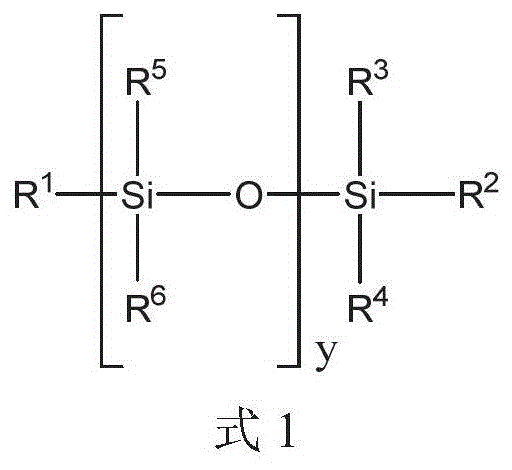
其中in
y是选自1至40的整数;y is an integer selected from 1 to 40;
R1、R2、R3和R4各自独立地选自C1-10烷基、芳基和C1-10烷基芳基;R 1 , R 2 , R 3 and R 4 are each independently selected from C 1-10 alkyl, aryl and C 1-10 alkylaryl;
每个R5和每个R6独立地选自C1-10烷基、芳基和C1-10烷基芳基;并且each R 5 and each R 6 are independently selected from C 1-10 alkyl, aryl and C 1-10 alkylaryl; and
其中R1至R4中的至少一个,或来自至少一个y基团的至少一个R5和R6选自芳基和C1-10烷基芳基中的至少一种。wherein at least one of R 1 to R 4 , or at least one R 5 and R 6 from at least one y group is selected from at least one of aryl and C 1-10 alkylaryl.
在另一方面中,提供了式1的聚硅氧烷化合物:In another aspect, a polysiloxane compound of Formula 1 is provided:
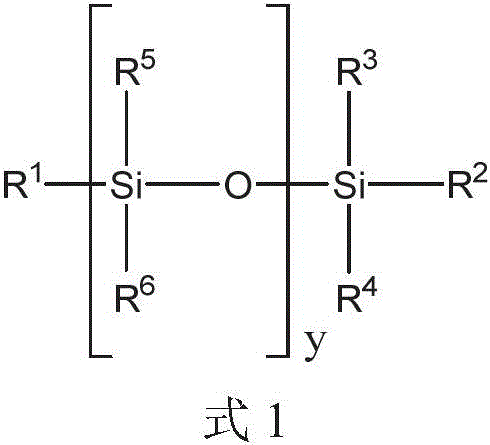
其中in
y是选自2至25的整数;y is an integer selected from 2 to 25;
R1、R2、R3和R4各自独立地选自C1-10烷基、芳基和C1-10烷基芳基;和R 1 , R 2 , R 3 and R 4 are each independently selected from C 1-10 alkyl, aryl and C 1-10 alkylaryl; and
每个R5和每个R6独立地选自C1-10烷基、芳基和C1-10烷基芳基;和Each R 5 and each R 6 are independently selected from C 1-10 alkyl, aryl and C 1-10 alkylaryl; and
其中R1和R2中的至少一个选自芳基和C1-10烷基芳基。wherein at least one of R 1 and R 2 is selected from aryl and C 1-10 alkylaryl.
上述方面的任一个的式1的聚硅氧烷化合物可以由式1a的化合物表示:The polysiloxane compound of
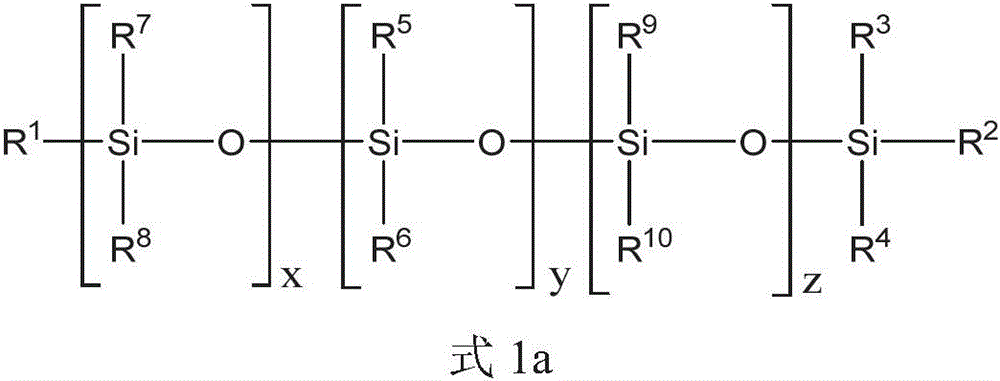
其中in
x是选自0至10的整数;x is an integer selected from 0 to 10;
y是选自1至20的整数;y is an integer selected from 1 to 20;
z是选自0至10的整数;z is an integer selected from 0 to 10;
R1、R2、R3和R4各自独立地选自C1-10烷基、芳基和C1-10烷基芳基;R 1 , R 2 , R 3 and R 4 are each independently selected from C 1-10 alkyl, aryl and C 1-10 alkylaryl;
每个R5和R6独立地选自C1-10烷基、芳基和C1-10烷基芳基;和Each R 5 and R 6 is independently selected from C 1-10 alkyl, aryl and C 1-10 alkylaryl; and
每个R7、R8、R9和R10独立地选自C1-10烷基。Each of R 7 , R 8 , R 9 and R 10 is independently selected from C 1-10 alkyl.
每个R7、R8、R9和R10可以是甲基,并且x和z每个可以是独立地选自1至3的整数。y可以是选自2至16的整数,或x、y和z的和可以是选自2至16的整数。Each of R 7 , R 8 , R 9 and R 10 can be methyl, and each of x and z can be an integer independently selected from 1 to 3. y may be an integer selected from 2 to 16, or the sum of x, y and z may be an integer selected from 2 to 16.
R1和R2各自可以独立地选自C1-10烷基、芳基和C1-10烷基芳基。每个R3、R4、R5、R7、R8、R9和R10可以是C1-4烷基。可以选择每个R6和y以提供具有独立地选自芳基和C1-10烷基芳基的1至6个任选的取代基的式1a的聚硅氧烷化合物。每个R6的任何其它取代基可以独立地选自C1-4烷基。每个R3、R4、R5、R7、R8、R9和R10可以是甲基,和每个R6可以独立地选自甲基、芳基和C1-10烷基芳基。Each of R 1 and R 2 may be independently selected from C 1-10 alkyl, aryl and C 1-10 alkylaryl. Each of R 3 , R 4 , R 5 , R 7 , R 8 , R 9 and R 10 may be C 1-4 alkyl. Each R 6 and y can be selected to provide a polysiloxane compound of Formula 1a having 1 to 6 optional substituents independently selected from aryl and C 1-10 alkylaryl. Any other substituents for each R 6 may be independently selected from C 1-4 alkyl groups. Each of R 3 , R 4 , R 5 , R 7 , R 8 , R 9 and R 10 can be methyl, and each R 6 can be independently selected from methyl, aryl and C 1-10 alkylaryl base.
R1和R2中的至少一个或两个可以选自芳基和C1-10烷基芳基中的至少一个。C1-10烷基芳基可以是C1-6烷基苯基,例如苯乙基。可以选择硅氧烷化合物中苯基取代基的数量以提供相对硅在2和50摩尔%之间的聚硅氧烷化合物中苯基的摩尔%。At least one or both of R 1 and R 2 may be selected from at least one of aryl and C 1-10 alkylaryl. A C1-10 alkylaryl group may be a C1-6 alkylphenyl group, such as phenethyl. The number of phenyl substituents in the siloxane compound can be selected to provide a mole percent of phenyl groups in the polysiloxane compound between 2 and 50 mole percent relative to silicon.
式1的聚硅氧烷化合物可以由两种或更多种式1的聚硅氧烷化合物的混合物提供。聚硅氧烷混合物可以包括一系列不同的式1的聚硅氧烷化合物,每种聚硅氧烷化合物具有选自9至12、8至13、9至14、8至15、7至16或6至17的每个整数和包括9至12、8至13、9至14、8至15、7至16或6至17的每个整数的不同的y值或硅氧烷重复单元(Si-O)的数量。将认识到,可以提供包括根据本文描述的任一个或多个实例的聚硅氧烷化合物的混合物的制剂或液压流体组合物。The polysiloxane compound of
包括根据本文描述的任何实例的聚硅氧烷化合物的液压流体组合物可以进一步包括选自根据本文描述的任何实例的单膦酸酯和二膦酸酯化合物中的至少一种的膦酸酯化合物。例如,液压流体组合物可以包括如本文所描述的式2的二膦酸酯化合物。例如,液压流体组合物可以包括如本文所描述的式3的单膦酸酯化合物。The hydraulic fluid composition comprising the polysiloxane compound according to any example described herein may further comprise a phosphonate compound selected from at least one of the monophosphonate and diphosphonate compounds according to any example described herein . For example, the hydraulic fluid composition may include a bisphosphonate compound of Formula 2 as described herein. For example, the hydraulic fluid composition may include the monophosphonate compound of
二膦酸酯化合物可以是式2的化合物:The bisphosphonate compound may be a compound of formula 2:
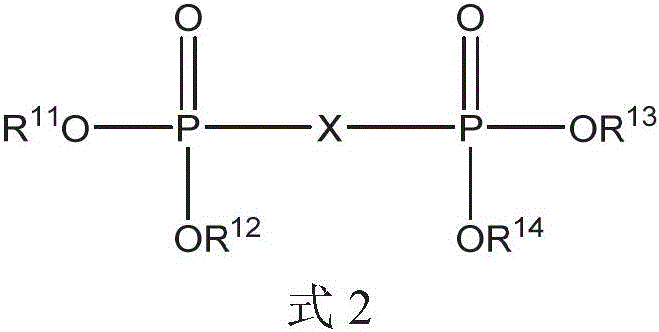
其中in
X选自芳基、C1-20烷基、C1-20烷基芳基和C1-20二烷基芳基;和X is selected from aryl, C1-20 alkyl, C1-20 alkylaryl, and C1-20 dialkylaryl; and
R11、R12、R13和R14各自独立地选自C1-20烷基、芳基和C1-20烷基芳基。R 11 , R 12 , R 13 and R 14 are each independently selected from C 1-20 alkyl, aryl and C 1-20 alkylaryl.
二膦酸酯化合物可以是式2(a)的化合物:The bisphosphonate compound may be a compound of formula 2(a):

其中in
X不存在或是芳基;X is absent or an aryl group;
r和s是独立地选自0至10的整数,条件是当s是0并且X不存在时r至少为1;r and s are integers independently selected from 0 to 10, provided that r is at least 1 when s is 0 and X is absent;
R11、R12、R13和R14各自独立地选自C1-20烷基、芳基和C1-20烷基芳基;和R 11 , R 12 , R 13 and R 14 are each independently selected from C 1-20 alkyl, aryl and C 1-20 alkylaryl; and
每个R15和每个R16独立地为选自氢、C1-20烷基、芳基和C1-20烷基芳基。Each R 15 and each R 16 are independently selected from the group consisting of hydrogen, C 1-20 alkyl, aryl, and C 1-20 alkylaryl.
二膦酸酯化合物可以是式2(a)(i)的化合物:The bisphosphonate compound may be a compound of formula 2(a)(i):

其中in
m是选自1至10的整数;m is an integer selected from 1 to 10;
R11、R12、R13和R14每个独立地选自C1-20烷基、芳基和C1-20烷基芳基;和R 11 , R 12 , R 13 and R 14 are each independently selected from C 1-20 alkyl, aryl and C 1-20 alkylaryl; and
每个R15和R16独立地选自氢、C1-20烷基、芳基和C1-20烷基芳基。Each of R 15 and R 16 is independently selected from hydrogen, C 1-20 alkyl, aryl, and C 1-20 alkylaryl.
对于如上所述的液压流体组合物,m可以是选自1至6的整数;R11、R12、R13和R14各自可以独立地选自C1-10烷基和C1-10烷基芳基;和每个R15和R16可以独立地选自氢和甲基。For hydraulic fluid compositions as described above, m may be an integer selected from 1 to 6; each of R 11 , R 12 , R 13 and R 14 may be independently selected from C 1-10 alkyl and C 1-10 alkane and each R 15 and R 16 may be independently selected from hydrogen and methyl.
对于如上所述的液压流体组合物,m可以是选自1至6的整数;R11、R12、R13和R14各自可以独立地选自C2-10烷基;和每个R15和R16可以是氢。For hydraulic fluid compositions as described above, m may be an integer selected from 1 to 6; each of R 11 , R 12 , R 13 and R 14 may be independently selected from C 2-10 alkyl; and each R 15 and R 16 can be hydrogen.
对于如上所述的液压流体组合物,m可以是选自2至4的整数;R11、R12、R13和R14各自可以独立地选自C2-6烷基;和每个R15和R16可以是氢。For hydraulic fluid compositions as described above, m may be an integer selected from 2 to 4; each of R 11 , R 12 , R 13 and R 14 may be independently selected from C 2-6 alkyl; and each R 15 and R 16 can be hydrogen.
液压流体组合物可以进一步包括由式3的化合物表示的膦酸酯化合物:The hydraulic fluid composition may further include a phosphonate compound represented by the compound of Formula 3:
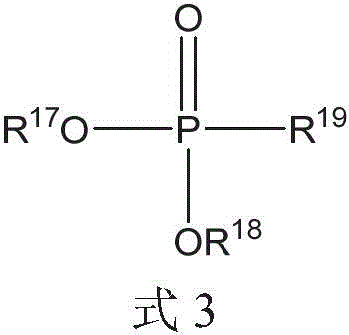
其中R17、R18和R19各自可以独立地选自C1-20烷基、芳基和C1-20烷基芳基。wherein each of R 17 , R 18 and R 19 may be independently selected from C 1-20 alkyl, aryl and C 1-20 alkylaryl.
R17、R18和R19各自可以独立地选自C1-10烷基和C1-10烷基芳基。Each of R 17 , R 18 and R 19 may be independently selected from C 1-10 alkyl and C 1-10 alkylaryl.
可以提供基于组合物的重量%在约10和90%之间的聚硅氧烷化合物的量。组合物中的聚硅氧烷化合物与二膦酸酯化合物的体积比可以分别提供为大于约1∶2的体积比,例如1∶1、2∶1或3∶1。The polysiloxane compound may be provided in an amount between about 10 and 90% by weight of the composition. The volume ratio of the polysiloxane compound to the bisphosphonate compound in the composition may be provided in a volume ratio of greater than about 1:2, eg, 1:1, 2:1, or 3:1, respectively.
液压流体组合物可以进一步包括至少一种添加剂或由至少一种添加剂组成,所述至少一种添加剂选自除酸剂、防侵蚀添加剂、粘度指数改善剂、消泡剂、防腐蚀添加剂、抗氧化剂和其任意组合。液压流体组合物可以进一步包括至少一种添加剂或由至少一种添加剂组成,所述至少一种添加剂选自除酸剂、消泡剂、抗氧化剂和其任意组合。将认识到,组合物可以包括选自整个组的单一添加剂或由选自整个组的单一添加剂组成。The hydraulic fluid composition may further comprise or consist of at least one additive selected from acid scavengers, anti-erosion additives, viscosity index improvers, defoamers, anti-corrosion additives, antioxidants and any combination thereof. The hydraulic fluid composition may further comprise or consist of at least one additive selected from the group consisting of acid scavengers, defoamers, antioxidants, and any combination thereof. It will be appreciated that the composition may include or consist of a single additive selected from the entire group.
除酸剂可以选自苯基缩水甘油醚、氧化蒎烯、氧化苯乙烯、环己基缩水甘油醚、环氧环己基缩水甘油醚、二缩水甘油醚、异丙基缩水甘油醚、二氧化丁二烯氧化环己烯(butadiene dioxide cyclohexylene oxide)、己二酸双环氧环己酯、3,4-环氧环己基羧酸酯、3,4-环氧环己烷、和其组合。The acid scavenger may be selected from phenyl glycidyl ether, pinene oxide, styrene oxide, cyclohexyl glycidyl ether, epoxycyclohexyl glycidyl ether, diglycidyl ether, isopropyl glycidyl ether, butylene dioxide Butadiene dioxide cyclohexylene oxide, diepoxycyclohexyl adipate, 3,4-epoxycyclohexylcarboxylate, 3,4-epoxycyclohexane, and combinations thereof.
消泡剂可以选自硅油、聚乙烯醇、聚醚和其组合。The antifoaming agent may be selected from silicone oils, polyvinyl alcohols, polyethers, and combinations thereof.
抗氧化剂可以选自2,6-二叔丁基对甲酚、苯基-α-萘胺、二(辛基苯基)胺、6-甲基-2,4-双(辛硫基)-甲基]-苯酚、四[亚甲基(3,5-二叔丁基-4-羟基氢化肉桂酸酯)]和其组合。Antioxidants may be selected from 2,6-di-tert-butyl-p-cresol, phenyl-α-naphthylamine, bis(octylphenyl)amine, 6-methyl-2,4-bis(octylthio)- Methyl]-phenol, tetrakis[methylene(3,5-di-tert-butyl-4-hydroxyhydrocinnamate)], and combinations thereof.
液压流体组合物可以基本上不含氟化的防侵蚀添加剂。液压流体组合物可以基本上不含全氟化的阴离子表面活性剂,例如全氟烷基磺酸或其盐。这些组合物可以是更加用户友好的,提供提高的易处理性或用更少的添加剂,可以促进商品的易制造性或更低的成本。The hydraulic fluid composition may be substantially free of fluorinated erosion control additives. The hydraulic fluid composition may be substantially free of perfluorinated anionic surfactants, such as perfluoroalkanesulfonic acid or salts thereof. These compositions can be more user friendly, provide improved handleability or with fewer additives, can promote ease of manufacture or lower cost of goods.
液压流体组合物可以基本上不含另外的粘度指数改善剂,例如选自聚(丙烯酸烷基酯)、聚(烷基甲基丙烯酸盐)(poly(alkyl methacrylate))、聚(甲基丙烯酸烷基酯)酯类(poly(alkyl methacrylate)esters)、多环聚合物、聚氨酯、聚环氧烷、聚酯及其组合的那些。这些具有较少添加剂的组合物可以促进例如商品的易制造性或更低的成本,或者可以提供更低的密度或增强的阻燃性能。The hydraulic fluid composition may be substantially free of additional viscosity index improvers, for example selected from the group consisting of poly(alkyl acrylates), poly(alkyl methacrylates), poly(alkyl methacrylates), those of poly(alkyl methacrylate) esters, polycyclic polymers, polyurethanes, polyalkylene oxides, polyesters, and combinations thereof. These compositions with fewer additives may facilitate, for example, ease of manufacture or lower cost of goods, or may provide lower density or enhanced flame retardant properties.
当利用Stanhope Seta开杯装置使用ASTM D4206的闪点测试方法测量2-4ml体积时,液压流体组合物的闪点可以在160和300℃之间。液压流体组合物的密度(gem-3,在298K下)可以小于1.5、1.4、1.3、1.2或1.1。液压流体组合物可以展现在约100°F下约5和约25厘泊之间和在-65°F下约500和约3500厘泊之间的粘度。The flash point of the hydraulic fluid composition may be between 160 and 300°C when measured in 2-4 ml volume using the Stanhope Seta open cup apparatus using the flash point test method of ASTM D4206. The density (gem -3 at 298K) of the hydraulic fluid composition may be less than 1.5, 1.4, 1.3, 1.2 or 1.1. The hydraulic fluid composition may exhibit a viscosity of between about 5 and about 25 centipoise at about 100°F and between about 500 and about 3500 centipoise at -65°F.
液压流体组合物可以是比如用于商用航空器的耐火液压流体或液压航空器组合物。The hydraulic fluid composition may be, for example, a fire resistant hydraulic fluid or a hydraulic aircraft composition for commercial aircraft.
将认识到,本文描述了进一方面和实例,其可以包括如上所描述的一个或多个特征。It will be appreciated that further aspects and examples are described herein, which may include one or more of the features described above.
具体实施方式Detailed ways
本公开内容描述了以下各种非限制性实例,其涉及为鉴定可选的液压流体组合物而进行的研究,液压流体组合物包括适合用于航空和航空器的那些。出人意料地发现,包括聚硅氧烷化合物的组合物——其包括如本文所描述的各种组合物和化合物,可以提供有效的液压流体性质,并且至少根据一些实例可以提供使其有效的用于商用航空器的优势。还鉴定了二膦酸酯化合物,以提供进一步的优势至包括聚硅氧烷化合物的液压流体。例如,液压流体组合物的一种或多种期望的性质可以包括粘度随温度的低变化率、阻燃性能、润滑性、与橡胶组分的相容性、操作条件下的稳定性和对金属和合金表面的低腐蚀性。例如,进一步的优势可以实现更加用户友好的制剂、易于处理、或来自制剂的降低的复杂性的商品的易制造性或降低的成本。化合物可以为组合物提供一种或多种性质,并且因此将多种化合物和任选的任何其它添加剂包括在液压流体组合物中可能对实现液压流体的期望性质提出重大挑战,特别是如果它正在开发用于商用航空器。液压流体应该提供合适的流变学、摩擦学和化学性质,单独的化合物本身不可能提供这样的各种性质,但是如果流体中的每种化合物贡献合适的单独性质以改进组合物的整体性质,则包括多种化合物的流体可以提供这样的各种性质。当前使用的基于磷酸酯的液压流体制剂的复杂性持续发展了多年,并且它们现在包括多层面的各种化合物和添加剂。与基于磷酸酯的液压流体制剂相反,本文公开了可选的液压流体组合物,其可以根据至少一些实例有效地用于包括商用航空器在内的航空器中。The present disclosure describes the following various non-limiting examples involving studies conducted to identify alternative hydraulic fluid compositions, including those suitable for use in aviation and aircraft. It has been unexpectedly discovered that compositions including polysiloxane compounds, including various compositions and compounds as described herein, can provide effective hydraulic fluid properties, and at least according to some examples, can provide effective for use in Advantages of commercial aircraft. Diphosphonate compounds have also been identified to provide further advantages to hydraulic fluids including polysiloxane compounds. For example, one or more desirable properties of a hydraulic fluid composition may include a low rate of change in viscosity with temperature, flame retardant properties, lubricity, compatibility with rubber components, stability under operating conditions, and resistance to metals and low corrosion of alloy surfaces. For example, further advantages may be achieved in more user-friendly formulations, ease of handling, or ease of manufacture or reduced cost of goods from the reduced complexity of formulations. Compounds can provide one or more properties to the composition, and thus the inclusion of multiple compounds and optionally any other additives in a hydraulic fluid composition can present significant challenges to achieving the desired properties of a hydraulic fluid, especially if it is being Developed for use in commercial aircraft. Hydraulic fluids should provide suitable rheological, tribological and chemical properties, it is not possible for individual compounds to provide such various properties by themselves, but if each compound in the fluid contributes suitable individual properties to improve the overall properties of the composition, Fluids comprising multiple compounds can then provide such various properties. The complexity of currently used phosphate ester based hydraulic fluid formulations has continued to evolve over the years, and they now include multiple layers of various compounds and additives. In contrast to phosphate ester-based hydraulic fluid formulations, disclosed herein are alternative hydraulic fluid compositions that can be effectively used in aircraft, including commercial aircraft, according to at least some examples.
特定术语specific term
如将理解的,无论单独还是在复合词如烷基芳基中使用,“芳基”可以指:(i)例如约6至约20个碳原子的取代的或未取代的单环或多环芳族碳环部分,例如苯基、萘基或芴基;或(ii)取代的或未取代的部分饱和的多环碳环芳环系统,其中芳基和环烷基或环烯基稠合在一起以形成环状结构,例如四氢萘基、茚基、茚满基或芴环。应该认识到,多环系统可以包括双环和/或三环系统。还应认识到,术语“未取代的”是指不存在一个或多个取代基或存在一个或多个氢。“取代的”基团可以是如本文所定义的C1-10烷基,例如直链或支链C1-4烷基。As will be understood, whether used alone or in compound words such as alkylaryl, "aryl" can refer to: (i) a substituted or unsubstituted monocyclic or polycyclic aromatic group of, for example, about 6 to about 20 carbon atoms carbocyclic moieties, such as phenyl, naphthyl, or fluorenyl; or (ii) substituted or unsubstituted partially saturated polycyclic carbocyclic aromatic ring systems in which the aryl and cycloalkyl or cycloalkenyl groups are fused at together to form cyclic structures such as tetrahydronaphthyl, indenyl, indanyl or fluorene rings. It should be appreciated that polycyclic ring systems may include bicyclic and/or tricyclic systems. It will also be appreciated that the term "unsubstituted" means the absence of one or more substituents or the presence of one or more hydrogens. A "substituted" group may be a C1-10 alkyl group as defined herein, eg, a straight or branched chain C1-4 alkyl group.
无论单独还是在复合词如烷基芳基中使用,“烷基”表示大小在1至约20个碳原子或更多的范围内的直链或支链烃。因此,除非明确限于较小的基团,否则烷基部分包括大小在例如1至约6个碳原子或更大的范围内的部分,例如甲基、乙基、正丙基、异丙基和/或丁基、戊基、己基和更高的异构体,包括例如大小在约6至约20个碳原子或更大的范围内的那些直链或支链烃。"Alkyl" whether used alone or in compound words such as alkylaryl, refers to straight or branched chain hydrocarbons ranging in size from 1 to about 20 carbon atoms or more. Thus, unless expressly limited to smaller groups, alkyl moieties include moieties ranging in size from, for example, 1 to about 6 carbon atoms or more, such as methyl, ethyl, n-propyl, isopropyl, and /or butyl, pentyl, hexyl, and higher isomers, including, for example, those straight or branched chain hydrocarbons ranging in size from about 6 to about 20 carbon atoms or more.
本文所使用的术语“C1-20烷基”指具有1-20个碳原子的直链或支链饱和烃。代表性的“C1-20烷基”基团包括但不限于-甲基、-乙基、-正丙基、-正丁基、-正戊基、-正己基、-正庚基、-正辛基、-正壬基、-正癸基;正十一烷基、正十二烷基、正十三烷基、正十四烷基、正十五烷基、正十六烷基、正十七烷基、正十八烷基、正十九烷基、正十二烷基。The term "C 1-20 alkyl" as used herein refers to a straight or branched chain saturated hydrocarbon having 1 to 20 carbon atoms. Representative "C 1-20 alkyl" groups include, but are not limited to, -methyl, -ethyl, -n-propyl, -n-butyl, -n-pentyl, -n-hexyl, -n-heptyl, - n-octyl, -n-nonyl, -n-decyl; n-undecyl, n-dodecyl, n-tridecyl, n-tetradecyl, n-pentadecyl, n-hexadecyl, n-heptadecyl, n-octadecyl, n-nonadecyl, n-dodecyl.
本文所使用的术语“C1-10烷基”指具有1至10个碳原子的直链或支链饱和烃。代表性的“C1-10烷基”基团包括但不限于-甲基、-乙基、-正丙基、-正丁基、-正戊基、-正己基、-正庚基、-正辛基、-正壬基和-正癸基;而支链C1-8烷基包括但不限于例如-异丙基、-仲丁基、-异丁基、-叔丁基、-异戊基、2-甲基丁基、1-己基、2-己基、3-己基、甲基、乙基、丙基、异丙基、正丁基、异丁基、仲丁基、叔丁基、正戊基、异戊基、新戊基、正己基、异己基、2-甲基戊基、3-甲基戊基、2,2-二甲基丁基、2,3-二甲基丁基、2,2-二甲基戊基、2,3-二甲基戊基、3,3-二甲基戊基、2,3,4-三甲基戊基、3-甲基己基、2,2-二甲基己基、2,4-二甲基己基、2,5-二甲基己基、3,5-二甲基己基、2,4-二甲基戊基、2-甲基庚基、3-甲基庚基、正庚基、异庚基、正辛基和异辛基。The term "C 1-10 alkyl" as used herein refers to a straight or branched chain saturated hydrocarbon having 1 to 10 carbon atoms. Representative "C 1-10 alkyl" groups include, but are not limited to, -methyl, -ethyl, -n-propyl, -n-butyl, -n-pentyl, -n-hexyl, -n-heptyl, - n-octyl, -n-nonyl, and -n-decyl; while branched C 1-8 alkyl groups include, but are not limited to, for example, -isopropyl, -sec-butyl, -isobutyl, -tert-butyl, -iso Amyl, 2-methylbutyl, 1-hexyl, 2-hexyl, 3-hexyl, methyl, ethyl, propyl, isopropyl, n-butyl, isobutyl, sec-butyl, tert-butyl , n-pentyl, isopentyl, neopentyl, n-hexyl, isohexyl, 2-methylpentyl, 3-methylpentyl, 2,2-dimethylbutyl, 2,3-dimethyl Butyl, 2,2-dimethylpentyl, 2,3-dimethylpentyl, 3,3-dimethylpentyl, 2,3,4-trimethylpentyl, 3-methylhexyl , 2,2-dimethylhexyl, 2,4-dimethylhexyl, 2,5-dimethylhexyl, 3,5-dimethylhexyl, 2,4-dimethylpentyl, 2-methylhexyl Kiheptyl, 3-methylheptyl, n-heptyl, isoheptyl, n-octyl and isooctyl.
术语“烷基芳基”、“C1-20烷基芳基”或“C1-10烷基芳基”指具有与芳基键合的烷基的化合物,其中“烷基”、“C1-20烷基”、“C1-10烷基”和“芳基”部分各自如上文所定义。The term "alkylaryl", " C1-20 alkylaryl" or " C1-10 alkylaryl" refers to a compound having an alkyl group bonded to an aryl group, wherein "alkyl", "C1-10 alkylaryl" The " 1-20 alkyl", "C 1-10 alkyl" and "aryl" moieties are each as defined above.
术语“二烷基芳基”、“C1-20二烷基芳基”或“C1-10二烷基芳基”指用两个烷基取代的芳基部分,其中“烷基”、“C1-20烷基”、“C1-10烷基”和“芳基”部分各自如上文所定义。将认识到,每个烷基可以提供与式2的化合物中的另一原子键合的点。The term "dialkylaryl", " C1-20 dialkylaryl" or " C1-10 dialkylaryl" refers to an aryl moiety substituted with two alkyl groups, wherein "alkyl", The "C 1-20 alkyl", "C 1-10 alkyl" and "aryl" moieties are each as defined above. It will be recognized that each alkyl group can provide a point of bonding to another atom in the compound of
术语“低腐蚀”通常是指有效地基本上抑制或减少腐蚀的浓度或量,例如典型地与液压流体接触的金属的厚度每年小于约100微米的损失。在另一个实例中,术语“低腐蚀”可以指与液压流体接触的金属厚度每年小于约10微米的损失。可以使用ASTM D4636中的方案来测定腐蚀。The term "low corrosion" generally refers to a concentration or amount effective to substantially inhibit or reduce corrosion, such as loss of typically less than about 100 microns per year in thickness of metal in contact with hydraulic fluid. In another example, the term "low corrosion" may refer to the loss of metal thickness in contact with hydraulic fluid of less than about 10 microns per year. Corrosion can be determined using the protocol in ASTM D4636.
一般术语General term
遍及本公开内容,除非另外特别说明或上下文另有要求,否则提及单个步骤、物质组合物、步骤的组或物质组合物的组应该认为包括那些步骤、物质组合物、步骤的组或物质组合物的组中的一个和多个(即一个或更多个)。因此,如本文所用,单数形式“一(a)”,“一(an)”和“所述(the)”包括复数方面,除非上下文另有明确指示。例如,提及“一(a)”包括单个以及两个或更多个;提及“一(an)”包括单个以及两个或更多个;提及“所述(the)”包括单个以及两个或更多个等等。Throughout this disclosure, unless specifically stated otherwise or the context requires otherwise, references to individual steps, compositions of matter, groups of steps or groups of compositions of matter shall be considered to include those steps, compositions of matter, groups of steps or combinations of matter one or more (ie, one or more) of the group of things. Thus, as used herein, the singular forms "a", "an" and "the" include plural referents unless the context clearly dictates otherwise. For example, reference to "a (a)" includes a single as well as two or more; reference to "an (an)" includes a single and two or more; reference to "the (the)" includes a single and two or more and so on.
本领域技术人员将认识到,本文的公开内容容易进行除了具体描述的那些之外的变型和改进。应当理解,本公开内容包括所有这样的变型和改进。本公开内容还包括在本说明书中单独地或共同地提及或指出的所有步骤、特征、组合物和化合物,以及所述步骤或特征的任一个和所有组合或任两个或更多个。Those skilled in the art will recognize that the disclosure herein is susceptible to variations and improvements other than those specifically described. It should be understood that the present disclosure includes all such variations and improvements. The present disclosure also includes all of the steps, features, compositions and compounds referred to or indicated in this specification, individually or collectively, and any and all combinations or any two or more of said steps or features.
除非另外特别说明,否则本文描述的本公开内容的每个实例在必要的变更后应用于每个其它实例。本公开内容不限于本文描述的具体实例的范围,该实例仅用于举例的目的。功能等同的产物、组合物和方法显然在本文描述的公开内容的范围内。Each instance of the disclosure described herein applies mutatis mutandis to every other instance unless specifically stated otherwise. The present disclosure is not to be limited in scope by the specific examples described herein, which are presented for purposes of illustration only. Functionally equivalent products, compositions and methods are clearly within the scope of the disclosure described herein.
术语“阻燃”指可以降低流体的可燃性或延迟流体的燃烧的物质、添加剂或化合物的性质。The term "flame retardant" refers to the property of a substance, additive, or compound that can reduce the flammability of a fluid or delay the combustion of a fluid.
术语“润滑”、“润滑性”或类似术语指可以促进摩擦或磨损减少的物质、添加剂或化合物的性质。The terms "lubrication," "lubricity," or similar terms refer to the property of a substance, additive, or compound that promotes friction or wear reduction.
术语“高温稳定性”通常是指当加热至约250℃的温度持续约1小时降低的或低的分解程度。The term "high temperature stability" generally refers to a reduced or low degree of decomposition when heated to a temperature of about 250°C for about 1 hour.
术语“和/或”,例如“X和/或Y”应被理解为意思是“X和Y”或“X或Y”,并且应认为对两种含义或任一含义提供明确的支持。The terms "and/or" such as "X and/or Y" should be understood to mean "X and Y" or "X or Y" and should be considered to provide explicit support for either or both meanings.
遍及该说明书中,词语“包括(comprise)”或变型比如“包括(comprises)”或“包括(comprisiing)”将被理解为暗示包括所述要素、整数或步骤,或要素、整数或步骤的组,但不排除任何其它要素、整数或步骤,或要素、整数或步骤的组。Throughout this specification, the word "comprise" or variations such as "comprises" or "comprisiing" will be understood to imply the inclusion of said elements, integers or steps, or a group of elements, integers or steps , but does not exclude any other elements, integers or steps, or groups of elements, integers or steps.
术语“由...组成(consists of)”或变型比如“由......组成(consisting of)”指包括在该术语的上下文中列举的任何所述要素、整数或步骤,或要素、整数或步骤的组,并且不包括在该术语的上下文中未列举的任何其它要素、整数或步骤,或要素、整数或步骤的组。The term "consists of" or variations such as "consisting of" means to include any stated elements, integers or steps, or elements recited in the context of the term , integers or groups of steps, and does not include any other elements, integers or steps, or groups of elements, integers or steps not recited in the context of that term.
将清楚地理解,尽管本文提及了许多现有技术出版物,但该参考文献并不构成对任何这些文件形成在澳大利亚或任何其它国家的本领域公知常识的一部分的承认。It will be clearly understood that although reference is made herein to a number of prior art publications, this reference does not constitute an admission that any of these documents form part of the common general knowledge in the field in Australia or any other country.
除非另外定义,否则本文使用的所有技术和科学术语具有与本发明所属领域的普通技术人员通常所理解的相同的含义。尽管与本文描述的那些相似或等同的方法和材料可用于本发明的实践或测试,但下文描述了合适的方法和材料。在相冲突的情况下,将以本说明书——包括定义——为主。另外,材料、方法和实例仅是示意性的而不拟是限制性的。Unless otherwise defined, all technical and scientific terms used herein have the same meaning as commonly understood by one of ordinary skill in the art to which this invention belongs. Although methods and materials similar or equivalent to those described herein can be used in the practice or testing of the present invention, suitable methods and materials are described below. In case of conflict, the present specification, including definitions, will control. Additionally, the materials, methods, and examples are illustrative only and not intended to be limiting.
液压流体组合物Hydraulic Fluid Composition
本公开内容提供了包括一种或多种聚硅氧烷化合物的液压流体组合物。本公开内容还提供了进一步包括一种或多种膦酸酯化合物的液压流体组合物。膦酸酯化合物可以是二膦酸酯化合物。聚硅氧烷化合物可以是如本文所描述的式1或式1a的任一种或多种化合物。膦酸酯化合物可以是如本文所描述的式2的任一种或多种二膦酸酯化合物。膦酸酯化合物可以是如本文所描述的式3的任一种或多种膦酸酯化合物。液压流体组合物还可以包括如本文所描述的任一种或多种另外的化合物和添加剂或进一步由如本文所描述的任一种或多种另外的化合物和添加剂组成。液压流体组合物可以包括聚硅氧烷化合物,其占总的组合物的重量%选自在15和85%之间、20和80%之间、25和75%之间、30和70%之间、35和65%之间、40和60%之间或45和55%之间的范围中。液压流体组合物可以包括总的组合物的至少约15、20、25、30、35、40、45、50、55、60、65、70、75或80%的聚硅氧烷化合物(按重量%计)。液压流体组合物可以包括小于总的组合物的约80、75、70、65、60、55、50、45、40、35或30%的聚硅氧烷化合物(按重量%计)。聚硅氧烷化合物可以为组合物提供粘度调节剂性质,并且可以包括另外的性质,使得在包括二膦酸酯化合物的组合物中提供更有效的液压流体,例如有效地用于航空器的液压流体。例如,根据至少一些实例,液压流体组合物可能不需要进一步的粘度调节剂添加剂。与卤化聚硅氧烷相反,如本文所描述的非卤化聚硅氧烷化合物还可以具有较低的破坏性或腐蚀性,并且可以提供有效地与液压流体中的二膦酸酯化合物一起使用的其它润滑性或闪点性质。非卤化聚硅氧烷也可以是更良性的和更加用户友好的,并且可以减少对于防侵蚀添加剂或防腐蚀添加剂比如氟化的表面活性剂例如PFOS的需要。The present disclosure provides hydraulic fluid compositions that include one or more polysiloxane compounds. The present disclosure also provides hydraulic fluid compositions further comprising one or more phosphonate compounds. The phosphonate compound may be a bisphosphonate compound. The polysiloxane compound may be any one or more compounds of
至少根据如本文所描述的一些实例,聚硅氧烷相对于二膦酸酯的增加的量或比可以为流体提供进一步有利的性质,其包括下列的一种或多种:在跨越一定温度(包括低于环境温度)范围内改进的粘度,与涂料、O形密封圈和金属的相容性,混溶性(与例如
液压流体组合物可以包括聚硅氧烷化合物,其中聚硅氧烷化合物中芳基或烷基芳基(例如苯基、苄基或苯乙基)取代基的数量提供选自相对硅在2和50摩尔%之间、5和45摩尔%之间、10和40摩尔%之间、15和35摩尔%之间或20和30摩尔%之间的范围内的聚硅氧烷化合物中芳基部分的摩尔%。至少根据一些实例,可以通过聚硅氧烷化合物中提供的芳基部分提供进一步的优势,例如材料相容性、流变性质比如粘度和热性质(例如闪点和燃点)。The hydraulic fluid composition may include a polysiloxane compound wherein the number of aryl or alkylaryl (eg, phenyl, benzyl, or phenethyl) substituents in the polysiloxane compound provides a range selected from the group consisting of 2 and 4 relative to silicon. of aryl moieties in polysiloxane compounds in the range between 50 mol %, between 5 and 45 mol %, between 10 and 40 mol %, between 15 and 35 mol %, or between 20 and 30 mol % mol%. Further advantages, such as material compatibility, rheological properties such as viscosity, and thermal properties (eg, flash point and fire point), may be provided by the provision of aryl moieties in the polysiloxane compound, at least according to some examples.
液压流体组合物可以包括总的组合物的选自在15和85%之间、20和80%之间、25和75%之间、30和70%之间、35和65%之间、40和60%之间、或45和55%之间的范围中的重量%的二膦酸酯化合物。液压流体组合物可以包括总的组合物的至少约5、10、15、20、25、30、35、40、45、50、55、60、65、70或75%的重量%的二膦酸酯化合物。液压流体组合物可以包括小于总的组合物的约70、65、60、55、50、45、40、35、30、25、20、15、或10%的重量%的二膦酸酯化合物。二膦酸酯化合物可以提供给组合物阻燃和润滑性质。二膦酸酯化合物可以是更加用户友好的,并且因此关于在液压流体中的使用是更加可接受的。The hydraulic fluid composition may comprise a total composition selected from between 15 and 85%, between 20 and 80%, between 25 and 75%, between 30 and 70%, between 35 and 65%, 40% and 60%, or between 45 and 55% by weight of the bisphosphonate compound. The hydraulic fluid composition may include at least about 5, 10, 15, 20, 25, 30, 35, 40, 45, 50, 55, 60, 65, 70 or 75% by weight of the total composition of bisphosphonic acid ester compound. The hydraulic fluid composition may include less than about 70, 65, 60, 55, 50, 45, 40, 35, 30, 25, 20, 15, or 10% by weight of the bisphosphonate compound of the total composition. The bisphosphonate compound can provide flame retardancy and lubricity properties to the composition. Bisphosphonate compounds may be more user friendly and thus more acceptable for use in hydraulic fluids.
液压流体组合物可以包括聚硅氧烷化合物和二膦酸酯化合物或由其组成,其体积比选自在约95∶5至5∶95、90∶10至10∶90、85∶15至15∶85、80∶20至20∶80、25∶75至25∶75、70∶30至30∶70、65∶35至35∶65、60∶40至40∶60、55∶45至45∶55或约50∶50或在此之间的范围。如上所述,可以选择流体中的聚硅氧烷化合物和二膦酸酯化合物的量以提供用于具体用途的改善的流变性质,比如与期望的用途相关的粘度、润滑性和阻燃性能的更平衡的组合。The hydraulic fluid composition may include or consist of a polysiloxane compound and a bisphosphonate compound in a volume ratio selected from about 95:5 to 5:95, 90:10 to 10:90, 85:15 to 15 :85, 80:20 to 20:80, 25:75 to 25:75, 70:30 to 30:70, 65:35 to 35:65, 60:40 to 40:60, 55:45 to 45:55 Or about 50:50 or a range in between. As noted above, the amount of polysiloxane compound and bisphosphonate compound in the fluid can be selected to provide improved rheological properties for a particular application, such as viscosity, lubricity, and flame retardant properties associated with the desired application a more balanced combination.
液压流体组合物可以进一步包括另外的组分例如如本文所描述的另外的化合物和/或添加剂或由其组成,其在总的组合物中按重量%计的量为小于约50、45、40、35、30、25、20、15、10或5%。液压流体组合物可以进一步包括一种或多种另外的组分或由其组成,其在总的组合物中按重量%计的量为至少约1、2、5、10、15、20、25、30、35或40%。液压流体组合物可以进一步包括一种或多种另外的组分或由其组成,其在总的组合物中按重量%计的量在约1%至30%、约3%至25%、或约5%至20%的范围中。还可以选择包括在液压流体中的一种或多种另外的组分的量和类型以提供用于具体用途的改善的流变性质或为流体增加另外的性质或减轻流体的性质。The hydraulic fluid composition may further include or consist of additional components such as additional compounds and/or additives as described herein in an amount by weight % of the total composition of less than about 50, 45, 40 , 35, 30, 25, 20, 15, 10 or 5%. The hydraulic fluid composition may further include or consist of one or more additional components in an amount by weight % of the total composition of at least about 1, 2, 5, 10, 15, 20, 25 , 30, 35 or 40%. The hydraulic fluid composition may further include or consist of one or more additional components in an amount by weight % in the total composition of about 1% to 30%, about 3% to 25%, or in the range of about 5% to 20%. The amount and type of one or more additional components included in the hydraulic fluid can also be selected to provide improved rheological properties for a particular application or to add additional properties to the fluid or to alleviate the properties of the fluid.
液压流体组合物可以被配制用于航空器,或配制以提供某些性质或达到某些规格,例如配制用于SAEAS1241规格。Hydraulic fluid compositions may be formulated for use in aircraft, or to provide certain properties or to achieve certain specifications, such as for SEAAS 1241 specifications.
在一个实例中,液压流体组合物包括聚硅氧烷化合物,其由根据本文描述的任何实例的聚硅氧烷化合物组成。例如,液压流体组合物可以基本上不含落在描述聚硅氧烷化合物的那些实例之外的任何硅氧烷或聚硅氧烷化合物。将认识到,用于该具体实例的液压流体组合物可以包括如本文所描述的一种或多种其它化合物和添加剂,条件是它们不选自硅氧烷或聚硅氧烷。In one example, the hydraulic fluid composition includes a polysiloxane compound consisting of a polysiloxane compound according to any of the examples described herein. For example, the hydraulic fluid composition may be substantially free of any silicone or polysiloxane compounds falling outside those examples describing polysiloxane compounds. It will be appreciated that the hydraulic fluid composition used in this particular example may include one or more other compounds and additives as described herein, provided that they are not selected from siloxanes or polysiloxanes.
闪点Flash point
液压流体组合物可以具有选自至少160℃、至少170℃、至少180℃、至少190℃、至少200℃、至少210℃、至少220℃、至少230℃、至少240℃、至少250℃、至少260℃、至少270℃、至少280℃、至少290℃或至少300℃的闪点。The hydraulic fluid composition may have a temperature selected from at least 160°C, at least 170°C, at least 180°C, at least 190°C, at least 200°C, at least 210°C, at least 220°C, at least 230°C, at least 240°C, at least 250°C, at least 260°C °C, at least 270 °C, at least 280 °C, at least 290 °C, or at least 300 °C flash point.
液压流体组合物可以具有在160℃和300℃之间的闪点。液压流体组合物可以具有选自在约180℃和290℃、约200℃和280℃、约210℃和270℃、约220℃和260℃或约240℃和250℃的范围之间的闪点。The hydraulic fluid composition may have a flash point between 160°C and 300°C. The hydraulic fluid composition may have a flash point selected from the range between about 180°C and 290°C, about 200°C and 280°C, about 210°C and 270°C, about 220°C and 260°C, or about 240°C and 250°C .
可以使用ASTM D4206中提供的方案测定闪点。ASTM D4206方法涉及利用StanhopeSeta开杯装置,使用2-4ml体积的流体组合物。Flash point can be determined using the protocol provided in ASTM D4206. The ASTM D4206 method involves the use of a 2-4 ml volume of the fluid composition using a Stanhope Seta cup opener.
根据如本文所描述的至少一些实例的液压流体组合物可以具有符合SAE AS1241规格的闪点。Hydraulic fluid compositions according to at least some examples as described herein may have flash points that conform to SAE AS1241 specifications.
燃点burning point
液压流体组合物可以具有选自至少160℃、至少170℃、至少180℃、至少190℃、至少200℃、至少210℃、至少220℃、至少230℃、至少240℃、至少250℃、至少260℃、至少270℃、至少280℃、至少290℃或至少300℃的燃点。The hydraulic fluid composition may have a temperature selected from at least 160°C, at least 170°C, at least 180°C, at least 190°C, at least 200°C, at least 210°C, at least 220°C, at least 230°C, at least 240°C, at least 250°C, at least 260°C A flash point of °C, at least 270 °C, at least 280 °C, at least 290 °C, or at least 300 °C.
液压流体组合物可以具有在约160℃和300℃之间的燃点。液压流体组合物可以具有选自在约180℃和290℃、约200℃和280℃、约210℃和270℃、约220℃和260℃或约240℃和250℃的范围之间的燃点。The hydraulic fluid composition may have a flash point between about 160°C and 300°C. The hydraulic fluid composition may have a flash point selected from the range between about 180°C and 290°C, about 200°C and 280°C, about 210°C and 270°C, about 220°C and 260°C, or about 240°C and 250°C.
可以使用ASTM D4206或ASTM D92中的方案测定燃点。The flash point can be determined using the protocols in ASTM D4206 or ASTM D92.
根据如本文所描述的至少一些实例的液压流体组合物可以具有符合SAE AS1241规格的燃点。Hydraulic fluid compositions according to at least some examples as described herein may have flash points that conform to SAE AS1241 specifications.
倾点pour point
液压流体组合物可以具有小于10℃、20℃、30℃、40℃、45℃、50℃、55℃、60℃、65℃、70℃或75℃的倾点。The hydraulic fluid composition may have a pour point of less than 10°C, 20°C, 30°C, 40°C, 45°C, 50°C, 55°C, 60°C, 65°C, 70°C, or 75°C.
可以使用ASTM D97中的方案测定倾点。Pour point can be determined using the protocol in ASTM D97.
密度density
液压流体组合物可以具有小于约1.5g/cm3的密度(在298K下)。液压流体组合物可以具有小于约1.4g/cm3、约1.3g/cm3、约1.2g/cm3、约1.1g/cm3、约1.08g/cm3、约1.06g/cm3、约1.04g/cm3、约1.02g/cm3、约1.01g/cm3或约1.00g/cm3的密度。The hydraulic fluid composition may have a density (at 298K) of less than about 1.5 g/ cm3 . The hydraulic fluid composition may have less than about 1.4 g/cm 3 , about 1.3 g/cm 3 , about 1.2 g/cm 3 , about 1.1 g/cm 3 , about 1.08 g/cm 3 , about 1.06 g/cm 3 , about A density of 1.04 g/cm 3 , about 1.02 g/cm 3 , about 1.01 g/cm 3 or about 1.00 g/cm 3 .
根据如本文所描述的至少一些实例的液压流体组合物可以具有符合SAE AS1241规格的密度。Hydraulic fluid compositions according to at least some examples as described herein may have densities that conform to SAE AS1241 specifications.
熔点melting point
液压流体组合物可以具有在大气压下小于约0℃的熔点。液压流体组合物可以具有选自小于约-10℃、约-20℃、约-30℃、约-40℃、约-45℃或约-50%的熔点。The hydraulic fluid composition may have a melting point of less than about 0°C at atmospheric pressure. The hydraulic fluid composition may have a melting point selected from less than about -10°C, about -20°C, about -30°C, about -40°C, about -45°C, or about -50%.
根据如本文所描述的至少一些实例的液压流体组合物可以具有符合SAE AS1241规格的熔点。Hydraulic fluid compositions according to at least some examples as described herein may have melting points that conform to SAE AS1241 specifications.
粘度Viscosity
液压流体组合物可以具有选自在约5和15cP、约6和14cP、约7和13cP、约8和12cP或约9cP和11cP的范围之间的粘度(在100°F下)。The hydraulic fluid composition may have a viscosity (at 100°F) selected from the range between about 5 and 15 cP, about 6 and 14 cP, about 7 and 13 cP, about 8 and 12 cP, or about 9 cP and 11 cP.
液压流体组合物可以具有选自在约500和3500cP、约1000和3000cP或约1500和2500cP的范围之间的粘度(在-65°F下)。The hydraulic fluid composition may have a viscosity (at -65°F) selected from the range between about 500 and 3500 cP, about 1000 and 3000 cP, or about 1500 and 2500 cP.
可以使用ASTM D445中的方案测定粘度,并且例如用于低温测量的ASTM D445FL1。Viscosity can be determined using the protocols in ASTM D445, and for example ASTM D445FL1 for low temperature measurements.
根据如本文所描述的至少一些实例的液压流体组合物可以具有符合SAE AS1241规格的粘度。Hydraulic fluid compositions according to at least some examples as described herein may have viscosities that conform to SAE AS1241 specifications.
涂料硬度Coating hardness
暴露于液压流体的涂漆表面的涂料硬度测试可以提供流体与涂漆的表面的相容性的指示,因为在使用中液压流体可以接触涂漆的表面。A paint hardness test of a painted surface exposed to hydraulic fluid can provide an indication of the compatibility of the fluid with the painted surface, as the hydraulic fluid may contact the painted surface in use.
在环境温度(约20℃)下暴露于流体28天之后,液压流体组合物可以具有至少7B、6B、5B、4B、3B或2B的涂料硬度(铅笔推压)。The hydraulic fluid composition may have a paint hardness (pencil push) of at least 7B, 6B, 5B, 4B, 3B or 2B after exposure to the fluid at ambient temperature (about 20°C) for 28 days.
在约60℃下暴露于流体28天之后,液压流体组合物可以具有至少7B、6B、5B、4B、3B或2B的涂料硬度(铅笔推压)。The hydraulic fluid composition can have a paint hardness (pencil push) of at least 7B, 6B, 5B, 4B, 3B, or 2B after exposure to the fluid at about 60°C for 28 days.
在环境温度下暴露于流体28天之后,液压流体组合物可以具有至少4B、3B、2B、1B、F、HB、1H、2H、3H、4H、5H或6H的涂料硬度(极限)。The hydraulic fluid composition may have a coating hardness (limit) of at least 4B, 3B, 2B, 1B, F, HB, 1H, 2H, 3H, 4H, 5H, or 6H after exposure to the fluid at ambient temperature for 28 days.
可以使用ASTM D3363中的方案测定涂料硬度。Coating hardness can be determined using the protocol in ASTM D3363.
根据如本文所描述的至少一些实例的液压流体组合物可以具有符合SAE AS1241规格的涂料硬度性质。Hydraulic fluid compositions according to at least some examples as described herein can have coating hardness properties that conform to SAE AS1241 specifications.
O形环溶胀O-ring swelling
通过使O形环暴露于液压流体的O形环溶胀测试可以提供流体与其它材料比如航空航天工业中使用的那些材料的相容性的另一指示,因为在使用中液压流体可能与那些类型的材料接触。An O-ring swell test by exposing the O-ring to hydraulic fluid can provide another indication of the compatibility of the fluid with other materials, such as those used in the aerospace industry, because in use hydraulic fluids may be compatible with those types of material contact.
液压流体组合物可以具有小于35%、30%、25%、20%、19%、18%、17%、16%、15%、14%、13%、12%、11%或10%的O形环的体积减少。液压流体组合物可以引起在约0-30%、约2-25%、约4-20%或约6-18%的范围内的O形环的体积减少。The hydraulic fluid composition may have less than 35%, 30%, 25%, 20%, 19%, 18%, 17%, 16%, 15%, 14%, 13%, 12%, 11%, or 10% O The volume of the ring is reduced. The hydraulic fluid composition may cause a volume reduction of the O-ring in the range of about 0-30%, about 2-25%, about 4-20%, or about 6-18%.
可以使用ASTM D6546中的方案测定O形环溶胀测试。可以使用Kapco或Parker O形环进行测试。The O-ring swelling test can be determined using the protocol in ASTM D6546. Can be tested with Kapco or Parker O-rings.
根据如本文所描述的至少一些实例的液压流体组合物可以具有符合SAE AS1241规格的O形环溶胀测试性质。Hydraulic fluid compositions according to at least some examples as described herein may have O-ring swell test properties in accordance with SAE AS1241 specifications.
芯循环(Wick Cycle)Wick Cycle
芯循环用于测定蒸发对液压流体的可燃性的影响。该测试基本上通过将流体浸泡的芯(即管道清洁器杆)循环到本生灯焰中来测量液压流体的耐火性。计数芯点火的循环次数。每分钟运行约30个循环。在环境温度下测试流体。液压流体样品应对于最少循环次数抵制点火。The wick cycle was used to determine the effect of evaporation on the flammability of hydraulic fluids. This test basically measures the fire resistance of hydraulic fluids by circulating a fluid-soaked wick (ie, a pipe cleaner rod) into a Bunsen burner flame. The number of cycles of core ignition is counted. Running about 30 loops per minute. Test fluid at ambient temperature. Hydraulic fluid samples should resist ignition for a minimum number of cycles.
液压流体组合物可以具有芯测试性质,其中对于至少25、至少50、至少75、至少100、至少150、至少200、至少250或至少300的最少循环次数不发生芯的点火。The hydraulic fluid composition may have core test properties wherein ignition of the core does not occur for a minimum number of cycles of at least 25, at least 50, at least 75, at least 100, at least 150, at least 200, at least 250, or at least 300.
可以使用ASTM D4172中的方案测定芯循环。Core cycling can be determined using the protocol in ASTM D4172.
根据如本文所描述的至少一些实例的液压流体组合物可以具有符合SAE AS1241规格的芯循环测试性质。Hydraulic fluid compositions according to at least some examples as described herein may have core cycle test properties in accordance with SAE AS1241 specifications.
毒性和环境影响Toxicity and Environmental Effects
可以选择流体组合物以提供低毒物学或环境影响,例如相对于


反应产物reaction product
可以提供包括聚硅氧烷化合物的液压流体组合物,聚硅氧烷化合物是一种或多种环硅氧烷与氢封端的硅氧烷的反应产物,其中反应产物进一步被烷基、芳基或烷基芳基加帽。烷基、芳基或烷基芳基可以通过如本文所描述的其任一个或多个实例提供,例如烷基可以是C1-10烷基。Hydraulic fluid compositions can be provided that include a polysiloxane compound that is the reaction product of one or more cyclic siloxanes and a hydrogen-terminated siloxane, wherein the reaction product is further modified by alkyl, aryl or alkylaryl capped. An alkyl, aryl, or alkylaryl group can be provided by any one or more examples thereof as described herein, eg, an alkyl group can be a C1-10 alkyl group.
在另一个实例中,提供了一种包括聚硅氧烷化合物的液压流体组合物,聚硅氧烷化合物是式A的取代的环硅氧烷和任选地被烷基、芳基或烷基芳基加帽的式B的硅氧烷的反应产物:In another example, there is provided a hydraulic fluid composition comprising a polysiloxane compound that is a substituted cyclosiloxane of Formula A and optionally substituted by an alkyl, aryl, or alkyl group Reaction product of aryl-capped siloxanes of formula B:

其中每个R独立地选自氢、C1-10烷基、芳基和C1-10烷基芳基;a是选自0至20的整数;和b是选自1至15的整数。还可以提供其它实例,其中式A和B如下面针对其任一个或多个实例所描述。wherein each R is independently selected from hydrogen, C 1-10 alkyl, aryl, and C 1-10 alkylaryl; a is an integer selected from 0 to 20; and b is an integer selected from 1 to 15. Other examples may also be provided, wherein Formulas A and B are as described below for any one or more examples thereof.
聚硅氧烷化合物polysiloxane compound
本公开内容的液压流体组合物包括聚硅氧烷化合物。聚硅氧烷化合物可以根据下述式1的化学结构来描述:The hydraulic fluid compositions of the present disclosure include polysiloxane compounds. The polysiloxane compound can be described according to the chemical structure of

对于上述式1,y可以是选自1至40的整数。R1、R2、R3和R4各自可以独立地选自C1-10烷基、芳基和C1-10烷基芳基。每个R5和每个R6可以独立地选自C1-10烷基、芳基和C1-10烷基芳基。将认识到,当y大于1时,每个R5和每个R6可以独立地选自C1-10烷基、芳基和C1-10烷基芳基,例如一个R5基团可以是C1-10烷基和另一R5基团可以是C1-10烷基芳基。For the
对于上述式1,y可以是选自在1和40之间的任何整数或整数范围。例如,项y可以是选自1至35、2至30、3至25、4至20或5至15的整数。例如,整数y可以是至少2、4、6、8、10或12的整数。整数y可以是等于或小于36、34、32、30、28、26、24、22、20、18、16、14、12、10或8的整数。For
在另一个实例中,R1至R4中的至少一个,或来自至少一个y基团的至少一个R5和R6选自芳基和C1-10烷基芳基中的至少一种。在另一个实例中,R1和R2中的至少一个选自芳基和C1-10烷基芳基。在另一个实例中,R1和R2各自独立地选自芳基和C1-10烷基芳基。在另一个实例中,y是选自2至25的整数。In another example, at least one of R 1 to R 4 , or at least one R 5 and R 6 from at least one y group is selected from at least one of aryl and C 1-10 alkylaryl. In another example, at least one of R 1 and R 2 is selected from aryl and C 1-10 alkylaryl. In another example, R 1 and R 2 are each independently selected from aryl and C 1-10 alkylaryl. In another example, y is an integer selected from 2-25.
上述式1的聚硅氧烷化合物可以通过下述式1a的聚硅氧烷化合物被进一步描述:The above-mentioned polysiloxane compound of

对于上述式1a,x可以是选自0至10的整数。项y可以是选自1至20的整数。项z可以是选自0至10的整数。R1、R2、R3和R4各自可以独立地选自C1-10烷基、芳基和C1-10烷基芳基。每个R5和R6可以独立地选自C1-10烷基、芳基和C1-10烷基芳基。每个R7、R8、R9和R10可以独立地选自C1-10烷基。对于上述式1a,每个R7、R8、R9和R10可以是甲基,并且x和z可以是各自独立地选自1至3的整数。For the above formula 1a, x may be an integer selected from 0 to 10. The term y may be an integer selected from 1 to 20. The term z may be an integer selected from 0 to 10. Each of R 1 , R 2 , R 3 and R 4 may be independently selected from C 1-10 alkyl, aryl and C 1-10 alkylaryl. Each of R 5 and R 6 may be independently selected from C 1-10 alkyl, aryl and C 1-10 alkylaryl. Each of R 7 , R 8 , R 9 and R 10 may be independently selected from C 1-10 alkyl. For Formula 1a above, each of R 7 , R 8 , R 9 and R 10 may be methyl, and x and z may each be an integer independently selected from 1 to 3.
对于上述式1a,y可以是选自在1和20之间的任何整数或整数范围。例如,项y可以是选自1至18、2至16、3至14、4至12或5至11的整数。整数y可以是至少1、2、3、4、5、6、7、8、9或10的整数。整数y可以是等于或小于19、18、17、16、15、14、13、12、11、10、9、8、7、6、5或4的整数。For Formula 1a above, y may be any integer or range of integers selected between 1 and 20. For example, the term y may be an integer selected from 1 to 18, 2 to 16, 3 to 14, 4 to 12, or 5 to 11. The integer y may be an integer of at least 1, 2, 3, 4, 5, 6, 7, 8, 9, or 10. The integer y may be an integer equal to or less than 19, 18, 17, 16, 15, 14, 13, 12, 11, 10, 9, 8, 7, 6, 5, or 4.
对于上述式1a,x可以是选自在1和10之间的任何整数或整数范围。例如,项x可以是选自1至9、2至8、3至7或4至6的整数。整数x可以是至少1、2、3、4、5、6、7或8的整数。整数x可以是等于或小于9、8、7、6、5、4、3或2的整数。For formula 1a above, x may be any integer or range of integers selected between 1 and 10. For example, the term x may be an integer selected from 1 to 9, 2 to 8, 3 to 7, or 4 to 6. The integer x may be an integer of at least 1, 2, 3, 4, 5, 6, 7 or 8. The integer x may be an integer equal to or less than 9, 8, 7, 6, 5, 4, 3, or 2.
对于上述式1a,z可以是选自在0和10之间的任何整数或整数范围。提及整数零,将被理解为不存在该基团。例如,项z可以是选自1至9、2至8、3至7或4至6的整数。整数z可以是至少1、2、3、4、5、6、7或8的整数。整数x可以是等于或小于9、8、7、6、5、4、3或2的整数。For Formula 1a above, z can be any integer or range of integers selected between 0 and 10. Reference to the integer zero will be understood to mean that the group is not present. For example, the term z can be an integer selected from 1 to 9, 2 to 8, 3 to 7, or 4 to 6. The integer z may be an integer of at least 1, 2, 3, 4, 5, 6, 7 or 8. The integer x may be an integer equal to or less than 9, 8, 7, 6, 5, 4, 3, or 2.
对于上述式1a,x、y和z整数的总和可以是选自在2和40之间的任何整数或整数范围。x、y和z整数的和可以是选自1至20、2至16、3至14或4至12的整数。x、y和z整数的和可以是至少2、3、4、5、6、7、8、9、10、11或12的整数。x、y和z整数的和可以是等于或小于18、16、14、12、10或8的整数。For Formula 1a above, the sum of the integers of x, y and z may be any integer or range of integers selected between 2 and 40. The sum of the x, y and z integers may be an integer selected from 1 to 20, 2 to 16, 3 to 14 or 4 to 12. The sum of the x, y and z integers may be an integer of at least 2, 3, 4, 5, 6, 7, 8, 9, 10, 11 or 12. The sum of the x, y and z integers may be an integer equal to or less than 18, 16, 14, 12, 10 or 8.
R1至R10基团R 1 to R 10 groups
上述式1和式1a的聚硅氧烷化合物的R1至R10基团可以被如下进一步描述。The R 1 to R 10 groups of the above-mentioned polysiloxane compounds of
R1至R10各自可以独立地选自C1-10烷基、芳基和C1-10烷基芳基。还可以选择R1至R10基团以提供具有一定数量或摩尔%的芳基和C1-10烷基芳基的式1和式1a的聚硅氧烷化合物。例如,聚硅氧烷化合物可以包含在1和10之间的选自芳基和C1-10烷基芳基的取代基,其中取代基的其余部分是C1-10烷基。聚硅氧烷化合物可以包含在1和6或2和4之间的选自芳基和C1-10烷基芳基的取代基,其中取代基的其余部分是C1-10烷基。C1-10烷基取代基的其余部分可以是甲基。Each of R 1 to R 10 may be independently selected from C 1-10 alkyl, aryl and C 1-10 alkylaryl. The R 1 to R 10 groups can also be selected to provide polysiloxane compounds of
聚硅氧烷化合物中芳基或烷基芳基取代基的数量可以提供相对硅在2和50摩尔%之间、5至45摩尔%、10至40摩尔%、15至35摩尔%或20至30摩尔%的聚硅氧烷化合物中芳基部分的摩尔%。例如,当芳基或芳基烷基包括苯基部分时,则聚硅氧烷化合物中苯基取代基的数量可以提供在2和50摩尔%、5至45摩尔%、10和40摩尔%、15和35摩尔%或20至30摩尔%之间的硅氧烷化合物中苯基的摩尔%。The amount of aryl or alkylaryl substituents in the polysiloxane compound can provide between 2 and 50 mol %, 5 to 45 mol %, 10 to 40 mol %, 15 to 35 mol %, or 20 to 20 mol % relative to silicon. 30 mol % of the aryl moiety in the polysiloxane compound. For example, when the aryl or arylalkyl group includes a phenyl moiety, then the amount of phenyl substituents in the polysiloxane compound can be provided in the range of 2 and 50 mole %, 5 to 45 mole %, 10 and 40 mole %, The mole % of phenyl groups in the siloxane compound between 15 and 35 mole % or between 20 and 30 mole %.
R1和R2各自可以独立地选自芳基和C1-10烷基芳基。R1和R2可以独立地选自C1-10烷基芳基。芳基或C1-10烷基芳基可以是单环或双环芳基。单环芳基可以是苯基,或单环烷基芳基可以是C1-10烷基苯基。C1-10烷基芳基可以是C1-6烷基苯基。C1-6烷基苯基可以是苯乙基。Each of R 1 and R 2 may be independently selected from aryl and C 1-10 alkylaryl. R 1 and R 2 may be independently selected from C 1-10 alkylaryl groups. The aryl group or C 1-10 alkylaryl group may be a monocyclic or bicyclic aryl group. The monocyclic aryl group may be phenyl, or the monocyclic alkylaryl group may be C 1-10 alkylphenyl. The C 1-10 alkylaryl group may be a C 1-6 alkylphenyl group. C 1-6 alkylphenyl may be phenethyl.
对于式1a,R1和R2各自可以独立地选自C1-10烷基、芳基和C1-10烷基芳基;每个R3、R4、R5、R7、R8、R9和R10可以是C1-4烷基;并且可以选择每个R6和y以提供具有独立地选自芳基和C1-10烷基芳基的1至10个任选的取代基的式1a的聚硅氧烷化合物,并且每个R6的任何其它取代基独立地选自C1-4烷基。可以选择独立地选自芳基和C1-10烷基芳基的任选的取代基以提供1至6个取代基,或2至4个取代基。For formula 1a, each of R1 and R2 may be independently selected from C1-10 alkyl, aryl, and C1-10 alkylaryl ; each of R3 , R4, R5 , R7 , R8 , R 9 and R 10 can be C 1-4 alkyl; and each R 6 and y can be selected to provide from 1 to 10 optional aryl groups independently selected from aryl and C 1-10 alkyl aryl groups Substituents of the polysiloxane compound of formula 1a, and any other substituents of each R 6 are independently selected from C 1-4 alkyl groups. Optional substituents independently selected from aryl and C1-10 alkylaryl can be selected to provide 1 to 6 substituents, or 2 to 4 substituents.
对于式1,每个R3、R4和R5可以选自C1-10烷基,并且每个R6可以独立地选自C1-10烷基、芳基和C1-10烷基芳基。每个R3、R4和R5可以选自甲基,并且每个R6可以独立地选自甲基、芳基和C1-10烷基芳基。R1和R2各自可以独立地选自芳基和C1-10烷基芳基。R1和R2可以独立地选自C1-10烷基芳基。芳基或C1-10烷基芳基可以是单环或双环芳基。单环芳基可以是苯基,或单环烷基芳基可以是C1-10烷基苯基。C1-10烷基芳基可以是C1-6烷基苯基。C1-6烷基苯基可以是苯乙基。For formula 1 , each R3 , R4 and R5 can be selected from C1-10 alkyl, and each R6 can be independently selected from C1-10 alkyl, aryl and C1-10 alkyl Aryl. Each R 3 , R 4 and R 5 can be selected from methyl, and each R 6 can be independently selected from methyl, aryl and C 1-10 alkylaryl. Each of R 1 and R 2 may be independently selected from aryl and C 1-10 alkylaryl. R 1 and R 2 may be independently selected from C 1-10 alkylaryl groups. The aryl group or C 1-10 alkylaryl group may be a monocyclic or bicyclic aryl group. The monocyclic aryl group may be phenyl, or the monocyclic alkylaryl group may be C 1-10 alkylphenyl. The C 1-10 alkylaryl group may be a C 1-6 alkylphenyl group. C 1-6 alkylphenyl may be phenethyl.
对于式1a,每个R3、R4、R5、R7、R8、R9和R10可以选自C1-10烷基,并且每个R6可以独立地选自C1-10烷基、芳基和C1-10烷基芳基。每个R3、R4、R5、R7、R8、R9和R10可以选自甲基,并且每个R6可以独立地选自甲基、芳基和C1-10烷基芳基。R1和R2各自可以独立地选自芳基和C1-10烷基芳基。R1和R2可以独立地选自C1-10烷基芳基。芳基或C1-10烷基芳基可以是单环或双环芳基。单环芳基可以是苯基,或单环烷基芳基可以是C1-10烷基苯基。C1-10烷基芳基可以是C1-6烷基苯基。C1-6烷基苯基可以是苯乙基,其在本文中也可以被称为乙基苯或EB。For formula 1a, each R 3 , R 4 , R 5 , R 7 , R 8 , R 9 and R 10 can be selected from C 1-10 alkyl, and each R 6 can be independently selected from C 1-10 Alkyl, aryl and C 1-10 alkylaryl. Each R 3 , R 4 , R 5 , R 7 , R 8 , R 9 and R 10 can be selected from methyl, and each R 6 can be independently selected from methyl, aryl and C 1-10 alkyl Aryl. Each of R 1 and R 2 may be independently selected from aryl and C 1-10 alkylaryl. R 1 and R 2 may be independently selected from C 1-10 alkylaryl groups. The aryl group or C 1-10 alkylaryl group may be a monocyclic or bicyclic aryl group. The monocyclic aryl group may be phenyl, or the monocyclic alkylaryl group may be C 1-10 alkylphenyl. The C 1-10 alkylaryl group may be a C 1-6 alkylphenyl group. C1-6 alkylphenyl may be phenethyl, which may also be referred to herein as ethylbenzene or EB.
在另一个实例中,R1至R4中的至少一个,或来自至少一个y基团的至少一个R5和R6选自芳基和C1-10烷基芳基中的至少一种。在另一个实例中,R1至R4中的至少一个,或来自x、y或z基团中的至少一个的R5至R10中的至少一个选自芳基和C1-10烷基芳基。在另一个实例中,R1和R2中的至少一个选自芳基和C1-10烷基芳基。在另一个实例中,R1和R2各自独立地选自芳基和C1-10烷基芳基。在另一个实例中,x、y和z的和在2和25之间,和R1至R4中的至少一个选自芳基和C1-10烷基芳基。In another example, at least one of R 1 to R 4 , or at least one R 5 and R 6 from at least one y group is selected from at least one of aryl and C 1-10 alkylaryl. In another example, at least one of R1 to R4, or at least one of R5 to R10 from at least one of x, y or z groups is selected from aryl and C1-10 alkyl Aryl. In another example, at least one of R 1 and R 2 is selected from aryl and C 1-10 alkylaryl. In another example, R 1 and R 2 are each independently selected from aryl and C 1-10 alkylaryl. In another example, the sum of x, y and z is between 2 and 25, and at least one of R 1 to R 4 is selected from aryl and C 1-10 alkylaryl.
如本文所描述的聚硅氧烷化合物可以提供用作液压流体的合适性质,比如低密度和流变性质,例如与期望的用途相关的粘度和润滑性的有效组合。至少根据本文描述的一些实例的聚硅氧烷还可以提供至少相对于

聚硅氧烷分散度Polysiloxane Dispersion
聚硅氧烷可以作为如本文所描述的聚硅氧烷化合物的混合物提供。聚硅氧烷化合物的混合物的组合物和组分也可以通过其分散度值(也称为多分散度指数-PDI)来描述,其提供组合物中各种聚硅氧烷化合物的分布的指示,并且可以通过确定重均分子量,并且将重均分子量除以数均分子量来测量。应当认识到,重均分子量和数均分子量可以通过各种色谱或光谱测定方法,比如HPLC或NMR方法,由聚硅氧烷的样品混合物测定。The polysiloxane can be provided as a mixture of polysiloxane compounds as described herein. The composition and components of a mixture of polysiloxane compounds can also be described by their dispersity value (also known as the polydispersity index - PDI), which provides an indication of the distribution of the various polysiloxane compounds in the composition , and can be measured by determining the weight average molecular weight, and dividing the weight average molecular weight by the number average molecular weight. It will be appreciated that weight average molecular weight and number average molecular weight can be determined from a sample mixture of polysiloxanes by various chromatographic or spectroscopic methods, such as HPLC or NMR methods.
聚硅氧烷化合物的重均分子量可以在约300至5000、400至4500、500至4000、600至3500、800至3000或1000至2500的范围内提供。聚硅氧烷化合物的重均分子量可以是至少约300、500、700、1000、1500、2000、2500、3000、3500、4000或4500。聚硅氧烷化合物的重均分子量可以小于约5000、4500、4000、3500、3000、2500、2000、1500、1000、700或500。重均分子量可以在如上所述的这些上限和下限中的任两个之间的范围内提供。The weight average molecular weight of the polysiloxane compound may be provided in the range of about 300 to 5000, 400 to 4500, 500 to 4000, 600 to 3500, 800 to 3000, or 1000 to 2500. The polysiloxane compound may have a weight average molecular weight of at least about 300, 500, 700, 1000, 1500, 2000, 2500, 3000, 3500, 4000, or 4500. The polysiloxane compound may have a weight average molecular weight of less than about 5000, 4500, 4000, 3500, 3000, 2500, 2000, 1500, 1000, 700, or 500. The weight average molecular weight can be provided in a range between any two of these upper and lower limits as described above.
聚硅氧烷化合物的数均分子量可以在约300至3000、400至2000、500至1500、600至1000或800至900的范围内提供。聚硅氧烷化合物的数均分子量可以是至少约400、500、600、700、800、900、1000、1500、2000或2500。聚硅氧烷化合物的数均分子量可以小于约3000、2500、2000、1500、1000、900、800、700、600或500。数均分子量可以在如上所述的这些上限和下限的任两个之间的范围内提供。The number average molecular weight of the polysiloxane compound may be provided in the range of about 300 to 3000, 400 to 2000, 500 to 1500, 600 to 1000, or 800 to 900. The polysiloxane compound may have a number average molecular weight of at least about 400, 500, 600, 700, 800, 900, 1000, 1500, 2000, or 2500. The number average molecular weight of the polysiloxane compound may be less than about 3000, 2500, 2000, 1500, 1000, 900, 800, 700, 600 or 500. The number average molecular weight can be provided in a range between any two of these upper and lower limits as described above.
组合物中的聚硅氧烷化合物的分散度可以在约1至20、1至15、1至10、1至5、或1至3的范围内提供。组合物中的聚硅氧烷化合物的分散度可以小于约20、19、18、17、16、15、13、14、13、12、11、10、9、8、7、6、5、4、3、2或1.5。组合物中的聚硅氧烷化合物的分散度可以是至少约1.5、2、3、4、5、6、7、8、9、10、11、12、13、14或15。组合物中的聚硅氧烷化合物的分散度可以在如上所述的这些上限和下限的任两个之间的范围内提供。The degree of dispersion of the polysiloxane compound in the composition can be provided in the range of about 1 to 20, 1 to 15, 1 to 10, 1 to 5, or 1 to 3. The degree of dispersion of the polysiloxane compound in the composition may be less than about 20, 19, 18, 17, 16, 15, 13, 14, 13, 12, 11, 10, 9, 8, 7, 6, 5, 4 , 3, 2, or 1.5. The degree of dispersion of the polysiloxane compound in the composition may be at least about 1.5, 2, 3, 4, 5, 6, 7, 8, 9, 10, 11, 12, 13, 14, or 15. The degree of dispersion of the polysiloxane compound in the composition can be provided in a range between any two of these upper and lower limits as described above.
式1的聚硅氧烷化合物可以通过两种或更多种式1的聚硅氧烷化合物的混合物来提供。例如,聚硅氧烷混合物可以通过至少3、4、5、6、7、8、9、10、11、12、13、14、15、16、17、18或19种不同的式1的聚硅氧烷化合物来提供。聚硅氧烷混合物可以包括具有选自9至12的y值或硅氧烷重复单元(Si-O)的平均数的式1的聚硅氧烷化合物。在另一个实例中,聚硅氧烷混合物可以包括具有选自8至13、7至15、6至17、5至19、4至21或3至23的y值或硅氧烷重复单元(Si-O)的平均数的聚硅氧烷化合物。平均数可以是基于平均值、众数或中值的平均,例如相对于上文所描述的y值或硅氧烷重复单元的基于式1的聚硅氧烷化合物的混合物。聚硅氧烷混合物可以包括一系列不同的式1的聚硅氧烷化合物,每种聚硅氧烷化合物具有选自并且包括从9至12的每个整数的不同的y值或硅氧烷重复单元(Si-O)的数量。在另一个实例中,聚硅氧烷混合物可以包括一系列不同的式1的聚硅氧烷化合物,每种聚硅氧烷化合物具有选自8至13、7至15、6至17、5至19、4至21或3至23的每个整数和包括从8至13、7至15、6至17、5至19、4至21或3至23的每个整数的不同的y值或硅氧烷重复单元(Si-O)的数量。在另一个实例中,聚硅氧烷混合物可以包括:至少四种聚硅氧烷化合物,每种聚硅氧烷化合物具有选自9至12个重复单元的不同数量的硅氧烷重复单元(Si-O);至少六种聚硅氧烷化合物,每种聚硅氧烷化合物具有选自8至13个重复单元的不同数量的硅氧烷重复单元(Si-O);至少八种聚硅氧烷化合物,每种聚硅氧烷化合物具有选自7至14个重复单元的不同数量的硅氧烷重复单元(Si-O);至少十种聚硅氧烷化合物,每种聚硅氧烷化合物具有选自6至15个重复单元的不同数量的硅氧烷重复单元(Si-O);至少十二种聚硅氧烷化合物,每种聚硅氧烷化合物具有选自5至16个重复单元的不同数量的硅氧烷重复单元(Si-O);或至少十四种聚硅氧烷化合物,每种聚硅氧烷化合物具有选自4至17个重复单元的不同数量的硅氧烷重复单元(Si-O)。将认识到,可以提供制剂或液压流体组合物,其包括根据上述的任一个或多个实例的聚硅氧烷化合物的混合物。The polysiloxane compound of
根据下面所描述的至少一些实例,聚硅氧烷化合物和聚硅氧烷化合物的混合物可以提供进一步优势,例如与其它化合物和流体的改善的混溶性、燃点和闪点、流变性质和与包括例如二膦酸酯在内的材料的相容性。According to at least some examples described below, polysiloxane compounds and mixtures of polysiloxane compounds can provide further advantages, such as improved miscibility with other compounds and fluids, flash and flash points, rheological properties, and Compatibility of materials such as bisphosphonates.
聚硅氧烷化合物的合成Synthesis of Polysiloxane Compounds
如本文所描述的聚硅氧烷可以通过使用各种环硅氧烷的开环聚合反应来制备,例如阳离子开环聚合(CROP)反应。CROP反应可以通过在氢封端的硅氧烷存在下使用阳离子引发剂来引发。CROP反应和试剂的选择使得能够实现相对受控的合成和聚合反应,以获得如本文所描述的聚硅氧烷,例如低重量聚硅氧烷或低重量聚硅氧烷的混合物,比如具有如上所述的硅氧烷重复单元或多分散度的聚硅氧烷。这提供了制备如本公开内容中所描述的聚硅氧烷化合物的方法,其已经显示出提供出人意料的有效性质以用作更加用户友好的液压流体。Polysiloxanes as described herein can be prepared by ring-opening polymerization reactions using various cyclic siloxanes, such as cationic ring-opening polymerization (CROP) reactions. The CROP reaction can be initiated by using cationic initiators in the presence of hydrogen-terminated siloxanes. The choice of CROP reactions and reagents enables relatively controlled synthesis and polymerization to obtain polysiloxanes as described herein, eg, low weight polysiloxanes or mixtures of low weight polysiloxanes, such as those with the above The siloxane repeating unit or polydispersity polysiloxane. This provides a method of preparing polysiloxane compounds as described in this disclosure, which have been shown to provide unexpectedly effective properties for use as more user-friendly hydraulic fluids.
将认识到,阳离子引发剂提供环硅氧烷的酸解和缩合,并扩展(propagation)到各种氢封端的聚硅氧烷。然后可以用各种烷基、芳基和烷基芳基取代或“加帽(capped)”氢封端的聚硅氧烷,氢封端的聚硅氧烷还可以沿着硅氧烷链提供有氢基团。例如,氢封端的聚硅氧烷可以在催化剂存在下通过与各种烷基、芳基和烷基芳基的乙烯基等价物反应来用各种烷基、芳基和烷基芳基末端加帽。It will be appreciated that cationic initiators provide acid hydrolysis and condensation of cyclosiloxanes and propagation to various hydrogen terminated polysiloxanes. Hydrogen-terminated polysiloxanes can then be substituted or "capped" with various alkyl, aryl, and alkylaryl groups, and hydrogen-terminated polysiloxanes can also provide hydrogen along the siloxane chain group. For example, hydrogen-terminated polysiloxanes can be capped with various alkyl, aryl, and alkylaryl ends by reaction with various alkyl, aryl, and vinyl equivalents of alkylaryl in the presence of a catalyst .
阳离子引发剂可以选自具有非亲核碱的酸,或质子阳离子酸比如H2SO4、HClO4和CF3SO3H(三氟磺酸),或路易斯阳离子酸比如AlCl3和SnCl4。在一个实例中,阳离子引发剂是CF3SO3H。催化剂可以是铂或有机铂化合物,比如Karstedt催化剂。The cationic initiator may be selected from acids with non-nucleophilic bases, or protic cationic acids such as H2SO4 , HClO4 and CF3SO3H ( trifluorosulfonic acid ), or Lewis cationic acids such as AlCl3 and SnCl4 . In one example, the cationic initiator is CF3SO3H . The catalyst may be platinum or an organoplatinum compound, such as Karstedt catalyst.
在一个实例中,提供了用于制备如本文所描述的聚硅氧烷化合物的方法,包括下列步骤:在阳离子引发剂存在下使环硅氧烷和氢封端的硅氧烷反应以形成氢封端的聚硅氧烷;和在催化剂存在下使氢封端的聚硅氧烷与乙烯基烷基、芳基或芳基烷基反应以形成聚硅氧烷化合物。In one example, a method for preparing a polysiloxane compound as described herein is provided, comprising the steps of: reacting a cyclosiloxane and a hydrogen-terminated siloxane in the presence of a cationic initiator to form a hydrogen-terminated siloxane terminated polysiloxane; and reacting the hydrogen terminated polysiloxane with a vinylalkyl, aryl or arylalkyl group in the presence of a catalyst to form a polysiloxane compound.
在另一个实例中,提供用于制备式1的聚硅氧烷化合物的方法:In another example, a method for preparing the polysiloxane compound of


其中in
y是选自1至40的整数;y is an integer selected from 1 to 40;
R1、R2、R3和R4各自独立地选自C1-10烷基、芳基和C1-10烷基芳基;和R 1 , R 2 , R 3 and R 4 are each independently selected from C 1-10 alkyl, aryl and C 1-10 alkylaryl; and
每个R5和R6独立地选自C1-10烷基、芳基和C1-10烷基芳基;Each R 5 and R 6 is independently selected from C 1-10 alkyl, aryl and C 1-10 alkylaryl;
所述方法包括:The method includes:
(a)在式B的硅氧烷存在下使包括式A的取代的环硅氧烷的溶液与阳离子引发剂反应以形成式C的氢封端的聚硅氧烷:(a) reacting a solution comprising a substituted cyclosiloxane of formula A with a cationic initiator in the presence of a siloxane of formula B to form a hydrogen-terminated polysiloxane of formula C:

其中每个R独立地选自氢、C1-10烷基、芳基和C1-10烷基芳基;wherein each R is independently selected from hydrogen, C1-10 alkyl, aryl, and C1-10 alkylaryl;
a是选自0至20的整数;a is an integer selected from 0 to 20;
b是选自1至15的整数;b is an integer selected from 1 to 15;
c是选自1至40的整数;c is an integer selected from 1 to 40;
(b)使包括式C的聚硅氧烷的溶液与烷基、芳基和烷基芳基中的至少一种或其反应性前体反应以形成式1的聚硅氧烷。(b) reacting a solution comprising the polysiloxane of formula C with at least one of an alkyl group, an aryl group and an alkylaryl group or a reactive precursor thereof to form the polysiloxane of
将认识到,可以通过本文所描述的针对式1的各种聚硅氧烷的任一个或多个实例来提供式A、B和C的进一步实例。It will be appreciated that further examples of Formulas A, B, and C may be provided by any one or more of the examples of the various polysiloxanes described herein for
对于反应步骤(a),还可以在式C的聚硅氧烷的期望的扩展之后提供中和步骤,比如通过用碱中和存在的任何酸来完成反应步骤。For reaction step (a), a neutralization step may also be provided after the desired expansion of the polysiloxane of formula C, such as by neutralizing any acid present with a base to complete the reaction step.
式A的环硅氧烷可以是式A1或A2的环硅氧烷:The cyclosiloxane of formula A may be a cyclosiloxane of formula A1 or A2:
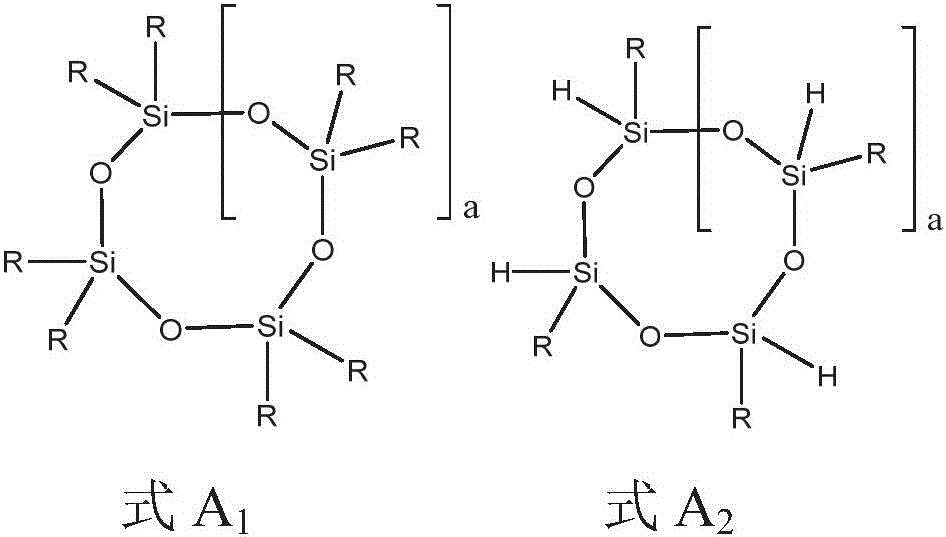
其中in
a是选自0至20的整数;a is an integer selected from 0 to 20;
每个R独立地选自C1-10烷基、芳基和C1-10烷基芳基。Each R is independently selected from C 1-10 alkyl, aryl, and C 1-10 alkylaryl.
式A的环硅氧烷可以由式A1或A2的环硅氧烷的混合物来提供。例如,该方法的步骤(a)可以包括提供式A1的环硅氧烷和式A2的环硅氧烷的环硅氧烷混合物。例如,式A1的环硅氧烷可以是八甲基环硅氧烷,和式A2的环硅氧烷可以是四甲基环硅氧烷。式A1和A2的比可以根据取代硅氧烷链中的氢所需的乙烯基团的数量而变化。式A1和A2的比可以是1∶1。Cyclosiloxanes of formula A can be provided from mixtures of cyclosiloxanes of formula A1 or A2. For example, step (a) of the method may comprise providing a cyclosiloxane mixture of a cyclosiloxane of formula A1 and a cyclosiloxane of formula A2. For example, the cyclosiloxane of formula A1 may be octamethylcyclosiloxane, and the cyclosiloxane of formula A2 may be tetramethylcyclosiloxane. The ratio of formula A1 and A2 can vary depending on the number of vinyl groups required to replace the hydrogens in the siloxane chain. The ratio of formula A 1 and A 2 may be 1:1.
可以提供如上所述的式B的硅氧烷,其中每个R独立地选自C1-10烷基、芳基和C1-10烷基芳基。可以提供式B的硅氧烷,其中每个R独立地选自C1-10烷基,比如甲基。在一个实例中,b是选自1至10的整数。例如,式B的硅氧烷可以是四甲基二硅氧烷(TMDS)。A siloxane of formula B as described above can be provided, wherein each R is independently selected from C1-10 alkyl, aryl, and C1-10 alkylaryl. Siloxanes of formula B can be provided wherein each R is independently selected from C 1-10 alkyl groups, such as methyl groups. In one example, b is an integer selected from 1-10. For example, the siloxane of formula B can be tetramethyldisiloxane (TMDS).
式C的硅氧烷化合物可以由式C1的硅氧烷表示:The siloxane compound of formula C can be represented by a siloxane of formula C1 :
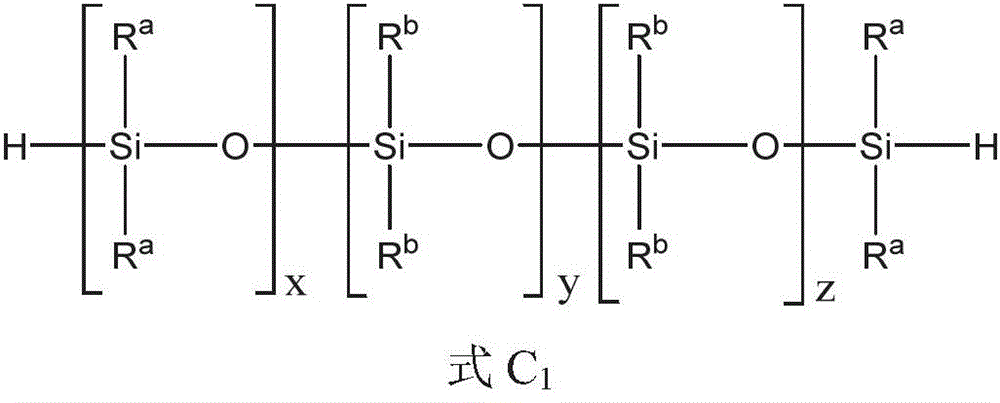
其中in
x是选自0至10的整数;x is an integer selected from 0 to 10;
y是选自1至20的整数;y is an integer selected from 1 to 20;
z是选自0至10的整数;z is an integer selected from 0 to 10;
每个Ra独立地选自C1-10烷基;和each R a is independently selected from C 1-10 alkyl; and
每个Rb独立地选自C1-10烷基、芳基和C1-10烷基芳基;each R b is independently selected from C 1-10 alkyl, aryl, and C 1-10 alkylaryl;
在式C1的另一个实例中:每个Ra是甲基;每个Rb独立地选自C1-10烷基、芳基和C1-10烷基芳基;x和z各自为独立地选自1至3的整数;和y是选自2至16的整数,或x、y和z的和是选自2至16的整数。In another example of formula C1 : each R a is methyl; each R b is independently selected from C 1-10 alkyl, aryl and C 1-10 alkylaryl; x and z are each and y is an integer selected from 2 to 16, or the sum of x, y and z is an integer selected from 2 to 16.
该比可以在式A的环硅氧烷和式B的硅氧烷之间变化。将认识到,这种比的变化提供了改变聚硅氧烷链长度的选择。例如,可以分别提供至少约1∶1,例如约1∶1至1∶10或1∶1至1∶5之间的式B的硅氧烷与式A的环硅氧烷之间的比。例如,可以分别提供1∶2、1∶3、1∶4、1∶5、1∶6、1∶7或1∶8中的任一个或多个或在1∶2、1∶3、1∶4、1∶5、1∶6、1∶7或1∶8中的任一个或多个之间的步骤(a)中式B的硅氧烷与式A的环硅氧烷的比。This ratio can vary between cyclosiloxanes of formula A and siloxanes of formula B. It will be appreciated that a change in this ratio provides the option to vary the polysiloxane chain length. For example, a ratio between the siloxane of formula B to the cyclosiloxane of formula A may be provided, respectively, of at least about 1:1, eg, between about 1:1 to 1:10 or 1:1 to 1:5. For example, any one or more of 1:2, 1:3, 1:4, 1:5, 1:6, 1:7, or 1:8, or in 1:2, 1:3, 1, respectively, may be provided The ratio of siloxane of formula B to cyclosiloxane of formula A in step (a) between any one or more of: 4, 1:5, 1:6, 1:7, or 1:8.
上述步骤(b)中的反应可以是包括催化剂和乙烯基的反应。反应可以是硅氢加成反应,例如使用Karstead催化剂。烷基、芳基和烷基芳基可以作为乙烯基,例如乙烯基化的前体被提供,以提供C1-10烷基、芳基和C1-10烷基芳基,例如烯基或烯基芳基。C1-10烷基、芳基和C1-10烷基芳基可以加帽存在于硅氧烷上的一个或多个氢基团。式C的硅氧烷化合物可以在一端或两端提供氢基团,其可以被C1-10烷基、芳基或C1-10烷基芳基“末端加帽”,例如用乙苯末端加帽。式C的硅氧烷与乙烯基的比可以至少等于所需的C1-10烷基、芳基或C1-10烷基芳基的数量。可以分别提供至少约1∶1,例如约1∶1至1∶10或1∶1至1∶5之间的步骤(b)中式C的硅氧烷与乙烯基的比。例如,可以分别提供1∶2、1∶3、1∶4、1∶5、1∶6、1∶7或1∶8中的任一个或多个或在1∶2、1∶3、1∶4、1∶5、1∶6、1∶7或1∶8中的任一个或多个之间的步骤(b)中式C的硅氧烷与乙烯基的比。The reaction in the above-mentioned step (b) may be a reaction including a catalyst and a vinyl group. The reaction may be a hydrosilylation reaction, for example using a Karstead catalyst. Alkyl, aryl and alkylaryl groups can be provided as vinyl, such as vinylated precursors to provide C1-10 alkyl, aryl and C1-10 alkylaryl groups such as alkenyl or Alkenylaryl. C1-10 alkyl, aryl and C1-10 alkylaryl groups can cap one or more hydrogen groups present on the siloxane. The siloxane compound of formula C may provide a hydrogen group at one or both ends, which may be "terminal capped" with a C 1-10 alkyl, aryl or C 1-10 alkylaryl group, for example with ethylbenzene Cap. The siloxane to vinyl ratio of formula C may be at least equal to the desired number of C1-10 alkyl, aryl, or C1-10 alkylaryl groups. The ratio of siloxane of formula C to vinyl in step (b) may be provided at least about 1:1, eg, between about 1:1 to 1:10 or 1:1 to 1:5, respectively. For example, any one or more of 1:2, 1:3, 1:4, 1:5, 1:6, 1:7, or 1:8, or in 1:2, 1:3, 1, respectively, may be provided Ratio of siloxane of formula C to vinyl in step (b) between any one or more of :4, 1:5, 1:6, 1:7 or 1:8.
二膦酸酯化合物Diphosphonate compounds
本公开内容的液压流体组合物可以包括一种或多种二膦酸酯化合物。在一个实例中,二膦酸酯化合物具有连接膦酸酯基团的烃链。烃链可以任选地被芳基,例如苄基中断。烃链可以是如本文所描述的烷基。The hydraulic fluid compositions of the present disclosure may include one or more bisphosphonate compounds. In one example, the bisphosphonate compound has a hydrocarbon chain to which the phosphonate group is attached. The hydrocarbon chain can optionally be interrupted by an aryl group, such as a benzyl group. The hydrocarbon chain can be an alkyl group as described herein.
一种或多种二膦酸酯化合物可以由式2的化合物表示:One or more bisphosphonate compounds can be represented by compounds of formula 2:

式2的二膦酸酯化合物被如下进一步描述。X可以选自芳基、C1-20烷基、C1-20烷基芳基和C1-20二烷基芳基。X可以选自C1-20烷基和C1-20二烷基芳基。C1-20二烷基芳基可以是C1-20二烷基苯基。C1-20二烷基芳基可以是C1-10二烷基苯基,例如1,4-二甲基烯基苯(1,4-dimethylenylbenezene)。The bisphosphonate compounds of
R11、R12、R13和R14各自可以独立地选自C1-20烷基、芳基和C1-20烷基芳基。R11、R12、R13和R14各自可以独立地选自C1-20烷基和C1-20烷基芳基。R11、R12、R13和R14各自可以独立地选自C1-10烷基和C1-10烷基芳基。R11、R12、R13和R14各自可以独立地选自C2-10烷基或C2-6烷基。Each of R 11 , R 12 , R 13 and R 14 may be independently selected from C 1-20 alkyl, aryl and C 1-20 alkylaryl. Each of R 11 , R 12 , R 13 and R 14 may be independently selected from C 1-20 alkyl and C 1-20 alkylaryl. Each of R 11 , R 12 , R 13 and R 14 may be independently selected from C 1-10 alkyl and C 1-10 alkylaryl. Each of R 11 , R 12 , R 13 and R 14 may be independently selected from C 2-10 alkyl or C 2-6 alkyl.
一种或多种二膦酸酯化合物可以由式2(a)的化合物表示:One or more bisphosphonate compounds can be represented by compounds of formula 2(a):

式2(a)的二膦酸酯化合物可以被如下进一步描述。The bisphosphonate compounds of formula 2(a) can be further described as follows.
R11、R12、R13和R14可以通过上面先前描述的其任何实例来提供。R 11 , R 12 , R 13 and R 14 may be provided by any of the examples thereof previously described above.
X可以不存在或是芳基,例如苯基团。X may be absent or an aryl group such as a phenyl group.
项r和s中的每个可以是选自0至10的整数,条件是当s是0并且X不存在时r至少为1。项r和s中的每个可以是选自1至10的整数。例如,项r和s可以是独立地选自1至9、1至6或2至4的整数。每个独立项r和s可以至少为1、2、3、4、5、6、7或8。每个独立项r和s可以等于或小于9、8、7、6、5、4、3或2。Each of the terms r and s may be an integer selected from 0 to 10, provided that r is at least 1 when s is 0 and X is absent. Each of the terms r and s may be an integer selected from 1 to 10. For example, the terms r and s can be integers independently selected from 1 to 9, 1 to 6, or 2 to 4. Each of the independent terms r and s may be at least 1, 2, 3, 4, 5, 6, 7 or 8. Each of the independent terms r and s may be equal to or less than 9, 8, 7, 6, 5, 4, 3, or 2.
每个R15和每个R16可以独立地选自氢、C1-20烷基、芳基和C1-20烷基芳基。每个R15和每个R16可以独立地选自氢、C1-10烷基、芳基和C1-10烷基芳基。每个R15和每个R16可以独立地选自氢、C1-10烷基和C1-10烷基芳基。每个R15和每个R16可以独立地选自氢和C1-10烷基。每个R15和每个R16可以独立地选自氢和甲基。每个R15和每个R16可以是氢。Each R 15 and each R 16 may be independently selected from hydrogen, C 1-20 alkyl, aryl, and C 1-20 alkylaryl. Each R 15 and each R 16 may be independently selected from hydrogen, C 1-10 alkyl, aryl, and C 1-10 alkylaryl. Each R 15 and each R 16 may be independently selected from hydrogen, C 1-10 alkyl and C 1-10 alkylaryl. Each R 15 and each R 16 may be independently selected from hydrogen and C 1-10 alkyl. Each R 15 and each R 16 can be independently selected from hydrogen and methyl. Each R 15 and each R 16 may be hydrogen.
二膦酸酯化合物可以由式2a(i)的化合物表示:Diphosphonate compounds can be represented by compounds of formula 2a(i):

式2(a)(i)的二膦酸酯化合物可以被如下进一步描述。The bisphosphonate compounds of formula 2(a)(i) can be further described as follows.
项m可以是选自1至10的整数。项m可以是选自在1和10之间的任何整数或整数范围。例如,项m可以是选自1至9、1至6或2至4的整数。整数m可以是至少1、2、3、4、5、6、7或8的整数。整数m可以是等于或小于9、8、7、6、5、4、3或2的整数。The term m may be an integer selected from 1 to 10. The term m may be selected from any integer or range of integers between 1 and 10. For example, the term m may be an integer selected from 1 to 9, 1 to 6, or 2 to 4. The integer m may be an integer of at least 1, 2, 3, 4, 5, 6, 7 or 8. The integer m may be an integer equal to or less than 9, 8, 7, 6, 5, 4, 3, or 2.
R11、R12、R13和R14各自可以独立地选自C1-20烷基、芳基和C1-20烷基芳基。R11、R12、R13和R14各自可以独立地选自C1-20烷基和C1-20烷基芳基。R11、R12、R13和R14各自可以独立地选自C1-10烷基和C1-10烷基芳基。R11、R12、R13和R14各自可以独立地选自C2-10烷基或C2-6烷基。Each of R 11 , R 12 , R 13 and R 14 may be independently selected from C 1-20 alkyl, aryl and C 1-20 alkylaryl. Each of R 11 , R 12 , R 13 and R 14 may be independently selected from C 1-20 alkyl and C 1-20 alkylaryl. Each of R 11 , R 12 , R 13 and R 14 may be independently selected from C 1-10 alkyl and C 1-10 alkylaryl. Each of R 11 , R 12 , R 13 and R 14 may be independently selected from C 2-10 alkyl or C 2-6 alkyl.
每个R15和R16可以独立地选自氢、C1-20烷基、芳基和C1-20烷基芳基。每个R15和R16可以独立地选自氢、C1-10烷基、芳基和C1-10烷基芳基。每个R15和R16可以独立地选自氢、C1-10烷基和C1-10烷基芳基。每个R15和R16可以独立地选自氢和C1-10烷基。每个R15和R16可以独立地选自氢和甲基。每个R15和R16可以是氢。Each of R 15 and R 16 may be independently selected from hydrogen, C 1-20 alkyl, aryl and C 1-20 alkylaryl. Each of R 15 and R 16 may be independently selected from hydrogen, C 1-10 alkyl, aryl and C 1-10 alkylaryl. Each of R 15 and R 16 may be independently selected from hydrogen, C 1-10 alkyl and C 1-10 alkylaryl. Each of R 15 and R 16 may be independently selected from hydrogen and C 1-10 alkyl. Each of R 15 and R 16 can be independently selected from hydrogen and methyl. Each of R 15 and R 16 may be hydrogen.
当与如本文所描述的聚硅氧烷化合物混合时,如本文所描述的二膦酸酯化合物可以提供用作液压流体的合适性质。例如,二膦酸酯化合物可以为流体提供阻燃性能,或者提供合适的密度(例如重量)和流变性质,例如与期望的用途相关的对流体的阻燃性和润滑性的有效组合。The bisphosphonate compounds as described herein can provide suitable properties for use as hydraulic fluids when mixed with the polysiloxane compounds as described herein. For example, the bisphosphonate compound can provide flame retardant properties to the fluid, or provide suitable density (eg, weight) and rheological properties, such as an effective combination of flame retardant properties and lubricity to the fluid in relation to the intended use.
还将认识到,如本文描述的本公开内容的所有公式和化合物结构——其包括聚硅氧烷或二膦酸酯化合物——可以包括其任何立体异构体,包括任何几何异构体(例如顺式/反式或E/Z异构)。例如,本公开内容的任何公式或化合物结构包括所有顺式和反式异构体以及其任何混合物。It will also be appreciated that all formulae and compound structures of the present disclosure as described herein, which include polysiloxane or bisphosphonate compounds, may include any stereoisomer thereof, including any geometric isomer ( e.g. cis/trans or E/Z isomerism). For example, any formula or compound structure of the present disclosure includes all cis and trans isomers and any mixtures thereof.
实例化合物Example Compounds
如下在表1中提供了式1的聚硅氧烷化合物的一些实例:Some examples of polysiloxane compounds of
表1:式1的化合物Table 1: Compounds of

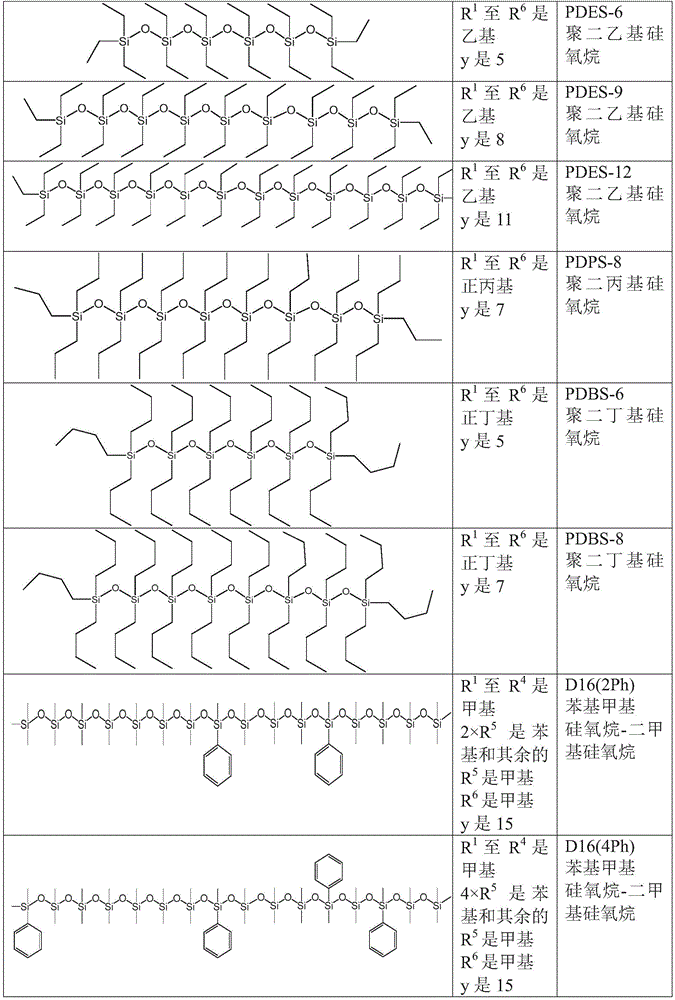


如下在表2中提供了式2的二膦酸酯化合物的一些实例:Some examples of bisphosphonate compounds of
表2:式2的化合物Table 2: Compounds of
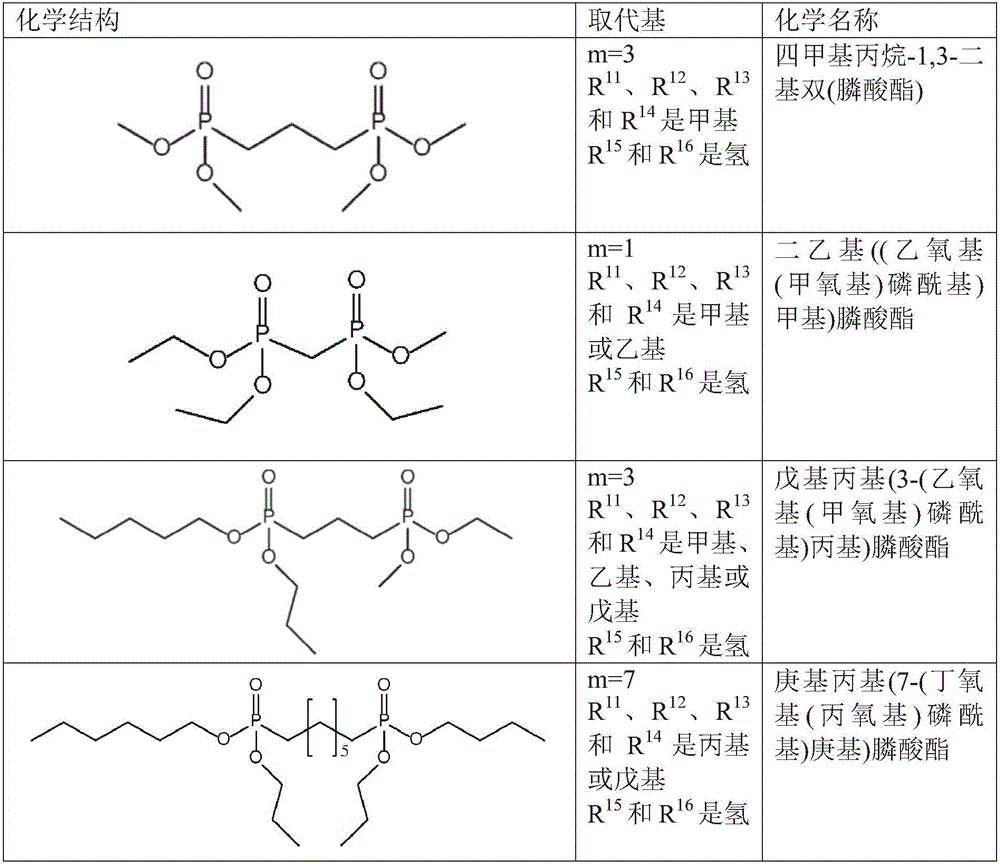
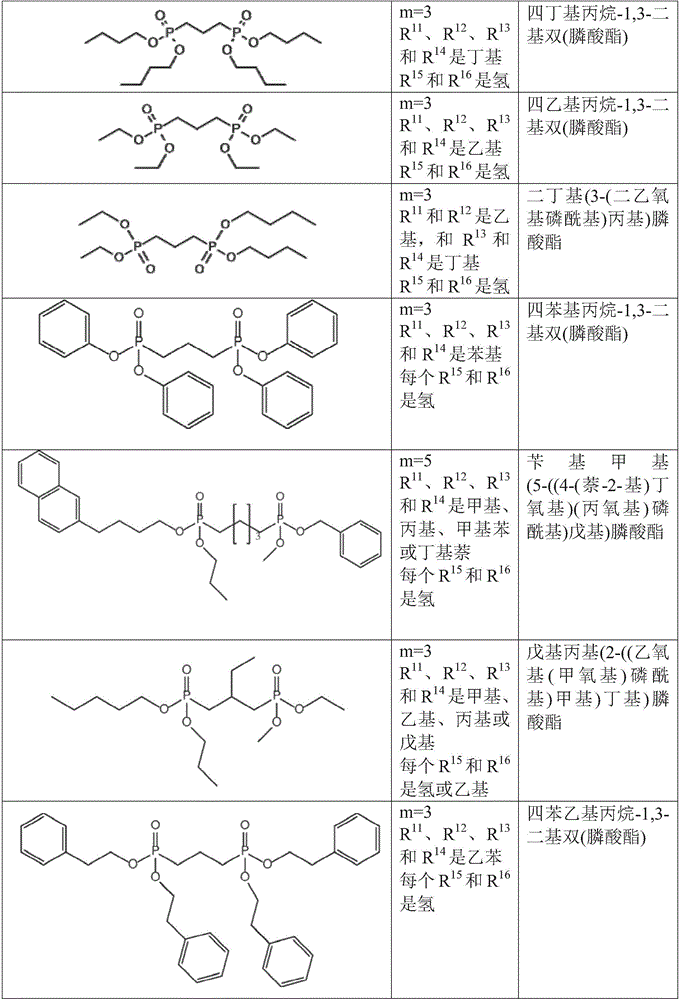
另外的组分additional components
本公开内容的液压流体组合物还可以包括任一种或多种另外的组分或由其组成,例如如下所述的“另外的化合物”和“另外的添加剂”,其可有助于其作为液压流体组合物的功能。另外的化合物可以包括单膦酸酯化合物、磷腈化合物、次磷酸酯化合物或其组合,或由其组成。例如,液压流体组合物可以包括根据本文描述的其任何实例的一种或多种聚硅氧烷化合物、根据本文描述的其任何实例的一种或多种二膦酸酯化合物和根据本文描述的其任何实例的单膦酸酯化合物,或由其组成。这些另外的组分,即如下所描述的“另外的化合物”和“另外的添加剂”仅是实例,并且可以在组合物中使用其它另外的化合物或组分。The hydraulic fluid compositions of the present disclosure may also include or consist of any one or more additional components, such as "additional compounds" and "additional additives" as described below, which may contribute to their Function of hydraulic fluid composition. The additional compounds may include or consist of monophosphonate compounds, phosphazene compounds, hypophosphite compounds, or combinations thereof. For example, a hydraulic fluid composition may include one or more polysiloxane compounds according to any example thereof described herein, one or more bisphosphonate compounds according to any example thereof described herein, and one or more bisphosphonate compounds according to any example thereof described herein A monophosphonate compound of any instance thereof, or consisting of it. These additional components, "additional compounds" and "additional additives" as described below are only examples, and other additional compounds or components may be used in the composition.
还可以选择流体组合物以提供进一步的优势,例如低毒物学或环境影响流体,例如相对于包括


另外的组分,即“另外的化合物”和“另外的添加剂”,可以以高达约30%(基于总的液压流体组合物的重量),例如小于约30%、25%、20%、15%、10%、5%、4%、3%、2%或1%,或例如至少约1%、2%、3%、4%、5%、10%、15%、20%或25%的量一起或单独地包括在液压流体组合物中。另外的组分可以以按总的液压流体组合物的重量计在约1%和约30%之间,例如在约2%和约25%之间、约3%和约20%之间或约5%和约15%之间的量包括在液压流体组合物中。Additional components, ie "additional compounds" and "additional additives", may be present in amounts up to about 30% (based on the weight of the total hydraulic fluid composition), eg, less than about 30%, 25%, 20%, 15% , 10%, 5%, 4%, 3%, 2% or 1%, or for example at least about 1%, 2%, 3%, 4%, 5%, 10%, 15%, 20% or 25% The amounts are included together or individually in the hydraulic fluid composition. The additional components may be between about 1% and about 30% by weight of the total hydraulic fluid composition, such as between about 2% and about 25%, between about 3% and about 20%, or about 5% and about 15% Amounts between % are included in the hydraulic fluid composition.
提及“基本上不含”通常指除了可能存在的任何痕量或杂质以外组合物中不存在化合物,例如这可以是按总的组合物的重量%计小于约1%、0.1%、0.01%、0.001%或0.0001%的量。如本文所描述的组合物还可以包括例如按总的组合物的重量%计小于约5%、4%、3%、2%、1%、0.5%、0.1%、0.01%、0.001%或0.0001%的量的杂质。在一个具体实例中的杂质——其中组合物包括一种或多种聚硅氧烷化合物或由其组成,其中对于式1,y至少为2(或对于式1a,x、y和z的和至少为2)——可以是例如二硅氧烷基(disiloxanyl)化合物,比如二乙基苯二硅氧烷。Reference to "substantially free" generally refers to the absence of compounds in the composition other than any traces or impurities that may be present, eg this may be less than about 1%, 0.1%, 0.01% by weight of the total composition , 0.001% or 0.0001%. Compositions as described herein can also include, for example, less than about 5%, 4%, 3%, 2%, 1%, 0.5%, 0.1%, 0.01%, 0.001%, or 0.0001 % by weight of the total composition % amount of impurities. Impurities in a specific example - wherein the composition includes or consists of one or more polysiloxane compounds wherein for
另外的化合物additional compounds
单膦酸酯化合物Monophosphonate compounds
本公开内容的液压流体组合物中的另外的组分可以进一步包括一种或多种单膦酸酯化合物或由其组成。单膦酸酯化合物可以例如通过提供进一步的润滑性或阻燃性或改进粘度促进或赋予适用于液压流体组合物的进一步性质。Additional components in the hydraulic fluid compositions of the present disclosure may further include or consist of one or more monophosphonate compounds. Monophosphonate compounds can promote or impart further properties suitable for use in hydraulic fluid compositions, for example, by providing further lubricity or flame retardancy or improving viscosity.
在一个实例中,单膦酸酯可以被烃基取代。烃基可以选自根据本文描述的那些基团的任何实例的烷基、烷基芳基和芳基。烃基可以是烷基。烷基可以是直链烷基。例如,选择单膦酸酯化合物可以提供比
单膦酸酯化合物可以由式3的化合物表示:Monophosphonate compounds can be represented by compounds of formula 3:
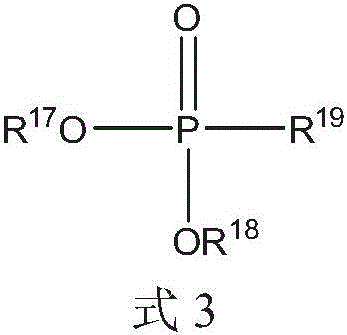
可以进一步描述上述式3的单膦酸酯化合物,其中R17、R18和R19中的每个独立地选自C1-20烷基、芳基和C1-20烷基芳基。The monophosphonate compound of
R17、R18和R19中的每个可以独立地选自C1-10烷基、芳基和C1-10烷基芳基。R17、R18和R19中的每个可以独立地选自C1-10烷基和C1-10烷基芳基。R17、R18和R19中的每个可以独立地选自C1-6烷基和C1-6烷基芳基。芳基可以是单环或双环芳基。芳基可以是苯基。C1-10烷基芳基可以是C1-10烷基苯基,比如苄基。例如,单膦酸酯化合物可以是二乙基苄基膦酸酯或二丁基辛烷膦酸酯。Each of R 17 , R 18 and R 19 may be independently selected from C 1-10 alkyl, aryl and C 1-10 alkylaryl. Each of R 17 , R 18 and R 19 may be independently selected from C 1-10 alkyl and C 1-10 alkylaryl. Each of R 17 , R 18 and R 19 may be independently selected from C 1-6 alkyl and C 1-6 alkylaryl. Aryl groups can be monocyclic or bicyclic aryl groups. Aryl can be phenyl. A C1-10 alkylaryl group may be a C1-10 alkylphenyl group, such as benzyl. For example, the monophosphonate compound may be diethylbenzylphosphonate or dibutyloctanephosphonate.
式3的单膦酸酯化合物的实例可以由表3中的下列化合物提供。Examples of monophosphonate compounds of
表3:式3的单膦酸酯化合物Table 3: Monophosphonate compounds of


本公开内容的液压流体组合物可以进一步包括单膦酸酯化合物或由其组成,该单膦酸酯化合物的量为高达约30%(基于总的液压流体组合物的重量),例如小于约30%、25%、20%、15%、10%、5%、4%、3%、2%或1%,或例如至少约1%、2%、3%、4%、5%、10%、15%、20%或25%。液压流体组合物可以进一步包括单膦酸酯化合物或由其组成,该单膦酸酯化合物的量为按总的液压流体组合物的重量计在约1%和约30%之间,例如在约2%和约25%之间、约3%和约20%之间或约5%和约15%之间。The hydraulic fluid composition of the present disclosure may further include or consist of a monophosphonate compound in an amount of up to about 30% (based on the weight of the total hydraulic fluid composition), eg, less than about 30% %, 25%, 20%, 15%, 10%, 5%, 4%, 3%, 2% or 1%, or for example at least about 1%, 2%, 3%, 4%, 5%, 10% , 15%, 20% or 25%. The hydraulic fluid composition may further comprise or consist of a monophosphonate compound in an amount of between about 1% and about 30% by weight of the total hydraulic fluid composition, for example at about 2% % and about 25%, between about 3% and about 20%, or between about 5% and about 15%.
磷腈化合物Phosphazene compounds
本公开内容的液压流体组合物中的另一种另外的组分可以进一步包括一种或多种磷腈化合物或由其组成。磷腈化合物典型地包含大量的磷,其可以促进或赋予进一步的阻燃性能。Another additional component in the hydraulic fluid composition of the present disclosure may further comprise or consist of one or more phosphazene compounds. Phosphazene compounds typically contain large amounts of phosphorus, which can promote or impart further flame retardant properties.
磷腈化合物可以是环状磷腈。磷腈化合物可以是环状氟化的磷腈化合物。磷腈化合物的实例可以包括2,2,4,4,6,6-二(4-氟苯氧基)四(3-三氟甲基苯氧基)-1,3,5-三氮杂-2,4,6-三膦杂苯、2,2,4,4,6,6-二(3-氟苯氧基)四(3-三氟甲基苯氧基)-1,3,5-三氮杂-2,4,6-三膦杂苯、2,2,4,4,6,6-二(2-氟苯氧基)四(3-三氟甲基苯氧基)-1,3,5-三氮杂-2,4,6-三膦杂苯、2,2,4,4,6,6-三(2-氟苯氧基)三(3-三氟甲基苯氧基)-1,3,5-三氮杂-2,4,6-三膦杂苯、2,2,4,4,6,6-三(3-氟苯氧基)三(3-三氟甲基苯氧基)-1,3,5-三氮杂-2,4,6-三膦杂苯、2,2,4,4,6,6-三(4-氟苯氧基)三(3-三氟甲基苯氧基)-1,3,5-三氮杂-2,4,6-三膦杂苯、2,2,4,4,6,6,8,8-三(4-氟苯氧基)五(3-三氟甲基苯氧基)-1,3,5,7-四氮杂-2,4,6,8-四膦杂苯、2,2,4,4,6,6,8,8-三(3-氟苯氧基)五(3-三氟甲基苯氧基)-1,3,5,7-四氮杂-2,4,6,8-四膦杂苯、2,2,4,4,6,6,8,8-四(4-氟苯氧基)四(3-三氟甲基苯氧基)-1,3,5,7-四氮杂-2,4,6,8-四膦杂苯、2,2,4,4,6,6,8,8-四(3-氟苯氧基)四(3-三氟甲基苯氧基)-1,3,5,7-四氮杂-2,4,6,8-四膦杂苯、2,2,4,4,6,6,8,8-2.57(3-氟苯氧基)-5.43(3-三氟甲基苯氧基)-1,3,5,7-四氮杂-2,4,6,8-四膦杂苯、2,2,4,4,6,6,8,8-2.57(4-氟苯氧基)-5.43(3-三氟甲基苯氧基)-1,3,5,7-四氮杂-2,4,6,8-四膦杂苯和其混合物。在优选的实例中,磷腈是2,2,4,4,6,6-二(3-氟苯氧基)四(间-三氟甲基苯氧基)-1,3,5-三氮杂-2,4,6-三膦杂苯、2,2,4,4,6,6-二(4-氟苯氧基)四(间-三氟甲基苯氧基)-1,3,5-三氮杂-2,4,6-三膦杂苯或其混合物。The phosphazene compound may be a cyclic phosphazene. The phosphazene compound may be a cyclic fluorinated phosphazene compound. Examples of the phosphazene compound may include 2,2,4,4,6,6-bis(4-fluorophenoxy)tetrakis(3-trifluoromethylphenoxy)-1,3,5-triaza -2,4,6-triphosphine heterobenzene, 2,2,4,4,6,6-bis(3-fluorophenoxy)tetrakis(3-trifluoromethylphenoxy)-1,3, 5-Triaza-2,4,6-triphosphinobenzene, 2,2,4,4,6,6-bis(2-fluorophenoxy)tetrakis(3-trifluoromethylphenoxy) -1,3,5-triaza-2,4,6-triphosphinobenzene, 2,2,4,4,6,6-tris(2-fluorophenoxy)tris(3-trifluoromethyl) phenoxy)-1,3,5-triaza-2,4,6-triphosphinobenzene, 2,2,4,4,6,6-tris(3-fluorophenoxy)tris( 3-Trifluoromethylphenoxy)-1,3,5-triaza-2,4,6-triphosphinobenzene, 2,2,4,4,6,6-tris(4-fluorobenzene) oxy) tris(3-trifluoromethylphenoxy)-1,3,5-triaza-2,4,6-triphosphinobenzene, 2,2,4,4,6,6,8 , 8-Tris(4-fluorophenoxy)penta(3-trifluoromethylphenoxy)-1,3,5,7-tetraaza-2,4,6,8-tetraphosphinobenzene, 2,2,4,4,6,6,8,8-Tris(3-fluorophenoxy)penta(3-trifluoromethylphenoxy)-1,3,5,7-tetraaza- 2,4,6,8-Tetraphosphinobenzene, 2,2,4,4,6,6,8,8-Tetrakis(4-fluorophenoxy)tetrakis(3-trifluoromethylphenoxy) -1,3,5,7-tetraaza-2,4,6,8-tetraphosphinobenzene, 2,2,4,4,6,6,8,8-tetrakis(3-fluorophenoxy) ) tetrakis(3-trifluoromethylphenoxy)-1,3,5,7-tetraaza-2,4,6,8-tetraphosphine, 2,2,4,4,6,6 , 8,8-2.57(3-fluorophenoxy)-5.43(3-trifluoromethylphenoxy)-1,3,5,7-tetraaza-2,4,6,8-tetraphosphine Heterobenzene, 2,2,4,4,6,6,8,8-2.57(4-fluorophenoxy)-5.43(3-trifluoromethylphenoxy)-1,3,5,7- Tetraaza-2,4,6,8-tetraphosphinobenzene and mixtures thereof. In a preferred example, the phosphazene is 2,2,4,4,6,6-bis(3-fluorophenoxy)tetrakis(m-trifluoromethylphenoxy)-1,3,5-tris Aza-2,4,6-triphosphinobenzene, 2,2,4,4,6,6-bis(4-fluorophenoxy)tetrakis(m-trifluoromethylphenoxy)-1, 3,5-Triaza-2,4,6-triphosphinobenzene or mixtures thereof.
本公开内容的液压流体组合物可以进一步包括磷腈化合物或由其组成,该磷腈化合物的量为高达约30%(基于总的液压流体组合物的重量),例如小于约30%、25%、20%、15%、10%、5%、4%、3%、2%或1%,或例如至少约1%、2%、3%、4%、5%、10%、15%、20%或25%。液压流体组合物可以进一步包括磷腈化合物或由其组成,该磷腈化合物的量为按总的液压流体组合物的重量计在约1%和约30%之间,例如在约2%和约25%之间、约3%和约20%之间或约5%和约15%之间。The hydraulic fluid composition of the present disclosure may further include or consist of a phosphazene compound in an amount up to about 30% (based on the weight of the total hydraulic fluid composition), eg, less than about 30%, 25% , 20%, 15%, 10%, 5%, 4%, 3%, 2% or 1%, or for example at least about 1%, 2%, 3%, 4%, 5%, 10%, 15%, 20% or 25%. The hydraulic fluid composition may further comprise or consist of a phosphazene compound in an amount of between about 1% and about 30% by weight of the total hydraulic fluid composition, such as between about 2% and about 25% between about 3% and about 20% or between about 5% and about 15%.
次膦酸酯化合物Phosphinate compounds
本公开内容的液压流体组合物中的另一种另外的组分可以进一步包括一种或多种次磷酸酯化合物或由其组成。Another additional component in the hydraulic fluid compositions of the present disclosure may further comprise or consist of one or more hypophosphite compounds.
次磷酸酯化合物可以是芳基二烷基次磷酸酯。The hypophosphite compound may be an aryldialkyl hypophosphite.
次磷酸酯化合物的实例可以包括苯基-二-正丙基次磷酸酯、苯基-二-正丁基次磷酸酯、苯基-二-仲丁基次磷酸酯、苯基-二-正戊基次磷酸酯、苯基-二-新戊基次磷酸酯、苯基-二-正己基次磷酸酯、苯基-二-正丁基硫代次磷酸酯、对-甲氧苯基-二-正丁基次磷酸酯、间-氯苯基-二-正丁基次磷酸酯、苯基-(正丙基-正戊基)次磷酸酯、苯基-(正丙基-正丁基)次磷酸酯、苯基-(正丙基-正己基)次磷酸酯、苯基-(正丁基-正戊基)次磷酸酯、苯基-(正丁基-正己基)次磷酸酯、苯基-(正戊基-正己基)次磷酸酯、苯基-(新戊基-正丙基)次磷酸酯、苯基-(新戊基-正丁基)次磷酸酯、苯基-(新戊基-正己基)次磷酸酯、苯硫基-二-正丙基次磷酸酯、苯硫基-二-正戊基次磷酸酯、甲苯基-二-正戊基次磷酸酯、叔丁基苯基-二-正丁基次磷酸酯、正丁基苯基-二-正丁基次磷酸酯、仲丁基苯基-二-正丁基次磷酸酯、乙基苯基-二-正丁基次磷酸酯、二甲苯基-二-正丁基次磷酸酯、苯硫基-二-正己基次磷酸酯、苯硫基-二-正丁基次磷酸酯、苯硫基-二-正丙基硫代次磷酸酯、苯硫基-二-正丁基硫代次磷酸酯、苯硫基-二-正戊基硫代次磷酸酯、苯硫基-二-正己基硫代次磷酸酯、苯硫基-(正丙基-正丁基)次磷酸酯、苯硫基-(正丙基-正戊基)次磷酸酯、苯硫基-(正丙基-正己基)次磷酸酯、苯硫基-(正丁基-正戊基)次磷酸酯、苯硫基(正丁基-正己基)次磷酸酯、苯硫基-(正戊基-正己基)次磷酸酯、苯硫基-(正丙基-正丁基)硫代次磷酸酯、苯硫基-(正丙基-正戊基)硫代次磷酸酯、苯硫基-(正丙基-正己基)硫代次磷酸酯、苯硫基-(正丁基-正戊基)硫代次磷酸酯、苯硫基-(正丁基-正己基)硫代次磷酸酯和苯硫基-(正戊基-正己基)硫代次磷酸酯。Examples of the hypophosphite compound may include phenyl-di-n-propyl hypophosphite, phenyl-di-n-butyl hypophosphite, phenyl-di-sec-butyl hypophosphite, phenyl-di-n-butyl hypophosphite Amyl hypophosphite, phenyl-di-neopentyl hypophosphite, phenyl-di-n-hexyl hypophosphite, phenyl-di-n-butylthiophosphite, p-methoxyphenyl- Di-n-butyl hypophosphite, m-chlorophenyl-di-n-butyl hypophosphite, phenyl-(n-propyl-n-pentyl) hypophosphite, phenyl-(n-propyl-n-butyl) base) hypophosphite, phenyl-(n-propyl-n-hexyl) hypophosphite, phenyl-(n-butyl-n-pentyl) hypophosphite, phenyl-(n-butyl-n-hexyl) hypophosphite ester, phenyl-(n-pentyl-n-hexyl) hypophosphite, phenyl-(neopentyl-n-propyl) hypophosphite, phenyl-(neopentyl-n-butyl) hypophosphite, benzene phenyl-(neopentyl-n-hexyl) hypophosphite, phenylthio-di-n-propyl hypophosphite, phenylthio-di-n-pentyl hypophosphite, tolyl-di-n-pentyl hypophosphite ester, tert-butylphenyl-di-n-butyl hypophosphite, n-butylphenyl-di-n-butyl hypophosphite, sec-butylphenyl-di-n-butyl hypophosphite, ethylbenzene phenyl-di-n-butyl hypophosphite, xylyl-di-n-butyl hypophosphite, phenylthio-di-n-hexyl hypophosphite, phenylthio-di-n-butyl hypophosphite, benzene Thio-di-n-propyl thiophosphite, phenylthio-di-n-butyl thiophosphite, phenylthio-di-n-pentyl thiophosphite, phenylthio-di- n-hexyl thiophosphite, phenylthio-(n-propyl-n-butyl) hypophosphite, phenylthio-(n-propyl-n-pentyl) hypophosphite, phenylthio-(n-propyl) - n-hexyl) hypophosphite, phenylthio-(n-butyl-n-pentyl) hypophosphite, phenylthio (n-butyl-n-hexyl) hypophosphite, phenylthio-(n-pentyl-n-hexyl) base) hypophosphite, phenylthio-(n-propyl-n-butyl) thiophosphite, phenylthio-(n-propyl-n-pentyl) thiophosphite, Propyl-n-hexyl)thiophosphite, phenylthio-(n-butyl-n-pentyl)thiophosphite, phenylthio-(n-butyl-n-hexyl)thiophosphite and benzene Thio-(n-pentyl-n-hexyl)thiophosphinate.
本公开内容的液压流体组合物可以进一步包括次磷酸酯化合物或由其组成,该次磷酸酯化合物的量为高达约30%(基于总的液压流体组合物的重量),例如小于约30%、25%、20%、15%、10%、5%、4%、3%、2%或1%,或例如至少约1%、2%、3%、4%、5%、10%、15%、20%或25%。液压流体组合物可以进一步包括次磷酸酯化合物或由其组成,该次磷酸酯化合物的量为按总的液压流体组合物的重量计在约1%和约30%之间,例如在约2%和约25%之间、约3%和约20%之间或约5%和约15%之间。The hydraulic fluid composition of the present disclosure may further include or consist of a hypophosphite compound in an amount of up to about 30% (by weight of the total hydraulic fluid composition), such as less than about 30%, 25%, 20%, 15%, 10%, 5%, 4%, 3%, 2% or 1%, or for example at least about 1%, 2%, 3%, 4%, 5%, 10%, 15% %, 20% or 25%. The hydraulic fluid composition may further comprise or consist of a hypophosphite compound in an amount of between about 1% and about 30%, for example between about 2% and about 30% by weight of the total hydraulic fluid composition Between 25%, between about 3% and about 20%, or between about 5% and about 15%.
另外的添加剂Additional additives
如上所述,本公开内容的液压流体组合物可以进一步包括一种或多种另外的组分比如另外的化合物和/或另外的添加剂或由其组成,其可有助于其作为液压流体组合物的功能。另外的添加剂可以进一步包括除酸剂、防侵蚀剂、粘度指数调节剂、抗氧化剂、消泡剂、防腐蚀剂或其组合,或由其组成。在另一个实例中,另外的添加剂可以进一步包括除酸剂、粘度指数调节剂、抗氧化剂、消泡剂或其组合,或由其组成。在另一个实例中,另外的添加剂可以进一步包括除酸剂、防侵蚀剂、抗氧化剂、消泡剂或其组合,或由其组成。这些另外的添加剂是实例,并且还可以使用其它另外的添加剂或组分。As noted above, the hydraulic fluid compositions of the present disclosure may further include or consist of one or more additional components such as additional compounds and/or additional additives, which may contribute to their functioning as hydraulic fluid compositions function. Additional additives may further include or consist of acid scavengers, corrosion inhibitors, viscosity index modifiers, antioxidants, defoamers, corrosion inhibitors, or combinations thereof. In another example, the additional additives may further include or consist of acid scavengers, viscosity index modifiers, antioxidants, antifoaming agents, or combinations thereof. In another example, the additional additives may further include or consist of acid scavengers, corrosion inhibitors, antioxidants, defoamers, or combinations thereof. These additional additives are examples, and other additional additives or components may also be used.
本公开内容的液压流体组合物可以进一步包括一种或多种另外的添加剂或由其组成,该一种或多种另外的添加剂的量为高达约30%(基于总的液压流体组合物的重量),例如小于约30%、25%、20%、15%、10%、5%、4%、3%、2%或1%,或例如至少约0.01%、0.1%、1%、2%、3%、4%、5%、10%、15%、20%或25%。液压流体组合物可以进一步包括一种或多种另外的添加剂或由其组成,该一种或多种另外的添加剂的量为按总的液压流体组合物的重量计在约1%和约30%之间,例如在约2%和约25%之间、约3%和约20%之间或约5%和约15%之间。可以通过先前描述的下限值和上限值中的任两个来提供另外的范围。这些量或范围中的任一个或多个可以单独地应用于下面描述的每种类别、混合物或单独的添加剂,或者共同地应用于液压流体组合物中提供的所有“另外的添加剂”。The hydraulic fluid compositions of the present disclosure may further include or consist of one or more additional additives in an amount of up to about 30% (based on the weight of the total hydraulic fluid composition) ), such as less than about 30%, 25%, 20%, 15%, 10%, 5%, 4%, 3%, 2%, or 1%, or, for example, at least about 0.01%, 0.1%, 1%, 2% , 3%, 4%, 5%, 10%, 15%, 20% or 25%. The hydraulic fluid composition may further include or consist of one or more additional additives in an amount between about 1% and about 30% by weight of the total hydraulic fluid composition between about 2% and about 25%, between about 3% and about 20%, or between about 5% and about 15%. Additional ranges may be provided by any two of the previously described lower and upper values. Any one or more of these amounts or ranges may apply individually to each class, mixture or individual additive described below, or collectively to all "additional additives" provided in the hydraulic fluid composition.
除酸剂acid scavenger
液压流体组合物中的另外的添加剂可以进一步包括除酸剂化合物或由其组成。将认识到,除酸剂是添加到组合物中以便除去、减少或去活化酸杂质或不需要的反应产物的化学物质。除酸剂可以包括各种酯或脂肪族环氧化物,例如环氧烷基羧酸盐。合适的除酸剂可以包括例如有机化合物,其包含至少一个环氧基团,例如苯基缩水甘油醚、氧化蒎烯、氧化苯乙烯、环己基缩水甘油醚、环氧环己基缩水甘油醚、二缩水甘油醚、异丙基缩水甘油醚、二氧化丁二烯氧化环己烯、己二酸双环氧环己酯(bis-epoxycyclohexyl adipate)、3,4-环氧环烷基羧酸酯和碳二亚胺(例如3,4-环氧环己基羧酸酯或3,4-环氧环己烷),及其混合物。在一个实例中,除酸剂可以选自4-环氧环烷基羧酸酯和碳二亚胺,比如3,4-环氧环己基羧酸酯或3,4-环氧环己烷。Additional additives in the hydraulic fluid composition may further include or consist of acid scavenger compounds. It will be appreciated that acid scavengers are chemicals added to compositions to remove, reduce or deactivate acid impurities or unwanted reaction products. Acid scavengers can include various esters or aliphatic epoxides, such as epoxyalkyl carboxylates. Suitable acid scavengers may include, for example, organic compounds containing at least one epoxy group, such as phenyl glycidyl ether, pinene oxide, styrene oxide, cyclohexyl glycidyl ether, epoxycyclohexyl Glycidyl ether, isopropyl glycidyl ether, butadiene oxide cyclohexene dioxide, bis-epoxycyclohexyl adipate, 3,4-epoxycycloalkyl carboxylate and Carbodiimides (eg, 3,4-epoxycyclohexylcarboxylate or 3,4-epoxycyclohexane), and mixtures thereof. In one example, the acid scavenger may be selected from 4-epoxycycloalkylcarboxylates and carbodiimides, such as 3,4-epoxycyclohexylcarboxylate or 3,4-epoxycyclohexane.
除了上述另外的添加剂的量之外,在另外的实例中,抗氧化剂可以以小于总的组合物的3wt%的量提供,例如在约0.1至约1wt%的范围内。In addition to the amounts of the additional additives described above, in additional examples, the antioxidant may be provided in an amount less than 3 wt % of the total composition, eg, in the range of about 0.1 to about 1 wt %.
除了上述另外的添加剂的量之外,在另外的实例中,除酸剂可以以约0.5至10wt%的量提供,例如在约2至9wt%或约4至8wt%的范围内。In addition to the amounts of the additional additives described above, in additional examples, the acid scavenger may be provided in an amount of about 0.5 to 10 wt %, eg, in the range of about 2 to 9 wt % or about 4 to 8 wt %.
防侵蚀剂Anti-corrosion agent
液压流体组合物中的另外的添加剂可以进一步包括防侵蚀剂或由其组成。防侵蚀剂可以以有效抑制流动诱导的电化学腐蚀更准确地称为ζ(zeta)腐蚀的量并入。防侵蚀添加剂可以是全氟化的阴离子表面活性剂。Additional additives in the hydraulic fluid composition may further include or consist of corrosion inhibitors. The corrosion inhibitor may be incorporated in an amount effective to inhibit flow-induced electrochemical corrosion, more accurately referred to as zeta (zeta) corrosion. The anti-erosion additive may be a perfluorinated anionic surfactant.
防侵蚀剂可以是全氟化的阴离子表面活性剂。全氟化的阴离子表面活性剂可以是碱金属盐,例如全氟烷基磺酸的钾盐。典型地,烷基组分包括己基、庚基、辛基、壬基、癸基或其混合物,其中在一些实例中,全氟辛基提供进一步的优势。The corrosion inhibitor may be a perfluorinated anionic surfactant. The perfluorinated anionic surfactant may be an alkali metal salt, such as the potassium salt of a perfluoroalkanesulfonic acid. Typically, the alkyl component includes hexyl, heptyl, octyl, nonyl, decyl, or mixtures thereof, with in some instances perfluorooctyl providing further advantages.
防侵蚀剂可以是全氟烷基磺酸,其选自全氟甲基磺酸、全氟乙基磺酸、全氟丙基磺酸、全氟丁基磺酸、全氟戊基磺酸、全氟庚基磺酸、全氟辛基磺酸、全氟癸基磺酸、全氟十八烷基磺酸、全氟环戊基磺酸、全氟环己基磺酸、全氟环庚基磺酸、全氟(乙基环己基)磺酸、全氟(环己基甲基)磺酸、全氟(环己基乙基)磺酸、全氟(环己基丙基)磺酸、全氟(甲基环己基)磺酸和全氟(二甲基环己基)和其任何盐或组合。氟化的防侵蚀剂可以作为混合物或与一种或多种其它防侵蚀剂,例如与非氟化的防侵蚀添加剂组合提供。例如,非氟化的防侵蚀添加剂可以是单环氧环己烷羧酸酯,例如2-乙基-1-己基环氧环己烷羧酸酯。The corrosion inhibitor may be a perfluoroalkanesulfonic acid selected from the group consisting of perfluoromethanesulfonic acid, perfluoroethylsulfonic acid, perfluoropropylsulfonic acid, perfluorobutylsulfonic acid, perfluoropentylsulfonic acid, perfluoroheptylsulfonic acid, perfluorooctylsulfonic acid, perfluorodecylsulfonic acid, perfluorooctadecylsulfonic acid, perfluorocyclopentylsulfonic acid, perfluorocyclohexylsulfonic acid, perfluorocycloheptylsulfonic acid Sulfonic acid, perfluoro(ethylcyclohexyl)sulfonic acid, perfluoro(cyclohexylmethyl)sulfonic acid, perfluoro(cyclohexylethyl)sulfonic acid, perfluoro(cyclohexylpropyl)sulfonic acid, perfluoro( Methylcyclohexyl)sulfonic acid and perfluoro(dimethylcyclohexyl) and any salt or combination thereof. The fluorinated anti-erosion agent may be provided as a mixture or in combination with one or more other anti-erosion agents, eg, with non-fluorinated anti-erosion additives. For example, the non-fluorinated anti-erosion additive may be a monoepoxycyclohexanecarboxylate, such as 2-ethyl-1-hexylepoxycyclohexanecarboxylate.
防侵蚀剂可以是全氟辛基磺酸或其盐。The corrosion inhibitor may be perfluorooctane sulfonic acid or a salt thereof.
防侵蚀剂可以是选自钠、锂、钾、铷和铯的盐。全氟化的阴离子表面活性剂可以是钾盐。防侵蚀剂的一个实例是KPF6。The corrosion inhibitor may be a salt selected from the group consisting of sodium, lithium, potassium, rubidium and cesium. The perfluorinated anionic surfactant can be a potassium salt. An example of an anti-erosion agent is KPF 6 .
防侵蚀剂可以是全氟辛基磺酸钾。The corrosion inhibitor may be potassium perfluorooctane sulfonate.
防侵蚀剂可主要地包括全氟辛基磺酸的钾盐或由其组成。The corrosion inhibitor may essentially comprise or consist of the potassium salt of perfluorooctane sulfonic acid.
在航空器液压流体组合物系统的操作中,防侵蚀剂的磺酸部分可以降低液压流体组合物的表面张力,并且从而更好地覆盖通常与液压流体组合物接触的金属表面。伺服阀的计量边缘通常是需要防止电化学腐蚀的最重要的金属部件。流体中的正离子——包括防侵蚀剂的碱金属离子,被吸附到金属表面上并中和金属上的负电荷,负电荷否则由液压流体组合物在伺服阀计量边缘之上的快速流动产生。In operation of an aircraft hydraulic fluid composition system, the sulfonic acid moiety of the corrosion inhibitor can reduce the surface tension of the hydraulic fluid composition and thereby better cover the metal surfaces normally in contact with the hydraulic fluid composition. The metering edge of a servo valve is often the most important metal part that needs to be protected from galvanic corrosion. Positive ions in the fluid, including alkali metal ions of corrosion inhibitors, are adsorbed to the metal surface and neutralize the negative charge on the metal that would otherwise result from the rapid flow of the hydraulic fluid composition over the metering edge of the servo valve .
尽管将认识到,该组合物可以任选地包括防侵蚀剂或全氟辛基磺酸添加剂,但本公开内容的液压流体组合物不需要这样的添加剂。因此,液压流体组合物可以进一步包括如本文所描述的组合物或由其组成,条件是该组合物排除或基本上不含防侵蚀剂,例如全氟辛基磺酸添加剂。在一个实例中,液压流体组合物基本上不含氟化的防侵蚀添加剂。液压流体组合物可以基本上不含全氟化的阴离子表面活性剂,例如全氟烷基磺酸或其盐。这些组合物可以是更加用户友好的并且提供易处理性,并且使用更少的添加剂可以促进商品的易制造性或更低成本。Although it will be appreciated that the composition may optionally include an anti-erosion agent or perfluorooctane sulfonic acid additive, the hydraulic fluid compositions of the present disclosure do not require such additives. Accordingly, the hydraulic fluid composition may further comprise or consist of a composition as described herein, provided that the composition excludes or is substantially free of corrosion inhibitors, such as perfluorooctane sulfonic acid additives. In one example, the hydraulic fluid composition is substantially free of fluorinated anti-erosion additives. The hydraulic fluid composition may be substantially free of perfluorinated anionic surfactants, such as perfluoroalkanesulfonic acid or salts thereof. These compositions can be more user friendly and provide ease of handling, and the use of fewer additives can facilitate ease of manufacture or lower cost of goods.
在另一个实例中,防侵蚀添加剂可以是非氟化的防侵蚀添加剂。例如,非氟化的防侵蚀添加剂可以是单环氧环己烷羧酸酯,例如2-乙基-1-己基环氧环己烷羧酸酯。In another example, the anti-erosion additive may be a non-fluorinated anti-erosion additive. For example, the non-fluorinated anti-erosion additive may be a monoepoxycyclohexanecarboxylate, such as 2-ethyl-1-hexylepoxycyclohexanecarboxylate.
除了上述另外的添加剂的量之外,在另外的实例中,防侵蚀添加剂可以以约0.001至1wt%的量提供,例如在约0.01至0.5wt%或约0.02至0.4wt%的范围内。In addition to the amounts of the additional additives described above, in additional examples, the erosion control additive may be provided in an amount of about 0.001 to 1 wt %, eg, in the range of about 0.01 to 0.5 wt % or about 0.02 to 0.4 wt %.
粘度指数调节剂Viscosity Index Adjuster
液压流体组合物中的另外的添加剂可以进一步包括粘度指数调节剂或由其组成。合适的粘度指数调节剂可以包括聚丙烯酸烷基酯、聚(烷基甲基丙烯酸盐)、聚(甲基丙烯酸烷基酯)酯类、多环聚合物、聚氨酯、脂肪族环氧化物、聚环氧烷和聚酯,以及其组合。粘度指数调节剂可以是聚(甲基丙烯酸丁酯)或聚(甲基丙烯酸己酯)或其混合物。在一个实例中,液压流体组合物可以基本上不含如上所述的粘度指数调节剂。Additional additives in the hydraulic fluid composition may further include or consist of viscosity index modifiers. Suitable viscosity index modifiers may include polyalkyl acrylates, poly(alkyl methacrylates), poly(alkyl methacrylate) esters, polycyclic polymers, polyurethanes, aliphatic epoxides, poly(alkyl methacrylates) Alkylene oxides and polyesters, and combinations thereof. The viscosity index modifier can be poly(butyl methacrylate) or poly(hexyl methacrylate) or mixtures thereof. In one example, the hydraulic fluid composition may be substantially free of viscosity index modifiers as described above.
粘度指数调节剂(也称为粘度指数改善剂)可以是具有例如在约50,000和约100,000之间的数均分子量和在约200,000和350,000之间的重均分子量的高分子量化合物。Viscosity index modifiers (also referred to as viscosity index improvers) can be high molecular weight compounds having, for example, a number average molecular weight between about 50,000 and about 100,000 and a weight average molecular weight between about 200,000 and 350,000.
除了上述另外的添加剂的量之外,在另外的实例中,粘度指数调节剂可以以约1至10wt%的量提供,例如在约2至9wt%或约3至8wt%的范围内。In addition to the amounts of the additional additives described above, in additional examples, the viscosity index modifier may be provided in an amount of about 1 to 10 wt %, eg, in the range of about 2 to 9 wt % or about 3 to 8 wt %.
抗氧化剂Antioxidants
液压流体组合物中的另外的添加剂可以进一步包括有效抑制液压流体组合物或其任何组分的氧化的量的抗氧化剂或抗氧化剂的混合物,或由其组成。代表性抗氧化剂包括例如苯酚抗氧化剂,例如2,6-二叔丁基-4-甲基苯酚、四[亚甲基(3,5-二叔丁基-4-羟基氢化肉桂酸酯)]-甲烷、双(3,5-二叔丁基-4-羟苯基)甲烷、1,3,5-三甲基-2,4,6-三(3,5-二叔丁基-4-羟苯基)苯等;胺抗氧化剂,其包括例如二芳基胺,比如辛基化的二苯基胺、苯基-α-萘胺、烷基苯基-α-萘胺,或N-苯基苄胺与2,4,4-三甲基戊烯、二苯胺、二甲苯胺(ditoylamine)、苯基甲苯胺、4,4′-二氨基二苯胺、二对甲氧基二苯胺或4-环己基氨基二苯胺的反应产物。仍其它合适的抗氧化剂包括氨基苯酚,比如N-丁基氨基苯酚、N-甲基-N-戊基氨基苯酚和N-异辛基对氨基苯酚以及任何这样的抗氧化剂的混合物。Additional additives in the hydraulic fluid composition may further comprise or consist of an antioxidant or mixture of antioxidants in an amount effective to inhibit oxidation of the hydraulic fluid composition or any component thereof. Representative antioxidants include, for example, phenolic antioxidants such as 2,6-di-tert-butyl-4-methylphenol, tetrakis[methylene(3,5-di-tert-butyl-4-hydroxyhydrocinnamate)] -methane, bis(3,5-di-tert-butyl-4-hydroxyphenyl)methane, 1,3,5-trimethyl-2,4,6-tris(3,5-di-tert-butyl-4 -Hydroxyphenyl)benzene and the like; amine antioxidants including, for example, diarylamines such as octylated diphenylamines, phenyl-α-naphthylamines, alkylphenyl-α-naphthylamines, or N -Phenylbenzylamine and 2,4,4-trimethylpentene, diphenylamine, ditoylamine, phenyltoluidine, 4,4'-diaminodiphenylamine, di-p-methoxydiphenylamine Or the reaction product of 4-cyclohexylaminodiphenylamine. Still other suitable antioxidants include aminophenols such as N-butylaminophenol, N-methyl-N-amylaminophenol, and N-isooctyl-p-aminophenol and mixtures of any such antioxidants.
抗氧化剂的混合物可以包括2,6-二叔丁基-4-甲基苯酚和二(辛基苯基)胺(例如,1∶1的混合物)或由其组成。另一种混合物可以包括2,6-二叔丁基对甲酚、二(辛基苯基)胺和6-甲基-2,4-双(辛硫基)-甲基]-苯酚(例如,1∶2∶4的混合物)或由其组成。另一种抗氧化剂的混合物可以包括2,6-二叔丁基-4-甲基苯酚、二(辛基苯基)胺和四[亚甲基(3,5-二叔丁基-4-羟基氢化肉桂酸酯)]甲烷(例如,1∶2∶3的混合物)或由其组成。The mixture of antioxidants may include or consist of 2,6-di-tert-butyl-4-methylphenol and bis(octylphenyl)amine (eg, a 1:1 mixture). Another mixture may include 2,6-di-tert-butyl-p-cresol, bis(octylphenyl)amine, and 6-methyl-2,4-bis(octylthio)-methyl]-phenol (eg , a mixture of 1:2:4) or composed thereof. Another mixture of antioxidants may include 2,6-di-tert-butyl-4-methylphenol, bis(octylphenyl)amine, and tetrakis[methylene(3,5-di-tert-butyl-4- hydroxyhydrocinnamate)]methane (eg, a 1:2:3 mixture) or consist thereof.
除了上述另外的添加剂的量之外,在另外的实例中,抗氧化剂可以以小于总的组合物的3wt%的量提供,例如在约0.1至约1wt%的范围内。In addition to the amounts of the additional additives described above, in additional examples, the antioxidant may be provided in an amount less than 3 wt % of the total composition, eg, in the range of about 0.1 to about 1 wt %.
消泡剂defoamer
液压流体组合物中的另外的添加剂可以进一步包括消泡剂或由其组成。消泡剂可以选自硅油、聚乙烯醇、聚醚或其组合。消泡剂可以是硅油,例如聚硅氧烷,比如聚二甲基硅氧烷。消泡剂可以是聚丙烯酸酯,例如聚(丙烯酸烷基酯)和聚(甲基丙烯酸烷基酯)。Additional additives in the hydraulic fluid composition may further include or consist of an antifoaming agent. The defoaming agent may be selected from silicone oil, polyvinyl alcohol, polyether, or a combination thereof. The antifoaming agent can be a silicone oil, for example a polysiloxane, such as polydimethylsiloxane. Defoamers can be polyacrylates such as poly(alkyl acrylates) and poly(alkyl methacrylates).
防腐蚀剂Corrosion inhibitor
液压流体组合物中的另外的添加剂可以进一步包括防腐蚀剂或由其组成,防腐蚀剂也可以被称为防腐蚀添加剂或腐蚀抑制剂。防腐蚀剂可以以有效抑制、降低或防止金属表面的腐蚀速率的量并入。防腐蚀剂可以以有效抑制、减少或防止锈形成的量并入。Additional additives in the hydraulic fluid composition may further include or consist of anti-corrosion agents, which may also be referred to as anti-corrosion additives or corrosion inhibitors. The corrosion inhibitor can be incorporated in an amount effective to inhibit, reduce or prevent the corrosion rate of the metal surface. Corrosion inhibitors can be incorporated in amounts effective to inhibit, reduce or prevent rust formation.
防腐蚀添加剂可以选自无机或有机磷酸酯、用链烷醇胺中和的脂肪羧酸、胺羧酸酯、烷基胺、链烷醇胺、没食子酸丙酯、聚氧化烯多元醇、十八烷基胺、壬基苯酚乙氧基化物、氢化的十五烷基苯酚的苯酚钙、烷基苯磺酸镁和其任何混合物。在一个实例中,防腐蚀添加剂可以选自铜腐蚀抑制剂,比如苯并三唑。Anticorrosion additives can be selected from inorganic or organic phosphoric acid esters, fatty carboxylic acids neutralized with alkanolamines, amine carboxylates, alkylamines, alkanolamines, propyl gallate, polyoxyalkylene polyols, ten Octaalkylamine, nonylphenol ethoxylate, hydrogenated pentadecylphenol calcium phenate, magnesium alkylbenzenesulfonate, and any mixture thereof. In one example, the anti-corrosion additive can be selected from copper corrosion inhibitors, such as benzotriazole.
防腐蚀添加剂可以为链烷醇胺。合适的链烷醇胺可以包括单乙醇胺和三乙醇胺。The anti-corrosion additive can be an alkanolamine. Suitable alkanolamines may include monoethanolamine and triethanolamine.
防腐蚀添加剂可以为烷基胺。合适的烷基胺可以包括C6-20直链或支链烷基。The anti-corrosion additive can be an alkylamine. Suitable alkylamines may include C6-20 straight or branched chain alkyl groups.
防腐蚀添加剂可以为链烷醇胺。合适的链烷醇胺可以包括1至12个碳原子,和任选地多于一个链烷醇基团,比如二链烷醇胺和三链烷醇胺。The anti-corrosion additive can be an alkanolamine. Suitable alkanolamines can include from 1 to 12 carbon atoms, and optionally more than one alkanol group, such as dialkanolamines and trialkanolamines.
防腐蚀添加剂可以是苯并三唑。合适的苯并三唑可以包括辛基1H苯并三唑和二叔丁基化的1H-苯并三唑。The anti-corrosion additive may be benzotriazole. Suitable benzotriazoles may include octyl 1H benzotriazoles and di-tert-butylated 1H-benzotriazoles.
其它腐蚀抑制剂可以包括聚乙氧基化的脂肪胺和聚乙氧基化的二胺。Other corrosion inhibitors may include polyethoxylated fatty amines and polyethoxylated diamines.
在一个实例中,腐蚀抑制剂可以以有效基本上抑制腐蚀的浓度或量提供,如果存在,例如使得与液压流体接触的金属的厚度存在每年小于约10微米的损失。In one example, the corrosion inhibitor may be provided in a concentration or amount effective to substantially inhibit corrosion, if present, such that there is a loss of less than about 10 microns per year in the thickness of the metal in contact with the hydraulic fluid.
本公开内容所属领域的技术人员将想到本文阐述的实例的许多改进,这些改进具有前述描述和相关的绘图及附图中呈现的教导的益处。因此,应该理解,本公开内容不限于阐释的具体实例,并且改进和其它实例旨在包括在所附权利要求的范围内。此外,尽管前述描述和相关的绘图和附图在要素和/或功能的某些说明性组合的上下文中描述了本公开内容的实例,但是应当认识到,通过可选实施可以提供要素和/或功能的不同组合而不背离所附权利要求的范围。Many modifications of the examples set forth herein will come to mind to one skilled in the art to which this disclosure pertains having the benefit of the teachings presented in the foregoing descriptions and the associated drawings and drawings. Therefore, it is to be understood that the present disclosure is not to be limited to the specific examples illustrated and that modifications and other examples are intended to be included within the scope of the appended claims. Furthermore, although the foregoing description and associated drawings and drawings describe examples of the present disclosure in the context of certain illustrative combinations of elements and/or functions, it should be appreciated that elements and/or functions may be provided by alternative implementations Various combinations of functions may be employed without departing from the scope of the appended claims.
附图说明Description of drawings
在实施例中,将参考附图,其中:In the embodiments, reference will be made to the accompanying drawings, in which:
图1显示了根据本公开内容的一个实例的聚硅氧烷混合物的液相色谱的示意图,其中在垂直轴上提供特定聚硅氧烷化合物的量,和沿水平轴提供由硅烷(Si)基团的数量限定的聚硅氧烷化合物;1 shows a schematic diagram of a liquid chromatography of a polysiloxane mixture according to an example of the present disclosure, wherein the amount of a particular polysiloxane compound is provided on the vertical axis, and the groups consisting of silane (Si) groups are provided along the horizontal axis a polysiloxane compound with a limited number of groups;
图2显示了根据本公开内容的一个实例的制备EB-D8-EB的第一步的GC数据,其显示了在GC中易挥发的低聚物的分布;Figure 2 shows GC data for the first step in the preparation of EB-D8-EB showing the distribution of volatile oligomers in GC, according to an example of the present disclosure;
图3显示了根据本公开内容的一个实例的制备EB-D8-EB的第一步的质子NMR,其显示发生了链延伸,其中末端Si-H基团明显(在~4.65处的峰)和与Si相关联的甲基(峰~0.15是末端Si,和峰0.05是主链Si);Figure 3 shows proton NMR of the first step in the preparation of EB-D8-EB according to an example of the present disclosure, showing that chain extension occurs with terminal Si-H groups evident (peak at ~4.65) and Methyl groups associated with Si (peak ~0.15 is terminal Si, and peak 0.05 is main chain Si);
图4显示了与根据本公开内容的一个实例的制备EB-D8-EB的第二步(硅氢加成)相关的GC数据,其显示了在GC中易挥发的低聚物的分布;Figure 4 shows GC data associated with the second step (hydrosilylation) of the preparation of EB-D8-EB according to an example of the present disclosure, showing the distribution of volatile oligomers in GC;
图5显示了根据本公开内容一个实例的制备EB-D8-EB的第二反应步骤的质子NMR;Figure 5 shows proton NMR of the second reaction step to prepare EB-D8-EB according to an example of the present disclosure;
图6显示了EB-D8-EB的HPLC,其显示根据本公开内容的一个实例的低分子量低聚物;Figure 6 shows HPLC of EB-D8-EB showing low molecular weight oligomers according to an example of the present disclosure;
图7显示了EB-D8-EB的HPLC,其显示根据本公开内容的一个实例的低聚物的完整分布;Figure 7 shows HPLC of EB-D8-EB showing a complete distribution of oligomers according to an example of the present disclosure;
图8显示了在蒸馏/WFE之前根据本公开内容的一个实例的EB-D8-EB的GC数据;和Figure 8 shows GC data for EB-D8-EB according to an example of the present disclosure prior to distillation/WFE; and
图9显示了在蒸馏/WFE之后根据本公开内容的一个实例的EB-D8-EB的GC数据。Figure 9 shows GC data for EB-D8-EB after distillation/WFE according to one example of the present disclosure.
实施例Example
通过以下实施例进一步描述了本公开内容。应当理解,以下描述仅出于描述具体实施例的目的,并不意欲关于以上描述是限制性的。The present disclosure is further described by the following examples. It should be understood that the following description is for the purpose of describing particular embodiments only and is not intended to be limiting with respect to the above description.
A.液压流体组合物A. Hydraulic Fluid Composition
制备液压流体组合物并确定各种性质。在以下表4和5中显示了流体组合物的一系列实施例。对于表4,聚硅氧烷与二膦酸酯分别以50∶50至95∶5的比提供在组合物中。还评估了聚硅氧烷与单膦酸酯、二膦酸酯和


表5:液压流体组合物Table 5: Hydraulic Fluid Composition
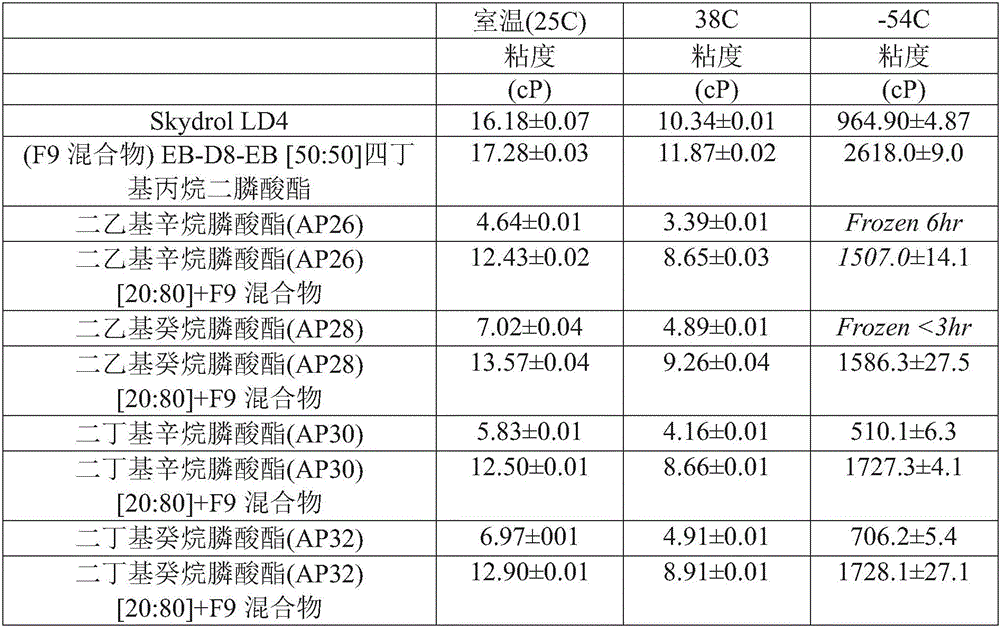
产物分析Product analysis
通过GC、质子NMR和/或HPLC分析聚硅氧烷产物。下面呈现的分析数据针对EB-D8-EB,并且提供了除EB-D8-EB之外的聚硅氧烷的分析方法的说明。这里呈现的分析数据与第一反应步骤——即开环聚合以形成聚硅氧烷主链(GC和NMR),第二反应步骤——即通过硅氢加成加帽(GC和NMR)以及最终产物中低聚物的分布(HPLC)有关。另外呈现了其中已除去低分子量挥发物的蒸馏/WFE产物的典型GC痕量。The polysiloxane product was analyzed by GC, proton NMR and/or HPLC. The analytical data presented below is for EB-D8-EB and provides a description of the analytical methods for polysiloxanes other than EB-D8-EB. The analytical data presented here relate to the first reaction step, namely ring-opening polymerization to form the polysiloxane backbone (GC and NMR), the second reaction step, namely capping by hydrosilylation (GC and NMR), and The distribution (HPLC) of the oligomers in the final product is related. Also presented are typical GC traces of distillation/WFE products from which low molecular weight volatiles have been removed.
EB-D8-EB的分析数据Analytical data for EB-D8-EB
在图2中显示了用于制备EB-D8-EB的第一步的GC数据,其显示了GC中易挥发的低聚物的分布。在该方法的这个阶段,在GC中观察到19种硅链长的低聚物(参见图2)。还在下面的表6中提供的GC结果显示了聚硅氧烷主链的形成,其中数均/重均(NiWi)接近目标D8。GC data for the first step used to prepare EB-D8-EB are shown in Figure 2, which shows the distribution of volatile oligomers in the GC. At this stage of the process, 19 oligomers of silicon chain length were observed in the GC (see Figure 2). The GC results, also provided in Table 6 below, show the formation of a polysiloxane backbone with number/weight average (NiWi) close to target D8.
表6:GC结果Table 6: GC results

在图3中提供了与制备EB-D8-EB的第一步相关的质子NMR,其显示发生了链延伸,其中末端Si-H基团明显(在~4.65处的峰)和与Si相关联的甲基(峰~0.15是末端Si和峰0.05是主链Si)。The proton NMR associated with the first step in the preparation of EB-D8-EB is provided in Figure 3, which shows that chain extension occurs with terminal Si-H groups evident (peak at ~4.65) and associated with Si of methyl groups (peak ~0.15 is terminal Si and peak 0.05 is main chain Si).
图4中提供了与制备EB-D8-EB的第二步(硅氢加成)相关的GC数据,其显示在GC中易挥发的低聚物的分布。在该方法的这个阶段,由于发生了硅氢加成,观察到11种硅链长的低聚物。将会注意到,更长链低聚物不出现在GC中,使得平均链长看起来比其实际的要小。还在下面的表7中提供了GC数据。GC data related to the second step (hydrosilylation) to prepare EB-D8-EB is provided in Figure 4, which shows the distribution of volatile oligomers in GC. At this stage of the process, 11 oligomers of silicon chain length were observed due to hydrosilylation. It will be noted that longer chain oligomers do not appear in the GC, making the average chain length appear smaller than it actually is. GC data is also provided in Table 7 below.
表7:硅氢加成产物Table 7: Hydrosilylation Products


图5中显示的用于制备EB-D8-EB的第二反应步骤的质子NMR表明在该方法完成时没有看到起始H-D8-H(上面的质子NMR中~4.65处的峰不明显)。The proton NMR of the second reaction step shown in Figure 5 for the preparation of EB-D8-EB indicated that no starting H-D8-H was seen at the completion of the process (the peak at ~4.65 in the proton NMR above was not evident ).
图6中EB-D8-EB的HPLC显示低分子量低聚物的分离。图7中EB-D8-EB的HPLC显示低聚物的完整分布。HPLC of EB-D8-EB in Figure 6 showed separation of low molecular weight oligomers. HPLC of EB-D8-EB in Figure 7 showed a complete distribution of oligomers.
上面呈现的组合的HPLC数据的分析和整合显示了EB-D8-EB产物中存在的低聚物的相对量,允许确定平均链长为~8(参见图1)。Analysis and integration of the combined HPLC data presented above showed the relative amounts of oligomers present in the EB-D8-EB product, allowing the determination of an average chain length of -8 (see Figure 1).
图8(在蒸馏/WFE之前)和图9(在蒸馏/WFE之后)中的GC数据显示在蒸馏/WFE之后的分布,这清楚地指示低分子量挥发物存在的减少。The GC data in Figure 8 (before distillation/WFE) and Figure 9 (after distillation/WFE) show the distribution after distillation/WFE, which clearly indicates a reduction in the presence of low molecular weight volatiles.
添加剂添加Additive addition
当酸值超出规格时,可以通过使用活性氧化铝来降低酸值。使用DCE 410[7-氧杂二环[4.1.0]庚烷-3-羧酸,2-乙基己基]是在
B.式1和1a的聚硅氧烷化合物的制备B. Preparation of Polysiloxane Compounds of
实施例1:α,ω-二乙基苄基八硅氧烷(EB-D8-EB)的制备Example 1: Preparation of α,ω-diethylbenzyl octasiloxane (EB-D8-EB)

将TMDS(四甲基二硅氧烷;671.6g)置于配备有磁性搅拌子(magnetic flea)、氮气进料、真空管线和冷凝器的5000ml圆底烧瓶中。加入D4(八甲基环四硅氧烷;2341.7g),使用氮气和真空使混合物脱气,然后加入三氟甲磺酸(4.34g),伴随搅拌。将温度升高至50℃,持续3小时,以产生平均长度8个重复单元的氢化物封端的硅氧烷链的分布。接下来,加入大量过量的碳酸氢钠(6.08g),并且搅拌该混合物30分钟以确保酸的中和。将Karstedt催化剂(2%,1.00g)加入到苯乙烯(1066.9g)中,并且然后将该混合物分三部分:293g、352g和448g;以约1小时的间隔加入到氢化物封端的硅氧烷中。每次添加之后不久,将温度升高约40℃,然后缓慢降低。在最后一次添加之后1小时,加入活性炭(20g)以吸附Karstedt催化剂,并将混合物搅拌进一步的1小时。然后加入助滤剂(C盐542;20g),并通过中速纸过滤该混合物。然后通过在减压下蒸馏(~1mBar,高达160℃),或通过刮膜蒸发(~5mBar,在150℃下,在2”单元上4ml/min流速)从过滤的反应混合物中除去挥发物(主要是残留的苯乙烯和D4)。最终产物为白色至浅黄色油。TMDS (tetramethyldisiloxane; 671.6 g) was placed in a 5000 ml round bottom flask equipped with a magnetic flea, nitrogen feed, vacuum line and condenser. D4 (octamethylcyclotetrasiloxane; 2341.7 g) was added, the mixture was degassed using nitrogen and vacuum, then trifluoromethanesulfonic acid (4.34 g) was added with stirring. The temperature was raised to 50°C for 3 hours to produce a distribution of hydride-terminated siloxane chains with an average length of 8 repeating units. Next, a large excess of sodium bicarbonate (6.08 g) was added and the mixture was stirred for 30 minutes to ensure neutralization of the acid. Karstedt's catalyst (2%, 1.00 g) was added to styrene (1066.9 g) and the mixture was then divided into three portions: 293 g, 352 g and 448 g; added to the hydride terminated siloxane at about 1 hour intervals middle. Shortly after each addition, the temperature was increased by about 40°C and then slowly decreased. 1 hour after the last addition, activated carbon (20 g) was added to adsorb Karstedt's catalyst and the mixture was stirred for a further 1 hour. A filter aid (celite 542; 20 g) was then added and the mixture was filtered through medium speed paper. Volatiles ( Mainly residual styrene and D4). The final product is a white to pale yellow oil.
通过液相色谱分析硅氧烷产物的组成,并且获得的硅氧烷低聚物混合物表示在图1中提供的图表中,其中在垂直轴上提供特定硅氧烷化合物的量,并且沿水平轴提供由硅烷(Si)基团的数量限定的硅氧烷化合物。数均摩尔质量测定为869,重均摩尔质量测定为1044,并且由这些计算测定多分散度(PD)为约1.2。硅氧烷低聚物混合物的组合物基本上提供对应于约8个硅烷基团的数均硅氧烷低聚物(即EB-D8-EB)。该硅氧烷产物组合物显示为提供用作液压流体或其中的组分的有利性质,其包括有利的粘度性质和与包括其各种组分和添加剂的其它液压流体的各种相容性。The composition of the siloxane product was analyzed by liquid chromatography, and the obtained mixture of siloxane oligomers is represented in the graph provided in Figure 1, where the amount of a particular siloxane compound is provided on the vertical axis and along the horizontal axis A siloxane compound is provided which is limited by the number of silane (Si) groups. The number average molar mass was determined to be 869, the weight average molar mass was determined to be 1044, and the polydispersity (PD) was determined to be about 1.2 from these calculations. The composition of the siloxane oligomer mixture essentially provides a number average siloxane oligomer corresponding to about 8 silane groups (ie, EB-D8-EB). The silicone product composition is shown to provide advantageous properties for use as, or a component of, a hydraulic fluid, including advantageous viscosity properties and various compatibilities with other hydraulic fluids including its various components and additives.
实施例2:α,ω-二乙基苄基乙基苄基十二硅氧烷(EB-D12EB-EB)的制备Example 2: Preparation of α,ω-diethylbenzylethylbenzyldodecasiloxane (EB-D12EB-EB)

将TMDS(四甲基二硅氧烷;134.3g)置于配备有磁性搅拌子、氮气进料、真空管线、冷凝器和温度探针的2000ml圆底烧瓶中。加入D4(八甲基环四硅氧烷;667.4g)和“D4H”(四甲基环四硅氧烷;60.1g),使用氮气和真空使混合物脱气,然后加入三氟甲磺酸(1.72g),伴随搅拌。将温度升高至50℃-60℃持续三小时,以产生平均长度12个重复单元的氢化物封端的硅氧烷链的分布,每个链平均具有3个氢化物单元。接下来,加入大量过量的碳酸氢钠(3.65g),并且搅拌该混合物30分钟以确保酸的中和。将Karstedt催化剂(2%,1.50g)加入苯乙烯(320.1g)中,并且然后将该混合物分成两部分,每份160.0g加入到氢化物封端的硅氧烷中,在添加之间具有约1小时的延迟。在每次添加之后不久,将温度升高约50℃,然后缓慢降低。在最后一次添加之后1小时,加入活性炭(8.8g)以吸附Karstedt催化剂,并将混合物搅拌进一步的1小时。然后加入助滤剂(C盐542;8.8g),并通过中速纸过滤该混合物。然后通过在减压下蒸馏(~1mBar,高达160℃),或通过刮膜蒸发(~5mBar,在150℃下,在2”单元上4ml/min流速)从过滤的反应混合物去除挥发物(主要是残留的苯乙烯和D4)。最终产物为白色至浅黄色油。TMDS (tetramethyldisiloxane; 134.3 g) was placed in a 2000 ml round bottom flask equipped with a magnetic stir bar, nitrogen feed, vacuum line, condenser and temperature probe. D4 (octamethylcyclotetrasiloxane; 667.4 g) and "D4H" (tetramethylcyclotetrasiloxane; 60.1 g) were added, the mixture was degassed using nitrogen and vacuum, and trifluoromethanesulfonic acid ( 1.72 g) with stirring. The temperature was raised to 50°C-60°C for three hours to produce a distribution of hydride-terminated siloxane chains with an average length of 12 repeating units, each chain having an average of 3 hydride units. Next, a large excess of sodium bicarbonate (3.65 g) was added, and the mixture was stirred for 30 minutes to ensure neutralization of the acid. Karstedt's catalyst (2%, 1.50 g) was added to styrene (320.1 g) and the mixture was then divided into two portions of 160.0 g each added to the hydride terminated siloxane with about 1 g between additions hours of delay. Shortly after each addition, the temperature was increased by about 50°C and then slowly decreased. 1 hour after the last addition, activated carbon (8.8 g) was added to adsorb Karstedt's catalyst and the mixture was stirred for a further 1 hour. A filter aid (Celite 542; 8.8 g) was then added and the mixture was filtered through medium speed paper. Volatiles (mainly volatiles) were then removed from the filtered reaction mixture by distillation under reduced pressure (~1 mBar, up to 160°C), or by wiped film evaporation (~5mBar, at 150°C, 4 ml/min flow rate on a 2" unit). are residual styrene and D4). The final product is a white to pale yellow oil.
实施例3:α,ω-二乙基苄基二乙基苄基十六硅氧烷(EB-D16EB2-EB)的制备Example 3: Preparation of α,ω-diethylbenzyldiethylbenzylhexadecasiloxane (EB-D16EB2-EB)
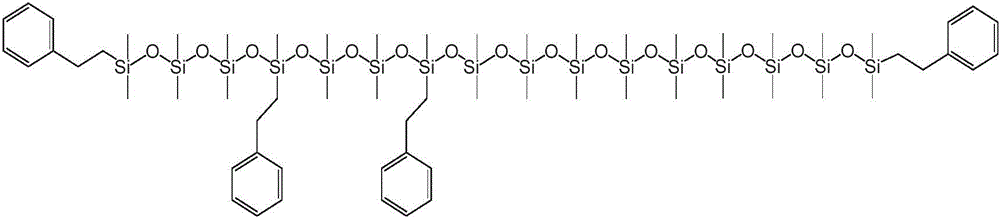
将TMDS(四甲基二硅氧烷;94.03g)置于配备磁性搅拌子、氮气进料、真空管线、冷凝器和温度探针的2000ml圆底烧瓶中。加入D4(八甲基环四硅氧烷;622.90g)和“D4H”(四甲基环四硅氧烷;84.18g),使用氮气和真空使混合物脱气,然后加入三氟甲磺酸(1.602g),伴随搅拌。将温度升高至60℃-70℃,持续四小时,以产生平均长度16个重复单元的氢化物封端的硅氧烷链的分布,每个链平均具有3个氢化物单元。接下来,加入大量过量的碳酸氢钠(5.66g),并且搅拌该混合物30分钟以确保酸的中和。将Karstedt催化剂(2%,0.8g)加入到苯乙烯(298.72g)中,并且然后将该混合物分成两部分,每份149.36g加入到氢化物封端的硅氧烷中,在添加之间具有约40分钟的延迟。在每次添加之后不久,将温度分别升高约70℃和40℃,然后缓慢降低。在最后一次添加之后1小时,加入活性炭(8.2g)以吸附Karstedt催化剂,并且将混合物搅拌进一步的2-3小时。然后加入助滤剂(C盐542;5.46g),并通过中速纸过滤该混合物。然后通过在减压下蒸馏(~1mBar,高达160℃),或通过刮膜蒸发(~5mBar,在150℃下,在2”单元上4ml/min流速)从过滤的反应混合物去除挥发物(主要是残留的苯乙烯和D4)。最终产物为白色至浅黄色油。TMDS (tetramethyldisiloxane; 94.03 g) was placed in a 2000 ml round bottom flask equipped with a magnetic stir bar, nitrogen feed, vacuum line, condenser and temperature probe. D4 (octamethylcyclotetrasiloxane; 622.90 g) and "D4H" (tetramethylcyclotetrasiloxane; 84.18 g) were added, the mixture was degassed using nitrogen and vacuum, then trifluoromethanesulfonic acid ( 1.602 g) with stirring. The temperature was raised to 60°C-70°C for four hours to produce a distribution of hydride-terminated siloxane chains with an average length of 16 repeating units, each chain having an average of 3 hydride units. Next, a large excess of sodium bicarbonate (5.66 g) was added, and the mixture was stirred for 30 minutes to ensure neutralization of the acid. Karstedt's catalyst (2%, 0.8 g) was added to styrene (298.72 g), and the mixture was then divided into two portions of 149.36 g each added to the hydride terminated siloxane with approx. 40 minutes delay. Shortly after each addition, the temperature was increased by about 70°C and 40°C, respectively, and then slowly decreased. 1 hour after the last addition, activated carbon (8.2 g) was added to adsorb the Karstedt catalyst and the mixture was stirred for a further 2-3 hours. A filter aid (Celite 542; 5.46 g) was then added and the mixture was filtered through medium speed paper. Volatiles (mainly volatiles) were then removed from the filtered reaction mixture by distillation under reduced pressure (~1 mBar, up to 160°C), or by wiped film evaporation (~5mBar, at 150°C, 4 ml/min flow rate on a 2" unit). are residual styrene and D4). The final product is a white to pale yellow oil.
实施例4:α,ω-二乙基苄基二苯基十六硅氧烷(EB-D16(Ph2)-EB)的制备Example 4: Preparation of α,ω-diethylbenzyldiphenylhexadecasiloxane (EB-D16(Ph2)-EB)

将TMDS(四甲基二硅氧烷;94.03g)置于配备磁性搅拌子、氮气进料、真空管线、冷凝器和温度探针的2000ml圆底烧瓶中。加入D4(八甲基环四硅氧烷;622.90g)和“D3PH”(三甲基三苯基环硅氧烷;190.72g),使用氮气和真空使混合物脱气,然后加入三氟甲磺酸(1.43g),伴随搅拌。在室温下搅拌该混合物,持续四小时,以产生平均长度16个重复单元的氢化物封端的硅氧烷链的分布,每个链平均具有3个氢化物单元。接下来,加入大量过量的碳酸氢钠(4.01g),并且搅拌该混合物30分钟以确保酸的中和。将Karstedt催化剂(2%,0.234g)加入到苯乙烯(149.36g)中,并且然后将该混合物加入到氢化物封端的硅氧烷中。之后不久,将温度升高约60℃,并且然后缓慢降低。之后1小时,加入活性炭(11.04g)以吸附Karstedt催化剂,并且将混合物搅拌进一步的2-3小时。然后加入助滤剂(C盐542;184.36g),并通过中速纸过滤该混合物。然后通过在减压下蒸馏(~1mBar,高达160℃),或通过刮膜蒸发(~5mBar,在150℃下,在2”单元上4ml/min流速)从过滤的反应混合物去除挥发物(主要是残留的苯乙烯和D4)。TMDS (tetramethyldisiloxane; 94.03 g) was placed in a 2000 ml round bottom flask equipped with a magnetic stir bar, nitrogen feed, vacuum line, condenser and temperature probe. D4 (octamethylcyclotetrasiloxane; 622.90 g) and "D3PH" (trimethyltriphenylcyclosiloxane; 190.72 g) were added, the mixture was degassed using nitrogen and vacuum, then trifluoromethanesulfonic acid was added acid (1.43 g) with stirring. The mixture was stirred at room temperature for four hours to produce a distribution of hydride-terminated siloxane chains with an average length of 16 repeating units, each chain having an average of 3 hydride units. Next, a large excess of sodium bicarbonate (4.01 g) was added and the mixture was stirred for 30 minutes to ensure neutralization of the acid. Karstedt catalyst (2%, 0.234 g) was added to styrene (149.36 g), and the mixture was then added to the hydride terminated siloxane. Shortly thereafter, the temperature was increased by about 60°C, and then slowly decreased. After 1 hour, activated carbon (11.04 g) was added to adsorb Karstedt catalyst and the mixture was stirred for a further 2-3 hours. A filter aid (Celite 542; 184.36 g) was then added and the mixture was filtered through medium speed paper. Volatiles (mainly volatiles) were then removed from the filtered reaction mixture by distillation under reduced pressure (~1 mBar, up to 160°C), or by wiped film evaporation (~5mBar, at 150°C, 4 ml/min flow rate on a 2" unit). are residual styrene and D4).
实施例5:α,ω-四苯基八硅氧烷(Ph2-D8-Ph2)的制备Example 5: Preparation of α,ω-tetraphenyloctasiloxane (Ph2-D8-Ph2)

将TPhTMTS(1,1,5,5-四苯基-1,3,3,5-四甲基三硅氧烷,24.24g)置于配备磁性搅拌子、氮气进料、真空管线、冷凝器和温度探针的100ml圆底烧瓶中。加入D4(八甲基环四硅氧烷;18.54g),使用氮气和真空使混合物脱气,然后加入三氟甲磺酸(0.11g),在氮气下搅拌,持续5小时。加入过量的碳酸氢钠(0.76g)和活性炭(0.76g),并且搅拌该混合物,持续6小时。然后加入助滤剂(C盐),并通过中速纸过滤该混合物。然后通过在~10mBar下,在80℃下旋转蒸发持续3-4小时从过滤的反应混合物去除挥发物。产生透明液体。TPhTMTS (1,1,5,5-tetraphenyl-1,3,3,5-tetramethyltrisiloxane, 24.24 g) was placed in a device equipped with a magnetic stir bar, nitrogen feed, vacuum line, condenser and temperature probe in a 100 ml round bottom flask. D4 (octamethylcyclotetrasiloxane; 18.54 g) was added, the mixture was degassed using nitrogen and vacuum, then trifluoromethanesulfonic acid (0.11 g) was added and stirred under nitrogen for 5 hours. Excess sodium bicarbonate (0.76 g) and activated carbon (0.76 g) were added and the mixture was stirred for 6 hours. A filter aid (celite) was then added and the mixture was filtered through medium speed paper. Volatiles were then removed from the filtered reaction mixture by rotary evaporation at 80°C for 3-4 hours at ~10 mBar. Produces a clear liquid.
实施例6:四乙基苄基四甲基四环硅氧烷的制备Example 6: Preparation of tetraethylbenzyltetramethyltetracyclosiloxane
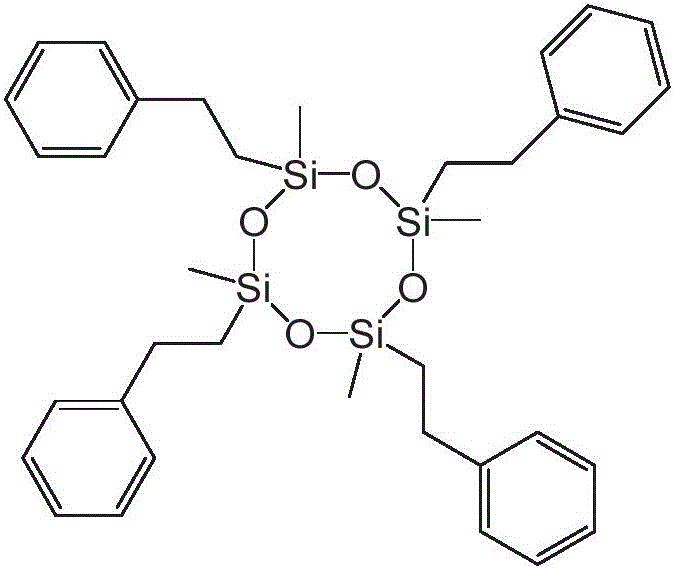
将D4H(四甲基环四硅氧烷;24.05g)置于配备磁性搅拌子、氮气进料、真空管线、冷凝器和温度探针的100ml圆底烧瓶中。使用氮气和真空使混合物脱气,然后加入Karstedt催化剂(2%,0.16g)。随后,分四部分加入苯乙烯(42.675g),并且使混合物在下一次添加之前冷却。在每次添加之后不久,将温度升高约40-70℃,并且然后缓慢降低。在最后一次添加之后,使混合物冷却,并加入活性炭(0.66g)以吸附Karstedt催化剂。通过中速纸过滤该混合物,并且然后通过在减压下蒸馏(~1mBar,高达160℃),或通过刮膜蒸发(~5mBar,在150℃下,在2”单元上4ml/min流速)从过滤的反应混合物去除挥发物。最终产物为黏性液体。D4H (tetramethylcyclotetrasiloxane; 24.05 g) was placed in a 100 ml round bottom flask equipped with a magnetic stir bar, nitrogen feed, vacuum line, condenser and temperature probe. The mixture was degassed using nitrogen and vacuum, then Karstedt's catalyst (2%, 0.16 g) was added. Subsequently, styrene (42.675 g) was added in four portions and the mixture was allowed to cool before the next addition. Shortly after each addition, the temperature was increased by about 40-70°C, and then slowly decreased. After the last addition, the mixture was allowed to cool and activated carbon (0.66 g) was added to adsorb the Karstedt catalyst. The mixture was filtered through medium speed paper, and then extracted from the mixture by distillation under reduced pressure (~1 mBar, up to 160°C), or by wiped film evaporation (~5mBar, at 150°C, 4 ml/min flow rate on a 2" unit). The reaction mixture was filtered to remove volatiles. The final product was a viscous liquid.
实施例7:α,ω-二乙基苄基苯基十二硅氧烷(EB-D12(Ph)-EB)的制备Example 7: Preparation of α,ω-diethylbenzylphenyldodecasiloxane (EB-D12(Ph)-EB)

将TMDS(四甲基二硅氧烷;6.72g)置于配备磁性搅拌子、氮气进料、真空管线、冷凝器和温度探针的250ml圆底烧瓶中。加入D4(八甲基环四硅氧烷;33.37g)和“D3Ph”(三甲基三苯基环硅氧烷:6.81g),使用氮气和真空使混合物脱气,然后加入三氟甲磺酸(0.10g),伴随搅拌。在室温下搅拌该混合物,持续三小时。加入碳酸氢钠(0.35g),并且搅拌该混合物30分钟以确保酸的中和。然后加入苯乙烯(10.67g),接着加入Karstedt催化剂(2%,0.075g)。在添加之后不久,将温度分别升高约60℃,然后缓慢降低。加入活性炭(0.6g)以吸附Karstedt催化剂。然后通过在减压下蒸馏(~1mBar,高达160℃),持续两小时,从过滤的反应混合物去除挥发物。TMDS (tetramethyldisiloxane; 6.72 g) was placed in a 250 ml round bottom flask equipped with a magnetic stir bar, nitrogen feed, vacuum line, condenser and temperature probe. D4 (octamethylcyclotetrasiloxane; 33.37 g) and "D3Ph" (trimethyltriphenylcyclotetrasiloxane: 6.81 g) were added, the mixture was degassed using nitrogen and vacuum, then trifluoromethanesulfonic acid was added Acid (0.10 g) with stirring. The mixture was stirred at room temperature for three hours. Sodium bicarbonate (0.35 g) was added and the mixture was stirred for 30 minutes to ensure neutralization of the acid. Styrene (10.67 g) was then added, followed by Karstedt's catalyst (2%, 0.075 g). Shortly after the addition, the temperatures were each increased by about 60°C and then slowly decreased. Activated carbon (0.6 g) was added to adsorb the Karstedt catalyst. Volatiles were then removed from the filtered reaction mixture by distillation under reduced pressure (~1 mBar, up to 160°C) for two hours.
实施例8:α,ω-二乙基苄基二苯基十二硅氧烷(EB-D12(Ph2)-EB)的制备Example 8: Preparation of α,ω-diethylbenzyldiphenyldodecasiloxane (EB-D12(Ph2)-EB)

将TMDS(四甲基二硅氧烷;6.72g)置于配备磁性搅拌子、氮气进料、真空管线、冷凝器和温度探针的250ml圆底烧瓶中。加入D4(八甲基环四硅氧烷;29.66g)和“D3Ph”(三甲基三苯基环硅氧烷:13.62g),使用氮气和真空使混合物脱气,然后加入三氟甲磺酸(0.09g),伴随搅拌。在室温下搅拌该混合物,持续三小时。加入碳酸氢钠(0.15g),并且搅拌该混合物30分钟以确保酸的中和。然后加入苯乙烯(10.67g),接着加入Karstedt催化剂(2%,0.04g)。在添加之后不久,将温度分别升高约60℃,然后缓慢降低。加入活性炭(0.6g)以吸附Karstedt催化剂。然后通过在减压下蒸馏(~1mBar,高达160℃),持续两小时,从过滤的反应混合物去除挥发物。TMDS (tetramethyldisiloxane; 6.72 g) was placed in a 250 ml round bottom flask equipped with a magnetic stir bar, nitrogen feed, vacuum line, condenser and temperature probe. D4 (octamethylcyclotetrasiloxane; 29.66 g) and "D3Ph" (trimethyltriphenylcyclotetrasiloxane: 13.62 g) were added, the mixture was degassed using nitrogen and vacuum, then trifluoromethanesulfonic acid was added acid (0.09 g) with stirring. The mixture was stirred at room temperature for three hours. Sodium bicarbonate (0.15 g) was added and the mixture was stirred for 30 minutes to ensure neutralization of the acid. Styrene (10.67 g) was then added, followed by Karstedt's catalyst (2%, 0.04 g). Shortly after the addition, the temperatures were each increased by about 60°C and then slowly decreased. Activated carbon (0.6 g) was added to adsorb the Karstedt catalyst. Volatiles were then removed from the filtered reaction mixture by distillation under reduced pressure (~1 mBar, up to 160°C) for two hours.
实施例9:α,ω-二乙基苄基乙基苄基十二硅氧烷(EB-D12(EB)-EB)的制备Example 9: Preparation of α,ω-diethylbenzylethylbenzyldodecasiloxane (EB-D12(EB)-EB)
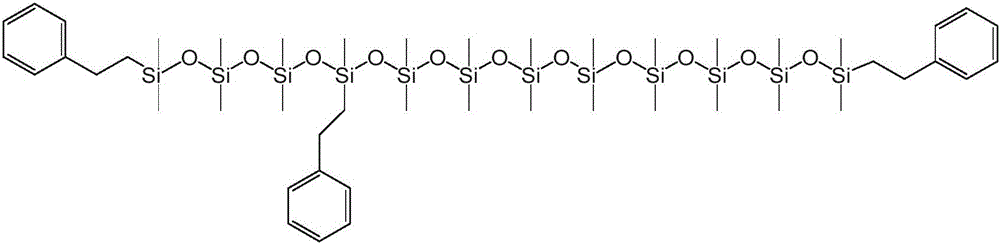
将TMDS(四甲基二硅氧烷;2014.9g)置于配备磁性搅拌子、氮气进料、真空管线、冷凝器和温度探针的2000ml圆底烧瓶中。加入D4(八甲基环四硅氧烷;10010.8g)和“D4H”(四甲基环四硅氧烷;901.9g),使用氮气和真空使混合物脱气,然后加入三氟甲磺酸(25.85g),伴随搅拌。在70℃下搅拌该混合物,持续四小时。加入碳酸氢钠(0.15g),并且搅拌该混合物30分钟以确保酸的中和。然后加入苯乙烯(2400g),接着加入Karstedt催化剂(2%,0.5g)。观察到~80℃的放热,并且使反应混合物冷却至约~70℃,然后第二部分苯乙烯(2400g)接着发生~40℃的放热。使反应冷却到~80℃,然后加入活性炭(132.1g)以吸附Karstedt催化剂。加入C盐(88g)和MgSO4(88g),并且过滤该混合物。然后通过在减压下蒸馏(~1mBar,高达160℃),持续两小时,从过滤的反应混合物去除挥发物。TMDS (tetramethyldisiloxane; 2014.9 g) was placed in a 2000 ml round bottom flask equipped with a magnetic stir bar, nitrogen feed, vacuum line, condenser and temperature probe. D4 (octamethylcyclotetrasiloxane; 10010.8 g) and "D4H"(tetramethylcyclotetrasiloxane; 901.9 g) were added, the mixture was degassed using nitrogen and vacuum, then trifluoromethanesulfonic acid ( 25.85 g) with stirring. The mixture was stirred at 70°C for four hours. Sodium bicarbonate (0.15 g) was added and the mixture was stirred for 30 minutes to ensure neutralization of the acid. Styrene (2400 g) was then added, followed by Karstedt's catalyst (2%, 0.5 g). An exotherm of ~80°C was observed and the reaction mixture was allowed to cool to about ~70°C, followed by a second portion of styrene (2400 g) with an exotherm of ~40°C. The reaction was cooled to -80°C, then activated carbon (132.1 g) was added to adsorb Karstedt catalyst. Celite (88 g) and MgSO4 (88 g) were added, and the mixture was filtered. Volatiles were then removed from the filtered reaction mixture by distillation under reduced pressure (~1 mBar, up to 160°C) for two hours.
实施例10:α,ω-二乙基苄基二乙基苄基十二硅氧烷(EB-D12(EB2)-EB)的制备Example 10: Preparation of α,ω-diethylbenzyldiethylbenzyldodecasiloxane (EB-D12(EB2)-EB)

将TMDS(四甲基二硅氧烷;6.72g)置于配备磁性搅拌子、氮气进料、真空管线、冷凝器和温度探针的100ml圆底烧瓶中。加入D4(八甲基环四硅氧烷;29.7g)和“D4H”(四甲基环四硅氧烷;6.01g),使用氮气和真空使混合物脱气,然后加入三氟甲磺酸(0.106g),伴随搅拌。在50-60℃下搅拌该混合物,持续三小时。加入碳酸氢钠(0.18g),并且搅拌该混合物10-20分钟以确保酸的中和。然后加入苯乙烯(21.3g),接着加入Karstedt催化剂(2%,0.08g)。观察到~100℃的放热。使反应冷却到环境温度,然后加入活性炭(0.6g)以吸附Karstedt催化剂。过滤该混合物。然后通过在减压下蒸馏(~1mBar,高达160℃),持续两小时,从过滤的反应混合物去除挥发物。TMDS (tetramethyldisiloxane; 6.72 g) was placed in a 100 ml round bottom flask equipped with a magnetic stir bar, nitrogen feed, vacuum line, condenser and temperature probe. D4 (octamethylcyclotetrasiloxane; 29.7 g) and "D4H" (tetramethylcyclotetrasiloxane; 6.01 g) were added, the mixture was degassed using nitrogen and vacuum, then trifluoromethanesulfonic acid ( 0.106 g) with stirring. The mixture was stirred at 50-60°C for three hours. Sodium bicarbonate (0.18 g) was added and the mixture was stirred for 10-20 minutes to ensure neutralization of the acid. Styrene (21.3 g) was then added, followed by Karstedt's catalyst (2%, 0.08 g). An exotherm of ~100°C was observed. The reaction was allowed to cool to ambient temperature, then activated carbon (0.6 g) was added to adsorb the Karstedt catalyst. Filter the mixture. Volatiles were then removed from the filtered reaction mixture by distillation under reduced pressure (~1 mBar, up to 160°C) for two hours.
实施例11:四苯基十六硅氧烷(Ph2-D16-Ph2)的制备Example 11: Preparation of Tetraphenylhexadecasiloxane (Ph2-D16-Ph2)

将TPhTMTS(1,1,5,5-四苯基-1,3,3,5-四甲基三硅氧烷,9.7g)置于配备磁性搅拌子、氮气进料、真空管线、冷凝器和温度探针的100ml圆底烧瓶中。加入D4(八甲基环四硅氧烷;19.28g),使用氮气和真空使混合物脱气,然后加入硅氧烷醇(0.3g),在氮气下搅拌过夜,然后加热至150℃,持续一小时。TPhTMTS (1,1,5,5-tetraphenyl-1,3,3,5-tetramethyltrisiloxane, 9.7 g) was placed in a device equipped with a magnetic stir bar, nitrogen feed, vacuum line, condenser and temperature probe in a 100 ml round bottom flask. D4 (octamethylcyclotetrasiloxane; 19.28 g) was added, the mixture was degassed using nitrogen and vacuum, then siloxanol (0.3 g) was added, stirred overnight under nitrogen, then heated to 150°C for a Hour.
C.式2的二膦酸酯化合物的制备C. Preparation of Bisphosphonate Compounds of
实施例7:四乙基丙烷二膦酸酯的制备Example 7: Preparation of Tetraethylpropane Diphosphonate
将1,3-二溴丙烷(60.6g)和亚磷酸三乙酯(100.0g)装入配备磁性搅拌子、氮气进料、冷凝器、接收器和温度探针250ml圆底烧瓶中。开始缓慢的氮气进料,并且使温度朝向180℃上升,伴随搅拌。在约150℃下,随着副产物乙基溴蒸馏到接收器内,混合物开始沸腾,并且升温速率增加。温度在约185℃处达到峰值,在此之后缓慢地进料剩余的亚磷酸三乙酯(50.0g)。将该混合物维持在170℃-180℃下,持续进一步的2小时,以确保完全反应。然后冷却粗产物,并且通过在减压下蒸馏(~1mBar,高达160℃),或通过刮膜蒸发(~5mBar,在160℃下,在2”单元上4ml/min流速)从反应混合物去除挥发物(主要是未反应的亚磷酸三乙酯,和副反应副产物二乙基乙基膦酸酯(diethyl ethyl phosphonate))。最终产物为白色油。1,3-Dibromopropane (60.6 g) and triethyl phosphite (100.0 g) were charged into a 250 ml round bottom flask equipped with a magnetic stir bar, nitrogen feed, condenser, receiver and temperature probe. A slow nitrogen feed was started and the temperature was raised towards 180°C with stirring. At about 150°C, the mixture began to boil and the rate of temperature increase increased as the by-product ethyl bromide was distilled into the receiver. The temperature peaked at about 185°C after which the remaining triethyl phosphite (50.0 g) was fed slowly. The mixture was maintained at 170°C-180°C for a further 2 hours to ensure complete reaction. The crude product was then cooled and volatiles removed from the reaction mixture by distillation under reduced pressure (~1 mBar, up to 160°C), or by wiped film evaporation (~5mBar, at 160°C, 4 ml/min flow rate on a 2" unit). (mainly unreacted triethyl phosphite, and by-product diethyl ethyl phosphonate). The final product is a white oil.
实施例8:四丁基丙烷二膦酸酯的制备Example 8: Preparation of Tetrabutylpropane Diphosphonate
将1,3-二溴丙烷(888.3g)和亚磷酸三丁酯(2203g)装入配备磁性搅拌子、氮气进料、冷凝器、接收器和温度探针的5000ml圆底烧瓶中。开始缓慢的氮气进料,并且使温度朝向180℃上升,伴随搅拌。在约150℃下,随着副产物丁基溴蒸馏到接收器内混合物开始沸腾,并且升温速率增加。当温度达到200℃时,以足够的速率进料剩余的亚磷酸三丁酯(881g)以维持反应温度接近200℃。将该混合物维持在170℃-190℃下,持续进一步的2小时以确保完全反应。然后冷却粗产物,并且通过在减压下蒸馏(~1mBar,高达160℃),或通过刮膜蒸发(~5mBar,在160℃下,在2”单元上4ml/min流速)从反应混合物去除挥发物(主要是未反应的亚磷酸三丁酯,和副反应副产物二丁基丁烷膦酸酯)。最终产物为白色至浅黄色油。1,3-Dibromopropane (888.3 g) and tributyl phosphite (2203 g) were charged into a 5000 ml round bottom flask equipped with a magnetic stir bar, nitrogen feed, condenser, receiver and temperature probe. A slow nitrogen feed was started and the temperature was raised towards 180°C with stirring. At about 150°C, the mixture began to boil as the by-product butyl bromide distilled into the receiver, and the rate of temperature increase increased. When the temperature reached 200°C, the remaining tributyl phosphite (881 g) was fed at a sufficient rate to maintain the reaction temperature near 200°C. The mixture was maintained at 170°C-190°C for a further 2 hours to ensure complete reaction. The crude product was then cooled and volatiles removed from the reaction mixture by distillation under reduced pressure (~1 mBar, up to 160°C), or by wiped film evaporation (~5mBar, at 160°C, 4 ml/min flow rate on a 2" unit). (mainly unreacted tributyl phosphite, and by-product dibutyl butane phosphonate). The final product is a white to pale yellow oil.
实施例9:二乙基二丁基丙烷二膦酸酯的制备Example 9: Preparation of diethyldibutylpropane diphosphonate
将1,3-二溴丙烷(504.72g)和亚磷酸三乙酯(498.47g)装入配备磁性搅拌子、氮气进料、冷凝器、接收器和温度探针的2000ml圆底烧瓶中。开始缓慢的氮气进料,并且使温度朝向160℃上升,伴随搅拌。在约140℃下,随着副产物乙基溴蒸馏到接收器内,混合物开始沸腾,并且升温速率增加。在放热达到峰值以后,并且以足够的速率进料蒸馏出亚磷酸三丁酯(625.8g)的副产物,以维持反应温度接近200℃。将该混合物维持在170℃-180℃下,持续进一步的2小时,以确保完全反应。然后冷却粗产物,并且通过在减压下蒸馏(~1mBar,高达160℃),或通过刮膜蒸发(~5mBar,在160℃下,在2”单元上4ml/min流速)从反应混合物去除挥发物(主要是未反应的亚磷酸三乙酯和/或亚磷酸三丁酯)。最终产物为浅黄色油,并且使用活性炭除去颜色。1,3-Dibromopropane (504.72 g) and triethyl phosphite (498.47 g) were charged into a 2000 ml round bottom flask equipped with a magnetic stir bar, nitrogen feed, condenser, receiver and temperature probe. A slow nitrogen feed was started and the temperature was raised towards 160°C with stirring. At about 140°C, the mixture began to boil and the rate of temperature increase increased as the by-product ethyl bromide was distilled into the receiver. After the exotherm peaked and the tributyl phosphite (625.8 g) by-product was fed at a sufficient rate to maintain the reaction temperature near 200°C. The mixture was maintained at 170°C-180°C for a further 2 hours to ensure complete reaction. The crude product was then cooled and volatiles removed from the reaction mixture by distillation under reduced pressure (~1 mBar, up to 160°C), or by wiped film evaporation (~5mBar, at 160°C, 4 ml/min flow rate on a 2" unit). (mainly unreacted triethyl phosphite and/or tributyl phosphite). The final product was a pale yellow oil, and activated carbon was used to remove the color.
实施例10:四丁基二甲苯基二膦酸酯的制备Example 10: Preparation of tetrabutylxylyl diphosphonate
将α,α′-二氯二甲苯(17.51g)和亚磷酸三丁酯(150.19g)装入配备磁性搅拌子、氮气进料、冷凝器、接收器和温度探针的250ml圆底烧瓶中。开始缓慢的氮气进料,并且使温度朝向200℃上升,伴随搅拌。使反应混合物冷却到约160℃,反应并连续加入溴化钠(20.58g)和碘化钠(30g)。然后冷却粗产物,并且通过在减压下蒸馏(~1mBar,高达160℃),或刮膜蒸发(~5mBar,在160℃下,在2”单元上4ml/min流速)从反应混合物去除挥发物(主要是未反应的亚磷酸三丁酯)。Alpha,alpha'-dichloroxylene (17.51 g) and tributyl phosphite (150.19 g) were charged into a 250 ml round bottom flask equipped with a magnetic stir bar, nitrogen feed, condenser, receiver and temperature probe . A slow nitrogen feed was started and the temperature was raised towards 200°C with stirring. The reaction mixture was cooled to about 160°C and reacted with successive additions of sodium bromide (20.58 g) and sodium iodide (30 g). The crude product was then cooled and volatiles were removed from the reaction mixture by distillation under reduced pressure (~1 mBar up to 160°C), or wiped film evaporation (~5mBar at 160°C, 4 ml/min flow rate on a 2" unit) (mainly unreacted tributyl phosphite).
D.式3的膦酸酯化合物的制备D. Preparation of Phosphonate Compounds of
实施例11:二乙基苄基膦酸酯的制备Example 11: Preparation of diethylbenzylphosphonate
将苄基溴(171.0g)和亚磷酸三乙酯(28.5g)加入配备蒸馏装置、磁性搅拌子和20cm长的Dufton分馏柱的500ml圆底烧瓶中。在搅拌下使反应加热到140℃,并且蒸馏出副产物乙基溴,并收集。以维持分馏头温度在约40℃和反应器温度在约140℃的速率再加入五部分亚磷酸三乙酯(28.5g)。一旦蒸馏停止,使用NMR由质子NMR中-CH 2-Br信号的缺失来确认反应已经完成。粗产物经由高真空蒸馏纯化以去除挥发物(主要是未反应的亚磷酸三乙酯和副反应副产物二乙基乙基膦酸酯)。最终产物为透明的浅黄色油。Benzyl bromide (171.0 g) and triethyl phosphite (28.5 g) were added to a 500 ml round bottom flask equipped with a distillation apparatus, magnetic stir bar and a 20 cm long Dufton column. The reaction was heated to 140°C with stirring and the by-product ethyl bromide was distilled off and collected. Five additional portions of triethyl phosphite (28.5 g) were added at a rate to maintain the fractionation head temperature at about 40°C and the reactor temperature at about 140°C. Once distillation stopped, the reaction was confirmed to be complete by the absence of the -CH2 -Br signal in proton NMR using NMR. The crude product was purified via high vacuum distillation to remove volatiles (mainly unreacted triethyl phosphite and side reaction by-product diethylethylphosphonate). The final product was a clear pale yellow oil.
实施例12:二丁基己烷膦酸酯的制备Example 12: Preparation of Dibutyl Hexane Phosphonate
将1-溴己烷(194.8g)和亚磷酸三丁酯(443.1g)加入带有蒸馏装置和磁性搅拌子的圆底烧瓶中。将反应物加热至165-170℃,并且蒸馏出副产物丁基溴,并收集。一旦蒸馏停止,通常在约2-3小时之后,使用NMR由质子NMR中-CH 2-Br信号的缺失来确认反应已经完成。通常,由于其相对高的沸点阻止了快速挥发,仅收集了约50%的理论量的丁基溴。经由高真空蒸馏纯化粗产物以去除挥发物(主要是未反应的亚磷酸三丁酯和副反应副产物二丁基丁烷膦酸酯)。最终产物为透明的浅黄色油。1-Bromohexane (194.8 g) and tributyl phosphite (443.1 g) were added to a round bottom flask equipped with a distillation apparatus and magnetic stir bar. The reaction was heated to 165-170°C and the by-product butyl bromide was distilled off and collected. Once distillation has ceased, typically after about 2-3 hours, the reaction is confirmed to be complete by the absence of the -CH2 -Br signal in proton NMR using NMR. Typically, only about 50% of the theoretical amount of butyl bromide is collected because its relatively high boiling point prevents rapid volatilization. The crude product was purified via high vacuum distillation to remove volatiles (mainly unreacted tributyl phosphite and side reaction by-product dibutyl butanephosphonate). The final product was a clear pale yellow oil.
实施例13:二乙基辛烷膦酸酯的制备Example 13: Preparation of diethyloctanephosphonate
将溴辛烷(1931.3g)和总的亚磷酸三乙酯(1994g)中的一些加入到配备蒸馏装置、磁性搅拌子和20cm长的Dufton分馏柱的5000m1圆底烧瓶中。将反应混合物朝向200℃加热。当温度超过160℃-180℃时,发生剧烈的放热,伴随着副产物乙基溴被蒸馏出,并收集。缓慢加入剩余的亚磷酸三乙酯以便使馏出物温度保持低于100℃。随着放热降低并且反应接近完成,使温度维持在170℃-180℃,持续进一步的2小时。通过真空蒸馏去除未反应的亚磷酸三乙酯和其它挥发物二乙基乙基磷酸酯(DEEP)。一旦蒸馏停止,使用NMR由质子NMR中-CH 2-Br信号的缺失来确认反应已经完成。经由高真空蒸馏纯化粗产物以去除挥发物(主要是未反应的亚磷酸三乙酯和副反应副产物、二乙基乙基膦酸酯)。Bromooctane (1931.3 g) and some of the total triethyl phosphite (1994 g) were added to a 5000 ml round bottom flask equipped with a distillation apparatus, a magnetic stir bar and a 20 cm long Dufton fractionation column. The reaction mixture was heated towards 200°C. When the temperature exceeds 160°C-180°C, a vigorous exotherm occurs, with the by-product ethyl bromide being distilled off and collected. The remaining triethyl phosphite was added slowly to keep the distillate temperature below 100°C. As the exotherm decreased and the reaction neared completion, the temperature was maintained at 170°C-180°C for a further 2 hours. Unreacted triethyl phosphite and other volatiles diethyl ethyl phosphate (DEEP) were removed by vacuum distillation. Once distillation stopped, the reaction was confirmed to be complete by the absence of the -CH2 -Br signal in proton NMR using NMR. The crude product was purified via high vacuum distillation to remove volatiles (mainly unreacted triethyl phosphite and side reaction by-product, diethylethylphosphonate).
进一步,本公开内容包括根据下列条款的实例:Further, this disclosure includes examples according to the following terms:
条款1.一种包括聚硅氧烷化合物和非卤化二膦酸酯化合物的液压流体组合物,其中所述聚硅氧烷化合物由式1的化合物表示:

其中in
y是选自1至40的整数;y is an integer selected from 1 to 40;
R1、R2、R3和R4各自独立地选自C1-10烷基、芳基和C1-10烷基芳基;R 1 , R 2 , R 3 and R 4 are each independently selected from C 1-10 alkyl, aryl and C 1-10 alkylaryl;
每个R5和每个R6独立地选自C1-10烷基、芳基和C1-10烷基芳基;和Each R 5 and each R 6 are independently selected from C 1-10 alkyl, aryl and C 1-10 alkylaryl; and
R1至R4中的至少一个或来自至少一个y单元的R5和R6的至少一个是C1-10烷基芳基。At least one of R 1 to R 4 or at least one of R 5 and R 6 from at least one y unit is a C 1-10 alkylaryl group.
条款2.根据条款1所述的液压流体组合物,其中所述式1的聚硅氧烷化合物由式1a的化合物表示:

其中in
x是选自0至10的整数;x is an integer selected from 0 to 10;
y是选自1至20的整数;y is an integer selected from 1 to 20;
z是选自0至10的整数;z is an integer selected from 0 to 10;
R1、R2、R3和R4各自独立地选自C1-10烷基、芳基和C1-10烷基芳基;R 1 , R 2 , R 3 and R 4 are each independently selected from C 1-10 alkyl, aryl and C 1-10 alkylaryl;
每个R5和每个R6独立地选自C1-10烷基、芳基和C1-10烷基芳基;和Each R 5 and each R 6 are independently selected from C 1-10 alkyl, aryl and C 1-10 alkylaryl; and
每个R7、R8、R9和R10独立地选自C1-10烷基。Each of R 7 , R 8 , R 9 and R 10 is independently selected from C 1-10 alkyl.
条款3.根据条款2所述的液压流体组合物,其中每个R7、R8、R9和R10是甲基,并且x和z是各自独立地选自1至3的整数。
条款4.根据条款所述的液压流体组合物,其中y是选自2至16的整数,或x、y和z的和是选自2至16的整数。
条款5.根据条款2所述的液压流体组合物,其中R1和R2各自独立地选自C1-10烷基、芳基和C1-10烷基芳基;每个R3、R4、R5、R7、R8、R9和R10是C1-4烷基;并且其中选择每个R6和y以提供具有独立地选自芳基和C1-10烷基芳基的1至6个之间任选的取代基的式1a的聚硅氧烷化合物,并且每个R6的任何其它取代基独立地选自C1-4烷基。
条款6.根据条款5所述的液压流体组合物,其中每个R3、R4、R5、R7、R8、R9和R10是甲基,并且每个R6独立地选自甲基、芳基和C1-10烷基芳基。Clause 6. The hydraulic fluid composition of clause 5 , wherein each R3 , R4, R5 , R7 , R8 , R9 , and R10 is methyl, and each R6 is independently selected from Methyl, aryl and C 1-10 alkylaryl.
条款7.根据条款1所述的液压流体组合物,其中R1和R2中的至少一个或两个选自芳基和C1-10烷基芳基。
条款8.根据条款1所述的液压流体组合物,其中所述C1-10烷基芳基是C1-6烷基苯基。
条款9.根据条款8所述的液压流体组合物,其中所述聚硅氧烷化合物中苯基取代基的数量提供相对硅在2和50摩尔%之间的所述硅氧烷化合物中苯基的摩尔%。
条款10.根据条款1所述的液压流体组合物,其中所述组合物包括至少两种式1的聚硅氧烷化合物的混合物。
条款11.根据条款10所述的液压流体组合物,其中所述聚硅氧烷混合物包括一系列不同的式1的聚硅氧烷化合物,每种所述聚硅氧烷化合物具有选自从9至12、8至13、9至14、8至15、7至16或6至17的每个整数和包括从9至12、8至13、9至14、8至15、7至16或6至17的每个整数的不同的y值或硅氧烷重复单元(Si-O)的数量。
条款12.根据条款10所述的液压流体组合物,其中所述聚硅氧烷混合物包括至少四种聚硅氧烷化合物,每种所述聚硅氧烷化合物具有选自9至12个重复单元的不同数量的硅氧烷重复单元(Si-O);或至少六种聚硅氧烷化合物,每种所述聚硅氧烷化合物具有选自8至13个重复单元的不同数量的硅氧烷重复单元(Si-O)。
条款13.根据条款1所述的液压流体组合物,其中所述二膦酸酯化合物由式2的化合物表示:
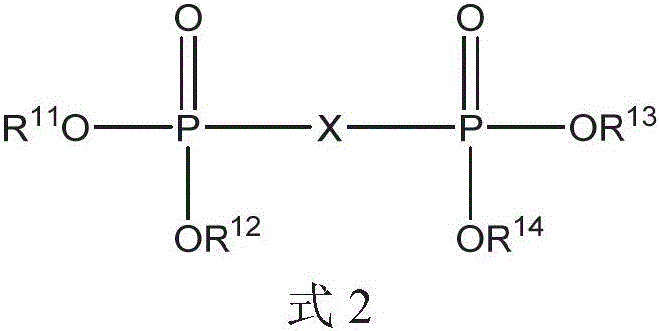
其中in
X选自芳基、C1-20烷基、C1-20烷基芳基和C1-20二烷基芳基;和X is selected from aryl, C1-20 alkyl, C1-20 alkylaryl, and C1-20 dialkylaryl; and
R11、R12、R13和R14各自独立地选自C1-20烷基、芳基和C1-20烷基芳基。R 11 , R 12 , R 13 and R 14 are each independently selected from C 1-20 alkyl, aryl and C 1-20 alkylaryl.
条款14.根据条款1所述的液压流体组合物,其中所述二膦酸酯化合物由式2(a)(i)的化合物表示:

其中in
m是选自1至10的整数;m is an integer selected from 1 to 10;
R11、R12、R13和R14各自独立地选自C1-20烷基、芳基和C1-20烷基芳基;和R 11 , R 12 , R 13 and R 14 are each independently selected from C 1-20 alkyl, aryl and C 1-20 alkylaryl; and
每个R15和R16独立地选自氢、C1-20烷基、芳基和C1-20烷基芳基。Each of R 15 and R 16 is independently selected from hydrogen, C 1-20 alkyl, aryl, and C 1-20 alkylaryl.
条款15.根据条款14所述的液压流体组合物,其中
m是选自1至6的整数;m is an integer selected from 1 to 6;
R11、R12、R13和R14各自独立地选自C1-10烷基和C1-10烷基芳基;和R 11 , R 12 , R 13 and R 14 are each independently selected from C 1-10 alkyl and C 1-10 alkylaryl; and
每个R15和R16独立地选自氢和甲基。Each of R 15 and R 16 is independently selected from hydrogen and methyl.
条款16.根据条款14所述的液压流体组合物,其中
m是选自1至6的整数;m is an integer selected from 1 to 6;
R11、R12、R13和R14各自独立地选自C2-10烷基;和R 11 , R 12 , R 13 and R 14 are each independently selected from C 2-10 alkyl; and
每个R15和R16是氢。Each of R 15 and R 16 is hydrogen.
条款17.根据条款1所述的液压流体组合物,其中所述组合物进一步包括由式3的化合物表示的膦酸酯化合物:
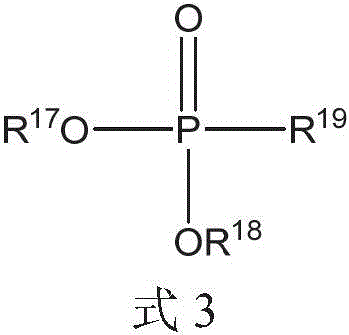
其中in
R17、R18和R19各自独立地选自C1-20烷基、芳基和C1-20烷基芳基。R 17 , R 18 and R 19 are each independently selected from C 1-20 alkyl, aryl and C 1-20 alkylaryl.
条款18.根据条款17所述的液压流体组合物,其中R17、R18和R19各自独立地选自C1-10烷基和C1-10烷基芳基。
条款19.根据条款1所述的液压流体组合物,其中基于所述组合物的重量%,所述聚硅氧烷化合物的量在约10和90%之间提供。
条款20.根据条款1所述的液压流体组合物,其中在所述组合物中所述聚硅氧烷化合物与所述二膦酸酯化合物的体积比分别以对于所述聚硅氧烷大于约1∶2或在约4∶1和1∶4之间的体积比提供。
条款21.根据条款1所述的液压流体组合物,其中所述组合物进一步包括添加剂或由其组成,所述添加剂选自除酸剂、防侵蚀添加剂、粘度指数改善剂、消泡剂、抗氧化剂、防腐蚀添加剂和其任何组合。
条款22.根据条款21所述的液压流体组合物,其中所述组合物进一步包括添加剂或由其组成,所述添加剂选自除酸剂、消泡剂、抗氧化剂和其任何组合。
条款23.根据条款21所述的液压流体组合物,其中所述除酸剂选自苯基缩水甘油醚、氧化蒎烯、氧化苯乙烯、环己基缩水甘油醚、环氧环己基缩水甘油醚、二缩水甘油醚、异丙基缩水甘油醚、二氧化丁二烯氧化环己烯、己二酸双环氧环己酯、3,4-环氧环己基羧酸酯和3,4-环氧环己烷,和其任何组合。
条款24.根据条款21所述的液压流体组合物,其中所述消泡剂选自硅油、聚乙烯醇、聚醚和其任何组合。
条款25.根据条款21所述的液压流体组合物,其中所述抗氧化剂选自2,6-二叔丁基对甲酚、苯基-α-萘胺、二(辛基苯基)胺、6-甲基-2,4-双(辛硫基)-甲基]-苯酚、四[亚甲基(3,5-二叔丁基-4-羟基氢化肉桂酸酯)]和其任何组合。
条款26.根据条款1所述的液压流体组合物,其中所述组合物基本上不含氟化的防侵蚀添加剂。
条款27.根据条款26所述的液压流体组合物,其中所述组合物基本上不含任何全氟化的阴离子表面活性剂。Clause 27. The hydraulic fluid composition of
条款28.根据条款1所述的液压流体组合物,其中所述组合物基本上不含任一种或多种另外的粘度指数改善剂,所述粘度指数改善剂选自聚(丙烯酸烷基酯)、聚(烷基甲基丙烯酸盐)、聚(甲基丙烯酸烷基酯)酯类、多环聚合物、聚氨酯、聚环氧烷和聚酯。
条款29.根据条款1所述的液压流体组合物,其中当利用Stanhope Seta开杯装置使用ASTM D4206的闪点测试方法测量2-4ml体积时,所述组合物的闪点在160和300℃之间。Clause 29. The hydraulic fluid composition of
条款30.根据条款1所述的液压流体组合物,其中所述组合物的密度(gcm-3,在298K下)小于1.5。
条款31.根据条款1所述的液压流体组合物,其中所述组合物展现在约100°F下约5和约25厘泊之间和在-65°F下约500和约3500厘泊之间的粘度。Clause 31. The hydraulic fluid composition of
条款32.根据条款1所述的液压流体组合物,其中所述组合物被有效地用作耐火液压流体。Clause 32. The hydraulic fluid composition of
条款33.根据条款32所述的液压流体组合物,其中所述组合物被有效地用作航空器中的液压流体。Clause 33. The hydraulic fluid composition of clause 32, wherein the composition is effective for use as a hydraulic fluid in an aircraft.
条款34.根据条款1所限定的液压流体组合物作为耐火液压流体的用途。Clause 34. Use of a hydraulic fluid composition as defined in
条款35.根据条款34所述的用途,其中所述耐火液压流体被用于航空器。
条款36.根据条款1所限定的式1的聚硅氧烷化合物在制备包括根据条款13所限定的二膦酸酯化合物的液压流体组合物中的用途。Clause 36. Use of a polysiloxane compound of
条款37.根据条款13所限定的二膦酸酯化合物在制备包括根据条款1所限定的式1的聚硅氧烷化合物的液压流体组合物中的用途。Clause 37. Use of a bisphosphonate compound as defined in
条款38.一种用于制备液压流体组合物的方法,其包括将根据条款1所限定的式1的聚硅氧烷化合物和二膦酸酯化合物以任何顺序一起添加在组合物中。Clause 38. A method for preparing a hydraulic fluid composition comprising adding a polysiloxane compound of
条款39.根据条款38所述的方法,其中通过将膦酸酯化合物或添加剂中的至少一种以任何顺序添加到组合物中来制备液压流体组合物。Clause 39. The method of Clause 38, wherein the hydraulic fluid composition is prepared by adding at least one of a phosphonate compound or an additive to the composition in any order.
条款40.一种液压流体组合物,其包括式1的聚硅氧烷化合物:

其中in
y是选自4至40的整数;y is an integer selected from 4 to 40;
R1、R2、R3和R4各自独立地选自C1-10烷基、芳基和C1-10烷基芳基;R 1 , R 2 , R 3 and R 4 are each independently selected from C 1-10 alkyl, aryl and C 1-10 alkylaryl;
每个R5和每个R6独立地选自C1-10烷基、芳基和C1-10烷基芳基;和Each R 5 and each R 6 are independently selected from C 1-10 alkyl, aryl and C 1-10 alkylaryl; and
其中R1至R4中的至少一个或来自至少一个y单元的至少一个R5和R6是C1-10烷基芳基。wherein at least one of R 1 to R 4 or at least one of R 5 and R 6 from at least one y unit is a C 1-10 alkylaryl group.
条款41.根据条款40所述的液压流体组合物,其中所述式1的聚硅氧烷化合物由式1a的化合物表示:Clause 41. The hydraulic fluid composition of

其中in
x是选自0至10的整数;x is an integer selected from 0 to 10;
y是选自4至20的整数;y is an integer selected from 4 to 20;
z是选自0至10的整数;z is an integer selected from 0 to 10;
R1、R2、R3和R4各自独立地选自C1-10烷基、芳基和C1-10烷基芳基;R 1 , R 2 , R 3 and R 4 are each independently selected from C 1-10 alkyl, aryl and C 1-10 alkylaryl;
每个R5和每个R6独立地选自C1-10烷基、芳基和C1-10烷基芳基;和Each R 5 and each R 6 are independently selected from C 1-10 alkyl, aryl and C 1-10 alkylaryl; and
每个R7、R8、R9和R10独立地选自C1-10烷基;和Each of R 7 , R 8 , R 9 and R 10 is independently selected from C 1-10 alkyl; and
其中R1至R4中的至少一个,或来自x、y或z单元中的至少一个的R5至R10中的至少一个是C1-10烷基芳基。wherein at least one of R 1 to R 4 , or at least one of R 5 to R 10 from at least one of x, y or z units is a C 1-10 alkylaryl group.
条款42.根据条款41所述的液压流体组合物,其中每个R7、R8、R9和R10是甲基,和x和z是各自独立地选自1至3的整数。Clause 42. The hydraulic fluid composition of Clause 41, wherein each of R7 , R8 , R9 , and R10 is a methyl group, and x and z are integers each independently selected from 1-3.
条款43.根据条款40所述的液压流体组合物,其中y是选自4至16的整数,或x、y和z的和是选自4至16的整数。Clause 43. The hydraulic fluid composition of
条款44.根据条款40所述的液压流体组合物,其中R1和R2各自独立地选自C1-10烷基、芳基和C1-10烷基芳基;每个R3、R4、R5、R7、R8、R9和R10是C1-4烷基;并且其中选择每个R6和y以提供具有独立地选自芳基和C1-10烷基芳基的1至6个之间任选的取代基的式1a的聚硅氧烷化合物,并且每个R6的任何其它取代基独立地选自C1-4烷基。Clause 44. The hydraulic fluid composition of
条款45.根据条款44所述的液压流体组合物,其中每个R3、R4、R5、R7、R8、R9和R10是甲基,并且每个R6独立地选自甲基、芳基和C1-10烷基芳基。Clause 45. The hydraulic fluid composition of clause 44, wherein each R3 , R4, R5 , R7 , R8 , R9 , and R10 is methyl, and each R6 is independently selected from Methyl, aryl and C 1-10 alkylaryl.
条款46.根据条款40所述的液压流体组合物,其中R1和R2中的至少一个是C1-10烷基芳基。Clause 46. The hydraulic fluid composition of
条款47.根据条款40所述的液压流体组合物,其中所述C1-10烷基芳基是C1-6烷基苯基。Clause 47. The hydraulic fluid composition of
条款48.根据条款47所述的液压流体组合物,其中所述聚硅氧烷化合物中苯基取代基的数量提供相对硅在2和50摩尔%之间的所述硅氧烷化合物中的苯基的摩尔%。Clause 48. The hydraulic fluid composition of clause 47, wherein the amount of phenyl substituents in the polysiloxane compound provides between 2 and 50 mole % of benzene in the siloxane compound relative to silicon mol% of base.
条款49.根据条款40所述的液压流体组合物,其中所述组合物包括至少两种式1的聚硅氧烷化合物的混合物,所述式1的聚硅氧烷化合物每种根据条款40所限定。Clause 49. The hydraulic fluid composition of
条款50.根据条款49所述的液压流体组合物,其中所述聚硅氧烷混合物包括一系列不同的式1的聚硅氧烷化合物,所述每种聚硅氧烷化合物具有选自从9至12、8至13、9至14、8至15、7至16或6至17的每个整数和包括从9至12、8至13、9至14、8至15、7至16或6至17的每个整数的不同的y值或硅氧烷重复单元(Si-O)的数量。
条款51.根据条款50所述的液压流体组合物,其中所述聚硅氧烷混合物包括至少四种聚硅氧烷化合物,所述每种聚硅氧烷化合物具有选自9至12个重复单元的不同数量的硅氧烷重复单元(Si-O);或至少六种聚硅氧烷化合物,所述每种聚硅氧烷化合物具有选自8至13个重复单元的不同数量的硅氧烷重复单元(Si-O)。Clause 51. The hydraulic fluid composition of
条款52.根据条款40所述的液压流体组合物,其中所述组合物进一步包括式3的膦酸酯化合物:Clause 52. The hydraulic fluid composition of

其中in
R17、R18和R19各自独立地选自C1-20烷基、芳基和C1-20烷基芳基。R 17 , R 18 and R 19 are each independently selected from C 1-20 alkyl, aryl and C 1-20 alkylaryl.
条款53.根据条款52所述的液压流体组合物,其中R17、R18和R19各自独立地选自C1-10烷基和C1-10烷基芳基。Clause 53. The hydraulic fluid composition of Clause 52, wherein R 17 , R 18 , and R 19 are each independently selected from C 1-10 alkyl and C 1-10 alkylaryl.
条款54.根据条款40所述的液压流体组合物,其中基于所述组合物的重量%,聚硅氧烷化合物的量在约10和90%之间提供。Clause 54. The hydraulic fluid composition of
条款55.根据条款40所述的液压流体组合物,其中所述组合物进一步包括添加剂或由其组成,所述添加剂选自除酸剂、防侵蚀添加剂、粘度指数改善剂、消泡剂、抗氧化剂、防腐蚀添加剂和其任何组合。Clause 55. The hydraulic fluid composition of
条款56.根据条款55所述的液压流体组合物,其中所述组合物进一步包括添加剂或由其组成,所述添加剂选自除酸剂、消泡剂、抗氧化剂和其任何组合。Clause 56. The hydraulic fluid composition of Clause 55, wherein the composition further comprises or consists of an additive selected from the group consisting of acid scavengers, defoamers, antioxidants, and any combination thereof.
条款57.根据条款40所述的液压流体组合物,其中所述组合物基本上不含氟化的防侵蚀添加剂。Clause 57. The hydraulic fluid composition of
条款58.根据条款40所述的液压流体组合物,其中所述组合物基本上不含任一种或多种另外的粘度指数改善剂,所述粘度指数改善剂选自聚(丙烯酸烷基酯)、聚(烷基甲基丙烯酸盐)、聚(甲基丙烯酸烷基酯)酯类、多环聚合物、聚氨酯、聚环氧烷和聚酯。Clause 58. The hydraulic fluid composition of
条款59.根据条款40所述的液压流体组合物,其中当利用Stanhope Seta开杯装置使用ASTM D4206的闪点测试方法测量2-4ml体积时,所述组合物的闪点在160和300℃之间。
条款60.根据条款40所述的液压流体组合物,其中所述组合物的密度(gcm-3,在298K下)小于1.5。Clause 60. The hydraulic fluid composition of
条款61.根据条款40所述的液压流体组合物,其中所述组合物展现在约100°F下约5和约25厘泊之间和在-65°F下约500和约3500厘泊之间的粘度。Clause 61. The hydraulic fluid composition of
条款62.根据条款40所述的液压流体组合物,其中所述组合物被有效地用作耐火液压流体或航空器中的液压流体。Clause 62. The hydraulic fluid composition of
条款63.根据条款40所限定的式1的聚硅氧烷化合物作为用于流体组合物或用于制备液压流体组合物的粘度调节剂的用途。Clause 63. Use of a polysiloxane compound of
条款64.一种用于制备液压流体组合物的方法,其包括将式1的聚硅氧烷化合物和一种或多种另外的化合物和添加剂以任何顺序一起组合在组合物中,其中一种或多种式1的聚硅氧烷化合物、包括式3的膦酸酯化合物的一种或多种另外的化合物和一种或多种另外的添加剂的每一种根据条款40所限定。Clause 64. A method for preparing a hydraulic fluid composition comprising combining the polysiloxane compound of
条款65.一种式1的聚硅氧烷化合物:Clause 65. A polysiloxane compound of Formula 1:

其中in
y是选自4至25的整数;y is an integer selected from 4 to 25;
R1、R2、R3和R4各自独立地选自C1-10烷基、芳基和C1-10烷基芳基;和R 1 , R 2 , R 3 and R 4 are each independently selected from C 1-10 alkyl, aryl and C 1-10 alkylaryl; and
每个R5和每个R6独立地选自C1-10烷基、芳基和C1-10烷基芳基;和Each R 5 and each R 6 are independently selected from C 1-10 alkyl, aryl and C 1-10 alkylaryl; and
其中R1和R2中的至少一个是C1-10烷基芳基。wherein at least one of R 1 and R 2 is a C 1-10 alkylaryl group.
条款66.根据条款65所述的聚硅氧烷化合物,其中所述式1的聚硅氧烷化合物由式1a的化合物表示:Clause 66. The polysiloxane compound of Clause 65, wherein the polysiloxane compound of

其中in
x是选自0至10的整数;x is an integer selected from 0 to 10;
y是选自4至20的整数;y is an integer selected from 4 to 20;
z是选自0至10的整数;z is an integer selected from 0 to 10;
R1、R2、R3和R4各自独立地选自C1-10烷基、芳基和C1-10烷基芳基;R 1 , R 2 , R 3 and R 4 are each independently selected from C 1-10 alkyl, aryl and C 1-10 alkylaryl;
每个R5和每个R6独立地选自C1-10烷基、芳基和C1-10烷基芳基;和Each R 5 and each R 6 are independently selected from C 1-10 alkyl, aryl and C 1-10 alkylaryl; and
每个R7、R8、R9和R10独立地选自C1-10烷基;并且Each of R 7 , R 8 , R 9 and R 10 is independently selected from C 1-10 alkyl; and
其中x、y和z的和在4和25之间,并且R1至R4中的至少一个是C1-10烷基芳基。wherein the sum of x, y and z is between 4 and 25, and at least one of R 1 to R 4 is a C 1-10 alkylaryl group.
条款67.根据条款66所述的聚硅氧烷化合物,其中每个R7、R8、R9和R10是甲基,并且x和z是各自独立地选自1至3的整数。Clause 67. The polysiloxane compound of Clause 66, wherein each of R 7 , R 8 , R 9 , and R 10 is methyl, and x and z are each independently an integer selected from 1 to 3.
条款68.根据条款65所述的聚硅氧烷化合物,其中y是选自4至16的整数或x、y和z的和是选自4至16的整数。Clause 68. The polysiloxane compound of clause 65, wherein y is an integer selected from 4 to 16 or the sum of x, y and z is an integer selected from 4 to 16.
条款69.根据条款65所述的聚硅氧烷化合物,其中R1和R2各自独立地选自C1-10烷基、芳基和C1-10烷基芳基;每个R3、R4、R5、R7、R8、R9和R10是C1-4烷基;并且其中选择每个R6和y以提供具有独立地选自芳基和C1-10烷基芳基的1至6个之间另外的取代基的聚硅氧烷化合物,并且每个R6的任何其它取代基独立地选自C1-4烷基。Item 69. The polysiloxane compound of Item 65, wherein R 1 and R 2 are each independently selected from C 1-10 alkyl, aryl, and C 1-10 alkylaryl; each R 3 , R 4 , R 5 , R 7 , R 8 , R 9 , and R 10 are C 1-4 alkyl; and wherein each R 6 and y is selected to provide a compound having a group independently selected from aryl and C 1-10 alkyl A polysiloxane compound having between 1 and 6 additional substituents of the aryl group, and any other substituent of each R 6 is independently selected from C 1-4 alkyl groups.
条款70.根据条款69所述的聚硅氧烷化合物,其中每个R3、R4、R5、R7、R8、R9和R10是甲基,和每个R6独立地选自甲基、芳基和C1-10烷基芳基。Clause 70. The polysiloxane compound of Clause 69, wherein each of R 3 , R 4 , R 5 , R 7 , R 8 , R 9 , and R 10 is methyl, and each R 6 is independently selected From methyl, aryl and C 1-10 alkylaryl.
条款71.根据条款65所述的聚硅氧烷化合物,其中R1和R2均是C1-10烷基芳基。Clause 71. The polysiloxane compound of Clause 65, wherein R 1 and R 2 are both C 1-10 alkylaryl groups.
条款72.根据条款65所述的聚硅氧烷化合物,其中所述C1-10烷基芳基是C1-6烷基苯基。Clause 72. The polysiloxane compound of Clause 65, wherein the C1-10 alkylaryl group is a C1-6 alkylphenyl group.
条款73.根据条款72所述的聚硅氧烷化合物,其中所述聚硅氧烷化合物中苯基取代基的数量提供相对硅在2和50摩尔%之间的硅氧烷化合物中的苯基的摩尔%。Clause 73. The polysiloxane compound of Clause 72, wherein the amount of phenyl substituents in the polysiloxane compound provides between 2 and 50 mole % of the phenyl groups in the siloxane compound relative to silicon mol%.
条款74.一种液压流体组合物,其包括根据条款65所述的聚硅氧烷化合物。Clause 74. A hydraulic fluid composition comprising the polysiloxane compound of clause 65.
条款75.根据条款74所述的液压流体组合物,其中所述组合物包括至少两种式1的聚硅氧烷化合物的混合物。Clause 75. The hydraulic fluid composition of Clause 74, wherein the composition comprises a mixture of at least two polysiloxane compounds of
条款76.根据条款75所述的液压流体组合物,其中所述聚硅氧烷混合物包括一系列不同的式1的聚硅氧烷化合物,所述每种聚硅氧烷化合物具有选自从9至12、8至13、9至14、8至15、7至16或6至17的每个整数和包括从9至12、8至13、9至14、8至15、7至16或6至17的每个整数的不同的y值或硅氧烷重复单元(Si-O)的数量。Clause 76. The hydraulic fluid composition of Clause 75, wherein the polysiloxane mixture comprises a series of different polysiloxane compounds of
条款77.根据条款75所述的液压流体组合物,其中所述聚硅氧烷混合物包括至少四种聚硅氧烷化合物,所述每种聚硅氧烷化合物具有选自9至12个重复单元的不同数量的硅氧烷重复单元(Si-O);或至少六种聚硅氧烷化合物,所述每种聚硅氧烷化合物具有选自8至13个重复单元的不同数量的硅氧烷重复单元(Si-O)。Clause 77. The hydraulic fluid composition of Clause 75, wherein the polysiloxane mixture comprises at least four polysiloxane compounds, each polysiloxane compound having a repeating unit selected from 9 to 12 different numbers of siloxane repeating units (Si—O); or at least six polysiloxane compounds, each polysiloxane compound having a different number of siloxanes selected from 8 to 13 repeating units Repeating unit (Si-O).
条款78.根据条款74所述的液压流体组合物,其中所述组合物被有效地用作耐火液压流体或航空器中的液压流体。
条款79.根据条款65所限定的式1的聚硅氧烷化合物作为用于流体组合物或制备液压流体组合物的粘度调节剂的用途。Clause 79. Use of a polysiloxane compound of
条款80.一种用于制备液压流体组合物的方法,其包括将根据条款65所述的式1的聚硅氧烷化合物与一种或多种另外的化合物和/或添加剂以任何顺序一起组合在组合物中。Clause 80. A method for preparing a hydraulic fluid composition comprising combining the polysiloxane compound of
Claims (40)


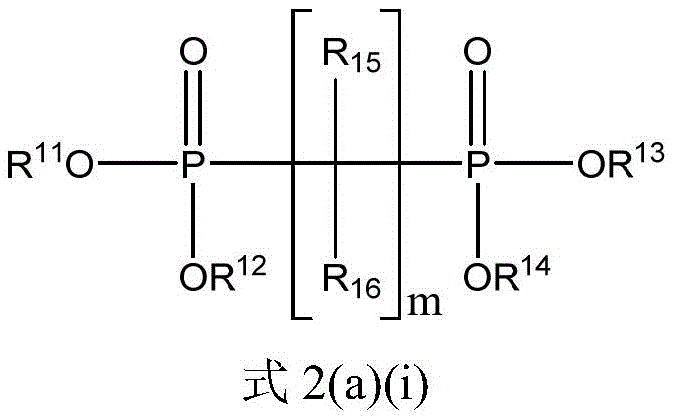
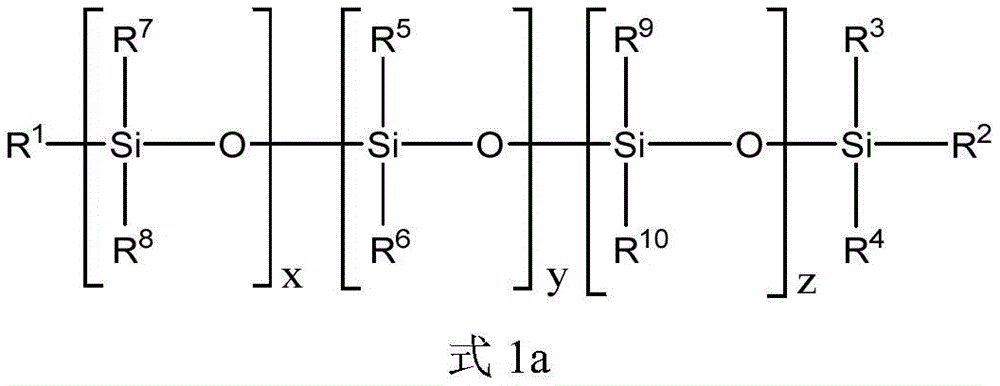

Applications Claiming Priority (3)
| Application Number | Priority Date | Filing Date | Title |
|---|---|---|---|
| US201662334555P | 2016-05-11 | 2016-05-11 | |
| US62/334,555 | 2016-05-11 | ||
| PCT/AU2017/050435 WO2017193174A1 (en) | 2016-05-11 | 2017-05-11 | Polysiloxane hydraulic fluids |
Publications (2)
| Publication Number | Publication Date |
|---|---|
| CN109790293A CN109790293A (en) | 2019-05-21 |
| CN109790293B true CN109790293B (en) | 2022-08-12 |
Family
ID=60266156
Family Applications (1)
| Application Number | Title | Priority Date | Filing Date |
|---|---|---|---|
| CN201780042733.3A Active CN109790293B (en) | 2016-05-11 | 2017-05-11 | Polysiloxane Hydraulic Fluid |
Country Status (7)
| Country | Link |
|---|---|
| US (1) | US11299688B2 (en) |
| EP (2) | EP3455282B1 (en) |
| JP (1) | JP7277143B2 (en) |
| CN (1) | CN109790293B (en) |
| AU (2) | AU2017263714B2 (en) |
| CA (1) | CA3023827C (en) |
| WO (1) | WO2017193174A1 (en) |
Families Citing this family (5)
| Publication number | Priority date | Publication date | Assignee | Title |
|---|---|---|---|---|
| EP3455282B1 (en) | 2016-05-11 | 2023-11-01 | Commonwealth Scientific and Industrial Research Organisation | Polysiloxane hydraulic fluids |
| US12227713B2 (en) | 2016-05-11 | 2025-02-18 | The Boeing Company | Polysiloxane hydraulic fluids |
| US10113131B2 (en) | 2017-01-11 | 2018-10-30 | The Boeing Company | Phosphono paraffins |
| JP6990299B2 (en) * | 2018-04-13 | 2022-02-03 | 株式会社Moresco | Lubricating oil composition and lubricant using it |
| CN113372300A (en) * | 2021-06-07 | 2021-09-10 | 浙江聚贤医药科技有限公司 | Continuous flow synthesis process of cyclohexene-based epoxide and cyclohexene-based epoxide |
Citations (7)
| Publication number | Priority date | Publication date | Assignee | Title |
|---|---|---|---|---|
| US2634288A (en) * | 1951-01-10 | 1953-04-07 | Virginia Carolina Chem Corp | Tetraalkyl esters of alkane diphosphonic acids |
| GB1165026A (en) * | 1965-09-20 | 1969-09-24 | Monsanto Co | Functional Fluid Compositions |
| US3532730A (en) * | 1968-04-29 | 1970-10-06 | Dow Corning | Organopolysiloxane fluid |
| US5194652A (en) * | 1992-05-29 | 1993-03-16 | The Dow Chemical Company | Oxidation-resistant cyclophosphazene fluid including triarylphosphine or phosphine oxide |
| US6348437B1 (en) * | 1996-05-01 | 2002-02-19 | Dow Corning Corporation | Silicone oils with improved viscosity stability |
| CN103497739A (en) * | 2013-10-09 | 2014-01-08 | 中国科学院深圳先进技术研究院 | Heat transfer paste and preparation method thereof |
| CN104911006A (en) * | 2015-05-27 | 2015-09-16 | 黄进堂 | Hydraulic oil and preparation method thereof |
Family Cites Families (19)
| Publication number | Priority date | Publication date | Assignee | Title |
|---|---|---|---|---|
| BE596160A (en) * | 1959-10-20 | |||
| NL131310C (en) * | 1964-05-11 | 1900-01-01 | ||
| US3630916A (en) | 1966-07-21 | 1971-12-28 | Monsanto Co | Functional fluid compositions |
| US3579449A (en) * | 1968-09-26 | 1971-05-18 | Procter & Gamble | Lubricant composition |
| US4019997A (en) | 1974-02-04 | 1977-04-26 | General Electric Company | Silicone fluid useful as a brae fluid |
| US5130041A (en) * | 1990-06-21 | 1992-07-14 | Dow Corning Corporation | Silicone fluid compositions having reduced viscosity temperature coefficient |
| JPH0491125A (en) * | 1990-08-06 | 1992-03-24 | Mitsubishi Rayon Co Ltd | Aromatic polyester-polyorganosiloxane block copolymer with excellent thermal stability |
| GB9114430D0 (en) * | 1991-07-03 | 1991-08-21 | Sandoz Ltd | Improvements in or relating to organic compounds |
| JP3130103B2 (en) * | 1991-12-26 | 2001-01-31 | 東レ・ダウコーニング・シリコーン株式会社 | Release agent composition for aluminum die casting |
| JP2952750B2 (en) | 1995-02-23 | 1999-09-27 | 株式会社林原生物化学研究所 | Monoclonal antibody |
| JP2982675B2 (en) * | 1994-12-28 | 1999-11-29 | 吉富製薬株式会社 | Novel phosphine compounds and their uses |
| JPH1121443A (en) * | 1997-06-30 | 1999-01-26 | Tonen Corp | Organopolysiloxane fluid composition |
| EP2580308A1 (en) | 2010-06-08 | 2013-04-17 | Dow Corning Corporation | Silicone hydraulic fluids |
| GB201105588D0 (en) * | 2011-04-01 | 2011-05-18 | Elliptic Laboratories As | User interface |
| US8466249B2 (en) * | 2011-05-13 | 2013-06-18 | Sabic Innovative Plastics Ip Bv | Clear silicone polycarbonate elastomeric copolymers |
| JP2013018872A (en) * | 2011-07-11 | 2013-01-31 | Idemitsu Kosan Co Ltd | Lubricating oil composition and mechanical apparatus |
| JP2015525827A (en) | 2012-08-14 | 2015-09-07 | ダウ コーニング コーポレーションDow Corning Corporation | Lubricant composition |
| EP3099743B1 (en) * | 2014-01-28 | 2019-06-19 | SABIC Global Technologies B.V. | Halogen free flame retardant polycarbonate/thermoplastic polyester molding compositions with polymeric phosphorus flame retardant |
| EP3455282B1 (en) | 2016-05-11 | 2023-11-01 | Commonwealth Scientific and Industrial Research Organisation | Polysiloxane hydraulic fluids |
-
2017
- 2017-05-11 EP EP17795195.1A patent/EP3455282B1/en active Active
- 2017-05-11 WO PCT/AU2017/050435 patent/WO2017193174A1/en not_active Ceased
- 2017-05-11 AU AU2017263714A patent/AU2017263714B2/en active Active
- 2017-05-11 CN CN201780042733.3A patent/CN109790293B/en active Active
- 2017-05-11 CA CA3023827A patent/CA3023827C/en active Active
- 2017-05-11 US US16/300,579 patent/US11299688B2/en active Active
- 2017-05-11 EP EP23196176.4A patent/EP4269543A3/en active Pending
- 2017-05-11 JP JP2018559844A patent/JP7277143B2/en active Active
-
2021
- 2021-12-17 AU AU2021286419A patent/AU2021286419B2/en active Active
Patent Citations (7)
| Publication number | Priority date | Publication date | Assignee | Title |
|---|---|---|---|---|
| US2634288A (en) * | 1951-01-10 | 1953-04-07 | Virginia Carolina Chem Corp | Tetraalkyl esters of alkane diphosphonic acids |
| GB1165026A (en) * | 1965-09-20 | 1969-09-24 | Monsanto Co | Functional Fluid Compositions |
| US3532730A (en) * | 1968-04-29 | 1970-10-06 | Dow Corning | Organopolysiloxane fluid |
| US5194652A (en) * | 1992-05-29 | 1993-03-16 | The Dow Chemical Company | Oxidation-resistant cyclophosphazene fluid including triarylphosphine or phosphine oxide |
| US6348437B1 (en) * | 1996-05-01 | 2002-02-19 | Dow Corning Corporation | Silicone oils with improved viscosity stability |
| CN103497739A (en) * | 2013-10-09 | 2014-01-08 | 中国科学院深圳先进技术研究院 | Heat transfer paste and preparation method thereof |
| CN104911006A (en) * | 2015-05-27 | 2015-09-16 | 黄进堂 | Hydraulic oil and preparation method thereof |
Non-Patent Citations (1)
| Title |
|---|
| "Combinatorial Approach to the Catalytic Hydrosilylation of Styrene Derivatives: Catalyst Systems Composed of Organoiron(0) or (II) Precursors and Isocyanides";Yusuke Sunada et al;《organometallics》;20150603;第34卷;第2896-2906页 * |
Also Published As
| Publication number | Publication date |
|---|---|
| JP7277143B2 (en) | 2023-05-18 |
| JP2019515120A (en) | 2019-06-06 |
| CA3023827A1 (en) | 2017-11-16 |
| AU2017263714A1 (en) | 2019-01-03 |
| CN109790293A (en) | 2019-05-21 |
| EP3455282A4 (en) | 2020-01-01 |
| EP3455282B1 (en) | 2023-11-01 |
| WO2017193174A1 (en) | 2017-11-16 |
| AU2021286419B2 (en) | 2023-08-17 |
| US11299688B2 (en) | 2022-04-12 |
| EP3455282A1 (en) | 2019-03-20 |
| EP4269543A3 (en) | 2023-12-20 |
| AU2017263714B2 (en) | 2021-09-30 |
| AU2021286419A1 (en) | 2022-01-20 |
| US20190284494A1 (en) | 2019-09-19 |
| EP4269543A2 (en) | 2023-11-01 |
| CA3023827C (en) | 2023-08-22 |
Similar Documents
| Publication | Publication Date | Title |
|---|---|---|
| CN109790293B (en) | Polysiloxane Hydraulic Fluid | |
| CN101386680A (en) | Novel siloxane-containing block copolymers, their preparation and their use in lubricants | |
| JP6834949B2 (en) | Lubricant containing silicon-containing ionic liquid | |
| EP1141179B1 (en) | PHOSPHATE ESTER BASE STOCKS COMPRISING MIXED $i(n)-BUTYL/ISOBUTYL PHOSPHATE ESTERS AND AIRCRAFT HYDRAULIC FLUIDS COMPRISING THE SAME | |
| US3531550A (en) | Phosphorus ester amides | |
| TWI816787B (en) | Moisture curable organopolysiloxane composition and electric/electronic apparatus | |
| JP2018070721A5 (en) | ||
| US12227713B2 (en) | Polysiloxane hydraulic fluids | |
| CN112088205B (en) | Lubricating oil composition and lubricant using same | |
| US12522778B2 (en) | Use of a polyalkoxysiloxane-based oil as a lubricating agent | |
| US5194652A (en) | Oxidation-resistant cyclophosphazene fluid including triarylphosphine or phosphine oxide | |
| MX2011004663A (en) | Phosphorus-containing silsesquioxane derivatives as flame retardants. | |
| JP2674598B2 (en) | Functional oils | |
| JP2020023673A (en) | Curable composition | |
| US5552067A (en) | Thermally stabilizing organic functional fluids in the absence of oxygens | |
| CN113088356A (en) | Anti-corrosion petroleum additive containing anti-foaming agent and preparation method and application thereof | |
| US3654157A (en) | Lubricant compositions | |
| JP2025169573A (en) | Refrigerant containing organopolysiloxane | |
| KR102006863B1 (en) | Silanes and silicones with separate hydrophilic and oleophobic substituents | |
| US3340331A (en) | Fluorine-containing phosphinates | |
| GB815231A (en) | New silicon-containing compounds and the use thereof |
Legal Events
| Date | Code | Title | Description |
|---|---|---|---|
| PB01 | Publication | ||
| PB01 | Publication | ||
| SE01 | Entry into force of request for substantive examination | ||
| SE01 | Entry into force of request for substantive examination | ||
| GR01 | Patent grant | ||
| GR01 | Patent grant |