CN109782274B - Water damage identification method based on time-frequency statistical characteristics of ground penetrating radar signals - Google Patents
Water damage identification method based on time-frequency statistical characteristics of ground penetrating radar signals Download PDFInfo
- Publication number
- CN109782274B CN109782274B CN201910100046.3A CN201910100046A CN109782274B CN 109782274 B CN109782274 B CN 109782274B CN 201910100046 A CN201910100046 A CN 201910100046A CN 109782274 B CN109782274 B CN 109782274B
- Authority
- CN
- China
- Prior art keywords
- water damage
- data
- time
- frequency
- ground penetrating
- Prior art date
- Legal status (The legal status is an assumption and is not a legal conclusion. Google has not performed a legal analysis and makes no representation as to the accuracy of the status listed.)
- Active
Links
Images


Classifications
-
- Y—GENERAL TAGGING OF NEW TECHNOLOGICAL DEVELOPMENTS; GENERAL TAGGING OF CROSS-SECTIONAL TECHNOLOGIES SPANNING OVER SEVERAL SECTIONS OF THE IPC; TECHNICAL SUBJECTS COVERED BY FORMER USPC CROSS-REFERENCE ART COLLECTIONS [XRACs] AND DIGESTS
- Y02—TECHNOLOGIES OR APPLICATIONS FOR MITIGATION OR ADAPTATION AGAINST CLIMATE CHANGE
- Y02A—TECHNOLOGIES FOR ADAPTATION TO CLIMATE CHANGE
- Y02A90/00—Technologies having an indirect contribution to adaptation to climate change
- Y02A90/30—Assessment of water resources
Landscapes
- Radar Systems Or Details Thereof (AREA)
- Investigating Or Analyzing Materials By The Use Of Electric Means (AREA)
Abstract
Description
技术领域Technical Field
本发明属于沥青道路质量检测领域,涉及一种基于探地雷达信号时频统计特征的水损害识别方法。The invention belongs to the field of asphalt road quality detection and relates to a water damage identification method based on time-frequency statistical characteristics of ground penetrating radar signals.
背景技术Background Art
沥青路面具有施工速度快、行车平稳舒适、通车时间短等优点,然而各种各样初期损害的出现严重影响着沥青路面的使用,其中水损害是其中常见较为严重的一项。沥青路面不可能完全隔水,当水从缝隙或其他路径进入沥青路面结构内部会使沥青粘附性减小,由于集料表面对水比对沥青有更强的吸附力,长期接触下沥青会从集料表面剥落,加上行车荷载的影响会使水产生流动,产生动水压力进而使剥落的沥青流失,被裹挟流动出沥青路面内部。随之而来的就会使路面出现松散、剥离、坑洞等病害。Asphalt pavement has the advantages of fast construction speed, smooth and comfortable driving, and short traffic time. However, the appearance of various initial damages seriously affects the use of asphalt pavement, among which water damage is a common and serious one. Asphalt pavement cannot be completely water-proof. When water enters the asphalt pavement structure from cracks or other paths, the adhesion of asphalt will decrease. Since the aggregate surface has a stronger adsorption force to water than to asphalt, asphalt will peel off from the aggregate surface under long-term contact. In addition, the influence of traffic load will cause water to flow, generating dynamic water pressure and causing the peeled asphalt to flow out of the asphalt pavement. As a result, the pavement will become loose, peeled, and have potholes.
在沥青路面水损害的检测方法主要有探地雷达法、红外法、超声波法等。红外检测法利用水损害区域和正常路面在阳光照射下温度差异原理来测量水损,必须在特定条件下进行,如在含水区域吸收太阳辐射能量后温度与正常路面温度不同才行,测量结果不稳定,且无法判断水损害的深度位置;超声波法穿透强,由于与地面耦合性不好,受干扰较大;探地雷达可实现沥青路面病害的无损检测,图谱显示直观,但是现有沥青路面测量大多采用空气耦合天线,向地面发射能量小,采样间距大,分辨率不高,未有成功检测出沥青路面水损害的报道,因此迫切需要建立水损害缺陷的检测方法。The main methods for detecting water damage in asphalt pavement include ground penetrating radar, infrared, ultrasonic, etc. The infrared detection method uses the temperature difference between the water-damaged area and the normal road surface under sunlight to measure water damage. It must be carried out under specific conditions, such as when the temperature of the water-containing area is different from that of the normal road surface after absorbing solar radiation energy. The measurement results are unstable and the depth and position of water damage cannot be determined. The ultrasonic method has strong penetration, but is subject to greater interference due to poor coupling with the ground. Ground penetrating radar can realize non-destructive detection of asphalt pavement diseases, and the spectrum display is intuitive. However, most of the existing asphalt pavement measurements use air-coupled antennas, which emit little energy to the ground, have large sampling intervals, and low resolution. There have been no reports of successful detection of water damage in asphalt pavements, so there is an urgent need to establish a detection method for water damage defects.
目前,雷达图谱解释依靠专家经验,培养相关的专家耗费人力财力,并且人力在识别图谱时带来的是耗时耗力,现有工程中水损害检测案例以空耦天线为主,主要用于测量路面的厚度,由于空气对雷达信号的衰减,以及采样间距较大的问题,造成空耦天线的分辨率不高,导致人力对雷达图谱的解释更加困难,影响识别效果。At present, the interpretation of radar maps relies on expert experience. Training relevant experts consumes manpower and financial resources, and manpower is time-consuming and labor-intensive when identifying maps. In existing projects, water damage detection cases are mainly based on air-coupled antennas, which are mainly used to measure the thickness of the road surface. Due to the attenuation of radar signals by air and the large sampling interval, the resolution of air-coupled antennas is not high, making it more difficult for humans to interpret radar maps, affecting the recognition effect.
发明内容Summary of the invention
本发明的目的在于克服上述现有技术的缺点,提供一种基于探地雷达信号时频统计特征的水损害识别方法,解决了现有探地雷达信号解释依靠人工经验费时费力,主观性强的问题。The purpose of the present invention is to overcome the shortcomings of the above-mentioned prior art and provide a water damage identification method based on the time-frequency statistical characteristics of ground penetrating radar signals, which solves the problem that the existing ground penetrating radar signal interpretation relies on manual experience, is time-consuming and labor-intensive, and is highly subjective.
为达到上述目的,本发明采用以下技术方案予以实现:In order to achieve the above object, the present invention adopts the following technical solutions:
一种基于探地雷达信号时频统计特征的水损害识别方法,包括以下步骤;A method for identifying water damage based on time-frequency statistical characteristics of ground penetrating radar signals, comprising the following steps;
步骤一,数据采集:选取部分含水损害的路段作为采样路段,使用探地雷达对采样路段进行GPR数据采集,采集过程中,在GPR数据采集软件里对路面发生水损害的路段进行标记;
步骤二,GPR数据的预处理:对GPR数据滤波,包括扣除直流分量、静矫正切除、去背景和滑动平均;Step 2: GPR data preprocessing: GPR data filtering, including DC component removal, static correction removal, background removal and sliding average;
步骤三,步骤一的标记区域且其雷达图谱的B-scan图处呈现高亮区域定义为水损害区域,将该区域作为水损害特征,用于识别其他水损害区域,其余区域为正常路面;Step 3: The marked area in
步骤四,数据集建立:将处理后的GPR数据导出为矩阵,矩阵元素为雷达波形数据,矩阵维数为n×m,n为GPR数据预处理后每一道波形的采样点数,m为GPR采集的总样本数量,将水损害和正常路面样本合并构建用于训练用的训练样本集和测试样本集;Step 4: Dataset establishment: export the processed GPR data into a matrix, the matrix elements are radar waveform data, the matrix dimension is n×m, n is the number of sampling points of each waveform after GPR data preprocessing, m is the total number of samples collected by GPR, and the water damage and normal road samples are combined to construct the training sample set and test sample set for training;
步骤五,时频特征提取:从训练样本集选取若干个时域特征参数和若干个频域特征参数,从测试样本集选取相同数量的时域特征参数和频域特征参数,对特征参数进行计算,得到二维矩阵;
步骤六,敏感特征提取:对步骤四中的特征参数分别进行分布统计,找到具有明显分布特性的特征作为敏感特征值;Step 6: Extract sensitive features: Perform distribution statistics on the feature parameters in
步骤七,归一化处理:对步骤五中的敏感特征值进行归一化处理;Step 7, normalization processing: normalize the sensitive feature values in
步骤八,PCA主成分分析:对归一化后的敏感特征值进行PCA主成分分析进行降维处理,并取前b个贡献率之和达到95%的主要成分PCs;Step 8, PCA principal component analysis: perform PCA principal component analysis on the normalized sensitive eigenvalues to reduce the dimension, and take the first b main component PCs whose sum of contribution rate reaches 95%;
步骤九,模型建立:构建分类模型,并利用PCA分析后的主成分PCs作为输入量,对分类模型进行训练,构建水损害的分类模型;Step 9, model building: construct a classification model, and use the principal components PCs after PCA analysis as input to train the classification model and build a classification model for water damage;
步骤十,水损害识别:将剩余道路路段的GPR数据输入至步骤四中,作为时频特征的提取对象,重复步骤四至步骤七,将步骤七中得到的主要成分数据PCs输入至训练好的模型中,对新路段的水损害进行识别,模型输出结果为正常或水损害。Step 10: Water damage identification: Input the GPR data of the remaining road sections into
优选的,步骤一中,采用地面耦合高频天线进行路面无损探伤,探地雷达的地面耦合天线频率≥1.6GHz,采样间距≤50mm/道。Preferably, in step one, a ground-coupled high-frequency antenna is used for non-destructive testing of the road surface, the ground-coupled antenna frequency of the ground-penetrating radar is ≥1.6 GHz, and the sampling spacing is ≤50 mm/channel.
优选的,步骤二中,对雷达数据进行一维滤波进行去直流漂移;Preferably, in
静矫正切除仅扣除地面以上的信号,取路面直达波的第一个最大峰值;Static correction excision only deducts the signal above the ground and takes the first maximum peak of the direct wave from the road surface;
背景去除采用去均值法,取各采样位置上同一时刻的采样点得均值作为背景杂波信息从原始波形中去除。The background removal adopts the mean removal method, taking the mean of the sampling points at the same time at each sampling position as the background clutter information to remove it from the original waveform.
优选的,步骤三中,提取出a道A-scan数据,训练集和测试集各a/2道,其中每部分包含水损害和正常数据各a/4道。Preferably, in step three, a channels of A-scan data are extracted, and the training set and the test set each have a/2 channels, wherein each part contains a/4 channels of water damage data and normal data.
进一步,步骤四中,以单道A-scan为识别单位,对步骤三中的数据集其进行时频域统计量计算,选取16个时域特征参数P1-P16,和12个频域特征参数P17-P28,计算公式下所示;Further, in


P3=max(|xi|)P 3 = max(|xi|)


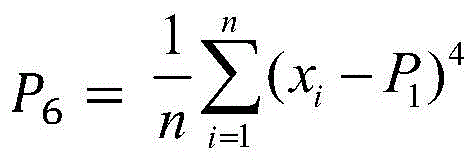


P9=max(x)-min(x)P 9 = max(x)-min(x)


得到一个28×a的二维矩阵,其中x(i)是时域信号序列,i=1,2,…,n,n是预处理后的单道采样点数;s(k)是信号x(i)的频谱,k=1,2,…,M,M是谱线总数;fk是第k条谱线的频率值。A 28×a two-dimensional matrix is obtained, where x(i) is the time domain signal sequence, i = 1, 2, ..., n, n is the number of single-channel sampling points after preprocessing; s(k) is the spectrum of signal x(i), k = 1, 2, ..., M, M is the total number of spectral lines; fk is the frequency value of the kth spectral line.
再进一步,步骤五中,每一个特征值对应a个数据,对计算的28个特征值各自进行分布直方图统计,找到具有明显分布特征的特征值。Furthermore, in step five, each eigenvalue corresponds to a data, and the distribution histogram statistics of the calculated 28 eigenvalues are respectively performed to find the eigenvalue with obvious distribution characteristics.
再进一步,步骤六中,将步骤五中的敏感特征值归一化到0和1之间。Furthermore, in step six, the sensitive feature values in step five are normalized to between 0 and 1.
再进一步,步骤八中,正常数据标定为0,水损害数据标定为1,将a道A-scan数据按照1:1分为两部分,其中训练集a/2道数据,测试集a/2道数据。Furthermore, in step eight, normal data is calibrated to 0, water damage data is calibrated to 1, and the a-channel A-scan data is divided into two parts according to a 1:1 ratio, including a/2 channel data for training set and a/2 channel data for test set.
再进一步,将模型预测结果0和1按照雷达图谱的原采样点坐标,以雷达图谱为背景基础,进行绘图,其中1代表了水损害,0代表了正常,最终在雷达图谱上表现为若干线框,线框区域与水损害区域重合部分越多,则模型的可行性以及准确性越高。Furthermore, the
优选的,根据正常数据实际测试集与预测测试集之比,和水损害数据的实际测试集与预测测试集之比,得到正常数据的识别率和水损害数据的识别率,取平均值为总体识别率,当总体识别率越高,表明模型得到的结果越精确。Preferably, the recognition rate of normal data and the recognition rate of water damage data are obtained according to the ratio of the actual test set of normal data to the predicted test set, and the ratio of the actual test set of water damage data to the predicted test set, and the average is taken as the overall recognition rate. The higher the overall recognition rate, the more accurate the results obtained by the model.
与现有技术相比,本发明具有以下有益效果:Compared with the prior art, the present invention has the following beneficial effects:
本发明提出探地雷达信号的时频统计特征提取方法,并借助统计特征方法筛选了敏感特征,建立分类模型,可用于直接评价沥青路面水损,解决了现有探地雷达信号解释依靠人工经验费时费力,主观性强的问题;另外,本方法可以用大量的信息来评价水损害,提高水损害识别准确性。建立的水损害分类模型可以实现沥青路面水损害区域的自动识别,为路面缺陷智能化检测提供基础。同时,本发明提出的分类模型建立方法,可以为GPR在其他领域的智能化检测提供基础。The present invention proposes a method for extracting time-frequency statistical features of ground penetrating radar signals, and uses the statistical feature method to screen sensitive features and establish a classification model, which can be used to directly evaluate water damage on asphalt pavements, solving the problem that the existing interpretation of ground penetrating radar signals is time-consuming and labor-intensive and highly subjective, relying on manual experience. In addition, the present method can use a large amount of information to evaluate water damage and improve the accuracy of water damage identification. The established water damage classification model can realize the automatic identification of water-damaged areas on asphalt pavements, providing a basis for intelligent detection of pavement defects. At the same time, the classification model establishment method proposed in the present invention can provide a basis for intelligent detection of GPR in other fields.
进一步,本发明提出用大于1.6GHz的地面耦合高频天线检测路面水损害,相比空气耦合天线,能发射更强的能量进入路面,且吸收更强的反射信号;同时以更密的采样间距增强信号特征,实现了沥青路面水损害的检测,实现了水损害区域(长度和深度)的无损检测,可以为养护部门的路面预养护和精准养护提供依据;Furthermore, the present invention proposes to use a ground-coupled high-frequency antenna greater than 1.6 GHz to detect road water damage. Compared with an air-coupled antenna, it can emit stronger energy into the road surface and absorb stronger reflected signals. At the same time, it enhances signal characteristics with a denser sampling interval, realizes the detection of water damage on asphalt pavement, and realizes non-destructive detection of water damage areas (length and depth), which can provide a basis for the maintenance department's road surface pre-maintenance and precision maintenance.
附图说明BRIEF DESCRIPTION OF THE DRAWINGS
图1是本发明算法流程图;Fig. 1 is a flow chart of the algorithm of the present invention;
图2是含水位置雷达图谱;Figure 2 is a radar map of water-bearing locations;
图3是P7特征分布直方图;Figure 3 is a P7 feature distribution histogram;
图4是PCA分析累计贡献率曲线图;FIG4 is a PCA analysis cumulative contribution rate curve;
图5是kmeans聚类分析结果图;Figure 5 is a diagram of kmeans cluster analysis results;
图6是BP神经网络预测结果图;Fig. 6 is a diagram of the prediction results of the BP neural network;
图7是预测结果在雷达谱图上的具现图。FIG7 is a diagram showing the prediction results on the radar spectrum.
具体实施方式DETAILED DESCRIPTION
下面结合附图对本发明做进一步详细描述:The present invention is further described in detail below in conjunction with the accompanying drawings:
参见图1所示,本发明所述方法为以下步骤:Referring to FIG1 , the method of the present invention comprises the following steps:
步骤一,数据采集:选取部分含水损害的路段作为采样路段,使用探地雷达对采样路段进行GPR数据采集,具体为采用地面耦合高频天线进行路面无损探伤,探地雷达的地面耦合天线频率≥1.6GHz,采样间距≤50mm/道,采集过程中,在GPR数据采集软件里对路面发生水损害的路段进行标记。Step 1: Data collection: Select some water-damaged sections as sampling sections, and use ground penetrating radar to collect GPR data on the sampling sections. Specifically, use a ground-coupled high-frequency antenna to perform non-destructive road surface testing. The ground-coupled antenna frequency of the ground penetrating radar is ≥1.6GHz, and the sampling spacing is ≤50mm/channel. During the collection process, mark the sections of the road with water damage in the GPR data collection software.
步骤二,GPR数据的预处理:对数据滤波,包括扣除直流分量、静矫正切除、去背景和滑动平均。Step 2: GPR data preprocessing: data filtering, including DC component subtraction, static correction removal, background removal and sliding average.
由于GPR系统电路偏移以及接受的波为周围物体反射波的叠加,会导致波形发生零漂,所以对雷达数据进行一维滤波进行去直流漂移。Since the GPR system circuit offset and the received wave are the superposition of the reflected waves from surrounding objects, the waveform will cause zero drift, so the radar data is filtered in one dimension to remove DC drift.
静矫正切除也叫做去除空气层,由于探地雷达是根据反射波信号的延时来确定目标体深度的,反射波信号的时间计算影响了深度计算的精度,所以非常有必要对信号的零点进行调整,也就是对地面的初至波进行定位,根据地面表层厚度及下层的电阻率和电导率而定,本实施例优选直达波的第一个最大峰值。Static correction resection is also called removing the air layer. Since the ground penetrating radar determines the depth of the target body based on the delay of the reflected wave signal, the time calculation of the reflected wave signal affects the accuracy of the depth calculation. Therefore, it is very necessary to adjust the zero point of the signal, that is, to locate the first arrival wave of the ground, according to the thickness of the ground surface and the resistivity and conductivity of the underlying layer. This embodiment prefers the first maximum peak of the direct wave.
背景去除采用去均值法,取各采样位置上同一时刻的采样点得均值作为背景杂波信息从原始波形中去除,这样做可以对直达波以及其他杂波进行抑制,凸显目标信号。Background removal uses the averaging method, taking the mean of the sampling points at the same time at each sampling position as the background clutter information to remove from the original waveform. This can suppress the direct wave and other clutter and highlight the target signal.
滑动平均主要是为了去除高频白点噪声,属于一种图像处理技术。The sliding average is mainly used to remove high-frequency white point noise and is an image processing technology.
步骤三,依据现场采集水损害的比较确定水损害的特征,根据GPR雷达波传输机理,GPR波经过水损害区域后会产生强烈反射,增大GPR波幅值,水损害区域的一般幅值为正,在B-scan图中出现高亮区域,同时通过步骤一的标记区域与雷达图谱高亮区域对应,确定雷达图谱上水损害的特征,两者重合区域为水损害区域,据此区分水损害区域和正常路面,筛选水损害样本和正常路面的样本集,用于分类模型的训练。Step three: determine the characteristics of water damage based on the comparison of water damage collected on site. According to the GPR radar wave transmission mechanism, GPR waves will produce strong reflections after passing through the water damaged area, increasing the GPR wave amplitude. The general amplitude of the water damaged area is positive, and a highlighted area appears in the B-scan image. At the same time, the marked area in step one corresponds to the highlighted area of the radar map to determine the characteristics of water damage on the radar map. The overlapping area of the two is the water damaged area. Based on this, the water damaged area and the normal road surface are distinguished, and the sample sets of water damaged samples and normal road surfaces are screened for training the classification model.
步骤四,数据集建立:将处理后的GPR信号导出为矩阵,矩阵元素为雷达波形数据,矩阵维数为n×m,n为GPR数据预处理后每一道波形的采样点数,m为GPR采集的总样本数量,将水损害和正常样本合并构建用于分类模型训练用的训练样本集和测试样本集。Step 4: Dataset establishment: The processed GPR signal is exported as a matrix, the matrix elements are radar waveform data, the matrix dimension is n×m, n is the number of sampling points of each waveform after GPR data preprocessing, and m is the total number of samples collected by GPR. The water damage and normal samples are combined to construct the training sample set and test sample set for classification model training.
提取出a道A-scan数据,训练集和测试集各a/2道,其中每部分包含水损害和正常数据各a/4道,本实施例以提取出6600道A-scan数据为示例,训练集和测试集各3300道,其中每部分包含水损害和正常数据各1650道。A-scan data are extracted, and the training set and the test set are each a/2 channels, wherein each part contains a/4 channels of water damage and normal data. In this embodiment, 6600 channels of A-scan data are extracted as an example, and the training set and the test set are each 3300 channels, wherein each part contains 1650 channels of water damage and normal data.
步骤五,时频特征提取:以单道A-scan为识别单位,从训练样本集选取若干个时域特征参数和若干个频域特征参数,从测试样本集选取相同数量的时域特征参数和频域特征参数,本实施例优选的选取16个时域特征参数P1-P16,和12个频域特征参数P17-P28,计算公式如表1所示。
表1Table 1


其中x(i)是时域信号序列,i=1,2,…,n,n是单道采样点数;s(k)是信号x(i)的频谱,k=1,2,…,M,M是谱线数;fk是第k条谱线的频率值。Where x(i) is the time domain signal sequence, i = 1, 2, ..., n, n is the number of single-channel sampling points; s(k) is the spectrum of signal x(i), k = 1, 2, ..., M, M is the number of spectral lines; fk is the frequency value of the kth spectral line.
步骤六,敏感特征提取:对步骤四中的特征参数分别进行分布统计,每一个特征值对应6600个数据,对计算的28个特征值各自进行分布直方图统计,找到具有明显分布特性的特征作为敏感特征值,如图3所示为一个敏感特征,通过分析得到11个敏感特征。Step 6: Extract sensitive features: Perform distribution statistics on the feature parameters in
步骤七,归一化处理:归一化处理是十分有必要的,大的特征量会将小的特征量所掩盖,因此对步骤五中的敏感特征值进行归一化处理,本实施例中将11个敏感特征归一化到0和1之间。Step seven, normalization: Normalization is very necessary. Large feature quantities will mask small feature quantities. Therefore, the sensitive feature values in step five are normalized. In this embodiment, 11 sensitive features are normalized to between 0 and 1.
步骤八,PCA主成分分析:对归一化后的敏感特征值进行PCA主成分分析进行降维处理,并取前b个贡献率之和达到95%的主要成分PCs,本实施例中得到主分量为5个。Step 8, PCA principal component analysis: PCA principal component analysis is performed on the normalized sensitive eigenvalues to reduce dimensionality, and the first b main components PCs whose sum of contribution rates reaches 95% are taken. In this embodiment, 5 main components are obtained.
步骤九,模型建立:构建分类模型,分类模型既可以为BP神经网络分类器,还可以用于其他分类模型,比如支持向量机(SVM)等其余模型。Step 9: Model building: Building a classification model. The classification model can be a BP neural network classifier or other classification models, such as support vector machine (SVM) and other models.
本实施例以BP神经网络分类模型为例,利用PCA分析后的主要成分PCs作为输入量对分类模型进行训练,构建水损害的分类模型;正常数据标定为0,水损害数据标定为1作为模型输出量,将6600道A-scan数据按照1:1分为两部分,其中训练集3300道数据,测试集3300道数据。In this embodiment, the BP neural network classification model is taken as an example, and the main components PCs after PCA analysis are used as input to train the classification model to construct a classification model for water damage; normal data is calibrated to 0, and water damage data is calibrated to 1 as the model output, and 6600 A-scan data are divided into two parts according to a 1:1 ratio, including 3300 data in the training set and 3300 data in the test set.
步骤十,水损害识别:将剩余道路路段的GPR数据输入至步骤四中,作为时频特征的提取对象,重复步骤四至步骤七,将步骤七中得到的主要成分数据PCs输入至训练好的模型中,对新路段的水损害进行识别,模型输出结果为正常或水损害。Step 10: Water damage identification: Input the GPR data of the remaining road sections into
对模型输出结果进行验证,根据正常数据实际测试集与预测测试集之比,和水损害数据的实际测试集与预测测试集之比,得到正常数据的识别率和水损害数据的识别率,取平均值为总体识别率,当总体识别率越高,表明模型得到的结果越精确,从而对模型结果的准确率进行判断;如图6所示,本实施例结果显示,正常数据的识别率达到97.2%,为1604/1650,水损害数据的识别率达到99.6%,为1645/1650,总体识别率达到98.45%。The model output results are verified. According to the ratio of the actual test set of normal data to the predicted test set and the ratio of the actual test set of water damage data to the predicted test set, the recognition rate of normal data and the recognition rate of water damage data are obtained. The average value is taken as the overall recognition rate. The higher the overall recognition rate, the more accurate the result obtained by the model, thereby judging the accuracy of the model result. As shown in Figure 6, the results of this embodiment show that the recognition rate of normal data reaches 97.2%, which is 1604/1650, and the recognition rate of water damage data reaches 99.6%, which is 1645/1650, and the overall recognition rate reaches 98.45%.
此外利用主分量重构特征集,对其进行Kmeans聚类分析,如图5所示,可以发现利用本发明筛选后的特征可以对水损害和正常数据进行很好的区分。In addition, the feature set is reconstructed using principal components and subjected to Kmeans cluster analysis. As shown in FIG5 , it can be found that the features screened by the present invention can well distinguish water damage from normal data.
将bp神经网络预测结果0、1按照雷达图谱的原采样点坐标,以雷达图谱为背景基础,进行绘图,其中1代表了水损害,0代表了正常,最终在雷达图谱上表现为若干线框。如图7所示,图中高亮区域已知为水损害,模型判定为1,灰色背景区域已知为正常,模型判断为0,线框区域与高亮区域基本重合,由此说明了本发明识别方法的可行性以及准确性是有保障的。The BP neural
以上内容仅为说明本发明的技术思想,不能以此限定本发明的保护范围,凡是按照本发明提出的技术思想,在技术方案基础上所做的任何改动,均落入本发明权利要求书的保护范围之内。The above contents are only for explaining the technical idea of the present invention and cannot be used to limit the protection scope of the present invention. Any changes made on the basis of the technical solution in accordance with the technical idea proposed by the present invention shall fall within the protection scope of the claims of the present invention.
Claims (5)
Priority Applications (1)
| Application Number | Priority Date | Filing Date | Title |
|---|---|---|---|
| CN201910100046.3A CN109782274B (en) | 2019-01-31 | 2019-01-31 | Water damage identification method based on time-frequency statistical characteristics of ground penetrating radar signals |
Applications Claiming Priority (1)
| Application Number | Priority Date | Filing Date | Title |
|---|---|---|---|
| CN201910100046.3A CN109782274B (en) | 2019-01-31 | 2019-01-31 | Water damage identification method based on time-frequency statistical characteristics of ground penetrating radar signals |
Publications (2)
| Publication Number | Publication Date |
|---|---|
| CN109782274A CN109782274A (en) | 2019-05-21 |
| CN109782274B true CN109782274B (en) | 2023-05-16 |
Family
ID=66504024
Family Applications (1)
| Application Number | Title | Priority Date | Filing Date |
|---|---|---|---|
| CN201910100046.3A Active CN109782274B (en) | 2019-01-31 | 2019-01-31 | Water damage identification method based on time-frequency statistical characteristics of ground penetrating radar signals |
Country Status (1)
| Country | Link |
|---|---|
| CN (1) | CN109782274B (en) |
Families Citing this family (13)
| Publication number | Priority date | Publication date | Assignee | Title |
|---|---|---|---|---|
| CN110133643B (en) * | 2019-05-22 | 2021-08-20 | 北京林业大学 | Plant root detection method and device |
| CN110458028A (en) * | 2019-07-12 | 2019-11-15 | 北京交通大学 | An automatic identification method for typical defects of tunnel lining based on ground radar |
| CN110736985B (en) * | 2019-09-27 | 2021-05-14 | 山西省交通科技研发有限公司 | Pole characteristic clustering road hidden disease identification system and implementation method thereof |
| CN111025285B (en) * | 2019-11-01 | 2021-08-24 | 长安大学 | An Asphalt Pavement Water Damage Detection Method Based on Grayscale Adaptive Selection |
| CN111025286B (en) | 2019-11-01 | 2021-08-24 | 长安大学 | An adaptive selection method of ground penetrating radar spectrum for water damage detection |
| CN110927713B (en) * | 2019-11-01 | 2021-06-11 | 长安大学 | Asphalt pavement water damage detection method |
| US11609322B2 (en) | 2019-11-08 | 2023-03-21 | Caterpillar Paving Products Inc. | Ground material density measurement system |
| CN111476088B (en) * | 2020-03-03 | 2023-04-07 | 长安大学 | Asphalt pavement water damage identification model construction method, identification method and system |
| CN111562574B (en) * | 2020-05-22 | 2022-08-16 | 中国科学院空天信息创新研究院 | MIMO ground penetrating radar three-dimensional imaging method based on backward projection |
| CN111767874B (en) * | 2020-07-06 | 2024-02-13 | 中兴飞流信息科技有限公司 | Pavement disease detection method based on deep learning |
| CN114247661B (en) * | 2020-09-24 | 2023-04-28 | 长鑫存储技术有限公司 | Semiconductor product grading method and grading system |
| CN116451142A (en) * | 2023-06-09 | 2023-07-18 | 山东云泷水务环境科技有限公司 | Water quality sensor fault detection method based on machine learning algorithm |
| CN120808181B (en) * | 2025-09-12 | 2025-11-14 | 长沙理工大学 | A method and device for identifying cracks in the base course of asphalt pavement based on ground-penetrating radar |
Citations (7)
| Publication number | Priority date | Publication date | Assignee | Title |
|---|---|---|---|---|
| CN105717514A (en) * | 2014-12-22 | 2016-06-29 | 通用汽车环球科技运作有限责任公司 | Road surface reflectivity detection by lidar sensor |
| CN106443668A (en) * | 2016-10-08 | 2017-02-22 | 中国科学院电子学研究所 | Evaluation method for interlayer stripping of highway pavement based on ground penetrating radar |
| CN107527067A (en) * | 2017-08-01 | 2017-12-29 | 中国铁道科学研究院铁道建筑研究所 | A kind of Railway Roadbed intelligent identification Method based on GPR |
| CN107621626A (en) * | 2017-10-09 | 2018-01-23 | 中国矿业大学(北京) | Detection method of radar signal railway subgrade disease based on deep convolutional neural network |
| CN108197655A (en) * | 2018-01-03 | 2018-06-22 | 重庆亲禾智千科技有限公司 | Road surface breakage disease geo-radar image sorting technique based on principal component analysis and neural network |
| CN108319963A (en) * | 2018-02-06 | 2018-07-24 | 太原理工大学 | Urban road underground disease recognition method based on constraint Robust Principal Component Analysis |
| CN108828588A (en) * | 2018-04-16 | 2018-11-16 | 长沙理工大学 | A method of with 3D Ground Penetrating Radar evaluation path technology status |
Family Cites Families (1)
| Publication number | Priority date | Publication date | Assignee | Title |
|---|---|---|---|---|
| CL2008000024A1 (en) * | 2008-01-04 | 2009-01-16 | Univ Pontificia Catolica Chile | System and method for the detection, location and identification of objects in soil and subsoil that are in an area of interest previously referenced. |
-
2019
- 2019-01-31 CN CN201910100046.3A patent/CN109782274B/en active Active
Patent Citations (7)
| Publication number | Priority date | Publication date | Assignee | Title |
|---|---|---|---|---|
| CN105717514A (en) * | 2014-12-22 | 2016-06-29 | 通用汽车环球科技运作有限责任公司 | Road surface reflectivity detection by lidar sensor |
| CN106443668A (en) * | 2016-10-08 | 2017-02-22 | 中国科学院电子学研究所 | Evaluation method for interlayer stripping of highway pavement based on ground penetrating radar |
| CN107527067A (en) * | 2017-08-01 | 2017-12-29 | 中国铁道科学研究院铁道建筑研究所 | A kind of Railway Roadbed intelligent identification Method based on GPR |
| CN107621626A (en) * | 2017-10-09 | 2018-01-23 | 中国矿业大学(北京) | Detection method of radar signal railway subgrade disease based on deep convolutional neural network |
| CN108197655A (en) * | 2018-01-03 | 2018-06-22 | 重庆亲禾智千科技有限公司 | Road surface breakage disease geo-radar image sorting technique based on principal component analysis and neural network |
| CN108319963A (en) * | 2018-02-06 | 2018-07-24 | 太原理工大学 | Urban road underground disease recognition method based on constraint Robust Principal Component Analysis |
| CN108828588A (en) * | 2018-04-16 | 2018-11-16 | 长沙理工大学 | A method of with 3D Ground Penetrating Radar evaluation path technology status |
Non-Patent Citations (4)
| Title |
|---|
| 基于GPR反射信号多维分析的隧道病害智能辨识;高永涛 等;《工程科学学报》;20180331;第40卷(第3期);第293-301页 * |
| 基于GPR和F-K法的桥面隐性病害无损检测方法;张军 等;《中国公路学报》;20160731;第29卷(第7期);第110-116页 * |
| 基于PCA的管道缺陷导波信号特征优化方法;许桢英等;《电子测量技术》;20160415;第39卷(第04期);第160-163页 * |
| 基于SVM的高速公路路基病害自动检测算法;周辉林等;《中国公路学报》;20130315;第26卷(第02期);第42-47页 * |
Also Published As
| Publication number | Publication date |
|---|---|
| CN109782274A (en) | 2019-05-21 |
Similar Documents
| Publication | Publication Date | Title |
|---|---|---|
| CN109782274B (en) | Water damage identification method based on time-frequency statistical characteristics of ground penetrating radar signals | |
| CN111476088B (en) | Asphalt pavement water damage identification model construction method, identification method and system | |
| Jiao et al. | Identifying concrete structure defects in GPR image | |
| CN104062654B (en) | A kind of soil water meauring method based on ULTRA-WIDEBAND RADAR | |
| CN103941254A (en) | Soil physical property classification recognition method and device based on geological radar | |
| CN105334269A (en) | Pipeline defect type determination method based on neural network and guided wave characteristic database | |
| CN106022339A (en) | Method for extracting depth of shallow buried pipe in reclamation land | |
| CN114563771B (en) | Dual-threshold lidar cloud detection algorithm based on cluster analysis | |
| CN110427878A (en) | A kind of sudden and violent signal recognition method of Rapid Radio and system | |
| CN118171144A (en) | An optimization method for identifying internal pavement defects based on statistical characteristics of radar signals | |
| CN101923063A (en) | A method for identifying foreign objects in grain piles | |
| CN106338729A (en) | Method for inversing railway base track bed contamination rate by using ground penetrating radar | |
| CN119024226B (en) | Ultrasonic guided wave-based transmission tower grounding electrode corrosion detection method and device | |
| CN119148129A (en) | Pipeline periphery soil body detection method and system based on ground penetrating radar | |
| CN114486783A (en) | Winter wheat field soil moisture inversion method based on unmanned aerial vehicle multi-source remote sensing | |
| CN101109732A (en) | Classification Method of Ultrasonic Nondestructive Testing Echo Signals Based on Fuzzy Plane Features | |
| CN110779875A (en) | A method for detecting the water content of winter wheat ears based on hyperspectral technology | |
| CN115902884A (en) | Asphalt Pavement Internal Condition Evaluation Method Based on Typical Amplitude Values of 3D Radar | |
| CN103278810A (en) | Method for extracting dimension characteristics of underwater target based on space similarity | |
| CN110208767B (en) | A Fast Detection Method of Radar Target Based on Fitting Correlation Coefficient | |
| Martino et al. | Determining ground penetrating radar amplitude thresholds for the corrosion state of reinforced concrete bridge decks | |
| CN117434295B (en) | Intelligent processing and evaluating method for acoustic chromatographic signal intensity data | |
| CN108827909A (en) | Soil rapid classification method based on visible and near infrared spectrum and multiple targets fusion | |
| CN114384511A (en) | Asphalt pavement interlayer contact state evaluation method based on three-dimensional ground penetrating radar | |
| CN110333506B (en) | Method for extracting inhaul cable position parameters of cable force measurement radar |
Legal Events
| Date | Code | Title | Description |
|---|---|---|---|
| PB01 | Publication | ||
| PB01 | Publication | ||
| SE01 | Entry into force of request for substantive examination | ||
| SE01 | Entry into force of request for substantive examination | ||
| GR01 | Patent grant | ||
| GR01 | Patent grant |